Travis Tailwind: February 13, 2026

Page 1


TRAVIS TAILWIND

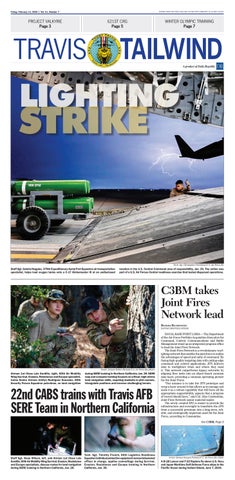
LIGHTING STRIKE

The Joint Fires Network is a revolutionary warfighting network that enables the joint force to realize the advantages of speed and unity of command. By fusing high-quality targeting data with cutting-edge command and control applications, JFN delivers data to warfighters when and where they need it. This network outperforms legacy networks by aligning fires tasks into an object-based common data layer, providing a common operating picture for the Joint Force.

“Our mission is to take the JFN prototype and wrap a layer around it that allows us to manage and scale it as a robust capability that will have all the appropriate supportability aspects that a program of record should have,” said Col. Alex Constantine, Joint Fires Network senior materiel leader.

The newly created IPO is meant to provide the infrastructure and oversight to transform the JFN from a successful prototype into a long-term, reliable, and strategically important asset for the Joint Force, according to Constantine.

Staff Sgt. Beau Wilson, left, and Airman 1st Class Luis Gordillo, 60th Air Mobility Wing Survival, Evasion, Resistance and Escape specialists, discuss routes for land navigation during SERE training in Northern California, Jan. 28.

TRAVIS AIR

BASE — The Army & Air Force Exchange is making Fridays even better for Travis military shoppers with its Free Friday giveaways.

Authorized Travis shoppers worldwide who comment on the Exchange’s Free Friday post each Friday at Facebook.com/Shop

MyExchange will be automatically entered to win trending products, including kitchen and housewares, furniture, power tools and more.

“Free Fridays provide Travis shoppers an easy way to participate in free giveaways,” said Travis Exchange General Manager Cathie Byrns.

“It is an honor to celebrate military shoppers all year long through the giveaways.”

In 2025, shoppers won nearly $25,000 in Free Friday prizes, including appliances, bedding, patio sets and more. Since the giveaway started in 2017, military shoppers

From Page 1

“The establishment of the IPO allows us to create structured interfaces and venues with the services and Joint Force that ensure integration of fires at the combatant command-level and below,” Constantine said. “We will be able to look at economies of scale, supportability, and warfighting efficiency as we continue to increase the footprint and capabilities of JFN.”

The future architecture of JFN will focus on how it delivers decision advantage to the Joint Force as well as how it feeds into the DAF Battle Network, by working collaboratively across the Department of War.

“The actual system itself touches multiple parts of planning, fires control, and execution,” Constantine said. “So, it will touch various aspects of the DAF Battle Network, but it’s really a tier 1 combatant command-oriented system that the planners and below at the lower echelons will use to collaboratively plan and execute fires.” Constantine said developing JFN in a joint environment contributes to its overall success as service members from each branch bring unique perspectives and expertise.

have won more than $185,000 in prizes.

Among 2025 winners is Daniel Duplichien of Keesler Air Force Base, an Air Force veteran with 22 years of service, who won a vacuum set.

“I’ve entered a few sweepstakes hoping to win,” Duplichien said. “Then suddenly, I won a Free Fridays giveaway –two vacuum cleaners. The standup one will soon replace my old one, then the other will be a gift to family or friends. Thanks, Free Friday giveaways.”

Free Friday giveaways are open to all authorized Exchange shoppers 18 and older, including honorably discharged and disabled veterans, and Department of War and Coast Guard civilians and retirees.

All comments made on the Free Friday Facebook post by 9:59 p.m. on the day of the post will be entered. Winners will be randomly selected and notified by Facebook message from the verified Facebook.com/ shopmyexchange account and/or email from social media@aafes.com.

Travis AFB hosts Honorary Commanders Induction Ceremony

“We have a Navy deputy and teammates from across the ser-

vices who bring technical interchanges together to ensure that we’re touching Army, Naval and Department of the Air Force equities holistically, as well as those of the relevant combat support agencies, to truly deploy a better system,” he said.

JFN’s development will utilize the DOW’s Software Acquisition Pathway 5,000.87 so servicemembers can develop and deliver the capability quickly.

“To ensure JFN remains adaptable and responsive to evolving threats, the program office is leveraging software acquisition pathway, an approach designed to streamline the capability delivery process,” he said. “Our approach balances agility with acquisition rigor to continue our rapid fielding efforts while we address supportability in manner tailored to the system’s needs as we move forward.”

The DAF Battle Network is the integrated system-of-systems connecting sensor, effector, and logistics systems enabling better situational awareness, faster operational decisions, and decisive direction to the force. It integrates roughly 50 programs of record across the department, ensuring resilient decision advantage needed by the Air Force, Space Force, joint and coalition forces to win against the pacing challenge. C3BM

Combat casualty care technology receives FDA breakthrough designation for the ‘AI-GUIDE’

59th medicAl Wing chieF ScientiSt’S oFFice, Science & technology

JOINT BASE SAN ANTONIO-LACKLAND, Texas — The Defense Health Agency director, Dr. David Smith, showcased a significant breakthrough in combat casualty care when he visited San Antonio, Texas, in April 2025, as the U.S. Food and Drug Administration granted Breakthrough Device Designation to the “AI-GUIDE” system, with researchers from the Massachusetts Institute of Technology’s Lincoln Laboratory.

This artificial intelligence-enabled system is designed to assist frontline medical personnel in establishing rapid and accurate vascular access in austere combat environments. The DHA supports this innovation through funding to create a system that helps frontline medical providers establish vascular access efficiently and precisely in combat zones with limited resources.

The AI-Guide (Artificial Intelligence-Guided Ultrasound Interventional Device) is a robotic medical technology developed by researchers at MIT’s Lincoln Laboratory. It is designed to assist frontline medical personnel – especially those in military or remote settings – in rapidly and reliably gaining vascular access (such as inserting an intravenous line or catheter) in high-stress, low-resource environments. The FDA Breakthrough Devices Program designation represents a significant achievement for battlefield medical care.

The FDA Breakthrough Devices Program accelerates the development and evaluation process for medical devices that deliver superior treatments for fatal medical conditions. Notably, Dr. Jason Rall and Col. Wayne Causey of the 59th Medical Wing-Science and Technology and the 959th Medical Group, Joint Base San Antonio-Lackland, supported MIT LL by col-

laborating under the Data Transfer Agreement with Brooke Army Medical Center, which enabled the AI-GUIDE project.

The AI-GUIDE device operates within a DHA research program that focuses on noncompressible torso hemorrhage because it represents the primary cause of preventable combat deaths in current military operations.

The identification of internal bleeding sources through invasive surgical exploration causes delays in administering life-saving treatments for NCTH. The DHA accelerated innovation by providing animal experiment data from swine models that simulated battlefield injuries to MIT LL. To accelerate innovation, the DHA provided MIT LL with a comprehensive data set from the 59th Medical Wing, derived from animal experimentation using swine models designed to simulate battlefield injuries. These data were collected to support an ongoing study titled “Local-

ization of Noncompressible Torso Hemorrhage Using. Minimally-Invasive Endovascular Techniques to Detect Battlefield Relevant Injuries.” The goal is to test and refine technologies capable of localizing internal bleeding without the need for surgical intervention.

Under Dr. Brian Telfer’s leadership, MIT LL is conducting advanced analysis and modeling to interpret these data. This work is expected to yield a final report and multiple technical outputs. Collaborators will also contribute to scientific manuscripts and presentations.

Courtesy file photos
Krish Ramadurai recites a pledge during the Honorary Commanders Induction Ceremony at Travis Air Force Base, Jan. 29. The program fosters relationships between military leaders and local civic partners.
Col. Brandon Shroyer, right, 60th Air Mobility Wing commander, gives a speech during the Honorary Commanders Induction Ceremony at Travis AFB, Jan. 29.
The Travis Air Force Base Honor Guard present the colors during the Honorary Commanders Induction Ceremony at Travis Air Force Base, Jan. 29.

Biomedical equipment technician maintains occupational safety excellence at Andersen

m

FALLS CHURCH, Va. — Occupational safety is crucial for improving readiness and mission execution, from setting safety standards and practices to fostering a proactive culture of risk management and injury prevention.

At Andersen Air Force Base, Guam, Tech. Sgt. Robert Bickelhaupt has been the go-to subjectmatter expert leading the base’s safety program since January 2021.

“In this program, if we find something that could be a hazard, we tackle it right away and do not wait for the mishaps to roll in first,” he said. “We ensure that fewer people are getting pulled out of the fight due to injuries that could easily have been prevented, and we acquire more efficient tools to get the job done.”

Andersen has incorporated these practices into readiness efforts at all levels, including Resolute Force Pacific 2025, a department-level exercise held in July that tested rapid-response Total Force capabilities in the Indo-Pacific region, including Guam, Hawaii, and Japan.

As section chief for healthcare technology management at the 36th Healthcare Operations Squadron, Bickelhaupt ensures all equipment used by medical providers is safe for patient use at Andersen AFB.

He manages a 23-member team that maintains 1,400 medical devices supporting a $104 million medical facility. He also oversees recall alert processing for 16,000 medical equipment assets across the Mariana Islands,

including war reserve materiel and detached medical functions.

“We started with just getting a pass on our wing inspection and improved each year,” he shared.

This year, under his guidance, Andersen AFB’s Wing Safety Office benchmarked the safety program as the gold standard for personnel training across the installation.

Noting Bickelhaupt’s dedication to warfighter safety and operational continuity, Col. Elizabeth Gibby, 36th HCOS Group Commander, nominated him for the Trusted Care Hero recognition.

“Tech. Sgt. Bickelhaupt leads our squadron with mission-ready precision,” Gibby said. “He has a relentless focus on safety and readiness, ensuring every person and every piece of equipment is prepared to support our warfighters when it matters most.”

A cross-service training effort mentioned in his nomination involved Bickelhaupt providing support to U.S. Navy partners in updating recall hazard alerts. The safety benefits went beyond medical units, helping air expeditionary wing goals during exercises, according to Gibby.

“Bick reflects selfless service to our patients and community,” she said. “He has a keen eye for gaps in compliance and safety regulations. He continuously maintains a pulse on the functionality of all equipment and facility mechanics while setting up all section safety monitors to embody these same values.”

Bickelhaupt joined the U.S. Air Force in 2014, motivated by

See Safety, Page 6

Project Valkyrie builds livesaving readiness across the Indo-Pacific

Senior A irm An JonAthAn r. SifuenteS 18TH WING PUBLIC AFFAIRS

KADENA AIR BASE, Japan — In the IndoPacific, where distance and logistics can challenge medical response times, U.S. service members are training to bring lifesaving care wherever the mission takes them.

The 18th Medical Group hosted Project Valkyrie, a joint-service medical training course focused on emergency blood transfusion procedures, at Kadena Air Base, Japan, Nov. 30, 2025.

The week-long course teaches military medical personnel how to safely collect and transfuse fresh whole blood in austere or resource-limited environments; a critical skill when time and resupply are limited.

“This training is crucial for our medics when they’re put in high stress environments where resources can be limited,” said U.S. Air Force 1st Lt. Darreauna Morris, 18th Medical Operations Squadron Project Valkyrie program manager. “It gives students the confidence and competence to perform these procedures when it matters most.”

Project Valkyrie blends classroom instruction with hands-on simulations, allowing trainees to perform emergency blood transfusions under realistic conditions. Each course culminates in tactical combat casualty care scenarios where participants apply their skills under pressure.

For this iteration, participants included medical personnel from the 18th MDG, 961st Airborne Air Control Squadron, Misawa

Air Base’s 35th Medical Group at Misawa Air Base, U.S. Army 1-1 Air Defense Artillery, and the U.S. Marine Corps 3rd Medical Battalion.

18th Medical Operations Squadron Project Valkyrie medical director. “Training together helps us learn each other’s language so we can operate more effectively as a joint force.”

In the Pacific theater, where vast distances, can delay access to traditional medical supplies, fresh whole blood transfusion is a proven life-saving measure for those suffering from hemorrhagic shock, the leading preventable cause of death in combat.

Project Valkyrie ensures that when emergencies happen far from hospitals or supply chains, medics are ready to respond decisively. The program not only sharpens clinical proficiency but also strengthens joint medical readiness across the Indo-Pacific.

“Each service approaches medical care differently based on their mission sets,” said U.S. Air Force Capt. Brittany King,

The joint training provided a shared baseline for emergency transfusion procedures and enhanced coordination across services. By learning each other’s terminology, methods, and capabilities, the teams improved their ability to operate as one cohesive medical force.

“This course builds the confidence and interoperability we need in real-world scenarios,” Morris said. “No matter the location or the service uniform, everyone here is focused on the same goal: saving lives.”

Senior Airman Jonathan R. Sifuentes/U.S. Air Force file photos (2025)
A Marine Corps marine assigned to the 3rd Medical Battalion draws tranexamic acid from a vial during Project Valkyrie at Kadena Air Base, Japan, Dec. 12, 2025. The
training enhances joint medical interoperability and ensures military medics are prepared to deliver lifesaving care in any environment.
Marine Corps marines assigned to the 3rd Medical Battalion apply pressure to a simulated injury during Project Valkyrie at Kadena Air Base, Japan, Dec. 12, 2025. Conducted monthly, the course equips combat medics, pararescuemen, and independent duty medical technicians with the skills to safely collect and transfuse blood in austere conditions.
Senior Airman Kory Paschal, 18th Healthcare Operations Squadron technician, wraps the head of a simulated patient during Project Valkyrie at Kadena AB, Japan, Dec. 11, 2025.
Courtesy file photo (2025)
Tech. Sgt. Robert Bickelhaupt, section chief of Healthcare Technology Management, 36th Healthcare Operations Squadron, leads an occupational safety training session at Andersen AFB, Guam, June 2025.

General officers forge flying proficiency at Nellis AFB

Staff

57TH WING PUBLIC AFFAIRS

NELLIS AIR FORCE

BASE, Nev. — In a powerful demonstration of leading from the front at every echelon, U.S. Air Force generals have taken to the skies here to reaffirm that command at every level is backed by the same core competencies demanded of every airman under their leadership, Jan. 9-15. Training sorties across the western region of the country occurred in the weeks leading up to and while the general officers were at Nellis Air Force Base, long considered the crown jewel of the Air Force, for the annual Weapons and Tactics Conference (WEPTAC) and Command and Control (C2) Summit. Key leaders who participated in flying operations included Air Force Chief of Staff Gen. Ken Wilsbach; Gen. Adrian Spain, commander of Air

Combat Command; Brig. Gen. David C. Epperson, U.S. Air Force Warfare Center commander (USAFWC) and Brig. Gen. Lawrence T. Sullivan, 57th Wing commander.

Flying 10,519 sorties in fiscal year 2025 alone, Nellis AFB is the epicenter of advanced airpower. It’s the home of the USAFWC and the U.S. Air Force Weapons School, in addition to the 2.9-million-acre Nevada Test and Training Range, which provides the stage for annual iterations of exercises such as Red Flag-Nellis and the department-level exercise Bamboo Eagle.

“Nellis is where we forge the future of airpower,” said Brig. Gen. David C. Epperson, USAFWC commander. “It’s an honor hosting our senior leaders here for WEPTAC and the C2 Summit, then having them step into the cockpit and lead from the front was a highlight for our airmen.

It provided our aircrew and maintainers the opportunity for two-way dialogue and to tactically interact with them. Now, more than ever, it is critical for leaders to stay connected to the fundamentals of the fight to ensure our force is ready to prevail at any given notice.”

By maintaining standards and technical excellence leaders show airmen what it means to have pride in their craft and strengthen the foundation of the force. Instilling a sense of pride is critical in each member as they generate airpower to support the joint fight.

“Flying allows senior leaders to stay connected to our warfighting mission,” Wilsbach said. “Every time I step to the jet, I’m immersed in daily operations and discover new obstacles airmen face that I can help remove. I only gain that insight by being present on the flightline.”

“It was an empowering experience to see our most senior leaders step to jets while tuning into operations,” said Senior Airman Christopher Hinds, 757th Aircraft Maintenance Squadron crew chief. “Knowing how busy they are, it meant a lot to me to witness the chief of staff hone proficiency and warfighter skills by flying in the lethal F-22 [Raptor].”

The presence of the general officers in the cockpit underscores a core principle of leadership, and ensures airmen are led by the most capable and combat-credible leaders. Their participation in these demanding flight operations serves as a clear message that readiness and tactical pro-

DRMC airmen support certification of instrument landing systems

Senior a irM an K aralyn DegraffenreeD

U.S. AIR FORCES CENTRAL PUBLIC AFFAIRS

U.S. CENTRAL COMMAND AREA OF RESPONSIBILITY — Airmen assigned to the Air Forces Central Deployed Regional Maintenance Center worked several weeks to support the commissioning and flight inspection of the 332nd Air Expeditionary Wing’s airfield instrument landing systems in the U.S. Central Command area of responsibility, Jan. 29.

The project focused on ensuring the airfield’s instrument landing systems met required standards for safe operations during periods of reduced visibility.

“We’ve been working throughout the last few weeks to commission a glide slope and complete

flight inspections through the Federal Aviation Administration to certify the instrument landing systems and ensure that they are safe for all pilots to use during inclement weather conditions,” said Tech. Sgt. Keenan Herlocker, DRMC noncommissioned officer in charge. “The glide slope provides a centerline path for the pilots to follow to the ground at the correct touchdown points established on the runways.”

Although the glide slope system was installed in 2023, required certification had not been completed due to circumstances that prevented a flight inspection from taking place. Due to more recent efforts, FAA pilots have been able to conduct flight inspections for navigation aids across the airfield.

See DRMC, Page 6

ficiency are maintained to the highest standard, from a four-star general to the most junior airmen.
Senior Airman Lauren Clevenger/U.S. Air Force file photos
Air Force Chief of Staff Gen. Ken Wilsbach and Senior Airman Christopher Hinds, 757th Aircraft Maintenance
Squadron crew chief, perform preflight procedures for a F-22 Raptor at Nellis Air Force Base, Nev., Jan. 15.
Air Force Chief of Staff Gen. Ken Wilsbach takes off in an F-22 Raptor at Nellis Air Force Base, Nev., Jan. 15. Wilsbach had the opportunity to fly and reaffirm the importance of technical excellence at all levels of leadership while visiting Nellis AFB.

621st Contingency Response Group, 22nd MEU Marines expand Caribbean airlift capabilities

1st Lt. Jessica McLaughLin 621ST CONTINGENCY RESPONSE WING

JOINT BASE MCGUIRE-DIX-LAKE -

HURST, N.J. — Airmen

from the 621st Contingency Response Group (CRG) recently collaborated with a Marine Mobile Air Traffic Control Team (MMT) from the 22nd Marine Expeditionary Unit (MEU) to significantly expand airlift capabilities in the Caribbean. The joint team surveyed and certified a C-130 landing zone on the island, opening the area to more mobility aircraft platforms.

This effort was a model of inter-service cooperation, with the 621st CRG airmen integrating with their Marine partners to share tactics, techniques, and procedures for landing zone operations. The collaboration created valuable synergy for future joint missions in the region.

Combat engineers from Battalion Landing Team 3/6, 22nd Marine Expe-

ditionary Unit (Special Operations Capable), delivered a major enhance-

ment to Camp Santiago’s operational infrastructure by constructing a

KC-130J Super Herculescapable runway. Their work required

precise surveying, grading, compaction, and surface preparation to meet the requirements of a C-130 landing zone, transforming an undeveloped stretch of terrain into a fully functional tactical airstrip. This engineering achievement fundamentally expanded Camp Santiago’s training and mobility capabilities, creating a direct link between ground forces operating in Puerto Rico and the MEU’s airlift platform. By enabling KC130J aircraft to land, refuel, and support distributed training events, 22nd MEU Marines effectively bridged the gap between land-based exercises and rapid, theater relevant lift capacity. Their work both strengthened forces’ ability to project combat power across the Caribbean and left a lasting imprint on the theater. In addition to the new

See 621st, Page 6

“The People of The United Methodist Church™”
Courtesy file photo
1st Lt. Brady Williams, 22nd Marine Expeditionary Unit Marine Mobile Air Traffic Control Team officer in charge, and Capt. Juan Niño, 621st Contingency Response Group
landing zone survey team lead, discuss the different requirements and criteria for landing zone surveys between the Marines and Air Force in the SOUTHCOM AOR.

Vietnam-era flight nurse champions veteran health

FALLS CHURCH,

Va. — Nearly six decades after joining the Air Force, Dr. Linda Spoonster Schwartz, a retired flight nurse and Vietnam veteran, continues to devote her life to veterans’ health advocacy.

Her perseverance to champion this cause is shaped by family history, her wartime efforts as a nurse, and her personal struggles accessing care as a medically retired veteran during a time when women in the military had less representation.

Schwartz’s dedication to the veteran community has influenced national policy, advanced recognition of women veterans, and strengthened care for the next generations who will serve. Since medically retiring in 1986, she has advocated for improving veteran access to mental health care, employment after service, housing, and financial assistance. She has received accolades from the Department of Veterans Affairs, Vietnam Veterans of America, and other veteran health advocacy organizations for her work.

Schwartz was assigned to Tachikawa Air Base in Japan – a critical casualty staging area for service members wounded in Vietnam. She said this assignment had a profound impact on her future.

the influx of patients with limited resources.

Despite the challenges, overcoming the obstacles and saving lives was what mattered. Medics and patients did what was needed to help one another survive.

Decisiveness in critical care

The beginning of her flight nurse career

Growing up with a father who served in the Navy during World War II, Schwartz felt called to military service. While in nursing school, she read a Reader’s Digest article about Air Force flight nurses, which compelled her to join.

In 1967, she joined the U.S. Air Force, setting her sights on the frontlines of patient care. Among her early assignments,

621st

From Page 5

landing zone, an engineering team from the 621 CRG deployed to conduct a critical pavement analysis, ensuring airfields are ready for contingency staging. The task force also surveyed two new drop zones, providing essential training locations for pararescue squadrons and boosting their proficiency for any emergency response scenario.

During operational lulls, the team conducted extensive academic refreshers on airfield criteria, operational procedures, and equipment fundamentals. This continuous training ensures that all personnel remain proficient and prepared for rapid deployment.

As U.S. Army soldiers and Army of the Republic of Vietnam forces fought a ground battle against the People’s Army of Vietnam in the A Shau Valley in 1969 – better known as the “Battle of Hamburger Hill,” Schwartz and her colleagues were tasked with treating treated waves of battlefield casualties from the conflict.

Schwartz said she and the available medical staff triaged and stabilized about 400 casualties overnight. The experience tested the staff’s resilience as they cared for

“Two casualties were helping each other carry another one who couldn’t walk,” she said, explaining that there were not enough litters and medical personnel to go around. “One had a sucking chest wound – it was so moving to see them help each other.”

These displays of strength in unity stayed with her years after the conflict, fueling her commitment to ensuring that veterans – from nurses to combat soldiers – receive the recognition and care they need after service.

Safety

From Page 3

generations of his family in military service, dating back to a great-granduncle who served during the Civil War.

“I wanted to carry on the family tradition,” he said, proudly stating that he is the first in his family to serve in the Air Force.

occupational health and safety experts in the field who set the standard for safety in support of warfighter readiness.

“Without us, medical facilities would not be able to take care of the thousands of patients who walk through their doors each month,” he said. “We take care of the home front so the ones that are in the combat zones can rest easy, knowing that

DRMC

From Page 4

Maintainers rely heavily on data gathered during flight inspections for ground calibrations because they cannot observe aircraft performance in the air. During these inspections, maintainers coordinate directly with inspection aircraft to make real-time system adjustments as needed to meet certification standards.

“Usually during a flight inspection, you’re on the

radio with the pilot, and they’ll give you numbers when they’re flying,” said Staff Sgt. Jessica Ayala, DRMC assistant noncommissioned officer in charge. “So, if you have to make an adjustment, you’re right there inside the equipment shelter and able to make those quick adjustments.” With the completion of the flight inspections, the 332nd AEW’s airfield instrument landing systems are now certified, ensuring pilots have reliable guidance when operating in reduced visibility conditions.

After Japan, Schwartz was assigned to Frank furt, Germany, where she served with her husband, who was also an airman. She provided aerial medical support on flights while traveling to strate gic outposts including Iran and Turkey.

“When you are 30,000 feet above the ocean, you can’t call a doctor,” she said, noting that nurses provided invaluable clinical lead ership on flights across oceans and into con flict. “We were educated and trained to be able to do those things,” she said, underscoring the autonomy and expertise required in the air.

See Nurse, Page 7

Josh Mahler/U.S. Air Force file (2025)
Military Women’s Memorial President Phyllis Wilson, left, speaks with retired Air Force Maj. (Dr.) Linda Spoonster Schwartz during the Department of Veterans Affairs Center
for Women Veterans Trailblazers ceremony at the Library of Congress in Washington, D.C., Sept. 25, 2025. Schwartz joined the Air Force nearly six decades ago.
Connecticut Veterans Affairs courtesy file photo (1967) Maj. (Dr.) Linda Spoonster Schwartz takes her oath upon joining the Air Force at a recruitment center in Idaho in 1967.
Senior Airman Karalyn Degraffenreed/U.S. Air Force file
Courtesy file photo (2024)
Tech. Sgt. Robert Bickelhaupt, healthcare technology management section chief, 36th healthcare operations squadron, holds an American flag with his wife, Tech. Sgt. Monica Bickelhaupt, a physical therapist technician, after his second reenlistment ceremony at the Andersen Air Force Base overlook in Yigo, Guam, April 2024.

For Schwartz, these were among the richest experiences of her life.

“It really gave me a great deal of pride in the mission of the Air Force, and the way in which nurses and people who fly can accommodate and challenge their ingenuity to be sure that the patient had the very best care,” she reflected.

From medical retirement to veteran advocacy

Schwartz’s military career came to an unexpected halt in 1983, when, as a reservist on a C-141 mission, the aircraft’s hatch blew off, and she suffered traumatic brain injury and spinal damage from rapid decompression. She medically retired due to her injuries but struggled to access the Veterans Affairs system for care.

“They really were not prepared for women,” she said, adding that it took more than three years to access veteran benefits.

“In a way, some of what I was seeing … I was looking at it with a nurse’s eye and saying, ‘this isn’t good enough.’”

The experience reframed her perspective and ignited in her a passion to advocate for women veterans.

Schwartz testified before Congress in 1987 on the status and concerns of women veterans alongside several female senior generals. She felt conflicted when they indicated that women veterans support was sufficient due to provision of beauty products and women’s clothing.

Schwartz challenged that narrative, “I’m saying to myself, ‘I can’t be here because they’re not gonna like what I’m gonna say.’”

Encouraged by the Vietnam Veterans of America director at the time, Schwartz delivered her first testimony recounting challenges accessing veteran benefits after medical retirement, and the lack of recognition and specialized care needed for women veterans who equally served their country.

In her written testimonial, Schwartz said, “This is not a mere question of money, cosmetics in the canteen, or the availability of services. Before us is a question of honor. How does a nation honor, how does a state honor, how does an individual honor the achievements, sacrifices, contributions of … its citizens who are women veterans?”

Through the years, she continued to testify as a woman veteran, helping to initiate lasting reforms, including the removal of quotas that restricted women’s roles in the

military and the dedication of the Vietnam Women’s Memorial.

“It’s a legacy of a generation. The women before us didn’t use the VA because they didn’t think they were veterans,” she said.

Impact of veteran advocacy through the years

Now, with nearly two decades of veteran advocacy, Schwartz reflects the same dedication she brought during her service. And her efforts to break down barriers continue to be acknowledged.

In September 2025, the VA’s Center for Women Veterans honored more than 30 veterans, including Schwartz, during its Women Veterans Trailblazers ceremony at the Library of Congress. The event celebrated women who served with distinction and who continue to shape the lives of veterans, their families, and caregivers after military service.

Within her role as the Connecticut Commissioner of Veterans Affairs from 2003 to 2014, she helped pioneer the “Have You Ever Served?” campaign. The VVA, AAN, and the National Association of State Directors of Veteran Affairs supported the effort, which was designed to inform service members and their families of the most common health concerns linked to military service. In 2013, President Barack Obama nominated her to serve as the Assistant Secretary of Veterans Affairs for Policy and Planning to lead veteran health efforts. Now, Schwartz continues advocating for the veteran and military nurse community as an active member of VVA and the American Academy of Nursing.

Fifty-eight years after starting her journey as a nurse in the Air Force, she said she’s witnessed a dramatic change.

“All nurses are educated on prioritizing the health of the patient,” she said, explaining that that has not changed. However, “Back in the day, we didn’t talk too much about death or transition. It was just what you did, and it was common among the nurses … now we talk about it.”

Schwartz said a significant improvement is the growing emphasis on mental health and holistic care.

Schwartz’s journey exhibits the resilience and devotion of an Air Force veteran who continues to advocate for the military community beyond service. Her recent trailblazer recognition underscores a lifetime committed to advancing military nurses and strengthening support for those who served.

Training for the mission, the 2026 Olympic medal

AVIANO AIR BASE,

Italy — U.S. Air Force

Staff Sgt. Kelly Curtis, a member of the 31st Fighter Wing Communications Squadron at Aviano Air Base, is preparing to represent Team USA on the world’s biggest stage for the second time at the XXV Olympic Winter Games.

Qualifying for the XXV Winter Olympics is brutally competitive. Only 232 U.S. athletes earned the right to represent the country in Milan-Cortina. NBC Olympics reported that thousands of athletes competed through years of races, rankings and trials for these spots. For Curtis, this moment is the culmination of years of discipline, sacrifice and resilience, both as an athlete and as an airman.

“When I first asked the Air Force [World Class Athlete Program] if I could be assigned to Aviano Air Base, the goal was always these Olympic games,” Curtis said. “Four years ago, I qualified for my first games in Beijing, but Milano Cortina was always the plan.”

Raised in a highly competitive household, Curtis grew up immersed in athletics. As the youngest of four siblings, she credits her upbringing and her father’s experience as a former NFL player for shaping her drive.

“I was always trying to keep up,” Curtis said. “I competed in everything: wrestling, track and field, softball, baseball and basketball. I never specialized in a specific sport early, and I believe that helped me more than anything.”

Curtis’s diverse athletic foundation eventually evolved from traditional collegiate sports to the bobsled, and ultimately the skeleton, an event that demands power, precision and fearlessness.

The skeleton is a highspeed winter sport where athletes race headfirst down an icy track on a tworunner sled. The athlete sprints at the start to gain momentum, then they lie on the sled, shifting their body weight and shoulders to steer. The International Bobsleigh and Skeleton Federation reported athletes can reach speeds of up to 93 mph and experience a gravitational force of up to 5Gs.

“The first time I went down a skeleton track, I instantly knew [it was for me],” Curtis recalled. “You learn a lot about yourself in one run.”

Her assignment to Aviano AB proved to be a massive turning point in her training. Stationed in northern Italy for more than four years, Curtis gained access to worldclass European training locations in places like Cortina and the Swiss Alps. Despite this new access to a plethora of off-site training locations, Curtis made sure she utilized her home turf to her advantage. On base, Curtis credits Aviano AB’s facilities and

support network, from the fitness centers and track to medical resources, for reinforcing the Air Force’s culture of fitness and readiness in her daily life.

“The Air Force has always valued fitness,” Curtis said. “For me, working out alongside other airmen reminds me that I’m not separate from the mission.”

Balancing Olympic-level training with military readiness wasn’t always easy. As a mother, non-commissioned officer and a world class athlete, Curtis describes her daily routine as a careful balancing act, one made possible by strong leadership and teamwork within the 31st CS.

“Staff Seargent Curtis’s ability to balance the demands of military service with world-class competition shows our airmen that anything is possible, so long as you’re passionate, dedicated and driven to reach a goal,” said Lt. Col Ryan Williams, 31st CS commander.

While leadership points to her example, Curtis points back to her team, emphasizing that their confidence in her allows her to carry the same focus and discipline from the workplace to the world stage.

“My leadership has been incredible,” Curtis said. “From my commander

down to my supervisor, they’ve been extremely accommodating while still ensuring I’m fulfilling all my responsibilities as an airman. Their trust frees me to focus when it’s time to perform.”

As the current points lead for skeleton on the U.S. team, Curtis prepares to carry more than her personal goals onto the frozen track. She also carries with her the weight of family legacy and representing the U.S. Air Force. Despite the pressure, Curtis remains grounded in the values that brought her to this point: discipline and resilience.

“After the games, I’ll be right back at Aviano AB doing my job,” Curtis said. “But for now, I have the privilege of representing the U.S. Air Force on the world stage, and I don’t take that lightly. At the end of the day, all I can do is prepare the best I can and put it together when it matters.”

Curtis hopes her journey inspires other airmen to pursue their own athletic ambitions.

“Reach out. Research Air Force sports and look into the Air Force World Class Athlete Program,” Curtis said. “There’s more support out there than people realize, from intramural sports all the way to the Olympics.”

Courtesy file photo (2025)
Staff Sgt. Kelly Curtis, 31st Communications Squadron knowledge operations technician, competes in the skeleton at the World Cup Bobsleigh and Skeleton at
Cortina D’ Ampezzo, Italy, winter 2025. Curtis will compete in the Milano-Cortina 2026 Winter Olympic Games as a skeleton slider.

Turn static files into dynamic content formats.

Create a flipbook
Travis Tailwind: February 13, 2026 by mcnaughtonmedia - Issuu