Travis Tailwind: April 3, 2026

Page 1


TRAVIS TAILWIND

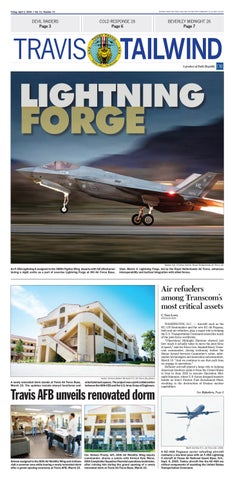
LIGHTNING FORGE

Travis AFB unveils renovated dorm

Wings Over Solano Airshow almost here

Hello, beautiful people. It’s your Travis AFB hypeman here.

We’re inside one month until the Travis AFB Wings Over Solano Open House and Airshow on April 25-26. Mark your calendar, rally your crew, and get ready for a weekend of jaw-dropping aviation and hometown pride.

In my best Michael Buffer voice:

“Are you ready?!”

I’ve been part of Travis airshows for several years, and I can tell you firsthand, what you experience over that weekend is the result of months of planning, teamwork, and some clutch, last-minute execution. The payoff? An event that welcomes more than 100,000 guests onto the base, and sends them home with a new appreciation for Travis AFB and the Air Force mission.

As your unofficial hypeman, here are three quick, superfun ways to get fired up right now, and a simple way to jump in and be part of the show, not just a spectator.

1) Turn the volume up. Open your favorite music service (e.g. iTunes, Spotify, Pandora, etc.) and search for “Wings Over Solano Airshow.” Yes! That’s right. There’s a “pump you up” song made just for our airshow. Put it on your playlist and share it with someone you’re bringing to the base.

2) Learn the dance and join the flash mob. There is also a specially choreographed line dance that goes with this song, and, if all goes as planned, we’re going big with a “flash mob” moment at the airshow

Refuelers

From Page 1

Reed told lawmakers during the hearing that refuelers are among the most critical assets in the Transcom inventory.

“Currently, the air refueling fleet is the most stressed fleet that we have,” he said. “But it is the one that I use the most to actually set the conditions to get the joint force on the move.”

The KC-135 Stratotanker was first introduced in the late 1950s. It is an aircraft that is still playing an important role for Transcom, though it needs modernization to remain a contributor to the command’s mission. Transcom is also using the newly introduced KC-46 Pegasus.

“For the KC-135 that we continue to fly, we appreciate the continued investment and sustainment and spare parts for it,” Reed said. “It is a fantastic plane.”

Right now, Reed said, Congress is funding efforts to address connectivity issues with

on Saturday and Sunday. Former Honorary Commander Kelly Bria choreographed the dance and has already been teaching it around the community. Want in? Your last chance to learn it before the airshow is April 18 at True Symmetry Brewing Company, 315 Marina Center, in Suisun City. You can also look up the dance at www.Copperknob.co.uk/ as “Solano Wings.”

3) To the Travis airmen making this happen: Thank you. For all the Capital “A” airmen involved in Wings Over Solano, and I know it’s nearly everyone: Thank you.

As a 30-year retired chief master sergeant, I could not be prouder of the professionalism and heart you bring every day to serving our nation and protecting our freedoms. This weekend matters because it connects our community to the mission, the people and the pride behind the uniform. So let’s go! Listen to the song, learn the dance, and bring your friends to Wings Over Solano. Let’s celebrate Travis AFB, the Air Force and America’s 250th birthday with a weekend that’s loud, proud and unforgettable. Until next time, be intentional, be the goodness and ladies and gentlemen, let’s welcome the United States Air Force Thunderbirds. Let’s go!

John Evalle is a retired U.S. Air Force chief master sergeant, who works in the Military Affairs Office, Travis Credit Union. jevalle@ traviscu.org.

the KC-135.

“Adversaries continue to advance in their ability to see us and to affect us,” Reed said. “With that, we continue to press for increased connectivity of [the] fleet, to be able to get information inside the airplanes, to the crew, so that they could see what’s happening around them, that I can give them direction and control and that they can be more responsive.”

As the Air Force continues to buy newer KC-46 Pegasus aircraft, older KC-135 Stratotankers will be retired, Reed said, adding that Transcom will always have enough refueling capabilities.

“Once we get to the current end of the buy [cycle of KC-46], we will still have about 300 KC-135s,” he said. “They will be close to 70 years old, and they will need some care. And so, whatever we do, we need to invest in the whole thing, because I need them all.”

Gary Edwards 60TH AIR MOBILITY WING

TRAVIS AIR FORCE

BASE — A kidney dona tion between Department of Defense colleagues highlighted the meaning of service before self after a chance meeting years earlier led to a lifesav ing outcome.

David Lin, 60th Civil Engineer Squadron deputy base civil engi neer, first met Amy Larson, Joint Munitions Command ammunition case manager, at the Tomb of the Unknown Soldier in Arlington National Cemetery during the Department of Defense Executive Leadership Development Program in August 2019. At the time, neither realized the sig nificance of that brief introduction.

Their connection began during a guided reflec tion exercise at the Tomb of the Unknown Soldier in Arlington, Virginia, where participants were encouraged to consider the meaning of sacrifice.

“We were asked to speak to the person beside us and have a conversation about sacrifice and what it meant to us individually,” said Lin. “Out of all those people, we happened to be sitting next to each other. There was no planning. It just happened.”

As one of 48 participants in the yearlong program, Larson remained alongside Lin throughout recurring training events across the United States and overseas, allowing that initial conversation to grow into a lasting friendship.

“The program lasted about a year, and we spent a lot of time together,” said Lin. “We traveled to places like Boston, Korea and Hawaii for training about a week each month. When you go through something like that, you build real connections. We shared the same values, the same sense of purpose, and we both loved food.”

Even after the program concluded, their connection continued and developed into one of mutual professional support, reinforced

ship evolved into a close personal bond.

In 2022, Lin’s sister’s kidney began to fail, creating an urgent need for a transplant and shifting his priorities both personally and professionally.

“He was excited about an opportunity in Hawaii,” said Larson. “Then he told me he withdrew his name because his sister was ill and needed a kidney transplant. That changed everything.”

As Lin navigated the uncertainty surrounding his sister’s condition, Larson began to consider how she could help.

Without hesitation,

California, went through testing at Stanford and

Although Lin’s sister ultimately received a kidney from another donor, Larson’s willingness to step forward reinforced the strength of their bond.

“She had already done more than anyone could expect,” said Lin. “But she

In 2025, Lin’s kidney function declined significantly, and doctors informed him he would

“Amy stepped forward

“I’m still here,” said Larson. “I want to help.”

Subsequent testing confirmed Larson was a match again, though Lin initially struggled to accept the

“At first, I told her no,” said Lin. “It’s a huge sacrifice. But she believed in Medical evaluation

Gary Edwards/U.S. Air Force file
David Lin, 60th Civil Engineer Squadron deputy base civil engineer, sits on a bench at Travis Air Force Base, March 25. Lin received a lifesaving kidney transplant in December 2025, facilitated by his close friend Amy Larson.
Courtesy file photo (2020)
Amy Larson, left, Joint Munitions Command ammunition case manager, and David Lin, 60th Civil Engineer Squadron deputy base civil engineer, pose for a picture during the Department of Defense Executive Leadership Development Program in Charleston, S.C., March 12, 2020.
John Evalle Hype Man

Travis AFB

brings Furby Furblets magic to Month of the Military Child

A

TRAVIS AIR FORCE

BASE – Military fami-

lies can flutter in for fun during Month of the Military Child at the Travis AFB Exchange.

Join the fun and create priceless memories with Furby Furblets coloring stations and toys including, Furby Furblets Chirp, Spirit, Swee-Dee and more, April 4 from 11 a.m. to 1 p.m.

General Manager Cathie Byrns. “The laughter, smiles and lasting memories that fill the Exchange remind us that even our youngest family members play an essential role in our nation’s success.”

Preregistration is not required. For more information, shoppers can contact the Travis AFB Exchange or visit the Travis AFB Exchange’s social media pages. Military families can visit the Exchange’s community Hub to for information on Month of the Military Child celebrations throughout April.

“Month of the Military Child is truly one of the most meaningful times of the year,” said Travis Air Force Base Exchange

and space needed to heal.

ultimately led doctors to pursue a paired kidney exchange, allowing Larson’s donation to support another patient while prioritizing Lin for a compatible transplant.

Larson donated her kidney Dec. 19, 2025, and Lin received his transplant days later.

As Lin prepared for surgery, members of Team Travis provided support and encouragement, reinforcing the strength of the community around him.

“Going into my surgery, it was scary. There’s no way around that,” said Lin. “But I felt incredibly supported. My leadership, my command team and my coworkers all reached out and made it clear I wasn’t facing this alone.”

Leaders at multiple levels emphasized the importance of focusing on recovery, Lin added, ensuring he had the time

Reflecting on the experience, both said the journey reinforced a broader understanding of service within the Department of Defense civilian workforce.

“This really reinforced that people matter,” Lin said. “Relationships matter, and sometimes the connections you make, connections you never expected, can change your life completely.”

For Larson, the experience reshaped how she defines service.

“Working in the Department of Defense, I’ve learned that service means showing up for one another in our most vulnerable moments, whether in uniform or as a civilian,” said Larson.

“Seeing a leader face such a challenge made me realize I had the power to change his story.”

“Service comes in many forms,” she added.

“For me, it was a chance to give a friend a second chance at life, and I’m honored to have been able to do it.”

Travis Air Force Base holds 2026 chief recognition ceremony

Devil Raiders open dialogue: Building family resilience for a high-risk mission

621st ContingenCy

Response Wing publiC A ffAiRs

TRAVIS AIR FORCE

BASE — Acknowledging its inherently higher-risk global mission, the 621st Contingency Response Wing hosted its firstever Family Readiness Town Hall & Social on March 25 at Joint Base McGuire-Dix-Lakehurst, New Jersey, and March 31 at Travis Air Force Base.

The pioneering forum was designed to directly address unique challenges by establishing an open dialogue between wing leadership and the families who form the backbone of the “Devil Raider” mission.

The driving force behind the town hall was a clear and sobering philosophy articulated by Col. Justin Ballinger, 621 CRW Commander.

“My true north has always been to pin medals on service members’ chests, not hand a folded flag to their families,” he said.

This guiding principle was the event’s cornerstone, shifting the focus to proactive readiness by creating a space to tackle difficult conversations and equip the community with the tools needed long before a crisis occurs.

To facilitate this, the town halls featured panels of experts from within the wing to include intelligence

officers and first sergeants. They were joined by the chaplain corps, the judge advocate general’s office, and key base partners like the Military & Family Life Counselor (MFLC) and the

Military & Family Readiness Center (MFRC). After their briefings, the entire panel opened the floor for a candid Q&A session with leadership.

The event drove home

Senior Airman Robert Nichols/U.S. Air Force file photos
Chief Master Sgt. Laura Hoover, right, 60th Air Mobility Wing command chief, delivers remarks alongside Col. Nelson Prouty, 60th AMW deputy commander, during
the 2026 Chief Master Sergeant recognition ceremony at Travis Air Force Base, March 27. The ceremony recognized 18 new Chief Master Sergeants.
Chief Master Sgt. Mary Kathleen Olaes, middle, 82nd Aerial Port Squadron aerial port manager, walks under the cordon of honor with her father, retired Chief Master Sgt. Rogelio Olaes, and mother, Jojina, during the 2026 Chief Master Sergeant recognition ceremony at Travis Air Force Base, March 27. Chief Master Sergeant is the highest enlisted rank in the U.S. Air Force and only one percent of the total force can hold the rank at any given time.
Chief Master Sgt. Alan Wood, right, 349th Aircraft Maintenance Squadron senior enlisted leader, shares a salute with Col. Patrick Brady-Lee, 349th Air Mobility Wing commander, during the 2026 Chief Master Sergeant recognition ceremony at Travis Air Force Base, March 27.
a critical message: for the CRW, readiness is not a goal; it is a standard – and that standard begins at home.
Tech. Sgt. Luke Kitterman/U.S. Air Force
Col. Justin Ballinger, 621st Contingency Response Wing commander, right, his wife, Leslie Ballinger, middle, and Chief Master Sgt. Jarrod Getz, 621 CRW command chief, introduce themselves and welcome attendees to the 621 CRW Family Readiness Town Hall event at Travis AFB, Tuesday.
See Devil, Page 7

101st Airborne Division tests next-generation drones

Ky.

— The 101st Airborne Division tested its ability to integrate unmanned aircraft systems to support ground forces during a livefire exercise, March 12, at Fort Campbell, Kentucky.

“We are no strangers to innovation here on Fort Campbell,” said Army Brig. Gen. Travis McIntosh, deputy commanding general of operations for the division. “Drones are reshaping the geometry of the battlefield in real time and we must adjust. Distance and sanctuary no longer provide the protection they once did, and mass and speed of decision-making will increasingly be enabled by autonomy and [artificial intelligence]. This event tested and proved these assumptions for us.”

Advancing Secretary of War Pete Hegseth’s directive for drone dominance, the division used UAS operators assigned to its 1st Mobile Brigade Combat Team, 2nd Mobile Brigade Combat Team and 101st Combat Aviation Brigade to fly multiple UAS alongside the 5th Special Forces Group.

The sortie, which consisted of an MQ-1C Gray Eagle, C100 small UAS and Attritable Battlefield Enabler 1.01 drone, provided aerial clearance for the Special Forces soldiers during the exercise.

“Drones are a great tool for over-the-hill reconnaissance,” said Army Spc. Basil Holland, an infantryman and small UAS operator assigned to the 1st Battalion, 502nd Infantry Regiment. “They have a lot of ability to identify short- and medium-range targets and get eyes on whatever you need. It’s proven to be super useful.”

U.S. Army Reserve Command representatives attended to learn more about how the 101st incorporates emerging technologies.

“We wanted to get a clear understanding of how the big Army is integrating UAS,” said Sammy Stevens, a counter-UAS lead planner for USARC. “We want to try and replicate their efforts with the [Army] Reserve. During counterinsurgency operations, everyone was used to looking down to identify improvised explosive devices; now we have to look up in the air.” Partnering with USARC highlights the division’s commitment to improving lethality for the entire Army.

“The 101st has been very gracious in supporting

us,” said Army Master Sgt. Bryan Pettaway, USARC senior enlisted advisor for operations and logistics.

“By showing us what has worked, and what hasn’t, they have helped us avoid those same mistakes.”

The exercise validated the division’s ability to operate UAS in a kinetic, multidomain setting. This successful pairing of systems and soldiers ensures the 101st Airborne Division remains at the forefront of Army transformation efforts.

“Today’s demonstration

was a direct answer to the secretary of war’s directive,” said Army Chief Warrant Officer 2 Page Frazier, the exercise coordinator and member of the 101st Robotics and Autonomous Integration Directorate. “We did some unorthodox things and always made first contact with a machine. ... And I don’t think any other exercise has done that. We leveraged modern technology to set conditions for a safe employment of a ground force.”

“I am superbly proud of

the teamwork, from both the operational and institutional sides of the Army, as well as the conventional [forces] and Special Forces on Fort Campbell,” McIntosh said. “This exercise demonstrates one of the many ways we will dominate in tomorrow’s fight.”

SHEPPARD AIR FORCE BASE, Texas —

An airman was sentenced to life in federal prison, Feb. 27, following a guilty plea to abducting and sexually abusing a 14-year-old girl, officials said.

The airman, Travis Robert Larson, was assigned to Sheppard Air Force Base, Texas, when he was initially indicted in Aug. 2025 and pleaded guilty three months later to one count of enticement of a minor and one count of sexual abuse of a minor.

According to court documents, the case began May 4, 2025, when a father reported his daughter missing to the Colorado Springs Police Department. The father located messages on the teen’s phone that indicated Larson had communicated with her and planned to travel from Texas to Colorado to pick her up.

From there, investigators obtained surveillance footage showing Larson with the girl and tracked his vehicle traveling overnight between Texas and Colorado, May 3-4, 2025.

Prior to this, Larson, aware of the victim’s age, had communicated with the girl online for several years before arranging in-person meetings, according to prosecutors.

According to the Justice Department, after picking up the child during the early morning hours of May 4, Larson drove her back to Texas without returning to her home.

On May 5, 2025, members of the 82nd Security Forces Squadron, working in coordination with Special Agents from AFOSI Det. 411, located and safely recovered the child near Larson’s dorm room on base property.

During the investigation, Special Agents coordinated with local and federal authorities, including the Colorado Springs Police Department, the Texas

Department of Public Safety and the Federal Bureau of Investigation.

Investigators with AFOSI Det. 411’s Major Crimes team conducted numerous interviews and used multiple techniques during the case, said Special Agent Thomas Cauthen, the detachment’s commander. Those techniques included closed-circuit television footage, license plate reader data, forensic DNA analysis, cell phone data, digital forensics, credit card transactions, military dorm access logs and fingerprint analysis, he said.

“Det. 411’s Major Crimes team leveraged investigative tools that reconstructed the suspect’s movements and corroborated the victim’s account,” Cauthen said. “The coordination between military, local and federal partners was instrumental in ensuring the child was safely recovered and the evidence was preserved for prosecution.” Officials said the case underscores the risks minors face online. According to the National Center for Missing and Exploited Children, reports of online enticement rose sharply in recent years as children increasingly use digital platforms.

According to Cauthen, the case highlights the importance of proactive engagement in online safety.

“Special Agents see firsthand how offenders use digital platforms to groom and exploit minors,” Cauthen said. “Awareness and early intervention are critical to prevention. We urge families to remain engaged and proactive to best protect their children.”

Assistant U.S. Attorneys Allyson Monte and Stephen Rancourt prosecuted the case. The case was brought under Project Safe Childhood, a DOJ initiative launched in 2006 to combat child exploitation through coordinated federal, state and local enforcement efforts.

Sgt. Parris Kersey/U.S. Army file
Spc. Basil Holland of the 101st Airborne Division prepares a C100 small unmanned aircraft system for a live-fire exercise at Fort Campbell, Ky., March 12. The
Spc. Sandy Vera/U.S. Army file
A soldier assigned to the 101st Airborne Division operates an unmanned aircraft system by using a headset during a live-fire exercise at Fort Campbell, Ky., March 12.
Sgt. Parris Kersey/U.S. Army file Soldiers assigned
Airborne Division prepare
1.01 drone
Campbell, Ky., March 12.

Army tests APEX Counter-UAS round in Arizona

U.S. ARMY YUMA PROVING GROUND

U.S. ARMY YUMA PROVING GROUND, Ariz. — The Yuma Test Center at U.S. Army Yuma Proving Ground, Arizona, recently tested a new 30 mm Aviation Proximity Explosive round, primarily developed for firing from the AH-64 Apache helicopter.

The APEX closely resembles the fielded M788 training round and M789 high explosive dualpurpose round.

Walter McCormick, a test officer at the proving ground, explained that the APEX is designed to integrate with the existing M230 gun already mounted on the Apache.

“The APEX round was developed to be a [fragmented] round that would [explode] in front of the [unmanned aerial system] and make a [small] pattern that would take out a UAS,” McCormick said, adding that the need for counter-UAS solutions is urgent.

In recent years, the UAS has become the weapon of choice on the battlefield, as seen in Ukraine and Russia. Army Secretary Daniel Driscoll is pushing for the Army to focus its efforts on UAS and counter-UAS technology. In fact, the Yuma Test

Center has been designated as the primary, dedicated interagency counter-small UAS test and training range.

During testing, the center performed two subtests: the first to assess and compare it with the legacy M789 rounds, and

the second test was to engage a UAS. Crews fired approximately 1,200 rounds across the two variants at both short and long ranges.

“We engaged a couple [of] different UASs and a few different ground targets,” McCormick said.

Yuma Proving Ground has nearly 2,000 square miles of restricted airspace and yearround sunshine, which makes it ideal for aerial testing.

“They have done ground testing at other ranges. The problem is they don’t have the land or airspace to do aerial

firing from a helicopter. So, that’s a big benefit. Plus, all the unique instrumentation YPG offers,” McCormick said.

During the APEX test, the proving ground used its full arsenal of support capabilities to collect data, including airto-ground assets such as chase pilots from UH-60 Black Hawk helicopters flying overhead for scoring, tracking mounts, telemetry, high-speed video, still photographers and data collectors.

These assets are readily available to industry partners testing at the proving ground.

“The Black Hawk was used primarily for overhead [scoring], so we can assess where rounds are impacting based on [the] firing point of the aircraft. The other benefit of surrounding ground camera angles was having a 360-[degree] view of the situation,” McCormick said.

The next step for the APEX is to undergo airworthiness release based on the current test results. This will provide a safety release for the APEX to be fired from Apaches by soldiers when rounds are available. The airworthiness release is a milestone on the road toward materiel release and fielding.

CA www.1ag .com

Email: o ce@northhillsvv.org

Website: www.northhillsvv.org Service

“The People of The United Methodist Church™”
Courtesy photo/U.S. Army
A new 30-mm Aviation Proximity Explosive (APEX) round undergoes a test at the Yuma Test Center at the U.S. Army Yuma Proving Ground, Ariz. “The APEX round was developed to be a frag round that would prox in front of the UAS [unmanned aerial system] and make a frag pattern that would take out a UAS,” Test Officer Walter McCormick said.

Airman-built 3D model strengthens air traffic controller training

Senior a irM an iM ani WeSt 19TH AIRLIFT WING

LITTLE ROCK AIR FORCE BASE, Ark. — Airmen assigned to the 19th Operations Support Squadron at Little Rock Air Force Base, Arkansas, are taking a creative approach to training the next generation of air traffic controllers by developing a detailed 3D model that visually represents aircraft patterns and procedures used at the installation.

The innovation demonstrates how airmen are leveraging emerging technologies and creative problem-solving to improve training and operational readiness.

scenarios more accurately. The enhanced visualization helps trainees better understand aircraft spacing, sequencing and potential conflict areas.

Perry used a 3D modeling program to build his creation, but he made it by manipulating shapes to create detailed designs. After designing each component digitally, Perry prepared the parts for printing and produced them using multiple 3D printers available at the base innovation lab.

The process required careful planning, preparation and experimentation.

STATION, Norway — U.S. Air Force airmen, alongside Norwegian and allied partners, successfully concluded participation in exercise Cold Response 26, a Norwegian-led multinational training event designed to enhance collective defense, sharpen warfighting skills and reinforce deterrence capabilities in the high north.

The exercise brought together more than 25,000 military and civilian personnel from over a dozen NATO nations across all domains operating from locations throughout Norway, Sweden and Finland. U.S. Air Force forces integrated with allies to execute highintensity scenarios that tested interoperability and readiness in harsh Arctic conditions.

“During Cold Response, we are able to help strengthen the alliance by practicing and integrating with the other partners, from the mission planning to the actual execution at the squadron level,” said U.S. Air Force Lt. Col. Dustin Merritt, 493rd Fighter Squadron commander.

F-35A Lightning IIs from the 48th Fighter Wing, RAF Lakenheath, United Kingdom, operating out of Ørland Air Force Station, Norway, flew alongside Royal Norwegian Air Force F-35s

A Finnish Air Force pilot and U.S. Air

understanding and the long-standing partnership between allied nations.

assigned to the 123rd Luftving, integrating advanced fifth generation fighter capabilities across allied forces. Together they conducted demanding training, including complex night operations, to strengthen collective combat capability.

The air combat picture was further enhanced by Finnish Air Force F/A-18 Hornets, from the 211th Fighter Squadron, and Swedish Air Force JAS 39 Gripens from Karelia Air Wing, expanding the scope of multinational integration and reinforcing allied interoperability in complex and challenging scenarios.

Enabling these sustained air operations, KC-135 Stratotankers assigned to the 100th Air

Refueling Wing, based at RAF Mildenhall, United Kingdom, provided aerial refueling support, extending the range and endurance of U.S. and allied aircraft.

“Air-to-air refueling is an inherently a dangerous job because you’re flying two or more airplanes very, very close together in proximity, so it takes a lot of preplanning, mission planning and coordination prior to, and good communication with our NATO allies and partners,” said U.S. Air Force Capt. Jeff Chae, KC-135 pilot, with the 100th ARW. “Overall, I think the exercise really helps us to practice what we play and strengthens the NATO alliance, making us a more cohesive and capable force.”

Complementing this capability, HC-130J Combat King II aircraft assigned to the 23rd Wing, stationed at Moody Air Force Base, Georgia, also conducted in-air refueling with Swedish Air Force JAS 39 Gripens, expanding the reach and flexibility of multinational combat air operations.

In addition to refueling, HC-130J crews also supported combat search and rescue missions alongside airmen assigned to the 56th and 57th Rescue Squadrons, from Aviano Air Base, Italy. From Bardufoss Air Station, these units trained with Swedish Air Force Rangers to execute personnel recovery operations in austere

See Cold, Page 7

The immersive training tool was designed and produced by Air Force Airman Jay Perry, 19th OSS air traffic control apprentice. It provides a scale representation of the base’s airspace and flight patterns. The project was inspired by an idea from Air Force Tech. Sgt. Ryan Sanders, 19th OSS noncommissioned officer in charge of training and standardization.

Traditional training methods often rely on instructors holding model aircraft or cards to demonstrate aircraft positions and movements. While effective, the approach can make it difficult for visual and tactile learners to fully imagine spacing, conflict points and maneuvering patterns.

“This model allows us to physically show where aircraft may break in the pattern, extend downwind or maneuver differently,” Sanders said. “It helps airmen understand when conflict may exist or when it doesn’t, based on the flight path.”

The model re-creates the installation’s airspace layout at scale and uses magnets to hold miniature aircraft in place, allowing instructors to demonstrate real-world

“Everything started from a single block in the design software,” Perry said. “Each piece had to be separated and designed in a way that it could be printed and assembled later. It might look simple when you see the final model, but a lot of thought went into making sure the supports, slopes and connections would actually work.”

One of the biggest challenges was ensuring the model could support its own structure at the scale required to accurately represent the airfield. The team experimented with different stand designs and angles to create a realistic yet durable layout.

By transforming abstract training concepts into a physical, visual model, the 19th Operations Support Squadron is helping trainees better grasp the complexities of airfield operations. This ensures controllers are better equipped to manage the skies above the base.

The project also highlights a broader culture of innovation across the installation, where airmen at every level are encouraged to identify challenges and develop solutions that enhance mission effectiveness.

Staff Sgt. Elizabeth Davis/U.S. Air Force file
Force Staff Sgt. Jose Maldonado Cruz, 493rd Equipment Maintenance Squadron aircraft structural maintenance craftsman, discuss flying a Finnish Air Force F/A-18C Hornet aircraft at Ørland Air Force Station, Norway, March 13. Exercise Cold Response 26 leveraged decades of combined experience, mutual
Senior Airman Imani West. U.S. Air Force file Tech. Sgt. Ryan Sanders, left, and Airman Jay Perry, stand behind a 3D model to simulate aircraft movement at Little Rock AFB, Ark., March 6.

Staff Sgt. Elizabeth Davis/U.S. Air Force file

A Finnish Air Force member and U.S. Air Force Staff

Sgt. Martin Stiller, 493rd Fighter Generation Squadron tactical aircraft maintenance specialist, discuss elements of a Finnish Air Force F/A-18C Hornet aircraft assigned to the Karelia Air Wing at Ørland Air Force Station, Norway, March 13.

Cold

From Page 6

Arctic conditions. Using HH-60W Jolly Green IIs from the 56th RQS, the integrated team conducted hoist, rappelling and simulated recovery missions, strengthening their ability to locate, treat and extract isolated personnel.

Sustaining U.S. Air Force operations, maintainers across all participating units ensured aircraft survivability and mission readiness despite extreme Arctic conditions. Working in freezing temperatures, high winds, rain and snow, they kept aircraft mission-capable across the Arctic, enabling air-

Page 3

To help families uphold it, the wing chaplain offered a powerful mindset for navigating hardship, framing challenging periods as a “life season vs. a life sentence” type mindset shift. This perspective serves as a tool for personal resilience, reinforcing the idea that even difficult times are temporary phases that can be weathered.

The impact was felt

crews and rescue crews the ability to execute complex missions.

Together, these efforts demonstrated NATO’s ability to rapidly deploy, integrate and sustain combat-ready forces in the high north, reinforcing a unified and capable defensive alliance. By strengthening stability in a vital region of the European theater, Cold Response enhances the ability to defend the homeland by deterring potential threats before they reach U.S. borders.

“By exercising in Cold Response, the ability to execute missions rapidly and flexibly is one of the byproducts of this,” Merritt said. “It sends a message that we’re ready as part of NATO to deter and defend whatever we need to when the time arises.”

immediately. One Key Support Liaison (KSL) in attendance noted that in her many years as a military spouse, this was the first time she had ever experienced an open forum with such direct access to wing leadership. By confronting the toughest aspects of military life head-on, the 621 CRW’s inaugural bi-coastal town hall did more than just disseminate information; it built trust, fostered resilience, and affirmed the wing’s deepest commitment of taking care of its people.

18th Medical Group showcases expeditionary capabilities

KADENA AIR BASE, Japan — U.S. Air Force Brig. Gen. John Gallemore, 18th Wing commander, and Chief Master Sgt. Will Cupp, 18th Wing command chief, visited 18th Medical Group during a tour of the Expeditionary Medical Support System facility as part of a USAF-led operational exercise, Beverly Midnight 26 at Kadena Air Base, Japan, March 10.

During the visit, 18th Medical Group airmen and Forward Resuscitation Surgical Team members from the 3rd Marine Logistics Group, 3rd Marine Expeditionary Force briefed wing leadership on EMEDS capabilities and demonstrated patient care procedures using a simulated casualty scenario.

internal medicine medical director with the 18th Healthcare Operations

Squadron. “This exercise gives our airmen the opportunity to understand

what will be expected of us in a contested environment and how quickly we must be ready to care for trauma patients.”

Establishing the EMEDS facility during Exercise Beverly Midnight 26 tested rapid-response capabilities and helped prepare medical personnel for potential regional contingencies while reinforcing the 18th Wing’s ability to provide lifesaving care anytime and anywhere.

Exercise Beverly Midnight 26 provides an opportunity to strengthen readiness and enhance coordination among U.S. forces operating in the Indo-Pacific region.

EMEDS enables the rapid deployment of mobile medical treatment facilities, allowing medical personnel to provide care in austere or contingency environments.

“This location serves as a secondary site where we can receive and treat patients,” said U.S. Air Force Staff Sgt. Cheree Voto, an operational medical technician assigned to the 18th Operational Medical Readiness Squadron. “If an emergency occurs, we want to ensure we are fully prepared and ready to respond.”

The exercise also provided airmen with hands-on training in a high-tempo operational environment.

“Understanding how to build and operate a medical facility from the ground up is critical,” said U.S. Air Force Capt. Daniel Shields,

Airman 1st Class Amy Kelley/U.S. Air Force file
Navy Cmdr. Henry Sander, 3rd Medical Battalion anesthesiologist, 3rd Marine Logistics Group, center right, briefs Air Force Brig. Gen. John Gallemore, 18th Wing commander, during exercise Beverley Midnight 26 at Kadena Air Base, Japan, March 10.

Turn static files into dynamic content formats.

Create a flipbook