Travis Tailwind: April 24, 2026

Page 1


TRAVIS TAILWIND

Secretary of the a ir force Public a ffairS

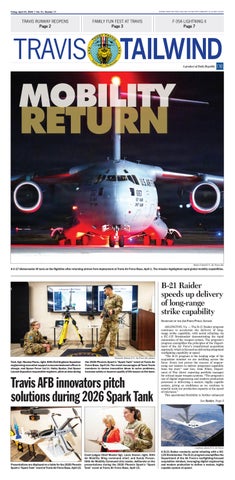
ARLINGTON, Va. — The B-21 Raider program continues to accelerate the delivery of longrange strike capability, with aerial refueling via a KC-135 Stratotanker demonstrating the rapid maturation of the weapon system. The program’s progress exemplifies the principles of the Department of the Air Force’s transformed acquisition approach, which is focused on delivering integrated warfighting capability at speed.

“The B-21 program is the leading edge of the acquisition mindset we are instilling across the force. Every test proves the success of empowering our leaders to deliver integrated capability from the start,” said Gen. Dale White, Department of War direct reporting portfolio manager for critical major weapon systems. “The program’s use of digital engineering and modern production processes is delivering a mature, highly capable system, giving us confidence as we continue to smartly scale our production capacity at the speed of relevance.”

This operational flexibility is further enhanced

See Raider, Page 3

Hello, beautiful people. It’s your Travis AFB hypeman here. You made it through April, and let’s be honest, it was busy. For many of you, it proba bly felt like that famous scene in “Raiders of the Lost Ark” where Indiana Jones barely outruns the giant rolling boulder. Except in real life, it never seems to be just one boulder. You make it through a major dead line, event, ceremony, or family commitment only to glance at your calendar and see another one already rolling toward you. If this sounds familiar, you’re not alone.

complex efforts into smaller, manageable steps with realistic timelines and clear deliverables. While multiple tasks may move forward in parallel, give your full atten tion to one priority at a time. Focus creates progress, and progress reduces stress. Momen tum builds confidence.

For military members – and especially military leaders – this constant pressure is incredibly common and a major source of stress. The good news? There are practical ways to manage the pace without letting it manage you.

First, prioritize your tasks. If you’re not the one assigning the work, your leadership should be establishing priorities for you, but sometimes clarity gets lost. If you’re unsure what task truly comes first, ask. Seeking alignment shows professionalism and prevents wasted effort. For personally assigned or self‑created tasks, let your values guide your priorities. Family, faith, work and service often compete for limited time and energy. Decide in advance what matters most and let those priorities shape your daily choices. Golden Nugget: Make sure your loved ones aren’t just getting your leftovers.

Second, one bite at a time. An all‑you‑can‑eat buffet can only be consumed one bite at a time, and large projects are no different. Break

Finally, control your response. Let go of what you can’t control. Avoid carrying stress for things that aren’t your respon sibility. And don’t exhaust yourself worry ing about the “What if” outcomes that haven’t happened yet. Strong communication keeps teams aligned and prevents small issues from turning into major problems. Communicate early and often. And if you have the opportunity to build a team, surround yourself with excellence; hire high performers who elevate the mission. Set clear expectations. Delegate intentionally. Hold people account able. And if something isn’t working, address it professionally and adjust course. No stress. Serving in the Armed Forces is demanding. The pace is real, the expectations are high and the boulders never fully stop rolling. But with clear priorities, focused effort, and the right mindset, they don’t have to crush you. So until next time, be intentional, be the goodness and don’t let that next rolling boulder steal your peace.

John Evalle is a retired U.S. Air Force chief master sergeant, who works in the Military Affairs Office, Travis Credit Union. jevalle@ traviscu.org.

Gear up for Marvel RolePlay Day at the Travis BX

a Rmy & a iR foRce exchange seRvice public a ffaiRs

TRAVIS AIR FORCE

BASE — Get ready to suit up for action and join the Travis Exchange for some serious Month of the Military Child fun.

Military families can visit the BX with their little heroes from 11:00 a.m. to 1 p.m. on April 25 for a day of Mar vel themed role play with toys including the Venom Versus Venom Strike Blaster, Star Wars Light saber, Fantastic 4 Hero Brocade and more.

Travis Air Force Base celebrates opening of renovated runway

$3,000

in gift

cards up for grabs in Travis Exchange pet photo contest

a Rmy & a iR foRce exchange seRvice public a ffaiRs TRAVIS AIR FORCE

BASE — Attention Travis shoppers. It’s time to show case those patriotic pets.

General Manager Cathie Byrns said. “This photo contest is a great way to appreciate the companions that our soldiers, airmen, Guardians and military families cherish.”

ties twofold. The

repair was a collabora tive effort between the 60th Air Mobility Wing, the Air Force Civil Engi neer Center, Baldi Bros. Construction and the Environmental Chemical Corporation. The project involved 220,000 labor hours, 450,000 tons of concrete recycled, and 140,000 plus cubic yards of new con crete placed.

“These children are dressing up as their favorite heroes while, in many ways, serving as heroes themselves,” said Travis Exchange General Manager Cathie Byrns. “As we close out this year’s Month of the Mil itary Child celebration, we’re reminded that the households of our nation’s service members are filled with superheroes.”

The Patriot Pet Just Say “Treat” Photo Contest, from the Army & Air Force Exchange Service and Hills Pet Nutrition, offers participants the oppor tunity to win a share of the $3,000 in Exchange gift cards.

Preregistration is not required. For more information, shoppers can contact the Travis Exchange or visit the Travis Exchange’s social media pages. Mil itary families can visit the Exchange’s commu nity Hub for information on Month of the Mili tary Child celebrations throughout April.

From May 1 through May 31, eligible Exchange shoppers 18 years and older – including honor ably discharged veterans, Department of War and Coast Guard civilians and retirees – can submit a patriotic photo of their pets to ShopMyExchange. com/sweepstakes for a chance to win.

“Pets are beloved members of the family that bring joy into our lives,” Travis Exchange

Two grand prize winners will each receive a $500 Exchange gift card. Eight runners up will each receive a $250 gift card. No purchase is neces sary to enter. Contest rules can be found at ShopMyEx change.com/sweepstakes. Winners will be selected on or around June 12.

TRAVIS TAILWIND

John Evalle Hype Man
Col. Brandon Shroyer, 60th Air Mobility Wing commander, delivers remarks during the runway ribbon cutting ceremony on the flight line at Travis Air Force Base, Monday.

Ken. Kassens/U.S. Army file

A competitor in the 17th Annual United States Army Special Operations Command (USASOC) International Sniper Competition shoots a rifle at multiple longdistance targets on a range at Fort Bragg, N.C., March 18. Seventeen teams competed in the USASOC International Sniper Competition where instructors from the United States Army John F. Kennedy Special Warfare Center and School designed a series of events that challenged the two-person teams’ ability to work together while engaging various targets at different distances for speed and accuracy.

Joint Force comes together for special operations sniper competition

N.C.

— In a demanding test of precision, endurance and teamwork, 17 elite sniper teams participated in the U.S. Army Special Operations Command International Sniper Competition at Fort Bragg, North Carolina, March 15-19.

The U.S. Army John F. Kennedy Special Warfare Center and School hosted the competition, now in its 17th year. Special Forces sniper course instructors and leadership designed the various challenges and served as officials and scorekeepers.

“This competition represents the pinnacle of the sniper craft,” said Army Col. Simon Powelson, commander of the 2nd Special Warfare Training Group. “We have brought together highly trained teams from across the joint force and partner nations. These competitors are not just here by chance; they are the product of intense and specialized training within their respective units.”

The five-day event included special operations forces representing multiple allied nations with participants drawn from the ranks of Army Special Forces, Army Rangers, Naval Special Warfare Command, Marine Forces Special Operations Command and Coast Guard units. Designed to strengthen interoperability and foster esprit de corps among partner forces, the competition featured a series of complex engagements conducted both during the day and under the cover of darkness that pushed competitors to their physical and mental limits.

Throughout the week, sniper teams of two highly trained operators were evaluated across multiple ranges at Fort Bragg. Competitors demonstrated proficiency with sniper rifles, carbines and pistols, engaging at distances of up to 1,200 meters while adapting to constantly changing scenarios.

The opening day set the tone for the grueling challenge ahead. Persistent thunderstorms brought intermittent rain and strong winds, forcing teams to contend with reduced visibility, slick terrain and unpredictable shooting conditions, adding a layer of realism for competitors.

“The weather played a significant role,” said Timothy Gozelski, the sniper course manager. “Our goal with the wind and rain was to make sure the visibility was the same for all the teams.”

In the following days, the weather cleared, but conditions remained poor. Temperatures dropped to 35 degrees, and variable winds swept across the ranges, complicating long-distance shots.

Competitors had to calculate wind speed and direction on the fly while maintaining communication and coordination with their teammates.

“Good, clear, concise communication is a must,” said Richard Cuza, a sniper course instructor. “It’s beyond important; it’s crucial.”

Each stage of the competition emphasized not only marksmanship but also teamwork.

Sniper pairs had to locate, range and engage multiple targets in rapid succession, often while maneuvering between

See Sniper, Page 6

Travis Air Force Base families assemble for Family Fun Fest

Benson Killingbeck, son of Staff Sgt. Emily Killingbeck, 60th Civil Engineer Squadron airman dorm leader, takes a hot dog during the Family Fun Fest at Travis Air Force Base, April 16. The event, supported by more than 20

and off-base organizations, raised awareness for Month of the Military Child and other child-focused programs.

From Page 1

by the aircraft’s design.

As the most fuel-efficient bomber ever built, the B-21 consumes a fraction of the fuel used by legacy aircraft. This significantly reduces demand for theater tanker logistics and provides commanders with greater flexibility in force packaging.

“The B-21’s fuel efficiency is one of the core components of its lethality” said Air Force Chief of Staff Gen. Ken Wilsbach. “This long-range strike bomber will reduce

the demand on our tanker fleet and free up assets to support the joint force. This will provide a wider range of employment options and the deterrence our nation requires.”

The ability to refuel inflight is fundamental to the B-21’s role in projecting power globally, assuring allies and partners, and providing combatant commanders with flexible options to deliver decisive effects anywhere in the world.

“For our bomber crews and the combatant commanders they support, this is about endurance and mission readiness,”

said Gen. S.L. Davis, commander of Air Force Global Strike Command.

“This capability ensures we can deliver penetrating long-range strike anywhere in the world, at any time. We are strengthening the capabilities of our bomber force and putting a highly effective and lethal weapon system into the hands of our warfighters.”

Aligned with the National Defense Strategy, the B-21 is designed for the high-end threat environment and will deliver a mix of conventional and nuclear munitions, serving as a visible and flexible component of the nuclear

triad. Its open systems architecture allows for rapid integration of future capabilities, ensuring the platform remains adaptable and dominant as the threat environment evolves.

The ongoing test and evaluation program at Edwards Air Force Base – a collaborative effort between the Air Force Test Center, the 412th Test Wing, and our industry partner, Northrop Grumman – continues to reduce risk and mature the B-21 weapon system, moving it closer to operational service.

Families attend the Family Fun Fest at Travis Air Force Base, April 16. The event featured games, raffles, a bounce house and refreshments.

31st ATF collaborates with SOF for specialized medical training

dAniel White

U.S. AIR FORCE

HURLBURT FIELD, Fla. — Medics assigned to the 31st Combat Air Base Squadron gained proficiency with an air transportable clinic, becoming the first medical personnel to undergo specialized, expeditionary training during an Air Force Unit of Action’s pre-deployment training window, Feb. 8-20.

The 31 CABS, assigned to the 31st Air Task Force, recently conducted its second 200-level field training exercise which saw 31st CABS dispersed to Tyndall Air Force Base’s Silver Flag campus and the 31st ATF command element operating out of Hurlburt Field. For 31st CABS medics, the exercise also marked a unique, firsttime partnership between a Unit of Action and special operations medics, enabling expanded learning opportunities and significant achievement of training objectives.

“What is unique about this event was that the Unit of Action medical team received comprehensive austere, contested, expeditionary medical training that included damage control resuscitation, fresh whole blood, prolonged casualty care, and patient movement,” said the 31st Air Task Force’s surgeon general.

While most CABS members trained under the standard Silver Flag curriculum, medical personnel followed a course of instruction developed by 31st ATF’s medical planner in coordination with Special Operations Forces Medical Element personnel from the 1st Special Operations Wing. This is also the first time medics assigned to a Unit of Action are sourced almost exclusively from the supporting wing, enabling high-level teamwork and enhanced training opportunities.

“The Tactical Operations Medical Skills lab and I share the same office,” said 31st ATF’s medical planner. “Knowing they train highly skilled medics who embed with special operations forces, I turned to them for guidance on how to create a training plan and gave them some of our parameters. They offered to partner with the SOF-MEs to actually cadre the week of instruction.”

That training plan included quickly establishing an air transportable clinic – a self-contained facility designed to provide medical support to deployed forces in austere locations. The ATC is rapidly deployable and is designed to begin receiving patients shortly after setup. It supports a large contingent of personnel at a forward operating base for an extended period with minimal resupply.

The facility, easily palletized and shipped as cargo, is an Air Force medical capability containing defibrillators, ventilators, and EKGs as well as an array of medicine and other supplies.

With the ATC up and

running, SOF-ME cadre

trained 31st CABS’ medics in planning support for a forward operating base. The cadre, made up of a flight surgeon and independent duty medical technicians, led instruction on point-of-injury care, litter carrying, evacuation planning, prolonged casualty care, treating of traumatic brain injuries, and establishing a walking blood bank.

The training culminated in a hyper-realistic, hours-long mass casualty and trauma care scenario with personnel from Tyndall’s 325th Medical Group acting as wounded individuals to stress response capabilities and push the medical team to operate at near-max capacity.

“With this unique, first-time training opportunity, 31st CABS medics better understand how to provide care in an austere environment,” said the ATF’s medical planner. “They can provide care if the ATC is the only thing they’re given. They’ve learned not only how to use their equipment but to work together as a team.”

The 31st Air Task Force continues evolving to meet updated national priorities and efficiently use Air Force talent and resources. On its path to deployment, 31st ATF is preparing the force of the future by training Airmen in a manner consistent with how they will operate when they deploy.

The 31st Air Task Force is an O-6 wing headquarters consisting of a command and control element, supporting a combat air base squadron with up to 2,500 airmen capable of providing base operating support and sus-

“Many

General Manager Cathie Byrns. “Our Beauty Mixer event bring the season’s best trends directly to those who serve and their families.” For more information, shoppers can contact the Travis Exchange or visit the Exchange Beauty Hub for more information.

The Military Star card is administered by the Army & Air Force Exchange Service. For more information or to apply for a Military Star card, see an Exchange associate or visit https://publicaffairssme.com/Community/ military-star/.

taining up to three mission generation force elements required to execute agile combat employment at any deployed location.
Senior Airman Ty Pilgrim/U.S. Air Force file photos
Air Force
medics assigned to the 31st Combat Air Base Squadron participate in training with Special Operations Forces Medical Element during the 31st Air Task Force’s second field training exercise at Tyndall Air Force Base, Fla., Feb. 9. This collaboration with the 1st Special Operations Medical Group demonstrated how the 31st ATF is evolving to meet updated national priorities while using Air Force talent and resources more efficiently.
Medics assigned to the 31st Combat Air Base Squadron treat a simulated patient during training with Special Operations Forces Medical Element during the 31st Air Task Force’s second field training exercise at Tyndall Air Force Base, Fla., Feb. 9.

Sentinel Program advances with silo prototype

Secretary of the a ir force

Public a ffairS

ARLINGTON, Va. —

The LGM-35A Sentinel intercontinental ballistic missile program is rapidly moving from digital design to tangible reality, marked by the recent groundbreaking for a full-scale launch silo prototype in Promontory, Utah. This milestone marks a key step in modernizing the landbased leg of the nation’s nuclear triad.

Developed in partnership with prime contractor Northrop Grumman, the silo prototype will validate a modular, repeatable construction approach designed to accelerate fielding, reduce cost growth and enable learning before full-rate production. The shift to building new silos – rather than refurbishing legacy Minuteman III infrastructure – preserves uninterrupted alert coverage while enabling a modern, adaptable architecture.

“The new silo design delivers operationally relevant capability on a predictable cost and schedule,” said Gen. Dale White, director, Critical Major Weapon Systems for the Department of War. “We are accelerating delivery while ensuring the system is sustainable and ready for airmen to operate for decades.”

The silo prototype builds on a series of milestones demonstrating continued program momentum. Construction is underway on a new Wing Command Center at F.E. Warren Air Force Base, Wyoming, and the program has demonstrated

all propulsive elements of the Sentinel missile. These include test firing stagesone, -two and -three and completing a hot fire test of the post boost propulsion system, reducing technical risk as the program advances toward a planned 2027 flight test.

“This prototype is a critical step in proving the design and reducing risk before production,” said Brig. Gen. William S. Rogers, Air Force program executive officer for intercontinental ballistic missiles. “We are executing a disciplined

acquisition strategy to deliver a fully integrated, operational weapon system on schedule.”

As the program advances, operational leaders emphasize the importance of delivering a system ready for the airmen who will execute the mission.

“Sentinel is foundational to our no-fail mission, and this work helps deliver a weapons system that is more safe, more secure, and more effective on day one,” said Gen. S.L. Davis, commander of Air Force Global Strike Command.

“This modernization effort will provide uninterrupted deterrence and ensure the readiness of the ICBM force for decades to come.”

The unified effort across the Sentinel program office, Air Force Global Strike Command and U.S. Strategic Command reflects a shared commitment to this national priority. Sentinel remains on track to field initial capability in the early 2030s, ensuring a safe, secure, and credible land-based deterrent for decades to come.

to Discover, Develop, and Demonstrate a relationship with God.

We invite you to join us for Sunday service at 10:30 a.m.

2207 Union Avenue, Fairfield, CA www.1ag .com

Website: www.northhillsvv.org

Service Times: Sunday morning 10 a.m., Wednesday evening 6:30 p.m. Phone: 707-449-8977

Vacaville Church of Christ 401 Fir St., Vacaville, CA 95688 (707) 448-5085

Minister: Elliott Williams

Sunday Morning Bible Study 9:30 AM

Sunday Morning Worship 10:30 AM Sunday Evening Worship 5:00 PM

Wednesday Evening Bible Study 6:00 PM vacavillecoc.com 401 Fir St.,

ZARENE
Courtesy photo/U.S. Air Force
The U.S. Air Force, Northrop Grumman and industry partner Bechtel recently broke ground on the LGM-35A Sentinel
intercontinental ballistic missile launch silo prototype in Promontory, Utah.

US, Japanese providers team up at Camp Foster Nurse Symposium

KADENA AIR BASE,

Japan — When an injured service member reaches the intensive care unit, there is no room for uncertainty.

Every decision made in the ambulance, every intervention in transit and every handoff between providers must align. In high-risk environments, confusion costs time – and time can cost lives.

Closing those gaps was the purpose of the annual Nurse Symposium, hosted at Camp Foster, Japan, Feb. 19. The event brought together more than 100 medical professionals from three U.S. military branches and Japanese partner organizations to strengthen coordination across the full spectrum of care.

From emergency medical technicians to critical care nurses, participants represented each link in the medical chain – roles that often operate separately in daily routines but must function seamlessly during crisis response.

“I look forward to hearing from the 18th Aeromedical Evacuation Squadron,” said U.S. Air Force Senior Airman Blake Gray, 18th Healthcare Operations Squadron paramedic. “I don’t really know what they do, and I’d like to work with them one day. This is a chance to understand how we connect.”

Understanding that connection was central to

the day’s events. Joint En Route Critical Care nurses from Branch Medical Clinic Evans demonstrated a batterypowered mobile ventilator used during ambulance transport. Inside a tent configured to replicate the confined space of an emergency vehicle, they simulated stabilizing a patient with shrapnel wounds while preparing for transfer to a higher level of care.

Across the venue, medical technicians from the 18th Aeromedical Evacuation Squadron displayed aircraft transport equipment and explained the coordination required to safely move patients by air.

Airmen from the 353rd Special Operations

Wing led instruction on Tier 4 Tactical Combat Casualty Care, allowing participants to wear operational gear to better understand the challenges providers face when treating wounded personnel in combat conditions.

“For a patient to receive proper care, everyone needs to understand what the next level of care can provide,” said U.S. Navy Lt. Ann Marie Vasquez, a joint enroute critical care nurse assigned to Branch Medical Clinic Evans. “You can’t transport a patient to a facility that isn’t prepared for them, and you can’t prepare if you don’t understand what’s coming.”

One of the most impactful demonstrations highlighted the Valkyrie

COUNTRY GARDEN SENIOR APARTMENTS

Sniper

From Page 3

firing positions. Communication, trust and synchronization proved just as critical as shooting accuracy.

“Being in sync with your teammate is equal in importance to communication,” Gozelski said.

“To be successful, the two have to talk and be on the same page in everything they do.”

Organizers emphasized the competition was more than a test of skill. It brought together international partners and joint force teams in a high-stress training environment. As a result, the event allowed competitors to build relationships, and it improved the joint forces’ ability to operate seamlessly in real-world missions.

“It’s awesome to have international teams competing,” Gozelski said. “It helps with interoperability and being able to look at each other’s equipment and techniques. It’s

not just about competing; it’s about learning some things from our allies and how they operate. All the foreign teams are thrilled to be here. This competition helps us in expanding operational expertise.”

Cuza added that “it was great to have allies and teams from our sister services here. It will help us in working together and that’s important.”

After five days of intense competition, the Army Special Operations Command team emerged as the overall winner, demonstrating consistent performance across all events and conditions. The Army’s 3rd Special Forces Group team finished second. As the competition concluded, participants departed not only with sharpened skills but with stronger bonds between allied forces and sister services.

“Most importantly, this competition is a powerful vehicle for building esprit de corps among an elite group of warriors who may one day serve alongside each other,” Powelson said.

Program; a contingency whole blood transfusion capability designed for austere or resource-lim ited environments.

During a live simula tion, clinical nurses from the 18th Healthcare Opera tions Squadron performed the procedure in front of attendees, modeling a scenario in which traditional

Senior Airman Jamal J. Berry II/U.S. Air Force file photos
1st Lt. Darreauna Morris, right, a clinical nurse assigned to the 18th Healthcare Operations Squadron, performs a live contingency whole blood transfusion on Senior Airman Blake Gray, a paramedic assigned to the 18th
Healthcare Operations Squadron, during a Valkyrie Program demonstration at the 2026 Nurse Symposium at Camp Foster, Japan, Feb. 19. The program prepares providers for scenarios in which traditional blood supplies are depleted.
Ken Kassens/U.S. Army photo file photos
Competitors in the 17th Annual United States Army Special Operations Command International Sniper Competition engage multiple targets from a rooftop on a range at Fort Bragg, N.C., March 18.
Competitors in the 17th Annual United States Army Special Operations Command International Sniper Competition fire pistols at multiple targets on a range at Fort Bragg, N.C., March 19.
Capt. Hooten, left, a clinical nurse assigned to the 18th Healthcare Operations Squadron, answers questions from a Japan Air Self-Defense Force captain during a neonatal care briefing at the 2026 Nurse Symposium at Camp Foster, Japan, Feb. 19. The symposium fostered collaboration between U.S. and Japanese medical professionals.
See Foster, Page 7

From Page 6

blood reserves were unavailable. The program enables providers to collect and transfuse whole blood in emergencies when conventional supplies are depleted.

“The Valkyrie Program is a backup plan for the backup plan,” said U.S. Air Force Capt. Brittany King, medical director for the program.

“If we exhaust every standard resource, we still need a way to sustain life. That’s what this prepares us for.”

Additional briefings covered advancements in neonatal transport and psychological first aid, underscoring the breadth of medical readiness required in the IndoPacific theater. Leaders emphasized that rapid respiratory support and coordinated transport options are critical when

caring for premature or critically ill infants during contingency operations.

By the conclusion of the symposium, what began as separate briefings and demonstrations had become something larger - a clearer, shared understanding of the medical continuum.

From the point of injury to definitive care, each role depends on the next.

As U.S. forces continue operating across the Indo-Pacific alongside allied partners, medical interoperability remains a cornerstone of mission success. Events like the Nurse Symposium ensure that when the call comes – whether in peacetime response or high-end conflict – providers operate not as separate units, but as one unified, lifesaving force. Because in the moments that matter most, a cohesive team is the difference between survival and uncertainty.

Service members, families and community members

past a parked F-35A

F-35A Lightning IIs arrive at Misawa Air Base

MISAWA AIR BASE, Japan — F-35A Lightning IIs assigned to the 13th Fighter Squadron arrived at Misawa Air Base, March 28, marking the beginning of the squadron’s transition to fifth-generation airpower and the permanent stationing of the joint force’s most advanced tactical aircraft in northern Japan.

The arrival supports the Department of the Air Force’s modernization efforts and demonstrates the United States’ ironclad commitment to the defense of Japan and sustaining peace through strength in the Indo-Pacific.

“Bringing the F-35 to Misawa underscores our long-standing commitment to Japan and the region,” said U.S. Air Force Col. Paul Davidson, 35th

Fighter Wing commander.

“It strengthens our ability to respond quickly and operate seamlessly with our Japanese partners.”

Col. Jeromy Guinther, 35th Operations Group commander, welcomed the arriving pilots on behalf of Col. Davidson.

“The Wild Weasels stand ready to defeat any threat in our area of responsibility and beyond,” Guinther said.

“As you lay the foundation for Misawa’s upgrade to a fighter integration wing, remember your Wild Weasel legacy, stay ready and lethal, and continue to contribute to the Panther’s many generations of excellence. Cave Putorium!”

Misawa AB’s forward position makes it a critical hub for maintaining regional stability. The transition to the F-35 increases fighter capability, deepens interoperability with allies and partners, and enhances deterrence

across the Indo-Pacific.

“The F-35 was tailor made to be a weasel platform,” said Lt. Col. John Widmer, 13th Fighter Squadron commander.

“Where legacy platforms performed the Wild Weasel mission with bolted-on sensors or weapons, the F-35 was built from the ground up as a sensor platform with the sensor fusion and quarterback capability we bring to the fight.”

The F-35 excels at operating and surviving in advanced threat environments. Its aerodynamic performance and fully integrated avionics deliver next-generation stealth, improved situational awareness and reduced vulnerability for U.S. and allied forces.

“As far as transitioning from the F-16 to the F-35, the stealth capability is obviously one of the biggest things,” Widmer said. “The sensor package we bring to the fight allows

us to sense the threat and manage the entire spectrum of what the enemy is fielding at us right now. It’s constantly updating, constantly getting upgraded, and as we continue forward, it’s the place I want to be if I need to go to war.”

Airmen across the wing completed months of preparation leading up to the aircraft’s arrival, including formal training, infrastructure updates and coordination to ensure the squadron can generate and sustain combat-ready aircraft.

The permanent stationing of the U.S. F-35s in northern Japan further multiplies the collective defense capabilities of the U.S.-Japan alliance and ensures the 35th Fighter Wing remains ready to defend Japan and deter aggression in the Department of War’s largest area of responsibility.

Senior Airman Gavin Hameed/U.S. Air Force file
walk
Lightning II following the F-35’s first aircraft arrival at Misawa Air Base, Japan, March 28. The
aircraft’s presence at Misawa highlights the wing’s growing ability to project advanced airpower while reinforcing regional deterrence and allied assurance.
Senior Airman Jamal J. Berry II/U.S. Air Force file
Tech. Sgt. Tristan Meadors, an aeromedical evacuation technician assigned to the 18th Aeromedical Evacuation Squadron, instructs Japanese medical professionals and U.S. Navy Sailors on aeromedical evacuation equipment during the 2026 Nurse Symposium at Camp Foster, Japan, Feb. 19. The symposium highlighted advancements in transport, neonatal care and contingency blood transfusion procedures.

Turn static files into dynamic content formats.

Create a flipbook
Travis Tailwind: April 24, 2026 by mcnaughtonmedia - Issuu