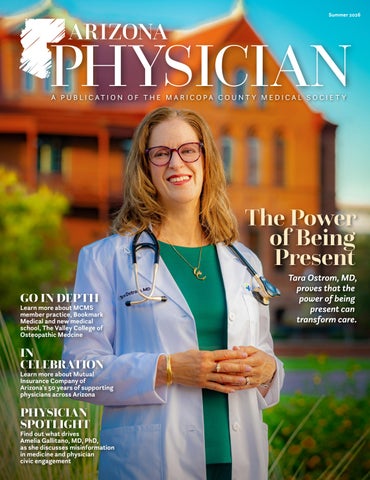
Summer 2026
A P U B L I C AT I O N O F T H E M A R I C O PA C O U N T Y M E D I C A L S O C I E T Y
The Power of Being Present GO IN DEPTH
Learn more about MCMS member practice, Bookmark Medical and new medical school, The Valley College of Osteopathic Medcine
IN CELEBRATION
Learn more about Mutual Insurance Company of Arizona's 50 years of supporting physicians across Arizona
PHYSICIAN SPOTLIGHT
Find out what drives Amelia Gallitano, MD, PhD, as she discusses misinformation in medicine and physician civic engagement
Tara Ostrom, MD, proves that the power of being present can transform care.
CONTENTS
VOLUME 8 • ISSUE 2 EDITOR-IN-CHIEF
Desire’e Hardge, MBA MANAGING EDITOR
Edward Araujo ASSOCIATE EDITOR
Dominique Perkins CREATIVE DESIGN
Randi Karabin, randi@karabincreative.com COVER & FEATURED ARTICLES PHOTOGRAPHY
IN EVERY ISSUE 2 | From the MCMS Board President 4
| From the Editor-in-Chief
6
| Briefs
44 | Physician to Physician 48 | Practice Management 52 | MCMS Member Practices Directory
Jeff Noble, jeffnoblepictures.com ads@arizonaphysician.com MARICOPA COUNTY MEDICAL SOCIETY BOARD MEMBERS PRESIDENT
PRESIDENT-ELECT
TREASURER
Zaid Fadul, MD, FS, FAAFP SECRETARY
Gregory Aran, DO IMMEDIATE PAST PRESIDENT
RESIDENT & FELLOW DIRECTOR
26
In Depth: The Valley COM
Physician Spotlight: Amelia Gallitano, MD, PhD
Ajay Bhatnagar, MD, MBA
Mona Amini, MD, MBA Kishlay Anand, MD, MS Jay Arora, MD, MBA Shana Johnson, MD Linda Eller, DO Nandita Khera, MD, MPH Nacchal Nachiappan, MD Duane Wooten, MD
We go in depth with Bookmark Medical’s Arizona leadership, Market President, Juan Vega and Regional Chief Medical Officer, Karen Wetherell, MD.
32
Rahul Rishi, DO, FAAAAI, FACAAI
DIRECTORS
In Depth: Bookmark Medical
We sit down with Arizona’s newest medical school, The Valley College of Osteopathic Medicine and their leaders, President & CEO, Andrew High, JD, MBA, and founding Dean & Chief Academic Officer, Alissa Craft, DO.
ADVERTISING
Jane Lyons, MD
10
18 C O V E R S T O R Y Read about Tara Ostrom, MD, FACP, CenterWell Senior Primary Care’s Market Chief Medical Officer and her medical journey plus what drives her “patients come first” mentality.
We spotlight Dr. Amelia Gallitano as she discusses misinformation in medicine and the importance of physician involvement in civic engagement.
40
Celebrating MICA’s 50th Anniversary
We reflect on Mutual Insurance Company of Arizona’s 50 years of physician support with President & CEO Ed Marley.
Jacob Less, MS-IV MEDICAL STUDENT DIRECTOR
Kambrea Soltera, MS-IV
DIGITAL & SOCIAL MEDIA
134TH ANNUAL MCMS GALA
“A LEGACY IN MOTION”
arizonaphysician.com
FRIDAY, OCTOBER 23, 2026, 6 PM AT THE CAMBY
ArizonaPhysician @AZPhysician
RSVP TODAY
@AZ_Physician
ARIZONAPHYSICIAN.COM
1
FROM THE MCMS BOARD PRESIDENT
Trust your physician. Trust the science. Trust the care.
A
t a time when misinformation can travel faster than facts, Arizona’s physicians remain a vital source of clarity, compassion, and scientific integrity. Every day, we see how patients encounter conflicting information that can create uncertainty and undermine confidence, particularly when they are simply trying to make informed choices for themselves and their families. Yet even in these challenging circumstances, physicians remain committed to guiding our communities with evidence-based knowledge and a deep sense of responsibility. Medicine has always required more from clinicians. It calls for rigorous education, ethical practice, sound judgment, and a strong physician-patient relationship. When inaccurate or misleading information shapes public understanding, that relationship becomes even more important. Physicians have the expertise to translate complex science into practical information, address concerns without judgment, and help patients make informed decisions with greater confidence. Across Arizona, I see physicians meeting this challenge every day. We answer difficult questions, address misconceptions, promote prevention, and advocate for public health with both courage and humility. We do this not because the work is easy, but because it is essential. Our profession understands that credible, evidence-based information can save lives, while allowing misinformation to go unchallenged can cause significant harm. Physicians continue to step forward, ensuring patients and communities have access to the knowledge, guidance, and clarity they deserve. At the same time, trust is not built by physicians alone, it is strengthened when patients feel empowered to ask questions, seek credible sources, and have open conversation with their healthcare team. As a physician, I encourage every Arizonan to turn to their medical professional during times of uncertainty. We are here to listen, provide clarity, address concerns, and help you make informed decisions about your health. Your physician is more than a clinician they are a trusted partner and advocate committed to your well-being. As healthcare continues to evolve, our commitment to evidence, integrity, and patient-centered care must remain constant. Arizona’s physicians will continue to stand with their patients, advocate for healthier communities, and provide trusted guidance when it matters most.
Dr. Rishi completed his fellowship in Adult and Pediatric Allergy-Immunology through Nova Southeastern University/Larkin in Miami, Fl. During his fellowship, he was honored as Chief Fellow. Dr. Rishi is a prestigious Fellow of the acclaimed American Academy of Allergy Asthma and Immunology (AAAAI) and the American College of Allergy Asthma and Immunology (ACAAI). He is also board-certified in Internal Medicine and a Fellow of the American College of Osteopathic Internists (ACOI). He currently serves on the Board of Directors for the Maricopa County Medical Society. Dr. Rishi is married to a fellow Allergy-Immunologist, Radha Rishi, MD, and they have two children.
Rahul Rishi, DO, FAAAAI, FACAAI MCMS Board President
2
n ARIZONA PHYSICIAN MAGAZINE
Get involved with MCMS. Visit our website, mcmsonline.com.
FROM THE EDITOR-IN-CHIEF
“In uncertain times, Arizona’s physicians lead with courage, purpose, and an unwavering commitment to truth.” “For more than 134 years, MCMS has stood with Arizona’s physicians. Today, we continue that promise to remain committed to leading with courage and strengthening the voice of physicians.” —Desire’e Hardge, MBA, CEO & Executive Director, MCMS
A
rizona summer arrives with its characteristic intensity, yet this issue of Arizona Physician reflects a different kind of warmth one defined by leadership, innovation, connection, and the enduring commitment of physicians across our state. Our cover story features Tara Ostrom, MD, FACP, whose journey from a life-altering accident to serving as Market Chief Medical Officer for CenterWell Senior Primary Care illustrates the transformative power of presence in medicine. Dr. Ostrom experience underscores the importance of human connection, attentive listening, resilience, and leading with empathy throughout every patient interaction. This issue also examines the transformation of Arizona’s healthcare delivery system through innovation and practice redesign. Our practice profile on Bookmark Medical highlights a physician-centered model that integrates clinical support, technology, and operational infrastructure to give clinicians greater capacity to focus on patient relationships and high-quality care. Their approach offers valuable insight into building sustainable and fulfilling practice environments amid an increasingly complex healthcare landscape. We also introduce readers to The Valley College of Osteopathic Medicine (Valley COM), Arizona’s newest medical school and an institution founded on a compelling mission: preparing physicians who are from Arizona, trained for Arizona, and committed to serving its communities. Through an educational model integrating advanced technology with osteopathic principles, Valley COM is preparing future physicians to address clinical complexity while maintaining a whole-person approach to care. Our conversation with Amelia Gallitano, MD, PhD, candidate for the Arizona State Senate representing Legislative District 2, explores another critical dimension of contemporary healthcare: the intersection of medicine, public discourse, and evidence-based leadership. Dr. Gallitano discusses the physician’s responsibility to listen critically, communicate effectively, and apply scientific reasoning beyond the clinical environment. Her perspective reinforces that advocacy is not separate from medicine, it is an extension of service. In Physician to Physician, MCMS member Rajiv Sharma, MD, offers an important perspective for colleagues navigating the profession today. We also feature MICA attorney Jeanne Powell, JD, who provides essential guidance on medical-record subpoenas and HIPAA compliance, addressing legal and regulatory considerations that physicians encounter in practice. As you read through this issue, I hope you recognize the same qualities I have witnessed throughout its development: physicians who continue to lead, innovate, educate, advocate, and serve often simultaneously. At a time characterized by unprecedented information, complexity, and change, their expertise, integrity, and commitment remain essential.
Desire’e Hardge, MBA, serves as the CEO & Executive Director of MCMS and the Editor-in-Chief for the Arizona Physician magazine. Desire’e brings over 19 years of experience across both for-profit and non-profit sectors.
Desire’e Hardge, MBA Arizona Physician Editor-in-Chief 4
n ARIZONA PHYSICIAN MAGAZINE
Become an MCMS member in 2026 by calling us at (602) 209-9867 or email us at mcms@mcmsonline.com.
BRIEFS
NEWS AND NOTES FROM THE FIELD
Valley Fever Late Summer Spike Updated Clinical Insights for Arizona Physicians
Outdoor recreation surges, with hikers,
campers, and travelers encountering sporerich soil in desert parks and rural trails. Delayed symptom recognition is common because patients attribute fatigue, cough, or malaise to heat exhaustion, allergies, or a lingering viral illness. These factors combine producing underdiagnosis early in the season and overdiagnosis later, when patients become more aware of Valley Fever, but symptoms may reflect other respiratory conditions.
As Arizona enters peak dust and monsoon season, physicians should anticipate a measurable rise in Coccidioides exposure across Maricopa, Pima, Pinal, and expanding pockets of northern counties. While Valley Fever remains a familiar diagnosis for Arizona physicians, summer environmental conditions create distinct diagnostic patterns, delayed presentations, and higher patient uncertainty—making early recognition and clear communication essential. SEASONAL DRIVERS BEHIND THE SUMMER INCREASE Our extended summer conditions amplify exposure in ways patients rarely recognize: Monsoon winds and haboobs disturb soil and aerosolize spores across wide geographic areas, including urban zones previously considered lowrisk. Construction and land development—especially in Phoenix’s West Valley and Tucson’s outskirts—create chronic dust exposure for workers and nearby residents.
6
n ARIZONA PHYSICIAN MAGAZINE
C L I N I C A L C O N S I D E R AT I O N S F O R S U M M E R 20 2 6 Physicians can improve detection and management by focusing on several summerspecific patterns: Symptom duration matters. A cough or fatigue persisting beyond 2–3 weeks— especially with pleuritic pain or night sweats—should prompt consideration of Valley Fever. Serologic testing remains the cornerstone, but early tests may be negative. Physicians can help patients understand why repeat testing may be necessary. Fatigue is often the dominant complaint, even when pulmonary symptoms are mild. Setting expectations around prolonged recovery reduces frustration and unnecessary return visits. Immunocompromised patients (transplant recipients, those on biologics, pregnant individuals) may present atypically and warrant closer monitoring. Coinciding respiratory conditions— asthma flares, wildfire smoke exposure, and heatrelated respiratory stress—can complicate the clinical picture.
PAT I E N T E D U C AT I O N T H AT I M P R OV E S O U T C O M E S Clear, anticipatory guidance helps patients navigate a confusing illness: Explain the environmental link. Many patients don’t realize dust storms, construction zones, and trail dust increase risk even when symptoms appear weeks later. Normalize the recovery timeline. Fatigue lasting months is common; reassurance prevents unnecessary antibiotic requests or specialist referrals. Clarify when to escalate care. Worsening shortness of breath, persistent fevers, hemoptysis, or severe chest pain should prompt immediate evaluation. Promote protective habits. While masks and avoidance aren’t foolproof, they help reduce exposure for highrisk individuals during dust events.
W H Y T H I S M AT T E R S F O R A R I ZO N A P H YS I C I A N S Valley Fever remains one of Arizona’s most defining and misunderstood endemic illnesses. Our extended summer spikes challenge clinicians to differentiate it from heatrelated illness, wildfire smoke irritation, and viral respiratory infections. A brief, proactive conversation with patients, especially those with prolonged symptoms, can significantly improve diagnostic accuracy and reduce unnecessary worry.
AVONDALE, ARIZONA | THE CENTER OF IT ALL ` Business Support Services
` Healthcare ` Innovation & Technology Ecosystem ` Centralized Location
` Entertainment & Sports For more information, visit AvondaleEcDev.com or contact us at ecdev@avondaleaz.gov or (623) 333-1400
ARIZONAPHYSICIAN.COM
7
CLINICAL PEARLS Ask targeted questions: recent
Electrolyte Imbalances in Outdoor Workers & Athletes SUMMER PREVENTION AND EARLY RECOGNITION
Arizona’s extreme summer heat creates a uniquely hazardous environment for outdoor workers, athletes, and recreational hikers. Long hours in triple digit temperatures, combined with intense physical exertion, make electrolyte disturbances one of the most common—and most preventable—heat related clinical issues physicians encounter from June through September. Early recognition is essential, as symptoms often present subtly and can escalate quickly in the field.
COMMON SUMMER PATTERNS Outdoor workers (construction, landscaping,
delivery) frequently underhydrate during peak heat hours, especially when work schedules limit breaks. Endurance athletes may over hydrate with water alone, diluting sodium levels and increasing hyponatremia risk. Weekend hikers often underestimate trail difficulty, heat exposure, and hydration needs, leading to rapid fluid and electrolyte depletion.
8
n ARIZONA PHYSICIAN MAGAZINE
outdoor activity, hydration habits, use of electrolyte drinks, and duration of heat exposure. Recognize early signs of imbalance: headache, nausea, confusion, muscle cramps, dizziness, or unusual fatigue. Reinforce that both under hydration and over hydration can be dangerous—balanced intake matters, especially during prolonged exertion. Consider environmental factors such as humidity spikes during monsoon season, which reduce evaporative cooling and increase sweat loss.
PATIENT EDUCATION THAT STICKS Encourage scheduled hydration
rather than reactive drinking, especially for workers with fixed shift patterns. Remind patients to include electrolytes during extended activity or heavy sweating, not just water. Promote heat smart habits: early morning activity, shaded rest breaks, cooling strategies, and avoiding peak afternoon exposure. For employers and coaches, emphasize structured hydration protocols and heat illness training.
WHY THIS IS IMPORTANT FOR ALL PHYSICIANS IN ARIZONA Electrolyte disturbances remain one of the most preventable summer health threats in Arizona, yet they continue to drive ED visits, workplace injuries, and rescues on popular hiking trails. By equipping patients—and the organizations that rely on them—with clear, practical guidance, physicians can significantly reduce heat related morbidity during the hottest months of the year. A brief, proactive conversation can help patients stay safe, maintain performance, and avoid preventable medical emergencies in Arizona’s unforgiving summer climate.
QUICK CONTACT TIP
Meet the MCMS Membership & Events Manager:
Want to become an MCMS member? Do you need help with your membership account, upcoming events, or connecting with other physician colleagues?
Krystal Inman W H AT B R O U G H T YO U T O M C M S ? With a 20-year career path behind me, it was an exciting opportunity to join the MCMS and be able to apply gained experience into all facets of working to assist and support physicians in a variety of ways. With a background in education, non-profit, administration, and customer support, I was intrigued by the challenge of applying my project management skills to the larger event planning aspect to be able to curate an environment at each of our events that allows Physicians to connect and feel supported. H OW D O YO U S U P P O R T M E M B E R P H YS I C I A N S DAY-T O - DAY ? My focus at MCMS is to be a bridge for physicians between available resources and their success in the healthcare system or in their private practice or in the community at large. I provide exposure for the achievements of our members, respond to connection and support requests, connect members to those valuable resources, and provide human contact to listen and respond to the ever-evolving needs of our medical professionals. Whether it be emailing
Reach out to Krystal Inman at kinman@ mcmsonline.com — she’s your go-to resource for making the most of your MCMS membership.
communication about new opportunities to connect or helping connect a patient to a physician member or a physician member to a practice resource, I work hard each day to serve our members in a way that allows them to thrive in their career goals. C A N YO U S H A R E W H Y P H YS I C I A N S S H O U L D J O I N A N O R G A N I Z AT I O N LIKE MCMS? Medical societies such as the MCMS are a valuable resource for physicians on several fronts. MCMS and our collaborative partner societies provide opportunities most importantly for physicians to connect to one another, to resources in the business and academic communities, and to stay informed on advocacy issues which affect themselves, their practices, and their
patients. Our medical society addresses the human issue that physicians need support too and we try to streamline access to that support by encompassing as many of those parts into one place. W H AT D O YO U E N J OY M O S T A B O U T WO R K I N G W I T H M C M S M E M B E R P H YS I C I A N S In my time with MCMS it has been eyeopening to learn of the different issues affecting our doctors in real time. I do my best to glean the valuable insight from our most tenured and experienced physicians while also staying open-minded to hear the new issues affecting the incoming generations of new medicine practitioners. I look forward to continuing to learn and collaboratively brainstorm solutions and policies as medicine is a facet of life that is relative to all people.
UPCOMING MCMS EVENTS IN 2026 09 SEP
24 SEP
01
OCT
23 OCT
13
NOV
M CM S & CI T Y OF AV ONDA LE PRES ENT: WI NE. DINE. FIND Come join MCMS and City of Avondale at Cooper’s Hawk Winery & Restaurant in Avondale for an evening of discussion on the next wave of medical practice developments in the West Valley.
3 R D A NN U AL MCMS L EG IS LAT IV E MEET & G REE T Elections are right around the corner. Come join us for an evening where medicine and politics come together. Meet many candidates and current state & municipal office holders.
H E AL T H CA R E S UMMIT : B UILDING S TRO NGER P RA C TIC ES Come join MCMS and partners Integro Bank and XCellerant Ventures for an exclusive evening with star studded panelists discussing capital, innovation, Ai, and private practice growth.
13 4 TH A N NU AL MCMS G ALA Come join MCMS for an evening of physician celebration at one of Phoenix’s most exquisite venues, The Camby Hotel in the Biltmore area. This event is Black-tie.
A OM A & M CM S PRES ENT: THE 9 T H A NNUA L D INNER WI TH DOCS Come join us for this great event focused on mentoring and networking amongst osteopathic & allopathic medical students and physicians. FOR MORE INFO: 602-209-9867 kinman@mcmsonline.com
ARIZONAPHYSICIAN.COM
9
10
n ARIZONA PHYSICIAN MAGAZINE
BOOKMARK MEDICAL BUILDING A B E T T E R WAY TO PRACTICE
F
or physicians across Arizona, practicing medicine has never been more complex. Administrative burdens continue to grow, reimbursement pressures remain relentless, recruiting physicians is increasingly difficult. At the same time, patients expect more personalized, coordinated, and accessible care than ever before. Against that backdrop, Bookmark Medical believes the future of primary care depends on solving two challenges simultaneously: giving physicians more support while strengthening the relationships with patients that define great medical management.
ARIZONAPHYSICIAN.COM
11
Formerly known as Revere Health in Arizona, Bookmark Medical recently completed a national rebrand that unites practices under a single identity while preserving its physician-centric philosophy. The organization believes outpatient provider services are best delivered through independent providers and therefore supports providers who are seeking to be employed or affiliated. Bookmark’s approach is gaining attention as it now operates across 39 clinics in the Phoenix metropolitan area and Tucson, with nearly 150 providers, and plans for continued expansion throughout Arizona.
12
n ARIZONA PHYSICIAN MAGAZINE
For Juan Vega, Market President, the opportunity was compelling from the moment he encountered the organization. With 16 years of experience in healthcare business, Vega was looking for the right fit. “I was looking for a group in this market that really had the opportunity, size and scope to drive a high amount of success for people that live in this state,” he said. While the Bookmark Medical name may be new, leadership emphasizes that its mission, to improve lives through high-quality continuous care, has remained consistent throughout the organization’s evolution.
“I love the new name,” said Karen Wetherell, MD, Regional Chief Medical Officer. “A patient’s medical journey is like a story that evolves over time. We want our patients to know that we are here for you, and you don’t have to start over every time. We’ll pick up where we left off because we know you.” That emphasis on continuity resonates at a time when many patients feel their healthcare has become increasingly fragmented. Rather than viewing individual visits as isolated encounters, Bookmark Medical seeks to cultivate long-term physician-patient relationships supported by coordinated care teams and technology designed to keep providers connected with patients throughout their healthcare journey.
We ground our team in our mission, which is delivering high-quality continuous care, and we really work to live our values: trust, ownership and compassion. And we’re all about relentless progress.
K EEPI N G PH YS I C IAN S AT TH E C ENTER As Arizona’s physician shortage continues to loom, organizations across the state are searching for ways to recruit and retain providers while reducing burnout. One approach is to remove obstacles disconnecting physicians from the passion that brought them to medicine to begin with. From Vega’s perspective, the role of healthcare administration is straightforward, and one of the central advantages he sees in a larger medical group. With nearly 150 physicians and advanced practice providers (APPs) across multiple locations in Arizona, Bookmark Medical can invest in infrastructure that would be difficult for many smaller independent medical practices to sustain. “I view myself and my team as having a responsibility to our providers and to our patients to drive the highest
degree of efficiency and unburdening our provider workforce with things that they shouldn’t be focused on, so that instead they can focus on patient care,” he said. This physician-centric philosophy extends beyond clinical operations into the organization’s leadership structure. “I think our secret sauce is our leadership structure. We have an operational and clinical dyad,” said Dr. Wetherell. “If it’s from a clinical perspective, I will see something, and from an operational perspective, Juan will see something,” she said. “And we can bring our views together and we get to a much better place.” That collaboration also shapes how the organization approaches practice culture.
ARIZONAPHYSICIAN.COM
13
Bookmark Medical is all about building lasting relationships with our patients, and it represents our commitment to continuous care, and it reinforces our commitment to making sure that our patients know that we’re here for them through every stage of their journey.
TEC H N O LO GY THAT G IVES TI M E BAC K For many physicians, technology has become synonymous with increasing documentation requirements and endless clicks. Bookmark Medical hopes to reverse that equation. Rather than viewing artificial intelligence as a replacement for physicians, leadership sees it as a means of restoring the face-to-face interactions patients value most. Tools like virtual scribes that document patient consults. “When we give our providers these tools and resources, we make them more efficient, they become more connected to the patient, they have more time with the patient and the patient feels it,” Dr. Wetherell said. The organization’s investment extends beyond AI-assisted documentation to pharmacy support, virtual care teams, coding assistance, and systems designed to reduce administrative workflows for physicians. For Dr. Wetherell, the distinction between meaningful work and unnecessary work is critical. “Physicians don’t get burned out seeing their patients,” she said. “We love being with our patients. It’s the inbox that burns us out.”
14
n ARIZONA PHYSICIAN MAGAZINE
G ROWI N G ALO N G S I D E ARIZO NA Arizona’s rapid population growth continues to reshape the healthcare landscape. New communities are emerging across the Valley, demand for primary care continues to rise, and medical practices face mounting pressure to recruit providers while maintaining access for patients. For Bookmark Medical’s leadership, those trends represent both an opportunity and a responsibility.
“We are prepared to meet the needs of our community, we are prepared to grow alongside our community,” said Dr. Wetherell. She believes patient expectations are also evolving. “Our patients, our communities, want more proactive, preventative, personalized care,” she said. “They want to collaborate. They don’t want to be told.” Vega sees another side of Arizona’s remarkable growth story. While the state’s expanding
population has fueled opportunity, it has also dramatically increased the cost of practicing medicine. “I’ve seen the evolution of the state from a very low cost of living location to now one of the higher costs,” he said. “Real estate costs have increased considerably over the past decade and so have labor costs, minimum wages, have also risen materially.” Those economic realities, he said, make efficiency more important than ever.
ARIZONAPHYSICIAN.COM
15
We are all about our people. If we don’t treat our people well, if we don’t build trust with our people, then that will get in the way of success.
I NVESTI N G I N TH E FU T U R E WO R K FO RC E Like many physician leaders throughout Arizona, Dr. Wetherell and Vega recognize that expanding access to care ultimately depends on developing the next generation of healthcare professionals. Bookmark Medical maintains its own residency program and partners with educational organizations throughout the state to support physician and advanced practice provider training. “It’s important that we invest time and energy in developing our next group of physicians,” said Dr. Wetherell. “We also partner with our residency program and other programs to develop that next generation of physicians and APPs.” Vega agrees that workforce development is inseparable from expanding patient access. “In order to create access to care, you have to create access to providers,” he said. 16
n ARIZONA PHYSICIAN MAGAZINE
A D I FFER ENT C O NVERSATI O N AB O U T PR ACTI C E After nearly three decades in private practice, Dr. Wetherell understands both the rewards and the burdens of independent medicine and acknowledges that many physicians worry about sacrificing autonomy when joining a larger organization. “It can be scary for physicians to consider joining a larger medical group,” she said. “But when you have your own practice, there’s no PTO. There’s just TO. One of the benefits of joining a larger medical group is having the support and resources that allow you to truly take time away.”
Ultimately, she believes support—not control—is what physicians are seeking. “There is a way to bring back joy to people who are feeling burned out. There’s a way to be more balanced, and that’s by surrounding yourself with a team of people that can help you.”
LO O K I N G AH E AD As healthcare continues to evolve, Dr. Wetherell believes patients will continue to demand more personalized and accessible care. “Our patients want to choose where and when they want their healthcare,” she said. “Healthcare is a service industry, right? Which means we have to provide the care to our patients where and when they want it and need it.” For Bookmark Medical, staying ahead of those expectations means embracing innovation while carefully evaluating new technologies before broad implementation. “We definitely pilot new initiatives,” Vega explained. “We perfect the process with a smaller localized group before we then take it to the masses.” Innovation, however, is not limited to executives or technology teams. “We want everyone in our organization to know that they have a platform to make suggestions and recommendations for what they think they could improve,” Vega said. That philosophy reflects the broader culture both leaders described throughout the interview—one built on listening, collaboration, and continuous improvement. ■
Bookmark Medical in Arizona BY THE NUMBERS
Began Operating in Arizona May 2026 76 Physicians 80 Advanced Practice Providers 450 Total Employees Services Offered CORE HEALTHCARE SERVICES Comprehensive Primary Care: Routine physicals, wellness checks, preventative screenings, and long-term care management for adult patients.
Chronic Disease Management: Dedicated, structured support for
ongoing conditions like diabetes, hypertension, heart disease, COPD, and asthma.
Acute Illness & Injury Care: Same-day diagnostic care and treatment for sudden medical issues, minor injuries, infections, and viruses.
Senior-Focused Care & Value-Based Medicine: Specialized programs tailored to older adults, focusing on comprehensive coordination, medication management, and proactive preventative wellness.
SPECIALIZED CLINICAL SERVICES Mental & Behavioral Health Integration: On-site or coordinated mental health counseling and therapy services directly tied to primary care treatment.
Diagnostic & Lab Coordination: Efficient access to essential on-site or partnered diagnostic screenings, blood tests, and lab tracking.
Telehealth & Virtual Care: Remote video or phone consultations for medication refills, follow-ups, and non-emergency clinical guidance.
TREATMENTS PROVIDED Chronic Condition Treatments, Endocrine Therapies, Cardiovascular Management, Respiratory Therapies, Joint & Musculoskeletal Care
Acute & Urgent Treatments Infection Interventions, Minor Wound & Injury Care, Allergy Mitigation, Preventative & Wellness Interventions, Immunization Protocols, Behavioral Health Treatments, Weight & Metabolic Management
35+ Locations By Dominique Perkins Associate Editor Arizona Physician azphysician@mcmsonline.com
Phoenix, Mesa, Glendale, Chandler, Tempe, Scottsdale, Peoria, Avondale, Goodyear, Litchfield Park, Anthem, Apache Junction, Surprise, Queen Creek, Oro Valley, and Tucson
Connect with Bookmark Medical Bookmarkmedical.com | communications@bookmarkmed.com ARIZONAPHYSICIAN.COM
17
The Power of Being Present DR. TARA OSTROM
T
ara Ostrom, MD, FACP, never expected to become a physician. As a young woman, she
imagined herself in law school. She spent her high school and college years working in
legal offices, building a career that seemed both logical and familiar. Medicine was not part of the plan. There were no physicians in her family, no childhood dreams of wearing a white coat, no carefully charted path toward becoming a leader in healthcare. Instead, her journey began with an unexpected detour.
18
n ARIZONA PHYSICIAN MAGAZINE
ARIZONAPHYSICIAN.COM
19
At 18, while away at college, Dr. Ostrom was struck by a car while riding her bicycle. In an instant, independence gave way to uncertainty. “I found myself going from an independent young woman away at college to laying in a hospital bed, wondering, would I ever hike again? Would I dance? Would I walk? What would that look like? And just frightened for the whole future,” she said. The orthopedic surgeon who treated her was technically exceptional. Yet it was not surgical skill alone that transformed her future. It was something quieter. “That moment of connection of him as a caring physician to me, laying in that hospital bed, and I thought, I could do that,” she said. “I could translate the complex to a patient and give them clarity and hope, whether it’s going to be good news or bad news.” Today, as Market Chief Medical Officer for CenterWell Senior Primary Care, Dr. Ostrom has moved from caring for individual patients to shaping systems of care. But the lesson she learned in that hospital room remains central to how she practices and leads: medicine is ultimately about human connection.
LE AR N I N G BY D O I N G If the bicycle accident revealed her calling, medical school began shaping the physician she would become. Dr. Ostrom deliberately chose a demanding path. She enrolled at the Keck School of Medicine of University of Southern California and trained at Los Angeles County Hospital, where students carried an unusual degree of responsibility.
20
n ARIZONA PHYSICIAN MAGAZINE
“We were doing the care, things that usually residents and attendees would do at other hospitals, but as a student,” she said. “I was fully accountable for patients.” That was exactly the kind of environment she wanted: in the trenches, learning by doing. “I thought being a physician that I was going to need a lot of grit and resilience,” she said. “I figured that setting would build it.” Those early years established a pattern that would continue throughout Dr. Ostrom’s career. Rather than waiting until she felt completely prepared, she learned by accepting responsibility and growing into it.
TH E D O O R THAT HAD TO C LOS E For years, Dr. Ostrom believed she would become an obstetrician-gynecologist. She carefully selected residency programs, mapped out her future and committed herself to that goal. Then Match Day arrived, and she found herself with no placement. “That door needed to close, and close hard on me, because it wasn’t where I was supposed to go,” she said. “I ended up getting a prelim spot in internal medicine here at St. Joseph’s Hospital.” Internal medicine unlocked something she had not recognized in herself. The realization crystallized during an emergency involving an
“
I wanted heart. And I wanted something that would shape me into... a future leader.
”
ARIZONAPHYSICIAN.COM
21
obstetric patient. Dr. Ostrom recognized the patient’s pulmonary embolism, coordinated the response and suddenly understood that she had found the right specialty. “I like investigative work,” she said. “That Sherlock Holmes, Dr. Watson type of thing. This is where I’m meant to be!” The experience also gave her a lesson she now shares with younger physicians. “You know, some doors have to close to get to where I’m supposed to go,” she said.
A LE AD ER B EFO R E S H E R E ALIZED IT Leadership, much like internal medicine, found Dr. Ostrom before she consciously sought it. She became chief resident, then “chief of the chiefs,” advocating for residents across the institution. Faculty responsibilities followed. The pattern continued as she moved into private practice and later corporate medicine. Again and again, mentors recognized something in her before she fully recognized it herself, encouraging her to pursue opportunities and expand her reach. “I’m grateful for that mentor tapping me on the shoulder, because then that sent me into a trajectory going from an associate medical director to a medical director to a senior medical director,” Dr. Ostrom said. Her understanding of leadership evolved with each role. Eventually, her focus broadened from individuals to systems. Instead of asking only how to solve a problem, she began asking what had created it in the first place. “If the patient outcomes aren’t great, what was the system that led to that?” she said. “Changing systems would actually have a greater impact on healthcare delivery.” That shift became central to her leadership philosophy: better systems should make it easier for physicians to deliver the care they entered medicine to provide.
22
n ARIZONA PHYSICIAN MAGAZINE
I was there to serve the people that I led.
T WO CAN O ES That work, however, comes with an inherent tension. Physician leaders must improve healthcare systems without losing sight of the patients those systems are designed to serve. One of Dr. Ostrom’s mentors gave her a metaphor she has carried throughout her career. “One of my amazing mentors says, it’s like standing in two canoes: You’ve got to balance the two, or you’re going to capsize.” For Dr. Ostrom, the balance begins with a simple priority. “Patients come first,” she says plainly. “All the work is about the patients.”
That philosophy helped draw her to CenterWell Senior Primary Care, where she now serves as Market Chief Medical Officer. After years of leading across different clinical environments, she was drawn to a model focused specifically on older adults. “My father has passed, my mom’s a senior, I’ve had a group of patients that have aged as I have,” she said. “The ability to have a model that is so focused on improving senior care, it involves setting up systems in a different way.” For Dr. Ostrom, improving those systems is ultimately about preserving the human side of medicine.
ARIZONAPHYSICIAN.COM
23
WHAT PATI ENTS TE AC H After more than two decades in primary care, Dr. Ostrom has learned that healthy aging cannot be reduced to laboratory values or lifestyle choices. “I found that some of the seniors that really made it into later years, they had a level of great resilience and engagement with their world,” she said. “They were still there, engaging, joking. They weren’t letting life happen to them, they were living life.” One of her favorite patients, a World War II veteran in his 90s, once pretended to suffer a heart attack during an office visit, sending the staff into action before finally revealing the joke. “Gotcha.” “He thought that was hilarious,” Dr. Ostrom says. “And he also taught me not to take myself so seriously.” The story captures something Dr. Ostrom values about caring for older adults: the person in front of her is more than a diagnosis. “I think one of the things I really like about the CenterWell Senior Primary Care Model is the extra time that we allow our clinicians to spend with the patients,” she said. “Sometimes there’s a story in getting to know the person.”
PR ES ERVI N G TH E ART Dr. Ostrom’s vision for the future of medicine is similarly centered on preserving that connection. Interestingly, one of the technologies that gives her hope is artificial intelligence. AI documentation tools, she says, can free physicians from their screens and allow them to return their attention to the patient. “It basically lets you look at the patient straight in the eyes, and have a conversation,” she said. “If you let the patient talk long enough without interrupting, the diagnosis is there.”
24
n ARIZONA PHYSICIAN MAGAZINE
“
I found that some of the seniors that really made it into later years, they have a great level of resilience and engagement with their world.
”
B EI N G PR ES ENT Dr. Ostrom has approached family life with the same intentionality she brings to medicine. She learned Irish dance makeup to support her daughter, became a certified robotics judge for her son, traveled to competitions and immersed herself fully in each season of her children’s lives. “It was all in,” she says simply. “I made sure that when I was present with my family, my focus stayed in the present moment.” That same commitment shapes how she approaches older patients. “They have more years under their belts than we have,” she says. “A lot of what has gotten them there is the relationships they’ve built and the trust in people.” Building trust requires time, patience, curiosity, and lengthy conversations. All a part of the art of medicine. “You have to know if they’re married or widowed, you have to know how their kids are doing, you have to know that they have a little dog,” she said. “That relationship that you build is going to impact whether or not they’re going to follow your recommendations.”
TH E RI G HT S P OT But technology also brings concern. “I fear for the loss of the art of the practice of medicine,” Dr. Ostrom said. “Truly listening, truly being present, actually doing that physical exam. Trusting your gut on what you’re hearing, what you’re feeling, and what you’re seeing.” She remembers a patient whose symptoms appeared to be musculoskeletal. A chest x-ray seemed unnecessary. Still, something did not feel right. “My gut said, do it,” she said. The x-ray revealed an early-stage lung cancer unrelated to the patient’s presenting complaint. For Dr. Ostrom, that experience is a reminder that medicine is both science and art. Evidence matters, but so do observation, experience, intuition and the ability to notice what does not fit neatly into the obvious diagnosis.
As her youngest child prepares for college and Dr. Ostrom settles into a new chapter of executive leadership, she is looking ahead with the same openness that has defined her career. Her professional focus is on improving care for Arizona’s seniors. Personally, she is making room for music, Pilates and the next chapter of life with her adult children. When asked about the legacy she hopes to leave, she does not mention titles or accomplishments. “I would hope with my legacy that people would know that I care deeply,” Dr. Ostrom said. “I hope by caring deeply and being present, that I had a positive impact on others.” ■
By Dominique Perkins Associate Editor Arizona Physician azphysician@mcmsonline.com
ARIZONAPHYSICIAN.COM
25
26
n ARIZONA PHYSICIAN MAGAZINE
FROM HERE, FOR HERE A LO O K I N S I D E TH E VALLE Y C O M
A
rizona’s physician shortage is not a distant problem. It is already shaping the state’s healthcare landscape, and the gap is expected to widen. Arizona consistently ranks in the bottom third nationally for primary care physicians per capita. Every county in the state is designated as a health professional shortage area, while Maricopa County is on track to double its population by 2040. For Andrew High, JD, MBA, President and CEO of The Valley College of Osteopathic Medicine (The Valley COM), the numbers point to a problem that cannot be solved incrementally.
ARIZONAPHYSICIAN.COM
27
FOUNDING DE AN AND CHIEF ACADEMIC OFFICER A L I S S A C R A F T, D O
“It’s the kind of gap that you really can’t close incrementally,” he said. “You have to be big.” The Valley COM welcomed their inaugural class on July 27 of this year, bringing a new medical school to a state that needs more physicians. Andrew, alongside founding Dean and Chief Academic Officer Alissa Craft, DO, envision something beyond simply increasing the number of medical graduates. The school is being built around a question that reaches well beyond enrollment: What should medical education look like when today’s students become tomorrow’s physicians? “I chose to help build The Valley COM because I absolutely believe the 28
n ARIZONA PHYSICIAN MAGAZINE
future of medical education should prepare students for a rapidly changing, technology-driven world. While keeping the health and well-being of patients and communities at its core,” said Dr. Craft. That balance between technological sophistication and human-centered care runs through nearly every aspect of The Valley COM’s emerging identity. “As much as we possibly can we want to build physicians that are from here, for here, and stay here in Arizona,” High said.
A D R E AM B EC O M ES R E ALIT Y For Dr. Craft, the opportunity to build a medical school in Arizona has long been a dream. So, when that opportunity arrived here in Phoenix, she answered the call.
“This is a really nice opportunity to leave a legacy, for the profession, for the people who trained me, and mentored me in the profession, and for the state of Arizona,” she said. She hopes to leave behind not simply another institution, but physicians who understand that medicine is also an expression of who they are, and what they bring to patient care. “And that means we don’t all do it exactly the same way, but we should all do it with extreme dedication and extreme care,” she said.
“The ability to still use your hands, which are one of our best diagnostic tools,” she said. “And the most important thing we have is our communication skills with our patients, no matter what tech tells us to do.” High shares the same underlying philosophy. “If you look at our collective medical knowledge as a society, it is growing so quickly,” he said. “Medicine is going to be inherently
H I G H -TEC H, H I G H TO U C H The Valley COM’s curriculum will incorporate AI, ultrasound, virtual reality, augmented reality and highfidelity simulation. But the school’s leaders are careful to frame those technologies as tools rather than replacements for physicians. “There is always going to be more to learn in technology,” Dr. Craft said. “We want to bring technology to bear, and we want to model it in a good way in our institution.” The challenge is not simply learning how to use new technology but learning how to use it without allowing it to displace the skills that make a physician a physician. “The idea is that you use those tools as tools to help free you up in your time, so that your time can better be spent truly caring for the people you’re supposed to care for,” she said. Dr. Craft describes the goal as a combination of “high-tech and high touch.”
“For me, the most important thing is empowering young physicians, or physicians-to -be, to really think about who they are and bring those special characteristics of who they are to caring for p a t i e n t s , f a m i l i e s , a n d c o m m u n i t i e s .”
ARIZONAPHYSICIAN.COM
29
technology-driven in a significant way. But we believe that the best physicians will still be defined by their judgment, their leadership, their commitment to whole-person care.” The curriculum is designed accordingly: patient-informed, casebased and osteopathic, with the different elements of medical education integrated from the beginning. Students will encounter cases that become the organizing framework for their learning, bringing together basic sciences, clinical skills and the realities of navigating the healthcare system. Dr. Craft explained that students will learn not only anatomy and physiology, but how those disciplines connect to the patient in front of them.
“ We wanted them to have a curriculum that i n v o l v e s a l o t o f s e l f- d i r e c t e d l e a r n i n g . W e a r e using our faculty more as facilitators, with the s t u d e n t s m o r e a s t h e i n f o r m a t i o n g a t h e r e r s .”
30
n ARIZONA PHYSICIAN MAGAZINE
Students will learn how to use their hands for diagnosis to palpate or feel a liver, as well as how to consider insurance, access to care, and how to close the loop with patients as test results return. The point is not to eliminate the complexity of medicine, but to teach students how to navigate it.
B E YO N D C LI N I CAL E XC ELLEN C E The Valley COM wants students to see physicians as participants in the larger healthcare system, with a responsibility to challenge it, improve it and take ownership of it. “True leadership: valuing the patient, taking responsibility for our communities, the healthcare organizations, healthcare as a whole, is absolutely an expectation that we have,” said High. Dr. Craft adds another distinction: “Everything we do requires leadership,” she said, further clarifying that leadership is not as much about leading, as it is about developing followship. “If you say to a patient, I’d really like you to follow these recommendations, you’re asking for that followership,” she said. And each individual patient encounter requires that kind of trust. For High, the experience of building The Valley COM has reinforced the importance of having a clear mission. That clarity has helped bring together the disparate stakeholders required to build a medical school, from educators and healthcare organizations to local physicians and community partners.
PRE S I D ENT & C EO, AN D RE W H I G H , J D, M BA
B U I LD I N G AN ARIZO NA PI PELI N E The Valley COM’s role in Arizona’s healthcare system will not end with graduation. High points to a crucial connection between where students train and where they ultimately practice. An Arizona student who trains in Arizona and matches into an Arizona residency is more likely to remain in the state. The school is therefore working to strengthen the entire pipeline, including graduate medical education. Dr. Craft notes that The Valley COM has been approved by the ACGME as a sponsoring institution, and the school is already working on residency program development with community hospitals and large clinics, while also participating with the Arizona
“I think one of the most important things we can do for our students is maintain that passion for service by giving them the opportunity to continue to serve.”
ARIZONAPHYSICIAN.COM
31
Medical Association and the Arizona Osteopathic Medical Association in efforts to secure additional graduate medical education funding. But Dr. Craft believes keeping physicians in Arizona begins even earlier. Students will be embedded in community service activities throughout their four years, giving them an opportunity to form relationships with the communities where they live and train. “And if they are here in the Metro Phoenix or in the Arizona communities serving, I don’t see how they don’t fall in love with that community and want to stay there,” she said. The ambition is straightforward: cultivate physicians who are not simply educated in Arizona but invested in it.
32
n ARIZONA PHYSICIAN MAGAZINE
TH E LO N G VI E W Dr. Craft has spent much of her career teaching physicians. One of the experiences that shaped her philosophy began more than 30 years ago, during her final year of medical school. During that final year of medical school, she cared for a premature infant who was not expected to survive. “He did go on to survive, and helping to care for him as part of the team did shape me,” Dr. Craft said. “I ended up becoming a neonatologist to take care of patients like that.” Beautifully, the story did not end when the infant left the hospital. “His family are still some of my best friends. We have stayed in touch for well over 30 years, and that young man now works for us here at The Valley COM.”
It is the kind of full-circle moment that gives Dr. Craft’s vision for medical education its emotional weight. The work of a physician can extend far beyond a single encounter, sometimes in ways that are impossible to anticipate. That may also be the best measure of what The Valley COM hopes to accomplish. For a medical school preparing to welcome its first students, the work is only beginning. But its leaders already have a clear measure for what comes next. High hopes that, years from now, people looking back at the school’s founding will say: “That we never stop working to create great physicians and earn our place in Arizona’s overall healthcare Landscape.” Dr. Craft’s hope is equally rooted in the promise made to the state that helped make the school possible. “Hopefully they say that we held up our end of the bargain,” she said. “That for everybody who has helped us along the way, and we’ve said we’re doing our best to make physicians for Arizona, they feel like we’ve done that for them.” For The Valley COM, that legacy will ultimately be written not in classrooms or accreditation documents, but in the lives of the physicians who emerge from them, and in the patients and communities they choose to serve. ■
The Valley College of Osteopathic Medicine BY THE NUMBERS
Founded in 2022 100+ Physician Clinical Preceptors 35 Total Employees Inaugural Class 44 Students
Start Date July 2027 Curriculum Overview Integrated Curriculum, small group learning, and early community & clinical exposure.
Four Year Curriculum: YEAR 1: Integrated Foundational Sciences - students build a strong foundation in the biomedical sciences while developing clinical skills. YEAR 2: Introduction of Pathophysiology - Students apply the principles of biomedical sciences to more complex conditions and disease states. YEAR 3: Introduction to hands-on patient care experience across essential medical specialties with longitudinal experience in osteopathic hands-on diagnosis and treatment. YEAR 4: Advanced Training - Students will get enhanced training with academic medicine, research, and preparation for residency.
Location 2525 W. Townley Ave, Phoenix, AZ 85021
By Dominique Perkins Associate Editor Arizona Physician azphysician@mcmsonline.com
Connect with Valley COM thevalleycom.org | 602-830-2020
ARIZONAPHYSICIAN.COM
33
PHYSICIAN SPOTLIGHT
34
n ARIZONA PHYSICIAN MAGAZINE
When Evidence Meets Leadership D R . A M E L I A G A L L I TA N O O N M E D I C I N E , M I S I N F O R M AT I O N A N D THE RESPONSIBILIT Y TO LISTEN
F
or nearly four decades, Amelia Gallitano, MD, PhD, has devoted her career to understanding one of medicine’s greatest mysteries: the human brain. As a psychiatrist, physician-scientist, educator and
mentor, she has spent her professional life asking difficult questions, weighing evidence, collaborating across disciplines, and helping patients navigate some of life’s most complex challenges. Today, those same habits of mind are guiding her into an unexpected arena of service: public leadership.
ARIZONAPHYSICIAN.COM
35
At a time when misinformation spreads rapidly, public trust in institutions has eroded, physicians increasingly find themselves defending established science as much as practicing it. Dr. Gallitano’s career offers a compelling case study in what evidence-based leadership looks like beyond the walls of a clinic or laboratory. Her message is not that physicians should all become politicians. Rather, it is that physicians have a unique responsibility to bring scientific thinking, intellectual humility and effective communication into the public sphere.
A LIFETIME OF ASKING QUESTIONS Long before she became a professor, researcher or physician, Dr. Gallitano found herself captivated by the questions surrounding the brain. “I remember learning about adolescent suicide. It’s such a horrible, sad problem,” she recalled. “But it seems like if you can just get kids through that
36
n ARIZONA PHYSICIAN MAGAZINE
stage... then they can go on to have incredibly productive, satisfying lives.” That early fascination evolved into a career spanning neuroscience research, psychiatry, patient care and medical education. She studied behavioral science in college before pursuing the dual path of physician and researcher. “I knew that I wanted to investigate the underlying causes, so we can come up with better treatments, and also care for patients,” she said. Today, she serves on the faculty at the University of Arizona College of Medicine – Phoenix, where she directs the MD/PhD program, mentoring future physician-scientists, while continuing her work in neuroscience and medical education. Her clinical work treating veterans with post-traumatic stress disorder reinforced another lesson that would shape her philosophy of leadership: the best outcomes rarely come from
one person acting alone. “I was really privileged to be on a team,” she said of her years treating veterans at the Phoenix VA. “The best treatments that we have for PTSD are actually therapies. To work with a team and to be able to use evidence-based treatments and see people get better was incredibly rewarding.” The collaborative nature of that work continues to influence how she approaches problems far beyond medicine.
A N E X T E N S I O N O F S E RV I C E Dr. Gallitano describes her move into public life not as a departure from medicine, but as a continuation of service. For years, civic engagement occupied her personal time. She attended rallies supporting science, became involved in local political organizations and gradually learned how public policy is shaped at the community level. “My older son was in high school and getting very interested in politics,” she said. “He convinced me that you don’t just focus on what’s going on federally. You should be attending the local legislative district meetings.” That local involvement grew into volunteering on campaigns, meeting elected officials and learning firsthand how public servants engage with constituents. She credits former state representative Judy Schwiebert with helping her see public office as another avenue for meaningful service. “What I was so privileged to have learned from her was how she interacts with her constituents
at the doors,” Dr. Gallitano said. “She has real relationships with the people that she represents and would write them a note or send them an email, to follow up on their concerns.” She initially resisted the call to seek office herself. She had work enough to do, after all, and surely another could step up to fill this role. But repeated conversations and advocacy projects came with a growing sense that it was just going to have to be her. Not that all physicians are required to run for public office. Dr. Gallitano affirms that meaningful advocacy is possible, and needed, at every level. “One way that you can become involved is by listening to that information that you get from your professional societies, and making calls, writing letters to your elected officials,” she said. “Those can be your congressmen and senators, but they can also be your
“One way that you can become involved is by listening to that information that you get from your professional societies, and making calls, w r i t i n g l e t t e r s t o y o u r e l e c t e d o f f i c i a l s .”
ARIZONAPHYSICIAN.COM
37
local legislators. And a lot of times our voices are louder with our local legislators.” Her emphasis on local engagement reflects a broader belief that physicians possess expertise that communities genuinely need. Increasingly, she believes physicians cannot afford to remain on the sidelines.
HUMILIT Y AS A LEADERSHIP SKILL Years of practicing medicine and conducting research have influenced Dr. Gallitano’s approach to public leadership. First and foremost, by instilling in her an awareness of how much there always is to learn. “I know both what I know and I know how much I don’t know,” she explained. “I respect that there are people that are really experts, that have done the research and have the results and the evidence.” For Dr. Gallitano, evidence-based leadership is fundamentally collaborative. “The best part of science,” she tells her students, “Is the brainstorming. It’s the most fun part where you get a bunch of people together and you think about problems... and that stimulates somebody else’s idea.” Seeking expertise, inviting collaboration and remaining intellectually curious are, in her view, not signs of weakness but hallmarks of effective leadership. Those same principles become especially important in today’s information environment.
“I tell students that there are many w a y s t o s e r v e , w h e t h e r t h a t ’s t h r o u g h research, through patient care, through teaching, through advocacy — we need p h y s i c i a n s i n v o l v e d .”
38
n ARIZONA PHYSICIAN MAGAZINE
L I S T E N I N G B E FO R E L E A D I N G Few issues have challenged physicians in recent years as profoundly as the rise of medical misinformation. During the COVID-19 pandemic, many clinicians found themselves confronting not only disease, but also skepticism toward scientific institutions, public health recommendations and even long-established medical practices. As a psychiatrist, Dr. Amelia Gallitano approaches that challenge from a different perspective. Rather than asking why people reject scientific evidence, she begins by asking why people believe what they do. “The first thing is to listen,” she said. “Just as you do with your patients. You have to understand where they’re coming from before you can have any meaningful conversation.” As a psychiatrist, she sees misinformation not simply as a communication failure, but as an opportunity to better understand how people process information, evaluate risk and make decisions. “Our brains are fascinating,” she said, noting that human beings often rely on emotion, personal experience and trusted relationships as much as facts when making decisions. That instinct, she believes, reflects one of medicine’s greatest strengths. Physicians are trained to gather information before reaching conclusions, to understand the whole person rather than simply treating symptoms, and to build trust through careful listening. Those same principles, she argues, are increasingly necessary in public conversations about science. For Dr. Gallitano, one of the greatest challenges facing physicians today is not simply generating scientific knowledge but communicating it effectively. Medical education emphasizes rigorous analysis, precise language and careful interpretation of data. Public communication demands something different. Physicians must learn to translate complex ideas into language that patients and communities can understand without sacrificing scientific accuracy.
That responsibility extends well beyond the examination room. “We’re trained to explain complicated things to patients every day,” she said. “That’s something physicians do very well, and it’s something that’s needed now more than ever.” She believes physicians also have an obligation to engage with elected officials and policymakers, who often make decisions affecting healthcare without specialized medical training. “When decisions involve complicated medical science,” she said, “it’s important that the people making those decisions hear from the people who actually work in those fields.”
P R E PA R I N G T O M O R R OW ’ S P H YS I C I A N L E A D E R S While public attention may currently focus on her newest chapter, much of Dr. Gallitano’s professional energy remains devoted to the next generation of physician-scientists. As director of the MD/PhD program at the University of Arizona College of Medicine – Phoenix, she mentors students pursuing careers that combine scientific discovery with patient care.
She hopes those future physicians recognize that medicine does not exist in isolation. Healthcare is shaped by research funding, education, legislation, public trust and scientific literacy. Physicians who understand those connections are uniquely positioned to improve not only individual patient outcomes but the healthcare systems as a whole. “I tell students that there are many ways to serve,” she said. “Whether that’s through research, through patient care, through teaching, through advocacy — we need physicians involved.” She also encourages physicians who may feel intimidated by advocacy to start small. Writing a letter to a legislator, speaking at a community meeting, serving on a professional committee, meeting with local representatives. Each action, she says, helps ensure that evidencebased medicine remains part of public conversations that increasingly influence patient care. ■
By Dominique Perkins Associate Editor Arizona Physician azphysician@mcmsonline.com
ARIZONAPHYSICIAN.COM
39
50 Years of Promises Kept C E L E B R AT I N G M I CA
40
n ARIZONA PHYSICIAN MAGAZINE
M
utual Insurance Company of Arizona (MICA) celebrates 50 years of protecting physicians through a mission that has never changed: Protect, support, and defend the
practice of medicine. In 1976, Arizona physicians found themselves confronting an uncertain future. As medical professional liability insurance became increasingly difficult to secure and premiums continued to rise, physicians across Arizona and the nation were confronting the growing challenges of a malpractice insurance crisis. Rather than relying solely on commercial insurers whose priorities could shift with changing market conditions, Arizona physicians from both the Maricopa County Medical Society (MCMS) and the Arizona Medical Association (ArMA) came together to create a solution of their own. That collective effort led to the creation of Mutual Insurance Company of Arizona (MICA), a physician-led, member-owned insurance company established with a fundamental purpose: to protect physicians, strengthen the practice of medicine, and support those who dedicate their lives to caring for others. MICA’s origins reflect the power of physicians coming together across medical organizations to address a critical challenge facing their profession. What began as a collective response to an evolving liability environment became an enduring institution built by physicians, for physicians. Fifty years later, MICA is celebrating a milestone that is about far more than longevity. It is the story of an organization created by physicians, governed by physicians, and shaped by a mission that has remained remarkably consistent through five decades of change in medicine. For Ed Marley, MICA’s President and CEO, the organization’s legacy is not measured simply in years of operation or policies written. “When I reflect on MICA’s first fifty years, I don’t think first about insurance policies or courtrooms,” Marley said. “I think about the doctors and healthcare professionals who have entrusted us with protecting their life’s work.”
When physicians choose MICA to protect their practice, they place extraordinary trust in us. That trust is upheld through transparency, integrity, consistency, and follow-through.”
B O R N FRO M A N EED The circumstances surrounding MICA’s creation were challenging, but the purpose behind it was clear. Arizona physicians believed that the profession would be better served if physicians themselves directed the organization responsible for protecting their practices. Organized as a mutual insurance company, MICA was designed to place policyholders, not outside shareholders, at the center of every decision. Half a century later, Marley believes that original purpose still defines the organization. “Rather than one defining moment, I think MICA’s defining achievement has been keeping a promise for fifty years,” he said. “In 1976, a group of Arizona physicians came together because they believed they would be stronger if they stood behind one another. That mutual promise has endured through changing markets, evolving healthcare, and an increasingly complex medical liability environment.” That philosophy has guided MICA through decades of growth while maintaining physician leadership and a governance structure rooted in the medical community.
ARIZONAPHYSICIAN.COM
41
TRU ST, E AR N ED DAI LY
PRE S I D ENT & C EO, ED MARLE Y
STAN D I N G B ES I D E PH YS I C IAN S For most physicians, malpractice coverage is something they hope never to use. Yet when a claim does occur, its effects often extend well beyond the courtroom. Marley says physicians experience liability differently than most people realize. “A malpractice claim can challenge far more than a doctor’s livelihood,” he said. “It can shake confidence, professional identity, and even the passion that brought someone into medicine in the first place.” That understanding has shaped MICA’s approach for five decades. Beyond providing financial protection, MICA draws on experienced claims professionals, legal defense, risk management resources, and personal support designed to help physicians navigate the stress and uncertainty that accompany a claim or incident whenever one arises. “When our members know MICA has the expertise, financial strength, and commitment to stand beside them, they can move forward with confidence and refocus on what matters most: caring for their patients,” Marley said.
42
n ARIZONA PHYSICIAN MAGAZINE
For a physician-led mutual company, trust is both a responsibility and a measure of success. “Trust is earned one decision at a time,” Marley said. “When physicians choose MICA to protect their practice, they place extraordinary trust in us. That trust is upheld through transparency, integrity, consistency, and follow-through.” That commitment extends well beyond claims handling. Much of MICA’s work takes place before a physician ever needs to report a claim. Through underwriting, risk management education, financial stewardship, customer service, and preparation for emerging risks, MICA works to maintain the organization’s strength and ensure it is ready to support physicians when they need it. “Our members experience the results of our work, but there is an extraordinary amount happening behind the scenes long before a claim ever occurs,” Marley said.
LO O K I N G AH E AD Medicine today has changed significantly from the profession MICA’s founders knew in 1976. Artificial intelligence, evolving technology, workforce shortages, changing regulations, and rising patient expectations continue to reshape healthcare. Marley says MICA has always worked to keep pace with changes while preparing for what comes next. “Our priorities begin with preparing MICA for the future while honoring the principles that have guided us for fifty years,” he said. “Healthcare is evolving rapidly... Our responsibility is not simply to react to those changes. It’s to anticipate them.” Even as MICA invests in new technology, leadership development, and operational capabilities, Marley says the organization’s guiding principle remains unchanged.
A Legacy of Trust, Advocacy, and Support “MICA was created by physicians, for physicians, and that purpose remains unchanged today,” he said. “When you join MICA, you become part of an organization built on physicians protecting one another by sharing risk, supported by physician leadership, financial strength, and an enduring commitment to the practice of medicine.”
A LEGACY O F STE WAR D S H I P MICA’s fiftieth anniversary is also an opportunity to recognize the physician leadership behind its creation, including the important role MCMS played in our formation. The physicians who established the company in 1976 did more than solve an immediate insurance challenge. They created an institution built on the idea that physicians should stand behind one another, especially during one of the most challenging periods of a medical career. That idea has sustained MICA for five decades and continues to guide its future. “The physicians who founded MICA fifty years ago believed healthcare professionals are strongest when they stand together,” Marley said. “Their vision created an organization that has supported generations of doctors, and we are honored to carry that legacy forward.” As MICA begins its next chapter, its mission remains much the same as it was in 1976: to provide physicians with a trusted partner so they can focus on what matters most — the practice of medicine. ■
1 976 1984 AM Best Affirms Strength MICA earns its first AM Best rating—today holding an A (Excellent).
1995 Risk Management Tools Launched Resources created to reduce liability and improve patient safety.
Built by Physicians Arizona doctors unite to form a provider-led malpractice insurance
1988 Giving Back Begins Over $762 million returned to members to date.
1 9 97 Online Access First website provides 24/7 member support.
2 0 0 0’S Growing into New States
2005
MICA broadens its footprint, building on decades of stability.
Membership Grows Thousands of healthcare professionals choose MICA for dependable coverage.
2 014 Expanding Access MICA forms a Risk Retention Group (RRG) and surpasses $1 billion in assets.
2026 50 Years of Trust Celebrating half a century of defending and supporting healthcare professionals.
ARIZONAPHYSICIAN.COM
43
PHYSICIAN TO PHYSICIAN
The GI Signs Physicians Should Never Miss AND THE STRAIGHT ANSWERS THEY SHOULD GIVE
44
n ARIZONA PHYSICIAN MAGAZINE
WHEN A COLONOSCOPY IS NOT OPTIONAL Colonoscopy remains the single most effective tool for preventing colon cancer, a disease that almost always begins as a small, silent polyp. Because colonoscopy both detects and removes polyps in the same visit, it is preventive in a way no other test can match. But its value depends entirely on identifying the right patients at the right time.
AG E- B A S E D S C R E E N I N G Every average-risk adult should begin colorectal cancer screening at age 45. Physicians should consider earlier screening for patients with: A first-degree relative with colorectal cancer or advanced adenomas Hereditary syndromes such as Lynch or FAP Long-standing inflammatory bowel disease involving the colon Age remains the simplest and most powerful trigger — but it is only the beginning.
P E R S I S T E N T B OW E L C H A N G E S
P
rimary care physicians and specialists alike know the pattern: a patient arrives with symptoms that have lingered too long, changed too much, or begun to carry the quiet weight of risk. In those moments, the question is not whether to refer to gastroenterology — it is whether the patient’s presentation warrants a direct look inside the digestive tract. Colonoscopy and upper endoscopy remain the most definitive tools for answering that question, and knowing which patients need them, and when, is central to preventing disease rather than reacting to it.
Changes that last more than several weeks warrant attention. These include: New or worsening constipation Chronic diarrhea Narrowing of stools Unexplained shifts in bowel habits Even when symptoms seem mild, duration matters. Persistent change is often the earliest sign of a deeper issue.
RECTAL BLEEDING OR IRON-DEFICIENCY ANEMIA Rectal bleeding should never be dismissed as hemorrhoids without further evaluation. Iron-deficiency anemia, especially in men and postmenopausal women, is a red flag for occult GI blood loss and should prompt colonoscopy.
ARIZONAPHYSICIAN.COM
45
U N E X P L A I N E D A B D O M I N A L PA I N OR WEIGHT LOSS When abdominal pain is persistent, unexplained, or paired with weight loss, colonoscopy becomes an essential part of ruling out malignancy, inflammatory disease, or structural abnormalities.
POSITIVE STOOL TESTS Abnormal FIT, FOBT, or stool DNA tests require direct visualization. A positive stool test is not a diagnosis — it is a mandate for colonoscopy.
“Because a colonoscopy
Patients with a history of adenomas, especially advanced or multiple polyps, require shorter surveillance intervals. Those with ulcerative colitis or Crohn’s colitis need scheduled monitoring to reduce cancer risk. Experience matters profoundly here. A physician’s adenoma detection rate, how reliably they can spot polyps, is directly tied to how well their patients are protected from cancer in the years after the exam. A high-volume endoscopist is more likely to catch subtle, flat, easy-to-miss lesions that determine longterm outcomes.
WHEN UPPER ENDOSCOPY IS THE RIGHT CALL If colonoscopy protects the lower GI tract, upper endoscopy (EGD) protects the top of it. It is the most direct way to evaluate symptoms that cannot be safely managed by empiric therapy alone.
both detects and removes
C H R O N I C O R R E F R AC T O RY G E R D
polyps in the same visit, it is
Patients whose reflux persist despite optimized PPI therapy need endoscopic evaluation. Chronic GERD can lead to erosive esophagitis, strictures, or Barrett’s esophagus — all conditions that require visualization and biopsy.
preventive in a way no other t e s t c a n m a t c h .”
46
S U RV E I L L A N C E FO R P R I O R P O LY P S O R I B D
n ARIZONA PHYSICIAN MAGAZINE
DYS P H AG I A O R O DY N O P H AG I A Difficulty or pain with swallowing is never a symptom to watch and wait. EGD can identify strictures, eosinophilic esophagitis, malignancy, or motility disorders, and allow immediate therapeutic intervention when needed.
PERSISTENT UPPER A B D O M I N A L PA I N When pain is unexplained, recurrent, or associated with nausea, vomiting, or early satiety, endoscopy helps identify ulcers, gastritis, malignancy, or structural abnormalities.
S U S P E C T E D C E L I AC D I S E A S E Positive serologies or unexplained malabsorption require biopsy confirmation. EGD remains the gold standard for diagnosing celiac disease.
GI BLEEDING Melena, hematemesis, or unexplained anemia should prompt urgent endoscopic evaluation. EGD allows the physician to locate and treat bleeding sources immediately.
B A R R E T T ’ S E S O P H AG U S S C R E E N I N G A N D S U RV E I L L A N C E Patients with chronic reflux and risk factors — male sex, obesity, smoking, age over 50 — benefit from screening. Those with confirmed Barrett’s require periodic surveillance.
FO R E I G N B O DY I N G E S T I O N O R SUSPECTED OBSTRUCTION EGD allows immediate removal or intervention, preventing complications. The uploaded article highlights the power of EGD: “During the same procedure he can take small biopsies… or band enlarged veins before they rupture.” For physicians, this means upper endoscopy is not only diagnostic — it is therapeutic. ■
Why Experience Matters The Physician Behind the Scope Across the Phoenix East Valley, gastroenterologist Rajiv Sharma, MD, has built a practice around helping physicians make those decisions with clarity. His approach is rooted in experience since he has delivered care to 300,000+ patients. His philosophy, as he puts it, “No confusion, no runaround — just honest guidance.” For physicians, that guidance begins with recognizing the clinical cues that should never be ignored. Dr. Sharma’s work has earned recognition beyond the exam room, including the Governor’s Innovation Award in Indianapolis for modernizing care delivery and the Walter McPherson Society Research Excellence Award at Loma Linda University. He has spoken at Digestive Disease Week, sharing a stage with leaders in the field, and has appeared on CBS, ABC, FOX News, and Sirius XM Health to educate the public on digestive health. Before moving to Arizona, Dr. Sharma built and led a four-location GI group serving 450,000 patients, an experience that taught him how to standardize quality at scale — and why a smaller, boutique, more focused practice can deliver better clarity for patients and referring physicians. His current practice platform MIRAGE HEALTH in Chandler and Mesa is built around the principles physicians value most: clarity, honesty, and unhurried time with each patient. As the article states, “The colonoscopy and the upper endoscopy are among the highest-value procedures in medicine since they are lifesaving” Dr. Sharma’s experience ensures those procedures deliver the diagnostic and preventive value physicians rely on. He is always glad to collaborate with his colleagues and peers to provide excellent care for their patients.
By Rajiv Sharma, MD, Founder & Practice Owner Mirage Health 480-210-3155 info@miragehealthaz.com
ARIZONAPHYSICIAN.COM
47
PRACTICE MANAGEMENT
Medical Records Subpoenas and HIPAA Compliance 48
n ARIZONA PHYSICIAN MAGAZINE
A
s a physician, if you ever feel uncertain about responding to subpoenas for medical records, you likely are not alone. Subpoenas are common in the normal course of running a physician practice, but physicians and their staff often express misunderstandings about whether all subpoenas are court orders and whether and how HIPAA applies. This article addresses these misunderstandings and offers a stepby-step process for HIPAA compliance. Physicians and practices that have questions about whether a subpoena for medical records complies with HIPAA or Arizona law should always consult their practice attorney before disclosing patient information.
S U BP OE N A V S . C OU R T OR DE R To comply with a valid court order, HIPAA allows medical practices to disclose patient medical records, even without patient consent. However, subpoenas for medical records are not court orders. A subpoena for medical records, issued in a civil lawsuit, is simply a formal way for an attorney to request medical records. This kind of subpoena is called a Subpoena Duces Tecum (SDT) and is different from a subpoena commanding you to appear and give testimony in a court proceeding. Attorneys don’t obtain SDTs from judges; they print them in their office without ever contacting a judge.
AZPHYSICIAN.COM
49
records the judge or commissioner is ordering you to disclose. Disclosing records that fall outside the scope of the order would be a Privacy Rule violation unless the patient or personal representative consents to such disclosure.
S T E P T WO : H I PA A- C OM P L I A N T AU T HOR I Z AT ION ? HIPAA also permits disclosure of medical records if the subpoena package includes a HIPPA-compliant authorization for release of records, signed by the patient or patient’s personal representative. To ensure coampliance with the Privacy Rule: Disclose only records described in the authorization. Confirm the authorization is not expired (check the date and any time restrictions, e.g., “expires 6 months after the effective date.” If you have any doubts, calling the patient prior to
C OM P L I A NC E W I T H T H E H I PA A P R I VAC Y RU L E Physicians and their medical practice staff are obligated to determine whether a subpoena complies with the HIPAA Privacy Rule requirements before disclosing records. If it does not, releasing the requested records would be a HIPAA violation. Developing and implementing a policy and procedure that incorporates HIPAA Privacy Rule requirements to standardize responses to medical records subpoenas can reduce the risk of risk of impermissible disclosures. To get you started, the following analysis provides an overview of HIPAA requirements and Arizona law and includes some risk management tips.
S T E P ON E : C OU R T OR DE R? While SDTs themselves are not court orders, occasionally an attorney will send a subpoena that includes a valid court order as an attachment. Court orders are signed by a judge or commissioner. As noted above, HIPAA allows medical practices to comply with a court order by providing the records described in the order. If the subpoena includes a court order, read it carefully to determine what
50
n ARIZONA PHYSICIAN MAGAZINE
any disclosure is a good risk management strategy. For authorizations signed by a personal representative or health care decision maker, obtain and document proof of authority to authorize disclosure.
With requests for deceased patient records, for example, obtain a copy of the death certificate and documentation that either appoints the signer as the personal representative in probate court or establishes that he/she was the patient’s legally appointed health care decision maker at the time of death.
S T E P T H R E E : H I PA A- C OM P L I A N T P R O T E C T I V E OR DE R? To be HIPPA-compliant, a subpoena could also include a protective order signed by a judge or commissioner. In this case, HIPAA also permits disclosure of the requested records as long as the protective order: Contains wording that prohibits use or disclosure of protected health information outside of the lawsuit in which the subpoena was issued. Requires that the parties destroy the medical records or return them once the lawsuit concludes.
NO R E C OR D S ? If the subpoena is compliant and requests records that you do not maintain, either because you never treated the patient or the records were destroyed according to applicable retention requirements, you may communicate this to the attorney requesting the records by:
Completing the custodian of records affidavit accordingly (if one was included in the subpoena package). Sending a letter to the attorney
confirming you have no records. Keep a copy for your records to prove you responded to the subpoena.
S U BP OE N A S A N D M E DIC A L R E C OR D DI S C L O S U R E OU T S I DE OF C I V I L L AW S U I T C ON T E X T Physicians and their practices may receive subpoenas for medical records not issued in the context of a civil lawsuit. Arizona’s statute governing medical records subpoenas specifies three such situations where medical records disclosure is required by law: Grand jury subpoena issued in a criminal investigation. Subpoena issued by a health professional regulatory board; and subpoena issued pursuant to any other law that authorizes the release of records.
P R O T E C T IONS F OR A R I Z ON A H E A LT H C A R E P R OF E S S ION A L S
Developing and implementing a policy and procedure that incorporates H I PA A P r i v a c y R u l e requirements to standardize responses to medical records subpoenas can reduce the risk of risk of impermissible disclosures.
Arizona law governing medical records subpoenas says the subpoena must allow at least 10 days for the physician to respond (time starts from the date of service). In addition, under Arizona law, if a subpoena is non-compliant as described above, a medical practice may: File the records under seal with the Court. File an objection with the Court; or file a motion to quash (nullify) or modify the subpoena with the Court. Physicians and their practices should consult their practice attorney for assistance with these options. ■
Jeanne E. Varner Powell, JD Senior Legal Risk Consultant Mutual Insurance Company of Arizona jpowell@mica-insurance.com
AZPHYSICIAN.COM
51
MC MS MEMBER PR AC T ICES
TOP SPECIALT Y
| SURGERY
OVERVIEW | Arizona Advanced Surgery (AAS) provides patients with the highest quality surgical care and the latest surgical techniques. Surgeons at AAS deliver expert surgical care while minimizing disruption to patients’ lives. They routinely perform minimally invasive procedures that dramatically reduce risks and recovery time. SERVICES AND CONDITIONS TREATED | Bariatric surgery, colon & rectal surgery, general surgery, laparoscopic surgery procedures, plastic surgery, robotic surgery, surgical oncology, trauma surgery, and vascular surgery.
TOP SPECIALT Y
| UROGYNECOLOGY
OVERVIEW | As the foremost urogynecology practice in Phoenix, Arizona, Valley Urogynecology Associates offers exemplary care to patients with urinary and gynecologic issues. Valley Urogynecology Associates emphasizes a strong quality of life for every patient. The team offers a variety of treatment options, from conservative nonsurgical care, like lifestyle changes and medication, to advanced treatments, including minimally invasive vaginal surgery and robotic surgery.
LOCATIONS | 14 offices in Chandler, Gilbert, Glendale, Goodyear, Mesa, Peoria, Phoenix, Scottsdale, and Surprise
SERVICES AND CONDITIONS TREATED | Hysterectomies, urinary incontinence, thermiVA, overactive bladders, fecal incontinence, pelvic organ prolapse, sacral nerve stimulation, bladder Botox, Vesicovaginal fistula, vaginal suspension, rectovaginal fistula, robotic surgery, laparoscopic surgery, and urethral bulking.
MAIN OFFICE | 2945 S Dobson Rd, Mesa, AZ 85202
NUMBER OF PHYSICIANS | 4
NUMBER OF PHYSICIANS | 45
480-969-4138
LOCATIONS | 1 office in Phoenix
WEBSITE | arizonaadvancedsurgery.com
MAIN OFFICE | 1616 E Maryland Ave, Phoenix, AZ 85016
602-788-1521
WEBSITE | valleyurogynecology.com
TOP SPECIALT Y
| PEDIATRICS
OVERVIEW | Pediatrix physicians and staff focus on the overall well-being of children. They believe each child is a special individual; thus, they consider the specific needs of the child at each visit. Likewise, Pediatrix address parents’ concerns to help families meet the needs of their children. In cases of children with special needs, Pediatrix coordinates referral care from specialists to ensure the process of care moves smoothly for parents. Children not only experience special attention at Pediatrix; they also receive the finest medical care.
TOP SPECIALT Y
| INTERVENTIONAL RADIOLOGY
OVERVIEW | The doctors at Vascular & Interventional Partners are renowned in the Phoenix area for their knowledge and specialized procedural skills. Our expertise comes from decades of combined experience treating some of the most complex medical conditions in Arizona. Our team’s commitment to improving the health and wellness of our patients has helped us become one of the most respected interventional radiology (IR) divisions in the state.
SERVICES AND CONDITIONS TREATED | Care of premature infants, care for children with special needs, adolescent care, ADHD management, pediatric nutrition & obesity prevention.
SERVICES AND CONDITIONS TREATED | Oncology, venous disease, neurovascular, men & women’s health, spine care, dialysis access, Gi interventions, arterial disease treatment, join pain treatment.
NUMBER OF PHYSICIANS | 8
NUMBER OF PHYSICIANS | 7
LOCATIONS | 2 offices in Phoenix (Black Canyon & Happy Valley)
LOCATIONS | 2 offices in Scottsdale and Avondale
MAIN OFFICE | 15650 N Black Canyon Hwy, STE 100,
MAIN OFFICE | 22455 N Miller Rd #B100,
WEBSITE | pediatrixmd.com
WEBSITE | vipinterventional.com
Phoenix, AZ 85053 | 602-866-0550
52 n A R I ZO N A P H Y S I C I A N M A G A Z I N E
Scottsdale, AZ 85255 | 480-613-3445
TOP SPECIALT Y
| OTOLARYNGOLOGY
OVERVIEW | Valley ENT is a multi-practice physician group that specializes in otolaryngology, allergy, audiology, and facial plastics. No matter the ear, nose, and throat problem, the physicians and providers at Valley ENT can take care of the problem with expertise and care.
TOP SPECIALT Y
| ORTHOPEDIC SPINE SURGERY
OVERVIEW | DISC is an orthopedic spine center of excellence practice serving spine patients in the greater Phoenix, Arizona area. DISC surgeons treat a wide array of spine conditions such as herniated disc, sciatica, spinal stenosis, and degenerative disc disease. DISC provides compassionate and customized patient care to those suffering in pain.
SERVICES AND CONDITIONS TREATED | Adult ENT services, allergies & asthma, facial/cosmetic surgery, snoring & sleep apnea, dizziness & balance, head & neck cancer, swallowing & speech issues, hearing loss & hearing aids, sinus conditions & nasal surgery, thyroid, parathyroid & salivary issues.
SERVICES AND CONDITIONS TREATED | Artificial disc replacement, endoscopic spine surgery, selective endoscopic discectomy, endoscopic visualized dorsal rhizotomy, and endoscopic foraminoplasty.
NUMBER OF PHYSICIANS | 37
NUMBER OF PHYSICIANS | 5
LOCATIONS | 18 offices in Phoenix, Glendale, Chandler, Mesa, Scottsdale, Flagstaff, Green Valley, Sierra Vista, and Tucson
LOCATIONS | 4 offices in Phoenix, Gilbert, Glendale, and Scottsdale
MAIN OFFICE | 9097 E Desert Cove, STE 250,
MAIN OFFICE | 1635 E Myrtle Ave, STE 400,
WEBSITE | azvent.com
WEBSITE | sciatica.com
Scottsdale, AZ 85260 | 480-614-0499
TOP SPECIALT Y
| NEPHROLOGY
OVERVIEW | DKA physicians are tireless advocates for Arizona patients vulnerable or already suffering from CKD and those experiencing end-stage renal disease (ESRD). Their mission is to meet the varied needs of each patient, provide value and excellence in their care, and work to improve every patient’s quality of life. SERVICES AND CONDITIONS TREATED | Chronic kidney disease treatment, kidney transplant management, kidney stone management, kidney transplants, dialysis, diabetic neuropathy, hypertension treatment, hematuria. NUMBER OF PHYSICIANS | 14 LOCATIONS | 16 offices in Phoenix, Avondale, Chandler, Mesa, Casa Grande, Florence, Gilbert, Globe, Lake Havasu, Maricopa, Prescott, San Tan Valley, Show Low, and Sun Lakes. MAIN OFFICE | 612 W Baseline Rd, Mesa, AZ 85210
480-834-9039
WEBSITE | desertkidney.com
Phoenix, AZ 85020 | 602-944-2900
TOP SPECIALT Y
| OTOLARYNGOLOGY
OVERVIEW | AOC provides multiple levels of comprehensive primary ENT care including the diagnosis and management of all diseases of the ears, nose, throat, and sinuses. SERVICES AND CONDITIONS TREATED | Management of pediatric airway, cancer, skill base surgery, neuro-otology, advanced head & neck surgery, craniofacial surgery, ENT diseases, pediatric otolaryngology, laryngology, endoscopic sinus surgery, audiology & hearing aids, voice & swallowing disorders, thyroid & parathyroid. NUMBER OF PHYSICIANS | 8 LOCATIONS | 3 offices in Phoenix, Glendale, and Mesa MAIN OFFICE | 4530 E Shea Blvd, STE 180, AZ 85028
602-264-4834
WEBSITE | aocphysicians.com A R I ZO N A P H Y S I C I A N . C O M
53
MC MS MEMBER PR AC T ICES
TOP SPECIALT Y
| OPHTHALMOLOGY
OVERVIEW | Associated Retinal Consultants has an experienced team of Arizona eye specialists that diagnose and treat vision problems. Their focus is on the retina and macula (the back of the eye) and the vitreous humor (gel like tissue) in the eye. SERVICES AND CONDITIONS TREATED | Retinal diseases, ocular oncology, inherited retinal disease, retina surgery, and clinical trials. NUMBER OF PHYSICIANS | 10 LOCATIONS | 13 offices in Phoenix, Gilbert, Goodyear, Mesa, Scottsdale, Peoria, Prescott Valley, Prescott, Casa Grande, Cottonwood, Flagstaff, Payson, and Sedona. MAIN OFFICE | 1750 E Glendale Ave, Phoenix, AZ 85020
TOP SPECIALT Y
| KIDNEY, LIVER, & PANCREAS SURGERY
OVERVIEW | Arizona Transplant Associates has continued to wage war on cancer for decades. SERVICES AND CONDITIONS TREATED | Whipple procedures, liver resections, liver transplants, kidney transplants, kidneypancreas transplants, pancreas transplants, and other pancreas & bile duct resections. NUMBER OF PHYSICIANS | 6 LOCATIONS | 1 office in Phoenix MAIN OFFICE | 2218 N 3rd Street, Phoenix, AZ 85004
602-252-2543
WEBSITE | aztransplant.com
602-242-4928
WEBSITE | associatedretinalconsultants.com
TOP SPECIALT Y
| RADIATION ONCOLOGY
OVERVIEW | Radiation Oncologists of Central Arizona, LLP (ROCA) has been offering compassionate, cutting-edge cancer treatment to Valley residents for over 20 years at the premier hospital-based cancer centers in metro Phoenix. ROCA physicians are internationally recognized leaders in advanced radiotherapy technology and have introduced state-of-the-art therapies to the Valley. ROCA physicians have also provided Arizona’s cancer patients access to clinical trials through collaborative research organizations. SERVICES AND CONDITIONS TREATED | Lung cancer, breast cancer, prostate cancer, brain cancer, trigeminal neuralgia, abdominal cancer, acoustic neuroma, and arteriovenous malformations (AVM). NUMBER OF PHYSICIANS | 4 LOCATIONS | 1 office in Phoenix MAIN OFFICE | 4611 E Shea Blvd, STE 120, Phoenix, AZ 85028
602-441-3845
WEBSITE | phoenixcyberknifecenter.com 54 n A R I ZO N A P H Y S I C I A N M A G A Z I N E
TOP SPECIALT Y
| OPHTHALMOLOGY
OVERVIEW | At Retinal Consultants of Arizona, they diagnose and find new innovative treatments for retinal conditions. Their goal is to provide patients the best possible outcomes for their unique retinal needs. SERVICES AND CONDITIONS TREATED | Diabetic macular edema, diabetic retinopathy, flashes, floaters, macular degeneration, macular holes, macular pucker, posterior vitreous separation, retinal artery occlusions, retinal detachment, retinal tears, retinal vein occlusions, and uveitis NUMBER OF PHYSICIANS | 7 LOCATIONS | 15 offices in Phoenix, Gilbert, Mesa, Peoria, Scottsdale, Bullhead City, Flagstaff, Kingman, Payson, Prescott, Yuma, and Yuma Foothills MAIN OFFICE | 1101 E Missouri Ave, Phoenix, AZ 85014
602-222-2221
WEBSITE | retinalconsultantsaz.com
TOP SPECIALT Y
| GENERAL SURGERY
OVERVIEW | At Arizona Preferred Surgeons, their surgeons are skilled in complex decision making and diagnosis, as well as treatment and management. SERVICES AND CONDITIONS TREATED | From anal fistula & fissures, appendectomies, breast surgery, colon cancer surgery, colonoscopies & upper endoscopies, Crohn’s & Ulcerative colitis, diverticulitis, fecal incontinence, gallbladder surgery, gastric resection, hernia surgery, hemorrhoids, and Nissen Fundoplication. NUMBER OF PHYSICIANS | 3 LOCATIONS | 1 office in Glendale MAIN OFFICE | 18699 N 67th Ave, Glendale, AZ 85308
602-995-0822
WEBSITE | azpreferredsurgeons.com
TOP SPECIALT Y
| DERMATOLOGY
OVERVIEW | Arizona Dermatology is proud to be a leader in the skin care industry and they strive to provide the highestquality medical dermatology, skin cancer treatments, cosmetic procedures, and med spa aesthetic services in Arizona. They use advanced techniques, expertise, and state of the art technology that allow them to provide unparalleled skin care results. SERVICES AND CONDITIONS TREATED | Medical Dermatology (wart removal, acne treatments, psoriasis treatments, rosacea treatments, vitiligo treatments, melasma treatments), skin cancer (skin cancer screening, Mohs therapy skin cancer treatment), Botox, facial fillers, and Medspa services (intense pulse light therapy (IPL), micro-needling, chemical peels, vascular laser, dermaplaning, and microdermabrasion). NUMBER OF PHYSICIANS | 6 LOCATIONS | 5 offices in Phoenix, Paradise Valley, Apache Junction, Mesa, and Show Low MAIN OFFICE | 4835 E Cactus Rd, STE 155, Scottsdale, AZ 85254 | 602-996-3050 WEBSITE | arizonaderm.com
TOP SPECIALT Y
| PAIN MANAGEMENT
OVERVIEW | Mountain View Headache and Spine Institute provides one-on-one chronic pain management services. In addition to medication management, they offer a variety of pain-relieving therapies. SERVICES AND CONDITIONS TREATED | Bone Marrow Concentrate, injections, infusions, nutraceuticals, and manual therapy. NUMBER OF PHYSICIANS | 3 LOCATIONS | 2 offices in Phoenix and 1 in Peoria MAIN OFFICE | 2222 E Highland Ave, STE 110, Phoenix, AZ
85016 | 602-767-0007
WEBSITE | mountainviewheadacheandspine.com
TOP SPECIALT Y
| PEDIATRICS
OVERVIEW | Pleasant Pediatrics was founded in 2008 by a devoted husband-wife team with a vision of providing compassionate, family-centered care. The Pleasant Pediatrics logo of three joyful children (inspired by the founders’ triplets) represents their inspirations and commitment to nurturing every child’s wellbeing. SERVICES AND CONDITIONS TREATED | Routine well child exams, sports physicals for school, immunizations, TB skin testing, hemoglobin, urinalysis, rapid strep treatment, flu testing, pregnancy testing, antibiotic injections, circumcision, ear lavage, frenectomy (tongue tie), umbilical granuloma, and nebulizer treatments. NUMBER OF PHYSICIANS | 16 LOCATIONS | 8 offices in Peoria, Glendale, Ahwatukee, and Phoenix MAIN OFFICE | 9059 W Lake Pleasant Pkwy, STE E540,
Peoria, AZ 85382 | 623-322-3380
WEBSITE | pleasantpediatrics.com A R I ZO N A P H Y S I C I A N . C O M
55
MC MS MEMBER PR AC T ICES
TOP SPECIALT Y
| NEUROLOGY
OVERVIEW | Neurology Associates Neuroscience Center is a multi-disciplinary practice that takes a comprehensive approach to physical and mental health and well-being. In addition to neurology they offer other related specialties. SERVICES AND CONDITIONS TREATED | Neurology conditions treated include epileptology, movement disorders, multiple Sclerosis, and stroke. Related medical services include MRIs, neuropsychological evaluations, physical therapy, and psychiatry. Holistic services include cognitive rehabilitation, counseling, and naturopathic medicine. NUMBER OF PHYSICIANS | 5 LOCATIONS | Chandler, Mesa MAIN OFFICE | 2201 W Fairview St, STE 1,
Chandler, AZ 85224 | 480-800-4890
WEBSITE | neurologyassociates.com
TOP SPECIALT Y
| FAMILY MEDICINE
TOP SPECIALT Y
| PSYCHIATRY
OVERVIEW | Choulet Performance Psychiatry is revolutionizing mental health care for today’s professionals and their families. They have a deep understanding of achieving mental excellence. They guide patients to optimize performance in all facets of life and help them enhance overall life satisfaction. SERVICES AND CONDITIONS TREATED | Concierge psychiatry, executive mind health assessments, psychology, sleep medicine, and concierge care. NUMBER OF PHYSICIANS | 5 LOCATIONS | Phoenix, Paradise Valley, Scottsdale, AZ, Beverly Hills, San Diego, CA, Dallas, TX, and Bellevue, WA MAIN OFFICE | 7373 N Scottsdale Rd, STE C190,
Scottsdale, AZ 85253 | 480-448-6571
WEBSITE | chouletperformance.com
TOP SPECIALT Y
| VASCULAR SURGERY
OVERVIEW | Ark Family Health prioritizes patients by providing affordable, direct primary care. Direct primary care allows patients unlimited and direct access to their physician by paying a flat monthly membership fee.
OVERVIEW | Veincare of Arizona understands the importance of vein health in the overall well-being of their patients. They offer innovative, effective, and comprehensive care for varicose veins and other venous diseases.
SERVICES AND CONDITIONS TREATED | General primary care, same or next day appointments, 24/7 urgent care, in-house procedures, diagnostics, labs & imaging, low-cost medications, gynecology, and behavioral health.
SERVICES AND CONDITIONS TREATED | Varicose vein treatments include laser vein ablation, radiofrequency vein ablation, clarivein, transcatheter embolization, venaseal, and sclerotherapy.
NUMBER OF PHYSICIANS | 3
NUMBER OF PHYSICIANS | 1
LOCATIONS | Peoria, Gilbert
LOCATION | Sun City West
MAIN OFFICE | 8514 W Deer Valley Rd, STE 100,
MAIN OFFICE | 13626 W Camino Del Sol #100,
WEBSITE | arkfamilyhealth.com
WEBSITE | veincarearizona.com
Peoria, AZ 85382
56 n A R I ZO N A P H Y S I C I A N M A G A Z I N E
Sun City West, AZ 85375 | 623-584-7874
NATIONAL CLINICAL EXPERIENCE. DEDICATED TO ARIZONA CARE.
Care continues after hours. So do we. Nurse-led triage, after-hours support and care navigation— backed by 27+ years of clinical experience.
NURSE-LED TRIAGE
90%
Resolved without physician interruption
SCAN TO CONNECT
•
AFTER-HOURS SUPPORT
27+ YEARS
Supporting medical practices
MELANIE KUNZ, NP FOUNDER
•
CARE NAVIGATION
EHR-INTEGRATED Clinical continuity
Give your practice more support— and your physicians more time. Schedule a complimentary practice consultation. MDTriageAZ.com
Arizona Physician Magazine 326 E Coronado Rd, Suite 101 Phoenix, AZ 85004 (602) 417-2303 information@arizonaphysician.com
50 YEARS OF MEMBERSHIP VALUE For 50 years, physicians have trusted MICA for medical professional liability coverage guided by physicians and backed by exceptional financial strength. As a member-owned company, MICA is committed to protecting physicians while sharing its long-term success with eligible policyholders.
Physician-led
$762M+
21 Years
Guided by Practicing Physicians
Returned to Eligible Policyholders
Consecutive Years of Declared Dividends
See Why Physicians Choose MICA Scan the QR Code or visit: mica-insurance.com/why-choose-mica