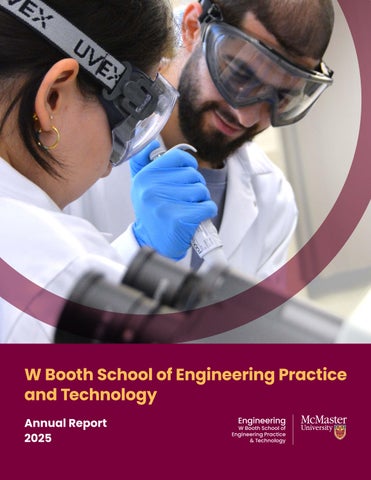
W Booth School of Engineering Practice and Technology Annual Report 2025
At the W Booth School of Engineering Practice and Technology (W Booth School), innovation is not just a concept, but a daily practice. Our faculty, students and alumni work side by side with community partners, industry leaders, hospitals and municipalities; they design and build capstone projects and engage in research that seeks to tackle challenges that matter. Whether improving healthcare, addressing climate challenges, strengthening manufacturing, advancing smart technologies or shaping policy and entrepreneurship, the W Booth Schooll stands on the premise that engineering education must be hands-on, purposeful and deeply connected to real world impact.
2
This year has been no exception. Across our Bachelor of Technology (BTech) four-year, BTech DCP and graduate programs, our community has exemplified what it means to learn by doing. From student-led innovation to collaborations driven by faculty, the work highlighted in this report reflects a school that is engaged and committed to contributing to a brighter world. As you move through this report, we invite you to experience the breadth of work happening across our School. You will meet the people behind the work and find opportunities to collaborate. This publication is more than a reflection of our year; it is an open invitation to partner and create shared impact.
In my final year as Director of the W Booth School, it is a privilege to reflect on a community that continues to grow as a place where ingenuity meets purpose. This year holds special meaning as we celebrate the 20th anniversary of our our graduate programs, a moment to honour Walter Booth’s vision for education that empowers people to solve real problems and strengthen communities. At the W Booth School, innovation is never theoretical. Our students and faculty immerse themselves in hands-on, practice-based learning that directly engages with partners across Hamilton and throughout the country. From advancing planetary health to designing solutions that improve healthcare delivery, our School continues to take on the kinds of challenges that shape the everyday lives of Canadians. This is what I mean when I say we are “elbows up”: ready to roll up our sleeves, collaborate widely and put ideas into action. This year, our faculty distinguished themselves through impactful applied research and meaningful partnerships, work that reflects both intellectual rigour and a deep sense of responsibility to society. Their efforts are making a difference in areas such as clean energy, sustainable infrastructure, AI in clinical settings and design for community wellbeing. Our students have also shown tremendous creativity and drive. Whether building prototypes, advising community groups, supporting municipal initiatives or contributing to design challenges, they have demonstrated not only technical strength but also empathy, resilience and leadership. Their projects continue to showcase the value of learning through doing. We are equally proud of our alumni who are charting exciting paths across industry, entrepreneurship, policy and research. Their achievements remind us that practice-based education creates graduates who are adaptable, engaged and ready to meet the needs of a rapidly changing world. As we mark two decades of impact, the W Booth School remains committed to a future defined by practical innovation and community connection. The stories in this report highlight a School that is tackling real issues, forming strong partnerships and empowering the next generation of problem-solvers. I encourage you to explore this year’s report and see how our community continues to shape solutions with purpose and heart.
Inside 4 Celebrating 20 years of W Booth School graduate programs ö Honouring the legacy of Walter G. Booth
6
Planetary health
8
Healthcare
12 Smart systems 14 Manufacturing 17
Policy
18 Celebrating our new professional engineers ö BTech DCP Civil Engineering Infrastructure Technology alumni earn their P.Eng. designation
20 Community engagement ö Building Canada’s future at Opportunity Marketplace 2025
22 General Technology (GenTech) ö The human and business dimensions of technology engagement
24 Education ö Celebrating excellence in teaching and learning
25 The Bachelor of Technology Association (BTA) ö Strengthening community and student experience in 2025
27 Alumni to watch 30 Ways to engage
Brian W. Baetz, P.Eng. Director, W Booth School of Engineering Practice and Technology 3
Celebrating 20 years of W Booth School graduate programs
4
Honouring the legacy of Walter G. Booth
This year marks the 20th anniversary of the W Booth School’s graduate programs; a milestone rooted in the vision and generosity of Walter G. Booth. To commemorate the occasion, we welcomed to campus his daughter, Catherine Booth, to share her father’s remarkable journey in an anniversary video. Walter’s path to engineering was anything but linear. With only a grade 12 diploma, he worked a variety of jobs before completing a three-year program at the Ryerson Institute of Technology (Now Toronto Metropolitan University). When he applied to universities, most turned him away for lacking Grade 13. McMaster chose differently. The Dean of Engineering recognized his potential, accepted his diploma and admitted him into Mechanical Engineering. Walter went on to complete both his undergraduate and
master’s degrees at McMaster — an opportunity that changed his life. In gratitude, Walter became a dedicated supporter of McMaster’s Faculty of Engineering, contributing to experiential learning opportunities across the Faculty, including the building of the Gerald Hatch Centre. His belief in creating opportunities for others, lives on through the W Booth School. As we celebrate 20 years, we honour Walter’s values; resilience, generosity and a deep commitment to empowering future engineers. His legacy continues to shape our School, our programs and the communityengaged work highlighted in this report.
5
Planetary health Our work in planetary health reflects a shared goal: creating sustainable, resilient communities. This year’s projects highlight how W Booth School students and faculty are helping reduce emissions, protect natural systems and support responsible growth across Hamilton and beyond.
6
Recovering waste heat to power low-carbon communities
Designing a greener way to manage stormwater
Shaping policy to support Hamilton’s housing future
Our Master of Engineering and Public Policy students continue to support a multiyear partnership with Hamilton Community Enterprises aimed at modernizing the city’s district energy system.
Rainfall on campus can be more than runoff; it can be a resource.
As Hamilton works to meet the growing need for affordable, sustainable housing, thoughtful policy has never mattered more. To support this effort, the West End Home Builders’ Association (WE HBA) invited our Master of Engineering and Public Policy students to examine how the city’s engineering guidelines shape new home construction.
This year, a graduate team from the program developed a set of recommendations to help Hamilton capture industrial waste heat and redirect it into low-carbon thermal networks that supply surrounding buildings with space heating and domestic hot water. Their work provides a practical pathway for reducing emissions while improving the efficiency of local energy infrastructure. Faculty lead: Greig Mordue Graduate students: Rebecca Korolek, Shivani Nathoo, Mahdiyar Qajar
A team from our Master of Engineering Design program worked with Brad Fairley of Five Smooth Stones Restoration to reimagine how McMaster manages rain and stormwater. Drawing on leading practices in sustainable stormwater design, the students proposed a system that uses natural features, including bioswales, tree plantings, and retention ponds, to absorb and filter water at the source. Their design also incorporates creative placemaking elements, including fountains and stream-like channels powered by filtered rainwater, enriching both function and the campus experience. The goal is to reduce McMaster’s reliance on underground infrastructure while easing pressure on Hamilton’s overburdened treatment systems, demonstrating how thoughtful design can support both environmental health and community resilience. Faculty lead: Brian Baetz Graduate students: Weichang (Matthew) Hou, Zahra Abyaneh
Working alongside industry partners and municipal staff, a team of graduate students produced a detailed report outlining both the challenges and opportunities within the current framework. Their recommendations focus on advancing housing development while protecting the natural environment, a balance that is central to Hamilton’s long-term planning goals. The team later presented key findings at a Hamilton City Builders meeting co-chaired by WE HBA and the city’s Planning and Economic Development Divisions, ensuring their insights reached the people shaping policy on the ground. Faculty lead: Velma Grover Graduate students: Meiying (May) Gu, Wen Ma
7
Healthcare Across the W Booth School, students and faculty are advancing innovations that cultivate healthier people and communities. From new biomaterials and DNA analysis tools to virtual care technologies and city-wide health initiatives, our teams are improving how care is delivered and accessed. These projects highlight our commitment to healthcare solutions that are human-centred, datainformed and ready for real-world impact.
8
A pocket-sized lab on a chip
BIOx Research Group - Transforming healthcare through next-generation biomaterials and diagnostics
Master of Engineering in Manufacturing Engineering students developed an innovative product – a “lab on a chip” device designed to make health testing more accessible. Their microfluidic chip uses a tiny drop of liquid and a colour-changing reaction to detect key health biomarkers, turning bright blue when a target chemical is present. The more intense the colour, the higher the concentration.
The BIOx research group, led by faculty in the W Booth School, conducts innovative research across the biomedical, food, water and energy sectors. The team includes postdoctoral fellows, PhD and MASc students, and routinely welcomes W Booth undergraduate co-op students into the lab. Together, they focus on designing and developing sustainable, functional nanomaterial-based solutions to address both current and emerging challenges in these fields.
The students engineered and 3D-printed the entire chip on campus. They also built a portable reader powered by an Arduino and sensor technology, allowing users to scan the chip and receive an instant digital result.
Their research program is supported by government agencies, non-profit organizations and industry partners. The group publishes extensively in highimpact peer-reviewed journals, files patents and actively works toward the commercialization of its technologies.
With further refinement, this point-ofcare tool could be adapted to detect a wide range of biomarkers, offering a low-cost, easy-to-use alternative to traditional lab testing and expanding access to early screening in homes, clinics and remote communities.
The BIOx Research Group had an exceptional year, advancing several cutting-edge projects that push the boundaries of healthcare innovation. One major achievement was the development of smart, 3D hydrogels designed to help repair damaged nerve tissue, a promising step toward improving independence and quality of life for people living with irreversible nervous system injuries. The team also created metal-free protective coatings for medical textiles, using carbon quantum dots to reduce the spread of infections on high-touch surfaces such as masks, gowns and linens. These
Faculty lead: Amin Reza Rajabzadeh Students: Stuart Burns and Jonathan Jarzabek
coatings offer antibacterial, antioxidant, and antifungal protection, providing a safer and more sustainable alternative to traditional antimicrobial treatments. BIOx researchers also made significant progress in biosensing technologies, creating ultra-sensitive electrochemical, fluorescent and colour-based detection tools capable of identifying biomarkers in blood, saliva, food and the environment. In parallel, the group engineered a multifunctional mechanofluorescent hydrogel that lights up when stretched or compressed, opening the door to future applications in wearable health monitors and soft robotic systems. Together, these projects produced 13 publications, two U.S. provisional patent applications, and new collaborations with industry and academic partners. Their work demonstrates W Booth School’s growing leadership in translating advanced biomaterials and nanotechnology into real-world healthcare solutions. Faculty: Amin Reza Rajabzadeh and Seshasai Srinivasan Postdoctoral fellow: Poushali Das PhD Students: Parham Marvi, Elahe Masaeli, Misha Muthalali, Mohamed Mahana, Ahmad Sheikhlar and Samira Nikmanesh MASc student: Shiza Hassan Collaborating alumni: Herlys Cobas and Rahin Ahmed 9
Guiding responsible AI use in healthcare
3D-printed hydrogel scaffolds for future tissue repair
Supporting personal support workers through smart technology
As AI tools become increasingly common in clinical environments, St. Joseph’s Healthcare Hamilton (SJHH) partnered with the W Booth School to ensure these technologies are introduced safely and responsibly. In 2025, students in our Master of Engineering and Public Policy program worked alongside hospital staff to develop clear criteria for evaluating which AI tools are appropriate for use in patient care and facility operations..
A team of final-year Biotechnology students used digital light processing (DLP) to 3D print biocompatible hydrogel scaffolds — high-precision structures that can support new tissue growth. As a proof of concept, they created a small heart-valve scaffold, offering a glimpse into how this technology could help repair or replace damaged tissues in the future.
Supporting the people who support others is emerging as a critical healthcare challenge, and this year, W Booth students stepped directly into that space. Faculty and graduate students in our Engineering Design Program were engaged by InvisibleCare, a Hamilton-based wellness company that provides attendant care to clients requiring physical, cognitive and emotional support.
To refine this framework, W Booth School faculty and students led a half-day workshop that brought together staff from across the hospital to test and discuss how the criteria could be applied in real scenarios. The next phase of the partnership will see these guidelines trialed using a set of healthcare use cases, helping SJHH build a thoughtful, evidencebased approach to AI adoption. Faculty lead: Velma Grover Faculty support: Robert Fleisig Graduate students: Doris Antwi-Debrah, Hezhe Guan and Qianxin Zhou
10
Their capstone project demonstrates how emerging tools in 3D printing may lead to personalized medical treatments and new possibilities in regenerative medicine. Students: Armin Ensafi, John Mudie, William McKinnie, Ramy Esteitie, Daniela Fajardo Cabrales and Stefania Fajardo Cabrales
Working closely with company staff and other stakeholders, the team helped refine an AI-mediated online coaching service that offers personal support workers (PSWs) real-time, “in the moment” guidance. The resulting design report and prototype highlight the school’s growing strength at the intersection of smart technology and virtual healthcare. Faculty lead: Robert Fleisig Graduate students: Albert Ding, Qicheng (Arthur) Liu and Shiyu (Ashley) Ma
Active transportation for better health
Advancing DNA analysis through high-throughput testing
Building a healthy city means designing active transportation systems that work for everyone, from casual cyclists to daily commuters. The City of Hamilton is working with partners across the region to expand walking, hiking and cycling as meaningful alternatives to driving, with the dual goals of improving community health and reducing emissions.
A team of Biotechnology students explored a faster, more scalable way to study DNA stability, an essential factor in genetic engineering, biotechnology research and emerging diagnostic tools. The students created a workflow that uses familiar lab tools in an innovative way, allowing researchers to test many DNA samples more quickly. Their approach helps scientists see how small changes in DNA can influence its structure and behaviour — insights that are essential for designing new biotechnologies and understanding how genetic materials function. While not designed for clinical diagnostics today, this capstone project provides researchers with a powerful tool for understanding how subtle changes in DNA sequences affect molecular stability. In the long term, this foundational knowledge can support advances in biotechnology, genetic engineering and future diagnostic innovation.
In 2025, the municipality engaged our Master of Engineering Design Program to develop solutions that help cyclists of all abilities navigate key areas of the city more safely and confidently. The students employed a range of design methods, including user interviews and stakeholder surveys, to craft a report with recommendations. Among the recommendations were prototypes of improved wayfinding signs and proposed digital tools to enhance the cycling experience. The report has been provided to the City of Hamilton for its consideration. Faculty lead: Kate Whalen Graduate students: Aaila Bazil, Yca Meriel and Winnie Chen
In the long term, this foundational knowledge can support advances in biotechnology, genetic engineering and future diagnostic innovation.
Students: Maria Sosa, Osha Cruz Joaquim and David Sandu
11
Smart systems Across the W Booth School, students and faculty are designing technologies that think, adapt and respond in real time. Our Smart Systems work brings together automation, sensing, data analytics and human-centred design to solve complex problems — from agriculture and emergency response to advanced simulation and hands-on learning. These projects highlight how intelligent systems can make industries safer, cities smarter and innovation more accessible to communities everywhere.
12
Smart automation to support safer, more efficient farming
Enhancing drone pilot performance for emergency response
AI-driven tools to transform simulationbased learning
In collaboration with a local farmer at Oosterhof Farms, a Bachelor of Technology – Automation Systems Engineering Technology student team created an affordable Internet of Things (IoT) system that modernizes an older grain dryer with real-time automation. By using moisture data to control drying, their capstone project solution improves grain quality, reduces fuel waste and removes the need for constant overnight monitoring.
When emergencies unfold, drone pilots must make split-second decisions under intense pressure, and better tools can make all the difference. In collaboration with the Canadian Emergency Responders Robotics Association (CERRA), our Master of Engineering Design students and faculty explored how pilots manage cognitive workload during real-world crisis scenarios.
As digital labs become more central to modern STEM education, our students are helping shape what the future of learning will look like. In partnership with LABonWEB, our Master of Engineering in Systems and Technology program contributed to the development of an AI-powered chatbot that allows learners to interact directly with complex lab simulations using simple, conversational prompts.
The team’s approach gives small farms access to advanced agricultural technology without replacing existing equipment. What once required round-the-clock supervision can now be safely managed from a phone or tablet, offering farmers greater efficiency, better safety and meaningful everyday impact. Students: Emmett Stavnitzky, Colin Campbell and Peter Pilling
The team examined how operators interpret camera feeds, sensor data and onboard tools like grapples or thermal imaging, and identified ways to make these interactions more intuitive. Their insights will help shape nextgeneration, human-machine interfaces and improve training programs, strengthening pilot performance when every second truly counts. Faculty lead: Robert Fleisig Graduate students: Danish Khader, Muskan Lalwani and Yifan Zhou
The result is a more intuitive, engaging experience: complex procedures become easier to navigate, experiments run more efficiently, and students gain deeper insight into scientific concepts. This work marks an exciting step toward making high-quality STEM education accessible to classrooms and training programs around the world. Faculty lead: Marjan Alavi Graduate student: Osama Mohamed Abdulghani
Cyber-physical systems that bring automation to life
The Remote Control (RC) car platform became one of our most versatile teaching tools, used to study vibration data, explore machine-condition monitoring, build autonomous driving systems and test real-time sensing and control. Students added cameras, microcontrollers and edge-processing tools to build complete cyber-physical systems. This work gave learners a safe, low-cost environment to design, test and optimize Industry 4.0 technologies, bridging the gap between software, automation and mechanical engineering.
13
Manufacturing Advanced manufacturing at the W Booth School is driven by curiosity, handson problem-solving and a commitment to building the systems and technologies that will shape Canada’s future.
14
Bringing Industry 4.0 to the Learning Factory’s paint line
Engineering the future of flying cars
Building the future: Robotics in modular housing
A capstone team in the Learning Factory took on the challenge of modernizing the walking-cane painting station, a process that used to rely on a simple Arduino– PLC setup and manual oversight. Their upgraded solution brings full Industry 4.0 automation to the line by introducing a robot that can paint cane components independently while communicating in real time with the Manufacturing Execution System (MES).
In partnership with Ontario-based GoWrench Auto, our Master of Engineering in Manufacturing Engineering program is contributing to the development of a prototype “roadable aircraft” designed for use in both urban and rural environments.
Master of Engineering in Manufacturing Engineering students continue to work alongside Grapl Inc. to accelerate the mainstream adoption of modular construction processes in the race to meet the growing demand for affordable housing.
This multiyear project brings together complex engineering considerations, including structural materials, propulsion, control systems and advanced simulation, offering students rare, hands-on experience with one of the most ambitious mobility challenges of our time. Along the way, they are also learning about the evolving rules, regulations and safety frameworks that will guide the emergence of flying cars across North America.
Most recently, the company teamed up with our graduate students on a project to support the automation of pneumatic nailing in wood fabrication using robotic systems. Data and insights pertaining to reaction forces, recoil and energy transfer will be used to engineer shock absorbing mounts, dampers and stable worktables in robotic nailing set ups.
This new setup lets the station send and receive live production data, including cycle counts, paint times, robot status and quality checks, making the entire process smarter, safer and fully traceable. The upgrade not only delivers more consistent, highquality finishes but also boosts throughput and reduces worker exposure to paints and chemicals. It’s a major step toward a fully connected, modern manufacturing environment and a shining example of what BTech students can build when engineering meets hands-on innovation. Faculty lead: Tom Wanyama
As engineering work continues, the next phase will involve securing additional partners and investors to help bring this groundbreaking concept closer to reality. Faculty lead: Moein Mehrtash Graduate students: Zihao Li and Wenhao Gai
These and other advances are vital to implementing fully automated, self-correcting robotic assembly lines in timber construction and critical to lowering costs and increasing housing supply. Faculty lead: Marjan Alavi Student: Alexis Macagno
15
Smart digital manufacturing systems for hands-on learning
Reimagining vehicle performance through a customizable transmission system
Faculty thought leadership shaping Canada’s manufacturing future
The Learning Factory made major progress this year in building a fully connected, Industry 4.0 learning environment.
A Bachelor of Technology – Automotive and Vehicle Engineering student team set out to rethink how drivers interact with their vehicles by building a fully customizable transmission system. Working from a scooter’s continuous variable transmission (CVT), this capstone team engineered a setup that can mimic virtually any manual or automatic gearbox. Through a touchscreen interface, users can switch between gear modes and adjust ratios to suit their driving style, whether for daily use or high-performance track conditions.
This year, Greig Mordue continued to be a leading national voice on automotive manufacturing, supply chains and Canada’s rapidly evolving industrial landscape. His expertise was featured widely across major media outlets, reflecting the School’s growing influence in conversations that shape public policy and economic strategy. In recent months, he appeared on TVO’s The Rundown, CBC’s Radio’s onehour call-in program with Amanda Pfeffer, and multiple national news platforms including, CBC National, CBC Metro Morning, CBC Ontario Morning, CTV News Network, CHCH, The Globe and Mail and The Canadian Press.
Students worked with MES-Core, our in-house Manufacturing Execution System, to track orders, materials and machine activity in real time — just like a modern factory. A simplified version, MES-Minimal, helped learners understand production analytics, OEE and automated workflows. The team also developed EdgeSense, a smart system that monitors material levels using sensors and automatically requests refills. With the addition of a Shopify–MES integration, students can now follow a product all the way from online purchase to factory execution. Together, these tools give our students a realistic experience of how digital manufacturing works from end to end. Faculty lead: Tom Wanyama
16
Their innovation showcases how familiar automotive components can be transformed through creative engineering. By unlocking the CVT’s full potential, the team demonstrates how future vehicles could offer drivers far greater control, personalization and responsiveness. Students: Rylee Boissoneau, Varun Nagarajan and Zain Khan
These interviews, spanning topics from electric vehicle policy and global trade tensions to historic shifts in Canada’s auto sector, demonstrate the vital role W Booth faculty play in informing public understanding of manufacturing challenges and opportunities. Through his continued engagement, Grieg Mordue is helping Canadians make sense of a sector undergoing rapid transformation, and reinforcing W Booth’s position as a trusted source of evidence-based insight.
Sample project: Powering Hamilton’s future through smarter energy policy
Policy At the W Booth School our students and faculty work directly with government, industry and community partners to shape frameworks that support sustainable growth, energy innovation and better public outcomes. In 2025, our policy students worked on four community engaged projects with real world implications.
The W Booth School continued its collaboration with the City of Hamilton this year through an eight-month Master of Engineering and Public Policy project focused on advancing Integrated Community Energy Systems (ICES) — local electrical and thermal systems designed to improve sustainability and efficiency. Working with the City’s Office of Climate Change Initiatives, the Master of Engineering and Public Policy student team developed a policy framework to support the adoption of ICES at Steelport, the 800-acre redevelopment of Hamilton’s Bayfront Industrial Area. Their report, built on research and stakeholder interviews, highlights the need for clearer, more flexible policies to help unlock local energy innovation. Supervised by W Booth School Adjunct Professor Greg Zilberbrant, the project gave students valuable experience working directly with municipal staff on a real policy challenge. The final report has been shared with the City for consideration, with support from partners including Alectra, Hamilton Community Enterprises, NRStor and Slate Asset Management. Faculty lead: Greg Zilberbrant Students: Yueyue (Julie) Bai, Sindhuja Iyer and Nianzu Shen
17
Celebrating our new professional engineers
18
BTech DCP Civil Engineering Infrastructure Technology alumni earn their P.Eng. designation
This year marks an inspiring milestone for the W Booth School as graduates of the BTech Degree Completion Program in Civil Engineering Infrastructure Technology achieved their Professional Engineer (P.Eng.) designation. Their success reflects the strength of the BTech pathway, the dedication of our students and the quality of the applied engineering education delivered through the DCP program.
Chloe Cao, P.Eng. Class of 2019
Josh Self, P.Eng. Class of 2020
We are proud to recognize these graduates, several of whom continue to give back to our community through recruitment events, outreach and mentorship.
“This accomplishment is especially meaningful because I completed the full-time Civil Infrastructure BTech program at McMaster while working full-time. Balancing both was demanding, but it taught me discipline, resilience and how to deliver under pressure. Earning my P.Eng. is the cumulation of that journey and I am grateful for the mentors and colleagues who supported me, especially the program Chair Michael Justason whose dedication to advancing the program truly inspired me. I am excited to continue contributing to thoughtful, reliable engineering work and building our communities a better place.”
“After completing my civil engineering diploma at Fanshawe College in 2017, I attended McMaster’s BTech Civil Engineering Infrastructure Technology degree completion program from 2017 to 2020. It provided the crucial pathway I needed to pursue my P.Eng. designation. The program strengthened my technical skills, broadened my understanding of infrastructure systems, and ultimately enabled me to meet the academic requirements for licensure. Now working in municipal government, I apply what I learned every day, and I’m proud to have earned my P.Eng. in 2025 thanks to the foundation that the program helped build.”
Sharmin Kassam, P.Eng. Class of 2018
Daniel Scouten, P.Eng. Class of 2020
Reece D’Souza, P.Eng. Class of 2021
“This has been a long, humbling journey that I didn’t even see myself on until I got my BTech. The experience has been shaped by mentorship and encouragement from my colleagues and peers, especially Mike Justason. I’m looking forward to using my P.Eng. to raise the bar within the niche of scaffold engineering, mentor likeminded individuals, and continue gaining confidence in the work I get the opportunity to deliver!”
“Starting from attending McMaster’s engineering camp in 1999, to graduating from Mohawk College in 2011, to earning my degree from McMaster in 2020, and now receiving the Iron Ring and P.Eng. in 2025, it has been an incredible journey. I’m proud and grateful to be part of the engineering profession and excited to continue the next chapter.”
“Earning my P.Eng. license in 2025 is a milestone that fills me with pride and gratitude. It represents years of hard work, perseverance, and growth as a professional. I’m deeply thankful to McMaster for creating a program that empowers working professionals to achieve this goal without putting their careers on hold. This accomplishment opens doors to new opportunities and challenges, and I’m excited to continue growing and making an impact in the field of Civil Engineering.”
Each of these alumni has followed a unique journey, balancing work, family, professional growth and the rigorous licensing process required by Professional Engineers Ontario. Their accomplishment is not only a celebration of personal determination, but also a powerful reminder to current and prospective students that BTech is a meaningful, respected and achievable route to becoming a licensed engineer in Canada.
19
Community engagement
20
Building Canada’s future at Opportunity Marketplace 2025
In August, the W Booth School hosted its third annual Opportunity Marketplace, convening 130 leaders from academia, industry, policy and community organizations, with additional participants joining virtually from across Canada. Co-founded by Salman Bawa and Richard Allen, Community Engagement Coordinators at the School, the event has established itself as a national forum for addressing Canada’s most pressing challenges. This year’s theme, Building Canada’s Future: What Matters Most?, framed discussions around interconnected issues, including energy security, sustainable housing, healthcare access and wildfire resilience. The morning opened with a keynote address from Marcia Young, host of CBC Radio’s World Report, who emphasized the foundational role of shared knowledge in strengthening communities. Her message resonated throughout the day: “Knowing is the first step in connecting.”
Panel discussions brought together engineers, economists, social scientists, political leaders and researchers to examine pathways for universities and communities to collaborate on building a more resilient and inclusive Canada. As Director Brian Baetz observed, the nation’s future depends on collective effort built “by people who believe progress is not just possible but shared.” Opportunity Marketplace is structured to move beyond dialogue toward tangible outcomes. Following the event, organizers authored a post-event report that identifies opportunities for community-engaged projects faculty, staff, and students can advance in the coming year. The continued growth of the series reflects the W Booth School’s commitment to convening diverse perspectives, fostering meaningful collaboration and contributing to solutions that strengthen Canada’s future.
21
General Technology (GenTech)
The human and business dimensions of technology engagement General Technology (GenTech) courses form the business and management foundation of the B.Tech programs at the W Booth School. Comprising approximately 30% of the curriculum, these mandatory courses deliver the program’s Management Advantage by integrating business acumen, communication and professional skills with applied engineering technology education.
22
This integration develops graduates who understand both the technical and business dimensions of engineering and technology practice, enabling them to make informed decisions within organizational, financial and operational contexts and to transition seamlessly into industry as effective project leaders, supervisors and technology professionals.
M-Factor: Building confident, adaptive engineers
M-Factor returned in 2025 as a signature GenTech event, bringing 25 select engineering students together for a weekend of challenges designed to strengthen communication, leadership, adaptability and realtime decision-making. With $6,000 in prizes, students tackled improv exercises, construction challenges and a high-pressure simulated press conference, each testing their ability to think critically on the spot. Led by GenTech faculty Hoda Kamel, Allan Mackenzie and Mike Justason, the competition highlighted how experiential learning builds essential skills across engineering disciplines. Jasmine Smith earned first place, with Naomi Dover and Yash Dubey finishing second and third. Students described the experience as confidence-building and transformative, helping them sharpen presentation skills, collaborate effectively and connect with peers and industry judges. More than a competition, M-Factor helps shape engineering students into adaptable, future-ready leaders.
Where engineering meets entrepreneurship
The fall 2025 W Booth Management Advantage session brought students face-to-face with Eldon Sprickerhoff, CoFounder of eSentire. His talk highlighted what it really takes to innovate in fast-moving fields like cybersecurity. Students learned that building smart systems requires more than strong technical skills — it demands entrepreneurial thinking, leadership decision-making and an understanding of how technology fits into complex organizational environments.
BTech students rank among global Top 100 in strategy competition We are proud to highlight the outstanding performance of several student teams from our GENTECH 4FT3 Strategic Management course that earned Global Top 100 rankings in the GLO-BUS international business simulation in 2025. Competing against 2,358 teams from 128 universities worldwide, our BTech students demonstrated remarkable strategic insight, analytical skill and teamwork. Their results affirm that W Booth School students are competing, and excelling, on a global stage, frequently outperforming senior commerce students and MBA cohorts. As they prepare to graduate, these achievements reflect the strength of the engineeringmanagement education they carry forward into their professional careers.
Michael Justason – building engineers for the real world Michael Justason’s McMaster Student Union Award of Distinction recognizes his work building engineering management education at the W Booth School around what matters in practice: smart infrastructure, community needs, and the realities of public policy. His curriculum doesn’t just teach technical decision-making, it shows students how engineering solutions have to function within the complicated systems of community stakeholders, regulations and government. Whether he’s creating faster pathways into graduate management programs or bringing new technology into the classroom, his approach is grounded in preparing students for the messy, interconnected challenges they’ll face in civil and municipal engineering.
Excellence in teaching across systems, healthcare and professional pathways Allan MacKenzie’s Accreditation Council for Business Schools and Programs (ACBSP) National Teaching Excellence Award recognizes his commitment to preparing students for the multidisciplinary realities of modern engineering careers. Through systems thinking, experiential learning and strong attention to student wellbeing, he has reshaped the management curriculum for the hybrid era. His work, including innovative course design and emerging pathways such as accelerated routes to medical school, helps students understand how engineering intersects with healthcare, policy and organizational leadership. 23
Education
Celebrating excellence in teaching and learning Seshasai Srinivasan was recognized this year with McMaster’s highest honour for teaching excellence: the President’s Award for Outstanding Contributions to Teaching and Learning. Sesha is known for creating active, supportive learning environments where students build confidence, think critically and develop as human-centred leaders. He approaches teaching as a facilitator, continually refining his methods
24
through student and peer feedback and modelling the curiosity and lifelong learning he encourages in others. Holder of the Endowed Chair, W Booth Chair in Engineering Entrepreneurship and Innovation, students describe his passion, mentorship and commitment to their growth as transformative. His work exemplifies the W Booth School’s mission to prepare graduates who can lead with both technical skill and human insight.
The Bachelor of Technology Association (BTA)
Strengthening community and student experience in 2025 In 2025, the Bachelor of Technology Association (BTA), a council of 28 students representing all BTech programs — continued its mission to enrich the student experience through academic support, professional development, mentorship and community-building initiatives.
25
Professional development:
This year, the BTA hosted five professional development events, engaging more than
500 students
and collaborating with six engineering programs and the Centre for Career Growth and Experience.
Welcome week:
Through Clubs Fest and the annual Amazing Race/Bonfire, the BTA connected with over
80 incoming students,
helping new learners transition into the BTech community.
26
Academic support: This year the BTA organized
11 academic help nights,
creating meaningful connections between students and faculty while supporting success across BTech courses.
Council leadership & initiatives:
This year’s council strengthened internal operations by creating SOP documents, expanding coordinator roles, and adding a new leadership position. The team also released new Faculty Trading Cards and collaborated with McMaster Engineering Communications to launch the Flare Trading Card.
Social & community engagement: The BTA held
14 social events,
partnering with groups such as the McMaster Outdoors Club, the McMaster Engineering Society, and the W Booth School to foster a vibrant and welcoming community.
I am so thankful for the opportunity the BTA gave me to work with and meet students and staff throughout the McMaster Engineering Faculty and programs. The knowledge, experience, and relationships my team has acquired from our time on the BTA will continue to develop the future of this organization and McMaster community. I look forward to seeing what is in store for the BTA in 2026! — Quinn Sheppard, 2025 BTA President
Alumni to watch Driving impact in automation and business
Racing toward a future in Formula 1
Keeping Ontario’s lights on and its future bright
Tobi Popoola Automation Systems Engineering Technology Class of 2015
Ariana Wong Automotive and Vehicle Engineering Technology Class of 2025
Mark Coenen Power and Energy Engineering Class of 2015
Tobi Popoola built the foundation of his career in our Automation Systems Engineering Technology program, where co-ops in systems integration and design set him on a path toward manufacturing and logistics automation. After graduating, he advanced into technical and commercial roles across material handling and packaging automation, earning Honeywell Intelligrated’s President’s Club Award for leading large-scale digitization projects during the pandemic.
Ariana Wong is already charting an ambitious path toward a career in Formula 1 engineering. Inspired from childhood by watching races with her family, she has become a passionate advocate for women in motorsport. Ariana is now pursuing a Master’s in Motorsport Engineering at Oxford Brookes University, building the advanced skills needed to enter F1. With determination, talent and a commitment to opening doors for future women engineers, Ariana is poised to make a significant impact in the motorsport world.
Today, he leads the growth of PeakLogix’s Canadian automation business — consulting on racking, high-density storage systems and robotics solutions for manufacturers and distributors — while continuing to expand his expertise and impact across the industry. Learn more about Tobi Popoola in our Life after BTech series.
Learn more about Ariana in our 2025 Women in Engineering spotlight.
Mark Coenen is building a career at the intersection of renewable energy and grid operations. After completing his BTech part-time, he joined Hydro One as a Grid Controller and earned his NERC certification as a power system operator. He’s since moved into operations planning and training, helping shape the next generation of operators. Mark sees significant opportunity ahead as Ontario’s energy sector evolves — from nuclear refurbishment to emerging technologies like Small Modular Reactors. His approach: stay informed, stay flexible and be ready when the industry shifts. With handson experience and strategic thinking, Mark is positioned to make an impact as the energy landscape transforms. Learn more about Mark in our Life after BTech series.
27
Valedictorian leading at the intersection of engineering and health
Shaping a sustainable future
From biomanufacturing to brain health
Xiru Wang Master of Engineering Systems and Technology Class of 2024
Akosua Ossai Master of Engineering and Public Policy Class of 2019
Daniel D’Souza Master of Engineering in Manufacturing Engineering – Biomanufacturing Class of 2024
BTech and MEST alum Xiru Wang has made a remarkable impact at the W Booth School through her leadership, research and community engagement. As valedictorian of McMaster’s 2024 Fall Convocation, she was recognized for her academic excellence and service to her peers. Her master’s research advanced machine-learning models to analyze EEG biomarkers for chronic pain, strengthening patient-centred innovation. Xiru acknowledges the guidance of Zhan Gao, Associate Director of Graduate Studies, in supporting her opportunity to contribute to this EEG research.
After graduating from McMaster with a Master’s in Engineering and Public Policy, Akosua Ossai continued her career at the nexus of climate policy, sustainability and strategy – first with the Green Climate Fund, a multilateral climate fund in South Korea, and later as a Business Incubation Manager supporting entrepreneurship and innovation in Ghana. These early experiences strengthened her commitment to systems level problem-solving to address global challenges.
Daniel D’Souza, a graduate of both McMaster’s iBioMed program and the Master of Engineering in Manufacturing Engineering (Biomanufacturing) program, is now pursuing an MD/PhD at the University of Toronto. Currently in the medical portion of his training, he plans to pursue a PhD focused on neurosurgery and neuromodulation – research aimed at refining neural circuits through minimally invasive techniques to improve outcomes for patients with neurological disorders. His long-term goal is to become a neurosurgeon-scientist whose clinical practice and research inform one another to advance patient care.
Now beginning a PhD in kinesiology at McMaster, Xiru continues to push the boundaries of neuroscience, AI and human-health engineering. Xiru’s vision extends beyond the lab, she’s determined to develop intellectual property during her PhD that could serve as the foundation for a healthcare startup. With support from McMaster’s entrepreneurship ecosystem, she’s already building relationships with mentors and exploring the resources that will help turn that vision into reality.
28
Today, as a Manager in Deloitte’s Sustainability & Climate practice, she leads risk, strategy and ESG transformation projects for Canadian and global clients, helping organizations embed sustainability into their core business strategy while driving measurable performance and growth. Looking ahead, Akosua aims to help organizations navigate complexity and market transitions by developing strategies that ensure long-term relevance and competitiveness – ultimately contributing to a more resilient, innovative and sustainable future.
Daniel credits McMaster for providing the foundation that prepared him for this demanding path. The iBioMed program trained him to approach medical challenges with an engineering mindset, while the Biomanufacturing program equipped him with essential skills in project management, design thinking and statistical modelling – tools he now uses daily as a medical student and future researcher. He reflects on his time at McMaster as transformative, noting that the culture of innovation and interdisciplinary learning continues to shape his trajectory.
For Daniel, being an alum means carrying forward the spirit of discovery and impact that defines the McMaster community – something he says will stay with him throughout his career.
From BTech to P.Eng.
Daniel Scouten Civil Engineering Infrastructure Class of 2020 Since graduating from McMaster’s Bachelor of Technology program in Civil Engineering Infrastructure in 2020, Daniel Scouten’s career has focused on building a strong technical foundation and taking on progressively broader leadership roles in transportation infrastructure.
projects and positioned him well for his current senior leadership role. Daniel’s journey to becoming a licensed Professional Engineer in Ontario has been shaped by a blend of education and experience, beginning with his Civil Engineering Technology diploma and C.E.T. designation, returning to complete his degree at McMaster while working full time, and then formalizing his engineering practice through PEO. Today, as a Senior Manager at Jacobs, where he works primarily on the Eglinton Crosstown LRT and specializes in the latter stages of major transportation megaprojects, focusing on civil, systems, safety certification, asset management and the transition from capital delivery into operations and long-term maintenance. Looking ahead, Daniel sees himself continuing to grow in roles that shape how large, multi-stakeholder transit and highway programs are delivered and handed over, leading multidisciplinary teams, mentoring future leaders and helping deliver safe, reliable and sustainable transportation systems that perform over their full lifecycle.
He began on the technical and construction side, first as an inspector with the City of Hamilton and then as a civil engineering technologist in various roles with the Ontario Ministry of Transportation (MTO), where he gained hands-on experience with highways, municipal works, materials and maintenance operations. Over time at MTO he moved from front-line construction and maintenance into quality assurance and then into managing major design and construction projects, including multiple major P3 highway expansions. This progression gave him a deep understanding of how design, construction, quality and operations come together on complex 29
Ways to engage Community-Engaged projects Turn a challenge within your organization into an eight-month experiential learning project.
Your real-world problem becomes the foundation for a collaborative effort involving your team, faculty expertise, talented student innovators and access to state-of-the-art facilities. Deliverables may include: • Proof-of-concept hardware or software prototypes • Feasibility and viability studies • Strategic reports and presentations These projects not only generate fresh perspectives for you, they also ignite life-changing learning moments for students.
Collaborative partnerships
Some engagements grow into deeper, long-term partnerships. Organizations may choose to hire a graduate or post-doctoral fellow to work fulltime on a challenge, allowing for more rigorous exploration, focused research and sustained innovation.
Company site visits and tours
Our students are eager to learn directly from experts in the field. Hosting a tour of your facility gives them an inspiring look into real operations and provides your team with early access to emerging talent.
Guest speaking opportunities
Share your expertise through a guest lecture on a mutually agreed topic. Your insights can spark curiosity, help students understand evolving industry realities and expand their career imagination.
Cross-faculty collaborations
If you are working on nation-building or contemporary societal challenges that require multidisciplinary expertise, we can facilitate crossfaculty connections to build collaborative, high-impact initiatives. Example: Wildfires@McMaster.
Co-ops
Hire our students for co-ops and bring motivated, industry-ready learners into your teams.
Advisory groups and committees Join one of our advisory groups to help shape curriculum, anticipate future industry needs and guide strategic growth opportunities.
Connect with us
If you would like to explore any of these opportunities, or if you’re curious about how we can build something meaningful together, reach out to Community Engagement Coordinators Richard Allen and Salman Bawa. We would be delighted to collaborate with you.
Alumni stories
If you are an alumnus of the W Booth School, we would love to feature your journey. Your story can inspire current students and strengthen our community. Reach out to Karen Totimeh for more information.
Richard Allen
Workshops
Engage our faculty to deliver tailored workshops for your organization’s employees on topics aligned with your evolving needs.
Connect with us
W Booth School of Engineering Practice and Technology 1280 Main Street West, Engineering Technology Building, Hamilton, Ontario L8S 0A3
@WBoothSEPT https://www.linkedin.com/school/wboothsept/ @wboothschoolofengineeringp2464
Salman Bawa