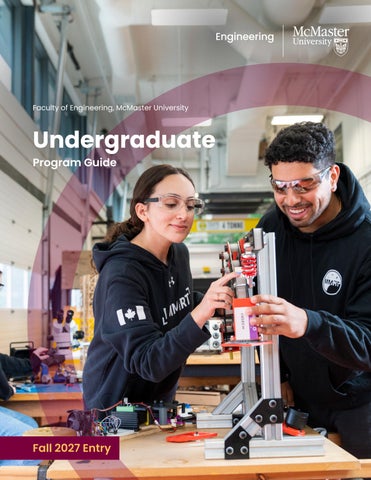
Faculty of Engineering, McMaster University
Undergraduate Program Guide
Fall 2027 Entry
Table of contents Welcome to McMaster Engineering
1
Get to know Hamilton and our campus
2
Experience McMaster Engineering your way
4
Degree options
8
Customize your degree
10
Engineering programs
12
Computer Science program
26
Integrated Biomedical Engineering & Health Sciences (iBioMed) program
28
Bachelor of Technology programs
30
Scholarships
32
Admissions info
33
Campus map
36
Connect with McMaster Engineering
37
2 | Faculty of Engineering
Together, we’re engineering a brighter future
8,387 41-48% 100+
undergraduate students (2025-2026)
of our Level 1 engineering students over the past three years are women
countries represented by our international students
31,000
70+
250+
alumni working in various industries across the world and growing
clubs and teams led by Mac Eng students involving thousands of student participants
undergraduate research students completing summer research experiences in 2026
Undergraduate Program Guide | 1
Hamilton, Ontario We’re known as the Hammer. Steel Town. The Ambitious City. We’ve also been called the Brooklyn of Canada: the new housing hotspot for Toronto transplants. We’re eclectic and proud of it. We’re also proud of having more waterfalls than any other city in the world (more than 100), a thriving arts scene, beloved professional sports teams including Forge FC, the Hamilton Tiger-Cats, and both men’s and women’s professional hockey teams, tons of scenic trails, a vibrant music and nightlife culture and enough delicious restaurants to impress any foodie. Get to know your new home!
Hamilton
Farmers’ Market 20-minute bus ride
Bayfront Park 40-minute bus ride
Ancaster
Westdale Village Neighbourhood
Tiffany Falls 25-minute bus ride
Shops in Westdale Village 10-minute bus ride
2 | Faculty of Engineering
Downtown 20-minute bus ride
McMaster campus
Our beautiful, medium-sized campus has everything you’ll need to feel at home: well-maintained green spaces to hang out with your friends, cozy study spots in libraries, award-winning athletic facilities, transportation right into the heart of campus and plenty of food options. Our engineering buildings house state-of-the-art equipment in labs and studios and spaces to collaborate with peers. The best way to get to know McMaster is to come visit!
Scan the QR code to book an in-person tour today.
John Hodgins Engineering Building
Engineering Technology Building
Thode Library
Cootes Paradise
Scan for Residence info
Scan for a virtual tour
Undergraduate Program Guide | 3
Experience all that the Faculty of Engineering has to offer
Experience co-op
We offer so much more than a best-in-class degree. Experience Mac Eng to the fullest through extracurricular, co-curricular, co-op, research, and volunteer opportunities that enhance your learning and prepare you for your future career. Each year, about 200 students complete international co-op placements, giving them the opportunity to gain global work experience while earning their degree.
Spring’s
experience Spring’s co‑op experiences immersed her in Canada’s fast-growing nuclear sector. After connecting with Ontario Power Generation (OPG) at the Canadian Nuclear Association Conference, she secured a full‑year co‑op with OPG’s XLAB team, where she worked on deploying innovative technologies into existing nuclear facilities to improve safety and enable early detection of equipment issues. After graduation, Spring will be returning to OPG in a full-time nuclear safety role.
Learn more about Spring’s story
4 | Faculty of Engineering
Co-op quick facts
93%
of Mac Eng students enrolled in co-op
4,800
co-op work terms by 3,000 students 2025-2026
2nd
largest co-op program in Ontario
3rd
largest co-op program in Canada
Experience innovative learning spaces
The Candu Core
iBioMed Design Studio
Where first-year Engineering students work in teams on design projects with real-world impact. The 5,000 sq. ft. space features collaboration areas and cuttingedge prototyping equipment to help bring ideas to life.
Where iBioMed students connect on a project-based integrated learning course that introduces a range of foundational topics in engineering, including engineering design and communication, computation, graphic design, materials and the engineering profession.
Experience
entrepreneurship On-campus incubators like The Forge@Mac and The Clinic are dedicated to supporting aspiring entrepreneurs at every stage. The majority of budding businesses connected to The Forge are affiliated with McMaster Engineering.
Hatch Centre: Student Workshops and Build Space A space for undergraduate students to participate in experiential learning through extracurricular activities such as personal projects, final-year capstone projects or many clubs and teams, which will further develop your technical and professional skills.
2022 Mechanical & Biomedical Engineering (iBioMed) graduate and award-winning entrepreneur Lianna Genovese founded ImaginAble Solutions Inc. Her business was born out of a project she started in her first year.
Scan to learn more
Undergraduate Program Guide | 5
Experience clubs and teams
Ask an Engineering student about a defining moment during their time at McMaster, and chances are they’ll talk about a club, team or society. These communities are where theory meets practice, friendships form and students begin to see themselves as engineers. McMaster Engineering Concrete Toboggan Team (MECTT) designs, builds and races a concrete toboggan in the Great Northern Concrete Toboggan Race, the oldest engineering competition in North America.
Scan to learn more
Meet the McMaster Engineering Concrete Toboggan Team (MECTT) – a long-standing student tradition
Fostering belonging Students can participate in identity-focused societies like the National Society of Black Engineers (NSBE) - McMaster Chapter, McMaster Engineers with Disabilities (MEWD), Engiqueers, Women in Engineering Society (WIE), American Indian Science and Engineering Society (AISES), and more
6 | Faculty of Engineering
Experience
community and supports The fireball has been the symbol of McMaster Engineering for decades. It represents a community that values collaboration over competition, your home away from home, connection amongst students, faculty, staff and alumni, and a passion for all things engineering. You are never alone in your Mac Eng journey. When you join our Faculty, you become part of the Fireball Family. From an energy-packed Welcome Week where friendships are forged, through to graduation and a celebration of your successes, you’ll feel supported along the way.
Supports for all students include:
International student supports include:
• Academic advising
• Immigration advising
• Health and dental care
• Securing health insurance
• Counselling
• Financial affairs
• Technology services
• Athletics, fitness and movement
• Success coaching
• Peer support and events
• Transition programs and support
Nothing is more important than your well-being. That’s why we have a mental health service exclusively for Mac Eng students. TalkSpot offers same-day, in-person and virtual appointments.
Scan to learn more
Undergraduate Program Guide | 7
Degree options Find the path that fuels your curiosity:
Bachelor of Technology
Computer Science*
• Automation Systems Engineering Technology
• Automotive and Vehicle Engineering Technology • Biotechnology
Engineering • Chemical Engineering
Integrated Biomedical Engineering and Health Sciences (iBioMed)
• Civil Engineering
• Civil and Biomedical Engineering
• Electrical Engineering
• Engineering Physics and Biomedical Engineering
• Chemical Engineering and Bioengineering
• Chemical and Biomedical Engineering
• Computer Engineering
• Electrical and Biomedical Engineering
• Engineering Physics
• Materials Engineering
• Health, Engineering Science and Entrepreneurship (HESE)
• Mechatronics Engineering
• Mechanical and Biomedical Engineering
• Software Engineering
• Software and Biomedical Engineering
• Mechanical Engineering
• Materials and Biomedical Engineering
• Nuclear Engineering
• Mechatronics and Biomedical Engineering
*Only one option available
8 | Faculty of Engineering
Your track, your way Students applying to Engineering or Integrated Biomedical Engineering & Health Sciences (iBioMed) at McMaster University will be able to choose one of the following: Discover your discipline at McMaster University
Take advantage of McMaster University’s program guarantee
Apply to the Discovery Track. Available in Engineering and iBioMed, the Discovery Track allows you to choose your program at the end of your common first year.
Apply directly to a program before you start first year. There are 11 Engineering programs and 9 iBioMed programs that you can select, all with a co-op option available.
or
Ready to start your degree, but debating on the right program for you? The Discovery Track gives you more time to choose your focus.
You’ll still participate in the common first year. Have a discipline you can’t wait to pursue? Lock in your second-year spot when you apply!
Rank your choices When applying to McMaster University to start in Fall 2027, you’ll be able to rank your options. You will rank one alternate program in one application to Engineering and/or iBioMed. You’ll be considered for each program in the order you list them. The alternate program is only considered if you’re not accepted into your preferred program. Please note when applying to the Discovery Track: program allocation for level two is a competitive process based on cumulative grade point average (CGPA) in first year. Students are assigned to programs based on preference and available capacity.
Undergraduate Program Guide | 9
Customize your degree
Consider adding one of McMaster’s many interdisciplinary minors to complement your program and enhance your academic experience
Many interests? Many ways to explore them
Interdisciplinary minors led by the Faculty of Engineering include:
After completing a first year — whether students have secured their Level II program or chosen the Discovery Track — they can further personalize their degree by adding an & Management or & Society option.
• Minor in Innovation
• Minor in Nuclear Studies and Society • Minor in Sustainability
Explore all of the minors available to students
Complement your engineering degree with additional business skills or societal perspectives | Engineering & Management Elevate your engineering career with the Engineering & Management program, a prestigious five-year track blending technical excellence with business insight. This program equips you with essential project management and leadership skills, setting you up for success in the corporate world or with your own venture.
| Engineering & Society Explore the intersection of technology and humanity with the Engineering & Society program. This distinctive five-year program integrates a traditional engineering curriculum with a comprehensive university experience, fostering engineers who are creative, inquisitive and well-rounded.
10 | Faculty of Engineering
Experience
undergraduate research
At Canada’s top research-intensive university, McMaster faculty members are at the forefront of groundbreaking innovation, and our undergraduate students are working right alongside them. Through funded opportunities for domestic and international students, 250+ undergraduate students participated in summer research at McMaster in 2026. Students honed their presentation skills in an annual poster showcase that draws hundreds of guests.
Faculty of Engineering Research Experience Award – available to students with top grades and scholarships Picture this: you’ve just finished first year in the Faculty of Engineering and are now spending your summer working under professors, researchers and entrepreneurs across campus to gain valuable work experience and create a network of contacts to grow your career.
Sonia’s
experience As part of her research experience, Sonia worked at the HeART lab under supervision of assistant professor, Dr. Onaizah. She worked on developing a magnetic actuation platform that would allow surgeons magnetic control of microbots and other devices without interfering with the surrounding environment.
Undergraduate Program Guide | 11
Chemical Engineering Credential: Bachelor of Engineering Length: 4-years Co-op: Available Supplementary Application: Yes
Career opportunities • Energy production • Pharmaceuticals
• Biomedical enhancement • Food and agriculture
• Environmental engineering and analysis • Water and wastewater treatment
• Commercial chemicals (paints, dyes, industrial chemicals)
Innovating the future Chemical engineering involves developing efficient, cost-effective and socially responsible processes that convert chemical components and energy into higher-value products. By taking on grand challenges such as developing access to clean and sustainable energy, advancing industrial water and wastewater treatment processes or improving the yield and reliability of the agriculture sector, chemical engineers continue to play a vital role in the development and growth of modern society. Chemical engineers are involved in every stage of the consumer supply chain, from the extraction and processing of raw materials that are taken for granted in everyday life, to the production of finished commercial products.
For their capstone project, a group of Chemical Engineering students designed a sustainable wound dressing alternative to Band-Aids.
12 | Faculty of Engineering
Chemical Engineering and Bioengineering Credential: Bachelor of Engineering & Biosciences Length: 5-years Co-op: Available Supplementary Application: Yes
Career opportunities • Chemical Engineer
• Environmental Engineer
• Manufacturing Engineer • Process Engineer
• Quality Assurance Analyst • Research & Development Engineer
Life’s building blocks Chemical Engineering and Bioengineering combines core chemical engineering principles with biology to design and improve products that enhance everyday life, from medicines and vaccines to sustainable materials and clean technologies. Students develop expertise through hands-on labs, design projects, and courses, with a focus on cellular biology, bioreactions, and pharmaceutical applications. Graduates are prepared for careers in biotechnology, pharmaceuticals, healthcare, and industrial manufacturing, including drug development, process design, and environmental solutions.
For their capstone project, a group of Engineering students explored integrating SBR-style operation with Fibracast membranes to improve MBR startup, biomass growth, effluent quality, and long-term foam and membrane fouling control.
Undergraduate Program Guide | 13
Civil Engineering Credential: Bachelor of Engineering Length: 4-years Co-op: Available Supplementary Application: Yes
Career opportunities • Design and construction of buildings and infrastructure systems • Earthquake engineering
• Environmental and water resources engineering • Education
• Government • Consulting • Industry
• Construction
Building tomorrow’s communities Civil engineering requires a sense of curiosity and the ability to not just look at the world around you, but to develop ways to improve it. Civil engineers do exactly that — planning for and safely designing, constructing, maintaining and rehabilitating communities. By using the latest technology to design and construct facilities that are critical to our society, including buildings, bridges, roads, transit, and water and wastewater systems, civil engineers collaborate to build a better, more sustainable future.
Recent Civil Engineering graduate Max is finding cross-border success while working on the Gordie Howe International Bridge project.
14 | Faculty of Engineering
Computer Engineering Credential: Bachelor of Engineering Length: 4-years Co-op: Available Supplementary Application: Yes
Career opportunities • Digital electronics • Web applications
• Computer security • Machine learning • Robotics
• Digital communications • Medical devices
• Consumer electronics • Automotive industries • Software
Engineering connected intelligence Computer engineering makes our world more connected, more intelligent and even healthier by applying advances in electronics and software to develop devices and systems. Our program encompasses computer hardware, programming, electronics, multimedia, augmented and virtual reality, signal processing, robotics, cyberspace, hardware, software for machine learning, and more.
A capstone including Computer Engineering students harnessed advanced AI to build a robot capable of navigating on its own and understanding human language.
Undergraduate Program Guide | 15
Discovery Track: Choosing your engineering path
Starting in Fall 2027, students applying to Engineering or Integrated Biomedical Engineering & Health Sciences (iBioMed) at McMaster University can either enter through the Discovery Track or directly into a program. This is an option for applicants who want more time to explore their interests before selecting their specific program. Whether admitted directly to a program or through the Discovery Track, all Engineering students complete a common first year together. The same is true for all iBioMed students. This allows them to gain exposure to engineering fundamentals, design and different areas of study before choosing their Level II program.
16 | Faculty of Engineering
How does program selection work?
At the end of the first year, Discovery Track students rank their preferred Level II programs and receive their program assignment during the summer. Students are assigned to their program based on: • Their first-year cumulative grade point average (CGPA)
• Their ranked program preferences
• Available space within each program Program allocation is competitive, and admission to a specific program cannot be guaranteed.
Free Choice
A limited number of students may receive Free Choice during the application process, which guarantees admission to their preferred Level II program upon successful completion of the first year. Free Choice is awarded based on a student’s Grade 12 admission average. The cutoff varies each year depending on the applicant pool, but it is typically in the high-90s. Students who receive Free Choice in their admission offer will retain this benefit as long as they successfully complete Level I and meet the Free Choice requirements.
Is the Discovery Track right for you? The Discovery Track is a great option for students who:
• Know they want to study engineering or biomedical engineering but want more time to explore their options • Have interests across multiple engineering disciplines
• Want to experience a first year at university before choosing a discipline • Value flexibility when planning their academic path
If you know which engineering discipline you want to pursue, you can apply directly to that program, securing your seat.
Undergraduate Program Guide | 17
Electrical Engineering Credential: Bachelor of Engineering Length: 4-years Co-op: Available Supplementary Application: Yes
Career opportunities • Power and renewable energy • Electrified transportation • Biomedical electronics • Telecommunications
• Robotics and automation • Aerospace and defence • Consulting and services
Powering progress through electrical solutions Electrical engineering involves designing devices and systems that use the flow of electrons to connect the world. Our program covers electrical power generation and distribution, electrified and autonomous vehicles, robots and drones, electronics, wired and wireless communications, optoelectronics, signal processing, computers, radar and lidar, medical devices and imaging, and many other technologies transforming our world for the better.
Electrical Engineering student Milana is part of the inaugural cohort of Climate Action Research Scholars. Her work is part of McMaster’s Thermal Mapping for the Decarbonization of Building Heating Project.
18 | Faculty of Engineering
Engineering Physics Credential: Bachelor of Engineering Length: 4-years Co-op: Available Supplementary Application: Yes
Career opportunities • Quantum Computing • Semiconductor fabrication • Semiconductor equipment manufacturers • AI infrastructure • Smartphones and wireless devices • Information and Communications Technology • Satellite communications • Aerospace and defence systems • Optical instrumentation • Photonics • Medical sensing • Solar energy • Nuclear energy • Electric vehicles • Quantitative data and finance analytics
Innovating at the intersection of physics and engineering Our faculty and students are pushing the forefront of modern physics to better the world through technological advancement. We are developing today’s and tomorrow’s advanced technologies in fields as diverse as nano and microdevices engineering, nuclear engineering, photonics engineering, quantum technologies, space systems engineering, semiconductor device engineering, and biomedical engineering.
Engineering Physics capstone students created HandySpeaks, an innovation designed to bridge communication barriers for mute individuals. Their smart gloves translate American Sign Language (ASL) gestures into spoken English.
Undergraduate Program Guide | 19
Materials Engineering Credential: Bachelor of Engineering Length: 4-years Co-op: Available Supplementary Application: Yes
Career opportunities • Design engineer
• Quality control engineer
• Process control engineer • Failure analyst
• Research engineer
Reinvent what the world is made of Explore the dynamic world of materials engineering, where innovation meets problem-solving to create cutting-edge materials. This field focuses on understanding and developing materials with unique mechanical, physical and chemical properties to meet the demands of modern technology. Whether it’s designing biomaterials or smart devices, materials engineering equips you to develop reliable and sustainable solutions for a wide range of applications.
Materials Engineering graduate Vanessa is working to bring safe and fun toys to store shelves in her management role at Canadian-founded toy giant Spin Master.
20 | Faculty of Engineering
Mechanical Engineering Credential: Bachelor of Engineering Length: 4-years Co-op: Available Supplementary Application: Yes
Career opportunities • Biomechanics
• Renewable energy
• Advanced manufacturing in automotive and aerospace industries • Mechanics and design • Thermal fluid science
Engineering ideas into motion Dive into the world of mechanical engineering, where physics and mathematics come alive to create transformative systems. Mechanical engineers work in interdisciplinary teams to design, develop and maintain everything from vehicles and airplanes to renewable energy systems and biomechanical devices. Your skills will drive innovation across diverse fields, shaping the future of technology and sustainability.
Co-subcaptains, friends, and Mechanical Engineering students Alisa and Kristin broke from tradition to lead the McMaster Concrete Toboggan Team into a new era.
Undergraduate Program Guide | 21
Mechatronics Engineering Credential: Bachelor of Engineering Length: 4-years Co-op: Available Supplementary Application: Yes
Career opportunities • Robotics and automation
• Electro-mechanical design and devices
• Embedded control systems • Flexible manufacturing • Artificial intelligence • Renewable energy • Medical devices • Entrepreneur
Design the future with intelligent machines Explore mechatronics engineering, where electrical and mechanical systems merge to develop advanced, computercontrolled devices. This interdisciplinary field blends electrical, mechanical, software and systems engineering to create innovative technologies. As a mechatronics engineer, you’ll design and lead the development of cutting-edge electromechanical systems that are revolutionizing industries.
Mechatronics Engineering student Magalie completed a co-op at MDA Space where she worked with the team building Canadaarm3.
22 | Faculty of Engineering
Software Engineering Credential: Bachelor of Engineering Length: 4-years Co-op: Available Supplementary Application: Yes
Career opportunities • Software and systems development • Artificial intelligence and machine learning • Cybersecurity • Cloud and distributed computing • Robotics and intelligent systems • Biomedical and health technologies • Automotive and autonomous systems
Empowering innovation through code and creativity Software engineering is everywhere — it’s how we solve problems, manage information, create smart products and connect with communities. By harnessing the incredible power of hardware, software engineers design, build, test, and maintain the programs that make everything work. They apply engineering principles to ensure the software we use every day is reliable, efficient and effective.
Software Engineering student Aidan balances his passion for programming with his love for piano. When he’s not applying new software skills at his co-op with Deighton Associates Limited, he’s playing a tune in the John Hodgins Engineering Building.
Undergraduate Program Guide | 23
Nuclear Engineering Credential: Bachelor of Engineering Length: 4-years Co-op: Available Supplementary Application: Yes
Career opportunities • Senior Technical Engineer
• Nuclear Reactor Operator • Nuclear Design Engineer • Nuclear Safety Analyst • Reactor physicist
Power the future with nuclear energy Build fundamental skills and explore nuclear engineering at the only Canadian university with a full-scale, nuclear research reactor on campus. Our faculty and students are advancing the future of clean, reliable energy through nuclear innovation. You will work at the intersection of engineering and physics to develop technologies in nuclear power, advanced reactors, radiation applications, and energy systems, preparing you to shape the future of the global nuclear technology sector.
Undergraduate research students from McMaster were given the opportunity to visit Chalk River Laboratories, the site of the first nuclear reactor in Canada, as part of a collaboration with Canadian Nuclear Laboratories (CNL).
24 | Faculty of Engineering
Nuclear science in action Home to Canada’s most powerful university research reactor McMaster University is home to the McMaster Nuclear Reactor (MNR), a 5 MW multi-purpose research reactor and the most powerful of its kind at any Canadian university. Since 1959, the MNR has fueled groundbreaking discoveries and real-world innovation across vital fields such as medical imaging, cancer treatment, materials science, environmental research, and industrial testing. At McMaster, you won’t just study nuclear science, you will experience it firsthand every day. Inside our active reactor facility, you’ll witness real research in action, from the production of life-saving medical isotopes like iodine-125 (used to treat prostate cancer) to innovative experiments that shape the future. Students and visitors can tour the facility and see the reactor core’s awe-inspiring blue glow up close.
Expand your perspective Ready to take your curiosity further? The Interdisciplinary Minor in Nuclear Studies and Society welcomes students from every program to explore the impact of nuclear technology across engineering, medicine and society. Whether your passion is clean energy, advanced reactor design, breakthrough medical treatments, or shaping a sustainable future, you can enhance your degree with a unique perspective on one of the world’s most influential technologies and set yourself apart as a leader in tomorrow’s innovations.
Undergraduate Program Guide | 25
Computer Science
Solve Problems. Shape Technology. Honours Computer Science is a four-year program where students learn how computers work and how to use them to solve real-world problems. Through courses in programming, software design, algorithms, artificial intelligence, machine learning, cybersecurity and systems, students develop the technical skills needed to build the technologies shaping tomorrow. McMaster’s hands-on curriculum emphasizes practical learning through labs, projects and five dedicated Practice & Experience courses that bridge theory with real-world software development.
Program highlights • Master the fundamentals with five computer science courses in the first year, allowing students to build technical skills immediately.
• Hands-on learning through five Practice & Experience courses featuring lab-based exploration, software design and collaborative projects. • Flexible degree structure with two first-year electives and ample upper-year elective space to pursue a minor or specialized interests.
• Research opportunities across artificial intelligence, robotics, cybersecurity, software systems, humancomputer interaction and more. • Supportive community with small classes, personalized instruction, student societies (McMaster AI, Start Coding and DeltaHacks) and one-on-one academic support. 26 | Faculty of Engineering
First-year courses • Introduction to Computational Thinking • Introduction to Programming
• Computer Science Practice and Experience: Development Basics • Computer Science Practice and Experience: Introduction to Software Design Using Web Programming
• Discrete Mathematics for Computer Science • Linear Algebra I
• Engineering Mathematics I
• Engineering Mathematics II - A • 2 Elective Courses
Upper-year courses include: • Machine Learning
• Introduction to Data Mining • Data Privacy
• Automata and Computability • Software Entrepreneurship • Artificial Intelligence • + more!
Beyond the first year
As you progress through the program, you can customize your degree with technical and open electives while exploring emerging areas of computing, such as artificial intelligence, machine learning, cybersecurity and data science. With 30 units of open electives, many students pursue a minor alongside their degree. In your final year, you’ll complete a capstone project where you’ll work in teams to solve a complex, real-world computing challenge.
Co-op and future careers
Our program emphasizes a strong foundation in core fundamentals, giving you a long-term advantage in the ever-evolving job market. As a co-op student, you’ll gain a minimum of 12 months of work experience through a combination of four-, eight-, 12- or 16-month co-op work terms.
Undergraduate research
Potential career paths: App Developers, Chief Information Officers, Database Developers, Information Security Analysts, Information System Designers, Systems Analysts and Programmers, Web e-Commerce Developers. Top co-op employers: Advanced Micro Devices (AMD), Ericsson Canada, Evertz Microsystems, Geotab, Google, IBM, Microsoft and Synopsys Canada.
95%
of first-year students enrolled in co-op
50+
minors to choose from
With more than 40 faculty members conducting research across computing and software, students have opportunities to participate in undergraduate research projects, particularly during the summer. Research spans topics such as artificial intelligence, autonomous vehicles, healthcare technologies, robotics, cybersecurity and humancomputer interaction.
Undergraduate Program Guide | 27
Integrated Biomedical Engineering & Health Sciences (iBioMed)
Innovating solutions for better health We’ve fused the best of our top-ranked health sciences and engineering programs with entrepreneurship to deliver a unique projectbased learning experience that is second to none. In the iBioMed program, you’ll be working on realworld projects from day one. In dedicated design studios, you’ll learn to work effectively in teams to solve relevant problems in health, pitch ideas, build prototypes and test products with real clients.
Key features: • Canada’s only integrated 5-year program combining engineering, health sciences and entrepreneurship
• Dedicated iBioMed Design Studio and specialized biomedical laboratories • Student-directed projects showcased through a personalized online portfolio • Collaboration with clinicians, healthcare professionals and industry partners
• Flexible, optional co-op program with opportunities across healthcare, technology, and government • Small cohort environment with 155 students admitted annually
Your first-year courses: • Health Solutions Design Projects I – Design and prototype solutions for real healthcare challenges
• Entrepreneurship in Biomedical Innovation – Learn how healthcare ideas move from concept to impact • General Chemistry
• Waves, Electricity and Magnetic Fields • Introductory Mechanics
• Engineering Mathematics (three courses) • 1 elective course
28 | Faculty of Engineering
Choose your pathway after the first year
Students applying to the Integrated Biomedical Engineering & Health Sciences (iBioMed) program can choose between the Discovery Track or McMaster University’s program guarantee, as outlined on page 9. Following a shared first-year experience, all iBioMed students proceed into one of two degree pathways: Honours Bachelor of Health Sciences (BHSc) – Health, Engineering Science & Entrepreneurship — 4 years
Bachelor of Biomedical Engineering (BEng/BME) – 5 years Combine biomedical engineering with a traditional engineering discipline, including: • Chemical & Biomedical Engineering • Civil & Biomedical Engineering
• Electrical & Biomedical Engineering
Designed for students interested in the intersection of healthcare, technology, and innovation. Students develop skills in health sciences, engineering design or and entrepreneurship while creating solutions to healthcare challenges.
• Engineering Physics & Biomedical Engineering • Materials & Biomedical Engineering
• Mechanical & Biomedical Engineering
• Mechatronics & Biomedical Engineering • Software & Biomedical Engineering
Why choose iBioMed?
Design projects and showcases
Learn from healthcare professionals: Engage with clinicians, researchers and industry partners.
Past projects include:
Learn across disciplines: Collaborate with students from engineering, health sciences and entrepreneurship backgrounds.
Access unique facilities: Gain experience as a Level II student in anatomy labs.
Co-op opportunities
iBioMed students start innovating from year one, making them ideal co-op students and strong future business leaders. Complete co-op in four-, eight-, 12- or 16-month terms. Each year, iBioMed students complete co-op work terms across diverse industries, including education, government, healthcare and finance.
iBioMed students take various projects and design courses throughout their degree. Projects evolve from year to year, culminating in the iBioMed Showcase at the end of each term. • An adaptive knife attachment for individuals with Multiple Sclerosis (MS) • Gut-based therapy for patients with Alzheimer’s disease
• A low-cost wireless digital stethoscope
Explore past projects
Graduates can go on to:
Employers of our graduates include:
• Pursue careers in biomedical engineering, biotechnology, health and biomedical science
• RBC, Boston Scientific, TELUS Health, GE, Siemens, Johnson & Johnson, Google, Microsoft, Meta, Hatch Ltd., and more.
• Launch their own start-up companies or innovate within existing organizations • Explore further studies in graduate research, professional health science careers or medicine
Undergraduate Program Guide | 29
Bachelor of Technology (BTech)
Small classes, award-winning professors and incredible co-op opportunities The Bachelor of Technology (BTech) combines hands-on engineering education with business and management training to prepare graduates for today’s rapidly evolving industries. Through a curriculum that combines theory and practice, students spend more than 750 hours in lab settings applying engineering principles to design innovative technical solutions. Guided by industry professionals and taught by professors with industry experience, each of our three BTech programs is designed to tackle technological change head-on. With 25% of the curriculum devoted to business and management courses, graduates are uniquely positioned to assume leadership roles and contribute to an organization’s success.
You’ll receive: • Bachelor of Technology degree
• Mohawk College Advanced Technology diploma • Certificate in Business Management
• Minimum of 12 months of professional co-op experience
Kickstart your career with co-op: • 12 months of required co-op allows students to launch their careers before graduation • Students can complete co-op anywhere in the world
An average class size of 80 students means more interaction with your professors and a close-knit student community.
BTech graduates can go on to: • Work in diverse engineering fields and industries such as automotive, manufacturing, automation, smart infrastructure, biotechnology, healthcare, software and engineering consulting • Complete graduate school (MEng, MBA, MASc, PhD, MD), including a new Accelerated MBA at McMaster’s DeGroote School of Business, which you can complete in only eight months full-time
30 | Faculty of Engineering
Learn more about the Accelerated MBA pathway
Program
Specialized year 1 courses
Common year 1 courses
Automation Systems Engineering Technology Co-op
• Principles and Applications of Object-Oriented Programming • Programming Fundamentals • CAD for Design
Chemistry
Automotive and Vehicle Engineering Technology Co-op
• Statics and Mechanics of Materials • Object-Oriented Programming • C++ Programming
Biotechnology Co-op
• Analytical Chemistry • Biology • Programming Fundamentals
Automation Systems Engineering Technology Co-op
The Automation Systems Engineering Technology program equips students with the skills to design intelligent electronic systems that solve everyday problems. By combining knowledge from chemical, mechanical, electrical and computer engineering, graduates are prepared to transition seamlessly between industries. Whether it’s robotics or food processing, wherever there are automated systems that use sensors, instruments, actuators, and networks, our skilled automation specialists will find their place. Career outcomes
• Design and implement automation systems to enhance efficiency in industries such as petrochemicals, power generation, pharmaceuticals and primary steel • Develop and program robotic applications for industrial and commercial use • Create control systems and assembly lines to streamline production and improve quality
Biotechnology Co-op
Biotechnology is an interdisciplinary field that merges basic science, applied science and engineering. Students study genetic engineering, cell biology, molecular biology, microbiology, analytical instrumentation and bioprocessing. Students engage in the latest research in immunology, virology, genomics, proteomics and bioinformatics. With a strong theoretical foundation and extensive lab experience, graduates are well prepared for careers in genetic engineering and bioprocessing.
Electricity and Circuit Analysis Mathematics l Mathematics ll Physics Foundations of Business Professional Communications
Where will you go?
• Work in biofuel, food and pharmaceutical industries to drive innovation in health, improve safety, and enhance environmental sustainability
• Monitor quality control and assurance of biomaterials and bioproducts to meet industry and regulatory standards Unique at McMaster: Biotechnology students are the only undergraduate students with access to a Level II Biosafety Laboratory, providing hands-on experience with advanced laboratory techniques rarely available at the undergraduate level.
Automotive and Vehicle Engineering Technology Co-op
The Automotive and Vehicle Engineering Technology program prepares students to design the next generation of transportation, enhancing vehicle safety, speed, cleanliness and sustainability. With a systems perspective, the program integrates mechanical, electrical, computer science, mechatronics and materials engineering disciplines. Students gain hands-on experience in 3D CAD modelling, robot programming, controller tuning, electric or hybrid vehicle design, vibration control, troubleshooting and manufacturing. Where will you go?
• Develop electric, hybrid and autonomous vehicle technologies to support the future of sustainable transportation
• Design power and control systems, engines, and vehicle bodies for high-performance applications
Eligible Biotechnology graduates may qualify for fast-track admission to the four-year Doctor of Medicine program at St. George’s University, providing an accelerated pathway for students interested in pursuing a career in medicine. Undergraduate Program Guide | 31
Scholarships The Faculty of Engineering offers a variety of entrance scholarships to recognize academic achievement and support student success. Open to both domestic and international students, a single application will automatically consider you for all Faculty of Engineering entrance scholarships. Applications can be submitted through AwardSpring and close on February 19, 2027, at 11:59 p.m. ET.
Scan the QR code to learn more about Faculty of Engineering entrance scholarships, eligibility requirements, and how to apply
Select awards include:
Dean’s Excellence Entrance Scholarship Eligible programs:
• Bachelor of Technology • Computer Science • Engineering
• Integrated Biomedical Engineering & Health Sciences
Value: $7,500 (38 available) Minimum eligibility: Academic performance – must meet required admission average for the award (typically a minimum of 94%). Demonstrated leadership experience and attributes, involvement in extra-curricular and/or volunteer activities in the community. Letters of reference.
FIRST Alumni Entrance Scholarship Eligible programs:
• Bachelor of Technology • Computer Science • Engineering
• Integrated Biomedical Engineering & Health Sciences
Value: $15,000 (10 available) Minimum eligibility: Academic performance – Admissions average of 90% or higher. Demonstrated leadership experience and attributes, involvement in extra-curricular and/or volunteer activities in the named organization. Letters of reference verifying participation in named organization.
DECA Alumni Entrance Scholarship Eligible programs:
• Bachelor of Technology • Computer Science • Engineering
• Integrated Biomedical Engineering & Health Sciences
32 | Faculty of Engineering
Value: $15,000 (10 available) Minimum eligibility: Academic performance – Admissions average of 90% or higher. Demonstrated leadership experience and attributes, involvement in extra-curricular and/or volunteer activities in the named organization. Letters of reference verifying participation in named organization.
Admissions Supplementary application All Faculty of Engineering (BTech, CompSci, Eng, iBioMed) applicants are required to submit a mandatory supplementary application. The application consists of one written and three video responses. The mandatory supplementary application assesses competencies not captured on a transcript, including communication, critical thinking and problem-solving.
Scan for full details
Indigenous students
Recommended early application submission: Thursday November 12, 2026 Recommended early supplementary application submission: Thursday November 26, 2026 OUAC application deadline: January 15, 2027 Supplementary application deadline: January 28, 2027 at 11:59 p.m. ET. Submitting your application and supplementary application by the early recommended dates may allow your application to be reviewed sooner. However, it does not guarantee an earlier offer of admission. Every application is reviewed using a holistic process. Most admission decisions will still be released between March and May.
First Nation, Métis and Inuit applicants are encouraged to contact McMaster’s Indigenous Student Services office for assistance in navigating the application process. Programming and resources such as cultural and social events, Elders in Residence and academic supports are available.
Scan to learn more
Is your English proficiency test score too low?
International admission requirements
Attention IB, AP and A-Level students:
The MELD diploma is designed for students whose primary language is not English and who wish to pursue their undergraduate studies at McMaster University. Please contact meld@mcmaster.ca with questions.
For nine common curriculums, including American-Style, IB, British Patterned, CBSE and more, please visit: future.mcmaster.ca/international
You may be eligible for transfer credit for non-math and science courses. Please email engserv@mcmaster.ca
Reach out to us at thinkeng@mcmaster.ca for more details on your eligibility.
in the summer before your studies to confirm potential transfer credits.
Undergraduate Program Guide | 33
Degrees
Minimum average*
Admission requirements
Engineering
87%
Grade 12 U
Co-op is available
Admission is by selection for all programs
• English
• Calculus & Vectors
• +2 Grade 12 U/M courses
• Chemistry • Physics
Integrated Biomedical Engineering & Health Sciences (iBioMed)
90%
• Chemistry • Physics
90%
Grade 12 U • English
• Calculus & Vectors
82%
Co-op is mandatory
Grade 12 U • English
• Calculus & Vectors • Chemistry • Physics
*required for consideration based on Ontario curriculum Degree lengths may vary depending on when and how students choose to complete co-op. Please see page 4 for details.
34 | Faculty of Engineering
• +1 Grade 12 U/M courses
• Calculus & Vectors
Co-op is available
Bachelor of Technology
• Biology • English
Co-op is available
Computer Science
Grade 12 U
• +4 Grade 12 U/M courses
• +2 Grade 12 U/M courses
Year
1
Year
2
Year
3
Year
4
Year
5
Chemical Engineering & Bioengineering Level 1 Engineering
Chemical Engineering • Civil Engineering • Computer Engineering • Electrical Engineering • Engineering Physics • Materials Engineering • Mechanical Engineering • Mechatronics Engineering • Nuclear Engineering • Software Engineering
Society Management
BEng Biomedical Engineering (BME)
Level 1 iBioMed
• Chemical & Biomedical Engineering • Civil & Biomedical Engineering • Electrical & Biomedical Engineering • Engineering Physics & Biomedical Engineering • Materials & Biomedical Engineering • Mechanical & Biomedical Engineering • Mechatronics & Biomedical Engineering • Software & Biomedical Engineering Honours BHSc in Health, Engineering Science & Entrepreneurship (HESE)
Computer Science Honours BASc
Automation Systems Engineering Technology Co-op Automotive and Vehicle Engineering Technology Co-op Biotechnology Co-op
For non-Ontario high school students scan to check admission requirements
Undergraduate Program Guide | 35
Campus map
4
5
3
6 7
2
1
1
Engineering Technology Building (ETB)
2 Information Technology Building (ITB)
3
H.G. Thode Library
4
ABB Tower
5
Nuclear Reactor
36 | Faculty of Engineering
8
9 6 John Hodgins Engineering Building (JHE)
7
Gerald Hatch Centre
8
ichael G. DeGroote Centre M for Learning and Discovery (MDCL)
9 MARC and MMRI
Located near the main campus location of McMaster University on 200 Longwood Road South, Hamilton, ON
Connect with McMaster Engineering We’re here to help you explore your options for choosing a university, answer your questions, and experience what life is like as a McMaster Engineering student. You can visit campus, talk with current students or join our events to discover if McMaster Engineering is right for you.
Visit us on campus
Connect with a student ambassador
Join an upcoming event
Experience McMaster Engineering for yourself
Engage with students who have been where you are
Meet our experts
Explore our campus, check out our classrooms and student spaces and get to know our wonderful community.
Our Engineering Ambassadors are current students who can share their personal stories, answer your questions, and tell you what life at McMaster Engineering is really like from the perspective of a peer.
On a campus tour, you can:
• Visit a variety of engineering buildings, facilities and classrooms
• Explore campus, student life and dedicated student spaces • Ask questions about undergraduate programs, co-op opportunities, clubs & teams and more
Talk to an ambassador to find out more about: • Engineering programs and academics
• Co-op and experiential learning opportunities
• Clubs, teams and student life
• Transitioning from high school to university
Book your campus tour
Join a McMaster Engineering event to learn about our programs, connect with staff and students, and get your questions answered before you apply. Upcoming events include: • Undergraduate program webinars
• Supplementary application webinars
• Student information panels and unique series
Explore upcoming events
Connect with a student ambassador
Start your journey with us We can’t wait to welcome you to McMaster Engineering and the Fireball Family!
Undergraduate Program Guide | 37
Connect with us from home
McMaster UEngineering
Explore McMaster Engineering, connect with students and get your questions answered — wherever you are in the world.
@mcmastereng
Scan to get started
Contact us Email: thinkeng@mcmaster.ca McMaster University 1280 Main Street West Hamilton, Ontario L8S 4L8 Canada
eng.mcmaster.ca/future 38 | Faculty of Engineering
@McMasterEng Faculty of Engineering McMaster University