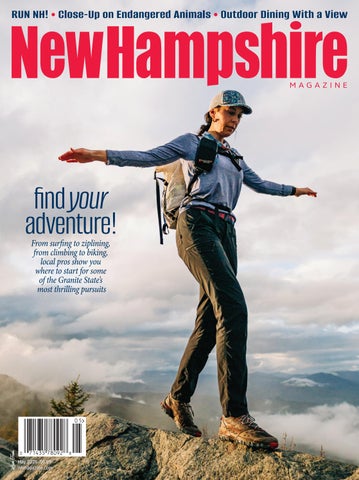
From surfing to ziplining, from climbing to biking, local pros show you where to start for some of the Granite State’s most thrilling pursuits


![]()

From surfing to ziplining, from climbing to biking, local pros show you where to start for some of the Granite State’s most thrilling pursuits


Finding a home at Taylor means more than access to a stunning new cottage or apartment – it means receiving the keys to present and future peace of mind.
Taylor Community is located in the beautiful Lakes Region of New Hampshire with campus locations in Laconia, Wolfeboro, and Meredith. Whether you prefer an active lifestyle lled with tness classes and an extensive lineup of social and recreational opportunities, or would rather enjoy a ne dining experience with friends after a day spent by the lake... Taylor is the place for you!


Whether you fill your days with ADVENTURE, or just soaking up the sun... The NASWA Resort it the perfect place to STAY and PLAY!
•An Iconic Lake Winnipesaukee Resort with Lakeside Rooms, Colorful Cottages & Suites. Just Minutes from Weirs Beach!
•Exquisite Fine Dining, PRIME Steaks & Seafood and Gourmet Breakfasts at the Blue Bistro
•Lunch, Dinner & Creative Tropical Drinks on the beach at the NazBar & Grill.
•Heart & Soul Hospitality & Service!
•Live Music, Theme Weekends & Celebrations all Summer Long!
• Plenty of Dock Space for Boaters.
•The most Amazing Sunsets!
• The TOP SPOT to Eat on Winnipesaukee! - Phantom Gourmet


6 Editor’s Note
6 Contributors
FEATURES
44 On the Brink
As the NH State Wildlife Action Plan enters its second decade, the need to protect local species from climate change, pollution and habitat destruction continues.
By Emily Reily, Illustrations by Sara Richard
60 Find Your Adventure
From surfing to ziplining, from climbing to biking, local pros show you where to start for some of the Granite State's most thrilling pursuits.
74 Run NH
Hit your stride with warmer temps and scenic splendor.
Compiled by NH Magazine


10 The Big Picture Fiddleheads make for a visual and appetizing treat.
Photo by Carol Horton
12 Savor
These dining spots pair delicious dishes with unforgettable scenery.
By Kara McGrath
24 Our Town
Hollis embraces its agricultural roots to preserve its past and future.
Story and photos by Allegra Boverman
30 History
There are plenty of archeological mysteries to solve at the Colonel Paul Wentworth House.
By Elisa Gonzales Verdi
36 WDYK
Rolling Down the Road
By Marshall Hudson
40 Q&A
John Nolan finds beauty and joy connecting with community through music. By Nathan Graziano

84 Healthwise
How to protect your vision for years to come.
By Krysten Godfrey Maddocks
86 Out and About Calendar of events
Compiled by Elisa Gonzales Verdi
88 Live Free Freedom on 2 Wheels
SPECIAL ADVERTISING SECTION
39 Ask the Experts
By Brion O'Connor ON THE COVER: Elizabeth Kane faced a steady climb right up to the summit of South Moat Mountain, where she was rewarded by sweeping 360-degree views.
Photo by Corey McMullen


President/Publisher Ernesto Burden 603-624-1442 x5117 ernestob@yankeepub.com
Editor Mike Cote 603-624-1442 x5141 mikecote@yankeepub.com
Managing Editor Emily Heidt 603-624-1442 x5115 eheidt@nhmagazine.com
Managing Editor, Sarah Pearson 603-624-1442 x5128
Custom Publications sarahekp@yankeepub.com
Assistant Editor Elisa Gonzales Verdi 603-624-1442 x5010 egonzalesverdi@nhmagazine.com
Assistant Editor Emily Reily 603-624-1442 x5119 emilyr@yankeepub.com
Art Director John R. Goodwin 603-624-1442 x5131 johng@yankeepub.com
Creative Services Director Jodie Hall 603-624-1442 x5122 jodieh@yankeepub.com
Graphic Designer Christian Seyster 603-624-1442 x5116 christians@yankeepub.com
Senior Graphic Nicole Huot 603-624-1442 x5116
Production Artist nicoleh@yankeepub.com
Director of Business Jenna Pelech 603-624-1442 x5154
Development jennap@yankeepub.com
Sales Executives Josh Auger 603-624-1442 x5144 jauger@nhmagazine.com
Jessica Schooley 603-624-1442 x5143 jessicas@yankeepub.com
Connie McCullion 603-624-1442 x5000 conniemc@yankeepub.com
Operations Director Ren Chase 603-624-1442 x5114 renc@yankeepub.com
Sales & Events Coordinator Paul Milone 603-624-1442 x5121 paulm@yankeepub.com
Information Manager Gail Bleakley 603-563-8111 x113 gailb@yankeepub.com
Assistant Controller Nancy Pfuntner 603-563-8111 x138 nancyp@yankeepub.com
VP/Consumer Marketing Brook Holmberg brookh@yankeepub.com
VP/Retail Sales Sherin Pierce sherinp@yankeepub.com
250 Commercial Street, Suite 4014 Manchester, NH 03101
603-624-1442, fax 603-624-1310
E-mail: mikecote@yankeepub.com
Advertising: sales@nhmagazine.com
Subscription information: Subscribe online at: nhmagazine.com or email customerservice@nhmagazine.com
To order by phone call: 877-494-2036
© 2026 Yankee Publishing, Inc.
New Hampshire Magazine® is published by Yankee Publishing, Inc., 250 Commercial Street, Suite 4014, Manchester, NH 03101, 603-624-1442. All rights reserved. Reproduction in whole or in part without the written permission of the publisher is prohibited. The publisher assumes no responsibility for any mistakes in advertisements or editorial. Statements/ opinions expressed herein do not necessarily reflect or represent those of this publication or its officers. While every effort has been made to ensure the accuracy of the information contained in this publication, Yankee Publishing, Inc.: New Hampshire Magazine disclaims all responsibility for omissions and errors. New Hampshire Magazine is published monthly, with the exception of February and April.
USPS permit number 022-604. Periodical postage paid at Manchester 03103-9651. Postmaster send address changes to: New Hampshire Magazine, P.O. Box 37900, Boone, IA 50037-0900

PRINTED


WHILE I’M A NOVICE THRILL-SEEKER, I’ve ridden rocky trails on a UTV in Aruba, paddled icy waters whitewater rafting in North Carolina and hiked up steep mountains in Colorado.
You can do all these things without leaving the Granite State.
That’s the true New Hampshire Advantage.
This month, we invite you to “Find Your Adventure” (page 60). In addition to essays on whitewater rafting, hiking and off-road vehicle driving, our team of experts and enthusiasts invites you to experience surfing, scuba diving, ziplining and mountain biking.
Since I moved back to New Hampshire more than a decade ago, I’ve tried some of these excursions, but I still have a few to cross off my adventure bucket list. We bet you do, too. Our state is primed for recreation lovers of every experience level to enjoy our great outdoors.
Outdoor recreation also is an important business in New Hampshire, supporting more than 33,000 jobs, generating $1.8 billion in wages and compensation and contributing $4.2 billion to the state’s economy every year, according to federal 2024 data released in March.
New Hampshire’s all-access ticket to the outdoors helps to attract and retain residents. That’s probably not news to you, but after sloughing off the winter chill we all need a reminder, so get out there and find your adventure.
Wild kingdom
Lest we think we have the great outdoors to ourselves, Assistant Editor Emily Reily reminds us about our responsibility to nature and the precarious existence of some of the creatures that inhabit our state.
“On the Brink” (page 44) spotlights eight animal and plant species in New Hampshire that are considered threatened or endangered due to climate change, pollution, loss of habitat and other factors. They include the New England cottontail, the Saltmarsh sparrow and the White Mountain fritillary butterfly. Illustrator Sarah Richard presents stunning portraits of all eight — so you might recognize these species should you spot them in the wild.
For runners, outdoor adventure means exploring new trails. Julia Robitaille and Timm Huffman offer their favorites and how to tackle them in this month’s Run NH section (page 74). It also features Greg Heilshorn’s profile of Christopher Stock, an Army veteran who runs marathons to raise money for the USO and other charities.
Ernesto Burden, who recently was named president and CEO of our parent company, Yankee Publishing, kicks off the section with an essay about running long distances with his dog, Bodhi, and how those excursions have strengthened their bond.
What better way to top off an outdoor adventure than with outdoor dining, say, on a rooftop deck with panoramic views of Portsmouth, a lakeside table with gorgeous sunsets or on a patio that faces majestic mountains. Contributor Kara McGrath takes you on a tour of some of the best spots in the state that provide a feast for the palate, the eyes and the soul (page 18). Save me a seat, but excuse my appearance: I might be a bit sweaty when I get there. That’s the price of adventure.


The parent company of New Hampshire Magazine has a new CEO and president who is familiar to our readers.
Ernesto Burden is taking over as president and CEO of Yankee Publishing Inc. from Jamie Trowbridge, who has served in those roles for more than 25 years.
For the past six years, Burden has led YPI’s New Hampshire Group, whose titles include New Hampshire Magazine, New Hampshire Home, NH Business Review and 603 Diversity.
“Both a strategic thinker and a hands-on leader, he has a wealth of experience navigating the changing media landscape,” said Trowbridge, who is retiring but will remain on the company’s board of directors.
Burden’s background includes diversifying business models and managing the introduction of new technologies at media companies.
“Since the start of my career, the industry has undergone existential levels of change, but YPI has shown incredible resilience in handling these challenges,” Burden said. “I am honored to have been chosen to shepherd YPI into the future.”
Spot FOUR newts like the one here, hidden on ads in this issue, tell us where you found them and you might win a gift certificate for $50 to use at The Common Man Restaurants. Each month’s gift card will be different, which adds to the overall Newt fun. Let the hunt begin!
To enter our drawing for Spot the Newt, visit spotthenewt.com and fill out the online form. Or, send answers plus your name, email address and mailing address to:
Spot the Newt c/o New Hampshire Magazine 250 Commercial St., Suite 4014 Manchester, NH 03101
You can also email them to newt@nhmagazine.com.
Last month’s “Spot the Newt” winner is Mike Hefferman of Sutton Mills. March/April issue newts were on pages 19, 27, 21, and 31.


“My love of fiddleheads comes from my mother. She used to pick them in the forest and cook them for our dinner on occasion. This photo comes from my mother’s garden at her summer house in Randolph, where she planted them many years ago. Ever since her death in 2010, I have been keeping an eye on them, out of my loyalty to her, to make sure that they are doing well. She was a wonderful gardener, as well as a first-class cook, and these are examples of some of her best handiwork!”
BY KARA MCGRATH
After the snowiest, coldest winter in half a decade, Granite Staters have more than earned a cold cocktail and delicious dinner paired with a perfect sunset view. Whether you want to relax by the water or take in the White Mountains, these five restaurants promise a side of spectacular vistas with your meal.
Rooftop at the Envio 299 Vaughan St., Portsmouth • rooftopportsmouth.com
There’s only one rooftop bar open to the public in Portsmouth, and it’s located at the Envio. Luckily, it also has a whopping 180 seats. “The rooftop overlooks all of Portsmouth, including the harbor,” says Bill Hart, director of food and beverage. The vibe is modern, but casual. “You get a lot of people that just want to relax, look at the water and have a cocktail.”
Peak rooftop dining is, of course, during the summertime, but this particular rooftop has options for those who wish they could eat outdoors in the middle of December too. In the winter months, all the usual tables and chairs are replaced by two big igloos that seat six each.
“We rent them out for two-hour blocks at a time,” Hart says. “I can’t remember a day when they weren’t full.”
He recommends making a reservation
a few weeks in advance, though sometimes walk-ins have lucked out when the weather has led to cancellations.
Chef Laura Horan has curated a menu of modern New England seafare, like warm crab dip, lobster poutine, and a rotating locally-sourced fish dish, mixed with other protein and vegetarian options. Hart particularly recommends the clam chowder, red pepper dip, lamb meatballs and short ribs.
For those seeking a more interactive experience, Rooftop at the Envio has started hosting monthly, themed cocktail classes. In February, for example, attendees learned to make martinis at the Be My Valentini class. March was Jameson-focused, while October was “Spirits and Spirits” — the cocktail lesson came with a side of spooky ghost stories.


Walter’s Basin 859 US Route 3, Holderness • waltersbasin.com
Of all the restaurants on this list, you can only drive your boat up to one. Walter’s Basin is on the shore of Squam Lake and, thanks to a patio and large windows throughout the dining area, offers great views throughout the year.
“The water and seasonal scenery become part of the dining room,” says owner Gary Chaffee.
“The view changes the whole mood — boats and sunlight in summer, foliage in fall and a cozy snowy backdrop in winter.”
Chaffee says the space offers three distinct vibes too. The dining room is quieter, “perfect for dinner and conversations with lake views.” The bar and lounge is a bit more energetic, and the outside
deck feels like “a casual beach bar” where people can grab “light-fare food and tropical drinks.”
Walter’s Basin has been open since 1996, and Chaffee has been behind the line for 22 years. The menu blends classic New England coastal with modern updates. Chaffee says three of the most popular menu items are the seafood paella, fish tacos and pork porterhouse. There’s also an extensive craft beer selection, specialty cocktails, and a wine selection curated to pair well with everything on the menu.
“Many people describe (the restaurant) as feeling like being welcomed into a friend’s lake house that happens to serve great food,” Chaffee says.
Nonna’s Place 60 Pleasant St., Concord • nonnasplacenh.com
When Remi Hinxhia immigrated to the U.S. from Albania in 1996, he didn’t know anything about cooking.
“I couldn’t even make an egg,” he says. But he needed a job and spoke Italian, so he got a job at an Italian restaurant. “The owner asked me, ‘What do you know how to do?’ ” Hinxhia recalls. “And I said, ‘Nothing, but I’ll watch you and learn.’ ”
Learn he did, then he used that knowledge to start his own restaurant. Remi’s Place opened in 2000, then became Nonna’s Place — in honor of Hinxhia’s mother, who followed him to the States — on Valentine’s Day, 10 years later.
Nonna’s Place serves handmade pasta, New York-style pizza, and a variety of other Mediterranean-inspired dishes. Hinxhia
says the focus is on southern Italian cuisine, since there’s another spot in town — which happens to be one of Hinxhia’s tenants — that handles northern fare.
Nonna’s Place is fairly small and cozy, with 60 seats inside and 40 on the rooftop. Customers who snag an outdoor dining spot get a view of the courthouse and, if the timing is right, a beautiful sunset. “After 20 years in this business, I know everyone in town,” Hinxhia says. “Sometimes people get mad at me if they don’t get a seat on the rooftop.”
Hinxhia gets emotional talking about those regulars, expressing gratitude for the community he’s found in Concord. He’s contemplated retiring, but those customers keep pulling him back in.


The largest ski resort in New Hampshire also offers diners some stunning mountain views at its summit.
“No matter where you are, perched at the bar or settling in for lunch, your eyes are drawn to the sweeping panorama of the Presidential Range,” including an unobstructed view of Mount Washington and its Cog Railway, says Céline McArthur, the official Slopeside Storyteller at Bretton Woods. “The restaurant is designed so all the seats — inside and out — have that incredible view,” she says.
Executive chef Dan DeFusco oversees the culinary teams across Omni Hotel properties, including Switchback Grille. The menu is tightly curated — shared plates, soups, salads and a wide range of burgers and sandwiches — with comfort dishes for everyone, including vegan and gluten-free diners.
“My go-to on a cold day is the grilled cheese with tomato bisque — it’s made with three different cheeses, and it’s honestly
Lodge 310 Mount Washington Hotel Road, Bretton Woods • brettonwoods.com
one of the best you’ll ever have,” says Ana Encisco, food and beverage supervisor at Rosebrook Lodge. For something a little more unexpected, she recommends the vegan pumpkin curry paired with the Cocoa Runner (rum, rumchata and hot chocolate) cocktail.
Switchback Grille closes for mud season
(early April through Memorial Day), but flourishes again in the summer. From June through October, Rosebrook Lodge hosts a reservations-required full moon dinner series that’s timed so guests can watch the sun set over Bretton Woods and the moon rise over Mount Washington.
“It’s a spectacular sight,” McArthur says.


Bubba’s Bar & Grille 976 New Hampshire Route 103, Newbury • bubbasbarandgrille.com
For a panoramic patio view, Bubba’s Bar & Grille is the place to be.
“From the main dining room, and especially from the outdoor patio, diners see wide open water, boats cruising by in the summer, and some of the most beautiful sunsets in New Hampshire,” says owner Heather Skeie. “There is really no bad seat in the house, but sunset on the patio is something special.”
The patio is on the side of Route 103, with a direct view of Lake Sunapee and its surrounding hills.
Bubba’s opened in 2008, and Skeie took over in 2023 when the original owners, Bubba and Robin Williams, decided it was time to retire. The vibe inside is “relaxed, welcoming, and full of personality,”
Skeie says. “Think classic lake house meets neighborhood gathering spot.”
The menu features a crowd-pleasing mix of North American favorites — like burgers and pulled pork sandwiches, as well as lobster rolls and pizza — served in generous portions. Plus, like any New England waterfront restaurant worth its salt, Bubba’s has an award-winning clam chowder. “It is rich, hearty, and packed with fresh seafood,” Skeie says.
Ultimately, the team aims to be a casual, welcoming place where locals and tourists alike can gather after a day on the lake or the slopes. “Our longtime tagline is, ‘We’re havin’ a lot of fun,’ ” Skeie says. “That spirit really reflects the experience here.” NH

A Side of Extra Views: Here are a few more places to soak in the sights and flavors

Waterhouse Restaurant
18 Depot St., Peterborough • waterhousenh.com
Rosebrook Bar at Omni Mount Washington
310 Mount Washington Hotel Road, Bretton Woods • omnihotels.com
←The Rooftop at The Artisan 17 Via Toscana, Salem • theartisanhotelattuscanvillage.com
Sky Meadow Country Club
6 Mountain Laurels Drive, Nashua • skymeadow.com
The Patio at The Fisher Cats Stadium
101 S. Commercial St., Manchester • thepatiomanchester.com
Covered Bridge Farm Table
57 Blair Road, Campton • farmtablenh.com
Franconia Inn
1172 Easton Road, Franconia • franconiainn.com
Panorama Six82 at Owl’s Nest Resort
40 Clubhouse Lane, Campton • owlsnestresort.com
Lost Cowboy Brewing Company
546 Amherst St., Nashua • lostcowboybrewing.com


New Hampshire has an abundance of picturesque small towns and bustling cities to the gorgeous White Mountains and ocean beaches, all with plates to match any palate request. The following advertisers are doing their part to make our state the best place to live and explore, yes, but also dine, offering delicious food that looks as good as it tastes.


We take pride in offering a diverse menu that highlights the rich tapestry of Thai and Southeast Asian cuisine.
Blending tradition with creativity, every dish is crafted with love and fresh New England ingredients, creating dishes that comort the soul and excite the palate.


You will still find our hilltop hideaway at the end of the winding dirt road. Lighten your spirit as you step out of your world and into ours. Welcome to Pickity Place. Have a Pickity Day!


Call us for dining reservations.


STORY & PHOTOS BY ALLEGRA BOVERMAN / ILLUSTRATION BY PETER & ISLA NOONAN
You feel it the moment you cross from Nashua into Hollis: You’ve arrived somewhere distinct.
The landscape opens from tightly settled neighborhoods into planting fields. You pass unpaved historic roads, gently rolling hills and curving stretches along Broad Street before cresting into the Hollis Historic District, where working farms greet you.
The town center emerges — sidewalks, orchards, Monument Square, Town Hall — with well-preserved classic New England buildings.
“It was the landscape in Hollis that drew us,” says resident Louann Swaney, whose grown children live nearby. “You feel nestled in the country and minutes from shopping and highways.”
Hollis is uniquely positioned. The agricultural and historic hub, incorporated in 1746, is minutes from Nashua and major highways
leading to Boston, the mountains, the lakes and the Seacoast. The Hillsborough County community is home to about 8,800 people.
Many towns have drifted from their farming roots. Hollis has leaned in. While the town is home to some professional and technical services companies as well as construction-related businesses, several busy farms continue to innovate and diversify. Thousands of acres are protected, yielding great crops.
Outdoor life is central to the town. It maintains miles of conservation land and trails, complemented by the Beaver Brook Association’s 2,200 acres and 40-plus miles of trails. Recreational and educational programs occur year-round.
Lisa Udelsman, architect and long-time resident, can walk from her home to Monson Center without crossing a road. “I love sharing our nature and trails,” she says.
Juliana Rowland, editor of the Hollis Brookline News website, says the town’s commitment to open space, conservation and local farms is what gives it its sense of balance. “People in town work hard to create that stability — in giving value to nature while being a family and farming community as well, with all its history here,” she says.
Tara Happy, who previously lived in Denmark and Germany and other areas of the U.S., can’t imagine living anywhere else.
“I love that Hollis totally has a smalltown vibe where everyone knows everyone, even if I thought it was so weird when I moved here,” said Happy, an environmental teacher who used to work at Beaver Brook.
Multigenerational families help retain the town’s character and rural feel. Some residents leave after high school and then return to raise their own children.
Anna Birch lives in a home built by her family in 1872; her child is the seventh generation there. “It’s been great returning here and putting down (new) roots,” she says.
Others like Lindsey Sud were “hell-bent on living in Hollis” after living in neighboring towns. Her neighbors, who have lived in town for generations,

let her family ride their golf cart, pick apples and peaches, feed animals and explore their land. “I don’t want to lose that sense of belonging,” she says.
Returning comes at a higher price these days. Like similar towns in New Hampshire, property values have skyrocketed. The median home price in Hollis is $930,000 — nearly $400,000 more than the median for the state of New Hampshire, according to realtor. com. More than half of the 20 homes listed for sale in early March had a sale price of $1 million or more, including one listed for $2.35 million.
Fellowship has its deep roots for those like Bruce Hardy, co-owner of Brookdale Fruit Farm. The town was a childhood staple for him where he grew up with cousins “like siblings.” After decades away, he returned for the agrarian lifestyle like many town members.
Farm stands are part of Hollis’ fabric. Swaney and other residents say they happily pay a little more to support them. Pick-yourown programs reconnect families to their food sources and help farms diversify, say brothers Bruce and Rick Hardy.
Rick Hardy notes that historically Hollis differed from neighboring mill towns like

Nashua and Milford. Hollis grew food and built barrels to store it, selling to other towns. Brookdale Fruit Farm supplies regional supermarkets with fruits and vegetables and uses new technologies to make farming efficient and safe. Their practices bring farmers from long and wide to come to learn from them.
The soil — rich with glacial minerals — and longstanding zoning and conservation efforts are also part of the story. Jeff Begin of Begin Family Farm describes Hollis’ soils as critical to regional food supply. As southern New Hampshire developed, farmland disappeared, but Hollis held those steady. Begin says decades of focused conservation have helped Hollis avoid the fate of towns overtaken by sprawl.
Small farms, vineyards, lavender fields, fresh egg stands, specialty poultry operations and horse farms further diversify the town, while domesticated animals — from donkeys to emus, alpacas and sheep — dot the landscape.
Hollis’ rural character did not survive by accident. Restrictive zoning and conservation partnerships shaped its future, and open fields along Depot and Dow roads were protected. Portions of Woodmont Orchards


were purchased to prevent development while allowing farming to continue, which helped keep the town’s foundations in shape.
“Hollis approved a zoning ordinance early on with minimum 2- and 4-acre residential lot sizes in mainly residential/agricultural zones with small areas for business and industrial zones,” Howe says. “And, no public sewers or water supplies were installed. That set the stage for the majority of the land use as residential or rural.” Voters established a Conservation Commission, an Historic District Commission, and in 1999, a Heritage Commission.
David Sullivan emphasizes that maintaining rural character is central to the town’s master plan. Hollis preserves over 10 miles of unpaved roads, for example. While any 250-year-old town will change, preservation and conservation remain at the forefront, and Howe would agree.
Howe, who lives in a circa-1775 farmhouse, helped restore and move the original schoolhouse and another relative’s home onto her property. Her father and grandfather attended the schoolhouse; her grandmother taught there.
Volunteerism runs deep. Swaney, retired from health care, devotes time to the Historical Society and Garden Club and is impressed by residents’ generosity of time, energy, money and valuable donations. Sullivan said civic service stretches back to the Revolution, when more than 300 of the town’s roughly 900 citizens served. Now, the same hospitable and selfless spirit remains alive through a variety of programs that encourage residents to continue to take care of the other.
“It takes volunteer power to keep the nice things here,” Sud says. School events, festivals, and beautification projects all depend on residents showing up. She helps in the elementary school and organizes Old Home Days.
Town trails are maintained by a committee and by volunteers from the Nor’easters Snowmobile Club. Realtor Christina Marmonti calls them “a wonderful example of community stewardship.” “In winter, those same volunteers enjoy the trail system they so diligently help maintain,” she notes. “It’s a quiet, but meaningful reminder of how Hollis works.”
Marmonti notes that new residents and rising enrollment have prompted discussions of expanding the elementary school. Demand puts pressure on remaining open space and water resources. “I still feel incredibly fortunate to live, work and raise our family here — open fields still outnumber subdivisions, neighbors show up for one another, and where community traditions still matter.”
Michael Bates grew up in England among his uncle’s orchards. “Hollis reminds me of the countryside of England, its open and working fields of mixed agriculture crops, fruit trees, hay meadows and open spaces,” he says.
Like many others in the town, Bates is concerned about how current development will impact the town’s charm. Rising school, police and fire budgets drive property taxes higher, he says. He praises the Historic District Commission for safeguarding the town’s heritage.
“I have a natural desire to preserve what we have here, and make sure that the unique character of Hollis doesn’t get eroded.” NH


BY


BY ELISA GONZALES VERDI / PHOTOS BY BRITTANY GRIMES
The trash doesn’t lie,” says Salem State University archeology professor Emerson “Tad” Baker. “Trash tells the truth.”
Baker isn’t dumpster-diving. He and a handful of SSU students are at an archeological dig site at the Colonel Paul Wentworth House in Rollinsford as part of a summer field school offered by Strawbery Banke. They are joined by archeology students and professors from the University of New Hampshire, one high-schooler, and archeological enthusiasts of all ages who want to spend two weeks participating in the field school.
Last year, the summer field school was held off Strawbery Banke’s campus for the first time in its history.
“One of the main principles of archeology is that you don’t dig just for the sake of digging,” says Strawbery Banke’s lead archeologist, Alix Martin. At first, finding a new location for the field school proved to be a daunting task. But when Martin and Baker received a request from the Association for Rollinsford Culture and History (ARCH) for an archeological dig at the original site of the historic Colonel Paul Wentworth House, they knew they had found the perfect dig site.
Built in 1701, the Wentworth House was originally owned by Paul Wentworth before ownership passed to his nephew John Wentworth. Don’t confuse Rollinsford’s John Wentworth with his cousin, John


Clockwise from top left:
Students carefully dig and collect soil from marked areas.
Vigorous yet careful shakes are needed to reveal potential artifacts among roots and rocks.
More and more pieces of a yellow pot are revealed as the students continue to unearth their sector.
Her are some of the tools used to unearth potential artifacts in predetermined sectors of the Wentworth site.
Shards of a yellow pot await their own carrier for easy recalling and to prevent further damage in transport to the lab.
The finding of the 18th century pot was popular at the dig site.

Wentworth, who served as New Hampshire’s last royal governor. This John Wentworth served as speaker of the Provincial House from 1771 until 1775 as president of the Revolutionary Congress in New Hampshire, along with other roles in the newly formed New Hampshire government.
When the house was deconstructed and moved to Dover, Mass., in 1936, Rollinsford didn’t just lose an old building — it lost its heart. That loss ultimately led to the founding of ARCH. Their goal? To bring the historic house back to Rollinsford.
“The loss of historic houses, and cultural sites in general, leaves a deep and lasting scar on a community,” ARCH board member Jake Moody says. “We’re so lucky that this community banded together to bring the house back. It really is a case of a house that was repatriated back to its community.”
In 2002, Rollinsford residents voted in favor of buying the Wentworth House back, and by the end of the year, the house was disassembled in Dover and moved home to be rebuilt for a second time in the house’s history, a few yards behind its original location.
You read that right: This house was surveyed, mapped, taken apart piece by piece and rebuilt in Massachusetts to be surveyed, mapped, taken apart piece by piece and rebuilt again, decades later, in its original location’s backyard.
It had been a longtime dream of ARCH to have a full archeological dig at the Wentworth House’s original site, but while the house was gone, the lot become private property, and the owners weren’t interested in having their backyard torn up. That was until a new owner bought the property in 2024, and said “Why not?”
Armed with brushes, shovels and sifting screens, the field school began last June with the hopes of reuniting the household’s material history with the rebuilt house, along with locating two structures — the Wentworth House’s original foundation, and a carriage house that was left out of an inaccurate map drawn in the 1930s — but was noted as “slave housing” in early property maps. If the field school was able to find evidence of the carriage house, this would be the third excavation of slave quarters in New England.
Baker mentioned that it’s a common misconception in New England that everyone was free. In fact, he said, that by 1757, 10% to 15% of Boston residents were enslaved, with


Obvious
A special glue is applied to prevent corrosion of pieced-together shards. Shards are labeled to maintain documentation as they are puzzled together.
Alix Martin, Ph.D., shows a completed artifact on display at the
Martin’s collection of completed artifacts on display at the

most people working in sawmills and with lumber because those jobs were undesirable. Along with unveiling a historical hypocrisy, a public project like this can bring attention to an overlooked piece of New England’s history.
“Archeology is good at telling the stories of those who didn’t leave written records,” Baker says. “(We) can put them back in the story where they belong.”
“Right now, we’re getting a snapshot — a redacted report,” Martin says. “(We’re) looking for evidence of people living there. Things like personal belongings in sub hole pits, some ceramics or evidence of West African culture.”
In the dig’s first season, the archeological team was able to locate the house’s original foundation, along with broken chamber pots, fragments of English ceramics and dinnerware, medicine bottles, a cat skull, thimbles and more. Each item found gives the team a glimpse into the day-to-day lives of the house’s former residents, and brings them a step closer into reconnecting the oral history of the carriage house with the physical.
Going into this season, Martin says that there’s a lot she and the team are looking forward to. In October, she and Baker returned to the dig site with a remote sensing team to narrow down the location of the
carriage house, and see if they could locate a stone foundation, or evidence of it.
“We didn’t find any promising results,” Martin says. “But in archeology, we like to say that ‘absence of evidence is not evidence of absence.’”
With a newfound understanding of how the carriage house wasn’t built, the team can go into this season looking for answers on how it was. With no stone foundation, they can focus on finding evidence of a wooden structure with posts or beams.
“We’re excited to start this season with the base of knowledge from last season, and focus on how (the carriage house) must have been constructed,” Martin says. “We’re start-


ing with a better understanding of the site, and with a more specific question.”
While this year’s field school is currently full, interested participants can sign up to be added to their waitlist. Or, you can stop by and see the site firsthand and see what it’s all about.
“We’re also hopeful that we get more visitation from people who are interested,” Martin says. NH
This season, Strawbery Banke’s field school will be back at the Colonel Paul Wentworth House in Rollinsford from June 1-12 and June 15-26. For registration and more information visit strawberybanke.org.


Jackson’s historic town hall moves to a new location and looks to a new lease on life
STORY AND PHOTOS BY MARSHALL HUDSON
One day last summer I found myself up in Jackson watching their historic town hall roll down the road. That’s not something you see every day.
Recognizing the uniqueness of this occasion, the Jackson Historical Society was hosting a celebration to witness “Moving History Forward,” as proclaimed on their souvenir T-shirts. In addition to T-shirt vendors, there was also a band, popcorn, demonstrations, exhibits and a “guess the weight of the building” contest to keep onlookers entertained as the building slowly inched its way from over here to over there.
At the new site, the cellar hole had been excavated and a concrete footing poured. On the footing, an orange paint dot, the size of a quarter, marked the target for the building to end
up at, if everything went as planned. About 200 feet away, up Black Mountain Road, the old building was ready to make the big jump. It had been jacked up in the air and seated on I-beams with dolly wheels and was ready to roll. An eight-man team from Sylvester Building Movers of Falmouth, Mass., was busy with last-minute preparations, taking aim to make the building hit the target.
This town hall was constructed in 1879 and then bisected and enlarged in 1900. The old building had served as Jackson’s town hall up until 2000. Town meetings, movies, dinners, entertainment and dances were held on the first floor and a lock-up was in the basement. The Jackson Grammar School had used the building as a gymnasium. Town offices for the selectmen, town clerk and tax
collector had been housed here at various times before relocating to more modern facilities. Beginning in 2009, the building was leased to the Jackson Historical Society, and they are now spearheading the drive to save it.
Situated on a small and ever-narrowing plot of land, the town hall was wedged between Black Mountain Road and the Wildcat River and threatened by both. In December of 2023, a flood event eroded the riverbank undermining the building and flooding the basement furnace area. In the spring of 2024, another river torrent caused further erosion and the foundation became unstable. On the opposite side, snowplow trucks pushed snow against the building, leading to rotting sills and damaged clapboards.
Squeezed by river washouts on one side and road creep on the other, options to preserve the building were limited. The tight boundaries of the existing parcel meant the only feasible option for saving the historic town hall was to move it onto a wider, adjacent parcel. This larger parcel was once the site of a long-gone 19th century bowling alley but was now owned by the town. Selectmen

To prepare for its move, the town hall building was lifted up and placed on cribbing, and the old foundation was removed.
voted to allow the Historical Society to move the building but left funding the project up to them.
At a town meeting, voters appropriated $100,000 seed money toward the moving project. The Historical Society then sought grants from the LCHIP Program, the Ham
Charitable Foundation, the New Hampshire Preservation Alliance and the Dorothy and Robert Goldberg Foundation.
Other donations from $25 to over $100,000 were graciously received. With funding in place, the moving project was ready to move forward.
In an initial first step, a 50-foot partial move was made to get the building up and off the old foundation and prepped for the big move. This was also as far as they could go before running into overhead utility wires. The next step involved patience as they waited for utility companies to relocate the overhead wires and clear a path for the final move.
Perhaps one of the most underappreciated steps in the process is the installation of wooden cribbing for the now wheeled building to drive upon. Old buildings don’t flex very much, nor do they maneuver well around tight corners. Tall buildings, with a high center of gravity, must be kept from racking and precarious leans by avoiding uneven ground, bumps, dips and holes. To accomplish this, a temporary roadbed of wooden cribbing was constructed, creating a smooth level pathway to the new site.
With everything ready to go, the move began at 9 a.m., and the old town hall started on its journey down the hill and across the cribbing roadbed, reeled in slowly by a hydraulic winch mounted on a front-end loader. To prevent gravity from giving the building an undesired downhill boost, a

semi-truck chained to the building on the uphill side acted as a restraining brake and crept forward incrementally. Anchoring the semi-truck was a second truck with a mounted winch, slowly playing out a thick cable. At noon the old building was in its new home.
When the equipment shut down and the site was secured, I was able to access the building now suspended above its new concrete footing. Someone had hung a plumb bob from the building’s corner, and it dangled down over the target paint spot. Missed by an inch. I’m impressed and call that a direct hit.
Since moving day, restoration work on the building has continued. New basement walls were poured, and all above-ground concrete was faced with granite to give the building a historical appearance. Bathrooms and a septic system were installed, something the former site never had. The old entryway was rebuilt to make it ADA (Americans with Disabilities Act) handicap-accessible. Rotting sills and damaged clapboards were replaced. Plumbing and electrical wiring were brought up to code. Windows were restored to improve energy efficiency, and interior and exterior painting is underway.

A recent generous donation provided funds for a fire-suppression system and an ADA elevator to be installed. Once construction is completed, the newly relocated and refurbished old town hall will once again serve as a community space welcoming residents and visitors to programs, events and exhibits.
If you guessed the weight of the building to be about 105 tons, you’d have won the contest. And if you ever find yourself needing to know how to move a 105-ton, 146-year-old, 2 1/2-story building down the road a couple hundred feet... I’d suggest you do it one step at a time. NH

How can people tell when their financial strategy needs to evolve, even if nothing feels “wrong”?
A: W hen “Nothing is Wrong” is the Right Time to Evolve a Financial Strategy.
A:
W hen “Nothing is Wrong” is the Right Time to Evolve a Financial Strategy.
In wealth management, the most consequential decisions are rarely made in moments of crisis. They are made during periods of stability, when portfolios are performing, plans appear sound, and nothing feels overtly wrong. Yet it’s precisely in these moments that financial strategies are most at risk of becoming misaligned.
A financial plan is built on assumptions: about risk tolerance, time horizon, market conditions, tax structures, and personal priorities. While these assumptions may hold at inception, they inevitably shift. Inflation quietly reshapes purchasing power. Market cycles alter risk dynamics. Regulatory and tax environments evolve. Most importantly, clients themselves change, often gradually and without fanfare.
E xperienced advisors recognize that progress in a client’s life does not always arrive with disruption. Career advancement, business growth, increased responsibility, or a growing focus on legacy can materially change what wealth is meant to accomplish. When strategies remain static, they may continue to function but no longer optimize.

For wealth management leaders, this underscores a critical truth: review is not a response mechanism; it is a discipline. Proactive reassessment allows advisors to test whether capital allocation still reflects intent, whether risk exposure aligns with lived reality, and whether long-term objectives remain properly prioritized.
The most resilient financial strategies are not those that endure unchanged, but those that evolve deliberately. In an industry built on stewardship and foresight, the absence of urgency should never be mistaken for the absence of opportunity.

Cydney Shapleigh, CTFA® President, NHTrust
NHTrust.com
NHTrust.com


BY
BY NATHAN GRAZIANO
On the first Sunday of the month from November to March, a community of musicians, as well as their friends, families and fans, congregate in the secondfloor ballroom of The Stone Church Music Club in Newmarket for soup, bread and live, often improvised, jam sessions.
These shows are part of The Slow Cooker Sessions, a live performance and podcast — which just celebrated the completion of its fourth season — organized and fronted by local showman Jon Nolan, who invites a new musical guest to each show to play alongside his band, Good Co.
At The Slow Cooker Sessions, the musicians sit in a jam circle in the center of the room with the crowd surrounding them. Some of the audience sits at small tables, while others lounge on old couches arranged throughout the room. Other crowd members watch from a small stage at the far end of the historic ballroom.
With Nolan at the helm, the sessions have a communal energy, similar to old Grateful Dead shows.
Nolan, who grew up in Durham, originally made a name for himself in the mid-‘90s, playing in the New Hampshire-based Americana band Say ZuZu. The band’s roots dated back to high school for Nolan, when he and his brother, James, and their longtime friend Cliff Murphy first started playing together in the Nolans’ childhood home.
Say ZuZu rose to prominence with their album “Highway Signs and Driving Songs,” which was recorded in a week in 1994 by Willie Nelson’s producer Bradley Hartman, and drew international acclaim, particularly in Italy. Say ZuZu then spent years touring the United States and Europe, returning home between tours and working odd jobs in the interim.
Jon Nolan, who now works as a mental health counselor, spent his time between making music and touring employed as a
clerk at Marelli’s Fruit and Real Estate in Newmarket; as a house painter; and even as an inflatable crayon at a Michaels’ store opening for a day.
“There is no middle class in rock ’n’ roll,” Nolan joked.
Eventually, the band amicably parted ways — in what Nolan calls “the most boring breakup in rock ’n’ roll history” — when the members started building families and pursuing other endeavors. Nolan then went on to record two solo albums, “When the Summers Last Long” (2006) and “Everything Has Changed” (2014).
Then, in 2021, Say ZuZu reunited, and the band finally signed a record contract with Strolling Bones Records. They released “Here Again: A Retrospective (1994-2002)” in 2022, followed by “No Time to Lose,” their first album of new material in two decades, in 2023.
In September, 2025, Jon Nolan & Good Co. released the album “Slow Cooker” — its title derived, in part, from The Slow Cooker Sessions at The Stone Church — which was also turned out by Strolling Bones Records, and co-produced by Nolan and his friend and bassist Geoff Taylor.
Now, the 52-year-old Nolan says he is dedicated to “creating music that stirs the heart” and bringing people together in a community of sound and goodness and joy.
New Hampshire Magazine: Many of the songs in “Slow Cooker” are about your connection with the community in Newmarket, the people and the places that you have described as creating “the quiet beauty of everyday life.” How has this “quiet beauty” inspired these songs? Talk about some of the people and places who appear in the songs on “Slow Cooker.”
Jon Nolan: I think it took getting a little older to be able to see my town, my neighbors and my life here as clearly as I see it now. My family moved to the area in 1980, and I’ve seen Newmarket through all the seasons of
my life, so far. But, again, I didn’t see them as “seasons” until the last decade or so. (The last decade) has made me look longer at things, ponder moments, and the simple “hellos” from the folks in town. It made me think back on my younger days and appreciate a sense of roots in a place. All that living (in Newmarket) couldn’t help but find its way into these songs. As the great Philly-band Marah once wrote, “You get to know your hometown when you’re traveling...” I’ve travelled a good bit, and I’m always happy to come back to my little mill town.
NHM: You’ve called “Slow Cooker” “a new season of creative meaning for (you).” You also recently said on Tom Compton’s podcast “Pursuing the Muse” that the album “happened by accident.” What do you mean by that? How is this album different from the music you’ve created in the past, both with Say ZuZu and your other solo records?
“Playing with Say ZuZu feels so familiar, like an old baseball glove. It’s broken in and you know what you’ve got.”
JN: Say ZuZu got pulled out from the mothballs in 2021, when Strolling Bones Records signed us and started rereleasing a bunch of our back catalog. Up until that point I had been focused on working a job and raising a family. Getting back together with the guys (from Say ZuZu) was great. I caught the bug again, but after taking several years off from regularly playing music, I was able to reapproach it with the more even-keeled mindset. Gone were the lofty dreams of my 20s, and what took their place was a more grounded, sustainable vision that was built around joy and community and a desire to get together with my friends and have some adventures. I was trying to start a “just for fun” project built around playing stuff that was influenced by early ZZ Top (Nolan laughs). But one of the guys who was going to play on that project couldn’t make a practice, and this, accidentally, started Jon Nolan & Good
Company. Then it just became really apparent to me and my friends that this was a worthy project to focus on. I’m so glad we did. Playing with Say ZuZu feels so familiar, like an old baseball glove. It’s broken in and you know what you’ve got. My other two solo records started with songs that built a band after the records were made. But this album was created while the music series (The Slow Cooker Sessions) was being created. My good friends at the Stone Church have a really magic ballroom upstairs, and they kindly allowed the guys and me to record the basic tracks over a few, late weeknight sessions. We did a lot of (“Slow Cooker”) live off the floor. I liked recording live, and it was a new thing for me.
“My good friends at the Stone Church have a really magic ballroom upstairs, and they kindly allowed the guys and me to record the basic tracks over a few, late weeknight sessions.”
NHM: You’ve also said that you “write songs that can bring you (and, assumingly, by extension, your listeners) joy” and that your goal is to create “music that stirs hearts.” But how important is commercial success to you? How do you, personally, measure the success of an album?
JN: I’ve always said that there’s no middle class in rock ’n’ roll, and that is true now more than ever. I don’t know if I know what “commercial success” means. I’m happy to be discovered, and I’m certainly happy to get paid, but chasing whatever (commercial success) is ... it’s just so mysterious. I’ve decided to focus on making sure that I’m enjoying myself, and that the band is enjoying what we’re doing. If we’ve done that, then we’ve already won. Then we can just take what we’re doing and take it to the people. Some

people golf, some people fish, I like to travel from state to state and play music with my friends. Adventures galore. It’s delightful.
NHM: You’ve said that you hope listeners will find themselves in these songs. And while this is certainly a loaded question for any artist, how do you know if a song that you’ve written is any good? What do you hope listeners will take away from your music?
JN: Sometimes songs arrive and you just know they’re good. Other songs take a minute to make themselves known — like when you try a new food, and it takes you a second and it sticks around in the palate then calls you back. Emotionally, it’s like that. As for what I hope people take from the songs ... man, I hope it is joy, refuge, affirmation and a vehicle to help them feel something deeply. NH
BY


As the NH State Wildlife Action Plan enters its second decade, the need to protect local species from climate change, pollution and habitat destruction continues. These eight species and others facing ongoing threats represent a small slice of the state’s delicate ecosystem.
New Hampshire Fish and Game Department wildlife diversity biologist Heidi Holman has seen firsthand how environmental activism can shape the future of endangered species.
About 500 species — from fish and reptiles, to mosses and molds, tiny shoreline plants, mayflies, butterflies, mammals and more — live among the mountains, valleys, coastlines, lakes, ponds and bogs here. Some are plentiful, some are not.
Piping plover nests are legally protected at Hampton and Seabrook beaches. The moose, alewife, Canada lynx, Atlantic cod, purple martins and golden eagles are wellknown threatened or endangered species. The American bumble bee, the Eastern wolf and certain bats have also made headlines for declining populations.
But conservationists say hundreds more are in danger, including a relatively unknown subspecies, the Mount Washington fritillary butterfly.
“A lot of species have been prevented
from going extinct, but they’re often very dependent on our stewardship. They need humans to proactively manage them now. Extinction is permanent,” says Holman.
Since 2005, she and other Fish and Game conservationists have continuously refined the State Wildlife Action Plan (SWAP), a nationwide federal program that maps out the conditions of a state’s wildlife and habitats, identifies at-risk species, and creates a conservation action plan, or “blueprint,” to maintain and protect threatened and endangered species.
To be eligible to receive federal funds and access to state wildlife grants, agencies must update their SWAP every 10 years. New Hampshire’s 2025 version lists 138 wildlife species and 188 plant species, and covers 28 habitats, including salt marsh, ponds, rivers and lowland spruce-fir forest.
For all of New Hampshire’s federally endangered species, the state receives anywhere from $36,000 to $50,000 a year from the government. That’s not much, Holman says. And
if more species become federally endangered, it doesn’t mean the state gets more funding.
“I just don't think people understand the scale of the impact relative to the rest of the natural world we are really having. They think science will solve it somehow, and unfortunately, sometimes you just can't overcome the threats and the challenges,” Holman says.
Holman has seen how crucial this funding can be when it comes to species survival. Competitive grants, sales from NH conservation license plates, fundraisers and donations can help fill in the gaps, but it’s still not enough.
While progress continues, many threatened species are not out of the woods yet.
“We have to make that decision to prevent species from going extinct and invest the money, or they do go away,” Holman says.
At this point, amid rapid global warming and habitat destruction, it’s not enough to just enact laws to protect certain species — it also takes ongoing vigilance and effort, she says.
And success stories aren’t as simple as
BY EMILY REILY / ILLUSTRATIONS BY SARA RICHARD


receiving more funding, Holman says.
For example, installing a sign that says “keep on trails” around a White Mountain fritillary butterfly’s delicate alpine habitat won’t be effective, Holman says.
“People are very sensitive to too many signs. Everyone's very protective of leaving no trace, (and) being very low-impact,” Holman says.
Fish and Game is working with the U.S. Forest Service, NH State Parks, Appalachian Mountain Club and the U.S. Fish and Wildlife Service to find a solution everyone can approve. But it takes time.
“You have to really justify (putting up a sign). How are we going to monitor what actually happens? You have to set up a plan,” Holman says.
The New England cottontail needs 10 or more acres of shrubby thicket for survival, but its habitat is fragmented here due to business development, and it faces fierce competition from the Eastern cottontail.
But through the New England Cottontail and Early Successional Habitat Project, Holman collaborates with other regional states and zoos to improve the New England cottontail’s diversity and populations. They’ve been trapping cottontails and releasing them into breeding colonies elsewhere to varied success.
Matt Carpenter, the fish conservation program project leader for NH Fish and Game, monitors all threatened and endangered Species of Greatest Conservation Need. He has been studying the federally endangered shortnose sturgeon for years.
Its population, once abundant in the Merrimack and Connecticut rivers and other waterways, was heavily depleted years ago. Dams constructed in the 1800s blocked migration, hastening their decline. These bottom-feeders are also difficult to find, tag and ultimately study, and it’s expensive to do so. Lack of funding and staffing issues further slows research.
“There's a pretty limited number of people who have the expertise and ability to work on this. It's not a simple story,” Carpenter says.
Now, 40 years after some dams were licensed, dam removal and relicensing offer a chance to lessen the damage.
“When it comes to fish restoration, a free-flowing river is the best option,” Carpenter says.
Conservationists are negotiating with hydropower companies, surrounding states, NOAA Fisheries and other agencies to im-
prove fish passages by creating ladders, elevators and river channels that can direct fish around dams. Some dam removal is ongoing, but it’s not perfect.
“Sometimes the compromise works well, sometimes it doesn't,” Carpenter says.
Still, the protected sturgeon population is on the rise.
“There’s been a number of good conservation projects that have had a really good effect on these populations. It's not all bleak,” Carpenter says.
Natural Heritage Bureau researcher Peter Bowman has studied the federally and state-endangered Jesup’s milk-vetch, an ultra-rare pea plant, along the Connecticut River for about 15 years. There are only three natural populations here.
“It'd be amazing to find it somewhere else, but it seems pretty unlikely,” Bowman says. Its delicate, fluid habitat has led to its precarious position. Its survival relies on flooding, but only at the right times. Spring flooding is ideal, but long droughts and summer flooding, when the flower produces seed, can sap the population of seeds. Connecticut River damming also inundated fledgling populations.
Bowman doubts Jesup’s milk-vetch will ever be abundant.
“It's inherently rare. It's going to be a continual management program,” Bowman says. Regardless, endangered or threatened species with small populations or limited data doesn’t mean their role in the environment holds no value, Holman says.
“In some cases, it's just integrity — its right to just exist, right? Sometimes people feel like it has to serve a purpose. It has to be a keystone species, or the primary food source for something,” Holman says.
One keystone species is the federally endangered Karner Blue butterfly. Its habitat is a small 300 acres of pine barrens in Concord.
Biologists have improved conditions through the Karner Blue Butterfly and Concord (NH) Pine Barrens Project. But the habitat may always need monitoring to prevent its evolution into a different habitat, such as an oak forest.
If that evolution happens, Holman says, “things start falling out of the landscape; then different species start to fall out.”
Another keystone species is the American beaver, North America’s largest rodent, which faced elimination in the late 1800s.
“They call them ecosystem engineers,
because they create wetlands. They shape the habitat,” for other species. If the beaver disappears, then little by little, other species will follow, like spokes in a bicycle wheel.
“Turtles and frogs and snakes, all these other animals live there. If you don't have certain bees, certain types of flowers aren't getting pollinated, and so they stop — their population declines. And when that plant disappears, maybe there's no food for caterpillars. So, then some butterflies that depend on it start to decline,” Holman says.
“Citizen science” can be a great asset in the fight to protect threatened species. There’s no right or wrong way for people to help, Holman says.
At the free nonprofit website and social network iNaturalist, anyone can record wildlife observations and share information with others. Individual reports are turned into scientific data that aids conservation efforts in New Hampshire and globally.
Volunteers have also created change at the NH Butterfly Monitoring Network, where data has been collected to better understand butterfly trends. The amount of data has snowballed.
“We've gone from 6,000 records of butterflies to 50,000 in a few years, just by having (that website),” Holman says.
There are yet more ways to help. People can grow a pollinator garden. Landowners can maintain their wetlands or vernal pools.
“People can steward their property. They can work with their conservation commissions to encourage them to work with us, or protect more land in that way,” Holman says.
Donating to a local land trust or specific agencies, being mindful of why trails exist in the first place, or simply buying a NH moose plate at mooseplate.com/ can make a difference.
The State Wildlife Action Plan is online for those who want to learn more. There are plenty of unique and bizarre creatures with specific needs.
“People can look there and be like, ‘What can I contribute?’ Maybe we'll say (a species) needs research, and a student in a graduate program will decide to do that research,” Holman says.


NH designation/status: NH Wildlife Action Plan Species in Greatest Need of Conservation; vulnerable to extirpation.
What does it look like? Often confused with the green frog, the mink frog can grow up to 3 inches and features irregular spots along its back legs. Listen for its deep “cut cut cut” sound.
Where is it in NH? “Restricted” to areas north of 43-degree latitude, the mink frog lives in northern Grafton County and north of the White Mountains in Coos County, at the tail end of its habitat. Its remaining range stretches up to Quebec and Ontario provinces, and west to northern Wisconsin and northern Minnesota. It can be found clinging to lily pads or pickerelweed in the cold, oxygenated water of lakes, ponds, stream edges and wetlands.
Fun facts: A 1986 study states the mink frog exists at the highest latitude of any North American frog. If you pick up a mink frog, you may get a whiff of rotted onion, similar to how a mink smells; hence its name.
Biggest threats: Water pollution and acid precipitation. Global warming has been linked to its decline. Because it also likes lily pads, which prefer warmer water, its habitat is limited. If a mink frog lays a clutch of eggs in too-warm water, eggs in the middle of the clutch will die from lack of oxygen, which may eventually kill the entire clutch.
What’s being done: Not enough is known about this shy frog because it spends much of its time in aquatic areas.
What you can do: Take a USGS frog quiz to identify different frog calls, or volunteer for a frog-call survey.
To report sightings / observations, contact Melissa Winters at melissa.winters@wildlife.nh.gov or wildlife.nh.gov
— Info from Melissa Winters, NH Fish and Game NH Wildlife Action Plan

NOTE: Species under the federal Endangered Species Act are either Endangered (in danger of extinction) or Threatened (likely to become endangered in the future). Since states have their own laws, federal and state designations of the same species can vary.
For example, the ringed boghaunter is listed as “stable, of least concern” on the IUCN Red List, but it’s Threatened in NH, and Massachusetts designates it as a Species of Greatest Conservation Need. And while the White Mountain Fritillary butterfly isn’t listed on the IUCN Red List, in NH, it’s Endangered. Data for these info boxes was taken largely from NH Wildlife Action Plan profiles and research studies.


NH designation/status: Endangered.
What does it look like?
Much like the Eastern cottontail, but a bit smaller. The New England cottontail does not have a white spot on its forehead, like the Eastern cottontail, but instead has black lines along its ear.
Where is it in NH? This fluffy forager prefers thickets and early successional forests in southeastern New Hampshire. How to tell them apart: Eastern cottontails only eat in backyards and open landscapes; the NE cottontail does not.
Fun facts: The NE cottontail likes room to roam, and runs in a zig-zag pattern to confuse predators. It doesn’t interbreed with the Eastern cottontail. An expert at camouflage, the New England cottontail blends into thickets, shrubs and undergrowth for safety. It can emit a bloodcurdling scream to alert others.
Biggest threats:
Besides competition with the Eastern cottontail, it faces habitat destruction like ongoing regional business development in large cities like Manchester.
The more fragmented its habitat, the more risk it takes on, says Wildlife Diversity Biologist Heidi Holman with NH Fish and Game.
What’s being done: Fecal pellet collection and DNA testing helps identify the NE cottontail from its relative. Holman and others are coordinating regional breeding programs, working with zoos, landowners, state agencies, etc. to help manage its habitat.
What you can do: Be a citizen scientist! To put these furry friends on the map, visit nhrabbitreports.org to submit sightings and upload photos.
— Info from Heidi Holman / NH Wildlife Action Plan


NH designation/status: Endangered; currently proposed for evaluation for federal protection
What does it look like? A nonmigrating subspecies of the Arctic, or purple fritillary, the upper sides of the White Mountain fritillary’s wings are in an orange and black pattern, with a black edge and white fringe. The host plant for its caterpillar stage is still unknown. Adults love to seek nectar, so on sunny days, you may see them visiting asters, goldenrod or violets.
Where does it live in NH? Its habitat is restricted to the “alpine garden,” an alpine zone in White Mountain National Forest. A small population exists on the leeward side of the mountain range, where snow collects and where they are sheltered from the wind.
This subspecies is only found in NH, and only in the Presidential Range, thanks to the ice age. When glacial activity receded, a rare alpine tundra habitat remained in the high elevations of the Presidential Mountain range. These butterflies were “left behind” and became isolated. It lays eggs in August, but the adult butterfly might not emerge until August — two years later. During their first winter, tiny hatchlings will burrow into leaf litter, but don’t eat.
Fun facts: It was discovered in the late 1800s by insect biologist Samuel Scudder, founder of the Appalachian Mountain Club. During winter, it lives under snow-pack in a steady 32-degree climate, even if the air temperature above is warmer. This insect, like many others, can change its body chemistry to prevent freezing.
Biggest threats: Climate change affects mountain snow cover, and the White Mountain fritillary depends greatly upon existing snowbanks. Though their habitat is protected, if visitors stray from trails, their home can be trampled.
What’s being done: Members of NH Fish and Game are working with the Forest Service, US Fish and Wildlife Service, NH State Parks and other agencies to identify the butterfly’s host plant and set up a captive colony for research. Agencies are mapping out its habitat and conducting population surveys.
What you can do: Several things! Keep to trails in the Presidential Range; submit observations to iNaturalist at www.inaturalist.org/. At the NH Butterfly Monitoring Network, www.nhbutterflies.org, volunteers are collecting data to better understand butterfly trends in New Hampshire. You can also grow a pollinator garden to give common butterflies more food sources.
— Info from Melissa Winters, NH Fish and Game NH Wildlife Action Plan


NH designation/status: Both the shortnose and the Atlantic sturgeon are federally endangered; critically imperiled in NH, Mass., Vt., NY, and Conn.; and Vulnerable in Maine.
What does it look like? First arriving more than 100 million years ago in the time of the dinosaurs, the appearance of the shortnose sturgeon hasn’t changed much. Five “rows” of scutes — bony plates — along its body give it an armor-like appearance. It uses four “barbels” to help suck up their food. It can be more than 4 feet long and weigh up to 50 pounds. Some sturgeon can live up to 60 years, depending on how cold the water is.
Fun Facts: Some scientists studying low-vibration / low-frequency sounds from Atlantic sturgeon during spawning have dubbed the sound “sturgeon thunder.” Slow growth rates allow them to live for up to 30 years or more; they can migrate over 260 miles.
Where does it live in NH? They hatch in freshwater rivers, and live near estuaries, where rivers meet the sea. Shortnose sturgeon have been found in the Androscoggin, Merrimack and Connecticut rivers.
Biggest threats: Dredging, vessel strikes, habitat degradation, water pollution and the use of rivers used for nuclear power or hydropower. Dams block them from reaching other waterways to spawn. Overfishing for sturgeon meat and eggs, or roe, combined with dam-building and warmer water due to climate change, have also affected populations.
What’s being done: NOAA Fisheries Sturgeon Recovery Program and its partners are working with conservation groups and hydroelectric companies to remove dams that block fish passage. Though their numbers are improving, more research is needed.
What you can do: In New England, the SCUTES program — Students Collaborating to Undertake Tracking Efforts for Sturgeon — offers educational kits for students to adopt a tagged sturgeon. Report any sturgeon you see to fisheries.noaa.gov.
— Info from NH Fish and Game biologist Matthew Carpenter; Research Fishery Biologist Micah Kieffer, U.S. Geological Survey; NOAA Fisheries


NH designation/status: Endangered; a Northeast Regional Species of Greatest Conservation Need (SGCN)
What does it look like? This 2.5-inch to 4-inch-long microbat weighs anywhere from 1/8 to ½ ounce. They look glossy brown from above and appear lighter gray below.
Where does it live in NH? They feed over wetlands and still water, navigating using streams and rivers. In the summer they roost in barns, attics and outbuildings, seeking hot spaces directly under roofs, while males might be found in tree cavities. During winter, they hibernate in clusters in caves and mines.
Fun facts: Bats use echolocation to find and eat insects like wasps, moths, mosquitoes, gnats and mayflies, keeping you more itch-free during the summer. They can live for 20-30 years.
Biggest threats: White-nose syndrome, discovered in New Hampshire in 2009, stems from a fungus that develops in the caves where bats hibernate at their preferred 40 degree temperature. During hibernation, the fungus attaches to their body and interferes with sleep This causes them to wake up more often than they should, burning up energy reserves. Some bats will then fly out of their cave to seek food and will die in the cold.
What’s being done: According to NH Fish and Game, there is currently no habitat management for the little brown bat other than educating landowners about how to manage nearby colonies.
What you can do: Consider installing a bat box, or simply leave them alone. Check out this UNH brochure on bats from Taking Action for Wildlife at extension.unh.edu/resource/bats-new-hampshire.
— Info from Sandra Houghton, wildlife diversity biologist with the Nongame and Endangered Wildlife Program, NH Fish and Game


NH designation/status: Threatened; in Massachusetts, it’s a Species of Greatest Conservation Need and Threatened.
What does it look like? From the emeralds family of dragonflies, this glacial relict is about 1.2 to 1.4 inches long, with yellow-orange rings along its abdomen, transparent, colorless wings and blue-gray eyes.
Where does it live in NH? The ringed boghaunters’ range is restricted to the Northeast, from Maine to Connecticut, and southeastern New Hampshire. The dragonfly favors fens, wetlands, acidic environments and sphagnum bogs with open pools or standing water where few, if any, fish are present. They can mate and bask in the sun in the woods surrounding the bogs. It’s one of the earliest dragonflies to hatch here, appearing mainly in May, and has a short flight season.
Fun facts: The ringed boghaunter is one of the rarest dragonflies in North America, and the only dragonfly on New Hampshire’s Threatened and Endangered Species list.
What are its biggest threats? Loss of forested uplands and wetland destruction. Other threats include insecticides and pollution; flooding from beaver activity; and water management programs that affect habitat.
What’s being done? Work continues to identify new sites the ringed boghaunter frequents. A NH Dragonfly Survey from 2007-2011 prompted its reclassification from endangered to threatened in 2017. More research is needed to narrow down its habitat needs.
What you can do: Monitor wetland and forested upland protection / preservation; send observations to NHFGreview@wildlife.nh.gov. It’s encouraged to send photographs and exact locations.
— Info from NH Audubon / Massachusetts State Wildlife Action Plan / Maine Department of Inland Fisheries and Wildlife


NH designation/status: Species of Greatest Conservation Need. Not federally listed, but deemed globally endangered by the IUCN.
What does it look like? A small brown sparrow with streaks of color on its chest, orange eyebrows and mustache, rust-colored wings and a “spiky tipped tail,” it eats insects, spiders and small crustaceans inhabiting salt marshes.
What does it sound like? Gives series of tweets and little “clicks” followed by a static-y trill. “Some compare it to radio static. I like to call it alien communication,” says Grace McCulloch, community science project leader at New Hampshire Audubon.
Where does it live in NH? Saltmarsh sparrows are “habitat specialists”that only live in coastal / tidal salt marsh habitats from southern Maine to Chesapeake Bay. In NH, it’s found in the Hampton Seabrook Estuary and Great Bay salt marshes. It lives nowhere else on earth.
Fun facts: This “flagship species,” whose success reflects the health of its habitat — coastal marsh ecosystems — weighs about eight pennies. It plans its nests around every full moon to avoid extreme high tides. According to McCulloch, saltmarsh sparrows are at risk of extinction by 2050.
Biggest threats: Loss of salt marshes where they nest; climate change; and accelerated sea-level rise. Coastal storms and extreme high tides can flood nests. Predators like crows, raccoons and deer also attack nests. Studies indicate an annual population decline in the U.S. of about 9 percent between 1998 and 2012 — about a 75 percent loss in that time period.
What’s being done: Ongoing salt marsh habitat conservation and restoration projects by various U.S. Fish and Wildlife Service agencies include ditch remediation, sediment placement and other interventions to expand high-marsh areas and build elevation to improve nesting conditions. Visit Atlantic Coast Joint Venture at www.acjv.org/ to learn more.
— Info from Grace McCulloch, NH Audubon / U.S. Fish and Wildlife Service / Atlantic Coast Joint Venture


NH designation/status: Endangered; Federally endangered and state endangered in VT
What does it look like? It blooms in late May or early June with pale-purple to white pea-like flowers. Sometimes found competing for space with poison ivy, Japanese knotweed and black swallow-wort; springtime snowmelt and flooding can clear away these competitors and give the milk-vetch room to grow.
Where does it live in NH?
It’s found in only three natural locations along the Connecticut River in NH and Vermont, growing on exposed ledges, including cracks in the rock where soil collects. One site has hundreds to thousands of plants; the others have far fewer. The U.S. Fish and Wildlife Service states that in 2018, there were about 736 natural plants.
Fun facts: The global occupied habitat of Jesup’s Milk-vetch is less than 1 acre. Only a couple other milk-vetch species live in the eastern U.S. — this one is the rarest.
Biggest threats: It’s vulnerable to summertime flooding events. Other threats include global warming and encroachment from invasive species like black swallow-wort.
What’s being done: NH Natural Heritage Bureau researchers are establishing new sites, collecting seeds and propagating seedlings to help the population and help prevent extinction.
To learn more and help out with these and any other species on the endangered list, visit New Hampshire’s Taking Action for Wildlife website at takingactionforwildlife.org NH
What you can do: Leave it alone. It’s against the law to pick them or damage this federally protected plant.
— Info from Peter Bowman, Natural Heritage Bureau, Division of Forests and Lands in the NH Department of Natural and Cultural Resources.


Check out these local spots and explore your thrill-seeking side.


SUN DAY, SEPT. 20
During the NH Highland Games & Festival
Race Starts at 8:30 AM Loon Mountain Resort, Lincoln, NH
A challenging 5k course featuring 800 ft. of elevation gain.
All participants will receive: A race shirt, Sunday Highland Games ticket ($45 value), and 1 free Scotch Ale (must be 21+)
After the race, relax and enjoy live music, Scottish cultural activities, food, drink, & more.


From surfing to ziplining, from climbing to biking, local pros show you where to start for some of the Granite State’s most thrilling pursuits
A fall backpacking trip with three friends atop
is highlighted by a spectacular sunset. This popular rocky traverse is one of the most beloved and scenic hikes in
PHOTO BY CORY McMULLEN

Looking for an opportunity to get out and try a new sport or hobby this season, but don’t know where to start?
Don’t worry, we’ve got you. Each of our local adventure experts will guide you through how to approach ziplining, ATVing, biking, surfing, scuba diving, climbing and whitewater rafting, complete with tips and tricks for each quest and recommendations for where to go.
The Bretton Woods zipline tour is impressive, with nine different lines, two sky bridges and three rappels.


I’D LIKE TO REPORT that I wasn’t afraid, but that would just be silly bravado. The truth is my nerves were jumping as I stood on the first platform at the Bretton Woods Ski Resort’s Canopy Tour, a multi-hour zipline experience that brings visitors down the mountain via thick cables and some securing hitches. It was a midweek day, and my buddy and I had made the nearly three-hour drive to the White Mountains from the Monadnock region to take our first shot at ziplining. Could I do this? Should I do this? It wasn’t like I was a stranger to adventuring around this region. Over the years, I’d hiked and biked all over the Whites, in all kinds of weather. Big snows. Drenching rains. Scorching days. But dangling from a cable 160 feet up while hitting 35 MPH was a thrill I’d somehow overlooked — or maybe dodged? Somehow, however, I’d gotten it into my head that the Bretton Woods experience — descending more than 1,000 vertical feet with spectacular views of the western Whites — seemed too good to pass up, fear of heights be damned.
Except they weren’t. I hemmed and hawed on that first platform, which, I’m ashamed to admit, wasn’t even that high. But then a funny thing happened: I left my feet. Then I did it again at the next platform. And on it went. By the time we reached the halfway point, those early fears had (almost) subsided and a cool rush of adrenalin coursed through my body. There were whoops. There were high fives. There was — dare I even say it? — an excitement for being a few hundred feet in the air, staring down a 900-foot line that cut through the trees.
A good zipline tour can build that kind of empowerment. A Latin American import, ziplining has flourished in New Hampshire as the state’s major ski resorts have reinvented themselves as year-round destinations. Fortunately for us, the opportunities keep getting better.
The Bretton Woods tour is arguably the state’s most comprehensive, with nine different lines, two sky bridges and three rappels. It operates year-round and can take a good couple of hours to complete. But there’s worthy competition in other parts of the state.
In nearby Lincoln, you’ll find New England’s first zipline operator. Alpine Adventures opened its course in 2006 and remains the largest outfit in New England. Making its home along 300 rugged acres on Barron Mountain, Alpine’s three main tours (Tree Top, Skyrider and Super
Skyrider) all begin with an off-road safari in the company’s six-wheel-drive Pinzgauer, a perfect mood setter for the adventurous fun that follows.
At Gunstock Mountain Resort in Gilford, visitors can experience one of the longest zipline runs in the country. Both of its Recoil and Pistol zips cover a distance of nearly 4,000 feet and as the names would suggest, go wicked fast — up to 70 mph.
It’s all about going peak-to-peak at Attitash Mountain Resort in Bartlett. Its famous Flying Bear Zip, the fourth longest single span in the contiguous United States, begins at the summit of Bear Peak. From there, riders follow a nearlymile long trajectory across the Stoney Brook Valley to Attitash Mountain.
The beautiful White Mountain National Forest comes into full focus at Wildcat Mountain in Gorham. The unique zip found here features four side-by-side cables that allow friends to descend the 2,100-foot ride together.
A different kind of scenery awaits at Morningside Flight Park in Charlestown, smack-dab in the Connecticut River Valley. A longtime favorite among hang-gliders and paragliders, Morningside more recently has catered to a different population of thrill seekers with the addition of the seven-line Superman glide. Want more? Don’t miss the two-hour hang-glide-zip combo package.
Each of these tours is led by experienced professionals who put a heavy focus on safety long before you step onto your first platform. And while they can’t guarantee you’ll be permanently free of any fear of heights, it’s almost certain that you’ll see (and experience) the Granite State like never before.
Bretton Woods Ski Resort: Open year-round. Singleadmission tickets start at $89. brettonwoods.com
Alpine Adventures: Open year-round. Single-admission tickets start at $89. alpinezipline.com
Gunstock Mountain Resort: $85. gunstock.com
Attitash Mountain Resort: $70. attitash.com
Wildcat Mountain: $40. skiwildcat.com
Morningside Flight Park: Single admission starts at $59. flymorningside.kittyhawk.com
IAN ALDRICH is executive editor at Yankee magazine, where he has worked for more than two decades. Aldrich has written many stories about outdoor adventures in New England.

THE GRANITE STATE IS WHERE ATV FANS come to get wild.
New Hampshire has some 1,200 miles of all-terrainvehicle trails, the majority of them in Coos County, which is both home to Jericho Mountain State Park — the only purpose designed motorized riding facility in the state — and also has portals to access an extensive regional trail network that will take you, if you like, to Vermont, Maine and even Canada.
And, yes, the 1,000-mile network, which is among the largest in the Northeast, is popularly known as Ride the Wilds, and it continues to retain that name, although not that long ago, the NH Trails Bureau privately frowned on the moniker since it was thought to encourage a certain type of aggressive riding that was less than desired.
Like snowmobile trails, most ATV trails in New Hampshire are on private land, and it is important to maintain the goodwill of landowners to keep the trails open. Maintaining that goodwill means staying on trail and riding responsibly, even though the temptation, as with snowmobiles, is great to ride fast and take lots of chances.
Like snowmobiles, ATVs are straightforward to use: throttle, brake and a steering mechanism to guide the direction of your vehicle.
That said, as NH Fish and Game reminds us, there are lot of crashes involving snowmobiles in the winter and ATVs the rest of the year, and many of the crashes are attributed to operator error and unfamiliarity with the machines.
The lesson here is to take a riding lesson and to take it easy out there.
An ATV is dripping with torque. One time, while I was riding with a Polaris factory driver at the event formerly known as the Jericho ATV Festival, the driver floored the accelerator, nearly causing the vehicle to stand on its rear wheels. Or so it felt.
Now known as the Jericho ATV Weekend, the event, which will be held this year July 31 to Aug. 1, includes events both in downtown Berlin and at Jericho Mountain State Park.
Like many communities in the North Country, Berlin and neighboring Gorham are very ATV-friendly. During the day, you can ride off trail on public roads to get to a gas station, for example, or a place to eat.
You can opt for stunning views, including of the Presidential Range to the south, and the Alpine Cascades waterfall in Berlin.
You can poke along the Ride the Wild trail in Cambridge, on the west side of NH Route 16, and the chances are good that you will see a moose or other wildlife.
The Jericho ATV Weekend is a great opportunity to ride at Jericho Mountain State Park and to explore Berlin. The event is also the place to talk ATVs with fellow enthusiasts, NH Fish and Game, and retailers.
If you don’t have an ATV, you can readily rent one from several business in the North Country, among them Northeast ATV Rentals in Gorham, which will rent you a two- or four-seat Polaris RZR for a minimum of two hours for about $200. The cost rises the longer you rent the ATV and is higher on weekends.
Northeast ATV Rentals offers an “8-Hour Sideby-Side Adventure” that will give you an experience featuring “epic climbs, mountaintop views, hidden waterfalls, a swim in the lake and even a chance to grill lunch or ride into town for a bite.”
Further north, Bear Rock Adventures in Pittsburg, will also be happy to rent you an ATV. The business promotes what it calls “the Bear Rock Experience” where ATV riders are invited to “embrace the thrill of the unknown.”
Out here past the notches, you’ll find connection not on your phone, not to Wi-Fi, but on the trail, around the campfire, with the land, Bear Rock Adventures says.
“You heed the wild call to go a little further and get a little dirty because you know there’s something out there, something worth discovering — even if it’s something that’s been inside you all along.”
Northeast ATV Rentals: Prices start at $199 for two hours. northeastatvrentals.com
Bear Rock Adventures: Open year-round. Prices start at $202.90 for two hours. bearrockadventures.com
JOHN KOZIOL has been a journalist for three decades, from Connecticut to New Hampshire. During his tenure in the Granite State, the Meredith resident has spent many years writing stories about the North Country, including its outdoor recreation industry.

Jericho Mountain State Park is a 1,000-mile network of trails dedicated to motorized riding.

MY LIFE REVOLVES AROUND THE SEA. I taught myself how to surf in the Northeast 20 years ago and have been drawn to the ocean ever since. When the water is calm, I keep a close eye on the tide to go fishing and exploring beneath the ocean’s surface. Naturally, I’ve pursued a career in marine science and conservation to protect the places that I love.
I hope to share this joy the ocean has given me with you all. Before I convince you to start surfing or diving, I want to start by saying that these two sports require you to be a strong swimmer. If you don’t know how to swim, the best place to start is at your local pool.
New Hampshire is home to 18 miles of coastline stretching from Seabrook to New Castle. This sliver of land hosts a mix of sandy beaches and rocky shorelines, resulting in a diversity of wave shapes and sizes.
Just as in skiing, some waves should be considered green circles, and others black diamonds.
If you’re new to the sport, the best two “green circle” beaches are Jenness Beach in Rye and The Wall in Hampton. Both are long, sandy beaches with room to spread out.
Cinnamon Rainbows in North Hampton and Summer Sessions in Rye both offer board and wetsuit rentals, surf lessons and gear for sale. The best board to start your wave-riding journey will be with a longboard, and since the Gulf of Maine certainly isn’t known for being warm, you’ll want a season-appropriate wetsuit.
You can use wave forecasting apps to check the swell and reference your local weather reports for wind and precipitation information. The best conditions for learning are light offshore winds and 1- to 3-foot waves.
Safety is everything in surfing. There are rip currents, wildlife and rocks; however, other surfers and your own board pose the greatest risk. This is why there are important rules to follow in the surf lineup. Always use your leash, which connects yourself to your board. The surfer closest to the “peak” of the wave has priority, and the worst thing that you can do is “drop-in” on someone else’s wave. Most importantly, you should always know your limits and let someone know where you’re planning to surf.
Don’t give up, either. Surfing is 99 percent paddling, and it isn’t easy. You can expect to fall more often than you stand up on your board, and some days you won’t even make it out past the whitewater. But all those falls will be worth it once you stand up and ride your first wave, looking down through the clear water that you’re magically floating above.
Scuba and Snorkeling
There are forests of kelp, meadows of eelgrass and an unfathomable diversity of life to explore under the ocean’s surface, and you can scuba dive or snorkel to witness these special places in New Hampshire yourself.
I recommend you begin with snorkeling. There are many places where you can walk in from shore to glide above coastal ecosystems.
My favorite is Odiorne Point State Park in Rye. The south side of the park offers a shallow, rocky and protected area that’s home to lobsters and sea stars.
Northward, the inside of Odiorne’s jetty hosts a vibrant eelgrass meadow. At high tide, when the eelgrass is submerged, striped bass swim with the tide and flounders blend in. If you look closely, you might find a northern pipefish hanging onto a blade of eelgrass. Step into the Seacoast Science Center within the park to learn about the species you may encounter before suiting up.
To snorkel, you’ll need a properly-fitting mask with attached snorkel, fins and a temperature-appropriate wetsuit. You can find all of this at local dive shops like Atlantic Aquasport in Rye and Portsmouth Scuba in Portsmouth.
There are a few safety precautions you’ll want to take. First, you should have a buddy and a plan. Never underestimate the sea. It’s crucial to know the weather and ocean conditions before you take the plunge below. You should have a dive buoy or flag with you to let other ocean users know that there’s a person in the water, and be mindful of boat traffic and fishing.
If you’re ready to dive deeper, the next step is to become scubacertified. Scuba-diving requires proper training, and courses are offered by these same shops. The first certification is PADI Open Water Diver Scuba Diving Certification, which teaches you the basics of scuba-diving and how to use your gear, and you’ll embark on your first real dives with trained instructors.
Once certified, you can dive from shore or arrange a trip to a deeper water area like the Isles of Shoals or Nubble Lighthouse in York, Maine.
We live on a blue planet and learning how to dive can open your eyes to wonders you never imagined.
Both surfing and diving connect us to the sea. Yes, it’s cold, requires a level of dedication and isn’t for the faint of heart, but the feeling of gliding on waves and swimming like a fish below the surface is entirely worth it. As users of the sea, we hold a unique responsibility to be its stewards.
Always leave the beach cleaner than you found it, respect the space of wildlife, and get involved with any of the amazing local nonprofits out there, like Surfrider Foundation’s New Hampshire Chapter that organize beach cleanups and test the quality of our waters. Enjoy the ride.
FIND YOUR ADVENTURE!
Surfrider Foundation New Hampshire: nh.surfrider.org
Cinnamon Rainbows: cinnamonrainbows.com
Summer Sessions: newhampshiresurf.com
Atlantic Aquasport: atlanticaquasport.com
Portsmouth Scuba: portsmouthscuba.com
BRIAN YURASITS is a local surfer, marine scientist and photographer. When he's not at work as the science communication specialist at New Hampshire Sea Grant, Brian enjoys photographing the natural world around us to help inspire conservation. He also volunteers with Surfrider Foundation's New Hampshire Chapter to support clean water and beach access for all.

Urango pauses in the rugged alpine Presidential Range near the summit of Mount Eisenhower. It may be considered one of the easiest 4,000-footers to hike, but reaching the peak requires a challenging and rocky 3.3-mile climb.
PHOTO BY CORY McMULLEN


WHIPPED BY MIST, the view obscured by an otherworldly fog, it’s like I’m hiking through a hurricane. My bare legs collect moisture that drips down to my running shoes. Mount Lafayette’s summit is a little way above me to the north. Somewhere.
Despite taking full advantage of the flexible schedule my job as a freelancer allows, despite clicking on weather forecast after weather forecast in my office over the past two weeks, I’ve gotten caught in a little squall on Franconia Ridge — par for the course when hiking in New Hampshire.
I duck and weave past startled hikers wearing full rain suits. As a team leader of Mountain Rescue Service, one of several volunteer groups responsible for search and rescue operations in the state, I’m fully aware I might be pushing it a little bit. If the weather stays bad, I’ll bail, I promise myself as I jog from cairn to cairn — the stone markers dotting the above-treeline paths across the state, hoping to make it back into the trees on Mount Garfield before too long.
All this should be taken in stride on the Pemi Loop, a grueling, 30-mile circle of peaks ringing the fabled Pemigewasset Wilderness, including Franconia Ridge, labeled one of the most beautiful hikes in the United States by Outside Magazine in 2025. Longer than a marathon, gaining over 9,000 feet in all, the loop is often done over three days with backpacking gear. I’m trying to complete it in a day, carrying little apart from water, lots of snacks, a light emergency kit, and a windbreaker the size and thickness of a plastic shopping bag.
About 15 miles in, after a two-minute lunch break at Galehead hut, my legs churn uphill to North and South Twin. I’m getting tired, longing to stop moving. The cloud ceiling has lifted now. I crest the thicket of vegetation and I’m above the trees.
Go deep enough in the Pemigewasset Wilderness, and roads and towns aren’t visible even from the summits. Mountains undulate instead, unfolding to the horizon in infinite greens and greys. The air is crisp and the sky is blue now.
My shoes find traction on the newly dry trail, and my legs churn toward Lincoln Woods, a gradual descent up, over, and around the Bond mountains. I’ve been pushing my time all morning, checking my GPS watch, urging my feet to move faster. But I can’t help stopping to look at the view.
I realize I’m really up here for the same reason everyone else is: a reminder that it’s not so hard to get above the Northeast’s thick canopy in the Granite State, and that every time I do, the world seems a little more radiant.
You don’t have to be an expert to enjoy the New Hampshire mountains — a half-mile hike to visit Pinkham Notch’s Lost Pond can be just as rewarding as a miles-long slog to the most remote part of the state.
New Hampshire’s White Mountains region remains the undisputed mountain capital of New England, with rugged Mount Washington the crown jewel. Check out the Appalachian Mountain Club’s hiking guide to the region, currently in its 31st iteration, for trails of all lengths, for any ability level.
Wild Weather: The state’s summits are notorious for high wind, summer snow squalls and pea-soup fog. The Mount Washington Observatory has been tracking it all since 1932. Each day, the Obs team provides an accurate forecast for Mount Washington’s 6,288-foot summit — an invaluable resource to check before heading out the door. mountwashington.org
Safety First: Everyone deserves to recreate in the mountains. Hiking requires gear, but most importantly, it requires knowledge. A few tips: Pick small objectives to start out. Weather can be unpredictable; check out Mount Washington’s website for up-to-date mountain forecasts. Buy a hike safe card — profits go to the New Hampshire Fish and Game Department, which coordinates most rescues in the state. Check out the nonprofit Hiking Buddies to join a friendly community built on safety and education. hikingbuddies.org
Hire a guide! Want to dip your toes in with an expert? Interested in tackling a winter ascent of Mount Washington, or even an ice or rock climb? It’s safest to do so with a guide. Local options for climbing include Cathedral Mountain Guides, Synnott Mountain Guides and International Mountain Climbing School.
Cathedral Mountain Guides: cathedralmountainguides.com
Synnott Mountain Guides: newhampshireclimbing.com
International Mountain Climbing School: climbimcs.com
MICHAEL WEJCHERT, a writer and climber based in North Conway, has climbed in Alaska, Peru, Newfoundland, Argentina and the Canadian Rockies. His work has appeared in Yankee, Alpinist, Ascent, Rock & Ice, Appalachia and The New York Times.

NEW HAMPSHIRE CYCLISTS, specifically those who venture off-road — are a fortunate lot. Every corner of the state enjoys an abundance of wonderful routes, from rail-trail cruisers to white-knuckle rambles. That’s the beauty of mountain bikes and gravel rigs. These two-wheelers are remarkably versatile, allowing riders to sample a fantastic variety of terrain, especially when the ground features dirt, roots and rocks.
However, choosing the “best” places to ride is always a tricky proposition, since any list will be subjective. Instead, we’re suggesting “great” places to ride around the Granite State. You won’t be disappointed with any of these spots.
Local fat-tire types would often make the trek to Vermont’s fabled Northeast Kingdom. Now many opt to visit Green Woodlands Foundation in Dorchester. Offering a veritable cornucopia of trails tailored for neophytes to solid intermediates, the nonprofit aims to help people connect to nature through cross-country skiing and mountain biking. And they deliver.
Not far from the state capital of Concord, Bear Brook State Park in Allenstown has long been a premier destination for mountain bikers throughout the region, with an extensive, well-marked trail system. Check out the grin-inducing "Hedgehog Ledge" and “Chipmunk” to test your rocks and roots skills.
Mountain bikers of all abilities will love North Conway’s fabulous Eastside Trail Network with its quicksilver single-track runs that feature wooden bridges, swooping berms, and spine-tingling descents with stunning views. Bring your granny gears and climbing legs to the epic Red Tail Trail.
Southeast New Hampshire’s finest single-track destination is tucked away at Drummer Hill Conservation Area and Goose Pond in Keene, where intermediate and expert riders can pedal 13 miles of rugged trails. Goose Pond is a bracing spot for a summer swim, while in winter the trails transform into a fat-biking wonderland.
Close to the Connecticut River in Lebanon, the Landmark/ Boston Lot trail network has a bounty of exquisite technical, rocky terrain, including advanced options such as “Rob’s Rolldown” and “Spiny,” all maintained by the Upper Valley Mountain Bike Association. The thigh-frying 14-mile “Three Hills Ride” is a local favorite.
As for hidden gems, try the Ramblin’ Vewe Farm Trust in Gilford. This nonprofit organization aspires to conserve rural landscapes, and offers an entertaining milieu of multi-use trails that are open year-round. The routes here range from flat to hilly, with a combination of dirt roads and single-track paths, providing a multi-level experience.
Divided by Route 101 but connected by a giant culvert running beneath the highway, Fort Rock encompasses Oaklands Town Forest and Henderson-Swasey Town Forest in Exeter, totaling 450 acres of near-constant challenge, even for expert mountain bikers. Henderson-Swasey is a nice counterpoint, offering more mellow pedaling.
Not everyone is hardcore. For beginners and intermediates looking to hone their skills and develop more confidence, the hundreds of acres surrounding Franklin Falls Dam on the Pemigewasset River near Franklin features more than 13 miles of friendly,
flowing routes. Don’t miss the natural halfpipe on the signature “Mighty Chicken” trail.
Just a few minutes from downtown Wolfeboro, Sewall Woods is a 179-acre woodland encompassing 4 parcels belonging to the Lakes Region Conservation Trust. Consisting of 5 miles of beginner to intermediate single-track and double-track trails with some nice flow sections, these routes are perfect for families.
Also in the Lakes Region, Laconia’s Ahern State Park boasts serpentine single-track routes with picturesque views of Lake Winnisquam. The 7-mile network is rated primarily from easy to intermediate, but it does have some steep terrain and rocky drops.
Spanning nearly 90 acres in Gorham, Moose Brook State Park has a selection of sinewy single-track trails, including some of the most demanding in the state, plus scenic dirt roads. Nearby, the Coos Trails is known for a wide assortment of terrain.
Finally, for gravity junkies who prefer lift-assisted ripping along machine-built trails, check out Highland Mountain Bike Park, the former Highland Ski Area in Northfield, and the mountain bike-specific parks at four-season resorts like Loon Mountain Resort in Lincoln and Cranmore Mountain Resort in North Conway. The chairlift near the village at Waterville Valley Resort accesses multi-use trails, so cyclists need to take care to share.
Green Woodlands Foundation: greenwoodlandsfoundation.org
Bear Brook State Park: nhstateparks.org/find-parks-trails/ bear-brook-state-park
Eastside Trail Network: eastsidebikeguides.com/local-intel.html
Drummer Hill Conservation Area: explorekeene.org/places/biking/ drummer-hill-conservation-area
Landmark/Boston Lot: uvmba.org/localtrails/lebanon
Ramblin’ Vewe Farm Trust: ramblinvewefarm.org
Fort Rock: mtbproject.com/directory/8014955/fort-rockoaklands-trails
Franklin Falls Dam: recreation.gov/gateways/210
Sewall Woods: lrct.org/property/sewall-woods#trail-map
Ahern State Park: nhstateparks.org/find-parks-trails/ahern-state-park
Moose Brook State Park: nhstateparks.org/find-parks-trails/ moose-brook-state-park
Highland Mountain Bike Park: highlandmountain.com
Loon Mountain Resort: loonmtn.com
Cranmore Mountain Resort: cranmore.com
Waterville Valley Resort: waterville.com
For more recommendations, check the nine New Hampshire chapters of the New England Mountain Bike Association (nemba.org/chapters#nh), or groups such as Ride NoCo (ridenoco.org) or the Upper Valley Mountain Bike Association (uvmba.org).
BRION O'CONNOR is a frequent contributor and an avid outdoor adventurist with a passion for biking and cycling. When he's not exploring all of the thrill-seeking options the Granite State has to offer, you can also find him playing hockey or soccer with his family.


ONE MOMENT, I was paddling deep and hard with my raft mates as we navigated a frothing section of rapids. The next, I was admiring the lush green foliage along the Magalloway River, looking for signs of wildlife, as our raft floated lazily downstream.
This is the thrill of whitewater rafting: an addicting juxtaposition of adrenaline and tranquility. My first excursion was timed perfectly with the summer’s final recreational river release.
On a bright August day, I joined guides from the Errol-based rafting company Northern Waters Outfitters and a group of fellow thrill-seekers to take on the formidable conditions created when 1,200 cubic feet of water surges from a nearby dam every second.
Whitewater rapids are classified into six categories (Class I through Class VI), which describe the size of the waves; the presence of features, such as waterfalls or whirlpools; and ultimately the navigability of the route.
Typically, this particular stretch of the Magalloway — a tributary of the Androscoggin River that flows south from Maine to New Hampshire — features Class II rapids: quick-moving water that calls for some maneuvering around obstacles, but offers a relatively mellow introduction to rafting for beginners. During this scheduled release, however — a planned increase in water flow from the Aziscohos Dam in northwestern Maine — the classification intensified to Class III, transforming the run into a faster ride with larger waves and more pronounced drops that demanded more precision.
My outing began at the outfitter’s Paddle Shack, where I was given a personal flotation device and a helmet. Here, I listened to a short safety talk, which included advice on what to do if I were to fall overboard (it happens more than one might think) before shuttling to the put-in spot upstream.
After a quick hike down to the water, my group of six hopped in a 14-foot inflatable raft with our guide who directed us from the stern of the craft. Once we launched, there wasn’t much time to think before the current intensified and churning rapids came into view.
With my inner hand on the paddle’s T-grip and my outer wrapped tightly around the paddle shaft, I moved instinctively to the sound of the voice from behind. “Two forward! All back! Paddles up!” I held my paddle (and my breath) as the raft plunged over the first waterfall, the river’s power churning beneath my feet. In an instant, numbing water splashed over the bow, providing a good soaking — stunning yet energizing — to those of us in the front.
Perhaps the most intense moment came toward the end: pitching into a large wave created by a submerged boulder, surfing the crest, and stalling momentarily at the peak before spinning wildly over and down a drop, allowing the current to carry us on.
My heart racing and arms shaking, I found it hard not to
smile, admiring the slow, sparkling water, signaling the run’s end, up ahead.
WHILE MANY New Englanders might be more familiar with the Kennebec River in Maine or the Deerfield River in Massachusetts, there are plenty of opportunities for whitewater adventures in the Granite State:
Northern Waters Outfitters: Described as the perfect basecamp for North Country adventures, Northern Waters Outfitters offers guided rafting tours, kayak and canoe rentals, and onsite camping. With Class II and III rapids, rafting on the Androscoggin River is a great place for beginners to build more confidence in whitewater. Tours include four runs down the river, and, for the adventurous, inflatable kayaks are available to test out, too.
North Woods Rafting: Pancake Wave, Fluffy Bunny Hole, and Grandma’s Revenge are a few whitewater features rafters encounter on the Errol Rapid Adventure with North Woods Rafting, one of New Hampshire’s oldest rafting companies. Boasting fun for the entire family, this classic New England tour on the Androscoggin ends with swim time in Braggs Bay.
Great Glen Trails Outdoor Center: Been rafting before, but interested in learning more about whitewater paddling? Consider one of the Beginner Whitewater Kayaking Clinics at Great Glen Trails Outdoor Center in Gorham. In this full-day program, participants will learn proper paddling techniques, perform self-rescues and read river hydrology among other important skills.
Outdoor New England: Explore Class I and II rapids on the upper Winnipesaukee River with Outdoor New England, a hub for outdoor recreation in the Lakes Region. Starting in May, this Franklin-based outfitter offers the Gripper to Ripper instruction program: five personalized whitewater lessons totaling 24 hours of instruction. NH
Northern Waters Outfitters: Rafting tours cost $80 for adults and $70 for youth younger than 18. beoutside.com
North Woods Rafting: Tours cost $79 for adults (ages 11+) and $59 for youth (ages 5-10). northwoodsrafting.com
Great Glen Trails Outdoor Center: Recommended for ages 13 and up. Semi-private clinics cost $195, while private clinics cost $315. greatglentrails.com
Outdoor New England: Purchase a discounted gift certificate for the program ($648) by visiting outdoornewengland.com.
JILL ARMSTRONG is a frequent contributor who reports on the outdoor industry in the Granite State. A lover of the natural world, she looks to her adventures in snowboarding, hiking, mountain biking, rafting and surfing for inspiration. Jill lives in Manchester where she is perpetually researching and planning new travel opportunities
Rafting on the Androscoggin River in late summer.


I’m running along the shoulder of a rural New Hampshire road thinking about aging. I’m 55 years old, and my companion on this run, an Australian Shepherd named Bodhi, is a year and a half.
He’s much faster than I am, but for the moment, as a distance runner still tackling marathons and ultramarathons, I can run longer than he can without starting to flag. I’ve been carefully working his distance up over the past few months, though. Someday he’ll be both faster and able to go longer, but that’s somewhere out in the future. Right now? The two of us feel ... aligned.
It’s a strange, beautiful feeling, that alignment. It’s not just in our tolerance, or perhaps our need,
for these almost daily runs. It’s not just that he now senses when I’m going to turn, or stop, as though he can read my mind through the leash that tethers us.
It’s not just that when we’re both in the groove and I slip into a tempo pace and he begins to gallop and turns and looks back at me, tongue lolling and what can only be a grin of sheer delight on his face, that I can’t help grinning back just as unreservedly. It’s all that and more: On these runs we completely understand each other and the land we’re running through.
Which brings me back to aging. Dogs’ lifespans are compressed greatly compared to ours. Which means this dog, this beautiful bundle of energy,

BY ERNESTO BURDEN
muscle, fur and joy, might reach the peak of his capabilities as a distance runner in the next four years or so and then begin to slow down.
I wonder if I can hold on to enough of my own top-end ability as a runner to carry him through that. I picture us slowing down together, the runs getting shorter and easier as we each find new ways to carry on despite this ache or that. Meeting the inevitable together.
But that’s also been the beauty of running, in my life, in the lives of all the runners I know. It adjusts itself to who we are when we meet it on any given day. Turn out at any race here in New Hampshire and you’ll be stunned at the mix of ages, from kids on up through octogenarians and beyond. The sport adapts with us to the seasons of our lives. Because we were meant to do this.
And in this season, while I sometimes contemplate my own decline as Bodhi and I trot along together, I’m still just as often planning the next big push. Because now, while marathon training has taken a backseat to making sure Bodhi gets his miles in, I’ve discovered a whole new running adventure: canicross.
The first nudge toward this was a sore back. I’d had Bodhi in a harness, but wore a regular leash around my waist. The more miles we logged and the stronger he got, the more the leash dragged on my lower back. After a month of increasing pain, I found canicross gear. Belts that look like rock climbing harnesses and distribute the dog’s pull to the runner’s hips and glutes. Bungee leashes and racing harnesses to distribute the force of the pulling safely on the dog.
My back improved immediately. But now my algorithm (and our running group’s text thread, the most organic algorithm of all) is showing me stories about canicross racing.
I learned recently, for example, that Ben Robinson and his dog Zuma, running as a team, ran 11:56 for a 5K.
Whoa. Now we’re talking.
Sure, I’m at an age where I’m standing on the edge of inevitable decline, but just when that happens remains an unknown, and between then and now, with Bodhi joining me for this next season of my running life, I may yet go faster before I go slower. And there are certainly some PRs yet to set for the two of us. NH


Bear Brook is better than the average. The sheer scale of park means there’s plenty of room for runners.
While many know its name from the haunting echoes of the New Hampshire Public Radio podcast by the same name, Bear Brook State Park is a paradise for trail runners.
I first fell in love with the trails here when training for the inaugural Bear Brook Marathon in 2012, a race still held here each September. I’ve spent countless hours in the 15 years since exploring what often feels like a private 10,000acre playground. With more than 40 miles of flowing single and double track meandering through the lush woods of southern New Hampshire, it’s the rare place where you can still find solitude without traveling far.
The park’s magic lies in its diversity. On the northerly edge, the Bear Brook and Hemlock trails trace the contours of the park’s namesake waterway. Nearby is the strenuous stair climb to the summit of Catamount Hill, while Ledge Trail winds behind Bear Hill and along the base of a jagged rock formation, and Chipmunk Trail skitters back and forth through the forest. At the southerly edge of the park is Hall Mountain, and not far from Podunk Road the intrepid searcher can find the Civilian Conservation Corps’ Lost Camp and the Leavitt Cemetery – relics from another time.
The water-rich park is dotted with beaver ponds and criss-crossed with streams and marshes. These make for frequent water crossings and summer swimming at the campground beach. They also make great breeding grounds for bugs and if you plan to brave the park in late spring through mid-summer; the deer flies are as dedicated as the runners. Try deer fly patches or hang a Bounce dryer sheet from the back of your hat or pack as deterrents.
There are seasonal bathrooms and running water at the Beaver Pond Campground. While you may share the "flow" with mountain bikers — many of whom volunteer with NEMBA to maintain these pristine paths — the sheer scale of the park means there is plenty of room for everyone. NH
PLAN YOUR VISIT: NHStateParks.org – Trail map, parking information, day use/reservation fees and additional details. Park office: 603-485-9869
BY TIMM HUFFMAN

The safety director for electric operations at Eversource NH has a habit of veering toward the unexpected.
Christopher Stock went to Keene State College because “it was near a good selection of mountains to snowboard.” He risked a promising career for a detour in the U.S. Army, and in April, he was scheduled to run the Boston Marathon, his fourth marathon in five years.
For a Connecticut kid who grew up with asthma, few of Stock’s life choices have been grounded in logic. He is 38 now, a husband and father of three boys. He has a home in Brookline and a good job. For the moment at least, Stock’s unpredictability seems more predictable.
Were you always a runner?
Not until I joined the military. The biggest thing I miss about the Army is PT (physical fitness training) in the morning. Call me crazy. It set me up for my day. I just felt better. I had always been active, but I never expected to be a runner.
BY GREG HEILSHORN
You were hooked.
Once I started, I liked it. It’s like a drug. Something happens between mile eight and 10. They call it a runner’s high. I can’t live without it.
Your wife joined you. And it was not just about the adrenaline rush. You and Ashleigh have raised almost $28,000 for three different charities running a half-marathon in Hartford and the Chicago and New York City marathons. We pick organizations that are close to us. We ran Hartford for Wounded Warriors on behalf of my platoon sergeant. Sgt. 1st Class Rick Hines was one of my best friends, a great leader and mentor. My oldest son has epilepsy, so we chose the Danny Did Foundation for Chicago and You Gotta Believe for New York City. They help older foster kids find permanent families.
You’re running the Boston for the United Service Organizations. (Ashleigh chose to sit this one out.) Thanks to a generous donation from the Eversource Veterans Association, you’ve raised more than $11,000 as a member of Team USO. Collectively, the team has raised $80,000. That’s impressive. (Founded in 1941,
the USO provides support and entertainment for U.S. military and their families in peacetime and war.)
USO had been phenomenal. They have a running coach for us. The team is made up of 12 runners. They are military veterans, active military, military spouses and children of military. They are from all over the country. We’re getting to know each other. We do monthly Zoom calls. We’re on WhatsApp and we text. We motivate each other.
You’re the safety director for electric transmission and distribution. What does that mean?
I’m in charge of overseeing the safety of working in transmission and distribution. I have a full team under me. We set policies and procedures to mitigate and control hazards. It’s not just high-voltage electricity. It’s gravity hazards, temperature hazards, physical hazards and mechanical hazards.
Do you have a goal in mind for the 130th Boston Marathon?
Boston’s the gold standard for me. It’s the most prestigious marathon in the world. My father-in-law ran it three times. I’d like to set a personal record, so I would have to run it in under three hours and 50 minutes. I did that in Chicago. But that was flat. Boston’s not flat. NH
• Same-Day X-Ray
• Open MRI
• Ultrasound
• CT Scan


• Lung Cancer Screening
• Osteoporosis Screening
• 3D Mammography


Also known as Long Sound, the 9.5 mile run winds through forest trails from Hanover, NH to Norwich, VT
Ifirst ran “The Sound of Music,” known colloquially as “Long Sound,” during preseason of my freshman year at Dartmouth. Its panoramic views made it one of my favorite runs — and it has stayed that way ever since.
I learned over my next four years in Hanover that the special mix of technical forest terrain and remote, rolling dirt roads could hammer strength into my legs, fortitude into my lungs, and a special bond among the people I shared it with.
The roughly 9.5-mile run features a scenic view that’s earned in 1,000 feet of elevation gain, winding through forest trails to Bragg Hill via the Ballad Trail system. It begins in Hanover, heading down West Wheelock Street and crossing the Connecticut River on Ledyard Bridge into Norwich, Vt.
Here it climbs gradually over several miles, past Dan and Whit’s General Store (convenient for a restroom or refreshment stop) and left onto Beaver Meadow Road, offering glimpses into quaint Vermont countryside living before reaching the Ballard Trail entrance on the left, at Ballard Park.
The Ballard trail single-tracks twist and climb gently as a creek trickles nearby. After a mile and a half of switchbacks and stone steps that can feel more like dancing than running, you reach a junction and turn left onto Brown Schoolhouse Road. Here, the trail continues its quiet ascent for nearly half a mile, before rising sharply to a steep climb — a physical crescendo that matches the anticipation for what’s to come.
At the top, it spills out onto Bragg Hill, where rolling green pastures stretch out on either side of the dirt road and the horizon finally reveals itself, giving way to mountains in the distance. Turn left and take it all in — this is the Sound of Music, the panoramic view that gives the run its name. On a summer day, it feels unforgettable, akin to the opening scenes of the 1965 film.
Celebrate the lactic burn in your legs as you descend Bragg Hill and the road gets cooler and shadier as pines shed moisture into the country air. After all that technical climbing, the dirt downhill feels forgiving. When Bragg Hill eventually intersects Beaver Meadow Road at the bottom, turn right and head back through Norwich’s Historic Village, following the same route back across the Connecticut once more and up West Wheelock back into town.
By the time my teammates and I would reach the top of this final hill, waiting for the stoplight to turn and to cross the street, the Sound of Music was behind us. We were back to the rhythms of our regular lives — dining halls, dinner and tomorrow’s exams. The green pastures and open hills felt impossibly far away, like something we’d passed through in a dream, almost imagined. But when the stoplight turned green and we started jogging again, our legs would always remind us otherwise.
I best enjoy this trail from late spring through early fall, when conditions are more reliable. If you decide to explore this hidden gem, be sure to check the weather and trail conditions, watch for ticks and bring water — and a friend. NH
BY JULIA ROBITAILLE

Camp Locations
Concord • Goffstown • Greenland Hooksett • Londonderry
Manchester • Rochester • Windham Overnight Camps
Camp Foss, Strafford, NH
Camp Mi-Te-Na, Alton, NH
www.graniteymca.org


Tom Raffio has embraced running to connect his company with the community, raise money for charities and promote wellness.
You’ve long had a personal love of running. What makes this activity special for you? Running is pure joy, especially experiencing the camaraderie and support of other runners, having family members running with you, or cheering for you; being able to say thank you to volunteers. Pure joy in a world of noise and stress. Also, road races generally provide opportunities to raise funds for worthy charities and educational opportunities on the importance of oral health.
What race have you been most proud to complete?
I have completed the Delta Dental Mount Washington Road Race 10 times (running up the Auto Road), three times under 2 hours, which is the most compelling race that I’ve finished.
Do you have a favorite course?
Four come to mind: The Angels 5k race at Merrimack Valley High School, a race that I was the first male finisher back in 2010, in a time of 20.33. This race is also compelling because it recognizes children (and now adult loved ones) who have passed away.
The second one is the Delta Dental New England Half Marathon, a beautiful halfmarathon course that goes from Hopkinton to Concord in the fall. Beautiful scenery.
The third one is the Beach to Beacon 10k in Cape Elizabeth, which I have run every
August for many years. Again, beautiful scenery.
Fourth, I'd like to highlight our newly USATF-certified Delta Dental 5K course in Concord. Our organization manages and sponsors its own races to benefit local charities and foster community connection.
What spurred you to connect Northeast Delta Dental with sponsoring running events? I learned that sponsoring (and participating in) running events is an opportunity to promote wellness and population health, plus the importance of oral health. As importantly, NEDD’s sponsorships enable the recipient charity to raise more money for its cause, as Northeast Delta Dental pays for the timing or other road race infrastructure expenses. It’s a great symbiotic relationship — supporting charities (oral health and non-oral health related) while promoting wellness and population health.
Can you explain what “Miles with a Mission” is and why you implemented it for Delta Dental employees?
Miles with a Mission is a program where NEDD is able to combine promoting employee health and wellness with our commitment to the community. Through Miles with a Mission, we hold a virtual 5K each month, and for each employee and plus one who participates, $10 is donated to nonprofit organizations throughout Maine, New Hampshire and Vermont that have been nominated by our employees. There is a departmental challenge where the department with the highest

participation over the course of the year earns the coveted trophy and bragging rights.
How does support of these programs fit in with Delta Dental’s mission to provide “the highest quality dental and wellness benefits solutions”?
The program helps us practice what we preach — promoting employee health and wellness as one part of the overall wellness package. Employees rally around the program, promoting their favorite organizations, and competing for the trophy. This is just one example of programs we employ to help to keep our employees happy and engaged, and happy and engaged employees help us deliver high-quality customer service and overall plan management.
You’ve met hundreds of different runners through these events and profiled many of them in your book, “Stories from the Starting Line.” Do they share any commonalities beyond a love of running?
While we gather for our shared love of running, this group is about so much more than that. We are a community that truly cares for one another and looks forward to seeing each other every weekend at races.
We take great pride in everyone's achievements and consistently cheer each other on. We are also fortunate to have elite athletes who help set the tone for our events.
For example, at my last race, Millennium's St. Paddy's 5k/10k, Nick Gosling was running at a 5:39 pace. Even as he was about to win the 10k race and set a new personal record, he thoughtfully gave me a quick clap as he raced by on his second lap while I was finishing my first. I was thrilled to see him as the lead runner, as he is such a cherished member of our community.
Do you have any advice for runners as a new season begins?
The best advice for a new runner is simply to get started. The running community is incredibly welcoming and offers a great way to stay fit and meet new friends. You can find partners who share your pace or choose to run solo and connect with others at races. There are also many local running groups in the area that would be happy to have you join them with weekly runs and races.
In 2023, Northeast Delta Dental published “Stories from the Startling Line,” by Tom Raffio and Ellen Raffio with Erika Alison Cohen, from which this article was excerpted.
If you add up the miles from all the road races we have done over the years, we could cross the country and return home more than once. That line would extend around the world multiple times once you add in the miles covered by the runners we talked to for this book. But it’s not the total miles that count; it’s what those miles mean to us. It’s the way running makes us feel happy, accomplished, at peace and most importantly, a part of a community. That journey, like each race we’ve run over the years, has a starting line.
For Ellen, it was her first cross-country meet on a hilly course at Belmont High School in the Lakes Region of New Hampshire. She was invited to join the Hopkinton High School cross-country team her junior year after being spotted running around the school fields. The team needed one more girl. She hadn’t known her school had a cross-country team, but when asked to join, she quickly agreed. She walked part of that first race and was disappointed she couldn’t run the whole thing.
Today, as an adult, she returns to Belmont each August for the Belmont 10 Miler. It starts in the same spot as her very first crosscountry meet and is one of the toughest ten milers in New England. Starting at mile 5.7, the road heads steeply uphill, gaining almost 400 feet in elevation over the next two mile — and that is after continuous hills for the first five miles. Ellen recalls how she struggled to finish that first cross-country race. She now finds inner strength and happiness as she attacks the challenging hills of the 10-miler.
Tom’s starting line came as an adult in the fall of 2003. Tom ran the Hopkinton Lions 5K road race, which used a stopwatch and popsicle sticks for time and place, and the Mast Yard Race, a fundraiser for Hopkinton High School, a challenging trail race that wound through forest and field and an occasional patch of poison ivy. At Mast Yard, Tom gained a love for running through nature and an appreciation of the pure test of fitness that comes with a trail race.
Without knowing it, he was also experiencing firsthand the evolution of race management. Jeff Litchfield, who managed the race and went on to manage bigger races, including the popular Boston Prep 16 Miler in Derry, swapped out popsicle sticks for race tags with tearoff numbers. Jeff found people lost popsicle sticks, messing up the results. Back then, Jeff said, “Runner’s World” provided free bibs and race bags in exchange for finisher info. Having now been involved with thousands of races, Tom appreciates the complication and importance of accurate timing and tracking. Another thing Tom didn’t know at the time was that the race was held on the property of Ellen’s uncle, and that he and Ellen would marry some 15 years later.
We revived the Mast Yard Trail Race in 2016 after it was discontinued. It was the first race Northeast Delta Dental put on instead of
just sponsoring. It started a tradition of putting on races for charities where 100 percent of registration fees go to charity. Northeast Delta Dental pays for awards, timing, food and announcing, with donations sometimes helping to defray costs.
In 2021, the fifth and final year we put on the race, we donated all proceeds to the Cystic Fibrosis Foundation. Ellen’s nephew, Thomas, has battled cystic fibrosis his entire life and has had intensive treatments and missed a lot of school during long hospital stays. A lot of family came to that race and Thomas spoke to the crowd.
Even more touching, he chose to push Havanna, our granddaughter and his toddler cousin, in a jogging stroller over rocks, roots and grass for the entire race. This is a hard feat in itself but was harder because of the heat that day. Thanks to medical breakthroughs, lung function and quality of life for many, including Thomas, now in college, is much better. We love running, but more than that we love doing good through running, and this race was particularly meaningful for us.
Helping the community while bringing the community together is a win-win. At Mast Yard, the first charity was Shriner’s Children’s Hospital in Boston, at the request of Ellen’s nephew. Over five years, the Mast Yard race also benefited other local charities, including Concord Hospital’s nurse navigator program in New Hampshire. It has also supported a local child with cystinosis, a rare genetic condition that leads to organ and tissue breakdown. The child’s grandmother had reached out to Ellen asking for fundraising help.
Running is like that. It forges connections between people and places that may not even be known at the time. Sometimes these races mark the beginning of a career as a runner; other times, they teach us a love for a distance or a terrain. Always, they instill in us a belief that we can do hard things and a drive to do it again.

“Stories from the Starting Line” is available at local book stores and Amazon.com.

BY KRYSTEN GODFREY MADDOCKS / ILLUSTRATION BY PIXEL-SHOT
Colors may suddenly lack luster. You find yourself holding restaurant menus farther away to make them easier to read. Driving at night seems more challenging than it used to be.
Some of these symptoms may be a normal part of aging, but health care providers say many of the most serious eye problems develop quietly, often before people realize anything is wrong. That’s why paying attention to your eye health after the age of 40 is particularly important.
The National Eye Institute celebrates Healthy Vision Month in May, an annual observance to encourage proactive eye care and healthy lifestyle choices to prevent vision loss. Dr. Masooma Athar, a geriatrician and medical director and section chief of geriatrics for the Elliot Health System, regularly sees the impact vision loss can have on older adults’ independence and quality of life. While many people assume declining vision is unavoidable, she says proactive care
and early detection can help preserve sight and prevent complications.
“It’s important that folks over the age of 65 see an ophthalmologist or optometrist and get their vision checked at least once a year or every two years,” she says. “People who have diabetes, hypertension or a family history of eye disease should go at least once a year and get a dilated eye exam from their ophthalmologist.”
Eye health and aging: what the numbers show
Most people recognize subtle changes to their eyesight around midlife. By age 75, half will develop cataracts, a condition where the normally clear lens inside the eye becomes cloudy or opaque, making it one of the most common age-related eye conditions.
Turning 40 often marks the start of noticeable shifts in how the eye focuses.
“You’ll need brighter light to read,”
Athar says. “Increased dry eyes could be also a potential change that can happen over time. Reduced night vision is another thing that could potentially affect your eyes as you’re getting older.”
But not all eye diseases come with obvious early symptoms. For example, conditions such as glaucoma and macular degeneration can develop gradually.
“The challenge with vision issues is that you may have changes that are occurring without you actually having symptoms,” she says.
Several health conditions and lifestyle factors can increase the likelihood of vision problems later in life. Elevated blood sugar levels, for example, can damage blood vessels in the retina and lead to diabetic retinopathy. Diabetic retinopathy can develop in anyone who has type 1 or type 2 diabetes.
Hypertension, or high blood pressure, can cause similar problems by damaging the tiny blood vessels in the eye.
“It’s important to get a dilated eye exam that looks at the back of the eye so your eye doctor can potentially pick up on any changes later on,” Athar says.
Exposure to ultraviolet light can also damage your eyes, making it important to wear
sunglasses when you’re outdoors. Your risk of developing cataracts goes up with exposure to UV light as well, she says.
As we age, the risk of several eye diseases increases — including cataracts, glaucoma and macular degeneration. Cataracts occur when the normally clear lens of the eye becomes cloudy. Many patients notice faded colors or increased glare when driving at night. Some even see halos around lights.
Although the symptoms develop gradually, cataract surgery is a short procedure that can be highly effective in restoring vision. The procedure replaces the cloudy lens with an artificial one, often restoring clearer vision.
“Cataract surgery is the easiest and lowest risk surgery out there,” Athar says. “The surgery does improve quality of life and reduces falls and other problems that can go along with having cataracts.”
Glaucoma is a group of eye diseases that damage the optic nerve, often caused by high fluid pressure inside the eye, leading to irreversible blindness if untreated, according to the National Eye Institute. The most common type of glaucoma causes a gradual loss of peripheral vision. Because the changes happen slowly, many people don’t notice until significant damage has occurred. A rarer form, angle-closure glaucoma, can cause sudden symptoms including severe eye pain, blurry vision, headaches and nausea. This form requires immediate medical treatment, Athar says.
“Glaucoma is in fact one of those sneaky ones that has a slow progression,” Athar says. “Initially you’ll have minimal early symptoms.”
Age-related macular degeneration affects the eye a bit differently, specifically the macula, or the central part of the retina responsible for detailed vision. As the disease progresses, it can cause blurry or blank spots in the center of your vision. People with macular degeneration may find it difficult to read, recognize faces or see fine details, while their peripheral vision typically remains unaffected. The dry form develops slowly and is more common, causing gradual central vision loss, while the wet form progresses more quickly due to abnormal vessel growth under the retina.
Nearly 20 million Americans age 40 and older have macular degeneration, making
it one of the leading causes of vision loss in older adults, according to the Centers for Disease Control. Genetics plays a significant role in macular degeneration, with studies showing people who have a parent or sibling with the disease may be two to four times more likely to develop it themselves.
“Some of the risk factors are associated with smoking,” Athar says. “You can’t change your genetics, but stopping smoking is something you can change.”
Changes in vision affect much more than just your eyesight, Athar cautions; they impact your independence, safety and overall well-being. People shouldn’t wait for symptoms to occur before they schedule a visit with an eye doctor. They can even call their primary care provider’s office to get referrals, she says. Families should also look out for loved ones who are having difficulty reading, recognizing faces or having increased falls.
With regular eye exams, healthy habits and prompt treatment, many vision problems can be detected early and managed effectively, helping people maintain clear sight and independence as they age.
“As we’re getting older, physiological changes are happening not just in our vision, but with our hearing and our sense of touch,” she says. “It’s important to get evaluated earlier on, because if you catch it earlier, it’s easier to treat.” NH
1. Schedule routine eye exams
Regular checkups help catch diseases like glaucoma or macular degeneration before symptoms appear.
2. Protect your eyes from UV light Wear sunglasses with UV protection whenever you spend time outdoors.
3. Manage chronic conditions
Control blood sugar and blood pressure to protect the delicate blood vessels in your eyes.
4. Quit smoking
Smoking significantly increases the risk of macular degeneration and other eye diseases.
5. Reduce digital eye strain
Long periods in front of screens can cause dryness and fatigue. Take regular screen breaks and use blue-light protection lenses to mitigate the effects.
6. Pay attention to subtle vision changes Difficulty reading, recognizing faces or driving at night could indicate developing eye disease.

The pre-eminent girls’ leadership organization equipping girls to reach their full potential Girls Inc equips girls –particularly girls from lowincome communities and girls of color– to succeed and lead while advocating for an end to inequity and discrimination.

Serving girls throughout NH since 1974
Providing after-school and summer programs at two Girls’ Centers located in Manchester and Nashua
Dinner Club feed over 100 girls daily
Delivering in-school programs at dozens of schools across the state
Educational programs on careers and leadership, health and nutrition, STEM, media and economic literacy, drug and alcohol prevention, and violence prevention
Scan for information on programs, volunteer opportunities, or to donate www girlsincnewhampshire org info@girlsincnewhampshire org

MAY 2
The day includes a 5K trail race through Odiorne Point State Park featuring varied terrain — you’ll run, or walk, through the forest, by the rocky shore, across a sandy beach, and alongside historic military fortifications — and enjoy sweeping vistas of the Gulf of Maine and Little Harbor. Following the race, participants, along with their families and friends, will be welcomed back to the Seacoast Science Center, where prizes will be awarded. Then it’s time for the littlest runners to race in the Kids Fun Runs, featuring a 300-yard dash for ages 1-7 and a half-mile run for children ages 8-12. We’ll end the day with a Beach Cleanup along the shoreline in the Park, hosted by the Blue Ocean Society. Registration required. Seacoast Science Center, 570 Ocean Blvd., Rye; seacoastsciencecenter.org/events or runreg.com
The 43rd New Hampshire Farm, Forest & Garden Expo is a hands-on, family-friendly celebration of agriculture, forestry, and land stewardship in the Granite State. This year’s theme, “From Soil to Sawdust: How New Hampshire Makes Ag Happen,” brings the full story to life — showing how New Hampshire’s natural resources are transformed into the food we eat, the tools we use, and the products that support everyday life. Enjoy two full days of live demonstrations, expert-led workshops, running machinery, barnyard animals, lumberjack shows, and free horsedrawn wagon rides. With interactive exhibits and activities for all ages, the Expo offers something for families, gardeners, landowners, makers, and anyone curious about how things are grown, built, and made right here in New Hampshire. $10-$12, Friday, 9 a.m. to 5 p.m. & Saturday, 9 a.m. to 4 p.m., Deerfield Fairgrounds, 25 Stage Road, Deerfield; nhfarmandforestexpo.org
MAY 2
Spring Awakening Pow Wow
Hosted by the New Hampshire Intertribal Council, this open-to-the-public event will feature drummers, dancing, Native American arts and crafts, food and more! 10 a.m. to 4 p.m. (Grand Entry at noon), Winnisquam Regional High School, 435 W. Main St., Tilton; calendar.powwows.com
MAY 9
Colonial Garden Club of Hollis Annual Plant Sale
More than 2,000 plants, trees, shrubs, and Mother’s Day baskets will be for sale. The sale provides the club’s operating budget and funds many worthwhile projects in Hollis. The Garden Club is proud to contribute to local scholarships, the Beaver Brook Association and the Hollis Social Library, as well as civic-improvement projects and seasonal town plantings. 9 a.m. to noon, the field next to the Lawrence Barn, 28 Depot Road, Hollis; hollisgardenclub.org
MAY 9
Great Bay Food Truck Festival
Head over to Stratham Hill Park for a wonderful day where local flavors meet great company. This lineup of food trucks has something for everyone. Make sure to come hungry, bring your friends and family, and enjoy the simple pleasure of good food in the outdoors. $10-15. Noon to 4 p.m., Stratham Hill Park, 270 Portsmouth Ave., Stratham; greatbayfoodtruckfestival.com
Hear ye, hear ye! The NH Renaissance Faire is a family-friendly, educational, visual, theatrical, and fantastical event held in gorgeous, (and central), Fremont. From historical knights to fantastical fairies, NHRF brings together education and fun for the whole family. The merchants are mainly local artisans with an emphasis on handmade items including costumes, jewelry, pottery, herbals, weaponry, and more. Some will even demonstrate their craft, live, for your enjoyment. $15- 20, 80 Martin Road, Fremont; nhrenfaire.com

MAY 16
Come and join the fun at this awesome arts & crafts fair at Tanger Outlets! More than 90 fabulous exhibitors with a wide range of media! Saturday, 10 a.m.- 5 p.m. and Sunday 10 a.m.-5 p.m., Tanger Outlets, 120 Laconia Road, Tilton; joycescraftshows.com
MAY 22-25
Enjoy a full weekend of camping, community, live music, yoga, guided adventures, gear demos, exploring the vendor village and so much more! Times and ticket prices vary. Barn Door Hostel, 30 Stone Hill Road, Rumney; barndoorhostel.com
BY ELISA GONZALES VERDI
My first summer at sleep away camp, I had just turned 10. Nervous and excited, with a bad haircut covered by a bucket hat and my trunk full of athletic shorts, I embarked on what would become the highlight of my year for well over a decade. I’ve spent nearly every summer of my life at camp, as a camper and eventually as a camp counselor. Every summer, I made new friends from around the world, had new experiences and learned more about myself than I ever thought possible. I am who I am today because of my summers spent at camp. My confidence, my ability to make connections with new people, and of course, my Gaga Ball ferocity are all skills that I learned at camp. In a safe and supportive environment, summer camp teaches kids independence, opens them up to new things that they might not have tried before (like archery, or sketch writing), boosts their confidence, and most importantly, lets them have the time of their lives with new friends that will last a lifetime. NH

For parents interested in exploring what options are available for their children, NH Camps Association has partnered with New Hampshire Magazine to produce the 2026 Summer Camps Guide, available online at nhmagazine.com/ campguide.


Boys & Girls Clubs of Greater Manchester 555 Union Street Manchester, NH 603-625-5982 bgcgm.org/summer-programs
Concord Community Music School 23 Wall Street Concord, NH 603-228-1196 ccmusicschool.org/ summer-programs
Easter Seals Camp Sno-Mo 260 Griswold Lane Gilmanton, NH 603-364-5818 eastersealsnh.org/camping
Fleur de Lis 120 Howeville Road Fitzwilliam, NH 603-585-7751 fleurdeliscamp.org
The Granite YMCA
670 N. Commercial, Suite 103 Manchester, NH 603-228-9622 graniteymca.org/camps
Girl Scouts of the Green and White Mountains 888-474-9686 girlscoutsgwm.org/en/ camp/our-camps.html
Lantern Light Camps 292 Blake’s Hill Road Northwood, NH 603-942-5233 lanternlightcamps.org
Manchester Community Music School 2291 Elm Street Manchester, NH 603-644-4548 mcmusicschool.org
McAuliffe-Shepard Discovery Center 2 Institute Drive Concord, NH 603-271-7827 starhop.com/summer-camps
New Hampshire Audubon 84 Silk Farm Road Concord, NH 603-224-9909 nhaudubon.org/camp
Night Eagle Wilderness Adventures 2126 Wallingford Pond Road P.O. Box 479, Wallingford, VT (802) 353-4071 nighteaglewilderness.com
NH Climbing & Fitness 10 Langdon Avenue Concord, NH 603-715-9171 nhclimbinggym.com/camps
The Palace Theatre 80 Hanover Street Manchester, NH 603-668-5588 palacetheatre.org
SEE Science Center 200 Bedford Street Manchester, NH 603-669-0400
see-sciencecenter.org/ see-camps-programs/
World Academy 138 Spit Brook Road Nashua, NH 603-888-1982 worldacademynh.com
YMCA Greater Nashua Camp Sargent 141 Camp Sargent Road Merrimack, NH 603-966-8847 nmymca.org/camps/ camp-sargent

BY BRION O’CONNOR / ILLUSTRATION BY PETER & ISLA NOONAN
As an avid cyclist, and a fan of New Hampshire’s backroads, I was delighted to see House Bill 1703 buried in committee, where it should die a welldeserved death. The measure would have required a $50 registration fee for all bicycles rolling along our roads, paths and trails — including out-of-state bikes.
The bill could actually discourage cycling, especially for the less affluent. And that could have terrible consequences.
The health benefits of riding a bike are well established. A study recently unveiled by the Journal of the American Medical Association, charting a half million adults over 13 years, found that those who biked regularly had a significantly lower risk of developing dementia, including Alzheimer’s disease, and an increased capacity for memory and learning.
I thought of the charity events I’ve ridden, including the Trans-NH Ride and the Mount Washington Auto Road Hillclimb, and the out-of-staters I’ve met. Should they all have to register their bikes, as this bill would require? Should we have troopers inspecting participants of the Tri-State Trek as they ride into New Hampshire from Massachusetts and Maine?
For me, cycling’s attraction runs much deeper. Bicycles have always been my wings. They represented freedom — I could travel as far as my legs could take me. I was one of six kids, and Mom had little time to play taxi driver. Growing up in New Jersey, my brothers and I rode our bikes to school, to parks, to friends’ houses. “Just be home for dinner,” was Mom’s standing orders.
When our clan arrived in Manchester in the summer of 1974, three years after cancer claimed Dad, my bike was my single most important tool in acclimating to a new reality. Mom, a Manchester native, came home to supportive parents. But her kids needed to get around. As a 16-year-old without a driver’s license, my escape was an emerald green Schwinn 10-speed.
That sturdy rig got me from my North End home to my grandparents’ place on Pickering Street. It got me to the Livingston Park, Derryfield Country Club (a bag of clubs draped on my shoulders), and soccer practices at Hillside Middle School. It got me to Charlie Mallett’s house, to Doug Zesiger’s house, to Rick Tracy’s house.
These were among my first Manchester friends, and they were undeniably a positive influence. Without my bike, my adjustment
would have been far more difficult.
I also had bikes stolen, an affront that wounded me deeply because my bike was an extension of who I was. But those experiences also forced me to confront the real world.
As a student at the University of New Hampshire, I’d pedal to Manchester to see my girlfriend. (I’m not sure Mom approved of those trips.) During one early morning ride back to Durham, I got a flat. Luckily, an old Central High hockey teammate stopped to give me a lift. But I quickly learned how to patch, or replace, a punctured tube. Bikes teach self-sufficiency.
Today, my wife and I own two cars and 15 bicycles (excluding our stationary exercise bikes). We have road bikes, gravel bikes, cross-country hardtail bikes, fullsuspension mountain bikes, commuter bikes and fat bikes. That would translate to a tidy $750 tab under HB 1703 (even though we can only ride one bike at a time).
Our two daughters also have bikes. A neighbor once quipped she saw our girls “riding everywhere.” I simply replied: “They don’t have a choice.” We want them to embrace their strength, and that same sense of self-assured adventure.
That’s the inherent danger of bills like HB 1703. Bikes aren’t the problem. More often, they’re the solution. Perhaps a nice spin on a bright spring day might clear things up for sponsors of this bill. It’s always worked for me. NH

