
New Hampshire Home March-April 2026

Page 1


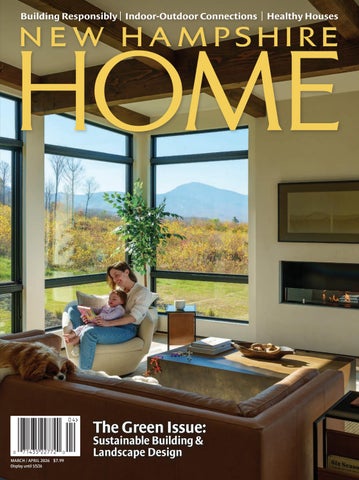
The Green Issue: Sustainable

Building & Landscape Design
Local Representative: Guy Gere | 603 669 1329 NanaWall transforms homes into

Customizable Designs

NanaWall Folding Glass Wall

Everything you expect and so much more.

“The showroom associate was so knowledgeable and easy to talk to. She made sure we had everything we needed for our project...making the whole process stress-free.”

Step into our showrooms to find inspiration and friendly, expert guidance for your bath, kitchen and lighting projects. Discover New England’s largest Kohler inventory plus world-class brands including House of Rohl, Brizo, BainUltra, Robern, Hinkley and many more.

A.F. ~ Westborough, MA

17 inspiring showrooms in New England including... Concord • Exeter • Lebanon • Manchester • Nashua Portsmouth • Rochester • Lowell, MA

you’re invited.

THURSDAY,

Michael Colbert /
Brian W. Ferry
Christina Poletto / Photography by Keegan Rice
By Janice Randall Rohlf / Photography by John W. Hession
Photo by Keegan Rice
Rob Karosis Photography

DEPARTMENTS

INFORM & INSPIRE

FABULOUS FINDS

24 Natural Homestead

Compiled by Amanda Andrews

EYE ON DESIGN

30 Design That Restores

Architect Tracy Kozak on places that nourish both people and planet.

By Michael Colbert

Photography by John W. Hession

CREATE

38 Passion Project Stone sculptor Joseph Gray found his calling by listening to the material.

By Janice Randall Rohlf

Photography by John W. Hession

HOME AWAY

44 The Lake Estate on Winnisquam

New Hampshire’s newest resort.

By Debbie Kane / Photography courtesy of The Lake Estate on Winnisquam

20 From the Editor

GREEN SPACE

82 Painting With Plants

For Laura Trowbridge, fine art and gardening go hand in hand.

By Robin Sweetser

Photography by John W. Hession

IN ADDITION

88 Dreaming Big, Living Well

A long-held vision of a home spa is fulfilled.

By Crystal Ward Kent

Photography by John W. Hession

94 Mark Your Calendar

Compiled by Elisa Gonzales Verdi

96 Parting Shot

Photo and text by Betty Wiley

VICE PRESIDENT/PUBLISHER

Ernesto Burden

EDITOR

Janice Randall Rohlf

ART DIRECTOR

John R. Goodwin

PHOTO EDITOR

John W. Hession

PROOFREADER/STAFF WRITER

Amanda Andrews

CREATIVE SERVICES DIRECTOR

Jodie Hall

SENIOR GRAPHIC

PRODUCTION ARTIST

Nicole Huot

CONTRIBUTORS

Michael Colbert, Brian W. Ferry, Debbie Kane, Crystal Ward Kent, Christina Poletto, Keegan Rice, Cheryl Watson, Betty Wiley

ADVERTISING SALES MANAGER Jessica Schooley 603-624-1442 ext. 5143 • 603-345-2752 jessicas@yankeepub.com

DIRECTOR OF BUSINESS DEVELOPMENT Jenna Pelech

OPERATIONS MANAGER Ren Chase

SALES & EVENTS COORDINATOR Paul Milone

VP/CONSUMER MARKETING Brook Holmberg

VP/RETAIL SALES

Sherin Pierce

INFORMATION MANAGER Gail Bleakley

ASSISTANT CONTROLLER Nancy Pfuntner

NEW HAMPSHIRE GROUP 100% Employee-Owned

© 2025 Yankee Publishing, Inc.

New Hampshire Home is published six times a year by Yankee Publishing, Inc.; 250 Commercial Street, Suite 4014, Manchester, NH 03101; 603-624-1442. All rights reserved. Reproduction in whole or in part without the publisher’s written permission is prohibited. The publisher assumes no responsibility for any mistakes in advertisements or editorial. Statements and opinions expressed in this magazine do not necessarily reflect or represent those of this publication or its officers. Every effort has been made to ensure the accuracy of the information contained in this publication, Yankee Publishing, Inc.: New Hampshire Home disclaims all responsibility for omissions and errors.

Photography by: Rob Karosis Photography
DESIGN BY BONIN ARCHITECTS, PLLC | PHOTOS BY JOHN W. HESSION

New Hampshire Home is mailed to our subscribers six times a year and is available at more than 200 newsstands across the state and New England, including the following locations: Barnes & Noble, Books A Million, Hannaford, Market Basket, CVS Pharmacy, Shaw’s and Walmart

HOW TO CONTACT US

SUBSCRIBE ONLINE

To begin a subscription for yourself or give a gift subscription, visit nhhomemagazine.com/subscribe

SUBSCRIBE BY PHONE

Call during office hours (8:30 a.m. to 5 p.m.): 877-494-2036

We accept Mastercard, Visa and American Express.

CHANGE OF ADDRESS OR CUSTOMER SERVICE QUESTIONS 877-494-2036, or email customerservice@nhhomemagazine.com BY MAIL

New Hampshire Home PO Box 37900, Boone, IA 50037-0900

EVENTS CALENDAR & HOME SUBMISSIONS

EDITORIAL CORRESPONDENCE

To submit industry events and home-related news, send an email to editor Janice Randall Rohlf at janicerohlfnhh@gmail.com with a basic description of the event or happening, its time, date, place and a phone number that the editors can call you for more information. Details should be submitted 3 months before the issue’s cover date.

To submit your home or design project, or to suggest a story idea for editorial consideration in New Hampshire Home, email janicerohlfnhh@gmail.com.

PRINT ADVERTISING

New Hampshire Home offers businesses the most cost-effective way to reach New Hampshire’s upscale consumers of home products and services. Information about advertising in the print editions and online is available by contacting Jessica Schooley. 603-624-1442 ext. 5143 • 603-345-2752 jessicas@yankeepub.com

Saturday & Sunday March 14 & 15, 2026

Manchester, NH

Green is In

BUILDING SUSTAINABLY isn’t a trend — it’s a path to the future for a healthy planet.

Three years ago, New Hampshire Home added two new categories to its annual Design Awards: Energy-Efficient Home and Net-Zero/Net-Zero Ready Home. This was in response to a growing awareness that going “green” — once considered an anomaly — was becoming the standard in homebuilding, both by choice and mandate. Every year since we added these Green Design categories, the number of submissions has increased.

Today, as more and more homeowners are choosing to build or renovate, conversations around energy efficiency, responsible material choices and long-term durability are no longer the exception; they are central to good design. Equally encouraging — and the homes we feature in this issue are living proof — is that sustainability doesn’t mean sacrificing beauty or comfort. Nor originality.

When the owners of a home on Squam Lake (page 54) were discussing their needs and wants for their future retreat with their architect, foremost was to maintain the modest footprint by the water, outfit the cottage for year-round living, and build a sustainable home respectful of the surrounding, mature forest, all within a modernist vocabulary. The story of this tree house-like home is one you don’t want to miss.

Energy-Star Certified, a young couple’s stunning, modern home in the White Mountains (page 64) is engineered to conserve power while withstanding the New England climate. It operates entirely without fossil fuels, relying instead on geothermal heating and cooling, bio-ethanol fireplaces, induction cooking and a heat-pump washer and dryer. “Every system in the home was designed to eliminate fossil fuels while enhancing comfort and efficiency,” says the homeowner.

And, in an interesting twist at our feature home in Rye (page 72), when the homeowners were ready to install a pool, they were surprised to learn that their town requires that a new pool be chemical-free, which is sure to become an increasingly popular way to promote a healthy environment. These pools are easy to maintain, too.

In addition, building sustainably is about prioritizing the use of local and regional materials like responsibly harvested timber, New England stone or reclaimed architectural elements. It’s about creating homes that work hard, tread lightly and endure.

As New Hampshire architect Tracy Kozak says in her interview (page 30), “Our buildings have to maintain the opportunity for everyone to be able to replenish our spirit and our health.”

CONTRIBUTORS

Michael Colbert is a writer and editor whose writing appears in Decor Maine and Dwell, among others. For this issue, he wrote “Eye on Design” and “A Modern Treehouse.”

Debbie Kane writes about design, architecture and education. A communications professional, she wrote “Home Away” in this issue.

John W. Hession is an accomplished photographer and filmmaker and is New Hampshire Home’s photo editor. His photos appear extensively throughout this issue.

Robin Sweetser is an organic gardener who grows much of her family’s produce. For this issue’s “Green Space” department, she wrote about Laura Trowbridge’s garden in Peterborough.

Natural Homestead

Reduce your environmental impact by styling your home with eco-friendly options. Compiled by Amanda Andrews

Pitcher Interiors Green in Littleton interiorsgreen.com

Bamboo scrubber brushes Rayne Refillery in Rochester raynerefillery.com

Branch plant stand Gardener’s Supply Company in Burlington, Vt. gardeners.com

Tulum outdoor armless chaise Christine’s in Rye christinesrye.com

Evelyn recycled glass leaf chandelier Ethan Allen in Bedford & Portsmouth ethanallen.com

Sandshell accent chair Jordan’s Furniture in Nashua jordans.com

Lucille reversible quilted pillow sham Pottery Barn in Salem potterybarn.com

Seed collecting kit Willow Brook in Westmoreland willowbrooknh.com

Savannah bench Boston Interiors in Bedford bostoninteriors.com

Hours: Mon–Thurs. 9am–5pm, Friday 9am–4pm, Saturday 9am–12pm 95 E Conway Rd, Center Conway, NH 603-356-5766 countrycabinetsetc.com Dream it, Design it, Install it, Enjoy it

Design That Restores

Architect and sustainability leader Tracy Kozak discusses climatesmart building, right-sizing our homes, and creating places that nourish both people and planet.

SMART DESIGN can enhance daily life, creating spaces that help restore both well-being and spirit. This imperative inspires Tracy Kozak, a leader of sustainable architecture and design in New Hampshire. Kozak founded ARCove Architects in Portsmouth and chairs the New Hampshire American Institute of Architects (AIA) Committee on the Environment.

Taking time out from her work in high-performance sustainability initia-

tives and historic preservation, she sat down with New Hampshire Home to talk about climate-smart building, decluttering and getting back in touch with our roots.

What is your earliest design memory? I’ve always designed and made stuff. My dad had a workshop in the basement with tools he had inherited from his father. When I was six, he built a little house in our basement for my brother

PHOTOS BY JOHN W. HESSION
PHOTO BY DEVON LABRIE, LABRIE MEDIA
Tracy Kozak, left, is in the vanguard of New Hampshire architects practicing and promoting sustainable building. Her small-footprint, yellowpainted former family home is in a South End Portsmouth neighborhood.

and me. We did blueprints, bought the lumber, and that was my first build.

Do you have any architects you turn to for inspiration?

I am inspired by the way light interacts with our built environment and how buildings relate to their setting. Louis I. Kahn has always been a favorite—he did the library at Phillips Exeter. His work is very sculptural. It has a great sense of scale, and the way he utilizes shadow and light is very dramatic.

What lights you up about sustainable design?

I’m an outdoor person. The other thing I love, maybe even more than architecture, is riding horses. Before I wanted to be an architect, I wanted to be a jockey. I spend all my free time out on the trails. I have found a profound nourishment of the body and spirit by being outside. Our buildings have to maintain that opportunity for everyone to be able to

BY

PHOTO
ARCove’s design focus for The Commodore residences in Portsmouth was to restore the historical exteriors of the 1810 building while enhancing the interiors of 21 apartments with contemporary finishes and fixtures.
Kozak reviewing an energy-efficient single-family home design with two members of her staff, Hannah Haytko and Hussein Al Salih.
PHOTOS BY JOHN W. HESSION

replenish our spirit and our health. The statistics are shocking. Forty percent of global emissions are from the construction of buildings, so there’s that head-on collision between the two things I love the most. Of course, I have to find a way to make them play well together.

How do you practice that?

We do energy modeling and embodied carbon analysis of every project from the very beginning of the concept design. We strive to hit performance targets. Code minimum is generally not what we’re going for. We’re looking for highperformance buildings in a way that makes sense to the program and budget of each project. By doing these extra steps at the beginning, we’re able to add value by improving performance over the building’s lifetime.

I’m also chair of the AIA Committee on the Environment in New Hampshire. Our primary objective is to provide education for other designers and people related to the building and construction trades, so that we have the tools to do these designs that work best for sustainability.

You’re leading a case study on the lifetime cost of operating a single-family home. What have you found so far?

New Hampshire is lagging behind. The current energy code is 2024, and New Hampshire keeps holding at 2018. There’s a fear that it will increase construction costs, specifically with single-family housing. Anybody who does energy modeling or operates a building over time knows that choices in how we build affect the overall cost, so we thought maybe not everybody has all the information. We did a study on a multifamily home last year, which was a collaboration of several people — engineers, folks from Dartmouth, scientists and financial analysts— and it showed negligible first cost within two years. We found similar results of an analysis on a single-family house based on an ARCove design.

What advice do you have for people who want to build their home sustainably

First, durability of the materials. Cheap 9 Search for a professional within any of these categories. 9 View detailed company profile, including projects and videos.

materials that don’t last ultimately cost more. They break, fail, leak and rot, then you’ll have to do it again.

The other thing I love to have people consider is efficiency of space. There has been an overwhelming trend toward large living spaces and accumulation of

stuff. I raised a family of four for 27 years in a house that was 862 square feet. It was challenging at times, not because people take up space, but stuff takes up space. Driving through the countryside, even in rural New Hampshire, there’s lots of self-storage buildings in a land where

the houses are already big. We can shrink spaces to what we need and use spaces for multiple purposes at different times of day: convertible furniture, convertible spaces, walls that move. If we could shrink the average size in American homes by 10%, that’s a huge global impact on overall carbon emissions and global warming.

What’s New Hampshire’s best-kept secret?

The history. We learn where we want to go by knowing where we have been. It’s like a treasure hunt when we do a historical assessment. We dig into the people that lived there, the events that happened, the crafters that created it, and there are always fascinating stories. People are inherently interesting, and most of this history is hidden. It is in letters in people’s attics. It’s in file drawers in dusty old museums. They’re not online. They’re not talked about. History is, I think, falling out of fashion with the fast-paced world of media. It’s such a rich resource to pull from. It’s our heritage, and it helps ground communities and connect people, which is the strength of our universe. NHH

BY

PHOTOS
JOHN W. HESSION
ARCove restored the 1818 Treadwell Mansion in Portsmouth, the home of Ann Stocker Pearse Treadwell, a wealthy merchant’s widow.
One of the short-term-stay apartments in ARCove’s historic rehabilitation of the early 19th-century Treadwell Mansion, located in Portsmouth.

Passion Project

JOSEPH GRAY DID NOT SET OUT to become an artist. In fact, for much of his early life no one — including Gray himself — would have described him as artistic at all. Today, Gray’s sculptures live around the world: an eagle on a cliff in St. Kitts; stonework and gardens in London; a six-month project on the French Riviera in St-Jean-Cap-Ferrat, where he learned precision limestone techniques from a master British mason.

Raised in New Hampshire, Gray graduated from Plymouth State College in 1980 with a degree in accounting, a

practical choice encouraged by strong math scores and sensible advice. He slogged through four years of coursework, dutiful and uncertain. “I wouldn’t say I was thrilled with the idea of being an accountant,” shares Gray. “I’m more of an outdoors guy.”

At the time he finished college, a sluggish economy made accounting jobs scarce, and living at home meant contributing financially. When a local stonemason needed labor, Gray took the work, expecting it to be temporary.

It wasn’t.

His first job — hauling stone on Martha’s Vineyard — was grueling. Yet Gray, then 24, found he loved the physicality, the dirt-under-the-fingernails honesty of it. He was laid off that winter, called the mason again in spring, and soon found himself in an unlikely position: running a crew on a massive state road project, building miles of stone walls along Route 3 between Concord and Pembroke.

The work was fast and utilitarian, and Gray learned quickly. His aptitude for precision and structure translated well to stone, and before long he was handling

Stone sculptor Joseph Gray found his calling by listening to the material.
Above: Sculptor Joseph Gray at work on a bobcat, the mascot of Brewster Academy in Wolfeboro, where it will be on public display. Carved from NH granite, the piece and its stone base will weigh close to 4,000 pounds.
Opposite page: Carved from a layered piece of Goshen stone, a hawk leaping off the sacred Native American Mount Denali is a tribute to family and nature.

residential projects, studying Europeanstyle walls, patios and detailed masonry. Landscape architects began requesting him by name. A partnership followed, then — after it proved financially unsustainable — Gray struck out on his own.

By the late 1980s, his stone business was thriving. But a turning point came years later, in 1995, during a winter slowdown, when a landscape architect he admired invited him to Salt Lake City. Homesick for his family back east, Gray was on the verge of leaving when, almost on a whim, he picked up a scrap of limestone and began carving.

“I threw myself into it,” he recalls. Armed with chisels, a diamond grinder and polishing pads he carved by day and studied Rodin and Michelangelo at night. The result — a primitive stone face — was less important than the experience itself. “It took my mind off my worries,” he says. “It was peaceful. My hands felt like they were channeling something.”

Back in New Hampshire, sculpture became a refuge. During a difficult divorce, Gray carved constantly, despite warnings that he was jeopardizing a successful business. He made pieces for friends and family, then took on small commissions. When Art and Cathy Coviello, who have a summer home in Wolfeboro, commissioned sculptures for each of their numerous grandchildren, one piece led to another. “That’s when I realized I could actually call myself a sculptor,” he says.

Public recognition followed. At the Boston Flower Show, Gray debuted a monumental garden installation — stonework, sculpture, birds in motion — on a rotating platform. Organizers paid him to open the show. He sold nearly every piece, year after year. Sculpture soon became the heart of his practice.

Today, Gray’s work ranges from whale benches and soaring ravens to his signature eagle benches — 60 to 70 of them, carved from massive single stones and

An apt illustration of Gray’s company motto, Simple Yet Elegant, a straightforward stone seating area with a central fire pit echoes the stonework on a house overlooking Lake Winnipesaukee.
A carved head alluding to Gray’s Native American ancestry is perched above a two-sided selfportrait in stone—the polished side represents Gray the artist, while the hand-chiseled, rough side represents Gray the stonemason.

often sited along the coast. His largest piece, an 18.5-foot, hand-carved eagle at Alnoba in Kensington, NH, is believed to be the largest of its kind in North America.

Since first meeting Alnoba’s founder, Alan Lewis, in 2019, Gray has been devoted to the organization, placing 16 of his sculptures there and leading art tours on the 600-acre property several times a year.

Despite his success, Gray remains deeply rooted. He still carves at his

parents’ property, now a sculpture garden filled with stone paths, spiritual symbols and deeply personal works. He donates generously, carving small marble owls to benefit food banks and conservation causes. “If you do good and you’re kind, it comes back to you,” he says. “Every time I give a piece away, the return is tenfold in some form or another.”

Gray continues to do select stone masonry projects, but sculpture is now his passion and primary focus. “Stone knows when you mean it,” he says.

“If you’re open, if you respect it, it gives something back.”

He smiles: “Until I picked up a hammer and chisel in Salt Lake City, when I was almost 40, people told me I wasn’t artistic.” He proved them wrong. “Everything needs passion,” he says. “Especially this.” NHH

Learn more about Joseph Gray’s stone sculpture at josephgraysculpture.com.

For information about Joseph Gray’s Art Tours at Alnoba, go to alnoba.org/event/ original-art-tours-2026/2026-10-02/.

Carved from massive blocks of brownstone, this sculpture is a tribute to the Native American Inukshuk, who used them as markers for trails and sacred places. Meant to be human-like, they symbolize safety, hope and community.

The Lake Estate on Winnisquam

It’s all about understated luxury at New Hampshire’s newest resort.

IN AN ERA when luxury hospitality often means minimalist design, The Lake Estate on Winnisquam stands out. The new 114-room resort, situated on 36 acres on Lake Winnisquam in Tilton, fully embraces the warmth and grandeur of New Hampshire’s 19th-century grand resort hotels.

“We envisioned building a resort that is more of a grand estate than a

hotel, something that felt like the home of a wealthy relative,” says Ed Rocco, co-owner and general manager with his wife, Patti.

During several months of conversations between the Roccos, Lake Estate owners Dan and Elaine Dagesse, SamynD’Elia Architects and Boston-based interior designer Manuel de Santaren, the property’s architectural features and

furnishings were as important to discuss as its hospitality and customer service.

For their designs, the Samyn-D’Elia team and de Santaren drew on historic inspiration from other grand hotels around the country and elegant lakefront homes. “It was important to get the language and ethos of this property correct,” says de Santaren. “It needed to feel elegant but welcoming. A place where

Above: Exposed beams, a paneled ceiling and accent wall, and an elegant stone fireplace make The Dining Room a welcoming place to dine.
Opposite page: Oak beams, molding and paneling warm the lobby; a large custom-designed light fixture is inspired by lighting found in American grand hotels.

INFORM

you wouldn’t feel out of place wearing a sweater and a pair of corduroys or a tuxedo.”

Adds Cris Salomon, principal architect at Samyn-D’Elia, “We want visitors to feel like they’ve left their busy lives behind and are coming someplace to really relax and disconnect.” The woodtimbered lobby is representative of the high level of architectural detail found throughout The Lake Estate. Visitors enter under an Arts and Crafts-inspired 16-foot-high light fixture, custom designed by de Santaren and Samyn-D’Elia Principal Architect Clay Hayles. On the wall facing the entrance hangs a 17thcentury tapestry that anchors the highceilinged space.

De Santaren was given unusual latitude to assemble a collection of art and antiques to create The Lake Estate’s atmosphere of subtle refinement. Hung throughout the resort’s public spaces are Hudson River School and American Impressionist paintings spanning the late 19th and early 20th centuries; antique decorative objects and objets d’art are tucked into bookshelves or grace tabletops. “I wanted to convey the feeling of a great lakefront home that had evolved over decades,” de Santaren says.

Comfortable seating areas in the Living Room off the lobby as well as in an area known as the Library Lounge contain vintage Oriental rugs and overstuffed chairs and couches in complementary

Decorated in complementary shades of blue and green, guest rooms feature high-end details like white crown molding and paneling, wool carpeting, custom-designed furnishings and original artwork.

Details

You have a vision, an idea, a dream. Our designers help you create a space that reflects your personality and individual style. We always look to take advantage of the unique architectural features and aspects of your home in order to maximize the functionality — and fun — that a welldesigned kitchen delivers. We work with our customers to the very end, ensuring that the vision we design is executed to perfection.

Custom made in Manchester since 2005

9050 South Willow St., Manchester (603) 606-6123 | revcabinetry.com info@revcabinetry.com

INFORM & INSPIRE Home Away

fabrics. “Once we had everything in place, with artwork on the walls and objects on the shelves, it just shimmered,” de Santaren says.

Wall coverings and fabrics were chosen with a similar aesthetic in mind. De Santaren worked with the famed British decorative arts company, Morris & Co., founded by 19th-century artist and designer William Morris, to recreate some of their iconic wallpapers in vinyl, a material appropriate for hotel and lodging spaces. (“Paper wall coverings don’t meet the fire codes for hotels,” de Santaren notes.) Even the lavatories are noteworthy for their vivid walls.

Decorated in blues and greens, nearly all the guest rooms and suites have balconies with lakefront views. Rooms are warm with high-quality finishes, handmade quilts and original landscape paintings by New Hampshire artist Rebecca M. Fullerton. “All of the furnishings throughout the guest rooms and public spaces were custom designed,” says Salomon. “Every detail was drawn and carefully considered, from details like brass feet

Above: The hotel’s cedar-shingle and fieldstone design is inspired by 19th- and early 20th-century Adirondack lake homes. Nearly all the guest rooms overlook Lake Winnisquam.
Top: Glass doors on one end of The Bar open to The Living Room space, creating a larger room for special events.

on the bedside tables to the number of pleats on the custom curtains.”

The design team created a prototype guest room in a warehouse near the property that enabled Dagasse and the Roccos to see what each material and fabric looked and felt like. “For example, we would compare how a wool carpet felt on your feet versus the standard hotel nylon carpet,” says Salomon. Those were important details to invest in.” So were solid wood doors with brass handles and genuine hardwood flooring. The wedding and events center features a soaring timber frame structure by Timberpeg of Claremont; Timberpeg also fabricated the oak beams in the lobby and adjacent Living Room space.

Now that The Lake Estate is open and welcoming guests, the design team can take a breath and appreciate their accomplishments. “We really pulled it off,” de Santaren says. “It’s been one of the proudest moments in my career.” NHH

Each of the hotel’s 18 suites features a private balcony or ground-floor patio, all with lakefront views.

PROJECT TEAM

ARCHITECT: Samyn-D’Elia Architects, PA • 603-968-7133 • sdarchitects.com

INTERIOR DESIGNER: Manuel de Santaren, Inc. • 617-330-6998 • manueldesantaren.com

BUILDER: Daniel Hebert, Inc. • 603-237-4454 • dhigc.com

TIMBER FRAME & BEAMS: Timberpeg • 800-636-2424 • timberpeg.com

LANDSCAPE DESIGNER: SE Group • 802-862-0098 • segroup.com

in soothing tones of blue, gray, green and white, The Spa’s relaxation lounge opens onto a terrace with a heated mineral spa, fire pit and meditation garden.

Decorated

Inspired by Squam Lake’s history, forest and light, this Passive House reinterprets the classic kids’ outdoor play platform through a contemporary, carbon-conscious lens.

BY BRIAN W. FERRY

Prioritizing the health of the hemlock forests, Alchemy Architects built a dreamy lake house in a class by itself.

here's a reason they shot ‘On Golden Pond’ on Squam Lake,” says Geoffrey Warner, founder and architect at Saint Paul, Minn.-based Alchemy Architects. “You've got the mixed pine forest, the lake, and the history of lumber and white pines and hemlocks.”

When Warner’s former clients from a home in Pennsylvania relocated to Boston and found a dreamy property in Holderness, an early 20th-century cottage only 15 feet from the water’s edge, they enlisted Warner’s team with a clear remit: to maintain the modest footprint by the water, outfit

the cottage for year-round living, and build a sustainable home respectful of the surrounding mature forest, all within a modernist vocabulary.

“This part of Squam Lake is close to national forest land,” Warner says. “Whenever you build on a site like that, I think you have to, as the Boy Scouts would say, leave the land better than how you found it, which is obviously difficult when you're building anything new.”

Alchemy specializes in residential architecture, often renovating craftsman bungalows typical of the Twin Cities,

“ If you slam a platonic box into a forest, you're going to get these places where the trees poke through the facade, walls and ceiling.”

and in 2003 they developed the weeHouse, a modern modular program that uses pre-fabrication to embrace small, efficient, sustainable dwellings.

Drawing upon Alchemy’s expertise and the imperative to “leave no trace” in Holderness, they developed a pre-fabricated Passive House that blends with the surrounding hemlock forest. Warner’s team designed the house’s interior almost entirely with white oak over an engineered soft wood core for the floor, walls and ceiling to make the build stabler and more sustainable than solid wood. To reduce the Tree

Opposite page: Hydraulic doors open up the living room to the lake, while a sliding door opens to connect the dining area to the porch.

Above: Instead of maximizing square footage, Warner worked with the homeowners to minimize the build and invite communion with the land.

Above: Building smart is a far cry from sacrificing comfort. With modern appliances, the kitchen is fit to entertain.

Right: Playful oval windows evoke the forest’s trees breaking through the home and welcoming it to the landscape.

Opposite page: Thoughtful landscaping enhances the homeowners’ experience of the property. Only steps from Squam Lake, they’re ready to unwind.

From left to right:

Digifabshop was a match for Alchemy’s boundless creativity, and the digital fabrication firm constructed stairs like a fallen trunk suffused with warm light.

Skylights and natural materials align the home with wellness design principles — a day indoors becomes one amid nature, too.

Bold millwork supplies arresting décor within a minimalist design.

House’s envelope, a partial timber frame was panelized off-site by Walpole-based Bensonwood, using fiber-based, dense-packed insulation and exterior sheathing made from hydrophobic compressed wood fiber.

In conceiving of the Tree House, they imagined a “box of trees” dropped onto the forest floor, creating an opportunity for functional and thematic play.

“If you slam a platonic box into a forest, you're going to get these places where the trees poke through the facade, walls and ceiling,” Warner says.

Oval windows and skylights are meant to embody trees from the forest bursting through the home. Partnering with Digifabshop, they designed parametric trees that embed in the home’s architecture and filter light from the forest canopy. The staircase evokes a tree trunk lying down, making a trip upstairs a voyage into the woods. Lying around indoors, the homeowners could enjoy a forest bath.

Passing through the home’s interior, it’s clear that Alchemy realized their vision—it does feel like living inside a treehouse. Within a footprint of only 1,500 square

PHOTO BY CHERYL WATSON

feet, the three bedrooms can sleep up to 8 to 10 people, with more in the boathouse.

By blending the house into the surrounding environment, the space it occupies begins to feel larger without intruding upon the landscape. A handy hydraulic overhead door opens the living room up to the lake’s edge, and the live-edge dining table is ready to roll through the zerothreshold lift-slide door onto the porch. Window seats provide both seamless storage and a place for a quick nap. Surrounding blueberry-sod rain gardens manage runoff and

bring greenery just a few steps away from the home’s patios.

The neighboring, 600-square-foot boathouse is a sort of Quonset hut that is “somewhere between a birchbark canoe, a fallen tree and a big old sand worm,” Warner says with a laugh. The family can store kayaks and paddleboards inside, and it also features a small sleeping porch.

They built the home responsibly, too. Working within the constraints of the Passive House, they had to meet extremely precise specifications for thermal, air, radiation and moisture control.

“ They were not concerned about gross square footage and instead wanted to really look at the experiential qualities of being on the site.”

“We don't do it because it's easier,” says Warner, “but if you're going to build something new with technology that's 150 years old, that doesn't make much sense.

“We have the ability to make something that requires very little energy input and is made with much lower carbon content,” he adds. “That looks toward our future. What gets me excited about it is that we're doing something that empowers people to be part of future solutions through our built environment.”

The homeowners were deeply committed to this vision as well. While many may seek to maximize square footage on their parcel of waterfront land, the homeowners had different priorities.

“They were not concerned about gross square footage and instead wanted to really look at the experiential qualities of being on the site,” Warner says.

Building more modestly within the landscape brings every room in the home closer to the outdoor environment the family so deeply loves.

“Instead of having the big lake view, how else can you get a feeling for being in the forest and somehow escape your normal life in a way that's actually meaningful?” poses Warner.

“They are really interested in the health of the hemlock forest,” he adds. “Being in the hemlock forest and doing things that protect it for future generations — I think they feel that the house reflects that spirit.” NHH

Above: With doors opening right over the pond, the guest house isn’t too shabby a place to spend the night.

Opposite page top: Whether you see it as a sandworm or a birchbark canoe, the boathouse is a stunning addition to the home’s footprint.

Opposite page bottom: Multipurpose spaces optimize the home’s versatility all year long.

PROJECT TEAM

ARCHITECT: Alchemy Architects • 651-647-6650 • alchemyarch.com

BUILDER: Vision Design Build • 508-309-5181 • visiondesignma.com

TIMBER FRAME: Bensonwood • 603-756-3600 • b ensonwood.com

STYLE&SUSTAINABILITY

In the White Mountains, a young couple’s dream for a modern, eco-friendly home comes true.

In the daytime, this living space affords panoramic views of the mountains. At night, the telescope is used for

stargazing.

It took several days of walking across their nearly 40 acres in Bethlehem—and collecting elevation data from topographical maps—for Monica and Keegan Rice to determine the ideal site for their modern home. When they finally found it, the decision was instant. “We get to watch every last moment of the sun slip behind the mountains, followed by layers of pink, orange and a deep, glowing afterlight,” shares Keegan. “It often feels like we've been gifted another hour of daylight

most evenings.” To the west lies Franconia Notch; to the east, Vermont stretches into the distance.

The land held particular meaning for the couple, both of whom have deep roots in New Hampshire. Monica grew up in Concord, while Keegan spent his formative years in North Woodstock. Today, they share the property with their 19-month-old daughter and a King Charles Spaniel, embracing life in the Granite State from a fully appointed, 3,699-square-foot home that reflects their shared vision for modern, sustainable living.

Bringing that vision to life was a labor of love, driven by meticulous attention to detail and the assembly of a trusted team. The home’s panelized post-and-beam timber frame was designed and constructed by Yankee Barn Homes of Grantham, using domestically sourced, kiln-dried Douglas fir. According to Chris Sevigny, director of architectural and production design at Yankee Barn Homes, the design team worked with Monica and Keegan to update one of the company’s existing home styles and tailor the layout to their personal preferences. Presby Construction of Franconia

Above three photos: Connectivity to outdoor spaces is key. Glass on the porch railings ensures a seamless view from all angles.

Opposite page: Specialized window placement achieves a snow globe effect with nature.

Below: In addition to providing a luxurious bath, the soaking tub is a spot to view Mount

Opposite page: Taking a moment to play in the spacious bedroom/sitting area.

served as general contractor, guiding the project from shell to completion.

Energy-Star Certified, the house is engineered to conserve power while withstanding New England’s climate. It operates entirely without fossil fuels, relying instead on geothermal heating and cooling, bio-ethanol fireplaces, induction cooking, and a heat-pump washer and dryer. “Every system in the home was designed to eliminate fossil fuels while enhancing comfort and efficiency,” explains Keegan. Inside, 10-foot ceilings span the open floor plan, comple-

mented by discreet storage that keeps everyday necessities out of sight. The home also includes a suite of amenities— among them a home gym, steam shower, hot tub and sauna. In the finished basement, a built-in bunk niche with a climbing wall and ladder creates a playful retreat for their daughter and her friends. “It’s so kids can be in their own little world. The only way to access the top bunk is by climbing rocks,” says Keegan.

Rather than hiring an interior designer, Monica and Keegan addressed the interiors themselves. “Keegan and I

Lafayette and Cannon Mountain.

really wanted the home to feel like an authentic reflection of us, so we took the lead ourselves, drawing inspiration from places we've traveled and styles we're naturally drawn to,” says Monica. “We leaned into minimalism to allow the architecture, the views and the quality of light to take center stage.” Scandinavian and Japanese influences shape the interior aesthetic, evident in the pale wood floors, natural materials, and emphasis on simplicity and calm. The palette remains intentionally earthy and neutral, with walls left largely bare. As Keegan puts it, “The artwork is really the

windows and the changing scenery throughout the seasons.”

To reinforce a sense of visual continuity, the couple avoided traditional trim in favor of drywall returns at the windows. Doors sit flush with the walls and feature hidden hinges and streamlined hardware, while switches and outlets are recessed to maintain uninterrupted lines throughout the space.

Though deeply rewarding, the custom build was not without challenges. Keegan notes that elements such as siding, cabinetry, lighting and baseboard details required extra

Above: The family room features cozy seating and shuffleboard.
Top: A custom rift-sawn oak cabinet from Walpole Cabinetry graces the primary bath.

time and coordination. Advance planning proved critical.

“We were fortunate that we planned ahead to acquire our materials, as at the time, products were in short supply and shipping times were upwards of a year on some items.”

With the home complete, the Rices are turning their attention outdoors. Landscaping is next on their list, with plans to enlist the help of relatives who are master gardeners. In the meantime, they continue to draw inspiration from the ever-changing surroundings, and from the experience of bringing up their daughter in a place they cherish.

“We’re excited to raise her surrounded by the beauty of New Hampshire.” NHH

The luxe lower-level bath features a steam shower, Japanese-style smart toilet and a mirror with integrated Bluetooth speaker.

PROJECT TEAM

DESIGN/BUILD: Yankee Barn Homes • 603-863-2400 yankeebarnhomes.com

GENERAL CONTRACTOR: Presby Construction • 603-823-5298 presbyconstruction.com

A Forever Home

Designed for an active retirement and rooted in Seacoast tradition, this Shingle Style home balances timeless architecture, low-maintenance living and seamless connections to the outdoors.

On the cusp of early retirement and eager to build their forever home, a Massachusetts-based couple turned their attention north to Rye. “We love New Hampshire, we love the Seacoast area and we knew our lives were changing,” says the husband. “We understood that we were not only going to build a house but also choose a neighborhood where we would want to spend the rest of our lives.” Choosing Rye, he adds, “We chose so well.”

After an extensive search of architects on the Seacoast, the couple knew there was only one logical choice to bring their

dream to life: Maugel DeStefano Architects, which has offices in Portsmouth and Harvard, Mass. Working closely with the firm’s residential studio leader, Britni Rotunda, the couple articulated a vision for a traditional Shingle Style home, complete with an attached garage plus a detached garage spacious enough to accommodate up to nine cars, including ceiling height for multiple car lifts. An active pair who spend much of their time outdoors, they also emphasized the importance of seamless connections between interior and exterior spaces.

“It was great that Maugel DeStefano came to our old house

Left: In the kitchen, Oyster White marble with a leathered finish tops the island, and Hubbardton Forge pendant lighting is suspended from the coffered ceiling.

Below: A cozy seating area is surrounded by windows that have views to the backyard.

and asked us to point out the things we liked and those we didn’t like,” shares the couple. “That way, they were able to incorporate what we liked and redesign what we didn’t.” The resulting 5,600-square-foot residence includes four bedrooms, four bathrooms and two half-baths, along with generous living spaces, high ceilings and abundant windows that flood the interiors with natural light. A sizeable covered porch with a retractable screen overlooks the pool, while thoughtfully designed landscaping complements both the scale of the house and its three-acre setting.

That covered porch—with a wood-burning fireplace and a widescreen TV—may be the feature that best supports the couple’s indoor-outdoor lifestyle. Both agreed that a space like this was essential, though the wife was clear about what she didn’t want: a traditional screened porch or a repeat of the canvas awning they had at their previous home. The solution came in the form of retractable screens that can be raised or lowered at the touch of a button—just one example of the advanced smart home technology that automates and controls a wide range of functions throughout the home.

Above: The foyer's soft, neutral palette sets the stage for the rest of the home's transitional look.
Top: A large cased opening allows the dining area some privacy while maintaining a link to the kitchen.
Opposite page: Despite its vaulted ceiling, the airy living room feels grounded by the millwork and custom railings.

Oriented perpendicular to the porch, the pool offers a dramatic lengthwise view, and it quickly becomes a talking point. It’s a chemical-free natural pool that relies on aquatic plants to absorb nutrients and prevent algae growth, dramatically reducing maintenance. “I pull the cover off, start the pumps and do practically nothing the rest of the summer except robo-vacuum it,” says the husband, clearly a fan.

Low maintenance was a guiding principle throughout the

project, reflecting the couple’s desire to simplify their retirement years. High-quality, durable materials and energy-efficient systems were selected to ensure longevity and performance, balancing beauty with sustainability. For example, rather than natural cedar shakes, which are vulnerable to moisture and insects, the home is clad in NuCedar engineered shingles with a 25-year warranty. Their rough-sawn texture so closely mimics real cedar that the difference is nearly imperceptible.

Providing a significant indoor–outdoor element to the home, its spacious porch looks down the length of the chemical-free pool. The porch’s retractable screens can be raised or lowered at the touch of a button.

While the exterior settles comfortably into the neighborhood’s Shingle Style traditions, the interior takes a more nuanced turn. The wife says “unlike the traditional homes we’ve previously owned, I really wanted to challenge myself to use a more transitional design approach.” Working within a predominantly neutral palette, she chose restrained millwork and unfussy finishes. “I’m a big believer that simple is more elegant,” she explains. “It’s really a balance between trying not

to overdo the interiors, but still have enough going on to make them interesting.”

That philosophy is especially evident in the living room. Without careful attention to scale and detail, the large, vaulted space could have read as little more than a featureless box. Instead, thoughtful architectural articulation gives it dimension and warmth. “A band that runs around the height of the tall space cuts the room in half, and there is paneling above and

Paneling detail in the primary bedroom, top, and a dormer cutout in a guest room, above, add interest to two of the home's four sleeping areas.

The primary bathroom's curbless double shower features keypads that allow each person to customize their light and music preferences.

below that,” notes architect Rotunda. “We did things to break down the scale and to make it feel grounded and finished, but not overdone.” This perfectly captured the wife’s vision of the space. And while the main living area has the ease of an open concept, it is not entirely without boundaries. “The kitchen and living space are open to each other, but dining is a separate room,” she says, “accessed through a generous cased opening.”

A similar strategy shapes the kitchen, where a coffered ceiling introduces depth and shadow that temper the room’s nine-foot-three-inch height. The ceiling remains lofty, but the effect is warmer and more intimate.

Throughout the house, trimwork plays a quiet yet defining role, bringing clarity, cohesion and character to each space. Simple, square-edged profiles reinforce the home’s transitional sensibility, while specific applications vary from room to room: board-and-batten paneling behind the bed in the primary suite adds subtle texture to crisp white walls; vertical shiplap lends the laundry room a relaxed, utilitarian feel; and partial wainscoting introduces rhythm and interest in the dining room and hallways.

Just as trimwork grounds the interiors, the landscape

design carefully anchors the house to its setting. “It’s a big, open lot and a fairly substantial house, so we did a number of large natives out at the street, where there is an alley of red maples that I really think give the house some stature,” says Robbi Woodburn, owner of Woodburn & Company Landscape Architecture. “The trees tend to anchor the house to the land.”

Closer to the house, ornamental plantings provide color and texture throughout the seasons. Daylilies, Knock Out roses and lavender ring the foundation, while ornamental grasses, allium, butterfly bush and black-eyed Susans at the back of the pool extend the summer bloom. “Around the pool, there are two flanking seven-son flower trees, which we like to use near pools, because they bloom in August and September—something you don’t get very often,” Woodburn adds. “They have a terrific scent.”

It is a lovely setting for a gracious house, and the effect continues to resonate with the homeowners even after five years. “We’re so lucky,” says the couple. “We come back from vacation, and we’re so psyched to be home.” NHH

PROJECT TEAM

ARCHITECT: Maugel DeStefano Architects • 603-431-8701 • maugel.com

BUILDER: Persimmon Custom Homes • 603-778-6400 • thegovegroup.com

LANDSCAPE ARCHITECT: Woodburn & Company • 603-659-5949 woodburnandcompany.com

HARDSCAPE: Exeter Land Contractors • 603-778-0005 exeterlandcontractors.com

POOL: Waterscapes by Jesse Dutra Landscape • 508-228-9310 waterscapesnaturalpools.com

SMART HOME TECHNOLOGY: Audio Visual Experience • 603-601-1050 electronic-lifestyle.com

In addition to an attached garage, left, a freestanding garage accommodates up to nine cars, including ceiling height for multiple car lifts.

Homeowner, garden designer and budding painter Laura Trowbridge has plenty of flowers to choose from when creating a bouquet. The artistic mix of contrasting colors, shapes, sizes and textures makes the 125-foot-long border behind her house a visual delight all season long.

Painting with Plants

For Laura Trowbridge, fine art and gardening go hand in hand.

WHEN LAURA TROWBRIDGE moved to Peterborough in 1997, she was the mother of four young children. What little time she could devote to gardening was spent in her large vegetable patch. “My mother had always grown and canned much of our food, and I wanted

to do the same for my family,” she says. As time allowed, she began a flower border along a stone wall behind the house. “I got plants from friends and family and just threw them in there in a single row. I didn’t know what I was doing,” she says with a laugh.

Eventually, she was drawn to the beautifully designed public gardens planted and maintained around town by a dedicated group of volunteers. “It was so interesting!” she says. “There were so many plants I had never seen before, all with their Latin name tags; I had to find out more about it.” After meeting the volunteer gardeners and their leader, Michael Gordon, she eagerly joined in. “I worked with them for 15 years and soaked up everything I could,” she says. As her children grew, so did her interest in garden design. Soon she began creat-

ing gardens not only for herself but for others, and in 2014 she started her own landscape design company: Laura Trowbridge Garden Design.

A Living Canvas Trowbridge’s garden style has evolved over the years. She made her flower borders much deeper, adding trees and shrubs to the mix of annuals and perennials. The main border is now 125 feet long and 10 to 25 feet deep. “I learned about potted plants to use on my patio and also to echo some of the same plants in the

border and window boxes,” she points out. “I like to have all the different gardens talking to each other.”

Annuals and tropicals are an important part of the landscape, allowing her to change the look of the gardens each year. “It feeds my need for change, and I love giant leaves, color and drama. I like the exuberance,” she says. Having recently taken up painting, she says that, the more she does watercolor, the more she realizes that painting is exactly what she does in her garden, only with plants.

The Kindest Cut

Trees and shrubs are an essential part of many gardens, adding structure and yearround interest, but as they mature they can take up too much space and overwhelm neighboring plants. “It’s a mistake many gardeners make,” says Trowbridge. “We fail to realize how big these plants get.” Eventually, the offending plant may have to be dug up and moved or even cut down. “I’m constantly reevaluating the size of these plants to keep them in balance with the rest of the border,” she says. Coppicing is one method Trowbridge

employs to keep the plants in her own garden in check. “Coppicing is an age-old pruning technique in which a tree or shrub is cut to the ground or almost to the ground,” she explains. “This severe pruning stimulates the root system to produce abundant new growth, which is often larger and more colorful, but blossoms will be sacrificed.”

She regularly cuts back her smoke bushes to one foot tall in the spring. “I like the color and size of the new leaves; I don’t need the smoke,” she says. The eleven boxwood balls in the landscape

also get a haircut every July to keep them around 2.5 feet tall and wide. Her variegated Chinese elm (Ulmus parviflora) ‘Frosty’ is a slow-growing tree, but it still could become eight feet tall and block her kitchen window if she didn’t keep it pruned. “It gets a major haircut three times a year, like a bonsai,” she says. The princess tree (Pawlonia tomentosa) in her border grows so fast each year she calls it the “Jack and the Beanstalk” plant! “It is root hardy but not stem hardy in our zone, so it dies back to the ground every winter. In the spring, up come the new

Clockwise from opposite page top left: Echinacea and alliums grow near the path that leads into the rear of the border.

Trowbridge checks out visiting birds while Luigi relaxes in the shade. From this viewpoint, we can appreciate the repetition and flow of color throughout the border.

Plantings near the old Cape-style house are quietly appropriate from the road, not even hinting at the explosion of color behind the house.

Trowbridge’s constant companion Luigi supervises her every move in the garden.

Large leaves of pawlonia provide a backdrop for purple delphiniums and red-leaved calycanthus ‘Burgundy Spice.’ Red canna ‘Australia’ revs up the color after pink ‘Fairy’ rose on the rock in front has gone by.

stems with their huge leaves, and it can grow 14 feet tall and 10 feet wide in a season. Around the Fourth of July, I have to cut it back again to keep it in proportion with the rest of the border,” she explains.

Another fast-grower in need of attention is the ‘Sunburst’ honey locust (Gleditsia triacanthos). “I planted it in the border early on not realizing it could someday be 40 feet tall and 20 feet wide!” When it eventually blocked her view of the distant

hills, it had to go. She cut it to a two-foottall stump and the next year it sprouted like a shrub. “Now every spring I treat it like a shrub and cut back the new branches to control its size,” she says. “Sometimes it also needs a second haircut.”

One of the many things Trowbridge has learned over the years is that careful editing is an important part of keeping a design fresh when renovating a mature garden. From her kitchen window, she can see the whole border at once. She says,

“To create a pleasing picture, everything has to be in proportion—the colors, density of the foliage and heights of the plants—just like in a painting.” NHH

RESOURCES

Laura Trowbridge Garden Design 603-562-5213 • lauratrowbridge.com

Bunker Farm • 802-387-0223 thebunkerfarm.com

Edgewater Farm • 603-298-5764 edgewaterfarm.com

Inspired Gardener • 603-399-4354 inspiredgardener.com

Full moon Japanese maple ‘Autumn Moon’ anchors one end of the border. Its golden-green leaves contrast with the ‘Royal Purple’ smoke bush behind. Annuals including Profusion apricot zinnias and red tassel flower (Emilia) are repeated throughout the border.

Dreaming Big, Living Well

A long-held vision of a home

spa is fulfilled.

Above: Lots of glass and natural wood give the spa an open, airy feel. Opposite page: The custom plunge pool is surprisingly deep given its small circumference.

THIRTY YEARS AGO, Roger Hain and his wife, Regina, traveled to BadenBaden, Germany, where they enjoyed an extraordinary spa experience. Hain was so impressed that he vowed to one day have a home spa that provided as many similar amenities as possible. Decades would pass

before this dream could be fulfilled, as career and family priorities intervened. Upon retiring, Hain decided it was time. Hain selected G.M. Roth Design Remodeling of Nashua to tackle the project. He knew the work would be complex, but the firm had experience

with intricate builds. “I wanted to transform part of our walk-out basement into a spa featuring two heat stations, a cool-down station and a regular shower,” he explains. “The spa wellness treatment is very specific. You enjoy a dry sauna, which achieves temperatures of up to 176 degrees Fahrenheit but no humidity. Then, you go to a steam shower that is 100% humidity but with temps of only 115 degrees Fahrenheit. Next comes a cold plunge into about 64-degree water.

“ This project made all of us up our games. We learned a lot and tackled some things we had never dealt with before. ”

If you wish, you can repeat the process, or go back to the steam room, or simply rinse off in the regular shower. The sauna in particular provides tremendous therapeutic benefits. One Finnish study showed that this process, when done regularly, reduces your risk of heart attack by 52%, and also increases life span in general.”

Hain notes that each segment of the process has to be physically isolated from the others. This added to the challenge, as the spa area is small. On the plus side, it received a fair amount of natural light, and 30 years ago, when the house was being built, Hain had the foresight to sink PVC pipes into the basement floor in hopes of one day having his spa.

IN ADDITION

“Roger was meticulous in planning what he wanted,” says Dean Rascoe, sales and marketing director for G.M. Roth. “He had a clear idea and paid enormous attention to the details. This helped us capture his vision. The small space was a challenge, and there were also safety things to be worked out, as each

area—sauna, steam shower and regular shower—had uplighting, and the electrical had to be isolated from any moisture.

“The plunge pool is not large, but it is deep. To meet Roger’s needs, it was recessed into the floor to allow easy access and exit. Choosing the right materials also necessitated some research. Roger

wanted natural materials, and we used those where possible. However, with so much moisture, we had to opt out of natural stone in the regular shower as it would mold, and go with a porcelain tile that looks like stone. Similarly, the materials in the plunge pool area look like wood, but are in fact tile. There is a

IN ADDITION

tremendous amount of tile craftsmanship in the entire project.”

Great attention was paid to the color palette for the spa area, with a warm beige chosen for the paint. The color harmonizes with the earthy woods, stone and tilework, creating an overall calming ambience. The glass doors on the individual wellness areas add to the open, airy feeling and allow light to flow throughout. Accent lighting is used to highlight shelving, thus helping define and brighten spaces, and all lights have dimmer capabilities. Small details like matching black hardware to shelving trim make the spaces feel cohesive.

“This project made all of us up our games,” says Rascoe. “We learned a lot and tackled some things we had never dealt with before. We were proud of the results and very pleased to deliver the finished product for Roger.”

Hain is thrilled with the results and uses the spa nearly every day. “It’s wonderful to have this in my home,” he says. “G.M. Roth did an outstanding job. They met every challenge and now my dream is a reality.” NHH

PROJECT TEAM

G.M. Roth Design Remodeling • Designer: Alexandra Guerra • 603-880-3761• gmroth.com Helo • helosauna.com

The workout area is just steps away from the spa.
G.M. Roth collaborated with Helo, a company specializing in saunas, for a seamless installation.

MARK YOUR CALENDAR

Events Around the State

New Hampshire Home is on the lookout for events that may interest our readers. If you have one to submit for consideration, send details to egonzalesverdi@nhmagazine.com.

APRIL 16

New Hampshire Home Design Awards

The New Hampshire Home Design Awards honor and celebrate excellence in home design and the creative use of materials in new, remodeled and historic residences. Although small geographically, New Hampshire is fertile ground for the architects, designers and builders who work in and draw inspiration from the Granite State. The Annual Design Awards event is a special soirée saluting New Hampshire’s best residential architects, designers and builders. Guests are invited to mingle with peers as they enjoy an evening full of networking, spirited cocktails and delicious food. $90-$100, 5 to 8 p.m. The Venues at the Factory, 252 Willow St., Manchester; nhhomemagazine.com/design-awards

MARCH 12-15

Bloom — A Floral Palette

This beautiful exhibition is rooted in partnership. In the inaugural season of Bloom, the New Hampshire Federation of Garden Clubs has partnered with the Currier to create 18 Currier-inspired custom arrangements that have been crafted by Garden Club members. Visitors will discover floral arrangements in a fresh experience for all ages. Ticket prices and times vary, Currier Museum of Art, 150 Ash St., Manchester; currier.org

MARCH 14-15

NH State Home Show

Produced by the professionals at the New Hampshire Home Builders Association, this show is where you can attend and interact with builders, remodelers, decorators, landscapers and all types of home solutions providers. The latest in

home-related products and services will be showcased—everything from air quality to mortgages, hot tubs to custom home builders, and custom closets to fabulous kitchens and baths. With over 200 vendors and exhibitors covering all aspects of the home building/remodeling industry plus items in the “Made in New England” and “Beer & Wine Garden” areas, this is a home event that you won’t want to miss. $10, Saturday, 10 a.m. to 6 p.m. and Sunday, 10 a.m. to 4 p.m., DoubleTree by Hilton, 700 Elm St., Manchester; nhstatehomeshow.com

MARCH 14-15

Old House and Barn Expo

Visit the biennial Old House & Barn Expo for all things related to old house and barn history, repair, rehabilitation and stewardship. Bring your friends and family for an experience that only comes around every other year. This event is a

must for everyone who loves old buildings and is the only opportunity of its kind in New Hampshire to gather with like-minded people, experts and vendors all specializing in historic buildings, maintenance and upkeep, under one roof. Ticket prices vary, Saturday, 9:30 a.m. to 5:30 p.m., Sunday, 9:30 a.m. to 4:30 p.m., Sullivan Ice Arena, Saint Anselm College, 100 St. Anselm Drive, Manchester; nhpreservation.org

MARCH 21

UNH Gardening Symposium

The Spring Garden Symposium is perfect for anyone who enjoys gardening and learning ways to do it better. It has remote and in-person options and features four presentations by gardening experts. A silent auction fundraiser for UNH Extension Master Gardeners includes gardening tools, supplies, artwork, experiences and more. MainStreet

PHOTO BY ZACH DAVIDSON

Bookends of Warner will also be on hand selling garden-related books, including those written by some of the speakers. To register, and for more information, visit extension.unh.edu.

MARCH 28

Bridgerton Dinner Party with String Quartet

Dearest Gentle Reader, the social season is upon us and Lady Whistledown cordially invites you to a celebration with the finest food, drink and musicians at LaBelle Winery in Amherst. It is with the utmost excitement that we anticipate this elegant four-course dinner with wine pairings, her majesty’s favorite ball music performed by the excellent Yaeko Miranda string quartet, and Regency-inspired decor for a night that will surely be read about in the society papers. Attire inspired by this season’s Diamond is welcome, though not required. $89, 6:30 p.m. to 9:30 p.m., LaBelle Winery- Amherst, 345 Route 101, Amherst; labellewinery.com

EDITOR’SPICK

APRIL 18

Sourdough Bread Making

Learn to bake your own bread from scratch using a sourdough starter. You’ll learn how to start and keep a sourdough culture alive and use it to make breads and many other baked goodies, including a loaf of bread to finish at home and biscuits that use the sourdough discard to enjoy at the end of the class. You will also go home with some sourdough starter to continue your sourdough baking journey. Participants should bring a bag lunch for this 4-hour class, a container to transport their unbaked sourdough, and a small jar for their starter. Registration required. $25-$40, 10 a.m. to 2 p.m., Prescott Farm Environmental Educational Center, 928 White Oaks Road, Laconia; prescottfarm.org

APRIL 25

Goffstown SpringFest

SpringFest is a community fun day for Goffstown and Central/Southern New Hampshire. After a long winter, SpringFest offers friends and neighbors the opportunity to have fun and meet some of their local business owners and community groups. All proceeds raised from this event help support the nonprofit Goffstown Citizens Committee. The Goffstown Citizens Committee supports the Goffstown scouting programs and provides scouting opportunities in the Goffstown community. $4-$5, 10 a.m. to 4:30 p.m., Sullivan Ice Arena, Saint Anselm College, 100 St. Anselm Drive, Manchester; goffstowncitizens.org

MARCH 7

On Tap for CASA

At this fundraiser for CASA (Court Appointed Special Advocates) of New Hampshire, participants aim to keep their teams’ barstools occupied for 10 hours without abandoning the post while competing in a variety of fun competitions to gain points, including trivia, stein hoisting and more. Come for the cause, stay for the friendly competition. All participant spots will likely be filled by early March, but interested persons can donate and drop by the event for music, raffles and libations offered throughout the 10-hour event. All proceeds go toward recruitment and training of CASA volunteer advocates, ordinary women and men advocating for abused or neglected children in New Hampshire’s court system. New England Tap House and Grille, 1292 Hooksett Road, Hooksett; donate.casanh.org

603•770•1630

starer@aol.com

PARTING SHOT

I PHOTOGRAPHED THIS BEAUTIFUL SCENE several years ago in Sugar Hill, NH, when the lupines were in full bloom. It was a great season for them, but while I love lupines and that was the focus of my trip up north with friends, I was drawn to these beautiful buttercups in a field adjacent to a farm. Fortuitously, it was a beautiful sunrise that illuminated the flowers, and the lone tree in the background stood tall against the colorful sky. As a photographer, I truly live for mornings like this one. Spring is truly God’s gift to New England.

Photo and text by Betty Wiley

Turn static files into dynamic content formats.

Create a flipbook