Key changes and potential implications for property investors
Executive snapshot
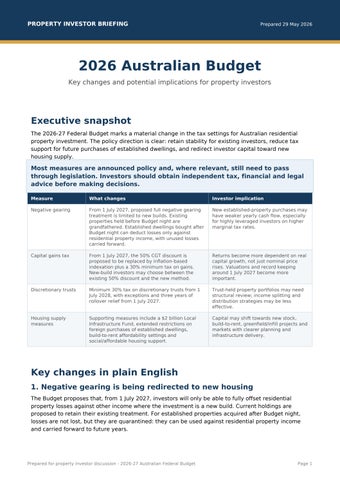
The 2026-27 Federal Budget marks a material change in the tax settings for Australian residential property investment. The policy direction is clear: retain stability for existing investors, reduce tax support for future purchases of established dwellings, and redirect investor capital toward new housing supply.
Most measures are announced policy and, where relevant, still need to pass through legislation. Investors should obtain independent tax, financial and legal advice before making decisions.
Negative gearing
Capital gains tax
From 1 July 2027, proposed full negative gearing treatment is limited to new builds. Existing properties held before Budget night are grandfathered. Established dwellings bought after Budget night can deduct losses only against residential property income, with unused losses carried forward.
From 1 July 2027, the 50% CGT discount is proposed to be replaced by inflation-based indexation plus a 30% minimum tax on gains. New-build investors may choose between the existing 50% discount and the new method.
Discretionary trusts Minimum 30% tax on discretionary trusts from 1 July 2028, with exceptions and three years of rollover relief from 1 July 2027.
Housing supply measures
Supporting measures include a $2 billion Local Infrastructure Fund, extended restrictions on foreign purchases of established dwellings, build-to-rent affordability settings and social/affordable housing support.
Key changes in plain English
New established-property purchases may have weaker yearly cash flow, especially for highly leveraged investors on higher marginal tax rates.
Returns become more dependent on real capital growth, not just nominal price rises. Valuations and record keeping around 1 July 2027 become more important.
Trust-held property portfolios may need structural review; income splitting and distribution strategies may be less effective.
Capital may shift towards new stock, build-to-rent, greenfield/infill projects and markets with clearer planning and infrastructure delivery.
1. Negative gearing is being redirected to new housing
The Budget proposes that, from 1 July 2027, investors will only be able to fully offset residential property losses against other income where the investment is a new build. Current holdings are proposed to retain their existing treatment. For established properties acquired after Budget night, losses are not lost, but they are quarantined: they can be used against residential property income and carried forward to future years.
Implication: an established investment purchased under the new rules may need to stand up on its own cash flow. Investors should stress-test repayments, vacancy, insurance, strata, land tax and maintenance without assuming annual tax refunds will subsidise the holding cost.
2. CGT treatment is moving from a fixed discount to inflation indexation
The current 50% CGT discount is proposed to be replaced from 1 July 2027 with indexation for inflation and a 30% minimum tax rate on capital gains. The changes apply only to gains arising after 1 July 2027. The main residence exemption is not affected. Investors who buy new homes are proposed to be able to choose the better of the current 50% CGT discount or the new indexed approach when they sell.
Implication: high-growth assets may become less attractive after tax if real growth is strong, while assets with modest growth relative to inflation may not be as heavily affected. This makes acquisition price, yield, depreciation, holding period and exit timing more important.
3. Trust structures may require review
The Government has also announced a minimum 30% tax on discretionary trusts from 1 July 2028, with some exceptions and rollover relief to assist restructuring. This could matter for property investors using family trusts or related structures.
Implication: the after-tax benefit of holding or distributing property income through a discretionary trust may reduce. Investors should review structures early, especially where trusts hold multiple properties or development interests.
Potential implications for property investors
Existing investors may be advantaged by grandfathering
Current holdings are proposed to keep existing negative gearing treatment. This reduces forced-sale risk, but may create a "lock-in" effect where owners are reluctant to sell because selling may mean giving up old tax treatment.
Established
dwellings may become less attractive for new investors
Future purchases of established residential property may need stronger rental yield or lower debt to achieve acceptable cash flow. Investors may become more selective on price and more focused on yield.
New builds may attract more investor demand
The Budget clearly favours investment that adds housing supply. New houses, apartments, house-and-land packages, build-to-rent and small-scale infill projects may become relatively more appealing.
Rents could face some upward pressure, but the scale is uncertain
If some private investors withdraw or slow acquisition of rental stock, rental pressure may rise. However, Government and bank commentary suggests the broader impact may be modest and depends heavily on whether new supply is delivered.
Market turnover may slow
Grandfathered owners may hold longer, and new investors may delay decisions while legislation and pricing adjust. Lower turnover can reduce listings and liquidity, particularly in investor-heavy markets.
Tax records and valuations become more important
Investors should maintain clear cost-base records, apportionment evidence, capital works schedules and valuations around transition dates, especially for assets held across 1 July 2027.
Investor action checklist
• Model each property on pre-tax and after-tax cash flow under the proposed rules.
• Separate analysis for existing holdings, established dwellings purchased after Budget night, and new builds.
• Ask your accountant about transition dates, CGT records, depreciation and trust structures.
• Reassess acquisition criteria: yield, land value, build quality, growth drivers and exit liquidity.
• Consider whether capital improvements, secondary dwellings or development potential could improve cash flow and supply alignment.
• Avoid rushed decisions until legislation is final, but prepare scenarios now.
Portfolio strategy considerations
Investor profile
Existing negatively geared investor
New investor targeting established homes
Investor considering new build
Trust-based investor
Developer or sophisticated investor
Grandfathered, but may become reluctant to sell.
Reduced ability to use losses against wages.
Build risk, delays, defects, oversupply and settlement valuations.
Potential minimum tax and restructuring complexity.
Feasibility remains constrained by construction costs, approvals and finance.
What to watch next
• Final legislation and any amendments before commencement.
Possible response
Review hold/sell plans, refinancing risk and whether holding remains strategic without relying only on tax benefits.
Prioritise stronger yields, lower leverage, renovation upside or markets with lower entry cost.
Focus on builder quality, location fundamentals, land component, vacancy risk and realistic completion timelines.
Seek tax advice before acquisitions, distributions, refinancing or restructuring.
Target projects with planning certainty, infrastructure support, repeatable design and demand for finished stock.
• ATO guidance on quarantined losses, eligible new builds and transition treatment.
• Market response in investor-heavy suburbs, regional centres and high-rise apartment markets.
• Lender policy changes for serviceability, rental income treatment and new-build lending risk.
• State taxes, land tax thresholds and tenancy reforms, which can compound the federal changes.
Bottom line
The Budget does not remove property investment as a strategy, but it changes the rules of the game. The strongest policy signal is to reward investment that adds supply and to reduce tax-driven demand for established homes. For investors, the practical response is to move from tax-led investing to fundamentals-led investing: cash flow, asset quality, tenant demand, debt resilience, development potential and exit liquidity.
Sources and notes
• Australian Government Budget 2026-27, Tax reform page, accessed 29 May 2026: https://budget.gov.au/content/04-tax-reform.htm
• Australian Taxation Office, Tax reform - Boosting home ownership - Reforming negative gearing and capital gains tax, published May 2026: https://www.ato.gov.au/about-ato/new-legislation/in-detail/indi viduals/tax-reform-boosting-home-ownership-reforming-negative-gearing-and-capital-gains-tax
• BDO Australia, What the 2026 Federal Budget means for housing, construction and investment into the sector, 14 May 2026.
• Department of Finance / budget.gov.au, 2026-27 Budget overview, accessed 29 May 2026.
This document is a general summary only and is not tax, legal, accounting or financial advice. It is based on announced Budget measures and public commentary available at the date of preparation. Measures may change as legislation progresses.