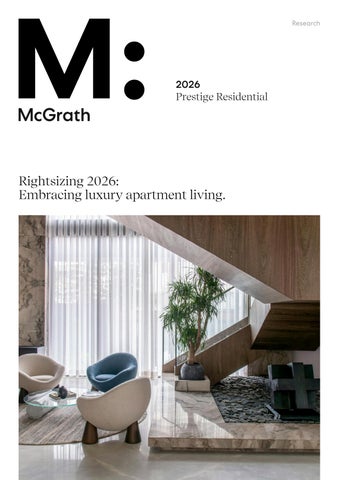
Exploring the concept of rightsizing: downsizing to luxury apartment living
Buyers aren’t just looking for a home. They’re seeking a lifestyle defined by convenience, comfort, and exclusivity.
Premium apartment buildings are now expected to deliver far more than four walls and a view; they must offer a curated suite of features that elevate everyday life.
From world class wellness facilities and resort style pools to concierge services, private dining spaces, and integrated smart home technology, these developments set a new benchmark for urban sophistication.
In competitive markets, exceptional amenities aren’t a bonus, they’re essential for attracting discerning residents who also demand a high level of privacy and security
This shift is occurring against a backdrop of persistently high construction costs for new vertical communities
Despite growing demand for premium apartment living, the expense of delivering these projects remains significantly elevated driven by rising material prices and a shortage of labour, especially for specialist trades
Developers face mounting pressure to balance quality and amenity rich designs with financial feasibility, often leading to longer timelines, and higher entry prices for buyers
At times, these elevated costs underscore the value of existing premium apartments, which can offer immediate access without delay and uncertainties tied to new construction
However, Australia’s luxury apartment market is evolving, attracting investors and rightsizers seeking space and sophistication
These new residences now deliver generous layouts paired with hotel style services, catering to a mobile, affluent population which value convenience without compromising on quality.
Close to triple the number of prestige apartments sold in 2025 than ten years ago Queensland holds the majority share with 43%, followed closely by NSW (41%), then Victoria (16%)
Barangaroo leads Australian East Coast apartment prices in 2025 Brighton East was strongest across Victoria whilst in Queensland, Gold Coast apartments overtake Sunshine Coast
Gold Coast new prestige apartments recorded growth of 88% since Q3 2020, followed by Brisbane (60%), then Sydney (34%) and Melbourne (32%).
By 2028, 40% of apartments in prime regions of Melbourne and Brisbane will be delivered with more than three bedrooms, 34% on the Gold Coast and 31% in Sydney
An average prestige three bedroom apartment size is forecast to start from 160 sqm in Melbourne in 2028, from 166 sqm in Sydney, 172 sqm in Brisbane and 190 sqm on the Gold Coast
Sydney held a 62% premium for three bedroom apartments sold with more than four car spaces compared to having one, Brisbane was 47%, Gold Coast (46%) and Melbourne (41%).
More than two-thirds of residential buildings in Australia’s three largest CBDs had a swimming pool and gym, with further wellness, social and lifestyle opportunities
Prestige apartments generally incur lower ongoing costs compared to similar quality standalone houses, when sinking funds are appropriately managed
Prestige apartments in numbers
Monitoring the volume of high-end apartment transactions across Australia’s East Coast
Total number of prestige apartment sales
By state, annual volume with year ending Q3
Allocation of prestige apartment sales
Share of total annual number of prestige sales per location, year ending Q3/25
Close to triple the number of prestige apartments sold in 2025 than ten years ago.
Prestige apartment sales volume on Australia’s East Coast started on an upward trajectory in the year ending Q3 2020 with 184 sales, peaked at 715 sales in 2024, before recording the second highest volume historically with 505 sales in 2025
Victoria made up 49% of prestige apartment sales back in 2015, followed by NSW (36%) then Queensland (15%) In 2025, Queensland held the majority share, with 43%, followed closely by NSW (41%), then Victoria (16%).
Regional Queensland recorded the greatest share of apartments sold, making up 23% of all its prestige residential sales in 2025
Across the remaining cities and regional areas on the Australian East Coast, Sydney prestige apartments came next with 15%, then Brisbane (13%) and Melbourne (9%) Regional NSW and Regional Victoria both held the lowest apartment share of their total prestige sales with 6%.
Apartment price leaders
Ranking the suburbs setting the benchmark for apartment prices
Top suburbs have evolved over the past five years, as Barangaroo led Australian East Coast apartment prices in 2025.
When ranking NSW suburbs for median prices in Q3 2025, Barangaroo recorded the most expensive apartments at $3 58 million, according to Cotality Darling Point ($2 31 million) followed, then Milsons Point ($2.06 million) made up the top three as had previously done in Q3 2020.
It was the suburb of Milsons Point which led the rankings back then (at $3.38 million), followed by Kurraba Point ($2.00 million) and Darling Point ($1.78 million) Across NSW, the median apartment price for the top 10 suburbs has collectively grown 18% over this five year period
Brighton East recorded the strongest median apartment prices for Bayside and across Victoria.
After not making the top 10 five years ago, Brighton East ($1 40 million) and Mont Albert North ($1 34 million) ranked highest for Victoria in Q3 2025, followed by Caulfield South ($1 28 million)
The top 10 suburbs in Victoria collectively grew 31% in Q3 2025 when compared to Q3 2020 Back then, Balwyn ($1 28 million) held the most expensive median price for apartments in Victoria, then Bentleigh East ($1 08 million) and Hampton ($995,000) rounding out the state’s top three
Gold Coast apartments overtake Sunshine Coast for highest median prices in Queensland in 2025.
Paradise Point and Main Beach, both with a median apartment price of $1.70 million, ranked highest for Queensland in Q3 2025, then Noosa Heads ($1 64 million). Looking back to Q3 2020, Noosa Heads ($1 00 million), Sunshine Beach ($950,000) and Bulimba ($730,000) topped the list
Collectively, the top 10 Queensland suburbs ranked for apartment prices rose 88% over these five years.
Top 10 suburbs ranked for median apartment price, by state Q3/25 compared to Q3/20
NSW
VICTORIA
QUEENSLAND
Tracking prestige apartment prices
Analysing the price divergence between new and established prestige apartments
New prestige apartments lead price growth in 2025.
Between 2020 and the end of 2023, established and new prestige apartments across the major cities on the Australian East Coast followed a similar growth path, with a combined average growth of 22%
On the lower end of the range, Melbourne established prestige apartment prices grew by 9.3%, whilst on the upper end, established prestige apartments on the Gold Coast grew 33 4%
The performance of new prestige apartment prices for all four cities has since overtaken and led price growth trajectories in Q3 2025 When indexed to Q3 2020, new prestige apartments recorded total growth of 88.0% on the Gold Coast, this was followed by Brisbane (60 0%), then Sydney (34 3%) and Melbourne (32 2%)
Five main reasons for new apartments outperforming established price growth
Larger floorplans
Superior quality of materials
Best in class amenities
Chance of multiple car spaces
Historic low levels of new luxury apartments built to cater for the rising wealthy population
Price change for new and established prestige apartments
Indexed to Q3/20
SYDNEY
MELBOURNE
BRISBANE
GOLD COAST
The rise of the three bedroom apartment Developers have steadily increased the bedroom count across new projects in prime regions
Share of new and established apartments with 3+ bedrooms Apartments built or due to be completed in prime regions
When downsizing from a standalone prestige home, many buyers have been seeking a luxury apartment offering at least three bedrooms. Developers have prioritised building more in response.
The proportion of three bedroom layouts built within a development has steadily increased over recent years, with the Gold Coast leading the charge Between 2017 and 2019, 17% of Gold Coast apartments had three or more bedrooms, while this increased to a 45% share from 2023 to 2025
This was on par with the share of apartments delivered in Melbourne in 2023-25, although this came after one quarter of apartments built in 2017-19 had more than three bedrooms The share in Sydney rose from 15% in 2017-19 to 29% in 2023-25, whilst Brisbane built a higher share in 2023-25 with 36%, rising from 19% in 2017-19
Historically, a handful of generously configured luxury apartments have been built at the top of residential towers close to the CBD, but increasingly developers have delivered more apartments within low rise boutique developments across prime regions.
The pace of sales activity and price point expectation for larger sky homes is likely to be adjusted in this growing marketplace, whilst developers aim to also recover increased costs from construction
From now until the end of 2028, it’s forecast 40% of apartments in prime regions of Melbourne and Brisbane will deliver more than three bedrooms, a higher share than the past three years for Brisbane, but a lower share for Melbourne Gold Coast is also forecast for a lower share at 34%, whilst Sydney is expected to modestly rise to 31%
What is the right size?
How oversized new apartments are reshaping urban living
Generous indoor living space and functional outdoor zones have become the point of difference as the number of bedrooms grow for luxury apartments.
The Gold Coast saw the largest average three bedrooms built between 2020 and 2025, starting from 179 sqm, being 47 sqm larger than built between 2014 and 2019 (at 132 sqm)
Melbourne built the next biggest average three bedroom apartments
Starting from 154 sqm, they are 26 sqm bigger than the Melbourne 128 sqm average in 2014-19
Brisbane saw the most growth in three bedroom apartment sizes, growing by a significant 51 sqm between 2019 (when the average size started at 96 sqm and was the smallest of the four cities) and in 2025, when they averaged 147 sqm
Sydney built three bedroom apartments starting from 115 sqm between 2014-19, increasing only by 19 sqm to 134 sqm, in 2020-25
Average size baseline for a 3 bedroom apartment sqm starting from, apartments built or due to be completed in prime regions
This became the smallest average apartment size of the four cities, mostly due to many sites with a smaller footprint closer to the city
Although by the end of 2028, the average three bedroom apartment size is forecast to start from 166 sqm in Sydney, overtaking Melbourne forecast at 160 sqm
The Gold Coast will likely remain the largest size at 190 sqm, followed by Brisbane at 172 sqm; expanding by a total 76 sqm since 2019
SYDNEY
MELBOURNE
BRISBANE
GOLD COAST
Parking power
High-end apartment owners value multiple car spaces as part of their lifestyle
Prestige 3 bedroom apartment average price, by car space distribution Sales in the five years ending Q3/25
Prestige apartment buyers typically request additional car spaces for their daily convenience, lifestyle vehicles and rare collectables.
Once an apartment building is complete, the finite supply of underground parking elevates the premium paid on apartments with multiple allocated parking car spaces
When analysing the average price of prestige three bedroom apartments sold in the five years ending Q3 2025, there was a 62% uplift in Sydney for those with more than four car spaces compared to an apartment with only one car space This premium was 47% in Brisbane and 46% on the Gold Coast. A multiple car requirement can vary between cities when good public transport is available, and as a result, the uplift in Melbourne was lower at 41%.
This demand further varies depending on the array of parking options available for buyers Looking at the distribution of allocated car spaces across the prestige three bedroom apartment sales, overwhelmingly, those with two spaces dominated in Sydney (71%), then Gold Coast (66%), Melbourne (52%) and Brisbane (44%). Sales holding more than four spaces was led by Brisbane (23%) and Melbourne (22%), whilst the Gold Coast had 10% and Sydney only 4%
Distribution of car spaces across prestige 3 bedroom apartment sales Sales in the five years ending Q3/25
Amenities in the spotlight
Mapping out the most featured amenities offered in CBD apartment living
Allocation of amenities within CBD residential buildings As at Q3/25
WELLNESS
Swimming Pool
Gym
Spa | Sauna
Yoga | Workout Space
Tennis Court
SOCIAL
Private Lounge
Function Room
Games Room
LIFESTYLE
Concierge
Pet-Friendly
Wine Room
Residents in global cities are increasingly expecting that premium residential buildings offer a comprehensive range of high-end amenities.
Mapping out the current allocation of amenities in established residential buildings within the Central Business District (CBD) of Australia’s three largest cities has shown the variance between wellness, social and lifestyle available to those who desire an elevated features for a luxury lifestyle
More than two-thirds of buildings across the three CBDs had a swimming pool and gym, with ample opportunities to incorporate more dedicated wellness spaces and integrated services in proposed developments across the cities
As lifestyles build within vertical communities, new buildings may also consider providing enhanced social elements like private lounges and adaptive function rooms, whilst allowing pets to reside, wine rooms and concierge services
SYDNEY CBD
The bottom line on maintenance
How the quarterly expense of upkeeping a prestige apartment stacks up against standalone houses
Understanding the true cost of ownership is important when comparing prestige apartments to standalone luxury homes.
Prior to buyers undertaking their own analysis, five case studies have been prepared with estimated administrative costs and sinking fund contributions
Calculations are for three sample prestige apartments across Australia, alongside equivalent estimates for a typical prestige and a super-prestige standalone house
In 2025, the average estimated quarterly expense for maintaining a prestige apartment in a luxury highrise with low amenities ranged from $4,500 to $8,000. A prestige apartment in a luxury highrise with high amenities averaged $8,500 to $12,500 with a prestige apartment in luxury boutique with high amenities being $9,500-$14,000 per quarter
This was compared to a prestige standalone house equivalent estimated at between $15,000 and $26,000 with a super-prestige standalone house being $32,000-$48,000 per quarter
The expense of maintaining prestige homes Australia, estimated average range per quarter, 2025 compared to 2019
This analysis was last completed back in 2019 with the same five scenarios for comparison Once again, it reveals that apartments generally incur lower ongoing quarterly costs compared to similar quality houses, when sinking funds are appropriately managed.
This difference is largely driven by shared maintenance efficiencies and consolidated building services, which reduce individual outlays for owners. In contrast, standalone homes require full responsibility for upkeep, repairs, and infrastructure, often resulting in significantly higher annual costs
Prestige apartment in luxury highrise with low amenities
Prestige apartment in luxury highrise with high amenities
Prestige apartment in luxury boutique with high amenities
Prestige standalone house Super-prestige standalone house
Definitions
Rightsizing
The downsizing lifestyle trend towards luxury apartment living, as defined by McGrath Research
Prestige property
The most desirable and most expensive property in a given location, generally defined as the top 5% of each market, by value
Prestige sales
Prestige residential sale transactions hold a threshold of A$5 million in New South Wales (NSW) and A$3 million in Victoria and Queensland.
Super-prestige sales
Super-prestige residential sale transactions hold a threshold of A$10 million in NSW and A$5 million in Victoria and Queensland
New build apartments
New apartments are defined as being within a 3+ storey building and with 6+ apartments, as defined by McGrath Research
Wealthy population
A high-net-worth individual (HNWI) with a net worth of at least US$10 million, as defined by Knight Frank Research
Sydney, Melbourne, Brisbane and Gold Coast
Sydney, Melbourne and Brisbane refers to the Greater Capital City Statistical Areas or ‘Greater Sydney’, ‘Greater Melbourne’ or ‘Greater Brisbane’ as defined by the Australian Bureau of Statistics The Gold Coast is defined by the Gold Coast local government area boundary
Prime regions
Sydney includes Inner Sydney, Eastern Suburbs, Inner West, Lower North Shore, Upper North Shore, Northern Beaches and Southern Beaches Melbourne includes Inner Melbourne, Inner East, Bayside and Eastern Suburbs
Brisbane includes Inner Brisbane, Inner South and Inner West