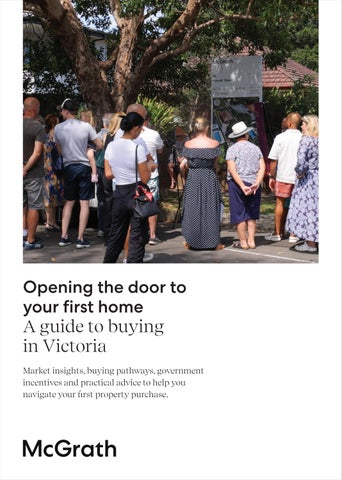
Opening the door to your first home A guide to buying in Victoria Market insights, buying pathways, government incentives and practical advice to help you navigate your first property purchase.
Welcome Your guide to buying with confidence Buying your first home can be a major milestone, but it can often feel overwhelming. From saving a deposit and understanding your borrowing power, to choosing the right property and navigating the buying process, there are many decisions to make along the way. There are now a variety of support programs available to help first home buyers enter the property market. Government incentives, deposit guarantee schemes and alternative ownership pathways can help eligible Australians overcome some of the common hurdles to home ownership and take their next step. This guide combines practical buying advice with local market insight to help you better understand the opportunities and make informed decisions throughout this exciting home buying journey.
First home buying in VIC today The market at a glance First home buyers are still finding a way into the market
Demand remains strongest in more affordable housing segments
Despite affordability pressures, first home buyer activity in Victoria has remained relatively resilient. Demand for more affordable housing opportunities and a range of government incentives continue to support new buyers entering the market.
Many first home buyers continue to focus on apartments, outer metropolitan locations and regional markets where entry prices can be more accessible. Population growth, constrained supply and the relative affordability of lower-priced homes continue to support demand.
39% of owner-occupier lending is now going to first home buyers
Lower-priced properties continue to attract strong demand
This means almost four in 10 owner-occupier home loans in Victoria are being taken out by first home buyers. The share has increased from 26% a decade ago, highlighting the continued importance of new buyers in the market.
Property values in Victoria’s lowest-priced quartile recorded solid growth over the year to Q1/26. Regional houses grew the fastest, while Melbourne houses and apartments also recorded price increases, reinforcing the need for buyers to understand their budget and be prepared to act when the right opportunity arises.
First home buyer loan activity increased 3% over the past year
Key takeaway
Victoria recorded 39,638 first home buyer loan commitments in the year to Q1/26, the highest total across the East Coast. This signals that many buyers are continuing to find a pathway into home ownership despite affordability challenges.
While affordability remains a challenge, first home buyers continue to enter the Victorian market in significant numbers. Understanding where more affordable opportunities exist, what support is available and which purchasing pathway is right for you can make home ownership more achievable than you may think.
Victoria Entry-Level Market Snapshot* Market Melbourne Houses
Melbourne Apartments
Average Price
Annual Growth
$710,100
+5%
Entry-level detached homes remain in demand, with prices continuing to rise
+3%
A more accessible pathway into the Melbourne market for many first home buyers
$480,000
What it means
Regional Victoria Houses
$532,200
+7%
Lower entry prices than Melbourne, with the strongest annual growth of the four segments
Regional Victoria Apartments
$405,600
+5%
The lowest average entry price, offering a more affordable regional pathway
Tracking the average sales price for homes in the the lowest quartile, plus % price change over the year ending Q1/26. Source: McGrath Research, Cotality
Preparing to buy Three steps to get started Before you begin inspecting properties, it's important to build a strong financial foundation.
1
3
Save your deposit
Review government support
The dream of home ownership begins with the first dollar saved towards your deposit. Having a clear savings target is important. Review your income, expenses and savings capacity.
Review government support by taking the time to understand the grants, concessions, stamp duty exemptions and shared equity schemes that may be available to first home buyers in your state, as these initiatives can significantly reduce upfront costs, lower the deposit required and help bring forward your purchase timeline.
2 Understanding your borrowing power Work with a lender or mortgage broker to assess your financial position to determine how much you may be able to borrow. They can also check your credit history. Knowing your price range can help you search with confidence and act quickly when the right home becomes available.
Want to learn more about your mortgage options? Whether you're comparing lenders, exploring loan products or keeping an eye on interest rates, the Oxygen Home Loan team can help guide you through the process.
Government support explained What assistance is available? Australia-wide incentives
VIC incentives
First Home Super Save Scheme | FHSSS
First Home Owner Grant | FHOG
– Eligible buyers can make voluntary super contributions (often at a lower tax rate) then withdraw to help purchase their first home. – Up to $15,000 per financial year and $50,000 in total can count towards the scheme; this can be doubled for a couple. – FHSSS can complement the First Home Guarantee and Help to Buy.
– Grant of $10,000 is available when the purchase price does not exceed $750,000.
First Home Guarantee | FHG – Buy your home to live in within the price cap to be entitled to a deposit guarantee covering up to 5% of the property value. – Apply through participating lenders to ensure there is no Lenders Mortgage Insurance (LMI) payable. – There are no limits on your annual income or the places available, making the scheme broadly accessible. Help to Buy Equity Scheme – Buy with a minimum 2% deposit of the property value, with no LMI payable for your home to live in. – You share in the home's equity with the Goverment, which is 40% for a new home and 30% for an established home, until this is repaid over time or when the property sells. – There are eligibility limits on your annual income and only 10,000 places available each year.
First Home Owner Grant | FHOG Established homes – No transfer (stamp) duty for established homes valued up to $600,000. – Concession transfer duty on established homes valued between $600,001 and $750,000. New homes – No transfer duty for newly built homes valued up to $600,000. – Reduced transfer duty on new homes valued between $600,001 and $750,000. Vacant land When vacant land is purchased to build a new home, the home must be built within 12 months for the following to apply: – No transfer duty for vacant land valued up to $600,000. – Reduced transfer duty on vacant land valued between $600,001 and $750,000.
Paths to ownership First home buyer scenarios Every buyer's journey is different. The following examples demonstrate how different purchasing pathways and support programs can impact upfront costs and deposit requirements. The cost required to buy your first home varies by property price, eligibility and incentives. Using Oxygen Home Loans calculators, these examples show three potential paths to ownership. Scenario 1
Scenario 2
Scenario 3
Single professional buys an established apartment in Greater Melbourne
Couple buys a new house-andland package in Regional Victoria
Essential worker buys a new apartment in Greater Melbourne
Property Price
Property Price
Property Price
$600,000
$600,000
First Home Guarantee
First Home Guarantee
First Home Guarantee
Help to Buy scheme
Help to Buy scheme
Help to Buy scheme
Deposit Required (5%)
-$30,000
Deposit Required (5%)
-$30,000
Deposit Required (2%)
Stamp Duty
Stamp Duty
Stamp Duty
Lenders Mortgage Insurance
Lenders Mortgage Insurance
Lenders Mortgage Insurance
Est. Other purchase costs
-$4,000
First Home Owner Grant Est. Upfront cost
$34,000
$600,000
-$12,000
Est. Other purchase costs
-$4,000
Est. Other purchase costs
-$4,000
First Home Owner Grant
+$10,000
First Home Owner Grant
+$10,000
Est. Upfront cost
$24,000
Est. Upfront cost
$6,000
Finding the right property Research before you buy Local market knowledge remains one of the most valuable tools available to first home buyers.
Access to transport
Shops and lifestyle amenities
Schools and childcare
Future infrastructure projects
Walkability
Comparable sales
Local demand
Development plans
Inspection checklist What should you look for? A thorough inspection can reveal potential issues, highlight future expenses, and help ensure the property suits your needs both now and in the years ahead.
Inside the property Doors, windows & locks: Open and close correctly, lock securely and show no signs of damage. Water pressure & plumbing: Check taps, showers, toilets and look for leaks or water damage Walls, ceilings & floors: Look for cracks, stains, mould, uneven flooring or signs of movement. Natural light and ventilation: Assess sunlight, airflow and overall comfort throughout the home. Storage & layout: Consider whether the floorplan suits your current and future needs.
The neighbourhood Transport connectivity: Check proximity to public transport and major road networks. Schools & local services: Consider access to schools, childcare, shops and medical facilities. Noise & traffic: Visit at different times to understand activity and noise patterns. Future developments: Research planned infrastructure or developments in the area. Community & lifestyle: Assess walkability, safety, amenities and overall neighbourhood appeal.
Outside the property Roof, gutters & drainage: Check for visible damage, rust, blockages or drainage issues. External walls & structure: Look for cracks, deterioration or signs of structural movement. Fencing & outdoor areas: Assess the condition of fences, decks, retaining walls and landscaping. Future maintenance: Research planned infrastructure or developments in the area. Parking & access: Consider driveway access, parking availability and ease of entry.
Questions to ask to ask the agent: Why is the owner selling?
Do they have a particular timeline?
How long have they owned?
What price feedback have they received?
Budgeting beyond the deposit What else needs to be considered? Many first home buyers focus on saving a deposit, but it's equally important to budget for the additional costs that come with purchasing a property. Potential upfront costs
Ongoing costs
- Conveyancing fees ($1,500 - $3,000) - Mortgage registration and transfer fee (VIC $950-$3,500) - Loan establishment fees ($150 - $750) - Insurance (Home, contents or landlord insurance) - Building inspections ($300 - $1,000) - Pest inspections ($300 - $600) - Moving expenses ($500 - $2,000)
-
Council rates Water rates Home and contents insurance Strata levies Repairs and maintenance
Note: Every property purchase is different, and costs can vary significantly depending on your circumstances. We recommend you speak with a qualified lender, broker, solicitor or conveyancer to understand the costs that may apply to your situation.
Understanding buying methods Private treaty/sale or auction Buying by private treaty/sale
Buying at auction
Private treaty is the most common method of buying a home in Australia, where a property is listed for sale at an advertised price or price guide.
An auction is a public sale conducted by a licensed auctioneer, where a property is sold to the highest bidder, subject to the reserve price being met.
Whilst a property may be marketed with an asking price, the eventual sale price is typically established through negotiation. Following a period of offers and counteroffers, the buyer and seller will often agree on a price that reflects market conditions and their respective expectations.
The vendor (seller) will set a reserve price in consultation with their agent. This is the minimum price they are prepared to accept for the property.
Once this price is reached, the Contract of Sale is signed and a deposit of approximately 10% is made. When there is a cooling-off period, the buyer can complete the final legal, building and financial checks. Keep in mind if the buyer pulls out of the contract, they may lose some or all of the deposit, so make sure you discuss all of this with your lawyer or conveyancer before you sign anything.
If bidding reaches the reserve price, the property is considered "on the market" and will be sold to the highest bidder. The successful buyer will be required to sign the contract and pay a deposit, typically 10% of the purchase price, on auction day. Importantly, there is generally no cooling-off period when purchasing a property at auction. As a result, buyers should complete all necessary due diligence before auction day, including finance approval, legal review of the contract, and any building or pest inspections. If bidding does not reach the reserve price, the property may be passed in. In this situation, the agent may commence negotiations with interested buyers, often beginning with the highest bidder, to reach a mutually acceptable sale price. Note: Auction rules, buyer obligations and deposit requirements can vary between states and territories. Buyers should seek independent legal and financial advice and confirm the requirements applicable in their state before bidding at auction.
Before buying: Finance pre-approval secured
Deposit funds available
Budget confirmed
Government support eligibility checked
Comparable sales researched
Recent strata meeting notes reviewed
Contract reviewed by a solicitor or conveyancer
Conditions agreed with vendor prior to auction via your solicitor or conveyancer
Building inspection completed Pest inspection complete
Your journey to home ownership A step-by-step guide Buying by private treaty/sale/auction
1. Save your deposit
2. Understand your borrowing power
3. Review government support
4. Research suburbs in price range
5. Obtain loan pre-approval
6. Inspect properties
7. Make an offer or bid
8. Secure finance approval
9. Complete settlement
10. Collect your keys and move in
Understanding the key terms
Term
Definition
Solicitor or Conveyancer
A legal professional who assists both buyers and sellers with contracts, searches and settlements.
LVR (Loan-to-Value Ratio)
The percentage of a property's value you are borrowing from the lender.
Pre-approval
An indication of how much you may be able to borrow, subject to conditions.
LMI (Lenders Mortgage Insurance)
Insurance that protects the lender if your deposit is less than 20% and if the First Home Guarantee or Help to Buy Equity Scheme isn't being used.
Auction
A public sale where the highest bidder purchases the property if the reserve price is met. No cooling-off period applies.
Unconditional approval
Confirmation from your lender that your home loan has been fully approved and all requirements have been met, allowing you to proceed with confidence.
Cooling-off Period
A short period after exchange where a buyer may withdraw from the purchase (conditions apply).
66W Certificate
Waives your cooling off period and can make your offer stronger and more competitive, may be required when buying prior to auction or in a private treaty sale.
Settlement
The final stage of the purchase when ownership transfers from the seller to the buyer.
Guiding you home Explore the latest property insights and research at: mcgrath.com.au/research Find your local McGrath office or speak with a local agent.
© McGrath Limited 2026 Disclaimer: This report is published for general information only and not to be relied upon in any way. Although high standards have been used in the preparation of the information, analysis, views and projections presented in this report, no responsibility or liability whatsoever can be accepted by McGrath Limited for any loss or damage resultant from any use of, reliance on or reference to the contents of this document. As a general report, this material does not necessarily represent the view of McGrath Limited in relation to particular properties or projects. Reproduction of this report in whole or in part is not allowed without prior written approval of McGrath Limited. McGrath trademarks are property of McGrath Limited.