The McGill Daily is located on unceded Kanien’kehá:ka territory.
coordinating editor
Andrei Li
managing editor
Sena Ho news editors
Adair Nelson
Justin Friedberg
Mara Gibea commentary + compendium! editors
Ingara Maidou
Sonia Berman culture editors
Isabelle Lim Youmna El Halabi
features editor
Elaine Yang visuals editors
Eva Marriott-Fabre
Nikhila Shanker copy editor
Charley Tamagno design + production editor
Cassandra Cohen multimedia editors
Golnar Saegh
Parker Russell social media editor
Lara Arab Makansi cover design
Eva Marriott-Fabre staff contributors
Zoe Sanguin, Julia Lok, Enid Kohler contributors
Lyla Burt, Angela Zhai, Jad Morin
Published by the Daily Publications Society, a student society of McGill University. The views and opinions expressed in the Daily are those of the authors and do not reflect the official policy or position of McGill University. The McGill Daily is independent from McGill University.
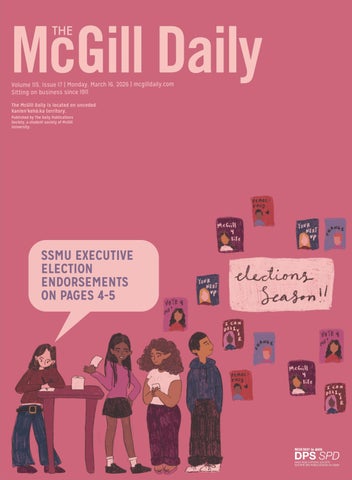
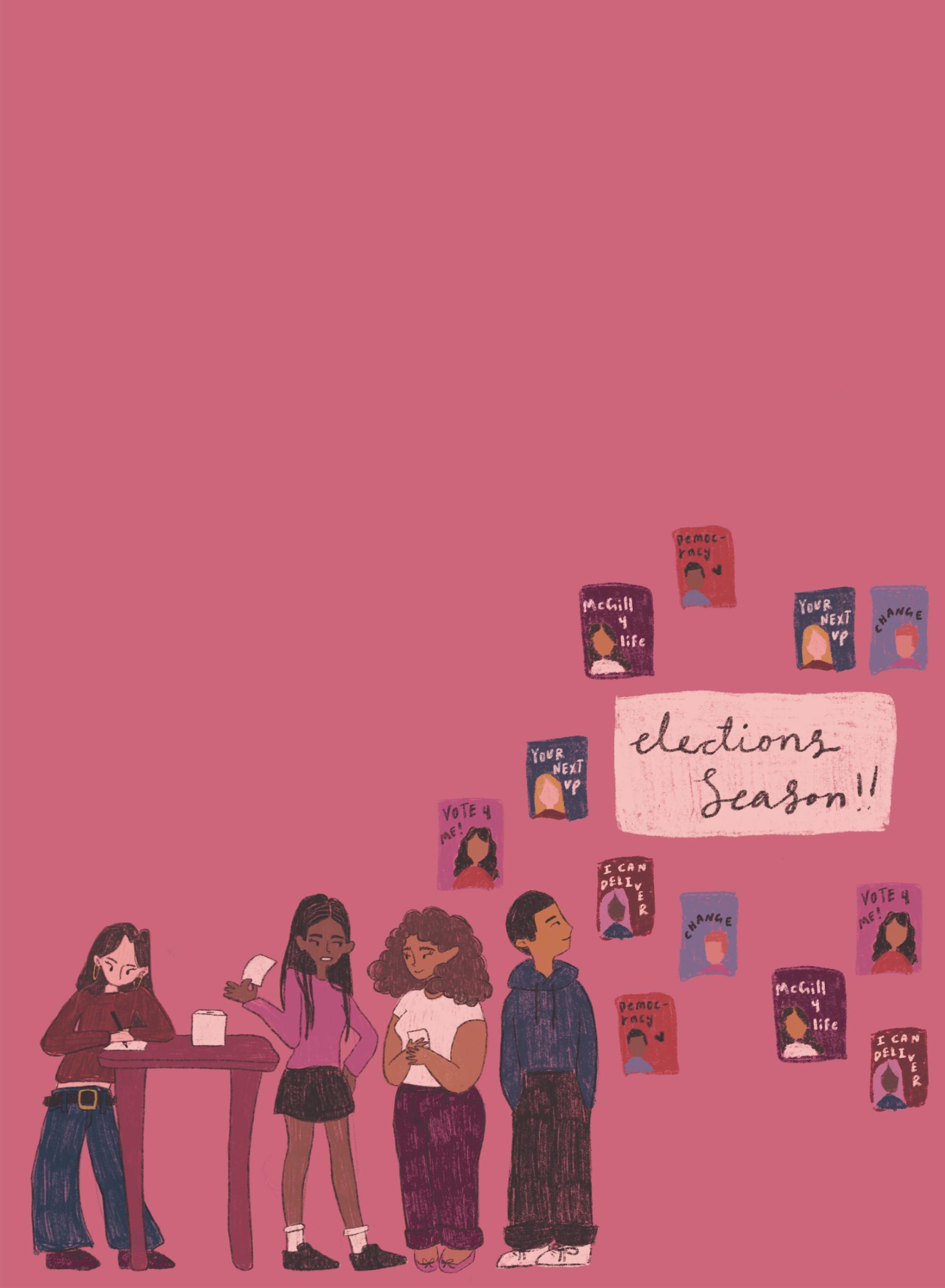
Vote in the 2026-2027 SSMU Executive Election
The Student Society of McGill Undergraduates (SSMU) is a not-for-profit organization that represents approximately 23,000 undergraduate students at McGill University. The responsibilities of the SSMU include supporting and coordinating the activities of undergraduate student groups and representing the student body as a liaison to the university’s highest governing bodies, as stated on their website.
This year, the McGill student body will be able to vote for five of the six positions within the SSMU’s executive team President, Vice President Internal, Vice President External, Vice President Clubs and Services, and Vice President University Affairs. There are a total of 14 candidates on the ballot: Acadia Knickerbocker, Anna El Mur, Cecelia Callaghan, Hamza Abu-Alkhair, Harry Wang, Justice Bongiovanni, Kareem El Hosini, Laurence Desjardins, Maggie Tang, Mars Gagawchuk, Meghan Lai, Mia Duddy-Hayashibara, Safia Haiboub, and Sophie Smithson. This election cycle also includes one slate, “S.T.A.N.D” (Students for Transparency, Anti-austerity, New voices, Democracy), that is running a candidate in each position.
TheMcGillDailyEditorial Board has compiled a list of endorsements, available on pages 4 and 5, but we also strongly encourages readers to do their own research on each candidate. The SSMU has a crucial academic, financial, and social role in our university and it is our responsibility as students to make informed decisions when exercising our democratic vote.
More information on each candidate can be found on the SSMU’s website: ssmu.ca.
The following encompasses TheMcGillDaily’s endorsements for the Students’ Society of McGill University (SSMU) 2026–2027 Executive team.
TheMcGillDaily’s Editorial Board presents its endorsements for the Executive candidates running for the 2026-2027 SSMU election. The editorial board’s decision process included researching each executive's roles and responsibilities, as well as the responses of the candidates present at the executive debate. Decisions were made through a democratic vote among the editorial board.
PRESIDENT
According to the SSMU website, “The President is the chief officer of SSMU, responsible for determining the vision of the Society, coordinating and supporting the activities of the other Executive Officers, and representing student interests on various university governance bodies.”
ENDORSEMENT: YES TO HAMZA ABU-ALKHAIR WITH RESERVATIONS
Experience: Hamza Abu-Alkhair has extensive experience in student government: he is currently a member of the Syrian Student Association, a member of the Arab Students Network, and most importantly, the current VP Clubs and Services of the SSMU. Abu-Alkhair’s position in the SSMU demonstrates an understanding of the organization’ s structure.
Platform: Abu-Alkhair’s platform focuses on three main initiatives: accessibility, community, and financial stability. He aims to achieve his first initiative by launching event summaries for students, ensuring transparency of how SSMU operates, improving SSMU outreach, and promoting student engagement. In terms of community building, he aims to make SSMU more visible on campus, develop a multi-year plan to rebuild SSMU as student-centered hub, and increase daytime programming in the University Centre. Finally, he aims to improve financial stability and transparency through collaboration with VP Finance to ensure financial reporting is accessible and inclusive of student voices.
Endorsement: Hamza Abu-Alkhair’s experience as VP Clubs and Services demonstrates his understanding of the SSMU structure and his experience communicating with student organizations. While his platform lacks specificity in describing the mechanisms he will install to improve current SSMU operations, his recognition of SSMU’s internal limitations demonstrates a desire for change and the implementation of student voices in democracy.
VP CLUBS AND SERVICES
According to the SSMU website, “The VP Clubs and Services is the point person for internal relations between SSMU and its clubs, services, and independent student groups. They are also responsible for mental health promotion, collaborating with Student Services, and addressing issues of student life on campus.”
ENDORSEMENT: YES TO ACADIA KNICKERBOCKER
Experience: Acadia Knickerbocker has diverse community engagement experience in and out of McGill. She has served as the VP Race Director for McGill Run Club, AUS CoCommissioner of the Sponsorship committee, and volunteers at the Milton Park Food Hub. Within the SSMU, she has served as the governance speaker of the Legislative Council, chairman of the Board of Directors under Internal Council, and Corporate Secretary.
Platform: Knickerbocker’s extensive platform targets four main areas of clubs and services. She firstly aims to expand resource accessibility by improving the SSMU club fund, increasing storage space, and expanding University Centre booking access. She strives to increase engagement with student groups through on-campus promotion and orientation channels as well as establishing an Activities Night bursary. Her platform also centres on administrative reform, which she states can be achieved by improving the backlog of student club requests, updating internal regulations of student groups. Finally, she intends to address accounting reform by increasing club financing and autonomy.
Endorsement: Acadia Knickerbocker’s platform and campaign showcase a deep understanding of the SSMU structure, policies, and areas of improvement. Her platform includes clear goals, and concrete solutions for existing concerns among student organizations. The Daily Editorial Board endorses Acadia Knickerbocker for the role of VP Clubs and Services, and believes her diverse experience in student clubs, her cohesive platform, and her passionate campaign position her as a strong fit for the role of VP Clubs and Services.
According to the SSMU website, “The VP External is in charge of coordinating SSMU’s relations with various levels of government, student associations, community groups, and campus labour unions; as well as managing political campaigns and mobilization efforts.”
VP EXTERNAL VP INTERNAL
AENDORSEMENT: YES TO HARRY WANG
Experience: As a provincial School Board Trustee for the Hamilton-Wentworth District School Board, Harry Wang has experience in public service, developing academic policy. Wang has brought this experience to McGill University, where they has served as corporate Secretary for the SSMU, parliamentarian on the Legal & Governance team under the Internal Counsel, chair of the nominating committee for the VP Finance, board member at large, and a member of the judiciary, as well as a member of the accountability committee.
Platform: Harry Wang’s platform relies on three pillars: Government Advocacy, Student Affordability, and Accountability and Transparency. Wang aims to demystify the ways Quebecois provincial policy impacts McGill operations through collaboration with undergraduate student associations and news platforms. Their platform also discusses supporting lower-income students through subsidies and bursaries to support lower-income students in the face of tuition hikes. Finally, Wang aims to limit the unilateral uses of power and increase transparency on the structure and portfolio of the SSMU.
Endorsement: Harry Wang’s experience in provincial school boards as well as various McGill committees demonstrates maturity and familiarity with representing students' voices on a larger platform. By championing anti-austerity initiatives, promoting minority voices, and highlighting the impact of provincial policies on McGill, Wang shows to be knowledgeable about student demands and interested in meeting student needs. The Daily’s Editorial Board strongly believes that Wang’s campaign showcases his strong commitment to striving in the role of VP External.
ccording to the SSMU website, “The VP Internal is chiefly in charge of communication and creating a sense of community with the student body through event planning and communications (such as the listserv).”
ENDORSEMENT:
YES TO MAGGIE TANG WITH RESERVATIONS
Experience: Maggie Tang’s experience in student government spans the faculty-wide and school-wide scales, having been the AUS HR Administrator as well as the Faculty of Arts Senator. The former comprised matters like promoting awareness of sexual violence and introducing initiatives to improve student life, and the latter involved liaising directly with the SSMU President and VP Internal. She has also worked as SSMU VP Internal administration.
Platform: The three pillars of Maggie Tang’s platform are Inclusivity, Safety and Good Vibes. In terms of inclusivity, her proposed initiatives include free events, engagement with first-year and international students and interfaculty partnerships. Regarding safety, she suggests lower intervention by external security authorities, more structured and transparent event planning processes, and advocacy for the prevention of sexual violence. Finally, lower-cost ticketed events, stronger alumni career fairs, and attractive events like Winter Carnival and SSMU’s Got Talent – in addition to events that aim to ameliorate mental health through light-hearted, casual means – are part of her plan to infuse good vibes into the student body.
Endorsement: Maggie Tang’s platform is not only full of personality, but full of heart. Despite stating that “the role is not about politics,” we believe that her platform and past experience still demonstrates her commitment to social justice issues, which are not only tied to the communitarian roles of VP Internal but are also inherently political. With her additional knowledge of SSMU bureaucracy, we believe in her ability to navigate the responsibilities that come with shaping the student body.
VP UNIVERSITY AFFAIRS
According to the SSMU website, “The VP University Affairs advocates for student interests at almost all levels of university governance. They do this through coordinating student representation to the university Senate and its committees, researching and consulting on policy solutions, and overseeing academic affairs. They also oversee equity initiatives and complaints, as well as advocacy regarding libraries.”
ENDORSEMENT: YES TO MEGHAN LAI
Experience: Meghan Lai’s experience mostly lies in the faculty of education. These roles are Education Student Senator, Legislative Councilor, Co-Chair of the McGill Committee on Student Services, Director on SSMU Daycare Board, EdUS Council Member, Faculty of Education Council Member, Education Faculty Ambassador, McGill Students For the Open Door Montreal Volunteer.
Platform: The three pillars of Lai’s platform include three ABCs: Academics, Bridge, and Community. In terms of academics, their specific aims include revising the Policy on Assessment of Student Learning, develop AI use guidelines/policy, and bring back VP Academic roundtables. They also aim to improve student services through alleviating Student Accessibility and achievement’s exam proctoring load, develop online booking with the Wellness Hub, and increase Student Services programs. Finally, Lai recognizes, and aims to continue the sitting University Affairs’ open-door policy while also striving to facilitate idea sharing through the University Affairs instagram and website.
Endorsement: Meghan Lai’s extensive experience in the undergraduate Education Faculty demonstrates a commitment of pedagogy and student interests. Their understanding of the responsibility of the VP University Affairs role showcases a strong ability to deliver their promises. Finally, Lai’s dedication to social justice, including menstrual health awareness, diversity, and mental health highlight how their care and devotion to student wellness amidst an rigorous academic environment.
The Power of Play
McGill chapter of international non-profit empowers children through play
Enid Kohler Staff Writer
Good People is a bi-weekly column highlighting McGill students doing communityoriented work on and around campus.Becauseit’simportant tocelebrategoodpeopledoing goodthings.
Play is critical for children's physical and mental wellbeing, but not every child has the same access to recreational athletics and community socialization.
Founded in 2000, Right to Play is an international non-profit organization that seeks to protect, educate, and empower children in disadvantaged communities through the power of play. Since its foundation, it has reached millions of children in Africa, Asia, and North America, namely, Canada; with the aim of harnessing play to support youth enduring conflict, disease, and poverty.
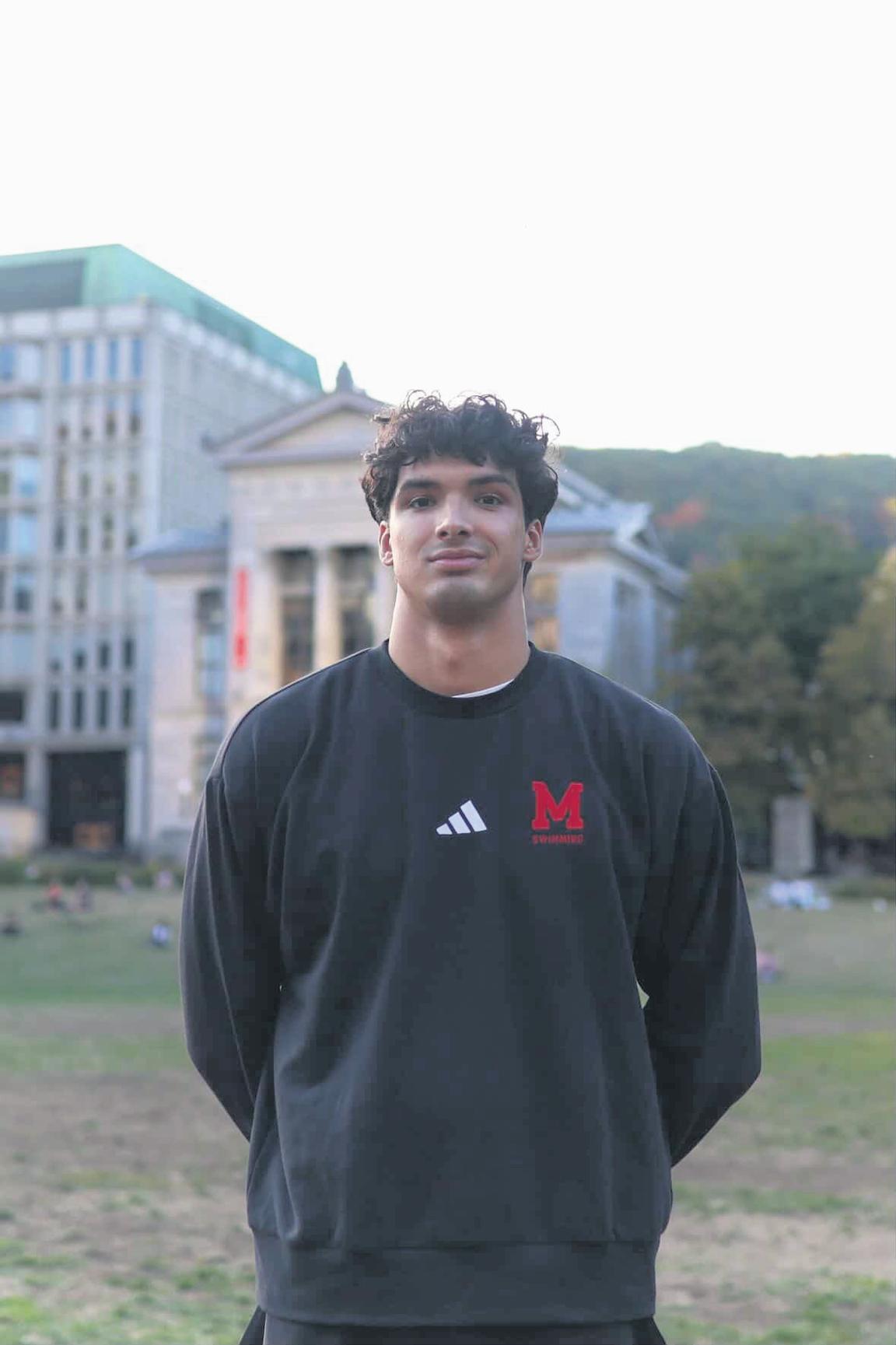
Since 2006, students have been the official university representatives of the Right to Play organization at McGill. They volunteer in local Montreal schools to promote inclusive and accessible play, fundraise for the international organization, and run community events like toy and food drives for underprivileged communities in the city. The Daily spoke with Co-President and U3 Biology and Math student Jack Gill about Right to Play. We spoke about his involvement in the club, the importance of play and physical activity, and why curiosity should be encouraged in youth.
This interview has been edited for clarity and conciseness.
Enid Kohler for the McGill Daily (MD): I’m curious about your own involvement with Right to Play. How and why did you get involved?
Jack Gill (JG): I'm on the varsity swim team at McGill, so I've been swimming most of my life. We train almost every day, sometimes twice a day. So sports and being active have been a really important part of my life. It’s allowed me to develop a sense of community, make tons of friends, and build my confidence in and out of the water. I wanted to encourage that in other kids. I started volunteering in winter 2025. I
worked in a class with students who have learning disabilities and autism, to encourage more inclusive play. It was really fun to build connections with these kids and slowly see throughout the semester how they got more comfortable and open with us.
MD: How would you pitch Right to Play to a first year student at Activities Night?
JG: Right to Play is not just a club we founded here. It's a broader international organization. Their whole goal is to empower kids through play to overcome adversity, especially less privileged kids. In Canada, the branch focuses more on [BIPOC such as] African communities who might not have access to [the] resources that we do, as well as Indigenous communities who similarly don't have the same resources or access.
Our chapter takes from that. We have a lot of events where we fundraise in order to support local schools and youth groups, as well as give back to the broader Right to Play organization. We also volunteer in schools to encourage active lifestyles and fun activities.
MD: Why is it important for kids to have play in their lives?
JG: A lot of children we volunteer with don’t necessarily have access to play. For those with learning disabilities, their parents try to protect them a lot and they don't necessarily let them do the things other children would do. It doesn't necessarily give them the opportunity to learn and be curious. Being able to encourage that and let them try things and maybe fail and letting them explore is really meaningful to me.
MD: Do you have a favourite memory of your work with Right to Play?
JG: At one of our schools where we volunteer, we go sledding on this little hill in the winter. One of the kids at the beginning wasn’t able to get up on his own. We would encourage him to get up, but we'd end up having to help him. But later, near the end of the semester, he was able to start getting up by himself with all of us cheering around and encouraging him. It was just so
nice when he was able to stand up by himself and show [that] he was fully independent. And now he’s able to do that all the time. His parents might have just always helped him and would never have let him learn to do it by himself. That was probably my favourite moment.
MD: What do you hope kids will take away from Right to Play programming into university and beyond?
JG: I think just life skills, like being able to be independent and do things on your own and
interact with other people. Also a sense of community as well as teamwork and the idea of an active lifestyle. With this generation we’re kind of leaning away from that with technology, but it’s so important.
MD: The theme of this column is “good people doing good things.” In the context of your work with Right to Play McGill, what does being a “good person” mean to you?
JG: I think what it means to be a good person is to be able to listen to people and kids and let
them guide you. One of the big things I like with volunteering is not necessarily forcing kids to do things but guiding them and helping them choose their own path.
To learn more about Right to Play and opportunities to get involved, visit @rtpmcgill on Instagram.
End note: If you know good peopledoinggoodthingswhoyou would like to see featured in this column, email news@mcgilldaily.com
Courtesy of Jack Gill
March 16, 2026
Alto’s High-Speed Rail Project for Canada
The national project that could make or break the connection between Toronto and Quebec City
Julia Lok News Contributor
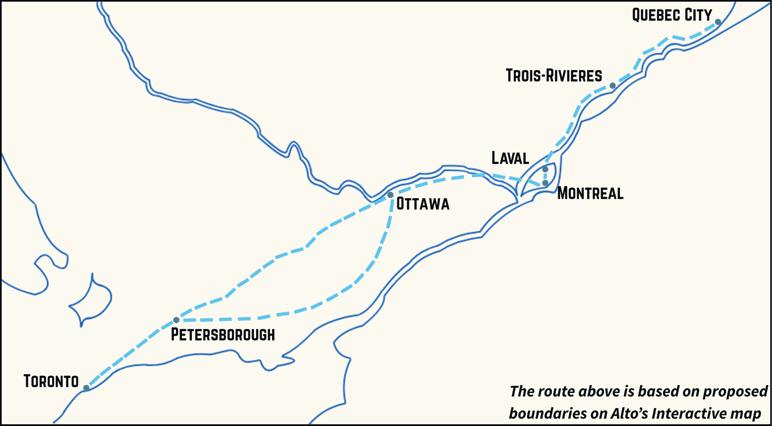
On February 19, 2025, Prime Minister Justin Trudeau announced the high-speed rail line (HSR) project that will run through the corridor between TorontoandQuebecCity.Currently, ittakesalittleoverfivehourstoreach Toronto from Montreal. Using HSR trainstravellingupto300kilometers per hour, the commute will be reducedtothreehours.
Now that Justin Trudeau has stepped down from the position, currentPrimeMinisterMarkCarney will be in control of this nationbuilding project. The HSR was mentioned in Carney’s Canada Strong plan and is ostensibly a goal forCarney’stimeinoffice.Trudeau’ s administration brought up several large-scale infrastructure and resource projects, such as the Northern Gateway and Energy East pipelines, without taking any action so far. Now, Carney’s administration has inherited this burdened reputation of unfinished projects. However, American President Donald Trump’s tariffs and his bold stance on Canada’s sovereignty shouldprovideadditionalmotivation for Carney to complete this project. TheUnitedStateshasbeenCanada's biggesttradingpartnerforyears,but this change in relationship means
there is a need for the nation to strengthenpre-existingmarketstobe abletosustainitself.
Alto,thecompanybehindtheHSR, believes the project will be able to offer accommodation for Canada’ s rapidly growing population. In additiontofastertravel,over50,000 jobs are expected to be created via the construction of the HSR. The company estimates that Canadians couldsaveupto$570millionintravel efficiency, besides reducing carbon emissions by transitioning to an electric rail system. Furthermore, they claim that the project will contribute an annual $35 billion to thecountry’ seconomy.
However, before even beginning construction,theHSR’sdesignphase alone could last up to four or five years. Accounting for planning and design,theraillineisnotprojectedto be fully operational for another eighteen years. The heavy time investmentrequiredbytheprojectis just one of the concerns that Canadianshavebeenvoicingaround theHSR.
Many farmers question the company ’s level of consideration for the long-term impacts of the project on the lands and communities that will be affected by its construction. Similarly, a group known as Alt-NO has formed in opposition to the proposedHSRline.They’vecreateda GoFundMe for donations used to spread awareness on Alto’s project.
Theywrite, “TheAlt-NOcommittee, composed of citizens, residents and businesspeople, landowners and farmers, has formed to oppose the proposed high-speed rail corridor project being developed by Alto, a federal Crown corporation. We are non-partisan and our opposition is founded in our concern for the serious and irreversible impacts this projectwouldhaveonfarms,natural habitats,andcommunitiesinOntario and Quebec along the proposed routes.Thisisa90billiondollarfolly attaxpayerexpense.” Membersofthe grouphavebeenexpressingconcerns with the ramifications of Bill C-15 and its effects, including the expropriationofland,theloweringof property values, and the potential to block residents from their property for the period of construction. AltNO are in favour of abandoning the project entirely and focusing instead onpre-existinginfrastructure.
Additionally,severalonlinegroups have also voiced disquiet over the project’s environmental impacts. A group of ecologists from Carleton University recently signed off on a Facebook post warning against the lossofnaturalhabitattheybelievethe HSR would cause and questioning whether Alto had a plan to mitigate environmentalharm.
Despite public opposition, the planningphaseoftheHSRprojectis currentlyunderway.Duringthispreconstruction period, representatives
from Alto have been visiting cities and towns for “public consultations” to answer citizen and media questions about the new rail line. Additionally, the company says they plan on conducting field studies and havebeguntechnicaldesignworkon theinfrastructure.
Alto states that they have “signed several collaboration agreements with Indigenous communities” to mark their progress in “building strong partnerships.” In October 2023, when Alto was working on a High Frequency Rail (HFR) project, the company published a “What We Heard & What We’re Doing” report, which demonstrates an effort to bring Indigenous voices into their project. In this report, Alto acknowledges the involvement of Indigenouspeopleas “essentialtoits success. ” Through the report, Alto
gained a concern for Indigenous peoples' engagement in the project, awareness of economic considerations, and respect for Aboriginalandtreatyrightswhilethe HFRprojectwasinmotion.Nowthat the company has transitioned to an HSR project, its ideals have not changed, but there hasn’t been a report released yet. Iori:wase, the publicationfortheKanien’kehá:kaor Mohawk Nation, writes that the “Mohawk Council of Kanesatake (MCK) Acting Vice Chief Brant Etienne said the council has not signedupforanyoftheconsultation sessions as of yet.” Nothing is planned, but that’s not to say consultations between Alto and Indigenousgroupswillnothappen. WhileAltohassuccessfullygained federal approval, citizens in the regionwhereitplanstobuildremain
Parker Russell | Multimedia Editor
Keep Hope Alive in Memory of Jesse Jackson
Leyla Rousseau Culture Contributor
Jesse Jackson, an outstanding voice in the fight for Black empowerment, passed away on February 17, 2026 at the age of 84. For many years, he had beenbattlingParkinson'sdisease and progressive supranuclear palsy, a rare brain condition that worsens over time and causes significant problems with swallowing, walking, balance, and eye movement. Born Jesse Louis Burns in 1941 to his 16year-old mother Helen Burns in Greenville, South Carolina, Jackson took the name of his stepfather, Charles Jackson, with whom he had lived since he was two. His life experience was riddled with injustices of racial discrimination where he was forced into separate schools, confined public spaces, and denied the freedoms his white peers took for granted. He made a name for himself early on, thanks to his brilliance and confidence. He first attended the
University of Illinois on a football scholarship before transferring to the HBCU North Carolina A&T State University, where he rose to prominence as a well-known campus leader and took active part in the Civil Rights Movement of the 1960s. He then collaborated closely with Martin Luther King Jr. by becomingamemberoftheSouthern Christian Leadership Conference, a prominent African American civil rights organization that helped propelhiscareerforward.
For decades, Jackson, whose dreams of racial equality, politicalinclusion,andeconomic justice were matched by a pragmatic approach to activism, served as one of the most influential Black leaders of his time. In Chicago, Jackson led Operation Breadbasket, pushing the mainly white-owned businesses that operated in Black neighborhoods, to hire Black workers, and invest in Black communities. His work soon extended to national politics, and in 1984 and 1988, he ran for the Democratic
presidential nomination, although his candidacy also faced political opposition and controversy due to racial prejudice and skepticism. Some voters questioned whether the nation was prepared to elect a Black president because he was one of the first Black contenders to mount a sizable national campaign. Members of the Democratic Party, including supporters of former US VicePresident Walter Mondale, were concerned that his outsider status and progressive views would cause division within the party or make winning the grand election more difficult. During his 1984 campaign, he was also criticized for making offensive remarks about Jews. Despite these controversies, Jackson continued to advocate for the improvement of Black communities' quality of life, establishing organizations that would eventually form the Rainbow/PUSH Coalition.
Through these institutions, he sought to unite marginalized groups across racial and
economic lines. Although he never won the presidency, he contributed to the growth of Black voter registration and demonstrated the national efficacy of Black leadership through his devotion. All of this laid the groundwork for later leaders, such as Barack Obama. Jackson's mission as a passionate speaker was to transform the mind of America. In 1988, during his speech at the Democratic National Convention, his repeated proclamations to “keep hope alive”, transformed the crowd into a choir crying for justice. It became a powerful rallying call for marginalized Americans. He delivered the same speech on multiple occasions, and every time, the crowd called for peace over war, equal compensation for women, and moral leadership in fields like politics, law, medicine, and religion. Jackson urged marginalized people to dream beyond present injustice and believe in their dignity. He showed them the potential they have to create change.
“I am Somebody”, another of his famous addresses delivered at the 1972 Wattstax Festival in Los Angeles, clamours for the worth and dignity of African Americans and calls for community action against systemicinjustice.Thisspeechis undoubtedly a centerpiece of the documentary Wattstax, which captures the eponymous festival. This event represents a turning point celebration of Black culture and resilience in the wake of the Watts riots, a series of violent protests that erupted in Watts, a majority Black Los Angeles neighborhood, in August 1965. Voices like Jesse Jackson’s became even more important in the struggle and cultural affirmation to transform dissatisfaction into coordinated activity and, in turn, long-lasting social change.
Jesse Jackson’s legacy endures in the lives he touched and the communities he empowered. Keep hope alive, in memory of Jesse Jackson.
A Plan for the Future
A chat with incoming AUS President Keith Baybayon
Sena Ho Managing Editor
On February 26, the Arts faculty’s student body elected their new Arts Undergraduate Society executive members: Keith Baybayon for AUS President, Jane-Andrea Kwa Mbette for Vice President Internal, Janya Rajpal for Vice President External, Lucy Crowther for Vice President Academic, Peace-Tai Thomasson for Vice President Communications, Inès Wolff for Vice President Social, and David Luzzatto for VicePresidentFinance.
Overthereadingbreak,Ihadan in-depth conversation with Baybayononhismotivationsto run,hiscampaignstrategy,and his upcoming plans for the 2026-2027academicyear.
This interview has been condensed and edited for clarity.
SenaHofor The McGill Daily (MD): What motivated or inspired you to run for AUS president? What experiences or moments throughout your time at McGill led you to this decision?
Keith Baybayon (KB): I came to McGill with a background in student government, because I had served as a student trustee for myschoolboardinToronto.So
I had already done a lot of advocacy work, such as recognizing the pride flag [and Pride Month] in my Catholic schoolboard,etc.Ihadbeenin important operational and standardized meetings with the school board, which gave me the experience I wanted to take forward at McGill University. I think student advocacy is very important because we're at a very unique standpoint in our lives, where the systems in place constantly affect us, and we have the least representation at these decision-making tables.
Growing up with that mindset, I've always wanted to fight for my peers.
I first got involved with the AUS in my first year as a committee's volunteer, through the Arts Student EmploymentFundCommittee,as well as the Valedictorian SelectionCommittee.Iwantedto testthewatersalittlebitofwhat student government was like in thisnewenvironment because,
[Montreal] was just completely different: a new language, new government, etc. I later was elected as Arts Representative to the Student Society at McGill in my second year. That got me more familiar with the environment of how student governmentactuallyworks.
I've come to really love the Arts community, because I feel we're so unique. We have so many different disciplines, and so many different programs under our portfolio, to the point where it's so diverse it's so full of life. And that's why I wanted to continuously expand my horizons within the AUS and explore more positions to get more involved with the art student perspective at these decision
the BOD or the executive committee. I hope to see that implemented very soon. What I've been wanting to focus on when entering the Arts Representativeroleischanging up operations to ensure that whoever gets these positions is elected by the students.
MD: Are there any initiatives in which you are planning to enhance Arts student life and community on campus?
KB: I hope to continue my advocacy work from my role as Senator into my presidency. A lot of things that we at the Senate Caucus focused on has been the Policy on Assessment of Student Learning. The policy was implemented just
“Once I leave McGill, I want to, and hope to, leave the Arts communitybetterthanIfoundit.” -Keith Baybayon
making tables.
Once I leave McGill, I want to, and hope to, leave the Arts community better than I found it.
MD: Was there anything that you observed while being an Arts Representative or Arts Senator, that institutionally you wanted to change as president?
KB: One thing I definitely wanted to change was the structure of power that was distributed within the SSMU I feel like it was just a bit imbalanced. You have, for example, the Legislative Council in which you have all the elected representatives from different faculties. But then you have the Board of Directors (BOD) who have the lastsayinalotofthethingswe try to pass at Legislative Council. I feel like the distribution of power was very imbalanced [because the] BOD were elected for different positions that don't necessarily represent every single faculty, point blank.
Right now, we're in a review period for the Student Society of McGill University Constitution, which I've been able to take part in. There was also the recent plebiscite released to the Student Society [asking] who should have the power of operations. The results [displayed a preference for] Legislative Council over
last year, and because it's so new, there aren’t really strong mechanisms in place to hold thoseresponsibleforenforcing it accountable within their classrooms.
This policy is so important because it protects a lot of rights for students. For example, PASL requires that assessment methods, including their structure, weight, and due dates, be outlined in the syllabus, which raises questions about practices like pop quizzes. Under this policy you also have the right to receive feedback from your assignmentsorassessments.So I want to create a mechanism in the Faculty of Arts, where we can track violations of this policy. We need to make this clear amongst our faculty, professors, and students, so that they can report these violations, [observe] how trends are increasing, and [learn] how to mitigate them.
I see the future of working alongside the Vice President Academic, Lucy, and our senators, who are interested in working on this mechanism. Another thing I'd like to focus on is the state of learning at McGill. A lot of students are very vocal about how these classes with hundreds of kids are just not conducive to learning. Whereas, for example, the Education Student Senate has been a leader in assessing the state of learning for students through
capstone projects and experiential learning experiences that I would love to see in the Arts. So, I want to work with the Office of Arts Education on that end to identify the best pedagogical practices for our faculty. Another aspect on the
creating an accountability plan with executives, departmental executives, and students of the Arts Faculty to see how we can keep ourselves accountable to our responsibilities and pitches from the beginning of the year.
I want to kind of take some
operational side is accountability. My campaign focused a lot on keeping executives and any student elected positions accountable to their responsibilities and our recently amended AUS Constitution makes it easier to achieve that. I don’t want to take a punitive approach to keeping people accountable. I want to take a more collaborative approach. So I focused my campaign on co-
time from now up until September to create a plan in which we can keep ourselves accountable, whether that means identifying what our specific focuses are for the year, alongside our mandates withinourpositions,[or]doing midterm check-ins, which we already do in Legislative Council, but also making that more public and visible to the general student community.
9 News March 16, 2026
MD: Switching gears to anothertenetofyourcampaign: student internships. I'm wondering, what steps are you planning on putting in motion to give students better access andopportunitytointernships?
Considering the present economy and job market, in whatwaysdoestheAUSplanto supportArtsstudentsfinancially andintheircareerprospects?
forourstudentsalready.Iwant to make that more visible [since] McGill is notorious for havingsomanythingsgoingon, but students just aren't aware aboutthem.Itcouldbethrough a centralized database within theAUSoraninternshipevent where partners of the AIO can come to the AUS to talk. Ontheinternalsideofthings,
to simplify that process for them, and work with VP Academic on that end.
AnotherthingI'dliketoreally promote is cross-faculty opportunities. I feel like we shouldn'tleaveourselvestojust theArtswhen,forexample,the SchoolofPopulationandGlobal Healthhavesomanyopportunities under their belt, and are constantly promoting it to differentfaculties.Lastsemester, I did a Department of Equity, Ethics, and Policy internship. Myprojectwasstationedatthe DepartmentofIntegratedStudies of Education in the Faculty of Education where you have so many different departments workingtogether.Iseethepower in collaboration, I see the opportunities found in other faculties, and we need to work with each other.
WiththeupcomingPresident's Roundtable of the different faculty presidents, I'd love to garnertheirknowledgeandalso their expertise in how we can providemoreopportunitiesfor allstudentsusingourresources.
KB: Tosimplify,Ihadareally fun time doing it just because it's an opportunity for the studentstogettoknowme.For me, it was more [focused] on authenticity because I've been with the AUS for a while now. Iknowalotofpeoplecanvouch forwantingnewleadership,but whatwasaveryimportantpillar for myself was institutional memory.Overthreetofouryears at the AUS, I've seen so many differentinitiativesandprojects take place I've seen a lot of things fail, too.
“I wanted students to feel less disconnected from the student society. Whether that means more town halls, more roundtables...”
-Keith Baybayon
important priority of mine I wanted students to feel less disconnected from the student society. Whether that means moretownhalls,moreroundtables with,forexample,thePresident andVPAcademicstotalkabout PASL, the Policy and Student AssessmentandLearning,orVP Finance to study the finance mechanism for the Financial Management Committee. Anotherthinginmycampaign wasempoweringstudentstobuild communityundertheAUS.Over the years, you start seeing the turnout in voting increase. DuringmyArtsRepyearwehad 13 per cent turnout, while this yearwehadalmost18percent. Another one of my pillars was toreducethebarrierstostudent initiatives under the AUS. Makingiteasier,forexample,to startclubs, whichyoudon’thave under the AUS. It could be a futureendeavorthatispossible after consulting departments, students,andexecutives.
MD: A more lighthearted question in terms of your campaign, you had a very clear branding. How did you envision that? Did you come across any obstacles or road blocks throughout that brainstorming process?
their interests and thoughts. Withmybrandingandmessaging, that was just like my own little twisttoit.I'veseensomanyfun, creativethingshappeningonline. I remember I did a dance to SabrinaCarpenter’ s “ManChild,” becauseIjustwokeuponeday, saw it on TikTok, and thought ‘let me do this.’ So I called my friendandwediditrightthere. I felt like taking a fun twist to things was very important for mycampaign,becausethat'swho I am.
MD: Are there any future projects or initiatives planned that you want to mention?
KB: There's going to be a lot of collaboration on that for sure. We have our Vice President External that's in charge of partnerships and postgraduateopportunities.But I don't want to solely focus on just postgraduate opportunities. An important partnerthatwehaveistheArts InternshipOffice(AIO) they provide a lot of opportunities
we actually have the Arts Student Employment Fund. This is an opportunity for students to get work experience, like research on campus alongside a professor. This can be very intimidating, I'd say, especially for first or second years who don’t really knowmuchabouttheprocesses of requesting for research opportunities. I really want to demystify the Arts Student EmploymentFundforstudents
I was able to work with that in my campaign because I was focused on what's happened in the past year and how we can improve things for the coming year.Iwantedvoterstoseethat the AUS should be a space in which they feel comfortable learningandbeingin;itshould beasocietythatfunctions,works reliably,andfollowsthroughon their commitments, not just making huge promises during the elections. My platform focused on accountability, studentrightsandadvocacy,and community engagement. An important thing for me was making accountability a very centralexpectationbecauseit’ s really tough not having any visibleoutletsforstudentsinthe General Assembly. One big frustration I've had over the years is that sometimes governance [is not] accessible to students. So that was a very
KB: I feel like my campaign brief was just an accumulation of everything that I've experiencedatMcGillinthepast threeyears:everyconversation, debate, project I've taken on, motion I've written, etc. Everythingkindofleduptothat momentbecausealloftheseideas were not created from thin air. It’s been built upon those that came before me.
I've shown a lot of appreciation,andIwillcontinue toshowalotofappreciationfor thepastpresidents.I'veworked witheachofthem,andI'veseen how their leadership has accumulatedovertheyearstoo. Thisyear,Ijustwantedtotake that opportunity to show that collaborationisreallypossible. This platform was really built onthestudents,because,likea lotofthepillarsI'vementioned, they were also in consultation with departmental executives orevenjustmyfriends,gauging
KB: I am very excited for my executives we have so many amazing individuals in these positions, and they're going to havetheirownpassionprojects, too. I'm very keen to support each of them. The president's role is very all-rounded. I feel like when people see it at first glance, they think, ‘Oh, you're just the spokesperson and on the operational side of things.’ I want to ensure that the AUS is in a stabilized state so that you can actually do what you want to pursue. Without transparencyoraccountability, the AUS can fall short on their promisesjustbecausewedon't have the internal structures in place. So that's been a very important focus of mine for these next few months.
Afterwards,I'dlovetobeable toseealloftheirprojectscome into action too [as well as] any students that want to do a project with the AUS. I’ ve emphasizedanopendoorpolicy alotinmycampaign.Astudent canbookameetingwithmeand I'll be happy to talk to them. I want to foster that sort of environmentwithintheAUSas a whole.
Theprospectiveexecutiveteam willnotofficiallytakeofficeuntil May1,andarecurrentlyundergoing a period of transition from the currentAUSboard.
Courtesy of Keith Baybayon
On the Ground in the West Bank: A Testimony with Giancarlo Cininni International
Solidarity Movement (ISM) volunteer speaks of
Youmna El Halabi Culture Editor
“ You never know if you’ re going to be in the news or not that day if [the Israeli Defense Forces (IDF)] will try to pull a trigger.”
In October 2025, Giancarlo Cininni packed his bags and headed to Ramallah, a city in the West Bank of Palestine. Cininni worked as a volunteer for the International Solidarity Movement (ISM), a PalestinianledmovementfoundedinAugust 2001. The ISM’s main objective is to provide support for Palestinian resistance against apartheid through direct action including protests, disruption and on-the-ground volunteering. In addition, they provide documentation of current events in Palestine such as photos and volunteer testimonies.
Cininni is a freelance journalist based in Halifax, Nova Scotia. Having studied journalism at King’s College during the Gaza genocide in 2023, he wrote a piece for the Dalhousie Gazette criticizing theeventsthatleduptoOctober 7th. Cininni vividly remembers the 9/11 incident, and the global “war on terror” that ensued a phenomenon he couldn’t help comparing with the public reaction to the ongoing genocide in Gaza more than 20 years later.
“9/11 didn't have the same historical context in the same way that October 7th did,” he clarifies. “But the way the media
was just essentially gathering the troops and trying to get everybody in line, and was spreading hate towards a specific group, was similar to 9/11,” Cininni noted in an interview with the Daily “I would say October 7th was probably worse [with regard to scapegoating] because the context of the Hamas attacks was very much in line with [resisting the oppressor]. There was the Great March of Return in 2019 and other struggles.
Anybody with a brain would be like, ‘[Gaza’s resistance] is a powder keg waiting to explode’ Itwasonlyamatteroftime.And there was strategic significance to the actions on October 7th, what with the media normalization happening.”
Cininni’s piece sought to give the public some type of context on what Israel is doing in Gaza and how their actions amplified the violence that occurred on October 7th.
“Most Canadians are probably not well-versed in the complicated histories of Israel and Palestine,” he wrote, “which makes our population an easy target for the management and manipulation of public opinion via unbalanced coverage. This involves several factors Israeli lobbyists, Western governments, andnewsmedia.”
The piece goes on to give clear statistics provided by the United Nations, from 2008 to 2020, comparingthenumberofPalestinian casualties with Israeli ones. The numbersshowacleardisparity.
“United Nations Ambassador
“Most Canadians are probably not well-versed in the complicated histories of Israel and Palestine ... Which makes our population an easy target for the management and manipulation of public opinion via unbalanced coverage.”
- Giancarlo Cininni
his experience in Palestine
for Palestine, Riyad Mansour, responded to much of the world’s reaction succinctly,” writes Cininni, “saying, ‘History for some media and politicians starts when Israelis are killed. Our people endure one deadly year after another.’”
A year into the genocide, a collective feeling of despair and depression was felt amongst activists, as the possibility of a ceasefire seemed farther than ever, and death tolls rose every day. That’s when most people would either opt out of doing anything at all, letting helplessness take the reins, or try even harder to find a tangible way to help. Cininni chose the latter.
“I hadn’t heard about the ISM before,” he told the Daily “About a year into the genocide, a lot of people felt this kind of collective depression of hearing about another genocide happening, specifically a Western-backed genocide, which means that we're all kind of culpable, like our societies are very much more culpable. In this case, there are reasons why we might feel more culpable for thisthan other things, because it's our governments that are actually actively arming [Israel’s] government to do these actions.AndsoIdidfeelthatthere wasasenseofpowerlessness.”
Cininnithenstumbleduponan interview on the left-wing podcast TruAnon with Daniel Santiago, a US citizen who was shotbyanIDFsoldierinNablus, whilevolunteeringwithFaz3a,a Palestinian-led initiative providing on-the-ground civil protection from Israeli violence based in the West Bank.
“When I listened to that episode,Iwaslike,wait,youcan actually go down there. You can actually do stuff, you can take action,” he says. “You can actually do something against this [genocide]. And even though it's the West Bank, it's not in Gaza that's a different type of activism that's a lot harder to get but in the West Bank, there's still a lot going on. Israel has no rhetorical justification for what it’s doing in the West Bank. There is no Hamas there. What is [the IDF] doing? Why are they terrorizing
acivilianpopulationthatexplicitly just wants to live a normal life on thelandthattheyhavelivedonfor generations? What's the justificationthere?Why?”
“And so I heard about this [opportunity] and I kind of find it funny, because I think that a lot of people would be like, “What, you heard this guy got shot doing it and
Presence. They're asking for our assistance and for our participation.”
Cininni told the Daily that the onboarding process was heavy with information as a way to triage the volunteers and assess whowaswillingtostayon.Once the ISM presented a clearer idea of the mission, they dove into
“...You have to know what you're here for. Palestinians are actively asking Westerners and people from all over the world to come here to show solidarity. Presence. They're asking for our assistance and for our participation.”
- Giancarlo Cininni
that's what made you go?” But for me, it was just an opportunity for directaction,andassomeonewho's kindofskepticalofalotofWestern activism, I find it's harder to find stuffthatisactuallysuperpractical.” CininniappliedtojoinFaz3a.But by the time his application went through, the organization had ceased its operations and was not taking on any more volunteers. That’swhenFaz3a referredhimto theISM.
“I emailed [ISM] in early winter of 2025,” he mentions, “and did my onboardinginahotelroominApril, while I was in Newfoundland with my girlfriend. It was two hours long, and during those two hours, you learn about what [the organization]does,andsomeofthe risks[ofbeingavolunteer].There's a lot of talk about the cultural sensitivities that you have to be aware of. [The Palestinian people] arenotlookingforWesterncultural kinds of colonialism. They're not looking for Western feminism either, which could be something that happens in [other] Muslim countries. Essentially, they're saying that you have to know what you're here for. Palestinians are actively asking Westerners and people from all over the world to come here to show solidarity.
the training sessions. One was virtual, and the other on the ground in Ramallah.
“By October, I flew to the Levant,” he added. “I flew to London, then to Jordan, crossed the border, made it into Palestine, and I did my training in Ramallah, which was pretty heavy and detailed. They were liketwoeight-hourdays,andone happened to last 12 hours. We wereallinagrouphouse,sleeping on mattresses on the floor.” Alongwiththeonboardingand training sessions, Cininni’ s experience with the ISM also included lessons on what to expect once he was on the ground, and how to be prepared for any scenario. As activists volunteeringforaPalestinian-led organization, they were not the mostwell-likedintheWestBank bytheIsraeliOccupationForces. “We had to learn how to make ourselves as untrackable as possible,” Cininni says. “How to useSignal,howtouseencrypted software to message each other, howtousealiases.Ilearnedalot about weapons, tear gas, and what weapons might be used, whattolookfor.Youwanttolook at a soldier's hand, if the safety [ontheirgun]ison,ifthey'vegot
Cininni went on to commend ISM’sconsensus-basedprocess, thinkingofitalmostlikeadirect democracy. Dynamic, intragroup discussions, and encouragement to share ideas werekeytomakingtheirmission asuccess.Cininnifoundthatthis approach helped with the learning process, and bonded the volunteers together in the face of serious risk of injury.
“The thing is, you don’t know what it’s like out there. It’s like a lottery,” he says. “One person fromCanadahadherribsbroken bythe IOF[sic.,apejorativeterm
for the IDF] I was not subject to any violence because I was lucky, but I did see some people get grabbed at a protest in Nur ShamsCampinTulkaram.Atone pointatthisprotest,theIOFcame from behind and took some international [volunteers] and basically brought them to their side, checked their passports, went through their stuff, and interrogated them.”
WhiletheISMdoesassessand take into account one’s risk tolerancetoprotectitsmembers, volunteers have no absolute guarantee of safety.
“It’snoteverymanforhimself, because as an organization, we
haveeachother’sbacks,” Cininni says. “But I would say, you can’t really [proclaim] you’re in an organization because Israel doesn’treallywantyouthere.It puts a target on your back eventually.Israeldoesnotwant human rights activists there.” Inspiteofthedangershefaced, including almost being held at gunpoint,Cininnilooksbackquite fondly on his experience in the West Bank.
“I'm a pretty seasoned traveller,” he says. “I’ve been to fourcontinents,andIfoundthat the Palestinian population was themostaccommodating.Itdoes notevencompare.Theygoabove
“It's very nice to feel like some activism is actually making real strides and real difference, and people are working together and not splitting up and policing each other too much.”
- Giancarlo Cininni
andbeyond,theyaresogenerous, sonicetotalkto,andsofriendly. I had nothing but good experiences with Palestinians.” He praises Palestine’s beauty, fromitslandtoitspeople,while alsoappreciatingthecommunity he built there with his fellow volunteers, and the sense of accomplishment he felt.
“It'sverynicetofeellikesome activism is actually making real strides and real difference, and thatpeopleareworkingtogether andnotsplittingupandpolicing each other too much,” he says, “which I think is what we hear regularly through the media. I thinkit'soneofthoseparadoxes, where everything's so stressful, everything's so bleak, but it seemed like people were really activeandtryingtoworktogether and have a good time.” Cininni’s attempt to make the bestoutofastressful,dangerous situation bears a striking resemblance to the Palestinian attitude.Thecountryisbeautiful, full of kind, generous people. Althoughtheloomingoccupation deprives them of all the joys of
theirsurroundings,Palestinians makethebestwithwhatisoffered. “It'sprettyinspiringtoseethat there'salotofpeoplewhodocare, inthefaceofeverything,” Cininni adds, “and who are willing to go to this extent, to fly to a pretty dangerousplaceandtodothiskind of work. It gave me a lot more confidence in a lot of ways, and itmademepersonallywanttodo more of this type of work.” TheISMisalwayslookingfor volunteersfromacrosstheglobe. Aregistrationformcanbefound ontheirwebsite.
Image Courtesy of Giancarlo Cininni
Phil Elverum on the Power of Imperfection
The indie rock luminary reflects on his unfiltered approach to making music – a practice he believes the contemporary world discourages
Jad Morin Culture Contributor
FromthePittotheBackstage.
The line between performance and identity has become increasinglyblurredinmusic.Be it EsDeeKid’s carefully hidden persona or Gorillaz’s quartercenturyoflore,artistsnowconstruct themselves as deliberately as they write songs. Every physical action anddigitaltracecarriesamagnitude ofimportance.Opticsareking,anda misstep could spell the end of an artist’ scareer.
Singer-songwriter Phil Elverum, talking to the Daily from his home studio in Anacortes, Washington, USA, has noticed this modern obsession with a carefully crafted image. “I think it’s an expression of what’s happening in the culture at large,” he says, gesturing for
emphasis. “Everyoneonsocialmedia is always performing for their followers, so everyone is used to putting on a face and presenting themselvesinanidealizedway.”
The goal of “perfect” performance is not restricted to social media or mainstream artists. “I think that it’ s even finding expression in independentmusic,” Elverumadds.
Performing as TheMicrophones and MountEerie,Elverumleansinto lo-fi production, recording many songswithanalogtaperecordersand sparse acoustic arrangements. From hellish sound collages to delicate love stories, his music exudes vulnerability. The result is an intimate sonic landscape listeners canimmersethemselvesin.
Having released more than 40 records since the 1990s, with standouts like The Glow Pt. 2 shaping the independent scene, Elverum is no stranger to the pressuresofpresentation.Likemany publicfigures,heholdshisactionsin high regard but rather than chasing flawlessness, he actively avoids it. “People forgot that human touchissoimportant,” saysElverum, who is known for manning his own merchandiseboothwhenontour.
Still, his goal of showcasing imperfection is most evident in his music. “My mind was formed in the era where sloppiness and imperfection were important to feature prominently,” Elverum says. His musical identity is shaped by
Seattle’s grunge scene, which he describes as “raw and imperfect.” Thateraofmusicwasnotburdened by today’s technology, a development which tends to eliminate the mistakes and human touch that make recording music so specialinthefirstplace.
Hence, the contrast between Elverum’ssoundandthemajorityof today’snewmusicisevident.
“I’m weirded out by how clean everything sounds. Also, people’ s singing is so pretty.” He laughs, flashing a wide grin. “What’ s up withthat?”
Our algorithm-driven world is relentless in its crusade to force individuals into fixed boxes. Whether it’s new technology or the latest viral trends, the pressure to conform to social pressures seems unavoidable. In this day and age, a student showing up to class in skinny jeans would likely face judgement from classmates even though the opposite might have been true ten years ago. Elverum faces a similar dilemma. Instead of skinny jeans in a room of straightcutorbootlegdenim,hearrivesata technically faultless musical landscapearmedwithunevenvocals anduntamedinstrumentals.
How has he resisted the expectations of conformity from the music industry, remaining aligned with his north star of imperfection?
[and] to not really participate in the music industry as a whole in a way that feels like it’s beyond me,” Elverumexplains.
His independence, facilitated throughhisownlabelP.W.Elverum &Sun,allowshimtoreleaseandsell hisworkonhisownterms.
“Idon’tworkwithotherlabels,I’ m small,soI’mfreeandliberatedtojust do whatever I want. Also, I don’t really follow music very well, so I don’t even know what the expectationswouldbe Iknowhow todoonething,andthat’sjustwhatI do. If I were to try to do something thatwouldbewell-receivedorcool,it wouldbeembarrassinganditwould notwork.”
The authenticity with which
Elverum pursues his craft is poignant. Despite the talent and influencehehasaccumulated,hehas not abandoned his ethos of imperfection for a path that almost certainly would have brought more commercialandfinancialsuccess.
Athisessence,Elverumisanartist, andwhilehemaycontinuetoponder the mysteries of human existence throughhismusic,onethinghedoes not question is the importance of making art. “My ideal is to be engaged with some kind of art practice. Whatever it is, if it’s music or something else, I don’t know,” Elverumsays.
“That’s who I am. That’s who I want to be. That’s the life I want to live,untilIdie.”
Taking Attendance for EmptySeats
Student-led zine project sheds light on the Palestinian students unable to take up their spots at McGill due to structural migration barriers
Isabelle Lim Culture Editor
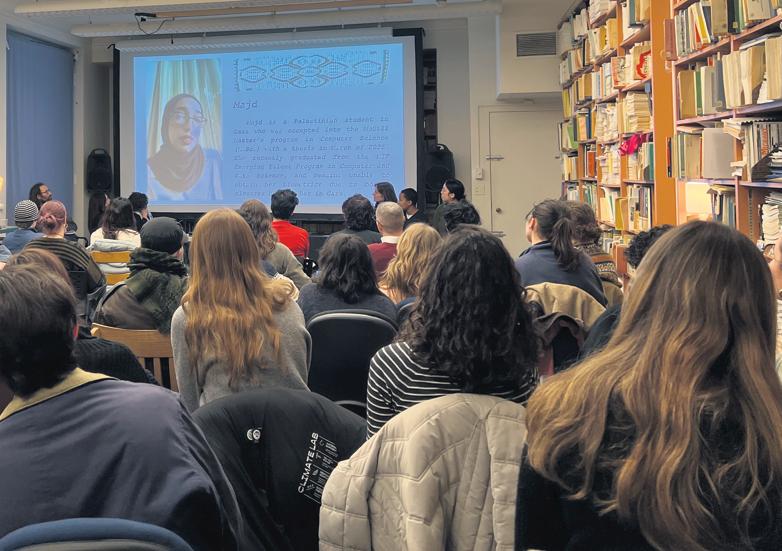
On Wednesday, February 25, 2026, a crowd filled the CriticalMediaLabtocelebrate the launch of Empty Seats. The project, spearheaded by a team of five students (Angela Zhai, Louise Deroi, Lulu Calame, Sahel Delafoulhouse, Zeena Zahidah,) is dedicated to raising awareness of Palestinianstudentswhohavebeen admitted to McGill University but refused entry due to their inability toobtaintheirVISAs.
According to the CBC, 130 Palestinian students admitted to Canadian universities cannot enter Canadaduetorelatedadministrative barriers. Empty Seats includes writtentestimoniesfromfouroutof
fivePalestinianscholarsadmittedto McGill but who are currently in bureaucratic limbo, unable to enter Canada; as well as testimonies from McGill faculty members and students expressing solidarity with these Palestinian students. It also includesconcretecallstoaction.
The project was kickstarted by an article written by Calame and DelafoulhouseinOctober2025.The piece, which included interviews with McGill’s Palestinian scholars and members of the Palestinian Scholars and Students At Risk (PSSAR) organization, highlighted the bureaucratic barriers that keep admitted Palestinian scholars from attendingon-siteschoolinMontreal.
The PSSAR identifies Palestinian scholars and connects them to academic opportunities in Canada. Upon the article’s publication,
AssociateProfessorofAnthropology
Diana Allan, who is also the acting faculty liaison for PSSAR at McGill, proposed broadening the project scope to better uncover and uplift these students’ circumstances in hopes of changing them. Subsequently,ProfessorAllanhosted a zine-making workshop in collaborationwithmedia-makerand activist Stefan Christoff as an extracredit opportunity for her classes, withinterestedstudentsencouraged to participate in the zine’s creation. Thus, EmptySeatswasborn. The zine format, commonly used forsocialjustice,welcomesacademic writing while also centering other valuable sources of knowledge like testimonies, interviews, and artworks. It is also remarkably collaborative and approachable, which was imperative for engaging
students regardless of their background and experience in organizingandactivism. “It was a very McGill student-
Courtesy of Isabelle Lim
Courtesy of Phil Elverum
CULTURE
centred project,” says Louise Deroi, one of Empty Seats’ student organizers, in correspondence with The McGill Daily. Voluntary testimonies were collected from McGill students via a Google Form disseminated via social media and word of mouth, with respondents ranging across year groups and faculties. “A common theme expressed in the [student] testimonies was the disillusionment ofandangeratattendingauniversity that doesn’t do more for these students who, despite having submitted an excellent application and having been admitted, have the world pitted against them, which prevents them from being here. Putting the testimonies of the Palestinian scholars and other students and activists side by side showsthe[Palestinian]studentsthat they’re not alone; that there’ s a
community backing them up that desperately wants them to make it andiswillingtomobilizeforthat.”
At the zine launch, the team screened video testimonies by Palestinian scholars Shereen and Majd (last names not given), who were respectively admitted to McGill’s Master’s programs in NeuroscienceandComputerScience but remain in Gaza due to multiple barriers preventing them from receiving their visas. Biometrics, a keycomponentoftheCanadianvisa application, cannot be obtained in Gaza, meaning that individuals seeking them must travel through the Rafah crossing to neighbouring WestBankorEgyptianterritoriesto do so. However, the Rafah crossing has been closed since May 2024, making it extremely difficult for thesestudentstofulfillthenecessary steps for their visa application
withoutexternalintervention. However, in the last few years, nations like France, the United Kingdom and Ireland have enabled Palestinian students to complete their visa processes through various means, from evacuating them to neighbouring countries like Jordan to creating streamlined bureaucratic pathways. Historically, Canada has also proved itself flexible by making concessions for individuals in extenuating circumstances during the visa application process. For instance, applications for the CanadaUkraine Authorization for Emergency Travel (CUAET) visa, temporary emergency visas which were issued to families and individuals fleeing Ukraine, waived the requirement of medical examinations and
COVID-19vaccinations.
At the institutional level, McGill belongs to lobbying bodies like U15 with mandates that encourage international talent and scholarship to drive Canada’s innovation.
Moreover, McGill, registered as an active in-house lobbyist in Ottawa, meets regularly with Canadian governmentofficialstodiscussahost of notable issues including immigration. “It’s hard to access the content of these meetings, but we want to make sure that McGill is using all of its political power to makesurethesestudentsmakeit[to Canada],” statesDeroi.
The zine’s launch hopes to spark a larger national movement to bring Palestinian scholars to Canada by pressuring the IRCC to expedite their VISA processes.
“This is a Canadian issue, and is much bigger than McGill,” affirms
Deroi. “Eventually, it would be amazing if other universities wantedtoreplicatethezineformat andtheproject.”
McGill students can follow the Critical Media Lab to receive updates about the Empty Seats project and other follow-up events currently in the works. In addition to staying informed about Empty Seats,Deroiencouragesstudentsto get involved in the other various forms of on-campus activism pertaining to the Palestinian genocide. “Seeing these issues as interconnected and knowing that there are many different approaches to activism in support ofPalestiniansisveryimportant.”
Copies of Empty Seats can be found at Cinema Politica. Any inquiries can be directed to mcgillemptyseats@gmail.com.
WutheringHeightsand Modern Art History: A Niche Venn Diagram
Fennell’s deviation from tradition revisits a question Manet’s art once posed: where is the line between innovation and avoidance in art?
Asasecond-yearpsychologyand physiology student, I have found myself in the trenches taking monotonous prerequisites. However, between my Organic Chem and Psych Stats classes, I alwaysmanagetotakeoneengaging elective every semester. This semester,my electiveisamodernart historyclass.
In class over the past few months, we have examined the backlash modern artists received for going againstthegrain the “grain” being the expectations set by the Art Academy, the salon where they wouldshowtheirworktoaudiences and critics. Modern artists like Manet, who portrayed purely modern scenes without conforming to the “grain,” provoked viewership fury.Frenchcriticofthetime,Émile Zola, argued in his essay “Édouard Manet,” originallypublishedin1867, that public outrage reveals how tightly audiences cling to expectationsofwhatartshouldlook like. The public, up until this point, had maintained neoclassical expectations toward art: to flatter, narrate,andmoralize.Manetrefused allthreeofthosefamiliarimperatives by producing art that felt uncomfortableandbluntlynew a choice that is now heavily applauded. True art, a point Zola returns to time and time again, does notcomefromadesiretoconformto norms or follow expectations but from individual temperament and personalvision.
Nearly two centuries later, my girlfriendsandIvisitedtheCineplex
on Rue Sainte Catherine to watch Emerald Fennell’s 2026 adaptation of WutheringHeightsforGalentine’ s Day. The reaction to the film was generally varied. Some praised it while lovers of the novel jumped to Twitter and Reddit to vent their anger over yet another inaccurate adaptation. To give credit to these bookworms,Fennellabandonsmany ofthethemesthatmakethisstoryso impactful by depicting a narrative basedonherinitialimpressionofthe book as a 14-year-old girl. Through this youthful interpretation, Fennell centres the film around a glorified toxic romance between Catherine and Heathcliff. Frustrated viewers were appalled at the film’s tonedeafness; Fennell foregrounded obsessive love while sidestepping and softening the harsher themes of the novel pertaining to Heathcliff’ s racial marginalization and the systemicclassviolence.
In reading tweets alleging the film's negligence, just as I did in Decemberwhenchoosingmywinter semester electives, I turned to modern art history. Two hundred yearsapart,bothManetandFennell have something in common: they’ ve both committed to their personal visions and rejected traditional expectations. Manet countered aesthetic norms and produced art thatdepictedtensionsofmodernlife in a way that is truthful to himself, while Fennell abandons the expectation for adaptations to be reflective of their source material to create a film rooted in her own experience. Whether or not you enjoy or even “agree with” either of these artist’s work, they both made the choice to commit to their personal truths and abandon
external expectations. In practicing artistic autonomy, they choose their own temperament as an anchor in theirwork.
Ifthesetwoartistsarecorrectand individualtemperamentisthe “True North” ofart,itleadsustoquestion: are there traditions or expectations that artists must uphold or is personalvisionallthattrulymatters? Betweenthesecontexts, “tradition” is understood very differently. For Manet, “traditions” are expectations setbytheArtAcademysurrounding whatdefinesacademicallyvalid(and objectively good) art. For Fennell, “tradition” underlines the source material, Emily Brontë’s Wuthering Heights. Both these artists abandon traditionintheirworksanditmakes audiencesquestion:whereistheline drawn between artistic autonomy anddeviationsfromtradition?
In deviating from tradition, one canquestionthedifferencebetween innovationandavoidance.
Ifartistsdohavearesponsibilityto uphold a certain tradition, both ManetandFennellhavefailedtodo so. Yet we celebrate Manet as a transformative turning point in modern art history. Why? In my opinion, it is because Manet’s work deniesthecomfortofignoranceand bluntly presents his audiences with uncomfortable social realities, forcing them to analyze their own lives through his work. In contrast, Fennell’ s WutheringHeights does exactly the opposite. While she also deviatesfrom “tradition,” shedoesso by refusing to inherit the uncomfortableanddarkerthemesof the novel. She allows her audiences to find comfort in the avoidance of difficult subject matter surrounding theintersectionofviolence,race,and
class. If Manet makes audiences question how closely art should follow academic standards, Fennell forces audiences to question how muchpersonalvisionwearewilling to accept in interpretations of classicnarratives.
Insomecases,werespondwellto moving away from tradition when artists depict their personal visions becauseitfeelshonestandrevealing, confronting you with art rooted in socialreality.ThisiswhatManetdid in pulling at the seams of academic arttorevealtruemodernlife.Onthe other side of the coin, moving away from tradition can feel dishonest if viewersdon’tfeelitisrootedinthese socialtruths theverysocialtruths that made Emily Brontë’s novel so impactfulinthefirstplace.
Moreover, this argument is somewhat of an open ended question.Ithinkthatisbecausethere is no universal line that separates avoidance from innovation in art. Maybethatlineisunstablebydesign and artists have always toed it by pushing their own personal vision forwardwhilebalancingarespectfor tradition. Perhaps this tension is what produces great art. That being said, in my art history class, we are still marveling at Manet’s impact on the evolution of modern art two centuries after he lived. Yet as I left the Cineplex on Sainte Catherine after seeing Fennell’ s Wuthering Heights, I got the impression that this particular adaptation might not make it onto the syllabus of a film classinanothertwohundredyears.
Zoe Sanguin | Staff Illustrator
Lyla Burt
Culture Contributor
TheGoldenVillage: Home-Making in the Microcosm of Asian Malls
After BigFightinLittleChinatown, Karen Cho returns with another documentary centering Asian migrants in North America.
Angela Zhai Culture Contributor
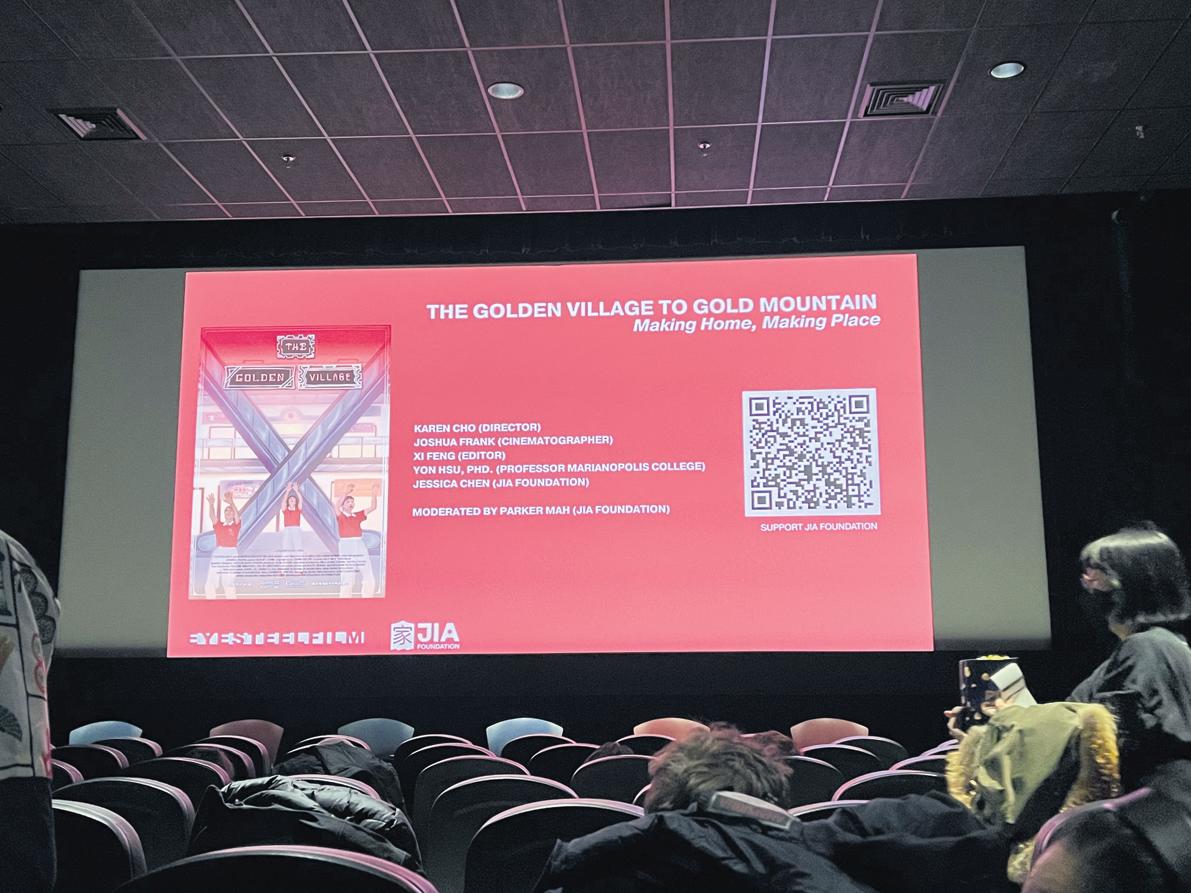
The GoldenVillage by Karen ChohaditsMontrealpremiere onFebruary25at Cinémadu Parc. The 33-minute film, Cho’s most recent work, takes us to Richmond,BC,whereAsian-themed plaza malls and shopping centres have appeared alongside the massive demographic shift in the area in the last few decades. The eventwaspresentedbyEYESTEEL and the Jia Foundation, and included a discussion panel with the director Karen Cho, the cinematographer Joshua Frank, and other crew members.
TheGoldenVillage iscomposed ofaseriesofvignettes,divinginto the vibrant lives of shop-owners and customers in the distinctly Asian Richmond district. Graded with bright colours, the film expressivelyportraysthesmalljoys andmomentsofcommunityinthe microcosm of Asian malls. The opening scene, where a group of scouts are at a Buddhist temple, sets the tone for the film’s theme ofspaceandhome-making.Asian communities in Richmond create intimate communal spaces in an ever-changingandever-globalizing landscape, merging their culture andcommercetobringapieceof Asia to North America.
The communities the film capturesprovidesinsightintothe unique micro-society that breathes life into Richmond malls: the Chinese radio station broadcasters joking about using old unpaired socks as rags drew laughs from the audience and the egg waffle granny captured hearts. Other characters that
practiced aerobic exercises in the middle of the shopping centre, and the TikTok-famous Chef James. By centring the ordinary everyday lives of these individuals, the film uncovers heart-warming stories and immerses the audience in the cultural and atmosphere portrayed on the screen.
The Golden Village is especially captivating in the ways it contrasts with Cho’s 2022 documentary, BigFightinLittle Chinatown. Where BigFightin Little Chinatown is about the
Asian communities in Richmond are creating intimate communal spaces in an ever-changing and ever-globalizing landscape, merging their culture and commerce to bring a piece of Asia to North America.
stood out were the influencer who started a religion for luosifen, an iconic Chinese noodle dish, the elders who
struggles and resistance of ethnic minorities against historical erasure and gentrification, The Golden Village depicts a new
reality for Chinese and Asian immigrants in North American suburbs. During the Q&A panel, Cho explained that she had originally planned to include scenes of modern Asian-themed malls in Big Fight in Little Chinatown. The footage would have argued for the inauthenticity of the “new suburban Chinatown[s]” as a place of commerce and transactionality, as opposed to the historical, long-standing Chinatowns who were fighting to preserve their heritage. The idea was scratched when she discovered that these suburban malls were far from artificial displays of culture; rather, they were places full of life and community, with their own stories to tell. From there, The GoldenVillage was born.
Focusing on the contemporary Chinatown highlights the experience of newer Asian immigrants living in North American suburbs, refreshingly showcasing how migrant communities put down roots in their new countries of residence. Theincreaseinthesheernumber of members from the Chinese diaspora in Richmond has preceded a cultural shift: being Chinese, or Asian, is no longer a
risk, it is cultural capital. As opposed to older generations,
their doors. The agglomeration of the Asian diaspora in Richmond hence enabled an unapologetic display of their authentic culture with the community growing large enough to back it up. The immersive footage of the malls in The Golden Village gave the impression of entering a third space: from the uncles singing karaoke in the food court to the footage of traditional Lunar New Yearcelebrationsandliondances, it felt like a piece of modern everydaylifeinAsiathathadbeen transported to the West.
The cultural power new migrants possess also allows for innovations that reverse the status quo. For instance, the Richmond night market, which appeared in the film, is one of the largest open air markets in theworld,andisafamoustourist attraction. Asian culture in the contemporary Chinatown, or Asian District, can therefore be desirable and empowering, breaking away from the feelings of inferiority or shame older generations might have had to deal with.
All in all, TheGoldenVillage is a charming and light-hearted
Asian culture in the contemporary Chinatown, or Asian District, can therefore be desirable and empowering, breaking away from the feelings of inferiority or shame older generations might have had to deal with.
who had to fight for their place on an unfamiliar land, adapt to a new culture, and cater to their Western peers and demographics to fit in, newer generations are freed from that burden.
In fact, while old Chinatowns located in city centres are facing gentrification, the Asian character of businesses in Richmond are actually highly beneficial. As Cho explained during the Q&A panel, revampingthestrugglingshopping centres to cater to the majority Asian customer base in the area saved them from having to close
watch, and a telling of hope and community. The vibrant colours of the footage align with the endearing personalities viewers encounter throughout the film, pulling them into the ordinary yet heartfelt everyday stories that take place in the Asian malls in the Richmond suburbs of BC.
Although short and simple, the film transmits a heart-warming feeling of belonging amongst diasporic communities, and reminds us to appreciate every joyful moment or interaction no matter how seemingly quotidian.
Image courtesy of Isabelle Lim
March 16, 2026 mcgilldaily.com
CarryingHome,Wherever She Goes
Yas Kanaan’s journey to her most recent exhibition
Youmna El Halabi Culture Editor
What does “home” mean to you? Is it a person? Where you have lived for decades? Where you were born? And what if home was something you could not return to, but could only carry with you?
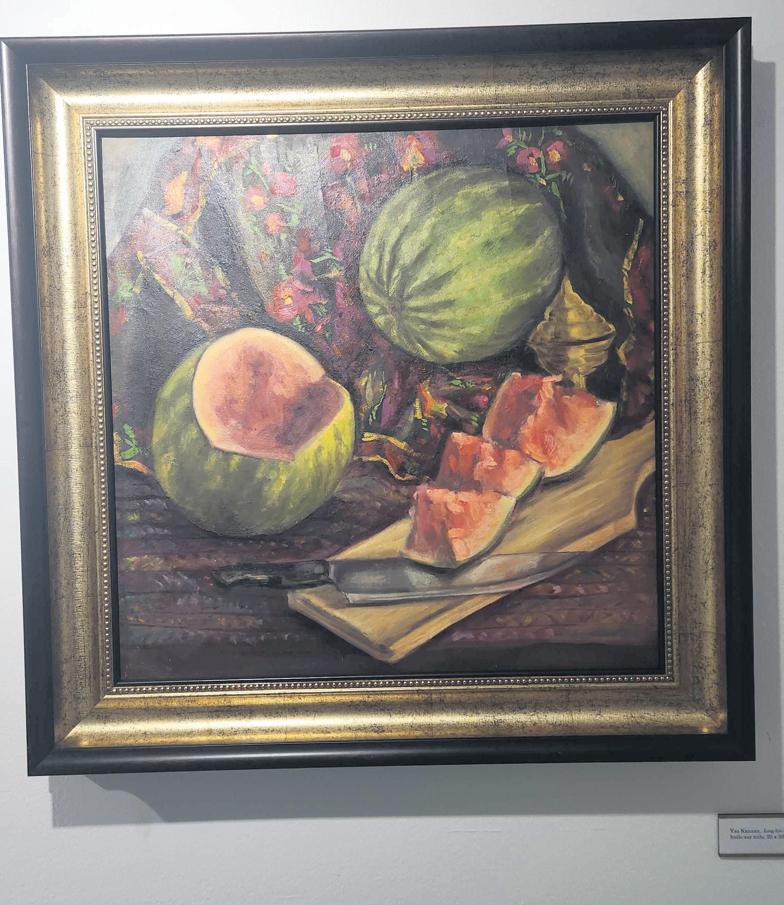
Such is the sentiment of Yasmeen “Yas” Kanaan’smostrecent exhibition, Carrying Home, whichwas exhibited as part of the 2026 Montreal Filministes Festival. Through her art, Kanaan recounts a beautiful story of belonging, the passing down of culture, and resistance. She derives stylistic inspiration from renowned PalestinianartistslikethelateIsmail ShammoutandSlimanMansour.
TheMcGillDailyspoketoKanaan about her exhibition’s theme: “For
And what if home was something you could not return to, but could only carry with you?
me,.artisaformofculture, culture is a form of preserving identity, and preserving identity is a form of resistance against oppression. Basically,artismytool,whichwasa ;arge part of how I chose the theme forthisexhibition.”
Kanaan is a Palestinian artist with a bachelor’s degree in Visual Arts from the University of Jordan andamaster’sdegreeinArtHistory from Concordia University. From a very early age, she learned to conceptualize and express her feelings on a canvas. She admired artists like Palestinian political cartoonist, Naji al Ali, best known for his famous caricature Handalah. Kanaan’s patriotism for Palestine first drew the attention of her high schoolteacher.
“When I was very young, my passion used to come out as anger, andfrustration,” shesays. “Andthen I had a genuinely good teacher, the typethatchangesyourlife,whotold methatpassionwithoutdirectionis kindofuseless.Hetaughtmehowto turnmypassionintoaneducational tool, into something useful to society. And that's when I started thinking how can art be used to tell astory?” After graduating from Concordia University, Kanaan worked as an art historian for six years before applying herself to paintingagain.
“Being an art historian and art curator took me down a different path, and gave me a different perspectiveontheartsthanbeingan artist,” she says, “[but] I still had so muchtoofferasanartist,soIchose togobacktoit.Andthefirstpainting that I did [post-return] was the watermelonpiece.”
Long Live the Watermelon (2025) is one of the pieces featured in Carrying Home. It shows two watermelons: one with three pieces cut and ready to be served, and another ripe from the harvest. The background showcases a beautiful embroidered cloth with patterns that are anything but random. This detail was inspired by Kanaan’ s mother’s Palestinian embroidery, called tatreez,whichtheartistfellin lovewithasachild.Incorporatingit into her art was Kanaan’s way of conveyingtheimportanceofpassing down heritage and culture, a preservation of generational memory – the core themes of her exhibition.
“My heritage and my art were never separated,” she says. “That's kindofmyautomaticidentity.Every singleelementinmypiecesispartof my everyday life. Even the embroidery pieces are reminiscent ofmymother'sjacketthatIwear.” Another example Kanaan cites as symbolic of themes of memory and cultural preservation is the frame piece –“the most important art piece in the exhibit” as the artist calls it. “There's nothing inside it,” She explains, “but it’s over 60 years old and has lived through different exiles from different cities. It was with my family during the Naksa, [also known as the Six Day War of 1967, and] now in Montreal. So, this
is part of my identity. It’s carrying home.”
Thethemeofmemorywasalso heavily inspired by Palestinian writer Ghassan Kanafani’s novel, ReturntoHaifa, which dealt with questions centring around the idea anddefinitionofhome.
“What is home?” Kanaan asks. “Isitthetablethat'sbeenthereforso many years that became part of the furniture of the house? Is it the language? What is the concept of a home? What is [its definition]? The answerinthebookis ‘thewill.’ Ithad an impact on me because I'm also a traveller. Wherever I go, I have my baggage,myhomeismybag it'sno longer a physical place. It's a collection of traditions, values, recipes,clothing,andembroidery,all togetherinabag.
”
To have her artworks be featuredaspartofthe11theditionof Montreal’s Filministes Festival was very significant to Kanaan. The Filministes Festival, held annually since 2015, is a film festival that organizes discussions on contemporary feminist issues in Montreal through the screening of cinematographicworks.Thefestival promotes films and directors from Montrealandbeyond,whilecreating spaces for discussion and reflection for audiences of all kinds. Ultimately, its significance lies in bridgingfeminismandcinema.
“This festival is really going for it, and is supportive of otherwise controversial topics,” Kanaan says, “especially in the current context and political climate, where there's so much anti-immigrant hate. There'scurrentlyalotofpeopleand policies fueling hate against Arabs [and]Muslims.ButthepeoplethatI worked with at the festival are very supportive, Alhamdulillah” “Ifeellikealotoffeministslike tocarrytheideaoffeminismwithout actually incorporating the values,” Kanaan continues. “It’s become a commercial motto for a lot of women, because it doesn't make sense for someone to be a feminist and defend someone like Taylor Swift. yet not take into account causeslikethegenocidesinSudanor in Palestine. When it comes to justice, they forget all about feminism. Personally, it’ s very feminist of me to choose to portray the topic of Palestinian identity as a woman. And even if I wasn't a woman. I think the cause of Palestine should be directly affiliatedwithfeminism.” TheFestivalFilministesopened itsdoorsfromMarch4toMarch14, with CarryingHome available for viewing from opening night until March9.
Foranyandallfutureexhibitions by Yas Kanaan, you can follow her Instagrampageforupdates.
Image Courtesy of Youmna El Halabi
Image Courtesy of Youmna El Halabi
The Substack Essay
The changing landscape of independent journalism
Ingara Maidou Commentary Editor
If you’ve ever taken a high school language class, you’ve maybe encounteredaformofclosereading dissecting the many devices used in literature.Doestheauthoruseformal orcolloquiallanguage?Whatmotifs areusedinthetext?Howdoformand contentworktogether?
You aren’t asked these questions becauseyou’reexpectedtopursuea careerinliterature.Youaren’tasked todomostassignments,likewritean essay, for example, because you’ re expectedtomakeabreakthroughon problems exhaustively studied by experts.Writing helpsdevelopyour ownanalyticalvoice.Understanding howtomethodicallyworkthrougha questionisamusclethatneedstobe constantlytrained.
Yetinlightoftherisingcritiquesof the bias, disproportionate representations, and scarce job prospectsseenintraditionaljournalism, masseshave,asaresponse,begunto rediscoverthisformoftextualanalysis to make sense of our current social and political sphere. Old and new writershavefoundahomeonSubstack, where they can freely express their opinions without the constraints of an editor at their back. Many of us, disillusionedwithmajornewsoutlets, havediscoverednewsletterscovering marginalizedvoicesandunderrepresented stories.Sowhilethe “oversaturation” ofwritingplatformslikeSubstackor Mediumhasexposedsmallercommunities toanewer,wideraudience,Iliketo think that the abundance of people wielding their intellectual freedom outsideofaformalclassroomhasthe potential to create accessible spaces where knowledge, curiosity, and creativitycanopenlythrive Sowhy doesn’tit?
The resurgence of blogging in the last few years has naturally led to a massmigrationofsocialmediausers to essay-format platforms. This past year, Substack amassed over 2 million new paid subscribers and currently has a total of over 20 million subscribers. To sustain this upward trajectory, and perhaps prevent shortened attention spans from pivoting elsewhere after experiencing the writer’s high, Substackintroducednewfeaturesto keep its newfound audience seated. The OnSubstackpublicationrunby the platform’s management team credits the addition of notes (basically tweets) as one of the drivers of Substack’s significant growth. Instead of merely publishing articles, users can now also put out status updates on subjects ranging from midnight musings to quotes from other publications.Notesprovideasimple way to share one’s thoughts on any subject matter and receive
You begin to ask yourself: ‘does the author aim to reveal pitfalls in modern society, or are they just repeating trend cycles masquerading as commentary?’
engagement without the added task of research, drafting, or editing. Following their introduction, these short, sharp, and often morally superior attacks on current culture have begun to dominate the app’ s discovery pages. Occasionally, these noteswillbeextractedfromalonger essay expanding on the same point. Often, this longer essay will just be oneoutofthethousandsontheapp that advances the same general takeaway, which leads me to my secondproblem.
Iambynomeansasticklerwhenit comestowhatpeoplewriteabouton their page. I also would not expect every newsletter I read to make transgressive breakthroughs, as I don’t have those expectations for myself. However, I do object to claimsoverstatingtherecentstrides cultural commentary has made this past year in developing spaces for progressivediscussion.
Iwon’tdenythefactthatSubstack hasachievedsomesignificantstrides in reviving many people’s love of writing. Substack has additionally exposed me and so many others to greatideaswhileallowingwritersto monetize their content and make a living doing what they love. But the excitementofreadingarticlesonthe appbegantosubsideonceIrealized that I was reading the same conclusions reached in the same manner. Think essays on performative femininity, parasocial relationshipswithmediafigures,the correlation between trend cycles andconsumerism,etc.Noneofthese topicsareinherentlyflawed,andI’ m sure there are interesting points to be made about each. Yet when cultural commentary writers are pigeonholed into social media analysis and fail to apply any historical research into the topics covered, you begin to ask yourself, does this observation aim to reveal pitfallsinmodern-daysociety,orare thesejustrepeatingtrendcyclesand masqueradingitascommentary?
Idon’tbelievetherecentgrowthof users is exactly to blame for the redundancy I’ve seen on Substack.
As previously mentioned, the newcomers led to more frequent updates undertaken by Substack’ s team, such as trending pages, direct messages, and newsletter rankings to secure the app’s growing popularity.Substackbecameaviable competitortoothersocialplatforms,
butinsteadofupholdingwhatmade itsounique,Substackcavedintothe algorithmic and fast-paced rhythm seen on TikTok, Instagram, and Twitter. While they were intended tomaintainthestaminaofSubstack’ s growth, these developments simultaneously fostered an environment where quantity has triumphed over quality, and devoid, sweeping, almost superficial aphorisms have replaced curiosity. Substack, like most other social platforms,wasultimatelyplaguedby the internet flu, or in other words, the online philosophers’ problem of the week, quickly exhausted once the same point was recycled over andoveragain.
Besidesmybasicfrustrationsover the repetitive content seen on the app, the trend cycles piercing platformscenteringart,politics,and all other forms of analytical writing do reveal some worrisome consequences. In the act of reiterating what’s already been said on the news, online, and in our circles, we weaken the muscle of writingtothepointofparalysis a point where eventually, all we can criticallyconsiderwithacarefuleye is what’s familiar. We step into the processofwritinganessaywithaset conclusion, and consequently no
curiosity. Capitalism or antiintellectualism become the foundation of the piece, a base that webuildouranalysisatopof,rather than being the end conclusion reached after research and investigation. Consequently, when the focal point of such analysis presentsitself,withitsmanyfacesin the real world, there is little independent written about the matter. Capitalism and its consequences are only examined when discussing low-quality clothingfromSHEINandthedeath of personal style, rather than the devaluationoflocaltextilemarketsin African countries for cheaper Chinese goods (which are typically produced in horrific working conditions). Anti-intellectualism is reduced to American college students’ inability to finish a novel, andtheglobalcutstoeducationand researchareseldomconsidered.We distanceourselvesfromthetopicswe aren ’t informed enough on to make anopinionon,andintheend,writing and the skills acquired through that processarenolongertransferable. When considering what I personally would like to see in independent journalistic writing, I often fall back on Toni Morrison’ s advice to young writers. Morrison, who despite mostly receiving accoladesforherwriting,wasalsoa skillededitoratRandomHouse.She also often provided young writers withaplenitudeofadvice.Ina2013
The more you learn about a subject the more your opinion will change.
interviewwiththeNewYorkPublic Library she said, "You don't know nothing. So do not write what you know. Think up something else.” Morrison explained how she would usually say this to the creative writing students she taught, and I knowthekindofonlinenewsletters that fancy themselves in cultural criticism don’t necessarily concern themselves with creative nonfiction.Still,Idothinkthereissome benefitingoingintoawritingproject with a basic idea in mind and a strong motivation to gain more knowledge because naturally, the more you learn about a subject the moreyouropinionwillchange. The cycle of “trending discourse” that has afflicted many bloggers todayrevealsalargerissuewiththe wayopinionwritingistreatedtoday. Whenwerunwiththeideathatone must develop a clear thesis and layout before undertaking the drafting process, an idea that has been drilled into the minds of youngwritersandacademicsforas long as anyone cares to remember, we kill the potential of so many possibly insightful projects. Deciding that our own limited, probably one dimensional, perspective is the most important perspective will drive us to solely seek information that supports our main argument, or engaging with those that challenge it in a superficialmanner.