The McGill Daily is located on unceded Kanien’kehá:ka territory.
coordinating editor
Andrei Li
managing editor Sena Ho news editors
Adair Nelson
Justin Friedberg
Mara Gibea commentary + compendium! editors
Ingara Maidou
Sonia Berman
culture editors
Isabelle Lim
Youmna El Halabi features editor
Elaine Yang visuals editors
Eva Marriott-Fabre
Nikhila Shanker copy editor
Charley Tamagno
design + production editor
Cassandra Cohen
multimedia editors
Golnar Saegh
Parker Russell social media editor
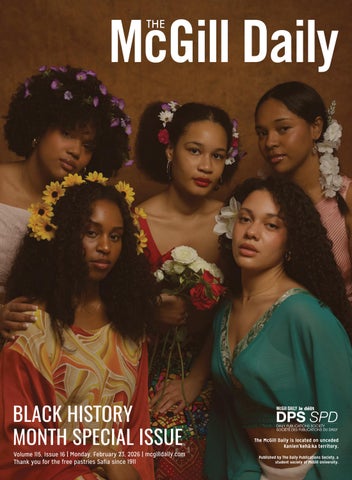
Lara Arab Makansi cover design
Doria Rafolisisoa staff contributors
Auden Akinc, Jane Goodman, Lisa Banti, Enid Kohler contributors
Madelyn Mackintosh, Simone Marcil, Jamie Xie, Sarah Toman
Published by the Daily Publications Society, a student society of McGill University. The views and opinions expressed in the Daily are those of the authors and do not reflect the official policy or position of McGill University. The McGill Daily is independent from McGill University.
JWhen Black History is Erased
ustthispastweek,USPresidentDonaldJ.Trumpsuccessfully appealed a January federal court ruling which mandated the reversaloftheNationalParkService’sremovalofanymention regarding slavery. Last year, Trump issued an executive order to review exhibits in the National Museum of African American HistoryandCulture.HepostedtoTruthSocial, “TheSmithsonian isOUTOFCONTROL,whereeverythingdiscussedishowhorrible ourCountryis,howbadSlaverywas,andhowunaccomplishedthe downtroddenhavebeen.” Frombookbanstodebatessurrounding Critical Race Theory, Trump’s revisionism has formed part of a largertrendinrecentAmericanhistory.
AsAmericaattemptstoriditselfofitsBlackhistory,wemustnot assume that Canada has always been the multicultural land of belongingasitscurrentreputationstands.Rather,wemustbeginto question the histories that are being taught in this country and confrontadisturbingquestion:whathappenswhenthesehistories areerased?
Education stands at the centre of this conversation. Black educators across Canada have repeatedly emphasized how Black historyandtheBlackCanadianexperienceisnotbeingtaughtina standardizedfashioninschoolcurriculums.Withnoprovincesin Canada mandating a Black history curriculum, much of the responsibilitytorelaythesehistoriesistakenupbyBlackeducators. Furthermore, as right-wing conservatism spreads throughout the country,Canada’sBlackpastiscontinuouslydeniedbyparents and schoolboardswhoarguethattherewereneverenslavedpeoplein Canada,andthatthis “alternative” historyisnotwhatthecountry standsfor.
Wewouldexpectthissentimenttochangeaswemoveupthe education system. However, universities suffers from a systemic dearth on Black history education. Notably, McGill lacks an independent African Studies department, with the present African Studies program classified within McGill’ s Institute of Islamic Studies. Furthermore, McGill currently offers few undergraduate courses on the history of Black populationswithinCanada.
When Black history is continuously denied by the very institutions that are designed to teach, our collective memory ceases to acknowledge the systems of oppression upon which Canada is built. Often taught in history textbooks is how our country prides itself for having been a safe haven for enslaved
Americans through the Underground Railroad. Yet, a lesser knownfactishowCanadaalsoparticipatedintheslavetrade,with the New France colony relying on the labor of approximately 3,600 enslaved peoples to construct the settlement. Much of Canada’sinstitutionalframeworkreliesonanti-Blackracismthat emerged from the slave trade, and which continues to present systemic barriers to Black Canadians today. In Canadian classrooms, we are rarely taught about the legacies of communities such as Africville, and how governmental neglect culminatinginlackofaccesstocleanwaterandgarbagedisposal systems led to the city’s demolition with descendents of residentscontinuingtofightforjusticetoday.McGillisamember ofthebroaderCanadianeducationsystemthatfailstoprovideour youthwithaholisticaccountofBlackhistoryinCanada. Assomepost-secondaryinstitutionsuseeducationasatool topushpredominantlywhite,Euro-centrichistories,wemust look beyond. Thankfully, Montreal is home to many collectives and organizations that strive to inform the public ofthesemissinghistories.
The Black Community Resource Centre (BCRC) takes on a holisticapproachtomeetingtheneedsofBlackyouthinMontreal through “health, education, socio-culture, and community economic development programs.” The BCRC also contributes to the development of education related to Black history and experiences in Montreal, publishing research reports on topics rangingfromBlackheritagetoover-policing.
BlackTheatreWorkshop(BTW),isanon-profittheatrecompany founded and based in Montreal. Its mission has centred on “reflecting Black culture and community by developing and providing visibility for Black Canadian artists.” BTW presents artisticrenditionsofBlacksocietyandculture,whichtheystateis an “answertothegrowingneedamongstBlackcommunitiestosee themselves reflected in the stories they watch.” One of the workshop’s key projects has been touring schools in Montreal to helpeducatorssharefragmentsofBlackhistorywiththeirstudents, primarilyreflectingonstoriesfromtheCanadianBlackdiaspora. Foundedin2015,SayasporaisanAfro-diasporicfeministmedia outlet that publishes stories about the experiences of women in Montreal.InadditiontoupliftingthevoicesofyoungAfricanand Caribbean writers, Sayaspora also provides online courses on digitalmediaproductionandbrandmarketing.
3480 McTavish St, Room 107
Montreal, QC H3A 0E7
phone 514.398.690 fax 514.398.8318
advertising & general manager
Letty Matteo
ad layout & design
Alice Postovskiy
“Trump = Creon = Hitler”
Through its superficial analysis of tyranny, the Daily’s Antigone op-ed renders itself reductive
Madelyn Mackintosh
Editorial disclosure: I am the director and co-adaptation playwrightoftheMcGillClassics Play’ s Antigone, writing in response to the Daily’ s recent commentarypiece.
The enduring relevance of Sophocles’ Antigone lies in its lessons about tyranny’ s deceptive capacity for selfreinvention, as well as the dangers of abandoning nuance in favour of easy political equivalences.Andyet,the Daily’ s recent op-ed on McGill Classics’ recent adaptation of Antigone asserts: “The takeaway of this production seems to be that Trump = Creon = Hitler.”
This is a striking claim not only because it is provocative, or because the analysis seems distastefully hamfisted but because it is largely unaccompanied by substantiating evidence. The oped broadly fails to root its claims in specific textual or staging analysis, making it somewhat challengingtoseewhatunderlies the author’s certainty that their owninterpretationoftheshowis synonymous with authorial intent. You are, of course, free to express your artistic critiques of the adaptation in whatever terms you please political theatre invitesasmuch.Granted,thereis a meaningful difference between sharing one’s subjective interpretation, and asserting that viewpoint as objective fact. The op-ed repeatedly collapses that distinction most notably in its assertion that the delivery of
Kreon’s speeches is “clearly meant to recall the aesthetics of Hitler’s speeches.”
Onthismatter,Iwouldliketobe particularly direct: you may speak for yourself and your interpretation of the work in whatever terms you please. But absent any definitive sourcing to support your assertions, do not claim to credibly speak for me and certainly do not presume authorityovermybeliefsregarding the Nazis my Jewish ancestors fled.Asamatterofmutualrespect, it is reasonable to expect a higher journalisticstandard.
It is precisely this substitution of assumption for analysis that shapes the article’s broader critique. The op-ed proceeds from the premise that the adaptation functions as a direct allegory for Donald Trump, refracted through the visual shorthand of Nazi Germany. It confidently posits that Kreon functions as a thinly veiled composite of Trump and Hitler, whileinstructingtheaudienceto recognize contemporary America as a simple reiteration of the Third Reich. The author then labels this analogy as deeply reductive, which I would agree with.
The production is indeed occurring during Trump’ s presidency, and the adaptation is set in the 1930s. But it is an enormous leap to, on a near temporal basis alone, assert that the entire production exists to argue a simple equivalency between Trump and Hitler or, otherwise, to construct Kreon’ s character in their direct image.
The piece does not demonstrate that this equation is textually
sustained; it simply assumes it, and then proceeds to critique the show for failing to serve as a sufficiently rigorous allegory for that comparison.
For one thing: Hitler was far fromtheonlyascendantfascistin the1930s,andtoimplyotherwise is naively ahistorical. To move from “interwar aesthetic” to “Hitler” to “Trump = Hitler” is precisely the kind of interpretive shortcut the op-ed claims to resist, in part because it flatly ignores the existence of other autocrats in favour of modern history’s most-cited tyrant.
For instance: in arguing the Trumpism comparison, the article states that “Creon wants to make Thebes great again.He...seekstovanquishthe enemy within. In the second act ...asoldiercries “Ididn’tvotefor him!”” Otherwise put, the core examples that led the author to understand Kreon as a Trump metaphor are (1) his expressed desire for national greatness, (2) rhetorical references to “the enemy within,” (3) thematic allusions to civic responsibility/ accountability among voters. It seemsbizarretotreatthesetraits asuniquelyTrumpian,whenthey all reflect core features of authoritarian movements. Each appears across decades and continents, and was included precisely for its recurrent applicability.Theseexamplesare not the markings of a single presidency, but the grammar of authoritarianism.
In failing to see beyond its narrow allegorical framework, the op-ed (once again) mistakes its own interpretive lens for the text’s thesis. It also misses the
fact that the production’ s timelessness is not an accident of staging it is rather the point.
The production draws deliberately from multiple historical reference points not as a collage of aesthetic gestures, but as a structured study of recurring authoritarian mechanisms. Mussolini’ s rhetoric of purification and national restoration informs Kreon’s language of order and rebirth. Mosley’s domestic fascist movement (with its normalization of organized intimidation) informs Kreon’ s reliance on coercive enforcement. Saddam Hussein’ s security-state logic shapes the regime’s mediated relationship to its citizens, while Stephen Miller’s bureaucratic nationalism echoes in the language of contamination and de-personification Kreon uses to justify violence. This structural layering of references is not arbitrary, but a deliberate integration of contemporary history’s fascist lineage intended to illustrate how tyranny evolves across contexts while its underlying methods continue to rhyme.
The op-ed argues that this “aimless” historical referencing strips the play of its complexity but it fails to locate complexity because it makes no attempt to search for it. Instead, it narrows the frame to two culturally familiar reference individuals and reads everything into that binary. Regrettably, the text of the article then finds itself too preoccupied with dismantling its own straw man (ie. whether
“Trump = Creon = Hitler”) and leaves little time to engage with the actual subject matter or text of the show. Thus, by insisting that this production’s meaning collapses into a Trump-Hitler equation, it reduces tyranny to a visual or rhetorical checklist and reinforces the very flattening it critiques. This is a dangerous reflex.
If fascism only “counts” when it resembles Hitler, we will keep failing to recognize it in time. Reducing authoritarianism to surface resemblance podium equals Hitler, nationalist rhetoric equals Trump shifts attention away from structure. It distracts from how power consolidates itself, how law becomes weaponized, how cruelty is normalized, how dissent is reframed as treachery, how fear becomes governance. That blackand-white mode of thinking feels decisive,butisalie.
Whenourpoliticalimagination narrows to two familiar templates, we become less capable of identifying authoritarianism when it emerges through different institutions, different languages, or different faces.
Antigone endures not because it allegorizes one regime, but because it interrogates the moral architecture of power itself and the recurrent tools that fascists have used to accumulate power and exercise cruelty throughout human history. The point is not toindividualizethetyrant;itisto recognize their methods and to learn from the past before we are forced to relive it once again.
One Thousand Protest McGill-Contracted Security Firm Operating at ICE Detention Facility
Montrealers, McGill students march to GardaWorld Headquarters
Sena Ho and Charley Tamagno
Managing and Copy Editor
Approximately one thousand demonstrators marched to GardaWorld’s headquarters at3PMonFriday,February13,in protest of the security firm’ s contracts with US Immigrations and Customs Enforcement (ICE) at a detention facility in Florida known as “Alligator Alcatraz.” Thiscomesafteranotheranti-ICE protest in Montreal was held on February 1 before the US Consulate.Montrealersorganized in outrage against ICE’ s crackdown on illegal immigration, and the killing of two civilians, Renee Good and Alex Pretti, at the hands of ICE agents.
GardaWorld’sinvolvementwith ICE was revealed last July in a MiamiHeraldreportthatdetailed howasubsidiaryoftheMontrealbased firm, GardaWorld Federal Services, was approved as one among ten companies to aid in running Alligator Alcatraz. The company was awarded eight million USD by ICE for the securitycontract.
Montreal activists accompaniedbyQuébecsolidaire, Amnesty International, and several union representatives from the Confédération des Syndicats Nationaux (CSNFederation of National Trades Unions) and the Fédération Autonome de l’Enseignement (FAE) gathered at Place Vertu, before making the approximately two-kilometremarchtowardsthe security firm’s headquarters. A McGill contingency also attended theprotest.
The university has historically procured at least $19 million in GardaWorldcontractsforcampus security services. McGill currently continues to hire security officers from GardaWorld, with job listings as recent as February 4, 2026.
Student organizers joined the march with a banner stating: “GardaOffOurCampus.” McGill students departed from the McGill campus and joined other demonstrators at Place Vertu. The organizers, who have asked the Daily to remain anonymous, elected to create this contingent to encourage students to travel to the protest despite being 55 minutes away by public transit. They sought to highlight
McGill’s involvement with GardaWorld in a written statement to the Daily: “McGill contracts GardaWorld to police its students. Students have observedanincreasedpresenceof GardaWorld security in the semesters that followed the Gaza Solidarityencampment.”
The McGill organizers further stated that, “McGill has been extremely willing to pay large amounts of money to “securitize” its campus Considering that a good portion of this money must have gone to their partnership with Garda[World], the students havearesponsibilitytodemandan end to our University’s complicity inICE’sterrorism,whichweknow isfacilitatedbyGardaWorld.” When asked about their personal feelings about having GardaWorld’ssecurityofficerson campus grounds, the organizers said that, “we are outraged. It is extremelyunsettlingtothinkthat the same security guards who follow around students and encroachontheirrighttoprotest” work for the same organization that helps “ICE dehumanize and terrorize people in Alligator Alcatraz.” When asked about why McGill
students should mobilize, student organizers responded, “Students should be in charge of what occursontheirowncampus.” The contingency outlined future steps that McGill students can take, should they also feel outraged by the GardaWorld contract: “We need to mobilize to show admin that we do not agree with the securitization of our own campuses. We refuse for our tuitiontogotowardssecuritythat wedon’twant ourmoneygoing towards a company which funds ICE.”
BeforeleavingfromPlaceVertu, Celeste Trianon, one of the protest organizers, led a series of speakers to the fore. Each condemned GardaWorld’ s collaboration with ICE and their participation in detaining over 6,000 individuals at the South Florida detention centre under inhuman and unsanitary living conditions.
An organizer from Indivisible Québecsaid, “WhileICEoperates in the United States, the infrastructurethatenablesitdoes not stop at the border. GardaWorld, a corporation headquartered here in Quebec, is one of the private contractors
involved in the immigration detention systems.” In 2022, Investissement Québec, a provincial investment agency, invested$300millionCADinthe firm; while nationally, the Canadian federal government has entered into significant, long-term contracts with GardaWorld, including a deal brokered with Canadian Air Transport Security Authority in 2023for$2.7billion.
“Let us be clear: when public funds strengthen corporations tied to detention systems, when subsidies and contracts flow without scrutiny, and when profit is made from incarceration that is not neutrality.Thatisparticipation,” the speaker continued.
AMontreallocalwhowishedto remain anonymous spoke with the Daily, stating that it was vital for Canadians to show up and protest, “especially when we are seeing this rise in right-wing conservatives who are not afraid to assemble on the other side.” She noted that attending protests such as this one is important for building community and creating active change in the world we livein.
“There’salotofactionintheUS [against ICE], which makes the world think that Canada isn’t doing anything, but we are,” she said. “Canada is also participating inprotestinghere that’swhyit issoimportant.”
Sofar,theprotestorsmentioned there have been no talks with the McGill administration regarding its affiliation with GardaWorld. Thestudentsurgedthatthereisa chance for dialogue should there be more pressure on the University through popular supportanddirectaction.Asthey put it, “They will not change unless they are cornered into doingso.”
The Daily has reached out for commentfromMcGillUniversity. As of the time of writing, we are waitingforaresponse.
Upon arriving at the firm’ s headquarters at 5 PM, the demonstratorsweremetwithriot police and GardaWorld’s security staff. According to the Montreal Gazette, the confrontation resulted in officers spraying the crowdwithpeppersprayandtear gas. At least one demonstrator wasarrested,reportedlythrowing a piece of ice at an officer before beingpinnedtotheground.
Image by Sena Ho
Taking the Medical Community by “Fire and Force”
The McGill Black Medical Students’ Association (BMSA) advocates for Black empowerment, inclusion, and representation in the medical field
Enid Kohler Staff Writer
The McGill Black Medical Students' Association of Canada (BMSA) is a studentrun chapter of the national organization, which goes by the same name. Founded in 2022, the organizationseekstoaddressantiBlackracismthroughadvocacyfor curriculum modification and reform, tackle barriers to medical school admissions by supporting Blackpre-medicalstudents,andto foster a sense of community for currentBlackstudents.
The Daily spoke with copresident and second-year student of the Faculty of Medicine and Health Science, Britany Mbangi, over her lunch break on the first day of her neurology rotation. We spoke about Black inclusion and representation in the medical community, BMSA’s rapid expansion, and how to be a good person without losing yourself in theprocess.
This interview has been edited forclarityandconciseness.
Enid Kohler for The McGill Daily (MD): I’m curious to know moreaboutyourstory.Whatdrew youtoBMSAandhowdidyoufirst getinvolved?
Britany Mbangi (BM): I knew that I wanted to get involved in a club coming into medical school, andseeingalltheBlackstudentsat
orientation the very first day touched something deep within me. It wasn't easy getting here. Within the BMSA, we're all about supportingeachotherandtryingto make the path easier for fellow Black students who are interested inmedicinespecifically.Soitwasa no-brainer for me. I was going to jointheBMSAbyfireandbyforce.
MD: As Co-President, how would youdescribetheBMSAinanutshell?
BM: The BMSA is full of supermotivated, highly-driven people. We're all about encouraging each other, pushing each other forward however we can, and trying to build connections with people in the community. We all know as visible minorities that it's not easy tointegrateintocertainspaces.But wewanttomakeiteasierforBlack students to join this space. The BMSA is rapidly changing. Last year,mycohort,[the]classof2028, was the largest cohort that McGill Medicine has had. It's a long journey, but we believe that little bylittle,yearafteryear,wedoour besttomakeitbetter.
MD: Before beginning McGill medical school, was there a specific experience or person who inspiredyoutojoinBMSA?
BM: It’s kind of [a] cliché, but ever since I was little, honestly, I knew I wanted to be a doctor. I decided,youknowwhat,I'mgoing to shoot my shot at medicine. I've been surrounded by a lot of very
strong Black figures in my personal life. The sky wasn't even thelimit IcoulddoanythingifI put my mind to it, and I was very lucky and grateful to have the support of my close family members. It wasn't abnormal for metostrivetogreaterheights.
MD: That's really special that you had that growing up. On a wider scale, why is BMSA important for the McGill community, but also for the medicalspaceatlarge?
BM: Historically, there has always been a very low number of Black people getting accepted into medicine due to socioeconomic barriers, social challenges, or biases. We cannot brush those undertherug.Sohavinganofficial space for Black medical students where their voices are heard and wheretheyareseenandsupported issoimportant.
The BMSA really is integral to betteringtheeducationofnotonly Black medical students, but all students from different backgrounds and cultures. It advocates for an even better medical education and safe space for Black patients, Black students, andBlackprofessionals.
MD: Switching gears a bit, do youhaveafavoritememoryofyour workwithBMSA?
BM: Oh my gosh. There have beenalotofgreatmomentswithin the BMSA. I think one of my
An Evening of Unity
favorite memories was the welcomeevent[in]myfirstyearof medical school. The Welcome Event is an annual event for our members across all cohorts, including Med-P and MD-PhD students. It creates space for our new students to connect with returning members and for the broadercommunitytoengagewith Black professionals. I cannot even put into words [how] I felt when I sawthe25,26otherBlackstudents in my cohort. This was the first time in my life that I've seen so manyBlackfellowstudents.Going to the welcome event this year where there were, I believe, over 100attendees,wasamazing.
Speaking of the welcome event, thisyeartheMcGillBMSAreached over100membersacrossallyears. It's a milestone for us. Just thinking that a few years ago, we were only five students and now we're over 100, [is] just incredible. It speaks to the work that the McGillBMSAhasbeendoing.
MD: Beyond your graduation from McGill’s School of Medicine, what do you hope will be the lasting legacy of BMSA on future students and the medical space morebroadly?
BM: That's a great question. I wouldsaythatIdon'tseeBMSAas just a student club. I see it as an organization where we strive to better the whole experience around the healthcare system, specifically the medical system for Blackprofessionals,Blackpatients,
Recapping the BSN, MASS, and ASSA Voices and Visions Roundtable
Simone Marcil News Contributor
On January 22, three student associations representing Black and Afrodiasporic students at McGill the Black Students’ Network (BSN), McGill African Students Society (MASS), and the African Studies Students Association (ASSA) organized a roundtable discussion that brought together students and faculty memberstosharetheirexperiences and resources. The event aimed to create a space where individuals could express themselves and reflectonthestateofBlackstudent and faculty representation and advocacy on campus. ASSA’ s president, Zahra Hassan Doualeh, explained how the roundtable was
first and foremost an opportunity for unconstrained expression: “The eventaimedtocreateaspacewhere individuals could express themselves and reflect on the state of Black student and faculty representation and advocacy on campus. ” Invited to the discussion were Brittany Williams, McGill FacultyofLaw’sAssistantDean,and Antoine-Samuel Mauffette Alavo, who holds the position of McGill’ s BlackStudentAffairsLiaison.
The theme "Voices and Visions," set the tone for the evening: one where students could share their experiences with representation, access to resources, and mechanisms of discrimination, all whileenvisioningafutureofequity and opportunity. Grassroots efforts have succeeded on campus: this February marks the ninth year of
McGill’s official celebration of Black History Month, a mark of progress in the recognition of BlacknessatMcGill.Butthesingledigitanniversaryisalsoanindicator that equity efforts are still in their formativestages. Oneofthekeytopicsofdiscussion at the event was Black student representation at McGill. Many voiced frustration regarding the lack of Black presence in various faculties, as well as the student body. Black people make up over four per cent of the Canadian population, yet many McGill faculties maintain significantly lower representation. Students at the roundtable expressed how seeingmembersoftheircommunity inpositionsofembodiedknowledge is crucial for self-esteem and inclusion. Mauffette Alavo stressed
and Black students. I would hope that my legacy would be to better this experience, not just for Black people, but for everyone. I hope that the BMSA leaves a lasting positive influence on the healthcare system and encourages people to strive for greatness, [creating]abetterenvironmentfor all.
MD: Thethemeofthiscolumnis “goodpeopledoinggoodthings.” In the context of your work with BMSA, what does being a “good person ” meantoyou?
BM: Oh my gosh, what does it meantobeagoodperson?Beinga good person to me means being abletomakethepeoplearoundme feel good without losing myself in the process. Although we’re all unique, as Black people, we often have to minimize or filter ourselves to present a more digestible version to the people around us. While that can make you a great person to others, it doesn'tmakeyouagoodpersonto yourself,becauseyouloseyourself intheprocess.
Learn more about BMSA and opportunities to get involved on Instagram,@mcgillbmsa,orthrough theirwebsite,mcgillmed.com.
End note: If you know good people doing good things who you would like to see featured in this column, email news@mcgilldaily.com.
that while the university still has crucial improvements to make, Black excellence remains integral, and more effective publicizing should be done to make the community more visible. Williams further underlined the necessity to target efforts in underrepresented areas, like STEM faculties and executive faculty positions. Both speakersrecognizedthatinitiatives of further inclusion need to be led by students. Brittany Williams noted that the university’ s administration is highly receptive to students’ demands and encouragedthedevelopmentofthe resourcestheyalreadyhave,suchas SSMU’s Black Equity Fund, Black student internship, and research summer programs. Key people and projects are in place, but students are the fuel to the fire, the
roundtableconcluded.
Towards the end of the evening, the discussion progressed towards aspirations for the future.
“The support of Black students is not a trend,” Mauffette Alavo asserted. Organizationalstabilityandreliable frameworks guarantee long-term commitments and partnerships, bothwithintheuniversityandwith outsidepartners.
Events like the roundtable and organizations like the BSN, MASS, and ASSA provide spaces for Black students to not only support each other but also to share their knowledge and collectively organize towards common goals. The Voices and Visions roundtable wasyetanothersuccessfuloutcome ofstudent-led,community-building initiatives.
February 23, 2026
“Africa Has Always Been My Centre”
The ASSA’s Uhuru Journal celebrates Pan-African agency and innovation
Isabelle Lim Culture Editor
Named after the Swahili word for freedom, the UHURU Journal, run by the McGill African Studies Student Association (ASSA), is an academic journal celebrating and uplifting Africancentricstoriesinbothresearchpaper and creative formats. These include those that not only commemorate Africa’s rich histories, but push the boundaries of dominant narratives surrounding the continent and its diversepeoples.
Founded in 2019, the journal published in the spring of that year before taking a hiatus from 2021 to 2024 due to pandemic constraints. However,inthespringof2025,itwas revivedwiththetheme “BeyondThe Single Story: Africa’s Diaspora and Diverse Realities.” The 2025 edition includes a gallery-esque exhibition complete with readings of poetry, artworks, and authentic Ghanaian food. This year’s edition of the journalwillcentrearoundthetheme “Afrofuturism: Envisioning The FuturesWeCreate.” ForourBlackHistoryMonthissue, TheMcGillDaily spoke with ASSA President Zahra Hassan Doualeh, ASSA VP Academic Henry Maidoh, andASSAVPExternalandUHURU Editor-in-Chief Shanna Coulanges. We discussed UHURU’s role in shifting the needle on African narratives, and their greater hopes for the journal as part of a larger visionofAfrofuturism.
Isabelle Lim for The McGill Daily(MD): TellmeaboutASSAand the work you do as an academic studentorganization.
Henry Maidoh (HM): We are an undergraduate association aiming to elevate the African Studies program and department. We foster connectivitybetweenAfricanStudies students and their professors, and raisegeneralstudentbodyawareness of the program and its various curricular and extra-curricular opportunities.
Zahra Hassan Doualeh (ZHD): As members,wesitoncommitteeswith the African Studies faculty that inform the faculty members and the administrationhowtheprogramcan beimprovedandwhatstudentswant to see more of. That is what we do moreontheacademiclevel.
MD: McGill is one of the few universitiesinCanadawithaunique African Studies program. How do youthinktheAfricanStudiesoption is valuable, and how do you think current programming could be diversifiedorimproved?
ZHD: I think McGill has this specific advantage of being an English institution in a majority French-speaking province. That linguistic aspect puts it in a very advantageous position, considering thatalotoftheAfricanpopulationof MontrealisfromNorthAfrica;while alotofAfricanscholarshipfocuseson sub-Saharan Africa, which is mostly English-speaking.McGillisinformed by both languages as it has bilingual scholars and faculty members with experience in different parts of Africa. Uniting these two creates something that's never been done before, which is where our strength lies. Afrofuturism is not just about innovation,technology,andstartups. It is also about looking inwards. It's about historical imagination, and Pan-Africanism is a big part of that. We are a collective. There would never be us without each and every single one of us, you know? That's why I think the work being done at McGillisunlikeanyotherinstitution.
HM: In general, we want to give students the ability to engage with African literature and elevate their own experiences with African realities not only localised to the continent, but also pertaining to the African diaspora and relevant global communities. While a lot of the content in the African Studies programisveryvaluable,Idon'tfeel like it's as forward-thinking as it could be. While you can't know the futurewithoutknowingthehistory,I still believe having more courses centred on the now and the future [would be valuable] for youths to applythatknowledgetothepresent. ThefutureisAfrica,afterall.
MD: The theme for UHURU’ s 2026 edition is “Afrofuturism: EnvisioningtheFuturesWeCreate.” What was the thought process behindthetheme?Comparedtolast year ’s, which focused on individual narratives, how did you choose to widenthescopefromthenarrativeto thecollective?
Shanna Coulanges (SC): I’ m especiallydrawntothesecondpartof thetitle:EnvisioningtheFuturesWe Create.Itcarriesadeeplymobilizing force, one that calls on all of us to imagine and actively build [into being] what has yet to come. Too often, Africa has been framed through narratives of reduction and constraint, as we explored last year. This year, we open a new conversation, one without limits or restraint. Ultimately, we hope this issue stands as a testament to ambition,boldness,andcreativity,an invitation to learn, explore, and give formtofuturesnotyetuncovered.
ZHD: When you look at the themes,they’resortofacontinuation of one another. We started by going
against reductive narratives. Now, Afrofuturismisaboutshowing[our] potentialandeverythingthatisbeing done.Ifyouperceiveitthatway,itis like a timeline. So who knows what nextyearisgoingtobe?
MD: UHURU uniquely welcomes both research and creative submissions.Whatnarrativesdoyou hopetoupliftwiththisapproach?
HM: Well, with a name like UHURU, who do we leave out of freedom?
ZHD: Accepting artworks is part of decolonising scholarship. There are many kinds of expertise, and many ways of sharing that. A lot of our stories cannot simply be told through the rigid framework of a scholarlyarticle.
SC: It’s about transcending the frontiers of communicating a powerfulmessage.UHURUhas,in my opinion, a dual mandate: to provide a space for Afrodescendantvoicestobeheard,but more importantly, to narrate plural&unapologeticexperiences of Africa & Africans. Allowing for creative submissions is not motivatedbyasimplewhimtoadd colour, but by the desire to provide a new layer of depth, understanding, and ways of perceiving the reality of the Africancontinent.
MD: This year, UHURU is collaborating with other Black and African organisations as part of the journal’s outreach. Tell me more aboutthosecollaborationsaswellas how those tie into your aforementioned mission of elevating Pan-Africanexperiences.
HM: We’re building a lot of partnershipsatthemoment.Wehave onewithSayaspora,whichworkson givingmoreAfricanwomenandgirls opportunities,whichreallycoincides with UHURU’s project. We've also been able to get involved with the Black Law Students’ Association (BLSA) and the IDSSA’s Candid conversations podcast [interviewer’ s note: episode still pending] to speak on behalf of UHURU. Notably, the McGillmarketingteamcontactedus for an article, which appeared on theirnewsletter,whichissentoutto everyone, and on their news page. Thatwashuge. There’smoretocome,forsure.I love the fact that we're able to engage with multiple like-minded organisations and groups to show that it's possible to start an initiative that's focused on Black andAfricanstudents.
MD: Inthissense,doyouthinkthat UHURUhastranscendeditsstatusas a student journal to encompass
somethinglarger?
HM: For sure. The journal was a foundation for bringing more awareness to African Studies. In doingso,though,we'vealsobeenable tocreateamovementbymobilizinga bunch of people even outside of thecountry,letalonejust[at]McGill. Butthere’sstillalongwaytogo,soI wouldn’t say we’re a fully-furnished movementjustyet.
ZHD: Imean,Iseeitasacollective. From the get go, we didn't want to limit the scope of this journal to simply the African Studies program, because we would be limiting the impactthatwecouldhave.Thegoal is to create a community that is greater than just the couple of students who produce this journal. BringinginSayasporaisahugething because it’s well-known within the BlackcommunityinMontreal,butit isn’t just limited to Montreal. Frankly,theideaofthecollectiveisso art-basedaswell,whichalsomakesit moreinclusive.
MD: Allthis:towhateffect?
HM: ToshowthatAfricanStudies isn't just for Africans, it's for everyone. And that being knowledgeable about it isn't and shouldn't be disproportionately attributedtoonegroupofpeople.
MD: Finally, what does Afrofuturismlookliketoyouinyour ownlife?
HM: Agency.
SC: Afrofuturism to me looks like agency in all its forms and shape.Reclaimingpowerinspaces where Africa had been treated as passive rather than [the] holder of itsowndestiny.
ZHD: Once, a journalist asked Senegalese cinematographer Ousmane Sembène, who made films for Africans about Africans, how he felt about how his films were perceived in France, and he said, “Europeisnotmycentre.” Igrewup inafamilythatneversawtheWestas the centre, so coming in [to McGill] and meeting people who thought differently was quite a shock. So for me,Afrofuturismgivessomepeoplea peekintowhatmylifehasbeenlike. Africahasalwaysbeenmycentre.
UHURU Journal’s fifth edition “Afrofuturism: Envisioning The Futures We Create” is accepting academicsubmissionsuntilFebruary 23, 2026, and creative submissions until March 1, 2026, for launch in April2026.
Courtesy of UHURU Journal
Bad Bunny: Resistance Through Art
How a Spanish-language Super Bowl set turned pop spectacle into a fight over belonging
Lisa Banti Staff Writer
For13minutesduringSuperBowl LX,thehalftimeshowleanedinto friction instead of smoothing it over.BadBunny,bornBenitoAntonio MartínezOcasio,wastheAppleMusic Halftime Show headliner and performednearlyentirelyinSpanish. Attheendoftheshowheshout“God bless America” at the end, having namieddozensofcountriesacrossthe Americasasaparadeofflagsswayed behindhim.
Itwasadeliberatereframingofwhat “America” canmean,deliveredonone ofthefewstagesleftthatstillpretends to speak for everyone at once. That’ s why the “Benito Bowl,” the fan nickname that spread almost as quickly as the clips themselves, became inescapable this past week. People weren’t only reacting to the performance; they were reacting to what it symbolized, and the people who got to be centred on his own terms: linguistically, culturally, and politically.
BadBunny’srisetostardommakes thatcenteringfeelespeciallypointed. Hedidn’tarriveinNorthAmericaasa “ crossover ” project. He arrived as a Puerto Rican artist whose work has always proudly uplifted Puerto Rico and its unique culture. Puerto Rico’ s political status makes visibility complicatedoncontact,asthecountry is not a sovereign state, but a US territory. Puerto Ricans are US citizens, but residents of the island cannot vote for president and do not electvotingmembersofCongress.
When halftime stopped being background noise
The Super Bowl halftime show usually aims for one thing above all: broadagreement.Evenwhenviewers complain, the show is built to feel familiarandcontainrecognizablehits, universalcues,andminimalrisk.
Bad Bunny’s set didn’t play that game. It made Spanish the default language,PuertoRicothecentre,and “America” thehemisphereratherthan the brand name. That shift alone explains a lot of the reaction cycle: celebration from viewers who felt seen,andbacklashfromviewerswho felt the centre move without their permission.
One detail made the performance feellesslikeamedleyandmorelikea statement.Duringtheset,acouplewas married on the field, and multiple outlets later confirmed it was a real, legally binding wedding. In a broadcast built around scripted spectacle, that choice landed as intimateandpoliticalatthesametime: areminderthatlegitimacy,belonging, and who gets to be “official” are arguments happening in public life right now, not just in comment sections.
This is what turns a halftime show intoaculturalevent,notjustthefact
that “people had opinions,” but the reasonstheyhadthem.
Puerto Rico isn’t an aesthetic, it’ s the context
Bad Bunny’s Puerto Rican upbringingisn’tafootnote,it’sthecore ofhispublicidentity.Referencesinthe halftime show weren’t random decorations; they were modes of insistingPuertoRico’sbelongingatthe centreofthestory,notonthemargins.
What looked like set dressing was actuallyakindofgeographylesson,not the textbook kind, but the kind you feel.Theshowunfoldedlikeamoving “tour” throughPuertoRicanlife:from asugarcanefieldtoacasita,theninto the streets of San Juan, with domino players,block-partyenergy,andevena piragua (shaved ice) vendor stitched intothevisuals.
That choice matters right now because it insists on ordinary Puerto Ricanlife;notPuertoRicoasavacation backdrop,aheadline,oranAmerican afterthought. Sugar cane hints at the island’s extractive histories and the economicstorybehind “paradise”;the casitareadsascontinuityandhomein anerashapedbydebtcrises,austerity politics, and displacement pressures; and the street scenes refuse the idea thatLatinidentityhastoarriveonUS televisioninasimplified,export-ready form.
Even the smaller gestures were calibrated.Thelight-bluePuertoRican flagsignalledapoliticallineagemany viewers recognized immediately, and “seguimos aquí” (“ we ’re still here”) landed like a compact slogan of survival. When he spiked a football stamped “Together,WeAreAmerica,” theSuperBowl’smostpatrioticobject became an argument about what “America” includes and who gets to claim it. It was capped off by a billboard that read, “The only thing more powerful than hate is love,” alongside an “Easter egg” cameo that quietlynoddedtodiasporamemory.
That insistence carries weight because Puerto Rico’s relationship to the United States continues to be politically unresolved. As a US territory, Puerto Rico is tied to US power while lacking equal federal political representation. So when Puerto Rico is centred on the most symbolic US stage, a broadcast typicallysoakedinnationalmythology, it can’t help but read as political. Representation becomes less “visibility” and more “reckoning” : a reminderofwhoisincluded,how,and atwhatcost.
Inotherwords,thecontroversyisn’t thatBadBunny “madeitpolitical.” It’ s that Puerto Rico’s position already is, and has always been, and the Super Bowl simply doesn’t usually invite viewerstositwiththat.
built to be read. It’s a choice about audience: who is assumed to understandwithouteffort,andwhois expectedtoleanin.
Takentogether,thesechoicesmake thehalftimeshowfeellikesomething greater than entertainment. They renderitaculturalmessagedelivered in the language of Bad Bunny’ s characteristic effusive Latin trap: spectacle,symbolism,andthekindof visibility that becomes disruptive simplybyrefusingtoshrink.
Resistance, in plain sight
The temptation with any “art as resistance” story is to hunt for one definitivepoliticalmessageandcallita day.However,BadBunny’sversionof resistance is often quieter, and, in some ways, harder for a mainstream audiencetodismiss.It’snotonlywhat hesays,it’swhatherefusestodilute. He made that refusal explicit at anotherhigh-profileeventbeforethe Super Bowl. At the 2026 Grammys, Bad Bunny used his acceptance speechforBestMúsicaUrbanaAlbum (for Debí Tirar Más Fotos) to denounce ICE and call for an end to what one report described as an “ongoing immigration crackdown,” punctuating it with the slogan “ICE out.”
That’s not symbolism, but a clear alignment with migrants and immigrantcommunitiesatamoment when immigration enforcement has becomeaflashpointinUSpubliclife. Anditsitsalongsideadifferentkindof milestone from the same night: Debí TirarMásFotos also won Album of the Year, marking the first time a Spanish-language album took the Grammys’ topprize. Theresistancehereisn’tjust “ apop
Auden Akinc | Staff Illustrator
star being political.” It’s a global superstar insisting that Spanish, Puerto Rico (and Latin America at large), and immigrant life aren’t side stories, even in the most mainstream room.
Backlash, then the rumour mill
Backlash was predictable. A Spanish-heavy halftime show on the SuperBowlstage,andaPuertoRican artist refusing to soften his message, wasalwaysgoingtotriggertheusual reactions: “keep politics out of it,” “speakEnglish,”“thisisn’tforyou,” and the more familiar accusation hiding under all of that: you don’t belong here.
But the backlash didn’t stay in the realmoftaste.Itmovedintotherealm of narrative-making, constructed through the spreading of misinformation. In early February, socialmediausersclaimedBadBunny wore a bulletproof vest to the Grammys because of threats tied to xenophobichostility.Therumourwas investigated and no evidence was foundforthe “bulletproofvest” claim, explaining that his sharply tailored outfit (and altered silhouette) fuelled speculation.
The point isn’t just that “people onlinelie.” TherumourframesLatino visibilityasinherentlydangerousand controversial, transforming a historic career moment into a security conspiracy. This converts prejudice intosomethingresemblingconcern.It alsoshiftstheconversationawayfrom theactualstakesofBadBunny’swork, language, belonging and power, towardwhetherhe’ s “toopolitical” to besafe.
In that sense, the rumour becomes partoftheculturalreaction:awayof
policing what kinds of artists are allowed to be visible, and on what terms.
Why this lands in Montreal too
FromMontreal,it’seasytotreatUS culture battles as exported noise: loud,constant,andsomehowalways trending. But the themes that surfaced around Bad Bunny’s Super BowlandGrammysmomentsarenot uniquely American. They travel and translate because they interrogate fundamental questions: who gets treated as “normal,” what language gets to be default, and who has to translatethemselvestobeheard. Thosequestionslanddifferentlyin Quebec,wherelanguageisneverjust language, but identity, law, power, and a recurring public argument. This is a city shaped by diaspora, wherebelongingislivedratherthan theoretical.
BadBunny’sjourney,fromaPuerto Rican artist building momentum on his own terms to winning the prestigiousAlbumoftheYearatthe Grammys and headlining a Spanishforward Super Bowl halftime show, matters because it shows what art can do when it refuses to stay in its lane. It may not be able to rewrite policy or put an end to structural abuses. But it can shift the centre of the frame, force a mainstream audience to notice what it usually treats as peripheral, and remind peoplethat “unity” withoutinclusion isjustbranding.
And maybe that’s the most useful waytoreadthe “BenitoBowl”:notas avictorylap,notasacontroversy,but as a moment where pop culture briefly stopped pretending that belongingisuncomplicated.
February 23, 2026
Patienceis a Virtue
McGill Savoy Society’s latest production is well worth the wait!
Jamie Xie Culture Contributor
“Loveisaduty,itisnowonder they are all so miserable,” sighs the titular character fromGilbertandSullivan’ s Patience After a long awaited two-year hiatus, the McGill Savoy Society has made its grand return to the Moyse Hall Theatre, performing Patience; or, Bunthorne’s Bride With a company of over 60 performers, musicians and technical creatives, the irreverent 1881 comic opera is given new life and reads as strikingly relevant today as ever underscoring that Patience makes perfect in this romantic absurd comedy, opening February 13 to a wonderfullytimedValentine’sDayweekend. Thepiecerecoåuntstheevergreen plot structure of aå love triangle between simple milkmaid Patience and the two superficial, artistically minded muses Bunthorne and Grosvenor who pine after her. A bitter satire on the Aesthetic Movement that was sweeping Europe at the time. Championed most famously by Oscar Wilde, the movement was a reaction to the moralism of art at the time, expressing the idea that art had inherent value even as superficial beauty, independent of social, political or ethical significance. The piece takes on newfound meaning with the rise of the performative male archetype, asking audiences to reinvestigatethetimelessnessofman falling victim to his own follies. For Artistic Director Michael Quinsey, “[Patience] is more than just about the Aesthetic Movement, it's about fad chasing. It’s about pretense whichisveryhuman.”
Nathaniel Jablonski, who plays Patience’s childhood love interest Grosvenor, expands on this idea by talking about the way modern masculinity responds flexibly to affirm the status quo of the time: “The ideas of masculinity are constantly in flux the traditional masculinity of military men are played for laughs as uncultured, contrasted with the nouveau of masculinitywhichisartistic,dreamy, sensitiveandliterary.” He highlights that much of the commentarypresentedin Patience is representedthroughgenderplayand how the modern man adjusts his performanceofmasculinityinfavour of reaffirming the status quo. He adds that many operas like Patience play with the weight of navigating a hostile world where “very strict socialcodesaretakentotheextreme bitterend,” oftentoabsurdtheatrical consequence. “Peopleactcompletely nonsensically,they’retryingtomake senseoftheworld.They’retryingto survivetheirlivesunderthesecodes and that’s part of the humour. How absurd it is that love must be
consideredeitherunselfishorselfish to be considered real,” Jablonski reflects.
Ana Neocleous, music director, speaks to the enduring relevance of Gilbert and Sullivan today. In particular Neocleousfocusesonthe unique space comic opera occupies in the public imagination which makes it especially equipped to tackle the subject of affect: “People have more preconceived notions on opera than many other performing artforms.Thesemiscomprehensions came from the 19th century and are bound up in the serious work environment realized under a maestro conductor. It’s super high art! [...] [Opera] has taken so many different forms from intellectual art to low-brow comedy, Gilbert and Sullivanisanartifactmoreaccessible than most people think. There's nothing high art about this, and there’s something nice about embracing it for what it is. The operas of Gilbert and Sullivan provide this unique opportunity to revisitthatandplayaround.”
ThoughBunthorneandGrosvenor carry much of the comedy in this piece, Patience, played by Helayna Moll, is the play’s emotional and philosophical anchor, serving as the voice of reason. Speaking to Patience’s fixation on moral love, Moll says, “She is obsessed with morality: when her friend Lady Angela ‘says you have to love, it is your duty to love and it must be unselfish,’ shebelievesher.Itreflects the beliefs of the time and the demandsplacedonwomen.”
In her recharacterization, Moll sought to re-engage Patience as a character that approaches the institution of love with skepticism: “[Patience is] treated as this dumb blonde, but she really achieves everything she wants without compromising on her beliefs. I believe she is really smart.” She pointsinparticulartoPatience’sAct TwoAria, “LoveisaPlaintiveSong,” noting that she approached this moment as a turning point, questioning why she is expected to appear happy when as the lyric suggests, it is “everything for him, nothingatallforher.”
Though the male lead Bunthorne acts as a caricature of an amalgamation of Aesthetic Movement figureheads, it is Oscar Wilde that Patience is most often culturally identified with. Depicted alongside Wilde in satirical magazinesisthelilywhichbecomes a prominent symbol throughout the opera. As pointed out by Professor Maggie Kilgour in the program’ s “Note on Aestheticism,” the lilies referencetheMatthew6:28-29ofthe New Testament wherein “Christ praises the flower for its beautiful uselessness: ‘Considertheliliesofthe field, how they grow; they toil not neither do they spin: And yet I say untoyou,thatevenSolomoninallhis
glory was not arrayed like one of these.’” Though the Aesthetic Movement’s rise was attributed heavily to Wilde’s contributions, it was also his trial for indecency that suffocated much of the movement’ s culturalinertia.
Quinsey says, “A lot of things are said about being true to yourself in relationships. There’s this idea that youshouldloveacertainwayornot becauseitmightbeselfish,butinthe end, you have to ask yourself if you can be happy.” Likewise, Matthew Erskine, who plays Bunthorne and
has been a part of the Savoy Society foreightyears,speakstofindingthat happiness in loneliness: “This is the exceptional, unprecedented [Gilbert and Sullivan] opera where someone ends up alone. Bunthorne ends up alone, and it's funny, but I like Quinsey’s direction with his lily. He looks pensively at this symbol of poetry and Aestheticism and he tosses the flower, accepting that he doesn’t need to be aesthetic, [and] thatit’sokaytobesingle.” In all its romance and absurdity, the production marries biting social
commentaryonAestheticaffectation with a modern sensibility that feels sincere and approachable. The McGill Savoy Society embraces Patience’s tongue-in-cheek spirit with confidence, delivering a production that could only be made byateamthatisunafraidtolovetheir workasselfishlyasnecessary.Asthe show ultimately reminds audiences, we owe it to ourselves and to others to fall madly in love with whowetrulyare.
“Wuthering Heights” and the Rejection of Complexity
Emily Brontë’s iconic story withers away in Emerald Fennell’s adaptation
Sarah Toman Culture Contributor
Emerald Fennell’s much anticipated WutheringHeights has hit theaters just in time for Valentine’s Day. The film is based on the beloved novel by EmilyBrontë,whichtellsthetale ofCatherineEarnshaw,Heathcliff, andtheirfamilies.Thoughthisfilm is marketed as a romance, the original text is anything but that. It is a tragedy that unfolds due to classism, racism, and cyclical abuse. Though many filmmakers haveattemptedtotranslatethese events from words into film, Brontë’srawandincisivenovelhas been said to be “unfilmable.” Unfortunately,Fennell’sfilmproves to be no different in this regard. Starring Margot Robbie as Catherine and Jacob Elordi as Heathcliff, the film does have its strengths, such as the stunning cinematography of the English countrysideandthesurrealistand dreamlikesets.However,thefilm notonlyfailstodoBrontë’snovel justice, but also completely disregards the story’s central conflicts and themes.
One of the most controversial aspects of the film is Jacob Elordi’s casting, which caused outrage on social media as audiences were rightfully upset about the whitewashing of Heathcliff’s character. Though Brontë never specifies his race in the book, she does describe
Though many filmmakers have attempted to translate these events from words into film, Brontë’s raw and incisive novel has been said to be “unfilmable.”
Heathcliff as being “darkskinned,” which causes him to be discriminatedagainstandabused by Catherine’s brother, Hindley a character noticeably absent from the film. The racism that Heathcliff faces leads to the start of the cycle of abuse within his and Catherine’s families, which is eventually dismantled by Catherine’s children and her nephew. Elordi being cast as Heathcliff not only takes a role away from actors of colour, but also erases one of the central and extremely pertinent conflicts in the story. Heathcliff has been known to be played by white actors the only exception being Andrea Arnold’ s adaptation in 2011 yet it is still upsetting to see that nearly no progress has been made in the past century ever since filmmakers have been adapting Wuthering Heights for the screen.
In turn, the depth of Heathcliff’s character was diluted in Fennell’s film. Rather than being a victim of racially motivated discrimination who eventually torments those around him, he is boiled down to an archetypical sexy bad boy. Though he acts cruel at certain moments in the film, the sheer villainy of his character has been completely removed, rendering him incredibly underdeveloped. Instead of presenting a flawed and sometimes evil man who, despite his faults, is seen as an object of desire to Catherine, Fennell removes all of the complexity from his character in favour of making him a palatable love interest.
Wuthering Heights revolves around Catherine and Heathcliff’s torrid relationship, as it curses everyone around them, including their own children. Rather than presenting a doomed but passionate bond that lasts even beyond the grave, their relationship in the film is presentedasnothingmorethana typical enemies-to-lovers situation. Catherine and Heathcliff are friends as children, but are not very fond of each other as adults and are always arguing. However, after
byhim:heverballythreatensher, throws a knife at her, and kills her dog. Eventually, Isabella manages to escape the house, settling down far away from the dreary moors to raise her son alone.
Catherine has a sexual awakening of sorts, the two suddenly cannot keep their hands off one another. Their supposed love for one another appears out of nowhere and is given no room for growth, making it seem like an afterthought instead one of the story’s main threads.
Another disappointing aspect of the film was Fennell’ s treatment of Isabella Linton, played by Alison Oliver. In the novel, Isabella marries Heathcliff, who takes her to live with him at Wuthering Heights. Isabella becomes a prisoner in Heathcliff’s house and is abused
Incontrast,Fennell’sversionof Isabellacanbecharacterizedasa weird girl, whose youthful naïveté leads her to marry Heathcliff even after he insists that he does not love her, will never love her, and will treat her horribly. Hence, it is not only uncomfortable to watch Isabella’s complacency in tolerating Heathcliff’ s degradations but also trivializes the abuse she faced from him in the novel. The film presents her as willingly participating in this degradation, whereas the original text makes clear that Heathcliff’s treatment of her was abuse, not something she consented to. The romanticization or rather the sexualization of abuse in the film is vile to say the least, as it absolves Heathcliff of any wrongdoing and instead suggests that Isabella enjoys being dehumanized. Rather than accurately portraying the realities of abusive relationships, Fennell turns Isabella into Heathcliff’s lap dog, so that their
relationship fits nicely into her oversexualized rendition of a brutally torturous tale. The most important thing to know about Brontë’s work is that itisnotaneasilydigestiblestory; it is gruesome, calamitous, and sickening. Her novel has long been considered a masterpiece due to its portrayal of racial Othering and exclusion in colonial England, the lasting effects of intergenerational abuse, and the link between obsession and violence. Conversely, Fennell’s adaptation is messy and watered down, all tied up in a pretty little bow that fails to mask its disingenuity. Some may argue that the quotation marks around the film’s title suggest that it is merely an interpretation. However, Fennell’s film borrows too much from the source material to be thought of as anything other than an adaptation. As much as I tried to see this film as its own entity separate from the novel, at the endofthedayitcannotbetotally removed from the context of the originalwork.AshardasFennell tried to depict Wuthering Heights in her own way, she missed the mark entirely, making a mockery of Brontë’ s magnum opus.
Jane Goodman | Staff Illustrator
Vows, Visas and the Politics of Marriage The Ministry of Love
Jamie Xie Commentary Contributor
For those immigrating to Canada, it might not just be the grass that’ s greener on the other side of the border, but the conditional visas as well.
Marriage-based immigration has existed in Canada since the early 20th century. That being said, it was only in 2001, through the Immigration and Refugee Protection Act, that the Canadian government established a modern spousal sponsorship framework. Family sponsorship or reunification programs quickly became a gateway of opportunity for many to build a life across borders; however, these programs also reveal the consequences of intertwining private life with public power dynamics, serving as a microcosm of the blind confidence we place in the law and how procedural legitimacy is often placed at odds with lived realities.
The privilege to import marriages to Canadian soil is selectively granted legitimacy,
by a legal system that legitimizes situations it already has precedent for. With Canada’s Immigration, Refugees and Citizenship (IRCC) department’s announcement for “tighter immigration checks” andlowersponsorshipquotas declining from 70,000 in 2025 to a projected 61,000 for 2027, concerns about the system’ s eagerness to approach spousal union feels more relevant now than ever. Though designed to prevent marriage fraud, the legal system’s exhaustive investigation procedure and rigid documentation policies can pose additional barriers for couples and immigrants who are already vulnerable upon entering a new country.
Public servants’ interference in the private sphere is exemplified when the Canada Border Service Agency (CBSA) cross examines Canadian immigrant households with scrutiny and suspicion, which exposes these households to societal norms of what is deemed an acceptable relationship. In one striking 2022 case, in Sudbury, Ontario,
Ariella Ladouceur applied to sponsor her husband, Cordella James from Jamaica. Despite their three-year relationship and a child on the way, their application was rejected on concerns that Ladouceur’ s husband might intend to commit marriage fraud. This remained a concern even after Ladouceur showed the immigration officers letters from her family physician and ultrasound photos of the baby. Though the couple has applied to appeal the decision, the process is said to take up to two years, leaving Ladouceur to give birth to her child without the father. The government attempts to measure the legitimacy of marriage and it is the lovers who bear the burden of providing proof. It is the government’s perception of legitimate marriage the limits of what it is willing to acknowledge as a Canadian household that is justified by the rigorous documentation of a couple’s correspondences, travel records, family affidavits. Conditional spousal immigration regulations embed
inequality into the union of two equals. By introducing a power imbalance through legal asymmetry a condition in which one partner holds immigration authority over the other these regulatory forces create situations of dependency, where one partner’s legal status is contingent on the other’ s sponsorship, a power that can be leveraged against them, opening up opportunities for exploitation and abuse.
In 2012, Canada had the Conditional Permanent Residency policy in place, which required couples to live together consecutively for two years after permanent residency was granted or risk losing legal status. This put victims of domestic abuse at risk, with many forced to choose between enduring two years of domestic violence or giving up the life they had begun to build in Canada. While the IRPR s. 72.1(6) outlined an exception in the case of abuse victims, accessing this exemption was widely regarded by legal advocates as procedurally burdensome and re-traumatic
for victims, as the burden of proof for victims demanded comprehensive police reports and invasive medical examinations leading to the policy's repeal in 2017.
In a climate of fear and paranoia, the policy granted sponsors authority. It reinforced the view that citizenship was a privilege that the sponsor personally afforded to their spouse one that could be revoked. When the sponsor’ s authority is backed by the state, it is inevitable that a power imbalance results in the relationship. Manipulation could take the form of selfvictimizing narratives about being promised a partnership and being “used” for a visa. Being unaware of one’s legal rights, the existence of the abuse exception, or availability of language learning resources could restrict newly arrived immigrants’ abilities to navigate the complex legal landscape and make them dependent on their sponsors. At the same time victims faced the emotionally taxing burden of supplying proof of abuse, which is made especially difficult if the abuser is uncooperative by withholding critical documentation and preparing to defend themselves against the possible reinvestigation into the legitimacy of their marriage. The power disparity is not a case of interpersonal relations, it is by design, a natural consequence of transposing law onto domestic life.
Examining the intersection of immigration and marriage reveals what kind of marriages the legal system legitimizes. Spousal reunification is at the mercy of the government. When we allow the state to assign legitimacy, the importance that we as a society place in the institution of marriage is revealed. It is because we validate marriage with legal recognition that these structures are given permission to grant, withhold and limit spousal partnership on the basis of borders. It is worth being skeptical of these government institutions that impose bureaucratic legal frameworks onto the very real lives of spouses and families across the world. It is not good faith, it is beyond bad faith; it is deeply un-Canadian.
Margaux Chan Chaillou | Visuals Contributor
Support Montreal’s Black-Owned Businesses!
Amplify
Amplify is more than just a fashion brand. It’s a movement committed to sharing a message of hope, encouraging each of us to achieve the great things we envision.
Cultur’elles MTL is dedicated to advancing young BIPOC women in the fields of culture, arts, and media by establishing: experiential workshops and trainings that contribute to their socio-professional fulfillment; events and cultural activities that contribute to their personal development; digital content and productions that highlight underrepresented perspectives and contribute to their visibility.
SL!CK | SatinFlow is a Montreal-based brand founded by young entrepreneur Habib Diallo. Tired of waking up every day and having to wear a durag to protect his hair, and frustrated by the fact that he couldn't wear a sleeping bonnet outside because it lacked style, he decided to create a satin-lined beanie that combines protection and style. SL!CK blends culture, innovation, and streetwear his motor style outside, satin inside "keep it SL!CK."
À la Matoko is a homemade food service offering West and Central African cuisine for catering and personal orders. Rooted in family recipes and food as a language of connection, it brings warmth, familiarity and community to every plate: sharing a slice of home, wherever you are.