Auden Akinc, Jane Goodman, Helena Cruz Da Costa Barros, Enid Kohler, Julia Lok, Aurélien Lechantre contributors
Kayla Gaisi, Julia Apitz-Grossman, Rhiannon Leed, Sophie Kuah, Alix Broudin, Molly Dea-Stephenson
Published by the Daily Publications Society, a student society of McGill University. The views and opinions expressed in the Daily are those of the authors and do not reflect the official policy or position of McGill University. The McGill Daily is independent from McGill University.
Better in Print
Universitystudentsviewedtheirscreensforanaverageof14.3 hoursperdayinthe2021-2022academicyear,accordingtoa study conducted by the National Center for Biotechnical Information;approximately7.6hoursarespentstudyingandabout 6hoursarespentrecreationally.Consideringhowmuchtimemost people already spend on their electronic devices whether for schoolorleisure oureyesrarelygetabreak.
McGillremoved2.38millionphysicalsourcesfromitsdowntown campusin2024.In2025,theMassachusettsCollegeofPharmacy andHealthSciencesfoundthatamonggraduatestudents,64.4per cent were e-book readers. Additionally, according to the AssociationofAmericanPublishers,in2024,digitalbookformats accountedfor14percentofrevenue,whichincreasedby11.4per centsince2023.Thistrenddoesnotseemtobejustsomepassing fad:inaninterviewwithBBC,RobertStein thefounderofthe InstitutefortheFutureoftheBook states “Theaffordancesof screen reading will continuously improve and expand, offering peopleareasontoswitchtoscreens.”
Inotherwords,onlinemediaisbecomingmoreaccessible,and,as aresult,increasinglyconsumed.AttheCollegesofSultanQaboos UniversityinOman,74.6percentofstudentswhoprefere-booksdo so because they are easier to carry, while students at Yeditepe Universityprimarilyusee-booksforresearchandaccessibility.Ebooksaregreatlyaccessiblebecausetheyarecost-effective,canbe usedbymanypeopleatthesametime,andobtainedwithoutleaving thecomfortofyourroom.
The benefits of these digital resources extend to learning. Accordingtoa2024ACRLstudyatRowanUniversity,e-booksare “linkedtoquickdecision-making,[and]rapidpatternrecognition.” However, the ACRL also states that e-books are associated with “instant gratification, and often impatience when results are not immediate.” ThisisbecausetheconvenienceoftheInternetcomes with a caveat: worsening self-control and time-management, as wellasagreaterpropensitytowardsdistraction.
Ontheotherhand,printbooksare “linkedtodeeperfocusand concentration, better integration of concepts, and easier memorization.” Moreover, according to the Colleges of Sultan QaboosUniversitystudy,67.9percentofstudentspreferphysical booksforthepurposeofnote-taking.Readingcomprehensionis6 to 8 times greater with the use of print books. According to Psychology Today , the physical act of turning a page creates an “index” inthereader’smind “mappingwhatwereadvisuallytoa particularpage.”
Althoughtheseresultssuggesteachformofmediahasdifferent uses – print for studying, e-books for research – the increased screentimethataccompaniesdigitalmediauseposesmanyadverse effectsonmentalandphysicalhealth.
So,isalighterbackpackworththeheadache?
AccordingtoanotherstudyconductedbytheNationalCenterfor BiotechnicalInformation,excessivescreentimecancausebackpain and a collection of eye-related problems including “eye strain, headaches, blurred vision, dry eyes, as well as neck and shoulder pain.” Mentally,ramificationsinclude “increasedlevelsofdepression, anxiety, and overall other mood disorders” as well as negatively impacting “socialrelationshipsandcognitivedevelopment.”
Moreover, according to the 2024 ACRL study, first-generation universitystudentsfeeltheimpactofincreaseddigitalresourceuse moreacutely.Universitiesassumethatcurrentstudentsare “digital nativeswhopreferelectronicresourcessincetheyhavegrownup surroundedbythistechnology” andbenefitfromtheaccessibilityof electronicresources,butlibrarieshavewitnessedtheoppositewith first-generationstudents.
Perhapsmostimportantly,printbooksarepreferredbyamajority ofstudents.Accordingtoa2015studyconductedbyDr.NaomiS. Baron a professor emerita of world languages and culture at American University 92 per cent of students favour physical booksoverdigitalones.
However, this does not dismiss the very real issue of cost. Even thoughphysicalsourcesareoftenpreferredandmorebeneficialto learning,theyarenotalwayschosen.Thisisduetotheexpenseof print books and course packs, and the accessibility of digital versions.AtMcGill,someprofessorslinkbothlibrariesandInternetsourcede-booksontheirsyllabi,aswellasscannedPDFsofbook sectionsonmyCourses.Conversely,othersrequirestudentstofind thetextsontheirown.Thisrequireseitherspendinghundredsof dollarsatParagrapheortheMcGillBookstore,orotherwisefinding online and possibly illegally-pirated copies. It seems that many universities are taking advantage of the abundance of online resourcesavailabletoavoidtheresponsibilityofprovidingstudents withamoreaffordablemeansofaccessingprintmedia.
Ifyouwanttosavemoneyandroamthewelcomingwoodenaisles of a cozy bookshop, independent booksellers are also an option. Barelyafiveminutewalkfromcampus,TheWordisafamily-run stapleoftheMcGillandbroaderMontrealcommunity,providing coursebooks and used texts in English and French. Librairie l'Échange is another secondhand bookstore, located in Plateau Mont-Royal; they sell books, CDs, and records in English and French.NexttoBerri-UQAM,VolumeBoutiquesellsusedbooks, DVDs,CDs,andrecords.OnBoulevarddeMaisonneuvearetwo more secondhand bookstores: Librairie Bonheur D'Occasion and YannVernayLibrairie.
Additionally,therearemanyusefulwebsitesthatreselloreven loancoursematerials.Theseinclude,butarenotlimitedto:Thrift Books, the McGill University Book Exchange, and the Free TextbookLoanProgram astudent-ledinitiativeoftheQPIRGMcGillAlternativeLibrary.
The Department of English Student Association (DESA) also hostsbiannualbooksales.
“Something’s Brewing” in Burnside basement: behind the Science Undergraduate Society’s first-ever student bar
Adair Nelson News Editor
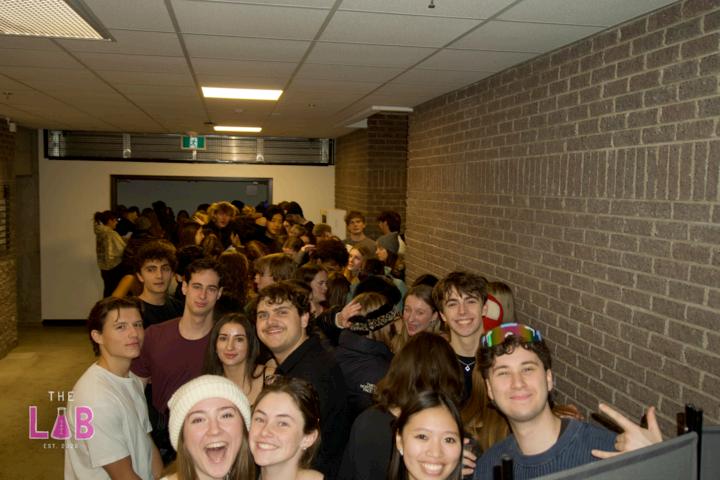
After months of launch rumours, McGill’ s oncefabled, first-ever science student bar is here. On February 6, hundreds of students across faculties waited in the basement of the Burnside building for the chance to grab a drink with friends and classmates. A project of the Science Undergraduate Society (SUS), thebaroperatesonFridaysfrom 6 to 9 PM, every other week, in rooms 1B17 and 1B18. All McGill students are welcome to attend.
“It’s all very exciting, to finally have this,” SUS Vice President External Hadrien Padilla, thirdyear Computer Science student and primary organizer of The Lab, said in an interview with the Daily Asciencestudentbarhasbeen a work in progress for over four years. Prior students in SUS’ s VP External position made efforts to organize a faculty bar, butlogisticalcomplicationskept the idea from materializing.
“The problem that we’ve always had is that we don’t have a good space, ” Padilla told the Daily “Arts has their basement, same for Engineering, and Management as well: they all have really large spaces with limited exits.
” The Burnside basement had been the ideal location for a Science-faculty bar, but using the entire open space would have been a fire hazard. Last year, two adjacent Computer Taskforce rooms were reallocated to SUS, which inspired Padilla to present the ideatotheSUSexecutiveboard.
“It wasn’t the most popular idea, using two study rooms of limited size in the basement of an academic building,” Padilla told the Daily. The SUS executiveteambegandiscussing The Lab over the summer, and hadpreparedtopresenttheidea to the McGill administration by September. Getting the idea off the ground required discussions between SUS executives and McGill staff, including McGill’ s Burnside building director, the Spaces Administrator, and administrators from the Science Faculty’s student affairs office andSecurityServices.Afterfour months of emails, meetings, and negotiations, the idea was approved and planning for openingnightbegan.
The Lab is run by SUS’ s preexisting after-hours committee –
whichexistsyear-to-year,planning after-hours events – including Padilla, directors Ella Rikley and Madison Brass, and five coordinators. There are currently 30 student bar staffers, as well as multiple staff photographers.
Padilla stressed that organizing TheLabandpreparingforopening nightwasajointeffortacrossSUS:
“I’ve been lucky to get a lot of supportfromeveryonewho’sbeen willing to help wherever it’ s needed,” he told the Daily “It’ s beenaverycollaborativeprocess.”
The Lab’s doors opened only three and a half weeks after being confirmed for operation, a feat Padilla attributes to “ an incredible, dedicated team.” An estimated 300 to 500 students came to the basement on opening night. Some waited for over two hours, and many who packed into the adjacent stairway reported line-cutting and rowdy crowds. The organizers, who had an hour to set up the room, did not realize how many people had congregated until the bar was ready to open. For future events, the committee plans to schedule staff to monitor the line during and before opening hours. “The capacity is limited, so we try to work the best we
can, ” Padilla said. “We definitely had at least twice our capacity show up, which was a little bit intimidating. It was a little scary, butthingsweregoodintheend.”
Organizing a student bar is a large undertaking, especially for McGill’s second-largest undergraduate faculty. “There was a lot to do, and very little time to do it. I think everyone really learned how to be overwhelmed and yet still take one thing at a time,” Padilla told the Daily. He added that the launch has also been a learning experience for those involved within the SUS executive committee,andworkingtogether to set up The Lab has been another instance of successful collaboration to serve the needs of the Science faculty. “Being thoughtfulinourcommunication and including everyone is the biggest thing that we’ve learned, but I think that’s something that theSUSteamisreallygoodat.” Ultimately, Padilla reported thatopeningnightwasasuccess: they opened, served drinks, and closed without any incidents or destruction to the basement. Beyond the primary goal of havingfun,theteam’saimforthe bar’s initial nights is “to show SUS, admin, and all the parties
“It’s a spot that you can go, as Science students, every other week, or every week in the future, and know you’ll have friends there.”
-
involved that this is something that can work.” Padilla described this semester as a “proof of concept,” a demonstration that the space can bring the faculty together safely without disruptions. The Lab’s biweekly schedule was designed for the committee to troubleshoot between events and learn from any setbacks or unexpectedchaos,throughtheir own observations and their anonymous feedback form. The team hopes for the schedule to shift to weekly in the upcoming Fall semester, once staffing and routinearesolidified.
The Lab will be open five times this semester, including this Friday, February 20. The
Hadrien Padilla
concept – drinkingawarm,twodollarbeeroutofaplasticcupin a crowded basement – is shared among McGill’s other student bars, yet The Lab was designed by and for McGill’s Science undergraduates as a place for the community to come together. “It’saspotthatyoucan go, as Science students, every other week or every week in the future, and know you’ll have friends there and people from your faculty that you can hang out with,” Padilla told the Daily “I’ve heard from a lot of people that they’re super excited to finally have their own space, ad Ihopeitcontinuestobethat.”
Image courtesy of Hadrien Padilla
TAL Recommendations and Rent Inflation in Montreal
Rent increase recommendations heighten concerns over tenants’ rights and housing security
Aurélien Lechantre Staff Writer
OnJanuary21,Quebec’shousing tribunal, the Tribunal Administratif du Logement (TAL),issuednewrecommendations to increase rents by 3.1 per cent for leases renewing between April 2, 2026andApril1,2027.Thetribunal recommendedthattherentforleases renewing April 1st or earlier be increasedby4.5percent.Fortenants who have services like meals, nursing, housekeeping or medical assistanceincludedintheirrent,such as seniors, this surge is intended to amount to about 6.7 per cent, accordingtothenewTALguidelines.
The 2026-2027 recommendations were determined by the TAL using a new method of calculation. With the
Good People
oldformulaprovinginefficientinpostCovid years, the new formula takes inflationandpreviousrentpricesinto account. While Eric Sansoucy, spokesperson of the Corporation des propriétaires immobiliers du Québec (CORPIQ) representing Quebec landlords, told the Montreal Gazette that “the balanced solution is at inflation,” ithasbeenshownthatifthe new formula had been applied to preceding years, excluding 2025, the TAL would have predicted a much steeper increase in rent over the past two decades. Thus, tenants associationshaveprotestedagainstthe newrecommendations,withShannon Franssen, interim coordinator of the Coalition of Housing Rights Committees of Quebec (RCLALQ), declaring to CTV News that the new TAL formula contributes to an
“inflatory spiral” of rent prices. Franssen explainsthat,seeingasthe new calculation takes previous rent prices into account and rents have increased for the past few years, “rentsaregoingupandjustifyfurther rentincreases.”
The Canadian Mortgage and Housing Corporation (CMHC) reported that in Montreal, despite an overall easing in the market, rents increasedby7.2percentin2025 a number significantly above the TAL’ s 2025-2026 5.9 per cent recommendation. Steve Blair, community organizer for the Quebec CoalitionofHousingCommitteesand Tenants' Associations (RCLALQ), remarkedtothe Dailythatrents “often goupfasterthanthe[predicted]rate.” Blairexplained thatitisoftendifficult topreventlandlordsfrombumpingthe
prices up as “tenants either don’t refuse, or can’t refuse, or there is a changeintenants.”
This7.2percentincreaseoutpaced the overall increase in income, meaning housing became even less affordableformost.Theeasinginthe market that the CMHC describes is partly due to a rise in new, largely unaffordable, residences, while affordable units remain desperately scarceandareevendisappearingfrom Montrealwithfurtherrentincreases.
It is in this context of already unaffordablehousingandheightening prices that the TAL recommended a 3.1 per cent increase for the year to come.Blairdescribedthisincreaseas only slightly “less bad than last year,” which he had characterised as the “worstyearonrecordbyfar.” Nevertheless,theseTALguidelines
are only recommendations. As a tenant,youmayrefutetheincreasein rentifyoudeemitunfairorunlawful. Initslastfiscalyear,theTALreceived 22,494requeststosettlearentdispute. Resources provided by the RCLALQ allowMontrealtenantstomoreeasily calculate how much rent may increase,howtorefuserentincreases, and what procedures to follow afterwards. Syndicat des locataires autonomesdeMontréal (SLAM), the autonomoussyndicateoftenants,also provides support for tenants seeking help or suffering from abusive landlords. The collective actively protested against the new TAL recommendationsonJanuary29and helpedbuildtenantunionsinthecity. Amidst rising rent prices and unaffordablehousing,itisimportantto rememberthattenantshaverightstoo.
“Swimming With a Mission”: Using Sport for Good
Student-run non-profit provides affordable swimming lessons for children with disabilities
Enid Kohler Staff Writer
Good People is a biweekly column highlighting McGill students doing community-oriented work on and around campus. Because it’ s important to celebrate good people doinggoodthings.
Founded in 2009, Swimming With a Mission Montréal (SWAM) is a registered nonprofit organization led by student volunteers.Achapterofthenational organizationSWAMCanada,itseeks to provide affordable and accessible one-on-oneswimminginstructionto childrenwithdisabilitiesaged3to18. Instructors are paired with one swimmer for the course of the eight week program. Every week, they teach 30-minute lessons with the ultimate goal of fostering the children’sconfidenceinthewater.
The McGill Daily spoke with coPresidents Anna Bogdan, U3 Psychology,andBenjaminLévesque Kinder, U3 Neuroscience. We discussed their motivations for joining SWAM, making sports accessible, and the power of swimming to transform how children with disabilities move throughtheworld.
This interview has been edited for clarityandconciseness.
EnidKohlerforTheMcGillDaily (MD): I want to start by learning more about your involvement with SWAM. Why and how did you join
theorganization?
Benjamin Lévesque Kinder (BLK): Igotinvolvedinthewinterof my first year. I had been a camp counselor many summers in a row during high school, giving swim lessons to kids. One week, I was assigned a girl who had an undiagnosed autism spectrum disorder.Hersupportneedswerevery high,muchhigherthanthecamphad the resources for. She loved swimming.Wejustwanderedaround thewholeday.Itwasawesome.When I came to McGill, I learned about SWAMatActivitiesNightandknewit wassomethingIwantedtodo.
Anna Bogdan (AB): I’ve been a competitiveswimmersinceIwasvery, very small. When I was injured, I transitionedovertocoaching.WhenI came to McGill I really wanted to continue.IwenttoActivitiesNightand saw that there was a club that was offeringswimminglessonsforchildren withdisabilities,andIthoughtitwasa great way for me to continue my coaching experience, but also to help outthecommunityinMontreal.
MD: Youbothmentionedyoufound out about SWAM at Activities Night. As co-presidents, how would you pitch your club to a prospective studentmemberatActivitiesNight?
AB: SWAM offers swimming lessons to children with disabilities. Typically, a swimming lesson for a child with a disability is upwards of $300, but our lessons are about $45.
We're about the only place in Montreal that offers lessons at this price. You're partnered up with just oneinstructorfortheentiretyofeight weeks, every single Sunday for 30 minutes. You see your child become more comfortable in the water and have more confidence in their own abilities, and become more engaged andhappyoverall.
MD: Youalreadytouchedonthisin your response, Anna, but why is SWAM important? Why is it importantthatitexistsinMontreal?
BLK: Thereareafewreasons.This isademographicforwhomit’shard to get exercise. Getting out of the house and doing activities can be difficult for those with sensory issues.SWAMisconsciousofthis:we havealotofstaffandproceduresset up.We’vehadparentstellusthatit's one of the few places that they can justbesomewhere. Akeyreasonisaffordability.Mostof the population cannot afford hundreds of dollars of swim lessons every week. We have a lot of new arrivals to Quebec in our program, peoplewhoarriveinCanadaandhave children who are newly diagnosed, andnowtheyhavetoadaptnotonlyto anewculture,butalsowhatitmeans togettherightsupportfortheirkids. You show up, and none of your concerns matter to anyone here. It does become sort of trivial. As a student, you’re thinking about graduation and graduate school in theseverylongtimespans.AndthenI go to SWAM, and you're making
progress on a week to week basis. I thinkthatisrefreshing.
MD: On that note, what have you learnedfromyourworkwithSWAM thathasinfluencedyourownoutlook onlife?
AB: Forme,oneofthethingsthatI learnedisthatprogressisnotalways necessarilylinear.Itrequiresalotof patience and it requires a lot of confidence within yourself. I’ve also learned how important it is to make sure that you're always there to supportandencourageeachother.
MD: What is your vision for the futureofSWAM?Whatdoyouhope children will take from their swimming lessons and apply into theirfuturelives?
AB: WehopethatSWAMislikea stepping stone to the rest of their lives going forward. We’re hoping that these children not only have more skills to be safer in the water, but also hope they can build other skills for example, social skills and communication skills to be able to create meaningful connectionswithothers. Itwouldalsobeniceatsomepoint to build a relationship with the SpecialOlympicsinQuebec.Itisabig problem in the disability space that once you age out, resources go to zero.Theamountofmoneythatgets puttowardsprogramsforchildrenis huge, but once they turn 18, it's all over. We also hope to expand the chaptertoreachmorekids.
MD: The theme of this column is “good people doing good things.” In the context of your work with SWAM, what does being a “good person ” meantoyou?
BLK: By virtue of our position, Anna and I have become the spokespeople for SWAM. But really, we ’renotthegoodpeople.Thegood people are really the almost 100 instructorswhocomeineveryweek. It's not easy getting up on Sunday morning at 9 AM to trudge through snow,todothisforsomekid,inacity youshowedupinlessthanayearago. Without all of them volunteering theirtime,AnnaandIwouldbetwo people with a logo. SWAM is the teamwehavebehindus.
AB: Although Ben and I are the heads,typicallytheonesthatmakethe most amount of difference in the community are our instructors. So I thinkbeingagoodpersonisbeingable tohelpothersout.Asauniversity,we have all of these services and resources, so why not use them to serveunderservedpopulations?
To learn more about SWAM and opportunities to get involved, visit swammontreal.ca or @swammontreal on Instagram. Read the full interview onwww.mcgilldaily.com.
End note: If you know good people doinggoodthingswhoyouwouldliketo see featured in this column, email news@mcgilldaily.com
February 16, 2026
mcgilldaily.com
McGill Students Rally Against ICE
ICE Out MTL brings hundreds together in front of the US Consulate to call for an end to ICE and Canadian complicity in US immigration crackdowns
Justin Friedberg News Editor
Betweenroadworkfencingand theUSConsulate,aroundtwo hundred people packed onto the frozen sidewalk of Rue SainteCatherine at 1 PM on Sunday, February 1, to protest immigration raids by US Immigration and Customs Enforcement (ICE). This demonstration, dubbed ICE Out MTL, came amidst waves of internationalcondemnationofICE set off by the January killings of two American citizens, Renee Nicole Good and Alex Pretti, by ICE agents in Minneapolis. Advertised as a family friendly gathering “in solidarity with Minneapolis against fascism everywhere,” ICE Out MTL was organized by Indivisible Québec, the Immigrant Workers Centre (IWC-CTI), and Democrats atMcGill.
Approached by ICE Out MTL organizerscladinbrightorangeand neon green vests, protestors and passers-by were offered a slip of paperthataskedthequestionmany in Canada have been struggling with as the US seems to spiral: “WhatcanwedofromCanada?” One such person was Jacob Wesoky, president of Democrats at McGill, whomthe Dailyinterviewedpriorto theprotest.AsanAmericanabroad, Wesokycitedcombattingthissense of hopelessness as a driving force behindhelpingtoorganizeICEOut MTL: “TherearealotofAmericans here, and it's easy to feel powerless watchingallofthischaosfromafar. ButinCanada,we'renotpowerless. Westillhaveavoice.”
Olivia, a second-year McGill student who braved the -10°C weather to join the protest, indicated a similar sentiment: “I wish I could participate in all theprotestshappeningintheUS right now. It’s really hard to see everything going on from here and feeling kind of helpless.”
In addition to calls for the abolishment of ICE, bluntly referredtobyonespeakerasthe “new American gestapo,” ICE Out MTL was also intended as a wake-up call for Canadians. As such, Wesoky outlined the details behind Indivisible Québec’s demand in their preprotest press release to end “Canadian firms’ complicity” in financing ICE. His examples ranged from post-secondary institutions like McGill to firms based in Ontario, Quebec, and British Columbia.
“McGill holds over $2.2
million in investments in Palantir, the AI surveillance company that's behind ICE's immigration crackdown and the illegalsurveillanceofmillionsof Americans. Ontario-based Roshel supplies armoured vehicles to ICE. Montreal-based GardaWorld staffed Florida's Alligator Alcatraz, which was the site of some of the worst human rights abuses in modern American history. Vancouverbased Hoopsuite provides social media services that amplify ICE's propaganda.” Exemplified by chants of “Quebec stop funding ICE’s crimes.” Participants of ICE Out MTL made it clear that they would not tolerate Canadian complicity in funding and supplying ICE. At around 1:30 PM, protestors were led around the corner to Dorchester Square, where they were presented with a QR code to contact their Members of Parliament in support of the No More Loopholes Act. The bill, first proposed in 2025, seeks to
tighten export restrictions for Canadian arms manufacturers. As the website linked in that QR code puts it, the hope is that the No More Loopholes Act will stop the Canadian funneling of “unrestricted and unregulated arms to Trump’s illegal wars, ICE’s campaign of terror, and Israel’s ongoing genocide.” Their breath floating into the cloudless sky, the multigenerational crowd assembled in Dorchester Squarecheeredandjeeredasvested organizers, including Wesoky and IndivisibleQuébec’sMichaelLipset, delivered passionate speeches against ICE and in support of immigrants and those protesting in Minneapolis. Lipset, a Montreal resident originally from Minnesota, comparedTrump’sAmericatoNazi Germany and declared, “This is not about border security. This is about statepowerwithoutconstraint.” Wesoky made a direct appeal to Canadian Prime Minister Mark Carney in his speech, referencing Carney’s widely covered Davos address: “Part of taking down the sign from the
window, part of no longer living within the lie, is recognizing the reality in the United States right now. [...] If Canada is the beacon of hope and freedom that you say it is, then Canada will open its doors and protect the rights and dignity of migrants and asylum seekers.” Wesoky also called for an end to the Safe Third Country Agreement (STCA) between Canada and the US, which requires refugee claimants to request protection only from the country they arrive in: “[The STCA exists] under the premise that the United States is a safe country forimmigrantstoseekasylum.[. ..] The United States does not respect immigrant rights.” At around 2:30 PM, protestors walked back to the cramped sidewalk in front of the US Consulate. Despite a reduced headcount, the crowd resumed loudly chanting, shouting through megaphones, and holding up their signs. Refusing to go unnoticed, one person rattled a green tambourine,
while another blew through a harmonica. Half an hour later, just before the scheduled end of the demonstration, ICE Out MTL organizers thanked those still remaining and made a final appeal: “Keepmakingyourvoice heard. Keep showing up.”
ICEnowhasthelargestbudgetof any US law enforcement agency in history.Nevertheless,Wesoky,who began efforts to protest against government-sponsored brutality by organizing a walkout at his middle school following the 2018 Parkland school shooting, remained undeterred. In organizing ICE Out MTL, he hoped Americans back home could see that “the world is noticingwhat'shappeningintheUS, and we're not going to sit back and justwatchithappen.”
Justin Friedberg | News Editor
& CULTURE
Towards Improved Disability Representation in Tech
Dismantling dehumanizing stereotypes and providing individualized visibility
Kayla Gaisi Sci+Tech Contributor
Adobe Firefly is a text-toimage (TTI) model that generates images based on descriptive prompts from users. For each prompt, Firefly produces four images, which can be further tailored according to visual characteristics such as composition, lighting, and color. Users also have the opportunity to browse a gallery of community-generated images or edit their own images through additional prompting. Once generated,imagescanbeusedfor personal creative projects, educational purposes, or commercialwork.
February 16,
To identify the particular kinds of disability bias in Firefly, I spent three days engineering prompts, feeding them to the model, and analyzing the outputted images within the frameworksofexistingliterature.
Almost immediately, I noticed that unless behind so that her face remained obscured. With her face hidden, the assistive technology (AT) of the wheelchair became the subject of the image, not the girl. The image’s bleak setting also indicated Firefly’s tendency to consign people with disabilities to strict categories of loneliness, idleness, and medicalization. Implicit in such categories are tropes that disabled people are helpless,isolated,andconfinedto medicalfacilities.
When I prompted Firefly to generate images depicting a group of people with a variety of specifieddisabilities,otherissues
As TTI models become increasingly ubiquitous in variousfields,fromadvertisingto education,mostcritiquesofthem have been limited to examinations of gendered, racialized, and cultural biases. These critiques often observe how AI underrepresents specific races and non-Western cultures or associates certain professions with certain genders for example,identifying “ nurse ” with “ woman ” and “doctor” with “ man. ” While these biases are important to address, it is also necessary to consider the oftenneglected issue of disability bias, which Firefly perpetuates through its scarce representation of disabled people and its reliance on harmful tropes when itdoes.
persisted. These included the inaccurate rendering of AT and the abundance of visual artifacts, which are unintended errors in the images that consequently misrepresent disabilities. For example, in one test image, a presumably blind woman walks down a park path carrying two canes in her right hand, while holding up an anatomically distorted left hand, perhaps intended to indicate sign language.Thisresultwasnotjust inaccurate, it bordered on absurd. In classrooms and public materials, subtler cases of misuse have the potential to mislead those unfamiliar with ATs about theirproperusage.Theincreased presence of visual artifacts in images of disabled people, as comparedtothoseofable-bodied people, also appears to dangerously conflate nonnormative bodies with model errors.
For Adobe to mitigate the biases I encountered when testing Firefly, they must address the poor representation of disability in their training data.
In his book, The Alignment Problem, programmer Brian Christian notes that “bias in machine-learning systems is
often a direct result of the the data on which the systems are trained making it incredibly important to understand who is representedinthosedatasetsand to what degree, before using them to train systems that will affect real people.” Given the socialconsequencesofinadequate representation, it is imperative that Adobe gather higher quality data that includes diverse and positive portrayals of disabled people and ATs. This may pose a challengetoAdobe’sprudentdatagathering approach, as they only use content that is licensed or in the public domain, and compensate creators who contribute their work to Firefly’ s training. However, for a company the size of Adobe, I believe that licensing more high-quality data withtheintentionofreducingbias would be a worthwhile and attainablepursuit.
As AI-generated images increasinglycirculateinthemedia and are utilized as educational tools,theirpotentialtoexacerbate existing disability bias is of growing concern. Yet, as ethics scholar Nicholas Tilmes points out, disability as an identity is sociallysituatedandirreducibleto biology, granting it the allowance to be imagined differently. If TTI models like Firefly are corrected for their biases, they can be instrumentalized to reimagine disability in a more just way one that supplements existing representation by dismantling dehumanizing stereotypes and providing individualized visibility.
Thatbeingsaid,moredataisnot always better. The number of human evaluators who assess datasets, along with their training and interrater agreement, plays a crucial role in shaping the reliability of datasets and the validity of their corresponding models. Importantly, human evaluators do not process information in a decontextualized manner; rather, their embodied experiencesinformhowtheylabel data. Considering this, Adobe must use this subjectivity as a means of decreasing bias in their training data; a goal that can be achieved by employing people withvaryingdisabilitiesashuman evaluators. Equipped with valuable personal experience, these evaluators could assess subtle biases in the data and offer accurate, community-specific insights about authentic representation.
The Digital Camera’s Revival is About More Than Nostalgia
It has to be. How can Gen Z be nostalgic for a time we didn’t live through?
Sophie Kuah Culture Contributor
Newsoutletscan’tseemtostop asking, “What’s with the resurgence of point-andshoot digital cameras?” Nowhere is the trend more visible than among GenZ.Thesepressagenciescometo more or less the same answer: nostalgia.
For the last few years, many have discussed the popularity of pointand-shootdigitalcameras,aswellas Polaroid and film. In 2024, CBC reported that #digitalcamera on TikTokhadover287,000posts.This hashtag has now amounted to over 669,000 posts. In an interview with BBC, Scott Ewart, a TikToker who hasgainedafollowingforhisdigital cameracenteredcontent,said: “Alot of folk find [digital cameras] quite comforting.Itremindsthemoftheir childhood, it reminds them of simplertimes.”
To me, it seems like the digital cameratrendisonecomponentofa larger counter-culture movement against the pervasiveness of social media,withthedigitalcameraitself being a mode of accessing the techno-optimist 90s and 2000s. Similarly,wheninterviewedbyCBC, SofiaLee,aco-founderof@digicam. love,said: “Ithinkit'sironicthatGen Z is stereotyped as being the most
logged-on generation, when a lot of their countercultural tech practices indicatetheneedtobreakawayand create a space that is separate from theinternet.”
But these nostalgic narratives are notthewholestory.
How can the digital camera be an actofresistanceagainstBig Techif, after all, digital camera photos are trendingonsocialmedia?And,how canGenZbenostalgicforatimethat manyofusdidnotlivethrough?
Two potential explanations could justify the claim that Gen Z are resistingBigTechbypostingdigital camera photos on social media: eitherGenZisnotactuallytryingto resistsocialmedia,orthey’rejustnot very good at it. In a video, Eugene Healy (@eugbrandstrat on Instagram), an educator and brand strategyconsultant,hasdevelopeda theory of “the fear of becoming an NPC,” (or,ifyoudon’tknowtheGen Z slang, the fear of not having any unique opinions or interests) an explanation that can be applied to the case of digital cameras. Healy arguesthatsocialmediauserssharea deep-seated fear that we are losing control over our identities to social media algorithms. This has been partially the result of often hearing expertslectureusonhowcompanies usebehaviouralsciencetomaximize profits. Gen Z are especially vulnerable to this because most use
social media; according to a 2024 report,84percentofCanadiansages 16 to 24 use Instagram, not to mentionthatwedon’tknowaworld without it. The idea that by using socialmediaweareessentiallybeing controlled by it, undermines our understanding of ourselves as individuals.Theideathatwemaynot be able to truly know ourselves because the algorithms are doing it for us is frightening. So, out of fear that social media will replace our unique tastes with whatever is trending, many of us try to reclaim control by engaging in what Healy calls “active, albeit algorithmicfriendly[forms]ofresistancetothat notionofbeingmanipulated.” Forexample,the “propagandaI’ m notfallingfortrend” includesalistof phenomena that social media users think are false, overrated, or ridiculous.Inthisway,usersequate social media trends with “propaganda:” a trend which has increasingly gone viral. Healy’ s theoryseemstofitwellwiththisnext student’s account of their relationship with their digital camera. A student at Toronto Metropolitan University told The Daily that digital camera photos were a feature of certain alternative subcultures a few years ago. By participating in this kind of photography, he separated himself from mainstream culture. He stated
that “[digital camera photos] make photos [on Instagram posts] stand outfarmorecomparedtothephotos that ‘normies’ were taking [on iPhones].” While digital camera photos could set us apart from others,peoplefrombothmainstream and alternative cultures are still unitedbypostingonsocialmedia. Therefore, to say that Gen Z is resisting Big Tech by using old technology isn't quite right. However,it’salsonottruethatGen Z isn’t trying to resist Big Tech. In my experience, it’s just hard to say no to social media because of FOMO.
Many journalists covering the resurgence of digital cameras have argued that the trend is part of the call back to nostalgia. But how can thisbetrueforGenZifsomanyof us grew up after the period from 1990totheearly2000swhendigital cameraswerethemostpopular? Oneansweristhatdigitalcameras are reemerging as a result of diminishing cultural cycles. Based on historical patterns, the fashion industry came up with what they called the “20-year rule” in which trends repeat because of the renewal of a 20 to 30-year cultural cycle: the previous generation that grewupwithcertainculturalitems now has the income and influence to shape the market. In short, what’s in style will go out of style
but come back a few decades later. Nonetheless,NationalPublicRadio (NPR) noticed that culture doesn’t really cycle so much anymore, but has exploded on social media. Rebecca Jennings, a senior correspondent for Vox who covers internet culture, told NPR that "TikTokhasaweirdwayofmaking everysinglethinginstyleatonce.” By this explanation, everything that was once popular is trending again on social media, including digitalcameras.AsGenZaresome of social media’s most regular users, this has mostly been documented through our generation.
If any of these explanations resonatewithyou,I’mveryglad.At thesametime,it’shardtosayIcan imagine all of them being applied universally. After all, a digital camera is a digital camera, and peoplehaveallsortsofreasonsfor taking pictures with them. Many who were interviewed insist that they simply love the way the camera captures light, creating stunningfadedcolours,ortheway it inconveniences them just enough to slow them down and makethephoto-takingprocessmore intentional. Whatever your reason, it’s worth thinking about how your context might influence your relationship with the point-andshootdigitalcamera.
Isabelle Lim Culture Editor
inge, Tinder, Grindr, Bumble. Among others, these names have become all too familiar to us.
From TikTok POVs to the anecdotes passed around our social circles like ghost stories, dating apps have slowly but surely become an integral part of our generation’s dating landscape.
I never thought I would get on the apps, more specifically Hinge. However, seeing an Instagrampostabout “datingas an anthropological study” inspired me. Being in a city where I knew nobody and nobody knew me during a reading week trip made for a
dehumanizing experience of beingonadatingapp.
At some point, swiping becomes mindless. You might start out looking through someone ’s entire profile, pictures and prompts and all, then come to as objective of a decision as you can given the limited information you have about this person. Hundreds of profiles later, though, you’ ve seen enough. Just the first photo, maybe the second, suffices to make a decision. It even becomes a game: my roommate called it “playing Hinge.” We’d sit together, gazes fixed on my phone screen, and swipe through tens ofpeopleatatime.Itwasquite hilarious how our reactions started to sync: “ nope, ” “next,”
If dating apps are the answer,
someone was probably swiping onme.Theywerealsoprobably forgetting the few details they had learned about me in that very same second, my face blurring into just one of thousands in a continuous, unfeelingswipe.Icouldn’teven blame them: I was doing the exact same thing. Each of us equally the perpetrators and victims of our mutual judgement. Finally, I happened to walk past one of my failed Hinge talking stages on the street while he was with a friend. In the split second in which I passed him and heard him speak, I was taken by surprise by his thick European accent since he had never mentioned it. Not that the accent
It even becomes a game: my roommate called it “playing Hinge.”
these are meaningful experiences, and maybe I’ll writeaboutthemanothertime.
The main point of this piece, however, is the viscerally
themselves online versus in personslowlybegantosolidify. I realized that somewhere within 20 kilometres of me, likely at that very moment,
This prompted further introspection on my end: who was I? Was my profile at all representative of who I was, or justacarefullyprojectedimage
kind of connection we even wantinthefirstplace?
This is not to say that one cannot find love on the apps. I know loving, long-term couples who have met there. I also do not mean to sound like an anti-dating app prude; I have, after all, been on them. I take issue not with the apps
confidently say that, had we come across each other on a dating app, we would have swiped on each other. This is not to mean that attraction is absent,onlythatitgrows;with proximity,withtime,ingetting toknowthem.Andisn’tthatthe beauty of connection? Letting someonesurpriseyou?
So,asobviousasitmaysound,
It seems cheesy, maybe even dumb; an empty platitude that offers no real help at all. You might even roll your eyes I getit,I’vebeenthere.Buttruly, inthequestionofhowtoaccess the love that seems to be everywherebutalsoincreasingly out of reach, I posit that you, perhaps,aretheanswer.
Adapting Antigone: A Discussion with the Director and Writers
A 1920s spin on one of Ancient Greece’s most political plays
Justin Friedberg News Editor
An hour before the closing performanceofthe2026McGill Classics Play Antigone on February7,the Daily interviewedthe show’swriteranddirectorMadelyn Mackintosh (MM) and co-writer CarolineLittle(CL).
The following interview has been edited for clarity and conciseness.
Justin Friedberg for The McGill Daily (MD): How did you guys get involved with the Classics Play? Whatwasthedevelopmentprocess likefor Antigone?
Madelyn Mackintosh (MM): We were taking [History and Classical Studies Associate Professor] Lynn Kozak’s Greek myth class together last year (romantic). I wanted to direct again and we were in class when Lynnsaidtheywerelookingfora director. I had heard of the
ClassicsPlayandtheGreekmyth classwasinteresting.Ialsoknew I'd be working with Lynn, who runs the Classics Play and is lovely and wonderful. I was drawn to Antigone, given the geopolitical context [of late February last year when we startedworkingontheplay,asat the time] Trump had just been inaugurated. So I asked Adam Zanin if he would do a raw translation of the Ancient Greek text, which he did over the summer, and Caroline if she wouldhelpwiththewriting.
A big part of the division of labour between Caroline and I was how to structure [and restructure] the show as a contemporary play as opposed to the original Sophoclean text. That restructuring element was me. I come from a politics background and Caroline comes from a writing background. A lot of the show is an ethical debate between the characters, so I can do that, I can speak and write
[effectively] like a politician. But when it comes to the storytelling pieces, that is where I need Carolineverydesperately.
Caroline Little (CL): You had a dream,Imadeitreal.
MD: During that writing process, how did you approach adapting the playforacontemporaryaudience?
MM: We joke that they had just invented theatre. There’s a lot of distance between what you would expect from a play today and how they did it. Some of that is cultural. In Ancient Greece, you weren't allowed to show death on stage. We wanted to reintegrate some elements of the story that were recounted off stage. The original text is similar to myth. There'll be gods introduced in the story but they assume you know the context and they aren't explored further. There are several characters that I think are underused Antigone’s sister is a great
Courtesy of Naomi Meyer
example of this. In the original text,sheactsasafoiltoAntigone in the first third of the show and thenvanishes.
CL: Now she ends the show on a massive monologue that I felt guiltywriting.
MM: Also, this is a hefty show. I hope it feels like we’re depicting a tangible form of tyranny. It's one thing to play a maniacally evil character like a Disney villain it’s another to play somebody who’s evil in a way thatyoucanlookinthenewsand see[thattheyare]hurtingpeople rightnow.
MM: Stephen Miller was the biggest influence for Creon's voice. I don't know that I hate anyone more than Miller. Part of the rationale for that is he's not dumb.He’sanintelligentformof evil who can articulate why he hates immigrants, people of color, and gay people. It was important to me that Creon felt like a real person with realistic motivations and traits and some softnessorhumanityinplaces.
CL: I think it's a lot worse when villainshavehumanity.It'seasier to hate people who don't seem like you at all. This show operatesalongthegrayarea.
MM: In staging the show, I wanted theaudiencetofeellikethecitizenry of Thebes. If you saw this injustice, whatwouldyoudo?Wouldyouspeak up?Wouldyoutellwhatyouthinkis thetruth,evenifitrequiredsacrifice?
MD: Speakingofstaging,whyset theplayinthe1920s?
CL: We were influenced by the WeimarerainGermany,atimeof rapid progressivism. Germany was pro gay and trans. Marlene Dietrich, who inspired Antigone's costuming, was openly bisexual and operated in gay clubs. You wouldn't think that came right before World War II. Unfortunately, I think we're seeing a lot of that now fromthe2010sintothe2020s:an explosion of progressivism and thenarapiddeclinebackintoaltrightthinking.
MM: A big part of the show, in
my view, is about cycles of tyranny and violence and how cruelty begets more cruelty. I'm fascinated by the notion that we can give this almost 2,500 years old text the aesthetics of the early 1900s and some of the language of today and it still makes sense. Asking people to think about that lineage of tyranny was part of the goal. Another important thing to me about the show is I think Antigone is driven by love. It sometimes sounds silly or cringey, but I think empathy is thestrongestantidotewehaveto the form of tyranny that we see on the rise today. I don't think it is a coincidence that this was the show that came out of a writing partnership with the person I've been dating for three years. I think it allowed some of the love that the characters share for one another to be expressed in the textmoreclearly.
CL: It’s important these texts aren ’tstudiedinavacuum.These stories are still relevant. When you study them in a library or conference, you forget that people wrote and performed them, that it touched them in a certain way. I think it's important that these shows continue to be staged and it's great work that Lynn is doing to make sure that happens. It's really important to hear something. You can't know if a poemisworkinguntilyou'vesaid it out loud, and I think it's the samewiththeatre.
Antigone ran from February 4 to 7, 2026 in the Grand Hall of Montreal's Le 9e.
February 16, 2026 mcgilldaily.com |
The Death of the Rom-Com
Is the Hollywood rom-com dead, or are we falling out of love with it?
Julia Apitz-Grossman Culture Contributor
Something is in the air in the movie world, and it isn’t love.
For decades, romantic comedieswereaHollywoodstaple, drawing audiences in to laugh, cry, and believe, even just for a couple hours, that love could conquer all. When Harry Met Sally, How to LoseaGuyin10Days,Sleeplessin Seattle,LoveActually;thesemovies did more than just entertain, they contributed to a genre of classics thatisbecomingrelativelyhistoric. There’s something about classic rom-coms that make us feel overwhelmingly comforted and happy.Viewersaretransportedtoa dream-like reality: charming bookstores, cozy cafes, and picturesque city streets. Many of the aforementioned iconic romcoms emerged in the 80s, 90s, and early 2000s before the era of smartphones and social media, before the digital age reshaped meet-cutesfromrun-insatgrocery stores to matches on dating apps. Seeing as peak romance seemed to exist in movies at this time, was love somehow easier, or was life simply better before technology took over our lives? This is a question I find myself returning to often,alongwithacertainnostalgia foralifestyleIneverexperienced.I think this is partly why that era of
rom-coms is so widely loved. In many ways, they are windows into aversionoflifethatnolongerfeels easily accessible. Whether or not the past was truly more romantic, these films offered audiences a visionofconnectionthatfeltwarm, hopeful, and deeply human qualities becoming increasingly rareintoday’scinematiclandscape.
In contrast, recent additions to the romantic comedy genre have been wiped of this dreamy quality. Films like Anyone but You and Ticket to Paradise did achieve streaming popularity, yet few have embedded themselves into our long-term cultural memory in the way that earlier films did. Today’ s romancemoviesoftenleanintothe drama of it all, emphasizing emotional conflict, messy “situationships,” or the toxicity of modern dating rather than the hopefulescapismthatoncedefined thegenre.Visually,manysharethe now-familiar “Netflix lighting” making movies feel interchangeable and somewhat bland, contributing to the sense that these films lack the sparkle theyoncewereadmiredfor. These changes in production might reflect a change in audience preferences, indicating perhaps that people find cynicism more entertaining than romance itself. However, even more compelling is thequestionofwhetherthesefilms
simply reflect the realities of modern dating, where traditional grand gestures such as sending flowers in the mail, running through a city to confess love, or showing up unannounced to express one ’s romantic feelings have become increasingly rare; or whether the media we consume is quietly steering audiences away from imagining romance in these waysatall.
Theatrical rom-com releases have declined significantly, in part because the genre typically falls into the mid-budget category ($550 million) that studios now considerfinanciallyriskycompared toblockbusterfranchises.Asfewer of these films are produced and promoted, their cultural influence also diminishes. What are the effectsofthisdecline?
Rom-coms help keep classic romancealiveandhavehistorically acted as social examples for courtship, modeling communication, vulnerability, and intentional actions. Audiences may therefore lose exposure to the emotionalopennessandthoughtful gestures that are the backbone of a healthy relationship. These are especially important for youth to internalise, as they lack romantic experience at a young age and might require models of successful relationships outside of their immediatefamilies.
More simply, rom-coms are fun to watch. They’re the perfect thing to wind down to after a stressful day at schoolorwork.Whilepsychologically compelling romantic dramas can be entertainingattimes,theyjustdonot producethesamewarm,cozyfeeling.
Psychological research on romantic media suggests that its influence is complex. Some scholars argue that romance films can reinforce unhealthy expectations, encouraging the belief that individuals are “incomplete” withoutapartnerand reinforcing stigma around being single. Others argue that romance movies are sometimes overly unrealistic, accelerating processes ofemotionalintimacythatinreality take much longer to develop or solving deeply-rooted problems that only years of therapy can fix.
Melanie Maimon, a professor of psychology at Bryant University, explains that films tend to emphasize passionate love, dramatic confessions and intense attractions, while overlooking the quieter forms of love that actually sustain long-term partnerships. Ratherthandramatics,long-lasting relationships are built instead on companionate love, defined by friendship, emotional support, and sharedroutines.Sincetheseaspects of companionship are not deemed as cinematically interesting as passionate love and grand gestures
are,audiencesareoftenleftwithan incomplete picture of how relationshipsactuallyendure. At the same time, other research highlights the constructive potential of romantic storytelling. Manyrom-comconflictsarisefrom miscommunication, showing how failure to properly express feelings can block connection and emphasizing how successful relationships require vulnerability. Thesemovieshavealsohistorically gotten humans through difficult times; during crises like the Great Depressionandwartime,theywere a reliable form of escapist entertainment. Romantic films act both as a key to a transportive world of relatable characters with easily identifiable struggles, and as a warm security blanket we can wrap ourselves in when we need comfortand/oralaugh.
Rom-coms once gave audiences a place to believe in grand gestures, awkward meet-cutes, and the possibility that love may be just around the corner. Today, as the genregrowsquieter,perhapsthereal questionisnotwhethertherom-com isdying,butwhetherwearereadyto lose the kinds of stories that once reminded us, albeit a little cheesily, thatlovecouldbeallweneed.
Taking Refuge in Montreal's Annual JamduNord
On a cold Saturday in early February, I attended the 4th edition of Montréal Boréal - Le Jam du Nord. This event, located at Parc Sir George-Étienne-Cartier in the St. Henri neighborhood, held a variety of winter activities that, for the encompassing two days, allowed attendees to delve into QuébécoisandNordictraditions.
I was pleasantly surprised by the massive, insulated (thank god!) igloo tent named “Le Refuge” that held tables with arts, crafts, and board games. Booths selling local Quebec products lined the sides of the igloo. One stand, “Tuck Shop,” sold hot wine and non-alcoholic drinks. Another one of my most frequented coffee shops, “Escape”, sold caffeinated
beverages and hot chocolate.
Sipping happily on my moka, I explored the outside activities the event had in store.
Among others, I noticed a Christmas tree farm, a photo stand-in, maple taffy on snow at a sugar cabin stand next to a speaker blaring Québécois music, and children snowboarding down a hill. My friend and I roasted marshmallowsatthefirepit,and soon enough, a lumberjack demonstration began. With a growing crowd of eager watchers encircling the designated performance space, the lumberjack took a chainsaw and began sawing away at the uprightlog.Finally,heforcefully swung the axe, and there was a round of applause as the log was eventually cut in two.
simultaneously with the unveiling of a chosen bird of prey by a worker from the Zoo Ecomuseum. Children, teens, and adults waited with rapt attention as the worker revealed a great horned owl with a hooked beak, sharp talons, and large, penetrating eyes. There was a murmur of excitement from the spectators. As the worker began introducing the owl, the ice sculptor chipped away at the block of ice with a chisel. A more distinct shape began to emerge.
I was able to see a nearfinished sculpture of what appeared to be a small, animated Christmas tree with a tuque and scarf, its arms (or branches) raised in the air in a jovial manner. This animated tree is the event’s mascot, with cardboard cutouts of it throughout the park adding
whimsical, childlike energy to the environs.
In the evening, a circus took over the insulated igloo.
Performers were doing impressive stunts, such as elevated handstands on canes.
Later, there were DJ performances to revitalize the crowd: the first by JP Groove and the second by Marycee. Le Refuge was illuminated with a light show of various projections, such as the aurora borealis that danced across the expanse of the igloo’s walls.
Outside, the Christmas tree farm and signs were lit up as well so that people could traverse the cold grounds.
MontréalBoréal-LeJamduNord continued the following day, with some new activities, such as survival and line dancing workshops. I regrettably did not attend, but I am suretheywereinvigorating.
After attending, I was pleasantly surprised by what the event had to offer. For St. Henri and the wider Montreal community, Le Jam du Nord is clearly a beloved, muchanticipated event; it has been going on for four years, and will likely continue for much longer. If next year’s Jam du Nord is anything like its fourth edition, I will be sure to pay it another visit especially if there is the possibility of seeing another majestic, austere owl.
Rhiannon Leed Culture Contributor
June 9th, 2025 - Maybe everything is somehow destined to be okay. Date with a girl who told me I was attractive. I hope I don’t fumble.
June 10th, 2025 - I think this girl is really cool. I’m going to see her on Sunday and I’m quite excited. Leaning into this crush and trying to NOT overthink it.
July 22nd, 2025 - I got my tarot read! Son of wands: self-confidence, adventure, newness. Chariot: moving by strength of my own will. Ace of cups: self-love, happiness, loving couple.
August 18th, 2025 - It feels so real. I told everyone that my feelings for her are nonexistent. But now I maybe feel for her. I need to sort out what is truth and what is optimism.
October 1st, 2025 - Been talking with her every day since I saw her. Maybe we’re meant to be something.
October 7th, 2025 - I talked to her about morals for two hours.
October 16th, 2025 - I’ve maybe acquired a girlfriend.
November 1st, 2025 - I have to stay in this relationship until November 15th. Or else I haven’t given it a good shot.
November 17th, 2025 - I was told today that my time will come to find a lover. I already have one. A lover that happens to live in this arctic city, I guess.
November 19th, 2025 - My friend is obsessed with a Jewish girl too.
November 28th, 2025 – I think I need to tell her I love her. Because I know it. And she needs to as well. I want her to know I mean it. I know its true. But there are so many ways that will make this so complicated. She’s going to be even more heartbroken than me. But I know I’m just processing it before it happens. But I declare it here: I love her.
My cousin is getting married to a man she loves but has so many qualms with. Maybe in a way, love is the need to compromise. I’m not sure that means I don’t love her. I think love is supposed to mold to the state you’re in. I have enough love for her to wrap around the earth’s equator, and yet it’s not molding to 200 miles.
December 17th, 2025 - We exchanged the big three words with each other. I still feel uneasy. Maybe we love each other, maybe we don’t. It won’t matter in the end. How lucky am I to have someone think I’m awesome and good at sex
Excerpts From My Journal
C.T.
Culture Contributor
and worth loving? I don’t think I’m ready to compromise for this love. Maybe one day. Why do I fall in love with the wrong people? Or is it right person, wrong circumstances? The circumstances are, inherently, a part of the person.
December 18th, 2025 - I love you with my whole heart. It scares me and it satisfies me. The way I feel about you is something I’ve never felt about anyone else, in the weird way love works.
I often think about how you said you were afraid I only like (now I can say… love) you because of the way you make me feel. Of course I love the way you make me feel. I feel complete. But I love you for a million other reasons.
I love your thought process. I love how insightful you are. I love how much effort you put into the things you love. I love the way you tell stories. I love the way your laugh sounds. I love the curls at the top of your head snipped just a bit shorter than the rest. I love your passion for Thai food. I love and adore your art and your crafts. I love your piercing stack. I love the way you smell like summer and warmth. I love the way your eyes sparkle in the sunshine of my room. I love the freckles on your left cheek. I love the way you express yourself over text. I love that you ask me about my day every day and genuinely want to know the answer. I love how much you love your people. I love that you are nothing like who I expected you to be. I love that you still think about how you didn’t kiss me on the first date even though you really wanted to. You said it first, but you are my light.
January 1st, 20262026 GOALS - Cool hairstyle - Straight A semester - Run 3x/week - A girlfriend that lives in Montreal
January 3rd, 2026 - We broke up a few hours ago. I miss you fully. You are such a light in this life and you don’t always let yourself feel your own warmth.
January 5th, 2026 - I continue from my bed in Montreal. Your heart has soaked itself into my bedsheets, the wood of my desk, the posters on my walls. My pillow smells like you. My bedroom is both mine and yours. I opened my door for the first time since we were here together to see your art on the floor and the tiny scribbled words under your signature: I love you. My room remains a portrait of our time together.
You exist to show others magic. I think you showed me true, powerful love. I know I’ll love you for a long time.
February 16, 2026
Is Rising Singlehood the End of Romance, or the End of the Relationship Norm?
Alix Broudin Culture Contributor
Every February 14, people partake in the same frivolous routine: buy flowers; book the overpriced dinner;or,ifthey’resingle,brace for the annual reminder that they are alone and quietly wonder if they have failed at adulthood. Though the contemporary holiday was initially designed to celebrate love,Valentine’sDayhasbecome oversaturated with social expectations – how to celebrate “properly,” gift-giving, or even performative posts on social media – that often leave single people feeling left out.
The irony is that, worldwide, fewerpeopleareinrelationships compared to the previous century. Since 2010, the number of people living alone has risen in 26 out of 30 wealthy countries. In the United States, the share of 25 to 34-year-olds living without a partner has doubled over the past 50 years. More and more people across Asia are choosing not to marry, and each new European generation is less likely to be married or living with a partner than the last generation at the same age. The Economist is calling this phenomenon the “great relationship recession.” This label makes it sound as if romance is collapsing, when
what’s actually collapsing is the centuries-old convention that successful adulthood, and especially womanhood, must entail romantic relationships.
For most of history, romantic relationships weren't merely a norm. They were also an economic necessity, especially for women. Marriage was pitched as security, status, and social legitimacy, safeguarding a woman ’ s “place” in society. If unmarried, women were called “spinsters,” a word which carried a misogynistic aftertaste in its pronouncing of a woman’ s failure in life. While we may have retired the term, we have not yet retired the logic. Even today, as Vogue writer Chanté Joseph puts it, there’s still “boyfriend land:” a world where women ’s identities are centered around their partners’ lives in a way that’s rarely reversed. However, Joseph also affirms that “being partnered doesn’t affirm your womanhood anymore. ” Women have many other claims to success: degrees, jobs, confidence, creativity and knowledge, to name a few. In spite of the historical pressure to marry, rising chosen singlehood isn’t automatically a crisis. Rather, it can read as one of the most significant forms of female emancipation in the last half century.
For some, this shift is evidence of women’s admirable self-
Jane Goodman | Staff Illustrator
reliance and the reclaiming of their lives. As women’ s career prospects have improved, their financial dependence on partners has decreased. Being able to support themselves means they’re less likely to tolerate “inadequate or abusive” relationships. In fact, The Economist suggests that a multitude of women have been liberated from unhappy unions and that men must now treat theirpartnersbetteriftheywant to stay together. In that sense, the story isn’t about dying romance, but rather about gendered emancipation. Additionally, heterosexual relationship terms are being renegotiated. As living alone becomes more viable, women’ s standards become more exacting – partly because increasing divorce trends taught people to think carefully about what they want and who they want it with, as SFU researcher Yuthika Girme notes. A mediocre partner is no longer a better bet than remaining single. For instance, many women prioritize education and financial stability in a partner. Yet, at the same time, men have gradually dropped behind women academically. Men are therefore incentivized to meet “this moving bar,” pushing domestic labour and childcare toward a more equal split across genders. For many, growing female autonomy and loosening gender roles is a genuine win.
However, if being single is so freeing, why does it often feel so bleak? Surveys across countries suggest that 60 to 73 per cent of single people would rather be in a relationshipthansingle.A2019U.S. poll found that “although 50 per cent of singles were not actively looking for a partner, only 27 per cent said this was because they enjoyed being single.” Essentially, there’s a rising number of people yearning for love but stuck in a dating market failure preventing compatiblepeoplefromfindingone another. Worse still, the timing of thisfailureisbrutalasweareinthe midst of a so-called “loneliness epidemic.” Researchers within HarvardSchoolofEducationfound a strong correlation between loneliness and mental health: reports of anxiety or depression werefarhigheramonglonelyadults (81percent)thanamongthosewho werelesslonely(29percent).
Yet, “single” is not a synonym for “lonely” – andtreatingitthatwayis part of the problem. Stigmaentrenched couple-centered thinking, i.e. the assumption that beingcoupledupisthedefaultand
ideal way to live, has declined. However, single people are stigmatized as being “in between” their real lives, expected to, by midlife, “come to terms with being single.” Familygatheringsstillcome with the expected question: “Are you seeing anyone?” This might sound innocuous, but it actually implies partnership is the ultimate goal. It also undermines the fact that, across representative samples – even including those who very much wish they were coupled –singlepeopleareoften happywith their relationship status Many thriving singles savour solitude as an opportunity for freedom, reflection, productivity, and personal growth. For them, the discomfort isn’t the status of singlehood itself. Rather, it’s these social interactions that manufacture the insecurity they then claims to pity that threatens thehappinessofsinglepeople.
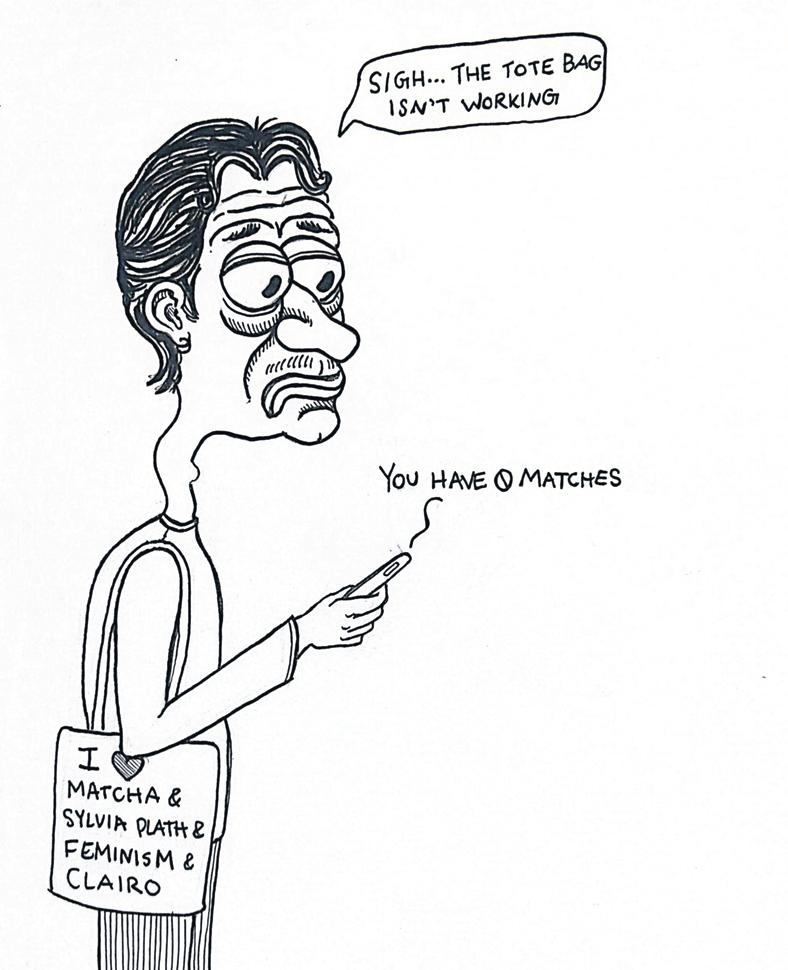
Ultimately, if people want a romantic connection but can’t find it, what’s going wrong? By 2013, meeting online became the most common way couples formed, restructuring the relationship “market.” For one thing, social media sells relationships as perfect fairytales, producing unrealistic expectations. For another, dating apps foster excessive pickiness.
Take Bumble, many women using the app to rule out men under six feettall,eliminatingroughly85per cent of potential matches. Social media has also made political identity inseparable from compatibility. The gendered polarization pushing men and women further apart – with the former leaning conservative and the latter leaning more liberal –turns politics into a deal-breaker. Take the 2024 US presidential campaign:womenfavouredKamala Harris while Donald Trump benefited from a 10-point advantageamongmen.
Then there is the social atrophy issue. Americans, young and old alike, now meet up in person less often than they used to. Though COVID-19wasn’ttheinitialrootof theissue, itcertainlyacceleratedit.
Stanford sociologist Michael Rosenfeld estimates that the pandemic-related reduction in dating pushed the number of singlesintheUS13.7millionhigher in2022thanitwouldhavebeenhad 2017singlehoodlevelsheldsteady.
Some argue this erosion of inperson social life is indicative of “social and moral decay,” particularly as artificial intelligence (AI) grows more sophisticated and increasing numbers of people turn to it for intimate relationships. Surprisingly, seven per cent of
As women’s careerprospects have improved, their financial dependenceon partners has decreased.
young singles say they would considerarobo-romancewithan AI companion. After all, AI does not ask you to clean the bathroom or get a better job. Still, the real scandal isn’t that some people would rather date a bot; it is that, in a couplecentered world, singlehood comes with economic and social penalties. Even as stigma decreases,therecanbeapriceto independence, and it is called the “singles tax” – the extra cost of living that falls on people who can ’tsplitrent,bills,orgroceries with a partner. While unattached New Yorkers may save on the costs of an expensive Valentine’s Day date, they’ re paying a much higher – the highest worldwide in fact –“singles” tax to live by themselves. Living alone in New York City costs $19,500 (USD) more per year than living with a partner,nottomentioninflation. In Toronto, the singles tax was nearly $15,000 (CAD) in 2023 based on one-bedroom rents. On the other hand, married or common-lawcouplescanreceive a spousal credit, pool medical expenses and split pensions with their partners, if eligible. As Queen’s University professor Elaine Power warns, “poverty rates for people living alone are ‘significantly higher’ than the general population.” Overall, where being single was once a cautionary tale, it is nowslowlybecomingadesirable and coveted status. While some believe this “great relationship recession” might reflect social decay and loneliness, being single also reflects liberation from outdated expectations built on misogynistic assumptions. Yet, given the entrenched societal and economic barriers linked to singlehood, its rise might just be a trend. Only time will tell.
McGill Classics Play’s Antigone: Timeless, Not Timely
While comparing Trump to Hitler may have felt cutting edge a year ago, it doesn’t anymore
Molly Dea-Stephenson Commentary Contributor
Sophocles’ s Antigone is a play for our time. In the wake of civil war, Creon, the newly self-appointed King of Thebes, issues an edict forbidding anyone to bury Polynices, brother to Antigone and Ismene, who fought against Creon’s winning side. Moreloyaltothelawsofthegods and the needs of nature than to this sacrilegious edict from a tyrannical ruler, Antigone buries Polynices anyway and faces the consequences: death by abandonment through solitary confinement, where she is, in Luce Irigaray’s words, “deprived of the air, the sun, and all the environmentnecessaryforliving.” Against the contemporary backdrop of rising fascism and suppression of activism, Antigone embodies the resolve and courage demanded of us today. Her unjust punishment, too, exemplifies the sort of repression that unfortunately dissuades many from following in her footsteps. Antigone has been widely regarded not only as aparagonofcivildisobediencein general but also, more specifically, as a role-model for climate activists. Montreal’ s own offshoot of the international climate activist group Last Generation has dubbed itself “Le CollectifAntigone.” Thisisaplay with an important message that could resonate with viewers, one that is increasingly important for ustohear.
The McGill Classics Play’ s “daring new iteration” seems, on some level, to understand that this is a play for our time. The adaptation, directed by McGill studentMadelynMackintoshand alumna Caroline Little, based on anewtranslationbyAdamZanin, certainly seems to have Donald Trump in mind. Creon wants to make Thebes great again. He is troubledbyandseekstovanquish the enemy within. In the second act, as the people start to turn on him, a soldier cries “I didn’t vote forhim!”
Adapting the play for Trump’ s America could be interesting. In truth,Ihappentothinkthatsuch an interpretation would, failing truly extensive and off-putting revisions to the dialogue, be too flattering to Trump and his ilk. Say what you will about Creon, but at least he can string a sentence together. Melania, unlike Eurydice, does not appear to have any sympathy for dissidents and Haemon is far
more human than any of the Trump sons. Thus, when the McGill Classics Play’ s production did obviously allude to Trump, I had to laugh at how absurditistoliveinatimewhen the “leader of the free world” is even more despicable than this villainofancientliterature.
However, rather than committing to making such a comparison, this staging is instead set “amid the rising authoritarianism of the 1930s.”
Although the art deco set design confuses the analogy, the delivery of Creon’s monologues (pre-recorded and piped in such that Creon himself just stands, mouth unmoving, in front of a microphoneafewtimesanact)is clearly meant to recall the aestheticsofHitler’sspeeches.
This confusion of contemporary (and 1920s) America with the Third Reich is, Ithink,insomewaysmeanttobe the point. The takeaway of this production seems to be that Trump = Creon = Hitler. And insofaraswe,themembersofthe audience, are not Antigone, we are the everyday Germans whose complacency allowed for the horrors of the Holocaust –although, in light of Hannah Arendt’s influential view of the Holocaust as a manifestation of the banality of the evil, this message is somewhat undercut by the choice to put all but the play’ s “good guys” in ghostly face paint. Insofar as we understand Trump’s America to be devolving into a simple reiteration of Nazi Germany, we are, too, the Americans who “didn’t vote” for Trump, but who aredoingnothingtostophim.
This choice of takeaway irks me.Itiscertainlytruethatmany, if not all of us are complicit in a great many horrors. But as Trump’scroniesmurdermodernday Antigones in the street and people increasingly compare Trump to Hitler, there has been growing discourse about how inapt this particular comparison is. John Meyer has recently arguedthatifyou’researchingfor a European fascist on whom to model Trump, Francisco Franco is your man. More compellingly, many point out that America in fact has its own long history of fascism. The Nazis were themselves inspired by this history.W.E.B.Duboisimpliedas early as 1935, in his Black Reconstruction in America, that “the white supremacism of Jim Crow America” was fascist. Two years later, Langston Hughes
stated that “we Negroes in America do not have to be told what fascism is in action. We know. Its theories of Nordic supremacy and economic suppression have long been realities to us.” We might then worry that the compulsion to compare Trump to European dictators flows out of an unwillingness to look America’ s own history in the face. Trump isn’t Hitler and he’s not Franco –his fascism is homegrown. In trying to say so much, this production thus fails to say anything especially compelling, flatteningallparticularity.
All of this said, this production had some real potential. Aniela Stanek’s portrayal of Antigone is excellent. The sister dynamic between her and Neela PercevalMaxwell’s Ismene is very compelling, as is the choice to make Ismene as sympathetic as this version does. Nikhil Girard’ s Creon, unmoving soliloquies in front of the mic aside, is solid. Nicholas Cho manages to make Eurydice surprisingly sympathetic even despite the character’ s “moral blindness and outright complicity” with Creon. Megan Siow’s handmaiden and Sarah Shoff’s Tiresias are both importantgroundingvoices.
Asidefromthebloodyandfiery spectacle that follows the death of the titular character, Griphon Hobby-Ivanovici’s Haemon, the
most central and impassioned voice of reason, is the highlight ofthesecondactforme.Wecan’t allbeAntigonesandweshouldn’t all be Ismenes. But many of us can, I think, aspire to be Haemons: loving and fiercely supportive of the few who, like Antigone, have an almost inhuman ability to stay committed to their principles against all odds. Loving them not in spite of this commitment, as withIsmene,butbecauseofit.
Brendan Lindsay’s sentry is funny and charming – the comedichighlightoftheshowby a mile. Although making Sam Snyders’s magical bartender Hades himself leans a little too Percy Jackson and the Olympians-coded for my liking, especially in a production that already has so many moving pieces, his winkingly irreverent delivery is a welcome source of levity. Luca McAndrews’ s advisor really shines in his fearful reactions to Creon’ s increasingrageinthesecondact.
If I have more to say about the acting in the latter half, that’ s largely because I was only able to seetheactors’ facesafterImoved into a seat that had been vacated during the intermission. While the original play is in part a call for tradition and ritual to be respected, this production for somereason – perhapstoleverage the art deco interior design of Le
9e – foresook the tradition of the stage itself, thereby making it impossible for most of the audience to see anything. That this choice, and so many other confused adaptational choices, was made is a real shame, especially given that the cast, for allIcouldsee,seemtohavegiven suchstrongperformances.
If this review is perhaps a little polemic, that is in part because this adaptation had such promise and because the choice to stage Antigone todayissuchagoodone. But I love Antigone precisely because of its particularity. In G.W.F.Hegel’sinfluentialanalysis of the play, in fact, Antigone’ s deepest crime is arguably that she preserves her brother in his particularity instead of allowing him to become just another anonymous corpse. It therefore saddenedmetoseethisadaptation strip the play of what I take to be one of its greatest strengths. That Antigoneistimelessdoesnotmean that adaptations of it should pull aimlessly from so many historical contexts. In doing so, this adaptation loses much of the complexitythatissoimportantfor developingarobustunderstanding of the play, of the history of fascism, and of the workings of contemporaryfascism.
Image courtesy of Janna T.
Falling in Love with Friendship
Julia Lok Staff
Writer
Ialways knew in the back of my head how important my friends were. I’ve obviously hadupsanddownswithmanyof them. Yet my friends have seen me through all my phases and stuck with me as I’ve evolved into the person I am today. And as friendship is a two-way street, I’ve done the same for them. While I reside in a happy romantic relationship, my friendships are one of the most important things in my life. I gain so much love and knowledge from the people I build friendships with, and what I’ve gathered up to this point, I will always hold close to my heart.
I resonate with the notion that our personalities are made up of the ones from people we’ve met throughout our lives; SZA has been one of my top artists ever since a close friend recommended “Good Days” to me in 2021. Every time before I peel an orange, I roll it the same way as a friend of a friend of mine.
With Valentine's Day having just passed, there’s been a noticeable societal shift away from spending time with significant others to prioritizing our friendships. The moment I personally realized the importance of investing time and care into my friendships rather than romantic
A personal reflection on the value of friendship
relationships was when one of my best friends got a boyfriend. Gradually, she stopped devoting time to us and our friends, as she spent more and more time with her boyfriend. If we wanted to hang out with her, he would be automatically invited. He was her priority, and she made this explicitly clear to us. Most of us noticed this shift, and in some ways, I started to resent her for it. I felt guilty, though. I wanted my best friend to be happy, but not at the cost of our friendship. I never wanted any of my friends to feel this way about me, so I calculated how I was going to act in my future relationships. I wouldapproachmyrelationship with open arms, but still have set times dedicated to my friends.
I got into my first serious relationship shortly after experiencing this. I started to understand that some of my friend’s actions were valid: you’ll obviously devote time to the personyouarewith.Butattheend oftheday,it'snaturaltostillinvest time in your friendships as well. I always find myself wanting to call my friends or have a laugh with them, which is a different experience than hanging out with myboyfriend.
Incidentally, being in a healthy relationship has amplified my commitment to my friendships. WhilemyboyfriendandIareina strong relationship, it’s only one extension of our lives, as we are
much more than simply our romantic ties. By avoiding devotingmywholelifetothisone relationship,I’vebeenabletostill reach out and hang out with my friends.
Growing up in a patriarchal society, there are some things that only my girlfriends will ever understand, making their friendships that much more valuable to me. My friendships give me more than what a romantic relationship can sometimes offer. As I love to spend time with others, I’ ve always been one to cultivate my existing friendships and seek newones.Myfavoritememories are the ones I’ve shared with my friends, laughing about something ridiculous in the car or their rooms.
Asma Siddiqui mentions in an article for Vogue India how throughout a woman’s lifetime, friendships are neglected when more “important” relationships develop, such as the ones we have with “husbands, children, in-laws, and parents.” Depending on the phase of our lives, the strength of certain friendships can change. My friends talk about how their moms don’t have close friends, and it makes sense to lose these strong connections at an age when you have an entire family to take care of. The world has established that the role for most women is to become mothers and raise their children; that role is more often
With Valentine's Day having just passed, there’s been a noticeable societal shift away from spending time with significant others to prioritizing our friendships.
than not something that is forced upon women. So, when she is placed in that role, she isn’t given the free time to sustain her friendships and make new ones. Yet isn’t there a sting that comes with accepting that idea? How can the girls I’ ve grown up with suddenly not be the centre of my life? The ‘inevitability’ of my lifelong friends someday having their own, more ‘important’ relationships to tend to is a terrifying thought. Nevertheless, this fear has not
altered the importance I’ ve placed on developing close connections with my peers. At university, the single most importantthingtomeoutsideof academics is making lifelong friends. We can learn so much from anyone we cross paths with. While my friends’ mothers haveadifferentexperiencewith friendship in their maternal years,withdatingbecomingless of a worry to young women, I have greater hope that I will stay close to my best friends in my future. There’s been less of a concern on maintaining a family, and more of a focus on maintaining your friendships with the downfall of dating culture. There’s a newfound importance in keeping our friendships throughout those years that will stick with us even if we all decide to settle down and become mothers. In high school, I was always looking for a boy to latch on to. It made the time go by quicker, and it was an easy distraction from schoolwork. Over time, the boys changed,butmyfriendsneverdid. Iwillalwaysbesogratefulforthe friends whom I’ve met and the ones to come. To have thoughtful conversations with, laugh with, and confide in a friend is the strongest connection one will haveattheendoftheday.
Jane Goodman | Staff Illustrator
Beyond the Bubble
There's a Montreal past Roddick Gates
Helena Cruz Da Costa Barros Staff Writer
Itdoesn't take long at McGill to get a good sense of the university’s culture. As a highly-ranked anglophone institution, McGill attracts students from across the country and around the world. It's fair to saythatformanywhomovehere to study, the school itself is the mainsellingpoint,notthecityof Montreal. It appears that everything we need is right here oncampus.
And maybe that's a problem. Despite sitting at the heart of Canada's second-largest city, McGill's self-sufficiency isolates us from the broader Montreal community while fostering a cultureofitsown.Withaccessto food, sports, leisure, healthcare, and social activities of every sort on campus, it's easy to be
disincentivized from exploring the rest of the city. We become entrapped by the idea of the McGill bubble, a subconscious limitationofourscopeofthecity to the McGill Ghetto and Milton Parc area. We've normalized takingthecityandtheprovince's complex cultural fabric for granted, living at McGill but not trulyinMontreal.
Justine, an exchange student from Sciences Po, became immediatelyawareofthissocial detachment between the campus and the city. She described how, if you live near McGill, you’ll naturally end up spending most of your time around campus. It's not unreasonable to imagine a routine where you can grab coffee, go to class, have lunch, hit the gym, join sports clubs and activities, and even attend your medical appointments all within the comfort of McGill’ s downtown campus. “It's like a
city within a city,” she says. Staying in this convenient microcosm makes an Opus feel like a luxury rather than a necessity, insulating downtown McGillians even more while limiting their gateway into all the city of Montreal has to offer. If you stop to think about it, the farthest many students have ventured in the last two weeks was likely a 15-minute walk to a clubonSaintLaurent.
Thinking beyond convenience, International Development student Olivia suggests that the ‘bubble’ couldalsobeaproductof community building. She argues that “part of what makes the McGillbubblesoprofoundisthat a large part of McGill isn't just from Quebec: the students from France stick with each other, just like the Torontonians and the Americans." Olivia specifies that this is a cycle that begins when we first move into student residence. We form bonds with
people who share similar backgrounds and create our friend groups in these limited spaces, rarely reaching out to students at Concordia, UQAM, and UDeM. After living in the McGill Ghetto for four years, Olivia is excited to “finally move from McGill to Montreal” after graduating. It will as she says, give her a chance to experience thecityinanewlight.
For those of us who won't stay and fully experience this astoundingcityafterfinishingour studies, there are many other opportunities to exit the bubble.
Keona Gingras, a 4th-year LinguisticsstudentfromToronto, shared that bursting the bubble can be as easy as exploring the city's bustling art scene. With countless concerts, plays, museums, and festivals throughout Montreal, there's always an excuse to explore somewhere new. Bursting the bubblecanalsotranslatetohitting
apubinanewcornerofthecityto watch a hockey game, striking up a conversation with a local, joining sports groups in the park, or meeting someone new on a night out. If all of this sounds overwhelming for your social battery during midterm season, trytheseoutwhenyouhavemore breathing room in your schedule stay for March break, explore for a bit of the summer, or dedicateaweekendtodiscovering anewneighbourhood.
McGill coddles us with unbound convenience, and in many ways, we're privileged to have such an ecosystem at our disposal. But the real privilege should be being here at all: in a vibrant metropolis beyond our campus gates. At the end of the day, the ghost of the McGill bubble amounts to the choice of being accommodated. Burst the bubble. Choose differently. I dare you not to fall in love with therealMontreal.
Daily Matchmaking: Pick a Valentine’s
Dessert,
Reveal the Perfect Sign for You
relookingforsomeoneadventurous,but with good taste that stands out. Together, you two will be curious, trying new things that might raise some eyebrows. Weird combinationsmightjustmakeperfectsense. Socialandinsightful,wesuggestbaking or evenaflourfight withyourValentine.
Your Valentine will put in the effort; their love language is acts of service, and they are devotedtothecause.Thesesignsunderstand therewardsofhardwork.Whiletheymight have a hard shell, they have a sweet, soft center.Expectlotsofgifts.
Box of Chocolates:
YourValentinevaluesstabilityand routine. Make sure you dressed for your first date: a romantic candle-lit dinner. This person will teach you that appearancescanbeabitdeceiving, andthatthere’salotmoretothem thanwhatmeetsthesurface.
YourValentineisgenerousandpassionate. Ardent and romantic, you’ll be swept off your feet. From grand gestures and confessions of love as snow falls around you to thoughtful home-cooked meals: you will enjoy life together, growing ever closerintheprocess.