Remembering Ken Dryden: Canadiens legend and McGill alum PG. 15
McGill community considers transportation alternatives in the face of upcoming STM strike
Transport society reports workers have scheduled a strike from Sept. 22 to Oct. 5
On Sep. 9, white nationalist group the Second Sons announced the opening of a Montreal division. This expansion is part of a rising wave of extremist ‘active clubs’ across Eastern Canada. Framed as organizations propagating a combination of fitness and men’s mentorship, these ‘active clubs’ coopt medieval aesthetics and martial rhetoric to recruit young men and promote an ethos of nationalism, misogyny, and white supremacy. The group’s rhetoric frames white Canadians as victims of cultural displacement, a narrative rooted in the “Great Replacement” theory, which villainizes immigrants and people of colour.
This growth is not atypical: neo-Nazi active clubs have increased by 25 per cent worldwide since 2023, with more than 181 ac-
tive chapters operating in 27 countries, including Canada. The announcement of the Second Sons’ Montreal chapter follows a recent march by a “Canadian men’s nationalist” group, which took place in Ontario’s Niagara Region over Labour Day weekend.
Resurging white nationalism across Quebec and Ontario poses pressing questions of student susceptibility and institutional responsibility at universities like McGill. Universities are not only targets for recruitment, but also risk becoming complicit in fostering hate when such conversations are presented as innocuous ‘debate.’ These organizations openly encourage violence and target marginalized communities that form much of McGill’s diverse and international student body. While recruitment for these groups often happens off-campus, universities are crucial in shaping whether such rhetoric is normalized or rejected.
An investigation into the militarization, surveillance, and foreign influence behind Canada’s ‘Strong Borders Act’
Helene Saleska News Editor
n December 2024, the Government of Canada announced a $1.3 billion CAD plan to expand militarization and surveillance along the U.S.-Canada border. The plan includes the deployment of drones, helicopters, and mobile surveillance towers as part of a new Royal Canadian Mounted Police (RCMP) Aerial Intelligence Task force, along with a commitment to 24-hour aerial surveillance. Nicknamed the ‘Strong Borders Act,’ the project is now part of Bill C-2, introduced in the House of Commons in June. By increasing border surveillance, imposing new immigration and visa restrictions, and expanding law enforcement powers, Bill
C-2 is a direct attack on human rights. It limits migrants’ abilities to claim refugee status and broadly revokes many resident and work visas. The bill also undermines the rights of all Canadians by expanding private, military, and police surveillance capabilities, while allowing broad international data sharing. To many, Bill C-2 is an effort to appease U.S. President Donald Trump, who repeatedly accuses Canada of allowing undocumented migration as well as gun and drug smuggling into the U.S.
Consequently, this bill begs the question of whether Canada, in the name of security, is pursuing the same political path of racist exclusion, surveillance, and human rights abuses as the United States.
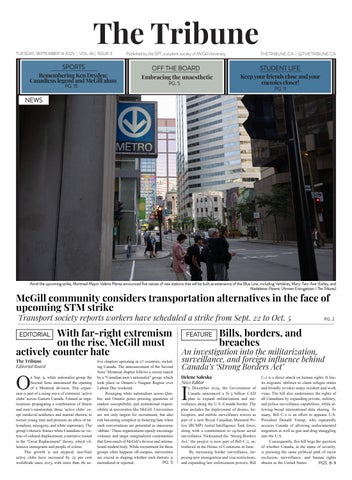
Amid the upcoming strike, Montreal Mayor Valérie Plante announced five names of new stations that will be built as extensions of the Blue Line, including Vertières, Mary-Two-Axe-Earley, and Madeleine-Parent. (Armen Erzingatzian / The Tribune)
First SSMU Legislative Council meeting of the year approves edits to Accountability Plan Amendments to
General Assembly standing rules also pass after debate
Amelia H. Clark Staff Writer
The first Students’ Society of McGill University (SSMU) Legislative Council (LC) meeting of the academic year began on Sept. 11 by introducing all in attendance, with16 out of 34 voting members on the Council present.
Speaker Jonathan Dong and Deputy Speaker Yasmin Beeai could not be present in person, so President Dymetri Taylor assumed the Speaker role. Over Zoom, Dong announced that he will be resigning as Speaker to become the LC’s Accountability Commissioner as of Sept. 15. His successor will be Acadia Knickerbocker.
After adopting the meeting’s agenda, the council moved on to an announcement by Commissaire aux Affaires francophones Maëla Dube, who discussed how the committee is dedicated to making meetings more accessible for French speakers.
A representative from Agence Voltaic, the photography organization responsible for graduation and class photos at McGill, then gave a presentation. The representative pointed out that the studio takes appointments for graduation pictures year-round, yet most students book for November or
March, leading to scheduling congestion. In order to encourage students to utilize the agency more efficiently, SSMU’s Communications staff created faculty-specific posters in collaboration with Agence Voltaic, explaining how to register for pictures.
The council next discussed two motions on the table, both of which were brought forth by Taylor. The Motion Regarding the Adoption of the Standing Rules for the 2025-2026 Legislative Council and General Assemblies (GA) sought to add more strict regulations for decorum and procedure to these meetings, such as requiring presented reports to include deadlines. VicePresident (VP) University Affairs Susan Aloudat questioned the motion’s language, noting that some rules were referred to with “should” and others “must,” which called into confusion which aspects of the motion were optional.
“For example, the rules say we [must] close our laptops for guest speakers, but everyone’s laptop was open [during the Agence Voltaire presentation],” Aloudat said. “So, do we want to go back and review this?”
Taylor responded that SSMU should enforce all regulations listed to make governance events run smoother, and that since the motion had not yet been passed, the rules
were not currently in effect.
VP Clubs and Services Hamza Abu Alkhair motioned for a five-minute recess so council members could re-read the bill for questioning, after which Aloudat asked if the Accountability Commissioner would be enforcing the mandates listed in the motion.
Dong responded that the members themselves will be responsible for submitting reports to the Parliamentarian when fellow members fail to follow the Accountability Plan.
“This is something that is changing in the administration section of the new [Internal Regulations] of governance, [that] the executives will be reporting at every meeting,” Dong said.
Aloudat asked to amend the motion by removing the section prohibiting snapping, clapping, and knocking on desks at GAs, and the section prohibiting council members from having their laptops open. Taylor made these amendments, and the bill passed, with all except Abu
Alkhair in favour.
The council then discussed the Motion Regarding the Legislative Council Committee Allocations. Council members decided which student committee they will stand on, as all are mandated to participate in at least one. No one volunteered to join the Board of Directors, leaving one seat still vacant.
Moment of the Meeting
Taylor concluded by introducing a notice of the Motion Regarding Edits to the Accountability Plan and Committee Terms of Reference, before ceding his time to the current Accountability Commissioner, Asma Khamis. The motion seeks to implement revised guidelines for how the Accountability Committee must process, communicate, and address complaints regarding SSMU operations, stipulating that it must present reports to the LC monthly. It also would require that the Committee present reports made against councillors immediately to increase transparency among members.
Soundbite
“[The Motion Regarding Edits] was mainly spurred by the fact that I don’t necessarily have the authority to enact accountability recommendations. I can only suggest and recommend. It’s up to the councils to determine a course of action.”—Asma Khamis, on the importance of revising the SSMU Accountability Plan.
McGill researchers and students discuss limits to Montreal’s bike infrastructure McGill study highlights the gap between micromobility demand and limited road space
Alvise Ceolato Contributor
As classes begin this Fall term, BIXI bikes return as a typical transport choice for McGill students. Montreal is often ranked among the most bikeable cities in North America, with more than 1,000 kilometres of cycling infrastructure across the city. BIXI, the city’s station-based bike-sharing system, hosts 12,600 bikes and almost 1,000 stations.
Many McGill students have described the common challenges of navigating BIXI services: Searching for an open dock, struggling to enter and stay in bike lanes, or finding bikes unavailable when they need them. Despite these issues, BIXI remains one of the most common ways for students to get around.
On June 11, PhD candidate Daniel Romm and colleagues at McGill’s Department of Geography published a new study in the Journal of Cycling and Micromobility Research. Romm and his co-authors found that approximately 97.7 per cent of road space in Montreal is dedicated to automobiles, while only 2.3 per cent is allocated to micromobility infrastructure—largely bike lanes. Yet, micromobility methods of transport account for just 4.92 per cent of total trips taken, highlighting the current insufficiency of cycling infrastructure despite high demand.
In a written statement to The Tribune, Romm explained why inadequate bike lanes pose a problem for many potential users in Montreal.
“Insufficient bike infrastructure has two main harms: it discourages travel by bicycle,
which provides people with more options and flexibility for how they get around [...], and it threatens the safety of cyclists,” Romm wrote.
Romm’s study also shows that even if Montreal were to double its bike lanes, cars would still occupy more than 90 per cent of the municipality’s roadspace.
“There is room—and need—for both private vehicle ownership and sharing systems for micromobility,” Romm wrote. “They serve different populations and needs. [....] Encouraging more travellers to use noncar modes ultimately promises to ease traffic problems, as one more cyclist is potentially one less driver.”
Students at McGill also offered accounts of their experiences with Montreal’s bike lane infrastructure. Will Coward, U2 Engineering, noted in a written statement to The Tribune that Montreal’s biking culture is pleasant, despite micromobility challenges in the city.
“Although construction sometimes interferes with bike lanes and BIXI stations, biking around campus and the Plateau is still enjoyable,” he wrote.
Tatiana Bejarano, U2 Engineering, emphasized in a written statement to The Tribune that BIXI still needs to expand its services around campus to better cater to McGill’s student population.
“[BIXI’s] infrastructure around the main student areas remains insufficient, and the lack of docking spaces at BIXI stations can cause significant distress for university commuters,” Bejarano wrote.
Romm highlighted that the study also aims to help government officials and city
planners make better decisions regarding micromobility infrastructure, especially in areas where biking is an essential mode of transportation, such as around campus and Milton-Parc.
“The orientation of our study is to assist policy-makers, advocates, and others in communicating about street space, including possible changes to it by installing new infrastructure,” Romm wrote.
Kevin Manaugh, McGill Geography professor and research co-lead with the McGill Sustainability Systems Initiative, explained in a written statement to The Tribune that Montreal’s city policies must better address micromobility.
“Policies should ensure that cycling is treated as a core mode of transportation, not an afterthought,” Manaugh wrote. “That means dedicated budgets, city-wide planning, integration with transit, and measures to ensure equity—so that infrastructure isn’t concentrated only in central or wealthier areas.”
Romm stressed the importance of Montreal’s upcoming municipal elections in dictating the future of the city’s micromobility infrastructure, which may give McGill students hope for safer and more accessible cycling support around campus.
“Whether or not the city continues to invest in protecting cyclists and encouraging non-automotive travel rests, in part, on the results of this next election,” Romm wrote. Romm further expressed his hope that Montreal will follow the global urban trend of reducing reliance on cars in favour of safer, more accessible micromobility.
“There is a strong, growing global movement to reform our cities away from car dominance, and this is likely to continue on a global scale regardless of the [Montreal municipal] election,” Romm wrote. “The question is if Montreal will lead the way, as it has among North American cities, or fall behind.”
BIXI was the first bike sharing system to be created in North America. (Nell Tov / The Tribune)
McGill community considers transportation alternatives in the face of upcoming STM strike
Transport society reports workers have scheduled a strike from Sept. 22 to Oct. 5
Sonia Berman & Samuel Hamilton Contributor Contributor
The Société de transport de Montréal (STM) has announced a workers’ strike starting on Sept. 22. During the strike, city buses and the metro will be running on restricted schedules Mondays, Wednesdays, and Fridays until either Oct. 5, or when the STM and the Syndicat du transport de Montréal—a union that is part of the Confédération des syndicats nationaux labour federation—come to an agreement. While STM paratransit will remain unrestricted, school service buses will experience reduced service times during the strike.
During the strike days of restriction, buses will be available from 6:15-9:15 a.m., and 3:00-6:00 p.m. The night bus service will remain unchanged, going from 11:15 p.m.-1:15 a.m. All buses will finish their routes in their entirety once they have begun.
The metro will function on a similar schedule, remaining open from 6:30-9:30 a.m. and 2:45-5:40 p.m. The night service will last from 11:00 p.m. through the usual closing time of approximately 1:00 a.m. The STM will close stations’ doors as soon as the last train passes through each stop.
In an interview with The Tribune, Sarah Moser, associate professor of McGill’s Department of Geography and associate member of the School of Urban Planning, pointed out that a lack of provincial assistance to Montreal’s transportation system has been a recurring issue.
“The STM is being starved of funding from the province, so tension like this will likely occur more regularly in the future,” Moser said.
31 out of 68 STM stations are considered by the STM itself to be in poor or very poor condition. Stations Saint-Michel, Peel, and Champde-Mars—among others—have experienced significant physical deterioration that could eventually pose safety risks. Despite these concerns, the Quebec government’s 2025-2026 budget plan announced a $258 million CAD cut to the STM’s funding over the next three years. Éric Alan Caldwell, president of the Board of Directors of the STM and city councillor of the MercierHochelaga-Maisonneuve borough, pointed out at a press conference on March 26 that the STM will require more funding to provide reliable and safe transportation services to its everyday commuters.
Moser also explained that this STM strike has been caused by a history of numerous unsuccessful negotiations
between the STM and the Syndicat du transport de Montréal.
“To get to the stage where workers are striking, there have been failed attempts to address the problems,” Moser said. “The upcoming STM strike stems from frustration over the practice of hiring outside contractors, who are not unionized, rather than using unionized employees. The employer is either unable or unwilling to address these problems, so the union may feel they have no other choice but to strike.”
The upcoming 14-day strike will be the STM’s second strike of the year—with the union also striking in June 2025. This previous strike coincided with Montreal’s Canadian Grand Prix 2025, which saw a record of 352,000 spectators heading to Île Notre-Dame over three days to attend the event. In order to handle the resulting transit usage surge across the Grand Prix weekend, Quebec’s Tribunal administratif du travail mandated a pause to the strike, forcing the STM to resume full service from Friday, June 13 to Sunday, June 15.
Moser explained that while alternative transportation options to the STM exist, vulnerable and marginalized groups in Montreal who rely on metro and bus services may be most heavily affected by the upcoming strike.
“Many people like myself take the STM to work, but if there are delays resulting from the strike, I can also ride my bike or take a taxi if I need to,” Moser stated. “However, many people are unable to ride a bike, don’t own a car, and can’t afford a taxi, so they are particularly vulnerable. If I am late for work, it’s not the end of the world, but for many employees, being late could mean getting fired or have other serious consequences.”
Lince Ketchate, U3 Science, stated in an
interview with The Tribune that an STM strike would greatly impact his route to school due to the timing of his classes.
“My commute would be mostly affected in the afternoon, because I finish classes when it’s not peak hours, so there would not be service,” Ketchate explained.
He added that this disruption will be particularly difficult in comparison to the last STM strike in June, when he was able to ride a Bixi without having to manage his school supplies.
“I don’t have a Bixi pass, so I have to pay a lot for every trip, and I had to bike for 50 minutes, so it’s really exhausting,” Ketchate said. “And especially now that I have my backpack with me and I have my books, [...] everything’s going to be heavy.”
In a written statement to The Tribune, Dymetri Taylor, President of the Students’ Society of McGill University (SSMU), maintained that the union will continue to accommodate students’ needs during the strike.
“The SSMU’s services will remain available during the strike,” Taylor wrote.
One of these services, DriveSafe, is a student-run volunteer platform that will transport students to destinations anywhere on the island of Montreal from Thursday to Saturday between 11:00 p.m. and 3:00 a.m. In a written statement to The Tribune, DriveSafe explained that they are in the process of finding additional solutions to support students affected by the strike.
“We anticipate no impact to our regular operations, [but] we are currently exploring options to potentially offer a shuttle service of some kind during the day when all STM services are suspended,” DriveSafe wrote. “We would like to remind students that we are an entirely volunteer run and operated service, and
thus are limited in how many rides we are able to provide during our service hours.”
DriveSafe also provided recommendations for how best to access their resources in high-demand times, such as during a transit strike.
“Wait times can get fairly long during busy periods, so the earlier [one calls,] the more likely [one will be] able to get a ride before the end of our service hours,” DriveSafe wrote. “Any updates regarding this matter will be made to our Instagram profile, @ssmudrivesafe.”
Ketchate noted that while he could delay his commute until peak hour STM services resume during the strike, he remains apprehensive about having to wait extensively for strained transportation services, thus missing out on time that could be spent completing schoolwork or participating in clubs.
“The other option is just to stay on campus until the service resumes, so I [would] have to be here for four hours, but I don’t have anything to do for four hours,” Ketchate stated. “Especially now that [since] things are starting up, I’m going to get more assignments, [...] [the strike is] a really big inconvenience.”
Ketchate concluded by suggesting that it would be helpful if McGill could arrange alternative transportation options or opportunities for remote learning for students throughout the duration of the STM strike.
“I don’t know if it’d be possible for [McGill] to offer some kind of bus service,” Ketchate said. “From campus, to maybe a central metro station […] or [look into offering] classes online.”
McGill’s Media Relations Office (MRO) declined to comment on the strike and whether the university will make any efforts to accommodate its affected students.
Amid the upcoming strike, Montreal Mayor Valérie Plante announced five names of new stations that will be built as extensions of the Blue Line, including Vertières, MaryTwo-Axe-Earley, and Madeleine-Parent. (Armen Erzingatzian / The Tribune)
PGSS hosts first meeting of the academic year, recognizing two new student associations
Student society discusses McGill’s austerity policies and society’s funding
Kaitlyn Schramm News Editor
McGill’s Post-Graduate Students’ Society (PGSS) convened for their first meeting of the academic year in the ballroom of Thomson House on Sept. 10, where they discussed their plans for the months to come and reported on how they prepared for these goals over the summer.
The meeting began as Zoe Neubauer, External Affairs Officer, announced a collaboration they planned with the McGill Community Council: An anti-austerity rally on Oct. 1, from 12:00-1:00 p.m. at the Roddick Gates. Neubauer explained how the rally will address McGill’s ongoing budget cuts and austerity policies, as well as the first of a series of university layoffs in response to McGill’s deficit.
The meeting then moved to an announcement of the Association of Graduate Students Employed at McGill (AGSEM)’s priorities for the academic year. PGSS Councillor for the Department of Philosophy and AGSEM Representative Molly Dea Stephenson presented these primary concerns, stressing the importance of the union’s existence.
“[Student workers] can sometimes feel like [AGSEM] is just this separate thing, but the fact is it is this membership, and it only works when its membership gets involved,” Stephenson said. “So I’m here to give you some ideas on ways to get involved.”
Stephenson went on to describe numerous paths for members’ involvement, including showing up to the occasional rally or assembly, or working as a delegate for one’s given department. This task is vital, as the delegate role is one of the basic functioning units of AGSEM, connecting the workers within the society to the society membership as a whole.
Next, after PGSS members motioned to approve routine ratifications of the PGSS Society Policy Manual as well as the 20252026 Executive-Commissioner Work Plan, the meeting covered motions to recognize two new Post-Graduate Student Associations (PGSAs).
The first motion recognized the Kinesiology and Physical Education Graduate Student Association (KPEG) as a new PGSA. KPEG’s
membership recently reached 25 members— the minimum requirement allowing a graduate association to be recognized as a PGSA, per guidelines outlined in the PGSS Bylaws and Society Affairs Manual.
Councillor for the Association of Postdoctoral Fellows of McGill University Emily MacLeod raised a concern about how the recognition of a new PGSA would affect funding for existing PGSAs. Secretary-General Sheheryar Ahmed responded by clarifying how the budget process works within PGSS.
“The way PGSAs’ funding works is that we’re paying $10 [CAD] on our student statements that basically is returned to the statement vis-à-vis their PGSA’s funding,” Ahmed explained.
Ahmed continued to describe how KPEG was
previously part of a broader PGSA, and after reaching the minimum membership requirement, now has the ability to operate as its own branch. Following Ahmed’s explanation, the motion passed, formally establishing KPEG as a PGSA.
The following motion to recognize a second PGSA, the Sustainability in Engineering and Design Student Society (SEADSS), was then brought to attendees’ attention. SEADSS Representative Camille Nepveu described how the society also recently reached the mandatory minimum of 25 members. She conveyed her excitement about SEADSS becoming a PGSA as the motion was passed.
Moment of the Meeting
In his Secretary-General Report to the Council, Ahmed announced the creation of an informal PGSAs Working Group composed of members of the PGSS Executive Committee. These members delivered an updated PGSS presentation, created by the Member Support Commissioner Kali Heale, at over 25 events such as departmental orientations with the goal of increasing engagement with the society. Ahmed reported that the Working Group will soon plan an event for the executives of all PGSAs later in the Fall term.
Soundbite
“Austerity policies have already negatively affected McGill, [in the] learning and working environment, and as austerity continues to be implemented, these kinds of effects will only increase. [We are] trying to come together and demonstrate to the administration that we do not accept this austerity climate, [and that] there are alternatives, that there are better ways to organize.” — Zoe Neubauer, External Affairs Officer.
Student unemployment is steadily increasing in Canada
McGill students may face financial instability as unemployment
Asher Kui News Editor
Desjardins economists Kari Norman, LJ Valencia, and Randall Barlett published a report on Sept. 4 explaining the recent, rapid increase in youth unemployment rates in Canada. The unemployment rate for all youth has increased from 10 per cent in 2022 to 14 per cent in mid-2025. The burden has fallen particularly heavily on 15to 19-year-olds, with one in five of those willing to work unable to find a job.
Canada’s National Council of Unemployed Workers (NCUW) is an organization working to promote the rights and privileges to which unemployed workers are entitled. Milan Bernard, co-spokesperson of the NCUW and lecturer at the Département de science politique at Université de Montréal, expressed in a written statement to The Tribune that although he has not observed a sharp increase in young people reaching out to the organization, the rising unemployment rate among youth is still concerning.
“We have not seen a difference in the profile of people coming to our offices for help with Employment Insurance (EI),” he wrote. “[Nonetheless], it is alarming to see that unemployment rates are so high for young people. It is not a good sign for the economy.”
The Desjardins report outlined that the youth unemployment rate is now at a level
typically only seen during economic recessions. Bernard emphasized how in periods like these, young workers may find it especially difficult to access unemployment resources.
“It is often harder for young workers to qualify to get EI benefits, because of the admissibility criteria,” he said. “It is something that we have called on the government to address, especially in the current context with the [United States] trade war and economic instability.”
In an interview with The Tribune, Caroline Menton, U1 Science, explained that finding a job in Montreal may be especially difficult for anglophone students at McGill because of the language barrier.
“Most entry-level jobs are public-facing, and employers obviously require French for a customer service job,” she said.
Menton also described students’ lack of awareness around and access to McGill resources when it comes to helping youth at the university secure employment.
“I wasn’t even aware McGill offered help with [job searches],” she said. “For any of my friends that were looking for jobs at any point, I never heard them mention using any McGill resources. [....] If anything, [McGill] could advertise those more, if they [even] exist.”
Currently, the McGill Career Planning Service (CaPS) supports students with career advancement and leadership development. Through activities like Career Fairs, work-
r ates rise
shops, and advising services, CaPS oversees a range of internship, part-time, and full-time opportunities for students in search of employment.
Midnight Kitchen (MK) is a nonprofit collective that works to increase food accessibility on McGill campus and across Montreal. In a written statement to The Tribune, a representative from MK noted that they have observed a recent increase in the number of people attending their programming, though rising youth unemployment is not necessarily a factor.
“Since the University Centre has reopened, we have seen a large increase of service users,” the representative wrote. “Our service has also expanded with our capacity and outreach over the years.”
MK then mentioned the many other McGill food groups available to support students who are experiencing financial difficulties.
“McGill has been described as a food desert—with limited groceries and affordable food options on and surrounding the campus,” the MK representative wrote to The Tribune. “There are many [...] great student food groups looking to build the McGill Food Coalition, an accessible food
system at McGill that does not rely on the corporate food services contracted by McGill.” MK concluded by highlighting how its new structure has been designed in part to help open up more opportunities for unemployed students.
“We know from speaking with students [...] that it can be very difficult to find a job for a variety of reasons, such as language barriers, scheduling restrictions, and required experience as the job market becomes more and more competitive,” the representative wrote.
“Over the summer we worked on a new structure that would allow for more part-time positions, with some being open only to students. With this new structure, we are able to hire more students, and hopefully increase student engagement.”
The next PGSS meeting will be held on Oct. 15 at 6:00 pm. (Emiko Kamiya / The Tribune)
The next PGSS meeting will be held on Oct. 15 at 6:00 pm. (Emiko Kamiya / The Tribune)
Sports Editors Ethan Kahn Clara Smyrski sports@thetribune.ca
Design Editors Zoe Lee Eliot Loose design@thetribune.ca
Photo Editors Armen Erzingatzian Anna Seger photo@thetribune.ca
Multimedia Editors Sahel Delafoulhouse Wendy Lin multimedia@thetribune.ca
Web Developer Rupneet Shahriar webdev@thetribune.ca
Copy Editor Ella Bachrach copy@thetribune.ca
Social Media Editor Mariam Lakoande socialmedia@thetribune.ca
Business Manager Celine Li business@thetribune.ca
With far-right extremism on the rise, McGill must actively counter hate
The Tribune Editorial Board
Continued from page 1.
McGill has previously hosted speakers whose rhetoric dehumanizes entire communities, such as Mosab Hassan Yousef, a former Israeli military informant who has made explicitly Islamophobic statements that frame an entire religious group as expendable. By allowing speakers like Yousef on campus, McGill reinforces extremist rhetoric and signals to socially vulnerable students that dehumanizing communities is acceptable discourse, in turn encouraging these students to delve into hateful extremist ideologies.
In Quebec, this increase
in political and ideological extremism cannot be viewed as an isolated incident. The province’s increasingly conservative political climate—particularly around topics such as immigration and secularism—has enabled policies that disproportionately affect religious minorities. Provincial leaders consistently scapegoat immigrants for social and economic hardships, most notably the housing and healthcare crises. Premier François Legault, for instance, has falsely claimed that 100 per cent of Quebec’s housing crisis can be attributed to immigrants. This environment redirects economic and cultural anxieties away from structural issues and toward scapegoated ‘outsiders.’ Extremist groups exploit this dynamic, channeling public frustration into racialized
Mia Helfrich Creative Director
ITarun Kalyanaraman, Emiko Kamiya, Alexa Roemer,
love seeping into an aesthetic. Going for walks in the park in a long skirt, colour-coding my notes, listening to an ‘indie morning’ playlist over gentle sips of coffee. Yet, watching my grandfather empty the guts from a fish, I realized that aesthetic lifestyles set unrealistic expectations of beauty and alienate cultural practices and identities that don’t fit into aesthetic moulds. We were fishing off a pier on the Potomac, a B-grade river carrying industrial chemicals and sewage waste of Washington, DC. My grandfather propped three poles on the railing as we sat on folding camping chairs, tapping the poles to feign the aliveness of our bait. We caught three fish and dumped
hostility. By positioning themselves as defenders of ‘heritage’ and masculinity, organizations like the Second Sons weaponize economic hardships—particularly rising living costs—to recruit young men into white nationalist networks.
The establishment of a Montreal division of the Second Sons only fortifies the immediacy of this risk. If left unaddressed, the rise of white nationalist and extremist groups in Quebec undoubtedly leave McGill students, particularly those who feel socially isolated, amenable to joining hateful networks. In 2020, McGill students attempted to form a ‘White Students Union’ with the baseless rationale that McGill does not serve the interests of white students. This example alone should be a wake-up call
Embracing the unaesthetic
them in a margarine bucket. He killed the fish over the bucket’s lid, and laid them out on a nearby picnic bench. One was an invasive catfish, which only stopped flopping when he pulled the womb out. “The eggs are good fried,” he said, smiling. His hands were bloody and the fish’s moisture was still on my t-shirt. Was I living that cottagecore life? I was definitely enjoying nature— with all its beauty, excitement, and laughter—but not in the Pinterest-perfect way.
Social media thrives through aesthetic and lifestyle trends, converging into genres such as light and dark academia, old money, and clean girl. These aesthetic categories represent more than fashion, encompassing films, music, products, and hobbies. Yet when trends include activities, those interests may become based on the aesthetic rather than the act. “Frolicking in the meadows” is not only not a hobby, but consequentially sets unrealistic visual expectations for a hobby. I like to bake but my bread could double as a cannonball. I enjoy hiking, but anticipate dirty sneakers. A person’s interests thus change when the trend inevitably falls out of style.
In the past year, a counterculture of influencers have made themselves a
for the McGill administration that campus spaces are not immune to white supremacy. Universities have a responsibility to provide supportive environments that combat bigotry by offering accessible mental health resources, anonymous peersupport lines, and inclusive social spaces that strongly counteract hateful ideologies. McGill must actively reject hate speech and abolish existing platforms for extremism, and instead foster critical media literacy and communitybuilding. By prioritizing student safety, belonging, and mental health, McGill can prevent farright radicalization and protect its marginalized communities, all while setting a crucial precedent for other universities, and greater Quebec, to follow suit.
niche in the ‘unaesthetic.’ Vlogs centre average morning routines and normal home decor. The unaesthetic sits within the broader trend of ‘deinfluencing’—in which social media personalities attempt to dissuade hyper-consumption behaviours typical of viewers enjoying aesthetics-based platforms—and, in the process, pushes back on the unrealistic expectations of aesthetic lifestyles. Yet by making the unaesthetic a trend, it succumbs to the surrealism of aesthetic lifestyles. The unaesthetic becomes the next aesthetic, where authentically beautiful moments don’t fit into this new script of normalcy.
Products—from your cute local coffee shop to your favourite skincare company— promote their brand through the use of aesthetics. The reason for this strategy is clear: The consumer cannot try the product so therefore relies on advertisements to convey how the product would make them feel . However, this style of marketing often avoids talking about the substance of the product: How strong is the coffee? How fragrant is the perfume? It allows companies to mark up the price of a product or service, even if it is of average quality. Thus the consumer, interested in a particular aesthetic, will pay
for the product’s vibe as much as for the item or service itself. Even the recent unaesthetic trend promotes unaesthetic products, subsequently treating the unaesthetic like another marketable aesthetic.
Aesthetic idealism also sidelines cultural practices. Many aesthetics focus on ‘slow living’ and ‘rural’ lifestyles, often featuring charming villages and pretty views. Idealized rural life, however, fails to incorporate the livelihoods of many communities in the Global South. For example, thatched roof homes are a staple architectural practice all over the world, but only Western European homes are featured in ‘renovation inspo,’ and called ‘cottages’ over ‘huts.’ Lifestyles that promote material aestheticism are likewise incredibly expensive and antithetical to the cultures the aesthetic takes inspiration. While there is no rule about who can and cannot embrace a certain aesthetic, the foundations of many aesthetics fail to incorporate all cultures. My summer consisted of fishing, hanging out in cafes, baking pie, and walking on the beach; but the enjoyment came from the authenticity of moments with family and engagement of my culture, not an alignment with an aesthetic.
Shatner University Centre, 3480 McTavish, Suites 404, 405, 406
Simona Culotta, Defne Feyzioglu, Alexandra Hawes Silva, Celine Li, Lialah Mavani, Nour Kouri, Laura Pantaleon
Norah Adams, Noah Agne-Richards, Zain Ahmed, Tasha Amin, Sonia Berman,Rachel Blackstone, Alvise Ceolato, Nicolas Costa, Guillaume Delgado, Nudara Edirisinghe, Samuel Hamilton, Aidan Hotte, Merce Kellner, Ella Paulin, Jenna Payette , Anna Roberts, Olivia Wigod, Michelle Yankovsky
Nell Tov
McGill’s notice of default with QPIRG demonstrates the school’s continuous hostility towards
student activism
Nudara Edirisinghe Contributor
On Aug. 8, four McGill unions signed an open letter in solidarity with the Quebec Public Interest Research Group (QPIRG) in response to McGill’s notice of default on QPIRG’s Memorandum of Agreement (MoA). In the notice, the university threatened to suspend student funding to the group if it did not retract its support for the Solidarity for Palestinian Human Rights (SPHR).
In their open letter, the four unions—the Association of McGill University Support Employees (AMUSE), the Association of Graduate Students Employed at McGill (AGSEM), the Association of McGill University Research Employees (AMURE), and the Association of McGill Professors of the Faculty of Arts (AMPFA)—condemned this notice of default and praised QPIRG for its invaluable contributions to McGill’s community, including its textbook loan program, community research, and affordable programming. Suspending their funding would jeopardize these initiatives, creating disadvantages for students relying on the affordability and opportunities QPIRG provides.
The open letter raised concerns about the threat to organizational autonomy that the notice of default poses; the termination
COMMENTARY
Nicolas Costa
Contributor
Aof QPIRG’s MoA not only demonstrates McGill’s neglect of the group’s crucial role in the uplifting of the McGill community, but also follows a broader pattern of hostility towards peaceful pro-Palestinian activism.
This is not the only time McGill has targeted a student organization for its support of the Palestinian liberation movement. McGill sent a notice of default to SSMU in July 2024, claiming that SPHR—which was then a SSMU-sanctioned club—was violating the MoA between the union and McGill by “intimidating and harassing” community members despite its peaceful protests. In this letter, McGill demanded that SSMU remove SPHR’s status as an official SSMU organization and halt its funding, eventually threatening to terminate SSMU’s contract if they failed to do so. Despite disagreeing with the notice of default, SSMU removed SPHR from its official clubs. This decision was made concerning how the threat of further action would hinder SSMU’s ability to sustain its clubs, services, and members.
In perhaps its most blatant abuse of institutional power to date, McGill sent a notice expressing intent to terminate its contract with SSMU in April for hosting a three-day strike that called for divestment from companies complicit in Israel’s genocide in Palestine. 72 per cent of voting SSMU members democratically voted for the strike. Although McGill and SSMU restored their
MoA following a lengthy mediation period this past summer, threatening to cut ties with SSMU over the student strike is deeply hypocritical. McGill’s blatant pattern of violence against student activism — such as using tear gas against protestors and employing external police forces to dismantle the pro-Palestinian encampment in July 2024—demonstrates a blatant overreach of institutional leverage. McGill’s willing and persistent repression of mobilization for—or even association with— the Palestinian liberation movement is deeply concerning, especially when this repression terminates crucial university services. Considering how essential both QPIRG and SSMU are to the McGill community, it is apparent that McGill will stop at no limits to stifle pro-Palestine action among the student body. Its multiple threats to terminate contracts with student-run organizations, simply for affiliating with the pro-Palestine movement unjustly strips these organizations of their organizational autonomy.
QPIRG supports over 15 working groups across Montreal and Canada, and puts on popular education event series, such as Spring into Action and Culture Shock. (Anna Seger / The Tribune)
Furthermore, McGill’s despotic repression of student movements that do not align with its agenda is alarming. McGill students have historically played a central role in social movements, speaking out against the apartheid in South Africa and the Vietnam War. If student advocacy back then pushed McGill to become the first Canadian university to divest from South Africa, then McGill should treat students’ pro-Palestinian activism with due respect. McGill must rescind its notice of default on QPIRG and allow them to continue to support SPHR and its proPalestinian efforts; it is not for them to dictate what their students can or cannot advocate for.
Quebec cuts into education in a callous attempt to balance the budget
fter large public outcry from various parents’ associations, teachers, and administrators, the Quebec government rescinded the $570 million CAD budget cut it made to education back in June, promising to put $540 million CAD towards student services. Though this attempt at financial redress seems like a genuine commitment to meeting Quebecers’ demands and supporting education, it is simply a perfunctory measure to justify continued austerity measures, further degrading this province’s social programs.
Over the past few years, there has been a steady rise in right-wing populist governments in the United States and Canada, with politicians looking for any way to lower their debt, even if it comes at a great social cost. A striking example of this is the Department of Government Efficiency (DOGE) in the United States, a project spearheaded by billionaire Elon Musk. Musk established DOGE with the promise to cut $2 trillion USD in fraud, waste, and abuse. Instead, he cut just over ten thousand government contracts without reclaiming even a fraction of the money Musk insisted the government was wasting. Despite the United States’ threats against Canadian territorial sovereignty, the increasingly conservative American political climate is still deeply influential in Canadian public and political discourse, particularly when it comes to investments into education.
The Coalition Avenir Québec’s (CAQ) commitment to reducing fiscal deficit has fallen similarly on the shoulders of essential social sectors. For many years, Quebec has had thousands of teaching positions vacant at the start of the school year. This isn’t due to a lack of trained professionals, but rather a quick turnover rate in the field: 20 to 30 per cent of teachers change careers within five years. Who could blame them when the government shows such blatant disregard for their profession? In addition, about 10 per cent of teaching staff in Quebec schools do not have a teaching diploma, causing the quality of education to suffer.
Quebec’s $540 million CAD bandaid package also comes with some stipulations—notably that all the money must be spent on student services. To ensure this, schools will have to prove what actions they are taking to reduce their budget, increasing their administrative burdens and further harming their operational efficiency. In making expectations of educational institutions’ budget reporting more strict, the CAQ government problematizes schools’ ability to mobilize their budgets into concrete projects. Although the Quebec Government is restoring the majority of the original budget, these funds are more difficult to access and translate less efficiently into meaningful changes in schools.
Even before financial cuts, education in Quebec faced an extremely tight budget. The government’s further restrictions
will disproportionately harm children with learning disabilities. The staff and tools required to address their needs have been particularly targeted by the budget cuts. Schools have a duty to provide an equitable learning environment for all of their students; it is especially crucial to help those with special needs at a young age.
While the goal of reducing the debt is a noble pursuit, the Quebec government has demonstrated that it is willing to slash crucial spending for public education while spending exorbitantly on other projects. In February 2023, Quebec launched SAAQclic, an online platform for the Société de l’assurance Automobile du Québec which went over budget by $500 million CAD and ultimately failed. Evidently, when it comes
to fiscal responsibility, the CAQ government is not only incompetent but entirely inimical to those whose interests they are meant to serve.is not only incompetent but entirely inimical to those whose interests they are meant to serve.
Since the Quiet Revolution, Quebec has prided itself on having strong labour unions and a commitment to social services. It has the highest provincial income tax rate and a large per cent of the money goes to funding public services that benefit all Quebecers regardless of class. Paying these taxes becomes harder to justify once the services citizens receive are a shell of what they once were. Quebec’s debt must be reduced, but it cannot come at the cost of the future generations.
Premier Legault publicly stated in 2018 that he would not cut into education to reduce the budget. (Mia Helfrich / The Tribune)
Robyn Sarah’s We’re Somewhere Else Now explores pandemic-era Montreal through poetry
A lyrical collection on contemporary anxiety, change, and grief
Anna Roberts Contributor
On Sept. 2, Canadian writer, musician, and poet Robyn Sarah released her first new poetry collection in a decade titled We’re Somewhere Else Now . She won both the 2015 Governor General’s Award for poetry and the Canadian Jewish Literary Award for poetry, and in 2025, her work was nominated for the National Magazine Award, a testament to her writing. Her highly anticipated collection delves into the intricacies of human life, frequently reflecting on the COVID19 pandemic and the lockdown in a major city such as Montreal. The new work is simultaneously raw and emotionally vulnerable, while also displaying Sarah’s stylistic and poetic talents.
Sarah’s familiarity with Montreal seeps into her poems and grounds the work in an intricately crafted setting. She attended McGill University and has lived in Montreal for many years; this love and concern for the city is reflected in her careful consideration of location. Sarah places her poems in specific areas—and even streets of the city—creating a map of life in Montreal.
Containing poems written from 2016 to 2024, the collection is split into two distinct parts. The first half is comprised of a
series of short poems exploring the central themes of grief, memory, nostalgia, and change. These universal concepts are depicted through mundane scenes of everyday life rooted in specificity, heavy imagery, and metaphors. The book opens with “Chandelier”: “I woke up one day and the world was out there, roaring and / being the world, almost as though nothing had happened,” setting the tone for the pieces that follow. This poem confronts the idea that, despite catastrophic change in the world, there is a natural human desire to ignore it and move forward with life.
Sarah writes, “It was a kind of chandelier that hung there above our heads [….] But no one was looking up.” While this poem captures the audience’s attention by opening the collection on a dramatic and bleak note, the work as a whole shifts between tones of despair and hopefulness, depicting the multifaceted human reaction to change and modern life.
These pieces also grapple with current societal anxieties. The collection is dedicated to “my generation,” and several poems reflect on the emotional weight of lockdown, as well as the overwhelming nature of change. In “In Lockdown,” the speaker recalls finding graffiti in both French and English, documenting the bleak and depressing experiences of isolation during the pandemic in Montreal. In
contrast, other poems, such as “Street Hockey on Hutchison and Villeneuve, 1981,” draw on memories of a past Montreal to show that things have not always been this desolate. The two poems create a deep contrast, emphasizing what has been lost.
While the first explores a myriad of themes, illustrating highly specific events, the second half features only one poem titled “Into the Wilderness”—the true heart of the collection. This long, meandering poem is broken into six sections, at times going from highly philosophical and abstract to a more grounded style that mirrors the complex thought patterns of the speaker. While the poem attempts to explore ideas of religious faith, hope, and the human experience, the most intriguing part is the personified character of ‘Doubt.’ Sarah varies her descriptions of Doubt across stanzas, describing him as “a tall, lean, androgynous fiddler,” “the Prince of Nonsense,” and “a jester.” This fluid characterization allows Sarah to profoundly analyze her emotional experiences.
This collection grapples with contemporary life in a way that is both stylized and vulnerable, prompting the reader to reflect on their own lives and emotional experiences. These works form a cohesive unit, connected through shared themes and images, without feeling repetitive. Sarah’s ability to tie scenes of everyday life to highly abstract concepts and ideas results in compelling poems.
We’re Somewhere Else Now is now available for purchase online
Pounding the Pavement grapples with the ethics of representation in street photography
The exhibition’s attempts at inclusivity become a formality
Noah Agne-Richards
Contributor
Montreal street photographer Gilbert Duclos and then–17 Pascale Claude Aubry engaged in a 10year legal battle after he photographed her in public and published the image without her consent. As a result, in April 1998, the court ruled that although such photographs could still be legally taken in the public sphere, their publication would be prohibited without the permission of the subject.
Pounding the Pavement , now showing at the McCord Stewart Museum, sets out to capture the zeitgeist of Montreal through the lens of a bygone era prior to the socalled ‘ Affaire Duclos ,’ when street photographers were uninhibited by the photorights of their subjects. The advancement in modern technology and the lag of the laws that followed created a unique few decades in which, unsuspecting of a camera flash, the urban landscape and all its inhabitants could be photographed in their most dramatic, telling, and often ridiculous forms.
Pounding the Pavement aims to present Montreal life, energy, and conflict through a variety of viewpoints, resulting in a diverse subject matter. It attempts to cast light on working class, queer, multiethnic, and Indigenous history unraveling on the city’s streets.
However, for an exhibition based on
the idea that a complete image of Montreal can only ever be achieved through a multitude of viewpoints, the photographers themselves hail from remarkably homogenous backgrounds. Although it features several women and queer photographers, almost all participants are white, and a vast majority possess at least one university degree. Bruce McNeil, the key exception as the only racialized photographer featured—who specifically talks about social injustice in his work—was a McCord Steward Museum employee at the time they amassed his photographic collection. This raises questions about the level of intention behind his inclusion.
Despite its lack of diversity, Pounding the Pavement has a direct focus on the experience of Montreal’s urban working class, often living below the poverty line, an experience unlikely to be relatable to many of the degree-holding contributors to the exhibit. Their relation to the largely young, disenfranchised, or marginalized subjects is starkly similar to that of the museum guests, who pay $17 CAD to leave the bustling Sherbrooke street and wander wide-eyed through an austere, whitewalled building, viewing selective projections of a conceptualized outside city. The display grapples with an idea of urban grit through a perspective that is eminently upper-class and isolated from many of Montreal’s foundational working communities. Nevertheless, it would be a stretch
to call the printed work of these majority white men photographers an entirely inaccurate artistic pursuit. There is nothing necessarily untrue about their depictions. However, they likely resonate more with many of the exhibition’s similarlybackgrounded viewers than the average Montrealer. The image—leaving behind a large portion of Montreal’s residents—is unfinished.
On April 24 at 6 p.m., in the McCord Stewart Museum, Gilbert Duclos will discuss the “Affaire Duclos” and its impact on the world of street photography. (Armen Erzingatzian / The Tribune)
Pounding the Pavement never explicitly states its opinion on the ‘ Affaire Duclos ,’ but hints that the evolution of photo rights led to the decline of street photography—showing subjects how they desired to be seen takes away the honesty of their portrait. And truthfully, the featured images, ripped from a spur-of-the-moment intensity, appear genuinely unique to a time in which photographers had unbridled control over image rights. However, this ex -
clusive power of storytelling is not entirely synonymous with realistic narratives, as subjects unable to consent have no power to request that a photographer capture their life as they see it.
Inclusivity goes beyond the mere formality of representing the underrepresented, and thus, a narrative of a city told only through the lens of its upper-class residents is not just unethical, but also incomplete— no matter how talented its writers are. Pounding the Pavement is a deeply creative sight that is unable to achieve its vision of capturing the innate diversity, and therefore essence, of Montreal.
Robyn Sarah’s poetry incorporates melodic rhythms and clever wordplay, demonstrating her skills as a writer. (Tarun Kalyanaraman / The Tribune)
Continued from page one.
Canada’s recent trend towards increased security and militarization demonstrates how Western settler-colonial states reinforce each other’s ability to oppress and control certain groups by sharing tactics, technology, and information, particularly in the realm of border security and surveillance. While Canada is often perceived as the United States’ friendly next-door neighbor, Canada’s reciprocal relationship with the United States and Israel perpetuates the narrative that the need for increased ‘security’ justifies violating necessary protections for human rights.
U.S. Immigration: A template for Canada?
in favour of indiscriminate arrests and imprisonments, targeting ethnicity while disregarding due process.
Since January, the world has watched Trump’s escalating use of inhumane migrant detention centres for undocumented migrants and asylum seekers, illegal Immigration and Customs Enforcement (ICE) raids on both public spaces and private homes, broad interpretation of immigration law, and increased militarization.
Arizona State Senator Analise Ortiz told The Tribune that ICE agents sometimes wait for days outside schools and hospitals—places once considered ‘sensitive locations’ where people should feel safe.
“There are very clear constitutional concerns about how ICE is policing and surveilling people in our communities,” she said.
Former Immigration and Customs Enforcement (ICE) Agent Howard Bolick, who refuses to go back to the job under the current leadership, also spoke to The Tribune about the blatant human rights abuses the agency is committing.
“[The border patrol under Trump] is constantly trying to expand their mission, they get into investigations that they don’t know how to do, and civil rights to them is just something to be worked around,” Bolick said.
He explained that even his ICE unit, Homeland Security Investigations, which is charged with handling only high-level criminal investigations, is now doing raids of places like Home Depot, explicitly racial profiling by using “brown skin” or “speaking Spanish” as a justification for arrest.
Bolick emphasized that these practices do not make the country safer; in fact, they do the opposite. He fears that the critical investigation into organized crime and trafficking executed by agents in his time is now being abandoned
Bills, borders, An investigation into the militarization, foreign influence behind Canada’s
U.S. border militarization is not new, nor are the inadequacies of U.S. immigration policies for migrants.
Written by Helene Saleska, News Editor
But Trump has escalated enforcement to unprecedented heights—increasing ICE surveillance and deploying the National Guard on civilians—under the auspices of public safety.
These developments serve as a warning for Canada, where a similar pattern is emerging: Bill C-2 threatens to upend the lives of migrants and breach the privacy rights of all Canadians. And this is not an anomaly. Like the U.S., Canada receives much of its military and surveillance technology from Israel, making the parallels between these two nations overwhelmingly stark.
A shared infrastructure of surveillance
In July, Canada approved $37.2 million CAD in exports of military aid to Israel—but the aid flows the other direction too: Canada imports Israeli military and surveillance technology. Just as Canadian aid to Israel supports the enormous surveillance apparatus and militarization on Israel’s border with Palestine, the technologies made in Israel with Canadian money go to increasing surveillance on Canadians.
Israel is one of the world’s largest manufacturers and exporters of high-tech military and surveillance technology, often testing spyware and AI surveillance on Palestinians in Gaza and the West Bank before exporting them, where they are used to oppress other groups of people around the world.
As of August 2025, Electronic Frontier Foundation mapped 579 surveillance towers across the U.S.-Mexico border, creating what they call a ‘virtual wall.’ Most were developed and installed by Elbit Systems, Israel’s largest military and surveillance contractor.
In my home state of Arizona, 55 Elbit Integrated Fixed Towers now stand on and around both the U.S.-Mexico border and the Tohono O’odham Indigenous Nation’s border. The towers increase the mortality risks of migrants crossing the desert from Mexico into the Southern U.S. by pushing them towards more dangerous desert routes.
But Canada is not just a bystander in this sys-
tem. It plays a role in enabling the U.S.’s application of this technology and maintains its own secretive technology-sharing agreements with Israel. Public information about Canada’s military trade deals, purchases, and production cooperation partnerships is detailed by the Database of Israeli Military and Security Export, documenting Canada’s purchase of Israel’s Iron Dome radar technology, frequent deals with Elbit Systems, and annual military imports from Israel of up to $100 million CAD.
Concerns about Israeli surveillance technology in Canada extend beyond the military, with researchers uncovering possible use of spyware by provincial police on Canadian citizens. In March, Citizen Lab at the University of Toronto discovered evidence of a sale to Canada from an unknown vendor of an Israeli ‘mercenary spyware’ technology called Graphite, developed by Paragon Solutions. Researchers believe it was used by the Ontario Provincial Police (OPP) in investigations against citizens, which the OPP neither confirms nor denies. The spyware from Paragon Solutions has also been found on the cell phones of journalists and human rights activists around the world.
Lack of oversight
Canada is sacrificing its commitment to privacy in the name of expanding surveillance.
Kate Robertson, senior researcher at Citizen Lab, explained in an interview with The Tribune that although Canada has historically been much more forceful in protecting citizens’ privacy than the United States, its privatization of surveillance systems and increasing use by police forces is going unchecked.
“We’re now seeing gaps in laws that are growing into, frankly, chasms about the privatization of surveillance, and the shift to [...] policing that [is] increasingly distant from oversight and meaningful controls by privacy regulators in the courts,” Robertson reported.
She also stressed the need for increased parliamentary oversight of new surveillance technology.
“We have pointed to the need for Parliament to play its critical function in regulating and overseeing surveillance systems that include the growing adoption and use of mercenary spyware,
ders, and breaches militarization, surveillance, and Canada’s ‘Strong Borders Act’
sides of the border, and with potentially significant consequences leading to family disruption or persons being deported to countries where they have fewer rights,” she said.
Editor & Designed by Zoe Lee, Design Editor
but also other forms of algorithmic or AI-fueled surveillance systems that are currently falling through the cracks.”
Datasharing: Is Canada complicit in the U.S.’s disregard of migrant rights?
With the U.S. expanding its control over im migration, Canada is preparing to grant the U.S. further access to personal information about migrants and Canadians. The Clarifying Lawful Overseas Use Of Data (CLOUD) Act Agreement, which the two countries are currently negotiat ing, proposes to allow any U.S. law enforcement officer to receive personal data from any elec tronic communication or computing service in Canada, all without Canadian judicial oversight.
According to Citizen Lab, Bill C-2 is a pre cursor to this law enforcement data-sharing agreement between the U.S. and Canada. The agreement could outright assist the U.S. in com mitting more atrocities against migrants and peo ple of colour.
As stated in Citizen Lab’s report, the sharing of this personal data, especially under the current U.S. administration, could make “the Canadian government and technology sector complicit in the data-fuelled criminalization and persecution of historically marginalized groups in the U.S. — groups whose equality and human rights, if they were in Canada, would be constitutionally guar anteed under the Canadian Charter of Rights and Freedoms.”
Kate Robertson explained why this agree ment opens the floodgates for privacy breaches and human rights abuses by the U.S.
“When we’re talking about a new data shar ing agreement under the CLOUD Act, we’re actually talking about [...] Canada ceding sover eignty to the law enforcement authorities across the border to directly issue surveillance orders on companies or entities in Canada, without the in volvement of the Canadian courts.”
Robertson also expressed concern about how this shared data could be used by the U.S.
tion to the U.S. for flights going from Canada to the US, without restriction. The U.S. could even publish all that information online,” Crépeau said.
He explained the tightening of the already very restrictive immigration policy for refugees coming through the U.S. from a third country under the later stages of the Trudeau and Biden administrations.
“[As a result of this renegotiation], there is no
“There’s a high potential that some of the surveillance and information collection will be targeted towards migrants and refugees on both
that contain personal information of migrants, are exchanged between countries easily. When 9/11 happened, Canada accepted within weeks to transfer all passengers’ informa-
will require institutional changes to dismantle the military industrial complexes, which fuel narratives and systems that call for increased ‘security’ while trampling human rights.
Norah Adams Contributor
On Sept. 5, Big Thief released its new studio album Double Infinity. For many, this album has been a source of confusion, as it is set so apart from much of the band’s work. For starters, the cover is optically exploratory in comparison to their others: It features a bright green lime encircled by ring-shaped peels. Additionally, the music itself is significantly more exploratory—surprising considering the album is produced by Dom Monks, who has been working with the band since their 2019 album Two Hands
Big Thief’s discography has seen an apparent movement towards experimentation over the years. Their debut album, Masterpiece, while unique in terms of production and lyricism, stands as a genre-conforming indie-rock album. However, with the growing faith of their listeners, Big Thief has em-
braced a new confidence in defying genre.
In an interview with NPR, Adrianne Lenker, Big Thief’s lead singer, commented on one of the lyrics of “Grandmother,” their new album’s seventh track. “We’re going to turn it all into rock and roll. We’re going to transmute this energy and find a high frequency of love and recognize […] the gift of life.”
To most, the album hardly sounds like rock and roll, which is characterised by a steady beat and simple phrasing. Double Infinity instead plays with lagging tempos and daring lyric-work. Not distinctly un-rock and roll— though definitely uncommon—the album also makes use of a German steel-stringed guitar, the zither. Shockingly, “Grandmother” lacks that signature rock sound. Instead, it features the loping vocals of Laraaji, an American ambient-musician notable for his defiance of musical convention.
For the band, it seems that rock and roll shows up as less of a sound than an ideology.
Big Thief aims to abandon the singularity of music categorisation, opting for layered vocals, a smorgasbord of genres, and a diverse range of instruments. The band explores the infinite shapes that music can take, reflected in the LP’s title.
In the album’s title song, “Double Infinity,” the lyrics explore another meaning of the album’s name. During the chorus, Lenker sings, “At the bridge of two infinities / What’s been lost and what lies waiting.” This defines Double Infinity as a simultaneously endless existence of one’s past and future.
As a dedicated Big Thief listener, I noticed Double Infinity projects an emphasized sense of self-observance. For example, the title song has a line which states, “Troubled mind let me rest / My life is full, my heart is blessed / And still you put me to the test.” Lenker uses the word “you” to refer to her own psyche and its recollection of the past. In other songs, such as “Los Angeles,” the
lead singer does something similar; she notes a “you” who sang for her. Perhaps Lenker describes a self she found in LA: Her identity as a singer-songwriter.
These lyrics suggest that the two infinities of Double Infinity are more than just the past and the future; they are the infinity of one’s identity within the present moment, and that of the identity that they remember from the past or envision for the future.
“Incomprehensible” provides an analysis of aging, with Lenker pondering the future ahead as she sojourns, “All across Ontario,” accompanied by her older self. In applying this understanding of the theme, “All Night All Day” stands out, for the song is written in the present tense and forms no attempt at remembrance or forward reach. The song describes the relationship between Lenker and her partner. It acts as a boon, providing an answer to what grants one respite from constant self-rumination: Love. This is mirrored in “Grandmother,” which features the suffering of an older woman plagued by her past self. The song states, “It’s alright, everything that happened happened,” followed by, “We are made of love.”
VMAs? More like Tate McRae concert
Olivia Wigod Contributor
TAnalyses aside, Big Thief’s newest album, Double Infinity, cannot be boiled down into one thesis—just like infinity itself. Listeners should approach the album with an open mind because the songs will take them exactly where they need to go, riding comfortably on the mystical twangs of a zither.
the 2025 VMAs
Ultimately, 2025 VMA performers like Sabrina Carpenter and Lady Gaga are singers who can also dance. Tate McRae, conversely, is a dancer who also sings. Tate McRae’s performance last week was career-defining as it separated her from other popstars, proving that she is in a league of her own. Tate McRae delivers the fiercest performance of the night at
he 2025 MTV Video Music Awards (VMAs) aired on Sept. 7, featuring stunning looks, heartfelt speeches, and star-studded performances. Out of 13 impressive numbers, one stood out from the rest: Tate McRae’s. Her showstopping performance solidified her status as the best dancer in the music industry.
Accompanied by a group of dancers, Tate McRae performed a mashup of “Revolving Door” and “Sports Car,” two songs off her latest album, So Close to What, with choreography by Robbie Blue. The number begins with more conceptual choreography as McRae and her dancers demonstrate their flexibility, contorting themselves into seemingly impossible shapes. It then concludes with a complex dance sequence: McRae steps onto a sand-covered stage, where every movement sends dust scattering artfully around her and her dancers. The VMAs’ performance-heavy format can become tiring to watch, but McRae’s act broke the evening’s monotony, captivating the attention of athome viewers and celebrities alike. From lifts and splits and fire to sand, she left viewers in awe.
For those familiar with her background,
McRae’s level of excellence was not a surprise: Tate McRae was a household name in the dance world before she became one of today’s rising popstars. As a child, she trained at the Professional Division of the School of Alberta Ballet, one of Canada’s top ballet schools. She holds some of the most coveted titles in the dance world, winning silver at the Youth American Grand Prix in 2015— the largest ballet competition and scholarship audition in the world. The star also won the American National title of Best Dancer at The Dance Awards three times: As a mini (2013), a junior (2015), and a teen (2018). She even participated in So You Think You Can Dance: The Next Generation at age 12, placing third against the best of the best child dancers in the United States. As one of the most decorated child dancers in the industry, many view Tate McRae as a dance prodigy. This professional training was on full display in her VMAs performance last week. While other performances included dances as part of their musical acts, no choreography came close to matching the difficulty and precision demonstrated by McRae and her dancers. Both Sabrina Carpenter and Lady Gaga, for example, performed the viral choreography from their respective music videos. Carpenter recreated the “dance break” in the music video for her song “Tears,” com-
pleting a series of jazz-like steps. Similarly, Lady Gaga’s performance incorporated the iconic moves from her music video for “Abracadabra,” which consists largely of upperbody movements to imitate a monster-like figure. When viewing these performances alongside McRae’s, it becomes apparent that Carpenter’s and Gaga’s dances are far more rudimentary. This is not to say that simplicity is bad. In fact, it’s their dances’ simplicity that allows them to become viral trends, as fans can easily replicate the routines. TikTok users, for instance, frequently recreate the dances from both “Tears” and “Abracadabra,” thereby circulating the songs and increasing their popularity. While virality is certainly appealing to most artists as it expands their outreach, what makes Tate McRae’s performance stand out is its unachievable nature. McRae’s routine is not something the average person can recreate in their living room without breaking their backs (and probably taking some furniture out with them too). The mastery required for McRae’s performance creates a
satisfying contrast to the night’s more basic performances, making her the obvious standout.
The American folk band mentions Ontario in one of their prereleased singles, “Incomprehensible.” (Alexa Roemer / The Tribune)
Tate McRae won her first ever VMA for “Song of the Summer.” (Zoe Lee / The Tribune)
A guide to healthy and happy roommate cohabitation
Roommates can be tricky, but these tips can help build a home within a student house
Rachel Blackstone Contributor
We’re three weeks into the fall semester, and routines are already beginning to shuffle into place, whether that be dusty old study habits or the arrival of household responsibilities that come with living in shared spaces. For many McGill students, living with roommates is an exciting opportunity, a marker of newfound independence and adulthood. With this in mind, it’s important to remember that not everyone is prepared to be entering a shared living space for what may be their first time. Here is The Tribune’s guide to healthy and happy cohabitation.
Take advantage of accessible and free resources
The McGill Roommate Agreement Contract gets those awkward first conversations flowing, offering questions about cleanliness and visitors that are crucial when sharing a dorm or apartment with a stranger.
In an interview with The Tribune, Amelia Gourlay, U0 Arts, explained, “[The Roommate Contract] got the ball rolling on just conversation in general and how [my roommate and I] both wanted to cohabitate.”
If you’re sharing groceries and other expenses with your roommates, take advantage
of free apps like Anylist and Splitwise to keep your finances and fridges organized.
Be mindful that communal spaces are indeed communal
Nobody wants to live in a messy space, whether it’s a cluttered bathroom sink or crumbs all over the kitchen table. Keep this in mind, and clean up after yourself.
“Be responsible and slightly hyper-aware of how you act [in shared spaces] and what you put out, from cleaning something to the way you speak. Be aware, true to who you are, and honest with yourself,” Ilia Mehr Bakhsh, U2 Arts, said in an interview with The Tribune
Making a chore chart is an easy way to divide daily and weekly tasks like taking the garbage out, cleaning the bathroom, and doing the dishes.
Embrace communication rather than fear it
For many of us, bringing up our roommate’s annoying habit can feel incredibly daunting. While this feeling is completely valid, strong relationships depend on honest communication.
In an interview with The Tribune, Bakhsh added, “If you see your roommate do something wrong, don’t let that define them for you. But, also be open and be communicative and tell your roommate. Please, please, please communicate.”
Allow for trial and error
Sharing a living space is bound to be a continuous learning curve. Not every first attempt at task division will be a success; give yourself the space to grow with your roommates. Good things take time—Rome wasn’t built in a day, after all.
A common concern for those with roommates is how to go about grocery shopping. Some people prefer to buy and cook everything for themselves, whereas others prefer sharing groceries and cooking meals together.
In an interview with The Tribune, Isabel Burns, U2 Arts, explained that she and her housemates are still figuring this out.
“Our biggest concern right now is food. Splitting food and figuring out how we do that financially because food is expensive, and there [are] things that some people like that others don’t. That was a point of contention. Now we have switched to people buying their own food.”
It is okay to change your mind; make mistakes and navigate cohabitation through trial
and error. Be flexible and generous with your roommates and yourself.
Strive for a positive perspective
Reframing your opinion on having roommates can help uplift your experience. Roommates can be a lot of fun if you let them be; they can turn an apartment into a home. Even if you and your roommates are not destined to be best friends, consider the built-in companionship that their presence provides. Let your roommate situation be an opportunity for you to learn more about yourself and how you interact with others.
Keep your friends close and your enemies closer! A guide to loving thy Concordian
Jamie Xie Staff Writer
They walk among us, disguised as men. They whisper in accents you don’t recognize and laugh at jokes no one finds funny. Rumour has it that McGill students have superior, bigger ears for listening, while Concordia students have pointier elbows indicative of too much time spent doing studio art.
McGill x Concordia is the only truly convincing love story of our generation— enemies turned lovers of Montreal’s darkacademia sphere. Both are anglophone, both victims of tuition hikes. As two schools with highly international student populations, they are the highly unlikely downtown darlings of the Montreal imagination. Welcome to Concordia 101— The Tribune’s crash course for McGill students looking to co-opt the best Concordia has to offer!
Studying Surrounded by the Enemy
You would need an extra pair of hands to count the number of times a Concordia student has complained about a McGillian using their libraries. Open to the public everyday from 7:00 a.m.-11:00 p.m., both the Webster and Vanier Libraries have quickly become popular spaces for McGill students looking to study. What many people don’t know is that Concordia’s online event calendar lists many drop-in offerings that don’t require a Concordia ID to register; nearly once a month, the Vanier Library on Loyola hosts Therapy Dog drop-in at VL-101 from 11:30 a.m.-1:30 p.m. and VR gaming on the
neighbour
third floor. The Webster Library on the Sir George Williams Campus hosts the Fibre Arts Technology Club every Tuesday afternoon from 2:00 p.m.-4:45 p.m. at the Technology Sandbox room, for those interested in knitting, crocheting and “integrated work with wearable technology.”
Though currently closed, the Concordia Greenhouse in the Henry F. Hall rooftop is another study space option that brings a touch of greenery even in winter, with a grand reopening anticipated by the end of Winter 2025.
Creativity without a Prereq
Looking for a space to get creative?
At two permanent Concordia Art Hive studios, a pair of creative art therapists host four weekly free walk-in non-directed art sessions. Alongside these time-slots, they offer approximately ten pop-up events per term at varying spaces on Concordia campus to facilitate community bonding.
For those who would rather admire than create art, the Leonard and Bina Ellen Art Gallery offers free contemporary exhibitions, while the Concordia Film Festival hosted by the Mel Hoppenheim School of Cinema is the longest running student film festival in North America, also free to attend.
You Aren’t What You Eat
If you’re looking for a quick meal, the People’s Potato Kitchen is a vegan soup kitchen at Hall building H-700 that offers donation meals from Monday to Thursday from 12:30 p.m.-2:00 p.m., as well as a food bank every second Friday. On the
Loyola Campus, the Hive Cafe Co-op has a similar free vegan meal offering on Fridays from 12:30 p.m.-1:30 p.m. on the SC building’s second floor.
Though initiated in 2015 by two McGill psychology students, Vent over Tea has since become a Concordia-run service, offering one-hour anonymous, non-judgemental listening sessions with trained volunteers at a cafe of your choice. The service is free—you just need to cover the cost of your own drink. Whether you prefer to meet downtown, in the West Island, or online, Vent over Tea offers a safe space to feel heard and serves as an example of the meaningful collaboration that can emerge when McGill and Concordia are able to realize their responsibilities to a shared Montreal community.
A school by any other name would smell as sweet. Beneath the banners and rivalries which obscure what unites us, we are all struggling students trying to navigate the unfamiliar, hostile environment of being young dreamers. Though there is comfort in school pride, there is shame in personal apathy. University is an opportunity to discover yourself, and that journey begins with fostering an understanding of the shared challenges that every student faces. One person’s success is never another’s failure. To share resources, spaces, and support is more than an act of generosity; it is an act of student solidarity—a respectful acknowledgement of our mutual struggle which spares no one. It’s time that we ask not what we can do for our schools, but what our schools can do for us.
Exterior iron staircases are architectural phenomena idiosyncratic to Montreal apartments in neighborhoods like the Plateau and Mile-End, with an estimated 30,000-40,000 wrought across the city. (Emiko Kamiya / The Tribune)
What do McGill and Concordia students both have in common? They both applied to McGill. (Eliot Loose / The Tribune)
Refreshing third spaces in Montreal that decenter alcohol Group and individual opportunities to take a break from the city’s nightlife scene
Mairin Burke Managing Editor
After weeks of OAP, McGill Frosh, working your way through Piknic Électronik’s 2025 lineup, and filling university friends in on your summer drama over drinks, your start to September may have been drenched with alcohol. Getting back to Montreal, it can be hard to escape the pressure to enjoy the city’s liquored-up nightlife and McGill’s drinking-centric events. In case you’ve been needing a reset, The Tribune is here to offer you a list of third spaces not focused on alcohol consumption. Ordered from lowest to highest in price, these venues and activities around the city offer a refreshing alternative to drinking, for individuals and groups alike.
Page Break at De Stiil Booksellers
Every Wednesday, regulars of the Plateau’s beautifully curated English bookstore, De Stiil, find themselves eagerly lining up at the shop’s checkout counter to dispose of their cellphones. This is Page Break—hosted weekly at 7:00 p.m., though the seasoned attendee knows to get there for 6:30—a rare and precious opportunity to cuddle up with a good book, all distractions circumvented. For $5 CAD, De Stiil’s staff will confiscate your devices and point you to a corner of the store, where you can nest in cushions or a comfortable chair with your book of the moment. Once everyone is settled in with a glass of lemonade or water, the shopkeepers will
lock De Stiil’s doors and turn on mellow jazz music. Page Break’s hour of total, communal immersion in your book flies by magically fast, after which you can mingle with your fellow technophobes and discuss what about your books most deeply engrossed you that evening.
Cinéma Moderne
Cinéma Moderne’s innovative, independent programming is always worth a watch. This cozy movie theatre offers a perfect escape from the gloomiest of days—both emotional and weather-wise. In any given week, the cinema’s programming will range from local and experimental films to cult classics and current fan favourites, making it hard to decide what to buy a $14 CAD ticket for first. Nevertheless, be sure to keep an eye out for the theatre’s monthly Queer Cinema Club, which hosts screenings of emerging and canonical 2SLGBTQIA+ films to spotlight and celebrate queer narratives and creators in the industry. While not the most conversationappropriate activity, Cinéma Moderne’s Mile End location lends itself well to a post-movie snack with friends at ICONOGLACE—but don’t forget to enjoy the theatre’s popcorn sprinkled with paprika during your show.
Innocere Yoga
For a more introspective option, try a hot yoga or pilates class at Innocere. Tucked away up an unassuming staircase on the pedestrian stretch of Prince Arthur, Innocere’s beautiful space is expansive and full of sun. Their flow
options range from beginner-friendly overviews of foundational yoga poses to dynamic vinyasa practice, all in a studio that grounds any level of session in high-intensity movement. After your class, lounge in Innocere’s cushioned, lamplit reception area and enjoy aromatic herbal tea while chatting with your classmates. Though typically a more expensive outing, Innocere frequently offers discounted class packages, and commonly hosts $11 CAD Community Classes taught by newer instructors—cheaper than the average Montreal cocktail.
Late-night ice skating and dim sum
A big group of friends on a Friday winter’s evening can never go wrong by heading
to the Quartier des spectacles at Place des Arts. With no cover-charge, you just need to bring your own skates—or rent a pair there for $15 CAD—to enjoy the city’s largest refrigerated ice rink, alongside skaters of all ages and experience levels. With digital art illuminating its surface and hot chocolate sold right beside its locker rooms, the Esplanade Tranquille offers skaters a relaxed, social, and quintessential winter experience as they work up an appetite skating laps around the rink. Enter a post-skate dim sum date in nearby Chinatown, where many delicious restaurants stay open past the rink’s mid-evening close: Late enough that you can get into your spot of choice without requiring a promoter to get you on the guest list.
The Tribune Predicts: Fall horoscopes
What the stars say about your fall
Malika Logossou Managing Editor
With the add-drop period ending, the sun setting earlier, and the days getting colder, fall is inevitably on the horizon. While we can’t predict your GPA, The Tribune consulted the stars to see what autumn has planned for you.
Aries (March 21 – April 19): Aries, you will juggle your numerous extracurricular activities like a pro, but that one bird course you thought would be easy will turn out to be a hassle. Prioritize time management, attend office hours, and speak with TAs this fall. It will help you more than you think.
Taurus (April 20 – May 20): The colder days and earlier sunsets will throw you off from your usual rhythm. You might feel like there is never enough time to do everything, but remember that there are only 24 hours in a day. Don’t overwork yourself, and take time to breathe this season.
Gemini (May 21 – June 21): Caffeine and the McLennan Library will be your closest companions. But don’t worry—those long nights spent rereading the same sentence in your textbook for the third hour in a row will (hopefully) generate fruitful results. You’re in for a ride. Good luck!
Cancer (June 22 – July 22): Your work ethic will lead to the discovery of some of the best study spots and hidden gems on campus and
beyond. Due to your work load, you might consider dropping out (more than twice), but you’ll also find that new, cozy places across Montreal will save you from spiraling out of control.
Leo (July 23 – Aug. 22): You love being right, but this fall, you might have to start questioning yourself. An overly bold email to a professor could be just the tip of the iceberg. Being so sure of everything may cost you a grade, a friend, or something else you care about. Proceed with caution.
Virgo (Aug. 23 – Sept. 22): Happy birthday, Virgos! This season, someone new will enter your life, maybe as a study partner at the Nahum Gelber Law Library or a new friend at Bar des Arts. Whether this connection grows into a close friendship or something more, pay attention because it will shape the rest of your year—for better or for worse.
Libra (Sept. 23 – Oct. 23): You crave balance, but you will find yourself caught in chaos. Expect last-minute schedule changes, late assignment discoveries, and miscommunication with friends. However, things will smooth out towards the end, and this season will have finally taught you to master the art of patience.
Scorpio (Oct. 24 – Nov. 21): Love is in the air for you, Scorpio. Everyone will have their eyes on you, and not because you’re always late to class. Whether you deepen a current relationship, reconnect with someone from the past, or meet someone new, expect attention to follow you everywhere.
The term ‘fall’ dates back to the 1500s and is believed to come from the phrase ‘the fall of the leaf,’ referring to when trees shed their leaves. (Lilly Guibeault / The Tribune)
Saggitarius (Nov. 22 - Dec. 21) You will level up professionally this season. Whether you find a job, earn a promotion, or finally join the club you’ve been eyeing, your resume is in for a serious glow-up.
Capricorn (Dec. 22 – Jan. 19): Like Libras, you can expect change to come fast this season. From unexpected deadlines to extracurricular commitments you forgot you signed up for, you will be forced to branch out of your comfort zone and adapt. Luckily, your natural ambition will help you navigate this season of
change with extreme ease.
Aquarius (Jan. 20 – Feb. 18): Your social life will boom this season. Between club meetings, family events, parties, and concerts, you’ll barely have time to breathe. Just remember to find time to study. After all, summer is over, and your midterms won’t ace themselves.
Pisces (Feb. 19 – March 20): Will you change majors, find a new hobby, or finally let go of something holding you back? Only time will tell. But one thing is for sure: A new beginning awaits you in an important area of your life.
McGill-favourite Café Bloc, a bouldering gym in Quartier des spectacles, does not allow you to purchase a beer until after your climb. (Emiko Kamiya / The Tribune)
Exploring the role of virtual family participation in adult intensive care unit rounds
New research reveals a promising future for patient outcomes via remote family involvement
Michelle Yankovsky Contributor
Family engagement in patient care is an essential aspect of adult intensive care unit (ICU) practice. The approach includes family members in multidisciplinary care rounds, allowing them to contribute to medical decision-making while being present for their loved ones—yet systemic and individual-level barriers often get in the way. But what if families of ICU patients could participate in rounds without ever stepping foot in the hospital? A virtual approach may overcome these issues while still benefiting patient outcomes.
In a recent publication in the Journal of Critical Care, Michael Goldfarb, associate professor and physician at McGill’s Department of Medicine and researcher at the Lady Davis Institute, investigated the feasibility of virtual family participation in adult ICU rounds. Motivated by the lack of measurable evidence demonstrating how family member involvement actually improves patient outcomes, Goldfarb aimed to advance this field of research by providing data that could ultimately persuade clinicians to alter their practice.
“There’s not a lot of quantitative evidence in this field,” Goldfarb said in an interview with The Tribune. “A lot of it has been qualitative, involving interviews and focus groups with family members in the ICU [...] but what I set out to do was [quantitatively]
measure how family member involvement in care actually improves outcomes, and that information will be much more persuasive to the people who work in the ICU.”
Goldfarb emphasized the pivotal role played by family members in patient care and outcomes. He explained that familial involvement can facilitate better communication with the healthcare team, thus creating more effective treatment plans, as well as helping alleviate patients’ fear through a sense of support.
“[The ICU] is more concerned about the best medical management, what medications to use, what therapies to do. But the family members are the integral part of the care team, and in many ways can actually contribute to the patient’s care and outcomes,” Goldfarb explained. “They know the patient best.”
To determine the feasibility of implementing virtual family participation in ICU rounding, 84 participants were given the opportunity to engage via videoconference during ICU rounds across five hospitals in Montreal. Feasibility metrics included recruitment rate, intervention uptake, technical issues, and follow-up rate.
“It allowed people who were at home and couldn’t come to the hospital for various reasons to be more involved in their loved ones’ care,” Goldfarb said.
The results showed that 72 out of 84 participants engaged in at least one virtual round, and they experienced no technical is-
sues in 113 out of 132 rounds.
“We were able to have a high number of successful rounds with very few technical issues,” he noted. “The vast majority of the ICU health care team workers, physicians, nurses, and other allied health members, were willing to participate in rounds with family members virtually, so the overall finding was that it was feasible.”
Not only do these findings indicate that virtual participation by family members in ICU rounds is feasible, but more importantly, it is associated with improved family engagement and high satisfaction scores.
Goldfarb also highlighted that similar results were replicated across five hospitals, speaking to the study’s validity.
“Each centre has its own culture and own team dynamics, so the fact that we’re able to show [this finding] at several centres means it’s potentially generalizable to a larger number of [hospitals] and shows strength to the study,” he said.
Despite these findings, Goldfarb stressed the importance of reassessing these results by conducting a randomized control experimental study in order to determine causation.
“Everyone got the same intervention, which means that
we really need studies where people are randomized to the intervention or to the usual [non-virtual rounding] care, to see that this [treatment] actually makes a difference in improving outcomes,” Goldfarb said.
Overall, Goldfarb’s study points to a promising future of virtual rounding in ICUs, where families can care for their loved ones no matter where they are, ensuring the patient receives comfort and support despite the distance.
Restrictions on visitation during COVID-19 impacted the health and wellbeing of patients admitted to the hospital and their families. (Zoe Lee / The Tribune)
Normal results, hidden illness: Rethinking bloodwork in anorexia nervosa
Research suggests elevated nutrient levels may mask true deficiencies
Tasha Amin Contributor
Blood tests are the cornerstone of modern medicine, often relied on as objective indicators of health. In patients with anorexia nervosa (AN), however, these numbers may be misleading.
A new study from Montreal’s Douglas Institute, published in the Journal of Psychiatry & Neuroscience, found that women with anorexia nervosa had higher serum levels of vitamin B12 and betaine—results that would otherwise be reassuring if they were not masking malnourishment.
For Howard Steiger, senior author of the study and psychologist at the Douglas Institute, this paradox highlights the complex ways biology and lived experience intersect in patients with AN.
Steiger’s study compared 162 women divided into three groups: 64 with active AN, 49 in remission, and 49 who had never experienced an eating disorder. The group with active AN included both restrictive and bingepurge subtypes. The researchers note no subgroup differences. The sample size, however, may have been too small to detect such differences. Importantly, no participants were taking dietary supplements.
The sample was limited to women, who represent the majority of AN cases. Socially, women face heightened cultural pressures around body size and appearance. Biologically, sex-based differences also play a role in AN
susceptibility—a confounding factor for which Steiger’s design accounted.
Steiger explained in an interview with The Tribune that prenatal hormone exposure can shape later susceptibility. He pointed to research linking a ‘feminized’ digit ratio—where the index finger is longer than the ring finger, suggesting greater exposure to estrogen in the womb—with heightened eating disorder risk.
Results showed that those with active AN had higher B12 and betaine levels as compared to healthy controls. Concerningly, B12 levels remained elevated even a year into remission. This persistence raises questions about whether AN leaves lasting biological traces, even after remission.
Under normal conditions, nutrients like B12 and betaine get used up and help regulate DNA methylation, a chemical, epigenetic process that influences which genes are expressed.
“If you think of a [piano] keyboard, it’s a fixed thing. It has 88 keys, nothing’s going to change that, but depending on which keys you play, you can get a lot of different tunes,” Steiger said. “I like to think of the epigenome as the environment playing on a 30,000-key DNA keyboard, constantly changing and reprogramming and resetting what’s being expressed.”
In AN, this regulatory relationship between nutrients and DNA methylation breaks down. Elevated nutrient levels may not indicate better nutrition, but can instead signal problems with how the body processes and uses these vitamins. When cells cannot properly absorb nutrients from the bloodstream, vi-
tamins accumulate in the blood rather than reaching the tissues that need them.
The study explains that this disruption has also been observed in autoimmune diseases such as lupus and rheumatoid arthritis, where inflammation disrupts normal vitamin transport.
The Douglas Institute has been Quebec’s leading eating disorder treatment center for decades. (Leanne Cherry / The Tribune)
Given that AN affects cellular metabolism and has links to immune dysfunction, similar mechanisms may be at play, though the underlying biology remains unclear.
The study also found hints of lasting epigenetic effects: Even over 12 months into remission, the B12-methylation relationship remained altered. Still, Steiger stressed that biology is not fatalistic: His previous, largerscale research shows that DNA methylation disruptions associated with AN reverse with recovery.
“Epigenetic processes can explain how you go from a genotype, a genetic susceptibility, to a phenotype, a full-blown eating disorder, and back,” Steiger said.
For clinicians, these findings are a warning: Normal bloodwork may not reveal the true
nutritional state of someone with an eating disorder. Numbers alone cannot capture the lived experience of the illness—an experience that plays, and sometimes creates dissonance with, the very keys of biology.
“People with eating disorders often have a hard time getting access to well-informed care,” Steiger added. “There’s a tendency to blame them [....] This work really helps us to understand that it’s not weakness. It’s not a moral weakness, it’s not a lack of effort, and it’s not bad parenting. It’s biology. But it’s biology that is changeable.”
The paradox of normal-looking bloodwork underscores how complex and misunderstood anorexia nervosa can be; it is not a choice, recovery is possible, and biology is not destiny.
Shop talk: We need to have a word about jargon
Judging scientific fields by their terminology
Ella Paulin Contributor
A2020 study on jargon published in the Journal of Language and Social Psychology found that not only did using more jargon harm levels of understanding among lay people, but it also decreased their engagement with the material and their subjective sense of identification with the scientific community at large. Interestingly, it appears that jargon is not just a barrier for the general public: A 2021 study on citation patterns across 21,486 biology papers found that the amount of jargon in a paper’s title was negatively correlated with the number of citations it received. Taken together, it is clear that jargon may be a barrier to communication for both experts and lay people. Consequently, there is a growing movement to make scientific writing more readable—for example, by developing ‘lay summaries’ for new research in addition to abstracts.
However, here in the ivory towers of the McGill campus, scientific jargon is not going anywhere anytime soon. In the meantime, let’s take a look at how different fields choose their jargon—and see if we can find some disciplines that fare better than others…
“Conformally covariant boundary operators and sharp higher order CR Sobolev trace inequalities on the Siegel domain and complex ball”
Mathematics
At least mathematics makes things simple for students: If you forget the name of
a formula, theorem, or identity, there is a good chance it is named after a dead white guy, and there is a good chance that dead white guy is Euler. To be fair, they do often have fun names—Bernoulli was always a personal favourite, not to mention Cauchy and Schrödinger—but it can get hard to keep track of them all after a few years. When in doubt, though, guess Euler.
“Vestigial ergativity in Shughni: At the intersection of alignment, clitic doubling, and feature-driven movement”
Linguistics
Ah, linguistics—as the only discipline on this list whose experts should theoretically be able to use human language to communicate with others, you would expect this to be an easy victory. Nowhere is the linguist’s mantra, “we study languages, we don’t speak them,” more on display than in their technical terminology. On the one hand, there’s an overflow of extremely precise, opaque concepts: Welcome to the study of specificational copular sentences, overgeneralizations of dative altemation, and early left-anterior negativity. On the other, we step out of the office and into a place of surprising, wanton sex and violence. Here we have bleeding and counter-bleeding, sisters dominating sisters, clauses binding poor, defenceless pronouns, and PPs—prepositional phrases—searching for verbs to “fill their slots.” Despite the professional shell of linguistic terminology, the
A 2020 study found that the use of very rare acronyms in scientific papers is increasing, with more than 80 per cent appearing fewer than 10 times across their entire corpus.
inner world of a syntax tree is a dark and dangerous place.
“RobusTAD: reference panel based annotation of nested topologically associating domains”
Biology & Anatomy
As a Classics minor, I have always appreciated life science’s penchant for Latin names, even if they are the bane of every first-year biology student as they frantically memorize body parts and taxonomical kingdoms the night before their final exams. At the same time, these Latin terms are part of a legacy of an elite, patriarchal approach to life sciences that has only begun to change in the last fifty years. Look no further than the jargon for the female body—the fallopi-
an tube and the G-spot are just two examples of many of male doctors’ names that remain attached to female anatomy.
“On Learning Whittle Index Policy for Restless Bandits With Scalable Regret” Computer Science
Although it was somewhat of a dark horse in this competition, computer science, and in particular algorithm studies, has an unexpected knack for finding vivid metaphors for thorny abstract concepts. Restless bandits? Regret? We are more in the realm of a fantasy novel than an academic paper, and after the other fields, it is a welcome break from the slew of four-syllable Latinate terminology. Do I know what any of it means? Not at all—but colour me intrigued.
Unraveling the painful mysteries
of
dyskinetic
cerebral
palsy Study reveals which factors to consider for dyskinetic cerebral palsy prognosis
Guillaume Delgado Contributor
Dyskinetic cerebral palsy is the second most common subtype of cerebral palsy (CP). Children with DCP usually experience serious motor impairments along with comorbidities such as cognitive deficits, communication challenges, seizure disorders, and sensory impairments.
Despite its severity, very little is understood about DCP. McGill MD student Victoria D’Amours and her colleagues, representing prominent pediatric institutes across Canada, attempted to address these critical research gaps by conducting a large sample study on DCP, which was published in Pediatric Neurology
“People tend to believe that cerebral palsy is just associated with a baby that lacked oxygen at birth. But actually, that’s not it,” D’Amours said in an interview with The Tribune . “You have kids that grew up without CP and can develop CP as long as there is a certain insult to the brain. And to know there are certain factors that can either cause or increase the severity of cerebral palsy.”
In their study, D’Amours and her colleagues evaluated the prognostic significance—how much a particular factor can be used to determine the outcome of a dis -
ease or disorder—of two potential early markers: Gestational age (GA) and neonatal magnetic resonance imaging (MRI) findings. GA is the time period between conception and birth, whereas neonatal MRI involves scanning a newborn’s brain to detect any abnormalities. Both methods are routinely available in early life care and have been proposed as predictors of developmental outcomes in other forms of CP, yet their use in DCP remains underresearched.
D’Amours’s analysis draws on data from a sample from the Canadian Cerebral Palsy Registry of 170 children diagnosed with DCP. This study’s large sample size is especially vital considering that the majority of previous research on DCP used relatively small convenience samples.
D’Amours and her colleagues compared the effectiveness of GA to MRI as early indicators of DCP. Based on their findings, they concluded that GA analysis was a more effective indicator for properly diagnosing DCP. Specifically regarding GA, D’Amours found that 60 per cent of the infants with DCP included in the study were born at term.
“I don’t think MRI is necessarily inconclusive. I just think when we do compare MRI to gestational age, gestational age is a better predictor of future DCP severity,” D’Amours said in an interview
with The Tribune
These results could help alleviate the delays in diagnosing DCP in children. If certain patterns of brain injury from MRI or thresholds of maturity in GA are found to reliably predict worse outcomes, then children exposed to these methods might benefit from earlier diagnoses and more intensive support. This could, in turn, help to improve the overall quality of life for children afflicted with DCP.
Although D’Amours’ work provides tremendous insight into this subtype of cerebral palsy, DCP remains a critically underexplored subject. Researchers have yet to understand why children born at term are more likely to have DCP than others.
Investigating the root causes of DCP is the next step in uncovering these mysteries.
“We found that there are more kids with DCP that were born at term, but we also don’t know why,” D’Amours said. “So I think the future is in digging deeper and understanding the causal relationships between things, and also seeing where genetics actually plays a role.”
(Leanne Cherry / The Tribune)
Most children with cerebral palsy are not formally diagnosed until age 2 or older. (Lilly Guilbeault / The Tribune)
Remembering Ken Dryden: Canadiens legend and McGill alum
The rare athlete defined by a lifelong pursuit of knowledge and public service
Jenna Payette Contributor
Ken Dryden, the towering goaltender who backstopped the Montreal Canadiens to six Stanley Cups and became the calm heart of a dynasty, died on Sept. 5 at 78 following a battle with cancer. More than a hockey player, Dryden was a symbol of Montreal’s golden age. An athlete, intellectual, and leader, his presence still echoes throughout the city.
Dryden was larger than life in both frame and character. At six foot four, he commanded the crease with quiet authority, his face hidden behind a goalie’s pretzel mask that revealed little and shielded even less. His poise became the stuff of legend.
Born in Hamilton, Ontario, in 1947, Dryden was drafted by the Boston Bruins in 1964 before his rights were traded to Montreal. Prior to entering the big leagues, he pursued a history degree at Cornell University, while guiding the Big Red to their first national championship in 1967. But when Dryden finally donned his Canadiens jersey, few expected the extensive impact he would make.
Dryden had just six regular-season games under his belt when he was thrown into the 1971 National Hockey League (NHL) playoffs against the defending champion Bruins, led by Bobby Orr and Phil Esposito. Montreal was not expected to last. But Dryden, 23 years old and unshaken, outduelled the league’s best. He carried the Habs to the Stanley Cup title and was named the postseason’s most valu-
able player, winning the Conn Smythe Trophy.
The following year, Dryden earned the Calder Trophy as rookie of the year, having been ineligible in his first season without enough regular-season games. No one else has ever captured the Stanley Cup, Conn Smythe, and Calder in that order; it was a remarkable feat, unlikely to be replicated.
But Dryden did not stop there. He won the Vezina Trophy as the NHL’s top goaltender five times. He recorded 258 wins and 46 shutouts in 397 games.
From 1976 to 1979, the Canadiens won four straight Cups. Dryden’s style in net throughout these victories was not flashy, but cerebral. He employed a ‘stand-up’ style, focusing on anticipation and positioning, and rarely relying on sprawling saves. His intelligence and confidence in goal made Dryden a unifying presence in a city divided by language and culture, where the Canadiens were a shared source of pride.
Dryden was never only an athlete. While tending goal at night, he studied law at McGill University by day, often seen in the Forum with textbooks under his arm. When a contract dispute impacted Dryden’s play in 1973, he stepped away from the Canadiens for a season to complete his degree and article at a Toronto law firm.
In his post-hockey career, Dryden’s relationship with McGill endured. Decades later, he returned to the university to teach “Making the Future”—a course that challenged its students to transform their visions into ac-
tion, and think critically about the version of Canada that awaited them. His dedication to activism also helped launch “FSCI 198: Climate Crisis and Climate Actions,” a course that continues to shape how students confront urgent environmental issues today.
Dryden retired definitively from hockey in 1979 at just 31, before carving out a second act as an author, lawyer, commentator, and public servant. His 1983 book, The Game, is still hailed the finest book ever written on hockey, as it blends sport with reflections on culture, pressure, and identity. He later became president of the Toronto Maple Leafs, entered politics as a federal cabinet minister, and in 2013, was named an Officer of the Order of Canada. He was inducted into the Hockey Hall of Fame in 1983, and his No. 29 jersey was raised to the rafters of the Bell Centre in 2007.
Numbers alone cannot define Ken Dryden. Montreal remembers the calm presence he
Know Your Coach: Christopher Haddad
Zain Ahmed Contributor
When Christopher Haddad walks onto the diamond, he brings more than a clipboard and a lineup card. The McGill baseball head coach, now in his second season at the helm, carries with him the weight of the program’s history, the lessons of his own playing days, and a belief that joy is as essential as discipline.
Haddad’s ties to McGill run deep. From 2009-2012, he shone on the field as a student-athlete, balancing his love for baseball with the academic rigour of one of Canada’s most demanding universities.
“I was smart enough to get by without doing many of the readings,” he joked in an interview with The Tribune , “but McGill gave me the chance to grow, both as a player and as a person.”
Haddad’s decision to attend McGill was shaped by his CEGEP peers at John Abbott College and his early fascination with sports psychology—a field he would later pursue through a master’s degree in human kinetics and recreation.
After completing his master’s, Haddad cycled through teaching and coaching roles at Pierrefonds Baseball Club and Dawson College before returning full circle to McGill. Initially, Haddad admitted, the leap to university coaching was daunting.
“At the CEGEP level, you have a lot more support staff,” he recalled. “At Mc-
Gill, the responsibilities are heavier, [with] recruiting, administration, [and] gear orders. I wasn’t prepared at first, but the Athletics Department has been patient, and, over time, I’ve grown into [the role]. Now, I wouldn’t want it any other way.”
Haddad’s coaching framework can be summed up in two words: “Fun and detailed.”
“If you enjoy something, you’re going to work harder for it. That’s the fun,” he explained. “But the detail is just as important. Whether you [are completing] ten reps or a hundred, make them the best reps you can. It’s about quality and intent.”
For Haddad, enjoyment and precision are not opposites, but work in harmony to build resilient and well-rounded athletes. This perspective is especially important for the upcoming 2025-2026 season, a self-described “rebuild year” for McGill baseball. When 15 key players graduated last spring— enough to make a starting lineup—Haddad entered this season with only two returning starters.
“It’s not easy to bring in half a new squad and get them performing the way you want,” he admitted.
Yet Haddad sees opportunity in the challenge.
“I always had to find ways to beat bigger, stronger players,” he shared. “I’m trying to instill a mentality of finding the way, no matter the odds in this group. I don’t want athletes who constantly ask, ‘What did I do wrong?’ I want them to think for
displayed in the crease. McGill remembers the scholar who inspired students to dream boldly. And Canada remembers a man who stood tall—for the game, for his community, and for the future he helped shape.
Dryden is survived by his wife, two children, and four grandchildren.
We will always remember the quiet courage and grace he showed in life, and in facing cancer. Thank you, Mr. Dryden. Your spirit will continue to inspire generations to come.
themselves, to be self-motivated, to become aware of their own game.”
Off the field, Haddad is equally concerned with the team’s balance. He remembers stepping away from McGill’s baseball program in his final year as a student to focus on academics, and he makes sure his players also know that school comes first.
“I’ve seen too many athletes burn out from overtraining and overthinking,” Haddad emphasized. “If the game stops being fun, no one performs at their best.”
Haddad is candid about the obstacles facing McGill baseball, beyond his roster. University baseball in Quebec is at a crossroads. Rival programs have folded, Concordia’s team is suspended, and the province is teetering on the edge of lacking a legitimate league.
“It’s frustrating because there’s talent in Quebec,” Haddad said. “But without a sustainable league, we’re left piecing together a 30game exhibition schedule. I don’t
want to see baseball fail at McGill or anywhere else.”
Despite this uncertainty, Haddad remains grounded in what matters most for his players: The experience.
“There’s nothing like being on a varsity team, [experiencing] the friendships, the late practices, the chaos of balancing class and competition,” Haddad expressed. “You miss it when it’s gone.”
In the end, that is the heart of Haddad’s philosophy: Fun and detail, challenge and growth. McGill baseball may be rebuilding, but with a coach who blends rigour with positivity, the program’s future looks as promising as its past.
A regulation baseball game is nine innings, with 27 outs per team. (Eliot Loose / The Tribune)
In 1972, Dryden represented Canada in the legendary Summit Series, helping defeat the Soviet Union in one of the most politically charged contests in sports history. (Zoe Lee / The Tribune )
The NFL’s creepy new AI ad is proof the league is out of touch
The first in a series of AI ads for the NFL, “Ride the Float” is already garnering a slew of hate
Aidan Hotte Contributor
Fans of the National Football League (NFL) watching the season opener between the Dallas Cowboys and Philadelphia Eagles on Sept. 4 may have been surprised to see a giant AI-generated baby staring back at them during a commercial break. More shocking, though, is the fact that it was an official NFL ad.
“Ride the Float” is the first advertisement in the NFL’s 2025 season kickoff campaign titled “You Better Believe It.” The ad is a minute long, takes place on
an enormous parade float, and is chockfull of celebrity cameos and references to each of the NFL’s 32 teams. On paper, it is a promising concept, with potential to inspire the excitement typical of the football season’s debut. In practice, however, everything about the ad feels kind of… off.
Whenever a scene in “Ride the Float” includes a crowd of people, the group is composed of faceless humanoids moving in a way that can only be described as inorganic. A giant hovering bear in a Chicago uniform squirms artificially above the float. Most disturbing, though, is the baby. Decked out in full Las Vegas Raiders gear, the infant is so obviously AI-generated that it is easy to forget the ad was produced by a league whose teams are worth $7.1 billion USD on average.
In the NFL’s eyes, however, this strategy is right on target. In a press release accompanying the “You Better Believe It” campaign, Tim Ellis, the NFL’s
Chief Marketing Officer, said, “Our fans are at the heart of this campaign — their joy, optimism and belief in what’s possible — and we embraced AI to bring them even closer to the game they love.”
According to the same press release, the ad’s blend of generative AI and computer-generated imagery was meant to give the NFL’s creative team “freedom to experiment.”
But for viewers, it does not feel like “Ride the Float” delivered anything new, or at least anything that could not have been achieved without AI. Fans’ opinions of the ad were dismal. Claiming that the league used generative AI for “innovation” is, frankly, insulting—watching the ad makes it clear that this was simply a cost-cutting measure. For a league with as much money and popular appeal as the NFL, such blatant dismissal of the idea that fans might want a final product with substance is significant. It implies to viewers that the NFL does not care about them—only about their bottom line.
The NFL’s out-of-touch problem extends further than the campaign. A beloved Sunday tradition for NFL fans is NFL RedZone, a seven-hour nonstop whiparound show covering every game of the day. For years, host Scott Hanson would start the show by saying, “Seven hours of commercial-free football starts now.” That promise has disappeared this year, as ads have begun to infiltrate the program, to the anger and frustration of many. The show is already only available by subscription—starting at $14.99 USD a month—so existing subscribers feel as if any return on investment is going away. As RedZone shows, the NFL is seeking any opportunity it can to monetize the love of the game, and everyone is expected to just accept it.
So, where should the NFL go from here? The answer is simple: They need to listen to their fans. At the end of the day, football supporters are the lifeblood of the league, as in any sport. With fans’ overwhelmingly negative responses to the NFL’s AI-generated ads and RedZone commercials, it is clear the NFL needs to rethink their priorities and start putting viewers first again.
Aside from its AI use, “Ride the Float” further signals how out of touch the NFL is. In a glossary accompanying the campaign’s press release, the league tries to define the word ‘aura.’ The best definition the NFL can come up with for this intangible, powerful vibe is, “Aura = something you want to have.” If the marketing team had taken five minutes to ask anyone familiar with popular culture at all, they would have come up with a much better definition.
Know Your Team/Tournament Recap: Varsity Golf
Merce Kellner
Contributor
Earlier this week, the Martlets and Redbirds Varsity Golf Team travelled to La Bête Golf Club in Mont-Tremblant to compete in their second Réseau du sport étudiant du Québec (RSEQ) competition of the season. The Redbirds finished fourth out of the nine competing universities in their division, while the Martlets finished third out of six.
The Redbirds kept pace with the results of their first RSEQ outing in August, with Sept. 9’s successes led by Benjamin Blanshay, who recorded 232 strokes across the circuit. Blanshay was closely followed by his teammate, Adley Abols, who finished with a score of 234. Abols recorded the first and only hole-in-one in Redbirds history last season as a rookie.
It was also an exciting tournament for the Martlets. Second-year star Astoria Yen had a fantastic outing, finishing the tournament as a co-winner. She shot 233 strokes over three rounds, becoming the first-ever Martlet to achieve an RSEQ podium finish. This accomplishment reflects Yen’s already-strong play this year, as she finished third during the August RSEQ tournament.
In an interview with The Tribune , Yen described her experience achieving a historic result.
“I didn’t realize until some of the guys came up to me and told me that [I set
a school record],” Yen said. “I was just trying to perform and actually do my best to not look at the scores as I go throughout the day. I cannot do anything to change what has already been shot. I didn’t really realize it was such a big deal until after the fact. It didn’t really hit me until a day ago after the tournament ended.”
Yen also highlighted the recent success and prominence of the Martlets Golf program.
“Our girls’ team is really developing right now,” Yen stated. “We went from not having a program to something that [Head Coach] Pierre [Brisebois] has tried really hard to build [and] we saw a lot of potential that helped us secure that third place team title.”
Redbirds golf captain Camden Purboo, who has also represented Jamaica at the national level, discussed the responsibilities that come with being the captain of a successful McGill varsity team.
“Because, as [Yen] said, it is an individual sport, but we play as a team, [helping them know] that the guy beside you or behind you will play for you [is my role],” Purboo said in an interview with The Tribune
Purboo also emphasized the importance of “picking each other up” and preparing for the next hole when a teammate is having a rough day.
With the Varsity Golf season only being a month long, spanning from August until the end of September, the team is strategic about their training regimen.
In a written statement to The Tribune , team member and coach’s assistant Mathieu Sénéchal pointed to the importance of McGill’s golfers working on their mental preparation and gearing up for gameplay scenarios in between RSEQ tournaments.
Sénéchal continued that when the team is not focusing on the mental aspects of competition play, they travel to La Bête Golf Club, 130 kilometers outside of Montréal, or to a nine-hole course in South Shore. During these sessions, Sénéchal shared that training consists of playing either a nine- or eighteen-hole round, followed by practice on the driving range or short game areas.
The McGill Golf team will compete in the RSEQ Championship from Sept. 22-24. (Eliot Loose / The Tribune)
look to excel in the postseason. Sénéchal celebrated the team’s strong and unprecedented season.
“During the rounds, [the] coach comes and sees every player, focusing on different little aspects specific to [individual] needs to get better,” Sénéchal wrote.
With their season ending soon and the RSEQ Championship approaching in less than a week, both the Martlets and Redbirds are in contention for Nationals, and
“We have had solid performances from the veterans on the [Redbirds] team, as well as impressive starts from the newcomers, which have put us in this situation,” he wrote. “As for the Martlets, I believe it is one of the strongest teams we have had, and they are showing off their skills quite well. They are determined and focused.”
It will be exciting to watch McGill’s golf team continue their quest to make school history.
Non-AI participants in the ad include internet stars Druski, The Rizzler, and quarterback Jalen Hurts. (Mia Helfrich / The Tribune)