The Tribune
TUESDAY, SEPTEMBER 22 2026 | VOL. 46 | ISSUE 3
SPORTS
Yes, it is bigger than ‘just sports’: Sydney Sweeney’s Novig ad PG. 15
Published by the SPT, a student society of McGill University
OFF THE BOARD
Passion or prestige: McGill’s hierarchy of degrees
THETRIBUNE.CA | @THETRIBUNE.CA
FEATURE
It’s not just sync or sink: The nuances of cycle syncing
PG. 11
PGS. 8-9
NEWS
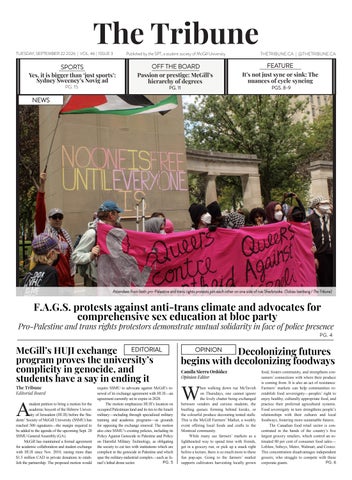
Attendees from both pro-Palestine and trans rights protests join each other on one side of rue Sherbrooke. (Tobias Izenberg / The Tribune)
F.A.G.S. protests against anti-trans climate and advocates for comprehensive sex education at bloc party
Pro-Palestine and trans rights protestors demonstrate mutual solidarity in face of police presence PG. 4
EDITORIAL McGill’s HUJI exchange program proves the university’s complicity in genocide, and students have a say in ending it
Decolonizing futures begins with decolonizing foodways
The Tribune Editorial Board
hen walking down rue McTavish on Thursdays, one cannot ignore the lively chatter being exchanged between vendors and curious students, the bustling queues forming behind kiosks, or the colourful produce decorating tented stalls. This is the McGill Farmers’ Market, a weekly event offering local foods and crafts to the Montreal community. While many see farmers’ markets as a lighthearted way to spend time with friends, get in a grocery run, or pick up a snack right before a lecture, there is so much more to these fun pop-ups. Going to the farmers’ market supports cultivators harvesting locally grown
A
student petition to bring a motion for the academic boycott of the Hebrew University of Jerusalem (HUJI) before the Students’ Society of McGill University (SSMU) has reached 500 signatures—the margin required to be added to the agenda of the upcoming Sept. 28 SSMU General Assembly (GA). McGill has maintained a formal agreement for academic collaboration and student exchange with HUJI since Nov. 2010, raising more than $1.5 million CAD in private donations to establish the partnership. The proposed motion would
require SSMU to advocate against McGill’s renewal of its exchange agreement with HUJI—an agreement currently set to expire in 2028. The motion emphasizes HUJI’s location on occupied Palestinian land and its ties to the Israeli military—including through specialized military training and academic programs—as grounds for opposing the exchange renewal. The motion also cites SSMU’s existing policies, including its Policy Against Genocide in Palestine and Policy on Harmful Military Technology, as obligating the society to cut ties with institutions which are complicit in the genocide in Palestine and which spur the military-industrial complex—such as IsPG. 5 rael’s lethal drone sector.
OPINION
Camila Sierra Ordóñez Opinion Editor
W
food, fosters community, and strengthens consumers’ connections with where their produce is coming from. It is also an act of resistance: Farmers’ markets can help communities reestablish food sovereignty—peoples’ right to enjoy healthy, culturally appropriate food, and practice their preferred agricultural systems. Food sovereignty in turn strengthens people’s relationships with their cultures and local foodways, fostering more sustainable futures. The Canadian food retail sector is concentrated in the hands of the country’s five largest grocery retailers, which control an estimated 80 per cent of consumer food sales— Loblaw, Sobeys, Metro, Walmart, and Costco. This concentration disadvantages independent grocers, who struggle to compete with these PG. 6 corporate giants.
2
NEWS
news@thetribune.ca
TUESDAY, SEPTEMBER 22 2026
Montreal protesters rally against Canada’s largest AI summit
Protesters call for resistance against AI development, highlighting its humanitarian and ecological dangers Talia Moskowitz Staff Writer
O
n Sept. 16, around 300 protesters gathered at Place Jean-Paul-Riopelle at 4:30 p.m. to protest the ALL IN 2026 artificial intelligence (AI) and tech summit—the largest AI summit in Canada— which took place across the street in the Palais des congrès de Montréal from Sept. 16 to 17. Organized by Convergence des luttes anticapitalistes (CLAC-Montréal) and endorsed by more than 15 organizations, the protesters marched around Place Jean-Paul-Riopelle, across blvd. René-Lévesque, up rue de Bleury, and through rue Ste.-Catherine. The Service de police de la Ville de Montréal (SPVM) maintained a large presence throughout the procession. At around 7:00 p.m., the SPVM and protesters clashed at the intersection of rue Ste.Catherine and rue Jeanne-Mance. The peaceful demonstration escalated as police officers flanked the protesters on foot and horseback. Officers used pepper spray against and fired flare guns into the crowd. A 19 year-old man was tackled, restrained on the ground by five officers, and subsequently arrested. ALL IN, organized by Scale AI and Mila—the Quebec AI Institute—featured over 200 speakers this year, including Montreal Mayor Soraya Martinez Ferrada, associate professor at the McGill Max Bell School
of Public Policy Anna Jahn, and the Canadian Minister of Artificial Intelligence and Digital Innovation Evan Solomon. The ALL IN website also lists the Canadian, Quebec, and Montreal governments as major partners. In a written exchange with The Tribune, Fraser Panton, protest organizer and graduate student in McGill’s Faculty of Arts, described the excessive degree of police force used at the demonstration. “Flanking is a known provocation tactic because once [police] start shoving protesters, even in the most disciplined actions, any attempts to defend oneself or to push back just to create space can be used as a justification,” Panton wrote. “The level of aggression and policing was simply unjustifiable given the size and nature of the protest.” The Tribune also spoke to Panton at the protest, where he highlighted CLAC-Montréal’s demands and rallied demonstrators around the power of collective action to resist AI. “We want to show that there is resistance to these AI projects, and that it’s possible to organize people and fight against this,” Panton said. “We need to […] mobilize [and] to show our opposition and fight against these developments that don’t benefit us, that just benefit a handful of tech billionaires.” ALL IN did not respond to The Tribune’s request for comment in time for publication. At the summit, Canadian Minister Solomon and the German Federal Minister for
Digital Transformation and Government Modernisation Karsten Wildberger announced the two nations’ plan to invest $150 million CAD and $100 million EUR, respectively, in LawZero—a Montreal-based nonprofit—to develop safe AI. Renee Sieber, associate professor in McGill’s Department of Geography, attended the protest against ALL IN and expressed her distrust of AI self-regulation in an interview with The Tribune. “It’s a farce. [There is] tons of empirical evidence that self-regulation simply does not work, and yet According to a 2025 KPMG survey, 73 per cent of Evan Solomon speaking over there is Canadian students use generative AI for their schoolwork. saying yes,” Sieber said. (Zoe Lee / The Tribune) In a written statement to The concerned about AI development. Jeremy ElTribune, Nabil Beitinjaneh, faculty lecturer iosoff, national leader of PauseAI Canada— at McGill’s School of Continuing Studies, an organization that aims to institute a pause discussed the impact generative AI has on on the development of frontier AI models— assessing student work at the university. He attended the event. In an interview with The highlighted the term “slop grenade” in refer- Tribune at the protest, he emphasized the need ence to large amounts of AI-produced output for a coordinated, global effort to safeguard from students, which instructors must verify against the imminent threat posed by this techand repair. nology. “A slop grenade shifts the instructor’s “People are still allergic to the word work from assessing the student to correct- ‘pause.’ They’re allergic to existential risk as ing the AI’s output, which does not help the a concept. It sounds too freaky. We need to student learn from their work,” Beitinjaneh start an international conversation to ban [AI wrote. development] to stop the frontier,” Eliosoff The protest attracted other organizations said.
McGill Senate discusses Bill 9, fiscal concerns, and the establishment of AI commission Senators question religious expression on campus and Saini proposes plan to tackle economic insecurity Shea McDonnell Staff Writer
T
he McGill Senate convened on Sept. 16, for their first meeting of the Fall 2026 semester. The meeting began with three memorials to McGill professors emeritus Arak M. Mathai, Varoujan Yaylayan, and Apostolos Papageorgiou. The Senate next discussed McGill President Deep Saini’s remarks on Bill 9 and its implications for prayer on campus grounds. Passed by the National Assembly in April 2026, Bill 9 aims to regulate religious expression in public spheres, specifically banning prayer spaces on university grounds. Arts Senator Frances Li opened questioning by bringing attention to the bill’s impact. “The implementation of Bill 9 affect[s] students today [....] What actions will McGill take to support our community while balancing [its] commitments to both students and the provincial government?” Li asked. Provost and Executive Vice President Academic Angela Campbell rose to reply, listing current alternatives on campus such as the Meditation and Spirituality Room. An example of a third-party space, Campbell suggested, are spaces leased in the SSMU building. “Space that lends to a third party is not subject to the bill [....] The Birks [Heritage] Chapel is also an exception,” Campbell said. “We’re also waiting for further recommendations from the ministry, which should come down after the
fall election.” Li also spoke to the legal status of Bill 21, Bill 9’s parent legislation, which banned public employees from wearing religious symbols and is currently being challenged in the Supreme Court of Canada. Saini then addressed McGill’s financial situation, calling for unity to be a pillar of Senate affairs in the future. He also noted that a new financial strategy is needed moving forward amid economic insecurity and political factors. “[This unity] does not mean conformity of thought [....] We can challenge each other, we can debate ideas, that is a fundamental feature of a public university,” Saini said. “We will always continue to lobby for more investment […] but in spite of that […] it is extremely unlikely that we will see [the provincial government reinvest] in higher education in the foreseeable future.” Saini presented three scenarios moving forward. The first option he outlined was to continue to run the university as it is now. The second option he proposed was decreasing overall spending by shrinking McGill’s calendar, as well as its services and programs. The third option was for the university to diversify assets and tap into new sources of funding, rather than rely on current revenue streams. While Saini preferred the third option, he emphasized that the university would not reap this pathway’s benefits for another three to five years. Campbell further elaborated on diversification, which applies to both the student body and
international relations. “We have relied too much or too long on a handful of countries of origin of our students,” Campbell said. “There’s a handful […] of geographies where there’s huge representations, […] where there’s huge talent, and we can do a lot with that.” Lastly, Terry Hébert, professor in the 53 per cent of McGill’s revenue comes from government grants. (Eliot Department of Pharma- Loose / The Tribune) cology and Therapeutics, raised a question regarding the university’s Soundbite: evaluation of the impact of AI. Citing Cory “We need to get through this with Doctorow’s concept of “enshittification”, which momentum and good energy, and if a describes the effects of deliberate platform degthree- to five-year horizon is accurate, radation, Hébert expressed hope about the esI worry a lot about how the reaction is tablishment of a McGill committee on AI use from [the Senate] here. Our undergrad inspection. students, that’s their time here, right? “McGill does not currently assess the outSo it has to go well for them.”—Angela comes [of AI] that raise concerns,” Hébert said. Campbell on the potential downsides of “[Doctorow] talks about a real set of risks from Saini’s new fiscal strategy AI that we should think about. AI is a bubble. We need to recognize that.” Moment of the Meeting: Arts Senator Rajan Duncan echoed similar Rare and Special Materials Cataconcerns, asking when the proposed committee loguer Marc Richard agreed with Saini would produce tangible results. Deputy Provost that McGill’s new fiscal strategy of diAcademic Christopher Buddle replied, explainversification can be compared to recent ing that the committee would report its findings Canadian economic initiatives. by the end of the 2026-2027 academic year.
news@thetribune.ca
TUESDAY, SEPTEMBER 22 2026
NEWS
3
‘The Tribune’ Explains: Quebec’s major parties’ platforms in the 2026 election
Comparing politicians’ promises regarding cost of living, language, and environment Asher Kui Managing Editor
Cost of living The CAQ promises to renew law I-7.1, which limits tax inflation on public services to here are 20 authorized political parties three per cent. These services include obtaining in Quebec, but only five that have at a driver’s license at the Société de l’assurance least one candidate in each of the prov- automobile du Québec, childcare at a Centre de ince’s 127 electoral districts: Coalition Avenir la petite enfance, and elderly homes at a Centre Québec (CAQ), Parti conservateur du Québec d’hébergement et de soins de longue durée. (PCQ), Parti libéral du Québec (PLQ), Parti The PCQ vows to abolish the carbon tax in québécois (PQ), and Québec solidaire (QS). Quebec, as well as to suspend the gasoline tax The Tribune outlines the five major parties’ of 19.2¢ CAD per litre for at least five months. political platforms concerning the cost of livIn an effort to re-establish the Quebec ing, French language preservation, and envi- government’s finances, the PLQ pledges to ronmental protection. bring back the Quebec Sales Tax (QST) breaks that the CAQ previously implemented on certain food and pharmaceutical products. Meanwhile, the PQ promises to abolish the QST on all used goods in Quebec; this would include used vehicles, clothes, furniture, and appliances. QS vows to raise the provincial minimum wage to $20 CAD per hour by May 1, 2027, and to provide $330 million CAD to Quebec compaThis is an example of campaign materials. (Asher Kui / The Tribune)
T
The Tribune is hiring
nies to “catch up” with this raise. Language In order to maintain French as the primary language in Quebec, the CAQ affirms it will renew the notwithstanding clause as applied to the province’s language laws, extending the Charter of the French Language to adult and vocational education centres. The PCQ has yet to announce its plans for linguistic protection. The PLQ promises to invest $380 million CAD in the next four years to make French an economic strength, centering literacy as a priority. The PQ plans to extend the Charter of the French Language to children of temporary immigrant status attending CEGEP, provided they have resided in Quebec for more than 12 months. Additionally, the PQ says it will attribute 10 per cent of every academically evaluated grade to the quality of a student’s French. QS promises to invest a total of $100 million CAD in the Programme de soutien à la francisation and the Programme québécois d’apprentissage du français combined. Environment Under the Legault government in 2020, the CAQ implemented the 2030 Plan for a Green Economy, which aims to reduce 37.5
per cent of greenhouse gas emissions—compared to 1990 levels—by 2030. An elected CAQ government would uphold this goal, striving for carbon neutrality by 2050. The PCQ promises to abolish the Fonds d’électrification et de changements climatiques (FECC), citing the fund as a waste of $13 billion CAD. The PLQ would redistribute $560 million CAD to grow Quebec’s agricultural sector, granting $140 million CAD to farmers annually over four years. This would ensure that the FECC is well-used and returned to maximize agricultural production and development. The PLQ also promises to modernize the province’s forestry regime in the party’s first year in office. Similarly, the PQ pledges to enact a new forest regime by 2027 if elected, consulting key actors in the industry as well as First Nations beforehand. It vows to achieve carbon neutrality by 2050, with a flexible greenhouse gas emissions reduction target of 42.5 per cent by 2034. QS would attempt to block any pipeline project from happening on Quebec territory. In addition, QS would invest $950 million CAD into green infrastructure, dedicating one per cent of the Plan québécois des infrastructures’s investments to the greening of cities and municipalities.
The Tribune is looking for an
STAFF INDIGENOUS CREATIVES STUDENT PHOTOGRAPHERS & ILLUSTRATORS ARTIST Please email a CV, one-page cover letter, and relevant creative sample to editor@thetribune.ca by September 28th, 2026 at 5pm EST. Please specify which position(s) you’re applying for in the subject line.
RESPONSIBILITIES: staff creatives must:
contribute 6-8 photos/illustrations to the paper a month attend weekly pitch meetings (6:00pm, • SSMU Building, room 404) •
(LEANNE CHERRY)
to design the cover for The Tribune’s National Day for Truth and Reconciliation issue
DESIGN:
The design can be photography, illustration, or mixed media.
DEADLINE:
Submissions are due to creativedirector@thetribune.ca on Friday, September 25, at 11:59pm. Final designs are due Monday, September 28, at noon. COMPENSATION: $150 FOR SELECTED DESIGN.
4
NEWS
TUESDAY, SEPTEMBER 22 2026
news@thetribune.ca
F.A.G.S. protests against anti-trans climate and advocates for comprehensive sex education at bloc party
Pro-Palestine and trans rights protestors demonstrate mutual solidarity in face of police presence Helene Saleska & Asher Kui News Editor & Managing Editor
In an interview with The Tribune, Emma*, the F.A.G.S. protest media liaison, highlighted the importance of Sept. 20 to the Montreal trans community. n Sept. 20, the Faction Against “[Sept. 20] has been a significant day for Genocide, in Solidarity (F.A.G.S.) the queer community for many years because organized a counter-protest bloc this small fringe transphobic group has been party, in response to the Ensemble pour pro- organizing transphobic marches every year,” téger nos enfants (EPPNE)’s anticipated an- Emma said. “We’ve gathered together to outnual protest. In previous years, EPPNE has number them and counter-protest and come held demonstrations on Sept. 20 to protest together to fight for trans liberation and for “gender ideology” taught in schools. In re- trans rights, against their hateful ideology sponse, F.A.G.S. has continuously planned and bigotry.” counter-protests to oppose EPPNE and proEmma then spoke to the current, broader mote education that includes discussions of anti-trans climate across Quebec and internagender and sexual identity. tionally. “From access to healthcare to this decision by the [Coalition Avenir Québec] last year to put trans women in men’s prisons […] a lot of trans people at some of these prisons are now being put in their own block, separated from the general population, which puts [them] further at risk,” they said. “The hysteria around trans people in bathrooms, trans people in sports [....] Being trans today is just Police keep protesters from walking onto the street. (Tobias constantly being used as a Izenberg / The Tribune) scapegoat […] for people who This year, the EPPNE did not announce want to deflect from actual issues that are afa rally, but nonetheless, F.A.G.S. and other fecting people.” transgender students and allies gathered on Emma continued to explain that the bloc rue Sherbrooke and av. McGill College, out- party aimed to redeem what was a day of side of the Roddick Gates. Around 50 people chaos and violence by transforming it into a were in attendance, with some of these par- cause for celebration. ticipants also protesting against Israel’s on“It looks like we’ve been so successful going genocide of Palestinians. in past years that this year they haven’t even
O
bothered to show up, and our counter-protest has now become the protest,” Emma said. “It’s a day that we can celebrate trans joy and queer joy and our fight for this liberation, instead of it being a very conflictual day like it has been in the past.” Across the street at the same time, protestors for Palestine also gathered to protest McGill’s investments in Israel’s genocide and apartheid in Palestine. At 11:50 a.m., police officers arrest a pro-Palestine protester for Many protestors walked chalking the sidewalk. (Tobias Izenberg / The Tribune) back and forth to support both causes, and from both events rushed over in an attempt Chloe*, another organizer from F.A.G.S., to protect him from the police encounter. A highlighted the connection between trans lib- drummer* at the protest explained how the areration and liberation for every citizen around rest took place in an interview with The Trithe world, including Palestinians. bune. “Our fight for trans liberation includes a “[The man arrested] was chalking on the fight for all peoples, handicapped people, ra- sidewalk, which we know is not illegal, we’ve cialized people, people suffering genocides been [protesting here] for three years and it’s here on Turtle Island and abroad, because we know that we share a common enemy,” Chloe said. “We’re all fighting against the forces of capital that put profit before people [....] We are stronger when we band together in solidarity.” At around 11:50 a.m., a protester at the event for Palestine was arrested by the Service de police de la ville de Montréal (SPVM) outside of the Roddick Gates. Demonstrators wave pride flags while dancing to loud music on av. In response, demonstrators McGill College. (Tobias Izenberg / The Tribune)
Attendees from both pro-Palestine and trans rights protests join each other on one side of rue Sherbrooke. (Tobias Izenberg / The Tribune) Protesters hold up banners that read “Ensemble pour protéger les droits des enfants trans” (“Together to protect the rights of the trans children”). (Tobias Izenberg / The Tribune)
Organizers address the crowd. (Tobias Izenberg / The Tribune)
A protestor wears the transgender pride flag behind their head in solidarity. (Tobias Izenberg / The Tribune)
been verified in the courts that chalking is not illegal,” the drummer said. “[An SVPM officer] arrested him because he walked away from the police and didn’t want to answer their questions. They are arresting him as an intimidation tactic.” The protestor was driven away in a squad car, but shortly after, SPVM officers brought him back as there were no charges filed against him, according to another demonstrator* in an interview with The Tribune. The F.A.G.S. event ended with a celebratory atmosphere, as protestors danced in the street together, played music, gave speeches, and collected candy from homemade piñatas. Chloe commented on the heavy police presence throughout the counter-protest and the attempted arrest, while emphasizing that queer joy still remains a stronger force than police action. “Police presence is not at all surprising to me. When queers demonstrate, riot cops show up, and more often than not, they beat us [....] I wish I could tell you why, but I think it is because our queer joy and our queer liberation stands so far opposed to [the accumulation of] capital,” she said. “When people are queer, they are not mindlessly feeding into the machine, […] sitting down, being quiet. No, queer people are much more in solidarity with their neighbours. They form diverse networks that are much more inspired, complex, and integrated.” *All sources’ full names have been omitted for the sake of their privacy.
opinion@thetribune.ca
TUESDAY, SEPTEMBER 22 2026
T EDITORIAL BOARD Editor-in-Chief Mairin Burke editor@thetribune.ca Creative Director Zoe Lee creativedirector@thetribune.ca Managing Editors Asher Kui akui@thetribune.ca Ellen Lurie elurie@thetribune.ca Clara Smyrski csmyrski@thetribune.ca News Editors Ilia Mehr-Bakhsh Josette Chandler Helene Saleska news@thetribune.ca Opinion Editors Lulu Calame Julie Raout Camila Sierra Ordóñez opinion@thetribune.ca Science & Technology Editors Avery Berry Sarah McDonald scitech@thetribune.ca Student Life Editors Rachel Blackstone Tamiyana Roemer studentlife@thetribune.ca Features Editor Kaitlyn Schramm features@thetribune.ca Arts & Entertainment Editors Norah Adams Annabella Lawlor arts@thetribune.ca Sports Editors Merce Kellner Ivanna Zhang sports@thetribune.ca Design Editors Eliot Loose Gwen Heffernan design@thetribune.ca Photo Editors Emiko Kamiya Sophie Schuyler photo@thetribune.ca Multimedia Editors Will Dawson Daphne Short multimedia@thetribune.ca Web Developers Zola Ball Kate Lauro webdev@thetribune.ca Copy Editor Ella Bachrach copy@thetribune.ca Social Media Editor Chloe Ross socialmedia@thetribune.ca Business Manager Amy Xia business@thetribune.ca
TPS BOARD OF DIRECTORS Zain Ahmed, Nour Khouri, Celine Li, Lialah Mavani, Ilia Mehr Bakhsh, Aleks Rohozinski, Alex Hawes Silva
STAFF Zain Ahmed, Brooke Barak, Miranda Forster, Abigail Francis, Alex Hawes Silva, Helena Helms, Dylan Hing, Gretta Iraheta Palacios, Lialah Mavani, Shea McDonnell, Jenna Payette, Sofia Vidinovski Rokayah Bellaoui
CONTRIBUTORS Lia James, Henry Latanville, Niamh Maguire, Shivaani Mohanraj, Olivia Zanini Sophie Alzona, Claire McCallum, Marco Gavita, Tobias Izenberg
TRIBUNE OFFICE Shatner University Centre, 3480 McTavish, Suites 404, 405, 406 The Tribune is an editorially autonomous newspaper published by the Société de Publication de la Tribune, a student society of McGill University. The content of this publication is the sole responsibility of The Tribune and the Société de Publication de la Tribune, and does not necessarily represent the views of McGill University. Letters to the editor may be sent to editor@thetribune.ca and must include the contributor’s name, program and year and contact information. Letters should be kept under 300 words and submitted only to The Tribune. Submissions judged by The Tribune Publication Society to be libellous, sexist, racist, homophobic or solely promotional in nature will not be published. The Tribune reserves the right to edit all contributions. Editorials are decided upon and written by the editorial board. All other opinions are strictly those of the author and do not necessarily reflect the opinions of The Tribune, its editors or its staff.
OPINION
5
EDITORIAL
McGill’s HUJI exchange program proves the university’s complicity in genocide, and students have a say in ending it The Tribune Editorial Board Continued from page 1. McGill currently forbids students from travelling to Israel under its Policy on Student Safety Abroad, which states that level three destinations—as Israel presently is— are not safe to visit. By dissuading students from attending HUJI due to regional safety concerns rather than because of its ties to Israel’s apartheid regime, McGill has attempted to shroud its complicity in Israel’s genocide in Palestine. Institutions that support Israel’s military development and operate on Palestinian land must not become sites for McGill students’ semesters abroad. HUJI claims its relationships to the Israeli state and military are purely academic. However, the university’s administration has evicted Palestinian students from campus housing and Israeli snipers have been spotted stationed atop university buildings, targeting the Palestinian
neighbourhood of Issawiya. Additionally, not only does HUJI host top military intelligence programs for the Israel Defense Forces (IDF)’s Intelligence Corps, but HUJI also houses the Talpiot Program, a premier IDF training program for “promising recruits,” on its Givat Ram campus. Considering the institutionalized relationship between the IDF and HUJI, McGill’s ongoing exchange program with the university is a form of active complicity in the state of Israel’s genocidal regime. It is important to acknowledge that HUJI’s student body and, by extension, McGill students who study on its campus cannot be reduced to a single political position or be uniformly characterized by their views on the violence in Palestine. In fact, students and faculty at HUJI have engaged in activism against Israel’s genocide in Gaza. Rather, the problem stems from McGill presenting its HUJI exchange program as an ordinary opportunity for academic enrichment, distancing students from the violent political
context that the institution is founded upon. As McGill itself has explicitly stated, academic freedom depends on institutions protecting the conditions that make this principle possible. However, maintaining a partnership with HUJI amid a violent political context—and despite documented proof of the university’s role in undermining academic freedom— contradicts McGill’s stated commitment to intellectual integrity. Undergraduates’ ability to vote in GAs on pressing institutional issues is not simply a right, but a political imperative with benefits extending beyond the act or outcome of voting itself. Voting is the first step towards participating in university governance—and demanding that it work better for students. The act of participation itself pushes the SSMU to provide students with clear information about their rights, and how to exercise them, as well as address possible accessibility barriers. Undergraduate students, who constitute the overwhelming majority
of exchange participants, represent nearly 70 per cent of McGill’s student body and thus hold incredible democratic power when it comes to critiquing partnerships such as this one—power that can shape the McGill administration’s ultimate decisions. If the SSMU motion passes through the Sept. 28 GA, SSMU will be obligated to present a parallel boycott motion to the McGill administration no later than the Jan. 13, 2027 McGill Senate meeting. McGill must be ready to hear its students’ concerns with dignity, respect, and consideration— in alignment not only with its institutionalized duty to preserve academic integrity, but also with its moral imperative to cut institutional ties with genocidal regimes. Students, attend the Sept. 28 SSMU GA. Read the HUJI boycott motion, listen to the debate, ask questions, and vote. McGill’s ties with HUJI will never be changed through silence. Remain informed and demand better from McGill.
Plamondon’s campaign misrepresents the real costs of a potential Quebec referendum COMMENTARY
Niamh Maguire Contributor
Q
uebec’s upcoming provincial general election on Oct. 5 has a particularly controversial underbelly: the promise of a sovereignty referendum by two of the major parties on the ballot, Parti Québécois (PQ) and Québec solidaire (QS). Last Friday, PQ leader Paul StPierre Plamondon stated that his party’s plan for a 2029-2030 referendum would cost the province approximately $130 million CAD. Plamondon’s announcement was hastily followed by castigating comments from several of his opposing candidates, who were quick to highlight that the longer-term cost of sovereignty would extend far beyond the price of the referendum paper itself. Christine Fréchette, leader of the Coalition Avenir Québec (CAQ), claimed that Plamondon had failed to disclose all the costs affiliated with a sovereign Quebec. Parti Libéral Québec leader Charles Milliard also criticized Plamondon’s proposal, describing the PQ’s plan for a referendum as a misuse of funds, particularly when the cost of living is rising, with wages struggling to keep up. Therefore, the more pressing contention underlying the current Quebec sovereignty debate is not whether sovereignty is a good idea, but rather whether Quebec politicians
are presenting a transparent and comprehensive image about the true cost of separatism. Politicians owe voters an honest depiction of what provincial sovereignty could look like—regardless of whether they support it or not. If Plamondon transparently conveyed the economic shifts implied by potential sovereignty, his supposed $130 million CAD referendum would, in fact, have a much higher price tag. Upon separation, Quebec would have to take on an additional estimated $397 billion CAD from its share of the national debt, adding to the province’s existing $250 billion CAD debt. Quebec also receives almost half of Canada’s $27 billion CAD equalization budget, as well as an additional $20 billion CAD in tax revenue from the federal government. Thus, between the increase in debt and loss of federal funding separatism would cause, Quebec would be thrown into a financial tornado. On Sept. 15, Plamondon announced his party’s intention to cut the Quebec budget deficit by $6.6 billion CAD, notably failing to comment on how a potential referendum would impact this plan. Instead, he has shielded himself from further scrutiny with the offhand claim that Quebec’s budget plan would be subject to potential unforeseen expenses following a successful referendum.
Politicians cannot make cost-cutting promises to voters whilst simultaneously neglecting their duty to be transparent about the true financial ef- The 1995 Quebec sovereignty referendum was defeated by a fects of the poli- margin of only 0.58 per cent. (Gwen Heffernan / The Tribune) cies at the root of their campaigns. it is first and foremost crucial that Whether they are for or against politicians do not divisively miscona sovereign Quebec, politicians must strue its potential costs and long-term present their stances on the separat- implications to voters for the sake of ism debate with full information— their own political motivations. Benot only concerning sovereignty’s fore heading to the polling stations, it true long-term costs, but also the is crucial that our politicians present consequences that would arise for all constituents with accurate informaQuebecers from separation. We must tion to inform a vote that would deconsider who, if the referendum were cide the future of the province. to be successful, would bear the brunt A party whose campaign is of its financial damages. predicated on dishonesty and opacFor many Quebecers, particular- ity will only make an untrustworthy ly students and lower-income people, government which places patriotism times are already extremely tough, above economic stability. Right now, and added financial instability due to the PQ is delegitimising the debate a referendum would only put them about sovereignty through its lies in greater precarity and distress. The of omission regarding the true cost possibility of volatile budgets under of separatism. If Quebec politicians a sovereign Quebec requires more continue to obscure information for thoughtful and comprehensive con- the sake of their party’s campaigns, sideration in the public discourse on Quebec voters will go into a potential separatism. sovereignty referendum improperly The potential referendum that informed—harming the province as a looms over the upcoming provincial whole, and undermining democratic election is controversial in itself; but transparency.
6
OPINION
opinion@thetribune.ca
TUESDAY, SEPTEMBER 22 2026
The UAE is funding the genocide in Sudan, and Canada just rewarded the Emirati government with a trade deal COMMENTARY
Ellen Lurie Managing Editor
C
anada and the United Arab Emirates (UAE) concluded negotiations for a Comprehensive Economic Partnership Agreement (CEPA) on July 24, 2026. This agreement strategically reduces barriers to trade between the two nations, in an effort to improve supply chain resiliency and market access for Canadian businesses. However, the United States-Canada trade war, and the Carney government’s resulting push to diversify its global trade relations, cannot serve as justification for Canada to exculpate itself from its international legal obligation to prevent genocide. Through its investigations, the United Nations (UN) has repeatedly exposed that the UAE covertly arms and finances the Sudanese paramilitary Rapid Support Forces (RSF). Since 2023, this provision of resources has allowed the RSF and its allied militias to commit a mass genocide in Sudan’s Darfur region, directly targeting Black, non-Arab ethnic groups, including the Masalit, Fur, and Zaghawa peoples. The UAE has funnelled advanced weapons, ammunition, and drones to the RSF through Chad, Libya, and Somalia via cargo flights, and provided backing through foreign mercenary networks to support the RSF’s campaigns against Black Darfurians. Acting out of strategic interest—particularly in Sudan’s gold reserves, access to Red Sea ports, and agricultural land—the UAE supports the RSF’s military operations while the RSF rewards Emirati investments with a steady stream of gold, creating a mutual ex-
COMMENTARY
change of economic and political resources for human lives. Canada is simply another link in this chain of genocidal complicity. The proposed CEPA represents the fastest trade negotiation in Canadian history, with both parties agreeing to remove or lower tariffs on goods, reduce red tape, and improve market access—including in the aerospace and engineering industries, which are deeply intertwined with ongoing mass violence worldwide. Two weeks before Canada and the UAE concluded negotiations, a UN fact-finding mission found that the RSF has carried out brutal mass killings, abductions, and gang rapes of women and girls—distinct markers of genocide. The extent of these atrocities would not have been possible without Emirati funding and arms, enabled by Canadian partnership with and investment in the UAE. In the face of abundant evidence proving the UAE’s complicity in the genocide in Sudan, Canada has not only maintained but in fact strengthened its ties to the UAE. Both Canada and the UAE are legally bound by the Convention on the Prevention and Punishment of the Crime of Genocide (Genocide Convention), after ratifying this UN human rights treaty in 1952 and 2005, respectively. Under Article Three of the Genocide Convention, complicity in genocide is a punishable offence. However, even failure to prevent genocide is considered a violation of international law, as Article One of the Genocide Convention strictly establishes a duty for state parties to employ all reasonably available means to prevent genocide from occurring.
As of August 2026, more than nine million Sudanese people have been internally displaced by the genocide, and more than two thirds of the population are in need of humanitarian assistance. (Eliot Loose / The Tribune) Canada is twice-bound in its duty to played these atrocities and failed to push prevent genocide: It ratified the Rome Stat- for substantial change—in stark violation ute in 2000, an international treaty that re- of their obligations under international law. iterates the obligations delineated in the Canada must remember the genocidal conGenocide Convention. Canada was also sequences of international inaction in 2003 the first country to codify the rules of the for Sudan, and break this cycle of systemic Rome Statute into national law—through its disregard for Black lives. Crimes Against Humanity and War Crimes The RSF methodically targets Black Act, which restates the country’s duties re- ethnic groups in Sudan using Emirati weapgarding genocide a third time. ons technology. By refusing to see the During the 2003 Darfur genocide, Su- UAE’s complicity in the genocide in Sudan danese General Omar al-Bashir’s regime during trade negotiations, Canada lays bare ethnically cleansed the Black Darfurian its unscrupulous dedication to furthering population in Sudan, destroying villages, its own global economic profile, and fails poisoning wells, and systematically raping to prevent the RSF from persecuting Black women and children—killing 200,000 indi- Sudanese populations. Canada must immeviduals and displacing roughly 2.7 million diately sever all economic partnerships with people. Yet, international actors down- the UAE.
Decolonizing futures begins with decolonizing foodways
Camila Sierra Ordóñez Opinion Editor Continued from page 1. As a result, certain areas are blessed with many food shops while others are completely disregarded, leaving residents in these neighbourhoods with limited access to healthy food. Nearly half of Montreal residents report being unable to reach quality grocery stores within a tenminute walk from their home or place of work. In other words, many Montrealers live in food deserts, and are left dependent on inaccessible food systems that mostly offer nonnutritious and unaffordable options. In this environment, farmers’ markets and other locally driven food initiatives become touchstones for consumers seeking alternatives to the inaccessible corporate food system. Grocery aisles appear to offer a multitude of choices, but do not always clearly disclose how and where their foods are grown, produced, distributed, or priced—information that may factor into consumer selection. In contrast, farmers’ markets close the distance between producers and consumers. Customers purchase directly from the people who care for, raise, and grow their food, affording
In 2022, only 38.8 per cent of Canadian farms sold directly to consumers. (Eliot Loose / The Tribune) consumers and producers alike a greater agency over what they choose to grow, sell, and eat. Canada’s current oligarchal food systems also rob consumers of opportunities to connect with the land and ancestral foodways. Indigenous communities across Canada—and the world—have
long used food cultivation as a way to connect with their culture, revitalize ancestral practices, and share knowledge with younger generations. Yet, these understandings of food and how to grow it are often excluded from mainstream food production systems and are rarely recognized as effective ways to strengthen
cultural continuity and access to diverse, nutritious foods. Grassroots initiative Tkà:nios, founded and directed by Kahnawà:ke community member Brooke Rice, is a space that fosters Indigenous knowledge exchange, bringing Elders and younger generations together to share traditional foodways through land-based learning. Similarly, the Montreal Chinatown community garden allows generations of Chinese Montrealers and other community members to share gardening techniques, enjoy the sunlight, and promote food sovereignty. These opportunities to spread knowledge to the broader community create distinct, tangible ways for individuals to engage with various food traditions. Refusing colonial approaches to food and food cultivation is a way of rejecting the extractive, profit-above-all-else, capitalist imagination of how food should be produced. The McGill Farmers’ Market offers more than fresh produce—it provides a glimpse into what food systems can look like when communities come together to grow, share, and learn about food. Simply buying from local farmers’ markets is a way to begin decolonizing foodways and to cultivate different possible futures. Dare to think otherwise, learn from others, and come back to the land.
arts@thetribune.ca
TUESDAY, SEPTEMBER 22 2026
ARTS & ENTERTAINMENT
7
Remembering Bob Mackie
Retracing the costume designer’s glamorous and star-studded legacy Gretta Iraheta Palacios Staff Writer
O
n Sept. 14, the loss of famed costume designer Bob Mackie left the fashion and entertainment industries reeling. He passed away at the age of 87 in Palm Springs, California. A lifelong aficionado of show business, Mackie’s career began in the 1960s as a sketch artist for costume designers in the film industry. Since then, he has worked with the biggest names in the entertainment industry, designing wardrobes for musicians, actors, and dancers. Mackie was no stranger to vivid colours and memorable silhouettes. He fashioned a legacy marked by designs oozing with a love for exaggeration that defines the camp style. His pieces are known for their countless sequins and rhinestones which dazzle perfectly under the spotlight. Deep cuts, frills, and sheer fabrics add a playful, risqué touch— Mackie’s bold, creative spirit left no stone unturned. In 1962, when Marilyn Monroe famously sang “Happy Birthday” to U.S. President John F. Kennedy, her iconic dress was conceptualized by none other than the legendary designer himself. As his glamorous designs gained traction through the ‘60s, American comedian and actress Carol Burnett enlisted Mackie to design all the costumes for The Carol Burnett Show, leading to a decade-long collaboration. He also worked with entertainment legends
like Judy Garland, Diana Ross, and Barbara Streisand. One of Mackie’s muses was the incomparable Cher. He designed her glamorous outfits during her days on The Sonny and Cher Comedy Hour, which ran from 1971 to 1974. Mackie also created many of the legendary looks Cher wore on her concert tours and other television shows, winning two Emmy awards for his work with her. The ‘70s popstar took to social media following his passing, writing, “Bob has gone up to heaven. Knowing him, he’s bringing Sequins, Beads, & his sketch pad.” Her tribute was one of many which graced social media platforms when the news broke of Mackie’s passing, an indication of the designer’s vast influence. Mackie was highly decorated, having accrued nine Emmy awards, a Tony Award, and three nominations at the Academy Awards overall. In 2002, Mackie was inducted into the Television Academy Hall of Fame for his outstanding contributions to the industry. His deep reverence for the world of performance and theatrical production was evident. Mackie once stated he preferred being designated as a costume designer rather than a fashion designer, since he relished in playing a meaningful role in the creative process of a production and loved to bring a story to life through his work. Mackie has certainly made a lasting impression in the fashion space. Mainstream artists such as Zendaya and Miley Cyrus continue to wear his archival pieces for their
performances and public appearances, likely once stated, “A woman who wears my clothes unable to resist the sea of shimmering rhine- is not afraid to be noticed.” stones that dot Mackie’s enormous catalogue The world will continue to mourn the of looks. loss of the extraordinarily talented Bob MackIn April 2026, Sabrina Carpenter head- ie, and his dazzling career has left a mark that lined Coachella, offering a grand production will be felt through generations. inspired by the glitz and glamour of Hollywood in the ‘60s and ‘70s—particularly evidenced by her many costume changes. With their resplendent sequins and flattering silhouettes, these dazzling outfits testify to Mackie’s eternal influence, paying homage to many of the design aspects that made his work so unforgettable. Moreover, Gen Z maximalism seems to wish to capture the essence of Mackie’s designs, with young people yearning for fashion that’s vibrant, striking, and bold. Over the summer, designs featuring bright colours and sequins—like those worn by Zara Larsson— inspired countless outfits and makeup looks. Mackie’s magic touch can be felt in this recent turn to aesthetics that are Mackie began collaborating with Mattel in the 1990s, designing over irresistible to the eye. He 60 Barbie dolls for the company. (Gwen Heffernan / The Tribune)
Macklemore’s support for Palestine highlights the importance of artists using their voices to protest injustice The rapper’s comments about Palestine got him kicked off Ed Sheeran’s 2026 tour Lia James Contributor
O
n Sept. 4, rapper Macklemore showed his solidarity with Palestinians by yelling “Free Palestine” and waving a Palestinian flag at MetLife Stadium. Ten days later, venue owners and promoters forced Macklemore off Ed Sheeran’s North American Loop tour for vocally advocating for Palestinian rights. Following his removal from the tour, Macklemore released a statement stating that Sheeran was under pressure from stadium owners across the U.S. to drop him from the tour, but that speaking out against a genocide is more important than any touring opportunity. Several of the stadium owners responsible for Macklemore’s expulsion had claimed that his pro-Palestine statements were antisemitic. However, such stadiums have had no problem hosting performances by Kanye West, who has shown explicit hate and threatened violence toward Jewish people. In response to such claims of antisemitism, Macklemore addressed Jewish members of his audience on Sept. 5. “Critism of Israel, criticism of apartheid, being against genocide, in no way is a criticism of you,” he said. “My message is for peace, love, for all human beings to be treated with dignity, respect, and equality.” Sheeran’s decision to take an “apolitical”
stance on atrocities in Gaza yet drop Macklemore for political reasons is hypocritical. Sheeran is one of the largest musicians in the world, and with his influence of 81.1 million monthly listeners on Spotify, his public opposition to the genocide in Palestine could push other artists to similarly express solidarity with Palestinians, as well as inspire his fans to condemn Israel’s genocide. With the significant amount of money he makes on tours, Sheeran is well-equipped to donate to relief funds supporting Palestinians who are suffering from forced starvation. Sheeran’s pattern of silence, under which he prioritizes touring and moneymaking opportunities, is anything but neutral: Failing to speak out is effectively siding with the oppressor. Macklemore is not the first artist to speak out against Israel’s genocide. The singer-songwriter Hozier frequently expresses his support for Palestine during his concerts, calling for a ceasefire and defending Palestinians’ right to statehood. Roger Waters, co-founder of Pink Floyd, has also advocated for Palestinian liberation since 2011, when he publicly announced he was joining the Boycott, Divestment, Sanctions movement. Since then, he has consistently encouraged other artists not to perform in Israel. After Sheeran dismissed Macklemore from his tour, Waters called Sheeran a “little prick” on his Instagram. Macklemore’s activism is not limited to the statements he makes while on stage: His songs themselves emphasize the importance
of global solidarity with Palestine. His 2024 million of my net earnings from Ed Sheeran’s releases, “HIND’S HALL” and “HIND’S Loop Tour to six organizations working directHALL 2,” reference Columbia University en- ly to support the Palestinian people,” he wrote. campment protestors’ symbolic renaming of Macklemore is proof that simply speaking Columbia’s Hamilton Hall to Hind’s Hall. The the words “free Palestine” on stage can have a renaming honoured Hind Rajab—a six-year- profound resonance. With this much discourse old Palestinian child who was murdered in generated from the words of one musician, it is Gaza, along with her family and the paramed- clear that artists can bear genuine impact when ics who tried to respond to her call to emer- demanding Palestinian liberation. So, before gency services. thinking that artists don’t have a responsibility “HIND’S HALL 2” spotlights Palestin- to speak up against injustice, take a step back ian artists and activists: anees, MC Abdul, and consider the power their words can have and Amer Zahr each make appearances on the when they do. track. Through these songs, Macklemore connects student encampments to broader histories of civil disobedience, using his platform to pay tribute to the over 73,000 Palestinians killed by Israel’s genocide. The royalties Macklemore received from the two tracks were donated in their entirety to relief efforts for Palestinian refugees. On Sept. 16, Macklemore published another statement to Instagram. “I will be donating the entire $1 Macklemore began writing lyrics at 15 years old. (Zoe Lee / The Tribune)
IT’S NOT JUST SYNC OR SINK: THE NUANCES OF CYCLE SYNCING WHY ELITE COACHES AND ENDOCRINOLOGISTS ARE PUSHING BACK ON CYCLE SYNCING WRITTEN BY SARAH MCDONALD, SCIENCE & TECHNOLOGY EDITOR DESIGNED BY ELIOT LOOSE, DESIGN EDITOR
F
or centuries, menstruation has been weaponized and used as evidence that those who menstruate—women or others—are the weaker sex. From myths of the hysterical woman to women being seen as unclean, menstruation became solidified within the social fabric of the world as a taboo sign of natural inferiority—an inferiority salient in the world of sports. Forget the fact that women make up seven of Canada’s ten most decorated Olympians and three of the five most decorated Olympians worldwide: How could women be as strong or as physically capable as men when women menstruate? Needless to say, these assumptions fold under scrutiny. Yet their power perpetuates not because they are true, but because they are accepted as true. These harmful narratives have self-sustained for centuries. Girls are afforded fewer opportunities to play sports, and women’s sports receive less funding and less media coverage than men’s counterpart activities. But women are fighting back. Enter: cycle syncing.
CYCLE-HUH?
At its core, cycle syncing is the acknowledgement that the modern world is designed around the male hormonal cycle—one which takes place over 24 hours—as opposed to women’s hormonal cycles, which typically range from 24 to 38 days. Cycle syncing advocates preach mantras of “Live like a woman, not a man” and “STOP taking care of yourself like a male,” presenting an alternative lifestyle which takes women’s fluctuating hormones into account during everyday routines. Across social media, women advocating for cycle syncing promote altered exercise routines which factor in varying hormone and energy levels. This essentially includes lightening workouts during the luteal phase, and hitting the gym a little extra during the follicular phase. However, some influencers call for more substantial changes, claiming that workloads and diets should also be adjusted to reflect hormonal changes. They say it will change your life, but is cycle syncing all it’s made out to be? In an interview with The Tribune, Rose Monday— retired elite international track champion, former head coach of the 2020 United States Women’s Olympic track team, and current high school track and cross country coach—discussed how she trained as an elite runner herself, and how those practices inform how she now trains her women athletes. “I knew from the age of nine, when I saw the 1968 Olympics on TV, that that is what I wanted to do when I grew up. I saw Bob Beamon win the Olympic gold medal in the long jump,” Monday said. “I could jump far at that time, and I was a sprinter. As a little girl, I could beat all the boys on the block. In fact, my brothers and sisters used to bet boys that I could beat them.
So, I would race even high school boys, and [in eighth grade] my dad signed me up for a track team.” That was the start of Monday’s running career, which took off with her competing in her first Olympic trials in 1984—one year after graduating college. Monday spent years competing at the international level before taking her first coaching position at a high school in Los Angeles. Later, she took an assistant coaching position at the University of Texas at San Antonio (UTSA), where her performance earned her an invitation to coach American athletes at the international level. Monday has since left UTSA, now coaching at a high school, but continues to advise professional athletes. In terms of the scientific nature of her approach to training, Monday described her own categorization as an 800-metre runner. “I was a sprinter in high school,” Monday explained. “When I got to college, our coach took us to [University of California, Los Angeles] to have a muscle biopsy done to determine how much fast-twitch and slow-twitch fibre we had. And at that point, it was determined that I had 65 per cent fast-twitch and 35 per cent slow-twitch, and at that moment, that day, I became an 800-metre runner.” Every day of her career as an 800-metre runner was determined by her biology: her physical ratio of slow-twitch fibres, which support endurance, versus fast-twitch fibers, which allow for bursts of movement. Such analyses helped Monday understand running as not simply a sport, but also a science, where training and energy utilization are functions which can be optimized. Understanding her athletes’ twitch fibres—not through biopsies, but through careful observation— allows Monday to recruit meticulously and train her runners in a way most conducive to their biology now that she is a coach. Science plays a role beyond Monday’s recruitment. In fact, her entire training regiments are scheduled around individual needs and body mechanics. “[Training is] all about the adaptation of stress to all the different energy systems with the demands of the event in mind [....] If I could train [my athletes] all the same, my life would be easy. [But with] 35 kids, I can’t do that. We have 15 workouts going on within the workout, depending on how I can get each one of them the very best they can be,” Monday explained. “So knowing what percentage I have to have of lactate threshold, […] [or] of aerobic threshold of
velocity at VO2 Max, [or] of anaerobic thresholds [....] There’s different types of training that go with all these areas.” Yet in regards to incorporating cycle syncing into long-term training regiments, Monday was quick to question this process. She explained that it was not something she did as an internationally ranked athlete, nor is it a practice she uses when training her teams—regardless of whether they are high school students or Olympic athletes. “If an athlete tells me she’s having her cycle, then I’ll adjust the training just slightly, just take the edge off, if she’s got a lot of cramps or something like that,” Monday said. “I know that some of the athletes I coach have really bad cramps, and we have to adjust their training a little bit more for them.”
THE SCIENCE OF THE CYCLE most gynecological researchers and the foundation encers explain how each hormonal shift—associatstood. Prior explained that cycle length, the focus of around knowledge of the self and of the body. Influ-
Monday’s perspective is corroborated by hormonal science. The Tribune interviewed Jerilynn Prior, an emeritus professor of endocrinology at the University of British Columbia who has been studying women’s reproductive hormones since the 1970s, to understand the science behind periods and cycle syncing. “For a start, each menstrual cycle is primarily made up of the hormones that come from a single follicle, a follicle that was made when you were in utero and had just begun to make eyelashes,” Prior said. Prior then went on to describe the menstrual cycle, and what role each of its two central hormones, estrogen and progesterone, play throughout. She referenced a chart that many of us have seen, an infographic showing that estrogen—a growth-stimulating hormone, partially derived from the aromatization of testosterone—peaks first, followed by a taller peak in progesterone—a hormone which blocks the stimulating effects of estrogen while working to mature and specialize cells—occuring concurrently with a smaller, second peak of estrogen. Together, these hormonal fluctuations provide the base of the menstrual cycle. The premise of cycle syncing is founded in the belief that these hormones each have distinct physiological effects which can be capitalized on and adjusted for, in order to allow for the best possible workout during each phase of a woman’s menstrual cycle. However, for these changes to be optimized, the hormones themselves, along with their levels, must both be properly under-
of most cycle syncing practices, is actually not where research nor social energy should be focused. Rather, she stressed the importance of studying ovulation. “[Ovulation is] extremely important, and so understanding that ovulation sometimes doesn’t occur is important, and understanding when and why and how it sometimes doesn’t occur is also important,” Prior said. “And what [society] does is totally ignore that. We use cycle length, which tells us nothing about ovulation, because you can have perfectly regular cycles that are not normally ovulatory, in fact, that are anovulatory and that don’t release an egg at all.” Ovulation is a critical period in the menstrual cycle, as it triggers the sharp uptick of progesterone levels. Progesterone plays a crucial role in heart function—with Prior citing low progesterone as associated with heart attacks and poor bone health. When the luteal phase of the menstrual cycle is too short, progesterone cannot reach optimal levels: a critical issue in the modern world, which Prior attributed to increased stress levels. However, Prior explained that the amount of progesterone in the body during menstruation is often misunderstood, as while the graphs we are all familiar with show a rise, this increase is not set to scale. “The reality is that estrogen rises 220 per cent above its baseline, but progesterone rises 1,400 per cent above its baseline, and, in fact, they’re in different units,” Prior explained. “The unit for estrogen is picomole. The unit for progesterone is nanomole, which is a thousandfold bigger.” Prior clarified that she does not know of any evidence which definitively shows a relationship between menstrual phases and muscle fibres throughout the body. “You can spin a bunch of stories about it, but there really is not strong evidence either that [menstrual] hormone changes directly relate to [muscle] fibres,” Prior said. “If [cycle syncing] empowers [you], go for it. But I don’t think there’s scientific evidence to back it.” This begs the question: If elite athletes aren’t cycle syncing, and cycle syncing isn’t scientifically backed, why is it being promoted as a lifestyle cure-all?
CYCLE SYNCING: CAUSE AND EFFECT
In an interview with The Tribune, Holly Kohler—U3 Joint Honours Political Science and Gender, Sexuality, Feminist, and Social Justice Studies, as well as project coordinator with the Students’ Society of McGill University’s Menstrual Health Project—discussed how menstrual health education and social structures play into beliefs about women’s bodies. “I think overall people are highly undereducated about periods, and that is something that surprised me when I started working at the Menstrual Health Project,” Kohler said. “To even ask questions, people feel like they’re asking stupid questions all the time. They’re like, ‘Oh, I should know the answer to this,’ and they don’t, and they feel really bad about that. But I think that ultimately comes from just a lack of education.” Cycle syncing, however, offers a form of knowledge. It is a practice centred
ed with respective phases of the menstrual cycle— warrants its own lifestyle changes. They claim that when you know your body, you can live your best life within it. To be clear, their claims do have some basis. Acknowledging your body and giving yourself the grace you deserve is key in any effective self-care routine. That being said, adjusting your entire life to cater to a physiological reality may not be the best choice for many. “My first impression of [cycle syncing] is not a negative one, in the sense of when you don’t think about it too deeply, you’re kind of like, ‘Yeah, like that could make sense.’ When your body is at a certain point in its cycle, you should be doing things to accommodate it,” Kohler explained. “But when I think about it deeper, there are problems that arise in maybe pathologizing or being very categorical about the ways in which women experience different parts of their cycle.” Critically, the practice of cycle syncing extends beyond the gym: It makes its way into the living room, the kitchen, the home office, and the bedroom. The cycle syncing lifestyle promotes completely altering your routines based on the hormonal stage you are in at any given time. Women are encouraged to work out less and take things easy at work during the luteal phase, while told to push against their physical limits and take on extra responsibility at work during the follicular phase. Though a shift towards a social prioritization of feminine hormonal cycles is important, the implementation of this change toes the line between support for, and subjugation of, women. While the cycle syncing movement exists to help women through menstruation, its underpinning logic bears an uncanny resemblance to the logic which was, and continues to be, used to oppress and marginalize women, such as the seemingly-endless online content depicting women as weak, inferior, and irrationally emotional during their periods. “What would [the spread of cycle syncing] ultimately do to people’s perception of women?” Kohler asked. “Already, [society has the] idea that women’s hormones make them weaker or more emotional, more hysteric [....] If [women are] now sectioning our workouts and our schedules based on [menstruation], it almost feels like succumbing to something. [But] in some senses I’m like, ‘Oh, maybe this is a step towards deconstructing this system of the 24-hour day and the world that’s been constructed without women’s hormones in mind.’” This poses the real question of what it truly means to succumb to something so socially enmeshed as the patriarchal hormonal cycle. Is catering to the menstruating body an admission of defeat, or is it an overdue empowerment? At the end of the day, Olympic coaches and medical doctors aside, there is no right way to be a woman in the modern world. The careless promotion of cycle syncing practices risks disempowering the very populations it aims to support. If you call women more creative and physically powerful during ovulation, but this is understood as women only being creative and strong during the first half of their cycles—in other words, only capable half the time— where does that leave women, if not more susceptible to the systems which have been oppressing us for centuries? So, take it or leave it: It’s not “sync or sink.” If cycle syncing is a process which helps you, as many claim it does, then continue living in a way that makes you feel your best. But don’t think less of yourself or your abilities just because you’re in your luteal phase. You are capable every day—some days, your body may just need more grace.
10
ARTS & ENTERTAINMENT
arts@thetribune.ca
TUESDAY, SEPTEMBER 22 2026
Aldous Harding’s poetic peculiarity takes the stage at Le National Harding tours her new record, ‘Train on the Island’
Annabella Lawlor Arts & Entertainment Editor
A
ldous Harding songs are like riddles with no answer. They snatch the curious listener in with whispers, biting down sharply in unruly melodies and leaving musical phrases without closure, soothing and combative in the same measure. On paper, their peculiarity should overshadow their content. But Harding’s songs bleed truth. She fashions idiosyncratic poetry to confront the harrowing intricacies of love, life, and isolation. On Sept. 15, New Zealand-based musician Aldous Harding performed at Montreal’s Le National. Touring her recent album release, Train on the Island, Harding’s musical demeanour ranged from sombrely reflective to eccentrically intense while translating these new tracks to the stage. Harding is known for the persona she inhabits while performing: Her sharp stares pierce every crevice of the concert hall, while her stiff, gesticulating dances constitute her complete immersion into this perplexing character. Train on the Island departs from the playfulness of Harding’s past records into a world that reconciles with loneliness, the culture of performing, and drifting personal relationships. As a result, Harding’s strange on-stage character has morphed on this tour from unconventionally awkward into troublingly intense. Shifting from the danceforward tracks of her previous record, Warm Chris, into the stark sincerity of these new songs, Harding’s stage presence makes the
juxtaposition clear. Harding opened her show with the new record’s title track, “Train on the Island,” a piano-driven ballad that resists concrete definition in its introspection. She took to the stage with her long-time collaborators—Mali Llywelyn on piano and harp and H. Hawkline on guitar and bass, along with touring musicians on drums and guitar. With instrumentation forming a warm background to her tinny vocalizations, Harding moved with a nonhuman stiffness, fixing her glare harshly toward the crowd. Certain tracks gain new resonance with the realization that Harding’s poetry eulogizes the disintegration of her relationship with
her presumed ex-partner, Hawkline himself. Singing in a duet on the record, “Venus in the Zinnia,” the two musicians demonstrate the close-knit relationship they have maintained in the wake of their romance. Their continued collaboration demonstrates the honest poignancy of these tracks, especially in the moments of the performance wherein Harding hummed elegies lamenting their increasing isolation. Harding sang two of her most vulnerable songs on the record, “San Francisco,” and “What Am I Gonna Do?,” in sequence. On these tracks, Harding asks what comes next in the aftermath of her disintegrating relationship with Hawkline, searching for
In 2025, Harding collaborated with Perfume Genius on the song “No Front Teeth.” (Annabella Lawlor / The Tribune)
answers to internal strife through these emotional melodies. With stark instrumentation to accompany her words, Harding’s lyrics on “San Francisco” become the emotional centrepiece of the record. She croons against her acoustic guitar, “Baby, I know who I am / What is the change to save me?” No harmonies comfort her sorrowful words; Harding was alone at centre-stage, and the only one who could resolve this internal conflict. “What Am I Gonna Do?” continues this line of questioning. On stage, Hawkline’s grooving bass melodies punctuated Harding’s verses, abruptly fading to a simple piano as she asked, “What am I gonna do if I can’t break out of it? / What am I gonna do if they can’t train me out of it?” With Llywelyn’s harp accompaniment plucking over the song’s conclusion, Harding laid flat on the stage, gazing up at the dark abyss of the concert hall as her winded chest expanded and contracted. To close out the performance, Harding sat alone with her guitar to play her 2017 track, “Imagining My Man.” Singing, “I do not have the answer / But I don’t have the wish to go back,” Harding responded to her questioning from nine years in the past: There doesn’t need to be a solution. Train on the Island is Harding’s path to rediscovery. Witnessed in the flesh, the album penetrates the hearts of those who lend their ears to listen, extracting emotions that feel incomprehensible until Harding injects them into song. To see Harding live is to witness her music in an ineffable new light.
Why we’re all falling for the analog trend
Gen Z is exchanging earth-warming digital media for heartwarming physical versions
Norah Adams Arts & Entertainment Editor
A
s the jagged edges of leaves start to seep with orange tones, and the wasps on campus (finally) all die off, another telltale sign of fall migrates inwards. Whether you’re a doomscrolling addict or simply an “I only have Instagram on my laptop” type, you’re sure to have already seen countless Reels containing “fall guides” and tips to “whimsify your fall.” In this genre of aesthetic, warm-filtered inspo-posts, there is a new frontrunner for the best way to maximize your fall cozies: Live like it’s 2009. Many of these Instagram carousels feature photos of fuzzy TVs playing It’s the Great Pumpkin, Charlie Brown on VHS, or Twilight: New Moon on DVD. Reels flash photos of flip phones and iPods connected to wired headphones. Nostalgia and autumnal comfort are portrayed as seemingly impossible without another trending practice— switching to analog media. Throughout 2026, the internet has been an active participant in its own destruction. A host of posts have cropped up ironically denouncing online activity and the consumption of digital media in favour of time spent journaling, listening to cassettes, and taking film photos. The internet was once a space which made art more accessible, with the costs of streaming large rosters of music, movies, and
television coming at similar price points to physical copies of the same forms of media. Digital zones fostered the creation and sharing of independent art from small artists. Now, AI-written messaging—replete with eerily well-suited emojis and fictitious images of sexy fruits—crowd the spaces where online creativity once thrived. Record and CD players, which were once an indication of a hipster tendency, are now among the few ways to listen to music AI-free. On streaming platforms such as Spotify, AI makes customized playlists for listeners, AIs DJ, and music created by generative AI floods in-app recommendations. Netflix, the most subscribed-to streaming service globally, has admitted to using AI technology in several titles produced under its studio. Many film-watchers, distressed by the implications of this usage of AI in the art of movie-making, are thus increasingly shifting to watching movies in theatres or on DVD. For many, this switch to physical forms of media cultivates a new sense of intentionality in media consumption. By moving away from streaming platforms brimming with endless options, consumers are able to spend more time focusing on the merit of individual pieces of art. In an interview with The Tribune, U3 Arts Oren Liebenthal, who shoots film as a hobby, described how analog photography provides him with a more honest experience.
“I really value being able to hold the trend is just that—an aesthetic response to film negative in my hand. It does feel like burgeoning fears of an increasingly unwelit’s more truthful than having an image in come digital space, or a revolutionary movemy camera roll,” he said. “I feel like that is a ment toward reclaiming an internet-free life. feeling in response to everything being made Either way, if the temptation of fall whimsy so easily available online.” is strong, you might as well check your local These physical forms of media provide thrift store to see if you can snag a box set of a cozy hideaway from the wealth of anxieties Gilmore Girls and really make the most of that AI brings. They push us back to a pre-In- your movie nights this autumn! ternet era, free from unintentional media consumption and an excessive production of low-quality content. Although seemingly an alternative to the negative environmental impacts of AI, the analog trend could represent a similarly damning issue. Many creators online have called out the movement’s inclination toward overconsumption: Influencers, hoping to capitalize on the analog fad, are purchasing plastic-cased CDs and sparkly flip phones, all of which are likely to end up in landfills by the time the trend cycle runs its course. However, with physical media generally purchasable second-hand, the analog shift could instead solve two problems at once. By switching to nondigital media, you can simultaneously reduce the use of emission-skyrocketing AI-embedded platforms and make use of previously overlooked technology that stuffs both thrift store shelves and your Craft store Michael’s has seen a 136 per cent increase parents’ basements. in website searches for “analog hobbies” in the past six Time will tell whether the analog months. (Gwen Heffernan / The Tribune)
studentlife@thetribune.ca
TUESDAY, SEPTEMBER 22 2026
OFF THE BOARD
STUDENT LIFE
11
Passion or prestige: McGill’s hierarchy
Avery Berry Science & Technology Editor
“
What are you studying?” So goes the question that follows every acceptance email, every round of congratulations, every Frosh event, and every random conversation at a bar. The answer is never quite enough on its own—every interrogation is closely followed by a, “But what are you going to do with it?” McGill sits 30th in the 2027 QS World University Rankings: a number that elicits congratulations. But the simplicity behind such numerical praise wears off quickly. Somewhere between acceptance and graduation, McGill students build an invisible hierarchy of pro-
grams: Any courses with an intimidating syllabus and even more intimidating Rate My Professors score are rewarded above all else. Though it’s never written down, and no one admits to thinking it, this hierarchy embeds itself in the raised eyebrow you’re met with when you name your program. Your answer may warrant either a dismissive, “Oh, that’s a chill degree,” or an impressed, “Wow, that must be so much work.” I felt that hierarchy from the inside before I understood what it was. After my first-ever trip to Montreal, the McGill Campus Store’s successful attempt to dress my entire family in McGill merch, and an unauthorized campus tour through the Ingram School of Nursing, I was determined to study nursing at McGill. However, after my family and I moved to Amsterdam for five years, my elementary school French immersion knowledge faded with the time abroad, and my confidence in my ability to study nursing through McGill’s bilingual program faded with it. So, I looked for a way onto campus that would not depend on a language requirement I no longer trusted myself with, and applied to Kinesiology. In the end, my acceptance got me where I ultimately wanted to be: McGill. My degree choice felt safe, but safe-
ty is not the same as passion. By settling for a program that got me into the school I wanted without the future I envisioned, any praise I received for my acceptance felt bittersweet, and I slowly started to ingrain this hierarchy in my head that my program ranked lower than those around me. By the second month of my first semester, a single course—ANAT 315: Clinical Human Musculoskeletal Anatomy—confirmed my decision to transfer out of Kinesiology. Maybe I initially chose to transfer with the attempt to receive more praise for my degree, but my final decision was ultimately due to the fascination I found working in a cadaver lab and having the unique opportunity to learn anatomy through such hands-on experience. With the newfound passion I discovered in ANAT 315, along with my unexpected enjoyment of MATH 133: Linear Algebra and Geometry—albeit for a completely different reason; sitting down and solving a problem until you reach its logical solution is deeply satisfying—I transferred into Cognitive Science, a field I felt brought these interests together. Nothing about my interest in anatomy or linear algebra had changed between Kinesiology and Cognitive Science, but
my hesitancy in switching degrees taught me that McGill’s unspoken hierarchy rewards status and difficulty over curiosity, making it easier to justify choosing something because it is hard rather than because you genuinely enjoy it. My changes in degrees were not simply due to a lack of direction: They reflected my internalization of the hierarchy I perceived between programs. I became less willing to trust what I enjoyed and more concerned with whether my choice was respectable enough. This structure, meant to sharpen ambition, instead fosters anxiety, replacing “Do I enjoy what I study?” with “What if enjoying what I study isn’t enough?” These urges are not unique to any one faculty. Desautels and Arts students alike fill their schedules with clubs, internships, and extracurriculars. For many, these decisions are motivated by a fear that the empty space on their resume will label their experience at McGill as insufficient. The on-paper definition of your success at McGill depends on who you ask, but the habit of seeking prestige does not. Maybe McGill students really have built this hierarchy together, degree by degree. Or maybe I’ve created one in my own head, and I’m just noticing it because I’m afraid of where I fall within.
Where’d all the backpacks go? A letter from an abandoned friend Tamiyana Roemer Student Life Editor Dear McGill student,
I
curse the Longchamps, the Goyards, and the thrifted messenger bags alike. A harsh opening, perhaps, but a justifiable one, considering I am your beloved, and now abandoned, backpack. We were inseparable once, but now I am squished in your closet among the other misfit victims of your disregard. I never imagined, after all our long walks down the academic halls of your childhood, that I’d end up spending more than the mere summer months apart from you. I was once thrilled, back in your senior year, when you packed me up to accompany you to a new city—even though my invitation was mostly ordered by your mother. Out of habit, you brought me to your first day of undergraduate classes, to an uncomfortable seat at the back of Leacock 132. Staring down at hundreds of students, you watched as your peers lay down their tote bags and oversized purses. Pushing me sheepishly under the table, you swore to assimilate. Perhaps if I sported the Arc’teryx logo, I’d have enough social capital to outweigh the stigma that follows me. Or maybe the embroidery of the McGill varsity emblem could have sufficed. But alas, you never were quite that athletic. So while these two iterations of backpacks remained socially acceptable, I simply didn’t make the cut. Look, I’ll concede: My design isn’t perfect. When packed until the zippers barely closed, I wasn’t exactly great for your posture. But I dutifully carried your laptop, your water bottle, those three textbooks you swore you would read, and the crumbling granola bar you always forgot
about. I held your belongings through midterms, tional personal branding. slush, you will remember me. Until that day, I finals, and all your mortifying high school social Honestly, I’m not bitter. I am simply asking yearn for you to open the closet, brush the dust blunders. I never complained when you began to you to remember who you were before Montreal from my straps, and put me on your shoulders only wear one of my straps. I kept my pocket shut taught you that functionality was unfashionable. again. I would forgive you, of course. I was built when you threw me carelessly into the back seat. I know you, and I know that one day, when your to carry your baggage anyway. I even held my zipper when you stuffed a half- winter coat is determined to repel your purse eaten sandwich into my front pocket. straps from your shoulder, causing your belong- Sincerely, And yet, at McGill, I’ve been labeled an em- ings to end up in a puddle of half-melted grey Your backpack barrassment. I remember the first time you left me behind. You told yourself it was practical. You only had one class, after all. A notebook and laptop would easily fit in your tote. Then I heard your excuses: “Backpacks are too bulky.” “I’m going to BdA after class.” “What are we in, middle school?” I watched from the closet as your collection expanded— a canvas tote here, a leather shoulder bag there. Each acquisition was more trendy than the next, aside from the flimsy reusable Provigo bags that are still accumulating in your apartment. I’m inclined to wish you’d gone to a school like Queen’s University instead. Surely there, among a sea of Lululemon and schoolbranded sweat sets, I would have fit right in. But you chose McGill, where a utilitarian nylon object fails to The Thailand Office of the Basic Education Commission suggests that school bags should not exceed 15 per cent of the child’s communicate your aspira- body weight. (Claire McCallum / The Tribune)
12
STUDENT LIFE
studentlife@thetribune.ca
TUESDAY, SEPTEMBER 22 2026
Study hard, party harder
A nightlife guide based on your favourite McGill study spots Brooke Barak Staff Writer
A
t McGill, there is one motto that all students live by: Work hard, play hard. This means grinding in Schulich until closing time, running home, changing, taking three [insert your drink of choice here] shots, and then running to the pre. Clearly, part of the reason we get to live this luxurious lifestyle is the abundance of wonderful libraries our campus offers to students. Where you study reveals who you are, so here are some nightlife recommendations based on your favourite McGill study spots. Birks Reading Room The Birks Reading Room, located on rue University, is so quiet that students’ heads turn 180 degrees at the sound of a pencil dropping. Its beautiful, historic rooms transport you a century into the past, allowing you to focus like you never have before. Birks is also famous for its shoes-off policy—if you’re so inclined. If Birks is your go to, check out Bar Darling. Filled with vintage tchotchkes and colourful ambient lights, Bar Darling is Birks’ whimsical late-night sister. It’s the perfect place to go if you want a chill night with good cocktails, light dishes, and good conversation. Just like Birks, Bar Darling is fit for anyone who loves a calmer ambience.
Except at Darling, your shoes must stay on. McLennan Library The seven floors of McLennan can be safely described as dark, depressing, and an overall pit of despair. Students who prefer to study in McLennan have the goal of making themselves miserable enough to concentrate on their schoolwork. Luckily, dark environments don’t always have to be gloomy. If you like a dim setting like McLennan, finish your assignments and head on over to Bar Bifteck. Bifteck has two dimly lit floors filled with cheap drinking, pool tables, and grungy fun. When you’re there, you sometimes feel like a vampire—just like you would at McLennan studying late into the night. Cyberthèque Cyberthèque, located in the lovely basement of the Redpath library, is defined by one thing—its diverse crowd. There, you can find anyone from first years and grad students to professors and people who don’t even go to McGill. You can also enjoy a vast range of activities in this space: its glass study pods, a poke bowl from Redpath Café, or people-watching from its windows overlooking the McGill quad. If you are someone who enjoys the ample amenities at Cyberthèque, you should try MadHatter. Located on rue
Crescent in the heart of downtown Montreal, this basement bar attracts a wide crowd. From Concordia students to random 40-year-olds, you can meet just about anyone at MadHatter. You can watch a show on one of their TVs, play a round of pool with your friends, or even rally some ping pong. The possibilities are endless.
opposite. For one, Stereo’s sound system, nicknamed “The Beast,” is one of the loudest in Montreal. So, you can scream, cry, or laugh as loud as you want—things you can’t do on Schulich Six. Let it all out; the sound system will overpower you anyway. Every student needs time to let loose, especially when constantly shushed by others. In the end, balance is what McGill’s all about.
Schulich Library, Floor Six While there is already a lot to say about Schulich as a whole, the sixth floor is a world unto itself. It may be the most sterile place on campus. It is rumoured that no student has ever smiled while studying there. If you try to whisper to your friend, or even let out a small laugh, dirty looks and shushes will attack you from countless directions. Clearly, spending time on Schulich Six can be frustrating and exhausting. So, if you need a detox from those surroundings, go There are over 420 registered bars in Montreal. (Gwen Heffernan / The to Stereo: It’s the exact Tribune)
IDSSA panel highlights Palestinian sustenance projects and education Shaban and Rantisi share personal experiences of and encounters with Gazan resilience Sofia Vidinovski Staff Writer
O
n Sept. 17, the International Development Studies Student Association (IDSSA) hosted an event titled “From Control to Annihilation: Food, Education, and the Destruction of Palestinian Life in Gaza.” The discussion was led by Ahmed Abu Shaban, visiting professor in the Department of Natural Resource Sciences at McGill and dean of the Faculty of Agriculture and Veterinary Medicine at Al-Azhar University in Gaza (AUG), along with Norma Rantisi, professor in the Department of Geography, Planning, and Environment at Concordia University. Before the genocide in Gaza, the Israel Defense Forces (IDF) already controlled both the Occupied West Bank and Gaza with multiple checkpoints, closures, and blockades limiting the amount of people and goods entering each given territory. Shaban began the panel by emphasizing how the people of Palestine were heavily restricted in terms of movement, aid, and education. “Gaza is known as the largest open-air prison in the world,” Shaban said. “What we [now] call the Gaza Strip, it is actually what is remaining from the historical Gaza. Gaza used to be much bigger in size than what we have today [....] And you have 2.2 million people living in this small piece of land, with a strict siege since 2006 controlling all means of life [and] all the Palestinians in Gaza.” In terms of land ownership, the IDF controls 85 per cent of Gaza’s fishing waters, forcing Gaza’s food system to depend al-
Only three per cent of Gaza’s cropland is currently accessible and undamaged. ( Sophie Alzona / The Tribune) most entirely on imports. Additionally, in the 2000s, Israel calculated the amount of calories a person requires to survive, admitting only that 2,300 calories per person per day into Gazan territory. Even before Hamas’s attacks on Oct. 7, 2023, higher education was present but limited in Gaza, with many universities, including the Islamic University of Gaza and AUG being threatened by Israel’s government. The IDF has since blockaded, restricted, and repeatedly attacked these universities and their students. Shaban recalled a student of his own who he remembers showed immense passion towards his education and future, who was killed by the IDF. “I was very happy and proud of him,” Shaban said. “He was killed in October 2023. And believe me, I lost members of my fami-
lies. Some of them were children. I lost my niece. She was 15 years old. But believe me, my heart was broken for that because I just got the feeling, they are trying to kill our future.” Since October 2023, Gaza and the West Bank have been under a total siege, leading to increasing restrictions on Palestinian food, fuel, movement, and agriculture. This has caused massive famines throughout Palestine, leading to increased calls on the international stage for humanitarian aid. Rantisi recounted her personal experience when visiting Palestine. She described the oppressive control of the Israeli government as a way to stifle the ability of Palestinians to continue living in Gaza. “It’s a long-term project to make life unbearable, to make the actual […] productive capacity [of the land] unviable,” said Rantsi.
“There were open sewer systems when I went to visit. There were all kinds of sectors that faced constraints, both in how they operated [and in their] potential for expansion.” Although IDF soldiers have consistently damaged Gazan-grown food sources, this destruction has only prompted Palestinian resilience. Shaban’s own student, Yousef Abu Rabee, began rehabilitating the land through his initiative Hanezraaha (We Will Plant It); he would find seedlings within the rubble from warfare and distribute them to farmers across Gaza to aid those in need. Abu Rabee was killed by an Israel airstrike while farming on his land in 2024. Shaban emphasized how Abu Rabee’s efforts inspired the Palestinian people to persevere. “This model of resistance is the most threatening one,” said Shaban. “He will cultivate it with seeds and love, and he will irrigate it with tears and blood. And this is exactly what he did.” As the IDF commits scholasticide in Gaza, Palestinian educational institutions have demonstrated immense resilience. AUG resumed classes online and over 11,000 students attended the university as of 2025. In a written statement to The Tribune, Students for Palestine’s Honour and Resistance at McGill (SPHR) underscored the significance of Gazan resilience in the face of Israel’s multifaceted, genocidal oppression of Palestine. “The resilience and the determination of the Palestinian people to remain on their land is the very threat to the Zionist entity’s legitimacy, not only on Palestinian land but in the international scene,” SPHR wrote.
scitech@thetribune.ca
TUESDAY, SEPTEMBER 22 2026
SCIENCE & TECHNOLOGY
13
Why you should be at the 43rd edition of Soup and Science
The lunchtime lightning talk puts researchers across disciplines in a room filled with students and bowls of soup Avery Berry Science & Technology Editor
F
rom Sept. 14 to 18, the Faculty of Science hosted their 42nd Soup and Science event in the Thomson House Ballroom. Held twice a year, the event invites researchers and students alike to engage in discussion of what their scientific methods look like up close over a bowl of soup. Over the four-day event, a select 20 academics—five per day—give five-minute presentations on their research to the audience. After a round of speed presentations and a question to the crowd from each researcher, the group as a whole enjoys some delicious soup and various treats while actively engaging in conversation. The event’s range is part of its appeal. This year’s talks varied from Professor Lucas Caire da Silva on bioinspired chemistry to Geography Professor Yann le Polain de Waroux’s research on the logic behind rapid deforestation in Paraguay. On Sept. 18, Andreas Warburton, McGill Department of Physics professor specializing in subatomic particle physics, attended his third Soup and Science event. Warburton spoke at the 1st and 13th Soup and Science, and explained his consistent engagement in an interview with The Tribune, emphasizing that the audience is much of the draw for speakers. “Curiosity is really stimulating. It’s
somewhat similar to the stimulation one gets from teaching in class,” Warburton said. “It’s really a treat to be able to portray my field in this forum where you have people who are actually interested in what you’re doing. And [the attendees] have a lot of knowledge from different fields, [so it] is very uplifting to get that traction with people.” For Warburton, this exchange between students and professors is especially meaningful. When discussing his pathway towards research in exploring flavour in matter-antimatter collisions, he recalled being approached as an undergraduate. “The chair of the department at the time at this university came up to me and said, ‘We think you’d be a very natural person to do particle physics,’ and I was completely taken aback [to hear this] as an undergraduate […] and I got hooked,” Warburton said. He now sees students from his own classes and research groups at Soup and Science. “In fact, one of my undergraduate students who’s working in my research group was here just today. [And] someone from my electronics class,” Warburton said. Vanessa Grenier and Aidan De Sena, Research and Grants Officers of the Faculty of Science, described their involvement in the event and how receptive students have been to the opportunity in an interview with The Tribune. “We’ve been at capacity every day and
[forced] to turn people away, unfortunately,” ing an undergraduate speaker. “Engage with De Sena said. “[Despite] a lot of planning and peers and make them excited about research logistics that go through […] it’s really great [....] Sometimes people think research is just to see excitement on both sides for this event.” for professors or [they are unsure] how [they] Beyond simply learning about research, would go about it. So [this event] gives them Soup and Science offers students a chance to an opportunity to discuss with their peers see the people behind that research and ask [how] they can get involved.” questions in a setting that feels less formal Research connections and opportunities than a classroom. For students who are curi- at McGill are only as available as you make ous about getting involved, the event can also yourself open to them. So enjoy some deliprovide a starting point for discovering labs cious soup, learn about incredible ongoing reand professors whose work they may not oth- search, get out of your comfort zone, and talk erwise encounter. With researchers from such to that professor at the 43rd edition of Soup different fields sharing the same room, stu- and Science in the winter semester. dents can also make connections between disciplines that are rarely presented together in a typical course. Undergraduates are also part of the program. Each day includes one student presenter, such as Ezra Huang, U3 Honours Mathematics and Computer Science, who spoke on quantifying radiative feedback within a neural network. The reasoning for including a student presenter, De Sena and Grenier pointed out, is that this makes research feel within reach. “‘I did it. You could do it At Soup and Science, answer a professor’s questions right and you too,’” De Sena said, referenc- win a free tote bag! (Zoe Lee / The Tribune)
Dark matter: The invisible building block of our universe
A look into what exists beyond protons and neutrons
Helena Helms Staff Writer
T
he entire world is made of matter: solids, liquids, gases, and plasmas. Because matter has mass and mass produces gravity, scientists can use gravitational interactions to approximate the mass of different bodies such as the sun— in work conducted by Isaac Newton— and the Earth—as demonstrated by Nevil Maskelyne in the Schiehallion experiment. These insights allowed physicists and astronomers to begin approximating the masses of other bodies in the universe, such as galaxies and star clusters. In the 1970s, while investigating the masses of different regions in the Andromeda Galaxy, astronomer Vera Rubin concluded that several areas did not have nearly enough observable mass within them to achieve the orbital speeds they were reaching. The theory of dark matter was constructed based on this research. Katelin Schutz, assistant professor in the McGill Department of Physics, Canada Research Chair in Astrophysics Beyond the Standard Model, and 2026 Sloan Research Fellow, discussed her current research in dark matter theory and particle phenomenology in an interview with The Tribune. “Dark matter is a form of matter that interacts gravitationally, but doesn’t emit, absorb, or reflect light. The strongest evidence [for its existence] is the cosmic mi-
crowave background, which is the afterglow of the plasma that suffused the early universe,” Schutz said. Essentially, light waves or ripples in the sky demonstrate that there are some parts of matter that do not interact with particles within plasma. “The physics is well enough understood that we don’t just detect [the dark matter], we measure [it],” Schutz clarified. She added that there was actually more non-visible material in the ripples than regular matter. The establishment of the existence of dark matter brought about the question of how it fits into the Standard Model— which provides an explanation for three of the four fundamental forces of nature that act in our universe. The model categorizes carrier particles based on the amounts of energy that they transfer, and explains how they act on matter. “Ordinary matter in the universe is pinned down by the light elements produced and […] there isn’t enough room in the budget for dark matter to be made of protons and neutrons,” Schutz said. This explains how the understanding of dark matter requires physics beyond the Standard Model, which is the focus of Schutz’s current research. “My work is analytic calculations, numerical modeling, and reinterpreting data in the context of different theories of dark matter,” Schutz said. Schutz stated that the existence of dif-
ferent kinds of dark matter would have a “This feeds directly into work my range of implications on our understand- group does using stars as dark matter deing, like changes in star evolution, and tectors, where a new particle would alter how matter is distributed throughout gal- subtly how a star expends its nuclear fuel,” axies. Schutz said. While Schutz’s research is imperaSchutz hopes to formulate theoretical tive to further discoveries in dark matter, predictions that will be precise enough to she did express how her work is a multi- interpret the data that will arrive from the disciplinary problem, with many different Observatory’s surveys, with the goal of angles. making new strides in the physics of dark “It’s particle physics work in an astro- matter interactions. physical setting, and I collaborate with a While the field of astronomy has made lot of astronomers to make sure [to bring] a many major discoveries about the universe, full range of expertise,” Schutz explained. Schutz’s research illustrates a tiny bit of With her recent successes and acco- just how much there is left to uncover, and lades in her field, Schutz plans to continue brings hope that greater understanding of to pursue answers about dark matter and dark matter as a whole will lead to further how it interacts with the universe. As for breakthroughs in the future. the direction she hopes to take her research, she spoke of the Vera C. Rubin Observatory in Chile. The Observatory is currently conducting a decade-long survey to map how matter clusters on small scales, which is exactly what current dark matter theorists disagree on. Additionally, the centre will conduct another survey of stellar populations, to better under- Visible matter only makes up about five per cent of the universe; the rest is dark matter and dark energy. (Zoe Lee / The Tribune) stand star evolution.
14
SCIENCE & TECHNOLOGY
scitech@thetribune.ca
TUESDAY, SEPTEMBER 22 2026
The right to nap: Changing how workplaces deal with sleep deprivation
Exercise and sleep may have similarly beneficial effects on memory after sleep deprivation Henry Latanville Contributor
eficial effects on memory following sleep deprivation. The study, published in Proceedings of leep deprivation has profoundly detri- the National Academy of Sciences, had parmental effects on memory and cogni- ticipants stay awake for 30 hours before either tion, yet for many it is unavoidable. taking a 90-minute nap, performing a highFrom medical professionals to nightshift work- intensity 20-minute workout, or doing neiers to students, sleep loss may seem to many ther—the control group. Three days later, parlike something one has to just power through ticipants were tested on their memory, specifior self-medicate against using caffeine. How- cally if they could recognize images they had ever, a new study by Madhura Lotlikar, a PhD been shown after either exercising, napping, or student working in McGill’s School of Physi- neither. The groups that napped and exercised cal and Occupational Therapy, showed that performed similarly, and were on average 22 aerobic exercise and napping both have ben- per cent better at recognizing images than the control group. The choice to put the interventions before learning took place was important. “Sleep loss has [been] shown to affect memory [more] when [it] occurs before learning than after learning something new,” Lotlikar described in a written statement to The Tribune. “[The] same rationale was used […] with the placement of exercise. [Exercising] before According to a report by Stats Canada, one third of Canadians aged 18 to 65 learning was more benreport poor sleep quality, and two thirds report high variability in sleeping and eficial than after for waking times between workdays and weekends. (Eliot Loose / The Tribune) long-term memory in
S
normal wakefulness.” These findings could have huge effects on occupational and workplace safety; workers are often expected to deal with sleep deprivation on their own, which can lead to severe consequences. A comparative analysis by RAND Health found that the United Kingdom, Germany, the United States, Canada, and Japan together could lose up to $680 billion USD each year from 2020 to 2030 due to the various negative psychological and physical health effects of sleep deprivation. Exercise is becoming an increasingly common recommendation for dealing with fatigue in relevant occupations. Lotlikar’s study and similar research are driving this new development. “Given our current findings, occupational health and safety guidelines at the workplace could introduce protected time to apply these countermeasures before high-stakes tasks,” she wrote. The next step in the field of sleep sciences is to introduce these new practices, and study them for efficacy in the real world. “Our interventions could be tested for their outcomes of interest in the occupations where sleep deprivation is inevitable,” Lotlikar wrote. The studied interventions were chosen to be practical for use in workplaces, where employees need a simple and quick solution to sleep deprivation. Despite this, more research is needed to determine if these interventions are still effective outside of the carefully con-
trolled laboratory environment. While her research shows a lot of promise, Lotlikar is clear that these treatments do not act as replacements for good sleep and should remain a last resort. “[These interventions] are not intended as a long-term strategy for two reasons: The effects of a single bout of exercise or a nap are temporary [and] we do not recommend adopting sleep deprivation followed by exercise or napping as a habit or lifestyle choice,” she wrote. Lotlikar is continuing her inquiry into this topic, now focusing on the long-term benefits that exercise could have on memory. “The next step is to determine whether regular, long-term exercise training can make the brain more resilient to the detriments of a future event of sleep loss. I am currently conducting this work in our lab under the supervision of Dr. Marc Roig, and we are eagerly awaiting the results,” Lotlikar wrote. Sleep deprivation is a widespread and multifaceted issue, with negative effects for individuals, organizations, and society as a whole. While Lotlikar’s research is just one piece of the puzzle, it offers a surprisingly simple and effective solution for when preventing sleep deprivation entirely is not possible. “I would add that, more broadly, sleep should be recognized as an important pillar [of] health and an organization’s success [....] Employees must have access to these countermeasures where sleep deprivation is unavoidable,” Lotlikar wrote.
The tiny receptors behind the brain’s biggest connections
New research complicates 30 years of understanding a common brain receptor, with stakes for autism and intellectual disability
Shivaani Mohanraj Contributor
I
ntellectual disability (ID) affects roughly two per cent of people worldwide, with a higher prevalence among men than women. It is not one disability, but the shared endpoint of hundreds of distinct genetic, chromosomal, and environmental causes. In 30 to 50 per cent of cases of ID, the underlying cause remains idiopathic. The impacts of ID extend beyond health, with lifetime costs that can surpass $1 million USD per person in the United States. For Derek Bowie, a professor in McGill’s Department of Pharmacology and Therapeutics, these gaps underscore the need to understand the biological mechanisms that connect genetic changes to ID. Bowie sees a potential common thread in the glutamatergic synapse. Disruptions at this junction—where neurons communicate using the neurotransmitter glutamate—can contribute to different forms of ID. Understanding how the synapse responds to these disruptions could connect findings that otherwise remain unrelated. At the glutamatergic synapse, two major receptor families carry much of the signalling: α-amino-3-hydroxy-5-methyl-4isoxazoleproprionic acid (AMPA) and N-methyl-D-aspartate (NMDA) receptors. AMPA receptors produce most of the synapse’s rapid electrical response. Depending on
their molecular composition, they can relay or dampen a signal, a form of fine-tuning which Bowie describes as “neuronal arithmetic.” Their behaviour depends on receptor subunits such as GluA1-4; auxiliary proteins such as transmember AMPA receptor regulatory proteins (TARPs) and cornichons; and molecular processes such as RNA editing and alternative splicing. NMDA receptors play a different role. They act as coincidence detectors, opening when glutamate release coincides with electrical activity in the receiving neuron. This allows calcium to enter the cell and triggers longerlasting changes at the synapse, impacting processes that are central to learning and memory. The importance of these receptors becomes clearer when researchers look at their genes. Nearly 100 missense mutations in the AMPA receptor genes GRIA1-4 have been linked to ID and autism. The mutations are scattered across the receptor rather than concentrated in one region. Almost half occur in GRIA3, an X-linked gene that may help explain part of why there are disparate rates of ID between sexes. NMDA receptor mutations are similarly classified as gain- or loss-of-function, with their location within the cell membrane helping predict how they alter receptor activity. However, identifying a mutation does not necessarily reveal what is happening at the synapse. That distinction is central to Bowie’s work. The Bowie Lab at McGill is investigating
how changes to AMPA receptors disrupt their function. Bowie’s group proposes two mechanisms: Mutations may alter the relationship between receptor function and calcium permeability, or they may disrupt the developmental timing of RNA editing, splicing, and auxiliary protein expression. For decades, GluA2-containing AMPA receptors were largely treated as either calcium permeable or calcium impermeable. Bowie’s team found that the reality is more nuanced. GluA2-containing AMPA receptors form a fluid continuum of varying calcium permeability, shaped by the combination of receptor subunits A single change in an AMPA receptor’s genetic code and auxiliary proteins. can alter how the receptor responds to signals between “Rather than two boxes labelled ‘calneurons. (Gwen Heffernan / The Tribune) cium permeable’ and ‘calcium impermeable,’ there is a spectrum,” Bowie said in called radiprodil—designed to dial down overan interview with The Tribune. active NMDA receptors—is currently in trials That complexity helps explain why genet- for patients whose mutations necessitate dampic discoveries have not automatically translated ening. into treatments. Most therapeutic advances so Bowie believes closing the gap between far have come about by accident rather than by genetic discovery and treatment requires better design. biomarkers than psychometric and self-reportThere are early signs that this is starting to ed measures, alongside a coordinated strategy change. As outlined in a piece for The Scientist, connecting researchers, clinicians, families, NMDA receptor mutations can now be sorted and government funders. Radiprodil trials suginto those that boost receptor activity and those gest that, for at least one corner of this disconthat suppress it. Researchers can start matching nect, research and knowledge are starting to treatments to the specific kind of malfunction: catch up. dampening an overactive receptor or restoring “It is very difficult to develop rational one that is underperforming. That logic is al- treatments for biological systems that we do not ready being tested in the clinic, where a drug yet understand,” Bowie said.
sports@thetribune.ca
TUESDAY, SEPTEMBER 22 2026
SPORTS
15
McGill Redbirds’ fast start fuels 5-0 home-opening victory
Four first-half goals and shutout gave Men’s Soccer its biggest regular-season offensive performance in nearly two years
Jenna Payette Staff Writer
T
he McGill Redbirds needed less than five minutes to turn their home opener into a statement. Three goals in the opening 15 minutes and four before halftime powered Redbirds Soccer to a 5-0 victory over the Université du Québec à Montréal (UQÀM) Citadins at Percival Molson Stadium on Sept. 18 in front of over 200 enthusiastic spectators. The win evened the Redbirds’ record to 2–2–0, extending their winning streak to two games. McGill secured their opening goal in just 3 minutes and 29 seconds. Scoring his first of the season, rookie Spencer Neil buried a clean strike from just outside the box. Just over a minute after, Nicholas Minchillo doubled the lead with a nifty flick from behind his back and into the net. Soon after, the Redbirds found the net for the third time, when defender Yacine Ihaddadene made it 3-0 with a long-range strike in the 15th minute. Team veteran Nathan Yee nearly added another just minutes later, with a shot ringing off the crossbar. UQÀM had chances to respond in the first half, with Jarode Nichele hitting a shot against the crossbar. But Minchillo renewed the Redbirds’ offensive in the 37th minute, with a slick assist from defender Renaud Fleury permitting his second goal of the night and establishing a 4-0 lead for McGill into the halftime break.
Just after halftime, substitute Lefika Noko made the score 5-0 in the 47th minute, with the momentum remaining strong for a team that had every reason to take its foot off the gas. “It was a great team performance,” forward Maher Fares, U3 Management, said in a post-game interview with The Tribune. “The energy was up [and] the technical quality was there.” Minchillo, U1 Education, added in an interview with The Tribune that this game reflected the team’s rapid growth this season. On Sept. 11, McGill snapped its 10-game winless streak against the Université Laval Rouge et Or when the Redbirds took their first win of the season. “I think it showed exactly what we’re working for,” Minchillo said. “We put in the work every single day for a reason, and against Laval, that’s when it all came together.” That chemistry was on full display. “This year we’re much more of a family,” Fares explained. “You’d expect that to take some time to build, and for us it took about two games, but we found joy in our game.” These wins gave the Redbirds a glimpse of what their rookie-heavy roster could accomplish. Six first-year players started on Sept. 18, and the coaching staff rotated heavily through the bench as the Redbirds maintained their intensity well into the second half. Minchillo’s breakout performance, with
two goals and an assist, helped McGill pro- four corner kicks to UQÀM’s one—an imduce its highest offensive output in regular- portant advantage. season play since another 5-0 home victory With 12 new recruits joining the team over the Concordia University Stingers on this season, Fares said the group has already Oct. 5, 2024. The Redbirds’ biggest test after found a sense of togetherness that took longer jumping out to an early lead was maintaining to develop last year. the intensity and passion that had put them “Everyone’s doing their job, everyone there. loves showing up every day, at practice [and] “Sometimes it’s easy to score early at games,” Fares said. “We’re already eager and let the energy drop, and you let the to play again and get three points.” [other] team come back into it,” goalkeeper Coming off a hard-fought 1-1 tie against Ludovyck Ciociola, U4 Education, shared in the Université de Sherbrooke Vert et Or on an interview with The Tribune. “But we never Sept. 20, the Redbirds now turn their attention stopped [....] It wasn’t perfect, but it was very to this Friday’s matchup against the Stingers good.” at Molson Stadium, kicking off at 8:15 p.m. Ciociola backed up that claim with another clean sheet, stopping all three shots directed on target. It was his second consecutive shutout after making four saves against Laval last week. McGill outshot UQÀM 13-10 and held a 7-3 advantage in shots on goal, Despite a yellow card and seven fouls, the Redbirds never lost their composure in while taking the pursuit of victory. ( Marco Gavita/ The Tribune)
Yes, it is bigger than ‘just sports’: Sydney Sweeney’s Novig
How a nude advertisement, strong online pushback, and growing addiction collide in a single campaign Olivia Zanini Contributor “Think you know sports?” actress Sydney Sweeney asks, staring into the camera as it pans out to reveal her nude breasts, pressed and covered by two footballs. “Prove it.” For the next minute, Sweeney solo-stars in the production, posing with sports equipment and exposing her unclothed body in the dimly lit set. Novig, a surfacing sports betting company, published this short advertisement on Sept. 9, 2026. Its release sparked controversy and raised questions about the current state of the sports industry. That frustration has been loudest from the community Novig’s ad exploits: women’s sports. Viral trends have emerged—such as one started by American gymnast Gracie Kramer, who posted a supercut of herself competing—criticizing the ad and inspiring women athletes at all levels to do the same. “[I don’t know] what Sydney Sweeney was doing, but this is what a woman in sports looks like,” Kramer captioned her video. The public outrage only continued. Olympic medalist runner Amy Hunt spoke on Good Morning Britain, sharing similar apprehensions. “When we’re trying to provide role models for young people and young women in sport, we really want to show that it’s about what your body can do, not so much what it
looks like,” Hunt said. The fight against the sexual objectification and hypersexualization of women has not been an easy one in the sports industry. For decades, when performing in the context of sports, women have been consistently recognized for the aesthetics of their bodies, rather than their athletic abilities—a harmful rhetoric which Sweeney’s ad is promoting. “I can’t describe how infuriated I feel when I watch this,” four-time Olympic gold medalist swimmer Ariarne Titmus commented. “How do we live in a world where monetizing a woman’s body and sexualizing women’s sport is still a thing?” Novig—and Sweeney, who owns a part of the company—has exploited this unfortunate reality for profit. According to //CNN//, in just four days, the advertisement racked up 37 million views across various platforms. As Titmus said, the executive marketing decision behind the video brings up a bigger concern about the state of not only the sports industry but also society today. It begs the question: Does sexualizing a woman’s body still draw more attention than celebrating what it can do? These reactions to Novig’s ad are imperative. It is incredibly harmful to objectify the women’s sports community the way Sweeney and Novig have. But that is exactly the kind of discourse Novig was aiming to spark to cover up the highly detrimental core of its whole campaign: the promotion of sports gambling.
The world of sports gambling keeps So no, Sydney Sweeney, this advertisegrowing, and so does the damage it causes. ment is not about “just sports.” Its execution Psychiatrists have reported that in the and mission represent something much bigU.S. in 2023, those with gambling problems ger, and should spark a moment of reflection had the highest suicide rate of any addic- on the chauvinistic state of our sporting industion disorder. And, more specifically, Zappi try and society today. conducted a survey on a pool of active gamblers, reporting that 73.4 per cent of men—the demographic making up the majority of the market—said Sweeney’s ad made them more likely to choose Novig as a gambling platform. Novig played its cards correctly. The company’s calculated marketing move to put the socially provocative Sweeney as the face of its campaign has proven to work for more reasons than one. Novig’s choice to hypersexualize women in the sports realm drove sales, kept people talking, and caused enough public outrage to keep the advertisement relevant. Women in sports are still fighting to be taken seriously as athletes, not just bodies. Sweeney’s advertisement both undermines that struggle and profits from it, all while encouraging an industry that is harming a gen- Global women’s sports consumption reached an all-time high of eration of young men as well. 46 billion minutes in 2025. ( Gwen Heffernan / The Tribune)
16
SPORTS
TUESDAY, SEPTEMBER 22 2026
sports@thetribune.ca
Know Your Athlete: Sienna Matheson
How a solo high school runner from Kingston became a Martlets cross country podium threat Zain Ahmed Staff Writer Sienna Matheson, a U3 Bio-Organic Chemistry student and member of the McGill Cross Country team, opened her season on the podium: earning silver and the title of McGill Athlete of the Week in her first race of the year. The race was, in her words, a “rustbuster.” She took the chance to dust off the cobwebs rather than chase a specific time or position, and still emerged well ahead of the pack. “I was just running it by feel, not trying to go any crazy times,” Matheson said in an interview with The Tribune. “The first girl was quite a bit ahead, and the girls behind me weren’t pushing me.” Matheson’s path into the sport was unconventional. Growing up in Kingston, Ontario, she ran in elementary school, drifted away, and only found the sport again toward the end of grade 11, as her grade 9 and 10 seasons were wiped out by COVID-19. She dabbled in soccer and basketball in her younger days and competed seriously in horseback riding for five years, but running offered something the other sports did not: results without an enormous time commitment. Notably, she never ran for a club. Her entire junior development came through high school and long solo training runs. The turning point came the summer before grade 12, after months of training alone. “Our first grade 12 race was city provincials, and it was against some girls who I
thought were better than me, but I ended up winning. It was then that I realized training on my own has gotten me this far, so [by] joining a team, I could go even farther,” Matheson said. Cross country is scored as a team, but Matheson was candid that her individual, internal motivation is what drives her. “Even if we didn’t have a team, I would still put the same amount of effort in,” she said. “But having the team gives me another motivator, and it makes it easier mentally knowing that there are other girls to back me up.” That backing is literal on race day. “Even if [my teammates are] not stride by stride beside me, I can still hear them behind me. It pushes me to keep going [....] I’m getting really tired, [so] they’re probably feeling the exact same way,” Matheson stated. When Matheson discussed what outsiders misunderstand about her sport, she hurdled over the physical grind. “A big thing about running is [you’ve] really got [to] love it. You have to have that intrinsic motivation to wake up every day, go to practice, and do the hard workouts,” she emphasized. “It’s about patience, commitment, and showing up every single day.” Then, there is the wall every runner hits. “Each race, there will be a time when you feel like you’re kind of done. It’s about being able to embrace the pain and go through it, and learn to enjoy it,” Matheson explained.
That intentionality seeps into every for med school, with a focus on surgery. Her facet of life. She described distance running through line, on the roster and in the lab, is as demanding deliberate planning around the same A-type drive she brings to every sleep, fuelling, and workouts. During the 8k. Her advice to first-years hoping to make season, Matheson’s Monday, Wednesday, a varsity roster is simple, and it circles right and Friday training sessions include race- back to where she started. pace intervals, tempo work, and speed reps, “Be patient with the process, and you sandwiched by 14- to 16-kilometre easy runs really need to enjoy what you’re doing,” on her own, and two lifting sessions a week. Matheson highlighted. The sport gives way to no shortcuts. “If you don’t enjoy it yet, then don’t do “I hate treadmills, so I’ll go outside in it, especially at the varsity level. It’ll make negative 20 [degrees Celsius],” Matheson doing it five days a week really difficult.” said. F o r Matheson, her academic and athletic workloads are complementary rather than competing. Head Coach Dennis Barrett sets the tone, emphasizing academics over all else, and Sienna maintains that she always looks forward to practice after a long day of classes. Off the course, Mathe- Last year, the Martlets finished 16th of 23 teams in the U SPORTS National son is aiming Championships. ( Zoe Lee / The Tribune)
Fans call for consistency in refereeing standards after another
A costly refereeing decision in a high-profile match has lasting impacts on determining this season’s champion Merce Kellner Sports Editor
A
s the Premier League returns for another exciting year of competition after a summer of soccer at the Fédération Internationale de Football Association (FIFA) World Cup 2026, so does the refereeing drama. On Sept. 13, Manchester United hosted Manchester City in the 199th rendition of the Manchester Derby. In an historic rivalry between the two clubs, Manchester City came out on top, winning the match 1-0 from a goal by Erling Haaland in the 60th minute. City won despite playing a man down for almost 70 minutes of the game due to an early red card for attacker Phil Foden. However, Haaland’s winning point should not have counted. To the naked eye, the goal appeared indisputably offside. Only after a lengthy check from the video assistant referee (VAR), a mechanism used by the Premier League refereeing team to catch missed errors and to verify goals, was the point awarded. Despite granting the goal, Professional Game Referees (Pro Ref)—the Premier League’s refereeing body—released a statement just hours after the game apologizing to Manchester United for awarding City the goal in error. While Haaland, the scorer, was onside, Manchester City midfielder Enzo Fernández was in an offside position and di-
rectly interfered with the play leading to the goal, meaning it should not have counted. The situation worsened when audio recordings were released of the VAR officials—Matt Donohue and Blake Antrobus—who made the decision to award the point. The recording painted a rushed situation, with Donohue being quoted saying, “Let’s go” multiple times while checks on the goal continued. While it is true all members of professional officiating positions are criticized weekly in the Premier League milieu, it is critical that despite the pressure of refereeing roles, adequate time is taken to ensure the right decision is made. Hence, it is not a surprise that Donohue and Antrobus have not been selected to officiate in next week’s Premier League matches. Manchester United players and staff amplified their frustration with the incident. Defender Lisandro Martínez called the referee’s decision an “injustice.” He continued expressing discontent with the Premier League refereeing body for explaining the rules with confidence to each team prior to the start of the season, yet continuing to mismanage vital decisions about these rules. United Head Coach Michael Carrick added that the VAR error was “obvious.” Further, Premier League legend and former United goalkeeper Peter Schmeichel called for VAR officiating to be scrapped as a whole. This is not an isolated instance, as criticisms towards and apologies from Pro Ref regarding the decisions approved by VAR date back as far
as its introduction at the start of the 2019-20 Pre- error; however, the human judgement remier League season. quired to make game-changing decisions as The Key Match Incidents Panel, an inde- seen in last weekend’s Manchester matchup pendent body that reviews all game incidents, reveals that VAR’s application still needs to stated that there were 25 VAR mistakes identified be sharpened. in the 2025-26 Premier League season, all of which had profound impacts on the team standings in the league. Sports Illustrated created a league table ranking how well teams finish relative to how they benefit from or are penalized by incorrect VAR decisions, revealing the impacts these decisions have. For example, if incorrect VAR decisions last season were corrected, the 2025-26 Premier League champions, Arsenal, would have had four fewer points, accounting for a win—which awards three points—and a draw—which awards one. While Arsenal would still remain league champions with a three-point gap in this scenario, these changes would have made the league standings far closer throughout the season, shifting teams’ mentalities at the end of the season and possibly resulting in the crowning of a different champion. In every Premier League match, there are two video assistant VAR was introduced to pro- referees (VARs) to accompany the four on-field referees. fessional soccer to prevent human ( Gwen Heffernan / The Tribune)