The Tribune
TUESDAY, SEPTEMBER 15 2026 | VOL. 46 | ISSUE 2
SCIENCE & TECHNOLOGY
Fifty years later, pain still defies measurement PG. 13
Published by the SPT, a student society of McGill University
THETRIBUNE.CA | @THETRIBUNE.CA
OFF THE BOARD Something witty: Something wise
FEATURE
Oui, but who are we? PGS. 8-9
PG. 11
SPORTS
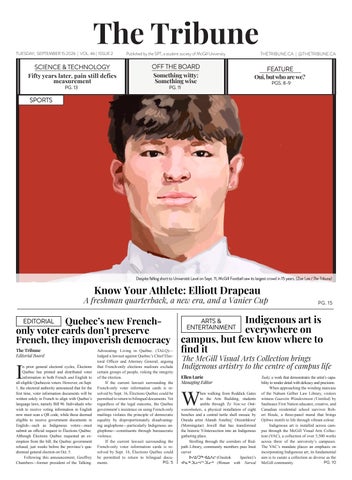
Despite falling short to Université Laval on Sept. 11, McGill Football saw its largest crowd in 15 years. (Zoe Lee / The Tribune)
Know Your Athlete: Elliott Drapeau
A freshman quarterback, a new era, and a Vanier Cup
Quebec’s new Frenchonly voter cards don’t preserve French, they impoverish democracy EDITORIAL
The Tribune Editorial Board
I
n prior general electoral cycles, Élections Québec has printed and distributed voter information in both French and English to all eligible Quebecois voters. However, on Sept. 1, the electoral authority announced that for the first time, voter information documents will be written solely in French to align with Quebec’s language laws, namely Bill 96. Individuals who wish to receive voting information in English now must scan a QR code, while those deemed eligible to receive government documents in English—such as Indigenous voters—must submit an official request to Élections Québec. Although Élections Québec requested an exemption from the bill, the Quebec government refused, just weeks before the province’s quadrennial general election on Oct. 5. Following this announcement, Geoffrey Chambers—former president of the Talking.
Advocating. Living in Québec. (TALQ)— lodged a lawsuit against Quebec’s Chief Electoral Officer and Attorney General, arguing that French-only elections mailouts exclude certain groups of people, risking the integrity of the election. If the current lawsuit surrounding the French-only voter information cards is resolved by Sept. 16, Élections Québec could be permitted to return to bilingual documents. Yet regardless of the legal outcome, the Quebec government’s insistence on using French-only mailings violates the principle of democratic equality by disproportionately disadvantaging anglophone—particularly Indigenous anglophone—constituents through bureaucratic violence. If the current lawsuit surrounding the French-only voter information cards is resolved by Sept. 16, Élections Québec could be permitted to return to bilingual docuPG. 5 ments.
PG. 15
Indigenous art is everywhere on campus, but few know where to find it ARTS & ENTERTAINMENT
The McGill Visual Arts Collection brings Indigenous artistry to the centre of campus life
Ellen Lurie Managing Editor
W
hen walking from Roddick Gates to the Arts Building, students amble through Tsi Non:we Onkwatonhnhets, a physical installation of eight benches and a central turtle shell mosaic by Oneida artist Alanah Astehtsi̲ ’ Otsistóhkwaˀ (Morningstar) Jewell that has transformed the historic Y-Intersection into an Indigenous gathering place. Strolling through the corridors of Redpath Library, community members pass Inuit carver (Osuitok Ipeelee)’s (Woman with Narwal
Tusk), a work that demonstrates the artist’s capability to render detail with delicacy and precision. When approaching the winding staircase of the Nahum Gelber Law Library, visitors witness Gaawiin Wiindesinoon (Untitled) by Saulteaux First Nation educator, creative, and Canadian residential school survivor Robert Houle, a three-panel mural that brings Ojibwe motifs to life through vibrant colour. Indigenous art is installed across campus through the McGill Visual Arts Collection (VAC), a collection of over 3,500 works across three of the university’s campuses. The VAC’s mandate places an emphasis on incorporating Indigenous art; its fundamental aim is to curate a collection as diverse as the PG. 10 McGill community.
2
NEWS
news@thetribune.ca
TUESDAY, SEPTEMBER 15 2026
AMPE and AMASCS unanimously vote for limited strike mandates
AMPE and AMASCS become the third and fourth faculty unions to approve strike Maya Hidalgo Contributor
T
he Association of McGill Professors of Education (AMPE) voted unanimously in June 2026 for a limited strike mandate, allowing the union to call a strike for up to five days. This decision was followed shortly by the Association of McGill Academic Staff of the School of Continuing Studies’ (AMASCS) vote for a limited strike mandate, which also passed unanimously in August 2026. Both unions now have the right to strike, and will do so depending on if their demands are met by McGill in continued negotiations. In an interview with The Tribune, Dennis C. Wendt, AMPE president and associate professor in the Faculty of Education, explained why AMPE believes establishing a strike mandate may be necessary moving forward. “We feel that without a strike mandate, we’re really at the employer’s discretion with the pace and frequency of meetings [about AMPE’s collective agreement] […] and it’s not in McGill’s interest, in my opinion, for this to be done expeditiously,” Wendt said. “As far as [McGill] is concerned, they’re motivated
to drag [negotiations] out [....] We’re saying no, these sorts of things can be settled very quickly if needed.” AMASCS and AMPE make up two of the six allied faculty unions which operate under the Confederation of Faculty Associations of McGill (COFAM). Wendt highlighted how AMPE is negotiating demands in a more complex configuration as part of COFAM. “We’re allied with [multiple other] associations in COFAM, and that requires us having a bargaining table that is for confederation-wide demands, first non-monetary and then monetary, but then we will also have faculty-specific demands,” Wendt said. Wendt continued to emphasize that COFAM’s nonmonetary, confederation-specific demands are largely policy-based, emphasizing issues such as tenure and promotion, retirement policy, disciplinary policy, and grievance policy. Margaret Levey, AMASCS president and faculty lecturer at the School of Continuing Studies, voiced three crucial bargaining demands that overlap with the demands listed by Wendt: improved job security for Contract Academic Staff (CAS), more equitable pension plans, and increased wages.
“All of the academic staff at [the] School of Continuing Studies are CAS,” Levey noted in an interview with The Tribune. “One of our most important asks across COFAM is that McGill do something to improve the conditions of CAS [....] We get what’s called indefinite appointment, which doesn’t carry the same weight as tenure.” Levey elaborated on what improved conditions would look like for CAS. “Our demand is that McGill make us more secure. We’re asking that CAS, in fact, be converted into tenuretrack professors, teaching or research professors.” Levey said. Both Levey and Wendt voiced similar complaints with McGill’s current pension plan, describing a severe disparity compared to other U15 universities and other schools in Quebec such as the Université de Montréal. Wendt elucidated the unions’ dissatisfaction with the plan. “McGill, instead, relies on a pension scheme that would be illegal to institute within Quebec today,” Wendt said. “It’s a two-tiered pension depending on when you were hired. If you were hired after 2009, you’re on what’s called the Part B pension […] meaning that there’s no
guaranteed benefit that comes [with retirement].” In a written statement to The Tribune, McGill’s Media Relations Office (MRO) reiterated McGill’s receptive stance towards unionization. “McGill respects the right of faculty members to organize in the manner they choose, consistent with Quebec labour law,” the MRO wrote. “We recognize that a strike mandate may be part of the collective bargaining process. A strike vote does not change our commitment to continue negotiating constructively.” Levey emphasized that student support is crucial to the possibility of a strike. “Ultimately it’s in [the students’] best interest to have professors whose working conditions are good and [who] want to stay at the university,” Levey said. Wendt echoed this sentiment, reflecting on why student advocacy is important. “It can serve well into a certain administrative playbook to have faculty and students be pitted against one another,” Wendt said. “From my experience, faculty and student interests overlap considerably […] we’re on the same team, and that’s ‘Team Academic,’ as opposed to ‘Team Executive.’”
Fabienne
de Cartier
was a News Editor and Director of Digital Strategy at The Tribune from 20242025. We remember Fabienne with immense gratitude and love, and point all readers to the Fabienne de Cartier Award for Poetry at www.fabiennedecartier.com. (Joshu de Cartier)
LSA executives repeal boycott of Israeli universities
Council votes to rescind provisions of the association’s March 2026 referendum Devdas Hind Contributor
T
he McGill Law Students’ Association (LSA) Executive Council voted on Aug. 13 to repeal the Referendum Regarding the Academic and Cultural Boycott of Israel to Preserve Academic Freedom (PACBI), passed by 57.3 per cent of LSA members in March 2026. By amending the LSA’s by-laws, the referendum sought to commit the student association to an institutional boycott of Israeli universities. Furthermore, the referendum proposed to create a new PACBI committee to ensure LSA members’ satisfaction with the boycott’s implementation. In response, Faculty of Law student Rachel Harroche filed a series of injunctions against the LSA and Law Students for Palestine at McGill (LS4PM), who brought forward the referendum. Superior Court Judge Luc Morin dismissed the provisional injunctions brought against the LSA and LS4PM on March 27, while Harroche’s interlocutory and permanent injunctions remain in litigation. McGill also placed the LSA in default of their shared Memorandum of Agreement (MoA), arguing that the referendum provisions violate the LSA
Constitution and McGill’s Charter of Students’ Rights and Policy on Harassment and Discrimination. This default may prevent the LSA from using the McGill name, accessing campus space, or distributing publications. On April 6, the LSA rejected McGill’s Notice of Default, stating that referendum results are binding and take precedence over decisions of the LSA Executive Council—as written in the LSA Constitution. Following the August 2026 repeal of the referendum, the LSA Executive Council proposed to create a Positions Book, outlining the association’s political stances. In a written statement to The Tribune, the executive council stated that a Positions Book will be a better framework moving forward to develop and maintain the association’s political stances, as opposed to referendum-based amendments to LSA by-laws. “The Positions Book will be a serious and enduring instrument of our Association,” the executive council wrote. “The democratic expression of the March referendum will also be at the heart of this work.” In an interview with The Tribune, LS4PM member Hugo-Victor Solomon explained why the
executive council’s decision to replace the referendum provisions with a Positions Book is insufficient in reflecting students’ wishes. “Students voted for something binding,” Solomon said. “They’re proposing something that’s not binding [....] Freedom of expression [is] a fundamental right.” In the same interview, LS4PM member Iman Sattar raised similar concerns over the threats the repeal poses to law students’ democratic expression. “Our current LSA executive president was campaigning [to] uphold the results of the referendum,” Sattar said. “He was very well-aware of what the consequences were, especially when McGill was emailing the LSA about how they were in default of the MoA.” The LSA is currently defending itself in two court cases and is in an ongoing dispute with McGill over the implementation of the referendum. The university’s Media Relations Office politely declined The Tribune’s request for comment. LSA members will have the opportunity to ratify their executives’ decision of repealing the referendum through a vote. If a majority reject the decision to repeal, then the process of implement-
ing the March 2026 referendum will continue. The ratification vote will take place before the end of September, with a date to be announced the week of Sept. 14. Sattar commented on the redundancy of another student vote on this issue. “[The LSA Executive Council is] trying to reorganize and relitigate an issue that was already decided in the court of public opinion and in the actual courts,” Sattar said. “Students have the right to express themselves.”
Chair of the McGill Faculty of Law’s advisory board Jonathan Amiel resigned from his role after the March 2026 LSA referendum passed. (Holden Callif / The Tribune)
TUESDAY, SEPTEMBER 15 2026
news@thetribune.ca
NEWS
3
COFAM hosts Welcome Back Week, showing solidarity with faculty associations
Members from six McGill faculty associations gather for week-long activities Ilia Mehr-Bakhsh News Editor
the confederation following its Affiliation Vote in March 2026. While each COFAM association advocates for its own members, he Confederation of Faculty Associa- each also contributes to the confederation’s tions of McGill (COFAM) hosted a collective efforts. Welcome Back Week Welcome Back Week of activities presents an opportunity for members of diffrom Sept. 8 to 11. Programming ranged ferent associations to meet and discuss these from banner- and button-making to a bar- efforts. gaining team appreciation gathering, with Kyle Kubler, faculty lecturer at the different unions hosting events throughout McGill Writing Centre and Association of the week. McGill Professors of the Faculty of Arts COFAM comprises six faculty associa- (AMPFA) treasurer, is a member of COtions, with the Association of McGill Pro- FAM’s bargaining team. At the bargaining fessors of Science (AMPS) the latest to join team appreciation event, Kubler and Sarah Brauner-Otto, professor in the Department of Sociology and fellow member of AMPFA, provided updates on COFAM’s most recent negotiations with the McGill administration on Sept 2. “The way that bargaining works […] is [a] backand-forth exchange of articles that compose what we hope to be our future The Table des partenaires universitaires plans for a simultaneous banner collective agreedrop across Quebec universities on Sept. 22. COFAM will unroll its banment,” Kubler said. ner outside of the Redpath Library at noon. (Emiko Kamiya / The Tribune)
T
“There is a lot of work internally [among the bargaining team] that gets done that is interspersed over months and […] years where we do eventually meet at the table with the administration […] to try and come to [an] agreement on certain articles.” Since July 2025, COFAM has been bargaining for non-monetary demands, including tenure, promotion, appointments, and, namely, the working conditions of Contract Academic Staff (CAS) members of its unions. As of Sept. 11, COFAM submitted its monetary demand, which it hopes to discuss with the administration when they next meet on Sept. 23. Brauner-Otto currently serves as executive director of the bargaining team. She commended the impact that COFAM events, such as the Welcome Back Week, can have in creating a network and solidarity among faculty unions. “It’s been a really good opportunity to build solidarity across the individual unions in a way that we haven’t yet had,” BraunerOtto said. “When we sit down with [McGill administration] next time [for bargaining] […] we [will be] a united front [....] These relationships that we are establishing through this COFAM Welcome [Back] Week will help us make sure the university [administration] can’t put us against each other.” The Tribune reached out to McGill’s Media Relations Office (MRO), which main-
tained that McGill remains “committed to respecting the collective bargaining process and the role of the union representatives chosen by faculty members who have decided to collectively negotiate their working conditions.” Rosalie Bélanger-Rioux, a senior faculty lecturer in the Department of Mathematics and Statistics, celebrated the formation of AMPS and acknowledged the necessity of faculty bargaining with the university administration. “It’s a trend that’s been happening all over Canada and the U.S. […] of centralization of power, corporatization of universities,” Bélanger-Rioux said. “Traditionally [in] universities […] professors [and] faculty are supposed to have […] a strong say in how the university is [run].” Bélanger-Rioux echoed Brauner-Otto’s words on the impact of the Welcome Back Week in fostering greater solidarity and identifying common issues among association members. “Yes, we’re doing this, of course […] for the faculty, we want better working conditions. But our working conditions are the students’ learning conditions,” BélangerRioux said. “To me, it’s really been about the students [....] The things that we want to put in that collective agreement will help us do our job better so that we can better supervise and teach our students.”
SSMU, BSN, and LSA host provincial election debate
Candidates from QS, Green Party, and PLQ discuss affordability, systemic racism, and Quebec separatism Helene Saleska News Editor
T
he Black Students’ Network of McGill (BSN), the McGill Law Students Association (LSA), and the Students’ Society of McGill University (SSMU) hosted a debate between three Quebec provincial election candidates on Sept. 10 in the SSMU Ballroom. Present at the debate was the Quebec Liberal Party (PLQ), represented by Nada Boumeftah, candidate in Maurice-Richard, Green Party of Quebec leader Alex Tyrell, candidate in Notre-Dame-de-Grâce, as well as Olivier Sylvestre from Québec solidare (QS), candidate in Westmount-Saint-Louis. According to the debate’s organizers, candidates from Parti Québécois (PQ) pulled out of the debate at the last minute, and the Coalition Avenir Québec (CAQ) and Parti conservateur du Québec declined the debate invitation. Present candidates responded to a series of questions on different issues, particularly concerning university students. Eza Igorola Uwizeramariya Munyabagisha, BSN Vice President Political, began the debate by asking about the candidates’ stances on Quebec’s role in addressing systemic racism in policing—specifically in light of recent incidents of racism and racial profiling against Black residents by the Service de police de la Ville de Montréal (SPVM) in the Station 39 neighbourhood. Boumeftah began by explaining her party’s plan to implement more legal clin-
ics and services to address systemic racism incidents. *“We’ve established the latest legal clinic, like the one in Saint-Michel, which, incidentally, addresses the issue of racial profiling,” Boumeftah said. “As a government and as people in positions of authority, and therefore in positions to make decisions, we must start by acknowledging all forms of racism.” Tyrell emphasized that despite protests and pressure on the SPVM after the racist incidents came to light, the Black people who were victimized by police have still not received justice. “It’s not just an unfortunate incident,” Tyrell said. “It’s a culture that exists within the SPVM and within many police forces in Quebec.” He also put forward the Green Party’s plan to reduce the police budget, a plan that differentiates his party’s stance from the other two on the stage. “[As] the Green Party of Quebec, we have a policy of reducing the police funding by 30 per cent. For us, it’s a question of putting those resources into prevention, into social services, and trying to prevent things before they get to the stage of needing police intervention,” Tyrell said. Candidates also spent time discussing affordability issues and the housing crisis that many residents are experiencing in Montreal. Sylvestre explained QS’s plan to address rent increases and wages. *“We want to take measures to freeze
rent increases. We also want to raise the Quebec independence. minimum wage to $20 CAD an hour. That’s As the parties gave their closing rea very important issue, to ensure that work marks, Tyrell added an additional compays better and that work matters more,” ment on his party’s support for Palestine, Sylvestre said. an issue which was not asked about directly In addition to free public transit and during the debate. public grocery stores, Tyrell explained “I completely oppose the genocide some other measures that the Green Party is that is taking place, […] I thought that the proposing to bring down the costs of living way [McGill’s] administration dealt with it for Quebecers. was completely deplorable, and I’ve called “[First,] lowering rent by five per cent for the president to be fired because I saw per year for four years [....] This will really him in a picture with the Israeli consulate,” cut down on real estate speculation because Tyrell said. if the government were to bring in such a The Quebec provincial election will measure, people would not be investing in take place on Oct. 5, 2026. For more inforthe speculative way that they are, and the mation, please consult The Tribune’s guide price of real estate would go down,” he on how to vote, published Sept. 8. said. *These quotes are translated from The candidates also differed on the French. place of Quebec within Canada. Both the Green Party and the PLQ supported Quebec remaining in Canada, while QS described themselves as “sovereigntists,” and plan to advocate for a Constituent Assembly on the issue of Quebec independence. All three parties criticized PQ’s Currently, polling in Quebec shows the Parti Québécois leading with 29 per rhetoric about cent of voter support. (Sophie Schuyler / The Tribune)
4
NEWS
TUESDAY, SEPTEMBER 15 2026
news@thetribune.ca
SSMU LC passes motions implementing referendum on a McGill yearbook and new student campus events
Student governors kick off the school year with plans to revive old McGill traditions and foster community Talia Moskowitz Contributor
posed a plebiscite question on the SSMU ballot for next week, on Sept. 16. According to SSMU’s projections, each yearbook he Students’ Society of McGill would cost $20 to $35 CAD per student. University (SSMU) Legislative “Once we have that data, we can work Council held its first meeting of the with that data and say, students do want academic year on Sept. 10 to discuss and this back, and we can begin to consult pass two motions: to run a plebiscite ref- the proposal that I had written down and erendum on the McGill yearbook and the have council discuss whether or not this is approval of a movie night as a new SSMU something we’d like to put money on, and event. focus our energy on as well,” Abu-Alkhair SSMU President Hamza Abu-Alkhair, said. U4 Engineering, explained the historical SSMU Vice President (VP) Universignificance of the yearbook, The Old Mc- sity Affairs Meghan Lai, U3 Education, Gill, established in 1898 and run by the argued for the necessity of the plebiscite SSMU until 2016. To assess the student in representing student opinion. body’s interest before delegating time and “Even though we maybe have 15 per resources to the project, Abu-Alkhair pro- cent of students turning out [to vote], that is still 15 per cent of 25,000,” Lai said. “That is still quite a large number of people, as compared to the six of us [executives] trying to go and speak to people, where we would maybe reach 100 people [....] The plebiscite question is a fantastic opportunity to have people who are already going to be voting in an election speak on an issue.” The motion to run a special plebiscite referendum on the McGill yearbook passed unanimously with an amendment to include an open-ended The SSMU Legislative Council meets biweekly on question inquiring how much students Tuesdays at 6 p.m. (Sophie Schuyler / The Tribune)
T
would pay for the yearbook. SSMU VP Internal Maggie Tang, U3 Arts, proposed a motion regarding the approval of a movie night as a new SSMU event. She cited a 2025 plebiscite asking students what events they wanted to see on campus, which students responded to by requesting free, accessible, non-alcoholic gatherings. She explained that a movie night can deliver on that request. “We will be setting up a massive outdoor screen, sound system, and have free snacks and beverages,” Tang said. “It costs nothing to show up, and it is open to every McGill member and the greater Montreal area.” She proposed that movie nights take place on Sept. 22 and 29 on the Lower Field. SSMU VP Clubs and Services Acadia Knickerbocker, U3 Arts, emphasized the importance of supporting local creators at the movie night. “Even if it’s a Quebec-related film, I would definitely hope that we would prioritize Quebecois film studios and writers and creators, just because the whole intention was also to give them that audience,” she said. The motion to hold a movie night was unanimously approved. The council then held presentations promoting the SSMU’s
Board of Directors, as well as the SSMU’s Steering, Nominating, Funding, Equity, Student Groups, Solidarity Funding and Students’ Society Programming Network (SSPN) committees, to be joined by legislative councillors. Moment of the Meeting Deputy Speaker for the Board of Directors Yasmin Beeai explained a proposed amendment to Section 7.4C of the SSMU’s Internal Regulations (IRS) of Governance. This section currently requires councillors to sit on at least one committee of the Legislative Council or participate in at least one other university organization. The proposal expands the requirement to include the Board of Directors committees as well. Soundbite “In terms of Quebec-related films, I just want to bring to the attention of this council, especially if it is a series of events, that Heated Rivalry is considered a Quebec-related film because it used Quebec tax credits to fund it.”—Arts Representative to SSMU Charley Letham on the film shown at the SSMU movie night.
Quebec contingent launches “Vote Palestine” campaign ahead of Oct. 5 elections
Campaign presses 127 provincial candidates to address Quebec’s complicity in the genocide in Gaza Asher Kui Managing Editor
Jewish Voices (IJV), Greenpeace Canada, Divest for Palestine, Honte au Bureau du Québec à Tel Aviv, and Palestinian Youth n Sept. 8, Votons Palestine (Vote Movement Montreal. According to BoutaPalestine) hosted a webinar, mark- ïna Chafi, the webinar’s host and CJPME ing the official launch of its self- National organizer, more than 200 Quebec titled campaign. The campaign was founded organizations have officially endorsed Vote by a contingent of six organizations based Palestine. in Quebec: Canadians for Justice and Peace In light of the Oct. 5 provincial elecin the Middle East (CJPME), Independent tions, the campaign aims to hold political candidates across all 127 electoral divisions responsible for Quebec’s complicity in Israel’s ongoing genocide of Palestinians. Specifically, Vote Palestine outlines four demands: to shut down the Quebec government’s office in Tel Aviv, to extend RAMQ health insurance coverage to Quebec residents from Gaza, to divest Caisse de dépôt et placement du Québec (CDPQ) investments from companies complicit in Israel’s apartheid According to a report by four non-governmental organizations, 433 regime, and to shipments of TNT moved through Quebec’s Port of Saguenay in transit cease the flow of between Poland, the United States, and Israel. (Gwen Heffernan / The Quebec’s military Tribune) equipment to Israel.
O
The webinar began with Salomé Sané, representative from Greenpeace Canada, who spoke about the current political situation in Palestine. “Even after the so-called ceasefire in Gaza, the bombing, blockade, and the imposed famine continue to claim numerous victims every day, restricting all hope of self-determination, dignity, and even reconstruction,” Sané said. Sané continued to emphasize Israel’s violent campaign across the Middle East. “Just the last few days, we have also witnessed a new violent wave of attacks by Israel in Southern Lebanon, where houses, hospitals are destroyed, and families, children, and ambulance workers are assassinated,” Sané said. “We see that the Israeli entity continues their deadly operation in the region with total impunity, despite its incessant attacks in Gaza, [and] the escalating violence in the West Bank, and against Palestinian prisoners in Israeli prisons.” A representative* from Honte au Bureau du Québec à Tel Aviv highlighted the importance of the Vote Palestine campaign as Quebec heads to the provincial elections. “Our goal is to use the provincial elections as leverage to concretely provide support to Palestine,” the representative said. “[The campaign] builds upon the provincial government’s existing demands and campaigns […] This is a great opportunity to boost those campaigns and make it clear to the candidates that Palestine is an issue close to [our] hearts, and that their position would certainly influence our vote.” The webinar’s hosts then elaborated in
detail on the four demands that the campaign aims to achieve. Chafi explained that Quebec is the only province where the public healthcare system does not extend to Gazan temporary residents—hence the urgent need for the province to expand RAMQ coverage to ensure that Gazans can access universal provincial healthcare. “The federal government mandated all Canadian provinces to extend their provincial health coverage to Gazan nationals who [have] a very specific temporary residence visa,” Chafi said. “Under the [current Coalition Avenir Québec] government, this still hasn’t been done, and the concrete impact this lack of healthcare coverage has on Gazans is that […] many live with the physical and mental repercussions as a result of what they lived through in Gaza [....] It is a huge shame that Quebec is still, to this day, the only province that hasn’t extended this medical coverage.” IJV representative Zev Saltiel concluded the webinar by reiterating different ways in which Quebec citizens can support the Palestinian movement. “It could also be an event of [giving out] leaflets or flyers,” Saltiel noted. “I’ve also seen combinations of giving out leaflets and asking people on the spot to call their candidates [in their electoral district] […] If you are invited to an event, […] you can also ask to take the microphone for a few minutes to raise awareness about [the] campaign with the people present.” *The representative’s name was not publicized during the webinar. All quotes were translated from French.
opinion@thetribune.ca
TUESDAY, SEPTEMBER 15 2026
T EDITORIAL BOARD Editor-in-Chief Mairin Burke editor@thetribune.ca Creative Director Zoe Lee creativedirector@thetribune.ca Managing Editors Asher Kui akui@thetribune.ca Ellen Lurie elurie@thetribune.ca Clara Smyrski csmyrski@thetribune.ca News Editors Ilia Mehr-Bakhsh Josette Chandler Helene Saleska news@thetribune.ca Opinion Editors Moyo. Alabi Lulu Calame Camila Sierra Ordóñez opinion@thetribune.ca Science & Technology Editors Avery Berry Sarah McDonald scitech@thetribune.ca Student Life Editors Rachel Blackstone Tamiyana Roemer studentlife@thetribune.ca Features Editor Kaitlyn Schramm features@thetribune.ca Arts & Entertainment Editors Norah Adams Annabella Lawlor arts@thetribune.ca Sports Editors Merce Kellner Ivanna Zhang sports@thetribune.ca Design Editors Eliot Loose Gwen Heffernan design@thetribune.ca Photo Editors Emiko Kamiya Sophie Schuyler photo@thetribune.ca Multimedia Editors Will Dawson Daphne Short multimedia@thetribune.ca Web Developers Zola Ball Kate Lauro webdev@thetribune.ca Copy Editor Ella Bachrach copy@thetribune.ca Social Media Editor Chloe Ross socialmedia@thetribune.ca Business Manager Amy Xia business@thetribune.ca
TPS BOARD OF DIRECTORS Zain Ahmed, Nour Khouri, Celine Li, Lialah Mavani, Aleks Rohozinski, Alex Hawes Silva
STAFF Zain Ahmed, Dylan Hing, Jenna Payette, Julie Raout
CONTRIBUTORS Holden Callif, Lilly Guilbeault, Maya Hidalgo, Devdas Hind, Lia James, Nathan Lippa, Shivaani Mohanraj, Talia Moskowitz, Gretta Iraheta Palacios, Sophie Wedge
TRIBUNE OFFICE Shatner University Centre, 3480 McTavish, Suites 404, 405, 406 The Tribune is an editorially autonomous newspaper published by the Société de Publication de la Tribune, a student society of McGill University. The content of this publication is the sole responsibility of The Tribune and the Société de Publication de la Tribune, and does not necessarily represent the views of McGill University. Letters to the editor may be sent to editor@thetribune.ca and must include the contributor’s name, program and year and contact information. Letters should be kept under 300 words and submitted only to The Tribune. Submissions judged by The Tribune Publication Society to be libellous, sexist, racist, homophobic or solely promotional in nature will not be published. The Tribune reserves the right to edit all contributions. Editorials are decided upon and written by the editorial board. All other opinions are strictly those of the author and do not necessarily reflect the opinions of The Tribune, its editors or its staff.
OPINION
5
EDITORIAL
Quebec’s new French-only voter cards don’t preserve French, they impoverish democracy The Tribune Editorial Board Continued from page 1. Yet regardless of the legal outcome, the Quebec government’s insistence on using French-only mailings violates the principle of democratic equality by disproportionately disadvantaging anglophone— particularly Indigenous anglophone—constituents through bureaucratic violence. Christine Fréchette, Quebec’s current premier and leader of the Coalition Avenir Québec (CAQ), has asserted that this change in documentary language does not impact anglophone voters’ access due to the same voting information being accessible by QR code. However, making English electoral information available only online does not constitute true equal access. Various anglophone groups, including senior citizens and lower-income people—for whom widespread access to the internet and technological literacy are not
a given—are disproportionately disadvantaged by the switch to online documents. The shift to online-only English voter information creates further challenges to clear and informed voting, and risks furthering individuals’ disinclination to vote; Quebec already experiences notably low election participation—such as Montreal’s 2025 municipal election, which saw a mere 37 per cent voter turnout. Moreover, the new election regulations entrench Canada’s disregard for Indigenous sovereignty and obstructs Indigenous participation in provincial government proceedings. As a result of European colonialism and Canada’s residential school system, many Indigenous communities in Quebec have adopted English as a second language for survival, resulting in over 65 per cent of Indigenous people in the province speaking English as a primary or regular language. Indigenous organizations have petitioned the Quebec Superior
Court to challenge Bill 96 since the law’s passing—arguing that the bill infringes on their rights to linguistic self-determination and the intergenerational transfer of their ancestral languages. The groups requested an exemption from the language law, but the court refused, citing the need to protect the historic French language. The French-English language discourse in Quebec positions French as an oppressed and dying language while systematically erasing every other language, thus establishing a hostile and misinformed logic that the preservation of French relies on the nonexistence of anything non-French. Seeing as current nationwide bureaucracy requires Indigenous individuals to operate in a colonial language—English or French—to participate in the country’s democratic process, French language laws only further this linguistic marginalization. Availability of and access to anglophone services are in a state of precarity in Quebec. Élections Québec’s switch to French stands
alongside further provincial regressions in anglophone public spheres—including healthcare and the use of gender-affirming language. The result is a system where language debates are increasingly waged in sectors with high stakes for both individual and democratic liberties, making bilingual resources a matter not simply of convenience but of protecting human rights and ensuring civic inclusion. Information gaps due to a lack of English-language documents risk producing an uninformed electorate, damaging the legitimacy of Quebec’s democracy. With its provincial elections quickly approaching, it is imperative that the Quebec government work in the interests of its constituents by removing targeted barriers to political participation. Democratic processes must not be disfigured into an arena for French-English debates. For more information, consult The Tribune’s guide on how to vote in the Oct. 5 Quebec provincial general election.
Curbing autonomous vehicles hurts road safety initiatives and hampers discussions of AI COMMENTARY
Dylan Hing Staff Writer
W
ith artificial intelligence (AI) on a rapid rise over the past several years, it is hard not to worry about the danger it poses to humanity. Its capabilities have cost countless jobs, its datacentres ravage natural resources, and at academic institutions like McGill, students and professors alike feel its detrimental impacts. Yet while AI poses imminent societal and environmental threats, the technology itself is not a danger, so long as it is well-regulated—it can actually be a life-saver. Reading the news, it is frighteningly easy to find stories from across the province regarding fatal car crashes and other road accidents. Many times, the danger is preventable: In a 2016 trial in Quebec, 60 per cent of participating student drivers chose to drive after consuming alcohol. In 2023, 322 road fatalities in Canada involved at least one distracted driver. Now, with the advent of AI-powered autonomous vehicles (AVs) in North America, it is evident that despite the risks of AI in other fields, its use on the road is necessary in order to curb preventable danger. Waymo, owned by Google’s parent company Alphabet Inc., is
one of the few AV companies in North America legally allowed to offer paid services to the general public. Operating in 11 American cities, Waymo cars drive at level four on SAE International’s J3016 self-driving standard—a scale that goes up to level five: complete autonomous independence. Operating at a level four means that Waymo’s vehicles can drive autonomously, though only within geographic limits. According to a 2026 report by the Insurance Institute for Highway Safety, a Waymo vehicle is, broadly, safer than the average driver. In Phoenix, Los Angeles, and San Francisco, Waymo’s crash rates were 76 per cent, 71 per cent, and 35 per cent lower than human drivers’ rates, respectively. The report also noted that the Waymo driver was very rarely the instigator in accidents involving its vehicles. Autonomous vehicles can also be of use when human drivers cannot drive safely or are not the most convenient option. For example, the Students’ Society of McGill University’s DriveSafe program—which provides McGill students with a safe ride home after late-night activities—could integrate driverless vehicles alongside human drivers to improve its response times and increase the volume of cars it is able to send out each shift, thus serving
more students overall. Also, despite limitations surrounding autonomous technology in winter conditions, ongoing developments toward weatherresistant AV technology could eventually improve road safety in Montreal’s winters. It is still worth pointing out several concerns Waymo has already begun testing its vehicles about the rollout of AVs, abroad, including in Tokyo, London, and most recently, Munich. (Eliot Loose / The Tribune) both technological and economic. Waymo, though by far the ing Amazon warehouses, most most advanced company in North workplace dangers are the fault of America’s AV race, still faces se- the employer, with the sole ability vere issues: During San Francisco’s to reform labour conditions vested Independence Day celebrations this in the employers themselves. But past July, many of its vehicles be- when it comes to driving, the dancame stranded in traffic, stopped ger stems entirely from the drivers unexpectedly on the streets, and in themselves. In 2023, Canada saw one instance, ran over a firework 1,964 motor vehicle fatalities, up with passengers inside. 1.7 per cent from 2022. With AVs Labour also looms large in on the road, this number could be the debate over driverless cars, as so much lower. around half of roughly 154,000 Car culture is celebrated in Canadian rideshare drivers rely on North American society; even driver gigs as their primary income youth are encouraged to drive. source. Labour unions have strong- Here, the dangers of the road are ly opposed a bill being considered brushed off as unfortunate side in Washington, D.C. that would effects of a necessary mode of allow AVs to transport people and transportation. Yet, driverless cars, goods in the city, out of fear that which make this car culture safer, Waymo would put thousands of are met with contempt. ChatGPT drivers out of work. may be the mind-killer, but AVs Yet context is critical. In other are not the enemy: They are the fuindustries and workplaces, includ- ture of road safety.
6
OPINION
COMMENTARY
opinion@thetribune.ca
Canada is exploiting Indigenous land to fuel its clean-energy future
Asher Kui Managing Editor
W
ith $10 billion CAD in federal funding, Hydro-Québec and Newfoundland & Labrador Hydro reached a historic deal over the Churchill Falls Hydroelectric Generating Station and Gull Island Power Plant on Aug. 17. Generating over 14,000 megawatts of renewable power—enough to light, heat, and cool every home in the three biggest Canadian cities combined—the project represents North America’s largest clean energy investment to date. However, the Churchill Falls project must make the well-being of northern Indigenous communities a priority over governmental profit. As a milestone in Canada’s transition to a clean-energy future, the project must establish a precedent for Indigenous participation in major development projects, and thereby serve as a model for reconciliation and shared prosperity. Under this so-called “win-win-win” agreement, Quebec will secure five decades of reliable clean energy at one-third of the cost of alternatives. Newfoundland and Labrador also anticipates this deal will offer an opportunity to overturn the lopsided 1969 Churchill Falls Contract, which has sold electricity to Quebec at an unreasonably low price. In addition, the new project will support 23,000 jobs, contributing $31 billion CAD to Canada’s GDP. Once the agreement is finalized, Newfoundland and Labrador will be able to sell up to 985 megawatts of power to American markets through Quebec. The Churchill Falls project brings significant economic and political benefits, but it prom-
COMMENTARY Julie Raout Staff Writer
A
TUESDAY, SEPTEMBER 15 2026
ises no concrete action toward improving northern Indigenous communities’ access to clean and stable energy. Currently, five Nunatsiavut communities and the Mushuau Innu First Nation—all situated on Labrador’s North Coast— still rely on diesel generating stations for regular or backup power. Diesel pollution carries risks of ground-level ozone, which can cause lung damage and worsen asthmatic symptoms. Meanwhile, Canada’s Clean Energy for Rural and Remote Communities Program—an initiative designed to connect Indigenous and rural communities to greener energy sources— is scheduled to shutter in March 2027, with no further plans for federal funding yet announced. Although the program has supported some Nunatsiavut communities’ transitions to clean energy, its limitations reflect Canada’s negligence of Indigenous energy security. Even with the project’s nearly $70 billion CAD valuation, Churchill Falls still fails to adequately address energy insecurity across northern Indigenous communities: reflecting a broader colonial pattern where Indigenous lands and resources generate wealth for colonial societies, while Indigenous Peoples remain systematically excluded from its benefits. Just last year, Canadian Prime Minister Mark Carney launched the Major Projects Office (MPO) to accelerate and oversee nation-building projects, including Churchill Falls. While the MPO promises to “forge meaningful partnerships” with Indigenous Peoples, its retroactive approach to consultation does nothing to prevent or reverse the environmental and cultural damage caused by colonial developments. The Churchill Falls Generating Station was built in Nitassinan—unceded land from which Canadian corporations have historically
extracted resources without the Innu Nation’s consent. Since 1967, construction projects on the station have caused the flooding of ancestral lands and burial grounds, and the destruction of Indigenous cultures and lifestyles. In the nearby Muskrat Falls Generating Facility, installed along the same river, downstream impacts of hydroelectric power developments have increased the risk of methylmercury contamination, which can lead to reduced health and food quality in In- Under the new agreement, Quebec is guaranteed electricity supply from Churchill Falls until 2077. (Lilly Guilbeault / The Tribune) digenous communities. It was not until the 2011 Tshash Petapen don denounced Fréchette’s rushed attitude toAgreement that the government of Newfound- wards a decision that would bind Quebec for the land and Labrador agreed to compensate the next five decades, while Québec solidaire memInnu Nation for the generational harms that the ber Ruba Ghazal criticized Fréchette for acting project caused. But Canada advances with the in the electoral interests of the CAQ. Churchill Falls project despite Innu Nation leadBut a project of such magnitude, and one ers’ continued opposition, maintaining its legacy that carries so many consequences for Indigof environmental racism against Indigenous enous communities’ well-being, must not allow communities. partisan interests and political controversy to All the while, Quebec’s political partisan- take precedence over the proactive inclusion ship further distracts long-term decision-making of Indigenous voices. Indigenous participation from prioritizing Indigenous interests and liveli- must be a foundation and priority of Canadian hoods: Quebec and Newfoundland and Labra- clean energy’s development and progress, rather dor aim to finalize the Churchill Falls deal by the than an afterthought to economic and political end of the year, as Quebec heads into a provin- gain. cial election on Oct. 5 under Premier Christine Canada must direct substantial revenues toFréchette. wards renewable alternatives for northern comWhile Fréchette pledged that a re-elected munities and uphold Indigenous Peoples’ rights Coalition Avenir Québec (CAQ) would make to give final approval before major infrastrucsure to implement such a deal, other parties ac- tural expansions occur on unceded lands—makcused her of using the project for electoral gain. ing reconciliation an institutional practice rather Parti Québécois leader Paul St-Pierre Plamon- than a hollow promise.
Anonymity in police brutality cases allows officers to remain unpunished
lmost one year after a Service de police de l’agglomération de Longueuil (SPAL) officer fatally shot 15-yearold Nooran Rezayi, Quebec’s Minister of Justice has opposed Rezayi’s family’s legal request to publicize the identity of the officer who killed their son. The minister argues that revealing the shooter’s identity poses a safety risk to the officer, as he is already receiving death threats on social media. SPAL’s claim that Nooran Rezayi’s killer should remain anonymous for safety concerns is not only tragically ironic; it is a weak excuse that allows systemic inaction in police brutality cases to persist. On Sept. 21, 2025, a police officer brutally killed Rezayi, shooting the unarmed teenager twice—after receiving a 911 call about masked and armed individuals on Montreal’s South Shore—within 10 seconds of his arrival on site. Following the shooting, an unknown teenager on Instagram promised a monetary reward to anyone who kills Rezayi’s shooter. The person who issued the threat was found guilty of criminal harassment on Jan. 12, 2026, and the officer stayed in a safe house throughout the death threat investigation. SPAL also de-indexed the officer’s personal information on search engines, and erased his identity from both court records and property
assessment rolls. Such death threats are horrific and should not be tolerated. However, preserving the identity of an officer responsible for the heinous killing of a child is not a matter of protecting this officer from death threats; awarding the officer anonymity prevents him from appearing in official records, thus protecting him from public scrutiny and allowing him to circumvent most forms of proper accountability and punishment. Longueuil’s active decision to protect the killer’s identity stands alongside allegations that the SPAL interfered with the independent investigation of Quebec police watchdog Bureau des enquêtes indépendantes (BEI), the body in charge of investigating deaths and injuries related to Quebec police operations. In emails released by the City of Longueuil, head of BEI Brigitte Bishop stated that SPAL had started conducting their own investigation of the crime scene before the BEI arrived—a violation of provincial regulations—and allegedly gave inaccurate information to the BEI to delay alerting it about the civilian’s death. Police officers who kill civilians are systemically protected by city police, review boards, and judicial authorities across Canada. The BEI itself is consistently ineffective in bringing unfit police officers to justice: The organization sent their investigation of Rezayi’s death to prosecutors in March 2026, but the verdict determining Reyazi’s shooter’s potential charges is still pending six months
later. Nevertheless, Reyazi’s shooter remains unMoreover, the BEI’s history points to- sullied. The judicial inaction around the ward slim chances of charges ever being re- shooter’s prosecution shows a clear double alized. Since its founding in 2013, only two standard that legitimizes a narrative under out of the BEI’s more than 400 investigations which the police can be absolved from any have resulted in an officer being charged, and culpability. none of the BEI’s 52 investigations regardAn upcoming court hearing in October ing fatal police shootings have led to pros- will determine whether Rezayi’s shooter’s ecution. identity can be publicly revealed. If the During a press conference on the Rezayi SPAL is ordered to identify the officer, the case, Bishop declared that the public “[has] City of Longueuil has requested that the to trust [the BEI],” but when patterns show name be made public only after the officer officers who kill citizens consistently evade is charged—or, if not charged, after 30 days. prosecution and can even do so anonymous- Longueuil’s concern about the officer’s safely, trust becomes hard to earn, and anonymity ty ultimately hides a cunning system that albecomes a tool used to shield officers of the lows violence officers to remain anonymous, law from accountability. protected, and free to offend again. The unacceptable death threats that the shooter received reflect the intensity of civilian anger towards police brutality and its systemic impunity. Rezayi’s death reminds the public of Canadian police forces’ record of killing civilians—disproportionately racialized civilians—and escaping responsibility. The Service de police de la Ville de Montréal has charged 11 teenagers with criminal offences connected Nooran Rezayi’s family filed their lawsuit against the City of to the events leading up to Longueuil and the Longueuil police service for $2.2 million CAD Reyazi’s murder in June. in December 2025. (Eliot Loose / The Tribune)
arts@thetribune.ca
TUESDAY, SEPTEMBER 15 2026
ARTS & ENTERTAINMENT
7
‘Little House on the Prairie’ reimagines pioneer life on television
The recent adaptation raises questions about the role of glamourization in modern storytelling Gretta Iraheta Palacios Contributor
T
his past July, Netflix treated its subscribers to Little House on the Prairie, an adaptation of the beloved Little House book series by Laura Ingalls Wilder. Nostalgic fans of the show were quick to press play on the first episode, eager to see a childhood gem be brought back into contemporary cultural imagination. Wilder’s semi-autobiographical series includes nine books detailing the lives of the Ingalls family on the 1870s American frontier. The series is also famously known for its 1970s television adaptation starring Michael Landon and Melissa Gilbert. In Netflix’s recent iteration, showrunner Rebecca Son- nenshine stays true to the books and follows Charles, Caroline, Mary, and Laura Ingalls as they settle in Independence, Kansas. The family faces the beauty and hardship of pioneer life head-on. The episodes are replete with scenic landscapes. The great American outdoors—or rather, Manitoban outdoors, since the show was shot entirely on Canadian soil—are displayed in picture-perfect lighting. These dazzling and sensorial shots are interspersed throughout the show as the Ingalls struggle to get their footing in their new life. Adversity is no stranger to the Ingalls, and the first episode makes this point deliberately clear mere minutes in. Their pet dog gets swept away by the current as the
family crosses a rapid river, the ostensible loss tugging at viewers’ heartstrings. Once they reach Independence, the Ingalls have difficulty affording food and necessities, and Charles Ingalls (Luke Bracey) struggles to find work. Their new life proves to be no easy feat. Aside from the show’s stunning visuals, Sonnenshine’s take is notable for the corrective work it does in bringing forth the stories of those cast aside in the 1970s version. For instance, Dr. George A. Tann (Jocko Sims), featured in the new adaptation, was a real Black physician who treated pioneers like the Ingalls. Though he did appear in the original books, the character was completely omitted from the 1970s adaptation. Additionally, the first television adaptation of Little House widely neglected the presence of the Osage Nation in Independence. Sonnenshine gives them a far more significant role in her work: From the get-go, she establishes that the Ingalls have chosen to settle on Osage land, and tensions arise directly from this decision. Reimaginings of period pieces like these open up a real possibility: the chance to bring forward important stories that earlier iterations may have brushed aside. Yet, the timing of the show’s release is quite ironic. The viewer is invited to root for a family travelling and settling in a new state in search of a better life, which sharply contrasts with North America’s current climate of growing anti-immigration sentiment in public discourse. Within the past year, the Trump ad-
ministration’s ICE raids have made head- do seem to make an honest effort to reinlines globally. The required rigour of vigorate these important conversations. It Quebec’s’s immigration policy has also depends on whether viewers are able to rebecome a topic of contention leading up to sist the urge to immediately run to make the provincial election on Oct. 5, as certain prairie-themed moodboards before the end candidates blame newcomers for Quebec’s credits roll. strained resources. Sonnenshine’s Little House on the Moreover, Canadian Prime Minis- Prairie, which has already been renewed ter Mark Carney continues to pursue the for a second season, is now streaming on construction of the West Coast pipeline, Netflix. despite warnings by First Nations communities about the pipeline’s potentially devastating environmental impacts—a continuation of Canada’s extensive history of settler colonialist legislation. The themes laced into The Little House in the Prairie still ring true in the 21st century. It is worth questioning whether Netflix’s glamourized sets and cinematography may eclipse the show’s underlying cultural messaging. With a young generation that has become so fixated on perfectly curated Pinterest boards and online personas, the shiny visuals in mainstream media can be hard to resist and enough to cling to. But, there remains space for mindful cultural analysis, and showrunners The 1970s Little House on the Prairie television adaptation totalled and creators across the board 200 episodes and five specials. (Gwen Heffernan / The Tribune)
‘Ride the Cyclone’ inspires an appreciation of life through the depiction of death
The musical’s showing at Centaur Theatre is a hilariously dark spectacle Lia James Contributor
the musical’s songs centres around a different member of the choir hoping to convince the others of why they most deserve to esntil Sept. 19, Not Safe for Magic cape death. Productions is staging Ride the The first student to give their case is Cyclone at Centaur Theatre, a mu- the commanding Ocean (Maya Lewis), who sical about six choir students who die in sings an upbeat tune about how she cona rollercoaster crash. After their untimely tributes the most good to society. The next deaths, the students meet a mechanical for- teen to sing is Noel (Juan Tonita-Charriez), tune teller named Karnak (Alexandra Abit- an eccentric boy who imagines a burlesque bol) and have the chance to select which of life for himself in France, taking inspiration them will be brought back to life. Each of from musicals such as Cabaret and Chicago in his dance moves and costuming. After Noel, rebellious student Mischa (Dylan Stanley) states his case, beginning with a rap about how epic his life is and slowly turning towards a slow, vulnerable song about his beloved fiancé. Ricky (Matthew Carlson) then sings about his wild imagination, an internal world that his schoolmates previously had no access to. Images of Six Flags New Orleans, abandoned after Hurricane Katrina, were One of the inspirations for the writer of Ride the Cyclone. (Matt Sandoval / @sandoval_snaps) most memorable
U
and technically difficult songs follows: Jane Doe (Courtney Crawford)’s dramatic opera-style number. In the aftermath of the rollercoaster accident, Jane Doe, tragically decapitated, is unidentified and without memory of her life. Her uncanny and dolllike makeup reflects the other students’ perception of her as an unsettling and anonymous figure. While the previous songs were desperate appeals, each a demonstration of why these characters believe they deserve to live, Jane Doe’s song questions why the crash happened in the first place and examines the overwhelming feeling of loneliness that followed it. The confusion in her voice, coupled with the visceral energy of her opera singing techniques, makes her song undeniably tragic. Last to perform is Constance (Kylene Mak), a shy girl who tends not to take up much space. Instead of singing, she performs a monologue reflecting on the meaning of her 17 years of life. Rather than sugarcoat the situation, she exhibits her raw, true self with a newfound courage in making herself heard. Throughout the production, cast members sport exaggerated, colourful makeup that recalls the childlike wonder of a carnival, exemplifying one of many creative liberties the Centaur crew took to elevate the production. In an interview with The Tribune, di-
rector Cait Hawes shed light on the process of making the magical story of Ride the Cyclone come to life. Hawes described the extensive cooperation between different departments of the show, from production to the cast. “We had, at the very beginning of this process, a pre-production meeting where we didn’t tell people, ‘Hey, this is exactly what we’re going for.’ [Instead], we said, ‘Here’s the script, here’s the show. Let us know what your biggest ideas are,’” they reflected. The cast’s chemistry, closeness, and cooperation all shine through the extreme coherence of the musical. Hawes ascribes the show’s success to this visible dynamic of co-creation. “It was a lot of working and coordinating between departments to make sure that everything worked, vision-wise, and it all came together so well,” they said. Hawes’ and Centaur Theatre’s staging of this dark musical offers an opportunity to take a step back and appreciate the life we have been given. Ride the Cyclone reminds viewers that rather than immediately jumping to future plans, they should be focused on living their current lives to their fullest potential. Otherwise, have they really lived at all? Ride the Cyclone is showing at Centaur Theatre from Sept. 10 to Sept. 19. Tickets are $40 CAD for students.
1995 Quebec referendum, the “No” campaign against separatism obtained a razor-thin victory with 50.58 per cent of votes. After the results were announced, former premier Jacques Parizeau delivered a speech to his “Yes” supporters, citing “money and the ethnic vote” as the cause of their defeat. In an interview with The Tribune, Éric Bélanger, Political Science professor and co-chairholder of the Chaire de recherche sur la démocratie, le vivre-ensemble et les valeurs communes au Québec, explained that prior to 1995, the idea of a sovereign Quebec was perceived as a progressive movement. “Originally, the sovereign Quebec movement was progressive, of the left-wing, and René Lévesque originally intended for an inclusive model of Quebec sovereignty,” Bélanger noted. “Indeed, [for] Jacques [Parizeau], in the disappointment of the defeat the very evening of the referendum […] the project is not inclusive. It’s a movement for the francophone majority, and a split in the movement occurred, because those who are inclusive, progressive, and left-wing […] quit the Parti Québécois (PQ) to found [QS]. It was those who realized that PQ began to derive too much to the economically right-wing, to begin with.” Shortly after the referendum, the new premier, Lucien Bouchard—leading the PQ government—implemented a set of fiscally conservative policies. This included the Loi sur l’élimination du déficit et l’équilibre budgétaire, which largely cut public funding and social services. PQ continued its shift to conservatism socially and culturally. In 2013, under Pauline Marois’s government, PQ introduced the Quebec Values Charter, which, under the name of state secularism, aimed to prohibit public servants from wearing symbols that indicate religious affiliation. Although the charter was ultimately dropped following the 2014 provincial elections, it revealed PQ’s political hostility against religious and ethnic minorities in Quebec. In June 2026, the PQ published the Livre bleu sur l’indépendance du Québec—a 524-page exhaustive blueprint for achieving independence in Quebec. While PQ reaffirms that their version of a sovereign Quebec includes an open and inclusive Quebecois identity, they frame what they term the “politics of massive immigration” on page 54 as a menace to Quebec society and a reason for the province’s reported cultural decline. This rhetoric further cements the image of sovereignty as an ethnonationalist project despite the movement’s progressive beginnings. Bélanger continued to highlight the discrepancy between left-wing and right-wing sovereignty movements in Quebec. “Behind this lies this perception that immigrants do not wish to adopt Quebec values [....] On this issue, today’s [PQ] aligns with the [Coalition Avenir Québec] (CAQ)’s stance on immigration,” Bélanger said. “[PQ’s] rhetoric is harsh when it comes to immigrant integration, and it is an exclusionary stance [....] Currently, there is a split between the left and right. The two want sovereignty but not for the same reasons. They
Oui, but wh
Inside the resurgence of its divergence from e self-deter
«J’ai deux nations, mais pas de pays. » (“I have two nations, but no country.”)
R
uba Ghazal published these words in her 2025 memoir Les gens du pays viennent aussi d’ailleurs. Born in Lebanon to Palestinian parents, Ghazal immigrated to Quebec at the age of 10. Today, she serves as the co-spokesperson and parliamentary leader for Québec solidaire (QS). Her book’s title—“The people of the country also come from elsewhere”—highlights a fundamental question in Quebecois identity: Who gets to be considered Quebecois? This question has long been at the heart of Quebec’s political discourse. Les Québécois de souche, Bill 21, les enfants de la loi 101, Bill 84, Bill 96— all represent developments that have fueled broader debates over Quebec’s “distinct society.” In 2006, the House of Commons of Canada recognized Quebec as a nation within Canada. However, these debates have also been inseparable from discussing Quebec nationalism and what binds the nation together, whether it is shared ancestry and history, a common language and culture, or a broader sense of belonging and political attachment. The idea of a sovereign Quebec is often painted as an exclusionary project that aims to protect the white francophone majority and the French language, and such criticism of Quebec’s ethnonationalism must not be easily dismissed. But the sovereignty movement’s recent traction—particularly in left-wing political spheres—suggests an alternative structure: a civic nationalism that is rooted in a common language and shared political belonging.
« Dans la vie, ce n’est pas parce que tu as raison que tu as raison de le dire. » (“In life, it’s not because you’re right that gives you the right to say it.”)
Thus said Ghazal’s colleague at the National Assembly—pointing to one of the most contentious moments in the Quebec sovereigntist movement. In the
Written by Asher Kui, Mana Gwendolyn Heffern
both have very different approaches.”
« Je ne veux pas savoir d’où le monde vient, je veux savoir où il va. » (“I don’t want to know where everyone is from, I want to know where they go.”)
Thus said Pierre Falardeau, renowned Quebec director and screenwriter behind the famous Elvis Gratton short film series. In defining belonging as a shared civic vision, Falardeau offered a different perspective on Quebecois identity. In July 2026, QS launched its new sovereigntist manifesto Nouveau Québec libre. Seeking to reposition Quebec sovereignty on the political spectrum, Nouveau Québec libre frames independence as a prerequisite to the development of Quebec society. Sovereignty becomes a massive social project built around a different vision: one defined less by where people are from, and more by a collective civic identi-
ho are we?
rights of the anglophone minorities, in regards to access to schooling, healthcare services, universities, and so on.” Acknowledging that certain legislation does have disproportionate effects on minorities, Zanetti extended this argument to Quebec’s secularism. “The goal is to […] hold an inclusive vision of society regarding newcomers who aren’t necessarily anglophone, but arrive speaking many languages, practicing different religions,” Zanetti added. “We want the state to remain neutral with religion, and we strongly disagree with the approach taken by the CAQ or [PQ], who believe that secularism requires a ban on religious symbols and prayer in schools and universities. We intend to dismantle these laws.” According to Zanetti, however, civic inclusion has little significance when the Quebec province has no political autonomy. He argued that Quebec must achieve independence from the Canadian federal government in order to meaningfully address its challenges—whether minority rights or environmental justice. “When the Constitution of Canada, the British North America Act, stated that [Canada] was a colony, they decided that it was Ottawa that makes all decisions regarding interprovincial freight transportation,” Zanetti said. “Today, Ottawa can decide to impose pipeline projects between two provinces and the provinces cannot refuse. The most recent example occurred in British Columbia, when the Canadian government bought out the Trans Mountain [Expansion] project [....] British Columbia did not want to do it, but they did not have the political power to refuse a project passing through on their territory. We are in a political system that was constructed for the extractive industry.” Zanetti continued to elaborate how this political structure also infringes on Indigenous sovereignty. “It is a constitution, a separation of powers, and a political system that has been designed to favour mining companies, and today, energy companies,” Zanetti said. “All other companies that have exploited natural resources are able to maximize exports and profits without considering the sovereignty of Indigenous Peoples who inhabit the territory, or other people who settled there after.” In Nouveau Québec libre, QS envisions an independent Quebec as a plurinational state consisting of the Quebecois nation and the 11 Indigenous nations in Quebec. The manifesto argues that the right to self-determination must apply equally to Indigenous nations, meaning each could decide whether to maintain the status quo or join an independent Quebec. To ensure Indigenous participation in the creation of this country, QS proposes inviting First Nations, Métis, and Inuit communities to co-construct the process through which the constituent assembly would draft a new constitution. The manifesto presents ambitious founding principles, but it lacks the actual mechanisms and concrete avenues used to put them in place. If QS’s new Quebec is centred on reconciliation and decolonization as promised, written pledges must translate into political commitments. This is the obligation of Quebec’s civic nationalism: If the Quebecers claim the right to deter-
Quebec sovereignty and ethnonationalism to rmination
againg Editor & Designed by nan, Design Editor ty and a fundamental belief in self-determination. The 25-page document presents sovereignty not only as a simple transfer of power from Ottawa to Quebec City, but also as something to be exercised across multiple levels—economically, culturally, and diplomatically. QS’s definition of sovereignty extends beyond a political scope; it contains concrete dimensions to tackle social and environmental
issues. Economically, sovereignty would allow Quebec to divest from Canadian subsidies in the fossil fuel industry, weaponry, or fighter jets, and instead reinvest in Quebec’s precarious social welfare system. Culturally, a sovereign Quebec would be able to regulate digital platforms and artificial intelligence use, which pose serious challenges to Quebecois culture and the French language. Diplomatically, sovereignty would strengthen Quebec’s international presence, allowing the nation to advance pacifist and progressive values on a global stage. Together, these proposals point to QS’s attempt to centre civic nationalism around Quebecers’ interests, shifting away from exclusive ethnonationalism. QS extends this civic conception to Quebec’s ethnic and linguistic minorities. In an interview with The Tribune, QS co-spokesperson Sol Zanetti highlighted that The Charter of the French Language, or Bill 101, is a compromise—allowing Quebec to protect its identity without portraying non-white, non-francophone groups as a threat. “Indeed, what we want is for Bill 101 to be in place,” Zanetti said. “[Currently,] it protects the rights of minority anglophones in Quebec. At the same time, it ensures that newcomers integrate into the francophone community. Without this, there would undoubtedly be a decline in the French language in Quebec and across North America. The idea is to maintain [the French language] while respecting the
mine their own future, they must also recognize the right of Indigenous Peoples—whose land they seek to govern—to determine theirs.
« Si je vous ai bien compris, vous êtes en train de dire, à la prochaine fois! » (“If I understood you all correctly, you are saying, until the next time!”)
Former premier Lévesque delivered these words following the province’s first independence referendum in 1980, where the “No” side won by 59.56 per cent. Some four decades later, the question of a sovereign Quebec has once again entered into major political arenas, carrying the same question that has shaped the movement over generations: What kind of nation does Quebec want to become? This is no longer a question between traditional federalism and sovereigntism—it is a debate over who belongs, what Quebec aspires to be, and whose self-determination must be respected. According to a CROP survey conducted last year, 56 per cent of Quebecers aged 18 to 34 are in favour of Quebec’s independence. In an interview with The Tribune, Antoine Proulx, co-president of the Collectif Indépendantiste de McGill, expressed that Quebec sovereignty ultimately comes back to protecting Quebec’s distinct society within the anglophone North American majority. “Independence was not made to be acting against the English language,” Proulx said. “All the cultures of the world are a source of richness. But Quebec’s culture is just as valuable, hence the idea to protect a language spoken by nine million people, in a continent of [350 million] anglophones.” But at the expense of protecting this identity, Quebec’s linguistic legislation has disproportionately affected ethnic and linguistic minorities, leaving some to question whether they are truly welcome. Proulx spoke to the importance of bringing the sovereignty debate to McGill campus. “Even if McGill University has not been historically a fertile ground for [discussing] Quebec sovereignty, or at least the support of it […] it is more crucial to talk about sovereignty in an environment that may view it unfavourably, where people simply do not hear it, or where they receive information that is erroneous, false, or based on outdated prejudices,” Proulx said. With provincial elections ahead on Oct. 5, Quebec sovereignty once again resurfaces at the political forefront. The movement has, at times, veered towards xenophobia and exclusion, and these discourses are not isolated errors. They have real consequences that have marginalized and affected ethnic and linguistic minorities in Quebec, and moving forward, our nation must directly confront rather than excuse this fraction of history. At the same time, reducing the sovereign Quebec movement to those elements overlooks competing visions of independence that instead seek to decolonize and build a more inclusive future. The next chapter of Quebec sovereignty rests on what future the nation envisions for itself. The people of the nation also come from elsewhere, and they deserve to see themselves in its future. All quotes were translated from French.
10
ARTS & ENTERTAINMENT
arts@thetribune.ca
TUESDAY, SEPTEMBER 15 2026
Beneath SoundCloud’s internet rap underground: new wave ambient plugg Rage has been the sound of internet rap for six years. What’s next? Nathan Lippa Contributor
pearances and tens of millions of streams. It is not inaccurate to suggest that a typical fan’s perception of “underground” n 2026, underground hip-hop has ho- hip-hop as a whole is, ironically, viral: Netmogenized into a genre in and of itself, tspend and che’s new single “KickAss (Pull not unlike the indie rock of the 2000s. Up Pls)” amassed over 200,000 views on Many fans consider OsamaSon and 2hollis YouTube within a week of its release, and to be contemporaries in this genre, even with Ken Carson’s xperiment - cartunez debuted their stark sonic differences, and insist on in the top 10 of the Billboard 200. The describing their music as “underground”— overused attribution of “underground” acts despite the artists’ numerous festival ap- as a proxy for the artists who truly go unheard—fans have no need to support small artists or seek out innovation if every artist they listen to is “underground” by default. I do not pretend to have an encyclopedic awareness of a true underground, but I do want to shine some light on a movement that I am calling “new wave ambient plugg.” The plugg genre originated in Atlanta from producer collective Beatpluggz, and is characterised by melodic vocals, dream-like synthesizer melodies, and prominent basslines. In 2022 and 2023, artists such as g0bln, The music video for kllhhr’s skin has amassed over 500,000 views in the past iokera, and .cutspace worked to develop two weeks. (Zoe Lee / The Tribune)
I
what was first being dubbed ambient plugg. Unexpectedly, ian, a rapper known most for his 2024 Gucci Mane-(un)inspiredmega-hit “Magic Johnson,” started his career as a producer with credits on songs by ambient rap pioneer Izaya Tiji in 2019. Unlike the bombastic trap he is now known for, the ambient plugg Tiji helped develop meets somewhere sonically in the mud between ‘90s Autechre, James Ferraro’s digital hyperreality, and mumble rap taken to the utmost extreme. The artist collective SIE’s output most notably drives the new wave ambient plugg movement. Their music combines ambient textures with the violent, haunting atmosphere and lyrics of Philly drill and the sinister pads and overwhelming low end of dark plugg. According to their SoundCloud, SIE’s members are kllhhr, Holdmedown, suckrball, 01margiela, sheroy, hunnakay, 22 @ pooruhn, and tazparis—before his passing. SoundCloud collectives like these are often mired with internal issues, but it’s clear that the bonds in SIE go beyond music: Members rap “I live and die for SIE” on “pure poetry in motion,” and “it’s SIE till I die” on “final.” In spite of how many fans view it, the underground is so much more than buzzing synths and homages to Playboi Carti’s Whole Lotta Red. You just have to take a closer look. Here are a few projects from this world I think deserve some greater recognition. kllhhr - Hey This two-song EP is the perfect distillation of the lyricism and minimalism kllhhr
has been developing this year. While his EP im home might be the closest thing to a classic the new wave ambient plugg scene has at the moment, these two songs dial it up and hit harder. 1babybirdnest - happens I saw someone online recently call this scene “No Preset,” referring to the lack of vocal effects used by the artists, and I agree—1babybirdnest is loud and clear on this project. The track is engulfing and claustrophobic despite its minimalism, and 1babybirdnest brings the listener into his world from the very first words spoken on “vacant.” Is there anything larger or emptier than the inside of your own mind? undrcvr - dont worry dont worry is twitchy, rustling, apathetic and empty. tazparis’s track, “left in dirt,” is one of the darkest songs I have heard in recent memory—its lyrics are desperate yet numb, and the melody’s disappearance halfway through the song leaves the listener with nothing other than tazparis’ pleas for help. nasir and chinapoet - we meant well Sonically denser and perhaps less literal in its ambience, we meant well is one of the more immediately palatable projects on this list for new listeners to connect with—yet is still equally rewarding for the more experimentally inclined. Producer chinapoet’s production is delicate and vibrant, and nasir’s vocal performance is undeniably charismatic. As far as earworms go in this scene, I would say nasir and chinapoet have it figured out.
Indigenous art is everywhere on campus, but few know where to find it
The McGill Visual Arts Collection brings Indigenous artistry to the centre of campus life
Ellen Lurie Managing Editor Continued from page 1. In an interview with The Tribune, curator Michelle Macleod described how the VAC’s enormous scale necessitated the creation of a key resource—an interactive map of Indigenous art on public display at McGill. “If [someone is] interested in a particular type of art, or a certain artist, or a thematic approach to what’s in the art collection, [they] need to be able to […] find it,” she said. “We kept getting requests [asking], ‘What do you have that’s Indigenous in the collection?’ We have this problem of hiding in plain sight, [...] so we decided to make [a] virtual map for Indigenous art in public spaces.” The VAC’s collection of Indigenous works is notably multifarious, incorporating painting, sculpture, beading, and more. According to Macleod, the VAC’s curatorial imperative to seek out a diversity of mediums is particularly crucial when it comes to Indigenous art, as what makes a work Indigenous is not a particular style, but rather an expression of Indigenous experience, history, and identity.
“There is a stigma about what Indigenous art is supposed to look like, […] [but] it’s about who’s making the art, their particular worldview, their artistic practice,” she said. “It’s [important] to support these artists’ vision[s] and […] be part of a dialogue here with our community [.…] For that reason, we really prioritize putting anything Indigenous in the collection in a public space, […] [instead of] private offices or even classrooms that are hard to gain access to.” Caroline Monnet’s Fragment installations take advantage of the university’s public spaces. The Anishinaabe artist’s six-part photographic series features Indigenous individuals with cubic, black-and-white masks obscuring their faces. The masks’ geometric patterns, derivative of the Anishinaabe motifs Monnet encountered in her childhood, also reference seigneurial systems of land division superimposed onto Indigenous Peoples by the Canadian colonial regime. Macleod noted that the acquisition process for Fragment—a rare instance where the university purchased a work rather than receiving it as a donation—involved significant interfaculty collaboration. The VAC installed Monnet’s photographs across McGill’s public spaces, including the Strathcona Music Building, the Donald E. Armstrong Building, and Outaouais Campus.
“We liked this idea that [the installation nization of Indigenous Peoples and its ongowas] representing that Indigeneity is every- ing efforts to uplift Indigenous creatives and where,” Macleod said. artists. Representation in art is crucial, but The VAC’s Indigenous art portfolio ef- merely a step in the much broader, structural fectively transforms the McGill campus into process of reconciliation. a platform for recognizing the significance Pictured: Caroline Monnet, Nico (Fragof Indigenous contributions to the contem- ment Series) 1/3, 2019, Photograph, 62.7 x porary art world. However, this celebratory 62.7 cm. Purchased with the support from framing is juxtaposed against the funda- the Desautels Faculty of Management. Mcmental ethical and moral issue of display- Gill Visual Arts Collection, 2022-006.001. ing Indigenous art on unceded land to begin with. McGill was built on unceded Haudenosaunee and Anishinaabe lands, and the institution’s existence today is a direct product of university founder James McGill’s active participation in colonialism and slavery. James McGill’s decorative urn still looms above the Tsi Non:we Onkwatonhnhets installation—a profound juxtaposition between the university’s deeply The McGill Visual Arts Collection first began collecting pieces in the rooted ties to the colo- 1830s. (Caroline Monnet)
studentlife@thetribune.ca
TUESDAY, SEPTEMBER 15 2026
OFF THE BOARD
STUDENT LIFE
11
Something witty: Something wise
Sarah McDonald Science & Technology Editor
I
f there is one thing my English degree has taught me, it is the art of the title. I use the word “art” deliberately. My essays are often written in a sleepdeprived, caffeine-fueled, pseudo-psychotic state that lets words tumble out of my brain and onto the paper, where they are then melted and moulded into shape. Titles, however, require more intention. Bear with me. Writing is a process of refinement. To write is to separate originality from redundancies, to articulate and rearticulate, to delete and start again: often until the idea you began with has been forgotten in favour of something entirely new,
exciting, and complete. Writing leaves space for these adjustments. Pieces begin with a hook of some sort, but as you read, the centre of attention shifts, giving the reader time to become invested in whatever argument is being crafted. Sometimes, pieces end with little resemblance to where they began a mere six pages ago. Yet somehow, each rhetorical twist and turn must be captured within a few big words at the top. Titles bear the terrifying responsibility of containing all of the multitudes that the reader has yet to realize. They must slot in sensibly with the piece’s introduction, logically flow with its middle sections, and tie seamlessly in with the final conclusion. All this to say, a lot hinges on a title and the promises it contains. So, each time I sit down to write an essay, I skip the title and only return once everything else has been tidied and polished, every once-jumbled phrase ironed out. But, being the meticulous person I am, I also refuse to leave the top of my page blank—it feels too casual and improper to write without the skeleton of what is yet to come. So each essay begins with a placeholder, a guide which I firmly believe contains all the necessary
ingredients for the perfect title. These same four words have provided direction to every single piece of writing I have produced over the past two years: “something witty: something wise.” Exhibit A, a title for a paper I wrote last semester: “Roses are Red, Violets are Really Ugly: Subversive Sentences in No One is Talking About This.” Now, I will be the first to say that not all of my titles are particularly witty, nor are they particularly wise. They do, however, tend to follow this vague format of something engaging followed by a direct link to the topic of subsequent analysis. Many of them have colons, some are just a single clause, and let me be the first to say that sometimes I miss the mark and my titles are purely standard and by-thebook. Luckily, as a student, a subpar title isn’t the end of the world. As a science journalist, the stakes are higher. Much higher. My English professors will read my essay whether they want to or not, but you—the collective, vast, and untamable you—will only read what sits on the delicate middle ground between boring and clickbait. This leaves me with the noble pursuit of finding such a title: something to convince you that this science! This science right here! is what you should spend your time reading about.
The promises these titles contain must not only be of entertainment, but also of scientific progress, understanding, and something New! And! Great! Happening! Right! Now!!! But this simply isn’t always the case. Science journalism is often a world of silver linings, but sometimes I merely bear an explanation: an explanation of the why and how behind climate change, behind the spread of disease, behind the technology underpinning surveillance states. Sometimes I have no hope to offer, but rather, leave my readers with the burden of knowledge. But to know is the first step in creating change—in forming policies, voting for updated protocols, and organizing protests. This change is then often covered in other sections, whether News, Opinion, or Student Life. As much as I wish my job were to unreservedly give you hope and good news, my job is to help you know—because once you know, you will almost certainly care, and once you care, there is no telling what you can achieve. So please, keep reading our headlines, and when we strike that perfect balance between boring and clickbait, read on and let our writing make you just a little wittier and, hopefully, substantially wiser.
McGill Farmer’s Market 2026: Discovering the McGill food ecosystem How student initiatives fight food insecurity on campus Sophie Wedge Contributor
E
very Thursday until Oct. 29, McGill will run a Farmers’ Market on rue McTavish, complete with vendors selling fresh produce and artisanal goods. This past week, The Tribune attended the Farmers’ Market’s special event featuring Campus Crops, Élevès des champs, McGill Students’ Food Coalition, the Students’ Society of McGill University’s (SSMU) Food Pantry, Student Nutrition Accessibility Club (SNAC) McGill, and MealCare McGill, getting the scoop on how these initiatives on campus share food resources. At noon, the bustling market was full of students grabbing a bite between classes and tourists stopping to see what vendors had to offer. Vendors partnered with the Farmers’ Market include Cactus en ligne, Happy Periods, Boutique Femade, and Pomegranate Pearls, all offering a diverse range of products—from indoor farmgrown plants to taboo-free menstrual products. There were also lots of food and beverage options, including bar à beurre’s homemade cookies and No Recipes’ completely vegan, Caribbeaninspired dishes. Between downtown campus veggie gardens, youth-led farms on the MacDonald Campus, a weekly masterlist with information on food services, and a free food pantry, our community seems to have it all. However, 1 in 10 people do not have the finances required to eat healthy food in Montreal. As we all adjust to being back on campus, students have the opportunity to volunteer with the organizations gathered at the farmers’ market to better support community members who may be in need of a comforting, warm meal.
For instance, SNAC McGill—which won the 2025-26 SSMU Service of the Year award— helps make healthy, nutrient-dense foods more accessible to students.
own bags to pick up a Good Food Box. Although SNAC’s executive team is already fully staffed, they are still searching for volunteers. Check them out at Activities Night
From 2021 to 2024, the grocery bill for a family of four increased by 33 per cent, representing an annual increase of more than $3,000 CAD. ( Holden Callif / The Tribune) SNAC co-president Robinson Libman shared in an interview with The Tribune at the farmers’ market event that the club meets in the University Centre’s Room 109 on Mondays from 1:00 p.m. to 4:00 p.m. During these hours, they distribute their signature Good Food Box, which includes dried foods, fruits, and vegetables. To get a box, students must sign up on SNAC’s website; registration opens at noon every Friday. Libman reminded that students must bring their
on Sept. 16 or 17, or during their monthly collaboration with other clubs, including the Nordic Culture Club, Nazun Montreal, and Cocoa & Cacao McGill. Another food group present at the Farmers’ Market was MealCare McGill, which was created in 2017 and has since expanded nationwide. With their mission statement, “Diverting food waste, one meal at a time” in mind, MealCare McGill donates to homeless shelters such as La
porte ouverte in Milton-Parc and Old Brewery Mission in Old Montreal. In an interview with The Tribune, MealCare McGill Isabella Zhou representative highlighted the group’s work on and around campus. “We take excess food from New Residence Hall, [the] Bronfman [Building] and local businesses to bring to Montreal community members,” Zhou said. During the Winter 2026 semester, MealCare McGill diverted more than 2,400 kilograms of food from going to waste. At Gerts Bar, the club hosted a “Food for Thought”-titled trivia night with questions based on sustainability and food, providing prizes and free pitchers for participants. The organization has also hosted fundraisers throughout the past year, such as a carrot-on-a-stick fun run, and BeaverTail and donut sales. Interested students can join the MealCare McGill executive team or volunteer with the organization during flexible hours and dates. Members of a McGill club who are running an event serving food and expecting to have leftovers may also reach out to MealCare McGill to prevent food waste. McGill’s food system is diverse, with multiple opportunities for healthy eating and rewarding volunteering on campus. Organizations like the McGill Farmers’ Market, SNAC, and MealCare McGill all contribute to this network against food insecurity. Student Life Editor Tamiyana Roemer, who is the Promotions and Outreach Coordinator at the McGill Farmers’ Market, was not involved in the publication process of this article.
12
STUDENT LIFE
studentlife@thetribune.ca
TUESDAY, SEPTEMBER 15 2026
The perfect weekend in Montreal with your ex The best spots in town to win her back
Asher Kui Managing Editor “Hey, I’ll be in Montreal this weekend.” You open your phone just to see her name in bold—a name you used to call yours. For a second, you decide that seven months of no contact should have taught you better than to text back. And yet: “Sure, what do you have in mind?” Yes, you know that she’s your ex, but can’t two people reconnect? She texts back almost immediately. “I don’t know. You’re the expert, show me around.” Perfect. After months of lying to yourself, you have decided that it must be time to move on. Or more accurately, to prove that you’ve moved on. This is a perfect chance for you to show her, and yourself, that you’ve turned your life around. You look out the window to search for a sign—grey skies, potholes, and “WEED KING” spraypainted across the street. Nothing screams new beginnings louder than Montreal’s break-up season. She arrives Friday night, and you bring her to your first stop: the Underground City.
You start at Complexe Guy-Favreau, where the Cubist interior illuminates the pinnacle of Montreal’s architecture—concrete, brick, and no desire to look attractive. The towering walls make you feel insignificant, a familiar feeling with her. You start walking through mazes of permanently closed stores, and you’re sure that you’ve seen the same Café Dépôt three times now. You don’t say anything, because that requires communication—you’ve already tried that and it didn’t work the first time. Eventually, you surface back to ground level on av. du Parc and boul. De Maisonneuve. You’ve made it through the tunnel, but somehow so has no contact. She says she’s hungry, and—as her patience with you hasn’t improved— you head to nearby Mandy’s Gourmet Salads and get their famous $18 CAD cobb salad; a pathetic attempt to impress her by funding inflated romaine lettuce. Even if the thin slices of their free-run hard-boiled egg and cherry tomatoes set you back a dollar each time she takes a bite, you still pay, because she once said she wouldn’t settle with someone who doesn’t pay—and you have changed. Saturday morning, and you’re reaching for the stars: You’re hoping to prove that your financial situation has changed for the better, but also that you are academically vigorous now. You get a spot at a small table at Café Olimpico’s downtown location,
and she goes to pick up your iced Ameri- blant. But nobody told you not to take the 15 cano. The coffee’s good, but the basement on a Sunday, or maybe you just didn’t listen. is packed. Every time you press the “Enter” She used to complain about that too. key, another customer side-eyes you as if Everyone in Montreal has had the same you asked the barista to switch to English. idea, and now you’re stuck in traffic with That doesn’t matter though, because she just your ex. You have nowhere to go and not wants to see you have ambition—even if much else to talk about, so you start arguing, you’re just typing the same sentence into the laughing, and remembering why you were in same document to make sure she sees you’re love in the first place. You may have won “working”. her over, but you have also moved only two It’s time to eat again, and you want to kilometres in three hours. take her somewhere special. So you go to By the time you get back to Montreal PFK because it only exists in Quebec. You that night, it’s time for her to go. Seven tell her that she wouldn’t be able to get it months of no contact might not have worked, anywhere else, but that wouldn’t be the first but at least she will leave Montreal liking the time you said that to her. place a little more. After all this grease, urbanism, and overpriced greens, you decided Sunday is the day to finally go on the hike that you never went on together. You rent a car and start your long drive up Autoroute 15 towards Parc national du M o n t - T r e m - Montreal welcomed 11.8 million visitors in 2025. ( Gwen Heffernan / The Tribune)
If only these walls could talk
Giving the buildings on campus a chance to clear their names Rachel Blackstone Student Life Editor
W
ith each passing convocation, a fresh class of students touches down on campus. Arriving with their wide eyes and eager minds, it only takes a few weeks of sitting in Leacock 132 and mad dashes to Stewart Biology Building before the complaints begin. This eagerness to disparage the very buildings that house our education and nurture our friendships continue throughout our short years spent parading around campus. Perhaps this grumble is unifying and perhaps it’s true, but like all gossip, what goes around comes around. For the first time in over 200 years that McGill has been operating, The Tribune had an opportunity to sit down with a few of campus’s most divisive and frequented buildings for an all-access exclusive interview. In this interview, all walls came down, giving these infamous buildings a chance to explain their side of the slander they relentlessly endure. McCall MacBain Arts Building As the oldest—and in my opinion, the fairest—building on campus with the McGill, and occasionally Montreal Canadiens, flag soaring above me, people are ever eager to speak of my beauty and photograph my grandeur. Whilst I relish in the attention, after 183 years, I’m beginning to worry that students only speak so highly of me because of what lies upon the exterior. I am more than a few handsome columns, and contrary to popular belief, I get more action than the weekly midmorning campus tour.
Leacock Building I stand tall through it all. I’m the place to be, and just wait to hear what I see. My favourite time of day happens on the hour, every hour—well, every hour and five minutes. The ten-minute break between classes is when my walls fill. People drift up from the basement, classrooms empty, and all the sunbathers come inside. My foyer floods to the brim, forcing a brief pause in the beelines of every exasperated student. I watch as upper-year students wait for my elevator that seldom comes, in hopes of meeting with a professor who I can almost guarantee isn’t in their office. Why is everyone so unhappy? I unite campus. I bring together all faculties and all years, and I host the most popular bar on campus, Bar des Arts. To me, I might just be the Best Place on Earth—unless that title is already taken.
what—comfortable seating, all to be rewarded with endless complaints. I see the solemn expressions that match the slow trudges into my lobby. I hear the sighs, and see the smiles that return on the elevator out. And hey, I read Spotted McGill too. I don’t ask for much, but it’s not easy to be filled with such negativity, especially when I treat these students so well. McConnell Engineering One of the newer kids on the block, I came to McGill in 1959—and I still don’t fully fit in. Tucked between the older and cooler Macdonald Engineering and the
Adams Building, I’m one for the transitions. I catch people on their way in and way out, rarely keeping them under my roof for long. This imposter syndrome channels into something new each week, and right now I feel a little nervous. Tunnel Espresso is in, and Dispatch Coffee is out. I can tell this switch wasn’t as symbiotic for everyone as it was for me. The cafe’s line remains long, but I sense the confusion and longing for what is familiar. I can’t help but wonder if other, older campus institutions—like the Redpath Library, circa 1893—have felt as uncertain as I have.
Schulich Library of Physical Sciences, Life Sciences and Engineering Where I have trouble is with the students. They occupy me day in and day out, racing to get a seat every finals season. You’d think after all I do for them, I’d get a little appreciation. I provide warmth, good lighting, and—some- The Arts Building is McGill’s oldest building, opening in 1843. ( Sophie Schuyler / The Tribune)
scitech@thetribune.ca
TUESDAY, SEPTEMBER 15 2026
SCIENCE & TECHNOLOGY
13
2026 JELF recipients: Spotlighting McGill professors and their research grants
CFI invests $7.7 million CAD in projects at McGill, from biostimulants to outer space research Asher Kui Managing Editor
T
wenty-five McGill professors have received $7.7 million CAD in funding through the Canadian Foundation for Innovation (CFI)’s John R. Evans Leader Fund (JELF), a $118 million CAD project announced in August 2026 aimed at increasing Canadian postsecondary institutions’ retention of the most talented researchers. The Tribune highlights two of these innovative projects, exploring how the new research grants support their development. Sustainable Food Analysis Platform for Enabling Novel Food Innovations Traditional food analysis tools need upgradation to detect what is actually present in a food. In order to keep up with food industry trends and the introduction of newer kinds of food into the market, Saji George, associate professor in Agricultural and Environmental Sciences and Canada Research Chair in Sustainable Nanotechnology for Food and Agriculture, is building analytical platforms capable of evaluating novel food categories. In an interview with The Tribune, George emphasized that evolving agricultural practices and technologies create new food categories, effectively requiring different analytical dimensions. “Nowadays there is also this kind of plant or food that is raised on many of those biostimulants [….] This includes a range of things from bacteria to fungus to even viruses that can be used as a control agent to prevent infections or pests in plants,” George said. “Nanotech-
nology-enabled agricultural inputs are another category hitting the market.” George also described that part of his research includes testing biostimulants for their safety and effectiveness. “We look for the nutrient content in the food, and we also look for anti-nutrient content, basically if there is any toxicant present,” George said. “We are applying [nanotechnology-enabled] biostimulants in the field, growing tomatoes [and] beans for example, and now we are also stepping into grapes and even cannabis.” George explained that through JELF, Canada hopes to build capacity and long-term sustainability for novel food research projects like his. “Our objective is to create a platform that will [serve] as a test lab for research, as well as industries if they want to come and use this facility for optimizing their production,” George said. “From the CFI’s point of view, it is actually a country’s [responsibility to build] in terms of research and also in terms of our capacity to analyze food that is coming into our market.” Charting the Extremes of the Universe using Coherent Radio Transients McGill has partnerships with the Canadian Hydrogen Intensity Mapping Experiment— Canada’s largest radio telescope located in the Dominion Radio Astrophysical Observatory in British Columbia. Instead of light, these telescopes collect invisible radio waves from black holes, neutron stars, and other objects in outer space. In an interview with The Tribune, Jason Hessels, Physics professor and Canada
Excellence Research Chair in Transient Physics, highlighted how the telescopes actually function across various sites. “We can run the telescope just by the internet,” Hessels said. “We actually have a few satellite telescopes in other geographic locations. Another one in British Columbia, and two others in the United States, so that when we do detect something, we can use these telescopes all together to pinpoint exactly what direction the radio waves come from.” Hessels further outlined the importance of the computers behind the telescope, speaking to how CFI’s fund contributes to the enhance-
ment of these machines. These upgrades allow the computers running the radio telescopes to process enormous amounts of data and notify the scientists if something interesting has happened. “[JELF] allows us to further develop these telescopes to see over a wider area of the sky to detect radio waves over a wider range of timescales,” Hessels said. “You can do a lot more with the same telescope by upgrading the computers behind it.” Overall, JELF provides McGill researchers with the resources to push the boundaries and capacity of their research.
Quebec will match the Canadian federal government’s investment in McGill’s research, raising the total investment amount to more than $15 million CAD. (Gwen Heffernan / The Tribune)
Fifty years later, pain still defies measurement
Professor Jeffrey Mogil discusses the limitations of the groundbreaking 1975 McGill Pain Questionnaire
Clara Smyrski Managing Editor
W
hen the McGill Pain Questionnaire (MPQ) was published in 1975 by McGill Professor Ronald Melzack, it revolutionized how pain was reported, quantified, and studied. However, while the MPQ’s methods were unique and remain in use today, there is still a long way to go in studying and understanding individual differences in pain. The Tribune sat down with Professor of Psychology Jeffrey Mogil, founder of McGill’s premier pain research laboratory, MOGILab, to discuss the evolution of pain research and what is still not understood. Mogil explained that in the late 1800s and early 1900s, the common practice was to study pain threshold and tolerance using stimuli. Patients would be subject to stimuli, such as heat, which would increase until the subject reported discomfort—pain threshold—and then until the subject asked for the stimuli to stop—pain tolerance. “There’s two problems [with this]. One is that it’s very hard for people to [relay] the precise moment that something goes from being warm to painfully hot. That’s the problem with threshold,” Mogil said. “The problem with tolerance is that it doesn’t really tell you anything about pain. That just tells you about people’s motivation to [last longer during] your experiment. But the biggest
problem is that it’s completely artificial [....] Know[ing] how much heat pain people can stand [is] all great and good, but what does that tell you about how much their back is hurting?” After threshold experiments, the common practice was to rely on simple intensity scales, asking patients to rate their pain on a scale of one to five. While the intensity practice is helpful for tracking one patient’s pain over time, Mogil emphasized that due to the subjectivity of these types of pain scales, this method was unsatisfying. Melzack recognized this methodology gap and aimed to make pain measurable in more than just intensity. Melzack’s MPQ survey asks patients to classify their pain using a series of descriptive words within three major classes: sensory (using terms such as “throbbing” and “stabbing”), affective (with words like “exhausting” and “sickening”), and evaluative (phrases such as “annoying” and “unbearable”). A later section of the MPQ, the Present Pain Intensity Index, asks patients where their pain exists and to rank it on a quantitative scale. Melzack hypothesized that descriptive words would allow one person’s pain to be compared to another’s more accurately than previous threshold experiments and simple intensity scales allowed. For example, doctors and patients alike agreed that sensations operate on an increasing intensity scale from
pinching to pressing to crushing. However, you will get ratings that go from 5 to 95,” while ranking these words against each other Mogil said. “People have the same injuries was reliable, using them to diagnose the type [yet] some of them end up with chronic pain of pain a patient experiences proved much [while] others don’t. You give people analgeharder. sics like morphine or aspirin, and they work “The irony about the McGill Pain Ques- really well in some people, and not at all in tionnaire is it got incredibly popular, but the others. And so, in general, we think that the adjective part of it never really worked. The answer to understanding pain is by underonly thing that you can reliably say is that if standing individual differences.” the pain is shooting or burning, it’s probably due to nerve damage, and if it’s throbbing, it’s probably due to inflammation. Everything else just gets too confusing and doesn’t really have a clear pattern,” Mogil explained. “That being said, the Present Pain [Intensity] Index part of [the MPQ] actually became super popular and may be the most popular system to this day. So it’s a little bit ironic that, in some sense, it was sort of a scientific failure, but in the other sense, […] it’s still very popular.” Even with a reliable way to describe pain, the deeper question—why the same injury produces wildly different pain in different people—remains largely unanswered, according to Mogil. Half a century after Melzack changed how pain is described, his successors still contemplate why pain differs so much from person to person. “We know that if you give 100 peo- Pain is an enormous human health problem globally in ple the same pain stimulus, and you ask terms of prevalence and morbidity. (Eliot Loose / The them to rate it on a scale from 0 to 100, Tribune)
14
SCIENCE & TECHNOLOGY
scitech@thetribune.ca
TUESDAY, SEPTEMBER 15 2026
Health Canada sets new rules for evolving AI medical devices
The approach mirrors FDA framework for AI-enabled devices while adding another layer of oversight Shivaani Mohanraj Contributor
M
edical devices may receive government approval today, but the artificial intelligence (AI) they contain may change tomorrow. As machine learning-enabled medical devices (MLMDs) evolve, regulators face a new challenge: determining which of their changes require additional regulatory review, and which can be pre-authorized. Under Canada’s existing medical-device framework, “significant changes” to a licensed Class III or IV device requires manufacturers to submit an amended license to Health Canada before implementing said change. For MLMDs, however, modifications to models or algorithms can be treated as part of the device’s expected lifecycle as manufacturers work with new data. This means that even large updates, which would otherwise warrant additional regulatory review, can be automatically added to these devices without a new regulatory authorization. On April 1, 2026, Health Canada issued its first pre-market guidance for MLMDs, introducing a framework called a predetermined change control plan (PCCP). A PCCP allows manufacturers to describe planned changes to an MLMD, the boundaries within which those changes can occur, and how they will be developed, validated, implemented, and assessed throughout the device’s lifecycle. Once Health Canada authorizes a medical device’s PCCP, changes made within the PCCP’s scope do not require a separate licence amendment application. Canada is not alone in adopting this approach. In August 2025, the United States Food and Drug Administration (FDA) released its own guidance on a predetermined change control framework for MLMDs. Like Health Canada’s approach, the FDA framework allows manufacturers to have certain anticipated modifications reviewed as part of their initial marketing submission, rather than having to seek a new review for every change covered by the preauthorized plan. The two regulators’ approaches are based on principles jointly developed by Health Canada, the FDA, and the United Kingdom’s Medicines and Healthcare products Regulatory Agency. However, the two frameworks are not identical. Canada’s guidance also calls on manufacturers to apply Sex and Gender-Based Analysis Plus (SGBA Plus) across a medical device’s lifecycle, asking them to consider factors such as age, sex, gender and ethnicity in device applications. Separately, in January 2026, amendments came into force expanding the ability of Canada’s Minister of Health to impose or amend terms and conditions on Class II to IV medical device licenses at any stage of a device’s lifecycle, rather than only at initial approval stages. Together, these measures give Canadian regulators additional tools for oversight and intervention throughout a device’s lifecycle. To understand what these rules mean, The Tribune interviewed Dr. Ma’n H. Zawati, an associate professor at McGill University’s Faculty of Medicine and Health Sciences and Research Director of the Centre of Genomics and Policy.
Rather than requiring regulators to re- MLMDs’ performance thresholds. who had the information necessary to prevent view every foreseeable modification individHowever, identifying these risks is only it, and who made the final clinical decision. In ually, Zawati said the PCCP shifts the process part of the challenge. Regulators must also many cases, the responsibility could therefore governing those future changes. have access to timely information about how be shared, he said. “There’s three parts of this. There’s a devices perform after deployment in order Ultimately, however, Health Canada’s change description, identifying the modifica- to respond when problems emerge. Zawati framework’s effectiveness may depend on tions that may be made, a change protocol, explained that because monitoring is largely what happens after MLMDs’ deployment. which will specify how each of these modi- performed or organized by manufacturers, “I would recommend proactive, stanfications will be developed, validated, imple- regulators’ ability to respond depends on dardized post-market performance monitormented, and monitored, and an impact assess- what is measured, what is reported, and how ing for higher-risk AI-enabled devices,” Zament, examining the cumulative benefits, the quickly those signals reach them. wati said. risks, and the effects on the clinical workThis limitation is also relevant to the Such monitoring could require manufacflow,” Zawati said. Minister of Health’s ability to respond to turers to provide Health Canada with periodFor Zawati, the value of a PCCP lies in emerging risks. Zawati said the expanded ic, auditable information on how their models anticipating risks before a model changes, power of the minister gives them greater flex- perform, including the exact model version rather than responding to them afterward. ibility to manage issues with MLMD evolu- running at specific medical institutions and A well-built PCCP would surface risks ear- tion, but it does not ensure that those risks will metrics such as sensitivity, specificity, calilier rather than deferring them, he argued. It actually be detected early. The significance of bration, error rates, subgroup performance, would force manufacturers to anticipate how this approach, he added, will depend on how complaints, near misses, and corrective actheir MLMDs may evolve, establish valida- often Health Canada exercises this power, tions. tion and performance benchmarks ahead of how specific and demanding the conditions For Zawati, this kind of model-level any changes, and respond to predictable drift attached to it are, and whether manufacturers monitoring could help regulators identify without waiting for a new regulatory review. are required to provide performance data that performance drift before it causes widespread The framework also alters what Health are timely, disaggregated, and auditable. harm. He argued that the framework should Canada reviews. Liability presents another challenge, par- extend beyond initial approval by requir“Health Canada here, in some ways, ap- ticularly if a change made under an approved ing manufacturers to provide evidence at proves the change process rather than review- PCCP contributes to patient harm. On this the model-version level, rather than relying ing the evidence for every resulting model issue, Zawati said that the responsibility for primarily on the original approval: allowing version before deployment. So the safety, in harm would depend on the conduct of each regulators to detect changes in performance some ways, shifts, at least partly, from, ‘We actor, with manufacturers potentially liable early. examine this exact model,’ to ‘Well, we actu- for problems in how an updated model was Health Canada’s guidance is only five ally examined and accepted the process that defectively designed, implemented, or vali- months old, leaving limited time to assess will generate future models,’” Zawati said. dated, and clinicians accountable for their how its new PCCP mechanism will work However, approving a process instead of decisions. in practice. PCCPs give regulators a way to every future model also creates a new point “The PCCP does not immunize the man- anticipate and manage certain planned AI of vulnerability: the scope and limits of the ufacturer, and it also does not automatically changes, but their effectiveness will ultimatechanges manufacturers are allowed to make. make clinicians the bearer here of liability. ly depend on how narrowly those changes Zawati stated that the strength of the initial Liability is likely to follow control,” Zawati are defined, how effectively manufacturers authorization depends on how narrowly and said. monitor them, and whether regulators receive measurably that change is defined. Broad That control, he explained, can depend enough timely information to intervene when terms such as “improved performance” are on who designed the risk, who could detect it, performance begins to deteriorate. not sufficient unless they are tied to specific datasets, endpoints, subgroup thresholds, or clear stopping rules. One risk is that an AI model can appear to perform well overall while becoming less accurate for a smaller group of patients. “Aggregate performance can actually conceal what we call subgroup deterioration. A model could remain above its overall acceptance threshold while actually becoming worse, for example, for Indigenous patients, people with darker skin pigmentation, seniors, [and] other small populations,” Zawati said. Canada’s SGBA Plus requirement to consider factors such as sex, gender, age, and ethnicity may help address this problem, but such safeguards do not necessarily eliminate the risk. Their effectiveness will depend on how those factors are measured, monitored, Health Canada describes Canada’s medical device regulations as among the most stringent in the world—setting a high bar and incorporated into for new AI-enabled device governance. (Zoe Lee / The Tribune)
sports@thetribune.ca
TUESDAY, SEPTEMBER 15 2026
SPORTS
15
The championship-contending Montreal Alouettes face fluctuating support
Despite numerous recent successes, the team is impacted by a league-wide pattern in declining viewership Merce Kellner Sports Editor
W
hen the Martlets and Redbirds are not dominating in sporting events at Molson Stadium, Montreal’s Canadian Football League (CFL) team, the Montreal Alouettes, takes on opponents from across Canada there. Recently, the Alouettes have been one of the best teams in the CFL. In 2023, they won it all, defeating the Winnipeg Blue Bombers 28-24 in the Grey Cup—the CFL’s championship match. They returned again to the Cup final last season, but fell short to the Saskatchewan Roughriders 25-17. Despite last year’s Grey Cup loss, the team has maintained its momentum this season. Currently, the Alouettes are undefeated at home, leading the CFL’s East Division by three wins. Yet, they continue to face one core problem: inconsistent fan support. Fan attendance has fluctuated significantly in recent seasons. Molson Stadium, which has a capacity of 23,035 seats, has been left with thousands of empty chairs on numerous occasions—even during the playoffs. During the 2024 and 2025 seasons, just after their Grey Cup victory, the Alouettes averaged attendances of just over 21,000, leaving roughly 2,000 seats empty per game. Similar trends have continued this year, with just 17,138 attending this season’s matchup versus the Ot-
tawa Redblacks on June 28. While attendance has recovered this season, with 22,752 getting behind the team for their victory against the BC Lions on Sept. 4, an underlying issue of sustained fan engagement persists. The contrast between the team’s success and its inconsistent support creates an issue that extends beyond the Alouettes to the entire CFL. The Alouettes have made numerous changes in order to combat their shifting fan engagement. On May 15, 2026, the team announced a partnership with radio station 99.5 FM, which has become the sole broadcaster for the team. Crucially, having their own station will prevent the Alouettes from being overshadowed by Montreal’s other athletic powerhouse: the Montreal Canadiens, who play in the National Hockey League. Additionally, as Molson Stadium is the smallest stadium in the CFL, the Alouettes organization has begun to rally fans primarily through designated fan engagement zones, placed throughout the stadium on gameday. The attendance issues the Alouettes face are not isolated. League-wide, the CFL has struggled to maintain spectators. Viewership has declined significantly in the past decade, with the proportion of Canadians who are close followers of the sport declining from 21 per cent in 2014 to just 16 per cent last year. To tackle this persistent engagement issue, in 2025, the CFL announced multiple
changes to the league’s rules. The new rule the front of the end zone in Canadian football, rollout began this season, with the most sig- will be moved further back, as in the NFL. nificant set of gameplay revisions to come in This aims to encourage more touchdowns. 2027. While it may take some time to see genCFL Commissioner Stewart Johnston uine changes in fan engagement due to the framed these changes as an effort to make the CFL’s new modifications, as former Alouettes league more “entertaining,” introducing modi- president Mario Cecchini framed it, it is the fications to create more touchdown opportu- product on the field that will ultimately drive nities. Starting this season, teams are unable fans to CFL stadiums in the meantime. to win games from missed field goals that go The Alouettes have two home games through the end zone, a unique scoring rule remaining in the regular season before their to the CFL that is different from the National focus will turn towards claiming the Grey Football League (NFL) in the United States. Cup once again. Additionally, a 35-second play clock has been added in order to speed up play and decision-making. The 2027 season will be a landmark year of change for the league. CFL fields will be shortened from 110 yards to 100, and end zones will be shortened from 20 yards to 15. Additionally, field goalposts, which The Alouettes are the only team from Quebec in the CFL. ( Eliot Loose / The traditionally sit at Tribune)
Know Your Athlete: Elliott Drapeau
A freshman quarterback, a new era, and a Vanier Cup Ivanna Zhang Sports Editor
M
cGill Football opened its 155th season with a 25-13 win against the Bishop’s University Gaiters on Sept. 5. The win not only marked a successful start to the season, but also witnessed the debut of rookie quarterback Elliott Drapeau, the 10th freshman starting quarterback in McGill history. The 6’6” quarterback from Quebec City grew up in an athletic household. His parents met playing basketball, but Drapeau grew up playing hockey, baseball, and football. Ultimately, he chose only football in order to have time to prioritize his education. In an interview with The Tribune, Drapeau, U0 Management, explained his ultimate decision to play quarterback. “I was in an indoor gym, and I just picked up a football, and I chucked it inside the basketball hoop. I was far away, and I drained it. So, every coach came up to me and was like, ‘Have you played football?’ And [since] then, I’ve just always been a quarterback,” Drapeau explained. Drapeau’s talent carried him beyond the Canadian football circuit. After playing for Saint-Jean-Eudes in Quebec City, he was recruited to McCallie School in Tennessee for his final two years of high school: where he led the Blue Tornado football program to a state championship in 2024. He believes that these experiences in the United States helped him mature as both an athlete and a person.
“I am very close with my family, so leaving them was hard, but McCallie was such a great place,” Drapeau said. “It’s hard to do the right thing and be a good person all the time, but they really put emphasis on that. I changed a lot and I matured a lot living there on my own at 17.” Playing abroad also meant that Drapeau had to adapt his game to U.S. football rules, which differ from Canadian regulations. Canadian football fields—110 yards long and 65 yards wide—are traditionally wider than American fields, though the Canadian Football League (CFL) is currently implementing a new set of rules that includes downsizing teams’ fields by 2027 in the hopes of increasing viewership. “The field is so much shorter [in the U.S.], so [American fields force] me to throw better balls and to be a lot more accurate. Also, dealing with pressure, big-time moments, a lot of people watching, that’s something you don’t get as much in Quebec as you do over in the States,” Drapeau said. In McGill’s first win, Drapeau threw for 246 yards and completed 14 of 29 passes, recording one touchdown and no interceptions. Rather than viewing the performance solely as a successful debut, however, Drapeau saw room for improvement. “Well, the touchdown was fun, [but] I don’t think we played up to our standards,” Drapeau said. “We missed a lot of plays, made a lot of mistakes, but it’s also a privilege to not play up to your standards and win.”
As the first freshman starter at McGill wants to take advantage of it. in four years, Drapeau is also stepping into “I want to bring a trophy to McGill. I the role previously held by Eloa Latendres- want to win the Vanier [Cup] for McGill,” se-Regimbald, who owns McGill’s all-time Drapeau said. “I’m really hard on myself, football touchdown record and became the and I have high expectations for myself, so first McGill quarterback drafted to the CFL I try to prove myself wrong instead of provsince 1966. ing other people wrong.” Needless to say, the pressure is on Drapeau’s shoulders. But he embraces it. “I don’t want to say I don’t feel pressure because I think everyone does,” Drapeau said. “There’s a saying that ‘pressure is privilege.’ If you have pressure, that means you have the chance to do something good. At the end of the day, you’re the one who’s on the field, and you’re doing what you love and what you are prepared to do.” But Drapeau is not just focused on living up to what came before him. With this pressure comes an opportunity—and Drapeau Despite falling short to Université Laval on Sept. 11, McGill Football saw its already knows how he largest crowd in 15 years. ( Zoe Lee / The Tribune)
16
SPORTS
TUESDAY, SEPTEMBER 15 2026
sports@thetribune.ca
Between dynasties and debuts: A generational collision at the 2026 U.S. Open Under the lights at Arthur Ashe, the future of women’s tennis unfolds live on the court Jenna Payette Staff Writer
F
or Aryna Sabalenka, Flushing Meadows was supposed to be an historic occasion. The Belarusian arrived at the 2026 U.S. Open chasing her third consecutive title, a feat only accomplished by two women in the Open era: Chris Evert, from 1976-78, and Serena Williams, from 2012-14. Sabalenka was still alive in that pursuit after battling past Linda Noskova in a third-set tiebreak to reach the Open’s semifinals. She then beat Jessica Pegula in two sets to reach the final. But while Sabalenka was fighting to defend her territory in New York, the ground underneath women’s tennis was shifting. Elena Rybakina’s quarterfinal victory over Qinwen Zheng and semifinal victory against Coco Gauff ended Sabalenka’s 99week reign atop the Women’s Tennis Association (WTA) rankings. The 28-year-old Sabalenka—who admitted how mentally challenging it was to disconnect from her ranking throughout the U.S. Open tournament—even paused a practice session to watch the Rybakina-Zheng scene unfold. It was a strange position for a player trying to build a dynasty—Sabalenka could still have become the first woman in more than a decade to win three straight U.S. Opens, yet she was no longer the world’s No. 1.
Thus, the storybook final was set: Rybakina vs. Sabalenka on Sept. 12, under the bright lights of Arthur Ashe Stadium. Rybakina had just become the 30th woman to lead the WTA ranking since its establishment in 1975. Ultimately, the momentum of gaining No. 1 catapulted Rybakina to a 6-4, 5-7, 6-2 victory. Rybakina not only dethroned the two-time reigning champ and global ranking leader, but also won her first U.S. Open and brought home the largestever prize awarded to a Grand Slam singles champion—$5.5 million USD. This is not simply a changing of the guard. It is a bottleneck. Heading into the tournament’s second week, Sabalenka, Rybakina, Pegula and Gauff all had a theoretical path to becoming the world’s No. 1, a remarkable showing of top-tier talent. The competition at the top has been matched by unprecedented depth throughout the draw. 26 of the 32 seeded women reached the Open’s third round, showing just how competitive the vast women’s side has become. There was no single player waiting to inherit the coveted No. 1 on the women’s side. Instead, several established stars fought to defend it. And behind them, younger players began to knock on the door—without waiting to be let in. Eighteen-year-old American Iva Jovic did not simply fall into the spotlight. She
earned it the hard way, surviving a three- stages of their careers are colliding at the hour battle against her 21-year-old best same tournament, sometimes across the net friend Alexandra Eala in the third round of from the very athletes they grew up idolizthe U.S. Open. Jovic won 7-5, 3-6, 7-5, only ing. to find herself facing Gauff: a player part of For years, tennis has been defined by an emerging generation herself. eras: the dominance of Serena Williams, the The matchup felt symbolic. Jovic and Federer-Nadal-Djokovic era on the men’s Eala had followed in the footsteps of “vet- side. But women’s tennis appears to be moveran” players like Gauff, Sabalenka, and ing toward something different. Perhaps the Naomi Osaka: The faces of women’s tennis. defining feature of this era will not be one Now, they all were sharing the same stage— player’s dominance, but the absence of it. at primetime and on centre court. At Arthur Ashe, the world’s largest tenJovic pushed Gauff, too. Gauff won nis stadium, the past is still fighting to hold 6-1, 6-4, but admitted afterward that the its ground, the present is fighting for the top match felt like “running a marathon,” de- spot, and the future is already asking how scribing the game as the first in a long time long it has to wait. that had left her genuinely out of breath. The answer seems to be: not very long. For now, experience prevailed. That may be the most interesting story emerging from this year’s U.S. Open. The younger generation is not replacing the seasoned one—at least, not yet. Instead, players American tennis player Iva Jovic is only 18, yet reached the 2026 U.S. Open’s at different fourth round. ( Zoe Lee / The Tribune)
Behind the scenes of McGill’s sport medicine clinic
A look into how the clinic’s physiotherapists keep students on their feet—literally Zain Ahmed Staff Writer
E
very September and January, an orchestra of bookings flourishes inside the McGill Sport Medicine Clinic. Students filter back to campus, varsity seasons kick off, dormant gym memberships are revived, and inevitably, bodies start to protest. “During the school season, we are wildly busy,” Julia Steeves, a physiotherapist at the clinic, reported in an interview with The Tribune. “People want to get back into the routine. They’ve started exercising again. Injuries happen.” Despite all this traffic, the clinic remains an underutilized resource on campus: largely because students assume it is not theirs to use. Though it can feel like a space reserved for the varsity elite, it is not. “I honestly think students don’t know that we do anything other than [treat] varsity athletes,” Steeves said. “If I could change one thing, it [would be for everyone to] know we exist for them.” In fact, general students and members of the public account for an estimated 60 per cent of her caseload, with competitive and varsity athletes making up the rest. Every physiotherapist on staff is assigned to a varsity team; their contracts run twofold, split between their duties at the clinic and on the field. A first appointment with a Sport Medicine Clinic professional runs a full hour, and the opening stretch is almost
their own style. “Not one physio is perfect for everybody, because we all treat differently,” Steeves said. The appeal for Steeves is that no two cases look alike. “There’s always more to the story, and you’re always trying to problem-solve,” The McGill Sport Medicine Clinic was established in 1995. ( Eliot Loose / The Tribune) she said. entirely conversational, acting as a subjecA rugby player and a marathon runner tive assessment. Steeves outlined some of the might arrive at the clinic with the same dipoints of discussion at hand. agnosis and leave with completely different “‘How did you get your injury? When physiotherapeutic plans, which is a distincdoes it hurt? How does it hurt? Can you tion in treatment that sharpens for the clinic’s sleep?’” Patients are often thrown by these practitioners with their years of experience. questions, she admitted. The complaints that need treatment “They expect to go to [a] doctor, [and be] themselves reach far and wide: varsity athin and out [in] five minutes,” Steeves said. letes and their various sport-specific ailments, While perhaps tedious, the point of all graduate students with the neck and upperthis talk is context. From there, Steeves moves back strain of life hunched over a desk, and into the objective side, watching a patient the broad and reliable category of undergrads walk, jump, or squat, checking their range of having done something silly while out on motion, and running what she calls “special blvd. St.-Laurent. tests” to treat their specific injury. Follow-up If Steeves could correct one client habit, visits are 30 minutes long, leaning more into though, it is the instinct to wait out an injuhands-on treatment and a rotating set of exer- ry—although it is important not to expect a cises. Each physiotherapist, she added, brings miracle in a single visit. A quick fix is neither
realistic, nor something a patient should actually want. “If I can fix you in one day, you’re going to be back in a year,” Steeves warned. Her best advice is for students to take the appointment almost nobody books: the one before anything hurts. “Come do an assessment,” she said. “[Then] we have a baseline, and we can make adjustments.” Booking an appointment at the clinic is deliberately easy: Students can call, email, or simply walk in. And the clinic works hard not to turn anyone away. “I always joke that I’m going to make magic happen,” Steeves chuckled, describing how she and the front desk will go hunting for an appointment slot that might not technically exist to fit in an urgent case. Steeves made it clear that “[the clinic is] not going to leave you hanging.” Which brings her back to the thing she wants students to hear the most: The clinic’s exclusive name and its long staircase are actually hiding a room full of people who want to help. So, for anyone facing their first injury of the year, the message is simple—go and see the clinic. The McGill Sport Medicine Clinic is located in the McGill Sports Complex at 475 Pine Ave. W. Appointments can be booked at (514) 398-7007 or at mcgillsportmedicineclinic.ca. Contact the clinic for more information regarding the fees associated with appointments.