Post-secondary and CEGEP students strike against austerity in education PG. 2 NEWS
We can’t all be superheroes
After another year spent watching and reporting on student activism, I can see that I was wrong...
6
EDITORIAL
The McGill administration’s recent effort to obstruct the Law Students’ Association’s (LSA) referendum epitomizes its blatant disrespect for student expression and democracy. From March 19–21, students in the Faculty of Law voted in favour of a referendum endorsing the Academic and Cultural Boycott of Israel (PACBI). The referendum, introduced by the LSA, passed with 57.3 per cent support and a 67.3 per cent voter turnout. The referendum called for a formal boycott of all exchange and collaborative partnerships with Israeli academic institutions, collaboration with the PACBI Committee, and academic initiatives promoting solidarity with Palestinian scholars.
However, ten minutes before the ballots opened, then-interim (since declared full) Dean of Law Tina Piper and McGill Provost
and Executive Vice-President (Academic)
Angela Campbell sent a joint letter to all law students and professors dissuading the referendum’s passage, dangerously labelling it as discriminatory toward Jewish students and in breach of the LSA-McGill Memorandum of Agreement (MoA). Piper and Campbell’s intervention is a reprehensible violation of McGill students’ right to free and fair democracy, with administrators using disinformation and fearmongering as tools to obstruct student expression.
The referendum’s focus on institutions is not incidental, as Israeli universities are not merely neutral sites of learning, but active participants in the production of legal, military, and ideological frameworks that shield state violence from accountability. By conflating a boycott of Israeli institutions with antisemitism, McGill has diluted the impact of a word representative of horrifying hatred and violence.
Walking for change: Relay For Life raises funds and builds community
Kaitlyn Schramm Managing Editor
Around 44 per cent of Canadians will be affected by cancer in their lifetime; estimates project 254,800 new cancer cases throughout Canada in 2025 alone, compared to 196,900 in 2015. With increasing numbers comes the growing need for resources to fund research and programming, as well as the need for a robust community to manage the emotional, physical, and financial toll of battling cancer.
On Sunday, March 22, McGill students showed out to match these growing needs. Students, survivors, and family members met in the Tomlinson Fieldhouse for an afternoon of group activities and walking laps. According to organizers, the event drew the largest turnout in the history of McGill’s participation in the nationwide fundraising initiative Relay For Life. At McGill,
Relay is run by the McGill Students’ Cancer Society (MSCS), a team of 33 students working behind the scenes to make the event possible. The group is made up of two presidents, 12 directors, and 19 subcommittee members, all divided into seven committees that manage different aspects of the event, from recruitment to the survivors’ committee. Each team plays a key role in building what has become one of the university’s most impactful student-led initiatives.
At McGill, the event combines a sense of community with tangible impact. MSCS’s CoDirector of Recruitment Amy de Lataulade, U3 Arts and Sciences, described both the scale and significance of the event in a statement to The Tribune
“The event aims to fundraise for cancer research and support service, honour survivors, and create a community around those affected by cancer,” de
wrote.
Lataulade
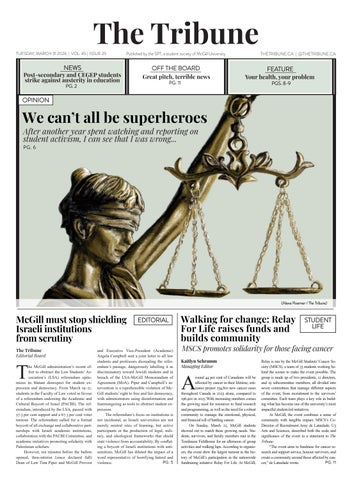
(Alexa Roemer / The Tribune)
Post-secondary and CEGEP students strike against austerity in education
CRUES leads students in week-long strike following budget cuts
Josette Chandler Staff Writer
From March 23 to March 27, over 65,000 post-secondary and Collège d’enseignement général et professionnel (CEGEP) students participated in a weeklong strike against austerity in education. The strikes were organized by the Coalition de résistance pour l’unité étudiante syndicale (CRUES), a union of 30,000 students in local and regional levels in Quebec. The strike called for a higher education budget in the province in response to Minister of Finance Eric Girard’s budget for the 2026-27 fiscal year.
The 2026-27 budget attempts to balance funding for public services with economic stimulation. While the budget established a 2.4 per cent increase in education spending, it is insufficient to cover the increasing costs of public education, which would require a 3.8 per cent increase. In all categories other than education and health, where a 2.3 per cent increase is required to keep up with growing costs, spending will decrease by 1.2 per cent.
In a written exchange with The Tribune, Elki Mercier, a coordinating officer at CRUES, highlighted the government’s failure to invest in education.
“Despite last fall’s student mobilization and the struggles of community groups and
workers against austerity and budget cuts, the government continues to turn a deaf ear to our demands,” Mercier wrote. “This is very clear in the new budget, in which the government is failing to invest sufficiently in education.”
Over 20 student groups participated in the week of action through organized strikes, with the majority coming from the Université du Québec à Montréal. 10 CEGEPs and universities participated in the week of action, organizing students across Quebec.
The Association étudiante du cégep de Saint-Laurent (AECSL), a student group with 4,900 members participating in the week-long strike, emphasized their commitment to creating change in a written response to The Tribune.
“This movement shows that students of Quebec are getting tired of governments that cut in public services to the advantage of the elite,” AECSL wrote. “For now, we have not seen actual change from the government, only a weak budget that does not cancel past budget cuts and that does not properly refinance education. We demand clear change, not half measures. Until then, the strike and protest situation is only going to escalate.”
Simone Bélanger, a spokesperson at l’Université du Québec à Rimouski (UQAR)’s strike movement Population Unie Contre l’Austérité et la Précarité, spoke on the changes the Quebec government needs to make for
students.
“Students hope for a massive reinvestment in post-secondary education. We are asking for a serious reform of the [Student Financial Assistance] program, paid internships for all students, the lowering and indexation of international students’ tuition fees, which have been instrumentalized by the government for years to narrow its deficit, as well as the preservation of our social safety net.”
dent involvement beyond the March strikes and how students can further fight against the budget changes.
To close the week of action, CRUES organized a protest on March 27 at Dorchester Square. While not on an official strike, the McGill contingent joined the protest. McGill students, in addition to protesting austerity in the Quebec budget, also rallied against McGill’s investments in weapons manufacturers and previously in fossil fuel companies.
As the week of action came to an end, Mercier emphasized the importance of stu-
“There are other concrete ways to get involved in the fight against austerity: Participate in general assemblies, join or start mobilization committees, stay informed about ongoing struggles through student newspapers, associations, or CRUES’s social media, and organize direct actions,” Mercier wrote. “CRUES also encourages student associations to ally with workers’ unions on their campuses, since austerity affects us all.”
Montreal police expands surveillance with Project Aurora
SPVM’s new project targets crime prevention through social media monitoring
Rebecca Votier Staff Writer
The Service de police de la Ville de Montréal (SPVM) says its new Project Aurora has already led to 20 arrests in just over six weeks, as part of a strategy aimed at preventing serious crimes such as arson, shootings, and home invasions through social media monitoring.
Described by police as an innovative and disruptive project, the program focuses on detecting criminal activity before offences are carried out. According to the SPVM, it relies on structured surveillance active around the clock, with specialized cybercrime teams monitoring platforms where offers of criminal contracts are believed to circulate.
Police say the program involves analyzing coded vocabulary, identifying potential threats, and coordinating between investigative units. Information gathered by the cybercrime unit is shared with other divisions, including antigang teams and firearms units, which can then initiate investigations.
In a written statement to The Tribune, Samantha Velandia, a representative from the SPVM Media Team, explained that the unit conducts continuous monitoring to identify and assess potential criminal activity. The SPVM affirms that social media has played a significant role in recruiting young people, who are rarely paid as promised after carrying out illegal acts.
“The cybercrime unit of the SPVM is conducting a proactive and continuous monitoring of social media platforms to identify and assess
potential criminal activity,” Velandia wrote.
However, some Montrealers have raised concerns about whether the initiative could reinforce existing biases. Noah Weisbord, associate professor in the Faculty of Law, explained in a written statement to The Tribune that the program risks targeting certain ethnicities.
“SPVM’s racial profiling record means there is a danger that Aurora, without robust safeguards, could unfairly target racialized kids online, hitting some communities harder than others.”
Project Aurora builds on previous efforts, such as outreach to businesses, which focused on in-person engagement and crime prevention. In 2025, the SPVM reported 86 violent incidents targeting business owners, with 46 suspects arrested, including minors. The new initiative adds an intelligence-driven layer that targets the online environments where criminal activity is increasingly organized.
The strategy reflects a broader trend in policing that emphasizes prevention based on digital behaviour rather than crimes committed. Similar efforts have been made at the federal level, including initiatives by the Royal Canadian Mounted Police (RCMP) to monitor criminal activity through online data collection. Federal programs like the RCMP’s Project Wide Awake show that large-scale monitoring of social media is not new in Canada.
In a written statement to The Tribune, McGill’s Socialist Fightback Club warns that this signals a broader trend of suppressing activism in the province.
“While the Quebec government is parading this new project as a way of stopping crime
and bringing people to justice, in reality these are just new tools that the state will have at its disposal to further crack down on activism at McGill and throughout the rest of the province,” Socialist Fightback wrote. “However, these measures will not scare us off. We will continue openly calling for students and workers at McGill to fight back against any cuts that might come.”
Monitoring will be conducted on X, Instagram, Snapchat, and WhatsApp. (Eliot Loose / The Tribune)
The expansion of social media surveillance has raised legal and ethical questions, pointing to challenges in interpreting online evidence in court. Weisbord commented that while online communications can provide valuable evidence, they also present risks of misinterpretation.
“Screenshots and logs hold up in court if properly authenticated. One danger is [that] police, prosecutors, and judges might misread slang, jokes, or emojis as real intent, charging protected speech. Courts need full context to avoid punishing thoughtcrimes,” Weisbord wrote.
Nonetheless, the SPVM reaffirmed that safeguards are in place. Prosecutors at the Directeur des poursuites criminelles et pénales will review cases involving youth, and the police have emphasized that prevention programs remain part of their approach alongside enforcement.
“A small number of cases do involve youths facing significant challenges, the majority of those who are arrested or investigated are individuals with prior criminal histories or who are already facing charges for other offences,” Velandia wrote. “This approach supports a balanced response that emphasizes prevention and support, while ensuring appropriate accountability when required.”
As Project Aurora continues, questions remain about how to balance crime prevention with privacy and legal protections in the digital landscape. Weisbord emphasized that Project Aurora is still susceptible to political exploitation.
“Aurora has already demonstrated it can help stop violence early. [However], surveillance systems like Aurora don’t stay neutral: Once built, they tend to grow, and in the wrong political moment, they become tools of authoritarian control,” Weisbord wrote.
Quebec intends to eliminate its budget deficit by the 2029-2030 fiscal year. (Emiko Kamiya / The Tribune)
SSMU Legislative Council discusses athletic clubs and constitutional amendments
Members work to wrap up before the academic year closes
Tamiyana Roemer Student Life Editor
The Students’ Society of McGill University (SSMU) called to order its penultimate Legislative Council (LC) of the academic year on March 26. As the semester draws to a close, members are moving to finalize key decisions for a smooth transition into the summer months.
Early in the session, Speaker Acadia Knickerbocker explained the notice of suspension issued to Dentistry Councillor Brian Kim.
“A few weeks ago, the Secretariat and I issued a notice of suspension to Councillor Kim after [he] was absent without
regrets for three consecutive meetings,” Knickerbocker said. “The councillor did not decide to issue an appeal, and so now, [the Steering Committee] are moving towards suspension.”
Vice-President (VP) Clubs and Services Hamza Abu Alkhair then presented his executive report. He announced that multiple clubs have been approved to officially operate under SSMU, including the Chinese Drama Club and the Nigerian Students Association.
Athletics Councillor Anette Yu asked whether there were any updates regarding McGill Athletics, referring to the 25 cut varsity teams and clubs. Abu Alkhair explained that while he had previously said that the notice in motion would be ready for the present meeting, extenuating circumstances have delayed the consultation process. Yu noted that this delay could compromise the ability of teams to recruit and organize before the fall athletics season. Abu Alkhair affirmed that concerned athletes should book office hours with him for further clarity on SSMU’s timeline.
In her executive re -
port, VP University Affairs Susan Aloudat recounted her meeting with McGill’s new Chief Security Officer (CSO) Tom O’Neill. The CSO oversees all aspects of campus security operations and is responsible for engaging with the university community to understand their concerns and improve security measures. Over the past few years, and amid student protests and strikes against the university’s involvement in the ongoing genocide in Palestine, tension between students and security has been high.
“I think that the [CSO’s] intentions are in a really good place [....] We did go into cultural sensitivity and [...] cultural awareness as part of this initiative, and so we made recommendations about doing the humanizing before doing the integrating.”
VP External Seraphina Crema-Black presented the Motion Regarding a Statement on Proposed Quebec Legislation Restricting Prayer and Faith-Based Spaces in Postsecondary Institutions for approval. The motion was informed by her conversations with religious student groups and the internal council about Bill 9. The motion was ultimately passed.
Much of the discussion time was spent on the Motion Regarding Constitutional Amendments 2025-2026. Members considered how to balance the retention of qualified applicants with an even representa -
tion across faculties when constructing its board composition.
“I think it’s important that we have even representation and diverse representation,” Crema-Black said.
Between four voting options, councillors passed an amendment that will prohibit more than five voting directors from the same faculty.
Moment of the Meeting
Aloudat highlighted the tension between the goal of the Community Engagement Fund to foster community building and its allocation of $5,000 CAD to the McGill Law Student Association, which she said can be exclusionary toward students outside the Faculty of Law who may wish to use their spaces.
Soundbite
“There was a referendum regarding an institutional boycott of Israeli [universities]. It passed by a simple majority, but [that is] currently being contested both through internal McGill regulations as well as through external proceedings [....] [The judge] heard arguments today, so we’ll have a little bit more clarity tomorrow.”—Law Councillor James Scott.
Bill 21 and invocation of notwithstanding clause condemned as unconstitutional English Montreal School Board and other groups challenge Bill 21 in Supreme Court of Canada
Sahar Jafferbhoy Staff Writer
On March 26, a four-day hearing concluded in the Supreme Court of Canada, where six groups challenged the Quebec government regarding Bill 21, continuing the debate over religious freedom, minority rights, and the use of the notwithstanding clause. The six opposing groups include the English Montreal School Board (EMSB), the World Sikh Organization, the National Council of Canadian Muslims, and the Canadian Civil Liberties Association.
Bill 21, passed in 2019, prohibits publicsector workers, including teachers, police officers, and judges, from wearing visible religious symbols while working. The Quebec government has argued that the law is necessary to uphold secularism in public institutions.
In an interview with The Tribune, Elizabeth Elbourne, a professor in the McGill History and Classical Studies department, emphasized the disproportionately damaging effects Bill 21 has on individuals who wear religious symbols.
“Beyond the impact on particular individuals in their jobs, Bill 21 has arguably created a permission-giving environment for discrimination,” Elbourne said.
Elbourne said that while the law applies broadly, its effects are not evenly distributed. She referenced a survey she conducted with Kimberley Manning, Political Science Profes-
sor at Concordia University, which concluded that some student teachers chose to change careers or leave Quebec rather than work under the law.
Historically, the notwithstanding clause has been used sparingly, and typically in response to court decisions. Introduced in 1982 as part of the Charter, it was designed as a political compromise to balance judicial power with parliamentary sovereignty.
In an interview with The Tribune, Jonathan Montpetit, a senior investigative journalist with CBC News, noted that Bill 21 marks a shift in how the notwithstanding clause has been used in the past.
“It was used preemptively […] the law did not specify a specific Charter right it was overriding,” Montpetit said. “Whatever the Supreme Court decides will have huge ramifications, not just for constitutional rights, but for how we think of the federation and indeed Canadian democracy itself.”
Some challengers also claim that Bill 21 violates rights that cannot be overridden by the clause, including gender equality and minority language rights. The Canadian Civil Liberties Association, one of the six appellants, argues that the law violates the protections of the Canadian Charter.
The EMSB contends that Bill 21 conflicts with Quebec’s identity as both pluralist and secular.
“The [EMSB] argues that the English community has the right to manage its own school boards in accordance with its own
values and therefore can’t be made to enforce Bill 21 in English schools,” Elbourne said.
The case also raises broader philosophical questions about democracy and the balance of power in Canada. Montpetit pointed out that the outcome could reshape how Canadians understand their political system.
“Which institution ought to have the final say in a democracy, the courts or the legislature?” Montpetit asked. “Is a democracy about respecting the will of the majority or protecting the rights of the minority?”
In a written statement to The Tribune, Kaya Scrivens, U1 Arts and Vice-President Events for the McGill Religious Studies Undergraduate Society, explained the consequences of Bill 21 for Quebec minority groups and McGill students.
76 per cent of Muslim women who wear the hijab reported discrimination in public and professional settings since Bill 21’s passing in 2019. (Alexa Roemer / The Tribune)
of day more than it affects others who can pray on more lenient schedules and in places that don’t require a prayer room.”
“Bill 21 is a ban on religious symbols in public, but it represents much more than that, and it sets a kind of precedent in Quebec for tolerance of religious discrimination as this bill affects certain religions more than others,” Scrivens said. “In terms of the McGill students, banning prayer spaces affects Muslim students who require prayer at specific times
Elbourne believes this case will have significant implications for Canada’s constitutional rights moving forward.
“The challenge won’t overturn the notwithstanding clause, even if successful. Nonetheless, if the court places clearer restrictions on the use of the clause this will shift balance of power back to courts and charter rights somewhat, albeit within limits.”
The final LC meeting of the 2025-2026 school year will be held on April 9. (Armen Erzingatzian / The Tribune)
Anarchist training camp teaches students how to combat fascism in Quebec
Workshop
discusses identifying white supremacist movements amid a growing far-right movement
Amelia H. Clark News Editor
From March 27 to 29, l’Organisation Révolutionnaire Anarchiste (ORA) hosted RAFALES , a free series of workshops and talks educating participants on theoretical and practical methods for practicing anarchism against fascism and authoritarianism. Run in the Comité social Centre-Sud building, the series provided lunch and dinner to attendees and had several tables of priced and free educational materials, including novels, zines, and pamphlets on past and upcoming protests and campaigns against fascism.
The workshop, titled “The Far Right in So-called Quebec: History and Anti-Fascist Resistance,” was hosted by speakers Mylène and Serge, who chose to withhold their last names. The first section, led by Mylène, focused on Quebec’s attitude towards immigration throughout the 20th century. Afterwards, Serge discussed Montreal-based white supremacist groups and how they attract and radicalize members.
Mylène began by clarifying that while Quebec has never been under a fascist regime, several of its key leaders in the past have openly supported fascist dictators and their ideas. Although the right-wing of Quebec between the 1900s and the 1930s were far from homogenous in ideology, they were united by an anti-communist and antisemitic
stance. This led to the creation of several newspapers dedicated to anti-immigration rhetoric, arguing that accepting immigrants to the province would eventually destroy French culture.
“The reactionary element of the anticommunist religious right really made a conflation between Jewish immigrants as a breeding ground for subversion […] as if they were evil communists who came to create rebellion and subversion in Quebec,” Mylène said. “In that year, several small groups were created which would have had common points in anti-communist propaganda and, originally, xenophobic remarks.”
In an interview with The Tribune , Michelle, a volunteer at RAFALES who withheld her last name, emphasized that the accessible environment RAFALES creates— offering free food, childcare, and materials to attendees—is integral to attracting new members to the movement, and further destigmatizing anarchism.
“In Quebec, we are really facing a rise of the right, and it’s super important to talk about it, to see the signs, and to be ready to act in different ways, including in more radical ways,” Michelle said.
“As an anarchist, I think it’s super important to somewhat de-demonize this term to help people understand it a bit more [.…] It can be gathering everyone together, learning, sharing meals, educating ourselves among ourselves, sharing our knowledge,
and meeting each other.”
Mylène explained that during the second half of the 20th century, both left- and right-wing parties in Quebec were anti-immigration, leading to the eventual 1995 referendum, which moved to grant the province sovereignty from Canada. The referendum failed by a margin of around one per cent of voters.
Serge then explained that although there are more progressive groups rallying for the separation of Quebec from Canada, many others have escalated, now relying on arguments based on racial as well as religious differences. He highlighted the Frontenac Active Club, a neo-Nazi group based in Quebec, whose express purpose is to prepare themselves for, and hasten the arrival of, what they believe is an imminent race war in Canada. Serge also warned attendees to be wary of groups that do not publicly claim white supremacist ideology, but have proven connections to white supremacy groups, pointing out that White Lives Matter often acts as a funnel for people with racist sentiments to be radicalized
into supremacists and join more extremist online forums.
“When you identify as a fascist Nazi, you dehumanize an entire part of the population,” Sergio said. “For me, you lose a bit of your status as a human being [.…] You lose what makes up a bit of the human essence.”
All quotes were translated from French.
The Tribune would like to invite you to their
End of Year & Special Issue Launch Party
+ food drive for local organizations
All contributors, editors, staff, and dedicated readers welcome
Saturday, April 11, 2026
8:00 p.m. to 11:00 p.m. Espace Culturel Kawalees
5175A Av. du Parc
Speakers stated that attendees should be concerned about the potential of right-wing radicalization through online channels. (Zoe Lee / The Tribune)
Social Media Editor Mariam Lakoande socialmedia@thetribune.ca
Business Manager Laura Pantaleon business@thetribune.ca
McGill shields Israeli institutions at the expense of its students
The Tribune Editorial Board
Continued from page 1.
Administrators must confront antisemitism on campus as a pressing issue, not weaponize antiJewish violence to shield their suppression of student democracy and obscure the political and legal role of academic institutions in Israel’s assault on Gaza.
The LSA referendum is explicitly framed around institutional relationships, not individuals. It calls for the severance of academic partnerships and in no way targets individuals on the basis of Israeli ethnicity, nationality, or background. The institutions are not being singled out arbitrarily by the LSA; Israeli universities have played a legal and political role in helping justify, sanitize, and legitimize the
COMMENTARY
Yusur Al-Sharqi Editor-in-Chief
One year ago, I wrote an article titled ‘Disruption is the essence of effective protest,’ arguing that radical activism is more effective than catering to the politically neutral, and that fencesitters aren’t worth engaging with. But after another year spent watching and reporting on student activism, I can see that I was wrong.
Activism has gotten louder in the past year, but it has also become increasingly insular. Inclusion in activist spaces has grown contingent on adhering to a set of expectations that aren’t always explicit, but are quickly and harshly enforced when broken. There is simply a zerotolerance policy for error.
occupation and genocide in Gaza.
Tel Aviv University’s (TAU) Institute for National Security Studies, for instance, brings together academic experts and senior security personnel to produce legal and policy guidance for the Israeli state and military. A referendum that targets institutional partnerships is not antisemitic; insisting otherwise irresponsibly collapses political critique into bigotry and shields complicit institutions from accountability.
In response to the referendum, Jonathan Amiel, Faculty of Law Advisory Board Chair, has resigned and withdrawn financial support for the university. In his resignation letter, he warned that if McGill failed to respond, the university would suffer reputational damage, weakened recruitment, lower employer confidence, declining alumni engagement, and donor erosion. His stance has framed a
democratically-adopted student referendum as a threat to the faculty’s financial stability and institutional standing, presenting the issue as a crisis requiring administrative intervention and containment.
McGill’s response reveals an emerging pattern of administrators obstructing and delegitimizing resolutions reached through democratic channels. In April 2025, Students’ Society of McGill University (SSMU) members voted to ratify the Policy Against Genocide in Palestine with a 71.1 per cent majority. In response, McGill threatened to terminate its MoA with SSMU, which would have been detrimental to the Society’s ability to support student groups on campus. Similarly, students passed divestment policies through the SSMU in 2022, and 2023, both of which were blocked by the administration. McGill
We can’t all be superheroes
about a cause are not experts, nor are they willing to dedicate their lives to it. That is not a moral failure. Social movements have never been powered solely by their most radical participants; they succeed when the radical few who are willing to sacrifice everything are supported by a much larger base of people who contribute in smaller ways. Divest McGill needed both visible building occupations and slow, years-long negotiations with administrators to succeed. We can’t all do the superhero work on the frontlines.
And perhaps more importantly, this stubborn need for a singular, perfect kind of activism conflates performance with substantive change.
CONTRIBUTORS
Alexi Fuentes, Evelyn Lonergan Hernandez,Sammi Lai, Julia Lok, Laura Pudane
This demand for perfection and refusal to compromise aren’t just unhelpful but actively counterproductive. History proves it: The United States’ Federal Bureau of Investigation’s COINTELPRO program exploited internal divisions within the Black Panther Party by amplifying existing tensions and spreading rumours about ideological purity—and it worked. By the 1970s, the Panthers were spending more energy on internal purges than organizing. Similarly, Occupy Wall Street failed in 2011 because— despite the hundreds of passionate, radical thinkers—the movement demanded a unanimity that would never materialize.
The expectation that everyone involved in a social movement must be hyper-radical is strategically selfdefeating. Most people who care
Telling someone to use the word ‘unhoused’ rather than ‘homeless’ is accomplished in a single breath, but when’s the last time you donated to the food bank or volunteered at a shelter? While changes at the level of language and rhetoric do carry real symbolic weight, their impact pales in comparison to tangible efforts at change. The outcomes we strive for require something much less gratifying—but much more fundamental—than correcting people from our high horse: active, sustained community involvement, and sometimes even compromise.
Refusing practical engagement comes at a cost, one that has clearly registered at McGill. In 2024, students alleged that the Students’ Society of McGill University (SSMU) President Dymetri Taylor misconstrued the scope of a legal injunction regarding the Policy Against Genocide in Palestine (PAGIP), suggesting that a proposed strike motion could not
has repeatedly characterized student mobilization as violating its policies—but when students attempt to use existing democratic structures to advance their goals, the university is quick to bulldoze their efforts. It seems that there is no palatable form of activism to McGill, so long as it objects to their complicity in genocide.
By sending alarmist memos that claim to speak for all Jewish students, the university both misrepresents the politically diverse communities it claims to protect and weaponizes grounded fears of rising antisemitism to delegitimize student democracy. McGill must cease its attempts to frame the referendum as discriminatory, stop using administrative power and MoA threats to obstruct its implementation, and acknowledge that a boycott of Israeli institutions is not, by default, a danger, but a crucial form of political expression.
Of the 4160 students who voted on the Motion Regarding Removal of President Taylor, 2438 (58.6 per cent) voted no. (Alexa Roemer / The Tribune )
proceed as drafted. They argued that this misunderstanding prevented McGill students from participating in a nationwide strike.
The frustration was justified, but the scale and intensity of the response quickly outpaced its strategic value. Students launched a motion to impeach Taylor: Hundreds showed up with pitchforks for the General Assembly public humiliation ritual, but those who called for Taylor’s impeachment perhaps hadn’t considered that installing new leadership would take a whole semester and would interfere with various other facets of student life. By fixating so intensely on punishment under the guise of accountability, we lost sight of the practical reality that SSMU is one of the few bodies capable of turning student demands into institutional action at McGill.
In the end, the impeachment motion failed. Taylor remained
president, and the PAGIP passed the following year. Yet, the hundreds of people with pitchforks are nowhere to be found today. While we were busy debating SSMU’s “delinquency of duty,” SSMU voter turnout dropped by over 50 per cent between the Fall 2023 and Fall 2024 referenda. The motion to increase the Student Services Fee failed, leaving groups such as First Peoples’ House and Student Accessibility and Achievement with less funding to support the groups we purport to advocate for. We showed up in droves for spectacle but not for tangible action.
No effective movement has ever succeeded by reserving the right to activism to a select, terminally online, jargon-obsessed few. We’re eating our own because of our obsession with ideological purity. At some point, we must choose: Do we want to create change, or do we just want to feel good about ourselves?
Shatner University Centre, 3480 McTavish, Suites 404, 405, 406
Simona Culotta, Defne Feyzioglu, Alexandra Hawes Silva, Lialah Mavani, Nour Khouri, Laura Pantaleon, Amy Xia
TPS BOARD OF DIRECTORS
Brooke Barak, Rachel Blackstone, Loriane Chagnon, Josette Chandler, Carla Cretin, José Moro Gutiérrez, Will Kennedy, Antoine Larocque, Sofia Lay, Lialah Mavani, Talia Moskowitz, Talia Moskowitz, Luca Paone,Julie Raout, Parisa Rasul, Alex Hawes Silva, Michelle Yankovsky, Ivanna Zhang Gwen Heffernan, Lilly Guilbeault, Emiko Kamiya, Alexa Roemer
Nell Pollak Managing Editor
Bill 28 entrenches the devaluation of feminized labour
Trigger warning: mentions of violence
In 2018, a nurse in Beauce had a miscarriage after a patient kicked her in the stomach.
In 2020, a nurse in Montérégie-Est was strangled for several minutes. In 2023, a high-school teacher in Laval was assaulted with scissors by a student in her classroom. Last spring, a youth-protection worker was thrown head-first into a brick wall at the Sherbrooke courthouse.
Violence should not be part of any job. Yet, for educators, healthcare professionals, and social workers in Quebec, such attacks are not outliers but the norm. In Quebec's classrooms, 90 per cent of teachers report having faced violence at work. Violencerelated lost-time injuries in healthcare and social services are rising at three times the rate of police and correctional officers. These are among the most dangerous workplaces in the province. However, unlike workers in fields such as construction and transport, they are denied access to the full protections of Quebec's general occupational health and safety prevention program.
Law 28, which originated in Labour Minister Jean Boulet's Bill 101, An Act to improve certain labour laws, explicitly carves hospitals, schools and social-services institutions out of the workplace violence prevention program. On Feb. 23, major labour organizations filed constitutional challenges
before the Quebec Superior Court to have these exclusions invalidated. Given that women make up 81 per cent of Quebec's healthcare workforce, 75 per cent of elementary and secondary teachers, and nearly 90 per cent of social workers, the groups argue that Bill 101 exacerbates the precarious working conditions of women across Quebec.
The court must respond to the unions’ challenges by repudiating what Bill 28 truly represents: not merely an administrative gap in workplace safety, but the legislated devaluation of feminized labour. By entrenching full prevention rights for male-dominated industries while relegating care and education to a second-tier system, this law codifies a hierarchy of suffering in which injuries sustained within women-dominated fields are marginalized.
Without a general prevention program for women workers, the consequences are concrete. Institutions are no longer obligated to collaborate with workers on prevention plans, accident registers become difficult to maintain, inspections slow, and occupational health and safety representatives are granted fewer hours and narrower mandates. When the province says it cannot afford full prevention in these workplaces, it is making a political choice tantamount to declaring that injuries in feminized sectors are simply not worth the cost of preventing. Research consistently shows that every dollar spent on prevention returns several in reduced injury and compensation costs— making the government's framing not only discriminatory but economically incoherent.
According to a Quebec labour and safety
commission report, healthcare, social work, and education sectors account for roughly 12.5 per cent of active establishments in Quebec but amount to more than 30 per cent of occupational injuries. The same data further discloses that in 2024, more than half of all claims by pregnant workers requesting removal from unsafe working conditions came from the health and social services sector alone. This violence is gendered not only in who endures it, but in who inflicts it—men perpetrate nearly two-thirds of workplace violence cases in healthcare. The risks are well-documented and concentrated precisely where women work.
Canadian healthcare workers are five times more likely to be attacked on the job than workers in other
The devaluation of feminized labour remains pervasive in Canadian policy. At the federal level, social workers remain excluded from Canada's definition of public safety personnel, barring them from occupational stress injury benefits afforded to police officers, firefighters, and paramedics—positions that are between 67 to 95 per cent filled by men.
Research consistently demonstrates that as women come to dominate a profession, its perceived prestige, compensation, and institutional protections decline—regardless of qualification or skill. This disparity reflects a long-standing assumption that the dangers of feminized work are simply natural extensions of the work itself—supposedly neutralized by
women’s ‘innate’ care skills—and therefore undeserving of the same structural intervention afforded to other sectors. Women are not more drawn to fields that are disparaged or underresourced; a field becomes devalued as women dominate it.
In 2021, Quebec overhauled its occupational health and safety regime on the promise of finally extending full prevention mechanisms beyond traditional industrial sectors to hospitals, schools, and social services—sectors that had otherwise been excluded since 1979. Four years later, Bill 28 writes that inequality back into law, protecting the assumption that the indispensable women in our communities who care, teach, and intervene are built to absorb harm the state refuses to prevent.
COMMENTARY Challenging the supremacy of Canada’s highest court
Zoe Lee Design Editor
Canada’s Supreme and provincial courts are raising more questions than answers as Aboriginal title cases are increasingly being brought before them. Aboriginal title refers to a collective and inherent right to a land or territory. It is inalienable, as it derives from the sovereignty of Indigenous peoples, and is held communally. Because it is constitutionally protected, Aboriginal title allows Indigenous nations to reap the economic benefits of land and entails the right to self-governance.
Given all of its advantages, Aboriginal title is a major objective for many Indigenous communities. But the path to recognition is long and uncertain as courts across Canada have yet to reach an agreement on several critical issues, such as the coexistence of title and private property.
Land cession treaties extinguish or terminate title; therefore, only nations that never signed these treaties are deemed eligible to claim Aboriginal title. As such, most landmark cases on Aboriginal title, such as Calder and Delgamuukw, have come out of British Columbia, where 95 per cent of the province remains unceded.
The Cowichan v. British Columbia decision was an unprecedented ruling where the court declared Aboriginal title over 3.25 square kilometres of mixed residential, agricultural, and industrial land, even though much of it is privately owned. Fee simple titles, or ownership, are supposed to be indefeasible or otherwise guaranteed. As
such, other title claims should not override this type of ownership. Yet, the ruling of the B.C. courts found the coexistence of private fee simple ownership and Aboriginal title. In doing so, the court opened a legal question with no settled answer: Whether Aboriginal title can coexist with private ownership, or whether one must yield to the other.
In Eastern Canada, the lower courts have a different interpretation of title. For six years, the Wolastoqey Nation has been seeking a declaration of Aboriginal title over their traditional territory, which spans western New Brunswick. In December 2025, the New Brunswick Court of Appeal ruled that Aboriginal title cannot be declared over fee-simple lands. This ruling stands in direct tension with the B.C. Supreme Court’s finding that Aboriginal title and fee simple ownership can exist in parallel.
This inconsistency is significant because only the Supreme Court can definitively establish whether Aboriginal and fee simple titles can coexist. Until then, the decision will be left to the discretion of lower courts, leaving Indigenous nations subject to fragmented and contradictory rulings that vary by province.
Precedents on Indigenous rights cases have always been central to nations’ fights to have their rights upheld within Canada’s legal system. Section 35 of The Canadian Constitution recognizes and affirms Aboriginal and treaty rights, but does not define them. This leaves affected parties in the lurch, waiting for the Supreme Court to fill this empty box over years of developing case law.
Indigenous nations had no confirmation
that Section 35 of the Canadian Constitution involved proprietary rights—Aboriginal title—until Delgamuukw in 1997, which was the first case that affirmed that title was protected under the constitution. Tsilhqot’in Nation v. British Columbia decision established under Aboriginal title over a portion of the Tsilhqot'in Nation’s traditional territories. Thus, the Crown must justify incursions on these lands. Honour of the Crown requires that title holders be consulted on the use of their lands and accommodated to their interests. This would give nations like the Wet’suwet’en full jurisdiction to oppose pipelines crossing into their lands.
Very slowly, a small body of law has developed on Indigenous rights, as more
rulings determine what Section 35 entails. Yet many legal issues remain untested, like title and private property disputes, leaving everyone with unanswered questions. Dozens, if not hundreds, of cases would be required to formalize Indigenous legal rights.
The Supreme Court will not engage directly with the issue of overlapping claims of Aboriginal title and private property until Cowichan reaches its desk. In the meantime, this matter will continue to affect the lives of Indigenous peoples, with major economic, social, and political consequences. Respecting the sovereignty of Indigenous nations entails establishing new avenues to recognizing title, especially when the current path is fraught with inconsistencies and fragmentation.
‘Hookman’: A story about the confrontation of guilt, grief, and change as we grow The Tuesday Night Cafe’s production of Hookman fosters a dialogue around how socially taboo topics are approached
Lia James Staff Writer
Trigger warning: This piece contains mentions of sexual violence.
Tuesday Night Café Theatre (TNC)’s production of Hookman explores grief through the metaphor of a masked killer representing guilt. The show ran from March 17 to 20, under the direction of Andrea Alcaraz (U1 Education). The play, written in 2012 by Lauren Yee, follows first-year college student Lexi (Alyssa Yeung)’s attempt at navigating life after witnessing her childhood friend Jess (Gemma Martin-Fung)’s death in a car crash. Throughout the play, this scene reoccurs as Lexi begins to recollect clarity of that night, most notably remembering the masked killer who was hunting her down.
Upon first introduction, one would likely assume Hookman, who wears a ghoulish mask and boasts an unsettling aura, to be the killer. Perhaps we even expect his dramatic unmasking—but this is not the case. Hookman is instead revealed to be a physical manifestation of the suffocating grief and regret of losing a loved one.
A pivotal moment in the play is a conversation between Lexi and Jess, where Lexi opens up about a time when she was sexually assaulted. However, rather than
being supportive, Jess questions the validity of her friend’s experience. This scene thus explores the impacts of victim-blaming and complicates Lexi and Jess’s friendship.
A very important aspect of this production was the lighting design. Much of the play takes place in the dark, with a small spotlight on Lexi. While this was likely done to master the creepy feeling of a thriller, it created an emotional connection between the audience and Lexi. The distinct spotlight expresses her loneliness and vulnerability, and places the audience in the surrounding darkness. Through her powerful facial expressions and line deliveries, Yeung also excellently expressed frustration, confusion, and sadness, luring the audience in.
The people surrounding Lexi often claimed that her hardships were inevitable. This sentiment and belief were echoed throughout the play as the cast did not make eye contact with Lexi, and the hugs given to her out of compassion for her suffering did not feel genuine. However, by the end of the play, Lexi finds the strength to fight back. She expresses that violence against women is not inevitable and that these situations should not be approached passively. Her newfound strength is a turning point in the play, pushing the other characters to later empathize with her—though victims should not have to fight for compassion in the first place.
Despite the play’s heavy theme, there are comedic moments in the dialogue. These express to the audience that even when going through traumatic times, there is still a way to find moments of laughter with loved ones.
The play’s final scene is the third and final flashback of Jess’s death. In this flashback, Lexi finally confronts Hookman. Instead of a dramatic fight, the play ends with them sitting together in a car, demonstrating Lexi’s acceptance of feelings she once feared.
The TNC did a fantastic job tackling
a play that is both dark and comedic at the same time, with actors seamlessly navigating between comedy and sorrow. Lexi’s endearing awkwardness does not go unnoticed, as it balances the play’s heavy theme. Overall, this production was an authentic representation of the complexities of grief. Not only did this play create an opportunity for important discussions about grief and assault, but it also demonstrated how important it is to counter passive reactions to violence. True change can only occur when we overcome the fear of “taboo” topics and instead face them head-on.
Human artistry is threatened by the increase in generative arti ficial intelligence The issues of generative AI for the humanity of art
Julia Lok Contributor
At a 2024 auction, a portrait of Alan Turing was sold for $1.08 million USD. Although a compelling painting, it was created by the artificial intelligence (AI) robo-artist Ai-Da, built in 2019. Now the most valuable AI-generated artwork ever sold, the piece represents what most artists have been fearing: The invasion of AI in artistic spaces.
This invasion isn’t strictly within the visual arts, though: In November 2025, How Was I Supposed to Know? reached Billboard’s Adult R&B Airplay. The song was number 30 on the chart. Xania Monet wrote this song; she’s an AI-generated musician who creates AI-generated music.
Generative AI (GenAI) has been increasingly used to create or enhance art. Many are questioning the integrity of non-human-generated art, the value of the ‘art’ Gen AI produces, and how far it will go.
As AI attempts a mimicry of human creativity, the already heavy competition in the art industry has been amplified. Many GenAI image generators exist on the market. DALL·E, now DALL·E 3, was created by OpenAI in 2022, its name ironically inspired by the 2008 film, WALL-E, and impressionist painter Salvador Dali. To test the generator’s knowledge on artistic styles, Jamena McInteer, a full stack developer and UI/UX designer, tried entering different prompts ranging from landscapes to llamas, abstract to photorealism, and oil paint
to gouache. McInteer determined DALL·E was successful in creating alluring images that resembled human art, but found the generator’s limits in the sometimes uncanny or inaccurate results. Despite these inaccuracies, DALL·E’s mimicry can produce a broad range of what a user might desire. If it can be thought of, it can be generated, and the quality of these creations is only improving with time.
Many artists have criticized the introduction of AI into artistic spaces. Kenneah March Dimacali, who was selected as a runner-up
for the Michèle Whitecliffe Art Writing Prize under the theme ‘Artificial intelligence (AI) and the visual arts,’ wrote in her essay that art is meant to be difficult. It’s not the art itself that is the prize, but the time and effort that it took to make the piece. GenAI ‘art’ is not art because it eliminates the difficulty of the artistic process.
Fortunately, in a push-back, there’s been a rise in appreciation for human-made art. Another study conducted by C. Blaine Horton Jr., Sheena S. Iyenga, and Michael W. White made clear that human-made art is valued over AI art
because of the substance and feeling behind it. It takes months or years for artists to create one meaningful piece. AI, however, only takes a couple of seconds to generate something. And, while its quality is adjustable through the viewer’s typed prompts, there is no sentient feeling behind its creation. Art stems from its human artists and is shared with viewers to produce feeling, whereas AI ‘art’ is created solely for a consumer who found an easy way to get an image.
With products labelled as “human-made,” an anti-AI movement has begun. Past the plastic arts, the book and film industry has joined this movement. Published last year, the horror novel Shy Girl gained positive public traction from readers and critics until it was suspected that 78 per cent of the book was AI-generated. The book’s publisher, Hachette, cancelled its production. Heretic’s producers added an “anti-credit” of GenAI at the end of the film.
Co-existing in the artistic sphere with AI is becoming inevitable, but there is a significant problem with GenAI developing too fast for regulation to keep up. Artists’ careers are at risk of being compromised. Human creativity and intelligence have decreased. With the abuse of GenAI, artistic creativity and humanity as a whole are threatened. Art is so existentially human; we need it not to survive, but to live. From the first cave paintings found in Altamira to Jeff Koons’ balloon animal sculptures, art’s purest form comes from the human hand at its centre. Even as AI hones its perfect copy, art will never flourish through mere mimicry.
GenAI’s development can be seen in an AI video of Will Smith eating spaghetti that has significantly improved in quality over three years. (Mia Helfrich / The Tribune)
Hookman is a character based on an urban legend that has been popular since the 1950s. (Andrea Alcaraz / Hookman)
Igot in an accident that involved some sea urchins,” Natalie Joy Gale, a PhD student in McGill’s Department of History and Classical Studies, said in an interview with The Tribune
YOUR HEALTH, YOUR
Gale recalls wiping out in an ‘urchin-y’ area of reef while surfing in Puerto Rico, resulting in several sea urchin spines puncturing the skin on her hands and feet. After the incident, she turned to the internet for answers, making use of the suggested home remedies she found online. That same evening, still in severe pain, Gale came across a paper that warned of the dangers of sea urchin spines should they remain embedded for too long. The following morning, she woke up feeling unwell and decided to seek help from the local emergency room. The doctors removed as many of the spines as they could, although they could not remove them entirely due to the risk of infection.
Keeping that paper in mind, Gale visited more doctors when she returned to Montreal and eventually got the care that she needed.
With the seemingly limitless amount of health information available on the internet, it is no surprise that around half of Canadians reported accessing these sources in 2024—albeit likely for information unrelated to sea urchins. Online resources—whether from social media or established medical websites—can make it easier to figure out what you may be experiencing, what treatments are out there, and whether a trip to a family physician or the emergency room is warranted. But beyond the information intended to address more immediate health concerns lies a whole world of wellness content which aims to promote a holistic, healthy lifestyle.
Upon first glance, some of the wellness content found on social media seems fairly innocuous. Chia seed pudding with colourful splashes of fruit and a drizzle of honey. A monochromatic workout set. An early wake-up to catch the sunrise and get to the gym. A general vibe of put-togetherness.
A glimpse beneath the aesthetic surface, however, reveals something more sinister. Instructions on how to get “snatched.” Claims that purchasing one product will fix your health problems. Mysterious health remedies lacking any scientific backing. Moreover, much of this content seems to suggest that the responsibility of maintaining one’s health should be left almost entirely to the individual, and that the social determinants of health—factors beyond genetics and lifestyle that shape health outcomes, such as socioeconomic status, race, and gender—are to be ignored.
Take wellness influencer Reagan Spencer’s thoughts on the matter, for example, in her video captioned, ‘The truth most people don’t want to hear’:
“You make time for what’s important to you, and if you’re not making time for it, then it’s obviously not that important. You can make excuses all day about why you can’t eat healthy, why you can’t get x amount of steps in, or why you can’t get to the gym. But when something truly matters to you, you find a way.”
In her view, any difficulty you experience
INVESTIGATING ONLINE WELLNESS INFLUENCERS AND WRITTEN AND DESIGNED BY LEANNE CHERRY,
in maintaining your health is a moral failing, a lack of willpower, and/or a priority issue above all else: You simply don’t want it badly enough.
In an email to The Tribune, Jonathan Jarry, scientist and science communicator at McGill’s Office for Science and Society, explained how an individual’s actions are unfairly framed as the sole determining factors for one’s health in online wellness content.
“When you get sick, you are blamed for it. You didn’t eat right enough, you didn’t exercise enough, you didn’t buy the right supplements, you didn’t pay for enough sessions at your local infrared sauna,” Jarry said. “This blame is misplaced, and it causes anxiety, and I think it’s an insidious consequence of believing that health can simply be bought at the right price.”
Crucially, in championing these “simple” fixes, wellness influencers act as though health exists outside of social or economic conditions, despite the fact that racialized and lower-income communities are disproportionately neglected by the healthcare system, and experience poorer health outcomes and lower life expectancy overall. Wellness influencers’ disregard of these systemic injustices is made all the more problematic when considering the size of their audiences; Spencer herself has over 450,000 followers on TikTok, meaning this merely individualistic narrative is disseminated on a large scale.
“Good modern medicine, including public health, recognizes that health is not just a choice. Sure, there are decisions you can make to reduce your risk of becoming ill, but so much of [your health] is outside anyone’s control,” Jarry explained. “It has to do with who your parents are and the genetic material they gave you. It has to do with where you grew up and in what social class. It has to do with how much money you earn now. The wellness movement, however, has always thrived by denying this reality and selling you solutions under the guise of self-empowerment.”
A HEALTHY BODY IS A THIN BODY (ALLEGEDLY)
Beyond the fact that wellness influencers are frequently attempting to sell you a product, they are also often giving instructions on how to lose weight. Of the wellness industry’s $6.8 trillion USD valuation in 2024—which encompasses economic activity in sectors that allow people to incorporate wellness into their lives—$1.3 trillion USD comes from personal care and beauty, while another $1.1 trillion USD is tied to healthy eating, nutrition, and weight loss. For reference, the wellness sector’s total valuation is around 16 times larger than that of the global sports economy.
Moreover, the beauty and health industries
at large are increasingly intersecting. Influencer Jada Moylan paints a clear picture of this over lap on her TikTok page, whose bio reads, “Here to get hotter and healthier.”
In her recent posts, Moylan frames lifestyle practices that are objectively good for you, such as weightlifting and eat ing well, almost sole ly in relation to how they will make you look. Rather than simply sharing a workout routine and encouraging people to exercise just for the sake of strength, these posts revolve around being thin and toned while avoiding bulkiness. This framing coincides with the semi-recent comeback of “thinspo” content in broader social media contexts—although its presence has arguably been continuous.
“The idea that a healthy body is a body that adheres and conforms to the ideals that the dominant society has established, which always reflect certain ideas about class, certain ideas about race and certain ideas about thinness, I think that it’s all kind of interlocking,” Gale said.
Indeed, there is a significant relationship between socio-economic status and weight, with rates of obesity and socioeconomic status being inversely correlated in developed countries, and positively correlated in developing countries. Concurrently, the means by which Moylan claims one can achieve this look completely obscures problems in the modern food market.
“Eat simple, boring meals, eat high protein, eat whole foods, limit sugar, limit alcohol, limit processed foods,” she suggests, among other tips, when describing how to achieve your
YOUR PROBLEM
AND THE INDIVIDUALIZATION OF HEALTH RESPONSIBILITY
CHERRY, SCIENCE & TECHNOLOGY EDITOR
dream body.
Moylan is correct in pointing out that these practices are largely good for you, but when examining what food is readily available to the public, it becomes clear why people cannot simply switch to a whole foods diet. In the United States, around 75 per cent of the food supply is thought to be ultra-processed. This includes products such as energy drinks and hot dogs, as well as staples like sliced bread and yogurt. They have been specifically engineered to be nearly irresistible to the human palate, and furthermore, they are energy-dense, easy to prepare, and above all, more affordable. These ideas that health should be a means through which to realize patriarchal beauty standards, and that anyone can take up a healthier lifestyle at will, only further isolate people in an already broken healthcare system, pointing the blame at us and ignoring the systemic issues which leave us stranded in the first place. Moreover, the abundance of content that focuses on weight loss is ironically making people unhealthier, indeed contributing to increased body image issues and eating disorders.
Moylan’s team did not respond to The Tribune’s request for comment.
PSEUDOSCIENCE AND MISINFORMATION
In the same breath as telling you that you aren’t reaching your health goals simply because it’s not important enough to you, and that you should be exercising and eating well for
the sake of getting your body “bikini-ready,” wellness influencers make unsubstantiated claims about how well their health regimen really works. There are countless scientifically dubious yet financially lucrative health products they promote, ranging from mouth taping, coffee enemas, or dietary supplements—none of which are subject to U.S. Food and Drug Administration regulations.
In a TikTok with nearly 400,000 likes, self-proclaimed “beauty guru” Tatyana Lafata takes us through her daily supplement routine for “glass skin, a happy gut and long healthy hair.” Once again, we see the overlap of beauty and health, and this time, it can be attributed in part to a daily spoonful of edible sea moss.
“It has 92 out of 102 minerals on this Earth. A serving of sea moss every day will change your health. Skin, hair, brain function, mental clarity, anxiety, appetite, everything. This will cure it,” she says.
First of all, it is not clear which 102 minerals Lafata is talking about: There are over 5000 minerals on our planet, and humans only require about 30 of these to survive. Second, while we cannot say that she hasn’t seen benefits from taking sea moss, it is completely irresponsible to make such a lofty statement about how it could benefit others.
A SYMPTOM OF DEEPER ISSUES
Despite their questionable claims, it should come as no surprise that wellness influencers are successful. Not only is there legitimately useful information to be distilled from these murky waters—even though it is tied up with notions of beauty and pseudoscience—but there is a general sentiment of dissatisfaction with the healthcare system across both Canada and the United States. This is especially relevant for women and BIPOC individuals who are routinely dismissed in healthcare spaces. Social media allows people to access information quickly, avoiding the long wait times that patients experience in clinics today.
Moreover, along with the already-heightened sense of institutional mistrust, we have people like Robert F. Kennedy Jr., the United States Secretary of Health and Human Services, adding fuel to the misinformation fire—a man whose government has gutted research programs across the country and rolled back vaccine mandates that were long understood to be safe and effective.
Jarry touched on some of the factors that are correlated with the birth of RFK Jr.’s Make America Healthy Again movement, which itself is tied to the wellness industry.
“The COVID-19 pandemic was a radicalizing event across multiple lines. It brought to
the surface basic inequalities that had always been there but that some of us were ignorant of; but it also reenergized a somewhat waning anti-vaccine movement,” Jarry wrote. “The fact that mRNA vaccines were being rolled out for the first time was a big reason for the distrust, and I think that anti-vaccine influencers like Kennedy managed to sway people who were otherwise pro-vaccine into becoming more hesitant of them.”
MEDIA LITERACY: A STEP IN THE RIGHT DIRECTION
Knowing that both government officials and wellness influencers are spreading health misinformation, it is crucial that we learn, as consumers, to evaluate the legitimacy of what we encounter online, so as to avoid completely disregarding the internet as a useful tool for gaining health information.
In an interview with The Tribune, McGill science communication specialist and faculty lecturer Diane Dechief suggested how students in particular can work together to critically examine information they find on the internet.
“It’s really important for students to realize they can be part of this good communication system too [by] asking people how they found out about this information and maybe pointing them towards places to verify it or like better information,” Dechief said. “So I feel like there’s a bit of a citizenship responsibility as well as the units that provide us with healthcare […] to make things ready to be drawn on in these ways, […] I do think people are turning away from social media in a lot of cases and looking more toward what’s the good information and what’s the good evidence, and to kind of carry that forward a bit better.”
Dechief leaves us with questions to ask ourselves when we come across health information online to evaluate its legitimacy.
“What is the source? […] Are they from a major publisher or not? […] Are there real editors attached to it? […] What are the vested interests? Who’s paying for this? Is this publicly funded or not?”
Ultimately, we cannot reduce systemic injustices to individually manageable problems. We must call on policymakers to address the death of media literacy education seen today, as well as the general public sentiment against science and the scientific method. We must ask for stronger fact-checking on our social media platforms that profit from misinformation.
And finally, we must remember that, while we do have some control over our health, maintaining our wellbeing will always be at odds with the values of a neoliberal society, which encourages us to forgo our bodily needs for the sake of growth and productivity. To truly feel better, we must first challenge the overarching systems that frame us as mere individuals in the first place.
If you are a McGill student looking for health and scientific resources, please consult the Eating Disorder Centre (EDCSSMU), the Student Wellness Hub, or one of McGill’s many wonderful librarians.
Student artistry: Made at McGill, yet advanced by artists
Lack of institutional support burdens student groups with promoting artistic growth
Dylan Hing Staff Writer
Watching a show in Tuesday Night Café Theatre’s (TNC) space, the first thing you will notice is that the separation between crew and audience—or cast and audience, if the director so decides—is almost non-existent. The small theatre at Morrice Hall, whose seating can be configured as the director wishes, creates a fluid, warm atmosphere that serves as a meeting place for McGill’s artistic community.
For McGill students who wish to participate in the creative arts, whether it be in visual arts, dance, drama, journalism, or other disciplines, several clubs and student societies exist to fulfill this need. Organizations such as the Visual Arts Society and the Photography Students’ Society, as well as a plethora of dance and drama companies like Alegria Contemporary Ballet or TNC, provide students—beginner and advanced alike—the opportunity to explore the arts.
However, these opportunities operate within a university that, outside the Faculty of Music, offers little in the way of support for artists hoping to develop their skills professionally. Notably, McGill’s lack of a studio art program has forced students to look elsewhere, as there is no serious institutional alternative on campus.
This persists in the sphere of theatre. Though opportunities to get hands-on expe-
rience are diverse in scope, preparing student actors for careers outside McGill is a challenge. In a written statement to The Tribune , TNC production manager Megan Siow, U2 Arts, outlined the issues that student theatre groups face in establishing themselves as serious alternatives to professional drama programs.
“We strive to create an environment where, regardless of experience level, you can get involved and become part of the community. However, in terms of preparing students for arts outside McGill, TNC only really has the resources to support to a certain extent,” Siow wrote. “TNC is, and cannot be, a place geared toward people who want to seriously pursue a career in the arts [.…] There is nowhere at McGill that is a place for emerging artists who are serious about pursuing theatre.”
There is no doubt that student societies have opened doors for students of all backgrounds to get involved in the arts, yet, as with any club, not all members have the same level of commitment. As Siow affirmed, these clubs do not have the resources to be both a society for students to try out new interests and a pre-professional placement.
It is disappointing that, among the three anglophone universities in the province, McGill provides the least institutional support for the arts despite its international renown. Concordia, just two metro stops away, boasts an incredible selection of professional pro-
grams in its Faculty of Fine Arts. Bishop’s University has the only English-language musical theatre program in Quebec.
Student-run groups do not hold the same power or prestige as academic programs, making it more difficult for artists to navigate bureaucracy. Siow pointed to the difficulties in making the TNC space available to other groups.
“New policies in the last year have made it so we have to go through [Arts Undergraduate Society] AUS and/or the Islamic Studies [IS] Department to approve other groups using the theatre. Adina [Sigartu, IS Administrative Student Affairs Coordinator] and the IS department have always been very helpful, and we are immensely grateful for their support, but certain bureaucracies undermine TNC’s mission to create accessible theatre.”
McGill artists, while creating impres-
sive work on their own, deserve the opportunity to hone their skills through professional programs. Courses such as the Department of English’s Stage Scenery and Lighting and Costuming classes for the theatre are a great example of the fruitful possibilities that McGill could foster, but McGill should be doing more to connect its artists with industry professionals.
The lengths to which McGill’s artistic community will go to express their creativity deserve further support from the university, which continues to neglect its artists. The current offerings, made by students for students, are endeavours that contribute to the vibrant and diverse community we call home, but they are not enough. Emerging artists who wish to attend McGill should not be shut out due to its artistic impracticalities; instead, McGill should listen to its student culture by nurturing creative arts.
‘ARIRANG:’ BTS’s most divisive and misunderstood album One thing is consistent in BTS’s music—change
Alexi Fuentes Contributor
On March 20, the South Korean boy band Bangtan Sonyeodan (BTS) released its first group album in nearly four years: ARIRANG . Long-awaited and highly anticipated, the album sparked an influx of online debate after defying some listeners’ expectations, quickly becoming one of the group’s most divisive projects. As someone who has followed BTS’s releases for the past 10 years, the discourse and noise are inevitable, but experiencing this album is so enjoyable when individual expectations are not projected onto artists’ work. Despite pushback, BTS’s musical ventures and choices for this album—from genre diversity, to English lyrics and an unexpected lead single—feel natural to their artistic journey. For 13 years, the group has pushed boundaries, delivering new songs that reveal unexpected sides to the artists.
The album takes a more experimental turn than their previous releases, featuring tracks written and produced by Mike WiLL Made-It, JPEGMAFIA, Kevin Parker from Tame Impala, Teezo Touchdown, El Guincho, Diplo, and Flume, among others. Some listeners were surprised by the number of collaborations with Western, namely American, writers and producers. But this is nothing new for BTS, whose music, like the K-pop genre in general, draws heavily from Black American music and culture.
ARIRANG takes its name from the cen-
turies-old traditional Korean folk song and unofficial national anthem “Arirang.” It has around 3,600 variations and about 60 versions—reflecting the contributions made by generations of Koreans who continue to create and add new lyrics, adding to the song’s cultural and musical diversity. The significance of this song deserves its own deep dive, as the history of “Arirang”’s first official recording inspired the artistic direction of the group’s new album.
In an interview with Jimmy Fallon, Kim Namjoon, the leader of BTS, explained the song’s importance and meaning.
“It’s the song that represents Koreans the most [….] It includes lots of emotions in it, it could be joy, it could be sorrow, longing, sadness, […] resistance,” he said.
These emotions are depicted throughout the tracks in BTS’s ARIRANG alongside love, separation, and nostalgia, as the group reaffirms and pays homage to its Korean identity.
The album is structured into two parts, with “No. 29” marking the transition from the high-energy first half of the album to the softer, more mellow second half of the album. The track contains the sound of South Korea’s 29th National Treasure, “Divine Bell of King Seongdeok,” adding a multitude of layers of meaning to the album.
ARIRANG opens strong with “Body to Body,” which fuses pop, hip-hop, and national Korean music. It lets listeners experience traditional music without feeling
overly patriotic—a worry that some members of BTS had when choosing whether to include “Arirang” in this track.
The next four songs pulse with vibrant and upbeat energy that echoes the group’s musical roots in hip-hop. “Aliens” features a hard-hitting beat with lyrics that project BTS’s pride in their culture and identity, whilst sharing their experiences of othering and alienation. Its lyrics make culturally specific references and draw on BTS’s lived experiences, resonating with those who understand what it’s like to be labelled an “alien” in a foreign country.
Moving into the second part of the album, “SWIM”’s mellower style and completely English lyrics made it an unexpected choice for a lead single. Its appeal lies in its approachable melody, with lyrics open to different interpretations and a message about swimming forward through hardship. “Merry Go Round” is one of my favourites, both musically and lyrically, because of its beautiful, melancholic melody and introspective lyrics about the pain of being stuck in a loop or cycle. “Like Animals” is another standout track in an alternative rock style new to BTS, with piercing vocals and instruments. I also have to shout-out “Please”—an R&B track
with addictive vocals.
The album finishes strong with “Into The Sun,” which evokes the perfect feelings for a finale. It uses a vocoder for the first half of the song, adding an interesting vocal texture that fades out at the end when their voices, free from the distortion, sing “I’ll follow you into the sun.”
For all its context, wit, and creative nuance that cannot be fully encapsulated in this review, this album is for real music lovers and those willing to search for the various meanings and references in its samples, lyrics, wordplay, and musical arrangement. This album is bound to be misunderstood when listeners lack a full picture of the creative vision, especially in the meaningridden lyrics. I encourage readers to experience this album for themselves to form their own opinion.
discography covers various social topics, with creative inclusions like references to literature and psychology, an alternate universe storyline, and more. (Zoe Lee / The Tribune)
Bureaucracy makes finding space a challenge for artistic societies, especially in theatre. (Eliot Loose / The Tribune)
OFF THE BOARD
Great pitch, terrible news
Ellen Lurie Opinion Editor
In T he Tribune ’s Slack, ‘that’s great!’ doesn’t usually mean there’s good news.
Coming up with pitches for our paper requires a particular analytic perspective. Examining politics, social life, and culture through the lens of journalism can instill a habit of reading the news in search of something controversial; something sensationalizable. While not inherently problematic, an overemphasis on procuring a ‘newsworthy’ story risks flattening suffering into an opportunity for coverage.
Palestinian film director and journalist Basel Adra unpacks this tension with Israeli co-director Yuval Abraham in their documentary, No Other
Land . In 2019, the two embarked on a mission to chronicle the Israel Defense Force (IDF)’s destruction of Adra’s agrarian community of Masafer Yatta in the West Bank. In the 1980s, the Israeli government declared Masafer Yatta to be a military training zone, starting an offensive of forcible displacement that has since dispossessed several hundred Palestinians.
The documentary’s central feature is Adra and Abraham’s mutual commitment to exposing the IDF’s siege through journalism as a means of fostering public and international awareness. At one point, Adra tells Abraham, “I feel you’re a little enthusiastic [....] You want everything to happen quickly, as if you came to solve everything in 10 days and then go back home [....] [You say], ‘the article didn’t get enough views.’ You want it all fast.”
This moment highlighted an inherent tension between the desire— or need—to reach a wide audience as quickly as possible, and the necessary delicacy and patience with which the subject of their journalism must be explored. As Adra acknowledges, a single article will not end decades of conflict and destruction. Regardless, journalists still hope to stumble upon the story— the one that revolutionizes the conversation entirely.
Yet, sensationalism does not only operate at the level of the individual
journalist—it is an institutionalized, extractive method of knowledge creation, shaped by historical and structural forces dating back to colonialism, under which the Other’s suffering was commodified for circulation among and consumption by white Western audiences.
In The Wretched of the Earth , Frantz Fanon writes, “When a Western journalist interviews us, it is seldom done to render us service.”
When stories are written for the benefit of the individual reporter, the newspaper, or the ruling power instead of for the people whose experiences are being shared, journalistic exploration quickly becomes exploitation. In the late 19th century, Belgian King Leopold II used journalism antagonistically to sow division amongst revolutionary groups in the Congo, a key inciting incident in the initiation of the Congo Free State propaganda war.
Yet, it is because storytelling is so intrinsically shaped by power that the myth of the ‘objective’ journalist remains so appealing. This alleged neutrality obscures the unethical nature of extractive reporting, subconsciously allowing readers to forget the implication of power in the creation of news articles.
On objectivity, Fanon notes, “Even the most liberal of the French reporters never ceased to use ambiguous terms in describing our struggle [under
colonization] [….] When we reproached them for this, they replied in all good faith that they were being objective. For the native, objectivity is always directed against [them].”
During the colonial era, objectivity was a tool that only the colonizer was allowed to possess, weaponized with the underlying intention of legitimizing the colonizer’s presence or challenging the validity of anti-colonial and liberatory movements. Today, the myth of objectivity persists in more subtle ways: The view from nowhere, bothsidesism, elite journalism—the list goes on.
Many journalists are now pushing for the abandonment of the objectivity fallacy, but sensationalism operates on a parallel logic. Both obscure the role of power in the production of knowledge: Where objectivity shrouds power by insisting the journalist holds none, sensationalism commodifies struggle for the benefit of the journalist’s narrative needs. Abandoning one without confronting the other leaves the underlying exploitative system intact. These dynamics are not limited to large institutions. They live on in the practices of individual reporters, who will continue to capitalize upon others’ suffering for its narrative potential until sensationalism is decentred from journalism. This piece is no exception— it, too, was pitched and written with an audience in mind, making it subject to the very impulses it critiques.
From budget cuts to student cuts (an April Fools special) In totally real news, budget strain will force McGill to cut existing students from Fall 2026
Brooke Barak Staff Writer
As we are all well aware, McGill has faced minor financial issues for quite some time now. For the 2025-2026 school year, our university has a minuscule projected deficit of $45 million CAD. Fortunately, so far, this deficit has only led to an abundance of staff cuts, cutting the majority of McGill’s sports teams, a hiring moratorium, and cuts to infrastructure spending. But fear not! In a wave of innovation, McGill has come up with a seemingly unorthodox budgeting technique to be implemented in the upcoming 20262027 academic year: Student cuts.
Under these exciting new regulations, McGill will ask any returning students with a GPA lower than 3.9 to leave the university. The logic is simple: The school desires to more quickly offset the ever-increasing budget deficit, and to represent the brightest young minds of Canada. It’s killing two birds with one stone! Another benefit of this genius plan is that it will minimize the number of distressed athletes on campus who have lost their athletic careers to McGill Athletics’ whims. It’s truly a win for everyone on campus.
The news has unsurprisingly caused outrage everywhere on McGill’s campus
this past week. Students have raised subsidiary concerns, such as noting the fact that GPAs vary across different faculties, or that McGill’s ordinary grade deflation might make it more difficult to reach the required 3.9 GPA every semester. Students have also brought attention to the fact that McGill should maybe rethink the rigour of its academic courses.
While there is widespread anger throughout McGill’s student body, the greatest indignation comes from students who are set to graduate next year. Unfortunately, if they do not meet the required 3.9 GPA, they will be asked to leave the university and explore exciting transfer opportunities to alternative institutions. One student familiar with the matter declared their distaste with this decision, as the news kind of interrupted their senior-year plans—specifically, to graduate and obtain the degree they paid thousands of dollars for.
Additionally, talks have come about of a plan to TP the dean’s office in a defiant act of resistance. Suspiciously enough, Dollarama and Uniprix have reportedly both run out of toilet paper this weekend. When questioned by The Tribune , a Dollarama employee claimed to have seen a horde of angry-looking customers wearing desecrated McGill merch storming to the cleaning aisle. Next thing they knew, all of the toilet
paper was gone.
McGill’s administration is planning to combat the protests by increasing the already imposing security presence on campus. Only this time, they can’t afford to hire any more personnel. To keep the peace, the administration will resort to stationing TAs in front of every building on campus, from Sherbrooke 680 up to the Mont Royale lookout, for the next few weeks. Yes, this does mean that all confer -
ences will be cancelled.
These student cuts, while in theory academically inequitable, have really brought on a wave of unity for the students of McGill, forcing them to band together in the face of a dreadful threat to many of their academic careers. The real question is: What is next? Cutting bathrooms? Getting rid of Hotdog Man? We have yet to find out. But we know one thing for certain: We need to start studying for finals. Now.
Walking for change: Relay For Life raises funds and builds community
Kaitlyn Schramm Managing Editor
Continued from page 1.
Through these efforts, MSCS contributes to a broader network of fundraising and advocacy. In partnership with the Canadian Cancer Society (CCS), funds go towards both research and resources for patients, families, and caregivers across the country. These supports include funding for wigs, transportation to treatment, residence for patients and caregivers, and prosthetics. CCS also supports Camp Goodtimes—a medically supervised summer camp “where kids with cancer can just be kids.”
While fundraising remains central, Relay also fosters a sense of community among cancer survivors and those who have lost loved
MSCS promotes solidarity for those facing cancer
ones to cancer. Beginning with a series of survivor speeches, attendees of Relay experienced moments of reflection that resonated long after the night ended. De Lataulade in particular recalled one of her most impactful memories from her involvement with Relay.
“The survivors who come to give speeches at Relay every year have really had an impact on me. Their stories about experiencing cancer diagnoses as young people, disrupting their lives and completely changing their outlook on life is particularly touching,” de Lataulade wrote. “One of our survivors this year happened to know a friend of mine who passed away from cancer last year, and told me about going to camp for kids with cancer together when they were younger. Moments of community like that have really shown me why it is so important to foster spaces like these to have open conversations about cancer
How to avoid a messy move-out
and maintain a community where no one has to fight alone.”
As Relay For Life continues to expand, students can join by attending the annual event, forming teams, or contributing to MSCS fundraising efforts throughout the year. Relay offers the chance to change the pace: A space to slow down, come together, and support a cause that extends far beyond McGill. Even if you haven’t been personally affected by cancer, a sense of community and hope at Relay radiates forth.
“For students, getting involved is a meaningful way to get further involved in McGill student life while contributing something larger than themselves,” De Lataulade wrote.
Tips for smoothly transitioning between living arrangements
Laura Pudane Contributor
When finals season finally ends, you might have thought that the last of your worries would be gone. Instead, you’re faced with the final test—having to figure out how to transport your whole personal ecosystem somewhere else. To make the transition easier, The Tribune has put together some pointers that might come in handy.
Less is more
As someone who used to grieve throwing away everything—from raggedy socks to shards of broken dishes—my first move kickstarted a journey towards minimalism. The sight of all my belongings laid out on the floor transformed me into a memories over possessions advocate, so much so that the only decor in my room now is a single framed picture. While there’s no need to adopt such an ascetic lifestyle yourself, a good pre-move decluttering won’t hurt anyone. During the process, it’s important to be mindful of the size of your new place, especially if you’re moving to a less spacious area. A good selection criterion is assessing the potential value of each item rather than focusing on its past worth.
A good final step of sustainable spring cleaning is donating used, but functioning goods. Thrift McGill and Renaissance Quebec
accept a vast array of items for donation. Remember to check their lists of accepted items, and don’t forget to clean and wash your things beforehand!
This one’s heavy
Talking business now, if you are a proud owner of furniture but want to downsize your collection, consider your options based on the time and resources available to you. List your items for free on Facebook Marketplace or Kijiji if your main goal is to clear your space out as soon as possible. If you’d prefer to sell your items, remember that during this time of year, many other renters are posting their furniture. Keep this increased supply in mind when setting your price points. As a last resort, Welcome Collective is a paid service that can pick up all the unwanted furniture you weren’t able to get rid of yourself.
Think outside the box
Even though a stack of moving boxes creates the perfect photo-op for an aesthetic Instagram story, those pile-ups of cardboard monstrosities are impractical, especially if you are coordinating the move yourself. Boxes take up a lot of space, and they are hard to carry, especially if they’ve been packed to the brim. Instead, opt for something like an IKEA FRAKTA bag: They’re loose, have handles, are less prone to water damage, and have zip pers for extra security.
Update your address
Beyond the physical move, updating your address everywhere is one of those tasks that’s easy to put off and tedious to do, but saves you real headaches down the line. Start with the essentials: Your bank, your phone plan, and any necessary student and government records. From there, work through the less urgent but still important ones—like Uber or Amazon to avoid missing out on your next food delivery or taking a trip across town to pick up a 4x4-sized package. A good strategy is to sit down and make a list of every service you can think of, then knock them out in one session rather than discovering them one by one over the next three months.
Practice gratitude
After all the rigorous cleaning, heavy lifting and sighs of frustration, remember to properly part ways with the walls that were present through all the joys and hardships of your academic year. Take one last moment to observe the empty space and think about the lessons and memories you
behind. If you shared the space with someone, contemplate the future of your connection. A symbolic gift or one last shared meal can be a good way of memorializing the shared journey and signalling interest in maintaining contact. In the case of a less fortunate roommate relationship, a simple farewell message can be a respectful conclusion.
63 per cent of Montrealers are renters, which is almost twice the national average. (Lilly Guilbeault / The Tribune)
Relay For Life has been supporting the Canadian Cancer Society for over 20 years. (Lilly Guilbeault/ The Tribune)
Dark matter and energy: What we know about the unknown A quick discussion about what the universe is really made of
Evelyn Lonergan Hernandez Contributor
When we think of what the physical world is made of, atoms come to mind—but it turns out the story is far more complex. In reality, atomic matter makes up only five per cent of the universe. The rest, however, is made of dark matter and dark energy, which have puzzled scientists for nearly a century. In hopes of better understanding these components, The Tribune attended a talk by McGill’s Trottier Space Institute (TSI) on March 26.
Katherine Freese, one of the first women admitted to Princeton University
and now director of the Weinberg Institute for Theoretical Physics and the Jeff & Gail Endowed Chair of Physics at the University of Texas at Austin, led the discussion. She explored where current scientific research stands and what it reveals about the nature of dark matter and energy.
Before asking what dark matter is, one must understand how scientists discovered it. The first person to suggest such a thing could even exist was Fritz Zwicky, a Swiss scientist who, in 1933, studied the motion of hundreds of galaxies clustered together, known as the Coma Cluster. The laws of physics dictate that the closer a galaxy is to the centre of its cluster, the faster it should spin. However, Zwicky’s observations
showed that galaxies further away from the centre travelled differently than expected.
“[Zwicky] saw some that were really whizzing, going really, really fast. If there’s not enough material inside there, then those galaxies should just escape. And based on the other galaxies that he was able to see, that’s what should have happened. There shouldn’t be these rapidly whizzing galaxies at larger distances from the centre,” Freese said. “A potential solution is [to] add more matter, more gravitational pull that would hold in those galaxies to keep them [closer to the center] even though they’re moving so fast.”
In the 1970s, American astronomer Vera Rubin definitively demonstrated that dark matter was the additional matter behind these strange observations. Additional support comes from Einstein’s theory of gravitational lensing—which describes how light and time bend around massive objects—and from recent observations such as the Bullet Cluster, where two galaxy clusters collide. These phenomena can both be attributed to the presence of dark matter.
Freese highlighted why WIMPs remain a favourable candidate, pointing to a concept referred to as the ‘WIMP Miracle.’ After the cooling of the universe—a consequence of the Big Bang—the density of WIMPs left over happens to be 26 per cent of the universe, matching the observed amount of dark matter. Axions, the other top contender, are proposed particles that are weakly interacting like WIMPS; however, they do not have a fixed mass.
While dark matter acts as a type of glue for the universe, dark energy, making up the other 69 per cent, behaves differently. From the theoretical and observational side of things, there isn’t a strong understanding of what exactly dark energy is. What we do know is the universe is not only expanding, but its expansion is accelerating—an acceleration best understood as some form of repulsion. The existence of dark energy would explain said repulsion, leading scientists to confidently believe in its existence, even if we can’t see it.
With these answers only come more questions. Talks like Freese’s remind us of the many great mysteries of our universe waiting to be unravelled.
To learn more about dark matter and energy, “The Cosmic Cocktail” by Katherine Freese expands on this topic.
So the real question remains: What is dark matter? The short answer is that scientists don’t know yet. There is a large experimental effort trying to determine the answer to this very question. As of 2026, two particles are thought to make up dark matter: Weakly Interacting Massive Particles (WIMPs) and axions.
How a tiny brain region is shaping the future of major depressive disorder The habenula’s potential role in depression
Michelle Yankovsky Staff Writer
Warning: This piece mentions suicide.
The habenula is a tiny structure buried deep within the brain, composed of two distinct subregions—the medial (MHb) and lateral habenula (LHb). Although small, it is a critical hub for regulating mood, motivation, and reward processing. Because of this, researchers have begun to link abnormalities in this region to major depressive disorder (MDD), a condition that causes persistent feelings of sadness, hopelessness, and a general loss of interest in pleasurable activities.
In a recent review paper in Nature’s Translational Psychiatry , Feiteng Lin, a PhD student in McGill’s Department of Human Genetics and member of Dr. Gustavo Turecki’s Lab at the Douglas Research Centre, synthesized recent research exploring the habenula’s wiring in the brain and how it shapes the pathophysiology of MDD. In an interview with The Tribune , Lin described his deeply personal motivation to study MDD.
“I’m personally interested in [researching] depression because one of my family members [died] by suicide,” Lin said.
Lin highlighted that a major research gap in the field is the limited ability to study MDD-related brain circuitry in living human subjects, explaining that such studies can only be conducted on individuals who have died and donated their brains for research.
“The majority of research has only
been done in animal models of depression […] so the major gap I wanted to address is the [lack of] research conducted in humans,” Lin said.
The review found that the two subregions of the habenula are affected differently in the brains of MDD patients. Specifically, research on the MHb shows that certain signalling systems appear downregulated, while in the LHb, several stress-related pathways seem abnormally amplified.
Lin also explained how patients who experience prolonged stress tend to have worse symptoms and, therefore, outcomes, which may be related to alterations in the habenula’s neurocircuitry.
“Patients who are generally experiencing stress and anxiety, especially [for longer periods], may develop an overactive habenula,” Lin explained. “My suggestion would be to [develop strategies to decrease anxiety levels] and do more exercise to keep the mood [elevated].”
The study also revealed that there are significant changes to the nicotine acetylcholine receptor (nAChR) in the habenula among those who smoke.
“Smoking would be one of the [habits] that may develop as a result of stress, but it can definitely contribute to increasing the habenula’s activity, [which may lead to an overactive circuit and cause MDD symptoms],” Lin said.
While ketamine was first used as a surgical anesthetic in the ‘60s, studies from the 2000s proved it was a viable treatment for depression, demonstrating its rapid-acting effects by slowing down the activity of the habenula. Its mechanism blocks the burst
firing of LHb neurons, which is significant because abnormal firing is associated with depression-like states.
What makes Lin’s study different from the rest is his focus on the habenula—a brain region that is notoriously difficult to study due to the careful precision required to extract it.
“It’s extremely small, which also makes it difficult to [isolate], and it’s different from other studies using other regions of the brain, such as the prefrontal cortex, which is a large brain tissue [making it] easier to handle,” Lin said. “[Overall], the habenula requires extra carefulness.”
Given that the World Health Organization projects that MDD will become the
greatest global burden of disease by 2030, it is imperative that researchers continue investigating its underlying mechanisms and potential treatments. Lin’s study is a promising step in that direction, suggesting that the habenula may play a larger role in MDD than previously understood.
“Depression is a leading cause of disability, and it’s affecting lots of people, with many currently [unable to obtain treatment], and therefore continuing to suffer,” Lin said. “There’s multiple avenues towards [investigating the underlying] mechanism of MDD, and so we must keep trying to combine different technologies and strategies [to improve the lives of MDD patients].”
Dark stars, the first stars to ever form, are not powered by the usual nuclear fusion, but instead by dark matter itself. (Gwen Heffernan / The Tribune)
Think you know plants? These six fun facts might surprise you
A look at what makes plants so fascinating—according to McGill
Antoine Larocque Staff Writer
From the giant sequoias of the Sierra Nevada to the stinking corpse lilies of tropical forests in Southeast Asia, plants take astonishing forms. Despite all relying on the same basic ingredients to thrive—sunlight, water, air, and nutrients—the plant world is endlessly diverse.
But what do plants mean to people at McGill? The Tribune asked students and faculty to share their favourite plant facts.
The flowering takeover - Frieda Beauregard, the academic associate and curator of McGill’s herbarium
Among the 391,000 plant species worldwide, about 90 per cent are angiosperms—flowering plants—whose diversity stems from a key evolutionary change related to reproduction. While their gymnosperm relatives—conifers, cycads, and ginkgos—can take up to two years to produce seeds, some angiosperms can complete their entire life cycle in just a few weeks. This rapid life cycle opened the door to entirely new lifestyles.
“All in all, angiosperms are a very diverse group and are the source of most of our food plants and are important in every (terrestrial) ecosystem,” Beauregard wrote in a written statement to The Tribune “They have a huge diversity of life-cycles and all different kinds of pollination systems, seed dispersal adaptations, secondary chemicals, etc.”
Fascinating Sphagnum - Frieda Beauregard
Sphagnum mosses are a group of plants that are commonly found in peatlands—a type of wetland that stores large amounts of carbon.
“What I find most remarkable is Sphagnum ’s ability to control and build their environment,” wrote Beauregard. “They are sort of like beavers, ecosystem engineers that create their particular wetland habitats. Mainly, they do this by manipulating the soil chemistry and holding onto a lot of water, resulting in very acidic conditions and […] specialist communities of plants [such as blueberries and orchids].”
The twilight effect - David Wees, Plant Science faculty lecturer and associate director of the Farm Management and Technology Program
After sunset, an interesting plant phenomenon occurs. During the day, red light dominates oveler far-red light—a range of wavelengths bordering the edge of the visible light spectrum. But once the sun sets, far-red light becomes more abundant, which acts as a signal for plant development.
“When plants are exposed to lots of far-red light, their stems tend to grow tall and skinny,” Wees wrote to The Tribune “To prevent plants from growing tall and skinny (with weak stems), some greenhouse growers will turn on artificial lights for an hour or two right around sunset to counteract this ‘twilight effect,’ therefore keeping their plants more compact and ‘bushy.’”
The science behind beeturia - David Wees
Plants are known to produce a range of pigments, such as green chlorophyll and yellow and orange-looking carotenoids. Since chlorophyll and carotenoids do not dissolve in water, they either accumulate in fat or are digested when they are consumed.
“Beets, however, contain a pigment called betacyanin, which is red or purple,” wrote Wees. “Betacyanin is very watersoluble and not completely digested by our body. So some of it ends up in our urine […], changing its colour to orange-red (depending on how many beets you ate, of course).”
Evolution at full speed - Cameron So, PhD candidate in the Department of Biology
When you think about lupines, also known as Lupinus , you picture the striking purple blooms that dominate Instagram posts from places like New Zealand and Iceland. Yet beyond their photogenic appeal, lupines are also remarkable for their extraordinary diversity.
The diversification of lupines occurred during the formation of the Andes, a geological event that created isolated, island-like habitats for lupines. Within
these newly available environments, lupine species arose at a pace comparable to that of the famous cichlid fish diversification event, which led to the formation of approximately 2,000 species within 15,000 years. As a result, this flowering plant group now exhibits strikingly different variations.
Odd Quebec plants - Antoine Larocque, SciTech Staff Writer
In Quebec, there are about 3,000 native species. Some of the unique specimens you may encounter in your next hike are Monotropa uniflora , a fungus parasite that does not produce chlorophyll; Osmundastrum cinnemomeum , a fern species that still persists after 74 million years; Sarracenia purpurea , a carnivorous plant; and Myrica gale , a shrub with an intense aromatic flavour that acts as a natural insecticide. You
Although they are capable of photosynthesis, algae are not considered true plants due to the lack of complex, specialized structures, such as leaves. (Jenna Durante / The Tribune)
Not just ice caps: Shorter frozen seasons causing concern for climate scientists Rising global temperatures are causing fewer frozen land surface days every year
Sammi Lai Contributor
The climate crisis, painfully familiar and distressing, continues to demand our attention. Some researchers are devoting this attention to analyzing the number of frozen land surface days—days when the ground surface is in a frozen state.
A recent paper led by Shadi Hatami, a hydrologist and climate scientist at the University of Calgary and a former postdoctoral fellow at McGill University, exposes a concerning trend: Warming temperatures and diminishing snow depths are causing fewer frozen land surface days every year.
“We used satellite observation and climate data over a period from 1979 to 2021, and we found that the [number of] frozen days are declining across a major part of the northern hemisphere. This decline is found to be strongly linked to warmer temperatures, and in many regions, it’s linked to thinner snowpacks and snow depths,” said Hatami, in an interview with The Tribune. “We are observing, and we will observe, fewer days each year with a frozen state.”
While this metric does not capture details about the depth of the frozen soil or the transitions between frozen and thawed ground states, the number of frozen days in a year serves as a helpful, large-scale measure of how long the surface remains frozen.
The study found that over the course
of 40 years, 85 per cent of the studied ecoregions experienced a significant increase in annual temperature and a decrease in annual snow depth. This resulted in a significant decrease in the number of frozen days in over 70 per cent of ecoregions. The researchers predicted that these trends would only continue. By the end of the century, northern ecoregions may see an average of 30 fewer days of frozen land surfaces—assuming that the rate of climate warming does not intensify.
“We should, for sure, be worried about the rate of the change [....] Just one degree centigrade of warming temperature corresponds to roughly six fewer days with the frozen state, and just one centimetre decrease in snow depth
corresponds to roughly three fewer frozen days on average,” Hatami said.
While the trends are concerning, Hatami addressed a few considerations to keep in mind.
“Our frozen day metric reflects the satellite-observed surface condition, so no information about the deeper soil freeze, or the permafrost conditions, for instance,” Hatami clarified. “Another [limitation] is that future-looking estimates are based on the linear extrapolation of historical trends. They should be read as the first-order benchmark, rather than the precise future forecast.”
The paper further discusses its effects on local infrastructure. Permafrost, which refers to soil below the surface which remains frozen
throughout the year, is impacted by declining frozen land surface days. As these soils thaw, roads destabilize to the point of being unusable, limiting the transport of resources and services to northern communities.
“The Indigenous communities in the northern regions are closely tied to the land. Shorter frozen season and less days with the frozen condition over a year or over a specific season can affect them in several connected ways,” Hatami said. “Their access to the natural resources would be impacted, the hydrology of the region that they are living in will be impacted, and also the broader environmental system that supports their livelihood will be impacted.”
These findings add to the mountain of evidence pointing to the urgency of climate change. Alongside advocating for government action and corporate regulation, it is crucial to acknowledge one’s individual responsibility. Change will come from those who see these disheartening times for what they are: A status quo overdue for upheaval.
“I would just want to encourage people from engineering backgrounds to look into the environmental side of things,” Hatami said. “Future climate and environment will play a very important role in all of our lives, because we can see already the impact and we can see it in our day-to-day lives. I would like to encourage people to try to look at the environmental side of things and sustainability in their future career goals.”
McGill artistic swimming stays in perfect sync to sweep CUASL
A flawless weekend in Quebec City saw McGill secure six gold medals and capture five major trophies
Jenna Payette Staff Writer
Martlets Artistic Swimming left the University of Laval’s Aquatic Centre on March 22 as the undisputed 2026 champions of the Canadian University Artistic Swimming League (CUASL), sweeping every event they entered across three days of competition.
This marked the program’s eighth championship in the past 12 seasons, and its 18th national title overall. Head Coach Lindsay Duncan, who has directed the program since 2014, described it as something she had never witnessed in her time at McGill.
Results like this do not happen by accident. They are the product of depth, preparation, and belief. McGill’s program has slowly built one of the most impressive dynasties in Canadian artistic swimming history.
Artistic swimming is one of the most physically demanding disciplines in competitive sport, and one of the most underappreciated. Athletes must synchronize every movement across an entire team, both above and below water, while executing choreography timed to the second—all without letting the audience see how hard they are working. With the slightest miscommunication, or the tiniest lapse in timing, a detailed plan can quickly unravel. It is a sport that rewards obsessive attention to detail and punishes anything less.
That is exactly the standard McGill’s Martlets met from start to finish.
McGill returned home with five major
A
trophies: The Evelyn Young Trophy as the top overall university program, the John Drake Trophy for winning the experienced division, and the Wendy Yule Trophy for topping the novice division.
The Martlets also secured permanent possession of the Geraldine Dubrule Trophy, awarded to the league’s historically dominant program, a fitting distinction for a school that has claimed the national title more than any other since the CUASL’s founding in 2002. Named after Geraldine Dubrule, who spent 34 years coaching the program before her induction into the McGill Sports Hall of Fame in 2024, the trophy now belongs to the Martlets for good. The championship also marked an enthusiastic bounce-back from last year’s runner-up finish among 15 teams in Victoria.
The experienced division belonged entirely to third-year Pharmacology student Sonia Dunn. The Ottawa native swept her category, claiming gold in the solo, duet, and team events, and earning Experienced Athlete of the Meet honours—the top individual distinction available in her division. In the duet, Dunn partnered with Microbiology senior Clara Thomas, also from Ottawa, posting a score of 211.1759 to top the podium.
What made the result even more striking was that McGill claimed all three podium spots in the duet event, with the other two Martlet pairs taking silver and bronze while performing routines of difficulty unmatched by any other school. A clean sweep of a single event at a national championship is remarkably rare, and is the kind of outcome that un-
derscores the prowess of McGill in the pool.
Dunn was also central to McGill’s goldmedal-winning experienced team, which performed a “Cirque du Soleil”-themed routine flawlessly. The 10-swimmer lineup drew on athletes at every stage of their careers, from younger contributors to fifth-year veterans like Master’s in Biology student April Ozere. Two additional McGill routines by the experienced team placed fifth and 14th, a pair of commendable performances to round out the weekend.
McGill equally dominated the novice division. First-year Education student Hailey Hertzog from Dollard-des-Ormeaux mirrored Dunn’s sweep perfectly, winning gold in solo, duet, and team events while earning Novice Athlete of the Meet honours. Hertzog’s duet partner was Stella Xu, and their novice team—which featured Natalia Romero, Cassandra Maheu, Laura Zhang, Quinn Varty, and Katherine Heald—turned in a strong performance.
Sweeping an entire division at a national championship is exceptional
for any athlete. In a sport like artistic swimming—where precision, timing, and composure typically grow with experience— Hertzog’s performance shows the program’s future is exceptionally bright.
The fact that McGill produced both the experienced and novice athletes of the meet on the same weekend tells you everything you need to know about where this program stands.
As the Martlets head into their 75th anniversary season, they do so with five trophies, 18 national titles, and the confidence of a team that continues to set the standard in Canadian artistic swimming.
new era for women’s sports: The historic WNBA collective bargaining agreement
The deal that now stands as the most significant labour agreement in women’s professional sports history
Alex Hawes Silva Staff Writer
This week, Women’s National Basketball Association (WNBA) players voted unanimously to ratify a new collective bargaining agreement (CBA), with over 90 per cent of the league’s athletes participating in the vote. The seven-year agreement will begin with the 2026 season and run through 2032, with an opt-out after the sixth year. It is, without a doubt, the most significant labour deal in the history of women’s professional sports.
A CBA is a legally-binding contract negotiated between a league and an organization. In this case, the contract is between the WNBA and the Women’s National Basketball Players Association (WNBPA), the league’s players’ union. It outlines everything from salaries, benefits, and working conditions to travel standards and how revenue is shared between players. Essentially, it is a rulebook for the employment relationship between a sport and its athletes. All WNBA players vote on whether to accept a CBA, making it one of the most democratic processes in professional sports. When players feel the terms do not reflect their value, they can opt out and force the league to renegotiate, which is exactly what the WNBPA did in October 2024, initiating 17 months of
tedious negotiations.
The numbers in the new deal are unprecedented and unparalleled by the standards of women’s professional basketball. The salary cap will start at $7 million USD, a significant increase from $1.5 million USD in 2025, with the supermax starting at $1.4 million USD, compared to just $249,244 USD last year.
The average salary will be around $600,000 USD, a staggering jump from $120,000 USD, and the minimum salary—previously $66,079 USD—will surpass $300,000 USD.
To paint the picture further, a player who previously earned the league minimum was making less than some entry-level office jobs in major American cities.
Perhaps even more impactful than the raw salary numbers is how those salaries will now be calculated. For the first time in league history, the salary system will be directly tied to a share of league revenue. As the business grows, so will the players’ salaries. The new CBA establishes the first revenue-sharing model in professional women’s basketball history, with players receiving nearly 20 per cent of league revenue on average.
At its core, the deal addresses equality issues that had long undermined the league. The CBA guarantees private charter flights for all players in the league, a basic standard in men’s professional sports that WNBA players have long been denied, at a cost of
over $300 million USD across the span of the agreement.
Working towards fixing these disparities is a conversation that extends beyond basketball. The gender pay gap in professional sports is one of its most visible and persistent issues.
The U.S. Women’s National Soccer Team spent years fighting for equal pay, filing a landmark discrimination lawsuit in 2019. They eventually reached a settlement in 2022 that included $24 million USD in back pay and a commitment to equal pay going forward. Despite having won four World Cups at the time, the women’s team still experienced immense institutional resistance to fair compensation.
The WNBA’s new CBA is coming in a different climate, one shaped by increased viewership, sold-out arenas, and the cultural phenomenon of players like Caitlin Clark and Paige Bueckers drawing audiences that rival
many men’s sports. This monumental step comes after more than a year of negotiations, with the deal avoiding what would have been the first work stoppage in league history. For decades, the argument against paying women athletes fairly was simple: The money is not there. The WNBA’s new CBA makes that argument much harder to uphold. It is the product of a players’ union that refused to accept unfair treatment at a moment when the league’s commercial growth backed them up.
For women’s sports organizations around the world, it offers concrete proof that the gap can close, and a blueprint for how to do so.
When the WNBA was founded in 1996, the league’s maximum salary was $15,000 USD per season. (Eliot Loose / The Tribune)
Artistic swimming, formerly synchronized swimming, was renamed in 2017 by World Aquatics, formerly known as FINA. (Gwen Heffernan / The Tribune)
Know Your Athlete: Loïc Courville-Fortin
Repentigny, QC native shines at U SPORTS, eyes 2028 Olympics
Ivanna Zhang Staff Writer
At the U SPORTS National Swimming Championships, held from March 12 through 14, Loïc Courville-Fortin, U2 Science, won one gold, one silver, and three bronze medals, rewriting his personal bests and breaking McGill and Réseau du sport étudiant du Québec (RSEQ) records. This is only the beginning. Courville-Fortin has his eyes set on the 2028 Los Angeles Olympics.
Courville-Fortin started swimming at the age of seven, partly due to his parents’ insistence. After training three times a week, mostly for fun, he soon realized how much he enjoyed spending time in the pool. In an interview with The Tribune , CourvilleFortin explained the journey that led him to join his current swimming club, CAMO NATATION.
“In the middle of high school, I decided to move to Montreal to train with bigger clubs and teams,” Courville-Fortin said. “I trained at the Olympic Stadium for two years while finishing high school. Then I joined CAMO, which is the club I am still training with right now.”
After graduating from Ahuntsic College, Courville-Fortin knew that he wanted to stay in Canada for university. For him, McGill had the best of both worlds: A fast swim team and a great STEM program. Courville-Fortin has been balancing his aquatics accomplishments with his academic commitments his entire life. Not only is
he a professional athlete, but he is also an Honours Biochemistry student and an undergraduate researcher at the Luedtke Lab.
“I wanted to have research opportunities at [university], and I also wanted to have the best [swim] team,” Courville-Fortin said. “I love learning. Unfortunately, it’s true that my sport affects my grades. It’s really planning-wise, knowing when to pull off a bit on training. For me, I just need a lot of sleep, which is hard to achieve for student athletes sometimes because of studying and training, but I try to be really careful with that.”
To balance time in the pool with time in the lab, Courville-Fortin trains with an innovative regimen that prioritizes quality over quantity.
“[My regimen] is on the really low side in terms of the number of practices, but every practice I go to, I’m always going 100 per cent,” he said. “I would say that my result didn’t improve because of something I changed. It’s more of the constant work. Everything we’re seeing now is based on the past three years of work.”
In his first semester at McGill, Courville-Fortin trained with the rest of the McGill Swim team, which allowed him to bond with head coach Peter Carpenter and his teammates. He currently trains with CAMO NATATION under Coach Greg Arkhurst and represents McGill for university-level swim meets. He attributed his success to Coach Carpenter, Coach Arkhurst, his teammates, and athletic therapists Cath-
erine Matthews and Romain Bouyer.
“My first year allowed me to get to know [Coach Carpenter] and actually be able to work with him properly right now,” CourvilleFortin said. “When I joined the university circuit, it was a premier bonus. My goal was to have an opportunity for me to race more often in the same events, which you don’t really get to do outside of university.”
Courville-Fortin also stressed the importance of having a team of students around him who also have to balance studying with competing. At CAMO NATATION, he trains with full-time athletes, including Olympians Mary-Sophie Harvey and Katerine Savard.
“They [don’t] really have anything else outside of training, which is understandable when you are at that level,” CourtinvilleFortin explained. “Right now, having the [McGill Swim] team allows me to get closer to people who have a similar reality in terms of school and training. I think it’s really helpful to have people encourage you. The team aspect goes beyond the pool.”
As for his future plans, CourtinvilleFortin hopes to qualify for the 2028 Los
Angeles Olympics while continuing his education by applying to a Master’s program at McGill. Despite his ambitious outlook, Courville-Fortin emphasizes the importance of balance.
“Even if it’s a hard choice to step back for most athletes, [because] you want to do as much as possible to be the best, sometimes you need to be smart about it and take a step back. Maybe train a bit less, but take care of yourself a bit more.”
Shame as a market inefficiency: The rise of prediction markets
The
Will Kennedy Staff Writer
Prediction markets began in the 1980s as an academic research tool at the University of Iowa. The aim was to see if collective wisdom could predict political outcomes more accurately than traditional polling. This idea appears to have merit: While polls viewed the 2024 U.S. election as a coin toss, prediction markets saw a clear Donald Trump victory, which turned out to be true.
However, prediction markets have since become highly profitable tech companies with little to no social utility. Services like Kalshi and Polymarket offer truly outlandish bets, such as which month U.S. forces might enter Iran. These markets also offer bets that resemble traditional sports betting, such as outright winners of sporting events, or spread betting. Sports dominate wager volume on prediction markets, accounting for nearly 35 per cent of Polymarket volume and nearly 80 per cent of Kalshi volume.
Despite similarities to traditional sports betting, prediction markets argue that they are not a gambling product but rather a financial marketplace to trade futures contracts on events with meaningful economic consequences. They make this argument to avoid the expensive and lengthy process of setting up a gambling product state by state, instead opting for federal regulation. Their success in skirting regulation as a gambling product has
essentially created legalized sports betting in all 50 states at a time when roughly 10 per cent of men report gambling-related problems.
Despite this, sports leagues are jumping at the opportunity to partner with prediction markets. Major League Baseball (MLB) just announced an exclusive deal with Polymarket in what commissioner Rob Manfred called “proactively managing the new and rapidly growing prediction market space.”
National Basketball Association (NBA) commissioner Adam Silver said of prediction markets: “I don’t think it’s one where you can necessarily turn the clock back,” acknowledging they are part of the mainstream now. Silver still noted that prediction markets pose risks beyond traditional sports betting. While nothing is truly predictable in traditional sports betting, every sporting event still has randomness and events beyond any one person’s control.
Prediction markets allow bets to be placed on knowable outcomes, as demonstrated by the recent Giannis Antetokounmpo controversy. Leading up to the NBA trade deadline, Antetokounmpo repeatedly made remarks to the media suggesting he no longer wanted to be a Milwaukee Buck. Antetokounmpo’s words led to $23 million USD in futures being traded on Kalshi about whether he would stay in Milwaukee. The day after the trade deadline passed, it was announced that Antetokounmpo was a shareholder in Kalshi, meaning he stood to gain from the bets his own comments prompted. Antetokounmpo
had the power to manipulate market volume, and those closest to him likely knew the final outcome, creating an opportunity for insider trading. Chris Murphy, a U.S. senator from Connecticut, cited this example in an interview with journalist Pablo Torre, where he raised concerns about prediction markets. Murphy is seeking to pass legislation that will ban all knowable events from being offered on prediction markets.
Murphy spoke about sports leagues embracing these prediction markets and the threats they bring: “The leagues know exactly what they’re doing here. They are knowingly corrupting the game in order to make more money.”
Murphy added that leagues may not realize prediction markets now have more sway in Washington than the leagues themselves, as they curry favour through hiring Trump family members as advisors and setting up free grocery stores.
Beyond legal and ethical concerns, Murphy expressed a frustration with the overfinancialization of culture. Sports are a sacred part of society that provide people with purpose, a sense of connection—when your favourite team is doing well, you are doing well without any personal financial implication. There are parts of society that ought to
serve no purpose other than joy or human connection, and those seeking to financialize them ought to feel immense shame. Unfortunately, as Murphy tells it, “shame is a market inefficiency,” and something the robber barons of the prediction markets do not feel as they continue to prioritize money over humanity.
The Redbirds placed fourth and the Martlets third at the U SPORTS Swimming Nationals. (Zoe Lee / The Tribune)
Kalshi locked in a $22 billion USD valuation in a March funding round. (Eliot Loose / The Tribune)