Ahigh school educator is suing the Quebec government, claiming a provincial policy that allows students over the age of 14 to change their name and pronouns without parental consent violates her Canadian Charter rights. The policy, introduced by the Quebec Education Ministry in 2021, requires educators to use students’ preferred names and pronouns, even when the parents are unaware. The teacher has claimed that this obligation obstructed her freedoms of expression and conscience.
With anti-trans sentiments rising across North America, Quebec must enshrine trans student dignity and anonymity in policy and in practice, rather than validating the transphobic biases of educators. Institutions across Canada have a profound duty to ensure that transphobia is neither normalized nor accepted, and that trans-inclusive policies are enforced effectively and com-
pletely.
This lawsuit communicates a clear message: The transphobic ‘discomfort’ of a teacher deserves more legal recognition than the identity and human rights of trans individuals. This negligence of inclusivity in schools is a fundamental safety concern; 46 per cent of transgender and non-binary youth have considered suicide in the past year, citing non-recognition of their identities, violence, and bullying as key factors.
Confidentiality is critical to protecting the physical and emotional safety of 2SLGBTQIA+ individuals, particularly for those who are uncomfortable coming out at home. Trans youth are far more likely to be kicked out of their homes or later become unhoused and experience disproportionate levels of violence as early as age 15, making schools a crucial space for safety and discovery.
Yet, the educator invoking this lawsuit has erroneously equated confidentiality with withholding vital information from family members.
Antoine Larocque Staff Writer
One wave at a time, coastal communities are becoming increasingly vulnerable to the impacts of climate change. Rising sea levels, intensifying storms, and shifting fisheries threaten ecosystems, infrastructure, and commerce. These challenges were at the heart of this year’s Annual Grand Challenge on Sustainability, organized by Desautel’s Faculty of Management’s Sustainable Growth Initiative (SGI).
The event kicked off on March 24 at Cinema du Parc, drawing a full house with a documentary storytelling evening. It opened with remarks from Adam Turcotte, associate
director of the SGI.
“The SGI was created mainly to address the interdisciplinary issues in solving the global sustainability challenges that the world faces,” Turcotte said. “[…] The objective of [SGI’s Annual Grand Challenge] is to present students across the country with a specific challenge related to sustainability and let them find a solution.”
This year’s challenge centred on exploring strategies that strengthen coastal communities’ resilience against climate change.
Two short documentaries were featured, followed by a Q&A session with their creators: Leila Beaudoin, a journalist who specializes in fisheries and climate stories, and Maxime Corneau, a Radio-Canada journalist who covers environmental issues.
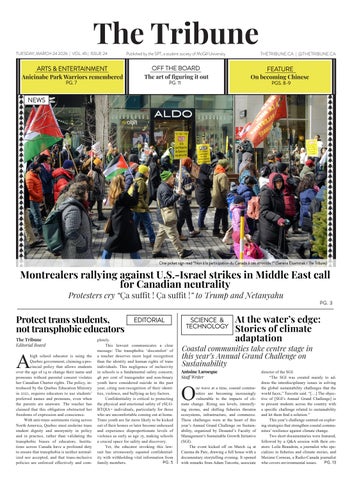
One picket sign read “Non à la participation du Canada à ces atrocités !” (Serena Elsammak / The Tribune)
AGSEM rally encourages progress in ongoing workers’ rights Unit 3 Workers continue to fight against McGill for higher wages
Josette Chandler Staff Writer
On March 18, approximately 40 McGill students, workers, and faculty members gathered outside the Leacock Building for the Association of Graduate Students Employed at McGill (AGSEM)’s rally. The rally, which advocated for a budget increase for the wages of graduate student workers, was timed to coincide with a McGill Senate meeting scheduled at 2:30 p.m. the same day.
Protesters gathered in support of AGSEM’s ongoing negotiations with McGill, as did speakers from the bargaining team. AGSEM’s negotiations occur through open bargaining, allowing all union members to participate.
In a speech to the crowd, Donald Morard III, a PhD candidate in History and Classical Studies and member of AGSEM’s Unit 3 bargaining team, explained the importance of putting pressure on the Senate to further AGSEM’s cause. Morard is also running for the role of Secretary General in the ongoing PostGraduate Students’ Society elections.
“Student senators and allies up on the faculty were able to block the worst proposed changes to the code of student conduct and discipline,” Morard said. “Senators are able to push these upper administrators to directly answer for these [wages] cuts [....] Politics are zero replacement for student activism and organized labour. But these bodies can serve as useful tools for information and to put pressure on the powers that be.”
In August 2024, over 1,000 academic casual workers at McGill unionized and formed AGSEM’s Unit 3. Nikaela Lange, a Master’s student in Political Science at McGill who is also a mobilization officer at AGSEM and a teacher’s assistant, explained what’s at stake in an interview with The Tribune
“We’re a union made up of around 4,000 workers at McGill,” Lange said. “We’re here today for our workers in Unit 3, which are course-based academic casuals. They are currently negotiating their first ever contract, and frankly, we did not like McGill’s monetary
offer. We think they deserve better so we’re rallying today to try and get them that raise.”
Emma Moore, U3 Arts student and member of the bargaining team, then addressed the crowd to speak on the progress AGSEM hoped to make for Unit 3 workers, which consists of academic casuals such as graders, tutors, course assistants, and graduate teaching fellows.
“Workers told us they needed stronger health and safety protections so people can do their job in safe working conditions,” Moore said. “They told us they needed clear job expectations and protections against overwork so workers are not made to work more than what they’re paid for.”
Lange then highlighted the specifics of what Unit 3 workers want included in their new contracts.
“Better working conditions for these workers, protections against harassment and discrimination. But a raise seems to be one of the biggest issues for our workers. Some of them are making minimum wage,” Lange said.
AGSEM’s negotiations with McGill began in September 2023 following the expiration of the organization’s collective agreement with McGill in July of that year, after which they came to a new agreement that expired on Dec. 1, 2025. Since then, AGSEM’s efforts have focused on improvements for Unit 2 and 3 workers, Unit 2 comprising McGill’s invigilators.
Moore informed the crowd of McGill’s response to the suggested pay increase at the March 11 bargaining session.
“Last week we tabled our wage proposal, moving us into the monetary phase of bargaining. Today McGill came back with an offer that was offensive,” Moore said. “McGill made it clear to us today that they do not care to pay you enough to live on.”
At this bargaining session, McGill recommended a pay scale structure, offering a range of wages for each position. The starting wage offered was $18.67 CAD per hour. Comparatively, at Concordia University, workers in a similar position are paid $32.68 CAD per
the pay is around $53.92 CAD per hour.
While AGSEM’s negotiations primarily focus on wage increases for workers at McGill, better treatment of workers and students is part of their fight as well, such as in the case of McGill’s new proposed identification (ID) policy. This policy will require anyone with a McGill ID to carry their card while on university property. Authorized personnel—including McGill faculty and staff, invigilators, and campus security—may request an ID for the alleged purpose of upholding the campus’s integrity, university policies, and cases of physical safety.
Morard elaborated on AGSEM’s opposition to the proposed identification policy when addressing the crowd.
“Today there will be a push by pro-democracy senators to fight against the upper administration’s proposed ID policy,” Morard said. “We’re into fighting the ID policy. Tell [the Senate], support the fight against it.”
In the Feb. 4 bargaining session, AGSEM focused on Unit 3 workers. The union successfully tabled workload forms to help reduce excessive workloads for employed students, outline clear job expectations, and better explain how hours are allocated. AGSEM also tabled to negotiate Article 8, which addresses workplace grievances. However, little progress was made for Article 6, which addresses harassment, discrimination, and sexual violence. AGSEM proposed specific language against deadnaming, but McGill rejected their proposal.
On Feb. 9, AGSEM began negotiations for a new invigilator contract. AGSEM proposed a salary raise to $26 CAD per hour for invigilators, a minimum number of shifts, and a minimum invigilator-to-student ratio. McGill’s initial proposal included a requirement for a 48-hour notice for shift cancellations and mandatory supervisor approval for overtime.
Following this negotiation session, AGSEM released an update stating their stance on McGill’s proposals.
“While last-minute absences and noshows can create additional stress for other
proved working conditions are the best way to reduce no-shows and increase reliability,” AGSEM wrote. “McGill has also proposed language aimed at preventing overtime that is not pre-approved in writing by a supervisor. We are determined to fight McGill on this proposal and win contract language that does not restrict the ability of invigilators to work.”
On Feb. 18, the final bargaining session before the tabling of monetary clauses occurred. The session again began with the trading of proposals. McGill’s workload proposal, when compared to AGSEM’s, was limited in specifications and lacked development, according to AGSEM’s report following the session. AGSEM reintroduced their proposal to amend Article 6 to include more explicit language against deadnaming and pronoun misuse. McGill’s position remained unchanged.
On Feb. 27, negotiations focused on contracts during which McGill opened the floor to longer-term contracts, according to AGSEM representatives in their negotiation coverage report.
“McGill indicated that they are open to discussing the possibility of contracts that last longer than a single semester. They acknowledged that there may be mutual benefit in exploring longer-term arrangements,” AGSEM wrote. “However, they expressed concerns about guaranteeing minimum numbers of shifts or hours beyond a single semester.”
Their most recent session on March 9 focused on shift distribution. The next negotiation session on March 27 will focus on contract length and sexual violence policies.
With the negotiations ongoing, Moore emphasized the importance of AGSEM’s fight for their workers and called on members to participate in future bargaining sessions.
“Our union took the time to understand the lived reality of our members. Through conversations with workers, general assemblies, and organizing across campus, we heard clearly what people needed in a first contract,” Moore said. “AGSEM cares for your Unit 3 bargaining team. We will fight for you and we need you in this pivotal time. Sign up for open bargaining. Come to the next session and
Montrealers rallying against U.S.-Israel strikes in Middle East call for Canadian neutrality Protesters cry “ Ça
suffit ! Ça suffit ! ” to Trump and Netanyahu
Rebecca Votier Staff Writer
Hundreds gathered at Dorchester Square on March 21 at 1:30 p.m. to protest what organizers described as a war led by the U.S. and Israel across the Middle East. Demonstrators filled the downtown park with Palestinian flags, anti-war banners, and chants of “Ceasefire now” and “Ça suffit” to voice their opposition to military operations targeting Iran and Lebanon, and to condemn Canada’s role in the escalation.
The rally was organized by a coalition of grassroots groups: Coalition du Québec Urgence Palestine, Collectif Échec à la guerre, Divest for Palestine, and the Palestinian Youth Movement. They framed the demonstration as part of a broader international movement against war, militarism, and Western intervention.
According to the United Nations, more than 1,000 people have been killed and over 2,500 injured in Lebanon since early March, with more than 1.2 million displaced. Aid agencies warn that continued escalation could push up to 45 million people worldwide into acute hunger, as supply chains and fuel costs would be disrupted.
Strikes have also targeted Iranian infrastructure, including nuclear facilities. For many demonstrators, these developments were central to their decision to take to the streets. In an interview with The Tribune, Boutaïna Chafi, the media representative for the protest, explained that the loss of human life is what brought many onto the streets.
“We’re talking about the tens of thousands of people in Lebanon from the south being displaced, and people living in makeshift tents and on the beach, and being bombed every day in Beirut,” Chafi said. “In Iran, we are talking about critical infrastructure for daily life to be sustained that are being purposefully destroyed by Israel and the U.S.”
International agencies have echoed concerns about civilian harm. UN officials report that airstrikes have destroyed residential buildings in densely populated areas, often killing entire families. In Lebanon, dozens of healthcare workers have been killed, while hundreds of schools are now being used as shelters for displaced families.
A central theme of the protest was Canada’s perceived complicity in the conflict. Demonstrators accused the federal government of supporting U.S. and Israeli military efforts through arms exports and political alignments.
Two demonstrators, Lisa D. and Sam B., who were at the protest with the Revolutionary Communist Party, emphasized Canada’s complicity in the war.
“Canada has a responsibility to stop sending arms to Israel and the U.S., and to stop the world from helping and protecting Israel on building sites,” said Lisa D.
Sam B. added: “I think that what people want to show today is that the Canadian people don’t want this war. Nobody wants war. It gives us, as people, nothing.”
Recent polling suggests public opinion
in Canada leans strongly against military escalation, with 67 per cent of Canadians opposing involvement and favouring a neutral stance. A representative of the Mouvement québécois pour la paix (MQP) spoke with The Tribune, criticizing Carney’s lack of decisiveness on the issue and appeasement to the U.S.
“[Carney] knows that around 70 per cent of the Canadian population is against the war in Iran and is against any policy or position that will accompany the United States,” the representative, who asked to remain anonymous, said. “At this stage right now, Canada does not do much for the war in Iran, but it’s the absence of condemnation which speaks volumes, especially when Carney claims to want a foreign policy independent from U.S. demands.”
Criticism of Canada’s role extended to its membership in the North Atlantic Treaty Organization (NATO), which protestors described as a vehicle for U.S. foreign policy. The representative from MQP described it as an obsolete organization.
“We understand NATO to be primarily a U.S. tool of foreign policy, despite the propaganda depicting it as a defensive organization,” the representative said. “It had a role during the Cold War. Yet, since the fall of the USSR, we’ve seen that it has been involved in Libya, Yugoslavia, and in Afghanistan for example. Ultimately, it has been used as a tool for U.S. domination.”
Chafi situated the current conflict within a broader historical pattern of intervention.
“This is a playbook that they’ve always, always used in the region,” Chafi noted. “They see a country that is able to sustain itself despite sanctions, and they will just come in and destroy everything that is needed in order for people to survive. This is what’s happening in Cuba right now. This is what they’ve tried doing in Venezuela. They’re doing it right now in Iran. They’ve done it in Iraq. This is the same playbook that has not changed. And so this is why we’re able to see through the narrative that the U.S. is pushing through, that democracy is not something you bring by destroying and killing people.”
The representative from MQP also criticized the role of Canadian institutions, including McGill, in global militarization.
“McGill has multiple ways in which it directly contributes to the military industrial complex,” the representative affirmed. “We know that McGill does a lot of research with regards to the production of military goods and high-tech missiles. McGill did research on thermobaric weapons, and most of those were sold over to American industrial complexes that are then utilized to bomb various countries across the world [....]
We’ve also seen McGill being
extremely hostile to the youth, expressing its demands for Canada taking a real position against genocide, against massacres. So McGill plays a very important role, I think, both in legitimizing wars, but also in producing wars.”
McGill’s Media Relations Office declined to comment on these claims.
The demonstration brought together a wide range of political perspectives, from anti-imperialist activists to Quebec sovereigntists. Andréa, who attended carrying a Québec Solidaire flag and withheld her last name, described this as a matter of self-determination: A principle in the United Nations Charter affirming the right of peoples to determine their political status and pursue their economic, social, and cultural development.
“As an independentist, personally, I cannot claim the right to self-determination for my own people without demanding it for others who need it,” Andréa said. “Supporting Palestine, supporting all oppressed peoples around the world, that’s the foundation when you are an independentist.”
Andréa also criticized what she described as a broader shift in political discourse when asked about media coverage of this conflict.
“Misunderstood or poorly conveyed, that’s the question. Unfortunately, there has been a shift in political discourse toward the right over several years since […] the early 1980s,” Andréa said. “The discourse has shifted to the right, and it continues to shift to the right on absolutely all issues. Fascism, misogyny, all of that is part of this rightward shift, orchestrated by the richest people in the world, who basically profit off the blood of the poor.”
Chafi also emphasized that domestic migrant justice is linked to international conflicts.
“There’s a significant part of the migrant diaspora here who has migrated to this country as a result of intervention, as a result of coups, as a result of government changes,” Chafi said. “The rights of migrants are fundamental to our struggle, because most of us in the streets, most of us in these movements, are either sons or daughters of immigrants or immigrants themselves.”
Other participants expressed more radical critiques. One protestor, who wished to remain anonymous, described Canadian political leaders as constrained, arguing that foreign policy decisions reflect a broader system of control.
“Tell me who pays the musicians, and I’ll tell you who calls the tune. Those who control the economy are the ones who command. If they control the economy, they own it. But politicians are only managers. They are not the ruling elite. They do not lead; they are commanded. So when we oppose them and when we rise up, the best outcome is to stop them from continuing their dirty work,” the protestor said in an interview with The Tribune
Various activist groups at the protest are involved in ongoing campaigns targeting economic ties to the conflict. La Coalition du Québec Urgence Palestine highlights investments by the Caisse de dépôt et placement du Québec (La Caisse), which activists say include billions of dollars in companies linked to Israeli occupation and military activity. The Coalition du Québec Urgence Palestine has since launched a campaign calling for divestment from such holdings, urging Quebecers to pressure public institutions to withdraw investments.
“We refuse to be complicit,” read one flyer distributed at the protest.
While the demonstration focused on public visibility, organizers stressed the importance of continued action beyond the streets.
“There are many things Canadians can do,” Chafi said. “Writing to [Members of Parliament], supporting campaigns like arms embargoes. These are simple actions that can have a real impact. This is about more than one conflict. It’s about the kind of world we want to live in.”
As the crowd began to disperse in the late afternoon, the message of the protest was clear: Opposition to war abroad is inseparable from demands of justice, accountability, and solidarity at home.
*Quotes from Andréa and the protestor who wished to remain anonymous were translated from French.
McGill Senate questions application of revised identification policy
Senators raised concerns over the policy’s impact on student fr eedom
Shea McDonnell Staff Writer
The McGill Senate convened on March 18 for its third meeting of the Winter 2026 semester. The meeting began with a memorial for the late Professor David Harpp in the Department of Chemistry. McGill’s President and Vice-Chancellor Deep Saini shared his Feb. 25 speech for the Montreal Chamber of Commerce with the Senate, as well as his visit to India with Prime Minister Mark Carney to discuss the opening of a Centre for Excellence in AI.
Next, Vice-President (VP) of Administration and Finance Fabrice Labeau opened the discussion with a revised identification (ID) policy proposal following the policy’s initial proposal in the Senate’s Jan. 14 meeting. The proposal would allow authorized personnel to request student identification on campus property for “legitimate purposes” outlined in the policy.
Post-Graduate Students’ Society University Affairs Officer Amina Bourai raised questions regarding the initial proposal’s academic necessity and potential safeguards, referencing an open letter from the McGill community opposing the proposed policy.
“[The open letter] has now been signed by over 500 members of the McGill
community, including undergraduate and graduate students, staff, alumni, and faculty,” Bourai said. “This reflects a broad and urgent level of concern across the university about both the necessity of this policy and its potential impacts.”
Furthermore, among other concerns of the policy’s safeguards, Bourai questioned the need to change McGill’s current security apparatus.
“What remains unclear is why [the existing frameworks] are inadequate and why a broad identification policy that doesn’t require any suspected wrongdoing is a proportionate response [....] How exactly is security supposed to handle the exclusion of people? Physically carry them outside or are we calling the police?”
In response to Bourai’s initial questions, Labeau presented his revised proposal with consultations from other senators. Labeau cited increased theft on campus as a reason for the policy, while also taking into account concerns about discretion in asking for ID.
“We heard a lot of comments about the fact that too many people had too much power and that was never the intent. We’ve clarified in this version that the role of an individual that is qualified to ask for identification is really limited to a specific place and time,” Labeau said.
Labeau acknowledged that the consul -
tations were useful, yet the policy’s passing would ultimately go through the Board of Governors (BoG), a point echoed by Saini. Labeau also clarified the definition of “authorized personnel” allowed to request ID, listing exam invigilators, campus security, and faculty or staff acting in an official capacity at on-campus events.
Faculty of Law Professor Victor Muñiz-Fraticelli then raised a question about the administration’s intention with the proposal and the practical application of this policy.
“We’re a bit like Athens under Pericles and not like Sparta,” Muñiz-Fraticelli said. “We are open to the world with Sparta, maybe Yale perhaps as a point of comparison, which closed itself from surrounding the community. And no one in Canada is asked to carry government-provided ID when they walk around the street.”
Additional concerns included adequate training for campus security under the policy and its potential effect on peaceful protests on campus. Particularly, the need for sufficient efforts to prevent profiling was brought up by Faculty of Dental Medicine and Oral Health Professor Alissa Levine.
“The only times in my life when I’ve been asked to produce ID have been when I was in the presence of a friend or colleague of colour,” Levine said. “I am concerned
and peaceful protest
there will be no records kept. I think the intent was to reassure and it actually might have the opposite effect in terms of how it’s carried out.”
The BoG will vote to pass the proposal at its next meeting on April 23.
Moment of the Meeting
Senators voted to add a 12th day to the examination period for the Fall 2026 term to alleviate evening exams, in turn shortening Winter break.
Soundbite
“I’m wondering if McGill intends to post guards at the entrances and gates of the university, to ask any tourist who wants to see the arts building, or any cyclist who wants to commute, to produce their papers or be excluded from the publicly funded campus.”—Senator Victor Muñiz-Fraticelli.
McGill drops legal battle over out-of-province tuition hikes
Professor cites multiple factors behind decision and notes broa der
Abigail Francis Staff Writer
As of Feb. 27, both McGill and Concordia University have dropped their legal battles against the Quebec government’s out-of-province tuition hikes. The decision was made in light of a January 2026 decision by the Quebec government that maintained tuition hikes for new out-of-province students studying at English universities by 33 per cent—from around $9,000 CAD to $12,600 CAD—despite a Quebec Superior Court ruling that found the hike “unreasonable.” Originally introduced in October 2023, the Legault government stated that the tuition increase aims
to safeguard the French language and limit the number of students in the province who do not speak French. Since 2020, McGill’s undergraduate out-of-province population has remained steady, from around 22 to 25 per cent.
In a written exchange with The Tribune, McGill’s Media Relations Office (MRO) wrote that McGill does not believe the Quebec government’s response to the tuition hike has properly respected the 2025 ruling. Nonetheless, McGill has decided to discontinue the legal battle after careful consideration.
“Further litigation would undermine its objectives of strengthening local engagement and advancing partnerships that contribute to
tuition trends
the vitality of the Québec society,” the MRO wrote. “McGill will continue to work with the Government of Québec to ensure predictability, stability, and transparency in the rules governing higher education.”
The MRO asserts that McGill is committed to investing in Scholarships and Student Aid to ensure students have proper access to financial support and resources to succeed in their studies.
However, recent changes have led outof-province students to question how welcoming McGill is to non-Quebecois Canadians. Students have expressed concern not only about the immediate financial implications of the tuition hike, but also its broader impact on accessibility, diversity, and belonging.
In an interview with The Tribune, Faye Dryden, a U3 Environment student from British Columbia, explained that the policy would cause significant financial strain, particularly in the context of limited scholarships, for out-of-province students.
“If the tuition increases had been in place when I applied, it is likely I would have reconsidered accepting my admissions offer and gone to my second choice school,” Dryden said. “It is important that McGill provides equal opportunity for people from around the world to have access to the quality of education provided by the school.”
Alyssa Volante, a U2 Science student from Ontario, similarly emphasized in a written statement to The Tribune that the increased tuition costs would have changed her decision to attend McGill. She noted that comparable institutions in Ontario would
have been more financially reasonable, highlighting broader concerns about the way the policy shapes students’ sense of belonging.
“There are many great universities in Ontario, where I’m from, and such a steep increase in tuition wouldn’t have been worth it for me,” Volante said. “Raising the tuition eliminates a whole group of students that can make great contributions to McGill but don’t come because they can’t afford it. Having lower tuition allows McGill to accept the brightest students [….] I’m from one province over and I’m already made to feel like I don’t belong.”
In an interview with The Tribune, Emma Harden-Wolfson, assistant professor in the Department of Integrated Studies in Education, highlighted that McGill’s decision to drop the legal challenge may not stem from one motive alone. She noted that the university has already demonstrated a willingness to invest heavily in legal battles.
“It seems an interesting argument to make that the cost is the reason for discontinuing the legal challenge,” she said. “I’m sure it’s part of the situation, but I feel like it’s not all.”
Harden-Wolfson situated the decision within a broader structural context, pointing to the increasing normalization of differential tuition models. While Quebec’s policy has drawn particular attention, she emphasized that similar approaches exist elsewhere.
“Perhaps what this means is that this is something that will become more common across Canada in the future,” she said. “We already see a differential sense of belonging among all kinds of students.”
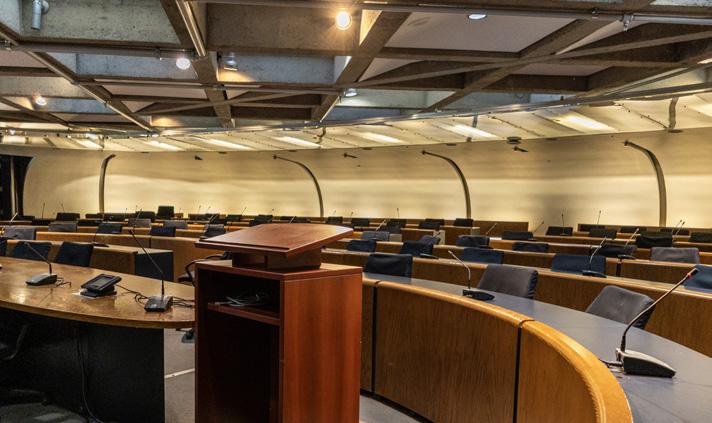
The Senate will meet again on April 15 in Room 232 of the Leacock Building. (Armen Erzingatzian / The Tribune)
Nearly a quarter of McGill’s undergraduate population is from outside Quebec. (Lilly Guilbeault / The Tribune)
Social Media Editor Mariam Lakoande socialmedia@thetribune.ca
Business Manager Laura Pantaleon business@thetribune.ca
Barak, Rachel
Will
Protect trans students, not transphobic educators
The Tribune Editorial Board
Continued from page 1.
While mandated reporting policies may require teaching professionals to share privatelydisclosed information for safety reasons, confidentiality in the context of a student’s gender identity does not fall under this umbrella. Forcibly outing trans students to parents only exposes them to heightened risk at home. Confidentiality may seem basic in the context of policy imperatives such as healthcare access, but it is foundational to trans safety. A study of patient-clinician relations found that doctors using patients’ preferred pronouns reduced the likelihood of trans youth suicide by more than 30 per cent, proving the importance of identity-affirmation to the well-
COMMENTARY
Sofia Sada Contributor
Despite efforts to advocate for women’s rights, including Quebec’s investments in combating domestic violence, there is a sense of ‘rolling back’—from bills meant to cut federal funding for causes such as the Women’s Program to public figures experiencing harassment online.
Quebec Solidaire cospokesperson Ruba Ghazal and author India Desjardins have spoken out about the online hate they have received for simply existing as women in a public position. They are not outliers; many women who speak out—especially on polarizing issues—face violent insults. In response to this problem, Ghazal has proposed a system outside of involving police forces: A 24/7 hotline to help cyberbullying victims.
being of trans individuals.
This lawsuit stands alongside several legal challenges to trans rights across Quebec. FrenchLanguage Minister Jean-François Roberge’s policy to ban genderinclusive language from government communications in French poses a significant risk to inclusivity in the province. Roberge has repeatedly asserted that French gender-neutral pronouns are “grammatically incorrect.” This fallacious argument interprets the gendered nature of the French language as requiring an equivalent binary at the level of identity and neglects the evolving nature of grammar and syntax. Trans individuals deserve to see their identities represented in the language of the law, as the normalization of gender-neutral pronouns in official, public contexts reaffirms 2SLGBTQIA+ identity rights.
Homophobic and transphobic
discourse at the level of political rhetoric and legislation also leads to anti-2SLGBTQIA+ sentiment in inter-personal contexts. Over 40 per cent of Quebec high school students surveyed in 2025 stated they would feel uncomfortable if their best friend was gay, compared to only 25 per cent in 2017. Quebec is entering a period of major backsliding where queerness has been de-normalized and the alleged ‘discomfort’ of a cisgender person is prioritized over the rights of transgender people.
The Canadian and Quebec governments must take active steps to ensure that such anti-trans sentiment is curbed and trans rights are protected under the law. McGill too must dedicate itself to protecting 2SLGBTQIA+ individuals through language, confidentiality, and policy. While the university offers a preferred first name policy, it is not well enforced: Professor of Religious Studies Douglas
B. Farrow repeatedly violated the preferred first name policy, expressing hostile views towards trans and queer individuals, with minimal intervention from the administration. Further, in 2023, McGill’s Centre for Human Rights and Legal Pluralism hosted a debate titled “Sex vs. Gender (Identity): The Divorce of LGB from T,” inviting notoriously transphobic and trans-exclusionary speaker Robert Wintemute as its host.
Both McGill and the Quebec government possess explicit constitutional and policy bases mandating the protection of trans rights, yet both fail to defend 2SLGBTQIA+ rights against rising hateful extremism. Quebec must reject this lawsuit and strengthen confidentiality protections for trans students; McGill must ensure neither faculty nor campus events are empowered to platform transexclusionary rhetoric.
Quebec must take online misogyny seriously
an emotional attack; it is also an active filter that asserts who has the right to speak and influence others.
Because institutions shape what speech is acceptable, they also have a responsibility to address online misogyny. However, rather than assuming that a resolution is outside of the realm of possibility, universities such as McGill must take concrete steps to address online misogyny. This could include expanding their Code of Student Conduct to explicitly cover harassment in digital spaces, implementing clear reporting mechanisms for students targeted online, and establishing dedicated support systems, such as trained staff or hotlines, to respond to these complaints. While enforcement may be complicated by anonymity, universities can still investigate cases tied to identifiable students and set institutional standards to make such behaviour unacceptable.
points to alternatives to institutional inaction and overreliance on policing by offering a support-based approach for survivors of harassment. Universities, however, cannot afford to treat this issue as external to their responsibility. Young adulthood is both the age at which many men are drawn into misogynistic online spaces and the age at which women are most likely to experience gender-based violence, placing universities at the centre of this dynamic. At McGill, reports of misogyny in academic spaces, student governance, and campus life demonstrate that these harms are not confined to the digital sphere and shape students’ everyday experiences. But unlike social media platforms, universities have the ability to impose meaningful consequences through their codes of conduct and to provide direct support to affected students.
Universities, media outlets, and public agencies have failed to act because online misogyny is often treated as background noise rather than as an issue requiring intervention, but the link between online harassment and real-world violence, where misogynistic content normalizes hostile behaviour toward women, cannot be overlooked. Universities and media outlets have the resources to take action and should strive to change these norms rather than reproduce them. Online misogyny is not inevitable, but rather a problem that institutions have yet to take seriously. As long as it is dismissed by institutions, the burden will always fall on women to simply endure it. Institutions must recognize their roles in sustaining misogynistic systems of oppression and implement concrete policies to properly support women.
CONTRIBUTORS
Abbey Locker
The mishandled issue of cyberbullying reflects a broader pattern where hate against women is dismissed. With the rise of the manosphere—male-centred online communities promoting antiwomen ideologies—it is important that women are not silenced.
Although social media is often regarded as a space for selfexpression, many women censor themselves or leave online discourse out of fear. A Canadian survey found that 4 out of 10 women who experience cyberbullying choose to completely remove themselves from social media. Harassment is not only
Some may argue that it is too difficult to respond to these online attacks given the anonymity of users and the huge amount of content in the digital space. Yet, as the popularity of the manosphere demonstrates, online misogyny has consequences that extend beyond individual harm; it can lead to severe psychological harm, loss of economic opportunities, and even physical violence against women. Although implementing effective responses is challenging, Ghazal’s proposed hotline
Shatner University Centre, 3480 McTavish, Suites 404, 405, 406
Simona Culotta, Defne Feyzioglu, Alexandra Hawes Silva, Lialah Mavani, Nour Khouri, Laura Pantaleon, Amy Xia
TPS BOARD OF DIRECTORS
Brooke
Blackstone, Loriane Chagnon, Josette Chandler, Carla Cretin, José Moro Gutiérrez,
Nello Giuliani, Rebecca Hamilton, Luke Pindera, Amalia Tsampalis
Camila Sierra Ordóñez Contributor
AA ‘walkable’ city where food is increasingly out of reach
recent Concordia University study revealed that 20 per cent of Montrealers cannot reach a quality grocery store within a 10-minute walk, a number that rises to nearly half the population when the diversity of food options is considered. These gaps are most pronounced in neighbourhoods such as Montréal-Nord, parts of western and southwestern Montreal, and suburban areas, where residents must rely on public transit or cars to access basic necessities. At the same time, Quebec is facing rising housing costs and unprecedented demand for food banks, with more residents turning to them for assistance, as demand is expected to rise by approximately 26 per cent in the next three years. For a city that presents itself as accessible, this reality points to an apparent failure: Access to healthy food remains uneven and dependent on income. Montreal must introduce targeted solutions to improve access to healthy food for everyone—not only those who can afford the time, transportation, or proximity required to obtain it.
Montreal often defines itself as a walkable, bike-friendly city where residents can easily move from point A to B. However, this vision of accessibility assumes mobility and resources, that residents can easily walk long distances carrying groceries or use a combination of cycling and public transit to meet their transport needs. This is not a neutral assumption. For many, particularly older adults
and individuals with limited mobility, access to food is directly constrained by distance, travel time, and physical effort. As transit costs rise across Canadian cities like Montreal, lowincome residents are left with fewer means to access essential goods.
These accessibility gaps are further intensified by Montreal’s broader cost-ofliving crisis. Rising housing costs are placing increasing pressure on household budgets, with the Tribunal administratif du logement (TAL) recommending a 3.1 per cent increase
for 2026, having suggested a 5.9 per cent increase in 2025—rates among the highest in two decades. Such rent hikes force many residents to make difficult trade-offs between housing and basic necessities.
Rising costs are also pushing employed and unemployed Canadians toward food banks, as one in four now experiences some form of food insecurity. As a result, demand for food banks has increased by 61 per cent since 2019, and according to Food Banks Canada’s HungerCount 2025 report, monthly
visits reached nearly 2.2 million in March 2025. In this context, food accessibility cannot be reduced to proximity.
Access to food should not depend on how far someone can travel, how much they can carry, or how much of their income remains after paying rent. In a city that claims to be accessible, this is not a minor gap waiting to be filled; it is a systemic failure to address the needs of residents. This reality is most visible in suburban and low-income neighbourhoods, where residents already face longer distances to grocery stores and must rely on transportation, making access to food even more dependent on financial means. In this sense, food accessibility in Montreal is not evenly distributed—it is structured by income and geography.
The city must address this issue not only by prioritizing residents’ proximity to grocery stores, but by recognizing that food access is equally a question of urban policy and affordability. This could take the shape of horticulture plots and collective gardens, a model already proving to be effective in Rivièredes-Prairies–Pointe-aux-Trembles, a borough where much of the population lives more than 500 meters from the nearest supermarket. The city should further strengthen this effort by expanding subsidized neighbourhood food markets and mobile grocery programs in underserved areas, bringing affordable produce directly to residents who live far from full-service supermarkets. Ensuring access to healthy food is a basic responsibility in a city that claims to serve all of its residents.
COMMENTARY Squeaky cheese is Quebec’s new playground for cultural preservation (and I’m not mad about it)
Julie Raout Staff Writer
The producer group representing Quebec’s dairy industry intends to request a protected Geographical Indication (GI) for Quebecois cheese curds. Products with a GI can only be produced in one given region, which certifies their authentic origin. Similar designations protect the quality of Bordeaux, Parmigiano Reggiano, and Tequila. The request to claim poutine cheese curds as a controlled, Quebec-only item highlights the province’s persistent efforts to protect its cultural heritage—this time, unlike many of its other cultural preservation projects, the amusing endeavour feels relatively harmless as it, refreshingly, does not target the province’s multiculturalism.
The Conseil des industriels laitiers du Québec (CILQ) aims to submit this demand to the Conseil des appellations réservées et des termes valorisants (CARTV), the Quebec organization responsible for granting controlled status to agricultural products.
CILQ President and CEO Charles Langlois and his fellow cheesemonger conglomerates seek recognition for the quality of the province’s cheese curd, the quintessential ingredient to any respectable poutine. Many know poutine as the unofficial national dish of Canada, often enjoyed after a hockey game or a long day of profusely apologizing to a Timmies cashier. Fearing the Canadianization of Quebec’s culinary success, Langlois says obtaining a GI would protect Quebec’s provincial food heritage amid the
growing mainstream popularity of poutine nationally and internationally.
If adopted, a seal would be assigned to cheese curds made in Quebec from Quebec milk. Other criteria, such as meltability, heat resistance, and squeakiness, might determine whether a product qualifies for the GI. If cheese tasting can become official provincial business, then sign me up to be a Quebec bureaucrat.
However, to obtain the GI, the CARTV must first prove that Quebec squeaky cheese has a distinctive characteristic or reputation that sets it apart from others produced outside Quebec. However, while cheese curds are an integral part of Quebec tradition, they are not inherently Quebecois in origin or production. We can only hope that the potential Quebecisation of cheese curds will not lead to a slippery slope of paperwork filed to certify beavers, maple trees, or Heated Rivalry as fundamentally Quebecois.
The Fromagerie St-Albert in Ontario has produced notoriously squeaky cheese curds since 1894, well before Quebec invented poutine in the 1950s. Eric Lafontaine, Director General of the Ontario establishment, says Quebec's claim for the invention of cheese curds is unfair. Similarly, Wisconsin is famous for its cheese curd industry, which grew in the 1860s.
Producers unable to claim the “Quebec poutine cheese” GI would still be able to market their cheese curd as such, only prevented from claiming any link to Quebec. The GI is, to a certain extent, symbolic. Behind the demand really lies a pride in regional
culinary mastery. And who can blame Quebec for wanting recognition for the invention of poutine and its agricultural expertise? The province is known for its fromageries and institutions that sell exceptionally fresh cheese curds, a key factor in its beloved squeakiness.
The Quebecois love their cheese—sue them! It wouldn’t be surprising if this curd venture were a cheeky ploy orchestrated by a secretly foodie bureaucracy that, if the GI were instated, would have to annually assess the squeakiness of every producer’s cheese to ensure status regulation.
But this cheese curd-fuffle is not an isolated effort by Quebec to promote its heritage. It fits into a series of measures aimed at preserving regional identity, often at the expense of the province’s multiculturalism. Whether through implementing harsh migration restrictions, cutting funding for non-French-speaking educational institutions, or enforcing French-language laws that contradict Canadian constitutional rights, the province has shown consistent aggressiveness in cultural preservation enterprises.
The CAQ government’s hostility has discouraged non-Francophones and foreign immigrants from engaging in Quebecois
culture. Considering the especially combative stance Quebec has taken since 1977, maybe this cheese petition isn’t so terrible after all. Only a few solutions for effective cultural promotion have been proposed by critics. Shouldn’t we see this cheesy—albeit silly—undertaking as an earnestly positive way to promote Quebecois culture? Although frivolous, this request for a Geographical Indication does not threaten the rights and well-being of Quebec residents but celebrates tradition without disparaging others. Maybe, just maybe, Quebec has finally discovered a form of Quebecois nationalism that doesn’t result in discriminatory consequences— though the lactose-intolerant community’s stance on the topic remains to be seen.
The average Quebecois family consumes 28.7 kg of cheese every year. (Emiko Kamiya / The Tribune )
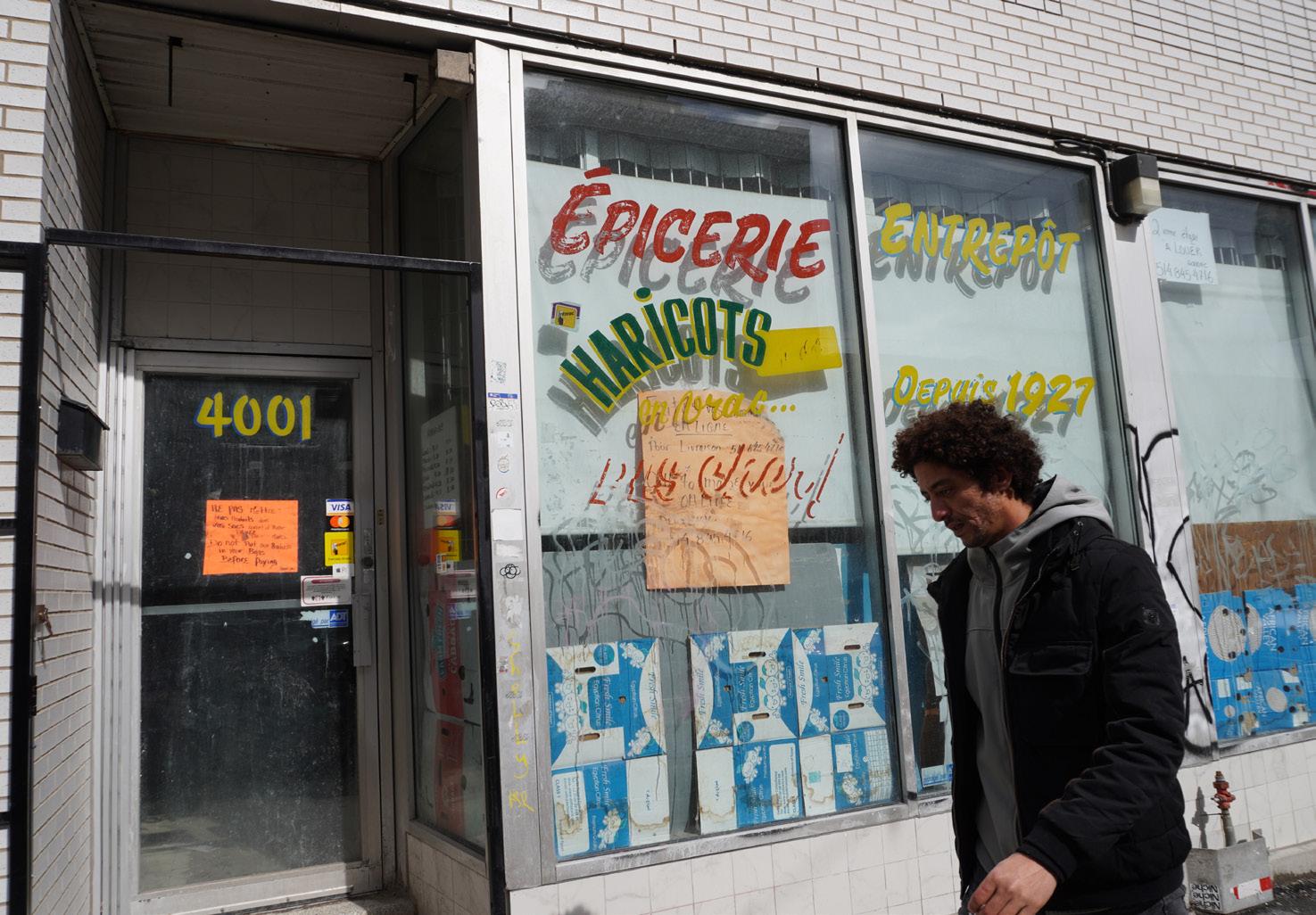
In 2019, approximately 38 per cent of Montrealers did not have access to fresh fruits and vegetables within 500 metres of their home. (Emiko Kamiya / The Tribune)
One Sinner After Another
This year’s Oscar nominations for Best Picture were debated among critics and fans
Romane Musquet Contributor
On March 15, the 98th edition of the Academy Awards took place at the Dolby Theatre, bringing the usual spectacle and controversy that define Hollywood’s most anticipated night. This year, two films in particular—Ryan Coogler’s Sinners and Paul Thomas Anderson’s One Battle After Another (OBAA)—competed closely in the race for Best Picture.
This category is traditionally the final award of the night, cementing its status as the ultimate marker of cinematic prestige. Unlike other categories, this Oscar is unique as it is decided by a preferential ballot system, in which Academy members rank nominees instead of selecting a single choice. This process rewards consensus and broad appeal, but also raises important questions about which films are ultimately deemed worthy of recognition—and why.
It is precisely this tension that has fueled the critique surrounding OBAA’s win. OBAA has received significant attention for its apparent political ambitions, engaging with themes such as racism, immigration and authoritarianism; Yet, Director Paul Thomas Anderson has repeatedly dodged opportunities to relinquish his apolitical stance. Nonetheless, despite—or perhaps because of— this ambition, the film has been widely criticized for its aestheticization of politics. A critique of
Anicinabe
Park
authoritarian state violence turned into a polished rendering of cinematic action, prioritizing form and effect over depth and meaning.
On the other hand, Sinners has been noted to humanize Black political identity in accordance with history, offering a portrayal that remains grounded and attentive to lived experience. The film has received acclaim for its ability to merge supernatural horror with a meaningful exploration of the dynamics of oppression and Black Southern culture, creating a narrative that feels both creative and relevant.
The contrast between these two films thus extends beyond questions of genre or style, pointing to a broader issue regarding the standards and criteria by which a film’s cinematic value is measured. What does the Academy reward when it recognizes a film as “Best Picture?” OBAA’s win reveals less about the relative quality of the films than the underlying values and preferences that shape the Academy itself. By favouring a stylized portrayal of political struggle over the more grounded and historically attentive approach of Sinners, the Oscars continue to privilege representations of politics that are aesthetically legible and institutionally familiar. In doing so, they reaffirm a particular vision of what “serious” political cinema looks like. Thus, the value of what constitutes a “Best Picture” no longer emerges as an objective measure of distinction, but as a reflection of the outdated and often problematic cultural
frameworks through which the film industry operates.
This critique is further compounded by OBAA’s choice of perspective. Despite the film’s engagement with themes of racism and systemic oppression, OBAA centres its narrative on two white male protagonists—a decision that has sparked additional criticism regarding the film’s representational scope. This results in the political stakes of the film feeling distanced, with racial issues appearing as thematic backdrops rather than lived realities.
The directors’ reputations also shape how audiences and institutions understand the dynamics of these films. Anderson has long established himself as an auteur in American cinema and benefits from a history of critical recognition and prestige. Ryan Coogler, however, while influential and successful, is a director tied to popular cinema. The outcome of the Best Picture award
thus appears to reflect not only artistic judgments but also the hierarchies that reign in the film industry.
Despite this year’s Oscars being shockingly predictable, the outcome somehow never fails to polarize the crowd. If anything united viewers, it was the widespread belief that Timothée Chalamet did not stand a chance of receiving his small statuette.
Warriors remembered Eight minutes of archival footage is transformed into film about the 1974
Indigenous youth-led occupation
Zoe Lee Design Editor
While researching for her book, The Knowing, Anishinaabe journalist, author, and filmmaker Tanya Talaga was asked by a friend what she knew about the 1974 occupation of Anicinabe Park. That prompted her to explore the story further. What followed was a captivating collaboration with Metis writer, director, and filmmaker Shane Belcourt, recounting the story of the young Louis Cameron.
On March 16, Cinema Politica Concordia hosted the Montreal premiere of Ni-Naadamaadiz: Red Power Rising as part of their Winter 2026 program, Carpe Machina. In the summer of 1974, led by Cameron of the Ojibway Warriors Society, a peaceful occupation of Anicinabe Park began, following a four-day youth conference. The documentary weaves interviews, archival footage, and a voice-over of Cameron’s son, Tyler, reading Cameron’s unpublished manuscript.
The film begins by setting the scene of life for a young Anishinaabe person living on the Grassy Narrows First Nation Reserve, or in nearby Kenora, Ontario. Racism and discrimination plague the lives of the local Anishinaabe youth, both during the film’s time period and today. For example, interviewees share experiences of being refused service in restaurants and denied public-facing jobs as Indigenous people. The film also explores how the Kenora region housed one of the largest numbers of
residential schools in Ontario, where Cameron and other Anicinabe Park Warriors spent their youth facing sexual, physical, and emotional abuse.
The narrative then follows Cameron’s son, Tyler, as he explains the extent of the mercury poisoning in his community and the process of getting his daughter tested. This is especially significant given that Indigenous communities disproportionately suffer from the effects of environmental racism, in which practices and policies result in greater pollution or health risks for Indigenous or racialized communities. Belcourt also illuminates the high levels of violence in the town, including the “Kenora Indian Beaters”—a violent and racist gang of non-Indigenous young men that target Anishinaabeg.
Despite the widespread culture of hate in town, the police focused their attention on Cameron.
“My dad, Louis Cameron, was one of the most wanted men in Canada. An outlaw. They called him a terrorist. I call him a warrior,” says Tyler in the film.
The photos and videos of the occupation dispel this depiction by revealing a very young group, with ages ranging from 20 to as young as 17. The occupation, which lasted 40 days, involved Anishinaabe mothers, youth, and leaders camping out in the park through cold weather, threats from the Kenora locals, and constant police surveillance. Their demands included better housing, more employment opportunities, an overhaul of the Department of
Indian Affairs, and—most significantly—the return of Anicinabe Park lands, which they claimed were illegally purchased by the federal government and sold to the City of Kenora in 1959.
During the post-screening Q&A, Talaga shared her intent behind the film.
“I wanted to show the youth our heroes. The heart of this film is human connection [.…] The youth in this film were standing up to resist what was happening, what is still happening,” Talaga said.
Cameron emerged as a political visionary who was both charismatic and wellspoken despite his youth. He left behind an unpublished manuscript, stored in a pink storage bin in Tyler’s home. The manuscript, narrated in both Anishinaabemowin and English, reveals the breadth of Cameron’s vision for his people.
The film positions Tyler as the emotional thread of this movie, inviting audiences to share in his experience of revisiting his father’s legacy of activism from Anicinabe Park to Parliament Hill. Digging into the storage bin, the film gently unravels this
forgotten juncture in Canadian history. Stunningly, Tyler looks and sounds exactly like his dad, reminding audiences that Indigenous resistance echoes through generations.
Ni-Naadamaadiz: Red Power Rising will be available on CBC Gem later this year. To get your fix of Indigenous activism in the meantime, Cinema Politica is screening Fairy Creek on April 13 at 7:00 p.m.
Regarding the subsequent demonstration on Parliament Hill, Cameron said, “I think our objective was to illustrate [that Canada] commits death on the native people.” (Zoe Lee / The Tribune)
One Battle After Another brought home a total of six golden statuettes. (Alexa Roemer / The Tribune)
Over the past few months, social media algorithms have been flooded with a deluge of warm water. Infused with goji berries and chopped apples, these heated alternatives to the typical iced coffee have appeared alongside qigong, house slippers, and herbal skincare as the internet’s most recent Orientalist fascinations.
Many publications have credited creator Sherry Zhu for starting the trend of “becoming Chinese” after her viral TikTok video facetiously informed non-Chinese viewers, “Tomorrow you are turning Chinese [...] There is no point in fighting it now because you are the chosen one.” Spurred by this video and a frenzy of others tagged #becomingchinese and #chinesebaddie, TikTok users have been recording themselves adopting Chinese wellness habits, beauty routines, and recipes. The content is twofold, spanning everything from overtly absurdist takes to genuine curiosity about the benefits of previously underexplored practices rooted in Chinese culture. But regardless of tone, the trend has proven and amplified outsider interest in China. What does this seemingly newfound curiosity signify?
Orientalism, as theorized by Edward Said, is crucial to understanding how “becoming Chinese” content participates in a broader pattern of constructing the East as a site of mysticism and cultural wholeness in contrast to a supposedly fractured West. Said argues that Orientalism is not a form of genuine admiration but a framework through which Western audiences project their own desires and deficiencies onto Eastern cultures.
The current wave of fascination toward China echoes earlier treatments of Japan and South Korea. Reduced to fodder for trends as they entered the American mainstream, these East Asian contexts demonstrate a pattern of cultural commodification where only superficial elements are extracted. In this sense, the “becoming Chinese” trend reflects more than mere cross-cultural interest. It rearticulates a familiar dynamic in which Asian identity is divorced from reality and flattened into marketable aesthetics.
Dylan Suher, Contract Lecturer in McGill’s Department of East Asian Studies, explained the
historical precedent of such cultural romanticization in an interview with The Tribune
“This kind of idealization of China and what China represents […] is literally centuries old, right? Not to say that it’s all continuous, […] but, I mean, in the 18th century you had people like Voltaire, who looked at the Qing Empire, and […] compared it […] to France, which they felt was falling apart,” Suher explained. “There is a very long tradition of […] assuming China to represent […] what we think is missing from Western culture. It’s a type of Orientalism, […] and it’s existed for a very long time.”
On becoming Fascination and flattening
Written by Tamiyana Dar-Mei
Designed by Zoe Lee, Design Editor, & Illustrated
“I think for the most part, it’s not malicious, honestly,” Wu said. “I think these are just people hopping on a trend, and I think that most of them don’t even know what they’re talking about.”
But Wu finds the more absurdist sect, in which non-Chinese creators document their new routines since “becoming” or “discovering” that they are Chinese, more troubling.
Today, amid the high cost of living, AI’s threat to entry-level jobs, and ramping political frustration, young people are growing increasingly disillusioned with the future that Western society presents them. The trend gains traction not because of China itself—a state many know relatively little about—but because it serves as a largely blank canvas onto which Western users can project fantasies of progress and opportunity. The sparse knowledge of the country that does colour the canvas is heavily idealized; the result is an inexact portrait of contemporary China.
“[Young people] see a China that seems to be evolving, and there’s so much fetishization [of technologies like] high speed rail [and] drone swarms [....] These kinds of demonstrations of technical prowess seem to reflect a future that they can no longer see in the West and the United States. And […] that is mostly about the West, […] and not very much about China,” Suher said. “It is certainly not about the China where youth unemployment has been at 20 per cent […] since the COVID-19 pandemic.”
Shallow engagement with cultural fragments of China obscures not only the reality of the contemporary Chinese state but the identity that comes with Chinese descent.
Alicia Wu, U1 Science, is a ChineseCanadian who has been exposed to many of these “Chinamaxxing” videos. In an interview with The Tribune , she expressed mixed feelings toward the trend. The majority of videos she’s seen have documented the incorporation of superficial Chinese culture into creators’ daily routines.
“I think the fact that they’re actually explicitly saying, ‘I’m Chinese’ is what bothers me the most [.…] You will never be Chinese because you have no idea [about] the kind of internalized racism that […] arises from [...] external aggressions. You have no idea what it feels like to grow up as a kid and be like, ‘Why do I look different?’ [….] I think that’s the worst part of it, honestly […] because [they] have no idea what the identity is,” Wu said.
Like many Chinese diasporic individuals, her frustration is not abstract—it is rooted in recent memory. The casual claims to “being Chinese” feel especially hollow when placed against the very real surge of sinophobic sentiment during the COVID-19 pandemic.
“I’d say Canada is quite a welcoming, diverse country, but during COVID, I had people say to me, ‘Hey, I don’t want to sit next to you. Do you have the virus?’ [.…] And I feel like I’m getting whiplash from the fact that six years ago, […] people were like, ‘You need to leave. You caused all of this.’ [.…] And then now, it’s not even been a decade, and people are like, ‘No, I love your culture,’’’ Wu explained.
While anti-Asian hostility surged visibly during the COVID-19 pandemic, it would be a
becoming Chinese flattening in the digital age
Dar-Mei Roemer, Student Life Editor, Illustrated by Alexa Dar-Jen Roemer, Staff Illustrator
mistake to frame sinophobia as a momentary spike rather than a persistent undercurrent. Sinophobia in Canada has formal roots in the Chinese Immigration Act of 1885— later escalated and followed by the Chinese Immigration Act of 1923— which institutionalized exclusion after a wave of Chinese labourers came to work on the construction of the Canadian Pacific Railway. The pandemic, therefore, did not create this prejudice so much as expose and intensify it, giving social license to sentiments that have long existed beneath the surface. For many Chinese and Asian diasporic individuals, these experiences are not confined to a single period in time but form part of an ongoing reality that shapes how their identity is felt and understood. It is precisely this continuity that makes the recent trend of non-Chinese creators claiming “Chineseness” feel so jarring: What is treated online as playful or absurd is, in practice, inseparable from a history of exclusion, suspicion, and racialization.
Juliette Chung, U1 Science, is a Chinese-American who grew up in the San Francisco Bay Area, where there is a particularly strong Asian community. It wasn’t until last year, when she arrived in Montreal, that she became newly aware of what it meant to be Chinese in North America.
“[When I came to McGill] […] There was this one experience where I was [at] at […] [New Residence Hall] and these guys […] pulled their eyes back at me,” Chung said. “I just had an entire crisis because I was like, ‘That’s never happened to me before.’ And I was just so shocked.”
The incorporation of China into popular trends—whether framed as humorous experiments or earnest explorations—carries
an ambivalence. On one hand, it signals curiosity; on the other, it raises difficult questions about cultural appropriation and the ease with which elements of a racialized identity can be cherry-picked for entertainment.
For individuals like Wu, this flippant treatment of Chinese culture through abstracted parts can feel reductive and disconnected from the realities of growing up with that identity.
“What a luxury it is to be able to pick and choose what parts of a culture you want to associate with, right? And [the selected parts are] such shallow, surface-level things too. Like, ‘I drink hot water. I drink green tea,’ Wu said. “Being Chinese is something that I struggled with accepting growing up because […] I was so conscious of it. And it took me 14, 15 years to accept that […] I’m Chinese. I’m going to embrace it because I don’t have a choice. This is who I am. This is how I was born.”
Chung expressed a similar sentiment, emphasizing that being Chinese is a constant, inescapable reality shaped by years of personal and social experiences.
“I’ve experienced […] 19 years of being Chinese. You can’t just borrow it for a few months.”
Questions of cultural appropriation have long existed, predating social media, but the current engagement with Chinese culture is uniquely shaped by its digital medium. Short-form platforms favour content that is highly shareable and designed to maximize engagement, often privileging spectacle over depth of the cultural context.
As Suher explains, “I really would encourage people, instead of thinking of this in sort of West-East cultural terms, just to think about what platforms incentivize [….] When it comes to sinophobia, these platforms incentivize engagement, which incentivizes these kinds of affects of rage [….] I complained about the […] shallow level of culture that [short-form video engages with], [but], what else are you going to get from short-form video?”
Indeed, the speed and format of these trends encourage uncritical engagement, often reducing complex cultural identities to a few selected habits or aesthetics. Yet, these formal limitations do not negate the
effect of such trends on individuals. While hollow in its digital nature, the internet’s interest in China is not entirely devoid of potential. Rather than treating them as endpoints of engagement, they can be reframed as points of entry. Moments that spark curiosity, however superficial, can be deepened through more reciprocal forms of connection with another culture.
Of the approximately 25 Chinatowns across Canada in the 1930s, a mere 12 have survived. Montreal’s Chinatown, for example, is the last remaining Chinatown in the province, and its existence has long been threatened by real estate development and gentrification.
Choosing to dine at independently owned Chinese restaurants, seeking out Asian beauty stores, or visiting Chinese herbalists can help sustain Chinatowns. By transforming curiosity into economic support for those whose culture is being appreciated, individuals can help preserve the deep cultural heritage protected by local communities. This particular type of engagement could be especially impactful when situated within the recent history of anti-Asian racism during the COVID-19 pandemic, when many Chinese businesses experienced sharp declines in foot traffic due to stigma and misinformation. Supporting these establishments now not only benefits small business owners but also resists the marginalization that rendered these spaces vulnerable in the first place.
More broadly, channelling cultural interest into tangible, reciprocal practice requires a shift from consumption to participation. It asks individuals to move away from flattening culture into aesthetic fragments and toward intentionally considering how best to support marginalized communities. In doing so, we can shift interest from sampling an identity to supporting the people who maintain it.
The “becoming Chinese” trend itself does not necessarily signify greater support for Chinese diasporic individuals, nor does it guarantee lasting solidarity beyond the digital moment. Yet, acknowledging its potential to shift public opinion—however superficial or fleeting—can be a starting point for reconciliation. Funnelling this newfound curiosity into continued, material support for Chinese communities, whether through local businesses, cultural exchange, or advocacy, could transform an otherwise shallow trend into something more meaningful.
Open mic nights at Turbo Haüs: A safe space for artistic self-expression Montreal musicians strengthen their community through
Gretta Iraheta Palacios Contributor
Tuesday nights at Turbo Haüs are synonymous with music and connection, and March 17 was no different. Located minutes away from the Plateau, the cocktail bar is committed to actively supporting the Montreal music scene. Open Haüs Nights give performers the opportunity to show off their skills and connect with other musicians, all in the spirit of enjoying the raw live performance experience.
While the bar is rather small and nearly completely hidden on rue St.-Denis, its intimate atmosphere is offset by its eccentric decor. A massive statue of a surreal, freakish woman greets visitors near the bar’s entryway, while art - works depicting alienlike figures adorn the walls.
A wall separates the seating and bar area from a spacious dance floor and stage. Along the walls, several coat racks are propped up, allowing visitors to enjoy the music in total comfort. At 7:00 p.m., musicians can sign up to perform, with the first act typically taking the stage around 8:00 p.m.
The venue provides a full backline, further encouraging participation. Musicians who may not have their own instruments can join in on the fun, too, or can experiment with a different kind of sound by picking up a new instrument. This setup also alleviates the burden of transporting one’s own equipment. Artists performed a mixture of their own original work and cov-
ers, with genres ranging from folk to rap to alternative rock.
The crowd is a melting pot of regulars, new attendees and performers. From the first act, a strong sense of community and camaraderie is felt. As a young duo was on stage, one of the bar’s employees ran into the dancefloor area, requesting a song. Another performer, El Totoso, encouraged audience members to provide feedback on one of his original songs, which he plans to perform to the person to whom he dedicated it. Casual interactions such as these foster the bar’s intimate and inviting atmosphere.
Singer-songwriter Danny Durand, a regular performer at Turbo Haüs’s open mic nights, revealed in an interview with The Tribune that he values the safe space that the venue creates for experimentation. The low-stakes environment allows musicians to take risks without fear of judgment. If a musician slips up, it can be easily brushed off. And since the crowd consists of many regulars, performers grow comfortable with the familiar crowd.
“It’s not a show like at the Bell Centre,” Durand said. “It doesn’t matter if you try something and it doesn’t work.”
Durand also credits the bar’s distinct energy for shaping the style of his performances. The musician recalled feeling inclined to perform his work with a more aggressive tone by leaning into the rock atmosphere within the bar, a tone that strays from his usual
live performance
folktronica sound.
These open mic nights represent an earnest commitment to live performance and creativity. For instance, there is no advertised setlist. While musicians can take the opportunity to promote their own work, they don’t have to. They’re offered the safety to perform any work just for the sake of having fun and sharing a project with whoever lends their ear. This freedom allows musicians to be authentic and vulnerable in their performance without it feeling too daunting.
“It’s like music is a flower and this is the pot. This is the soil where it grows
from,” Durand explained.
In a world dictated by social media algorithms, both well-established and aspiring musicians feel the pressure to constantly adapt to the ever-changing digital world to increase the reach of their work. However, Turbo Haüs’ accessible and nonthreatening space builds community through music in a world that promotes social isolation. Open mic nights remind musicians that there is an audience who will heartily listen to what they have to say.
Open Haüs Nights are held every Tuesday night from 7:00 p.m. to midnight at Turbo Haüs.
An anatomy of the rise and fall of Lil Timmy Tim Chalamet made headlines for his recent comments about the performing arts
Loriane Chagnon Staff Writer
In a tragic case of male ego coming to the fore, Timothée Chalamet, who went from playing European sad boys to a despicable American table tennis player in search of glory, lost this year’s biggest acting award to Sinners’ Michael B. Jordan. In a February 2026 conversation with former colleague Matthew McConaughey, Chalamet threw shade at ballet and opera, showing us How to Lose an Oscar in Ten Days. Under fire for defending the need to “keep movie theatres alive” while attacking other art forms, he has alienated many of his once devoted fans.
“I don’t want to be working in ballet or opera,” the actor said, “Where it’s like, ‘Hey, let’s keep this thing alive, even though no one cares about this anymore.’” Quick to backtrack his comment, Chalamet then claimed he respects both communities.
As karma would have it, he did not win a BAFTA Actor Award or an Oscar a few weeks later, despite having been considered the front-runner throughout the whole award season. Members of the ballet and opera communities openly rejoiced at Chalamet’s downfall and took to social media to voice their grievances with the actor’s remarks. Notably, the English National Ballet commented on the situation, saying that these art forms are “not only alive and well, but thriving.” Other companies took this as a promotional oppor-
tunity, with the Los Angeles Music Center offering a 20 per cent discount on ballets this summer by using the code “CHALAMET.”
As such, we may ask ourselves: Is Chalamet onto something? As someone who has grown up with a profound love for the performing arts, it seems to me that Chalamet misspoke, but the public may have slightly blown it out of proportion. Ballet and opera are not dying, but they have historically been extremely exclusive art forms, associated with the European aristocracy—an exclusivity that many wish to uphold. These are art
forms that have largely catered to the elite and privileged and tend to feature predominantly white, slender, and able-bodied artists. Thus, Chalamet may have opened up an important conversation about the accessibility of these performing arts. Still, undermining other art forms to argue the value of your own is not the right approach.
In my view, then, Chalamet, whose family has a background in the performing arts, spoke with arrogance but did point to something important: Cinema and ballet cater to vastly different audiences, and the former is
a lot more accessible than the latter. It would be a lie to say that “no one cares” about ballet and opera, but these are two art forms that have not given many people the opportunity to care, which is something that needs to be improved should they wish to avoid proving Chalamet’s statement correct.
Chalamet’s biggest problem is that he has used method acting throughout his Oscar campaign, but the character he was campaigning for, Marty Mauser, is a terrible person. There has been a recent debate around method acting and Kristen Stewart’s comments that male actors use the gendered practice of method acting to mask vulnerability and assert control, while women who do the same are labelled as difficult or crazy. It could be argued, then, that Chalamet’s comments are a continuation of his choice of relying on method acting for the Marty Supreme campaign. We may then question the gendered component of the practice of method acting and the validity of using it as an excuse to act like a bad person.
Ultimately, it seems to me that while Chalamet should not have shamed other art forms to promote his own, it has forced our society to have important conversations about the accessibility of the performing arts and the validity of method acting. Having these conversations matters if we wish to uphold the egalitarian ethos of democracy and strive to flatten the structural injustices that burden our society.
Timothée Chalamet had been twice nominated for Best Actor at the Oscars prior to this year. (Eliot Loose / The Tribune)
One of the current owners, Sergio Da Silva, was the bassist of the band Trigger Effect, from which the concept of Turbo Haüs came about. (Zoe Lee / The Tribune)
OFF THE BOARD
The art of figuring it out
Eliot Loose Design Editor
In the summer of 1969, a group of musicians walked on stage at the Montreux Jazz Festival in Switzerland with nothing short of a halfformed idea. In a last-minute effort, pianist Les McCann, bassist Leroy Vinnegar, and drummer Donald Dean recruited trumpeter Benny Bailey and saxophonist Eddie Harris to perform an impromptu hour-long set. The group had never played or rehearsed together for even so much as a minute; even the set list was not fully established. Yet, without hesitation, McCann counted in
P[h]assion
the band with the baseline for their first tune, Compared to What, and the group figured it out from there.
The performance was so spontaneous that, after the song and the roar of applause that followed, McCann made a brief clarification about their next number, Cold Duck Time
“Alright, we’re gonna try a new song. This is a song written by Eddie Harris, and today is the first time we ever saw it. So, with your help, we just might do it.”
The performance—which, by happenstance, was recorded in its entirety—was released under the name Swiss Movement later that year and became a best-selling album.
The nature of this performance is not something unbeknownst to jazz musicians—after all, a fundamental aspect of the genre is improvisation. But improvisation and its accompanying excitement are not exclusive to jazz, or live music for that matter.
Improvisation is one of the fundamental roots of elation. In sports, the biggest plays are made in the heat of the moment, when a player must make a split-second decision to secure a goal, basket, or point. A stand-up comedian’s prowess is often measured by their ability to engage in crowd-work, offering witty
comebacks to drunk audience members. To surprise spectators, even movies offer the illusion of characters making a last-ditch effort to save their universe through unforeseen tactics. Such an ability to improvise, when executed with confidence and precision, distinguishes people in their fields and awes observers who could only dream of doing something similar.
While these moments are most frequently felt in crowds, the act of stepping into realms of uncertainty should not be reserved for the higheststakes environments.
When I explain the concept of life drawing to people, I am often asked why I enjoy it. Instinctively, the first thing I point to is that from the moment the model is fixed in place and the timer begins, I am utterly terrified. I find myself staring, trying to recall the various lessons on form and proportions I was taught years ago. In this moment of defeat, where I have convinced myself I know nothing, I turn to other solutions. I might meticulously fixate on the contours of their face, I might mentally retrace the composition 15 times, and I might even engage in an internal debate about whether to focus on the negative space. But, eventually, my pencil finds the paper, and, line by line, I
is a ritual we must uphold
P[h]assion’s annual spring fashion show delivers its message in bold
Brooke Barak & Parisa Rasul Staff Writers
Student-organized events are a playground for creativity and innovation. Designers, unrestricted by large corporations or monetization, are instead fueled by true passion—or in this case, P[h]assion. P[h]assion is a non-profit organization at McGill that has fundraised over $150,000 CAD for various Acquired Immunodeficiency Syndrome (AIDS) and Human Immunodeficiency Virus (HIV) foundations, including their primary partner AIDS Community Care Montreal (ACCM), thanks to events centred on fashion. On March 14, P[h]assion held its annual spring fashion show to help raise awareness and funds for ACCM. This year’s theme was “RITUAL.”
Alina Lu, U4 Management, and co-director of P[h]assion, explained the show’s theme in a written statement to The Tribune
“For us, RITUAL is a journey through the experiences, spaces, and practices that shape daily life around the world [….] Some rituals are collective, rooted in culture, community, and shared belief. Others are deeply personal, unfolding in moments of solitude and everyday routine [….] It shapes identity, creates connection, and brings meaning to the ordinary.”
Lu and her colleagues aim to paint awareness onto a visual landscape, such as fashion, to encourage people to make contact with realities they would otherwise turn away from. By contributing to these
creative events, either behind the scenes or as audience members, students learn to see art as a medium for change.
“Fashion is an art form that has always been inherently political, standing alongside and amplifying social movements throughout history including the AIDS movement of the 1980s,” Lu continued.
“[Fashion] is both deeply personal and profoundly collective [….] In the context of the cause we stand for, history is especially meaningful. We are always intentional about honouring it and using P[h]assion as a platform to carry forward the legacy of those who used it as a tool for change.”
The runway, set in Centre St Jax, a church located on rue St. Catherine, solidified the show’s theme. The quiet light streaming through the stained glass and the arched reverberant architecture served as a backdrop for a collective religious identity formed through ritual. The community P[h] assion has built went hand in hand with supporting other communities, both Montreal designers and communities struggling with AIDS and HIV.
Alongside the setting, clothing pieces themselves are integral to the comingtogether of any fashion show. One dress, from the collection of designer Maya Ginzburg, particularly stood out to The Tribune The garment was held together by strings attaching black squares to make a long silhouette. The back was open, consisting only of thin black strings stretching between the two sides of the dress. The dress was beautifully intricate and seemingly fragile, reflecting the delicate nature of
piece it all together.
Whether lasting 45 or just 15 minutes, a pose requires a certain level of patience. It equally calls for a willingness to accept the decisions made in the moment, to trust in one’s ability, and to be present in an exercise that intrinsically connects the mind to one’s fingertips. It is a practice I love because it scares me, and however good or bad I might think my work is, it still represents a moment when I walked onto a stage, unsure of where it would lead me.
What makes improvisation so powerful is that it toes the line between control and uncertainty. Understanding a framework is only a preliminary step; what follows is learning to understand yourself. Engaging with the practice, redefining what it means to set limits for yourself, and finding a place for improvisation in your creative endeavours all allow for these limits to be tested, reshaped, and abandoned.
Should you feel doubt about the things you create, know that when McCann got off that Montreux stage, he feared his performance was less than satisfactory. It was not until he took a step back and listened to the tape that he began to understand how much joy he brought to the world that day.
rituals themselves.
Lu highlighted an additional piece from the Maya Ginzburg collection.
“[Another] dress [highlighted] forest fires in Canadian [forests] using charred wood and wood heels, it’s such a beautiful piece intersecting fashion and nature.”
The evening’s theme tied directly to the club’s main goal of spreading awareness and generating support for HIV/AIDS.
“Rituals can foster empathy and understanding. By showcasing diverse stories and
lived experiences through fashion, we want to humanize and bring visibility to the communities affected by HIV/AIDS,” Lu wrote.
“RITUAL” not only displayed but convinced audiences of the importance of P[h]assion’s mission to engage the McGill community in both art and social justice. Each collection offered its own unique perspective on the importance of the club’s cause, coming together to create a meaningful show representative of P[h]assion’s mission.
P[h]assion was established over 15 years ago. (Zoe Lee / The Tribune)
Titilope Sonuga explores motherhood, storytelling, and the art of remembering at DESA panel Sonuga
encourages the
audience to embrace the unconventional
Asher Kui News Editor
On March 19, the Department of English Student Association (DESA) hosted a guest lecture featuring Titilope Sonuga, a Nigerian-Canadian poet and playwright. Sonuga has previously been appointed Poet Laureate by the Edmonton Arts Council, and she was also the first poet to perform at a Nigerian presidential inauguration. This lecture marks the beginning of DESA’s new Annual African and Diasporic Literature Lecture Series, which will explore regionally specific African literary and poetic traditions.
The event began with DESA president Moyọ Alabi, who addressed the lack of engagement with African and diasporic literature in McGill’s academic field.
“The [lecture series] initiative aims to address gaps in the curriculum by creating space for African and diasporic literary voices, and by providing opportunities for students to engage directly with contemporary writers and their work,” Alabi said.
The microphone was then passed to Sonuga, who started by explaining her atypical entrance into the world of poetry.
“I studied civil engineering. I built roads and bridges, and would write poems in the margins of construction drawings on the side
of the road, lamenting my choices and thinking, ‘Why didn’t I study something else, why didn’t I study literature?’” she asked. “I’m a poet whose work is preoccupied with this idea of memory, womanhood, all of our inheritance, and I believe that the spoken word is powerful and prophetic [….] It’s important for me to advocate for this idea of an expanded literary imagination.”
Sonuga underscored her pride in telling and amplifying the stories of West Africa.
“I am blessed to stand in the oral tradition of West African speakers, this lineage of women who are custodians of memory, of lineage, of myth,” Sonuga said. “They are the keepers of songs, of stories that have kept us and buoyed us across oceans […] I speak in stories and poems, and so tonight will be a blend of both, a blend of my personal history and my arrival in this place, and my thoughts about poetry and art and the power that it has.”
Sonuga then recited her poem. She emphasized how Yorùbá—her mother tongue— allowed her to navigate her sense of belonging in the margins of two cultures.
“A poem takes on the attributes of every mouth that it passes through. It is coloured by every finger that grazes the page,” she said. “This dynamic edit made by the living for those left behind to translate what was etched in stone on clay, what was spoken in West Africa.”
She continued by describing a transformation in the language she grew up with and the language she is now most comfortable with.
“In my twenties, I wrote poems on the streets of my childhood, I wrote my way back to myself in a tongue that was not the one my grandmother gave me, but a one I had created for myself, and I let my contradiction sit side by side,” she said. “I found new spaces for parts of me that didn’t quite fit, and I offered myself grace for all the ways I had forgotten and the ways that I never will.”
After the recitation, Amber Rose Johnson, Assistant Professor in the Department of English, moderated a Q&A session with Sonuga, where she shared her own interpretation of Sonuga’s poem.
“This idea of often being a little out of place, a little out of place in the engineering job, and then out of place in the poetry world, and a woman who was too much water, and left-handed and gap-toothed and always being a little kind of on the outside [.…] It is a privi-
lege in some way,” Johnson said. Sonuga reminded the audience that art shines in the margins, and that emerging artists must not be afraid of failing. They must reposition the periphery as the centre, all the while pushing themselves out of their comfort zone.
“Do it again so you could do it better,” Sonuga said. “There’s no better time than right now. Just do the thing.”
Speaker and DESA president Moyọ Alabi is an editor at The Tribune and was not involved in the editing or publication of this article.
Summer courses: Bask in the sun while living and learning in Montreal
Talia Moskowitz Staff Writer
WLooking to fulfill credits? Check out McGill’s Summer Studies program
ith just over a month left of the Winter semester and warm weather (hopefully) on the way, many McGill students are getting ready to bid adieu to Montreal and head home for the summer. However, for those who are unsure of their summer plans, or want to stay in Montreal a little longer, McGill’s Summer Studies offerings provide over 300 condensed courses across the downtown and MacDonald campuses for students to get ahead in their degree or take a course in a discipline they wouldn’t otherwise have the opportunity to. Follow this guide to make the most of your summer courses at McGill!
Benefits of summer courses
Summer courses offer many unique opportunities for McGill students. Though course material is packed into a short time period, typically lasting four to six weeks, balancing your workload with other activities becomes much easier with fewer classes on your plate. During the fall and winter semesters, it can be difficult to juggle assignments and exams for four to five classes, while also maintaining an active social life and healthy habits. Summer studies feature more intense classes each day, but with only one course to focus on, you’ll have ample free time to study, relax, and try all of those restaurants and excursions that you didn’t get around to during the traditional school year.
For students entering their second year, spending some time in Montreal over the
summer gives you the opportunity to settle into your new apartment and make it feel like home before the fall semester starts. Summer courses also alleviate the need to look for a subletter, depending on how much time you plan to spend in Montreal.
How to register
Registering for a McGill summer course is very similar to registering for the fall and winter semesters. Simply log onto Minerva, go to the student menu, and click on ‘registration menu.’ From there, click “Search Class Schedule and Add Course Sections,” select the option for ‘Summer 2026’ from the dropdown bar, and search for classes based on subject to view what McGill is offering for the term.
Note that McGill’s summer courses start and end at different times between May and August. Check out the Summer 2026 course schedule on the McGill Summer Studies website to view all available course offerings and confirm that the class you are looking to take falls within a time period that accommodates the rest of your summer plans.
Basic course schedule
Summer courses offered by all faculties, with the exception of the Desautels Faculty of Management, take place over the same three sessions:
For the May session, classes begin on Friday, May 1, 2026. Final exams will take place for 3-credit courses on Tuesday, June 3 and Thursday, June 4, while 6-credit courses will have their final exams on Thursday, July 9.
For the June session, classes begin on
Thursday, June 5. Final exams for these 3-credit courses will take place on Thursday, July 9, and 6-credit courses will administer finals on Monday, Aug. 10.
Finally, for the July session, classes will begin on Friday, July 10, and all final exams will be held on Monday, Aug. 10.
Due to the condensed time period, the weekly schedule for most courses is two and a half hours a day, Monday through Thursday.
Study tips and tricks
Summer courses at McGill also provide an opportunity to test good study habits to bring into the next school year. If you’ve found yourself cramming before exams or are unsatisfied with your note-taking, the summer semester is the perfect time to reassess and examine what works and what doesn’t for your academic success.
Devote time after each class to going over the material that you learned that day. A plethora of information can be taught in two and a half hours, so it is a good idea to make sure you have a sound understanding of what you learned before covering new material in
class the next day. When you need a break from studying, take the opportunity to walk around new neighbourhoods or hop on a BIXI and enjoy the sights of Montreal in full bloom. Summer courses are also a great time to get to know your professors. If you introduce yourself and attend office hours with thoughtful questions, you’re likely to foster a fruitful relationship with an expert in your field before the fall semester even begins.
Sonuga has published three poetry collections: Down to Earth in 2011, Absess in 2014, and This is How It Disappeared in 2019. (Zoe Lee / The Tribune)
Registration for McGill’s summer course offerings is now open. (Lilly Guilbeault / The Tribune)
Burnout and
mentorship
gaps for marginalized clinician-scientist trainees
Data highlights the unequal experience and lack of support for marginalized MD-PhD and MD-MSc trainees
Arielle Brunet Contributor
MD-PhD and MD-MSc programs— where students pursue a Doctor of Medicine (MD) alongside either a Master of Science (MSc) or Doctor of Philosophy (PhD)—are becoming increasingly recognized for their academic and career-centric benefits. These programs train physicians with strong scientific research backgrounds, equipping graduates with a unique skillset.
However, these courses of study are particularly challenging, typically taking seven to eight years to complete. Students typically begin with two years of pre-clinical medical school, followed by MSc or PhD coursework, after which they re- turn to complete their final years of medical school.
A past study found that students who selfreport a marginalized identity have higher rates of burnout and are most likely to experience mistreatment. This is a pattern that Zaid A.M. Al-Azzawi, an MD-PhD student in McGill’s Department of Neurology and Neurosurgery, and Mimosa Luigi, a MD-PhD student in McGill’s Department of Psychiatry, sought to explore in their recent study, published in BMC Medical Education
In an interview with The Tribune, the two sat down to discuss their inspiration for this project and their results.
“[Our inspiration] really stemmed from the lack of data on the intersection between
MD-PhDs and students’ marginalized identities. When you look at the literature, there’s either little data reported, or it’s very institution-specific,” Al-Azzawi explained. “The way in which the reporting is done is not consistent across studies. That was [our] main motivation.”
Al-Azzawai and Luigi analyzed data from an online survey distributed by the ClinicianInvestigator Trainee Association of Canada (CITAC) to gain insights that could inform future decision-making from people who manage MD-PhDs and MD-MScs. They included identifying as a woman, living with a disability, being a visible minority, not being born in Canada, and being a primary caregiver as contributing to marginalization.
After analyzing the data, Al-Azzawai and Luigi concluded that MD-PhDs and MD-MSc trainees in Canada face clear challenges, including a lack of institutional support, financial barriers, and a lack of adequate mentorship, with a majority declaring a marginalized identity. Furthermore, marginalized identity trainees responded with more dissatisfaction towards mentorship due to the program’s discontinuity. This structure creates gaps in support, reduces the number of mentors who are of a marginalized identity, and overlooks the added barriers marginalized students face. Their findings underscore the importance of administrators’ approach to these training programs.
The study found that 78 per cent of the trainees identified with one marginalizing fac-
tor, and 47 per cent with at least two, showing how many students navigate these already demanding programs while facing overlapping barriers.
“What we found was actually many PhD [students] come and identify with multiple marginalized identities, and that their experiences are reflective of that. Greater marginalized identity identification found greater difficulties or multiple needs that were unmet,” Luigi said.
In tandem with marginalization factors, the researchers examined data concerning trainees’ satisfaction with the quality and experience of the program, mentorship needs, worries about imposter syndrome, and financial stressors.
They found the pattern of decreasing traineeexperience satisfaction aligned with multiple marginalized identities— a direct correlation to past research. Notably, those who identify as having a disability or as a primary caregiver would not participate in the program again due to dissatisfaction with the lack of accommodations provided.
“The issue that comes with a program like this is discontinuity.
Needing help with transition points was one of them as well. In Canada, at least, there’s usually an interruption in medical training or the PhD portion as you go along this path. People [returning after] their PhD [coursework] will often find some kind of dissonance with their medical cohort that did not have that interruption or vice versa,” Al-Azzawi added. This research is pivotal in addressing broad data gaps. With advances in targeted support and surveys that would oversee ongoing issues in these programs, diverse clinician-scientist trainees could thrive without systemic barriers. For now, the study calls for institutions to strengthen mentorship within national networks and to improve funding for MD-PhD and MD-MSc students.
In both medicine and science, diversity within professional groups serves as the backbone for a well-functioning infrastructure that can handle the evolving demands of diverse patients. (Mia
At the water’s edge: Stories of climate adaptation Coastal communities take centre stage in this year’s Annual Grand Challenge on Sustainability
Antoine Larocque Staff Writer
Continued from page 1.
Beaudoin’s film, All Eyes On the Water, explores the growing threats to coastal communities posed by rising sea levels and increasing storm intensity. When introducing her work, she reflected on sustainability and the challenge of maintaining communities and ecosystems in a rapidly changing world.
“Fishermen in my film can tell you the exact speed [by which] the wind has changed since they were children,” Beaudoin said. “When I started filming on my iPhone, I did not know what I was gathering […], just that I had to gather it and that it was important [.…] Last year, I purchased a [Sony camera] […], but one thing I realized when making this documentary is that climate stories do not wait. They do not care about theatrics or lighting or programs or funding, even.”
Filmed near her hometown in northern Newfoundland during the COVID-19 pandemic, the documentary highlights how storm activity is accelerating coastal erosion and damaging infrastructure, such as homes and fishing facilities.
“The message for me was really how [people] already know, they have solutions,” Beaudoin said.
By giving people space to express their thoughts, ideas, and concerns in her film, she demonstrates that communities are already adapting—proposing solutions such as relocat-
ing buildings inland or reinforcing shorelines with rock barriers—but are lacking the funding and political support needed to implement them.
During the Q&A, Beaudoin further explained how climate change impacts fisheries: While warming waters have benefited the lobster industry in Newfoundland, stocks are declining further south in the United States.
Maxime Corneau’s documentary, Tuktoyaktuk: où aller quand l’océan nous engloutit?, presented on Découverte, tells the story of Tuktoyaktuk, an Inuvialuit hamlet in the Northwest Territories, facing severe coastal erosion, worsened by permafrost thaw, rising sea levels, and amplified wave action.
“We wanted to share the story of people who were thinking about leaving [….] But when we got there, we quickly realized that […] they wanted to stay there, and it realigned the story,” Corneau said.
The film blends voices from scientists, local residents, and former mayor Erwin Elias, portraying a community deeply attached to its land; cultural, cemetery and economic activities are all connected to this place.
“As a Southerner, I […] thought [climate change] must be terrible [for Indigenous communities in the north],” Corneau said. “And when you are there, you speak with people, and it is all about adaptation, and how they move with the environment.”
Following the screening, Corneau shared that the community has since secured $54 million CAD in federal funding to help protect the town from erosion. He highlighted Tuktoyak-
tuk’s geopolitical importance as a factor in securing funding and expressed hope that the film will inform broader adaptation strategies, including in southern regions like Montreal.
Overall, audience members responded positively to both films, praising their striking visuals that captured the beauty of Canadian coastal landscapes, the representativeness of people’s voices, and the human-centred storytelling.
As conversations continued beyond the screening room, the event marked yet another successful edition of the Annual Grand Challenge on Sustainability.
Helfrich / The Tribune)
Corneau’s film highlights Aklavik, where residents resisted a government-led
despite flooding. (Zoe Lee / The Tribune)
Beating the fake-spring blues with science events at McGill
Finding the joy in science on campus
Leanne Cherry Science & Technology Editor
Now that we have returned to daylight savings, our days should feel longer, brighter, warmer—in theory, that is. Somehow, both the ground and the sky remain the same colour of lifeless grey. And not only are our skies dark, but our homes are as well, after recent winds of 120 kilometres an hour left over 300,000 Quebec residents without power. To add insult to injury, exam season is right around the corner. These are trying times, fellow McGillians. So, what better way to ease your woes than to participate in science-based activities around campus?
Physical Society Colloquia
It may feel a little bit intimidating to attend a seminar on the mechanics of our planet and our universe, especially if your specialty lies outside of the Department of Physics. However, do not let that stop you from checking out the weekly Physical Society Colloquia. While these talks target Physics undergrad students, we can confirm, as SciTech editors who are not majoring in Physics, that they remain interesting and accessible to all. If you are in need of plans on Friday, March 27, then head to the Ernest Rutherford Physics Building at 3:30 p.m. for a talk on dark matter and dark energy—the mysterious substances that make up 95 per cent of our universe. The event takes place in
room 112 of the Keys Auditorium, followed by wine and cheese.
HPV
Walk-In Vaccine Event
On March 26 from 10:00 a.m. to 3:00 p.m., the Student Wellness Hub invites students to a walk-in vaccination event for Human Papillomavirus (HPV), completely free of charge, in Room 5001 of the Brown Student Services Building. HPV is an incredibly common sexually transmitted disease, with experts estimating that around 75 per cent of sexually active Canadians will contract it at some point in their lives. Some strains of HPV can cause cancer, mak-
ing vaccination an excellent way to protect against this. In fact, if you are vaccinated before being exposed to the virus, the HPV vaccine is 97 percent effective in preventing cervical cancer and cell changes that could lead to cancer. Plus, it’s almost 100 percent effective in preventing external genital warts. Moreover, given the concerning rise in vaccine hesitancy seen in recent years, it is critical to remember that vaccines in Canada have been proven to be both safe and effective. They are a public health miracle and have saved more than 150 million lives around the globe over the past 50 years. The event does not require registration, so if you are looking to get an HPV vaccine, all you have to do is show up with either your government or student ID.
Science at McGill was taught under the Faculty of Arts until 1971, when the Faculty of Science established itself as a separate entity. (Leanne Cherry / The Tribune)
Spotlighting Canadian women in science Past to present: Shedding light on underrated trailblazers in STEM
Malika Logossou Managing Editor
Women have long driven scientific discoveries in Canada, yet their contributions often remain unrecognized and overlooked. Spotlighting the work of these innovators is crucial, as it ensures they are remembered without misattribution. The Tribune has compiled a list of women whose groundbreaking achievements continue to inspire future generations.
Elizabeth Elsie MacGill
Elizabeth Elsie MacGill was the first woman to earn a Bachelor’s degree in Electrical Engineering in Canada, and later, in 1929, became the world’s first woman to earn a Master’s degree in Aeronautical Engineering. She led the Canadian production of Hawker Hurricane fighter planes during World War II, earning her the nickname “Queen of Hurricanes” in a male-dominated field. MacGill also served as the national president of the Canadian Federation of Business and Professional Women’s Clubs from 1962 to 1964, and then as a member of the Royal Commission on the Status of Women in Canada from 1967 to 1970.
Anne Innis Dagg
In 1956, at the age of 23, Anne Innis Dagg became the first Canadian biologist and Western researcher to study giraffes in their natural habitat. Despite publishing 20 research papers, universities continually side-
lined her: The University of Guelph denied her tenure, and the University of Waterloo rejected her application because she was married. However, in 2010, giraffologists rediscovered Dagg’s contributions to the field, and filmmaker Alison Reid highlighted her journey in an award-winning documentary based on Dagg’s memoir. In 2019, she was named an honorary member of the Canadian Society of Zoologists and a Member of the Order of Canada.
Annette Herscovics
In 1969, Annette Herscovics shaped the future of medicine when she discovered that thyroglobulin—a key precursor to thyroid hormone–goes through carbohydrate modifications. This was one of the earliest discoveries in glycoproteins, and it took place here, at McGill. A few years later, in 1974, she found the universal process by which carbohydrates attach to proteins in nucleated cells while researching at Harvard.
Nadine Caron
Nadine Caron, a member of the Sagamok Anishnawbek First Nation, was the first Indigenous woman to graduate from the University of British Columbia’s medical school and became the first female Indigenous general surgeon in Canada in 2005. Her expertise is broad, and she leads projects on cancer as well as healthcare services in rural and remote settings. In 2025, Caron joined six other individuals as inductees into the Canadian Medical Hall of Fame.
Roberta Bondar
Roberta Bondar, neurologist, medical researcher, and educator, contributed tremendously to the field of space science and medicine. In 1992, she became the first Canadian woman astronaut to go to space, breaking gender barriers in both medicine and aerospace. She also led NASA’s head of space medicine for over a decade. Bondard holds the NASA Space Medal, has been named Officer of the Order of Canada and is an appointee to The Order of Ontario. She was also inducted into the International Women’s Forum Hall of Fame, the Canadian Medical Hall of Fame, and has received 24 honorary doctorates.
Donna Strickland
Donna Strickland, a professor in the Department of Physics and Astronomy at the University of Waterloo, pioneered the development of chirped pulse amplification, enabling the creation of the highest-intensity lasers possible. In 2018, she became the third woman to ever win the Nobel Prize in Physics. Her work has large implications, revolutionizing laser applications, from leading to more precise corneal surgery in patients to the machining of small glass parts for use in cell phones.
Undergraduate Science Showcase
Every year, McGill students dedicate entire semesters working on research projects in their departments, and many science classes afford students several opportunities to write for and contribute to the scientific fields they care about most. To celebrate this hard work, McGill’s Office of Science Education (OSE) hosts the annual Undergraduate Science Showcase, giving students the chance to present their work in a sciencefair-style format. This year’s event—happening on March 25 from 5:00 p.m. to 8:00 p.m. in the University Centre—will feature work from hundreds of students, including posters and field studies projects, as well as hors d’oeuvres and DJ sets. Registration is free, and the link can be found on OSE’s website.
Aurora Gala ‘26
Finally, if learning more about science isn’t your thing, then at the very least, you can spend some quality time with fellow science students at the Aurora Gala. On the evening of March 26, join a number of different McGill student societies and associations from 8:00 p.m. to 12:00 a.m. at Pangea Restaurant & Bar in Old Port for an end-of-year celebration. Tickets range from $20-25 CAD and are available on the McGill Undergraduate Geography Society’s event page.
Juliet Daniel Juliet Daniel is a major pioneer in cancer biology who has been credited with finding the ‘missing puzzle piece’ explaining why Black women experience higher breast cancer mortality rates than other racial groups. Her research focuses on colon cancer, as well as triple-negative breast cancers, which are most prevalent in young women of African and Hispanic descent. Daniel’s research is critical to the advancement and study of breast cancer and has earned her several awards, including the Black Excellence in STEM & Medicine Mentorship Award in 2022 from the Canadian Black Scientists Network and WXN Canada’s Most Powerful Women: Top 100 Award in 2020. She was also featured in “Millennium Minds: 100 Black Canadians” in 2000, a testament to her achievements.
Women make up less than 30 per cent of STEM occupations. (Eliot Loose / The Tribune)
Athletic excellence—and persistent media gaps—at 2026 Paralympic Games
Malika Logossou Managing Editor
The 2026 Paralympic Winter Games took place in Milan and Cortina, Italy, from March 6 to March 15, marking the 50th anniversary of the Winter Paralympics. Taking place just one week after the 2026 Winter Olympics, the event showcased the talent of 611 athletes from 55 nations. The competition was held across the following sports: Para ice hockey, para cross-country skiing, para biathlon, para snowboard, para alpine skiing, and wheelchair curling.
Team China dominated the competition, finishing as the most successful team overall, with 44 total medals, including 15 gold. The United States placed second with 24 medals, including 13 gold. The host country, Italy, came in fifth, with 16 medals and seven gold, marking a new record for the country. Canada finished sixth overall, earning medals across all sports. Canadian athletes secured two gold and two silver in biathlon, one gold in wheelchair curling—their first gold medal since 2014—five medals in alpine skiing, three in cross-country skiing, a silver in para ice hockey, and a bronze in para alpine.
Canadian athletes shone on the international stage, with 30 leaving the Games with at least one medal. Para Nordic skier Natalie Wilkie led the Canadian team with four medals—two gold, one silver, and one bronze—
Media coverage lags for Paralympic athletes
solidifying her status as one of the country’s standout athletes. She also became the first athlete to carry the Canadian flag at both the opening and closing ceremonies of the Games.
Alongside Wilkie were Kalle Eriksson, guide Sierra Smith, and Mark Arendz as Canada’s four multi-medallists. Arendz became a 14-time Paralympic medallist, making him one of Canada’s most successful para Nordic skiers.
Ina Forrest is now the most decorated wheelchair curler in the world, while also standing as Canada’s oldest medalist at the age of 63. Meanwhile, Mathieu Lelièvre became Canada’s youngest Paralympian to win a medal in Para ice hockey, showcasing Canada’s promising new generation of athletes. In total, nine athletes earned their first-ever Paralympic medals, eight of whom were competing at their first Games.
Despite these achievements, the Paralympics continue to receive significantly less media coverage than the Olympics; events were not aired during prime time, and many games were only available on streaming platforms or online.
The coverage of the 2026 Olympic Winter Games reached 30.5 million viewers in Canada across English and French television networks. In contrast, only 10 million viewers tuned in to the Paralympics across the Canadian Broadcasting Corporation (CBC) and ICI TÉLÉ—a gap reflecting a broader trend. Simi-
larly, in 2024, the Summer Paralympic Games counted 193.6 million viewers compared with the five billion who tuned in for the Olympic Games. These discrepancies in viewership reveal a persistent lack of equity in media coverage between Olympic and Paralympic athletes.
Even when Paralympic athletes receive media coverage, they are subject to stereotypes. Their achievements are viewed as extraordinary, and in recent years, they have been coined as ‘superhuman,’ recognized for continually breaking records in sports despite their disabilities, rather than simply for their achievements.
Additionally, media organizations tend to spotlight athletes who use advanced technology, such as blade prosthetics. This focus reinforces the portrayal of Paralympians as almost cyborg-like. It also places athletes who use technology for their sport at the centre of the media because it is seen as unique, while those without access to such equipment or whose impairments do not involve it remain overlooked.
In turn, the Paralympics become a show of technology rather than athleticism. This framing diminishes the athletes’ accomplishments and reduces them to stories of overcoming disability. Journalists and media networks alike must provide the same standard coverage to Paralympic athletes as they do for others, while avoiding harmful stereotypes. Simultaneously, viewers must challenge these narratives and support Paralympians, as they are athletes just like every other.
Team USA’s militaristic tone raises questions about how the U.S . chooses to represent itself internationally Militarism in American sports: What Team USA’s approach to baseball says about sports culture
Alex Hawes Silva Staff Writer
The World Baseball Classic (WBC) is one of the most captivating tournaments in international sport—a stage where national identity shines not just through competition but also through energy and celebration. Teams played with joy and spirit just as much as athleticism throughout the ups and downs of every game. Players from Team Italy sip espresso from Moka pots after home runs, while the Dominican Republic National Baseball Team turns every big hit into a moment of collective joy by dancing and embracing each other in celebration.
Against this backdrop, the United States National Baseball Team stood out, not due to its electric energy, but for its cold restraint. The contrast has sparked a broader conversation about the role of militarism in American sports culture and what it communicates globally.
This theme of militarism was only amplified when Team USA invited Robert O’Neill, a former SEAL Team 6 member, to deliver a motivational speech in the locker room. O’Neill is widely known for his role in the 2011 raid that killed Osama bin Laden. In recent years, however, he has gained attention for controversial social media commentary, making him an increasingly polarizing figure in the public sphere.
His presence in the locker room symbolized a longstanding pattern of military
imagery being meshed into American sport. From camouflage uniforms to pregame flyovers and “Salute to Service” campaigns, U.S. sports have long incorporated military symbolism into their culture. Yet, in the context of an international tournament defined by cultural expression and joy, the tone Team USA has conveyed felt significantly different. Bringing an even colder energy, catcher Cal Raleigh was seen wearing a shirt reading “Front Toward Enemy,” a phrase associated with the Claymore mine. While it was likely intended as a symbol of toughness or focus, the message holds overt military connotations. In a tournament where other teams lean into identity through food, music, and communal celebration, this kind of imagery is quite jarring.
The WBC lets nations choose how to represent themselves. For many countries, baseball is a point of cultural pride, an opportunity to be joyful and proud of where they come from. The Dominican Republic’s exuberance reflects a relationship with the sport that is deeply connected to the nation’s identity. Italy’s espresso rituals speak to its people’s cultural traditions and humour. On the other hand, Team USA chooses to platform its government’s insistence on foreign interference. Their inability to forgo discipline and focus—ultimately reminiscent of ‘military mentality’—may reflect broader cultural values of efficiency and become a testament to how seamlessly the emphasis of military presence has embedded itself into common
culture in the U.S. It brings important questions to light: What do we lose when we stop prioritizing and emphasizing joy? Is this lack of whimsy worth it to uphold the image of the U.S. as a nation not to be reckoned with? Couldn’t the real trophy be the friends we made along the way?
From Olympic boycotts to national anthems and flag ceremonies, international competition has always carried political undertones and has raised questions surrounding the relationship between sport and politics. In the case of American sports, the integration of military symbolism runs deep, and is shaped by decades of partnerships and cultural reinforcement. The integration of military symbolism has become a defining factor instead of just a facet of what it means to be American, and these symbols tend to speak not only to how nations see themselves, but also how they wish to be perceived. Having such a prevalent military attitude during a time when the U.S. military is waging war on the Middle East can convey a message of hate and malice to international audiences who are watching the WBC.
With Pete Hegseth calling the U.S. a Christian nation and intertwining the national identity with war—“Blessed be the Lord, my rock, who trains my hands for war and my fingers for
battle”—the notion is only deepened.
To meld together the United States’ identity with battle and war implies that those are actions to be proud of, despite the thousands of lives lost in the pursuit of those ‘values.’ A display of military dominance has no place on the global stage of WBC— which, at its core, is a celebratory tournament of baseball across the world.
Baseball and the culture that surrounds it are as much about joy as they are about competition. The success of the WBC shows that fans are drawn to authenticity, energy, and connection, which are all qualities that transcend borders. There is no place for the continued normalization of the American military-industrial complex at international sports tournaments.
The first-ever World Baseball Classic occurred in March 2006. (Eliot Loose / The Tribune)
Natalie Wilkie won Canada’s first gold in the 2026 Paralympic Games. (Mia Helfrich / The Tribune)
March Madness 2026
features a freshman phenom, a defending dynasty, and 64 reasons to believe
Chaos meets coronation and underdogs meet their moment in college basketball’s most unpredictable three weeks
Zain Ahmed Staff Writer
At this year’s March Madness basketball bonanza, 68 men’s teams and 68 women’s teams will tip off their pursuit of a national championship. The men’s tournament features the Duke University Blue Devils as the clear frontrunner, anchored by arguably the most dominant freshman college basketball has seen in years. The women’s bracket pits defending champions, the University of Connecticut Huskies, against a field of challengers led by the South Carolina Gamecocks, Texas Longhorns, and UCLA Bruins.
Men’s Tournament:
Duke’s path in the East Region feels like destiny. The Blue Devils enter as the top overall seed with a 32–2 record, powered by Cameron Boozer, the frontrunner for National Player of the Year. The 6-foot-9 forward averages 22.5 points, 10.2 rebounds, and 4.2 assists per game while shooting 56.5 percent from the field. His versatility is staggering: He scores inside and out, dominates the glass, and creates plays for teammates with court vision rare for any player, let alone a freshman.
Duke possesses one of the nation’s most complete defensive profiles, ranking among the top teams in rebounding and consistently forcing opponents into low-percentage possessions. Their 17–2 record in Quadrant 1 games includes victories over the Michigan Wolverines and Florida Gators, two other number one seeds.
The concern is health. Starting point guard Caleb Foster suffered a fractured foot and is unlikely to return unless the Blue Devils reach the Final Four. His absence, coupled with that of Patrick Ngongba II due to injury, has thrust Cayden Boozer, Cameron’s twin brother, into a larger role. If Cayden maintains his Atlantic Coast Conference (ACC) Tournament form, Duke’s margin for error increases. If not, the pressure on Cameron intensifies.
Duke’s likely Elite Eight opponent is UConn, the second seed in the East. The Huskies possess size, shooting, and a methodical offensive system that can neutralize Duke’s length. The West Region features the Arizona Wildcats as the top seed, built on defensive suffocation and efficient offence. In the Midwest, Michigan enters with Yaxel Lendeborg, a dominant forward whose size makes them a nightmare matchup. The South belongs to Florida, fueled by explosive offence.
Prediction: Duke defeats Arizona in the final. Cameron Boozer’s dominance proves insurmountable, and the Blue Devils capture their first national championship since 2015.
Women’s Tournament
Defending champion UConn seeks their third consecutive national title, a feat that would cement this era of Huskies basketball as one of the program’s greatest dynasties. UConn’s success stems from balance: Elite guard play, interior dominance, and suffocating defence. Their tournament experience gives them an edge in close games.
South Carolina presents as their most
formidable challenge. The Gamecocks boast the nation’s most dominant defence and a roster loaded with athleticism. They defend the rim ferociously and turn defence into offence seamlessly. If South Carolina and UConn meet in the Final Four, it will be a clash of styles: UConn’s precision against South Carolina’s physicality.
Texas brings size and scoring punch, while UCLA rounds out the top seeds with a potent offence led by elite guard play. The Iowa Hawkeyes possess one of the nation’s most explosive offensive lineups, and the Louisiana State University Tigers combine athleticism with championship swagger.
The NCAA Men’s Basketball Tournament began in 1939 with just eight teams. (Gwen
Prediction: UConn defeats South Carolina in the championship game. The Huskies’ experience and ability to execute in crunch time prove decisive as they complete the three-peat in Phoenix.
March Madness thrives on unpredictability. The California Baptist Lancers’ Dominique Daniels Jr. averages 23.2 points per game, and their matchup with the Kansas Jayhawks could produce an upset. The Virginia Commonwealth University (VCU) Rams have the defensive intensity to frustrate higher seeds. On the women’s side, the Princeton Tigers enter with a disciplined system that can frustrate opponents.
The beauty of March Madness lies in its refusal to respect conventional wisdom. Injuries, fatigue, and nights of bad shooting derail favourites. Role players become heroes. That is why brackets get filled out and millions watch. And so the chaos begins. Duke and UConn carry championship expectations. Cameron Boozer enters his first National Collegiate Athletics Association (NCAA) tournament in what is already considered one of college basketball’s all-time great freshman seasons. The next three weeks will produce moments that define careers and games that live in March Madness lore.
Duke and UConn are my picks. But if March has taught us anything, it is that the bracket never unfolds as predicted. That is why we watch.
Brackets and predictions were completed before the first games of the 2026 NCAA tournaments.
Will Kennedy Staff Writer
Earlier this week, Miami Heat announced that they are expected to waive Terry Rozier ahead of the National Basketball Association (NBA) playoffs. Rozier was arrested in October 2025 and charged with wire fraud conspiracy and money laundering conspiracy. As it is alleged, he manipulated statistical outcomes while telling associates to bet the unders on his stat lines. Rozier is not the first player to have allegedly done this: Jontay Porter was banned for life from the NBA in April 2024 after the conclusion of the NBA’s investigation into him.
NBA Commissioner Adam Silver has woefully mismanaged the NBA’s relationship with gambling as he is seemingly obsessed with the ‘enshittification’ of the NBA. In the early days of any product or service, surpluses are directed to the consumer in order to draw in new customers. As ‘enshittification’ occurs, surpluses in value are redirected towards the supplier and then eventually the shareholders. Silver is on step three as he relentlessly chases marginal revenue increases at the expense of fans and players alike. Under the watch of Silver, the NBA has become a luxury product where basketball is secondary. When asked by a New York Times reporter about the rising
cost of watching NBA games, Silver showed no concern about fans being priced out and instead pointed to platforms like TikTok and Instagram as a place where people can consume NBA content through highlight videos, stating, “This is very much a highlights-based league.”
For those lucky enough to watch games, be prepared to get bombarded with gambling everywhere you look. The gambling company FanDuel holds the regional broadcast rights to 13 NBA teams—including reigning champions Oklahoma City Thunder—whose games are shown on FanDuel Sports Network. Gambling has overrun every part of the broadcast and in-person viewing experience—and for what? Gambling partnerships only account for about one per cent of the NBA’s projected $14.3 billion USD revenue, despite how much they threaten the integrity of the game and the safety of players.
During a recent interview with the New York Times, Houston Rockets guard and NBA Players Association President Fred VanVleet aired his frustrations with the NBA’s gambling partnerships, saying that “a nice little campfire makes you feel warm. You got marshmallows and s’mores. But if it turns into a wildfire, that kind of feels like where we are right now.”
One of the problems VanVleet raised was fans confronting players after losing a
bet. VanVleet shared that someone once confronted him about a bet during church. He also highlighted a high-profile incident in which an angry fan found Golden State Warriors forward Jimmy Butler III walking alone on the streets of New Orleans and cussed him out for not scoring 30 points the previous night, as the fan had put $3,000 USD on it. Reflecting on the incident, VanVleet said, “If Jimmy escalates that situation and somebody’s got a gun on him, that’s real.” He also commented on the additional revenue from gambling partnerships stating, “It’s not substantial enough to make it worth any of this. For us or for the league, quite frankly.”
Las Vegas Sands Corporation majority owner Miriam Adelson purchased a controlling stake in the Dallas Mavericks alongside her son-in-law Patrick Dumont in 2023. (Eliot Loose / The Tribune)
of suicide. Nearly one in 20 gambling addicts attempts suicide. Others destroy their credit, put themselves into life-altering debt, and ruin relationships with loved ones.
Not only has the NBA’s embrace of gambling harmed the league, but it has also affected the young men who are its largest group of consumers. The National Council on Problem Gambling estimates that roughly 15 per cent of men aged 18-34 in America are currently struggling with gambling addiction. Gambling addiction is not just a habit of silly little NBA bets; it is the addiction with the highest rate
The NBA ought to be ashamed of the way they have helped fuel an epidemic of addiction, putting their athletes in harm’s way and making basketball secondary. If you ever find yourself placing a $3,000 USD wager on Jimmy Butler to score 30 in a regular season game, you can call or text 1-800-522-4700 in the United States or a provincial gambling support hotline in Canada.