by the SPT, a student society of McGill University
STUDENT
LIFE
Feeling lucky? The best St. Patrick’s Day bar crawl in Montreal PG. 11
BOARD
My friend AI told me
FEATURE PGS. 8-9
EDITORIAL
The Tribune Editorial Board
Satellite imaging company Planet Labs recently restricted public access to satellite imagery over Iran and surrounding regions. Now, images will be subject to a mandatory 14-day delay before being made available, with the intention of preventing ‘adversarial actors’ from conducting Battle Damage Assessments (BDAs) of Israeli and American attacks—a military technique used to evaluate the effectiveness of strikes and adjust targets for future attacks. Though commercial users face this delay, authorized government clients, including U.S. agencies, continue to receive more immediate access to Planet Labs’ imagery archive.
Planet Labs’ decision highlights the
growing geopolitical influence of private satellite companies in how conflicts unfold and are observed, documented, and later understood—despite being framed as a security measure. Planet Labs’ restriction of satellite imagery during the war in Iran highlights how commercial satellite infrastructure shapes the politics of war. McGill University, a research partner with Planet Labs, is therefore also a participant in these geopolitical dynamics. While McGill has repeatedly framed itself as impartial in response to calls for the university to take positions on geopolitical conflicts, the maintenance of this partnership despite the company’s preferential treatment of U.S. interests challenges its claimed institutional ‘neutrality.’repercussions on one’s ability to seek employment, receive medical care, obtain an education, or even access public transportation.
NEWS
Canada extends temporary immigration measures for Iranian workers
Policy changes allow some Iranian nationals to extend their work permits
Sahar Jafferbhoy Staff Writer
On March 4, the Canadian government announced an extension of temporary special immigration measures for certain Iranian nationals currently living and working in Canada. The Immigration, Refugees, and Citizenship Canada (IRCC) policy now allows Iranian citizens with valid work permits to apply for extensions.
Amid the U.S. and Israel’s military attacks on Iran, the decision is part of a broader set of temporary measures Canada introduced beginning in 2022—following the Islamic regime’s crackdown on ‘Women,
Life, Freedom’ protestors. However, the latest extension applies more narrowly than previous measures. In an interview with The Tribune , Rex Brynen, professor in the Department of Political Science at McGill University, highlighted the exclusivity of the current policy.
“The current temporary measures apply only to Iranians with valid work permits and do not, for example, cover those on study permits seeking extensions,” Brynen said.
Brynen noted that the extension’s narrower scope should be interpreted as a broader tendency of Canadian immigration policy, rather than as a direct indicator of Canada’s relationship with Iran.
2
(Mia Helfrich / The Tribune)
Students at Macdonald Campus object to McGill’s consideration of inter-campus shuttle stoppage
New REM station soon to be opened near McGill’s MacDonald Campus
Josette Chandler Staff Writer
In 2020, the Réseau express métropolitain (REM) began construction on a new station in Sainte-Anne-de-Bellevue, the Anse - à - l’Orme terminal station on the West Island. The REM delayed the branch opening until spring of 2026 and is still on schedule to open during this period. In response to this new station, McGill University released a statement announcing that it is considering shutting down the inter-campus shuttle.
The inter-campus shuttle—a connection for students to and from the downtown and Macdonald campuses—was established in the late 1990s. With a 45-minute bus ride instead of the hour-and-ahalf-long travel time of public transport, the shuttle has, since its creation, been the fastest and most affordable way for students to move between campuses.
According to a statement from McGill’s Media Relations Office (MRO), the new REM station will provide a faster and better connection between the two campuses. Swathi Prabhakar, a fifth-year student in the Faculty of Agricultural and Environmental Sciences, disagrees.
“I think people are nervous about how this is going to affect them, because even with the REM present, I don’t think it makes it easier to get to classes […] with the buses it takes about the same amount of time as the 211 [does now],” Prabhakar
said.
On Feb. 24, Associate Dean of the Faculty of Agricultural and Environmental Sciences Salwa Karboune sent an email to all Macdonald campus students and faculty regarding the Anse - à - l’Orme branch of the REM. Karboune then shared McGill University’s intention to shut down the shuttle if the station runs successfully.
In a written response to The Tribune , the MRO shared the administration’s official statement on the REM and the future of the inter-campus shuttle.
“This spring, Montreal commuters will benefit from the long - awaited launch of the REM’s Anse - à - l’Orme branch— bringing a faster, more seamless transit connection to the western tip of the island and to Macdonald Campus,” the MRO wrote. “For now, McGill’s inter-campus shuttle bus will continue to operate until December 2026. We will ensure that REM services meet our community’s needs before discontinuing the McGill inter-campus shuttle bus.”
Students at the Macdonald campus expressed anxiety about what the shuttle discontinuation and the new REM station would mean for transport between campuses. Prabhakar expressed how the shuttle is important for her ability to continue her studies on both campuses.
“This year I am living downtown, but I was living at Mac[donald] for three years, and I found that the only way to actually attend my classes downtown was
because of the shuttle. Because without it, it takes an hour and a half every single day,” Prabhakar said.
According to the Macdonald Campus Students’ Society, the cost of running one shuttle bus per year is $100,000 CAD.
The MRO declined to comment on the possibility of a transit subsidy for Macdonald students to supplement the additional transit cost of the REM, nor on where this funding would go if reallocated.
Amelia Ell, a first-year student in the Faculty of Agricultural and Environmental Sciences who lives at the Macdonald campus, does not believe the REM is a viable alternative to the shuttle.
“I think [the REM]’s amazing but it doesn’t come close enough to fill the needs of Mac[donald] campus students and downtown,” Ell said. “I don’t have the unlimited [OPUS] card, because I don’t live [downtown], but to be connected, the incentive has to be not paying money every time.”
Ell continued to emphasize that the inter-campus shuttle fosters inter-campus connectivity. She highlighted that the termination of the inter-campus shuttle service would cause Macdonald students to feel alienated from the downtown campus.
“[Not having the shuttle] would seriously make me reconsider my possibility of even having a life downtown, like living there, and still taking courses here [at Macdonald campus] because school is a priority,” Ell said. “All the clubs that I want to be involved in, the potential of living downtown, and being in a lab here is no longer realistic if [the inter-campus shuttle]’s not happening.”
Canada extends temporary immigration measures for Iranian workers Policy changes allow some Iranian nationals to extend their work permits
Sahar Jafferbhoy Staff Writer
Continued from page one.
“I don’t see this as a statement of Canadian policy towards Iran so much as reflecting the current government’s generally more restrictive approach to immigration,” he said. “Human rights matter, and labour market considerations matter, but so too does politics [….] Public opinion polls show a significant drop in public support for immigration in general.”
Brynen also noted that political rhetoric around immigration has shaped the broader context within which these policies are introduced.
“Islamophobia is a factor, too. The Conservative opposition that has been actively scapegoating asylum-seekers and scaremongering about the security risk of Iranian temporary residents,” Brynen said. “The Carney government is responding to that context.”
According to Brynen, the policy changes may also disparately affect those on certain types of work permits. An open work permit allows individuals to work for any employer in Canada, while an employer-specific work permit allows them to work only for one specific, pre-
approved employer during their stay in Canada.
“As I understand it, it becomes harder to extend one’s stay under an open work permit or study permit,” Brynen said. “That may push some people into having to make asylum claims rather than face a termination of their legal status.”
Daniel Douek, faculty lecturer in the Department of Political Science at McGill, mentioned that geopolitical conflicts can affect how citizens of certain countries are treated internationally.
“Anytime there’s a situation of warfare, and anytime there’s a situation of international crisis, and, in particular, [when] a government such as the Iranian one, which is predatory towards its own people, […] becomes the target of measures by other countries, then that brings into question Iranian citizens abroad,” Douek said. “However one feels about the government, [...] you still have some affiliation with it, so that can be problematic.”
Douek emphasized that Canada has a well-established Iranian community, many of whom left Iran due to political repression or other hardships.
“There’s a large Iranian diaspora here in Canada of people who, even if they didn’t come as refugees or didn’t come seeking asylum, nevertheless have faced
discrimination in different forms,” Douek explained.
McGill has sent an email offering support to Iranian students. McGill’s Media Relations Office (MRO) included this email in a written statement to The Tribune , acknowledging the hardships Iranian students may be facing.
“We recognize that the recent violence affecting Iran may be adding to the stress and concern felt within the Iranian community. We are here for you and are ready to help in any way we can.”
The email went on to list available resources students may consult. Specifically, students can contact case managers in the Office of the Dean of Students for guidance and support and access mental health services through the Wellness Hub. Students can also consult the GuardMe Student Support Program, which provides 24-hour counselling services. Additionally, students experiencing academic difficulties may speak with their instructors about accommodations.
The message emphasized that university support services remain available to students affected by ongoing events related to Iran.
In 2025, Iranian citizens constituted 5.8 per cent of International Mobility Program admissions in Canada. (Eliot Loose / The Tribune)
One class downtown would cost an additional $182 CAD per semester for MacDonald students without the intercampus shuttle. (Anna Seger / The Tribune)
Debate grows over Quebec’s proposed Bill 9 Concerns raised over religious expression and institutional autonomy on Quebec campuses
Rebecca Votier Staff Writer
Quebec’s proposed Bill 9 could change regulations around religious expression in public institutions, including universities. Introduced in November 2025 and currently in committee, the legislation expands the province’s secularism law and has sparked debate among students, advocacy groups, and university administrators about its potential impact on campus life.
Bill 9 is part of Quebec’s broader agenda of ‘laïcité,’ a principle emphasizing the strict separation of religion and state. Under this framework, public institutions are expected to remain religiously neutral while ensuring
equality and freedom of conscience for all citizens.
One of the bill’s provisions requires individuals to have their faces uncovered when receiving services from higher education institutions or a body providing childcare services, or in places under the authority of such bodies. In a written statement to The Tribune, Department Chair of Jewish Studies Eric Caplan argued the bill contradicts the objective of state neutrality.
“The stated aim of the bill is to protect state neutrality, but I fail to see how some of the things that it prohibits actually threaten state neutrality,” Caplan wrote. “I think people understand, for example, that when an employee wears a hijab or a [kippah] while serving customers at the [Société de l’assurance automobile du Québec], they are reflecting their own personal religious commitments only. Displaying these commitments does not associate the state with religion.”
Caplan also raised concerns about the bill’s implications for religious freedom.
“Whether the bill’s intent is to target religious minorities or not, the net effect is the same: It forces religious minorities to violate one of the rules of their religion in order to work in a school or for the government.”
The proposed legislation would also extend the ban on face coverings to public settings, including government buildings and spaces under the authority of public institutions. Additional measures include a ban on prayer spaces within public institutions, including universities, and a requirement for
groups holding religious gatherings in public spaces to obtain a municipal permit.
Bill 9 would also increase restrictions on religious symbols, banning workers in subsidized daycare and private schools from wearing them. These measures expand on Quebec’s current secularism law, Bill 21, which primarily applies to public-sector employees such as teachers and police officers.
Universities have expressed reservations about how the legislation could affect their governance and autonomy. In a written exchange with The Tribune, McGill’s Media Relations Office (MRO) warned that some provisions in Bill 9 are broadly worded and open to interpretation, which could create uncertainty on campuses.
“Central notions such as ‘religious practice’ or the ‘authority’ exercised in certain spaces are formulated broadly and imprecisely, which could lead to differing interpretations and open the door to a high number of complaints or disputes within our institutions,” the MRO wrote.
For students at McGill, the proposed changes could have practical implications for religious expression and campus spaces. Faithbased student organizations rely on university facilities to provide mentorship and create community spaces.
Mélissa Délalie Houinsou, president of McGill’s chapter of the Christian Medical and Dental Association (CMDA), noted in a written statement to The Tribune that many students draw strength and resilience from their faiths,
particularly in high-pressure academic fields.
“For many, faith is an important part of resilience, identity, and personal values,” Houinsou explained. “Students fear that increasing restrictions could make them feel that they must hide or limit an important part of who they are.”
Members of McGill’s Muslim Students’ Association (MSA) have also voiced concerns about how the legislation might disproportionately affect Muslim students. The association currently provides a prayer space in the Student Society of McGill University (SSMU) building and organizes weekly prayers—resources that support Muslim students’ religious practice and sense of community on campus. MSA president Hamza Alfarrash explained the potential effects of Bill 9 in an interview with The Tribune
“Bill 9 is a secularly motivated bill,” Alfarrash said. “Even though it does not explicitly mention targeting Muslims, it inherently affects Muslims, especially those who are visibly Muslim, such as those who wear the hijab or those who perform the five daily prayers.”
He added that concerns about Bill 9’s impact on religious expression extend beyond Muslims.
“When it comes to public support, we want to show [that Bill 9] does not just affect Muslims. It affects other religious groups and students [....] Today they’re targeting us, but tomorrow it could be targeting your freedom of expression, which is why it is important to not look aside when it is happening.”
*Statements provided by MRO were translated from French
SSMU LC discusses Wellness Hub, reprioritization of Positions Book, and GSPN panel
Legislative Council passes motion to endorse the GSPN panel event
Bianca Sugunasiri Arts & Entertainment Editor
On March 12, the Students’ Society of McGill University (SSMU) Legislative Council (LC) convened for its fifth session of the semester, with six members attending remotely through Zoom.
After making adjustments to the agenda, Speaker Acadia Knickerbocker introduced Steve Cameron to speak on behalf of GuardMe, a mental and physical health insurance company partnering with McGill’s Student Support Program. The program offers 24/7 confidential counselling services to students.
Science Councillor Benjamin Yu put forward a query regarding the advertising and
distribution of the program, noting that he has not personally seen tangible impacts on students.
“This is actually the first time I’m hearing about this program,” Yu said. “I wanted to ask you what your day-to-day engagement is [...] and what your strategy for advertising the service is, just because I know that there are a lot of students that are concerned about the Student Wellness Hub, but aren’t really mentioning this program.”
Cameron responded saying that actions are currently being taken to rebrand and remain visible for students.
Cameron also put forward for consideration a new facet of the program, Digital Doctor, which would provide students with more accessible primary healthcare. He emphasized its focus on students’ needs, comprehensive healthcare ownership, and existing success with the Post Graduate Students’ Society. The LC will consider the Digital Doctor program in a future session to discuss whether it can be made accessible to undergraduate students.
President Dymetri Taylor then announced the conclusion of SSMU’s eight-month hiring search for a new General Manager (GM), with the selection of Melissa Proietti. Proietti is a Mc-
Gill graduate who has worked in higher education for seven years.
Following Executive Reports and Reports by Councillors, the council discussed two notices of motion. Taylor put forward the Notice of Motion for the Reprioritization of the Positions Book, which was articulated by Policy and Advocacy Coordinator Simone Brown. Brown presented Taylor’s proposal to consolidate all SSMU positions into the SSMU Positions Book, replacing aspiration policies with actionable positions.
Vice-President (VP) External Affairs Seraphina Crema-Black endorsed this notice of motion, describing the strain of putting vague policies into action.
“It’s really difficult to know which of these [policies] are actually projects that we want to focus our time on versus projects that are maybe outdated,” Crema-Black said. “This is going to make things much clearer, make the actionable steps and tangible steps much easier to execute and get to the goal that we’re actually trying to achieve.”
Brown then put forward the Notice of Motion Regarding Political Campaigns Addition in The IRS Rep & Advocacy on the Governance Reform Committee. It called for the reintroduction of the External Affairs Committee, which would place political campaigns under the authority of not just a single executive, but a group of diverse individuals with multiple perspectives.
Among the discussion items, Crema-
Black proposed hosting the last leg of the Global Students for Palestine Network (GSPN) panel tour on March 30. The LC then discussed the management of ticket sales, logistics of the Q&A session, and student safety during the event.
After a thorough debate, Crema-Black drafted a Motion to Endorse the GSPN Panel Event in Collaboration with the Arab Student Network and the Palestinian Cultural Club. The motion passed with 14 in favour, two opposed, and three abstaining.
Moment of the Meeting:
Engineering Councillor Ben Mitchell raised concerns regarding student reception of the Discussion Item calling for the immediate annulment of the Ethical Partnership Policy. Mitchell cautioned the council about the potential confusion students may experience upon seeing the policy dissolve without a transparent explanation.
Soundbite:
“Make sure you exercise your democratic privilege to vote in the SSMU executive and referendum elections, really important stuff, really fun. Oh, yeah, you get stickers.”—VP University Affairs Susan Aloudat, on the importance of voting.
The Supreme Court of Canada is scheduled to hear arguments challenging Quebec’s existing secularism law, Bill 21, on March 23. (Zoe Lee / The Tribune)
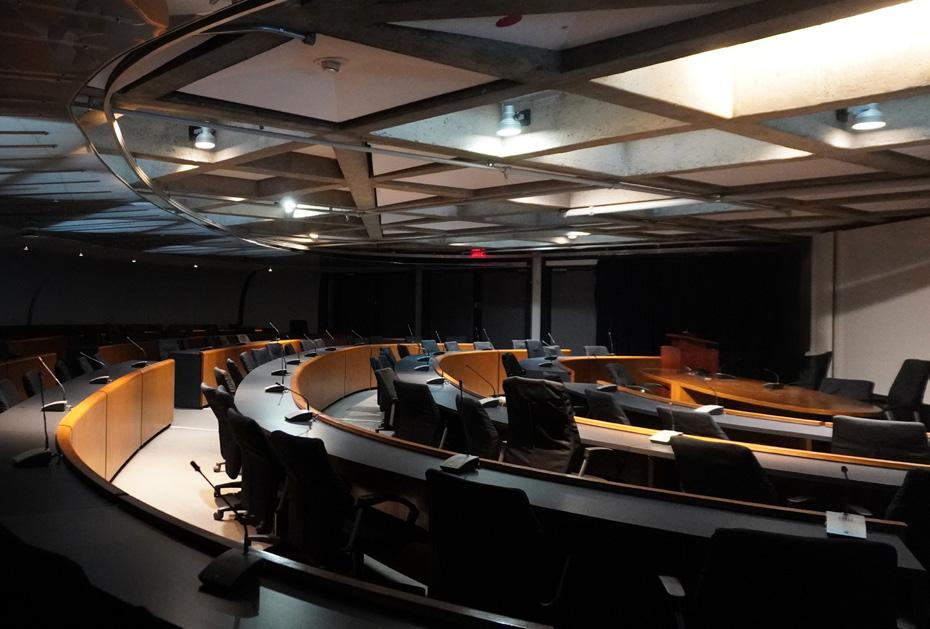
SSMU members are invited, as members of the gallery, to attend open sessions of Council, which typically take place every second Thursday at 6:00 p.m. (Emiko Kamiya / The Tribune)
Gwen
Editor-in-Chief
Yusur Al-Sharqi editor@thetribune.ca
Creative Director Mia Helfrich creativedirector@thetribune.ca
Social Media Editor Mariam Lakoande socialmedia@thetribune.ca
Business Manager Laura Pantaleon business@thetribune.ca
The Tribune Editorial Board
Continued from page 1.
Planet Labs’ new imagery policy in Iran displays how selectively restrictive satellite imagery reorganizes access to crucial wartime information. The company, despite having placed a hold on releasing images from the Middle East, has permitted authorized government users to retain immediate access to the company’s archive for ‘critical’ operational purposes. As a result, the U.S. military—a key partner with Planet Labs, having contracted $151 billion USD this year to the company’s operations— maintains access to satellite imagery, while Iranian and Gulf intelligence agencies lose access completely. This asymmetrical access to information has consequences beyond military strategy.
During the ongoing war, journalists and researchers have relied on satellite imagery and verified video footage to document damage to civilian infrastructure following
strikes by the U.S. and Israel. Recently, in Minab, a U.S. missile strike on an elementary school killed at least 175 individuals, primarily children. The strike was justified by the U.S. as an ‘accident’ resulting from outdated data that failed to account for changes to the site over time. U.S. intelligence relied on dated images from 2013, which identified the site as a military base; however, images from just three years later reveal a portion of the base had since been converted into a school. This incident demonstrates how accurate and accessible satellite imagery can play a critical role in verifying military claims and identifying failures in targeted processes. When access to such imagery is selectively restricted, independent verification becomes far more difficult, consequently limiting the public’s ability to scrutinize wartime actions.
In 2020, McGill University entered into a partnership with Planet Labs to provide students and researchers access to satellite imagery archives for geospatial analysis and environmental monitoring. Such applications have clear academic
value; satellite imagery clearly can be—and has been—used for researching and promoting global betterment and safety that would otherwise be largely inaccessible. The technology has also been used to monitor deforestation in the Amazon, track sanctioned Russian oil tankers moving through international waters, and document violations of international law. While such imagery is often framed as an unbiased tool to promote transparency and research, private satellite companies, by controlling who has access to that data, exert significant influence over how geopolitical events are observed.
The issue is not that satellite imagery can support military operations. However, when the companies controlling this infrastructure actively shape the flow of information during wartime, the technology quickly becomes contentiously entangled in the geopolitics of conflict. Planet Labs’ new policy regarding imagery in Iran exposes a contradiction within McGill’s ethos, as the institution claims ‘neutrality’ despite maintaining its partnership with
Passing bills ‘on division’ threatens Canadian democracy
Tarannom Moheq Contributor
Canada’s current Parliament has passed 50 per cent of its bills through a ‘division’ vote instead of a ‘tallied’ vote in the House of Commons. Parliament has previously used this practice to fasttrack legislation or opt for simplicity during online sessions. Today, it is justified in the name of stability, creating a united front in the face of geopolitical rivalries.
Lilly Guilbeault, Emiko Kamiya, Alexa Roemer
CONTRIBUTORS
Amy Gelfand, Tarannom Moheq, Sophia Angela Zhang
Amy Gelfand, Abbey Locker
However, this priority not only threatens Canadian democracy—it reflects democratic backsliding in contemporary society. Citizens, unaware of how their representatives would have voted, are ousted from the political process and forced to trust their elected officials under ignorance, while bills are passed on potentially non-existent consensuses in Parliament.
Division voting is beneficial for minority governments, as it allows bills to bypass the need for majority approval from Members of Parliament (MPs). This eases the creation of legislation in highly divided times, though at the cost of certain groups’ political power.
Existing dissenting voices in Parliament have been stifled by this practice to avoid bringing down the government or causing a snap
staff.
election; two of the bills passed on division under the current Parliament were confidence votes. A confidence vote is one in which a ‘no’ vote means that the prime minister no longer holds the support––confidence––of Parliament, obligating a consequent general election. By passing bills and motions frequently through division votes, Canada assumes the appearance of a stable, functioning government in the context of rising international tensions. Under pressure from the trade war with the United States, Prime Minister Mark Carney likely aspires to present national unity and a coordinated government.
However, this obscures the reality that this Parliament has been inefficient. As the completion of Carney’s first year nears, only 12 bills have passed, a stark contrast to previous governments that were able to pass over 50 within the same timeframe. Not only is Parliament inefficient, but half of the few bills that were successful only passed through a division vote, speaking to the fragility of the government and disagreement across the nation.
These confidence bills were passed on division to ensure this Parliament’s continuation while acknowledging the objections of other parties. However, acknowledgement alone does not imply democracy;
Planet Labs. Ending this partnership does not, in any way, imply support for the Iranian regime or its actions— but continuing it does actively support the U.S.’s brutal and unsubstantiated war on the region.
McGill must confront the political implications of the partnerships it forms, and how they contradict its assertions of ‘neutrality.’ These technologies offer clear academic value, but the institutions that support them cannot ignore the political consequences of how they are deployed. McGill should review its collaboration with Planet Labs, establish clearer ethical guidelines for future partnerships, and consult students and faculty when entering agreements with companies whose technologies intersect with global conflicts. Students also have an important role to play: Voicing their concerns, demanding transparency, and pushing the administration to justify its partnerships are necessary steps to challenge complacency. Universities cannot claim neutrality whilst benefiting from infrastructures that selectively shape the politics of war.
Bills passed on division in previous parliamentary sessions have been as low as 3 per cent and as high as 27 per cent in 2005. The current 50 per cent rate is unprecedented. (Gwen Heffernan / The Tribune)
impact does. When the influence of major portions of Parliament is removed from the decision-making sphere, their constituents lose power as well—even more so as constituents are unable to tell how their representatives vote. While division votes can only happen with the consent of most MPs, their lack of transparency greatly threatens Canadian democratic values. The issue of democratic participation is not one foreign to Montrealers and McGillians. Last fall’s municipal election saw the lowest voter turnout in years at a mere 37 per cent. Low voter turnout is also visible in the context of the Students’ Society of McGill University (SSMU)’s elections and referenda; despite holding a quorum
of only 15 per cent, resolutions frequently fail to reach this threshold. Political inactivity is widespread at the local level, and will only worsen with the continued use of on division bill passing. With its high frequency of use, this procedural tactic is an abuse to Canada’s democratic system and excludes significant numbers of people by assuming a consensus that may not exist.
By ignoring or accepting Parliament’s use of this tactic, we are at risk of creating a culture apathetic to political participation—that is, to democracy. It is imperative that we stay vigilant and continue to monitor these developments, as democracy does not always vanish overnight but instead may slip away quietly when no one is paying attention.
Shatner University Centre, 3480 McTavish, Suites 404, 405, 406
Simona Culotta, Defne Feyzioglu, Alexandra Hawes Silva, Lialah Mavani, Nour Khouri, Laura Pantaleon, Amy Xia
TPS BOARD OF DIRECTORS
TRIBUNE OFFICE
Brooke Barak, Rachel Blackstone, Loriane Chagnon, Josette Chandler, Carla Cretin, José Moro Gutiérrez, Will Kennedy, Antoine Larocque, Sofia Lay, Lialah Mavani, Talia Moskowitz, Talia Moskowitz, Luca Paone,Julie Raout, Parisa Rasul, Alex Hawes Silva, Michelle Yankovsky, Ivanna Zhang
Heffernan,
Quebec cannot afford ‘gender equality’ without feminism
Defne Feyzioglu Opinion Editor
Content warning: Mentions of genderbased violence, including intimate partner violence and femicide
Masculinist sentiment is gaining traction across the world while global backlash against feminism and gender equality is intensifying. Simultaneously, gender-based violence remains widespread, reproductive and bodily autonomy are increasingly policed, and gender-diverse people continue to face exclusion in public policy and everyday life. During these critical times, Bernard Drainville, the current Environment Minister in Quebec, and potential successor to Francois Legault as leader of the Coalition Avenir Québec (CAQ), explicitly stated that he did not wish to be identified as a feminist, but only as a supporter of gender equality. This is a statement that clearly embodies where Quebec—and global—politics are headed: A broader political moment wherein the language of equality is embraced, but the movements needed to achieve it are rejected.
Feminism, at its core, is the belief that everyone should have equal rights, regardless of their gender identity or sex. A politician who actively distances himself from feminism while claiming to support gender equality raises a larger question about what kind of equality he is willing to defend. Rejecting feminism is not a neutral branding choice; it
is a refusal to name and confront the systems that make inequality possible in the first place.
Drainville’s equality proposals mainly focus on homeownership and in vitro fertilization. While easing women’s path to property ownership and making fertility treatment more accessible are steps in the right direction, they remain insufficient. These policies frame gender equality largely through economic participation and family formation rather than addressing freedom from violence, bodily autonomy, and protection for those who face intersectional forms of discrimination and state exclusion. Drainville offers only a narrow and selective vision of equality.
This perspective becomes even more overt in his broader policies. By introducing initiatives like Bill 94, an expansion of Bill 21 that bans religious symbols for teachers and school staff, Drainville advances legislation that outright dismisses intersectional realities and excludes the people feminism seeks to protect. He also rejected gender-neutral bathrooms in schools in 2023, saying that the matter was out of the question for Quebec. Drainville then refused to convene a legislative committee on gender identity, arguing that doing so would only expose what he named a sensitive issue to political exploitation. Rather than confronting inequality as a structural issue, the version of equality he proposes is extremely limited in scope.
Gender inequality is experienced daily through violence, exclusion, and state neglect. Intimate partner violence and sexual violence
affect people of all genders, but remain deeply gendered in who is most affected and how that violence operates. Worldwide in 2024, 83,000 women and girls were intentionally killed—50,000 by their intimate partners or family members. On a daily basis, this number reached 137—approximately one death every ten minutes. Quebec is not exempt from this reality. Femicides, the genderbased killings of women and girls, are the byproducts of ongoing patriarchal systems that normalize coercive control, misogyny, and violence; the province has reported seven femicides since the beginning of 2026.
Women of colour and women with disabilities experience higher rates of violence, including intimate partner violence, sexual assault, and institutional abuse. (Zoe Lee / The Tribune)
When gender-related murders happen on a scale so large that they can be reported as a daily statistic, it becomes clear that gender-based violence is a global crisis and a human rights violation, as it strips women and gender-diverse people of their rights to safety, dignity, freedom, and life itself. Given this reality, a commitment to equality that stops short of feminism is deeply inadequate to address the structural conditions in which this violence persists.
Drainville’s statement is not a mere semantic happenstance, but a conscious, harmful choice. In an age where the need for feminism is urgent, vague statements about supporting gender equality or policies that
will “attract young women” are not enough. Anything less than explicit and continuous feminist practices is a limited political strategy that recycles traditional gender roles as progress instead of confronting the conditions that sustain inequality in the first place. Feminism saves lives, and ambiguity is not neutrality—it is participation in a patriarchal order.
If you or someone you know is experiencing gender-based violence, please refer to the resources below: SOS violence conjugale: 1 800 363-9010 (bilingual service available) Sexual Violence Helpline: 1-888-9339007 Sheltersafe.ca
COMMENTARY White supremacists cannot be trusted with coercive state power
Ellen Lurie Opinion Editor
Trigger warning: Mentions of racial and sexual
violence
WhiteDate, advertised as a “dating platform for white people with traditional values,” is a white supremacist, neo-eugenicist, ethnonationalist propaganda network impersonating a dating app. An investigation has revealed the presence of military and elected officials on this platform, posing a profound threat to global peace and security. Such individuals must be suspended from these positions effective immediately.
The WhiteDate homepage reads, “We are exclusive, not discriminatory. To learn about the difference, ask your local Country Club.” Or at least it did, until an anti-fascist hacker leaked over 8,000 profiles and 100GB of data at the Chaos Communication Congress (CCC), an annual hacking conference held in Hamburg, Germany. Of these accounts, 500 were based in Canada, with several holding ties to the Canadian Armed Forces (CAF).
The hacker goes by the pseudonym ‘Martha Root,’ a nod to the 20th-century Bahá’íst revolutionary and peace activist. In a video posted on YouTube, Root describes how she infiltrated WhiteDate by creating profiles and linking them to AI chatbots, which she handprogrammed to engage in flirtatious texting conversations with users.
After several months of covertly collecting data and information, Root leaked
user information—including profile photos, metadata, GPS coordinates, and bios—live from the stage of the CCC conference, and then forced the website offline. All the leaked user information can be found on her website, ‘okstupid.lol.’ Root also shut down WhiteChild, a platform discouraging white people from having children with non-white people, and WhiteDeal, a freelancing site offering whiteonly contractors. The two websites were created by the same person who founded WhiteDate, Christiane Horn.
The WhiteDate eugenicist project relies on white supremacist dogwhistles to accomplish its aims. Even its headline, “For a Europid vision,” reproduces neo-Nazi, white ethnonationalist attitudes. The term ‘Europid’ was popularized by German anthropologist and physiologist Johann Friedrich Blumenbach, whose 1795 hierarchical classification system was foundational to 19thand 20th-century biological determinism. Blumenbach also popularized degeneracy theory, arguing that the original, ‘perfect’ humans were white, and that all other races are ‘degenerations.’
Indisputable scientific and anthropological research confirms that human life originated from the Horn of Africa, and that race is not biological but socially constructed. Yet, white supremacist, pseudoscientific beliefs that promote the use of terms like ‘Europid’ continue to persist on sites like WhiteDate.
Since the data leak, the CBC has identified three WhiteDate users as active military personnel: Brogan Hale, a Royal Canadian Navy reservist; Brandon Longpré, a corporal with the
Governor General’s Foot Guards; and Tristan Armstrong, a major for the Royal Canadian Air Force.
The presence of these individuals on WhiteDate poses a threat to both national and international peace and security. Members of the military hold access to weapons and secure intelligence, making their participation in white supremacist platforms an undeniable threat to public safety and human rights. In fact, the CAF’s Hateful Conduct Policy expressly forbids racism, discrimination, microaggression, and hate propaganda; even social media posts promoting discriminatory violence or hatred are prohibited. Yet, Navy reservist Brogan Hale has posted numerous times calling for the use of “bioweapons that target non-whites.” Air Force Major Tristan Armstrong has stated that “the ideal woman is childlike,” and that Korean women “want” to be raped to “get sex without being a slut.”
These incidents all predated the data leak, yet the Canadian Armed Forces have not instituted disciplinary action or consequence, allowing perpetrators of hateful conduct and racist extremism to remain employed, their salary paid for by tax dollars. This inaction is only to the detriment of these military institutions’ legitimacy.
The Canadian government continues to hire, pay, promote, and arm individuals so starkly in violation of its ethics policies and so clearly dedicated to projects of white supremacy and eugenics.
Since the data leak, international disgust with the platform and its users has led to discrete action to remove some of these individuals from public office. For example, after Lillith Osborn, British Conservative Councillor for Glastonbury, Somerset, was discovered among users implicated in the data leak, she was promptly suspended from her position. Canada must follow suit. Removing these individuals from positions of power is the absolute minimum of necessary action governments must take to protect the human rights and security of racialized individuals and prevent the increasing spread of fascist, white supremacist thought.
Shakespeare’s lyricism thrives through comedy in ‘Goblin: Macbeth’ Goblins take the stage in a hilarious re-enactment of the Bard’s masterpiece
Dylan Hing Staff Writer
William Shakespeare’s work is no stranger to unique adaptations.
For over four hundred years, audiences have been dazzled by reimaginings of his compositions in West Side Story , 10 Things I Hate About You , and my personal favourite, She’s the Man . Brilliant stage and screen adaptations abound, and at Centaur Theatre, Spontaneous Productions has added Goblin: Macbeth to the list with a hilarious show that finds humour in Shakespeare’s poetry.
Starring the Goblins Wug, Kragva, and Moog, played by anonymous actors, Goblin: Macbeth follows this trio as they stumble across the com- plete works of William Shakespeare. They choose to perform Macbeth in hopes of better understanding human culture, because, as they put it, it is the Bard’s shortest play, and has quite a bit of blood. However, the show truly starts before the curtains rise, with the Goblins appearing in the lobby to the surprise of theatregoers and later commandeering the stage, much to the chagrin of the director whose show was ‘supposed’ to take place there.
This version follows the closing of
Théâtre du Nouveau Monde’s production of Macbeth on March 1st, which set the play amidst a biker-gang war. The Goblin’s version began previewing on March 4th, continuing Macbeth’s rightful dominance over Montreal.
The Goblins interact with the audience before they are even seated, introducing the cultural divide between themselves and humans through their discovery of humanmade items. Yet despite their uniqueness, Wug, Kragva, and Moog are distinctly human. Their attempt to perform the play is as familiar to the audience as it is charming, with each goblin playing multiple characters and arguing amongst each other about equal effort in performing the play. In one scene, Kravga plays all of the characters, while Wug, as Macbeth, hides behind a mirror, and Moog is stuck playing the music—you must see it to believe it.
Much can be said about the banter and the modernization of some of the play’s lines to better suit the comedy, but when all is said and done, the performances in Goblin: Macbeth fully convey the wide range of emotions that Shakespeare intended. Wug gave a showstopping performance as Macbeth, bringing genuine emotion to the famed “Is this a dagger” and “Tomorrow, and to-
morrow, and tomorrow” soliloquies. There was, especially in the latter speech, a clear intent behind the words, and Wug’s delivery was moving.
Kravga plays Lady Macbeth, among other characters, and stands out as well. Kravga leads many of the production’s most hilarious deviations from Shakespeare’s original script, having audience members play the army hiding under the leaves of Birnam Wood, marching upon Macbeth at Dunsinane, in the final act. Most memorably, once Wug’s Macbeth returns onstage after committing his nefarious deed, Kravga notices something off about him that sends the production into a breathtakingly insane direction.
The Goblins take great joy in involving the viewers in the production, culminating in a fun activity that also doubles as a stretch break. The Goblins occasionally encourage all audience members to respond to their dialogue, while some are asked to participate in the play from the comfort of their seats.
Overall, for Shakespeare enthusiasts and newcomers, Goblin: Macbeth is a mustsee. It is a masterclass in respecting Shakespeare’s world-famous poetry while cheekily using comedy to make it understandable to a modern audience. With a reverential treatment of the language, at least by Wug, the audience gets the best of both worlds: Brilliant comedy and beautiful handling of one of Shakespeare’s best. It’s something you’ll want to see again tomorrow, and tomorrow, and tomorrow.
In the vicissitudes of spring, find warmth in sound Fresh tracks to survive spring’s temperamental weather
Kaitlyn Schramm Managing Editor
Spring metamorphoses and melts, but music regulates and relates. As time skips forward and Montrealers hesitate on whether to put their snow boots away for good, the arrival of spring relies just as much on your Spotify playlist as it does the forecast. From the number one fan of spring—stuck in a perpetual limbo of rain, snow, and the occasional sunlight peaking through the clouds, here are songs that grow flowers from the slushy, frozen sidewalks.
“Spring” by Saint Etienne
Stylish, hip, and filled with whimsy, “Spring” captures Saint Etienne’s iconic yet underrated ability to glean sounds across genres.
“Spring” is electric and unique, sampling drums from James Brown and its base track from “The Time Is Right For Love” by Bobby Reed, creating a feeling of springtime optimism concurrent with ditching warm jeans for flowy skirts and sweaters for tank tops. Sarah Cracknell’s vocals, so light they almost get lost in the wind, whisper: “It’s only springtime / You’re too young to say / You’re through with love.”
“Sandy Toes” by Linda Perhacs
Hypnotic and dizzying, “Sandy Toes” by Linda Perhacs perfectly encapsulates the sunsickness that follows hours of lazing on the beach with a book and maybe a cocktail—or reentering the indoors disoriented by blotches of light. Perhacs’ layered melodies atop a mischievous guitar and a steady bongo beat give hope for simpler days on the sand, where research papers and internship applications cease to exist, at least for a few hours.
“Spring Is Coming With A Strawberry In The Mouth” by Caroline Polachek
A cover of the enchanting and cult-classic sounds of 80s-pop duo Operating Theatre, Caroline Polachek’s rendition of “Spring Is Coming With A Strawberry In The Mouth” is angsty and electrifying as Polachek whispers the opening lyrics—a letter to a friend thirsting for love. The chorus brings out her siren voice as she belts out the track’s title on repeat, transferring her hunger for love and spring to the listener. When spring knocks on your door with a strawberry as a peace offering, Polachek advises you to take it.
“Alone in Brewster Bay” by Minnie Riperton
And when the childlike hope for the sun feels unreachable, Minnie Riperton offers a hand amidst the solitude of spring snow in “Alone in Brewster Bay.” Accompanied solely by a chorus of seagulls and a soft guitar, Riperton sings, “Watch the fire die / See the snowflakes fly / Think of you, my love, so far away.” Piano and violin soon join her, but the song slows to a halt as the seagulls hawk and the guitar gently strums. Riperton’s loneliness becomes palpable yet reassuring. A ballad of introspection—or retrospection—and a yearning call for a previous lover, the seagulls don’t abandon the snow-covered beach. Instead, Riperton submits to the isolation of the in-between, and spring is made.
“Spring” by Angel Olsen Angel Olsen’s “Spring” begins with a call to action: “Don’t take it for granted / Love when you have it / You might be looking over / A lonelier shoulder.” Confronting reflection and adulthood, spring not only becomes a period of looking to what is to come, but also what has been left behind. As the song continues, Olsen’s voice fades in and out, from side to side, as the instruments oscillate. “Spring” concludes disoriented and unsure—a reminder that following the uncertainties of spring brings the possibilities of summer.
“OH! TENGO SUERTE” by Masayoshi Takanaka
Fans often pair Masayoshi Takanaka’s “OH! TENGO SUERTE” with a viral video of Takanaka shredding on his guitar in the ocean off Phantom Islands, the breeze in his hair as the water engulfs him. From his 1976 album SEYCHELLES, the song commences with sharp guitar notes until a funky drum beat and a glowing slide guitar join the symphony, quickly bringing Takanaka’s jazz-fusion style to life. The song is summer ease, swiftly transporting the listener to beachside paradise. Amidst Montreal’s temperamental spring, it becomes impossible to feel the cold pierce your Super Puff on the way to class with Takanaka’s guitar dancing in your earbuds.
Masayoshi Takanaka’s first world tour, SUPER TAKANAKA WORLD LOVE 2026, features stops in the U.S., U.K., Australia, and New Zealand this April. (Anna Seger / The Tribune)
The Shakespearean goblins Wug, Kragva, and Moog have performed across Canada, most recently at Edmonton’s Centennial Theatre. (Eliot Loose / The Tribune)
Cut varsity teams shut out of McGill24 fundraising despite promise of continued support
Athletes say exclusion contradicts administration’s commitment to treat them as varsity programs through year’s end
Zain Ahmed Staff Writer
Less than two weeks before McGill24—the university’s annual day of giving each March 11—McGill’s Field Hockey team received an email that changed everything. After submitting their McGill Crowdfunding proposal, they learned the team could no longer participate because they were not managed by a McGill unit. The notice came from someone unfamiliar to the team and offered no alternative path forward.
For Field Hockey, Women’s Rugby, and Track and Field—three of the teams cut from varsity status in November—McGill24 was their largest annual revenue source, where alumni rallied and donations were matched by the university. This year, that lifeline disappeared, and teams were left without any financial structure to support their endeavours next year.
In an interview with The Tribune, Avery Berry, U2 Arts & Science and forward on the Field Hockey team, explained the financial reality.
“We were basically all self-funded, so [funding from McGill24] was incredibly important to us because it went to keeping us alive [....] It allowed us to stay afloat as a team,” Berry explained.
The news arrived months after the cuts were made, leaving teams scrambling with no clear path to raise funds. For some, like Track and Field, the situation proved even more complex.
McGill’s Men’s and Women’s Cross Country teams, despite being a Track and Field subsidiary, were not cut. They retained access to McGill24 but were explicitly told they could not share any funds with Track and Field, even though the Cross Country runners are athletes who compete in both seasons. In previous years, both teams crowdfunded as one.
Mia Blackmore, U2 Arts distance runner and Track and Field captain, described the administration’s position in an interview with The Tribune
“We weren’t allowed to raise money through Cross Country and then use it for any sort of track event, and we weren’t even allowed to use it for an athlete who does distance running in track season and does distance running in Cross Country season,” Blackmore said.
Teams were encouraged by McGill Athletics to apply for club status with the Students’ Society of McGill University (SSMU) to restore McGill24 access. But after completing the registration process, the promise evaporated in what Alicia Gilmore, U3 Arts and second row on the Martlets Rugby team, described as a bureaucratic runaround.
“[McGill Athletics] were kind of telling us that ‘we still like you guys, we just can’t keep supporting you through this route,’ and then of course they wouldn’t let us do McGill24. It just felt like another lie,” Gilmore said.
This exclusion stands in stark contrast to the commitment from McGill Athletics when the cuts were announced, which promised that they would
be treated as varsity programs through the end of the 2025-26 academic year.
“It completely contradicts it. As soon as you hear that news, it diminishes you as an athlete and as a team. To now, with just a semester left of the school year, […] it’s difficult,” Berry stated.
For Track and Field, the consequences extend beyond a fundraising day. Unlike Rugby and Field Hockey, which can compete in club leagues next year, McGill Athletics will not sign the forms necessary for Track and Field to compete in Réseau du sport étudiant du Québec (RSEQ) or U SPORTS events—the only university competitions available. The sport is an international institution with no barriers to entry and even has external endeavours such as the McGill Olympic Club and a local club for youth development.
“Even if we raised $100,000 CAD through McGill24, we won’t be able to compete next year, so it doesn’t even matter. Sure, the money is great, but we won’t be able to compete, so there really is no point,” Blackmore said. “All of our athletes do this for a love of the sport. We aren’t Olympians, but we absolutely give 110 per cent every week.”
The financial impact varies by team. Rugby raised $82,000 CAD through an independent campaign shortly after the cuts were announced, eclipsing what they typically made through McGill24. Field Hockey and Track, however,
relied heavily on the matched donations and institutional framework. Without it, they face uncertain futures operating with drastically reduced budgets while trying to maintain competitive programs.
Athletes say what stings most is not just the loss of funding, but the exclusionary message it sends. McGill24 continues for remaining varsity teams, including newly added programs. Meanwhile, teams that represented McGill for decades have been removed from the day’s promotion and donor outreach.
“To see that the teams that are now being added in are allowed to be involved in McGill24 feels like too quick a turnover of our varsity status and being replaced by the new agenda that McGill Athletics is hoping to pursue,” Berry said.
Sports Editor Clara Smyrski is captain of the McGill Field Hockey team. She was not involved in the writing, editing, or publication of any Field Hockey-related content in this article.
RSEQ basketball champion Martlets return to national stage
The Martlets advance to the U SPORTS Final 8 for the first time in eight years, finishing fourth in the country
Jenna Payette Staff Writer
The McGill Women’s Basketball Team capped their 2025-26 season with a return to the national spotlight, winning the Réseau du sport étudiant du Québec (RSEQ) Championship before finishing fourth at the U SPORTS Final 8 in Quebec City. The run combined defensive grit, timely performances, and a young core that proved it could contend with the nation’s best.
The Martlets delivered their biggest statement on Feb. 28, travelling to Quebec City to upset the top-seeded Laval University Rouge et Or 51-45 and capture the RSEQ championship. The victory secured McGill’s first conference title since 2018 and the 14th provincial banner in program history.
True to the Martlets’ identity, the game was defined by their defensive prowess. McGill controlled the pace early, building a small but steady lead through the first half behind strong rebounding and disciplined defensive pressure. Laval slowly chipped away at the deficit and briefly tied the game early in the fourth quarter, setting the stage for a tense finish.
At that point, McGill’s depth made the difference. Guard Daniella Mbengo delivered a spark off the bench, finishing with a gamehigh 18 points and scoring on back-to-back possessions midway through the final frame to restore the Martlets’ lead.
McGill then relied on composure and execution down the stretch, hitting key free throws and controlling the boards in the final minutes to seal the upset on Laval’s home court.
Forward Emilia Diaz-Ruiz played a crucial role inside the paint, collecting a team-high 11 rebounds while sustaining a broken nose from earlier in the playoffs. Teammates Lily Rose Chatila and Emma-Jane Scotten also contributed key minutes and timely baskets that helped propel the Martlets to the title.
With the RSEQ trophy in hand, McGill entered the national tournament as the sixth seed and opened against third seed University of Calgary Dinos.
The Martlets quickly showed they belonged on the national stage. The teams were deadlocked at halftime after a tightly contested first half, with McGill matching Calgary possession-for-possession. But the Dinos gradually created separation in the second half, pulling away in the fourth quarter to secure a 58-45 win.
Diaz-Ruiz again stood out for McGill, recording a double-double with 15 points and 14 rebounds and earning player of the game honours for the Martlets.
The loss moved McGill into the consolation bracket, where the Martlets faced the seventh-seeded Carleton University Ravens in another tightly contested matchup. The game quickly became one of the most dramatic contests of the tournament. After trailing early,
McGill surged back with a dominant second quarter to take a halftime lead, setting the stage for a gritty second half.
Diaz-Ruiz once again led the Martlets offensively, finishing with 21 points and repeatedly answering Carleton’s scoring runs. Late free throws from the sophomore forward gave McGill a narrow lead with less than a minute remaining.
But the Ravens had one final push. After blocking what could have been a McGill gamewinning attempt, Carleton quickly transitioned the other way and converted a layup at the buzzer to escape with a 64-62 victory.
The heartbreaking finish brought McGill’s season to a close with a 17–11 overall record and a well-deserved fourth-place national finish.
Beyond the action on the court, one of McGill’s most meaningful moments came during the tournament’s offcourt honours. Emilia DiazRuiz was named the national recipient of the Sylvia Sweeney Award, which recognizes outstanding community service by a student-athlete.
The sophomore’s impact extends well beyond basketball. A chemical engineering student with an impressive academic record, Diaz-Ruiz is
deeply involved in campus initiatives, including leadership roles with the National Society of Black Engineers and other student organizations focused on outreach and mentorship.
The honour carries particular significance at McGill, as the award’s namesake, former national team captain Sylvia Sweeney, once starred for the Martlets. Diaz-Ruiz is the first McGill athlete to receive the award since it was created in 1994.
The Martlets ultimately finished just outside the podium, but their RSEQ championship and national semifinal appearance made one thing clear: McGill women’s basketball has reestablished itself among Canada’s elite.
The national women’s basketball championship trophy, the Bronze Baby, was originally donated by McGill students in 1922. (Abbey Locker / The Tribune)
McGill24 has historically been the largest single fundraising day for most varsity teams. (Zoe Lee / The Tribune)
The end of 2022 was marked by the public release and rapid democratization of OpenAI’s ChatGPT, one of the first generative artificial intelligence (AI) tools to become widely accessible to the general public. Since then, AI’s presence has been rapidly increasing in our daily lives and integrating itself into many of the tools we use, such as social media platforms or search engines. This gradual shift has changed the way we work, learn, and go about our personal lives, driven in part by the constant promotion and integration of AI across digital platforms and everyday technologies.
This technology has prompted growing questions surrounding its use. As students and professionals are increasingly urged to embrace AI for the sake of survival in a competitive landscape, the technology is often framed as an inevitable partner. However, we must remain cautious: By prioritizing algorithmic convenience over genuine human effort, we risk trading our critical thinking for a “frictionless” efficiency that hides a deeper cost to our creative and intellectual autonomy. AI remains a relatively recent technology and cannot always be considered a fully reliable tool.
ABOUT THINKING
This is one of the main ideas defended by Adam Dubé, associate professor of Learning Sciences and Director of the Technology, Learning, & Cognition (TLC) Lab, in an interview with The Tribune. His work focuses on educational technology and cognitive development,
Dubé’s research on home voice assistants highlights what he calls the “theory of artificial minds.” The concept is inspired by the “theory of mind,” which describes the human ability to understand the thoughts, beliefs, desires, and emotions of others. Dubé’s studies show a clear cognitive evolution in children. Younger children—those around four years old—often attribute human intentions to these devices when older children—around 10 years old—learn to see them as programmed machines. This shift from perceiving AI as something that is almost alive to understanding it as a technical tool is an important cognitive step. Yet many users, including adults, remain stuck in that earlier phase of emotional trust, treating AI responses as if they came from an intentional and reliable source.
This emotional trust leads to a deeper pedagogical risk: The shift from using AI as a support to using it as a substitute. Dubé explains that the danger lies in prioritizing the final product over the cognitive effort required to create it.
“Generative AI enables students to produce more polished writing, but the tool is doing the writing for them. They are submitting better assignments, but they aren’t necessarily learning how to develop better ideas. So students have better assignments […] but [they] are not learning how to make better assignments.”
This shift suggests the emergence of what
could be described as “performance dependence,” a phenomenon where the final output becomes more important than the human process used to achieve it. In this state, results and productivity are prioritized over actual mastery of the subject, and as this depen dency grows, the focus moves from the human process of learning to the machine’s ability to perform.
This pressure is already manifesting in the workplace. In an Instagram survey con ducted by The Tribune, one respondent echoed this sentiment.
“AI is deeply evil and harmful to our world and brains, but my boss mandates we use it.”
This highlights a growing tension: While AI is a powerful tool for efficiency, it may come at the cost of the intellectual autonomy and critical thinking that humans are supposed to maintain.
Dubé points to what he describes as a fun damental mismatch in how people approach this technology.
“Most students don’t use AI to help structure their thinking, [rather] they use AI to do the thinking for them,” he explains. “These systems are designed to provide answers that satisfy the user as quickly as possible, so they keep using them. They are not designed for learning, they are commercial products.”
While using AI may feel innocent for mundane tasks like making a grocery list, it becomes dangerous when users turn to these tools for guidance on complex personal matters.
“These systems are designed to provide answers and please the user. This can become problematic when users seek advice on personal matters, such as relationships or mental health, because even when the system lacks expertise in these areas, it will still produce a response,” Dubé added.
Thus, even if the system provides an answer, is it the right one? The concern here goes beyond mere factual accuracy. It touches on whether a non-human entity should be weighing in on experiences that are fundamentally exclusive to the human race. Grief, heartbreak, and moral dilemmas are not data points to be calculated; they are lived realities that require empathy, not just an algorithm. By seeking advice from a machine, we opt for an interaction where we aren’t challenged by the difficulty of handling another person’s opinion, trading the soul of human connection for a script that imitates empathy without ever having felt a single emotion it describes. And because the responses appear supportive, users often interpret them as meaningful wisdom when we get them from a product design to satisfy us in the fastest way possible.
About Us
This concern echoes the perspective of
MY FRIEND NAVIGATING THE BLURRED COMPANIONSHIP AND
Written by Johana Gaba,
Designed by Eliot Loose,
Renée Sieber, associate professor in the Department of Geography and one of the Top 100 Brilliant Women in AI Ethics for 2025. In an interview with The Tribune, Sieber began by clarifying a distinction often lost in current debates: While “AI” has become synonymous with generative AI, algorithmic systems have actually operated in the background for years—notably in Canada’s visa pre-screening processes.
By moving from invisible background code to human-sounding “trustworthy assistants,” these systems adopt a veneer of authority that makes them appear more reliable than they truly are. This shift mirrors our existing digital habits. Over the past two decades, digital platforms have transformed how we interact, moving from face-to-face discussions to messages and posts. This illustrates the concept of “alone together,” introduced by researcher Sherry Turkle, describing a world where we are constantly connected, yet experience growing social distance.
While a real friend provides the “friction” of disagreement or judgment, the machine listens without conditions. We are now moving
AI TOLD ME
EFFICIENCY
Web Development Editor
Loose, Design Editor
from messaging friends to asking a machine to refine our lives, scripting our most intimate human duties before they even happen: ‘GPT, write me the script for my breakup,’ ‘GPT, write me the script for my interview,’ ‘GPT, what should I answer to this message?’ By scripting these situations in advance, we avoid the anxiety of a raw reaction, but we also alienate ourselves from the actual experience. This is the dependence on this constant and unconditional support, something humans are not built to provide, that ultimately isolates us.
ABOUT WORK AND CONTROL
This desire to remove personal friction carries over into the professional world. Sieber is blunt about the harsh reality facing the modern workforce.
“AI is used to increase productivity. The hard truth is that it often means firing people and smoothing the rest,” Sieber said. “Productivity ends up meaning using AI instead of hiring people, when efficiency could sometimes mean hiring someone.”
In this framework, productivity becomes
synonymous eliminating the “human-inthe-loop.” The risk is that by treating human judgment as inefficiency, organizations may sacrifice the nuance and creativity that machines cannot
This obsession with me-
The ’s poll of 83 respondents, which show that response speed is the primary driver of AI adoption. While 49 per cent of respondents report using AI at least a few times a week, it is the demand for immediate results that stands out: among
sponse” as the main reason they prefer AI
These numbers reveal a profound shift in how we handle personal effort. Respondents
interactions or the time required for self-improvement.
One wrote: “I’m not gonna ask my mother to rewrite my essay in a more polished way.”
By using AI as a shortcut for tasks that used to require human feedback or personal labour, we are gradually outsourcing our own development. While 99 per cent of respondents claim they could not have a relationship with AI, nearly nine per cent admitted they would feel more comfortable sharing a personal problem with an AI than with a real person. This suggests that for some, the lack of judgment and the instant availability of the machine already outweigh the value of human connection, choosing the ‘simpler’ path, even when it means sacrificing the depth that only the effort of human interaction and disagreement can provide.
Beyond the workplace, AI has become a high-stakes geopolitical matter, reflecting a nation’s digital sovereignty. This isn’t just about borders—it’s about controlling data, infrastructure, and algorithms. In this global race, Canada holds a prestigious position, thanks in large part to pioneers like Yoshua Bengio and Geoffrey Hinton. Bengio, founder of the Quebec Artificial Intelligence Institute (MILA) in Montreal, is a leading advocate for ethical AI, while Hinton, Professor Emeritus at the University of Toronto, has warned of the existential risks posed by the technology he helped create. Both received the Association for Computing Machinery A.M. Turing Award in 2018 for their breakthroughs in deep learning.
MILA has turned Montreal into a global deep learning hub, attracting billions in investment. Yet, as Sieber cautions: “Without control over our own infrastructure and data centers, our digital sovereignty is sacrificed […] we risk
becoming mere ‘digital tenants’ of private foreign entities.”
In practice, renting hardware and storage from global tech giants means Canada produces the “brains” of AI without owning the “body.” This structural dependence highlights a tension: AI is presented as a tool for us to use, but we often don’t fully understand how it works or who ultimately benefits. This underscores that innovation alone isn’t enough—control and accountability must follow if AI is to serve the public good.
To understand the aggressive promotion of these systems, we must also look at what fuels them. Sieber is skeptical of the grand narratives surrounding Artificial Intelligence.
“I don’t believe in ‘super intelligence,’” she said. “Our data is the gold mine.”
In other words, the real value of these systems may not lie in their intelligence, but in the vast quantity of information they collect from users. Every prompt, correction, or interaction becomes part of a continuous feedback loop that helps improve the technology. What appears to be a simple tool for convenience also functions as a massive data-gathering infrastructure.
If AI systems depend so heavily on user input to improve, who ultimately benefits from that collective labour? While individuals gain speed and convenience, the long-term value of these interactions largely accrues to the companies developing the technology.
ABOUT THE FUTURE
The boundary between machine and companionship is being systematically blurred through a campaign of aggressive promotion. Advertisements appearing in the McGill metro station—proclaiming that “the future is cyber-friends”—are not merely slogans; they are strategic attempts to manufacture a new vision of normalcy. This promotion packages algorithmic interaction as friendship to mask a colder reality: We are being conditioned to outsource our relationships, our creativity, and our critical thinking to corporate products we do not fully understand.
This manufactured normal suggests that the total integration of AI is both inevitable and benign. However, as Sieber points out, this narrative is designed to keep us from questioning the speed of the shift. Behind the ‘magic’’ of the interface lies an opaque infrastructure that values speed over substance. It prioritizes “30-day sprints,” the government’s lightning-fast 2023 consultations, sacrificing democratic engagement and human rights at the altar of corporate efficiency.
AI can imitate the sound of a friend and the structure of an argument, but it cannot assume the human responsibility of deciding what kind of world we actually want to build. In our rush, we must avoid a repeat of the 2010s “tablet craze,” where technology was adopted simply because it was new. The power to choose humanity over mere efficiency still belongs to us—provided we don’t prompt it away.
McGill launches Athletics Strategic Planning Task Force following
varsity
program cuts
Committee seeks to create five-year plan with focus on student i nput but excludes reinstating cut teams
Ivanna Zhang Staff Writer
On Feb. 27, McGill University announced the launch of the Athletics and Recreation Strategic Planning Task Force to oversee the next five years of McGill’s Athletics and Recreation with a focus on uniting students, faculty, and alumni from across campus.
The Task Force will be co-chaired by Chancellor Pierre Boivin, Provost and Executive Vice-President (Academic) Angela Campbell, and Interim Deputy Provost (Student Life and learning) Tony Mittermaier. There will also be an external advisory board composed of students, faculty, staff, and alumni to achieve the goal of putting students at the centre. Campbell told the McGill Reporter that the committee will focus on transparency, inclusivity, and sustainability. The article also confirmed that the committee will not “revisit past decisions” but will aim to represent student-athletes on campus.
However, the scope of the Task Force misses the major current issue at McGill Athletics. The Task Force comes just after McGill Athletics announced one of its largest downsizings in November 2025. The department cut 25 varsity and club teams, citing challenges regarding facilities, budget constraints, and human resources. The statement enraged athletes across the world, including Olympic ath-
JT
Will Kennedy Staff Writer
Jayson Tatum returned from injury to the Boston Celtics after 298 days out with a torn Achilles tendon, which required reconstructive surgery. As impressive as it is that Tatum—someone who is 6’8” and 210 pounds—was able to return in under a year, what is more impressive is that the Celtics managed to remain one of the best teams in the National Basketball Association (NBA) despite his absence.
The Celtics always had talent with their trio of Jaylen Brown, Derrick White, and Payton Pritchard leading the way, but second place in the Eastern Conference is exceeding expectations nonetheless. People on social media point to Brown as the driver of Boston’s success and label him as an MVP candidate, but this represents a fundamental misunderstanding of what makes the Celtics so good. Brown is having a career-best season, but he is far from being an MVP—if anyone was the team’s most valuable member, it would be Head Coach Joe Mazzulla.
In the Celtics’ previous two seasons, which included an NBA Championship run in 2024, Mazzulla’s team shot an absurdly high number of three-pointers each game. Boston averaged 48.23 attempts per game from behind the arc in the 2024-25 season, a full three attempts more than the
letes such as seven-time gold medalist Andre De Grasse and Canadian Sports Hall of Famer Bruny Surin.
In a statement to the Canadian Broadcasting Corporation (CBC), De Grasse expressed his frustration at the news.
“What’s happening at McGill matters across Canada,” he said. “When a leading university cuts a program like this, it sends the wrong message to current and future athletes and to university leadership across the country.”
Moreover, varsity teams have also launched petitions to reinstate multiple programs that were to be cancelled next year. Despite these strong efforts, the athletics department has maintained its view on the matter, and the cuts will be implemented for the 2026-27 season. When asked if the decision is final, Perry Karnofsky, director of services, wellness programs, and operations, told the Montreal Gazette that “as far as the conclusions that we have come to now, I would say yes.”
One of the goals of the new Task Force is to communicate directly with athletes. As a result, the Varsity Council has sent out a Google Form to all varsity athletes to express their opinions on the cuts, saying “[they] have been facilitating ongoing discussions with admin and want to get holistic data on the impact this had on varsity athletes, to be presented to them.” The new committee also stated
that they will deliver “clear and measurable objectives” after engaging with the community throughout this spring.
The committee’s desire to look ahead to the future means that the 25 varsity and club teams eliminated are outside the committee’s mandate. The Task Force will focus on how the remaining athletics and recreation programs should operate going forward, overlooking the hundreds of athletes who are losing their dreams of competing at the collegiate level. The timing of the initiative has also led some to interpret it as a response to the backlash that followed the downsizing announcement, especially after the decision drew widespread criticism from athletes, alumni, and prominent figures in Canadian sport.
sentation on the Varsity Council enables the administration to understand the perspectives and priorities of the athletes. Whether or not those perspectives ultimately influence decision-making is another question.
On the other hand, the Task Force could be meaningful if it manages to repair a somewhat damaged relationship between the athletics department and the students. The cuts have created a sense of distrust among athletes, many of whom feel that their voices and concerns were overlooked throughout the decision-making process. Thus, having athlete voices within the Task Force through repre-
For now, however, much of the Task Force’s direction remains unclear. The language surrounding the initiatives has emphasized broad themes such as transparency and inclusivity, but it offers little clarity about what concrete outcomes athletes and the broader McGill community should expect. Regardless, it will be hard to assess the Task Force’s impact, as it has decided to avoid addressing one of the largest issues surrounding McGill Athletics.
next most in NBA history. By stretching the defence through the threat of shooting, Boston’s players could attack in isolation without other players being able to help defensively for fear of giving up a three. With the losses of Tatum and Kristaps Porzingis, the team went into this season with less shooting and athleticism, so they took a different approach.
With Tatum sidelined, Payton Pritchard stepped into a bigger role and has excelled at pretty much everything Boston hangs their hat on. Boston has become a pick-and-roll-heavy team this season, running the action at the third-highest frequency in the NBA and generating 0.93 points per possession out of the pickand-roll, also good for third in the league. Where Boston has the ultimate advantage is their league-lowest turnover frequency. Limiting turnovers has been a major reason why Boston has been so good this year, and that starts with Pritchard. The Celtics have also placed an emphasis on generating steals, deflections, and offensive rebounds to gain more possessions than opponents and attack a defence that is in scramble mode.
While Pritchard and Brown have helped to fill the void that Tatum left on offence, Derrick White serves as the team’s ultimate connective piece. Despite his shooting struggles this season, White has been one of the most impactful guards. He could score five points in
a game and still remain his team’s most valuable player because he impacts the game in so many different ways: By playing great defence, generating extra possessions, and consistently making the correct reads offensively. Another driver of Boston’s success has been the emergence of Neemias Queta. Boston lost all three of their rotation ‘big men’ in the off-season, something that felt like it would be their Achilles’ heel. Queta has emerged as a starting-calibre ‘big’ and that has been good enough to keep the Celtics afloat.
With Tatum back, a great coach, and the help of players like Pritchard, White, and Brown, the Celtics look poised to make a deep playoff run. In what should have been a gap year for Boston, they have positioned themselves as one of the Eastern Conference favourites. Their unexpected success is a testament to the or
McGill’s Track and Field team has a 125-year history. (Anna Seger / The Tribune)
Indiana Pacers star Tyrese Halliburton revealed that he has a group chat with Jayson Tatum, Damian Lillard, and Dejounte Murray where they discuss the recovery process of their respective achilles injuries. (Eliot Loose / The Tribune)
OFF THE BOARD
Reaping the consequences of ‘just a joke’
Clara Smyrski Sports Editor
On Feb. 19, the U.S. Women’s Hockey team won Olympic gold against Team Canada four minutes into the overtime period. Three days later, viewers experienced déjà vu when the U.S. Men’s Hockey team won in a similar 2-1 overtime against Team Canada.
As an increasingly unproud American, this was a bittersweet moment for me as I grappled with my extreme distaste for current U.S. leadership and the new-age patriotism this leadership has forcibly fostered.
Just one day later, a video circulated on social media of U.S President Donald Trump inviting the men’s team to a celebratory White House visit, and I was quickly reminded of why I remain
Rachel Blackstone Staff Writer
My phone and I are glued at the hip, literally. When reality interrupts our time spent face-tointerface, I still keep it snug in my back pocket, ready to be reunited again with my scrolling fingers.
It was love at first sight, but our relationship quickly became all-encompassing, causing me to forget the things I once loved. I now find myself addicted to its cheap thrills and instant gratification.
It loves me; it loves me not. I sprawl in an overgrown field of tailored algorithms, constant dopamine hits, suffocating consumerism, deepfakes, and unfiltered hate speech. Each petal tells me something different, but I know deep down that it’s time to break up with my cellphone.
I could download an app that blocks all my favourite apps. That feels a little meta. I could throw out my cell altogether and replace it with a Brick Phone. I’ve seen ads all over Instagram for that. But these options feel a little harsh. After all, my phone and I had some good times. I want to end our codependency through boundaries and the slivers of autonomy I still possess.
If you resonate with this preamble, read on for The Tribune’s suggestions for breaking up with your phone.
distinctly unpatriotic. After the team enthusiastically accepted the invitation, Trump said, “I must tell you, we’re going to have to bring the women’s team,” which was met with an uproar of laughter from the players. Trump continued, “I do believe I probably would be impeached [if I didn’t invite them].”
When the invitation was indeed extended to the women’s team, they politely declined, citing “previously scheduled academic and professional commitments.”
The video was subject to significant backlash—from Megan Rapinoe calling Trump’s remark “trash” to Flava Flav inviting the team to an alternate celebratory trip to Las Vegas. At the centre of the criticism is gold medal game-winner Jack Hughes, who appeared on Good Morning America and responded to the online hate.
“I think we are so tight with [the women’s team]. After we won the gold medal, we were in the cafeteria at 3:30 a.m. […] with them,” Hughes said. “I think everyone in that locker room knows how much we support them, how proud we are of them.”
Hughes wields the close relationship between the teams to shield the implications behind his actions. In an interview with the Daily Mail, he blames the criticism on people being
pessimistic and overly-sensitive, saying they are making something out of “almost nothing.”
And that’s just it. For Hughes, a 24-year-old who secured the first gold medal for the U.S. men in 46 years, it is almost nothing . Allowing sexist remarks behind closed doors is so normalized and ingrained in our society that it doesn’t even register as significant to him.
When women’s sports are still receiving less funding and less coverage than men’s, this is definitely not almost nothing. This incident shows that you can represent your country at the highest level, inspire a generation of women, consistently outperform men, and still be mocked and laughed at. It is not funny, it is not a joke—and yes, it is that serious.
The repercussions of this incident speak to a broader movement: Women are increasingly disinterested in marriage and dating. There are more single women than ever, and this change is by choice. A survey from the American Enterprise Institute found that almost half of college-educated women attribute their singlehood to an inability to find someone who meets their expectations, whereas only a quarter of men say the same. Women don’t feel that there are suitable options for them and would rather be alone than
How to break up with your phone
Four tips on decentering your cellphone
Befriend a book
It can be daunting to pick up a book when already faced with a few hundred pages of assigned weekly readings, but I firmly believe that getting lost in a good book is more gratifying than any doomscroll session could be. An easy way to get back into reading is to simply begin carrying a book with you everywhere you go. Every time your friend is late to your coffee date or the classroom projector fails, instead of mindlessly reaching for your phone, read a few pages. When screen time is used to fill in all the gaps in your daily routine, phone use becomes an automation. If you instead use these moments to read, you will slowly realize how much more time you have in a day.
Organize no-screen hangouts
Invite your friends over, tell everyone to bring a book, a craft, or a game, and spend the night relaxing sans phone. As collaborative as watching a movie with friends is, it’s likely that the group will end up mindlessly scrolling. Even if a movie isn’t on, it’s increasingly common to “rot” with your friends at home and all end up silently engrossed in your phones. To avoid this, create a space where alternative individual activities can still be performed in a shared environment.
Invest in long-form content
As depressing (or embarrassing) as
in a relationship with someone who doesn’t respect them as an equal.
During this time of increased singlehood, there has also been a rise in the so-called “male loneliness epidemic.” While a 2025 Pew Research Center study found that there is only a one per cent difference between loneliness in men and women, men are complaining that women have abandoned them.
Men blame women for being disinterested while lacking any accountability or reflection on why that is. Women have known that the kindness shown to their faces doesn’t always survive the walk to the next room. What has changed is that women now have the autonomy to do something about it. The male loneliness epidemic and women’s retreat from dating aren’t isolated social phenomena; they are a direct response from the former to the latter. Cause and effect.
This video of a single moment reflects a pattern of performative allyship that is unacceptable. Women no longer need to put up with a dynamic where they are celebrated in public and diminished in private. The loneliness epidemic, the declining marriage rates, the women opting out altogether—these are not crises that happened to men; they are consequences. You reap what you sow.
this may be, watching a movie or episode of television at the end of the day has become something of a lost pastime thanks to the rise of short-form content like Instagram Reels, TikTok videos, and YouTube Shorts. With shrinking attention spans, nights are lost to doomscrolling that feels involuntary. Leave your phone in another room and reclaim your evenings by finding a new show you love, or go to Letterboxd and find your new favourite movie.
Accept occasional boredom
In
Pay attention to moments where your phone is present when it doesn’t need to be: Before bed, first thing in the morning, walking through campus. Acknowledging that your phone has invaded all aspects of life is the first step to decentralizing it. Once aware, let yourself sit in occasional
phone.
boredom. Stare out the window and people-watch. Think about where you would like to be instead of waiting for the bus and get distracted in a daydream. Ground yourself in the present, to avoid floating away indefinitely.
2025, the average adult spent a total of 88 days on their
(Lilly Guilbeault / The Tribune)
Feeling lucky? The best St. Patrick’s Day bar crawl in Montreal Can’t-miss locations for live music, the perfect pint, and classic Irish eats
Talia Moskowitz Staff Writer
Montreal is about to turn green for St. Patrick’s Day celebrations, kicking off on Tuesday, March 17. The city will come alive with music, raised pints, and celebrations—the perfect occasion for McGill students to blow off steam at the time-honoured Irish pubs serving up an exciting line-up of festivities. Eat some Lucky Charms, throw on all the green garb you have, and follow this guide to make the most of St. Patrick’s Day in Montreal.
McKibbins Irish Pub - Rue Bishop Location
McKibbins Irish Pub is a slice of Ireland right in the heart of Montreal. While the location on St. Laurent is a popular watering hole for McGillians, head down to their location on 1426 Rue Bishop to kick off your celebrations. On St. Patty’s, the pub will feature live music from musicians Jono Trio and Tebo and the Mercenaries starting at 12:00 p.m.
Hurley’s Irish Pub
After McKibbins, continue on to Hurleys Irish Pub. A Montreal landmark since 1993, Hurleys is located at 1225 Rue Crescent and hosts live music every night. Rest assured that its St. Patrick’s Day celebration is not one to miss! Hurleys serves 19 beers on tap, not to mention a long list of Irish whiskeys that are
sure to warm you up inside and out to combat Montreal’s mid-March chilly weather. If whiskey isn’t your drink of choice, keep it simple with an excellent pour of Guinness, highly rated by one of Guinness’ Master Brewers.
McLeans Pub
For traditional Irish music and celebrations, McLeans Pub on 1210 Rue Peel will host Belfast Andi and Patrick Hutchinson on March 17. For the 34th year in a row, they will host The Riley Band on March 23, the day of Montreal’s St. Patrick’s Day parade. McLeans is known for its wide selection of imported and domestic beers, complete with a cozy atmosphere, pool, and foosball tables upstairs. Kick back, relax, and enjoy the atmosphere of this iconic Montreal destination on one of its most iconic days of the year.
Maison Publique McLeans
Next door to McLeans Pub, Maison Publique McLeans, located at 1420 Peel, offers a similar energy in a more intimate setting. Housed within a historic Montreal establishment, the bar blends traditional Irish charm with a lively atmosphere, friendly staff, and plenty of TVs for sports fans. From March 17 to 22, Maison Publique McLeans will host comedy nights, live music, DJs, and weekend brunch featuring traditional Irish music.
Peel Pub
Despite closing its doors eight months
ago after 63 years of business, Peel Pub, located at 1196 Rue Peel, is set to re-open on St. Patrick’s Day. This legendary spot, believed by many to be the oldest pub in town, is a long-standing Montreal institution patronized by locals and tourists alike. The pub’s new ownership has been working hard to set the place up for Montreal’s seminal celebration, renovating the space with 24 draft-beer lines, including six Quebecois craft beers. Don’t miss the chance to ring in a new era of The Peel Pub this upcoming Tuesday, March 17!
Ye Olde Orchard Pub & Grill
Ye Olde Orchard Pub & Grill, located at 1189 Rue de la Montagne, will serve up a special menu during the month of March for St. Patrick’s Day, mixing Montreal classics with Irish flair. Head to Ye Olde as the final stop on your St. Patrick’s Day Crawl for a delicious feast. To start, order the Paddy’s Poutine or the Irish Nachos,
then tuck into the Bangers n’ Mash with Guinness gravy, or the corned beef sandwich with fries. The Tribune recommends washing down your meal with the Irish Maid cocktail, complete with Jameson Whiskey, Lemon Juice, Elderflower Syrup, and Cucumber Syrup. If you’re still not ready to finish off the night, order a round of Dublin Drops with your friends for the ultimate St. Patrick’s Day challenge: A drop-shot of Jameson and Bailey’s into half a pint of Guinness—but work quickly, as the drink will curdle if left unfinished for more than a minute.
Montreal stays awake for its 23rd annual Nuit Blanche
A multitude of festivities transformed Montreal into a sleepless cultural playground
Sophia Angela Zhang Contributor
Montreal’s Nuit Blanche is a chance to rediscover the many facets of the city through a lively, nocturnal lens. Timed to coincide with secondary school and university breaks, this event was an opportunity for burnt-out students to spend quality time falling in love with new parts of Montreal. If your midterm study schedule or reading week travels kept you from this year’s night of nocturnal fun, here were the highlights of the evening.
On Saturday, Feb. 28, Montreal hosted its spectacular 23rd annual Nuit Blanche, transforming all four corners of the city into a bustling night attraction, complete with extended Société de transport de Montréal (STM) hours and hundreds of cultural activities for all to enjoy past bedtime. Most of the festivities were located in the Quartier des Spectacles, where the designated festival plaza, music, and joy, along with lively spirits and light installations, brightened the night sky. With towering projections and colourful light sculptures, the city was surrounded by a surreal atmosphere, and the snow-covered streets transformed into a vibrant public celebration.
Nuit Blanche and its light installations are part of the Montréal en Lumière festival. First held in the year 2000, this festival lights up the city with thousands of stunning light displays meant to encourage people to enjoy outdoor activities, even during the gloomy winter nights of February. The extensive programming features gourmet food, musi-
cal performances, and special events, most of which are free of charge.
With activities hosted at the Montreal Museum of Fine Arts, the Palais des congrès de Montréal, Théâtre Outremont, Espace OSM with the Orchestre symphonique de Montréal, Place des Festivals, and even McGill’s own Redpath Museum, the entire city was plunged into a festive mood, livening up what would have been a typical cold winter night.
Some of the activities offered included a bookbinding workshop with Caroline Boileau, Glisse et Groove, an event which transformed the Parc Jean Drapeau skating rink into a disco floor, animated by DJ Thatz and DJ Pullinsky, and a night at the Biodôme, which invited visitors to observe the Tropi-
cal Rainforest and Laurentian Maple Forest ecosystems at night.
The Montreal Biodôme is situated near the Olympic Stadium, clustered with related attractions such as the Planetarium, Insectarium, and Botanical Gardens, all of which offered special attractions for the all-nighter experience. The Biodôme reproduces all five of the ecosystems present in the Americas, allowing tourists to observe a variety of plants and animals in their natural environment.
Nuit Blanche completely transformed the Biodôme. The Tropical Rainforest ecosystem was much darker than during the day, with dim lights and a moody, humid atmosphere. The Laurentian Maple Forest was lit up with orange and red lights, giving the fa-
miliar Canadian forest a new vibe. The sunset effect of the warm lights gave the space a different feel, allowing visitors to see the ecosystems from a new perspective. The Biodôme famously houses two Canada lynxes, who are both usually asleep during daytime visits. However, for festival-goers, both lynxes were wide awake and playing enthusiastically together. Nuit Blanche is one of the few opportunities for visitors to see these furry nocturnal felines when they are awake.
However, as with all large, city-wide events, lines are an inevitable part of the experience. With public transit hours extended and the Réseau express métropolitain (REM) staying open all night, people congregated in very large numbers. At the Biodôme, the line to enter lasted slightly over an hour— about the same amount of time spent inside. In the harsh Canadian winter, standing outside for hours is not the most pleasant experience, but if you’ve ever braved the cold for Igloofest, you’re well prepared for the next Nuit Blanche.
For one night each year, Montreal embraces the idea that winter need not mean staying indoors. Nuit Blanche turns the city itself into a stage, inviting residents and visitors alike to stay up late, explore new spaces, and celebrate the creativity that defines Montreal’s cultural life—even in the depths of winter. For students staying in Montreal during Reading Week, the event is a musttry. With a diverse range of activities—many of them free—Nuit Blanche allows students to travel beyond the McGill campus and experience hidden facets of Montreal at night without breaking the bank.
2026 marks Montreal’s 201st St. Patrick’s Day parade. (Abbey Locker / The Tribune)
During Nuit Blanche, public transport stays open later to accommodate festival-goers, with the newly built REM operating all night. (Emiko Kamiya / The Tribune)
A look inside POWE: A McGill club empowering women in engineering Club co-presidents discuss the growing community for women engineering students at McGill
José Moro Gutiérrez Staff Writer
Content warning: Mention of femicide
New students often find it daunting to find a community that shares their values and aspirations. At McGill, engineering students can join Promoting Opportunities for Women in Engineering (POWE), an organization that creates a sense of belonging through mentorship, professional development, and outreach.
POWE was founded to support women in engineering after the 1989 École Polytechnique massacre, when a man opened fire on a group of women in a mechanical engineering class in Montreal, killing 14 and injuring 13. The club promotes and engages women’s participation in the male-dominated field by building a nurturing environment. The organization operates under three main pillars: Community, professional development, and outreach.
“Community is really about creating a supportive group on campus to lift each other up,” Ella Godun, a U4 Mechanical Engineering student and co-president of POWE, said in an interview with The Tribune. “We socialize, we support each other, and [we] remind people that they are not alone in engineering.”
Throughout the year, POWE hosts regular social events and general meetings designed to help members connect with peers outside the classroom. Activities range from casual gatherings to workshops and themed events. Alongside community building, professional development is another key focus
of the club’s day-to-day. The club regularly organizes networking opportunities, CV workshops, and industry panels that connect students with professionals and alumni. One of POWE’s largest initiatives is its annual conference dedicated to women in engineering, SymPOWEsium.
“The goal is to connect current students with industry professionals and POWE alumni,” Gracie Diabo, a U3 Software Engineering student and co-president of POWE, said. “We have workshops, panels, and even a research competition where students can present their work to a panel of women professors.”
The conference has expanded in recent years. POWE collaborates with companies and student organizations to broaden opportunities for its members. Industry partners frequently participate in conferences, networking events, and workplace visits, which allow students to explore different engineering career paths. Organizers hope to continue
growing the event and eventually attract students from across Canada.
“We have sponsorship packages with a lot of companies, but many of them also reach out to us to organize industry tours or send representatives to campus,” Godun said. “It allows students to see what different engineering fields actually look like in practice.”
Outreach is the final cornerstone in POWE’s mission. The club plans events aimed at high school and CEGEP students to introduce them to engineering and provide role models relatively early in their education. One of its largest events is the POWE Conference for Future Women in Engineering, which brings more than 150 high school and CEGEP students to McGill each year.
“These students get to meet women in engineering, attend workshops, and see what studying engineering can look like. It is about showing them that this path is possible,” Diabo said.
Despite the fact that approximately 20 per cent of first-year engineering students in Canada are women, only 12 per cent are practicing, licensed engineers. (Lilly Guilbeault / The Tribune)
Meet your prof: Alex Ketchum
Members of POWE also participate in science fairs at local schools and offer lab tours for visiting student groups. These activities aim to make engineering more accessible and visible, and encourage younger students to consider careers in STEM.
The club’s work addresses a persistent gap in representation within the engineering profession. While women made up roughly 35 per cent of McGill’s undergraduate engineering students’ enrolment from 2023 to 2024, this number drops significantly once they enter the workforce.
“That is a big reason why POWE continues to exist,” Diabo added. “There has been progress, but there is still a long way to go in terms of representation in industry.”
POWE additionally offers mentorship opportunities for incoming students. Through its mentorship program, first-year engineering students are paired with upperyear mentors who help guide the transition to university life. For Godun, that program played an important role when she first arrived at McGill.
“I did not know anybody when I came here,” she said. “Being paired with another mechanical engineering student helped me find my footing and feel like I belonged.”
As POWE continues to grow, its leaders hope the club will remain a strong and open space where students can find opportunities and a supportive community within engineering.
Students interested in getting involved with POWE are encouraged to subscribe to their newsletter and apply for coordinator roles at the start of the academic year, or attend events as general members.
From feminist kitchens to queer tech: Rethinking academia throu gh feminism and queerness
Antoine Larocque Staff Writer
Food. Gender. Tech. Queer history. What do these topics have in common?
They are all key research areas for Alex Ketchum, a historian and an Associate Professor in McGill’s Institute for Gender, Sexuality and Feminist Studies, whose research explores how these topics intersect.
Ketchum has long been interested in feminist and queer theory, incorporating them into her studies. She pursued her Bachelor’s degree at Wesleyan University, and both her Master’s in History with a specialization in Gender and Women’s Studies and her PhD in History at McGill.
Ketchum studied feminism in the 1970s— a salient period in second-wave feminism when women first stood up against the oppression inherent in unpaid domestic labour—for her honours undergraduate thesis. She wrote about the Bloodroot Vegetarian Restaurant in Bridgeport, Connecticut—a feminist establishment which has since permanently closed after 48 years of operation. Her Master’s and PhD expanded on her previous work by focusing on the history of feminist restaurants across Canada and the United States.
Ketchum’s work materialized in two books. Ingredients for Revolution examines the labour dynamics of feminist restaurants and how they challenged traditional hierar-
chical restaurant structures by experimenting with new ways of organizing labour and compensating staff. Queers at the Table is a collection of essays, recipes, and comics that illustrate the relationship between queerness and food.
In 2019, Ketchum launched a speaker series through which she organized over 100 events spotlighting feminism and accessible communications and technologies. As part of this project, Ketchum was named one of the 100 Brilliant Women in AI Ethics in 2021.
While researching the themes of feminist communications technologies for the speaker series, she became interested in queer groups such as the High Tech Gays and Digital Queers, which organized 2SLGBTQIA+ workers in tech companies, particularly in Silicon Valley and the Pacific Northwest. These workers brought together their technical expertise to support 2SLGBTQIA+ nonprofits and community organizers.
“Queer people transformed the internet,” Ketchum said in an interview with The Tribune. “The internet transformed queer people. But [what came out of this project] is a larger argument about the kind of mundane aspect of activism and information. Activism is much more than marches […], but so much of it is about teaching people and information sharing.”To conduct her research, Ketchum primarily combines interviews, literature reviews, and archival research.
“I love going to archives more than anything in the world,” Ketchum said. “It is my favourite part of research. I am looking through photographs, [...] audio materials, or old foam clips.”
Ketchum noted, however, that researching marginalized communities presents challenges.
“When […] you are doing research around marginalized communities, […] you sometimes have to deal with different kinds of pushback or backlash, like trolling, doxing and death threats,” she said. “As we are seeing an increase in homophobia and transphobia, it is emboldening bigots, so there is just starting to be a bit more harassment [….] Also, sometimes work on different marginalized communities is not taken as seriously.”
Ketchum is committed to making her work accessible beyond academia. In her book, Engage in Public Scholarship!, she argues that academic research should be communicated in ways that reach broader audiences.
Her most recent research project explores how space programs have historically defined the “ideal astronaut” and excluded queer people from space exploration. It also examines how the 2SLGBTQIA+ community responded through activism and creative visions of a more inclusive future in space.
“If you look at my […] career, it might
seem like I had a plan, […] but a lot of times, when we look at other people’s careers, we do not see how winding the path was. But I think the thing that has helped me through the different trials and tribulations is I kept following the passion and making decisions about things that I was interested in and trusting my gut about staying committed to my values.”
For people interested in this research, Ketchum is also organizing the Queer Food Conference at McGill from May 1 to May 3, 2026, for which students can register.
Ketchum curated an exhibition on queer food in Montreal that will be open from April to June 2026. (Zoe Lee / The Tribune)
Rethinking our relationship with academic emotions
Exploring how the context of education shapes students’ emotional regulation
Amy Gelfand Contributor
Have you ever stressed about your schoolwork, only for that stress to create even more stress? This phenomenon—stressing about stress—is a metacognitive experience very common among students of all ages. Academic emotions impact motivation, engagement in learning processes, and learning outcomes. However, it remains unclear which emotion regulation strategies actually support learning in an academic context.
Luyao Xu, a doctoral student and research assistant at McGill, and Krista R. Muis, director of the eMUIS Lab, co-authored a systematic review exploring emotional regulation (ER) methods in self-regulated learning published in Educational Psychology Review Xu analyzed numerous studies and articles on emotion regulation tactics elicited during learning, focusing on how emotional experiences correlate with learning performance outcomes and how the regulation strategies applied can mitigate negative impacts.
Psychology research has shown that certain emotional regulation strategies are more effective than others. Many scholars view reappraisal—a way to reevaluate a bad outcome as an opportunity to improve rather than a personal failure—as an effective strategy. Suppression, on the other hand, which involves pushing emotions aside without addressing them, is generally viewed as unhelpful in learning contexts. But do these results hold true across academic contexts?
“Recently, meta-emotive knowledge is getting more attention, like whether regulating anxiety using reappraisal is not a good idea when students are approaching an exam, because they may have used up their cognitive resources for ER rather than engaging in learning,” Zu said in an interview with The Tribune
Zu explained that competence-oriented strategies, which improve skills in subject areas to prevent negative emotions from interfering with learning, may be more efficient than strategies typically used in clinical psy-
chology.
“The effectiveness of the ER strategy depends on the context in which the emotion occurred. In certain contexts, students may not raise a need for regulation,” Zu explained. “For example, maybe when the exam is near, I do not identify myself as someone who needs to regulate [my] anxiety. Instead, I need to focus on reviewing the materials to get a good grade. So, […] distracting myself from my learning material is not a good way to regulate my emotions. In this case, trying to enhance my abilities is a more adaptive strategy.”
There has been an increased interest in studying a broader range of discrete academic emotions, beyond just anxiety, over recent years (Amy Gelfand / The Tribune)
Meet your prof: Siva Nadarajah
Introducing the Director of the McGill Institute for Aerospace Engineering
Sarah McDonald Science & Technology Editor
What do engineers actually do?
They are often described as problem-solvers, scientists, and inventors, but even with this framing, what they do on a day-to-day basis is not always obvious. In an attempt to dispel this mystery, The Tribune sat down with Mechanical Engineering professor Siva Nadarajah, who explained his education, why he chose to pursue engineering, and most importantly, what he actually does
“I did my education in the States, [I’m] originally from Malaysia, but I was in the States for about 10 years, and so I did a […] [joint] Bachelor’s in Aerospace Engineering and a Bachelor’s in Mathematics,” Nadarajah explained. “And then I did a Master’s and a PhD, all in Aerospace Engineering, but mainly in the Applied Math aspect of engineering.”
As with other disciplines, engineers are faced with the daunting decision of pursuing either academia or industry after they graduate; Nadarajah, however, undertook his education knowing he wanted to work in academia. Academia affords faculty the freedom to pursue their own projects, research aspects of their specialty that interest them, and contribute to ever-expanding literature and subject expertise. While working in industry can be immensely rewarding, Nadarajah was drawn to the na -
ture of academic work—he wanted to work through fundamental problems.
“So after my PhD, I submitted my thesis when the office opened at nine o’clock in the morning. [These were] the times when you had to kind of print the whole book,” Nadarajah said. “And so the office opened, I handed them the thesis, and then I got on [an] 11:30 flight from San Francisco Airport and landed in Montreal. I literally handed [in] my thesis, then got onto the flight to come to McGill.”
He has been at McGill ever since.
In addition to his professorial duties, Nadarajah is the Director of the McGill Institute for Aerospace Engineering (MIAE) and runs his own lab, the McGill Computational Aerodynamics Group, where he completes his research.
MIAE brings students and researchers from various faculties together to study different aspects of aerospace, from engineering to Air and Space Law. This work culminates in the seminar series “Grand Challenges and the Future of Aerospace,” which MIAE hosts either once or twice per semester, depending on the year. Nadarajah explained how this seminar brings together students from across engineering disciplines to network with large aerospace companies to understand the problems they are currently facing. The speakers at these events are typically either Chief Technology Officers or Vice Presidents, offering students perspectives on the current prob -
Raising awareness of academic emotions is an important step in encouraging learners to monitor how their emotions impact their well-being, learning processes, and performance outcomes. For instance, a student who recognizes that emotions are a normal part of learning may become less anxious about anxiety, allowing those emotions to shift from a burden to a tool that can support learning.
“In the learning context, the adaptiveness of ER strategy may not reflect on improved emotional experience, but rather on an improved learning performance,” Zu said. “In the learning context, most of the time, students’ ultimate goal is their learning outcome rather than their emotional experience. Since this emotional experience does have an impact on the learning processes, students regulate these emotions to prevent their negative impact.”
In response, Zu proposes the Integrated Model of Emotion Regulation in SelfRegulated Learning, linking ER, academic motivation, and learning performance on a person-level. This model focuses on students’ habitual use of ER in overall learning as well as at a task-level, examining how strategies interact with emotional states to influence task outcomes.
Emotions provide important bodily signals that can help individuals interpret and respond to their environment. When students become aware of their emotional patterns, regulation strategies can turn emotions into intentional tools that support personal flourishing.
lems industry professionals understand as impacting the field.
However, while his research and the work done at MIAE are interesting, Nadarajah expressed that he loves teaching just as much as he loves his research.
“I think that that, by far, that is definitely the most enjoyable thing is to is to be able to discuss and share the wonders of what we do […] [and] standing in a classroom and lecturing and sharing passion with others who are also interested. I think that’s a lot of fun.”
Nadarajah’s current research centres around fluid dynamics. He and his team are working on developing algorithms to optimize the efficiency of aircraft wings based on the movement of air around them. Once designed, this algorithm will be applicable to other aerodynamic structures.
“So on a daily basis, I would say, I think most of the time is spent on the applied math and understand -
ing the sort of equations developing these algorithms, but also keeping the back of the mind on the architecture of the computer that you’re trying to solve these problems on,” Nadarajah said.
Ultimately, Nadarajah’s work combines his passion for exploring fundamental problems with his desire to enact change, all while giving the rest of us some insight into what it really means to be an engineer.
There are four primary branches of engineering: chemical, civil, electrical, and mechanical. (Alexa Roemer / The Tribune)
SSMU Exectutive Endorsements
The Tribune’s Editorial Board presents its endorsements of the candidates for the 2025-2026 Students’ Society of McGill University (SSMU) Executive Committee. Editors researched and communicated with each candidate before leading an Editorial Board discussion on the candidates’ qualifications and vision for their prospective roles. Editors with conflicts of interest abstained from discussing, writing, and editing relevant reviews. Candidates who did not respond to The Tribune’s request for comment or were unable to attend an interview were not considered for endorsement.
Laurence Desjardins*
Desjardins’ platform reflects student voices and concerns through its emphasis on the Boycott, Divest, Sanction movement, the CU200 Divestment movement, and improving the quality of services provided by Student Accessibility and Achievement (SAA). As the presidential candidate of the S.T.A.N.D. coalition, Desjardins aims for a more collaborative and results-oriented operation within SSMU’s governance structure through transparent discussions with other executives. Desjardins has gained bureaucratic experience working with multiple community groups on and off campus, including the Gender, Sexuality, Feminism, and Social Justice Students’ Association, La table de quartier Peter-McGill, and the Quebec Public Interest Research Group (QPIRG) McGill. However, Desjardins fails to clearly outline the specific strategies and tactics needed to realize their outlined goals. Moreover, Desjardins’ lack of internal SSMU experience may pose a challenge in navigating the duties of the role. Given these concerns, The Tribune cannot endorse their candidacy. If elected, Desjardins must present concrete, attainable strategies and familiarize themselves promptly with SSMU’s structures to ensure a smooth transition into the role.
Endorsement: No
Hamza Abu Alkhair
Abu Alkhair was unable to participate in an interview with The Tribune due to extenuating circumstances
Endorsement: Abstain
Mars Gagawchuk
Gagawchuk’s campaign centres on improving transparency and communication between SSMU and the clubs and services it supports. Her platform prioritizes reinstating the Services Committee, reforming reimbursement processes that require students to pay expenses out-of-pocket, and expanding mental health support. She also emphasizes addressing food insecurity through reinstating Midnight Kitchen and improving accessibility to student spaces. Drawing on experience in student organizing and as a communications coordinator for the Gender, Sexuality, feminist, and Social Justice Studies Students’ Association, Gagawchuk frames her campaign around a ‘student-first’ approach to SSMU governance. However, she spoke vaguely about the administrative processes that make up a significant portion of the VP Clubs and Services portfolio. The Tribune endorses Gagawchuk, with reservations, believing her to be a strong candidate, and encourages her to develop clear operational strategies to implement her proposals and navigate the day-to-day administrative responsibilities of the role.
Endorsement: Yes, with reservations
Acadia Knickerbocker
Knickerbocker’s platform for VP Clubs and Services is distinguished by its strong emphasis on administrative reform and its clear understanding of the structural barriers clubs and services currently face. Her proposals to complete key logistical and financial reforms over the summer—including restructuring access to club finances, ensuring services have their own bank accounts, and streamlining forms and procedures—reflect a practical and proactive approach to the portfolio. Her prior experience in SSMU governance further demonstrates that she is well-prepared for the role. While Knickerbocker’s platform is strong, The Tribune encourages her to develop clearer positions on broader issues that student groups are facing, particularly where advocacy and political stance-taking are necessary. Even so, Knickerbocker presents a concrete, actionable vision for improving the dayto-day functioning of clubs and services. As such, The Tribune endorses her with reservations.
Endorsement: Yes, with reservations
Kareem El Hosini
El Hosini could not be reached in time for comment.
Endorsement: Abstain
Justice Bongiovanni
Bongiovanni could not be reached in time for comment
Endorsement: Abstain
Safia Haiboub
Safia Haiboub’s campaign for VP External Affairs highlighted community advocacy, specifically in campaigns against Bill C-12 and Bill 21, in addition to increasing representation for Arab and Muslim students. Haiboub also aims to hold more job fairs throughout the year while ensuring she receives feedback from the student body. The last two pillars of her campaign are to maintain solidarity with the Mohawk Mothers by spreading awareness of their cause and divesting from RBC, which is a top financier of fossil fuels. In her first semester of administration, she also aims to bring back Midnight Kitchen and increase grocery programs on campus. While most of her initiatives seem well-intentioned, Haiboub provides little tangible support or strategies for implementing them. For this reason, The Tribune endorses Haiboub with reservations.
Endorsement: Yes, with reservations
Harry Wang
Harry Wang’s platform for VP External focused on achievable priorities, including addressing housing affordability through a dedicated committee, avoiding tuition hikes during Quebec’s upcoming provincial election, and advocating for greater financial support for low-income students through collaboration with McGill administration and government partners. Wang also proposes concrete affordability initiatives, including creating an SSMU housing committee and a centralized housing platform
to help students find reliable rental listings and understand their tenant rights. Drawing on his experience as a student trustee in Ontario and his current role as SSMU Parliamentarian, Wang stresses the importance increasing transparency and institutional memory. His focus on practical outcomes and consultation with diverse student groups positions him as an attentive advocate of both policy impact and democratic accountability. As such, The Tribune endorses Harry Wang for VP External.
Endorsement: Yes
Sophie Smithson
Smithon’s vision for the role of VP Internal Affairs focuses on strengthening community-building through accessible programming and improved event organization. Her platform proposes expanding free and lowbarrier events, reviving Winter Carnival, and introducing regularized “Chill Nights” featuring smaller activities such as workshops, craft nights, and student markets. Drawing on extensive experience organizing large-scale events through the Engineering Undergraduate Society— including Frosh and Engineering Week— Smithson emphasizes practical improvements to event logistics, accessibility, and communication with students. Her focus on reducing financial and social barriers to participation, improving communication with students, and strengthening collaboration between campus groups reflects a thoughtful and practical approach to student engagement. The Tribune endorses Smithon, believing her operational experience prepares her well to strengthen campus programming and community life for McGillians.
Endorsement: Yes
Mia Duddy-Hayashibara
Duddy-Hayashibara’s campaign for the role of VP Internal demonstrates a strong drive to create change on campus, with plans to reinstate some of the 24 sports teams cut by McGill Athletics in Fall 2025, though her strategy for doing so remains unclear. She also intends to work alongside the VP External to restructure SSMU’s current free lunch service back into Midnight Kitchen, for which Duddy-Hayashibara was previously a volunteer. She explains actionable ways SSMU could better represent students’ decisions on the Policy Against Genocide in Palestine by cutting ties with companies complicit in Israel’s ongoing genocide, such as excluding companies like the Royal Bank of Canada from career and tech fairs. While Duddy-Hayashibara has prior experience as an SSMUnion member, she has not served in an SSMU governance role, raising concerns about her ability to carry out her plans if elected. As such, The Tribune endorses Duddy-Hayashibara with reservations.
Endorsement: Yes, with reservations
Anna El Murr
El Murr’s platform for VP Internal is centred on strengthening student engagement and improving the connection between the executive team and the broader student body. Her proposals to make events more accessible and inclusive—such as sober-friendly, free or low-cost activities, as well as wellness events, animal therapy, and cooking classes tied to food security—show a clear commitment to fostering community on campus. El Murr also emphasizes improving communication with students through more targeted listservs, bilingual outreach, social media visibility, and regular feedback mechanisms
such as surveys. However, her platform lacks concrete details on how these ideas would be carried out over the course of her mandate. While her enthusiasm and focus on inclusivity are commendable, her limited experience in executive positions raises questions about her readiness for the role. For these reasons, The Tribune does not endorse her candidacy for VP Internal.
Endorsement: No
Maggie Tang Endorsement: No
Tang’s campaign focuses on safety, inclusivity, and “good vibes.” Her platform foregrounds goals of making the SSMU more accessible and engaging by promoting a community-based culture and aesthetic content. If elected, she will focus on creating more SSMU events—such as reimplementing a Winter Carnival and SSMU’s Got Talent—and on offering more free events and lowering ticket prices. Despite Tang’s relevant experience—she is currently serving as the SSMU’s Internal Administrator and a Faculty of Arts Senator—she fails to outline concrete, actionable steps she will take to make events and the broader McGill community more inclusive and accessible. Furthermore, her campaign frames the VP Internal role as apolitical; The Tribune believes it is imperative that the VP Internal understands the political nature of inclusivity and accessibility; as such, The Tribune does not endorse Tang as VP Internal.
Endorsement: No
Cecelia Callaghan
Callaghan’s campaign focuses on pushing back against McGill’s austerity measures, creating a clear AI policy on campus, and fostering student activism by opposing the proposed Identification Policy and pressuring the administration to acknowledge and act on the Policy Against Genocide in Palestine. Callaghan also wants to improve access to gender-affirming care and expand support for trans students by working closely with the Trans Patient Union. Her campaign additionally advocates for improved access to mental health resources on campus, including improved SAA support. However, The Tribune urges Callaghan to narrow down specific actions, acknowledging the need for a candidate with more tangible goals and previous experience in SSMU politics. As such, The Tribune endorses Callaghan as VP University Affairs with reservations.
Endorsement: Yes, with reservations
Meghan Lai
Bringing in experience as Education Student Senator for the 2025-26 school year, Meghan Lai’s campaign expands her previous work in student politics in advocating for overlooked groups on campus and striving to enhance the student experience. She is running on a three-pillar platform, focused on academics, thriving student services, and a supportive community on campus. Lai wants to consolidate power away from the Board of Governors, believing the Senate is more democratically diverse. Additionally, she believes there should be a universal AI policy across campus, rather than variation across different departments. While Lai has a considerable amount of experience, her platform does not engage deeply with social justice advocacy on campus, which The Tribune believes is an integral part of the role. For this reason, The Tribune endorses Lai as VP University Affairs with reservations.
Endorsement: Yes, with reservations
PGSS Endorsements
The Tribune’s Editorial Board presents its endorsements of the candidates for the 20252026 Post-Graduate Students’ Society of McGill University (PGSS) Executive Committee. Editors researched and communicated with each candidate before leading an Editorial Board discussion on the candidates’ qualifications and vision for their prospective roles. Editors with conflicts of interest abstained from discussing, writing, and editing relevant reviews. Candidates who did not respond to The Tribune’s request for comment or were unable to attend an interview were not considered for endorsement.
Secretary General
Donald Morard III
Morard is running unopposed for the role of Secretary General. As a fourth-year PhD student, he has been involved in his department’s Post-Graduate Students Association (PGSA), is a PGSS student-member for McGill’s Senate, and is part of the Association of Graduate Students Employed at McGill (AGSEM). Morard wishes to make PGSS governance more accessible to its members by introducing ‘middle-ground’ roles—between regular members and councillors, for example. He is also planning to work with the Internal Affairs Officer to organize more social activities and make the association more engaging to its members, with the hope of generating interest and participation in student democracy through committees and high voter turnout. Morard would also work on securing more funding opportunities for students by building relationships with external agencies that would support student research, as he says McGill does not have a “real plan” to bring in external funding for its students. Overall, he aims to ensure the organization is doing its best to represent students and use his role not just to stand against austerity, but to push back. The Tribune endorses Donald Morard for the position of Secretary General.
Endorsement: Yes
Zoe Neubauer
Neubauer is running unopposed for a second term for the role of External Affairs Officer. In their first term, they reestablished a strong connection with AGSEM, represented PGSS at the provincial level with the Quebec Student Union, and took on a position on the McGill Community Council, which allowed them to foster more relationships with groups at McGill. Moving into the next term of their PGSS position, Neubauer is looking forward to achieving more at the McGill Community Council, creating a policy for interacting with unions, and continuing to raise awareness and rally students against austerity. Neubauer believes they have learned from their first term and are looking forward to improving in the position. The Tribune endorses Neubeauer for the position of External Affairs Officer.
Endorsement: Yes
Amina Bouraï
Amina Bouraï is running unopposed for her second term as University Affairs Officer.
In the past year, Bouraï has filled 95 per cent of university committee positions, ensuring graduate student representation in decision-making spaces. She also successfully chaired the Library Improvement Fund Committee (LIFC), through which she mobilized funding that had gone unused for several PGSS administrations. During Senate meetings, Bouraï has used her platform as a student-member to advocate for students’ rights, particularly in the context of the Code of Student Conduct and Disciplinary Procedures and the proposed Identification Policy for Access
to Properties Owned, Occupied, or Used by the University. Finally, Bouraï emphasized her goal of addressing food insecurity among graduate students, particularly given the recent end of graduate student access to the Free Lunches Program. Bouraï’s dedication to protecting student rights and facilitating graduate involvement in PGSS governance is undeniable. The Tribune endorses Amina Bouraï for the position of University Affairs Officer.
Endorsement: Yes
Drishti Kothari
Drishti Kothari’s core priorities in running for Internal Affairs Officer are to increase graduate student engagement, make programming more reflective of diverse faculties and departments, and ensure PGSS is visibly serving students’ needs. She proposes several concrete strategies: expanding communications beyond the PGSS newsletter and Instagram to platforms like LinkedIn, YouTube, and Discord; building informal, direct channels with PGSAs through one-on-one relationship-building; and using regular tabling and in-person outreach so students can easily learn what PGSS offers and access resources. She also wants to create a structured “experience map” of how students feel at different points in the semester across faculties, and then design events that respond to overlapping needs. Further, Kothari wants to rework Orientation Week to make smaller, interest-based and academically focused sessions that both welcome students and gather information about what they expect from PGSS over the course of their degrees. The Tribune endorses Drishti Kothari for the position of Internal Affairs Officer.
Endorsement: Yes
Sam Gleave Riemann
Sam Gleave Riemann describes himself as a “pro-democracy, anti-austerity” candidate who supports social justice outcomes through strong democratic processes. His campaign emphasizes protecting employee rights for PGSS staff, being proactive in communicating with PGSAs and unions such as AGSEM—with whom he has preexisting relationships—and fostering inter-departmental collaboration to target shared issues such as supervision and funding. Considering that the Deputy Secretary General role is a new addition to PGSS’s executive structure, Gleave Riemann recognizes that it will largely be shaped by his actions during the next term. His vision for the role is operational, centred on file management, improving internal information systems, and negotiating contracts, such as those for health insurance. He emphasized the importance of diverse skill sets within the executive board and advocated for the use of multiple strategies to address challenges while drawing on each member’s strengths. Given his dedication to fair democratic processes at PGSS, The Tribune endorses Sam Gleave Riemann for the position of Deputy Secretary General.
Endorsement: Yes
Referendum Questions
The Tribune’s Editorial Board presents its endorsements for the Students’ Society of McGill University (SSMU) Winter 2026 Referendum questions. The endorsements reflect a majority vote of the editorial board, with the option for editors with conflicts of interest to abstain from
Increase of the SSMU ECOLE Project Fee: Yes
The Tribune endorses a ‘Yes’ vote to increase the opt-outable SSMU ECOLE Project fee from $2 CAD to $4 CAD per semester beginning in Fall 2026 until Winter 2028 (inclusive). The ECOLE Project provides subsidized housing for 11 McGill students who are responsible for alternative research and sustainability projects. Their home also functions as a community hub, where free space booking services, educational events, and annual symposiums take place. Since operating costs continue to rise, and the fee has not increased since its creation in 2015, a majority vote ‘No’ would result in significant service reductions by Fall 2027.
Renewal of the Anti-Violence Fee: Yes
The Tribune endorses a ‘Yes’ vote on the renewal of the opt-outable $0.45 CAD SSMU Anti-Violence Fee, starting in Fall 2026 until Winter 2031 (inclusive). The fee allows SSMU to address violence and harassment through staffing, training programs, advocacy initiatives, and investigation support for survivors. A majority ‘No’ vote would end funding for the enforcement of the SSMU Gendered and Sexual Violence Policy, as well as other anti-violence mandates. The awareness and accountability assisted by this fee make continued antiviolence funding essential to building a safer campus. Therefore, The Tribune endorses a 'Yes’ vote on this fee.
Renewal of the WUSC Student Refugee Program Fee:
Yes
The Tribune endorses a ‘Yes’ vote to renew the World Service University Canada (WUSC) Student Refugee Program Fee. The non-opt-outable student levy of $4.00 CAD per student per semester enables the sustainable sponsorship of approximately six refugee students annually. The current fee is set to expire at the end of the Winter 2026 semester, and a renewal would allow it to continue starting Fall 2026 until Winter 2031 (inclusive). A majority vote of no will prevent WUSC McGill from sponsoring refugee students in the future, ultimately suspending the student refugee program. In the face of ongoing displacement and humanitarian crises, the global demand for refugee education and resettlement support is crucial. The Student Refugee Program relies on this funding; therefore, The Tribune encourages students to vote 'Yes’ to renew the fee.
Increase of the McGill Student Services Ancillary Fee:
Yes
The Tribune endorses a ‘Yes’ vote to increase the McGill Student Services Ancillary Fee. This non-optoutable fee increase of four per cent over the next three academic years will support McGill’s Student Services in its ability to offer effective services and programming. Student Services units include the Student Wellness Hub, Student Accessibility and Achievement, Scholarship and Student Aid, the Career Planning Service, the Office of Religious and Spiritual Life, International Student Services, and Campus Life and Engagement. Specifically, the fee increase would make possible online appointment booking for the Student Wellness Hub, support mental health care, and finance the hiring of a permanent counsellor with an Indigenous specialty. Given the chronically underfunded, understaffed, and insufficient nature of the Wellness Hub and the notable shortcomings of McGill’s programming with respect to accessibility and mobility, it is imperative that students vote ‘Yes’ for this fee increase.
Increasing and renaming of the SSMU Grocery Program Fee: Yes
The Tribune endorses a ‘Yes’ vote to increase and rename the SSMU Grocery Program Fee. The opt-outable fee from $1 CAD to $2 CAD per semester beginning in Fall 2026 and ending in Winter 2028 (inclusive) will allow the program to continue providing free groceries and food-related resources to students in need. With rising food prices, higher living costs in Montreal, and inflation, the program plays a critical role in addressing food insecurity on campus. The SSMU Grocery Program Fee would also be renamed “SSMU Food Bank.”
Renewal of the SSMU Daycare Fee: Yes
The Tribune endorses a ‘Yes’ vote to renew the SSMU Daycare Fee. The non-opt-outable fee will remain at a rate of $3 CAD per semester, starting in Fall 2026 until Winter 2031 (inclusive). Established in 1999, the SSMU Daycare supports student parents and members of the McGill community, providing high-quality education, care, and resources for children and parents. The renewal of the fee will ensure the daycare maintains its programs and services, promoting the well-being of families in the McGill community.
Renewal of the McGill Writing Centre Ancillary Fee:
Yes
The Tribune endorses a ‘Yes’ vote to renew the McGill Writing Centre Ancillary Fee. The non-optoutable fee of $1.50 CAD per semester is payable by all SSMU members, starting Fall 2026 and ending Winter 2031, inclusively. The Writing Centre currently provides undergraduate students with seven hours of services per semester, offering tutoring services and collaborative guidance to strengthen students’ writing skills. Additionally, the Centre hosts Creative Writing Hubs, Wednesday All Writes, Friday Wrap Ups, and presentation tutoring that aims to improve public speaking skills. According to a survey, 100 per cent of students would recommend the Centre to a friend. A majority ‘No’ vote will result in undergraduates’ discontinued access to services provided by the Centre. Although non-optoutable, the fee that students are paying is competitive for the services they will receive. The Writing Centre is an important tool for students with limited writing proficiency, and voting ‘Yes’ aligns with McGill’s broader goal of expanding student accessibility.
Renewal of the University Centre Fee: Yes
The Tribune endorses a ‘Yes’ vote to renew the University Centre Fee. This non-opt-outable fee accommodates increased costs under the lease agreement between McGill and SSMU. SSMU maintains that the renewal of this fee, which includes a 5.6 per cent increase from the current $10.53 fee per full-time student per term, to $11.12 per full-time student per term, is necessary to accommodate SSMU infrastructure and space-related costs for its own and student association-related activities. A majority ‘No’ vote will terminate the fee, forcing SSMU to cover building, infrastructure, and capital costs from its operating budget. This will significantly reduce SSMU’s capacity to financially support student spaces. A majority ‘Yes’ vote will renew the fee from Fall 2026 to Winter 2031 at a 5.6 per cent yearly increase.
Ratification of the Board of Directors Members-At Large: Abstain
A majority ‘Yes’ vote will confirm the SSMU’s Board of Directors’ four Members-At-Large, Hannah Lilles, Simon Ngassam, Adam Corbier, and Rajan Duncan, as members of the Board. The Membersat-Large are unelected, appointed by the Board’s Nomination Committee. The SSMU Board of Directors is responsible for the Society’s Human Resources, legal, financial, and operational affairs. As The Tribune could not reach the Members-at-Large in time for publication, The Tribune Editorial Board abstains from endorsement.