In September 2025, Minister of Artificial Intelligence (AI) and Digital Innovation Evan Solomon created the federal AI Strategy Task Force to provide recommendations on the role of AI in Canadian economic and social life. The Task Force conducted an extensive consultation of over 11,300 industry leaders, academic researchers, and civil society stakeholders to inform the government’s AI strategy, with particular emphasis on ethical research, transparent regulation, sovereign infrastructure, AI literacy, and security safeguards.
Yet, its composition and policy vision contain a critical failure: By excluding meaningful Black representation and refusing to directly confront how AI systems reproduce anti-Black racism, the Task Force has condoned and enabled racial harm across the infrastructures that AI is being built to govern.
On paper, the Task Force presented itself as a conglomerate of expert opinion and guidance, a time-limited advisory body assembled to generate ‘actionable’ recommendations on Canada’s AI development, governance, and usage. Beneath this consultative framing, however, is a structural absence of racial equity. 60 Black Canadian scholars have publicly cited underrepresentation on the Task Force. No sector is dedicated to equity in AI, and when the issue of equity does appear, it typically refers to equity of access rather than ensuring that these AI tools function equitably. In an open letter to Minister Solomon, over 40 groups and more than 100 individuals expressed concern regarding the AI strategy’s potential to automate anti-Black racism into decision-making tools used by the government, public sector, and private industry alike. By downplaying regulatory safeguards, the strategy prioritizes commercialization and global competitiveness, reflecting a preference for economic advancement over harm prevention.
Julia Lok Contributor
hen people think about popular, treasured romantic comedies, a few titles immediately come to mind: 10 Things I Hate About You, When Harry Met Sally, Love Actually, and 13 Going on 30. These films continue to dominate conversations about classic love stories and remain some of the most beloved in the industry. They make us laugh while giving insight into relationships, which transform into life lessons. But what do they—and most romcoms—have in common? They primarily centre white leads and white storylines as the face of love, reinforcing the idea that they are
the standard for romantic narratives. Some films completely lack diverse racial representation, and when there is representation, Black characters are confined to supporting roles, often reinforcing stereotypes. In North America alone, over the last 31 years, the rom-com genre has brought in $11.7 billion USD. This widespread popularity emphasizes the influence of their message—who is represented and who is not—leaving a majority of viewers underrepresented. In 2024, white actors occupied 74.7 per cent of top roles in films, while Black actors only made up 10.7 per cent of these leading roles. This is even more striking considering that a study conducted in 2025 found that the majority of movie-goers are
McGill’s contract with GardaWorld ends in April 2027, with the option to extend the contract for up to a maximum of two additional 12-month periods. (Armen Erzingatzian / The Tribune)
Montreal protests GardaWorld’s complicity in ICE immigration Police at GardaWorld headquarters target protestors with
Asher Kui News Editor
On Feb. 13, around 1,000 people gathered outside Place Vertu to protest the U.S. Immigration and Customs Enforcement (ICE) crackdown on illegal immigration and their aggressive treatment of migrants and citizens alike. The protestors decried the involvement of GardaWorld, a Canadian, Montreal-based private security firm whose U.S. subsidiary, GardaWorld Federal Services, provides armed security, logistics, and emergency services to ICE. Additionally, McGill University currently holds contracts with GardaWorld for campus security.
At 3:30 p.m., a group of around 50 people joined the crowd, holding up banners that read “Garda Off Our Campus.” Shortly after this group arrived, Celeste Trianon, one of the organizers of the protest, introduced Alejandra Zaga Mendez, the Québec Solidaire member for Verdun. Zaga Mendez began her speech by mentioning the South Florida Detention Facility—colloquially known as ‘Alligator Alcatraz’—where many have reported inhumane and callous treatment of detainees.
“It’s GardaWorld with this international subsidiary that created the new ‘Alligator Alcatraz’ in Florida, which tortures people,” Zaga Mendez said. “It’s GardaWorld who is complicit in deadly practices, practices that terrorize communities in the United States. As Quebecers, the reason we must protest is because there should not be one dollar, not even one cent of our money and our taxes, that has to go to a company like GardaWorld.”
Zaga Mendez continued by touching on a petition she launched in l’Assemblée Nationale du Québec, which was blocked by the Coalition Avenir Québec (CAQ). She stated that civil demonstration must continue to denounce the government’s silence on the issue.
“The CAQ decided to block the motion. That’s not courageous, and extremely shameful
Recap: Sabaa
at a time when communities continue to be terrorized,” she said. “We must not stop [protesting] until we [divest], and there is not one cent of our public funds involved [in ICE’s politics] [….] This is what we will continue to do.”
A representative from Solidarité sans frontières spoke next. They condemned GardaWorld’s involvement with the U.S. government, reaffirming that migrants have the right to be treated lawfully.
“When a corporation chooses to support or to collaborate with politicians who encourage mass detention, the separation of families, and criminalization of migrants, that’s not [politically] neutral,” they said. “Migration is not a crime. Fleeing violence is not a crime. Crossing the borders to protect one’s kids is not a crime. What is a crime, however, is [the corporations] gaining profits off of human suffering.”
Another representative, who was holding up a banner that read “Chinga La Migra,” recounted the story of the Bath Riots. In 1917, riots broke out after Mexican workers crossing the border into the U.S. were subjected to baths with toxic disinfectants. The representative made a connection between the Bath Riots and the working conditions at ‘Alligator Alcatraz.’
“[The chemicals used in 1917] were the same products used by the Nazis during the Holocaust, and the United States were the first to use them on the Mexicans,” they said. “The job offer which was published by GardaWorld for working at ‘Alligator Alcatraz’ said one must be ready to be potentially exposed to toxic chemical products or gas [….] It’s this company that the Quebec government decided to give $300 million CAD to.”
The representative continued by asking the audience how far they believe ICE will go for ‘national security.’
“We have seen what ICE is capable of doing in front of cameras to even white citizens. We have seen how they have treated Renee Good and Alex Pretti. Imagine what they do behind closed doors when there are no cameras,”
tear gas and pepper spray
they said. “I would like to emphasize, also, the courage immigrants have in changing countries and restarting from zero [….] We owe them, as citizens of a so-called ‘first-world country,’ to fight for them and provide them a place where they may flourish.”
At 4:00 p.m., protestorsleft Place Vertu, walking westbound on chem. de la Côte-Vertu. They then turned right at the intersection with rue Bégin. They turned right again on rue Poirier, before turning left on rue Émile-Bélanger. From there, protestors walked straight until they reached the headquarters of GardaWorld.
The crowd chanted “gauche, gauche, extrême gauche” at every left turn, and “droite, droite, fuck la droite” at every right. In addition, some protestors chanted “Fuck ICE, le projet de loi 12, le fascisme ici là-bas, ça nous concerne tous,” in reference to the Strengthening Canada’s Immigration System and Borders Act. Protestors criticized the bill’s lack of transparency and disproportionate distribution of power to immigration ministers.
At around 5:00 p.m., protestors arrived at
the GardaWorld headquarters where they were met with around 30 police officers, including riot police. Protestors threw snowballs and ice at officers across the barricade tape, and the police deployed tear gas and pepper spray to ward off the protestors. A Tribune journalist in attendance at the event was knocked over by a police officer.
In an interview with The Tribune, a representative from the Alliance des professeures et professeurs de Montréal who wished to remain anonymous, stated that fascism certainly exists in the modern world and that it is a pressing issue in Quebec.
“Fascism is clearly an abuse of our democratic institutions for the wellness and power of certain people, in particular the current elected American politicians,” the representative said. “There is always a fear that such abuse and systemic racism is present in Quebec, even more so in our schools and institutions [….] It is important for us to speak out against it.”
All quotes were translated from French.
Quao calls for creativity among disruption McGill hosts its keynote event for Black History Month
Kaitlyn Schramm Managing Editor
On Feb. 12, McGill’s Equity Team, in partnership with the Desautels Faculty of Management, invited Sabaa Quao, president of PlusCo Venture Studio, to speak at a keynote event in honour of Black History Month (BHM). Preceding Quao’s speech, Yolande E. Chan— the current and first Black dean of the Faculty of Management—took the stage to offer remarks on behalf of the faculty. She brought up two notable milestones: 2026 marks McGill’s ninth official BHM and the 30th anniversary of Canada’s recognition of BHM.
Following Chen’s opening remarks, Quao addressed the crowd. He highlighted the title of his speech, “One Step Back, Two Steps Forward,” and then transitioned into an analogy of worldbuilding and creative destruction, urging the audience to take a step back. He described how destruction is inherent to creativity and that disruption is crucial to moving forward. Nonetheless,
Quao reaffirmed that taking a step back is equally important to see the progress that has already been made.
Quao then highlighted the ‘dark side’ of stepping back, which he noted is still very powerful.
“Right now, we’re dealing with an erosion of institutional trust,” Quao said.
“We also are in a period where elections [….] Feel like each one is a kind of existential threat. How is it that something that was so consistent in terms of how we used to move forward has now become a point of tension and a point of anxiety?
[....] Two things can exist at the same time. We can have a sense of progress that does coexist with unresolved justice. And you’ve taken the same step back in order to be able to recognize that something does have to change. It has to change.”
Quao referenced a 2024 study by the McKinsey Institute for Economic Mobility which found that it will hypothetically take 320 years for Black people to achieve equal quality of life.
“Everyone in this room knows in
their gut that you have to reject those numbers. Not just for yourself, not just for kids, not just for your grandkids,” Quao affirmed.
“Resistance to change is natural and it’s a human tendency. But at some point, [...]
you ignore the resistance to change. You ignore the hurdles, and you maximize the space of what you need to build [....] The survival instinct is more powerful than the resistance to change.”
“If the imbalance is sustained for too long, the pitchforks come out.”—Sabaa Quao (Sophie Schuyler / The Tribune)
McGill University’s contract with GardaWorld ends in April 2027, with the option to extend the contract for up to a maximum of two additional 12-month periods. (Armen Erzingatzian / The Tribune)
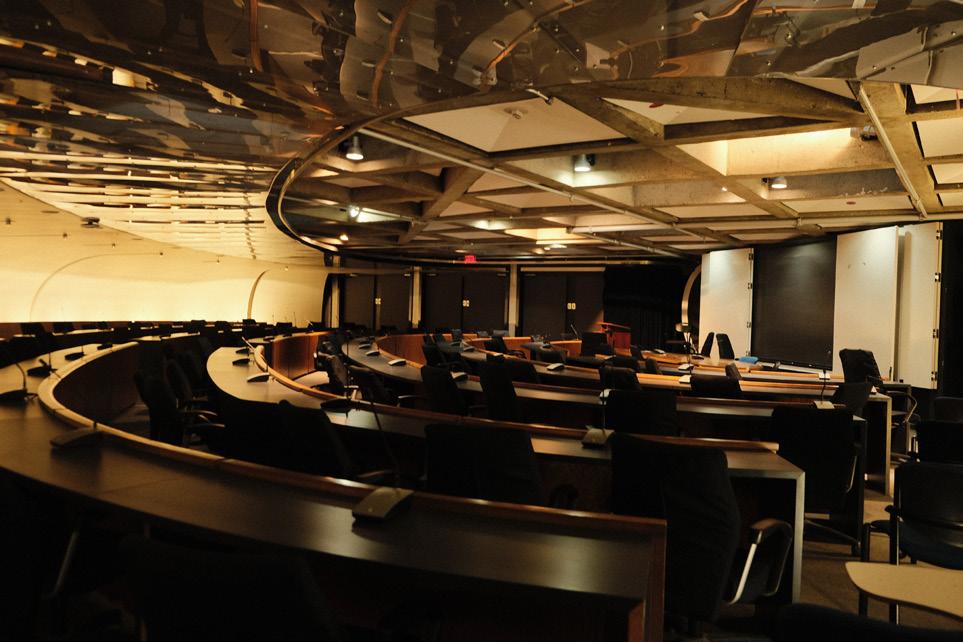
McGill Senate confronts the rise of AI and undergraduate enrolment pressures Senators weigh academic integrity as the university navigates rapid technological and institutional change
Jenna Durante Features Editor
On Feb. 11, the McGill Senate convened for its sixth meeting of the academic year. The senators discussed the Accountability and Implementation of the Policy of Assessment of Student Learning, the use of Artificial Intelligence (AI) in a broad university context, the proposed strategic plan on undergraduate enrolment and engagement, and the annual report on the Charter of Students’ Rights and Student Life and Learning.
The meeting commenced with three memorial tributes to late Associate Professor David Shannon of the Faculty of Medicine, Associate Professor Richard Hovey of the Faculty of Dental Medicine and Oral Health Science, and Professor Rachelle Keyserlingk of the Faculty of Education.
McGill’s President and Vice-Chancellor Deep Saini went on to share brief updates regarding international partnerships and university accomplishments. He noted that the Quebec National Assembly has resumed session, drawing attention to Bill 1, which aims to strengthen parliamentary sovereignty and could constrain certain legal challenges to provincial laws. He emphasized that academic freedom at the university level must remain protected. Saini also referenced Bill 9, which concerns secularism, expressing concern about its implications for teaching and campus life. He stressed that any legislative changes must preserve student autonomy and agency.
Turning to international initiatives, Saini highlighted McGill’s expanding global ties. During the 2026 World Governments Summit in Dubai, McGill signed a memorandum of understanding with the Khalifa Foundation to establish the United Arab EmiratesIndonesia Future Major Leaders program, with a donation from the foundation amounting to $17.5 million CAD. The initiative is built on more than 50 years of McGill’s collaboration with Indonesian education sectors and will focus on giving meaningful benefits to Indonesian students, educators, and institutions, while simultaneously providing support in areas of sustainability, engineering, and health care.
Saini concluded by celebrating McGill’s recent accomplishments. The university ranked in the global top three in 10 of 11 subject areas in the latest Times Higher Education subject rankings, with particularly strong performances in medical and health sciences, law, psychology, social sciences, and arts and humanities. Saini thanked the university community for their contributions to this achievement. He also wished luck to McGill athletes, coaches, and staff participating in the ongoing Milano Cortina 2026 Olympics.
The Senate moved to discuss the Accountability and Implementation of the Policy of Assessment of Student Learning, with senators reflecting on its rollout and areas for improvement. The policy is intended to provide a framework for assessment practices at McGill, aiming to advance student learning and well-being, support course instructors, and promote equity.
Senator Meghan Lai opened the discus-
sion by expressing gratitude for the work completed thus far. She then posed questions about next steps for resource engagement and stakeholder consultation.
In response, Senator Jérôme Fortier pointed to the early successes of the policy’s implementation.
“I think the success of the implementation was the willingness and openness to look at assessments a little bit differently,” Fortier said. “Through that principle-based approach […] there were many practices done very well over the years, but the policy actually didn’t reflect the pedagogical value of some of those practices.”
He further acknowledged ongoing challenges, particularly in developing effective rubrics and area-specific assessment frameworks.
“I think the biggest [challenge] was this question of rubrics, or how to support instructors in providing clear expectations for every assessment,” Fortier explained. “That’s not the practice of many parts of the university, and for some disciplines, it actually can be quite challenging to create a rubric that would really reflect the right way to assess on a certain task.”
Fortier concluded by highlighting the value of individual consultation and faculty drop-in sessions. He emphasized their focus on supporting instructors in developing courses using various pedagogical practices, and warned of potential difficulties in monitoring the policy going forward.
“It’s difficult to encourage change months or even a year ahead of when a course is delivered. So, in many cases, in an ideal world, all [learning] policies, when they’re adopted, they’re implemented right away. This was unique in having this long window of implementation, but it is difficult to plan that far ahead in many cases.”
Next, the Senate turned to an open discussion on the use of AI at McGill.
Framing the conversation, Associate Professor Christopher Buddle of the Department of Natural Resource Sciences emphasized that while he is not an expert in AI, the unprecedented speed of advancement in generative AI is a cause for concern. He described generative AI as a tool capable of producing text, code, and other outputs in response to prompts, noting that debates surrounding AI sit within a broader academic, governmental, and ethical ecosystem.
“Artificial Intelligence is not new to universities. AI [has] been used for decades, but what’s new is its visibility, accessibility, and the speed of the tools,” Buddle stated.
Senators then broke into 10 discussion groups before reconvening to share key points.
Across groups, senators identified potential academic benefits of AI, including its ability to aid research, support students with learning differences, assist with coding and industry workflows, and help students develop skills in evaluating AI-generated outputs. Several noted that familiarity with generative AI will likely soon be expected in many professions.
Concerns about academic integrity and authorship were also prominent. Senators raised questions about how to assess originality, how to recognize AI-assisted work,
and how grading practices may need to adapt. Some emphasized transparency and traceability as guiding principles, while others suggested developing a values-driven policy rather than rigid rules, given the rapidly evolving nature of the technology. Senators also raised environmental concerns, noting the high energy and water demands associated with AI systems.
“AI can support tutoring, drafting notes for studying, language support, accessibility, inclusion, research acceleration, and administrative efficiency,” Buddle stated. “Some of the challenges [concern] academic integrity. Who is the author? It’s the classic kind of question that could be important in high ed[ucation]. It’s been an important question for a long time, but again, that question has been accelerated.”
Several groups stressed the importance of faculty training and institutional clarity, such as creating an endorsed list of AI tools, integrating guidance into course syllabi, and providing education on safe and responsible AI use. Others emphasized that norms will emerge through practice and that flexibility will be necessary.
The discussion concluded with broad agreement that AI will shape the future of teaching and learning at McGill, though senators differed on what university policy will consist of and how it will be implemented.
The Senate then turned to discuss the proposed 2026-2030 Strategic Plan for Undergraduate Student Enrolment, led by Senator Angela Campbell.
The plan outlines four major priorities for guiding the university’s requirement mission: Transform, expand globally, anchor locally, and unite. The aim is to move beyond admissions numbers to consider access, engagement, and long-term student outcomes. Campbell emphasized coordinated efforts between central admissions and faculties, aiming to create an ‘end-to-end’—from recruitment to graduation—student experience while carefully shaping the composition of the student body.
“It’s not just the number of students that we’re thinking about when we recruit and admit students, but we’re thinking about the composition of our student demography, where we’re recruiting from, and how we are admitting our students,” Campbell said.
But enrollment is also tied to budget-
ing. Engineering and Commerce have seen significant growth, yet course capacity is strained. Senator Jan Kopyscinski warned that Engineering admissions may be too high, citing limited lab space. Senator Chloé Muñoz described overcrowded lecture halls, with students sitting on floors, and raised concerns about housing shortages and retention. Campbell acknowledged that other departments face similar pressures, especially during the add-drop period.
Timing also matters. If admissions offers go out too late—as Senator Elham Emami noted—McGill risks losing students to faster-moving universities. Ultimately, Campbell stressed that the goal is to “get the target right” by encouraging redistribution, relieving pressure on oversubscribed programs, and planning growth sustainably.
Lastly, the Senate briefly reviewed the Annual Report of the Advisory Council on the Charter of Students’ Rights, presented by Associate Professor and Interim Dean of the Faculty of Law Tina Piper for information, before moving to the Annual Report on Student Life and Learning.
Professor Anthony Mittermaier, who assumed the role of Interim Deputy Provost (Student Life & Learning) just last week, highlighted key achievements from 20242025, including the expanded use of preferred names and pronouns, an orientation welcoming over 700 students, upgraded digital systems, and the administration of a revised Student Code of Conduct. The Student Wellness Hub also served more than 5,000 students, with expanded support for Jewish, Muslim, 2SLGBTQIA+, Black, and Indigenous students.
Moment of the Meeting
Saini remarked that the flag would be lowered for the lives lost in a recent mass shooting in Tumbler Ridge, British Columbia, and shared his condolences in response to the senseless act of violence.
Soundbite
“AI does not simply change how work is done. It also raises questions about what institutions value, how learning is assessed, and how responsibility and accountability are distributed. So, it matters at McGill a great deal.”— Christopher Buddle.
PGSS council votes against SSMU food bank fee levy referendum question
The association’s members will lose access to SSMU’s food pantry at the end of the semester
Sarah-Maria Khoueiry
Copy Editor
On Feb. 11, the Post-Graduate Students’ Society of McGill University (PGSS) held its second council meeting of the semester to vote on which questions to include in its upcoming May referendum.
Councillors spent a significant portion of the meeting discussing issues regarding access to food on campus for graduate students. With the Students’ Society of McGill University’s (SSMU) closing of Midnight Kitchen (MK), the restricted access to SSMU’s alternative Free Lunch Program, and SSMU’s impending restrictions upon graduate students using the SSMU food bank, some councillors expressed worry over the lack of affordable food options on campus for their peers.
Secretary-General Sheheryar Ahmed presented a motion on this topic to approve the MK fee discontinuation referendum question, which annulled the previous $2 CAD fee per student per term that had gone toward the daily lunch program since MK’s closure.
“The second step will be a referendum question, probably in the fall, to do with the reallocation of the already collected funds from the Fall 2025 semester,” Ahmed said. “[SSMU’s] own internal regulations, as passed in their Legislative Council, would not extend us the access to their service at the $2 [CAD] level. We’d have to pass another referendum question to increase our contribution to their program, to the $8 [CAD] level, for them to give us access.”
Councillors unanimously voted in favour of the motion to approve the MK fee discontinuation referendum question.
PGSS council also discussed the situation concerning SSMU’s food bank fee levy. After PGSS suspended the MK fee, SSMU President Dymetri Taylor presented a motion to restrict PGSS members from accessing the SSMU food pantry during SSMU’s Jan. 15 Legislative Council meeting. However, following concerns over food security on campus, the Legislative Council passed an amendment to the motion to allow PGSS members to retain access to the pantry for the remainder of the Winter 2026 semester, given that 20 per cent of the pantry’s self-reported users are PGSS members.
Ahmed noted that introducing a PGSS fee levy would not resolve governance issues between the two associations, as there are currently
no plans to enter a Memorandum of Agreement (MoA) with SSMU over access to the food pantry.
“In the absence of [an MoA], there can be a lot of changes to the service without our consent,” Ahmed stated. “The various ways we have available to us when going into a partnership can include [an MoA]. It can also include seats on the board of directors of that entity [....] These are all very, very helpful safeguards, and in the absence of them, I personally don’t recommend adding this to the ballot.”
Ryan Olegario, a councillor representing McGill’s Chemistry Graduate Student Society (CGSS), expressed worry over the lack of alternatives available to graduate students.
“If this were to fall through, what are the other options that exist for food support of this nature on campus? Are there other options?” Olegario asked. “Because while I do agree that it may be dangerous to enter into an agreement like this without a proper memorandum, I think, for the time being, it also may be important to ensure that this fraction of students still be able to get this kind of food support.”
The PGSS council ultimately voted against including the SSMU food bank fee levy question in the referendum. With nine votes against, eight abstaining, and eight in favour of the motion, McGill’s graduate students will lose access to the food pantry at the end of the semester.
Moment of the Meeting
The council meeting ended after a second motion to extend the meeting by 30 minutes failed. As such, the motions to dissolve committees’ referendum questions were amended to become an omnibus vote motion.
Soundbite
“I am not against this fee, but I wish the executives could have been more clarifying on their intentions for the fee levy [....] This is just a comment for the future for executives, or in general, to be very clear and transparent about these things. It is unfortunate to have this interaction between executive and councillor.”–Ambre Lambert, CGSS councillor, after an exchange between Ahmed and Olegario over the membership fee increase referendum question to allocate funds to the creation of a new executive role.
SSMU LC discusses fee renewals, McLennan library, and DriveSafe
The Council approves fee increase for food pantry
Alexandra Lasser Arts & Entertainment Editor
The Students’ Society of McGill University’s (SSMU) Legislative Council (LC) convened for the third time this semester on Thursday, Feb. 12, beginning with an introduction of the new recording secretary, Alissa Gharzouzi. Vice-President (VP) Clubs and Services Hamza Abu Alkhair then proposed an amendment to the agenda, seeking to advance three motions moved by the Student Group Committee regarding group fees to the top, which were approved unanimously. Two motions regarded the World University Service of Canada (WUSC) Student Ref -
ugee Program fee, while the other pertained to the SSMU ECOLE Project fee, and all were passed after discussion.
The minutes from the Jan. 29 council meeting were then approved unanimously with no changes or amendments. This was followed by a report from the Steering Committee.
The announcement period followed, during which VP University Affairs Susan Aloudat gave an update on McLennan Library’s sixth floor.
“I am so happy to announce that the sixth floor of McLennan no longer has a mold problem, and that means that the new reflection zone is officially open,” Aloudat said. “It’s a space specifically for quiet meditation. I really encourage everyone to check it out, it’s a very unique space that no other library has, and I’m so glad it’s finally available.”
President Dymetri Taylor then delivered the executive reports, followed by VP Finance Jean-Sébastien Leger. Reports by councillors came next, with those from the Medical (MSS), Nursing (NUS), and Education (EdUS) undergraduate societies providing updates
on their respective responsibilities.
Next, Taylor moved a motion regarding the renewal of the McGill Writing Centre fee. He then put forward three more motions pertaining to the Student Services Ancillary Fee, a referendum question on the renewal of the University Centre fee, and the Anti-Violence Fee, all of which passed unanimously.
The Steering Committee’s motion to update the Standing Rules for the 20252026 SSMU Legislative Council was then passed unanimously, followed by a motion moved by VP External Seraphina CremaBlack to increase the SSMU Food Bank Fee by $1 CAD.
“At present, we restock the food pantry twice a week, and everything is gone in the 30 minutes after we restock it. So, obviously there’s [...] high demand,” Crema-Black said. “We have been expanding it to a full-on food bank as opposed to a food pantry, so we need more money so that we can stock a food bank as it should be stocked.”
After a brief recess, the council unanimously passed the last motion on the agenda regarding the SSMU Daycare fee, moved by Abu Alkhair.
The discussion period concluded the meeting, with Taylor introducing a plebiscite period where students could voice their opinions on the quorum for strikes.
“Right now it’s just 10 per cent of the students [who] need to participate in a vote to ratify it, going forward the question is [...] particularly for student strikes, whether that should be increased to 50, 40, 30, 20 or 15 per cent to determine is there a certain amount of students that we need a threshold of to actually go on strike,” Taylor said.
Moment of the Meeting
The discussion session’s second item concerned DriveSafe’s inoperable phone number last Friday. The mistake is being investigated to determine how the error occurred and to ensure it is not repeated.
Soundbite
“Last Friday, there was a Valentine’s Ball that was occurring at the University Centre. During this time, there was [...] an incident that often comes up when alcohol is involved unfortunately, to which Drivesafe was called to transport the individual home. However, the phone number unfortunately did not work, instead routed to a number in Montreal [...] to a gentleman who stated that he was very much not DriveSafe, [...] and would not be giving anyone rides.”— Dymetri Taylor.
Graduate students will vote in May on whether to renew their participation in the SSMU daycare fee until 2031. (Armen Erzingatzian / The Tribune)
The Council is composed of 30 councillors elected by specific constituencies. (Sophie Schuyler / The Tribune)
Social Media Editor Mariam Lakoande socialmedia@thetribune.ca
Business Manager Laura Pantaleon business@thetribune.ca
Canada’s AI strategy risks further propagating anti-Black racism
The Tribune Editorial Board
Continued from page 1.
AI systems already produce racial disparities in policing, immigration, facial recognition, hiring, loan rates, and health care allocation. These outcomes reflect the absence of marginalized voices within the designs of these systems and their strategies.
Workforce exclusion intensifies this as Black workers remain overrepresented in sectors most vulnerable to automation whilst underrepresented in the industries designing these systems, further widening racial wealth and labour gaps.
AI’s capacity to reinforce systemic discrimination is a product of its design; bound by the data it is trained on, AI replicates the discriminatory nature of its inputs and is unable to self-correct. An MIT study on facial recognition found near-
COMMENTARY
Abigail Kronenberg Contributor
Monica Colín Silva and her family moved to Quebec City from Mexico four years ago, during which she obtained a Master’s degree at Université Laval. After completing the program and becoming fluent in French, she felt hopeful for her path to permanent residency in Quebec.
perfect accuracy for light-skinned men but error rates exceeding 34 per cent for dark-skinned women, reflecting the lack of diversity and representation within the training datasets for such software.
Studies on large language models reveal similar dynamics: Prompts such as “Black people are ___” generate disproportionately negative traits and associations. Though overtly racist outputs have declined through corporate filtering, covert bias persists, with software assigning lower-paying jobs, harsher criminal outcomes, and deficit-based characterizations to Black individuals. Without representative development teams, transparent datasets, and continuous auditing, AI systems risk formalizing anti-Black racism within the infrastructures governing social and institutional life.
Generative AI also has significant environmental implications. Data centres require immense energy consumption, water extraction for cooling,
and the mining of minerals that drive ecosystem degradation and produce major carbon emissions. As these facilities proliferate, their environmental burdens are unevenly distributed.
Environmental racism scholarship has long documented how polluting infrastructure is disproportionately placed in marginalized communities.
This pattern is visible on a global scale, from contaminated water crises in predominantly Black municipalities to the concentration of industrial and digital infrastructure in racialized neighbourhoods. In Africville, a historic Black community in Halifax, residents were denied sewage and water services while landfills, slaughterhouses, and infectious disease facilities were built nearby, posing severe health risks to community members. As AI is increasingly integrated into urban planning and infrastructure modelling, such systems risk reproducing these same spatial inequalities, recommending the
placement of high-emission facilities in the very communities that already bear disproportionate environmental risk.
AI bias extends into education as well. Automated admissions, grading systems, and classroom tools are often deployed without critical oversight. Yet universities remain fundamentally underprepared. At McGill, AI governance is still framed primarily in terms of academic integrity rather than structural equity. While existing AI policies have acknowledged bias, they lack tangible enforcement mechanisms, shifting responsibility to individual students and instructors.
Canada’s AI strategy cannot be equitable without Black representation embedded at every level of design, regulation, and deployment. As AI infrastructure expands, Canada must now determine whether technological advancement will mitigate historical injustice or continue mechanizing it.
Quebec immigration reform has left bright minds behind
CONTRIBUTORS
Max Funge-Ripley, Abigail Kronenberg, Julia Lok Sophie Schuyler
In late 2024, the federal government started requiring postgraduation work permit applicants to take a language test. Colín Silva’s score of 427 on the written section of the required French exam fell one point short of the minimum 428 threshold. Because the permit is directly tied to the applicant’s authorization to work, Colín Silva’s failing score meant that neither she nor her husband would be eligible for employment in Quebec. Facing limited options to support her family, Colín Silva is preparing to return to Mexico.
While framed as measures to protect Quebec’s linguistic and economic priorities, these reforms place educated international graduates in a state of uncertainty, where years of academic achievement and language acquisition are undermined by shifting immigration policies.
The stricter language requirements are just one example of controversial policy changes
made to Quebec’s immigration system under Immigration Minister Jean-François Roberge this year. In September 2024, the government replaced the Quebec Experience Program (PEQ) with the new Skilled Worker Selection Program (PSTQ), shifting to a points-based system that evaluates applicants across several categories to determine how strongly they “match Quebec’s needs.” Roberge has argued that the new program allows Quebec to select workers in the sectors it considers most valuable, such as healthcare, education, and construction.
The PEQ’s dissolution has left thousands of international students, along with countless professors and other academics in Quebec, feeling suddenly abandoned, as it is almost impossible to predict one’s chances of being approved under the PSTQ. The point system leaves much to the government’s subjective interpretation of the value of one’s job instead of providing a clear checklist for hopeful applicants.
29.8 per cent of McGill’s student body of over 40,000 is made up of international students— and for many, repeated shifts in immigration policy can generate uncertainty around their chances of a future in Quebec. Quebec’s universities rely on international students for tuition and academic contributions during their studies, but its evolving immigration
framework has made long-term settlement far less predictable once those students graduate. For students like Colín Silva, the inherent issue lies not in Quebec’s desire to preserve French, but in how narrowly immigrants are defined under the law. When one score on an exam outweighs years of living, studying and working in French within Quebec’s institutions—including the completion of a Master’s degree in the language—it calls into question whether the current paths to permanent residency are fairly and holistically evaluating applicants.
Besides increased scrutiny on an applicant’s field of work, Quebec’s updated permanent residency pathways now require graduates to have completed at least three years’ worth, or 75 percent of their coursework in French, in order to qualify. For students who began their studies under previous criteria, the change has caused great anxiety, particularly for non-Francophone university students, as they now struggle to make up for the French coursework they’re missing.
When single factors such as line of work or language policy become the determinant in deciding who gets to stay and who must leave Quebec, the province sacrifices the minds of countless talented individuals whose stories, if considered through more holistic measures, would more than demonstrate their eagerness and dedication to contribute to the province’s workforce. While Quebec has the right to protect French and its cultural identity, rigid criteria excludes many graduates with proven intentions of contributing to Quebec in the long term. Colín Silva’s story demonstrates that she belongs in Quebec, and that the value her family can offer Quebec cannot be reduced to a single point on a standardized exam.
Shatner University Centre, 3480 McTavish, Suites 404, 405, 406
Simona Culotta, Defne Feyzioglu, Alexandra Hawes Silva, Lialah Mavani, Nour Khouri, Laura Pantaleon, Amy Xia
TPS BOARD OF DIRECTORS
OFFICE
Brooke Barak, Rachel Blackstone, Loriane Chagnon, Josette Chandler, Carla Cretin, José Moro Gutiérrez, Will Kennedy, Antoine Larocque, Sofia Lay, Lialah Mavani, Talia Moskowitz, Talia Moskowitz, Luca Paone,Julie Raout, Parisa Rasul, Alex Hawes Silva, Michelle Yankovsky, Ivanna Zhang Gwen Heffernan, Lilly Guilbeault, Emiko Kamiya, Alexa Roemer
Quebec was home to over 70,000 international students in 2025. (Mia Helfrich / The Tribune )
Defne Feyzioglu Opinion Editor
Nunavik’s disproportionately high suicide rate reveals colonialism’s
Content warning: Mentions of suicide
Feb. 2 to Feb. 8 marked Quebec’s Suicide Prevention Week. The province entered the awareness week with a statistic that sounds like a clear public health win: The suicide rate has dropped to 11.9 per 100,000 people, making it the lowest observed since 1981. However, this provincial average obscures the fact that progress has not occurred evenly across Quebec. The Institut national de sante publique du Québec (INSPQ) reports that Nunavik, an arctic region in Northern Quebec primarily inhabited by Inuit, had the highest suicide rate by far, with 122.7 suicides per 100,000 people—over 10 times more than the provincial average.
The uneven jump in suicide rates disproportionately affects Indigenous people in Canada, and this difference is not coincidental. If a region’s suicide rate is over 10 times higher than the rest of the province, this discrepancy cannot be explained as a statistical outlier. Nunavik’s case reflects the persistence of the deeply embedded power structures of colonialism, racial discrimination, and the intentional erasure of culture and language in the province.
Quebec’s suicide-prevention messaging often emphasizes reaching out, breaking the stigma around mental health, and reminding people that they are not alone. Those are not empty gestures, but stigma alone cannot explain a tenfold regional gap. This year’s campaign theme, “tendre la main,
soutenir l’espoir” (extend a hand, support hope), captures that emphasis on individual intervention and interpersonal relations as key to combating suicide.
But if awareness and social stigma were the main barriers, there wouldn’t be a stark geographic pattern; Nunavik’s disparate suicide rate instead points to an uneven landscape of support and access. In practice, ‘reaching out’ can take on very different meanings depending on whether suicide-prevention services are stable, staffed, culturally safe, and close enough to be accessed before a crisis escalates. A generalized campaign cannot, and should not, substitute consistent, local, and culturallygrounded care.
Research on the pervasive harms of Canada’s residential school system demonstrates that state policy has created intergenerational risk through family separation, abuse, and cultural suppression. A Western University study highlighted the link between increased rates of suicide, intergenerational trauma, and residential schooling. By forcibly separating children from their families and communities, residential schools also laid the groundwork that perpetuates downstream inequities and raises suicide risk today, including lower educational attainment, lower income, unstable employment, and poorer housing conditions.
INSPQ also noted that Nunavik lacks emergency rooms, and that consultations in its 14 local community service centres may not be as effective as ER visits elsewhere. When staffing is unstable and specialized services are concentrated at the two regional hospitals, this can result in time-sensitive delays and transfers.
With Nunavik’s small population of approximately 14,000, each death in the province carries an outsized statistical weight. In small, tightknit villages, the impact of a single suicide can ripple through extended families, peer groups, schools, and frontline workers, intensifying grief and strain on already limited support systems. Public health guidance on suicide clusters emphasizes that closely connected communities can face a heightened risk of additional deaths after an initial loss. This cascading vulnerability is itself a product of the structural conditions colonialism created: Isolated communities with minimal services bear disproportionate grief, with disproportionately fewer resources to absorb it.
Nunavik’s population is spread across 14 villages, ranging from roughly 200 to 2,000 residents each. (Anna Seger / The Tribune)
Prevention Week isn’t just whether reaching out matters—it’s applying that message to systems that people can actually reach. Culturally safe care is inseparable from addressing racism and power imbalances in service delivery.
The Quebec government must treat colonial policies as living determinants of health, not just features of history. When the province headlines its declining suicide rate, it obscures the systematic inequalities keeping Nunavik’s rate disproportionately high. The same report used by Quebec to demonstrate progress also shows where mental health programming has not translated into prevention outcomes and well-being.
The key imperative during Suicide
Nunavik’s disparate rate doesn’t erase Quebec’s progress, but it does complicate it. It suggests that any honest accounting of prevention has to hold two truths at once: The provincial average is falling, but regional crises remain severe. If Suicide Prevention Week is meant to describe the province’s reality—and not just offer a reassuring statistic—then local disparities are where the prevention has to begin.
If you or someone you know needs support, help is available 24/7 via suicide.ca or the AQPS.
COMMENTARY Point-Counterpoint: On the divine right of groundhogs
Julie Raout & Max Funge-Ripley
Staff Writer Contributor
Should one immortal groundhog be allowed to single-handedly colonize meteorology?
For the Divine Right of Groundhogs
The media is rich with speculation about The Most Honourable Punxsutawney Phil, the Pennsylvania native behind everyone’s favourite holiday: Groundhog Day. Some doubt his immortality—140 years of age is abnormal for a groundhog—but Phil is no ordinary groundhog. Others argue his eternal rule is undemocratic, a violation of popular will. Au contraire! Phil is a guardian of the United States and its people. No other hog could match his talent for serving the nation.
Look into his piercing eyes and dare question his coat’s lustre. His fur, denoting royal lineage, allows him to sip the Elixir of Life, a nectar every bit as crucial to the nation’s wellbeing as water.
Phil protects his nation, dictating appropriate February attire since 1886. In fact, he leverages his power to safeguard his country’s freedom. During the heat of World War II, Phil withheld a prediction altogether, unwilling to risk handing such potent climate information to enemies.
Those who doubt Phil’s accuracy only have themselves to blame. Climate change has rendered unrecognizable the weather patterns Phil once knew like the back of his furry little paw.
Sustainable climate action must accelerate—not simply for the planet, but for Phil.
Phil is a father and husband. He lives in a humble stump with his kin, devoted to the traditional values that make America great— protecting his burrow, serving his country, and speaking America’s true language: Groundhogese.
Quebec’s Fred la Marmotte’s recent passing is a poignant reminder that the U.S. is fortunate to have an immortal groundhog like Phil. Hopefully, his Canadian disciples will begin producing their own Elixir of Life, so that this painful transition of power between Freds might be the last.
All hail Most Honourable Punxsutawney Phil!
His divine power shall endure, protecting governmental institutions and serving as a beacon of hope for political order everywhere.
For a groundhog democracy
Tyranny corrupts even the best of groundhogs, and groundhog predictions are crucial for national security. The selection process cannot be left to nepotism. Yet Fred la Marmotte Junior did not earn his power; he inherited it after his father's death.
Groundhogs are Quebecers too, and they deserve a voice in groundhog authority. They are jolly participants in the province's community events, such as the Canadian Grand Prix, where they eagerly await their favourite Formula 1 drivers at the finish line.
At the Davos World Economic Forum, Prime Minister Mark Carney called for middle powers to pivot away from reliance on and imitation of the ultra-powerful. Might does not make right, a message that the young Fred ought to heed. His American counterpart, Punxsutawney Phil, has consolidated power, causing harm even here in Montreal by exploiting the rich local groundhog labour market.
As any McGill student who has spent time near Upper Residences knows, groundhogs are abundant in Montreal. Their prevalence has created tension at the Notre-Dame-des-Neiges cemetery, where they were discovered digging up graves.
No one should have to worry about groundhogs frolicking with their deceased family members. The root of this problem must be addressed. In this context, Phil’s Elixir of Life now appears troubling. How exactly is his serum crafted, and why is the recipe kept secret? Perhaps nefarious necromancy is afoot.
Clearly, Phil is outsourcing his vile elixir production process to Montreal, taking advantage of the weaker Canadian dollar and the large supply of groundhog labour to excavate bones for his mystical potion. Montrealers are subsidizing an American groundhog’s immortality, as loved ones are
snatched from their resting places to fulfill the fancies of a tyrant.
Fred’s arbitrarily bestowed power must be redistributed to the people.
All groundhogs should cooperate under one Union of the Groundhogs, by the Groundhogs, for the Groundhogs. Under this union, democracy shall be a vessel for careful experimentation with participants’ shadows and conscientious debate, leading to deliberative surveys and a unified announcement of the season’s upcoming weather.
Down with the Divine Right of groundhogs. Long live groundhog democracy.
F1 driver Max Verstappen narrowly avoided hitting a groundhog at the Canadian Grand Prix at Jean-Drapeau Park in 2024. (Gwen Heffernan / The Tribune )
Racial representation is missing from the world’s most beloved rom-coms A look at how Black people are represented in classic late ‘90s and early 2000s rom-coms
Julia Lok Contributor
Continued from cover.
The rom-coms that do include Black representation often reduce characters to caricatures like ‘The Black Best Friend,’ an attempt for productions to seem inclusive by diversifying the cast and narrative structure while still pushing a white-centric storyline. Take Gabrielle Union’s role as Chastity Church in 10 Things I Hate About You , the best friend of co-lead Bianca Stratford (Larisa Oleynik). At the end of the film, Chastity is villainized, whereas Bianca experiences a positive character arc. It is not a coincidence that Chastity is one of the only Black characters in the film.
Alongside her is Daryl Mitchell’s Mr. Morgan, the film’s Black English teacher. He is depicted as the ‘sassy’ Black character—another common cliche in film. Unlike Chastity, Mr. Morgan has the authority to be adored for his actions rather than villainized.
10 Things I Hate About You also exemplifies how passive inclusion of Black characters in the cast doesn’t qualify as authentic representation. Most of the Black representation exists as harmful stereotypes or underlying negligence of the Black character. Even when films highlight Black love stories, there’s often a condition of trauma or social struggle that affects the storyline. It’s uncommon that the industry shows Black couples experiencing love without hardship. To combat this industry-wide ig -
norance, fully developing Black characters in narratives and casting more Black actors in film and TV will address the film industry’s representational needs. Diversity isn’t a difficult feat to achieve; it simply requires active effort.
Black-led rom-coms do exist. However, they simply aren’t as popularized. Brown Sugar , Love and Basketball , and Love Jones are all fan favourites centering Black couples. But if we look at the worldwide box office earnings, How To Lose a Guy in 10 Days made over $178 million USD, whereas Brown Sugar , released a year before, made only a little over $28 million USD. This large difference in earnings illustrates how Black rom-coms are simply not prioritized in the film industry. White is the default of the majority of films, and it is what’s constantly advertised to consumers worldwide. Meanwhile, Black rom-coms are typically only marketed to Black people. There’s an imbalance in the distribution system that favours white nar -
ratives.
Rom-coms are essential to modernday pop culture. They provide comfort and hopeful love stories that shape our views on relationships. As such, these movies must go beyond telling the story of white characters and seek more racial diversity in their leads and storylines. Cast diversity is still lacking in Hollywood, and there remains a lack of care when writing non-white characters.
BIPOC representation matters because BIPOC matter; representation isn’t simply a character on screen, it is a different outlook on life, one where individuals from marginalized communities deserve to be appreciated, seen, and loved. Seeing someone who looks like you on the silver screen validates your lived experience, which is why representation matters.
McGill Classics Play brings a chilling new ‘Antigone’ into the modern The over-two-thousand-year-old play has never felt this electrifying
Dylan Hing Staff Writer
Sophocles is having a moment. The Ancient Greek playwright may be well over two millennia old, but his plays are seeing new life; his famed Oedipus Rex was recently adapted for an acclaimed Broadway run, and, here at McGill, his terrifying Antigone could not have been a more fitting choice for this year’s Classics Play.
Antigone , chronologically the last of Sophocles’s three Theban plays, culminates the story chronicled in Oedipus Rex and Oedipus at Colonus . In a move to modernize the work, translator Adam Zanin, adapter Caroline Little and director Madelyn Mackintosh set this production in the 1930s, on the heels of European fascism.
Starring Anelia Stanek, U2 Arts, as the eponymous daughter of Oedipus, the tragedy follows the rise of Oedipus’s advisor, Creon (Nikhil Girard, U3 Arts), to the throne of the city of Thebes after a violent civil war. His first act is to honour the fallen Eteocles, brother of Antigone, who fought to protect Thebes against their rebellious brother Polynices. For his treason, however, Creon denies the latter traditional Greek burial rites. The play’s conflict surrounds Antigone’s choice to bury her brother in spite of the edict.
Antigone’s actions create a storm in Thebes: Her sister, Ismene (Neela PercevalMaxwell, U1 Arts), disagrees with her, fearful of Creon’s wrath. It can be easy to scorn her as cowardly, but in an interview with The Tribune , Mackintosh provided a more sympathetic perspective on the character.
“Most of us, maybe, would like to be Antigone but are Ismene, and would not necessarily accept execution, even for the strongest principles,” Mackintosh said.
“But I don’t think that makes Ismene or anyone else weak [...] and I don’t think it’s a responsibility to all be martyrs, or to all be some unforeseen level of bravery. I think it is our responsibility to be as courageous as we can.”
Mackintosh’s direction brings out the play’s debate over what loyalty entails, humanizing the struggle of the fight for the audience. Much of it feels familiar even now; many of the play’s subjects, such as the tempting of fate and the idolization of leaders, resonate brightly.
“The show was written 2500 years ago, it’s set a hundred years ago,” Mackintosh said. “And it pulls on references from today, and I think it is demonstrative of the way that tyranny is cyclical and destructive that the same story is applicable in all of those contexts.”
In this regard, Sam Snyders, U4 Arts, takes his part as “The Bartender” seriously.
His near-constant presence throughout the production, as a spectator and aide to those in need, anchors him as the man who has witnessed and endured the cycle of tyranny. As the closest figure to a narrator, Snyder’s passionate performance brings with it anticipation and a will to fight.
While staying generally true to Sophocles’s original plot, there were several notable changes. One of them is the adaptation of the traditional Greek Chorus into a more modern ensemble; another is the introduction of death scenes, which were never performed in Ancient Greece. Together, these changes heighten drama in the production, resulting in a powerfully modern show that treats its source not just as history, but as a warning of what might be coming.
Ruminating on how Antigone mirrored the current state of U.S. politics, Mackintosh shared mixed emotions regarding global politics. Still, she highlighted a silver lining— that so many are willing to help keep Antigone’s fire alive through their work.
“A very significant part of
me wishes the show was not as prescient as I feel it is, but at the same time, I also think that is why it is necessary and why I’m really proud of it [...] a lot of people have put a lot of heart into the production, and I’m so incredibly proud of them.”
Antigone was the first composition of Sophocles’s three Theban plays, despite being the last in chronological order. (Janna Toubal)
In 2024, the most successful films featured casts of 41 per cent to 50 per cent BIPOC actors. (Mia Helfrich / The Tribune)
On Nov. 6, 2025, Quebec Minister of Immigration Jean-François Roberge abolished the Programme de l’expérience québécoise (PEQ), a program designed to help foreign students and workers obtain Canadian citizenship. This abolition erases the progress of those in this program, forcing them to seek different paths to citizenship. This measure is one of many that the government of Quebec has implemented in recent years to limit migration to the province, reflecting a broader trend throughout Canada to lock down on immigration while completely uprooting thousands of migrants’ lives.
Over the past sixty years, controversy around immigration in the political realm continues to increase dramatically. In 1971, Canada announced its commitment to multiculturalism; in 1972, Richard Swanson was celebrated as the 10 millionth immigrant since confed eration. Economically, immigration was applauded and appre ciated, but in the ear ly 1980s, migration entered Western politics as a highly debated issue follow ing increasing worries with work and housing insecurity. As a result, politicians in election sea son focused on appeas- ing their electorate rather than on undocumented immigrants, who are unable to vote.
police every day or every week.” These alternatives have been called for by Non-Governmental Organizations (NGO) for nearly 30 years, but they do not exist in immigration law. Rather, governments focus on punishments that bring electoral reward. Not only is the political display of detention an attempt at demonstrating heightened security measures, but the detention centres themselves simultaneously create jobs in, for example, construction work, management, and security. This is the core of the permacrisis: Politicians neglecting immigrants in order to appease the electorate.
“Most [migrants] are totally innocuous. They have a job. They’re solidly citizens in all aspects except their papers. As long as we don’t recognize that, well, our politicians are going to continue to peddle this idea that these are dangerous people and we need to take very harsh measures like deportation and detention to get rid of them or protect the citizenry from them,” Crépeau said.
Professor Emeritus in McGill’s Faculty of Law, François Crépeau, who specializes in migration and human rights law, explained the politics of migration in an interview with The Tribune. He described migration as an example of a ‘permacrisis,’ or a “long period of great difficulty, confusion, or suffering that seems to have no end,” arguing that political discourse around migration is often merely symbolic.
“Many immigration-related measures are essentially a discourse towards citizens,” Crépeau said. “If you increase deportations, it’s to tell the citizens, ‘Look, I’m protecting you better.’ At the same time, you’re spending a lot of taxpayers’ dollars, and you have to justify it. So you have to amplify the risk that those migrants are posing to society, and that’s why the discourse about the permacrisis is constantly amplified.”
One such example of this type of discourse came in 2012, when Canada altered its punitive measures for migrant smuggling. The law now mandates a maximum of 14 years’ imprisonment for bringing one migrant illegally, the same punishment as for sexual assault with a weapon. The punishment for bringing 10 or more people into Canada illegally is prison for life—the equivalent of a crime against humanity.
“The penalties that were decided by the Canadian government at that time were not designed to be implemented,” Crépeau said. “They were designed to send a message to the migrants, but most importantly, to the electorate. ‘Look how tough we are on crime.’”
Crépeau continued, explaining the myriad of mechanisms that can be invoked to avoid detention and deportation. He listed, “Bail, guarantors, house arrests, ankle bracelets, being housed with community organizations, reporting to the
In 2025 alone, Canada deported nearly 19,000 people—a sharp increase since 2022, when around 8,000 deportations occurred.
Solidarity Across Borders (SAB), a Montreal-based migrant justice network, has organized to confront Canada’s unjust immigration system since 2003. Shi Tao Zhang, a representative from SAB, spoke with The Tribune on the years-long injustices migrants have faced in Canada.
“Canadian Border Services Agency [CBSA] have yearly quotas of deportation and [...] they’ve increased their goal by 25 per cent for this fiscal year as compared to last year, which is very worrying to me personally, because I feel like they’re just treating human beings like numbers,” Zhang described. “At the end of the fiscal year to meet their quota, they’ll often ramp up deportation.”
Canada continues to deport and detain systematically in the name of political discourse and electoral reward, while thousands of migrants’ lives are violently uprooted.
THE LEGAL BLACK HOLE OF DETENTION
The basic human dignity afforded to all citizens under due process is not extended to migrants, placing them in a vulnerable space where detention sentences are irresolute and lives often unravel.
“When you’re in detention, your entire life stops. You become isolated from your family. You become isolated from everything. People lose essential pieces of their lives, people lose their jobs, people lose their housing and become homeless,” Zhang said.
Unlike jails or prisons, immigration detention is not formally punitive, but rather categorized as ‘administrative.’ Thus, it functions as a bureaucratic measure used to ensure removal, confirm identity, or address what authorities describe as a flight risk. Because it is not a criminal sentence, detainees are not serving time for an offence. Many have not been charged with any crime at all. While international human rights law outlines general protections for detained individuals, immigration detention operates in a grey zone. There is no fixed sentence, no guaranteed release date, and no trial determining guilt or innocence.
In Canada, detainees are subject to periodic detention reviews, but release is never guaranteed. If the CBSA argues that an individual is unlikely to appear for removal or poses a security concern, detention can continue for months or even years.
“You have international law about the rules for detention to respect the dignity of [prisoners]. They’re detained, but they’re not deprived of dignity. That doesn’t apply to detention centres, because this is administrative detention,” Crépeau explained. “It’s not a pre-trial detention or post-trial detention [....] They stay in detention for months or years on end, without any trial of any kind. And there’s no rule applying to that.”
As a result, the living conditions within these centres cannot be tracked. Even after release, migrants often remain undocumented, with any brutality witnessed inside the centres going unreported out of fear. Oversight mechanisms are limited, and because detention is administrative rather than criminal, it falls outside many of the reporting systems that govern prisons. Advocates argue that this opacity makes it difficult to track use of force, medical neglect, or prolonged confinement. Upon release, many migraants return to legal limbo: Unable to work, access housing, or report mistreatment without risking further scrutiny.
While much of the public scrutiny surrounding immigration detention has focused on the U.S., where footage of U.S. Immigration and Customs Enforcement (ICE) raids and overcrowded facilities circulate widely online, many Canadian advocates caution that this brutality is not a unique issue to the U.S. According to SAB, detainees across centres in Canada have described prolonged confinement with limited access to basic hygiene supplies, inconsistent medical attention, and restricted outdoor time.
“Because what ICE is doing is overtly brutal and deliberately cruel, it’s attracting a lot of attention because it’s being filmed and disseminated online. But I think what Canadians don’t realize [...] is CBSA is perpetrating the same types of violence on migrants here, but in silence, so no one really knows. They break into people’s rooms at night, they laugh at the children whose parents were arrested and make them cry,” Zhang said.
Just north of Montreal, the Laval Immigration Holding Centre houses individuals awaiting deportation. The centre operates within a distinct oversight structure, and much of its day-to-day management is contracted to private security—a practice that tends to diffuse responsibility. Beyond the concern of what happens inside the facility, very little of its operations are visible
to the broader public, and many detainees’ stories are only heard because of activist groups like SAB that communicate with detainees regularly.
“It’s this regime of administrative deten tion that’s sepa rate from the usual [...] carceral system, because in admin istrative de tention, they can technically keep you inside for as long as they want to,” Zhang said. “Unless you have a competent lawyer who inter venes, it’s usually very, very difficult, [...] it’s kind of like a black hole.”
The politics of protection How migration became a security issue and why politicians refuse to find solutions
OUTSOURCING ACCOUNTABILITY
As migration has increasingly been framed as a security concern rather than a humanitarian or administrative one, its enforcement expands beyond the CBSA, seeping into cities. Zhang described the key role the Service de Police de la Ville de Montreal (SPVM) has played in advancing detention and deportation, noting that even though Montreal became a sanctuary city in 2017—theoretically meaning that the SPVM is no longer supposed to collaborate with CBSA—both institutions still work closely together.
“In 2023, there were around 1,000 calls made from the SPVM to CBSA in terms of flagging or checking legal status,” Zhang explained. “There is something specific with the way the SPVM operates with CBSA with racial profiling [....] It is obviously more likely for someone who’s racialized to get stopped.”
Photojournalist William Wilson has reported on SPVM brutality at protests for nearly 10 years and spoke with The Tribune about how SPVM attitudes have changed towards the public in the past decade.
“Nowadays, the police are so intensely intimidating people [....] And that’s new. That’s totally new,” Wilson said. “10 years ago, they used to stay at a distance until the march got moving in the streets. But nowadays, it is just like they’re breathing down their neck the second they arrive.”
While public police remain central to interior enforcement, migration control is increasingly intertwined with private security actors operating under government contract. Specifically, there has recently been public outcry
Written by Kaitlyn Schramm, Managing Editor & Designed by Zoe Lee, Design Editor
over Canada’s involvement in U.S. deportation centres, with many protesting and signing petitions against the Montreal-based security company, GardaWorld. Despite the company’s leverage within American detention systems, it is a recent recipient of over $100 million CAD in Canadian government contracts since Mark Carney stepped in as prime minister. GardaWorld has security guards in detention centres across Canada, including at the Laval Immigration Holding Centre, as well as throughout some of the more controversial detention centres in the U.S. One such example is the South Florida Detention Facility, infamously nicknamed ‘Alligator Alcatraz,’ given its location situated amidst a moat of alligators.
Because private security firms operate under contractual agreements rather than public policing mandates, oversight mechanisms differ. Complaints processes, transparency requirements, and reporting obligations are often less visible to the public.
“[Security contractors] have a key advantage. The supervision of their activities is much more difficult, as long as you have the mil itary or the police, but you have oversight mechanisms, public oversight mechanisms that will report on what errors have been made and who did what [and] when, and you will get to the bottom of the thing,” Crépeau explained.
“[With private security], it’s not done outside. It’s done inside [...] where you have no journalists, no NGOs, no oversight mechanism.”
curity that day. He showed a video someone had filmed of him at the rally—10 or so guards completely surrounded him, with their shields, face coverings, and various intimidation tactics, while Wilson stood engulfed, holding his camera and yelling, “I’m a journalist.”
“They started beating the shit out of people, and I was screaming at them, ‘I can’t move, I can’t move. I have nowhere to go,’” Wilson recounted. “That was the biggest security operation I’ve seen [McGill] do. They must have hired at least 100 people just that day.”
This expansion reflects a broader cultural shift in which private security personnel assume roles once associated primarily with public police, often with fewer transparency requirements, and as oversight mechanisms struggle to keep pace, the expansion of private security reveals the deeper transformation in how migration—and public order—are governed and surveilled.
THE HUMAN COST OF POLITICAL DISCOURSE
The normalization of private security extends beyond detention infrastructure, as Montreal institutions increasingly rely on contracted security personnel to manage protests and campus unrest. GardaWorld manages security at 50 per cent of Canada’s airports and works with universities, maintaining a contractual relationship with McGill itself from Aug. 26, 2024, through April 30, 2027. As of 2024, Garda is McGill’s only private security, although they also hired Sirco in 2024 to dismantle the pro-Palestine encampment.
Around the same time, Wilson covered a pro-Palestine protest on McGill’s campus and described the tactics used by the private se-
Throughout debates on migration, the language of security has become increasingly dominant and invoked to justify border closures, the expansion of policing, and administrative detention. When migrants are cast as risks to be managed, enforcement measures can expand with limited public scrutiny; policies framed as procedural or preventative often carry deeply personal consequences. The validation of detention and deportation perpetuates the narrative that migrants are dangerous. Consequently, security frameworks surrounding the measures become normalized and embedded into public life. With the abolition of the PEQ and other measures like it, jobs are lost, families are separated, and lives are suspended in uncertainty. If the issue of migration begins as discourse, its consequences reverberate far beyond policy.
‘Bridgerton’
Season 4:
A peek behind the curtain Luke Thompson and Yerin Ha take centre stage as this season’s diamond couple
Loriane Chagnon Staff Writer
Warning: This piece contains spoilers.
Dearest Gentle Reader : It has come to my most attentive notice that this midterm season is hereby interrupted by the return of Netflix’s crown jewel, Bridgerton , which graces our screens with its fourth instalment. While young McGill students sharpen their minds in the hopes of succeeding in their upcoming examinations, they may find respite in this hit television series, which follows the lives of the Bridgerton family in a reimagined Regency-era England. An adaptation of Julia Quinn’s third novel from the Bridgerton series, An Offer from a Gentleman , the first part released on Jan. 29 with the second arriving Feb. 26. The fourth season explores the blossoming romance between second son and notorious rake Benedict Bridgerton (Luke Thompson) and Sophie Baek (Yerin Ha), the illegitimate daughter of a nobleman who is forced to become a maid by her evil stepmother. In this reimagined Cinderella story, the beloveds meet at a masquerade ball where Benedict falls hopelessly for Sophie, who is, well, not like other girls Dissatisfied with society women, whom he deems dull and uninteresting, Benedict has traded his faith in true love for short, passionate, and meaningless encounters. He finds, in Sophie, the infatuation for life that he has been secretly yearning for in
a partner, whilst pretending to be a freespirited bachelor. Unaware of her identity and social standing, he develops romantic feelings for her, which she reciprocates. Yet he cannot pursue her openly, since she is a maid and he, a gentleman.
For the first time, Bridgerton explores the upstairs-downstairs divide between the noble ton and the servant’s working class. Masters need servants to sustain their lifestyle, whilst servants depend on the masters for a living wage and employment. This season delves into the servants’ lived reality, class dynamics and the interdependence between those above and below. Bridgerton highlights how depersonalized that system is and how it keeps the lower class at the mercy of the upper class, exemplified notably when a young maid is treated in an untoward manner by a supposed gentleman, or in the uproar and confusion that the ton experiences because of the Maid Wars . Further, it exposes the unfairness of the fate of children born out of wedlock, who are kept out of society on account of their status as ‘illegitimate.’
This peek behind the curtain is a breath of fresh air, providing a new perspective by centring the narrative on the lives of servants for once. Both Sophie’s story and her romance with Benedict are authentic and a welcome departure from the last season. Ha’s acting is genuine and honest, and her chemistry with Thompson is refreshing. She revealed during her appearance on Royal Court, the YouTube show hosted by internet sensation Brittany
Broski, that she worked closely with showrunners to reimagine the role of Sophie, making her more authentic to her heritage. Most notably, she changed Sophie’s family name from Beckett to Baek. As the first East Asian lead of Bridgerton , she shines beside her co-star as a relatable character who deals with real-life problems whilst retaining her individuality. This comes across most notably when Sophie refuses Benedict’s offer to be his mistress despite her attraction to him. She has too much self-respect to debase herself in such a
way and teaches Benedict a well-deserved lesson.
Now, the ton feverishly awaits the next chapter of this season’s captivating drama. Lest we forget the people who make their lifestyle possible and hope that a happy ending soon befalls Ms. Baek and Mr. Bridgerton, who yearns to reunite with the lady in silver that he met at the ball. Until then, this author wishes you great success in your midterms and hopes that you find peace and wellness despite the cold and busy season.
With Valentine’s season ending, which fictional couples are your favourites? The Tribune’s roundup of the best couples in film
Lia James Staff Writer
Valentine’s Day may be behind us, but love is still in the air. From timeless classics to new movies in theatres, on-screen romance has a way of capturing the hearts of viewers. The Tribune has rounded up four of the most memorable couples in film.
Westley and Buttercup
Let’s start off with a classic: Westley and Buttercup, the lead couple from The Princess Bride. Magical and medieval, the movie consists of sword fights, fist fights, and fairytaleesque costumes, all in the name of love. Not only are Westley and Buttercup one of the most adorable and loyal couples, but the movie itself has a sense of whimsical nostalgia. Westley’s iconic line, “As you wish,” immediately hooks you into this relationship, making you realize that he will endlessly dedicate himself to Buttercup’s dreams.
Harry and Sally
If you are a fan of the friends-to-lovers trope, slow burn, and romantic comedies in general, you will love When Harry Met Sally This movie is a classic, and no love story has made me laugh nearly as much. The couple first meets at the end of university when they drive to New York City together, and though they don’t get along at first, they reconnect as friends years later. Their unmatched tension has
you rooting for them throughout the movie. Released in 1989, the comedy is timeless, and the characters are authentic and relatable. You may find yourself screaming at the TV screen, ‘Just get together already,’ but this slow burn is what makes their relationship absolute gold. If you are also a nostalgic McGill student from NYC, this heartwarming movie will make you feel at home.
Jon and Ygritte
One of the best TV show couples of all time: Jon and Ygritte from Game of Thrones These two are a fan favourite owing to their forbidden love and utterly tragic ending. The characters suit each other through their raw and natural chemistry, yet viewers knew that their love story was doomed from the start. Jon was originally Ygritte’s captor; the Night’s Watch and the Wildlings are rivals, leading to a wonderful enemies-to-lovers arc. When Jon holds Ygritte captive, he eventually joins her group, called the Free Folk. But seeing that the group goes against his morals, Jon leaves, abandoning Ygritte. They meet again in battle, and Jon holds her in his arms as she passes. Their final conversation discusses the cave where they first made love and how they never should have left each other—her final sentence: “You know nothing, Jon Snow.” This line highlights Jon’s initial ignorance towards the Free Folk and also emphasizes the cultural differences between him and Ygritte; differences which eventually led to their tragic ending.
Shrek and Fiona
Last but not least, Shrek and Fiona from Shrek. Shrek, an ogre in a swamp fairytale land, goes on an adventure to the kingdom of Duloc and finds the ruler Lord Farquaad, who wants to marry Princess Fiona. However, due to a curse that causes her to switch between human and ogre form, Fiona is confined to life in a tower. After Shrek rescues Fiona from this dragon-
guarded castle, they bond and fall in love. Long story short, they get married in the swamp, and Fiona’s true love’s kiss with the ogre breaks the curse. This couple reminds viewers that our expectation of love should not be based merely on looks or societal judgment, but rather on who will bring out the best version of ourselves—this is what makes Shrek and Fiona one of the best fictional couples of all time.
The actors of Jon and Ygritte in Game of Thrones fell in love while filming and are now married. (Lilly Guilbeault / The Tribune)
Classical arrangements of modern pop songs return with Taylor Swift’s ‘Enchanted’ and Pitbull’s ‘DJ Got Us Fallin’ in Love’. (Lilly Guilbeault / The Tribune)
OFF THE BOARD
A lesson from the neighbourhood cat
Tamiyana Roemer Student Life Editor
Ihave a friend who appears without warning, leaves without explanation, and never promises to return. He is profoundly unpredictable, given that he is a neighbourhood cat—but are the movements of human friends any more certain?
Manchego, lovingly nicknamed by my roommate Katie, is a beloved member of the Milton-Parc community. You’ve probably seen him on his daily patrol, climbing up fences and over mounds of
misplaced recycling in his ceaseless hunt for adventure and affection. And while you may even have been lucky enough to have pet the soft orange fur of his ears or hear the hum of his impressively loud purrs, my Reddit research on r/mcgill has informed me that recurrent encounters with him are a rarity. So it is with a hint of pride that I admit he visits me often, meowing needily at the patio door until I crack it open for him to slip inside.
While I imagine many of you are suppressing a bit of jealousy, (accurately) imagining this gentle ball of fur falling asleep on my chest or climbing on my shoulders while I make breakfast, I must also admit that his visits do not come without their inconveniences.
Manchego’s roguish explorations of the Montreal wilderness leave his paws perpetually muddy, poised to leave their mark on every surface he touches. And sometimes, much to Katie’s dismay, Manchego arrives with an unannounced plus-one, his standoffish brother who sours the scene with an unmistakable feline disinterest. Most unenviable of all, however, are the inexorable
itchy hives that cover my skin after each of Manchego’s visits—though I occasionally escape with the lesser sentence: hours of red, watering eyes.
And yet, this unappealing list has never once deterred me from letting Manchego in. Of course, each hassle could be largely mitigated by limiting our time together. I could open the door only just before laundry day, or when I’m feeling gracious enough to endure the unwelcome guest he brings, or on days when I can recover from an allergic reaction at home instead of sniffling through my classes. But, acutely aware that I cannot anticipate his next appearance, I always unlock the door.
It strikes me that I have granted this unpredictable feline friend a courtesy I have withheld from my more predictable companions. Trusting that they will remain, I have deferred their invitations, mistaking postponement for prudence. Armed with a litany of surmountable— albeit valid—excuses, I’ve ignored the fact that their presence is a brief and fragile gift.
Welcome home: A day in the life of a 2016 McGillian
Our loved ones will not always be available on our schedule. They may move to a new city, study abroad for a semester, accept a demanding job, or enter a relationship that takes up much of their time. The circumstances that bring us together are neither fixed nor guaranteed; they are contingent, unfolding, and often fleeting. For that reason, they are indelibly precious.
To be present with another person is to accept a measure of unpredictability—to make room for interruption and mess. To love people well is to resist the illusion that there will always be another opportunity at a more convenient time. When we enact patterns of postponements, we gradually stretch our presence into absence. Presence, then, is not merely a matter of physical nearness but of orientation. It’s the willingness to turn toward another person whenever the moment permits it. It is a form of attention, but also a form of faith—faith in the worth of ordinary moments. It is a belief that spontaneous participation is what gives a relationship its substance.
For some, reminiscing about 2016 means remembering a lighter, more carefree time
Rachel Blackstone Staff Writer
Iwake up to the sound of birds chirping after 9 hours of blissful sleep. As my eyelids flutter open, my Hipster Indie Boho Chic Urban Outfitters curtains soak up the September sun and drench my room in a haze so warm and rich I almost want to call it “Rio De Janeiro?” Before my feet hit the ground, I know that today is already perfect.
After throwing on my American Eagle skinny jeans, a loose tank top, and a flannel, I’m ready for the day. The sun hits my stack of rose gold bangles as I step out the door. I snap a quick pic on my new iPhone SE and upload it to Tumblr, not caring who sees it or how many interactions I get. I shared it because it made me happy. I go back and add a caption: #HappyThursYAY.
On my way to Starbucks, I listen to a new album that I can’t get enough of, Blonde by Frank Ocean. I order a venti Unicorn Frappuccino. To my surprise, they accidentally make two, and let me keep both. This day just keeps getting better.
I head to campus and surprise my friend, who’s going through a breakup, with the second drink. She tells me he wants to keep seeing her—only without a label. He misses her, she tells me, but the responsibility of being 21 makes him far too busy for “the relationship she deserves.” She describes her state of affairs as ‘being benched.’ A backup girlfriend, given just enough attention to stay at -
tached.
Sitting in my Comparative Politics lecture, my professor explains what the United Kingdom’s referendum to leave the European Union actually means. The UK has been a member of the European Union for 43 years. I think of all the history that has passed from then to now, and how exciting it feels to live through this moment in history. My friend interjects, pointing out how every moment of every day is a moment in history. He’s right, but nonetheless, it feels new to study a contemporary global event.
I race over to McLennan, eager to squeeze some reading in before heading home. All the floors are open, and the shelves are overflowing with books. Once I am settled at a desk, all optimism falters when I realize the sheer volume of my assigned readings. Two hours later, the weight of my readings only a month into the semester makes me plead with a higher power. I beg for a magical tool that could do my readings in seconds. It would break down the core concepts, I could access it at any time, but I would still learn everything I need to and ace all of my exams. Doesn’t that sound great and completely unproblematic? But alas, it is only 2016, so I sit in the library with nothing but full bookshelves and tired eyes.
Back at home for a quick meal before Bar des Arts (BdA), I treat myself to a rainbow bagel. Always up with the latest trends, this week’s BdA theme is “Pokemon Go-DA.” One of my roommates is going all out, creating a look with an uncanny resemblance to Pikachu. I decide to
keep it classy and focus on my makeup: A nude lip, arched eyebrows, cut crease eyeshadow, and everything matte. I put on a choker, switch my tank for a tube top, and I’m off to the races.
At BdA I drink a few too many Pabst Blue Ribbons and watch as the crowd attempts the Mannequin Challenge. Tonight feels endless in the best possible way. Right now, sitting in Leacock’s sweaty basement feels like the result of all the stars aligning. Gratitude fills me, and I think about where I will be 10 years from now. I vow to never let my optimism waver. I trust that the world will still be full of too much colour, light, and warmth to ever surrender to tyranny. My faith in our goodness
brings me to my feet. I dance around the room, “Closer” by The Chainsmokers fills my ears, and I slowly close my eyes.
Despite the glory of 2016, we mourned the life of George Michael. (Lilly Guilbeault / The Tribune)
Staying in Montreal over reading break? Here are the best mini-vacations in and around the city
Follow this guide to make the most of your week
Talia Moskowitz Staff Writer
Reading week is right around the corner for McGill students, providing a muchneeded respite from midterms, papers, and assignments that tend to accumulate midsemester. While many McGillians head home for break, or, if they’re lucky, take a vacation and escape the February chill, others will remain here. But don’t worry—The Tribune has put together a guide for some of the best minivacations in and around Montreal to make the most of this well-deserved time off.
Mont Tremblant
With snow still blanketing the slopes well into March, Mont Tremblant is an easily accessible day trip for McGill students staying in the city over break. For skiers and snowboarders, Mont Tremblant offers a variety of runs for all levels of experience. Mont Tremblant’s Village is quaint and cozy, complete with chalets, huts, and a lively après-ski scene after a day on the slopes. The mountain is just an hour-and-a-half drive from Montreal, and it takes about four
hours to reach via public transit.
Quebec City
Perfect for an overnight stay, Quebec City is a dreamy getaway rich in history, culture, and activities for McGill students to enjoy. Be sure to visit Old Quebec to be transported back to the 17th century with its cobblestone streets and historic Petit-Champlain district. Don’t miss the iconic Fairmont Le Château Frontenac, the stunning hotel overlooking the St. Lawrence River. Quebec City is a three-hour drive from Montreal, and around a three-and-a-half-hour train ride by VIA Rail, with ticket prices starting around $85 CAD.
Eastern Townships
The Eastern Townships region is just an hour and a half outside of Montreal, and is home to a wide range of vineyards and dairy farms to explore. Go for the day and embark on a wine route or cheese tour. Stop by some of Quebec’s most quaint towns, home to Manoir Hovey in North Hatley, Manoir Maplewood in Waterloo, and Auberge West Brome in West Brome. Spend some leisure time indulging in
off from school in Montreal
local specialties and farm-to-table meats and produce.
Marché aux Puces Saint-Michel
The Saint Michel Flea Market has every kind of trinket, accessory, jewelry, furniture, vinyl record and more to meet your most niche expectations. Don’t be fooled by the gritty exterior—this maze is full of the unexpected, with two sprawling floors to keep you busy. Take a stroll through the market and find that perfect item you didn’t even know you needed. Saint Michel’s Flea Market is 45 minutes away on the metro via the REM A train and Blue Line.
Omega Park
Escape the concrete jungle and return to nature at Omega Park, a drive-by safari experience where you can discover Canada’s wildlife and animals, such as bison, bears, elk, moose, and wolves in their natural habitat. Omega Park features 2200 acres of untouched nature that you can explore at your own pace on the
The unofficial tour guide’s guide to Montreal
Essential stops that don’t include Notre-Dame or the Biodome
Tamiyana Roemer Student Life Editor
Imust have missed the fine print when I enrolled at McGill. In my first year, when a sworn enemy from high school reached out to me for nightlife recommendations, I realized that accepting my offer of admission also meant accepting an unglamorous, unpaid part-time job as an unofficial tour guide to Montreal.
Residing in a city as unique as Montreal bestows many of us with the lofty responsibility of shaping the visits of all supplicants (friend or foe) who seek our insights. Unfortunately, owing to our student status, it may feel as though the only part of the city we’re truly experts on is the stretch between Docteur Penfield and Sherbrooke. Unwilling to admit our ignorance, we commit the predictable folly of half-heartedly recommending Notre Dame, Crew Cafe, or—perhaps worst of all—the Orange Julep. But Montreal’s reputation—and your own—is in your hands, and it’s not too late for the city to name you employee of the month.
La Banquise
It’s not often that a 24-hour restaurant is poised to impress. Yet, La Banquise can satisfy
Happy
a tourist’s interest in poutine at any time of day. This humble joint offers a classic poutine for the purists and newcomers, while churning out a menu full of unexpectedly delicious twists like La Paul Pogo—topped with onions, bacon, and, as the name suggests, pieces of Pogo.
Le Violon
Move aside, Joe Beef. Since opening its doors in 2024, Le Violon has taken Canada’s restaurant scene by storm, placing eleventh on the list of Canada’s 100 Best Restaurants and becoming the backdrop of an infamous photo of Katy Perry and Justin Trudeau. The menu leans French in spirit but plays freely with seasonal Quebec ingredients, resulting in an elegant rotation of dishes. Thoughtful plating, attentive service, and refined decor make it a solid representative of the contemporary Montreal food scene. While certainly a pricier restaurant by student standards, Le Violon is an excellent recommendation for those who’d like to splurge during their trip.
Pumpui
While Montreal is full of impressive upscale restaurants, it’s also home to a host of hip, casual spots that showcase the city’s culinary creativity. Among this variety, Pumpui is a standout. Seated in the vintage Thai diner-
guided route through the
will be
by friendly
your
all along the way, so make sure to bring some carrots for them to feast on. The park is around two hours away from Montreal by car—buckle up for a convenient safari adventure!
style booths, diners can enjoy a menu of nofrills curries, noodles, and salads that boast authentic flavours and satisfying portion sizes. Plus, the restaurant’s no-reservation policy makes it a great recommendation for a memorable last-minute meal when betterknown Montreal restaurants are characteristically fully booked.
Boutique Take Three
Tourists are bound to notice that Montreal is a surprisingly fashionable city. While people-watching, visitors may accidentally catch the shopping bug, and Zara, H&M, and Aritzia are powerless against this Montrealbased strain. Luckily, Boutique Take Three is curating a collection that responds to the city’s fashion needs. This Mile End gem combines meticulously selected second-hand treasures with pieces from local designers, ensuring every find feels both unique and quintessentially Montreal.
Baby Far West
Out of spite, I sent my high school enemy to Unity. But in the two years since then, I’ve reformed. For a true representation of the city’s superb nightlife, I now let travellers know that a Montreal tour should end with a night at Baby Far West. With its top-notch DJs, sultry
decor, and perfected cocktails (which are free for ladies every Wednesday), this bar offers more than the ideal space to dance. It’s also a labyrinth of small, intimate rooms, each with its own vibe, perfect for exploring with friends or escaping the dance floor for a brief respite. Whether your visitor is the type to sway to the music, chill on a lavish couch, or wander from room to room, Baby Far West guarantees an unforgettable night to round off a trip to Montreal.
wilderness. You
greeted
deer at
window
Relax, rejuvenate, and explore all Montreal and Quebec have to offer over reading week. (Gwen Heffernen / The Tribune)
Montreal has the second-highest number of restaurants per square mile in North America.
Alexa Roemer / The Tribune)
‘Not enough:’ How racial invalidation impacts the mental health of multiracial individuals The effects of intrafamilial racism on identity formation
Michelle Yankovsky Staff Writer
Despite facing unique forms of discrimination, multiracial people remain largely overlooked in research on the intersection of racism and mental health. Multiracial people not only experience racism from strangers, but also from within their own families—a phenomenon known as intrafamilial racism. This, in turn, is a risk factor for poorer mental health outcomes.
In a recent study published in Race and Social Problems , N. Keita Christophe, assistant professor in McGill’s Department of Psychology and principal investigator of the Cultural Developmental Science Lab, examined how biracial individuals experience racial identity invalidation—the experience of having one’s racial identity denied. While previous research has focused on racial invalidation in public settings, this study looked inward to examine how these dynamics unfold in family circles.
“Multiracial people are the fastest growing ethnic group in North America, and they’re already making up 10 to 15 per cent of the under 18 population,” Christophe said in an interview with The Tribune . “But at least in the type of stuff that I do, they make up one to three per cent of research, so I think there is a big gap.”
Christophe found that racial identity invalidation within families was not neces-
sarily more or less common in certain types of families; rather, the difference lies in how discrimination between family members presents itself.
“For multiracial folks interacting with people of colour (POC), I think there’s kind of those invalidation comments around them not being X enough, like ‘you’re not Black enough’ or ‘you’re not Asian enough,’ and denying membership into that [POC] identity,” Christophe said. “Whereas from white family members, it tends to be more around being a [POC]. So because of skin tone, you already feel like you won’t be accepted or you’re not similar to white people, even though you have some of that heritage.”
The study found that nearly half of the 383 biracial adults surveyed reported experiencing racial identity invalidation from at least one family member. Those who experienced invalidation reported lower self-esteem and higher social anxiety, highlighting how experiences of discrimination can lead to increased mental health risks.
Christophe emphasized that although multiracial individuals share similarities with other racialized individuals in their experiences of discrimination, they differ in who they endure discrimination from.
“The difference is that they might also be more likely to experience discrimination from the groups to which they belong, such as from those POC groups to which they belong.”
Chrisptophe also highlighted how inter-
sectional oppression plays into this phenomenon, where different axes of identity—race, gender, socioeconomic status, and sexuality—interact to create unique social positionalities for different people.
“Multiracial people also have intersectionality [within the element] of race,” Christophe said. “This kind of violates some longstanding notions of race as a binary [principle] and mutually exclusive category.”
Multiracial individuals often feel a stronger sense of connectedness or belonging to one group over another, and Christophe points out how these varying factors are worth investigating.
“[Some multiracial individuals] really identify a lot more strongly with one group over the other just because of how they look. They may be white or Black presenting, [cases in which] people wouldn’t clock them as being multiracial,” Christophe explained. “However, some multiracial people feel very comfortable with all of the different backgrounds that they are [a part of].”
Overall, Christophe aims to highlight multiracial individuals’ resilience in their experiences and how their identity can bring many unique and positive experiences.
“Just because there’s more complexity in the multiracial experience living in our racially charged society, doesn’t mean that being multiracial is bad. A lot of people have really positive senses of self and feel a lot of pride in their identity and experience really good mental health,” Christophe noted.
As the gap between the rapidly growing population of multiracial individuals and their underrepresentation in research grows, studies such as Christophe’s call attention to the importance of addressing the unique experiences multiracial communities face.
Started vaping to stop smoking? This medication may help you quit both Recent review finds promising evidence for Varenicline
José Moro Gutiérrez Staff Writer
Electronic cigarette usage has increased rapidly in recent years, with global estimates surpassing 100 million users. As vaping continues to grow in popularity, physicians and public health researchers are facing a difficult question: How should people quit a habit for which there is virtually no medical treatment consensus? A new clinical research review suggests the answer may already exist.
Tamila Varyvoda, a first-year student in McGill’s Faculty of Medicine and Health Sciences, found that varenicline—a medication prescribed to help people stop smoking cigarettes—may also help users quit vaping. The drug appears safe and potentially effective, though scientists emphasize that evidence is still developing.
Although vaping is often marketed as a safer alternative to smoking, it still administers nicotine, a substance that creates addiction by stimulating reward pathways in the brain. Despite growing concerns about its effects, there are no medications specifically approved to treat vaping dependency.
“Historically, teenagers were introduced to nicotine through cigarettes,” Varyvoda said in an interview with The Tribune. “Now that’s no longer the case. The first thing many young people try is vaping. When I was in CEGEP, there was literally an entrance where everyone would stand and vape. Seeing that made it clear that if we’re going to
help people quit nicotine addiction, we need treatments designed for this new reality [….] If there’s a time we need treatments to help people quit, it’s now.”
Researchers are intrigued by varenicline because, although it is typically used to help cigarette smokers quit, it is suspected that the medication could work for e-cigarette users as well. Varenicline targets the same brain receptors as nicotine, partially stimulating the receptor while blocking nicotine’s full effect, and thus maintaining a moderate dopamine release that reduces cravings and withdrawal symptoms.
To investigate this hypothesis, Varyvoda conducted a systematic review and metaanalysis, combining the results of three randomized controlled trials conducted between 2023 and 2025 in Europe and the United States.
Across those trials, 178 participants received varenicline while 177 received a placebo. Participants ranged in age from roughly their early twenties to mid-fifties, and about half were male. Treatments lasted between eight and 12 weeks, and participants were followed for up to 24 weeks. In addition to medication, many participants also received behavioural support such as counselling sessions or text-based quitting programs.
Researchers measured success primarily by whether participants stopped vaping. Results showed that people taking varenicline were estimated to be about twice as likely to achieve abstinence as those receiving a placebo, although the limited sample size pre-
vented any statistical significance.
“We couldn’t say, in good conscience, that varenicline was definitively effective yet,” Varyvoda explained. “Two of the trials showed clear benefits, but a smaller pilot study was inconclusive, which widened the confidence interval. Larger studies with longer follow-ups will likely clarify the effect, but right now the evidence points in a promising direction rather than a final answer.”
Stronger evidence appeared in secondary measures. Participants using varenicline were more than twice as likely to report not vaping within the previous week, both at the end of treatment and during followups. In two of the trials, continuous abstinence rates reached roughly 40 to 51 per cent in the varenicline groups compared to about 14 to 20 per cent in placebo groups at the end of treatment and remained higher months later.
Safety findings were reassuring as well. Serious adverse reactions occurred in zero to three per cent of participants. The most reported side effects included nausea, insomnia, and vivid dreams, which were typically mild and temporary. Overall, the drug did not produce a higher rate of serious complications compared to the placebo.
Varyvoda reiterated that evidence remains limited. With only three trials available, and one involv-
ing only 40 participants, the results are not necessarily conclusive. Differences in treatment length and how quitting was measured also reduced certainty in the findings. In any case, Varyvoda reminds us that quitting nicotine is a path worth pursuing.
“It’s never too late to take care of your health,” Varyvoda said. “Quitting nicotine is difficult, but the body can recover, and it’s always worth trying.”
McGill’s population has over 12,000 international students representing over 153 countries. (Mia Helfrich / The Tribune)
30 per cent of Canadians aged 20 to 24 reported having vaped in 2022. (Eliot Loose / The Tribune)
Improving Black and Latine youths’ sense of belonging in schools
Reflection as a means of
Antoine Larocque Staff Writer
Adolescence is a formative time for young people to define both who they are and who they hope to become. For Black and Latine youth, that journey often unfolds against a backdrop of historical barriers and discrimination in society as well as in educational settings, ultimately shaping how they see themselves, their future, and their place in school.
Negative stereotypes about academic ability, exposure to racism, and the lack of both role models and an institutional culture that reflects their identity are among the barriers affecting Black and Latine students’ identity and sense of belonging in school. Such barriers are not just individual shortcomings, but conditions that can affect students’ sense of belonging, confidence, and long-term engagement in school.
Régine Débrosse, an assisant professor at McGill’s School of Social Work, and her collaborators investigated whether simple, strength-based reflection activities could improve the academic persistence of Black and Latine adolescents.
In her study, participants were randomly assigned to three groups. The first group completed a community resourcefulness reflection, identifying strategies they could employ to help overcome obstacles to their ideal future. Participants in the second group completed a voice reflection, in which they were prompted
improving academic persistence
to reflect on situations in which they might be underrepresented and were encouraged to view their identity and perspective as strengths. The third group served as a control group and did not complete any reflection activities.
The participants then filled out a form assessing school belonging, academic persistence, and ethnic-ideal alignment—the connections between their racial/ethnic identity and their future identity.
“Both reflections improved markers of academic persistence by transforming adolescents’ experiences,” Débrosse wrote in an email to The Tribune
Altogether, the community resourcefulness and voice reflections both increased academic persistence of Black and Latine adolescents, but their effects depend on gender and operate through different psychological pathways.
Girls who completed the written community resourcefulness reflection reported greater alignment between their racial and ethnic identities and their ideal future self, which, in turn, predicted higher academic engagement. There was no measurable impact on the boys in this group.
However, both boys and girls who participated in the voice reflection reported greater belonging at school, which was associated with higher academic engagement.
Débrosse’s research highlights the importance of shifting away from deficit-based narratives in education and toward approaches that affirm students’ identities and lived experienc-
es. Her results also suggest that identity development during adolescence may be especially sensitive to targeted messages. Repeated opportunities for students to see their racial or ethnic background as aligned with long-term goals can reshape how young people relate to school and their futures and help nurture developmental pathways marked by sustained motivation and persistence.
The study design did not allow researchers to identify why community resourcefulness worked for Black and Latine girls but not boys.
The results also underscore the importance of intersectionality: Black and Latina girls appeared to benefit differently from the community resourcefulness reflection, potentially because they face distinct social expectations or tensions when imagining their futures.
“[This research] adds to work demonstrating the potential of highlighting people’s strengths and full experiences, especially people whose community is negatively stereotyped in a certain area,” Débrosse wrote.
The study also points to practical implications. For instance, schools might consider implementing structured reflection activities that both highlight community resilience and affirm students’ unique voices, particularly during key developmental transitions. However, Débrosse cautions that further research is needed, espe-
How socioeconomic inequality accelerates
cially given limitations such as small subgroup sample sizes and measurement constraints.
“[Future studies should examine] further the potential of strengths-based approaches, identity approaches that support expanding and connecting the different parts composing who each of us is, and of approaches that counter harmful narratives and make space for people to be their full selves,” Débrosse wrote.
Ultimately, the findings suggest that even brief, structured opportunities for reflection can meaningfully shape how adolescents see themselves in relation to school and their aspirations.
“It is powerful to go beyond common stories we hear about one another, and that incredible things happen when we focus on and lift each other’s strengths,” Débrosse wrote.
musculoskeletal decline
New research finds that bone and muscle loss in older adults is closely tied to socioeconomic status
Nell Pollak Managing Editor
As we get older, our muscles and bones gradually weaken, a progression that can lead to falls, fractures, and a devastating cycle of hospitalization and physical decline. But not everyone experiences this decline at the same rate—social and economic conditions over a lifetime can profoundly shape how the body ages, influencing access to nutrition, physical activity, and preventive health care. New research co-published by Gustavo Duque, the Dr. Joseph Kaufmann Chair in Geriatric Medicine and professor in McGill’s Department of Medicine, suggests that a patient’s position on the socioeconomic ladder may play a significant role in how quickly that deterioration occurs—and that the disadvantage begins well before a patient ever reaches a hospital.
The study examines the relationship between socioeconomic status (SES) and bone, muscle, and physical function in 300 community-dwelling adults aged 50 and older in the metropolitan region of Melbourne, Australia. Researchers measured five indicators of SES— education, income, employment, health care card ownership, and area-level disadvantage— against outcomes including bone mineral density, muscle mass, grip strength, gait speed, and leg power.
Notably, the researchers found that participants who completed post-secondary education had significantly higher bone mineral density, greater muscle mass, stronger handgrip strength, faster walking speed, and greater leg power
than those with less education. Higher income and possessing a private health care card—as opposed to a government health card—were similarly associated with better outcomes across most measures.
Duque said in an interview with The Tribune that the findings confirmed what the research team had long suspected.
“People with lower levels of income and lower levels of education […] were the ones who showed the worst situation in terms of muscle and bone,” Duque said.
One unexpected finding is that employed participants showed different patterns of deterioration, regardless of salary. Duque attributed this to the physical demands of their work, noting that those still employed tended to be active throughout the day. For those who were retired or unemployed and in the lowest socioeconomic brackets, however, the outcomes were markedly worse.
Osteoporosis, a condition characterized by low bone mineral density, which ultimately raises the risk of fractures, affects approximately 18 per cent of older adults globally. Sarcopenia, the progressive age-related loss of muscle mass and physical function, affects between 10 and 27 per cent of individuals over 60. Although a growing body of work links SES to musculoskeletal health, evidence on how social gradients operate in specific musculoskeletal conditions such as sarcopenia and osteoporosis remains limited. Prior studies have typically relied on secondary analyses of existing datasets rather than directly investigating the relationship.
Since the study is cross-sectional, it cap-
tures a snapshot of health outcomes at a given point in time and cannot determine whether interventions would prevent or reverse the disparities observed. Duque acknowledged this limitation, which is why his future research aims to explore the longitudinal impacts of socioeconomic status on bone and muscle decline.
The study also raises questions about health literacy—the ability to access, understand, and apply health information—as a potential mechanism linking a lower SES to worse musculoskeletal outcomes. Both osteoporosis and sarcopenia require patients to adopt and maintain lifestyle changes such as increased physical activity and dietary adjustments. However, lower education and income are strongly correlated with lower levels of health literacy, meaning that socially disadvantaged groups may be less likely to receive, understand, or act on prevention and treatment advice. Consequently, the same communities that enter older age with weaker bones and muscles are also the least equipped to access the information and resources needed to slow that decline, further entrenching existing disparities.
Duque stressed that prevention does not need to be expensive or complicated.
“It does not demand a lot of resources. A good physical activity can be done in a park or in a mountain,” Duque said. “There are some dietary recommendations, […] there are good sources of calcium that do not necessarily have to be very expensive.”
But he also emphasized that individual behaviour change alone is not enough, and that policy-level action is essential.
“We need a policy [....]The problem is that some of these policies are not necessarily applied, developed, or funded,” he said.
Duque’s team is now launching a Quebecbased screening project in collaboration with the World Health Organization to identify musculoskeletal decline early in older adults across the province. Musculoskeletal data cannot close the socioeconomic gap in bone and muscle health alone, but knowing where that gap starts is the first step toward designing interventions that effectively address it.
Musculoskeletal conditions affect an estimated 1.71 billion people worldwide, making them one of the leading contributors to disabilities worldwide. (Eliot Loose / The Tribune)
(Mia Helfrich / The Tribune)
The Harlem Globetrotters: A complicated piece of basketball’s history
More than a circus act—how the Globetrotters revolutionized the NBA
Will Kennedy Staff Writer
In 1950, Earl Lloyd, Chuck Cooper, and Nat “Sweetwater” Clifton entered the National Basketball Association (NBA) as the league’s first Black athletes. Cooper was the first to be drafted, Clifton was the first to sign an NBA contract, and Lloyd became the first Black player to enter an NBA game when he appeared on the court for the Washington Capitols in October of that year.
Prior to entering the NBA, Lloyd and Cooper had both played for the Harlem Globetrotters. While today the Globetrotters are seen more as a circus act than a basketball team, their role in the landscape of professional basketball is historically important.
The Harlem Globetrotters were originally founded in Illinois in the 1920s as the “Savoy Big Five,” a team that showcased Black talent at a time when segregation stopped Black players from playing in the professional league. They did not just happen to have Black players—they leaned into Black culture and identity. Later, the second iteration of the team branded itself as the “Harlem Globetrotters,” in reference to the Harlem Renaissance movement.
The team operated similarly to modern boxing, booking opponents and travelling around the globe to play in one-off games. Despite not being part of a formal basketball league, the Globetrotters dominated everywhere they went, with their most famous win taking place against Hall of Fame inductee
George Mikan and the Minneapolis Lakers, who later became the Los Angeles Lakers. The Globetrotters were so dominant that they were forced to incorporate elements of the circus act we know them for today, as crowds were starting to become bored of how easily they would win games.
The team’s dominance and popularity meant the NBA simply could no longer ignore Black talent knocking at its door. In 1950, the NBA began signing players from the Globetrotters and continued to do so for years afterwards. NBA legend Wilt Chamberlain played one season with the Globetrotters in 1958-59, during which he took part in a sold-out tour in the Soviet Union. The following season, Chamberlain became a member of the NBA’s Philadelphia Warriors, where he won league Most Valuable Player (MVP), All-Star Game MVP, and Rookie of the Year in his first season. Chamberlain went on to rewrite virtually every NBA record in existence, forever changing the game of basketball.
While the Globetrotters provided a platform for Black players, the team has its own complicated history with race. Team owner Abe Saperstein was a known racist who saw Black players solely as financial assets rather than as marginalized people whom he could be an ally to. The team used Harlem branding in an effort to profit from the cultural renaissance in Harlem, New York City, while enriching a team owner who was a racist.
Saperstein attempted to sign Boston Celtics legend and 11-time NBA champion Bill Russell in 1956. Russell notably refused
McGill varsity sports roundup
to play for the Globetrotters after Saperstein declined to speak with him directly during contract negotiations, instead speaking with Russell’s white college coach. While this may have worked with other players, Russell was one of the first professional athletes to use their platform to speak about racial injustice in America and to become a champion of civil rights. He was never going to stand for how the Globetrotters treated Black players just for a few extra dollars.
The Harlem Globetrotters’ role in basketball history is significant, but equally as complicated. The Globetrotters provided a
platform for Black players and became so dominant that the NBA could no longer keep its doors closed. On the flipside, they had an owner who clearly lacked respect for the Black players he employed while also profiting off the Harlem Renaissance. They were an organization deemed racially unjust by Bill Russell, one of the sport’s most significant players. Despite their prominence, they have been relegated to the status of basketball’s World Wrestling Entertainment (WWE) in recent years, when really they ought to be seen for what they are: An important piece of history.
Various season finales are set to pull on spectators’ heartstrings across multiple sports this week
Zain Ahmed Staff Writer
This past week delivered a wide array of results for McGill’s Redbirds and Martlets, with overtime heartbreak, senior celebrations, and a tough road loss setting the stage for the upcoming Winter semester regular season finales. From volleyball victory to hockey hurt, McGill teams battled across multiple venues as they prepared for their respective playoff pushes.
The Martlets Volleyball team banded together for a dramatic 3–2 victory over the École de technologie supérieure (ÉTS) Piranhas on Feb. 8 at Love Competition Hall. The match marked the squad’s first five-setter of the season, with McGill prevailing 25-17, 2515, 21-25, 19-25, 15-10.
Emma Waskiewicz recorded a matchhigh 16 kills while Selima Guidara dished out 38 assists in what proved to be a fitting home finale for the program’s graduating players. Seniors Guidara and Emilia Grigorova were fondly celebrated in a post-game ceremony following their final match at Love Competition Hall.
The victory lifted the young and slightly rebuilt Martlets squad to 7–13 on the season and snapped a six-match losing streak. McGill then travelled to Université du Québec à Trois-Rivières (UQTR), suffering a 2-3 defeat on Thursday before moving forward to wrap up the regular season against Laval University on Valentine’s Day, where they unfortunately fell short 1-3 against a relent-
less opposition.
Redbirds Hockey persisted through a difficult week on the road, dropping both of their games by painfully narrow margins. After a thrilling 3-2 overtime victory over the Queen’s University Gaels on Feb. 6, McGill unfortunately could not build and maintain its positive momentum in its subsequent matchups.
The week began with a heartbreaking 4-3 overtime loss to cross-town rival, the Concordia University Stingers, in the Corey Cup showdown on Feb. 7 at the Ed Meagher Arena. After battling back from a 2-0 deficit to take a 3-2 lead in the third period on Mathieu Gagnon’s goal, the Redbirds saw Concordia equalize and eventually prevail when captain Simon Lavigne scored on a breakaway in overtime.
The struggles continued Wednesday night with a 5-4 loss at Carleton University, leaving McGill with a 16–8–2 record leading up to their regular season finale. The Redbirds hosted the Ottawa University Gee-Gees on Valentine’s Day at the McConnell Arena in a dominant 4-0 victory in what was their final regular-season tilt before the OUA playoffs begin next week.
Bouncing over to basketball, the Martlets Basketball team suffered a disappointing 56-53 loss to the Bishop’s University Gaiters on Feb. 5 at Mitchell Gym, as a dominant second quarter from the Gaiters proved decisive. After leading 16-9 following the opening frame, McGill was outscored 23-12 in the second quarter, turning a seven-point ad-
vantage into a six-point halftime deficit they could never fully erase.
Emilia Diaz-Ruiz, still recovering from injury, paced McGill with 16 points and nine rebounds in 20 minutes off the bench. Lily Rose Chatila added 13 points and Daniella Mbengo contributed 12, but the Martlets struggled from beyond the arc, converting a faltering four of 20 three-point attempts.
The loss snapped McGill’s three-game winning streak and dropped them to 9–4, slipping into second place in the Réseau du sport étudiant du Québec (RSEQ) standings behind Laval University. However, a hard-fought victory in the late stages of their home win against Concordia (57-52) shifted their momentum heading into the last two games of the season against Laval and L’Université du Québec à Montréal (UQÀM). That being said, a comfortable first-seeded Laval team fought off the McGill momentum in Quebec City to close out another 57-52 victory, securing their spot at
the top of the rankings for the season. The Martlets, currently holding third place in the league, will be determined to secure a victory in their last game of the season.
As Redbirds and Martlets compete on home ice and courts in what is shaping up to be a bitter winter, a high-stakes playoff season looms ahead, giving the regular season finales added significance across all McGill programs. Teams will look to build momentum heading into the postseason, with strong performances serving as crucial confidence boosters before the stakes rise even higher. For McGill athletics, February has delivered its fair share of drama, but the most important games have yet to come.
McGill’s athletic venues include the historic Percival Molson Memorial Stadium, which hosted field hockey at the 1976 Montreal Olympics, and the newly renovated McConnell Arena. (Armen Erzingatzian / The Tribune)
Former Globetrotters owner Abe Saperstein is the Basketball Hall of Fame’s shortest inductee at 5’3”. (Mia Helfrich / The Tribune)
The NFL’s 2026 season is set to kick off with a record low three Black head coaches
EDI efforts have fallen short as Black candidates are consistently overlooked
Lialah Mavani Staff Writer
On Feb. 8, the National Football League (NFL)’s 2026 hiring cycle concluded. The 2025 season left 10 head coaching positions vacant, and no Black head coaches were hired to fill them for the upcoming season. The hiring cycle resulted in one minority hire, Tennessee Titans’ head coach Robert Saleh, who is of Lebanese descent. There are now only three Black head coaches in the league: The New York Jets’ Aaron Glenn, the Tampa Bay Buccaneers’ Todd Bowles, and the Houston Texans’ DeMeco Ryans. This marks the fifth time since 2003—the start of the Rooney Rule—during which no Black coaches were hired during a coaching cycle.
The Rooney Rule was adopted following the unjust firings of Black coaches Tony Dungy and Dennis Green, aiming to counteract the historically low number of minorities in head coaching positions. Originally, the policy required that every team with a head coach vacancy must interview at least one Black candidate before making a new hire.
After several changes over the following years, the current policy outlines three main rules. First, teams must interview at least two external minority candidates for head coaching vacancies and at least one external minority candidate for coordinator positions. In addition, they must interview at least one mi-
nority and/or female candidate for senior-level positions, such as team president and senior executive.
Second, as of 2022, clubs must conduct external interviews with a minority and/or female candidate for open quarterback coach positions, which are often a stepping stone to coordinator and head coaching jobs. The rule was implemented to help increase the pool of qualified minority coaches in the future.
Finally, the league introduced incentives for developing diverse talent. Teams with minority candidates who are later hired as head coaches or general managers will receive third-round compensatory picks for two
years, with an additional year awarded if both a coach and executive are hired elsewhere.
While the Rooney Rule aims to balance representation and diverse hiring within the league, its regulations ultimately do not dictate who occupies positions of power. According to a survey conducted in 2023 by The Institute for Diversity and Ethics in Sport (TIDES), Black athletes make up 53.5 per cent of the players in the NFL. However, in this season alone, the number of Black head coaches remains less than 10 per cent, occupying just three of 32 positions. The last time Black representation was this low was in 2002, before the adoption of the Rooney
Rule, when there were just two Black coaches in the entire league. The imbalance in head coaching roles highlights a broader power dynamic within the NFL: Black athletes overwhelmingly populate the field, yet decision-making authority remains in the hands of white coaches.
In a period when the United States is growing increasingly conservative, the issue of representation in sports is at the forefront of the conversation. Recently, U.S. President Donald J. Trump has moved to end federal government diversity, equity, and inclusion (DEI) programs, while many large companies are following suit.
While NFL commissioner Roger Goodell has stated his continuous commitment to “diversity efforts” in the league, it is clear that the NFL has failed to deliver on its promise of DEI.
Following the backlash of the recent hiring cycle, Goodell has reflected that the league needs to reevaluate its approaches to minority hiring. Yet, the shortcomings of the Rooney Rule should not be taken as proof that diversity policies are unnecessary. Rather, they expose the limits of such rules in confronting and dismantling deeply embedded institutional racism. Interview mandates alone cannot dismantle power structures that have historically excluded Black leadership. If anything, the NFL’s continued disparities underscore that these policies are a starting point, and that more meaningful reform is needed.
The price of daring to be great: What Lindsey Vonn’s crash says about elite sport’s hardest decision
When greatness is built on pushing limits, stepping back can feel more dangerous than forging ahead
Jenna Payette Staff Writer
13 seconds. That is all it took for an iconic Olympic comeback to collapse into chaos.
One moment, Lindsey Vonn was charging down the Olimpia delle Tofane at highway speeds. The next, she was tumbling violently down the hill, skis dangerously strapped in as her body crumbled. A stunned silence blanketed Cortina d’Ampezzo while medics rushed to the slope.
The crowd watched anxiously as a stretcher bed dangled in the wind below a helicopter, which would airlift Vonn away. She had suffered a complex tibial fracture just nine days after completely rupturing her anterior cruciate ligament (ACL). For many, it was a grim sense of déjà vu: Another brutal crash, another potential careerending injury.
But once the shock faded, a question remained: In elite sport, who decides when an athlete is truly ready to return from injury?
The stakes are immense because Vonn’s legacy is enormous. This was not a reckless newcomer chasing headlines, but one of history’s most decorated skiers—an Olympic downhill champion and multi-time World Cup winner who spent two decades mastering a highly dangerous sport.
Athletes at this echelon understand risk intimately. It is woven into every choice they make. This experience suggests that Vonn’s decision to race with a completely ruptured ACL was not an
act of carelessness, but of conviction.
At the heart of the debate is athlete autonomy. Elite competitors spend years developing an almost forensic awareness of their bodies. They know the difference between pain and injury, fatigue and failure, fear and focus. In downhill skiing, where racers hurtle down thin snow at breakneck speeds, readiness cannot be reduced to a scan or a checklist. Confidence, reflexes, and instinct matter just as much as ligament integrity. To deprive an athlete of the final decision feels, to many, like stripping them of ownership over their own lives.
However, medical science complicates this narrative. Doctors are trained to see what competitors are incentivized to ignore. While an athlete faces different external and internal pressures—national expectations, sponsorships, and the haunting fear of a closing ‘window’—a physician sees the mechanical reality. A compromised joint increases the probability of catastrophic failure, regardless of how sharp a racer may feel in training. This creates a difficult dilemma: Should medical teams hold absolute veto power while medals and careers hang in the balance?
In a definitive sense, Vonn’s crash was probably not preventable. Downhill skiing routinely claims perfectly healthy racers. This particular accident began with a single, technical mistake— a clipped gate and lost balance. Yet, repeated serious injuries inevitably shift the conversation toward recovery standards and risk tolerance. In the high-velocity world of alpine racing, the
distinction between a freak accident and a foreseeable disaster is often only visible in hindsight—and in Vonn’s case, the timing offered some relief: She was reassured that her ruptured ACL had played no role in her Olympic crash just days later.
Another dimension of the debate is the gendered lens through which the public evaluates high-stakes decisions by women in sport. When women in sport make high-risk decisions that end poorly, the backlash is often merciless. The rhetoric that “she should have known when to quit” ignores the psychological gravity of elite competition. For these athletes, retirement is not a simple career change: It is often an identity crisis. Had Vonn chosen safety over the start gate, the ‘what if?’ might have haunted her longer than any physical fracture.
Lindsey Vonn began racing at just seven years old, quickly proving herself an exceptional talent and advancing to international competitions by the age of nine. (Zoe Lee / The Tribune)
deem ‘reasonable.’ At that point, ambition is recast as irresponsibility.
We see this double standard often. When Simone Biles withdrew from Olympic events to prioritize her mental health, she initially faced backlash before later being hailed as a pioneer. When Serena Williams returned from lifethreatening childbirth complications, her ambition was celebrated until her results wavered.
Women are often applauded for their determination only until it pushes past what spectators
The reality is that for an athlete like Vonn, there is no ‘right’ choice: Compete and risk disaster, or step aside and endure a lifetime of regret. Following her crash, Vonn wrote in an Instagram post, “I hope if you take away anything from my journey it’s that you all have the courage to dare greatly.” For those whose identities are forged in the arena of sport, her words serve as a reminder that both racing and walking away carry a heavy cost—and that the courage to choose, however imperfectly, is what defines greatness.
Raiders head coach Art Shell was the first Black head coach in modern NFL history. (Zoe Lee / The Tribune)