Medical revision: Putting women in the narrative FEATURE PGS. 8-9
‘Cutlass:’
McGill regularly presents itself as an open and accessible campus, dedicated to offering the “best possible education” while ensuring academic freedom, equity, and inclusivity. Yet the university’s newly proposed Identification Policy for Access to Properties Owned, Occupied, or Used by the University, presented to the McGill Senate on Jan. 14, is grounded in a different premise altogether: That the university’s openness is contingent upon identification, monitoring, and the ability to regulate who inhabits its public spaces. Presented informationally to the Senate, the policy now moves directly to the Board of Governors for approval.
The proposed Identification Policy would empower “authorized personnel” to demand students, faculty, or visitors to produce McGill or government-issued identification and, if necessary, remove face-coverings for identity verification. The policy outlines several “legitimate purposes” for requesting ID: Supporting the integrity of campus or online activities, upholding university policies, ensuring the physical safety of community members, and protecting McGill property.
Although McGill frames the proposed Identification Policy as a neutral tool for campus safety, it extends discretionary surveillance powers across campus. In practice, this framework risks uneven enforcement while independently discouraging student organizing and entrenching a carceral approach to campus governance.
Impactful
Lia James Contributor
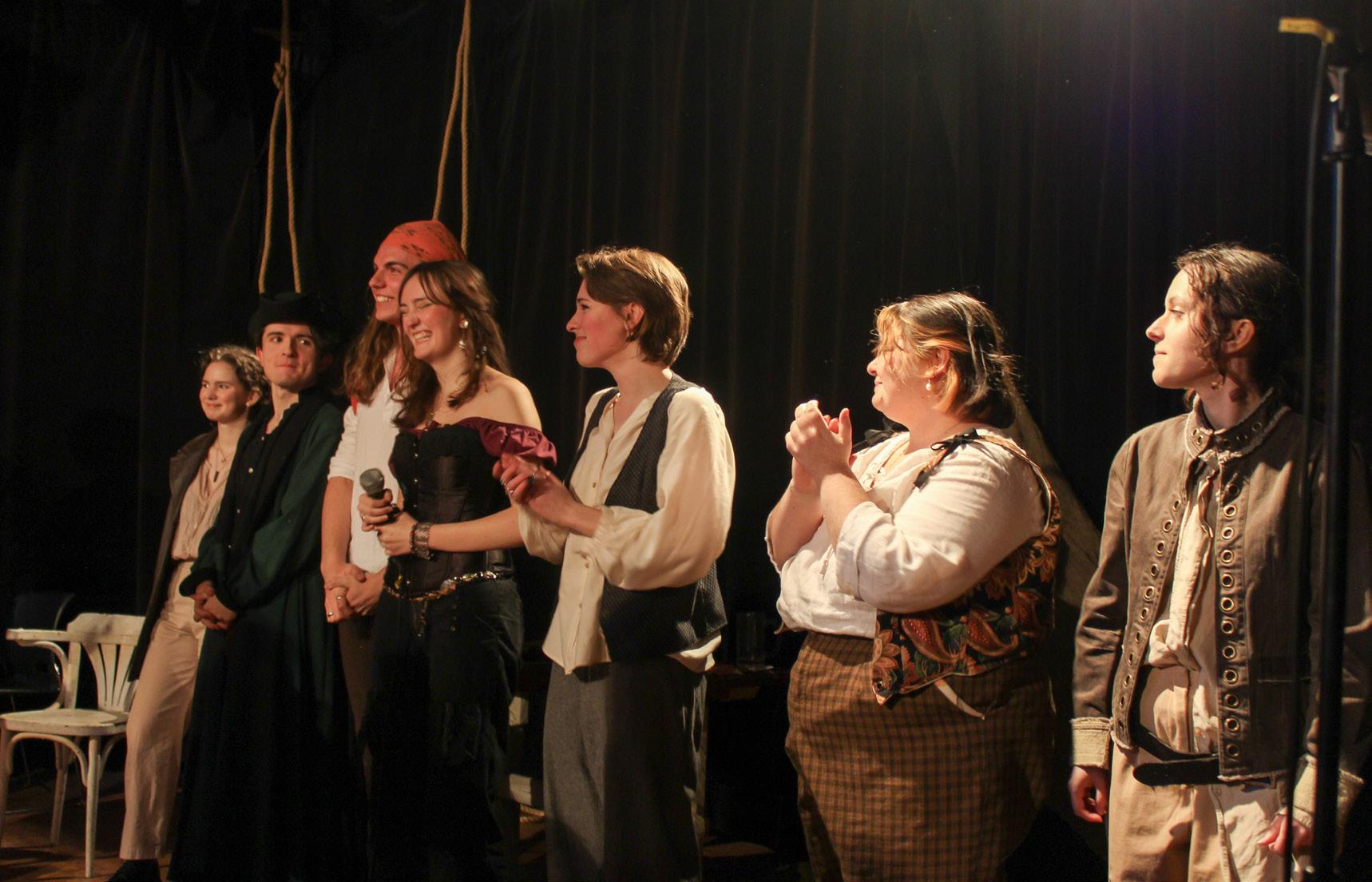
Jan. 15 marked the opening night for Cutlass ’s debut workshop performance at Tuesday Night Café Theatre, directed by Ruby Isaacs and written by Elise Holbrook. The show follows pirates Anne Bonny (Elise Holbrook, U2 Music Composition) and Mary Read (Abby Wyland, U3 Art History Honours), who sailed the Caribbean in the summer of 1720. Both Anne and Mary disguised themselves as men on their excursion to ensure their safety, but the moment they discovered their mutual secret, their rela
tionship ignited.
The show features a live band of cello, violin, and piano, which elevates the drama in each scene. The score spans a wide range of emotions, with the cello evoking a dark moodiness while the piano uplifts the score, conveying excitement. The dialogue also drives the emotional rollercoaster: You’ll laugh at the absurd jokes made by the comedic-relief pirates, then cry as Anne and Mary’s relationship faces its tragic fate.
Anne is a complex character whose story completely enraptures the audience. She is eccentric and angry, yet her chaotic humour makes her lovable.
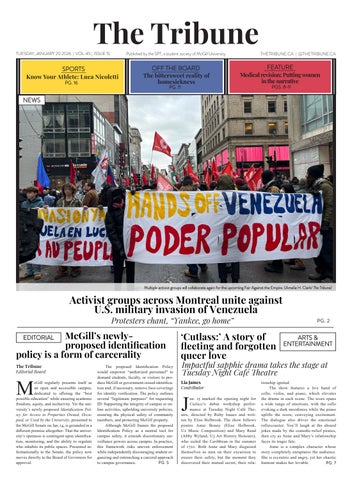
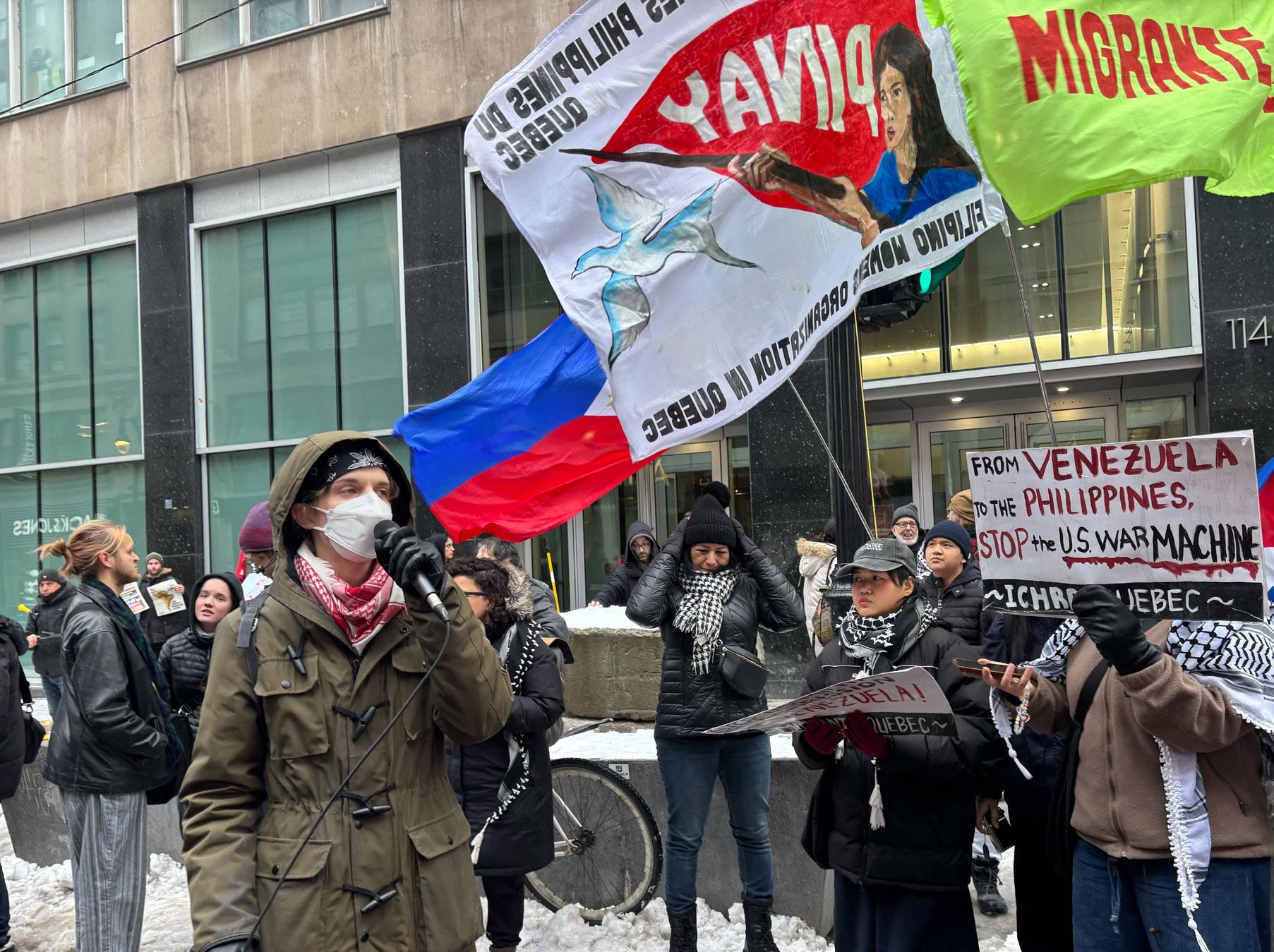
Multiple activist groups will collaborate again for the upcoming Fair Against the Empire. (Amelia H. Clark/ The Tribune) PG. 2
Activist groups across Montreal unite against U.S. military invasion of Venezuela Protesters chant, “Yankee, go home”
Amelia H. Clark News Editor
On Jan. 11, 10 activist groups in Montreal joined together for a demonstration against the military invasion of Venezuela. The protest began at 2:00 p.m. at 1134 rue St.-Catherine Ouest, with members of each group holding signs representing their organizations and condemning the United States’ recent actions in Venezuela.
The United States Army’s Delta Force unit conducted ‘Operation Absolute Resolve’ on Jan. 3. The military mission captured and transported the president of Venezuela Nicolás Maduro and First Lady Cilia Flores to Manhattan for prosecution on charges of conspiracy to possess and the possession of machine guns and destructive devices, as well as conspiracy to import cocaine. Maduro has also been charged with narco-terrorism.
Operation Absolute Resolve follows escalating U.S. military interventions in Venezuela, with the intention to curb drug trafficking from South America into the U.S. On Sept. 2, U.S. President Donald Trump carried out the first military strike on a water vessel connected to the drug trade. All 11 people on board were killed in what Democratic senators have likened to execution without trial. 34 additional strikes were conducted between then and Jan. 3, killing at least 115 people. The United Nations has described it as a violation of international human rights law.
Following Maduro’s capture, there have been mixed reactions among Venezuelans. While some citizens have expressed gratitude for the United States’ interference given Maduro’s history of corruption, others have expressed deep concern for Trump’s plans for the U.S. to run Venezuela in Maduro’s absence.
In Montreal, protesters focused on
how U.S. interference could harm the already shaky democratic system in Venezuela, allowing the U.S. to take advantage of the power vacuum for its own economic gain.
The Revolutionary Communist Party (RCI) held a table on the corner of rue St.Catherine and rue Stanley, where the demonstration was set to begin. They offered informative pamphlets on their mission as well as reading materials on capitalism and imperialism across the globe.
In an interview with The Tribune , a representative from the RCI, who wished to remain anonymous, explained that the United States’ intervention in Venezuela is directly tied to capitalistic motives, claiming that Trump was not seeking to free those in Venezuela from dictatorship, but to instead gain access to the largest oil reserves in the world.
“We know that there are people in Venezuela who are partying right now because Maduro is gone, but I believe that this positive energy will soon go away because the conditions there will not get better,” the representative said. “If you kidnap some politician, or you kill them, it’s not gonna make a change.”
have no moral high ground to take, [...] especially if you are a settler here, accepting comfort at the expense of Indigenous Peoples or any peoples throughout the world.”
The crowd of protesters began to march down rue St.-Catherine, periodically pausing to light American flags on fire. At the corner of rue St.-Catherine and av. Union, the march came into contact with a separate protest for Palestine. The two joined together as one voice, both crowds chanting, “Free, free Palestine.” One protester brought an Israeli flag to be burned alongside the American one. The march continued on, with the pro-Palestinian crowd moving in a separate direction.
A demonstration organizer from Socialist Unity who wished to remain anonymous shared with The Tribune that this meeting was coincidental, and that the solidarity between the two groups is a naturally occurring outcome of similar fights against imperialism across the globe.
At around 2:30 p.m., an event organizer made a speech to launch the march. The organizer explained that while demonstrations such as this one are effective at rallying the public, they often go unnoticed by government officials who can take meaningful legal action.
“I thank you for your camaraderie, for coming out, but we need to think about what comes next,” the organizer said. “We don’t want to just keep doing the same thing and going through the motions and sending petitions to a government that, quite frankly, doesn’t give a single fuck about us.”
The event organizer also emphasized the need for Canadians to take a more vocal stance against imperialism in their daily lives, calling for citizens to observe and criticize the country’s own colonial history alongside that of the United States.
“I wanted to speak to our position here in the imperial core, or at least in the embarrassing appendage to the imperial court that is the USA,” they said. “We
“There is a role for every person on Canadian soil to play, to stand in solidarity with the Venezuelan people, to defend the achievements of the Bolivarian revolution, and to resist imperial aggression,” they said. “Everybody who’s here needs to be talking to the people in their lives […] to come up with the strategies that are going to make a difference beyond just protesting in the streets [….] It’s good to bring people together, but if we keep only protesting, then we’re not going to make any significant difference.”
The march concluded at Complexe Guy-Favreau, where protesters gathered to hear speeches from each activist group before departing.
Jela de la Peña, a representative of Anakbayan Montreal, a Filipino youth organization dedicated to fighting for social democracy with a socialist perspective, told the crowd that working-class people bear the hardest consequences of imperialist action. She further stated that exploitation through conquest, such as that of the United States’ intervention in Venezuela, is a tactic often used by imperialist forces.
“Filipinos and Venezuela are bound by the same imperialist fists. The same system that drove bombs on Mindoro, Philippines, is the same system that has bombed, sanctioned, and strangled Venezuela for decades,” de la Peña said. “This is about silence. Venezuelans know this pattern well, just like we are told Venezuela is a narco state, that its leaders are criminals. These are old lies. These are recycled propaganda […] used to justify invasion, sanctions, coup and plunder.”
De la Peña continued, echoing the sentiments of several other activist groups present.
“Why Venezuela? Because it holds the largest proven oil reserves in the world […] The U.S. monopoly capitalists do not care about Venezuela. It does not care about people. It only cares about profit, about control, about domination. This is why […] Filipino and Venezuelan struggles are inseparable. Our shared enemy is U.S. imperialism,” de la Peña said. “Together, we say our lives are not collateral, our lands are not for sale, and together, across borders, we refuse to be silenced.”
Multiple activist groups will collaborate again for the upcoming Fair Against the Empire. (Amelia H. Clark / The Tribune)
McGill Senate discusses
identification policy, election rules, and budget
outlook Senators
raise concerns over student rights, security, and election procedures
Ellen Lurie Opinion Editor
On Jan. 14, the McGill Senate convened for its first meeting of the Winter 2026 Semester, discussing a proposed codification of the Senate’s electoral procedures, a draft identification policy governing access to university spaces, and McGill’s budget outlook for the 2026-2027 fiscal year.
The meeting began with McGill’s President and Vice-Chancellor Deep Saini’s opening remarks, in which he gave thanks to outgoing Provost and Executive Vice-President Academic Christopher Manfredi. Saini announced in November that current Interim Deputy Provost Student Life & Learning Angela Campbell will replace Manfredi beginning Feb. 1.
Secretary-General Edyta Rogowska then presented a proposed codification of Senate electoral procedures, scheduled for approval at the Senate’s next meeting on Feb. 11.
“Historically, Senate elections have been administered in line with […] statutory provisions [and] longstanding administrative practices,” Rogowska said. “While these practices have generally functioned well, they have not been consolidated into a single Senateapproved framework, which these procedures now provide.”
During the discussion, Senator Victor Muñiz-Fraticelli, associate professor in the Faculty of Law, raised concerns regarding the proposal’s ranked-choice voting process.
“The option of not ranking someone is […] unavailable under the current ranking
Ligue des
droits
et
system,” Muñiz-Fraticelli noted. “The truth is, very often, we either have absolutely no opinion about some of the candidates […] or perhaps we have a very strong, negative opinion about a particular candidate, and we would not like to rank them.”
The Senate then discussed the proposed Identification Policy for Access to Properties Owned, Occupied, or Used by the University, presented by Vice-President Administration and Finance Fabrice Labeau. If approved, this policy would allow authorized personnel— such as exam invigilators, faculty and staff, and campus security—to demand students, faculty, staff, and visitors identify themselves by providing IDs or removing face coverings “for a legitimate purpose.”
Amina Bourai, University Affairs Officer for McGill’s Post-Graduate Students’ Society (PGSS), expressed concern for what she saw as the “multiple red flags” in the policy.
“We are asking professors and staff to act as quasi-security officers, which is neither appropriate nor safe,” Bourai said. “Even police officers cannot force someone to identify themselves, unless detained or arrested. This policy is going to have a very chilling and punitive impact on students that […] must protect their identity during protests and public events.”
Senator Victoria Kaspi, representative of the Board of Governors, then acknowledged that this policy may help ensure campus security, citing her experience with classroom disruptions involving individuals wearing face coverings.
“[I am] someone who was strongly impacted in [the] classroom by masked intruders
who disrupted class and physically blocked my entry to the classroom,” Kaspi shared. “Without any way to identify, anyone from anywhere can come and choose to influence, disrupt, vandalize, or […] affect peace on campus.”
Bourai commented that the identification policy risks discrimination against certain groups.
“It is fully guaranteed that this policy will be applied unequally. Even with training, police officers always fall disproportionately on marginalized people,” Bourai said. “I find it very troubling knowing the steps that this province is currently taking to force the unveiling of Muslim women.”
The meeting ended with Manfredi presenting the Budget Planning 2026-2027 Report. Manfredi’s budget report estimates McGill will deliver a balanced operating budget for the coming fiscal year starting on May 1, 2026, despite its major deficit in 2025.
“Language requirements, immigration changes, and uncertainty around student permit allocations all affect our ability to recruit students,” he noted. “Because more than 80 per cent of our operating revenue is enrollment-driven, even small shifts can have outsized financial consequences.”
Despite the impact of declining tuition revenue, Manfredi empha-
libertés explains challenges
sized that measures to reduce McGill’s budget deficit should not be conflated with a shift in the university’s priorities.
“It’s not panic-driven crisis management, and it’s not austerity for its own sake. No one involved finds any of that appealing. Ultimately, the goal is to have sufficient resources to reasonably invest in the key elements of our core mission.”
Moment of the Meeting
When discussing the proposed identification policy, Senator Donald Morard compared the identification requirements to his own experiences completing his Master’s Degree in Russia under high security presence.
Soundbite
“We may want security, and in fact the majority of us want it, but it cannot come at the expense of people’s rights and entitlements to be treated as equals [….] You cannot balance rights and security.” – Catherine Lu, Political Science professor, on the ID requirement.
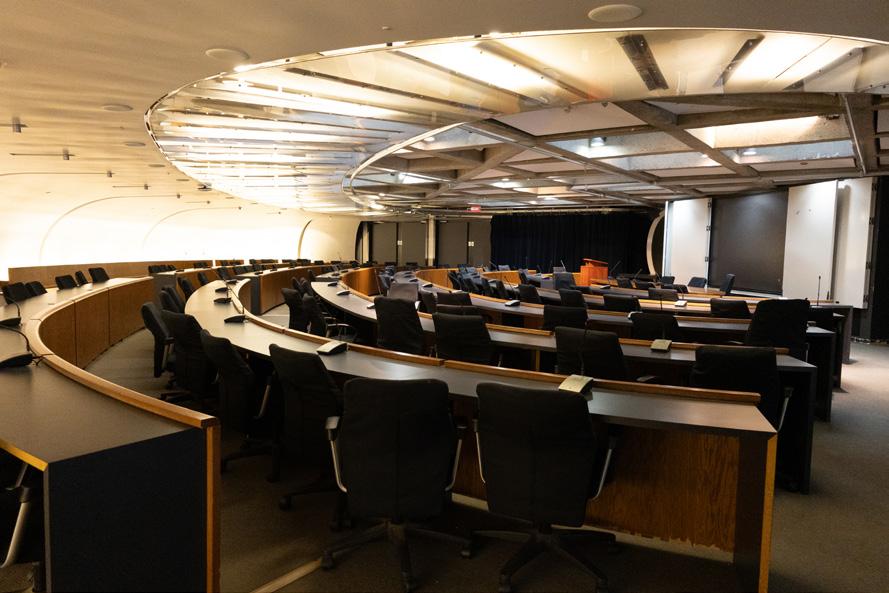
The McGill Senate is composed of 114 voting members, including faculty, staff, administrators, and students. (Armen Erzingatzian / The Tribune)
with the Combatting Hate Act
Panelists discuss the overly broad nature of the bill and its unequal distribution of power
Asher Kui News Editor
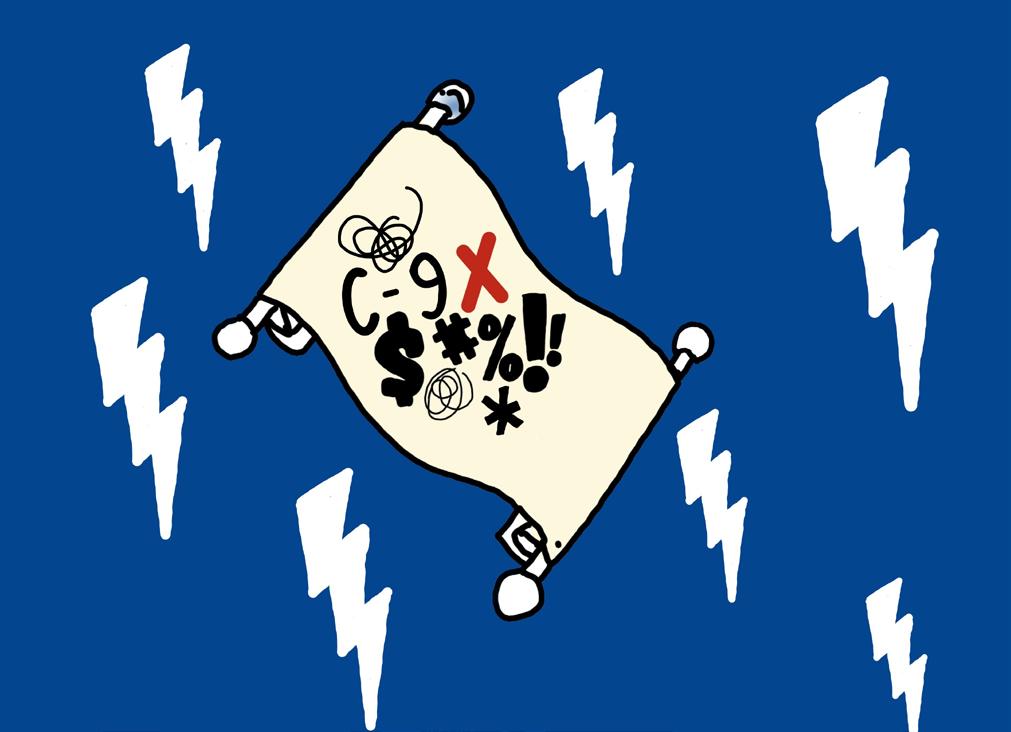
On Jan. 15, the Ligue des droits et libertés hosted a webinar titled, “Bill C-9: A threat to our liberties.” Bill C-9, also known as the Combatting Hate Act, was first proposed by Minister of Justice Sean Fraser in September in the House of Commons.
The proposed legislation would amend the Canadian Criminal Code, primarily by criminalizing hate-motivated conduct with the aim of protecting access to religious sites, schools, community centres, and other spaces used by identifiable groups. Under this proposal, it would be a crime to willfully intimidate and obstruct people from accessing such places or to promote hatred by displaying certain terrorist or hate symbols in public.
While this act was introduced amid a rise in hate crimes in Canada, many civil societies across the country have criticized its anti-constitutional nature, questioning whether it would risk criminalizing Canadians’ rights to peaceful assembly and freedom of expression. Lynda Khelil, the webinar’s host, began by highlighting how presentations like this one inform the general public of legislative proposals that often go unnoticed.
“We have found that very few people are aware of the content of this bill,” Khelil said. “Bills are not issues that the general population pay attention to often […] but it concerns society as a whole because obviously, in many
cases, it contains provisions that affect our rights and freedoms.”
The first panelist to speak was Anaïs Bussières McNicoll, director of the Fundamental Freedoms Program. She explained that many Canadians question the purpose of Bill C-9, as there are existing provisions in the Canadian Criminal Code that prohibit intimidation, harassment, and death threats.
“If someone has reasonable grounds to fear for their own security, it constitutes criminal harassment,” Bussières McNicoll explained. “What does the federal government want to further criminalize through Bill C-9? What effect could this have on peaceful protestors?”
Bussières McNicoll then highlighted how the bill’s content is loosely defined, granting police and security forces disproportionate power.
“Protests have created dissatisfaction among certain groups, and this is a provision that could easily be interpreted by police, targeting protests that are peaceful but disruptive, or offensive for some,” she said.
Bussières McNicoll continued to emphasize the general public’s role in upholding Canadian constitutional rights.
“We are talking about a provision that will open the gate to police officers having great discretion to act in a prejudiced way without clear guidelines, leading to the criminalization of groups who already experience excessive police surveillance and inappropriate racial
profiling,” she said. “We must be capable of tolerating discourse that is seemingly unpopular, that may seem unjustified or often outside of certain limits [….] We must say no to the criminalization of behaviour that is non-violent or non-threatening, simply because it displeases certain people.”
The second panelist was criminal and immigration lawyer Lucia Flores Echaiz, who explained that the current Criminal Code already targets the incitement of hateful propaganda and hate speech. Bill C-9 aims to broaden what constitutes a hateful symbol. Under the proposed legislation, a symbol principally associated with a terrorist entity listed by Public Safety Canada would not be allowed in public spaces, including in the virtual world. She highlighted the unreliability of this list.
“The process for listing an organization [as a terrorist entity] is opaque and arbitrary,” Flores Echaiz said. “It is the result of a discretionary decision by the Minister of Public Security [.…] The government of Canada even recognizes that a listed entity does not necessarily mean that they committed a crime [….] It is almost impossible to be removed from the list.”
Flores Echaiz contin-
ued to argue that while courts have the power to push back against the bill, it nonetheless poses a threat to freedom of expression and the distribution of power.
“Even with the adoption of this bill, I hope the judges will be able to say no [in Court],” she said. “The police are the ones applying the law, and even if a person is acquitted at the end […] they would have experienced an arrest, potentially deprived of their liberty for a certain period of time […] the bill allows a great discretionary power to the police, and this is what concerns us here.”
*All quotes were translated from French.
The Ligue des droits et libertés was founded in 1963 to raise awareness of the human rights guaranteed by the International Bill of Human Rights. (Asher Kui / The Tribune)
PGSS votes to dissolve several committees
Members worry that dissolution could hinder democratic checks and balances
Kaitlyn Schramm Managing Editor
On Wednesday, Jan. 15, the PostGraduate Students’ Society (PGSS) met in the Thomson House ballroom for its first meeting of the semester, commencing with an announcement advertising seven new positions that are open for election, including Secretary General, Deputy Secretary General, and External Affairs. They also mentioned the annual referendum, which will review the student services fee. The fee is currently $200 CAD per year per student, but the referendum proposes a percentage increase.
Secretary General Sheheryar Ahmed announced an interest among PGSS executives to host a town hall in the near future, offering to conduct the event after the February council meeting. Ahmed continued to describe the importance of hosting town halls.
“This will be an opportunity to submit discussion topics and devote more time to them than is available at council meetings typically, and we won’t be following the same structure [....] We’ll just have much more time to address those kinds of concerns in an open forum,” Ahmed said. “It’s a really positive democratic experience. Hopefully we can start doing this every year.”
Ahmed then went on to introduce a series of motions to dissolve inherited organizations within PGSS, claiming these committees are unfulfilled and stifle the
administrative process. The motions would remove the Policy Structure and Advisory Committee, the Student Rights and Advocacy Committee, and the Governance Committee. He also shared that the Funding Working Group would be dissolved and reconstituted as a standing committee of council.
The Governance Committee is responsible for addressing any legislative changes that the council wants to pass and is composed of three people who do not hold titled positions in PGSS. The issue with this, Ahmed noted, is that it is difficult to staff each year, as most active members of PGSS hold titled positions and therefore cannot work on the Governance Committee.
Ahmed stated that, as chair of the committee, the Secretary General can fulfill the responsibilities of the Policy and Structure Advisory Committee without the specified seven members, claiming that the existence of a committee to fulfill these tasks only duplicates work being done.
The Student Rights and Advocacy Committee used to be chaired by the Students’ Rights and Advocacy Commissioner, a position that was dissolved two years ago and replaced with the Funding and Supervi-
sion Commissioner. However, despite the chaired position no longer existing, the Student Rights and Advocacy Committee was never formally dissolved.
As the meeting progressed, Internal Affairs Officer Naga Thovinakere echoed previous concerns from a governance standpoint, sharing worries with other council members who felt the dissolution of committees may not be the correct solution.
“My understanding with the role of the Governance Committee is it’s supposed to check and balance,” Thovinakere said. “I have a sense that the solution that we’re moving towards might not be the right one. Just because it has been vacant and redundant and inactive, might not be the actual reason to dissolve a committee. It exists for a reason.”
The Tribune Explains: McGill Abroad
What you must know before travelling internationally with McGill
Asher Kui & Eren Atac News Editors
McGill Abroad is a program offered by the university that allows students to travel internationally for their studies or for an internship. Students may study at one of McGill’s partner universities, earning transferable credits while paying the same tuition as a full-time McGill student. No matter which international universitysanctioned activity students wish to participate in, The Tribune explains how McGill Abroad works, and what students must know before travelling abroad.
How do you go on exchange?
There are several steps that must be followed before students can go on exchange. The first is to explore McGill exchange partners, which are compiled in a list that students can filter by region, destination, and faculties offered.
The next step is to complete an application to the McGill exchange program, which is submitted through Minerva. Eligible applicants will be offered a nomination to a partner university. After accepting their nomination, students will receive instructions on how to apply for admission to their specific host university.
If accepted to their host university, students must then register for their new courses
and pay their McGill tuition. Once these steps are completed, students are ready to embark on their study abroad program.
How do you transfer credits from your exchange university?
To obtain transfer credits, students must consult course requirements and have their studies pre-approved by McGill before going on exchange. Courses must meet content and credit equivalency requirements, which may be verified with the Course Equivalency Database.
Grades earned at an exchange university will not be calculated into students’ McGill CGPA. After their exchange, students must submit the Credit Assessment Form on Minerva approximately four months after the end of their studies.
Where can you find opportunities for an international internship?
McGill offers several resources for students looking to intern abroad. Vault is a website accessible only to McGill students which offers international internships and job opportunities. Other avenues for international internship opportunities include International Experience Canada, Canada World Youth, and the Programme de stages en organisations internationales (French only).
Arts students wanting to complete an internship abroad may consult the David M. Culver Center Arts Internship Office for internship
Debate over the dissolution continued, and University Affairs Officer Amina Bourai defended the proposal to dissolve the committees.
“I would be the first person to say if I saw something that was unfair, if something would alter the democracy of the society,” Bourai said. “But [...] we have the [General Assembly (GA)], we have council, we have special GAs, we have executive meetings, commissioner meetings, senate. We have meetings with students all the time, with issues that they bring up.”
In the end, Motions 10.2, 10.3, and 10.4, all concerned with the dissolutions, were carried with 25, 27, and 22 votes, respectively.
Moment of the Meeting
PGSS announced a series of initiatives in the following weeks to spread awareness on Academic Bullying from Jan. 26 to Jan. 30, during which graduate students can stop by the Thomson House to spin a trivia wheel on academic bullying in exchange for a free cookie. Soundbite
“I think maybe a potential solution would be to sort of merge some committees and then increase the numbers to not overburden the existing committees that seem to do the work [....] Then maybe we can look at a better resolution to incorporate what the other students’ concerns are [...] that is probably enlarging some of the committees.” — Financial Affairs Officer,
postings. Here, students can view postings and apply for internships for Summer 2026.
What prerequisites are necessary to go abroad?
To apply to the McGill Exchange program, students must first fulfill several criteria. Eligible students must have a CGPA of at least 3.0, meet faculty-specific requirements, complete at least 24 McGill credits before their semester abroad, and verify their personal information in Minerva.
Beyond these prerequisites, students must complete Pre-Departure Orientation, a course offered through MyCourses. The course covers logistical information necessary to study abroad concerning pre-departure preparations and the eventual return to McGill. The course is offered on a monthly basis but it is recommended that students complete it three to six months prior to their time abroad.
What is the timeline for the application processes?
After students have chosen their host university, they must submit their applications. While the application deadline for going on exchange in the Fall 2026 Term has already passed, students may begin applying for exchange in the Winter 2027
Term in April. Eligible candidates will then be nominated to exchange partner universities by February for Fall and full-year exchanges, or by early August for Winter exchanges. Students must then independently apply for admission to the host university. Host universities will notify McGill students of their acceptance in a few months following their application.
Students wanting to complete an internship at the David M. Culver Centre Arts Internship Office must submit their applications by Feb. 8. The office will notify students if they are selected for an interview; if chosen, they have three days to accept the offer.
For more information regarding McGillsanctioned activities abroad, visit the McGill Abroad website and consult their FAQ page.
The Thomson House offers coffee, food, and study spots for graduate students. (Armen Erzingatzian / The Tribune)
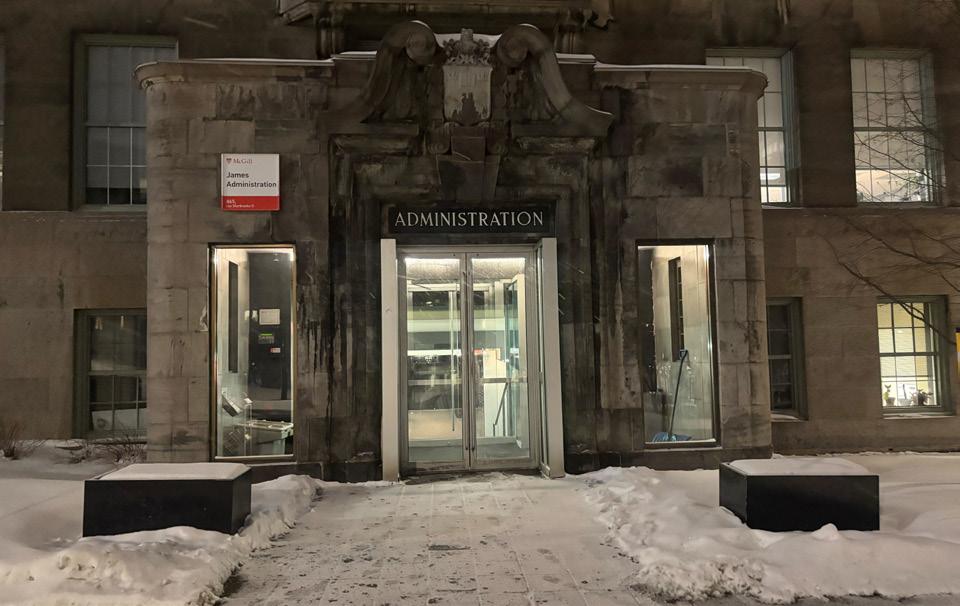
The McGill Abroad Office is located on the sixth floor of the James Administration Building. (Amelia H. Clark / The Tribune)
Social Media Editor Mariam Lakoande socialmedia@thetribune.ca
Business Manager Laura Pantaleon business@thetribune.ca
Blackstone, José
Ethan
Lilly Guilbeault, Emiko Kamiya, Alexa Roemer
CONTRIBUTORS
Noah Bornstein, Russel Ismael, Lia James ,Abigail Kronenberg, Tia Southwell, Vittoria Vespoli
Gwen Heffernan, Tarun Kalyanaraman, Samantha Van Wingen
The Tribune Editorial Board
Continued from page 1.
Sponsored by Vice-President Administration and Finance Fabrice Labeau, the policy was framed as a measure to codify existing practices of identity verification and surveillance that have been occurring without a basis in explicit policy. Framing the policy as a mere formalization not only exposes that surveillance practices have been operating without formal authorization and policy grounding, but also trivializes the devastating consequences the policy would have if approved.
Unlike exam invigilation, where identification serves a clear and narrow function as an administrative safeguard, the security-related justifications identified under the policy as ‘legitimate purposes’ are vague and become a coercive demand in public campus life.
The policy offers no criteria for determining necessity, no requirement that requests be expressly justified at the time they are made, and no immediate
mechanism for challenge. Instead, it concentrates discretion in the hands of the individual enforcing it—an arrangement that directly violates McGill’s own commitments to equality and due process.
The most consequential provision of the proposed policy is its authorization to demand the removal of a mask or face covering. This marks a shift in how presence on campus is regulated. Identification is no longer limited to confirming who someone is in a specific context, such as an exam, but extends to making individuals visibly identifiable in public university spaces.
Mask removal changes the stakes of identification; once a face is revealed, anonymity is lost beyond the immediate interaction. For protestors, this risk is particularly acute, as anonymity often functions as a basic safeguard against retaliation, doxxing, or disciplinary targeting. The policy offers no guidance on how such risks are to be mitigated, nor does it account for how compelled visibility reshapes who feels safe participating in on-campus organizing.
Although the policy includes provisions for religious
accommodation—such as allowing identification in a private space or before a person of a particular gender—these measures do not prevent harm. Instead, they shift the burden onto the individual being stopped, who must submit to additional scrutiny to justify their presence on campus. In doing so, the policy treats masking as a problem to be managed rather than a practice grounded in health, safety, or religious reasons. In Quebec, provincial legislative acts such as Bill 21 and Bill 9 have repeatedly targeted Muslim people—particularly Muslim women—to sustain scrutiny over religious visibility and practice.
In this context, discretionary enforcement of face-covering rules cannot be treated as neutral and is closely intertwined with the broader Islamophobic discrimination that is disguised as secularism.
This burden is amplified by the policy’s lack of meaningful oversight. While McGill states that “authorized personnel” will be adequately trained to know when it is appropriate or lawful to request identification, the proposed policy provides no mechanism for verifying whether a request was legitimate at the moment it
was made. This lack of clarity is compounded by the broad range of individuals who qualify as “authorized personnel.” Campus security officers—often employed through third-party contractors— are granted the same discretionary authority as exam invigilators and faculty acting in official capacities, without equivalent standards of transparency or accountability. Further, where students may be required to identify themselves on demand, “authorized personnel” are not required to provide identification in return. In practice, the policy concentrates enforcement power in such “authorized personnel.”
If McGill wishes to maintain credibility as an “open and accessible campus,” the minimum conditions are evident: Those empowered to demand identification must themselves be clearly identifiable, face-covering removal should not be treated as a routine enforcement tool, and policies governing protest must not hinge on discretionary interpretations made in the moment. An open campus does not treat anonymity as a threat. Until McGill reconciles that contradiction, this policy acts as a mechanism of control, not of safety.
Mayor Soraya Martinez Ferrada is not serious about fighting homelessness
Noah Bornstein Contributor
This past week, Montreal’s new mayor, Soraya Martinez Ferrada, announced her first budget, in which she plans to triple spending on homelessness initiatives. Her new Tactical Intervention Group on Homelessness (GITI) commits $29.9 million CAD to policing infrastructure, surveillance in public places, and social workers.
Despite the increase in allocated resources to fighting homelessness, Martinez Ferrada’s government has missed the big picture: The only way to solve the homelessness crisis is to put people in homes. However, Martinez Ferrada’s government has scrapped the 20-20-20 bylaw that required developers to allot 20 per cent of their units to social housing, 20 per cent to affordable units, and 20 per cent to family-sized units. By scrapping the bylaw, Martinez Ferrada’s pledge to address the unhoused crisis in Montreal will persist unfulfilled. Instead of connecting more people with affordable housing, this approach will force more people onto the street.
There are two major types of homelessness: Visible homelessness
which refers to people who are sleeping on the street, and hidden homelessness, referring to people who have no fixed address, bounce between friends’ couches, sleep in their cars, or live in shelters. In the fight against visible homelessness, the THRT could be quite useful.
Martinez Ferrada’s emphasis on locating where many unhoused people are and providing them with the resources to get into some kind of shelter directly tackles the crisis.
However, the GITI—and Martinez Ferrada’s budget plan in general—does nothing to combat hidden homelessness. The social workers hired for work under the GITI cannot help a person if they do not already know the person is looking for help. It is impractical to design support systems for unhoused people in which police are expected to go up to everyone on the street and ask if they need help looking for an apartment. Hidden homelessness can only be wholly addressed by creating permanent, affordable housing options something which the 20-2020 bylaw aimed to achieve.
According to the Institut de la statistique du Québec (ISQ), about seven per cent of Quebecers aged 15 or older have experienced hidden homelessness in their lives, while 0.9 per cent of Quebecers
experienced visible homelessness. The primary identified cause of hidden homelessness is eviction followed by individuals not being able to find a new, affordable place.
With more affordable housing, individuals experiencing homelessness will have an easier time finding another place after being evicted. Shelters are another solution, as might be the GITI—but these are not mutually exclusive of affordable housing.
Martinez Ferrada’s repealing of the 20-20-20 bylaw reduces the number of affordable units available for people experiencing homelessness or financial insecurity. When announcing her decision to repeal the bylaw, Martinez Ferrada claimed that the regulation’s requirements actually prevented new development in Montreal by discouraging developers from building more housing. Instead, the Martinez Ferrada administration chose to implement a set of incentives, including tax breaks, for developers to build more within the city. However, the evidence that the bylaw stemmed housing growth is not definitive.
Martinez Ferrada’s incentives offer no provisions for social and affordable housing, meaning there is no guarantee of any new affordable
Martinez Ferrada’s new budget includes a $90 million CAD outlay on fighting homelessness. (Mia Helfrich / The Tribune)
units for unhoused individuals experiencing hidden homelessness. While the 20-20-20 bylaw was not a guarantee of increased affordable housing, it at least ensured that something would be built. Mayor Martinez Ferrada’s new plan fails to do that.
If the Martinez Ferrada administration wants to get serious about combatting homelessness, it needs to get serious about building affordable housing. With the repealing of the 20-20-20 bylaw, it is not off to a good start.
Shatner University Centre, 3480 McTavish, Suites 404, 405, 406
Simona Culotta, Defne Feyzioglu, Alexandra Hawes Silva, Lialah Mavani, Nour Khouri, Laura Pantaleon, Amy Xia
TPS BOARD OF DIRECTORS
Rachel
Moro Gutiérrez,
Khan, Antoine Larocque, Lialah Mavani, Talia Moskowitz,Julie Raout, Parisa Rasul, Alex Hawes Silva, Michelle Yankovsky, Ivanna Zhang
Abigail Kronenberg Contributor
TThe Big O could be more than a costly relic
his year marks the fiftieth anniversary of the 1976 Montreal Olympics.
To this day, the Olympic Stadium, also known as the Big O, remains one of Montreal’s biggest architectural and cultural landmarks. Featuring the world’s tallest deliberately leaning tower and over 50,000 seats, the stadium is impractical to maintain from an engineering perspective. Due to its hefty maintenance costs, Quebecers frustrated by the continued use of their tax dollars have dubbed the stadium the “Big Owe,” as the facility remains unequipped to host large events, including the upcoming FIFA World Cup.
Despite calls for demolition, Quebec committed long-term to renovating the Olympic stadium. If taxpayers are funding this renovation, the stadium must stop functioning as a historical monument and instead operate as an active, publicly accessible venue that generates global attention through its events, creates quality jobs, and yields measurable economic returns for Montrealers.
The impacts of large government investments in sports stadiums have long been studied to determine the extent of their benefits to the surrounding communities. Academics largely agree that publicly funded stadiums rarely deliver strong measurable economic returns, often mostly profiting the few wealthy team owners and executives. Large stadiums rarely generate meaningful economic output such as higher local property values, tax revenue,
or employment. The Big O’s inability to regularly host large events since the Expo’s 2004 departure shows that these indicators are even lower compared to other cities with fully functioning stadiums of similar capacities. These findings rightfully fuel public skepticism toward continued spending on the Olympic Stadium.
Recently, the Quebec tourist minister unveiled an $870 million CAD plan to rebuild the stadium’s roof, which was damaged in over 20,000 areas in 2024. This significant expense is compounded by other costs, such as $28.6 million CAD for the electric system and $20 million CAD for sound equipment. The new roof is anticipated to last only 50 years after the project is finished in 2028.
The other option for the stadium’s fate—demolition—also carries a hefty $2 billion CAD price tag, meaning the stadium will remain whether Quebecers like it or not. So if public money is what’s keeping the stadium alive, the public must be able to access it. To ensure that the investments made in the stadium’s recovery have the best chance at providing economic benefits to all Quebecers, this plan cannot repeat the unwise choices of other cities with large stadiums that have not delivered such benefits.
Meaningful efforts must move beyond renovation and include enforceable commitments regarding how the stadium is used. Investments should guarantee that the stadium hosts and supports community events, youth sports, and cultural programming for Montrealers. If these commitments are made properly with insight and collaboration from local residents, the surrounding neighbourhoods, the city, and
the province as a whole would see tangible returns. The Olympic Stadium should function as a shared civic space, not a sealed monument maintained for hypothetical use in the ever-distant future.
Quebec’s hesitancy to develop an investment plan until 2024 led to countless missed opportunities for Montreal to host global events. Perhaps one of the biggest losses was the 2026 FIFA World Cup, where Montreal declined hosting due to financial concerns. Montreal was also unequipped to host Taylor Swift’s record-breaking Eras Tour, which would have brought millions into the city’s economy as it did in other Canadian cities such as Toronto and Vancouver. Missing out on these events caused Montreal to forgo tourism spending, employment opportunities, and international
visibility that could have directly supported the city’s small businesses and surrounding communities.
Cities are not recognized globally for simply maintaining their world-famous infrastructure, but for using it to bring people together. Since the Olympic Stadium is here to stay, Quebec has the opportunity to have Montreal recognized on the world stage and make meaningful contributions to its local economies. The public funding for this project should be tied to protocols, including event-hosting benchmarks, community access guarantees, and transparency about its use and impacts. The true cost of the Olympic Stadium is not how much Quebec spends on it, but whether that spending is managed in a way that allows all Quebecers to reap its benefits.
COMMENTARY Keeping Montreal alive means letting shops stay open late
Ellen Lurie Opinion Editor
It’s 7 p.m. on a Saturday night, and you have nothing to wear. Rushing out the door, you take to St. Laurent in search of the perfect, innovative solution to a closet lacking inspiration: Another black top. Yet, no matter where you look, every store is closed: La Caravane, CUL-DE-SAC, even Throwback Vault—they’re all lit by the neon luminescence of a sign reading “fermé.”
Your shopping misfortune isn’t new. It dates back to June 22, 1990, when the Quebec government passed the ‘Act Respecting Hours and Days of Admission to Commercial Establishments,’ or Bill H-2.1. Originally framed as a way to promote time with family and protect small businesses from burnout, Bill H-2.1 requires that all businesses close at 9 p.m. on weekdays and 5 p.m. on weekends.
The bill makes exceptions for establishments serving food and drink, cultural centres, businesses operating in airports, and pharmacies, but most major retailers are forced to close well before the feeling of an impending wardrobe malfunction sets in.
However, on Dec. 8, the Quebec government announced a major revision to Bill H-2.1, allowing retailers to remain open until 9 p.m. on weekends, effectively standardizing weekday hours across the
entire week.
In a city like Montreal, defined by spontaneity and a vibrant nightlife, the regulations that exist under Bill H-2.1 undermine the very local establishments they claim to protect, pushing consumers online instead.
Samuel Poulin, Quebec’s Minister for the Economy and Small and Medium Enterprises, explained that the shift in hours became necessary as local and small businesses were increasingly forced to compete with major online sellers, including ultra-fast fashion retailers like Shein and Temu. In fact, nearly 60 per cent of businesses in Quebec have reported drops in sales due to competition with foreign e-retailers.
When small businesses lose foottraffic because shoppers aren’t able to make purchases in person, they do not merely lose profit. They are replaced by massive online fulfillment warehouses. An outdated relic of Quebec’s past, Bill H-2.1 incentivizes consumers to seek less environmentally conscious—and less ethically-produced— options when in-person stores are closed at inconvenient hours.
With textiles being the fifth-largest category of plastic waste sent to landfills in Canada, and the fashion industry representing 10 per cent of Canadian greenhouse gas emissions, it is critical that in-person shopping experiences are
protected to ensure accessibility. Without them, shoppers default to online fast-fashion, with its familiar wastegenerating refrains:
“This doesn’t fit,” “this doesn’t look like the picture,” or “this isn’t comfortable to wear.” When customers are able to shop in person, avoidable problems relating to garment quality and fit no longer lead to the discarding of usable fashion items. Instead, these unfavourable items are merely returned to the rack.
Even the original motivation behind Bill H-2.1 of “promoting family time” no longer reflects the needs of individuals working in Quebec. Many Montrealers—from students, to part-time workers, to those with irregular working schedules—are forced to adapt their lives around arbitrary, outdated closing times instead of relishing the flexibility to shop ethically and conveniently. What was once framed as protection for the working class has evolved to impose constraints on both consumers and small businesses, limiting economic opportunity and Montreal’s social and cultural dynamism.
Montreal’s streets—lovingly pedestrianized during the summer months, and in some cases, all year round—lose their charm as sites of cultural events, social interaction, and, of course, windowshopping. Bill H-2.1’s provisions encourage the city’s social nature to come to a stiff halt at 5 p.m.—far before a ‘move’ for the night even emerges.
Poulin’s plan, a welcome revision to existing business hours standards, realigns the accessibility of retail shopping with Montreal’s social fabric. This amended policy allows late-night foot traffic, spontaneous window-shopping, and engagement with local neighbourhoods to strengthen and sustain the economic survival of small businesses.
Quebec is the only jurisdiction in North America that limits opening hours for stores. (Anna Seger / The Tribune)
At its peak, Montreal’s Olympic Stadium was the most expensive stadium ever built. (Eliot Loose / The Tribune)
‘Cutlass’: A story of fleeting and forgotten queer love Impactful sapphic drama takes the stage at Tuesday Night Café Theatre
Lia James Contributor
Continued from page 1.
She is eccentric and angry, yet her chaotic humour makes her lovable. Among the crew of pirates, she stands out as the life of the party and excites the other crew members with her stories. Mary, on the other hand, is awkward, making her passionate love for Anne result in tears for the audience. The physicality between the two pirates emphasizes their chemistry. Specifically, the staging of their duets highlighted their relationship dynamic. Starting from opposite ends of the stage, they would get closer with each note, illustrating their attempted restraint overpowered by the strength of their feelings for each other.
Their love story is particularly important because, throughout history, queer romance has been criminalized and erased from literary narratives. The love between these two women was written off as “a close friendship,” concealing the truth. Learning about sapphics from the 1700s is critical in modern times because it emphasizes the fact that queer people have always existed. Queer people have made history—and will continue to make history—just as these two women have.
Seeing this musical offers both a learning experience and a chance for audience members to connect with both the story and queer historical figures.
The music in the show is ethereal. Anne and Mary have several duets throughout the musical, with many moments of mystical harmonization, capturing their intense feelings. Their siren-like voices blend together beautifully, with Anne’s soprano voice balancing well with Mary’s longing alto voice.
“If you burn, I burn with you.” This powerful line spoken just before a kiss illustrates their willingness to face the danger that their love brings. They accept the risk of punishment for their queerness, choosing to endure it together forever.
The costumes and set are also astonishing. These are the types of outfits you can imagine a pirate from the 1700s wearing; the details of each outfit both convey the time period and reflect each character’s personality. The small, intimate theatre invites the au-
Tia Southwell
Contributor
Today’s agenda: Perfecting your duck face, finding the rarest Pokémon on PokemonGo, and blasting Zara Larsson’s “Lush Life” from your iPod touch. Bliss.
History may not repeat itself, but trends do—and right now, nostalgia is staging a dramatic return. According to the BBC, TikTok searches for ‘2016’ have risen by 452 per cent in the past two weeks. The minimalist, muted tones
dience onto the ship.
The end of the show took my breath away. The pirate ship gets seized, the crewmates are hanged, and the two women are imprisoned. The final scene was brought to life by Golbrook’s heartbreaking scream upon realizing that Mary is dead. This devastating
ending highlights the impermanence of love, reminding us to appreciate those we love, even if it means rejecting social boundaries. 25 per cent of Cutlass ticket sale proceeds went to Watermelon Sisters, an organization based in Chicago that provides humanitarian aid in Gaza.
Welcome back, 2016 Get ready, 2016 is making a full comeback in 2026
of 2025 are out, and the unapologetic cringe of 2016 is back in.
In honour of 2016’s comeback, here are the ultimate throwback highlights in fashion, pop culture, and music.
Skinny jeans
Skinny jeans were an absolute staple in every 2016 wardrobe. Looking to find something more unique? Why not try ripped skinny jeans, or pair them with your favourite Converse hightops? Brands released skinny jeans in all colours and styles, with American Eagle and Old Navy leading the way. Icons like Kendall Jenner, Gigi Hadid, and Jennifer Lawrence turned skinny jeans into a must-have look. While baggy jeans now dominate, skinny jeans still hold a sacred place in fashion history. It even seems as though skinny jeans are making a comeback—whether this is a blessing or a curse is up for debate.
Coachella
Hosted in Indio, California, Coachella was not just a music festival, it was the music festival of 2016. Known as the defining event of the time, Coachella was what every teen and young adult dreamed of. Those lucky enough to attend planned for months, while everyone else refreshed their Instagram feeds and Snapchat stories in desperate anticipation. Influencers flooded their feeds with sporting flower crowns, boho-chic, and peace signs. Coachella 2016 was the biggest Coachella to
date, making $84 million USD in revenue. Headliners included Major Lazer, Guns n’ Roses, Calvin Harris, and Sia. It wasn’t just a festival; it was a place of self-expression, and a symbol of the cultural moment of freedom and community defined by social media, fashion, and music.
Musical.ly
Before TikTok’s rebrand, we called it ‘Musical.ly.’ The app allowed users to create short, lip-synced videos to popular songs and trending sounds, turning everyday teenagers into viral stars overnight. Lisa and Lena, teenage twins from Germany, went viral on the app for making dancing videos. In March 2016 alone, their number of followers increased by 256 per cent, bringing them from 112,000 to 377,000 followers. Musical.ly became a launchpad for influencers, musicians, and artists alike, encouraging creativity, humour, and self-expression. It had something for everyone, from beauty influencers like Baby Ariel to upcoming young artists like Jacob Sartorius. Its popularity highlighted a shift in how young people consumed media. It was a clear indicator of shifting focus from long-form media to short, fast-paced digital content.
The Mannequin Challenge
Speaking of social media, the Mannequin Challenge was a must-try with all your friends. The trend involved groups imitating mannequins, while Rae Sremmurd’s “Black Beatles” played in the background. Soon, this trend spread to family gatherings and classrooms. One of the most famous Mannequin Challenge videos was titled ‘High School Mannequin Challenge 1500 Students’ and was uploaded by a teacher at a secondary school. This video alone had 9.4 million views. It even reached some well-known faces,
from Beyoncé and The Rock to Michelle Obama and the New York Giants.
YouTube
Instead of high-tech, polished studios and scripts, YouTube allowed viewers to watch content filmed in something as simple as a bedroom. Liza Koshy was just 19 when she began making funny YouTube videos at home, but gained over five million followers almost overnight, leading her to win the Streamy’s 2016 Breakout Creator award. Creators like PewDiePie, who had more than 50 million subscribers in 2016, rose to the top by yelling at video games, somehow building a fanbase larger than many TV networks. They even coined their own name—the ‘Bro Army.’ On the other side of the platform, creators like Emma Chamberlain took over with chaotic vlogs, challenges, and fashion videos. Her popularity came from the personal connection she built with viewers. These forms of videos offered something television couldn’t: Intimacy and immediacy. YouTube remains a major entertainment platform today, exemplifying the idea that anyone with a camera could be a star.
And finally, the ultimate playlist of 2016 Justin Bieber, “Love Yourself” - The perfect breakup anthem.
Major Lazer, “Lean On”- A must-play at any house party, club, or event that involves dancing.
Drake, “One Dance” - Smooth, rhythmic, and the perfect beat for a chilled summer night. The Chainsmokers, “Closer” - A nostalgic and catchy pop hit, perfect for sing-alongs. Mike Posner, “I Took a Pill In Ibiza” - For those who are at a beach club somewhere, or who wish they were.
Justin Bieber’s song “Sorry” was the most viewed music video of 2016, accumulating over 1.6 billion views that year. (Zoe Lee / The Tribune)
Many pirates wore eye patches for night vision, not just for injury. (Anna Seger / The Tribune)
To be a woman is to live within systems designed without your body in mind.
Whether or not this divide is felt or acknowledged is a far more personal question, but regardless, the reality remains: The marginalization of women is fundamentally ingrained in Western society. From endless bathroom queues to uncomfortable seatbelts calibrated for male bodies, the male lived experience is systemically privileged in all aspects of life—even the most mundane.
This foregrounding is not always benign. It is more than a general inconsideration of the female social experience—the lack of free and available menstruation products in public restrooms, and the absence of garbage cans in restroom stalls for sanitary products, for example—it is a pervasive diminution of women’s physical and mental agency.
This marginalization is especially prominent in the medical sphere, a sector historically designed by men, for men. Women’s pain is frequently ignored or dismissed as ‘exaggerated.’ Their concerns are attributed to menstruation or anxiety, and diagnostic criteria and treatments cen tre on male symptomologies, render ing women’s experiences as second ary within their own care.
Systemically, this places women in the centre of a social schism: Wom en face pressure to remain healthy, yet are continually prevent ed from accessing adequate health resources when they have medical concerns. While progress has been made, the medical system is still failing women—especial ly Indigenous women and women of colour.
To gain true social equality, medical biases must be addressed.
Women and the medical gaze
Women have been no toriously excluded from medicine throughout his tory. McGill’s first graduating medical class to include women — Winifred Blampin, Jessie Boyd Scriver, Mary Childs, Lilian Irwin, and Eleanor Percival—was after WWI in 1922. This exclusion was rooted in the miscon ception that women are inherently more emotional and irrational, a belief used both to bar them from medical training and to justify their absence from clinical research
Phoebe Friesen, an Associate Profes sor in McGill’s departments of Social Stud ies of Medicine and Equity, Ethics and Policy, discussed this gendered history in an interview with The Tribune.
Medical revision: Putting Examining the marginal treatment
Written by Sarah McDonald, Science & Technology
constantly in a woman’s body was seen as noise,” Friesen explained. “So we have this really again, another sad history where a lot of experiences, symptoms of women in health have been dismissed or have been entangled with stereotypes like an emotional woman, a dramatic woman, an attention-seeking woman, a woman who’s faking it.”
While women are no longer deemed irrational by virtue of their sex, these ste reotypes are still dangerously prevalent in medical atmospheres. There are countless re corded instances of women being turned away from medical care with their pain ignored, as doctors—both male and female—have operated under these faulty assumptions. With gender biases so deeply ingrained in medical curricula and interactions in medical schools, all doctors—regardless of sex or gender— are susceptible to undermin ing concerns expressed by
“Traditionally, the notion of hor mones disrupting the sort of normal state of a body
en were continually excluded from scientific study and clinical trials.
Studies have con sistently shown that women receive lower doses of pain medication in the emergency room compared to men experiencing comparable pain levels. The Victoria State Government’s state report on the gender pain gap concluded that 71 per cent of women and non-binary individuals seeking care felt dismissed by their providers. These stereotypes are particularly dangerous for Indigenous women, women of colour, and women from other marginalized communities. The intersectional nature of oppression compounds practitioner biases, preventing women from getting the care they need. According to a report published by the U.S. Centres for Disease Control and Prevention in 2019, maternal mortality rates are directly correlated to race: Non-Hispanic Black women had a maternal mortality rate 2.5 times higher than that of white women.
Getting a (mis)diagnosis
Women’s enforced absence from the medical sector resulted in male physiology being exclusively studied in medical education, while wom-
“The history of medical research is just a sad story of the ‘normal’ body being a man’s body,” Friesen said. “So I think it made sense to early researchers, who were primarily men, to focus on the standard male body and utilize them as human participants in research, and it wasn’t until later that people started to recognize how profound the harms were to women.”
This perspective was corroborated by Sara Bishop, a Vancouver-based occupational therapist, who explained how our medical system privileges male symptomatology. When a diagnosis comes before a plan of action, having sex-specific symptomologies is critical to an accurate diagnosis—something our medical system is clearly miss-
“If the diagnostic manual is based mostly on men’s issues and how these issues present to men, then, therefore, some of the symptoms can be missed, because those symptoms are going to present differently in a man versus a woman,” Bishop explained in an interview with The Tribune. “But the manual where we, especially doctors, refer to is, I believe, based on men’s symptoms, and so right off the get-go, it’s hard for a woman to get the diagnosis, and therefore the correct treatment that would follow.”
She went on to describe her experience working with people with autism, noting the higher rates of misdiagnosis in girls as opposed to boys. One study showed women are 31 per cent more likely than men to receive an alternate psychiatric diagnosis prior to an autism diagnosis.
“[In girls], autism is often diagnosed as anxiety, depression, or OCD. Girls are given every other kind of mental health diagnosis, and autism is not even considered as a diagnosis,” Bishop said. “It’s treated with antidepressants or anti-anxiety medication, or sometimes ADHD medication, and it’s not helping, and it’s because the real diagnosis is something like autism or some sort of neurodivergency.”
Friesen further explained that, in addition to
Putting women in the narrative treatment of women in Western healthcare
Technology Editor & Designed by Zoe Lee, Design Editor
neurodivergencies and mental health conditions, this pattern of gendered misdiagnoses is prevalent with physical conditions. A salient example is that of heart attacks. Women experiencing heart attacks and other cardiac events are often sent home because their symptoms don’t line up with the symptoms men display during cardiac events. According to the University of Alberta, 53 per cent of women with heart-attack symptoms are dismissed and left undiagnosed despite seeking care.
This creates a devastating feedback loop, wherein a woman’s pain is not taken seriously, she is sent home without further investigation, and her pain propagates. After being dismissed, women begin to feel discouraged by the lack of support they have received and hesitate to seek out medical care.
“And then also sometimes people, just like in the desperation to be taken seriously, look for their own sort of objective reports to demonstrate their suffering,” Friesen said. “We see people paying out of pocket to get extra blood tests, so that they have something to take in to show, like, ‘look, here’s something real that shows that I’m suffering’ if they’re just continuously being dismissed.”
These extra, out-of-pocket fees add up; in 2023, CNN reported that women in the United States spent approximately $15.4 billion USD more than men, despite ‘equitable’ insurance coverage. This, when coupled with the gender wage gap, showcases just how inaccessible healthcare is for women.
Forging autonomy
It was only in 1986 that the U.S. National Institute of Health (NIH) adjusted its guidelines to recommend that women be included as subjects in clinical trials. Since then, the field has been made more accessible. Women can now work in the medical field and participate, both as scientists and subjects, in clinical research.
However, while progress has been made, there is still much work to be done. While women are now studied in a clinical setting, this research is not always done with patients’ consent.
Informed consent is one of the cornerstones of the modern medical system; it is required for participation in any check-up, exam, procedure, or clinical trial. Further, consent critically affirms respect for all persons involved. Yet despite the moral underpinnings of consent, while under anesthesia, women are frequently given pelvic exams without having given prior, explicit consent.
a teaching tool without [the patient] knowing. And it’s, like, maybe one of the most vulnerable unconscious [bodies], naked from the waist down, faces sometimes covered,” Friesen said. “You don’t need, for the patient’s benefit, several extra pelvic exams by students, who are […] just there to observe.”
Friesen explains that this practice is often defended through claims of ‘students needing to learn,’ however, a desire for education should never override a patient’s right to clear and informed consent. There is no other sector of medicine where consent is breached so clearly and continually. Even when women are afforded adequate care, how can we expect them to trust a system that repeatedly violates their boundaries and autonomy?
“Sometimes people talk about ethical erosion in medical school. Just like some things fall away depending on what you learn, often in this sort of hidden curriculum,” Friesen explained. “This is a very implicit lesson about consent, about which bodies can be utilized as teaching tools without consent. And in other cases, you ask for consent.”
Hear hoofbeats, think horses
‘Hear hoofbeats, think horses, not zebras’ is a common refrain in medicine, urging clinicians to pursue the most statistically likely diagnosis rather than a rare one. While this may seem practical, it can have devastating consequences, especially for women.
When providers default to common diagnoses over serious medical concerns, they overlook critical symptoms in favour of simpler, less dangerous, and often inaccurate explanations.
“A lot of things are dismissed from women as anxiety, depression, menopause, and menstrual problems,” Bishop said. “All of these things are kind of considered first before necessarily looking at other diagnoses or comorbidities.”
Treating women’s concerns as inconvenient or routine not only delays proper care but entrenches a cycle of dismissal that prevents adequate treatment altogether.
Gabriella Giorgi, a U3 student studying English and Environmental Sciences, shared her experiences with medical dismissal in an interview with The Tribune
now. You said that about Lyme.’ [Meanwhile] I had both of them.”
This was not an isolated incident for Giorgi. Growing up, she suffered from severe stomach aches, with her pain progressing, and further symptoms such as dizzy spells, migraines, and heart palpitations. Yet she was ignored by her doctors when she voiced her concerns.
It was only once Giorgi started passing out that she was referred to both a cardiologist and a neurologist. But these specialists, both of whom were male, were no different than the doctors she had seen before: They ignored her concerns, simply chalking her symptoms up to “just anxiety.”
Strikingly, this pattern of dismissal changed as soon as her father—as opposed to her mother—advocated for Giorgi.
“I went back with my dad for a follow-up a few weeks later. And it was very different, like, even just having a male figure there, and they ran, like, a bunch of tests and stuff.”
All it took was having a man voice her concerns, and diagnostic progress was suddenly a conceivable option.
The prognosis
Giorgi’s story is not unique. There are innumerable stories of women facing similar circumstances: Women being told they are exaggerating, that they just have anxiety, that their pain is a joke. But women’s pain isn’t the problem; the medical system is squarely at fault.
To be treated, women’s pain first needs to be recognized for what it is: Valid. Women’s symptomatology needs to be understood in its own right, not only perceived through the lens of male presentations, and as Bishop explained, the diagnostic manuals need to be updated to reflect these differing symptomatologies.
“If you’re given the wrong diagnosis, then that leads to the wrong treatment, which takes time away from that girl’s life, where they could be feeling better,” Bishop said. “So if the DSM-5 could be revived, and the studies could be done on girls and women, then that would lead to [a] better diagnostic manual.”
Women need to be heard. Women need to be given the attention and care that men are arbitrarily afforded, and this care must be granted without sacrificing a woman’s dignity, autonomy, or boundaries.
Friesen explained how medical students on OB-GYN rotations are asked to do pelvic exams on anesthetized patients before their surgeries; patients have no way of knowing if these exams are taking place.
“[They are] just using an unconscious body as
“One time, I had Lyme and pneumonia at the same time,” Giorgi said. “I was very little, but I remember that I was in pain for, like, a year, and [doctors] kept just being like, ‘It’s growing pains.’ And my mom was like, ‘No, like, you need to test her for Lyme.’ And finally, she made them, and I had Lyme, and I had had it for a year. Then [my mom] was like, ‘Can you also test for pneumonia?’ And they [said] ‘No, she just has Lyme. That’s what it is.’ And my mom was like, ‘No, you’re [dismissing her] right
It is critical that we continue to advocate for women’s lived experience within the medical system: That we support policies which address healthcare inequities, challenge our own biases about how women experience and express pain, and lobby for consistent application of consent policies in OB-GYN rotations. Medical care must be made equitable for all, and this simply cannot be achieved when women are continually pushed to the periphery of medical studies, practices, and treatment.
The Golden Globes: A party while the world burns Once a self-aware antidote to the Oscars, now a humiliating cash grab
Vittoria Vespoli Contributor
Scrolling online on Sunday, Jan. 11, meant watching red carpet roundups bleed into footage of war crimes unfolding in real time. Headlines about Gaza, Iran, and the escalation in Venezuela nestled neatly between Golden Globes outfits, acceptance speech clips, and comedy bits. Somewhere between the fringe, fur, and feathers, the world started to feel like a grotesque circus. How did this become the norm we’ve collectively agreed to digest?
The 83rd annual Golden Globes packed in and spurred its usual share of entertainment: Best and worst dressed lists, viral clips, and extensive coverage of the year’s biggest stars; and yes, Di- Caprio’s favourite food is still pasta. One Battle After Another and Hamnet brought home the top film awards, whilst Adolescence swept yet another award ceremony. The stars of Heated Rivalry became some of the most talked-about figures in attendance—despite not even being nominated.
What grabbed my attention, however, was the Globes’ aggressive promotion of gambling culture. Throughout the ceremony, the crypto-based, right-leaning prediction market Polymarket dominated our screens at home, egging viewers to bet on the nominees in real time. Since when does an awards show meant to celebrate the arts double as a sportsbook? Must every cultural event become yet another opportunity to cash out? Betting
boards were also displayed inside the room, so nominees could see how little the betting public believed in them, along with everyone else in the room—a fun boost for the ego, that one.
Two-time host and comedian Nikki Glaser helmed the ship with confidence and playful quips, later admitting she held back on more politically inclined jokes. Remarks on Trump, U.S. Immigration and Customs Enforcement (ICE), and the current state of the country’s politics were deemed too serious, too horrid to comment on without trivializing. Yet jabs at the Justice Department over edits to the Epstein files and at CBS News—on its own network—were fair game. The audience was charmed. Satire is always welcome, as long as it doesn’t wander too close to the fire, right? In a time where reality is already grotesque, choosing restraint doesn’t neutralize harm; it just sanitizes it.
Some stars did attempt to step close. Mark Ruffalo, Wanda Sykes, and others wore “BE GOOD” and “ICE OUT” pins to protest recent fatal ICE shootings against Renee Nicole Good and Keith Porter. Ruffalo spoke on the carpet, calling out Trump and ICE, admitting he couldn’t stay quiet in the face of ongoing horrors happening in the U.S. The gestures were sincere. They were also subtle enough that most viewers likely missed them entirely, small symbols and moments lost unless you already knew to look for them.
The award show further delegitimized itself through its soundtrack, having its stars
walk onstage to nightclub songs. Stellan Skarsgård, just over 70 years old and accepting an award for the tragicomedy-drama Sentimental Value, received his award to the tune of Usher’s “Yeah!” The Secret Agent, a film about fascism, had to accept its win for Best Foreign Language Film to Rihanna’s “Pon de Replay.” Classy. Appropriate, even. The tonal whiplash didn’t just feel out of touch; it signalled a lack of respect for the work being honoured. Guess we’re trading the arts for the club in 2026?
Film and television are already under an industrial threat, as studios consolidate under streaming platforms and theatrical releases are sidelined. If these ceremonies serve any purpose beyond ridiculous spectacle, they should celebrate artistic achievements. Instead, the Golden Globes leaned into blatant cash grabs, sidelining longstanding categories like ‘Best Score’ in favour of a promotional UFC skit, courtesy of Paramount.
Still, beneath the ugly, something remains worth salvaging: The artists and their labour. When every alarm is ringing at once, the least the room can do is acknowledge the fire waiting outside.
’People We Meet on Vacation’: Best friends, right? A film praised for the sizzling chemistry between its leads, Emily Bader and Tom Blyth
Loriane Chagnon Contributor
Warning: This piece contains spoilers.
The highly anticipated movie adaptation of Emily Henry’s beloved second adult book, People We Meet on Vacation directed by Brett Haley, premiered on Netflix on Jan. 9. The number one New York Times bestselling story follows Poppy and Alex, two best friends who meet every summer for over a decade to share a week-long vacation. That is, until their friendship falls apart after a tumultuous trip to Italy, during which they almost kiss. Narrated through flashbacks, the film revisits their past vacations while simultaneously exploring their current trip to Barcelona, where they attempt to rekindle the broken friendship that once nearly evolved into something more.
Leading the charge is My Lady Jane actor Emily Bader as Poppy Wright, alongside The Hunger Games: The Ballad of Songbirds & Snakes veteran Tom Blyth as Alex Nilsen. The movie depicts the leads’ unfolding friendship and blossoming romance through picturesque scenery and palpable chemistry. These features ensure the film lives up to the quality of Henry’s work, which has become a phenomenon in recent years.
With charming warmth reminiscent of classic 90s romcoms like 13 Going on 30 and Notting Hill, the film masterfully
employs beloved romance tropes, such as friends-to-lovers and forced proximity. Poppy is bright and adventurous, while Alex is steady and dependable. While she wanders the world, he remains in their rural hometown. Although they seem like polar opposites, they form a strong bond that deepens through their yearly trips to places like Squamish, New Orleans, and Tuscany. In this classic tale of opposites-attract that rivals that of Harry Burns and Sally Albright in Rob Reiner’s When Harry Met Sally , Poppy’s bright energy balances Alex’s tranquillity. Yet, on their annual trips, Alex reveals a different and carefree side to his personality, which Poppy affectionately calls “Vacation Alex.”
“I’m only weird when I’m with you,” Alex tells Poppy in what stands out as the film’s strongest scene, after the characters complete a dance routine whilst playing dress-up as newlyweds. The film brilliantly depicts a deep connection between two people who have grown to love each other over a decade, an intimacy many of us hopeless romantics yearn to experience someday. Bader’s vulnerability and Blyth’s swoonworthy performance make the almost twohour run time pass like a blur.
Despite minor changes, People We Meet on Vacation remains a faithful adaptation of the original work. One slight weak point lies in its treatment of Sarah, Alex’s on-again-off-again girlfriend, played by The White Lotus ’s Sarah Catherine Hook. The book’s explanation of Sarah and Alex’s
problems is replaced by a stronger emphasis on Alex and Poppy’s relationship in the movie.
Moreover, Alex proposes to Sarah in the film, a moment that never occurs in the book, and their relationship also has fewer issues in the adaptation. These changes make the movie seem like a horror story from Sarah’s perspective: The film casts her as a nice and slightly naïve woman stuck between two best friends who have very few boundaries with each other. She seems like a woman whose long-term boyfriend—who she loves deeply—appears to have been in love with another woman for a long time.
After watching the film, I felt deep pity for Sarah, which was absent when reading the book. Still, the movie gives her a happy ending, and as Poppy and Alex finally find their way back to each other, she, too, finds what she wanted by becoming a flight attendant and leaving her small town.
People We Meet on Vacation is a fun and easy watch that may inspire you
to book a vacation to Europe and perhaps even risk ruining a close friendship for the sake of love. The film stands out as a classic romantic comedy that leaves audiences longing for a love like that of Poppy and Alex.
People We Meet on Vacation is the first adaptation of Emily Henry’s six novels, four of which are currently being adapted for the screen. (Gwen Heffernan / The Tribune)
Macaulay Culkin makes his return to the Golden Globes after 35 years to “Return of the Mack” - pun intended. (Eliot Loose / The Tribune)
OFF THE BOARD
The bittersweet reality of homesickness
Mariam Lankoande Social Media Editor
You just arrived at the airport. It’s snowing white everywhere. Security agents shout at you to go to the right line, and police officers coldly ask your reasons for entering the country. An eternity passes before you are reunited with your suitcases. You just made it back to Montreal. And that feeling, the strange mix of loneliness, emptiness, and nostalgia, serves as a reminder that you can belong to more than one place at the same time.
For those who had the chance to go home for the winter break, going back can feel like a blessing. All of a sudden, the weight of having to survive on your own dissolves—it’s like a trip back to childhood. You just sit, and the world rearranges itself around you. No more worrying about buying groceries; the kitchen smells like things you forgot you loved; someone asks if you have eaten.
Your bed waits for you, exactly the way you left it. Your room is full of outdated decorations you swore you would change one day but never did. Posters, old books, dusty souvenirs, all proof that time passed while you weren’t looking.
Then you see your friends, walk to the same bar. The city has not changed, but somehow everything has. You all order the same drinks, and just like that, the conversations pick up exactly where they left off.
You catch up on the local drama: Who still hasn’t left town, who finally got a job, who got married, who broke up, who no one has heard from in years. For a while, you forget that you left. In that way, coming back also feels like a curse. Just when you get used to it, you have to leave again. The
goodbye only grows heavier, like a quiet reminder of how far apart we really are from the ones we love and the ones that love us.
Distance stops being a Speed x Time calculation and starts becoming something tangible. It lives in your chest, in your heart, in the way your throat tightens at airport gates.
So you try to prepare yourself. You avoid the rituals of arrival. You skip class during Add/Drop period, let your suitcase— still not yet unpacked—gather dust in the corner of your room. You repeat to yourself that you’re just passing through, that this is temporary.
But the truth is, it always gets to you.
You settle in without meaning to. You learn the streets again, you find your way back into your classes. You reconnect with your friends, your roommates. Days become longer and brighter. You start planning for Igloofest and going on study dates at McLennan. You return to bar crawling on Saint-Laurent or Crescent. You stop checking the time difference. You stop calling home every day.
For reading week, you hesitate between renting a cabin in the woods, finally visiting New York, or actually reading? Visiting
Symposiamania: A brief introduction to presenting
research
your family can wait, you tell yourself. And that’s when you realize you belong. You’re busy now; you have a life here, so much so that when summer break approaches, the ache returns.
You pack your life into a suitcase again. You start counting goodbyes like a ritual: Last class, last metro ride, last late night, last hug. It stings, but only because you have settled in so fully, because the streets, the friends, the routines have become yours again.
So if, coming back from break, nostalgia weighs on you, if your chest feels too full, know this: It’s not permanent. You’re not failing at being away. You’re just learning how to live in more than one place.
Homesickness hurts because it shows how deeply we belong. For international students, this feeling becomes a paradox: We don’t want to leave the home where we grew up, yet we also don’t want to leave the city where we have become someone new, where we have grown in ways we never imagined.
The ache of leaving is both a reminder and a gift; it proves that we have the capacity to carry multiple homes in our hearts, wherever we go.
undergraduate
Answering the who, where, what, and hows of publishing student research
Gregor McCall Student Life Editor
It is a truth universally acknowledged, that a single student in possession of good research must be in want of a symposium in which to present it. Publishing and presenting research as an undergraduate is one of the most enriching opportunities students can pursue. Not only do they demand a level of academic rigour—driving students to hone skills in analysis, scholastic prose, and research methodology—but they also provide a fantastic environment to build your CV and make connections with peers, professors, and other scholars in your field. Even if you have next to no interest in pursuing professional academia, the benefits of the publishing and presenting process will aid you in any pursuit to come.
For many, however, the process of publishing and presenting a paper at an undergraduate symposium or colloquium remains enigmatic, especially for those who are not part of their departmental association or research journal. In hopes of demystifying the elusive research symposium, The Tribune has compiled everything you need to know to disseminate your research as an undergraduate.
The Submission
Before you can walk into a conference, scholarly guns blazing, to lay down your contributions to the canons of human thought, it will be helpful to review the listed criteria for the specific symposium or journal you’re interested in. Most, if not all, prefer and prioritize original research and longer essay formats, typical -
ly in the 10-20 page range (give or take, depending on the time, page, and length constraints of the particular symposium or journal). Many symposia and journals will also list a theme or relevant subjects of study they seek in the selection process. If you want to publish a paper you wrote for a class you took, this will most likely mean it should be from a 300-level course or above and within the A to A- grade range. Hence, the B- paper you pulled an all-nighter to write in first year about postcolonial subtext in Shakespeare’s The Tempest is probably unfit.
Poetics of the Periphery, the upcoming symposium produced by The Channel Undergraduate Review and Canvas—for example—sought papers 2,000-3,000 words in length written for art history, communications, English literature, theatre, or cultural studies that analyze embodiments of oppression and exclusion in imaginative expression, representations of life-worlds typically ignored by mainstream academia, and investigations of recondite aesthetics.
The Editing Process
Just because your paper has been selected does not mean the process is over. Often, in this stage, you will work with an editor, or a team of editors, to refine and rework some, if not all, of your paper. The editing stage is intensive, but it does not mean that your research was wrong, lacking, or unthorough. Rather, the focus here is to produce the best possible version of your original work. Remember: Your research, despite coming from you, is separate from you. Any critique of it is not a critique of you as a person, student,
or writer.
The Presentation
Here comes perhaps the hardest part—defending a thesis in front of an audience, some of whom may include experts in your chosen field. Though this is a legitimately scary thing to do, don’t fret—there are plenty of tips to ensure your presentation goes smoothly. The first key is to practice. Whether in front of a mirror, classmates, or friends, practicing your presentation is the best way to
prepare for a symposium. Having someone to ask clarifying questions will allow you to refine parts of your research that may be ambiguous or in need of revision. Incorporating your personality into the presentation and making eye contact with audience members will keep your listeners engaged and enthralled.
With these tips, you’ll be ready to take any symposium by storm and show the world who the next best armchair analyzing, tobacco pipe-smoking academic truly is.
The McGill Law Journal, run entirely by law students, was the first legal review to be cited by Canada’s Supreme Court. (Lilly Guilbeault / The Tribune)
Making the most of your final semester How to cope with an upcoming graduation
Tamiyana Roemer Student Life Editor
Your final semester is a liminal space: A mere 13 weeks in which past, present, and future warp relentlessly into one another. The library that sheltered you in your darkest hour no longer feels like home, but it is not yet a memory either. You half-listen to a lecture by your favourite professor, mentally rehearsing post-grad plans. Swept in the undercurrents of fear and excitement, it can feel that you’re already half elsewhere. But your last semester will draw to a close, whether you savour it or not: As a tenant of this tenuous time, you can choose whether to let it pass unremarkably or allow it to shape a deliberate, meaningful goodbye.
Be present
The impending end of student life may usher in a host of forwardthinking concerns. Amidst the chaos of inevitable LinkedIn rabbit holes and polarizing grad school Reddit threads, do not get lost in the future while your present moment escapes you. For some, this might mean refraining from filling out applications while sitting in class. For others, mindfulness may constitute taking mental notes of the way the afternoon light filters through a library window or allowing yourself to linger in the small, unremarkable moments of campus life that once felt permanent and now feel
transient. Before the deadlines, decisions, and titles trickle in, making constant attempts to define your adult life, there is value in remembering who you were when your primary obligation was to learn— and in recognizing that this version of yourself deserves your full attention, if only for a little while longer.
Make time for friends
At a time when plans are postponed in favour of productivity and conversa -
tions are cut short by the pressures of what comes next, try to use these final months to exist alongside those who have shaped and supported you at this stage in your life. Make time for shared meals, late-night talks, and the long way home. Be honest, caring, and kind. The assignments will be submitted and the emails will be answered, but the moments shared among friends are the ones you will reach for when campus life becomes something you speak about in the past tense.
Visit the places you love McGill students come from over 150 countries, and many will leave Montreal after graduating. Take the time to visit the places that have made this city home. Whether it’s the cafe that witnessed your first nervous midterm season, the park where conversations stretched long after the sun set, or the slushy streets that sent you off to class, these spaces have held versions of you that will not return in quite the same way. A complete goodbye bids adieu to places too.
Express gratitude
Allow the constant stream of reflection to make way for gratitude. As you take stock of the moments that have shaped you, turn your attention to the people who made them possible. Thank the mentor who made you a better leader, the friend who always listened, and the professor whose encouragement made all the difference. Gratitude does not need to be elaborate or performative; you can channel it into a brief message, a simple acknowledgment, or a conversation you have been meaning to initiate. These expressions may seem small, but they have weight for both you and the recipient. In recognizing the support you received, you affirm that no chapter of your life is written alone—and that this one, too, was shaped by more than just your own efforts.
In the Middle Ages, diplomas were written on sheepskin, as it lasted longer than papyrus and could be rolled and unrolled by graduates as needed. (Alexa Roemer / The Tribune)
Yes, your city moves differently on special event days How festivals, parades, and protests influence urban mobility
José Moro Gutiérrez Staff Writer
As major cities develop increasing dependence on shared micromobility— namely, e-scooters and e-bikes—urban planners face the challenge of understanding the fluctuating demand for these modes of transport. While daily travel patterns remain relatively predictable, special events such as festivals, parades, and protests regularly disrupt urban mobility. These events can attract large crowds, alter street access, and influence how people move through urban spaces. However, their direct impact on shared micromobility remains poorly understood. In a recent study, Dan Qiang, a PhD candidate in McGill’s Department of Geography, aims to address this gap.
“My PhD re- search focuses on something I call ‘mobility vitality,’ which [describes] how dynamic and active different places are,” Qiang wrote in an email correspondence with The Tribune. “Rather than relying only on static indicators, I look at mobility patterns as a behavioural lens on the city. That includes shared micromobility like bike-share […] that reflect how neighbourhoods ‘pulse’ across hours, days, and seasons.”
Her study focuses on Washington, D.C., a city known for its civic, cultural, and political events. Using high-resolution data from nearly 9.5 million shared e-bike and e-scooter trips collected between 2023 and 2024, researchers explored whether special events directly cause
changes in micromobility usage or whether other factors, such as weather, seasonality, or holidays, explain the observed patterns.
The research team categorized events into three types: Government-authorized large events, such as parades, marathons, and major festivals; independently organized small events, including concerts, exhibitions, and workshops; and government-registered protests. For each event, they compared micromobility trip destinations within 500 metres of the event location to matched control periods when no event was taking place in the same area.
What distinguishes this research from earlier studies is its use of Double Machine Learning (DML). Unlike traditional statistical approaches that rely on correlations, DML allows researchers to control for many interacting variables simultaneously, such as weather, gas prices, time of day, neighbourhood infrastructure, and sociodemographic characteristics. Using this method, it is possible to isolate the causal effect of a specific event. Qiang noted that although DML does not outright solve the problem of unobserved confounding variables, it helps estimate their effect more concretely.
Results showed that previous research underestimated the impact of special events’ shared micromobility thus far. Large events caused an average increase of more than 230 micromobility trips per event. Festival-related and entertainment-oriented events were found to be the most influential, sometimes generating several hundred additional trips near event
venues.
Small events also increased micromobility usage, though to a lesser extent. On average, they led to approximately nine additional trips per event. The study further revealed that not all event types have the same effect. Although festivals and entertainment events consistently increased ridership, small art events showed no significant impact.
One of the most notable findings concerns protest events. Although initial correlations suggested that protests reduced micromobility usage, Qiang’s analysis found no significant effect after accounting for confounding factors.
The study also found that large events interacted strongly with the built environment. Infrastructure features such as bike lanes, sidewalks, and proximity to transit stations played a meaningful role in supporting increased micromobility use. In contrast, small events were influenced mostly by environmental factors, including event duration, season, and weather conditions, rather than surrounding infrastructure.
“Small events can often be absorbed by the existing system without stress, but large events push the system closer to its capacity limits. As capacity nears its limit,
infrastructure shifts from being a passive background factor to the primary constraint,” Qiang wrote.
The findings carry important implications for urban planning and mobility management. Qiang argues that cities should adopt tailored strategies when preparing for events. For large events, investments in temporary infrastructure, parking zones, and coordination with transit systems may be most effective. For smaller events, operational measures, such as fleet redistribution or targeted incentives, should be sufficient to accommodate demand.
Ultimately, this study provides a strong foundation for understanding how special events reshape urban travel behaviour. As cities continue to host more frequent and diverse events, studies like these will be essential for designing transportation systems that are both resilient and responsive to consumer needs.
Plurilingual Lab restarts Grad Talk series with a discussion on multilingual classrooms
Tiffany Tam leads the inaugural talk for this year’s series
Russel Ismael Contributor
McGill’s Plurilingual Lab resumed its Grad Talks series on Jan. 15 as part of an initiative to highlight graduate students’ research on language education while also allowing them to receive constructive feedback from other researchers. The first talk of the year was led by Tiffany Tam, a University of Toronto master’s student who studies how teacher identity and multilingualism intersect in Ontario’s K-12 classrooms.
Tam focused her talk on how teacher candidates (TCs) shape their professional identities based on their multilingual and racial backgrounds, and how these choices influence their teaching. She developed her framework regarding TC experience based on multiple case studies from schools in the Greater Toronto Area (GTA) using raciolinguistics, which examines how race and language are intertwined.
In her research, Tam determined that current GTA classrooms often push English as the sole language for K-12 education. She noted that this is especially true for TCs, who often receive education in environments where learning in multiple languages is discouraged. As such, many TCs compartmentalize their multilingual identities rather than treating them as a valuable resource.
“Language patterns can be very different,” Tam explained. “But what you have in your mind, in your written and spoken language, are valuable. They can help you speak English better because you already know one or two more languages already.”
Due to this compartmentalization, Tam argued that TCs lose their cultural identity. Her research found that some TCs divorce themselves from their previous identities to easily integrate with Canadian culture, as shown in one of the TC case studies. Tam described how the TC in question gradually lost their native language fluency as they acclimated to Canada, so they sought to introduce more languages into Teacher Education Programs (TEPs). This measure would help students understand the value of speaking multiple languages in diverse environments.
However, since many TCs believe that multilingual students’ English development falls under the responsibility of English as a Second Language (ESL) teachers, success is often limited. Tam corroborated this example with another case study, explaining how an ESL student struggled to understand English concepts, like cars. The student only understood after a TC described cars in Arabic, saying sayaara hamraa , meaning a red car.
Tam’s research also highlighted the insufficient education about race and language within TEPs, stating that her re -
search participants felt that discussions surrounding race were often surface-level in classroom settings. She discussed how racialized speakers are still seen as ‘deficient’ speakers, with a separation between ‘native’ and ‘non-native’ English-speaking TCs. Tam explained how this “binarization of languages” serves to reinforce raciolinguistic stereotypes. This racialized perception often led to erroneous assumptions, as TCs with multilingual identities were presumed to be learning English as a second language.
Furthermore, Tam noted how TC practicum experiences differ across socioeconomic settings. In private schools, which often have a majority of white and Asian students, she emphasized how English is typically the only language heard in classrooms. In contrast, public schools often have classrooms where a myriad of languages can be heard.
Tam explained this discrepancy as a result of students’ backgrounds: Public schools have more immigrant students
who arrived in Canada with diverse language backgrounds. Despite the growing number of immigrant students, TEPs for public schools remain unchanging, hindering TCs’ teaching capabilities when it comes to educating ESL students. To improve this, Tam concludes that a multilingual framework celebrating language diversity can be adopted across schools.
“I believe that TEPs have to be up to date to meet the needs of these multilingual TCs and students in Ontario, as well as the changing climate of race, racialization, and language,” Tam said. “This has been an area that has always been taken for granted and pushed aside in education studies.”
English has an estimated 160 dialects from across the globe. (Mia Helfrich / The Tribune)
High gas prices decrease, rather than increase, shared micromobility use during events. (Samantha Van Wingen / The Tribune)
Meet your prof: Nikolas Provatas
From homemade pendulums
Sarah McDonald Science & Technology Editor
Despite being friends with several physics majors, when discussions of gravity and inertia inevitably shift into abstract theory, I can’t help but wonder, what is physics all about, anyway?
If you’re studying science or engineering here at McGill—or just interested in the mysterious inner workings of physics overall—there’s a pretty high chance you’ll find yourself at some point or another sitting in Leacock 132, as one in a sea of 650 students, taking an introductory physics class.
PHYS 102 is one such introductory course. In this introduction to electromagnetism, students learn the fundamentals of electric current, circuits, magnetism, and optics. These concepts are not only interesting but foundational to later studies in physics and engineering, and McGill students are in good hands: PHYS 102 is taught by Nikolas Provatas, a Tier 1 Canada Research Chair and member of the Department of Physics.
Like many scientists, Provatas traces his interest in science to early childhood. In an interview with The Tribune , he recalls being just seven years old when a picture book about Galileo Galilei and his theory of the pendulum captivated him.
“At that age, I had no clue about equations or anything, but I remember the text said that [Galilei] observed [his theory] by watching […] how long it takes the chandelier to swing,” Provatas explained. “So when I would go with my father to [his] restaurant in the morning, around 5:30 a.m. […] it would take a long time till things got busy. [So], I remember I took up a string, and I tied a little mass at the end of it. I can’t even remember what it was, [it] must have been a cup or something. And I would tie it somewhere, and I would just swing it in the kitchen and just watch it. And I remember my father looking at me, thinking, you know, like, ‘Do something productive with your life,’ [....] And I thought, ‘This is productive. The scientist did this. I’m trying to figure out how it works.’”
From here, Provatas’ curiosity continued to grow, eventually leading him through post-secondary education; he graduated from McGill with a PhD in theoretical physics in the late 1990s.
Given that he was interested in how the world works and why it works the way it does, Provatas found theoretical physics to be a natural fit. Unlike experimental physics, which focuses on data collection and analysis, theoretical physics relies on math and other models to explain phenomena.
After completing his PhD, Provatas went on to complete two postdoctoral positions—temporary research positions— where he explored different areas of physics. He emphasized the importance of these experiences, describing them as the academic equivalent of a doctor’s residency training.
“Labs hire you on a contract basis, and say, ‘Solve a problem or do something interesting, and then we’ll pay you to do that, and then we publish together.’ So I do the work, I publish, and then they provide me [with] some environment [or] ideas,” Provatas said.
to McGill physics professor
His first postdoc was in Helsinki, Finland.
“I spent three years at the University of Helsinki, at their Institute for Theoretical Physics, doing work there on something called Percolation theory,” Provatas explained. “It’s a theory of how random things diffuse through materials so as to percolate through them, and this is very important when considering the structure of materials, ranging from paper to even metals.”
After his time in Finland, he completed a second three-year postdoctoral appointment at the University of Illinois UrbanaChampaign (UIUC).
It was after this second postdoc that Provatas began searching for stable work. Life as a postdoc is inherently uncertain; each job is contracted for a specified number of years, after which researchers are left to find new roles, potentially on opposite ends of the globe.
“I literally owned nothing because I knew that in any apartment I would go, whether here as a PhD, in Helsinki as a postdoc, [in the] United States as a postdoc, I knew I couldn’t really buy stuff because I’d be on the move in a couple of years,” Provatas explained. “So literally, I would just have my backpack and a suitcase to hold some clothes, and that was my whole ownership at that time.”
At UIUC, he worked under two professors: One in statistical thermodynamics and another in mechanical engineering. Mentorship from this engineer proved pivotal to Provatas’s future career, as he taught him how to communicate his research in ‘engineering terms’ rather than purely theoretical language.
“He taught me how to ‘talk the talk’ and ‘walk the walk’ of engineers, and to focus on what’s important when you sales pitch your stuff to engineers versus just pure scientists,” Provatas said. “And he actually made me wear a suit to give conferences. And I started to go to engineering conferences and give seminars.”
It was through attending these engineering conferences that Provatas was able to land a job at Bush Paper Company, working as a Research and Development scientist. Eventually, through his work at Bush, Provatas was invited to apply for a professorship at McMaster University—not in the physics department, but rather in the materials science and engineering department.
“I thought, ‘Oh, boy, you know, this is nice.’ I’ve always wanted to be a prof, but I thought it’d be a physics prof.” Provatas said. “I didn’t know I’d go work as an engineering prof. So
I practiced and practiced and got over the fear, and I went and gave an interview, and to my shock, they hired me.”
Provatas worked at McMaster for 11 years. It was only after an opportunity to teach physics at the university level—as opposed to materials science and engineering—that Provatas left McMaster. This opportunity was from none other than McGill University.
“I’ve been here since 2012, teaching physics, doing research on the same topic. I’m still a material scientist, but looking at it from a very physics[-oriented] point of view,” Provatas explained. “What ultimately made me make the transition from an engineering department to a physics department, is that you know, you can ask the questions that, on one hand, they could be useful, but on the other hand, it could be very impractical, but you know, it’s there. So, ‘Why does gravity work?’ So someone might say,’ Oh, come on, do something important [and] practical with your life,’ but [gravity is] there. I see it. It acts on me every day.”
As a professor, whether at McMaster or at McGill, Provatas has always taught freshman courses. Classes like PHYS 102 allow him to connect his research to his course content, finding ways to keep the material engaging and interesting for students.
“I always like to take what dry theory we’re learning, and say, you know, ‘this is important, because power generation works
this way. Let me show you how making material works this way. An aircraft works this way.’ And I find that students like the fact that it is connected to the real world. It’s not just ‘Oh, I’m sitting here in a physics class learning all these equations.’”
Provatas’s current research focuses on understanding the microstructures of material—in other words, how they form and how they respond to material phase changes.
“If you now explore the depths of this material, at the level of atoms and thereabouts, you start to see that the material is just not some monolithic, boring object. It’s a myriad of interesting patterns [and] that the atoms [are] forming the tapestry of a solid form,” Provatas explained. “My research focuses on why these patterns form […] how they form, [and] what controls their formation. And it’s beautiful.”
This semester, Provatas is teaching PHYS 102 and PHYS 657—but anyone interested in learning more about physics or materials science is welcome to stop by his office hours: 3:30 p.m. to 5:00 p.m. on Mondays, in Rutherford 218.
While Provatas’s path to McGill wasn’t linear, his interests and curiosity led him to a career of research that his seven-year-old self may not have even been able to imagine. Ultimately, Provatas shows that the trick to life is the same as the answers to PHYS 102: Achieving through dedication and hard work, and seizing the opportunities in front of you.
Concordia Stingers narrowly dribble past Martlets Basketball in annual Shoot for the Cure game
Strong fourth-quarter push not enough as Stingers beat Martlets in home-game matchup
Lialah Mavani Staff Writer
Love Competition Hall was packed on Jan. 15 as fans gathered to watch McGill’s Martlets Basketball take on the Concordia Stingers. The cross-town rivals played in the 19th edition Shoot for the Cure game. The campaign is organized by U SPORTS in support of breast cancer awareness, with participating teams raising funds for the Canadian Cancer Society.
For some players, the event is more than just a tradition. Guard Daniella Mbengo, U3 Arts, told The Tribune about the cause’s per-
sonal significance.
“My mom had breast cancer two years ago,” Mbengo shared. “I think it touches every one of us in different ways, whether it’s family, friends, or grandparents. It’s an important cause to bring forward.”
The Martlets showed their support not just in their fundraising efforts, but also on the court. The team wore pink shirts during the warm-up and pink hair accessories throughout the matchup as small reminders of the game’s significance. Other McGill athletes were in the crowd supporting the home favourite, as the game marked the launch of the new McGill Women in Sport (WiS) program logo.
The first quarter started with the Stingers winning the jump ball and taking the first possession. While the Martlets started at a possession disadvantage, they opened the scoring in the first 40 seconds, taking the lead with their first shot of the match. For the remainder of the period, Con-
cordia came out offensively strong, forcing quick turnovers and fast plays, giving them a 26-18 lead over the Martlets.
In the second quarter, the gritty home team pushed to close the gap between itself and the Stingers. The period had lots of back and forth, with the Stingers and Martlets battling it out to score, the former team hoping to widen the gap while the latter aimed to keep the game close. Ultimately, Concordia retained its lead, finishing the half 45-37.
After halftime, the Stingers started the period with possession, taking their chances to put up more shots. The Martlets’ cohesion was clear on court as they fought for rebounds to close the point gap. Just three minutes into the period, the home team scored three baskets, narrowing the point margin to two points. However, the Martlets failed to capitalize. A dominant performance by the Stingers placed them 10 points ahead by the end of the third quarter.
The final quarter brought energy from the crowd, with supporters and teammates cheering, “Let’s Go Martlets.” Within three minutes and two seconds, the Martlets narrowed the gap to one point, with Mbengo as a lead scorer, racking up eight points within the quarter. The Martlets were unable to power ahead of the Stingers in the last few minutes of the game as the visiting team came back to win 80-74 at the end of the forty minutes.
While the game was not what the Martlets hoped for, they were able to capitalize on
some big moments for crucial points, Head Coach Rikki Bowles reflected.
“Our goal is to get better every game and every week. We know what hurt us today, and so we’ll have to make some adjustments,” she said. “I want them going out there feeling free, not worried about making a mistake. At the end of the day, it’s a game, and I hope they have fun when they’re out there.”
Quotable:
“This season and also past years, we’ve had this same group of people and with key additions throughout the years. We’ve already built something great, and we allow ourselves to be right out there by just learning and keep getting better. Our objective is always to win.” — Guard Lily Rose Chatila, U3 Science, on the team’s goals for the rest of the season.
Stat Corner:
Forward Emilia Diaz-Ruiz, U1 Engineering, was named Player of the Game. Diaz-Ruiz scored 14 points, two blocks, and nine rebounds.
Moment of the Game:
In the last minute of the game, centre Kristy Awikeh, Master’s in Science, hit a three-point shot to lessen the point gap with the Stingers to one.
Alex Hawes Silva Staff Writer
The International Bobsleigh and Skeleton Federation (IBSF) has denied the allegations of Olympic ‘sabotage’ involving the Canadian national team and cleared the coaching staff of any wrongdoing. The controversy stems from American skeleton veteran Katie Uhlaender, a fivetime Olympian whose hopes of competing at a sixth Winter Games Milano Cortina were swiped from her despite winning a key qualifying race.
The disagreement came down to how skeleton athletes earn Olympic qualification points. Points are not only based on finishing position, but are also tied to the size of the field. The more athletes in a race, the more points are available. In this situation, four of the six Canadian women who had originally been entered in a North American Cup race in Lake Placid from Jan. 7 to 11 were withdrawn before competition. That significantly reduced the field size, which lowered the total points that could be earned. Although Uhlaender won the race, the reduced points haul meant she could no longer qualify for the Olympics.
Uhlaender, one of the most experienced athletes in the sport, accused the Canadian head coach of intentionally withdrawing athletes to manipulate the points system. From her perspective, the decision was a strategic move to protect Canada’s Olympic spots by
limiting the ability of rival athletes to earn points. This was perceived as a clear message that even winning was not enough when tactical decisions could override performance.
Bobsleigh Canada Skeleton (BCS) has strongly rejected those allegations. The organization insists the withdrawals had nothing to do with points or Olympic strategy, but instead had everything to do with athlete welfare. According to BCS, the athletes who were pulled were young and relatively inexperienced, and they had already endured a difficult week on a demanding track. After assessing
their readiness, coaches concluded the athletes were not prepared to race for a third consecutive time, and withdrawing them was framed as a responsible decision rooted in safety and long-term development.
This clash of perspectives highlights why the situation has become so controversial. On one hand, Uhlaender’s frustration is entirely understandable. Winning a qualifying race is usually the only thing that matters, and for athletes who have worked for so long to achieve this dream, having it stripped away would be devastating. The idea that another team’s
roster decisions can determine the value of a victory feels fundamentally wrong, especially for something as highly regarded as Olympic qualification.
On the other hand, Canada’s explanation cannot be dismissed outright. Coaches regularly make judgment calls about athlete readiness and risk, particularly in extreme sports like this, where mistakes can lead to serious injury. Athlete safety is not a convenient excuse; it is a legitimate reason and is necessary to protect the team and its athletes.
The deeper issue seems to lie not in proving malicious intent, but in the structure of the qualification system itself. The fact that this controversy is even possible exposes a colossal flaw in how points are awarded. A system where the withdrawal of athletes could alter another competitor’s participation is logistically unsound. Even if Canada acted in good faith, it is hard not to see how it could have been manipulated.
Ultimately, this controversy is not just about Canada versus the United States or athlete versus federation. It is about whether Olympic qualification systems truly reflect athletic performance. The investigation may have determined responsibility, but it is clear to see that when winning on the track is not enough, the system itself needs reform. Olympic dreams should fall to the fate of hard work and performance, not the unintended consequences of decisions made behind the scenes.
The IBSF was founded on Nov. 23, 1923. (Eliot Loose / The Tribune)
The meeting marks the 199th matchup between the rival teams. (Emiko Kamiya / The Tribune)
Know Your Athlete: Luca Nicoletti
Ottawa native breaks a 40-year-old record amid McGill Track and Field cuts
Ivanna Zhang Staff Writer
McGill Athletics announced on Nov. 20 that it would cut the Track and Field program. Just nine days later, Luca Nicoletti, U3 Engineering, shattered the team’s longest-standing record by breaking the 300-meter dash mark that had stood since 1986. Nicoletti clocked a 34.11-second finish— three milliseconds faster than Earl Haughton’s 34.14-second record—at the Martlets Open Meet on Nov. 29, the team’s first competition of the season. In an interview with The Tribune, Nicoletti reflected on his emotions before and after the race.
“Going into the meet alone was insane because our team was getting cancelled. I had ‘SAVE MCGILL TRACK’ written all over my arms. I wanted to show the school that our team is still competitive,” Nicoletti said. “After the race and seeing the time was exciting. I’m like, at least [McGill Athletics] gets to know what they are missing out on.”
Nicoletti’s expectations were high going into this meet. After showing consistent progress over the summer, he wanted to break 34 seconds, putting him closer to the Tomlinson Fieldhouse record of 32.94 seconds set by Shane Niemi from York University in 2014. He also hopes to get a spot on the podium at the U SPORTS Track & Field Championships in March.
“I think [breaking 34 seconds] will come this season, but this was a mini-achievement and a mini-milestone on the way to U SPORTS, which was super exciting.”
Nicoletti started his track career at École secondaire catholique Paul-Desmarais in Ottawa, where he represented his high school team. However, he began training outside of school at the Ottawa Lions Club in 2019 at his friend’s insistence. Nicoletti competed in the Ontario Federation of School Athletic Associations Championship youth category that year, placing first and second in the 100-metre hurdles and 300-metre hurdles, respectively.
“I was like a big success off of very little training, so it solidified it as a sport for me there,” Nicoletti said.
Despite both his early promise and recent success, Nicoletti endured a serious hamstring injury during his first year on the McGill team. During his recovery, he prioritized regaining his speed, which ultimately led him to transition to short-distance events. Having moved away from his family a few months earlier, Nicoletti found it especially difficult to cope with the setback.
“I was losing two things I was comfortable with. I was away from my family, and I would have had the familiarity of track, but I lost that as well,” Nicoletti said. “Watching others get better wasn’t the worst part of it, but it was more just not getting to do the things I love doing.”
His injury, however, led him to appreciate the sport even more.
“On my recovery journey, every workout was painful, but I was just smiling. I remember the first summer back, my friend and I threw up after training. He was like, ‘Man, this sucks.’ I was like, ‘I’m just happy I can do this.’”
Nicoletti also attributed the success of his recovery journey to his coach, Tyrone Edge, and his teammates.
“Coach Edge is really good with competitive athletes, and he helped me get back into fashion after my injury,” Nicoletti said. “I think you have to have the self-discipline to train on your own, but you need your teammates to make the pain throughout the season worth it.”
The McGill Track team will host the RSEQ Championships on Feb. 20-21. (Tarun Kalyanaraman / The Tribune)
Entering his third season with the team, Nicoletti approached training with far greater intention, restructuring nearly every aspect of his life around track. He began taking his diet more seriously, closely monitoring his protein intake and incorporating supplements that support recovery.
While his dedication paid off, the news of the track team’s cut casts a lingering shadow over the moment, complicating what should have been a purely celebratory milestone.
“It’s bittersweet because what if my record is the last one that gets recorded? People are coming up to me and saying how you might have it forever, but I want the rookies under me to be able to challenge it and break it.”
Zain Ahmed Staff Writer
Disclaimer: This piece was written before the Divisional Round games which took place Jan. 17 and Jan. 18.
As the National Football League (NFL) Playoffs move into the Divisional Round, one thing is increasingly clear: This postseason is defined less by dominance and more by high-pressure execution. With both teams from last year’s Super Bowl eliminated before January’s second weekend, the league has entered a rare moment of competitive balance.
Wild Card Weekend reflected what the regular season suggested: Small edges matter. The Buffalo Bills (12–5) survived a tight 27-24 win over the Jacksonville Jaguars behind late-game efficiency and field position discipline. Buffalo finished the season with a top-five total offence (401.5 yards per game) and a top-10 scoring defence, a balance that has kept them competitive even when games tighten.
The Houston Texans (12–5) delivered the most decisive Wild Card performance, dismantling the Pittsburgh Steelers 30-6. Houston allowed just 17.4 points per game across the regular season— the second-fewest in the NFL—and converted that defensive consistency into playoff control.
In the National Football Conference (NFC), the Los Angeles Rams (10–7) edged the Carolina Panthers 34-31, leaning on red-zone efficiency rather than volume. The Chicago Bears (9–8) upset the Green Bay Packers 31-27, continuing a late-season
surge.
The New England Patriots’ (14–3) dominant 16-3 win over the Los Angeles Chargers stood out not for explosiveness, but for control. They forced three turnovers and allowed fewer than 300 total yards, which is a formula that has defined their season.
The Bills travel to face the Denver Broncos (14–3), whose defence ranked top-seven in points allowed (311) and thrived in low-possession games. Denver’s 8–1 home record adds another layer to what is likely the American Football Conference (AFC)’s most volatile matchup. Denver enters as the top seed. The Bills finished the regular season among the league’s most productive offences and have shown the ability to score in bursts, which is a critical trait against a defence designed to compress games. If Buffalo avoids early turnovers, it may in-
crease its chances against an opposition that is set to take the victory.
Houston’s trip to Foxborough pits pace against patience. The Patriots finished the season with the conference’s best point differential at +170 and went 8–0 away from home. Houston’s speed and offensive balance have powered one of the league’s most impressive turnarounds, but New England has succeeded in neutralizing teams that play with rhythm. The Patriots force opponents to sustain long drives and win situational downs: third-and-long, red zone, and late halves. If the game slows as expected, New England’s control becomes more pronounced.
In the NFC, San Francisco faces Seattle, and Seattle’s advantage here is not explosiveness but resilience. While San Francisco remains talented, their late-season inconsistency and attrition have
left them vulnerable in close games. Seattle, by contrast, has been comfortable playing through contact and capitalizing on short fields. In a matchup that figures to stay close into the fourth quarter, the Seahawks’ balance and physicality give them the upper hand. Finally, the Rams meet the Bears. Chicago’s late-season surge has been one of the NFC’s best stories, but the Rams bring a level of postseason experience that matters at this stage. Los Angeles has been efficient in the red zone and opportunistic defensively. While the Bears’ momentum is real, the Rams’ ability to adjust mid-game, particularly offensively, makes them the safer bet to advance.
This season has also accelerated a league-wide shift: Rookies are contributing immediately and meaningfully. Houston’s rise has been inseparable from C.J. Stroud, who finished the regular season with over 4,000 passing yards and one of the lowest interception rates among playoff quarterbacks. In Chicago, Caleb Williams delivered his most efficient performance of the year in the Bears’ Wild Card win. Overall, looking to Super Bowl LX, the Patriots remain one of the most structurally sound teams left, but they are not insulated from pressure. Houston’s speed, Buffalo’s volatility, and Denver’s defensive discipline all present legitimate obstacles, and none would qualify as an upset. This postseason does not belong to a dynasty or a breakout star. It belongs to teams capable of adapting in real time and in a bracket defined by equality, where grit may matter more than anything else.
Six of the eight teams remaining in the Divisional Round finished the regular season with double-digit wins. (Zoe Lee / The Tribune)