KATSEYE represent exploitation masked as progress PG.
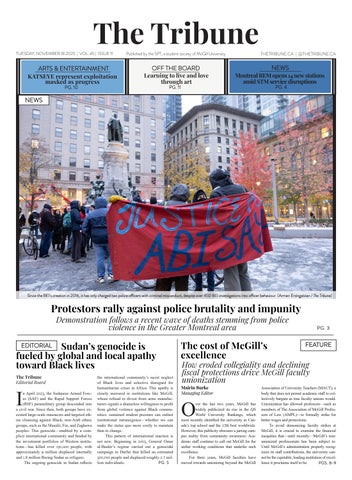
Protestors rally against police brutality and impunity
Demonstration follows a recent wave of deaths stemming from police violence in the Greater Montreal area
EDITORIAL
The
Tribune Editorial Board
In April 2023, the Sudanese Armed Forces (SAF) and the Rapid Support Forces (RSF) paramilitary group descended into a civil war. Since then, both groups have executed large-scale massacres and targeted ethnic cleansing against Black, non-Arab ethnic groups, such as the Masalit, Fur, and Zaghawa peoples. This genocide—enabled by a complicit international community and funded by the investment portfolios of Western institutions—has killed over 150,000 people, with approximately 9 million displaced internally and 1.8 million fleeing Sudan as refugees. The ongoing genocide in Sudan reflects
the international community’s racist neglect of Black lives and selective disregard for humanitarian crises in Africa. This apathy is clearly mirrored in institutions like McGill, whose refusal to divest from arms manufacturers signals a shameless willingness to profit from global violence against Black communities. sustained student pressure can outlast institutional intransigence—whether we can make the status quo more costly to maintain than to change.
This pattern of international inaction is not new. Beginning in 2003, General Omar al-Bashir’s regime carried out a genocidal campaign in Darfur that killed an estimated 300,000 people and displaced roughly 2.7 million individuals.
How eroded collegiality and declining fiscal protections drive McGill faculty unionization
Mairin Burke Managing Editor
Over the last two years, McGill has widely publicized its rise in the QS World University Rankings, which most recently identified the university as Canada’s top school and the 27th best worldwide. However, this publicity obscures a jarring campus reality from community awareness: Academic staff continue to call out McGill for the unfair working conditions that underlie such excellence.
For three years, McGill faculties have moved towards unionizing beyond the McGill
Association of University Teachers (MAUT), a body that does not permit academic staff to collectively bargain as true faculty unions would. Unionization has allowed professors—such as members of The Association of McGill Professors of Law (AMPL)—to formally strike for better wages and protections.
To avoid demonizing faculty strikes at McGill, it is crucial to examine the financial inequities that—until recently—McGill’s nonunionized professoriate has been subject to. Until McGill’s administration properly recognizes its staff contributions, the university cannot be the equitable, leading institution of excellence it proclaims itself to be.
Since the BEI’s creation in 2016, it has only charged two police officers with criminal misconduct, despite over 450 BEI investigations into officer behaviour. (Armen Erzingatzian / The Tribune)
SSMU Fall 2025 Referendum results
Voters reject MSA fee increase and pass new gender-affirming care plan
Amelia H. Clark & Eren Atac Staff Writer Staff Writer
19.1 per cent of undergraduate students voted in the Students’ Society of McGill University’s (SSMU) Fall 2025 Referendum, passing five of the seven ballotted motions. The Tribune sat down with the referendum’s stakeholders to discuss the results.
Motion Regarding Muslim Students’ Association (MSA) Services Fee Increase
The Motion Regarding Muslim Students’ Association (MSA) Services Fee Increase, moved by the Student Groups Committee, proposed an increase from $1.66 CAD to $2.19 CAD of the opt-outable MSA fee charged to SSMU members each semester. The increase was rejected in the referendum, with 52.4 per cent of students voting against it.
The MSA advocates for Muslim students’ rights to religious accommodations at McGill by ensuring halal meals and prayer spaces are available on campus, as well as by providing community programming such as mentorship opportunities. The 53-cent increase requested in the referendum was intended to mitigate the group’s financial dependency on the ticketed events they frequently host, which the MSA states decreases the accessibility of their programming.
MSA President Hamza AlFarrash stated in a written response to The Tribune that while the association’s goal of creating safe spaces for Muslim students on campus will not change, the motion’s failure shows a discrepancy between the level of support the Muslim community actually needs and the resources McGill and its undergraduates have deemed appropriate for this community. Many MSA services will have to be delayed, significantly scaled back, or halted entirely as a result of the ‘no’ vote.
AlFarrash further expressed surprise at the referendum result, stating that he expected more reciprocal support from other groups that the MSA advocates for.
“We have been consistent and unwavering in our advocacy for Palestine— a cause deeply rooted in our inseparable identity as Muslims […] [whether we were] pushing the administration, including the President at one point, to divest, [or] challenging their tone and language in official communications,” AlFarrash wrote. “I expected more support from our allies, especially those who share many of the same struggles and aspirations for justice.”
Motion Regarding the Student Services Fee
Voters also rejected the Motion Regarding the Student Services Fee; the nonopt-outable fee will remain $204.74 CAD per semester for full-time undergraduate students. Put forth by SSMU President Dymetri Taylor, the motion would have seen this fee increase by 4 per cent each Fall term until 2028, ultimately settling at $230.31 CAD, if passed. The increase was intended to address the costs of services such as the Student Wellness Hub, Campus Life & Engagement, the Career Planning Service, International Student Services,
Scholarships and Student Aid, Student Accessibility and Achievement (SAA), First People’s House, and the Office of Religious and Spiritual Life; as of this year, these services’ costs have exceeded the revenue the current fee generates.
In a written statement to The Tribune , Taylor described how the motion’s failure will lead to inevitable cuts to these programs’ resources, increasing work for both the student society and its members.
“It doesn’t affect the SSMU (budgetarily wise); however, it does affect [these] Student Services,” Taylor wrote. “In turn, [we could] see decreases in services offered by the respective departments, whether that’s cuts to employees, events, opportunities, [or] assistance.”
Motion Regarding the Renewal of the Access McGill Ancillary Fee
Taylor also put forward the Motion Regarding the Renewal of the Access McGill Ancillary Fee, which aimed to maintain the fee’s $2 CAD rate until Winter 2031. This referendum item passed, with just over three-quarters of voters in favour. The ancillary fee goes towards Student Accessibility and Achievement (SAA), which is responsible for providing accommodations to students who face disability-related barriers. These resources include exam support, language translation services, and transportation for students with physical impairments. The fee aims to improve the current services offered by SAA, and its passage occurred amid complaints from students regarding unprofessional SAA invigilator conduct.
Motion Regarding the Renewal of the SSMU Access Bursary Fund Fee
The Motion Regarding the Renewal of the SSMU Access Bursary Fund Fee, again moved by Taylor, was approved with a resounding 80.8 per cent of students voting ‘yes’, making it the most popular motion
on the ballot. The opt-outable fee, currently costing members $8.50 CAD per semester, is administered by McGill’s Scholarship and Student Aid Office to undergraduate students facing financial barriers. McGill matches each fee payment from students, amounting to an average of $700,000 to 900,000 CAD a year in need-based financial aid available to SSMU members through this fee.
Motion Regarding the Renewal of the Musician’s Collective Fee
Voters also passed the Motion Regarding the Renewal of the Musician’s Collective Fee, moved by Taylor, via a 66 per cent majority. This $0.10 CAD opt-outable fee will be put towards the SSMU Musician’s Collective’s equipment, performance opportunities, and jam room, which are available to any students who pay this fee.
Motion Regarding First Year Fee Renewal Question
The Motion Regarding First Year Fee Renewal Question, moved by Taylor, was approved with 53.2 per cent of voters saying ‘yes’ to the fee. The opt-outable $0.30 CAD charge will come into effect from Winter 2026 through Winter 2031, meant to facilitate the activities of the SSMU FirstYear Council. The Council hosts social events, provides forums for first-year discussions, and represents first-year students at SSMU’s Legislative Council.
Motion Regarding Creation of the Gender Affirming Care Fee
The Motion Regarding Creation of the Gender Affirming Care Fee, put forth by Taylor, was narrowly approved by a 51.1 per cent vote in favour. This opt-outable fee will come at a rate of $10.05 CAD per student per year, spanning from Winter 2026 until Winter 2031 when it will be re-voted on for renewal. The fee will provide for an Alumo (previously StudentCare) gender-
affirming care insurance plan, which will reimburse students up to $5,000 CAD per gender-affirming procedure, with a cap of $50,000 CAD per plan user.
This insurance plan seeks to fill the gaps in coverage of gender-affirming procedures under the existing SSMU general health insurance plan. Gender-affirming care was included in the student dental plan starting in 2023, but its cancellation in January 2025 left many students without guaranteed access to this life-saving healthcare, as gender-affirming procedures are often unaffordable without coverage.
Taylor affirmed that the new genderaffirming care insurance plan will be in effect starting in fall of 2026.
“Conversations have already taken place with Student Care to move forward with the plan, that is the only reason it was on the referendum as well,” he wrote. “Additional time is necessary because of the required work that needs to be done between McGill and Student Care to organise the opt-out process and communicate information.”
Voter Turnout
Reflecting on the 19.1 per cent overall voter turnout, SSMU Vice-President External Affairs Seraphina Crema-Black laid out SSMU’s plans for increasing participation in future referendums. She raised potential ideas such as ramping up SSMU tabling for voting on campus, coordinating with professors to help draw in voters, and preparing clearer resources for students ahead of voting.
“I recently met with our SSMU Elections team and my Political Campaigns Coordinator to begin planning how we can increase participation in the next referendum,” Crema-Black wrote in a statement to The Tribune . “We know turnout can always be improved, and we’re working on strategies that make voting more visible and accessible for students.”
Protestors rally against police brutality and impunity
Demonstration follows a recent wave of deaths stemming from pol ice violence in the Greater Montreal area
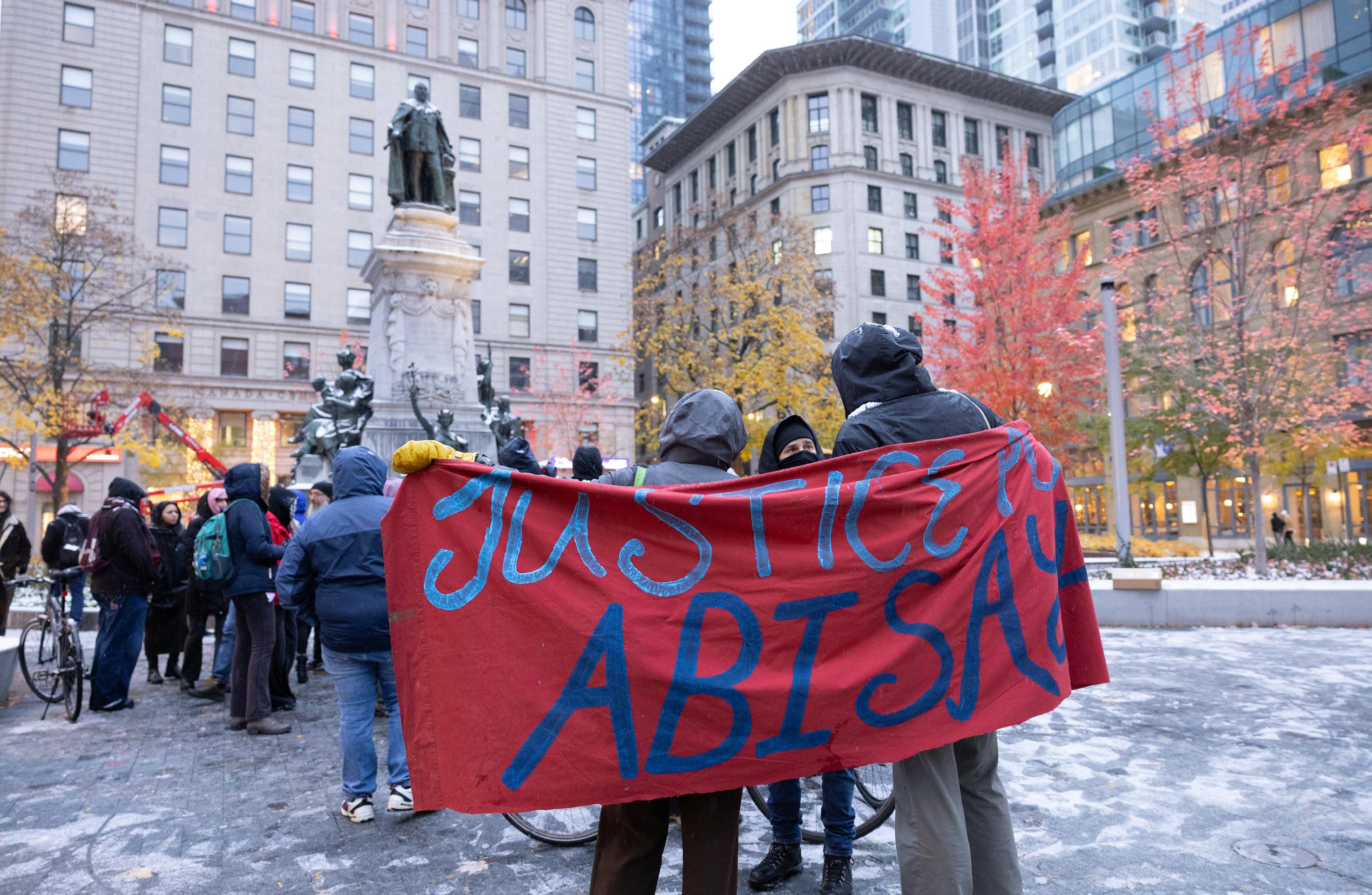
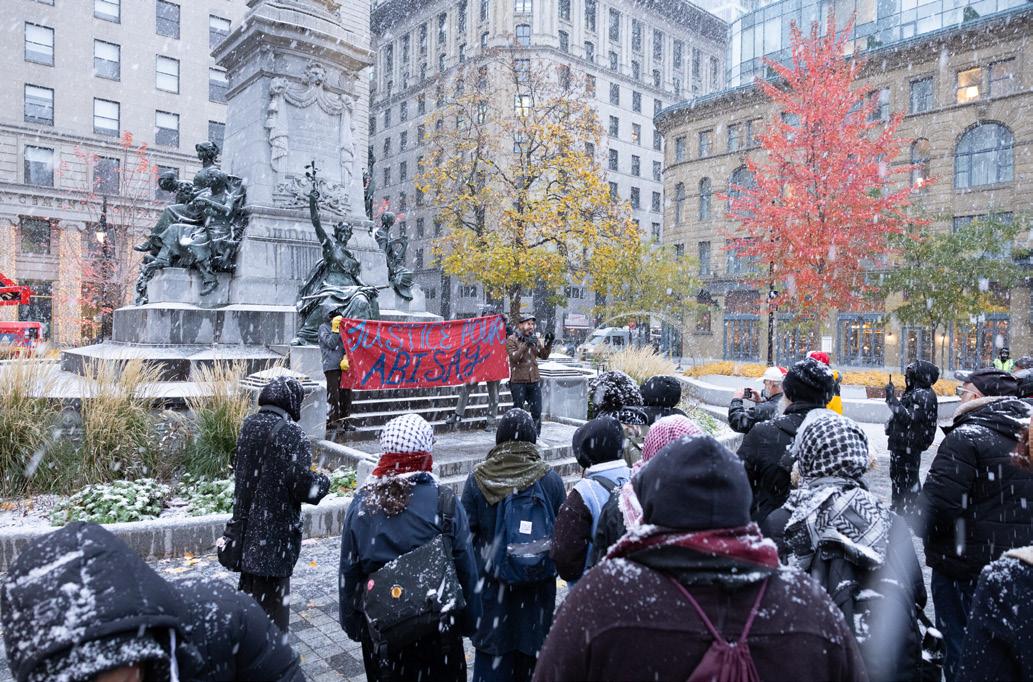
Despite freezing rain, a group of approximately 50 protestors rallied in Montreal’s Philips Square at 3:00 p.m. on Nov. 9 to march with the Defund the Police Coalition to denounce instances of police brutality in Greater Montreal this year.
On Sept. 21, 15-year-old Afghan-Canadian Nooran Rezayi was with his friends when an individual called 911, telling emergency services that a group armed with weapons was at the intersection of rue JosephDaigneault and rue de Monaco in Saint-Hubert. Officers with the Service de police de l’agglomération de Longueil (SPAL) arrived ten minutes later. Within 58 seconds, one of these officers—whose identity remains unknown—shot Rezayi twice, killing him.
In another act of police violence, on March 30, Latinx man Abisay Cruz was killed by Service de police de la Ville de Montréal (SPVM) officers, who were responding to a call regarding a person in crisis. While three officers handcuffed Cruz, one of them forced his knee into Cruz’s upper back. In a video captured during the altercation, Cruz can be heard yelling, “I’m going to die.” Moments later, he lost consciousness. After being transported to a hospital, Cruz was declared dead. His death is currently under investigation by
the Bureau des enquêtes indépendantes (BEI).
Protesters at the rally directly called out the BEI, Quebec’s police watchdog that investigates potential misconduct. Since its implementation in 2016, zero of the 52 BEI cases concerning police officers who have fatally shot civilians have resulted in charges against an officer. Quebec’s Ligue des droits et libertés has questioned the BEI’s independence, citing its reliance on police services in initiating its investigations, and the fact that the majority of BEI staff come from the policing sector.
One of the speakers at the rally discussed a recent provincial decision allowing police officers to remain silent and withhold information during BEI investigations.
“The Court of Appeal of Quebec decided that it was more important to protect the right to silence than the right of the public to information,” the speaker stated. “The police officer who killed Nooran told himself that in Quebec, you can kill anyone, anyhow, as a police officer, because the system is behind you.”
The SPAL, responsible for Reyazi’s killing, has been held in high public regard recently as a reformed, community-oriented police organization. In an interview with The Tribune, an individual at the rally who wished to remain anonymous spoke about these reforms.
“We’ve seen that not only are they not effective, but they are used by the police to justify further killings, imprisonment, [and]
surveillance,” the attendee said. “We [need] to move towards mutual aid. We [need] to move towards systemic changes that eliminate the conditions that lead to […] crime in the first place.”
Another individual, who wished to go unnamed, commented on their experiences with police violence at previous protests.
Since the BEI’s creation in 2016, it has only charged two police officers with criminal misconduct, despite over 450 BEI investigations into officer behaviour. (Armen
“You can’t expect the police to police themselves,” they shared, in an interview with The Tribune. “I was forcibly pushed by an [(SPVM)] police officer at the March 15 protest [against police brutality]. I could have been seriously injured [....] My cameras were damaged.”
The individual added that rallies are an important way of fighting police repression and making the cause visible.
“Excessive force shouldn’t happen at all [....] When police brutalize [protestors] and people see that, it has a dissuading effect [on protest attendance],” they said. “We have to put pressure on our politicians.”
In recent times, there has been an increase in heavy and often violent police presence on McGill’s downtown campus, such as SPVM’s presence at Independent Jewish Voices’ peaceful celebration of Sukkot in
October, at Association of Graduate Students Employed at McGill (AGSEM) protests in 2024, and at pro-Palestinian protests throughout 2024 and 2025.
A 2019 report commissioned by the City of Montreal found systemic bias in street checks performed by Montreal police; compared to white people of the same age, Indigenous, Black and Arab people between ages 15 to 24 were four to five times more likely to be targeted by checks. In 2024, the Black Coalition of Quebec filed a $171 million CAD class-action lawsuit alleging that the City of Montreal was responsible for systemic racial profiling within its police force; a Quebec Superior Court judge agreed.
Some quotes in this article have been translated from French.
Senate passes amended Student Code of Conduct following months of deliberation
After much debate, Senate voted against BoG supervision of the Committee on Student Discipline
Nell Pollak Managing Editor
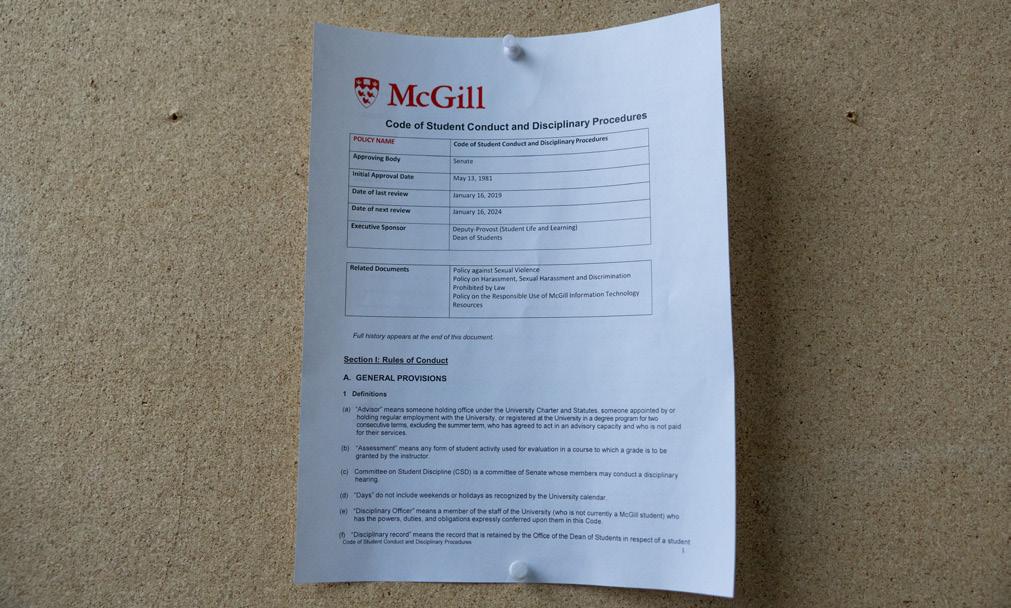
The McGill Senate convened on Nov. 12 for its third meeting of the academic year. Senators engaged in debate over proposed revisions to McGill’s Code of Student Conduct and Disciplinary Procedures, ultimately passing an amended version that removed Board of Governors (BoG) oversight from the Committee on Student Discipline (CSD), which implements the Code.
The meeting began with memorial tributes to Professor Erika Giselle, librarian Tatiana Bedjanian, and Professor Deborah Danoff. McGill’s President and Vice-Chancellor Deep Saini then discussed Quebec’s multi-year Immigration Plan for 2026-2029, which will maintain existing international student quotas. Saini expressed disappointment that the provincial government did not exclude graduate students from these quotas or reopen the Quebec Experience Program pathway to permanent residency for recent graduates, as McGill had recommended.
Most of the session focused on proposed revisions to the Code of Student Conduct, presented by Interim Deputy Provost of Student Life and Learning, Angela Campbell. Campbell emphasized that the Code’s revisions aimed to reflect deliberate consultation, engagement, and compromise with the McGill community.
However, Jérémy Boulanger-Bonnelly, assistant professor in the Faculty of Law, im-
mediately moved to amend the proposed code, explaining why he sought to remove any references to BoG involvement from the document.
“This amendment […] would give the Board of Governors a veto over the appointment of members of the CSD,” Senator Boulanger-Bonnelly said. “The Board has consistently failed to justify in any compelling manner [why these changes are necessary].”
BoG Chair Maryse Bertrand defended the Board’s involvement, citing numerous incidents involving ‘angry mobs’ on campus that have prompted concern from McGill’s administration.
“The Board has heard complaints […] from students who would rather spend their entire semester attending remotely, rather than face what they call a hostile or poisonous atmosphere in their faculties,” Bertrand stated. “The Board cannot and will not do nothing in the face of these new and unprecedented disruptions.”
Boulanger-Bonnelly’s amendment, which would remove Board involvement from CSD appointments, passed narrowly with 38 votes in favour, 34 against, and 6 abstentions. He then proposed a second amendment to maintain the Code’s current ‘knowingly’ intent standard— which requires proof that a student was aware their conduct would cause the specific result they are being penalized for—rather than the newly proposed ‘unreasonableness’ standard, which only requires that student conduct seriously deviate from what a ‘reasonable’ person would do for them to receive discipline.
Supporters argued the lower standard for punishment could discourage freedom of expression and assembly, particularly for protest-related offences. The Senate defeated the amendment in a majority vote.
After a failed motion by Vice-President Administration and Finance Fabrice Labeau to postpone the vote on whether to adopt the new Code indefinitely, the Senate heard final comments on the revised Code.
Saini warned that the updated Code may be read as a breach of power by McGill’s administration.
“[The amended Code] could be interpreted as the Senate overriding the statutes and […] seeking to regulate the authority of the [BoG],” he said.
In response, Catherine Lu, professor in the Department of Political Science, emphasized that the Senate did not intend to cause any conflict with the Board of Governors by amending the Code.
“I really would resist any kind of interpretation that somehow made this about winning or losing, because we’re all going to win or lose based on credible, convincing arguments,” she stated.
Ultimately, the revised Code of Student Conduct passed with 44 votes in favour and 18 abstentions.
Moment of the meeting: Associate Professor in the Faculty of Engineering, Ipek Türeli, read a statement from her Palestinian colleague in McGill’s Faculty of Medicine and Health Sciences, who described experiencing antiPalestinian racism on campus and called on the university to recognize its role as a silent witness to violence.
Soundbite: “I came here in support of my colleague, Senator Boulanger-Bonnelly’s, motions. I got the result that I wanted on the first motion. I didn’t get the result that I wanted on the second motion. On a balance, I’m going to vote for the Code [....] I’m prepared to respect the work that was done.”—Víctor MuñizFraticelli, associate professor in the Faculty of Law, on navigating disagreement through the Senate’s democratic process and on avoiding postponing a vote on the Code.
Erzingatzian / The Tribune)
Montreal REM opens 14 new stations amid STM service disruptions
REM expansion extends service to Deux-Montagnes as riders cite reliability concerns
Lawson Whitman Contributor
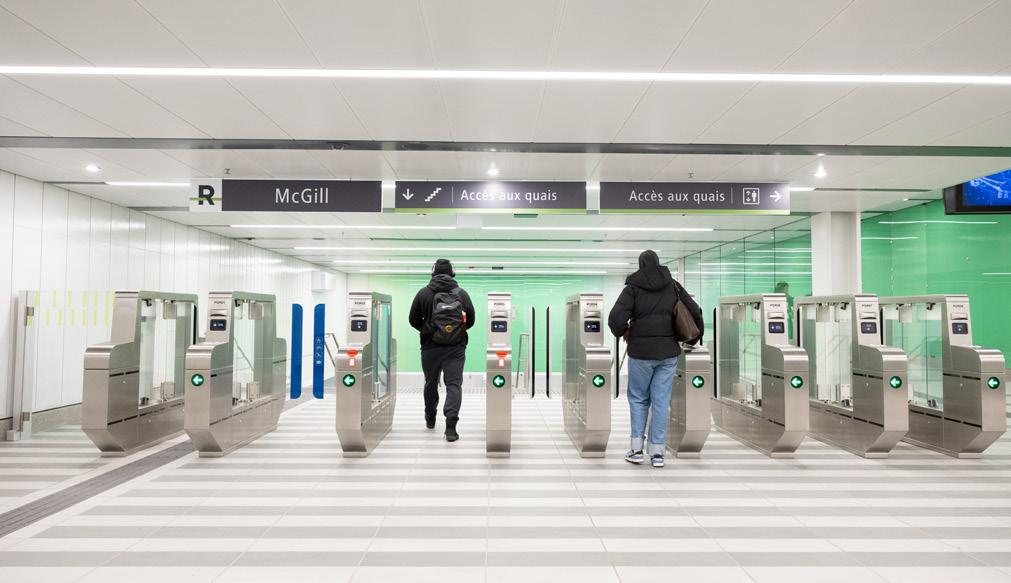
The expanded Réseau Express Métropolitain (REM) network officially opened on Nov. 17, unveiling 14 stations that stretch service from Montreal’s South Shore up to Deux-Montagnes. This expansion includes a newly shared McGill station, now a stop on both the REM and the Société de transport de Montréal (STM)’s metro lines.
The REM, a driverless light-rail system operated by private corporation CDPQ Infra, first opened in 2023 with just five stations between Brossard and Gare Centrale. Its new launch unfolded amid STM strikes that have caused disruptions in metro service, including a full shutdown of the system on Nov. 1.
For many South Shore commuters, the REM expansion marks a welcome improvement. Aïsha Nsiempba, U3 Accounting, takes the light-rail daily from Brossard to downtown Montreal and McGill’s main campus. In an interview with The Tribune, she explained how the REM allows South Shore residents to reach their destinations faster.
“I am pleased with the recent expansion of the REM, as it makes my commute more convenient and shortens travel times to areas that used to take over an hour and a half to reach,” she said.
Despite the REM’s convenience, Nsiempba expressed concern over how it has eliminated other transportation alternatives for many South
Shore commuters.
“The buses that used to take us from the South Shore to Montreal were completely cut and replaced by the REM, which would have been acceptable if the [REM] system had worked optimally from the start,” Nsiempba continued.
Privately operated, the REM has a noncompete clause with Montreal’s public transit systems that prevents the REM from operating along existing municipal transit routes. In the wake of the REM’s frequent service disruptions, commuters therefore have no alternative option to get to Montreal—other than driving. Doreen Assaad, the mayor of Brossard, has called for the reinstatement of several express bus lines as a solution. Meanwhile, REM officials claim, moving forward, their system should experience shorter wait times if service interruptions occur.
In an interview with The Tribune, Meredith Alousi-Jones, PhD student at McGill’s School of Urban Planning and graduate research assistant with Transportation Research at McGill (TRAM), offered insight into how the surrounding environments of the new REM stations affect use of the system. Local government investment, which varies by municipality, strongly influences whether a station supports increased ridership and economic activity in the region.
“Ease of access to stations is a key factor in travellers’ choice to take the REM,” AlousiJones explained. “Features such as well-connected sidewalks, nearby activities and services,
and efficient transfers between modes [of transit] can all encourage REM use.”
Alousi-Jones also explained how introducing another transit solution to the greater Montreal area can help increase social accessibility.
“At TRAM, we conducted a survey in June during the first [STM] strike and found that [its] negative impacts were particularly pronounced among women, low-income individuals, and people living with disabilities,” Alousi-Jones explained.
She stressed that the extra costs of Ubers, taxis, and BIXIs can put a financial strain on people as their everyday expenses increase.
“Circumstantial switches to other travel modes during these strikes such as vehicles, walking or bicycles, can become more permanent,” Alousi-Jones added.
In an interview with The Tribune, Students’ Society of McGill University (SSMU) VicePresident University Affairs Susan Aloudat explained that the SSMU is committed to supporting students’ transportational expenses to counteract STM service disruptions. During the most recent strike, students could request reimbursement for these expenses by submitting transportation payment receipts through a designated form.
“Examples of acceptable submissions [included] BIXI fees, rides between campus and your home address, parking passes, or other transportation passes,” Aloudat said.
Alousi-Jones emphasized that despite the coincidental expansion of the REM while the STM was on hold, reliability, not ownership structure, will remain the key factor in how riders judge transit quality.
“Since fares are aligned across both systems, riders will expect comparable levels [of] high-quality service,” she highlighted.
Nsiempba expressed cautious optimism that the new line will make getting to campus even a little easier.
“I plan to continue using the REM and hope it keeps improving,” she said. “It seems to be on a positive trajectory, and I genuinely hope that continues.”
The Tribune Explains: Departmental strikes for Palestine Understanding this week’s on-campus strikes
Sofia
Vidinovski Contributor
In the November 2023 Students’ Society of McGill University (SSMU) Fall Referendum, 78.7 per cent (5,974 voters) of SSMU constituents voted in favour of the Policy Against Genocide in Palestine. Undergraduates also voted to go on strike for Palestine through the SSMU in April 2025 and October 2025.
Now, in November 2025, students are organizing departmental strikes for Palestine, calling on McGill to divest from companies complicit in the genocide in Palestine, drop disciplinary charges against students involved in pro-Palestine advocacy, and end its research partnerships with Israeli institutions contributing to the oppression of Palestinians.
As of Nov. 17, 19 departments at McGill have voted to strike or are in the strike decision-making process. The Tribune explains the logistics of these strikes.
Why are departments striking?
McGill University invests approximately $73 million CAD of its endowment into various companies that are directly linked to Israel’s genocide in Gaza, including Lockheed Martin and Airbus. McGill also participates in exchange programs with Israeli institutions, such as the Technion-Israel Institute of Technology, which develops military technology used by the Israel Defense Forces. Furthermore, McGill campus security has heavily policed pro-Palestine student ac-
tivists over the last two years, which is why disciplinary immunity for these students is at the core of student strikes for Palestine.
What is the process of getting a departmental strike approved?
Each department has its own constitution that dictates how it can strike. Typically, to vote on a motion to strike, departments must hold a general assembly (GA) that meets a certain minimum number of departmental members—referred to as quorum—to ensure the GA is representative. If a GA meets quorum, departmental members can discuss motions concerning a strike, make amendments, and then vote for or against the strike motion. If the majority of students at the GA vote for the motion, the whole department is considered on strike.
What departments are going on strike? Which departments did not vote to strike at their GAs?
The undergraduate departments going on strike in the Faculty of Arts are Anthropology, Art History & Communication Studies, East Asian Studies, English, Environment (Arts), Gender, Sexuality, Feminist, and Social Justice Studies, Geography, International Development Studies, Liberal Arts, Philosophy, Sociology, South Asian Studies, and World Islamic and Middle East Studies. The Faculty of Science’s striking undergraduate departments are Atmospheric and Oceanic Sciences, Earth and Planetary Sciences, Physics, and Physiology. Additionally, Macdonald
Campus Agricultural and Environmental Science students are striking, as well as the Computer Science Undergraduate Society.
The departments of Education, History, Linguistics, Mathematics and Statistics, and Religious Studies did not meet the quorum needed to vote for a strike. The departments awaiting GAs to vote on striking are Anatomy and Cell Biology, Biology, Economics (Arts), Neuroscience, Political Science, the Caribbean and Latin American Studies and Hispanic Studies Association and the Electrical, Computer & Software Engineering Students’ Society. Rather than go on strike, the Faculty of Science Department of Pharmacology passed a motion affirming its solidarity with Palestine and instating a plan to donate 15 per cent of its Winter 2026 proceeds to relief efforts in Gaza through a humanitarian aid organization to be selected by members of the department.
tors stand outside classrooms and discourage attendance and participation.
How long will the strike last? What will it look like?
The strikes will occur during the week of Nov. 17 to Nov. 21, with the specific range of dates depending on the department. The strikes call on students to refrain from attending all classes, conferences, labs, and office hours held by their department. Students are still permitted, within the boundaries of the strike, to attend class to take assessments and exams that they cannot miss.
What is the difference between hard picketing and soft picketing?
Departments have announced, via their Instagrams, the unique picketing strategies they will be using during the strike. While hard picketing involves protestors physically blockading classrooms, most departments choose a soft picketing strategy where protes-
There will be activities, such as workshops and film screenings, for students to participate in during the strike, hosted by Students for Palestine’s Honour and Resistance at McGill.
To keep up with the current status of departmental strikes on campus, visit the strike
The REM’s new McGill station allows transfers between the light-rail system and the STM network for the first time. (Armen Erzingatzian / The Tribune)
There are currently 29 Palestinian international students enrolled at McGill. (Zoe Lee / The Tribune)
TUESDAY, NOVEMBER
Editor-in-Chief
Yusur Al-Sharqi editor@thetribune.ca
Creative Director Mia Helfrich creativedirector@thetribune.ca
Moyo Alabi Lulu Calame Ellen Lurie opinion@thetribune.ca
Science & Technology Editors
Leanne Cherry
Sarah McDonald scitech@thetribune.ca
Student Life Editors
Gregor McCall Tamiyana Roemer studentlife@thetribune.ca
Features Editor Jenna Durante features@thetribune.ca
Arts & Entertainment Editors Annabella Lawlor Bianca Sugunasiri arts@thetribune.ca
Sports Editors Ethan Kahn Clara Smyrski sports@thetribune.ca
Design Editors Zoe Lee Eliot Loose design@thetribune.ca
Photo Editors Armen Erzingatzian Anna Seger photo@thetribune.ca
Multimedia Editors
Jade Herz Ella Sebok multimedia@thetribune.ca
Web Developers Rupneet Shahriar Johanna Gaba Kpayedo webdev@thetribune.ca
Copy Editor Ella Bachrach copy@thetribune.ca
Social Media Editor Mariam Lakoande socialmedia@thetribune.ca
Business Manager Celine Li business@thetribune.ca
Sudan’s genocide is fueled by global and local apathy
The Tribune Editorial Board
Continued from page 1.
Al-Bashir, in collaboration with the Janjaweed militia, conducted mass killings of Black Darfurians, destroying villages, poisoning wells, and systematically raping women and children.
Yet the international community egregiously refused to multilaterally recognize al-Bashir’s campaign in Darfur as a genocide. The UN Security Council issued repeated resolutions calling for the cessation of human rights violations and hostilities, but offered no meaningful enforcement mechanisms, declining to authorize major interventions or impose punitive measures.
Although al-Bashir was overthrown in 2019, today’s civil war stems from many of the same perpetrators of past atrocities in Darfur. Current RSF commander
General Mohamed Hamdan Dagalo was a Janjaweed leader, and many RSF fighters also fought for the militia group during the Darfur genocide. In failing to intervene
COMMENTARY
toward Black lives
meaningfully during the previous civil war, international institutions have effectively enabled the next generation of genocidaires. As such, the same power structures continue to carry out genocidal acts against Sudanese Black ethnic groups today.
Although the RSF and SAF’s military actions today each amount to acts of genocide, the international community has again faltered, refusing to take action beyond symbolic recognition and passive investigation.
In fact, the very abuses that define Sudan’s ongoing genocide as such—the targeted destruction of a national, ethnic, racial, or religious group—have been reframed by global powers to justify their own neglect and complicity. Overtly racist framings of the genocide by officials and media as ‘tribal conflict’ minimize the responsibility of Western actors to intervene, and reinforce the devaluation of Black lives in Sudan.
Canada itself, whose Family Reunification Program has served to reunite refugees who have been torn from their families by crisis and war, has largely excluded Sudanese
applicants, substantiating the country’s apathy towards the suffering in Sudan. Canada has pledged to admit merely 4,000 refugees from Sudan, while Quebec has refused to admit Sudanese refugees for residence entirely.
Canada’s institutional response to the genocide in Sudan reveals a glaringly racist double standard.
In 2023, the Canadian government did not place a limit on the number of Ukrainians who could apply for refugee status, empowering over 300,000 Ukrainian refugees to enter Canada, an incredible testament to what is possible through effective, welcoming refugee policies. Yet when it comes to the suffering of Black Africans, Canada’s program to address the refugee crisis in Sudan is capped at a low number, reflecting the country’s discriminatory conceptions of whose suffering is urgent and whose is not.
McGill’s own investments in Lockheed Martin and other weapons manufacturers—which directly provide arms to the SAF and RSF— reveal the same selective morality that governs how Canada and the international community allocate
humanitarian support. McGill must immediately cease its funding of the genocide in Sudan, as it did in 2006 when it divested from companies doing business in Myanmar (then Burma), and adopt an anti-genocidal framework that values Black lives with the same urgency as other groups facing genocide and mass atrocity.
For the sake of the over 9.5 million people currently internally displaced in Sudan, the over 21 million trapped in famine, and the millions killed throughout generations of civil war.
Divestment blocks weapons manufacturing at its source. Even with the recently implemented UN arms embargo, the United Arab Emirates continues to arm and finance the RSF. Unless institutions divest, weapons companies will simply find new backers—sustaining the perpetrators of genocide.
When institutions fail to condemn genocide and choose complicity over conviction, the cycle of suffering, neglect, and violence only deepens. McGill’s investments sustain global violence; divestment from Sudan’s genocide is long overdue.
A clerical error calls Election Canada’s dedication to democracy into question.
Noah Bornstein, Guillaume Delgado, Sofia Vidinovski,Lawson Whitman, Sophia Angela Zhang Tarun Kalyanaraman, Abbey Locker,Elgin Wilson
Noah Bornstein Contributor
In the 2025 Canadian federal election, the Liberal Party won the riding of Terrebonne by a single vote, with Bloc Québécois as the runner-up. However, a clerical error returned a mailin ballot to a Bloc Québecois voter. This administrative fault, framed by judicial bodies as a mere unintentional mistake, has the potential to not only obstruct the accuracy and fairness of the Terrebonne race, but sets a precedent that minimizes the cruciality of honest elections.
Since this vote could have altered the outcome of the election, Bloc Québécois candidate Nathalie Sinclair-Desgagné argued that the result should be annulled, positing that not counting a vote constitutes a violation of that voter’s Charter rights. The judge ruled against her, stating that there was no malicious intent and that there was therefore no obstruction of election integrity.
Allowing this result to stand is not merely unjust but undemocratic, and could set a dangerous precedent that allows improper elections to be validated. Flaws in our electoral system are inevitable, but rather than neglecting those mistakes,
Elections Canada should be doing everything in its power to make sure that when those inevitable incidents occur, they do not affect electoral outcomes.
In an era where online conspiracies around elections are widespread, it is imperative that Elections Canada remains a neutral and effective electoral body. Claims of fraudulent elections have grown increasingly common around the world in the past few years. Infamously, right-wing insurgents stormed the United States Capitol on Jan. 6, 2021, in an attempt to overturn the results of the 2020 election—which rioters claimed was rigged. Then, in 2023, an almost identical insurrection took place in Brazil, clearly demonstrating the damage incited by a mistrust in the electoral process.
Democratic elections are supposed to be both free and fair. A free election is one where all voters can vote for the candidate of their choice. A fair election is one where all votes are counted equally. Hungary’s elections are free but not fair. Turkey’s elections are fair but not free. Elections in the Jim Crow South were neither fair nor free. The 2025 Canadian Federal Election was free—there was no voter coercion towards any party.
Yet because a vote was not counted, this election was not fair.
Elections Canada has a track record of miscounts and errors, one they must compensate for with thoughtful, targeted solutions to clerical errors like those within the Terrebonne election. In the October 2024 elections in British Columbia, Elections BC forgot to count an entire extra box of ballots, leading to conspiracy theories that the BC New Democratic Party fabricated election results in the extremely close election.
Nathalie Sinclair-Desgagné lost the former Bloc Québecois stronghold of Terrebonne through a clerical error. (Eliot Loose / The Tribune)
In the 2025 federal election, Elections Canada closed several remote polling sites in northern communities due to inclement weather, preventing people from voting as there were no other polling stations nearby. While Elections Canada offers a weather contingency plan on its website, it must also invest in sufficient infrastructure to support voting in all remote communities.
With Canadian electoral mistrust and political polarization on the rise, it is Elections Canada’s responsibility to prove to the Canadian people why it deserves to be in charge of one
of the most important functions of our democracy—elections. Determining the extent of an election's error should not be a question of intent or malice, but a question of fairness. By neglecting SinclairDesgagné's deciding vote, the ruling judge is sending the message to Terrebonne that unfair elections and undemocratic outcomes are acceptable as long as those outcomes were unintended. Failing to penalize—and be proactive about preventing—anti-democratic election activity on the basis of subjective perceptions of intent is a deeply flawed principle. The law does not carve out exceptions for good intentions; Canada’s democracy should not be any different.
Shatner University Centre, 3480 McTavish, Suites 404, 405, 406
Simona Culotta, Defne Feyzioglu, Alexandra Hawes Silva, Celine Li, Lialah Mavani, Nour Kouri, Laura Pantaleon
TPS BOARD OF DIRECTORS
OFFICE STAFF
Norah Adams, Zain Ahmed, Eren Atac, Basil Atari, Rachel Blackstone, Amelia H. Clark, Defne Feyzioglu, Samuel Hamilton, amuel Hamilton, Merce Kellner, Antoine Larocque, Alexandra Lasser, Lialah Mavani, José Moro, Talia Moskowitz, Jenna Payette, Julie Raout, Parisa Rasul, Alex Hawes Silva, Jamie Xie, Michelle Yankovsky, Ivanna (Ivy) Zhang
Julie Raout Staff Writer
HQuebec independence will not solve climate change
undreds of Quebec separatists— predominantly younger Quebecers—gathered in Montreal on Oct. 25 for a rally reaffirming their desire for independence 30 years after the 1995 Referendum for Quebec sovereignty, which failed by less than one per cent.
The young Quebecers at the front of this movement not only argue that secession would better protect the French language, but also that it would power climate action. The latter justification demonstrates a frustration with Canada’s ineffective and increasingly destructive climate policies. While this dissatisfaction is understandable, demanding independence for the climate agenda overlooks the need for collective action in climate protection, and fails to consider the social and economic consequences intertwined with the creation of a sovereign Quebec— setbacks which will, in fact, exacerbate climate inaction.
Émile Simard, leader of the youth wing of the separatist Parti Québécois, stated that it was nonsensical that Quebecers had to contribute to Alberta’s large fossil fuel industry through taxes. Complicity with the destructive national energy sector appears to be an important concern for young protesters, with some even referring to Canada as a ‘petro-monarchy.’
Sovereignists view independence as an opportunity for Quebec to disentangle itself from involvement in Alberta oil production, which accounted for 84 per cent
COMMENTARY
Defne Feyzioglu Staff Writer
Eof national output in 2023. However, they fail to recognize that Quebec’s departure will not stop Canada from remaining a major actor in climate change.
In their urgency to lead environmental initiatives, young Quebecers lose sight of the necessity of cooperation in effective climate action. ‘Separatism for climate sustainability’ sends the message that climate change is better addressed independently, thereby undermining the international community’s commitment to collective action for ecological protection.
Emphasizing the importance of cooperation to fight climate change is critical now more than ever: President Donald Trump withdrew the United States—the second-largest greenhouse gas emitter in the world—from the Paris Agreement last January. More recently, he refused to send a delegation to the COP30 launched on Nov. 10. Economists say American disengagement from the Paris Agreement could reduce global emission cuts by about a third.
Rhetoric preaching secession for climate protection does not have its place in a context where division could sabotage a union’s efforts towards a pressing goal. Rallying for Quebec separatism in the name of more effective climate action is misguided; it rationalizes the easy way out of the laborious task of collaborating with other provinces to achieve salient environmental progress.
Additionally, nothing guarantees that a sovereign Quebec government will tackle climate change. The creation of fundamental institutions and infrastructures, such as an
army, a potential new currency, new trade deal negotiations, and international agreements— because of their indispensability in a country’s operation— will most likely take precedence in the Quebec political agenda. Moreover, Quebec will have to face complex financial challenges: Negotiating its share of the national debt and assuming its costs, managing uncertain investors, and living without federal transfers.
Montrealers assert they want to leave the ‘petroleum state’ of Canada in separatist protests (Elgin Wilson / The Tribune)
These political and financial difficulties would be compounded by preexisting issues. Between the housing crisis, the doctor shortage, and inflation, independence seems risky—but outright utopian if one expects it to also adequately revolutionize the way the government approaches climate action. Right now, environmental protection is urgent, and a major political transition does not promise favourable grounds on which to rapidly build sustainable environmental governance.
The Parti Québécois is currently pushing for a new sovereignty referendum in 2030. This initiative is supported largely by the younger generation: Polls show that almost half of Quebecers aged
The poppy ban gets neutrality wrong
embodies narratives of sacrifice, national memory, and wartime identity. That alone makes it a political symbol, even if it is not an overtly partisan one.
verything is political—but not everything should be policed. This is the tension that sits at the heart of a recent decision in Nova Scotia, in which the judiciary ruled that court staff must seek the presiding judge’s permission to wear the Remembrance Day poppy, terming it a ‘symbol of support’ and therefore a potential threat to judicial integrity. By treating a symbol of remembrance as a potential source of bias, the ruling reflects an increasingly expansive understanding of neutrality—one that risks conflating civic expression with a threat to impartiality.
There is a crucial distinction between the appearance of bias and the presence of meaning; this ruling treats them as one. Judicial ethics rightly guard against symbols that relay allegiance to a litigant, a cause under adjudication, or an ideology that could shape ruling. A poppy, however, does not inherently function this way—its meaning is diffuse and collective rather than targeted. Treating it as inherently biased collapses the difference between symbols that influence outcomes and ones that simply coexist alongside them.
The poppy is political, but labelling it as such is not the same as calling it partisan. Politics refers to how power, identity, history, and the state are organized—it does not refer to a specific party or platform. The poppy
Under the same definition, flags are political, as are national holidays, military commemorations, and remembrance in general. Courts themselves are political spaces as well; they interpret laws, settle constitutional disputes, and issue decisions that can shape public policy. Their rulings directly determine how power is distributed and how collective identities are recognized or constrained. Acknowledging this political dimension should reinforce a proportionate approach to neutrality within procedural obligations—such as appropriate attire and use of symbols—in the courtroom. Treating the objective of neutrality as being the omission of all political meaning not only misunderstands both the nature of the courts and the purpose of the civic symbols, but also applies a selectively drawn standard for defining political expression.
The core issue here is not whether to call the poppy apolitical; it is how far the principle of judicial neutrality should be extended. Judges hold unique decision-making power, and their impartiality must be protected. But instead of clarifying neutrality, this ruling blurs the line between legitimate safeguards and excessive policing of symbols.
The ban sets a precedent where neutrality becomes hyper-sanitized, erasing shared civic or cultural expressions. The judiciary
risks creating an environment where staff cannot express any identity or memory, even shared ones. A similar dynamic plays out in Quebec under Bill 21, which prohibits certain public servants— including judges, police officers, prosecutors, and teachers—from wearing religious symbols. The bill targets items such as crosses, hijabs, turbans, and yarmulkes. When certain symbols, often those tied to minority communities, are singled out for removal, neutrality stops being a shield for fairness and becomes a tool that shapes whose identities are acceptable in public life.
The poppy has never meant one thing to everyone, and its meaning has shifted over time. Originally a symbol of mourning after the First World War, it later evolved into a symbol that honours veterans, and in some circles, it is critiqued as a marker of militarism. That evolution alone reflects a broader conversation about how nations remember conflict; the symbol’s plurality is precisely why calling it ‘apolitical’ flattens its history. Recognizing the political complexity behind the poppy is not disrespectful—it is honest. Yet complexity does not automatically justify restriction. Extending judicial neutrality rules to court staff and banning all political symbolism is a reductive approach that overlooks how ubiquitous and unavoidable political meaning is in public life.
If neutrality demands the erasure
18-34 would vote in favour. Nonetheless, when surveying all Quebecers, two-thirds say they would oppose independence. More than half of Quebecers believe that sovereignty would harm public finances and would not improve health and educational services. Evidently, regardless of the climate-centred rationale, Quebec independence is not a priority for the majority of Quebecers.
However, renewed calls for sovereignty reflect widespread discontent with governance and its inaction on addressing climate change. Although Quebec independence might be unfeasible, the reasons driving the protests underline legitimate frustrations with Canada’s flippancy toward the environment— concerns that the federal government must address proactively and wholeheartedly.
The poppy, adopted by the Great War Veterans’ Association in 1921, is a Canadian symbol of remembrance. (Tarun Kalyanaraman / The Tribune)
of all political meaning, then it becomes indistinguishable from a void. It asks people to shed their histories at the courthouse door. Justice does not become more legitimate when those who deliver it appear stripped of identity. That is neither realistic nor desirable. The poppy’s politics are real, but they are not inherently dangerous. What is dangerous is a fragile conception of neutrality that cannot withstand a symbol of remembrance. A justice system confident in its own impartiality should not fear the influence of the poppy nor the people who choose to wear it. The court’s goal should be to prevent real bias, not to pretend political meaning can ever be fully removed from public institutions.
Best Canadian Stories 2026: In the Shadows of Apocalypse
Alexandra Lasser Staff Writer
TZsuzsi Gartner introduces an exciting world of creative literature
he lived reality of an apocalypse is a daunting thought, yet one that Biblioasis’ Best Canadian Stories 2026, edited by Zsuzsi Gartner, confronts at length. The collection gathers a world of beautiful and provocative literature, each unique in writing yet united by shared thematic currents. Apocalypse— destruction on a catastrophic scale—appears here as an everyday occurrence, with stories exploring friendship, loneliness, and the stubborn resilience of life. Gartner’s collection puts the stories in conversation, creating new meanings between them while introducing readers to the breadth of talent in the Canadian creative writing landscape.
The collection opens with Rishi Midha’s “We Are Busy Being Alive,” which follows a newly affluent family struggling to understand one another and their place in their community. Midha undermines their self-image as activists by repeatedly reminding readers that their mansion sits at a crisp 64 degrees during a brutal heat wave. The upheaval around them is not explicitly described, highlighting the family’s privilege to drift in and out of movements while maintaining their ability to fall asleep comfortably every night. Their shallow bond introduces a question that recurs throughout the anthology: How does connection exist in times of difficulty?
Kaitlin Ruether’s “A Language of Shrugs and Sparks” turns to the digital world as an escape from the loneliness of reality. Ruether infuses every sentence with vitality and motion as
she describes a woman who pours her energy into a vibrant virtual life, while her physical existence remains still and stagnant. Her only tangible relationship is unstable and shallow, thus emphasizing her need for an online community of anonymous friends.
Alex Leslie’s “The Formula” similarly explores the strangeness of connection. Two teenagers forge a deep bond, united by their shared experiences, yet unable to communicate directly. Instead, they rely on their perfected formula of emoji strings meant to convey all that cannot be said.
The space between words is further explored in Margaret Sweatman’s “Sounding a Name,” which creates kinship without familiarity. This story examines an anonymous connection between two people visiting Russia before the war with Ukraine. Their friendship is built on witty remarks and dark humour, supporting the sporadic sharing of fragments of identity. Their friendship offers both of them solace, yet never comfort. The looming war creates an ominous atmosphere around the story, yet Sweatman only mentions it a sentence at a time, allowing dread to fester beneath the narrative.
The beauty of community is best explored in Bill Gaston’s “Jack’s Christmas Dinner,” a touching tale of found friendship. In a cold town during Thanksgiving, a solitary man’s eccentric neighbour prepares a feast out of roadkill. An
eclectic group forms around the holiday, united simply by their desire to attend. The effects of the pandemic and the man’s fractured family life cast a shadow of loneliness that the feast ultimately dissolves. Even the revelation that the presumed turkey is actually a vulture does not spoil the evening but instead amplifies the strange yet tender charm of strangers becoming unlikely friends. Gaston’s warm and witty writing makes this story a standout in the collection.
The anthology closes with Julie Bouchard’s “What Burns,” a tale that boldly confronts the climate crisis rather than placing catastrophe in the background. No longer is societal destruction backgrounded in favour of succinct
plots and individual character arcs. A cool, objective tone weaves statistics into an account of forest fires and arson. The narrator introduces a mystery, yet deliberately refuses to deliver narrative satisfaction, insisting that the climate crisis outweighs any one person’s story. By switching between first, second, and third person narration, Bouchard merges reader and narrator, revealing the frightening truth that we will all eventually face the climate apocalypse. As an art form, the short story collection uniquely allows readers to sample many authors while creating a discourse between each tale. This anthology is enjoyable to read, and I found myself wanting more from the selected authors.
The short story collection will be published on Nov. 18th, 2025. (Anna
Georgia Harmer brings audience home at Montreal stop on her Canadian tour
Opener Sister Ray’s convivial energy carried through the whole night
Norah Adams Staff Writer
When I entered Georgia Harmer’s show this past Thursday, Nov. 6, I was shocked to look around and see no one at all. That is, before I glanced down and noticed concert-goers sitting in groups on the hardwood floors of Sala Rossa’s upstairs venue. As I walked among the crowds, I overheard conversations in both French and English as the concert melded together members of both the anglophone and francophone Montreal communities.
I took my seat among the gaggle and waited for Georgia Harmer’s opener, Sister Ray—the stage name of Toronto-based Métis singer-songwriter Ella Coyes—to begin. Eventually, she came forward and, in an instant, warmed up the space. Like rapt children, concert-goers gathered crosslegged at her feet as she sang songs from her 2025 album, Believer . While Coyes sang bittersweet lyrics from tunes such as “Animal Thing” and “Magic,” the space around us sprouted a familial feeling. Her bold intimacy and willingness to banter with the crowd transformed Sala Rossa, making it feel more like a cozy living room than a concert hall.
Before performing the title song of her album, “Believer,” Coyes shared the story behind it, recounting her relationship with a man twice her age, whom she had kissed only twice within their year-long relation-
ship. The crowd’s whooping was followed by a laughing bite back from Sister Ray, saying, “Don’t cheer for that!”
After Sister Ray’s homey acoustic performance, the crowd warmed up and stood in anxious anticipation for the evening’s headliner: Georgia Harmer. The Toronto singersongwriter stepped to the stage flanked by Canadian bandmates: City and Colour’s leader Matt Kelly on guitar and pedal steel, Manitoban bassist Kris Ulrich, and Toronto drummer Dani Nash.
Harmer kicked off the set with her selfproclaimed favourite song from her 2025 summer album, Eye of the Storm : “Farmhouse.” The track describes an idealized farmhouse representing nostalgia for the good days of a now-failing relationship. She sang to the audience members with a clear voice, accompanied by the tap of her blackbooted foot.
Inciting her set with a song describing the comfort of a house, she picked up where Sister Ray left off, continuing the theme of home for the evening. This idea is maintained throughout Harmer’s music. She jived on stage and sang “Home early with the flu / Your parents pick us up from the airport,” from her song, “Can We Be Still.”
In an interview with The Tribune , Harmer articulated why she chose to emphasize the theme of home in her music.
“In my mid-twenties, I still feel like I am coming of age, and I think a lot of that is
looking for where home is,” she said.
As a fellow Ontarian, Harmer’s music presented a specific kind of home to me, with her songs evoking a familiar landscape, even mentioning Kingston in one of her songs. While speaking with The Tribune , Harmer expressed what it means to belong in the Toronto music community. She shared that this sense of place extends beyond Ontario to Montreal, admitting to concertgoers that she had spent one semester studying at McGill before dropping out to pursue music. Harmer situates herself within the Canadian musical tradition, both in her lyrics and in the Toronto music scene, as well as in every Canadian city she visits while touring.
She expressed to The Tribune that, for her, the biggest way home shows up is in people. This was apparent in the energy she felt with bandmates, particularly guitarist Kelly, who is, in fact, her romantic partner.
“For me, a lot of my songs are about
people, and they are very relational, and I think you can have homes in people,” Harmer said.
As Harmer played out her encore, the title song of the album “Eye of the Storm,” audience members danced all together, singing and stomping their feet. In that moment, it was clear that, for the night, under the blue and pink lights of Sala Rossa, we had all found a home within one another.
Seger / The Tribune)
Georgia Harmer is the niece of renowned Canadian artist Sarah Harmer. (Abbey Locker / The Tribune)
The cost of McGill’s excellence
How eroded collegiality and declining fiscal protections drive McGill faculty unionization
WRITTEN BY MAIRIN BURKE, MANAGING EDITOR & DESIGNED BY ZOE LEE, DESIGN EDITOR
Continued from page 1.
McGill’s professorial salary infrastructure, designed prior to faculty unionization on campus, is just one example of exploitative working conditions at the university. In an interview with The Tribune, Dr. Tim Elrick, Director of McGill’s Geographic Information Centre and Committee Chair of the May 2025 Report of the MAUT ad hoc Committee to Examine the Status of Salaries and Benefits at McGill, discussed the high income inequality across the university’s staff salaries represented in the report.
Using a metric called the Gini coefficient, the MAUT report indicates a “concerning case” of McGill setting aside a limited amount of money to pay all its staff salaries. A few “superstar,” public-facing, tenured professors net very high payouts through a merit-based salary system, while most other staff—often classified as faculty lecturers—earn much less.
Elrick, moreover, reflected on how McGill “[seems] to be putting women predominantly in low-paid positions” as faculty lecturers or untenured professors, resulting in structural differences in pay between men and women across its academic staff. Income inequality generally, as well as women’s predominant position as lower-paid faculty, is much less prevalent at other Quebec universities than at McGill.
Under these poor salary conditions, McGill’s employees can expect paltry pensions, as they can only contribute a fixed amount of their salaries to the funds, which is partially matched by the employer. Beyond poor input, the McGill University Pension Plan (MUPP)’s structure reinforces deep inequities that further disadvantage earlycareer professors while also threatening the stability of even established, tenured professors’ pensions.
Kevin Skerrett, director of Carleton University’s Financialization Research Lab and former
Canadian Union of Public Employees pensions specialist, was recently asked by a colleague in McGill’s Faculty of Law to review the MUPP. In an interview with The Tribune, Skerrett described McGill’s pension as “technical and complicated,” even with his expertise.
McGill offers a two-tiered pension plan to its employees: One for staff who began working at the university before January 1, 2009 (Part A), and another for all those hired afterwards (Part B). Part A is considered a hybrid plan, combining elements of both defined benefit pensions and defined contribution pensions. Part B can be considered an exclusively defined contribution pension.
financial burden to guarantee minimum payouts.
For McGill’s post-2009 Part B employees, there is no guaranteed pension amount.
“The only thing that’s secure [in this defined contribution plan] is how much money gets set aside, but no one has any idea what it will end up producing as a retirement income,” he said. “There are no risks for the employer […] of [needing] to contribute more […] even if things collapse [....] It’s a very inferior, much less comforting and secure pension arrangement.”
Skerrett reported that at McGill, the university contributes payments equivalent to between 7.5-8 per cent of an employee’s salary to both Part A and Part B employee pensions, while at other universities, such as the University of Toronto, Queen’s University, and the University of British Columbia, the employer typically contributes between 9-12 per cent. These lower contribution rates further weaken pension security at McGill. When the employer invests less in employee pensions pre-retirement, there is less money appreciating in value over time in employees’ pension funds.
Skerrett emphasized how the stark inequalities presented by McGill’s two-tiered pension model are known as ‘orphan clauses’ in Quebec, which refers to how they alienate newer workers from their employers and older colleagues.
“[The university is] basically saying, ‘Okay, well, let’s protect our current employees, and let’s screw the young people,’” he summarized.
Elrick further discussed how, at McGill, professorial salaries have decreased in real prices since 2016. Meanwhile, at the University of Toronto and the University of British Columbia, median professorial salaries have increased over the same period in an effort to catch up with Canada’s rising house prices.
“This is a very big problem for younger profs [at McGill], [whose] salary cannot keep up [with inflation so that they] cannot purchase a home,” Elrick asserted. “Do profs need to purchase a home? Maybe not. However, rental prices are linked to housing prices. So when housing prices go up, rental prices go up as well.”
Skerrett outlined that, under the hybrid model, McGill guarantees the pensions of Part A employees, legally promising they will receive a minimum payout upon retirement, calculated directly on the basis of their preretirement salary and years of work at the university.
“The employer essentially backstops and secures and guarantees that the plan will deliver what’s promised, [regardless of the value of the employee’s contributions alone], and sometimes that might mean [McGill has] to kick in extra money,” he explained.
Skerrett posited that McGill’s decision to redesign its pension structure was likely due to the 2008 financial crisis, which heavily impacted such investment funds and forced employers like McGill to take on a heavier
Additionally, McGill no longer applies indexation, or adjustment for inflation, to its pension plans, meaning neither its staff pensions nor its staff salaries are attuned to Montreal’s rising cost of living. Meanwhile, Skerrett reports, at the University of Toronto, staff pensions account for indexation protection.
He also pointed out that under changing Quebec legislation through the 2010s, a new pension plan structured like the MUPP would no longer be legally permitted by the provincial government. In fact, McGill’s restructuring was not subject to collective bargaining with any of its unions or employee groups, further removing the pension plan from the people who depend on it.
“McGill in 2009 had a wonderful situation from an employer perspective, which is, they could make whatever changes they want, and they wouldn’t have to negotiate them with nonexistent faculty unions. So they did,” Skerrett stated. “They took full advantage [and] imposed this horrible, very reactionary, inequitable change [....] This is very bad, what McGill has done, and they’ve done it unilaterally.”
McGill’s lack of employee consultation on its pension restructuring is reflected by its current Pension Administration Committee (PAC). Rather than operate under a joint governance structure, where both employers and faculty union representatives would oversee pension management—as the University of Toronto’s plan does—five of the PAC’s nine members are appointed by the McGill administration’s Board of Governors. There is only one annual public meeting that all MUPP members can attend.
“[The PAC] is an utterly employerdominated structure,” Skerrett asserted. “[The PAC is] also entirely bound by confidentiality, so none of us know what goes on behind its closed doors [....] They are not meaningfully accountable to anybody. By all appearances, the PAC, which is chaired by [McGill’s] Associate [VicePresident] of Human Resources, has never challenged anything the employer decides.”
McGill’s Media Relations Office referred The Tribune to the existing, public resources
over a glass of sherry with the [President of the University],” he explained. “In the few moments when [this] was the case, it was when the university looked very different, [and] generally did not include women, did not include minorities, did not include Jewish people, and certainly did not include people who were outside of the favour of the administration [....] By collegiality, [new faculty unions] mean governance by colleagues, all colleagues, everyone who has an academic title.”
Muñiz-Fraticelli continued by describing this expansive vision of a university where everyone—from contract academic staff to tenured professors—is entitled to participate in governance. He explained that currently, when professors at McGill promoted to the administration receive disproportionate salary increases, they do not return to the professoriate, which erodes the alternation in governance on which collegiality depends and inspires calls for financial justice.
“When the administration […] doesn’t regard us as equal, it doesn’t trust us. We have no reason to trust them in return, and […] this eroded collegiality […] is what eventually led to unionization,” he stated.
Muñiz-Fraticelli discussed how McGill has “been centralizing authority tremendously in James Hall and taking it away from faculties” in recent years, using the 2020 coronavirus disease (COVID-19) pandemic as a case study. The administration did not adopt recommendations from both the Department of Epidemiology, Biostatistics and Occupational Health and the Faculty of Law describing how to better equip McGill’s campus to fight the virus.
AMPL an interest-free loan of $1 million CAD, allowing them to fully pay striking professors’ foregone salaries.
For Muñiz-Fraticelli, this massive show of solidarity from CAUT and other groups, such as the Fédération québécoise des professeures et professeurs d’université, helped validate that unions are necessary and sustainable modes of labour advocacy.
“[Myself and other AMPL members] broke down crying because we realized that we could win, but winning takes resources, because we all have to have to pay our mortgages during the strike, and the union, with the help of CAUT, covered our net salaries during the strike so that we could hold on until the university met our demands,” Muñiz-Fraticelli described.
$ $ $
As McGill increases austerity measures and slashes hundreds of jobs amid financial challenges, public attention often falls on how budget cuts will impact the university’s student experience. Yet a massive driver of this student experience is McGill’s professoriate, who, austerity measures aside, have been poorly compensated for their excellent teaching and groundbreaking research for decades.
on McGill’s website to find information on the university’s pension and salary systems. $ $ $
The importance of addressing salary and pension inequities impacting both newer and older professors at McGill, permitted by McGill’s bad-faith fiscal governance, represents a moral drive behind campus unionization, perhaps even more than a financial one.
“During the COVID crisis, I think a lot of us finally realized that we were employees, because we were treated as employees and only as employees by the administration, [who] was beholden more to political pressure [and to pressure] from external donors and public opinion generally,” MuñizFraticelli expressed.
Campus unions’ emphasis on true collegiality—which would increase transparency and accountability throughout McGill’s community—is a critical step in calling attention to, and inspiring campuswide empathy in the face of, systems at McGill that put employees second time and time again. The university’s murky salary and pension systems can only be addressed when brought to light. And only when McGill’s administration pushes towards stronger fiscal and governance protections for academic staff can it wear the mantle of excellence in good conscience.
In an interview with The Tribune, Associate Professor in McGill’s Faculty of Law and its Faculty of Arts’ Department of Political Science Víctor Muñiz-Fraticelli emphasized that the primary motivation behind increasing faculty unionization on campus is the desire for true collegiality amongst staff, rather than financial gain.
“The people who have traditionally been against the unionization of faculty mean by collegiality […] that we settle our disputes
In the ensuing push for true collegiality, respect, and visibility for professors— represented by AMPL’s ultimately successful unionization in November 2022—the stark discrepancies between what MAUT can offer academic staff versus a true faculty union became clear to Muñiz-Fraticelli.
During AMPL strikes from April to September of 2024, as the union fought for better working conditions in their collective agreement with the McGill administration, the Canadian Association of University Teachers (CAUT) Defence Fund offered
Muñiz-Fraticelli stated definitively that unions—though they may cost professors higher dues than MAUT— provide academic staff the resources they need to fight for and achieve better working conditions at McGill.
“The university originally was a guild, a labour union of sorts,” Muñiz-Fraticelli emphasized. “[Unions] have better and more effective representation, more effective bargaining power, […] the possibility of strikes and withholding our labour. The result is higher benefits, higher salaries and better working conditions. So in fact, you shouldn’t think of [union dues] as just paying more money, but rather as an investment.”
KATSEYE represent exploitation masked as progress
Whether it’s their diversity or their bodies, this group was manufactured to sell
Sophia Angela Zhang Contributor
Since their 2023 debut, KATSEYE have skyrocketed into the mainstream. After a year of silence, the group resurfaced in 2025 with their second EP, Beautiful Chaos . Their hyperpop sound, paired with intricate choreography, marks a departure from their previous Kpop-inspired, teen girl music and aesthetic. Fans often celebrate KATSEYE as a symbol of empowerment, but the group’s carefully manufactured image raises questions about how much agency the members actually hold.
The group was created by HYBE—the
South Korean entertainment giant behind BTS and TXT—and the American record label GEFFEN. KATSEYE’s formation was documented in Netflix’s Pop Star Academy: KATSEYE , which explains how a handful of trainees went through an intensive training and development program, packed with singing, dancing, and performance lessons. After over a year of rankings and monthly evaluations, 20 girls were selected by the producers to advance to the global survival show, The Debut: Dream Academy . The finalists were pitted against each other in a popularity contest for a spot in the six-member group. The final group consists of Daniela Avanzini, from Atlanta with a Cuban and Venezuelan background;
Lara Rajagopalan, from LA with Indian roots; Manon Bannerman, from Switzerland, born to Swiss-Italian and Ghanaian parents; Megan Skiendiel, from Hawaii with Chinese ancestry; Sophia Laforteza, from the Philippines; and Yoonchae Jeung, the only member born and raised in Korea.
From the start, KATSEYE’s most marketable quality has been its diversity. The six girls come from diverse ethnic and national backgrounds, attracting a broad international audience as each member proudly embraces their cultural identity. HYBExGEFFEN have co-opted the demands for diversity—a significant absence in K-pop—to expand their global reach. The members’ different backgrounds are marketed as proof of progressiveness, instead of addressing the industry’s exploitative power imbalances, tokenistic use of diversity, and beauty standards imposed on female idols.
Though KATSEYE were designed to globalize the K-pop methodology by stripping the Korean from K-pop, their popularity is built not only on talent but also on the immense corporate machinery shaping their every move. The KATSEYE brand, which is centred on inclusivity, is a facade for capitalist greed—exploiting the hard work and pain of the girls who make up the group.
On their second EP, KATSEYE embraced more mature sounds and visuals. Their image, like countless other girl groups, is inseparable from the commodification of the female body. “Gnarly,” the lead single of their EP, was the catalyst for this provocative rebranding. The music video and song are meant to be off-putting and ‘cringey,’ while refusing to shy away
Nirvanna The Band The Show The Movie The Review
from the sexual innuendos. With the choreography incorporating twerking, porn soundbites inserted into the soundtrack, and a visual of bees having sexual intercourse, it is clear that the members’ sex appeal is a crucial selling point of the group. This serves as a reminder that the talented girls who make up KATSEYE are merely employees whose songs are written and choreographed by professionals, whose outfits are chosen by stylists, and whose image is crafted by executives. This commodification of sex becomes more unsettling upon realizing that the youngest member of the group, Yoonchae, is still 17 years old.
Their corporate partnerships reinforce this dynamic, especially their recent collaboration with GAP. The “Better in Denim” ad campaign presents a dichotomy between the ideal of global cooperation that KATSEYE embodies and the very product they promote: A fast-fashion company built on an underpaid, exploited workforce with high environmental costs. With new sponsorship, partnerships, and ad campaigns every other month, KATSEYE increasingly serves corporate interests. Their racialized bodies are treated as marketable assets, revealing the moral decay embedded within the global pop music industry. Ultimately, KATSEYE represent the contradiction of global pop: A celebration of womanhood, diversity, and hard work, all while constrained by the structures of capitalism and the male gaze. The success of this girl group proves that diversity is not enough to dismantle these systems of oppression. KATSEYE shine on the global stage, but its brilliance only reveals how much of pop’s empowerment is scripted.
Matt Johnson and Jay McCarroll reunite for a nostalgia-fuelled time-travel joyride
Gregor McCall Student Life Editor
If you’ve never heard of Nirvanna The Band The Show, don’t fret, you’re not living under a rock. The cult web series turned television show, now turned feature film, is neither about the grunge-rock group fronted by Kurt Cobain, nor is it really about a band or show—in any traditional sense, at least.
Debuting in 2007 as an independent web series, the show is a mockumentary-style comedy starring co-creators Matt Johnson and Jay McCarroll. The pair play (semi-)fictionalized versions of themselves: Two ‘man-children’ best-friends and roommates stuck in their 90s Canadian childhood. Members of the eponymous ‘Nirvanna the Band,’ Matt and Jay dream of playing a show at The Rivoli— a small Toronto music venue, restaurant, and bar. The only problem? Neither of the pair knows how to book it. Instead, the two craft a seemingly never-ending series of schemes, each more absurd and intricate than the last, to hopefully earn them their deserved spot on stage at the Queen Street music club.
Nirvanna The Band inverts, then breaks, then upends all of the traditional rules of storytelling in the visual medium. Reminiscent of
comedies like Just for Laughs Gags and Borat, the only two actors in a given scene are often Johnson and McCarroll themselves. Nearly everyone else, from extras to people who play pivotal roles in the plot, are real people, unaware that the duo’s preposterous actions are in service of an even more ludicrous story. Yet such conventions are still never scripture for Johnson and McCarroll. Sometimes, side characters that the audience once thought to be ordinary Torontonians return, ready to up the ante. From arson to robbery to general public nuisances, Nirvanna The Band keeps the audience in both shock and awe, wondering exactly what’s real, what’s scripted, and what’s somewhere in between.
The latest installation amplifies these themes up to 11. It would be inadequate to say that it simply breaks the fourth wall. Rather, Johnson and McCarroll completely shatter it, forcing the audience to question whether it ever existed at all. As a paragon of metafictional filmmaking, the pair repeatedly acknowledge that they’re in a movie, often talking to the camera operators themselves and showing them on camera. Carrying on the long tradition of intertextual storytelling, the film abounds with references to icons of 90s culture and Canadian nostalgia, often incorporating and interpolating pieces of those beloved and heav-
ily copyrighted materials themselves. In fact, the central plot device of the story is one big reference to, or parody of, Back to the Future At one point, Johnson speaks directly to the camera, acknowledging just what a copyright nightmare the film will be for distribution.
Nevertheless, Neon picked up the film in March 2025 after it debuted earlier that month at South by Southwest, where it won a coveted Audience Award. This is hardly Johnson’s first directing success, following his previous critically acclaimed film, BlackBerry, starring Glenn Howerton of It’s Always Sunny in Philadelphia and Canadian comedy mainstay Jay Baruchel. McCarroll composed the film’s score. Up next on Johnson’s directorial plate is a reported Anthony Bourdain biopic starring Dominic Sessa of The Holdovers. Although Nirvanna The Band The Show The Movie is not yet in wide release, Johnson and McCarroll hosted an advanced screening at Montreal’s Cinema du Musée in October as part of a promotional tour for
the film.
Though Nirvanna The Band The Show The Movie ups the stakes like never before, it never jumps the proverbial shark. The stunts are crazier, the antics more inane, and the legal trouble the two must surely be in, brazen. But it never forgets its roots. The Rivoli is still the unattainable MacGuffin driving the plot, and the two best friends are still the wacky, goofy, mischief-makers fans fell in love with in 2007.
Nirvanna The Band The Show The Movie is set for theatrical release in February 2026.
Sophia is the leader of KATSEYE, Lara is the main vocalist, Dani is the main dancer, Manon is the visual, Yoonchae is the Maknae (the youngest member), and Megan is an all-rounder. (Mia Helfrich / The Tribune)
OFF THE BOARD
Learning to live and love through art
Annabella Lawlor Arts & Entertainment Editor
Icannot count the number of times I’ve remarked, “That changed my life.”
It’s an exorbitant phrase, one that apparently—so I’ve been told—shouldn’t be used so casually when discussing art. I toss it around with nonchalance, proclaiming it at any mention of works that I adore. Accusations of recency bias have thus hounded me, my incessant passion denounced a diminishment of true artistic merit or simply something impossible to feel at every artistic turn.
There’s also the allegation of the phrase’s hyperbole: Do I exaggerate? Do I announce everything as my new ‘favourite’ to construct my changing
preferences as an illusion of progress? If only it were so simple.
Art—music, film, writing, visual culture, and everything in between—has meant so much to me for as long as I can remember. It has taught me to fall in love with life, through the ways it thrills and warps and wounds and inspires. For me, the statement, “That changed my life,” is never an exaggeration. That is what art is for.
A few years ago, I read Richard Powers’ novel The Overstory , and— you heard it here first—it changed my life. Growing up in Northern California, I was constantly surrounded by the landscapes of towering trees; douglas fir, eucalyptus, and redwoods cascade through the sweeping turns of my childhood memory. Powers’ book sets its narrative within these familiar environments, weaving together the enduring presence of trees with human existence, as humanity sowed its harmful roots into the earth. I’d go through my days thinking about the trees’ witnessing eyes as I rode the MUNI bus through Golden Gate Park. The storms that washed branches and logs into the street as obstructions became a reflection of the trees’ ubiquitous becoming and death. It was an embarrassing realization, really, taking for granted something that so
often surrounded me.
The Overstory made a mark on me. It demonstrated that artistic narratives had the power to infuse intense emotions into even the most common part of everyday life. Powers’ environmental novel transformed the way I saw my home, my childhood, and the trees in my garden whose shadows grew alongside me.
Art makes visible within me the emotions I would have never known were present. Music, especially, confronts its audience with intimacies of the artist’s mind, for its power is to harness sincerity and intention through an auditory soundscape. Magnificent songwriting elucidates this navigation of emotion and life: Joni Mitchell’s sombre Blue and Kara Jackson’s reflective Why Does the Earth Give Us People to Love? are exquisite records that colour my perceptions of experiencing love and loss as a young person.
Unpalatable art also makes me love the world, in all of its complex states. Art isn’t just beautiful, nor does it have to be, as it demonstrates all the facets of our complicated world. It can be putrid and vitriolic; still and smooth; boisterous and unforgiving. It is anything the artist could possibly want it to be. Being shown this sense of interiority through art is what makes one feel less alone in
our increasingly fragmented world.
The twanging teardrops of Bill Callahan’s melody in “To Be Of Use” are aching, haunting listeners with its sorrowful soundscape. Singing of his desires for purpose—almost to the point of commodified surrender—Callahan’s self-portrait is far from enjoyable. And yet, it lingers constantly in my mind with its uncompromising tenderness.
Creation puts a mirror to our reality as an intimate exploration of humanity’s endlessness. We experience so much in accessing art; it’s a privileged glimpse into our own interior lives that we could never begin to comprehend without it. For me, the creation of melody, visual art, or fictive narrative makes tangible the complicated nature of my own existence. In living within the worlds constructed by artistic visions, I come closer to finding myself in what feels like an unrelenting vastness.
It’s difficult to fully encapsulate into words all that art can do for a person. However seemingly minuscule its effects, it’s never wrong to proudly proclaim its influence on one’s personhood. “That changed my life” is never an exaggeration if it did, in fact, change your life. Through art, we know so many lives—first and foremost, our own.
Lost in translation? Here’s how to learn French in Montreal
Resources for aspiring language-learners
Tamiyana Roemer Student Life Editor
If you’re an anglophone McGill student, it’s entirely possible to glide through your degree without speaking more French than a hesitant bonjour. Campus life can feel like its own English-speaking bubble, where classes, clubs, and social circles rarely require you to venture beyond your comfort zone. But step outside of the Roddick Gates and into the rhythms of Montreal, and a different reality emerges. Whether you’re hoping to land a job
in the city, connect more deeply with Montreal’s vibrant cultural scene, or simply navigate daily life with less stress, learning French is a worthwhile goal. In a city where bilingualism is the norm, even a modest grasp of the language can open doors—professionally, socially, and practically. To help kickstart your linguistic journey, The Tribune has compiled a range of resources that teach French as a second language.
McGill’s French Language Centre
Although McGill is an English insti-
tution, it offers numerous opportunities for students to learn French during their degrees. From beginner to advanced level courses, students can enroll in three- or sixcredit French as a Second Language courses during the Fall and Winter sessions. If your schedule is swamped as it is, you can also earn six credits during an intensive summer course, which lasts eight weeks. Certain French courses throughout the academic year qualify for tuition reductions, making them particularly opportune for out-ofprovince and international students. Beyond the academic structure, one of the biggest advantages of taking French through McGill is the built-in community. Learning in a classroom setting—surrounded by peers who are just as nervous, motivated, or confused as you—creates a supportive environment where participation feels less intimidating. For many students, this may be a far more engaging and encouraging experience than trying to tackle a new language alone.
Summer French Immersion Program at Université Laval
If the classroom setting speaks to you but you’re hoping to switch up the scenery, McGill offers a Summer French Immersion Program, consisting of five intensive weeks in Quebec City. Participating students take 18 hours of classes per week while living on campus and participating in cultural activities that range from cooking workshops to dance. Outside of the McGill bubble— where it’s easy to slip back into English the moment class ends—this program surrounds you with francophone culture at every turn. Additionally, accepted students receive a
monetary award to cover the cost of housing and tuition.
Government of Québec French Courses For students hoping to learn French without adding to their tuition bill, the Government of Québec offers another structured learning environment. Anyone aged 16 or older living in the province can access free French courses designed to help newcomers and residents integrate linguistically. Under certain conditions, learners may even qualify for financial assistance, making this a particularly accessible route for those balancing school, work, or other commitments. The program is flexible, allowing you to choose the learning style that fits your schedule and goals. Options include full-time, part-time, and online courses, as well as specialized classes tailored to specific fields of employment. These government-funded courses offer a practical, costeffective way to strengthen your French and expand your future opportunities in Quebec.
McGill
Libraries
The start of any learning initiative often begins with finding the right resources, and McGill’s libraries make that easier than you might expect. Beyond their vast academic collections, the libraries offer a wealth of tools tailored to language learners—French dictionaries, grammar guides, films, magazines, and beginner-friendly readers that help you ease into the language at your own pace. A few useful highlights include free access to the Pimsleur French language learning audiobooks and a print book of 501 French Verbs.
80 per cent of workers in the Montreal metropolitan census area were at least bilingual and 28 per cent were at least trilingual in 2021. (Alexa Roemer / The Tribune)
Good
things come in artisanal, handcrafted packages Four must-visit Montreal markets to enjoy this holiday season
Gregor McCall Student Life Editor
Tis that jolly season once again. The days are shorter, the nights colder. Chestnuts are beginning to roast upon open fires across the world, and Jack Frost, in his unrelenting power, nips at all of our noses, having just blessed Montreal with 20cm of early snowfall this past week. As we approach Yuletide and embrace the festive spirit, many of us are starting to wonder where we can find the perfect gift to give our loved ones, while also celebrating togetherness, community, and the new year. Don’t fret, The Tribune has gathered a list of Montreal holiday markets you won’t want to miss.
Le Grand Marché de Noël at Place des Arts
No holiday market guide would be replete without due mention of the biggest and perhaps most well-known Montreal holiday market. From Nov. 21 to Jan. 4, shoppers can brave the cold and head down to the Quartier des Spectacles on rue St.-Catherine to see over 40 charming winter chalets housing exhibits from dozens of local and regional artisans. The Great Christmas Market offers tourists and locals alike a holiday experience to remember. With over 150 free activities, including musical and theatrical programming, there’s no risk of boredom. Take in what seems to be a scene ripped straight out
of the North Pole while drinking a hot, fruity, and spiced mulled wine. Make sure to stop by their signature show Noël à Montréal, which tells the tale of a fantastical Kingdom of Elves, for an even more immersive experience. Offering a number of packages which include drink and meal coupons, priority access to vendors, and even souvenirs, The Great Christmas Market is popular for a reason.
A Very Queer Holigay Market at l’idéal bar & contenus
If the crowded, maximalist energy of Le Grand Marché de Noël is more of a deterrent than an incentive, check out the Holigay market at l’idéal bar & contenus on Nov. 29 from 2:00 to 6:00 p.m. The market featuring over 15 makers and artisans from Montreal’s 2SLGBTQIA+ community, you’ll be able to shop hand-crafted jewelry from independent vendors like Statique, mycological paintings and pottery from Peauxs et Spores, or even a tattoo from Thanatasia.Tattoos. Support local queer businesses and mingle with the crowd in a more intimate setting at this inclusive, must-see event.
Le Marché Vintage at Église St. Denis
Whether you’re looking for a one-of-akind gift you can’t buy on Amazon, or you’re just shopping for that hipster friend who lives in the Plateau, you’ll want to check out the
It’s a Femininomenon!
Vintage Holiday Market on Nov. 29 at 5075 rue Rivard near the Laurier metro station. Featuring over 35 vintage and antique dealers and a live vinyl DJ, you’ll be able to find a wide range of trinkets, collector’s items, and other curiosities, many of which you literally cannot buy in stores anymore. From Bakelite coffee mugs and dinnerware sets to old lighters and chic fur coats to leather boots, you’ll be able to find a special present for anyone in your life. Plus, gifting second-hand items is both economical and sustainable—you’ll be able to fill out everyone’s wish-list at a fraction of the price, all while avoiding unnecessary waste.
Marché Malfectarium: Sombre Solstice Edition at 400 Rue St. Ambroise For those who wish every holiday were Halloween and are sad that the spookiest time of year has been all but replaced, we
McGillians answer: Is having a boyfriend embarrassing now?
Parisa Rasul Staff Writer
You have bewitched me, body and soul,” Mr. Darcy declared, over the striking rain on the rolling hills of the English countryside. Many find that this fictional gesture of romance from Jane Austen’s Pride and Prejudice has all but diminished in 2025. Recently, British VOGUE’s Chanté Joseph released an article entitled “Is Having a Boyfriend Embarrassing Now?” Joseph contends that having a boyfriend has social benefits that women want to maintain, yet the idea of being ‘boyfriend-obsessed’ has become decidedly gauche. For women today, it’s less Pride and Prejudice, and more Pride and Poorly Dressed. The question remains— do the women of McGill concur?
In an interview with The Tribune, Léa Finch, U1 Arts and Science, expressed surprise at this recent sentiment.
“[It] feels like the article kind of came out of nowhere [....] There’s no need to bring down men with it [....] Having a boyfriend doesn’t change you being able to have power and show it off.”
On the other hand, Adhara Scholten, U0 Arts, found the article’s topic to come from ‘somewhere,’ replete with contemporary social context.
“I think it’s a result of a lot of social […] policies against women, restricting women, [and] a lot of stories […] publicly made about, rape, for example […] Gisèle Pelicot [....] Then we think of [the 4B] movement in Korea. [In the article] the narrative blames women. It asks, ‘are women embarrassing themselves by
having relationships with men?’”
As women’s suffering becomes increasingly public through social media and fourthwave feminist activism, the world is more attuned to the realities of rape, femicide, and female health. As a result, the flaws of patriarchal government and social institutions have become increasingly apparent. In her article, Joseph wrote that in Western history, a woman’s value was entrapped in a relationship with a man.
This narrative has shifted into an era where society can begin to question these inherently asymmetrical heteronormative roles, and decide whether we should still abide by their social laws. With women no longer requiring a male counterpart to guarantee their basic needs, singleness is a more viable option. However, it is time we start questioning male hegemony instead of blaming women for their lack of a partner.
Anastassia Haidash, U4 Arts, explained her position on boyfriend embarrassment.
“I don’t necessarily find it embarrassing in itself to have a nice, caring boyfriend, but I find it embarrassing how we’ve kind of come to let ourselves be more disrespected and taken advantage of in terms of these, like, situationships.”
Vanessa Hellsten, U0 Arts and Science, expressed a similar sentiment.
“[W]hen [women] […] pardon a lot of the man’s mistakes, […] you need to be able to hold them accountable, and yourself accountable.”
Women who are navigating McGill’s dating scene must contend with men’s shortcomings. As Hellsten points out, accountabil-
ity is especially important in this context, to assure a nourishing reciprocal relationship rather than one sustained out of hegemonic expectations of heterosexual coupling.
However, without accountability, the rampant misogyny of the ‘male loneliness epidemic’—a patriarchally fabricated notion— continues to fuel the fire of ‘red pill ideology’ and incel culture. Specifically, in the ‘manosphere’—a network of online misogynist groups— men refer to women and feminist ideologies as the stem of male frustration.
Haidash further observes that embarrassment on campus may stem from the concern that a boyfriend may interfere with academic success.
“It definitely may seem more embarrassing at McGill to have a boyfriend, because […] for women, […] everyone here is so, so insanely devoted to their schooling and whatnot, and having a man get in the way of that is lame and awful.”
This observation about how having a boyfriend may become an obstacle to a woman’s success is what the manosphere demonizes. Women succeeding threatens the misogynist’s preferred gender hierarchy—one that depends on limiting female
see you, hear you, and understand. Instead of partaking in a holiday season that wishes for hackneyed, unrealistic, and frankly boring joy to the world, check out the ‘Season’s Creepings’ at Marché Malfectarium, a creepy twist on the classic holiday market. On Dec. 20 and 21, from 11:00 a.m. to 6:00 p.m., venture down to St. Henri to shop for gothic gifts featuring witches, vampires, and other horrifying creatures from the darkest depths of human creation. With over 20 vendors and the offer of a special goodie bag to the first 20 shoppers of the day, Marché Malfectarium is the perfect activity for those who would rather shout humbug than join in on the holiday cheer.
autonomy and achievement, and where simply being of the male sex can overtake that achievement.
These changing gender roles within heterosexual relationships underpin the true question British Vogue’s article is asking, or rather telling us. Women no longer need to, or should, be defined by their romantic male counterparts.
According to Environment Canada, Montreal has a 74 per cent chance of a snowy Christmas this year. (Alexa Roemer / The Tribune)
The 4B movement in South Korea lists four refusals: bihon (‘no marriage’), bichulsan (‘no childbirth’), biyonae (‘no dating’), bisekseu (‘no sex [with men]’). (Lilly Guilbeault / The Tribune)
World Antimicrobial Resistance Awareness Week at McGill McGill’s AMR Centre aims to stop spread of, and start conversation about,
Mairin Burke Managing Editor
Every year, from Nov. 18 to Nov. 24, the World Health Organization (WHO) observes World Antimicrobial Resistance Awareness Week (WAAW), recognizing antimicrobial resistance (AMR) as one of the greatest modern threats to global development and public health. AMR was responsible for 1.27 million deaths worldwide in 2019 alone.
McGill’s own AMR Centre works yearround to raise awareness about this pernicious phenomenon. Founded in 2021 by Dr. Dao Nguyen, with backing from bodies such as the McGill Interdisciplinary Initiative in Infection and Immunity and McGill’s Faculty of Medicine and Health Sciences, the AMR Centre brings together Mc- Gill professors from over 20 different departments to find innovative, interdisciplinary research solutions to AMR. The centre specializes in academic work on AMR diagnostics, therapeutics, and prevention strategies.
The support and funding from WAAW give the AMR Centre a particular opportunity to expand public understanding of AMR with the aim of reducing its emergence and spread. In an interview with The Tribune, McGill PhD Candidate in Microbiology & Immunology and AMR Centre Outreach Team co-lead Sophia Goldman explained what AMR is. According to her, basic knowledge of AMR is the first step in halting the public health crisis it creates.
“[AMR] occurs when microorganisms like bacteria, viruses, fungi and even parasites make changes or adaptations over time to develop the
ability to no longer [respond] to the drugs that are designed to kill them,” Goldman said. “In the big picture, this makes infections really hard to treat, and increases […] the spread of disease [....] [AMR] is mainly caused by the misuse and the overuse of antibiotics.”
AMR Centre Outreach Team co-lead and MSc student in Microbiology, Ashley McGibbon, described other factors contributing to AMR’s proliferation.
“Doctors and medical practitioners tend to prescribe antibiotics as the solution for everything, even though they’re only able to target bacterial infections,” McGibbon said in an interview with The Tribune. “[AMR is] also induced by the lack of investment by pharmaceutical companies […] into making new antimicrobials [....] Antibiotics are also used in a lot of agriculture [in soils, which] can promote [AMR’s development].”
Goldman outlined key solutions for preventing AMR on an individual basis: Taking antibiotics as prescribed and especially finishing them completely, keeping up with vaccination schedules to prevent infection, not sharing antibiotics or consuming expired ones, washing hands frequently, and staying home when sick.
McGibbon echoed the power of these independent choices in contributing to communal safety.
“Small actions add up,” she said. “If every person takes the time to make themself aware about this global health issue, it can inspire change and support responsible antimicrobial use, which will collectively help safeguard public health for generations to come.”
This week, the AMR Centre will be hold-
antimicrobial resistance
ing three public pop-up events to challenge preexisting notions of AMR: On Nov. 18 at Macdonald Campus, and on Nov. 20 at the downtown campus’ Redpath Library, as well as at the McGill University Health Centre. The Centre will also host a scientific symposium on Nov. 19 exploring solutions to antimicrobial resistance, at the McGill Faculty Club from 11:30 a.m. to 5:30 p.m.
On Nov. 21 from 12:00 p.m. to 1:00 p.m., Dr. Eric Nelson from the University of Florida will run a seminar at the Goodman Cancer Institute discussing AMR diagnostic developments. To round out the week on Nov. 24, the Centre will host an online student roundtable discussion on the WHO’s latest AMR reports from 12:00
p.m. to 1:00 p.m.
Throughout Nov. 18 to 24, the AMR Centre will enter anyone who posts themselves wearing blue alongside the hashtag #GoBlueWithMcGill—in honour of the WHO’s AMR awareness “Go Blue Campaign”—into a raffle. In solidarity with WAAW, the McCall MacBain Arts Building will be lit in blue on Nov. 24. Goldman emphasized what she hopes the McGill community will most take away from the AMR Centre’s WAAW events.
“Everyone’s interaction and experience with antimicrobials can affect everyone else around them, within Canada and even worldwide,” she said. “Everyone […] doing their little part matters.”
Immortal time bias: A source for inaccuracies in cancer prevention Research further clarifies misconceptions on the use of metformin medication
Guillaume Delgado Contributor
Cancer is one of the leading causes of death, and as such, cancer treatment and prevention research has been a large focus of medical professionals worldwide. Over the past few decades, several studies have proposed that metformin—a medication widely used for type II diabetes management—is a potential preventative measure for cancer.
Unfortunately, the truth is not so glamorous. A recent study published in the Journal of Clinical Epidemiology and led by Samy Suissa, a professor in McGill’s Departments of Epidemiology and Biostatistics and Medicine, sought to put misleading claims about metformin to rest.
“Many studies were appearing reporting that metformin, a treatment for diabetes, could lower the rates of several different cancers,” Suissa wrote to The Tribune. “What got us interested in this issue is that the reported reductions in cancer in these studies were spectacular, simply too good to be true.”
But what caused the misinformed results from these studies in the first place? Suissa traced the misleading results to a study error known as ‘immortal time bias,’ which can inflate the perceived effectiveness of a drug. He pointed to misinformation surrounding metformin and breast cancer as an example.
“Immortal time bias occurs when followup of breast cancer patients starts before they initiate metformin treatment. So those that re-
ceive metformin are ‘immortal’ between the start of cancer and the start of metformin; they must be alive to receive the metformin.” Suissa wrote. “The problem with immortal time bias is that all these studies started at breast cancer, but then looked at metformin use in the future, thus inherently giving a survival advantage to the women who start metformin.”
In other words, not every breast cancer patient survives long enough to actually reach the point of beginning metformin medicine. However, researchers may retroactively look at metformin use in breast cancer, and not account for the time in the interim when patients stayed alive while not using metformin. In this case, it could seem as though the metformin had a hand in treating the cancer, when in reality it was only useful for those who were able to live long enough to reach the point of taking it. This bias mischaracterizes the effectiveness of metformin as a breast cancer treatment.
Most earlier studies on metformin were observational, with no randomization occurring, and researchers only monitored the health progression of their patients without intervening. As such, Suissa stressed the importance of randomized trials—when participants are distributed by chance into different treatment groups—for producing accurate, unbiased results.
“Many scientists started to conduct randomized trials of metformin as a treatment for cancer, with the largest involving 3,600 women with breast cancer,” Suissa wrote. “Half received the usual treatment for breast cancer
along with metformin, while the other half received the usual treatment. They were followed for more than five years and the study found no benefit for the metformin group.”
Suissa has already begun examining potential misinformation in other major pharmaceutical drugs, and emphasized that both observational and randomized trials are necessary to reduce medical and scientific misinformation.
“Many such flawed studies are now appearing in many medical journals on the potential extracurricular benefits of GLP1 receptor agonists, the family of drugs that the popular Ozempic belongs to,” Suissa wrote. “The studies are also suggesting that these drugs are very
effective at reducing all kinds of diseases, including cancer [....] Before expensive randomized trials are undertaken to test this hypothesis, we are undertaking properly done observational studies using rapid cutting-edge methods to confirm that the hypothesis is tenable. We wish to ensure that any time-consuming randomized trials are based on solid data and avoid a repetition of the metformin failure.”
Suissa’s studies will prevent future misinformation regarding drugs such as Ozempic. This will ensure that Ozempic and similar pharmaceuticals are only prescribed for conditions that they are completely able to alleviate or prevent.
If AMR is not addressed, Canada could experience a reduction in GDP of more than $20 billion CAD by 2050, largely because of the increase in healthcare costs AMR drives. (Leanne Cherry / The Tribune)
(Eliot Loose / The Tribune)
What is the best way to track ammonia pollution?
Study examines methods to quantify ammonia pollution in the agricultural sector
José Moro Staff Writer
Ammonia (NH3) is an essential component of agricultural fertilizers, but can become an environmental pollutant. Roughly half of all nitrogen used in the agricultural industry escapes into the environment; 56 per cent ends up in water bodies and 44 per cent is released into the air, mostly as NH3. The gas contributes to soil acidification, biodiversity loss, and various respiratory problems. Monitoring NH3 is particularly difficult due to its high solubility and tendency to stick to surfaces.
A recent study published in Environmental Pollution provides a comprehensive comparison of sorbent materials for Passive Flux Samplers (PFS), a widely used tool in agriculture for estimating emission rates. The research establishes the groundwork for more accurate ammonia monitoring systems.
In an interview with The Tribune, Angela Trivino Arevalo, lead author of this study and doctoral student in McGill’s Bioresource Engineering Department, detailed how the two-year research was conducted using PFS—a tool utilized in agriculture to estimate emission rates.
“The [PFS] is just a tube, and inside you can change the sorbent according to the gas that you want to target and capture. I am working with ammonia, but there are other samplers that can capture [other gasses]. The idea is that you can go to any farm to measure gas emission, […] and the PFS tries to gather data in a
way that […] doesn’t ask the farmer too much work. You can then take the data […] to the lab to analyze what was captured.”
The measured mass obtained from the PFS is then converted into an emission rate. The two processes that determine PFS performance are aerodynamics, how freely air flows through the tube, and sorption, the material’s ability to trap molecules.
Although many materials can be used as sorbents, few studies have compared how these materials affect the PFS’s accuracy.
Trivino Arevalo’s team used four materials— glass microfibre filters, glass beads, zeolite, and biochar—and attempted to identify which provided the most reliable NH3 measurements.
“I love this research, because we are comparing materials that have different characteristics. We have zeolite, that is a material that we know has a big porosity, we have glass microfibre, that is something we use to analyze air, and glass beads [....] It’s not only interesting for the side of chemical and material development, but this knowledge is one specific area that develops something to measure air quality,” Trivino Arevalo said.
Trivino Arevalo used a wind tunnel to examine how each sorbent affects airflow through the PFS. They measured inlet airflow, pressure drop, and internal air velocity at wind speeds of one to six m/s. From here, they calculated a K factor, a measure of thermal conductivity ranging from zero to one, that describes how wind speed relates to the air entering the PFS. The higher the K factor, the more efficiently
airflow passes through the sampler.
Glass microfibre filters displayed the best aerodynamic behaviour, with the highest K factor of 0.61; zeolite and biochar performed moderately well, with scores of 0.58 and 0.59, respectively. Glass beads restricted airflow the most, with a K factor of 0.47.
The study compared the sorption abilities of these materials. To determine the best overall sorbent, Trivino Arevalo used a scoring system that emphasized four areas: Data variability, aerodynamics, sorbent capacity—the ability for the sorbent inside the PFS to hold ammonia—and handling and practicality. Variability also played a major role in determining the best sorbent. Zeolite and biochar, despite having high capacities, showed inconsistent results due to their complex pore
structures. Glass beads and microfibre filters provided lower detection limits for low-concentration sampling.
Sorption results showed zeolite had the longest breakthrough time of 103 minutes and the highest capacity, while glass microfibre filters and glass beads had lower capacities, meaning they saturated quickly. Trivino Arevalo’s research concluded that glass microfibre filters were the most effective sorbent materials for PFS usage. This material offered the most balanced combination of good aerodynamics and moderate capacity.
Improved PFS performances are a step towards more accurate and reliable data related to ammonia emissions, which is an urgent priority as agriculture is increasingly subject to erratic climate changes.
Freedom space: A new blueprint for river resilience McGill Geography Department seminar explores how river management could be improved
Antoine Larocque Staff Writer
For decades, river management in Quebec has focused almost exclusively on water. However, rivers do not just carry water; they also transport sediments, and ignoring this may explain why current river management practices fall short.
At last week’s GeoSpectives seminar—an annual seminar series hosted by McGill’s Department of Geography—Concordia University professor Pascale Biron addressed this issue in her talk Integrating hydrogeomorphology into river restoration practices: A winning approach
In drainage basins—an area of land that drains various water sources to one location— sediments are carried downstream, originating from many sources, including glacial deposits, landslides, hills, and riverbanks.
Lane’s balance model, introduced in the 1950s by Emory W. Lane, helps explain the relationship between water and sediments. It posits that a river maintains equilibrium by delicately adjusting its slope, depth, width, and flow to match the sediment load it receives.
Herein lies the problem: “The way that rivers have been managed in Quebec […] in the last decades was mainly to focus on water,” Biron said in her talk. “If [we] just intervene having water in mind, [we] may create some disequilibrium.”
Such disequilibrium arises from various human interventions, including the development of dams, bank stabilization, and ripraps,
a layer of stones added to prevent soil erosion. These prevent rivers from flowing as they naturally would. A common example occurs in agricultural drainage basins, where human intervention has straightened previously meandering rivers. When this happens, the river slope becomes steeper. The river will then tend to naturally increase its sinuosity—a measure of how much a stream bends—by rebuilding meanders through lateral migration.
“There is a spiral flow […] that [erodes] the sediments on the outer bend and brings these sediments into the inside bend,” Biron said.
Flooding is a second natural dynamic informed by river hydrogeomorphology.
“In general, it is a problem where [there are] urban or agricultural developments limiting the space available for rivers,” Biron said.
The two aforementioned hydrogeomorphological movements—meander lateral movement and flooding space—are at the heart of the concept of ‘freedom space.’ This approach to river management allows rivers to follow their natural movements, including erosion, flooding, and meander migration. Riparian wetlands— which harbour biodiversity, stabilize river flows and buffer against floods—also form within this space, but cannot develop if banks are stabilized via human intervention.
Researchers have created a matrix that combines mobility zones, flood zones, and riparian wetlands to determine how much space rivers need to ensure public safety and functional ecological services. The resulting freedom spaces vary widely in width, from a few metres to several hundred.
Other researchers have also conducted a cost-benefit analysis on three rivers in Quebec—the Yamaska River, the Matane River, and the Rock River—to determine whether preserving these buffer zones was economically viable. In their analysis, the team emphasized passive restoration and easements, where landowners agree not to build or reinforce banks.
Scientific study of river hydrogeomorphology is more elaborate in the Netherlands, where floods are widespread.
“We looked at the cost of […] the loss of right to construct in the future, the loss of right to farm in agricultural areas and river management restoration,” Biron said.
The benefits of freedom space preservation included reduced flood damage, reduced bankstabilization costs, and riparian wetland-induced ecosystem services, ultimately outweighing potential costs across the three rivers.
Biron also advocated for effective communication of river hydrogeomorphology concepts within science education.
“No one is taught about river dynamics in elementary school, in high school and CEGEP, and quite rarely even in university, so it is normal that people are very surprised when they see a river eroding its bank,” she said.
Biron concluded by presenting her PhD student Jean-Philippe Marchand’s project One
meander at a time, which helped restore a straightened river on Parentall Farm in Montérégie, Quebec in collaboration with the farmers, whom the Ministry of Environment financially compensated.
After creating the freedom space, the morphological quality of the river increased. Moreover, when Hurricane Debby hit in 2024, neighbouring farms experienced costly damage. However, the Parentall Farm did not, as flooding occurred safely within the designated freedom space, demonstrating the system’s resilience.
The freedom space concept is now being integrated into river-management frameworks, including Quebec’s Plan de protection du territoire face aux inondations. By aligning management practices with natural river dynamics, these policies aim to create more resilient and sustainable landscapes for future generations.
Ammonia is responsible for almost half of all nitrogen lost from farms. (Eliot Loose / The Tribune)
(Mia Helfrich / The Tribune)
McGill Athletics’ varsity program restructuring: Town hall updates
Student athletes, both club and varsity, discuss the effectiveness of Nov.
Lialah Mavani Staff Writer
Following the announcement of the upcoming varsity review, McGill Athletics hosted a town hall on Nov. 7 to promote transparency for its club and varsity teams. Perry Karnofsky, Athletics Director of Wellness Programs and Facility Operations, and Daniel Méthot, Athletics Director of Sport Programs, led the meeting.
Karnofsky and Méthot explained that the varsity review has three aims. The first is rebalancing programming and facility allocation between varsity teams, competitive clubs, and recreational activities. The second is consolidating all athletic programs under a single umbrella, which McGill Athletics claims will improve both the competitive athletic experience at McGill and the student experience at McGill’s Sports Complex.
The third concern, which Karnofsky and Méthot emphasized, is that the review is fundamentally about capacity: With McGill’s current financial and athletic resources, Athletics’ focus is on how to allocate these limited resources most effectively.
Méthot then outlined the process that the review committee is using to reorganize the current varsity structure. McGill Athletics is moving from a three-tier system to a ‘fourgroup approach’ that aims to more fairly evaluate and accommodate varsity teams that do not align with the Réseau du sport étudiant du Québec (RSEQ) format.
Currently, all teams in McGill’s three
tiers of varsity status must compete in an RSEQ league. The differentiation between the groups is dependent on teams’ competition formats at the provincial and national levels. For instance, tier one sports must be represented at three academic levels across Quebec: High school, Collège d’enseignement général et professionnel (CEGEP), and university level. Teams identified as tier one must also have a national championship, hosted by U SPORTS. Tier two includes sports that are represented at only the university level, but still have a national U SPORTS championship. Tier three also consists of sports that compete at the university level, but that only have an RSEQ provincial championship.
While the review process has allowed for more open discussion among current varsity and club teams and McGill Athletics, some existing teams remain in a state of uncertainty and anxiety about getting cut.
Avery Berry, U1 Arts and Science, and forward on the Martlets Varsity Field Hockey team, shared in an interview with The Tribune that she is unsure where this leaves teams like hers.
“We’re not in the RSEQ. We don’t recruit. We often don’t have as many home games, and we’re fully self-funded. So how [McGill Athletics] would take this into account in the auditing process was pretty unclear,” she stated.
Berry noted that McGill Athletics has not concretely communicated how the restructuring will affect teams, such as Field
Hockey, in unique situations. If her team’s status changes, Berry explained, they risk losing key off-season resources such as access to the varsity weight room and Strength and Conditioning coaches, as well as crucial visibility and outreach tools like media exposure.
For club teams like McGill’s Nordic Ski Club, the review does not just determine their competitive level—it determines whether they can operate at all.
Nordic Ski Co-Captains Astrid ScarthLella, U3 Arts, and Molly Tinmouth, U3 Arts and Science, said in an interview with The Tribune that the uncertainty around the varsity review has been especially difficult for their team, in part because they feel McGill Athletics is not familiar enough with their club to make an informed decision about its status.
“They don’t really know our training, our performance, or how we operate,” Scarth-Lella said. “They’ve been very unclear about how many teams are going to be cut or have their status changed.”
Tinmouth added that competitive clubs and teams feel pitted against each other, even though
7’s town hall
they all offer something vital to the student body.
Despite the administration’s attempts to foster open conversations on Nov. 7, many athletes did not get the answers they were looking for. The goal of the town hall was transparency, but the outcomes it discussed remain unpredictable. As teams await their fates, the potentially precarious future of the next season of McGill Athletics looms large.
Sports Editor Clara Smyrski is captain of the McGill Women’s Field Hockey team. She was not involved in the writing, editing, or publication of any section of this article that discusses Field Hockey.
Canadian talent shines in 2025-2026 NCAA women’s basketball
Five Canadian players worth a watch this season
Ivanna Zhang Staff Writer
The highly anticipated National Collegiate Athletic Association (NCAA) college basketball campaign resumed on Nov. 1. With a six-month-long off-season, NCAA fans are eager to return to the craziness that defines Division I (D1) college basketball in the United States.
With the public rise of star players in the Women’s National Basketball Association (WNBA) like Caitlin Clark and Paige Bueckers, NCAA women’s basketball has also seen
a recent increase in viewership and popularity. According to ESPN, the 2024-2025 women’s NCAA season finished with 8.5 billion total minutes of viewership, the second-most on record.
Amid rising interest and investment in women’s collegiate-level athletics, the NCAA has also seen a surge of Canadian women’s basketball players. The league offers players competitive and professional opportunities—such as playing for historically significant schools, gaining exposure to WNBA scouts, and securing name, image, and likeness deals—that provide athletes with additional income. However, major league success is not guaranteed for NCAA athletes, who must navigate intense pressures both on and off the court.
This season, more than 150 Canadian women studentathletes are playing D1 basketball in the NCAA. Here are five players to pay extra attention to during the 20252026 season.
Cassandre Prosper Prosper, a six-foot-three guard from Montreal, is returning for her final season with the University of Notre Dame Fighting Irish. Last season, she was one of only two athletes to appear in all 34 of
the team’s games, showcasing her reliability and consistency on the court. So far this year, Prosper has averaged 19.0 points with a field goal percentage of 66.7 per cent, making it her best season yet. Beyond college basketball, Prosper has also represented Canada at multiple levels—U17, U19, and on the senior Canadian national team—earning a bronze medal with Team Canada at the 2023 Fédération Internationale de Basketball (FIBA) AmeriCup.
Toby Fournier
Fournier is looking to build on her impressive momentum as she enters her second season with the Duke University Blue Devils. The 10th-ranked prospect in the ESPNW 2024 class, the Toronto-born forward made an immediate impact in her freshman year, earning the title of Atlantic Coast Conference Rookie of the Year as she led the Blue Devils in scoring, field goal percentage, and free throws made. She also helped Team Canada earn a bronze medal in the 2023 FIBA U19 World Championship. In Duke’s dominant home opener this season, Fournier put on another standout performance, scoring 27 points—just one shy of her career high.
Jasmine Bascoe
Bascoe, a five-foot-seven guard from Milton, Ontario, began her basketball journey at King’s Christian Collegiate. She committed to Villanova University’s Wildcats last year, averaging 16.2 points a game. Bascoe’s stellar performance earned her All-
BIG EAST First Team honours, and she was selected as a member of the All-BIG EAST Freshman Team. Under her leadership, the Wildcats have opened their 2025-2026 season with a 2–2 record, signalling a promising year ahead.
Sisi Eleko
This Montreal-born, six-foot-two forward played basketball at Saint-Laurent High School and New Hope Academy before committing to Canisius University in 2022. Eleko quickly became a standout player and earned a spot in the All-Metro Atlantic Athletic Conference team. Seeking new challenges and opportunities for growth, Eleko transferred to Eastern Michigan University last year, where she made an immediate impact. Starting in 27 of 28 games, Eleko led the Eastern Michigan Eagles, averaging 17.9 points and 10.1 rebounds per game.
Delaney Gibb
Earning the title of unanimous Big 12 Freshman of the Year last season, Albertan Gibb hopes to continue her success with the Brigham Young University Cougars this year. Like many of the standout Canadians making an impact in the NCAA, Gibb has also represented Canada across multiple youth levels of the national women’s program; she shared the court with Prosper as teammates during the 2023 FIBA Americup. The Cougars have pounced on this season with a 3–0 start. Gibb’s leadership will be key as they look to maintain this early success.
The University of Connecticut Huskies dominated the NCAA in the 2024-2025 season, earning their 12th championship. (Zoe Lee / The Tribune)
The last varsity review at McGill took place 16 years ago. (Zoe Lee / The Tribune)
Martlets Hockey push league-leading Stingers to brink in gritty OT
McGill’s young squad keeps pace with top-ranked team in a thrilling, hard-fought contest
Jenna Payette Staff Writer
On Nov. 14, McGill’s Martlets Hockey took to the ice at McConnell Arena and showcased a full-team effort, pushing the Réseau du sport étudiant du Québec (RSEQ)-leading Concordia Stingers to overtime in a hard-fought 2-1 loss. The effort marked a sharp turnaround from the Martlets’ earlier meetings with the Stingers this season—facing 5-0 and 2-0 defeats in October—signalling that the group is settling into a disciplined, structured identity. In front of a lively home crowd, McGill played with pace, physicality, and purpose, setting an early tone that carried through all three periods and into overtime.
“We had a really good week of practice, and we showed up tonight,” forward Mika Chang, U4 Engineering, shared in a postgame interview with The Tribune. “There was good energy on the bench the whole game.”
McGill opened aggressively, swarming Concordia’s zone for the first five minutes and keeping goalie Jordyn Verbeek under pressure. Their persistence paid off only 5 minutes and 33 seconds into the first period, when forward Anika Cormier buried a backhand upstairs to give the Martlets a 1-0 lead.
The period intensified with heavy board battles and smart body play, culminating in a major penalty awarded to Concordia for a hit on McGill forward Taylor Garcia, who left the game and did not return. McGill carried their resulting five-minute power play into the
second period, but could not extend their lead.
“[Garcia] was having a good game, so that one’s going to hurt for sure,” Head Coach Alyssa Cecere said, in an interview with The Tribune. “It’s a tough loss, physically and for the team.”
Garcia’s teammates agreed.
“She’s a big contributing forward for us, and a huge personality,” defender Meganne Chailler, U3 Education, expressed in an interview with The Tribune. “But we came together to play for her.”
The game’s second period showcased McGill’s defensive discipline. The Martlets blocked shots, clogged lanes, and disrupted multiple Concordia scoring chances, with defenders Hailey Neil and Bridget O’Hare standing out.
McGill nearly extended their lead on a partial break by Jordyn Watson, but with just 0.2 seconds left, Concordia’s Emilie Lussier pounced on a loose puck in the slot and beat McGill goaltender Jade Rivard-Coulombe, tying the game 1-1.
Despite the goal, the Martlets refused to let up.
“We set the tone early, and we just kept building off each other’s energy,” Chailler said. “Getting that first goal gave us a lot of momentum.”
The game’s final 20 minutes overflowed with resilience. McGill’s forecheck created turnovers, their defensive group played with poise, and the pace grew end-to-end. Chailler and Cormier disrupted Concordia’s rushes and cleared the puck under pressure.
With 20 seconds left, McGill called a timeout to prepare for a defensive-zone draw. In the game’s ensuing final moments, Rivard-Coulombe made a spectacular chest save through traffic, ensuring the Martlets secured one of two possible points before entering extra time.
“Jade had a very good game,” Cecere said. “She’s our last line of defence, and for her to have a solid performance like that is really encouraging.”
Four-on-four overtime was frantic—full of end-to-end rushes and scrappy net-front battles. Ultimately, Concordia’s Ekaterina Pelowich shovelled in a traffic-filled goal with 36 seconds remaining, handing the Stingers a 2-1 victory.
But the Martlets still walked off with their heads high.
“We’ve improved tremendously since the start of the season,” Cecere said. “There’s a lot to be excited about with this group.”
For Chang, the game underscored the growing parity in the league.
“The league is much closer this year,” she said. “Everyone can beat everyone. It’s good to see.”
Women’s hockey is gaining momentum
and visibility as the Professional Women’s Hockey League opens up career opportunities, showing RSEQ players a viable postuniversity path in hockey.
“There’s absolutely a different buzz,” Cecere said. “It’s awesome to see how far the game has come. There’s just a little more jump and urgency in everyone’s play now. A lot of these young women want to get to that level, and it’s really cool to see what they’re capable of.”
The Martlets faced off for a second time against the Stingers on Nov. 16, again losing 2-1 in overtime to Concordia. With 15 games left, McGill now looks to turn the page—with confidence—into the rest of their regular season.
Battling the elements: The ‘icicle kick’ and other notable weather moments in sport
How extreme weather has shaped some of the most unusual games in sports history
Alex
Hawes
Silva Staff Writer
On Nov. 9, the Canadian Premier League’s final match turned into a full-blown winter wonderland. TD Place in Ottawa was buried in a blizzard, with visibility collapsed for players and spectators, grounds crews and even goalkeepers clearing snow away by hand, and extra time delayed while snowplows worked to clear the pitch.
Through the mayhem, Atlético Ottawa emerged 2-1 to beat Calgary’s Cavalry FC with an unbelievable play from David Rodríguez, who stole the show. The midfielder pulled off an acrobatic bicycle kick to tie the game in the midst of the storm and then popped up in extra time to seal Atlético’s win—a finish that immediately went viral. The match’s battle against the elements led to fans coining Rodríguez’s surreal goal the ‘icicle kick.’
This whirlwind moment joins a long list of instances in sports history where weather stopped being a matter of setting and scenery and instead became the forefront of the game. Here are a few of the wildest weather sporting moments in recent years.
“#SnowClasico3”
During a Major League Soccer match between the Colorado Rapids and the Portland
Timbers on March 2, 2019, DICK’s Sporting Goods Park near Denver filled with snow and let in freezing temperatures as the teams played a hectic game, ending in a 3-3 draw.
Despite the frigid conditions, the game was a nail-biter. The snow made footwork a treacherous task and passing was quite unpredictable; the teams adjusted to this by running more direct plays, implementing shorter passes, and using simpler touches to try and reduce turnovers on the slick surface. This snowy spectacle proved how weather can add entertainment value to sport without destroying it.
The “Snowplow Game”
The New England Patriots and Miami Dolphins battled in a National Football League (NFL) showdown on Dec. 12, 1982: A frosty game that led to a quirky decision to let a tractor with a snow sweeper clear a spot for the Patriots’ kicker, whose ensuing field goal secured a 3-0 finish. This unusual moment of improvisation goes down in NFL history as the only one of its kind, made more rare by the fact that it allowed the only points of the game; the snowy conditions made it otherwise impossible to score.
“The Fog Bowl 2.0”
If snow games feel surreal, the Patriots vs. Buffalo Bills NFL game on Oct. 23, 2017, genuinely looked like it was played inside a
cloud. A massive, rolling fog bank drifted over Massachusetts’ Gillette Stadium during the game’s second quarter and turned the field into a grey void. Cameras could not track the ball, broadcast wires disappeared, and players seemingly vanished on the field. Teammates struggled to see their bench, never mind the endzones.
Despite the chaos, the Patriots managed to come out on top (20-13), playing a compressed and short-throw offence for the majority of the game. Quarterbacks had to throw largely based on timing and trust because proper reads downfield were impossible, and defensive players reacted only when a receiver physically bumped into them. The Bills struggled and miscommunications piled up as players disappeared in the mist.
Weather is a volatile, unpredictable, and uncontrollable aspect of sport that forces athletes and fans to adapt and adjust in real time. Snow, mud, and ice hinder technical play, cold and rain affect stamina and breathing, and wind tugs things off course. When coaches must shift their tactics and players must improvise, what emerges in these wild
conditions are either mediocre moves or moments of jaw-dropping talent.
Rodríguez’s bicycle kick in Ottawa proved that weather extremes do not always ruin games: They just reframe them. The drama, the visuals, and the athletic skill and adaptability weather reveals will be replayed for years to come.
The Martlets celebrate the first goal of the match, scored by Anika Cormier in the early the first period. (Armen Erzingatzian / The Tribune)
David Rodriguez is originally from San Luis Potosí, Mexico. (Lilly Guilbeault / The Tribune)