New to Montreal? Here’s what to do in your first few weeks PG. 10
McGill discusses potential consequences of drop in international student enrolment
Ryan M. Taylor
Contributor
Universities across Quebec and Montreal have experienced a significant drop in international student applications for the Fall 2025 semester. Concordia University and Université de Montréal have seen a 37 per cent decrease in international student appli -
University saw a 22 per cent drop in international student applications in the Fall 2025 EDITORIAL
The Tribune Editorial Board
The McGill administration has dissolved its Faculty of Medicine and Health Sciences’ Social Accountability and Community Engagement (SACE) office—the medical school’s main equity, diversity, and inclusion (EDI) body. Consequently, the university fired three major SACE leaders, all members of racialized groups with extensive research backgrounds in healthcare equity. In their place, McGill hired a singular white Vice-Dean of Community Engagement, Dr. Beth-Ann Cummings, whose qualifications do not seem to parallel those of her predecessors. This move comes
cations, while McGill has seen a 22 per cent drop.
McGill’s student body is made up of a diverse range of cultural and ethnic backgrounds. According to the Fall 2024 Admissions Profile, 2,023, or 28.04 per cent, of new enrolments McGill accepted were international students, a figure consistent with previous years.
In 2024, Immigration, Refugees, and Citizenship Canada announced a target cap of 485,000 on new international study permits. This measure alone is reported to
after Canadian medical school accreditation authorities placed the Faculty of Medicine on probation for a second time in February 2025, citing failures to meet 25 out of 96 standards, particularly its lack of adherence to anti-discrimination and diversity policies.
When McGill was first placed under probation in 2015, it established the SACE office to address equity concerns outlined by accreditors. Yet, despite the Faculty of Medicine’s continued probationary status today, McGill dismantled the very office it introduced to address EDI concerns. This reflects a profound institutional disregard for the role of EDI in medicine, which functions both as a means of improving diversity within the profession and of fighting racist bias in healthcare.
have decreased the number of international students by 40 per cent across Canada. In 2025, the federal government sought to decrease the number of new permits issued by another 10 per cent, bringing the figure down to 437,000 permits.
Moreover, in December 2024, the Quebec government passed Bill 74, which sought to give education ministers and higher education ministers more control over international student regulations.
Man’s Best Friend: A friend to all is a friend to none?
In defence of Man’s Best Friend
Malika Logossou Managing Editor
n Aug. 29, Sabrina Carpenter released her album Man’s Best Friend. But the real conversation began months earlier—on June 11—when she unveiled the provocative cover art on Instagram. It features Carpenter on all fours, in a black mini-dress and high heels, as an anonymous man grips her by the hair. A sec-
ond promotional image shows a dog with the album’s name on its collar, an idiom for unquestionable loyalty to one’s owner Critics slammed the cover as “deeply irresponsible,” “regressive,” and “insanely misogynistic,” with some saying it “set women back like 100 years.” However, such outrage misses the point. Carpenter is not glamorizing subservience but rather confronting it. Listeners should understand the album as a self-aware journey.
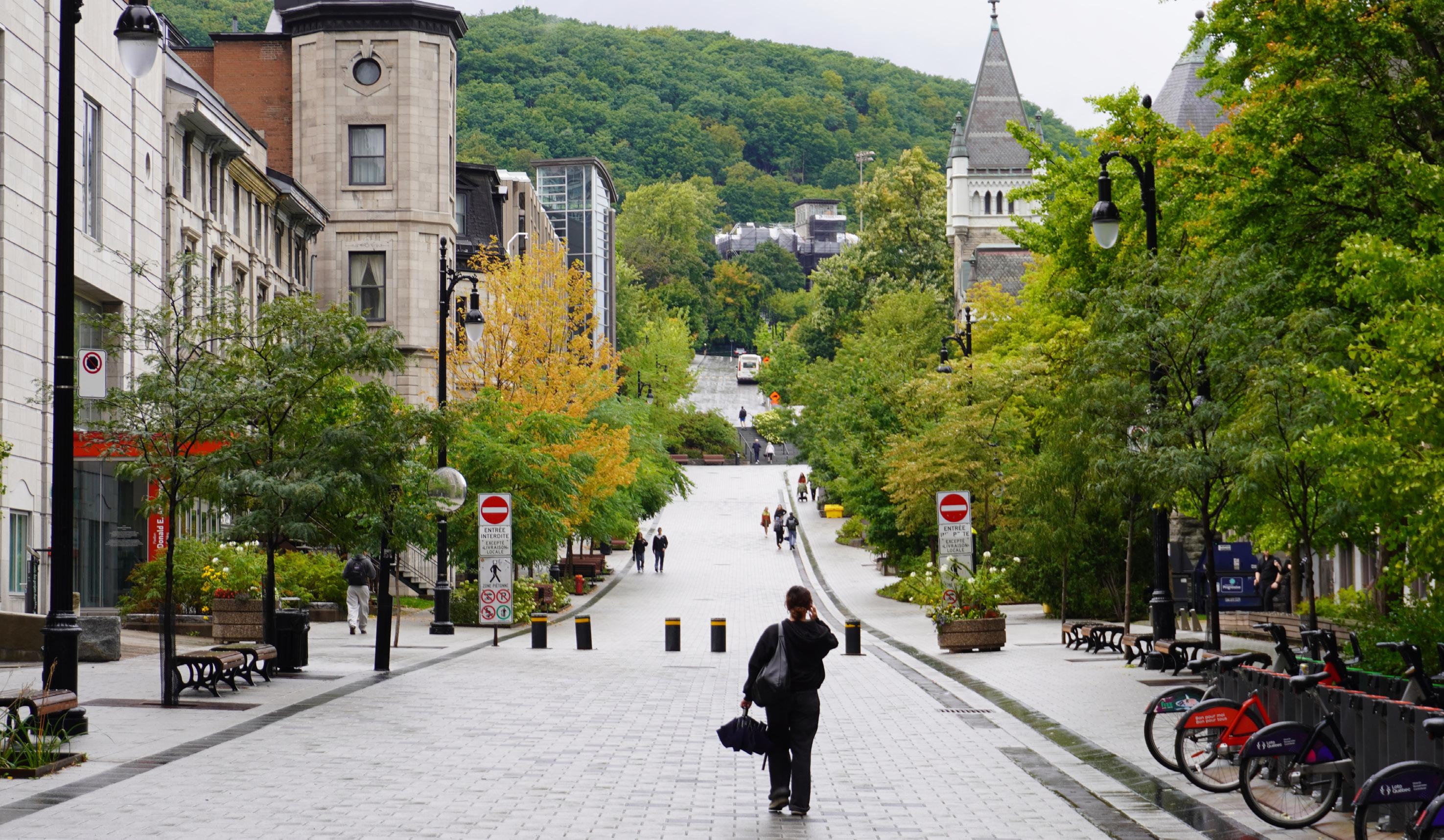
McGill encompasses a community of international students from over 150 countries. (Emiko Kamiya / The Tribune)
Quebec’s proposed public prayer ban could decrease inclusivity at McGill Muslim Students’ Association warns the measure could stigmatize religious practice on campus
Eren Atac Contributor
The Coalition Avenir Québec announced in late August that it plans to propose a law this fall banning public prayer. Introduced by Quebec’s Secularism Minister, Jean-Francois Roberge, the measure is intended to reinforce the province’s existing secularism laws, including Bill 21, which the government implemented in 2019. The newly proposed regulation would expand on such policies by prohibiting religious practice in public spaces.
At McGill, where the student population represents a wide variety of religious and cultural backgrounds, community members have raised concerns over the law’s potential effects on practicing religious students.
In a written statement to The Tribune , Hamza AlFarrash, president of the Muslim Students’Association of McGill University (MSA), expressed concerns over the pro -
posed law’s impact on Muslims at McGill. Although McGill’s campus is not technically a public space, AlFarrash explained that the bill’s broader message would threaten students’ ability to practice their faith in a safe and welcoming environment, especially for those who belong to minority faith communities.
“[The law] risks creating a climate where Muslim students feel singled out, stigmatized, and pressured to hide their prayers—even in semi-public spaces like libraries, cafeterias, or student lounges,” AlFarrash wrote. “Such laws do not just regulate space; they shape perception. By suggesting that prayer is something inappropriate or unacceptable in public, the ban opens the door to confusion, harassment, and discrimination.”
Quebec has pursued a strict agenda of secularism ( laïcité ) since the Quiet Revolution of the 1960s, when the province initiated efforts to distance public institutions such as schools and hospitals from the Catholic Church. In 2019, the government passed Bill 21, banning public servants, including teachers, judges, and police officers, from wearing religious symbols at work.
AlFarrash encouraged students impacted by the proposed ban to make use of resources such as counseling sessions with Muslim chaplain Faisal Malik. (Anna Seger / The Tribune)
AlFarrash explained that this new bill would severely affect MSA members, who rely on public spaces to carry out their mandatory daily prayers.
“This proposed law would
disproportionately impact Muslim students because of the central role that daily prayer plays in our faith,” AlFarrash wrote. “Unlike many other religious groups whose rituals may be weekly or occasional, Muslim students pray five times a day, often during class hours, which requires accessible and reliable prayer spaces on campus.”
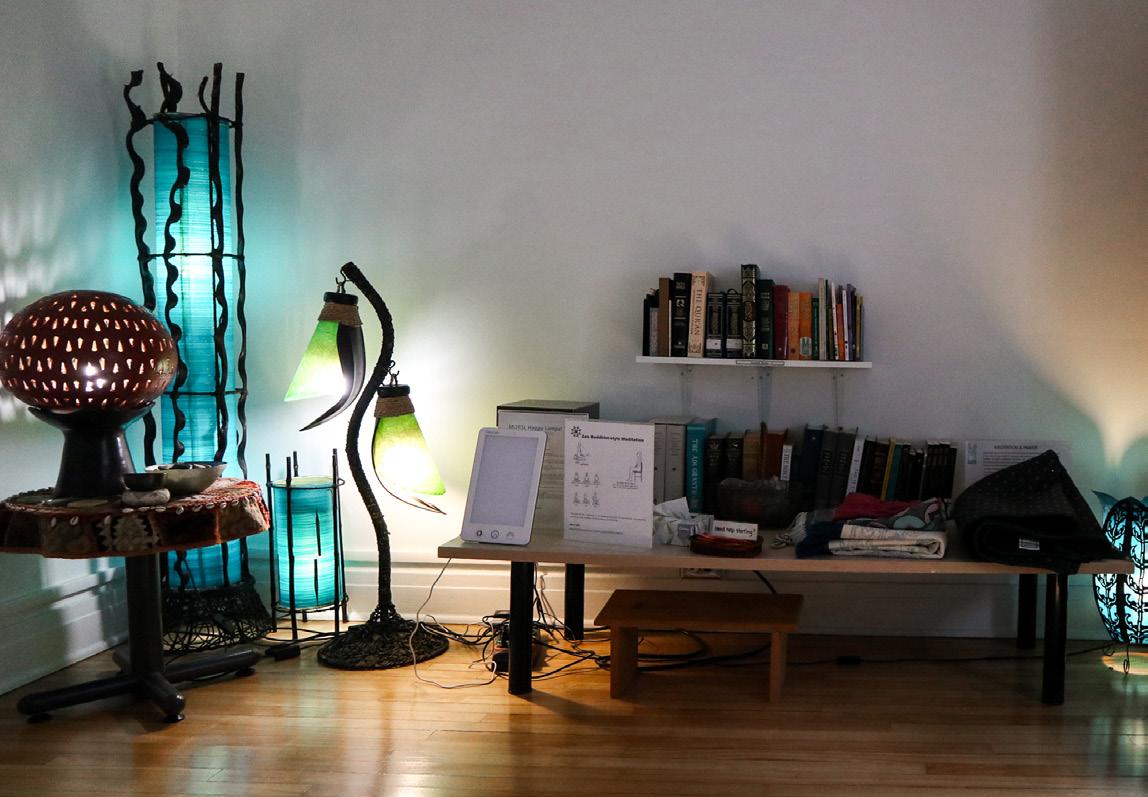
AlFarrash noted that McGill already lacks adequate prayer spaces for its population of over 4,000 Muslim students. There is one designated space in the University Centre, which has a 30-person capacity, while another small space under a stairwell accommodates two. Beyond these, most “designated” areas are multipurpose quiet rooms rather than proper prayer spaces, according to AlFarrash.
For other McGill students, the proposed ban points to broader issues regarding inclusivity and equity in Quebec. In an interview with The Tribune , Kaya Scrivens, U1 Arts, expressed concern that Bill 21 unfairly targets certain religious communities.
“When you look at how Bill 21 affects people, [...] the people who have public religious symbols that are a core part of their religion are mostly Muslim women,” Scrivens said.
Scrivens added that the Quebec government’s propagation of secularist policies may dissuade prospective students from choosing to attend McGill.
“When deciding what school to go to, [religious freedoms] can be something to consider [...] that would affect where you’re going for school and whether or not you’re choosing to come to Quebec,” Scrivens said. “It could be a very big decision that would, for me, make me not want to come.”
The McGill Media Relations Office (MRO) stated they are aware of the proposed law in a written statement to The Tribune
“McGill has taken note of the tabling
of the report by the Comité d’étude sur le respect des principes de la Loi sur la laïcité de l’État et sur les influences religieuses and is reviewing its contents,” the MRO wrote. It remains unclear what, if any, response the university will adopt should the law pass in the fall.
The Canadian Charter of Rights and Freedoms guarantees freedom of religion and equality for everyone in Canada. Based on the Charter, a ban on public prayer could face constitutional challenges from civil liberties groups, religious organizations, or directly affected individuals. However, Quebec has historically invoked the Charter’s notwithstanding clause—which allows provincial governments to override certain Charter rights for renewable five-year periods—to protect its secularist laws. Quebec could therefore shield the new public prayer ban from legal challenges if its government decides to reinvoke the clause.
McGill student groups like the MSA are currently calling for the university to stand behind the tenets of equity and civil rights.
“We expect McGill’s leadership to ensure that religious freedom is actively protected as a core element of inclusion and student well-being,” AlFarrash wrote. “This isn’t just about Muslims; it’s also about protecting religious freedom and dignity for everyone on campus.”
AlFarrash also emphasized how necessary it is for McGill’s community to speak out against Quebec’s proposed public prayer ban.
“We’re calling on all students and staff, regardless of background, to stand with us in defending the principle that everyone should feel safe to live their identity openly,” AlFarrash wrote. “This is not just a ‘Muslim issue.’ If public prayer can be restricted today, then tomorrow it could be another form of peaceful expression.”
McGill and SSMU restore ties through revised Memorandum of Agreement
Updated MoA protects SSMU’s use of the University Centre and outlines student rights to run for SSMU positions
Mairin Burke Managing Editor
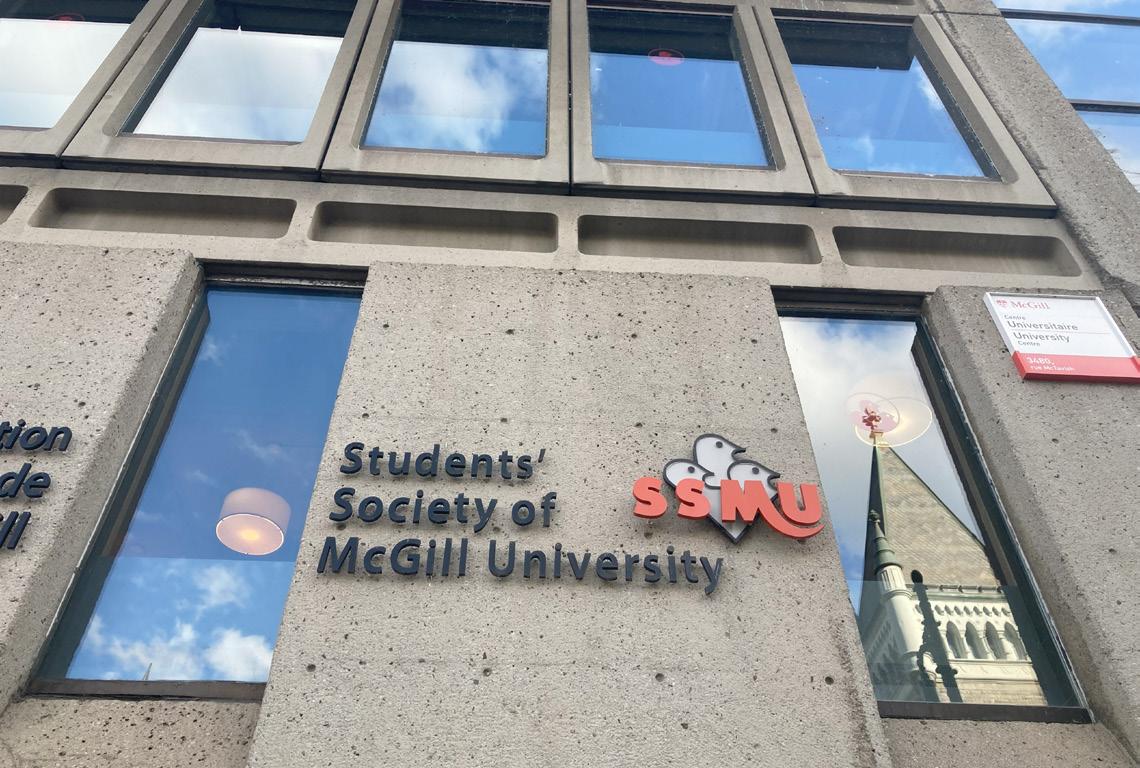
Students’ Society of McGill University (SSMU) President Dymetri Taylor and McGill’s Interim Deputy Provost (Student Life and Learning) Angela Campbell announced on Sept. 4, via joint email statement, that SSMU and McGill have negotiated a new Memorandum of Agreement (MoA) after a summer of mediation.
The mediation process followed Campbell’s April 2025 email announcement that McGill intended to terminate its existing MoA with SSMU. In this email, Campbell denounced the student union’s strike for Palestine from April 2-4, 2025— specifically, strike demonstrations that successfully cancelled dozens of classes.
The Sept. 4 update confirmed that McGill and SSMU’s MoA remains in effect after the parties made revisions during mediation “to reach an agreement that puts students first.” Taylor and Campbell
outlined that the University Centre will now host McGill as well as SSMU initiatives; if McGill had terminated the MoA, SSMU would have lost access to the Centre, leading to the closure of many student gathering spaces. Furthermore, the email affirmed that SSMU-funded student organizations will continue to operate.
Additionally, Taylor and Campbell rebuked specific forms of protest, while declaring SSMU and McGill’s shared commitment to “expression and peaceful assembly.” The statement also reported that McGill has removed some, but not all, MoA sections that dictate which students can run for SSMU elections.
In a written statement to The Tribune , Taylor explained how the union may aim to address future SSMU-McGill MoA disputes to best honour SSMU’s constituents.
“One of the plans for this year is to institute a process so that things of this nature, when there is a major disagreement, don’t simply result in a notice of
termination of the MoA,” Taylor wrote. “A better method of termination is necessary for the agreement to ensure that when there are disagreements of a political nature, the rights of the students and the Society are protected.”
Taylor also expressed the mutual advantages of upholding the SSMUMcGill MoA.
McGill’s Media Relations Office did not respond to The Tribune ’s request for comment.
“[Under the MoA], SSMU receives substantial benefits, chief amongst them being the [University Centre],” Taylor wrote. “However, it would be foolish to think that McGill does not benefit from this agreement, as without it, the University would suffer significant reputational harm.”
Under the revised McGill-SSMU MoA, SSMU has increased the number of signatures needed to call a General Assembly from 25 to 500, reflected by updates to their Governing Documents. (Mia Helfrich / The Tribune)
The Tribune Explains: Access to Student Accessibility & Achievement
What SAA looks like after Quebec government reduced educational support staff funding by $510 million CAD across the province
Amelia H. Clark Staff Writer
McGill’s Student Accessibility & Achievement (SAA) program is responsible for supporting students with mental or chronic health conditions and disabilities, aiming to provide them with resources that remove barriers to their academic success. Following the Quebec government’s $510 million CAD budget cuts to educational support staff across the province, The Tribune has provided an outline of McGill’s SAA program, as well as how the budget cuts may affect it.
What resources are available for students seeking accommodations?
Students with mobility needs can sign up for on-campus parking authorization to make commutes to classes more accessible, or use the adapted transportation van, which picks up and drops off students between buildings on McGill’s downtown campus.
For those seeking accommodations for intellectual disabilities, registering with SAA can provide them with academic assistive technology aligned with their accommodation plans, including in the Exam Centre. For instance, advisors can assist students with finding alternate-format texts, such as braille or vocal recordings.
Without registration, SAA still offers six Self-Directed Learning Guides to help students improve skills like note-taking,
time management, and memorization. There are also six directories of assistive technology tools and apps, available to all students, that list resources to support core academic activities such as reading and writing.
None of these services will be affected by provincial budget cuts.
How do I access these resources?
Students must make an appointment with an SAA advisor, wherein they must provide an official medical note listing a disability or diagnosis. If approved, an advisor will help determine what accommodations could improve the student’s university experience.
What are my options for exam support?
Students whose registered accommodation plans include exam support must log into Clockwork two weeks before their exam to review their requests for testing modifications, such as increased time. The program also assists with exam deferrals in instances where students, due to extended time accommodations, are scheduled for more than eight hours of exam writing in one day.
Does SAA offer peer support programs?
SAA offers peer-support initiatives intended to create inclusive and encouraging student spaces. Peer-Assisted Learning is a study program meant to help students practice self-reflection and engage in group
discussions facilitated by peer leaders. For Fall 2025, this accommodation is only offered for six introductory courses.
Additionally, the Peer Mentor Program (PMP) provides students opportunities to discuss their academic and career goals with a mentor who is also registered for SAA accommodations.
What have users reported about their experience with SAA?
Some students report that SAA can be inaccessible and unreliable. The program’s requirements for registration may create barriers for students still in the process of receiving a medical diagnosis from the Student Wellness Hub or an outside provider. This can make access to accommodations competitive among those who require them, with a long waitlist for the office.
SAA has also failed to provide its promised services to registered students multiple times, losing their exams instead of submitting them, and failing to ensure online testing software does not cause students technical difficulties. In these cases, students reported that
staff members were inaccessible or slow to answer requests for help, causing further distress.
How will Quebec budget cuts affect the program going forward?
In a written statement to The Tribune , McGill’s Media Relations Office (MRO) stated that government budget cuts will not affect SAA and student access to accommodations, since the program’s funding comes from many different sources whose finances, as of now, have not been affected by the cuts.
“Core services remain fully in place because they are essential for students and legally required,” the MRO wrote. “These services are still available and will continue to evolve based on student needs.”
“Rogue Archives”: QPIRG’s School Schmool agenda returns in 2025-26
Agenda’s launch event showcased student art, poetry, and
challenges to QPIRG’s mandate
Basil Atari Contributor
The Quebec Public Interest Research Groups (QPIRG) at McGill and Concordia launched the 20252026 edition of their annual daily planner and guide for students, School Schmool , on Sept. 4. The agenda’s goal is to inform students of practical anti-oppressive resources on both universities’ campuses and around Montreal. School Schmool also highlights student-made articles, art pieces, and poetry.
In an interview with The Tribune , Leila Salazar, a fourth-year anthropology student at Concordia and the School Schmool coordinator at QPIRG-Concordia, explained that QPIRG’s mandate is to find anti-oppressive ways of connecting Montreal’s wide-ranging communities of university students.
“[ School Schmool has been published annually] since 1994 to start the year right, bring new students into knowing the resources that they have access to, [and provide] a way for artists and writers to have their work published,” they said.
This year’s School Schmool theme is “Rogue Archives.” The agenda explains, “Rogue Archives do not sit quietly on a shelf [....] Archives created and preserved
by Indigenous, Black, [...] Queer and Trans, low-income, and disabled people are often absent [...] or reduced to fragments [which is why] we offer this Agenda as a rogue archive.”
At the launch event, Olivia-Jeri Pizzuco-Ennis, a final-year journalism student at the Université du Québec à Montréal, described some of McGill students’ contributions to School Schmool.
“In the context of [...] Rogue Archives, [...] [a McGill] author named Jane [...] put headlines from emails [sent by Provosts Deep Saini and Suzanne Fortier] about Ukraine and the encampment in conversation with each other,” she said in an interview with The Tribune
Pizzuco-Ennis noted that this contribution reflects how McGill students are using the agenda to critically engage with frustrations over the university’s inadequate response to a variety of issues, such as Palestinian and Queer liberation, the former of which has led to contractual disputes between QPIRG and McGill.
“There is a lot to say about QPIRGMcGill and QPIRG-Concordia’s continued existence, but obviously their position at McGill is much more threatened than at Concordia,” Pizzuco-Ennis stated.
In January 2025, McGill University sent QPIRG-McGill a notice of default of
activism in the face of McGill’s
their shared Memorandum of Agreement (MoA), due to QPIRG-McGill’s support for Students for Palestine’s Honour and Resistance (SPHR). As one of QPIRG-McGill’s working groups, SPHR receives financial and administrative support from the organization, which McGill alleges is a breach of its MoA with QPIRG as SPHR has violated McGill’s Code of Student Conduct.
School Schmool catalogues lists of resources such as local independent bookstores and off-campus food assistance.
(Mia Helfrich / The Tribune)
Nelly Wat, an outreach coordinator at QPIRG-McGill, shared why the School Schmool launch event itself is so significant in an interview with The Tribune.
“In the beginning of the [MoA] arbitration process, [...] we weren’t allowed to book spaces [...] [and] host events [on campus], which obviously impeded our activities,” they said. “As of now, that’s been lifted, we are technically allowed to book events on campus again, [but it] created a lot of barriers for us, especially when it came to our big events [….] So,
to be able to put together this agenda [...] and have [an] incredible launch [...] was really inspiring.”
Despite their MoA challenges, Wat highlighted how School Schmool provides a glimmer of hope to QPIRG by indicating that ongoing communal resistance is unfolding at McGill.
“I’m really happy to see just how many students there are who are interested in [getting involved in] activism, contributing to the agenda and putting out such beautiful artwork, poetry and articles,” they said.
SAA offers a Students from Care program for McGill attendees with experience in youth protection. (Anna Seger / The Tribune)
McGill seeking a public relations agency for rebranding support
University may be trying to remedy its image after backlash for its response to campus activism
Devdas Hind Contributor
McGill is expected to select a public relations agency this September to help it carry out a rebranding campaign, attempting to reposition how the Quebec government and McGill’s students and donors perceive the university. The potential rebranding deal could cost McGill up to $6.7 million CAD.
Student protests, tuition hikes, disputes with Indigenous communities, labour strikes, and conflicts with the Québec government have greatly impacted McGill’s reputation in recent years.
In a written statement to The Tribune , Co-President of the Association of Graduate Students Employed at McGill (AGSEM) Emma McKay commented on the public backlash McGill is facing from its responses to conflicts on campus.
“McGill believes its reputation has been damaged by widespread pro-Palestine activism (ironically worsened by their own security response), the Quebec government’s moves against anglophone universities, and labour strikes,” McKay wrote. “We believe the more serious issues are their funding of genocide, overwhelming and alarming use of private security, poor responses to reasonable asks from workers, and their immense turn toward austerity.”
From hunger strikes to solidarity encampments, McGill’s downtown campus has been the site of years of student activism for Palestine. The Students’ Society of McGill University (SSMU) ratified a three-day student strike in April 2025 to pressure the university to divest from
companies complicit in the genocide of Palestinians. During this strike, protesters blocked classrooms and demonstrated across campus. In response, McGill temporarily severed ties with SSMU for “[supporting] a three-day strike that further divided a campus community already deeply cleaved and hurting,” according to Interim Deputy Provost (Student Life and Learning) Angela Campbell.
Critics of the termination called McGill’s decision an attack on freedom of speech and assembly, which damaged the university’s brand in the public’s eye.
McGill has also recently been the site of multiple contentious labour struggles. In March 2024, the AGSEM went on a three-week long strike to demand better pay conditions for teaching assistants. In August 2024, the Association of McGill Professors of Law (AMPL) also decided to strike in response to McGill’s failure to meet their demands regarding faculty governance and pay conditions. The AMPL accused McGill of implementing a strategy of delaying their collective agreement negotiations, and thus denying employees their right to unionize.
McKay said that McGill is prioritizing its administrative executives’ paychecks over students and staff.
“[McGill cares] more about lining pockets of upper admin and maintaining the interest of wealthy donors than the education they offer,” McKay wrote. “[McGill’s] response to budget constraints from the government has been to hand them down to workers through the 60 layoffs this past spring and cuts to hours and functions across the university.”
In a written statement to The Tribune ,
McGill’s Media Relations Office (MRO) asserted that the university is reviewing its marketing strategy to make sure it is productive.
“We are engaging in a competitive process to help ensure that the resources dedicated to [marketing] initiatives are used as effectively as possible,” the office wrote.
The MRO also specified that McGill is undertaking its public relations efforts to bolster enrolment.
“[Marketing efforts are] particularly to support student recruitment,” the MRO wrote.
McGill’s enrolment has been impacted by the Quebec government’s announcement of a $3,000 CAD tuition hike for out-of-province students at Englishspeaking universities in Fall 2023. Although a Quebec judge ruled that the rationale behind the tuition increases was faulty, Higher Education Minister Pascale Déry announced that the government would move forward with the financial decision. McGill is planning to cut its
2025-2026 budget by $45 million CAD as a result of the Quebec government’s actions.
In light of tuition hikes targeting English universities, Ernan Haruvy, a professor of marketing in the Faculty of Management, emphasized in an interview with The Tribune that McGill has already shifted to being more bilingual, but has not communicated this effectively.
“The issue [was] messaging. [McGill] did not control it, [while] the government did,” Haruvy said.
University saw a 22 per cent drop in international student applications in the Fall 2025 semester McGill discusses potential consequences of drop in international student enrolment
Ryan M. Taylor Contributor
Continued from page 1.
Quebec Premier François Legault, using the newly adopted bill, announced in February that Quebec universities would not be permitted to receive more international students in 2025 than they did in 2024. Quebec’s Minister of Immigration, Francization and Integration Jean-François Roberge defended Legault’s decision, claiming Bill 74 would contribute to better consultation processes across Quebec’s higher education network.
Furthermore, Decree 155-2025, which Bill 74 permitted to be put forward, specifies that the Quebec government did not outright cap international student permits. Instead, each university listed by the decree, including McGill, has been individually assigned a maximum quota of permits for study purposes, based on the different academic programs they offer.
McGill’s Annual Report on Enrolment and Strategic Enrolment Management details how McGill is seeking to “maintain international student enrolment
at 25 to 30 per cent of the total undergraduate population.”
University leaders have emphasized the loss of international talent in the province occurring with Quebec’s diminishing international standing as study permit access decreases. As these leaders have argued, a decrease in talented students also marks a decrease in their ability to attract high-calibre staff and researchers to their faculties.
In a written statement to The Tribune , Students’ Society of McGill University (SSMU) Vice President University Affairs Susan Aloudat maintained that McGill’s drop in international students’ enrolment does not affect SSMU’s administration or financing.
“Day to day operations of SSMU have no changes from previous years,” Aloudat wrote. “Operating fees are charged and services are provided homogeneously across the membership and are unaffected by student status enrolment [whether] they are international or domestic.”
In a statement to The Tribune , the McGill Media Relations Office (MRO) explained that the Quebec and federal governments’ lack of transparency regard -
ing study permit quotas will pose a challenge to McGill’s administration.
“Introduced without consultation or coordination with the academic sector, these changes have created persistent instability in the management of student immigration,” the MRO wrote.
Wyatt Hogan, U1 Engineering, highlighted in an interview with The Tribune that uncertainty around the French language requirement at universities in Quebec is a factor which may deter international students from choosing to enroll at McGill.
McGill encompasses a community of international students from over 150 countries. (Emiko Kamiya / The Tribune)
versities and see [that] they have to take a full additional class, it can be worrying.”
Hogan also emphasized his appreciation for the vibrant international student community at McGill.
“The French language requirement can be difficult to build around,” Hogan said. “French is an extremely useful skill to learn, but when students compare uni -
“It’s very welcoming, with many events for students and international students to get to know and relate to each other,” he said.
McGill wishes for the public relations agency it will eventually contract to emphasize the university’s research focus, bilingualism, and global connections. (Zoe Lee / The Tribune)
News Editors Asher Kui Helene Saleska Kaitlyn Schramm news@thetribune.ca
Opinion Editors Moyo Alabi Lulu Calame Ellen Lurie opinion@thetribune.ca
Science & Technology Editors
Leanne Cherry Sarah McDonald scitech@thetribune.ca
Student Life Editors Gregor McCall Tamiyana Roemer studentlife@thetribune.ca
Features Editor Jenna Durante features@thetribune.ca
Arts & Entertainment Editors Annabella Lawlor Bianca Sugunasiri arts@thetribune.ca
Sports Editors Ethan Kahn Clara Smyrski sports@thetribune.ca
Design Editors Zoe Lee Eliot Loose design@thetribune.ca
Photo Editors Armen Erzingatzian Anna Seger photo@thetribune.ca
Multimedia Editors Sahel Delafoulhouse Wendy Lin multimedia@thetribune.ca
Web Developer Rupneet Shahriar webdev@thetribune.ca
Copy Editor Ella Bachrach copy@thetribune.ca
Social Media Editor Mariam Lakoande socialmedia@thetribune.ca
Business Manager Celine Li business@thetribune.ca
McGill, prestige won’t protect students from inequitable healthcare education
The Tribune Editorial Board
Continued from page 1.
While in operation, the SACE office issued strategic plans to confront discrimination and underrepresentation of minorities at McGill, including an Action Plan to Address Anti-Black Racism and a Task Force on Indigenous Studies and Indigenous Education. Without this infrastructure, McGill risks exacerbating the already strikingly low proportional representation of Black and Indigenous applicants. This downward trend incites a selfperpetuating cycle of exclusion: Less student body diversity produces a less diverse medical workforce, leaving fewer mentors for potential applicants of minority backgrounds.
Students trained in demographically diverse environments are better equipped to treat patients from minority backgrounds. Interactions between doctors and patients of the same background tend to last longer and
Ella Bachrach Copy Editor
If you know me, you are aware that I suffer from a serious problem—one that strains friendships, disrupts schedules, and even alters the very fabric of reality.
I am too often caught with indented lines strewn across my cheek like battle scars, my hair a knotted mess, and drool crusted near my mouth, when I should be hard at work in the library. I lose hours every week, entire days each month, to sweet, blissful unconsciousness.
I can’t help it—I love napping. Allow me to set the scene. My feet drag as I forge through MiltonParc, the blocks lengthening until my apartment appears like a flickering mirage in the distance. When I finally arrive, I manage to
lead to improved health outcomes for minority patients, including openness to preventative care, greater life expectancies, and lower infant mortality. Conversely, where EDI training is absent, curricular diversity and comprehensibility plummet and biases persist. A 2016 study revealed medical trainees incorrectly believed Black patients had a higher pain tolerance, a misconception which dates back to the era of slavery and has been weaponized against Black communities to justify violence. Educational facilities lacking EDI programs and equity-driven curricula leave discriminatory preconceptions unaddressed, resulting in future doctors with less capacity to deliver proper care to minority groups.
Replacing SACE with a group under the authority of the Faculty Dean will undermine institutional accountability, as McGill’s EDI programming will no longer function as an unbiased, independent interlocutor distinct from McGill’s Faculty of Medicine. SACE once offered students an opportunity to submit incident
reports and file complaints; now, the EDI structure falls under the very agents the office was meant to monitor, removing accountability mechanisms for discriminatory practices by administrative officials.
McGill’s dissolution of SACE mirrors broader anti-diversity backlash in the United States, where the Trump administration’s attacks on EDI in higher education have emboldened universities to neglect their responsibility of equity. The anti-EDI movement has been similarly influential throughout Canada: The Conservative and Bloc Québécois parties have both pledged to defund EDI in the federal public service, with Conservative Party Leader Pierre Poilievre deeming diversity strategies a product of “woke ideologies.”
McGill’s willingness to follow the lead of North American institutions reflects a flagrant disregard for the wellbeing of racially diverse students, doctors, and patients, and echoes the university’s own long history of institutional racism. In the 1930s, Black medical students at McGill were frequently barred from
completing their clinical work in Montreal, forced instead to train in segregated institutions. Beyond the Faculty of Medicine, the university was founded on—and continues to be guided by—discriminatory, colonialist principles. For instance, James McGill’s enslavement of Black and Indigenous peoples, ongoing development projects on unceded Tiohtià:ke land, and longstanding failures to consistently offer gender-affirming care for 2SLGBTQIA+ individuals, all demonstrate the deplorable foundations upon which McGill continues to build its practices.
Still, McGill remains willing to cut programming designed to dismantle systemic racism. Although facing severe financial insecurity, the university must not place EDI programming on the chopping block. The administration cannot continue to take shelter behind the Faculty of Medicine’s top ranking to conceal its failures in equity and accreditation. Prestige will not protect future patients from medical practitioners with untreated biases and culturally insensitive training.
Sleep to dream: In defense of napping
haul my aching body up the stairs, kick off my boots, and collapse onto my bed. I really should open a book and get to reading: Jacob’s Room requires my attention, as do 20 chapters of an 18th-century bildungsroman to be discussed in detail tomorrow morning.
Instead, I close my eyes. My muscles relax, from the crease between my eyebrows and the tension just above my shoulder blades, down to the knot in my stomach. I am like one of those mattresses you order online that comes vacuum sealed, the kind you have to throw in a corner and let expand for a couple of days. I let out a final exhale and drift into a limitless escape.
Napping is not thought of as a productive pastime. Instead, it is seen as lazy—the act of a slacker who lacks motivation or a procrastinator aiming to avoid afternoon obligations. However, while the body rests during sleep, the brain remains active.
As an English major, I spend considerable time pondering literature’s role in escapism. Reading permits the mind to wander outside the confines of the reader’s physical reality; they journey to new spaces and lives by accessing the depths of their imagination.
Is napping any different?
It allows the mind to explore, unrestrained by consciousness.
Sleep offers the mind freedom it cannot experience while awake: Freedom from laws of rationality and physics. Time warps and stretches during sleep, growing thin and sticky like taffy. Two hours pass like two minutes—or two years. I have dreamt of giving birth and raising a child into adulthood, only to wake and find that I have been resting for a mere segment of the day.
Of course, I am not the first to consider the nature of dreams.
Sigmund Freud called the interpretation of dreams “the royal road to a knowledge of the unconscious activities of the mind.”
In one of many diaries, Virginia Woolf wrote, “I will dream today; for I must unscrew my head somehow.”
Woolf cannot be called mentally well, and Freud was on his fair share of powdered stimulants. Still, these famous thinkers nonetheless concurred that dreaming provides an escape from daily life and allows access to paths otherwise untrodden.
Shakespeare, who crafted an entire play about the mysterious happenings of dreams, would surely agree. In A Midsummer Night’s Dream, fairy trickster Puck
even tells the audience to reflect on the performance as a dream if they struggled to comprehend the extraordinary events that occurred: “Think but this and all is mended, / That you have but slumber’d here / While these visions did appear.” Like literature, sleep breaks down boundaries and enables cognitive exploration.
Overnight sleep serves a function: To rest and rejuvenate the mind and body for the coming day. It is a part of daily order, a logical ritual.
Napping, however, is not a basic need. Instead, this form of sleep is an intellectual pursuit; it demonstrates a belief in the expansive, generative power of the unconscious.
Next time you make the endless odyssey home from class, pause before pulling up your endless list of readings and allow yourself the freedom to relax. Flop onto your bed. Kick off your shoes. Close your eyes and let your mind wander. I hereby grant you permission to do the unthinkable, the slothful, the temporizing: Take a nap.
Only when napping can your mind break free from inhibition and explore the depths of consciousness, perception, and imagination. Sleep, not to rest, but to dream.
Shatner University Centre, 3480 McTavish, Suite 404, 405, 406
Simona Culotta, Defne Feyzioglu, Alexandra Hawes Silva, Celine Li, Lialah Mavani, Nour Kouri, Laura Pantaleon TPS BOARD OF DIRECTORS
Eren Atac, Basil Atari, Devdas Hind, Merce Kellner, Antoine Larocque, Julie Raout, Ryan M. Taylor, Hillary Wright
Sophie Schuyler, Emiko Kamiya, Alexa Roemer
Julie Raout Contributor
LQuebec fines LaSalle College $29.9 million CAD over anglophone student quota
aSalle College overenrolled 716 and 1066 students in its English-speaking programs in 2023 and 2024 respectively. In response, the Quebec Government imposed a $30 million CAD penalty on the college, forcing the institution to postpone the school year kickoff, initially scheduled for Aug. 25.
The cost of such substantial defunding calls into question the Quebec government’s strategy in preserving the French language. LaSalle’s disregard for the quota has been treated as an attack against the Charter of the French Language. The province has defended this legislation vehemently within the last couple of years, aiming to preserve French as the sole official language of the province.
By the time Quebec introduced these quotas, LaSalle had already accepted students for the 2023 school year. The school was unwilling to break contracts with students in 2023 and 2024, to avoid letting down students who had enrolled before the announcement of caps on English-speaking programs.
LaSalle stressed the damage caused by the cut, noting that subsidies cover about 40 per cent of each Quebecois student’s tuition bill. This penalty impedes the provision of quality resources to college, threatens staff jobs, and compromises the education of all its students.
While Quebec’s penalty on a law violation is legitimate, refusing to give the college a grace
COMMENTARY
Jamie Xie Staff Writer
Tperiod for quotas and punishing non-profit institutions in ways that jeopardize their viability is not. Targeting LaSalle College over the schoolwide language of instruction speaks more broadly to an inflexible and destructive aggressiveness in this endeavour of cultural preservation.
Quebec’s ambition to preserve francophone heritage is understandable in an increasingly globalized world. Linguistic conservation is vital as the province anchors its identity and culture in French, using the language to differentiate itself from the surrounding English-speaking provinces. However, Quebec’s sanctioning of LaSalle fuels resentment against the government’s goal. Quebec’s coercive measures cultivate a hostile environment that is counterproductive to the promotion of francophone culture.
The Quebec government updated the Charter of the French Language through Bill 96 in 2022. These updates incorporated policies encouraging French over English—for example, through quotas on anglophone students in collegiate institutions— but also implemented austere policies against non-French-speaking foreigners. For example, immigrants are now given only six months to learn French, after which they must use it exclusively in official government communications. Measures that pressure immigrants to learn French so quickly make Quebec appear less attractive for immigration, although the province largely relies on it.
English-speaking universities are impacted because international students represent a
significant share of their student body—for instance, 30 per cent of McGill’s students come from abroad. In 2023, Quebec started to cut subsidies for Englishspeaking institutions like McGill, forcing a tuition increase for out-ofprovince and international students in its effort to preserve French linguistic dominance. As a result, prospective students are financially discouraged from moving to Quebec, and made to feel unwelcome by the fervent pushing of a French agenda.
The institution delayed the start of the Fall semester due to a substantial budget cut from the provincial government. (Sophie Schuyler / The Tribune)
Policies to enforce the Charter create downsizing by diminishing Quebec’s capacity to attract international talent. Provincial funding cuts forced McGill to announce approximately 99 layoffs for the 2025-2026 school year. The administration’s strategy to defund educational and research entities proves to be harmful to the province in the long run, as it hinders the province’s ability to provide resources and curbs development—especially considering that the higher education sector grew research and development from +$715.0 million CAD to $16.6 billion CAD in 2021.
This subsidy-cut strategy affects immigrants,
workers, and students, while disheartening people from learning French instead of promoting the language. The harsh implementation of the Charter for the French Language undermines the province’s strengths—particularly its multiculturalism, which has long been a source of social, economic, and cultural vitality. Instead of using public services to pressure individuals into francophone culture, Quebec should aim to foster a community invested in preserving French out of cultural curiosity and gratitude for the province’s openness.
In its heartfelt intention to protect its heritage, Quebec lost sight of what it sacrifices by antagonistically enforcing French, forgetting that the true goal is to promote French as means of furthering, not suppressing, linguistic diversity.
Quebec’s threshold of grace: Suffering, solace and the right to die with dignity
here is quiet strength in the decisions made at life’s edge—a reality Quebec has been able to realize through its approach to end-of-life care.
Quebec has long been at the vanguard of Medical Assistance in Dying (MAiD)—a medical protocol which allows an eligible individual to receive assistance from a medical practitioner in ending their life. In 2014, through the Act Respecting Endof-Life Care, the province became the first jurisdiction in North America to legalize MAiD—reframing MAiD not as a criminal issue but as part of a continuum of healthcare rights owed to patients. By fostering more open and routine conversations about death, we begin to see MAiD not just as a medical procedure but as a moral act of compassion from bodily betrayal—a willful act of reclaiming one’s own dignity.
Quebec’s most recent Bill 11 is the most controversial and ambitious expansion to MAiD yet. This bill marks Quebec as the first province in Canada to authorize binding advance MAiD requests for those with serious and incurable neurodegenerative diseases, such as Alzheimer’s, before these patients lose the cognitive capacity to give consent.
Concerns about advance request MAiD primarily centre on questions of informed consent. Since MAiD is typically offered, accepted, and administered within a short timeframe, requests made years in advance
are not considered legally consensual given the unpredictability of how a person’s mental clarity might diminish. The guiding principle of Bill 11, however, is that autonomy in the present trumps autonomy in the past, meaning MAiD can be refused at any time until capacity is lost. At that point, it is up to the guiding physicians’ judgement.
Beyond the ethics of the procedure itself, rising rates of MAiD also raise questions about Canada’s limited available care facilities and government resources for its aging population demographic. Some individuals may be implicitly pushed towards MAiD as a result of systemic pressures such as housing shortages or high insurance premiums. In such contexts, the decision to choose MAiD may be less reflective of personal choice and more indicative of a system strained in its ability to provide adequate care.
Critics argue that rather than prioritizing the expansion of MAiD protocols, the government should focus instead on making life more feasible—that through lowering living and medical costs and expanding access to treatments and therapy, individuals can choose life rather than death by systematic constraints. Physicians and policymakers may also be incentivized to promote MAiD to address fiscal issues within the healthcare system. A 2017 research paper predicted that further expansion of MAiD protocols could save Canada anywhere between 34.7 million to 138.8 million CAD in annual healthcare spending. However, it is crucial that financial incentives are made distinct from legal decisions to expand MAiD access,
as budgetary struggles within hospitals and governments must not influence personal end-of-life decisions.
It is understandable to be skeptical of a system like MAiD, as it intertwines government authority with the deeply personal matter of autonomy. While legislative provisions should still exist to ensure extended palliative care is accessible, there should be a governmentally-endorsed place in healthcare and in society for MAiD.
Society often casts MAiD as tragic, rather than a valid medical option.This framing is used to ethically justify MAiD in lieu of arguments that centre patient autonomy and personal choice. Too often we assume that prolonging life at any cost is inherently virtuous; we are fixated on achieving more time on earth rather than quality of existence.
In any humane nation, the value MAiD has should be selfevident. MAiD is a performance of self-sovereignty, and the ultimate assertion of autonomy. It is not
our place as lawmakers and moral arbiters to play God—to decide who may live or die. Too often we assume that prolonging life at any cost is inherently virtuous; we are fixated on achieving more time on earth rather than quality of existence. We do a profound disservice to our sense of humanity when we pretend to know what mercy people require. We rob people of their dignity when we say whether or not they deserve to suffer. There is no metric for the unbearable; pain is not ours to prescribe. We need not live in fear of death, for it is not always a losing battle. It does not need to be the enemy. In fact, it can be a final act of compassion.
A retrospective guide to Open Air Pub
Lessons and advice from an OAP veteran
Wendy Lin
Multimedia Editor
From a distance, the Open Air Pub (OAP) might look both dull and overwhelming: Endless lines snaking up the Y, hordes of students yearning for cans of cold-ish beer, and fencing that adds to the never-ending construction on lower campus. Inside, you’ll find hundreds of students moshing—rain or shine—to student bands and DJs. What makes such a chaotic scene the “best place on earth?” As a seasoned OAP veteran, here’s what I’ve learned—and my top tips for navigating this quintessential McGill event.
Lines upon lines
Mirroring the busiest days of Montreal’s Osheaga and Piknik Electronik, lines on a sunny day at OAP can be overwhelming, often filing all the way up to the Arts Building. You might find yourself wistfully admiring OAP from a distance for multiple hours before you get to join in on the fun yourself. However, time in the line passes much quicker with a group of friends. Small talk eventually blossoms
into a catch-up on adventures and mishaps from the summer. If you’re looking for a surefire way to pass the time, you might consider a cheeky game of “I Spy”: Someone’s ex-situationship talking to a new guy, your fratty frosh leader who’s had a bit too much to drink, or even your early morning tutorial crush. If the sights and smells of the OAP grills make you hungry in line, you can always satisfy your hunger by picking up a classic smokie from the hot dog man. Gather all your friends’ orders and have them save your spot in line!
Dress to impress
There is no doubt that Montreal is the most fashionable city in Canada, and this is further evidenced by the head-turning outfits at OAP. Outfits at OAP span a wide spectrum from perfectly on trend to unapologetically unique. It is common to see vintage lingerie reworked into flowy sundresses, tacky yet stylish Hawaiian buttonups, hand-painted denim jackets, McGill bucket hats, flowy satin skirts, and old band tees featuring artists from your parents’ generation. Anything goes at OAP. However, do keep in mind that the dance floor
can get muddy. Although the best place on earth allows for the best looks on earth, your best bet for shoes might be a pair of old sneakers that you don’t mind dirtying, or—for the definitive OAP look—a pair of good ol’ cowboy boots.
At the bar
What is your go-to drink at OAP? Is it the cost-alcohol-efficient Pabst Blue Ribbon? Are you a fiend for cider? Or do you go for the age-old classic—a tall can of Guinness? Whatever your drink of choice
is, if you sense a horde of froshies about to flood the drink lines, make sure you double fist your drinks—that is, grab two drinks in one visit to the bar. While your Sapporo might warm up before you get to it, it is certainly more time-efficient to have a drink or two on hand, rather than waiting in the crowded lines again. Want to try something new? Try this McGill student classic: Order a Sleeman and a Smirnoff Pink Lemonade, pour half of each into your reusable mug, and you have yourself a summery Radler.
More to explore: Montreal hidden gems based on your current favourites Shake up your routine with lesser-known Montreal spots
Tamiyana Roemer Student Life Editor
As a student, it’s far too easy to fall into repetitive patterns. Routines can be comforting and convenient, especially when your schedule is packed. But if your days in Montreal are starting to feel like a sequence from Groundhog Day , it might be time to switch things up. Whether you’re looking for a new cafe, bar, or restaurant, The Tribune has rounded up your current favourites—and the alternatives we recommend to shake things up.
If you love Mae Sri, try Pumpui
Tucked away on Rue Milton, Mae Sri is a McGill student favourite for lunch and dinner. Serving up hearty, flavourful Thai cuisine at student-friendly prices, this spot is beloved for its no-fuss charm. If you’re a fan of Mae Sri, you’ll want to check out Pumpui in Little Italy. Its vintage Thai diner aesthetic and streamlined menu deliver a casual but delicious dining experience reminiscent of Mae Sri’s appeal. Pumpui’s rotating curries are warming, complex, and sure to spice up your Montreal restaurant rotation.
If you love Bar Biftek, try Fitzroy
Bar Biftek is a St. Laurent staple, an iconic spot for late night rounds of pool and pitchers. But with few billiard tables and a steady crowd, getting your hands on a cue is like winning the lottery. Enter Fitzroy: a spacious loft hangout equipped with no less than 15 pool tables. Ideal for larger groups or anyone craving a bit more elbow room, Fitzroy promises a night of less waiting and more playing.
If you love Bar Darling, try Bar Henrietta McGill students can always count
on Bar Darling to deliver an evening of creative cocktails and delicious plates. If you’re looking to add a similar spot to your late-night rotation, Bar Henrietta is sure to impress. Like Bar Darling, this Mile End classic strikes the balance between chic and laid back, featuring a terrace that’s perfect for relaxing with friends and indulging in people-watching. With menu offerings from popcorn to scallops, this versatile spot is ideal for date nights, catch-ups, and everything in between.
If you love Cafe Saint-Barth, try Olive + Gourmando
Cafe Saint-Barth enthusiasts appreciate the comfort of a classic brunch and the reliability of a good cup of coffee. Luckily, Montreal has a wealth of spots that not only match this criteria but encourage you to wander away from the campus bubble. One such gem is Olive + Gourmando. Serving Montrealers since 1998, this Old Port bakerycafe-restaurant hybrid has grown a cult following. Although you’ll often find a line out the door, the buttery pastries and satisfying sandwiches are well worth the wait.
If you love Bar Suzanne, try Else’s
Bar Suzanne is a cozy favorite known for its lush greenery, welcoming vibe, and late-night dumpling menu that keeps customers coming back. If you’re a fan of Suzanne’s intimate, dimlylit atmosphere and satisfying
small plates, Else’s offers a kindred experience. Just a short walk away from Bar Suzanne, Else’s is a similarly warm and eclectic hideaway—perfect for seeking refuge as Montreal winter approaches. With a menu that ranges from tacos to butter chicken, it pairs comforting food with a relaxed bar setting, creating the perfect spot to unwind from the stresses of student life.
If you love Nouilles Zhongua, try Nouilles de Lan Zhou
Deservedly popular, Nouilles Zhongua
resides across from the Roddick Gates, making it a convenient spot for students craving fresh noodles and warm broth during the week. But if your weekend plans can take you a little farther, Montreal’s Chinatown offers a deeper dive into the city’s world of handmade noodles. Nouilles de Lan Zhou often tops the list of best Chinese noodle spots in the city. With its fast service, substantial portions, and bustling atmosphere, Nouilles de Lan Zhou provides the ultimate motivation to make your way out of the McGill bubble.
I Spy, fashion, and makeshift cocktails at the best place on earth. (Anna Seger / The Tribune)
Few universities can claim to have shaped the global sporting landscape as profoundly as McGill has. Among its crowning sports achievements are the first game of organized ice hockey in 1875, the first game of American football in 1874, and the invention of basketball by McGill alum James Naismith in 1891. Since its inception in 1923, the McGill Athletics Department has overseen the coordination of various sports such as volleyball and rugby.
These milestones, however, are overshadowed by a longstanding issue. In the 1860s, the university introduced pay-asyou-go sports clubs, where participants were responsible for paying the fees associated with the sport they played. More than a century later, this system persists as athletes are forced to shoulder the costs of competition.
For as long as McGill has had intercollegiate competition sports teams, it has struggled to fund them. In 1970, McGill was running a deficit of $6 million CAD and threatened to cut sports altogether. However, community outrage led to an agreement between McGill University and the McGill Athletics Department to increase athletic fees so that intercollegiate sports at the school could continue.
A turning point in McGill Athletics’ Varsity Program came in 1997 when, once again, McGill found itself facing dire budget constraints. At the time, McGill Athletics had a whopping 48 varsity teams and was pressured by the university to establish budgetary measures. These included dropping 22 teams—resulting in the 26-team varsity program we know today—and designating varsity teams into ‘Tier 1’ and ‘Tier 2’ categories. Using this framework allowed the university to manage resources and provide more funds, equipment, and media representation to the higher-tiered teams—a system still in place 28 years later.
This “new age” of sports is reminiscent of the first years of sports at McGill from a financial perspective. However, this now-notso-new system comes with several negative consequences, one of the most significant being that the success of a team and the amount of funding and resources they receive are inextricably linked. This undeniably inhibits the growth of some teams in favour of others. Which begs the question: Is it time for the tiered system to be reevaluated?
As ajournalist, unbiased conveyance of the truth is my top priority. However, as a varsity athlete who is a part of one of the most underfunded teams at McGill, it is im possible to write this article without bias. Being a student-athlete at McGill University has shaped both my university experience and who I am as a person. I am
MCGILL ATHLETICS'
McGill’s sports teams face deep inequalities
eternally grateful for the privilege of playing a sport I love at the collegiate level. However, I am disheartened by the inequality that plagues the Varsity Program.
Today, McGill Athletics oversees 26 varsity teams, 10 competitive clubs, and 3 recreational clubs. Of these 26 varsity teams, 10 teams—five women’s and five men’s— have secured the coveted ‘Tier 1’ label. They are the following: Basketball (W&M), Football (M), Hockey (W&M), Soccer (W&M), Swimming (W/M), and Volleyball (W). This leaves 16 teams to fill ‘Tier 2’: Badminton (W/M), Baseball (M), Field Hockey (W), Golf (W/M), Lacrosse (M), Rowing (W/M), Rugby (W&M), Artistic Swimming (W), Track & Field (W/M), and Cross Country (W/M). There is no public information explaining how sports are assigned to Tier 1 or Tier 2, but we can guess that the most popular are chosen to be Tier 1, while less popular sports are pushed into the shadows.
McGill Athletics has a difficult job. In a written statement, Stephanie Malley, McGill Athletics’ Senior Communications and Marketing Manager, stated that the organization oversees more than two dozen teams. Many of these teams do not compete or train at the McGill Sports Complex and compete in a variety of leagues, all of which have their own rules and regulations.
“What is really important to consider […] especially when it comes to funding, is that even though McGill Athletics and Recreation is a self-funded unit, we still face the same financial challenges as the rest of the University. This has meant identifying where monies can be saved and implementing austerity measures when needed,” Malley wrote to The Tribune. “The resources needed to properly support a team of, for example, 100 student-athletes versus a team of 20 student-athletes will always be different.”
But can McGill Athletics expect the under-funded teams to grow and perform at the same level as teams that have double or triple the number of resources? And is a two-tier system really the
the resources to scout and recruit talented rookies, stay healthy throughout the year, have a competent coaching staff, and have adequate equipment to be successful in collegiate-level athletics. To check all these boxes, a team must have sufficient funding and resources. If one of these elements is not up to standard, the whole system falls apart.
A source on the Tier-1 Redbirds soccer team who wished to remain anonymous disclosed that their team fees average around $180 CAD per year for veteran players and $250 CAD for rookie players. Compare this to the Tier-2 Martlets field hockey team, who pay more than $1,000 CAD per player per year. Though team fees are not publicly posted, nor is there any transparency from McGill Athletics about which teams they fund and which they do not, we can expect this same trend to be true for a majority, if not all, of Tier-1 and Tier-2 teams. Beyond the monetary support, men’s soccer, a team of 31 players, has four coaches, one head physician, one athletic therapist, and four student physiotherapists, while field hockey, a team of 22 players, has two coaches, no physicians, no athletic therapists, and no physiotherapists. There is a difference between efficient resource allocation and disregard for athlete safety.
Beyond essential resources like physiotherapists and equipment, representation in the media is a powerful tool that can greatly impact the success of a team. Frequent and higher quality media representation means more support from fans and alumni—whether monetary or other—along with more effective outreach for recruitment opportunities. Teams that get more attention tend to attract better players, which leads to greater success and, in turn, more attention. Even via Instagram posts, this difference in treatment between Tier 1 and Tier 2 is evident. McGill Athletics advertises its teams mainly through its Instagram, @mcgillathletics,
Written by Clara Smryski, Designed by Eliot Loose,
ATHLETICS' GREAT DIVIDE
inequalities in funding, resources, and recognition
Smy
rski, Sports Editor Loose, Design Editor
and news articles on its home page.
By conducting an analysis of McGill Ath letics’ Instagram posts throughout the past year (Aug. 23, 2024Aug. 23, 2025), some key discrepancies arise. Across 312 posts, teams were featured a total of 353 times, as some posts highlighted more than one team. 242 of these features, equaling almost 70 per cent, promoted the 10 Tier-1 teams. Of these features, Redbirds Football and Redbirds Hockey accounted for 15 per cent each, leaving the remaining 40 per cent to be split among the remaining eight Tier-1 teams.
despite being second in the nation, had a mere four features on Instagram in the past year.
In a written statement to The Tribune, Artistic Swim Team member Reagan Burgmann, U1 Psychology, shared her frustrations with the lack of support from McGill Athletics.
A plausible explanation for the differences in media representation among teams of the same tier is program success. It could be assumed that teams that are most successful get more media representation because they have ‘earned it.’ However, this is not the case. Redbirds Football had a record of 3–6 in the 2024-2025 season, while Redbirds Soccer had a 10–7–4 record. Despite this, Redbirds Football was posted 35 times, while Redbirds Soccer was posted only 22 times. Why? When I contacted the media representative who runs the Instagram, I was redirected to Stephanie Malley, who provided no answers.
There are similar discrepancies on the Tier-2 side. Redbirds Rugby and Redbirds Lacrosse secured 20 Instagram posts each, while the next most-posted team, Track & Field, had only 12 features. All three of these teams were fairly successful last season, with records of 6–3 and 11–2, respectively, for rugby and lacrosse, and 2nd (M) and 3rd (W) place finishes in the RSEQ Finals for
“We receive absolutely no funding from the school and have to fundraise to pay for equipment, clothing, competition wear, and travel […] We receive little-to-no recognition for our consistent high placement at national competitions,” Burgmann wrote. “We are never delegated to other athletic teams to come help volunteer at our events or support us in the crowd, despite the fact that we are consistently asked to do so for others.”
She added, “It’s not shocking that a small, niche, female-dominated sport often goes unacknowledged by the athletics committee, but I feel that’s all the more reason to be supporting our team–especially considering our strong reputation within the community.”
This is not a unique experience nor a unique feeling among varsity athletes. The Redbirds Soccer source also shared what he thinks regarding McGill Athletics’ lack of transparency in a written statement to The Tribune.
“One area where […]
are in which tiers and why they are there.” He continued: “[McGill Athletics] must take accountability and be transparent about their decision-making to teams and student-athletes. Otherwise, this lack of transparency only reinforces the idea that McGill doesn’t reward success and is more a game of favorites, ultimately leading student-athletes at McGill to the understandable impression that McGill Athletics is one of the most poorly run university athletic programs in Canada due to a lack of funding, organization, transparency, or a combination of all three.”
If McGill’s own varsity athletes feel they cannot trust their management, a great divide is created, not just between Tier-1 and Tier-2 athletes, but between student-athletes and McGill Athletics themselves. This divide will only continue to foster an environment where players must worry more about how they will afford to pay for their next season than about how to win their next match. The lack of equal media representation will further leave athletes in lower-tier sports questioning why they should even try to improve if they will never get the funding or recognition they deserve.
McGill Athletics must be transparent in their resource allocation and adjust their expectations to reflect the simple and unfortunate truth that funding most often equals success. They must take accountability for their tiered system, which guarantees inequality between teams and will only ever stunt the growth of the program. They must give athletes from every sport a voice in the management process. And they must start giving credit where credit is due if they want their Martlets and Redbirds to feel proud wearing a varsity M.
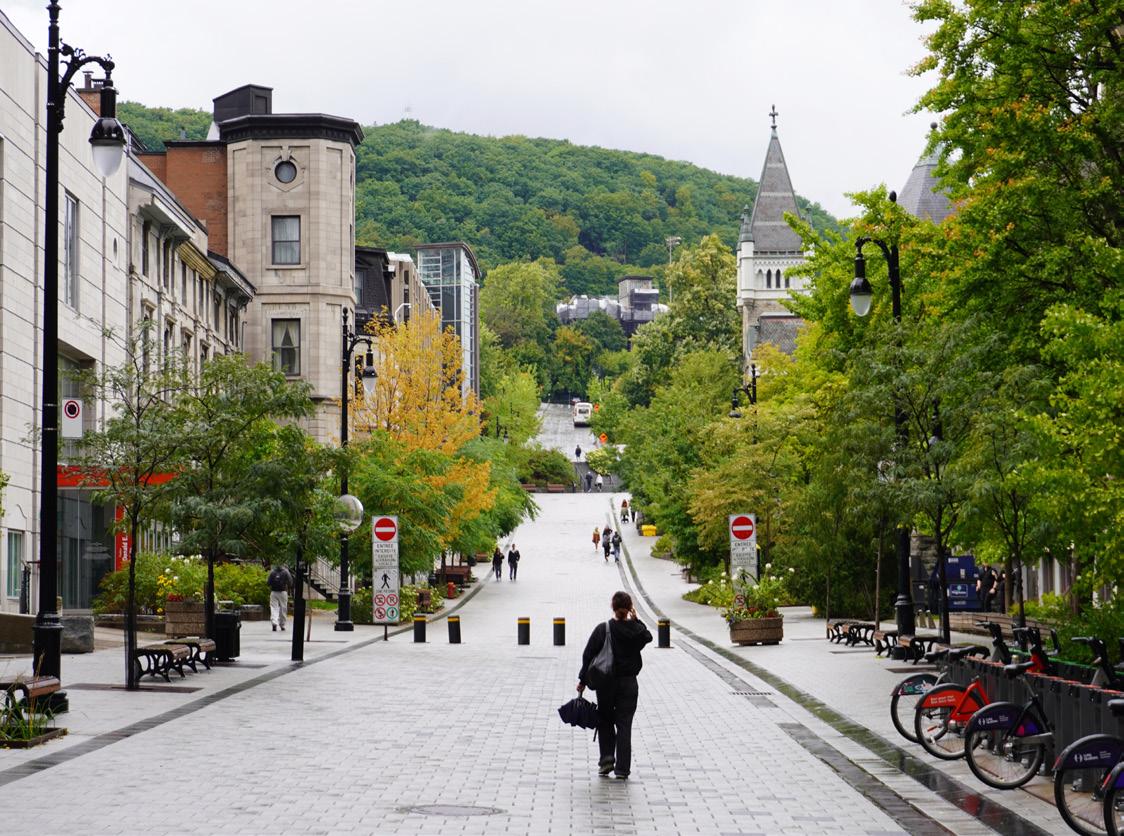
New to Montreal? Here’s what to do in your first few weeks Activities and advice to make the city your home
Gregor McCall Student Life Editor
Moving to a new place is scary—especially when it’s for school. All of a sudden, we’re thrust into an alien environment, surrounded by swaths of strangers and, at least for many anglophone McGillians, a new language. We’re expected to adapt to all of this while simultaneously managing the new pressure of university-level courses. This can make Montreal appear intimidating.
Yet, this adjustment also presents an opportunity to make the city your home. Don’t know where to start? Don’t fret, The Tribune has taken the liberty of compiling everything you need to combat homesickness and help you fall in love with Montreal.
Reach new heights
You may have already noticed Parc du Mont-Royal looming behind campus, an austere giant that lifts the skies and shoulders the buildings. Its dense woods and fertile hiking trails make it the perfect place to clear your head, get that heartbeat up, or contemplate those deep post-midterm existential crises. It’s also one of the best places to acquaint yourself with Montreal. Whether you opt to brave the seemingly never-ending staircase up to Kondiaronk Belvedere or spring for a leisurely stroll to Lac aux Castors, an afternoon on the mountain will be sure to acquaint you
with your new home. Take in the city skyline, marvel at the electric cross, or enjoy a coffee from the famed Chalet du Mont Royal in alpine bliss. No matter what, you will come away with a greater understanding of Montreal’s geography and history—and discover the perfect spot to bring new friends.
Take your stand in the city-wide debate
Fairmount or St-Viateur? That is the question. The bagel-war is the only skirmish you’ll want to enlist in—and with top-notch options, it’s hard to pick a side. Travel to the front lines by taking an excursion to the Mile End, a laid-back, cool, and semi-hipster neighbourhood with a thriving food scene stemming from its rich Jewish history. While at St-Viateur, you’ll find yourself in a utopia of cream cheese and breakfast sandwich options; at Fairmount, you’ll only be able to buy bagels by the individual, half dozen, or dozen. The ultimate test: Go to both stores (about a block away from each other), find a spot to sit down outside, and do a blind taste-test. Take a residence acquaintance, a classmate, or, for a real argument, a seasoned Montrealer, and see how heated the quarrel becomes.
Go off the beaten trail
Even if you’re new to McGill, you probably already know Old Port. Its prestige in terms of Montreal neighbourhoods is rightly deserved. Bursting with history, kitschy souvenir shops, first-class restaurants, and cob-
blestone streets which magically transport you to a European town square, it’s obviously worth a visit. However, much of Montreal’s rich cultural conversation lies outside the tourist zones, in neighbourhoods most non-Montrealer students might not see if they don’t go looking for it. Walk along the Lachine Canal and you’ll find yourself at the nexus of SaintHenri, Griffintown, and La Petite-Bourgogne, each with charming, unique architecture, idiosyncratic restaurants and cafes, and its own contributions to Montreal history and accomplishment.
Can’t decide between Italian, Haitian, Vietnamese, or North African food? In neighbourhoods like Saint Leonard, you can see cultural diffusion in action where ethnic enclaves constantly mesh with one another, producing gastronomic miracles and proud locals. Where else could you get Haitian Tassot with a side of arancini and a Vietnamese coffee, all within one block? Getting outside of the McGill bubble will give you a better sense of the city, the people who live here, and the robust culture they’ve built. Bonus: Taking
When campus walls become a canvas
the metro will make you all the more adept at navigating the city on your own (and you can get a student discount if you order your OPUS card through Minerva).
Become a regular At a cafe, a bar, a library, or even a club (dance or student, you pick). Show up somewhere regularly. Meet the people there. You’ll soon find that people begin to recognize your face and know your name, and that you’ll know theirs more and more. What’s important is to set up roots. It doesn’t matter if you don’t know anyone else going into it; you’ll meet people. Establish yourself, and you’ll begin to feel all the more at home.
“Interwoven” showcases the plurality of Indigenous practices and their connection with language
Nell Pollak Managing Editor
Abraid of sweetgrass winds across a purple backdrop in the University Centre’s flex space across from Gerts Student Bar. The mural, entitled “Interwoven,” represents more than vibrant artistic expression—it’s a deliberate effort to establish Indigenous presence in one of McGill’s most frequented student spaces. Zoe Gesaset-Gloqowej Lee, the ChineseMi’kmaq artist behind the installation, collaborated with Student’s Society of McGill University (SSMU) Indigenous Affairs Commissioner Delanie Havevrock to bring the project to fruition.
The design is inspired by Lee’s featured article in The Tribune, “A Minor Is Not Enough,” which calls on McGill to expand its undersupported Indigenous studies minor into a durable and meaningful program. The featured art installation centers on strands of sweetgrass—a plant used both ceremonially and medicinally across many Indigenous communities—braided together.
“We wanted to include a design element that connects all of the visual motifs both in practice and in principle,” Lee explained in an interview with The Tribune. “The sweetgrass ties the whole mural together, being language, community, traditional practices, people, land, and the distribution of those things.”
Alongside the sweetgrass, the art installation is filled with culturally significant plants like Saskatoon berries, blackberries, and cedar. These elements are labeled in different Indigenous languages, including “Shá:yehse” for blackberries in Kanien’kéha and “Gasgusi” for cedar in
Mi’gmaq. Lee deliberately chose elements that reflect the interconnectedness of Indigenous practices while respecting the distinct traditions of different communities.
“We wanted to highlight the diversity across Canada, while also not watering it down into something that was just like a greeting card,” Lee explained, describing the thoughtful approach taken to honour distinct Indigenous traditions throughout the art installation.
The creation process spanned from Oct. 2024 to May 2025, involving extensive community dialogue at First People’s House and collaboration with MU, a Montreal-based mural company, which she worked alongside with for two and a half weeks to bring her vision to life.
Lee emphasized the collaborative nature of the project. “There’s just been so much input from everywhere. It’s really a community-based initiative.”
Lee noted the contrast between individual support from community members like Indigenous Affairs Commissioner Havevrock and institutional barriers from McGill’s administration.
“There really wasn’t very much support in terms of the administration and the institution,” Lee observed. “It really comes down to the individuals who want to make this happen.”
For Lee, visual representation matters deeply, especially at a university that lacks a visual arts program. “I think visual design really changes a space,” she said. “This is a way to highlight not only the arts, but also Indigenous art and Indigenous creation.”
The mural serves an educational purpose beyond aesthetics. Lee hopes viewers will reflect on “the relationship between land, art, community, and language” while learning about Indig-
enous linguistic diversity. The piece explores the interconnectedness of different Indigenous communities through shared practices while celebrating distinct cultural expressions.
“It’s a call for reflection and for learning, because there’s all these different languages and all these different words that most people have probably never seen before,” Lee explained.
With the “Interwoven” art expo and concert planned for Sept. 23, Lee sees art as a powerful tool for reconciliation and education, with the potential to bridge gaps between communities. “It is accessible in a way that words and language aren’t […] art is so fundamental to so many different cultures, it’s not just something that one person has authority over.”
This accessibility makes art uniquely suited for fostering understanding in ways that tran-
scend linguistic barriers.
“Art says so many things that words sometimes can’t,” Lee said. “I want people to see my mural, be inspired to combine their passions, and say something and be visible.”
The mural represents one step toward meaningful Indigenous presence at McGill, though Lee emphasizes that while visibility and acknowledgment alone are important, they are not sufficient. The success of “Interwoven” stands proudly as a call for sustained institutional commitment at McGill to make such collaborations with Indigenous students and communities the norm, rather than the exception.
Artist Zoe Gesaset-Gloqowej Lee is a Design Editor at The Tribune. She was not involved in the editing or publication of this article.
Montreal is a UNESCO city of design, recognized for its achievements in the field, its promotion of creativity in city development, and its wide cast of talent in design disciplines. (Mia Helfrich / The Tribune)
The continuity of the braided sweetgrass across the mural “Interwoven” represents a celebration of community intertwined with art. (Anna Seger / The Tribune)
Essex Honey is a perfected orchestra of love, loss, and grief
A love letter to the resonating mastery of Blood Orange
Kaitlyn Schramm News Editor
Devonté Hynes, under the alias Blood Orange, entered the mainstream several years ago when his 2011 song, “Champagne Coast,” gained viral popularity on TikTok. After a six-year hiatus, he released a new album on Aug. 29, Essex Honey , in which he contemplates grief, loss, and growing up. Within each song is a series of ellipses tying itself together, as though he is intertwining several different sounds— fragmented, yet harmonious. The songs are free from the imprisonment of iconic sound and catchiness, acting rather as a surrender to a sense of measured choppiness. The lyricism reads like poetry, balanced amongst sounds of conversation and bursts of instrumental ad libs. Exhibiting a symphony of reality, Essex Honey is a phenomenal album that travels through the journey of grief with grace.
“Look at You,” the first track of the album, is a touching song about grief that sets the tone for the songs that follow, representing Hynes’ fear of the inevitability of change and death. The ebbs and flows of the song represent the ebbs and flows of loss: The feeling of staring at your ceiling trying to sleep when all you can think about is the sound of their laugh or the crinkle of their eyes. The rest of
the tracks don’t explicitly confront human death, but rather the death of the hometown, the death of childhood. Hynes’ uncertainty surrounding these losses is palpable beyond the words he sings. In each track lie multiple songs, with abrupt shifts from solemn collaborations of flute and piano to harsh, staccato cello notes. He conveys the anxiety that at any moment, your loved ones could die, your hometown could become unrecognizable, and without realizing it, you stop being a kid.
As someone who has experienced grief and loss, the album is incredibly touching. And as a musician, it is a commanding work of art. Hynes places each instrument, including the various features—namely Caroline Polachek and Tirzah—in conversation with one another. As he voices his lyrics, a flute chimes in with agreement. A bass line delivers some harsh news, and a crowd of seagulls offers condolences. In a way that feels incredibly tangible, the sounds are woven together in communication like a lively debate at the dinner table. Essex Honey is the kind of album that leaves a lingering desire to watch the music in action, to watch the instruments bounce off one another.
The concluding track, “I Can Go,” pulls the album together such that the listener themselves feels Hynes’ journey
with grief. He does not leave the listener hanging: It is not open to interpretation. Following the thirteenth track, “I Listened (Every Night),”— a liberating love letter to music as therapy—“I Can Go” settles into everyday grief. It is the light at the end of the tunnel, the acceptance that the only way forward is through. Hynes sings, “Now, what you know / Is nothing I can hold / I can go.” Whereas earlier in the album, he is clearly distraught, hanging on to what no longer exists, the final track is a surrender, an acceptance.
Rejecting the instant but fleeting gratification of TikTok virality, Hynes has created a beautiful and encapsulating album, free from overused and stereotypical fifteen-second sound bites that have become all-too familiar amongst popular artists. Essex Honey is not clippable nor catchy—it is raw, a breath of fresh air. It
is jazz, classical, and R&B. It is the experience of eavesdropping on the metro with one earbud in, studying in a cafe comforted by the clinking of silverware and overlapped conversations, walking on a busy street surrounded by your own contemplative thoughts of love and loss. A gleaner of everyday noise, Hynes has yet again proved himself to be a master of the medium, finding freedom and solace in the vicissitudes of life.
An essential condemnation of polite, tepid journalism in the face of mass murder One Day, Everyone Will Have Always Been Against This shatters the Western liberal ethos
Mairin Burke Managing Editor
This is going to be a poor book review. It is impossible to adequately editorialize upon Omar El Akkad’s One Day, Everyone Will Have Always Been Against This . Every line demands that its readers confront the Western liberal enterprise’s absolute apathy towards human suffering. If I had not expected to lend the book to everyone I know, my copy would be almost completely highlighted. Each of its incisive, revolutionary sentences speaks to our urgent obligation to walk away from systems of privilege that will always disregard humanity in favour of self-interest.
El Akkad began his career as a journalist for The Globe and Mail , which deeply informs both his acclaimed novels and One Day . Much of the latter is explicitly dedicated to condemning Western journalism’s repeated failures to indict neo-colonial and imperial perpetrators of violence until after they have already devastated entire populations. It is, moreover, a personal reckoning with authorial responsibility, as El Akkad grapples with how to balance the financial precariousness of a creative career with the core artistic need to fight injustice—even if its doers sponsor the awards and grants these artists earn, making them complicit.
One Day is also, as El Akkad posits in the book’s first chapter, “an account of an ending.” As an Egyptian and Qatari immi-
grant to Canada and now the United States, he describes the fable of the tolerant, the just West he was promised, and now sees for what it is: An empty shell. El Akkad argues that liberal politicians simply provide a less bad alternative for marginalized groups than the right, who are at least honest about their discriminatory natures. This dynamic exposes the deep hypocrisy at the heart of Western liberalism.
“The system [...] was never intended to work for you, but as an act of magnanimity on our part, you may choose the degree to which it works against you,” El Akkad writes, describing the United States Democratic Party.
One Day ’s argumentative power against Western liberalism’s performativity does not overshadow its literary elegance. Written as a series of vignettes, the work is overflowing with novelistic prowess. It is also bitingly funny: El Akkad recounts how, when living in Montreal, a universityaged peer informed him that Naked Lunch was “the finest novel ever written” (a very McGill-esque exchange). This familiarity enforces readers’ connections to the modes of action and resistance El Akkad argues we must assume to combat the malice of empire.
Moreover, El Akkad’s gorgeous prose deeply strengthens One Day ’s calls for a journalistic reckoning. Rather than the “linguistic malpractice” Western legacy outlets engage in when they describe atrocities as
happening without cause—in vague and lukewarm language that eschews blame— El Akkad’s prose asks us why we only feel “safe enough to venerate resistance in hindsight.” It reveals how the polite language Western society endlessly litigates is only possible when alienated from violence and suffering. While The New York Times avoids use of the words ‘Palestine’ and ‘genocide’ for fear of hurting those in a world “not reduced to rubble,” Israel wields literal weapons to destroy Palestinian lives. Through its deeply personal, unflinching commitment to truth and compassion, One Day, Everyone Will Have Always Been Against This challenges tidy narratives about Palestine that make the dead “pay the moral debt born of their killing” to protect the Western world from the discomfort of acknowledging Palestinian humanity. El Akkad’s ultimate call is to walk away from a liberal system that cannot fathom the true love for the ‘Others’ he depicts—in the Palestinians who mourn their families while continuing to document atrocities, in the Jewish activists who condemn Israel, in the artists who reject clout
to reject genocide—is an antidote to the insanity El Akkad, too, feels while watching genocide unfold in silence.
“You are being asked to kill off a part of you that would otherwise scream in opposition to injustice,” El Akkad writes. “[....] Forget pity, forget even the dead if you must, but at least fight against the theft of your soul.”
Blood Orange is currently on tour, set to open for Lorde in Montreal on Sept. 27. (Alexa Roemer / The Tribune)
The search for the perfect summer read
The History of Sound captures the quaint tranquility of long summer days
Annabella Lawlor Arts & Entertainment Editor
Soft gusts of breeze billow through loose hair as the sun reflects off bleached book pages. There is a prodding sharpness of salty seas and a deep odour of oak groves. A blow of wheat and pollen caresses overgrown fields; wind fights the fluttering pages of a book.
The beginning of summer often marks a return to reading for joy, without the impending doom that seeps into the pages of my literature assignments. Easing back into the comfort of real life, I rekindled my love of reading. But a real tragedy befell me: Glancing at the piles of books that awaited my return home, I felt stunted, overwhelmed by the number of options that lay before me.
The question of what books are perfectly suited to the airiness of summer’s lingering months plagues both the internet and my mind. To fill the long-winded days with narratives unlike my own would be the ideal outcome, but wherever I started seemed to be the wrong path. After searching for my perfect summer read in a drug and sex-ridden memoir of New York’s 70s punk scene, a historical fiction book about misogynistic witchcraft accusations, and whatever Miranda July considers the plot of her new novel, I finally found my answer in Ben Shattuck’s short fiction.
A book most suited for summer isn’t just something light—a work requiring no thought in the process of reading—but
rather one that bathes in the quaint beauty of its seeming nothingness. Its atmosphere is earnest and reflective. These contemplative, character-driven books hold a mirror to the surrounding world, picking out its complexities and documenting the nuances of human experience.
In the windy greenery of Vermont hills, I perched with Shattuck’s short story collection, The History of Sound , only glancing up at howling birds or the whispering of dirt roads. It is one of the finest collections of short stories that I have ever had the delight to read. Set amidst the backdrop of New England, the collection explores the interactions of people in the region throughout time.
Thoughtful and intense, each anecdote flows in like a budding wave, crashing and easing into the shore, slowly drifting back out with a turn of the page. “The Auk” follows a man’s quest to comfort the idle days of his wife with Alzheimer’s, while “Edwin Chase of Nantucket” sees a meeting between old lovers—a painter and his first love, Laurel—told from the perspective of her young son. The eponymous story, the first of the collection, details two men’s budding romance en route to tape folk songs of the American Northeast, and the eventual fallout of their forbidden love in the early 19th century. Shattuck rounds out the collection with “Origin Stories,” a return to the men’s narrative almost fifty years later, wherein a woman discovers these recordings and seeks to return them to their rightful owner.
In these quiet reflections of temporal transience, Shattuck’s narrative demonstrates how history scars the present with evidence of its past. His stories come in pairs, as if rhyming couplets in a poem. Often shifting from past to present—or vice versa—in the complementary stories, these odes to humanity serve to remind us that although history feels distant, it remains alive in everything around us.
Shattuck captures a moment in time as if a storied set of narrative paintings, waiting to be made sense of alongside its companions. Though we pass through each world only momentarily, we witness the charms and weaknesses of those encountered with breathtaking nuance.
I left his work with a profound sense of gratitude, recognizing the menialities and
quaintness of life through which we are all connected. We all have felt the anxiety of making new conversations, the internal ache of a love unrequited, the panging uncertainty of decision. We are all simply waves crashing against stone, combusting and receding, making way for waves soon to follow. It is ultimately in these quiet ruminations that summer is most suited.
Sabrina Carpenter and the thin line between submission and control
Man’s Best Friend: A friend to all is a friend to none?
In defence of Man’s Best Friend
Malika Logossou Managing Editor
Continued from page 1.
A man who does the dishes, communicates well, and listens. She is not celebrating low standards, but mocking how women are conditioned to reward basic decency. Her irony is clear—she knows it’s absurd, and still, she finds sexual pleasure in it. Digging deeper in “My Man on Willpower,” she watches a former partner prioritize his personal growth so much that he loses devotion to her. Despite her numerous attempts at seduction, he drifts. The song exposes her desperation for male attention, likening her own loyalty to that of a dog. However, the closing track, “Goodbye,” is different. Channeling ABBA’s “Voulez-Vous” and “Take a Chance on Me,” she ends on an empowered note. Her ex wants her back, but she refuses, reminding him that it was he who said goodbye. She finally chooses herself. Both the album and its cover cynically reflect the idea that accepting the bare minimum is akin to being ‘man’s best friend.’ She ridicules her own submission to the male gaze through cheeky lines while reclaiming agency. The message isn’t inspirational, but it’s honest:
Even when her standards disappoint, she maintains control over her sexuality.
Girl’s worst nightmare: Where was the puppy love?
Jamie Xie Staff Writer
In Short n’ Sweet, Carpenter reinvents herself, pivoting from vulnerable Emails I Can’t Send confessional pop to popstar parody. In Man’s Best Friend, she promises one whole hour of all things sex in 4/4 metre as her winking Mae West persona. It comes across as if Carpenter is a little too comfortable in her endeavours to subvert expectations and create a post-ironic, sexually-liberated, feminist image—perhaps at the expense of subtlety and substantive commentary. While her irony represents a refreshing take on the pop genre, her work lacks the intentionality needed to challenge existing patriarchal power structures. Carpenter’s album does very little to engage thoughtfully with criticism of commodified sexuality, falling victim to a lack of creative direction.
The album’s only lead single, “Manchild,” delivers a performance that comes across not only as formulaic but also derivative of her previous works. Echoing “Busy Woman” musical motifs but falling upon himbo cliches established in “Sharpest Tool.”“House Tour,” and “Sugar Talking,”
display the album’s core through retro 80s Nudisco synths—a safer genre direction than she seemed to be promising with the country elements used in “Slim Pickins” and “Manchild.”
Her strongest songs—“Go Go Juice,” “We Almost Broke Up Last Night,” and “My Man on Willpower”— barely tease this idea of developing Carpenter’s persona by making light of herself. What if Carpenter didn’t have all the answers? Could it be possible that she might not have as much control over her relationships as she would lead us to believe? On “Go Go Juice,” Carpenter is at her apex with her lyricism, creating a vignette of a messy but sympathetic woman running on boozy brunch and pure hope, all in a tight three-minute timeframe.
Worse than being regressive, Man’s Best Friend suffers from the true crime of a distinct lack of imagination in
the audience’s taste—symptoms of a desire to shock and please. Underlying the album are notes of insecurity that Carpenter is aware that the public’s adoration is difficult to hold. The current pop fixation on her may possibly be as short as it was once sweet.
The History of Sound’s eponymous short story has since been adapted into a film starring Paul Mescal and Josh O’Connor. (Lilly Guilbeault / The Tribune)
Man’s Best Friend marks Carpenter’s seventh studio album over the course of 10 years. (Zoe Lee / The Tribune)
Dice: The statistician’s Roman Empire The role of dice in the development of probability calculus
Sarah McDonald Science & Technology Editor
It’s a rainy Wednesday night in 50 BC, and you’re playing Yahtzee against Julius Caesar. You have four 4s, one 6, and one roll left. You have a decision to make: Do you risk it and try to get a Yahtzee, or settle for a fairly impressive four-of-a-kind? It turns out this question— of calculating the odds of whether or not a die will do you a favour—is not only an incredibly ancient question, but the basis of probability calculus.
In a recent paper published in International Statistical Review , McGill professor Christian Genest explores the historical role of dice in the development of probability calculus. By exploring the shifting role of dice throughout history, Genest and his co-author David Bellhouse bring preexisting theories together, creating a comprehensive perspective on the evolution of probability calculus in the Western world.
Dice have long been regarded as central to the development of probability calculus; they allow for randomness to be physicalized in a simple, predictable, and empirical way. However, while there is evidence of ancient Mesopotamians using dice in their games, the first probabilistic calculations only date back to the 13th century.
“The comparatively late emergence of this mathematical concept is somewhat
surprising, given that humans have been confronted to randomness since time immemorial,” Genest explained in a written statement to The Tribune.
Genest and Bellhouse attribute this late development to a number of conditions present in the Roman empire, one such factor being the lack of unbiased dice.
Astragali or tali, made of the ankle bones of goats or sheep, were common substitutes for dice. They had four playable sides and worked as modern dice do, but lacked any regularity that would allow for statistical data to be consistent from one talus to another.
“To my surprise, however, this fact did not appear to be so well been documented in the literature, so with my son Richard (who was 9 at the time), I endeavored to toss several modern tali (which we got from a butcher) hundreds of times each in the summer of 2024,” Genest wrote. “We had a lot of fun doing this together.”
The variation in the data they collected led Genest and Bellhouse to conclude that any probabilistic calculations would have been difficult to make and impossible to generalize. However, Genest suspects the Romans never even got that far.
“People [had a] tendency in ancient times to hold a deterministic view of the world that led them to interpret the result of random events, such as the throw of dice, as a manifestation of some deity’s will,” Gen -
est explained. Combined with their deterministic perspective, Genest explained that the use of Roman numerals would have hindered the Romans’ ability to complete any significant calculations; you can’t do any serious math with Roman numerals.
It follows that the Western discovery of probability calculus followed the implementation of Arabic numerals in Western society. In fact, the earliest found source of combinatorial calculations—a Latin poem “De Vetula,” published in the 13th century—is believed to be, in part, a way of introducing readers to Arabic numerals.
Together, the implementation of Arabic numerals, the creation of more “regular” dice, and the fallaway of determinist perspectives allowed for probability calculus and combinatorial mathematics to develop in the West.
“While ‘De Vetula’ seems to be the oldest Western source to date, it is entirely possible that traces of probability calcu-
lations could be found in older literature from Chinese, Indian, or Arabic culture. We need to look into it!” Genest wrote.
This goes to show that while we can hedge our bets on the odds of rolling that last 4 we need, if the Romans’ had Yahtzee, they wouldn’t have even known they had bets to hedge; their dice were biased, and this bias, instead of being attributed to physical structure, was attributed to the will of the gods.
So, yes, if you played Yahtzee against Julius Caesar using modern dice, it would be reasonable to believe—statistically speaking—that you would win, regardless of whether or not you try for that five-ofa-kind.
Boosting medical students’ surgical confidence through non-domin ant Study reveals training non-dominant handed suturing improves dominant-handed skill
Leanne Cherry Science & Technology Editor
While all of the clinical rotations in which medical students participate are challenging, one of the most intimidating rotations is general surgery. This is not surprising given what is at stake in an operating room (OR).
“First of all, you have to understand sterility and how not to contaminate the table,” Dr. Mirko Gilardino, plastic surgeon and professor of surgery at the McGill University Health Centre, said in an interview with The Tribune. “And then there’s this old adage that surgeons are grumpy [...] [although] that’s not necessarily true, of course [....] But still, it’s scary and overwhelming, nevermind the fact that there’s a body that’s being operated on.”
Despite how stressful it may be, spending time in the OR as a medical student is an incredible opportunity to practice and apply one’s basic surgical skills, such as the skill of suturing—stitching a patient’s wound or incision closed. Therefore, learning to suture with confidence before getting to the OR is a huge asset.
In a recent study published in the Journal of Surgical Education, Gilardino, along with Dr. Hassan ElHawary—the paper’s primary author—and their collaborators examined how training medical students to suture with their non-dominant hand affected both their skill acquisition and their confidence. They assessed the medical students’ aptness for suturing on practice material using both their dominant and non-dominant hands, before and after training. One group of stu-
dents completed the suturing training with their dominant hand, while the other trained with their non-dominant hand. Afterwards, the researchers administered a questionnaire to assess any changes in the students’ confidence in their skills, how well they could use them in the OR, and how they perceived the ambidextrous training.
The authors found that both groups of students improved their onehanded suturing skills to the same degree. Furthermore, they discovered that those who had trained to suture with their nondominant hand actually improved their dominanthanded suturing as well. Both groups of students generally reported increased levels of confidence in their surgical skills and in their ability to use them in the OR. Finally, many of the students expressed that ambidextrous training should become standard practice in surgical education.
called ‘surgical workshops,’” Gilardino said. “So what he felt was that students didn’t enter or didn’t even seek out careers in surgery, unless somehow they were exposed and had a positive experience.”
Rather than being driven by an interest in ambidexterity alone—although this was a key focus—this study was born out of a more general desire to improve how surgical skills are taught, and to do so in a way that makes students more comfortable with the idea of surgery.
“Hassan was really interested in what he
After seeing how successfully the workshops were running, ElHawary realized the research opportunity sitting in front of him.
“Hassan thought about it, and he was like, ‘Wow, you know, people are liking surgery more. I wonder if we can even do it better by training them on their non-dominant hand,’” Gilardino recalled. “It was more like a curiosity. And since you already had the whole structure in place and his courses, it wasn’t
that complicated for him to dive into this.”
There are many benefits to being a surgeon who is adept with their non-dominant hand. For example, some operations are better suited for right-handed maneuvers, and others are better suited for left-handed maneuvers. It is useful to be able to tackle a problem from both sides. Surgical ambidexterity has also been shown to improve both the efficiency and the outcome of an operation.
Overall, this study underscores the need for surgical education that not only encourages training with one’s non-dominant hand but that builds a sense of confidence in medical students at the same time.
The comedic elegy “De Vetula” is believed to have been written by polymath Roger Bacon. (Mia Helfrich / The Tribune)
All of the students who participated in the training expressed desire to participate in similar workshops in the future. ( Leanne Cherry / The Tribune)
All ages aboard: Making public transport more accessible for older adults
Antoine Larocque Contributor
Acity’s public transit system should serve the needs of all its inhabitants and leave no citizen behind. However, many older adults living in Canadian cities are reluctant to use these services, relying on their cars instead.
Meredith Alousi-Jones, a PhD candidate in McGill’s School of Urban Planning, and her collaborators investigated the barriers preventing older adults—those aged 65 years and above—from using public transit. This research was conducted as part of the Aging in Place Challenge program, which aims to help aging populations thrive in their own homes and communities—an alternative that many prefer to nursing home care.
“Older adults are a segment of the population that is typically less studied in research, especially concerning transit,” Alousi-Jones said in an interview with The Tribune. “We know that it is a growing population.”.
Their study surveyed residents across six Canadian cities—Montreal, Toronto, Vancouver, Victoria, Saskatoon, and Halifax—encompassing a wide range of urban contexts, from metropolises to smaller urban areas.
“The gap that [the study] was trying to address is mainly from a policy point of view of giving some tips to the agencies in each of the six research contexts,” Alousi-Jones said.
To form targeted initiatives for public transport agencies, the researchers grouped people who avoid public transit into four categories: Non-users who are transit-inclined, those who use it as a last resort, those who
are not considering it for now, and those who are transit-averse.
They found that many older adults do not use public transit simply because it often fails to meet their day-to-day requirements.
“It is not a mode [of transport] that suits their needs,” Alousi-Jones elaborated. “A lot of them, especially in the more rural areas, like the suburbs or even smaller cities, where public transit is not as expansive over the territory, do not find that it is efficient, do not find that they can carry groceries easily, or things like that.”
A lack of knowledge about how to use public transport also deters many, especially those who are new to a city or unfamiliar with its transportation system. Among the
491 survey respondents, many cited poor reliability and discomfort as key concerns. Alousi-Jones highlighted that reliability, comfort, and access to information on how to use public transit are solutions readily actionable by public transport agencies.
“Things like adequate seating and seating at bus stops were common suggestions from our respondents for how they could use public transit a bit more,” Alousi-Jones said.
The researchers noted differences in survey answers between cities. For instance, non-users from larger cities—Montreal, Toronto, and Vancouver—wanted transit services to run more frequently, while people in Saskatoon, a colder city, demanded more bus shelters for comfort while waiting.
While older adults in Montreal appreciated free fares, the researchers noted that this measure did not necessarily incentivize them to use public transit.
Taking the results together, AlousiJones’ main recommendation was to make transit more accessible by improving the reliability and proximity of public transportation services.
“A lot of older people do not necessarily have the physical ability or the desire to walk a long time to get to transit, so they do not mind transferring as much as [one] would think,” Alousi-Jones said. “They do not care if they have to go from a bus to a metro or so on, as long as the bus is reliable and it is close to their house.”
Alousi-Jones stressed that her recommendations would not only benefit older adults but also other users in the population. She presented her research to public transit agencies across the six cities to ensure that her results were communicated to the right decision-makers.
“The [cities] really want to make sure that the transit is well adapted to their needs,” Alousi-Jones observed.
Moving forward, Alousi-Jones now studies how to improve satisfaction among current transit users, as well as the barriers that prevent them from using it more frequently. She believes that public transit may improve if it is treated as an essential service that enhances life quality as opposed to a money-generating service. Applying this philosophy will not only enhance people’s well-being as they age but will also contribute to achieving Canada’s net-zero emission target by encouraging people to choose lowemission car alternatives.
Beyond the court: The Ostapenko-Townsend dispute
Tennis players Ostapenko and Townsend got into a heated altercation at the 2025 US Open
Alex Hawes Silva Staff Writer
On Aug. 27, tennis players Jelena Ostapenko and Taylor Townsend got into a verbal altercation after the second round of the 2025 US Open. After an intense matchup where Townsend defeated the Latvian in straight sets 7-5, 6-1, Ostapenko initiated a heated conversation that ended in her saying that Townsend had “no class” and “no education.” Ostapenko’s remarks sparked major outrage online and amongst fans, with many claiming the comments had racist undertones and that Ostapenko should be penalized accordingly.
Ostapenko has apologized since the incident, saying that English is not her first language and that she did not have malicious intentions and meant no harm. With a history of racism within the sport of tennis, many wonder what the truth is behind this incident, and whether Ostapenko should be held accountable for her actions.
Tennis has long been shaped by exclusionary practices, making any discussion of potentially racist remarks amongst athletes reflective of the sport’s history. For decades, professional tennis was dominated by wealthy, predominantly white individuals, with clubs and major tournaments often banning and excluding Black ath -
letes. Althea Gibson broke barriers in 1956 as the first Black player to win a Grand Slam title, but her success did not shield her from discrimination and prejudice both on and off the court.
In the 21st century, Venus and Serena Williams have endured similar treatment, facing racist behaviour from crowds and accusations that their competitive fire is “angry” and “unladylike.” These stereotypes speak to a broader pattern in tennis, in which Black women have been portrayed as lacking composure or “class.” With this deep-rooted history of racism, Ostapenko’s words—even if they were born of frustration rather than racism—resonate with a long history of discrimination that has targeted Black women in tennis specifically.
While Ostapenko apologized, her comments cannot be separated from this history. Her words “no class” and “no education” parallel language traditionally used to demean and dehumanize Black women, which explains why many saw them as racially charged. Even if Ostapenko’s remarks were less about race and more about venting frustration after a difficult loss, the fact that Townsend, a Black American player, was the target means the impact was different than if Ostapenko had directed her words at someone else. Athletes like Ostapenko must consider the effects of their actions and see how their comments risk
reinforcing harmful stereotypes that have persisted in tennis for decades. The situation as a whole highlights how racism in sport is not always explicit and overt, but can also emerge through language that carries different meanings depending on history, context, and audience.
Ostapenko’s remarks towards Townsend were more than a heated postmatch dispute: They serve as a reminder of how deeply history shapes the present in tennis and in society. Acknowledging this context does not mean automatically condemning Ostapenko as malicious, but it does highlight the need for awareness and accountability in tennis.
The next steps for the United States Tennis Association (USTA) should be not
just responding thoughtfully to address this single incident, but committing to education and policies for their athletes that prevent racist behaviour before it occurs. Tennis has progressed toward inclusivity, yet moments like this show there is still work to be done. Ensuring that every player, regardless of race or background, competes in an environment free from discrimination is not just the USTA’s responsibility—it is essential to the sport as a whole.
How a desired striker is creating a large legacy Alexander Isak’s choice: The controversy swirling around one of football’s brightest lights
Merce Kellner
Contributor
Amid a summer transfer window like no other, football’s biggest stars made even bigger moves. But one story especially captivated football fans this year. Alexander Isak, a 25-year-old Swedish footballer, had 27 goals in all competitions last season for his former club, Newcastle United. His time with the team came to an end early, despite having a contract that ran through 2027, with his shocking move to the Premier League champions Liverpool Football Club.
Isak’s refusal to attend pre-season team sessions and entrance into Newcastle coach Eddie Howe’s squad at the beginning of the 2025-2026 English Premier League season created a saga that not only tarnished Isak’s reputation amongst Newcastle supporters, but also raised questions about the power star players have. Newcastle, which was without another striker at Isak’s level, relied heavily on his goalscoring to achieve significant wins last season. Without him this year, the team has struggled, starting with one loss and two draws in their opening three games.
For Newcastle fans, the situation is frustrating. Recently, following the team’s acquisition by the Saudi Arabian-based Public Investment Fund in October 2021, the club has experienced significant success, led by Isak. His goalscoring reflected traits similar to club legend and all-time leading Premier League
goal scorer Alan Shearer, who played for the club from 1996-2006. Last season, Newcastle defeated Liverpool 2-1 in the League Cup final, with Isak scoring the game’s pivotal goal to make it 2-0 in the match. Furthermore, Isak’s 23 Premier League goals were significant in Newcastle’s qualification for this season’s Champions League.
Hence, the question looms. Why did Isak force his way out of the club? Why did he choose Liverpool?
Throughout the 2024-2025 season, Isak was linked heavily to Liverpool head coach Arne Slot’s Premier League-winning team. During a busy transfer window for Liverpool, the ‘Reds’ spent over $600 million CAD before signing Isak, including major attacking signings such as Florian Wirtz and Hugo Ekitike. It was questionable whether Liverpool could afford Isak or still considered him a desired attacking target.
Nonetheless, adding to the recordbreaking window for the Reds, they spent an additional $217 million CAD to make Isak’s move official. His addition to their revamped attack gives the team a massive leg-up in their title-defending campaign.
While Isak did get his move away from Newcastle, he violated the responsibilities he had to his former team. When a player signs a contract, it is their obligation to contribute to team efforts until their contract expires, or until the club transfers the player. Despite informing the club at the end of last season of his desire to leave, Newcastle’s refusal to
accept opening bids from Liverpool was not a reason for Isak to withhold from participating in club outings.
For Newcastle, the move created an exceedingly tricky situation. Their star player was refusing to participate while they still had not received a bid they deemed commensurate with Isak’s value.
Judging by the recent prominence and success of Newcastle, they are on the trajectory to be a potential elite club in the Premier League’s future. If they want to join this top-tier group, they cannot let go of players like Isak, despite pressure from the player or financial incentives.
Isak would arguably be in a better position if he stayed at Newcastle, being the team’s sole striker. The quality of competition at Newcastle is no different from what he will have at Liverpool: Both teams are competing in the same domestic competitions, and both teams are in this season’s Champions League.
At Liverpool this season, Isak will be competing for his striker spot with Ekitike, who has already had a hot start with the Reds in the opening games of this Premier League season.
Isak’s first return against his old side could come on Jan. 31, 2026, at Liverpool’s Anfield Stadium—that is, of course, if he earns his place as his new team’s starting striker this season.
The Alexander Isak transfer saga represents the power exceptional players have in creating their own destiny, despite contractual obligations. Now, it is up to Isak to perform in an exciting season ahead.
The French Open and Wimbledon officially began offering equal prize money to both men and women in 2007. (Zoe Lee / The Tribune)
Martlets home opener reminds McGill why its Women in Sports program is here to stay
McGill women’s soccer beat Laval 1-0 to the cheers of other Martlets varsity teams
Hillary Wright & Mairin Burke
Contributor Managing Editor
McGill’s Women in Sports (WiS) program kicked off the fall semester at the Sept. 7 Martlets soccer home opener. Hosted twice a year, WiS Days like these are social events that welcome McGill Athletics’ women’s players to attend the home game of a fellow Martlet team. The fall WiS Day event brought these Martlets into the stands of Percival Molson Stadium to watch the soccer team snag a win against Université Laval’s Rouge et Or. Here, the athletes were offered McGill-branded clappers to help cheer on their peers throughout the afternoon, and were encouraged to mingle with other onlooking teams during a halftime corn boil and pizza party.
The WiS program operates through McGill Athletics and began in 2018 with a $3.5 million CAD donation from McGill varsity hockey alumni Sheryl and David Kerr. The program received a second $1.25 million CAD donation in June 2025 from Monica Leitham and Mark Hantho dedicated to women’s athletics at McGill in collaboration with the Faculty of Education—of which Leitham is a graduate.
One of the only programs of its kind in Canada, WiS looks to support women varsity athletes at McGill by improving women’s representation at the varsity leadership level and offering stronger support services to Martlets. For instance, WiS aims to increase the number of women coaches at the university, with McGill more than doubling its proportion of women athletics staff to 38.1 per cent in the first five years of the program. WiS also provides some of its members with mental performance services, nutritional advice, and career preparation.
2025 marks the sixth year of WiS days. Roxanne Carrière, manager of the WiS program, explained how the recurrence of these events are important to the stream’s continued growth in an interview with The Tribune.
“It’s just promoting the advancement of women in sport, and so [in] bringing women together to support one another, [...] we’re really looking forward to increasing the visibility of our program and increasing engagement,” Carrière said. “And if there’s good followership, it makes our job a lot easier, because it becomes self-sustaining.”
For Martlets basketball guard EmmaJane Scotten, the WiS Day event was a great way to socialize with other Martlets and helped motivate her and her team to attend more Martlet sporting events.
“I think it’s good exposure for the program [and] just shows us the community that we do have here with other athletes,” she said, in an interview with The Tribune . “I think [Martlets basketball tries to] make more of an effort to go support the other women’s teams, and I think a lot of that has been through the program.”
This fall’s WiS Day was planned and carried out through collaboration between WiS staff like Carrière, McGill Athletics, and the 10-person WiS student-athlete council. This council was initiated by Carrière in 2024, and is being brought back to action for the 2025-2026 sporting season.
The committee is composed of Martlets student-athlete leaders like Scotten, who expressed that the council’s first meeting back this September was a positive opportunity for its student-athletes to provide
pushing on offence to force corner kicks for their team. Amidst the cheers of the robust WiS contingent and the couple hundred viewers in the regular crowd, forward Arianne Lavoie fired a header into Laval’s net in the game’s fourteenth minute, off of a commanding corner kick from midfielder Chloe Renaud. This dynamic play once again reminded the crowd why Renaud is frequently recognized by the Réseau du sport étudiant du Québec and McGill Athletics for her of -
input on the WiS event’s structure. Centre for Martlets basketball, Kristy Awikeh, affirmed in an interview with The Tribune that the WiS council—of which she is also a member—has helped her connect more with other women athletes at McGill.
While the Martlets in the stands were cheering, eating, and socializing, the Martlets on the field were fighting to improve their season record to 2–1, after their loss to Université de Montréal’s Carabins on Sept. 5. The WiS home opener saw strong passing plays from the McGill women’s soccer team from the outset of the game. The Martlets kept the ball in the Rouge et Or’s defensive zone, with forward Alexandra Hughes-Goyette even ‘scoring’ by the game’s third minute— though the goal was declared a hand ball and thus disallowed.
But this no-goal call only galvanized the Martlets, who continued powerfully
fensive talents.
Laval’s quick plays and attacking press throughout the game’s second half forced the Martlets to take a defensive stance to protect their lead, resulting in some choppy back-and-forth play that kept the ball largely out of both teams’ goal areas. The rest of the match saw Mc Gill defend their advantage, with Martlets goalkeeper Ann Stephanie Fortin shut ting out every shot Laval hoped to land: Including a series of tense free kicks for Laval in the last five minutes of the game.
Though the Martlets strug gled with multiple offside calls, and rough, physical play that led to Renaud and Martlets for ward/midfielder Poppy Honey bone needing to substitute out for injuries, McGill managed to keep the game’s final score at 1-0.
The win was a testament to the Martlets’ resilience in protecting their net even as the Rouge Et Or outshot them, reflecting the momentum from the three consecutive wins Laval was riding into the match.
Martlets Head Coach Jose-Luis Valdes emphasized in an interview with The Tribune the high level of vigilance his players had to assume to keep the Rouge et Or from taking command of the pitch.
“Laval is a very good team, and [...] they can control the game when it’s fit,” he shared. “We had to readjust and change what we were doing to make sure we were defending and keeping it clean in the back.”
While the WiS Day cheering section may have initially surprised the Martlets soccer bench when it first appeared at one of their home games three years ago, Valdes explains that today, his team is thankful for the support.
“Having all the varsity on the women’s side, present together, is great,” Valdes said.
Situated off of the endline, the WiS crowd also left a mark on Martlets rookie midfielder Georgia Baldwin, who told The Tribune in a post-match interview that she enjoyed seeing her fellow Martlets behind the goal.
“[Percival Molson is] a really big stadium, and sometimes it can feel pretty empty, but having all that cheering and stuff in the stands and behind the net, [...] it meant a lot to look up and see all that,” Baldwin described. “And, yeah, I feel like it really shows that we’re all here for each other. And I want to go to those other sports games and cheer for them.”
Carrière shared that the next WiS Day is planned to take place in January at a Martlets basketball game, providing an exciting opportunity for McGill’s women athletes to come together once again and celebrate the winter season. Scotten and Awikeh report looking forward to this event as a great chance to keep engaging with the WiS program.
The Martlets next play on Sept. 12 at Percival Molson Stadium, where they will face off against the Université du Québec à Montréal’s Citadins, whose last game against Bishop’s University’s Gaiters
Rookie goaltender Ann Stephanie Fortin made eight saves in the home opener, five of which were in the final last 10 minutes of the game. (Zoe Lee / The Tribune )