The Tribune
TUESDAY, JANUARY 13 2026 | VOL. 45 | ISSUE 14
Published by the SPT, a student society of McGill University
ARTS & ENTERTAINMENT
2026: The Year of Olivia Dean PG. 10
OFF THE BOARD
When we dance, we make the world a little lighter
THETRIBUNE.CA | @THETRIBUNE.CA
FEATURE
Lost within the looking glass
PG. 11
PGS. 8-9
SPORTS
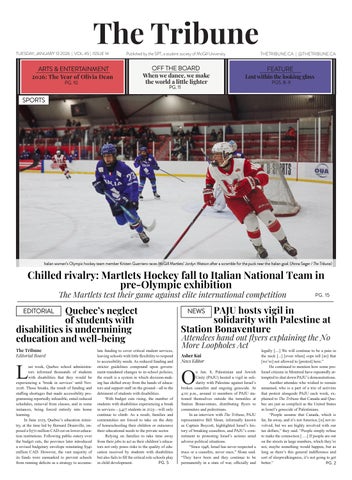
Italian women’s Olympic hockey team member Kristen Guerriero races McGill Martlets’ Jordyn Watson after a scramble for the puck near the Italian goal. (Anna Seger / The Tribune)
Chilled rivalry: Martlets Hockey fall to Italian National Team in pre-Olympic exhibition The Martlets test their game against elite international competition
Quebec’s neglect of students with disabilities is undermining education and well-being EDITORIAL
The Tribune Editorial Board
L
ast week, Quebec school administrators informed thousands of students with disabilities that they would be experiencing a ‘break in services’ until Nov. 2026. Those breaks, the result of funding and staffing shortages that made accessibility programming reportedly infeasible, entail reduced schedules, removal from classes, and in some instances, being forced entirely into home learning. In June 2025, Quebec’s education ministry, at the time led by Bernard Drainville, imposed a $570 million CAD cut on lower-education institutions. Following public outcry over the budget cuts, the province later introduced a revised budgetary envelope reinstating $540 million CAD. However, the vast majority of its funds were earmarked to prevent schools from running deficits as a strategy to accumu-
late funding to cover critical student services, leaving schools with little flexibility to respond to accessibility needs. As reduced funding and stricter guidelines compound upon government-mandated changes to in-school policies, the result is a system in which decision-making has shifted away from the hands of educators and support staff on the ground—all to the detriment of students with disabilities. With budget cuts rising, the number of students with disabilities experiencing a break in services—3,417 students in 2025—will only continue to climb. As a result, families and communities are forced to take on the duty of homeschooling their children or outsource their educational needs to the private sector. Relying on families to take time away from their jobs to act as their children’s educators not only poses risks to the quality of education received by students with disabilities but also fails to fill the critical role schools play PG. 5 in child development.
PG. 15
PAJU hosts vigil in solidarity with Palestine at Station Bonaventure NEWS
Attendees hand out flyers explaining the No More Loopholes Act
Asher Kui News Editor
O
n Jan. 8, Palestinian and Jewish Unity (PAJU) hosted a vigil in solidarity with Palestine against Israel’s broken ceasefire and ongoing genocide. At 4:00 p.m., around 10 members of PAJU stationed themselves outside the turnstiles at Station Bonaventure, distributing flyers to commuters and pedestrians. In an interview with The Tribune, PAJU representative Bill Sloan, informally known as Captain Boycott, highlighted Israel’s history of breaking ceasefires, and PAJU’s commitment to protesting Israel’s actions amid adverse political situations. “Since 1948, Israel has never respected a truce or a ceasefire, never once,” Sloan said. “They have been and they continue to be permanently in a state of war, officially and
legally [....] We will continue to be a pain in the neck [...] [even when] cops tell [us] that [we’re] not allowed to [protest] here.” He continued to mention how some proIsrael citizens in Montreal have repeatedly attempted to shut down PAJU’s demonstrations. Another attendee who wished to remain unnamed, who is a part of a trio of activists that protest alongside PAJU each week, explained to The Tribune that Canada and Quebec are just as complicit as the United States in Israel’s genocide of Palestinians. “People assume that Canada, which is far, far away, and it’s not America, [is] not involved, but we are highly involved with our tax dollars,” they said. “People simply refuse to make the connection [….] If people are out on the streets in large numbers, which they’re not, maybe something would happen, but as long as there’s this general indifference and sort of sleepwalkingness, it’s not going to get better.” PG. 2
2
NEWS
news@thetribune.ca
TUESDAY, JANUARY 13 2026
PAJU hosts vigil in solidarity with Palestine at Station Bonaventure
Attendees hand out flyers explaining the No More Loopholes Act Asher Kui News Editor Continued from page 1. They also mentioned the urgency of advocating for Bill C-233 and the No More Loopholes Campaign. Currently, many Canadian-made weapons cross into the United States unchecked, where they are then integrated into larger weapon systems and exported to Israel. Bill C-233, sponsored by Member of Parliament Jenny Kwan in November 2025, aims to end Canada’s complicity in Israel’s genocide by requiring permits and human rights assessments for all Canadian exports of military goods, effectively closing the loopholes and gaps in Canadian arms export laws. “To get rid of this loophole in Parliament [means Canada] would not be allowed to under the table, or even over the table, send weapons to Israel,” they said. “And that’s what we want. We want Canada to have nothing to do with this war on Gaza and not fund it in any way.” Another member of the trio, who also
PAJU hosts vigils twice a week, tabling at different metro stops. Future stations include Station Parc and St.-Michel. (Mia Helfrich / The Tribune) wished to remain anonymous, explained in an interview with The Tribune that they have been protesting in solidarity with Palestine since 2024. “We started to protest in front of Rod-
dick Gates, and then a bunch of other people came, a wonderful group of people who just kept it alive with music and dancing and talking about Palestine,” they said. “We had lots and lots of computations, but we did it
throughout the summer of 2024 and we continued into the fall, and then when it got cold [we started to] look for metro stations.” They also talked about an apathy among the public that continues to overlook the lived realities in Palestine. “We’re working against a very powerful culture, and people are encouraged by the culture to focus on themselves, their families, their homes, their clothes, and their job,” They said. “Their circle of consciousness doesn’t include Palestine or even Venezuela, now that they’ve been attacked. To break into that [circle] is very difficult, and we must be gentle too, because we don’t want to hurt people [in the process of protesting].” Captain Boycott highlighted certain strategies to engage the general public. “You try to make it, first of all, visually appealing,” Sloan said. “The first place you’re gonna catch [people] is with the visual [….] Try to smile, not shove it in their face, but offer it to them in their hands [.…] Once one person takes them […] all the people after him, or most of them, would take one, because when somebody’s taking one, why not?”
Quebec introduces new standardized formula for calculating rent Tenants worry that changes could shift more power to landlords Eren Atac News Editor
enough for me,” Dalgiesh said. “My landlord has been doing a lot of construction in the building. The construction kind of seems he Quebec government introduced a meaningless, and it’s disruptive to everybody new method for calculating rent on else in the building. Now it makes me wonJan. 1. The new method relies on the der if there’s another purpose behind all of the average consumer price index (CPI) over work that he decided to start doing.” the past three years to calculate rent, Wyatt Hogan, U1 Engineering, rather than landlords’ individual opsaid in an interview with The Tribune erating costs. As part of the new systhat, while the recent changes make tem, the government also introduced rent increases more predictable, tena fixed five per cent threshold to allow ants still need ways to contest them. landlords to recover money spent on “For people who have tighter major operations. budget constraints, it would be Under the prior system, rent inmuch more challenging, because creases were calculated based on a they would have to go through the landlord’s expenses, such as mainprocess of finding a new place if the tenance, taxes, and insurance. Landrent increases too much,” Hogan lords had to justify these costs when explained.“Predictability-wise, it proposing a rent increase. Tenants would be nice to have some way could request to see the calculation, you can expect [how much rent will and if they disagreed, dispute the inincrease] in the future [...] but I feel crease with the Tribunal administratif there should be more flexibility for du logement (TAL). Under the new the tenants to fight back.” system, rent increases are calculated Du Couturier-Nichol suggested using a standardized formula tied to that the new system disproportioninflation, measured by the CPI, a govately affects vulnerable groups, inernment statistic that tracks changes cluding students and seniors, by limin the costs of goods and services iting tenants’ agency. over time. “Housing is a human right that The changes were implemented is guaranteed under the Charter of with the goal of making rent increases the United Nations. If Quebec is more transparent and predictable for not going to live up to that, then Du Couturier-Nichol warned that rent increases under the new system could outpace pensions, disproportionately tenants and landlords. However, tenthat doesn’t say very much for [the affecting seniors. (Sophie Schuyler / The Tribune) ant advocates have criticized the new province], particularly in the case of rules as unfair to renters, as rent increases are what they want, they immediately say, ‘Okay, As a low-income demographic, students seniors and students,” Du Couturier-Nichol now harder to challenge. Since the calculation I’m taking you to the rent board.’ That scares are often disproportionately affected by rent said. “These are the two vulnerable groups. no longer relies on itemized operating costs students, it scares seniors, and it scares low- increases. Ossian Dalgiesh, U1 Arts, raised Students are studying. Many of them have specific to each building, tenants have fewer income people,” Du Couturier-Nichol said. concerns in an interview with The Tribune a part-time job. Seniors can’t work. And I concrete figures to dispute when challenging “Now, in my own particular case, my land- about how renovation work may affect rents think that’s the problem. What are you going an increase before the TAL. lord, over the last two years, not counting this under the new five per cent threshold. to do when the rent goes up eight or 10 per In an interview with The Tribune, Milton year, got a $100 [CAD] increase, and pensions “As a student, rent is already expensive cent?”
T
Park Citizens’ Committee President and McGill Course Lecturer Garrfield Du CouturierNichol criticized the new rent system for reinforcing an unequal power imbalance between landlords and tenants. “Landlords now have reached a point where if you don’t accept what they offer,
certainly did not go up to more than two per cent. This year she’s asking for an $80 [CAD]a-month increase.” Under the new rules, landlords can recover the cost of major renovations more quickly, with rent increases tied to a fixed five per cent annual threshold for capital expenditures.
news@thetribune.ca
TUESDAY, JANUARY 13 2026
NEWS
3
The Tribune Explains: QPIRG’s Free Textbook Loan Program
QPIRG offers compensation for textbook donations in order to provide free semester-long loans Amelia H. Clark News Editor
T
he Quebec Public Interest Research Group (QPIRG) at McGill’s Alternative Library offers a Free Textbook Loan Program to students of all faculties and programs, with the goal of providing low-income students free semester-long access to textbooks. Carl Bystram, community research and working groups coordinator at QPIRG, detailed the program’s purpose to The Tribune in a written response. “The cost of textbooks can be overwhelming for many working class students, and the lifecycle of textbooks has been foreshortened,” Bystram wrote. “As a result, the majority of students are stuck with having to buy new textbooks, which also has a negative environmental impact. Our Textbook Loan Program insists on lending out textbooks for the entire semester partly to curb this problem.” What is the program? The Free Textbook Loan Program was established to address the inaccessibility of affordable physical textbooks in academia. McGill Libraries, while offering course reserves, only allows students to borrow books within a three-hour to two-week time range, with a limit of three checkouts. Students then have to photocopy materials, pay
the printing fee, and manually scan each page if they want to access the content later in the semester. Students may also struggle to access textbooks in the first place as there is a limit to how many people can access the Course Reserve at a given time. McGill’s libraries cannot buy digital copies due to copyright laws, and academic publishing houses often overcharge buyers as they know students are required to make the purchase regardless of cost. QPIRG proposed the initiative as an alternative through which students can donate textbooks to receive compensation, borrow textbooks without cost, and dispose of textbooks without waste, thereby increasing both sustainability and accessibility on campus. How do I borrow books? Borrowing books through the program is entirely free and operates on a first-come, first-served basis, with priority given to students in the Faculty of Arts. Students can search the catalogue and suggest purchases if the library does not carry their needed materials. After filling in a request form, QPIRG will provide students a pick-up time and location to retrieve their books. Requests for syllabus materials are expedited, though students may also borrow textbooks for research purposes. The loaning period lasts an entire semester, ranging from
the first day of classes to the last day of exams. QPIRG does not charge late fees and offers loan extensions to students who cannot return materials by the given deadline. How do I donate books? The library accepts both textbooks and novels pending approval of their contents. Students must first fill out a dona- The program is partially funded by the Arts Undergraduate Improvetion form which asks for ment Fund. (Nell Tov / The Tribune) the donor’s contacts and the details of the student-led initiative, relying on the work of books they wish to give away. Only books volunteers to continue providing this essenthat are listed on a currently running class’s tial service not only for the McGill commusyllabus can be exchanged for the five-dol- nity but also for prospective learners across lars-per-item compensation, so after filling Montreal who lack access to physical and out the form, donors should email the rel- digital textbooks. To support the program, evant syllabi to the library directly. If the students can volunteer, donate, and utilize request is approved, QPIRG will contact the resources offered to sustain the circular the donor and arrange a meeting at the Arts economy model in which the program operLounge sometime between 1:00 p.m. and ates. 6:00 p.m. “More students should take advantage Textbooks that are not included in syl- of this program because it is free and it is labi are still accepted and can be dropped designed to help them save money,” Bysoff at the Alternative Library located at 3516 tram wrote. “One of the main barriers to the av. du Parc during opening hours. expansion of this program—and to getting this program funded—has been that it can Why should I use the program? be hard to reach the average student and get The Free Textbook Loan Program is a them to actually use this resource.”
Students and faculty discuss academic calendar and winter break duration McGill reaffirms commitment to student democracy in making of calendar Asher Kui News Editor
M
cGill’s Winter 2026 Semester officially started on Jan. 5, giving McGill students a two-week-long winter break. Compared to other Montreal universities such as Concordia University and Université de Montréal, McGill students receive one week fewer of winter holidays. Other Canadian universities, such as the University of Ottawa, also resume classes a week after McGill, leaving some McGill students to question the reason for this discrepancy between McGill and other schools. In a written statement to The Tribune, McGill’s Media Relations Office (MRO) explained that the academic calendar must follow the Guidelines Regarding the Setting of the University Calendar of Academic Dates. “McGill’s academic calendars, which are approved at least two years in advance, are reviewed judiciously and respect several key priorities,” the MRO wrote. “These include, among others, ensuring student wellbeing, two full 13-week terms, minimum examination periods, and the provision of a Reading Break in both the Fall and Winter terms.” The guidelines also mandate that McGill’s academic calendar include a one-day or weekend study break, separating the end of classes and the first day of exams. Overall, there must be at least 130 teaching days
over the combined Fall and Winter terms. In an email exchange with The Tribune, the Students’ Society of McGill University (SSMU) Vice President of University Affairs Susan Aloudat reaffirmed that McGill’s current academic calendar reflects a set of accommodations that students have advocated for, including an earlier winter exam season and a week-long Reading Break. “McGill’s academic calendar starts earlier than other universities in the province to allow for an earlier exam season,” Aloudat said. “[This] also gives [professors] almost the entire month of May to prepare grades for May graduation, as well as to accommodate the spring break.” Fall 2021 saw McGill University implement a two-day extension to Thanksgiving weekend for the first time. Fall 2024 was the first semester to see a week-long Reading Break. Such changes, in addition to McGill’s mandate for full 13-week terms, often create complications for scheduling academic calendars as well as student engagement activities. Nonetheless, the MRO assured that maintaining a student democracy remains a top priority in McGill’s decision-making. “[McGill’s decision] was done in close collaboration with students and student leadership,” the MRO wrote. “[It follows] a careful assessment of the impact on the academic year, with student well-being being a key factor [….] McGill welcomes student feedback on its academic calendar.”
While some students expressed dissatisfaction with the comparatively short duration of winter break, Aloudat underscored that many other students prioritize midsemester breaks over a The first day of classes in the Fall 2026 semester will be on Aug. 31. (Emiko lengthy winKamiya / The Tribune) ter break. “Students are the ones who advocated majority of students but I find that after an for Reading Break to be the entire week approximately [two-week] break, I come instead of the initial couple of days,” she back rested but not fully detached from wrote. “I imagine this demonstrated that school.” having an entire week of break in the midShe also mentioned that McGill’s acadle of each semester is important to the stu- demic calendar allows for a longer summer dents, which is why the academic calendar break, which may be beneficial to many is distributed the way it is by McGill.” students wanting to explore opportunities In an email to The Tribune, Chloé outside of the university. Muñoz, Arts and Science senator, expressed “Starting earlier [allows us to] have that although McGill has a comparatively a longer overall ‘summer time,’” she exshorter winter break than other universities, plained. “This time ends up being [the] the calendar allows her to stay focused in length of a typical semester, allowing stuthe winter semester. dents to have more time in internships, tak“As a student, […] I quite enjoy the ing classes, and exploring things outside length of the break we have,” she wrote. “I of the direct boundaries of our academic know this is not an opinion shared by the lives.”
4
NEWS
TUESDAY, JANUARY 13 2026
news@thetribune.ca
Recap: Quebec increases proof-of-funds requirement for international students
The financial requirement more than triples for some, limiting accessibility for prospective students Eren Atac News Editor
O
n Jan. 1, the Quebec government changed the financial requirements for international students to be eligible to study in the province. Quebec now requires international students to show at least $24,617 CAD in available funds to qualify for a Certificat d’acceptation du Québec (CAQ) and study permit. This new requirement, which applies to individuals both over and under 18 years of age, is a significant increase from the previous $15,508
CAD requirement for adults and more than triple the $7,756 CAD requirement for those under 18. The proof-of-funds requirement is intended to ensure students are able to cover living expenses incurred during their studies in Quebec, such as rent, food, and transportation. The funds do not need to be entirely held in the student’s bank account and may include parental support, scholarships, or loans. Nonetheless, the drastic increase could limit access to studying in the province for lower-income international applicants. In an interview with The Tribune, interna-
tional student Kai Bosniak, U3 Sciences, criticized the new requirements for reducing accessibility for otherwise qualified students to study in Quebec. “It seems like a shocking and unreasonable amount [....] It would have been triple for me. I’m against it personally, because it would have very negatively affected me [....] I don’t think I had $24,000 [CAD] in the bank account anywhere” Bosniak said. “I think a lot of people who would be qualified and eager to learn would just be completely unable to enter the country or the province.”
McGill hosts thousands of international students each year, many of whom already face high housing and tuition costs when living in Montreal. As tuition fees for international students are already more than triple the cost for Canadian citizens, the increased proof-of-funds requirement adds another financial barrier for prospective students. “I don’t think international students are prioritized at all. I feel like it is pretty explicit that they want to prioritize the Quebecois and other Canadians, but not [international students],” Bosniak added.
Recap: Students and professors adjust to a new semester with dwindling TAships
Faculties at McGill have readjusted their budgets for TAs to account for the growing budget deficit Kaitlyn Schramm Managing Editor
W
ith the commencement of the Winter term, students and professors alike have attempted to adjust to an education with a lack of teaching assistant (TA) positions. Many courses in the Faculty of Arts that previously had at least one TA now have none, and professors have adapted to leading in-class conferences with anywhere from 40 to 80 students. Following the Quebec government’s changes to tuition policy, McGill has had to restructure its budgeting drastically throughout the 2025-2026 school year.
In a written statement to The Tribune, McGill’s Media Relations Office (MRO) emphasized the university’s continued commitment to providing excellence in education despite growing budget constraints. “As is the case for many postsecondary institutions, McGill has had to make difficult decisions to balance its budget this year,” the MRO wrote. “McGill is working closely with its faculties to ensure it continues to meet its high standards of excellence while preserving the long-term financial stability of the University.” The university itself does not set a budget for TAs; rather, each faculty decides the number of TAships based on its individual
budget. The Faculty of Arts, McGill’s largest faculty, has committed to reducing TAships by 17 per cent, moving TAs to other positions or cutting their hours. Political Science Professor Narendra Subramanian reported that his courses have undergone significant changes since McGill readjusted TA hiring. Two of Subramanian’s 400-level courses, previously capped at 80 students, were reduced to a cap of 50 students. These courses also had one TA each but now do not. Subramanian has thus had to reorganize the way he conducts his lectures in order to optimize student learning without the assistance of graduate employees.
Subramanian further explained how the cut to TA positions has affected lecture time. “[It has] crucially [affected class]. [T] here are no conferences with about 20 students each where it is easier for students to speak,” Subramanian wrote. “I have to conduct these classes as an uneasy mix of lecture and discussion, which gives many shier students little effective room to speak/raise questions.” Additionally, Subramanian mentioned the shift in assignment structure due to the loss of grading support, with many professors inclined to assign less time-consuming exercises or digital assignments rather than handwritten ones.
Collectif 19 mars hosts “Gaza, from global failure to the duty of humanity” panel
Panel speakers discuss international responsibility in the ongoing Palestinian genocide Asher Kui News Editor
O
n Jan. 9, Collectif 19 mars, with the support of Coalition du Québec Urgence Palestine, hosted a webinar titled “Gaza, from global failure to the duty of humanity.” Élisabeth Garant, previous executive director at Centre Justice et Foi (CJF) started the webinar by introducing Collectif 19 mars and explaining how the organization was founded. “The name Collectif 19 mars was chosen in memory of the date where employees of the CJF were suspended in an unjust and undignified way,” she said. “[Collectif 19 mars] is, however, a different initiative than CJF [….] to bring together, like we are doing today, people who are brave enough to believe we can contribute to social transformation through collective work and reflection, despite, or perhaps especially, because of the difficult times we live in.” Monique Chemillier-Gendreau, jurist and professor emerita at Université Paris Cité, began the panel by highlighting the importance of distinguishing criticism against Israel from antisemitism. “Hamas’ actions [on Oct. 7 in 2023] were unjustifiable international crimes that must be sanctioned, but Israel’s military response is a crime of immeasurably greater magnitude,” Chemillier-
Gendreau said. “The argument, mostly used by [Israeli] officials, that all criticism directed against Israel is antisemitic, must be refuted. However, we must stay vigilant on antisemitism, which remains an extremely pertinent issue in our society.” She then mentioned Israel’s war crimes and examined how other nations have attempted to condemn Israel’s actions. “The policy pursued in Gaza demonstrates Israel’s genocidal intent, and such a case was brought by South Africa before the International Court of Justice,” Chemillier-Gendreau said. “The court has already issued three orders in 2024 to compel Israel to stop acts of genocide, provide humanitarian aid to the population of Gaza, and to halt the military offensive. These orders are binding. This is international law, and Israel ignores it.” Chemillier-Gendreau then urged attendees to question the weakness of the international legal system. “We must also take action to criticize the weakness in the application of international law,” she said. “We must cultivate hope by reflecting with forces from around the world, not only from the West, but with forces of the Global South that did not participate in the creation of the United Nations [….] With these forces, we must design a new international system because the current one
has proven to be dying.” de France, was the last speaker on the panel. He Rony Brauman, former president of Méde- explained that the international political system, cins sans frontières, was the next speaker on the including many Western countries, is culpable for panel, who explained how Zionism is a colonial the ongoing genocide in Gaza. ideology. “The official term ‘Israel-Hamas war’ “A form of colonialism that is unique in that was used systemically [by Western mainstream it presents itself as a discourse of national eman- media], even though from the start of Israel’s milcipation, [Zionism] is indeed a matter of impos- itary operations, Israeli officials, political or miliing a foreign state by force on a population in a tary, have announced that the plan was to destroy region that did not ask for it,” Brauman said. “It Gaza and its population,” Fassin said. “Although is extremely important to distinguish between the a ceasefire has been signed, it has been violated legitimacy of Jewish presence in Palestine, which daily [….] The time has come to start reflecting is a historical presence dating back to when Juda- on what has happened over the last two years.” ism was born, […] and installing a Jewish state *All quotes are translated from French. in Palestine [….] Anti-Zionism is not opposition to the Jewish presence but to a Jewish state in Palestine.” He continued to point to Israel’s systemic elimination of Palestinian press. “Israel has methodically assassinated Palestinian journalists, the only ones who provide information to the rest of the world,” Brauman said. “Similarly, around 500 humanitarian workers have been assassinated in Gaza, an absolute record along with a record of children killed, women killed, and doctors killed. Gaza is a war of all records, The Coalition du Québec Urgence Palestine brings and we must know that the war is not over together 54 organizations, denouncing government yet.” and corporate actions in Canada linked to war crimes Didier Fassin, professor at Collège in Israel. (Mia Helfrich / The Tribune)
opinion@thetribune.ca
TUESDAY, JANUARY 13 2026
T EDITORIAL BOARD Editor-in-Chief Yusur Al-Sharqi editor@thetribune.ca Creative Director Mia Helfrich creativedirector@thetribune.ca Managing Editors Kaitlyn Schramm kschramm@thetribune.ca Malika Logossou mlogossou@thetribune.ca Nell Pollak npollak@thetribune.ca News Editors Eren Atec Amelia H. Clark Asher Kui news@thetribune.ca Opinion Editors Moyọ Alabi Defne Feyzioglu Ellen Lurie opinion@thetribune.ca Science & Technology Editors Leanne Cherry Sarah McDonald scitech@thetribune.ca Student Life Editors Gregor McCall Tamiyana Roemer studentlife@thetribune.ca Features Editor Jenna Durante features@thetribune.ca Arts & Entertainment Editors Alexandra Lasser Bianca Sugunasiri arts@thetribune.ca Sports Editors Ethan Kahn Clara Smyrski sports@thetribune.ca Design Editors Zoe Lee Eliot Loose design@thetribune.ca Photo Editors Armen Erzingatzian Anna Seger photo@thetribune.ca Multimedia Editors Seo Hyun Lee multimedia@thetribune.ca Web Developers Rupneet Shahriar Johanna Gaba Kpayedo webdev@thetribune.ca Copy Editor Sarah-Maria Khoueiry copy@thetribune.ca Social Media Editor Mariam Lakoande socialmedia@thetribune.ca Business Manager Laura Pantaleon business@thetribune.ca
TPS BOARD OF DIRECTORS Simona Culotta, Defne Feyzioglu, Alexandra Hawes Silva, Lialah Mavani, Nour Khouri, Laura Pantaleon, Amy Xia
STAFF Rachel Blackstone, José Moro Gutiérrez, Ethan Khan, Antoine Larocque, Lialah Mavani, Talia Moskowitz,Julie Raout, Parisa Rasul, Alex Hawes Silva, Michelle Yankovsky, Ivanna Zhang Lilly Guilbeault, Emiko Kamiya, Alexa Roemer
CONTRIBUTORS Josette Chandler, Dylan Hing, Lia James Charlotte Bénard, Gwen Hefferman, Nell Tov, Sophie Schuyler
TRIBUNE OFFICE Shatner University Centre, 3480 McTavish, Suites 404, 405, 406 The Tribune is an editorially autonomous newspaper published by the Société de Publication de la Tribune, a student society of McGill University. The content of this publication is the sole responsibility of The Tribune and the Société de Publication de la Tribune, and does not necessarily represent the views of McGill University. Letters to the editor may be sent to editor@thetribune.ca and must include the contributor’s name, program and year and contact information. Letters should be kept under 300 words and submitted only to the Tribune. Submissions judged by the Tribune Publication Society to be libellous, sexist, racist, homophobic or solely promotional in nature will not be published. The Tribune reserves the right to edit all contributions. Editorials are decided upon and written by the editorial board. All other opinions are strictly those of the author and do not necessarily reflect the opinions of The Tribune, its editors or its staff.
OPINION
5
EDITORIAL
Quebec’s neglect of students with disabilities is undermining education and well-being The Tribune Editorial Board Continued from page 1. Schools are sites of socialization, interaction with other students, physical education, and civic training. Support staff may provide speech therapy, psychological assessments, and occupational therapy, roles that untrained family members cannot replace at home. Breaks in services also deepen long-term inequities for students with disabilities. Extended absences from school make reentry into educational spaces more difficult, and for those fortunate enough not to have been forced to leave school, insufficient programming under tightened
COMMENTARY
budgets still poses immense risks, such as exclusion from academics and extracurriculars, higher rates of suspension and expulsion, and lower graduation rates. Inequities produced by a budget design that neglects students with disabilities do not simply disappear as students reach the post-secondary level. Instead, these gaps heighten universities’ responsibility to invest in robust systems that treat accessibility as foundational to education. In June 2025, the Quebec government maintained its 33 per cent tuition hike for outof-province and international students in the higher education system, despite a Superior Court ruling requiring the province to abandon this tuition structure. For institutions like McGill, increasing barriers to entry for
students from outside Quebec have deepened financial deficits, leading to severe staff and budget cuts. Laying off nearly 100 faculty and staff in March 2025 and cutting 25 varsity and club sports programs in December, McGill has taken drastic action to address its budget deficit—reductions the university cannot sustain. While provincial policy has created substantial financial pressures, McGill has a responsibility to ensure that accessibility and student well-being are not treated as expendable in the face of tuition hikes and declining international student enrollment. With McGill’s Student Accessibility and Achievement Centre requiring a doctor’s note to receive accommodations and remaining infamous for
its unprofessional treatment of students, the same accessibility failures seen in Quebec’s primary and secondary school system are reproduced at the university level. When institutions like McGill offer insufficient or inaccessible support, these failures cannot be dismissed as mere byproducts of provincial underfunding. Rather, McGill’s failure to counteract the barriers created by provincial policy constitutes institutional negligence. Accessibility must not be contingent on documentation nor rationed through administrative scarcity; it should be enshrined as a fundamental component of students with disabilities’ right to education. Provincial underfunding does not absolve McGill of responsibility—it heightens it.
Sexual assault survivors should not have to ask for safety
Julie Raout Staff Writer
O
n Dec. 29, the Parole Board of Canada (PBC) banned convicted Catholic priest Brian Boucher from several parts of Côte-des-Neiges-Notre-Dame-deGrâce (CDN-NDG) and the Town of Mount Royal, after he repeatedly crossed paths with an individual he had sexually assaulted. The individual said that encountering Boucher caused discomfort. They noted that they had already sought additional safeguards in October by requesting the former priest not only be banned from the CDN-NDG region, but from the island of Montreal itself. The PBC’s failure to adopt preventative measures to ensure the safety of survivors— instead acting only after further harm was caused—shows that the system has failed yet again in its duty to protect survivors of sexual assault. In Jan. 2019, Boucher was convicted and sentenced to eight years for assaulting one boy between 1995 and 1999, and another between 2008 and 2011. He began serving the remainder of his sentence in a halfway house in July 2024, as Canadian law allows the statutory release of federal offenders after they have completed two-thirds of their sentence. The Archdiocese of Montreal, the church network through which Boucher served as a priest, chose to protect Boucher rather than act on warnings from survivors and their families. Multiple families raised concerns about Boucher’s suspicious behaviours toward boys in the 1980s, when he was not yet a priest and instead taught catechism
The Parole Board of Canada added new conditions to former Priest Brian Boucher’s statutory release after his multiple encounters with a person he had sexually assaulted. (Emiko Kamiya / The Tribune) classes. These complaints were ignored, and Boucher was ordained in 1996. Several parishioners raised further concerns about Boucher’s relationship with a ten-year-old boy in his new parish, but the Church again dismissed them. Quebec Superior Court Justice Pepita Capriolo disclosed the Archdiocese’s culture of inaction and secrecy in a report published in 2020. The report found that Boucher may have had concerning relationships with a boy and a young adult during his tenure as a chaplain at the Newman Centre at McGill University between 2000 and 2002. Capriolo concluded that senior members of the Archdiocese knew of his abuse but continuously deflected responsibility. Boucher’s violations of statutory release conditions and multiple encounters with his survivor align with his patterns of callousness and disregard towards the law. In the statement banning Boucher from parts of Montreal, the PBC explained that he continues to
lack empathy, deny his actions, and violate boundaries. The summary of the decision also notes that Boucher is at risk of inflicting further trauma on survivors. The Church failed to protect survivors by allowing Boucher to continue practicing as a priest for more than 20 years. The PBC cannot become another institution that falls short of safeguarding survivors by underestimating the risks posed by an unrepentant predator, even when that individual is subject to geographical restrictions. Boucher has made it abundantly clear that he will not change. Even before Boucher violated the terms of his statutory release, he was charged with additional sex crimes allegedly committed behind bars in 2023. Mere geographical restrictions are not sufficient. Letting Boucher roam free tells sexual abuse survivors that living in fear is a sacrifice they must make for the offender’s comfort and reintegration. When the PBC, the very tribunal responsible for ensuring
survivor safety, fails to prioritize the well-being and safety of individuals who have repeatedly expressed concerns about Boucher’s freedom of movement under statutory release, it becomes clear that survivors cannot rely on any institution to keep them safe. 55 per cent of provincially sentenced offenders re-offend after prison: Although reintegration is critical for the rehabilitation of sentenced individuals, data shows that the justice system must consider the recommendations and needs of survivors to ensure public safety. While the PBC needs to help offenders reintegrate into society, it is equally responsible for keeping citizens safe—especially individuals that other institutions like the Catholic Church previously failed to protect. The justice system must rethink rehabilitation as a process that not only reintegrates offenders into society, but at the same time ensures the safety and well-being of survivors and citizens.
6
OPINION
COMMENTARY Defne Feyzioglu Opinion Editor
opinion@thetribune.ca
Quebec’s winter crossings are a policy outcome, not a one-time crisis
W
hen 19 Haitian migrants, aged one to 60, are found hiding in the woods south of Montreal in extreme cold, it is not an isolated incident. It is a foreseeable outcome of policies that make asylum harder to access. On Dec. 25, the Royal Canadian Mounted Police was alerted by U.S. Border Patrol that over a dozen individuals had crossed the U.S.Canada border on foot, and located the group near Havelock, Quebec. All requested asylum, eight were taken to the hospital, and six required treatment for frostbite. Their story ended with deportation. Several of the 19 migrants were sent back to the United States after the Canada Border Services Agency determined their asylum claims were ‘inadmissible.’ A week later, another overnight search in Quebec’s Montérégie region ended with eight more asylum-seekers arrested after attempting to walk across the border in extreme cold, with several of them suffering from hypothermia and frostbite. Canada’s continued enforcement of border policy is no longer an orderly policy maintenance tool but a harm-producing choice that predictably pushes people to undertake dangerous winter crossings. Canada’s border control policies are outlined in a treaty between the U.S. and Canada known as the Safe Third Country Agreement (STCA), designed to allocate responsibility for asylum claims between the two countries. Under the SCTA, asylum-
COMMENTARY
seekers are generally required to claim asylum in the first country they arrive in—either the U.S. or Canada—and are forbidden from reclaiming asylum should they relocate. In the event a migrant attempts to claim asylum status for a second time in Canada, Canadian border services may determine their claim inadmissible and deport them back to the U.S. Since March 2023, the STCA has been applied across the entire U.S.-Canada land border, including irregular crossings between ports of entry. Yet, the decision to deport a repeat asylum-claimant depends on a crucial premise: That their return destination, the United States, has a fair system for processing refugee claims and protecting human rights. In the first eight months of 2025, Canada returned 3,282 people to the United States under the STCA, up from 2,481 in the same period the previous year. The decision to maintain strict compliance with the STCA was maintained even after American officials signalled that some individuals could be deported to third countries—meaning a country that is neither the person’s home country nor their attempted destination—upon returning to the U.S. If the U.S. is openly signalling the risk of detention or deportation, then the STCA’s core premise that return equals protection no longer holds. U.S. immigration policy disproportionately targets non-white individuals for deportation, offering an explanation as to why many seek entry into Canada despite the risks of unlawful border-crossing. In Nov. 2025, the U.S.
government published a notice terminating Haiti’s Temporary Protected Status (TPS), stripping deportation protections for hundreds of thousands of Haitians living in the U.S. At the same time, the boundaries of enforcement for such policies have widened. In Jan. 2025, the Trump administration rescinded guidance that had limited where Immigration and Customs Enforcement (ICE) raids may take place, enabling arrests to occur near ‘sensitive’ places such as schools, hospitals, and churches. With Haitian TPS protection ending on Feb. 3, 2026, repeated attempts at The Safe Third Country Act came into force in December 2004 claiming asylum in Canada and was expanded in March 2023 to apply across the entire are expected, with more Canada–United States land border. (Mia Helfrich / The Tribune) people taking greater risks to reach safety. responsibility to ensure safety, rather than Meanwhile, the International becoming the site of immediate fallout. A Organization for Migration has reported policy that ends in frostbite is not a neutral approximately 1.4 million people fleeing policy. If a legal regime leaves children with Haiti due to violence and insecurity. When frostbite in Quebec woods, it is not merely deporting Haitian asylum-seekers back to managing migration; it is externalizing harm. the U.S. risks these individuals enduring The question Canada is facing, of detention if not forcible relocation, Canada’s whether it should continue to enforce strict obedience to the STCA cannot be STCA, is no longer one of safety; the considered neutral. evidence is undeniable. It plays out in the When fear of being targeted by US dark, in subzero temperatures, along tree border enforcement pushes people north, lines 50 kilometres south of Montreal. And Quebec—a francophone province with then, the administrative language follows: large Haitian communities—must bear the ‘Inadmissible,’ ‘returned,’ ‘deported.’
New Year, same (institutional) burnout
Moyọ Alabi Opinion Editor
J
TUESDAY, JANUARY 13 2026
anuary, colloquially known as the month of new beginnings. Planners for the calendar year fill the bookshelves, wellness advice on how to ‘improve’ flood TikTok and Instagram For-You-Pages, and even McGill sends out communications encouraging students to return to campus with better habits and a renewed zest for academia and discipline. New Year’s resolutions are often framed as an introspective exercise that positions personal change as both the source and solution to any issue. Nevertheless, selfimprovement culture encourages students to internalize burnout as a personal failure, allowing institutions to avoid accountability for the structural conditions that make exhaustion inevitable. In this understanding, stress and fatigue become problems to be corrected individually rather than predictable responses to the collective institutional pressures students are expected to navigate. Responsibility for burnout is increasingly individualized within academic environments that normalize constant productivity and selfregulation. Studies consistently show high levels of stress and burnout amongst postsecondary students: Nearly 90 per cent report feeling overwhelmed by their responsibilities, and 66 per cent report overwhelming anxiety—numbers far above what one would expect if stress were simply a ‘personal
weakness.’ Research also consistently associates academic stress with diminished well-being, as students who report higher academic pressure also report declining mental health outcomes. Although there is a plethora of reputable research proving burnout to be structurally and contextually driven, institutional responses disproportionately emphasize individual behaviour change. A 2023 World Health Organization report identifies burnout as an occupational phenomenon driven by chronic workplace stress, explicitly rejecting framings that solely describe it as a personal medical condition. Despite this, universities respond to stress-related risks by promoting time-management strategies and resilience training, effectively evading their institutional responsibilities to provide support and accessibility to students and staff alike. In Canada, one in three students report that mental health resources do not meet their needs due to long wait times and limited availability. Academia on mental health in higher education shows that students are far more likely to be offered coping tools than material accommodations, which further reinforces the idea that distress reflects insufficient self-management. In this, burnout is framed as a failure to adapt to neoliberal demands of efficiency, rather than the manifestation of systemic pressure compounded by inadequate institutional support. The institutional benefit of framing
burnout as an individual issue is also well documented. A 2022 survey by the American College Health Association found that although over three-quarters of college students reported moderate to high levels of stress, few campuses have made corresponding investments in material support services such January is named after the Roman god, Janus, who is emblematic as reduced course caps of liminality, doorways, and time. (Sophie Schuyler / The Tribune) or expanded academic leave. Instead, many institutions offer limited full productivity almost immediately. While counselling and wellness programs while practices of self-discipline and routine can broader comprehensive structural support be genuinely supportive at the individual remains absent. At McGill, this gap is level, they cannot compensate for structural apparent in the limited accessibility of mental conditions that remain unchanged. Without health care: Student reporting shows that corresponding reductions in workload or appointments at the Wellness Hub can require expanded institutional support, self-care risks weeks-long wait times during peak periods becoming a means of endurance rather than such as midterms and final exams. Official relief, asking students to adapt indefinitely to university responses continue to emphasize environments that continue to demand more self-help guides and stress-management than they can reasonably sustain. resources. So this January, before reaching for The aforementioned framing is intensified another productivity planner or doomby the timing of the New Year itself. January scrolling through content promising personal marks the start of the winter semester, which transformation, it is worth considering that is characterized by limited daylight and the the problem may not just lie in individual lingering exhaustion of the fall term and exam habits, but in a system designed to make them period; yet students are expected to return to appear as the only thing that can change.
arts@thetribune.ca
TUESDAY, JANUARY 13 2026
ARTS & ENTERTAINMENT
7
What we liked this winter break
Our top picks in books and film from the holiday season Warning: This piece contains spoilers.
Dylan Hing Contributor Hamnet
A
s a self-described theatre-lover, I finally found the time to watch Chloé Zhao’s newest film Hamnet over the winter break, and I think we can all agree that Jessie Buckley is overdue for an Oscar. Based on Maggie O’Farrell’s 2020 novel, the film follows the longstanding myth that William Shakespeare’s Hamlet was inspired by his son Hamnet’s death. Though the Bard is prominent, Zhao and O’Farrell centre the story of his wife, here named Agnes, and portrayed by Buckley in a decade-defining role. William’s (Paul Mescal) significant absences from the movie, due to his work in London, allow Agnes to establish herself within the Shakespearean mythology; her joy in motherhood heightens the eventual emotional fall. Buckley masterfully embodies Agnes’ exhaustion and quiet resentment towards her husband’s absences while still showing genuine love, and her performance uniquely brought me to tears. Of course, one cannot forget the eponymous character Hamnet, played by the outstanding Jacobi Jupe. Buckley may be Queen, but it’s Jupe who—despite his age—performs with a subtlety that will shatter your heart. Please, if for nothing else, see this movie for him. You might just melt.
Alexandra Lasser Arts & Entertainment Editor
The film features an eclectic supporting cast, including Tyler Okonma (Tyler, The Creator) as Marty’s friend and Gwyneth Paltrow as Kay, a famous actor in an unhappy marriage to businessman Rockwell (Kevin O’Leary), making it all the more intriguing. Marty Supreme largely thrives because of Marty himself. He is narcissistic and selfcentred, yet becomes strangely endearing, and the film still encourages audiences to root for him during his final table tennis match. The story’s numerous subplots, while occasionally pulling away from the sport, sustain momentum and unpredictability. I would not rank it as one of 2025’s strongest achievements in cinematography, but it is an enjoyable watch.
The Queen’s Gambit by Walter Tevis
Malika Logossou Managing Editor
ver the winter break, I returned to a character I first grew fond of years ago: Beth Harmon. Like many, I was first introduced to her through the hit Netflix series, The Queen’s Gambit, but it wasn’t until reading its namesake novel that I truly understood her. Walter Tevis’ novel The Queen’s Gambit follows a young orphaned chess prodigy as she navigates growing up and ascending to the top of the chess world. The novel’s omniscient third-person narration invites readers into the mind of the young chess prodigy, humanizing her in the process. Readers are not only introduced to her intelligence but also to her vulnerability. Moments of suspense in the chess matches were heightened by her hesitation and lack of faith in herself. Tevis’s intimate narration style also highlighted the darker themes of the novel, specifically her addiction to tranquillizers. Throughout the novel, Beth believes her chess talent stems, at least in part, from the effects of the tranquillizers, which means breaking free from addiction also requires overcoming a deep anxiety that her talent may lessen. Having such intimate knowledge of her inner turmoil made her a compelling character whose eventual success felt well-deserved. Tevis’s clever writing of Beth made the novel so impactful and gripping, even to a non-chess player.
his winter break, I succumbed to Timothée Chalamet’s pervasive promotional campaign, watching Josh Safdie’s Marty Supreme—and I’m glad I did. Loosely inspired by American table tennis champion Marty Reisman, the film takes place in the 1950s but delivers modernsounding dialogue alongside a soundtrack of 1980s hits. Chalamet stars as Marty Mauser, a New York shoe store salesman working for his uncle while obsessively pursuing his dream of becoming the greatest table tennis player of all time. To finance his tournament travels, he hustles his way through a series of morally questionable choices, often at the expense of others—the most notable example being when he abandons Rachel (Odessa A’zion), his married friend whom he allegedly impregnates, to travel to Japan for a table tennis Jessie Buckley and Timothée Chalamet both won Critics’ Choice awards on Jan. match against his 4, for their respective roles in Marty Supreme and Hamnet. (Mia Helfrich / The rival. Tribune)
O
Marty Supreme by Josh Safdie
T
Stranger Things: Legendary, or a let down?
How fans reacted to the infamous decade-long series finale Lia James Contributor Warning: This piece contains spoilers.
T
he widely beloved show Stranger Things released its series finale on New Year’s Eve 2025, concluding almost 10 years of storytelling. It premiered in three parts: The first, the day before American Thanksgiving, the second on Christmas Day, and the third on New Year’s Eve. Splitting the season across the holidays kept fans engaged and helped the show amass 105.7 million total views, making it one of the most-watched TV shows today. But despite the vast number of views, did the content of this final chapter help or hurt the esteemed show’s legacy? The variety of opinions on this season has spurred much discourse on the internet. While some are satisfied with the ending, many are left wanting more. Unanswered questions regarding the Mind Flayer’s true desire, the origin of Henry Creel’s (Jamie Campbell Bower) mysterious stone, and how Eleven (Millie Bobby Brown) recognized Will (Noah Schnapp) in the first season made the ending unsatisfying for many viewers. Don’t get me wrong, some TV shows benefit from unanswered questions, which can enrich the narrative, but this is not the case for Stranger Things. The key issue
lies in the Duffer Brothers consistently introducing new plotlines as the show went on without clear plans to resolve them. Of course, they could not tie up every loose end, as there were far too many and too little time, but the constant addition of storylines left many viewers frustrated. Stranger Things was initially pitched as an anthology series, with each season featuring a new storyline and different characters. The first season’s tremendous and unexpected success, earning 18 Emmy nominations and 5 awards, likely led to the shift to film a continuous story. However, this change of plans necessitated expanding a plot that was only intended to last one season, perhaps explaining why the story seems unresolved at times. As the seasons progressed, the show became increasingly action-packed, leaving less time for viewers to connect with the characters themselves. In the first season, viewers learned a lot about Mike Wheeler (Finn Wolfhard) as a character, but in the final season, they barely hear his thoughts, with many describing him as “oblivious.” The first season also carried a nostalgic 1980s tone, heavily inspired by The Goonies, but that charm faded over time as the story grew darker, moving away from the nostalgia that watchers knew and loved. So, will the disappointment of fans across the world stain the reputation of Stranger Things? Unlikely. The series has
been extremely iconic for the past decade, storytelling, the ending isn’t the most imwith many viewers growing up alongside it. portant part; it is the journey to reach that By representing the developmental changes point. Stranger Things will no doubt conof adolescence, the series deeply connected tinue to be seen as successful despite its with its young audience, allowing it to stay ending, because ultimately, does the endrelevant. ing really matter in the grand scheme of the Even the most subpar of endings cannot show’s impact? tarnish a beloved show’s reputation forever. Take Game of Thrones, for example: Fans were extremely disappointed with the show’s ending, yet it remains widely loved and watched. Its prequel series, House of the Dragon, has also been a major success, with more spinoffs in the works. So, while I didn’t love the ending of Stranger Things, I love the series because of the nostalgia it brings me and the characters I have connected with over the past decade. The show’s final episode was two hours and five minutes, which is relatively short compared to the time spent watching the entirety of Stranger Things was originally meant to take place in Montauk, NY, the show. Many times in inspired by the Montauk Project. (Lilly Guilbeault / The Tribune)
LOST WITHIN THE LOOKING GLASS
UNDERSTANDING WHY STUDENTS’ ONLINE NETWORKS DON’T ALWAYS TRANSLATE TO REAL-WORLD COMMUNITY WRITTEN BY BIANCA SUGUNASIRI, Arts & Entertainment Editor DESIGNED BY ELIOT LOOSE, Design Editor
I
“
almost wish I hadn’t gone down that rabbit-hole—and yet—and yet—it’s rather curious, you know, this sort of life!” The sage words of the lovely Alice on her way to Wonderland capture the way social media has wheedled its way into our lives. Too often do we find ourselves wondering how the afternoon became evening in a flurry of incessant texts, new posts, and Italian brainrot. Tumbling down this rabbit hole is a daily occurrence for many of us, and one that has become a conventional part of life. But as Alice says, “It’s rather curious [...] this sort of life.” It is undeniably remarkable to have the entire world at your fingertips. You can communicate with anyone, anywhere, and never have to show your face. It connects billions of users in milliseconds, cultivating social networks that emerge on an unimaginable scale. It follows that we should all feel loved, supported, and connected in this virtual community, right? This wealth of connections and its ease of accessibility should augment our ability to find people with whom we relate, and spaces within which we can feel supported and thrive. But, does it? Researchers Bonsaksen et al. examined the association between social media use and loneliness following COVID-19 and found that more time spent on social media correlated with user loneliness. They hypothesized that individuals using social media with the intention of maintaining relationships feel lonelier than those who spend the same amount of time on social media for other reasons. A complementary study, conducted at Connecticut College, investigated the relationship between technological communication usage and the level of social skills among college students. They found that those who preferred technological communication to face-to-face interactions had inferior social skills. They also found that a greater restriction of technology in youth correlated with better social skills. Social media restrictions became of national interest in recent years when Australia banned under-16s from using major social media services, including TikTok, Instagram, and X, in December 2025. This legislation is intended to insulate youth from harmful, distracting, and addictive content. A commissioned study by the Australian government found that the majority of social media users between the ages of 10 and 15 encountered content with psychologically harmful messaging, emphasizing the need for this measure. It appears that the very medium which purports to bridge the gap between us not
only cuts us off from one another, but actively facilitates harm. Social media can only create online connection, not physical community. It can introduce one individual to another, but lacks the organic spark: The messy, tangible, social aspect of relationships that make us human. This particularly targets students— young, bright individuals taking their first foray into a broad social climate. Social media provides us with an illusion of community that seemingly satisfies the connection we crave, but falls short in capturing the intrinsic humanness of in-person interaction.
nected with on a deeper level,” she explained. Social media has created a space of customization, where every social choice is one that you can alter. You can smooth out every pore on your nose, colour code every post in a fruitless attempt to imitate the automatons we call influencers. Not only does this demand an THE (IM)PERFECT BUBBLE enormous cognitive Human interaction, the very basis of load, but it also bleeds community, has always been imperfect. It is into how we operate messy and organic, yet full of life. A first date in our day-to-day lives, is beautiful because you accidentally brushed leading us to avoid against one another’s hands in the popcorn opportunities for combucket, laughed so hard you spit out your munity. So why can’t we soda, and both got shushed during the movie. simply remove it from In icy contrast, social media is a series of bub- our lives? bles, each user distorted by the translucent walls which smooth out any imperfections: THE PSYCHOLOGICAL Pauses, awkwardness, and blemishes. ROAD TO ADDICTION In an interview with The Tribune, KenneThe addictive propdy O’Neil, U2 Arts, expressed her frustration erties of social media with this phenomenon. have been both end“[Social media] allows you to be pressured lessly alluded to and to feel intolerant of the natural bumps in a joked about sarcasticonversation. We have this thing against awk- cally online. However, wardness–but awkwardness is so natural, it’s addictions are most a part of human existence,” she said. harmful when the O’Neil explained that she always tries to individual is unaware laugh and move on from an embarrassing of their consumption moment, but that there’s no avenue online to and the sheer amount of practice that maneuver. If each text is perfect- time they are losing. ly curated at all times, with autocorrect backIn an interview with seat-driving, when do we get any exercise in The Tribune, U3 Econavigating the inconsistency of the everyday? nomics student Delaney There is pressure that comes with being able Cahill echoed falling into to control every aspect of how you communi- this trap. cate, from the emojis you place between your “When you look at words to the identity you begin to curate for your screen time and reyourself. alize that you only have Kathleen Casey, U2 Education, described a certain many hours in the anxiety this can create in an interview the day—anything else with The Tribune. with that much time “[Social media] gave you the freedom of spent would be beyond choosing how others perceived you, but for an addiction.” me at least, it brought so much anxiety. It was A poll of 286 stunot only exhausting to think about how my dents on The Tribune’s peers saw me, but it was even more so exInstagram found that hausting to keep up with others all the time,” 46 per cent of responshe said. dents spent 3-4 hours Casey opted to remove herself from social daily on social media, platforms once it got too overwhelming. and 13 per cent spent “Deleting social media gave [me] the opover five hours. portunity to create more genuine friendships Stanford Univerwith people in my social circles that I consity psychiatrist and
world-leading expert on addiction, Anna Lembke, describes the smartphone as the “modern-day hypodermic needle” that we turn to for quick hits of attention, validation, and distraction. These pleasures that naturally occur in our organic community are supplied online at a much faster and concentrated rate: Around 16,000 TikTok videos are uploaded every minute. The endless fountains of fun right at our fingertips result in global depression rates and reduce our ability to find enjoyment in our in-person society. When we are primed with so much stimulation, the pleasure we would typically get from a positive conversation or a smile from a stranger pales in comparison to the perfectly curated algorithm designed to stimulate dopamine. In the same way an alcoholic builds up tolerance that demands more and more drinks for the same effect, we are building up tolerance that requires a surplus of time in order to quench our pleasure signals. The obsession with instant gratification reinforces the brain’s limbic system, which governs emotion and reward. This imbalance jeopardizes the work of the prefrontal cortex, affecting our decision-making, rational thinking, and even our personality and sense of self. This threat is even more pronounced for students, as their prefrontal cortices are still in development. The key issue is that the internet does not exist in a vacuum, in which we can escape from the “real world.” It seeps into the way
we process reality, altering our behaviour. Due to our strengthened limbic system, when we’re confronted with a complex problem, we turn to digital satiation, opting for the curated world that lacks imperfection. This stiff online ecosystem creates echo chambers of thought, missing the flexibility that allows us to connect. O’Neil expressed how this rigidity impairs our ability to socialize with others, “I think social media is creating an intolerance for any [...] difference in opinion and views. As our feeds are feeding us these similar words, terms, phrases, songs, video styles, you become less tolerant of seeing anything else, and I think that translates in person.” With our limbic brain satiated by being fed exactly what it already believes, we make no effort to connect in person with someone who might not be aligned in such a way. Our inability to isolate our digital world from our physical one is what makes social media addiction just as overwhelming as that of a tangible substance like alcohol or drugs. The fast-paced, hedonistic caricature of social media becomes a competitor to our imperfect everyday lives. Reality cannot begin to match up, to bring the same pleasure, or satisfaction, and so what efforts are there to be made?
Nevertheless, these steps cannot rest on the shoulders of students alone. Once students have identified the issue and begin reclaiming their agency from the digital world, it is up to institutions to support them as their social climate shifts. As it currently exists, there are significant gaps in community building in universities. And although this may seem like a secondary duty of the administration, students feel its lack. In an interview with The Tribune, Rachel Hilb, U2 Education, spoke about a friend who did not use social media, explaining that this choice often left her in the dark about campus happenings. “She was so [...] unaware of these things [events] on campus because so many people find out about these things through social media platforms.” Universities such as McGill share the weight of this responsibility. Creating physical spaces, interactive workshops, and consistent program-specific events will give students an easier step into engaging with their peers. Casey also suggested implementing more third spaces. “Creating more third spaces within different buildings for students to hang out is important. Spaces that are designed specifically for students to hang out between/after classes. Not just desks to work at, but comfortable WHERE DO WE GO NOW? seating that encourages and allows for conAre we resigned to being isolated individu- versation and relaxation.” als, simply skirting past one another through This goes beyond the lounge spaces that a masquerade of communication? The change currently exist, as few are specifically debegins with a sense of compassion for one signed to facilitate peer-to-peer interaction. another and understanding that no individual Those that do are often associated with a speis entirely at fault. cific faculty or association, rather than align“I think our generation has done the best ing with the student body as a whole. with what we’ve been given,” Casey said. “It is Intentionality when creating these spaces not our fault that society is more individualis- will provide a more tangible avenue designed tic than it’s probably ever been, but we’ve still to build community, helping guide students had to endure it throughout our formative into taking those first shaky steps. Queen’s years.” University in Kingston, Ontario, has a variety Overturning this demands active steps of these spaces designed not only for general towards change. As students, we must make student wellness but also for diverse recogan effort to seek out opportunities for connec- nition and representation. Their Fireplace tion beyond the comfort of our ‘Wonderland Lounge features comfortable seating by a bubble.’ We cannot remain passive by waiting cozy fireplace, with Indigenous art displayed for a community to come to us; We each play along its walls. The University of British a role in building it. It can be scary to strike Columbia houses multiple lounge-style relaxup a conversation in a coffee line, ask a new ation spaces (Collegia), which are staffed by friend to hang out, or take out your earbuds senior students and offer kitchen facilities, before a lecture to socialize with others, but various study spaces, comfortable seating, each of these steps has an impact on everyand social facilitators like board games and one around you, inspiring them to reacquaint television. themselves with others in the real world. With this infrastructure provided, stuStudent societies and clubs also ought to dents would be more incentivized to try and recognize the various ways in which students actively put themselves in social situations consume information. Student clubs should that may be uncomfortable, dissatisfying, and diversify their communication platforms seemingly unfruitful. Like any physical feat, and work towards not only passively accomskills need to be trained, which means that modating student community-building but practice is the easiest way to actively rebuild actively inspiring it. This can include sharing your community. information in the form of posters in comOmitting social media entirely will not mon spaces around campus, promoting their solve a fundamentally social problem. Awareevents at the start of classes in the form of ness and active effort are the first steps toannouncements, and being more proactive wards building a more synergistic future. on school resources like Outlook rather than Be patient with yourself through your awkmainly relying on social media platforms wardness, and be patient with others who are such as Instagram. trying to reach for that connection.
10
ARTS & ENTERTAINMENT
arts@thetribune.ca
TUESDAY, JANUARY 13 2026
2026: The Year of Olivia Dean
British popstar’s newfound mainstream success is sure to last Alexandra Lasser Arts & Entertainment Editor
W
hen looking at the upcoming year of music, one name comes to mind in terms of dominating the charts: British singer-songwriter Olivia Dean. Dean has been steadily producing music and growing her following since her 2018 debut; however, it wasn’t until 2025 that she was
welcomed into the mainstream. She broke into the Billboard 200 albums chart with The Art of Loving, released in September 2025. Her single, “Man I Need,” gained traction on TikTok, with over 1.6 million videos having been posted to the sound, propelling the song to the top of the Billboard Hot 100. The song’s virality introduced many new listeners to her unique style.“Man I Need” incorporates elements of soul and gospel chords
Dean has been nominated for a Grammy for Best New Artist. (Mia Helfrich / The Tribune)
over a swinging rhythm, putting a spin on traditional pop melodies. Her smooth, inviting voice sings romantic verses that speak of crushes and the desperate hope that comes with them. Her ability to blend a diverse array of genres is perhaps what elevated her to the top of a scene oversaturated with repetitive harmonies and chords. The silky quality of her voice lends an intimacy to this breezy pop hit, setting the song apart from other, often shallow, hits. In an age where trendy stars burn brightly only to be forgotten in a week, Olivia Dean has only strengthened her foothold in the industry since blowing up. She performed as the musical guest on Saturday Night Live in November, which helped promote her album beyond the hit single. She sang “Let Alone The One You Love,” which not only displayed the depth and power in her voice belied by the playful verses of “Man I Need” but also expressed more vulnerability through her discussion of shame and heartbreak, demonstrating the breadth of her artistry. Dressed in a long pink gown with her hair styled in classic Hollywood waves, she created a visual connection to an older era of pop that often resonates in her music. Dean’s ability to maintain relevance past virality is no accident. Although she has only recently reached such a large audience, she
was named Amazon Music’s Breakthrough Artist of the Year in 2021. Her incremental rise to fame over the past few years set the stage for the staggering success of The Art of Loving. Her ongoing success is a natural result of years of working and developing as an artist rather than a simple stroke of good luck. This year, Dean will embark on an international tour, with several dates already sold out. In the midst of tickets dropping, she spoke out in defence of her fans against ticketing companies that allowed resale tickets to exceed $700 CAD. She set herself apart from profit-seeking artists who have done nothing to prevent unreasonable ticket prices by fighting to keep her concerts affordable for average fans. The first week of January saw her album ascend to number four on the Billboard 200 albums chart, and “Man I Need” reach No. 1 on Billboard’s Pop Airplay chart. She currently has over 58 million monthly listeners on Spotify and is sure to amass more, as her upcoming tour will reach global audiences. The continued popularity of her music past her shortlived virality and months after the album’s release demonstrates how incremental growth prepares artists to take advantage of their moment and display their years of gruelling work, thus ensuring long-lasting success, not just in 2026, but in the years to come as well.
Heated Rivalry reminds everyone to be brave enough to pursue love A beautifully devastating story that hits you right in the chest Bianca Sugunasiri Arts & Entertainment Editor Warning: This piece contains spoilers.
L
ove is dichotomously the simplest and most complicated thing that befalls us; both your first breath of fresh air and a crushing weight on your lungs form its delicate balance. Heated Rivalry has done a wonderful job in revealing all of love’s shifting forms: The heartbreak, the yearning, and the comfort. Beyond hockey, Montreal, and Boston, the show tells the story of two men learning to love each other. You’ve likely encountered the Crave series that’s been taking the Internet by storm, whether through your love of the sport, nationalistic pride for our snowy country, or the viral McGill namedrop. With only six episodes filmed across Ontario and Quebec in only 37 days, the show has rivalled the much-anticipated Season 5 of Stranger Things in popularity. So why is Heated Rivalry such a sensation? Perhaps because every character reaches into your chest and settles there, leaving you no choice but to become an active companion in their journey. The characters are so disastrously human, burdened with messy choices and regrets, fumbling their way to happiness, that you find yourself both heartbroken for their struggles and rooting for their success. This is not a show you watch passively: You become complicit in every embrace and argument. This effect is only made possible thanks to the sheer quality of the acting. Canadian actor Hudson Williams (who plays Shane Hollander) cultivates a hesitant yet earnest image of the Montreal Metros star through his delivery and body language. He
deliberately represents Shane’s autism without stereotypicality, conveying authenticity and sincerity of heart, turning him into a fanfavourite for viewers who each find a shred of relatability in his story. Williams’ acting is rivalled only by Connor Storrie’s portrayal of Boston Raiders player Ilya Rozanov, which he delivers with such lamenting grace that I still remain stunned. Storrie mastered both the Russian language and accent, leaving viewers flabbergasted at his natural American lilt. Ilya’s character is one imbued with torment as he struggles to reconcile his growing affections for Shane with the rigidity of his Russian family, while Shane seeks love curiously and openly. Storrie’s facial control completely transforms Ilya from scene to scene, his eyes filling with gentle adoration at one moment and hardening into daggers at the next. This fluidity of character enables a tumultuous relationship with both Shane and the audience. The chemistry between Storrie and Williams is undeniable, displayed both through physical intimacy and the brief glances exchanged between them. Observing the actors in interviews makes it crystal clear that they have forged a beautiful warmth for one another. Not to be overlooked is the work of Canadian actors François Arnaud (Scott Hunter) and Robbie Graham-Kuntz (Kip Grady). Scott and Kip emerge as a secondary romantic entanglement in the third episode, the resulting hour becoming a masterpiece all on its own. They navigate their own struggle of “right person, wrong time,” straining their relationship. Everything is right, but Scott isn’t ready to come out publicly, and Kip can’t keep being pulled back into the closet. Both actors work
synergistically to create a memorable relationship that enamours viewers, making their hardship all the more devastating. Their chemistry skyrockets in the fifth episode with a globally public coming-out kiss that inspires the main protagonists. The true magic of Heated Rivalry lies in its impact on audiences. In an interview with SiriusXM, Williams revealed that numerous closeted athletes have anonymously reached
out to him, expressing their gratitude for the show. “This is a fun show, and it’s celebratory, but also sometimes it’s just hitting people right in the nerve,” Williams said. This show is a moment of representation, a hand reaching out to anyone who might feel alone or afraid. It encourages everyone, regardless of who you are or who you love, to never stop reaching for connection.
The Crave TV show is based on the romance book of the same name by Rachel Reid. (Zoe Lee / The Tribune)
studentlife@thetribune.ca
TUESDAY, JANUARY 13 2026
OFF THE BOARD
STUDENT LIFE
11
When we dance, we make the world a little lighter
Jenna Durante Features Editor
T
he room is already breathing before you are. Bass thunders through your ribs as neon lights beam across moving bodies. By the second song, you are no longer dancing in a crowd so much as being embraced by it. Sweat soaks through your shirt. Hair sticks to your face. Strangers grab your hands as the surge pushes everyone forward, laughing when you almost lose your footing together. You smile at people whose names you’ll never know, and move in unison to a rhythm that belongs to everyone all at once.
It feels reckless, surrendering yourself to the beat of the music; letting dance take the lead in a culture where any misstep can be filmed and archived on our screens. But it feels beautiful, too. For the first time in years, movement is shaping how pop culture feels, and it’s restoring a kind of connection we forgot we needed. Across generations, dance has proved to be one of the most resilient art forms. During the COVID-19 pandemic, our connections were limited to virtual hangouts and meetups. Turning to our phones for entertainment, TikTok made choreography accessible in the most intimate way possible. You could learn simple routines in your kitchen in a matter of seconds. Thousands of people practiced the same counts in isolation, connected online when physical proximity was impossible. After so long without these connections, dance has become one of the most human ways to find ourselves and each other again. As our world reopened, that muscle memory carried back into public life, building on a lineage from long before social media’s takeoff. In the ‘80s and ‘90s, Michael Jackson transformed movement into spectacle, bending expectation and gravity with every beat. In the early 2000s, Lady Gaga made choreography pop’s
central language, teaching a generation to rehearse confidence in bedroom mirrors. Today, artists like Tate McRae carry that energy forward, blending pop and dance into songs meant to make you move. Tyler, the Creator took it further with Don’t Tap the Glass, a dance record built for movement, where he explicitly tells listeners not to sit still. The resurgence of this fearlessness extends further, reviving the spirit of the MTV era. Jungle’s vibrant music videos—especially the now iconic Back on 74—put dancers into larger-than-life hip-hop and jazz funk numbers, releasing raw, expressive energy onto the screen. Their choreography spills outward, arms flung wide, strangers pulled into motion until their joy feels contagious. Even recent dance-forward films such as La La Land and West Side Story (2021) remind audiences that movement can carry narrative just as powerfully as dialogue. Dance offers so much more than entertainment. It’s the heat rising behind your sternum, the moment your lungs burn and your mind goes quiet. It’s embarrassment dissolving mid-pirouette, replaced by laughter you cannot control. When you dance, you stop protecting your ego. You loosen. You synchronize with music and let everything go, and for a moment, nothing else matters.
Our appetite for dance is driven by its strength to create bonds across genres and cultures. Disco served as a refuge for Black and 2SLGBTQIA+ communities when they were refused the space to live proudly. Punk offered its own edgy style, where headbanging and mosh pits became collective acts of love and DIY spirit. Even ballet, for all its discipline, shares a sense of connection—bodies learning to move count by count, beat by beat, through the same story together. Yet dance becomes most powerful when it breaks free from form. Beyond choreography and technique, it is imagination that makes movement so special. In a world that so often teaches us to shrink—to curate, to monitor, to disappear behind screens—choosing to dance becomes an act of radical selfexpression. And when we dance together, we become part of a body larger than our own. Dance is not just expressing who you are; it reminds you that you are not alone. So dance while you’re getting ready in the morning, on your walk to class, in the shower, or even while brushing your teeth. Move because it feels good, because it lifts your chest and loosens your shoulders. Move because your body needs to. Because when we dance, we make the world a little lighter.
Igloofest: A first-timer’s guide to Montreal’s most iconic festival Use these helpful tips to dance all night at this can’t-miss event! Talia Moskowitz Staff Writer
I
t’s that time of year when Montrealers make their annual pilgrimage to the Old Port. Dressed to the nines in their warmest puffer jackets, snow pants, and hats, these party people are heading to Igloofest, one of the city’s most iconic music festivals. This year, Igloofest runs from Jan. 15 to Feb. 7, featuring some freezing cold nights and incredible DJ sets. Igloofest is an essential rite of passage for McGill students. To help firsttimers prepare for the festival, The Tribune has compiled a guide of everything you need to know before embarking on this snowy adventure. Dress (warmly) to impress First, and most importantly, prepare for the cold! Wear thermal underwear, snow pants, warm socks, and layers on top. Bringing air-activated or electric hand warmers will help, especially when waiting in line to enter the venue. If you aren’t dressed properly, you’re bound to feel like an icicle by the time you get past security. That being said, have some fun with what you wear! Bright colours, fur, and ski goggles are easy and creative ways to add a touch of style to your outfit. Igloofest is completely unique from other nights out in the Montreal winter: A puffer jacket is part of your ensemble, and no coat check is necessary! The usual heeled boots, button-down shirts, and black tops
can take a night off. Plan ahead: Get there early for a good spot The crowd will fill up fast, so plan ahead and arrive early for a spot close to the stage. Though taking an Uber may be most convenient, prices will be through the roof as demand for lift services is very high. Instead, opt for public transportation for a cheaper way to travel. Igloofest takes place at the Jacques-Cartier Pier, which is accessible from the Champ-deMars Metro station on the Orange line. Alternatively, take the 50 bus from the des Pins/du Docteur-Penfield stop all the way downtown to the Jacques-Cartier stop. Then the venue is just a few steps away! Stay with a buddy, keep track of your friends For a first timer, the Igloofest crowds can be overwhelming and chaotic. Use the buddy system with a friend or choose an easily accessible meeting spot to avoid getting lost. Searching for your friends isn’t only difficult in a sea of people in snowy conditions—it can be dangerous. Make sure your phone is fully charged before heading to the festival so you can stay in touch with your friends until the end of the night. Fuel Up and Hydrate One night of Igloofest is an adventure of epic proportions. With headliners taking the stage at 7:30 p.m. and DJs playing until 12:30 a.m., attendees must prepare
for a long night ahead of them to safely maintain their stamina on the snowy dance floor. Drink water and eat balanced meals throughout the day beforehand. Though food and drinks are certainly overpriced at the venue, buying a bottle of water at the beginning of the night is worth the splurge to stay hydrated. What NOT to Bring Igloofest has a strict policy on what you can and cannot bring on site. All festival-goers and their bags are subject to search before entering, so make sure to leave the following items at home: Alcohol, drugs, food and drinks, and bags larger than 35cm x 35cm x 15.25cm. Speakers and video recording equipment are also prohibited, so make sure your phone has enough storage to document your night.
Igloofest hosts over 50 DJs over three weeks, featuring household names and local talent. (Alexa Roemer / The Tribune)
Consume Responsibly For many, Igloofest is a big night of drinking and/or substance use. Pace yourself and know your limits so that you can enjoy the atmosphere and music responsibly. In addition, come prepared with a
small first-aid kit containing naloxone. In the event of an emergency, naloxone can counteract laced substances and overdoses. Be aware of your surroundings and communicate with your friends if you don’t feel well or need to take a break from the crowd to get some air.
12
STUDENT LIFE
studentlife@thetribune.ca
TUESDAY, JANUARY 13 2026
Bird (course) watching
McGillians weigh in on the truth behind the easy A Parisa Rasul Staff Writer
A
ncient Reddit thread scrolls whisper the lies of students past: “Math 133 is nothing, easiest class I’ve ever taken,” “Yo, you don’t even have to show up for ‘CATH 325: Mystery and the Imagination.’” You heed their advice, only to be later victimized by the thought that you could pass the class by daydreaming. We’ve all heard of the elusive ‘bird course,’ an elective that boosts your GPA with minimal effort. However, some McGillians seem to have conflicting responses to these bird courses. Are these courses consistent in their low rigour, or are they professordependent? Are they student-dependent? All of these nuances contribute to whether or not a given course is truly an ‘easy A’ or a perpetuated myth. The Tribune interviewed students in the midst of add/drop season to gauge the reality of the bird course. Nicole No, U4 Management, believes that they do in fact exist, having taken them herself. “There’s definitely some courses that are easier and that require less work than others. And I’ll be honest, [...] I think I did most of all of them [....] It really does help in the sense that I can actually focus on the harder courses [...] it gives me more time.”
Marijke Oosterhuis, U4 Arts, believes bird courses depend on a student’s degree requirements. “I’ve found that bird courses are more so ones that are required for your major, and the professor doesn’t really care too much [....] They just give you an automatic A.” Whereas Harantxa Jean, U3 Arts, finds them to be student-specific, “In general, when people want to have easy A’s, they are going towards classes that they have prior knowledge in because it’s going to be easier,” she explained. “But I don’t necessarily think classes in general are easy.” Evidently, the defining characteristics of a bird course are quite fluid. What defines a class as ‘easy’ is not a dependable metric of whether or not these courses actually exist. However, No’s experience with bird courses is proof that they have, in some cases at least, lived up to their expectations as a crutch for students to boost their GPA. In this perpetual search for the ‘easy A,’ is it possible that students have subordinated the pursuit of genuine curiosity when selecting their electives? Chloe Styres, U0 Science, finds that this is a common practice among McGill students. “I hear some people [saying], ‘I need an easy course for this upcoming semester.’ And they’ll just take anything. They don’t
even necessarily have to be interested in it, successfully navigating the rough terrain of which I think is kind of sad,” Styles said. “I McGill’s academic environment. In the highthink that one of the advantages of having pressure atmosphere of an elite institution, it electives, especially with the Satisfactory/ is difficult to ask students to jeopardize high Unsatisfactory grading systems, [is that] you grades for something as amorphous and incan take anything that you’re genuinely in- tangible as ‘passion.’ However, passion is terested in learning.” something we can learn to live for, no matter Oosterhuis speaks to the slight absurdity the initial difficulty in prioritizing it. of students choosing courses that don’t interest them in hopes of attaining high marks. “I find [it] so crazy because you’re paying so much money [...] just to, what? Take an easy A class? Don’t you want to learn anything?” Elaborating on the possible cause of this student tendency, Jean explained her own hypothesis for why the ‘bird course’ has gained so much popularity. “Especially with AI now, people are more lazy [....] They just want easy A’s so that they can have good grades and just move up in their lives.” Both the financial investment in a university education and the stresses of academic achievement can overshadow learning for its own sake. Ultimately, the pursuit of the ‘easy Add/drop season reignites the debate over which bird A’ demonstrates the woes of courses to take. (Alexa Roemer / The Tribune)
Tales from the brink of sanity
Tales of the 2 p.m. final on December 19th Rachel Blackstone Staff Writer December 3 I arrive at the Law Library at 11:00 a.m. after indulging in the snooze button a mere 4 times. After realizing that from now until doomsday (my last exam on Dec. 19), this library is exclusively open to law students, I turn around and drag myself to Schulich. I take the elevator to floor 6, and slowly search every room in the building until I’m back on the first floor. No seats available. As I lurk, I feel the eyes of my peers on me. It’s as if I can hear them snickering, Do better. Arriving at 11:12 a.m.? Who do you
think you are? Don’t you have work to do? December 7 One could say I’m in the swing of things. At the library by 9:00 a.m. Lunch at 1:00 p.m. Dinner at 6:00 p.m. Heading home at 10:00 p.m. I pretend the routine is good for me. I’m starting to lose track of when I last went anywhere that wasn’t my apartment or the library. At 4:00 p.m., I bundle up, preparing to face the Montreal tundra, since one professor requested our term paper be submitted in person. On my way out, I stop at the printer, a critical step for delivering a physical paper. I stand in the hallway tapping my student ID
for about 20 seconds before realizing I’m tapping the water fountain, and that the printer is down the hall. December 12 My mid-library Instagram scroll reminds me of the friends I haven’t seen since before the storm. My first-year roommate is already in Tokyo. Another friend posts a picture of her dog. My calendar reminds me I still have seven days until my personal freedom. In a brief outburst of emotion, I delete Instagram and stand up. My neighbour looks startled. Did I slam my laptop shut? Have my emotional regulation skills also gone to Japan? December 16 I take a study break at 2:00 p.m., and walk the halls with a friend, debating where the McConnell Engineering Building ends and where Schulich starts. We head to Dispatch in hopes of a sweet treat magical enough to revitalize our hopes and dreams, but they are sold out.
The effects of severe academic stress can continue far past the examination itself. (Sophie Schuyler / The Tribune)
December 18 Tonight, I fell victim to an Uber Eats “Buy One Get One” deal. My fridge is empty, my roommates
are gone, and with one exam remaining, I deserve a hot meal. It arrives cold and late, and, after briefly locking myself out of the building, I arrive at the McConnell Engineering Cafeteria. For the first time, it’s completely empty. My only company is the baby mouse who runs in and out of a hole in the wall. I consider joining the mouse, crawling into a dark warm corner to slip into a confused slumber. December 27 A week into break, I have yet to catch up on sleep due to the number of activities a much more ambitious and optimistic version of myself had organized. I can’t believe I’m already halfway through my respite, but I pity my mouse-y friend, who I imagine to be lonely without me. January 4 I’ve been back in Montreal for an hour, waiting to deboard my plane that circles the tarmac, hunting for a gate like a shark after a seal. 30 minutes later, I’m greeted by a stagnant Uber line and a gust of wind so cold that I forget I ever left this sly city. I open Minerva with unjust casualty and see that I am still missing all five grades. January 8 I am sitting in Leacock 219 unable to do anything except listen to the hum of construction. I try to identify the source: Is it from above or below? Inside Leacock or outside? Inside my mind? Can you guys hear this too?
scitech@thetribune.ca
TUESDAY, JANUARY 13 2026
SCIENCE & TECHNOLOGY
13
A diabetes peer mentorship program launches for First Nations youth
A community-based approach helps manage the diabetes epidemic in Cree populations Michelle Yankovsky Staff Writer
D
iabetes is often framed as a purely medical condition, managed through medications, blood sugar monitoring, and lifestyle changes. For many Indigenous youth in Canada, however, history and culture shape how they experience the condition. The enduring impacts of colonialism, intergenerational trauma, and the healthcare system’s failure to provide culturally sensitive and adequate care have contributed to diabetes being disproportionately prevalent in Indigenous communities across Canada. These realities have influenced Jonathan Linton—a First Nations young adult living with diabetes in the Eeyou 1st-chee (EI) territory in Quebec, home to nine separate Cree communities—to develop a peer mentorship program to address the diabetes epidemic specifically in this region. “Even before the [peer mentor program], I wanted to help my fellow Crees with their diabetes, because diabetes is a big thing around here, and a lot of people [used to think] it was the end when they were first diagnosed,” Linton said in an interview with The Tribune. The program employs a community-based approach, featuring activities based on promoting wellness practices, maintaining a healthy lifestyle, and reconnecting with the land to improve health and psychosocial outcomes for individuals with diabetes. Linton chose this approach because clinical environments often create barriers, including long wait times, feelings of stigma, and challenges navigating medical
information that is delivered in ways that do not align with Indigenous values and beliefs. “When I, myself, as a diabetic, went to the clinic, it was hard to understand [the medical professionals] […] and the [clients] would go through the same thing I went through. By the time I left the doctor’s office, I would forget most of the things that they told me,” Linton said. “But then, I started asking my clients if they wanted to go out on the land because it is our medicine and freedom […] and so [the program] took off.” ‘Going out onto the land’ refers to engaging in land-based activities, such as hunting, fishing, and preparing traditional foods. Linton explains that participation in these activities promotes physical exercise, which supports diabetes management, while also benefiting mental health. Romina Pace, an assistant professor in McGill’s Department of Medicine, also shared her experiences working alongside Cree communities to improve healthcare delivery and outcomes in an interview with The Tribune. “As a physician working with people with diabetes, and especially within the Cree community, I think that the lifestyle changes and the reconnecting with the land aspects [of the program] help with a lot of stuff besides diabetes,” Pace said. “Having those lifestyle changes for mental health, or the self-esteem that the program actually builds for people [...] helps to deal with drugs, alcohol, and other stressors that are going on a lot with the youth and young adults in the community.” Pace also emphasized the recurring complications First Nations youth with diabetes
continue to endure, explaining that many people mize psychosocial support for diabetes care. in the community are on dialysis from kidney Given the high prevalence of diabetes in failure. However, she is hopeful that negative Indigenous populations, with specifically one health outcomes can be prevented through the in five adults in Cree communities living with implementation of peer-mentorship programs diabetes, expanding programs like Linton’s to such as Linton’s. other Indigenous communities across Canada “Stepping into the [regular] clinic has a is essential to reconciliation and progression negative stigma, particularly for Cree youth and towards health equity. young adults, who are at higher risk of having renal complications from diabetes,” Pace said. Finally, Sahar Fazeli, a postdoctoral fellow at the McGill University Health Centre, highlighted some specialized methods used in the peer mentorship program to approach difficult discussions regarding individuals’ health. “When people are talking about their lived experiences, it is usually very hard and challenging, especially for the youth,” Fazeli said in an interview with The Tribune. “So that’s why we try to [approach discussions] through artsbased methods, which have deep roots in the Indigenous culture.” The project uses a decolonizing approach by working alongside EI young adults and the Cree Board of Health and Social Services of James Bay, fostering respect, reciprocity, 17 per cent of the First Nations peoples living on a reserve have and peer mentorship to opti- been affected by diabetes. (Eliot Loose / The Tribune)
SciLearn: Learning how to learn
Using neuroscience to help science undergraduates succeed Antoine Larocque Staff Writer
S
tarting a science degree at McGill can feel overwhelming. Between heavy course loads, fast-paced lectures, and the pressure to perform, many students struggle to find study strategies that work for them. SciLearn, a program run by McGill’s Office of Science Education (OSE), aims to change this. Grounded in neuroscience, SciLearn supports the growth, well-being, and academic success of undergraduate students by helping them study more effectively. “We try to provide [first-year undergraduates] with some skills that can enable them to feel well and to be successful in their first year,” Cyrille Mvomo, a PhD student and Science Education fellow at OSE, said in an interview with The Tribune. The program’s innovative approach has gained international recognition, earning a bronze QS Reimagine Education Award for its application of neuroscience learning. One of SciLearn’s central initiatives, SciLearn Peer Collaboration, operates a collaborative learning space on weekdays from 3:00 p.m. to 5:00 p.m. in the Burnside Hall basement, room 1B23. There, teaching assistants and undergraduate peer mentors assist students as they study together. The workspace hosts coursespecific study sessions for a selection of 100 and 200-level science courses. Students can work on assignments, prepare for exams, ask questions,
or simply take a break in between study sessions. Although SciLearn is housed within the Faculty of Science, students from other faculties enrolled in first-year science courses are also welcome. “We want everyone to come,” Kira Smith, Student Engagement and Learning manager at OSE, told The Tribune. “Part of the network that we establish between students means that the students who […] understand the concept can support their fellow peers in developing that same understanding and learn as they are teaching their peers [....] It is [a program] that builds on everyone’s strengths.” According to a survey conducted by OSE researchers, between 85 and 90 per cent of students reported that SciLearn Peer Collaboration prepared them for their assessments, improved their understanding of class material, and provided a centralized space to study multiple courses. Beyond SciLearn Peer Collaboration, SciLearn organizes events, such as workshops that explore the neuroscience of learning, memory, attention, and motivation. Through a combination of guest lectures, study groups and other events, SciLearn helps students understand how the brain retains information and applies the knowledge to improve their study practices. SciLearn also collaborates with instructors in select science courses to deliver guest lectures which introduce students to neuroscience-informed learning strategies. “In our events, we realized that some of the students had some misconceptions about the neuroscience of learning that could prevent them
from optimizing their learning performance,” Mvomo said. “For example, [people think] they are a visual learner, they are an auditory learner, and they cannot learn in any other way [....] After attending our events, these kinds of misconceptions are decreasing.” As advice to firstyear students, Mvomo cautions against cramming before exams, noting that it does not support long-term retention Beyond providing a learning space, SciLearn conducts research with the of information. He also students who use their services to assess the adoption rate of SciLearn’s encourages students to recommended study strategies. (Charlotte Bénard / The Tribune) remain open-minded about academic support programs and work- evolve, with upcoming initiatives including disshops, even those that may initially seem unnec- cussions on artificial intelligence in learning, an essary. expansion of guest lectures, independent study Smith echoed this message and also em- group sessions, and plans to secure a larger space phasized the importance of self-compassion. to broaden services. “Remember that you are a person first, Altogether, SciLearn aims to provide scithen you are a student, and then you are a club ence students with practical tools, evidencemember or executive, etc.,” Smith said. “[Be] based learning strategies, and supportive spaces gentle with yourself and [lean] on the supports designed to help them thrive at McGill and bethat exist for you [.…] Once you have identi- yond. fied these community members who […] want “It is a program that just wants students to help, lean on them, because it makes us feel to succeed, and we are doing everything that good to help you, too.” we can to do that, including giving them free The SciLearn program will continue to snacks,” Smith said.
14
SCIENCE & TECHNOLOGY
scitech@thetribune.ca
TUESDAY, JANUARY 13 2026
Fact or Fiction: Can artificial intelligence use reduce users’ cognitive skills over time?
The effect of AI on the brain’s core abilities
Malika Logossou Managing Editor
A
rtificial Intelligence (AI) tools now shape how many students tackle tasks such as essay writing, problem-solving, and even brainstorming ideas. Across online platforms, users claim that their reliance on AI has compromised their vocabulary, writing abilities, and creativity, raising concerns about a weakening of cognitive skills overall. However, from a scientific perspective, does sustained use of external cognitive tools truly alter how these abilities are exercised or maintained? In a written exchange with The Tribune, Nandini Asavari Bharadwaj, a PhD candidate in McGill’s Department of Educational & Counselling Psychology, explained how these external tools change people’s engagement with and maintenance of their cognitive skills. “Generative AI tools are relatively new, and more research is needed to understand their long-term impacts on human cognition; however, current research in the area suggests generative AI use may have various impacts on learning and cognitive processes like memory and attention,” Bharadwaj wrote. Bharadwaj also emphasized that any tool we use will shape how we think and process information. “Generally speaking, the use of any external tool during cognitive processes
can impact how we think and perform cognitively, from using a simple pen and notepad to computers, and now to generative AI,” she explained. “Moreover, tools are not entirely neutral by themselves. Our use of these tools is driven by what the tools can offer as functionalities, what are known as real affordances of tools and our perceptions of what they can do as well, known as perceived affordances.” Bharadwaj added that researchers have found how AI tools can both limit and enhance cognitive skills, depending on their use. “On the one hand, researchers have raised serious concerns that these tools, if used excessively, especially by novices, could reduce opportunities to develop and practice skills or ‘productively struggle,’” Bhardawaj wrote. “On the other hand, research has shown that generative AI can offer exciting new ways to engage with educational content, augment existing knowledge, and boost students’ reasoning and analytical skills.” As such, one may wonder whether to use AI tools at the start, middle, or end of a task, or perhaps only for a portion of the task, to mitigate a potential weakening of their cognitive skills; however, researchers remain unsure. “Some researchers have recommended using AI systems for brainstorming, review, or editing activities that still place the onus of creation on the student. Oth-
ers recommend it to be used as a tutor or guide, rather than a full teacher, to promote mastery in learners,” Bharadwaj wrote. “Ultimately, in education, we want students to develop thinking and writing skills, not just hand in assignments. Hence, applications of any technology for learning, including AI, should always be guided by pedagogical and learning goals.” Looking ahead, AI has been around since the 1950s and can refer to rule-based systems that follow deterministic algorithms to perform a particular task. (Lilly these elements unGuilbeault / The Tribune) derscore the need for thoughtful interaction with AI tools, which they understand how these tools work and requires understanding how they work and are informed on issues like system halluwhy they are being used. cinations, safety, privacy, alignment, and “Students should reflect on what skills transparency. This can also promote best they are trying to develop, where they might practices for working with AI systems.” need more or less teacher intervention, and So, fact or fiction: Can AI reduce cogwhat their overarching learning goals are. nitive skills over time? Limited research This will encourage more thoughtful use of offers mixed findings, but the answer ultiAI tools for skill development in the long mately depends on how individuals choose term as well,” Bharadwaj wrote. to use AI tools. Bharadwaj also stressed the impor“It is not just a simple question of tance of developing AI literacy skills. whether AI tools are good or bad for cogni“Students must understand AI systems tion. Rather, we need to get into the details and their capabilities, i.e., develop their of how they are being used and how the AI literacy skills, before any extensive use learner is engaged in the learning process,” of them. By doing so, students can ensure Bharadwaj wrote.
Refuting students’ false mathematical arguments with counterexamples Unpacking how prospective teachers use counterexamples in the context of fractions
Leanne Cherry Science & Technology Editor
Gill graduate, said in an interview with The Tribune. Of course, with this approach to learnhen today’s elementary school ing, students are bound to sometimes crestudents learn about fractions, ate false arguments. Teachers, then, must they are sometimes asked to be able to identify and refute such arguexplain how they reason, for example, that ments. One way to accomplish this is by one fraction is greater than another. By using a counterexample, as it can quickly constructing their own arguments to ex- expose where a student’s reasoning has plain how they came to a particular math- gone wrong and clarify what a more genematical conclusion, they take on more eral rule might be. agency in their own learning. In a recent study published in The “We know from research that when Journal of Mathematical Behavior, Jarrystudents have opportunities to devise Shore and his collaborators assessed what their own approaches [in math], they tend kind of knowledge this style of learning to come to view math as more of a cre- would demand of prospective elementary ative, open discipline, where they have school teachers. They were interested in some voice,” Michael Jarry-Shore, assis- how prospective teachers would go about tant professor of elementary education at employing counterexamples to refute stuNorth Carolina State University and Mc- dents’ false arguments in the context of fractions. Jarry-Shore worked with participants enrolled in a teaching program at a Canadian university, having them assess five arguments from imaginary students as they explained their reasoning when working through fraction problem sets. Two of the five arguments were false. For example, imaginary Student A stated, “When you compare them, 7/8 is Jarry-Shore decided to pursue a career in education after spending greater than 6/9 because 7 just one day volunteering in a school. (Leanne Cherry / The Tribune) is greater than 6.” While it
W
is, of course, true that seven is greater than six, this fact is not sufficient to determine which of the two fractions is larger, as the values of both the numerator and the denominator must be taken into account. The researchers found that participants easily identified which students made false arguments, a skill that relies on a participant’s subject matter knowledge— that is, how well the prospective teachers understand the mathematical concepts of fractions. However, participants struggled with pedagogical knowledge, which refers to the ability to explain concepts effectively to children. This was evidenced by the quality of their counterexamples. “[It was pretty rare] to present, for example, a more generic counterexample that didn’t just consist of one pair of fractions that successfully refute [the student’s argument], but that maybe suggested a mechanism to follow in developing more and more counter examples, and thus a wealth of kind of disconfirming evidence [....] We didn’t see [any general] counterexamples,” Jarry-Shore explained. Furthermore, while participants often produced counterexamples that successfully refuted an imaginary student’s false argument, they would occasionally mismatch the mathematical complexity of the counterexample with the student’s original fractions. For example, in response to imaginary Student A’s argument, one participant brought forth 6/8 and 5/6 as a counterexample, a case in which the fraction with the larger numerator is, in fact,
the smaller of the two fractions. However, determining which of the two is larger in this scenario requires a number of additional calculations. “It could kind of diminish the power of the counterexample because [the student might think], ‘Look, this is supposed to help me see that this argument is false, but we just went down this whole other path of equivalent fractions and inverse relationships,’ and so on and so forth,” Jarry-Shore said. “So it can kind of, you know, take away from the point of the counterexample.” After observing these difficulties, the researchers developed a framework that would allow prospective elementary school teachers to produce counterexamples that were not excessively complex— among other metrics—but remained convincing to students. The framework would guide prospective teachers to evaluate the quality of their counterexample based on a number of factors, ultimately revealing how well the counterexample is likely to resonate with a student. Jarry-Shore noted that the effectiveness of these counterexamples would need to be empirically validated with actual elementary school students. Ultimately, this study reminds us that teacher education must work to foster the development of both content knowledge and pedagogical knowledge, which requires collaboration and research among students, teachers, and teacher-educators alike.
sports@thetribune.ca
TUESDAY, JANUARY 13 2026
SPORTS
15
Chilled rivalry: Martlets Hockey fall to Italian National Team in pre-Olympic exhibition
The Martlets test their game against elite international competition Lialah Mavani Staff Writer
themselves to play hard and give their best effort. “It was a great game to get back after he Martlets finished the first half of their Christmas,” Pilon said. “I think we were quite season ranked fourth in the Réseau du scared because they are much older than us, and sport étudiant du Québec (RSEQ), with we are quite a young team. So we were a little six of their games going to overtime. On Jan. bit apprehensive, but I do think we came out re8, McGill’s Martlets Hockey returned to McCo- ally strong in the first period.” nnell Arena for their first game since Nov. 30. The Martlets put up a strong fight in the The team’s homecoming was marked by stiff first period, fending off offensive plays from the competition against the Italian National Team, Italian national team. The team’s persistence who are wrapping up their final weeks of pre- paid off, allowing them to keep the score tied Olympic training in Montreal. 0-0 until the last two minutes and seven seconds Goalie Megane Pilon, U1 Science, told The of the first period, when Italy’s Justine Reyes Tribune that the game was an important oppor- scored the first goal of the match, giving Italy a tunity for the Martlets to measure themselves 1-0 lead. The stadium erupted in chants of, “Let’s against an Olympic-level team and challenge Go Martlets,” as McGill fans attempted to recentre their players. T h e game was more physical than what the Martlets are used to, Pilon explained. It pushed them to respond to the other team’s physicality and battle for every The matchup marked the Martlets’ second-ever game against a national team. opportunity. (Anna Seger / The Tribune) Forward
T
Anika Cormier, U3 Education, further reinforced Pilon’s beliefs about the team’s strong mentality. “We’re a very gritty team, and I think we approach it the exact same way, just work hard, play fast, and play our games. Trust the system,” Cormier said. While the second and third periods were less favourable for the Martlets, they continued to give their all on the ice. The start of the second period was accompanied by more aggressive offensive plays from the Italian team, forcing the Martlets to play defensively. Impressively, the Italian team was able to score even while being shorthanded just six minutes and 41 seconds into the second period. The second goal of the game had fans of both teams excited and hopeful, with fans of the national team waving their Italian flags proudly, while McGill fans continued to cheer on their home team. The period finished with Italy leading 3-0; it was not just eventful offensively, but also in terms of penalties. The period included two power plays, giving the Martlets a hopeful advantage over the Italians. However, their offensive efforts fell short. The third and final period was the most successful for the Italian team, as they scored four goals in just under 11 minutes, showing their experience over the home favourite. The Italian national team remained dominant over the young Martlets; the exhibition also served as a valuable measuring stick for the
team. Facing an Olympic-bound team pushed them to match a higher level of speed, strength, and discipline, while reinforcing their grit and resilience. As the Martlets turn their focus back to their regular season games, they will face the Concordia Stingers on Jan. 16. The experience of competing against elite international talent offers new perspectives for the program’s future. Quotable “We are just looking to get better every single game, and we had some really good moments in the game. It was just about us lacking a bit of experience. So we’re looking at it from a growth perspective and taking away the positives, learning from the areas that we need to improve on.” –Head Coach Alyssa Cecere on the team’s takeaways and their goals going forward for the season. Stat Corner The game had six penalties, two against the Martlets and four against the Italian team. All six penalties were served in the first two periods. Moment of the Game The Martlets faced off against new opponents with some familiar faces. The Italian National Team included former Martlets assistant coach Kayla Tutino and was coached by McGill Redbirds Hockey alumnus, Alexandre Tremblay.
NHL players are back at the Olympics after a twelve-year ban Why the NHL players were barred from competing and what it means in Milan Ivanna Zhang Staff Writer
T
he Milano Cortina 2026 Winter Olympic Games are just under a month away. Featuring approximately 2,900 athletes across 116 events, the Winter Games is one of the biggest sporting events in the world. Despite its importance and popularity, the National Hockey League (NHL) has denied its players the opportunity to participate in the tournament for over a decade. The Milano Cortina Games will end a twelve-year hiatus of NHL players’ participation in the Olympics, the last involvement having been in Sochi 2014. The men’s hockey event was featured in the first-ever Winter Olympics in 1924. According to Olympics founder Baron Pierre de Coubertin, the Olympics were intended for amateurs; therefore, NHL players’ professional status prohibited them from competition. In 1992, however, the International Olympic Committee (IOC) abolished the amateur rule. Still, it was not until the 1998 Nagano Games that NHL players were allowed to compete. After sending their players to five straight Olympics, from 1998 to 2014, the NHL banned its players again in the 2018 and 2022 Winter Games. The NHL and IOC struggled to reach an agreement due to cost coverage issues and the timing of the games. In 2017, the IOC announced it would no longer cover NHL players’ accommodations, insurance, or travel ex-
penses, citing that it does not provide similar funding for athletes from other major professional leagues, such as the National Basketball Association (NBA). The International Ice Hockey Federation (IIHF) offered $20 million USD to cover the costs; nevertheless, the efforts to convince the NHL were unsuccessful. 146 players from the league will compete in Milan this year, with at least one player from each of the 32 NHL teams. Widely considered the largest hockey league in the world, the ban negatively impacted the viewership and entertainment value of the Winter Games, as some of the world’s best hockey players are unable to compete. For example, the Team USA roster for Milan is made up solely of 25 NHL players. For Beijing 2022, the ban from the NHL forced the U.S. to resort to a team of mostly college students from the National Collegiate Athletic Association (NCAA), mounting a short run to the quarterfinals. This 12-year ban fueled growing frustration among NHL players eager to represent their respective countries. In July 2025, an agreement was reached among the IOC, IIHF, NHL, and the National Hockey League Players’ Association (NHLPA), allowing players to compete in 2026 and 2030. However, controversies remain due to the delayed construction schedule and the size of Milan’s Olympic ice rink. Despite being less than a month away from the first puck drop, the rinks are scheduled to be ready on Feb. 2, just three days before the women’s tournament and nine days
before the men’s. The primary issue, however, the event. is the dimension of the rink. The initial agreeDespite this, there have been no official ment between the four parties was that the ice reports of safety concerns, and the stadium rink would be built to NHL specifications: is set to finish on time. Although players 200 feet long and 85 feet wide. However, the expressed that the smaller rink size would Olympic rink has been constructed as 196.85 change the game, reactions about NHL playfeet long and 85.3 feet wide, more than three ers’ participation have been overwhelmingly feet shorter and a few inches wider than prom- positive. After more than a decade away from ised. Olympic competition, many athletes are eager A shorter ice rink means a shorter neu- for the opportunity to represent their countries tral zone, hindering players’ ability to gain on the world’s biggest stage. speed in offence, which can increase physicality and encourage aggressive defensive strategies. NHL Commissioner Bill Daly said in an interview with The Athletic that the players will not participate if the conditions are deemed unsafe. Daly’s comments also highlight the significant power the NHL holds within Olympic hockey. Because the league controls access to the world’s top players, it can negotiate or withhold participation based on safety conditions. This leverage allows the NHL to advocate for safer playing environments, benefiting not only NHL athletes but Montreal Canadiens captain Nick Suzuki will be representing Team all players participating in Canada in Milan. (Gwen Heffernan / The Tribune)
16
SPORTS
TUESDAY, JANUARY 13 2026
sports@thetribune.ca
Know Your Athlete: Harry Corkum
The Redbirds Rugby star has his sights set on the 2028 Los Angeles Olympics Ethan Kahn Sports Editor
T
he Redbirds Rugby squad is coming off another strong campaign, going 5–1 in the regular season and falling just short against the Université de Montréal Carabins in the Réseau du sport étudiant du Québec semi-finals. Their effort was powered by the stellar performances throughout the team, but perhaps most notably by the impact of Harry Corkum, U3 Engineering and winger for the Redbirds. Corkum was named first team AllCanadian alongside teammate Brad Hunger by the Canadian University Men’s Rugby Championship committee. He was also named to the roster of the Canadian National Team for the 2025 Rugby Americas North Sevens tournament and scored a tournament-high nine tries en route to Canada’s eventual tournament triumph. In an interview with The Tribune, Corkum discussed his rugby beginnings, his rise to the international stage, and what lies ahead in his sporting future. Despite his lengthy rugby resume, Corkum was a two-sport standout and intended to further pursue ice hockey in Canada before eventually making the switch to playing rugby full-time. “I played hockey and rugby simultaneously, and originally had planned when I went to Montreal to stick with ice hockey. At the time, I was playing for the Great Britain International Ice Hockey Team,” Corkum said. “I mean, between rugby and
hockey, I’d always been around the sports world, […] but my McGill [rugby] career only started in the fall [of] 2024.” Corkum played rugby sevens for the national team, a seven-a-side version of rugby that is faster-paced with a greater emphasis on athletic ability than the traditional fifteen-man game. “I would say fifteens is quite tactical, and it’s an 80-minute game […] sevens is shorter, [with] seven-minute halves,” Corkum explained. “It ends up being a lot about your athletic ability in sevens, whereas [in] fifteens there’s […] a lot more to think about in terms of […] playing a territory game [....] In sevens, you think more about just possession, getting your hands on the ball and then beating players one-on-one.” Corkum went on to describe how the two variations are not just different on the field but also off the field in the ways that he and his teams prepare themselves for games. “Fifteens is kind of a […] single event, so you end up with one game a week, whereas sevens, you could play six games over three days,” Corkum said. “So in that sense, you do prepare a little bit differently, just because you have to really keep your head in the game all day, over three days for sevens, whereas fifteens, it’s kind of hard to get yourself in the mindset mentally, but once the game’s done, you’re able to relax.” Corkum’s participation in the national team setup at the Rugby Americas North Sevens tournament has opened up the distinct possibility of donning red and white at the 2028 Summer Olympics in Los An-
geles, something that even Corkum himself would not have seen coming a year ago. “I kind of had an idea that I would be somewhat involved in the Canada [team], because I had spoken to some scouts, some coaches, but to be honest, I had imagined it [happening] when I’d finished university,” he explained. “Canada Sevens has got a good pathway towards the Olympics, and provided everything goes right, we should qualify. So me, personally, I think my number one goal is to be able to put on that Canada Canada Sevens qualified for the HSBC SVNS Series by winning the jersey as many times RAN title. (Zoe Lee / The Tribune) as possible. Looking […] long-term to the 2028 L.A. Olympics, sport. I think it would be an amazing opportunity “I always find a sense of community for me to hopefully make that squad and be [in rugby] [....] There are people who are able to represent my country at an Olympic from different places, Ireland, Portugal, level.” [the] west of Canada, the U.S., […] all over Corkum is aiming to add his name to the place, and they’re all friends. Now that the list of McGillians who have represented I find that I can just send a message to every their country at the Olympics. For now, he once in a while if they’re ever in my homewill continue to hone his craft and enjoy town [....] I’ve made friendships that will the relationships he has forged through the last a lifetime.”
Change at the top for Manchester United and Chelsea
A detailed look into the two shocking sackings within the Premier League Alex Hawes Silva Staff Writer
T
he Premier League was rocked this week by two major sackings of highprofile managers, with both the Manchester United Football Club and the Chelsea Football Club choosing to part ways with their head coaches following disappointing seasons. Ruben Amorim was relieved of his duties at Manchester United after just over a year with the team, while Chelsea ended their 18-month relationship with Enzo Maresca after a turbulent stretch of results. Though the clubs’ situations differ, the firings reveal the unforgiving nature of elite soccer management. Maresca’s exit from Chelsea raises various questions, as he had shown success and promise prior to his departure. Appointed in the summer of 2024, the Italian coach was tasked with imposing order on a young and expensive squad, which was assembled during the club’s post-takeover spending spree. He delivered tangible success, guiding Chelsea to victory in the Union of European Football Associations (UEFA) Conference League and later the Fédération Internationale de Football Association (FIFA) Club World Cup. Those achievements suggested progress and hinted at a manager capable of building strong results amid the club’s ongoing rebuild. However, Chelsea’s Premier League performances deteriorated over the winter period,
with the team managing just one win in seven matches. Despite sitting in the top half of the table, the club’s play lacked consistency, and frustrations grew among supporters. Behind the scenes, the relationship between Maresca and Chelsea’s owners reportedly became strained, with differences over communication and squad management coming to the surface. On Jan. 1, the club announced Maresca’s departure by mutual consent and understanding. Manchester United’s decision to fire Ruben Amorim followed days later and reflected a different but parallel set of circumstances. Amorim was hired in November 2024 as a long-term appointment, arriving from Sporting Lisbon with a reputation as one of Europe’s most promising young coaches. Results, however, never aligned with those expectations. Manchester United struggled throughout the 2024-25 season, finishing well outside the title race and suffering damaging defeats in cup competitions. Performances were inconsistent, injuries took a toll, and key players failed to settle into Amorim’s system. Tensions escalated when Amorim publicly criticized the club’s recruitment structure, emphasizing that he had been hired as a manager rather than a head coach. Those comments reportedly contributed to a breakdown in trust between Amorim and Manchester United’s leadership, and after another run of disappointing results, the club chose to end his tenure. Whether or not the two managers were
given enough time is central to the debate surrounding their dismissals. At Chelsea, many argue that Maresca’s European success and partial league progress warranted greater patience, especially given the instability he was dropped into. Amorim’s case at Manchester United is more complex. While his stint lasted longer, issues with recruitment and internal power struggles Enzo Maresca’s contract with Chelsea was worth $5.3 million USD per persisted throughout year and was supposed to run until 2029. (Eliot Loose / The Tribune) his time in charge. Questions arose about whether his ideas were for a coach capable of balancing immediate ever given the proper support to succeed or results and long-term development. Mancheswhether his inability to deliver clear prog- ter United, meanwhile, faces scrutiny over its ress justified the club’s decision. Financially, governance as it begins yet another manageManchester United also faced the costly con- rial search. sequence of a change in leadership, taking yet Ultimately, these dismissals serve as a another hit with the turnover. While Amorim reminder of the Premier League’s harsh realiand Maresca both had shockingly short reigns ties. At clubs of Chelsea and Manchester Unitas coaches, they failed to beat the Premier ed’s stature, success is expected, and that can League’s Sam Allardyce’s record: A brief 30 only stem from cooperation amongst the team days with Leeds United back in 2023. and its leaders. For both teams, what comes The ripple effects of both firings will ex- next will hold more weight than what has just tend beyond the field. Chelsea must once again ended, as they look to reset and begin a more reorganize its squad and direction, searching stable path going forward.