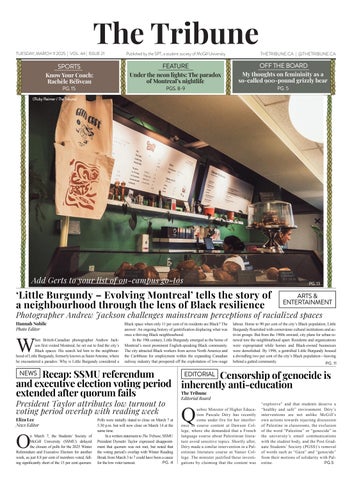
Photographer Andrew Jackson challenges mainstream perceptions of racialized spaces
Hannah Nobile
Photo Editor
When British-Canadian photographer Andrew Jackson first visited Montreal, he set out to find the city’s Black spaces. His search led him to the neighbourhood of Little Burgundy, formerly known as Saint-Antoine, where he encountered a paradox: Why is Little Burgundy considered a
Black space when only 11 per cent of its residents are Black? The answer: An ongoing history of gentrification displacing what was once a thriving Black neighbourhood.
In the 19th century, Little Burgundy emerged as the home of Montreal’s most prominent English-speaking Black community. The city attracted Black workers from across North America and the Caribbean for employment within the expanding Canadian railway industry that prospered off the exploitation of low-wage
President Taylor attributes low turnout to voting period overlap with reading week
were initially slated to close on March 7 at 5:30 p.m. but will now close on March 14 at the same time.
On March 7, the Students’ Society of McGill University (SSMU) delayed the closure of polls for the 2025 Winter Referendum and Executive Election for another week, as just 8.8 per cent of members voted, falling significantly short of the 15 per cent quorum.
In a written statement to The Tribune, SSMU President Dymetri Taylor expressed disappointment that quorum was not met, but noted that the voting period’s overlap with Winter Reading Break from March 3 to 7 could have been a cause for the low voter turnout.
EDITORIAL
The Tribune Editorial Board
labour. Home to 90 per cent of the city’s Black population, Little Burgundy flourished with cornerstone cultural institutions and activist groups. But from the 1960s onward, city plans for urban renewal tore the neighbourhood apart. Residents and organizations were expropriated while homes and Black-owned businesses were demolished. By 1996, a gentrified Little Burgundy housed a dwindling two per cent of the city’s Black population—leaving behind a gutted community.
uebec Minister of Higher Education Pascale Déry has recently come under fire for her interference in course content at Dawson College, where she demanded that a French language course about Palestinian literature avoid sensitive topics. Shortly after, Déry made a similar intervention in a Palestinian literature course at Vanier College. The minister justified these investigations by claiming that the content was
“explosive” and that students deserve a “healthy and safe” environment. Déry’s interventions are not unlike McGill’s own actions towards rejecting discussion of Palestine in classrooms, the exclusion of the word “Palestine” or “genocide” in the university’s email communications with the student body, and the Post Graduate Students’ Society (PGSS)’s removal of words such as “Gaza” and “genocide” from their motions of solidarity with Palestine.
Eliza Lee News Editor
(Ruby Reimer / The Tribune)
Request for SPVM to investigate McGill security’s alleged assault of AGSEM member still ongoing
Incident saw the member forcefully detained by private guards on McGill campus
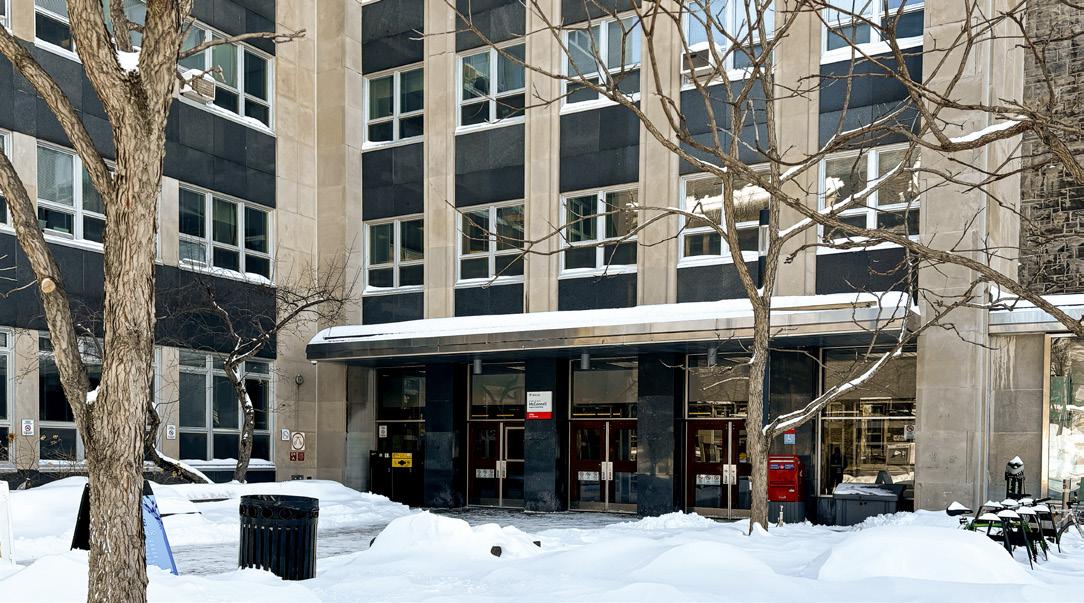
On Dec. 11, a member of the Association of Graduate Students Employed at McGill (AGSEM) alleges security officers forcibly detained her in the McConnell Engineering Building for taking a picture of armed agents there. Reportedly, the member has yet to receive communication from McGill about recourse.
In a written statement to The Tribune, the AGSEM member, Asa Kohn, explained that she has a job with the Students’ Society of McGill University (SSMU), with a scope that includes addressing the increased presence of security officers on McGill campus. When she saw two private security guards in McConnell that afternoon, she snapped photos of them to show her colleagues. One of the guards then approached Kohn, yelling at her to delete the images while placing his hand on his weapon.
“I tried to leave, but he grabbed my arm, dragged me to the wall by the door of the porter’s office, and forcibly held me there,” Kohn wrote. “He continued to yell, sometimes in English but mostly in French even when I told him I don’t speak French. He demanded several times that I delete my photos, give him my camera, and stop recording him. He threatened to break my camera and said that he had a gun.”
Kohn reported that a man identifying himself as the building porter then arrived and pushed
According to McGill Campus Public Safety, their security Patrollers are around campus to “[build] relationships with the McGill community.” (Anna Seger / The Tribune )
her to the side to access his office door. When she tried to record this incident, explaining her reasons for photographing and asking what law or McGill policy she was violating by doing so, neither the porter nor guard responded.
Kohn explained that McGill security guards then arrived to prevent her from leaving McConnell, even after the private security guard had released her. According to Kohn, the guards also told bystanders to “back off” while they detained her for approximately 50 minutes.
“When the police finally showed up, they immediately told me that I hadn’t broken the law and was free to go,” Kohn wrote.
In a written statement, the McGill Media Relations Office (MRO) claimed that the events of Dec. 11 provoked external security involve-
ment.
“The initial incident did not involve McGill Security agents,” the MRO wrote to The Tribune. “As we understand, it relates to an individual recording the movements of a couple of armoured truck guards. We understand that [the guards] had safety concerns about being filmed, so they contacted the Montreal police for assistance [....] That puts into motion McGill protocols that focus on avoiding escalation and waiting for police to arrive to determine if they think a crime was committed.”
The MRO also commented on McGill security’s role in the events at McConnell.
“The work of Campus Security was complicated by the intervention of other community members who, despite what one assumes were good intentions, fuelled tense exchanges,” the MRO wrote.
Kohn expressed that the hostile behaviour she alleges experiencing from security on Dec. 11 has occurred multiple times since she began documenting their campus presence in Summer 2024, with security “arbitrarily” demanding her student ID and addressing her by her name when
encountering her on campus.
“This sort of intimidation might be expected from a body designed to impose order on behalf of McGill,” Kohn wrote. “What is more disheartening is that other parts of the university have not helped me.”
Kohn also alleged that McGill “has done nothing to rectify the situation,” since she filed an internal complaint with McGill Security Services eight weeks ago, but has not received a response. She also submitted a request for information with the SPVM on Dec. 16.
SSMU Vice-President University Affairs
Abe Berglas confirmed Kohn’s difficulties accessing support from McGill in a written statement to The Tribune, reporting that they met with a representative from Campus Public Safety a week after Kohn’s alleged assault.
“[The representative] couldn’t tell me what Asa had done wrong for the security guard to grab her,” Berglas wrote. “I asked him what he would do about it, and he said that without a formal complaint, he would not take any action.”
In their statement about the events of Dec. 11, AGSEM affirmed the need to seek non-administrative support at McGill in situations like Kohn’s.
“There are ways we can look out for each other on an individual level,” the union wrote. “Bystanders on [Dec. 11] prevented worse abuse of the staff member. Their presence provided accountability.”
Students express concern over changes to future Frosh schedule
The orientation is now set to take place over the first week of classes
Asher Kui Staff Writer
McGill Campus Life and Engagement (CLE) recently opened leader-volunteer applications for freshmen orientation events. With the university’s decision to delay the Fall 2025 move-in date for first-year students in the downtown campus by one week to Aug. 23 and Aug. 24, many McGill students have expressed concerns over the schedules for Frosh, a set of student-run orientation activities, and other orientation events.
On Nov. 13, McGill Arts Undergraduate Society (AUS) Senators Anzhu Wei and Vivian Wright raised questions to the McGill Senate concerning this move-in delay, as it limits possible dates for orientation events for first years. In particular, Frosh events will now coincide with the first week of classes, which according to Wei and Wright, may affect the transition to university for incoming students.
In an interview with The Tribune , Wei explained that difficulties in scheduling Fall 2025 Frosh may be attributed to two reasons: McGill’s term length, and its finances.
“In order to have a [week-long] reading week, [McGill has] to push back the start of school earlier [...] to have the same number of school days,” Wei said. “For the 202526 school year, [school would have] to start before Labour Day.”
Wei described how McGill’s decision to postpone the first-year move-in date
leaves only a few days before classes begin for Frosh to take place, in an effort for the university to cut residence costs.
“The reason that [McGill provided] is that they didn’t have the resources [...] to open residences earlier,” Wei said. “They needed the time to train resident workers. It is a financial reason that they’re not opening [residences] earlier.”
In addition, the McGill Media Relations Office (MRO) wrote to The Tribune that the adjusted move-in dates will allow for maintenance and renovation in residences.
Elisha-Grace King, U1 Arts & Science, expressed concerns about the potential new timing of Frosh.
“Frosh being before classes started gave me a lot of time to meet new people and explore the McGill area,” King said. “The extra free time [was] good downtime as Frosh is super exhausting with the amount of walking and late-night events that [took] place.”
Both Wei and King speculated how the shortened period between move-in, Frosh, and the start of classes may be harmful to incoming students.
“I think it’s going to have a really big negative impact on first-year students,” Wei said. “To not give them that time to be able to adjust and be able to find their foothold in Montreal, I think it’s just pretty horrible.”
“Starting first year and adjusting to the university pace can be quite overwhelming,” King said. “If Frosh happens [along-
side classes], new students might not have a strong foundation of friends to lean on when things get stressful at school.”
Wei noted that the AUS has discussed their concerns with Deputy Provost (Student Life and Learning) Angela Campbell and Dean of Students Tony Mittermaier. He reported that while Campbell and Mittermaier acknowledged the AUS’s concerns, they remain unwilling to reverse the change in Frosh timing.
ber of options.”
The MRO concluded its statement by announcing a tentative decision on the Frosh schedule.
In a written statement to The Tribune , the MRO affirmed that Campbell, members of CLE, and student leaders have had discussions regarding the well-being of firstyear students.
“Our Student Life and Learning units have always worked with student leaders to provide the best student experience at McGill and will continue to do so,” the MRO wrote. “Student leaders were understandably concerned about Frosh overlapping with classes, so the group explored a num-
“Frosh would start on Aug. 29, after the start of classes, and run through Labour Day weekend to Sept. 1, with the possibility of some Sept. 2 events, to be determined in the coming months,” the MRO wrote. “The final Frosh schedule will be communicated to students during the summer.”
King suggested that McGill should ensure there are no scheduling conflicts between Frosh events and classes.
“Making sure students have time to settle into both the academic and social aspects of McGill are key to setting them up for success,” she said.
On top of student-led Frosh events, McGill will also host in-person faculty orientation events starting Aug. 25. (Hannah Nobile / The Tribune )
The Tribune Explains: SSMU’s new Memorandum of Agreement with McGill Document includes new requirements for SSMU executives’ eligibility
Shani Laskin Managing Editor
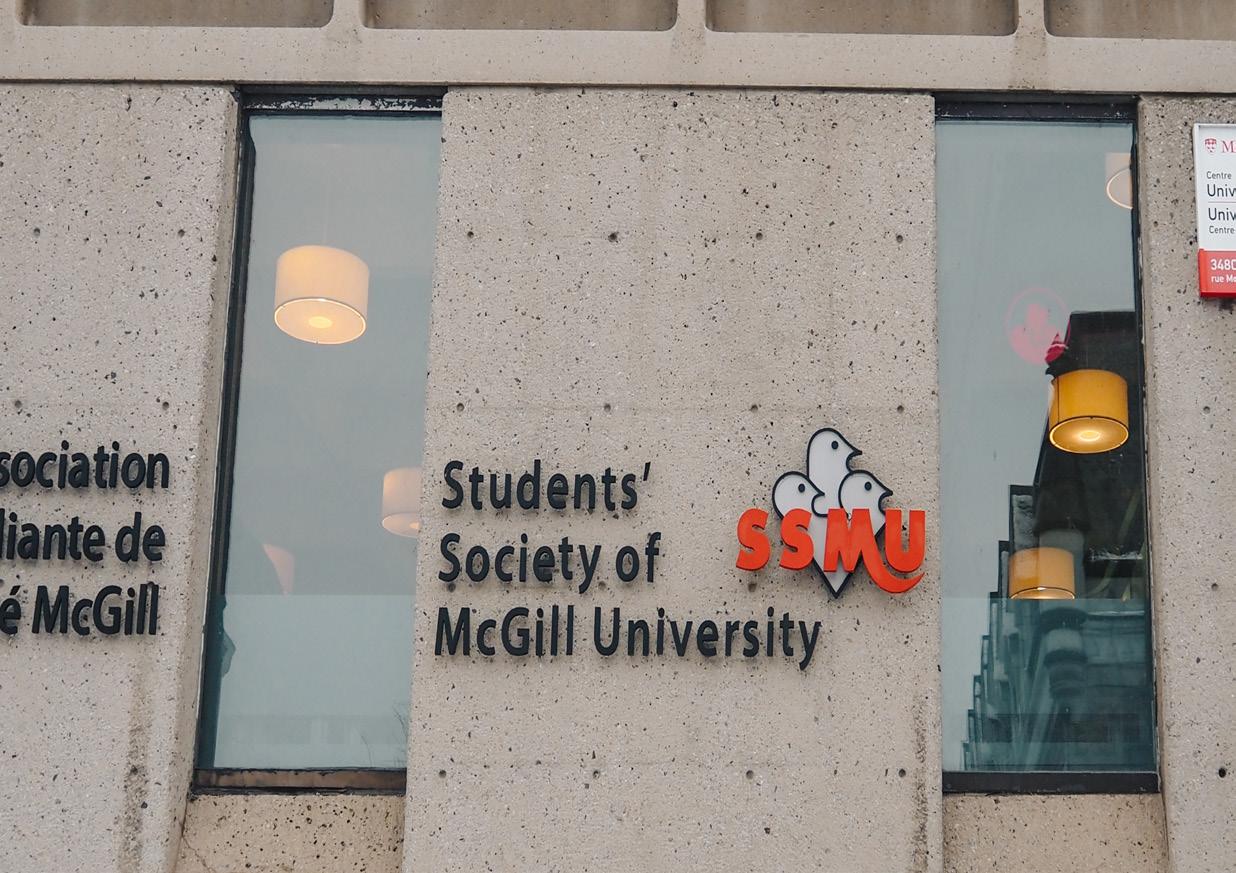
On Feb. 28, the Students’ Society of McGill University (SSMU) and the administration signed a new Memorandum of Agreement (MoA)—a document outlining the two parties’ cooperation. Coming in at 118 pages long, The Tribune breaks down what students actually need to know about the new MoA, how it differs from the previous version, and why it matters.
What is the MoA?
The MoA is a crucial aspect of how SSMU operates. The SSMU is a student-run organization registered as a not-for-profit incorporated under the Canada Not-for-profit Corporations Act. Despite its independence from McGill, the terms of its relationship with the university are central to its functioning— defining its ability to operate on the McGill campus and for clubs and services to use the McGill name.
Without an MoA, student clubs and services cannot legally use the McGill name or work out of the University Centre, fundamentally disrupting SSMU’s operations.
Typically valid for five years, the new agreement will remain in effect until May 31, 2029. This MoA includes a couple of key adjustments, including new requirements for hopeful SSMU executives and changes to how McGill and SSMU can resolve any Notices of Termination—formal announcements that either party wants to end the agreement. The MoA also includes details on the SSMU of-
fice’s upcoming move to the fourth floor of the University Centre.
What are the new rules for SSMU executive and executive nominees?
Under the previous MoA the only requirement to run for a SSMU executive position was to be an undergraduate student who had taken at least 18 credits in the 18 months leading up to the election. The previous MoA also stipulated that all SSMU executives and Board of Director members would be subject to the Code of Student Conduct and Disciplinary Procedures, although there were no further details on candidates’ eligibility.
Now, SSMU executives and directors cannot have a disciplinary record at McGill, an offence under the student code of conduct, or have been suspended from the university.
How has the process of resolving MoArelated issues between McGill and SSMU changed?
The default clause in the previous MoA outlined that an “event of default” would occur if SSMU breached the MoA, its own constitution, Quebec law, or faced serious financial issues. In the event of default, the money “assessed by the University for [SSMU]” would be put into a trust fund overseen by representatives of both parties until the default was resolved. The new MoA no longer includes this clause. Instead, either party can now issue a Notice of Termination at any point, with the issue being taken to an impartial third-party mediator.
To SSMU President Dymetri Taylor, this
McGill Food Coalition’s
adjustment takes away some of the University’s financial power over student union in negotiations over default.
“The reason for the change was more or less to give some leeway and have it be more of a conversation amongst equals,” Taylor explained to The Tribune
Where are the SSMU offices going?
Currently located in suite 1200 of the Brown Building, the SSMU offices will be moved to the fourth floor of the University Centre following this school year, taking over suites 401 and 403-409. While most of the
space is currently unoccupied, it includes the Club Lounge, the McGill University Photography Students Society office, and the Queer McGill library. The SSMU has yet to finalize where the clubs’ spaces will be relocated to, although he alluded that libraries from various SSMU services may be consolidated into a single space.
As for the current SSMU offices, McGill will take over the space to create more offices for staff on campus. According to Taylor, this is in part due to financial constraints that have forced the university to cut down on its external leases in and around Montreal.
/ The Tribune)
weekly calendar plants seeds for
alternative
food system Coalition hopes to increase collaboration between its member food advocacy groups
Eliza Lee News Editor
Throughout the Winter 2025 semester, the McGill Food Coalition (MFC) has posted a weekly calendar compiling food service events on campus, from free lunches to events discussing food sustainability. MFC is a student-run group that represents and coordinates projects between food advocacy groups, including the Student Nutrition Accessibility Club (SNAC), Midnight Kitchen, and Happy Belly.
In an interview with The Tribune, Mia Szabo, U3 Arts and a project leader for the MFC, explained that the calendar seeks to improve students’ access to nutritious, affordable, and sustainable foods. She added that by compiling the services of its member groups, the calendar enables students to more easily incorporate them into weekly meal planning.
“On Monday, I can get SNAC groceries,” Szabo said. “On Wednesday, I can go to Midnight Kitchen. On Friday, there’s Happy Belly, and in between, there’s workshops.”
Szabo also drew attention to the symbolic significance of the calendar in showing that student food advocacy groups are united in their efforts to combat food insecurity.
“We really want to convey a sense of cohesiveness across the different groups, which in the past, might not even know that each other existed,” Szabo said. “We’re all work-
ing towards a common goal, which is servicing McGill students and the McGill community.”
Szabo emphasized that the calendar contributes to MFC’s larger commitment to creating an alternative food system on campus, filling gaps left by the traditional food system centred upon for-profit companies.
Élèves des Champs—a student-run ecological garden on the Macdonald Campus—is among the member groups of MFC. Reflecting on the MFC’s work beyond the calendar, Sam Liptay, U3 Science and representative from Élèves des Champs, echoed the coalition’s role in tackling food insecurity holistically and addressing common obstacles between student groups.
“Something that people [have been asking] is, ‘What are the limits to growth for each group?’, and trying to assess those and see if this can be overcome, and see if there [are] commonalities,” Liptay said.
For Jeanne Arnould, U4 Arts and a representative from DefaultVeg McGill, MFC is a key way to increase the visibility of food advocacy groups for students, something that is crucial given that it can be challenging to find an updated list of active clubs and services on campus. DefaultVeg promotes plant-based eating through catering services and other food sustainability events, such as vegan snack nights.
“When you do have a club, you need to go table at Activities Night and hope that some people will be interested, otherwise your student club or group kind of dies,” Arnould told The Tribune. “So [MFC’s] initiative to actually structure [these groups under a coalition] is really, really valuable.”
In a written statement, Hugo-Victor Solomon, Vice-President External of the Students’ Society of McGill University (SSMU), noted that rising inflation and the lack of food options on campus are among the main driv-
ers of food insecurity for students. However, Solomon believes that SSMU signing a new Memorandum of Agreement (MoA) with McGill on Feb. 28 may help bring more food venues to the University Centre.
“I’m happy to say that given the signing of the new 5-year MoA, [...] it’ll be a lot easier to secure contractors in a more streamlined process through having a management agreement with the University in place—and to get more food service tenants in the building ASAP,” Solomon wrote.
Although Solomon reported that SSMU is not currently collaborating with MFC “in any official capacity,” he wrote that the student union will seek to work with them to revise SSMU’s Food Security Policy in the future.
Lia Boretsky, U4 Science and co-president of SNAC, hopes to see greater collaboration between student groups under MFC and underscored the mutual benefit that comes from this work. Boretsky recalled several weeks when SNAC was able to prevent wasting leftover produce from their weekly Good Food Box distribution service by offering it to Midnight Kitchen for their lunch program.
“It’s more effective when we work together and collaborate, rather than just being our own [groups], because then things go to waste,” Boretsky said. “We all have the same mission, and if we come together and be more strategic [...] it’s going to have a better result for the students.”
One change under the liquor permit section of the MoA allows the student union to use kegs at pre-approved events. (Mia Helfrich
MFC is working on a map of food advocacy organizations, food banks, and other food-related services on campus and in downtown Montreal.
(Armen Erzingatzian / The Tribune)
Recap: SSMU referendum and executive election voting period extended after quorum fails
President Taylor attributes low turnout to voting period overla p with reading week
Eliza Lee News Editor
Continued from page 1.
“We were able to get 8.6 per cent in the first week, so had it been back-to-back weeks of school, we most certainly would have gotten to 15 per cent,” Taylor wrote. “This hasn’t been an issue in previous years; however, outreach and promotion could also be improved.”
Taylor then explained that one possible solution could be to establish a recurring, consistent voting period for the election and referendum that avoids overlap with reading week.
“That would mean we likely have to opt for a nomination period in late January and a voting period in the last two weeks of February,” Taylor wrote. “Overall, [the failed quorum] gives much to think about for improvements, for both the setting of periods and for the way elections are advertised.”
Among such services included in the
referendum are questions on renewing the SSMU Menstrual Health Project Fee, which distributes free menstrual products on campus, and the Indigenous Equity Fee, which funds the work of the Indigenous Affairs Committee.
Along with executive elections
and service fee questions, three changes to the SSMU constitution were included on the
ballot. One constitutional amendment stands to make the Vice-President (VP) Finance appointed by the SSMU Board of Directors, rather than elected by students. The second constitutional amendment seeks to eliminate the position of VP Sustainability and Operations, reallocating the responsibilities of this role to other executives. The third change would remove Section 1.3 of the constitution, which SSMU argues will better protect the student union from litigation.
Susan Aloudat, the sole candidate for VP University Affairs, believes that students may have “checked out” from following university issues when reading week began. However, Aloudat emphasized the importance of the referendum and election in SSMU’s operations.
“I hope we meet quorum because operations for vital services and initiatives that every student rely on to some extent are counting on it,” Aloudat wrote to The Tribune
In the headlines: Week of March 11, 2025
McGill: Quebec Superior Court grants safeguard order against SSMU’s Policy Against Antisemitism
On March 6, the Quebec Superior Court suspended the Students’ Society of McGill University’s (SSMU) ratification of its proposed Policy Against Antisemitism after it granted a safeguard order submitted on Feb. 26. The Policy, which the SSMU Legislative Council passed on Dec. 5 previously faced legal contestation when the Court granted an injunction from Dec. 9 to Dec. 19.
SSMU’s Policy Against Antisemitism aims to “address the lack of specific guidelines and measures to combat antisemitism within the SSMU community.” It had been hotly contested among councillors at meetings throughout November; debates largely centered on differing opinions of what the definition of antisemitism ought to be.
Student groups such as the Jewish Law Student Association, Chabad McGill, Israel On Campus, Hillel McGill, StartUp Nation McGill, Students Supporting Israel, AEPi McGill and The White and Blue, lauded the ruling on Instagram, claiming the Policy was “politically motivated” and “[denied] Jewish students their identity on campus.”
Proponents of the Policy argue that its definition of antisemitism more robustly addresses issues faced by all Jewish students, regardless of their political leanings. Further, they argue that by delaying the ratification of this Policy, Jewish students are left without any clear frameworks to address antisemitism and seek recourse through SSMU.
Local: Montrealers resist U.S. rightwing extremism on International Women’s Day
Protestors took to the streets of downtown Montreal on March 8 to condemn the U.S.’s crackdowns on women’s and 2SLGBTQIA+ rights and Canadian sovereignty under a second Trump presidency. The group’s locus was the U.S. Consulate and was a part of a broader network of such protests across Quebec.
Eight years ago to the day, protestors similarly gathered to denounce Trump’s presidency at the start of his first term. Since then, the conservative administration has had a hand in controversial human rights setbacks including appointing conservative Supreme Court judges which has been attributed to the overturning of Roe v. Wade. Within the first week of his second term, Trump issued a suite of executive orders rolling back protections for trans, two-spirit, and non-binary Americans. This included an edict that the federal government would only recognize two genders, female and male. Another order banned federallyfunded schools from allowing trans athletes to compete in women’s and girls’ sports.
In Montreal, Joliette, Ottawa, Quebec City, Saguenay, Sherbrooke, and Victoriaville, protestors held hands as they observed eight minutes of silence. Organizer Anaïs Barbeau-Lavalette told CTV News, “You are not kings. We are not handmaids,” rebuking the current U.S. administration.
National: Mark Carney wins race for Liberal Party leadership
In a landslide victory, the Liberal Party of Canada voted Mark Carney as its new leader following Trudeau’s announcement of resignation in January. At the Liberal convention on March 9, party President, Sachit Mehra declared that Carney greatly outperformed the other three contenders, taking 85.9 per cent of the total vote. In contrast, the candidate coming in second, former finance minister and deputy prime minister Chrystia Freeland, received only 8 per cent of the vote.
Carney, the former governor of the Bank of Canada and Bank of England, gave an address to the convention focusing largely on Trump’s 25 per cent tariffs on Canadian goods. He asserted that his government would maintain tariffs on U.S. goods saying “We can’t let [Trump] succeed.”
Attempting to pose himself against Conservative Party leader Pierre Poilievre, Carney stated that he would be able to stand up against Trump and strengthen unity within Canada. To do so, some of his primary policy plans include diversifying the Canadian economy, liberalizing trade within the country, and fostering new trading relationships aside from the U.S.. Carney has also said he wants to secure the Canada-U.S. border and invest in pipeline projects which have faced increased scrutiny in recent years.
International: Scientists report record low levels of sea ice in the Arctic
Copernicus Climate Change Service (C3S) reported an all-time low for sea ice in the month of February, with there being 8 per cent less ice than average in the Arctic and 26 per cent less ice than average in the Antarctic. C3S operates within the European Centre for MediumRange Weather Forecasts (ECMWF), an intergovernmental organization that monitors and predicts weather using data from satellites, ships, and other technologies.
The ECMWF attributes decreasing levels of sea ice to rising global temperatures. Though temperatures across some parts of the world, including areas in the U.S. and Canada, were below average in February 2025, C3S found that February 2025 was the third warmest February on record behind that of 2024 and 2016. The average temperature in February 2025 was 13.36 degrees Celsius.
Scientists stress the potentially disastrous impacts of sea ice decline such as rising sea levels and threats to wildlife. Extensive research has also shown that sea ice plays a crucial role in conveying heat around the globe. Because of this, decreasing loss of sea ice can exacerbate natural disasters and lead to more extreme weather events.
The by-election results for Vice-President (VP) Student Life and VP Operations and Sustainability in November 2024 were nullified after the election failed to meet its 15 per cent quorum. ( Ruby Reimer / The Tribune )
Eliza Lee News Editor
Shani Laskin Managing Editor
Armen
Editor-in-Chief
Jasjot Grewal editor@thetribune.ca
Creative Director Drea Garcia Avila dgarciaavila@thetribune.ca
Web Developer Laura Pantaleon Roberta Du webdev@thetribune.ca
Copy Editor Matt Adelberg copy@thetribune.ca
Social Media Editor Aliya Singh socialmedia@thetribune.ca
Business Manager Celine Li business@thetribune.ca
Censorship of genocide is inherently anti-education
The Tribune Editorial Board
Continued from page 1.
Stifling discussion of Israel’s genocide in Gaza—or any other major geopolitical crisis— dismisses the lived realities of those involved, stunts positive change, and enables educational institutions to remain passive in their own contribution to acts of violence around the world. Suppressing conversation, especially that which is the most contentious and the most uncomfortable, heightens tensions and propagates misinformation.
Israel’s genocide in Gaza touches so many students in traumatic and deeply distressing ways, and the university setting is uniquely equipped to facilitate discussion around it in a respectful and informed space.
As experts and professionals, university professors can act as knowledgeable mediators and encourage evidence-based dialogue in their students. In this way, not only is open
discussion of weighty subjects itself destigmatized, but students are open to learning from one another instead of festering in repressed feelings and unspoken polarized conflict.
Geopolitical tensions do not cease to exist if a university chooses not to talk about them. Such silence sends the message that the lives affected by and lost to these injustices are not worth addressing in the classroom, thus enabling a false sense of detachment from those realities. McGill itself is instrumental in the genocide, as it continues to invest over $70 million CAD in more than 50 companies complicit in upholding Israel’s apartheid regime. The symbolic weight of these investments is greater than their monetary value; McGill is a worldclass institution of higher education, whose actions set a precedent for other educational institutions in Canada and abroad.
Suppression of uncomfortable discussion not only pacifies past violence,
Yusur Al-Sharqi Managing Editor
CONTRIBUTORS
For years, boys at school called me “Boog.” When I asked what they meant, they said that it was a character from the movie Open Season: “A nine hundredpound bear,” they would say. So, naturally, I believed I was fat. I developed an intense anxiety about eating in front of men that persists to this day.
I know many other women with the same fear. Women are taught to shrink. Physically, emotionally, even ideologically. We are praised for smallness—delicate features, a light footprint, a soft voice. We are expected to consume little and demand even less so that men have
but reproduces it. After an unidentified group in support of Palestine broke windows in McGill’s Leacock Building in February, President and Vice-Chancellor Deep Saini sent a message to students classifying these protestors as threats to students though no one was harmed. His message ignored the purpose of the protest entirely, instead criminalizing the pro-Palestine cause. This rhetorical tactic imbues reductive biases into the discussion of the genocide in Gaza, while simultaneously villainizing protest—by students or otherwise—and discouraging future action. It is in this fear-mongering environment, where certain causes are hand-picked as acceptable or not based on their convenience for the university, where polarizing narratives and heightened tension are encouraged in place of constructive dialogue and progress.
McGill’s student body and faculty must continue to hold the university accountable for its ongoing complicity in
violence and its suppression of crucial discussion. McGill and its student body must also show consistent and energetic solidarity with Dawson College, Vanier College, and the entire CEGEP system, where the grassroots of student activism in Quebec is growing. Ultimately, amidst censorship, suppression, and polarizing curation, it is critical that each of us individually continue to have uncomfortable conversations, both to educate others and to learn from others with an open mind. This could be with friends, family, classmates, or professors, but it must continue. We, as students, must challenge our professors when a syllabus is devoid of Palestinian, women, 2SLGBTQ+, BIPOC voices, and professors—especially those protected by tenure— must encourage and facilitate uncomfortable conversations. The power of individuals and their communal discourses in the fight against suppression is immense—neither the administration nor the McGill community can forget it.
My thoughts on femininity as a so-called 900-pound grizzly bear
more room to expand.
In case you’re curious, it turned out the nickname was never about my weight—it was about the hair on my body. I’m not sure which is worse, but the fundamental problem was the same either way: I was nauseatingly afraid of being unfeminine.
I have since learned that trying to prove your femininity will shrink you to death by design. For a long time, I thought that if I could control how I was perceived, I could win. I imagined that by conforming to the expectations they set for me, I would unlock some version of femininity that would feel like power. But when all of those boys who made fun of me slid into my DMs later on (true story), I didn’t feel the satisfaction I thought I was supposed to—I felt worse. Did I conform to their gaze? Should I be pleased with myself for that?
I believe choice feminism— the idea that any choice a woman makes is inherently feminist, or progresses feminism in some capacity—is a myth. I think the male gaze permeates women’s actions more than we’re even conscious of, and I do, uncomfortably, believe
that giving into it contributes to the oppression of other women. I realize this when the makeup that I claim to wear “for myself” goes untouched on days that I don’t leave my apartment. The act of adorning myself makes me feel good, yes, but not in a vacuum. It feels good because it makes me think that men will find me more attractive (and those standards of attractiveness by which I judge myself didn’t fall from a coconut tree).
Still, there is no force on Earth that can separate me from my MAKEUP FOREVER Artist Colour Pencil Longwear Lip Liner in the shade “Wherever Walnut.” I love femininity, and I don’t think we should be at war with it. But I believe that there’s some freedom in recognizing the male gaze, the “everpresent watcher.” Maybe that’s the first step to figuring out which parts of our femininity actually belong to us.
I don’t have a solution. Some believe that overcoming the male gaze means gazing back—judging back, objectifying back. Others argue that we should only care about our own self-perception. But I think it’s human nature to see ourselves
through the eyes of others. The question is, whose eyes will I choose to see myself through?
When I find myself fixated on this question and terrorized by the “ever-present watcher,” I think about Nawal El Saadawi, an Egyptian writer, doctor, and radical feminist.
In Woman at Point Zero, Saadawi tells the story of Firdaus, a woman who searches for the warmth of her late mother in every woman she meets. Her last memory of her mother is from when she was a baby. She recalls struggling to learn to walk, feeling as if something was always pushing her over. The only thing that held her up was her mother’s eyes.
“They were eyes that watched me,” she writes. “Even if I disappeared from their view, they could see me, and follow me wherever I went, so that if I faltered [...], they would hold me up.”
As she searches for her mother, she finds her, to some extent, in every woman around her. Herein might lie the solution, I think—to realize that the gaze that steadies us, the one that truly sees us, has always belonged to other women.
Shatner
Celine Li, Daniel Miksha, Ella Gomes, Jasjot Grewal Katie Lau
TPS BOARD OF DIRECTORS
Alex Hawes Silva, Amelia Clark, Asher Kui, Annabella Lawlor, Bianca Sugunasiri, Bianca Tri, Daniel Miksha, Daniel Pyo, Ethan Kahn, Jamie Xie, Luken Castañeda Garces, Mahin Siddiki, Mairin Burke, Olivia Ardito, Reuben Noam, Samathar Senso, Sarah McDonald, Tamiyana Roemer, Zain Ahmed.
Aiqing Qiu, Anna Seger, Ariella Morgan, Eliot Loose, Lilly Guilbeault, Nour Khouri, Ruby Reimer, Ryan Dvorak.
Antoine Larocque, Jenna Payette
Erzingatzian, Julia Buckle, Simona Culotta
(Leila Boujnane / Unsplash)
COMMENTARY
Ellen Lurie Opinion Editor
FCanada must look to its own history—not the United States’—when forming solutions to the fentanyl crisis
irst distributed in the 1960s as an intravenous anesthetic, fentanyl is a synthetic opioid 50 to 100 times stronger than heroin. As one of the world’s most frequently used opioid analgesics, fentanyl’s high potency poses a severe risk of overdose, particularly when consumed unknowingly through dealer lacing.
With a mere kilogram of smuggled fentanyl capable of killing over 500,000 people, the drug has emerged as a popular subject of the border control discussion, particularly as it provides a pretext for U.S. President Donald Trump’s tariff threats. On March 4, the U.S. imposed a 25 per cent tariff on Canada and Mexico, as well as a 20 per cent tariff on China, a known source of fentanyl’s component parts.
With demands for heightened international action to address fentanyl trafficking, Canada is facing a crucial turning point: Will the government follow the U.S. approach, built around law enforcement and criminalization, or adopt a harm reduction strategy rooted in Canada’s own history of progressive drug policies?
Although Trump’s claims of a severe fentanyl trafficking problem are false, with only 0.2 per cent of all fentanyl intercepted at US borders actually coming from Canada and more drugs flowing from the U.S. into Canada than vice versa, the Government of Canada has strategically prioritized addressing the fentanyl
COMMENTARY
Defne Feyzioglu Staff Writer
Qtrade to stop tariffs. Hoping to appease the Trump administration, Canada appointed Kevin Brosseau as Commissioner of Canada’s Fight Against Fentanyl, or “Fentanyl Czar,” on Feb. 11.
Additionally, the Government of Canada has followed the U.S. in classifying Mexican cartel groups as terrorist organizations, despite cartel groups lacking the characteristics of genuine terrorist activity, which is defined as politically, religiously, or ideologically motivated. By contrast, cartels lack symbolic governance targets, and are instead profit-driven. Attention towards cartel groups as key participants in the fentanyl trade is crucial, but inaccurately terming cartel activity terrorism will lead to unreasonably punitive justice outcomes.
We know from experience. In the 1970s, former U.S. President Richard Nixon attempted his own War on Drugs—a series of policy initiatives intended to destroy the illegal drug market by increasing prison sentences for dealers and users. His overly punitive laws left vulnerable and impoverished groups subject to mass criminalization, death penalty sentences, and increased long-term health risks. The War on Drugs was also intimately tied to race. Policies like the Smoking Opium Exclusion Act disproportionately persecuted Chinese immigrants, while the hyper-criminalization of crack relative to cocaine punished traditionally Black crack-users more harshly than traditionally white cocaine-users, serving to both reflect and reinforce systemic racism. Now, as the War on
Drugs experiences a revival under President Trump, Nixon’s racist and despotic drug philosophy is at risk of spreading to Canada. To avoid mimicking the punitive U.S. model, Canada must lead by example through the implementation of harm reduction strategies for the fentanyl crisis. Such an approach would not be foreign, either: Canada’s public health strategy has deep historical roots in harm reduction, with Montreal, in particular, being a pioneer. With CACTUS Montreal—established in 1989—hosting one of the first needle exchange programs in North America, the city has served as a hub of enlightened drug policy. Now, CACTUS has expanded its services and received government approval, serving as one of four safe injection sites in the Montreal area. The sites offer a crucial space for people to use substances under medical supervision and with clean supplies. Plus, evidence shows safe injection programs reduce the risk of overdose, limit the spread of infectious disease, and create networks of trust between healthcare officials and those with addictions.
Additionally, in 2016, Canada abolished the prescription requirement for naloxone—an overdose-reversal medication also known as Narcan. The government has also remained committed to providing naloxone for free to drug users and their families and friends. Together, these initiatives reflect Canada’s historical recognition of substance use as a public health issue rather than a criminal one. The country’s powerful reputation as a leader in harm reduction strategies should not be sidelined in the face of tariff threats; it should instead be amplified, serving as a foundation upon which Canada can continue building a productive and holistic response to the fentanyl crisis.
Quebec’s budget cuts to sexual violence survey put students at risk
will continue to face sexual violence with fewer protections and less institutional support.
uebec recently cancelled a survey investigating sexual violence on CEGEP and higher education campuses. This cancellation sets a damaging precedent for future policies on sexual violence and student protection, as well as for the salience of institutional accountability, creating a less regulated and more dangerous campus environment. Without data evidencing the frequency and severity of this crisis, it becomes invisible, and institutions can get away with ignoring it.
In Canada, one in three women above the age of 15 report to have experienced sexual assault at least once. This prevalence is reflected acutely on Quebec campuses, where 14 per cent of all reports and complaints to the Quebec ombudsman are related to sexual violence. The need for stronger protections and datadriven policies is vital. Yet, the government has removed a key mechanism for understanding and addressing campus sexual violence. How can an issue be addressed when those in power don’t consider it significant enough to research?
Without the survey, there is no longer a direct, survivor-centred means to monitor sexual violence and available safety measures on Quebec campuses. The Quebec government has justified this cancellation as a cost-saving measure. However, survivors pay the real price. The absence of data does not suggest the absence of violence. It only means that survivors are left unsupported and without a system willing to acknowledge their experiences. Thus, students
Quebec Higher Education Minister Pascale Déry stated that a broader provincial mental health survey will incorporate data about sexual violence, but merging a specific issue into a general study risks diluting critical insights and overlooking key patterns. Without a dedicated survey, the true scope of the crisis may be misrepresented or ignored entirely.
The government is not just neglecting its responsibility; it is deliberately turning its back on a problem that causes profound trauma for thousands of women, and demands urgent and ongoing attention. When the government fails, it is up to institutions to step up, take initiative, and ensure that student safety is not sacrificed for bureaucratic convenience. A campus without proper reporting mechanisms does not protect students; it protects perpetrators. Silence does not create safety but guarantees invisibility.
This invisibility is not distributed equally. 2SLGBTQIA+ students, students with disabilities, international students, racialized students, and women already experience sexual violence on campus at disproportionately high rates. The cancellation of this survey makes the severity of their realities even easier to erase. By cutting research funding, the government merely shifts the burden onto underfunded and understaffed organizations like the Office for Sexual Violence, Response, Support, and Education (OSVRSE), leaving it to them to fill the gaps while struggling with limited resources.
Higher education campuses are not responsible for Quebec’s failure, but in the face of the cancellation of this survey, they
have an important choice: Follow the Quebec government’s pattern of neglect or take real, independent action. If the province refuses to track sexual violence, institutions themselves must. McGill must acknowledge that safety does not start with response but with prevention. A commitment to student safety is a choice that must be reflected in action, policy, and transparency.
The government’s decision to erase data instead of addressing sexual violence is not just an oversight. Though there are still a number of
alternative forms of data collection in regards to sexual violence, they are not as tailored to Quebec’s school campuses in particular as the cancelled survey was, and thus hold less weight in institutional protections of sexual violence on campuses. Sexual violence is still happening, and will only intensify if the importance of sexual violence data is forgotten. The loss of data makes it difficult to assess whether the measures Quebec has taken to improve campus safety are working, and whose stories of sexual violence are going unheard.
In 2019, only 6 per cent of all sexual assault incidents in Canada were reported to police. (Simona Culotta/ The Tribune)
Two milligrams of fentanyl—roughly five grains of salt—is enough to cause death for an average adult. (Ruby Reimer / The Tribune)
How elite
coaches navigate adversity and sustain success
McGill
research uncovers the underlying causes of a difficult season and how to address them
K. Coco Zhang Science & Technology Editor
What does it take to win consistently at the highest level of Olympic and professional sports? While a growing body of research is examining serial winning coaches—those who have led teams and athletes to gold medals and championships over extended periods—most studies have focused exclusively on their triumphs, leaving a critical gap in understanding how they navigate periods of adversity.
In light of this, Madison Fraser, a researcher at the McGill Sport Psychology Research Laboratory, collaborated with Gordon Bloom, a professor of Sport Psychology at McGill and the lab’s director, to investigate how successful coaches handle dif- ficult seasons. Their study sheds light on the strategies elite coaches employ when facing challenges that threaten team success and morale.
At the core of high-performing teams is team culture—the shared goals and behavioural norms that unite athletes. While strong team culture fosters unity and cohesion, poor culture can lead to miscommunication and conflict as athletes operate under different behavioural guidelines.
Fraser identified athlete motivation as a key factor in cultural breakdown within the team.
“Several coaches mentioned a lack of drive within their team, where they had been successful for so long that senior athletes de-
veloped a mindset of ‘we’re going to win.’ Winning became more of an expectation [than an aspiration]. They were missing that extra motivation to strive for excellence,” Fraser explained in an interview with The Tribune
The study also revealed the disruptive influence of what coaches considered “problem athletes”—those who often fail to uphold team values.
“Sometimes there’s role conflict—the athlete wants to be the star player while the coach [envisions them as] a role player. In other cases, athletes might come from environments where selfish behaviour was tolerated,” Bloom said in an interview with The Tribune
Coaches have developed various strategies to address these challenges, including early identification of potential issues, establishing clear expectations, and building meaningful relationships with athletes.
However, the first encounter with a challenging season often proves particularly daunting, even for experienced coaches. The study revealed that post-season reflection emerged as a crucial practice, with coaches analyzing both their actions and those of their athletes to implement improvements for subsequent seasons.
Another key finding was the importance of strong social support networks—from family, staff, or organizations—to help coaches better handle stress during difficult periods.
“Coaches need to feel like they are not carrying the weight of their team’s success alone. That was a real struggle for a lot of them this season. Some even felt their universities
weren’t as supportive once the team stopped winning, despite years of success,” Fraser said. “Having that social support is huge. It can really help reduce pressure and support overall well-being, which is something we’ve seen backed up in research, too.”
While this study focused on Canadian university coaches, Fraser acknowledged the need for broader research across different coaching contexts and levels. Future research following coaches over longer periods could provide greater insights into the psychological flexibility that impacts the fluid nature of team culture throughout a season.
Additionally, the findings were limited to the perspectives of head coaches, suggesting future research could benefit from including insights from athletes, assistant coaches, or other team personnel.
Bloom also emphasized the importance of incorporating crisis management into coach education.
“In coach education classes, we don’t focus on what to do when things fall off the rails. High-level coaches need preparation for handling their first bad season,” Bloom said. This research underscores that even the most accomplished coaches face significant challenges. Their ability to learn from these experiences and implement strategic changes often determines their long-term success. By better understanding how elite coaches navigate difficult seasons, the sports community can better prepare future leaders for both triumph and adversity.
Weekly Ozempic shown to improve control of type 1 diabetes
Semaglutide could help manage blood sugar and reduce insulin dependence
Daniel Pyo Staff Writer
While both type 1 and type 2 diabetes involve issues with insulin—a hormone needed to absorb sugar from the bloodstream to produce energy— their methods of action are not the same. Type 1 diabetes (T1D) is an autoimmune disease in which a patient’s immune system attacks their pancreatic cells, thereby preventing the production of insulin. Type 2 diabetes (T2D), on the other hand, involves insulin resistance and a gradual loss of insulin production.
For decades, management of T1D has revolved around insulin therapy, requiring patients to balance blood sugar levels by using automated insulin delivery (AID) systems while carefully monitoring diet and physical activity.
However, a new study conducted by McGill researchers suggests that combining AID systems with semaglutide—an injectable medication that slows digestion, reduces appetite, and stimulates insulin release from the pancreas, known commercially as Ozempic—could help people with T1D gain more control over blood sugar levels while simultaneously using less insulin. This research marks a major step forward, as semaglutide has primarily been used for T2D and weight management.
Melissa-Rosina Pasqua, an assistant professor in McGill’s Division of Endocrinology and Metabolism, conducted this research with 28 T1D patients, observing the effects of sema-
glutide as an add-on therapy to AID.
After 11 weeks of gradually increasing semaglutide dosage, followed by four weeks on full-dose treatment while using the AID system, the study found several key benefits from employing both treatments simultaneously. Patients experienced improved blood sugar control, spending 4.8 per cent more time within their target glucose range than a placebo group.
Additionally, daily insulin requirements decreased by an average of 11.3 units, indicating a reduced need for insulin to manage blood sugar levels. Participants also saw an average of 5.3 kilograms of weight loss—a significant finding given the rising prevalence of obesity among individuals with T1D. Importantly, the treatment did not lead to a significant increase in hypoglycemia—when blood sugar levels are too low—which is a major safety concern for diabetes management.
“This was in keeping with what we see in other populations using this drug, such as weight loss, blood sugar, less insulin, but it was nice to see it in T1D. Other similar drugs have been studied in T1D, like liraglutide, but never with this form of insulin therapy, and not with such pronounced effects,” Pasqua said in an interview with The Tribune
Even with AID systems, many people with T1D struggle to maintain stable blood sugar levels. Post-meal blood sugar spikes remain one of the biggest challenges for T1D patients, as rapid changes in glucose levels can be difficult to control. By slowing digestion
and reducing the need for large insulin doses, semaglutide treatment may help prevent these extreme fluctuations.
“AID is great for overnight glucose control, but there are still issues meeting targets for daytime glucose, mostly due to meals. Semaglutide predominantly helped with this obstacle,” Pasqua said.
Between 2020 and 2021, 9.4 per cent of Canadians aged one year and older had a diagnosed case of diabetes. (Ariella Morgan / The Tribune)
Despite promising results, Pasqua noted that additional research is needed before semaglutide can be widely recommended for T1D. Two participants experienced a rare condition called euglycemic ketosis, a state where the body produces ketones—a backup energy source—despite normal blood sugar levels. While this did not progress to serious complications, it underscores the need for further safety evaluations.
Additionally, some participants struggled to tolerate the highest dose of semaglutide, suggesting that personalized dosing strate-
gies may be necessary. Future research will explore how to maximize benefits while minimizing side effects.
“It’s important to take the results with a grain of salt. This drug is not for everyone, and it’s still important to be careful of side effects,” Pasqua said.
For now, semaglutide remains an off-label option for T1D patients, but these results suggest that new treatments are on the horizon. With further research, a weekly injection could someday be a game-changer in diabetes care, offering more control over blood sugar, lower insulin needs, and improved overall health.
Women hold head coaching roles for only 26 per cent of women’s teams, 18 per cent of mixed-gender teams, and three per cent of men’s teams in Canadian collegiate and university sports. (Armen Erzingatzian / The Tribune)
Recently, the news of Muzique closing its doors sparked public outcry. The club cited the change in the party scene as the reason for its closure; John Gumbley, one of the club owners, told CTV news that young adults drink and party less, a trend supported by statistics. Many lamented the club’s closure, fearing that the loss of the long-time Montreal staple would negatively impact the rest of the city’s club scene. Others felt indifferent, citing the club’s longstanding unsafe reputation. As Gumbley admitted to CTV news, “Muzique was like, I think, the last ‘boy scout’ of clubs where it was anything goes, and it was a bit on the raunchy side.”
Testimonies from undergraduates echo the consequences of the ‘boys’ club’ atmosphere.
“From what I remember, almost every girl I know that has gone to Muzique has had some sort of bad experience with the guys there,” Anastassia Haidash, U2 Arts, wrote in a written statement to The Tribune. “It has really been forever since I have heard of anyone I know going
there for a night out because of bad experiences in first year.”
Josephine Morchoisne, U3 Arts, who regularly goes clubbing, expressed similar sentiments.
“Even if we were with two guys, it wasn’t safe at all [....] I have never felt unsafe in a club except for Muzique,” she told The Tribune
Muzique’s reputation for being an unsafe club is well-documented, with countless negative reviews circulating on online forums and social media. Yet, often missing from these discussions is a deeper examination of why so many nightclubs—Muzique included—stay open until financial struggles, not safety concerns, force them to shut down.
fluenced by the romanticization of nightlife or the desire to fit in.
“It is most definitely for social reasons [that I went clubbing],” Haidash wrote. “At the beginning of first year, I had this picture in my head of what clubbing was like (definitely because of movies), and I was excited to go, but after maybe a week of university starting, I only went out to try and fit in and make friends.”
For some, clubbing represents a step into adulthood.
Reasons for going out
Reasons for going out
Clubs like Muzique follow an outdated model, where quality music, good service and decent drinks are not the primary mechanisms of attracting customers. Instead, policies like free or discounted entry for women are used to attract men partygoers, who are more likely to spend big on tables and bottle service. Not only does this create an environment within the club where men behave creepily, but this approach reinforces the idea that women clients exist to attract men, reducing them to commodities rather than clubgoers in their own right. Clubs also fail to enforce strict anti-harassment policies and remove known offenders. This reflects a nightlife industry that prioritizes profit over people by objectifying women and treating harassment as an unfortunate but unavoidable consequence. Thousands of women go clubbing every night. Many enter these spaces with excitement, seeking a fun night out with friends. Others are in-
“Two years of pent-up COVID solitude made clubbing sound like the purest essence of going out. As downright corny as it sounds, going to Café Campus truly felt like a sign of no longer being a teenager who relied on house parties and siblings to get drunk,” Gilad Maianski, BA ‘24, explained in an interview with the Tribune
The cost of participation
The cost of clubbing extends beyond entrance fees and overpriced drinks. For many women, it requires a constant state of vigilance—an unspoken understanding that harassment is not an anomaly but an inevitability.
“Women getting taken advantage of and disrespected on a night out is disgustingly common,” Haidash wrote. “From getting repeatedly spoken to to getting grabbed, touched, etc, it happens pretty much every night out.”
Elise Holbrook, U2 Music, has had similar experiences, and highlighted how blurred the concept of consent becomes in a club setting.
“You just make eye contact with [men] and maybe start dancing with them, and then they think they can grind on you and bite your neck—like, that happened to me,” Holbrook recalled. “Even with the women, there wasn’t always consent exchanged. I never felt uncomfortable, but it’s still something to be aware of.”
“I don’t think I’ve ever gone out without being harassed at least once. Just last month, I had to jab a guy under the ribs on the Barbossa dance floor because him and his friends kept kicking us and trying to mosh,” Estora Marshall, U2 Arts, wrote to The Tribune. “I think at a certain point you get used to it: You’re never going to have fun in Montreal without getting a thick skin and sticking up for yourself.”
Over time, the frequency of this persistent objectification fosters a more subtle, tacit problem: A troubling sense of resignation as women begin to perceive harassment as an unavoidable aspect of nightlife.
A
Growing intolerance for the handsy men on dark dance floors has led to a shift in club demographics, with young adults going to lesser-known clubs to escape harassment.
“The places that I tend to go are a little bit smaller, [which] means that there’s not as many creeps, but maybe they don’t have as many resources and you don’t get that full clubbing, Charli xcx experience,” Holbrook said. “So you lose a little in the wildness, which is too bad, but sometimes it’s a compromise you have to make if you don’t wanna be creeped on.”
Morchoisne, who goes out two to three times a week, favours smaller clubs for the music and more welcoming social atmosphere.
“I love house music, so my favourite club would be Flyjin [....] [I love Le Bar Baby] because [...] it’s really well decorated, and just the vibe is nice to have drinks with friends and go dancing. And the most important thing is that the entrance is free in most places; even if you are on a budget, you can go out.”
Many queer spaces also offer alternatives to traditional clubs, creating a safer, more inclusive environment for 2SLGBTQIA+ partygoers. Venues like Club Chez Mado, Champs or raves like Latex provide diverse nightlife experiences, celebrating queer expression without fear of judgment or exclusion. However, queer spaces, often assumed to be safer alternatives, can also be sites of harassment. Many straight people seek refuge in these venues to escape predatory behaviour in mainstream clubs, inadvertently undermining the purpose of these spaces. As queer clubs become more widely attended, their original intent can become diluted, and the very people seeking “refuge” are met with the same dangers they hoped to avoid.
people,” Marshall wrote to The Tribune. “Unfortunately, people now treat “gay clubs” as safety centres or “themed” experiences.
I think all the straight girls started going to gay clubs because they thought that there wouldn’t be any creepy guys, causing the creepy guys to infiltrate the gay clubs in order to find the straight girls.”
The current commercialization of gay clubs strips them from their original intent of providing a safe space for queer individuals. In doing so, it undermines their importance as inclusive spaces for self-expression and diminishes the authentic gay club experience.
Holbrook highlighted another troubling aspect of this shift: The objectification of queer women within these spaces.
“I’ve been to a few different clubs and had queer experiences at them and every single time I was perved on by old men who sometimes I had to push off by force [...] and they thought that what I was doing with another girl was a spectacle for them.”
She also noted that harassment remains prevalent even in queer spaces, particularly when she is unaccompanied by men friends.
“Most people have experienced harassment,” Holbrook said. “I noticed a difference when I go with my male friends or not, regardless of the sexuality of my male friends. If they’re away from me, I’ll get harassed, especially in places like Unity.”
Despite this, many queer women still find gay clubs to be an improvement over more mainstream venues.
“I still feel safer in gay clubs, though, because it still does not compare to the risks of the bigger straight clubs. Protecting you and your friends from a couple creepy people is easier than trying to avoid hundreds of them,” Haidash added. Where reporting mechanisms exist, they are often ineffective, placing the burden of safety on those most at risk to defend themselves. This leads to a shift in the club scene with many patrons, in particular women and queer people, avoiding larger, mainstream clubs.
What can we do?
Overall, Muzique’s closure is a sign that young people are less willing to compromise on an uncomfortable or unsafe clubbing experience—they are willing to sacrifice a crowded dancefloor for better music, stylish venues, top-notch service, and a safer experience. Clubs should take note, and curate unforgettable experiences or cater to unique niches rather than continuing to use women to funnel as many men as possible into a massive venue. While clubbing remains a vital pastime for socialization and escapism, it should not come at the expense of personal security. If the nightlife industry is to be truly safe and inclusive, it must implement meaningful reforms. Club owners must enforce zero-tolerance policies, train staff to handle harassment appropriately, and ensure that safety takes precedence over profit.
Beyond institutional accountability, social attitudes must shift. Students and young adults play a critical role in reshaping club culture—not just through public discourses or online reviews but by making intentional choices in where they spend their money. Voting with your dollar sends a clear message: If you don’t appreciate the environment or values of clubs where people are routinely harassed or mistreated, don’t give them your business. Instead, find places that align more closely with your values and support those venues so they thrive.
Under the Neon Lights: The Paradox of Montreal’s Nightlife
“The clubs I feel safest in are those that are not advertised as gay but are frequented by gay
Freedom or a Culture of Harm?
Written by Malika Logossou, Student Life Editor and Designed by Zoe Lee, Design Editor
SCAnning the genome to uncover the genetics of a neurological disorder
How long-read sequencing is unlocking the mysteries of spinocerebellar ataxia
Antoine Larocque Contributor
Recent advances in molecular biology techniques are bringing new insights into complex diseases. These insights extend to spinocerebellar ataxias (SCAs), a group of progressive neurodegenerative disorders characterized by the deterioration of the cerebellum—a brain structure critical for balance and movement coordination.
In 2019, between 30 and 48 per cent of SCA patients remained without a genetic diagnosis—a test that identifies the genes responsible for a given disease. This was partly due to the limitations of short-read genetic sequencing, a technique which involves breaking DNA into small fragments before determining the order of DNA units that make up the fragments. While this technique is useful, it struggles to accurately resolve repetitive DNA regions in the genome—a challenge in diagnosing certain types of SCA.
Recognizing the need for improved diagnostic tools, Bernard Brais, the director of McGill’s Rare Neurological Disease Research Group, and his collaborators published a review article analyzing how the advent of long-read sequencing has revolutionized SCA research in recent years.
Unlike short-read sequencing, long-read sequencing can accurately detect repetitive sequences in the genome, revealing previously hidden genetic variants. This technology has
led to the identification of three new SCA variants: SCA4, SCA51, and, in particular, SCA27B.
SCA27B stands out from other SCA variants due to its distinct genetic signature: A high number of trinucleotide [guanineadenine-adenine (GAA)] repeats within an intron—a segment of DNA that does not code for proteins—of the fibroblast growth factor 14 (FGF14) gene.
FGF14 plays a key role in stabilizing ion channels crucial for the function of Purkinje cells, specialized neurons in the cerebellum involved in motor control and learning
“We suspect that if [individuals] have less of it, the channels cannot perform as well, and then it leads to all types of problems in the cell,” Brais said in an interview with The Tribune
Patients with SCA27B typically carry more than 250 GAA repeats in one copy of the FGF14 gene. However, some individuals with fewer than 300 GAA repeats never develop SCA symptoms, suggesting additional genetic considerations influence disease onset.
The purity of the GAA repeat sequence also plays a crucial role in SCA27B development. Asian populations, for example, rarely develop SCA27B since their FGF14 gene contains a mix of triplet nucleotides, making the repeat sequence more stable.
However, individuals inheriting a pure GAA repeat sequence may experience expansion over time, particularly in the cerebellum.
“We think that, with time, the error grows, and it will grow because it is a pure sequence that, for whatever reason, is prone to errors,” Brais commented. “When the DNA is patched up, it makes errors, and [the error] continues to grow.”
Additionally, between 15 and 50 per cent of SCA patients have no family history of this disease. Research suggests that a short 17-base-pair DNA sequence upstream of the FGF14 seems key in stabilizing the GAA repeat sequence length. Therefore, people without this controlling region are more likely to develop SCA27B.
“Somewhere in the history of Europeans, some people probably lost this controlling region, and that makes this region more unstable, so it changes size,” Brais explained. “If it goes past a certain size, it will continue to increase even more, and if it passes a threshold size, then [the person] will develop the disease.”
The discovery of SCA27B represents a major
step in refining SCA diagnosis, especially among individuals of European descent. Initially identified in French Canadians, where it accounts for nearly 60 per cent of SCA cases, SCA27B was later recognized as one of the most prevalent SCA variants worldwide.
“It is really worthwhile studying French Canadian genetics to find the cause of diseases,” Brais said.
Beyond ataxias, studying SCA genetics could offer broader insights into neurological disorders associated with aging.
“I think it’s opening the door to a better understanding of aging in terms of memory or movement, like for Parkinson’s disease. But this is not the same; it’s aging in terms of balance,” Brais said.
Stepping forward: How technology is improving gait
for Parkinson’s
and aging adults
A new wearable sensor helps individuals regain control of their walking patterns
Lana Liquard Staff Writer
The ability to walk is something most people take for granted. But for individuals with Parkinson’s disease and age-related mobility challenges, it can be a daily struggle. Slow, shuffling steps, difficulty maintaining balance, and unstable walking patterns make simple movements feel like obstacles.
Nancy Mayo, a professor at McGill’s School of Physical and Occupational Therapy, addresses these challenges with her company, PhysioBiometrics. Her team has developed a wearable device called the Heel2Toe sensor, designed to help people improve and regain control over their walking patterns, or gait.
The Heel2Toe sensor is a small device that attaches to the side of a sneaker. It emits a sound when a strong heel strike is detected, reinforcing a standard heel-to-toe walking pattern. By providing real-time auditory feedback, the sensor helps wearers make immediate adjustments, in turn promoting better steps, posture, balance, and coordination.
Mayo conducted a pilot study to test the Heel2Toe sensor in action. Participants were divided into two groups: One using the Heel2Toe sensor, and the other following a workbook-based exercise program. Over three months, those in the sensor group demonstrated significant improvements in their walking ability, with 13 out of 14 participants increasing their walking distance by an average of
To better understand how the Heel2Toe sensor works, The Tribune attended a class run by Natasha Hassija, a PhD student in Rehabilitation Sciences. The class, held biweekly over five weeks, is part of a research project aimed at determining the benefit of combining the Walk-BEST—BEtter, faster, longer, STronger—coaching sessions with at-home practice using the Heel2Toe sensor in participants over 50 years old.
“We are trying to see the benefit of expert coaching plus technology-assisted home practice. We have tested each component separately—now we are combining them,” Hassija explained in an interview with The Tribune
The session began with participants reflecting on their progress, sharing how they felt about their walking since the previous class. The exercises done during the session were structured around basic elements of proper walking: Heel-to-toe stepping, engaging the hip, arm movement, posture, breathing, and walking while engaging the brain.
Each exercise focused on different aspects of movement, some targeting physical elements like balance, flexibility, and pace, while others targeted cognitive aspects, for example, by continually subtracting seven from 100 while walking. Every exercise concluded with a moment of self-reflection, encouraging participants to be aware of their movement.
After the class concluded, The Tribune met with Mayo to discuss her research further.
She highlighted a key challenge in Parkinson’s gait training.
“Because of the nature of the condition, where dopamine-producing cells die, it’s difficult for people with Parkinson’s to perform automatic movements. Telling them to ‘walk properly’ isn’t enough—their brain doesn’t let them,” Mayo said.
Dr. Nancy Mayo recommends using the Heel2Toe sensor as early as possible to prevent poor walking patterns from becoming ingrained and harder to correct.
(Armen Erzingatzian / The Tribune)
This is where the Heel2Toe sensor makes a difference. Mayo explained that the device provides an external cue, stimulating the dopamine system and reinforcing correct movements.
“One classic example is arm swinging,” Mayo noted. “Most people swing their arms naturally while walking, but those with Parkinson’s don’t, which affects their balance. The sensor helps retrain those movements.”
She also explained that many older adults unknowingly reinforce problematic gait patterns, which can lead to instability and falls.
“If you walk badly for 10,000 hours, your brain will own that bad walking pattern. We have to unprogram that,” Mayo said. “Our
program is breaking that cycle and getting them to walk BEST.”
This research is part of an ongoing effort to integrate technology into rehabilitation. While technology alone may not be a complete solution for mobility challenges seen in both Parkinson’s disease and other aging-related conditions, the integration of structured exercise programs with innovative tools like the Heel2Toe sensor represents a promising step forward.
Mayo emphasized the importance of quality, as opposed to quantity, when trying to improve gait.
“Walk better before you walk more. Taking thousands of bad steps won’t help, but practicing good ones will.”
One kind of spinocerebellar ataxia, SCA4, has only been observed in families of Swedish and German ancestry. (Drea Garcia Avila / The Tribune)
66.4 metres in the Six-Minute Walk Test.
‘Baldwin, Styron, and Me’ is a contemplative exploration of
identities
Mélikah Abdelmoumen bridges the past and present in her fiction-memoir
Annabella Lawlor Staff Writer
Cigarette smoke caresses the wooden beams of William Styron’s colonial Connecticut home. The piercing smell of whiskey drifts across the creaking pine floors. In the airy afternoons, one can hear the clacks of dueling typewriters, marking each side of the historic property as their own. But into these bristling nights, Styron and his houseguest, James Baldwin, find themselves in stimulating discussions: Arguing, compromising, and honing their literary precision into thoughtful exchanges on race, religion, and selfhood. As the grandsons of an enslaver and an enslaved person, respectively, Styron and Baldwin contemplate the nuances of whiteness and Blackness in 1960s America— exploring how writers can contribute to this cultural dialogue that shapes a shared history and what it means to exist in a racist world.
Québécoise writer and magazine editor Mélikah Abdelmoumen’s newly translated book, Baldwin, Styron, and Me, is a hybrid fiction-memoir that weaves the encounters between literary icons Baldwin and Styron— during Baldwin’s nine-month stay with the Connecticut author—into accounts of her own life in Quebec. Born to a Tunisian father and a Québécoise mother, Abdelmoumen navigates the complexities of her cultural identity in a Canadian province deeply tied to a unified, and now racialized, provincial selfhood.
Abdelmoumen explores the complex history of racial congruence through Baldwin and Styron’s relationship. She gives fictionalized dialogue to their encounters, illustriously assuming the literary voice of each author to imagine how they may have spoken to each other throughout their lengthy, conversational nights. It was during this stay that Baldwin encouraged Styron to embark on his new project, the novel The Confessions of Nat Turner. Told from the perspective of Nat Turner, an enslaved man in the Antebellum South, Styron took from the minimal written records of Turner’s life to tell the story of his rebellion against enslavement. Abdelmoumen describes the novel’s initial critical acclaim and subsequent critique. Whether Styron’s creative liberties accurately or respectfully depicted the internal experience of Black identity during slavery is still carefully debated.
One writer featured in the literary critique Nat Turner: Ten Black Writers Respond, Vincent Harding, wrote,
“There can be no common history until we have first fleshed out the lineaments of our own, for no one else can speak out of the bittersweet bowels of our blackness.”
When Abdelmoumen’s Styron questions his ability to understand Blackness 100 years prior, Baldwin responds, “In the way that his story resonates in our time. Mine, and yours. By remembering that we are inextricably con-
nected and that your story is my story and that my story is yours.”
Through these imaginations of the past, Abdelmoumen reminds that in the wake of tragedy and trauma, we can only heal our wounds through empathetic, understanding, and direct confrontation with this problematic past. At the same time, she questions to what lengths one could accurately explore the Black identity while using a privileged, white pen: How could Styron even begin to capture the intense legacy of racism and intersectionality in America?
This anecdote of the past seamlessly transports us into Abdelmoumen’s present: On her way home from work while living in Lyon, France one night, she was assaulted, mugged, and called a racial slur. She speaks of her experience as the “Other” in both Québécois and French society, as someone who existed within Quebec and Tunisia in cultural tandem. She also reminds her Québécois readers of the province’s recent spike in racial injustices and hate crimes.
Abdelmoumen posits that once we identify violence and ugliness for what it truly is, we can truly move forward—but not so fast that we forget the traumatic truths of the past. Through these literary explorations, we can listen to and learn from those whose experiences differ greatly from our own. It is in
this space that Abdelmoumen realizes her own identity—not in rigid, definitive permanence, but as a fluid thing to be molded and shaped throughout time.
“Following in no one’s footsteps, I chose my identity: It is not, nor will it ever be, fixed,” Abdelmoumen asserts.
‘Little Burgundy – Evolving Montreal’ tells the story of a neighbourhood through the lens of Black resilience
Photographer Andrew Jackson challenges mainstream perceptions of racialized spaces
Hannah Nobile
Photo Editor
Continued from page one.
However, Little Burgundy wasn’t culturally acknowledged as a Black space until the 1980s.
“I began to think about what happens when spaces become termed as Black. There are very few benefits from that definition […] Little Burgundy became a Black space when it was linked to notions of criminality and failure,” Jackson said in an interview with The Tribune
His exhibition challenges that perspective. When the McCord Stewart Museum commissioned Jackson to document the sites and locals of Little Burgundy in the third iteration of its Evolving Montreal series capturing the transformation of the city’s neighbourhoods, he set out to explore the racialization of the space and how perceptions differ between Black and nonBlack individuals. The exhibition features photographs and three poignant, uplifting short films exploring the stories of people and organizations within the community.
“For a Black person, a Black space is a space of sanctuary, it’s a space of survival, it’s a space that holds personal or communal memories,” he explained.
Jackson points to his photo of a board-
ed-up window and notes how an outsider could look at this and see a sign of failure, while the person living beyond those walls is reminded of their 10th birthday, a meal shared with loved ones, or a first kiss.
This duality of understanding forms the basis of his work. Among the frames adorning the walls, there are close-ups focusing on details throughout Little Burgundy’s streets, whether it be a crack in the sidewalk or the way the sunlight hits an apartment window. These shots, representing a surface-level impression of the area, are then contrasted with intimate portraits of the individuals that inhabit that space.
Among them is Jason Fraser, an outspoken leader in Little Burgundy who directs a men’s group at the Tyndale St-Georges Community Centre.
“There’s a lot of things in Little Burgundy that taught me how to be a family man, that taught me how to love my community, that taught me how to represent it in a good way [….] I hope my kids continue to be proud of Little Burgundy and that everyone continues to talk about Little Burgundy, not in the negative but in the positive. That’s my goal,” Fraser said.
By spotlighting the individuality of the people within Little Burgundy, Jackson fosters a sense of shared connection with the viewer. It provides a glimpse into a resilient Black community that would otherwise be
invisible to those who have shaped their understanding of the space from negative cultural assumptions. The residents of Little Burgundy have a lifetime of personal memories and experiences that outsiders couldn’t know. This exhibition amplifies their voice.
“As a Black Canadian looking across the border at what’s happening in America, I think right now that making Black people, Black bodies visible, giving an opportunity for Black voices to be heard is a political act. It’s an act of resilience in the face of that erasure,” said Jackson.
Little Burgundy will continue to change. Jackson’s documentary photogra-
phy stands as a challenge to the erasure of its history and to its negative associations. Instead, it ensures that its legacy is not lost to gentrification. The exhibition isn’t just a visual testament to resilience but also a catalyst for dialogue on the ongoing transition of the community that through time, has been shaped, empowered, and threatened, yet remains at the heart of Montreal’s identity.
Little Burgundy – Evolving Montreal will be exhibited at the McCord Stewart Museum until Sept. 28.
A portion of these interviews were translated from French.
Mélikah Abdelmoumen is the Editor-in-Chief of Quebec’s literary magazine, Lettres québécoises (Ingrid Paulson / Biblioasis)
Proud community leader Jason “Mr. Burgz” Fraser stands next to a portrait of his mother while addressing the press. (Hannah Nobile / The Tribune)
Is ‘Percy Jackson and the Olympians’ a textbook for life?
Mythology
in modern media, from ‘Song of Achilles’ to ‘The Penelopiad’
Bianca Sugunasiri Staff Writer
If you had asked me at age 10 what I most wanted to be, I would’ve said a demigod. No series has ever commanded my attention and captured my affections the way that Rick Riordan’s Percy Jackson and the Olympians saga has. His world dances along the cusp of reality and fiction, stealing my imagination with no intention to return it.
I fantasized about which godly parent might claim me, donning an orange shirt and brandishing a toy dagger. Riordan’s characters were my dearest friends and teachers, fostering bravery, cleverness, and kindness. I travelled from the entrance of the Underworld to the heights of Olympus, fought battles against Cyclopes and paddled across the River Styx without ever leaving my bedroom. I was privy to a world that no one else could see; so enamoured that during exams I painstakingly forced myself to lock away my beloved books, because how on earth could one be expected to study DNA strands when my darling characters were floundering in Tartarus?
This March, back in my childhood bedroom, I revisited my favourite passages. Staring at the worn covers, I wondered what had entranced me back then. As I flipped through the lovingly dog-eared pages (book purists, please stay calm), the sentences bore the same effect that they had on me all that time ago—a world of magic and miracles just as vivid in colour as it was through young eyes, if not more. Revisiting Camp Half-Blood as an adult, I have a deepened appreciation for its complexity.
of Achilles by Madeline Miller and wept over his tragic heartbreak. I became enraptured with the song “Achilles Come Down” by Gang of Youths, a seven-minute depiction of Achilles’ psychological turmoil, as he’s choked by grief, hovering on a precipice. I was further enticed to read Margaret Atwood’s The Penelopiad , a beautiful blend of prose and poetry in the voices of Trojan War women long forgotten.
The influence of mythology is time -
way. But why? Why is it that mythology delights and inspires, centuries after its inception?
Lynn Kozak, associate professor of Classics at McGill University, suggested in an interview with The Tribune that myths allow for immeasurable multiplicity—infinite “fanfictions” reviving the same stories over and over. These core myths are so robust that no matter how many times they are reformed, much like the Ancient Greek monsters, they contin -
I was drawn back by a particular passage in Riordan’s The House of Hades — an argument where Cupid forces demigod Nico di Angelo to confess his heart’s deepest secret. With more naive eyes, I had seen Cupid as a brute, a target of my impassioned anger. But reading it again led me to realize the character personifies an intrinsically real facet of love: The part that’s uncomfortable and terrifying, that strips you to vulnerability.
The world of mythology walks the line between fantasy and fact, reflecting our day-to-day experiences through lofty quests and fated prophecies. It is because of this parallel that, for centuries, we have felt so strongly for these characters and recreated them age after age. Where other words might struggle to leave the pages of a book and take flight in imagination, mythology comes alive as if enchanted.
This world of myth and magic followed me through to adulthood, turning my attention towards the Trojan War. My passion for Greek mythology passed from Percy to Patroclus when I read The Song
less throughout art, literature, and performance. Everyone in the modern age has consumed traces of mythology, whether they are aware of it or not. So deeply ingrained in pop culture, it’s hard to notice its presence. It is in our common vernacular—Achilles’ heel, playing at Cupid. It’s in brands we use often: Nike, Amazon. Even Mythology-inspired media: If you’re a Swiftie, you’ve probably heard the song “Cassandra,” based on the myth of Cassandra of Troy.
Elizabeth Ellison, Department Head of Classical and World Languages & Individuals and Societies at Elmwood School, gave the example of Finding Nemo in an interview with The Tribune. She often uses this as a gateway to introduce Homer’s Odyssey . Traces of myths exist even in the archetypes that most stories are carved from today, from the oversexualized and underestimated Helen of Troy to the foolhardy and ambitious Achilles. It is truly singular how mythology has transcended regions and time in this
ing. Ellison shared an anecdote of a time she was stuck on a bus in Athens and decided to share a well-known story to pass the time. Children and adults alike were at the edge of their seats, urging her to go on. Beyond the story itself, sharing it in this form paid homage to how myths were once propagated verbally— a form that, although uncommon, still captivates audiences today. It draws on the human desire for relatedness through imagination by skirting the edges of our reality and touching on the universal struggles and joys that bind us together.
To consume mythology is to look into a mirror that reflects our own world; but that mirror soon becomes a portal to another world entirely.
Ellison also notes that these modern reimaginings foster accessibility for young students, funneling them towards mythological interest. They play on children’s innate curiosity about the world, drawing them past the modern retelling back to history. Kozak seconds this notion, describing these interpretations as “gateway drugs” to discovering the core myths.
ue to attract attention. Within this variation, there are numerous gaps to fill and interpret, allowing for the easy proliferation of new stories.
Ellison articulated some additional reasons why myths continue to captivate youth today. For her, the core of these stories is their humanness—and it is what draws us back time and time again. In the words of Homer’s Achilles, “[the gods] envy us because we are mortal, because any moment may be our last. Everything is more beautiful because we are doomed.”
The gods are compelling because they are crafted to be sacred but never rise above human fallibility. Gods, heroes, and monsters alike have become the tropes constantly revisited through culture, their lessons acted out in centuries of art. We cling to them because it allows us to access timeless human elements, to adopt perspectives that provide clarity and connection.
Mythology is accessible not only in its content, but also its form: Storytell -
Although modern reimaginings can have wonderful effects, there can be a concern about becoming oversimplified in our adaptations— something that Kozak highlighted. They referenced a paper they co-wrote on Miller’s Song of Achilles , mentioning how it was almost too homonormative. Achilles and Patroclus’ romantic relationship was so clearly defined that it lost the relational complexity present in Homer’s Iliad . They intimated that revisions of ancient myths, particularly attempts to highlight silenced voices, can come at the expense of engaging with the aspects of those characters that already exist. Kozak mentions Atwood’s The Penelopiad as an example where the confident intelligence that typified Homer’s Penelope was eclipsed by something more martyr-like.
Despite their flaws, I am eternally grateful for myth reincarnations as they’ve granted me both companionship and knowledge. From Orpheus and Eurydice, I learned to trust in love and oneself; from Daedalus and Icarus, to be mindful of hubris and to moderate ambition; and, of course, Hades and Persephone taught me never to accept pomegranates from shadowy men. All equally valuable morals.
Mythology is a tie that weaves through time and space to bind us. It connects us to history, childhood, and one another. I hope to return to Camp HalfBlood one day, as I know there are infinite adventures to be had and numerous lessons to be learned. But for now, I leave you with the words of Nico di Angelo: “With great power comes… great need to take a nap. Wake me up later.”
“Epic: The Musical” is a nine-part, self-made musical adaptation of Homer’s Odyssey created by Jorge Rivera-Herrans that became popular on TikTok in 2021. (Eliot Loose / The Tribune)
Gerts Café’s leave of absence is finally over Add Gerts to your list of on-campus go-tos
Auxane Bussac Student Life Editor
On Feb. 24, Gerts Café made a glorious comeback in the University Centre. While Gerts Bar reopened its doors at the start of the Winter semester, its café counterpart was not ready to welcome students again until right before Winter Reading Week. Now open Monday to Friday from 8:30 a.m. to 5:30 p.m., the café provides a large selection of drinks and pastries, with breakfast and lunch options coming soon. The current menu is largely based on the café’s previous one, with modifications pertaining largely to pricing and the addition of gluten-free options.
Relocated to the first floor of the University Centre, Gerts Café also allows students to stop by for a quick study sesh in between classes. While seating is limited, it sits across from the SSMU lounge, allowing students to relax on nearby couches while enjoying a well-deserved coffee break.
Tali Ioselevich, Gerts Café manager, explained why they decided to change location from the basement to the main floor in an interview with The Tribune
“One, you can’t enter Gerts Bar unless
Malika Logossou Student Life Editor
Wyou’re over 18, so even if you wanted to just go and have a coffee and you’re 17 years old, you can’t enter that space,” Ioselevich said. “Also, the space constraints. Before, there was [preparation], serving, everything was happening in a very small location and now we’re using that space for the café just to do the prep and we’re doing all the service upstairs.”
Compared to nearby on- and off-campus options, Gerts Café remains competitive enough price-wise to attract a vast student clientele.
“When I was creating the menu and doing the pricing for it, I was really [determined] to have subsidized pricing because we’re part of the SSMU, we don’t have to pay for the space,” Ioselevich said. “I really wanted to make things as affordable as possible for students.”
According to Paul-Hugo Arcand, U2 Science and barista at Gerts Café, it is a good compromise.
“The prices are cheaper than basically all of the bougie/good coffee options (Dispatch, Second Cup, Humble Lion),” Arcand wrote in a statement to The Tribune “I think the drinks are reasonably priced, though I’m not sure about the food. For the quality, the prices are excellent. However,
if you really are on a budget and aren’t looking for such a nice sweet treat, you can’t beat the 75 cents General Store coffee.”
Kittel, a local Montreal roaster, provides the coffee beans, while Boulangerie Guillaume is responsible for the pastries.
Gerts Café has the chill and inviting atmosphere you’d expect from a local café in Montreal, offering a change of scenery from typical McGill buildings.
“Aesthetically, the vibe I was going for is very 70s, and I really like colorful geometrics [....] I wanted it to feel cozy and warm and welcoming,” Ioselevich said. “I want people when they come in to be greeted with a smile and to have a good time.”
And this seems to be working. For Arcand, working at Gerts Café is more than a regular student job.
“My daily coffee/tea is always a highlight in my day, so I’m glad I get the opportunity to make the day of my fellow members of the McGill community. It’s a win win,” he wrote to The Tribune . “I’m [also] getting better at making latte art, which is something I’ve always wanted to be able to do.”
Gerts Café is a nice stopping point for people on their way to and from class, a community space that attracts students from all faculties. In the long run, Ioselevich hopes that they will even be able to offer catering to different student groups.
Unmissable events happening this March
Events to help you get in the spirit of spring—even if the weather isn’t
ith the roads defrosting, the weather warming, and the clock springing forward, Montreal is back and better than ever with a bunch of activities to take advantage of the (relatively) temperate temperatures. Lucky for you, The Tribune has compiled a list to keep you occupied in the upcoming weeks—if you’re one of the lucky few who has a lull between midterms and finals, anyways.
1. Festival Art Souterrain
From March 15 to April 16, the 16th annual Festival Art Souterrain will transform Montreal’s underground city into a contemporary art exhibition. The festival will feature 30 artists and five exhibit venues, as well as free artistic activities following this year’s theme: The environment. Entrance is free, although some activities, such as guided tours, require purchasing a ticket.
One of the perks of the festival is that it is underground—as much as we enjoy the weather getting warmer, it is still freezing outside, and there’s always the inevitable late-March snowstorm. The Underground City spans across 33 kilometers, serving as a pedestrian network right under the heart of Montreal that connects metro stations, shopping centers, and cultural landmarks. This festival is the perfect way to explore art while staying warm and getting to know one of Montreal’s most famous landmarks.
Quebec has over 500 festivals and events throughout all seasons this year! (Ruby Reimer / The Tribune)
2. International Festival of Films on Art
If you’d rather see your art through a video camera, this festival may be for you! From March 13 to March 30, the International Festival of Films on Art will be presenting hundreds of short and feature-length films on art and culture in cinemas in various locations downtown in light of its 43rd edition. This festival is your chance to watch captivating movies, paintings, photography, music, and dance, exploring Montreal’s rich artistic culture. The virtual edition extends until March 30, allowing you to enjoy the art from the
comfort of your home if you are unable to make it in person.
3. Cabane Panache
If you live in Quebec and you’ve never been to a cabane à sucre , can you really say you have lived the Quebec experience? Even if you have been to one before, not going to Cabane Panache this year would mean missing out on one of the province’s sweetest traditions! From March 20 to 23, on Promenade Wellington, you can find maple syrup delights, live folk music, and expanded festivities.
This year’s edition is special as it is part of Verdun’s 150th-anniversary celebrations. Be sure not to miss out on the largest urban sugar shack festival, and bring some of your friends along while you are at it. Additionally, it is not too far from McGill by metro, as it is located near De l’Église metro station.
4. Montreal’s St. Patrick’s Parade
On March 16, Montreal’s St. Patrick’s Parade will take place on Rue de Maisonneuve, from Fort St. to JeanneMance, starting at noon. It has happened annually since 1824, making it the second most famous Irish parade in North America, behind New York. Expect floats, marching bands, musicians, and performers flooding the streets. Whether you have Irish roots or just love a good celebration, this event is a must-see!
5. The Montreal National Women’s Show
From March 28 to March 30, enjoy a weekend of fashion, beauty, wellness, and lifestyle at the Montreal National Women’s Show. At the Palais des Congrès, the show will feature over 320 exhibitors providing attendees with food, wine tastings, fashion shows, celebrity guests, free beauty makeovers, health and beauty tips, cooking demonstrations, interior-design advice and travel ideas. Conferences and workshops complete the program of this event dedicated to women.
Montreal has covered you for March, so mark your calendars and make the most of these upcoming events!
Gerts Café is not to be confused with Gerts Bar, which is located in the University Centre basement, open Monday to Friday from 2 p.m. to 12 a.m. (Ruby Reimer / The Tribune)
How P[h]assion weaves creativity with activism
Student-run charity supports HIV/AIDS awareness and queer empowerment
Tamiyana Roemer Staff Writer
Fashion has long been more than just clothing—it is a language of identity, activism, and community. For Montreal’s queer youth, style serves as a powerful form of self-expression, allowing individuals to navigate their identities while participating in a larger cultural dialogue. This intersection of fashion and advocacy is at the heart of P[h]assion, a student-run charity that has integrated clothing with activism to raise awareness about HIV/AIDS for over 15 years.
Like many urban landscapes, Montreal hosts an eclectic fashion scene where bold self-expression flourishes. Fashion is not only worn, but lived: Designers, artists, and everyday trendsetters turn the streets into runways, showcasing a spirit of individuality, adaptability, and resilience.
In the 1980s, Montreal’s 2SLGBTQIA+ community grappled with the HIV/AIDS epidemic, which disproportionately affected queer individuals. As they dealt with both the health crisis and social stigmatization of the disease, many turned to fashion, art, and activism to channel feelings of grief and uncertainty. 2SLGBTQIA+ grassroots activism in Montreal also paved the way for organizations like AIDS Community Care Montreal (ACCM), which emerged
to provide crucial support, advocating for healthcare access and social services while fostering solidarity within the community. In recent years, P[h]assion has built a close partnership with ACCM, using fashion as a medium for empowerment and visibility.
“Together, [we have] created spaces where queer youth and others can explore their creativity while accessing the support and resources they need to thrive,” shared Lucy Kaskie, U3 Arts and the club’s Direc-
tor of Communications, in a written statement to The Tribune
One way P[h]assion achieves this is through its annual spring fashion show, which provides a space for students to showcase their creativity while advocating for social change. The theme of its 2024 show was “Disrupt,” setting the stage for an evening of bold, daring fashion, and encouraging students to push boundaries. Nicole Lazarovici, U3 Management and copresident of P[h]assion, explained why fashion is such a powerful medium.
“A people’s culture is woven into every stitch and fabric that shapes a garment,” Lazarovici said. “This garment then becomes a visual narrative tool, telling the stories of both the joys and the hardships of our people’s past, present, and future. At its very root, fashion has always been a collaborative effort to [...] create community.”
Beyond advocacy, P[h]assion encourages students to embrace their identities while contributing to a broader conversation
about inclusivity and empowerment. The organization achieves this through various initiatives, including mentorship programs and creative workshops, ensuring that young designers, models, and organizers feel seen and valued.
One key example of this integration is their work with local designer Oscar Mendoza, whose designs incorporate bold colors and intricate patterns. In Fall 2024, P[h]assion worked with Mendoza on a photoshoot that highlighted his vibrant pieces, embodying the city’s spirit of diversity and pride.
“Above all, we hope students walk away with a sense of community and belonging,” wrote Taryn Stibbe, U3 Arts and the other Co-President of P[h]assion. “Whether as designers, models, or organizers, everyone plays an equally important role in shaping our impact, and we hope students carry that sense of purpose beyond the club.”
Through creative partnerships and advocacy, P[h]assion works toward a future where self-expression is embraced and celebrated. By integrating fashion with activism, they provide students and community members with opportunities to connect, create, and support causes beyond the runway. Their efforts cement fashion’s capacity for change, helping individuals find confidence in their identities while contributing to a larger movement for equality and representation.
P[h]assion has raised over $150,000 CAD for AIDS foundations, including ACCM. (Julia Buckle / The Tribune)
Know Your Coach: Rachèle Béliveau
Volleyball coach looks back on her record as longest coaching
Zain Ahmed Staff Writer
After 34 remarkable years at the helm of McGill’s Women’s Volleyball program, Coach Rachèle Béliveau has just completed her final season. Her journey from Olympic athlete to one of Canada’s most accomplished university coaches offers valuable lessons in dedication, adaptation, and passion for the sport.
Béliveau’s volleyball career began in her early years in Sherbrooke, QC, playing from age 12 and included a varsity career at Université de Sherbrooke. Her talents as a setter earned her a spot on Canada’s national team from 1980 to 1986, appearing at both the 1984 Los Angeles Olympics and the 1986 World Championship.
“It was tough to make my place on the national team because of my height, but my sense of the game and my tactical awareness covered the lack of height,” Béliveau recalled in an interview with The Tribune. “That skill has transferred to my coaching.”
Her most treasured playing memory came not at the Olympics, but when Canada defeated volleyball powerhouse Cuba in the North, Central America and Caribbean Volleyball Confederation (NORCECA)—a qualifying event for the Junior World Championship.
“We won the final against the best team in the world, which was Cuba at the time,” Béliveau recounted, smiling. “So that was a surprise, and is why that was the most rewarding victory in my professional career.”
The transition to coaching came naturally. While completing a master’s degree in Kinesiology at Université de Sherbrooke—taking some classes at the national team centre in Regina—and obtaining her coaching certifications, Béliveau realized she had a talent for guiding fellow players. After Beliveau gained experience coaching 14- and 15-year-olds, McGill hired her in 1991 when she was just 30 years old, beginning what would become a coaching career for the ages.
Under Béliveau’s leadership, Martlets Volleyball has made five appearances at the U SPORTS national championship level, securing a bronze medal in 2012. Her coaching philosophy emphasizes technical development and tactical understanding, qualities that have earned her six Conference Coach of the Year awards.
“What my players appreciate is the way I can teach them,” Béliveau explained. “They see the progress very quickly [....] As an athlete, if I give advice, you will see a change. Once I have their confidence in my abilities to help guide them, my strength is the tactical and technical part of the game. That’s how I build these successful teams.”
Volleyball has transformed dramatically across her tenure at the forefront of the Martlets franchise. Today’s players are taller, fitter, and more athletic than ever, and the game itself has evolved from a controlled style to a more forceful approach.
“The game was more controlled long ago,” Béliveau said. “Now it’s more powerful. Sure it has more mistakes, but it’s more explo-
career in McGill history
sive and intense with spectacular moves and physical prowess on display.”
Originally planning to retire three years ago at age 60, Béliveau postponed her departure when the pandemic interrupted competition. She returned to lead McGill to its first Réseau du sport étudiant du Québec provincial title and a fourth-place finish at Nationals, before guiding a young squad through her final transitional season this year. Across her career, she has coached “78 conference all-stars, 19 All-Canadians, 21 league award recipients and eight major national awards honourees,” according to McGill Athletics.
Post-retirement, Beliveau plans to move to Sherbrooke to be closer to her family— including her son and daughter, who both work as volleyball coaches for local teams in Sherbrooke. While she expects to stay connected to the sport, she looks forward to stepping back from her current intense schedule. As Béliveau hangs up her whistle, she leaves behind not just a victorious legacy,
From Gretzky’s legacy to Ovechkin’s triumph
but a community of athletes who carry forward her technical knowledge, tactical wisdom, and enduring passion for volleyball.
“The time goes really, really fast,” Béliveau said. “While you’re there, appreciate it. Sometimes we train hard, we play a lot of volleyball. People are tired, we have school. But appreciate it when you’re in the moment, because it goes fast.”
Béliveau holds a 734-679-2 record in 1,315 games coached across 34 years. (Zoe Lee
How Ovechkin’s pursuit of Gretzky’s record celebrates two eras of hockey greatness
Jenna Payette Contributor
In the grand theatre of hockey history, few stories have captivated fans quite like Alexander Ovechkin’s relentless pursuit of Wayne Gretzky’s all-time goal-scoring record—a chase that feels like a question not of ‘if’ but ‘when.’ As the torch prepares to pass from the Great One to the Great Eight, it has ignited what has come to be known as ‘The Gr8 Chase’. This chase is more than just one legend pursuing another—it’s a testament to the evolution of hockey itself.
Gretzky holds the record for most goals in National Hockey League (NHL) history with 894, after an illustrious 20-year career. Entering the 2024-2025 season, Ovechkin needed just 42 goals to break the Great One’s record and cement the Washington Capitals’ sniper’s place in history. A broken fibula in November threatened to derail the 39-yearold’s pursuit, sidelining him for 16 games, but now, against all odds, Ovi sits a mere eight goals away from breaking what was once considered the ‘unbreakable’ record.
Ovechkin might surpass Gretzky in the exact same number of years Gretzky played—20—but in entirely different eras of the sport.
The 1980s and 1990s featured highscoring, free-wheeling hockey, with some players even exceeding 200 points in a single season. Gretzky achieved this feat four times. Goaltenders relied on a stand-up style with smaller equipment, defensive structures were
less refined, and rule changes favoured a more offensive style of play. During this era, Gretzky’s legendary vision and hockey IQ allowed him to dominate at an unprecedented rate. Remarkably, even if he had never scored a single goal, Gretzky would still hold the record for the most career points, due to his incredible number of assists. Let that sink in.
He was a once-in-a-generation hockey mind. His greatness is unquestioned, but the era he played in likely factored into his record-shattering totals.
Fast forward to the 2000s—the Ovechkin era of hockey. Dubbed the ‘Dead Puck’ era, the early 2000s was defined by highly structured defensive systems and physical play, making scoring far more difficult. Goaltenders embraced the butterfly style, allowing them to cover the bottom of the net more effectively, and with advancements in elite training and video analysis, they got better every year. Players have also become more willing to sacrifice their bodies, blocking shots and finishing checks, making every inch of the ice a battleground. The NHL has since tightened penalty enforcement and introduced rule changes like hybrid icing and shootouts, altering the game’s flow. Yet, despite playing in an era designed to suppress offence, Ovechkin continues to score. His electrifying slapshot, unleashed against some of the best goaltending the sport has ever seen, cements his case as the greatest pure goal-scorer in hockey history.
Scoring in hockey is one of the tough-
est feats in sport, requiring a perfect storm of skill, timing, and perseverance. Unlike the high-scoring nature of basketball, elite hockey players get only a few chances per game— battling never-ending obstacles, physical play, and relentless pressure—to capitalize. Unlike football, where plays are strategically planned, today’s hockey is more exciting than ever, driven by incredible speed and the need for split-second decision-making. Goals can be a result of an unpredictable bounce, a screen, or an individual moment of brilliance.
As Ovechkin inches closer to surpassing Gretzky’s legendary record, the significance of the Gr8 Chase extends far beyond mere statistics. It represents a celebration of resilience, skill, and evolution in the sport of hockey. While the game has transformed over the years, with new
challenges, rules, and dynamics, one thing remains constant: The pursuit of greatness.
As Ovechkin draws nearer to this historic milestone, the hockey world holds its breath, witnessing a legend rewrite history in real time. With just under 20 games left in the season, will Ovi do it?
Ovechkin’s remarkable consistency and longevity reached new heights on February 23, 2025, as he became the first player to score 200+ goals in three different decades. (Zoe Lee /
)
The Tribune
/ The Tribune )
Tennis world no. 1 Jannik Sinner suspended for 3 months amidst doping controversy
Ban marks the end of year-long saga that included reversed suspensions, stripping of Indian Wells prize money
Ethan Kahn Staff Writer
Tennis is full of exciting young superstars, from Spain’s Carlos Alcaraz to the U.S.’s Ben Shelton; however, nobody may be as talented or as dominant as Jannik Sinner. The 23-yearold from the South Tyrol region of Italy has racked up three Grand Slam wins and over $56 million CAD in prize money. Yet his meteoric rise to the top of the tennis world has hit a considerable speed-bump.
The World Anti-Doping Agency (WADA), an international organization comprised of more than 140 countries helping fight against performance-enhancing drugs in sports, handed Sinner a three-month suspension from Feb. 9 to May 4 after he tested positive for the performance enhancer Clostebol. The suspension stipulates that for its duration, Sinner is not allowed to participate in any Association of Tennis Professionals (ATP) Tour events.
The circumstances of Sinner’s suspension and the question of whether or not he intended to cheat or gained any advantages from Clostebol are murky at best. Sinner’s original positive test was from March 10, 2024, after he beat Jan-Lennard Struff in the third round of the BNP Pari -
bas Open at Indian Wells. Sinner’s physiotherapist Giacomo Naldi was using an over-the-counter spray that contained the steroid Clostebol for a cut on his finger. Naldi massaged Sinner throughout the tournament, and Sinner’s team argued that the Italian superstar was inadvertently exposed to Clostebol through Naldi. The International Tennis Integrity Association (ITIA) issued two bans for Sinner, both of which were reversed on appeal.
Following Sinner’s dominant U.S. Open win in September to claim his second Grand Slam title, WADA announced that they were filing an appeal to the Court of Arbitration for Sport, where they sought to ban Sinner from any tennis competition for one to two years. This launched another lengthy legal battle and thrust Sinner into the spotlight yet again. This time, he could not escape unscathed. WADA gave him a three-month ban, which, considering their initial one- to two-year goal, let Sinner off lightly.
However, their explanation for their decision did nothing to put the case to bed. WADA not only acknowledged that Sinner’s team was able to prove any Clostebol use was completely unintentional, but also said that their findings did not indicate that Sinner gained any competitive advantage from his accidental exposure
to the steroid. When considering these facts, it seems that Sinner was hard done by.
Many questions have been raised by critics on the handling of Sinner’s case and whether or not it creates a double standard for elite athletes. While it is true that Sinner’s punishment may not be the correct decision, he avoided two provisional suspensions through emergency appeals to lift them. Any other player would likely have been forced to serve at least one of the provisional suspensions handed down by the ITIA. Twenty-fourtime Grand Slam winner Novak Djokovic sounded off, saying that there were inconsistencies in the treatment of Sinner versus other players who had similar cases.
While the legal drama seems to be in the past for now, Sinner will have to work
hard to return to his best. Three months away from competition is a massive challenge in a sport that requires an incredible amount of focus. Sinner will need to get back into the right mindset before his return to competition at the Italian Open on home soil in Rome, which begins May 7. Fans will be hoping this saga is a mere blip on Sinner’s path to greatness, and that he will use this experience to motivate himself to reach the incredible heights that those in the tennis world know he can achieve.
Stadiums and sponsorship: insights drawn from Bell Centre
A
Reuben Noam Staff Writer
The Montréal Canadiens have shown flashes of improvement this season but remain on the cusp of making playoffs. While the team evolves, one thing remains unchanged—the heart of Montreal hockey beats strongest at the Bell Centre. As both a historic landmark and a commercial asset, the Bell Centre exemplifies the current intersection of tradition and economics in modern sports.
The Bell Centre (originally the Molson Centre, named after its founding sponsor) was an approximately $270 million CAD project in 1996. It boasted improved sightlines, new premium seating options, and a significantly larger capacity than the Montreal Forum, the Canadiens’ previous home. Before they settled there, the team had played in an assortment of venues, beginning with Jubilee Rink between 1909-1910, followed by the Montreal Arena from 1911 to 1918 and the Mount Royal Arena until 1926. The Forum hosted the team from 1926 to 1996 and was the site of some of the franchise’s greatest triumphs, including numerous Stanley Cup victories.
However, by the early 1990s, the Forum’s limitations had become apparent. It was aging, smaller than the modern standards, and it lacked the amenities expected in contemporary sports venues. To meet the growing demands of the sport
and its fanbase, the Canadiens moved into a state-of-the-art facility in 1996: The Molson Centre.
The home of the Habs has since undergone changes and renovations, including a naming rights change. The Molson Centre (1996-2002) was named after Molson Breweries, a company deeply intertwined with the team’s history. Molson, which held a long-standing ownership stake in the Canadiens, used this sponsorship to solidify its branding within the sport in the early 2000s.
In 2002, telecommunications giant Bell Canada acquired the naming rights
to Molson Centre, renaming it to the Bell Centre later that same year. Since then, the Bell Centre has remained the official name of the arena, despite shifts in minor stake team ownership landscape; Bell never owned a controlling share of the Canadiens.
The Bell Centre is one of many major sports venues that have undergone corporate sponsorship-driven name changes. Similar examples include Scotiabank Arena in Toronto (formerly the Air Canada Centre), Crypto.com Arena in Los Angeles (formerly the Staples Center), Mercedes-Benz Stadium in Atlanta, and for a glimpse across the pond, Etihad Stadium in Manchester, U.K.
The increasingly common trend of selling stadium naming rights is clear. Teams seeking financial stability and additional revenue streams see this as an unobtrusive way to bolster their margins. For corporations, these agreements provide unparalleled branding opportunities in high-visibility environments. For fans,
however, such rebranding can be an embarrassing abandonment of authenticity and spirit. The shift from historic, community-rooted stadium names to generic corporate branding can be a severing of emotional ties for supporters. While clubs justify the practice as a financial necessity, many see it as yet another reminder that modern sports prioritize profits over passion.
Looking ahead, stadium sponsorships are likely to continue evolving. More technology firms are entering the sponsorship space, as seen with Amazon’s Climate Pledge Arena in Seattle. Some teams are also opting for shorter-term agreements to maintain flexibility in sponsorship revenue. For example, FC Barcelona signed a four-year sponsorship with Spotify in 2022, much shorter than traditional stadium agreements which usually range between 10 and 20 years.
Given the Bell Centre’s longstanding partnership with Bell Canada, it remains to be seen if a new company will eventually take over its naming rights. However, what remains certain is that corporate sponsorship in stadiums is not just a trend but an economic necessity in modern sports. As the Canadiens strive to rebuild and reassert themselves as Stanley Cup contenders, the Bell Centre stands as both a symbol of tradition and as an everevolving commercial entity—a testament to the fusion of sports and business in the modern era.
Sinner is the first Italian tennis player to reach the #1 ATP ranking. (Mia Helfrich / The Tribune)
The Bell Centre is the second biggest hockey stadium in the world after SKA Arena in St. Petersburg, Russia. (Simona Culotta / The Tribune)