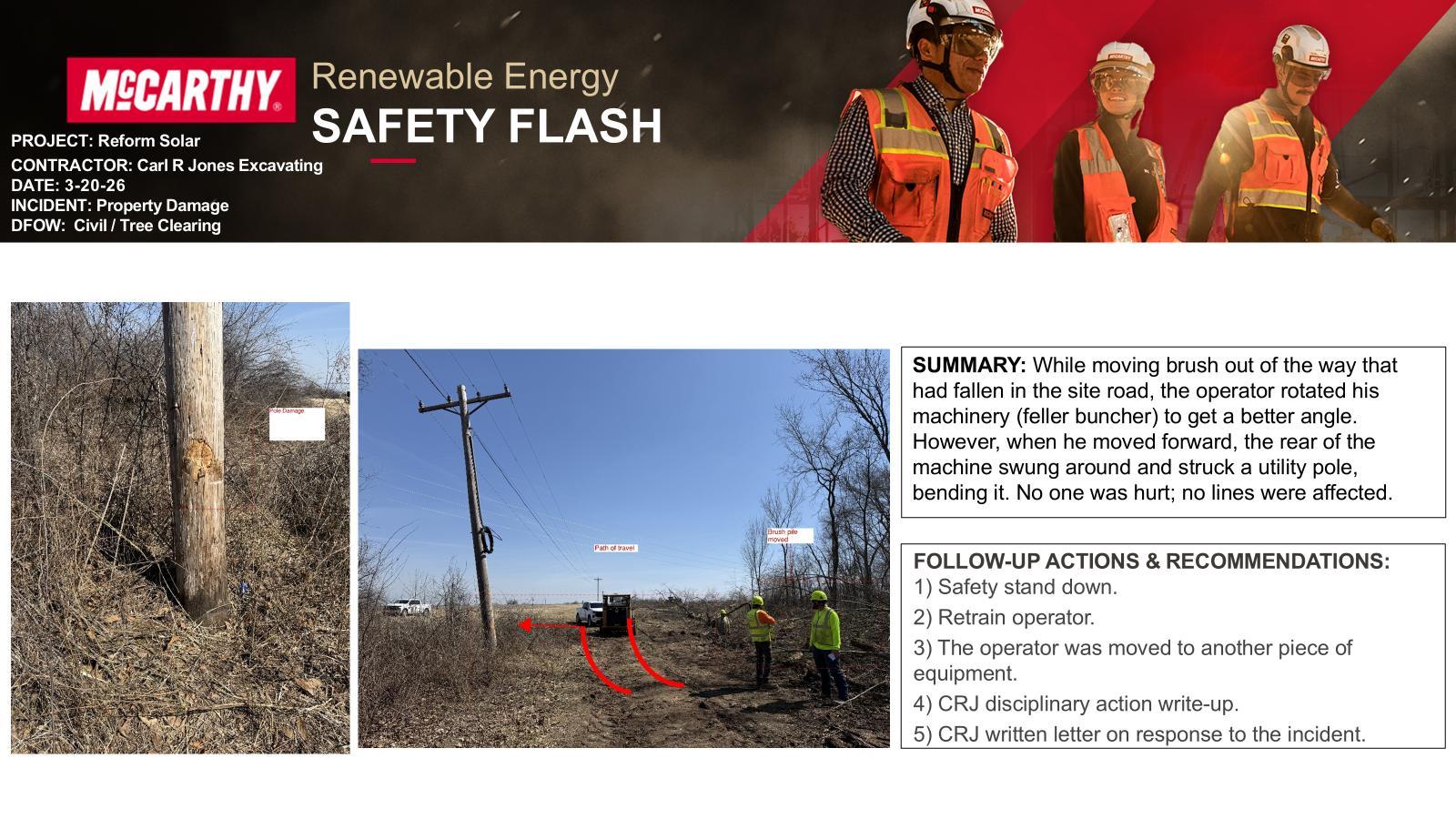
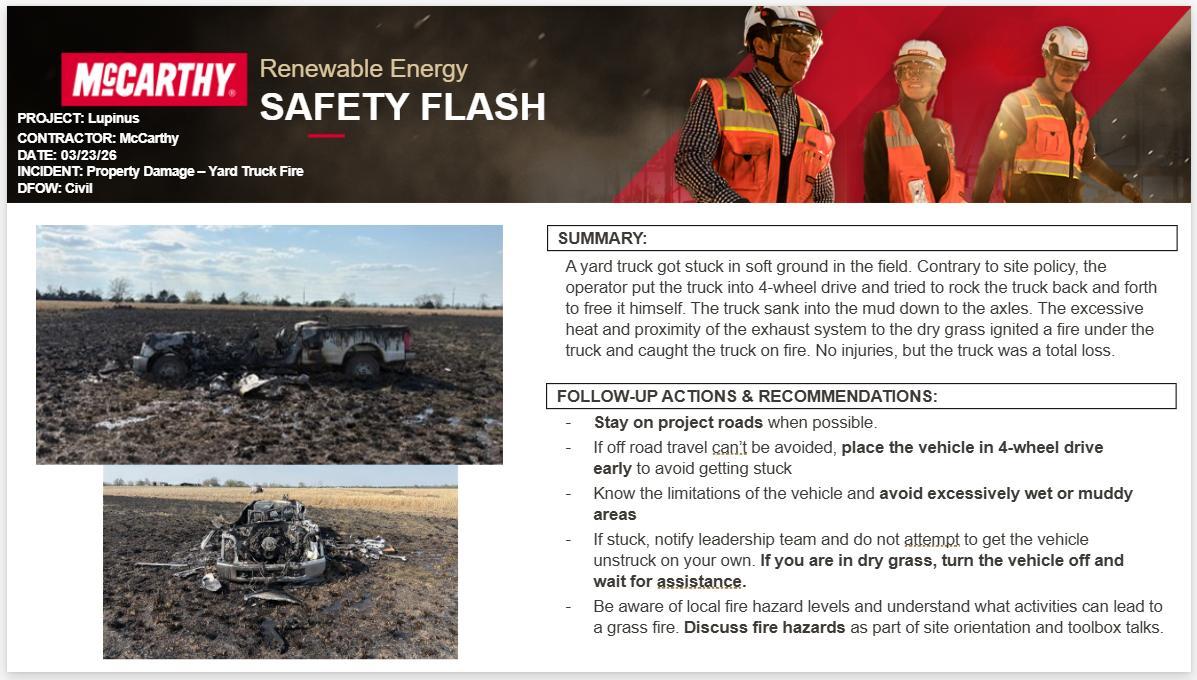
In recent weeks, we’ve seen several incidents involving property damage and grass fire ignition including equipment contacting structures, striking installed utilities and materials, and vehicles operating in combustible vegetation causing grass fires.
Scott Naumann
Regional Safety Manager
Much of the work we perform involves activities that can easily damage property or ignite dry vegetation such as operating heavy equipment near existing assets, parking and driving over vegetation, performing work with equipment in tight areas, using generators and vehicles with hot exhaust systems, and managing materials that can burn. When these exposures are not properly controlled, isolated, or verified as safe, the consequences can be immediate and severe.
As leaders and builders, we must maintain a strong awareness of where ignition sources exist, what can burn, and what property can be damaged around us when operating equipment and how quickly conditions can change with wind, heat, and dry grass. This starts during planning and continues through execution in the field. These discussions should be part of our work planning, pretask planning, and daily conversations in the field.
Reducing property damage and grass fires requires strong engagement, attention to detail, and the confidence to pause work when something doesn’t feel right. When we strengthen our hazard recognition, reinforce good housekeeping and equipment operation practices, and maintain open communication across our teams, we reduce risk and continue building a culture where protection of people, property, and the environment is truly embedded in how we work.
Thank you for your leadership and continued focus on safety every day.
Stay safe, Scott Naumann
Project Regional Safety Manger
March | Show Me The Numbers
MVP |THA Champions
2026 March Safety Champions: (Zero fail percentages excluded)
March Leading MVP Failures Champion: Bruce Anderson at our Echols/Cedar projects with 63 MVP Failures!
March Observation Champion: Joseph Gallagher at our Milford project with 78 Observations!
March THA Champion: Joseph Gallagher at our Milford projects with 49 MVP’s!
March THA (% fail, min. 8) Champion: Bruce Anderson at our Echols/Cedar project with 21% Failed!
March Project MVP Leader Ratio/Work Hours: Echols Grove with an MVP Rate of (32:1)!
Field Focus | Property Damage Prevention
In 2026 to date, we’ve had 159 incidents, including 78 with property damage. March alone saw 55 incidents, 25 involving property damage. This trend continues, and we must increase awareness and strengthen preventive measures to reduce damage to equipment, vehicles, and materials. Our focus moving forward:
•Reinforce Site-Specific Plans: Ensure every project is actively using and reviewing their Property Damage Prevention Plan—this must be embedded into daily planning and execution, not treated as a one-time document.
•Focus on High-Risk Activities: Our top incident types Struck By/Against, Material Handling (Mechanical), and Utility Strikes— continue to drive most damage events. These activities require tighter controls, defined work zones, and clear execution plans.
•Address Root Causes Head-On: Work behavior, procedures not being followed or fully developed, and communication gaps remain the primary drivers. Leadership presence and consistent reinforcement in the field are critical to changing these behaviors.
•Drive Equipment & Vehicle Accountability: Heavy equipment, construction materials, and vehicles (including UTVs and yard trucks) are most frequently involved. Set expectations for operator awareness, spotter use, and controlled movement to reduce exposure. Resource: Safety_Property Damage A3 3.pptx
Lessons Learned | Vegetation Fires
In Q1 2026, three grass fires occurred on our projects:
•An excavator working a burn pile caught fire when its battery compartment contacted flames, igniting nearby grass and burning about one acre.
•A worker transferring embers lost control of one in high winds; it spread beyond containment, but the team stopped it by cutting a fire break.
•A yard truck stuck in soft ground ignited dry grass when exhaust heat sparked a fire during attempts to free it, destroying the truck and burning about five acres.
These fires quickly contained but preventable. Dry vegetation is a major hazard, and risk will increase in the coming warmer, drier months. Fire safety must remain a core part of every Site-Specific Safety Plan (SSSP) to reduce grass fire risk. In the coming weeks, review SSSP fire protocols with your teams. Use local fire departments for training and stay alert to site conditions to prevent future incidents.
2026 THA Goal
In our latest town hall held on March 11th, we discussed the THA-MVP target threshold goal to be double the previous year. We have additional MVPs listed below that also reflect double the threshold percentage from the year before for our 2026 goals.
Here are the 2026 goal metrics that are tied to our MVP (McCarthy Vital Process) leading indicator program to measure our field engagement:
• THA - 2.28%
• Hand Injury - 9.10%
• Electrical - 4.34%
• Renewables - 3.10%
• Hazardous Energy Control/LOTO - 1.36%
McCarthy | Did you Know?
Project Highlight | Big Creek Solar Property Damage Prevention Re-Vamp
Big Creek has had a rash of property damage incidents over the past few months due to improper spotter usage, to help remedy the situation Big Creek implemented Spotter and Operator retraining. The focus is making sure that the operator and spotters are holding each other accountable and understanding Teamwork is crucial for equipment use on site. The training covers different types of spotter signals for each type of equipment being used, along with the importance of keeping eye contact with operators. The spotters and operators are instructed that if eye contact is not maintained then the work task shall stop until eye contact is re-established. Since this is a team activity, it is the responsibility of everyone involved to ensure the task is completed safely.
Re-Training Focus Areas:
• Correct spotter positioning and management of blind spots
• Standardized signals matched to equipment limits
• Joint THA/hazard assessment; stop work when new hazards appear
• Verify spotter role with supervisor if unsure
• A spotter doesn’t automatically make a task safe— both roles share responsibility
• Spotters will wear reflective vests w/ Red stripes for easy Identification
• Tests and evaluations for operators and spotters completed by supervisors
McCarthy | Reminder:
Safety Week is just around the corner, May 4 – 8th .
Please ensure that your project teams have entered your safety week schedules using the following link COMPLETE THIS FORM by APRIL 21.
Share your photos after the fact - SHARE YOUR PHOTOS HERE
McCarthy Safety Week Intranet site - CONSTRUCTION-SAFETY-WEEK-2026.aspx
External Office Construction Safety Week website - Construction Safety Week