If you would prefer not to receive a printed copy of Witness, please contact us.
Offices
4867 E. Townsend Avenue, Fresno, CA 93727-5006 USA
300-32040 Downes Road, Abbotsford, BC V4X 1X5 Canada
For other office locations, see multiply.net
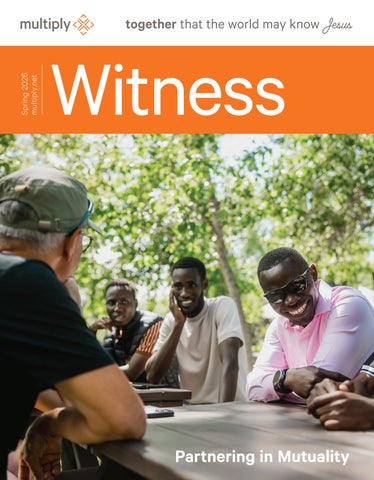
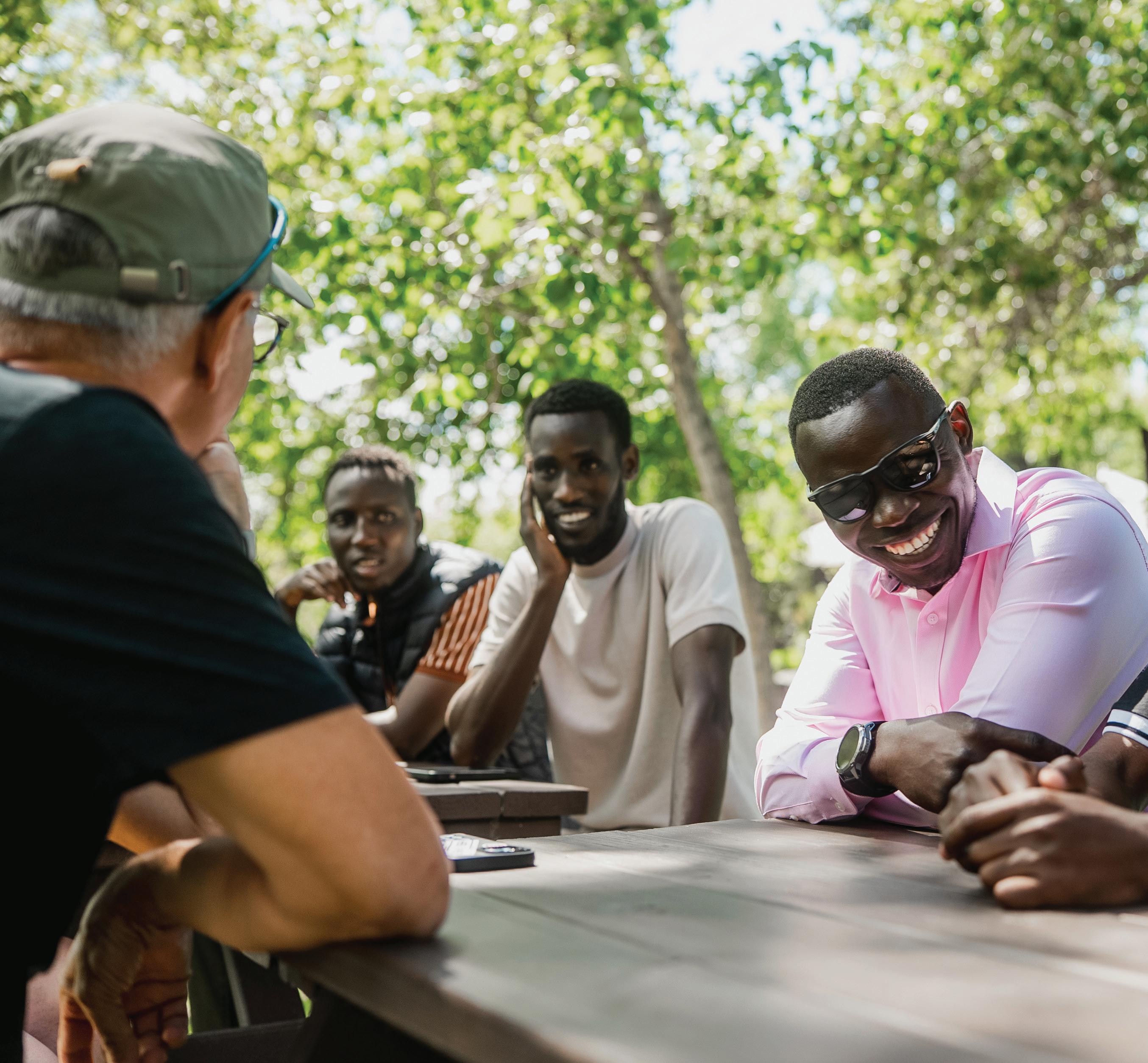
Partnering in Mutuality
By Bruce Enns
Created for Community
While the Trinity might be hard to explain, I love the image of community found in God the Father, Son, and Holy Spirit. God has created us for community, yet one of Satan’s most persistent lies is that we are alone. Scripture confronts this lie directly. God is with us—always. The psalmist declares that there is no place, no depth, no distance where God’s presence fails:
Where can I go from your Spirit?
Where can I flee from your presence?
If I go up to the heavens, you are there;
If I make my bed in the depths, you are there…
~ Psalm 139:7–12
This promise anchors our faith. We are never abandoned by God. And we are not meant to live out our faith alone. We are created for community.
Together as a Way of Discipleship
Within the Anabaptist tradition and within the Mennonite Brethren family is the conviction that discipleship is communal. Following Jesus is not an individual project; it is a shared journey. The word “together” is more than a tagline for us. It is a theological conviction and a goal to aspire to.
We walk together as disciples of Jesus in our local churches. We walk together across conferences and nations. Multiply serves alongside U.S. and Canadian MB churches, and together we walk with our global MB family in God’s mission.
When Words Fall Short—Relationships Speak
Several years ago, leaders from our church gathered in Panama with national leaders and missionaries, celebrating eighteen years of shared ministry partnership. We praised God for what He had done and discerned what our relationship might look like in the years ahead. During those conversations, we made a surprising discovery: there is no Spanish word that fully captures what we meant by partnership.
That realization caused us to pause. For nearly two decades, we had been using a word that did not translate across our cultural divide. It reminded us that words matter—and so do cultural and linguistic differences. Yet our shared history tells the story. In Panama, the way we had lived and served together embodied what we meant by partnership.
Partnering in Mutuality
This experience reinforces one of our deeply held values: wherever we serve, we seek to partner in mutuality. But what does that mean?
At its heart, partnering in mutuality recognizes that God has gifted the global Church broadly and beautifully. No church, culture, or region holds all the wisdom, resources, or initiative needed for God’s mission. We all come as both givers and receivers, but committed to one another.
The story of Ruth and Naomi offers a powerful picture of this posture. Ruth’s commitment—“Where you go, I will go… your people will be my people, and your God my God” (Ruth 1:16–18)—is not transactional; it is covenantal, relational, and rooted in shared belonging and family. Mutuality grows from this kind of faithfulness and commitment to one another.
The apostle Paul echoes this vision in Romans 12. He urges believers not to think too highly or lowly of themselves, but to honestly discern the gifts God has given by grace and use them for the good of the Body. This is mutuality in practice: knowing humbly the gifts that you have, appreciating the gifts in others you don’t have, and sharing and receiving together for the sake of the Church and God’s mission.
Learning to Release and Receive
Across the regions where we serve, we are witnessing increasing maturity, capacity, and fruitfulness within the global Church. This growth also reveals the limitations of mission approaches shaped primarily from North American perspectives. Multiply has long recognized the need to release more strategy, vision, and resourcing authority to regional teams and local church leadership.
We are intentionally moving toward peer-to-peer relationships within a global network, where each region participates as both contributor and beneficiary, with NA missionaries and national leaders working side by side. This posture emphasizes collaboration, shared discernment, and mutual learning, and nurtures deeper unity in the global Body of Christ.
A Biblical Pattern of Partnership
The New Testament offers models for this kind of relationship. The apostle Paul’s partnerships with churches were long-term and reciprocal. Churches offered financial and material support; Paul offered teaching, encouragement, and leadership development. He returned often, invested deeply in leaders, and strengthened congregations for long-term health and multiplication.
This mutual exchange fostered sustainability and resilience in the early Church. Mission was not something Paul imposed upon churches, but something he pursued with them.
Walking Forward Together
This is the posture of partnering in mutuality that we want to grow into together, working with and through local churches wherever possible. Partnership can be challenging. Cultural differences, language barriers, and differing expectations require patience and humility. But these challenges are worth it.
Healthy partnership calls us to listen well, learn from one another, and honor local vision and expertise. God has blessed the Mennonite Brethren family with gifted and faithful national leaders around the world, and it is a privilege for the North American Church to walk alongside them to give, to serve, to learn, and to receive. We need to train and send more NA workers who can serve in this way and be bridges between NA and other regions of the world.
Ultimately, we believe the Great Commission is fulfilled best through global collaboration. God’s mission belongs to the whole Church. As a global family, we desire to love one another and work together in humility and sincerity—for the glory of God— together, that the world may know Jesus
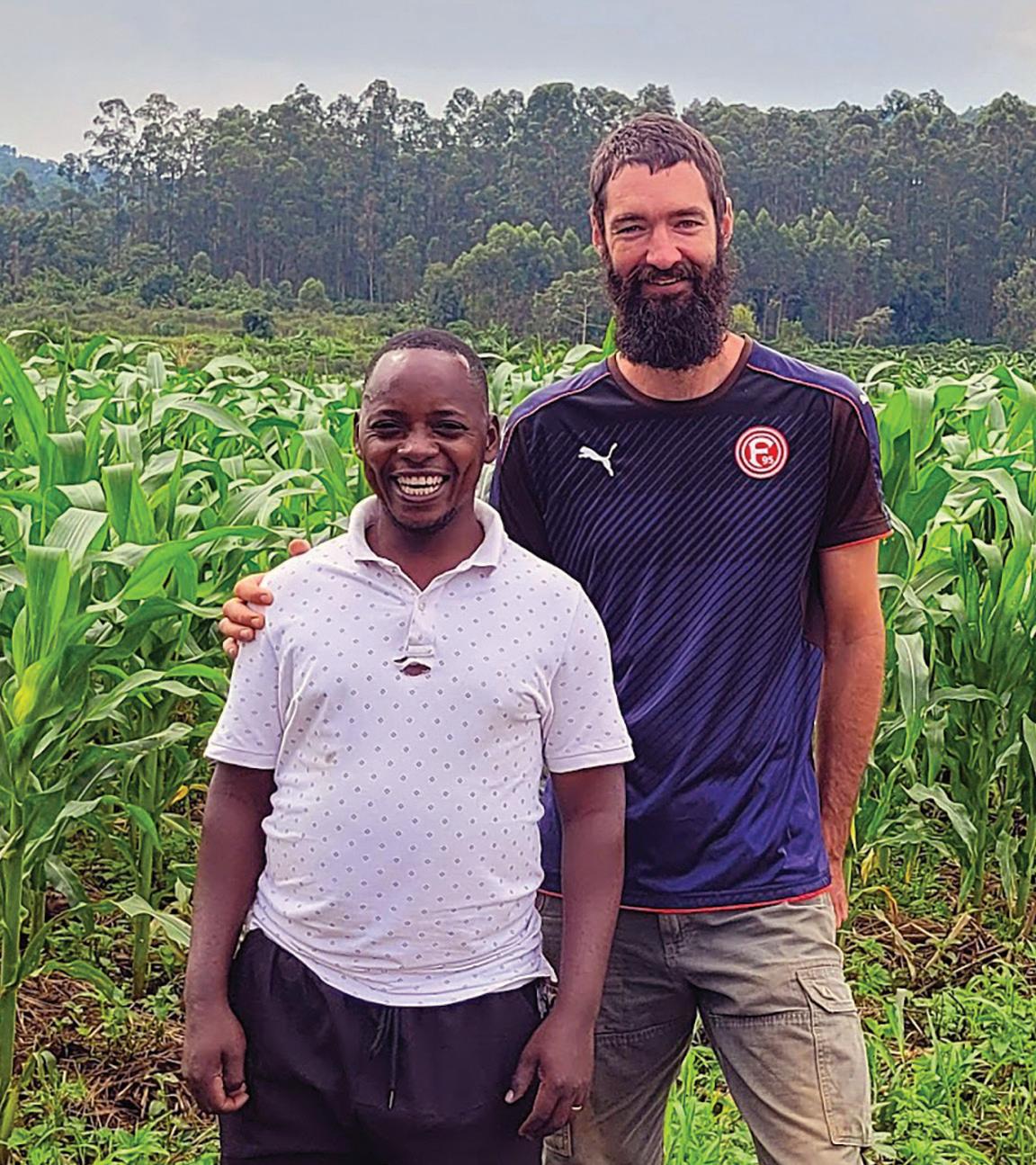
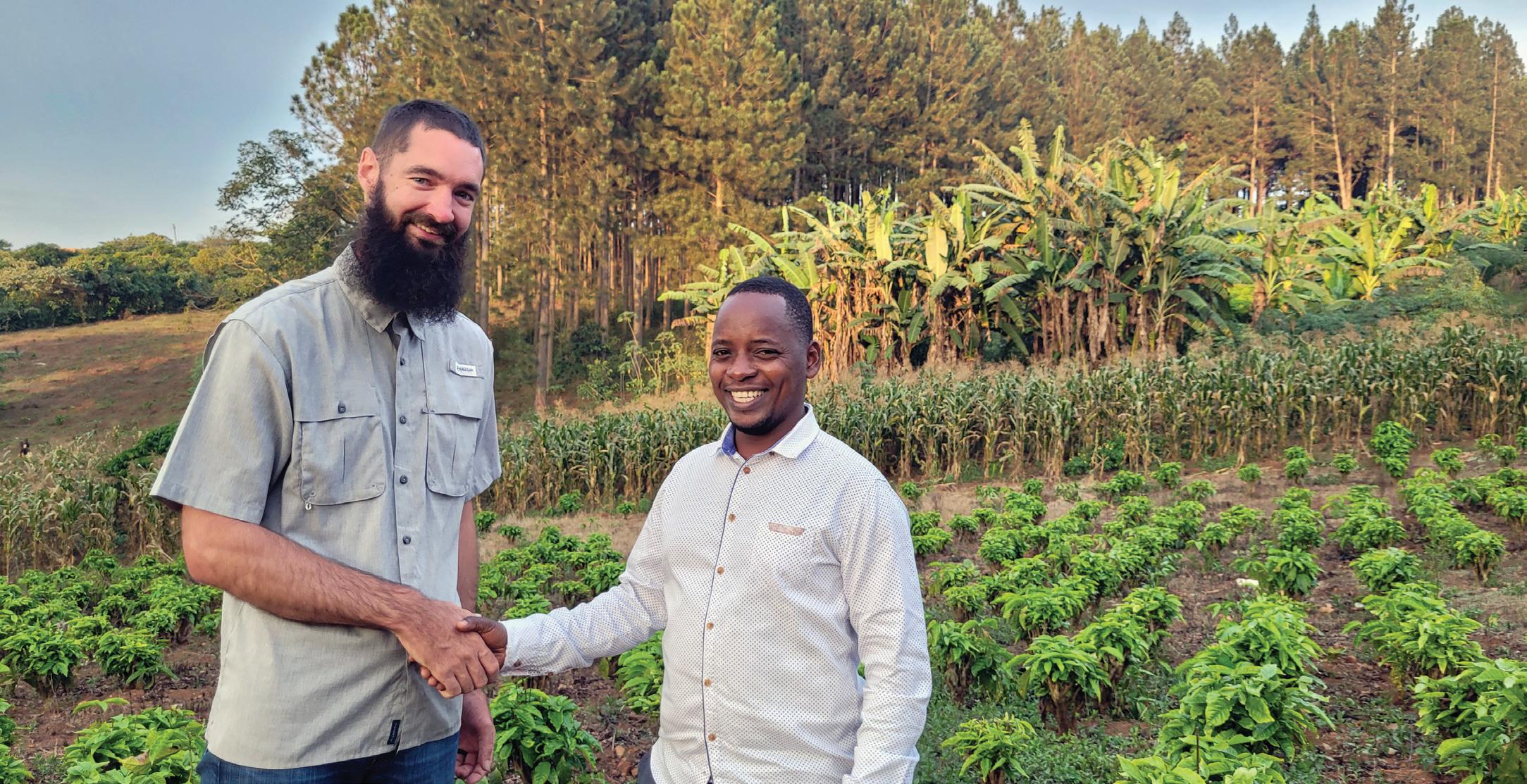
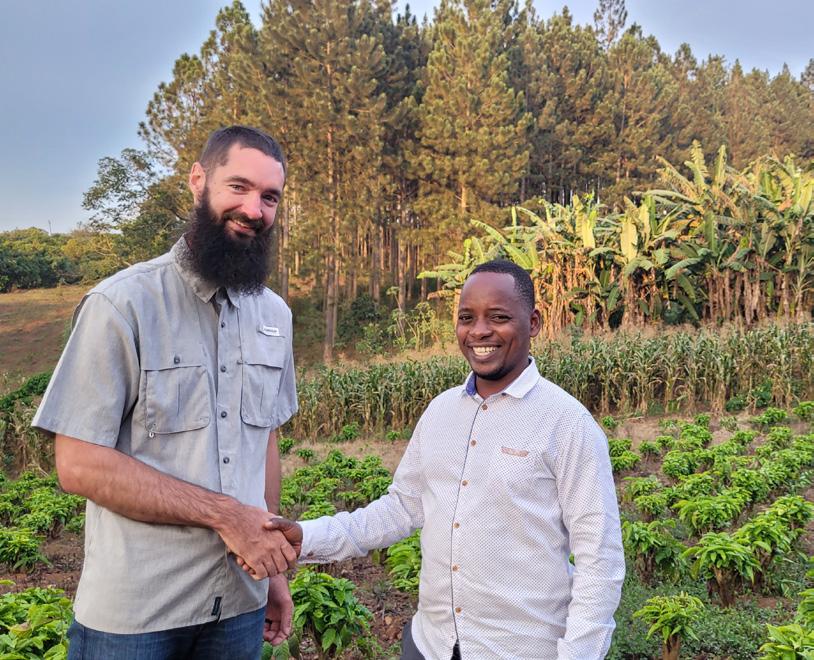
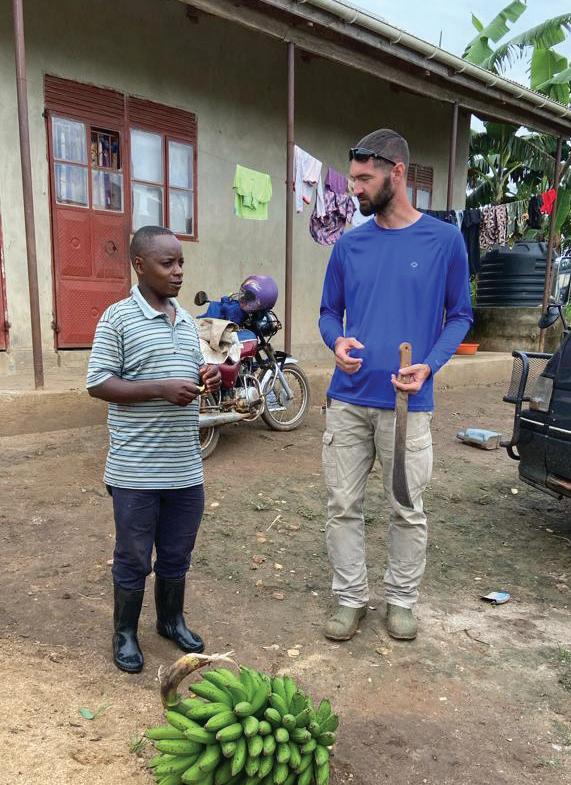
Kyle & Tony partnering for the Gospel in Uganda (page 4)
Banana Leaves and Brothers
UGANDA | By Nikki White
There was a moment when he wondered, “What am I doing here, trimming dead leaves off banana trees, week after week?”
When Kyle and Danae Schmidt first arrived in Uganda in the fall of 2022, Kyle was eager to learn all he could about the people, the culture, and the work on King’s Kid farm, a sustainability initiative supporting King’s Kid school. The vision of the farm was to help feed the students and staff, lessening their dependence on foreign aid.
Kyle, however, was not a farmer.
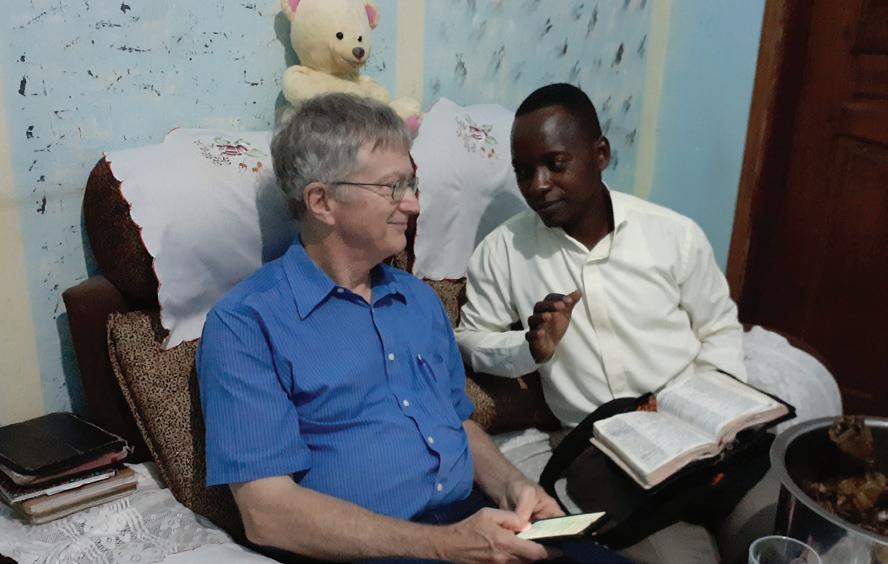
“As a carpenter and woodworker,” Kyle said, “I didn’t know a whole lot about farming! So I figured, if I wanted to learn about farming, I should hang out with a farmer.” Kyle began spending time with Tony, a worker at the farm. “I offered to help him pull the dead leaves off of the banana trees. I was motivated!”
“I started to wonder, am I wasting my time? This was not the work I expected to be doing in Uganda. What were we even accomplishing?”
At first, Kyle’s enthusiasm was carried along by the surreal experience of working on an African hillside overlooking a beautiful, lush valley, and the satisfaction of working shoulder-to-shoulder with Tony. Then the novelty wore off. “I started to wonder, am I wasting my time? This was not the work I expected to be doing in Uganda. What were we even accomplishing?”
Despite that early sense of frustration, over time Kyle began to realize that it wasn’t about the work; it was about relationship. “While we worked, we began to have
more and more conversations,” he related. “I would ask Tony about things I observed in his culture, about his love for evangelism, about what we were both learning from Scripture.”
They also talked about farming.
Both Tony and Kyle wanted to make the King’s Kid farm more productive, so that the school could become self-sustaining. “As we grew more comfortable with each other,” Kyle remembered, “I began to toss some ideas his way. Some he just threw aside, saying, ‘We’ve tried that, it doesn’t work here.’ Other ideas, he liked. We spent months this way—working, talking, having meals at each other’s homes. Then, one day, I went with him to his son’s kindergarten graduation, a two-hour drive. It took our relationship to a whole other level. We were now like family, like brothers.”
By spring of 2024, Kyle felt like a farmer. He had learned about growing maize in Uganda, and began to take on more management at the farm. Together, he and Tony began to imagine new ventures, and changing simple things, like using better seeds and improving the spacing during planting.
“Then, in July of that year, Tony and I went together to a training workshop on regenerative farming methods, called Farming God’s Way.” Kyle paused. “That was a game-changer.”
Employing these farming methods, they worked hard together to prep the fields, lay mulch and build compost piles. They talked excitedly about how, after a few years of stewarding the soil, they might increase the yield enough so that King’s Kid School could feed their students without relying on outside funding.
“We changed things up, we took a risk,” Kyle said. “And it worked!”
“Through
One day, again laboring shoulder-to-shoulder with Tony, Kyle reflected that the fruitfulness of the fields was nothing compared to the fruitfulness of their friendship. Together, they were stewarding not only the land, but one another’s lives.
“Through Tony, God was teaching me the importance of relationship over productivity,” Kyle said. “It was hard to break my Western habits, though!”
“Prioritizing relationship means that one day, long after we are gone, there will be people here who will carry on the work that we began together, as friends.”
Recently, while Tony was away with some unexpected church ministry, Kyle felt overwhelmed by all of the urgent things needing to be done at the farm to prepare for the upcoming rainy season. “The entire time,” he commented, “I just kept imagining us launching into work together, the moment he returned. Then God convicted me, again.” Instead of imagining getting up at the crack of dawn and seeing how much they could accomplish on the farm, Kyle began to imagine a more relational—and far more likely—scenario.
“We would still wake up early, but I would have to put aside my own agenda,” Kyle said. “We would take our time, sit down to eat a leisurely breakfast together, talk, catch up on what had been going on in each other’s lives. Then, probably around 10:00 AM, we would finally head out to the fields and start work.” Despite the urgency he felt to get things done, Kyle knew that the true urgency was about the reunion itself; it was about being together.
“I’ve learned so much from Tony,” Kyle concluded. “My whole approach to life has shifted profoundly. I still instinctively want to do things my Western way, emphasizing productivity. Yet, if I did this—and even if I were to have a lot to show for all my efforts—without relationship, the results would not endure the test of time. Prioritizing relationship means that one day, long after we are gone, there will be people here who will carry on the work that we began together, as friends.”
GIVE
You can be part of what God is doing at the King’s Kid Farm in Uganda by giving to support their poultry project. This project will be a selfsustaining business initiative that generates income for the King’s Kid School. To learn more, go to multiply.net/kings-kid-farm
Tony, God was teaching me the importance of relationship over productivity.” ~ Kyle
Even in the Shadow
ASIA | By Wai Wai Ton
I kept it a secret for two years. No one but my family knew how sick I really was.
One day, as I walked along a dusty road, I fingered the layers of cloth wrapped tightly around my neck. Underneath, the gaping, infected holes in my skin were causing me excruciating pain. It was also an unbearably hot afternoon, and my dress clung to my legs. I longed to feel the breeze on my bare neck, but I did not dare remove the wrappings. The witch doctor had warned me, “If you show your disease to anyone, you will die.”
Fear kept me silent. I walked on, feeling like I was surrounded by a dark shadow.
Unexpectedly, a woman I did not recognize smiled at me, and began to draw alongside. She was not from my village of Lin Thae, and looked harmless—but with the civil war skirmishes getting closer, my guard was up.
“My name is Lai Ya,” she said. “May I walk with you?”
Something in her eyes made me want to trust her. It was only a brief encounter, but her gentleness touched my heart. I thought I would not see her again, but over the days and weeks that followed, Lai Ya persisted in seeking me out. Over time, we became friends.
Eventually, she asked about the cloths around my neck. I told her, “It would only disgust you.”
“No,” Lai Ya shook her head. “Nothing will make me turn away from you.”
Slowly, I unwrapped my neck to show her the seeping, infected ulcers beneath. I could see that she was shocked, but the expression on her face was not disgust but deep compassion. She said, “I don’t know what this disease is, but if you allow me to take a photo, I will send
it to my Canadian friends and teammates in Thailand. They will help us find the answer. Right now, though—we need to take you to the hospital!” The nearest hospital was a full day’s journey away. I could not believe that anyone could care enough to do this for me!
“Jesus saw you on the road that day, and sent me to you.”
As we travelled together, Lai Ya began to tell me more about the god she serves. I had heard of Christianity, but never before spoken with one of its followers. “Jesus saw you on the road that day, and sent me to you,” she told me. Listening to Lai Ya, I felt comforted to think that there was a God like that, who saw me, even in my hiddenness.
The doctor was alarmed when he examined me. He took an x-ray of my lungs, thinking that this could be the source of the infection, but the x-rays were clear. Meanwhile, Lai Ya heard back from her missionary friends in Thailand.
“We showed the photo to a doctor in Bangkok,” they said. “He is sure that it is Tuberculosis! TB usually affects the lungs, but it looks like you have the disease in your neck. The doctor says that if you start medical treatment now, it will save your life!”
I was so thankful to hear this. But why had the witch doctor told me to hide my condition?
During my time at the hospital, I recovered fully and the scars on my neck began to heal. When I returned to my village, I felt deep gratitude toward Lai Ya. I considered telling my family about Jesus, but again, fear held me
back. I had disobeyed the witch doctor, and with my family’s strong animist and Buddhist convictions, I was forbidden to have anything to do with Christianity.
To my shame, I avoided Lai Ya.
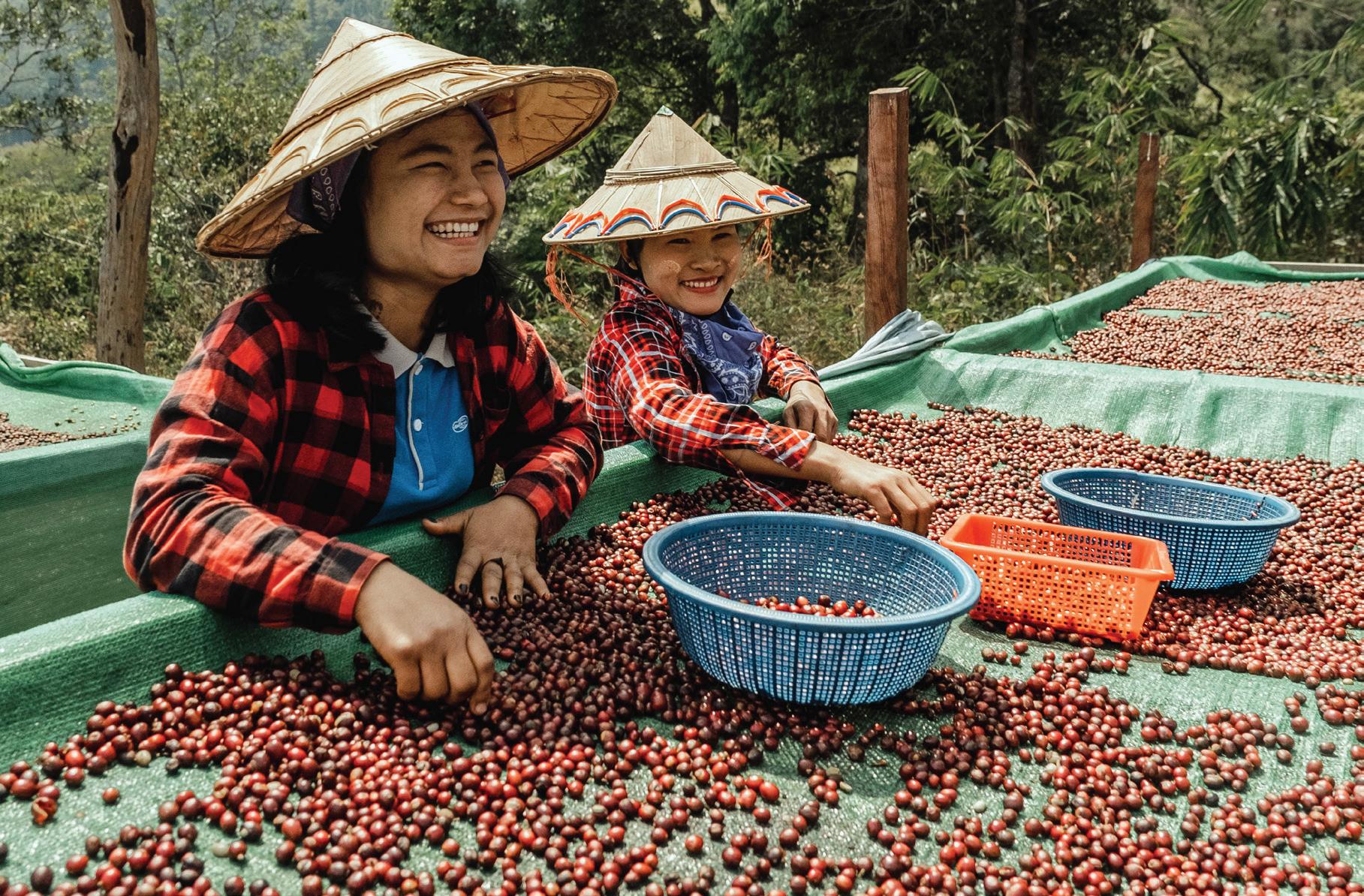
Life became more difficult. The war was close; work was scarce. Our family often went hungry, and struggled to afford school fees. During this time, Lai Ya kept seeking me out. “Why don’t you come and work with us on the coffee farm?” she asked, on one occasion. “We always need extra hands during the bean sorting season.” I gratefully accepted.
The farm was full of women just like me–Buddhist, internally displaced by the war, and very grateful for a safe environment to work in. Each day, we heard stories about Jesus from their holy book, sang, and prayed. When I was told, “God is love,” I knew it must be true; I felt so loved and accepted. During that season I saw twenty-eight of my fellow workers put their faith in Jesus and receive baptism. I wanted to follow, but I was afraid to face the anger of my parents. So I told them, “I don’t believe Jesus is God.”
After the season ended, I returned to my village. The problems my family was facing were even more than before! I wanted to tell them about Jesus, but was still hesitant. Then, I wondered, “What if I prayed in secret? Maybe He will hear, and answer me.”
On the first day of work back at the farm, I surprised myself. All the new Buddhist coffee sorters were sitting there, and I stood up and declared, “I have seen with my own eyes that Jesus is God!” That year, I studied the Scriptures with faith and love in my heart for Jesus. Everything I read felt fresh and alive and personal.
I knew it was time to tell my family. Upon returning home, I shared my testimony of God’s healing, power and provision in my life. My two sisters and brother could see the change in me, and they immediately placed their faith in Jesus. After listening to an MP3 Solar Bible I gave him, my father said, “This story is truly amazing! I never knew about the goodness and power of this God before!”
“I have seen with my own eyes that Jesus is God!”
I told no one, but began quietly praying to Jesus. Almost immediately, we began to experience unexpected help and provision and, the more I prayed, the more peace and joy filled my heart. So, when Lai Ya asked me to return for a second season, my answer came quickly: Yes!
I was glad they believed, because I knew God was calling me to serve Him for the rest of my life, sharing the Gospel with others. My life was once marked by fear, silence and shame. Now I love to testify boldly to others about Jesus–the God who sees all, even in the shadow.
PRAY
Ask God to continue building His Church in Asia through the bold testimony of believers like Wai Wai and Lai Ya. Pray for many families and entire communities to put their faith in Jesus.
I appeal to you, brothers and sisters, in the name of our Lord Jesus Christ, that all of you agree with one another in what you say and that there be no divisions among you, but that you be perfectly united in mind and thought.
- 1 CORINTHIANS 1:10
Be devoted to one another in love. Honor one another above yourselves. - ROMANS 12:10
Carry each other’s burdens, and in this way you will fulfill the law of Christ.
- GALATIANS 6:2
For where two or three gather in my name, there am I with them.
- MATTHEW 18:20
Becoming the Prayers
We Pray
EUROPE/CENTRAL ASIA | By A & R
When Turks look at Christians, they don’t think good thoughts. They think about Turkish history, about Constantine and the Crusades. They think Christians only want to conquer, divide and destroy. The reputation of the Church has been, for them, stained and soiled. Like dirty laundry.
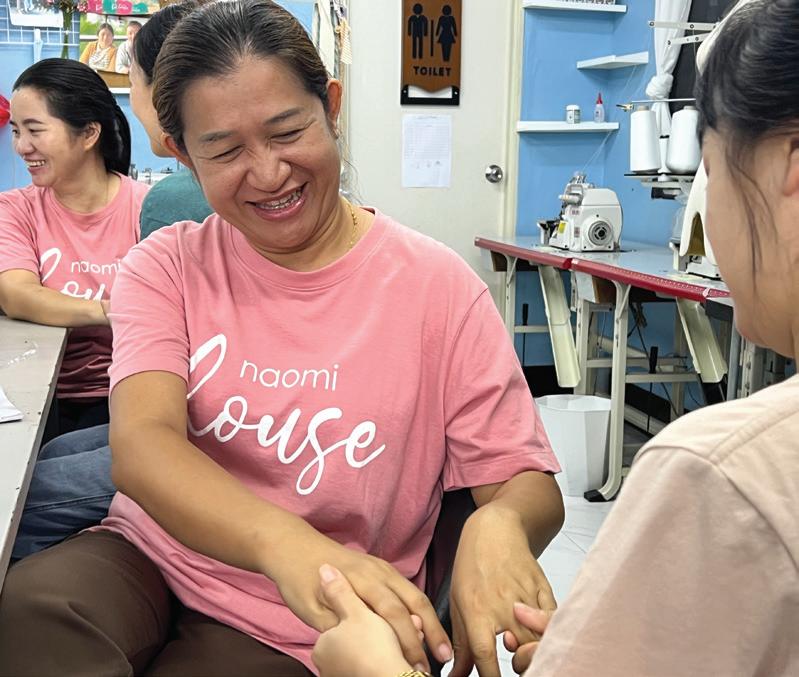
So, when the local church we partnered with opened a free laundromat, it was a way to be the hands and feet of Jesus to a community that had little reason to trust Christians. Our national partner who pastors this church had a dream to reach out to refugees in our city, and saw that there was a practical need for accessible laundry facilities–not just for comfort, but to help prevent the spread of disease.
The free laundromat facility actually got air time on local television: “Hey look, these Christians are caring for Muslims, the poor, refugees. Whoever wants to, can go and get their laundry done for free!”
People started lining up, first thing in the morning. That laundromat washed over 100 loads a day, six days a week. Even while customers waited to drop
off their clothes and linens, some were skeptical; no one does anything for free in this city. It is known for its thriftiness, full of people who haggle to get a good bargain. In fact, it has been a center of business for over 6000 years! This city was the first trading post on the Silk Road. In the northern part of the city, archaeologists actually found clay tablets with some of the earliest samples of literacy. They were grocery lists.
A free laundromat was our way to break the stereotype that Central Asian Muslims have of those who follow Jesus. Our tourism business was meant to do that, too—employing locals, contributing to the local economy. It also allowed us to maintain a long-term visa in this country, a country that was once a thriving center of first century Christianity.
It started with a dream. When we first came in 2011 on a vision trip, we went to visit an old monastery. I had an impression of a barely noticeable remnant of the vibrant church that was once here: embers burning low, with the Holy Spirit wanting to blow on them so they could blaze into flame again. Sometime after that–while we were in this country discerning where to live, long term–I had a dream. It was probably one of the scariest dreams I ever had.
I felt the fear of God in such a powerful way, because Jesus was there; this fiery, molten Jesus like you see in Revelation. He was calling us to settle in the very centre of the country. When I said, “Yes,” it felt like I was just putting a period at the end of His sentence.
That was over twelve years ago. It’s been so good. We’ve seen people come to faith, including some of the employees in our tourism business. We’ve baptized whole families. We
had a thriving church of seventy people. Yeah. Seventy believers in a city with two million people may seem like a pretty low percentage, but God is in the business of multiplication.
We trust Him to do that, with or without us, because this year we had to leave.
Leaving Central Asia was painful, especially for our kids. It was our home for over twelve years; it felt like home the minute we first stepped off the airplane and onto the tarmac. When we were told that we were going to be deported and never be able to set foot in this country again, our family was devastated. Devastated, but not surprised. Heartbroken, but not despairing. Although we were never given a clear reason as to why we had to leave, we know that we were deported for being Christians, for telling others about our Saviour, for working with the church.
We still had vision. We always had a vision to reach Muslims, disciple new believers and raise up national church leaders to plant churches. We were praying for this long before we ever launched into Central Asia. It was one thing to pray from a distance; it was a whole different reality to be with those that we had interceded for, to actually become the prayers that we were praying. That presence, that incarnating of the love of God, that’s what actually brings transformation in people’s lives— being the hands and feet of Jesus on the street, in coffee shops, in churches, in our business, in our home.
It was still our mission; it was still our calling. We still felt sent—but where?
Everything was happening so quickly, but we could not let prayer be rushed. So many people were praying with us, praying for God to make clear this next stage of mission. Together with our friends and other believers, we discerned His leading: to relocate to an island in the Mediterranean, just off the coast of our target country.
And so, here we are: still on mission. We continue to fulfill our calling, serving church planting initiatives among the Turkish-speaking diaspora, hosting global workers and pastors from our original location, raising up national church leaders to reach the Muslim people group with the good news of Jesus Christ. God is still at work, and we are still eager to respond to the invitation to be His co-laborers.
The island does not quite feel like home; not yet. But Jesus is here, and home is wherever He takes us.
GO
You can reach out to internationals and people from unreached people groups in your community and around the world. Train locally. Go globally. multiply.net/go
To Be Her Legs
South Asia | By Nikki White
Marieke Mostert was only seven years old when she was hit by a car while cycling to school in the Netherlands. As she hovered between life and death, her parents were likewise suspended in the in-betweenness of trauma. When days passed and their little girl did not die, they allowed themselves to hope that she would, in fact, wake up and recover.
Two months later, Marieke had still not woken up. The lengthy coma took its emotional toll on her mother and
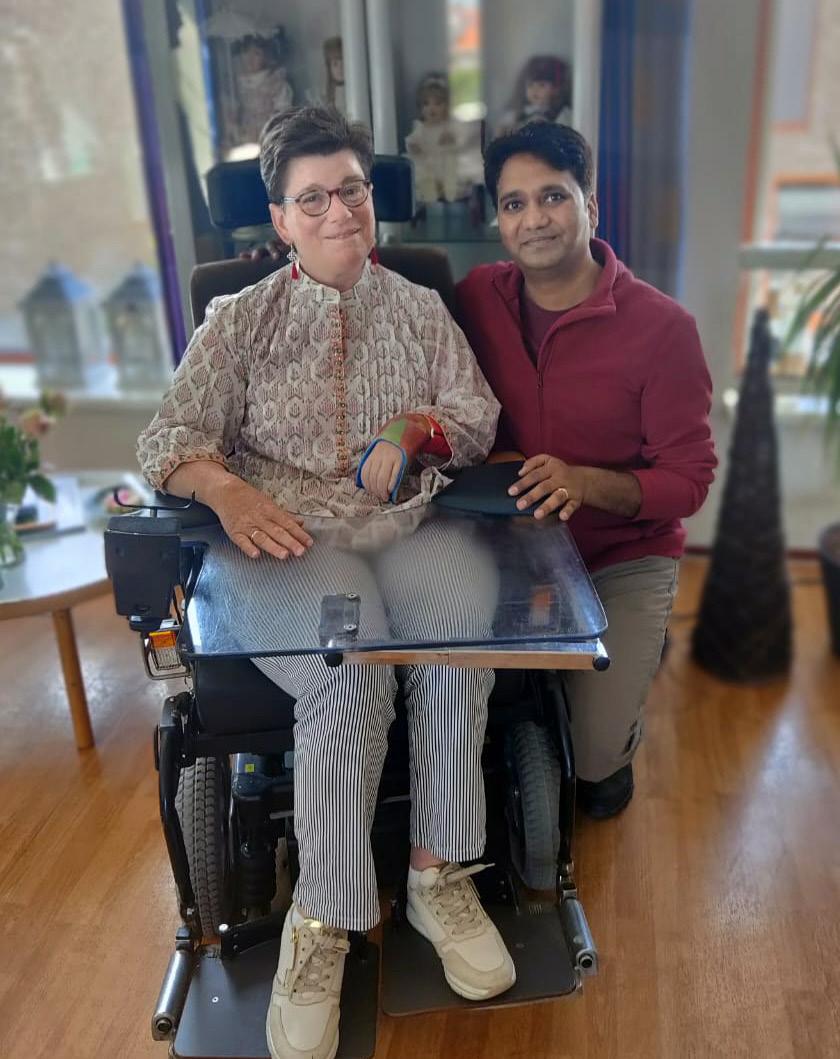
It was a deeply emotional experience for all. It took Marieke (L) some time to understand who Jaeem (R) was, but as he expressed his profound gratitude and prayed for her, she began to weep happily with the realization.
father, but they cast themselves upon the God of mercy, and humbly asked Him for the strength to endure this new reality. While caring for their comatose daughter, life went on. Little changed in Marieke’s condition. Until, one day, it did.
When her eyes fluttered open that day, her parents caught their breath. Was their Marieke coming back to them? It became evident, however, that she was not the same little girl that had cheerfully pedaled off to school that day. Marieke had no memories of her childhood, could think and communicate only with difficulty, and was paralyzed.
They cast themselves upon the God of mercy, and humbly asked Him for the strength to endure this new reality.
There was a great sadness in recognizing these disabilities, but also a sense of joy that their daughter was no longer in a coma. She was awake, aware, and engaged, and they poured out their love on her. Government compensation allowed for specialized equipment, such as a wheelchair, and Marieke soon became again a vital part of their growing family, as five younger sisters and three younger brothers were added. It was a big family, full of rambunctious good humor, hard work, and the love of God.
Then, when Marieke reached the age of seventeen, her parents felt an urge to somehow express their thankfulness to the Lord in a tangible way. The government compensation they received for their daughter was more than enough to meet her needs; could these funds also be used to invest in another child’s life?
The Mosterts were familiar with organizations which offered opportunities to sponsor children in need. Perhaps they, whose daughter would never walk, could help someone else’s son or daughter to walk in the ways of the Lord. With much prayer, Marieke and her parents looked through one organization’s photographs of children in impoverished circumstances. Their hearts yearned tenderly over all of the children they saw. Then, suddenly, there he was: a six-yearold boy living in an orphanage in India. This was the one, their hearts told them. His name was Jaeem.*
Then, suddenly, there he was: a six-year-old boy living in an orphanage in India. This was the one, their hearts told them. His name was Jaeem.
Marieke and her parents supported Jaeem for almost fifteen years. Growing up in the orphanage, Jaeem met and was mentored by one of Multiply’s global workers and, with wise counsel and generous financial support, he went on to pursue post-secondary education. Eventually Jaeem would become a pastor who, along with children of his own, would volunteer at that very same orphanage.
Jaeem treasured the letters written to him over the years by the Mosterts. One contained a photograph of Marieke, smiling from her wheelchair. He would pull out that picture and reflect on how she had helped transform the course of his life. “One day, Lord,” Jaeem prayed, “help me find a way to go to the Netherlands and thank her in person. Until then, may I be worthy of her kindness. May I serve you in the ways that she cannot–may I be her legs in the Kingdom of God. “
Jaeem found Marieke’s contact information on social media in 2012. By then, he was married, and his life was a balancing act of full-time ministry, graduate studies, and the economic strain of raising a young family. Still, his resolve never wavered. Somehow, he would find a way to meet her.
It took him ten years to save enough for the flights and visa. He then emailed the Mosterts, explaining who he was, and humbly asked permission to come in the spring and meet their daughter. They were elated. The elderly couple went to meet Jaeem at the airport, eagerly taking him home to meet Marieke and the rest of their family. It was a deeply emotional experience for all. It took Marieke some time to understand who Jaeem was, but as he expressed his profound gratitude and prayed for her, she began to weep happily with the realization
“Thank you,” Jaeem told her brokenly. “You have changed my life. All of you,” he added, looking around the room at those who had supported him for so many years.
“We love you, Jaeem!” was the warm reply from Marieke’s parents. “You are as a son for us; we are your father and mother in Christ.”
Returning to India and to the ministries in which he serves, Jaeem has reflected on how the love and generosity of one who could not even walk has helped him to walk further in the Kingdom of God than he had ever imagined possible.
GIVE
You can help Multiply’s global workers and national partners, like Jaeem and his wife Manju, respond to needs all around our world by making a donation to our Where Needed Most fund. You’ll be supporting urgent ministry needs as they arise and your gift will have an eternal impact. multiply.net/give
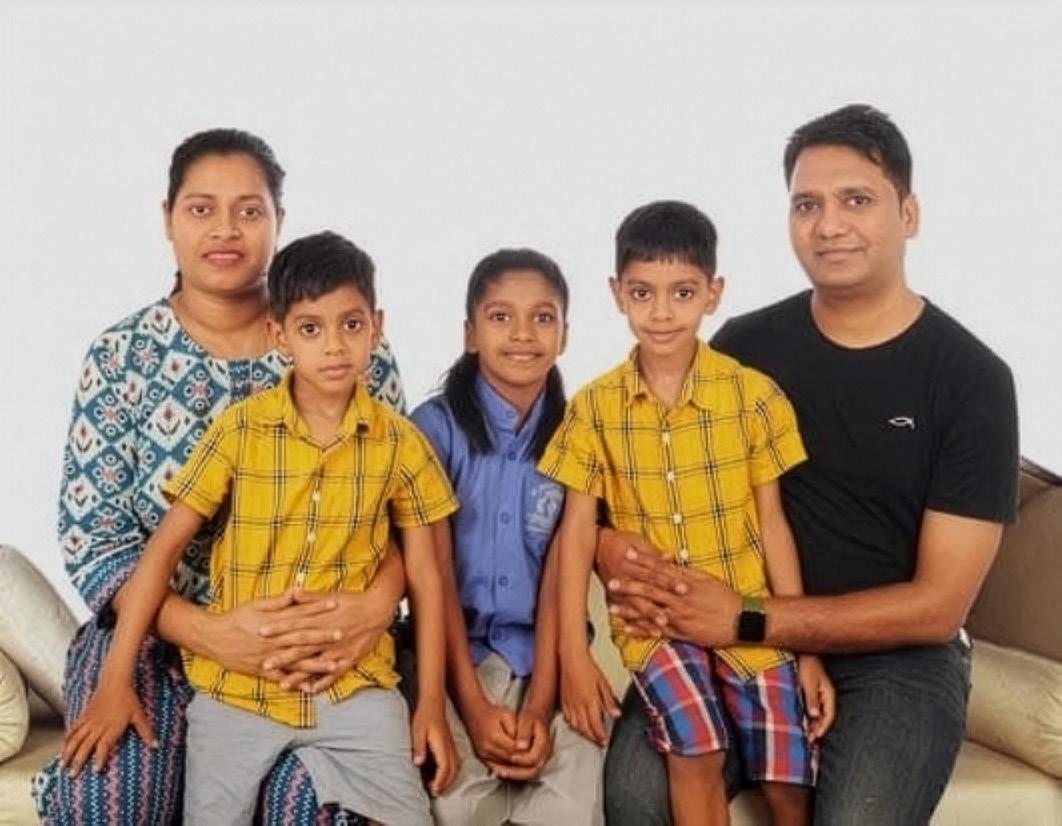
Jaeem and his wife Manju serve in partnership with Multiply in South Asia and continue to pastor several house churches, as well as providing discipleship and micro-business training for a network of churches. They have a seven-year-old daughter and twin fiveyear-old sons.
*Jaeem’s story was published in the Winter 2023 edition of the Witness and can be read here: multiply.net/come-to-the-wedding
The Greatest Quest
By Christopher Lane
“We
are plain quiet folk and have no use for adventures. Nasty, disturbing, uncomfortable things. Make you late for dinner!”
- The Hobbit
There’s a scene in the early moments of Peter Jackson’s movie, The Hobbit, that always makes me smile. Bilbo Baggins (the character from the title) is chosen by Gandalf (the wizard) to be part of a great adventure and suddenly finds himself reluctantly hosting a motley group of raucous dwarves.
Amidst their loud and obnoxious eating and drinking, the discussion eventually turns to the purpose of their upcoming quest: defeat a dragon and recover a treasure. As one of the dwarves points out, the task would be difficult enough for an entire army. But with a party of just thirteen—“and not thirteen of the best nor the brightest”—it’s virtually impossible.
“Do you forget,” another argues, “we have a wizard in our company. Gandalf will have killed hundreds of dragons.” When asked exactly how many dragons he has killed, Gandalf chokes on his pipe. The implied answer: zero.
It reminds me of Jesus’ first disciples. He chose an odd, hodge-podge of individuals to turn the world upside down.
Yet off they go, a rag-tag collection of inexperienced, would-be heroes intent upon defeating whatever evil they might encounter.
It reminds me of Jesus’ first disciples. He chose an odd, hodge-podge of individuals to turn the world upside down: several fishermen, a tax collector, a zealot, a thief... There were no rabbis, no trained scholars or teachers. They came from radically different backgrounds and had radically different agendas and perspectives. Their personalities didn’t always jive and they often competed with each other for their Master’s attention.
At one point, as Jesus prepared to endure the suffering of the cross, they were busy arguing about which of them was the greatest (Luke 22:24).
There were no “dragonslayers” among them. Yet Jesus commissioned this crew to engage in the greatest quest in history: to partner together in taking the Gospel to the ends of the earth and in making disciples of all nations.
The situation becomes even more curious when we insert ourselves into the story: imperfect, frail, undependable, and fickle creatures whom God has asked to join Him in reaching the nations with the Good News. We clearly aren’t qualified, often aren’t
motivated, and tend to have trouble working sideby-side to accomplish this monumental task.
But even as we entertain doubts about our ability to fulfill the mission, Jesus offers a crucial reminder: “Surely I am with you always, to the very end of the age” (Matthew 28:20). Someone infinitely greater than Gandalf leads the way— the One who has slain the Dragon through His sacrificial death and resurrection. Therefore, our ultimate victory is assured.
The question isn’t whether or not God’s quest will succeed. The question is whether or not we will participate in it.
The question isn’t whether or not God’s quest will succeed. The question is whether or not we will participate in it.
When Gandalf shows up seeking someone to accompany him on the adventure he’s arranging, he admits that it’s difficult to recruit anyone. To which Bilbo responds: “I should think so— in these parts! We are plain quiet folk and have no use for adventures. Nasty, disturbing, uncomfortable things. Make you late for dinner!” He concludes with, “We don’t want any adventures here, thank you!”
What about us? Will we Bilbo our way out of our calling, claiming to have no use for God’s adventure and refusing whatever discomfort it might involve? Or will we accept the invitation to partner with Jesus and His team of mismatched servants to reach the lost with the hope of salvation?
Are we up for the adventure of a lifetime?
GO
Ask God to show you how to join His mission. Pray for wisdom and discernment and consider participating in SOAR , ACTION , TREK , and FOCUS multiply.net/go