MIDLANDS LEADERS Q&A
Business Journal
LAUREN ENGLE ACCESSBANK
Page 23
CELEBRATING 50 YEARS
YOUR BUSINESS AUTHORITY ACROSS NEBRASKA & BEYOND
MBJ.COM
VOLUME 52 No. 17
$2.00
APRIL 17, 2026
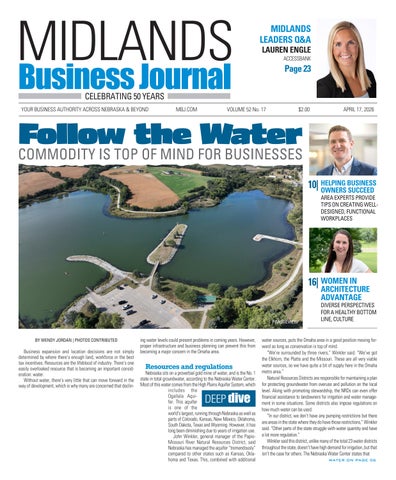
Follow the Water
COMMODITY IS TOP OF MIND FOR BUSINESSES BUSINESS 10| HELPING OWNERS SUCCEED
AREA EXPERTS PROVIDE TIPS ON CREATING WELLDESIGNED, FUNCTIONAL WORKPLACES
16| WOMEN IN
ARCHITECTURE ADVANTAGE
PRAIRIEVIEW
BY WENDY JORDAN | PHOTOS CONTRIBUTED
Business expansion and location decisions are not simply determined by where there’s enough land, workforce or the best tax incentives. Resources are the lifeblood of industry. There’s one easily overlooked resource that is becoming an important consideration: water. Without water, there’s very little that can move forward in the way of development, which is why many are concerned that declin-
ing water levels could present problems in coming years. However, proper infrastructure and business planning can prevent this from becoming a major concern in the Omaha area.
Resources and regulations
Nebraska sits on a proverbial gold mine of water, and is the No. 1 state in total groundwater, according to the Nebraska Water Center. Most of this water comes from the High Plains Aquifer System, which includes the Ogallala Aquifer. This aquifer is one of the world’s largest, running through Nebraska as well as parts of Colorado, Kansas, New Mexico, Oklahoma, South Dakota, Texas and Wyoming. However, it has long been diminishing due to years of irrigation use. John Winkler, general manager of the PapioMissouri River Natural Resources District, said Nebraska has managed the aquifer “tremendously” compared to other states such as Kansas, Oklahoma and Texas. This, combined with additional
DEEP dive
DIVERSE PERSPECTIVES FOR A HEALTHY BOTTOM LINE, CULTURE
water sources, puts the Omaha area in a good position moving forward as long as conservation is top of mind. “We’re surrounded by three rivers,” Winkler said. “We’ve got the Elkhorn, the Platte and the Missouri. These are all very viable water sources, so we have quite a bit of supply here in the Omaha metro area.” Natural Resources Districts are responsible for maintaining a plan for protecting groundwater from overuse and pollution on the local level. Along with promoting stewardship, the NRDs can even offer financial assistance to landowners for irrigation and water management in some situations. Some districts also impose regulations on how much water can be used. “In our district, we don’t have any pumping restrictions but there are areas in the state where they do have those restrictions,” Winkler said. “Other parts of the state struggle with water quantity and have a lot more regulation.” Winkler said this district, unlike many of the total 23 water districts throughout the state, doesn’t have high demand for irrigation, but that isn’t the case for others. The Nebraska Water Center states that WATER ON PAGE 06