Business Appearance: Interior & Exterior September 13, 2019
A section prepared by the staff of the Midlands Business Journal
Designers bring elements of home to office spaces to benefit clients, employees by Michelle Leach
Hospitality in terms of building features and activity related to the sector is a thread that runs through many designers’ projects at present. e are finding that companies want the chance to entertain their clients to varying degrees,” said TACK Architects LEED AP and Principal Jeffrey J. ole al. his allows a greater bond through social experience with these clients. Spaces we are designing to facilitate the hospitality experience range from a full-room bar to a roundtable conference Dolezal room that doubles as family dinner room for a more intimate experience.” ts vora Law roup design embodies these concepts; featuring a bar that accommodates groups of up to 70 guests, Dolezal also noted kegerators, a three-compartment bar sink, specialty lighting, lounge seating and a shuf eboard area. “The Dvorak team have conference rooms adjacent to the bar that can open onto it, and they allow outside groups and nonprofits use of the space on occasion,” he said. “These spaces allow a greater bond with clients and potential clients through a social experience. They can become differentiators between you and your competitors, if done properly.” Trendy features are residential in nature, according to Leo A Daly’s Senior Interior Designer Heather Robbins — amenities often include fireplaces, nicer restrooms, open oasis areas for water, coffee and snac s, and large windows for natural light. eatures with a residential vibe are popular because they make people feel comfortable at wor and create a less formal environment, she said. “Oasis areas bring people together for impromptu conversation and encourage employees to get up out of their chairs and move throughout the office environment. ccess to natural light has been shown to increase employee productivity and overall happiness. Both oasis areas and natural light promote wellness in the wor environment.” Furthermore, the branded graphics increasingly incorporated into training and conference areas were described as a fun way to add art and color and support companies’ identities. Features “in action” include the International Harvester Mississippi Valley Credit Union’s comfortable residential-feeling collaboration ar-
Lester Katz, interior designer at LK Design. eas within a large, three-story atrium space with looks reclaimed has been prominent as an effort views of the ississippi iver, obbins said. to get the look but to save money.” very wor station and office in the Much of these reclaimed look-alikes can be building has access to natural light,” she said. sourced from sustainable supplies, Katz said. “People are enticed to use the atrium space by “So, it is not necessarily a net loss as far a communicating wood stair that connects the as environmental design is concerned,” he wor levels and oasis areas with complimentary said. he hospitality owners tend to be the water, coffee and snac s on every level. trend-setters in the commercial design segment, Residential and hospitality are in LK De- willing to ta e chances and wanting to be seen as sign’s DNA, as Interior Designer and LEED leaders in their industries. he trends are always Lester at noted the firm does a lot of changing as result.” residential design and small-scale hospitality To this end, he sees high-end hospitality as pro ects such as restaurants, medical offices, going more luxurious, using expensive textiles gyms and coffee shops. and fixtures to create the upscale loo that their “One of the trends for hospitality design has customers expect. been to use elements of reclaimed material such ar colors, rich wood tones and subtle as barn wood, he said. long with the trend to lighting help to provide the look,” Katz said. use reclaimed material, the use of material that id-mar et hospitality owners may also try to
Reaanddit
create an upscale loo , but with a more casual atmosphere. he mid-mar et generally will want a more relaxed atmosphere that makes customers feel more at home. More vibrant colors, lively lighting, rustic wood tones produce this type of atmosphere.” LK Design’s hospitality projects span Omaha, Houston and Nashville; locally, projects include Via Farina restaurant, The Stokin’ oat restaurant and Torva gym. The many aforementioned features matter, as Dolezal noted good design equals Robbins good business. “Staff retention and recruiting in today’s market is huge,” he said. “Employers are offering more and more ‘perks’ designed into their office space in order to attract and retain top talent. They are also looking for spaces that are brand culture-forward and well designed. t is a tric y balance to do both successfully, and we go to great lengths to continue to push these boundaries with our clients.” Robbins noted employees value fitness areas and outdoor wal ing paths, as opposed to spaces that may routinely sit empty such as videogame rooms. “Omaha, like many communities, is struggling with a talent drought, she said. ttracting and retaining the best employees is difficult however, a well-designed interior environment can be the tipping point for employees when deciding between several companies. hy wouldn t someone want to wor in a place that encourages wellness and good design
Reap!
Office environments getting smaller, cozier by Dwain Hebda
he days of staid office spaces and rigid, formal wor spaces are increasingly becoming a thing of the past. Many companies today are reducing their footprint to save money and balancing that move by increasing comfort factors in furnishings. esigners say many of the newest trends are being driven more by how the modern office wor s than as a pure cost-saving move. Office wor ers are becoming more mobile, both in movement and devices,” said rystal unningham, partner with Planning and Design. “Employees don’t have
as much personal space in the office and people can wor almost anywhere. o meet these changing expectations, office furniture types and materials are changing.” Cunningham said these trends include a move toward more lounge furniture and modular options that boost the exibility factor several times over. “Clients are thinking beyond the desk when loo ing at office furniture, she said. “We notice clients asking for more modular and flexible lounge seating options, with many spaces serving multiple purposes. s furniture is used more within
a space, it needs to be multifunctional and durable. Sit-to-stand wor stations allow the ability within one s individual wor station to configure the des and layout to ma e it conducive to how they prefer to wor . iversity in collaboration spaces [means] furniture doesn t have to always be a table with chairs. We have been using soft seating and sofas for more informal meetings.” ian ic erel, president and owner of Office nteriors and esign said the industry has even developed a term for this brand of Continued on page 6.
Business Appearance — inside SEPTEMBER 13, 2019
THIS WEEK 'S ISSUE:
THE BUSINESS NEWSPAPER OF GREATER OMAHA, LINCOLN AND COUNCIL BLUFFS
$2.00
VOL. 45 NO. 37
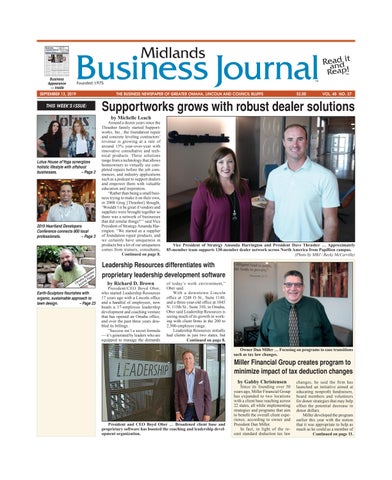
Supportworks grows with robust dealer solutions by Michelle Leach
Lotus House of Yoga synergizes holistic lifestyle with offshoot businesses. – Page 2
2019 Heartland Developers Conference connects 800 local professionals. – Page 3
ess sin es u a B ag ah al P OmJourn
Earth-Sculptors flourishes with organic, sustainable approach to lawn design. – Page 23
Around a dozen years since the Thrasher family started Supportworks, Inc., the foundation repair and concrete leveling contractors’ revenue is growing at a rate of around 15% year-over-year with innovative consultative and technical products. These solutions range from a technology that allows homeowners to virtually see completed repairs before the job commences, and industry applications such as a podcast to support dealers and empower them with valuable education and inspiration. “Rather than being a small business trying to make it on their own, in 2008 Greg [Thrasher] thought, ‘Wouldn’t it be great if vendors and suppliers were brought together so there was a network of businesses that did similar things?’” said Vice President of Strategy Amanda Harrington. “We started as a supplier of foundation repair products, and we certainly have uniqueness in products but a lot of our uniqueness comes from trainers, consultants, Continued on page 8.
Vice President of Strategy Amanda Harrington and President Dave Thrasher … Approximately 85-member team supports 130-member dealer network across North America from Papillion campus. (Photo by MBJ / Becky McCarville)
Leadership Resources differentiates with proprietary leadership development software by Richard D. Brown
President/CEO Boyd Ober, who started Leadership Resources 17 years ago with a Lincoln office and a handful of employees, now heads a 17-employee leadership development and coaching venture that has opened an Omaha office, and over the past three years doubled its billings. “Success isn’t a secret formula — it’s generated by leaders who are equipped to manage the demands
of today’s work environment,” Ober said. With a downtown Lincoln office at 1248 O St., Suite 1140, and a three-year-old office at 1045 N. 115th St., Suite 350, in Omaha, Ober said Leadership Resources is seeing much of its growth in working with client firms in the 200 to 2,500-employee range. Leadership Resources initially had clients in just two states, but Continued on page 8. Owner Dan Miller … Focusing on programs to ease transitions such as tax law changes.
Miller Financial Group creates program to minimize impact of tax deduction changes by Gabby Christensen
President and CEO Boyd Ober … Broadened client base and proprietary software has boosted the coaching and leadership development organization.
Since its founding over 50 years ago, Miller Financial Group has expanded to two locations with a client base reaching across 22 states, all while implementing strategies and programs that aim to benefit the overall client experience, according to owner and President Dan Miller. In fact, in light of the recent standard deduction tax law
changes, he said the firm has launched an initiative aimed at educating nonprofit fundraisers, board members and volunteers for donor strategies that may help offset the potential decrease in donor dollars. Miller developed the program earlier this year with the notion that it was appropriate to help as much as he could as a member of Continued on page 11.