Mennonite Brethren Herald is published bimonthly by the Canadian Conference of Mennonite Brethren Churches, primarily for the use of its members, to build a Canadian MB community of faith. We seek to 1) share the life and story of the church by nurturing relationships among members and engaging in dialogue and reflection; 2) teach and equip for ministry by reflecting MB theology, values, and heritage, and by sharing the good news; 3) enable communication by serving conference ministries and informing our members about the church and the world. However, the opinions expressed here are not necessarily those of the church as a whole.
Digest
APR/MAY 2026 | VOLUME 65, NO. 02
EDITORIAL OFFICE
1310 Taylor Avenue Winnipeg, Manitoba R3M 3Z6
Phone: 204-669-6575
Toll-free in Canada: 888-669-6575
MBHERALD@MBCHURCHES.CA WWW.MBHERALD.COM
ISSN: 0025-9349
The Mennonite Brethren Herald is a publication of
CANADIAN CONFERENCE OF MENNONITE BRETHREN CHURCHES
CONFÉRENCE CANADIENNE DES ÉGLISES DES FRÈRES MENNONITES
Sharing the life and story of Mennonite Brethren in Canada
8
QR CORNER
Ken Esau
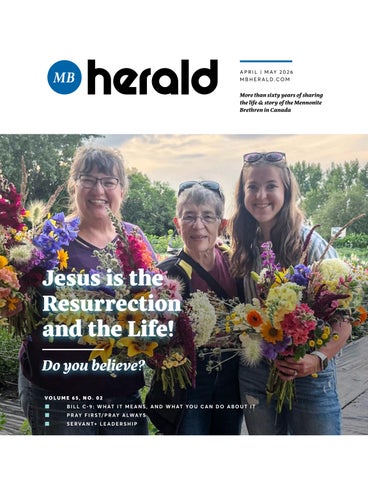
12 COVER STORY JESUS IS THE RESURRECTION AND THE LIFE! DO YOU BELIEVE?
Traci Johnston
15
SMALL CHURCH, BIG IMPACT
Helen Guenther
Participants at ONMB’s Acts 6:4 Assembly sign an Ontario flag, expressing their shared commitment to prayer and participation in Jesus’ mission across the province.
Read summaries of the Ontario and Manitoba Assemblies starting on page 4.
22 SERVANT+ LEADERSHIP
GETTING TO KNOW STEPHANIE
CHRISTIANSON
Leanne Janzen
25
Mark Wessner
30
Q&A WITH LORNE JACKSON
Leanne Janzen
FROM THE EDITOR
LIVING AS RESURRECTION PEOPLE
The publishing schedule wasn’t favourable for us this year, as you receive this issue of MB Herald, Easter has just passed. Calendar misalignment aside, we have included some Easter-specific content. As we sift through the rest of the issue, though, we see that the theme of Christ’s resurrection power over His Church and His disciples runs through every page.
We are grateful for poetry from returning contributor Frieda Klippenstein. In Father God (page 3), we are guided towards understanding God’s initiating and restorative love, “What I have said, I will bring about/What I have planned, I will do/So give me your fears/Your world-saving will/ Your reflex to rescue/Trust in me — peace, be still.”
In our cover story, Traci Johnston presses into the centre of the Easter story: the human encounter with Christ that leads to full spiritual transformation. Traci recounts how a serious accident involving her husband and the loss of her mother brought her into full dependence on the resurrected Christ: “...I feel God’s silence. Just like the day of Jesus’ crucifixion, I see the darkness that is veiling God’s glory, and my connection to God feels thin and fragile. Yet, I sense him carrying me.”
Elsewhere, we see the outworking of Easter— where we are called and sent to be resurrection people in creation, in our neighbourhoods, and in leadership. This issue opens with the love of the Father and centers on the lived experience of Easter, inviting us to consider what resurrection means not only for a moment, but for a lifetime.
I want to express my gratitude to our contributors, advertisers, and readers. We encourage you to respond to what you read: write to us, share these stories with your friends and family. n the coming months, as you participate in your home church or chat with colleagues and neighbours, consider sharing your Easter story— how has Easter transformed you? We are made new through the cross, no longer slaves to sin, but redeemed. We are resurrection people.
Peace,
CARSON SAMSON Editor
SBC’s Biblical Studies program prepares students to follow Jesus in every area of life with strong biblical training and real-world ministry experience.
YOUR FAITH. YOUR FUTURE. YOUR SBC
Father God
It becomes routine that repeated refrain
Found early in your child’s eyes
Heard with each milestone flying by
Those first steps they take
The fridge art they make
The bike they finally learn to ride
When they turn and wave goodbye
Look at me!
Look what I managed to do without you
See the triumph in your daughter’s face
That selfie from the summit of the trail
Her beauty beaming through silk and lace
Just before she walks down the aisle
It’s exuded by your son on graduation stand
And as he arrives safely home
From driving solo across the land
Look at me!
Look what I managed to do without you
Then why is it so hard to believe they’ll be fine
In this world full of hazards, of pitfalls and lies?
And you know that whatever the promise, the prize
No one gets out of this crazy escape room alive
So you pray, plan and plead
With guardian angels they’ll need
If the world is as dangerous and fragile as it seems
Then comes the answer to you
My child, I am Creator, Universe Maker
And I am parent too
My beloved son
Born vulnerable and weak
Bound within body, in time, place and fate
Stuck in that beautiful, terrifying state of being human
What I have said, I will bring about
What I have planned, I will do
So give me your fears
Your world-saving will
Your reflex to rescue
Trust in me — peace, be still
After all, look at me!
Look at all that I manage to do without you.
FRIEDA KLIPPENSTEIN
MOVE TOGETHER: ONMB ACTS 6:4 ASSEMBLY 2026
MB HERALD STAFF, WITH FILES FROM ONMB
On February 19-20, the Ontario Conference of Mennonite Brethren Churches (ONMB) held its annual Acts 6:4 Assembly at Mountain Park Church in Niagara Falls, Ontario. Focusing on the theme of Move Together: Collaborating in Mission Regionally for Jesus’ Glory, attendees were encouraged to slow down, discern how the Spirit is leading, and depend on Jesus rather than on systems or programs.
Friday’s Leader’s Day opened with a session led by Emerson Cardoso, Multiply’s Latin and Central America director. Translated from Portuguese by Franz Wolf, Cardoso emphasized Spirit-led leadership over reliance on structures or productivity: “The Lord doesn’t want you to do more, but to do less — to live in dependence on him.”
Ryan Jantzi (ONMB’s Ministry Director) and Matt Unruh’s (Cornerstone Community Church) session “Growing as a Healthy Leader” focused on discernment, health, and honest reflection. They facilitated round-table discussions exploring the following questions:
˚ What is Jesus asking you to do? And what is he asking you to stop doing?
˚ Where are you thriving?
˚ Where are you struggling?
˚ What step is God asking you to take to become a healthier leader?
In another session, Andrew Plett
(Mountain Park Church) shared his church’s Spiritual Leadership and Discernment process that was adapted from Ruth Haley Barton’s book Pursuing God’s Will Together and Arthur Boers’ Servants and Fools “Allowing Jesus to lead is hard, but it is the most fruitful way to lead,” said Plett.
The Acts 6:4 Assembly started with a worship service on Friday night where Emerson was the keynote speaker. Many signed their names to an Ontario flag, committing themselves to join Jesus’ mission in the province.
On Saturday morning, Plett continued the theme of discernment in his message, “How do we discern the voice of God?”
Later on Saturday, people gathered in prayer rooms to intercede for various mission opportunities in Ontario. Everyone present was able to engage in two prayer rooms, choosing from a list of 10. The afternoon continued with updates from the National Ministry Team and ONMB staff. Trevor Seath shared a message focused on the Church’s unity in boldness, kingdom vision, and willingness to suffer in Acts 4. An extended time of whole group prayer ended the weekend. It was an enriching and unified gathering; attendees went away encouraged to listen to Jesus, to discern where he is leading, and to depend on him, above all else.
Kristi Lee, ONMB Operations & Communications Manager, is honoured for 10 years on staff, with executive director Trevor Seath (left) and director of ministry Ryan Jantzi (right).
MISSIONAL DISCIPLE-MAKING: MBCM ASSEMBLY 2026
MB HERALD STAFF, WITH FILES FROM MBCM
On March 6-7, the Mennonite Brethren Church of Manitoba (MBCM) held its 2026 Assembly at Eastview Community Church in Winnipeg, Manitoba. Focusing on the theme of Missional DiscipleMaking, participants were encouraged to cultivate a culture of “going and sending” within churches and leaders.
Friday was a learning day for pastors and leaders. Multiply’s Derek Parenteau led two keynote sessions that highlighted the importance and urgency of mission: “’Go and make disciples’ is not an optional ministry add-on. It’s the heart of God.” Luke 10:1-20 framed much of Parenteau’s teaching, and he emphasized various relational disciplines such as the practice of hospitality and intentional prayer to be essential ways in which we “go.”
Derek shared stories from his time travelling with a Brazilian prayer cohort, visiting various ministries across Ontario for the sole purpose of prayer. The group’s willingness to listen, respond, and physically go proved pivotal for those they interacted with.
Saturday included MBCM Stories sessions hosted by Jason Dyck. In one session, Denis and Albina Nikitin shared about their church, Road 316, a Slavic/Ukrainian church plant that was welcomed into MBCM at last year’s Assembly. Road 316 continues to meet at Eastwood Community Church and has a strong emphasis on home church/Bible study. The Nikitins shared that they were encouraged by the members of Eastview who regularly volunteer
at various services and events. Road 316 also hosts seasonal English classes, providing opportunities to share the gospel in accessible, relational ways.
Another MBCM Stories session included an account of the reboot of Ministry Quest (MQ), a discernment program for young adults sensing a call to vocational ministry. Previously operating in Fresno, CA and Winnipeg, the program has been re-launched by MBCM. Josh Schultz (a MQ participant) shared how his spiritual journey was greatly impacted by MQ.
Additionally, it was announced that Living Word Temple is no longer a member of MBCM and has rejoined the Pentecostal Assemblies of Canada (PAOC).
The MBCM Assembly also included various workshops on the topics of education, mission, and partnership.
On Friday evening, Assembly attendees shared a meal with leaders of Douglas Mennonite Church. Members of Douglas Mennonite Church shared the story of their journey through the last few years towards associate membership with MBCM. The day concluded in prayer around the table.
All formal decisions, motions, and reports from Saturday’s gathering are summarized in the official recap here.
The MBCM Assembly was a time of worship, unity, and most of all challenge — to follow God’s unequivocal call to go and make disciples.
UPCOMING PROVINCIAL CONVENTION
DETAILS
British Columbia
BCMB Elevate and AGM
April 24-25, Willow Park Church (Kelowna)
Alberta
ABMB Gathering
May 8-9: Camp Evergreen (Sundre)
BILL C-9 WHAT IT
MEANS, AND WHAT YOU CAN DO ABOUT IT
Bill C-9, or the Combatting Hate Act, has passed in the House of Commons. As Christians, we work to combat hate in all spheres — the God we worship is the embodiment of love, not hate. So why are we not celebrating this new legislation?
As the Evangelical Fellowship of Canada (EFC) describes, the primary concern with Bill C-9 is that it now removes the religious belief defence from the Criminal Code.
Julia Beazley, Director of EFC’s Centre for Faith and Public Life, explains why this is so concerning to Christians. “The religious belief defence is meant to protect the expression of minority religious beliefs that don’t align with the majority,” says Beazley. “It acts as a safeguard to ensure that the wilful promotion of hatred offence isn’t used to silence or suppress the good faith expression of religious beliefs that others may find objectionable or offensive.”
She continues, “This proposal to remove it comes at a time when minority religious views are increasingly marginalized and can be characterized as hateful.”
As the bill has just passed in the House of Commons, it will now move on to the Senate. Citizens can contact the Senators in their province to express their concerns. They can write to the Government and Opposition leaders in the Senate, as well as the leaders of the Independent, Canadian and Progressive Senators groups. Here is a list of Senators and their contact information.
People can also write to the members of the Senate Legal and Constitutional Affairs Committee to urge them to bring needed clarity to the bill.
For resources on Bill C-9, with updates, tips on asking for change, and more, visit EFC’s website.
SIGN UP FOR THE ICOMB NEWSLETTER!
Find out what’s happening in our global family! Sign up to receive a monthly newsletter from the International Community of Mennonite Brethren (ICOMB). Contact daisy@icomb.org for more details.
Read previous newsletters here.
INTERNATIONAL COMMUNITY OF MENNONITE BRETHREN
IN CASE YOU MISSED IT
We regularly publish website-exclusive stories on mbherald.com. Here are a few articles we’ve posted online in the last few months.
Kids’ fun day in Gaza supports mental health with art, games
An MCC partner provides mental health support to displaced children in Gaza with creative expression at the centre.
Mennonite Historical Society of Canada releases new documentary
Have you heard about the new documentary “The Russlander Migration”? It tells the story of the migration of Russian Mennonites to Canada in the 1920s and the crosscountry train trip to commemorate this time 100 years later. Read about the film’s release as well as other updates from the Mennonite Historical Society of Canada.
Learning to cope, adapt in Ukraine as the fourth anniversary of invasion looms
Ukrainians have endured four years of war, experiencing heartache and holding onto hope. MCC’s 12 partners continue to provide emergency food, trauma support, education and peacebuilding.
Cubans continue to weather storms with the help of MCC church partners
This reflection piece is written by Rebekah York, who works for MCC in Latin America and the Caribbean. She traveled to Cuba in January 2026. The article describes how Cubans rally to help each other get through the continued challenges of limited power and supplies and Hurricane Melissa, with support from MCC and its partners, including the Brethren in Christ church.
MCC Statement: Stop U.S. bombing of Iran, work for peace in region
“We hear clearly from MCC staff and partners in the Middle East that the path to a lasting and just peace is through diplomacy and local peacebuilding, not bombs.”
Watch for these upcoming episodes!
April 8: The Anabaptist
Community Bible
Why is it important to have a Bible that includes commentaries written from an Anabaptist perspective? In this episode, we speak to two members of the publishing team at MennoMedia, as well as a biblical scholar who contributed to the production of the recently published Anabaptist Community Bible.
May 13: Randy Friesen
What is spiritual intelligence? And why is it vital to our walk with the Lord? Randy Friesen answers these questions as he introduces his new book SQ — and shares some incredible stories along the way.
June 10: Phil Gunther
SKMB’s Phil Gunther is a deep well of wisdom. In our conversation, he shares his insights on the impact suffering has on the soul, what to do when God seems silent, and why humility is essential in the life of a disciple. He also discusses his book Hello Again, and talks about what motivates him to keep writing.
Q&R CORNER
Q&R corner provides responses to questions that readers may have about CCMBC and its work collaborating with provincial MB conferences in areas of spiritual health and theology, leadership development, mission, and organizational health in order to achieve the overall mission: “To cultivate a community and culture of healthy disciple-making churches and ministries, faithfully joining Jesus in his mission.” If you would like to contribute a question, please send it to questions@mbchurches.ca
Please note that we will not be using your name in the MB Herald Digest in order to respect those who prefer anonymity. There may not be space to respond to every question—and sometimes we might not really have the ability or authority to respond to some questions (for example, those that relate more directly to one of our provincial MB conferences or to a local church leadership). We apologize in advance if we are unable to publish a response to your specific question.
Is there room in the MB interpretation of baptism for spontaneous baptisms? If someone is baptized in our church, does that make that person a voting member of our church? Is there room in the MB world for people who are not baptized as believers to become members of our church?
B.
Thanks, B., for these important questions. As you probably know, the MB family has not wanted our MB Confession to be so detailed that it becomes overwhelming. As a result, there are moments where something is not spelled out fully, and this can lead to a confusing diversity of practice within our churches. This is certainly the case with baptism. I have seen spontaneous baptisms, believers baptized twice within the same congregation, and people (younger and older) baptized without any mention of them joining the church. I have also heard of MB churches welcoming individuals on the basis of their baptism as infants. At times, it feels a bit like the Wild West.
This is part of the reason for our 2021 review and revision to Article 8 on Baptism. We also provided “Explanatory Notes” for this article and a
resource called “Living the Confession (FAQs)” to help clarify the implications of our Confession. (All of this is available here.) Here are a few foundational convictions that come out of Article 8: First, MBs believe that baptism is not an action that sanctifies one’s infant children (or makes them saved) but a fundamental act of obedience and witness that every believer should knowingly and voluntarily choose. We believe that all believers should be baptized. As F.F. Bruce stated well: “The idea of an unbaptized Christian is simply not entertained in the New Testament” (Commentary on the Book of Acts, 77). It seems difficult to imagine Jesus or any New Testament writer advising that a believer should not be baptized. Second, baptism is not simply about the individual and Jesus, but also about the
individual and the local church community. Baptism is a beautiful and meaningful individual symbolic action that demonstrates that the recipient has experienced salvation, been washed clean of sin, been filled with the Holy Spirit, and desires to move forward in discipleship. However, because it is also a church community action, it is a beautiful and meaningful corporate symbolic action that demonstrates that the person desires to become part of the church community, and it demonstrates that the church community is taking on the responsibility of welcoming them and discipling them from this point on.
We regularly see baptismal practices that fail to communicate both of these important dimensions. Often everything is about the individual recipient who gives a testimony that is simply about them and Jesus. At the baptismal event itself, recipients might be asked about their experience of salvation but are rarely asked if they are now desiring to be part of and participate actively in the body of Christ. Sometimes, baptisms become so individual focussed that recipients request a destination baptism to take place at some favourite or spiritually meaningful place or an exclusive baptism where only certain special people are present.
Since MBs see baptism as both individual and corporate, baptism is a church event that expresses that the individual has experienced salvation in Jesus, received the Holy Spirit, and desires to grow in discipleship BUT it also demonstrates a mutual covenant between them and the local church community. This means that they are committing themselves to the mission and convictions of a specific local church and that local church is committing itself to welcome and disciple the candidate into maturity in Christ.
No doubt you can already hear people saying—”well, I don’t really like that”—or “I want Jesus not the local church which has hurt me (or hurt someone I care about)!” We are facing many cultural pressures that push against our convictions about baptism (that we believe are biblically faithful).
Third, because of this two-dimensional understanding of baptism (both individual and corporate), MBs desire to only baptize individuals old enough to embrace this larger meaning of baptism. If baptism is simply one-dimensional
and only about the individual, then it would make sense to baptize anyone old enough to profess sincere faith in Jesus. (This is what some other Christian denominations do.) However, if baptism also includes a corporate dimension that involves participation, commitment (“membership”), and accountability within a local church, then the baptized individual should be old enough to meaningfully make this commitment. Even though children mature at different rates, this would seem to require baptismal candidates to be at least in their early to mid-teenage years. It would also compel us to find other meaningful symbolic actions that recognize and celebrate the sincere conversions of young children not yet mature enough to embrace the full-meaning and implications of baptism.
I have experienced parents wanting baptism for a very young child, and then expressing anger when we explained this second dimension that connected baptism with church participation, commitment, and accountability. There is a lot of pressure on pastors and church leaders to provide baptism as a kind of “service” for church “customers.” Our MB Confession of Faith is designed to be a biblical road map toward being healthy, disciple-making churches, and there will be times like this when following this road map will make us unpopular.
Fourth, while there are limits related to biological age/maturity, baptism is not a symbolic action appropriate only for those well-advanced in their faith. Instead, when it comes to the road of discipleship for new believers who understand its individual and corporate dimensions, baptism is a kindergarten step not a graduation step. Baptismal candidates should have a clear understanding of salvation, a clear commitment to ongoing discipleship, and a clear understanding of the theological and ethical convictions of the local church (to avoid very awkward situations later on), but baptism should not be delayed until candidates have somehow gained victory over every sin and temptation. The best place to grow in Jesus is in the context of the imperfect but loving church community.
Now to your questions.
Is there room in the MB interpretation of baptism for spontaneous baptisms?
Spontaneous baptisms refer to times when individuals have not had any specific preparation for baptism but an individual feels led by the Holy Spirit and wants to be baptized immediately. This can happen suddenly at a summer camp or a retreat or during a regularly-scheduled baptismal service. Sometimes a pastor or leader will extend an invitation for spontaneous baptisms and sometimes an individual will request it. The model for spontaneous baptisms might be the Ethiopian eunuch who became a believer and asked Philip: “Look, here is water. What can stand in the way of my being baptized?” (Acts 8:36). There was no formal preparation required and no sixweek long membership class.
While this seems like a good argument for spontaneous baptisms, this Ethiopian eunuch was no ordinary new convert but a well-educated Jew who was able to read and even had his own copy of at least the book of Isaiah (a very rare privilege). Philip explained to him how Jesus was the fulfillment of the Old Testament texts that he was reading, and this led him to connect the dots and request baptism. There was no local church to disciple this man after his baptism, but tradition
has it that the church in Ethiopia dates back to this new convert who became the first church planter in that country.
The bottom line is that we should not make the exceptional situation in Acts 8 justification for a baptismal practice today. There may be extraordinary times when we would practice a spontaneous baptism (e.g., baptizing a brand-new convert who request it and has only a few days to live), but these exceptional moments should continue to be just that—exceptional. Spontaneous baptisms can easily cater to individual preferences and the urgency of the moment. Spontaneous baptisms can easily make it seem like salvation is all about a past event while discipleship and church involvement are optional extras that a person can pick and choose.
Baptizing people we know very little bout what they are doing, or baptizing people who may have little interest in joining the community is not consistent with the overall New Testament teaching and practice. The early converts in Acts 2 “accepted [Peter’s] message”, were baptized, and then were “added to their number” (v.41). The baptisms in Acts 2 led to profound discipleship growth and sacrificial participation within the church family.
If someone is baptized in our church, does that make that person a voting member of our church?
Being baptized in a local church should make them a “member” of the church—in that they are fully part of the family, welcome to serve in an area they have been discerned to fit well in, and open to accountability by that family. Because we believe that the Holy Spirit lives in believers both young and old, newer to Jesus and older to Jesus, all church members should be welcome to speak into the life of the church community when those opportunities arise.
In the 2021 revision to Article 8: Baptism, there was an acknowledgment that because the biblical writers did not know of “legal membership”, there are legitimately different types of “membership” practiced in our MB church family. Historically in Canada, MBs have understood membership as involving both relational membership (we are part
of a family with mutual obligations of care, discipleship, and accountability) and legal/ functional membership (we are responsible to vote at business meetings and participate in church offices). However, for a variety of reasons, some MB churches have separated these two types of membership categories inviting the newly baptized to relational membership initially and then later to legal/ functional membership.
So to address your question directly, many MB churches would say yes in that that all the baptized individuals become voting members, while a lesser number of MB churches would say that they view this as a two-step process. As long as every baptized person is recognized as included, cared for, and discipled, then this would fit with our two-dimensional understanding of baptism.
The bottom line is that we should not make the exceptional situation in Acts 8 justification for a baptismal practice today. There may be extraordinary times when we would practice a spontaneous baptism (e.g., baptizing a brand-new convert who requests it and has only a few days to live), but these exceptional moments should continue to be just that—exceptional.
“ ”
Is there room in the MB world for people who are not baptized as believers to become members of our church?
This is, obviously, a challenging and contentious question. It is clearly the case that there are many Spirit-filled believers who attend our MB churches who have not been baptized as believers. Some of these amazing believers have simply never been baptized for a variety of reasons, while others received infant baptism and confirmation and feel no need to receive what MBs call “believer’s baptism” (where a believer knowingly and voluntarily chooses to be baptized). Many of these wonderful believers attending are churches are critically important to the health of the church, serving and supporting in ways above and beyond many of those identified as official members of the church.
While some denominations have tried to lessen the importance of these questions, the MB Confession of Faith (and the larger Anabaptist family that we are part of) view believer’s baptism as a critical piece in our theology of salvation, discipleship, and mission. This is why baptism is not a prerequisite to church attendance or overall service/participation, but it is considered to be a prerequisite to official church membership. As stated in the revised version of Article 8: “The local church invites those who claim baptism prior to their own confession of faith and who desire to be members of a Mennonite Brethren congregation to receive baptism as a testimony to their own faith.” While the word “invites” may sound soft to some implying that it is not really an expectation, baptism as a believer is the path to official membership in an MB church.
To conclude, I recognize that these convictions often put us in difficult situations. I
have experienced grief and sadness while trying to live these out. I have seen wonderful believers walk away from our church family because they could not come to the point where they were willing to submit to our expectation around believer’s baptism. I also recall a “baptism” where someone submitted to believer’s baptism, but it seemed like only an empty ritual for them so they could participation in church leadership which had the “hurdle” of baptism there as a requirement. And I recall a woman not on our list of baptismal candidates, letting me know on the way outside to the baptismal tank that she was now ready to be baptized as a believer. I expressed my enthusiasm for her spontaneous readiness—and told her we would love to meet with her in the coming week and would hold a baptismal service for her the following Sunday. I’d like to say that we had a great baptismal Sunday the following week, but she didn’t follow up and not long after she went somewhere else. I pray often for wisdom in just these sorts of moments, wanting to be faithful to the Holy Spirit above all— but also knowing that it is this Holy Spirit who inspired Scripture which is at the root of our MB convictions. We want people to come to know and follow Jesus faithfully within faithful church families!
Thanks again, B., for your great questions. Please pray for our larger family as we seek to be faithful to being the kind of church that God has called us to.
Blessings and Shalom in King Jesus!
Ken Esau. National Faith & Life Director
BY TRACI JOHNSTON
This past November, my ladies’ Bible study studied Jesus’ seven “I am” statements in the book of John. John 11:25-26 was particularly poignant to me; after Lazarus dies, Jesus says to Martha, “I am the resurrection and the life. The one who believes in me will live, even though they die; and whoever lives by believing in me will never die. Do you believe this?” Martha said she believed — but did she fully comprehend what Jesus was saying? Do I?
One week after this study, after my adult daughter and I had just arrived at Regina’s Western Canadian Agribition, I heard my phone ring. It was our farm employee, Dave. Why would he call me instead of my husband, Jason? My sense of foreboding increased when Dave’s first words were, “Are you sitting down?” He then told me that Jason had been in a horrible farm accident. His leg got caught in the combine, and it was bad. “How bad? Amputation bad?” Dave did not know. I breathed a prayer, asking God to be Life for Jason — because I could not entertain the idea of Jason losing his leg, let alone his life. Jason spent over three weeks in the hospital in Winnipeg, a couple of hours away from home. Once we came home, much of my day was taken up by caring for Jason and his leg. Thankfully,
Jason was able to keep his leg, although the recovery has been slow. It was not until the end of January that I was just starting to feel like I was able to come up for air.
While this was happening, my mom had been living with us for several months. She was healthy, but lonely on her own. On the morning of February first, due to bad weather, we watched church online and then took in the curling finals together. In the afternoon, we baked — one of our favourite activities. At bedtime, I gave Mom a big hug and thanked her for such a great day. “I just enjoyed you so much today. I love you,” I said.
The next morning, I heard her get up before me. My daughter texted that she was coming over for coffee and Mom replied, “Great!” A few minutes later when my daughter arrived, we found Mom had passed. Oh, I have loved you, Mom!
Mom and I had often talked about heaven and eternity, her joy and my grieving, but I promised I would let her go when the time came. But now, Lord?! I sensed God tell me that I had cared for her well, but now he had her in his care. He is the Resurrection and the Life. Do you believe this? Yes, Lord, I believe.
In those first few days after her death, I reminded God of his promise not to give us more than we could handle — and this was definitely too much! God patiently reminded me that he will never leave me or forsake me (Deuteronomy 31:6) and I will make it in Christ’s strength (2 Corinthians 12:10).
The promise from Matthew 5:4 — “Blessed are those who mourn, for they will be
Opposite: Traci, her mother Rita, and her daughter Krina spend an evening together picking and cutting bouquets at a local flower farm in summer 2024.
Top: A sunrise rainbow shines over the canola field, photographed by Krina while she was swathing.
comforted” — is true. A friend shared, “Precious in the sight of God is the death of his saints” (Psalm 116:15). A believer’s death is a significant event that captures God’s attention. He cares deeply about the passing of his precious children, seeing it as a homecoming, not an end. Somehow this brought comfort that God was taking Mom’s death just as seriously as I was.
I also saw God’s faithfulness in Mom’s passing. She feared either going to a personal care home or suffering in a hospital. It was her hope that, one day, she could go quickly. God granted that to her and he was also gracious to me that he did not let her die while I was away in Winnipeg in December. He had given us such a wonderful last day together!
Comfort came during another Bible study on the topic of walking with God. Leviticus 26:11-12 and John 1:14 say that God makes his residence among us and walks with us. God invites us to take his hand and walk with him. Tears came to my eyes as I imagined all the times I sat beside Mom and reached out to hold her hand. Now, I reach for God’s hand.
I identify with my church’s Easter theme of “Dust and Ashes.” We have been encouraged not to rush past our grief and lament to quickly get to the resurrection. God hears my sighing and lament (Psalm 5:1, 38:9).
Honestly, I feel so many opposing feelings. Sometimes, I feel God’s silence. Just like the day of Jesus’ crucifixion, I see the darkness that is veiling God’s glory, and my connection to God feels thin and fragile. Yet, I sense him carrying me. I liken it to preschoolers putting their hands over their eyes and thinking their parent is not there. Perhaps Jesus is carrying me and I still
have my hands over my eyes, crying, unable to see Jesus, although I am in his arms.
Other times, I sit in awe that I am walking by faith, while Mom is walking by sight! She sees Christ’s face and is in his presence. She is not truly dead, but alive. She has just changed her address. She is home.1
The disciples walked away from the foot of the cross in tears, grief, and disbelief. They had seen Jesus raise Lazarus from the dead, had heard Jesus talk about rebuilding the temple in three days, and had heard him say he would rise again. They did not understand. They sat in darkness, full of questions, and perhaps felt betrayed. On the third day, they saw Jesus again and came to understand. I believe God never allows a crucifixion without resurrection in view.
Today, we live on this side of the cross and resurrection, but we await Jesus’ second coming or our homecoming, whichever comes first.
“I serve a risen Savior, He’s in the world today. … You ask me how I know he lives? He lives within my heart.”2
Jesus is the Resurrection and the Life! Do you believe?
TRACI JOHNSTON attends Westside Community Church in Morden, Manitoba.
1 Billy Graham once said: “Someday you will read or hear that Billy Graham is dead. Don’t you believe a word of it. I shall be more alive than I am now. I will just have changed my address. I will have gone into the presence of God.” —Billy Graham, adapting a similar quote from Dwight L. Moody.
2 Lyrics from Alfred Henry Ackley’s 1933 hymn “He Lives.”
(l-r) Krina, Traci, Jason, and Riley on the family farm.
Small church, big impact
BY HELEN GUENTHER
As I sat listening to the worship quartet, I couldn’t help but notice the simplicity surrounding them. As a small congregation, our yearly budget didn’t allow for a fancy backdrop, Jumbotron screen, and state-of-the-art sound system.
It paled in comparison to the church we had transferred from. On any given Sunday there, the visuals captivated us, the loud music shook us, and the grandeur of it all bedazzled us. By the end of each service, I left feeling energized by the orchestrated bravado.
At times, I miss the boldness of their music ministry as I am an on-your-feet-hands-raised worship girl. Sometimes I even slightly resent having given up what made me feel so happy in those musical moments.
After the quartet sang their third hymn, the alto was moved to tears and felt the need to apologize. The lyrics had touched her so deeply that she couldn’t contain her joy. At that moment, I felt the Holy Spirit prod me to see the beauty in the overwhelm within her, amidst the underwhelm around her.
When I got home, I tried continuing on with regular life by logging onto Facebook. God stopped me mid-scroll by gifting me a thought-provoking post. By now, I have grown accustomed to him showing up time and again to drive a spiritual point home. God knows I am also a slow-to-catch-onto-things-the-first-time worldly woman.
The quote on display spoke volumes to me in the discontent I had been wrestling with. Pastor A. W. Tozer once said, “Religion has accepted the monstrous heresy that noise, size, activity, and bluster make a man dear to God!”
As a teenager, my mom had communicated something similar. I had bought a coveted ticket to see a secular rock band without seeking permission first. Although my mom never made me change my plans,
SIMPLE DOESN’T NECESSARILY MEAN LESS — SOMETIMES IT CAN END UP MEANING EVEN MORE.
Top: The choir sings during a worship service. Helen delights in the simplicity of One88’s corporate worship.
Next page: One88 is built on teamwork in service to Winnipeg’s downtown community
PHOTOS PROVIDED BY HELEN GUENTHER
she presented me with a question that has stuck with me: “If Jesus comes knocking on your heart’s door during the concert, will you even hear him?”
The next time I yearn for the swagger of a charismatic worship segment, I hope God nudges me again. That day, the quartet reminded me that authentic worship doesn’t require a loud back-up band, mesmerizing visual effects, and an entertaining experience. It requires an open heart to hear a message, eyes to see God move in wonderful ways, and a mind willing to be transformed by it all.
Instead of just experiencing “happy” in the moment, I want to be filled with a lasting sense of joy having connected with a message in the song, not the noise of a service. I’m trying to posture myself in reverence to God instead of expecting to be revered by an experience.
The manger scene didn’t offer fancy things, either. Realizing that the first Christmas setting was pretty simple is transforming me into appreciating a simple church service as well. If simple was perfect for the Son of Man, it is more than enough for a child of God. Simple doesn’t necessarily mean less — sometimes it can end up meaning even more.
HELEN GUENTHER attends One88 Church, a small congregation in the heart of downtown Winnipeg, Manitoba.
Our CCMBC theme for 2026 continues to be Pray First! Pray Always! 1 Thessalonians 5:17 is the foundation verse telling us to “pray continually.”
For 2026 we want to deliberately and intentionally pray for the “peace of Christ” to rule in our hearts (Col 3:15). When the peace of Christ rules in our hearts, we will have a peace with God that overflows into peace with others, peace with ourselves, and peace with creation.
Each month, we will focus on a certain element of the peace of Christ so that we can more fully appreciate the depth and beauty of this peace and live it out in all our relationships. These prayers should lead us to greater worship of the Triune God who has brought peace through Jesus Christ (Acts 10:36). We are praying that the “peace of God, which transcends all understanding” will guard our hearts and minds in Christ Jesus (Phil 4:7). We are also praying that through our prayers we will become more faithful peacemakers who can rightly be called “children of God” (Matt 5:9) and “reap a harvest of righteousness” (Jas 3:18). Finally, we are praying for the peace of Christ to become real for family, friends, neighbours, and enemies who do not yet know this peace. May there be peace on earth!
We are excited again this year to welcome a variety of writers from our MB family across Canada as they share their own insights and guide us to pray more faithfully. May 2026 be a year of transformation so that we would embrace and live out the peace of Christ faithfully in a world of hostility, vengeance, and violence! “Now may the Lord of peace himself give you peace at all times and in every way. The Lord be with you all” (2 Thess 3:16).
APRIL 2026 PRAYER GUIDE
Being People of Peace in a Divided World: Peace with Creation
“The heavens declare the glory of God; the skies proclaim the work of his hands. Day after day they pour forth speech; night after night they reveal knowledge. They have no speech, they use no words; no sound is heard from them. Yet their voice goes out into all the earth, their words to the ends of the world.
In the heavens God has pitched a tent for the sun. It is like a bridegroom coming out of his chamber, like a champion rejoicing to run his course. It rises at one end of the heavens and makes its circuit to the other; nothing is deprived of its warmth.” —Psalm 19:1-6 (NIV)
Every January, when we pause to pray together across Canada for a week, we are reminded that prayer is not simply a spiritual exercise. It is a posture. It is a way of seeing the world. It is a way of participating in the mission of God. This year, as we prayed for peace in a divided world, we also prayed for peace with creation
From Genesis to Revelation, Scripture tells a story of a Creator who delights in his world, a humanity shaped to care for it, and a Saviour who is reconciling all things to himself. When we pray for peace with creation, we are aligning our hearts with the heart of God, who declared his world “very good” and promises to one day make it “new.”
Created for Shalom
Genesis 1–2 paints the picture for us. God speaks, and the world comes into being. Light and land. Stars and seeds. Rivers and rhythms. At each stage, “God saw that it was good.” Humanity is created in God’s image, entrusted “to rule and care for creation as a sacred trust” (Confession of Faith, Article 3). Creation is not ours. It is God’s. We manage what God owns. We reflect the character of the Creator through how we care for what he loves
When I think about creation as God intended it, my mind often goes to mountain trails. Some of my best unhurried prayer times have happened while running in the hills around my home. I remember one autumn morning. The air was crisp, the trail wet from the night’s rain. A storm had blown through earlier in the week, knocking down branches and scattering debris everywhere. The forest looked bruised. But it was also stunning. Mist hung low in the trees. A startled deer bounded across the trail. The broken branches released a deep, earthy scent. It struck me that even in its imperfect state, creation still sings
The created world is beautiful, not because it is perfect, but because it is alive. And it points beyond itself to the One who made it.
Psalm 19 tells us this is not accidental. “The heavens declare the glory of God; the skies proclaim the work of his hands.” Creation declares. It reveals. It speaks, even when it is wounded.
Where Shalom Was Fractured
Genesis 3 reminds us that the beauty we see is both real and incomplete. Human sin fractures everything, including creation. Work becomes painful. The ground grows thorns and thistles. And as Paul later writes, “creation was subjected to frustration” and now “groans as in the pains of childbirth” (Romans 8:20, 22).
Our Confession states it simply: “Creation is under the bondage of decay. Humans and all creation long to be set free” (Article 3).
That groaning is hard to ignore. Fires, floods, degraded land, and fragile ecosystems are all reminders that something is not the way God designed it. And yet, creation still points to God. Brokenness does not erase beauty. It makes beauty ache for restoration.
Creation’s Voice in the Present Moment Even in its woundedness, creation calls us back to worship. Back to humility. Back to our vocation.
The trails I run are not always pristine wilderness. They bear the marks of erosion, fallen trees, and the occasional abandoned can. But every time I am out there, I find myself encountering the same truth: God has not abandoned his world. In fact, he continues to speak through it.
Creation’s endurance reflects God’s patience. Creation’s cycles reflect God’s faithfulness. And creation’s beauty reflects God’s glory. For those with eyes to see, broken creation becomes an invitation to hope.
The Groaning and the Hope
Romans 8 tells us the groaning of creation is not despair. It is labour. Creation “waits in eager expectation for the children of God to be revealed” (v. 19). That means our discipleship matters for the world God made. When we grow in Christlike character, creation rejoices because our restored humanity is the beginning of creation’s restoration.
Peace with creation is not peripheral to the gospel. It is part of the reconciliation God is accomplishing through Christ. As the Confession says, “In Christ all things are being reconciled and created anew” (Article 3).
God’s Promise of New Creation
The Bible ends the same way it begins, with creation. Revelation 21–22 gives us a glimpse. A renewed earth. A restored river. A tree whose leaves bring healing. The curse gone. God dwelling with his people. The way it was originally intended. “God will create a new heaven and a new earth in which there will be no evil, suffering, and death” (Confession, Article 3).
This is the future toward which all creation moves. Not escape. Not abandonment. Renewal.
CONSIDER:
HOW DO WE PRACTICALLY SEEK PEACE WITH CREATION?
The gospel moves us from hearing to doing. Peace with creation grows through simple, faithful, everyday obedience. Here are some practical ways, rooted in Scripture and shaped by the posture of discipleship:
a. Pay attention.
The first act of peacemaking is attentiveness. Notice the world God made. Appreciate what is good. Linger long enough to let creation remind you of the Creator. This is worship.
b. Practice gratitude.
Say thank you to God for food, weather, land, and water. Gratitude keeps our hearts humble and prevents us from treating creation as an entitlement.
c. Live with restraint.
Genesis commissions humans to “care” for the earth, not consume it. We honour that calling when we reduce waste, use resources wisely, and choose stewardship over indulgence. Small decisions matter.
d. Participate in local care. Pick up litter on a trail. Join a neighbourhood clean-up. Support community gardens. Plant trees. These are small but concrete acts of creation-focused peacemaking.
e. Practise love in environmental decisions. Environmental issues can be relational issues. Some are power issues. Peacemaking asks: Who is affected? Who is vulnerable? How does my choice help or harm my neighbour?
f. Let creation shape your spiritual practices. Pray outside. Walk instead of driving when possible. Sabbath rests your soul, but it also gives the land a break. When the rhythms of your life align with the rhythms of creation, peace grows.
g. Root everything in hope. We are not trying to “save the planet.” We are participating in God’s mission. We work with hope because God will finish what he started.
PRAYING FOR PEACE WITH CREATION:
Creator God, you crafted the world with intention and called it very good. Where we have neglected your creation, forgive us.
Where creation groans, teach us to groan with hope.
Give us eyes to see your beauty in what is broken.
Give us courage to live gently, gratefully, and wisely.
Make us peacemakers who reflect the character of Jesus in how we live on the land, care for the world, and love our neighbours.
Renew our hearts as you renew your creation. Amen.
MARK WESSNER is the president of MB Seminary and Associate Professor of Biblical Studies for Leadership. He and his wife Jennifer attend Central Heights Church in Abbotsford, B.C.
Praying for Peace in our Neighbourhoods
“Pursue the well-being of the city I have deported you to. Pray to the Lord on its behalf, for when it thrives, you will thrive. …
For this is what the Lord says: ‘When seventy years for Babylon are complete, I will attend to you and will confirm my promise concerning you to restore you to this place. For I know the plans I have for you’ — this is the Lord’s declaration — ‘plans for your well-being, not for disaster, to give you a future and a hope. You will call to me and come and pray to me, and I will listen to you. You will seek me and find me when you search for me with all your heart. I will be found by you’ — this is the Lord’s declaration — ‘and I will restore your fortunes and gather you from all the nations and places where I banished you’ — this is the Lord’s declaration. ‘I will restore you to the place from which I deported you.’”
Jeremiah 29:7, 10-14 (CSB)
Our home is near the edge of a small town on a cul-de-sac street, surrounded by a park, a cemetery and a feed mill. One of the gifts of living where we do is the spacious lots. But the downside of that roominess is that it can be hard to connect with our neighbours. With the exceptionally snowy winter we had this year, we hardly saw anyone. Everyone drove into their driveways, opened their garage doors remotely, and disappeared inside.
Having lived here for 20 years, I have been struck more and more with how little I actually know about the lives of my neighbours, their worldviews, and their needs. More importantly, as a follower of Jesus, I recognize I have minimal inroads to share the gospel with those who live within a 500-metre radius of my house. This is a problem.
During Lent last year, I felt the Lord inviting me to pray more for the town where I live, to pray for those living in closest proximity to me. So, for the weeks leading up to Easter, I took time each day to pray through a different street and over every home in my town of Elmira,
Ontario. It was a beautiful time of leaning into God’s Spirit to hear his heart for the people — his love, his desire to draw each one to himself through Jesus. I prayed Scriptures, I prayed songs, I prayed words the Spirit whispered in my ear. I looked at the homes and used what I saw as fuel for prayer. If there was a birdhouse, I simply prayed that the person living there would find refuge under God’s wings. Or if I saw children playing, I would pray Jesus’ words that the “Kingdom of God belongs to such as these” (Matthew 19:14). Praying through the streets of Elmira expanded my heart with more of God’s love for my neighbours.
The prophet Jeremiah wrote this month’s passage when Nebuchadnezzar carried the Israelites off as exiles from Jerusalem to Babylon. Jeremiah encouraged them to settle down, to build houses, to plant gardens, to marry, and grow their families. And then to pray. To pray for the well-being of the place in which they were forced to settle.
The Israelites were exiles. It was not their choice to live there among the Babylonians.
For the season of time that God brought them there, they were to pray. Their calling as exiles was to seek God for the well-being of their foreign neighbours, who were their enemies, their oppressors. I can only imagine how difficult it would have been to pray blessing over the Babylonians, when the Israelites had been taken there against their will and longed to be restored to their own homeland. Yet, that was God’s invitation to them. More than an invitation, it was a command with a promise. Only by praying would they eventually be restored and gathered back to their homeland.
We, too, live as exiles. Few of us have the experience of being exiles or being forced to live where we do. Yet, as representatives of God’s kingdom, that can put us in the position of being exiles in our neighbourhoods. We stand out as different, in our choices of how we spend our time, our money, in the ways we navigate our relationships, and do our work. Living in the midst of people with real hurts and needs, our call, like that of the exiled Israelites, is to pray for them — for the holistic peace of Christ to restore their relationship with God through the cross and to restore relationships with each other where they are strained.
So how do we pray for our neighbours? How do we invite the peace of God to infuse our neighbourhoods, to heal and restore individuals, to make peace where there is tension?
We can do this quite simply by prayer walking our neighbourhoods. Walk and invite the Holy Spirit to open your eyes to what he wants to do. Be attentive to what you see, hear, and sense as you walk. Pay attention to the small promptings in your heart, the thoughts that emerge, the Scriptures or songs that arise. And pray them back to the Father. Pray them in faith because our good God wants to bring his shalom, his true, enduring peace available to each one because of the death and resurrection of Jesus. Pray in faith that he will do this work, regardless of whether you see the fruit of your prayers or not. Pray for the “enemies” on your street, in your building, or on your country road, following the example of our Lord Jesus. Pray repeatedly, contending in the Spirit, as you partner with God in opposing the spiritual forces that have bound and oppressed many in your neighbourhood. Pray
for opportunities to share the peace of Jesus that you have. Praise God in advance for the work he will do and thank him for the privilege to join him in his kingdom work, albeit in a very small way as you pray.
Since praying last Lent, I have been able to continue prayer walking, now once weekly, for half an hour, with a few other followers of Jesus in my hometown. This has been a life-giving experience to pray with other believers for the lost right here where we live.
CONSIDER:
˚ Would you consider praying through your apartment building, your street, your village, or city? “Pursue the well-being of the city I have deported you to. Pray to the Lord on [your neighbour’s] behalf, for when it thrives, you will thrive.” (Jeremiah 29:7)
Heavenly Father, I pray today for my neighbours, asking for the well-being of my city, my town, my village, in the name of Jesus. As I interact with my neighbours, may I get a glimpse of what your Spirit is doing in their lives, how you are pursuing them in love and drawing them to a saving knowledge of our Saviour. Open my eyes to see needs, increase my desire to reach out in friendship, expand my heart in love, and give me greater faith to pray for my neighbours. Each one is known by you, deeply loved by you, and you yearn for each one to know your peace, your forgiveness, and your indwelling presence. Please grow in me a desire to know my neighbours, to build bridges to your gospel message, and not shrink away from the responsibility and privilege I have to bring them to you in prayer. May you receive more glory, more fame, more honour in the lives of my neighbours, I pray. In Jesus’ name, amen.
CONNIE
MAIER is Associate Pastor at Glencairn Church in Kitchener, Ontario.
Stephanie Christianson
INTERVIEW BY LEANNE JANZEN
Stephanie Christianson is the newest member of the National Faith and Life Team (NFLT). I recently sat down with her to hear how she came to accept this role, and to learn about what she has been reflecting on lately.
What led you to join the NFLT?
While I was a student at Bethany College, in my third year we took an Anabaptist theology class. That was my first comprehensive introduction into Anabaptist theology. And you could say I was hooked — I really resonated with a lot of it.
As a young adult, I had so much zeal — I wanted to know Jesus, and I wanted to change the world, and it was going to be awesome! (Fifteen years later, my vision is a little smaller — but not in a bad way.) I really resonated with the Anabaptist idea of integrating Jesus into every aspect of life, discipleship, even suffering. That was really compelling to me. I had grown up in an MB church, but in grade school I obviously wasn’t reading the Confession of Faith! As a child, at church I had the feeling of being part of a family.
After my time at Bethany, I kept getting opportunities to serve in the denomination. Ten years ago, I was invited to intern on the Executive Board for SKMB. While I was in seminary, I sat on the Developmental Leadership Team. Once I started my job [at Horizon College and Seminary], I had ongoing connection with SKMB by helping our students get
connected to the denomination. Then, I came to sit on the Faith and Life Team in Saskatchewan. That was almost five years ago. The combined factors of theological centredness in the Mennonite Brethren denomination, and ongoing opportunities that God and those in leadership have provided have led me to this place. I’m excited to step into a new season and get to know people on the national level. I know a lot of people in Saskatchewan, but not so much in our bigger national family.
What do you think are the most significant spiritual health questions in our MB family right now?
When I speak for such a large body, I inevitably come back to what the Lord is teaching me and how he is challenging me personally. I’m reading a book right now called Deliverance by Jon Thompson. In it, he references Charles Kraft, who talks about how our relationship with Jesus is like a three-legged stool — and you need all three legs to function. The first leg is allegiance: we declare that Jesus is Lord, we have a relationship with him, he loves us, and we love him. The second leg is truth: we commit ourselves to knowing the truth as revealed in scripture, we live into that truth, and we teach that truth. The third leg is power: we recognize that we are in a spiritual battle, and that Jesus has overcome.
I REALLY RESONATED WITH THE ANABAPTIST IDEA OF INTEGRATING JESUS INTO EVERY ASPECT OF LIFE, DISCIPLESHIP, EVEN SUFFERING.
In the book, Thompson says that often, churches will be pretty good at one of these legs while ignoring another leg. I’ve been challenged to, in my own life, make sure I’m thinking about all three.
We also need to think about what spiritual disciplines will sustain the balance of allegiance, truth, and power. For example, as I pursue truth, I have to be in the Word. And as I recognize God’s power, I have to be praying about it.
It’s not about just saying these things and giving lip service, but building practises into our lives that will make the stool sturdy. I hope through working with NFLT, and in our conference as a whole, that we are able to focus on all three legs of the stool: allegiance, truth, and power.
I also just want to say thank you. I really appreciate this opportunity to serve our MB family. I will be in the Word and praying while I serve because I can’t lead if I’m not doing those things.
ANNE QUIRING
In the early hours of Jan. 8, Anne Quiring died peacefully at the age of 94. She was born at home in La Glace, Alta., on June 10, 1931. Anne received her education in a small, one-room schoolhouse and continued until Grade 9, choosing then to remain on the family farm to help her mother. Life was not always easy for Anne. After a near-fatal car accident that claimed the life of her brother and left her hospitalized for a long and difficult recovery, her faith in God never wavered. Though many challenges lay ahead throughout her life, Anne faced each one with unwavering strength, grace, and dignity. She was a woman of many talents. From a young age, her sewing skills ensured that her children were clothed in warm, practical garments. Her family’s home was often filled with the comforting aroma of freshly baked bread and cookies, and when it came to stretching a grocery budget, Anne had a remarkable gift for making every dollar last until payday. To fully express what Anne meant to her children—and
to so many others—would fill many pages. She created a home grounded in love and security and taught them to love the Lord and to love one another. Her family is forever grateful for the life and legacy Anne leaves behind. While their hearts ache and her absence leaves a deep void, they find comfort in the promise that they will meet her again one day. Anne was predeceased by her loving husband Abram in October 2021. She is lovingly remembered by her children: Ron (Betty), Ben (Donna) of Calgary, and Judy Fitch (Garry) of Fredericton, N.B. She was a deeply cherished grandmother to Lisa Dyck (Matt), Traci Letkeman (Donovan), Jaron Fitch (Natascha), Ryan (Mary), and Adrienne Fitch Perrin (Andrew), and was blessed with 11 great-grandchildren: Joel, Luke, Silas, Jacob, Seth, Aeris, Emmy, Alister, Cru, Goldie, and Honoria. She was predeceased by her parents Margareta and Peter Warkentin; her brothers Henry, David Henry, John, Peter, and Corny; and her dearly loved sister, Mary. Anne is survived by her brothers Aaron and Walter and sisters Margaret and Freida.
Birth: June 10, 1931, Birthplace: La Glace, Alta., Death: January 8, 2026, Parents: Peter & Margareta Warkentin, Married: Abram Quiring, Oct. 23, 1952 [d. October 2021], Family: children Ron (Betty), Ben (Donna), Judy Fitch (Garry); 5 grandchildren; 11 great-grandchildren; 4 siblings, Church: Dalhousie, Calgary
OBITUARIES HAVE LONG BEEN A VALUED PART OF THE MB HERALD . FROM THE FUNERAL BULLETINS, EULOGIES, AND NEWSPAPER OBITUARIES YOU SEND, OUR EDITORS CRAFT LIFE STORIES OF OUR MEMBERS TO INSPIRE AND ENCOURAGE OUR READERS, CREATING A MEMORIAL OF MB SAINTS.
Click here to submit an obituary
Servant+ leadership
A framework for emerging ministry leaders
BY MARK WESSNER
If someone asked you to describe what kind of leader the church needs today, how would you respond? In recent decades, one answer has risen to prominence: servant leadership. The phrase sounds deeply biblical, and for good reason: Jesus himself told his disciples that greatness in his kingdom looks like serving others. But what does servant leadership actually mean, and is the popular understanding of it sufficient for the demands of pastoral ministry?
The modern concept of servant leadership traces back to Robert Greenleaf, who in 1970 proposed that the best leaders are those whose core impulse is to serve others, with leadership emerging as a secondary, conscious choice. This idea was later expanded by others, who identified characteristics such as listening, empathy, awareness, and a commitment to people’s growth. Christian writers then adapted these frameworks, integrating spiritual dimensions into what became a widely embraced model for church leadership.
Both “servant” and “leader” are biblical concepts, but the two terms rarely appear together in
the same passage, and the phrase “servant leadership” never appears in Scripture. This doesn’t make servant leadership wrong. It simply invites us to think more carefully about what Scripture actually calls us to be and do as ministry leaders, and to ask whether the popular model, as commonly practiced, is sufficient for the work we are called to do.
Where servant leadership can go wrong
Before we move forward, it’s worth naming a tension. The servant leadership model, for all its biblical instincts, can actually distort pastoral ministry when it becomes the whole of our leadership identity.
Consider how often “serving” becomes confused with “being nice.” A pastor who sees himself primarily as a servant may hesitate to speak hard truths, address sin, or make unpopular decisions, all of which are essential to faithful and effective leadership. Confrontation can feel “unservantlike,” so we avoid it. Difficult people are allowed to dominate. Unhealthy systems persist because challenging them seems at odds with our servant identity. Or consider how servant leadership, when left
unqualified, can slide into passivity. If my primary job is to serve, then I wait for others to tell me what they need. I respond rather than initiate. I meet expectations rather than cast vision. The result is a kind of leadership that is reactive rather than directional, and a congregation that drifts rather than grows.
These are not arguments against serving. They are arguments for something more — a framework that holds serving at the center while recognizing that effective pastoral ministry requires additional dimensions. What emerges from biblical reflection and personal experience is something I call servant+ leadership.
The Servant+ framework
Picture three overlapping circles with a common center. At that centre is the heart of ministry leadership: being a servant . With this central posture of serving God and others, a pastor is simultaneously three things: a disciple, an equipper, and a leader. These three are not additions to the servant posture — they are expressions of it. They represent the formational, relational, and directional dimensions of what it means to serve as a pastor. Discipleship is formational — it shapes who you are becoming in Christ. Equipping is relational — it develops others for ministry. Leadership is directional — it calls the community toward God’s purposes. All three flow from and express the servant posture. They are not sequential stages to pass through but concurrent realities to inhabit. Each dimension is essential; none can be neglected without diminishing the whole. And here is the sobering truth:
˚ Servanthood without discipleship leads to exhaustion. You give yourself away until there is nothing left to give.
˚ Servanthood without equipping leads to dependency. People rely on you rather than growing into their own calling.
˚ Servanthood without leadership leads to drift. The community loses direction and purpose. A pastor is a servant+ leader: a servant who is also an effective disciple, equipper, and leader.
Serving as the foundational posture
Jesus established the priority of a servant posture, as described in Mark 10:43-45. After his disciples argued about greatness, Jesus told them: “Whoever wants to become great among you must be
your servant, and whoever wants to be first must be your slave — just as the Son of Man did not come to be served, but to serve, and to give his life as a ransom for many.”
This was not merely instruction; it was autobiography. Jesus based his own mission on the foundation of serving.
The New Testament consistently describes disciples as servants of God, of Christ, of the gospel, and of one another. Paul called himself a servant of the gospel. He commended Tychicus as a faithful servant in the Lord. Peter urged believers to use their gifts to serve others as faithful stewards of God’s grace. And in Galatians 5:13, Paul writes, “You, my brothers and sisters, were called to be free. But do not use your freedom to indulge the flesh; rather, serve one another humbly in love.”
Did you catch that? Choosing the posture of a servant is the call for every follower of Jesus, not only those in formal leadership. Serving is the baseline for all Christians, which means it is necessarily the baseline for every pastor and ministry leader.
But simply being a servant does not make someone an effective pastor or leader. There is more.
The pastor as disciple
Having the posture of a servant is not the same as being a vibrant disciple of Jesus. You can serve others while your own soul withers. You can lead programs while neglecting prayer. You can care for a congregation while losing sight of the One you are ultimately serving. This is why personal discipleship is not optional for ministry leaders; it is foundational.
What does a growing disciple look like?
A growing disciple is someone captivated by Jesus and committed to following him regardless of cost. They cultivate a thriving relationship with God even in adverse circumstances, through Scripture, prayer, and attentiveness to the Spirit. They engage meaningfully with a community of faith, not as a pastor standing apart, but as a fellow pilgrim being shaped alongside others.
A growing disciple develops an invitational lifestyle that attracts others toward Christ. They are being transformed into Christ’s character, increasingly able to engage the world with discernment. They embrace discipleship as a lifelong journey toward maturity, recognizing that their
The church does not need heroic individuals who lead from above. It needs faithful servants who lead from within, submitted to Christ, accountable to one another, and attentive to the discernment of the whole community.
relationship with Jesus is their greatest treasure. Regardless of your servant posture, your leadership skills, your administrative ability, or even your persuasive personality, are you a growing disciple of Jesus? Nothing is more important than this. Ministry that flows from a shallow well eventually runs dry.
If our church leadership does not produce these outcomes, our leadership has missed the mark, no matter how busy we have been or how many programs we have run.
Equipping is not about making yourself indispensable; it is about making others capable. It enables the whole body to function, empowers believers to discover and deploy their gifts, and multiplies ministry rather than merely performing it.
The pastor as leader
Although the term “lead” does not appear frequently in the New Testament, Paul’s writing reveals three dimensions of leadership worth considering.
First, there is leading yourself. In Titus 1:5-9, Paul expects a leader to “be hospitable, one who loves what is good, who is self-controlled, upright, holy and disciplined. He must hold firmly to the trustworthy message as it has been taught, so that he can encourage others by sound doctrine and refute those who oppose it.” Leadership begins with self-leadership — the daily, often unheralded work of personal faithfulness and spiritual vibrancy.
The pastor as equipper Ephesians 4:11–13 provides a compelling vision for ministry. Paul writes that Christ “gave apostles, prophets, evangelists, pastors, and teachers to equip his people for works of service, so that the body of Christ may be built up until we all reach unity in the faith and in the knowledge of the Son of God and become mature, attaining to the whole measure of the fullness of Christ.”
Notice that the key terms in these verses — the equipped, the built up, the unified, the knowledgeable, the mature, the full of Christ — are nouns, not verbs. This means that Ephesians 4 is not primarily a list of activities for leaders to perform. It is a vision of transformed outcomes.
Imagine if the people under your leadership, whether you are an apostle, prophet, evangelist, or pastor and teacher, were known by others as “the equipped,” “the built up,” “the unified,” “the full of Christ.” Wouldn’t that be remarkable?
Second, there is leading your family. Paul writes in 1 Timothy 3:4-5 that an overseer “must manage his own family well…. If anyone does not know how to manage his own family, how can he take care of God’s church?” The home is the first context where leadership credibility is tested.
Third, there is leading others. In Romans 12:8, Paul includes leadership among the gifts: “if it is to lead, do it diligently.” And in 1 Timothy 5:17, he writes, “The elders who direct the affairs of the church well are worthy of double honor, especially those whose work is preaching and teaching.”
Which of these three dimensions do you feel most confident in? Which feels most stretching? How does each influence the others?
The role of a New Testament leader, as examined across these passages, is to ensure that biblical orthopraxy (right practice) and orthodoxy (right belief) endure. This involves working for the common good, building up the body, equipping saints for service, replicating teaching in faithful people, and encouraging sound doctrine. Leadership in the church is always in service to these ends.
Leadership in Community
One more dimension must be named. Servant+ leadership is never exercised in isolation. The New Testament knows nothing of the solitary leader who discerns direction alone and then announces it to a passive congregation.
From the earliest days of the church, leadership was plural and communal. Elders served together. Decisions were made in council. The community of faith played an active role in shaping, affirming, and when necessary, correcting its leaders. Authority was discerned together, not assumed unilaterally.
This means that servant+ leadership includes accountability to the body. Your discipleship is tested and refined in community. Your equipping is evaluated by those you are developing. Your leadership direction is confirmed — or challenged — by others who are also listening to the Spirit.
The church does not need heroic individuals who lead from above. It needs faithful servants who lead from within, submitted to Christ, accountable to one another, and attentive to the discernment of the whole community.
Bringing it together
So, what kind of leaders do our churches most need today?
The church needs servant+ leaders. Men and women whose foundational posture is serving, who are simultaneously growing as disciples, equipping others for ministry, and leading communities with wisdom and diligence — all within the context of mutual accountability.
As you step into ministry leadership, ask yourself regularly:
˚ Am I serving with the humility of Christ? Or have I begun to expect others to serve me?
˚ Is my own discipleship vibrant and growing? Or am I running on fumes from a faith that has grown stale?
˚ Am I effectively equipping others? Or am I doing ministry myself while others remain dependent?
˚ Am I leading with clarity and care? Or am I avoiding the hard work of vision and direction?
˚ Am I accountable to my community? Or am I leading in isolation, trusting only my own discernment?
Where the answer is uncertain or unsatisfy ing, there lies your invitation to growth. The church in every generation needs leaders who embody this integrated vision. May you be among them.
MARK WESSNER
is the president of MB Seminary and Associate Professor of Biblical Studies for Leadership.
Q&A WITH LORNE JACKSON, PRESIDENT OF ADVISORS WITH PURPOSE
INTERVIEW BY LEANNE JANZEN
Can you describe Advisors With Purpose?
We’re a registered Canadian charity that partners with churches and Christian ministries right across Canada to offer estate planning. We help members of the church think through their will before they write or revise it so they have all of the information they need to make wise decisions for themselves, their family, and the charities they want to support.
What is the partnership with CCMBC? What services are available to its churches and members? We assist the members of your churches create a plan for a tax-efficient will for their family. Oftentimes, many people don’t really know all the information they need to know before they make their will. For example, if a person has an RRSP and they own their own home, those items are treated very differently in their estate for tax purposes. So, if people don’t understand those differences, that can be very detrimental.
Many people already have a will, but maybe they need to update it. We can help prepare them before they walk down to the lawyer’s office.
How much does it cost to use your services?
There is no fee! Because CCMBC pays us a retainer to provide this service, there is no cost to your church attendees.
Here’s the other thing: it doesn’t really matter how many times people use our service — it doesn’t change the cost.
Why is estate planning important? Most people will walk into their lawyer’s office to do their will and not give any thought to the tax aspects in their estate. We don’t have an estate tax in Canada, but we do have capital gains tax and income tax. By meeting with us, we can help people discover what those tax aspects are.
Let’s suppose you have an RRSP and a Tax-Free Savings Account and maybe some investments down at the bank. Every one of those accounts are treated differently for tax purposes in our estate. If we don’t understand these distinctions, we might be making mistakes in our will that would be very costly because we didn’t have the information that we needed.
Another reason for estate planning is this: we love our kids equally, but we should be treating them uniquely. Let’s suppose you have one child who is a missionary in South Africa and the other child is a doctor in a Toronto hospital. Do they both have the same needs from our estate? Probably not.
The other thing is, when people hear about estate planning, many think, “Oh, that’s for rich people.” If you have something to put in a will, then you should make a plan before you do the will.
I remember meeting with a pastor and his wife, and they had an RRSP, owned their own home, and they had a little bit of money that her mom had left in her will a few years before. When I did up the estate, we found that their kids were going to get about $900,000 each.
And they went, “What? Oh my goodness, no, that would be way too much. They’ve never had any wealth in their life — that would just ruin them.” It’s not about disinheriting your kids. In this case, the kids ended up with over $700,000 each. It was still a lot of money, but charity got a lot more, as well as the church. Even though you may think you don’t have much, it does add up.
How often should someone create or revise a will? Are there any life events that trigger a revision?
First of all, according to a Google survey, 58 percent of Canadians do not have a current or up to date will.
The second thing is, Forbes Magazine did a survey a few years ago, and they found that of those who did have a will, 70 percent failed to accomplish what the will-maker had hoped.
Very often we leave assets in our will, such as a cabin in the mountains or a cottage up in the Muskokas, and we want to give the property to our kids because we want the grandkids to be able to use it. But the tax on that transfer could be so huge, that the executor of the will may be forced to sell that property, just to pay the tax.
The other thing I would say is, you should look at your will every five years and just see: has anything changed? For example, maybe I had an asset listed in my will that I no longer own. Or maybe I have a beneficiary in my will that I would not have as a beneficiary anymore.
But here’s the key: I would suggest you do a plan with us before you go changing your will, because there may be some information we can provide that you previously were unaware of that will help you in the revising process.
How can a will be a blessing to others?
We may be generous during our lifetime, but here’s what I’ve experienced over the years: out of 40 people we talk to, 39 would have no gift to charity in their will.
In most cases, it was because they didn’t think of it, or if they did, they weren’t sure how to go about doing it.
We can help you think through these things — you’ve got a legacy of generosity while you’re alive, and it doesn’t have to end with your life. Let it keep going. That’s the life that Jesus calls us to, to be continually giving and looking for ways to love others.
For someone who has put off creating a will — one of the 58 percent you mentioned earlier — what would be a good first step?
I’ve got the easiest step you could imagine! Do a plan with us, and we can provide you with the name of a Christian lawyer in your area to work with, if needed.
But even easier than that, after we’re done with the plan, you’ll have a nice one-pager that will lay out what you want in your will. If your will is relatively simple, you can go online to legalwills.ca/awp, and for less than $100, create a legal will. It’s very easy to use. You just answer all the questions (which, if you have met with us, you will have all the answers already). Hit print, have it signed by two witnesses (neither one being a beneficiary), and you’re good to go.*
How can somebody get in contact with you to get started?
To get started personally, you can email us at plan@advisorswithpurpose.ca.
We’ll send you a calendar, and you can choose the time that works best for you. We’ll do a Zoom or a phone call, whichever you choose. We have professional estate advisors on staff, and they will be in contact with you to answer questions. We don’t sell anything, so you never have to worry about that. And it’s always confidential — we do not feed any of your information back to the church denomination.
If you would like help sharing these services with your congregation, contact Tanya Prinsep at tprinsep@advisorswithpurpose.ca.
* CCMBC employees and family members have access to affordable ($50) online will and power of attorney services through their Canada Life benefits portal.
A MOMENT IN TIME
1985
Students celebrating Easter on the second floor of Riverton Hall at Mennonite Brethren Bible College in Winnipeg, Manitoba. (From l-r: Darryl Shoemaker, Wendy Voth, Mark Bartel, Paul Heidebrecht, Kathryn Koop.)
Courtesy of the Mennonite Archival Information Database
WINNIPEG, MANITOBA
SUBSCRIBE TO MB HERALD DIGEST WWW.MBHERALD.COM/SUBSCRIBE-VIA-EMAIL