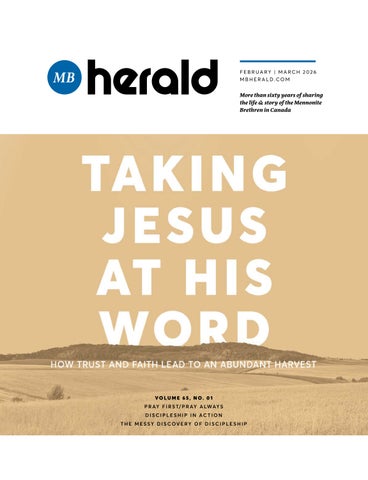
65.01 | February/March 2026

Page 1


MB SEMINARY

At MB Seminary, learning is built for real ministry in real time. Our students develop biblical depth, practical skills, and spiritual maturity through courses intentionally designed for the needs of today’s churches and communities. With Teaching Church partnerships in Burnaby, Williams Lake, Winnipeg, and Waterloo, as well as on campus or online, you can study in settings that keep you connected to your local ministry while immediately applying what you learn.

○ In-person, hybrid courses & workshops

With three theological degrees, a post-masters certificate, and non-health care CPE for professional spiritual caregivers, we have something for everyone who desires to be more equipped for God’s service. real time Build competencies for professional certification including CPE

○ Access some classes through our Teaching Church Partners across Canada

Mennonite Brethren Herald is published bimonthly by the Canadian Conference of Mennonite Brethren Churches, primarily for the use of its members, to build a Canadian MB community of faith. We seek to 1) share the life and story of the church by nurturing relationships among members and engaging in dialogue and reflection; 2) teach and equip for ministry by reflecting MB theology, values, and heritage, and by sharing the good news; 3) enable communication by serving conference ministries and informing our members about the church and the world. However, the opinions expressed here are not necessarily those of the church as a whole.

Daryl Lim, House For All Nations (BC): “Disciples reproduce because they love Jesus with their whole heart, mind, soul and strength, and they love others as Jesus does. This isn’t just a mandate we’re trying to follow; it flows from loving him dearly because we’ve tasted his goodness.”

Read our interview with Daryl on page 26.

Digest

FEB/MAR 2026 | VOLUME 65, NO. 01

EDITORIAL OFFICE

1310 Taylor Avenue Winnipeg, Manitoba R3M 3Z6

Phone: 204-669-6575

Toll-free in Canada: 888-669-6575

MBHERALD@MBCHURCHES.CA WWW.MBHERALD.COM

ISSN: 0025-9349

The Mennonite Brethren Herald is a publication of

6

DISCIPLESHIP OF OUR YOUTH

Vijay Manuel 9 THE MESSY DISCOVERY OF DISCIPLESHIP

David Manafo

19

CANADIAN CONFERENCE OF MENNONITE BRETHREN CHURCHES

23

DISCPLESHIP IN ACTION

Melody Loewen

21 WHAT DOES A “HEALTHY DISCIPLEMAKING” MB CHURCH LOOK LIKE?

Ken Esau

28

WATCHING THE CHURCH BE ACTIVATED MB Seminary COVER STORY TAKING GOD AT HIS WORD

Derek Parenteau

CONFÉRENCE CANADIENNE DES ÉGLISES DES FRÈRES MENNONITES

Sharing the life and story of Mennonite Brethren in Canada

From the National Director

Becoming healthy disciple-making churches

In October 2025, I attended a gathering of global leaders held in Baton Rouge, Louisianna. The reason for the gathering was driven by a “wild dream”: to develop a strategy to increase the annual growth rate of Christianity from 1.8 percent to 5 percent within the next 15 years. Wow, what a vision! The event aimed to foster “Spirit-led innovation” and collective ownership of the Great Commission. The only way this will happen is through prayer, collaboration, and laser-focused intentionality of our efforts on Jesus’ command to “go and make disciples of all nations.”

I left those meetings humbled, challenged, excited, and encouraged. I was mostly encouraged — this is exactly what we at CCMBC sensed the Lord inviting us to pursue in our 2018 vision (mennonitebrethren.ca/about-ccmbc).

We believe God has intentionally called us to collaborate for the express purpose of cultivating healthy disciple-making churches and ministries. I was challenged because we and the global church feel as though we are misaligned to the Great Commission vision that Jesus gave to his church.

The questions become: What priorities do we need to develop to move us back to this centre? What strategies will give us traction in making disciples that go and make more disciples? What are the things we need to stop doing?

These are challenging questions.

The articles that follow are mostly stories of people and churches seeking to “make disciples,” who are equipped to participate in Jesus’ vision given in the Great Commission.

Derek Parenteau, a Multiply missionary to indigenous communities, challenges us to have faith that King Jesus has already provided an abundant harvest. Melody Loewen explains her work with Church Renewal and multiplying disciples through a simple, effective disciple-making tool. Daryl Lim highlights how the House For All Nations International Church is seeking to prioritize disciple-making with young adults, equipping them to make disciples where they learn, work, play, and live. Vijay Manuel invites us to be part of the multi-layered community that disciples our youth.

There are many encouraging signs within our family of churches that show how the Spirit is at work, calling us to realign ourselves to Jesus’ vision. As we collaborate, we will be able to support one another with the gifts and resources entrusted to us. As we unify ourselves around Jesus’ vision, we will find courage to make the necessary adjustments and develop resiliency for the road ahead. It is going to be a fantastic and — if my intuition is correct — difficult journey! But it is the journey that Jesus has put before us, as we long for his return.

CCMBC National Director

CAM STUART

Hello there!

Letter to the editor

Reading through the MB Herald's articles I noticed that there are not many comments. Is this because nobody really comments or because the comments you receive don't meet editorial approval? I am curious.

Yours Sincerely, Jesse

Hi Jesse,

Thanks so much for your email! Unfortunately, we don’t have many comments because people just aren’t commenting! There is the occasional comment that won’t meet our standards, but that is quite rare. Recently, we’ve found that most engagement is on Facebook, but even that is sparse!

Letters to the editor

Please feel free to leave a comment or start a conversation on any of our articles. We would love to hear your thoughts! Or, send us a Letter to the Editor — we would love to include it in the next issue.

Thanks again for the note, and for your support!

Leanne

Associate Editor

MB Herald welcomes your letter on issues relevant to the Mennonite Brethren church, especially in response to material published in the magazine. Please include your name, address, and phone number, and keep your letters concise, courteous, and about one subject only. We may edit letters for length and clarity. We will not publish letters sent anonymously, although we may withhold names from publication at the letter writer’s request and at our discretion. Letters may also appear online or be published in the Herald from an online source, such as comments on articles posted to mbherald.com or on our social media platforms. In these circumstances, letter writers will be contacted by the editor to obtain permission. Because the letters column is a free forum for discussion, it should be understood that letters represent the position of the letter writer, not necessarily the position of the MB Herald or the Mennonite Brethren Church.

Send letters to MB Herald, 1310 Taylor Avenue, Winnipeg, Man. R3M 3Z6, or by email: mbherald@mbchurches.ca.

This free issue of MB Herald costs about $3.50 to publish and distribute. Make a taxdeductible donation today. Visit mbherald.com/heart for more details.

Something you can hold onto

At MB Herald, we’ve been telling stories for nearly 65 years. We’ve seen different editors, designs, publication schedules, and technologies. But one thing hasn’t changed — our commitment to sharing the life and story of the Mennonite Brethren in Canada.

This issue is a special one. It’s the first print edition since January 2020 — and we’re pretty excited about it! In addition to sending it out digitally, physical copies of the MB Herald will be distributed at each of our six 2026 provincial conferences. We are also sending a few copies to each of our member churches across Canada.

Our goal at MB Herald is to continue the decades-long tradition of being the Canadian MB family newsletter. So let’s celebrate together on the mountain peaks and support each other through the valleys. Send us a Letter to the Editor, submit an article, follow us on social media, subscribe to our e-newsletter. Let’s keep the conversation going.

Let’s stay in touch!

Email us at mbherald@mbchurches.ca

Subscribe for free at mbherald.com/subscribe.

2026 PROVINCIAL CONVENTION DETAILS

Ontario | ONMB Acts 6:4 Assembly

February 19-21: Mountain Park Church (Niagara Falls) February 26: Online AGM (Zoom)

Manitoba | MBCM Assembly March 6-7: Eastview Community Church (Winnipeg)

Quebec | AEFMQ Annual Conference / L’assemblée générale annuelle de l’AEFMQ March 21: Location and details coming soon!

Saskatchewan | SKMB Assembly March 27-28: West Portal Church (Saskatoon)

British Columbia | BCMB Elevate and AGM

April 24-25, Willow Park Church (Kelowna)

Alberta | ABMB Gathering May 8-9: Camp Evergreen (Sundre)

In youcasemissed it

We regularly publish website-exclusive stories on mbherald.com. Here are a few articles we’ve posted online in the last few months.

MCC Manitoba, province welcomes Gaza family to Winnipeg for medical care and healing Mennonite Central Committee (MCC) Manitoba will support a displaced Palestinian family of six from Gaza in Manitoba for complex medical care, after the Province of Manitoba announced an arrangement to enable their travel.

“Plant us in freedom” song celebrates family’s 100 years in Canada

Hear the song — and the story behind it — expressing the gratitude for a grandfather’s courage as he journeyed to Canada from Russia, 100 years ago.

Where do you place your focus?

Read Elton DaSilva’s reflection on the importance of perspective.

Holistic and contextual ministry

Bruce Enns, General Director of Multiply, writes: “As an MB family, we want to be people living out the gospel holistically and contextually in many diverse settings. This requires a posture of humility and service, as we encounter the transforming power of Jesus and his kingdom, together.”

The MB Herald Podcast is all about telling stories that build up our MB church family. We invite guests on the show to highlight various ministries and initiatives, as well as talk about some of the pressing issues we face in our churches and communities.

You can listen to previouslyreleased episodes on Spotify or Apple. Watch for these upcoming episodes to be released in the coming months:

Kenneth Kim (Executive Director, MCC). We talk about God’s call on his life, what “justice” means to him, and how he continues to find hope in Jesus.

Randy Friesen (former Director, Multiply). We discuss his new book SQ: The Transforming Potential of Spiritual Intelligence. What is “SQ”? And why do we need it?

David Balzer (Associate Professor of Communications and Media, CMU). We discuss the ever-changing media landscape, why Christians should be mindful of the stories we listen to and tell, and hear about his latest project, The Chatterbox.

Phil Gunther (SKMB, Director of Ministries). While talking about his new book Hello Again, he shares how the “bad times” impact the soul, and why humility is so important in the life of a disciple.

Discipleship of our youth

Every young person is being discipled by someone. The question is not whether discipleship is happening, but by whom?

Based on my experience as a youth, youth leader, parent, and educator, I believe the most effective way to disciple young people into lifelong, faithful followers of Jesus Christ is to intentionally immerse them in a community of believers — mature Christians who model uncompromising conviction, boldly proclaim the gospel in word and deed, and invest relationally through mentorship, shared life, and consistent teaching.

Discipleship is teamwork

It’s not solely the job of our awesome middle-school youth pastor to disciple our sixth-grade daughter. Yes, that’s part of his calling — and he’s truly awesome — but it simply won’t be enough if he’s the only one pouring into her life.

It’s also not the primary responsibility of her outstanding homeroom teacher at MEI Middle School. Again, she plays a vital role, but she cannot carry it alone. What about her basketball coaches? Absolutely — they have real influence, yet theirs are not the only voices that matter. My wife? Without question — moms are irreplaceable in discipleship. Even the parents of her friends? Yes — their words, actions, and home atmosphere shape her too.

Here’s the heart of it: the most effective discipleship doesn’t hinge on any single individual.

It flourishes when we’re all in this together — when an entire community of believers commits to wearing the same “team jersey” boldly marked “Jesus Follower.” When parents, pastors, teachers, coaches, family friends, and fellow church members all live out authentic, passionate, unashamed faith in Christ — consistently and visibly — our children receive the clearest, most compelling picture of what it means to follow Jesus.

I’ve spent years working with young people, and I can tell you: kids have an incredibly sensitive hypocrisy radar. They instantly detect when faith is genuine and when it’s performative. That’s why it’s critically important that they see the adults in their lives truly living out what they claim — loving Jesus wholeheartedly, obeying his Word, and pursuing his mission with joy.

When that kind of united, authentic witness surrounds them, we greatly increase the likelihood of raising young adults who love Jesus deeply, follow the Holy Spirit’s leading into adulthood, and make a lasting impact for God’s kingdom wherever he places them.

Home, Church, School

More than 80 years ago, MEI was founded on a profound vision: the home, church, and school, working in harmonious partnership to nurture children in the faith. My wife Sarah and I, with our four children, have experienced the power of this model firsthand.

Left to right: Sarah, Zoe (15), Misha (23), Sadie (11), Jada (21), Vijay

It all begins at home. My wife Sarah, deeply passionate about sharing the good news of Jesus with the next generation, serves as Advancement Director at Camp Luther Ministries. Together, we have intentionally established clear family values, which we prominently display in our kitchen. We are reminded daily of the biblical principles we have all committed to live by and that shape how we treat one another.

A few years ago, we took this a step further by walking our children through the full Mennonite Brethren Confession of Faith. Our conversation was direct and sincere: “This is who your mom and I are. These Bible-based convictions guide our lives. Now you must decide: do these truths reflect who you are and what you believe?”

As we discussed each article, something beautiful emerged — not mere parental imposition, but genuine family consensus: “This isn’t just who Mom and Papa are. This is who we are.”

discipleship, at a high level, now flows through a powerful three-pronged approach: home first, church second, and school third — all speaking the same biblical language.

I also spent 20 years serving as a teacher, vice principal, and principal in the public school system, and I witnessed how Christian students and staff can form vibrant, supportive faith communities. I fondly remember sponsoring a Prayer Club that met in my classroom at lunch and, later as a vice principal, visiting at lunch time a group of over 60 students with my guitar for worship and encouragement.

THE MOST EFFECTIVE DISCIPLESHIP DOESN’T HINGE ON ANY SINGLE INDIVIDUAL. IT FLOURISHES WHEN WE’RE ALL IN THIS TOGETHER

Our church is also firmly rooted in the MB Confession of Faith. As a result, our children receive a consistent, unified message from both home and church — clear Biblical truth reinforcing itself as they grow.

About five years ago, as part of my role in leadership at MEI Schools, we decided to guide our staff through the MB Confession of Faith during our annual kick-off event. Since our school’s constitution already identifies the Confession as our foundational guiding document, it was not a new direction but a deliberate reaffirmation. I read through key portions of each of the 18 articles to our 230 staff members. I wasn’t entirely sure how it would land, but the response was profound: instead of tension, there was a palpable sense of relief and unity. You could almost hear the collective exhale: “Yes, this is who we are.” We have since made this practice ongoing, and prospective staff are given intentional opportunities to engage with and share their alignment with the Confession of Faith.

Let’s be clear. MEI is a school of choice. No one is required to enrol their children here or to work here. Families and staff choose MEI because of what makes it distinct: we are an unapologetically Bible-believing, Jesus-following, Holy Spirit-led learning community guided by the MB Confession of Faith.

For our family, this means our children’s

Christian educators in public schools play an irreplaceable role — they often become that vital “third strand” alongside home and church, quietly discipling students while shining as authentic witnesses for Christ among colleagues, in classrooms, hallways, and at school events.

Yes it’s a bubble, but a thinning one I absolutely believe in raising children in a protective “bubble” — and I make no apology for it.

When our daughter Sadie was learning to walk, we didn’t place her at the top of a staircase and ask, “What do you think you should do next?” Instead, my wife Sarah and I intentionally and consistently taught her about dangers, guiding her steps with care and instruction.

In the very same way, we have never left Sadie’s spiritual formation to chance or cultural currents. Sarah and I have intentionally and consistently taught her the foundational truths of the gospel.

Now, as Sadie enters her middle-school years, we know the “why” questions will come — and a mere “because I said so” will no longer suffice. We welcome those questions, trusting they will arise upon the solid biblical foundation she has already received. The protective bubble begins to thin, not because truth grows weaker, but because her roots are growing deeper.

As she follows her older siblings into high school, college, and beyond, the bubble will thin further still. Yet the critical question put to her will always build upon that same unshakable foundation: “Sadie, will you choose — personally and wholeheartedly — to follow Jesus? Will you place your faith in him and join the family of God?” The decision, ultimately, will be hers. And by God’s grace, because of the intentional, consistent

discipleship she has received, we pray she will answer with a resounding yes.

Our young people have deep God-given needs for relationship, affection, belonging, identity, and discipleship. If we fail to provide them with humble, God-fearing mentors, the void will almost inevitably be filled by social media influencers, short-form videos, memes, interactive video games, and celebrity voices — whose messages are often far from random, but carefully crafted to shape worldview, desires, and identity in ways that rarely align with the truth of the gospel.

We must establish clear, technology-related boundaries early and hold firm to them without apology. Our primary calling as parents is not to win our children’s approval or popularity, but to serve as their protectors, providers, teachers, guides, and comforters — with the prayerful hope that true friendship will blossom naturally in adulthood.

What is the best strategy for discipling our youth?

Intentionally immersing our young people into a united, intergenerational community of believers,

one that eagerly preserves “the unity of the Spirit through the bond of peace” (Ephesians 4:3) will give us the best opportunity to develop lifelong, faithful followers of Jesus Christ.

As youth develop deep roots in this supportive, truth-centered environment, where they see authentic faith lived out across generations, they are equipped not only to stand firm but to boldly carry the gospel into the world, advancing God’s kingdom for his glory.

VIJAY MANUEL is the Head of MEI Schools in Abbotsford, B.C., Canada. He serves as the Assistant Moderator of the Canadian Conference of Mennonite Brethren Churches and as a member of the Trinity Western University Board of Governors.

This article was edited for length. Read the full version at mbherald.com/ discipleship-of-our-youth.

THE MESSY DISCOVERY OF DISCIPLESHIP

t seems like every pastor I meet is trying to figure out discipleship. Even if we’ve read all the books, attended multiple conferences, or preached extensive series on the topic, it’s difficult to grasp what discipleship is meant to look like in our church or city.

I can read Matthew 28 a hundred times and wonder: how do we really go about this?

I don’t have profound answers or any silver bullets, but I do have a few stories that have encouraged me in the last few years as we’ve determined to keep discipleship a focus at Westside Gathering, our church in Montreal.

Crystal* walked into our church in the summer of 2023, searching for faith and stability. Shortly after she showed up, we started inviting people to explore faith through Alpha. She joined and stayed engaged the whole 11 weeks. We witnessed how she grew in her understanding of God and connection to community.

Crystal is a single mom who works faithfully in a service industry, and somehow manages to attend and serve our church all while working and parenting. We sometimes encourage her to take a break!

She was baptized the following Easter after she finished Alpha and joined another discipleship environment later that fall. She shared her story at one of our Christmas services, inviting people to explore faith for themselves and promised she would be there to welcome them. Crystal kept growing and showing up.

Crystal helped with Alpha when we offered the course the following year, and then signed up to be a co-host last fall. During a prayer time, I saw a woman walk over to Crystal, asking for prayer. Crystal prayed with her freely and genuinely. I was so moved that I encouraged her about it the following Sunday. Her response was simple: “I’ve learned by watching many people do the same thing.”

Here’s where I started to see how discipleship happens: it isn’t a particular group or topic, one special Sunday or ministry, or a required hoop to jump through. Crystal grew from being a seeker one summer to praying for someone two years later through the layering of various environments, relationships, serving opportunities, and challenges along the way.

My perspective on discipleship has also been impacted by Tim*. His curiosity led him to watch The Chosen about 18 months ago. Six months later, his daughter, who had been attending our church on and off, invited him out one Sunday. He started to attend, and within a few weeks of him coming, we were inviting people to Alpha again. Tim decided to join. (This was the same Alpha group that Crystal started helping with.)

HERE’S WHERE I STARTED TO SEE HOW DISCIPLESHIP HAPPENS: IT ISN’T A PARTICULAR GROUP OR TOPIC, ONE SPECIAL SUNDAY OR MINISTRY, OR A REQUIRED HOOP TO JUMP THROUGH.

As Tim engaged, things slowly began to click in his mind and heart. “I wondered how to pray or how the Holy Spirit even worked... I discovered that here,” Tim said. I was surprised to hear him ask about baptism. He had decided to follow Jesus over that season and wanted to take the next step.

He got baptized that summer with another person from Alpha (another great story). They both, along with Crystal, participated in one of our post-Alpha groups, which continued to build community and give them a place to process their faith at a good pace for them.

Dallas Willard encourages churches to have a vision for discipleship, be intentional about it, and choose a method.1 I’ve

been around long enough now to realize that no method is perfect — but you do need to choose one.

I nurtured my understanding of a discipleship path from Bridgetown Church. I kept the principle of predictable patterns from a Mike Breen 3DM cohort several years ago. These have become part of our discipleship tool belt, alongside other things.

When we re-launched groups after COVID, we decided on an eight-week, three semester approach; Montreal is a bustling city and people often feel busy and burdened. We kept the pattern predictable, but not rigid.

We took a step of faith and ran Alpha a second time in 2025, mainly to strengthen our commitment to an annual fall session. On a side note, God surprised us and sent more people in the fall than in the spring. Only God!

A few years ago, we started to articulate that we needed to focus on discipleship environments that fuel mission, so that our spiritual formation isn’t merely self-serving, but as Robert Mulholland reminds us, also “for the sake of others.”2

The messy discovery from people like Crystal and Tim help us realize that our environments can be both missional and formational. Something like Alpha can welcome the curious, equip the committed, and disciple anyone willing to step into a space where they will listen, learn, and live out the way of Jesus. This is what I saw with Crystal. Something like Alpha doesn’t just help people come to faith, it helps Christians learn how to communicate faith, and it welcomes people early in their journey to start ministering to others. Amazingly, the more mature believers leading the group don’t get bored — they get inspired and stretched.

There are many more stories of seeking, faith steps, baptisms, and growing engagement that have confirmed for us that discipleship and mission require layers of varied environments. Is it one-on-one, groups of 6-12, or medium size groups

2  Robert Mulholland, Invitation to a Journey (Downers Grove: IVP Books, 1993) 16

1  Dallas Willard, Renovation of the Heart (Colorado Springs: NavPress, 2002) 85

around tables? All the above. Is it Alpha or Emotionally Healthy Spirituality? Yes. Is it the celebration on Sundays or the smaller congregations like youth, young adults, and kids? Yes. Is it corporate scripture reading in worship or deep-dives into scripture in groups or studies? Slow drip listening and slow discovery learning both play a part in formation.

In our context in Montreal, we need a “both-and” approach to discipleship, community, and mission. We’re too small of a Christian population to go it alone, or to simply rely on a Sunday celebration. And there’s way too much “Christian” content on the internet to let people go it alone. We need to re-hear the story of the gospel regularly in worship and encourage each other along the way.

Our city and province are deeply shaped by secularism. This isn’t so much of a challenge as a reality. During the same week, I hear from someone potentially deconstructing their faith, as well as from someone who is newly drawn to faith. Even in the middle

of a busy, secular, and divided city (politically, socially, linguistically) God continues to draw people to himself who are hungry and open. This was the case for the 10 people we saw baptized this year. In our context, we feel that’s miraculous.

Attending conferences, reading books, and talking to a few great leaders in the trenches — even those in more popular, growing churches — I discovered that we’re all trying to figure out how to disciple better. Let’s be determined to do something — not just anything, but wise and well-grounded things — and then continue to learn and adjust along the way.

This seems appropriate for what discipleship is: a communal apprenticeship to Jesus. That’s what I love about the church. We’re learning how to be with Jesus and become like Jesus together in different, spaces, shapes, and sizes.

I would love to learn and collaborate more. Feel free to reach me at dmanafo@ westsidegathering.com and share what you’re learning on discipleship!

DAVID MANAFO is Lead Pastor at Westside Gathering in Montreal, Quebec.

*Names have been changed

Our CCMBC theme for 2026 continues to be Pray First! Pray Always! 1 Thessalonians 5:17 is the foundation verse telling us to “pray continually.”

For 2026 we want to deliberately and intentionally pray for the “peace of Christ” to rule in our hearts (Col 3:15). When the peace of Christ rules in our hearts, we will have a peace with God that overflows into peace with others, peace with ourselves, and peace with creation.

Each month, we will focus on a certain element of the peace of Christ so that we can more fully appreciate the depth and beauty of this peace and live it out in all our relationships. These prayers should lead us to greater worship of the Triune God who has brought peace through Jesus Christ (Acts 10:36). We are praying that the “peace of God, which transcends all understanding” will guard our hearts and minds in Christ Jesus (Phil 4:7). We are also praying that through our prayers we will become more faithful peacemakers who can rightly be called “children of God” (Matt 5:9) and “reap a harvest of righteousness” (Jas 3:18). Finally, we are praying for the peace of Christ to become real for family, friends, neighbours, and enemies who do not yet know this peace. May there be peace on earth!

We are excited again this year to welcome a variety of writers from our MB family across Canada as they share their own insights and guide us to pray more faithfully. May 2026 be a year of transformation so that we would embrace and live out the peace of Christ faithfully in a world of hostility, vengeance, and violence! “Now may the Lord of peace himself give you peace at all times and in every way. The Lord be with you all” (2 Thess 3:16).

FEBRUARY 2026 PRAYER GUIDE

Peace with God

“You will keep him in perfect peace, Whose mind is stayed on You, Because he trusts in You. Trust in the LORD forever, For in YAH, the LORD, is everlasting strength.”

Isaiah 26:3-4 (NKJV)

What is the first thing that comes to your mind when you hear the word shalom?

I suspect that peace is what comes immediately! But let me ask another question that goes a bit deeper… What is the first experience that comes to your mind when you hear the word shalom?

This might be a bit more difficult and take more time to nail down. Even though we can name Jesus very quickly as the Prince of Peace — our Shalom — how we experience peace is something quite different.

We are beginning our Pray First, Pray Always series on Peace and Peacemaking by focusing on peace with God. It was over a year ago when God spoke to me about this through Isaiah 26:3-4.

The phrase “perfect peace” is actually the same Hebrew word used twice: “shalom, shalom.” This led me to explore how shalom is intersecting with my life and my relationship with God. My hope is that my experience will resonate and connect with you as you read on.

As my wife and I have met with people lately, it feels like peace is fleeting. We long for peace to be ever-present in our lives, but there seems to be so much that steals it away. This may also be your experience.

Isaiah 26:3-4 has become an anchor for me as I have found myself stepping off the sure foundation of the Prince of Peace, onto unsteady ground that stirs up anxiety and doubt.

I’m feeling led to begin this article with a vulnerable story that had significant impact on how trust and peace came together for me.

I was in the middle of a two-year Spiritual Formation program. During one of the retreats, we were invited to ask God if he had a name for us. I was familiar with this practice, knowing that God often uses biblical figures as those he would have us identify with through naming. I had done this many years before, and “Peter” was the name I felt he called me by. At that time, I was glad to receive it — but it wasn’t something that transformed me. However, during this retreat, God spoke very clearly to me as I journalled that day. With very affirming words, he said that Peter was indeed my identity, but now he was inviting me to identify more with Peter the apostle.

I struggled with this, finding it difficult to accept the weightiness of it. However, that day was one where transformation began, as I chose to believe and live into my new identity.

Shortly after this experience, I went through one of the most difficult challenges of my working life. While carrying out my responsibilities as I felt I had been tasked to do, I unknowingly did something wrong — and to this day I am still unsure of what exactly was my error! However, I was essentially sequestered to my office, responsibilities removed, and by all indications, my employment was hanging by a thread. I was devastated. Something like this had never happened before. I had always been wanted, always a valued member of whatever team I belonged to or job I had. But here I was, looking at rejection

fully in the face. I went home and wanted to just be alone, in a dark room forever! Depression was very real in that moment.

Thankfully, God had spoken to me before in times of despair, and my practice had always been to go to him. So that’s what I did. I complained to God: here I was, put into the “doghouse” right after he named me Peter! His reply was quite simple and unexpected: “How does being named Peter have anything to do with the situation you find yourself in? Are you now not who I named you to be? Does your situation dictate this? Can you still be Peter while you’re in the “doghouse”?

Hearing this was sobering. And it changed everything. Simply hearing God speak this truth brought peace to my soul, and I knew I could trust him. My situation didn’t change — I was still in the doghouse! But who I was — who God saw me as — hadn’t changed. This was his first invitation for me to live into the identity he called me to, something I probably would never have considered otherwise.

This is why Isaiah 26:3-4 is so meaningful to me. I felt like I “stayed” my mind on him during that time when my identity was in crisis, when I needed to be brought back to the truth of who I am in God. There have been many more times since when I’ve needed to practice this!

Jesus said to his disciples in John 14:27: “Peace I leave with you, my peace I give to you; not as the world gives do I give to you. Let not your heart be troubled, neither let it be afraid.”

And later on in John 16:33 he says: “These things I have spoken to you, that in me you may have peace. In the world you will have tribulation; but be of good cheer, I have overcome the world.”

I certainly experienced this. My heart was troubled and I was afraid for my job and my future. But choosing to receive and live into his peace was a game-changer.

I’m writing this as Advent is coming to an end and Christmas is just a few days away. It’s apparent that in this season, peace can be difficult to find for many. Christmas brings to the surface things such as hopelessness, loneliness, loss, anxiety, fears, and more — all of which steal our peace.

But it’s not just Advent where we might feel hopeless and alone. As you read this, it will be

well into 2026. You might be wondering why the peace you hear about, the peace you know is supposed to be there, still feels distant and hard to grab onto.

We watch the news to see the many places around the world that are in a state of war, where peace hasn’t been known in their context for a long time. Where you live undoubtably has conflict in some form or another. It may not be war, but you may be experiencing conflict in your family, your church, workplace, or community.

We often deal with conflict by looking to other people or finding ways to medicate to have some temporary reprieve from it all.

We need something to stand on that is unshakeable and constant, where we don’t have to tolerate inconsistencies or character flaws, or wonder how long the peace may last. The answer of course can be found in God alone. But what if we blame God for our situation? We may not be saying it out loud, but what if we’ve given space in our soul to that voice of doubt? What do we do if our source of peace feels absent?

I feel these questions can’t be avoided. We can feel guilty by even entertaining them! But if we avoid the questions, they only serve to push down our disappointment further until it becomes a big rock in our soul that is always there weighing us down, with doubt at every turn.

This doubt eats away at our soul and robs us of the peace that is available and present.

In the NKJV translation of Isaiah 26:3, it says: “You will keep him in perfect peace Whose mind is stayed on You.” What does it mean to have my mind “stayed on You”?

What comes to mind is to consider where I am not at peace, where I am not trusting God. There are certainly things that come up in life that can be unsettling — is perfect peace possible in all situations? Is trust in God necessary for all things? Is there ever anything that doesn’t really require me to trust God for?

My independence says that of course it’s not necessary to trust God in everything. If I were to do that, I wouldn’t ever make a decision!

But is this true?

God’s pace is not my pace. This is undeniable! Right out of the gate, I operate under the assumption that God moves too slowly. That’s not great! It gives me an excuse to take things into my own hands because expediency is needed — at least, that’s what I tell myself.

Independence can make trusting very challenging!

So much comes down to having my mind “stayed” on him. The NRSV translation of Isaiah 26:3 uses “steadfast.” When I consider whether this is true for me or not, I have to acknowledge that my thoughts turn to God quite often throughout the day and I’ve practiced trusting in him for many things, both the difficult and easy. However, something seems to happen when I want things to go a certain way. It’s usually when my steadfastness takes a right turn and I make the excuse that a decision needs to be made now. It’s like when we use Google maps while we’re driving and we have it set to suggest alternate routes when a delay is ahead. This happened recently when we were driving through Seattle. There was congestion ahead on the I-5 so I took the alternate route that was suggested. Well, this led to being stuck in even more traffic! The app can’t predict; it can only make a suggestion based on what is happening at that moment.

How similar this is when I take things into my own hands, not trusting in God’s timing. It causes me to take the path of least resistance — at least what appears to be — which can often lead to more troubles or delays that I had hoped to avoid.

What are you carrying into this new year? Whatever may be stirring within you, I urge you to allow God to bring it forth in his time. He alone knows when that time comes, and we can prepare ourselves for it by choosing silence and solitude as a practice that sets us up for its arrival.

You may also be experiencing something very challenging, something that feels like a punishment. How are you responding to this? Wherever you find yourself in this season, you too can experience shalom shalom by turning to God and intentionally choosing to stay your mind on him. It could mean that you quietly reflect,

choose to forgive, or let go of bitterness. His shalom shalom is possible. It’s there for you. Take steps to receive it this month.

CONSIDER:

1. In what area of your life do you most need to experience his shalom shalom?

2. If you imagine peace as a concrete foundation that one can stand on, talk to God about where your thoughts have led you off that foundation. What are some steps you can take to reposition yourself onto a foundation of peace?

3. Is God inviting you to trust him and let go of anything? Invite the peace of his presence to fill that space you give to him.

PRAYING THOUGH ISAIAH

You will keep him in perfect peace — Father, I believe this, but help me in my unbelief. There are times when it feels like peace is not possible, that I just can’t grasp onto it and it keeps slipping from my fingers. But you are the only one who is able to give me peace regardless of my situation. I desire your shalom shalom. Thank you for this precious gift. I choose to receive it today. Whose mind is stayed on you — I choose to fix my eyes on you today, Jesus, the author and

Will the legacy you leave reflect the life you lived?

perfecter of my faith. Today I choose to stay my mind on you rather than other things that take away from our relationship. But I can’t do this on my own. I need you. Awaken me to your presence in my life, throughout the day, and as I lay my head on my pillow.

Because he trusts in you — Thank you, Father, that I can trust you! Even now, you see me and know me and desire what is best for me. I give my situation to you now, and choose to trust you. As I do, I ask that you fill me with your peace, with your shalom shalom. Forgive me when I’ve taken things into my own hands. Forgive me for not waiting for you. I choose again to surrender to you, to trust you this day, and to trust you this year.

Amen.

NORM NICKEL and his wife Lori lead and serve on Multiply’s Member Care and HR team out of the international office in Abbotsford.

A staggering 60 percent of all Canadians lack a current, up-to-date Will or do not have one at all. If our Will is the last statement we will make, it is important that it be a meaningful one. Many people are not aware of the benefits of good planning, the variety of options available, and the potential tax implications of certain decisions.

Whether you feel your estate is large or small, we are confident that you can benefit from these estate and will planning services. Contact them at 1.866.336.3315, plan@advisorswithpurpose.ca, or ccmbclegacyfund.com

MARCH 2026 PRAYER GUIDE

Praying for Peace with Others

“He will judge between the nations and will settle disputes for many peoples. They will beat their swords into plowshares and their spears into pruning hooks. Nation will not take up sword against nation, nor will they train for war anymore.”

Isaiah 2:4 (NIV)

Where I live in Surrey, British Columbia, there have been over 100 extortion threats, including over half involving shootings. Last summer, my wife and I were heading out on a bike ride, and I suggested we bike to a certain coffee shop. This café has been shot at twice. My wife quipped, “Shall I keep my helmet on inside?” This tonguein-cheek comment was driven by her sense of humour and a real fear for safety in our city. We desperately need peace in our neighbourhoods and in our relationships with others. I regularly pray for peace in my city.

In Genesis 12, God chose Abraham to be the father of a special nation, a people set apart to exemplify God’s character and love. The people eventually settled in the land God had promised to them, but after hundreds of years, the kingdom split into northern Israel and southern Judah.

It didn’t take long for the northern tribes to turn away from God and begin worshipping idols. They became increasingly depraved and eventually made an alliance with Syria to attack Judah. The people in the south were afraid, so God raised up the prophet Isaiah to give them hope.

The first chapter of Isaiah has a grim ending to it, but then we read some words of hope in Isaiah 2. Isaiah is looking into the future, and he sees this picture of a new city, a new world. The prophet had a vision for a city of peace, of shalom. He yearned for the Messiah to come, because once the Messiah came and ushered in the

kingdom, peace would reign. Jerusalem would be Jeru-shalom, and there would be peace in relationships. This is what Isaiah sees:

“In the last days the mountain of the Lord’s temple will be established as the highest of the mountains; it will be exalted above the hills, and all nations will stream to it. Many peoples will come and say, ‘Come, let us go up to the mountain of the Lord, to the temple of the God of Jacob. He will teach us his ways, so that we may walk in his paths.’”

Isaiah 2:2-3 (NIV)

Isaiah is likely not calling the people to literally walk up a mountain. Back in Isaiah’s day, shrines were built on the mountains. He is saying the Lord’s temple will be above all those shrines. He calls the people to come to the temple to learn God’s ways, to walk in his paths. Isaiah sees this vision of a multitude of people, Jews and Gentiles streaming to God, like a flowing river. It’s not the architecture of the temple that’s critical, but rather God’s presence. The next verse in Isaiah 2 seems almost supernatural, so incredulous for us to imagine:

“He will judge between the nations and will settle disputes for many peoples. They will beat their swords into plowshares and their spears into pruning hooks. Nation will not take up sword against nation, nor will they train for war anymore.”

Isaiah 2:4 (NIV)

Isaiah says that there will come a day when nations no longer train for war, because it won’t be necessary — no nation will be at risk of attack. When Isaiah says, “In the last days” (v.2) it’s conceivably a wordplay from the first three words in the Bible: “In the beginning.”

Isaiah is showing the contrast between creation’s peaceful design and the current destruction that has been wrought on the planet through sin and selfishness. He pictures things returning to their original state. He writes: “Nation will not take up sword against nation” and “they will beat their swords into ploughshares.”

God’s vision is a planet of peace, where swords and guns aren’t necessary, where weapons of war are pointless. And so, from lack of use, these weapons would be fashioned into farming instruments: plough shares and pruning shovels.

In Preston Sprinkle’s book Fight: A Christian Case for Non-Violence, he tells the story of the “Tree of Life” project. When the South African country of Mozambique was decolonized, a civil war broke out that lasted 15 years until 1992. Over a million people were abused and murdered in horrible ways.

An Anglican pastor named Dinis Sengulane spearheaded an effort among churches that helped lay the foundation for a 1992 peace treaty. But they didn’t stop there, because there were still more than seven million guns hidden all over Mozambique that could lead to another civil war.

To prevent further violence, the government of Mozambique initiated several disarmament projects aimed at weeding out the hidden weapons. One of these initiatives was the Christian-backed “Tools for Arms” project, otherwise known as “Swords into Plowshares.” The project got its name from Isaiah 2:4.

In order to draw out the weapons from the bush, people were given an instrument of agriculture in exchange for every weapon turned in. A shovel for a rifle, a hoe for a machine gun. One village turned in a whole cache of weapons and received a tractor in return. A 12-foot high “Tree of Life” was fashioned from guns welded together. It celebrates the peace this movement has helped create.

I’m wondering if God’s word to some of us today is to beat our “swords and spears” into instruments of peace. Are you more like a soldier or a gardener in your posture towards others? Is your tongue more like a sword that cuts down, or a plowshare that plants seeds of peace?

“If it is possible, as far as it depends on you, live at peace with everyone.”

Romans 12:18 (NIV)

Peacemaking is not the absence of conflict, but the ability to deal with it. You do your part, as much as you can. You can’t manipulate the other person’s response. But you can regulate your reaction.

The human will alone is insufficient for peacemaking in relationships. To stop the fights in our world, in our churches, in our families, we have to stop the fight inside of us.

The prophet Isaiah continues: “Come, descendants of Jacob, let us walk in the light of the Lord.”

Isaiah 2:5 (NIV)

To walk in God’s light is to walk where God shines the light. If I’m walking down a path and it’s getting darker, I don’t continue to walk down the path of darkness — I shift to where the light is. I stay in God’s presence. I align my life with God’s will. I continually adjust my life to walk in God’s light.

Peace has an internal dimension: inner peace. It has a horizontal dimension: peace with others. All of this is fueled by the vertical dimension: walking in the light of the Lord.

All of us have been victims of conflict. Our “spears and swords” have been things like anger,

hate, and resentment. Because of the hurt we experienced, we hate in return. Because of the abuse we suffered, we are filled with bitterness. Because of the pain inflicted on us, we choose to dwell in self-pity and unforgiveness.

God says to you, let go and forgive. Many of us have been deeply hurt by someone we trusted. Forgive the person who betrayed you. Let go of the memory of that mean action. Surrender the bitterness that is keeping you from experiencing peace. The call to those of us who have been victims of conflict is to forgive.

All of us have also been instigators of conflict. You have people in your life that push your buttons; you’re ready to give someone a piece of your mind. God says, let go of the conflict, transform that weapon of war into an instrument of shalom. Stop instigating, stop setting fires in relationships. The call to those who are instigators of conflict is to repent.

“And those who are peacemakers will plant seeds of peace and reap a harvest of goodness.”

James 3:18 (TLB)

Take a tiny seed and plant it in a few centimetres of soil. Water it and give it sunlight, then watch that seed sprout to life. It will move dirt. It will dislodge rock. It could even crack through a driveway. All from a single seed.

James says those who are peacemakers will plant seeds of peace. The seed could be a word of love, a smile, a prayer offered, a word of gratitude or encouragement. Seeds can be planted by acknowledging a teller at the bank or barista at the coffee shop that you know by name. It may be giving a Tim’s gift card to the unhoused person in front of the Tim Hortons. This verse in James promises that if we sow seeds through being peacemakers, we will reap a good harvest. Isaiah lived in a terrible period of conflict and the awful ravages of war. The atrocities of the Assyrians were horrific. He roars prophetically against trusting in militarism. More than any other prophet, Isaiah vehemently critiques Israel’s trust in horses and chariots, military power, and alliances with other nations.

Recognizing the battle within, Isaiah calls us to trust in God — and God alone. He calls us to turn away from trusting or atoning for ourselves by pointing towards a future Messiah. This Messiah will fight for justice but through non-violent means. The Messiah will absorb violence and not perpetuate it. Isaiah prophesies these words:

“But he was pierced for our transgressions, he was crushed for our iniquities; the punishment that brought us peace was on him, and by his wounds we are healed.”

Isaiah 53:5 (NIV)

Jesus’ blood brings us peace. He died unjustly a criminal’s death. But his punishment gives us peace. When you experience Jesus’ grace and acceptance and live in it, then you can forgive yourself and others. The vertical becomes horizontal.

I invite you this moment to pray. Be still and know Jesus’ love and forgiveness and allow his life to be the fuel for your peacemaking with others.

CONSIDER:

˚ What relationship is Jesus asking you to pray into now?

˚ What “seeds of peace” can you plant this month?

PRAYING FOR PEACE WITH OTHERS:

Jesus, you came to this earth to bring peace — peace with the Father, peace with one another, peace with ourselves. May we experience you today to a greater extent, so that we can live as peacemakers. Amen.

BAYER is Director of Pastoral Ministries at British Columbia Conference of Mennonite Brethren Churches.

Watching the church be activated

Keziah Froese reflects on her experience with MB Seminary’s Teaching Church partnership

“We’re a small church with leaders who have big visions and big dreams — big in the sense that we have a lot of faith and are willing to risk, and that might seem incongruent with our size,” says Keziah Froese, Children’s Ministry Lead at Cariboo Bethel Church in Williams Lake, B.C.

One of those dreams is to see its members come alive with passion for Jesus. This led Cariboo Bethel Church to inquire about become a Teaching Church of MB Seminary, which came to fruition this past fall.

Nestled in the Central Interior of British Columbia, Williams Lake isn’t a location that is usually associated with seminary — but that is the beauty of the Teaching Church model. Teaching Churches are partnerships between MB Seminary

and a local congregation that provide students and other learners with education and training that is contextualized for the church.

The church functions as the host site for the teaching portion of the course. Rather than having students uproot their lives and move to where the school is located, MB Seminary travels to the host church and delivers the instruction to the academic students who are enrolled in the course. For anyone else interested in the subject, they can register as a workshop participant.

The first course offered at Cariboo Bethel Church was “The Life and Teachings of Jesus,” taught by MB Seminary President Mark Wessner. A total of 30 people participated (eight graduate students, 22 workshop particpants).

Reflecting on her past Bible school experience, Froese shares how difficult it was for her to re-enter her church community after intense spiritual learning, likening it to a “jump scare”: “returning to your local church and trying to articulate what you experienced…. There’s a lot of dissonance and a lot of grief and a lot of miscommunication or disappointment of why it’s different.”

In contrast, Froese says, it was profound to be able to experience this level of spiritual formation and learning with those in her church family.

“There was so much diversity in the room, but all people who I know and who I love, and who I have a little more insight into their story,” says Froese. “And then, this same group of people are there at church the next morning…. The walls are already kind of broken down, and everyone’s spirits are tender and everyone is hungry for more, and fired up to be part of the ‘Jesus revolution.’”

The courses offered through Teaching Churches are nine-weeks long, taught by MB Seminary Faculty. The teaching portion of the course is scheduled over one weekend, combined with context-based cohort meetings and mentoring relationships that enhance a student’s learning and broaden their ministry application.

Froese says the weekly cohort meetings are where her learning has come alive. “There are readings, and it can become highly cerebral and stressful on your own. But then to have this shared experience, and [hear how] we’re being transformed. Each of us have reflected on how it’s changed us — our perspectives and how we read the Bible.”

“As a staff member, so much of what we want is to see the church come to life,” says Froese. “And I’ve been watching the church be activated right in front of me, but also in such a personal way.”

For more information on MB Seminary’s Teaching Churches, visit mbseminary.ca/academics/ teachingchurches.

Just over four years ago, I was invited to join a discipleship movement that changed my life. I began working with Marketplace Leaders Renewal, a division of Church Renewal International (CRI). Marketplace leaders — ordinary laypeople — sit in our pews, serve faithfully, and lead in their homes, workplaces, communities, and churches. Marketplace Leaders Renewal challenges them to impact those within their spheres of influence for Christ. Many are eager to grow in discipleship but do not know where to begin. We invite them to join mentoring groups that equip them using CRI materials called TheWay — a discipleship pathway.

Abide in Christ is the first module in  TheWay series. This discipleship journey spans 16 weeks of lessons. Each week is carefully designed to guide participants through five daily devotionals. These devotionals provide opportunities for reflection, spiritual growth, and practical application of biblical principles. By engaging with the material daily, participants cultivate consistent habits that foster personal renewal. A key factor in success is the weekly group meeting where participants share insights with one another. We encourage and sharpen each other as we learn together.

Previously, I saw discipleship as simply teaching others about God and Christian living. However,

through TheWay, I realized true discipleship is not about gaining more information — it’s about guiding people into personal renewal. When I became more intentional in my own life, using a fuller spectrum of practices, it became purposeful. I am passionate about seeing lives changed! I realized how many others want more and don’t know how to get there, so it became my life calling to help others find renewal. I love leading groups of women, encouraging them in their walk with Jesus, and seeing lives change week by week.

Here are a few testimonies that reflect countless similar life transformations:

“Abide gave me the tools I had been looking for to grow deeper in my relationship with God and learn how to listen for that small, still voice.  TheWay has impacted my life in a beautiful way, and I hope to share that with others.”

“TheWay has been a turning point in my spiritual journey. The devotionals provide a deeper level of understanding that is relevant to me. God speaks directly to me with love rather than judgment.”

“I’ve been a Christian for 40 years and I have never experienced hearing God’s voice until I started in Abide.”

“ TheWay series is foundational teaching to abide in Christ. In my experience, the daily devotionals and mentorship have been one of the best spiritually growing exercises.”

“As a women’s ministry leader, I found myself searching for something to re-energize my Christian walk. I needed a spiritual emergency room. I stumbled on Church Renewal on the internet and am so thankful God led me to the Abide mentoring group and a Set Free retreat.”

Can you hear the hunger for more of Jesus? Obedience and daily practices lead to genuine growth. As Romans 12:2 reminds us: “Do not conform to the pattern of this world, but be transformed by the renewing of your mind. Then you will be able to test and approve what God’s will is — his good, pleasing and perfect will.” As we renew our minds, we learn to discern what God’s will is! It takes discipline and consistent practice.

I have identified five key components essential for multiplying disciples:

Scripture – As participants share a meaningful verse each week, these conversations bring Scripture to life, offer fresh insights, and encourage mutual learning.

Life Application – Thought-provoking questions help participants apply biblical principles daily. Sharing personal stories of God working in their lives reveals the Holy Spirit’s transformative power and the fruit of obedience.

Prayer – This is the foundation. Pray for the group you facilitate. Pray with the group. Share needs and joys and celebrate answers. As trust grows, prayer opens the door to confession and repentance. Transformation happens in real time.

Vulnerability – Facilitators are learners alongside the group, inviting the Holy Spirit to guide. Leading by example, being real, and admitting mistakes builds trust.

Multiplication – We continually pray for those God is calling to facilitate new groups. When new groups launch, multiplication begins. We have the privilege of supporting and praying for them. This is Matthew 28:19–20 in action!

One standout example is a men’s group of business entrepreneurs. Their commitment to personal study and weekly meetings has borne much fruit. Homes and businesses have been transformed because these men first did the “life renovation” work on themselves. They realized doing what they’d always done was producing the same results, and they wanted more. Today, they are changed people, and many are now discipling others.

Multiplication is happening! Just over three years ago, I felt led to pray for a participant in my group to start Abide in her home church. After

several months, she sensed the Holy Spirit’s nudge. Though she didn’t see herself as a leader and was initially reluctant, she obeyed. With her pastor’s blessing and our support, she launched a group of 10 women. It flourished and positively influenced their church’s culture. Today, she has trained 24 leaders to implement church-wide discipleship using Abide. It all began with prayer and a step of obedience.

Do you have a desire to disciple others but are not sure where to start? Common barriers include lack of experience, limited time, and few opportunities in your church or community. Do not let these stop you. Begin with prayer, asking the Holy Spirit for guidance. Consider joining a group first to build your own discipline and practices. Seek counsel and prayer from friends and your pastor as you discern next steps.

In summary, intentional discipleship rooted in prayer, obedience, and learning together is essential for lasting spiritual transformation. By equipping marketplace leaders with resources like TheWay, we empower people to step out in faith and multiply disciples in our unique contexts. Wherever you are on your journey, God invites you to take the next obedient step, trusting he will use your faithfulness to impact others for his glory.

There are many excellent resources available that can be used in our disciple-making initiatives. TheWay is one that I found extremely helpful; I encourage you to seek out the resources that make sense to you and your context.

For more on TheWay , visit churchrenewal.com/theway.

MELODY LOEWEN attends Mission Hill Church in Calgary, AB. She is the Coordinator for Marketplace Leaders Renewal at Church Renewal International and is a member of the MB Seminary board.

Q&R corner

Q&R corner provides responses to questions that readers may have about CCMBC and its work collaborating with provincial MB conferences in areas of spiritual health and theology, leadership development, mission, and organizational health in order to achieve the overall mission: “To cultivate a community and culture of healthy disciple-making churches and ministries, faithfully joining Jesus in his mission.” If you would like to contribute a question, please send it to questions@mbchurches.ca

Please note that we will not be using your name in the MB Herald Digest in order to respect those who prefer anonymity. There may not be space to respond to every question—and sometimes we might not really have the ability or authority to respond to some questions (for example, those that relate more directly to one of our provincial MB conferences or to a local church leadership). We apologize in advance if we are unable to publish a response to your specific question.

What does a “healthy disciple-making” MB church look like?

The mission of the Canadian Conference of MB Churches (CCMBC) is: “To cultivate a community and culture of healthy disciple-making churches and ministries, faithfully joining Jesus in his mission.” Because our mission makes these words so central, we often hear the question: What does a “healthy disciple-making” MB church look like? If we want to create communities and a culture of healthy disciple-making churches, then we need to know what exactly a healthy disciple-making MB church looks like.

How do we know if an MB church is healthier today than it was five years ago — or is less healthy? How do you measure disciple-making — simply by increased attendance, baptisms, or…? While our mission statement highlights church health and disciple-making, these are all works of the Holy Spirit. At the end of the day, we do what we can, but ultimately “unless the LORD builds the house, the builders labor in vain” (Ps 127:1). Paul’s humble attitude is key here. We are only “servants” who recognize our part while it is really God who creates “healthy disciple-making” churches. However, we do need to do our part! Paul says: “I planted the seed, Apollos watered it, but God has been making it grow…. For we are co-workers in God’s service” (1 Cor 3:6,9). While God grew the church, it was still critical that Paul and Apollos planted and watered. We must still be faithful to do our part while giving all the glory to the LORD!

Healthy churches embrace the lifegiving rhythms of prayer, worship, celebration, sacrifice, rest, study, and community.

So what do the words “healthy” and “disciple-making” mean for us?

The origin of the word “health” (or “healthy”) has to do with “being whole” or “complete” — in both the sense of uninjured and the sense of robust flourishing in all dimensions (physical, mental, emotional, relational, spiritual). Being healthy as a human being is multi-dimensional and holistic — requiring a good diet, exercise, positive relationships, meaningful endeavours, and so on. We would not call someone “healthy” if they had a brain aneurism, a failing heart, or lung cancer. For someone to be healthy, they need all their dimensions of life to be working well together. It is the same with a healthy church. There is no singular magic pill for church health (unless you mean the Holy Spirit and the fullness of King Jesus). Church health involves developing spiritual, relational, and emotional health in the way of Jesus and encouraging all of that health toward God’s Kingdom mission.

The word “healthy” also describes a situation where a person is able to withstand well common attacks on one’s health and vitality — and to recover quickly from those attacks when they do break through one’s defences. In the same way, a healthy church is constantly under various external and internal threats — spiritual, relational, financial, etc. — but a healthy church, by God’s grace, is able to withstand such threats so they do not overwhelm or completely destroy

the church. Healthy churches, by the grace of God, are also able to recover from unavoidable crises. There is no question that the Covid-19 pandemic tested the health, resiliency, character, and mission-mindedness of many churches. A healthy church must expect that there will be hard days ahead and should be staying on the healthy disciple-making mission so that it will stand firm in that day.

The adjective “healthy” also describes a person who is self-disciplined enough to embrace healthy life-giving practices and avoid those that are high-risk and destructive. Healthy churches embrace the life-giving rhythms of prayer, worship, celebration, sacrifice, rest, study, and community. Healthy churches avoid high-risk and destructive practices that reflect spiritual, intellectual, and missional laziness, or are short-cuts to spiritual and missional health.

The adjective “disciple-making” implies that there is positive movement toward greater discipleship life, vitality, and maturity that results in what we could call “new-disciple multiplication.” A disciple-making church should see disciples grow in character, prayer, service and compassion, and in proclamation and invitation. God can use these to grow attendance numbers and new-disciple baptisms and community impact.

We see unhealthy churches achieve astounding numerical growth and this is a huge temptation because church numerical growth most often brings increased finances, increased influence, and increased accolades. We do know that some physical growth in children and adolescents can be unhealthy (e.g., gigantism, Sotos Syndrome, etc.). There are churches that grow faster than others — while harbouring toxic or even abusive leadership, or unhealthy theological convictions. Jesus’ words to the disciples could also apply to churches: “What good will it be for someone to gain the whole world, yet forfeit their soul?” (Matt 16:26). It is obvious that if numerical growth is the primary goal of a church, then there are short-cut ways to achieve that goal. Preaching fear and/or wrath against government or against other Christians — or fully embracing a prosperity gospel — are two of the most effective church growth strategies today.

Our CCMBC mission says we want to be a family of “healthy disciple-making” churches. We do not want one without the other. Our CCMBC family has embraced four priority areas that we believe will help us become a family of healthy disciple-making churches: Mission, Spiritual Health and Theology, Organizational Health, and Leadership Development. These are some of the multi-dimensions of health that we need to have working together. Here is an overview of a rubric that can be used by each MB church to consider how they are growing (or not growing) into a healthy disciple-making church:

A “healthy disciple-making” church intentionally encourages, enables, and nurtures…

MISSION PRIORITY AREA

˚ A corporate commitment to seek first and model God’s Kingdom and God’s righteousness in all of church life — loving God and loving neighbour in the way of Jesus.

˚ A corporate grace-filled vision for disciple-making that encourages existing disciples to grow into the character and Kingdom mission of Jesus and embrace the mindset and practices that lead to new-disciple multiplication.

˚ A corporate grace-filled vision for new-disciple multiplication that involves making disciples of all nations, baptizing them, and teaching them to obey everything Jesus commanded.

SPIRITUAL HEALTH AND THEOLOGY PRIORITY AREA

˚ A growing understanding of and appreciation for the Triune God (Father, Son, and Holy Spirit) who is actively creating, saving, healing, and restoring so that God’s Kingdom will one day fully come to earth as it is in heaven.

˚ A growing commitment to live faithfully to Jesus Christ as Saviour, Redeemer, and King.

˚ A growing understanding of and embracing of God’s Kingdom story and the theological and ethical convictions that are part of that story as portrayed in Scripture — and as summarized in the MB Confession of Faith.

“Our CCMBC mission says we want to be a family of “healthy disciplemaking” churches.

”ORGANIZATIONAL HEALTH PRIORITY AREA

˚ A corporate and individual life that, by the grace and empowerment of God, models God’s Kingdom and can be called “good” — where Christian character, forgiveness, kindness, respect, integrity, compassion, the well-being of the vulnerable, self-sacrificial leadership, and financial transparency are valued and protected.

LEADERSHIP DEVELOPMENT PRIORITY AREA

˚ An ongoing process of identifying, encouraging, developing, and equipping disciples of Jesus toward meaningful service/leadership both inside and outside the church family.

Growing into a healthy disciple-making church involves clarity and commitment to our mission, a strong biblical theological foundation, practices and policies that produce overall church health, and a commitment to developing Christ-like disciples committed to service and leadership. While these are a “blueprint” or “building plan,” let’s begin with a prayer that the Triune God — the ultimate builder of the church — would empower each and every MB church to become a healthy disciple-making church that honours the name of Jesus and seeks first God’s Kingdom!

Blessings and Shalom in King Jesus!

Ken Esau, National Faith & Life Director

MB HERALD INTERVIEW

HOUSE FOR ALL NATIONS INTERNATIONAL CHURCH

How did you get connected to House For All Nations?

When I moved to Canada in 2001, I first joined Willingdon Church’s Indonesian ministry, led by Pastor Sonny Mandagie. That same year, he started an English service for those who did not speak Indonesian but were closely connected to the community (called the International Campus). He later planted House For All Nations (HFAN) in 2004 in Burnaby. I was a part of the planting team and served as a worship leader in the International Campus.

I never planned to be a pastor. I had gone to Bible college because I wanted to know more about God. The one time I preached in my final year, my teacher said, “Daryl, stick to worship leading.” That's how bad it was! But when HFAN planted a Vancouver Campus that consisted mostly of young adults, Pastor Sonny would ask me to preach. I always said no, until one time when he was out of town and there was no one else to do it. That week, I ended up preaching, and it went well. After that, he scheduled me to preach once a month.

In 2010, I was asked to oversee that campus. God gave me a love for these young adults, mostly UBC students, so I said yes and became the pastor for the Vancouver Campus. That campus later merged with the International Campus. Today, I serve as the Associate Lead Pastor of HFAN, as well as the pastor of Burnaby International Campus.

What is House For All Nations like?

We are one church with five multicultural campuses across three locations, serving in three languages: Burnaby International, Coquitlam International, Burnaby Mandarin, Burnaby Indonesian, and Calgary Indonesian. House For All Nations does not replicate the same model across

all campuses. Instead, we try to understand the different cultures and serve them according to their unique needs, while still having the same mission, vision, and values. This is often challenging, as each campus is so different. Yet it is also beautiful, because God loves the nations, and he loves when the nations come together as pictured in Revelations 7.

Can you describe House For All Nations’ vision of “reproducing congregations”?

I'll say this — we're not there yet! It’s a vision where disciples multiply. That's what Jesus calls us to do, right? Go and make disciples. By “disciples,” we mean baptized believers who love Jesus deeply — abiding, obeying, and sharing. When disciples make disciples, they start communities of disciples that eventually become congregations or churches. And the cycle continues. Disciples reproduce because they love Jesus with their whole heart, mind, soul and strength, and they love others as Jesus does. This isn’t just a mandate we're trying to follow; it flows from loving him dearly because we’ve tasted his goodness. Right now, beginning with the campus that I’m leading, we’re encouraging people to reach out

to those who are lukewarm or non-Christians and to start discovery groups. We've been learning from the disciple making movement. These groups are designed to help people discover Jesus and eventually join a local church or form home churches. I encourage people to practice sharing the gospel: a 30-second version, a three-minute version, or their testimony. Our mandate is not to make leaders; it is to make disciples. Some of my core team members would not fit the traditional mold of a leader, yet they're making disciples.

There are a lot of churches in Canada who are good at creating small groups focused on spiritual formation and caring for those in the group. Yet many find it hard to reach out to others and invite people in. How can churches learn from what you’re doing?

One of the main things I've learned over the past four years — and we all know this — is that we must go back to prayer. Disciple-making was the goal, not prayer itself, but as we kept the nations in the forefront of our minds, we came to realize that disciple-making cannot happen without prayer. Disciple-making begins with prayer and must be permeated by prayer.

In 2020, during COVID, I hit a wall (I think many pastors did). I began asking: What does it mean to follow Jesus? What does it mean to be his disciple? I remember one of my leaders asking our group: “How many of you have shared the gospel with someone this week?” No one raised their hand. “This month? This year?” Out of eight of us, only three raised their hands.

Around that time, another leader returned to Indonesia and later married a Muslim. In order to get married to her, he converted to Islam. That shook me.

After being a pastor for 10 years, I asked myself, What am I doing? What are we doing? Growing up in the church, I realized I had become good at raising up people to be good church ministers, but not at making disciples of Jesus. I made an intentional shift from doing church ministry to making disciples who make disciples who make disciples.

I began meeting with two men who wanted to pursue Jesus intentionally. We sensed that we needed to share the gospel every week. We also began reading the book of Acts. One of my friends came across a set of simple questions. About a year later, I learned these were Discovery Bible Study (DBS) questions. That's the model we've been using in our small groups. More than anything, a renewed dependence on prayer has been the biggest shift since 2020. God has led us from one intentional prayer time a week into a prayer culture.

How do you encourage young people to use their gifts and to feel equipped in ministry?

One of the things that Pastor Sonny and I talk about is that we need to be permission-givers. We need to give young people permission to fail, and permission to dream and try.

My name means “beloved by God,” and I pray that the love God has given me overflows to others. Growing up without a dad, I felt that sometimes I would have access to certain people, but that only went so far. I always wanted someone who shared their life openly. I longed for that. Over time, I realized I got to be that person myself to these young people. So, I just choose to be an open book with them. Encouragement flows from a genuine love for them — journeying together, serving one another, and leading them to taste and see that the Lord is good. My heart is for them to love him with all their heart, mind, soul, and strength. In simple terms, I just do life with them.

What’s your encouragement to other churches across Canada?

First and foremost, pursue God. Let us make disciples who make disciples who make disciples, being obedient to the Great Commission. Let's do this on our knees.

Love him with your whole heart, mind, soul, and strength. Sit quietly before him. Be with him. Listen to his voice. He actually does speak! Don't put ministry before him. Don't put your family before him. Taste and see that he is good, and watch how God pours into you.

JANZEN lives in Saskatoon, SK and is a member of Faith River Christian Fellowship.

everal years ago, God opened the door for me to minister in a local jail. In my 20 years of mission work among various marginalized people groups, I had often prayed for this very opportunity. I was thrilled to have the chance to join Jesus in his work of setting captives free.

SWhen the day came, I remember sitting in my parked car, praying. I felt excited and positive. Although I didn’t know exactly what to expect, I was fairly confident. I had two decades of experience under my belt. Not only had I been trained and mentored extensively in disciple-making principles and practices, but I had also experienced the fruit of it — I had seen many people baptized and many simple churches planted.

And then I walked through the door.

It didn’t take long for my positivity and confidence to evaporate. As I was signing in as a chaplain, the guard at the entrance rolled his eyes and said, “You think Jesus is going to save these guys?” I suddenly had a panicky feeling in my gut.

Next, I was escorted to one of the living areas. I walked in with a big smile on my face and my Bible under my arm — and found 40 tattoo-covered men, all staring at me with looks that could kill. My panic quickly progressed to nausea. I’m pretty sure my smile was gone.

To break the tension, one of the men came up to me and said, “Who are you?” I couldn’t help but notice that he had the words “Satan,” “murder,” and “hate” tattooed… on his face!

I don’t remember exactly what I said after that, but it involved a lot of stuttering, as I was desperately searching for a safe place to regroup. It definitely had not gone according to plan.

So, what had gone wrong? How could I have so much training and preparation and good intentions, only to end up falling so far short?

When it comes to disciple-making among those who are lost, there is a lot we can learn. Having a solid understanding of the gospel, discipleship methodology, and mission strategies are important. But what I think matters most is what we believe. Experiences like mine expose the depth of our faith and trust in Jesus — who he is and what he said. No matter what our perspectives or preferences on how to make disciples, there are some core beliefs that are absolutely necessary for us to even get started, let alone to be fruitful.

If you are still with me, I’d love to share the two beliefs that I think are the most foundational.

THE HARVEST IS PLENTIFUL

“And he said to them, ‘The harvest is plentiful, but the laborers are few. Therefore pray earnestly to the Lord of the harvest to send out laborers into his harvest’” (Luke 10:2, ESV).

I have often heard and believed that particular places or people are “hard soil.” But despite the very real and challenging experiences we have all had, Jesus has something else to say. He says that the harvest is abundant! And to emphasize the point, he makes clear that he has the authority to make such a promise, because he himself is the Lord of the harvest. That’s who we serve. That’s our King.

In my experience, many of our ministries are built around the false image of “hard soil.” Of course, in the Parable of the Sower, Jesus acknowledges different soils, but we have a habit of focusing on the scarcity as opposed to the emphasized onehundred-fold abundance.

We often gravitate towards expecting very little, and we put the bulk of the responsibility for our meager results on the shoulders of the lost. It becomes tempting to develop complex, expensive, expert-dependent ministries to work the assumed hard soil. As someone who has been there and done that, I can tell you that it is exhausting and discouraging.

But what if it simply isn’t true? What if we took Jesus at his word? What would change? A lot! Imagine a world where the harvest is abundant, the fruit is falling off the vine, and the hard work of sowing and cultivating has already been done. This is the worldview Jesus invites us into. Without that belief, all of our knowledge and resources and plans for discipleship add up to very little. We need to have faith.

KING JESUS IS WITH YOU

“… All authority in heaven and earth has been given to me. Go therefore and make disciples of all nations, baptizing them in the name of the Father and of the Son and of the Holy Spirit, teaching them to observe all that I have commanded you. And behold, I am with you always, to the end of the age” (Matthew 28:18-20, ESV, emphasis added).

Making disciples isn’t easy. First we have to “go,” which is never comfortable. Then we are to proclaim a message of repentance and radical allegiance to Jesus that needs to be made public — which can feel like a hard sell. And finally, we need to teach people to obey the commands of Christ, which I personally find the most overwhelming. There is good news and bad news about disciple-making. The bad news is that you will never be able to do it on your own. The good news is that you don’t have to, because Jesus is King! He is alive and he is with you.

If we don’t have a deep trust in the right here, right now presence of our powerful and victorious King, then avoiding disciple-making actually makes quite a bit of sense. But if we choose to take Jesus at his word and stand on this promise, then it becomes the most joyful of adventures. We get to introduce people to the real Jesus, who transforms lives and is actually in the room with us while we witness to them. Jesus does the heavy lifting; we simply get to join him in his work of bringing in the harvest.

THE FAITH OF A DISCIPLE MAKER

Several years have passed since I walked into that jail, and I’ve fallen short more times than I can count. But I can testify to abundant harvest and the faithful presence of Jesus in every interaction. I’ve witnessed more than I could ever have dreamed of on that first day, and it’s not because I’ve gotten smarter or worked harder.

There is so much to learn and grow in when it comes to missional disciple-making. But when it all boils down, if we want to be a disciple-maker, we need to have the faith of a disciple-maker. We need to trust that Jesus is personally leading us into an abundant harvest that he has already prepared. It’s a very different world than the one that most of us have imagined. Let’s believe in it together. Let’s trust in Jesus together. Let’s go and bring in the harvest.

DEREK PARENTEAU serves as the Canadian Regional Team Leader with Multiply. He and his family live in Northern Ontario where they have the joy of walking along side marginalized people in many different settings.

Launch Your Life with Purpose

1-Year Programs

QUEST

Columbia One

Emergency Rescue

Technician

Educational Assistant

2-Year Programs

Biblical Studies

Psychology

Applied Leadership

Practical Theology

Outdoor Leadership

Worship Arts

Youth Work

4-Year Programs

Biblical Studies

Psychology

Applied Leadership

Church Ministry

Dual Degree: Theology & Business

A moment in time

Disciple-making has been a long-held value of our MB family. Pictured here is a group shot of those who attended Disciple Making ’85, a conference held at Portage Avenue MB Church.

Courtesy of the Mennonite Archival Information Database

WINNIPEG, MANITOBA 1985

CCMBC Legacy Fund exists to provide ministry-focused financial services to facilitate Kingdom Growth.

Whether you are an individual looking to invest while making a difference, or a church looking for financial administrative support to free you for ministry, CCMBC Legacy Fund can help.

Investing in Kingdom Growth Together

For Churches

Legacy Accounts

Save excess funds, fund building projects, or diversify investments. Enjoy faithbased investing with competitive rates, no fees, and no terms.

HR Advisory Services

Three HR advisory service options available within our Canadian MB family. Each provider brings experience supporting Christian organizations and offers practical assistance across the HR lifecycle.

Payroll Services

We’ll take care of your CRA remittances, T4s, ROEs, direct deposit pay, and best of all, peace of mind that your payroll is being processed correctly and on time, each time.

Accounting Services

Free your staff from the burden of bookkeeping. We strive to provide our churches and conferences with high-quality financial information in a timely manner.

For Employees of CCMBC Churches

The CCMBC pension plan is a defined contribution plan held with Canada Life. You contribute 5% of your gross earnings, and your employer matches 100% of these required contributions. Pension

Benefits

Held with Canada Life, the CCMBC group insurance benefits include extended health, dental, life, and disability coverage, along with offerings to support your and your family’s physical, financial, and mental wellbeing.

Employee & Family Assistance

Through our national benefits plan, Homewood Health offers a wide range of resources and support, including short-term counselling for employees and their dependents. Assistance is available for a variety of challenges, from work and family issues to personal concerns, whenever it’s needed.

Wills & Power of Attorney

As a CCMBC employee, you and your family have access to affordable will and

For Everyone

Free, Confidential Estate Planning. Professional estate advisors at Advisors with Purpose help you create a personal estate plan and will to reflect your life, faith, and values.

Donation of Securities.

With CCMBC Legacy, we make it easy for you to give publicly traded securities to your local MB church or ministry. This no-fee service lets you support ministry work and receive a charitable tax receipt for your gift.

Investing through CCMBC Investments. Your investments help provide mortgages to MB churches and pastors, supporting ministry growth in practical ways. Enjoy faith-based investing with competitive interest rates, no fees, and no terms.

If you’re interested in learning more about any of CCMBC Legacy’s services, please contact our office by email at legacy@mbchurches.ca or by phone at 1-888-669-6575.

Turn static files into dynamic content formats.

Create a flipbook
Issuu converts static files into: digital portfolios, online yearbooks, online catalogs, digital photo albums and more. Sign up and create your flipbook.