

Celebrate the legacy and leadership of multi-generational companies! In this special issue, we'll recognize the many family businesses across the tri-state region and numerous contributions they make to their industries and the communities in which they operate!


Profile $1,400
500-650 words of copy, 2-3 high resolution photos, company logo and contact information
Profile Space Reservation Due Friday, April 24
Profile Materials Due Thursday, April 30
Ad Options
Full-page Ad
Half-page Ad

$1,300
$790
Quarter-page Ad $525
Business Card Ad $210
Ad Space Reservation Due Friday, May 1
Ad Materials Due Monday, May 11


For more information, contact our sales team: Shawn Netkowicz at snetkowicz@mbausa.org Judy Rosatti at jrosatti@mbausa.org or call 814/833-3200 or 800/815-2660 Visit MBABIZMAG.COM to learn more!


Every leader is looking for an advantage. That's where we come in. The MBA is bringing together business leaders for a half-day experience to give you a competitive edge in AI.
Understand how AI is reshaping operations
How cyber threats are evolving What this means for your business. How to stay ahead of the trends.
MBA CONFERENCE CENTER • 2171 WEST 38TH ST AT PITTSBURGH AVE 0 4 . 2 9 . 2 5 | 8 A . M . - 1 : 3 0 P . M . SCAN TO REGISTER
SPONSORS:


8 Jack Bloomstine, a client executive and a part of the next generation at Insurance Management Company / A HUB International Company in Erie, shares his thoughts on leadership, the insurance industry and how benefits fit into the broader business picture for attracting and retaining top talent.
11 Understanding loan covenants: What business borrowers should watch out for before closing.
Joshua Kirkpatrick
Pennsylvania’s path to prosperity.
U.S. Senator Dave McCormick
23 The MBA celebrates recent training graduates.
25 See photos of The MBA’s latest member events and happenings.
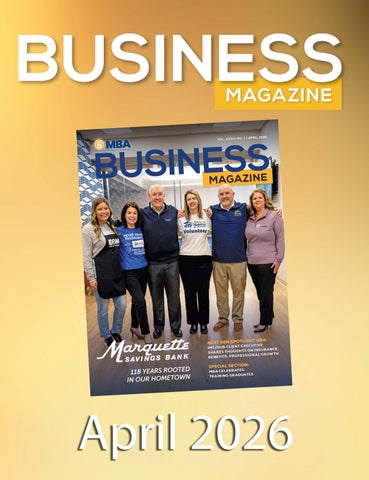
On the Cover: For 118 years, Marquette’s people-first, locally grounded approach has guided every move the bank makes. Shown here are, from left: Communications, Community & Public Relations Specialist Molly Sleppy; Senior Vice President of Deposit Operations Lisa Lopez; Chief Executive Officer, President & Secretary John Dill; Branch Manager, Assistant Vice President Angela Diver; Business Banker, Vice President Terry Danko; and, Branch Manager, Assistant Vice President Dawn Fronce. For the full story, see page 4.
Executive Editor
Karen Torres ktorres@mbausa.org


Erie’s Only Fully Integrated Third

Party Administration Suite
Self Funded Plan Solutions
Custom Analytical Reporting

Compliance Resources


COBRA, FSA, HRA & HSA
Fully Integrated ICHRA Solution


Financial literacy and strong benefits programs play a direct role in the stability and performance of both employers and their teams. When individuals understand how to manage their money — from budgeting and debt reduction to investing and retirement planning — they are better equipped to make sound decisions that affect their families and their work.
The National Endowment for Financial Education reports that financial stress remains one of the most common sources of anxiety among working Americans. When employees feel uncertain about their finances, that concern often carries into the workplace.
Employer-sponsored financial education and wellness initiatives can help address this challenge. Workshops on retirement planning, access to financial counseling, student loan guidance and emergency savings programs provide practical support. Clear communication about compensation and benefits is equally important. Employees are more likely to participate in retirement plans or health savings accounts when they understand how those programs work and how they fit into long-term planning.
Benefits themselves are a major component of financial security.
According to the U.S. Bureau of Labor Statistics, benefits account for roughly 30 percent of total compensation costs for private industry workers. Health insurance, retirement plans, disability coverage and life insurance form a safety net that protects employees from unexpected hardship. Access to preventive health care and employer-sponsored retirement savings plans contributes to both physical and financial well-being.
There is also a measurable business case for investing in these resources. PwC’s Employee Financial Wellness Survey conducted by PwC found that financially stressed employees are more distracted at work and more likely to be considering a job change. Workers who report feeling financially secure tend to be more productive and more engaged with their employer.
Organizations that prioritize financial literacy and thoughtful benefits design strengthen their workforce in tangible ways. Employees gain confidence and clarity about their future. Employers benefit from improved retention, steadier performance and a reputation as a workplace that values long-term stability.
In this edition of The MBA Business Magazine, we’ll highlight some of the many financial resources for employers in The MBA’s membership region, including Marquette Savings Bank. We’ll also hear some thoughts on the insurance industry, benefits and professional growth from MBA Next Gen Advisory Board Member Jack Bloomstine of Insurance Management Company / A HUB International Company.
Be sure to check out our expert articles on understanding loan covenants, ancillary benefit programs and simple steps employers can take to increase health-care literacy in their workplaces. Plus, don’t miss our special section recognizing The MBA’s recent training graduates. The MBA also is gearing up for its fourth annual Leadership Summit on April 29 at The MBA Conference Center in Erie. Don’t miss this timely program on artificial intelligence and cyber security, and how to gain a competitive edge. Learn more at mbausa.org!


On any given day, Marquette Savings Bank is at work serving its employees, neighbors and businesses that make Erie and Crawford counties their home.
When a family wants to buy their first home, the bank guides them not only through paperwork and closing on their home, but additionally through the schools, streets and community they’re joining. When a local entrepreneur comes in for a loan, Marquette offers more than numbers; it offers neighborhood insight. When a growing business secures financing, Marquette helps keep jobs local, fueling opportunity right at home.
For 118 years, this people-first, locally grounded approach has guided every move Marquette makes. Even as industries shift and markets change, Marquette’s commitment remains the same: make decisions locally, invest locally and strengthen the community from within.
Because this place where Marquette conducts its business isn’t just a market — it’s home. And serving it has always been, and will always be, what matters most.
Marquette Savings Bank’s story has always been about the communities across northwest Pennsylvania. As the only locally headquartered bank remaining in the region, Marquette has spent more than a century rooted in its communities, building trust, creating connections, and making decisions that reflect local needs and values.
What began in 1908 as the Marquette Building and Loan Association has grown from those community-driven roots into one of fewer than 500 mutual banks left in the United States. Mutual banks are key to community growth because they reinvest earnings directly back into the region.
“Being locally headquartered isn’t just a point of pride,” says John C. Dill, president and CEO of Marquette Savings Bank. “It shapes how we make decisions, how we interact with our customers and how we support the community. Everything we do is meant to benefit the people who live and work here.”
With 11 locations across Erie and Crawford counties, more than $1.37 billion in assets and a 5 - star BauerFinancial rating for over 30 years, Marquette is consistently recognized as one of the nation’s strongest and most reliable financial institutions — a reflection of the bank’s guiding principles.

JOHN C. DILL President and Chief Executive Officer
STEPHEN M. DANCH Chairman of the Board
Chairman of the Board Stephen M. Danch says, “Our focus has always been on creating long-term stability for our customers, serving them in personal ways and building the kind of trust that comes from knowing our neighbors for generations.”
That commitment shows up every day in the people and programs that bring Marquette’s hometown mission to life, from statewide leaders to hands-on efforts that strengthen Erie and Crawford counties.

KELLY A. MONTEFIORI Chief Operating Officer
When Kelly Montefiori, executive vice president and chief operating officer at Marquette, stepped into the role of board president of the Pennsylvania Association of Community Bankers (PACB), she brought decades of banking experience. She also brought a personal mission to advance the very values that guide Marquette at home: local decisionmaking, community investment and personalized service.
In this role, Montefiori takes the principles that define Marquette’s work in Erie and Crawford counties and applies them across the state, ensuring that locally focused banks have a voice in shaping policies, supporting communities and driving economic growth.
PACB represents independent, locally owned banks across Pennsylvania, and Montefiori’s leadership lets her guide the organization’s strategy, support member institutions and make sure the needs of community banks — and the towns they serve — are heard in Harrisburg.
Through PACB, Montefiori engages directly with state legislators, regulators and policymakers to highlight the role community banks play in fostering local growth. From lending to small businesses, helping first-time homebuyers, to supporting local development projects,
she advocates for policies that recognize the unique mission and scale of community banks and the direct impact they have on the neighborhoods they serve.
Montefiori’s statewide leadership reinforces the same principle that drives Marquette every day at home: strong, locally rooted banks are essential to thriving communities. By bringing the perspective of Erie and Crawford counties to the state level, Montefiori advances not only Marquette’s hometown mission, but also the broader goal of supporting communities across Pennsylvania.
Partnering with Lincoln Elementary, one of United Way of Erie County’s designated Community Schools, is another way Marquette Savings Bank is helping strengthen the foundation of Erie’s next generation, along with four other financial institutions.
The Community School model is built on a simple but powerful idea that when schools serve as neighborhood hubs that connect students and families to academic, social, health and basic-needs resources, children are better positioned to learn, grow and succeed in life.
That’s why, as a corporate partner, Marquette works collaboratively alongside United Way, Lincoln Elementary, and Erie’s Public Schools to help remove barriers to student success, supporting efforts that improve attendance, deepen family engagement and expand access to essential services.
That commitment is quite personal. Through Books with Bankers, a monthly literacy initiative, Marquette employees spend time in the classroom reading
with students and building meaningful, consistent relationships throughout the school year. By returning to the same grade level month after month, employees provide stability and encouragement for students, while showing them that the community is rooting for their success.
As the leading local residential lender in Erie and Crawford counties, Marquette Savings Bank helps more local families put down roots than any other bank or lender. Homeownership is more than a financial milestone; it’s an investment in the long-term strength and stability of the community.
Through simple, straightforward lending, the bank makes it possible for individuals and families to establish themselves in the neighborhoods they call — or dream of calling — home.
The bank’s team of 21 local loan officers serves as a single, consistent point of contact, guiding customers through every step of the mortgage and home equity process with insight into local neighborhoods, school districts, community dynamics and more.
In 2025 alone, that commitment helped families close more than $160 million in mortgages and home equity loans, once again making Marquette the number one local residential lender in the region.
Each loan is more than a closing date; it’s a family putting down roots, a neighborhood gaining strength and a community growing from within. By keeping its focus local, Marquette makes the path to homeownership personal, accessible and deeply connected to the place it has proudly served for more than a century.


Supporting its community means investing in the next generation. That’s why Marquette is committed to helping equip young people with the money skills that create financial wellness and, in return, build a stronger, more resilient local economy.
In 2025, that commitment deepened through the launch of Mpowered ™ U, a program designed specifically for youth ages 13 to 21 in the region. The initiative gives local young people the knowledge and confidence to make smart financial decisions early in life, a critical foundation for building strong, thriving communities.
Through a partnership with Banzai, a nationally recognized online financial education platform, students complete interactive courses covering essentials like budgeting, saving, credit, fraud prevention and online security.
To reinforce the value of learning, Marquette rewards account holders with up to $100 for completing the modules, providing both an incentive and a practical lesson in responsible money management.
Mpowered ™ U reflects the same principle that guides the bank’s broader work: investing locally means thinking generationally. By preparing young people today, Marquette is strengthening the communities it calls home for decades to come.
Safer banking is another way Marquette serves its communities. By reducing fraud, securing transactions and providing reliable, personalized tools, the bank helps families and local businesses manage their finances more confidently.
Customers can now use contactless debit cards — or “tap to pay” cards — for a faster, more secure way to pay. They never have to share card numbers with merchants, lowering the risk of fraud. New ATMs also let users save personal preferences for quicker, more convenient transactions.
Families and business owners also can get a clearer picture of their finances and make smarter money choices every day. Through a partnership with Savvy Money, all Digital One online and mobile banking customers can access Credit Insights for free, letting them view their full credit report, track changes, receive alerts and get practical tips to improve their scores.
Behind the scenes, Marquette has strengthened its cybersecurity program with multiple layers of safeguards designed to prevent, detect and respond to potential threats. These upgrades help protect customers and employees while keeping day-to-day banking secure, reliable and personal — the way Marquette has always done.

LISA N. LOPEZ , Senior Vice President, Deposit Operations, BSA, CBAP
As the head of Marquette’s Deposit Operations department, Lisa Lopez works closely with fraud cases. She regularly leads educational sessions for local organizations and senior living facilities, equipping staff members and families with practical tools to help safeguard themselves from financial exploitation. She also is a faculty member of the Pennsylvania Bankers Association’s School of Banking since 2025, where she shares her fraud expertise with banking professionals from across the Commonwealth.
Erie and Crawford counties are Marquette’s hometown, and a strong, personal commitment to those communities is the core of Marquette. This means supporting not only financially, but also through meaningful service.
Putting these values into action, Marquette encourages employees to volunteer during their workday and promotes organized volunteer
opportunities throughout its communities. Many of the bank’s employees also contribute their time in the evening and on weekends by serving on boards throughout Erie and Crawford counties, extending their impact.
From preparing and serving lunch at the Erie City Mission to monthly shifts at the Meadville Soup Kitchen, employees are hands-on in supporting those in need. They help maintain community gardens with the Sisters of St. Joseph Neighborhood Network, engage students and families through United Way Community School events, such as Books with Bankers and Safari Night, and serve meals to local residents at St. James Haven.
Marquette volunteers also lend their time to building homes with Habitat for Humanity, raising awareness for mental health through the NAMI Walk and a workplace mental health podcast. They also provide nonprofit leadership through board work at organizations, such as Bethesda Lutheran Services and the Crawford County Drug & Alcohol Executive Commission.
Through these efforts, Marquette employees don’t just work in the community — they actively invest their time, energy and expertise to strengthen the hometown they serve. In the past year, 104 employees volunteered nearly 2,700 hours across 137 organizations throughout the region, making a tangible difference in the neighborhoods they call home.
For 118 years, Marquette Savings Bank has focused its work on the community it calls home. Headquartered in Erie, Pennsylvania, the bank makes its decisions locally, guided by leaders who live and work alongside the people and businesses they serve.
That commitment shows up every day: helping families buy their first homes, financing local entrepreneurs, supporting growing businesses, and reinvesting in schools, nonprofits and community initiatives across northwest Pennsylvania.
Dill says that Marquette’s success is tied directly to the strength and vitality of its hometown.
“As a locally headquartered bank, our responsibility goes beyond banking,” he explains. “We invest in people, we help businesses grow and neighborhoods thrive, and we educate our youth to become financially savvy — all things that make this community prosper. When our hometown succeeds, we all succeed, and that’s what drives everything we do at Marquette. This is our hometown.”


Across industries, a new generation of leaders is bringing a fresh perspective to business today. Here, MBA Next Generation Advisory Board Member Jack Bloomstine, age 29, a client executive and a part of the next generation at Insurance Management Company/ A HUB International Company in Erie, shares his thoughts on leadership, the insurance industry and how benefits fit into the broader business picture for attracting and retaining top talent.
You are often identified as a “next generation leader” in the insurance industry. Tell us about your education and decision to go into the insurance business. Commercial business insurance truly runs in my family as I am a fourth-generation insurance broker. Growing up around the business, I was exposed early to the values of hard work, integrity and the importance of building long-term client relationships.
After graduating from Cathedral Prep in 2015, I went on to earn a degree in economics from the University of Dayton in 2019. While in college, I kept an open mind about my career path and wanted to explore opportunities beyond the family business before committing. My father encouraged me to spend the summer of 2019 working at the company, and that experience ultimately solidified my decision to continue full-time, which has been the best decision I have made to date.
Describe your job role today.
My current role encompasses several responsibilities — all centered around servicing and advocating for our clients. I work closely with clients to help them navigate claims, emerging liabilities and challenges as they arise and to ensure their insurance evolves as their business does.
A significant part of my role is managing and negotiating policy renewals. From Day One, my father and grandfather instilled the importance of approaching renewals with a strong sense of responsibility and advocacy. They always told me, “It is not our money” and treat every negotiation for your clients as it were your own business. That mindset ensures we are always working in our clients’ best interests and consistently delivering on our promise of service beyond expectations From the moment a client calls, our goal is to provide timely, knowledgeable responses and to ensure they feel supported, informed and confident in the guidance they receive. We have a sense of urgency with everything. Insurance Management merged with another private company HUB International in 2024 — a major milestone. From your perspective, what has this transition meant for you and your team?
The merger with HUB has been a positive transition for both our team and me. Almost overnight, we went from a 27-person organization to being part of a network of more than 18,000 professionals nationwide. That scale provides access to resources we previously did not have, including enhanced market access, expanded loss control capabilities and a deep bench of specialists across the country. If we’re working through a complex account or a niche industry challenge, there is always someone within HUB willing to jump on a call, share insight
and help us think strategically. When we were looking to partner up, we quickly learned that as a standalone firm we would never have been able to make these quantum leaps (for example Hub has its own proprietary AI platform). We truly saw us getting left behind, so we took action. Through HUB, your clients now have access to a broad range of employee benefits solutions. What does this include?
When we were a standalone entity, we never ventured into employee benefits. There is no way you can be a well-schooled property and casualty agent, as well as an employee benefits expert at the same time; HUB proved that for me. Now, it’s all here — from health plans to retirement and 401K, compliance, HR consulting, M&A assistance, all in one cohesive effort to help clients recruit, retain, support and engage their employees.
You are also an active member of The MBA’s Next Gen Advisory Board. What is your advice to young professionals when it comes to leadership and growth?
From a leadership standpoint, my advice to young professionals is to treat all criticism as constructive criticism and view it as an opportunity to grow. Early in my career, it was easy to believe I had the answers or that my way was the best or only way. I quickly learned that the more open I was to advice and guidance, the faster I learned.
From an opportunity and professional growth standpoint, I encourage young professionals to take full advantage of every networking and educational opportunity available to them.
For more information, visit hubinternational.com


Joshua Kirkpatrick is an associate at MacDonald Illig Attorneys and a member of the firm’s Business Transactions and Trusts & Estates Practice Groups.
After you finalize closing on your business loan, you may feel relieved knowing your business has access to the capital it needs to grow. However, this relief obscures a critical reality — the postclosing phase requires vigilance and disciplined financial management to prevent working capital from becoming a legal nightmare.
PILLARS OF LOAN COVENANT COMPLIANCE
Commercial loan agreements often impose three categories of obligations that will govern business operations for the debt’s lifespan: financial covenants, reporting requirements and default triggers. Thoroughly understanding each is essential to maintaining access to your business’s credit facility and avoiding costly technical defaults.
FINANCIAL COVENANTS:
OPERATIONAL GUARDRAILS FOR BORROWERS
Financial covenants are quantitative benchmarks businesses must maintain, typically tested quarterly or annually.
EBITDA (Earnings Before Interest, Taxes, Depreciation and Amortization) is used as a proxy for a borrower’s cash flow from operations to evaluate core operational profitability, independent of capital structure or accounting choices. EBITDA is the metric of borrower health in many financial covenants, with the Debt-toEBITDA leverage ratio being a common example, particularly if your business operates in a capital-intensive industry. By capping total debt as an EBITDA multiple, commonly 2.0x to 4.0x, lenders limit businesses from securing additional debt to prevent increased indebtedness from potentially consuming operational cash flow. If your business generates

$1 million in EBITDA, you typically cannot carry more than $2 million to $4 million in total debt.
For manufacturing businesses specifically, the danger lies within the details embedded in the definitions of financial terms. For example, the Fixed Charge Coverage Ratio measures a borrower’s ability to cover its fixed expenses by subtracting unfunded capital expenditures and taxes from EBITDA, which may unexpectedly trip up a business’ financials when needing to replace critical machinery using cash flow rather than equipment financing. Business owners should review these financial covenants carefully before signing, as post-closing renegotiation is expensive and frequently involves tighter terms.
ADMINISTRATIVE BURDENS
Reporting covenants require borrowers to provide regular financial updates to lenders. Missing deadlines, even slightly, may constitute a technical default with the same severity as payment default.
Business should expect to deliver annual audited financial statements within 120 days of fiscal year-end, quarterly unaudited statements within 45 days of quarter end and quarterly compliance certificates confirming covenant compliance. Borrowers are often required to also provide insurance certificates naming the lender as loss payee, tax compliance confirmations and immediate notice of litigation exceeding specified thresholds (often $100,000). Attempts to manually track these reporting requirements creates significant risk. Consider implementing automated covenant monitoring through accounting software or designating dedicated financial team members to flag upcoming deadlines and calculate ratios in real-time.
Beyond missed payments, commercial loan agreements contain extensive “Events of Default” that may surprise many borrowers. Technical defaults occur more frequently than payment defaults, and include covenant violations, late reporting, failure to maintain required insurance, unauthorized additional debt and changes in ownership without lender consent. Most business loans contain a “cross-default” provision, where a default on any other debt, including leases, automatically triggers default on a business’s primary loan. Material Adverse Change clauses deserve special scrutiny. They address negative changes in a borrower’s condition or circumstances potentially impacting its ability to meet loan obligations. Often, they are subjective provisions adding an element of risk for businesses by potentially allowing lenders to declare default if business prospects materially worsen, even without specific covenant violations.
The best approach is to communicate early and often with the lender. If covenant sensitivity testing reveals the business may encounter issues in the short-term (i.e. next quarter), contact the lender immediately. Lenders vastly prefer proactive borrowers seeking amendments before defaults occur. Loan covenants are not designed to create traps but instead serve as the lender’s early warning system. By approaching loan obligation compliance as a core business function and not an afterthought, business debt will remain a tool for growth rather than an unexpected source of crisis.
For more information, visit macdonaldillig.com


We have succeeded as a respected agency since 1925 and our mission is as true today as it was then. We diligently maintain our position as a superior agency force by listening to our clients’ needs, utilizing leading edge strategies, and adapting our portfolio of products and services to meet changing market demands while continuing to bring value and deliver on our promises.
ERIE MOLDED PACKAGING EARNS
BERLIN PACKAGING’S OVERALL SUPPLIER OF THE YEAR AWARD
Erie Molded Packaging (EMP) has been recognized as Overall Supplier of the Year at Berlin Packaging’s annual supplier awards held recently in Orlando, Florida.
According to EMP, “this recognition reflects performance across quality, service, commercial value and innovation, and we’re honored to be selected from among a large and diverse global supplier base.”
Among the key highlights of the recognition:
• Exceptional customer service and responsiveness, reflected in a Net Promoter Score of 73 — a worldclass result
• Continued investment in technology and processes to deliver consistent quality and flexibility

ORDER FROM NEW YORK’S MTA FOR NEW LOCOMOTIVES
• Strong, trust-based partnerships built with Berliners and joint customers and alike.
“Most importantly,” according to EMP, “this award is a direct result of the commitment and teamwork of the people at EMP. It represents years of effort, attention to detail and a mindset of getting a little better every day.”
Erie Molded Packaging, located at 6020 West Ridge Road in Fairview, Pennsylvania is a family owned custom and standard injection molded parts and packaging provider with more than 40 years in business.
For more information, visit https://www.empclosures.com/.
Wabtec Corporation (NYSE: WAB) secured a $386 million follow-on order to deliver additional R255 hybrid batterydiesel work locomotives to New York’s Metropolitan Transportation Authority (MTA). The order is a major step in the Authority’s Capital Plan to revitalize the city’s transit network infrastructure and improve the capabilities and safety of its maintenance crews.
“The success of the R255 hybrid locomotive is a tribute to the strong working relationship between Wabtec and the MTA,” said Alan Hamilton, vice president of Engineering for Wabtec. “Our collaboration positioned this locomotive as the ideal solution to maintain the subway system efficiently and reliably.” The expanded agreement includes both locomotives and spare parts. Wabtec will build the R255s at its design and development center in Erie, Pennsylvania, with deliveries scheduled to start in 2027. These state-of-the-art hybrid locomotives will replace aging equipment, offering enhanced reliability and operational efficiency while contributing to improved air quality across the network. The locomotives are a cornerstone of the MTA’s broader modernization efforts, aligning with the authority’s long-term strategy to deliver safe and efficient transit solutions.
Wabtec Corporation is a leading global provider of equipment, systems, digital solutions and value-added services for the freight and passenger rail industries, as well as the mining, marine and industrial markets.
For more information, visit wabteccorp.com.


CORE was formed in 2001 to provide professional, responsive, practical and cost- competitive environmental consulting services to the industrial and commercial marketplace.
Address: 6000 Brooktree Road, Suite 110 Wexford, PA 15090
Phone: 412/487-6000
For more information, visit https://core-env.com/.

KASTBERG AS NEW ASSOCIATE
Knox McLaughlin Gornall & Sennett, P.C. recently welcomed new associate Vegas F. Kastberg to the Erie area law firm.
Kastberg focuses his practice on environmental law and real estate. His prior experience includes working as an attorney in the Office of Chief Counsel for the Pennsylvania Department of Environmental Protection (DEP), serving as a law clerk for the U.S. Department of Justice (DOJ), Environment and Natural Resource Division, as a legal intern for DEP, and as a research analyst for a private firm in Washington, D.C. He also worked for Northwestern Legal Services, representing clients in various court proceedings.

MacDonald Illig recently announced that Attorney Taylor Korus has been made partner at the Erie area law firm.

JAMESTOWN COATING TECHNOLOGIES CEO NAMED TO ADVISORY COUNCIL FOR CLEVELAND FEDERAL RESERVE BANK
Kastberg earned his J.D. from Case Western Reserve University School of Law, where he was a Legal Writing Honors Fellow and received a CALI award for Advanced Legal Writing – Transactions. He received a B.A. in history from New York University and is proficient in Spanish.
At Knox Law, Kastberg joins a team of 40 attorneys that has been providing quality legal services to businesses, families, public entities and nonprofits for over 65 years.
ERIE INSURANCE NAMES LEEMHUIS SENIOR VP, CHIEF ACTUARY
Erie Insurance (ERIE) has named Dorothy Leemhuis senior vice president and chief actuary, effective February 5.
Leemhuis joined Erie Insurance in 2010 and has held several actuarial leadership positions, including director of actuarial modeling and data analytics. She became vice president, corporate risk officer in 2022 and most currently led the company’s Enterprise Risk Management department.

Korus represents corporations, health-care providers and individuals in a variety of litigation matters. Her practice focuses on insurance defense, health-care litigation, medical liability and commercial litigation. Prior to returning to Erie, Korus practiced civil litigation in Chicago. As an Erie native, she is a dedicated advocate for the local community and is actively involved in several civic and nonprofit organizations. Korus is licensed to practice law in both Pennsylvania and Illinois. She earned her Bachelor of Arts in strategic communication, with a minor in political science from Miami University of Ohio, graduating summa cum laude. She later received her Juris Doctor, cum laude, from DePaul University College of Law in Chicago, where she served on the editorial staff of the Law Review. She currently supports the Erie community through organizations including Friends of the Erie County Public Library and the Hamot Health Foundation
Erie Events recently recognized Tom Klep for achieving his certification as a Certified Ice Technician, one of only 12 professionals in Pennsylvania to earn this distinction.

Recognized by the National Hockey League (NHL), a Certified Ice Technician is the most highly regarded professional designation for ice rink operations professionals in North America.
"Dorothy is a thoughtful, effective leader with strong critical thinking skills, and I’m thrilled that she has stepped into this critical role,” said Julie Pelkowski, executive vice president and chief financial officer at Erie Insurance. “Her vast expertise combined with her enterprise risk experience brings a strategic perspective that consistently connects actuarial insight to ERIE’s broader organizational goals.”
Leemhuis is a graduate of Case Western Reserve University, where she earned a bachelor’s degree in statistics. She is also a Fellow of the Casualty Actuarial Society, a Chartered Property Casualty Underwriter and holds several additional insurance designations from The Institutes.
According to the organization, “Erie Events is committed to excellence and maintains a high standard to deliver a premier ice surface for all events hosted at the arena. This accomplishment reflects Tom’s dedication in playing a vital role in ensuring the best possible experience for our athletes, performers and guests.”
Erie Events is the primary entertainment and cultural hub in downtown Erie, Pennsylvania, operating four major venues: Erie Insurance Arena, Warner Theatre, Bayfront Convention Center, and UPMC Park.
Michael Walton, chief executive officer of Jamestown Coating Technologies, is among 33 new members added to the Federal Reserve Bank of Cleveland’s advisory councils. He is one of three new appointments to the Shenango-Mahoning Valley Business Advisory Council.

Jamestown Coating Technologies in Jamestown, Pennsylvania is a sixth-generation, family owned company with over 135 years of experience in formulating highperformance coatings for industrial and OEM applications.
The Cleveland Fed engages with the diverse members of its advisory councils to collect information about regional economic and business conditions. This gives Cleveland Fed researchers near-real time observations and a better picture of conditions as seen by business, civic and community leaders.
The Cleveland Fed is one of 12 regional Reserve banks and oversees the Fourth District, which includes Ohio, western Pennsylvania, eastern Kentucky and the northern West Virginia panhandle.
Along with the other members of the U.S. Central Bank, the Cleveland Fed helps formulate the nation’s monetary policy, oversees banking organizations and provides payment and other services to financial institutions and the U.S. Treasury. The Cleveland Fed also researches financial conditions and sponsors community outreach and education activities.


U.S. Senator Dave McCormick , representing Pennsylvania, serves on several key committees, including Banking, Housing, and Urban Affairs; Energy and Natural Resources; Foreign Relations; the Special Committee on Aging; and the Joint Economic Committee. He also serves as chair of the Energy subcommittee. For more information, visit https://www.mccormick.senate.gov/.
Pennsylvania Energy and Innovation Summit, securing $92 billion in committed investment in the Commonwealth, which will generate tens of thousands of jobs.
If America is going to win the AI race, Pennsylvania must win the energy race. Second, defense reindustrialization. During World War II, Pennsylvania forged the Arsenal of Democracy.
Today, we remain a national leader with extraordinary potential — including worldclass shipbuilding assets in Philadelphia and Erie. I’m a proud co-sponsor of the SHIPS Act, which would accelerate American shipbuilding. I encourage regional leadership to take advantage of the present momentum and turn our Commonwealth into a 21st century hub for world-class shipbuilding.
The third pillar is life sciences.
When I took office, I made a commitment to pursue ambitious goals that will fundamentally transform Pennsylvania. I call them “long passes” — big plays down the field, to use a football analogy — which deliver enormous value to Pennsylvanians and position our state for long-term growth and prosperity.
Thanks to President Trump’s energy, deregulatory and defense agenda, Pennsylvania is primed for economic transformation.
It’s time for the Commonwealth to capitalize on these generational opportunities and build a better future by developing its energy and AI, defense and life sciences sectors.
First, energy and AI.
The energy and AI revolutions give Pennsylvania a generational opportunity. With abundant energy, natural resources and a world-class workforce, we can build the infrastructure — including data centers — that creates thousands of skilled jobs and expands local tax bases. Last summer, I hosted the
Pennsylvania’s world-renowned medical centers and 100,000 life science professionals are at the forefront of health innovation.
This life-saving research is fueled by the National Institutes of Health, transforming lab breakthroughs into clinical cures.
I have fought to protect research funding and to strengthen pharmaceutical manufacturing, because innovation paired with production creates durable jobs and real economic growth.
Since taking office, we’ve been busy turning this transformation agenda into investment and jobs. And the results speak for themselves.
Nippon Steel announced a $14 billion investment in U.S. Steel, protecting more than 11,000 Pennsylvania jobs and creating thousands more. Amazon committed $20 billion to build data centers in Pennsylvania. Westinghouse inked an agreement with the federal government for up to 10 nuclear reactors totaling more than
$80 billion. Eli Lilly and Johnson & Johnson are expanding their Pennsylvania presence, bringing thousands of good-paying jobs. And all this on top of last year’s enormously successful Energy Summit.
Here is the economic truth: capital and talent are like water — they flow where the path is easiest.
For Pennsylvania to win, we must make it easier to invest here.
We have taken critical steps in Washington by strengthening Pennsylvania’s investment ecosystem, advancing permitting reform and passing the Working Families Tax Cuts Act, which made permanent the largest tax cuts in history.
But Pennsylvania’s transformation cannot come from Washington alone.
We need local leaders to step up and help make Pennsylvania as competitive as possible. In the northwest, Power Northwest is setting a tremendous example by uniting the region in this effort. The next major investments in Pennsylvania will land because you made it easy for capital to say yes.
We also need to reject the four horsemen of decline: cynicism, incrementalism, pettiness and divisiveness. I promise to work with anyone, regardless of party affiliation, to advance the interests of our Commonwealth.
Pennsylvania cannot afford complacency. By some measures, our state is struggling compared to its peers. Job formation and opportunity are not what they should be. To launch a renaissance for Pennsylvania, we must aim higher and work faster.
To quote President Ronald Reagan, “We have every right to dream heroic dreams.”
I look forward to dreaming heroic dreams together.


With the continued rising cost of group health insurance premiums for employers, The MBA is committed to finding ways to help members with their benefit costs. Thanks to our long-term partnerships with industry-leading carriers, MBA members have exclusive access to premium benefit plans at highly competitive rates.
Provides The MBA members dependable, affordable dental coverage, with flexible plan options, a 90th percentile reimbursement on out-of-network procedures and nationwide access to care. Eight plans available; five that include orthodontics. There are no waiting periods for coverage or treatment. All 2026 rates are guaranteed for two years.
VBA
Extremely competitive rates (starts at just $3.76 per month) and great plans that are easy to use. Groups must have at least two participants. This benefit can be employer or employee paid with no contribution requirements on the employer’s part. There are no additional billing fees or administrative costs.
Provides exclusive rates for MBA members and is available to groups as small as two. These plans require no medical underwriting and have no waiting periods. They also include many value-added services such as preparing a will at no cost.

Through our partner, MPC Insurance, MBA members have experts available to help with navigating Medicare for your eligible employees — provided at no cost to MBA members.
A leading national dental solutions company focused on delivering high-quality, costeffective care. The company is licensed in all 50 states, the District of Columbia and Puerto Rico. UCCI currently offers two dental plans to MBA members.
MBA members have access to workers; compensation insurance through our partner Eastern Alliance Insurance Group (EAIG), which provides the opportunity for stable rates and competitive pricing. This program offers the potential of a group policyholder dividend for all participants, including small groups.
MBA members enjoy an exclusive 10 percent off all WorkPartner EAP Services, which includes organizational support, consulting and training for employers and employees. Be sure to ask your broker about these great products available through The MBA or call 814/833-3200 or 800/815-2660.
REPORT OUTLINES KEY TRENDS
SHAPING BENEFITS, INSURANCE
CBIZ, Inc., a leading national professional services advisor, recently announced the results of its 2026 Benefits & Insurance Market Outlook, aimed at helping employers prepare for another year of increasing health-care costs and rising employee expectations. The report outlines key trends shaping the benefits and insurance sector and offers employers straightforward steps for the future.
“Employers are trying to balance rising costs with the need to offer benefits that resonate with their workforce,” said Polly Thomas, chief operating officer of CBIZ Benefits & Insurance Services. “This Market Outlook gives leaders a clear direction on where to put their focus in 2026.”
Employer Health-Care Costs Set to Hit Historic Highs
Projected 10 percent health-care cost increase per employee in 2026, driven largely by skyrocketing prescription and specialty drug expenses — especially GLP-1 medications, which have seen an 81percent cost surge since 2023.
Employees Demand Personalization
Seventy percent of employees say customizable benefits increase loyalty, putting pressure on employers to deliver more flexible, tailored total rewards to stay competitive.
Major Regulatory Shifts
From the SECURE 2.0 Roth catch-up mandate for high-earning employees to new tax credits under the One Big Beautiful Bill Act (OBBBA) and the expansion of pay transparency laws, employers will face significant compliance changes in 2026.
AI and Automation to Reshape HR Operations
Organizations are increasingly leveraging automation to streamline recruiting, onboarding, payroll and benefits administration — and the need for strong AI governance is on the rise.
Organizations must prepare for an increase in risks, including natural disasters, cyber threats, social inflation, supply chain disruptions, geopolitical instability and workforce continuity challenges.
Lisa McKinney
is the account manager for Benefits at The MBA. For more information, contact her at 814/833-3200, 800/815-2660 or lmckinney@mbausa.org.
We


The MBA recently recognized the graduates of its professional development and computer training course series. To see exclusive photos from the events or to learn more about The MBA’s training courses, visit mbausa.org.


WHAT IS THE DIFFERENCE BETWEEN PERSONAL HEALTH LITERACY AND ORGANIZATIONAL HEALTH LITERACY?
Personal health literacy refers to an individual’s ability to find, understand and use health information to make informed decisions.
Organizational health literacy is the responsibility of organizations to provide health information and services that are easy to find, understand and use equitably.
HOW DOES LOW HEALTH-CARE LITERACY IMPACT EMPLOYERS?
Low employee health-care literacy can lead to higher employer healthcare costs due to delayed or mismanaged care, lower productivity from increased absenteeism and frustration or disengagement with benefits and wellness programs.
WHAT ARE SOME STRATEGIES EMPLOYERS CAN USE TO IMPROVE HEALTH-CARE LITERACY AMONG EMPLOYEES?
Employers can improve healthcare literacy by simplifying benefit materials, providing transparent insurance information, offering year round education, using digital tools, promoting preventive care and wellness programs and fostering open communication so employees feel comfortable asking questions.

Low health literacy is common in the United States. According to the National Assessment of Adult Literacy, only a small portion of Americans have proficient skills, meaning many adults struggle to understand drug labels, follow medical instructions or identify trustworthy health resources. With the health-care system becoming increasingly complex, the ability to interpret and use health information has become essential. Employers can take meaningful steps to support their workforce by creating an environment where health-care information is accessible, understandable and actionable. Strategies include:
1. Provide clear and accessible information. Insurance terms and benefit details are often filled with jargon. Employers can work with benefits providers to simplify materials, summarize key information and ensure documents are written in plain language.
2. Ensure insurance plans are transparent. Understanding deductibles, copays or coverage limits can be overwhelming. Employers can offer one on one benefits counseling during open enrollment and throughout the year.
3. Offer education through multiple formats. Many employees do not have

time to research health-care topics on their own. Offering regular written resources — such as newsletters, tip sheets and FAQs — can help demystify topics like preventive care, choosing a provider or understanding medical billing.
4. Educate year round — not just during open enrollment. Although open enrollment is critical, ongoing communication helps reinforce how to access care, use available services and avoid common pitfalls like unexpected billing issues.
5. Leverage technology. Mobile apps and online platforms allow employees to view their insurance details, medical records and provider networks instantly.
6. Promote preventive care and wellness programs. Proactively encouraging preventive services — such as annual checkups, screenings and vaccinations — improves health outcomes and reduces costs.
7. Foster a culture of open communication. Encourage open dialogue, offering confidential support channels and collecting feedback through surveys or suggestion boxes can help employers identify common challenges and address them proactively.
Kim Figurski, SPHR, is an HR consultant and trainer at The MBA. Contact her at 814/833-3200, 800/815-2660 or kfigurski@mbausa.org.
The MBA hosts various educational and networking opportunities for members throughout the region and meets regularly with members to learn about the opportunities and challenges they are facing. To learn more about The MBA’s upcoming events or to learn about the benefits of membership, visit mbausa.org.


The MBA joined business and community leaders at the I-HACK Building to see Gannon's new medical laboratory and office space for First Ascent Biomedical as well as laboratory space for academic programs offered by Gannon and AHN Saint Vincent Hospital.


MetLife SpotLite on Oral Health℠ program¹ helps people connect to general and pediatric dentists who put proactive care front and center. This helps improve health outcomes, which helps reduce costs² and improve employee holistic wellness.
To find a MetLife SpotLite on Oral Health℠ dentist, scan the QR code or contact your MetLife representative.

1MetLife SpotLite on Oral Health℠ is a special designation intended to identify certain PDP providers who have demonstrated a focus on improved health outcomes and have met qualifying criteria. This designation may be used by plan participants to find providers that better align with their healthcare needs. MetLife is not endorsing or otherwise recommending the use of a particular PDP provider.
²Savings from enrolling in a dental benefits plan will depend on various factors, including the cost of the plan, how often participants visit a dentist and the cost of services rendered.
Like most group benefits programs, benefits programs offered by MetLife and its affiliates contain certain exclusions, exceptions, waiting periods, reductions, limitations and terms for keeping them in force. You may be responsible for copayments, deductibles, or any other amounts in excess of those MetLife is required to pay for covered services as described in your dental certificate and/or policy. Ask your MetLife representative for costs and complete details. Metropolitan Life Insurance Company | 200 Park Avenue | New York, NY 10166 L4927022[exp1027][Selected States/Territories][Pennsylvania]© 2025 MetLife Services and Solutions, LLC