CL
ICKABLE
LINKS
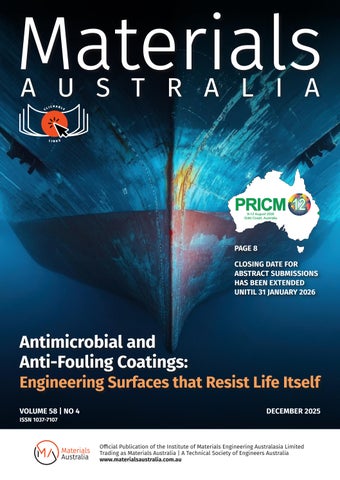
PAGE 8 CLOSING DATE FOR ABSTRACT SUBMISSIONS HAS BEEN EXTENDED UNITIL 31 JANUARY 2026
Antimicrobial and Anti-Fouling Coatings:
Engineering Surfaces that Resist Life Itself VOLUME 58 | NO 4 ISSN 1037-7107
DECEMBER 2025
Official Publication of the Institute of Materials Engineering Australasia Limited Trading as Materials Australia | A Technical Society of Engineers Australia www.materialsaustralia.com.au
palladium catalysts
nickel foam
thin film
perovskite crystals glassy carbon III-IV semiconducto europium phosphors buckyballs
Nd:YAG
MOFs
99.9999% aluminum oxide
1
1
H
1.00794
diamond micropowder
alternative energy additive manufacturing
metamaterials
borophene He osmium
organometallics
2
2
4.002602
Hydrogen
nanogels Li 3
Helium
2 1
4
6.941
9.012182
Lithium
YBCO
11
Na
2 8 1
12
MOCVD
2 8 8 1
20
2 8 18 8 1
38
39.0983
AuNPs
Rb
Ca
87.62
2 8 18 18 8 1
56
Ba
Fr (223)
88
Ra
Francium
(226)
Ti
44.955912
57
La
Ac (227)
Radium
41
72
2 8 18 18 9 2
Hf
50.9415
13
3D graphene foam
Nb Ta
178.48
104
Rf (267)
Actinium
Db (268)
Rutherfordium
Fe
54.938045
95.96
27
2 8 14 2
55.845
Co
28
2 8 15 2
29
2 8 16 2
Ni
58.933195
Iron
58.6934
Cobalt
74
2 8 18 32 11 2
75
183.84
Re
Cu
30
2 8 18 1
63.546
Nickel
Zn
14
2 8 3
Al
106
2 8 18 32 32 11 2
Sg (271)
Dubnium
76
2 8 18 32 13 2
Os
107
Bh (272)
Seaborgium
77
2 8 18 32 14 2
108
Hs (270)
Bohrium
109
Mt
110
2 8 18 32 32 15 2
Ds (281)
Meitnerium
Au
80
2 8 18 32 18 1
Hg
28.0855
111
Rg (280)
Darmstadtium
112
Cn (285)
Roentgenium
32
2 8 18 18 3
50
81
Sn
Tl
113
Nh (284)
As
82
Pb
83
2 8 18 32 18 4
208.9804
Fl (289)
Nihonium
115
Mc (288)
Flerovium
35
2 8 18 18 6
53
Te
Ar
I
2 8 18 32 18 6
85
At
2 8 18 7
36
2 8 18 18 7
54
2 8 18 32 18 7
86
2 8 18 32 32 18 7
118
Kr
Lv (293)
Ts (294)
Livermorium
Tennessine
2 8 18 8
83.798
Krypton
Xe
2 8 18 18 8
131.293
Xenon
(210)
117
Invar
39.948
Rn
2 8 18 32 18 8
(222)
Astatine 2 8 18 32 32 18 6
2 8 8
Argon
Iodine
(209)
Moscovium
18
126.90447
Po
116
2 8 7
79.904
Polonium 2 8 18 32 32 18 5
Br
h-BN
Neon
Bromine
127.6
Bismuth 2 8 18 32 32 18 4
2 8 18 6
Tellurium 84
Cl
2 8
20.1797
35.453
78.96
2 8 18 32 18 5
Bi
17
Selenium
121.76
207.2
114
52
Ne
Chlorine
Se
Antimony
Lead 2 8 18 32 32 18 3
2 8 18 18 5
74.9216
Sb
2 8 6
32.065
34
10
Fluorine
Sulfur
2 8 18 5
2 7
18.9984032
S
Arsenic
Tin
204.3833
Copernicium
51
118.71
Thallium 2 8 18 32 32 18 2
2 8 18 18 4
72.64
2 8 18 32 18 3
16
2 8 5
P
Germanium
114.818
2 8 18 32 18 2
33
F
15.9994
30.973762
2 8 18 4
9
Oxygen
Phosphorus
Ge
Indium
Mercury 2 8 18 32 32 18 1
2 8 18 3
69.723
In
15
Silicon
Gallium
200.59
Gold
2 8 18 32 32 17 1
49
Cadmium
196.966569
Platinum
(276)
Hassium
79
2 8 18 18 2
Ga
112.411
Silver
195.084
Iridium 2 8 18 32 32 14 2
107.8682
2 8 18 32 17 1
Pt
192.217
Osmium 2 8 18 32 32 13 2
106.42
78
48
2 8 18 18 1
Palladium 2 8 18 32 15 2
Ir
190.23
Rhenium 2 8 18 32 32 12 2
102.9055
Rhodium
31
Zinc
47
2 8 18 18
2 8 18 2
14.0067
2 8 4
2 6
O
Nitrogen
Si
26.9815386
65.38
Copper
46
2 8 18 16 1
Ruthenium
186.207
Tungsten
45
2 8 18 15 1
101.07
Technetium
2 8 18 32 12 2
W
44
2 8 18 13 2
(98.0)
Molybdenum
180.9488
105
26
2 8 13 2
Manganese
43
2 8 18 13 1
Tantalum 2 8 18 32 32 10 2
Mn
ultralight aerospace alloys Mo Tc Ru Rh Pd Ag Cd 42
Niobium 73
25
2 8 13 1
Chromium
2 8 18 12 1
92.90638
2 8 18 32 10 2
Cr 51.9961
Vanadium
Hafnium 2 8 18 32 18 9 2
24
2 8 11 2
V
Zirconium
138.90547
89
2 8 18 10 2
91.224
Lanthanum 2 8 18 32 18 8 2
23
47.867
Yttrium
2 8 18 18 8 2
2 8 10 2
Titanium
40
2 8 18 9 2
88.90585
Barium 2 8 18 32 18 8 1
22
2 8 9 2
Scandium
137.327
Cesium
Sc
39
2 8 18 8 2
Strontium
132.9054
87
21
2 8 8 2
isotopes Y Zr
Sr
12.0107
8
2 5
N
Carbon
Aluminum
40.078
Rubidium
Cs
nanodispersions
2 8 2
Calcium
85.4678
55
Mg Magnesium
Potassium 37
EuFOD
K
10.811
7
2 4
C
Boron
24.305
Sodium
6
2 3
B
Beryllium
22.98976928
19
Be
5
surface functionalized nanoparticles
2 2
Radon
Og (294)
2 8 18 32 32 18 8
GDC NMC CIGS
Oganesson
InAs wafers titanium aluminum carbide molybdenum TZM silver nanoparticles ITO 58
niobium C103 Ce
2 8 18 19 9 2
59
140.116
90
232.03806
2 8 18 21 8 2
140.90765
Cerium
quantum dots Th
Pr
Praseodymium 2 8 18 32 18 10 2
91
Pa 231.03588
Thorium
2 8 18 32 20 9 2
Protactinium
transparent ceramics
60
Nd
2 8 18 22 8 2
144.242
U
238.02891
Uranium
2 8 18 23 8 2
62
Pm Sm (145)
Neodymium 92
61
93
Np (237)
Neptunium
2 8 18 32 22 9 2
63
150.36
Promethium 2 8 18 32 21 9 2
2 8 18 24 8 2
Pu (244)
Plutonium
2 8 18 25 8 2
64
151.964
Samarium 94
Eu
95
65
2 8 18 32 25 8 2
96
Americium
(247)
Tb
66
2 8 18 27 8 2
158.92535
Gadolinium
Am Cm (243)
2 8 18 25 9 2
157.25
Europium 2 8 18 32 24 8 2
Gd
97
Curium
Bk (247)
67
2 8 18 28 8 2
162.5
Terbium
2 8 18 32 25 9 2
Dy
98
Cf (251)
Berkelium
99
2 8 18 32 28 8 2
Es (252)
Er
2 8 18 30 8 2
167.259
69
Tm
2 8 18 32 29 8 2
100
Fm (257)
Fermium
2 8 18 31 8 2
168.93421
Erbium
Einsteinium
101
Md (258)
Yb
71
2 8 18 32 8 2
173.054
Thulium
2 8 18 32 30 8 2
70
Lu
2 8 18 32 31 8 2
Mendelevium
102
No (259)
103
2 8 18 32 32 8 2
Lr (262)
Nobelium
2 8 18 32 32 8 3
mischmetal
Lawrencium
chalcogenides
biosynthetics
carbon nanotubes
Now Invent.
CVD precursors
endohedral fullerenes
laser crystals
zircaloy -4
Lutetium
TM
gold nanocubes OLED lighting
2 8 18 32 9 2
174.9668
Ytterbium
scandium powder
radiation shielding rare earth optical fiber dopants sputtering targets
68
Holmium
Californium
UHP fluorides
2 8 18 29 8 2
164.93032
Dysprosium 2 8 18 32 27 8 2
Ho
deposition slugs
flexible electronics
platinum ink
tungsten carbide The Next Generation of Materials Science Manufacturers superconductors Bulk & lab scale manufacturers of over 35,000 certified high purity compounds, metals,
tantaloy 60 and nanoparticles, including a wide range of materials with applications in industries such as photovoltaics
aerospace, automotive, military, pharmaceutical, and electronics, all engineered to meet
graphene oxide
zeolites
the most rigorous quality standards.
ultra high purity materials
InGaAs
metallic glass pyrolitic graphite Ti-6Al-4V
American Elements Opens a World of Possibilities..... Now Invent!
rare earth metals mesoporus silica
www.americanelements.com 99.99999% mercury
metallocenes
li-ion battery materials
SOFC powder
© 1997-2025. American Elements is a U.S.Registered Trademark
ors
m
s
VOLUME 58 | NO 4 DECEMBER 2025
CONTENTS
Reports Contents
3
From the President
4
Corporate Sponsors
6
Advertisers
7
PRICM12 - Gold Coast - 9-12 August 2026 Announcing some of our exciting 150+ Keynote Speakers
8
Materials Australia News WA Branch Reports
12
VIC Branch Reports
16
NSW Branch Reports
20
Report on the 2025 International Conference on Martensitic Transformations
22
CMatP Profile: Dr. Shervin Harandi
24
Our Certified Materials Professionals (CMatPs)
26
Why You Should Become a CMatP
27
CMatP Profile: Minh Nhat Dang
28
Industry News Finding New Life In Dead Solar Panels
30
Study Reveals Randomly Aligned Defects Key to Thermal Properties
31
Adhesion Testing of Photosensitive Insulators to Passivation Layers Under Controlled Humidity
32
Introducing the EDAX Orbis II micro-XRF System
35
Coffee Waste Helps Make Lower Carbon Concrete
36
Scientists Create Natural Plastics For Everyday Packaging
37
Phenom Desktop SEMs Driving Research and Teaching at the University of Sydney’s Engineering Analytical Facility
38
Synthetic Biology To Supercharge Photosynthesis In Crops
42
PolyJet 3D Printing Technology – Bringing Precision, Versatility and Realism in Additive Manufacturing
44
12
16
28
University Spotlight CQUniversity: Driving Regional Impact and Materials Innovation Across Australia
46
Breaking News
48
Feature – Antimicrobial and Anti-Fouling Coatings:
54
MA - Short Courses
80
Join Now
82
Engineering Surfaces that Resist Life Itself
WWW.MATERIALSAUSTRALIA.COM.AU
BACK TO CONTENTS
51 DECEMBER 2025 | 3
MATERIALS AUSTRALIA
From the President - Professor Nikki Stanford B.Eng(Hons) Ph.D. CMatP As we come to the end of another productive and rewarding year, I am pleased to present this President’s Report and reflect on the collective achievements that continue to strengthen our organisation. Over the past twelve months, Materials Australia has benefited from the dedication of its members, the energy of its volunteers, and a renewed focus on advancing excellence within our national materials community. It has been a year characterised by collaboration, innovation, and meaningful engagement across research, industry, and education. Looking ahead, one of the most significant milestones on our horizon is the upcoming PRICM Conference, to be held on the Gold Coast in August. This internationally recognised event is one of the premier forums for materials scientists and engineers throughout the Asia–Pacific region and beyond. PRICM consistently attracts worldleading researchers, industry innovators, and emerging talent,
creating a unique space for the exchange of ideas, the presentation of cutting-edge research, and the development of new partnerships. I am delighted to share that registrations are now open, and we are currently welcoming abstract submissions. I strongly encourage all members to participate, whether by presenting your latest findings, attending technical sessions, or engaging with colleagues and collaborators.
Dr. Jonathan Tran RMIT University Tanya Smith MATERIALS AUSTRALIA
4 | DECEMBER 2025
As we approach the holiday season, I hope you are all able to take time to pause, recharge, and enjoy moments of rest with family, friends, and colleagues. This period offers a valuable opportunity for reflection, and I wish everyone a safe, restorative, and enjoyable break. Thank you once again for your continued support of Materials Australia. I look forward to the opportunities that the coming year will bring and to connecting with many of you at PRICM in July.
I would also like to express my sincere appreciation to our Executive Committee and National Council. Their commitment, leadership, and strategic insight have been instrumental in guiding our organisation’s progress throughout the year.
Best Regards Nikki Stanford National President Materials Australia
From strengthening member
This magazine is the official journal of Materials Australia and is distributed to members and interested parties throughout Australia and internationally.
T: +61 3 9326 7266 E: imea@materialsaustralia.com.au W: www.materialsaustralia.com.au
Materials Australia welcomes editorial contributions from interested parties, however it does not accept responsibility for the content of those contributions, and the views contained therein are not necessarily those of Materials Australia.
NATIONAL PRESIDENT
Materials Australia does not accept responsibility for any claims made by advertisers.
Nikki Stanford
EDITORIAL COMMITTEE Prof. Ma Qian RMIT University
Thank you to all our members for your continued support, enthusiasm, and engagement throughout the year. Your commitment is the foundation of our progress, and we are proud to represent such a dedicated and passionate materials community.
For students and early career researchers in particular, PRICM represents an exceptional opportunity to gain exposure at a major international conference, broaden professional networks, and contribute to shaping the future of materials science. We anticipate an inspiring and memorable event, and I look forward to seeing many of you on the Gold Coast. For further details, and to register, visit: https://www.pricm12. org/
Materials Australia National Office PO Box 19 Parkville Victoria 3052 Australia
MANAGING EDITOR Gloss Creative Media Pty Ltd
engagement to driving new initiatives and ensuring the smooth delivery of events, their hard work ensures that Materials Australia remains vibrant, forward-looking, and impactful. My heartfelt thanks go to each member of these teams for their professionalism and dedication.
All communication should be directed to Materials Australia.
ADVERTISING & DESIGN MANAGER Gloss Creative Media Pty Ltd Rod Kelloway 0418 114 624 PUBLISHER Materials Australia Technical articles are reviewed on the Editor’s behalf PUBLISHED BY Institute of Materials Engineering Australasia Ltd. Trading as Materials Australia ACN: 004 249 183 ABN: 40 004 249 183
BACK TO CONTENTS
Cover Image
From feature article on page 54. CL
ICKABLE
CL
LINKS
ICKABLE
PAGE 8 CLOSING DATE FOR ABSTRACT SUBMISSIONS HAS BEEN EXTENDED UNITIL 31 JANUARY 2026
Antimicrobial and Anti-Fouling Coatings:
Engineering Surfaces that Resist Life Itself VOLUME 58 | NO 4 ISSN 1037-7107
DECEMBER 2025
Official Publication of the Institute of Materials Engineering Australasia Limited Trading as Materials Australia | A Technical Society of Engineers Australia www.materialsaustralia.com.au
LINKS
Letters to the editor;
info@ glosscreativemedia.com.au
WWW.MATERIALSAUSTRALIA.COM.AU
Deltech Furnaces
An ISO 9001:2015 certified company
Control systems are certified by Intertek UL508A compliant
ASME NQA-1 2008 Quality Assurance
www.deltechfurnaces.com
MATERIALS AUSTRALIA
Corporate Premium Plus
Corporate Premium
6 | DECEMBER 2025
BACK TO CONTENTS
WWW.MATERIALSAUSTRALIA.COM.AU
MATERIALS AUSTRALIA
Corporate
Advertisers - December 2025
WWW.MATERIALSAUSTRALIA.COM.AU
BACK TO CONTENTS
DECEMBER 2025 | 7
SAVE THE DATE
PRICM12 | GOLD COA ST | 9 -13 AUGUST 2026
Announcing some of our exciting 150+ Keynote Speakers The 12th Pacific Rim International Conference on Advance Materials and Processing will be held on the Gold Coast from 9 to 13 August 2026. PRICM is a series of triennial international academic conferences that focus on advanced materials and processing.
dissemination of current and emerging materials and processing, jointly organised by the Chinese Society for Metals (CSM), The Japan Institute of Metals and Materials (JIMM), The Korean Institute of Metals and Materials (KIMM), Materials Australia (MA), and The Minerals, Metals & Materials Society (TMS).
For more than 30 years, PRICM has served as an international stage for
PRICM12 is set to take place at the cutting-edge Gold Coast Convention
JULIE CAIRNEY
INTERIM DEPUTY VICE-CHANCELLOR (RESEARCH) OF THE UNIVERSITY OF SYDNEY Professor Julie Cairney studied Materials Science and Engineering at UNSW, and in 2002, she was awarded a PhD (Physical Metallurgy) also from UNSW. The next few years were spent working as a researcher at the University of Birmingham and the Max Planck Institute for Metals Research in Germany. She is a Professor in the University of Sydney’s School of Aerospace, Mechanical and Mechatronic Engineering, the Pro Vice-Chancellor (Research – Enterprise and Engagement) and CEO of Microscopy Australia.
Closing date for abstract submissions has been extended unitil 31 January 2026. Visit the website for more details.
CATO LAURENCIN
UNIVERSITY OF CONNECTICUT Dr Laurencin is the Albert and Wilda Van Dusen Distinguished Endowed Professor of Orthopaedic Surgery at the University of Connecticut. He is Professor of Chemical Engineering, Professor of Materials Science and Engineering and Professor of Biomedical Engineering at the school, and is the CEO of The Cato T. Laurencin Institute for Regenerative Engineering. He holds a Bachelor of Chemical Engineering from Princeton University, an MD from Harvard Medical School and a PhD in from MIT.
DANIEL MIRACLE
JOANNE ETHERIDGE
(PRESIDENT OF TMS), US AIR FORCE RESEARCH LABORATORY Daniel Miracle is a senior scientist in the Materials and Manufacturing Directorate of the U.S. Air Force Research Laboratory. He advises on strategies, policies, and workforce development for 3,400 scientists and engineers. His research has covered nickel-based superalloys and intermetallic compounds for hightemperature aerospace structures; metal-matrix composites for structural applications; advanced aluminum alloys for cryogenic components; and boronmodified titanium alloys for improved processibility.
and Exhibition Centre. This dynamic venue will buzz with the exchange of ideas, industry insights, and provide an exciting opportunity for professionals to network and connect within the field.
FORMER DIRECTOR MONASH CENTRE FOR ELECTRON MICROSCOPY Joanne Etheridge obtained a degree and PhD in physics from the University of Melbourne and RMIT University, respectively, before appointments at the University of Cambridge in the Department of Materials Science and Metallurgy and Newnham College, including a Rosalind Franklin Research Fellowship and a Royal Society University Research Fellowship. She returned to Melbourne to join Monash University where she established the Monash Centre for Electron Microscopy. Joint Sponsors
8 | DECEMBER 2025
BACK TO CONTENTS
WWW.MATERIALSAUSTRALIA.COM.AU
ROSE AMAL
BRIAN CANTOR
UNIVERSITY OF OXFORD
THE UNIVERSITY OF NEW SOUTH WALES Professor Rose Amal is a UNSW Scientia Professor and was an ARC Laureate Fellow, opens in a new window. Prof. Rose Amal is a chemical engineer and the Co-leaders of the Particles and Catalysis Research Group at UNSW Chemical Engineering and also the CoDirector of ARC Training Centre for the Global Hydrogen Economy. Professor Amal is recognised as a leading authority in photocatalysis and functional nanomaterials, specialised photochemistry, material science and system engineering.
Brian Cantor is the Professor of Materials at the University of Oxford and Brunel University, Editor-in-Chief of the journal High Entropy Alloys and Materials, and Director of the UN International Centre for Excellence in Circular Materials. He is a world-renowned expert in materials science, who founded the field of high-entropy alloys, also known as "Cantor alloys". He has also held significant positions such as Head of Mathematical and Physical Sciences at the University of Oxford.
HEUNG NAM HAN
ANTHONY WEISS
SEOUL NATIONAL UNIVERSITY
THE UNIVERSITY OF SYDNEY
Heung Nam Han earned his PhD in Metallurgical Engineering at Seoul National University in 1995. In 1996, he joined Department of Materials at the University of Oxford as a postdoctoral researcher. From 1997 to 2002, he made many contributions on the modelling of microstructure prediction during steel processes in the POSCO Research Laboratory. Since 2004, he has been a professor in Department of Materials Science and Engineering at Seoul National University, Republic of Korea.
Professor Anthony (Tony) Weiss is the McCaughey Chair in Biochemistry and Professor of Biochemistry and Molecular Biotechnology at the University of Sydney. He also leads Tissue Engineering and Regenerative Medicine in the Charles Perkins Centre. Professor Weiss founded the biotechnology clinical stage company Elastagen which was sold to Allergan/AbbVie in one of the largest ever transactions in Australian life sciences. The Weiss Laboratory is the leading research site for tropoelastin and synthetic elastin
FRANK CARUSO
MAYUMI SUZUKI
Frank Caruso is a Laureate Professor in the Department of Chemical Engineering at The University of Melbourne and head of the Caruso Nanoengineering Group. He received his PhD in 1994 from The University of Melbourne. Previous roles included postdoctoral researcher at the Commonwealth Scientific and Industrial Research Organisation Division of Chemicals and Polymers, an Alexander von Humboldt Research Fellowship and group leader at the Max Planck Institute of Colloids and Interfaces in Germany.
Dr Mayumi Suzuki is a professor in the Department of Mechanical Systems Engineering at Toyama Prefectural University. Her research specialises in structural metallic materials (particularly magnesium and lightweight alloys), with a focus on microstructural control, high-temperature creep behaviour, and deformation mechanisms. She has published extensively on Mg-Al-Ca alloys, alloy processing and metallurgical strength by dislocation and grain-boundary engineering.
TOYAMA PREFECTUAL UNIVERSITY
THE UNIVERSITY OF MELBOURNE
Destination Host
WWW.MATERIALSAUSTRALIA.COM.AU
BACK TO CONTENTS
Conference Host
DECEMBER 2025 | 9
PRICM12 | GOLD COA ST | 9 -13 AUGUST 2026
Sponsorship Opportunities
Maximise your visibility for your target markets by becoming a conference partner. Our marketing will ensure that your support and profile is raised with the over 1400 attendees coming to the PRICM12 Conference. You can choose one of our partnership opportunities or talk to us about a tailored package to suit your needs. An early commitment will mean a greater exposure and a greater return on your investment. Sponsorship Benefits
Platinum
Gold
Silver
Exhibitor
Stand or floor space
36m2
18m2
18m2
9m2
Full Conference Registrations
10
6
4
2
Advertorial in Conference News
2
2
1
–
1 x full page
1 x full page
1 x half page
–
10
6
4
2
Program Advertisement Gala Dinner
For tailored packages contact:
TANYA SMITH
ROD KELLOWAY
M +61 429 150 702
M +61 418 114 624
MATERIALS AUSTRALIA
MATERIALS AUSTRALIA
Organising Society
Email: rod@materialsaustralia.com.au
Email: tanya@materialsaustralia.com.au
Organising Chair PROFESSOR JIAN-FENG NIE
MONASH UNIVERSITY
Jian-Feng Nie is a professor of the Department of Materials Science and Engineering at Monash University. His research interests cover magnesium alloys, aluminium alloys, biodegradable metals, solidsolid phase transformations, applications of scanning transmission electron microscopy in materials characterization, and processingmicrostructure-property relationships in metallic materials. His publications include the 5th Edition of book “Light Alloys”, a chapter on light alloys in the 5th Edition of “Physical Metallurgy”, and over 200 papers in journals like Science, Nature, and Acta Materialia. He is editor of Metallurgical and Materials Transactions A, member of the Board of Governors, Acta Materialia Inc, and TMS Fellow. 10 | DECEMBER 2025
DOWN LOAD SPON SO PROS RSHIP PECTU S CLICK HERE
BACK TO CONTENTS
Other Opportunities Platinum Partnership Package
$49,500
Gold Partnership Package
$27,500
Silver Partnership Package
$16,500
Conference Dinner Sponsor
$16,500
Welcome Function
$9900
Poster Session
$9900
Delegate Bag Sponsor
$9900
USB Sponsor
$9900
Conference Program – SOLD
$7700
Exhibitor Stand - 3 x 3m
$6600
Lanyard Sponsor – SOLD
$5500
Pen Sponsor
$5500
Notepad Sponsorship
$5500
Exhibitor Passport Competition
$5500
WWW.MATERIALSAUSTRALIA.COM.AU
TWIN FALLS, SPRINGBROOK
getupandgoldcoast.com/deals
MATERIALS AUSTRALIA
WA Branch Technical Meeting - 10 November 2025 High-Resolution Insights: Leveraging the Olympus DSX2000 for Advanced Materials Characterization in the Resource Industry Source: Dr Vincent Tiong and Ken Loo, Evident Australia Evident is the new name for what was formerly the Olympus Scientific Solutions Division, following Olympus’s strategic decision to concentrate on medical technologies. Evident now operates through two business units – Life Sciences and Materials Science – and the presenters represented both sides of this portfolio. Ken Loo, Evident Australia’s Sales Specialist for General Microscopy, has a background spanning biosecurity, aquaculture, and university-level laboratory teaching and management. Dr Vincent Tiong, Business Development Manager at Evident Australia, completed his PhD on perovskite solar cells and has extensive experience deploying advanced microscopy systems for materials research. The presentation accompanied handson access to Evident’s DSX2000 digital microscope, which was available for viewing at the University of Western Australia. Vincent and Ken outlined how the DSX2000 is designed to streamline microscopy workflows, support defect and failure analysis, and enable highprecision microstructural and surface characterisation. They highlighted its strengths in 3D imaging, quantitative measurement, AI-assisted analysis, and documentation – particularly for assessing microstructures, phase distribution, and surface topography.
on advanced software-based techniques commonly used in digital photography. Automated focus stacking enables extended-depth-of-field imaging and generation of 3D surface models, allowing measurement of height variation and surface roughness. The system incorporates a high-precision 300 mm × 300 mm X–Y motorised stage, and all imaging parameters are automatically embedded in the captured file. The software also supports rapid image stitching for large-area mapping. These capabilities are integrated through Evident’s PRECiV unified interface, which also provides automated acquisition routines and realtime image enhancement. The session was highly interactive. In response to audience questions, the presenters discussed how requirements from the semiconductor manufacturing industry have strongly influenced the DSX2000’s development. Silicon wafers
require repeated microscopic inspection at critical stages, with defective die sites identified early. Because these inspections must occur within a clean-room environment, automated acquisition, analysis, and documentation have become essential. Vincent also described metallographyspecific applications, including guided workflows for grain-size measurement using three standardised methods. With an internet connection and the appropriate licence, the DSX2000 can access AI-assist functions that operate in real time during image capture. In addition to supporting established standards, these AI tools can be trained on proprietary datasets for tasks such as non-metallic inclusion characterisation and porosity assessment. For many attendees, the breadth of capability available in current digital microscopy platforms was a genuine revelation.
The DSX2000 is an upright optical digital microscope built around a suite of 20 objective lenses and a 10× optical zoom, delivering magnifications from 21× to 7,300×. Imaging is performed exclusively through an integrated camera, with no provision for optical eyepieces. In addition to still images, the camera records video at up to 60 fps and at resolutions up to 8K. Available observation modes include brightfield, darkfield, polarised, oblique, and rotational illumination. Image acquisition and processing draw
12 | DECEMBER 2025
L to R: Dr Vincent Tiong, Ehsan Karaji, Ken Loo (with a conventional microscope).
BACK TO CONTENTS
WWW.MATERIALSAUSTRALIA.COM.AU
Advance Your
Sustainability Goals Join us on the mission to ensure a more sustainable future for everyone. Receive a free review of your current lab chemicals, reagents, and consumables, and discover safer, greener alternatives without compromising on performance. Send us a list of your most used products and where possible we’ll suggest: • Sustainable & less harmful alternatives • Biodegradable & greener chemicals • Waste reduction & sustainable packaging As thanks, we will send you a limited-edition Sigma-Aldrich “Dihydrogen Monoxide” water bottle!
To start your free sustainability review, scan the QR code or go to: SigmaAldrich.com/sustainable-chemistry
The life science business of Merck operates as MilliporeSigma in the U.S. and Canada.
MATERIALS AUSTRALIA
Annual Sir Frank Ledger Breakfast Meeting Nuclear Net-zero: Successes and Challenges in Fusion Reactor Materials Source: Rhys James, Materials and Integrity Engineering Manager – Offshore Energy, Worley This annual meeting commemorates the achievements of Sir Frank Ledger as a leader in the local manufacturing industry and for his role in establishing one of the forerunner institutes that subsequently became Materials Australia. The presenter this year was Rhys James, a materials and corrosion engineer with more than 20 years’ experience in the oil and gas sector, particularly in offshore pipeline engineering. He holds a Master of Engineering degree in materials science, economics and management from the University of Oxford and maintains a long-standing interest in emerging developments in materials science and engineering.
L to R: Mike Ledger, Steve Algie, Chris Grant and Rhys James.
Rhys opened by noting that nuclear fusion has long promised a source of cheap, abundant and low-carbon power. Compared with fission, fusion produces far less long-lived radioactive waste, cannot undergo meltdown, and yields around four times more energy per unit mass of fuel. As background, Rhys clarified that the fusion processes under development on Earth differ markedly from those occurring in the Sun. Solar fusion operates at around 15 million K but is extremely inefficient – made possible only by the Sun’s enormous mass. Terrestrial fusion must be far more efficient, requiring temperatures of around 200 million K. Achieving and sustaining these conditions is central to the challenge. Rhys summarised progress in fusion research decade by decade, from early laboratory demonstrations in the 1930s to contemporary large-scale experiments. He then proceeded to provide a comparative overview of major reactor concepts – including tokamaks, inertial confinement systems, and compact high-temperature-superconductor-based designs. Notable recent milestones, such as the US National Ignition Facility’s achievement of ignition and net target energy gain, show the accelerating pace of progress. Significant public 14 | DECEMBER 2025
L to R: Rhys James, Ehsan Karaji
BACK TO CONTENTS
WWW.MATERIALSAUSTRALIA.COM.AU
MATERIALS AUSTRALIA
and private investment is now flowing into next-generation programmes, including design studies for a successor to the International Thermonuclear Experimental Reactor (ITER). Despite this momentum, substantial materials science and engineering barriers must be overcome before commercial fusion energy becomes viable. Tokamak-type reactors, for example, rely on magnetic fields of 15–20 T to confine the plasma. Such fields are generated by superconducting magnets, with the long-term goal of employing rare-earth barium copper oxide (ReBCO) conductors ideally operating near liquidnitrogen temperatures. Furthermore, fusion environments expose reactor components to extreme temperatures, intense neutron irradiation, strong electromagnetic fields and severe mechanical stresses. These combined conditions drive degradation mechanisms such as swelling, embrittlement, phase instability and thermal fatigue, with profound implications for durability, safety and lifecycle performance. As direct conversion of fusion energy to electricity remains a research topic at this stage, current reactor concepts use fusion primarily as a heat source. Heat must be transferred across a barrier to produce steam for conventional power turbines. This places stringent requirements on plasma-facing materials (PFMs), which must withstand extreme thermal loads, particle bombardment and neutron damage, while exhibiting low sputtering rates, low hydrogen retention and minimal production of long-lived activation products. PFMs are often bonded to a copper heat-sink material such as CuCrZr to enable effective heat removal.
Award of Florence Taylor Medal to Dr Evelyn Ng Dr Evelyn Ng holds a PhD in Materials Science and Engineering from the University of Toronto and has recently completed an MBA at the University of Western Australia. Her career began with First Quantum Minerals in Zambia, where she worked at Africa’s largest copper mine. She is currently with the Callidus Group, serving as the Product and Innovation Subject Matter Expert. Dr Ng played a central role in the development of two commercialised valve technologies and the registration of three patents. These innovations address the demanding conditions encountered in mineral processing autoclaves, where valves are exposed to extreme temperatures, high pressures and highly acidic slurries. Under these conditions, the original valve systems suffered recurrent in-service failures, sometimes in as little as four weeks. In response, Dr Ng developed a bi-layer coating system, BM-1600™, which fuses to the valve substrate to provide a corrosion- and erosion-resistant barrier. This technology has extended valve service life to more than a year, and in some applications to as long as three years, delivering substantial reductions in downtime and maintenance costs for operators. In recognition of her outstanding contribution to materials engineering within industry, Materials Australia is pleased to award Dr Ng the Florence Taylor Medal. The medal commemorates Florence Taylor who, in addition to her remarkable achievements and pioneering roles in aviation, architecture, town planning and structural engineering, was publisher of Australasian Engineer, the magazine that served for many years as an official publication of this Institute.
Current candidate PFMs include tungsten, beryllium and carbon-fibre composites, with significant development underway on oxide-dispersion-strengthened steels and high-entropy alloys. The high configurational disorder of high-entropy alloys may offer improved tolerance to irradiation-induced defects. Rhys concluded on a reassuring note: traditional expertise in mining, metallurgy, fabrication, welding and nondestructive testing will remain essential in a future fusion economy. And while challenges remain, practical fusion power may be considerably closer than many expect. WWW.MATERIALSAUSTRALIA.COM.AU
L to R: Stuart Folkard presenting the medal to Dr Evelyn Ng at the Sir Frank Ledger Breakfast meeting
BACK TO CONTENTS
DECEMBER 2025 | 15
MATERIALS AUSTRALIA
VIC Branch Report 2025 Borland Forum Source: Yvonne Durandet and Philip Nakashima This year, the Borland Forum was held on Tuesday 28th October at Monash University in the New Horizon building. It's another great annual event organised by long time serving committee member Rob O'Donnell. With participants from different universities across Victoria, as well as from industry, the event started with a networking session then five postgraduate students nominated by their institutions presented their research which was followed by Q&A. All presentations were of a very high quality and covered a wide range of topics as shown below: • Monash University – Aafreen Ansari “A Reversible Azobenzene Hydrogel to Model Dynamic Changes in Tissue Stiffness”
• Deakin University – Keith John-Roy Maloey “Next-Generation Bio-based Compatibilisers for Enhanced Plastic Waste Recycling” • RMIT University – Jiaxin Shi “Microstructure Evolution and Hot Tearing Susceptibility Simulation of DED-Arc in Aluminium Alloys” • University of Melbourne – Samantha Zaman “Near-infrared photoactivatable anti-cancer nanomaterials” • Swinburne University of Technology – Vimukthi Dananjaya Seekku Arachchige “Materials Against Lunar Dust: Graphene-Structured Polymer Films for Passive Lunar Dust Mitigation”
Award winner Samantha Zaman and Rosie Borland (daughter of Doug Borland).
The excellent level of materials related research being undertaken at Victorian universities is amazing. The presenters addressed important challenges and linked their knowledge of materials science to manufacturing or other research fields with possible translation of their work from academia to real world applications, sparking great interest from the audience with so many questions and discussions. This made it very difficult for the judging panel to select only one presenter as this year’s winner. We are grateful that Rosie Borland, daughter of the late Doug Borland was available to take part in the judging panel of three non-academic members. Appreciating a great effort from all the presenters, the panel awarded the Borland Prize to Samantha Zaman of the University of Melbourne.
Student presenters .
Forum participants and networking session
16 | DECEMBER 2025
BACK TO CONTENTS
WWW.MATERIALSAUSTRALIA.COM.AU
MATERIALS AUSTRALIA
VIC Branch Report - 14 November 2025 27th Annual Technologists Picnic Manufacturing Productivity in Ballarat and Australia Source: Gary Bunn The 27th Annual Technologists' Picnic was held in a different room than originally intended and brought back some very fond memories of the first few of these annual dinner-meetings held at Sovereign Hill. Peter Veal gave an excellent presentation sharing his lengthy research and hands-on experience within the Ballarat manufacturing industry. Peter's presentation was illustrated with various slides that clearly told the evolving nature of manufacturing both locally and in a Global setting. The importance of manufacturing to the local economy was shown to be far more significant than most of the participants were aware. The presentation also highlighted the various challenges for manufacturing in terms of suitable labour shortages and the use of AI.
Peter is heartily congratulated on his presentation by a grateful Gary Bunn.
Peter Veal held the full attention of the audience during his very insightful presentation
The annual event this year was supported by members of AFI, MA, ACA, EA and their partners, who came from Melbourne, Frankston, Geelong and Ballarat. They are shown relaxing before their excellent dinner and Peter’s thought-provoking presentation.
WWW.MATERIALSAUSTRALIA.COM.AU
BACK TO CONTENTS
DECEMBER 2025 | 17
MATERIALS AUSTRALIA
VIC Branch Report 2025 Combined Materials Societies End of Year Function hosted by Phillips Ormonde Fitzpatrick Source: Victor Le (Vic/Tas Branch Secretary) and Yvonne Durandet (President Vic/Tas Branch)
Since 2011, Phillips Ormonde Fitzpatrick (POF), a leading intellectual property firm, has generously sponsored Materials Australia’s annual End-of-Year function in Victoria. This event, coordinated by long time serving committee member Rob O'Donnell, brings together members from sister professional societies, including the Australasian Corrosion Association Inc., the Australian Ceramic Society, and the Australian Foundry Institute of Victoria. The function is a highlight of the combined technical calendar for each of the participating professional bodies. The end of year function provides
a blend of networking, social conversation, and insightful technical presentations, conducted over some first class refreshments provided by our host and sponsorall while enjoying a spectacular view of Melbourne skyline and MCG from POF premises at 2 Lonsdale Street, Melbourne. The 2025 event treated the audience to an outstanding presentation by Associate Professor Nisa Salim, Director at the Swinburne-CSIRO National Testlab for Composite Additive Manufacturing. Her talk on”Multifunctional Lightweight Materials and Composites”, was an engaging and comprehensive Dr Nisa Salim presenting on multifunctional lightweight materials and composites.
The Branch Committee, our lovely Tanya Smith (Executive Officer | Materials Australia) and POF wish all our members a safe and joyous festive season. Happy New Year!
overview of the capabilities and transformative potential of composites. Dr Salim highlighted the advancements she and her team have achieved throughout the value chain of the production process of carbon fibre composites. She introduced materials with controlled chemistries for improved toughness and incredible elasticity, conductivity measurements of composites for real time condition monitoring, and exciting new prospects of energy storage in fibre composites with complex geometries.
Group photo of attendees of the Combined Societies End of Year Function hosted by Phillips Ormonde Fitzpatrick.
18 | DECEMBER 2025
BACK TO CONTENTS
WWW.MATERIALSAUSTRALIA.COM.AU
E SAVE THTE DA
Closing date for abstract submissions has been extended unitil 31 January 2026. The Pacific Rim International Conference on Advanced Materials and Processing is held every three years, jointly sponsored by the Chinese Society for Metals (CSM), The Japan Institute of Metals and Materials (JIMM), The Korean Institute of Metals and Materials (KIMM), Materials Australia (MA), and The Minerals, Metals and Materials Society (TMS). The purpose of PRICM is to provide an attractive forum for the exchange of scientific and technological information on materials and processing. PRICM-12 will be held in Gold Coast on August 9-13, 2026, hosted by Materials Australia. PRICM-12 aims to bring together leading scientists, technologists and engineers from the Asia-Pacific region and around the world to discuss contemporary discoveries and innovations in the rapidly evolving field of materials and processing. This event is also intended to foster stronger and closer interactions between materials practitioners and their international counterparts.
This conference will cover most aspects of advanced materials and their manufacturing processes. It has 15 symposia: Symposium A:
Advanced Steels and Properties
Symposium C:
Structural Materials for High Temperature
Symposium B:
Advanced Processing of Materials
Symposium D:
Light Metals and Alloys
Symposium F:
Interfaces and Surface Engineering
Symposium E:
Symposium G: Symposium H: Symposium I:
Symposium J: Symposium K: Symposium L:
Additive Manufacturing
Materials for Energy Conversion, Generation and Storage
Electronic and Magnetic Materials
Biomaterials and their Applications Advanced Characterization and Evaluation of Materials High-Entropy Materials and Amorphous Materials
Composites, Hetero-Materials, and Functionally Graded Materials
Symposium M: Nano Materials and Nano Severe Plastic Deformation Symposium N:
9-13 AUGUST 2026
Gold Coast Convention & Exhibition Centre
ORGANIZING SOCIETY
Materials Australia Tanya Smith +61 3 9326 7266 events@materialsaustralia.com.au
www.pricm12.org
Symposium O:
Modelling and Simulation of Materials and Processes and Artificial Intelligence
Materials for Sustainability (Corrosion, Coating, Green Steel, Recycling) On behalf of the organising committee, it is our great pleasure to cordially invite you to PRICM-12. Professor Jianfeng Nie Organizing Chair of PRICM-12
Jointly sponsored by:
CSM, JIMM, KIMM and TMS
MATERIALS AUSTRALIA
NSW Branch Report - 24 September 2025 CMatP Mini-Conference Source: Dr Alan Hellier On 24 September, the NSW Branch of Materials Australia held their annual CMatP Mini-Conference online. Five recently appointed CMatPs from NSW gave 20 minute presentations on their work. See the table below for a list of presenters and topics. There were around 30 attendees including the presenters. CMatPs are able to claim 2 CPD hours for viewing this event. A recording will be available shortly in the member zone of the MA website.
Certified Materials Professional (CMatP) Mini-Conference NSW branch online event, 24 September 2025 @ 5:00 – 6:45 pm AEST Speaker
Time
Title
Alan Todhunter CMatP
5:00 – 5:05 pm
Welcome, Introduction to Materials Australia
Professor Xiaozhou Liao CMatP
5:05 – 5:25 pm
Decoding Materials: Linking Processing, Structure, and Properties through Advanced Electron Microscopy
Dr Bernd Schulz CMatP
5:25 – 5:45 pm
Seeing Beyond: My work as Materials Scientist at ZEISS
Robert Small CMatP
5:45 – 6:05 pm
Strategies for operating materials beyond design life
Professor Richard Yang CMatP
6:05 – 6:25 pm
3D Printing of MWCNT-ABS Nanocomposites with Fused Filament Fabrication
André van Zyl CMatP
6:25 – 6:45 pm
Resistivity and Durability in Early Concrete Carbonation: Enhancing Sustainability and Performance in Construction
NSW Branch President, Western Sydney University School of Aerospace, Mechanical & Mechatronic Engineering, The University of Sydney
Business Development Specialist – Materials Science, ZEISS Research Microscopy Solutions Managing Director, Robert Small Consulting Pty Ltd Technical Director, Aurecon Smart Structures, School of Engineering, Design & Built Environment, Western Sydney University
For more information on NSW events, email: nsw@materialsaustralia.com.au
Project Engineer, EcoCon
NSW Branch Report - 27 November 2025 PhD Mini-Conference Source: Dr Alan Hellier On 27 November, the NSW Branch of Materials Australia held their annual PhD Mini-Conference online. Five PhD students from the University of Sydney, University of Wollongong, UNSW Sydney and Western Sydney University gave 20 minute presentations on their research projects. All were awarded a one-year student membership of Materials Australia. See the table below for a list of presenters and topics. There were 28 attendees including the students. CMatPs are able to claim 2 CPD hours for viewing this event. A recording will be available shortly in the member zone of the MA website.
Doctor of Philosophy (PhD) Mini-Conference NSW branch online event, 27 November 2025 @ 5:00 – 6:45 pm AEDT Speaker
Time
Title
Alan Todhunter CMatP
5:00 – 5:05 pm
Welcome, Introduction to Materials Australia
Michael Lasisi
5:05 – 5:25 pm
Effect of Heat Treatment on the Microstructural Evolution and Mechanical Behaviour of Wire-Arc Directed Energy Deposited Ti6Al4V
Phan Nguyen
5:25 – 5:45 pm
Turning Plastic Waste into High-Value Products with Sustainable 3D Printing
Xiao (Roger) Wang
5:45 – 6:05 pm
Quantum and atomistic simulations of high-temperature oxidation resistance in TaMoCrTi refractory medium-entropy alloy
Min-Chang Wu
6:05 – 6:25 pm
Hydrogen-Induced Nanovoid Coalescence in 316L Stainless Steel
Tianhao Zhou
6:25 – 6:45 pm
Arc Oscillation for Process Optimization in WAAM-Fabricated Bimetallic Components
NSW Branch President, Western Sydney University School of Materials Science and Engineering, UNSW Sydney
School of Engineering, Western Sydney University
Faculty of Engineering and Information Sciences, University of Wollongong School of Aerospace, Mechanical and Mechatronic Engineering, University of Sydney Faculty of Engineering and Information Sciences, University of Wollongong
Closing date for abstract submissions has been extended unitil 31 January 2026 20 | DECEMBER 2025
BACK TO CONTENTS
WWW.MATERIALSAUSTRALIA.COM.AU
MATERIALS AUSTRALIA
NSW Branch Report - 23 October 2025 Student Presentation and Poster Competition Source: David Pham The New South Wales branch hosted its annual Student Presentation and Poster Competition this year as a hybrid event, both in-person on the Kensington campus of UNSW Sydney and online. We had brilliant talks and posters from Honours and PhD students nominated by the University of Sydney, University of Technology Sydney, University of Wollongong, Western Sydney University, and University of New South Wales. The judges and audience were excited to learn about a broad range of materials science and engineering topics from the outstanding research done by the students, from different types of alloys – steel, aluminium, refractory alloys, etc. – to injectable hydrogels and nanofibers. All presenters absolutely carried themselves with confidence on stage and by their posters as they shared their ideas, learnings, and breakthroughs. The poster competition also provided an excellent opportunity for the students to network with academics and industrial representatives. The connections formed here will undoubtedly serve them well in their career. The winners of the competition were recognised and celebrated with attractive cash prizes and a year’s free student membership of Materials Australia. The event was a huge success. The branch eagerly anticipates next year’s competition. The branch is grateful for the generous sponsors, who provided the cash prizes for the winners of the presentation and poster competition. This event would not have been possible without them. The First Prize for Oral Presentation, $600 sponsored by Dr Sam Moricca from Gravitas Technologies, went to Cherie Pepperell, UNSW, for her presentation on Mechanical Characterisation of Thermoresponsive Injectable Spacer Hydrogels. As per tradition, Cherie will be invited to be the student judge at the competition next year. AllAll oral oral presenters presenters andand poster poster presenters presenters at the at the compeJJon. compeJJon. The Second Prize for Oral Presentation,
All oral presenters and poster presenters at the competition.
$500 sponsored by Dr Phillip Carter from Kestrel Capital, went to Bianca Cacciola, UOW, for her presentation on Manufacturing of Refractory High Entropy Alloys with High Temperature Oxidation Resistance & Strength. The Third Prize for Oral Presentation, $400 sponsored by Frank Soto from SOTO Consulting Engineers, went to Bulin Wongtanakiate, UOW, for her presentation on Pelletising of lowmedium grade Pilbara iron ore of different fine sizes. The Fourth Prize for Oral Presentation, $300 sponsored by Dr Phillip Carter from Granta Capital, went to Trinh Thi Phuong Ho, UNSW, for her presentation on Porous silk-calcium scaffolds for accelerated wound healing.
The judging panel comprised of (from left to right) Bob Small from Aurecon, Madeline McCarthy from ANSTO, last year’s student winner Wendy Zhuo from UNSW, and Dr Benjamin Pace from UNSW.
The First Prize for Poster Presentation, $300 sponsored by Hasan Kanji from United Steel, went to Jessica Iskandar, UTS, for her poster on Development & Evaluation of a Ǫuercetin-loaded Phytosome Cosmeceutical Formulation.
The Fifth Prize for Oral Presentation, The Second Prize for Poster $200 sponsored by Hasan Kanji from Presentation, $200 sponsored by Hasan United Steel, went to Haoruo Zhou, Kanji from United Steel, went to Ashtyn USYD, for her presentation on Towards Maher, UOW, for her poster on Effect of ‘Reductionist’ Microstructure–Property Clogging on the Slag Detector. AllAll oral oralpresenters presentersin and and poster posterpresenters presentersatatthe thecompeJJon. compeJJon. Relationships WC–Co Cemented oral presenters poster presenters at the compeJJon. AllAll oral presenters andand poster presenters at the compeJJon. The Third Prize for Poster Presentation, Carbides via Advanced Microscopy. $100 gift card sponsored by Prof Anna The Sixth Prize for Oral Presentation, Paradowska from ANSTO, went to MA sponsors logos: MA MAand and sponsors sponsors logos: logos: MA andand sponsors logos: $100 sponsored by Hasan Kanji from Conrad Petrovic, UNSW, for his poster United Steel, went to Sri Merujen on An Investigation into the Effect of Chelvakumaran, UNSW, for his Cycle Time on Tensile Strength and presentation on Copper and Nickel Hardness of 1020 Steel Case Hardened doped Sodium Manganese Oxide by Pack Carburising, Gas Carbonitriding Cathodes with Optimal Performance. and Cyaniding Techniques.
MAMA andand sponsors sponsors logos: logos:
WWW.MATERIALSAUSTRALIA.COM.AU
BACK TO CONTENTS
DECEMBER 2025 | 21
MATERIALS AUSTRALIA
Report on the 2025 International Conference on Martensitic Transformations Source: Trevor R. Finlayson - School of Physics and Department of Chemical Engineering, University of Melbourne, Victoria, Australia 3010 Many readers would know that the International Conference on Martensitic Transformations (ICOMAT) has been a triennial conference since its inception in Kobe, Japan, in May, 1976. (See Table 1.) Following a most successful 15th ICOMAT in Chicago in July, 2017, when the offer to host the next, by a South Korean group and to be held on Jeju Island, won the vote at the International Council Meeting, against an offer by a group from China, by the casting vote of the No.
Location
Dates
1
Kobe, Japan
10-12 May 1076
2
Kiev, Ukraine
14-21 May 1977
3
Boston, MA, USA
24-29 June 1979
4
Leiven, Belgium
8-12 August 1982
5
Nara, Japan
26-30 August 1986
6
Sydney, Australia
3-7 July 1989
7
Monterey, CA, USA
20-24 July 1992
8
Lausanne, Switzerland
20-25 August 1995
9
Bariloche, Argentina
7-11 December 1998
10
Espoo, Finland
10-14 June 2022
11
Shanghai, China
14-17 June 2005
12
Santa Fe, NM, USA
29 June - 5 July 2008
13
Osaka, Japan
4-9 September 2011
14
Bilbao, Spain
6-11 July 2014
15
Chicago, IL, USA
7-13 July 2017
16
Jeju Is, South Korea
13-18 March 2022
17
Prague, Czech Republic
7-12 September 2025
Table 1. History of ICOMAT Conferences
Chairman, this triennial sequence was interrupted by the global pandemic. Indeed, ICOMAT2020 was firstly postponed to 2021 but with the continuation of the pandemic, the International Committee took the decision that the 16th ICOMAT should be held on-line in March, 2022. In my personal opinion, although I was happy to pay my registration and to deliver my paper which had been accepted back in 2020, I found that an on-line ICOMAT was a total waste of my time and registration fee.
Hotel Pyramida, Prague
So everyone in the ICOMAT community looked forward to ICOMAT2025 which was awarded to an organising group from the Czech Republic and to be held in the beautiful city of Prague. The local organisation was shared amongst members of FZU Institute of Physics and the Institute of Thermomechanics, both being part of the Czech Academy of Sciences. Conference Chair, Dr. Oleg Heczko was most ably assisted by Drs. Hanuš Seiner and Petr Šittner (pictured). The conference venue was the OREA Hotel Pyramida which also provided the accommodation for a large number of the conference delegates and associates. ICOMAT2025 opened with a Welcome Function in the conference hall of the Hotel Pyramida during the evening of Sunday, 7th September and continued throughout the following week. The program consisted of six Plenary Lectures on topics such as AI Towards the Development of Alloys and their Manufacturing, Bainite versus Martensite, Ni-free Ti-based Superelastic Alloys, Structure and Migration of Interfaces and Screw Dislocations in Titanium, Martensite Theory via Epitaxial Films and the Development of Shape Memory Alloys for Elastocaloric Refrigeration Technology. Other than these Plenary Lectures the program divided into three parallel sessions consisting of a mix of 24 invited talks each of 30 minutes duration and 127 contributed oral presentations, each of 20 minutes. In addition, there were 66 Poster presentations for which there were two “Poster Sessions” each of about 50 minutes allowed in the program. But in addition, the Posters were on display for the duration of the conference and were placed on poster boards adjacent to where the “coffee breaks” were held, allowing for considerable discussion between Poster Presenters and interested readers. The total number of registrants for the Conference, as recorded in the Program Book, was 240 which did not include associates. The accompanying conference photo was taken during the week and the representation by country is shown in Table 2. For me personally, on account of my research interests, I chose to attend mostly sessions on shape memory alloys
L to R: Drs. Oleg Heczko, Hanuš Seiner and Petr Šittner
22 | DECEMBER 2025
BACK TO CONTENTS
WWW.MATERIALSAUSTRALIA.COM.AU
MATERIALS AUSTRALIA
Country
No.
Armenia
1
Australia
4
Belgium
2
Brazil
4
China
14
Czech Republic
48
Finland
2
France
4
Germany
21
Hong Kong
2
Hungary
2
India
2
Israel
4
Italy
7
Japan
60
Norway
1
Poland
6
Slovakia
1
Slovenia
4
South Korea
12
Spain
15
Switzerland
2
Taiwan
1
Turkey
1
Ukraine
2
United Kingdom
6
USA
12
WWW.MATERIALSAUSTRALIA.COM.AU
and I was quite surprised to observe the amount of research currently in progress on alloys related to the famous magnetic shape memory alloy, Ni2MnGa, for which researchers, particularly in the Czech Republic and China are attempting to discover alloys which will have the excellent magnetostrictve properties of the original Ni2MnGa but which will be less brittle. One other interesting area of shape memory alloys for which there is some particularly interesting research, is the effort to find alloys for biomedical applications, which are more “bio-compatible” than the famous Nitinol. A long-standing tradition in the ICOMAT Conference series, has been the recognition of famous researchers in the ICOMAT field who have passed away since the previous ICOMAT. This tradition was maintained for ICOMAT2025 and in the months leading up to September, 2025, Dr. Petr Sittner had taken responsibility for the organisation of this Tribute Session scheduled for the Wednesday afternoon, and had invited persons to prepare and present Tributes to Professor Kazuhiro Otsuka (1937-2923), Professor Ken’ichi Shimizu (1928-2024) and Professor Eckhard Salje (1946-2025). The Tributes to Professors Shimizu and Salje were presented by Professor Tomoyuki Kakeshita, Fukui Univesity of Technology, Japan, and Dr. Jaroslav Hlinka, Institute of Computer Science, Czech Academy of Sciences, respectively, and I felt quite honoured to be invited to prepare and present the Tribute to Professor Otsuka. However, in early August, Professor Pat Kelly (1935-2025) passed away in Brisbane. So I drew this to the attention of Dr. Sittner who immediately asked me to send him “a few sentences” about Pat Kelly, which I did. But then on the Tuesday of the Conference, he asked me would I present a Tribute to Pat Kelly so I quickly turned the “few sentences” into a couple of Power Point slides. It was pleasing that following the Tribute session, Professor Wenzheng Zhang from Tsinghua University in Beijing and a long-time friend of Pat’s, came and thanked me for the Tribute to Pat at ICOMAT2025. From the social point of view, in addition to the Welcome Function on the Sunday evening, the Conference Dinner was held on the Wednesday evening in the beautiful Renaissance Martinickŷ Palace, just a short walk from the conference venue. Unfortunately, this enjoyable short walk was marred by the rain which also slightly upset some of the plans for the Conference Dinner on the part of the Organising Committee. For the Associates attending the conference, there was a guided walking tour on the Tuesday, covering important aspects of Prague including the Castle, in addition to the Welcome Function and the Dinner. For any interested reader, as part of the Closing Ceremony for the Conference on the Friday, the plan for ICOMAT2028 was summarised by Dr. Avadh Saxena from Los Alamos National Laboratories in that it will be held during July, 2028 at MIT in Boston. Left: Table 2: Registrants for ICOMAT2025 Below: ICOMAT2025 Group Photograph
BACK TO CONTENTS
DECEMBER 2025 | 23
MATERIALS AUSTRALIA
CMatP Profile: Dr. Shervin Harandi PhD, CPEng, NER, IntPE(Aus), APEC Engineer, MIEAust, CMatP to enhance product quality, mitigate production risks, and ensure compliance with relevant industry standards and client specifications. I also lead comprehensive failure analysis of materials and components to identify root causes and implement solutions that eliminate recurrence. My overarching goal is to achieve superior product quality and maintain reliable operations, thereby optimising resource efficiency and minimising environmental impact.
What inspired you to choose a career in materials science and engineering?
Shervin Eslami Harandi is an enthusiastic engineer with an interdisciplinary background in Materials, Metallurgical, and Mechanical Engineering, and holds a PhD from Monash University. He was honoured with the Postgraduate Best Student Award, and his academic journey is supported by a strong research record, including 15 peerreviewed publications with over 1,000 citations worldwide. He has also been awarded Chartered Professional Engineer (CPEng) status by Engineers Australia and is registered on the National Engineering Register (NER) as well as the International Professional Engineer (IntPE).
Where do you work and describe your job? As the Director of Engineering at Asset Reliability Inspection (ARI) Group, I lead the mechanical and metallurgical departments in providing testing, inspection, and consulting services to Australian and international manufacturers across a wide range of industries, including railway, automotive, aerospace and defence, mining, oil and gas, transport, and heavy machinery. My work involves designing and implementing material testing and inspection programs across all stages of manufacturing
24 | DECEMBER 2025
From an early age, I was fascinated by how the smallest changes in material structure could dramatically alter performance in the real world. This curiosity guided my academic path into the field of Materials Engineering - Industrial Metallurgy and ultimately into postgraduate studies, earning a Master’s degree in mechanical– materials engineering, followed by a PhD at Monash University under a fully competitive scholarship. My doctoral research focused on stress corrosion cracking and corrosion fatigue of biodegradable implant materials, culminating in the development of a novel magnesium-based alloy and an innovative testing methodology. Developed under precise mechanochemical conditions, this method enabled accurate estimation of the alloy’s lifetime and was designed to support the optimisation of laboratory tests to minimise the need for animal experiments. Through this journey, I came to value how materials science bridges fundamental research with engineering solutions that create meaningful impacts on people’s lives and the environment.
Who or what has influenced you most professionally? Throughout my career, I had the privilege of working with supervisors and industry leaders who not only shaped my technical expertise but also instilled the importance of professional integrity, critical thinking, and perseverance. Equally influential
BACK TO CONTENTS
has been the collaborative nature of the materials engineering field itself. Engaging with peers across academia, industry, and professional networks has broadened my perspective and reinforced the value of sharing knowledge and innovation to address complex challenges.
Which has been the most challenging job/ project you’ve worked on to date and why? One of the most challenging projects I have led was the failure investigation of stainless steel pipework used in a critical infrastructure installation. Installed underground, the pipework developed unexpected pitting corrosion adjacent to welded areas, causing leakage during the initial service test and posing a serious risk of operational downtime and substantial financial loss. The challenge had two distinct elements: first, evaluating the condition of the remaining buried pipework on-site without resorting to extensive excavation; and second, performing a comprehensive laboratory failure analysis on the affected section to determine the root cause and recommend preventive measures. Onsite assessments required the careful selection of non-destructive techniques capable of delivering accurate results while avoiding unnecessary digging, which would have increased costs, delayed timelines, and disrupted operations. In parallel, the laboratory investigation focused on assessing the quality of both the pipe material and the welding consumables. This involved a suite of materials and metallurgical examinations, including chemical composition analysis, microscopic and macroscopic evaluation, tensile and hardness testing, and corrosion resistance assessments. Findings from the field and laboratory were integrated and interpreted within the broader context of metallurgical variations, welding practices, soil chemistry, and installation conditions. This project was particularly challenging due to the need for
WWW.MATERIALSAUSTRALIA.COM.AU
MATERIALS AUSTRALIA
precise, high-stakes decision-making under strict budgetary constraints, operational pressures, and tight timeframes. The successful outcome - a set of targeted corrective measures and a clear plan for ongoing monitoring ensured that the issue did not recur and safeguarded the client’s infrastructure for the long term.
What does being a CMatP mean to you? Achieving Chartered Materials Professional (CMatP) status is a recognition of my commitment to technical excellence, ethical practice, and continuous professional development. It represents not only a personal milestone but also a responsibility—to uphold the highest standards in materials engineering and to contribute to the advancement of the profession. For me, being a CMatP also means serving as a mentor to emerging engineers, sharing both technical knowledge and the professional values needed to navigate this dynamic and demanding field. It is a role that requires ongoing learning and an openness to innovation, ensuring that the advice and solutions I provide are informed by the latest advancements.
What gives you the most satisfaction at work? The greatest satisfaction comes from seeing the tangible impact of my work—whether improving the quality of the clients’ products and overcoming manufacturing challenges, or enhancing safety and minimising environmental impact. Equally rewarding is witnessing the growth of team members I have mentored. Watching them develop the skills and confidence to manage
complex projects both independently and collaboratively is deeply fulfilling, as it reflects both the motivation they have gained and the meaningful impact they have made on the industry.
What is the best piece of advice you have ever received? The best advice I have ever received came early in my career: “Always start with the fundamentals.” In materials science and engineering, it can be tempting to jump straight into advanced analysis techniques, but without a clear understanding of the basics - material properties, processing history, service conditions - you risk overlooking the root cause. This principle has served me well, ensuring that every investigation I lead is grounded in solid engineering judgment before applying more complex methods. It has also reinforced the importance of asking the right questions at the outset, which often determines the success of the entire project.
What are you optimistic about? I am optimistic about the role materials science will play in addressing global challenges, particularly in the transition to sustainable energy systems. From lightweight composites that improve fuel efficiency to corrosionresistant alloys for renewable energy infrastructure, our field is central to building a cleaner, more resilient future. I am also encouraged by the increasing collaboration between academia, industry, and government in advancing material innovations. This multidisciplinary approach is accelerating the translation of research breakthroughs into real-world applications, which ultimately benefits society and the environment.
What have been your greatest professional and personal achievements? One of my greatest professional achievements has been building a reputation as a trusted specialist, leading numerous complex projects in materials science and metallurgy across industries such as railway, automotive, defence, and heavy machinery. Throughout my career, I have also conducted a wide range of failure investigations, with my findings and recommendations influencing manufacturing practices and strengthening quality assurance processes. On a personal level, one of my proudest achievements is balancing a demanding career with meaningful time for family and personal growth. This balance has been essential in maintaining perspective and sustaining my long-term motivation.
What are the top three things on your “bucket list”? 1. Contribute to international standards development – Play an active role in shaping materials and engineering standards that strengthen safety, sustainability, and innovation on a global scale. 2. Author a reference book in materials engineering – Share my professional and research experience in a way that educates, inspires, and supports the next generation of engineers. 3. Travel for discovery and inspiration – Explore diverse cultures and historical landmarks around the world, combining personal growth with the opportunity to learn how engineering and materials science have shaped societies across time.
Closing date for abstract submissions has been extended unitil 31 January 2026 WWW.MATERIALSAUSTRALIA.COM.AU
BACK TO CONTENTS
DECEMBER 2025 | 25
MATERIALS AUSTRALIA
Our Certified Materials Professionals (CMatPs) The following members of Materials Australia have been certified by the Certification Panel of Materials Australia as Certified Materials Professionals.
Dr Ivan Cole ACT Dr Syed Islam ACT Prof Yun Liu ACT Dr Avik Sarker ACT Dr Olga Zinovieva ACT Prof Mohammad Asaduzzaman Chowdhury Bangladesh Dr Rajib Nandee Bangladesh Mr Debdutta Mallik EGYPT Prof. Jamie Quinton NEW ZEALAND Dr Amir Abdolazizi NSW Dr Xianghai An NSW Dr Edohamen Awannegbe NSW Prof Julie Cairney NSW Prof John Canning NSW Dr Phillip Carter NSW Dr Li Chang NSW A/Prof Igor Chaves NSW Mr Matthew Cole NSW Mr Peter Crick NSW Mr Seigmund Jacob Dollolasa NSW Prof Madeleine Du Toit NSW Dr Ehsan Farabi NSW Prof Michael Ferry NSW Dr Yixiang Gan NSW Mr Michele Gimona NSW Dr Bernd Gludovatz NSW Dr Andrew Gregory NSW Mr Buluc Guner NSW Dr Ali Hadigheh NSW Dr David Harrison NSW Dr Alan Hellier NSW Mr Brook Hinckley NSW Mr Simon Krismer NSW Prof Jamie Kruzic NSW Prof Huijun Li NSW Dr Yanan Li NSW A/Prof Xiaopeng Li NSW Prof Xiaozhou Liao NSW Dr Hong Lu NSW Dr Tim Lucey NSW Mr Rodney Mackay-Sim NSW Dr Warren McKenzie NSW Mr Edgar Mendez NSW Dr Ranming Niu NSW Dr Keita Nomoto NSW Dr Anna Paradowska NSW Prof Garth Pearce NSW Prof Elena Pereloma NSW A/Prof Sophie Primig NSW
Dr Gwenaelle Proust NSW Miss Zhijun Qiu NSW Dr Blake Regan NSW Mr Ehsan Rahafrouz NSW Dr Mark Reid NSW Prof Simon Ringer NSW Dr Richard Roest NSW Dr Bernd Schulz NSW Mr Arya Sharifian NSW Dr Luming Shen NSW Mr Sasanka Sinha NSW Mr Robert Small NSW Mr Frank Soto NSW Mr Michael Stefulj NSW Mr Carl Strautins NSW Mr Alan Todhunter NSW Ms Judy Turnbull NSW Mr Jeremy Unsworth NSW Dr Philip Walls NSW Dr Alan Whittle NSW Dr Richard Wuhrer NSW Dr Vladislav Yakubov NSW Mr Deniz Yalniz NSW Prof Richard Yang NSW Mr Andre Van Zyl NSW Dr Michael Bermingham QLD Mr Michael Chan QLD Prof Richard Clegg QLD Mr Oscar Duyvestyn QLD Mr John Edgley QLD Dr Jayantha Epaarachchi QLD Dr Jeff Gates QLD Mr Payam Ghafoori QLD Mr Mo Golbahar QLD Mr David Haynes QLD Mr Nikolas Hildebrand QLD A/Prof Mainul Islam QLD Dr Janitha Jeewantha QLD Dr Damon Kent QLD Mr Jeezreel Malacad QLD Mr Michael Mansfield QLD Mr Sadiq Nawaz QLD Dr Saeed Nemati QLD Mr Bhavin Panchal QLD Mr Ashley Bell SA Ms Ingrid Brundin SA Mr Neville Cornish SA Prof Colin Hall SA Mr Brendan Dunstall SA Dr Andre Hatem SA Mr Mikael Johansson SA Mr Rahim Kurji SA Mr Ali Rafieeye SA Mr Andrew Sales SA Dr Thomas Schläfer SA Dr Christiane Schulz SA Prof Nikki Stanford SA Prof Youhong Tang SA Dr Mohammad Uddin SA Mr Kok Toong Leong SINGAPORE Prof Klaus-Dieter Liss USA Dr Muhammad Awais Javed VIC Mr Michael Bourchier VIC Dr Christian Brandl VIC Dr John Cookson VIC Mr Nasser Cura VIC Dr Minh Nhat Dang VIC Miss Ana Celine Del Rosario VIC Dr Yvonne Durandet VIC Dr Mark Easton VIC
26 | DECEMBER 2025
BACK TO CONTENTS
They can now use the post nominal ‘CMatP‘ after their name. These individuals have demonstrated the required level of qualification and experience to obtain this status. They are also required to regularly maintain their professional standing through ongoing education and commitment to the materials community. We now have nearly 200 Certified Materials Professionals, who are being called upon to lead activities within Materials Australia. These activities include heading special interest group networks, representation on Standards Australia Committees, and representing Materials Australia at international conferences and society meetings.
Dr Reza Emdad Dr Peter Ford Mr Bruce Ham Dr Shervin Eslami Harandi Dr Shu Huang Mr Long Huynh Dr Jithin Joseph Mr. Akesh Babu Kakarla Mr Russell Kennedy Dr Poom Kettalard Mr Trevor Layzell Mr Daniel Lim Dr Amita Iyer Mr Robert Le Hunt Dr Thomas Ludwig Dr Roger Lumley Dr Gary Martin Dr Srikanth Mateti Dr Rachel Mathew Dr Siao Ming (Andrew) Ang Mr Glen Morrissey Dr Khurram Munir Prof Jian-Feng Nie Dr Mostafa Nikzad Dr Chrysoula Pandelidi Dr Eustathios Petinakis Mr Vishnu Vijayan Pillai Dr Leon Prentice Prof Muhammad Mehran Qadir Dr Dong Qiu Mr John Rea Miss Reyhaneh Sahraeian Dr Christine Scala Mr Khan Sharp Mr Mark Stephens Dr Graham Sussex Mr Pranay Wadyalkar Dr Wei Xu Dr Ramdayal Yadav Dr Matthew Young Mr Angelo Zaccari Dr Yuman Zhu Mr Mohsen Sabbagh Alvani Dr Murugesan Annasamy Mr Graeme Brown Mr John Carroll Mr Sridharan Chandran Mr Conrad Classen Mr Chris Cobain Mr Stuart Folkard Mr Toby Garrod Prof Vladimir Golovanevskiy Mr Mark Hamilton Mr Paul Howard Dr Paul Huggett Mr Michael Jafarian Mr Ivo Kalcic Mr Srikanth Kambhampati Mr Ehsan Karaji Mr Ka-Seng Leung Mr Mathieu Lancien Dr Evelyn Ng Mr Deny Nugraha Mrs Mary Louise Petrick Mr Johann Petrick Mr Biju Kurian Pottayil Prof Andrew Ruys Dr Mobin Salasi Mr Daniel Swanepoel Dr Kishore Venkatesan
VIC VIC VIC VIC VIC VIC VIC VIC VIC VIC VIC VIC VIC VIC VIC VIC VIC VIC VIC VIC VIC VIC VIC VIC VIC VIC VIC VIC VIC VIC VIC VIC VIC VIC VIC VIC VIC VIC VIC VIC VIC VIC WA WA WA WA WA WA WA WA WA WA WA WA WA WA WA WA WA WA WA WA WA WA WA WA WA WA WA WA
WWW.MATERIALSAUSTRALIA.COM.AU
MATERIALS AUSTRALIA
Why You Should Become a Certified Materials Professional Source: Materials Australia Accreditation as a Certified Materials Professional (CMatP) gives you recognition, not only amongst your peers, but within the materials engineering industry at large. You will be recognised as a materials scientist who maintains professional integrity, keeps up to date with developments in technology, and strives for continued personal development. The CMatP, like a Certified Practicing Accountant or CPA, is promoted globally as the recognised standard for professionals working in the field of materials science. There are now well over one hundred CMatPs who lead activities within Materials Australia. These activities include heading special interest group networks, representation on Standards Australia Committees, and representing Materials Australia at international conferences and society meetings.
Benefits of Becoming a CMatP • A Certificate of Membership, often presented by the State Chapter, together with a unique Materials Australia badge. • Access to exclusive CMatP resources and website content. • The opportunity to attend CMatP only networking meetings.
• Promotion through Materials Australia magazine, website, social media and other public channels. • A Certified Materials Professional can use the post nominal CMatP. • Materials Australia will actively promote the CMatP status to the community and employers and internationally, through our partner organisations. • A CMatP may be requested to represent Materials Australia throughout Australia and overseas, with Government, media and other important activities. • A CMatP may be offered an opportunity as a mentor for student members. • Networking directly with other CMatPs who have recognised levels of qualifications and experience. • The opportunity to assume leadership roles in Special Interest Networks, to assist in the facilitation of new knowledge amongst peers and members.
What is a Certified Materials Professional? A Certified Materials Professional is a person to whom Materials Australia has issued a certificate declaring they have attained all required professional standards. They are recognised as demonstrating excellence, and
possessing special knowledge in the practice of materials science and engineering, through their profession or workplace. A CMatP is prepared to share their knowledge and skills in the interest of others, and promote excellence and innovation in all their professional endeavours.
The Criteria The criteria for recognition as a CMatP are structured around the applicant demonstrating substantial and sustained practice in a field of materials science and engineering. The criteria are measured by qualifications, years of employment and relevant experience, as evidenced by the applicant’s CV or submitted documentation. Certification will be retained as long as there is evidence of continuing professional development and adherence to the Code of Ethics and Professional behaviour.
Further Information Contact Materials Australia today: on +61 3 9326 7266 or
imea@materialsaustralia.com.au or visit our website:
www.materialsaustralia.com.au
Advertise with Materials Australia! Email rod@materialsaustralia.com.au for more information Advertising with Materials Australia will give you the opportunity to: • Maintain and build on professional relationships • Connect with a highly targeted audience • Showcase your new products and services
• Gain instant market feedback • Increase and strengthen brand awareness • Stay at the forefront of industry developments and innovations • Show your dedication to, and support of, the industry
WWW.MATERIALSAUSTRALIA.COM.AU
BACK TO CONTENTS
DECEMBER 2025 | 27
MATERIALS AUSTRALIA
CMatP Profile: Minh Nhat Dang
Dr. Minh Nhat Dang is an R&D Materials Engineer specialising in edge preparation and surface finishing for high-precision components. With a decade of cross-disciplinary experience spanning academia and industry, he currently works at ANCA — a global leader in CNC technology and automation solutions.
Where do you work and what do you do? I work at ANCA CNC Machines in Bayswater North, Victoria, as an Edge Preparation Application Engineer. The title sounds niche — and it is. My daily work sits somewhere between a research scientist, a process engineer, and an explorer of the microscopic world. Every day I work with EPX Stream Finishing, ANCA’s latest technology — an 11-axis robotic system designed to sculpt the actual cutting edges with astonishing precision. If you imagine the motion of a storm, but scaled down into a controlled vortex of abrasive particles, that’s roughly what stream finishing looks like. Most people think they know the drill. To the naked eye — or on the shelf at Bunnings — a carbide drill appears shiny and perfect. But under 10,000× magnification, the cutting edge looks like a mountain range after an earthquake. Micro-cracks, jagged 28 | DECEMBER 2025
carbides, cobalt-leaching voids — ready to break off when the tool hits 30,000 rpm and chews into titanium.
fiction but building blocks of the future, sometimes 20, 30, or even 150 years before society recognises their value.
My job is to transform that chaotic landscape into a well-defined and strengthened cutting edge through its interaction with abrasive media. I may only round the edge by a few microns, or polish its surface roughness to under 100 nanometres, but the difference is dramatic: longer tool life, lower heat, cleaner chips, and more reliable coating adhesion.
The turning point came during my PhD — a full scholarship with the ARC Centre in Surface Engineering for Advanced Materials, in collaboration with Sutton Tools. I moved from futuristic materials to industry pain points: edge failures, tool chipping, and delamination of coatings. These are not theoretical problems; they affect manufacturing output every day and cost industries billions of dollars every year. It was the first time I saw a straight line connecting: fundamental science → industrial application → significant impact. That moment changed my career perspective. Scientists often dream of what could be. Engineers can take the first step to build it.
In practice, that means designing experiments, pushing variables to extremes, breaking tools on purpose, and logging the results into a machinelearning database so the system gets smarter each time. In an intense week, I might run more than a hundred iterations until the edge behaves the way we want. But the work doesn’t stop at ANCA’s research hub. I travel and work with partners worldwide — medical implant providers in the UK, abrasive suppliers in Brazil, carbide producers in China, and aerospace manufacturers in the US. My contribution isn’t just machine operation. It’s developing unique recipes, tailored measurement methods, and detailed documentation that turn a research experiment into a reliable, scalable industrial process. The thrill comes from turning something invisible to the eye into something that creates measurable value.
What inspired you to choose materials science and engineering?
I realised I could be both.
Who or what has influenced you most professionally? It is hard to call out just one name, as I gradually grow from each lesson learned from my supervisors and managers. But to choose one, it has to be my first trip across the ocean — and my first time on a plane. Right after finishing my bachelor’s degree, I was awarded a short-term fellowship in Boston. I was a student from a modest background suddenly sitting in rooms at the prestigious Harvard and MIT, speaking with researchers who were world-class in multiple fields. It changed something internal.
When I was a kid, I used to imagine inventing a magical ink — one that could turn infertile soil into a green meadow. I later realised it wasn’t the ink itself that fascinated me — it was the material chemistry hidden inside it that made the miracle possible.
I realised excellence was not reserved for a certain passport or postcode. Everyone there was just human — curious, flawed, driven. If they could excel in more than one domain, so could I. That belief has propelled me ever since.
After studying advanced chemistry as my major in high school, I fell completely into the rabbit hole of materials science when it came to my undergraduate studies. I worked with graphene, dichalcogenides, quantum dots, metal-organic frameworks, highperformance concrete, and many others that earned their discoverers Nobel Prizes. These materials were not science
At present, the real grounding influence on my daily work comes from manufacturing floors. Nothing teaches faster than standing beside a machinist who has been doing this for 30 years, adjusting a machine by instinct. When I see their eyes light up because a shinier tool lasts twice as long after just an extra two minutes of edge preparation, that’s better than any citation count.
BACK TO CONTENTS
WWW.MATERIALSAUSTRALIA.COM.AU
MATERIALS AUSTRALIA
Which has been the most challenging project you’ve worked on — and why? My most challenging work has been advancing our EPX technology from handling arm-sized cutting tools to micro-tools smaller than half the diameter of an eyelash. On paper, stream finishing looks simple: rotate a tool inside an abrasive flow. In reality, it’s a tug-of-war between dozens of variables: fluid dynamics, abrasive hardness, grain shape, edge fracture behaviour, robotic trajectory planning, tool orientation, and speed. One incorrect parameter — you don’t just fail to improve the edge; you may destroy the whole tool.
the carbide tool was finally polished beautifully. My thesis went from explaining why the concept failed to rewriting everything in just a couple of long nights because the proposed mechanism finally worked. Those moments are rare, and they feel like time stops. At ANCA, I still get those moments — sometimes when we perfect a nanotool no one has ever successfully finished, sometimes when we apply agricultural by-products to polish a femoral implant to a mirror-like finish. The joy comes from solving a problem that seems impossible… and turning it into something repeatable.
There’s one eureka moment during my PhD that I will never forget. I started my journey at the beginning of the pandemic and had almost no lab access for almost two years due to COVID lockdowns. I built an electropolishing apparatus out of second-hand components from eBay — and on one late night, a week before my thesis submission, after hundreds of failures, WWW.MATERIALSAUSTRALIA.COM.AU
• processes can be simulated before a single chip is cut, • sustainability and performance are no longer opposing goals. After witnessing the record investment in AMCRC, new product releases at ANCA, and the first Australian Manufacturing Awards, where I was one of the finalists, I believe Australia has the talent, technology, and momentum — we just need the right policies to retain and amplify it.
Professionally, developing the stream-finishing process into a global benchmark — and seeing companies adopt it across Europe, the US, and soon Asia — is something I’m deeply proud of. For decades, one foreign corporation dominated this field. Now, within only two years of development, we have disrupted that landscape with 100% Australian-made technology.
What does being a CMatP mean to you?
What gives you the most satisfaction at work?
• surfaces can be engineered atom by atom,
What have been your greatest professional and personal achievements?
Creating one perfect result that beats the norm is difficult. Repeating that result ten thousand times, across factories on three continents, without constant human monitoring — that is the real challenge. These EPX tasks forced me to speak multiple “languages” — scientific reasoning with R&D, technical precision with machinists, commercial clarity with management — and that is also a challenge.
To me, being a Certified Materials Professional represents the highest level of trust in the field of materials engineering. As someone who was born and raised in a pre-war house in a developing country and now works on world-class manufacturing technology, this recognition means a lot. It reflects not only technical ability, but consistency, ethics, and accountability. I hope this credential inspires young students — wherever they are starting from — to believe that passion and courage matter more than postcode.
where automation, digitalisation, and high-precision materials science converge. We are entering a time when:
Personally, it’s building a meaningful career overseas, finishing a PhD during a pandemic, regularly travelling between continents, and finally finding a life partner who supports me through both breakthroughs and breakdowns.
What is the best piece of advice you have ever received? Not spoken by anyone directly — accumulated through my own life experience: “Think like graphene: strongest, yet flexible.” Strength without flexibility becomes stubbornness. Flexibility without strength becomes compromise. I can be wrong — and when data proves that, I change direction without hesitation. That mindset keeps me curious, grounded, and resilient.
What are you optimistic about? I’m super positive about the future of advanced manufacturing — especially BACK TO CONTENTS
Behind every achievement is someone who believed in me before I could believe in myself.
Top three things on your bucket list? 1. Contribute to ceramic-alloy or coating development for space or fusion technology, especially using surface engineering to extend material durability and lifespan. 2. Enjoy summertime with my wife in Kyoto and Osaka one day. 3. Help local farmers in Australia and from my home country turn agricultural waste — walnut shell, coffee residue, corncob, rice husk, and so on — into eco-friendly abrasive surface massaging for high-end medical and aerospace components. DECEMBER 2025 | 29
INDUSTRY NEWS
Finding New Life In Dead Solar Panels Source: Sally Wood Australians know a thing or two about solar: we have more panels per person than anywhere else in the world. But what happens when they stop working?
Most panels are viable for 20-odd years, meaning early installations are already turning to waste. One million tonnes worth of dead panels could enter the waste stream by 2050, and that’s just in Australia. But those panels are full of precious and critical minerals, including silver, copper and especially silicon. How do we keep them out of landfill? For Swinburne’s Professor Akbar Rhamdhani, the answer is simple: recycle them to make new panels.
Australia (Swinburne), India (IIT Hyderabad), Indonesia (Gadjah Mada University and BRIN, the country’s national research agency), and the USA (Sadoway Labs Foundation). The international program is known as Zero-Carbon and Circular Solar PV Recycling (Si-Zero). “This research program is the first of its kind in the world. It brings together international expertise to develop zero-carbon processes for recovering high-purity silicon and other valuable materials from end-of-life solar panels, strengthening the foundation for a sustainable and circular solar industry,” said Dr Bintang Nuraeni, a Swinburne researcher involved in the program.
“Silicon is a critical mineral, and we need very high-grade versions of it to produce more solar panels, along with many other technologies,” he said.
But recycling is not without its challenges. It still requires a lot of energy and time, and the silicon must again be made extremely pure—up to 99.99999 per cent. It also requires manual labour to dismantle the panels and remove wires. Professor Rhamdhani and his team are working towards a future where much of this work is done in bulk by robots, with processing powered by green energy and electricity. “We are developing a process that is quite clean, with a no or very low carbon footprint,” he said.
International collaboration is critical, because the global waste stream for solar photovoltaics (PV) is set to reach 78 million tonnes by 2050. In countries like Indonesia and India, the efforts could make solar more accessible at lower prices. “Recycling end-of-life panels can reduce import dependency, cut production costs and lower environmental impact,” said IIT Hyderabad’s Ashok Kamaraj. “Establishing silicon recovery infrastructure will support a circular economy, strengthen domestic manufacturing, and align with India’s Make in India, clean energy and sustainability goals.”
Tackling A Global Problem
Drawing On International Know-How
Professor Rhamdhani won't be working alone. He will manage the project together with a consortium of partners across four countries:
IIT Hyderabad brings deep technical expertise in high-temperature processing. Along with local industry partner Greenko, they will develop
30 | DECEMBER 2025
The project also aims to help partners become regional leaders in solar panel production and recycling, according to BRIN’s Professor Widi Astuti. “Regionally, [this initiative] positions Indonesia as a hub for PV recycling technology in Southeast Asia, strengthening the Indo-Pacific collaboration in renewable material recovery,” she said. “Through collaboration, Indonesian institutions gain access to frontier knowledge, advanced instrumentation and experimental methodologies,” adds Gadjah Mada University’s Professor Himawan Tri Bayu Murti Petrus. The collaboration builds on innovations coming out of Swinburne, too. A novel, electrically enhanced refining process developed there allows for the selective removal of impurities in silicon.
Recycling has the added benefit of using less energy and carbon to produce panel-grade silicon. “In a traditional process, we use carbon and extremely high temperatures to reduce raw silica to metallurgical-grade silicon. It’s very energy intensive and takes a lot of time. Recycling can bypass this,” said Professor Rhamdhani.
new methods like electro slag refining.
BACK TO CONTENTS
That aligns with a key strength of the project’s US partner, Sadoway Labs. The not-for-profit foundation uses extreme electrochemistry—at temperatures above 540°C—for industrial decarbonisation. “There is no formula or recipe for generating creative solutions, so we must cast our net as wide as possible. This means bringing together researchers from diverse backgrounds into a collaboration where all are valued,” said Sadoway Staff Scientist Dr Matthew Humbert. With funding secured, foundational work is set to commence. The project will bring in 10 PhD students and five research fellows across the four countries. Prof Rhamdhani’s initial focus will be on fundamental research, ensuring the process is optimised in theory before scaling up demonstrator technology. “It’s very exciting to be working on such a big project. We have the potential of making significant changes in the industry, and we’re up to the challenge.” WWW.MATERIALSAUSTRALIA.COM.AU
INDUSTRY NEWS
Study Reveals Randomly Aligned Defects Key to Thermal Properties Source: Sally Wood QUT researchers have identified why some materials can block heat more effectively, which is a key feature for energy conversion, insulation and gas storage.
The research, published in Nature Communications, discovered a structural mechanism that explains why some materials with uneven composition exhibit exceptionally low thermal conductivity. This is a property vital for the conversion of heat into electrical energy. The first author Siqi Liu said the findings challenged conventional models that overlook the role of microstructural features. “People used to think low thermal conductivity in uneven materials was just due to how the different parts were mixed,” Mr Liu said. “But we found it’s actually caused by tiny defects, called edge dislocations, that scatter heat more when they’re randomly arranged.” The researchers in the study looked at a commonly used thermoelectric alloy (Bi.Sb.Te) as a model system. The researchers used advanced electron microscopy and scanning thermal probe techniques to map the bismuth-antimony-telluride compound’s composition and thermal properties at the atomic level. Mr Liu said the research found that materials with more randomly mixed bismuth- and antimony-rich zones blocked heat more effectively than those with a more ordered structure. This was due to defects, called edge
(L to R): Associate Professor Jamie Riches, Professor Zhi-Gang Chen, Distinguished Professor Dmitri Golberg, Dr Meng Li, Mr Siqi Liu, Mr Yicheng Yue, Dr Wanyu Lyu, Dr Han Gao and Dr Xiao-Lei Shi. Image Credit: QUT.
dislocations, being scattered in all directions, which disrupt heat flow, Mr Liu said.
insulators, this work gives us a new tool to control heat flow at the atomic level,” Dr Liu said.
Team leader Professor Zhi-Gang Chen said the areas the discovery opens new avenues for designing materials with tailored thermal properties.
The full QUT research team, all affiliated with the QUT Centre for Material Science, was: Mr Siqi Liu, Dr Wei-Di Liu, Dr Wanyu Lyu, Yicheng Yue, Dr Han Gao, Dr Meng Li, Dr Xiao-Lei Shi, and Professor Zhi-Gang Chen with the QUT School of Chemistry and Physics and the ARC Research Hub in Zero-emission Power Generation for Carbon Neutrality. James D. Riches is based at QUT’s Central Analytical Research Facility (CARF). Distinguished Professor Dmitri Golberg is affiliated with the QUT School of Chemistry and Physics.
“By understanding how these dislocations form and align, we can better engineer materials for energy applications,” Professor Chen said. “This structural insight provides a new design principle for low thermal conductivity materials beyond traditional defect engineering. Mr Liu said the findings could have broad implications across industries. “Whether it’s improving the efficiency of thermoelectric generators or developing better thermal
Read the full paper, Alignment of edge dislocations – the reason lying behind composition inhomogeneity induced low thermal conductivity, online.
Closing date for abstract submissions has been extended unitil 31 January 2026 WWW.MATERIALSAUSTRALIA.COM.AU
BACK TO CONTENTS
DECEMBER 2025 | 31
INDUSTRY NEWS
Adhesion Testing of Photosensitive Insulators to Passivation Layers Under Controlled Humidity Source: Coherent Scientific Pty Ltd
Photosensitive polymer films are widely used in microelectronics packaging as a protective dielectric layer. Adhesion quality between the polymer and underlying passivation layer determines the organic film’s performance, and adhesion quality is affected by the high temperatures and humidity regularly experienced by devices. To simulate the effects of realistic conditions, nanoindentationbased adhesion testing has traditionally been conducted after simulated environmental exposure (exsitu). There are, however, significant advantages to instead conducting insitu nanoindentation-based adhesion testing—capturing both reversible and permanent effects in real time. This application note uses a Hysitron TI 980 TriboIndenter® equipped with the xSol® Humidity module to enable direct, in-situ mechanical characterisation of a nitride/ polymer interface under controlled temperature and relative humidity. It is found that relying exclusively on ex-situ tests after aging can lead to an overestimation of interface reliability.
Environment-Driven Adhesion Degradation Photosensitive polymeric dielectrics with micrometric thickness are widespread in microelectronic devices
with non-hermetic packaging. These organic films are usually interjected between traditional inorganic passivation layers and the outer encapsulation material (e.g., epoxy moulding compound) to provide mechanical protection, electrical insulation, and an additional barrier against moisture penetration into the active device. Consequently, the performance of the organic insulator strongly depends on adhesion quality between the polymer and the underlying inorganic passivation. These interfaces often face challenging environmental conditions, such as high temperature and humidity, which can degrade adhesion and compromise device reliability.
Experimental Setup
Traditional adhesion testing methods involve ex-situ nanoindentation performed after environmental aging treatments. However, this approach may not accurately capture the real time mechanical behaviour of the interface under operational conditions, as post-aging recovery phenomena could conceal the true extent of degradation. The following study compares in-situ nanoindentationbased adhesion testing with traditional ex-situ testing for a photosensitive polybenzoxazole (PBO) film deposited on silicon nitride (SiN).
In-situ nanoindentation measurements using the xSol Humidity module revealed a clear decrease of adhesion strength with increasing dew point, as illustrated in Figure 2. The critical delamination load, determined from a visible local decay of slope in the loaddisplacement curve, decreased consistently with increasing dew point for both standard and siliconrich SiN substrates (Figure 2a). Simultaneously, the delaminated area increased with the ambient dew point, as evidenced by optical micrographs of residual indents (Figure 2b). Brightness thresholding was employed to segment the outer ring of delamination, which manifests as a region of locally brighter contrast. These observations suggest that moisture uptake by the PBO film, along with the associated swelling and interfacial weakening, are directly correlated with the ambient moisture dew point.
FIGURE 1 - T-RH plot showing the lines of constant dew point and the points characterized in this study by climatic chamber or xSol Humidity module. Red lines indicate the operational limit of the humidity module.
32 | DECEMBER 2025
BACK TO CONTENTS
Two types of SiN substrates were investigated: standard stoichiometric SiN (Si/N 0.8 at%) and Si-rich SiN (Si/N 1.1 at%), both coated with a 9 μm PBO film deposited via electrospinning. The samples were subjected to ex-situ and in-situ adhesion testing with nanoindentation under varying environmental conditions, as reported in Figure 1. T-RH plot showing the lines of constant dew point and the points characterised in this study by climatic chamber or xSol Humidity module. Red lines indicate the operational limit of the humidity module.
In-Situ Testing Results
Figure 2 (a) Load-displacement curves for the two samples subjected to five different environments. A decay event is indicated by a sudden change in the slope of the curve. (b) Post-indentation footprints in three selected environments. The dependence of PBO adhesion on the dew point of the environment can be WWW.MATERIALSAUSTRALIA.COM.AU
Results reported in Figure 3 showed a markedly different adhesion behaviour compared to insitu testing. After two days of aging (not reported), the critical delamination load values largely recovered to levels comparable to initial ambient measurements. Even after seven days of aging (Figure 3, dashed lines), only a slight permanent adhesion loss was observed, without clear correlation to the severity of the aging environment. Figure 3 The critical load of delamination, and thus PBO adhesion, decreases as the dew point increases. This trend is hardly visible in the samples subjected to aging, due to probable recovery of PBO’s adhesive properties, while insitu tests show a more distinct trend. As compared to in-situ results (Figure 3, solid lines), ex-situ testing underestimates the extent of adhesion degradation occurring during exposure to harsh conditions. This suggests that aging (meaning a permanent change of physical properties) is not the only cause of adhesion degradation, and that the current moisture level plays a dramatic role in weakening (reversibly) the interfacial strength, which can recover. The recovered strength is likely due to rapid desorption of moisture upon returning to ambient conditions.
FIGURE 2. (a) Load-displacement curves for the five different environments. A decay event is indicated by a sudden change in the slope of the curve. (b) Post-indentation footprints in three selected environments. The dependence of PBO adhesion o the dew point of the environment can be seen from the decrease in the critical delamination loads and the increase in the delaminated area.
xSol Humidity Enables Realistic Evaluations of Adhesion Performance Bruker’s xSol Humidity module enables real-time measurements under controlled temperature and humidity, revealing that current exposure to a given moisture level leads to more SiN/PBO adhesion degradation as compared to being aged in comparably harsh conditions. Partial or total recovery of PBO adhesion may be due to fast moisture desorption. This potentially leads to an overestimation of interface reliability when relying exclusively on ex-situ tests after aging.
seen from the decrease in the critical delamination loads and the increase in the delaminated area. Importantly, the mechanical compliance of the PBO remained relatively stable across all tested environments, confirming that the observed changes in critical load were mainly attributable to variations in interfacial adhesion, rather than in bulk polymer properties. Notably, despite differences in SiN stoichiometry, PBO exhibited similar adhesion degradation versus dew point profiles with both samples, suggesting that environmental conditions are the dominant factor influencing adhesion loss.
The comparison between in-situ and ex-situ adhesion testing highlights the critical role of recovery time in accurately assessing the interfacial reliability of photosensitive insulators on passivation layer interfaces. In-situ nanoindentation with environmental control provides a more realistic and comprehensive evaluation of adhesion performance, capturing both reversible and permanent effects induced by critical environments. This approach is essential for developing and qualifying robust polymer/inorganic interfaces in microelectronic devices.
Comparison with Ex-Situ Testing Complementary ex-situ tests were conducted on identical samples after aging in a climatic chamber at elevated temperature and humidity for durations of two and seven days. After aging, the samples were removed and tested under ambient laboratory conditions.
Local Contact Christian Gow, Coherent Scientific Pty Ltd Michael Buckett, Coherent Scientific Pty Ltd sales@coherent.com.au www.coherent.com.au
Authors Eric Hintsala, Ph.D., NI Applications Development Manager, Bruker Filippo Sabatini, Ph.D. candidate, Politecnico di Milano and STMicroelectronics FIGURE 3 - The critical load of elimination, and thus PBO adhesion, decreases as the dew point increases. This trend is hardly visible in the samples subjected to ageing, due to probable recovery of PBO’s adhesive properties, while ini situ test show a more distinct trend.
WWW.MATERIALSAUSTRALIA.COM.AU
Emanuele Cattarinuzzi, Ph.D., Characterisation and Modelling Engineer, STMicroelectronics Vincent Coutellier, Characterisation and Modelling Engineer, STMicroelectronics
BACK TO CONTENTS
DECEMBER 2025 | 33
EW
Surface & Dimensional Analysis N
Dektak Pro Stylus Profilometer Proven technology, enhanced performance Unmatched accuracy and better than 4 Å repeatability 200mm stage option Accelerated measurement and analysis speed
Tribology Universal tribology platforms
Nanoindentation
Fast and cost-effective in-lab rapid screening of new friction materials
In-situ TEM/SEM nanomechanical instruments Stand alone nanomechanical test systems Wide range of environmental measurement options
Optical Profiling Next generation ContourX platforms Improved optical resolution Unmatched precision and repeatability
(08) 8150 5200 sales@coherent.com.au www.coherent.com.au
High-resolution AFM Microscopes New NanoScope 6 platforms, improved speed and data capability High resolution for all applications, all environments
INDUSTRY NEWS
Introducing the EDAX Orbis II micro-XRF System Experience the next-generation EDAX® Orbis™ II system, designed to support a wide range of non-destructive elemental analysis that use micro x-ray fluorescence (micro-XRF). The Orbis II system directly addresses two key challenges faced by XRF users today: slow data acquisition and difficulty in accurately targeting specific areas of interest. With significant improvements in speed, flexibility, and spatial accuracy, the Orbis II empowers researchers and laboratories to obtain faster, more reliable results in both small particles and larger, more complex samples. • Custom x-ray window technology enables the detection of light elements • Proprietary coaxial light and x-ray optics precisely targets specific regions – eliminating x-ray interference from adjacent areas • Maximises throughput by collecting spectra 2.5x faster and spectral maps >3x faster • Streamlines workflows with programmable autorun routines to boost productivity and ensure consistent, high-quality results For further information please contact : Coherent Scientific Pty Ltd sales@coherent.com.au | www.coherent.com.au
Smart, Flexible, Powerful Automatic transition from optical image to scanning electron microscope (SEM) image Real time display of elemental composition during image observation Advanced auto functions provide clean images from low to high magnification Low vacuum (LV) mode for imaging non-conductive specimens, without pre-treatment High vacuum (HV) mode enables observation of detailed morphology 3D reconstruction (Live 3D) during image observation SMILE VIEW Lab links optical and SEM images, EDS data and locations for data review and reporting
Millifera
worker
, x30
tentacle
Millifera
worker te ntacle, x3 00
Mob: (0461) 402 441 arnab.chakraborty@coherent.com.au www.coherent.com.au
WWW.MATERIALSAUSTRALIA.COM.AU
BACK TO CONTENTS
DECEMBER 2025 | 35
INDUSTRY NEWS
Coffee Waste Helps Make Lower Carbon Concrete Source: Sally Wood RMIT researchers are advancing new ways to cut the carbon footprint of infrastructure by turning everyday organic waste into useful construction materials.
Saberian said the team was already engaging with industry as well as state and local governments on construction projects. “Next steps include larger pilots, mix optimisation and alignment with standards so projects can adopt this confidently,” he said.
A life-cycle analysis has shown, for the first time, that biochar made from spent coffee grounds can help produce a lower carbon concrete while supporting strength benefits seen in earlier lab trials. Earlier experiments by the RMIT team heated used coffee grounds at about 350 degrees Celsius without oxygen to make a fine biochar. When this replaced 15 per cent of sand in concrete, 28 day strength increased by about 30 per cent, pointing to a practical way to reduce pressure on natural sand supplies. Building on that foundation, a new study led by Dr Jingxuan Zhang and Dr Mohammad Saberian presents a comprehensive life cycle assessment – a cradle to grave analysis that measures carbon emissions, resource use and other environmental impacts from production through to end of life. The results show lifecycle carbon dioxide reductions of 15 per cent, 23 per cent and 26 per cent at 5, 10 and 15 per cent biochar replacing sand, along with up to 31 per cent lower use of fossil fuels and improvements in impacts on rivers and lakes. This research supports Australia’s shift to a circular economy and net zero
“We welcome collaboration on supply chains and field deployments.” Dr Jingxuan Zhang. Image Credit: Will Wright, RMIT University.
goals by turning abundant waste into functional materials, reducing reliance on natural sand and building public engagement with resource recovery. Zhang said the findings strengthened the case for real world trials. “We showed that coffee biochar can cut concrete’s carbon footprint in the scenarios we assessed, while earlier trials demonstrated strength gains using the same approach,” said Zhang from the School of Engineering.
Prospective industry and government partners interested in pilots, product development or supply chain scale up can contact RMIT’s research partnerships team at research. partnerships@rmit.edu.au
Professor Chun-Qing Li, who provided guidance to the team, said the innovation turned organic waste into a practical ingredient for lower carbon infrastructure.
The study, ‘Carbon footprint reduction in concrete using spent coffee grounds biochar: a life cycle perspective’, is published in the International Journal of Construction Management (DOI: 10.1080/15623599.2025.2584549).
“Using moderate amounts of coffee biochar offers a clear, measurable pathway to lower impact concrete,” he said.
Jingxuan Zhang, Mohammad Saberian, Rajeev Roychand, Jie Li, Chun-Qing Li, Guomin Zhang and Dilan Robert are authors on the paper.
Dr Rajeev Roychand (back left) with BildGroup employees who are RMIT alumni including the CEO Stephen Hill (second from right, at the back) at the site of the Pakenham Roads Upgrade.
Professor Jie Li, Dr Rajeev Roychand and Dr Mohammad Saberian (left to right) with coffee biochar in their lab at RMIT University. Image Credit: Carelle Mulawa-Richards, RMIT University.
36 | SEPTEMBER 2021
RMIT and partners have already advanced public demonstrations, including a footpath pilot and the first coffee biochar concrete section on the Victorian Big Build, and showcased the concept through the National Gallery of Victoria’s Making Good: Redesigning the Everyday exhibition.
Image Credit: Pete Glenane, HiVis Pictures.
BACK TO CONTENTS
WWW.MATERIALSAUSTRALIA.COM.AU
INDUSTRY NEWS
Scientists Create Natural Plastics For Everyday Packaging Source: Sally Wood
Edward Attenborough and Dr Leonie van ’t Hag are creating smarter bioplastics for packaging and medical films to cut down single-use waste. Image Credit: Monash University.
Researchers at Monash University have transformed food waste sugars into natural plastic films that could one day replace petroleum-based packaging, offering compostable alternatives to commonly used plastics for food and agricultural films like silage wrap.
Attenborough and Dr Leonie van ‘t Hag from the Department of Chemical and Biological Engineering, provides a framework for designing bioplastics for temperature-sensitive packaging, medical films and other products, addressing the global challenge of single-use plastic waste.
Edward Attenborough and Dr Leonie van ’t Hag are creating smarter bioplastics for packaging and medical films to cut down single-use waste.
The research teams fed two soildwelling bacteria – Cupriavidus necator and Pseudomonas putida – a carefully balanced “diet” of sugars with the right blend of salts, nutrients and trace elements.
With global plastic production exceeding 400 million tonnes annually, a Monash University study highlights the potential of a new type of biodegradable plastic by converting food waste sugars into polyhydroxyalkanoates (PHA) biopolymers. By selecting different bacterial strains and blending their polymers, the researchers produced films that behave like conventional plastics and can be moulded into other shapes or solids. The study, led by Edward WWW.MATERIALSAUSTRALIA.COM.AU
Once the microbes fattened up, they began stockpiling natural plastic inside their cells. The scientists then “milked” these plastics out using solvents, cast them into ultrathin films about 20 microns thick and tested their stretchiness, strength and melting behaviour. “This research demonstrates how food waste can be transformed into sustainable, compostable ultrathin films with tunable properties. The versatility of PHAs means we can reimagine materials we rely on every BACK TO CONTENTS
day without the environmental cost of conventional plastics,” Mr Attenborough said. “By tailoring these natural plastics for different uses, we’re opening the door to sustainable alternatives in packaging, especially where they can be composted along with food or agricultural waste.” By comparing the stiff plastic made by C. necator with the softer, more flexible version from P. putida, the study demonstrates how blending the two can tune film properties like crystallinity and melting point, while maintaining strength and flexibility. The team is collaborating with industry partners including Enzide and Great Wrap through the ARC RECARB and VAP hubs to develop biodegradable packaging and medical solutions with potential commercial applications. The study builds on earlier work which demonstrated the potential of these materials as sustainable drug delivery systems. DECEMBER 2025 | 37
INDUSTRY NEWS
Phenom Desktop SEMs Driving Research and Teaching at the University of Sydney’s Engineering Analytical Facility Source: By Dr Maxwell Moyle, ATA Scientific Pty Ltd
The Engineering Analytical Facility (EAF) at the University of Sydney is a key hub providing researchers and students with access to stateof-the-art analytical instruments and technical expertise. Central to the University’s ongoing goal for research excellence, the EAF not only empowers and supports researchers through comprehensive training but also plays an important role in student learning and demonstration. One of the most versatile analytical instruments used across scientific study today is the Scanning Electron Microscope (SEM). The analytical value of high resolution, high-magnification imaging is applicable across a broad range of scientific and engineering disciplines. This often means that the SEMs in central analytical facilities are in high demand. To meet this need, and ensure users can generate high quality data independently, students and researchers must learn how to directly operate an SEM themselves. After all, mastering SEM theory from a lecture is only half the battle!
Figure 2. One of the EAF's Phenom XL G2 systems in action during an undergraduate teaching session. The ChemiSEM feature, showing a live view of elemental distribution, is currently in use.
The EAF operates several SEMs from the Thermo Scientific Phenom range of desktop scanning electron microscopes. Since 2023, more than
Figure 1. The Phenom ProX at the EAF facility in the University of Sydney.
38 | DECEMBER 2025
BACK TO CONTENTS
600 Engineering undergraduate students from Chemical, Biomedical and Materials Engineering have benefited from hands-on learning through Phenom demonstrations at EAF. As the first centralised facility at the University of Sydney to provide direct operational access of Phenom systems to undergraduate students, the EAF aims to spark student curiosity in advanced analytical techniques and empower them to investigate materials of study for their coursework. Astonishingly, the Phenom systems at the EAF are fully booked-out almost every day, being the most indemand analytical instruments at the facility. Their popularity spans across teaching and research, supporting a variety of projects that explore the morphology and elemental distribution of a diverse range of materials including synthesised alloys, polymer composites, 3D print scaffolds, porous catalyst substrates … etc. To supercharge their user output and meet this growing demand, the facility has expanded WWW.MATERIALSAUSTRALIA.COM.AU
INDUSTRY NEWS
its capabilities with additional Phenom desktop SEMs! The EAF now operates two Phenom XL G2 systems, as well as a Phenom ProX system. This prompts the question, what makes the Phenom range of SEMs so popular with both students and researchers?
Integrated Design In many facilities, operating certain SEMs independently requires extensive training before unsupervised access is granted to a user. This can be further complicated by the requirement to use multiple 3rd party software packages to activate certain detectors or manage complex stage setups, raising the risk of accidental collisions of samples into the pole piece! Phenom Desktop SEMs overcome these challenges with a fully integrated design from a single manufacturer. The modular sample stage setup makes it easy to insert user samples into the stage, setting the working distance before inserting into the instrument. The design ensures that any sample inserted into the SEM is within the maximum height limits, avoiding any risk of damage to the instrument pole piece, which could otherwise be costly! The powerful vacuum pumping system combined with the limited exposure of the chamber to low vacuum during sample insertion results in a rapid pump-down time. Users can begin
analysing their samples under the electron beam within 60 seconds of inserting their sample!
Easy to Use The Phenom user interface allows users to explore their samples and start their analysis in the shortest possible timeframe. Upon loading each new sample into the instrument, an optical NavCam image is taken. During analysis, this optical image serves as a reference, showing the user exactly where the live electron image is being taken from on the sample surface. This ensures that users do not get “lost” whilst analysing their samples and avoids the frustrating wasting of precious time in their SEM session trying to locate their region of interest! For SEM imaging analysis, the software and automated functions are logically laid out and easy to use with minimal training; a key feature for a facility focussing on undergraduate teaching, as well as many first-time researchers. Each Phenom Desktop SEM conforms to the same software user interface, meaning that, once trained on one system, it is easy for users to swap between different Phenom systems seamlessly. This maximizes the SEM throughput at the EAF across all its users. A recent development across the Phenom range has been ChemiSEM,
which utilises Energy Dispersive Spectroscopy (EDS) to produce an elemental distribution across the live electron image. This has proved to be an extremely useful tool, providing live feedback on the composition of different features. In many cases, this allows users to find compositional features of interest before committing to longer EDS mapping analysis. This minimizes the risk of users setting long EDS scans going only to later realise that their scan area has missed the key compositional feature of interest.
Small footprint As desktop SEMs, the Phenom systems do not require large amounts of space or specialised power outlets. Each system fits easily into even the most crowded lab. Furthermore, as part of their compact design, the sample stage forms a tight mechanical connection with the source and the lens, making the whole system very insensitive to vibrations. Many SEMs are operated in basement laboratories on vibration isolation platforms out of necessity, whereas the Phenom SEMs are able to operate at high magnification in the EAF’s lab on the 7th floor!
Case Study: Bio-ceramic coated titanium Researchers at the University of Sydney [1] have investigated titanium alloy substrates coated in bioceramic
Figure 3. SEM micrographs of bio-ceramic coated titanium intended for use in medical implants. The changes between the coatings as-received and after 3-weeks has prompted further study.
WWW.MATERIALSAUSTRALIA.COM.AU
BACK TO CONTENTS
DECEMBER 2025 | 39
INDUSTRY NEWS
for biological implant applications. Titanium is often selected as a material for implants due to its high strength and corrosion resistance. Despite its multitude of favourable properties, untreated titanium surfaces can still become a site for implant associated infections, which can lead to complications including implant failure. The study was aimed at investigating the use of bio-ceramic coatings to increase the biological compatibility of titanium. After completing their study [1], the researchers gifted their samples to the EAF for teaching demonstrations. The figure below shows a live view within the Phenom XL G2 to investigate the nature of the coatings grown on a titanium substrate. Distinctive snowflake-like crystals were observed forming on the surface after several weeks of use in laboratory demonstrations. Observing the gradual change in the coatings during these teaching sessions has prompted an additional study into the stability of the coatings.
contacting polymeric surfaces are susceptible to such biocompatibility issues. The researchers investigated a way of Zwitterionic grafting onto polymeric surfaces via plasma functionalisation in order to enhance biocompatibility. A crucial part of this research was to inspect the surface characteristics and topology of the polyurethane samples before and after functionalisation. The researchers were able to do this quickly and easily in the Phenom XL G2, showing clear contrast between the functionalised and nonfunctionalised surfaces.
Case Study: Improving Medical Devices
The Engineering Analytical Facility (EAF) at the University of Sydney is a flourishing hub for both higher degree research output as well as an undergraduate teaching environment. The most in demand instruments in the laboratory space are the Phenom desktop SEMs as they are compact, powerful, and easy to use as well as being applicable to a wide range of research areas in STEM.
Crago et al. [2] used the facilities at the EAF to investigate the polymeric blood-contacting surfaces of medical devices. For effective patient treatment, the implantation of medical devices should not result in any adverse biological responses from the body. It has been established in the field that blood-
Using these results, the researchers were successfully able to demonstrate the morphological modification of the surfaces. Further correlative analysis showed that the team had successfully reduced the prevalence of biocompatibility issues, with a 75% decrease in the occurrence of thrombosis relative to commercial polyurethane.
Conclusion
About ATA Scientific ATA Scientific’s commitment to providing access to the most advanced analytical technologies and ongoing support offers a valuable platform for knowledge exchange, training, and collaborative problem-solving. The Phenom Pharos Desktop FEG SEM is currently available for demonstration - Limited time only To book contact ATA Scientific via phone, 02 9541 3500, email enquiries@atascientific.com.au or visit www.atascientific.com.au.
References: [1] Pham DQ, Berndt CC, Cizek J, Gbureck U, Zreiqat H, Lu Z, Ang AS. Baghdadite coating formed by hybrid water-stabilized plasma spray for bioceramic applications: Mechanical and biological evaluations. Materials Science and Engineering: C. 2021 Mar 1;122:111873. [2] Crago M, Tan R, Hung J, Wise SG, Akhavan B, Bilek M, Dehghani F, Talebian S, Naficy S. Durable plasma-mediated zwitterionic grafting on polymeric surfaces for implantable medical devices. Communications Materials. 2024 Mar 5;5(1):24.
Figure 4. Surface analyses from the Phenom XL G2 at the EAF showing different Polyurethane (PU) samples following different surface treatments. PU = Pristine PU, C-PU = Control PU, ZG-PU = Zwitterion grafted PU [2].
40 | DECEMBER 2025
BACK TO CONTENTS
WWW.MATERIALSAUSTRALIA.COM.AU
Experience Experiencesharper sharperimaging imaging with withless lessdowntime downtime
Access Access the the freedom freedom of of advanced advanced SEM SEM imaging imaging made made simple simple within within your your lab. lab. The The Phenom Phenom XLXL G3G3 combines combines speed, speed, high high resolution resolution & ease-of-use & ease-of-use without without specialist specialist infrastructure. infrastructure
Longer Longer life, life, sharper sharper insights insights
CeB CeB lifetime lifetime doubled doubled 6 source 6 source toto 3000 3000 hours hours
TheThe new new Phenom Phenom XL XL G3G3 is equipped is equipped with with a CeB a CeB source source forfor higher higher 6 electron 6 electron image image quality quality compared compared to to a tungsten a tungsten source. source. Newly Newly extended extended source source lifetime lifetime means means fewer fewer replacements, replacements, lower lower costs costs & maximum & maximum uptime. uptime.
Enhanced Enhanced low low kVkV imaging imaging – – ideal ideal forfor sensitive sensitive samples samples
New New backscatter backscatter electron electron detector detector (BSD) (BSD) offers offers higher higher signal-to-noise signal-to-noise ratio, ratio clearer clearer images images at at accelerating accelerating voltages voltages down down to to 2kV. 2kV.
Improved Improved resolution resolution – 9– nm 9 nm TheThe Phenom Phenom XL XL G3G3 pushes pushes imaging imaging performance performance further, further, enabling enabling a pixel a pixel resolution resolution of of justjust 9 nm. 9 nm. ThisThis makes makes it it easier easier to to capture capture even even thethe smallest smallest structural structural features features with with precision. precision.
New NewPhenom PhenomXLXLG3 G3desktop desktopSEM SEMfits fitsyour yourworkflow workflow Pair Pair your your SEM SEM with with LUXOR LUXOR automated automated sputter sputter coaters coaters ✓ COMPLETELY ✓ COMPLETELY AUTOMATED AUTOMATED Remarkably Remarkably easy easy to use to use
✓ ROBUST ✓ ROBUST DESIGN DESIGN UseUse intensively intensively & run & run hassle-free hassle-free
✓ A² ✓ TECH: A² TECH: SELFSELF LEARNING LEARNING ALGORITHM ALGORITHM ✓ AVOID ✓ AVOID CONTAMINATION CONTAMINATION Ensures Ensures reproducible reproducible coating coating
Dedicated Dedicated units units for for metal metal or C orcoating C coating
✓ COATING ✓ COATING 1 to1100nm to 100nm THICKNESS THICKNESS
✓ LOW ✓ LOW COST COST OF OF OWNERSHIP OWNERSHIP
Process Process up up to 7tosamples 7 samples in one in one go go
Lower Lower frequency frequency of target of target replacements replacements
Gold, Gold,Platinum PlatinumororCarbon Carboncoatings coatingsfor forSEM SEMimaging imaging Scan Scanthe theQR QR&&use usethe thePhenom PhenomXLXLG3G3yourself yourself Book Bookyour yourlive livedemo demoororinstall installtoday! today! ATA ATA Scientific Scientific PtyPty LtdLtd | enquiries@atascientific.com.au | enquiries@atascientific.com.au | www.atascientific.com.au | www.atascientific.com.au | +61 | +61 2 9541 2 9541 3500 3500
INDUSTRY NEWS
Synthetic Biology To Supercharge Photosynthesis In Crops Source: Sally Wood Nanoscale compartments - called encapsulins - have been designed to target plants' biggest bottleneck: efficiently using Rubisco protein.
Australian researchers have created tiny compartments to help supercharge photosynthesis, potentially boosting wheat and rice yields while slashing water and nitrogen use. Researchers from Associate Professor Yu Heng Lau’s group at the University of Sydney and Professor Spencer Whitney’s group at Australian National University have spent five years tackling a fundamental problem: how can we make plants fix carbon more efficiently? The team engineered nanoscale ‘offices' that can house an enzyme called Rubisco in a confined space, enabling scientists to fine tune compatibility for future use in crops, which should allow them to produce food with fewer resources. Rubisco is a common enzyme in plants that is essential for ‘fixing’ carbon dioxide for photosynthesis, the chemical
process that uses sunlight to make food and energy for plants. “Despite being one of the most important enzymes on Earth, Rubisco is surprisingly inefficient,” said lead researcher Dr Taylor Szyszka from the ARC Centre of Excellence in Synthetic Biology and School of Chemistry at the University of Sydney. “Rubisco is very slow and can mistakenly react with oxygen instead of CO2 which triggers a whole other process that wastes energy and resources. This mistake is so common that important food crops such as wheat, rice, canola and potatoes have evolved a brute-force solution: mass-produce Rubisco,” she said. In some leaves, up to 50 per cent of the soluble protein is just copies of this one enzyme, representing a huge energy and nitrogen expense for the plant. “It's a major bottleneck in how efficiently plants can grow,” said Davin Wijaya, a PhD candidate at the Australian National University, who co-led the study. Some organisms solved this problem millions of years ago. Algae and cyanobacteria house Rubisco in specialised compartments and supply them with concentrated CO2. They’re like tiny home offices that allow the enzyme to work faster and more efficiently, with everything it needs close at hand.
When Rubisco reacts with carbon dioxide it helps plants make sugar for growth and energy, but when it reacts with oxygen it has a negative effect. Image Credit: Davin Saviro Wijaya/ANU
Scientists have been trying for years to install these natural CO2-concentrating systems into crops. But even the simplest of these Rubiscocontaining compartments from cyanobacteria, called carboxysomes, are structurally complicated. They need multiple genes working in precise balance and can only house their native Rubisco. “Despite being one of the most important enzymes on Earth, Rubisco is surprisingly inefficient.” The Lau and Whitney team took a different approach, using encapsulins. These are simple bacterial protein cages that require just one gene to build. Think of it like Lego blocks that automatically snap into place, rather than assembling complicated flat-pack furniture. To load Rubisco inside, the researchers added a short ‘address tag’ of 14 amino acids to the enzyme that, like a postcode, directs the enzyme to its destination inside the assembling compartment.
A transmission electron microscope image showing encapsulin compartments. Image Credit: Alex Loustau/USYD
42 | DECEMBER 2025
BACK TO CONTENTS
The team tested three Rubisco varieties: one from a plant and two from bacteria. They found that timing matters. For more complex forms of the enzyme, they needed to build Rubisco first, then build the protein shell around it.
WWW.MATERIALSAUSTRALIA.COM.AU
INDUSTRY NEWS
High-Resolution Multi-Material 4D Printing – BMF microArch M150 By Dr. Cameron Chai Boston Micro Fabrication have just released the microArch M150, a high-precision, multi-material photopolymer 4D printer designed for scientific research and industrial use. With an optical resolution of 25 µm, the M150 supports integrated processing of hard resins, elastomers, hydrogels, shape-memory polymers, conductive elastomers and other functional materials enabling true 4D printing for demanding sectors such as biomedical, soft robotics and aerospace. 4D printing extends additive manufacturing by combining intelligent materials with 3D geometry so that printed parts can respond predictably to thermal, optical or chemical stimuli. The microArch M150 implements a centrifugal photopolymerisation approach to enable robust, repeatable multi-material 4D production.
WWW.MATERIALSAUSTRALIA.COM.AU
The core innovation of M150 is centrifugal multi-material switching technology, a high-speed centrifugal action integrated into the build platform that rapidly and efficiently clears residual fluids after material changes, solving the perennial problem of cross-contamination and residual liquid removal. Switching materials takes just 60 sec and it is possible to switch 2000 times per build. Other breakthrough technologies that aid efficient workflows include dedicated multi-material slicing software, compatibility with materials of widely varying viscosities and integrated formation of multi-material structures. The latter allows simultaneous printing of up to 3 materials, with layer and in-layer switching, which facilitates fabrication of accurate functional gradients.
BACK TO CONTENTS
This new degree of flexibility opens up new possibilities in flexible electronics, biomedical devices, robotics, aerospace and more with the ability to co-fabricate multiple functional materials with tight control over microstructure and intermaterial transitions. As such, the M150 offers a pathway for users to transition from precision parts to functionally integrated, intelligent products.
DECEMBER 2025 | 43
INDUSTRY NEWS
PolyJet 3D Printing Technology – Bringing Precision, Versatility and Realism in Additive Manufacturing By Dr. Cameron Chai and Peter Airey PolyJet 3D printing, developed by Stratasys, is one of the most advanced polymer additive manufacturing technologies available today. Known for its exceptional precision, fine surface finish and multi-material capabilities, PolyJet allows users to create realistic prototypes, intricate models and functional components with unmatched detail. Compared to other available technologies, it is the only platform that offers true multi-material printing for unparalleled realism. It is a revolutionary multi-material jetting process that uses photopolymers for 3D printing. It offers the widest range of materials including full colour rigid, opaque, flexible, transparent and vivid materials as well as specialised materials for dental and medical applications. For the user, PolyJet enables you to produce smooth, detailed prototypes that convey final-product aesthetics as well as accurate moulds, jigs and fixtures. All of these can be fabricated in complex geometries with intricate details, various surface finishes in an almost infinite array of colours, making PolyJet the ultimate tool for designers.
How PolyJet 3D Printing Works PolyJet printing operates in a manner similar to an inkjet printer — but rather than depositing ink, it jets layers of liquid photopolymer onto a build tray. These layers are instantly cured using ultraviolet (UV) light, creating a solid part. The process repeats layer by layer at a resolution as fine as 14 microns, producing models with smooth surfaces, sharp edges and complex geometries. Support material, typically a gel-like substance, is automatically printed to enable overhangs and delicate features, then easily removed after printing by water jet or hand rinsing.
Advantages of PolyJet Technology • Ultra-high resolution: Achieves some of the finest layer thicknesses
44 | DECEMBER 2025
in polymer additive manufacturing, enabling smooth surfaces and intricate details.
Produce lifelike anatomical models for surgical planning, education and patient communication.
• Multi-material printing: PolyJet can combine different materials in a single build — from rigid to flexible, opaque to transparent — allowing simulation of real-world products.
• Consumer products – Evaluate ergonomics and aesthetics in earlystage product development
• Full-colour capability: Systems like the Stratasys J850 Prime can print in over 500,000 colour combinations for realistic prototypes and anatomical models. • Fast turnaround: Rapid layer curing enables high throughput and quick iteration during product development. • Excellent surface finish: Minimal post-processing is needed, ideal for models requiring aesthetic appeal.
Applications of PolyJet Printing PolyJet’s ability to produce visually accurate and multi-material models makes it ideal for:
• Engineering validation – Test form, fit and function before committing to tooling or production.
PolyJet Materials Stratasys offer a wide range of materials to support PolyJet 3D printing. These include rigid, flexible, transparent and opaque polymers that enable almost any colour and texture possibility needed to create realistic models. The material range can be divided up into: • Basic Materials – Ideal for prototyping and proof of concept • Design Materials – A range of opaque to transparent coloured polymers with tailored mechanical properties
• Art and education – Bring complex visual concepts to life with full-colour, detailed 3D models
• Functional Materials – Higher performance polymers for testing prototype functionality
• Product design and prototyping – Create realistic prototypes with accurate colours, textures and material properties
• Medical Materials – Biocompatible materials for medical applications • Dental Materials – Biocompatible materials for dental applications
• Medical and dental modelling –
• Support Materials – Includes
BACK TO CONTENTS
WWW.MATERIALSAUSTRALIA.COM.AU
INDUSTRY NEWS
soluble, water soluble and gel-like materials to support overhangs and complicated geometries
PolyJet in the Additive Manufacturing Landscape In the broader context of polymer 3D printing, Stratasys PolyJet technology occupies a unique position between Fused Deposition Modelling (FDM), Stereolithography (SLA) and P3-DLP (Programmable Photopolymerization) technologies. • Compared to FDM, PolyJet delivers vastly superior resolution, surface quality and the ability to combine multiple materials and colours within a single print. However, FDM remains the better choice for functional, loadbearing parts thanks to its use of engineering thermoplastics such as ABS, ASA and Nylon. • Compared to SLA, PolyJet offers faster build speeds for complex or multi-material parts and less postprocessing. SLA can produce slightly stronger, more heat-resistant parts,
WWW.MATERIALSAUSTRALIA.COM.AU
but lacks PolyJet’s multi-material and colour capabilities. • Compared to P3-DLP, PolyJet excels in surface finish, colour, and material versatility, making it ideal for visual models and prototypes. P3-DLP, by contrast, is optimised for production-grade performance, offering higher mechanical strength, chemical resistance and thermal stability. P3 systems such as the Stratasys Origin One and Origin Two use a precisely controlled light engine and closed-loop process monitoring to deliver consistent, high-quality parts suitable for enduse manufacturing.
Conclusion
In essence, PolyJet is the go-to choice for aesthetic realism and design validation, while P3-DLP bridges the gap between prototyping and true production. Together, these technologies complement each other within the Stratasys ecosystem — enabling customers to progress seamlessly from concept modelling through to functional part production.
Stratasys PolyJet 3D printing stands out as a precision-driven, design-focused technology that brings ideas to life with exceptional realism. Its combination of speed, material versatility and surface quality makes it invaluable for industries such as product design, healthcare, education and engineering. While not intended for end-use production, its ability to replicate the look, feel and function of final products continues to make it an essential tool in modern manufacturing workflows.
BACK TO CONTENTS
DECEMBER 2025 | 45
UNIVERSITY SPOTLIGHT
CQUniversity: Driving Regional Impact and Materials Innovation Across Australia Source: Sally Wood
Centre for Hydrogen and Renewable Energy. Image courtesy of CQUniversity.
Few Australian universities embody the spirit of access, applied expertise and regional transformation as strongly as CQUniversity Australia. Established in Rockhampton in 1967 and now recognised among the world’s top universities, CQU has grown from its regional roots into one of the nation’s largest and most inclusive institutions.
With more than 30,000 students, a presence in every mainland state, and over 250 qualifications spanning trades to PhDs, the University is defined by flexibility, equity and a commitment to real-world outcomes. CQU is Australia’s only dual-sector university, offering seamless pathways between vocational and higher education, an approach that consistently delivers strong graduate employment and industry readiness. With over 40 years of online education leadership, the University has built a reputation for supporting learners from diverse backgrounds, including Australia’s highest proportion of low-socioeconomic participation and one of the highest rates of students from regional, remote and Indigenous communities. Its national footprint stretches across 11 campuses and multiple regional university centre partnerships and creates an extensive network for 46 | DECEMBER 2025
education, skills development and research translation. This reach also shapes CQU’s research strategy: deeply connected to place, driven by industry needs, and focused on sectors vital to Australia’s future.
A Growing Force in Applied Research Despite its youth relative to Sandstone institutions, CQUniversity hosts ten research organisations, including two institutes and eight specialist centres. These span workforce development, machine learning, regional economies, railway engineering, coastal ecosystems, and future farming systems. Increasingly, they converge on a shared national priority: enabling Australia’s transition to low-carbon industries, sustainable manufacturing and resilient regional economies. It is within this context that CQU’s materials-related research is rapidly expanding, particularly through its flagship Centre for Hydrogen and Renewable Energy (CHRE) and complementary engineering and energy-focused initiatives across the University.
Materials Science and Engineering at CQUniversity CQU’s materials science and BACK TO CONTENTS
engineering capabilities are strongly aligned to Australia’s energy transition, circular economy and advanced manufacturing agendas. While the University does not house a traditional, siloed ‘materials science school’, its applied, industry-shaped research programs place materials innovation at the centre of work in: • Hydrogen production, storage and transport • Bioeconomy and waste-to-value technologies • Renewable energy systems and electrification • Industrial decarbonisation and efficiency • Regional manufacturing and cleanenergy supply chains This distributed model—where materials research sits within engineering, chemistry, environmental science and energy systems—mirrors the cross-disciplinary approach of leading global institutions.
The Centre for Hydrogen and Renewable Energy: A Materials-Focused Powerhouse Located in Gladstone (one of Australia’s most significant energy and industrial ports) the Centre for Hydrogen and Renewable Energy WWW.MATERIALSAUSTRALIA.COM.AU
UNIVERSITY SPOTLIGHT (CHRE) is the beating heart of CQU’s materials-intensive research agenda.
3. Hydrogen Materials and Systems
Designed to support emerging hydrogen and clean-energy industries, CHRE is home to a versatile hydrogen production system, advanced analytical tools and a suite of applied research programs targeting the materials challenges underpinning the energy transition.
Hydrogen’s path to commercial viability depends heavily on materials innovation. CHRE’s research aims to solve real-world challenges in:
Key Research Programs with Strong Materials Focus 1. Bioeconomy, Energy Efficiency and Waste Valorisation This program develops materials and processes that convert waste streams into valuable outputs, including: • Biochar, alternative fuels and sustainable aviation fuel (SAF) • Waste-to-materials pathways • Carbon capture, utilisation and storage (CCUS) solutions that rely on novel sorbent materials • High-temperature materials for industrial heat utilisation Materials engineering plays a central role in understanding microstructures, stability, durability and conversion efficiencies across these technologies.
• Electrolysis materials, catalysts and membranes • Advanced materials for ammonia, methanol and e-fuels • Storage technologies, including metal hydrides, composites and cryogenic solutions • Transport and distribution infrastructure, requiring corrosionresistant alloys and coatings This program positions CQU squarely within one of Australia’s most strategically important research fronts, where material behaviour dictates efficiency, cost, durability and safety.
Facilities Driving New Discoveries CQU’s engineering and energy laboratories provide capabilities in materials characterisation, thermal analysis, structural behaviour, microstructural investigation and process development. In Gladstone, Rockhampton and Mackay, these facilities support:
2. Renewable Electrification and Storage
• Mechanical and structural materials testing
Research here spans: materials for wind and solar energy systems; microgrid storage technologies, including batteries and pumped hydro; and advanced materials for transmission and distribution resilience.
• Corrosion studies and metallurgical analysis • Renewable energy materials assessment
These projects involve the development and testing of materials capable of withstanding extreme climates, cyclic loading, and long-term operational wear.
These capabilities underpin both research and industry partnerships, allowing CQU to directly support Queensland’s emerging hydrogen precincts while enabling national
• Pilot-scale hydrogen and energysystems testing
collaborations with energy, manufacturing and resource-sector partners. One of CQU’s greatest strengths is its close alignment with regional industry, particularly in energy, agriculture, transport, and resource processing. This model ensures that materials research addresses real operational problems, such as: • Extending the lifespan of infrastructure in harsh environments • Developing materials to support remote and rural energy reliability • Improving resource efficiency for regional manufacturing • Reducing carbon intensity in heavy industries The University’s partnerships across government, local industry, and multinational energy operators enable rapid translation from laboratory insights to commercial application.
Looking Forward: Materials Innovation as a Catalyst for Regional Transformation As Australia navigates its transition toward sustainable energy, low-carbon industry and advanced manufacturing, materials science will underpin almost every step. CQUniversity—through CHRE and its cross-disciplinary engineering and science capabilities— is positioning itself as a critical contributor to this national shift. With major investments in hydrogen, renewable energy and circulareconomy materials, CQU is shaping a future where regional Australia is not just participating in, but leading, the next generation of materials and energy innovation.
Closing date for abstract submissions has been extended unitil 31 January 2026 WWW.MATERIALSAUSTRALIA.COM.AU
BACK TO CONTENTS
DECEMBER 2025 | 47
BREAKING NEWS Tiny Metal Particles Show Promise For Targeted Cancer Treatments An international research team led by RMIT University has created tiny particles, known as nanodots, made from a metallic compound that can kill cancer cells while leaving healthy cells largely unharmed. While this work is still at the cell-culture stage (it hasn’t been tested in animals or people), it points to a new strategy for designing cancer treatments that exploit cancer’s own weaknesses. The particles are made from molybdenum oxide, a compound based on a rare metal called molybdenum, which is often used in electronics and alloys. The study’s lead researcher Professor Jian Zhen Ou and Dr Baoyue Zhang, from the School of Engineering, said tweaking the chemical makeup made the particles release reactive oxygen molecules – unstable forms of oxygen that can damage cell components and trigger cell death. In tests, the particles killed three times more cervical cancer cells than healthy cells over 24 hours. Importantly, they worked without needing light, which is unusual for this kind of technology. “Cancer cells already live under higher stress than healthy ones,” Zhang said. “Our particles push that stress a little further – enough to trigger self-destruction in cancer cells, while healthy cells cope just fine.” The collaboration involved Dr Shwathy Ramesan at The Florey Institute of Neuroscience and Mental Health in Melbourne and researchers from institutions in China including Southeast University, Hong Kong Baptist University and Xidian University, with support from the ARC Centre of Excellence in Optical Microcombs (COMBS). “The result was particles that generate oxidative stress selectively in cancer cells under lab conditions,” she said.
Lead author and PhD student Russell Ryan (right) with Professor Benjamin Eggleton in the Sydney Nanoscience Hub photonics labs. Image Credit: University of Sydney.
Sydney researchers tame 'noisy' light in tiny lasers Researchers at the University of Sydney have cracked a long-standing problem in microchip-scale lasers by carving ‘tiny speed bumps’ into the devices’ optical cavity in their quest to produce exceptionally ‘clean’ light. This exquisitely narrow spectrum light could be used in future quantum computers, advanced navigation systems, ultrafast communications networks and precision sensors. In a new study, the team shows how to eliminate a critical source of noise in Brillouin lasers, a special class of light source known for its extraordinary purity, producing an ultranarrow spectrum that is almost a perfect single wavelength (or colour) of light. Light produced from sources like a lightbulb have a broad wavelength spectrum and are fine for everyday use but are too ‘noisy’ for precision scientific purposes, where lasers are needed. Brillouin lasers generate light so pure that they can be used in optical atomic clocks, which only lose seconds over many thousands of years. But until now, their potential has been constrained by a phenomenon called Brillouin cascading, in which ‘parasitic modes’ of light emerge and degrade performance. “Brillouin lasers are among the most coherent light sources, and you can make them at chip-scale,” said lead author Ryan Russell, a PhD candidate at the University of Sydney Nano Institute and School of Physics.
Dr Baoyue Zhang and Dr Sanjida Afrin work under a fume hood at RMIT University’s Micro Nano Research Facility, which is part of the Victorian Node of the Australian National Fabrication Facility. Image Credit: Will Wright, RMIT University.
48 | DECEMBER 2025
BACK TO CONTENTS
“But once you try to increase their output power, they tend to break up into multiple parasitic modes. These extra modes add noise and steal energy from the fundamental mode, which is the one you want to use. For many real-world applications, that’s quite a problem.”
WWW.MATERIALSAUSTRALIA.COM.AU
BREAKING NEWS Swinburne And Bionics Institute Announce Strategic Alliance To Accelerate Medical Device Research The Bionics Institute will partner with Swinburne University of Technology in a first-of-its-kind collaboration to accelerate the development of life-changing medical devices. Swinburne and the Bionics Institute will combine their cutting-edge facilities, scientific expertise and resources to progress medical device innovation into the clinic for the benefit of patients worldwide. The partnership builds on decades of experience across both organisations. The Bionics Institute (BI) is a world-leading medical research institute with 40 years’ experience in taking medical devices from concept to clinical reality, including the cochlear implant and the epilepsy seizure monitoring device Minder. Swinburne is a technology and engineering-infused university that has spent a decade investing in medical technology and commercialisation. Swinburne Vice-Chancellor and President Professor Pascale Quester said the partnership exemplifies how collaboration can make meaningful change. “Swinburne and the Bionics Institute are united by a bold vision: to transform lives through innovation," Professor Quester said. "The Institute’s pioneering work has already improved lives globally. At Swinburne, we harness technology for impact, and there is no greater impact than advancing patient outcomes through purposeful collaboration.” BI will gain access to Swinburne’s fundamental research and next-generation facilities. This includes the only single-site human imaging facility in Australia and New Zealand to offer magnetoencephalography (MEG) and magnetic resonance imaging (MRI). Dr Werner van der Merwe, Swinburne Vice-President, Innovation and Enterprise said BI will also benefit from the opportunity to secure commercialisation funding from the university’s investment fund, Swinburne Ventures. “This opens the door to millions of dollars of investment into spin-off companies commercialising devices and therapies developed at BI, enabling us to create a seamless pathway together to turn breakthrough research into real-world solutions driving change on a global scale."
Deakin Institute for Frontier Materials’ Dr Jun Wang. Image credit: Deakin University.
Deakin Expert Wins International Prize For Magnesium Research Deakin Institute for Frontier Materials’ Dr Jun Wang has been recognised on the global stage, receiving the International Magnesium Award for Excellent Paper of the Year at the 2025 Magnesium Science and Technology Award Ceremony. The award honours Dr Wang’s paper, “Effect of precipitates on the dominant active slip systems in Mg-4.5Zn (wt.%) alloy,” which provides critical insights into the fundamental plastic deformation mechanisms in lightweight magnesium alloys with enhanced strength. This research is expected to advance the development of high-performance, sustainable materials for engineering applications. The work was a collaborative effort involving multiple leading institutions, including Deakin University, IMDEA Materials Institute, Polytechnic University of Madrid, Monash University, Central South University, and Nanjing Tech University. Professor Matthew Barnett also contributed as a co-author. The International Magnesium Science and Technology Award, established by the International Magnesium Society (IMS), Journal of Magnesium and Alloys (JMA), Caixing Foundation, and other partners, recognises individuals and teams making significant contributions to magnesium science and technology.
The Bionics Institute and Swinburne will work together to develop medical devices for patients worldwide. Image credit: Swinburne University.
WWW.MATERIALSAUSTRALIA.COM.AU
The award aims to promote innovation and encourage global engagement in magnesium research and applications.
BACK TO CONTENTS
DECEMBER 2025 | 49
BREAKING NEWS 'Artery On A Chip': 3D Printed Blood Vessels Could Unravel Secrets Of Strokes 3D printed blood vessels on glass that mimic blood vessel anatomy and the fluid dynamics of blood flow could be an invaluable tool in studying the causes of stroke, new research from a University of Sydney team has found and it has already led to important insights. The technology, published in Advanced Materials, could also help test new medications tailored to patients with specific health conditions. Cardiovascular disease is currently the leading cause of mortality in Australia, with one person losing their life from heart disease approximately every 12 minutes. Although there are well established diagnosis methods for cardiovascular diseases, there is no method to predict early events that lead to blood clots in carotid arteries. “We're not just printing blood vessels - we're printing hope for millions at risk of stroke worldwide. With continued support and collaboration, we aim to make personalised vascular medicine accessible to every patient who needs it," said PhD candidate Charles Zhao from the School of Biomedical Engineering, Faculty of Engineering. The model re-creates anatomically accurate replicas of healthy and diseased areas of blood vessels. This includes delicate blood vessel anatomy, and dents and divots on the damaged lining of the blood vessel wall, a pathology commonly seen in stroke patients. Researchers used CT scans of stroke patients as blueprints to create mini models, shrinking the original carotid artery 3D model to 200 to 300 micrometers. A full-sized carotid artery is 5 to 7 mm. The researchers were also able to ‘shrink’ the manufacturing time from 10 hours to two hours.
Researchers Develop Stick-On Patch That Monitors A Baby’s Movements In Utero Engineers and obstetricians at Monash University have invented a wearable Band-Aid-like patch to track a baby’s movements through the mother’s abdomen, offering a new way to support safer pregnancies from home. The study, published in Science Advances, presents a thin 10-14 cm² and lightweight patch that can detect fetal movements such as rolling, stretching and kicking. In a clinical trial of 59 pregnant women at Monash Health, it detected binary fetal movements with more than 90 per cent accuracy within an inhospital trialling setting. Associate Professor Vinayak Smith, from Monash University’s Department of Obstetrics and Gynaecology, said the new soft wearable aims to fill this gap by providing continuous, non-invasive selfmonitoring. “Fetal movements tell us a lot about how a baby is doing, but right now we don’t have an easy, comfortable way to monitor them continuously outside the hospital. Our soft wearable is designed to change that,” Associate Professor Smith said. “We’ve built a lightweight and flexible device that pregnant individuals can comfortably wear for long periods without disrupting daily life.” Co-corresponding author Dr Fae Marzbanrad, head of the Biomedical Signal Processing Research Lab at Monash Engineering, said the device’s strength lies in the combination of soft materials and intelligent signal processing and AI. “Different fetal movements create distinct strain patterns on the abdominal surface, and these are captured by the two sensors. The machine-learning system uses these signals to detect when movement occurs while cancelling maternal movements.” Dr Marzbanrad said. “By integrating sensor data with AI, the system automatically captures a wider range of fetal movements than existing wearable concepts while staying compact and comfortable.”
Charles Zhao examines the ‘artery on a chip’. Image Credit: University of Sydney and Fiona Wolf.
50 | DECEMBER 2025
BACK TO CONTENTS
WWW.MATERIALSAUSTRALIA.COM.AU
BREAKING NEWS Selfies From Space: Aussie Nanosatellite Completes First Phase Of Mission Australia’s SpIRIT nanosatellite has successfully completed the initial phase of its mission, marking a milestone achievement for Australia’s place and reputation in the global space industry. Led by the University of Melbourne, in collaboration with the Italian Space Agency (ASI), the Space Industry Responsive Intelligent Thermal nanosatellite – known as ‘SpIRIT’ – is the first space telescope funded by the Australian Space Agency to carry a foreign space agency’s scientific instrument as its main payload. Since its launch aboard a SpaceX Falcon 9 rocket from California in December 2023, SpIRIT has circled the Earth more than 9,000 times – travelling a distance comparable to a round trip between Earth and Mars – and has been in orbit for over 600 days. Principal Investigator, University of Melbourne Professor Michele Trenti, said SpIRIT’s successful commissioning period is a true milestone for Australian technological advancements and space capabilities. “SpIRIT is a complex satellite designed and built in Australia, with many components flying for the first time and hosting a scientific instrument contributed by the Italian Space Agency,” Professor Trenti said. “Now that SpIRIT has completed rigorous testing in space, we are confident it’s ready to commence the next phase of its mission, which is a truly exciting.” SpIRIT will be scanning large areas of space using its HERMES X-ray detector to spot cosmic explosions called gamma rays bursts, which are created when stars collide or die. These explosions are unpredictable and difficult to spot, like a needle in a haystack. Acting as an early warning system, SpIRIT will alert astronomers to a gamma ray burst event for further investigation.
Professor Marco Fiorentini. Image Credit: University of Western Australia.
Advancing Critical Minerals Research To Lead Global Energy Transition Researchers at the University of Western Australia (UWA) have stepped up to meet the global energy transition challenge, with the launch of an innovative new research centre, the ARC Industrial Transformation Training Centre in Critical Resources for the Future (ITTC). This Centre brings together some of Australia’s leading universities, resource industry stakeholders and government institutions to drive research into critical minerals and sustainable mining. The Centre’s founder and Director is Professor Marco Fiorentini, from UWA’s School of Earth and Oceans. Professor Fiorentini said the new Centre was the first of its kind in Australia, uniting research leaders from UWA, Australian National University, The University of Queensland and The University of Adelaide. “Critical minerals are so important because a lot of them are used to manufacture the technology needed to move away from fossil resources,” Professor Fiorentini said. “If we want to manufacture batteries, if we want to electrify the world, if we want to really develop a society that is non-carbon based, we need a lot of these metals. “However, Australia’s exploration and extraction strategies currently rely heavily on empirical knowledge of known mineral systems, limiting our ability to meet the rapidly increasing global demand for critical minerals.”
The first image taken by the SpIRIT selfie camera, acquired over New Zealand at the end of the thermal radiator deployment sequence. The camera captures the underside of SpIRIT satellite, where mission participant logos are printed. The image includes the electric propulsion thruster payload of SpIRIT (cylindrical aperture near the bottom) and telecommunication transceivers (diamond patches and antennae). The backs of the solar panels are also visible. Image credit: University of Melbourne.
WWW.MATERIALSAUSTRALIA.COM.AU
Hosted by UWA, the Centre aims to bring together the skills and disruptive thinking required to advance the critical minerals sector. It’s also focused on training the next generation of geoscientists to address the global challenges of climate change and energy security.
BACK TO CONTENTS
DECEMBER 2025 | 51
BREAKING NEWS Sunlight-powered breakthrough turns methane into valuable ethylene A cleaner and more efficient method to convert the greenhouse gas methane into ethylene – a key ingredient in plastics and textiles – has been developed using the harsh Australian sun. The international project was led by University of Queensland Honorary Professor Lianzhou Wang and co-authored by Dr Zhiliang Wang from UQ’s School of Chemical Engineering. “Traditional methane processing typically requires extremely high temperatures, which are costly to produce and harmful to the environment,” Dr Wang said. “But we’ve shown Australia’s strong solar intensity can be harnessed to power catalysts to convert methane far more efficiently and sustainably. The end product, ethylene, is essential for many everyday materials including plastics, clothing fibres and solvents.” The researchers developed a palladium-gold alloy catalyst that combines with titanium dioxide and sunlight to efficiently convert methane into ethylene. “Rather than over-oxidising methane to carbon dioxide, this catalyst adjusts the reaction pathway to favour ethylene formation,” Dr Wang said. “It’s like mixing two different catalysts into a cocktail, where the alloy brings out the best properties of both metals." Dr Wang said the process could also help solve an emissions problem. “In Australia, methane emissions from agriculture and coal mining is a problem more serious than carbon dioxide emissions,” he said. “But our research shows we can turn a problem into an opportunity by using our intense sunlight to produce a valuable product.” The researchers said the technology could eventually be deployed near methane sources or integrated into livestock facilities. “For industrial applications, a photocatalyst bed could be paved on rooftops where methane emissions occur,” Dr Wang said.
UNSW and BT Imaging teams at UNSW's Solar Industrial Research Centre. From left (standing): Dr Nitin Nampalli, Dr John Rodriguez, Dr Shuai Nie, Dr Yan Zhu, Dr Brendan Wright, Dr Zubair Abdullah-Vetter, Dr Timothy Walsh. At front: Dr Shubham Duttagupta, Professor Ziv Hameiri. Image Credit: UNSW Sydney.
UNSW Innovation Could Slash Solar Manufacturing Cost By Billions Researchers will work with UNSW spinout company BT Imaging to accelerate the commercialisation of solar cell defect detection technology, thanks to a $1.4m commercialisation project. A breakthrough contactless inspection system developed at UNSW could soon become the new global standard in solar cell testing – cutting waste, doubling production speed and saving the photovoltaic industry an estimated $US1.4 billion a year. UNSW researchers are taking their game-changing solar cell inspection technology to market, thanks to a $400,000 grant from the Trailblazer Recycling & Clean Energy (TRaCE) Lab to Market Fund and a $1 million contribution by their industry partner, UNSW spinout BT Imaging. The ACDC (Artificial Intelligence, Characterisation, Defects and Contacts) Research Group at UNSW is partnering with BT Imaging to accelerate the development of contactless technology, which incorporates advanced imaging and machine learning to produce detailed maps of key electrical parameters and defects in solar cells. The technology is expected to revolutionise solar cell manufacturing worldwide. Project lead Professor Ziv Hameiri said his team’s invention addressed urgent shortcomings in the quality control testing used by solar cell manufacturers. “While solar cells have advanced dramatically in recent years, with more sophisticated structures and outstanding performance, the main quality inspection tool has remained largely unchanged for over a decade,” he said. “The incumbent ‘current-voltage’ testers must physically touch the fragile surface of cells, which often leads to damage. The method also struggles with current cell components such as multi-busbars, zero-busbars, and back contacts, as well as next-generation technologies like perovskite and tandem solar cells.”
52 | DECEMBER 2025
BACK TO CONTENTS
WWW.MATERIALSAUSTRALIA.COM.AU
BREAKING NEWS Ultra-Thin Filters Could Help Improve Production Of Medicines And Dyes Scientists in Australia have developed new ultra-thin filters that can separate valuable chemicals from liquid mixtures fast and efficiently to make medicines, dyes and other products, which could help industries cut waste, save energy and lower costs. Led by RMIT University’s PhD scholar Yuxi Ma and senior researcher Professor Weiwei Lei, the team created hybrid filters that combine super-thin layers of boron nitride – a stable compound material – with tough synthetic fibres called aramid. The result is a flexible but robust filter that stays stable even under high pressure. “Boron nitride normally repels water, which makes it hard to combine with other materials,” Ma said. “We altered its surface so that it attracts water instead. That allowed us to form a stable, even mix with the fibres and create a much stronger composite filter.” The innovation could pave the way for cleaner, more efficient chemical manufacturing and recycling. “Many industrial processes rely on solvents to produce or purify products, but separating out those solvents and re-using them can be slow and energy-intensive. Our filters let solvents pass through quickly while holding back larger molecules, offering a faster and more sustainable way to recover useful chemicals,” Ma said. In laboratory tests, the filters worked effectively with common solvents such as ethanol, methanol and acetone. They maintained stability under pressures up to 10 bar (around 10 times the pressure in a car tyre) and continued to perform consistently during 24 hours of continuous use. By adjusting the thickness of the active layer, the researchers could control how selective the filter was. About 1 micrometre gave the best balance between fast flow and strong blocking performance, filtering out up to 96 per cent of larger dye molecules.
Gallium in a petri dish. Image Credit: Philip Ritchie and University of Sydney.
Absolutely Metal: Scientists Capture Footage Of Crystals Growing In Liquid Metal Researchers at the University of Sydney have successfully grown platinum crystals in liquid metal, using a powerful X-ray technique giving rare insight into how these delicate crystals form and grow. More than a beautiful curiosity, liquid metal-grown crystals could be the key to creating new materials. They are potentially a vital ingredient in new technology being developed to extract hydrogen from water and in quantum computing applications. Published in Nature Communications, the University of Sydney led team used metallic crystals to build an electrode that can efficiently produce hydrogen from water. Liquid metals like Gallium are curious elements. They shimmer on the surface like solid metals but can also be fluid. For instance, Gallium at room temperature resembles solid blocks of metal, but when warmed to body temperature it transforms into liquid metallic puddles. “Witnessing the formation of crystals inside liquid metals like Gallium is a challenging task. Gallium is a very dense element whose atoms are tightly packed and is so opaque it is impossible for most microscopes to pass through a thick layer of Gallium. It was a really special moment to be able to develop a method to do this,” said Professor Kourosh Kalantar-Zadeh, from the School of Chemical and Biomolecular Engineering, University of Sydney, who led the research. The team used X-ray computed tomography, equipment commonly used in medical imaging, to map internal organs.
Professor Weiwei Lei in the lab at RMIT University, holding one of the team’s new ultra-thin hybrid filters. Image Credit: Will Wright, RMIT University.
WWW.MATERIALSAUSTRALIA.COM.AU
The machinery revealed the internal details of the metallic crystals in 3D. It showed crystals blooming in liquid metal, revealing distinctive rod or frostlike structures developing over minutes and hours.
BACK TO CONTENTS
DECEMBER 2025 | 53
FEATURE – Antimicrobial and Anti-Fouling Coatings
Engineering Surfaces that Resist Life Itself
54 | DECEMBER 2025
BACK TO CONTENTS
WWW.MATERIALSAUSTRALIA.COM.AU
FEATURE – Antimicrobial and Anti-Fouling Coatings
In almost every engineered system, from medical implants and hospital surfaces to desalination membranes, marine vessels, food packaging and industrial process equipment, one challenge persists: living organisms do not stay where we want them to, and often colonise where we don’t. The unwanted build-up of microorganisms, biological residues or macro-organisms can compromise safety, efficiency, durability, sterility, and sometimes even the viability of the entire system.
inhibit settlement. Increasingly, these coatings are also used in industrial water systems, biosensors, medical devices, food handling equipment and consumer products.
Over the past century, as engineers have pushed materials into increasingly demanding environments, the science of controlling biological adhesion has evolved in parallel. Today, antimicrobial and anti-fouling coatings form a major frontier in materials engineering, drawing on chemistry, microbiology, nanotechnology, surface science and biomimicry to create surfaces that can either kill organisms on contact or prevent them from attaching at all.
How these Coatings Work: From Chemical Toxicity to Physical Design
Understanding the Two Families of Coatings Although the terms are often used together, antimicrobial and anti-fouling coatings represent two distinct but related approaches to managing biological contamination. Antimicrobial coatings are designed to kill or inhibit the growth of microorganisms, most commonly bacteria, but also fungi and viruses. Their mechanisms vary widely. Some rely on the slow release of biocidal agents such as silver or copper ions, which diffuse into contacting microbes and disrupt membrane integrity or metabolic pathways. Others are “contact-killing” surfaces, where fixed chemical functionalities or engineered nanostructures rupture microbial membranes upon contact. A third class consists of hydrophilic or otherwise non-adhesive polymer coatings that prevent microbial attachment in the first place, thereby making it difficult for biofilms to form and propagate. Anti-fouling coatings, by contrast, are primarily designed to prevent the adhesion of larger biological organisms or complex biofilms. They are widely used in the marine sector, where even a millimetre-thin layer of soft fouling can significantly increase hydrodynamic drag, and where barnacles, mussels, algae and microbial films can cause corrosion, energy inefficiency and structural deterioration. Anti-fouling surfaces operate through a combination of low surface energy, controlled elasticity, micro- and nano-scale patterning, or the incorporation of bioactive agents that WWW.MATERIALSAUSTRALIA.COM.AU
BACK TO CONTENTS
Although developed for different end uses, these two categories share considerable conceptual overlap. Many modern coatings blur the boundaries, combining antimicrobial activity with anti-adhesive or fouling-release behaviour to produce multifunctional surfaces suited to demanding environments.
The scientific principles that underpin antimicrobial and anti-fouling coatings can be broadly grouped into chemical, physical and biological strategies. The most well-established chemical approach is biocidal release, where active agents leach slowly from the coating into the surrounding fluid or environment. Silver ions, for example, bind strongly to thiol groups in bacterial enzymes and proteins, disrupting cellular respiration. Copper, long known for its inherent antimicrobial character, generates oxidative stress within microbial cells. Organic biocides and quaternary ammonium compounds have also been widely used, although environmental and toxicity concerns have driven many of these compounds toward more restricted applications. Contact-killing surfaces represent a more controlled, and often more durable, strategy. These materials are engineered so that microorganisms are killed when they attempt to adhere. Mechanisms vary: cationic functional groups can disrupt cell membranes; nanostructured surfaces can exert mechanical stress that punctures cell walls; and photocatalytic metal oxides such as titanium dioxide can generate reactive oxygen species when illuminated, killing nearby microbes without the need for leaching chemicals. A third family of approaches focuses on preventing biological adhesion altogether. Hydrophilic polymer brushes, zwitterionic coatings and hydrogel-like layers strongly bind water to create an energetic barrier that proteins and microorganisms find difficult to overcome. In marine environments, low-surface-energy silicone or fluoropolymer coatings provide insufficient grip for barnacles or algae, enabling them to detach under normal water flow. In more advanced versions, microDECEMBER 2025 | 55
FEATURE – Antimicrobial and Anti-Fouling Coatings
resistance to protein and cell adhesion, gained prominence in medical coatings and water treatment membranes. At the same time, photocatalytic materials such as doped titanium dioxide expanded the possibilities for lightactivated, self-cleaning surfaces.
Global Research Directions: Toward Greener, Smarter, More Durable Coatings Contemporary research in antimicrobial and anti-fouling surfaces is increasingly shaped by environmental regulation, antimicrobial resistance and the operational demands of modern engineering systems. One clear trend is the shift toward non-leaching, environmentally benign coatings. patterned or nano-patterned coatings mimic the skins of sharks, lotus leaves, cicadas and other organisms whose surfaces naturally resist fouling.
International Maritime Organisation eventually banned TBT in 2008, forcing the marine coatings industry to pivot rapidly toward new, safer technologies.
Increasingly, these approaches are being combined in layered or hybrid coatings. For example, a hydrophilic brush layer may be integrated with underlying photoreactive components, creating a surface that not only resists attachment but also self-cleans under specific stimuli. Such multifunctional systems represent a growing direction for high-performance applications.
In healthcare, the parallel evolution of antimicrobial coatings has been shaped by advances in germ theory, hospital sanitation and implantable medical devices. Early antimicrobial surfaces relied heavily on silver compounds, which remain among the most widely used antimicrobial agents today.
A Short History: From Arsenic Paints to Nanostructured Surfaces Humanity’s efforts to control biological fouling date back thousands of years. Early civilisations coated ship hulls with tar, wax or oil to slow marine growth. The Romans experimented with copper sheathing on wooden vessels, and by the 18th and 19th centuries, arsenic and mercury compounds were widely used in marine paints—effective, but environmentally disastrous. The 20th century brought the development of tributyltin (TBT) coatings, which proved extraordinarily effective at preventing marine fouling. For decades, TBT was considered the gold standard for ship hull protection, until its ecological toxicity—leading to shell deformities and endocrine disruption in marine life—prompted global regulatory scrutiny. The 56 | DECEMBER 2025
The emergence of catheter-associated infections and biofilm-related implant failures in the late 20th century drove the development of polymer-based antibacterial coatings, drug-eluting surfaces and materials specifically designed to prevent protein adhesion. The last two decades have seen coatings science transformed by nanotechnology and a deeper understanding of microbe–surface interactions. Researchers discovered that certain insect wings possess natural nanopillar structures capable of physically rupturing bacterial cells. Others studied how the micro-riblets on shark skin disrupt the settlement of algae and microorganisms. These discoveries led to a new generation of biomimetic coatings that achieve antimicrobial or anti-fouling effects without the use of chemical biocides. Simultaneously, polymer chemistry made major strides. Zwitterionic materials, known for their exceptional BACK TO CONTENTS
Regulations in Europe, North America and parts of Asia have significantly curtailed the use of toxic biocides, prompting researchers to explore mechanical and physicochemical antifouling mechanisms rather than conventional toxicants. Biomimetic nano-engineered surfaces have emerged as a particularly promising class, offering strong performance with minimal ecological impact. Another major direction is the development of highly durable coatings able to survive harsh physical and chemical environments. Marine coatings, for example, must withstand ultraviolet radiation, saltwater corrosion, abrasion and mechanical deformation, all while maintaining their anti-fouling performance over many years. Medical coatings face their own unique challenges, including sterilisation cycles, long-term exposure to bodily fluids, and the mechanical stresses associated with implantation. A third axis of research focuses on multifunctionality. Engineers increasingly seek coatings that combine antimicrobial activity with anti-adhesion behaviour, or that integrate fouling resistance with self-healing, corrosion protection or drag reduction. The convergence of surface engineering, polymer chemistry and stimulusresponsive materials has made such hybrid systems achievable. More recently, data-driven design has begun to influence the field. Advances WWW.MATERIALSAUSTRALIA.COM.AU
FEATURE – Antimicrobial and Anti-Fouling Coatings in modelling techniques, machine learning and high-throughput screening enable researchers to predict how nanoscale surface features or chemical functionalities influence microbial behaviour. This computational insight, combined with precise fabrication tools such as atomic-layer deposition and advanced lithography, is accelerating the pace of innovation.
The Australian Research Landscape Australia’s contributions to antimicrobial and anti-fouling coatings research are expanding rapidly, driven by the country’s unique environmental and industrial needs. Marine biofouling is of particular significance given the vast coastline and reliance on shipping, aquaculture and naval operations. Research groups across the nation are developing coatings that reduce drag, resist barnacle settlement and limit the environmental impact of traditional copper-based marine paints. These efforts often involve collaborations between universities, CSIRO, defence organisations and industry partners. In the biomedical domain, Australian researchers are advancing coating technologies to improve the performance of implantable devices, surgical tools and wound interfaces. Silver-based systems, nanostructured bactericidal surfaces and hydrogelderived anti-adhesive coatings are being engineered to reduce infection
rates and enhance biocompatibility. This aligns with the nation’s broader strength in biomedical engineering and implantable device innovation.
or prevent adhesion through hydration layers or surface energy effects—offer exciting alternatives that circumvent resistance pathways.
Water treatment is another major area of activity. As desalination and advanced wastewater processing technologies expand, there is growing demand for membranes that resist biofilm formation. Australian research teams are developing hydrophilic polymer coatings, zwitterionic materials and catalytic surfaces that improve membrane lifespan and reduce cleaning frequency, an important step toward more energy-efficient water management.
Durability remains a key concern, particularly in marine and industrial settings. Future coatings will need to combine mechanical robustness with long-term biofouling resistance, a combination that has historically been difficult to achieve. Advances in polymer design, surface patterning and nanoscale reinforcement are beginning to address this gap.
Finally, agriculture, mining and environmental monitoring are emerging fields where anti-fouling and antimicrobial surfaces are proving valuable. Coatings that resist contamination can extend the life of sensors, improve the durability of equipment in biosecurity settings, and protect materials exposed to harsh or microbially active environments.
Challenges and Opportunities Ahead Despite significant progress, several challenges continue to drive innovation. The emergence of antimicrobial resistance highlights the need for coatings that do not simply rely on conventional biocides. Mechanical and physicochemical approaches—those that physically disrupt microbial cells
Environmental sustainability will also shape future technologies. The global movement away from toxic biocides, combined with more stringent regulation, is pushing researchers to develop coatings that perform effectively without environmental compromise. Finally, the emergence of smart materials introduces new possibilities. Coatings that respond dynamically to environmental stimuli—changing surface energy, releasing antimicrobial agents on demand, or activating self-cleaning behaviour—represent the next frontier. As fabrication tools improve and nano-scale patterning becomes more accessible, the boundary between passive and active surfaces will continue to blur.
Conclusion Antimicrobial and anti-fouling coatings are no longer niche technologies. They have become central to the safety, efficiency and sustainability of systems spanning healthcare, marine transport, food production, environmental management and advanced manufacturing. Their evolution—from toxic biocides to biomimetic nanostructures and smart, multifunctional films—reflects the broader trajectory of materials science toward more precise, greener and more adaptive solutions. For materials engineers and scientists, the field presents both fundamental and applied challenges: how to design surfaces that interact predictably with complex biological systems; how to achieve durability without compromising performance; and how to create coatings that remain effective in environments where microbial behaviour is constantly adapting.
WWW.MATERIALSAUSTRALIA.COM.AU
BACK TO CONTENTS
DECEMBER 2025 | 57
FEATURE – Antimicrobial and Anti-Fouling Coatings
Engineering Smarter Surfaces: University of Queensland’s Polymer-Grafted Films for Dual Antimicrobial and Antifouling Performance By Sally Wood Biofouling and microbial contamination remain two of the most persistent challenges in modern materials engineering. Whether on implantable medical devices, biosensors, water treatment membranes or industrial equipment, the unwanted attachment of proteins, bacteria and biofilms can quickly compromise performance, lead to infection, and dramatically shorten service life. Materials scientists continue to pursue a long-standing goal: creating surfaces that are both inhospitable to microbes and resistant to the initial adhesion events that trigger fouling. Within this global effort, researchers at the University of Queensland (UQ) has emerged as leader in polymer-based strategies for fighting fouling at the molecular level. Their work focuses on polymer-grafted, functionalised surfaces. These are precisely engineered films that combine the two key capabilities needed for next-generation coatings: antimicrobial activity and longterm antifouling behaviour.
are created through grafting processes that covalently anchor tailored polymer chains onto a substrate. This produces a dense, uniform brush layer whose chemical functionality can be tuned with molecular precision. The sulfur-containing copolymer systems recently demonstrated by the group showcase the power of this method. In these coatings, the polymer chains incorporate thiol-bearing or thioether-based monomers that serve multiple surface roles: they influence hydrophobic/hydrophilic balance, enable specific chemical interactions with bacterial membranes, and provide active antimicrobial character without the need for added biocides. By adjusting the copolymer composition and chain density, researchers can modulate surface energy, hydration, charge distribution and topology, each of which strongly influences how proteins and cells interact with the interface. This tunability is critical, as real-world environments rarely present a single fouling threat; instead, proteins, lipids, extracellular polymeric
substances and diverse microbial species all compete to occupy surface sites. UQ’s polymer-grafted films are designed to resist this early “conditioning layer” formation, which is the essential first step of biofilm establishment. Their performance arises from a combination of physical and chemical interactions: a surface may be hydrophilic enough to retain a tightly bound water layer (creating a strong energetic barrier to adhesion), yet also carry functional groups that disrupt the membranes of bacteria that do manage to make contact. This ability to achieve simultaneous prevention of attachment and active antimicrobial response is one of the hallmarks of the UQ research.
Dual-Function Surfaces: Why They Matter Historically, antimicrobial coatings fell into two categories: biocidal surfaces, which kill microorganisms via chemical or catalytic action, and anti-adhesive surfaces, which simply prevent fouling.
This dual-function approach reflects a shift in the field. Instead of relying on leaching biocides, which raise environmental concerns and diminish over time, polymer-grafted surfaces aim to permanently modify interface chemistry so that microorganisms cannot easily attach, and those that do are quickly neutralised. UQ’s research in this domain has gained international attention, particularly through its work on sulfur-containing copolymer grafted coatings, which offer a stable, tunable platform for designing multifunctional antimicrobial surfaces.
The Polymer Chemistry Behind the Coatings At the heart of the UQ approach is a deceptively simple idea: control the interfacial environment, and you control biological behaviour. The surfaces developed by UQ’s polymer chemists 58 | DECEMBER 2025
BACK TO CONTENTS
WWW.MATERIALSAUSTRALIA.COM.AU
FEATURE – Antimicrobial and Anti-Fouling Coatings
membrane interactions. This sensitivity underscores the importance of molecular-level design in antimicrobial materials. It also points toward future opportunities: as machine learning and high-throughput synthesis become more integrated into materials workflows, polymer grafting may become one of the most optimisable and predictive coating platforms available.
Positioning Australia Within a Global Research Domain
Each approach has limitations. Biocidal coatings may release compounds into the environment or lose efficacy as actives deplete. Anti-adhesive surfaces may delay fouling but cannot protect against persistent or aggressive bacterial colonisation. Dual-function surfaces that combine passive resistance with active microbial killing present a more robust solution. They reduce the likelihood of biofilm formation, minimise the risk of antimicrobial resistance, and maintain performance over long service intervals. UQ’s polymer-grafted systems exemplify this philosophy. Their sulfur-containing copolymer coatings, described in recent work published in ACS Applied Materials & Interfaces, were shown to significantly reduce bacterial viability while also limiting initial cell adhesion. The combination is particularly attractive for applications where sterility and durability are essential: medical
implants, urinary catheters, biosensors, contact lenses, microfluidic devices and water purification membranes. The versatility of the grafting approach means these coatings can be applied to metals, polymers, ceramics and other substrates, which is an important factor for industry uptake.
Structure–Function Relationships at the Nanoscale One of the most compelling aspects of UQ’s work is its focus on understanding why these coatings perform so well. Advanced characterisation techniques (ranging from XPS and ellipsometry to AFM, contact angle analysis and live-cell imaging) have been used to map the behaviour of polymer-grafted surfaces at the nano- to microscale.
Internationally, polymer-based antimicrobial and antifouling coatings are a major research focus, with strong activity in Europe, North America and Asia. UQ’s contributions place Australia firmly within this competitive landscape, particularly in the area of sulfur-based functional materials, responsive polymer brushes, and surface-grafted antibacterial interfaces. What distinguishes the Australian work is its emphasis on robust, covalently attached systems that perform in real, complex environments—not just under idealised laboratory conditions. This practical orientation aligns with Australia’s needs in biomedical devices, water treatment and resource-exposed infrastructure.
The group has shown that small changes in grafting density or monomer composition can drastically alter protein adsorption kinetics or bacterial
Closing date for abstract submissions has been extended unitil 31 January 2026 WWW.MATERIALSAUSTRALIA.COM.AU
BACK TO CONTENTS
DECEMBER 2025 | 59
FEATURE – Antimicrobial and Anti-Fouling Coatings
Materials that fight microbes: Next-generation antimicrobial and anti-biofouling coatings Source: A/Prof Andrew Ang, Dr. Duy Quang Pham, Ms. Jiali (Julia) Jing, Dr. Shareen Chan, Dr. Ashok Meghwal, Dist. Prof Christopher Berndt of Swinburne University of Technology
1. Meet our excellent research team- Surface Engineering for Advanced Materials The Australian Research Council (ARC) Industrial Transformation Training Centre in Surface Engineering for Advanced Materials (SEAM) is Australia’s premier manufacturing research and development centre dedicated to applied research with realword impact. Established in 2019, SEAM provided a collaborative environment where researchers, industry partners, government, and international organisations work together to develop next-generation surface technologies. Over the past years, SEAM has been a fertile training ground for industryready early-career researchers, has continued to build international collaborations, and deliver innovations that provides commercial benefits both locally and globally. Across its core surface-engineering programs, SEAM also places strong emphasis on developing antimicrobial and antibiofouling coatings for applications in biomedical materials, health, food and marine sectors.
sources of infection, particularly food-related surfaces, such as food packaging, storage containers and utensils, which can facilitate the transmission of foodborne diseases 3. Surface contamination is equally critical in marine environments that forms detrimental biofilms. These biofilms subsequently allow marine microorganisms to rapidly colonise exposed surfaces, and can lead to accelerated corrosion, or macrofouling growth that increases vessels drag, degrading structural performance, and significantly shortening the service life of the parent material. These issues are associated with high maintenance costs and operational risks in demanding marine environments. To minimize the risks of microbial contamination, there is a strong need to design high-performance antimicrobial surfaces that can either strongly resist bacterial adhesion or kill bacteria on contact to prevent biofilm formation. As a result, antimicrobial and anti-biofouling coatings therefore represent a key surface-engineering strategy, offering an effective approach
to inhibit bacterial colonisation and prevent biofilm development. These coatings are essential for reducing microbial contamination, preventing device-associated infections, and improving material longevity across biomedical, food and marine sectors. The following case studies highlight how our research team has addressed these challenges through the development of advanced antimicrobial and anti-biofouling coatings.
3. Case Study 1: Plasma-sprayed strontium-doped hardystonite coatings for next-generation antimicrobial protection Biomaterial coatings are widely used to improve the biological performance of metal implants, with atmospheric plasma spray (APS) being one of the most established and FDA-approved coating technologies for orthopaedic applications 4-6. Hydroxyapatite (HAp) is the current commercial standard due to its excellent biocompatibility, yet its long-term stability is limited by phase decomposition and susceptibility to infection. Orthopaedic implants are
2. Why we need antimicrobial and anti-biofouling coatings? Microbial contamination on surfaces has posed a significant threat to public health, particularly as microbial resistance to antibiotics continues to rise. Many infections originate from indirect contact with contaminated surfaces rather than direct transmission between individuals. Therefore, infection transmission via shared contact with surfaces has been a great concern for the worldwide medical and the scientific community1. There are many biomedical applications that are impacted including for implanted devices can be prone to bacterial adhesion and biofilm formation, which can ultimately lead to implant failure2. Beyond clinical applications, surfaces we touch in our daily routine can be
60 | DECEMBER 2025
Coating surface morphology and cross-section microstructure of the Sr-HT coating (a-b) and the HAp coating (c-d).
BACK TO CONTENTS
WWW.MATERIALSAUSTRALIA.COM.AU
FEATURE – Antimicrobial and Anti-Fouling Coatings
particularly vulnerable to bacterial colonisation by pathogens, which highlights the need for more robust and antibacterial coating alternatives7. In response to this need, strontiumdoped hardystonite (Sr-HT) bioceramic coatings deposited onto Ti-6Al-4V substrates using atmospheric plasma spray (APS) have demonstrated significant advantages over conventional hydroxyapatite (HAp) coatings. During APS processing, Sr-HT powders were heated well above their melting point, enabling the formation of a dense, well-adhered coating with uniform mechanical properties. The resulting Sr-HT coatings displayed markedly higher nanohardness, elastic modulus, scratch resistance and wear resistance compared to HAp, along with more homogeneous mechanical property distributions across the coating surface. Bonding and shear strength values also exceeded the minimum requirements for commercial orthopaedic implant coatings, indicating excellent mechanical reliability. Importantly, Sr-HT coatings exhibited strong antibacterial performance against Gram-positive methicillin-resistant Staphylococcus aureus (MRSA) and Gram-negative Pseudomonas aeruginosa, significantly reducing bacterial attachment and proliferation. The coatings further enabled the controlled release of beneficial therapeutic ions including Zn, Si and Sr when immersed in biological media. Overall, the superior antibacterial efficacy, mechanical robustness and ion-release functionality of Sr-HT APS coatings highlight their strong potential as next-generation bioceramic coatings for orthopaedic implants, offering enhanced durability and infection resistance compared to commercial HAp coatings.
4. Case Study 2: Eco-friendly biodegradable antimicrobial polymer coating for sustainable surface protection Antimicrobial polymer coatings have emerged as effective materials for inhibiting or killing microorganisms1,2. Although synthetic petroleum-based polymers dominate this field due to their versatility and low cost, their non-biodegradability poses significant environmental challenges. As a result, there is growing interest in developing
WWW.MATERIALSAUSTRALIA.COM.AU
Eco-friendly chitosan based biodegradable coatings with enhanced hydrophobic, antimicrobial and thermal performance.
antibacterial coatings from natural and biodegradable polymers 8. Among bio-based materials, chitosan has gained particular attention due to its biodegradability and excellent biocompatibility 9. This research focused on developing biodegradable chitosan coatings reinforced with clove essential oil (CEO) and graphene oxide (GO) through a simple solutioncasting method. The incorporation of CEO and GO significantly improved coatings’ functionality, shifting their surface behaviour from hydrophilic to hydrophobic and reducing water and moisture permeability, which is important for extending food shelf life. The reinforced coatings also showed sustained antibacterial activity, with a 38.1% reduction in Escherichia coli (Gram-negative) and a 40.2% reduction in Staphylococcus aureus (Gram-positive) viability after 28 days of storage. Moreover, the synergistic effect of GO and CEO further enhanced the thermal stability and stiffness of biodegradable coatings, as shown by a substantial decrease in loss factor from 1.7 to 0.14 and a corresponding increase in glass transition temperature from 131.8°C to 154.1°C. These antibacterial coatings can provide long-lasting antibacterial protection, enhanced thermal stability, and environmental compatibility,
BACK TO CONTENTS
highlighting their strong potential as sustainable food-packaging materials capable of maintaining product quality and extending shelf life.
5. Case Study 3: High-entropy alloy coatings for robust marine anti-biofouling performance The marine environment presents an extremely challenging setting for metallic materials, where surfaces are rapidly colonised by bacteria, algae and other microorganisms that form persistent microbial biofilms. When metallic materials are exposed to seawater, marine microorganisms rapidly attach and form biofilms that drive severe biofouling on ships and pipelines10,11. This biological accumulation compromises mechanical integrity over time and imposes economic losses on marine infrastructure. Conventional alloys often struggle to withstand such biological challenges, limiting their long-term reliability in seawater exposure. To overcome this issue, high-entropy alloys (HEAs) have recently gained significant attention as next-generation materials due to their outstanding mechanical properties, corrosion and wear resistance and chemical stability12. These unique properties highlight HEAs as a
DECEMBER 2025 | 61
FEATURE – Antimicrobial and Anti-Fouling Coatings promising foundation for developing robust marine anti-biofouling coatings capable of meeting the demanding requirements of modern marine applications. EntroMat, as a pioneering deeptech startup, specialises in the development of next-generation high entropy material (HEM) powders for advanced manufacturing methods such as additive manufacturing, surface coatings, and powder metallurgy. Through its patented and sustainability-focused production technologies, the company creates computationally designed sustainable HEM compositions that deliver exceptional mechanical, thermal and chemical performance. These tailored material solutions support demanding industries, including but not limited to aerospace, mining, energy, and medical applications. Building on this strong technological foundation, EntroMat has recently expanded its innovations into the marine sector by developing HEA coatings with promising anti-biofouling capabilities. Anti-biofouling results demonstrated that the EntroMat’s newly developed HEA composition
achieved a 92.2% biofouling reduction, showing equivalent performance to the commercial benchmark nickelaluminium bronze alloy (NAB). Using Escherichia coli as the model organism, coatings produced from the newly developed HEM powders effectively suppressed microbial attachment, confirming its strong potential for marine applications as a biofoulingresistant material. More importantly, the HEA compositions have already outperformed NAB and SS316L in seawater corrosion resistance. To further validate real-world performance, ongoing studies will assess the anti-biofouling behaviour of coatings at day 1 and day 7, followed by long-term evaluations in seawater using Pseudomonas aeruginosa, a representative marine biofouling bacterium. This ongoing work aims to build a comprehensive understanding of the HEA’s durability and long-term anti-biofouling behaviour under realistic marine conditions, ultimately accelerating its development into a next-generation material capable of delivering reliable and sustained biofouling resistance across a wide range of marine applications.
6. Summary The growing challenge of microbial contamination across various biomedical, food and marine environment examples show that there is an urgent need for advanced antimicrobial and anti-biofouling surface technologies. Through the efforts of our SEAM research team, significant progress has been achieved, including the development of plasmasprayed antimicrobial bioceramic coatings, biodegradable polymer coatings for sustainable surface protection, and laser cladded highentropy alloy coatings with promising marine anti-biofouling performance. Looking ahead, our surface engineers and coating researchers will continue to explore next-generation antimicrobial and anti-biofouling technologies, supported by advanced modelling, additive manufacturing and material optimisation strategies. With ongoing collaborations across academia and industry partners, the team remains committed to developing high-impact surface technologies that address real-world challenges and drive future innovation in advanced materials engineering.
7. Reference 1. Jain, A., et al., Antimicrobial polymers. Advanced healthcare materials, 2014. 3(12): p. 1969–1985. 2. Arciola, C.R., D. Campoccia, and L. Montanaro, Implant infections: adhesion, biofilm formation and immune evasion. Nature reviews microbiology, 2018. 16(7): p. 397–409. 3. Eduok, U., J. Szpunar, and E. Ebenso, Superhydrophobic antibacterial polymer coatings, in Superhydrophobic polymer coatings. 2019, Elsevier. p. 245–279. 4. Ben-Nissan, B., Advances in calcium phosphate biomaterials. Vol. 2. 2014: Springer. 5. Sun, L., et al., Material fundamentals and clinical performance of plasma‐sprayed hydroxyapatite coatings: A review. Journal of Biomedical Materials Research: An Official Journal of The Society for Biomaterials, The Japanese Society for Biomaterials, and The Australian Society for Biomaterials and the Korean Society for Biomaterials, 2001. 58(5): p. 570–592.
A novel HEM developed by EntroMat and Swinburne University, presented here in powder and coating form, delivers outstanding biofouling resistance and seawater corrosion durability, positioning it as a breakthrough solution for demanding marine applications.
62 | DECEMBER 2025
BACK TO CONTENTS
6. Sun, L., Thermal spray coatings on orthopedic devices: When and how the FDA reviews your coatings. Journal of Thermal Spray Technology, 2018. 27(8): p. 1280–1290.
WWW.MATERIALSAUSTRALIA.COM.AU
FEATURE – Antimicrobial and Anti-Fouling Coatings
7. Zimmerli, W., Clinical presentation and treatment of orthopaedic implant‐ associated infection. Journal of internal medicine, 2014. 276(2): p. 111–119. 8. Samir, A., et al., Recent advances in biodegradable polymers for sustainable applications. Npj Materials Degradation, 2022. 6(1): p. 68. 9. Zhuang, C., et al., Development and characterization of nano-bilayer films composed of polyvinyl alcohol, chitosan and alginate. Food Control, 2018. 86: p. 191–199. 10. Yang, L., et al., Al/Cu Enhancement in Marine Anti‐Biofouling and Anti‐ Biocorrosion Performance of High‐Entropy Alloys. Advanced Functional Materials, 2025: p. 2502816. 11. Meghwal, A., et al., Thermal spray highentropy alloy coatings: a review. Journal of Thermal Spray Technology, 2020. 29(5): p. 857–893. 12. Meghwal, A., et al., Development of composite high entropy-medium entropy alloy coating. Scripta Materialia, 2023. 222: p. 115044.
Author Biographies A/Prof Andrew Ang Andrew Ang is an associate professor at Swinburne University of Technology, serving as Co-Director of STII, Director of MAAF and Chief Investigator at SEAM. His expertise covers surface engineering, thermal spray and additive manufacturing, with strong industry engagement across defence, aerospace and advanced manufacturing.
Below: SEAM Group Photo.
WWW.MATERIALSAUSTRALIA.COM.AU
Dr. Duy Quang Pham Duy Quang Pham is a Mechanical Engineer and Research Engineer at Swinburne University of Technology, with expertise in surface engineering, thermal spray coatings and biomaterials. He specialises in atmospheric and cold plasma systems, materials characterisation, and lectures in materials and surface engineering. He is an Associate Investigator with the ARC Training Centre SEAM and previously held research roles at CSIRO and Flinders University. Ms. Jiali (Julia) Jing Jiali (Julia) Jing is a PhD candidate at Swinburne University of Technology, specialising in antimicrobial and anti-biofouling coatings. She completed her Master’s degree at the University of Melbourne and focuses on developing advanced antimicrobial coatings during her PhD. Skilled in materials processing and biological testing, she is finalising her doctoral research on sustainable antibacterial surface technologies. Dr. Shareen Chan Shareen S.L. Chan joined SEAM as a postdoctoral research fellow in 2024, bringing strong expertise in materials engineering, processing
BACK TO CONTENTS
and characterisation. She has since broadened her knowledge into metallurgy and contributes actively to project leadership. Beyond her technical capabilities, Dr Chan plays a key role in coordinating research activities and supporting team management. Dr. Ashok Meghwal Ashok Meghwal is the CTO and Co-founder of EntroMat Pty Ltd and an adjunct Research Fellow at Swinburne University of Technology. With a PhD in Materials Engineering, he specialises in high-entropy alloy coatings and has published widely in this field. He has received major research honours and continues to bridge deep-tech innovation with extreme engineering applications across advanced manufacturing and sustainability. Dist. Prof Christopher Berndt Distinguished Professor Christopher Berndt is a leading expert in thermal spray coatings and a member of the ASM Thermal Spray Society, serving as Vice President (2000), President (2002), and Editor of its conference proceedings (1992–2003). As Director of SEAM, he has published extensively and continues to advance surface engineering through decades of global leadership in the thermal spray community.
DECEMBER 2025 | 63
FEATURE – Antimicrobial and Anti-Fouling Coatings
Biomimetic Nanostructured Mechano-bactericidal Surfaces Source: Denver Linklater1, Kavinda Manamperi2, Elena P. Ivanova2* Ian Holmes Imaging Centre, Bio21 institute, The University of Melbourne, Parkville, Victoria 3010, Australia School of Science, STEM College, RMIT University, Melbourne, Victoria 3000, Australia *Corresponding author: elena.ivanova@rmit.edu.au 1 2
Introduction Antimicrobial resistance (AMR) is a mounting global health crisis often referred to as a “silent pandemic.” It jeopardizes the effectiveness of antimicrobials across human, animal, and plant health and undermines the ability to treat infections, making common ailments potentially lifethreatening. AMR occurs when bacteria evolve to withstand treatments that once killed them. In 2019, drug-resistant infections directly caused approximately 1.27 million deaths and were associated with nearly 5 million deaths overall. Without decisive action, AMR may claim up to 10 million lives per year by 2050, surpassing deaths from cancer [1]. A recent nature-inspired approach to modifying materials relies on the surface fabrication of micro/nanostructures for provision of inherent bactericidal action. These biomimetic micro/nano-structured surfaces mimic natural bactericidal surfaces whereby a physical mechanism of bactericidal action is imparted, rather than relying on chemical or antibiotic approaches [2-7]. Prior to these studies, various methods to enhance the antibacterial properties of materials primarily focused on chemical coatings such as antibiotics, heavy metals or antimicrobial peptides, which risk developing bacterial resistance. Research into the self-cleaning and bactericidal properties of cicada and dragonfly wings inspired the use of black silicon, a material featuring high-aspect-ratio nanoprotusions, as an inherently bactericidal surface (Figure 1). The nanostructured silicon surfaces were demonstrated to kill both Gramnegative and Gram-positive bacteria, as well as endospores, at rates of approximately 450,000 cells/min/cm2 [8]. Later studies integrated bactericidal silicon into microfluidic devices, achieving up to 99% bacterial elimination under dynamic conditions. Following Ivanova et al. pioneering work, numerous works have explored nanostructured surfaces modelled on natural morphologies. Consequently, biomimetic designs inspired by hierarchical nanostructures found on shark skin, insect wings, and plant leaves, and fabricated through various nanofabrication techniques, have driven the development of a new generation of advanced biomaterials. Here we examine both conventional and emerging nanofabrication approaches for creating bactericidal nanostructured surfaces. Figure 1. Inherently bactericidal nanostructured surfaces. (A) Simulation of lipid membrane nanorod/sphere interface. Schematic of a bacterial outer layer adsorbing onto cicada wing nanopillars. The adsorbed layer can be divided into the green region (in contact with the pillars) and the bronze region (suspended between the pillars). Because the green region adsorbs and the region's surface area (SA) increases, the bronze region is stretched and eventually
64 | DECEMBER 2025
BACK TO CONTENTS
ruptures. Copyright © 2023, Elsevier. (B) Regular array of the nanopillared silicon surfaces. (Top) Top-down SEM micrographs of the native nanopillared surfaces fabricated with increasing heights L of (a) 220 nm, (b) 360 nm, and (c) 420 nm, as observed in air. (Bottom) Side profile SEM images (90° tilted) of each nanopillar array. Two-dimensional FFT are provided as insets to highlight the relative spatial periodicities and symmetry of the surface nanostructure for each image. (Scale bars, 200 nm. Copyright © 2020, Proceedings of the National Academy of Sciences of the United States of America. (C) Three-dimensional reconstructions based on a displacement map technique further highlight the differences and similarities of (a) black silicon and (b) dragonfly forewings. Figure 1
Fabrication of biomimetic mechano-bactericidal silicon surfaces Black silicon is most well known as a semiconductor material with very low reflectivity and correspondingly high absorption of visible and infrared light. The needle-like nanostructures that make up the black silicon surface enable a continuous change of the refractive index that reduces Fresnel reflectivity. Additionally, the spikes increase the effective path length of light within the material, so photons get absorbed rather than escaping [9]. Beyond its application in MEMs, solar photovoltaics etc., black silicon was the first material to be widely investigated as a synthetic analogue to the nanopillar topography found on the surface of insect wings such as dragonfly, damselfly, and cicada [8, 10-12]. These natural surface topographies have been demonstrated to lyse bacterial cells on contact through a purely biophysical mechanism [4, 12]. Briefly, as the bacteria adsorbs to the nanopillar topography, the bacterial membrane is stretched until its elastic limit is reached, resulting in cell rupture.
WWW.MATERIALSAUSTRALIA.COM.AU
FEATURE – Antimicrobial and Anti-Fouling Coatings
Black silicon can be fabricated via several methods [13]. Most used is maskless inductively coupled plasma (ICP) reactive ion etching (RIE) which employs a plasma containing reactive ions (often SF₆ and O₂) to etch the silicon substrate. SF6 gas primarily etches the silicon substrate via ion bombardment whereas O 2 enable the formation of a passivating layer (S iO xF y). Continuous rounds of etching and deposition of the passivation layer lead to the formation of high aspect ratio structures. Adjustments to source power, bias, gas flow rate, chamber pressure, etch time and temperature can be used to tune the resulting topography. The bactericidal effectiveness of nanopatterned surfaces is strongly influenced by the physical attributes of the nanostructures, their surface chemistry, and the specific bacterial species involved. We have demonstrated that changes in nanopillar geometry (spacing, height, etc.) as a result of etch time dramatically affected the resultant bactericidal efficacy toward both Gram-positive and Gram-negative bacteria [6, 14]. Further refinement of the resulting pattern can be achieved by the addition of a mask. For example, nanosphere lithography has been used to successfully fabricate mechano-bactericidal black silicon with a hexagonal array of regularly spaced nanoneedles [15]. Femtosecond laser irradiation whereby ultrafast laser pulses are directed at the silicon surface can also be used to fabricate high aspect ratio silicon nanoneedles [16]. The intense localized energy melts and restructures the surface, forming micro- and nano-scale features. This is often done in the presence of a halogen-containing gas (like SF₆) to enhance absorption. We previously questioned whether laserbased treatment of surfaces can be used for the design and fabrication of mechano-bactericidal surfaces [13].
Fabrication of biomimetic mechano-bactericidal metal surfaces Femtosecond laser-induced periodic surface structures (LIPSS) have also been fabricated on stainless steel. Laser fabrication represents a scalable and economical method of surface modification of metallic materials. By varying the laser incidence angle, the periodicity, width, and spacing of LIPSSs can be tuned, allowing for precision. A nanoblade array with period 300 to 500 nm, and ridge width between 150 and 300 nm and a spacing between 89 to 193 nm exhibited exceptional mechano-bactericidal effects. Surfaces with sharper, taller, and uniformly spaced nano-blades achieved the highest bactericidal efficacy, reducing S. aureus and S. epidermidis colonization by 90 % and 78 %, respectively [17]. Titanium and its alloys are widely used in orthopaedic and dental implants due to their excellent strength and biocompatibility. However, a major drawback is a lack of inherent antibacterial properties that leads to increased risk of implant-associated infections (IAIs). Furthermore, antibiotic resistance and biofilm formation make conventional treatments less effective. Alkaline hydrothermal treatment (AHT) of titanium is a simple, affordable and scalable techniques applicable for the fabrication of mechano-bactericidal surfaces that dually support osseointegration [18-21]. This duality is key for the fabrication of next-generation biomaterials that can remain infection-free in the absence of antibiotics while supporting bone tissue integration [22, 23].
WWW.MATERIALSAUSTRALIA.COM.AU
AHT is a template free method used to generate a variety of surface features including nanosheets, nanowires, and nanoneedles depending on the adjustment of a few select treatment parameters [13]. Briefly, TiO2 powder, titanium metal or titanium alloy is immersed in an alkaline electrolyte in a sealed reactor and subjected to elevated temperatures (typically between 150 and 250 deg) for a defined period. The surface nanostructures are formed by the dissolution of Ti4+ from the surface oxide layer and recrystallization of titanate (K2Ti3O7 or Na2Ti3O7) that forms shallow, random nanocrystallites at short etch times, followed by more welldefined nanowires, then nanosheets which are longer and wider (Figure 2A) [24, 25]. The hydrothermal treatment of titanium dioxide (TiO2) with various bases, such as LiOH, NaOH, KOH, and NH4OH, has been shown to significantly influence the formation of nanostructures. The type, strength, and concentration of the base used play a crucial role in determining the morphology and properties of the resulting titanate nanostructure. The hydroxyl ion source (NaOH, KOH, or LiOH) strongly affects surface morphology: KOH tends to produce nanorods and plate-like structures, LiOH yields nanoparticles, and NaOH consistently forms nanotubes [26, 27]. Treatment time significantly influences the morphology of surface structures. Longer etching durations can increase both the length and quantity of titanate nanofeatures, while higher temperatures further promote their growth. Indeed, the formation of materials with unique morphologies, relatively small crystallite sizes, and large specific surface areas are further characterized by their high reactivity and excellent thermal stability, making them suitable for various applications. In 2015, we showed that AHT of titanium could produce dragonfly-wing-topography-like nanopattern with selective bactericidal activity toward Pseudomonas aeruginosa cells (50% cell death) and Staphylococcus aureus cells (20% cell death)[28] (Figure 2B). Systematically tuning nanosheet morphology by adjusting fabrication parameters, such as etching duration, enables optimization of surface patterns for enhanced antibacterial performance. For example, we investigated the influence of etching time on the formation of mechano-bactericidal nanosheets by AHT of commercially pure titanium for 0.5, 1, 2, 3, 4, 5, 6, 24, and 60 h. We showed the facile development of Ti surfaces composed of nanosheets with controlled morphology based on etch time. After 6 h, sharp nanoedges of 10 nm thickness were formed that inactivated 100 % of contacting P. aeruginosa cells, and 90 % of S. aureus cells (Figure 3). Surface topologies generated at 2, 3, 4, 5, 6, 24 and 60 h also inactivated 100% of contacting P. aeruginosa, cells, while Ti substrata treated for either 0.5 or 60 h demonstrated significantly lowered bactericidal activity (<50%). By contrast, the proportion of non-viable S. aureus cells increased as etch time increased until a maximum bactericidal efficacy of ~90% was achieved at 6 h etch time. The change in bactericidal efficacy was attributed to the change in each respective nanopattern produced at the various etch times as other parameters such as crystallinity and surface chemistry remained unchanged. Dense nanopatterns produced at very short etch times were more likely to support the attachment and viability of S. aureus cells, whereas the sharper and more widely spaced nanosheets at 6 h could place destructive force on the attaching bacterial
BACK TO CONTENTS
DECEMBER 2025 | 65
FEATURE – Antimicrobial and Anti-Fouling Coatings
cell membrane, causing it to be pierced and rupture. As etch time increased past 6 h, the nanostructures had grown long enough to bend, leaving bacteria to interact with flat, blunt surfaces, rather than a cutting edge [24]. Like the nanofabrication of black silicon, maskless ICP RIE can be employed to create a self-assembled array of high aspect ratio nano-micropillars on titanium. Maskless reactive ion etching involves using plasma, commonly chlorine (Cl₂) or fluorine-based, without any lithographic patterning mask. This process naturally yields random nanoscale topographies (such as nanopillars) on titanium surfaces. Parameters like chamber pressure, power (coil/platen), gas composition, and cleaning cycles significantly influence resulting morphologies [29-31]. For example, as the etching time increases, the surface features evolve from sparse, short pillars to dense, vertically aligned pillars, and eventually to a two-tier hierarchical microtopography [31]. This hierarchical structure consists of large micron-sized pillars interspersed with shorter nanopillars. The formation of these structures is attributed to both physical ion bombardment and chemical etching, which together create a surface capable of mechanically inactivating bacteria by exerting sufficient force to rupture bacterial cells upon contact. We showed that hierarchical micronanostructured features fabricated by ICP RIE significantly reduced bacterial attachment and achieved maximum antibacterial efficiencies of 87.2% against P. aeruginosa and 72.5% against S. aureus (Figure 2C). Importantly, we revealed that the hierarchical topography not only minimizes bacterial adhesion but also mechanically inactivates bacteria that do attach, providing insights into the design of effective antibacterial surfaces for biomedical applications. A
B
C
Figure 2. Fabrication of bactericidal nanopatterns on titanium surfaces. (A) Schematic Figure 2. Fabrication of bactericidal nanopatterns on titanium diagram of hydrothermal treatment of titanium surfaces Copyright © 2017, Royal Society of surfaces. (A)(B)Schematic hydrothermal Chemistry [13]. Representativediagram SEM imagesof of polished Ti substrata, treatment the nanostructures of titanium surfaces treatment. Copyright © 2017, Royal Society of fabricated using hydrothermal Copyright © 2019, Author(s). (C) Micro-pillared titanium surface fabricated chlorine-based ICP RIE. Chemistry [13]. (B)using Representative SEM images of polished Ti
substrata, the nanostructures fabricated using hydrothermal treatment. Copyright © 2019, Author(s). (C) Micro-pillared titanium surface fabricated using chlorine-based ICP RIE.
66 | DECEMBER 2025
BACK TO CONTENTS
A
B
C D
Figure 3. The stepwise formation of the asymmetrical nanosheets on hydrothermally treated
Figure 3. The stepwise formation of the asymmetrical titanium surfaces (HTT-Ti). (A) (Top row) Schematic showing the formation of crystallite nanosheets treated titanium surfaces The longer the nanosheets with on the hydrothermally self-organised asymmetric arrays of sharp nanosheets. (HTT-Ti). (A) (Top row)and Schematic showing the formation . Three stages of reaction between Ti surfaces 1 M KOH, the thicker the layer of K2O.TiO2of nanosheet self-organisation arewith revealed; 1: short freestanding nanosheets with blunt crystallite nanosheets the stage self-organised asymmetric nanoedges, 2: higher nanosheets The with sharp nanoedges, stage 3: saturated clustering of arrays ofstage sharp nanosheets. longer the reaction between Ti surfaces and 1 M KOH, the thicker the layer of K 2O.TiO 2 . Three stages of nanosheet self-organisation 7 are revealed; stage 1: short freestanding nanosheets with blunt nanoedges, stage 2: higher nanosheets with sharp nanoedges, stage 3: saturated clustering of the nanosheets. Tilted SEM (bottom row) showing the cross-sectional morphology of the Ti nanoedges. At 6 h of hydrothermal treatment, the nanoedges have a thickness of less than 10 nm (inset SEM, scale bar 50 nm). The inset SEM also shows the intersections connecting the Ti nanosheets. Copyright © 2019, Elsevier. (B) Bactericidal performance of HTT-Ti surfaces. Representative SEM and CLSM images of (a) P. aeruginosa and (b) S. aureus on Ti nanotopographies produced at different etch times that confirm the disruption of cell morphology leading to subsequent cell death. CLSM scale bar is 10 μm; SEM scale bar is 400 nm. Fluorescent staining of samples with LIVE/DEAD Backlight shows nonviable cells as red and viable cells as green. Copyright © 2019, Elsevier. (C) The fate of bacterial cells on HTT-Ti substrata. SEM images demonstrating the nanostructures of HTT-Ti substrata disrupting the cellular integrity of Gram-positive S. aureus cells. FIB milling of the biointerface reveals the insertion of the TiO 2 nanostructures into the bacterial membrane, indicated by red arrows. Red arrows in the inset
WWW.MATERIALSAUSTRALIA.COM.AU
aeruginosa, achieving an 87.6% killing efficiency, but showed significantly lower effectiveness against Gram-positive S. aureus, with only a 43.1% killing efficiency [34].
FEATURE – Antimicrobial and Anti-Fouling Coatings The researchers proposed that the smaller S. aureus cells might use the larger graphene sheets
SEM image indicate areas of the membrane where the TiO 2 nanostructures are observed to ‘pierce' through the bacterial membrane. Copyright © 2019, Elsevier. (D) SEM micrographs were transformed and filtered to determine the size and angle orientation of the nano-wire arrays.
on the GN-R surface as a form of shelter, thereby evading lethal contact. Conversely, the GNS surfaces, characterized by a greater density of edges, demonstrated enhanced broad-spectrum efficacy, resulting in a reduction of up to 77.1% of S. aureus [34]. This indicates that maximizing the density of graphene edges, rather than just focusing on roughness, is essential for creating Figure 4 the membrane porosity needed for cell inactivation.
Biomimetic mechano-bactericidal carbon materials The focus on developing mechano-bactericidal surfaces has shifted increasingly towards carbon nanomaterials because of their unique mechanical properties and capability for fabrication into high-aspect-ratio nanostructures [32, 33]. Our recent investigations have shown that the effectiveness of these materials in killing bacteria is influenced not only by their chemical composition but also significantly by their unique nanotopography. In particular, the density of exposed edges in graphene films [34] and the aspect ratio of vertically aligned carbon nanotubes (VACNTs) plays a critical role [35]. In the domain of two-dimensional (2D) carbon structures, Pham et al. investigated the antimicrobial properties of graphene nanofilms, which were created using liquid-phase exfoliation and vacuum filtration methods (Figure 4A) [34]. Unlike the "nano-knife" mechanism that relies solely on sharp edges to cut through membranes, a different mechanism based on the formation of pores in the bacterial cell wall was proposed [34]. Using Single-Chain Mean Field (SCMF) simulations, it was demonstrated that the interaction is primarily driven by the lipophilicity of graphene, allowing it to penetrate the hydrophobic core of the lipid bilayer (Figure 4B). This insertion does not function merely as a blade; instead, it induces the formation of pores, resulting in osmotic imbalance and ultimately leading to cell death [34]. In this study two distinct surface topographies resulting from the filtration process were identified. The "rough" top surface (GN-R) is characterized by larger graphene stacks and a lower edge density of 7.7 µm/µm².[34] In contrast, the "smooth" bottom surface (GN-S) features smaller stacks with a significantly higher edge density of 10.8 µm/µm² [34]. Experimental results demonstrated a strong correlation between edge density and bactericidal efficiency. The rougher GN-R surfaces were highly effective against Gramnegative P. aeruginosa, achieving an 87.6% killing efficiency, but showed significantly lower effectiveness against Grampositive S. aureus, with only a 43.1% killing efficiency [34]. The researchers proposed that the smaller S. aureus cells might use the larger graphene sheets on the GN-R surface as a form of shelter, thereby evading lethal contact. Conversely, the GN-S surfaces, characterized by a greater density of edges, demonstrated enhanced broad-spectrum efficacy, resulting in a reduction of up to 77.1% of S. aureus [34]. This indicates that maximizing the density of graphene edges, rather than just focusing on roughness, is essential for creating the membrane porosity needed for cell inactivation. Figure 4. Antimicrobial properties of graphene nanofilms and vertically aligned carbon nanotubes. (A) Schematic depiction of the interfacial interaction taking place between the bacteria and different three-dimensional arrangements of the GT and GN surfaces. Copyright © 2015, American Chemical Society. (B) Free energy difference ΔF between the phospholipid bilayer and inserted graphene sheets with varying hydrophobicity (interaction parameter (ε obj) of (a) WWW.MATERIALSAUSTRALIA.COM.AU
Figure properties graphene nanofilms vertically aligned carbon -5, (b) 4.-6,Antimicrobial and (c) -7.5 kT) as of a function of the and distance from nanotubes. (A) Schematic depiction of the interfacial interaction taking place the bilayer center to the edge of the surface. Distance 40between the corresponds to the unperturbed bilayer before the contact 9 with the surface (zero energy, reference state); blue stripe corresponds to the solution of insertion of the surface into the bilayer with no change in the bilayer configuration; orange stripe corresponds to the solution with a pore in the bilayer (positive energy). Selected density profiles correspond to different positions of graphene surface; the colors of the bilayer represent the volume fraction of tails and heads from 0 to 1 (purple represents lipid tail and contour line represents lipid head). Copyright © 2015, American Chemical Society. (C) SEM images contrasting the heights of the high aspect ratio nanotubes (a) 1 μm and (c) 30 μm VACNTs. False color SEM images of (b) S. aureus and (d) P. aeruginosa attached onto VACNT surfaces, revealing the bending of the CNTs and deformation of the bacterial cell membrane. All scale bars are 1 μm, unless otherwise indicated. Copyright © 2018, American Chemical Society. (D) Stored and released energy U in kT of CNTs of different lengths vs tip deflection δ in μm for different nanotube lengths L. As the nanotube length increases, the same tip deflection allows for the storage (and release) of less energy. Similarly, shorter nanotubes can store larger amounts of energy while undergoing less bending. Copyright © 2018, American Chemical Society.
Linklater et al. investigated the bactericidal potential of Vertically Aligned Carbon Nanotube (VACNT) forests, which were synthesized using chemical vapor deposition, transitioning from layered sheets to three-dimensional arrays [35]. By adjusting the height of the nanotubes, they demonstrated that shorter VACNT arrays (1 µm) possessed significantly higher bactericidal activity, particularly against BACK TO CONTENTS
DECEMBER 2025 | 67
FEATURE – Antimicrobial and Anti-Fouling Coatings
S. aureus, compared to taller arrays (30 µm). For instance, the 1 µm arrays inactivated approximately 85% of S. aureus, whereas the 30 µm arrays killed only 17% (Figure 4C) [35]. A unique mechano-bactericidal mechanism based on the storage and release of mechanical energy, setting it apart from the static piercing models typically applied to dispersed nanotubes was found to be associated with this type of the surface topographies. The Euler-Bernoulli beam theory [36] to model the interaction was applied to reveal the mechanism of bactericidal activity (Figure 4D). The theoretical analysis suggested that as bacteria adhere to the flexible nanotubes, the VACNT bend and store elastic energy [35]. The stored energy is inversely proportional to the cube of the nanotube length. Thus, for a given deflection, shorter nanotubes are stiffer and store significantly more elastic energy than their longer counterparts [35]. When this energy is released, the nanotubes generate a restoring force that can stretch and tear the bacterial membrane [35]. These studies demonstrate that the bactericidal activity of carbon nanostructures is influenced not only by the toxicity of the materials but also by their geometric design. The efficacy of these nanomaterials is maximized by optimizing their physical dimensions to effectively penetrate and disrupt the mechanical stability of bacterial cell walls.
Fabrication of biomimetic mechano-bactericidal polymer surfaces Recently, advances in nanofabrication techniques have made it possible to manufacture mechanobactericidal polymers designed to kill bacteria through physical rupture. Techniques include nanoimprint lithography [37, 38], selfassembly of co-block polymers [39], 3D printing (2 photon polymerization), colloidal lithography [40], anodized aluminum oxide (AAO) templating [41], laser writing, and electrospinning [42]. Of these techniques, nanoimprint lithography (NIL) is a well-established technique with ability to fabricate nanofeatures as small as 6 nm. NIL requires the use of a patterned mould to imprint nanostructures onto polymer surfaces. These ‘master’ moulds can be made using previously discussed techniques such as reactive ion etching. We recently demonstrated the antibacterial and antibiofouling properties of sub-100-nanometer scale nanopatterned polymers fabricated using NIL. Regular nanopillar arrays of 60 nm height and 60 nm pitch were fabricated on polyethylene terephthalate (PET), polypropylene (PP), acrylic, and nylon polymer films (Figure 5). We examined how material type influences antibacterial performance and found that patterns fabricated from acrylic and nylon polymers were the most anti-infective. Further analysis of nanopattern geometry on these materials identified the optimal design for inactivating and repelling both Gram-positive and Gram-negative bacteria. Specifically, acrylic films featuring nanopillars with a height of 60 nm and a pitch of 30 nm exhibited exceptional antimicrobial and antibiofouling properties against Gram-negative P. aeruginosa and Gram-positive S. aureus [43]. Comparison of the same nanopattern but on different materials yielded varying bactericidal efficacies [44]. Therefore, other material properties, such as mechanical stiffness or Youngs modulus may have been responsible for the variation. Recently, a
68 | DECEMBER 2025
BACK TO CONTENTS
similar study reported the NIL fabrication of nanopillar arrays of 500nm in diameter, height, and spacing on polydimethylsiloxane (PDMS), low-density polyethylene (LDPE), polyurethane acrylate (PUA), and polylactic acid (PLA). They correlated the antibacterial efficacy of the different materials to the respective stiffness of each polymer. SEM analysis revealed that nanopillars made from softer materials underwent significant deformation upon bacterial contact, whereas those fabricated from stiffer materials retained their original structure. These mechanical differences translated into variations in antibacterial performance. Among the tested materials, PLA — the stiffest — showed the highest bactericidal activity, while PDMS—the most flexible—allowed the greatest bacterial survival [45] . Studies that investigate the variations in polymer nanopattern design provide deeper insights into how geometric parameters—such as height, pitch, and aspect ratio—affect the bactericidal and antibiofouling performance of polymeric materials. For example, the highest reported bactericidal efficacy for patterns with feature widths of approximately 100 nm, pitch of 200–250 nm, and height near 300 nm was about 60% for S. aureus and 50% for P. aeruginosa for polymeric substrata. Kim et al. reported that the bactericidal and bacteriostatic effects of arrayed nanopillars were found to vary with spacing. For S. aureus, a bactericidal effect occurred at a spacing of 300 nm, while spacings between 500 and 1000 nm resulted in a bacteriostatic effect [37]. Dickson et al. observed that PMMA surfaces with closely packed nanoprotrusions exhibited greater bactericidal activity against E. coli compared to patterns with wider spacing, with an optimal nanopillar spacing threshold between 130 and 380 nm [46]. Hazell et al. confirmed this trend, showing that denser PET nanocone arrays inactivated a larger proportion of attached E. coli and K. pneumoniae cells [47]. Cui et al. further demonstrated that a critical nanopillar height of approximately 200 nm was required to kill E. coli on contact, and that smaller pillar cap diameters and tighter spacing improved bactericidal performance [48]. In general, we surmise that sharper peaks would enhance the bactericidal effect of the nano-patterns. The nanopillar aspect ratio is recognized as the most crucial parameter to boost the bactericidal effects against the Gram-negative bacteria while spacing was found to be the most effective parameter against the Gram-positive species [49]. A very recent work produced nanopillar arrays using two-photon polymerization and assessed the impact of nanopillar spacing on bactericidal efficacy. They concluded that bactericidal efficacy is also dependent on the size of the bacteria interacting with the nanopillar array. For example, too closely spaced nanopillars for a given bacterium will create a ‘bed of nails’ effect and too widely spaced pillars will allow the bacteria to fit between the nanopillars and unable to be stretched [50]. There have been multiple studies describing the application of colloidal lithography with polystyrene nano- or microspheres to fabricate bactericidal nanopatterns on polymers [40, 47]. To fabricate the nanopillar arrays, polystyrene nanoparticles are spin-coated onto the polymer substrata and subjected to plasma bombardment that etches away the polymer in the niches between the polystyrene particles to create nanopillars with smooth sidewalls [42]. Arrays with the pre-designed dimensions are prepared by adjusting the etching process and gas. The choice of
WWW.MATERIALSAUSTRALIA.COM.AU
of sub-100-nanometer scale nanopatterned polymers fabricated using NIL. Regular nanopillar arrays of 60 nm height and 60 nm pitch were fabricated on polyethylene terephthalate (PET), polypropylene (PP), acrylic, and nylon polymer films (Figure 5). We examined how material FEATURE – Antimicrobial and Anti-Fouling Coatings type influences antibacterial performance and found that patterns fabricated from acrylic and nylon polymers were the most anti-infective. Further analysis of nanopattern geometry on these
Figure 5. Fabrication and characterization of the nanopatterned polymer films. (A) Schematic representation of the NIL techniques applied for fabrication of nanopatterned PET, PP, acrylic, or nylon films (B) Top-view and profile SEM micrographs of the AAO mold used for thermal imprint of PET, PP, and nylon patterns. (C) Top-view and profile SEM micrographs of fabricated nanopatterned films. Inset photographs show the water contact angle of 5 μL droplets. Yellow scale bars are 500 nm; cyan scale bars are 100 nm. Copyright © 2022, American Chemical Society.
Figure 5. Fabrication and characterization of the nanopatterned polymer films. (A) Schematic representation of the NIL techniques applied for fabrication of nanopatterned PET, PP, acrylic, or nylon films (B) Top-view and profile SEM micrographs of the AAO mold used for thermal imprint of PET, PP, and nylon patterns. (C) Top-view and profile SEM micrographs of fabricated nanopatterned films. Inset photographs show the water contact angle of 5 μL droplets. Yellow scale bars are 500 nm; cyan scale bars are 100 nm. Copyright © 2022, plasma, whether oxygen or argon, can tune the anisotropy Conclusions American Society. of the resultantChemical features. For example, Ar has been shown The growing problem of bacterial resistance to traditional to produce tube-like nanofeatures whereas O 2 etches isotropically [40, 47]. Using this technique, researchers have reported bactericidal efficacies of 80-90% toward E. coli cells. They also noted that the shape of the polymer nanopillar array was crucial to enhancing the bactericidal efficacy, with nanocones (sharp tips) achieving better outcomes than nanopillar (with flat tip) geometry.
Recently the nanofabrication of transparent, mechanobactericidal surfaces using Inverted Glancing Angle Deposition (I-GLAD) has been reported. Drawing inspiration from natural antimicrobial strategies, the fabricated surfaces incorporate needle-like nanostructures that physically rupture microbial cells upon contact. Utilizing the I-GLAD technique, the authors successfully produced large-area surfaces with nanoneedles featuring sub-10 nm tip sizes. Furthermore, the integration of transparent materials within the I-GLAD process enabled the fabrication of optically clear antimicrobial films [51].
WWW.MATERIALSAUSTRALIA.COM.AU
chemical treatments poses a serious challenge for future healthcare, especially as orthopaedic implants become increasingly common for fracture fixation and restoring limb function. Conventional antibacterial surfaces that are designed to repel bacteria or kill them through chemical functionalization also contribute to the rise of resistant bacterial strains. Thus, the demand for biocompatible, low-impedance bio-interfaces for implantable devices has driven the development of mechanically biocidal surfaces, created through a biomimetic design and implemented using nanofabrication methods. These nano-engineered surfaces including carbon nanotubes, graphene and graphene oxide sheets, black silicon, nanopillar polymers, and titanium nanowires, have demonstrated strong bactericidal properties, positioning them as promising candidates for next-generation biomaterials.
11
BACK TO CONTENTS
DECEMBER 2025 | 69
FEATURE – Antimicrobial and Anti-Fouling Coatings
Acknowledgements The authors would like to acknowledge partial support of the Australian Research Council (ARC), Discovery program, project ID DP250103271 and Research Hub for Australian Steel Manufacturing IH200100005.
References 1.
Naghavi, M., et al., Global burden of bacterial antimicrobial resistance 1990–2021: a systematic analysis with forecasts to 2050. The Lancet, 2024. 404(10459): p. 1199-1226.
2.
Linklater, D.P., et al., Mechano-bactericidal actions of nanostructured surfaces. Nature Reviews Microbiology, 2021. 19(1): p. 8-22.
3.
Linklater, D.P., et al., High aspect ratio nanostructures kill bacteria via storage and release of mechanical energy. ACS Nano, 2018. 12(7): p. 6657-6667.
4.
Linklater, D.P. and E.P. Ivanova, Nanostructured antibacterial surfaces – What can be achieved? Nano Today, 2022. 43: p. 101404.
5.
Linklater, D.P., et al., Comment on “Bactericidal Effects of Natural Nanotopography of Dragonfly Wing on Escherichia coli”. ACS Applied Materials & Interfaces, 2017. 9(35): p. 29387-29393.
6.
Linklater, D.P., et al., Influence of nanoscale topology on bactericidal efficiency of black silicon surfaces. Nanotechnology, 2017. 28(24): p. 245301.
7.
Nguyen, D.H.K., et al., The idiosyncratic self-cleaning cycle of bacteria on regularly arrayed mechano-bactericidal nanostructures. Nanoscale, 2019. 11(35): p. 16455-16462.
8.
Ivanova, E.P., et al., Bactericidal activity of black silicon. Nature Communications, 2013. 4(1): p. 2838.
9.
Tan, Q., et al., Nano-fabrication methods and novel applications of black silicon. Sensors and Actuators A: Physical, 2019. 295: p. 560573.
10. Hasan, J., R.J. Crawford, and E.P. Ivanova, Antibacterial surfaces: the quest for a new generation of biomaterials. Trends in Biotechnology, 2013. 31(5): p. 295-304. 11. Hasan, J., et al., Selective bactericidal activity of nanopatterned superhydrophobic cicada Psaltoda claripennis wing surfaces. Applied Microbiology and Biotechnology, 2013. 97(20): p. 9257-9262. 12. Ivanova, E.P., et al., Natural Bactericidal Surfaces: Mechanical Rupture
of Pseudomonas aeruginosa Cells by Cicada Wings. Small, 2012. 8(16): p. 2489-2494. 13. Linklater, D.P., S. Juodkazis, and E.P. Ivanova, Nanofabrication of mechano-bactericidal surfaces. Nanoscale, 2017. 9(43): p. 1656416585. 14. Bhadra, C.M., et al., Subtle Variations in Surface Properties of Black Silicon Surfaces Influence the Degree of Bactericidal Efficiency. Nanomicro letters, 2018. 10(2): p. 36-36. 15. Kayes, M.I., et al., Black silicon spacing effect on bactericidal efficacy against gram-positive bacteria. Nanotechnology, 2023. 35(2): p. 025102. 16. Younkin, R., et al., Infrared absorption by conical silicon microstructures made in a variety of background gases using femtosecond-laser pulses. Journal of Applied Physics, 2003. 93(5): p. 2626-2629. 17. Singh, S.C., et al., High-efficacy mechano-bactericidal stainless-steel surfaces via laser-induced nano-blades. Applied Surface Science, 2026. 715: p. 164416. 18. Wandiyanto, J.V., et al., Outsmarting superbugs: bactericidal activity of nanostructured titanium surfaces against methicillin- and gentamicinresistant Staphylococcus aureus ATCC 33592. Journal of Materials Chemistry B, 2019. 7(28): p. 4424-4431. 19. Wandiyanto, J.V., et al., Pheochromocytoma (PC12) Cell Response on Mechanobactericidal Titanium Surfaces. Materials (Basel), 2018. 11(4). 20. Wandiyanto, J.V., et al., The Fate of Osteoblast-Like MG-63 Cells on Pre-Infected Bactericidal Nanostructured Titanium Surfaces. Materials, 2019. 12(10): p. 1575. 21. Martins de Sousa, K., et al., Modulation of MG-63 Osteogenic Response on Mechano-Bactericidal Micronanostructured Titanium Surfaces. ACS Applied Bio Materials, 2023. 6(3): p. 1054-1070. 22. Clainche, T.L., et al., Mechano-Bactericidal Titanium Surfaces for Bone Tissue Engineering. ACS Applied Materials & Interfaces, 2020. 12(43): p. 48272-48283. 23. Ziegelmeyer, T., et al., Multifunctional micro/nano-textured titanium with bactericidal, osteogenic, angiogenic and anti-inflammatory properties: Insights from in vitro and in vivo studies. Materials Today Bio, 2025. 32: p. 101710. 24. Wandiyanto, J.V., et al., Tunable morphological changes of asymmetric titanium nanosheets with bactericidal properties. Journal of Colloid
E SAVE H T TE DA
Closing date for abstract submissions has been extended unitil 31 January 2026.
70 | DECEMBER 2025
BACK TO CONTENTS
WWW.MATERIALSAUSTRALIA.COM.AU
FEATURE – Antimicrobial and Anti-Fouling Coatings
and Interface Science, 2020. 560: p. 572580.
Surfaces and Interfaces, 2021. 27: p. 101494.
25. Diu, T., et al., Cicada-inspired cellinstructive nanopatterned arrays. Scientific Reports, 2014. 4(1): p. 7122.
39. Fontelo, R., et al., Bactericidal nanopatterns generated by block copolymer self-assembly. Acta Biomaterialia, 2020. 112: p. 174-181.
26. Wang, C., et al., Hydrothermal Growth of Layered Titanate Nanosheet Arrays on Titanium Foil and Their Topotactic Transformation to Heterostructured TiO2 Photocatalysts. The Journal of Physical Chemistry C, 2011. 115(45): p. 2227622285. 27. Chen, Q., et al., Trititanate Nanotubes Made via a Single Alkali Treatment. Advanced Materials, 2002. 14(17): p. 1208-1211. 28. Bhadra, C.M., et al., Antibacterial titanium nano-patterned arrays inspired by dragonfly wings. Scientific reports, 2015. 5: p. 16817-16817. 29. Roy, A. and K. Chatterjee, Bactericidal Anisotropic Nanostructures on Titanium Fabricated by Maskless Dry Etching. ACS Applied Nano Materials, 2022. 5(3): p. 4447-4461. 30. Ganjian, M., et al., Reactive ion etching for fabrication of biofunctional titanium nanostructures. Scientific reports, 2019. 9(1): p. 18815-18815. 31. Linklater, D.P., et al., Mechanical inactivation of Staphylococcus aureus and Pseudomonas aeruginosa by titanium substrata with hierarchical surface structures. Materialia, 2019. 5: p. 100197. 32. Pang, M., Y.Q. Zhang, and W.Q. Chen, Transverse wave propagation in viscoelastic single-walled carbon nanotubes with small scale and surface effects. Journal of Applied Physics, 2015. 117(2): p. 024305. 33. De Volder, M.F.L., et al., Carbon Nanotubes: Present and Future Commercial Applications. Science, 2013. 339(6119): p. 535-539. 34. Pham, V.T.H., et al., Graphene Induces Formation of Pores That Kill Spherical and Rod-Shaped Bacteria. ACS Nano, 2015. 9(8): p. 8458-8467. 35. Linklater, D.P., et al., High Aspect Ratio Nanostructures Kill Bacteria <i>via</i> Storage and Release of Mechanical Energy. ACS Nano, 2018. 12(7): p. 6657-6667. 36. Bauchau, O.A. and J.I. Craig, EulerBernoulli beam theory. 2009, Springer Netherlands. p. 173-221. 37. Kim, H.-K., et al., Antibacterial and Antifogging Nanopillar Array Films: Targeted Efficacy against <i>Staphylococcus aureus</i>. ACS Applied Polymer Materials, 2024. 6(5): p. 2836-2848. 38. Francone, A., et al., Impact of surface topography on the bacterial attachment to micro- and nano-patterned polymer films.
WWW.MATERIALSAUSTRALIA.COM.AU
40. Mo, S., et al., Dimensional-dependent antibacterial behavior on bioactive micro/ nano polyetheretherketone (PEEK) arrays. Chemical Engineering Journal, 2020. 392: p. 123736. 41. Liu, Z., et al., Biocompatible mechanobactericidal nanopatterned surfaces with salt-responsive bacterial release. Acta Biomaterialia, 2022. 141: p. 198-208. 42. Kumara, S.P.S.N.B.S., et al., Progress in Nanostructured Mechano-Bactericidal Polymeric Surfaces for Biomedical Applications. Nanomaterials, 2023. 13(20): p. 2799. 43. Linklater, D.P., et al., Nanopillar Polymer Films as Antibacterial Packaging Materials. ACS Applied Nano Materials, 2022. 5(2): p. 2578-2591. 44. Uchida, H., A. Saito, and Y. Kotsuchibashi, Drying-Triggered Random Aggregation of Nanopillar Hydrogels with Strong Shape Distortion of Trapped Bacterial Cells. ACS Applied Nano Materials, 2025. 8(30): p. 15246-15254. 45. Jang, M.-J., et al., Evaluation of Antibacterial Performance of Nanopillar Structures According to Mechanical Stiffness. International Journal of Precision Engineering and Manufacturing, 2025. 46. Dickson, M.N., et al., Nanopatterned polymer surfaces with bactericidal properties. Biointerphases. 10(2): p. 021010. 47. Hazell, G., et al., Bioinspired bactericidal surfaces with polymer nanocone arrays. Journal of Colloid and Interface Science, 2018. 528: p. 389-399. 48. Cui, Q., et al., Validation of the mechanobactericidal mechanism of nanostructured surfaces with finite element simulation. Colloids and Surfaces B: Biointerfaces, 2021. 206: p. 111929. 49. Maleki, E., et al., Analyzing the mechanobactericidal effect of nano-patterned surfaces on different bacteria species. Surface and Coatings Technology, 2021. 408: p. 126782. 50. Tan, N., et al., Mechano-bactericidal activity of two-photon polymerized microand nanoscale topographies against Pseudomonas aeruginosa: Surface interactions and antibacterial efficacy. Materials Today Communications, 2024. 40: p. 109785.
Author Biographies Dr Denver Linklater ‘Dr Denver linklater is a research fellow at the Ian Holmes Imaging Centre, the Bio21 Institute, University of Melbourne. Her research interests are in the design and synthesis of nanomaterials for novel anti microbial technologies, stem cell culture and tissue regeneration. ‘ Kavinda Manamperi Kavinda is a passionate researcher with a strong background in Physical science and chemistry. He is currently pursuing his Ph.D. in Applied Physics at RMIT University. In his Ph.D. research project, Kavinda is developing innovative biomimetic functional coatings that enhance durability, hardness, antibacterial activity, anticorrosion activity, and wear resistance. His project aims to push the boundaries of functional coatings, leveraging advanced materials and cutting-edge techniques to address pressing industrial needs. Dist. Professor Elena Ivanova Elena Ivanova is a Distinguished Professor of RMIT University. Her research interests are in design and fabrication of biomimetic antimicrobial micro/nano-structured surfaces, materials bio-interfaces and immobilisation of biomolecules and microorganisms in micro/nano/ environments.
51. Qu, C., et al., Mechano-Bactericidal Based Transparent Antimicrobial Surfaces via Inverted Glancing Angle Deposition (I-GLAD). Journal of Micro and NanoManufacturing, 2025: p. 1-22.
BACK TO CONTENTS
DECEMBER 2025 | 71
FEATURE – Antimicrobial and Anti-Fouling Coatings
Slippery When Clean: How University of Sydney Scientists Are Advancing Bioinspired Low-Energy Antifouling Surfaces By Sally Wood Biofouling—the unwanted accumulation of biological material on surfaces—is one of the oldest and most persistent problems in materials engineering. Whether in marine vessels, biomedical devices, food processing equipment or industrial fluidics, the formation of a protein film or microbial layer can rapidly cascade into performance degradation, contamination, infection, or structural failure. Across sectors, fouling leads to higher energy costs, reduced reliability, and increased maintenance burdens. In response, a new generation of materials is emerging: slippery, liquidlike surfaces designed to repel fouling at the molecular level. These surfaces, often referred to as SLIPS (Slippery
Liquid-Infused Porous Surfaces) or liquid-like polymer coatings, draw inspiration from nature—particularly the way pitcher plants maintain ultraslippery surfaces to trap insects. In engineering contexts, the principle is the same: create a lubricated, low-energy interface that makes it extraordinarily difficult for proteins, cells, bacteria or larger organisms to adhere. Among the leading Australian research groups advancing this field is the University of Sydney’s School of Chemistry, where Professor Chiara Neto and her team are conducting a systematic investigation into the antifouling behaviour of “slippery” polymer coatings. Their work stands
at the forefront of a movement toward environmentally benign, long-lasting antifouling technologies that avoid toxic biocides and rely instead on carefully engineered interfacial physics.
A New Class of Antifouling Surfaces Traditional antifouling coatings have often relied on leaching biocides; metals or organic toxins that deter microbes or larger organisms. While effective, these systems raise ecological concerns and lose potency over time. In contrast, slippery, liquid-like coatings offer a fundamentally different approach: reducing interfacial adhesion to near zero so that contaminants simply cannot gain a foothold.
The University of Sydney’s School of Chemistry. Image Credit: University of Sydney.
72 | DECEMBER 2025
BACK TO CONTENTS
WWW.MATERIALSAUSTRALIA.COM.AU
FEATURE – Antimicrobial and Anti-Fouling Coatings
The University of Sydney research program focuses on surfacegrafted, ultra-mobile polymer layers, often based on modified forms of polydimethylsiloxane (PDMS) or other silicone derivatives. These films form a thin, liquid-like layer at the interface, characterised by extremely low contactangle hysteresis and minimal pinning of droplets or particles. In practical terms, the surface behaves more like a lubricated fluid than a conventional solid. The key to their antifouling performance is the suppression of initial protein adsorption and cell adhesion. In both marine and biomedical environments, proteins are the first species to reach a surface, forming what is known as the “conditioning layer.” Once this layer deposits, it creates binding sites for bacteria, which subsequently form biofilms. These are dense, persistent communities that are extremely difficult to remove. Sydney’s slippery coatings are engineered to interrupt this first stage. Their interfacial mobility and low energy make it energetically unfavorable for proteins or microorganisms to attach. Even when deposition occurs, the weak interactions between the film and the foulant make it easy for contaminants to be dislodged with minimal shear or flow. This principle—make adhesion impossible rather than kill what adheres—is central to the next generation of antifouling science.
The Science Behind “Slipperiness” The research explores fundamental questions: How do protein molecules interact with a liquid-like surface? What role does polymer chain mobility play in preventing adhesion? How does the composition of the biological medium (salts, pH, macromolecules) alter the coating’s behaviour? To answer these, the Sydney team uses an integrated suite of characterisation tools. Quartz crystal microbalance (QCM) studies allow researchers to track real-time mass changes on coated surfaces during protein exposure. Surface force apparatus measurements and atomic force microscopy shed light on interfacial energy and nanoscale topography. Contact-angle WWW.MATERIALSAUSTRALIA.COM.AU
Professor Neto demonstrates how applying crystals of stearic acid produces highly water-repellent surfaces. Image Credit: University of Sydney.
measurements quantify slipperiness through reduced hysteresis, a defining characteristic of these coatings. These insights reveal a delicate balance between molecular mobility, surface chemistry, and interfacial lubricant stability. If the polymer layer is too fluid, it may degrade or fail under shear. If it is too rigid, its antifouling function is diminished. The Sydney work seeks to optimise this balance by tuning polymer architecture, grafting density and crosslinking.
Applications Across Marine and Biomedical Engineering Slippery surfaces are uniquely positioned at the intersection of two major industries with demanding antifouling needs: the marine sector and biomedical technology. In marine applications, traditional antifouling paints have relied heavily on copper and other metal-based biocides. Regulatory and environmental pressures are now pushing industry toward low-toxicity alternatives. Slippery coatings offer several advantages: they reduce drag by preventing soft fouling, improve fuel efficiency, and minimise maintenance cycles. For underwater sensors, cameras and measurement equipment, antifouling is critical to preserving BACK TO CONTENTS
optical clarity and functional accuracy. In biomedical contexts, the stakes are even higher. Catheters, stents, microfluidic devices, diagnostic sensors and implantable materials all face challenges related to protein fouling, thrombus formation, or bacterial colonisation. Unlike the marine domain, biomedical coatings must satisfy strict biocompatibility requirements, making non-toxic, low-energy slippery surfaces especially attractive. By reducing the adhesion of blood proteins or bacterial cells, SLIPS-inspired coatings may lower infection rates, extend device life, and decrease the need for systemic antibiotics. Sydney’s research deliberately spans both domains, acknowledging that the underlying science—controlling interfacial adhesion—is common to each, even if the environmental conditions differ. As the field moves forward, the University of Sydney’s slippery coatings project is helping lay the scientific foundations for broader adoption of SLIPS-like materials in industry. Future directions include incorporating stimuliresponsive behaviour, increasing mechanical robustness, and exploring hybrid architectures that combine slippery interfaces with antimicrobial functionalities. DECEMBER 2025 | 73
FEATURE – Antimicrobial and Anti-Fouling Coatings
Engineering Infection-Resistant Implants: How Flinders University is Redefining Antimicrobial Surface Science By Sally Wood In modern medicine, implantable devices are essential and life-changing, but they also carry a persistent and dangerous risk: infection. Catheters, joint replacements, vascular stents, dental implants and fixation hardware all face the universal challenge of bacterial colonisation. Once microbes adhere to an implant’s surface, they can form resilient biofilms that resist immune clearance and antimicrobial treatment. Implantassociated infections are among the most difficult clinical complications to treat, often requiring removal of the device and extensive revision surgery. One research group leading the charge against this long-standing problem is the Biomedical Nanoengineering Laboratory (BNL) at Flinders University, directed by Professor Krasimir Vasilev. Over the last decade, BNL has emerged as one of Australia’s most dynamic hubs for antimicrobial and anti-fouling surface engineering, producing a portfolio of technologies aimed at reducing infection risk, improving integration of implants with tissue, and enhancing patient outcomes. BNL’s approach is rooted in a simple but powerful idea: the surface is the battlefield. By engineering the first few nanometres of an implant, researchers can fundamentally change how cells
74 | DECEMBER 2025
and bacteria interact with it. Through advanced nanofabrication, plasma engineering, polymer functionalisation and nano-enabled antimicrobial strategies, the Flinders team is building the next generation of smart, infectionresistant biomaterials.
Nano-Engineered Surfaces that Fight Bacteria at the Interface One of BNL’s major strengths lies in its ability to design surfaces that either prevent bacterial adhesion or kill microbes on contact. Unlike traditional medical coatings that slowly release antimicrobial drugs or silver ions—a strategy that can raise toxicity concerns and lose efficacy over time—BNL frequently targets substrate-independent, surface-bound antibacterials. These coatings are meant to be long-lasting and active without relying on chemical leaching. Nanostructured bactericidal surfaces are a hallmark of the group’s work. Inspired by natural insect wings such as cicadas and dragonflies, these surfaces use highaspect-ratio nanoscale features that physically rupture bacterial membranes. This mechanical mechanism is potent yet biocide-free, reducing the risk of antimicrobial resistance while maintaining compatibility with mammalian cells. The Flinders team has built a strong international reputation
BACK TO CONTENTS
in this domain, helping reshape how the medical-device sector views antibacterial coatings. Another important thread within BNL’s portfolio involves plasma-engineered polymer films, ultrathin, tunable coatings that can be deposited on virtually any substrate, from metals and ceramics to polymers and flexible medical devices. These films can stabilise nanoparticles, introduce tailored chemical functionalities, improve cell integration on implants or provide an interface that selectively discourages microbial attachment. The adaptability of this platform makes it suitable for a wide range of clinical devices. BNL’s expertise also extends to novel antimicrobial chemistries, including the development of coatings based on gallium compounds, promising for indwelling catheters and wound interfaces due to gallium’s ability to interfere with bacterial iron metabolism. Such innovations demonstrate the lab’s commitment to tackling infection through mechanisms distinct from conventional antibiotics.
Graphene Joins the Fight: The JCU– Flinders Antimicrobial Coating Breakthrough A particularly impactful recent achievement is the collaboration between Flinders University and James
WWW.MATERIALSAUSTRALIA.COM.AU
FEATURE – Antimicrobial and Anti-Fouling Coatings
Cook University (JCU) on graphenebased antimicrobial coatings for biomedical implants. Published in 2023, the project demonstrated how plasma-deposited graphene films can dramatically reduce bacterial survival on cobalt–chromium (Co-Cr) alloy surfaces, materials commonly used in orthopaedic and dental implants. Using RF-PECVD (radio-frequency plasma-enhanced chemical vapour deposition), the researchers created ultrathin graphene coatings directly on medical-grade metal. These coatings exhibited excellent adhesion and stability, but more importantly, they displayed potent bactericidal activity. Against two clinically relevant pathogens (Staphylococcus aureus and Pseudomonas aeruginosa) the graphene surfaces significantly decreased bacterial viability. They also reduced initial cell attachment, providing both antimicrobial and antifouling benefits.
biocompatible with human macrophages, preserving normal cell morphology and function. This dual outcome—killing bacteria while remaining friendly to human cells—is the defining challenge of antimicrobial implant surfaces, and the Flinders–JCU work achieved it convincingly. Graphene’s unique properties (chemical stability, mechanical strength, electrical conductivity and two-dimensional structure) make it an exciting candidate for medical coatings. The Flinders-JCU project is one of Australia’s strongest demonstrations of how graphene can be engineered into a practical, implantready antimicrobial system. The work also aligns with BNL’s broader goal of developing long-term, non-leaching coatings with tunable antimicrobial action.
Translating Science into Clinical Impact What makes the Flinders University ecosystem particularly effective is its
Equally crucial was the finding that the graphene coatings remained
Safe Hydrogen Research BY MEANS OF
commitment to translational research. The Biomedical Nanoengineering Laboratory works closely with clinicians, medical device manufacturers and regulatory specialists to ensure that its coating technologies align with real clinical and industrial needs. This translational focus is evident in BNL’s ongoing work on infectionresistant dialysis catheter coatings, a major NHMRC-supported initiative aimed at reducing catheter-associated bloodstream infections. The group’s polymer-engineered surfaces enable controlled antimicrobial behaviour without compromising the mechanical and chemical properties that dialysis catheters require. The laboratory’s contributions extend into orthopaedic implants, dental devices, tissue engineering scaffolds, wound dressings and biosensors, reflecting the breadth of the medicaldevice market’s need for infection control at the materials level.
NEW
THERMAL ANALYSIS
H2 Secure Box
Find out more on netzs.ch/h2secure
STA 509 Jupiter®
NETZSCH Australia Pty Ltd. Unit 9/10 Anella Avenue, Castle Hill 2154 NSW www.netzsch.com.au/at
WWW.MATERIALSAUSTRALIA.COM.AU
The H2Secure concept is a certified, inherently safe solution for testing materials in up to 100% hydrogen atmosphere. Available for STA and TMA measurements.
BACK TO CONTENTS
DECEMBER 2025 | 75
FEATURE – Antimicrobial and Anti-Fouling Coatings
Cooling Paint Harvests Water From Thin Air By Sally Wood Discovery by University of Sydney researchers and Dewpoint Innovations could help cool urban heat islands and supplement tank water. Researchers at the University of Sydney and start-up Dewpoint Innovations have developed a nanoengineered polymer paint-like coating that can passively cool buildings and capture water directly from the air – all without energy input. The invention could help tackle global water scarcity and help cool buildings, reducing the need for energy-intensive systems. The research team led by Professor Chiara Neto created a porous polymer coating that reflects up to 97 percent of sunlight and radiates heat into the air, keeping surfaces up to six degrees cooler than the surrounding air even under direct sun. This process creates ideal conditions for atmospheric water vapour to condense into droplets on
the cooler surface, the way steam condenses on your bathroom mirror.
metre surface to supply the daily drinking needs of one person.
Professor Neto from the University of Sydney Nano Institute and School of Chemistry said the findings could have far-reaching implications.
The study, published in Advanced Functional Materials, shows that passive cooling and atmospheric water capture can be integrated into a paint-like material for large-scale use.
“This technology not only advances the science of cool roof coatings but also opens the door to sustainable, low-cost and decentralised sources of fresh water – a critical need in the face of climate change and growing water scarcity,” she said. In the six-month long outdoor study conducted on the roof of the Sydney Nanoscience Hub, dew could be collected over 32 per cent of the year and so could provide a sustainable and predictable supply of water even in periods with no rain. Under optimum conditions, the coatings can harvest up to 390 mL of water per square metre each day – enough for a 12-square-
Larger collection areas mean the paint could be versatile in industry: water for animals, for horticulture of high-value plants, for use in cooling by misting, or for use in hydrogen production. (About nine litres of water per kilogram of hydrogen is needed in electrolysis.)
Cooling The City, Drop By Drop Unlike traditional white paints, the porous coatings, made of polyvinylidene fluoride-cohexafluoropropene, or PVDF-HFP, do not rely on ultraviolet-reflective pigments such as titanium dioxide.
Professor Chiara Neto (left) and Dr Ming Chiu holding one of the polymer-coated tiles used in the experiment. Image Credit: University of Sydney.
76 | DECEMBER 2025
BACK TO CONTENTS
WWW.MATERIALSAUSTRALIA.COM.AU
FEATURE – Antimicrobial and Anti-Fouling Coatings
“Our design achieves high reflectivity through its internal porous structure, delivering durability without the environmental drawbacks of pigmentbased coatings,” said Dr Ming Chiu, the study’s lead author and Chief Technology Officer of Dewpoint Innovations. “By removing UV-absorbing materials, we overcome the traditional limit in solar reflectivity while avoiding glare through diffuse reflection. This balance between performance and visual comfort makes it easier to integrate and is more appealing for real-world applications.” Over the six-month outdoor trial, the team recorded cooling and water collection data minute-by-minute, confirming robust performance with no degradation under harsh Australian sun. Similar technologies have been shown to quickly deteriorate. Beyond water harvesting, these coatings could help reduce urban heat island effects, lower energy needs for air-conditioning and provide climateresilient water sources in regions facing growing heat and water stress. Professor Neto, also a member of the University of Sydney Net Zero Institute, said the research also challenges the assumption that dew collection only works in humid climates. “While humid conditions are ideal, dew can form even in arid and semi-arid regions where night-time humidity rises. It’s not about replacing rainfall but supplementing it – providing water where and when other sources become limited.”
Experimental set-up on the roof of the Sydney Nanoscience Hub. Image Credit: University of Sydney.
From Lab To Rooftop To bring the discovery from the lab to rooftops, Dewpoint Innovations is now developing a water-based paint formulation that can be applied using ordinary rollers or sprayers. “At Dewpoint, we’re proud to partner with the University of Sydney to bring this breakthrough in passive atmospheric water harvesting to life through advanced paint-based coatings,” said Perzaan Mehta, CEO of Dewpoint Innovations.
homes already collecting rainwater, Professor Neto said dew-collecting roofs could complement existing systems. “Imagine roofs that not only stay cooler but also make their own fresh water – that’s the promise of this technology,” she said.
“It’s a scalable, energy-free solution that transforms rooftops and remote infrastructure into reliable sources of clean water, helping address an urgent challenge of our time.” With more than two million Australian
Advertise with Materials Australia! Email rod@materialsaustralia.com.au for more information Advertising with Materials Australia will give you the opportunity to: • Maintain and build on professional relationships • Connect with a highly targeted audience • Showcase your new products and services
• Gain instant market feedback • Increase and strengthen brand awareness • Stay at the forefront of industry developments and innovations • Show your dedication to, and support of, the industry
WWW.MATERIALSAUSTRALIA.COM.AU
BACK TO CONTENTS
DECEMBER 2025 | 77
FEATURE – Antimicrobial and Anti-Fouling Coatings
Nano-Thin 'Liquid-Like' Coatings Pave The Way For A Self-Cleaning World
A biodegradable alternative to ‘forever chemicals’ with numerous applications By Sally Wood University of Sydney researchers have observed oil molecules retaining their 'liquid-like' properties when they are chemically attached as an extremely thin layer to solid surfaces, opening new possibilities for designing sustainable materials with non-stick characteristics. The findings are published in the leading chemistry journal Angewandte Chemie, led by Dr Isaac Gresham with co-authors Professor Chiara Neto and honours student Seamus Lilley from the School of Chemistry and Sydney Nano, Dr Kaloian Koynov from the Max Planck Institute for Polymer Research and Dr Andrew Nelson from the Australian Centre for Neutron Scattering. The ‘liquid-like’ coatings the team studied, known as slippery covalently-attached liquid surfaces (SCALS), are produced from silicones or polyethylene glycol – both of which break down into harmless byproducts in the environment. SCALS are anti-adhesive without relying on problematic perfluorinated polymers (PFAS), known as ‘forever chemicals’ that are usually used for their low adhesion properties. “These liquid-like layers are extremely slippery to most contaminants: they shed liquid droplets effortlessly, which is great to increase the efficiency of heat transfer and for collecting water, they prevent the buildup of scale, and resist the adhesion of ice and bacteria, bringing us one step closer to a self-cleaning world,” said Professor Neto, who leads the Nano-Interfaces Laboratory at the University of Sydney. “We can correlate the exceptional performance of these layers with their nanostructure – meaning we now know what we’re aiming for when we design slippery surfaces, enabling us to make them even more effective and provide viable alternatives to fluorinated coatings.” The slippery nano-thin layers, between two and five billionths of a metre thick or 10,000 times thinner than a human hair, are made up of oil molecules that are only a hundred atoms long. “A water droplet glides with no friction over a thick oil film, but
(L to R) Dr Isaac Gresham, Professor Chiara Neto, Mr Seamus Lilley. Image Credit: Isaac Gresham.
if you completely remove the oil film, say by using soap, most water droplets will stick to solid surfaces,” Professor Neto said. “How thin can the oil layer be on a solid surface before it is no longer ‘liquid-like’? At the nanoscale, the definition of a liquid becomes somewhat slippery.” To unravel the secrets of their ultra-thin liquid coatings, the team used two techniques to ‘see’ the surface layers. The first technique is single-molecule force spectroscopy, which measures the length of individual molecules and the force required to stretch or compress them. The second is neutron reflectometry, which allows scientists to measure the length and grafting density of molecules. “We found that if the liquid molecules were too short and sparsely grafted on the solid surface, they did not adequately cover the underlying solid surface and remained sticky,” Professor Neto said. “On the other hand, if molecules were too long or grafted too densely, they did not have enough flexibility to act like a liquid. “For SCALS to be effective, they needed to be in a Goldilocks zone, where they are neither too short nor too long, nor packed too loose or too tight.” To show definitively that the exceptional properties of these layers are due to their ‘liquid-like’ state, the team measured the speed that a small probe molecule diffused inside the layer.
Droplets on a slippery surface. Image Credit: Isaac Gresham.
78 | DECEMBER 2025
BACK TO CONTENTS
Molecules can diffuse through liquids, but not through solids. Professor Neto said the fastest molecular diffusion was observed in the Goldilocks zone, where the oil molecules are just the right length and grafted with moderate density. WWW.MATERIALSAUSTRALIA.COM.AU
FEATURE – Antimicrobial and Anti-Fouling Coatings
Orthopaedic Implants Aim To Last Longer By Sally Wood A pioneering liquid metal combination is shaping up as a potential secret weapon in the global fight against antimicrobial resistance, and promises to outlast existing implant materials. While also able to combat infections, new research at the Flinders University Biomedical Nanoengineering Laboratory confirms the special metallic material is far more biocompatible with bones – giving patients potential for quicker healing and device longevity after major orthopaedic surgery. With an ageing population, sport injuries and obesity among the causes, the rate of joint replacement surgery is increasing at a rapid rate. Currently more than 85,000 hip and knee replacements are undertaken each year in Australia. The outcomes of joint replacement are variable. “This new 3D bioceramic scaffold embedded with silver-gallium (Ag-Ga) liquid metal nanoparticles offers a
dual-function biomaterial that simultaneously combats persistent infection and promotes bone regeneration,” said Flinders University Associate Professor Vi-Khanh Truong, lead author of a new article in Advanced Functional Materials. “In our latest research we show our scaffolds significantly reduce bacterial colonisation at A pioneering liquid metal combination is shaping up as a potential implant sites and promote secret weapon in the global fight against antimicrobial resistance, healthy bone integration, and promises to outlast existing implant materials. Image Credit: University of Flinders. confirming both antibacterial efficacy and regenerative capability in effects have been shown to be effective a physiologically relevant setting.” against a range of clinically significant pathogens, including Staphylococcus This is the first reported instance aureus, methicillin-resistant S. aureus of integrating liquid metal-based (MRSA), Pseudomonas aeruginosa, nanomaterials into a load-bearing, and small colony variants – “which are bioactive ceramic scaffold, explained notoriously difficult to eliminate using Dr Ngoc Huu Nguyen, a postdoctoral conventional antibiotics”. researcher on the project. Future applications could include: “Our approach differs fundamentally from conventional antibiotic-loaded materials. Instead of burst release, the scaffold provides sustained, localised antimicrobial protection while actively supporting bone healing,” he said.
Associate Professor Vi-Khanh Truong and Dr Ngoc Huu Nguyen at the Flinders University Biomedical Nanoengineering Laboratory. Image Credit: Flinders University.
Early career researcher Dr Nguyen was instrumental in formulating the liquid metal-based bioceramic scaffold, successfully integrating AgGa nanoparticles into hydroxyapatite to achieve a seamless combination of antimicrobial activity and boneregenerative function. Senior co-author Flinders University Professor Krasimir Vasilev said the latest research successfully incorporates the surface coatings to a fully integrated, regenerative scaffold platform for orthopaedic and trauma applications.
Matthew Flinders Professor of Biomedical Nanoengineering Krasimir Vasilev. The research lab brings together expertise in plasma processing, liquid metal chemistry, infection biology, and orthopaedic translation. Image Credit: University of Flinders.
WWW.MATERIALSAUSTRALIA.COM.AU
“This innovation helps to create a new generation of bone repair materials that can prevent infection without relying on antibiotics, while also enhancing tissue integration and healing,” said Professor in Biomedical Nanoengineering Vasilev. He said the multi-targeted antibacterial BACK TO CONTENTS
• Antimicrobial bone void fillers for infected fractures, spinal fusions, and revision surgeries • Next-generation antibiotic-free bone cements with ion-mediated antimicrobial action • Patient-specific, 3D-printed scaffolds for craniofacial, long bone, and tumour resection defects • Standalone implantable devices for infection-prone environments, such as diabetic foot and oncology-related bone loss. Implant-associated infections remain a critical challenge in surgery and orthopaedics. Systemic antibiotics are increasingly ineffective due to resistance, and antibiotic-loaded cements are often short-lived and narrow in spectrum, researchers say. “Our technology offers a nonantibiotic, dual-function solution that can dramatically improve surgical outcomes, particularly for high-risk and compromised patients,” said Associate Professor Truong.
DECEMBER 2025 | 79
SHORT COURSES
Short Courses - Study at Home
Register Now
These short courses provide you with an engaging learning experience. Courses may include flash animations, video of instructors teaching the course in a classroom, video segments from ASM’s DVD series relevant to the learning material, and PDFs of instructor Power Points used in the instructor led training. All online courses require internet access for reading and viewing course content. Both HTML pages and PDF files for each lesson are downloadable and printable for easy offline access.
https://www.materialsaustralia.com.au/training-courses-and-workshops/online-training BASICS OF HEAT TREATING
Steel is the most common and the most important structural material. In order to properly select and apply this basic engineering material, it is necessary to have a fundamental understanding of the structure of steel and how it can be modified to suit its application. The course is designed as a basic introduction to the fundamentals of steel heat treatment and metallurgical processing. Read More
HOW TO ORGANISE AND RUN A FAILURE INVESTIGATION
Have you ever been handed a failure investigation and have not been quite sure of all the steps required to complete the investigation? Or perhaps you had to review a failure investigation and wondered if all the aspects had been properly covered? Or perhaps you read a failure investigation and wondered what to do next? Here is a chance to learn the steps to organise a failure investigation. Read More
MEDICAL DEVICE DESIGN VALIDATION AND FAILURE ANALYSIS
This course provides students with a fundamental understanding of the design process necessary to make robust medical devices. Fracture, fatigue, stress analysis, and corrosion design validation approaches are examined, and real-world medical device design validations are reviewed. Further, since failures often provide us with important information about any design, mechanical and materials failure analysis techniques are covered. Several medical device failure analysis case studies are provided. Read More
HEAT TREATING FURNACES AND EQUIPMENT
This course is designed as an extension of the Introduction to Heat Treatment course. It discusses advanced concepts in thermal and thermo-chemical surface treatments, such as case hardening, as well as the principles of thermal engineering (furnace design). Read More
NEW - INTRODUCTION TO COMPOSITES
Composites are a specialty material, used at increasing levels throughout our engineered environment, from high-performance aircraft and ground vehicles, to relatively low-tech applications in our daily lives. This course, designed for technical and non-technical professionals alike, provides an overarching introduction to composite materials. The course content is organised in a manner that guides the student from design to raw materials to manufacturing, assembly, quality assurance, testing, use, and life-cycle support. Read More
METALLURGY FOR THE NON-METALLURGIST™
An ideal first course for anyone who needs a working understanding of metals and their applications. It has been designed for those with no previous training in metallurgy, such as technical, laboratory, and sales personnel; engineers from other disciplines; management and administrative staff; and non-technical support staff, such as purchasing and receiving agents who order and inspect incoming material. Read More
PRACTICAL INDUCTION HEAT TREATING
This course provides essential knowledge to those who do not have a technical background in metallurgical engineering, but have a need to understand more about the technical aspects of steel manufacturing, properties and applications. Read More
Taking a fundamentals approach, this course is presented as an introduction to the world of induction heat treating. The course will cover the role of induction heating in producing reliable products, as well as the considerable savings in energy, labor, space, and time. You will gain in-depth knowledge on topics such as selecting equipment, designs of multiple systems, current application, and sources and solutions of induction heat treating problems. Read More
PRINCIPLES OF FAILURE ANALYSIS
TITANIUM AND ITS ALLOYS
METALLURGY OF STEEL FOR THE NON-METALLURGIST
Profit from failure analysis techniques, understand general failure analysis procedures, learn fundamental sources of failures. This course is designed to bridge the gap between theory and practice of failure analysis. Read More
80 | DECEMBER 2025
BACK TO CONTENTS
Titanium occupies an important position in the family of metals because of its light weight and corrosion resistance. Its unique combination of physical, chemical and mechanical properties, make titanium alloys attractive for aerospace and industrial applications. Read More
WWW.MATERIALSAUSTRALIA.COM.AU
E SAVE THTE DA
Closing date for abstract submissions has been extended unitil 31 January 2026. The Pacific Rim International Conference on Advanced Materials and Processing is held every three years, jointly sponsored by the Chinese Society for Metals (CSM), The Japan Institute of Metals and Materials (JIMM), The Korean Institute of Metals and Materials (KIMM), Materials Australia (MA), and The Minerals, Metals and Materials Society (TMS). The purpose of PRICM is to provide an attractive forum for the exchange of scientific and technological information on materials and processing. PRICM-12 will be held in Gold Coast on August 9-13, 2026, hosted by Materials Australia. PRICM-12 aims to bring together leading scientists, technologists and engineers from the Asia-Pacific region and around the world to discuss contemporary discoveries and innovations in the rapidly evolving field of materials and processing. This event is also intended to foster stronger and closer interactions between materials practitioners and their international counterparts.
This conference will cover most aspects of advanced materials and their manufacturing processes. It has 15 symposia: Symposium A:
Advanced Steels and Properties
Symposium C:
Structural Materials for High Temperature
Symposium B:
Advanced Processing of Materials
Symposium D:
Light Metals and Alloys
Symposium F:
Interfaces and Surface Engineering
Symposium E:
Symposium G: Symposium H: Symposium I:
Symposium J: Symposium K: Symposium L:
Additive Manufacturing
Materials for Energy Conversion, Generation and Storage
Electronic and Magnetic Materials
Biomaterials and their Applications Advanced Characterization and Evaluation of Materials High-Entropy Materials and Amorphous Materials
Composites, Hetero-Materials, and Functionally Graded Materials
Symposium M: Nano Materials and Nano Severe Plastic Deformation Symposium N:
9-13 AUGUST 2026
Gold Coast Convention & Exhibition Centre
ORGANIZING SOCIETY
Materials Australia Tanya Smith +61 3 9326 7266 events@materialsaustralia.com.au
www.pricm12.org
Symposium O:
Modelling and Simulation of Materials and Processes and Artificial Intelligence
Materials for Sustainability (Corrosion, Coating, Green Steel, Recycling) On behalf of the organising committee, it is our great pleasure to cordially invite you to PRICM-12. Professor Jianfeng Nie Organizing Chair of PRICM-12
Jointly sponsored by:
CSM, JIMM, KIMM and TMS
JOIN NOW!
www.materialsaustralia.com.au or call (03) 9326 7266.
Our Members
Individual Membership Benefits
Materials Australia members are
• Accreditation as a Certified Materials Professional (CMatP) if eligible.
involved in all aspects of materials
• Discounts on all Materials Australia conferences and training courses,
science, technology and engineering. Members include manufacturing technical officers, professional engineers, academics, research scientists, technical staff and students. Our members are experts in polymers, nano and biomaterials, ceramics, metals, composites and all of their
including the CAMS and APICAM Conferences. • Digital subscription to Materials Australia Magazine, our quarterly publication that is jam-packed with industry, product, technical and research news. • Discounts on advertising in Materials Australia Magazine. • Conferences, training courses, workshops and regular branch meetings, designed to facilitate continued professional development. • Outstanding networking opportunities through regular branch meetings,
engineering applications.
conferences and training courses.
There are two types of Materials
• Regular branch newsletters full of information on local activities.
Australia membership available: Individual and Corporate.
Corporate Membership Benefits
Individual members can join Materials
• Discounts on advertising in Materials Australia Magazine.
Australia as a Student Member, Graduate Member, Standard Member,
• Editorial support for articles in Materials Australia Magazine.
Retired Member or a Certified Materials
• Digital subscription to Materials Australia Magazine.
Professional (CMatP).
• Free employment listings on the Materials Australia website.
Corporate members can opt for a
• Free company listing on the Materials Australia website.
Standard, Premium, or Premium Plus membership package.
• Free company listing in the Materials Australia Magazine. • Discounts on all Materials Australia conference tickets and booths, including the CAMS and APICAM Conferences. • Discounts on all Materials Australia training courses and workshops.
www.materialsaustralia.com.au or call (03) 9326 7266
Materials Australia is a Technical Society of Engineers Australia