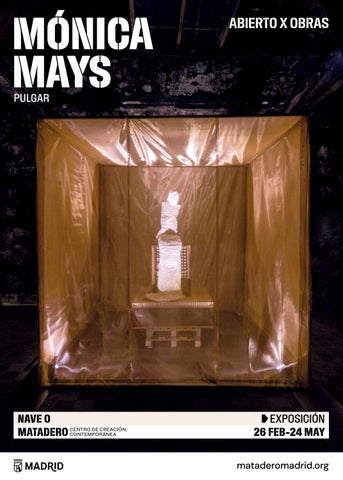
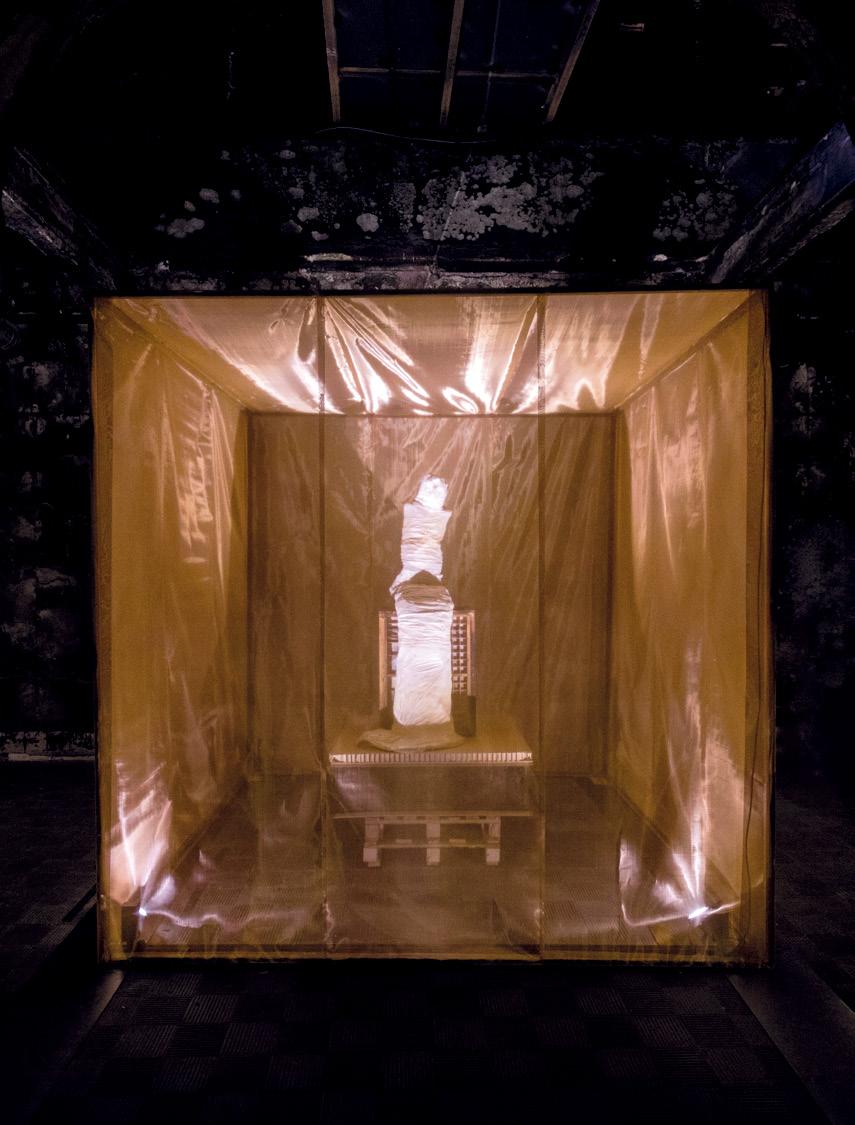
Abierto x Obras, en Matadero Madrid, es un programa de intervenciones site-specific que invita a artistas a realizar una pieza de nueva producción incentivando el carácter experimental de la creación contemporánea a través de planteamientos que exploran la relación entre el arte y el lugar que lo acoge, la antigua cámara frigorífica del Matadero. Una sala de más de 800 metros cuadrados que todavía conserva su aspecto original y las huellas de un incendio sucedido en los años noventa. Un espacio característico por su estructura diáfana de arcos volados y columnas.
En su etapa anterior, entre 2007 y 2018, el programa Abierto x Obras ofreció al público madrileño intervenciones únicas de artistas como Daniel Canogar, Jannis Kounnellis, Román Signer, Carlos Garaicoa, Fernando Sánchez Castillo, Jordi Colomer, Los Carpinteros, Cristina Lucas, Cabello/Carceller, Elena Alonso y Teresa Solar, entre otros.
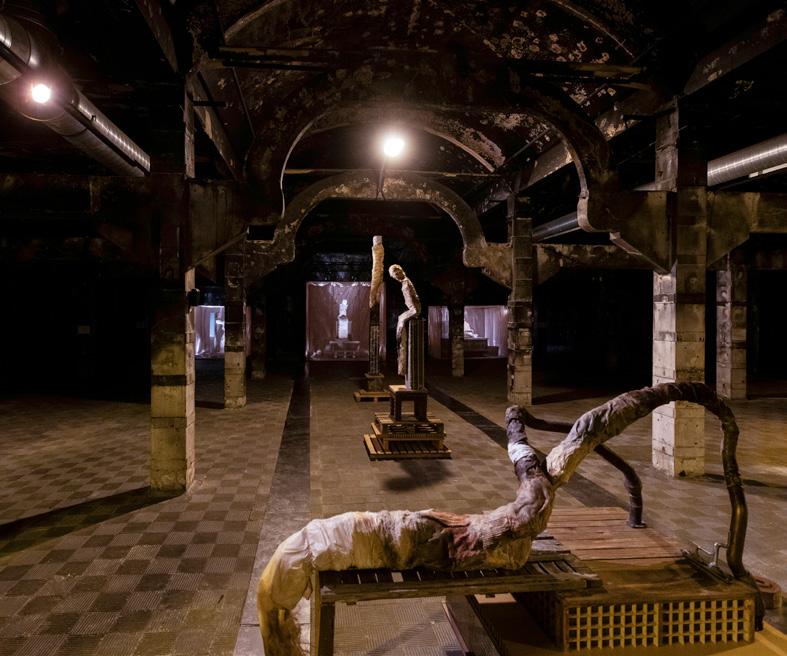
Mónica Mays (nacida en 1990, Madrid) trabaja entre Madrid y Zúrich. Su práctica artística abarca la escultura y la instalación, entrelazando la autobiografía, el proceso material y el archivo histórico. Sus piezas se componen de ensamblajes de objetos encontrados yuxtapuestos con cuerpos que rozan lo figurativo, entre una metodología de acumulación y traducción. Partiendo de una lógica barroca, Mays explora el exceso, los bordes difusos y el movimiento dramático, centrándose en la compleja superposición de significados incrustados en los objetos que utiliza y revelando la violencia y la fragilidad entre las que estos oscilan.
Pulgar es la primera muestra individual de Mónica Mays en una institución española. La exposición se despliega como un ensamblaje de objetos e historias que articula un campo de relaciones entre rastro y transmisión.
Mays investiga cómo el afecto, la violencia y el deseo circulan a través del mito y la materia. Su práctica sostiene formas de contacto con aquello que resiste ser traducido. Sus obras se sitúan en un cruce entre los restos de una economía material y las fuerzas sensibles que continúan produciendo. Componentes industriales —tubos de escape, sistemas de refrigeración— conviven con fragmentos domésticos, materiales orgánicos y elementos ligados a lo ritual. Estas combinaciones no ilustran discursos sobre extractivismo o tecnificación: los encarnan en configuraciones ambiguas, a veces dóciles, otras amenazantes.
El propio Matadero comparte esa condición de resto activo. Históricamente dedicado al procesamiento de carne, fue una infraestructura para la gestión de cuerpos, residuos orgánicos bajo lógicas de higiene y modernización. Los recorridos de las reses hacia las curtidurías del sur dejaban regueros de sangre que dieron nombre a El Rastro, mercado donde más tarde lo usado y descartado encontraría nuevas economías de valor.
Junto al índice —el dedo que señala, ordena y clasifica— el pulgar hace posible ejercer presión sobre lo pequeño, agarrar lo casi imperceptible. Las pulgas, que sobreviven en los márgenes de la domesticidad, dan nombre a los mercados de segunda mano: territorios donde circulan objetos usados, digeridos por el consumo y desplazados de su función original. Es en esos circuitos donde Mays recolecta muchos de sus materiales.
Un trasfondo de catolicismo material atraviesa la muestra, no como iconografía, sino como sedimentación de gestos y tecnologías del cuerpo. Mays incorpora bancos y reclinatorios eclesiásticos que funcionan como una suerte de infraestructuras históricas de devoción y disciplina corporal. Sus superficies arañadas y pulidas registran décadas de fricción anónima. Reubicados en la nave, pierden su función litúrgica estable, pero conservan su carga somática. Esta dimensión dialoga con la descripción que Elvia Wilk hace de prácticas medievales
de contemplación de las heridas de Cristo: una piedad centrada en mirar y aproximarse imaginariamente al cuerpo sangrante. Manuscritos besados, frotados y erosionados convertían el libro en piel. La herida como superficie de contacto. En Mays, la herida ya no es divina, pero sigue siendo estructural: las esculturas aparecen como conglomerados de partes, superficies abiertas y puntos de presión.
Las piezas emergen de tensiones físicas —gravedad, presión, combustión—. Pieles, ceras y resinas se extienden sobre intercambiadores de calor recuperados de sistemas de refrigeración. Diseñados para transferir energía sin fusión, introducen una imagen material de la relación sin mezcla. Siguiendo la noción de ensamblaje de Manuel DeLanda, las partes conservan identidad mientras producen juntas una situación común. La nave, que fue cámara frigorífica, hoy conserva rastros de combustión: dos regímenes térmicos que aún intercambian con el entorno.
Las esculturas se apoyan en estructuras de cartón, cajas taxonómicas, pallets y espejos de nitrato de plata. Estos soportes revelan operaciones de clasificación y asignación de valor. Los espejos, máquinas de duplicación y resto, absorben la luz de farolas de sodio retiradas del entorno urbano. Su espectro limitado genera una atmósfera similar a la de espacios nocturnos urbanos e interiores devocionales. Algunos ensamblajes quedan encapsulados en jaulas de Faraday, dispositivos que aíslan y concentran campos electromagnéticos. Protección y encierro se confunden. La malla actúa como filtro energético, sugiriendo que lo que circula no es solo luz o aire, sino fuerzas invisibles que afectan. Pulgar funciona como una máquina escénico-material: escultura, arquitectura y atmósfera operan sin jerarquía. Las formas se sostienen en equilibrio, entre atracción y repulsión, erotismo y horror. Pliegues, pieles tensadas y superficies abiertas insisten en que la separación entre forma y resto siempre fue frágil.
Sobre un pedestal, un sofá barroco desgarrado expone muelles y entrañas. La promesa de una superficie cómoda se rompe para mostrar la infraestructura. La apertura como herida, como zona de paso. Lo que está dentro ya está fuera y lo que está fuera ya ha penetrado.
Abierto x Obras, at Matadero Madrid, is a programme of site-specific interventions that invites artists to produce new work by encouraging the experimental nature of contemporary creation through approaches that explore the relationship between art and the place in which it is housed, the former cold storage unit of the slaughterhouse. An 800-metre room that still retains its original appearance and the signs of a fire that broke out in the 1990s. A space characterised by its diaphanous structure of cantilevered arches and columns.
In its previous incarnation, between 2007 and 2018, the Abierto x Obras programme offered the Madrid public unique interventions by artists such as Daniel Canogar, Jannis Kounnellis, Román Signer, Carlos Garaicoa, Fernando Sánchez Castillo, Jordi Colomer, Los Carpinteros, Cristina Lucas, Cabello/Carceller, Elena Alonso and Teresa Solar, among others.
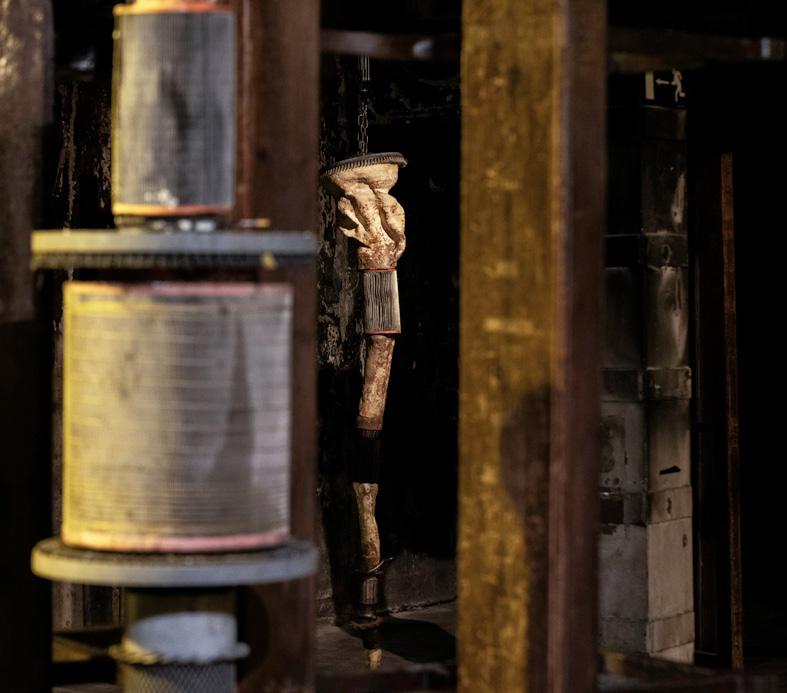
Mays (born
Madrid) works between Madrid and Zurich. Her artistic practice encompasses both sculpture and installation, interweaving autobiographical elements, material processes, and historical archives. Her works consist of assemblages of found objects juxtaposed with bodies verging on the figurative, following a methodology of accumulation and translation. Embracing a Baroque logic, Mays probes excess, blurred boundaries, and dramatic movement, attending to the complex layering of meanings embedded in the objects she employs while revealing the violence and fragility through which they oscillate.
Pulgar is Mónica Mays’ first solo exhibition at a Spanish institution. The presentation takes form as a layered assemblage of objects and histories, articulating a network of traces and transmission.
Mays investigates how affect, violence and desire circulate through myth and matter, sustaining modes of encounter with the untranslatable. Her works emerge amid the remnants of a material economy and the sensory forces that drive production. Industrial components – exhaust pipes, refrigeration systems – cohabit with domestic fragments, organic materials, and elements charged with ritual significance. Rather than illustrating messages about extractivism or technification, these combinations embody ambiguous, configurations at times pliant, at times uncanny.
Matadero itself persists as an active remnant. Once a slaughterhouse, it operated as an infrastructure for processing bodies under the dictates of hygiene and modernization. As the carcasses were driven south to the tanneries, lines of blood traced their passage, giving rise to the name El Rastro (translated as “trace” from Spanish), the flea market where used and discarded items would later be rearticulated within new economies of value.
In Spanish, pulgar means thumb. When paired with the index finger—the one that points, orders and classifies—the thumb allows to exert pressure on small things, to grasp the quasiimperceptible. The word derives from pulga (flea), an insect that survives at the margins of domestic life and in second-hand markets, where used objects enter a different economy of meaning and value. Those very circuits are where Mays sources many of her materials.
The exhibition carries an undercurrent of material Catholicism, not through iconography but rather through the sediment of bodily gestures and technologies. Mays incorporates church pews and prie-dieus, that stand as historical infrastructures of corporeal discipline and devotion. Their scratched surfaces bear the traces of anonymous friction. Relocated into the warehouse, they relinquish their liturgical authority while preserving their somatic weight.
This aspect ties to Elvia Wilk’s description of medieval practices of contemplating Christ’s
wounds, a piety devoted to observing, and imaginatively approaching the bleeding body. Kissed, rubbed, worn manuscripts turn books into skin. The wound is rendered as a surface of contact. The wound retains its structural force, though no longer divine; Mays’ sculptures resemble clusters of parts, open surfaces, and pressure points. The pieces arise from physical tensions: gravity, pressure, combustion. Skins and waxes stretch across heat exchangers salvaged from old cooling systems. Designed to transfer energy without fusion, they offer a tangible image of interaction without amalgamation. Following Manuel DeLanda’s assemblage theory, the parts retain their identities as they produce a shared situation. The warehouse, formerly a cold storage room, now bears traces of combustion, containing both temperatures within its architecture.
The sculptures rest on cardboard structures, taxonomical boxes, pallets, and silver nitrate mirrors, all classifying and valueassigning structures. The mirrors, false machines of duplication, absorb the light of the sodiumvapour lamps removed from the city streets. Their limited spectrum creates an atmosphere of both nocturnal urban spaces and devotional interiors.
Some assemblages stand within Faraday cages, devices that traditionally isolate and concentrate electromagnetic fields, blurring the distinction between protection and isolation. The mesh functions as an energy filter, suggesting that what circulates is not merely light and air, but invisible affect.
Pulgar functions as a scenographic device where sculpture and architecture operate in the absence of hierarchy. The forms rely on balances between attraction and repulsion, eroticism and horror. Folds, skins, and open surfaces underscore that the separation, form and remnant is unsubstantial.
On a pedestal, a slashed Baroque sofa reveals its innards. The promise of a comfortable surface is shattered to show the infrastructure within. The opening, as both wound and passage, suggests that interior and exterior were never distinct - what lies within appearing at the margins, and what lies at the surface entering within.
Comisaria / Curator:
Cristina Anglada
Asistencia de producción / Production assistants:
Brigitte Colson, Elena Mas, Emma Prats, Baba S. Sarr, Belén Tejedor
Concepto y producción de aromas / Scent concept and production: AirSolutions
Creación de aromas / Scent creation:
Yousif Saleh
Agradecimientos / Acknowledgments:
Juan Pablo Zino Cacciavi, Pedro Cera, Doble Erre, Simon Leibenson, Ianko López, Bombilla Mágica, Blue Velvet
MATADERO MADRID
Gerente / Manager
Alma Fernández Rius
Director artístico / Artistic Director
José Luis Romo
Subdirectora Adjunta Gerencia / Deputy Manager
Myriam González
Responsable de programa Coordinación / Coordination Office Head of Programme
Susana Zaragoza
Coordinación Gerencia / Coordinator
Adela Fernández
Gestión de proyectos / Projects
Aitor Ibáñez
Comunicación / Communications
Marisa Pons, Mariajo López, Iñaki Manjarrés, Gloria Inglis, Raúl González
Educación y públicos / Education and Publics
Javier Laporta, Beatriz Bartolomé, Pablo Gallego
Gestión operativa / Operations
Fermín Blanco
Producción / Production
Saturio Gómez, Santiago Jiménez, Gabriel Lucas, Natalia Salazar, David Romero, Vicente Fernández, Rodolfo Cortés
Infraestructuras / Infraestructures
Raúl Cano
Jurídico / Legal
Montserrat Rivero
Administración y gestión / Administration
Ana María Cubillo, Ana María Escobar, Álvaro Estévez, Nieves Montealegre
Matadero Madrid
Paseo de la Chopera, 14 28045 Madrid
T. 91 318 46 79
info@mataderomadrid.org @mataderomadrid
De martes a jueves de 17 a 21h. Viernes, sábados, domingos y festivos de 12 a 21h. Acceso a la sala hasta las 20.45h. Lunes cerrado