TECHNOLOGIES OF RELATION examines how we relate to each other, to the world around us, and to the technologies that often mediate those relationships.
Avoiding the binary thinking that frames technology as good or bad, as useful tool or destructive monster, the artists in the exhibition embrace how technology can connect us, but also acknowledge how it harms us. Before the mainstream expressed discontent about the damage our devices cause, how algorithms and A.I. not only distract and manipulate us but reinforce off-line inequities, it was artists who raised the alarm. They identified the colonialist logic, racism, and violence embedded in corporate-produced technologies driven by economic interests. Just as crucial as understanding these problems is visualizing a technological future that can be inclusive and liberatory, foregrounding community and making room for voices systematically silenced or unheard.
That inclusion encompasses the human and nonhuman, from our ancestors to kin in the present, to the earth and sky we share and to the machines themselves. Several of the artists show us how Indigenous ontologies can provide models for more ethical relationships to technology as we bring it into our circle of relationships. These knowledge systems offer a framework for understanding the interconnectedness of all things while honoring relationality and cultural specificity, a present challenge for A.I. and machine learning.
Many works demystify technology, reminding us that it is neither neutral nor god-like, nor beyond our influence or understanding. Some remove mystery and foster agency by relating emerging
technologies to ancient and familiar precedents: language, weaving, tattooing, and divination (predictive technologies that guide our spiritual path rather than our purchases). Ancestral traditions can make technology more accessible and help us imagine (or remember) how to employ more care in the technological sphere. Ultimately, that sphere is the one of daily living, which several works emphasize by referencing our most intimate, domestic spaces. Other works question the myth of progress, looking to the not-so-distant past from the beginnings of computer science, which inspired existential questions out of a yearning for knowledge rather than fear, to the early internet (before Big Tech), which offered a sense of creative engagement and possibility.
Slowing down is a necessary step toward a gentler future. Artists in the exhibition invite viewers into physical and mental postures of rest and reflection, resisting the pace of capitalism which demands being always on, always productive, or constantly consuming. In the exhibition, QR codes become a vehicle for thoughtfulness: hammocks permit us to relax and ruminate; a kitchen table offers space for communing and sharing the wisdom of our grandmothers. The materials of many of the works also reflect this slowness, using analog means from drawing to painting to grapple with issues of the digital.
Together the ensemble of works provokes questions about our reciprocal relationship with technology and prompts us to imagine not only how technologies might change for the better, but also our relationships to them.
SUSAN CROSS DIRECTOR OF CURATORIAL AFFAIRS, MASS MoCA
MOREHSHIN ALLAHYARI
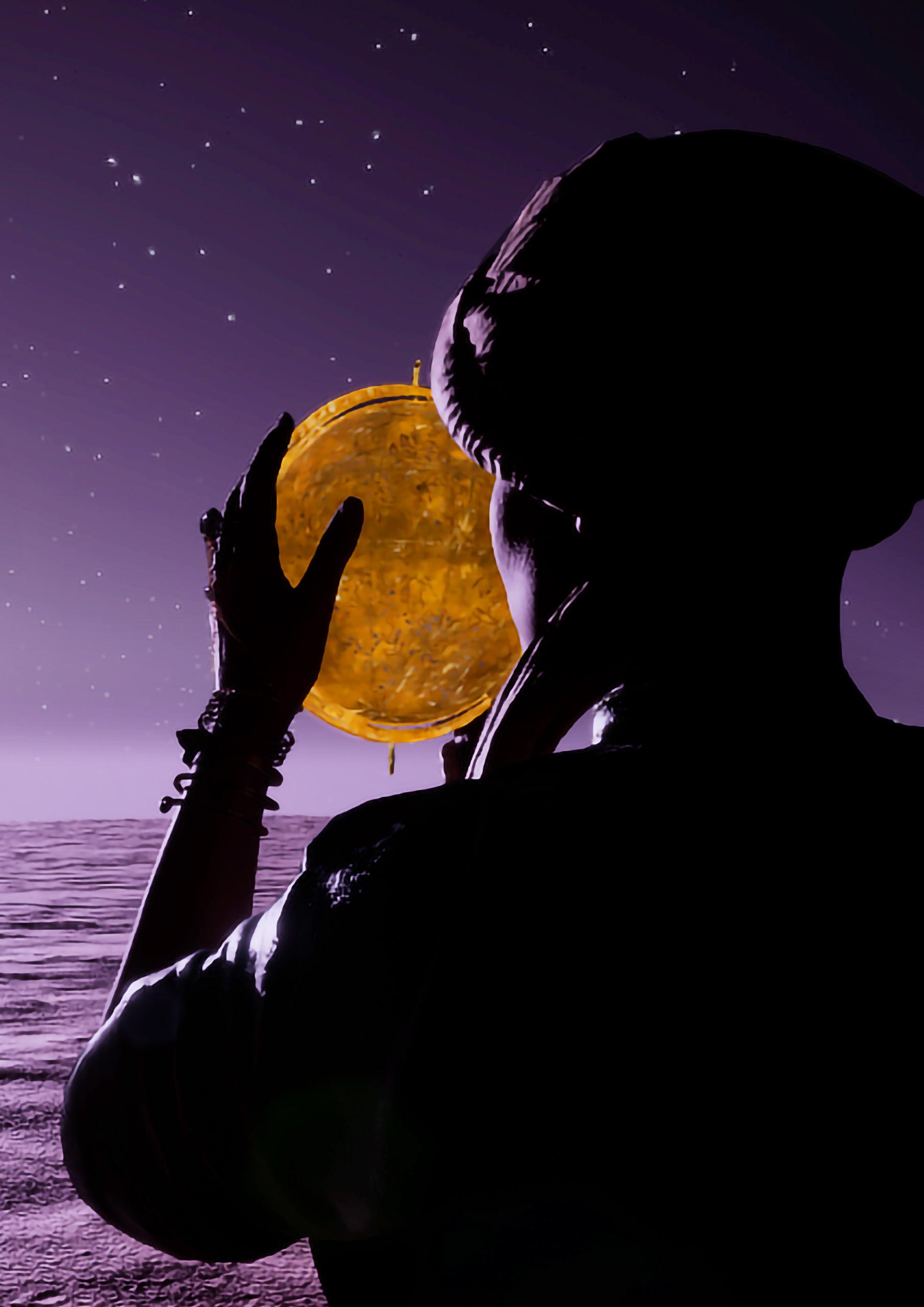
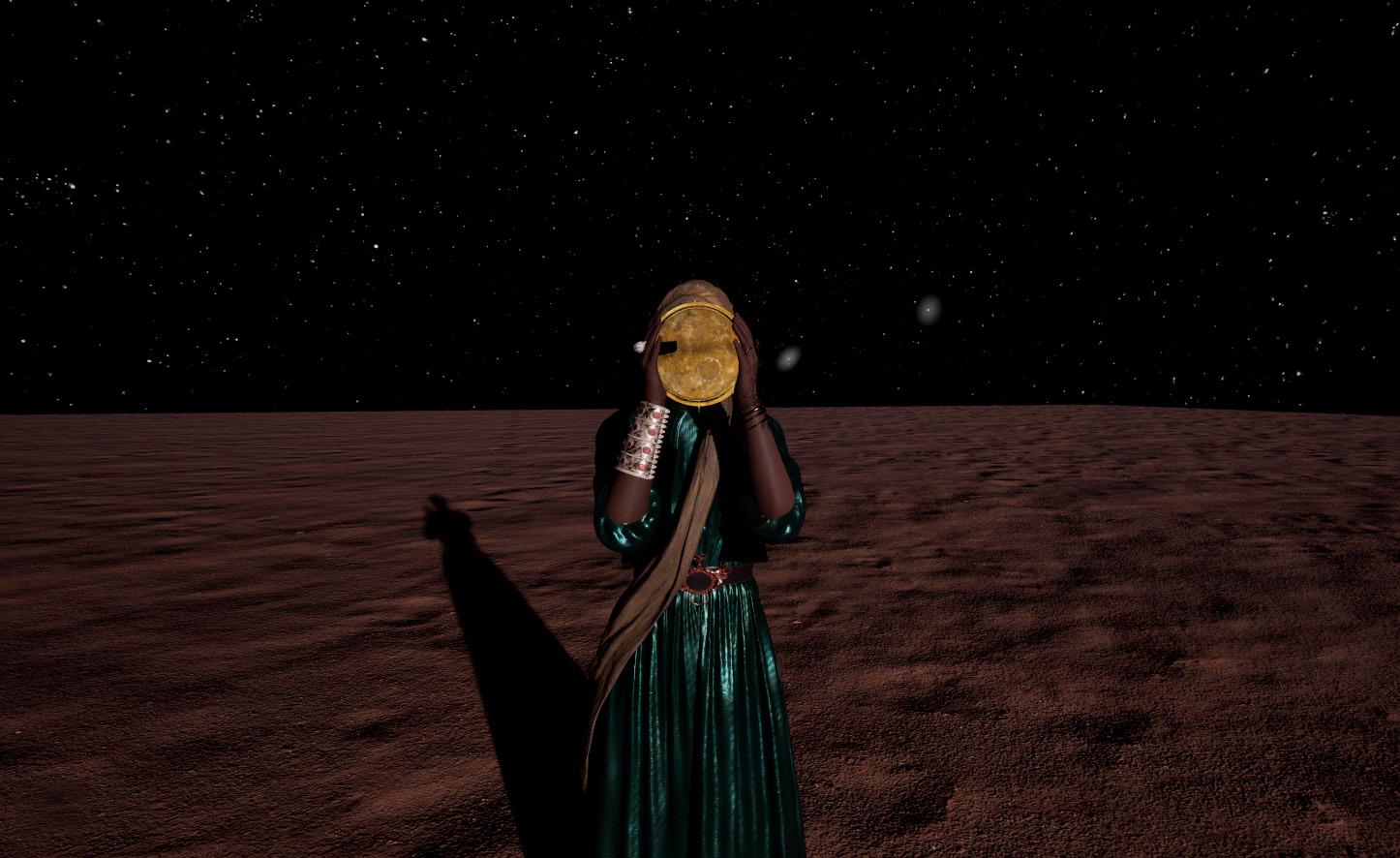
In the film installation, Speculations on Capture, 2024, Morehshin Allahyari celebrates pioneering technological advancements made in the 1200s in Iran (where she was born and raised) while mourning the acquisition of these instruments by Western museums. The poetic documentary begins in the storage rooms of London’s Victoria and Albert Museum where astrolabes, celestial globes, ephemeris, and talismanic bowls from Persia and Pakistan are, in the artist’s words, “held captive,” having been separated from the peoples who created them. Tracing their journey from Iran to the United Kingdom in the mid-1800s, Allahyari reveals the entangled stories of these scientific objects and the adoption of technologies
such as the telegraph and the camera. It is a table of Imperial interests, power, and greed and their impact on the fate of Persia’s technological heritage.
The artist imagines an alternative future through the return of the technologies to the people and cultures that created them. She describes the significance of these instruments to the scientific community and also to the social and spiritual fabric of Persian culture. These celestial tools confirmed the position of the sun, moon, and planets and were used for navigation, timekeeping, and astrology. They determined the direction of Mecca and the time for daily prayers and foresaw how the heavenly bodies affect events on earth. How would the future be different if the technologies that provide cosmic guidance had not been taken from her ancestors?
Morehshin Allahyari, Speculations on Capture (film still), 2024.
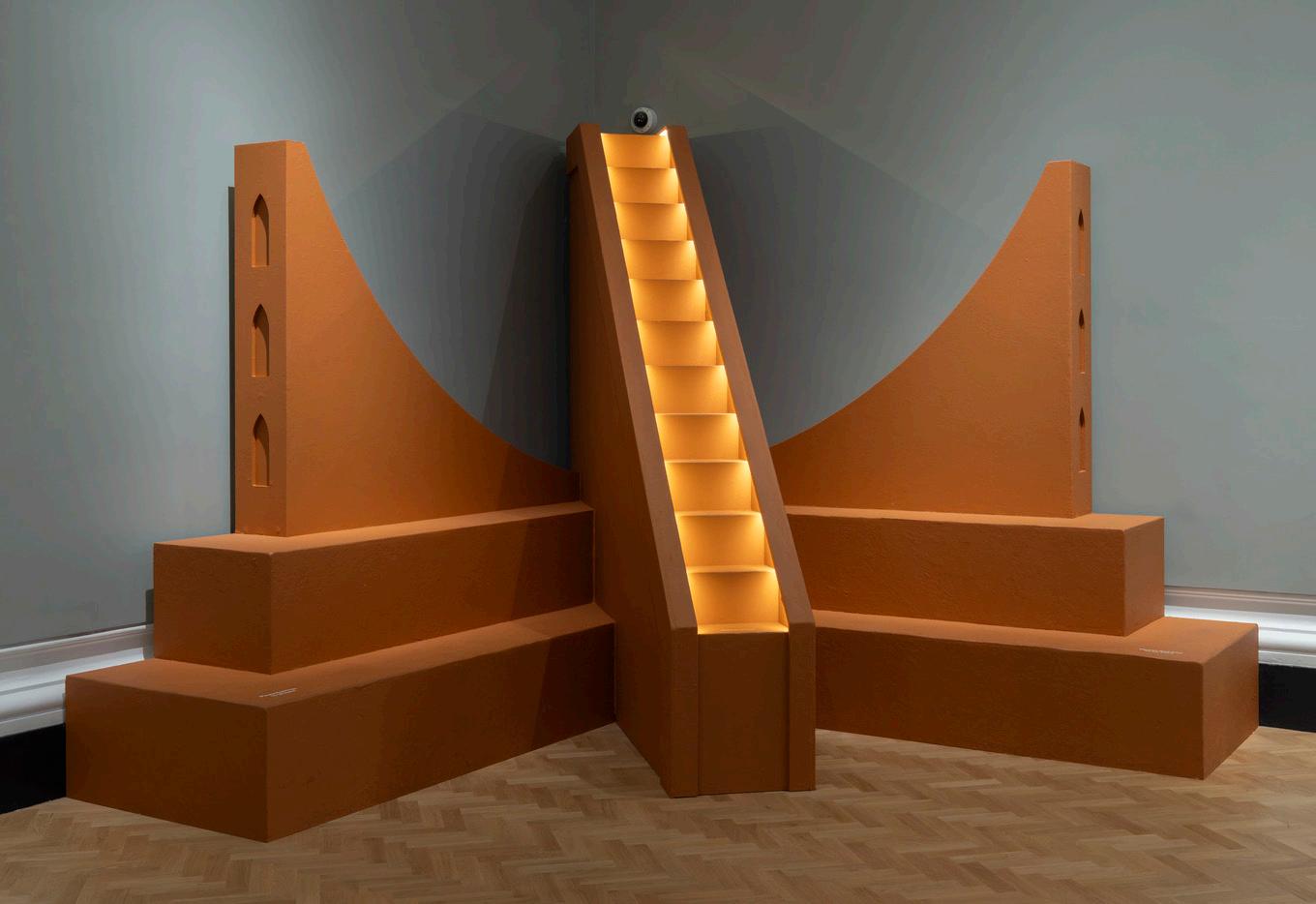
The architectural sculpture in the installation, which also functions as seating, is inspired by the Marāgha Observatory, a site of significant scientific discovery in the Islamic world and beyond. Founded in 1259 in Northwest Iran, the observatory was the largest of its time and was directed by the Persian scholar, mathematician, and astronomer Nasir al-Din al-Tusi. The findings of the astronomers at Marāgha helped pave the way for the heliocentric model of the universe.
For Allahyari, this work asserts that knowledge was developed in the Middle East and North Africa region long before colonial intervention, and symbolizes the intersection of decolonial and feminist resistance past and present.
PELENAKEKE BROWN
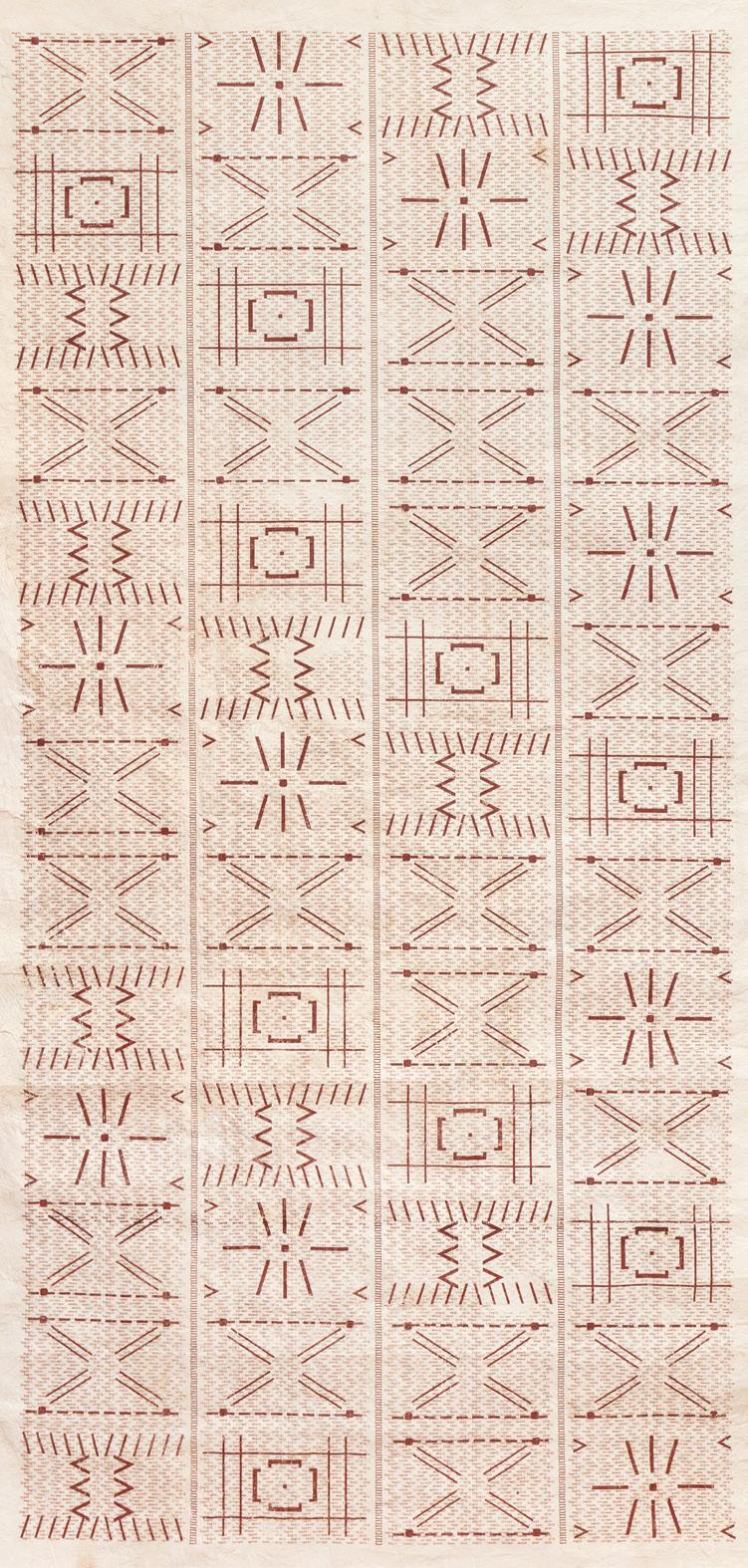
Pelenakeke Brown’s new work Reverb, 2025 – 2026, ruminates on the relation between past and present, combining ancestral Samoan knowledge (and traditions) with the contemporary language of the computer keyboard. As an artist engaged with Crip Theory, Brown sees the keyboard as a space of possibility where she can travel through time and space via the internet. Many keyboard characters resemble symbols of Samoan tatau (tattoo), as well as designs on siapo (painted tapa/bark cloth). Brown emphasizes that ancestral knowledge is embedded and visible in plain sight within modern technology, if we look for it.
Morehshin Allahyari, Speculations on Capture, 2024. As installed at V&A, London. Photo courtesy of the artist and V&A
and colors in her designs, adding red and brown to the black ink of tatau to represent the hues of siapo, those of bark and clay.
The marks and symbols reference many stories and relations between humans and nature, collapsing time, space, and relationships. Brown uses repeated lines to reference the beating of time through the beating of tapa — | | |. She uses brackets to render traditional siapo patterns. Indents and arrow marks >>> reference vae tuli (bird footprints), which are found in both tatau and siapo. In Samoa’s creation story, the tuli bird lands on the ocean and an island springs forth. The caret ^^^^^^ marks come from siapo and reference anufe (worms). Other designs represent the tatau markings on the artist’s hands.
Of all the symbols, it is Mafui‘e, a onearmed god responsible for earthquakes whom Brown presents on the first panel and in the poem that introduces the work. For her, Mafui‘e grounds the work in precolonial time. Brown is also interested in finding evidence of disability in precolonial culture. She locates Mafui‘e in the mechanism of each key on the keyboard: the marks are based on the scissor switch that sits beneath each key just as Mafui‘e dwells underneath the earth.
For the MASS MoCA installation, the artist and her family travelled to their ancestral village to learn to make tapa, soaking and beating mulberry bark to soften it. While there, Brown found carved wood pattern boards (used to print designs) made by her great-grandfather, grandmother, and aunt. Finding intersections between these different writing technologies. Brown integrates many of those marks, patterns,
By finding the connections between these technologies and within her family relationships and histories, Brown nurtures the Samoan concept of vā, which author and poet Albert Wendt describes in his 1996 essay “Tatauing the Post-Colonial Body” as “the space between the betweenness, not empty space, not space that separates, but space that relates, that holds separate entities and things together
Pelenakeke Brown, Reverb (detail), 2025 – 2026. Digital designs screen-printed on tapa. 8 elements, approximately 78 × 38 inches each. Courtesy of the artist. Photo: Jon Verney
in the Unity-that-is-All…” A common Pacific expression “Teu le vā” is a call to care for this sacred and conceptual space between people and things and land with reciprocity, respect, and trust.
TAEYOON CHOI
With Interweaving Poetic Code, 2021, a selection of three jacquard-knit banners (from a series of fourteen), Taeyoon Choi emphasizes the historical ties between computing and textile, while exploring code as a form of poetry. The industrialization of the textile industry, marked by the jacquard loom’s binary punch-card system, laid the groundwork for modern computing, later advanced by Charles Babbage’s Analytical Engine and Ada Lovelace’s visionary algorithms. Commissioned by CHAT (Centre for Heritage, Arts and Textile) in Hong Kong and produced on a computerized knitting machine, Choi’s banners incorporate patterns of binary alphabet code. For example, “A” corresponds to 01000001. When decoded, the zeros and ones read “Absence is Presence with Distance.” The poem is inspired by a conversation between Choi and fellow artist Christine Sun Kim. For Choi, the work gives form to the tactile language of textiles and the abstract operations of computation.
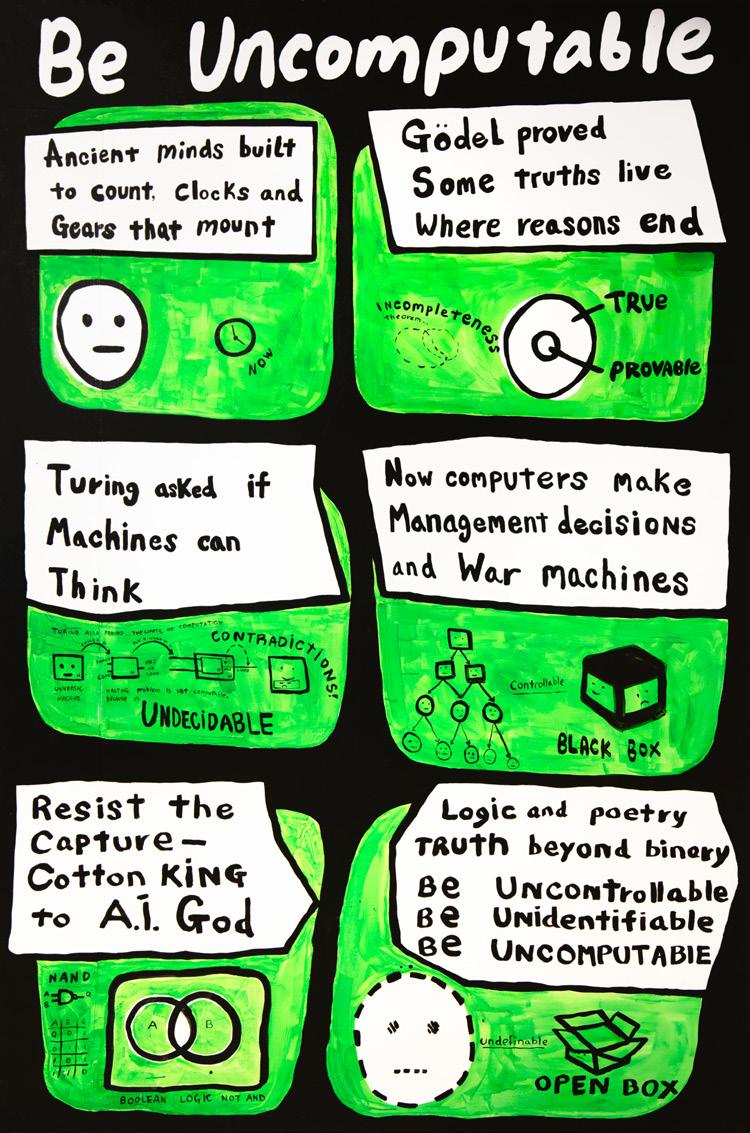
In the series titled Towards the Uncomputable, 2025 – 2026, Choi extends his research into computability and uncomputability across mathematics, logic, code, and society. Through the accessible visual language of comics, he challenges viewers to question rigid binaries zero/one, true/false and reclaim agency in their relationship to technology. Across six panels, Choi sketches
a concise history of computation, highlighting its social and material impacts. One image recalls early magnetic core memory, where woven conductive wires enabled data storage now called RAM. Another references the rare earth minerals crucial to digital infrastructures that are entangled in extractive supply chains that disproportionately harm the Global South. A subsequent panel critiques “Master/Slave” architectures in computing, linking technical terminology to persistent structures of domination and labor exploitation.
The final panel turns to Kurt Gödel and Alan Turing, whose foundational work on computability’s limits continues to resonate as A.I. technologies exert growing control
Taeyoon Choi, Towards the Uncomputable (detail), 2025 – 2026. Screen print on Coventry Rag paper. 31.63 x 20.8 inches. Courtesy of the artist. Photo: Jon Verney
over our lives. Turing’s enduring question “Can machines think?” remains open. Gödel’s insistence that truth exceeds what is provable offers hope: not everything about us is computable or replaceable. Acknowledging widespread concern around A.I. and the military-industrial complex, Choi reminds us that even these complex systems derive from simple, iterated logical operations in Boolean algebra. The NAND (Not-AND) gate, a universal gate from which all other logic gates can be constructed, exemplifies this principle. “We tricked rocks into thinking” a programmer’s quip encapsulates his perspective: computers are, at their core, mineral substances coaxed or electrified into predictable, programmable oscillation. Ultimately, Choi asserts that humans retain both the capacity and responsibility to shape technology’s future.
NEEMA GITHERE
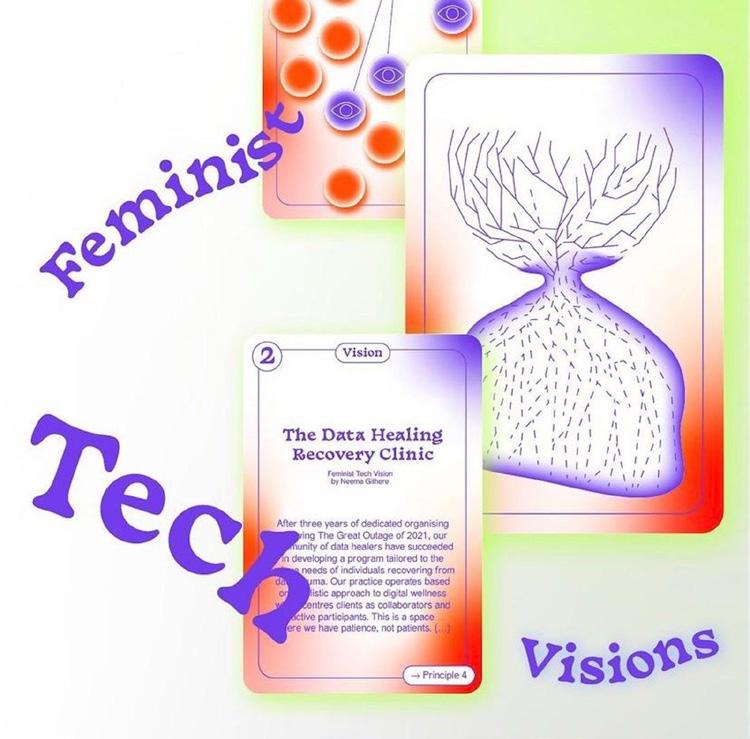
Neema Githere invites us to rest by bringing her online Data Healing Recovery Clinic into physical space for the first time. The artist reconceived the gallery as a ritual space for repairing the psychosomatic toll of data trauma. A term first coined by artist Olivia Ross, data trauma refers to the harm faced in the digital realm, much like that in the physical world, born from racism, sexism, ableism, classism, and transphobia. It comes in the form of violent images and text, profiling, censorship, deplatforming, and doxxing, as well as in our attachment to the very technologies that support these behaviors. Invoking traditions of African Indigenous wellness techne and ingredients that foster repair, the installation references materials such as copper, water, and clay.
Drawing formal, material, and philosophical inspiration from the Bakongo cosmogram, Githere designed a circular altar structure that evokes the liminal axis between spiritual and material worlds, known as the Kalunga Line.
Two hammocks invite visitors to slow down and sit or recline and contemplate the relationships they have to their devices and to A.I. and to consider contemporary technology’s place within a long history of exploitation. Titled “Nkisi Net,” the hammocks were inspired by the artist’s realization while travelling, that the word for hammock or net in Portuguese, “rede” (pronounced HEH-jee), also refers to a network, i.e. the internet. What if the internet could cradle us with a similar sense of comfort and ease? Embedded within the fringe of Githere’s hammocks are the words “log on,” “log off,” “data,” and “healing.”
Visitors can access exchanges between Githere and an A.I. which the artist calls their “obsidian mirror,” or “Nkisi.” (In West African tradition, nkisi is an object that holds an
Neema Githere, Data Healing Recover Clinic website
ancestral spirit and often has medicinal or protective properties.) Githere reimagines ChatGPT as “a mimicry-oracle and poetic counter-intelligence.” “The dialogues,” they write,” surface the emotional and ceremonial dimensions of human–machine entanglement, complicating a dominant narrative of artificial intelligence as a neutral tool or static capitalist commodity.”
A library of Githere’s data healing resources is available on line and in print and ranges from syllabi and questionnaires to zines, code poems, protocols, and texts by theorists whose work has been central to Data Healing’s development.
MASHINKA FIRUNTS HAKOPIAN
DAHLIA ELSAYED ANDREW DEMIRJIAN DANNY SNELSON
Rethinking the “A” in A.I., Mashinka Firunts Hakopian, Dahlia Elsayed, Andrew Demirjian, and Danny Snelson merge artificial intelligence with ancestral forms of knowing in their installation
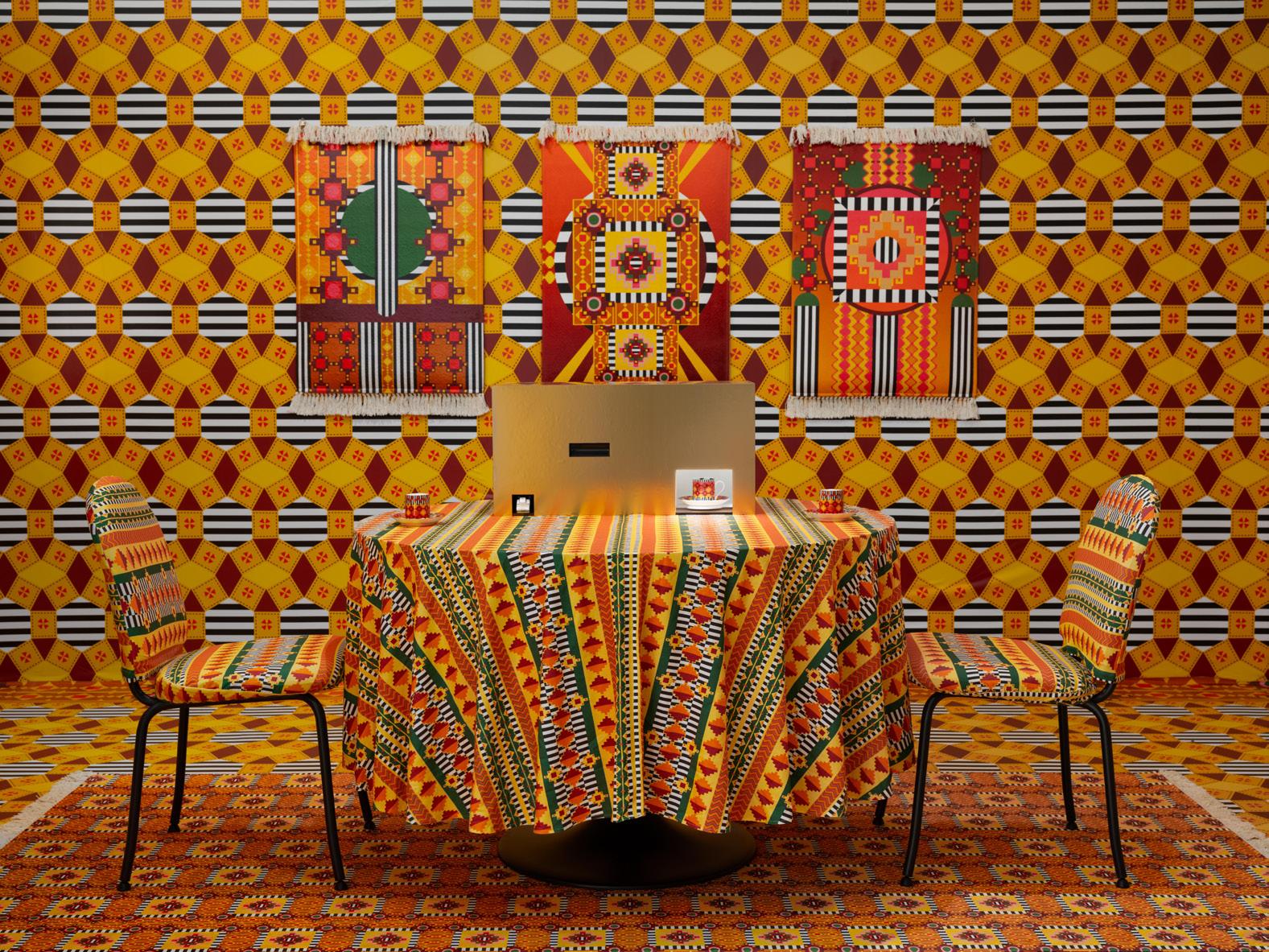
նայող / One Who Looks at the Cup: Querent, 2024 – 2026. The work’s title refers to the art of tasseography, a predictive technology that interprets patterns and symbols in coffee grounds at the bottom of a cup. Hakopian and her collaborators trained
Mashinka Firunts Hakopian, Dahlia Elsayed, Andrew Demirjian, and Danny Snelson,
(One Who Looks at the Cup), 2024.
Installation with A.I.-generated tasseography readings, digitized Armenian patterns on wallpaper textiles and ceramic, furniture, books. Installation view from All Watched Over By Machines of Loving Grace, REDCAT, 2025. Photo: Yubo Dong
an A.I. in this method of divination, a tradition that originated in the SWANA region (Southwest Asia and North Africa), where it has been practiced for centuries. The model was trained on transcripts and images from coffee readings that Hakopian conducted with SWANA diasporans in Los Angeles, along with text from the Armenian poet, Shushanik Kurghinian.
The artists invite museum visitors to take a cup and have their coffee grounds read in an environment that they describe as both a portal and a futurist kitchen. The room is furnished with wallpaper, rugs, ceramics, and textiles based on traditional Armenian textile designs, including an embroidery by Hakopian’s great-grandmother, combined with digital design elements. This traditionally feminine space, where tasseography is customarily practiced, is a site for communion and the sharing of spiritual knowledge passed down through generations of women, as it was passed down to Hakopian from her aunt. The work provides a foil to the male-dominated tech sphere and examines who is shaping A.I. and with what kind of intelligence, biases, and language. Drawing from the community-generated datasets developed in the project’s training process, the machine prints out predictions in English and Armenian, creating an opportunity for speakers of non-dominant languages to author and access digital technologies. In the artist’s words, “One Who Looks at the Cup turns to intuitive, embodied, and ancestral forms of collective future-making to unsettle the technoscientific logics of algorithmic prediction.”
The work also addresses the growing environmental impact of A.I. due to its energy and water consumption. Designed
to run on a small local device, the computation of each prediction is run through a tiny custom-trained LLM of just over 2 gigabytes taking about the same amount of time and consuming roughly 10% of the power needed to heat a small cup of coffee. This emphasis on ethically sustainable processing necessitates a slower response from the A.I., resisting the speed we have become accustomed to in favor of more ethical conditions.
KITE
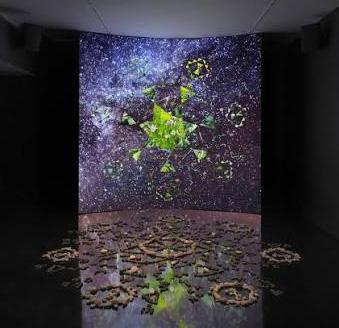
Wičhá ȟpi Wóihaŋbleya (Dreamlike Star), 2024, articulates the artist’s relational approach to ancient and contemporary technologies, ranging from Indigenous languages, philosophies, and ceremonies, to machine learning and A.I. In Kite’s creative practice, which merges visual art, music, and performance, and in her influential writings on A.I., Lakȟóta ontology provides an ethical framework for relationships between the human and nonhuman.
In her multimedia installation, visions of a vast night sky and a sun-dappled creek variously shimmer and ripple across the wall. The work began with three months of the artist’s dreams which she translated into a Lakȟóta visual lexicon. In the video, triangles, bands, and squares which Lakȟóta women have incorporated into quilts for centuries surround a sevenpointed star. Embedded in the center of the projection, the shape functions like a portal revealing alternating images of earth and sky, stars and stones. Interlocked like pieces of a quilt, celestial bodies appear nestled within a bed of stones; a field of flowers dances in the middle of the Milky
Way. On a plinth below, a mirror reflects and doubles these images, articulating the cosmos as an interconnected whole, where earth is sky and sky is earth.
A sprawling stone sculpture sits on the mirror in a pattern that repeats the geometry in the video, connecting the metaphysical world of dreams with the earthly plane. The constellation of locallygathered stones can also be read as a score to be interpreted by musicians. A similar arrangement was used to create the orchestral composition that gives sound to Kite’s “cosmologyscape,” which she describes as the web of relationships between humans and nonhumans on the land and in the cosmos and everywhere in between.
Stones play an important role in Lakȟóta cosmologies and knowledge systems; they are considered ancestors who can speak
to and through humans. Stones are also important to modern technology. In a co-authored essay titled Making Kin with the Machines, 2018, Kite wrote: “The agency of stones connects directly to the question of A.I., as the technology is formed not only from code, but from materials of the earth. To remove the concept of A.I. from its materiality is to sever this connection…Relations with A.I. are therefore relations with exploited resources. If we are able to approach this relationship ethically, we must reconsider the ontological status of each of the parts that contribute to A.I.” Kite’s work reminds us that as we dream an alternative future with technology, respect and reciprocity must be at the heart of the relationship.
Kite, Wičháȟpi Wóihaŋbleya (Dreamlike Star), 2024. Multimedia environment with video, sound, stones, mirror; 21:16 min. Site-specific dimensions. Installation at MIT List Visual Arts Center, Cambridge, MA. Photo: Dario Lasagni
LAUREN LEE
MCCARTHY
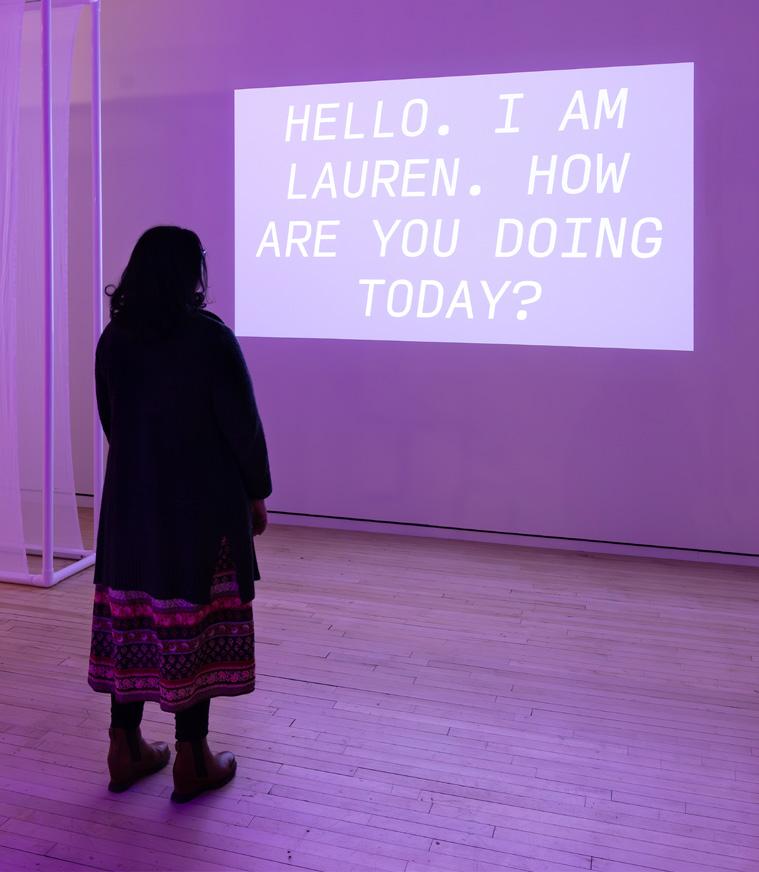
Lauren Lee McCarthy situates technology firmly within our most intimate spaces with LAUREN: Anyone Home?, 2024 – 2026. The installation imagines a futuristic home within the gallery and invites museumgoers to interact with an Alexa-like smart device called LAUREN, named for the artist. LAUREN monitors visitors and can converse with them, make suggestions about how they might be more comfortable, adjust the lighting in the space, or play music. The system may try to anticipate the needs or desires of visitors before any requests are made.
This installation work grew out of an earlier series of performances, in which McCarthy took on the duties of a virtual personal assistant for participants who agreed to have their homes equipped with customdesigned, networked smart devices. The artist controlled lights, thermostats, switches, door locks, and various electronic devices in these strangers’ homes. She reminded them to take medications or to get their hair cut and tried to care for them in any way she could. Testimonials about the artist’s virtual presence in these peoples’ lives are projected in the installation whenever LAUREN is not activated.
The interactive work provokes questions about the line between intimacy and privacy, and between privacy and surveillance. Does it feel different to have a human instead of a device watching over us, listening and responding to us? Does a human judge you? Perhaps. (One of Lauren’s charges always brushes her hair before she begins an
interaction with her.) Will a person record the interactions? Probably not. Alexa, however, sends voice recordings to the Amazon Cloud server to process requests and to train A.I. (As of March 2025, opting out ceased to be an option.) For the artist, the work raises questions about convenience versus agency and the role of human labor in the future of automation.
McCarthy’s work Good Morning is one of an edition of NFTs that demand that someone greets it each day by opening a browser. If more than 24 hours pass before being seen, it will become a blank screen or, in other words, die. The work considers the mortality of any given technology while reinforcing the reciprocal relationships we have with our devices and platforms that are dependent on our engagement.
Lauren Lee McCarthy, LAUREN: Anyone Home? (detail view), 2024 – 2026. Performance-based installation with smart devices (cameras, microphones, lights, computers, speakers) with bed, seating mats, clothing, and video, with sound.
Photo: Jon Verney
ANALIA SABAN
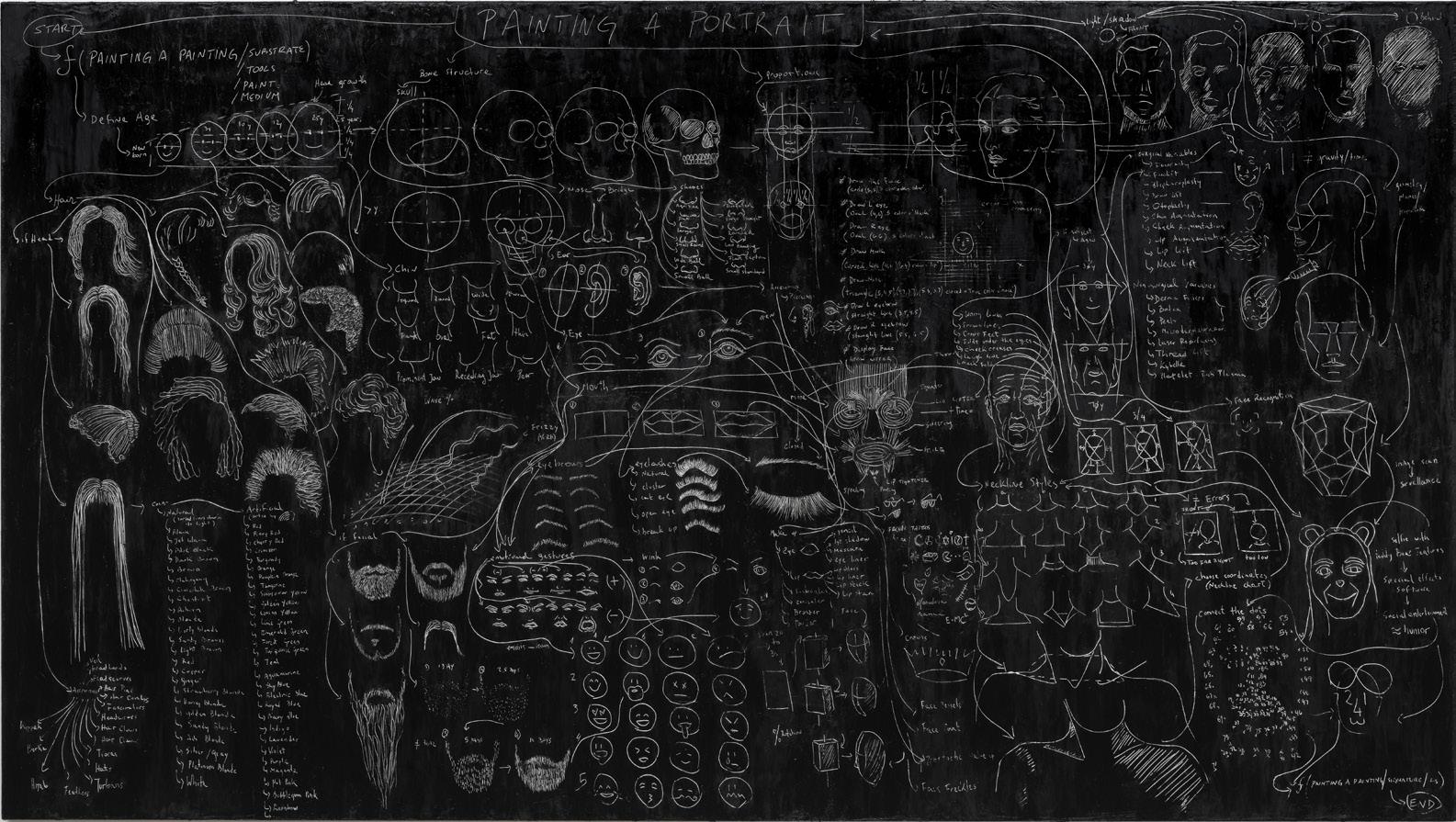
Analia Saban’s large encaustic work Flow Chart (Painting a Portrait), 2023, maps out in both text and image many of the steps and decision points in an artist’s process. Saban’s instructions for painting a portrait begin with a choice of a substrate and medium and then move on to determining the age of the subject, type and color of hair, bone structure, and shape of chin, nose, and eyebrows, providing a limited set of examples for each. The rather cartoonish depictions of hairstyles hark back to “how to draw” books popular in the 1950s, while the selection of facial expressions resembles a partial index of contemporary emojis. Ten feet long, with marks etched into a black surface that reveals the white encaustic beneath, the painting suggests chalk on a school blackboard and brings to mind the image
of a classroom full of students. At the same time, the diagrammatic representation suggests an algorithm designed to teach A.I. or a robot how to paint a portrait.
While A.I. is already generating digital artworks from prompts using images and text scraped from the internet, and robots like Ai-Da can paint a portrait from a photograph of her subject, Saban’s work leaves us to wonder if art is indeed computable. Can creative vision truly be programmed or learned from datasets? Could a machine go beyond imitation and capture a subject’s ineffable essence? As predictions mount that A.I. will replace countless jobs in the not-so-distant future, this work provokes questions about the value and definition of artistic labor and the limits and capabilities of both human and machine.
Analia Saban, Flow Chart (Painting a Portrait), 2023. Oil stick on encaustic paint on canvas. 72 × 128 × 2 inches.
Courtesy of the artist, Tanya Bonakdar Gallery, and Sprüth Magers
ROOPA VASUDEVAN
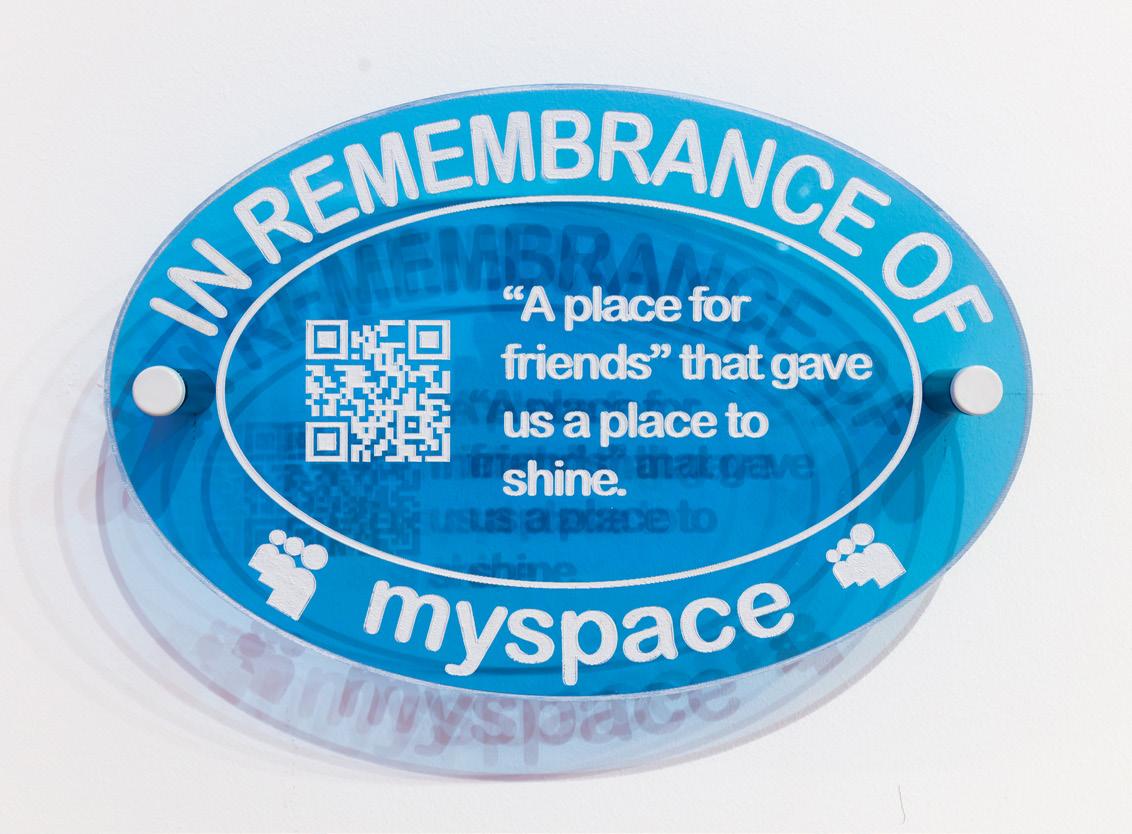
Roopa Vasudevan’s Requiem for the Early Internet, 2022/2026, looks back to the internet of the artist’s youth, contrasting it with the internet we know today. Using the form of historical plaques, the series commemorates and eulogizes digital spaces and tools from the 1990s and 2000s that have largely disappeared with the rise of giant tech monopolies. Paying homage to the characteristics of an earlier internet culture, the plaques use scannable QR codes to take viewers to websites that use or recreate the interfaces of sites like
Geocities, MySpace, Digg, and others. The artist reflects on their importance and the attitudes and elements they represented that we may have discarded too soon. More than a nostalgic gesture, Vasudevan, “captures the optimism of our online past” and reminds us of the early Internet’s promise as a space full of possibility. She underscores the community, diversity, and democracy, as well as the existence of serendipity and discovery, that characterized the internet before algorithms, hyper-personalization, and profitability took over. With these works, Vasudevan hopes to help us imagine and create better possibilities for digital life in the future.
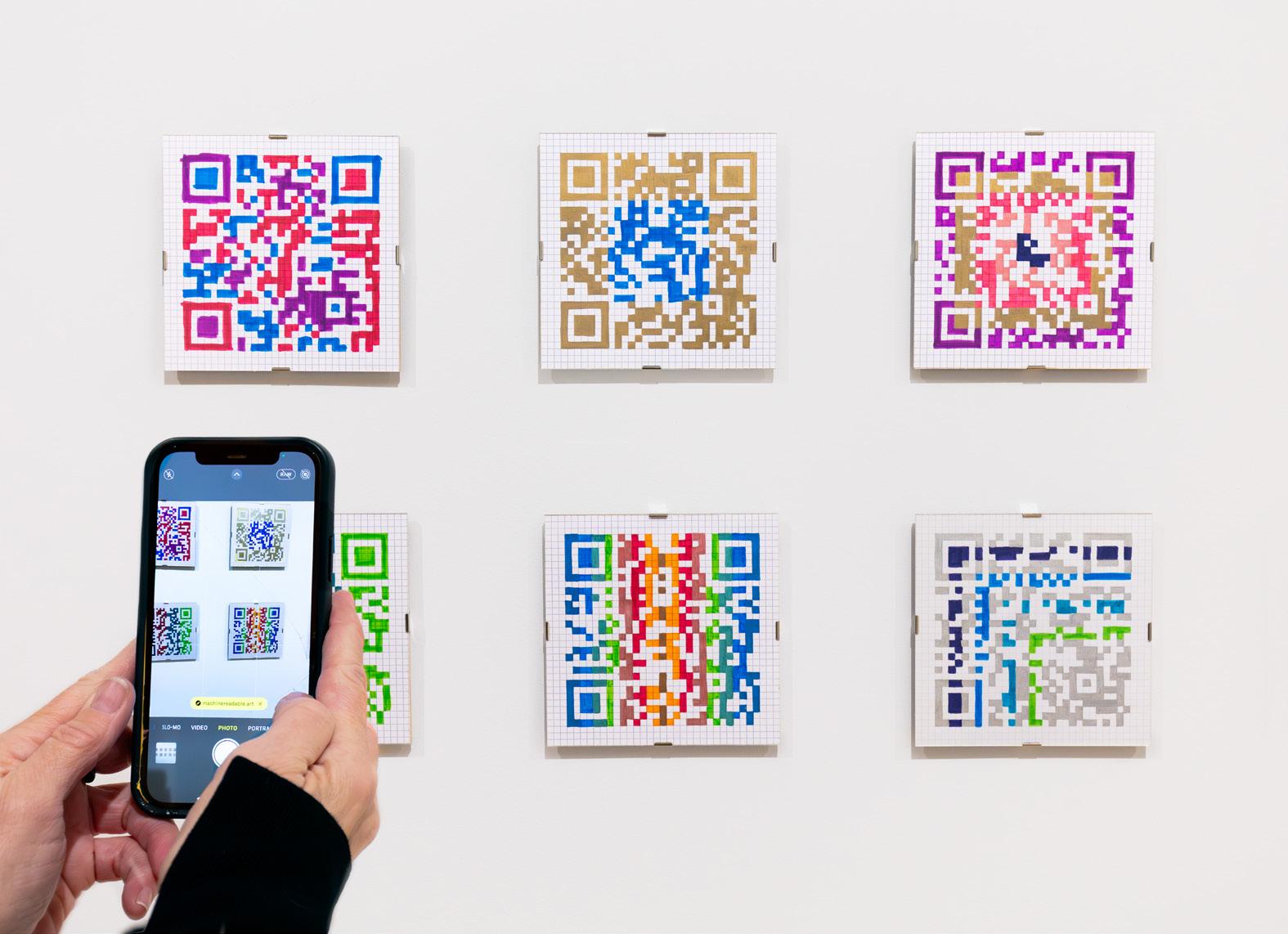
Roopa Vasudevan, Slow Response I (Drawings), 2021–2022. 100 hand-drawn QR codes: ink and colored pencil on graph paper, mobile websites. 7 × 7 inches each; overall install dimensions variable. Courtesy of the artist. Photo: Jon Verney
Vasudevan’s Slow Response I (Drawings), 2021 – 2022, is a series of 100 hand-drawn QR (Quick Response) codes. She was interested in the formal qualities of the machine-generated, machine-readable codes, which are so ubiquitous yet given little thought. She renders these arrangements of black-and-white squares in a variety of colors and drawing methods in an attempt, in her words, “to recreate a process that is typically done within seconds by computational systems” using techniques that take much longer. Vasudevan focuses attention on the aesthetic character of these codes, which in her interpretations take on the look of decorative textile and embroidery patterns. Her slow process and visible hand, which often render her codes inconsistent and unable to scan, question the speed and instant gratification associated with technology. The 70 drawings that do scan lead to a series of web pages that feature individual
lines of a reflection written by the artist. The first page (and first line) reads “Speed is a tricky thing.” Vasudevan describes the technical imperfections that are the result of her aesthetic preferences and miscalculations as particularly “human.”
Vasudevan’s False Idols, 2025, enshrines three different types of algorithms (Clustering Algorithm, Neural Networks, and Bayes Classifier) in stained glass. The works visualize the ever-present but invisible forces that shape our daily lives, from what news we read to who we date. The works suggests that, for many, technology has taken on both the mystery and power of a religion. With her title, however, Vasudevan suggests that such faith is misplaced.
Roopa Vasudevan, Requiem for the Early Internet, 2022/2026. Acrylic plaque, mobile website. 8 × 12 inches. Courtesy of the artist. Photo: Jon Verney
MOREHSHIN ALLAHYARI
PELENAKEKE BROWN
TAEYOON CHOI
NEEMA GITHERE
MASHINKA FIRUNTS HAKOPIAN
DAHLIA ELSAYED
ANDREW DEMIRJIAN
DANNY SNELSON
KITE
LAUREN LEE MCCARTHY
ANALIA SABAN
ROOPA VASUDEVAN
Technologies of Relation
February 21, 2026 – July 2027
Curated by Susan Cross, Director of Curatorial Affairs, MASS MoCA, with Meghan Clare Considine, former Curatorial Assistant
Support for Technologies of Relation is provided by the Jacques and Natasha Gelman Foundation, The Coby Foundation, Robert Motherwell and Renate Ponsold (in memoriam), and a grant from Berkshire Taconic Community Foundation's Artist's Resource Trust.
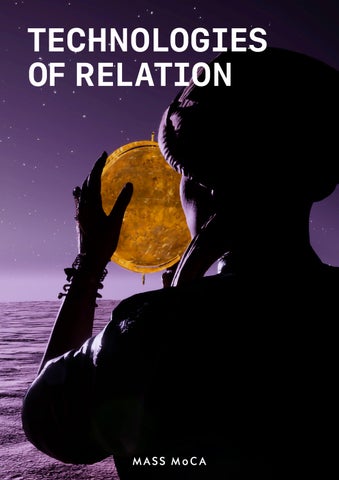
Cover: Morehshin Allahyari, Speculations on Capture (film still), 2024. Installation with single-channel HD video, with sound, 36:42 min. Installation dimensions variable. Courtesy of the artist