Cecilia VICUÑA
union of three
Lola Ayisha OGBARA Scars Insist on Being Remembered
Sam FRÉSQUEZ *
BY MARISSA DEL TORO
CEI FELLOW, MASS MoCA
Organized by three curators, and featuring the work of three artists, Spatial Poems is both a group exhibition and a trio of solo presentations. Collectively, the works by Cecilia Vicuña, Sam Frésquez, and Lola Ayisha Ogbara explore ritual, ephemerality, memory, and repetition. Separately, each artist articulates distinct insights and research through a range of materials and compositional approaches. As a whole, this exhibition and curatorial project is a communal composition, and a dialogue on care, social relations, cultural existences, and the organization of new forms of being. It is an act of refusal to the current precarity of the art world, and ultimately the world at large.
When I received the invitation to be a MASS MoCA Curatorial Exchange Initiative Fellow in 2023, with the opportunity to mount an exhibition at the museum, I recognized that I could multiply that opportunity in a wave of reciprocation by sharing it in whatever way I could. I proposed inviting two additional curators, Jamillah Hinson and Ninabah Reid Winton, to create exhibitions with and alongside me. The organizational and conceptual structure behind Spatial Poems is an opportunity to further expand the transformative proposition of the CEI program at MASS MoCA, and is a challenge to the traditional structures of the art world, where curatorial opportunities are often afforded to the same few creative characters.
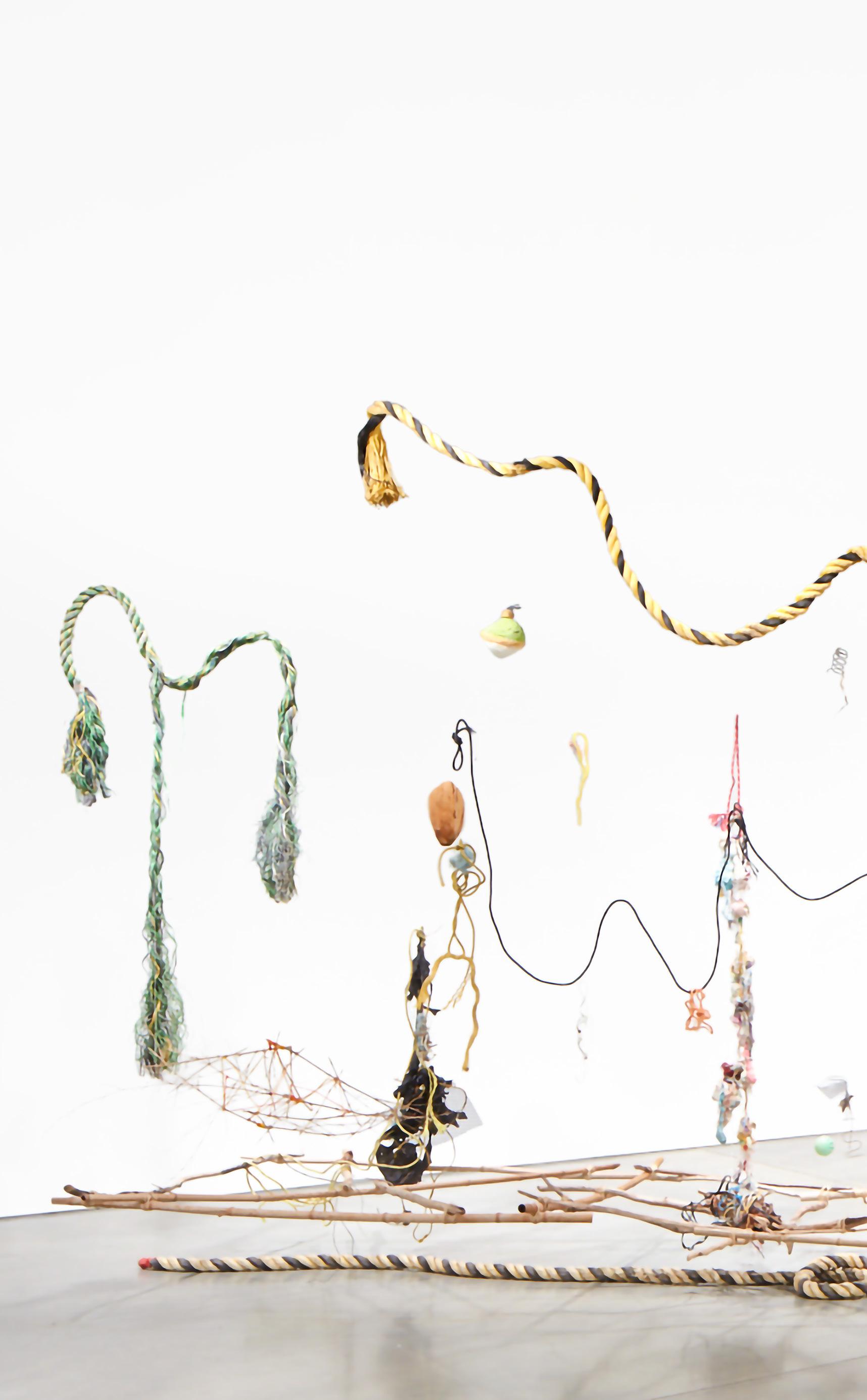
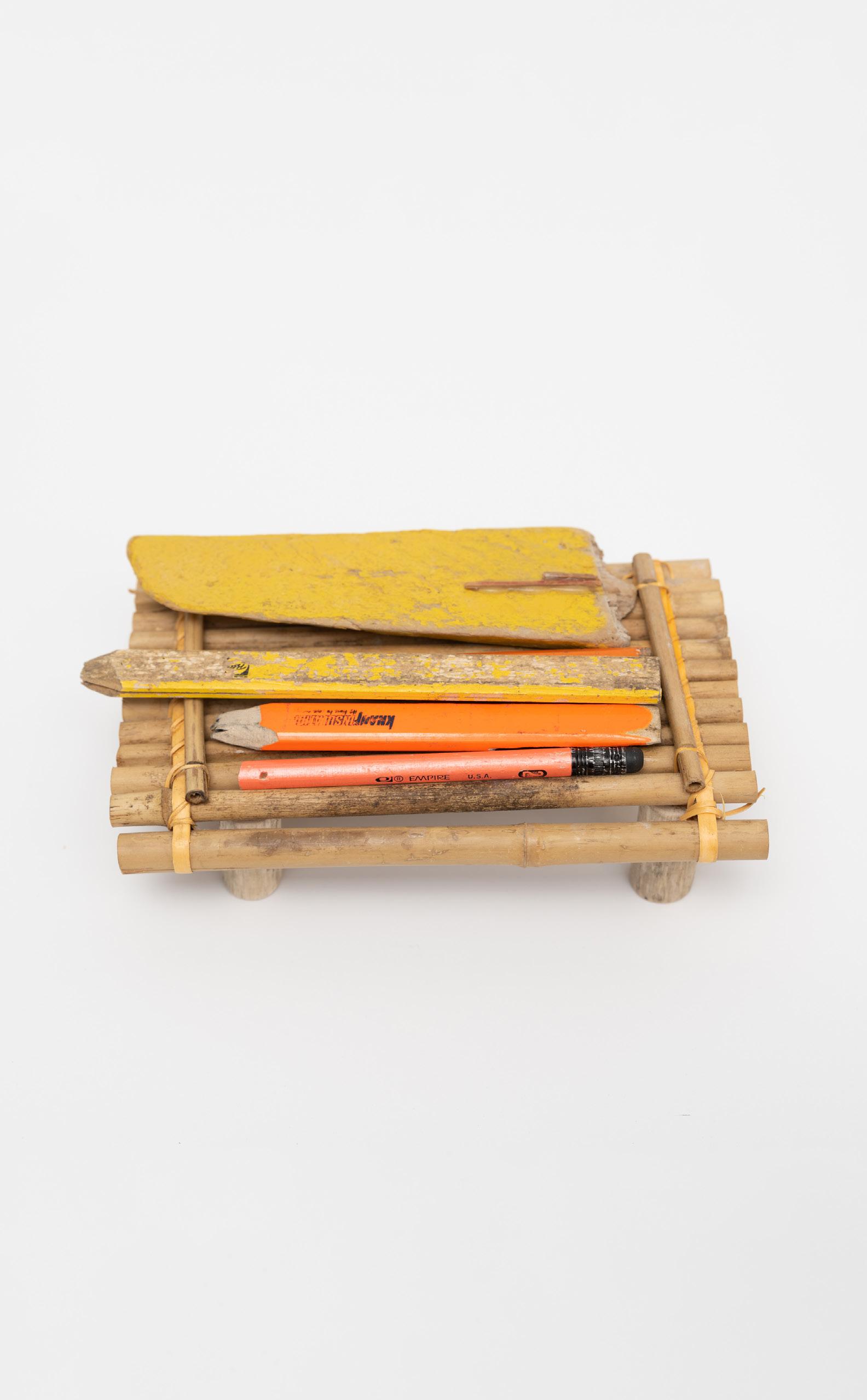
The central axis of Spatial Poems is set by the poet and multidisciplinary artist Cecilia Vicuña, and her sixty-year art practice of precarios or “arte precario.” These are small assemblages of discarded and fragmented materials conceptually foregrounding ephemerality, intangibility, and evanescence, articulating a broader dialogue on collectivity, new forms of being, and connectedness between human and nonhuman life. Much of her practice, including the precarios, is rooted in Andean epistemology, histories, and knowledge of reciprocal love and wisdom in relation to the environment. Vicuña’s work serves as the overarching conceptual framework for the three interrelated projects, with the curators and artists working collectively in euphonious rhythm to create a score or spatial poem from dissonant sounds and sights. Cecilia Vicuña: union of three presents a selection of precarios and quipu sculptures, including her monumental Quipu Desaparecido 2 / Disappeared Quipu 2 (2018) and Balsa Snake Raft to Escape the Flood
(2017), as well as films, texts, and sound. These works act as evocations of reciprocity between nature, the cosmos, and humans, as rituals of resilience against colonialism, and as actions that initiate future creativity and new ways of collective being.
Lola Ayisha Ogbara: Scars Insist on Being Remembered is a presentation of the artist’s two recent series, Sticky (2025) and Forget Me Knot (2023 – 25). The former recalls the nineteenth-century folktale of the Tar Baby as an allegory of Black survival, and the legacy of Afrocartography, while the latter evokes keloids and the African practice of decorative scarification as memories of lived experience, bodily cartography, and acts of resistance and rest across time. In addition, Ogbara’s new installation for MASS MoCA memorializes Elizabeth “Mum Bett” Freeman, the first enslaved woman to win her freedom in Massachusetts, whose successful court case spurred the dissolution of slavery in the state. The symbolic gravesite is filled with sand and memory jugs that channel portals between our world and the afterlife.
Sam Frésquez: * (pronounced as “asterisk,” informally known as the “Nesting House”) restages the artist’s most recent large-scale installation of a life-sized kitchen that unfolds into a series of miniaturized spaces as a dreamlike exploration of nested realities about time, perception, memory, and intergenerational knowledge. This installation draws viewers into contemplating themes of connection across distance, the folding of time upon itself, and how meaning is both revealed and obscured through references to memory and routine.
As visitors walk through the galleries, they are encouraged to receive and understand Spatial Poems as an actual poem, a score and composition of sights, sounds, and feelings conveyed through art. For those hesitant or apprehensive about how to comprehend this project, or poetry at large, consider the following excerpt by the American poet and educator Tracy K. Smith, from her book Fear Less: Poetry in Perilous Times, as a guide to accessing the power of poetry:
Poems exist in language, but their intention is to travel beyond the system of words and logic into systems of sound, sensation, memory, imagination, emotion, knowledge, and ultimately into insight. If you hold this view in mind that poems use words but are not about words… then you can feel confident that whoever you are and whatever you care about, you are already perfectly equipped to experience and even to claim a relationship to the art form.1
The Pulitzer Prize-winning poet demystifies the art of poetry by guiding and inviting readers to understand and, more importantly, feel how poetry cultivates human connection, resilience, and hope. It is with this intention that visitors are invited into Spatial Poems, a communal exhibition formed through three concurrent paths of poetic and artistic enunciation.
1 Tracy K. Smith, Fear Less: Poetry in Perilous Times (New York: W. W. Norton & Company, 2025), 2.
BY MARISSA DEL TORO
CEI FELLOW, MASS MoCA
For much of Cecilia Vicuña’s multidisciplinary, sixty-year career, her work has been positioned in terms of ritual, revolution, and reciprocity, among other concepts. Her practice channels Andean epistemology, histories, and knowledge of reciprocal love and wisdom in relation to the environment, with nature as a key component and collaborator for the artist. She visualizes acts of reciprocity among nature, humans, and the divine through conceptual modes of sculpture-making, painting, poetry, film, and performance. Vicuña’s acts of reciprocity extend beyond current art influences and spark creativity that leads to future ways of being not yet here. This exhibition presents a selection of the artist’s precarios (small assemblages made from discarded and fragmented materials), quipu sculptures (largescale installations composed of unspun wool based on the ancient Andean knotted-string communication devices known as quipus), recent oil paintings based on drawings from 1978 that she recreated from memory, and limited photo documentation, video works, and select photographs that record the earliest making of her precarios and quipus. As a whole, union of three combines Vicuña’s precarios, a symbol of life’s precarity and fragility, her quipu installations as woven metaphors for the cosmos and resilience, and her acts of poetry as a reminder of the power of collective rituals, sacred offerings, articulations, and evocations of futurity. All of these
foreground transformation and honor the intimate connection between humans, nature, and the cosmos.
The title of this exhibition, union of three, is a reminder that a collection of elements is the sum of all elements in the collection. In this presentation of Vicuña’s artwork, her precarios, quipu sculptures, and film-poetry acknowledge the interconnectedness of her works as living, breathing entities unified by her belief system. It is also a reference to Vicuña’s practice of intentionality within her work. During the installation and preparation for this exhibition, the museum team at large was asked to recognize the inherent intentionality, care, and reverence required to engage with these artworks. Above all, the cosmos and concept of healing are at the core for all who engage with these works, from beginning to end. It is with this understanding that viewers are invited to consider these intentions as they walk among the works on view.
Vicuña’s Quipu Desaparecido 2 / Disappeared Quipu 2 (2018) occupies the main gallery as a tower of natural, unspun wool strands or chorros (Spanish for “streams”) hanging from the twenty-five-foot ceiling. This monumental, multisensory installation consists of numerous strands referred to as “ghost quipus” and “sound quipus,” which delicately hang amid the sights and sounds of the artist’s chants and poems, as a soft whisper in the space. This piece includes collaborative components, such as a sound composition made with the composer Ricardo Gallo, which incorporates Vicuña’s poems “Se acabará,” “Oro es tu hilar,” and “Khipu Kellcani,” and an improvised chant called “En Lengua Desconocida.” The poems are included in the gallery guide
and near the installation as wall text; viewers are encouraged to read them aloud or in silence. The video, made in collaboration with the director Robert Kolodny, is a compilation of photographic imagery of Andean textiles spanning 1,400 years, specifically of the Nasca (100 – 600 CE), Wari (600 – 1000), Chimú (1100 – 1400), and Inca (1400 – 1532) cultures, selected by Vicuña from Andean textile collections at the Brooklyn Museum and Museum of Fine Arts, Boston. The quipu, which is Quechua for “knot,” is an intricate mnemonic or recording device used by various ancient Andean cultures, most notably the Inca empire. Made from llama or alpaca wool, the quipus were composed of varying knot types, colors, and arrangements that signified possible numerical data, information, and even histories. Within Andean culture, wool, textiles, and weaving carry great significance. Ancient Andeans “relied heavily on textiles for both survival and artistic expression” over millennia. 1 Textiles were a primary medium for ancient Andeans; they were “used to establish important political and social distinctions,” and even “high-quality textiles were ritually ‘killed’ as sacrifices… to cosmic forces.”2
As part of the “quipus for the future” series, Quipu Desaparecido 2 honors Andean culture and resilience against colonialism. The title of this piece alludes to twentiethcentury Latin American dictatorships, where political abductions, imprisonment, torture, and murder were orchestrated by the government against its people. The victims of these state-sponsored violent episodes were known as desaparecidos, or the “disappeared.” Vicuña’s recognition of this history draws a parallel between this
period of violent elimination and the eradication of the quipu by Spanish conquistadors in sixteenth-century colonial South America, an act that destroyed an invaluable system of Andean record-keeping. This injustice allowed the Spanish invaders to control genealogical history and ultimately seize ownership of lands from the Inca Empire. Within Vicuña’s longstanding career, she has devoted her practice to the study, interpretation, and revitalization of the quipu. As Quipu Desaparecido 2 spans time and generations to recognize the disappearance of knowledge and peoples, it is also a social artwork that encapsulates healing and serves as a restorative offering to everyone who interacts with it.
Vicuña first encountered wool as a material in 1975 during her travels in South America, specifically to Lake Titicaca, the largest lake on the continent located in the Andes Mountains between Peru and Bolivia. In a recent conversation, the artist recalled seeing llamas near the lake wearing wool tassels, or aretes , and asked the local residents why they placed such material in the animals’ ears. Surprised by the obvious question, they replied that it clearly symbolized fertility. Since then, Vicuña has acknowledged wool’s connection to land and water, incorporating it as a critical element of her work. Over the past fifty years, the artist has been working in collaboration with wool, earth, and water as
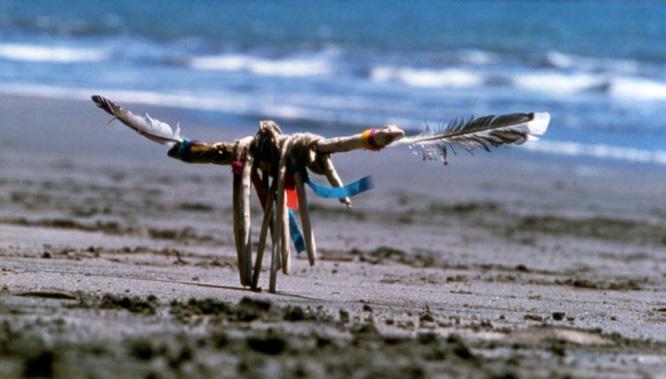
Cecilia Vicuña, Con Con, Chile, 1967. Archival pigment print. Edition of 3 plus 1 AP. Courtesy the artist and Lehmann Maupin, New York, Seoul, and London
central elements and characters in her practice. In 1966, Vicuña visited the sandy beaches of Concón, Chile, and recalled walking along the Pacific Ocean; she described the encounter in her poetic memoir from 2012, Spit Temple , with the following:
I was on a beach in Con-cón, when I felt the wind and the sea feeling me. I knew I had to respond to the Earth in a language that the tide would erase. I arranged the litter I saw strewn about. I called it arte precario knowing that art had begun in me.3
This was the first manifestation of her arte precario, in which she collected discarded litter and detritus, including “stones, sticks, and feathers,”4 and arranged the materials into ornate, fragile, delicate, and precarious sculptural compositions, as the title suggests.
1 Rebecca Stone, “An Introduction to the Fiber Arts of the Ancient Andes,” in To Weave for the Sun: Ancient Andean Textiles in the Museum of Fine Arts, Boston (New York: Thames & Hudson, 1994), 11.
2 Stone, “An Introduction to the Fiber Arts of the Ancient Andes,” 13 and 18.
3 Cecilia Vicuña, Spit Temple: The Selected Performances of Cecilia Vicuña, ed. Rosa Alcalá (Brooklyn, NY: Ugly Duckling Presse, 2012), 55.
4 Cecilia Vicuña, “Choosing the Feather,” trans. Lorraine O’Grady, Heresies: A Feminist Publication on Arts & Politics 4, no. 3 (1982): 18, https://jstor.org/stable/community.28038313.
Included in this presentation is a selection of precarios and quipu sculptures from the past twenty years, along with photographs documenting her creative process from 1967 to 1989. Vicuña’s precarios are composed of colorful feathers, twigs, threads, bamboo, cord, stone, and plastic debris, among other discarded materials. The precarios were initially created as intentionally ephemeral objects intended to disappear. She later learned that the Latin origin of precario comes from the word precis, prayer, with the piece becoming more akin to a rite or prayer; she described the work in 1982 as a “way of remembering, of recovering a language; the shaman is the one who remembers his other lives.”5 Yet, in 1973, while Vicuña was studying abroad in London, she transformed the precarios into “objects of resistance” after the attempted Chilean coup and overthrow of the Popular
Unity government of Salvador Allende, and then the ultimate military coup d’état by the Chilean military, led by General Augusto Pinochet with help from the United States. 6 The delicate precarios were a reminder of the fragility of discarded and overlooked items, followed by an affirmative assertion of the collective power, strength, and value of such materials when reverently gathered and reconfigured into a composition of beauty and significance.
During and after this tumultuous period, Vicuña was exiled for over fifty years, unable to return to her home country. She later traveled to Colombia, Venezuela, and Brazil, but ultimately settled in New York, where she currently resides, in addition to Chile. She would continue to create her precarios, incorporating more plastic materials, the result of pollution. She would transform the
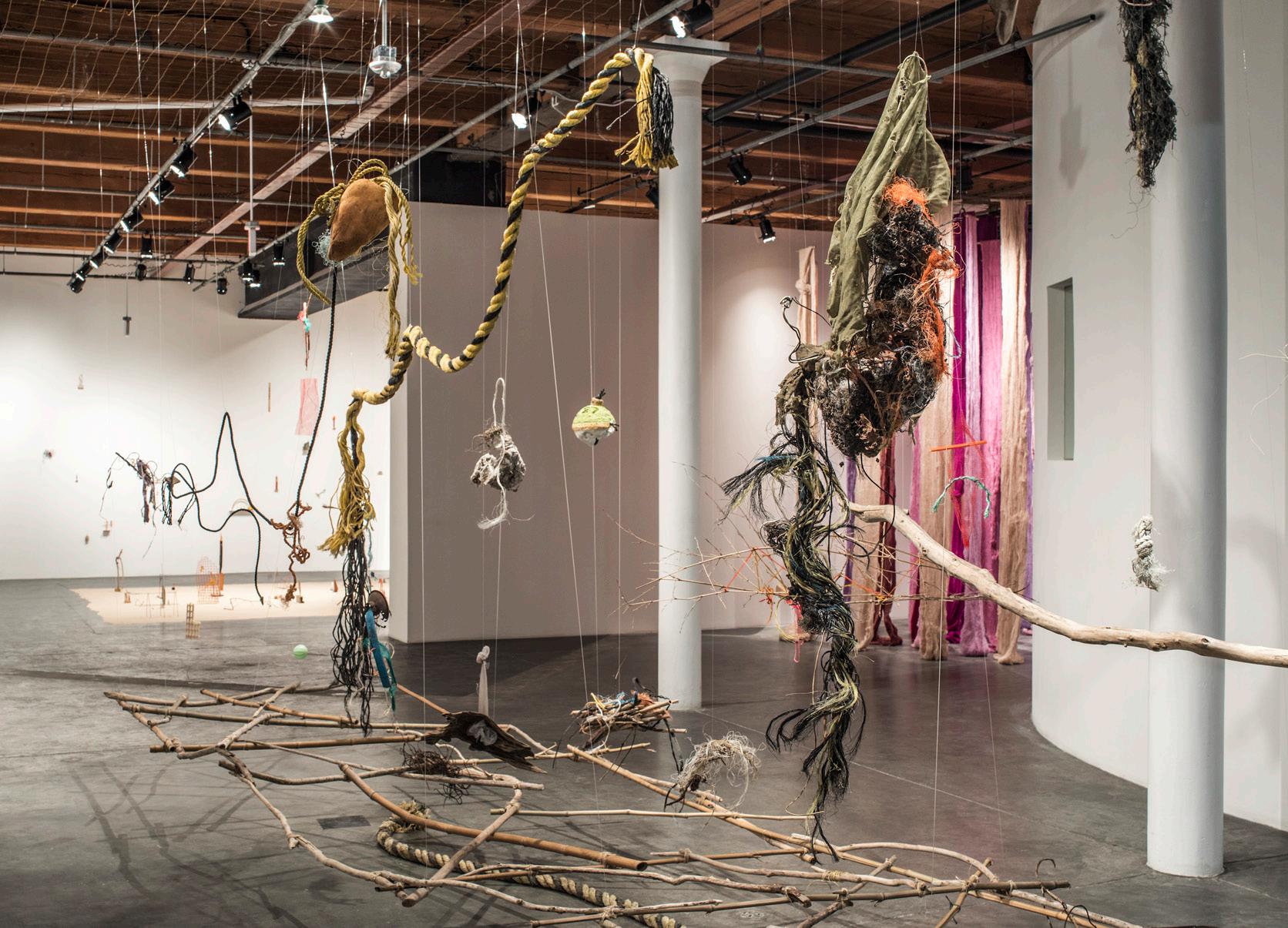
work into large-scale installations, as seen in Balsa Snake Raft to Escape the Flood, a fortytwo-foot-long, site-specific installation created in New Orleans in 2017 as an homage to the catastrophic natural and man-made disasters of the 2005 Hurricane Katrina, which decimated the city of New Orleans, and the 2010 BP oil spill that afflicted the coast of the Gulf of Mexico. Made from scavenged materials from New Orleans, Chile, and New York, this work is a winding, snakelike raft named after the buoyant wood of balsa, a tree native to the Americas. Composed of various materials hung by fishing line in a linear and unruly arrangement, the piece is a memorial to the abovementioned disastrous events, but also a life raft offering a healing path from tragedy to a restorative future. Ultimately,
the work is a reminder that government “policies [must] reflect a commitment to justice, equity, and resilience.”7
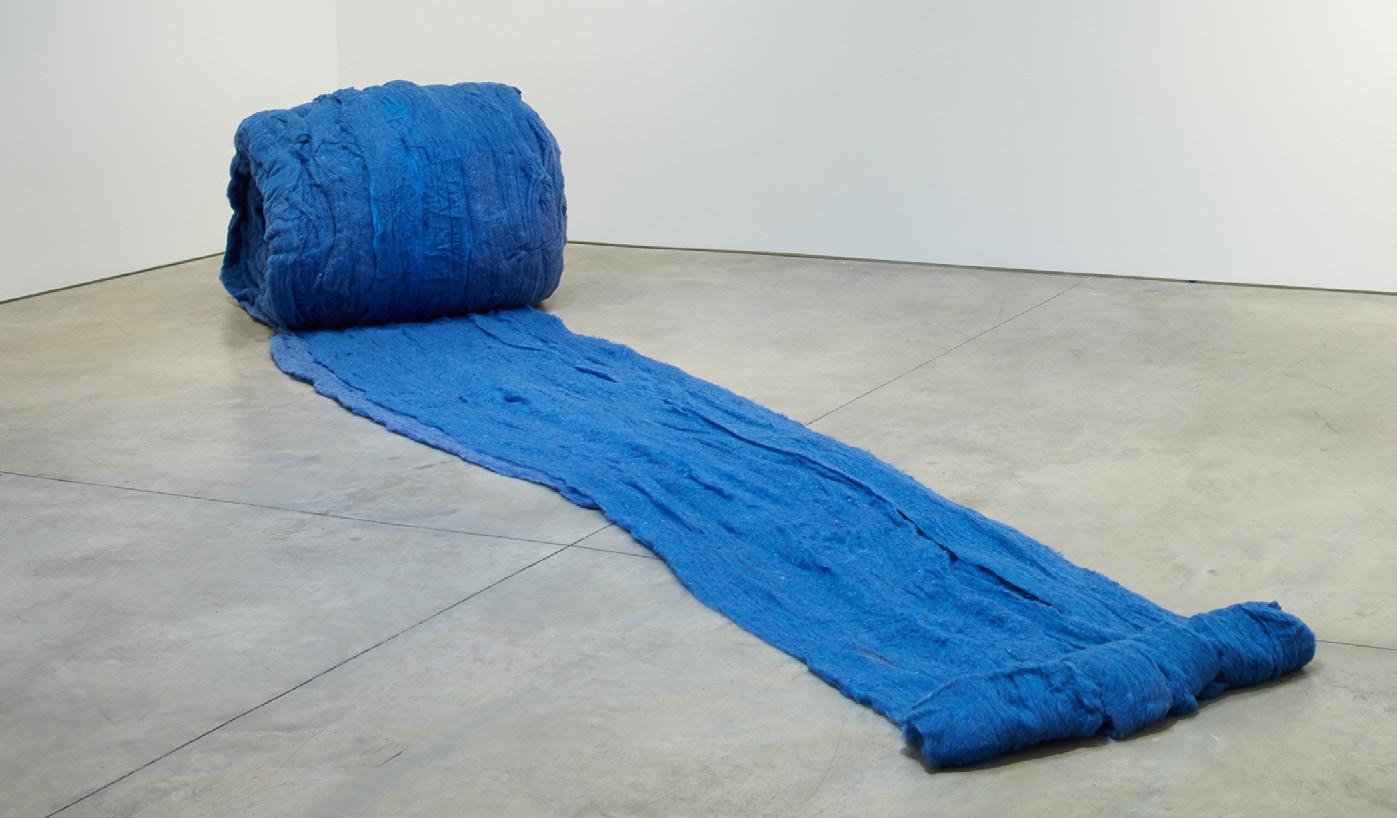
Much like her precarios, Vicuña’s quipu sculptures are just as fragile and delicate, with their natural, unspun wool soft and precious, almost tearing to the touch. These pieces of wool have been described by the artist as clouds or cosmic dust, holding significant spiritual and cultural meaning rooted in Andean culture. In Caracol azul (Blue Snail) (2017), the blue-dyed wool sculpture unfurls its tightly wound center, spreading itself and revealing its coiled blue train across the gallery floor. The caracol, or snail shell, is a spiral that symbolizes evolution and the cyclical nature of life, death, and rebirth. This work is a poetic
5 Vicuña, “Choosing the Feather,” 18.
6 Chus Martínez et al., Cecilia Vicuña: Brain Forest Quipu (London: Tate Modern, 2023), 62.
7 Terry C. Landry Jr., “From Katrina to Today: Connecting Past Lessons to Future Policy Priorities,” Southern Poverty Law Center (August 29, 2025), https://www.splcenter.org/resources/reports/post-hurricane-katrina-policy-priorities/.
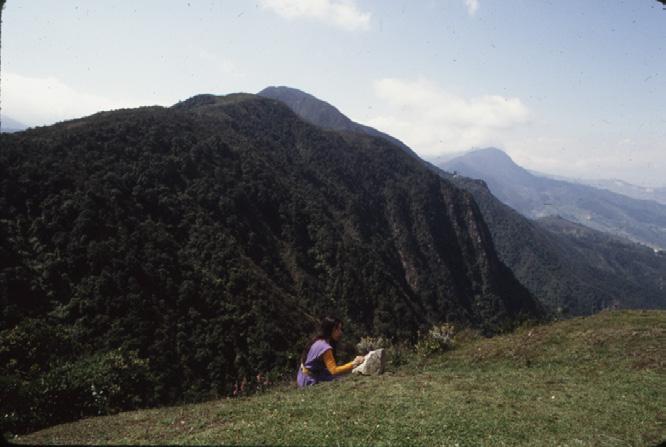
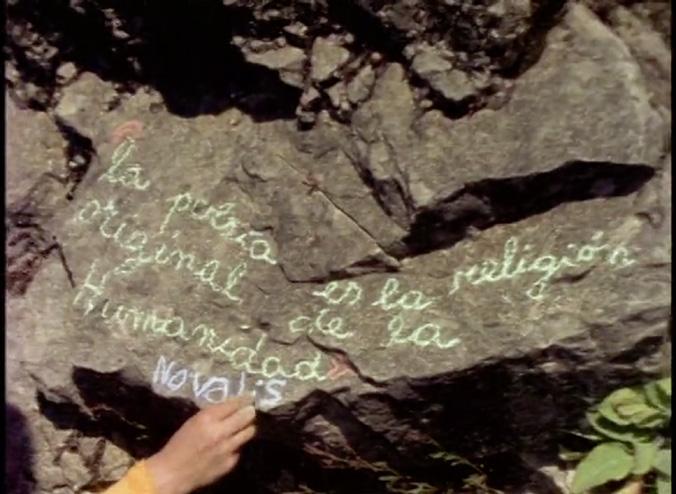
Western society, which views it, much like art, solely as entertainment.8 Included in this presentation is the artist’s 1980 film ¿Qué es para usted la poesia? (What is Poetry to You?) where the artist interviewed everyday folks on the streets of Bogotá, Colombia, asking what poetry means to them. Their replies and answers ranged from sweet understandings to realistic attitudes and critical viewpoints, all woven into a communal poem with scenic views of mountain tops and city streets.
visual evocation that honors the material significance of wool and the spiritual meaning of the spiral as a journey toward a higher consciousness of self, both inward and outward, especially in relation to nature and the cosmos at large.
From the beginning of her career, Vicuña’s practice has employed poetics and symbolism to articulate her perspective, wisdom, and imagination. In a 2017 interview with the art historian and curator Julia Bryan-Wilson, Vicuña notes that through her extensive study of poetry, she recognized the power of oral traditions, especially within Indigenous societies, to be valued as wisdom, rather than in
Much like a spiral, a curve that winds around a central point while moving farther away or closer to it, union of three, and the curatorial project Spatial Poems at large, centers around Vicuña’s precarios, quipu sculptures, and poetics. These specific works highlight her six decades of study, care, and activation of Indigenous knowledge and ceremony to mobilize communal reciprocity among humans, nature, and the cosmos needed for a transformative revolution of subjectivities, especially of the current society and our relation to it. At the core of Cecilia Vicuña’s practice, her work is a powerful antidote for healing the mind and heart. Her works offer a moment of reprieve, contemplation, and awareness through beauty, joy, play, and laughter, for anyone carrying the weight of the world.
The sound composition made in collaboration with Ricardo Gallo includes the following poems written by Cecilia Vicuña, “Khipu Kellcani,” “Oro es tu hilar,” “Se acabará,”9 and an improvised chant of hers that the artist and Gallo refer to as “En Lengua Desconocida.”
Khipu Kellcani
(Lluvia de hilos, Lloro del hilo)
Agua anudada
Rompo al nacer
Quipucito quebrado
Abando tu nado
Ya sin brotar
Planta seca
Mi utku
Omento del sueño
Cuelgo del roto
Redecilla de piel
Desnudo caer
Alivia tu hilacha
Campana de nudos
Badajo mental
Danzo lo amargo
Tu plano tornado
Acaricio y deshago
Nudero primo
En núdalo ya
Computa tu laya
En marca y señal
Al tacto brotado
Florece en razón
Y no hay ni lo habrá
Mensaje ni hablar.
Notes:
Khipu: o quipu nudo (Quechua)
Kellcani: pintar/inscribir (Quechua)
Utku: algodón (Quechua)
Oro es tu hilar
Oro es tu hilo de orar
Templo del siempre enhebrar
Armando casa del mismo treznal
Teja mijita no más
Truenos y rayos bordando al pasar
Tuerce que tuerce
El dorado enderezo
El fresco ofrendar
Ñustas calmadas de inquieto pensar
Marcas señales
Pallá y pacá
Hilos y cuerdas
Los negros y los dorá
Cavilan el punto
No se vaya a escapar
Hilo y vano
Lleno y vacío
El mundo es hilván
Pierdo el hilo y te hilacho briznar
Código y cuenta cómputo comunal
Todo amarran
Hilando en pos
Cuerdas y arroyos
Río es telar
Aunar lo tejido
¿No es algo inicial?
El cálido fuelle
Oro templar
Habla y abriga
El mejor juglar.
Se acabará
Se acabará la fuente redonda la propia silencia la sílbida clave
¡Se acabará!
¿Dónde se irá la neblina?
¿La bruma vivificante?
¿Dónde se irá?
Fresco, fresco
¡El sostén de la tierra!
¡Los racimos de llanto!
¡Los corazones apagados sin neblinar!
9
INTERVIEWED BY NINABAH REID WINTON GUEST CURATOR
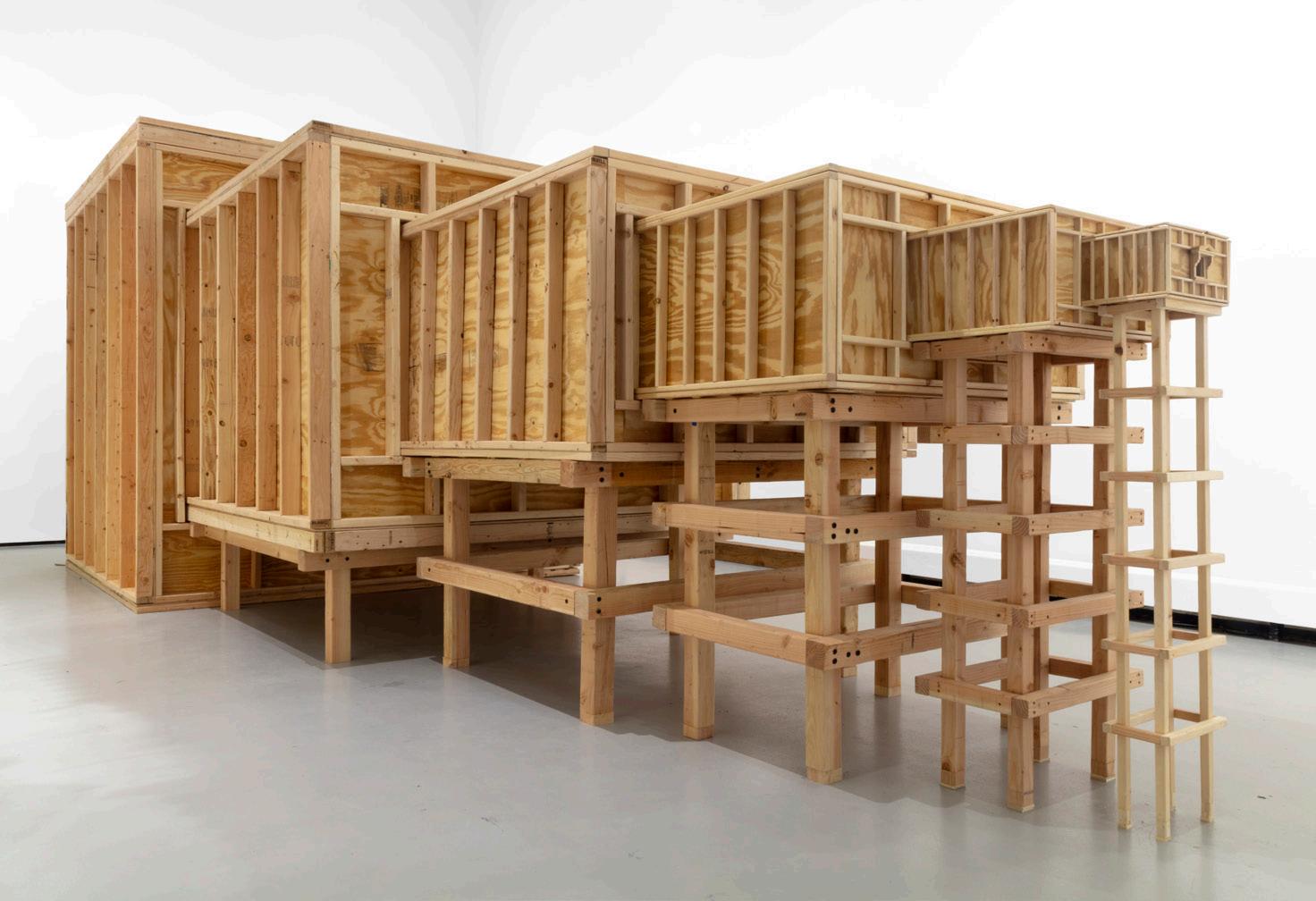
Sam Frésquez’s architectural installation * (pronounced “asterisk”) presents a cross-sectional, mise-en-abyme view of a nested series of kitchens. Each room behind the first shrinks successively in scale, along with interior objects, including appliances, furniture, and clothing. Ranging from life-size to miniature, the telescoping rooms unfold into a sequence of six miniaturized versions of the same room, prompting viewers to contemplate the compression and expansion of lived histories. Constructed with raw two-by-four studs and plywood, the exterior of the work lays bare the usually hidden internal structures of a home, and provokes questions about internal versus external experience. The title of the work, * , a typographic symbol that connects one text to another, underscores the work’s function as a portal, connecting one plane, one moment, to another. Frésquez, whose practice spans sculpture, beaded textiles, intermedia, and public art, uses the work to examine how meaning is both revealed and obscured by memory and routine, by the folding of time upon itself, with echoes and mirrors of people and stories reverberating throughout time and space.
In February and March 2026, Frésquez and curator Ninabah Reid Winton conducted a written conversation about the artist’s exhibition * and her artistic practice.
NINABAH REID WINTON:
I am excited to talk about the many lives and multiple realities that exist in what you and I have been referring to informally as the “Nesting House,” or more formally, * . The house itself is shaped almost like a lens, a telescoping portal into a view of lives across time, multiple realities descending upon one another, cascading into a miniature infinity, creating atomic implications. It telescopes from the most minute detail in the back of your brain a place that only memory inhabits to a true-toscale depiction of your once-lived-in Laird apartment, a historic 1920s studio in Phoenix, Arizona. As a result of your many worlds, how does memory and meaning entwine in the scaffolding of the house? How does access to your own memories, the memories of others, or the conjuring of people and the past contribute to some of the decisions you’ve made artistically with regard to setting and space? Why the kitchen? What has it taught you?
SAM FRÉSQUEZ:
When I started this work, I was thinking about the domestic place and its many layers in a pretty broad sense. Thinking about the home and the way it’s always a reflection of one’s state of mind. Different areas of the home have taught me different things, by different people family members, domestic teachers, and friends.
Kitchens are uniquely communal, intimate, ritualistic, and regimented. This kitchen, in particular, is modeled on a small historic apartment I lived in in
Phoenix, and, due to its central location, it also served as a sort of living room. Because of that, it witnessed so much.
NRW: The title of the piece, * , frames the work as a portal a connector between one place or moment and another. How does the portal function as a tool for historical redress or longing for a different time or place?
SF: During my time living in New England while finishing my MFA, I spent a lot of time thinking about the historical violence that still feels very physically present in much of the area’s architecture and in the earth beneath me. The mass graves that had been picked through, but never labeled or properly addressed. I was thinking a lot about Yale’s “Old Campus”–style buildings, which are very unique to see in the United States and are made to feel European. The stained glass, the hand-carved stone, the incredibly labor-intensive structures that were only possible because of the labor of enslaved persons,1 atop the genocide of Indigenous peoples.
I think that we are all looking for a means of escapism for obvious reasons. But it’s also such a paranoid activity to look for ways in which everything is connected across space and time. I can generally be a bit unsettled by the ways that we think about time and how disconnected we are from the past. About the way we talk about historic time, and our own personal histories with such distance. There’s a kind of dehumanization that happens when we learn about people who lived before us.
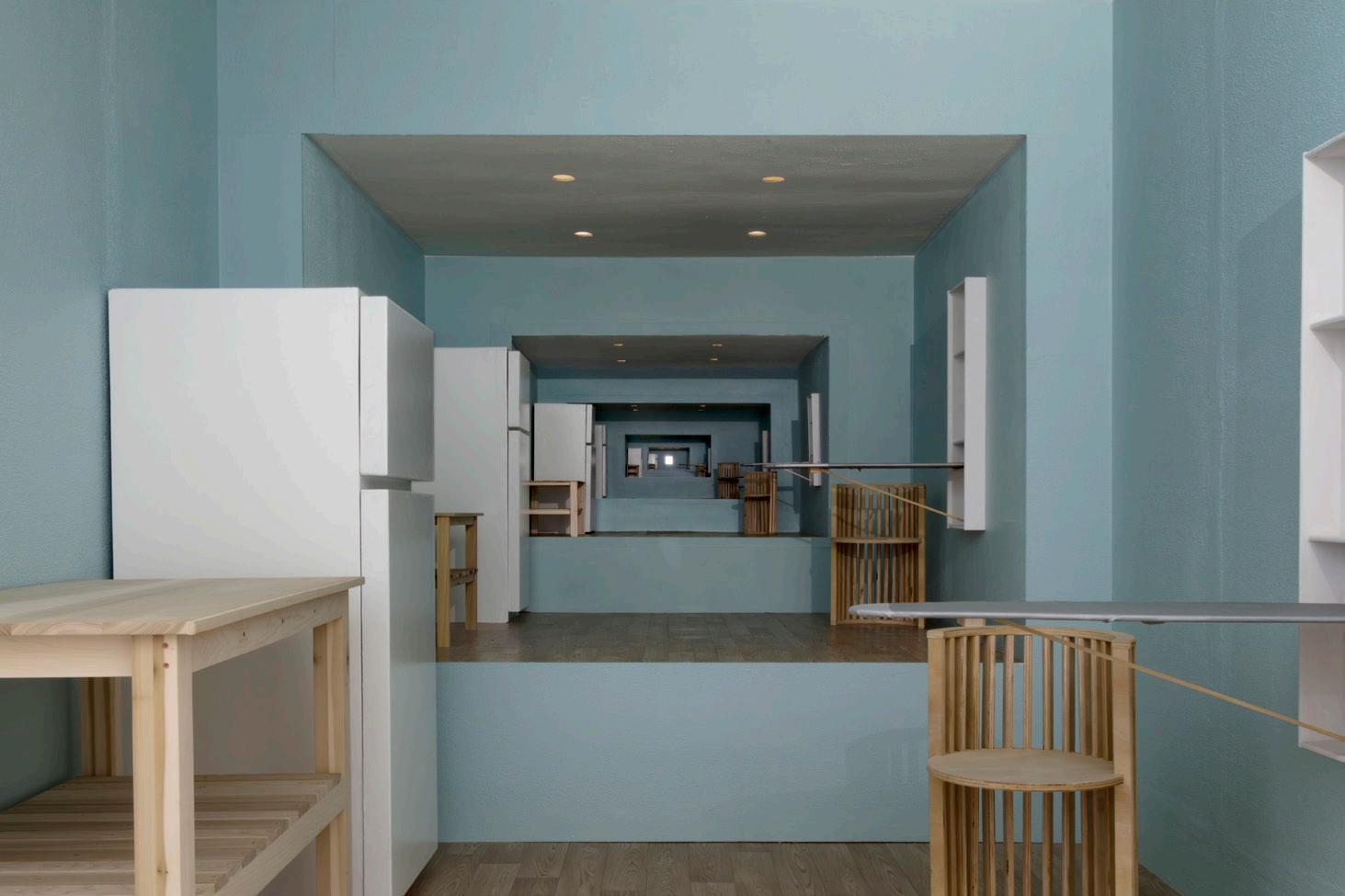
I was thinking about my apartment in New Haven, and the things it had witnessed and reflected back to me. I was thinking about my apartment in Phoenix, the things it had witnessed, the friendships, the relationships, the milestones, the changes in my mental state. This work comes from a personal craving and need to connect one time to another, and one place to another, as a way of holding on to the reality of both. All versions of place, versions of myself and others, I wanted to sit with them all at once and to bake them a cake, to celebrate them. It kind of feels like the closest thing to nuance.
NRW: It seems that you’re not just interested in working across memory but also across the space and scale of not only experiences but also material and place.
Tell me more about the telescoping nature of and scale shifts inherent within the kitchen space. Why are you attracted to working from the miniature to the life-size and then the giant? What does it do for you as an artist and for us as viewers?
SF: Throughout the making and building process of * , some prideful part of me wanted to fight the urge to say that working at a miniature or small scale creates control. To take a landscape and shrink it down, or to turn an architectural place into an object, to take something that surrounds and can envelope you and then turn it into something you can hold in your hand, or look down on that is how scale creates control.
1 Yale University, “The Yale & Slavery Research Project,” 2026, https://yaleandslavery.yale.edu/.
Ultimately, I think using scale is also about memory and perspective, and the ways that your physical orientation and understanding of a place change as you get to know it and as you change alongside it. I’m thinking about the way a hallway feels on the first day of school versus the last day of school versus in memory. And the memory of it containing all its different versions. (And are any of those accurate?)
Drawing an object, or remaking it, can be another way of consuming it, of trying to understand it, of articulating, of checking in with everyone else and saying, “Is this what you see too? Is this what you’re experiencing?”
NRW: Your work is similar to the concept of geometric space-time and how there
can be multiple versions of yourself just out of your field of view, in different dimensions and timelines.
SF: Yes, you know when you squeeze your face between the bathroom cabinet mirror and the one mounted on the wall, and you see forty reflections of your face? Or, like Sundays and Christmases experiences that many people have but in many different fonts and how they relate to the concept of déjà vu or the collective unconscious. Like when you have a dream about someone, and you text them, and they had a dream about you too, or when you go somewhere and it smells like your childhood best friend’s house. Those strong memories that are shared but exist in some other stored space.
BY JAMILLAH HINSON GUEST CURATOR WITH MARISSA DEL TORO CEI FELLOW, MASS MoCA
Lola Ayisha Ogbara’s art explores the experience of Black interiority as an enclosed cultural resource. In her conceptual practice, material experimentation is interpolated through imagined geographies and naturally forming archives. Such tools are rooted in the traditions of post-structuralism in Black American and African diasporic communities. At MASS MoCA, a sense of scientific inquiry runs throughout the exhibition Scars Insist on Being Remembered, where Ogbara archives both perceived and created realities and histories. In this contemplative presentation, she engages with her recent work, the continuation of an ongoing series, and a site-specific installation and sound piece newly commissioned by MASS MoCA.
Across her material and compositional investigations, Ogbara enacts both personal and historicized forms of conceptualism. These modes stand at the intersection of non-Western epistemologies and bodily topographies. As a Nigerian American, she both honors and mines her dual diasporic identities, with subtle cultural nods couched among larger contextual narratives, imbuing her art with an intimate sense of prior knowledge. As a conceptual artist one who works with ceramics, metal, textiles, sound, and photography she commits her deep interest in materiality to an exploration of memory, internal archives, and shared knowledge systems.
Grave Adornments — GRAVE MARKER
(Elizabeth “Mum Bett” Freeman)
With this powerful and moving work, Ogbara draws attention to a significant historical waypoint the life of Elizabeth Freeman and the impact of her presence and movements in an installation, Grave Marker. Believed to be born in 1744 in New York, Elizabeth “Mum Bett” Freeman spearheaded the abolition of slavery in Massachusetts. Suing her enslaver, Colonel John Ashley, she was the first Black woman to win her freedom in the state. Her success began a sweep of “freedom suits” across Massachusetts. Gaining her freedom along with an enslaved man known as Brom, also owned by the family, Freeman would receive thirty shillings and the cost of her trial in 1781 before going on to become a midwife, healer, and domestic worker.
Although she ultimately escaped the abuse she suffered on the Ashley plantation, scars remained. A wound on her forearm inflicted by Hannah Ashley left what was described as “a frightful scar she carried to her grave.”1 Freeman wore her scar proudly, letting those who asked know with no uncertainty who lashed out and marred her skin.
Catharine Sedgwick, Mum Bett’s young charge, would later recall her caregiver saying: “Madam never again laid her hand on Lizzy. I had a bad arm all winter, but Madam had the worst of it. I never covered the wound, and when people said to me, before Madam, ‘Why, Betty! What ails your arm?’ I only answered, ‘Ask missis!’ Which was the slave and which was the real mistress?”2
Elizabeth Freeman died on December 28, 1829. Ogbara has erected an ephemeral memorial to “Mum Bett” in the galleries at MASS MoCA. A place of rest and commune, the gravesite holds generations of cultural memory just
enough information seeping through earth and whispered by spirits for those who are privy to gather what is useful and move on swiftly.
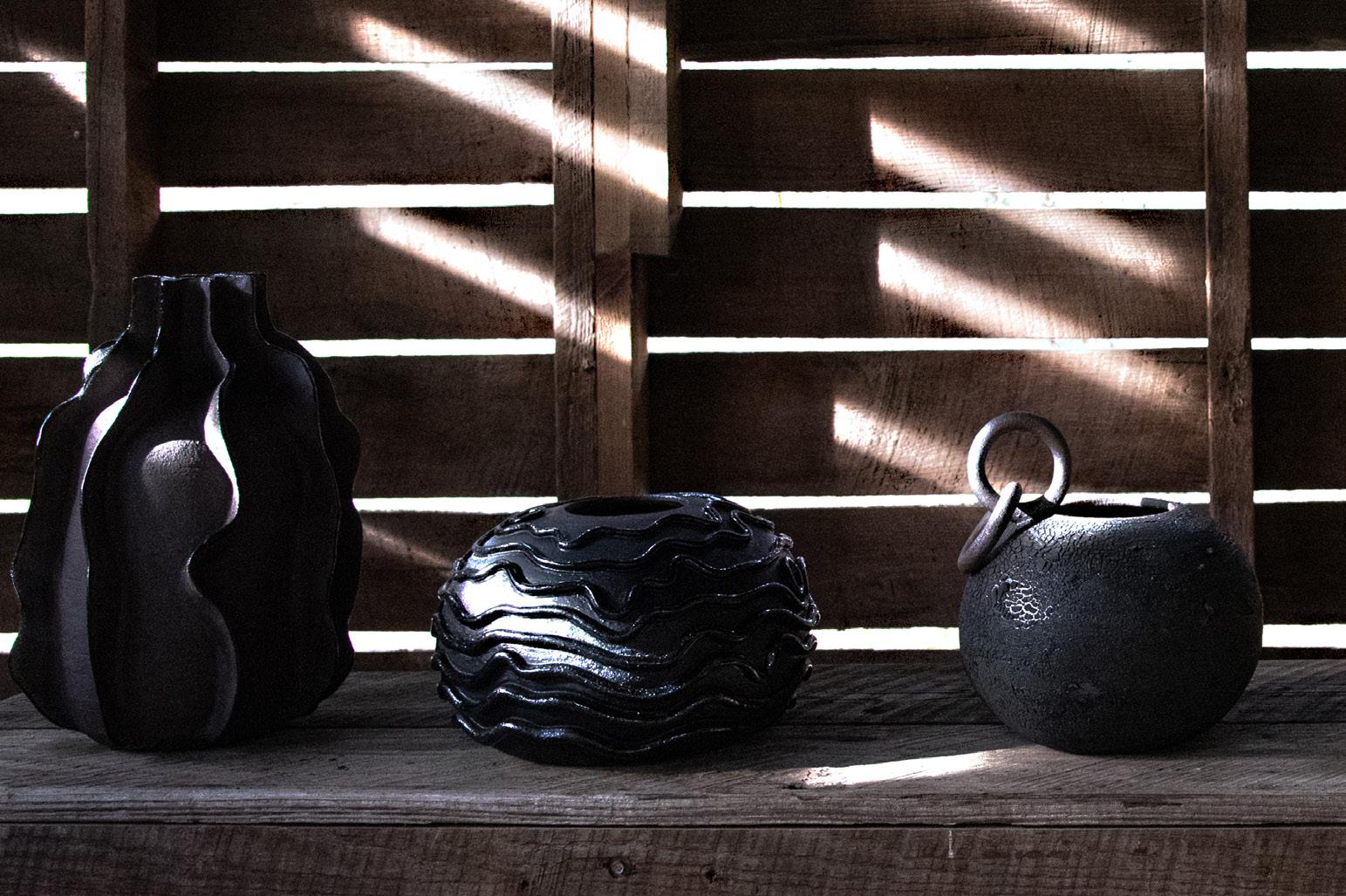
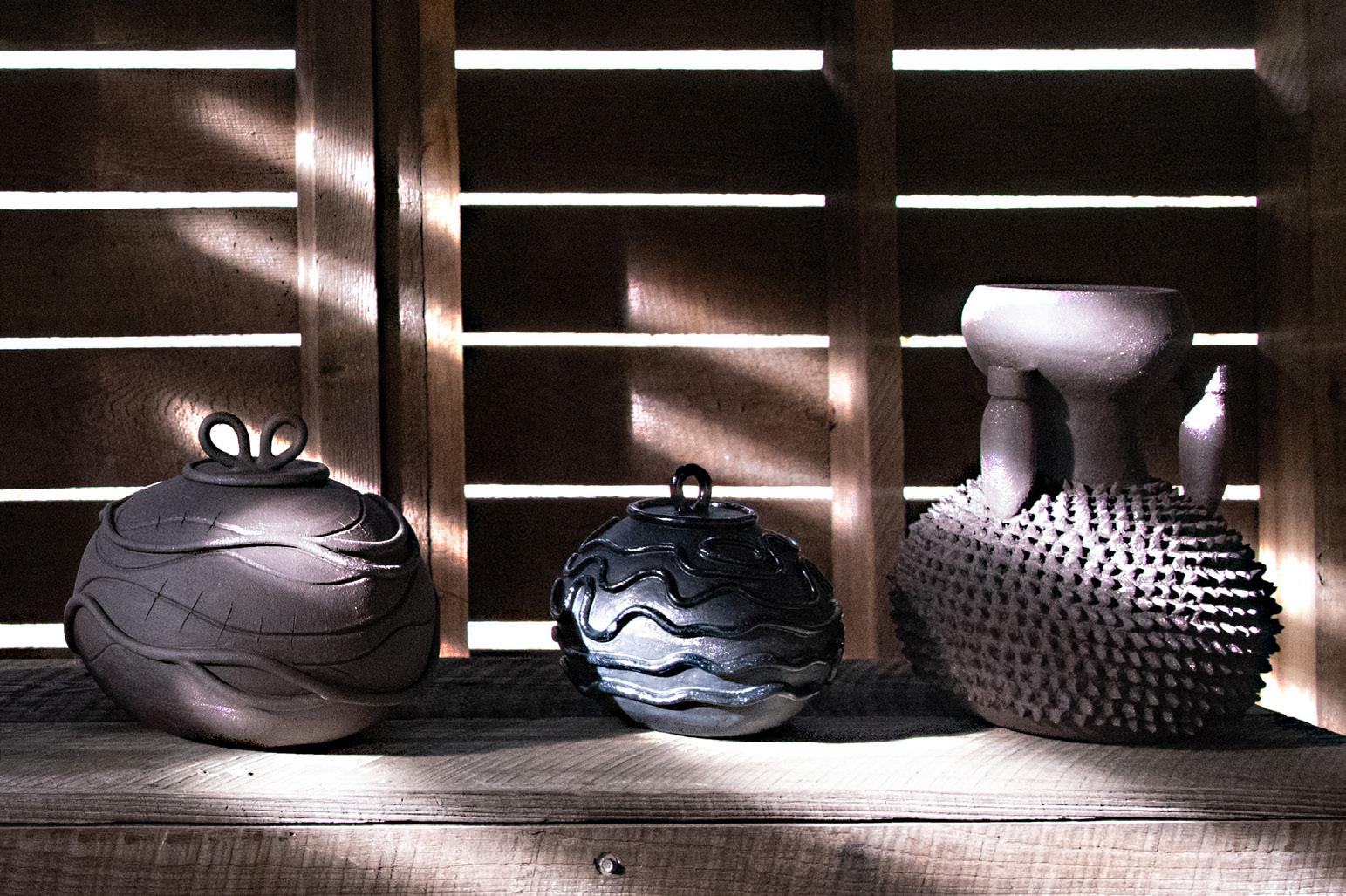
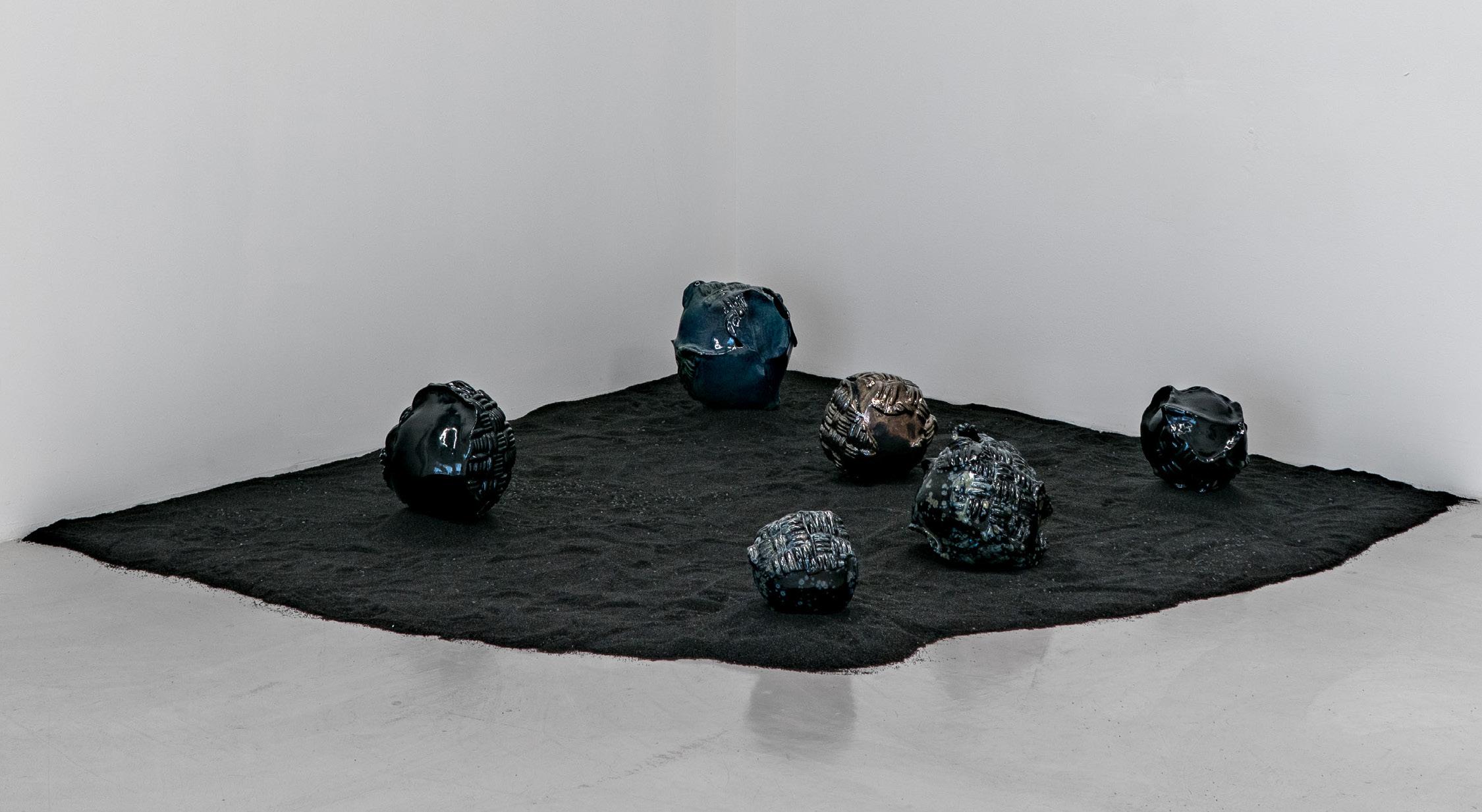
For Mum Bett, a fresh grave marks the existence and end of a life. In Ogbara’s installation, stoneware vessels sit on a bed of sand, representing the earth trod under Freeman’s feet throughout her life. The ceramic objects guard and adorn the grave, where ornate black vessels sit with other, more organic vessels with simpler surfaces that bulge and open. These “memory jugs” are an African American folk art tradition directly tied to vessels made by the Bakongo people in what is the modern-day Democratic Republic of the Congo. The gourd-like vessels,
often filled with water and covered in personal mementoes, are traditionally clustered around gravesites like beacons to guide the deceased.
A well-preserved example of cultural memory and shared knowledge, memory jars found in the United States hold properties and principles similar to their predecessors. The Bakongo believe the spirit world is inverted from our own, and water is the portal between, so by looking into the jug, you look back at yourself. In order to ensure a continued journey through the afterlife, broken trinkets and personal items included in memory jugs release the spirit from this world.
1 Victor Curran, “Elizabeth Freeman: A Free Woman on God’s Earth,” Discover Concord (June 15, 2022), https://www.discoverconcordma.com/articles/218-elizabeth-freeman-a-free-woman-on-gods-earth.
2 Catharine M. Sedgwick, “Slavery in New England,” Bentley’s Miscellany, Vol. 34 (London: Richard Bentley, 1853), https://books.google.com/books?id=8-ARAAAAYAAJ&pg=PP7&source=gbs_selected_pages&cad=1#v=onepage&q&f=false.
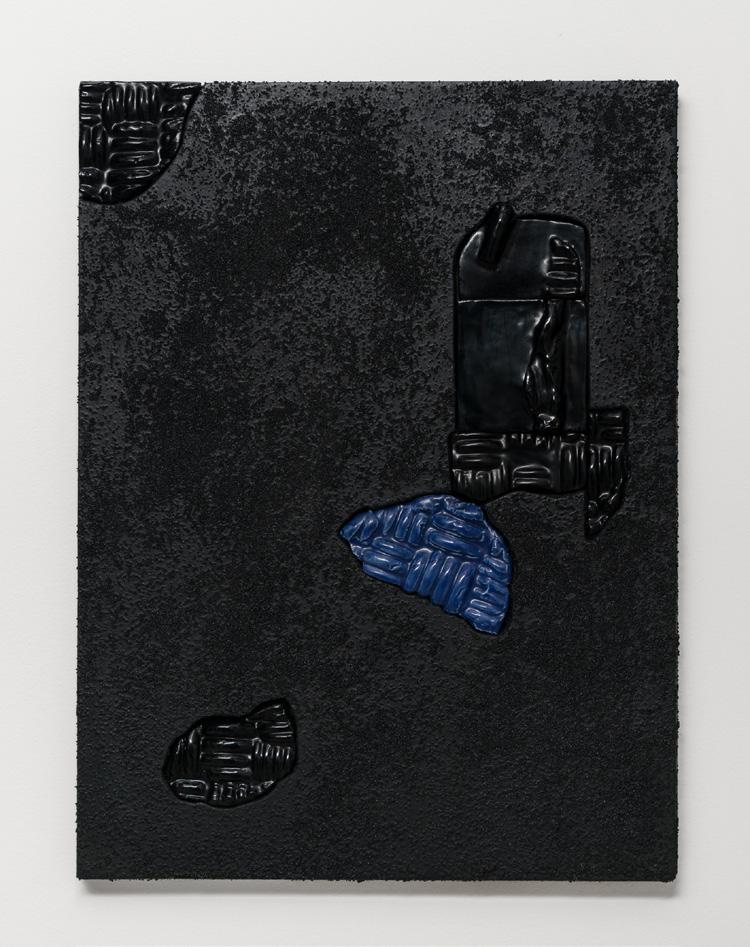
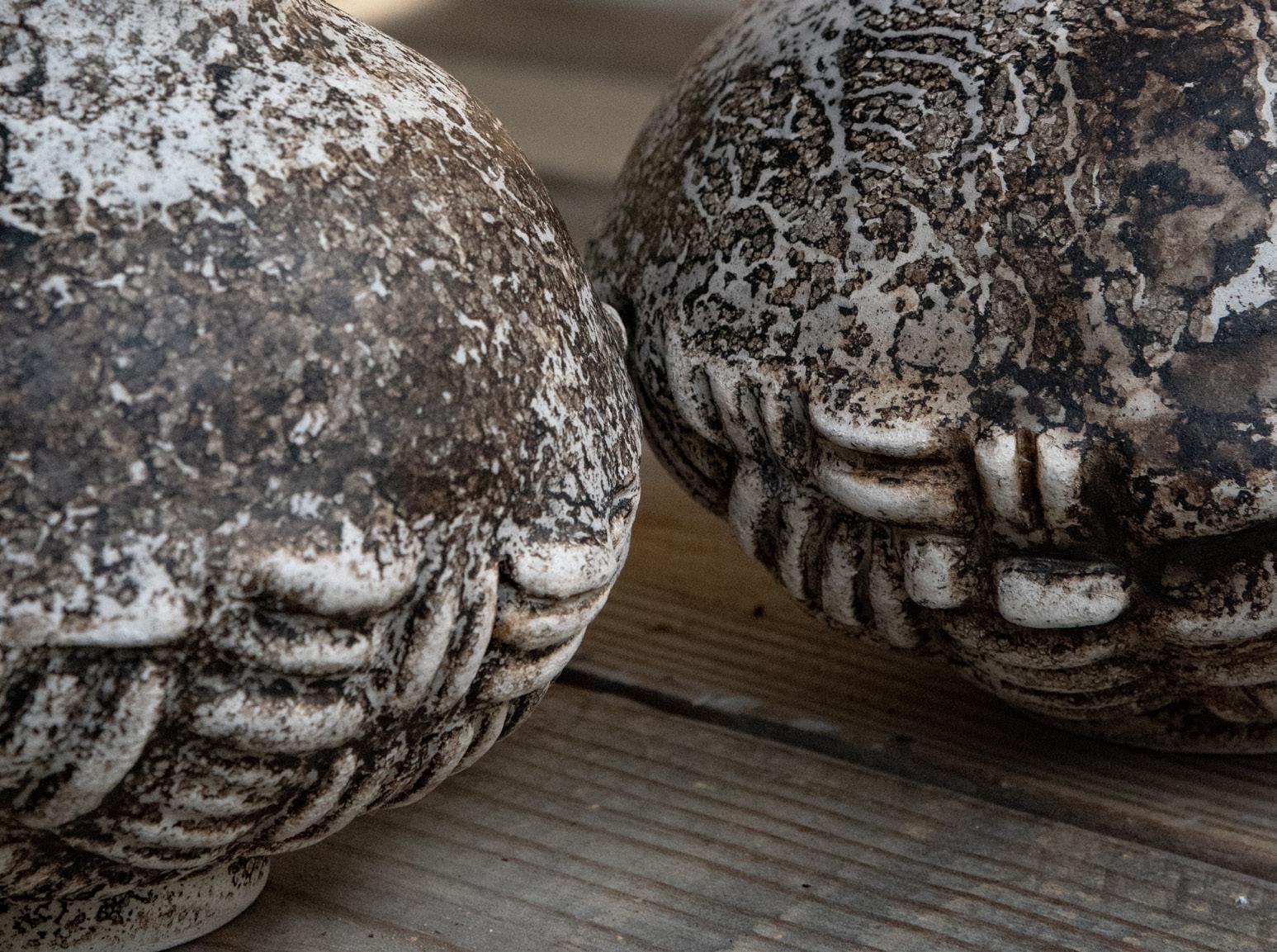
All images: Lola Ayisha Ogbara, Vessels series, 2025. Black ceramic stoneware with glaze. Courtesy the artist
In a continued study and interpretation of scarification the decorative, patterned cuts made in the skin Ogbara’s Forget Me Knot ceramics are adorned with textured markings and protuberances that resemble keloids, serving as extensions of the body. As a type of personal archive, these forms hold the duality of trauma and beauty on their surfaces, just as one might who continues to move through the world.
In these works, layers of natural and man-made material form organic orbs. These loose interpretations of memory jugs, themselves sometimes called “forget-me-not” jugs, serve as collections of life held by the living. A field of memories cheeky nods to bodiliness, traumas, and healing lies beyond Freeman’s memorial installation, filled with ceramics in high-shine blacks and mirrored metallics alongside blues and fleshy nudes. These fecund objects are supported
by bronzed, chicken-footed armatures, and held like talismans of good fortune and protection. Smooth surfaces exist in this series, but they are accompanied by surface cavities and craters denting a portion of the body as if in a constant state of transformation, just before a germination process begins.
In displaying these vessels, Ogbara visually evokes cultural and divination practices, such as cleromancy in the spiritual tradition of Ifá.3 In this form of divination, palm nuts (ikin) or cowrie shells are tossed onto a wooden tray known as an opon, and how they fall reveals the patterns of one’s life on their flesh and in the happenstance of their configuration. Unlike lukasa, a divination system that requires the interpreter to be in communion with the spiritual realm (see below), Ifá requires the diviner to hold ancestral knowledge. As an abstraction of life and nature, bodily and unbodied in existence and use, Ogbara’s objects are living memory vessels to store and recall what we can no longer hold.
Among the vast archival practices of West Africa are some that employ scarification, mnemonic devices, and infrastructural design. These methods can also be seen in different cultural forms throughout the African diaspora. Notably, braid designs and overall hairstyling can identify a person’s origin, and for generations in the Americas, these designs were used to denote escape routes during the period of chattel slavery.
Many forms of mapmaking have been abandoned in the Western world, discarding often more complex systems of charting and mapping. In her newest series, Sticky, Ogbara explores lukala, the cartography traditions of the
Luba people of the Democratic Republic of the Congo. Lukala are large wall maps utilized for initiation into the ranking society.4 These maps depicted an entire region’s waterways and major landmarks, along with the homes of both earthly royals and protecting spirits. When necessary, another layer is added to the reading of lukala with the introduction of a lukasa, a mnemonic instrument consisting of boards configured with cowrie shells and beads. An elder or orator would recite their intentions about information passed down through the board. Much like the wall maps, these readings were informed by ancestral journeys and sacred landmarks, while allowing for the orator’s interpretation.
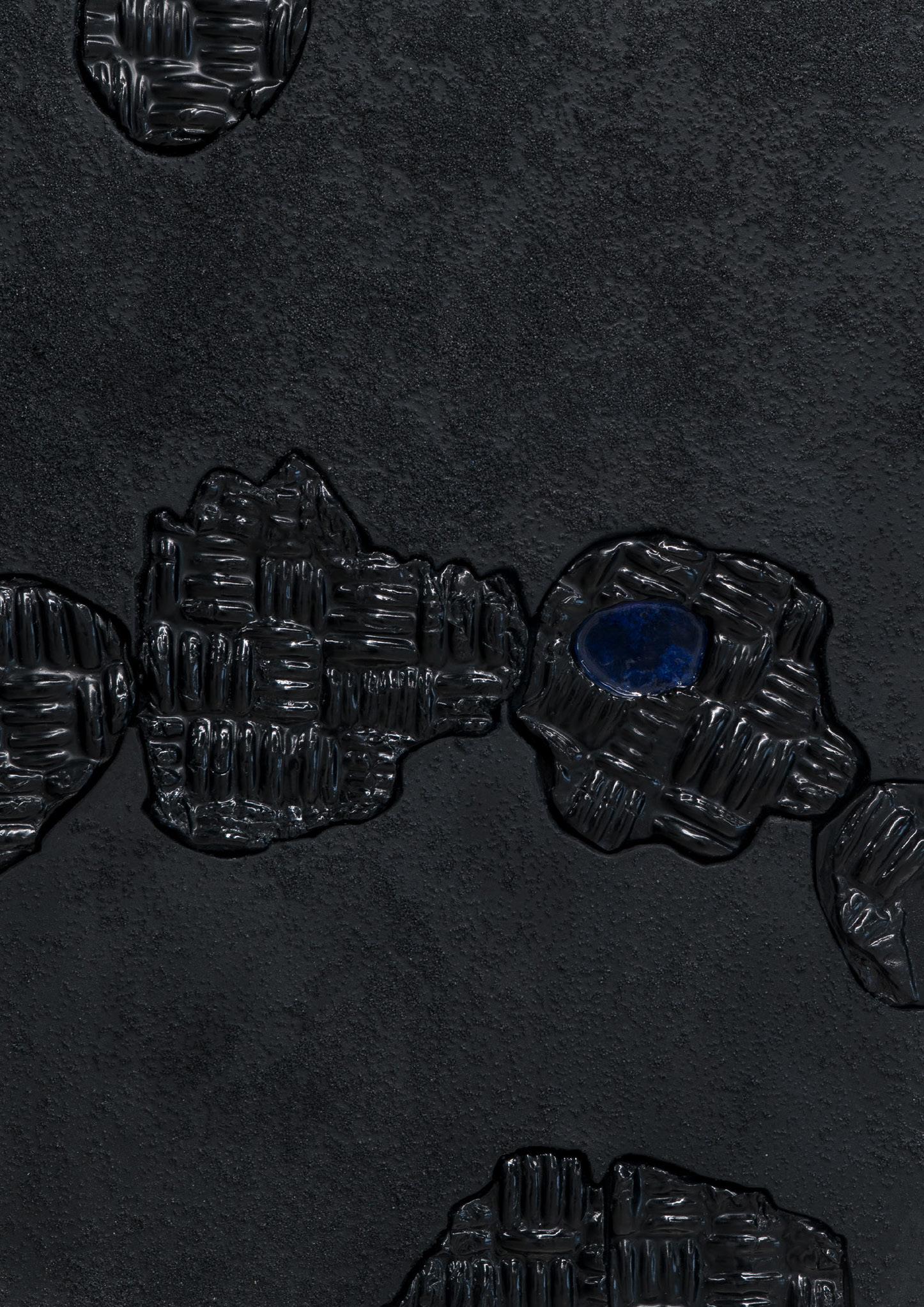
Scattered information and patterns of movement, along with the effects of the journey, sit nestled together in Ogbara’s Sticky, series. On these tile pieces suggesting wall maps or boards, the glazed
components catch light and attention, charting information and landscapes hidden within closed systems of cultural knowledge and remembrance. Sticky, like much of Ogbara’s work, contains dualities and exists within intersections of cultures. While marked with landmasses and the homes of royal and supernatural beings, these tiles also evoke a quieter story of domestic intimacy the kitchen backsplash or the shower stall and the power that home spaces have in holding our journey. These spaces, similar to the artist’s constructed environments, are balancing places, often built on the foundation of our most impactful sorrows, joys, traumas, and moments of growth, and in turn are wells of insight.
The tile pieces are also, however, evidence of flight. As the traditional lukasa depicts prior journeys or movements throughout the spiritual realm, Ogbara explores fugitivity frameworks of
3 See United Nations Educational, Scientific and Cultural Organization (UNESCO), “Ifa Divination System,” n.d., https://ich.unesco. org/en/RL/ifa-divination-system-00146.
4 See Thomas J. Bassett, “Indigenous Mapmaking in Intertropical Africa,” in Cartography in the Traditional African, American, Arctic, Australian, and Pacific Societies, Vol. 2, Book 3 in the series The History of Cartography (Chicago: University of Chicago Press, 1998), https://press.uchicago.edu/books/hoc/HOC_V2_B3/HOC_VOLUME2_Book3_chapter3.pdf.
refusal and escape. Evoking African American folktales of Br’er Rabbit and the Tar Baby, in which Br’er Fox finds every way to hinder Br’er Rabbit, he nonetheless breaks free. The tiles, embedded in amorphous pools of thick tar, are Rabbit’s footprints; we track his movements, the physical and conceptual liberation of Black people.
Much cultural information and imagery rests in these footprints. Blue tile tells the story of indigo, a plant that once economically and culturally dominated the United States, yet is now largely forgotten. Indigenous indigo species were cultivated using practices developed by enslaved Africans who had experience with African varieties. As the demand increased, so did the extremes of labor. However, alongside its
industrial use, indigo became a cornerstone of African American culture and spiritual practices. Likewise, with Scars Insist on Being Remembered, Lola Ayisha Ogbara preserves memory in materiality.
Cecilia Vicuña (b. 1948, Santiago, Chile; lives and works in New York and Santiago) integrates practices of poetry, performance, conceptualism, and textile craft in response to pressing concerns of the modern world, including ecological destruction, human rights, and cultural homogenization.
Vicuña received an MFA from the National School of Fine Arts, University of Chile, in 1971, and continued with postgraduate studies at the Slade School of Fine Art, University College, London, in 1972 – 73. Solo exhibitions of her work have been organized at major institutions, including the Pinacoteca do Estado de São Paulo, Brazil (2024); Museo Nacional de Bellas Artes, Santiago, Chile (2023); Tate Modern, London, UK (2022); and Solomon R. Guggenheim Museum, New York, NY (2022).
Her work is in numerous international private and public collections, such as the Guggenheim Abu Dhabi, United Arab Emirates; Museo de Arte de Lima (MALI), Peru; Museum of Modern Art in Warsaw, Poland; National Portrait Gallery, Smithsonian Institution, Washington, DC; and Zhuzhong Art Museum, Beijing, China.
Sam Frésquez (she/they) was born in Mesa, Arizona. She currently lives and works in Chicago. Frésquez received a BFA in Intermedia Arts from Arizona State University in 2019 and an MFA in Sculpture from Yale University in 2025. Most recently, she was included in Get in the Game: Sports, Art, Culture at SFMOMA, which will travel to Pérez Art Museum Miami and Crystal Bridges Museum of American Art in Bentonville, Arkansas. They have participated in numerous residency programs, including Xico, Phoenix (2017); Haystack Mountain School of Crafts, Maine (2019); New York Arts Practicum (2019); Vermont Studio Center (2019); MASS MoCA Assets for Artists (2019); and CALA Alliance, Phoenix (2022). Along with her work, she shares a collaborative practice with Merryn Omotayo Alaka entitled Hairland (2017 – present). She is represented by Lisa Sette Gallery in Phoenix, Arizona.
Lola Ayisha Ogbara (b. 1991, Chicago, IL) is a Nigerian American maker and curator based in Chicago. She earned a BA from Columbia College Chicago and an MFA from Washington University in St. Louis, MO. Her practice explores haptic (sub)conscious frameworks, utilizing the body form as well as its absence, to contemplate the complexities of emotion, belonging, looking/ seeing, labor, time, and space through clay, installations, sonic experiments, and curatorial endeavors. Ogbara has exhibited in art spaces across the country, including The Luminary, Kavi Gupta, Kemper Museum, Mindy Solomon Gallery, and Elmhurst Art Museum. She has also received exhibitions, residencies, fellowships, and awards from institutions such as Alfred University, MASS MoCA, the University of Chicago, and the Cité Internationale des Arts in Paris, among others.
May 23, 2026 – April 2027
Curated by Marissa Del Toro, Curatorial Exchange Initiative Fellow, MASS MoCA, with guest curators Jamillah Hinson and Ninabah Reid Winton
Spatial Poems is part of MASS MoCA’s Curatorial Exchange Initiative (CEI). The CEI is an exploratory pilot for how contemporary museums work collaboratively with curators and artists, whose diverse practices and knowledge can be exchanged, supported, and deepened. The three-year program invites six curators to realize curatorial projects at MASS MoCA and in the North Adams community. The CEI is generously supported through leadership gifts from Sarah Arison and the Arison Arts Foundation, Michi Jigarjian, Denise Sobel, the Teiger Foundation, and Yukiko and Anders Schroeder. Additional support is provided by the Director’s Catalyst Fund, with generous contributions from Greg and Anne Avis, Kelly and Bill Kaiser, Steve and Lisa Jenks, Bob Gold, and an anonymous donor. Special thanks to the Williams College Museum of Art for their support.
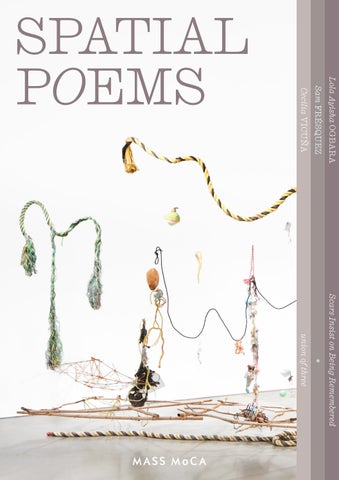
Cover: Cecilia Vicuña, Balsa Snake Raft to Escape the Flood (installation detail), 2017. Found mixed media sources from New Orleans, Chile, and New York. Courtesy the artist and Lehmann Maupin, New York, Seoul, and London. © 2025 Cecilia Vicuña