Warm Up
On one of my early visits to Michael E. Smith’s studio, on a particularly frigid November day, the heat went out. Unfazed, he found two heat lamps and plugged them in. I took notes sitting between them for several hours while he placed and grouped objects on glossy white work tables. This is how Smith’s practice functions: he makes things work under constraint, improvising and looking for warmth in his materials and the work as a whole — a radiance that not everyone immediately notices.
In the days before the opening of The makings of you, Smith told me he sees the show operating like synapses firing in the brain. “We are miraculous machines of sensation,” he said. His goal, if it can be stated as such, is to get people to pay attention and to trust themselves to interpret what they see.
Process
Smith begins each show with the site itself, studying details meant to disappear and using his sculptures to make them visible again. He considers not only the gallery but the entirety of the museum and its surroundings, the routines of everyday life that pass through and around it. He treats his materials the same way, as specific things with patterns of use. The humble objects he works with — clothing, dishware, discarded tech, paper, cellophane — come into the work in their texture, weight, color, and purpose. His editing of these objects goes in several directions. Either he removes the parts of an object that make it too easily identifiable, or alters it to accentuate qualities he wants you to notice, and — when the recognizable aspects, like a logo, themselves serve the meaning — keeps that in too. Much of this
happens in a sleep-deprived state of mind during late nights in the studio and installation, when reality relaxes and fact and fiction blur. It is then when associations between objects and spaces become more liquid and flexible to Smith. He often holds on to materials for years until he finds their right places, describing a successful sculptural maneuver as finding “the other halves of objects.” The final arrangements have the logic of a very good joke or a very bad dream. They all become part of what he calls “the poem.”
Room One
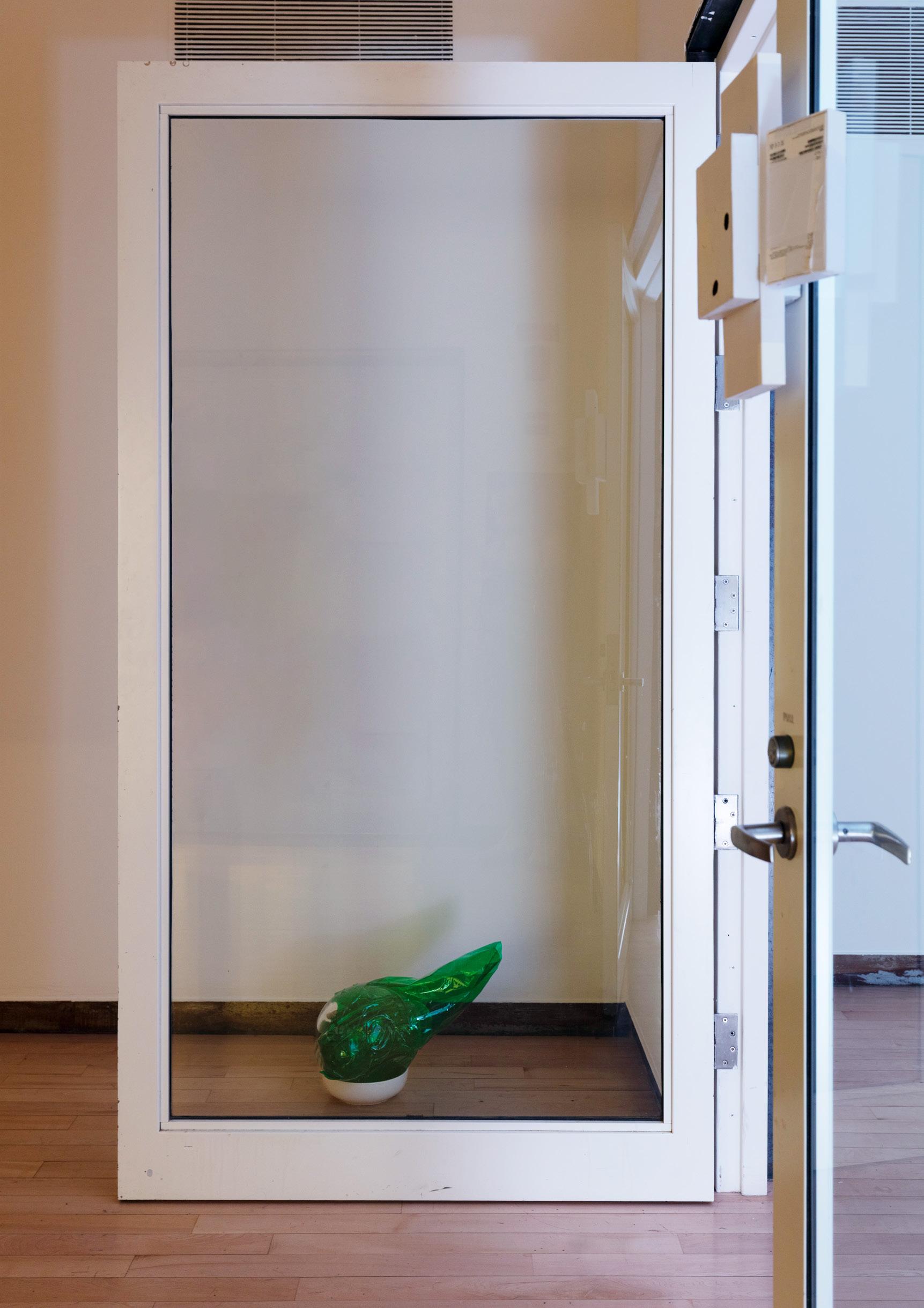
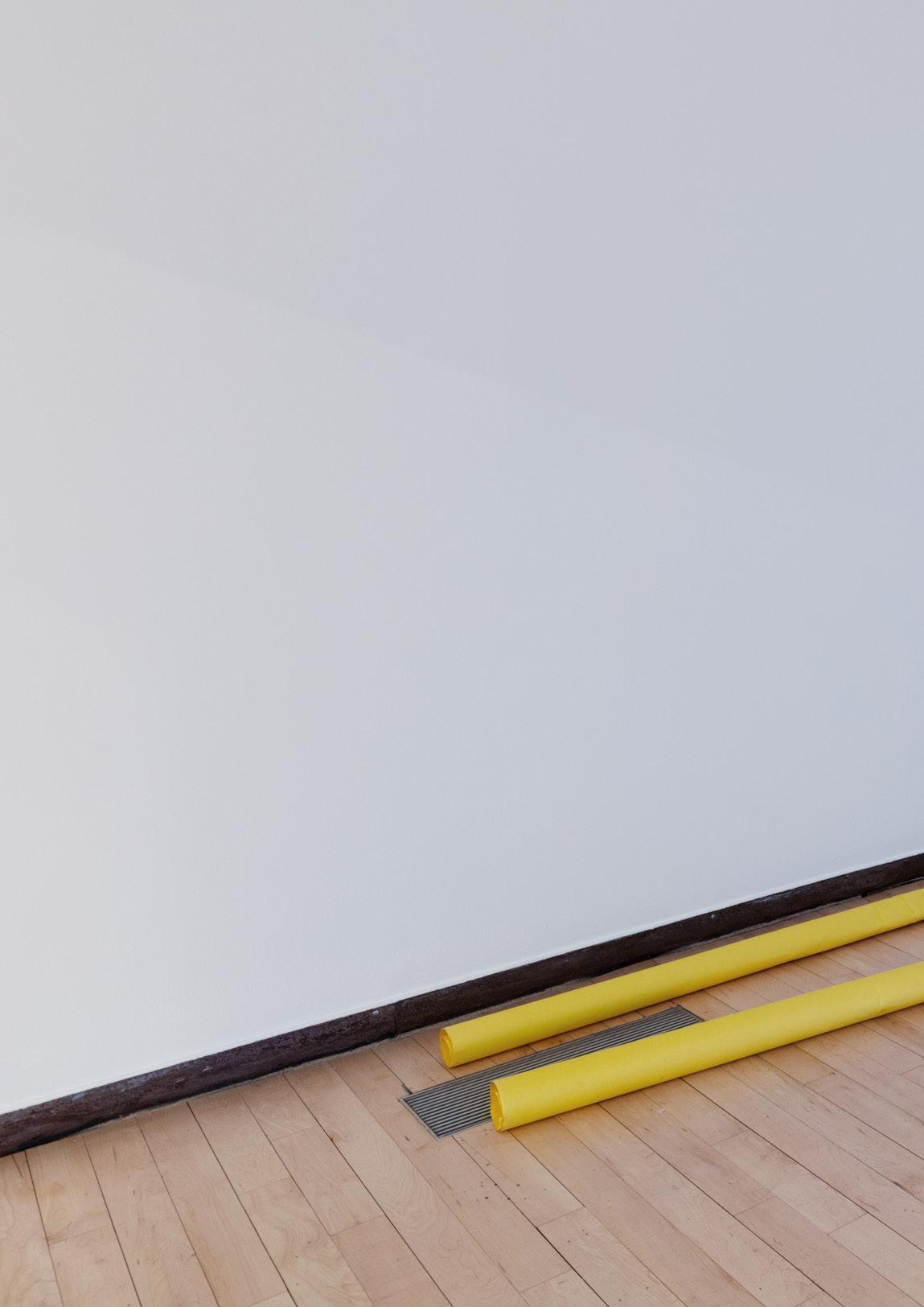
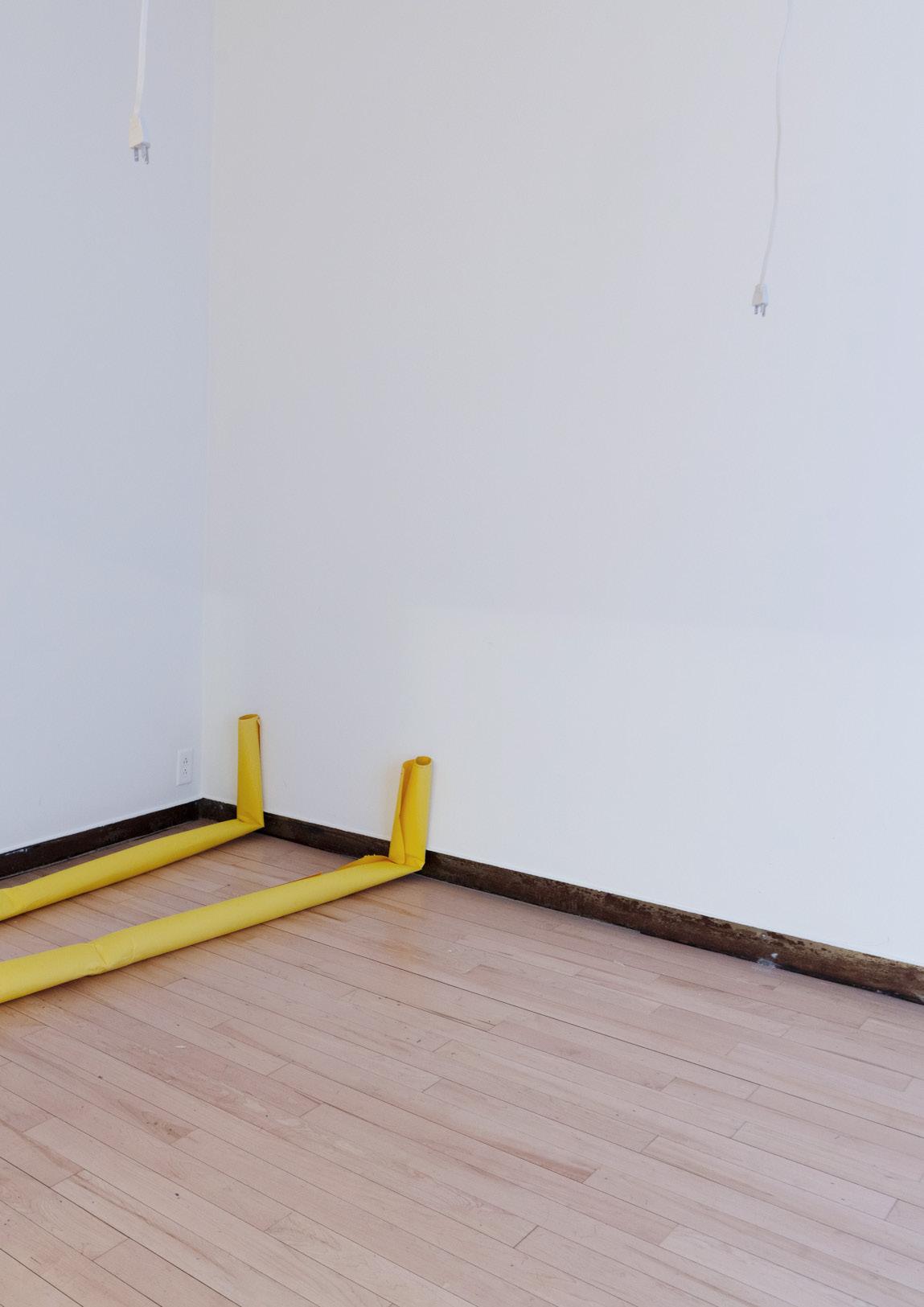
The title of the show The makings of you comes from a Curtis Mayfield track on his 1970 solo debut, Curtis! — an album marking Mayfield’s move from pop-soul toward a more experimental, personal sound. For Smith, this show also marks a turn toward the personal. On the cover of Curtis!, Mayfield wears a bright yellow chamois suit. In the front room of Smith’s exhibition, a pair of yellow paper legs lies in the corner, slightly spread apart, almost absurdly cheerful. Mayfield’s album asks what it takes to make a whole person, or a person whole, prompted by American racial violence and the failures of integration. Smith picks up the question of wholeness, in different materials, room by room. Throughout the show, Smith stops just short of fully representing the figure. He leaves the body partial, deflated, cartoonish. Across from the legs, behind a door he propped open, Smith placed a sculpture he titled green: glass bowls glued together, wrapped in green cellophane, set inside a white ceramic bowl. It is hard to tell whether the form — which resembles a frog and a tadpole — is catching a fly or still growing into itself — caught between maturity and early development. Though the sculpture may
appear benign, it recalls Pepe, the cartoon frog co-opted into a symbol of the radical right. Smith handles the charged object through containment — wrapped, glued, set inside another vessel, kept behind glass.
On the other glass door Smith adhered a sculpture made from iPhone boxes. He has been working with Apple packaging — the cut cardboard, the engineered shell, the apparatus that delivers the almost-living thing, a phone, cradled in extraordinary care. The packaging is a measure of misdirected tenderness: its makers are preoccupied with what’s inside, not who it’s for. In the work, circular holes in a box suggest a face — which appears to be winking, or to have a black eye — with a white adhesive bandage across the forehead. More boxes taped to its sides extend like wings, giving the form the shape of a cross. The sculpture stares with the flat look of a child’s robot drawing, or the thousand-yard gaze of a war veteran. The phone box might be both guardian angel and angel of death.
Room Two
The main gallery contains a tableau intentionally placed along one side of the space, evoking a panorama or a strip of road. A diffuse blue light emanates from a flood lamp placed inside a white bucket in the corner. It is the same light our screens cast on us, the light that both seduces and alienates. Paradoxically both bright and dim, the light creates “the experience of being both inside an app and a love letter.”
A pair of wooden legs lies on the ground next to the light source. Their angled posture rhymes with the double doors left open and askew. These legs appear chewed down to the bone, the feet wearing Smith’s own shoes, airbrushed to look bloodied. They collapse before the bucket’s glow as if at an
altar — the body edited down to the parts a screen couldn’t digest: bones and some Nikes. Against the wall, two white plastic wash bins hold glass objects — bulbs, vases, fishbowls, dishes — which are connected by a spiral wire. The piece is unusually illustrative for Smith, who seems to be displaying more objects than usual. Lightbulbs are placed inside fishbowls. In this pairing, there is a contradiction: the form that lets an idea exist and become visible is the same form that risks closing it off. He has selected objects intended for display and let them remain totally hollow. Their emptiness produces a feeling of alienation. In front of the bins sits a bubbling glass form — a molecule or Mickey Mouse, a mascot of the operation.
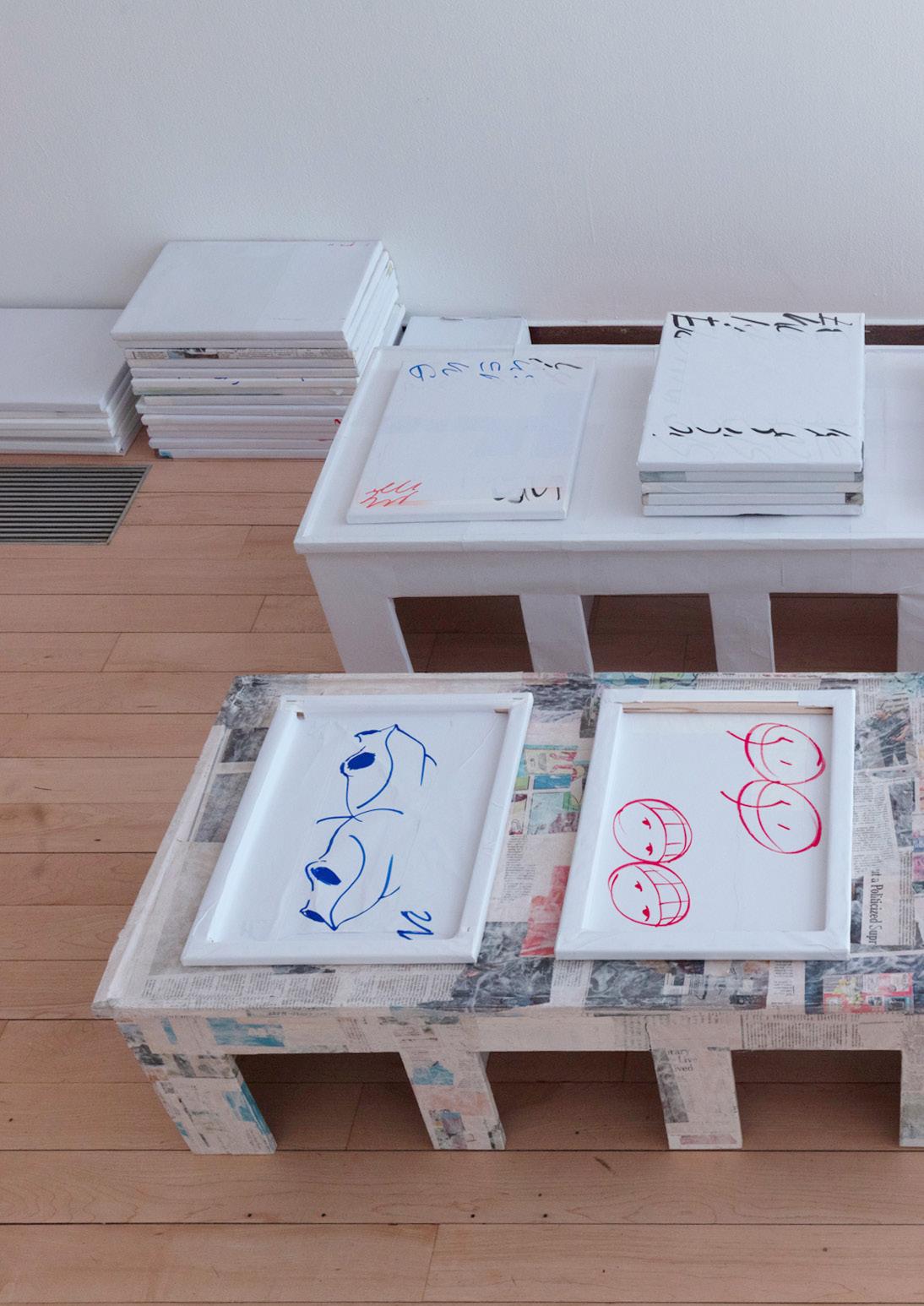
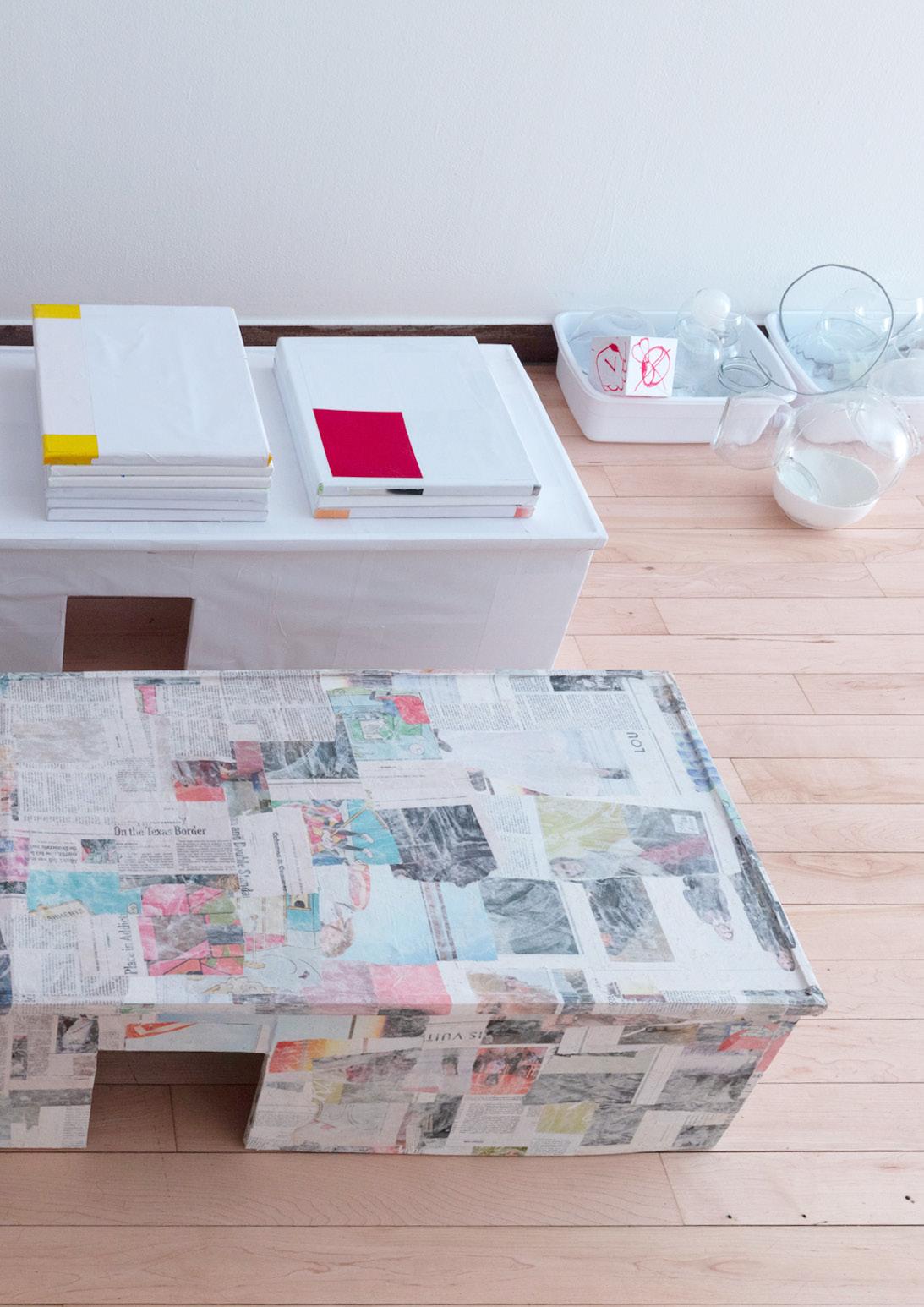
In the center of the scene, the insinuation of labor and cleaning comes into further focus. Two rectangular models of a car wash sit side by side, bringing to mind a low-rent Donald Judd or a pair of children’s cots. These structures are scale models of Best Way, the car wash on River Street which sits adjacent to the museum. Smith treats the car wash both as a found object and paradigm of American vernacular architecture, a fixture of the service economy, usually unremarked precisely because it is everywhere.
The two models, made by Smith’s partner from papier-mâché, are the closest thing in the show to literal “other halves.” They do the room’s work of establishing scale, as Smith reduces a real building to tabletop size, against which all other objects are read. One is covered in a collage of celebrity faces, headlines, and advertisements; Smith has coated the other in adhesive white paper. Each makes a different claim about what to represent: the structure as it absorbs its surroundings and the structure stripped to pure form. By building both, Smith asks which version the institution recognizes.
Smith has placed his small canvases on top of the car washes and in stacks behind
them. The canvases are identical, generic supports from a craft store, but the painting technique is layered and exact: full of gesture, symbol, collage, airbrush, built up and peeled back. He uses the adhesive paper here the way Robert Ryman used oil and acrylic in the “White Paintings” — different whites yielding different intensities, what looks smooth becomes topographical when you get close. Where Ryman exposed the painter’s craft, Smith uses white paper that coats the car wash to compose his paintings, connecting art-making and car-washing as equally significant practices of labor. Indeed, the car wash is the support on which the paintings rest.
The remaining objects in this attraction are opaque. Nike shoeboxes are stacked behind the car washes like apartment buildings. Their contents aren’t available to visitors, but some hold things — a DNA test Smith never took…and a wire mobile constructed with devil seed pods. ‘Personal’ material is what Smith usually shies away from; here he includes it inside the boxes. The gesture is protective and revealing. On the opposite wall, an overturned ochre bucket sits with a folded white towel atop it. Smith calls the work you can sit here.
The Back Room
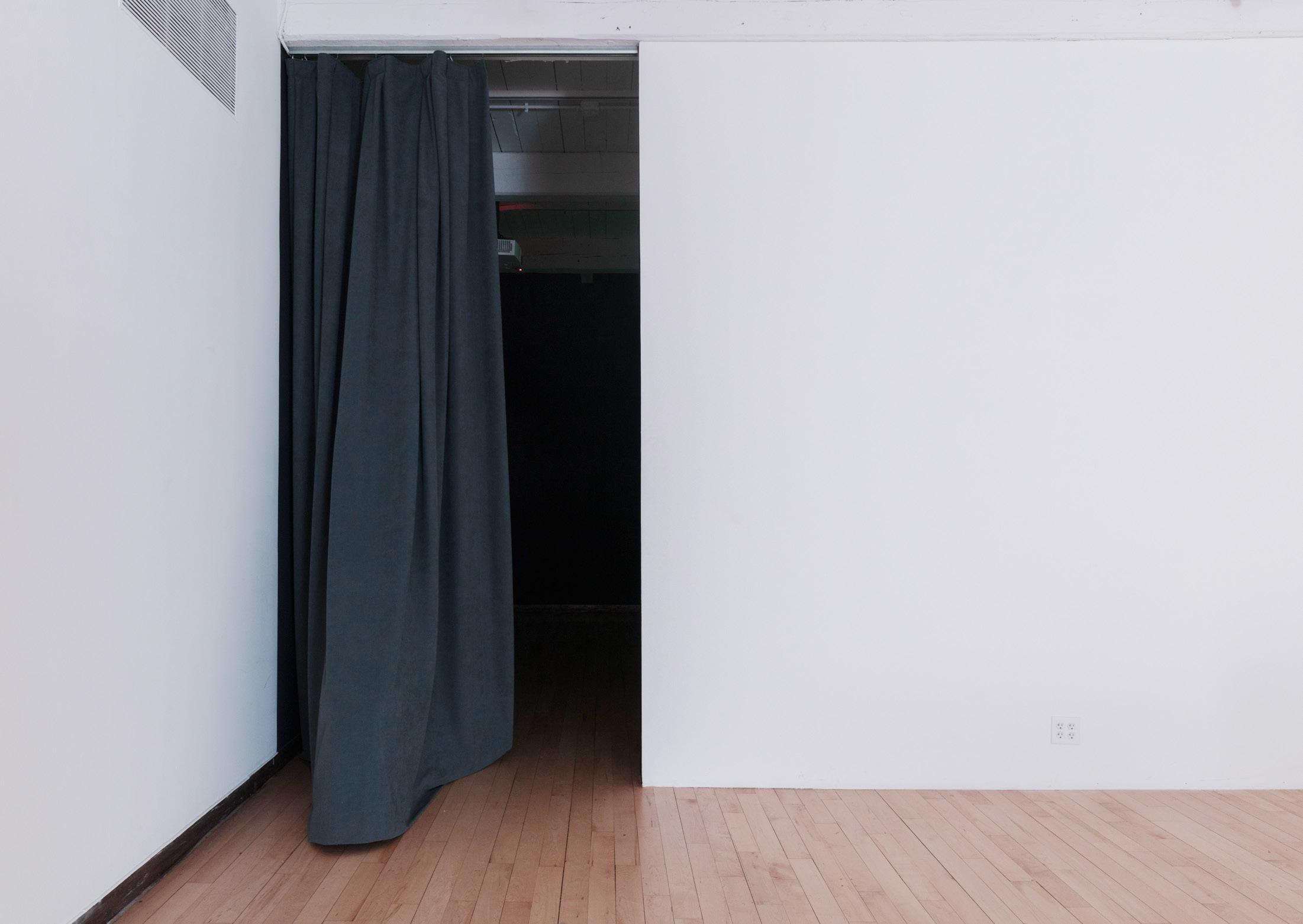
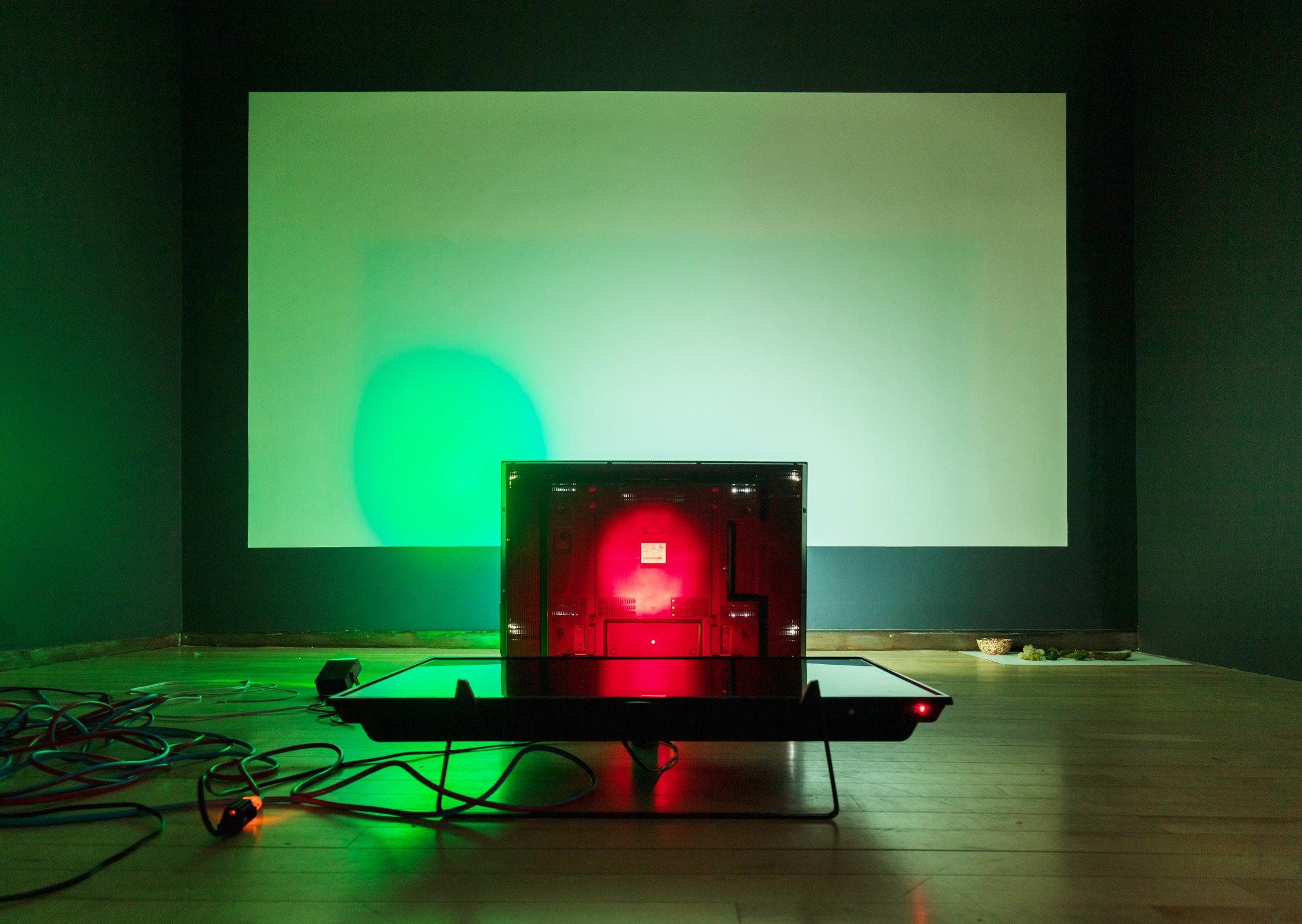
The Wizard of Oz instructed: “pay no attention to that man behind the curtain.” Smith asks the opposite of us. Inside a curtain at the threshold between rooms, he placed a small speaker, unplugged, mute, and about the size of a child. The sculpture looks like a poor disguise. Smith’s call to look behind the curtain leads to a nearly pitchblack room. He left the space exactly as it was after the previous show — a white rectangle painted on a wall where a video work was projected, the projector still installed. He doubles down on these features while
subverting them. A monitor faces the wall, displaying a “No Signal” error screen. The only light we receive from the monitor is through its backside — the light from LEDs shine through the rectangular slits like windows in a building at night. The scale from the rest of the show is referenced but also confounded, because being in the room at once feels like standing inside a single device and inside the data center that powers it all. Cables candy-striped red and blue loop across the floor like an exposed nervous system; they could just as easily read as a DNA coil unwound. Red and green LEDs flash like a broken traffic light. The HVAC hums like white noise or a computer fan overheating. In front of the monitor, Smith has set a large cardboard box nested with stacks of phone packaging and powered-down tablets whose screens he has whited out with tape. Smith replaced the iconic smile-arrow logo on the box with a swoosh-shaped rip. In the far corner, unlit, are bits of moss and lichen arranged across a board on the floor like a mini earthwork. Beside it sits a speckled ceramic bowl Smith’s daughter made, painted in blues, browns, greens, and whites — the colors of Earth from space. The vignette is tender: the nature from just outside brought into the air-conditioned museum, the planet held in a child’s hand. Against the dead screens and the cabling, the arrangement turns foreboding. The same work of scale and perspective the car washes set in motion has reached the planet. The Earth has been emptied of its contents, like Smith’s boxes, and shrunk to the size of a cereal bowl. The technology, indifferent to us, has swallowed up the room.
To leave The makings of you is to walk back through it. The first pass is discovery; the second is recognition; the show is a dream you only realize you’ve been in once you’ve begun to wake up. The objects in the show exist between states; they fail to settle into a single identity. Smith’s answer to Mayfield’s question — what makes something or someone whole — is to redefine what whole is. He attends instead to the makings. Mayfield’s own refrain, which includes the title lyric, suggests the complexity of trying to put being into language:
The
love of all mankind
Should reflect some sign
Of these words I’ve tried to recite They are close, but not quite
Almost impossible to do
Reciting the makings of you
What Mayfield offers is wholeness as always in process: the trying, the reciting, the close-but-not-quite. What protects a whole person from being compressed into symbol, biography, or commodity is exactly a commitment to the makings rather than the made. To maintain oneself in opacity, to allow identity to be unfixed or incomplete, as these objects do, is a challenge and a sacrifice. The same is true for artists like Smith who resist transparency. When an artist refuses to package their practice neatly, or deviates from the role the art world writ large assigns to them, this can be uncomfortable for the institutions that depend on artists fitting into a pre-assigned identity. What Smith leaves us with is a question about how we organize ourselves, our work, and the world, and how these containments never quite hold. What seeps out is what Smith takes up as his subject, placing his viewers in the messiness of trying to hold onto one’s capaciousness
in a landscape that so often rewards clean boundaries — a landscape we now navigate through screens, feeds, and the powerful infrastructures that compress our beings and dictate how we see ourselves and others. The hope, perhaps, is that we leave the dimness of the installation, step back into the museum’s bright halls, or out into the sunlight, more capable of recognizing the spaces where we and others are being made to make sense too quickly. The attention Smith has asked us to have in the gallery invariably slips out into how we see the world outside, encouraging us to value that which won’t quite fit.
Emma Poveda M.A., Williams College, 2026, Williams College Graduate Program in the History of Art
A typographic representation of one of the artist’s sketches wherein he anagrams the word “Car Wash.”
Michael E. Smith (b. 1977, Detroit, MI) lives and works in Providence, Rhode Island. His work has been the subject of solo exhibitions at Kunst Museum Winterthur, Henry Moore Institute, Pinakothek der Moderne, The Vienna Secession, Kunsthalle Basel, SMAK Ghent, Sculpture Center, La Triennale di Milano, CAPC Bordeaux, and Contemporary Art Museum St Louis, among others. He participated in the 58th Venice Biennale, the 2022 Whitney Biennial, and the 2012 Whitney Biennial. His work is held in permanent collections including the Whitney Museum of American Art, the Hammer Museum, Walker Art Center, SFMOMA, MCA Chicago, SMAK Ghent, and Ludwig Forum Aachen.
Michael E. Smith: The makings of you May 2, 2026 – February 2027
Curated by Emma Poveda, M.A., Williams College, 2026, Williams College Graduate Program in the History of Art
Michael E. Smith is made possible by the Sterling and Francine Clark Art Institute in support of MASS MoCA and the Williams College Graduate Program in the History of Art. Support for this exhibition is provided by Kathy & Brian Schultz with The Connie Frank Foundation, in memory of Billy Poveda, and The Rosen Family Fund.
Images:
Michael E. Smith, green, 2026, mixing bowls, cellophane
Installation view of Michael E. Smith: The makings of you, 2026
Michael E. Smith, untitled, 2026, speaker, curtain
Michael E. Smith, untitled, 2026, screens, lights, empty boxes, extension cords, poster board, bowl, paint, sod, moss, dirt
Michael E. Smith, untitled, 2026, yellow paper
All courtesy of the artist and photographed by Jon Verney