I
f you’ve spent any time on the art side of TikTok, you may have seen the trend that Zendaya is impossible to draw. According to the legend, anyone who tries enacts a curse that was placed upon her at birth. Allegedly, a coven of witches banded together so anyone who dares try capture her beauty will never be able to do so, and any other drawing utensil they use will be cursed as well. I have spent weeks (one night) collecting evidence (watching TikToks) on where all these people before me went wrong. I start with her nose, attempting to work from the centre outwards. Eyes come next, they’re too big. I don’t fix it, excusing this as ‘a stylistic choice’. Eyebrows next. Mouth, ears. This is definitely a person. Hair, jaw, chin. Every feature is a stepping stone towards Zendaya. I darken up her hair in an attempt to fix it. I don’t think it’s working. I keep going. Neck, earrings, what more even is there to add at this point. Maybe if you look at it from far away? This just looks like a dark-haired Karen.
NEWS KAWEPŪRONGO Massey Disestablishes Five Senior Leadership Roles
4
10
11
He Toi Whakairo, He Mana Tangata
12
13
5
Labour Guarantees Jobs for Nursing Grads
Massey’s Plan for Each Campus
Green Party Policy Would Benefit Struggling Students
Student Loan Borrowing Numbers on the Rise
7
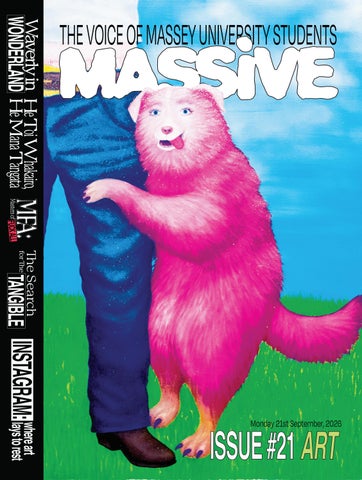
Waverly in Wonderland
Zero Students Apply to be Wellington Student Rep
MFA: Masters of Fuck All
14
8
15
Hallucinated AI References Cause Serious Problems
6
FEATURES Pencil Man in the Fight Against Creative Block
AHUATANGA
The Search for the Tanglible
9
16
Listen, this isn’t my first rodeo with an impossible portrait. But with an art style like mine, usually I can get away with it looking nothing like the person I’m meant to be drawing. But on one fateful market day, this wasn’t the case. Two girls sit down at my stall. They ask for a joint portrait. No fucking worries. I got you guys. I start drawing. Girl on the left first, easy as pie. Her features flow from my pen: nose, eyes, eyebrows, she’s even got a hat on, so I don’t have to draw her hair. Perfect. A spitting image. On to the next one. But something suddenly severed the connection from my brain to my hand. I AM LOST. All artistic ability had left my body. I look at this girl and feel a complete disconnect. I can’t capture her. Her features were too normal, too regular, nothing to pull from, no noticeable qualities to exaggerate.
Massive is largely funded by Te Tira Ahu Pae and the student services levy, however, remains editorially independent.
NZ Media Council: Those with a complaint towards the publication should first complain in writing to: editor@massivemagazine.org.nz
Disclaimer: The views presented within this publication do not necessarily represent the views of the editor.
If unsatisfied with the response, complaints should be made to the NZ Media Council: info@mediacouncil.org.nz
Lines and lines of... something... come out of my pen. I decide I am done. Nothing that I add to her will help this ‘ket monster’ that has erupted onto the paper. I turn the page to show them, both their smiles fade. “Yours is nice...” The ket monster says to her friend. They thank me (I did not deserve to be thanked), and stand to leave. Ket monster is still looking at the monstrosity I drew as I unconfidently mutter the line. “Follow me on Instagram if you want.” With her eyes filling with tears, she does. I can’t explain what happened except the same coven of witches who cursed Zendaya must have also cursed her. Fuck that coven.
Seeing as she’s already handed over $15 cash, I power on.
Art Competition Winners
17 Mother Massive
24 31
18 25
Sexcapades
32
19 Instagram: Where Art Lays to Rest
26 33
CENTREFOLD
27
Elsie Te Huinga Waea Harré
HOROSCOPES
34
28 35
22 29
PUZZLES
36
23TĪWAE
COLUMNS
30
Gig Guide with Radio Control
PANGA
37
MASSIVE MAGAZINE
MONDAY SEPTEMBER 21ST
Massey Disestablishes Five Senior Leadership Roles Jessie Davidson • SHE/HER
M
assey University has confirmed that five senior leadership roles are set to be disestablished as they introduce a new executive leadership team model. This announcement followed a proposal presented to staff in August. Under this proposal, parts of the senior leadership structure was reorganised into an eight-member executive leadership team. To do this, five existing positions would be disestablished. A Massey spokesperson has now confirmed that the diestablished roles are: • Provost • Deputy Vice-Chancellor University Services • Deputy Vice-Chancellor Students & Global Engagement • Director Governance and Assurance • Executive Director People and Culture
4
The new executive leadership team will comprise eight roles reporting to the vice chancellor. As a result of this new structure, five senior positions will be disestablished, and seven new executive roles will be created—all of whom would report to vice chancellor professor Pierre Venter. With this, 59 positions will have minor changes such as reporting lines or job title adjustments.
TEU member and Massey’s dean’s chair in Communication, professor Mohan Dutta, said this was a “grave concern”. “Academic freedom is still absent as a responsibility in the senior leadership roles, and that is a grave concern in an environment where academic freedom is constantly under attack.” Dutta said this change could have been an opportunity for Massey to protect academic freedom, but it failed to do so.
This decision has drawn criticism from members of the Tertiary Education Union, who disliked that academic freedom is absent as a responsibility in the senior leadership roles.
“Across all six final position descriptions, academic freedom, critic and conscience and institutional autonomy do not appear once.”
When the proposal was originally sent to staff, TEU members said said the restructure would reduce academic representation within Massey’s senior leadership while creating an additional layer of academic management.
He added that TEU members asked for a business case and impact assessments, including a Te Tiriti o Waitangi impact assessment. These would show the impacts that these changes would have on staff, students, and culture at the university.
Massive Magazine
NEWS “None have been provided.” TEU member and academic rep at Massey TEU’s branch committee, associate professor Sean Phelan, echoed Dutta’s concerns. “I asked the Vice-Chancellor a question about the absence of any reference to academic freedom in the job descriptions
KAWEPŪRONGO for the two key academic roles ... I was surprised to see that it still went unmentioned in the version of the change proposal designated as ‘final’. In a press release, a Massey spokesperson said that the restructure has been done to ensure Massey successfully delivered its new 2026 to 2030 strategy, which launched on September 25.
Venter said full and careful consideration was given to all feedback and suggestions received during staff consultation, and minor changes have been made because of the feedback. Recruitment processes will begin soon to fill the new positions, and the new model will take effect from Monday 28 September.
Zero Students Apply to be Wellington Student Representative Ellice Lawrie • SHE/HER
T
e Tira Ahu Pae has confirmed that approximately zero students have signed up to be the 2027 student representative for Massey University’s Wellington campus. The student association posted on their Instagram two weeks ago announcing that the timeframe for student to apply for the role had been extended. Originally, students had until midnight on 6 September to apply for the role. This has now been extended to 18 September.
In a response to Massive, Te Tira Ahu Pae general president Takunda Mabonga said having no students come forward for the role was “gutting”. However, he wasn’t concerned, saying that there were a number of capable candidates. “I can think of many students who would do a great job and make a positive difference on campus.” Mabonga said that this role is an important opportunity for students to make changes, support their peers, and gain valuable leadership experience.
Want to learn more about Student Representation at Massey Wellington Campus?
He was hopeful that this extension provided Wellington students with another chance to step forward and encouraged students to apply.
“There are many students who have what it takes, but you have to be willing to take that first step. Back yourself, put your hand up and apply.”
ISSUE #21
ART
“Systematically embarrasing”
–Hallucinated AI References Cause Serious Problems Milly Matthews • SHE/HER
N
ew research from Auckland University shows that dozens of academic papers have references invented by AI. According to RNZ, the research looked at 3,000 peer reviewed articles, and roughly 2 percent had hallucinated references. Senior lecturer of Media Studies at Massey University, Dr Kevin Veale, said that the scope of these changes could go beyond simply needing extra due diligence. “Where things could get a little gnarlier in a different direction is this idea of contaminated information, where you’ve got something that has been endorsed by being published academically, which is not true. “That includes fake quotes being attributed to academics, but it might also include dangerous information being stamped as, ‘yes, this is true’, that people might use or respond to and then, we don’t entirely know the downstream effects of that.” Veale said it could have serious consequences for people working in research academia. “I know people who have been contacted because somebody said that they want to talk to them about a particular article, and that person
6
said, ‘I never wrote that, what are you talking about?’
trim them down is causing knock-on consequences everywhere.”
“There are people who have been attacked or gotten in trouble with their jobs because somebody has reported them for writing something really inflammatory or publishing something terrible, and they’ve said, ‘I never published it’ and they [their employers] have said ‘yes you have, it’s here.’”
In Veale’s opinion, academics should know how and should be checking references. “I would have thought that sourcing [references] ... would have been part of kind of the core literacies and practices involved. So, this is kind of systematically embarrassing.”
However, Veale believed general education around AI can help spread awareness. “Academics have knowledge “I think the best thing and training and context for best practice of being able to find things. that we can try to do The difficulty level of expecting generally is just make undergraduate students to be able sure people know to tell what’s real and what isn’t and trace things back, it’s much harder for how these things them.” work and how they Veale said weaknesses in the peer don’t work,” he said. review process are allowing these articles to slip through. “I have been telling undergraduate “The amount of work expected of people to do peer review is students if time is of significant, and it’s something the essence, I would that people are expected to take far rather you rely on seriously. It’s free labour, and the amount of effort required to just Wikipedia than AI.” Worldwide, Veale said that millions of hours will now have to go into identifying fake references. For people lower on the academia ladder, he said identifying fake references may be more challenging.
Massive Magazine
NEWS
KAWEPŪRONGO
Labour Guarantees Jobs for Nursing Graduates Josie Maddox • SHE/HER
I
f elected, Labour has promised that every NZ-trained nurse will get a job once graduating in an effort to keep graduate nurses in Aotearoa and ease shortages in primary care. Starting in 2027, the policy would see the number of working nurses increase by 350 over four years. This is projected to cost $525 million, funded by the annual cost pressure increase. Labour leader Chris Hipkins said that National has fueled a crisis in Aotearoa’s health system, leaving patients and staff “paying the price every day”. “Graduate nurses are being trained here, but instead of starting their careers in New Zealand, too many are being forced to look overseas because National won’t give them a job.” However, National’s deputy leader Nicola Willis said that 2300 nurses are being
recruited by Health NZ right now. She expected that these nurses would be working by Christmas. “What that means is Health NZ is actively interviewing and placing them in roles around the country,” she said on Morning Report last week. The government has faced criticism for Health NZ’s hiring freeze and for not having enough nurses in place in time for winter this year. These shortages had led nurses across Aotearoa demanding solutions.
In 2025 alone, fewer than half of graduating nurses were initially offered jobs through the Advanced Choice of Employment (ACE) program—a system which connects nurses with their first clinical jobs. Under Labour’s policy, 2400 Nursing students would have a secure job lined up once they graduate. These jobs would be available to any New Zealand or Australian citizen, or New Zealand resident visa holder, who completes their Nursing qualification at a New Zealand institution.
Just last week, nurses at Tauranga Hospital declared a state of emergency after a patient collapsed in the Emergency Department waiting room.
Labour’s health spokesperson, Dr Ayesha Verrall, said that there currently aren’t enough roles in the health system for graduate nurses, forcing them to begin their careers overseas.
Currently, between 2500 to 3000 Nursing students graduate per year in Aotearoa. However, in policy documents Labour said only 54 nurses have been added to the public health system in the past two years.
Part of this policy included doubling the funding for graduate Nursing roles in primary care. This would see an increase from $20,000 to $40,000 in rural areas, and $15,000 to $30,000 in urban areas.
Green Party Policy Would Benefit Struggling Students Maya Trotman • SHE/HER
T
he Green Party wants to launch a government owned supermarket chain called ‘KiwiMart’ to lower food prices and break up Aotearoa’s supermarket duopoly.
take about a million dollars a day in excess profit out of our shopping baskets. That is money that should be in people’s pockets,” Swarbrick said.
For struggling Kiwi students, lowering the cost of groceries would benefit them significantly.
Swarbrick said KiwiMart would be mandated to prioritise affordability.
Speaking to OneNews, co-leader Chlöe Swarbrick said greater competition is needed to bring down grocery prices.
Part of their ‘Affordable Kai’ policy, the Greens have also promised they’ll ban supermarkets from exploiting their marketshare and charging unfair prices. This would prevent supermarkets from inflating prices on
“Two companies control what almost everyone in this country eats, and they
student essentials—which students are already struggling to afford as is. Last month, Victoria University’s student association released survey results which found many students were skipping meals so they could pay rent. Out of the 1238 surveyed students, 33 percent said they’d skipped a meal in the previous week because they couldn’t afford to eat. The policy is estimated to cost $2.8 billion.
8
Massive Magazine
Features • Ahuatanga
WORDS BY JESSIE DAVIDSON • SHE/HER PHOTOS BY ELI ARMSTRONG • HE/THEY
S
now-capped mountains pierce vibrant blue skies, filled with fluffy clouds and pink blimps. Dinosaurs roam freely, stomping through a river dividing the landscape. On the riverbanks, a war is brewing. A pink centaur draws back her arrow, ready to shoot at a pink robot aiming its own weapon back at her. But floating down the river, a more peaceful scene approaches —swans riding swan boats.
Dive down the rabbit hole and enter Waverly’s Wonderland. Under the boats, hidden beneath the water, is another wonderland in itself. Pink turtles dance among pink fish. They swirl with the currents, a trail of bubbles following behind. This magical landscape may seem out of the ordinary for many visitors. But for Fine Arts student Waverly Saindon, this is her normal.
Massive Magazine
9
Art
“I want to paint things that make me happy and that can make other people happy. I want to make things that are simple, colourful and wonderful.”
A weird, wonderful, Waverly wonderland.” 10
Massive Magazine
Features • Ahuatanga The whimsy bleeds beyond the borders of her art. With strands of tinsel blended among her hot pink hair, wrists covered in bangles, hair ties and bracelets, and a colourful wardrobe to match, Waverly embodies whimsy and wonder. Creativity comes naturally to Waverly— she was creating before she could talk. “I didn’t start talking until I was four. But when I was three, I started making giant cardboard robots and toys to hang out with,” she laughs.
centaur, each character depicts who Waverly is at a particular moment in time. This series of surreal self-portraits was inspired by a trip to London at the beginning of the year, after her dad was nominated for a BAFTA. She recalls standing in a room full of celebrities and being surrounded by Vincent van Gogh’s works, which included his portrait series. She says t his moment was “life changing”. “It was such an otherworldly experience,” she says. “I was drunk out of my mind in a room full of celebrities, in the van Gogh room in London, and it hit me then that I need to start my legacy.”
It was never a question of whether she was going to study Art or not. Whether it’s painting, sewing, sculpting or drawing, creating is the only thing Waverly has ever wanted to do. Van Gogh’s portrait series is famous for reflecting his experiences and mental “Ever since I was able to draw, I was states at different points of his life. Pieces drawing. Ever since I was able to paint, of his personality can be found in each I was painting.” self-portrait. Waverly wanted to explore this in her own series of painted portraits. For Waverly, exploring her feelings and experiences is far easier to depict “When I came back home, I wanted to do through crafts than by writing them a self portrait of myself in my own weird down in a diary. Whenever she’s feeling style. After the first one, it began to be something big, exciting or confusing, a diary entry into my 20s. Like, a visual Waverly paints it. of how I’m feeling and how I’m seeing “I’ve never been good at writing down all my words. But I feel like painting can paint a thousand words or whatever that quote is.” But this is no surprise. Creativity is in her blood. With a painter for a mum and an award-winning visual effects artist for a dad, Waverly is a self-proclaimed “creative nepo-baby”.
myself as a 21-year old.” As the series continued, Waverly says “they kept getting weirder and weirder and more wacky. People started asking, ‘is that Waverly? Or is that just a pink turtle?’”
In one painting, Waverly depicts herself as three characters—a pink huntswoman, a pink moose and pink Bigfoot. Created “Growing up around parents that never after visiting her family in America, the suppressed my creativity or what I wanted painting was inspired by how her family to wear, what I wanted to do, or anything like perceived her style. that, has made me have a lot of freedom with what I can paint,” she says.
“My dad’s side of While Waverly has always been interested the family is very in creating whimsical wonderscapes, this conservative, and my grandpa was like, year she’s started putting herself in the ‘Waverly, what are you settings—but not like one might think. Throughout her work, Waverly paints doing here with pink herself into pink creatures. Whether it’s hair? You’re gonna get a pink turtle, blimp, swan boat, robot or yourselves shot!’” Massive Magazine
The huntswoman represents who this part of her family wants her to be, Bigfoot is who she feels like she is, and the moose is her watching the battle between the two identities. Right now, Waverly is working on a painting called Me When I’m Wave. Half of the perspective is underwater, while the other half is above water, showing the connection between two worlds. “Everyone is so connected, and a part of you is in everyone around you. I wanted to explore what that connection might look like under the sea. I wanted to see an ocean of me.” Pink characters depicting Waverly are scattered throughout. Whether it’s a pink jetski on the ocean’s surface or a pink turtle dancing amongst the currents, she has created an ocean depicting her personality. “There’s always so many things going on in the Waverly universe. In the world of Waverly.” Nearing the end of her Honours year, Waverly is ready to leave Massey and take on her next adventure. While she has no firm plans for the future, she’s not worried. No matter where life takes her, Waverly will be happy as long as she’s creating. “I would love to be a painter. I would also love to be a dressmaker. I would love to be a sculptor. I would love to be a mum. I’d love to be a teacher. I just want to follow my heart.” With a surrealist dreamscape of confusion, whimsy and self-expression living both within her and across her canvases, Waverly Saindon is ready to take on the world—one pink creature, splash of colour and piece of glitter at a time.
“Because what’s more magical than glitter?” 11
Art
WORDS BY KAMAIA BAINBRIDGE-FROST • SHE/HER ’OUTA O TAINUI, FASITO AT IK WA , HI PU Ā NG
s I was eight yfiresatr old when I chisel. picked up ad by my Surrounde tared cousins, I s e piece down at th e in of limeston and front of me king away started haccing some unfamiliar formnofuf sed at it. Produ , I grew frustrated and co I knew. jagged rockcouldn’t replicate the pou as to why I d last n a t s ir f y m s a tw Admittedly, ttohiawhakairo. attempt at d carving, an
12
āori aditional M ing whakapapa, d, tr f o rm g, record to legen is an art fo Whakairo a form of storytellinuardians. Accordinghe rescued can act assenting tūpuna or g Ruatepupuke after ater village. and repre was discovered by aroa’s carved underw re whakairo anuruhi, from Tang ack to befo b te a d his son, M o e ir s from th of whaka examples r in style to carvingāori developed t s ie rl a e ila M The s and share sim overtime 1500, andn islands. However,ding carved patterne ferns. k ia lu li s Polyne unique style, inc native plants— their own pired by Aotearoa’s motu, cross the s into a r fe spirals ins if d s tive style nd design patterns a g their own distinc o ir a k a h W iwi bringin with eachings. their carv
M
any years have passed since I discovered that whakairo was never as simple as chipping away at a piece of limestone. My childish ignorance was cute—an innocent attempt to nurture my Māoritanga in another form. But recognising that ignorance has followed me into my young adulthood is not cute. I did not want my knowledge of whakairo to begin and end at cosmetic appreciation.
Karl Leonard, a kaiako in that space, spoke to the nature of the course:
“It’s not just a craft course. I think every carving degree I’ve seen, they’re missing all these other foundational things. They’re just looking at technical abilities, you can’t run a car without the petrol.” Around the room, students pour intention and meaning into and out of each intricate carving.
Escorted by an entourage of curiosity, a few members of Massive’s team travelled to Ōtaki to gather a deeper understanding of whakairo at Te Wānanga o Raukawa.
“For most of them, it is a connection to Te Ao Māori. Being involved in your marae, in your people, keeps you grounded.”
Under their diploma in Design and Art, Te Wānanga o Raukawa offers a Whakairo pathway. The course includes a weeklong noho on the Ōtaki campus where all ākonga gather twice a year.
Karl recognises that within whakairo, carvers can often focus singularly on the carving. However, this can disregard a necessary relationship with their people, the designs, and the whakapapa of whakairo.
By some divine intervention, this noho fell around the same time I was seeking an expansion of my mātauranga. Resting on the corner of Te Rauparaha Street and Tasman Road, the bass of some familiar Justin Bieber waiata swirled out of the carving shed. Singing alongside the Biebs was a familiar beat of chisel against wood. Brian Clime, Pūkenga Matua Toi Whakarakai, welcomed us in and introduced us to the whānau there. Taking us around the carving shed, Brian took time to explain each of the adornments and portraits of past carvers hanging from the walls. From tohunga whakairo to ākonga who had passed away, the shed was truly held by love. Gathered from what felt like every corner of the motu, the range of wairua in the room was palpable. The singular similarity amongst everyone were the chisels sprawled in front of them. Otherwise, they were all fascinatingly different.
“That’s where I come in and start filling the gaps for these ones here,” Karl says. “There’s crossovers for everything, and you have to have everything to make it whole.”
Features • Ahuatanga Now in her second year, Aimee has found a place for herself in whakairo: “It’s a spiritual connection with the rākau and my sister.” For student Taylor May, he travelled from Tāmaki Makaurau for the course to follow in the footsteps of his koro. Among the course allocated chisels sprawled across the surface, a set of unique dark wooden handled chisels stood out. “They were my grandads,” he says. No matter who they are or where they come from, every person in the carving shed dedicates part of themselves to the art form of whakairo. Whether they’re connecting to their whānau, nurturing their hauora, or are the only person in their hapu to learn the craft of whakairo—the foundation of whakairo is built on history and is held by passion.
He toi whakairo, he mana tangata. The integrity of one’s character isseen in what they produce.
For all the ākonga in the class, they were all drawn to the chisel by different feelings and experiences. For student Aimee Porteners, she describes her calling as a spiritual healing after her sister passed away. “It was a healing thing for me,” she says. “Our [sister] connection that we had was a toi connection, like a creative connection.” As Aimee chips away at the rākau, she explains how the chisel found her after she accidentally wandered into the carving shed while searching for a weaving class. What began as a happy accident has grown into a practice she continues to nurture. Massive Magazine
##
Art
WORDS BY LEE JUDI • THEY/THEM
Two months ago, I started a Master of Fine Arts right after finishing my Bachelor of Design. Immediately, I felt the defensiveness creeping into my system because of the Art vs Design hierarchy. This is a hierarchy I felt deeply in my four years of undergrad. It’s tiny habits. For instance, I always find myself s lipping in the word ‘just’ when I talk about stress in my studies: “Aw but you know, nothing I can’t handle. It’s just Art school.” 14
T
he self-deprecating Art student. Someone who would die for their craft (or spend $40,000 to study it) but will stop at nothing to be the butt of the joke. Yet we find ourselves talking shit on the absurdity of our degree consistently. Especially when chatting to the Design students. My sheepish attitude about studying Fine Arts is a tell for how others perceive the art world. The prejudice isn’t delusional—it’s inherited and socialised. Bë, a former Industrial Design student, describes the energy in the workshop surrounding the differences between Art and Design. Massive Magazine
Bë says, “There is definitely an ego in design. Especially in Industrial because it’s practically all men. They like to make things with their hands and hammers. It’s all very ‘Yeah lads!’” Whilst Design students have marketing packages, product proposals, and reports due, I have get naked, run around, and take selfie due. It’s hard not to snicker. But neither degree is any less valid—they’re just different. Bë theorises that the reason many hold one over the other has a connection to constructed superiorities surrounding the masculine and feminine. Gendered stereotypes about men yielding
ART BY MĀTA GEIRINGER • SHE/HER • NGĀTI KUHUNGUNU KI TE WAIROA strength is bleeding into material form— steel, wood, and all. This legitimises their making opposed to painting because of its gendered connotation. Bë explains: “The skills that the Fine Arts kids have over the Design kids, designers don’t notice because it’s less obvious. Things like emotional intelligence, empathy, and being more caring are less visible than knowing how to use a drill.” In Fine Arts, we label what we make is our ‘practice’. Whilst in Design, it’s called your ‘work’. This distinction implies a lack of grunt, effort, and masculinised skill in the former, while boosting the latter as superior. This hierarchy between feminised and masculinised labour has been illustrated for centuries. Feminised workforces, such as childcare, nursing, and teaching are still fighting for fair pay and rights. Whereas masculinised trades are hard mahi still but great pay. The constructed differences between Art and Design mirror a similar dynamic. “When I tell people that I studied industrial design, they’re like ‘Woah, that’s so cool!’ They think it’s like civic engineering,” Bë says. “The term Industrial Design gets a good chunk of respect. But when my peers tell people they studied Fine Arts, the reaction is ‘Oh, that’s nice’.”
Words like ‘functionality’ and ‘practicality’ hold so much more gravitas than ‘expression’ and ‘feeling’. Bë wonders if the strict labels between Art and Design hold any value at all: “Often the function of a design can be about how it makes you feel.”
Features • Ahuatanga They say: “Personally, I would prefer a melting pot system at school where we’re all mixed. But I know there would be blokes I studied with that would hate it.” But fuck them and fuck ‘Art’ and ‘Design’ schools. I want Dart school.
We are not artists or designers: we’re makers, imaginaries, kooky cunts and “Fine Arts and Design are both so craftswomen. A connected and similar that you can’t define that there’s one or the other. It’s not revolution against black and white.” our labels could mean that everyone’s In fourth year at Massey University, all Art work would be taken and Design students are taught how to define their practice/work through this seriously. two-category system. We all then go into our major projects, Honours or Masters, Whether it made with this understanding. your daily life easier or made you cry, I can’t help but wonder what fascinating creations could come from a curriculum everyone deserves a that throws this research methodology seat at the table and a in the bin—or even restructures it. painting on the wall. Bë, an incredibly talented maker and The best designers often have a deeper understanding of the evocative than some may realise.
undoubtedly impressive ‘designer’, fantasises similarly.
For those who’ve felt the pain of taking Massey’s Creative Practice Research Methodologies paper, you’ll roll your eyes at any sentence which includes the words ‘evocative’ and ‘effective’. Basically, anything that you create which makes people cry, laugh, puke or cum—it’s evocative. It’s art. But if what you create solves world hunger or convinces consumers to buy shit —it’s effective. It’s design. This definition of the two was formed to help artists and designers describe themselves easily. It claims to hold no bias between them. But the bias has become too heavily ingrained into the way we think about Art and Design to pretend one doesn’t sound more important.
Massive Magazine
##
Art
Tangible (adjective) Something real, concrete, and able to be touched, felt, or clearly observed. WORDS BY ELLICE LAWRIE • SHE/HER
16
Massive Magazine
Features • Ahuatanga
C
oncreting something into reality is exactly what Fine Arts student, Bee Putali, is trying to replicate through art. Creating something tangible, something that cannot run away, is Bee’s way of understanding her complicated relationship with memory. Growing up with an artistic mother, who she credits as her main inspiration, art has always been a part of Bee’s life. From school productions, to her Musical.ly aesthetic account, and now her current paintings, sculptures and photographs—art has always been intertwined with her being. Part of her being, and now the biggest inspiration for her art, is her struggle to keep her memories from slipping away. Caused by long-term trauma, Bee has trouble recalling memories, which leaves dozens of gaps in her head. She says, “If something bad happens or if something big happens … really anything that strikes a feeling rather than calmness I forget.” These blank spaces create the canvas for her art, providing a way for Bee to better understand what she’s experiencing. “Not only is this something that I live with every day, that completely touches every single part of my life but it’s also something that would benefit me so much to understand more.” This is where Bee’s search for tangibility comes from. The feelings from certain moments may have left her, but her art is something concrete that helps her understand what she is experiencing. So many parts of her life sit on the tip of her tongue. Being able to see and touch these artistic representations of her life ensures they cannot escape.
Unfortunately, this does sometimes leave her in a Catch 22: “How do you make art about memory if you don’t fucking remember anything?”
Bee explored this question in her painting series, barely tangible. In this work, she focused on remembering the feeling of a moment, but not the context. “I started off by making the context and the feeling as too different parts of a work, then I realised, well, I don’t remember [the context].” In previous works, Bee used a poem she had written about what she was going through to represent the context. Now, in the place of the poem, is scribbles. From a distance, these scribbles almost look like words. But come closer, and the viewer is unable to make anything out. By doing this, Bee puts viewers of the art in her shoes.
“Sometimes I want the viewer to feel as stressed out, scared, confused, and muddled as I’m feeling.” “I want to create a little portal where it’s like, this is what’s going on right now. You have to feel it too.” Using different mediums to explore the concept of memory, Bee isn’t confined to one artistic box. Her sculpture, barely tangible as always, is made up of several paintings held together by string hanging from the ceiling. With each painting representing feelings, context and the gaps within, this piece illustrates the fragility of Bee’s brain and its sporadic nature. “That was about the way my brain feels to me, just holding up with pieces of string, all around the places, and you don’t know where it’s coming from. A lot of confusion.” The experience of being inside her brain is something that Bee finds hard to put into words. But her art has created a peep hole through which viewers can get a glimpse.
Massive Magazine
17
Art
TE KOHU WALLACE | SECOND PLACE
JESS OTT | FIRST PLACE
Voyage
Sirens
Dreams have long been a topic of debate amongst scholars, creatives, and different cultures, each offering their own interpretations of what they represent. Through Te Kohu Wallace’s research, however, they have struggled to find a perspective that feels entirely accurate to their own experience of dreaming.
Originally from the United States, Jess Ott is an artist and maker of things. They have a background in photography and illustration but have recently been enthralled with install work and textiles. Their work tends to work around themes of the body, transness, and observation. Jess considers Sirens to be their illustration magnum opus, having drawn it over the course of many moons and travelling 11,500 kilometres with it. It is inspired by their lifelong obsession with watching water pass over their skin, as well as folklore, and historic Japanese art.
Kohu’s artistic practice explores the raw depiction of their dreams as they navigate different ways of expressing them and giving the audience a glimpse into Kohu’s subconscious. Through this process, Kohu is beginning to recognise patterns and question whether dreams are simply manifestations of unconscious desires, or something more.
ALISA BAZILEVSKAIA | THIRD PLACE Come Closer, Not Too Close
This work continues this exploration through experimentation with PovidoneIodine antiseptic wipes, allowing the unpredictable qualities of the material to inform the process and outcome.
Alisa Bazilevskaia is a second-year Master of Design student at Massey University. For her research, Alisa is developing hand-drawn ecosystem cards to explore how images can complement personality selfassessment. Alisa has always loved drawing nature and animals. Ink is her comfort zone, but she enjoys experimenting with mixed media too. Creature design is where Alisa wants to take her art next. Drawing this creature with fineliners, Alisa was inspired by greyhounds, bats and sea creatures, so its family tree is a little complicated. She was aiming for dangerous elegance: beautiful enough to draw you closer, but not too close.
NISHA VAN DIJK| FOURTH PLACE For this painting Nisha van Dijk explored the different ways age can be shown. Through nature we see growth, through rust and copper we see deterioration, and in our classical sheet music we see legacy. Nisha made a small scale diorama using copper candle holders, rusty metals and a mechanical wooden theatre, laid atop the sheet music for The Singhalese Dancer (A violin piano duet written by Walter Carroll in 1946 as apart of his Enchanted Isle), then used acrylic paint to paint the imagery. In Nisha’s paintings, they love to comment on the beauty of nature and the dystopian nightmare of a “new” world—one where we have no age, history, or nature to bring peace, a concrete garden. This piece is a tribute to the beauty of aging.
18
Massive Magazine
Features • Ahuatanga
Massive Magazine
##
Art
centref ##
Massive Magazine
Features • Ahuatanga
fold Massive Magazine
##
Art
##
Massive Magazine
Massive Magazine
Art
##
Massive Magazine
Art
WORDS BY GRACE BYRNE • SHE/HER • NGĀTI POROU
ART BY BRIANNA GRAPES • SHE/HER
Here lies my beloved art. Painted, drawn, photographed, and posted, this artwork now rests on my Instagram feed—falling victim to algorithms and social media regulations. Some art may flourish and go viral. Others are doomed to flop, or worse, be taken down for showing a woman’s nipple. Let us pray for the art we post on Instagram. ##
Massive Magazine
Features • Ahuatanga
P
osting art on Instagram is a love-hate relationship among artists, with some questioning if it's even worth it. On one hand, posting your art shares it with the world and connects you to hundreds of other people. On the other hand, some artists don't see posting their work as a cause for celebration.
People have this perception of me—“@missmoodyjudi”—and it’s all intertwined. It’s not, ‘This is my personal life and this is my art account.’ It’s all together,” Lee says. “When I’m being silly or wanting attention for a selfie, that’s still connected to promoting my exhibitions and my art.” While Lee enjoys the mingling on personal and project content on their page, Master of Fine Arts student Eli Armstrong prefers to keep their work seperate.
“It's kind of hard to explain to people what my degree is about and why they would see a random character on their feed as opposed to a painting,” she says. “I feel like it makes my work less special when I really have to explain it to someone and convince them that [it’s] good.” Brianna says when your art reaches the wrong audience, it can be disheartening.
It feels like they're In her experience, having a consistent sentencing their art style and profile helps to reach work to death. “On my personal Instagram, I might post a wider audience. Working within For Massey University Master of Fine Arts student, Lee Judi, their relationship with Instagram is a complicated one. Lee’s current work focuses on unpaid feminist labour, and what it means for women and their bodies in opposing this. Since the majority of Lee’s work is nude photography, Instagram’s censorship rules prevent them from being able to post any of it. “I could post those photographs on OnlyFans, Patreon, Twitter or another platform, but that’s not where the prestige is. It’s a completely different audience, and I wouldn’t gain anything career-wise from it." Lee says, as long as their models were comfortable with it, they would post their portfolio of work if they could. However, Lee doesn't want Instagram to be their art's final resting place. “It’s a celebration of the work. It’s a birth—here it is, in its real form. An Instagram post, on the other hand, feels like its funeral.” But it's not just about whether you can post on Instagram, it's about how you post. Whilst some artists create separate Instagram accounts purely for showcasing their artwork, Lee only has one account which encompasses everything.
something silly or deliberately unserious, and I don’t want that intermingled with my art practice. I don’t necessarily want people to view my practice through that lens,” he says.
inconsistent art mediums has previously hindered interaction with her account, causing her to lose confidence in her work.
"Instagram feels like the graveyard of art. It’s where you send your work, and then it dies there and sits forever," Eli says.
to doomscrolling on her art account can be a great source of motivation.
“People don't get it, so people don't interact with it. And then it's like, holy Eli's current work focuses on digital queer social platforms and interactions flop, it actually must have sucked.” with these. He often doesn't post all his Beyond her own work, Brianna says that work on Instagram—not because he's Instagram can be a great place to gain not proud of it, but because he doesn't inspiration. Sometimes switching from want it to become stagnant. doomscrolling on her personal account
"I’m sending the work there, and it stays there. It’s a portfolio that I put something into and don’t touch."
“I think for artists and aspiring artists and unsure artists, it's a good place to realise that it's okay to make something you don't find beautiful, because somebody will.”
Art on Instagram doesn't invite much room for discussion beyond a repost or comment. It takes effort to go outside of Instagram to engage with an artist and their work, leaving some artists feeling as though Instagram limits how they're perceived.
In a feed where paintings, selfies, memes and advertisements all fight for the same few seconds of attention, art can be reduced to a like, a comment, or a swipe. An artist can spend months making something, only for it to disappear beneath the next post.
For Concept Design student Brianna Grapes, Instagram can be a place of inspiration and connections within the art space. However, she feels unmotiavated to post her concept design work because they don’t get as much engagement as her personal paintings.
But despite the frustration, artists keep posting. They keep sharing, connecting, scrolling and finding inspiration. Because even in the graveyard, there are still people looking.
Massive Magazine
Perhaps the problem isn’t that Instagram is the final resting place for art. It’s that we’ve started treating the feed as though it should be.
27
Art
28
Massive Magazine
Features•• Ahuatanga PHOTOS BY ELI ARMSTRONG HE/THEY
WORDS BY RUBY BARR • SHE/HER • NGĀ PUHI, TAINUI
Elsie Harre is drawing, sculpting, painting, photographing, and stitching her way back through the ngāhere and moana tuauriuru of her whakapapa. Like sticking your fingers into sun-warmed sand and not picking the pieces out from under your fingernails, her work attempts to reconnect to the whenua.
D
uring her time as a Fine Arts Student at Massey University, her style and practice distilled into a focus on memory and acknowledging her history as whakapapa Māori. She says, “The pieces aren’t reflecting a memory of a certain event, but more the emotions that I both feel when creating and aim to evoke feel nostalgic. It feels like I’m reconnecting.” This journey of self-archeological discovery has created a “confronting” language between Elsie and her practice. “I’m acknowledging what makes up me. I have both Pakeha ancestors and Māori ancestors, and I’m fair-skinned. So, it’s been a process of acknowledging the privilege that comes with that but also acknowledging that I am able to connect with my tīpuna.” Realising this acknowledgement has created a tidal wave of artistic influence for Elsie’s practice—reshaping the way that she interacts with new pieces. Every piece offers a glimpse into Elsie’s connection to the whenua and invites the viewer to do the same. “It’s been really scary, but also the most amazing journey I’ve been on.” Despite Elsie’s history as a solo artist, everything that she creates is collaborative with the medium she feels compelled to explore. Pieces of string tie together rocks and driftwood; Intricate stitching creates seascapes; Detailed repetition of line work translates a kōrero between objects and light. Every piece reads like a conversation between the artist and the medium.
“As I develop my work, especially with my textile works, I’m collaborating with the material to make the artwork. It’s not a tool. We are making the piece together.” Incredibly intricate linework is the focal point for her most recent work. These lines create constant movement, making the work transportational. “My work is quite time-consuming, and I naturally make it so that it does take a long time so I can really sit with it,” she says. They allow you to hear the cry of the seagull as waves crash against jagged rocks. Your footsteps brush against windswept grass, and your next inhale is slightly saltier than the last.
“I love that it feels like constant, ongoing movement, and it’s not stagnant. I hope the viewer can feel that in their own way.” The balance of light also plays a huge role in transporting the viewer to a place of serene nostalgia. This understanding of the relationship between light and shadow comes from Elsie’s background in photography. On her bedroom dresser sits her secondyear photobook Perfect Day, which features striking photographs of sun-soaked cliff sides harshly contoured by shade. “Looking at light and shadows is super important to me. After learning about it and spending time on it, it has really elevated my art,” she explains.
Massive Magazine
This learning follows Elsie from when she starts creating through to installing her art. Light and shadow dance alongside her creations as they move throughout the day. Her pieces take a different shape according to the whim of the sun’s humble rotation. A poignant example of this is her piece, Untitled, which features two sheer embroidered sheets of fabric attached and separated by driftwood. When sunlight meets this piece, the contrasting embroidery on both sheets is illuminated, creating the final work. “When one of my pieces is installed in an exhibition space for a day, its relationship and conversation with natural light, as the light changes, acts as an expression of time.” This visual dialogue between artist, piece, and space embodies Elsie’s reconnection to memory. The intense driving forces behind her pieces remain personal to Elsie as she dives deeper into the language forming between her and her practice. “It’s just me and my art that have that, which I really value ... It makes me feel safe.” Much like her personal demeanour, her works are warm, peaceful, and humble at first glance. But once you are let into Elsie’s world, an incredible complexity emerges— inviting you to nurture your history. Tiaki mai I ahau, maku ano koe e tiaki—if you look after me, then I will look after you. As Elsie continues her journey of reconnection, she reminds you to leave the sand underneath your fingernails, leave room for light and shadow to dance, and reconnect to the whenua.
29
Scandal
Ch! Nonso Sat, 26 Sep Neck of the Woods
01 AW - Rhubarb 02 mouth - 8Bit 03 Car Crash Emy - Skinniest Bitch 04 LAUGHING STOCK - Terracotta Lilies 05 Diesel Jenny - Longbow
(showponi Remix)
Sports Dreams, Whelmed And There’s No Invincible Disguise... Sat, 26 Sep Snails
06 Girls Rock Aotearoa - Bare Minimum 07 DJ Hemisphere and Club Tremaine
- No clearance (panel beater edit)
08 Planet Overload - Key To My Life 09 U-No Juno - Frown
indy Album Release Tour With Homing And Cruelly Sat, 26 Sep Valhalla
30
10 Watercolour - Loose Ends
HINE - ARAHINA MAI
Art by Brianna Grapes SHE/HER
I met a guy and I let him know I kinda like him. We agreed to take it slow and get to know each other, as I have broken up last year from a very long relationship. I am falling fast and hard for this guy as I get to know him and I am scared of messing this up or being too much. What do you think?
O
oooo I know this feeling! The first person you click with after ending a long-term relly can feel like they’ve personally invented romance. You start aligning star charts, imagining what your children will look like, and browsing TradeMe for your fairytale cottage.
See your friends, do the things you enjoy and resist the urge to make him the main character of your life. The sexiest thing you can do is remain a person outside of the relationship.
After I broke things off with husband number five, I fell completely head over heels for my next-door neighbour, Todd. I don’t really know why... all he did was invite me to go gnome hunting and I was enamoured (don’t ask). But three months in, I discovered he was a Republican who didn’t believe in women’s rights OR climate change. Needless to say, Todd did not become husband number six.
You don’t need to know where this is going yet. You only need to know what is happening right now. Ask yourself: Does he treat me well consistently? Do our values line up? Do I feel comfortable being myself around him? Is he actually someone I like, or am I just very excited to be liked?
Falling fast is not necessarily a bad thing. After spending years loving the same person, it’s exciting to have someone new make your stomach flip. You’re allowed to fancy him! But don’t rush into it just because you’re feeling loved up. You agreed to take things slow, so honour that. Not because you need to play hard to get or pretend you don’t care, but because you deserve the chance to find out who this guy really is before you confess your love Pride and Prejudice style. Go on dates. Kiss him. Flirt outrageously. Have fun! But keep your own life, too.
There is a difference between falling for someone and building something with someone. The first can happen overnight. The second takes time. So, enjoy your crush while keeping both feet somewhere vaguely near the ground. And finally, you will never be “too much” for the right person. You should never be self-conscious about caring too deeply. And if it turns out he’s just a Todd? Well. At least you found out before the wedding.
Mother Massive Magazine Massive
31
Art
Unfortunately for my flatmates, the suspicious mark on our couch, lovingly nicknamed The Mysterious Work of Art, has quite the backstory. Is this story something I’ll ever tell them? No. But if they happen to read this, so be it.
So, it was mid-sem, my flatties had all buggered off home for free heating, meaning I had an empty flat, zero responsibilities and, inconveniently, the libido of a woman possessed. Naturally, I started messaging every guy I could think of: past flings, current flings, potential flings. You know the drill. I got a bite, and soon my fave ex arrived looking tall, brooding and (thankfully) much like the male lead in the spicy book I’d been reading five minutes earlier. I was immediately like, well, well, well, isn’t this convenient?
32
Massive Magazine
Columns • Tīwae
Sexcapade submissions provided by
For 20% off yo ur next purchase, enter discou nt Things escalated quickly. One minute we were flirting in the kitchen, the next I was bent over the counter with his hand between my legs. Eventually, we stumbled to the couch, where I died and went to heaven—kind of. I was admiring his hand and mouth work, wondering why we ever broke up when all of a sudden, something happened.
As for him, he was completely unfazed; his eyes were low ley black with lust and he told me it was “hot as fuck,” so obviously things continued, and the following morning I wandered downstairs feeling smug about my recent cracking when I saw it. The stain.
I froze. Something was wet. Terrified I’d gotten my period, I asked if everything was all good, and he chuckled: “You just squirted.”
I tried to get it out, but it wouldn’t budge, so when the girls got home, I obviously blamed a split drink and declared it a “priceless piece of contemporary art.”
WHAT. I’d never done that before, my mind was racing, my ears were ringing, I was sensitive af down there.
After all, isn’t art subjective?
Massive Magazine
33
You’ve been on someone’s mind this past week and a dramatic reunion is coming your way. Start cardio training, because running through a crowded airport into someone’s arms is in your near future.
You have had to make a hard decision this week, but listen to your gut and hold your ground. Now is not the time for compromise. It is time to put yourself first.
Days of tanning, swimming and no responsibilities are just around the corner, but one good day of sunny weather does not mean it’s the holidays. Lock in and finish your assignments.
It’s time to roam through a field of flowers and make a daisy chain. Build a little fairy house and bring it trinket offerings. If you do it for long enough, they might just give you a present in return.
Cherish those around you this week Leo! Plan a fancy surprise date, buy some ‘just because’ flowers or a pick out a cheeky chocolate bar. Remember: what goes around comes around.
It’s time to move on! Tie up your loose ends and get the hell out of there!! You have served your sentence and now you can move on with your life. Don’t stay stagnant due to imaginary shackles.
This past week brings sudden changes which will flip your whole life upside down. Don’t fight your fate, embrace it. You will emerge from this time of hardship changed for the better.
It’s time to reconnect with people from your past. Book a flight to see an old friend (or flame), send a “been thinking about you” text, or be extra and send a handwritten letter to that someone special.
It’s time for a dip in the ocean. Whether this is more of a baptism to wash off your crimes or just a cold plunge for your health is up to your interpretation. Nevertheless, the sea is calling your name.
You think you’re living in a Taylor Swift song, but in reality, it’s more like a YouTube parody. You deserve the original, you deserve better.
Embrace the evil side of yourself this week Aquarius. You haven’t listened to the devil on your shoulder in a long time and he’s getting bored. Humour him xx
You’ve been having issues with cutlery recently. Remember, just because you have had something once does not mean you will always have it. Be careful where you place your spoons.
Massive Magazine
35
EASY
HARD
36
Paint
Sewing
Texture
Paintbrush
Knitting
Gesso
Pencil
Design
Pattern
Crayon
Art
Realism
Canvas
Photo
Draw
Creative
Colour
Gallery
Massive Magazine
FIND PUZZLE ANSWERS ON www.massivemagazine.com
5. Fast-drying, water-based paint (7) 7. Quick, rough drawing (6)
16. Thick, sticky liquid which hardens to a plastic-like material (5)
5. Surname of NZ artist who has a Wellington retirement village named after her (5)
9. Which ear did van Gogh cut off? (4) 10. Type of oil often used alongside oil paints (7) 11. Largest art Gallery (6) 13. Portrayal of someone, often their face (8) 14. “Paint me like one of your ________ girls” (6)
4. Number of times the Mona Lisa has been stolen (3)
1. Traditional Māori carving (8) 2. Reusing items by creating product of higher value (7) 3. Pale, soft shade of color or a drawing utensil (6)
Massive Magazine
6. Art style using geometric shapes (7) 8. Sir Isaac Newton invented what? (6, 5) 12. Surname of artist who painted Waterlilies (5) 15. Anonymous street artist (6)
37
Albany
Ōkahukura
Lock-and-leave living A short walk from Massey University fletcherliving.co.nz/unitliving
Homes
from
559k
$
Our single‑level unit homes in Albany are designed for effortless lock‑and‑leave living ‑ giving you more time for what matters. With a range of floorplans to choose from, they’re ideal for first‑home buyers or investors seeking low‑maintenance convenience. Perfectly positioned within walking distance of Albany’s popular amenities and Massey University. Explore Unit Living at Albany today.
Refer
and receive
$1,000
Know someone looking for a new home? Refer them and get rewarded with the Fletcher Living Referral Programme. $1,000 for you, a brand new home for them.
* It’s a win-win.
FIND OUT MORE & VIEW T&C’S.
fletcherliving.co.nz/referral
Debbie Dickens 027 203 4802 ddickens@frl.co.nz
*T&Cs apply. See website for details.
Joss Lewis 021 245 5155 JLewis@frl.co.nz
Visit our Show Home 21 Te Ara Tu Para Albany. Open 7 Days.
Massive Magazine
Cover by Waverly Saindon