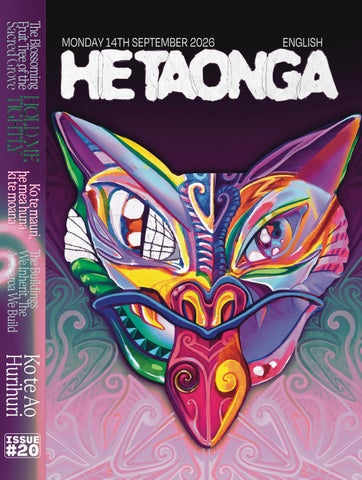
The Blossoming Fruit Tree of the
Sacred Grove
Ko te mauri, The Buildings he mea huna We Inherit, The ki te moana Aotearoa We Build
Ko te Ao Hurihuri
ISSUE
#20
ENGLISH MONDAY 14TH SEPTEMBER 2026
Tēnā koutou katoa, Nau mai ki te mātauranga māori mō tauira ki Massey University. He mihi atu ki a koe i runga i ngā āhuatanga o te wā, He mihi ki a Massive whānau mō tō aroha, He mihi ki a ringatoi mō tō mahi ātaahua toi, He mihi ki a kaituhi mō tō mahi waiwaiā tuhituhinga. Tenei te mihi ki a koutou mō tō tautoko. Tihei, mauri ora! Ko Kamaia BainbridgeFrost toku ingoa.
The necessity of an issue dedicated to the celebration of Te Ao Māori rings a tuneful significance in Aotearoa 2026. What a privilege to be the maestro of the mātauranga orchestra presented in this magazine, ‘He Taonga’. Being wahine Māori means understanding who I am in gentle conjunction with those who came before me, and those to come. As a product of the continuation of whakapapa, wahine toa nevertheless, I carry more than myself throughout all my mahi. With this issue specifically, there are intricate echoes of pain and pride. My Māoritanga has been threatened, ā wairua, ā tinana, throughout the navigation of my life. A sentiment I imagine I do not navigate independently. Nonetheless, I sit in the peaceful gratitude of knowing my Māoritanga is etched into the walls of my existence. No bill, micro-aggression, or tokenisation could invalidate the security I have in being Māori.
8
9
Ko te Ao HuriHuri
15
16
We know the power lies with the collective. Merge and mobilise. Ka ora tonu mātou, Āke! āke! āke!
EDITORIAL
Hold Me Tightly
GUEST EDITOR KAMAIA BAINBRIDGE-FROST
10
Ko te mauri, he mea huna ki te moana
UMNS TĪWAE
COL
Sexcapades
17
11 18
2 5
12
Contributors
3
FEATURES The Blossoming Fruit Tree of the Sacred Seed
6
The Buildings We Inherit, The Aotearoa We Build
13
Rep Rants: Jahmyn Murray
4
AHUATANGA
7
14
Maramataka
19
CENTREFOLD
Massive is largely funded by Te Tira Ahu Pae and the student services levy, however, remains editorially independent.
NZ Media Council: Those with a complaint towards the publication should first complain in writing to: editor@massivemagazine.org.nz
Disclaimer: The views presented within this publication do not necessarily represent the views of the editor.
If unsatisfied with the response, complaints should be made to the NZ Media Council: info@mediacouncil.org.nz
ILLUSTRATOR ILLUSTRATOR MĀTAGEIRINGER GEIRINGER MĀTA
CENTREFOLD
NGĀ MIHI NUI RUBY BARR GRACE BYRNE KISHARN HAUPAPA DUNN TAMATI PUHIPI PAPARUA PEARSE-OTENE MORIARTY PAIGE MEREANA WILSON MICAH GEIRINGER TARA GRIZ AISHA SKINNER REREAO TAITE HARIATA ENNLYE PEARSE-OTENE MORIARTY 3
He Taonga
Kia ora, my name’s Jahmyn, and I’m from Ōpōtiki on the East Coast.
O
ne thing that’s really moved me over the last year or so is seeing how many tangata whenua are actually here in tertiary education, and then having the opportunity to meet all of you individually. I truly believe that this country’s future is in each and every single one of your hands—from our business students up in Oteha, to our art students in Kōkiri Ngātahi, and everyone in between. And that’s what makes me proud to be Māori. Before I came to uni, our people were already across the jobs sector, stepping into roles that weren’t initially meant for us, but doing it with absolutely zero hesitation whilst representing our whakapapa before. From our brothers and sisters in the army and the trades, building and protecting this country, to our future leaders of Aotearoa in governance, and to our whānau protecting the land we were raised on.
We have been pushed back continuously as a people, but the spirit of our people has never faded. It makes me proud to know that regardless of how the media or governing parties view our whānau, there’s nothing that’s stopping us. All I ask is that whatever your degree is, whatever your path is, you do it to your utmost best ability, and keep the values your whakapapa passed away protecting. They’re watching over you right now.
So stop reading this magazine, open your laptop, finish your assignment, and do it for those who came before us.
WORDS AND PHOTOS BY KAMAIA BAINBRIDGE-FROST • SHE/HER • NGĀ PUHI, WAIKATO TAINUI, FASITO’OUTA
The Blossoming Fruit Tree of the Born from a time of necessity, Aotearoa’s longest-run independent Māori theatre company, Te Rākau Hua o Te Wao Tapu Trust, has had a residence at Massey University for the past 15 years.
W
orking at the intersection of hauora and toi, Te Rākau’s work represents the experiences of underserved and marginalised communities. They’ve worked with rangatahi and people with lived experiences, to bring this real-life knowledge into theatre and to communities. For professor of Creative Communication, Elspeth Tilley, supporting this mahi was essential. In 2014, Tilley attended a wānanga at Hariata Rangikauia, Tapu-te-Ranga, held by pou in the creative Māori space—Jim Moriarty, Hone Kouka and Rangimoana Taylor. It was here where Tilley learnt many creative kaupapa Māori collectives had no place to gather. The significance of a single sentence Moriarty shared on that day still remains with Tilley. “[He] actually used the word homelessness. The homelessness of Māori theatre in this country,” she recalls.
Massive Magazine
5
As the kaupapa concluded with a wērō— everyone in the room was challenged to address the ongoing impact of colonisation. Part of this challenge was to question the colonial structures of the funding systems neglecting Māori.
As part of their theatre marae model, Te Rākau concludes each show with a kōrero to reflect and ensure audiences leave feeling safe and mauri tau. Here, hāpori can share their response to the mahi whakaari they recieved.
Recognising the significance of the mahi produced by Te Rākau, Tilley received the wērō with certainty: “I went away and thought, I have to do something ... I knew it [their work] was a taonga.”
On Te Rākau’s Instagram, comments and responses shared by audiences after watching a show speaks to the significance of their work:
“Doing all that work in prisons, with rangatahi, working on addiction, with understudied topics like incest. The courage to bring that, but also the necessity.” She says the impact Te Rākau’s work has created community and brought visibility to underrepresented issues. “[Te Rākau has] Incredible processes of working in ways that care, that build community, that heal people, that address those difficult topics.” Moriarty, the kaitohu (director) and kaihuawaere (facilitator) of Te Rākau says that the partnership with Massey has provided the company with access. He explains that many institutions allow their spaces to sit idle whilst creative kaupapa Māori collectives have no place to gather. “Certain institution sit idle after hours or sometimes in the weekends ... Dr. Paul Spoonley and Elspeth really helped provide us access as a community theatre company,” he says. Despite acknowledging that the university’s namesake—William Massey—was a coloniser, Moriarty’s perspective remains grounded in looking to the future. “That was then, this is now. It’s what happens next that matters.” Te Rākau has occupied many spaces across Massey’s Wellington campus for more than a decade. But the impact is felt across Aotearoa.
6
“Proud to be Māori and proud to be fighting against the system in different shapes and form.” “Many cannot forget their past. Something such as this is not only inspiration, but the start of a healing journey.” “Important and incredible social justice messaging that is relevant. Mīharo te rongo te reo kia tika te reo kia rere te reo kia Māori.” “Fucken awesome and sad and tragic and true.” “There is hope when people [te rākau] are brave like you.” “When you’re from a challenged socioeconomic demographic like Papakura, you’ve either lived these stories, seen them, or you know them very well. The room filled with sound that felt like a transmutation of pain into healing.” Te Rākau has recently concluded their 2026 tour of the play Waenga on August 5th. This play acknowledges the experiences of a rangatahi Māori in police custody and the complexities of the justice system. Over two months, their adaptation of Waenga was shared across Aotearoa in collaboration with Hurō Productions— established by siblings Tamati and Hariata Moriarty in response to the current coalition government. Tamati, kaimahi of Te Rākau and producer of Hurō Productions, says the production company adapted much of their tikanga from their experiences within Te Rākau.
Massive Magazine
“We wanted to create something where we could express our creativity in multiple different mediums,” he says. Te Rākau’s relationship with Massey extended to Hurō Productions. Since their establishment, Hurō Productions has developed and presented their play Waenga in Massey spaces. He feels the significance of having a consistent space to create in. “Having a space, that is so foundational to your craft ... The gestation of your ideas happens in those spaces, you know?” He says. “You feel the mauri of all the other shows that you’ve created in there when you come back to use it. I think it adds to your belonging.” Massey has hosted work by Te Rākau, Hurō Productions, Taki Rua, and Shot Bro. The collective mauri of these kaupapa, of the hāpori that hold these pūrākau, dances within the walls of Massey. “The most important thing is the collective. Made by Māori for the emancipation of Māori” Tamati says. In a climate that continues to perpetuate the oppression of Māori—socially and politically—the significance of supporting indigenous artistic expression is pivotal. Utilise your privilege and encourage community as a form of resistance. There is a hāpori of indigenous creativity in Te Whanganui-a-tara: Shifting Centre, Open Jamz, Te Rākau, Taki Rua, Hurō Productions, Pū te Hue Productions, to name a few. There is always opportunity to support indigenous expression. Kia kaha, kia māia, kia manawanui e te whānau.
Fund the arts, invest in Māori.
WORDS BY RUBY BARR • SHE/HER • NGĀ PUHI, TAINUI ART BY MĀTA GEIRINGER • SHE/HER • NGĀTI KAHUNGUNU KI TE WAIROA “What percent are you?” was a question that used to make my next breath sharp and painful.
A
part from olive skin and a family tree the size of three encyclopaedia books stacked on top of each other, I never felt Māori enough to claim my whakapapa. My whānau had never openly expressed our whakapapa Māori—except from early memories of my pāpā ticking both NZ/ European and Māori on my school forms. I didn’t grow up on our marae or join the kapa haka groups at school. I didn’t even know my own iwi until I was 13. But even then, I was too afraid to tell other Māori, just in case I mispronounced them. But the Christmas of my final year of high school changed the path I was on with my Māoritanga for the rest of my adult life. For me, the most exciting part of Kirihimete is finally having my whānau under one roof after several years of broken communication.
8
My grandparents have ten mokopuna, so gift-giving has always been a financial stretch for them. This meant that the older cousins always knew to expect a prewritten Woolies card with a twenty-dollar note that slips out as soon as you open it. But instead of dairy money, my grandparents sheepishly passed around an envelope concealing a printed A4 letter and a small kete with closed drawstrings. I opened the letter first, standing next to my kaihana, and after only three sentences, our eyes were mirrored with welling tears. “This Christmas we decided to give you something incredibly special—a gift of pounamu. Giving each of you pounamu is a symbol of honour, respect, love, and permanence and ties you to Aotearoa New Zealand, your whanau, and your heritage as Tangata Whenua forever. This is a Taonga, a prized possession. It has cultural significance as it is blessed by a tribal elder and therefore you can wear it to school, to work, wherever and with pride.”
Massive Magazine
Each taonga was chosen individually to represent our personalities and qualities. Mine, the Pikorua or twist, represents unbreakable bonds through friendship, loyalty, and unity. Blessed by Catholic Tainui kaumātua, Tipa Compain, to link us all to our iwi and their faith. Even though most of their tamariki and mokopuna have moved away from the church, it is important to acknowledge how their faith— particularly for my grandmother—has instilled the values of rich love and acceptance that override judgment. They adore their takatāpui mokopuna—me included—and I choose to believe their faith in love has helped them to understand it. As my eyes continue to devour every word, the fifth paragraph reveals the significance beyond cultural representation. “We will soon move on.” I’m already the family’s token public displayer of waterworks, so my highly emotional reaction came as no surprise. The letter continues: “and the world will be yours, but when you feel lost or in need you will only need to grip these precious gifts in your hand and remember us, and you will know that old Poppa and Squeezy are right there with you, around you, in the palm of your hand and protecting you as you squeeze your pounamu tight in those times.”
Massive Magazine
It was not a simple Christmas card with a prewritten note—it was a reminder of our connection to each other. A reminder that, if kept safe, our taonga keeps us together regardless of time’s unforgiving trajectory of hemonga and grief. “Never ever give up hope, always care for others and go gently in this precious world remembering Poppa and Squeezy.” My whānau—like all—is far from perfect. From family members who don’t speak to each other, to the loss of cultural practices. But this letter and our pounamu represent our whakapapa and shared blood that hold greater significance. “Life was never meant to be easy, but it has good times and tough times and the Wairua—The Spirit will guide you through even in your darkest days.” Even though my brother’s pale skin still compels my grandmother to tell him that he’s “full pākeha” and I’ve given up on correcting their pronunciation of Taupō, we are Māori. Despite the reo from our tongues being lost, our whakapapa is never going to disappear. It is simply waiting for us to rediscover it.
Kei te taha ō tōku tupuna kuia a Wetekia Karioi te maunga Whaingaroa te moana Whareiaia te tangata Tainui te waka Tainui te iwi Tainui te hapū Tainui Āwhiro ngunguru te pō ngunguru te ao Ko Ruby toku ingoa
9
Ko te mauri, he mea huna ki te moana WORDS BY GRACE BYRNE • SHE/HER • NGĀTI POROU ART BY TARA GRIZ • SHE/HER • NGĀI TAHU
Ha ki roto,
Let it be your own breath that lifts you up from beneath the waves, and it is their prowess that point you towards the shore.
Ha ki waho.
Jaggedly beautiful, the greying rocks of the shore quietly hum with a quiet force.
He toka tu moana, he akinga na nga tai.
Worn and whipped by the tide, a symbol of the tough fabric of te taiao.
Like a rock standing in the sea, buffeted by the tides.
Along the shore, ngā rakau stretch out their limbs, both through their They bite, they bury, they throw mother and father. themselves beneath you. Mauri flows through their roots, their Breath shallow, hope shallower, tinana, up into the sky where they cradle your ankles long swallowed by the rain. the cold. Their leaves have whispered your name Sinking into mauri noho. before it was given. The call of a father, a mother, a sister, a friend. Ha ki roto,
Ha ki waho.
How sweet it is to share their breath, to hold hands with their soul, to know them utterly without even opening your eyes. It is he mauri, the essence of life, which weaves an invisible bond between it all. Let the tide roll back in.
10
Massive Magazine
Do not succumb to the tide, do not fight it for its mercy. Stand tall like the rock, Ask questions like the trees, Speak softly like your father. And learn to rise with the tide in harmony, uplifting yourself with mauri tau. The same mauri that flows from above, from below, through the air, Is within you. So, when you lose sight of your hands in front of you, Reach out to te ao around you. Let the tide roll back in.
Ha ki roto,
Ha ki waho.
Tuwhitia te hopo.
Massive Magazine
11
We Build WORDS BY MICAH GEIRINGER • HE/HIM • NGĀTI KAHUNGUNU KI TE WAIROA
O
ne hundred years ago, the Massey Agricultural College Act 1926 was passed. This began the construction of what would eventually become Te Kunenga ki Pūrehuroa—Massey University. Walking through the Manawatū campus today, it’s easy to see the age of this institution. The Sir Geoffrey Peren Building, with its almost regal presence, certainly lends the idea some credibility. Further along the concourse, however, one is confronted with a very different design. Brutalist slabs of concrete that envelop the Science towers seem almost alien in comparison.
Massey University, much like its architecture, is a product of conflicting ideas. Across the campus are competing visions of the society New Zealand sought to build: from the internationalist origins embodied by Colombo Hall to the concrete towers constructed by the Ministry of Works.
12
Massive Magazine
Inherit, Though, it would be wrong to say these contrasting ideas began in 1926. The college was not built upon empty land. The area surrounding modern Manawatū and Massey’s campus contained several Rangitāne settlements, including Te Motua, Te Kuripaka, Te Aokautere, and Mokomoko. Turitea itself was a small pā within this wider landscape, overlooking the Manawatū River. The land where Massey was eventually established was acquired as part of the Te Ahu a Tūranga purchase. Sold to the Crown on July 23, 1864, the block covered approximately 250,000 acres, for which Rangitāne received only £12,000. It was not until 2015 that this injustice was formally addressed through a Treaty settlement. Shortly after the land was sold, European settlers began arriving. The settlement of Palmerston North was laid out in a large clearing known as Papaioea—a name some may find familiar today. The landscape, once organised around Rangitāne communities and relationships with the whenua, was progressively transformed into surveyed property, farms, and a European town.
The Māori history of the whenua was obscured. Massey Agricultural College continued this process of erasure throughout the 20th century. During the 1960s and 1970s, the Ministry of Works reshaped the campus again. The Science towers, Social Science buildings, Vet Tower, library, and administration buildings were all products of this period.
The architecture represented a modern, forward-facing New Zealand while often having little connection to the places in which it was built. Massey’s concrete campus could, in many respects, have existed almost anywhere.
That is something contemporary Aotearoa has substantially diminished— and something we desperately need if we are to address not only the material inequality faced by Māori, but the growing problems confronting society as a whole.
A university built in pursuit of the modern future, where, by design, the past was ignored.
The history of our campus, the roots of its whakapapa, and the ideologies that shaped its architecture all stare us in the face whenever we set foot upon it. Every aspect of a building, from its design to its construction and purpose, is ultimately a political choice.
For Māori, this placelessness matters. In seeking to create a uniform national future, architecture overlooked the deeply local relationships between people, history, and whenua.
As I walk through the campus and along University Avenue, I am confronted with the latest addition to Massey’s competing architectural visions: Ngā Huia.
Yet there was also something powerful in the vision these buildings embodied. The belief that collective institutions, backed by a capable state, could materially reshape society. The Ministry of Works was not simply constructing buildings, it was constructing the physical foundations of a modern Aotearoa. Today, however, there is a liberal temptation to treat recognition as a substitute for that kind of material change. Acknowledging whakapapa, restoring Māori names, and changing the symbolism of our institutions can all matter. But recognition alone cannot resolve material inequality. It cannot build houses, create employment, repair infrastructure, or reverse ecological decline. In a time of record unemployment, ecological collapse, and deteriorating infrastructure, perhaps we ought to look differently at the brutalist buildings of our campus. Whatever their failures of place and history, they are monuments to collective labour and to a different conception of society: one in which the state had the capacity to organise expertise, employment, and construction on a national scale.
Massive Magazine
Like the buildings that came before it, Ngā Huia is itself a vision of what the future of Aotearoa might look like. Though it was built by private contractors rather than the state, it demonstrates what can be achieved when architecture responds to place, history, and the people who inhabit it. It shows what our built environment can look like when designed to resource the next generation in collaboration with mana whenua. Perhaps this is the lesson Massey’s architecture leaves with us: the buildings we create are never simply buildings. They are physical expressions of the society we wish to build, the history we wish to remember, and the people we wish to empower.
If the next hundred years are to be as transformative as the last, we should not only think about what we want our buildings to look like, but about what kind of Aotearoa we want them to embody.
13
Ko te Ao Hurihuri Te Rākau Hua O Te Wao Tapu—The blossoming Fruit Tree of the sacred grove is where I first witnessed the potential of ngā mahi a Rēhia. Within this realm, I have been nurtured by my parents and inspired by the legacies of the many gone before me. The thing that has stuck with me is the understanding that creative potential is endless, and flows when our instrument is tuned to its presence. When one is in the flow state, Wairua from the past, present, and future is able to manifest itself.
He uri whakaheke nō Ngāti Toa Rangatira, Ngāti Kahungunu ki te Wairoa, Ngāti Koata, Ngāti Ruanui, me Ngā Puhi Hokianga ki Te Raki. I descend from Italian, German, Scottish, Irish, American and English heritage. Ko Tamati Moriarty tōku Ingoa. Tēnā koutou katoa.
14
Massive Magazine
WORDS BY TAMATI PUHIPI PAPARUA PEARSE-OTENE MORIATY• HE/HIM/IA NGĀTI TOA RANGATIRA, NGĀTI KAHUNGU KI TE WAIROA, NGĀTI KOATA, NGĀTI RUANUI, ME NGĀ PUHI HOKIANGA KI TE RAKI
ART BY PAIGE MEREANA WILSON • SHE/HER TE RARAWA, NGĀTI HINE, NGĀ PUHI
Ko Te Ao Hurihuri
I began at age 7.
Te Pō is a familiar place,
Reciting scripted lines,
Kai is script, dialogue, and pūrākau.
Learning characters, Drama conventions. One green room to the next, Cheaper than a babysitter. Growing older alongside my curiosity, Fascination developing, Like conception within Te Kore. Fueled by telling our stories, Our collective histories, Our shared mamae,
Sacred and nurturing. Etching into my bones, Every line I deliver, Weaving with my Mauri, Every song I sing. Journeying through Te Wheiao, Keeping me on tip-toes, Performing in Te Ao Mārama, Held in Wairua,
Our worldview.
Past, Present, and Future.
I’ve felt these stories before,
Tihei Mauri Ora.
I may not have written them, But I remember, E rongo ana tōku ngākau.
Massive Magazine
15
sexcap 16
Massive Magazine
ART BY MĀTA GEIRINGER • SHE/HER • NGĀTI KAHUNGUNU KI TE WAIROA
pades I had the hots for this girls from dance. Since moving to Wellington, I had fallen in love with dancing again. And boy oh boy could this girl move. I’ll tell you, those hips didn’t lie and I kept thinking, doesn’t it take two to tango? I would sit in class during groups and be mesmerised by her body. The way it moved with the music. I was shamelessly trying to move my body up in her.
One day, she came to class with a koru design on her buzzed head. That was it, my breaking point. I decided then and there, I was going to freak this girl. Not only was she hot, even better, she was Māori. Miiāāāooo.
My plot to get head from the girl with a koru design on her head began. While dramatically hoping we weren’t whanaunga, I started my puppeteering. I was slowly getting closer to my Māori Parris Gobel. I began edging my way closer to her in class, even fraternising beforehand. We became very close friends... homoerotic one could say. One day, we were having a sleepover under the usual guise of friendship. She was curled up behind me, I could feel her breath on the back of my neck. Our hands were intertwined, rolling around one another.
Frustrated and aroused, I rolled over. Our faces met, centimeters away from each other. I was looking at her eyes, then her lips, she was looking at mine. Tango time. She leaned in and kissed me. A feral switch flicked in me and my primal instincts took over. I pulled my shirt off. She unclipped my bra. A frenzy of clothes and accessories went flying around my room. Honorary mention for the 40 seconds it took her to take off her rings (typical). In record time, we were naked. She began passionately sucking on my neck. Our bodies pressed against each other. TANGO. TIME. She was urgently kissing down my body. I shivered as she got lower and lower. When I was pretty much begging for it, she started to eat me out. Now, having only previously being eaten out by men, I can now confidently say women do it better. I was shaking and gripping on for dear life. As I got louder and closer, louder and closer, I had to muffle my cries of pleasure with my childhood teddy, Mr. Cuddles. I looked down at the koru designs looking back at me and knew I had won. I finished with a window shaking scream as her eyes were fixed up at me. She laughed and wiped her mouth with a smirk.
“I still got it!” She said.
Massive Magazine
17
WORDS BY AISHA SKINNER • SHE/HER • NGĀTI RAUKAWA KI TE TONGA, NGĀTI MANIAPOTO,
TAINUI
ART BY MĀTA GEIRINGER • SHE/HER • NGĀTI KAHUNGUNU KI TE WAIROA
• Toitoi (Eeling) • Hī ika (Fishing) • Mahi māra (Gardening)
• Hī ika (Fishing) • Mahi māra (Gardening)
Make time to explore te taiao or near water. This is also a good time to connect with others, and to learn and share karakia or your pepeha.
• Hī ika (Fishing) • Mahi māra (Gardening)
18
Good time to plant out seedlings and all areas of planting; seek kai knowledge to sustain whānau. Be active, keep learning.
Massive Magazine
Communication and creativity is flowing. Try something new. A day to appreciate life. Spend time with whānau.
• Mahi māra (Gardening)
Time to be cautious - the unpredictable can happen. Avoid hui at this time. Stay close to whānau. Take notice.
• Toitoi (Eeling) • Hī ika (Fishing) • Mahi māra (Gardening)
• Toitoi (Eeling) • Hī ika (Fishing) • Mahi māra (Gardening)
Tamatea phase as above. A time to be cautious, avoid hui and offer your support to whānau or those who need your tautoko.
Tamatea phase as above. A time to be cautious, avoid hui and offer your support to whānau or those who need your tautoko.
• Mahi māra (Gardening)
Massive Magazine
Be cautious. Unpredictable time. A good time for taking notice, keep learning and giving back.
19
centre
efold