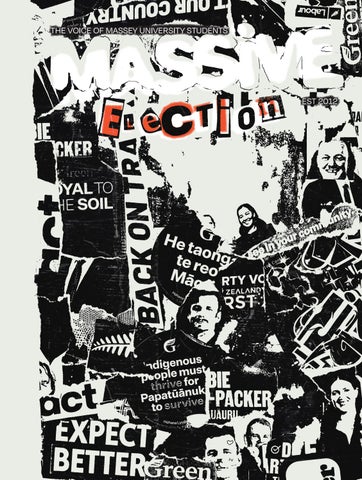
THE VOICE OF MASSEY UNIVERSITY STUDENTS
EST 2012
Election
Stop telling students to wait
I
’ve spent the last month speaking to politicians from almost every major party (except National, because they ignored me), and while they’re happy to remain firmly on their respective sides of the political divide, they do have one thing in common. They keep telling students to wait. Wait, and things will get better. Well, students have been waiting. We waited after the first nationwide School Strike 4 Climate in 2019. We waited through the protests that followed. We waited when politicians promised to tackle the mental health crisis affecting young New Zealanders. We waited while they promised to bring down the cost of living. And now we’re being told to wait some more.
The problem with waiting is that eventually, we stop being students. The issues we were warned about become the reality we have to live with.
If the Government doesn’t find new ways to cut emissions within the next year or two, meeting our climate targets will become increasingly difficult.
Take climate change. The Climate Commission has warned that Aotearoa is at risk of missing all its climate targets. According to its latest annual report, while our climate pollution had gradually declined, progress stalled in 2024. The pace of emissions reductions now needs to roughly double if we’re going to get back on track.
Youth mental health isn’t exactly a success story either. Despite years of political promises to improve it, reports from UNICEF, the Mental Health and Wellbeing Commission and Youthline show psychological distress among young people is rising, not falling.
Agricultural emissions pricing has been scrapped, while new policies and industry incentives aren’t doing enough to bring methane emissions down.
Aotearoa continues to record one of the highest youth suicide rates among 15 to 19-year-olds in the OECD, while access to mental health support remains a major problem.
In other words, we are running out of time.
And don’t even get me started on the cost of living.
Rep Rants - Peyton Joe
NEWS KAWEPŪRONGO
4
Massey Proposes Overhaul of Senior Leadership as Staff Raise Concerns
AHUATANGA
10
7
11
Labour - Chris Hipkins
12
13
Green Pary - Tamatha Paul
14
Massey Students Disappointed by Drop in Student Voter Numbers
5
Students Find Disability Allowance “Unnecessarily” Difficult to Access Uni Entrance Rises —But Not by Much
8
15
6
Auckland Students Unhappy About Golden Chicken Wing’s New Home
FEATURES NZ First - Winston Peters Te Pāti Māori - Debbie Ngarewa -Packer
9
16
Massive is largely funded by Te Tira Ahu Pae and the student services levy, however, remains editorially independent.
NZ Media Council: Those with a complaint towards the publication should first complain in writing to: editor@massivemagazine.org.nz
Disclaimer: The views presented within this publication do not necessarily represent the views of the editor.
If unsatisfied with the response, complaints should be made to the NZ Media Council: info@mediacouncil.org.nz
Yes, the Government can point to improvements in some parts of the economy. But that doesn’t mean much when students are still struggling to afford the basics. Food prices rose 2.5 percent in the year to June, while rents remain painfully high.
And what have we got?
For students already trying to balance rent, groceries, transport, fees and the occasional luxury of having a social life, that adds up quickly.
Maybe politicians should stop looking at where they disagree and start looking at where they agree.
A survey by Victoria University of Wellington’s student association found that 33 percent of 1,238 students surveyed had skipped meals because they couldn’t afford to eat. None of these things are a future problems. They are happening now. Students have waited. We have listened to the promises, sat through the speeches and watched governments come and go.
17 National - ‘Christopher Luxon’
Mother Massive
24 31
ACT Party - Laura Mcclure
18 25
Sexcapades
32
More warnings. More targets pushed out of reach. More young people struggling to access help. More students choosing between eating and paying rent.
They all say they want future generations to thrive? Well, we are the future generation. And we aren’t thriving. We’re surviving. So stop telling us to wait.
19 What Your Favourite Political Meme Says About You
26 33
CENTREFOLD
27
Who’s Cooking? Ranking the Parties’ IG Roasts
HOROSCOPES
34
28 35
The Opportunity Party - Qiulae Wong
22 29
PUZZLES
36
23TĪWAE
COLUMNS
30
Gig Guide with Radio Control
PANGA
37
Election
S
ix months into my Co-Tumuaki role and I’m back on the Rep Rants to catch up and hopefully generate some excitement around the current Massey Council Student Elections! The last 6 months have been super busy — celebrating the official launch of Ngā Haumi ki te Ao, connecting with tauira at Wednesday Kai & Kōrero across our physical campuses, and travelling to Papaioea, Taranaki and Pōneke for Noho Marae. As if everything we’re already doing wasn’t enough — we’re taking Māori student representation at Massey to the next level! This year, Ngā Haumi ki te Ao will be co-hosting the Annual National Tertiary Māori Student Conference, Te Huinga Tauira, alongside Tītahi ki Tua (AUT) and Te Mana Ākonga.
It’s a chance to celebrate being Māori, connect with tauira Māori, and share kaupapa with tauira from 8 universities around the country! A final reminder for this on-brand Election issue of Massive: the Massey Council Student Representative role is currently out for voting!!!
Voting closes 5pm, Friday 28 August 2026. If you’re interested, search your emails for ‘Massey University Council Student Member Election’ for your link to vote!
MASSIVE MAGAZINE
MONDAY AUGUST 17TH
Massey Students Disappointed by Drop in Student Voter Numbers Ellice Lawrie • SHE/HER
W
ith recent statistics showing that the number of university students enrolling to vote is continuing to plummet, some Massey University students find this lack of engagement from young voters disappointing. According to statistics released by the Electoral Commission on July 31st, youth enrolment figures are looking grim with only 53.9 percent of 18 to 24-year-olds enrolled to vote. This is a large drop from the 2023 rate of 60 percent. For Massey student Ruby Green, these recent statistics were frustrating news. “It really doesn’t take much time to enrol and do your research to vote, but it’s so important that we do,” she said. In a poll by Massive on Instagram, it found that 94 percent of Massey students were enrolled to vote, five percent were planning to enrol soon, while two percent were not.
Massey student Lucia* said that students who aren’t planning to vote showed a lack of care.
For your vote to count this election, you must be enrolled by midnight on the 25th of October.
“Political fatigue is definitely a real thing, but nobody should be completely unaware of their current happenings until it personally affects them,” she said.
Historically, late enrollers are disproportionately young voters.
“It’s especially important to care about local communities and each other in these trying times.” This low enrolment rate is particularly concerning due to the recent changes that came from the Electoral Amendment Act 2025. Previously, people could enrol and vote on the same day. According to a report by The Spinoff, during the 2023 election, 450,0000 people enrolled and voted during the 12-day voting period. This year, anyone who enrols after this 12-day period starts will not be able to cast a vote.
Massive Magazine
In a statement to Massive, a Te Tira Ahu Pae spokesperson said they encouraged students to enrol to vote by organising the Electoral Commission to host on-campus pop-ups. “The pop-ups during O-Week and Re-O Week have been successful, providing students with a convenient opportunity to enrol, update their details, and speak directly with Electoral Commission staff.” Te Tira Ahu Pae encouraged students to keep an eye on the Te Tira Ahu Pae social channels to be informed about upcoming events and opportunities. *Name changed for anonymity
5
ISSUE #18
ELECTION
Auckland Students Unhappy About Golden Chicken Wing’s New Home Maya Trotman • SHE/HER
M
assey University’s Auckland campus is expecting to reunite with its iconic golden chicken wing statue next year, but students are unhappy about its new location.
Originally, the statue was located between the Quadrangle A and B buildings. In February, it is now expected to be placed between the student centre and the residential accommodation.
Last August, the golden chicken wing—also known as ‘The Golden Promise’—was taken off campus for some much-needed TLC after the paint began to peel and crack.
Construction Management student, Negin Karimi, didn’t agree with this new location because she doesn’t spend time on that part of campus.
The refurbishment was initially estimated to take two months to complete. But it has now been over a year, leaving students worried if they’d ever see the wing fly back to campus.
“I’d like to see it every day. But I won’t with the new location because I don’t go there,” she said.
Ngāti Whātua o Kaipara, before choosing the new location. “We are currently planning some landscape enhancements to showcase the sculpture and improve the usability of the area for social activities.”
Another student also told Massive they disagreed with the new location.
Luckily, a Massey spokesperson confirmed that it is finally heading home in February 2027.
“Not a lot of students go there. I don’t even know where it is.”
But students were upset about the wing’s new location on campus.
A Massey spokesperson said that they considered the artwork’s popularity with students and consulted with the artist,
Photo: Stuff
Massey Proposes Overhaul of Senior Leadership as Staff Raise Concerns Jessie Davidson • SHE/HER
M
assey University is proposing a major shake-up of its senior leadership structure, with five existing positions set to be disestablished and eight new executive roles created. The changes came as Massey prepared to launch its new 2026–2030 strategy later this month. The university begun a two-week consultation with staff on the proposed restructure. Massey said the new model would better align senior leadership
6
with the university’s future priorities and strengthen collaboration across Massey. Currently, Massey’s senior leadership structure includes the Vice-Chancellor (VC), Deputy Vice-Chancellors (DVCs) and Pro Vice-Chancellors (PVCs). The VC sits at the top, while DVCs oversee major universitywide areas and PVCs provide academic leadership across the university’s colleges.
Massive Magazine
Under the proposal, parts of this structure would be reorganised into an eight-member executive leadership team. Five existing senior positions would be disestablished, while some responsibilities and positions would be moved. However, Massey stressed that no decisions have been made about individual employees.
NEWS
KAWEPŪRONGO
If the proposed structure is confirmed, staff whose positions are affected would have the opportunity to apply for the newly established roles through recruitment processes.
“Universities are not corporations that also happen to teach. Their public value depends on independent scholarship, robust academic governance, and the protection of academic freedom,” he said.
“It is appalling that the Vice-Chancellor appears more focussed on reshuffling senior management than investing in the staff that teach, research, and keep the University running.”
Vice-chancellor professor Pierre Venter said the restructure was intended to ensure Massey was “set up to deliver well” against its new strategy.
TEU are also concerned about a proposed deputy vice-chancellor research and enterprise role. This role wouldn’t require the person appointed to hold a doctoral qualification or have an established academic research profile.
For students, the proposed changes are primarily about who sits at the top of the university and how responsibilities are divided between senior leaders.
However, the proposal has already drawn criticism from the Tertiary Education Union (TEU), who represents university, polytechnic and wānanga staff. TEU said the restructure would reduce academic representation within senior leadership while creating an additional layer of academic management. The union also criticised the proposed creation of roles including a chief of staff and chief people and culture officer. They argued the changes risked making Massey’s leadership more corporate. Associate professor Sean Phelan, TEU Massey University branch academic representative, said the proposal “weakens academic voice at the VC’s table”.
The union’s criticism comes as Massey staff negotiate a new collective agreement with the university. TEU Massey co-branch president, Te Awatea Ward, said staff were already dealing with increased workloads following previous staffing cuts, as well as the rising cost of living. “Our workloads have increased enormously due to previous staffing cuts, and the cost of living is hurting us all.” Ward criticised Massey for focusing on restructuring senior management while staff continue to negotiate pay and job security.
The restructure could change who is responsible for major areas of Massey and how decisions are made at a senior level. However, what the new structure will ultimately look like will not be known until the consultation process is complete and final decisions are made. Massey has said the proposal will not affect the continuity of teaching, research or services to students. The consultation is open for two weeks, after which Massey will consider staff feedback before deciding whether to proceed with the proposed structure.
Students Find Disability Allowance “Unnecessarily” Difficult to Access Josie Maddox • SHE/HER
C
oeliac students are struggling to afford gluten-free groceries after facing difficulties receiving financial support. With rising costs of produce and living, this has hit those with coeliac disease twice as hard. According to Coeliac New Zealand, glutenfree goods cost nearly three times more than regular ones, with products such as bread costing up to five times more.
Work and Income’s disability allowance offers financial support to individuals facing chronic illnesses and disabilities. However, many don’t know about its existence or how to access it.
Second year Massey student Beth wasn’t aware of the support available from WINZ, only applying for assistance when she desperately needed it. But even then, the process was frustrating.
The allowance for coeliac disease offers up to $82.85 a week, intended to cover extra costs of gluten-free alternatives and doctors appointments.
“It got to a point where I couldn’t afford my groceries. I finally applied second semester of my first year,” she said.
To get the allowance, students must already receive a benefit from WINZ or StudyLink.
Massive Magazine
“The whole thing was super complicated and contradicting, it didn’t make sense.”
7
ISSUE #18
ELECTION
She said the application appeared to be aimed towards those with physical disabilities, and she didn’t see where she fit.
After attempting to confirm her circumstances numerous times, she was unsuccessful.
“The phone call was like 30 seconds, they fixed it straight away. It was all so complicated for the simplest resolution.”
The application process was also “long and difficult”, where the applicant must complete a gluten free versus ‘normal’ shop and keep hold of receipts.
“I had to do it repeatedly. [I] called work and income every few hours and the wait times would be like 80 minutes,” Beth said.
Beth described both the WINZ and StudyLink websites “intentionally difficult to use”.
Beth had been receiving the payment for almost a year when WINZ sent her a letter asking her to confirm she was still eligible. If she didn’t reconfirm, her payments would stop of August 4th.
“[The website] had completely crashed. Everyone was suddenly aware of this cut off.” Beth eventually reached out to StudyLink over the phone.
“It just feels impossible to get anything you need, like they don’t want to help you. It shouldn’t be this difficult for anyone to get support.” The Ministry of Social Development was approached for comment but did not provide a response in time for print.
University Entrance Rises —But Not by Much Milly Matthews • SHE/HER
A
report from the Ministry of Education has revealed that the highest number of high school students have achieved University Entrance (UE) since 2020. However, this number still sits below 50 percent.
you jump straight into level two, it can feel like just being thrown into the deep end.”
Last year 42.8 percent of high school students attained UE, a two percent increase from last year.
“Since we didn’t have level one, year 11 was kind of like a breeze. And then you go into level two, and everything’s like, go, go, go.”
Highschool students Enesh Suresh (Year 12) and Rakshan Suresh (Year 13) attend Wellington’s Newlands College and hope to study at university after high school.
Despite these challenges, both brothers remained excited about university.
However, some changes have made this more difficult, such as the switch to making NCEA level one optional in 2024. This is a change Newlands College opted to do. “At first, it was quite ridiculous because the amount of stuff you were expected to learn in level two. It’s quite stressful to think about,” Enesh said. “That was our year to trial-and-error different stuff like studying techniques, how we cope in exams, what it’s like. Whereas if
8
Like his brother, Rakshan said that not experiencing level one made NCEA feel more daunting.
“There’s a lot of different career options now. Like, I got surprised when one of the speakers from Massey [University] came and said she has a PhD in ice cream. She works with food companies like Fonterra to make like the products more appealing to their customers,” Enesh said. The biggest factor determining whether a student gained UE was their school’s Schooling Equity Index. Currently, only 13 percent of students from schools deemed most in need of socioeconomic support attain the qualification.
Massive Magazine
A Massey University spokesperson said that the university is taking steps to ensure that students from low economic backgrounds have pathways to university. “Massey University services over 350 secondary schools across the motu and runs targeted outreach programmes in the community, including schools in low socio‑economic areas. “This month, for Open Days, we are providing buses and travel subsidies to support students who would benefit from attending but may not have the financial means to travel. Massey also has dedicated staff who engage with Māori and Pacific students and their whānau.” Whilst Massey did not have a position on whether NCEA level one should be compulsory, the spokesperson said: “We support approaches that ensure learners develop strong foundations in literacy, numeracy and learning skills, while maintaining flexibility for diverse educational pathways.”
WORDS BY ELLICE
R
LAWRIE • SHE/HE
ART BY BRIANNA
R
GRAPES • SHE/HE
ART BY BRIANNA GRAPES • SHE/HER
O
ne day before Winston Peters made racist comments towards Green MP Lawrence Xu-Nan, I met with him in his office. I’d spent the week prior with friends, family and other politicians sending me thoughts and prayers for this interview. So, it was safe to say I was nervous. But, in an outcome I never expected, I walked into the Beehive at 4:30pm and left four hours later with a stomach full of burger and Sauvignon Blanc—courtesy of the man himself. I wish I had gotten photographic evidence of this, but Peters insisted that he has, and never will, take a selfie with anyone. Too scared to annoy the person who shouted me about three-to-four glasses of wine, I let that pipe dream die. So, imagine my shock the next day when my editor found numerous photos of Peters posing for selfies on Google Images.
After this, I began to wonder what other fun facts he may have lied about. • Is he actually on an all-venison, no sugar diet? • Has he actually denied the offer of receiving a knighthood twice? • Has he actually never been in an issue of Woman’s Weekly? [Editor’s note: After a brief Google search, we discovered he was in an issue in 2017).
Of course, we did actually talk about politics. I listened to him as he swept climate change under the rug, made numerous transphobic comments, and explained what he thought was the most pressing issues for students in Aotearoa. 9
Election
Peters believes the biggest issue students are facing is the cost of living. He recognises the costs of transport, rentals, and other fundamental needs as a struggle for students. To tackle this, NZ First wants to establish a KiwiSaver generation and break up power gentailers. However, despite being in a coalition with the Labour Party when first year fees free was introduced, he believes it was the right decision to remove the policy. He says that the people who were receiving fees free were “not broke” and therefore did not need it.
He dismisses the criticism of how the current wording of the bill means women under 20 wouldn’t have access to some medical procedures, such as abortion. He says “what a struggle” it must have been for people to find this.
“I know what poverty smells like ... when you’re down to your last sixpence,” he says.
However, he didn’t clarify whether women would in fact not be able to access these procedures.
He believes that students were taking advantage of the policy, as they were going to university without a clear idea of what they wanted to do. In his view, a better use of this money would be to invest it into trades.
Throughout our conversation, one word kept resurfacing: “woke”. For Peters, it underpins everything from gender policy to the way he believes politics is changing.
The Green Party’s idea about making tertiary education completely free makes no sense to Peters.
But how does he actually define wokeness?
“Unfortunately, when Adam ate the apple that Eve gave him, we got kicked out of Heaven and we have had to work ever since.” Historically, NZ First has not been a popular party among students. Even more so this year with NZ First’s introduction of the Definitions of Woman and Man Bill. This proposed legislation would legally define a woman as an “adult human biological female” and a man as an “adult human biological male”. This attack on our trans whānau has rightfully caused concerned among Kiwis. But Peters backs the bill wholeheartedly.
10
“What we are not going to allow to happen is these beta blocks, and all these things that happen to young children who have not made up their mind … When they get a certain age, they have been horrified of what happened to them.”
He explains that being ‘woke’ is someone who has just read a certain book, watched a certain movie, or has had a certain experience and now they think they know more than you. They believe no one has the right to offend or disagree with them, even if they are in the wrong. “Someone who has never had a bad day experiences in business.” Alongside the growing ‘wokeness’ in our country, Peters says there is also a growing number of young NZ First voters. To convince more students to vote NZ First, he has this message for them: “If you’re not a socialist by the time you’re 80 you haven’t got a heart, and if you’re not a conservative by the time you’re 30 you haven’t got a brain.”
Massive Magazine
If elected, NZ First plans to invest $1 billion into identifying and extracting natural fuel resources in New Zealand. Peters is not concerned about the environmental impacts of this policy, saying that “mining is critical for the future”. He doesn’t understand why everyone is anti-oil despite it being the product that “is the only difference between first world and fourth world”. Through his policy, Peters believes New Zealand will be back at the top of the first world. Focussing on cutting down carbon emissions is a waste of time for Peters. He argues that even if Aotearoa went carbon zero, the other countries would still be causing climate change. “China has been opening a coal factory every week for the last year ... meanwhile they’re making a fortune selling you solar power.” But even if these countries started divesting from fossil fuels, he still wouldn’t do the same here. “Fossil fuels are providing so many critical products for humanity, and medical products for humanity. To deny them that is to see people living shorter lives, and more miserable lives.” According to Mongabay, 2025 saw 200 climate related disasters which impacted 87.8 million people. So, while fossil fuels may generate money for healthcare, it also is the reason people will be requiring it. In practice, NZ First’s future proofing policy will generate money for the economy and create jobs. However, it will have detrimental environmental impacts.
NZ First released a policy where every New Zealander has a KiwiSaver account with $1000 in it from the day they are born. Peters believes this will ease our cost-ofliving crisis, create a country of savers and change people’s psychology when it comes to saving money. Interestingly, the National Party came out with a very similar policy, only their one saw $1500 being put into KiwiSaver. Peters was dismissive of this, saying: “You don’t need to make it $1500, $1000 was enough, but they had to make it so there was a difference.”. Unless you’re a newborn baby, this doesn’t really help current students facing the cost-of-living crisis.
Peters recognises that the cost of power is a challenge for students. To ease this pressure, he’s going to break up the power genetailers—similar to how he’s going to break up the supermarket duopoly. Referencing a 1998 law which stated that if power pricing got out of hand it could be regulated, Peters believes that the government has failed to do this. He asks, “Why aren’t you doing your job and why shouldn’t I fire you?” This policy hopefully results in cheaper power for Kiwis.
With the cost of food being a struggle for many students, Peters wants stricter rules surrounding Aotearoa’s supermarket duopoly. He also thinks a fiercer Commerce Commission will help this problem. In his eyes, past governments have been “absolutely useless” on this matter. This policy would control the supermarket duopoly, a system that he says is ripping Kiwis off at the checkout. This would mean cheaper groceries for students.
With the latest Roy Morgan New Zealand polls, it signalled that NZ First is receiving the lowest level of support it’s had so far this year at 8.5 percent. However, that’s still enough to keep some seats in Parliament, which means Winston Peters won’t be taken down yet (unless he gets fired for making more racist comments). 11
U Election R • NGĀTI PORO BYRNE • SHE/HE E AC GR BY S RD WO
T
his election, a number of the Labour Party’s policies directly affect students. So, you could say Chris Hipkins is unofficially positioning himself as the man for students.
ART BY BRIANNA
R
GRAPES • SHE/HE
Like nearly every other politician Massive spoke to, Hipkins says that the cost-of-living is a number one issue impacting students today. “The cost of living—the cost of surviving in the case of students—it’s not so much living, it’s just surviving I think ... really does feel like it’s at a new level now.” With every new policy that Labour is announcing, Hipkins says they consider if it will make the cost-of-living crisis better or worse. But with a well-paying job, easy access to healthcare, and a place to call home, Hipkins believes this gives anyone “the building blocks of a good life”.
Whether that’s true remains to be seen. But Labours policies would hopefully put these building blocks into place.
If elected, starting in July next year, Labour will cap weekly public transport fares at $20 in Auckland, Wellington and Christchurch. Everywhere else in Aotearoa would be capped at $10. Hipkins says that this is a policy that students will benefit from “disproportionately to the rest of the population”. “Students are disproportionately large users of public transport ... So potentially [there will be] quite significant savings on a weekly basis for students who are using public transport.” He explains that the fare cap is a “pretty straightforward” and affordable policy to implement. It would be funded by redirecting less than one percent of the National Land Transport Fund towards public transport. This fund is paid through petrol taxes and road user charges, and currently funds roads and public transport. Hipkins says the change would not add extra costs to the Government because it would come from money already set aside for transport.
12
Labour
With more Kiwis jumping the ditch to Aussie, Hipkins wants to create an incentive for them to stay here. Labour’s proposed ‘Future Fund’ would invest in Kiwi businesses to help them continue. Hipkins says they plan to invest seed funding of one-to-two hundred million into the Future Fund. Currently, Hipkins says that entrepreneurs are leaving Aotearoa when they want to scale up their business. But he wants them to scale up here, and Labour will help them do that. “We want to use any profits that they generated for reinvestment, either back into those businesses, or into other businesses that can help to create good jobs and grow the economy.”
While not a policy, Hipkins confirms that Labour finds the proposed Legislation (Definitions of Woman and Man) Amendment Bill “divisive, ugly politics”. NZ First introduced this legislation earlier this year. This bill proposes to define a woman as “an adult human biological female” and a man as “an adult human biological male”. If passed, the Bill could undermine safe and equitable healthcare for transgender, non-binary, and intersex people, and impact their wellbeing. Hipkins says that this proposed legislation is “designed to distract people from the mess that the government are making of the economy”.
Labour has promised to introduce a Medicard system, which would give all Kiwis three free GP visits a year. For the past two decades, Kiwis have largely been paying a set fee for healthcare, but Labour is proposing a shift to an independent-pricing model. Here, a national rate would determine GP funding based on evidence and patient needs. If that rate increases because of rising patient needs, Health NZ would be required to fund the increase. Hipkins says, “Lack of access to healthcare disproportionately affects people on lower incomes, which of course students fall into that category.” However, New Zealand is already facing a significant shortage of doctors, and that is only expected to get worse. Labour hasn’t addressed how they’d ease this shortage, which raises questions about how the policy would even work if there weren’t enough GPs to provide additional visits.
“It’s designed to target the trans community. And I just think it’s ugly and awful,” he says. “The whole Labour team is opposed to it. We don’t need that debate. It’s ugly, it’s awful. And we’re rigorously opposing it.” Similarly, Labour also opposed banning puberty blockers “on the basis that politicians shouldn’t make decisions about that”. He believes it’s a medical decision which should involve a medical professional, the individual involved, and in the case of age, their parents. “We think that it should be treated as a medical decision ... We don’t think politicians should interfere in that.”
Massive Magazine
What Hipkins believes lacks in our current government is that they don’t give students “a second thought”. “I don’t think that tertiary education is something that they value other than from a purely utilitarian economic viewpoint ... and I think that is just so totally short-sighted.” “I just don’t think that they really care.” But Hipkins claims that he does care and says that we should keep an ear out for further student-aimed policies to be announced. We weren’t told when these policies would be released, but that students will find them “very attractive”.
13
DI • THEY/THEM
WORDS BY LEE JU
J
ust two days before Massive sat down with Tamatha Paul (Ngāti Awa, Waikato Tainui), she was boogying through Circa Theatre in a line of drag queens, singing: “She a bad mana wahine!” A campaign launch that perfectly aligns with her political approach. Far from the identities that have taken up the seats of parliament for decades now, Paul continues to push policy that supports students and young people’s wants. With the election coming up this year, fees-free study looks shiny for young voters across the nation. So, what is Paul bringing to students? Alongside the Greens policy where students would be bussing to kura for free, Paul also shows unwavering support for the cultural core of young communities—art and music.
14
EY
RTLETT • SHE/TH
ART BY OLIVE BA
Massive Magazine
For ten years, Wellington didn’t have a mediumsized music venue. You can either go to a local gig at San Fran or a large-scale concert at TSB Arena. Artists would hit a ceiling and move to Melbourne, and Kiwis would get tired of events that lacked variety. That is, until Paul helped open Meow Nui—a perfect medium-sized venue. Since opening, Meow Nui has supported local bands reaching new heights and brought international artists to Aotearoa. Paul says, “Wellington likes to call itself the arts and culture capital of New Zealand, and we say it all the time. We need to grind to retain that s tatus. We can’t just rest on our laurels and think that we’ll always have that reputation.” Paul has brought tangible change to the arts scene even through the hardship Wellington has faced. Last year was Jim Beam Homegrown’s final host in the city, moving its tunes to Hamilton. Although this might seem like a loss, Paul reframes the move. She says, “This is a commercial, alcohol-sponsored, male-heavy line-up. And I think that we can do better... We have to actively protect our venues. We need the government to be investing in our own artists. Not fucking Robbie Williams.” Two years after the opening of Meow Nui, Tamatha continues to put her money where her mouth is in supporting NZ artists. You’ll find her singing along to Mokotron’s Ko Wai Koe? at her fundraiser gig this weekend, alongside the city’s finest—Bad Taste and Nam Chucks. Of course, it’s not just music. Tamatha also has love for real local swag. Sitting in front of the sewing machine and trying to craft her own drip has informed her perspective on the fashion sector and expression. She says, “I know that a lot of people are watching my style but what I’m trying to say to them is, stop fucking thinking you have to jump on every trend. This is exactly why I love Wellington. I think it really teaches people to be themselves.” This is real grassroots’ politics, and they’re glistening green all the way to the top. Paul speaks with passion to the ways in which she will make Te Whanganui-a-Tara a better place.
“Our city deserves a representative who doesn’t just show up in their branded t-shirts and take photos. They deserve someone who’s in it. Someone who meets them where they’re at. Someone who gives them the best set list, makes them dance, makes them happy, and makes them forget about their worries.” It takes one peek to find a plethora of support for students from the Greens. The Greens propose to not only introduce entirely fees-free study for students entering university, they also propose to write off any existing student debt to date. This would mean university would be totally free. The Greens also want to increase the minimum wage to a livable wage. Currently, living wage is $28.95 per hour whilst minimum wage is $23.95 per hour. How is our absolute bare minimum wage not livable? A question the Greens want to resolve. Of course, somebody has to pay for all this, and unless you’re cruising yachts and riding ponies everyday, it won’t be you. Even if you do have a collection of convertibles, it won’t actually make much of a dent on your billions—just a 2.5% tax to be precise. New Zealanders are often convinced this life is impossible because the tax scheme isn’t incredibly common. But Paul says that other parties are the ones convincing Kiwis it’s not possible. “They’re rich. They’re well-funded parties with a strong hold on the media.” For example, Steven Joyce, the former National Party cabinet minister, owns over 100,000 shares of NZME. If the Greens’ policies don’t sound plausible to you, think about who’s telling you that. Is it the Greens’? Or is it the parties who are opposing them? Paul works for policies that are informed by her own position, and she encourages students to vote from theirs.
She says, “Just vote! Vote for who you believe in. Vote for who you feel reflected by.”
Massive Magazine
15
WORDS BY RUBY
BARR • SHE/HER
INUI
• NGĀ PUHI, TA
ART BY BRIANNA
R
GRAPES • SHE/HE
J
e Pāti Māori co-leader Debbie Ngarewa-Packer understands the extensive barriers to tertiary education—especially those faced by ākonga Māori.
Ngarewa-Packer has an extensive history with Aotearoa’s education system. Growing up with teacher parents—her mum a principal and her father a head of faculty Māori—education has always been a top priority in her whānau. But after falling hapū (pregnant) at 19, tertiary education became a necessity. She was chosen by her whānau to be a “leaver of poverty”. She remembers being told: “You will be educated, and you will use that to come back and better your whānau.” “It was the way that I was trying to get ahead. To get the income that I needed to be able to—not only as a single mum but then with my tāne—raise a whānau.” As a wāhine Māori who has faced a range of challenges during her time in tertiary education, Ngarewa-Packer says she has a “real empathy for what it takes to get across the line”. Her studies did not always align with the demands of her cultural commitments, making tertiary education feel inflexible. Balancing study with whānau, economic, cultural and kaitiaki commitments was “tough”, she says. “I think getting into tertiary learning is one thing, but being able to sustain it for the years required to finish what it is, even wanting to qualify in, is hard.”
It is this experience, she says, that directly informs Te Pāti Māori’s 16 education policies.
As more students graduate with significant student debt, Ngarewa-Packer believes the current system is damaging Aotearoa’s graduates. “[Student loans are] delaying being able to afford safe homes, buying homes, to rent, to start their businesses, to return to serve their communities, because of debt.” Te Pāti Māori wants to write off student debt through a universal student allowance, aiming to remove financial barriers and address student poverty. The policy would remove means-testing based on parental or partner income and expand financial support to all students in tertiary education. “We believe that students should receive income regardless of what their parents’ income or family circumstances are, and this current system assumes that all whānau can provide support.” Ngarewa-Packer says the universal student allowance would “ensure that every citizen has equitable access to study and support services”. She says Māori face disproportionate barriers to tertiary education, from low levels of student income to the high cost of tuition.
According to a Facebook post made by Te Pāti Māori in February, some of the party’s student-focused policies— funded through its proposed fair tax system—include: • Writing off the student loan for those who work in Aotearoa for five years after graduation. • Immediately writing off the living cost component of all student loan debt. • Restoring full allowance eligibility for postgraduate, part-time, and long-course students. Around 42 percent of university income in New Zealand comes from government tuition and research funding. But despite extra funding announced in Budget 2026, the Tertiary Education Commission expects to cover only around 99 percent of forecast tertiary enrolments in 2027. Some
For Ngarewa-Packer, investing in education also means investing in teachers. Although Te Pāti Māori does not have clear policies outlining specific financial targets for teachers, Ngarewa-Packer says competitive pay is essential to retaining them. “We’re never going to retain them [teachers]—including graduates—if we can’t competitively provide them with the income. That degree of study and knowledge deserves.” But for the co-leader, supporting teachers goes beyond pay. “In order to be a good teacher, you need to be valued.” In her eyes, this means “valuing income, valuing wairua, valuing mental health, and valuing what it is they need physically”.
universities are already dealing with unfunded domestic students and have warned that funding pressures could continue next year. Ngarewa-Packer says these pressures could create further barriers for ākonga Māori, who already face challenges accessing and completing tertiary education. “What you’re doing is creating a nation where we’ve got unskilled workers. They are the first laid off. They are the first to endure work insecurity.” “When we’ve got universities capping enrolments or reducing courses or institutions that are narrowing down, it actually has a huge impact on Māori communities.” She believes these barriers, created under the current Government, will continue to make it harder for the next generation, as well as young and mature students today, to access education.
Over the last year, many ākonga Māori have expressed their mamae with Te Pāti Māori, questioning whether the party reflects their values amid continued negative press. Ngarewa-Packer understands that conflict within the party has created a disconnect with some voters. “My job and my role isn’t to demand trust. It’s to earn it.” “Conflict doesn’t define you, it doesn’t cancel you out. It doesn’t make you any less trustworthy. But it does mean that you have to hear and feel when your people are upset.” She says the most important thing Te Pāti Māori can do to rebuild trust in the community
Massive Magazine
According to the Taxpayers’ Union, writing off the living-cost component of all outstanding student loan debt is estimated to cost the Crown approximately $4 billion. The organisation also estimates the universal student allowance would cost the Government a further $770–790 million per year. However, Ngarewa-Packer says the party sees education as a long-term investment. “We [Te Pāti Māori] believe in investing in our people, and that delivers the greater, longer-term economics and social returns for Aotearoa.” In the latest Budget, Māori only received 0.24 percent. Ngarewa-Packer describes this as a serious underinvestment in Māori which is creating major barriers to education and support pathways. “The evidence consistently shows that when Māori succeed, it has a multiplier effect and the benefits flow across the motu.”
is continue fighting for policies that improve the lives of ākonga. “Affordable education, decent housing, and active mental health support, and acknowledging all climate kaupapa.” For those who feel disconnect from the pāti, Ngarewa-Packer encourages them to ask questions and have conversations directly with the party. In return, Te Pāti Māori will continue to listen and show up for the hapori whānui.
For Ngarewa-Packer, the question facing students across the motu: “Can we forward another generation of graduates that are delaying or not staying in Aotearoa?”
17
WORDS BY JESSIE
HER
DAVIDSON • SHE/
J
he ACT Party has caused plenty of controversy during its time in government. From wanting to legally redefine the principles of the Treaty of Waitangi, to dismantling race-based initiatives and bringing Paul Henry on board as an MP, it’s safe to say they aren’t the most popular party among students. But Laura McClure—ACT’s spokesperson for small business, education, seniors, and mental health—says this isn’t unusual. “I actually don’t care who people vote for as long as they really look at their policies and think about how is this party addressing the issues that they have.”
For current students, McClure believes that the cost-of-living crisis is the largest issue impacting them, “as well as everybody”. “We’re not very productive, we don’t have any new businesses opening, new industries appearing that would create new, higher paying jobs.” In her eyes, this has made it challenging for students to find work while studying and after graduating. “I think it would be really challenging being a student right now. Like finishing up a degree, spending an awful lot of money, having a huge student loan, all that and then not necessarily equating to a job.” Despite acknowledging students are carrying “huge student loans”, ACT has historically opposed the Fees Free policy which was scrapped earlier this year. McClure says that while ACT never supported it, she doesn’t support the way it was taken away. “It would have been good to see some sort of ... phase out. Because I think if you have started your education thinking you’re going to
18
Massive Magazine
get that last year free, then I feel like the government should have honoured that.” “I think when you commit to a policy, you should commit to a policy. Even if I disagree with it.” McClure believes New Zealand’s tertiary education is already heavily subsidised compared with other countries, but says more investment should happen earlier in the education system. “If you’ve made it to tertiary education, you’ve actually done really well. I know that’s really condescending and hard to say to students, but it is true.” “There are, like, so many people that are disadvantaged, that will just never make it even close to university because they’ll have dropped out of school well and truly before then.” Despite acknowledging the financial pressure facing students, McClure says ACT currently has no specific financial relief policies for students. Instead, they are focused on early childhood, primary and secondary education, hoping more students will eventually make it to university.
ACT also wants to remove the ability of universities to reserve scholarships, accommodation, study spaces and support on the basis of ethnicity through its proposed Education and Training (Equal Treatment) Amendment Bill. ACT’s position is that taxpayer-funded support should be based on individual need rather than race. Privately funded scholarships, however, could still be targeted according to a donor’s wishes. At Massey, there are more than $900,000 worth of Māori and Pasifika scholarships.
One policy that could directly affect every domestic university student is ACT’s proposal to make Student Services Fees (SSF) voluntary. Students currently pay a compulsory SSF of up to $1,253 a year on top of tuition. The money funds services including gyms, student unions, student media, clubs and advocacy. ACT wants universities to offer these services as a menu, allowing students to choose what they pay for. For students already watching every dollar, being able to opt out may sound appealing. For student organisations, however, losing guaranteed funding could mean a very different story.
With AI rapidly becoming part of university life, McClure sees both its benefits and risks—particularly in deepfakes. Earlier this year, she proposed a member’s bill that would expand the legal definition of an intimate visual recording to include images or videos manipulated by AI without consent—of which students are disproportionately affected by. “If you share a nude with someone and then they just shared it on, it is still very harmful... But deep fakes can just be shared on mass and uploaded to websites in different ways. You can’t escape it.” McClure says the long-term effects are particularly concerning. “The victims of this often have really withdrawn from society. They have pulled out of university, stopped going to school, and they are scared to open their phone.” Outside of deepfakes, however, McClure is firmly pro-AI.
On NZ First’s controversial Definitions of Woman and Man legislation, which would define a man and woman as an “adult human biological” man or woman, McClure says ACT only supports the bill progressing to select committee. “We don’t have a position on it long term. It was more that we just want to know more.” “It is really noisy on both sides ... I think those groups and the people deserve to be heard.” McClure says ACT is a libertarian party and believes people should be free to live as they choose. “We’re super liberal when it comes to choosing what you do in your own life. So, you can be whoever you want and we don’t believe people should ever be judged on that.” However, ACT does not support provisions in the bill that could prevent women under 20 from accessing some healthcare procedures, such as abortion. “There’s things like that we wouldn’t support going forward.”
“AI is actually really awesome. It can do heaps of things that we can’t do, and it can make us way more efficient.” She believes AI needs some regulation, but says there are “100 percent things that we should be embracing with AI”. When it comes to university, McClure thinks individual universities and courses should set their own AI guidelines rather than having blanket government regulation.
As the election closes in, McClure is excited for what is coming next. “I think overall, ACT has done really well. We had lots of our bills get through this term.”
19
Election HER DAVISON • SHE/ WORDS BY JESSIE
W
ith the major parties dominating New Zealand politics for decades, smaller parties can often feel like the political equivalent of shouting into the void. But Opportunity Party leader Qiulae Wong says the growing attention on smaller parties this election reflects growing frustration with the status quo— and a desire for something different.
Looking towards the future, Wong wishes she could promise Opportunity will make students’ lives better in the next few years. Instead, she points to the long-term and systemic challenges facing young people.
“They just don’t seem to have the solutions to our really big problems,” she says.
“We’re stuck between the old-fashioned economy and then a new way of doing things,” she says. “For students, this means an inability to afford an astronomical cost of living that is just getting worse without any prospect of good jobs and good wages to help manage that.”
Founded in 2016, the Opportunity Party has spent nearly a decade trying to break into Parliament. It first contested the 2017 election, receiving 2.4 percent of the party vote. But this year, the party appears closer than ever. A recent Taxpayers’ Union-Curia poll put Opportunity at 6.1 percent — above the five percent threshold needed to enter Parliament. Wong says this reflects frustration with bigger parties being “stuck in an old way of thinking” where they either prioritise economic growth or the environment — not both.
While Opportunity can’t promise immediate change, Wong says the party is committed to “a much more aspirational vision for New Zealand”. “I think if we’re clear on that direction, then I hope young people will see the opportunity to stay and help to build their future with us.”
But Opportunity believes it can do both. “I think people are really looking around for new ideas and a new approach to politics and new solutions that are going to be delivering a much more hopeful vision for our future.”
22
“I can only imagine being a student at the moment, that would feel really stressful.”
For Wong, that direction is a lower-emissions future that “puts the environment at the heart of our economy”. “We cannot deliver a prosperous economy if we don’t have thriving nature, if we don’t have healthy oceans, if we don’t have healthy soils, if we’re not lowering our emissions.” Opportunity argues that tackling climate change can also reduce costs for future generations. “If we continue relying on fossil fuels, that will continue to make things more expensive for people.”
Massive Magazine
Opportunity also wants greater investment in innovation and technology, arguing New Zealand is not investing enough in research, development and productivity. For Wong, this shows “we’re not putting our money where our mouth is”.
While Wong agrees that the way Fees Free was removed was unfair, she believes Opportunity’s proposed Citizen’s Income would provide students with greater financial support than a single year of free tuition.
“That vision and that future is very much about innovation, tech, the environment, and a country where we come together as people.”
The policy would give almost all adults aged 18 and over up to $370 a week, or $19,400 a year. It would replace most existing benefits, including the student allowance.
Opportunity’s Future Fit Education policy would also change the education system to better prepare young people for a changing workforce. The party proposes measures including more flexible learning, greater support for disabled students, teaching civics from Year Six and greater investment in teachers.
“I think that this is the support that would give young people the confidence to go and study. The reduction in their student loan balances because of that would make a massive difference to young people.”
Wong says the skills young people need are changing as AI, climate change and global instability reshape the workforce. “It’s about having a more long-term view about the kinds of skills that we need our young people to have.”
Opportunity also wants to make buying a first home easier through its proposed Land Value Tax. The policy would impose a 1.75 percent annual tax on land value, with the party arguing it would discourage land banking and large property portfolios while shifting the tax burden away from working people. The party estimates the policy could bring house prices down by 10 to 15 percent in the short term. Wong acknowledges prices would eventually rise again with inflation, “but there does need to be some correction in the market”. “If we want to support a growing population, we may have to make sure the housing supply is there.”
Wong believes the policy, alongside investment in innovation, could encourage young people to build their careers in New Zealand. “I hope these would be the industries that a lot of young people want to be working, because they’re exciting frontier industries.” She also believes greater financial security would give people more freedom to find meaningful work rather than taking the first job available.
Opportunity presents itself as an alternative to the traditional left-right divide and says it could work with either Labour or National in coalition. For Wong, the answer to what voters would be choosing is simple: “What they’re voting for is a more stable, consistent government going forward, regardless of whether it’s Labour or National.” She says Opportunity would hold National more accountable on the environment, while pushing Labour harder on investment, innovation and business policy. Massive Magazine
For Wong, the ultimate goal “is delivering more stability and unity back to politics”. “No matter who I talk to, whether it’s business leaders, teachers, doctors or engineers, everybody is really tired of this pendulum politics where we keep swinging from left to right and changing the way we do things every few years.” For Opportunity, the answer is a shake-up. “We need to try something new. Otherwise, we’ll keep spinning our wheels, keep feeling like nothing’s getting better and more people will head overseas. I think we do need a bit of a shakeup.”
23
WORDS BY JESSIE
W
HER
DAVIDSON • SHE/
ART BY
*SATIRE*
hile all other major political parties offered their leaders or MPs to chat to Massive, the National Party never responded to my five emails requesting an interview. I would have sent a sixth, but I started to feel a bit like a desperate ex. So, in the spirit of balanced reporting, I printed out a picture of Prime Minister Christopher Luxon’s face, taped it to a broomstick, and sat to face him. What followed was the most productive political interview I have ever conducted.
24
Massive Magazine
• SHE/HER & BRIANNA GRAPES
OLIVE BARTLETT
• SHE/THEY
Luxon visited Massive’s lessthan-pristine office to hear what the students of Massey University wanted to know. He says he’s thrilled to escape the Beehive, particularly after having to hold a second confidence vote in his leadership last week. “I’m glad to escape the bubble of Parliament. Getting out and actually speaking to real people to find out what’s going on—the good, the bad and the ugly.” With the state of cost-of-living, housing, and rising costs in tertiary education, ugly was the right word for the situation students are facing —a situation Luxon says he empathises with. “Let’s chunk it down,” he says. “If you don’t manage an economy, it has real consequences for real people.” Right. But with some students working 20-hour weeks on top of study, struggling to pay rent, put food on the table, and leaving university with a crippling student loan—how is National going to support students? Particularly after taking away the Fees Free scheme? “Fees Free didn’t achieve any of its deliverables. National is all about results-driven agendas that will fix the fundamentals,” he says. “What I’m saying very clearly to students is that we need to look at the deliverables.” “The cost of living. Housing. Education. Those are the big rocks. Those are the results we are going to deliver.” Luxon doesn’t elaborate on what exactly these “big rock” results are, or whether they will help students afford their next grocery shop. However, this Government can point to some improvements in the economy. New Zealand has emerged from recession, and GDP is growing again. But there is a fairly large gap between an improving economic graph and an improving student bank account.
For students, inflation does not magically disappear when the rate falls. Rent is still rent. Groceries are still groceries. And a student loan is still a student loan. But Luxon says this is just the reality of being a student and that “it’s time that students became adults” and to stop treating his government like they’re their parents. Except it’s a little difficult to be entirely independent when the Government controls the terms and conditions around student loans, accommodation and tertiary funding. But Luxon blames the previous government for students’ financial strain. “What I say to you is that it’s all about poor inheritance. A lot of Kiwis just don’t get that. They’re very negative, wet, whiny and inward-looking Kiwis.” That’s all well and good, but National has now been in government for nearly a full term. I’m not saying that New Zealand’s economic problems appeared overnight, or that one government can save them. But at some point, the Government has to own the house it is currently living in. Previously, Luxon has told struggling Kiwis to “go make a Marmite sandwich” and described himself as “wealthy and sorted”. Most students I know are not wealthy and sorted. They are more likely to be financially stressed and vaguely aware that their bank account is about to hit zero. But I realise I may be the first studentaged person Luxon has spoken to who isn’t his own children. Perhaps this explains the disconnect. Luxon, however, says keeping his distance from students, the public and the usual political bubble is deliberate. “I avoid sticking to the same agendas that past governments have. That includes surrounding myself with C-listers and tag-alongs,” he explains.
Massive Magazine
But I thought Luxon wanted to surround himself with real people? When I point this out, he simply says that students need to ground themselves in the “fundamentals” to fix our economy. He says something about key performance indicators. Then benchmarking. Then operationalising. I nod along as though I understand. I do not understand. What I do understand is that Luxon seems confident... despite having to be reassured by his party twice in the last three months that they’re still confident in him. He says that these meetings were part of a team building initiative, where once every three months, the National MPs come together for a game of ‘Compliment Tag’. The exercise consists of MPs playing tag in Luxon’s office for three hours. Every time they tag him, they have to compliment him. “It’s about ensuring National remains ambitious, results driven and focused on me,” he says.
Basically, the fundamentals are being fixed. The big rocks are being addressed. The agenda is being operationalised. Etcetera, etcetera. Remarkably, I leave the interview with few answers about whether students will actually be better off under another National-led government. I look at my Luxon broomstick, but the tape has lost its stickiness and instead of answers, I watch his face drift slowly to the ground. I’m met with silence. Perhaps that is the most honest answer I got all afternoon.
25
ST • SHE/HER BAINBRIDGE-FRO IA MA KA BY S RD WO SITO’OUTA ATO TAINUI, FA NGĀ PUHI, WAIK
T
at can be ul words th rf u lo o c re ry politician here a almost eve e b ri c s e d the used to If you ignore t. n e m rn e in our gov ians can nce, politic ra o n ig d n a laugh at. insolence r just fun to o . .. y n n fu e b al meme sometimes urite politic o v fa r u o y es But what do u? o y t say abou
D N A E D I S T U O “GO ” S G E L R I E H T SPREAD You have learnt to use humour as your greatest coping mechanism, specifically in inappropriate contexts. Despite being born out of unresolved trauma, your comedic timing is unmatched. As a kid, teachers called you disruptive after repeatedly catching you doing inappropriate gestures to your mates. Your TikTok comments continue to go viral from stupid references to beautifully toned reaction pictures.
26
You are Tangata Tiriti final boss and can often be found sporting a hi-vis and volunteering at any local protest. You are most likely an older sibling and are used to running the fale like the military. Despite being a woke warrior, you have some really out-of-pocket takes. Like, enjoying pineapple on pizza or being team Jacob in Twilight. On a night out, you’ll be found cracking jokes with the bar staff and successfully scoring free drinks. You’re the go-to funny friend who is always up for a side quest.
S I D N A B S U “MY H N, SO TALOFA” SAMOA
Massive Magazine
Features • Ahuatanga
R E T O O C S O G FLAMIN
You think that you’re better than everyone else just because you listen to ‘underground’ music (your dads) and develop film. But buddy, it’s time you got humbled. Mansplaining microplastics at any given opportunity and attributing your understanding of empathy to that one time you tried shrooms doesn’t make you God. It makes you arrogant. And taking abstract photos by day and watching black and
white movies by night doesn’t help you “gain perspective”, it’s just basic. Admittedly, you know all the best coffee spots and can be relied on to almost always have a cigarette behind your ear. Despite being mildly insufferable, you do know all the best coffee spots around town. You have developed a niche taste that most try and fail to achieve.
” R E M O O B “OK You peaked in high school. Being a super senior is your legacy and you’re unable to move on from your glory days. You reminisce on your Year 13 boyfriend and keep your old prefect uniform in your wardrobe “just in case” they need you to step back into the role. After every haircut—even if it’s just a trim—you post a reveal on your Facebook with the caption: “so I did a thing “. Despite your millenial behaviours, you are as cute as a button and have a passion for baking sweet treats.
With the humour of a 13-year-old boy, you think six-seven is the peak of comedy. You laugh at ‘your mum’ or fart jokes unironically and can often be found watching YouTube compilations of Vines. In high school, ‘deez nuts’ was the extent of your vocabulary and you were often interpreted as immature and inappropriate. But deep down, you’re unsuspectingly intelligent and can spit out seven random facts about hyper-specific topics.
E C A F E H T O T DILDO
L I A T Y N O P S ’ WAITRESS As a fan of the classics, people describe you as an “old soul”. In the weekends, you can be found at your local cafe, sipping on a long black, and scribbling something urgently into a notebook while muttering to yourself. You most likely study English or Communications, and have an extensivecollection of physical media. You try romanticise your life in hopes that one day you’ll meet your Mr. Darcy, Anthony Bridgerton, or someone adjacent. In your spare time, you roam art galleries or spend far too much money on second hand clothing.
Massive Magazine
27
Scrolling through National’s Instagram, I’m met with an abundance of poorly edited (and weirdly eerie) close-ups of Chris Hipkins’ face. Paired with these are just single words like “BREAKING” and “ABSOLUTELY”. What does this mean? It feels less like a political roast and more like an obsessed ex who hasn’t quite moved on. Still, it’s better than their AI reels, which frankly, freak me out. You know those AI conspiracy-podcast-style TikToks that have blown up over the last year or two? It’s those, but make it National. An American AI voice narrates over AI-generated clips of AI people watching opposition parties on ancient TVs in grotty living rooms. Two stars only because I started laughing at how bad—and yet somehow incredibly dramatic—these roasts were.
But surely this is a little contradictory? If National has fixed the economy, shouldn’t everyone be living in a nice house watching TV on a model made in this century? Instead, their AI Aotearoa looks like it’s one missed payment away from having the TV repossessed.
“Labour: Indoctrination” is plastered over a picture of zombie-like children using iPads. Then there’s “ACT: Education”, paired with a picture of David Seymour sitting among a group of children. Which, funnily enough, made it look less like he was visiting a classroom and more like he’d been assigned a seat in it.
Overall, National’s roasts felt less like a political takedown and more like I’d accidentally tuned into a Joe Rogan podcast.
28
Massive Magazine
WORDS BY JESSIE DAVIDSON • SHE/HER
While Labour also uses AI in a few of its roasts, I think they put more thought into what they’re actually putting out into the world. There is definitely a Gen Z on this team who is chronically online enough to know how to construct a solid meme to roast the coalition. My personal favourite is a reel captioned, “stick your tongue out if National lied about Labour policies today”, paired with a video of Luxon poking his tongue out. I like that. It made me giggle.
What makes Labour’s roasts work is that whoever is making them is obviously up with the times. They know what works. They know what gets likes. And they seem to understand that young voters don’t want a perfectly polished political ad. They want something they can send to their group chat with “HAHAHA” attached. It feels less like a political party trying to appeal to young people and more like a political party that actually knows how the internet works. Which, in 2026, should not be as impressive as it is.
Speaking of political parties that desperately need to get with the times, NZ First has managed to claw two stars out of me purely because I audibly laughed at how bad these roast posts were. Scrolling through, either screenshots of Winston Peters’ Facebook rants, where he takes two paragraphs to arrive at something resembling a roast, or, once in a blue moon, an attempt at a meme.
At least I know these can’t be AI, because the Photoshop job is actually dismal. Seriously, you guys reportedly get $2.45 million in donations each year and this is what you’re posting? Surely there’s enough in the budget for a Canva Pro subscription.
But the meme always includes an inspirational quote from Winston.
I guess I have to give them props for always finding a way to paint themselves in a good light—even when they’re supposedly roasting someone else. Honestly, the commitment to selfpromotion is almost admirable. But seriously, please hire someone with some social media competency. Someone who knows what a meme is. Someone who has opened TikTok. Someone who doesn’t think Facebook is the cutting edge of political communication.
LIKE THIS ONE
Massive Magazine
29
Scandal
Halsey Drive + Bobby Mouldy + Blossom - Reboot Show
01 Watercolour - Loose Ends
Fri, 21 Aug UFO
03 G.L.N.C - 74112
02 King Hit - post divorce clearance sale
04 Club Tremaine - Hoya 05 Emma Carter - funeral for the living
The Moving Air Ensemble Performs ‘220826’ Sat, 22 Aug Snails
06 Kokoa Nashi - Motherlode 07 Dillon Jo - Good Person 08 Greatsouth - It’s getting hotti 09 Te KuraHuia - Ms. Divine
(feat. Jordyn with a Why)
10 GRIFTHORSE - ## SHUDDER LAPSE ##
Hine Ka Mua Ka Muri EP Release Tour Sun, 23 Aug St Peter’s on Willis
30
Car Crash Emy - Skinniest Bitch
Art by Brianna Grapes SHE/HER
Hey mama! My girlfriend is going away for three weeks. How do I keep myself busy? Hey girl! Man, that’s tough. But it’s also the perfect opportunity to lock in and start a new hobby. Me personally, I’d recommend giving aerial silks a go. Whenever a partner of mine has gone away, I’ve always tried a hobby that would impress them by the time they get back. Aerial silks is a perfect example of this.
When your gf gets back, you can hang aerial silks from the ceiling in your house and show her your moves. You can flip, spin and hang upside down just like Spiderman. She will be so impressed and enamored that she’ll never want to leave your side again. Hope that helps! XOXO
Mother Massive
Massive Magazine
31
Election
I hooked up with this girl the other night. Everything was tracking nicely. I’d done the usual routine: invited her over, snuck her straight past the flatties (because I don’t need those muppets making eye contact with her), and got her into my room.
32
The plan was pretty simple, get her in, get in her. I didn’t think about the yapping before hand, but all good, at least it was until she asked who I was voting for in this year’s election. I told her I don’t really keep up with that kind of stuff. I know voting is important and all that, my mum lectured me about it and reckons I need to pull my head in and just go get it done but reading through the policies just sounds like a huge ceebs.
Massive Magazine
Columns • Tīwae
Sexcapade submissions provided by
For 20% off yo ur next purchase, enter discou nt So I told this girl exactly that and she got all serious and said, “Let’s just not talk about politics.” Sweet as. Problem solved so I leaned in for a kiss and got things moving again. For a while, anyway. Then, mid-hook-up, she s topped, looked me dead in the eyes and said, “Actually, I can’t sleep with someone who doesn’t understand why voting matters.” Next thing I know she’s pulling her jeans back on, giving me a lecture about civil responsibility, and gapped it.
So if there are any lads reading this who also couldn’t care less about politics, learn from my mistakes. Voting takes less effort than explaining to your mates why you got cockblocked by the electoral process.
Massive Magazine
33
For some reason, when the winter illness comes around to get you, you get the worst of it. Wash your hands thoroughly this week, in preparation for the winter virus.
Focus your energy on navigating messy situations with empathy rather than reverting to your defensive ways. Practice mindfulness and gratitude to help you with complicated feelings.
This week brings severe stress with workload and personal goals. However, you will be able to release your wildest self once the workweek is completed. Your friends have missed your messiness.
With Mars in your sign, your intuitive senses grow this week. But don’t let our feelings control your logical brain when making big decisions.
Prepare your bank account because this week brings some major giftgiving. Your love language shines this week as you watch your loved ones unwrap with six-inch grins.
At last! You will finally be hit with a rush of motivation to help you complete the tasks that you have been procrastinating on.
A saucy romance with a sexy face has their eye on your pretty face. It’s time to up your chapstick game in preparation for the kissy lips coming in your direction.
You have big goals for financial success, but unfortunately your lack of well-paying employment is stopping you. Maybe think about a career change—or just limiting your student loan.
Embrace the season of sincerity and knock down the walls you have up that keep you from getting closer to the people around you. Joking your way out of serious situations is unattractive.
Get prepared for the funniest week of your life. This week brings an abundance of laughing so hard you must take a break because your stomach begins to hurt.
Be mindful of the people around you who are having a worse time than you are. It might be a good time to reflect on how you are treating your friends in need during the winter blues.
You are killing it girl! The stars say that your career aspirations will come to fruition with your recent positive attitude.
Massive Magazine
35
EASY
HARD
36
Politics
Democracy
Opportunity
Election
NZ First
Te Pāti Māori
Minister
ACT
Luxon
Finance
Greens
Hipkins
Education
National
Ballot
Vote
Labour
Massive Magazine
Puzzles • Panga
4. Number of years between each election in NZ (5)
15. Official branding colour of the ACT party (6)
6. Form of government where leaders govern based on religion (9)
5. Animal that featured in NZ First’s 2023 election campaign video (5)
16. Surname of the NZ Prime Minister who led the country during WW1 (6)
7. Steven Joyce had a ______ thrown at his face (5) 9. Last week’s Massive theme (6)
8. Surname of party leader who like sausage rolls (7) 10. Kind of sandwich Luxon told unhappy parents to make for their kids (7) 11. Name of NZ Parliament’s executive wing building (7) 12. Winston Peters’ nickname (9) 14. Number of MPS named ‘Chris’ or ‘Christopher’ in NZ parliament (4)
1. The shortest time that a NZ Prime Minister has been in office is ___ days (5) 2. Name that Chlöe Swarbrick called Todd Muller in 2019 (6) 3. Name of Orange Guy’s dog (3) 4. Number of times votes are counted in NZ (5)
Massive Magazine
13. What does the first ‘M’ in MMP stand for? (5) 17. Number of months voting papers are kept after the election (3)
FIND PUZZLE ANSWERS ON www.massivemagazine.com
37
Cover by Eli Armstrong
a Geiringer
Centrefold by Māt
Massive Magazine