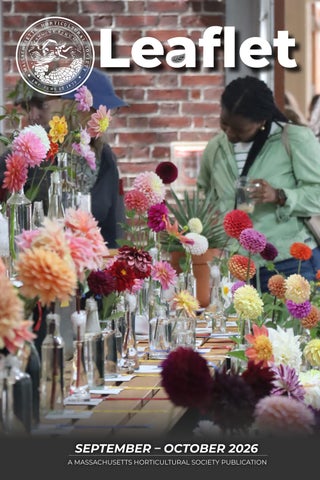
Leaflet
SEPTEMBER – OCTOBER 2026 A MASSACHUSETTS HORTICULTURAL SOCIETY PUBLICATION
TABLE OF CONTENTS
3 FROM THE DIRECTOR'S DESK KAREN DAUBMANN 4 UPCOMING MHS CLASSES 5 YOUTH PROGRAMS 5 GREEN PARTNER SPOTLIGHT 6 ECHINACEA, CONEFLOWER ILLUSTRATION BY MARIANNE ORLANDO 7 COLLOQUIA PLANTARUM: INTERVIEWS WITH PLANTS BY SHANNON GOHEEN 15 IN FIRST PERSON WITH CRAIG HALVORSON 21 FIVE REASONS TO JOIN US FOR THE FLOWER SHOW BY MEGHAN CONNOLLY 27 FROM THE STACKS BY MAUREEN O'BRIEN 30 PLANT & CREATE: NEW YOUTH EXHIBITOR WORKSHOPS 31 LOST TOOLS BY JOHN LEE
EDITOR-IN-CHIEF Dave Barnett mhsleaflet@gmail.com MANAGING EDITOR Meghan Connolly mconnolly@masshort.org
2 | September – October 2026
Front Cover: Giant hyssop (Agastache) and seed dahlia with bee in Weezie's Garden for Children pollinator beds. Back Cover: Pick your own sunflowers at Sunflower Spectacular, returning this August
From the DIRECTOR'S DESK
Jennifer Jones Director of Finance & Administration MHS Leaflet | 3
UPCOMING HUNNEWELL ESTATE TOURS Explore the horticultural history of the H. H. Hunnewell Estate with a 90-minute guided walking tour. All tours run from 10 am-11:30 am with a 9:45 am arrival at the Garden at Elm Bank. Available Dates: Wednesday September 30, 2026 Wednesday, October 7, 2026 Friday, October 9, 2026 Tuesday, October 13, 2026 Wednesday, October 14, 2026 Friday, October 16, 2026 Wednesday, October 21, 2026 HANDS-ON FLORAL DESIGN WORKSHOPS Discover the joy of floral arranging in this creative workshop series led by Lorraine Walsh and Mary Lou Ashur of Artistry Floral. All workshops run 10-11:30 am at the Garden at Elm Bank. Saturday, October 31, 2026 Saturday, November 14, 2026 Saturday December 5, 2026 Saturday February 27, 2027 Saturday March 23, 2027
CLASSES BOTANICAL ART & ILLUSTRATION Botanical Flat Lays: Arrange, Style, & Photograph Saturday, October 3 10 am - 11:30 am Introduction to Botany Through Drawing Thursdays: Oct. 8, 15, 22, 29; Nov. 5, 10:00am - 2pm Foundations of Botanical Drawing & Painting Wednesdays, October 14, 21, 28; November 4 9:30am - 1:30pm Drawing and Painting for the Petrified Saturdays, Nov. 14 & 21 9:30am - 1:30pm History of Botanical Art Tues. & Thurs., Nov. 17 & 19 10am - 12:30pm MORE CLASSES Introduction to Forest Bathing: Healing with Nature Wednesday, September 30 10am-12pm Dormant Pruning Workshop Saturday, November 14 10-11:30am OR 12-1:30pm
EXPLORE ALL UPCOMING CLASSES
4 | September – October 2026
YOUTH
PROGRAMS
Little Sprouts
Discover a seasonal theme through a 5-senses garden walk, story-time, a hands-on craft or activity, and a take home kit. October: Leaves Tuesday 10/27 at 10:30am & Thursday 10/29 at 3pm November: My First Winter Hike! Tuesday 11/10 at 10:30am & Thursday 11/12 at 3pm Register Now
Natural Play
Explore, create, and connect with nature in Weezie’s Garden. Let curiosity guide the way with self-guided, exploration-based activities such as fairy house building, nature crafts, and other seasonal outdoor discoveries. 10am Every Thursday from April–September Included with Admission
Green Partner Spotlight Shop at Green Partner businesses to receive 10% off with your MHS Membership card!
North Attleboro, MA
BROOKBOUND Westminster, MA
Rowley, MA
MHS Leaflet | 5
Marianne Orlando is a landscape architect turned freelance illustrator who loves plants, and does commissioned drawings of homes, pets and people. You can see samples of her work at www.marianneorlando.com.
6 | September – October 2026
The Spell of Ancient Herbals By Daphne Minner When asked to catalogue the prints in the Herbals of Five Centuries, I thought it would be easy—they had labels after all. However, I quickly fell under the spell of handling a tangible object that is 541 years old. MHS purchased its edition of the Herbals in 1958, which includes an annotated bibliography. This compilation of 50 plates was assembled by Claus Nissen in 1958. Three antiquarian booksellers pooled their stocks of incomplete herbals and selected the pages that were the most representative and attractive, to assemble 100 collections. Each collection of 50 plates is unique, though they all contain specimens from the 15th to the middle of the 19th centuries. In the MHS edition, there are pages from herbals printed between 1485-1858 on presses in Austria, Czech Republic, Denmark, Germany, Italy, Netherlands, Switzerland, and United Kingdom. There will be ten plates on display in the fall exhibit at MHS library. An herbal is a book containing descriptions of plants that can be used to treat human ailments. They describe the plant’s appearance, how it is to be prepared to treat certain conditions, and often information about similar plants to aid in identification. Some books also contain animal and mineral compounds that could be Carob Tree (Ceratonia siliqua) from Vollstandiges Krauter-Buch: Augsburg, Germany, 1783 (plate used as medicines. 25 in Herbals of Five Centuries.)
Knowledge of plants, and their potential for healing, has been shared orally among humans since we first evolved as a species. However, the oldest remaining written documents are from central India (3000 BCE.) These were recipes for drug preparations written on a Sumerian clay slab from Nagpur. The earliest extant European work dealing with medicinal plants is the famous five-volume De Materia Medica of Dioscorides (50-70 CE).
MHS Leaflet | 7
Knowledge of plants was brought to western Europe in the ninth century by Rhabanus Magnentius Maurus, a German writer who compiled an encyclopedia with information about plants. He derived his information from the writings of Theophrastus, Pliny, and Isidor of Seville. By about 330 BCE various Greek schools had been founded in Syria around the teachings of Aristotle. These teachings were then passed into Persia, Arabia, and other countries. The Arabs translated the Syrian versions of Greek writers into their own language. Arab physicians and philosophers kept alive the knowledge of science during the dark ages when Greece and Rome had ceased to be the centers of learning. The Arabic translations of classical writings were eventually rendered into Latin, or sometimes into Greek again, and found their way to western Europe.
Herbals were used as resources for all kinds of healers from ancient Egypt, China, India, and Europe. These early herbals were written manuscripts with limited circulation because they took a long time to produce manually. This changed with the invention of the printing press. The Gutenberg Press was invented by Johannes Gutenberg around 1440 in Mainz Germany. This press combined a screw-press, like those used in olive oil production, with individual movable metal letters that could be reused, and oilbased ink. While metalcast type was invented two centuries earlier in Korea, Gutenberg’s innovation allowed for a much faster rate of printing with more durable alloy letters. This press enabled the first widespread exchange of ideas in the western world. Religion was the initial content distributed via the Gutenberg Bible, with An illustration of a Flemish printer's shop, Impressio Librorum. Made in Antwerp, 1580- approximately 180 copies 1605 CE. (British Museum, London). produced. Herbals were
8 | September – October 2026
close behind, beginning in the 1480’s, when information on the uses of plants for curing human ailments was printed.
To make the MHS edition of the Herbals more accessible, I was asked to create an inventory of the individual pages (i.e., plates,) including the name of the plants depicted. This seemingly simple task quickly became a challenge since I could not actually read what was written on the page. I recognized it as text, but the letters were formed differently, and the words were not English. All I wanted was the name of the plant depicted on page! To ascertain this, an intellectual detective mission ensued. I first had to identify the typeface that was used so I could do a letter-by-letter transcription. Over the 500-year time period covered in the collection, there were four different typefaces Gothic Rotunda typeface used that required transcription before I moved to translation. But before I could do the transcription, I had to find what I thought was the name of the plant in the text. Often there were not titles, captions, or labels as we would expect today. I had to look for clues like Latin names or word repetition—assuming that might be the name of the plant being referenced.
My knowledge of botany came in handy here. Since these were European texts with Mediterranean plant families, I knew the part of the world in which the flora grew, and I had a woodblock picture of the plant. It was from these shards of information that I was able to identify most of the plants depicted on the 50 plates (i.e., pages) of the Herbals. I used Google translate to go from the original language—mostly German— into English. Once that was done, I wanted to know more. After all, it isn’t everyday you get to read what someone from 2,000 years ago said about a plant. This is when I relied on AI to translate the large blocks of text. I manually worked through transcribing the two oldest plates and manually translated each word from German into English. So, I had a basis to judge the accuracy of the AI translation. Once I verified that the AI translation was very similar to what I did manually, I translated all the plates in the collection.
MHS Leaflet | 9
To see what the plates say, you will have to come visit the exhibit in the hall outside the library. We will have ten plates with their transcriptions on display. There are two plates from each century printed in Czech Republic, Germany, and Switzerland. Also included in the exhibit is a brief history of printing, an overview of the role plants in medicine over human history, information on how the art in these plates were produced, and you can see how much the most basic unit of language—letters—has changed over the past 600 years in typeface alphabet examples. △ Aloe plant (Aloe vera) from New Kreuterbuch: Basle, Switzerland, 1543 (plate 18 in Herbals of Five Centuries).
▷ Yellow monkshood (Aconitum anthora) from Sammtliche Giftgewachse Deutschlands: Berlin: Germany, 1831 (plate 48 in Herbals of Five Centuries).
Daphne Minner is a retired science education researcher and current owner of Growing Garden Habitats, educating the public about our native New England flora. She volunteers at the MHS library on special projects.
10 | September – October 2026
Saving Summer
Overwintering Annuals & Tropical Plants By C.L. Fornari
MHS Leaflet | 11
S
ummer’s end finds many looking at their containers or flower gardens and wondering, “Can I save this indoors over the winter?” In the early fall many of our annual and tropical plants are in full bloom and at their splendorous peak. Hard frosts will come in September or October, and it seems a shame to let them die. But how to determine which plants to keep from year to year, and how to do that most easily or effectively? Some of the commonly grown container and garden plants are easy to keep from year to year, but others may not thrive indoors. The likelihood of success needs to be considered, as does the amount of space we have for such plants. Most people don’t have a greenhouse, so they need to be selective about which plants to bring inside, and how to maximize the space available. Which Plants Should I Save? The first question to ask is: Is this plant commonly available every year? Those New Guinea impatiens, the blue Scaevola, or a favorite Cuphea might be beautiful into October, but these can reliably be found every summer at garden centers. There are other tender or tropical plants that are less commonly available, however, so these are worth saving. I have a Brazilian plume flower (Justicia carnea) that I bought several years ago at a nursery and haven’t seen for sale locally since. It’s worth it for me to keep this plant from year to year because it’s not generally obtainable.
Above: This Brazilian plume flower isn’t commonly found at garden centers, so I keep mine from year to year in front of a sunny window. It drops leaves and steadily declines all winter, but with the help of some fresh soil and fertilizer, quickly greens up and flowers again the following summer.
Previous page: The Agapanthus on this porch will come into a bright, unheated garage for the winter. This provides them with a cool resting period. Agapanthus bloom best when they are a bit root bound, so they can remain the same pot for several years. Although the Fuschia and Dracaena need to be in the house, they don’t require full sun; an eastern or western facing window will be fine for these plants. 12 | September – October 2026
Succulents worth saving: Every year the pencil cactus (Euphorbia tirucalli 'Sticks on Fire') grows more attractive. All of these succulents spend the winter in front of a south-facing window where they are watered every ten days to two weeks.
My second filter is to ask if a particular plant has the ability to grow bigger and become more beautiful every year. If the answer is yes, that’s a plant that deserves space by a sunny window. Some of my succulents, such as the red pencil cactus (Euphorbia tirucalli 'Sticks on Fire') grow well indoors and get more spectacular every year.
Finally, the chances for success must be considered. Some plants are more prone to insect infestations indoors, and we need to ask if it’s worth it to fight the aphids, mealy bug, scale, mites or other problems a plant is prone to. The low humidity and poor air circulation indoors are stressful for most plants, and a stressed plant is more prone to hosting insects. Additionally, when grown outdoors there are natural predators that keep bugs in check, but this is not the case in our houses. When inside, tropical Hibiscus are prone to aphids, spikes (Dracaena) host mealy bugs in their leaf crevices, and ivy is especially susceptible to spider mites. Tropical hibiscus overwinter well in front of a very sunny window. Since these have big leaves and flowers, they may dry out more quickly than other plants. Be sure to have a large saucer under the pot so that you’re able to water it thoroughly when the soil is dry.
MHS Leaflet | 13
Other plants might be easy to save indoors, but might not flower well after being grown in home conditions. Mandevilla vines, for example, have specific requirements for hours of daylight in order to come into bloom. This popular tropical plant is easy to keep alive but is brought into bloom by going through a period of long days. Professional growers have them in greenhouses where they are given 12 hours of artificial light in early spring so that they will be in flower when they are sold in May.
As beautiful as these tropical vines are, I won’t attempt to keep them over the winter. I would have to provide them with 12 or more hours of artificial light in March and April in order for them to be blooming well again in May.
When kept in home conditions though the short days of winter, most Mandevilla plants don’t start to flower again until they’ve gone through the long days of June and July. Many a plant lover has been disappointed when their overwintered Mandevilla hasn’t started flowering until August. I personally decided long ago that I’d rather spend my money on a new plant that’s already in flower, than on the electricity needed to bring my saved plant into bloom in May.
When to Bring Them In? Once the decision is made to bring some plants inside, you’ll want to watch the long-term forecasts, paying attention to the nighttime temperatures. Once these are predicted to regularly fall to 50° Fahrenheit or slightly lower, your plants should come indoors. Tropical plants are like residents of South Florida; they regard 50 degrees to be a level of cold that’s just above frigid. That nighttime temperature is also important because when the nights are that low but the days are still warm, the central heating in homes isn’t regularly coming on yet. Plants that are moved inside already have to deal with much reduced levels of light. They shouldn’t also have to immediately contend with the warm, dry air from our furnaces.
14 | September – October 2026
Avoiding Stowaways Before bringing any plant indoors, inspect it well to be sure that there are no slugs under the pot or ants living in the soil. Move the plant into good light and water it deeply, inspecting for fleeing insects or animals. I know a woman who discovered a mouse nesting in the hanging fern she brought inside. She was shocked when she went to water the plant to see a tiny mouse head sticking out of the fern fronds!
Some spray their plants with insecticidal soap or horticultural oil before bringing them inside in an attempt to get rid of insects. This is particularly useful for plants that are prone to scale such as citrus and bay trees.
Many who save plants from year to year find that the most common and annoying of pests are the fungus gnats. These tiny insects thrive in damp, organically rich soils. Their larvae feed on organic matter and plant roots, so our potted annuals and organically rich potting media are the perfect breeding grounds for them. To avoid fungus gnats, add Bacillus thuringiensis subspecies israelensis (BTi) or Spinosad to the watering can or use a product like crushed Mosquito Bits on the surface of the soil. These are bacteria-based, biological larvicides that kill fungus gnat larvae. As an additional measure, place some yellow sticky cards, also called white fly traps, around your plants once they come inside. Such cards trap and kill the adult gnats. To Fertilize or Not? We plant lovers want to do the best for what we are growing, and this leads some to reach for fertilizers once their plants are inside. Because they are adjusting to lower light levels and a change in air circulation, plants that have been relocated can show significant levels of decline once they are indoors. It’s common for such plants to drop the lower, older leaves, or have some amount of die-back. Fertilizer isn’t the answer to these symptoms, however.
Most plants that we overwinter will be going dormant or semi-dormant in response to the indoor environment and the shortening days. So adding fertilizer that stimulates growth will work against that normal resting period. The exception to this rule are citrus plants; they should be regularly fertilized throughout the year. MHS Leaflet | 15
A citrus and an epiphyllum spend their winter in a bright kitchen. The wide saucer under the lemon tree is important because citrus plants need to be kept evenly moist when indoors.
The best way to make the transition less stressful for most plants isn’t fertilizer, but being sure that every container had a large saucer underneath so the plants can be thoroughly watered. Plants without large saucers to catch the overflow tend to be underwatered because the person caring for them doesn’t want to flood the tables or floors.
Whole Plants, Cuttings, or Tubers? Some annuals and tropicals are easily propagated, and it may be more efficient to save them as smaller cuttings instead of bringing a large container inside. Spurflower (Plectranthus), geraniums (Pelargonium), Coleus, and many Salvia are examples of common annuals that are more easily saved this way. Take a six-inch piece of the plants, remove the lower leaves, coat the stem with a rooting hormone and put it in a pot filled with new, moist seed-starting mix. These can be placed in a bright location and later moved to a sunny window once they have rooted.
Plants that grow from bulbs or tubers are efficiently kept by either digging up the roots and packaging them, or letting the foliage die down and storing the pots, soil, tubers, and all, in a cool location. Canna lilies, Caladiums, Dahlias, and calla lilies (Zantedeschia) are examples of plants with tubers that can be allowed to go dormant before storing for the winter.
16 | September – October 2026
The House, the Garage, or the Basement? While some plants require a sunny window and regular watering through the winter, others can be kept alive but dormant in a coolbut-not-freezing location. Bay trees, for example, easily over-winter without scale in a bright, unheated garage where the temperature doesn’t go much below 40°. Fig trees, Pelargoniums, and lily of the Nile (Agapanthus) do well when brought into cold but above-freezing basement or garage for the winter. Since these plants will be dormant, they don’t require regular watering over the winter. As the days get longer, check the soil once a week and water only if they are getting dry.
Tropical plants don’t often fare well with this cold-storage treatment, so bring tropical Hibiscus, Bougainvillea, and passion vine (Passiflora) into the house and place them in a sunny window. The exception to this treatment is the angel’s trumpet (Brugmansia). This tropical has such thick stems that it tolerates cool temperatures in a garage or basement where it will drop all foliage and be dormant until spring.
Cannas are easy to save from year to year by pulling their pots into a garage where it doesn’t go below 40°. Once they fill the pots, as these do, it’s time to plan on dividing them when they come back out next year. MHS Leaflet | 17
Brugmansia plants grow larger and more spectacular from year to year. Although some people avoid them because they are highly poisonous, others appreciate its large size and fragrant flowers. 18 | September – October 2026
As Winter Ends If plants have become leggy and lanky over the winter, most can be cut back in March as the days start to become longer. At this time, you can also begin to fertilize again. Looking forward to spring, remember to wait until the nighttime temperatures are once again above 50° at night before putting plants back outside. Don’t move overwintered plants directly into full sun, even if they are sun-loving varieties. Place them in part shade or dappled sunlight for a week or two as they get reacquainted with the real world.
Saving Summer at a Glance Know that you don’t have to save everything, and be willing to accept a level of decline. Given the lower levels of light indoors, most plants will shed leaves over the winter. I have found that many begonias are especially prone to this…by late winter they all look like Begonia prettypathetica. Yet these plants recover quickly when put back outside and fertilized in the early summer.
Soak overwintering plants well when you water, and then wait until the soil is dry before you water again. The worst way to water any indoor plant is to give it “a lick and a promise” because you’re worried about overwatering. If you don’t saturate all the soil in the container, many of the roots will dry up and die. Inspect your plants regularly for insects and treat quickly if you find bugs. If possible, isolate those that are infested so that the pest doesn’t spread to other plants.
Finally, don’t feel guilty if it’s impossible to bring summer annuals or tropicals indoors. They have brought you months of joy, after all. Take photos so you remember them, and start looking forward to growing something new next summer.
C.L. Fornari is a writer, speaker, and the host of The Garden Lady on WCAI and WGBH radio. She’s the author of Hydrangea Happiness, and she brings far too many plants into her house for the winter.
MHS Leaflet | 19
thank you for joining us!
20 | September – October 2026
thousands of attendees joined us to enjoy: 120 exhibitors entered 425 plants, designs, and creations to be judged by 50 national judges 50 vendors joined us from near and far to sell their gardening and lifestyle goods 100 ikebana arrangements and 13 outdoor installations created by sogetsu ma branch save the date for 2027:
friday, september 17 sunday, september 19 preview party: thursday, september 16
MHS Leaflet | 21
PREPARING FOR FROST By John Lee
John shares stories of Bert and Brenda and their gardening wisdom. These chronicles feature recipes, tried-and-true gardening practices, and seasonal struggles and successes. Bert and Brenda were first introduced in the March 2022 issue of Leaflet.
As summers went, this summer had been pretty decent – a little droughty but not excessively hot in retrospect. There had been a good harvest, at least insofar as Bert and Brenda’s annual needs went. Not as much to palm off on the neighbors as they might have hoped but certainly enough to keep the wolf from the door. Lettuces had been a little tougher this year – the heat in early July had made bolting a bit of a 22 | September – October 2026
problem. The leaf lettuces had not been as sweet as they might have remembered. But who knows if they remembered right. Bert was getting on a bit (his annual issue at this time of year). When September rolls around, they, like most of the rest of us, wonder where June, July and August went. The interminable flurry of things needing to be accomplished rotations, replanting, canning, freezing never mind that there
were innumerable other daily domestic responsibilities that cried out for someone’s attention lest life become too chaotic. On the occasional late-summer evenings when they both could put their feet up and watch the sun go down, one or ‘tother wondered how so much could get done were it not for their time-honored routines.
close-to-nature lifestyle was what gave them immense satisfaction. Doing for themselves gave them an understanding that their Walmartshopping neighbors apparently could never cotton onto. George Washington’s admonition that “agriculture is the most healthful, most useful and most noble employment” rang true in their ears especially on those While September was mostly days which seemed particularly greeted with a sigh of relief, exhausting and the need to feel it did bring a certain seasonal slightly virtuous kept their noses anxiety: had they done enough to to the proverbial grindstone. replenish the larder in the event of a tough winter? If the power went Of all the seasons, late summer/ out for an extended period, the early fall seemed to be the most endless what ifs that occasionally pleasurable, if endless. Yes, the nagged particularly at Bert’s harvests were always colorful endless need to be the good and bountiful but occasionally a provender provider. He, of course, little disappointing. Every year knew full well that if he grew it there was one harvest which she would turn whatever it was seemed a little short. But there into something delicious which would keep body soul together on the seemingly endless winter days and nights soon to darken their door. They proudly lived in a (mostly) cashless economy that was steeped in self-reliance. Bert had, ever since his father’s stories of the market crash, steeled himself (and any family he might ever have) against the possibilities that he (they) might go hungry. They knew that their pridefulness in their independence came at a mental and physical cost. They also realized that their hands-on,
MHS Leaflet | 23
was always something else that seemed to pick up the slack and/ or exceeded expectations. This year the summer squash harvest had come in heavy. Neither Bert nor his kitchen maven had any use for frozen soft squashes. In the face of the unexpected glut, Brenda put what creative juices she could muster to find a way to put all that summer squash to good use. It turned out that this year her assignment was to make a soup for the local home-maker’s chicken pie supper down at the Grange. Every early September since God-knows-when the neighbor ladies came together to honor the memory of St. Isidore ‘the farmer’, the patron saint of gardeners. These days, everyone could appreciate the non-holiday and come together to enjoy one another’s camaraderie and share news of community interest. It was always a chicken pie supper
Garlic, potatoes and squash from the harvest.
24 | September – October 2026
and the competition to produce the most extraordinary chicken pie was stiff. The only downside of such revelry was an excess of wasted chicken carcasses. Such waste had forever rankled Brenda. Couldn’t something be done to make use of what was otherwise non-compostable trash? What further frosted Brenda this year was Bert’s surfeit of summer squash that was on the verge of going to waste. Couldn’t there be a happy marriage? She let it be known that several days before the supper, she would be happy to collect any leftover skeletal remains from pie-making that were going to waste. She would offer her soon-to-be-developed recipe* in trade. For weeks ahead of the supper, she fiddled with the recipe. Brenda always had a couple of skeletal remains frozen in the cellar so all of the requisite ingredients were on hand.
Expanding the recipe to serve maybe forty families was the confounding issue. Her best guess below: To make the stock she estimated*: 2-4 carcasses per 3 gallons (12 qts) water 3+ carrots 1 bunch of celery including the heart Parsley, salt, peppercorns, garlic How and how much of any of the ingredients used in the stock was, of course, a matter of taste. An extra carcass made the stock a little richer.
Boil gently for at least 30 minutes, strain and set aside. This should yield enough stock to make 24 servings. To make the soup: 8-12 medium summer squash cubed 1 medium garlic bulb minced 4 onions chopped 4-5 medium potatoes cubed 1 handful fresh thyme (or parsley) 1TBSP mild curry
Saute the onions until aromatic; add minced garlic then summer squash (ANY variety going begging!) with the potatoes. Add reserved stock and herbs; simmer until potatoes are fork-tender then use a blender or wand to purée. Season as you wish with salt and pepper. To dress up each serving, you might drizzle a little olive oil on top and an extra smidgen of garnish. (Your improvisations encouraged.)
*Of course, one could buy chicken stock but that defeated her purposes. If nothing else, such yankee parsimony gave Brenda a small thrill. Bert had given his imprimatur to her early development experiments. His nod gave her the necessary encouragement to ‘go public’.
John Lee is the retired manager of MHS Gold Medal winner Allandale Farm, Cognoscenti contributor and president of MA Society for Promoting Agriculture. He sits on the UMASS Board of Public Overseers and is a long-time op-ed contributor to Edible Boston and other publications.
MHS Leaflet | 25
26 | September – October 2026
Colloquia plantarum Interviews with Plants By Shannon Goheen At this time of year, there is an unmistakable bright red celebration happening in sunny wild places. A tropical-looking plant, staghorn sumac (Rhus typhina), features pointy red to maroon seed pods that poke up and out of thick foliage. Bare stems below make an open grove underneath a leafy overhang. Besides admiring this native clumping plant, I’ve used the seed pods in my artistic endeavors. I notice this plant everywhere in New England, and beyond. It’s the reddest fall offering I know that persists through winter, even lingering longer than the brilliant scarlet viburnum and holly berries. I pulled over to the side of the road to get closer to a clump. What’s the skinny on this stellar native? I aim to find out. Let’s have a chat with staghorn sumac. Photo: A healthy street-side colony of staghorn sumac. All photos by Shannon Goheen unless otherwise noted.
MHS Leaflet | 27
Large roadside clump of staghorn sumac showing characteristic growth of the species.
Me: Hello Sumac!
Sumac: Oh hello! Have you come to collect some seed pods?
Me: Ah, you must be psychic! Yes, I would like some but before I do that, I’d love to chat for a while. Do you have a moment? Sumac: I do, and of course I’m psychic. I’m a plant! I know things.
Me: You are an amazing plant, if you ask me. I’d like to find out more about you. Sumac: I appreciate that. And we do think we are amazing, to be perfectly honest.
Me: I’d like to start by learning more about these massive clumps you form. I suppose you don’t always grow in big clumps, but that habit seems more likely than not. I haven’t found a place to plant you in the landscape because I feel like I need a large space to make it work. I know you will spread. But why, and how? Sumac: Our clumps are either male or female. Sometimes we grow together, but that’s rare. 28 | September – October 2026
Me: We call that “dioecious” (dy-EE-shus), male and female reproductive organs occurring on different plants.
Sumac: We spread by root suckers. As our roots spread horizontally, new stems emerge and on and on we go. Our massive clumps that you referred to and admire are typically one individual. With many stems, that is. Me: One individual? Wow. You mean to say that one giant clump is likely one single female or one single male? Are all those stems that look like skinny tree trunks genetically identical within one clump? Sumac: Yes, that is correct.
Me: Fascinating! That’s news to me! It’s obvious which clumps are female when all the red fruits stick straight up in late summer. Is there a way to tell earlier in the season if a clump is male or female?
Sumac: Yes. Males bloom first, about two weeks before females bloom. Our flowers are pale yellow and we release pollen that will fertilize the similar-colored female flowers. Then, we rest. Females continue on, forming seeds and cones. Me: I do know one thing about those cones. The red berries that make up the seed pods are actually something we call a “drupe.” A drupe describes a mango, for instance, that has an outer skin, fleshy fruit, and a hard stone in the middle that holds one seed. In your case, the outer surface of the drupe is covered with tiny red hairs and thousands of those clustered together give the fuzzy scarlet cone its characteristic look. Sumac seed pods in a wild and weedy area alongside Rt 1 in Peabody, MA.
MHS Leaflet | 29
Pubescent stem characteristic of staghorn sumac.
Sumac: We’re all fuzzy everywhere.
Me: I love that about you! You’re soft and touchable, like the velvet covering of a young stag’s horn. The botanical word we use to describe that is “pubescent.” I guess that’s why they named you Staghorn Sumac, although for the longest time, I thought the staghorn name came from the pointy cones. It could be both, I guess. You know, I recently looked for you on a drive from the East Coast to the Midwest. I searched for you in North Dakota and couldn’t find any sign of you. I noticed you in huge healthy clumps in Minneapolis alongside the highway, and practically everywhere in Wisconsin, then all the way back to Cape Cod. I understand that you grow from Quebec and Ontario and down south to Georgia. That’s quite a range! Sumac: We are almost everywhere. The fact that we get around as much as we do gets us accused of being invasive. We are not invasive! Me: No, you are not invasive. That’s not a fair accusation. Sumac: Thank you.
Me: An invasive plant has certain characteristics. Shall we compare them to yours? Sumac: That sounds like fun! Let’s do it.
Me: Okay. First, you are a native plant that co-evolved with other plants, animals and insects native to eastern North America. Your growth habit can be said to be “aggressive” but not invasive. Sumac: I like that. Go on.
Me: You provide winter food for birds. Pollinators enjoy your flowers.
30 | September – October 2026
Although you produce many seeds, which is what invasive plants do, you hold them for birds to eat in the winter when their food sources are scarce. An invasive plant produces many seeds but disperses them and the resultant growth destroys or replaces native plants. You don’t. You have checks and balances, like demanding sun, for instance. Sumac: Oh yes, we love sun. Hot and dry and sunny please! We colonize areas before the large trees do, and once they grow and cast shade, we move on. We don’t like shade.
◁ Staghorn sumac seed pod in the Garden at Elm Bank. Credit: Massachusetts Horticultural Society. ▽ A healthy street-side colony of staghorn sumac.
MHS Leaflet | 31
Me: That’s right. If you were an invasive plant, you wouldn’t care if you were in sun or shade, and you’d keep on growing no matter what. You wouldn’t help stabilize the soil and then move on when other native plants were ready to take your place. You wouldn’t be affected by local diseases or chewing insects or ravenous herbivores.
Sumac: You mean rabbits and deer? They are always munching on us, year-round. Bare winter staghorn sumac stems.
Me: Yes, precisely. Those darn critters! They do some good, however, in helping manage your growth.
Sumac: Have you ever been chewed on by a rabbit or a deer? Those teeth!
Me: Because you grow so readily and in such huge clumps, it seems that whatever the herbivores are doing isn’t going to shut you down.
Sumac: I suppose not but they do limit our expansion a bit, along with soil that is too wet. We have a cousin that grows in wet, boggy areas – quite unlike us - and we are often accused of being poisonous, like them. And we are harmless! It’s so unfair! Me: Oh! You mean poison sumac! Yes, people often think you are poisonous and you certainly are not. Your scientific names are different, for starters. Your poison cousin is Toxicodendron vernix, and let’s not forget my nemesis, Toxicodendron radicans, which we know as poison ivy. And you, of course, are Rhus typhina. Sumac: Why do you humans so often assume we are poisonous?
Me: Unfortunately, people go into panic mode when they hear the word “sumac” and associate it with danger! There are distinct differences
32 | September – October 2026
between poison sumac and you. You are hairy. They are smooth. You have red pointy seed pods. They have drooping white berries. You grow in big, tall clumps in dry soil. They tend to grow alone in boggy areas. You have longer leaves, up to 2’ long and with anywhere from 13-27 toothed, hairy leaflets on each stem. They have shorter leaves with 7-13 leaflets with no hairs and no teeth. And so on. Not so similar after all! Sumac: Right. That’s what we say! Not so similar but related whether we like it or not. Me: We humans have that same problem. Sumac: Ah, so it’s universal!
Me: Yes, but like all of us, we have some interesting family members. You have well-behaved cousins like fragrant sumac (Rhus aromatica), eastern winged sumac (Rhus copallinum) and smooth sumac (Rhus glabra). Your famous family members include mangoes, cashews, pistachios, smoke trees (Cotinus) and others. And your family is the cashew family, Anacardiaceae (ah-na-kahr-dee-AY-see-ee), who were already well-established back in dinosaur days. Your line, Rhus, is about half that old. Still pretty old! Sumac: Yes. We weren’t born yesterday.
Me: Certainly not! And people across the world have long depended on you for flavoring water, using your roots, your bark, leaves and fruit. Even for dyes and leather processing. That’s coevolution at its finest!
Staghorn sumac leaves starting to turn shades of red and salmon in early autumn. MHS Leaflet | 33
Sumac: We are rather impressive, aren’t we? We can be cut down or even burned and still sprout from our roots which means that any given clump of us may be younger on top than the age of our roots. We tolerate conditions that would kill other plants and we thrive. We smile, perpetually. And we add the most beautiful seed pods to the landscape, not to mention the show we put on when autumn turns our leaves from yellow to orange to crimson. Who can rival us? Me: I can’t think of anyone who can. Yes, you are rather wonderful! And thank you for speaking to me. It has been such a pleasure!
As always, I couldn’t help but reach out and touch the soft, hairy stems of Staghorn sumac. I admired the cluster of skinny trunks amongst which I stood and I cut a few lovely seed pods to take with me. I felt so much more connected as I left the forest edge and made my way back to the car, anticipating the autumn show that would unfold soon enough.
Sumac seed pods add long-lasting color in an artistic plant composition by the author.
Shannon Goheen has been loving plants and designing landscapes, primarily on Cape Cod, for nearly 40 years as Second Nature Gardenworks. She talks about plants and landscape notes on Instagram as @theeveninggowngardener.
34 | September – October 2026
We didn’t know we were making memories, we just knew we were having fun.
"
"
Anonymous
Recently, a visitor arrived with a package of memories that he wanted to donate to the Library. He had attended Camp Elm Bank from the mid1960s to the early 70s. The ephemera he gave to the Library included brochures, photographs and artifacts from the camp. He also provided a map and other valuable Current location of the Trial Garden in front of information about the Hunnewell. Campers would meet at the Parade landscape during his Field near the flag pole every morning and years here. Noteworthy is evening. July 1968. MHS Collections. how prominent the trees were in his memory. His donation and memories add to our knowledge of the Elm Bank landscape and buildings during the mid-20th century.
Collections – Elm Bank The footprint of the Garden at Elm Bank that you see today was primarily designed during the ownership of Alice Cheney Baltzell (1867-1938) who acquired Elm Bank in 1905. She also built the Manor House and carriage house (Hunnewell Building). She hired the Olmsted Firm to enhance the landscape. Those improvements included tennis courts, the Italianate Garden, the Asian Garden and the terrace overlooking the Asian Garden. MHS Leaflet | 35
Italianate Garden, c. 1940s. The footprint of the Olmsted firm's design remained, while the planting plan was simplified. MHS Collections.
After Baltzell’s death, Elm Bank was transferred to Dartmouth College. In 1941, Dartmouth sold the property to the Stigmatines, a small Catholic religious order (Order.) The Order built the building now known as the Education Building in 1957 and operated a high school for boys during the school year. The Order also operated a popular summer day camp. Originally, the camp was for boys, but in the 1960s, girls also attended the camp. The Order sold the property to the Commonwealth in 1976. The Order made few significant changes to the Cheney and Baltzell-era landscape, instead adapting its activities to the existing grounds. Most of its alterations have since disappeared and left little lasting impact, with the exception of the Education Building. The following are some notable ways the property was changed and used:
The Buildings: • The Library in the Education Building was the chapel for the Order. The windows were stained glass. It also housed a small office, a changing room for the priests, and a confessional. The pedestal at the front entrance held a statue of Saint Gaspar Bertoni (17771853), the founder of the Order. • The other rooms on the first floor of the Education Building included offices, a nurse’s office, a site PA system, rooms for boarders, showers and rest rooms. Classrooms were on the second floor.
36 | September – October 2026
• •
The Hunnewell building was converted from a carriage house to a gym. It was also used for rainy day activities. A firepit in the back was used for weekly cookouts. The barn housed an arts and crafts shop on one side and boat storage on the other side.
The Landscape: • Before the left turn at intersection of Turtle Lane and Reservation Road, there was a cemetery for the Order in the cleared area on the right. The graves were removed when the property was sold. • The current parking lot at MHS was a basketball court. Adjacent to the court were trampoline pits, an archery range, soccer and baseball fields as well as a playground. • What is now the Trial Garden was a grassy area called the Parade Field. The campers started and ended their days here beside the flagpole. • Maple Grove was used for folk masses in the summer on Fridays. • Bressingham Garden was built by MHS where tennis courts remained from the Baltzell era. • The temple platform in the Asian Garden was shaded and had seating, a sundial and a clear view down to the pond over a “field of grass.” The bridge was solid and in good condition. Algae covered the pond.
Postcard depicting the Asian Garden at Elm Bank, c. 1940. This view depicts a highly maintained landscape with ornamental gardens. The footbridge was a reproduction of the bridge in “The Temple of the Sun” in Yokohama, Japan. MHS Collections.
MHS Leaflet | 37
Camp Elm Bank. Summer campers posing on the bridge in the Asian Garden, c. 1960s. Note the flagstones in the foreground and the open lawn. The landscape was simplified from the 1940s. MHS Collections.
• • • • •
By the 1960s, the Italianate Garden was not in good shape; however, water still flowed in the fountain. By the 1970s, the fountain was not working. At the rear of the Education Building, there were three swimming pools and a cabana. A nature area was where the greenhouses are today. Farm animals were brought in for the summer. Rowboats and canoes were kept at the small stone bridge. Campers would ride upriver and use the current to return since they were tired after their row. The hemlock with the curved extension in front of the Education Building remains; a second hemlock toward the rear of the building also had a curved “seat.” The “seat” on that tree has been removed.
Most of the landscape changes by the Order are no longer evident. It is good to see that the historical “bones” of Elm Bank remain today and that its assets were respected during the Stigmatines’ residency.
38 | September – October 2026
Library Quarterly Exhibits The Fall Exhibition will be “Five Centuries of Herbals.” This exhibit will display a representative selection of original illustrations in herbals published in the 15th through the 19th centuries. It will run from October through December. Volunteer Daphne Minner curated this exhibit.
The Exhibitions are on view in the entry hall of the Education Building when the Garden is open.
MHS Book Club
Book Club meetings take place on the third Tuesday of the month at 1:30 pm in the Crocket Garden. In Inclement weather, the meetings are held in the Dearborn Room in the Education Building. All are welcome to attend. These are the books for the Club’s upcoming discussions:
October 20, 2026 Eager: The Surprising Secret Life of Beavers and Why They Matter by Ben Goldfarb
November 17, 2026 Tiny Gardens Everywhere: A History of Urban Gardening and The Next Food Revolution by Kate Brown
Come Visit! The Library is open on Thursdays from 10 am to 1 pm and on Fridays from noon to 3 pm. The Library is also open by appointment. If you wish an appointment or want to access specific items, please email Library & Archives Manager Maureen O’Brien for an appointment or for other assistance.
MHS Leaflet | 39
The Garden at Elm Bank Open April 1-November 24 Classes, Programs Year-round www.masshort.org
Massachusetts Horticultural Society 900 Washington St Wellesley, MA 617.933.4900