SPIRIT FA L L 2 0 2 6
A M A G A Z I N E F O R T H E G E O R G E M A S O N U N I V E R S I T Y CO M M U N I T Y
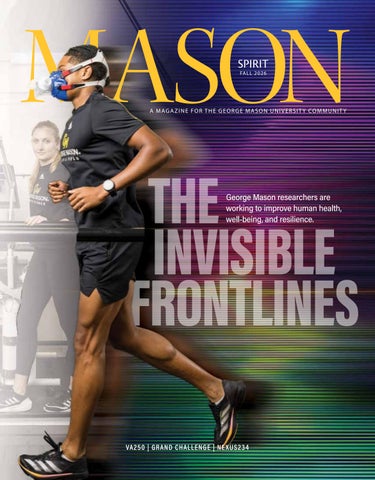
THE INVISIBLE FRONTLINES George Mason researchers are working to improve human health, well-being, and resilience.
VA250 | GRAND CHALLENGE | NE XUS234
PHOTO BY R. SISON
At Spring Commencement, George Mason University honored more than 12,000 degree and certificate earners, including more than 5,200 from summer and winter 2025, from 105 countries and 49 states, as well as the District of Columbia, Puerto Rico, and military installations domestic and abroad.
MASON SPIRIT
FALL 2026
ABOUT THE COVER
At George Mason, researchers are discovering new ways to improve health and well-being across the lifespan. Through innovative research spanning public health, behavioral science, and kinesiology, they’re developing solutions that make a tangible diference in people’s lives.
PHOTO BY EVAN CANTWELL
GRAD FEST
EUREKA! The National Academy of Inventors ranked George Mason No. 92 on its 2025 list of the top 100 U.S. universities for patents granted. In 2025, the U.S. Patent and Trademark Ofice issued 14 utility patents to George Mason inventors, including Monique van Hoek (left).
LEARN MORE. go.gmu.edu/inventors
Photo by John Boal Photography
CONNECT WITH GEORGE MASON UNIVERSIT Y #MasonNation • gmu.edu @georgemason
@georgemasonu
@georgemasonu
@georgemasonuniversity
Scan the QR codes you’ll find throughout the magazine with your smartphone’s camera app for associated websites with more details.
features
18
The Invisible Frontlines Nearly 12 million Americans provide unpaid dementia care for loved ones. Researchers at George Mason are building new models of support to help them cope, connect, and carry on.
24
A New Pathway for Mental Health Care Professionals As behavioral health care shortages grow nationwide, George Mason is training graduate students to bring evidence-based, culturally responsive care to communities in need.
28
Research in Motion At George Mason, student-athletes and dancers partner with researchers to advance the science of performance and recovery.
departments 2 First Words
40 Class Notes
3 From Our Readers
42 From the Alumni Association President
4 @Mason
Alumni Profiles
32 Inquirin Minds
40 Ashley Fortner, BS Inte rative Studies ’17
36 Shelf Life
43 Michael J. A. Davis, BA Inte rative Studies ’09
38 Alumni in Print
45 Brendan Gottlieb, BA Film and Video Studies ’15
39 Patriot Profile
48 Retro Mason
MORE ON THE WEB When you see this graphic, follow it to the magazine’s website for more: spirit.gmu.edu. Fall 2026 MASON SPIRIT | 1
FIRST WORDS
MASON SPIRIT A MAGAZINE FOR THE GEORGE MASON UNIVERSITY COMMUNITY
ANSWERING THE CALL
PHOTO BY RON AIRA
Some of the most important work in health care takes place in everyday settings. A daughter guides her mother with dementia back to bed. A teacher detects that a student is struggling with a personal issue and steers them to counseling. A researcher maps heat islands in urban areas to help government oficials decide where to direct resources to reduce heat-related illness. These are the invisible frontlines of health. The many people who serve on them— caregivers, researchers, clinicians, mental health specialists, nutritionists, and others—work where the demand is great, but the work itself is often overlooked.
There’s no questioning the demand. A 2023 study by the Virginia Health Workforce Development Authority found that 102 of Virginia’s 133 localities—home to nearly one-third of the state’s population—are federally designated Health Professional Shortage Areas, and 93 face shortages of mental health professionals. The George Mason-based Center for Health Workforce has identified the need for more than 20,000 additional registered nurses across the commonwealth. Communities also need social workers, school counselors, health informaticians, emergency planners, environmentalists, and others to build a robust ecosystem of professionals devoted to public health. At George Mason, these interdisciplinary eforts are part of the core solutions toward the university-wide Grand Challenge Initiative. We are home to Virginia’s only College of Public Health (CPH), where researchers are building new models of support for the nearly 12 million Americans providing unpaid dementia care to loved ones. Our College of Humanities and Social Sciences and CPH are working together to expand the pipeline of mental health professionals trained to deliver culturally responsive care to the communities in need. Our student-athletes and dancers are partnering with researchers from the College of Education and Human Development in a living laboratory advancing the science of performance and recovery. And in our Lab for Immersive Technologies and Simulation—which is the first lab at a public health college accredited by the Society for Simulation in Healthcare—students train for the most complex moments of care before they ever face them.
We also are investing in the well-being of our students, faculty, and staf because a university that contributes so much to wellness should also model it. In true George Mason tradition, we are thinking boldly about what comes next. Our long-term vision is a university that brings every discipline to bear on the greatest challenges in human health. This vision includes exploring the possibility of a medical school, through partnership or one of our own. Members of our community believe in this work as deeply as we do. We recently announced a gift from Barry Dewberry and Arlene Evans to support the School of Nursing, which is that family’s latest transformational gift to the university. Pending approval by the State Council of Higher Education for Virginia, the school will be named the Arlene Evans and Barry Dewberry School of Nursing. Fortifying public health requires a public response. And as the largest public university in Virginia, George Mason is answering the call.
Gregory Washington President, George Mason University 2 | S PI R I T.G M U.ED U
spirit.gmu.edu MANAG ING EDI TOR Colleen Kearney Rich, MFA ’95 AR T D IR E CTOR Joan Dall’Acqua A S SO CIAT E EDI TOR S Melanie Balog, PhD ‘25 Priyanka Champaneri, BA ’05, MFA ’10 Anne Reynolds ED I TO R IAL A S SISTAN T S Katarina Benson, BA ‘24 Zachary Grimm CO N T R IB U TOR S Shayla Brown Paola Duran Sarah Holland John Hollis Kendall Hymes Rebecca Kobayashi Amanda Milewski Katie Pearce Kendra Poindexter Lauren Clark Reuscher, MA ’12 Corey Jenkins Schaut, MPA ’07 Emily Schneider Isaias Sequa Asad, BA ‘26 Taylor Thomas, BS ‘23, MPH ‘24 Preston Williams G R APH IC DE SIGN Claire Brandt Angel Lee Dirk I. Macorol, BA ‘11
Jeeun Lee Namgoong Michaela Reilly, BA ’21 PH OTO G R APH Y AND M U LT IM EDIA Ron Aira Melissa Cannarozzi, MA ’22 Evan Cantwell, MA ’10 Andani Gene Munkaila Romulfo Sison, BA ’26 Cristian Torres PR O D U CT IO N M AN AGER Brian Edlinski
ED I TO R IAL B OAR D
Stephanie Aaronson, BA ‘94 Deputy Vice President for Communications and Digital Strategy Paul G. Allvin Vice President for University Branding and Chief Brand Oficer Trishana E. Bowden Vice President for Advancement and Alumni Relations Robin Rose Parker Associate Vice President for Advancement Communications and Donor Stewardship Jennifer W. Robinson, JM ’02 Associate Vice President for Alumni Relations Mason Spirit is published three times a year by the Ofce of Advancement and Alumni Relations and the Ofce of University Branding. George Mason University is an equal opportunity employer that encourages diversity.
FROM OUR READERS
Kudos We want to hear from you.
Big shout-out to Colleen Kearney Rich and the entire staf and team behind the Mason Spirit Spring 2026 issue—it was truly a gem! Usually, it can take me up to a week to finish an issue—this one flowed so seamlessly from article to article I finished it in one setting on the train ride to Harlem. Fantastic stories and fabulous editing convinced me to give another donation as I see George Mason is doing big things.
I want to tell you what a great job you and your team do on the magazine. I know you have a VERY diverse base of readers and the content you include is always compelling and well produced. My wife, Amy, [BA Communication ’07] and I genuinely look forward to it. We actually met at George Mason when we lived in the same dorm in Presidents Park. Jonathan Bennett, BA English ’96
Now if we could only get a football team. Will Sloan, BA Philosophy ’96
Letters to the editor are welcomed. Send correspondence to Colleen Kearney Rich, Mana in Editor, Mason Spirit, 4400 University Drive, MS 2F7, Fairfax, Vir inia 22030. Or send an email to spirit@gmu.edu. Need to chan e your address or update contact information with us? Or prefer not to receive the ma azine in the mail any lon er? Just let us know via email at development@gmu.edu.
The programs and services ofered by George Mason University are open to all who seek them. George Mason does not discriminate on the basis of race, color, religion, ethnic national origin (including shared ancestry and/or ethnic characteristics), sex, disability, military status (including veteran status), sexual orientation, gender identity, gender expression, age, marital status, pregnancy status, genetic information, or any other characteristic protected by law. After an initial review of its policies and practices, the university afirms its commitment to meet all federal mandates as articulated in federal law, as well as recent executive orders and federal agency directives.
Support student scholarships with an oficial university license plate! Get yours today at licenseplates.gmu.edu.
Mason Spirit content may not be reproduced without prior written permission. To request permission for any form of reproduction or reuse, please contact spirit@gmu.edu. Fall 2026 MASON SPIRIT | 3
@MASON
Keep updated on what’s going on
THIS STUDENT IS TASTING START-UP SUCCESS
Zach Suh, however, is mastering the recipe. Suh, a marketing major in the Costello College of Business and a member of George Mason University’s Honors College, founded HomePlate, formerly Elderly Eats, in his sophomore year. It’s a meal service for seniors that provides medically thoughtful and culturally relevant meals made fresh and delivered right to their doorstep. The idea first took root during COVID-19 lockdowns, when Suh’s grandmother moved in with the family as her Alzheimer’s reached late-stage. “My mom, who is a George Mason professor, became her full-time caregiver,” he says of Jennifer Suh, a professor in the College of Education and Human Development. “Caregiving takes a huge physical and emotional toll. I wanted to help her in any way I could.” Leaning into his love for cooking, Suh took over making all the meals for his family. He discovered that his grandmother was most interested in Korean food. “Even with her cognitive decline, you could tell she enjoyed those meals much more,” he says.
This discovery led him to consider a major gap in senior food delivery. “At one point, we looked into a meal service for seniors, but we couldn’t find anything that did culturally relevant meals.” Suh is familiar with start-ups. His older brother founded an artificial intelligence company while in college. “He’s a big inspiration for me, very much my mentor,” Suh says. “We talked about this idea for a food delivery service, about how I could bring this onto a larger scale.” Those conversations encouraged Suh to apply for the 2024 Patriot Pitch competition, hosted by Costello. HomePlate won first place in the General Entrepreneurship Track and was selected as a Mason’s Choice Award Prize winner, earning Suh $7,000 to start turning his idea into reality. “From the very outset, what impressed me most about Zach was his unwavering commitment to helping caregivers and seniors by providing them with nutritious, culturally relevant meals that could be consumed at home,” says Jerry Pierce, MBA ’92, a retired KPMG partner and professor of accounting at Costello. “His passion for helping others is always on full display and was a big reason the audience selected him for the Mason’s Choice Award.”
PHOTOS BY EVAN CANTWELL
STARTING A BUSINESS IS A DELICATE TASK. Even if you get the measurements just right, without a dash of innovation, a sprinkle of luck, and a heaping spoonful of courage, it’s likely to go straight from the oven to the bin.
“At one point, we looked into a meal service for seniors, but we couldn’t find anything that did culturally relevant meals.”
4 | SPI R I T.G M U.ED U
H E A D E@RMRAI S GO HN T
George Mason student and entrepreneur Zachary Suh founded HomePlate, a meal delivery service for seniors.
Previously, HomePlate provided meal plans with an in-house demonstration of meal prep. Now, they’re transitioning to a fresh meal delivery service. Suh works with a registered dietitian to craft meals that meet the variety of dietary and health needs of senior populations, such as diabetic restrictions, sodium control, low cholesterol, and general wellness. During the pilot program in March, HomePlate focused on Korean meals with hopes to expand to other cuisines in late 2026. For Suh, now a junior at George Mason, this shift lets him get back to doing what he loves: cooking. He is making all the meals from scratch in partnership with Kitchen of Purpose in Arlington. “You’ll see me at every stage,” he says. “In the grocery store, in the kitchen, delivering the meals, and then taking the trash out after.” Being both a student and a business owner is certainly a balancing act. Suh says that it wouldn’t be possible without support from George Mason. Costello’s Ofice of Career Services and Jeremy
Plotnick, director of minor programs for Costello, have been key supporters. Plotnick mentored Suh and helped him register his work on the business as an internship, allowing him to prepare for the relaunch while earning academic credit toward his degree. Working in the MIX incubator connected him to student and alumni entrepreneurs, and his professors have ofered advice. Even while studying abroad at Mason Korea, Suh was able to network and pitch his business through the Center for Innovation and Entrepreneurship, as well as attend a one-week accelerator program in Australia. “I don’t think you get this level of care and mentorship at other universities,” Suh says. “Being a George Mason student gives you access to this unparalleled network of professionals who have so much knowledge.” —Sarah Holland
Fall 2026 MASON SPIRIT | 5
@MASON
GEORGE MASON PANEL CONFRONTS THE COMPLEX LEGACY OF ITS NAMESAKE WATCH THE PANEL.
go.gmu.edu/ virginia-250-gmu
LEARN MORE ABOUT THE CENTER FOR MASON LEGACIES.
GEORGE MASON UNIVERSITY FILMED A VIRGINIA 250 panel discussion on its Fairfax Campus examining The Complex Legacy of George Mason, the founding father, author of the Virginia Declaration of Rights, and slaveholder whose contradictions mirror the larger story of the United States. The one-hour program premiered on both GMU-TV and C-SPAN. The Complex Legacy of George Mason panel was moderated by Christopher Eck, executive director of Gunston Hall, George Mason’s 18th-century estate on the Potomac River. He was joined by Carly Fiorina, national honorary chair of the Virginia 250 Commission and CEO of the Colonial Williamsburg Foundation; George Oberle, BA History ’96, MA ’98, PhD ’16, historian and director of the Center for Mason Legacies at George Mason University; and Gregory Washington, president of George Mason University.
PHOTO BY ANDANI MUNKAILA
Across the conversation, the panelists traced how the same man who helped forge the language of universal rights—language echoed by Thomas Jeferson in the Declaration of Independence and James Madison in the U.S. Bill of Rights—also held more than 100 people in bondage and failed to free them. Rather than treat that contradiction as a reason to look away, the panel framed it as the work of a great public university.
legacies.gmu.edu
6 | S PI R I T.G M U.ED U
“This is what a university is for—to have these hard conversations,” says Oberle, who co-founded the research initiative behind the Enslaved People of George Mason Memorial on the Fairfax Campus. “If you’re not going to have them here, where are you going to have the hard conversations?” Washington, who became the eighth president of George Mason in 2020, described the university’s decision to keep its namesake and use his legacy as a teaching platform. He noted that freedom of expression remains a core value the university traces directly to Mason’s own writings. Fiorina connected the discussion to the larger goals of the nation’s semiquincentennial—to educate, to engage every community, and to inspire a season of civic renewal. “Nostalgia is not history. Propaganda is not history,” Fiorina says. “To know our country fully is the only way we can be true citizens and true patriots.” The panel was presented as part of Virginia’s 250th anniversary commemoration, marking 250 years of George Mason’s Virginia Declaration of Rights, the Declaration of Independence, and the founding of the nation.
@MASON
MARION UNDERWOOD IS GEORGE MASON’S NEW PROVOST AFTER A NATIONWIDE SEARCH, Marion Underwood has been named provost and executive vice president at George Mason University. Underwood, who began her new role on July 27 and is the former provost and executive vice president of Colorado State University (CSU), brings 35 years of academic, research, and leadership experience to the role.
She has more than 20 years of continuous funding from the National Institutes of Health and more than 100 publications. Her research on social aggression includes the 2003 book Social Aggression Among Girls and the upcoming second printing of her co-written book Social Development: Relationships in Infancy, Childhood, and Adolescence.
“Dr. Underwood’s career path has taken her to other institutions very compatible with George Mason, and she brings the right attitude and aptitude to thrive as our next provost,” says George Mason President Gregory Washington. “This is an important partnership as we forge George Mason into a university that is purpose-built to lead in the 21st century and beyond.”
A strong advocate for student success, she launched a CSU transfer program in collaboration with Front Range Community College and worked with the enrollment team there to recruit more rural students.
Her accomplishments at CSU included the creation of the university’s Strategic Roadmap 2025: A National Model for the Modern Land Grant University; formulating the CSU System Vision for Student Mental Health 2023; playing a critical role in finetuning CSU’s new hybrid responsibility center management (RCM) budget model; and hiring and developing multiple outstanding academic leaders, including three deans.
Underwood has a BA in psychology from Wellesley College, where she graduated magna cum laude, and a master’s and PhD from Duke University in clinical psychology.
Underwood served as dean of Purdue University’s College of Health and Human Sciences and distinguished professor of psychological sciences. She led the college through a period of strong enrollment growth and increased student success, oversaw a research portfolio of $32 million during the 202122 academic year, collaborated with the university senate to create a new winter term, and led a university-wide cluster hire in public health, health equity, and health policy to attract faculty members to enhance expertise in diversity. She also spent 20 years at University of Texas at Dallas, culminating in three years as dean of graduate studies and associate provost. During her time as graduate dean, the number of doctoral degrees awarded annually increased by 29 percent. She earned tenure as an associate professor of psychology at Reed College in Portland, Oregon.
PHOTO BY JOHN EISELE/COLORADO STATE UNIVERSITY PHOTOGRAPHY
“I look forward to working with faculty, staf, and University Life to strengthen a holistic student success model: expanding advising and basic needs supports, fostering belonging, advancing experiential learning and career-connected pathways, advancing research and scholarship based on societal needs, and building employer partnerships that help more graduates thrive,” Underwood says.
Fall 2026 MASON SPIRIT | 7
SECURE YOUR SEATS FOR THE 2026–27 SEASON. Men’s Basketball
Women’s Basketball
PHOTO BY ART PITTMAN
PHOTO BY ART PITTMAN
@MASON
SKINN AND BLAIR-LEWIS EARN CONTRACT EXTENSIONS THROUGH 2031–32 GEORGE MASON UNIVERSITY Assistant Vice President and Director of Intercollegiate Athletics Marvin Lewis announced contract extensions for men’s basketball head coach Tony Skinn, BA Communication ’06, and women’s basketball head coach Vanessa Blair-Lewis through the 2031–32 season.
Blair-Lewis has elevated the George Mason women’s basketball program into one of the premier programs in the Atlantic 10 during her five-year tenure, which is demonstrated by the program’s first-ever Atlantic 10 Championship, NCAA Tournament appearance, and regular season conference title.
Skinn, the 2025 Atlantic 10 Coach of the Year and architect of George Mason’s first A-10 championship team, has put together the best start to a coaching career in school history and cemented himself as one of the top young coaches in the nation.
In 2025–26, Blair-Lewis guided the Patriots in another historic campaign, leading George Mason to its first regular season championship in program history and a program-record 16 conference victories. The Patriots also hosted a postseason game for just the third time ever, while Blair-Lewis also earned the 400th victory of her head coaching career. George Mason women’s basketball also saw its highest attended home game when 4,123 fans packed EagleBank Arena for a game against the University of Dayton on December 31, 2025.
Skinn has set new program bests for overall wins (70), league wins (35), overall winning percentage (.693), and league winning percentage (.648) for a Patriot coach over his first three campaigns. What’s more, Skinn’s 69.3 overall winning percentage ranks 17th nationally among current Division I head coaches with at least three seasons at the helm. “In just three seasons, Tony has elevated our competitive standard, delivered sustained success on the court, and built a culture rooted in accountability, player development, and integrity,” says Lewis. “This extension reflects our confidence in Tony’s vision, his leadership, and his commitment to continuing to position George Mason as a nationally respected program. We’re excited about what lies ahead for Patriot basketball under his direction.”
8 | S PI R I T.G M U.ED U
“Vanessa Blair-Lewis has delivered one of the most remarkable turnarounds in college basketball, while building a culture rooted in purpose, passion, and the development of young women on and of the court,” says Lewis. “Her impact goes far beyond wins and championships—she has united our community and redefined what’s possible at George Mason, and we’re proud to extend her leadership into the future.”
@MASON
GEORGE MASON INITIATIVE WILL STRENGTHEN VIRGINIA’S EDUCATOR WORKFORCE AS SCHOOLS ACROSS VIRGINIA struggle to find and keep qualified teachers, George Mason University is stepping in with a comprehensive new initiative designed to make entering—and staying in—the profession more accessible. The College of Education and Human Development (CEHD) has launched Future Ready Teachers to strengthen Virginia’s educator workforce by removing financial barriers, innovating and elevating teacher preparation, and supporting teachers through their early years in the classroom. Too many aspiring educators step away from the profession due to cost, limited early-career support, and salaries that often do not align with the cost of living. The resulting teacher shortage disproportionately afects high-poverty, rural, and high-need schools, limiting PK–12 students’ access to stable, high-quality learning environments. With deep regional partnerships and a strong track record of preparing efective educators, George Mason is positioned to deliver a scalable, high-impact solution.
classroom and hundreds of students taught over a career, which could strengthen both schools and communities across the commonwealth. “Teacher preparation is the cornerstone of educational excellence,” says Audra Parker, director of CEHD’s Ofice of Teacher Preparation. “When we invest in teachers and teacher preparation, we’re investing in the lives of students who will shape [the] future.” This comprehensive approach positions Future Ready Teachers as more than a scholarship efort; it is a workforce strategy designed to increase teacher retention, reduce preventable turnover, and strengthen long-term classroom stability.
MAKING THE CASE
This initiative is part of Mason Now: Power the Possible, George Mason’s historic $1 billion campaign to advance student success, research, innovation, stewardship, and community engagement.
“Future Ready Teachers represents a bold commitment to every child, every classroom, and every future,” says Guerra-López. “It is an investment in people and in the long-term strength and stability of our education system.”
The initiative focuses on three priorities: removing financial barriers, increasing teacher preparation for evolving classroom demands, and supporting educators beyond graduation. Funds raised for the program provide full-ride and cost-of-living scholarships and sustain a rigorous model that integrates structured mentorship, a three-year induction program, and preparation for technology-enabled, data-rich learning environments. These components help reinforce that teaching is a rigorous, future-ready profession designed to attract and retain top talent.
The urgency is clear. Eighty-six percent of U.S. public schools report hiring challenges due to a lack of qualified applicants, with Virginia reporting more than 3,600 teacher vacancies in 2024–25. Each Future Ready Teachers scholar represents a stable
LEARN MORE. PHOTO BY JOHN BOAL PHOTOGRAPHY
“At George Mason, we believe every aspiring educator deserves the opportunity to succeed, regardless of financial barriers or the realities of sustaining a career in teaching today,” says CEHD Dean Ingrid Guerra-López. “Future Ready Teachers reflects our responsibility to address the nation’s teacher shortage by investing not only in access, but in forward-looking innovative preparation, sustained support, and long-term success in the profession.”
cehd.gmu.edu/ future-ready-teachers
Fall 2026 MASON SPIRIT | 9
Robinson Professor of Physics James Trefil (left) with George Mason President Gregory Washington.
PHOTO BY RON AIRA
@MASON
HEAR ROBINSON PROFESSOR TREFIL’S STORY IN HIS OWN WORDS.
bit.ly/jimtrefil
JAMES TREFIL MARKS 55 YEARS OF SERVICE ROBINSON PROFESSOR OF PHYSICS JAMES TREFIL has watched George Mason University transform from a young institution still finding its footing into one of the nation’s leading public research universities. He is the first faculty member in university history to reach 55 years of service. A theoretical physicist known for championing science literacy, Trefil has spent decades translating complex scientific ideas for general audiences. A fellow of the American Physical Society, the American Association for the Advancement of Science, and the World Economic Forum, he has written more than 50 books exploring subjects ranging from cosmology to everyday science. His honors include the Andrew W. Gemant Award and the inaugural AAAS Science Book Editor’s Award. On the Early Days: Trefil taught at the University of Virginia for more than a decade before joining George Mason’s then brand-new Robinson Professor Program in 1987. He says, “Mason back then reminded me of these towns in Western movies with unpaved streets.” He recalls attending a faculty reception at the new Patriot Center (now EagleBank Arena) where then-President George Johnson shared plans for the Center for the Arts. “It was just a swamp, and they had a drawing of what it was going to be. I remember thinking, ‘In your dreams.’ But it happened. Watching this university grow has been an amazing experience.” A Major Milestone: Trefil says his most important contribution to George Mason was chairing the committee that founded the College of Science. At the time, George Mason was expanding its
1 0 | S PI R I T.G M U.ED U
research ambitions, and university leaders recognized the need for a standalone college dedicated to the sciences. Trefil was chosen to lead the efort because, as he puts it, he was “the only scientist they could find who didn’t have a stake in how things turned out.” Trefil drafted the proposal approved by the university’s Board of Visitors, helping to lay the groundwork for George Mason’s emergence as a nationally recognized research institution. His Commitment to Science Literacy: For Trefil, science literacy is less about memorizing formulas and more about participating thoughtfully in public life. He believes that to live in the United States in the 21st century, people need to know a bit about science, and he has made it a goal to help nonscientists feel comfortable engaging with science. “If somebody is talking about whether using stem cells is moral, you should know what a stem cell is,” he says. Big Ideas: With his colleague, Robinson Professor of Earth Science Robert Hazen, he created and taught the popular PROV 301 Great Ideas in Science, a class for nonscience majors that introduces ideas that have shaped the field, from the building of Stonehenge to the Big Bang. The course inspired the textbook The Sciences: An Integrated Approach, written by Trefil and Hazen. Now in its ninth edition, the book is used at hundreds of universities across the country. —Colleen Kearney Rich, MFA ‘95
@MASON
XIAO AND BLOOM AMONG VIRGINIA’S OUTSTANDING FACULTY HONOREES GEORGE MASON UNIVERSITY RESEARCHERS XUESU XIAO AND MICHAEL S. BLOOM are among the 12 recipients honored by the State Council of Higher Education for Virginia (SCHEV) with 2026 Outstanding Faculty Awards. Chosen from a pool of 81 nominees and 21 finalists representing the commonwealth’s public and private colleges and universities, the recipients are recognized for their superior accomplishments in teaching, research, and public service. Xiao, an assistant professor in the Department of Computer Science within the College of Engineering and Computing, was recognized as a Rising Star for his early-career accomplishments. He directs the RobotiXX Lab, the only robotics testing facility of its kind in the region, and works at the intersection of motion planning and machine learning, with a focus on developing highly capable mobile robots that can operate in real-world environments with minimal human supervision. His work has supported search-and-rescue eforts following the Mexico City earthquake, the refugee crisis in Greece, and decommissioning eforts at the Fukushima nuclear plant in Japan. In 2025, Xiao was one of three recipients of the George Mason Presidential Award for Faculty Excellence in Research.
Reproduction Special Interest Group in a series of roles culminating as chair. Bloom has co-written more than 200 peer-reviewed publications and book chapters, with research funded by the National Institutes of Health, the Centers for Disease Control and Prevention, and the Fulbright Program. “Receiving this award is an incredible honor,” Bloom says. “It reflects not only my eforts, but also the support and collaboration of colleagues, students, and mentors who have shaped my journey. This recognition reinforces our shared mission as George Mason faculty—advancing education, research, and service that make a meaningful diference.” Xiao and Bloom become the 30th and 31st George Mason faculty members to receive SCHEV awards since the program’s inception in 1987. —John Hollis
Xuesu Xiao (left), College of Engineering and Computing, and Michael Bloom, College of Public Health, are recipients of the 2026 SCHEV Outstanding Faculty Awards.
A reproductive and perinatal epidemiologist, Bloom has been elected to the American Society for Reproductive Medicine, where he will serve on the leadership committee of the Environment and
PHOTO BY EVAN CANTWELL
Bloom, a professor in the Department of Global and Community Health within the College of Public Health, teaches graduate-level epidemiology and mentors graduate students while conducting research on the health efects and sources of exposure to environmental pollutants, with a focus on human reproduction and fetal development. His work is driven by a commitment to addressing health disparities and supporting vulnerable populations.
PHOTO BY RON AIRA
“This recognition is especially meaningful because it reflects Virginia’s commitment to scholarship that serves the public good,” Xiao says. “It strengthens the commonwealth’s research profile, prepares students to address complex, real-world challenges, and recognizes not only my research contributions, but also the broader vision behind them—advancing robotics research with real impact while educating and mentoring the next generation of engineers and scientists.”
Fall 2026 MASON SPIRIT | 11
@MASON
PARTNERING WITH FAIRFAX COUNTY TO SUPPORT EMPLOYEE DEVELOPMENT WHEN PUBLIC HEALTH WORKERS DEEPEN their expertise, entire communities benefit. That idea is at the heart of a growing partnership between George Mason and the Fairfax County Health Department (FCHD) that is opening new educational pathways for the county’s frontline professionals.
register for classes where they’re fully integrated with other College of Public Health students.” That integration is by design. Certificate students complete 18 credits—six courses—that mirror much of the MPH curriculum, which allows them to build connections while gaining exposure to graduatelevel coursework. And flexibility is key for the students. “A lot of our students are working professionals,” Liu says. “We ofer classes that fit more easily into their schedules.”
PHOTO PROVIDED
For employees like Salisa Sathityudhakarn, the program ofers both practical skills and renewed inspiration. Sathityudhakarn is a school health aide with FCHD assigned to Fairfax County Public Schools, and she began the certificate program in fall 2024.
George Mason student Salisa Sathityudhakarn is a school health aide with Fairfax County Public Schools.
Since 2019, George Mason has worked with FCHD to ofer employees the opportunity to earn public health certificates—an option many are using as a stepping stone to graduate programs. To date, 46 employees have enrolled in the program, and of those who completed the certificate, more than half—57 percent—have gone on to earn a master of public health (MPH) at George Mason. The collaboration reflects a shared commitment to strengthening not only community health outcomes but also the workforce behind them. The partnership grew out of FCHD’s investment in continuing education for its staf, says Sarah Liu, BS Community Health ’17, who serves as both the MPH program coordinator in the Department of Global and Community Health and the coordinator for the FCHD partnership. “We help certificate students
1 2 | S PI R I T.G M U.ED U
Her work puts her on the front lines of student health. “I provide basic health care for sick and injured students including emergency care, administering daily medication, or when necessary, giving an EpiPen for allergic reactions and albuterol for asthma attacks,” says Sathityudhakarn. With more than a decade of experience in health care, and degrees in communication and mental health counseling, she came to the program eager to broaden her perspective. Sathityudhakarn sees immediate applications for what she’s learning in her day-to-day work. “Through this program, I have learned diferent aspects of public health,” she says. “I’m looking forward to applying the knowledge to better serve FCHD, my school, my students, and their families.” Like many initiatives at George Mason, the program is designed to remove barriers. The county covers tuition for the certificate courses, and employees become eligible after one year of service—making advanced education more accessible to those already committed to public service. Looking ahead, George Mason and FCHD leaders are working to expand the partnership, creating even more opportunities for employees to advance their education—and, in turn, strengthen the communities they serve. —Shayla Brown
@MASON
GIVING DAY RACES TO A RECORD FINISH THE GEORGE MASON UNIVERSITY COMMUNITY CAME TOGETHER in a powerful show of support on April 2, raising a record $2.95 million during the university’s 24-hour Giving Day.
The momentum of Giving Day adds to George Mason’s historic fundraising campaign, Mason Now: Power the Possible, which has raised more than $638 million toward its $1 billion goal.
More than 1,900 donors made 3,229 gifts to 293 funds across the university to help expand opportunities for students, strengthen academic programs, and support initiatives that advance George Mason’s mission.
“Each gift, no matter the size, helps expand student success, support academic excellence, and create opportunities for George Mason students to learn, lead, and thrive,” says Bowden. “Through Mason Now, that generosity is helping George Mason move forward in ways that will shape the university for years to come.”
Throughout the day, alumni, faculty, and friends rallied behind the university with enthusiasm and generosity. Among the donors were 864 alumni and 337 faculty and staf members, demonstrating strong support across the George Mason community. In addition, nearly 500 donors made their first gift to the university, representing about 25 percent of all Giving Day participants.
—Kendra Poindexter
MAKING THE CASE
This event is part of Mason Now: Power the Possible, George Mason’s historic $1 billion campaign to advance student success, research, innovation, stewardship, and community engagement.
“It was especially meaningful to see so many people choose to support George Mason for the first time,” says Trishana E. Bowden, vice president for advancement and alumni relations and president of the George Mason University Foundation. “Every new donor strengthens this community and expands what we can make possible for our students. When people invest in George Mason, they are investing in opportunity—in the students whose lives are changed here and in the impact they will go on to make in the world.” That spirit of generosity was reflected across the university, with donors supporting scholarships, athletics, academic programs, and other priorities that directly shape the student experience. The General Scholarship Fund attracted the largest number of faculty and staf donors, followed by the Costello College of Business’s Spirit of ’77 Fund and Intercollegiate Athletics’ Basketball Greatness. George Mason Athletics generated the highest totals for both dollars and donors on Giving Day. “Giving Day captures the very heart of our athletics community—from our athletes and coaches to the fans who fuel our mission,” says Marvin Lewis, assistant vice president and director of Intercollegiate Athletics. “The extraordinary growth we see year after year is a testament to the trust our supporters place in us and the deep pride they take in investing in the lives of our student-athletes.” Along with Athletics’ standout results, the Costello College of Business and the College of Visual and Performing Arts also received notable support in dollars raised and donor participation. Fall 2026 MASON SPIRIT | 13
@MASON
CREATING JOYFUL NEW CONNECTIONS THROUGH DANCE LEARN MORE.
go.gmu.edu/ danceforpd
“BEING IN CLASS WITH OUR PARTICIPANTS reminds me of the pure joy of dance,” says School of Dance senior Emma Simons, BFA Dance ‘26, of her time interning with Dance for PD®. Dance for PD is a movement-based class for people with Parkinson’s disease, which ofers not only physical benefits to the participants but also helps reduce the social isolation associated with the neurological disease. George Mason University’s School of Dance has ofered the national program, administered by George Mason arts partner Mark Morris Dance Group, in Northern Virginia since 2021. When Simons and fellow dance major Asiah Moore, BFA Dance ‘26, interned with Dance for PD, each took a diferent approach to her work, which was encouraged by George Mason adjunct Elizabeth Spatz, a certified Dance for PD teaching artist. Moore concentrated on internal awareness of Dance for PD at George Mason, creating strategic social media content and encouraging her peers in the School of Dance to engage more robustly with the program. Moore recruited fellow students to attend the classes and perform brief dance selections for class participants. After these showings, participants had the opportunity to ask the students questions about the pieces and their experiences overall.
“I wanted to combine these worlds and give the community a chance to see inside the work we do,” says Moore. “When [the participants] have a chance to see pieces beforehand, they might come to a performance, [then] they come in feeling like they’re already part of this world because they know us.” In her work, Simons focused on external communications, building on previous interns’ research into local medical practices, retirement communities, and businesses where patients and caregivers might be looking for the resource that Dance for PD provides. Simons made cold calls and sent out emails, aiming to bring more people to campus. But as she spent more time in class, she noticed that people’s hesitation melted inside the studio, and she decided to pivot in her approach. “It’s so much joy to be in the room with the participants, and I knew words can’t bring people in as much as the movement itself could,” says Simons. Simons and Moore joined forces and started reaching out to administrators at various retirement communities to organize in-person trial classes on-site. The class they ofered with Westminster at Lake Ridge was very well attended. “There were staf members who said ‘we’re just here to watch’ at the beginning of the session, but within five minutes, they were dancing and smiling and moving. It has this power for connecting people,” says School of Dance Assistant Professor Shaun Boyle D’Arcy, MFA Dance ‘21, who helped bring the program to George Mason.
PHOTO PROVIDED
Both Simons and Moore look forward to building on their experience with Dance for PD after graduation. Each of them plans to perform professionally and they are looking for companies that value community engagement and service.
1 4 | S PI R I T.G M U.ED U
Spatz says these internships can lead to jobs. “One of our former interns was hired by a company that was impressed with her [Dance for PD] experience,” says Spatz. “It’s so valuable for our students to see the diferent ways dance applies to people’s lives.” —Emily Schneider
MASON NATION PHOTO BY EVAN CANTWELL
MEET THE
Job: Environmental Graphic Designer and Sign Program Manager, Campus Planning,
JOHN FORGY Facilities and Campus Operations
People rely on countless signs each day, whether they are driving, walking through a neighborhood, shopping at the grocery store, or going from building to building on campus. John Forgy, BA Art (Studio) ’89, environmental graphic designer and sign program manager at George Mason, creates the wayfinding systems that guide students, faculty, staf, and visitors across the university’s campuses and sites.
DIFFERENT DIRECTIONS: Across the university’s multiple campuses and sites, there are a lot of signs to design, create, and manage. “George Mason is like a small city, which means I get to work on a wide range of projects for a variety of clients,” Forgy says. “Every day is diferent, and I’m never bored.” Signs are fabricated in the university’s sign shop located on the Fairfax Campus or by contractors of-site.
ENTER HERE: After graduating from George Mason, Forgy started working at an environmental graphic design firm in Washington, D.C., where he focused on experiential design, which merges graphic, architectural, interior, and landscape design to enhance how people interact with built environments. “I was fortunate enough to work on a wide variety of projects like museums, sports facilities, concert halls, hospitals, commercial buildings, and campus wayfinding programs,” Forgy says. He always enjoyed higher education projects, which prepared him to start working at George Mason in 2012.
CAUTION AHEAD: Because signage is a long-lasting investment for the university, Forgy must balance his focus between present needs and planning for the future. “Much of what I do sets the standard for the future,” he says. “Sometimes that means taking extra time to think way ahead when a project comes to me without a precedent.”
BRAND BUILDER: One of Forgy’s main responsibilities is to integrate the university brand into the built environment. He manages the development, implementation, and maintenance of interior and exterior wayfinding signs, code-required signs, recognition signs, and more. “I also document all of the sign systems in use and plan for the future growth of signage and graphics programs at George Mason,” he says.
PLACEMAKING: Some of Forgy’s most memorable projects include a collaboration with the City of Fairfax to apply “We Are Mason” decals on several streets in the city and on campus, as well as an exterior wayfinding sign refresh that is taking shape this year. “Anytime you see your work come to life, it’s exciting,” Forgy says. “Getting positive feedback from the George Mason community, especially from the students, is very satisfying.” —Lauren Clark Reuscher, MA ’12
Fall 2026 MASON SPIRIT | 15
@MASON
NEXUS234 INNOVATION DISTRICT DEBUTS
PHOTO BY EVAN CANTWELL
government, channeling bold ideas into research, discovery, and invention, and working in partnership with Northern Virginia Community College to train a pipeline of workers to successfully enter highdemand fields. We stand behind the leaders that came before us who set this district in motion.”
From left, Sumeet Shrivastava, MBA ‘94, rector of the George Mason Board of Visitors; Amy Adams, BS Biology ‘03, MS Chemistry ‘12, executive director of Nexus234, and George Mason President Gregory Washington at the launch in April.
LEARN MORE.
GEORGE MASON UNIVERSITY, PRINCE WILLIAM COUNTY, AND THE CITY OF MANASSAS oficially unveiled the Nexus234 Innovation District in April and marked a milestone that has been decades in the making. The nearly 6,000-acre destination, named for the Route 234 corridor that runs through its heart, is Northern Virginia’s first Innovation District and positions the region as a national destination for research-driven industry. Centered around Innovation Park alongside George Mason’s Science and Technology Campus, Nexus234 connects researchers, entrepreneurs, and technology companies ranging from start-ups to global firms across sectors including life sciences, aerospace, defense, semiconductor, data center, and artificial intelligence infrastructure. Designed to accelerate the path from discovery to deployment, Nexus234 provides an environment where research, workforce training, and industry collaboration intersect to support economic growth and commercialization.
nexus234.org
1 6 | S PI R I T.G M U.ED U
“Since 1997, George Mason has been at the heart of Nexus234,” says George Mason President Gregory Washington, “collaborating with local businesses and
The naming event coincided with the Association of University Research Parks conference, bringing visitors from across the country to tour Nexus234 and engage with researchers, students, and anchor companies including Micron, General Dynamics’ Progeny Systems, and American Type Culture Collection (ATCC). Attendees got a firsthand look at workforce training programs, an international soft-landing initiative, and the dynamic NOVA LIVE. Leaders emphasized Nexus234’s competitive advantage for development that includes tech-flex industrial space, incubator and accelerator programs, and sites for commercial and mixed-use expansion. “Prince William County is building a destination for discovery,” says Chair-at-Large Deshundra Jeferson of the Prince William Board of County Supervisors. “Nexus234 reflects our long-term strategy to attract high-value industries, support groundbreaking research, and ensure companies have the space, talent, and infrastructure they need to grow.” Nexus234 builds on 30 years of public-private collaboration, formalized through a $2.6 million GO Virginia grant to create Northern Virginia’s first Innovation District in June 2025 and matched by $1.3 million in local investments from founding partners ATCC; Didlake; ECU Communications; Dominion Energy; Employment Enterprises; I-66 Express Mobility Partners; Garcia Family Foundation; Micron Technology; Northern Virginia Community College; Vanderpool, Frostick & Nishanian; and Virginia Innovation Partnership Corporation. Nexus234 includes approximately 330 acres available for laboratory, R&D, manufacturing, and ofice development, with a portion of land publicly controlled to support coordinated public-private growth. Conveniently located with access to Interstate 66, major rail corridors, and Manassas Regional Airport, and proximity to Washington Dulles International Airport, Nexus234 positions the region to attract and support companies operating at the forefront of technology and applied research.
HEADER RIGHT
FALL INTO ARTS AND ATHLETICS AT GEORGE MASON NOVEMBER 5–6 SCHOOL OF DANCE
FALL: NEW DANCES
PHOTO BY PARI DUKOVIC
CENTER FOR THE ARTS
OCTOBER 3
OCTOBER 17
ARTS BY GEORGE!
MEN’S SOCCER VS. GEORGE WASHINGTON
FEATURING HEADLINER PERFORMANCE BY JEFF GOLDBLUM AND THE MILDRED SNITZER ORCHESTRA
Family Weekend Game GEORGE MASON STADIUM
This annual benefit includes showcases by talented Mason Arts students throughout our studio and performance spaces, complemented by a bufet dinner, and culminates with the headliner performance.
DECEMBER 6 DEWBERRY FAMILY SCHOOL OF MUSIC
MASON SYMPHONY ORCHESTRA AND CHOIRS WINTER FESTIVAL
CENTER FOR THE ARTS
CENTER FOR THE ARTS
OCTOBER 6–10 FALL FOR THE BOOK Northern Virginia’s oldest and largest festival of literature and the arts returns for its 28th year. This year ’s headliners are novelists Stephen Graham Jones and Celeste Ng. WILKINS PLAZA, FAIRFAX CAMPUS
MASON ARTS EVENT CALENDAR
OCTOBER 29– NOVEMBER 1 SCHOOL OF THEATER
URINETOWN
cvpa.calendar.gmu.edu
GEORGE MASON ATHLETICS
gomason.com
HARRIS THEATRE
Fall 2026 MASON SPIRIT | 17
Nearly 12 million Americans provide unpaid dementia care for loved ones. Researchers at George Mason are building new models of support to help them cope, connect, and carry on.
18 | SPI R I T.G M U.ED U
PHOTO BY GETTY IMAGES FG TRADE | GETTY IMAGES
PHOTO BY GETTY IMAGES
MARIIA VITKOVSKA | iSTOCK
F
or 12 years, Lily Liu cared for her mother, who had Parkinson’s disease, in her Washington, D.C., apartment. She handled every meal, every bath, and every sleepless night as her mother’s Parkinson’srelated dementia advanced.
“I was doing it all by myself,” she says. She found relief through Mason Caregivers Aiming for Resilience, Empowerment, and Support (CARES), an evidence-based virtual support program developed by George Mason University researchers to help family caregivers manage stress and burnout. Over nine weeks, caregivers participated in guided breathing exercises, journaling, and group discussions designed to build resilience and connection. For Liu, the greatest benefit was the realization that other people understood what she was going through. Researchers Megumi Inoue and Emily S. Ihara, professors in the Department of Social Work who served as co-principal investigators on the project, say that was the goal. “They learn they’re not alone. There are people wearing the same shoes, so they can exchange information and experiences,” Inoue says.
Researchers estimate that by 2040, 110 million people worldwide will be living with dementia.
That support translated into measurable results. Using a standardized caregiver burden score that measures exhaustion and emotional strain, researchers found a 15 percent reduction in stress levels among some participants. “That’s a pretty big deal,” says Gilbert Gimm, associate professor of health administration and policy, who led the data analysis. “Even modest reductions mean relief.” Across the country, nearly 12 million people provide unpaid care for relatives or friends living with Alzheimer’s disease or related dementias. Roughly 80 percent of that care takes place at home, a reality that has created mounting pressure on family members as the population ages. Researchers estimate that by 2040, 110 million people worldwide will be living with dementia.
LEARN MORE.
go.gmu.edu/gci-health
College of Public Health researchers see this growing burden as both a caregiving crisis and a public health priority. George Mason is actively approaching improvements in health systems that advance science, develop talent, and strengthen communities. It’s all part of the university’s Grand Challenge Initiative and its Improving Human Health, Well-Being, and Preparedness solution.
Fall 2026 MASON SPIRIT | 19
PHOTO BY EVAN CANTWELL
Li-Mei Chen (left) and Megumi Inoue bring a global perspective to their work, which is shaped by their years studying aging and dementia care in Japan.
THE INVISIBLE BACKBONE OF DEMENTIA CARE “Caregiving is one of the most stressful roles imaginable,” says Catherine Tompkins, principal investigator of Mason CARES. The toll caregiving takes on families is profound. Participants in the Mason CARES study entered the program with stress levels well above the threshold associated with anxiety, depressive symptoms, and worsening physical health. In a separate analysis led by Inoue, nearly three-quarters of Alzheimer’s caregivers reported living with at least one chronic condition themselves.
“We ended up with people from all over—Texas, Louisiana, Northern Virginia,” she says. Some of the most meaningful interventions are also among the simplest. Within Mason CARES, researchers incorporated elements of Music and Memory, a national program that uses personalized music playlists to help people with dementia reconnect with memories.
Gimm believes the strain reflects a broader policy problem in the United States, where “aging in place” has become the preferred model for dementia care without a corresponding investment in caregiver support.
Research has long shown that familiar music can prompt moments of recognition, speech, movement, and joy in people living with dementia. George Mason researchers wanted to understand how those moments also afect caregivers.
“The U.S. saves money by keeping more people at home,” he says, “but it’s on the backs of family caregivers. That’s not sustainable.”
“The idea is that if the person living with dementia is happy, it can reduce resistance, and caregiving becomes more positive,” Inoue says.
According to Tompkins, for aging in place to succeed long term, caregivers need far more support than they currently receive. Family caregivers urgently need access to training, resources, programs, and respite, she says.
Researchers found that caregivers used the technology in very diferent ways. Some never found time to use the MP3 players they received, while others discovered deeply meaningful moments of connection. One caregiver told researchers that listening to a song from her wedding helped briefly restore a sense of partnership with her husband after dementia had left him emotionally distant.
TURNING RESEARCH INTO RELIEF The pandemic reshaped how researchers approached that support. Mason CARES launched during the pandemic and was delivered virtually over Zoom, ultimately reaching 97 caregivers across the country—an unusually large sample for dementia research. 2 0 | SPI R I T.G M U.ED U
Historically, Tompkins explains, many caregivers struggled to attend in-person programming because they could not leave their loved ones alone. Virtual meetings unexpectedly removed that barrier.
In a follow-up study, Inoue and Tompkins are now examining those types of nuances to understand what made the program efective and how it could be improved.
With a $3 million grant from the National Institute on Aging, health administration and policy researcher Y. Alicia Hong is refining Wellness Enhancement for Caregivers (WECARE), an AI-enhanced digital intervention for dementia caregivers. The seven-week platform combines multimedia education, quiz games, social networking, personalized feedback, and tailored caregiving resources. The goal is to create technology that feels responsive to caregivers’ daily realities. “WECARE is one of the first personalized digital interventions for dementia caregivers,” says Hong. “Though it is designed for Chinese American dementia caregivers, it can be adapted for other groups and serve the growing demand for digital support for dementia caregivers in an aging society.”
PHOTO BY EVAN CANTWELL
Another George Mason researcher, School of Nursing Professor Kyeung Mi Oh, is using AI to help families reconnect through storytelling and memory.
Catherine Tompkins is a principal investigator of Mason CARES.
For some Mason CARES participants, the relationships built through the program outlasted the research itself. Liu’s support group continued meeting even after the program ended. “Five of us kept it going,” says Liu, whose mother passed away two years ago. “We’ve seen each other through loss and grief. This program built a sense of community, and that meant a lot for our little group.”
TECHNOLOGY DESIGNED FOR HUMAN CONNECTION As caregiving demands increase nationwide, George Mason researchers are exploring how technology can create more accessible, culturally responsive, and personalized support.
Oh is serving as co-principal investigator on a $2.9 million National Institute on Aging grant to refine the LifeBio Memory app, an AI-powered storytelling platform that helps older adults capture memories and share them with caregivers and family members. The project builds on reminiscence therapy, an approach that uses personal memories to strengthen mood, cognition, and social connection for people experiencing memory loss. “We want to see how storytelling technology can improve quality of life and relationships for both the older adult and the caregiver,” says Oh. “When people talk about their past, they often smile. It strengthens social support and emotional closeness.” Over the next three years, Oh’s team—including co-principal investigator Lisbeth Sanders, founder and CEO of LifeBio—is conducting usability testing followed by a randomized controlled trial with 84 caregiver–care recipient pairs. Earlier versions of the app used in nursing homes and assisted-living facilities showed greater engagement and fewer symptoms of depression among residents. The new phase of research brings the technology into homes and community settings while expanding it into English, Spanish, and Korean versions. Researchers hope the platform can eventually become a scalable and afordable support tool for families caring for loved ones at home. “We’re working to make LifeBio Memory accessible for people of diferent languages and cultural backgrounds, so older adults can tell their life stories in their own voices,” says Oh. Fall 2026 MASON SPIRIT | 21
PHOTO BY EVAN CANTWELL
Kyeung Mi Oh is using AI to help families reconnect through storytelling.
BUILDING EMPATHY THROUGH VIRTUAL REALITY For George Mason researcher Li-Mei Chen, the potential of VR became clear the moment she experienced a dementia simulation developed in Japan. At a conference on aging, Chen put on a VR headset and suddenly found herself inside the perspective of a person living with dementia. The simulation cast her as an older adult experiencing confusion and delusion, frozen in fear at the end of a hallway as the floor appeared to disappear beneath rising floodwaters. “There was no actual flooding,” Chen recalls, “but I could feel the panic.” Chen, who teaches in the Department of Social Work, immediately saw how the technology could transform dementia training for professional caregivers. Working with Japanese company Jolly Good, and with support from the Virginia Center on Aging, Chen launched a pilot program for certified nursing assistants at a Northern Virginia nursing home. The training combined immersive VR experiences with online lessons and group discussion. The VR scenarios, adapted for English-speaking audiences using AI-generated voiceovers, allowed participants to experience the confusion, fear, and sensory disorientation often associated with dementia. For many participants, it was their first dementia-specific training. Beyond improving patient care, the researchers hope the project can also support workers in a field marked by high turnover, low wages, and emotional exhaustion. 2 2 | SPI R I T.G M U.ED U
Through simulations designed to mimic dementia-based disorientation and other symptoms, VR technology has become a powerful training tool for professional caregivers. Social work graduate student Zeynep Senturk Mannix helped facilitate the VR training.
“In Japan, dementia is seen as a community issue, not just a family one,” says Chen. She points to dementiafriendly neighborhood cafés, school-based dementia education, and trained community volunteers as examples of a collective approach to care.
PHOTO BY GETTY IMAGES PHOTO BY GETTY IMAGES
Both Inoue and Chen bring a global perspective to their work, shaped by their years of studying aging and dementia care in Japan, where nearly one in three citizens is over 65.
Chen emphasizes that VR is not a replacement for human caregiving; it’s a tool for building empathy and strengthening relationships between caregivers and the people they support.
FIVE STRATEGIES TO FIGHT BURNOUT More than three-quarters of health care workers report feeling stressed or stretched thin, with burnout contributing to problems like higher turnover and stafing shortages that can afect patient care. According to researchers at George Mason’s College of Public Health, the fight against widespread burnout needs to begin with the training of future health care administrators. Drawing from existing research and national frameworks on workforce well-being, Debora Goldberg, principal investigator and an associate professor in the Department of Health Administration, Policy, and Informatics, outlines several leadership strategies that can help counteract burnout.
“It’s about understanding the person and building a connection that’s beyond client and provider,” Chen says. Katie Pearce and Taylor Thomas, BS ‘23, MPH ‘24, contributed to this feature.
1. Build workplaces where staf can speak up. Health care leaders must create environments where employees can report mistakes, raise concerns, and discuss safety issues without fear of punishment. Clear reporting policies, open communication, and a culture of trust are key for psychological safety. 2. Redesign jobs to reduce overload. Many health care roles involve long hours, heavy documentation, and clunky technology that add to daily stress. Leaders’ decisions about stafing, scheduling, and tools can either ease those pressures or make them worse. 3. Prevent violence and protect staf safety. Health care workers face some of the highest rates of workplace violence of any profession. Leaders can help reduce risks by establishing zero-tolerance policies, training staf to de-escalate tense situations, and putting safety measures in place before incidents occur. 4. Involve frontline staf in decisions. The people delivering care often know exactly where problems arise. When leaders directly involve nurses, physicians, and other staf in decisions about schedules, policies, and daily operations, the changes are more likely to succeed.
PHOTO BY EVAN CANTWELL
5. Measure and improve workforce well-being. Health care organizations routinely track patient outcomes and financial performance. Workforce well-being deserves the same attention. Leaders can measure burnout, engagement, and working conditions and use that data to steer improvements. George Mason’s John Cantiello and Riva Kamat from Lotus Clinician Well-Being are co-authors on the study published in the Journal of Health Administration Education. —Katie Pearce
Fall 2026 MASON SPIRIT | 23
PHOTOS BY EVAN CANTWELL
As behavioral health care shortages grow nationwide, George Mason is training students to bring evidence-based, culturBY SHAYLA BROWN
24 | SPI R I T.G M U.ED U
ally responsive care to communities in need.
W
hen Gracie Pak, MSW ’26 (pictured left), sat down with clients at the Inova Cares for Women and Children clinics, she quickly learned that healing begins with trust.
That demand is staggering. Nationwide, there is roughly one mental health provider for every 340 people in need, according to Mental Health America. In Virginia, the ratio is even higher.
Some of her conversations with young patients required translators. Others required patience, cultural sensitivity, and the ability to listen carefully for what was left unsaid.
“This grant opportunity was a perfect fit,” says Christy Esposito-Smythers, director of George Mason’s Center for Evidence-Based Behavioral Health (CEBBH) and the program’s principal investigator. “Our center is dedicated to increasing access to evidence-based behavioral health care in community settings through research as well as behavioral health workforce training and consultation for emerging and licensed behavioral health professionals.”
“Therapy is an extremely vulnerable experience, and there’s a lot of open communication involved,” Pak says. “It’s very dificult for a lot of people to be honest, especially if they come from a cultural background where therapy is stigmatized.” For Pak, who completed her master of social work degree at George Mason University in May, those moments became some of the most meaningful parts of her fellowship experience. Pak was part of a training program designed to address one of the country’s most urgent public health needs: the shortage of behavioral health professionals serving children, adolescents, and young adults. George Mason’s Interprofessional Behavioral Health Training Program for Youth Serving Professionals, funded through a four-year grant from the U.S. Health Resources and Services Administration, prepares graduate students to work in communities where mental health services are often hardest to access. Through clinical placements, interdisciplinary training, and community partnerships, the program is building a pathway for professionals who are equipped to meet the growing demand for youth behavioral health care.
The program brings together multiple other George Mason academic units. Robyn Mehlenbeck leads the Center for Community Mental Health in the College of Humanities and Social Sciences, and Caroline Sutter, MSN ‘01, DNP ‘12, leads the Center for Health Workforce in the College of Public Health. The two are also program co-investigators. To further improve outcomes, this program also draws on the expertise of community leaders working to strengthen the interdisciplinary behavioral health workforce and improve access to care through such organizations as the Virginia Mental Health Access Program, the Virginia Health Workforce Development Authority, Claude Moore Opportunities, and the Inova Kellar Center. The program’s design reflects a broader shift happening across health care, one that emphasizes integrated, collaborative models of treatment. Students in George Mason’s clinical psychology, nursing, and social work degree programs train
Debora Goldberg, Irene Regalario, and Christy Esposito-Smythers
Fall 2026 MASON SPIRIT | 25
together, mirroring the team-based environments they will enter after graduation. Each year, 10 fellows like Pak complete supervised practicum experiences within partnering primary care clinics, including Inova Cares for Women and Children, the university’s Mason and Partners (MAP) Clinics, Capital Area Pediatrics, Fairfax Pediatric Associates, and the Pediatric Group, among others. “[When choosing fellows] we look closely at who the applicants want to serve,” says Debora Goldberg, associate professor in the Department of Health Administration, Policy, and Informatics and coprincipal investigator. “Their goals and prior experiences help us place them in primary care settings where they can grow and make the greatest impact.” In addition to advanced training, fellows receive a stipend, which may come with tuition support, to help remove financial barriers to participation. They may also earn micro- and macro-badges recognizing demonstrated competencies as they transition into the workforce. For many students, the experience is transformational both personally and professionally.
MEETING PATIENTS WHERE THEY ARE Pak arrived at the training program with years of experience working with children. She volunteered in classrooms, worked as a substitute teacher, and even gave horseback riding lessons—an experience that sparked her interest in equine-assisted psychotherapy. Still, she says the fellowship fundamentally expanded her understanding of adolescent mental health. “This experience brought a whole new perspective for me on a much broader level and the challenges that [teens] go through,” Pak says. “A lot of their situations force them to live in survival mode and grow up faster than they should have to.” Just as valuable as the clinical training was the interprofessional collaboration. “Being in the fellowship with diverse medical personnel was really beneficial for learning how to communicate with one another,” Pak says. “Social work is very unique, so figuring out how to work alongside other medical personnel was essential.” That collaborative spirit is central to the program’s design. Fellows don’t simply study behavioral health in isolation; they learn how psychologists, nurses, social workers, and physicians work together to support patients and families navigating complex emotional and medical challenges. Pak is carrying those lessons into her new role as a child and adolescent behavioral health therapist with
26 | SPI R I T.G M U.ED U
Healthy Minds Therapy. “I am taking everything I’ve learned throughout the fellowship and the practicum and applying it to my real-life job as a professional therapist,” she says.
FOCUSED ON COMMUNITY CARE For doctoral student Luther Achu Njweipi, MSN ’21, serving as a fellow in the training program strengthened a career already rooted in service. Njweipi immigrated to the United States from Cameroon after attending schools in underserved communities, an experience that shaped both his worldview and his approach to health care. Today, as a nurse practitioner, he works as a clinical manager at Caregivers Home Health Services in Northern Virginia, supporting patients and families through hospice and palliative care. “I saw a need in my line of work that required some behavioral counseling with families that are going through a dificult time with a loved one in serious condition,” says Njweipi, who is working on a doctor of nursing practice degree at George Mason. In hospice care, conversations often center on grief, uncertainty, and loss. The training program helped him develop new tools to guide families through those moments with empathy and clarity. “It is dificult talking to the family about the dying process and about their expectations going forward,” he says. “No matter how many times I’ve gone through this, it impacts me every time.” Njweipi’s fellowship placement was at the MAP Clinic in Falls Church, which serves uninsured and economically vulnerable patients across Northern Virginia. There, he witnessed how integrated care models can help close gaps for patients who might otherwise go without services. “I saw close to 10 to 15 people a day in this free clinic that accommodates individuals and families who don’t have any health insurance but are in dire need of health services,” he says. The training in motivational interviewing and behavioral health assessment broadened the way he thinks about patient care. “Everybody needs mental health counseling at some point because we all go through crises,” Njweipi says. “I really appreciate that our training focused on services across the board—for diferent ages, cultures, and illnesses.” Now, in addition to earning his doctorate, he hopes to become a psychiatric mental health nurse practitioner.
PAYING IT FORWARD The training program aligned perfectly with doctoral student and fellow Irene Regalario’s academic and clinical interests. “My focus is at the intersection of mental health and physical health—caregiver health, chronic illness, or chronic health conditions—so this integrated, interdisciplinary component was such a perfect opportunity for me,” says Regalario, BSN ’18, MA Clinical Psychology ’21. Working at the MAP Clinic in Manassas Park, Regalario strengthened her patient consultation skills while learning how culturally responsive, evidence-based care can improve outcomes and build trust. “Those [skills] really helped me to build patient rapport, which makes up a good portion of the treatment,” she says. “I loved being able to reassure [my patients] that we’re here to help and protect them and gain that trust and respect in return.” As a PhD student in clinical psychology, Regalario says one of the program’s most important lessons has been the value of mentorship and shared learning. Faculty supervisors helped her sharpen her clinical instincts, while at the same time she had the opportunity to mentor undergraduate nursing and social work students at the MAP Clinic. “We’re still training and learning, so it helps me figure out if I have any blind spots,” says Regalario. “To be a supervisor and mentor to some of the undergraduates and to be able to give them perspective in behavioral health training has been such an amazing experience.”
PHOTO BY EVAN CANTWELL
Nationwide, there is roughly one mental health provider for every 340 people in need, according to Mental Health America. In Virginia, the ratio is even higher.
“A main thing that I’ve learned in this program is how to problem-solve with my peers,” says Regalario, who began a residency at Augusta University in Georgia this fall. “We’re asking what we can learn from each other so that we leave here as better medical professionals to make the greatest impact possible in our fields.” At a time when behavioral health systems nationwide are stretched thin, programs like this one for youth-serving professionals are doing more than training future clinicians. They are helping shape a workforce prepared to deliver compassionate, culturally responsive evidence-based care in the communities that need it most. “This is really a beautiful academic community partnership that we’re developing here,” says EspositoSmythers. “Consistent with George Mason’s core value of ‘thriving together,’ through collaborative eforts we are increasing access to behavioral health services in primary care settings, which in turn, may improve outcomes for youth and families within entire communities.”
In addition to earning his doctor of nursing practice, Luther Achu Njweipi hopes to become a psychiatric mental health nurse practitioner.
LEARN MORE.
cebbh.gmu.edu
Behavioral Health Workforce Education and Training Program for Professionals, Health Resources and Services Administration (HRSA) M01HP55161‐01‐01 PI: Christianne Esposito-Smythers; Co-PI: Debora Goldberg; Co-Is: Robyn Mehlenbeck, Caroline Sutter, and Emily Ihara. George Mason collaborators: K. Pierre E’Klou, BSN ’14, DNP ’18, and Lisa Climer
That cycle of mentorship—students learning from clinicians while preparing to guide the next generation themselves—is exactly what the training program hopes to create. Fall 2026 MASON SPIRIT | 27
Research in
Motion
At George Mason, student-athletes partner with researchers to advance the science of performance and recovery. BY SARAH HOLLAND BY SARAH HOLLAND George Mason University, learning and research aren’t limited to the classroom or the lab. Researchers, coaches, clinicians, and students are working across disciplines as a part of the university’s Living Lab, a space where real-world questions become opportunities for discovery, innovation, and care.
AT
From the training facilities used by NCAA Division I student-athletes to the rehearsal studios where School of Dance students spend hours perfecting their craft, George Mason researchers are studying how bodies perform, recover, and thrive under intense physical demands. This research has an immediate impact: helping athletes avoid injury, improving recovery and sleep habits among dancers, and shaping evidence-based practices that can influence health and performance far beyond campus. These projects reflect George Mason’s distinctive approach to research—bringing together academic expertise and hands-on practice in ways that directly benefit the health and well-being of the university community. Here, students are not only learning from research—they are living it.
KEEPING ATHLETES IN THE GAME One way that George Mason’s Intercollegiate Athletics and the College of Education and Human Development keep our student-athletes in top form is through evidence-based practices and science in the Patriot Performance Lab. “We’re not just a research lab,” says Margaret Jones, director of the Patriot Performance Lab. “Providing health services to athletes is also critical. It’s what makes the partnership work.” For example, postdoctoral research fellow Erica King, BS Bioengineering ’21, PhD ’25, a former swimming and diving student-athlete, led a recent nine-month study
28 | SPI R I T.G M U.ED U
that assessed the load demands on volleyball players’ knees using wearable sensors for tracking load during practice, counter-movement jump testing, wearable and clinical ultrasound devices, MRIs, and surveys. “At the end of the season, we were able to show the coaching staf the average number of jumps athletes complete in a 15- to 16-week period and the direct efects of that from a joint adaptation standpoint,” Jones says. “Now they can tailor practice sessions to better support the players and help alleviate strain that could lead to injury.” Athletes, coaches, and athletic trainers often come to the lab with ideas and questions for study. Last spring, George Mason’s swim team approached the lab to conduct a blood lactate study and applied for and received an Ofice of Student Creative Activities and Research grant to fund the study. Researchers collected data from blood draws, heartrate monitors, DEXA body composition scans, and jump testing. An early review suggests a swimmer’s stroke specialization and maximal power generation capabilities significantly impact accumulation in blood lactate levels during all-out swim bouts. “We couldn’t do what we do without the support and trust of the coaching staf,” says PhD student Noelle Saine, BS Kinesiology ’22, MS ’23. Saine (pictured, right), who was a track and field student-athlete, understands the importance of strong communication between sport scientists and athletes. “The sports management field as a whole is starting to ask how we can make good management decisions around athlete health and performance data,” says Chris Green, director of the Center for Sport Management. “The Patriot Performance Lab is already doing this work. It’s one of the things that makes us unique, and it’s what makes our work impactful.”
PHOTO BY JOHN BOAL PHOTOGRAPHY
Fall 2026 MASON SPIRIT | 29
HELPING DANCERS STAY STAGE READY MAKING THE CASE
Mason Now is committed to the success of our nearly 500 studentathletes in competition, in the classroom, and in the community.
go.gmu.edu/athletes
When Jena Hansen-Honeycutt, the athletic trainer for George Mason’s School of Dance, started seeing an influx of injuries among dance students, she approached Professor of Kinesiology Jatin Ambegaonkar and then-student Kelley Wiese, PhD Kinesiology ’25, hoping to find a solution. Dancers are “aesthetic athletes,” meaning they have high workloads and high injury rates like traditional athletes. “They dance for at least three hours a day in classroom practice,” says Hansen-Honeycutt. “And that doesn’t account for their extracurricular work: rehearsals, choreography, or additional practice.”
Dancers received biosensors to wear on their wrists 24 hours a day for seven days. They repeated the study four times throughout the semester. “We wanted to understand the cycles of the body breaking down and recovering as workload increased and decreased throughout their semester,” says Ambegaonkar. Participating students were also given surveys to provide subjective perceptions of their workload, sleep habits, and energy levels.
“We can recognize there’s a correlation between fatigue and injury, but you need data in order to make a stronger case for implementing cultural and systemic changes,” says Wiese.
Reviewing the data, Wiese found that at peak times throughout the semester, students were spending more than seven hours a day completing moderate to vigorous physical activity between class, rehearsals, practice, and choreographing. As a result, energy levels decreased and fatigue increased, indicating a need for integrated recovery times and programs.
Wiese, a trained dancer and now an assistant professor of athletic training at Shenandoah University, worked with Ambegaonkar on various studies at the intersection of kinesiology and dance during her doctoral program at George Mason.
Another key finding from this study was the dissonance between students’ perceived sleep and the biosensor data. While students self-reported great and suficient sleep, the biosensors reported insuficient sleep.
30 | SPI R I T.G M U.ED U
PHOTOS BY EVAN CANTWELL
The dance students were given biosensors (below) to wear on their wrists 24 hours a day for seven days. Researchers repeated the study four times throughout the semester.
PHOTO BY EVAN CANTWELL PHOTO BY EVAN CANTWELL
“Over time, insuficient sleep can lead to dificulty recovering and therefore higher rates of injury,” says Wiese, “particularly when [students are] already struggling to recover.” As a result, the research team worked together to develop what Ambegaonkar calls “micro-interventions” through improved sleep health education programs. Hansen-Honeycutt has created sleep health resources for students to educate them on the impacts of good sleep on their academic and physical performance and is working with the faculty to incorporate this messaging into their classrooms. “This study proved to me that us dance majors are extremely active, more than I often realize!” says Sanaa Fairley, BFA Dance ’26. “I learned that I could develop a much more consistent sleep schedule to set up my space, and therefore my mind, in a healthy way each day to prepare for rest.” Fairley says she has
Margaret Jones, director of the Patriot Performance Lab, works with George Mason postdoc researcher Erika King. Left, King tests a microsensor device.
implemented other recovery techniques, such as cold showers, into her routine as well because of the study. T’aja Williams, BFA Dance ’26, also reports improving her sleep hygiene through a consistent bedtime. The study made her more aware of how academic, socio-emotional, and physical activities impact her schedule and technology use. Building good habits now helps George Mason dance students have long and fulfilling careers in dance. And Ambegaonkar and Wiese think this study might help pave the way for further research into the physical demands and impacts of dance. “George Mason is a pioneer in the field of dance medicine,” says Ambegaonkar. “We’re broadening the scope of what kinesiology is and what it can do in the public health domain.”
Fall 2026 MASON SPIRIT | 31
INQUIRING MINDS
GCI-Funded Projects Seek Answers to Grand Challen es AS THE UNIVERSITY’S GRAND CHALLENGE INITIATIVE (GCI) ENTERS ITS SECOND YEAR, George Mason University has funded seven catalyst research projects and launched the Grand Challenge Research Exchange—quarterly convenings for all GCI-related research—to accelerate solutions to the grand challenges of our time. “We have placed our first bets on building a better future for humanity,” says President Gregory Washington. “At a time when the world’s greatest challenges can appear to be winning, today the smart money is on George Mason professors.” Washington launched the Grand Challenge Initiative in 2025 to focus faculty expertise on tackling the world’s most pressing threats to solve the ultimate grand challenge of sustaining humanity’s ability to forge a peaceful and prosperous future, rather than merely a life endured.
LEARN MORE ABOUT THE GCI PROJECTS.
go.gmu.edu/ gciprojects26
Spanning artificial and aerial intelligence to quantum and space infrastructure development, the seven catalyst projects will also strengthen talent and workforce development across interconnected industries. The projects include: George Mason’s Quantum Leap will expand the university’s strength in quantum hardware, algorithms, degree and training programs, and workforce development for Virginia’s emerging quantum economy. Principal Investigator: Patrick Vora George Mason University Space Center will design and launch small satellites that generate data for climate forecasting, disaster preparation, infrastructure protection, and scientific discovery, and expand degree and training programs. Principal Investigators: Anamaria Berea, PhD Computational Social Science ’12, and Ferah Munshi Teaching Initiative for Digital Education through AI will create a model for responsible AI integration in the classroom that prepares teachers to help
shape PK–12 students across Virginia and the nation. Principal Investigator: Jennifer Suh Toward a Center for Aerial Intelligence and Digital Earth Histories will digitize and analyze unclassified historical aerial archives into usable digital data resources for research, education, and societal impact—laying the groundwork for a future full-scale center. Principal Investigator: Dieter Pfoser The Industry–University Working Group on Climate Change and Physical Risks will advance understanding of shifting climate hazards and will develop practical tools that strengthen physical risk assessment and decision-making for the insurance, reinsurance, and finance sectors of the economy. Principal Investigator: Luis E. Ortiz Humanitarian Forensics and Peacebuilding will improve how human remains are located, identified, and reunified with families after conflict or disaster. Principal Investigators: Joseph DiZinno and Margarita Tadevosyan AI-Powered Human Rights Education for All will provide universal access to practical, personalized tools to learn and apply human rights principles in daily life. Principal Investigator: Cher Weixia Chen The seven projects were selected from 41 proposals, with more than 75 principal investigators, submitted across every college and school at George Mason, including Mason Korea. More than 35 external partner organizations were represented across submissions; 38 were transdisciplinary, and six involved five or more colleges working together. To support all GCI-related research, including the 41-proposal cohort, through stages of development, George Mason is launching new quarterly convenings called the Grand Challenge Research Exchange. The first convening will take place this fall and feature industry keynotes and professional development workshops. A five-year campuswide initiative with a $15 million investment to drive bold solutions for a changing world, GCI will fund more than 20 solutions-based catalyst research projects over the next four years.
32 | S PI R I T.G M U.ED U
INQUIRING MINDS
Geor e Mason Delivers First Commercialization Under New Lab-to-Launch Initiative GEORGE MASON HAS BECOME VIRGINIA’S FIRST RESEARCH 1 (R1) INSTITUTION to commercialize a product under the state’s new Lab-to-Launch initiative, marking an early milestone in the commonwealth’s push to accelerate university research into the market.
Invented by the late George L. Donohue, Professor Emeritus and founding director of the Center for Air Transportation Systems Research in the College of Engineering and Computing, the coferdam is an inflatable, permanently anchored system that when deployed creates a watertight barrier in under 16 minutes to protect vulnerable communities from most flood events. When not deployed, the system functions as a low-profile boardwalk, blending into waterfront environments rather than standing as a permanent wall. The coferdam’s potential to protect communities from floods while supporting economic growth is what attracted Fung, who is a former Virginia deputy secretary of technology. His support—as well as that of the Virginia Innovation Partnership Corporation (VIPC) and Mason EnterpriseTM—has helped move the project toward commercialization. Valorlox is the first company in Virginia to complete a Virginia FastTrack License, which enables them to apply for up to $50,000 in VIPC commercialization funding. “The coferdam project brings together everything I’ve learned about business, government, innovation, and solving real problems,” says Fung. “It’s exactly the kind of challenge I want to tackle.” The coferdam’s commercialization demonstrates how the Lab-to-Launch initiative is intended to work: university research, streamlined licensing, and experienced entrepreneurs working together to move innovations into the marketplace. The team is currently working on a prototype. Developed through a collaboration between VIPC and the state’s six R1 research university partners— George Mason, Old Dominion University, University
PHOTO PROVIDED
In January, the George Mason Research Foundation entered into a license agreement with serial entrepreneur Anthony Fung and his company Valorlox for the patented technology Dynamic Low Visibility Pneumatic Coferdam, a coastal resilience system designed to protect against flooding. This is the first commercial product to move forward under the new statewide commercialization framework.
Serial entrepreneur Anthony Fung has licensed the patented technology Dynamic Low Visibility Pneumatic Coferdam.
of Virginia, Virginia Commonwealth University, Virginia Tech, and William & Mary—the Lab-toLaunch initiative aims to significantly increase the number of start-ups emerging from Virginia’s universities and help move technological breakthroughs to the marketplace through a fast-track license. Instead of taking months, a licensing agreement can now take weeks. “George Mason has created several programs to support faculty lab-to-market activities,” says Paula Sorrell, George Mason’s associate vice president for innovation and economic development. “This not only helped build the pipeline of technologies ready for market and created the support system to make them successful, but then got this first technology through this terrific new state program.” The invention has been years in development and Donohue shares the patents with his former students, Adel Youssef, BS Systems Engineering ’20; Lucciana Remy, BS Systems Engineering ’20; Faris Masri, BS Systems Engineering ’20; and Murat Gokturk, BS Systems Engineering ’20. Additional George Mason technologies are currently moving toward commercialization through the Lab-to-Launch initiative. —John Hollis
Fall 2026 MASON SPIRIT | 33
INQUIRING MINDS
Geor e Mason Leads Statewide Study on Ethical Use of AI GEORGE MASON IS DEEPENING ITS LEADERSHIP IN 21ST-CENTURY EDUCATION as several faculty members and researchers join a statewide efort to understand how generative artificial intelligence (AI) is reshaping college classrooms. The project, supported by a State Council of Higher Education for Virginia (SCHEV) Fund for Excellence and Innovation grant, brings together 80 faculty members, graduate students, and staf members from institutions including the University of Virginia, James Madison University, Roanoke College, Bridgewater College, and Virginia Commonwealth University. The initiative, Artificial Intelligence in Teaching and Learning, is a large-scale Scholarship of Teaching and Learning project—one of 11 that George Mason is leading across the state. Its goal is to test whether structured onboarding activities can help students use AI tools more ethically and responsibly. “We designed the activities and then made them available for professors across disciplines to adapt,”
says Amanda Bryan, assistant professor of English and co-lead on the study. “They provide us with data on how efective the activities are in increasing ethical AI use.” The team created tiered assignments to support both AI newcomers and advanced users. They also modeled the practices they teach. “We used AI to revise the activities in the ethical, responsible way we want students to use it,” Bryan says. Her ENGH 302 Advanced Composition students contributed the project’s first round of data. Students were asked open-ended questions about their own AI habits, including whether they felt over or underreliant on generative tools. Those reflections fed into lessons about the risks of both extremes. “We want students to find a cushy middle,” Bryan explains. Early results are promising. Data from spring 2025 show that simply creating space for these conversations increased students’ ethical thinking about AI use by more than 60 percent.
POINT OF
PRIDE
3 4 | S PI R I T.G M U.ED U
George Mason is the Lead Academic Partner for spaceNEXT, the inaugural global convening focused on the commercialization of space and a flagship program of Connected DMV’s Potomac Center for the New Space Economy. The center leverages the region’s unparalleled mix of assets—federal space agencies, aerospace giants, venture investment, world-class universities, national security infrastructure, and diplomatic reach—to build the partnerships, standards, workforce, and innovation pathways that will shape humanity’s next giant leap.
The project will have a life beyond the study itself. All research methods and activities are being compiled into Open Educational Resources under a Creative Commons license, ensuring that future educators— and students—can continue exploring what ethical AI literacy looks like in the modern classroom. —Shayla Brown
PHOTO BY EVAN CANTWELL
PHOTO BY RON AIRA
Breana Bayraktar, an educational developer at George Mason and one of the project’s primary investigators, notes that the SCHEV grant made it possible to hire graduate research assistants and involve undergraduates in data organization and analysis. Students from George Mason’s Undergraduate Research Scholars Program and OSCAR Research Assistant Program played key roles. “They gain real professional experience and exposure to research practices,” Bayraktar says.
PHOTO PROVIDED
INQUIRING MINDS
Lo istics, Not Apathy, Suppress Student Votin EVERY ELECTION CYCLE BRINGS HEADLINES about the lack of voter participation among 18- to 24-year-olds. The conventional wisdom is that young people are too apathetic or tuned out to vote. But, according to George Mason University research from the 2025 election cycle, that story is wrong.
included staf members from the Ofices of University Life and Community Engagement and Civic Learning. Working with a local chapter of the nonpartisan League of Women Voters, they recruited and trained more than 60 volunteers who wanted to help their peers vote.
For the past four years, Jennifer Victor, an associate professor of political science, has led groups of undergraduates at the Schar School of Policy and Government in experiential research activities to discover what actually keeps college students from voting.
The program, organized as Mason Voting Ambassadors, included formal training in regulations around voter registration, on-campus tabling events, classroom presentations, and an Instagram campaign, as well as broadcast and editorial content produced with Student Media and a website and email hotline for accurate voting information and resources.
“We surmised it’s not that students don’t care,” says Victor. “Maybe it’s that voting is actually hard for them.” During the 2022, 2023, and 2024 elections in Virginia, Victor worked with Schar School students to conduct experiments and surveys to understand the barriers to voting and test ways of overcoming them. One previous finding was that—not unlike their older counterparts—young people are more likely to vote when someone they know personally asks them to. Victor and her team found that students often juggle multiple addresses, live in temporary housing, and move between states with diferent rules. Many assume they have to travel home to vote. And when the process feels confusing or inconvenient, participation drops. What happens if those barriers are removed? Victor and her student researchers wanted to find out. “For the 2025 election, the student volunteers put into practice all the principles I’d learned in the prior studies,” Victor says. “But could we really increase turnout during an of-year election with no federal candidates on the ballot? The low salience 2025 election was a good test to see if our methods would work.”
Professor Jennifer Victor (far right) with some of the Mason Votes volunteers.
After the election, the students analyzed turnout at the university’s precinct in Merten Hall, the polling place for on-campus residents. Voter turnout increased. “The results stunned us,” says Victor. “George Mason was the only precinct in all of Fairfax County to see an increase in voter turnout compared to the 2024 presidential election.” Not only that—she says turnout at the polling place was 48 percent higher in 2025. “In a year when turnout typically falls across the state, George Mason moved dramatically in the opposite direction. It seems we did something right.”
LEARN MORE ABOUT GCI.
Their research confirmed that students vote when the barriers to voting are lowered. Making voting understandable, accessible, and relevant can help drive young people to the polls. “This is the type of evidence-based social science that students at the Schar School are learning— turning their passions into action and developing the social science tools to shape smarter, more responsive public policy for the world they’re inheriting,” Victor says.
go.gmu.edu/ gci-democracy
Victor says that key to the efort was creating a cross-campus coalition with a leadership team that Fall 2026 MASON SPIRIT | 35
SHELF LIFE
Recently published works by George Mason faculty and staf The Handbook of Social and Political Conflict
Sergei A. Samoilenko, MA Communication ‘06, PhD ‘00, assistant professor, Communication Department, and Solon Simmons, professor, Carter School for Peace and Conflict Resolution (Eds.) Wiley, February 2025
The handbook ofers a comprehensive exploration of confict from a variety of disciplinary perspectives by merging insights from felds including sociology, political science, psychology, communication, and confict resolution and bringing together original work by experts from around the world.
Early Modern Performance Beyond the Public Stage: Extra-Theatrical Forms and Spaces
Jennifer Linhart Wood, assistant professor, English Department, with Amrita Sen (Eds.) Bloomsbury Publishing, September 2025
The frst major work to explore and analyze the popular extra-theatrical performances in late medieval and Renaissance England, the volume reveals how these productions shaped urban and rural life.
Crisiswork: Activist Lifeworlds and Bounded Futures in Lebanon
Erik Hines, professor, College of Education and Human Development (Ed.)
Kendall Hunt Publishing, December 2025
This volume is grounded in research and evidenced-based approaches that are focused on solutions to engage Black youth in developing their gifts and talents through academic achievement, career development, mental health and wellness, and college readiness.
Creating an Informed Citizenry: Knowledge and Democracy in the Early American Republic
George D. Oberle III, BA History ’96, MA ’98, PhD ’16, associate professor, History and Art History Department University of Virginia Press, December 2025
By spotlighting various institutions of learning, this book provides a comprehensive look at how knowledge was created, circulated, and consumed in the early American republic.
American Environmental History and Policy: A Troubled Journey to Reform
Yasemin Ipek, assistant professor, Global Afairs Program
Frank T. Manheim, afiliate professor and Distinguished Senior Fellow, Schar School of Policy and Government
Stanford University Press, October 2025
Bristol University Press, February 2026
Through an ethnographic investigation into the relationship between crisis and political imagination, this book presents a story of Lebanon through the lens of activist lifeworlds, showing how, amid crisis, both political structures and everyday life become a terrain of generative possibility.
This book explores the rocky trajectory of U.S. environmental history and policy from pre-European settlement to the present. It includes underreported aspects of early history, and the frst in-depth synthesis of the framing and outcomes of the groundbreaking environmental laws of the 1970s.
A World of Possibilities: The Legacy of ‘The Undivine Comedy’
The Long War of Ideas: American Public Diplomacy in Arabic After 9/11
Kristina M. Olson, associate professor, Modern and Classical Languages Department
ICI Berlin Press, November 2025
Published in 1992, Teodolinda Barolini’s The Undivine Comedy: Detheologizing Dante was a clarion call for a paradigmatic shift in reading Dante. Bringing together an international cadre of scholars, this volume illustrates the generative infuence that Barolini’s approach has exerted across continents, disciplines, and generations. 3 6 | SPI R I T.G M U.ED U
The American Dream 2.0: Recognizing the Academic Gifts and Talents of Black Students
Nathaniel Greenberg, associate professor, Modern and Classical Languages Department
Columbia University Press, March 2026
This book tells the story of American propaganda campaigns in the Middle East after 9/11, drawing on in-depth interviews with key players and previously classifed documents.
Alan Shark, associate professor, Schar School of Policy and Government Public Technology Institute, March 2026
Designed to provide current and aspiring government technology leaders with a deeper understanding of current issues and available resources, this book is expected to serve as a guide for those who interact with local government chief information ofcers, ofering insights into best practices, innovation, and leadership.
Profit vs. Progress: Why Socially Responsible Investment Doesn’t Work and How to Fix It
Brad Swanson, adjunct faculty member, Costello College of Business MIT Press, April 2026
The book dissects the massive $30 trillion “socially responsible” or “sustainable” fnance industry—and fnds the emperor has no clothes. At best, sustainable investing typically delivers average rates of fnancial and social returns. But it makes social and environmental crises harder to overcome by using fnancial gimmickry to distract attention from real solutions.
The Impossible Shot: Race, Genre, and Spectacle in Jordan Peele’s Nope Eric Gary Anderson, associate professor, English Department (Ed.)
University of Mississippi Press, September 2026
By teasing out the nuances and complexity of Peele’s flm, this volume explores Nope from a variety of perspectives and situates it within the director’s body of work, alongside scholarship on Peele and the political turn in American horror flms.
PHOTO PROVIDED
CIO Leadership for Cities and Counties: Emerging Trends and Practices
BUILDING PEACE Silvia Danielak, an assistant professor at the Carter School for Peace and Conflict Resolution, is the author of Peace Infrastructures: How UN Peace Operations Build Roads, Bridges, and Solar Farms in the Pursuit of Sustainability (MIT Press, April 2026), the first comprehensive account of infrastructure building in United Nations peace operations. Danielak’s work focuses on sociospatial and infrastructure planning in conflict settings and as part of peace eforts, as well as its coalition with climate and environmental eforts. What inspired you to write the book? I wrote Peace Infrastructures because I was struck by how rarely infrastructure shows up in conversations about peace, even though it shapes everyday life in conflict zones in very visible ways. While studying UN peace operations, I kept encountering roads, bases, power systems, and utilities that were treated as technical background rather than as part of how peace is made and maintained. I wanted to understand how peace operations became infrastructure builders, and what their material footprint means for communities living with conflict long after international missions arrive—and leave. Was there anything that surprised you in your research for it? What surprised me most was how ambitious peace operations have become as infrastructure actors, even though this role is often underplayed or described as secondary. I was also struck by how much attention goes into building infrastructure, and how much less attention is paid to its afterlife—how it is maintained, repurposed, contested, or abandoned once a mission draws down. But I have also come to appreciate the UN’s willingness to reconsider practices, to innovate and improve. How do you anticipate people will use this book? I hope it ofers a vocabulary and set of questions for thinking more carefully about infrastructure decisions—who they serve, what risks they create, and how their impacts unfold over time. I am grateful to MIT Press for including Peace Infrastructures in its open-access program, making it freely available worldwide, including in places that experience the spatial footprint of peace operations. More broadly, I hope the book encourages readers to think about reconstruction not as a technical task, but as a deeply political part of building a durable peace. What are you working on now? I’m continuing to think about conflict risk through material and spatial lenses, particularly in relation to environmental hazards and urbanization. I’m interested in how infrastructure interventions designed to mitigate risk can create conflicts but also ofer opportunities for dialogue and social cohesion. My current work explores what responsible infrastructure planning might look like in contexts marked by compounding environmental and conflict risk. Fall 2026 MASON SPIRIT | 37
ALUMNI IN PRINT
Recently published works by George Mason alumni Your Arteries—An Owner’s Manual William L. Driscoll, JD ’98
This book (Hawkeye Press, April 2024) is based on 40 medical journal articles and presents evidence on the ideal level of “bad” LDL cholesterol. It also advises how to work with a doctor to attain a desired LDL level. Driscoll is a journalist who was fortunate to learn that his arteries were getting clogged so he could work with his doctor to protect his health.
Money and Liberty: How the Framers’ Obsession with Protecting Your Money Shaped the Constitution Rick Lynch, BS Political Science ’95
Drawing from the Federalist Papers, convention records, and the framers’ own words, this book (Van Cortlandt Books, September 2025) presents a bold reinterpretation of the nation’s founding. Learn why the framers initially rejected the Bill of Rights, how they saw money as a sacred right, and why they believed economic freedom—not freedom of speech or religion— was the cornerstone of liberty. Lynch is a retired speechwriter, former U.S. Marine and combat veteran, and longtime researcher of U.S. history, political philosophy, and constitutional law. His writing has appeared in The Washington Times and other national outlets.
Here’s What I Know: Balancing Economic, Political and Personal Power to Better Coexist
Andrea McCarley, MS Information Systems ’92
From the realities of capitalism and wealth distribution to U.S. foreign policies, this book (AGM Enterprises LLC, November 2025) presents a laser-focused look at where we are today and the opportunities for more positive outcomes. Born and raised in Los Angeles, McCarley currently resides in Hawaii. She has traveled the world as a foreign service ofcer with the U.S. State Department and as a private-sector IT professional, including 13 years in Australia.
38 | SPI R I T.G M U.ED U
Beyond Good Friday: Governance Possibilities in Post-Brexit Northern Ireland
Paul S. Adams, BA International Studies ’91
This volume (Bloomsbury Publishing, December 2025) analyzes numerous options that could fundamentally change Northern Ireland’s governance model. While unifcation with the Republic of Ireland or remaining part of the United Kingdom are the conventional choices, this book assesses other options to consider. Adams is associate professor of political science at the University of Pittsburgh at Greensburg, specializing in comparative politics and international relations. He regularly leads study-abroad courses to Belfast, Derry, and Dublin.
Alias Irene
Elisabeth Murawski, MFA Creative Writing ’91
In Alias Irene (Fernwood Press, December 2025), Murawski turns an unfinching eye toward the moments that shape us—those fragments of childhood, faith, family, and loss that echo long after they pass. Born and raised in Chicago, Murawski was a training specialist for the U.S. Census Bureau before retiring in 2005. She has conducted poetry workshops as an adjunct professor at the University of Virginia and Johns Hopkins University.
Worth Burning
Mickie Kennedy, MFA Creative Writing ’96
Worth Burning (Black Lawrence Press, February 2026) traces a boy’s journey from a turbulent Southern childhood—marked by parental abuse, death, and hidden queerness—through the AIDS crisis, a marriage of convenience, and fnally, toward a rugged self-acceptance haunted by the past. Kennedy’s poems have appeared in Poetry, The Threepenny Review, Prairie Schooner, The Southern Review, and The Sun. He is also the founder of eReleases, a national press release distribution company that helps small businesses earn media coverage. He splits his time between Baltimore County, Maryland, and Rehoboth Beach, Delaware.
PHOTO BY ART PITTMAN
PAT R I O T P R O F I L E
MIA AREVALO-DELCID W
YEAR: Junior MAJOR: Civil Engineering HOMETOWN: Manassas, Virginia
hen the call-up to El Salvador’s Senior National Team finally came through, George Mason University women’s soccer standout Mia Arevalo-Delcid didn’t need a moment to let it sink in. She already knew exactly what it meant. “That’s the big leagues right there,” she says. “It’s all eyes in the country on you.”
Manassas, earning All-District First Team, All-Region, and an honorable mention for the Washington Post’s All-Met honors. She also excelled in club soccer with the Virginia Development Academy, one of the top programs in the region, earning a ranking of No. 16 prospect in the Mid-Atlantic region by Top Drawer Soccer.
HOME AND AWAY: Arevalo-Delcid, a dual citizen of the United States and El Salvador, has been representing El Salvador on the pitch since earning her first call-up to the Salvadorian U20 National Team in 2022. That experience gave her a taste of something she hadn’t expected: the electricity of playing in front of family. “Everyone was so excited for me. We were in the newspaper, and my family bought like 50 papers. Representing my country was one of the best moments of my life.”
TURNING PRO: The national team call-up is just one line on a resume that’s been filling up fast. This spring, Arevalo-Delcid signed with Loudoun United in the USL W semi-pro league and landed a name, image, and likeness (NIL) deal with alumni-owned Tinycup Cofee (see the alum’s story on p. 43).
READY FOR THE BIG LEAGUE: This summer, she did it again— only on a much bigger stage. She traveled south in early June to train with El Salvador’s top players for several weeks before a series of friendly competitions against neighboring countries. “I love playing for my family’s home country,” she says. “It’s a way to honor my heritage.” HOMEGROWN: The road to San Salvador ran through some Northern Virginia locations first. Arevalo-Delcid was a four-year letter-winner and team captain at Colgan Senior High School in
BEYOND THE PITCH: When she’s not training or studying, ArevaloDelcid works as a substitute teacher at Woodbridge High School, tutoring Latino students and helping them prepare for AP exams, and holds down a part-time job at a Starbucks near campus. “Yes, it’s a lot,” she says. “But you have to work for anything worth having.” EYES ON THE FUTURE: Arevalo-Delcid is already thinking about what comes next and a professional soccer career is squarely in her sights. “I want to try,” she says. “I want to see whatever opportunity I can get. Going to El Salvador has definitely been a game changer for me.” —John Hollis
Fall 2026 MASON SPIRIT | 39
CLASS NOTES
PHOTO BY SMITHSONIAN’S NATIONAL ZOO
Bringing Up Baby Linh Mai
SEE FORTNER CARING FOR LINH MAI.
T
here’s a lot to do when a newborn is on the way, from doctor appointments to nursery setup and more. But when that baby is 308 pounds and 21 months in the making, preparations rise to a new level. Born in February, Linh Mai is the Smithsonian’s National Zoo and Conservation Biology Institute’s first Asian elephant calf in nearly 25 years. George Mason alum Ashley Fortner, BS Integrative Studies ’17, has been there for every rambunctious step of the way. An Elephant Trails keeper with the National Zoo since 2019, Fortner has formed close bonds with the herd of now seven elephants, but she’d never worked with a calf. “It still doesn’t feel real,” she says. “Linh Mai is perfect.”
Like any newborn, Linh Mai requires around-theclock care, including a bottle every two hours. Fortner and other keepers rotate through three 10-hour shifts each day. And every day is diferent. “She just learned how to trumpet,” Fortner says. “I think she surprised herself when she did it.” The birth of a baby elephant is notable for more than just sheer cuteness. Fortner explains that most female elephants in the United States are past the age for bearing a calf. “They typically only have one [calf] at a time… so it’s a very long involved process for hopefully one single payout for an entire species.”
Fortner and the rest of the team started preparing long in advance, but challenges along the way forced them to be nimble and adapt. When first-time mother Nhi Linh and grandmother Trong Nhi did not immediately accept Linh Mai, herd mate Swarna stepped in and formed a close bond with the baby. Fortner says neither situation was part of their playbook and keepers had to quickly switch gears. “You write a whole plan and then the moment comes and everything goes diferently,” Fortner says. “We were very adaptable because we had to work with where Nhi Linh’s willingness was and where she was in her pregnancy.” Fortner’s journey to her current role shows her perseverance and an openness to curiosity. She arrived at George Mason in 2013 and immediately felt right at home. “[George Mason has] so many little pockets of diferent things that you can investigate and find out where you fit. I really liked that.” One of those pockets was the Smithsonian-Mason School of Conservation (SMSC), which had such an impact on her that she ended up spending two semesters at the Smithsonian Conservation Biology Institute in Front Royal, home of the SMSC. “I didn’t know if I would go the keeper route or if I wanted to be a researcher,” she says. Through her practicums, she gained hands-on experience in both.
PHOTO BY SMITHSONIAN’S NATIONAL ZOO
But Fortner was hungry for more. She connected with Associate Professor Elizabeth Freeman, PhD Environmental Science and Public Policy ‘05, now also SMSC’s interim executive director, and began helping on a project to monitor red panda behavior.
4 0 | S PI R I T.G M U.ED U
As Fortner neared graduation, she took on internships working with rhinos in Florida, hoofstock in Texas, and then—fatefully—elephants in Dallas. When an opportunity came to work at the National Zoo, Fortner was ready. “I like to think that elephants chose me. Everything lined up so perfectly, and I can’t imagine working with anything else.” —Priyanka Champaneri, BA ’05, MFA ’10
Asian elephant calf Linh Mai with her “auntie” Swarna
1980s Peter Nassetta, BS Business Administration ’81, is pastor of St. Mark Catholic Church in Vienna, Virginia. He served as chaplain of both the Catholic Campus Ministry at George Mason University and the Catholic Campus Ministry at James Madison University. Audrey Prins Rasmussen, JD ’83, has practiced law in the District of Columbia for 37 years. Her ffth murder mystery, Everywhere She Ran (A Layla James Mystery), was published in December 2025. The series, written under the pen name A. Eveline, involves a Washington, D.C., attorney who is reluctantly drawn into murder investigations. David Hirsch, JD ’84, is senior counsel at Moore Christof & Siddiqui, headquartered in Old Town Alexandria, Virginia. He is an American Arbitration Association arbitrator in commercial and consumer cases, construction and renovation disputes, criminal and trafc defense, and protective orders. He also represents clients in state and local administrative agency hearings, including public student disciplinary hearings. He has served for fve years as general counsel on the Dulles Regional Chamber of Commerce board of directors. Ken Budd, BA English ’88, MA ’97, received gold in the North American Travel Journalists Association awards for his Civil War article, “The Never-Ending War,” in the Saturday Evening Post. He also won
Class Notes silver in the Digital Health Awards for his Washington Post story on lessons he learned from a nine-day hospital stay. Pamela Hoke, BA English ’89, MA ’91, is a Peace Corps volunteer serving in Moldova as a trade school English curriculum specialist at Moldova Academy of Economic Studies. She works to develop and improve teachers’ English competency and strengthens students’ and teachers’ intercultural communication, personal development, and career development skills.
1990s Kamran Afzal, BS Economics ’90, is police chief of Greensboro, North Carolina. His law enforcement career began with the U.S. Capitol Police before he moved to the Arlington County (Virginia) Police Department, where he spent 24 years, overseeing community policing and special operations and human resources support management. He also served as head of the Durango (Colorado) Police Department, chief of the Hopewell (Virginia) Police Department, and director and chief of the Dayton (Ohio) Police Department. Joseph Babits, JD ’91, is lead U.S. securities counsel and associate counsel for Shell USA. In January, he was named Top Lawyer of the Decade by the International Association of Top Professionals and will be honored at the organization’s annual awards gala in December. Babits, an
expert in securities law and regulatory compliance, spent a number of years in various roles at the U.S. Securities and Exchange Commission and was an associate at Morgan, Lewis & Bockius. Michael Creasy, BS Accounting ’91, BS Management Information Systems ’91, is retired after working for almost 35 years with the accounting frm Grant Thornton. He lived and worked in six cities— Washington, D.C., Hong Kong, New York, Shanghai, Baltimore, and San Francisco—and contributed to Grant Thornton for more than a third of its history. Carmen Jung Skipworth, BA International Studies ’91, wrote Lead with Intelligence: A Woman’s Guide to Thriving in the Age of AI, published in October 2025. She is an AI strategist and global leadership advisor. Tim Grove, MA History ’93, is an author, public historian, and owner of Grove History Consulting. His seventh book was published in May in collaboration with Mount Vernon. Titled George Washington: A Revolutionary Life, the book highlights Washington’s interest in lifelong learning and introduces readers to some of those who infuenced Washington’s life.
Jonathan Slater, BA Sociology ’93, is business development director for Mazin Homes and operates a special events company. Jonathan Bennett, BA English ’96, is a brigadier general in the U.S. Army Reserves, where he serves as deputy commanding general for support of the 200th Military Police Command. In his civilian career, he is chief of staf at the Defense Advanced Research Projects Agency, where he coordinates agency operations and advises senior leadership in advancing breakthrough technologies for national security. Monica Riva Talley, JD ’97, is a director at Sterne Kessler. She received a Lexology Client Choice Award for the ffth consecutive year. The awards are based on anonymous client feedback, recognized excellent client service, and quality of work. Lori Wade, MA New Professional Studies ’99, has been named chief learning ofcer at the U.S. Central Intelligence Agency, stepping into a senior role that oversees the agency’s far-reaching learning and development strategy and ensures employees are equipped with the skills they need today—and for the challenges ahead.
2000s
Paul Olsen, MS Civil and Infrastructure Engineering ’02, received the U.S. Forces in Business Award for Best Veterans Initiative for 2025. He established a data- and outreach-driven efort that identifed potential entrepreneurs from among service members transitioning from military to civilian life. The frst cohort of veteran entrepreneurs produced a combined $20 million in revenue. He received his doctorate in public administration and policy from Old Dominion University in 2026. Sarah Archibald, MA Sociology ’03, is associate vice provost for research compliance and regulatory science at Drexel University in Philadelphia. Jessica Anthony, MFA Creative Writing ’04, was named a 2026 Guggenheim Fellow, part of the 101st class. A senior lecturer at Bates College in Lewiston, Maine, she is the author of several books including The Most (Little, Brown and Company, 2024), which was on the longlist for the National Book Award. Her other books include The Convalescent (Grove Press, 2010), winner of McSweeney’s inaugural (continued on page 42)
What’s New with You? We are interested in what you’ve been doing since you graduated. Landed a new job? Received an award? Started a family? Have a new business? Submit your class notes to alumni.gmu.edu/whatsnew. In your note, be sure to include your graduation year and degree.
Fall 2026 MASON SPIRIT | 41
PHOTO BY EDUARDO MACEDO
CLASS NOTES
Dear Fellow Patriots Greetings, Fellow Patriots!
PHOTO PROVIDED
I am Jef Fissel, BS Information Technology ’06, and I am proud to be your George Mason University Alumni Association (GMUAA) president for the next two years. Sincere thanks to Scott Hine, BS Decision Sciences ’85, our immediate past president, for his steadfast leadership and for broadening the scope and reach of GMUAA. Also, many thanks to the outgoing GMUAA board members for their vision and contributions of time, talent, and treasure to alumni eforts which, in turn, benefit the university as a whole.
MAKING THE CASE
Mason Now, our $1 billion campaign, has surpassed its halfway point. We look to the Mason Nation to partner with us to continue to keep our promise to our community for the next 50 years and beyond.
George Mason University holds a special place in my heart, not only for the top-notch education I received, but also for our family connection. My wife—Meredith Forbes, BA Integrative Studies ’10, MEd Curriculum and Instruction ’13—is also a proud George Mason alum, and we are raising two young George Mason basketball fans. Go Patriots! After graduating, I strengthened my connection to George Mason through alumni board service, guest lecturing, and connecting with and supporting the entrepreneurial community. In 2014, I received the Distinguished Alumni Award from the Volgenau School of Engineering and served on the school’s alumni chapter board. I have held several roles on the GMUAA board and am currently a member of the George Mason University Foundation Board of Trustees. I’m excited to serve as your alumni president and to help build on the strong foundation Scott and previous board members have established. My focus is on enabling groups of alumni to connect across schools, interests, industries, regions, and around the world. The alumni board and association are at their best when we serve as a catalyst, helping alumni to find each other, organize around shared ideas, and strengthen the George Mason community beyond campus. I welcome your ideas, energy, and fresh perspectives, and I encourage you to reach out with opportunities for how we can better connect and support George Mason alumni everywhere. I am always eager to hear your ideas and insights; feel free to reach out to me at alumpres@gmu.edu. I can’t wait to connect! Jef Fissel, BS Information Technology ’06 President George Mason University Alumni Association
42 | S PI R I T.G M U.ED U
Amanda Davis Highwire Fiction Award, and Enter the Aardvark (Little, Brown and Company, 2020), a fnalist for the New England Book Award in Fiction. Her short fction has appeared in Best New American Voices, Best American Nonrequired Reading, McSweeney’s, and New American Writing. Cara Chaapel, BM Music Education ’05, is a music teacher in the Fairfax County (Virginia) Public School System. In November 2025, she presented at the Virginia Music Education Association Conference for a second time. She also presented “Ideas for Your Autism Students” at the Wisconsin State Music Conference in October 2025. Hollie Kapos, BS Economics ’05, JD ’13, is vice president of legal and contracts at Vertosoft, a distributor that provides innovative and emerging technology solutions to the government. Previously, she was director of legal counsel at Arrow ECS North America, senior corporate counsel at Palo Alto Networks, and corporate counsel at immixGroup. She is certifed by the National Contract Management Association as a commercial contracts manager. Mike Derrios, MBA ’06, is the executive director of George Mason University’s Greg and Camille Baroni Center for Government Contracting. He has more than 30 years of experience as an accomplished procurement ofcer in the U.S. military, federal government, and private sector. He led the U.S. Department of Homeland Security’s design and expansion of the Transportation Security Administration’s PreCheck Application Program. He also was deputy assistant secretary for acquisition, U.S. Department of State, where he led a global workforce of 1,500, managed an average annual spend of $15 billion, and established global procurement policies. (continued on page 44)
CLASS NOTES
Creating Intentional Moments of Rest
T
he cofee that once fueled the long workdays of Michael J. A. Davis, BA Integrative Studies ’09, eventually became his antidote to corporate burnout. At his company Tinycup Cofee, Davis now follows a time-honored pan-roasting tradition for his cofee beans. Since fall 2024, he has been sharing that transformative experience with the George Mason community via his Brave & Bold line of cofee.
That label might also describe Davis’s journey. After he graduated from George Mason in 2009, he began working in corporate branding. Over time, his work evolved to sit at the intersection of branding and inclusion, helping Fortune 500 companies think through equitable design. “Through all of those projects, cofee became like a battery pack to keep me awake, productive, and delivering on time,” says Davis. “That’s how a lot of us in the Western hemisphere kind of relate to cofee.”
“Through research, conversations with friends of the Ethiopian and Somali communities in Virginia, and time spent learning from family members in the countryside of the Dominican Republic, I came to understand cofee’s long history of traditional roasting and brewing is very much alive,” says Davis. “These communities don’t treat cofee as something to rush through; it’s intentional, it’s communal.” As his corporate career intensified, cofee became a grounding ritual. Working as a consultant, Davis spent his days in what he recalls as emotionally draining conversations with executives while advocating for marginalized communities. “Those conversations really beat me up and really took a toll on my mental health,” says Davis. “But during those years, roasting cofee was a ritual of rest for me.” After leaving the corporate world in 2023, Davis founded Tinycup Cofee to share the idea that cofee is much more than fuel for productivity. “Our mission is to help cofee lovers to experience cofee, not as fuel to power through the Monday morning grind but as a ritual of rest and restoration.”
PHOTO PROVIDED
That relationship shifted in 2015, when Davis first encountered the pan-roasted cofee in the back kitchen of an Ethiopian café in Falls Church, Virginia. Watching the beans being roasted in small batches made cofee feel less like a commodity and more like an art. That visit sent Davis on a journey into cofee’s deeper history.
Michael J. A. Davis partnered with George Mason to create Brave & Bold: The Patriot Roast cofee blend, which can be found online and at on-campus convenience stores. A percentage of sales is returned to the university.
In summer 2024, Davis partnered with George Mason to create a co-branded cofee. He tested his flagship Tinycup roast with members of the George Mason community, refining the flavors to reflect the university’s character. He named the product Brave & Bold: The Patriot Roast in collaboration with David Atkins, BS Decision Sciences ’90, executive director of brand development and licensing at George Mason, who initially introduced the co-branding opportunity to Tinycup.
LEARN MORE.
Because he wishes someone had told him so earlier, Davis shares this advice for student entrepreneurs: “Don’t let hustle culture convince you that rest is ‘lazy’—protect your energy like it’s the most important asset you have. Give yourself permission to step back, breathe, restore—those quiet moments are what keep your creativity, joy, and heart alive and well for the long term.” —Kendall Hymes
Fall 2026 MASON SPIRIT | 43
CLASS NOTES
Ryan Efgen, MFA Creative Writing ’06, is senior instructional designer at the Foreign Service Institute at the U.S. Department of State. His debut novel, Make Nice, was published by Knopf in July 2026. His work has appeared in Best New American Voices, Fiction Magazine, and Painted Bride Quarterly, among others.
Are you an alum who owns a business? List it in our alumniowned business directory.
Kishore Thota, BA Government and International Politics ’06, is a management consulting director in the CIO Advisory practice of RSM US. He was previously chief of staf to the lieutenant governor of Virginia and was appointed to lead the Department of Professional and Occupational Regulation by the former governor of Virginia. In his current position, he continues to focus on advancing
Go to go.gmu.edu/ alumnibiz to fnd out more.
technology modernization and operational performance across the public and private sectors. Brett Bearce, BA Communication ’07, retired after a 30-year career in public service. During his post-retirement job search, he became frustrated that there was no tool that centralized all job search functions. So, he built Jobodex, an app for the Apple ecosystem that helps job searchers capture opportunities from any website or app, keep their materials connected to each opportunity, and maintain organization throughout the process. Katherine Colburn, MM Cello Performance ’09, is the director and owner of Prince William Music Academy, a music school that ofers
both private lessons and group instruction, located in Manassas, Virginia. She founded the school in 2016. She has performed with the Prince William Symphony, Manassas Chorale, and the Fredericksburg Symphony, and was an adjunct professor at the University of Mary Washington.
2010s Steven Wagoner, BS Health, Fitness, and Recreation Resources ’11, is founder and managing principal at America Investment Management, a private asset management and advisory frm, and founder of the Major Leage Development Association, a sport management frm operating men’s and women’s soccer teams in the National
Premier Soccer League (NPSL), the United Soccer League, and pre-professional academies. He was elected chairman of the NPSL last year and has served as a member of the board of directors for a decade. Alexandra Parker Campbell, BA History ’12, MA ’14, is assistant archivist with the Fairfax County (Virginia) Circuit Court Historic Records Center. She is the coauthor, with Ava Smigliani, BA History ’23, of Reston (Arcadias Publishing, Images of America Series, 2026). The book is a collection of vintage images portraying Reston from its founding as a planned community in the 1960s to today. Smigliani is a museum professional and digital archivist. (continued on page 46)
GEORGE MASON UNIVERSITY ALUMNI ASSOCIATION BOARD OF DIRECTORS 2026–27 Jef Fissel, BS ’06, President Scott Hine, BS ’85, Immediate Past President Michael D. Marino, BA ’11, President-Elect Mariana Cruz, BS ’11, Vice President, Alumni Engagement Stephanie Zimmermann, BS ’93, Vice President, Student Engagement Kristen Taylor, BA ’88, Vice President, Volunteerism Janae Johnson, BS ’11, MAIS ’15, Vice President, Partnerships and Sponsorships Sawyer Dullaghan, BS ’15, Treasurer Scott McCarthy, BA ’10, Historian
Shawn Brann, BA ’95, MEd ’99, Director-at-Large (2026-28)
Daniel Williams, MS ’11, President, Costello College of Business Alumni Chapter
Gabriella Cruz, BS ’14, Director-at-Large (2026-28)
Alejandro Lopez, BS ’15, President, Early Identifcation Program Alumni Chapter
Mike Steele, BA ’07, Director-at-Large (2026-28) Obum Egolum, BS ’20, President, Black Alumni Chapter Vacant, President, Carter School for Peace and Confict Resolution Alumni Chapter Philip Wilkerson, MEd ’12, President, College of Education and Human Development Alumni Chapter Dennis V. Pereira, BS ’01, President, College of Engineering and Computing Alumni Chapter
Kathleen Wills, BS ’15, JD ’20, G.O.L.D. Advisor
Kerri Chapman, BA ’98, President, College of Humanities and Social Sciences Alumni Chapter
Thomas Ammazzalorso, MA ’04, CERG ’05, MEd ’10, Director-at-Large (2025-27)
Vincent Pereira, MHA ’14, President, College of Public Health Alumni Chapter
Alexis Anyang-Kusi, MBA ’23, Director-at-Large (2025-27)
Ida Kondori, BA ’04, President, College of Science Alumni Chapter
Aabid Daud, BS ’09, Director-at-Large (2025-27)
Tina Kelleher, BFA ’94, President, College of Visual and Performing Arts Alumni Chapter
Leigh Ann Dewitte, BS ’15, President, Green Machine Ensembles Alumni Chapter Vacant, President, Honors College Alumni Chapter Rehan Mahmood, BS ’09, MS ’10, CERG ’10, President, Innovation and Entrepreneurship Alumni Chapter Xavier Clark, MPA ’18, PhD ’23, President, Lambda Alumni Chapter Valeria Alfonso, BS ’25, President, Latino Alumni Chapter Vacant, President, Scalia Law School Alumni Chapter Erika Laos, BA ’01, President, Schar School of Policy and Government Alumni Chapter Lisa Rosser, BA ’89, GMUAA Military Network Liaison
If you would like to become involved in the Alumni Association, please contact the Ofce of Alumni Relations at alumni@gmu.edu.
4 4 | S PI R I T.G M U.ED U
CLASS NOTES
From Doodles to Disney
G
eorge Mason alum and Disney animator Brendan Gottlieb, BA Film and Video Studies ’15, recently worked on two films recognized with 2026 Academy Award nominations. Gottlieb was an animator on the feature Zootopia 2, which was nominated for Best Animated Feature, and the animation supervisor for Forevergreen, which was nominated for Best Animated Short Film.
Gottlieb, who has worked at Walt Disney Animation Studios since 2016, has been on the animation teams for many Disney movies including Moana, Wish, Encanto, Raya and the Last Dragon, Frozen 2, Wreck-It Ralph 2, and Moana 2. Gottlieb says his love of animation started early. When he was in 10th grade, his dad gave him 3D animation software. “I was really into video games at the time, but then that [software] sort of became like a video game,” he says. “I could create my own worlds and stories.” PHOTO PROVIDED
Soon Gottlieb was watching online tutorials and using the software to create animated short films that he then posted on YouTube. After an animation course in high school, he learned to use the industry standard Autodesk Maya software, and a whole new world opened up for him. “I could do all these cool and fun things that made the animation look more sophisticated. By the end of that year, I was also helping [the teacher] teach her night class,” he says.
important is who you work with, not what you work on. That job will always have a special place in my heart.”
Gottlieb credits his senior project in the Film and Video Studies Program at George Mason for preparing him to work in the industry. He was originally planning a live-action short film until a classmate saw his designs and suggested he pursue animation. Gottlieb says that the project helped him animate with deadlines, which he had never done before.
While working for the VFX house, Gottlieb applied for Disney’s Animation Apprenticeship Program and was accepted. After three months of training, he joined the team for the first Moana movie, where he worked on animating background characters. “The little coconut demons, the Kakamora, were super fun,” he says.
The project needed to be several minutes long, which presented a challenge. “A couple minutes is a lot in animation. That’s some heavy lifting, especially for one person.” Gottlieb ended up receiving special permission from his professor to make his project one minute long.
Forevergreen, the Oscar-nominated project on which Gottlieb served as animation supervisor, is a 13-minute film about an orphaned bear cub that took more than five years to complete and is still garnering accolades and nominations. For Gottlieb and the team working on it, the film was a labor of love.
Gottlieb’s first job after graduation was at a visual efects (VFX) house just outside of San Francisco, where he worked with a computer-generated character in a live-action film.
“We did the project on our own time. Nobody was paid for it,” he says. “It was great to work with the directors and see their hard work and commitment be recognized. It was an honor to be part of the project and to see it get this far.”
“It was a terrible movie, but the team was fun,” he says. “[We were] a bunch of animators fresh out of college; we bonded a lot. Oftentimes what’s more
CHECK OUT GOTTLIEB’S WORK.
go.gmu.edu/ gottlieb
—Isaias A. Segui Asad, BA ’26
Fall 2026 MASON SPIRIT | 45
CLASS NOTES
Timothy Hammond, MS Confict Analysis and Resolution ’12, is director of strategic engagement at the National Defense University’s College of Information and Cyberspace. He also is the founder of REGERINT, where he is a board-certifed quantum biology practitioner and integrative nutrition health coach, who helps clients optimize health through circadian and biophysics education targeting mitochondrial function. Michael Teferi, BS Psychology ’12, is a student at Centenary University in their happiness studies degree program. He is also working on a master’s degree in the creative writing–poetry program at Southern New Hampshire University.
Brittany Warman, MAIS ’12, and Sara Cleto, MAIS ’12, wrote Fairylore: A Compendium of the Fae Folk, published by Sterling Ethos of the Hachette Book Group in February. They both earned their doctorates in folklore from Ohio State in 2018. Nashan McKelton Miller, BA Global Afairs ’14, founded a global software expansion frm that helps software companies successfully scale into the U.S. market. She earned her executive MBA at the Carlson School of Management at the University of Minnesota in 2025. Najeeba Gootee Gassel, BA Integrative Studies ’16, was named the 2026 Armed Forces Insurance Coast Guard Spouse of the Year.
In addition to supporting her husband, Daniel Gassel, BS Criminology, Law and Society ’16, whom she met as a freshman at George Mason, she serves as an ombudsperson for six Baltimore-area Coast Guard units, and informally, as an advocate for new area Coast Guard families. Her civilian position is campaign development manager for Blood Cancer United (formerly the Leukemia & Lymphoma Society). The Gassels have been married for 13 years and are the parents of two sons. Brooke Jones, BA Communication ’17, received her second degree, a bachelor’s in psychology, from Southern New Hampshire University in winter 2026.
Henry Thomas, BSW ’17, MSW ’19, works at the Thurman Brisben Center in Fredericksburg, Virginia. He helps strengthen programs to support individuals and families experiencing homelessness. He also serves as the center’s AI practitioner and is an MBA candidate specializing in AI at the College of William & Mary.
2020s Dieu Pham, BS Information Technology ’21, MS Applied Information Technology ’23, is technical program manager at Amazon Web Services. Sumeya Gibril, BIS ’23, MS Global Commerce and Policy ’26, is the founder of the nonproft Rise Above and Be Relentless Foundation,
an organization that assists women navigating sexual assault and domestic abuse through short-term fnancial assistance, education, and community. The foundation, which serves women in Maryland, Virginia, and Washington, D.C., was borne from Gibril’s own experience as a survivor. Caius Ruscella, BS Computer Game Design ’23, is a developer at Ruscella Immersive, where he contributes to immersive learning experiences for education and workforce training. He is also working on a master of science degree in interactive entertainment at the Florida Interactive Entertainment Academy at the University of Central Florida. He started his professional career while still enrolled at George Mason, working with Access VRl and later at Intecrowd.
Obituaries ALUMNI AND STUDENTS Elizabeth B. Monroe, BA History ’68, d. January 3, 2026 David D. Bingham, BA Psychology ’71, d. January 13, 2026 Robert L. Cushing Jr., BA History ’71, BA Biology ’71, MPA ’97, d. December 18, 2025 James A. Roby, BS Public Administration ’71, d. December 29, 2025 Peggy A. Miller, BSEd Elementary Education ’72, d. December 11, 2025 Benjamin E. Newton, MEd Elementary Education ’72, d. January 7, 2026 Merrillyn C. Calhoun, BSEd Middle Education ’73, d. February 15, 2026 Beverly A. Perri, MEd Elementary Education ’73, d. February 10, 2026
4 6 | S PI R I T.G M U.ED U
Sierra S. Langley, MS Biology ’74, d. December 23, 2025
Scott D. Ballin, JD ’83, d. January 1, 2026
Patricia L. Bowers, MA English ’78, d. February 20, 2026
Martha L. Barnes, BSN ’83, d. December 24, 2025
Linda M. Horen, BSN ’78, d. December 9, 2025
Diane C. Flaherty, BA English ’83, d. December 19, 2025
Forrest T. Mullikin Jr., MBA ’78, d. January 19, 2026
Greg Hollingsworth, MBA ’83, d. December 24, 2025
Frank J. Brizzi Jr., JD ’79, d. January 20, 2026
Rosemary L. Garrett, MEd Curriculum and Instruction ’84, d. January 19, 2026
Beatriz C. Garcia, BA Psychology ’79, d. January 10, 2026 Elizabeth W. Putnam, MEd Education Administration ’80, d. December 16, 2025 William S. Reinhardt, BS Business Administration ’81, d. November 22, 2025 John Dolan Jr., BA International Studies ’82, JD ’85, d. March 8, 2026 Glen R. Hovey, MBA ’82, d. November 12, 2025
Michael E. McCollum, BA Chemistry ’84, d. January 29, 2026 Elaine Z. Mercer, MA English ’84, d. February 2, 2026 Mary T. Mullin, BSN ’84, d. November 15, 2025 Kathleen A. Donaldson, JD ’85, d. February 4, 2026 Pam A. Mossburg, MBA ’85, d. November 18, 2025
Bettianne Delia, MEd Special Education ’86, d. January 1, 2026 Philip E. Pate, MA Psychology ’86, PhD ’93, d. January 28, 2026
Anthony L. Bennett Sr., MEd Education Admininstration and Supervision ’90, d. January 7, 2026 Daniel B. Nickell, MBA ’90, d. January 8, 2026
Jayne L. Day, BA History ’87, d. January 9, 2026
Mark R. Galbraith, JD ’92, d. November 17, 2025
Joseph J. Terrana, JD ’87, d. March 3, 2026
Jessica L. Hughes, BS Psychology ’92, d. December 8, 2025
Hugh Boeving, MS Confict Management and Resolution ’88, d. October 15, 2025 Theresa M. Marston, BA Speech Communication ’88, d. December 20, 2025
Laszlo A. Koves, MS Electrical Engineering ’92, d. November 24, 2025 Holly G. Ruhling, MEd ’92, d. March 16, 2026
Kristopher K. McCandless, BS Geology ’88, d. March 14, 2026
Paul F. Pearson, BA International Studies ’93, d. January 25, 2026
Nat Nguyen, MEd Curriculum and Instruction ’88, d. March 9, 2026
Charles W. Fox II, MFA Creative Writing ’94, d. March 19, 2026
Atif R. Aleemi, BS Decision Science ’89, MBA ’91, d. January 27, 2026
Matthew M. Gravett, BA English ’94, d. October 1, 2025
CLASS NOTES
Dale A. Huebner Jr., BS Finance ’94, d. March 15, 2026
Elizabeth E. Lee, MPA ’96, d. March 17, 2026
Virginia A. Bruno, MEd Instructional Technology ’95, d. March 11, 2026
Loretta T. Murphy, BA English ’96, d. March 8, 2026
Rita J. Franke, BA Psychology ’95, d. January 4, 2026
Melissa S. Haase, MEd Curriculum and Instruction ’97, d. November 25, 2025
John J. Lane, DA Community College Education ’04, d. December 2, 2025 David S. Scopp, MS Systems Engineering ’04, d. January 9, 2026 Jeremiah F. Elrod, MA International Commerce and Policy ’05, d. February 1, 2026
Holly J. Zungali, BS Health, Fitness, and Recreation Resources ’07, d. November 27, 2025 Karen Grifn Roberts, BIS ’08, MEd Special Education ’10, d. January 18, 2026 Kristin M. Kutch, BFA Art and Visual Technology ’11, d. December 23, 2025
Tripop Noiwan, BA History ’95, EMBA ’14, d. February 11, 2026
Claudia L. Lazaris, MEd Counseling and Development ’97, d. December 15, 2025
Robert H. Trice III, MA International Transactions ’95, d. February 19, 2026
Paul A. Pelish, JD ’97, d. January 20, 2026
Bradley J. Santmyer, BA Sociology ’05, d. January 21, 2026
David E. Obozele, MS Statistical Science ’11, d. January 26, 2026
Laura F. Keller, MA New Professional Studies ’98, d. February 17, 2026
Rachel L. Silagyi, BSN ’05, d. December 15, 2025
Patricia L. Donini, MAIS ’12, d. December 30, 2025
Nancy D. Guth, PhD Education ’01, d. January 27, 2026
Darcie L. Swisher, MS Exercise, Fitness, and Health Promotion ’05, d. January 10, 2026
JayCee W. Turnquist, BSEd Physical Education ’13, d. November 26, 2025
Brian E. Tubbs, BA Government and Politics ’95, d. December 3, 2025 William P. Church, BS Computer Science ’96, d. December 6, 2025 Anne-Marie (Yerks) Clark, MFA Creative Writing ’96, d. December 25, 2025 Archana R. Gupta, MS Computer Science ’96, d. January 6, 2026
Samuel C. McQuade III, PhD Public Policy ’01, d. March 5, 2026 Mark J. Simon, BS Decision Sciences and Management Information Systems ’01, MS New Professional Studies ’10, d. November 29, 2025
Vipul Bajpai, MS Information Systems ’07, d. January 25, 2026 Ashley R. Brumbaugh, BA Anthropology ’07, d. January 27, 2026
David E. Meyer, MPP ’23, d. December 6, 2025 Caleb Ridings, d. February 20, 2026
FORMER FACULTY AND STAFF Patricia Balasco-Barr, d. March 1, 2026 Michael Jeck, d. March 13, 2026 Martha H. Maher, d. February 1, 2026 Brian H. Marcus, d. December 10, 2025 Milton J. Riley, d. January 29, 2026
Rachelle A. Phillips, BS Psychology ’15, d. February 26, 2026
Steven L. Turner Jr., d. December 4, 2025
Nicholas K. Boesel, BS Applied Information Technology ’18, d. March 1, 2026
FRIENDS Ceda McGrew, d. October 16, 2025
FACULTY, STAFF, AND FRIENDS George L. Donohue, Professor Emeritus of Systems Engineering and Operations Research, passed away on April 23, 2026. He was 81. He joined George Mason University in 2000 after serving as the associate administrator of research and acquisition in the Federal Aviation Administration. A fellow of the American Institute of Aeronautics and Astronautics, he had broad experience in managing major research and technology projects in both the public and private sectors. He served as founding director of George Mason’s Center for Air Transportation Systems Research. One of his patents was the frst to be licensed as part of a Virginia Lab-to-Launch program (see story on page 33). He is survived by his wife of 57 years, four daughters, six grandchildren, two step-grandchildren, and his two brothers. Robert L. Dudley, Professor Emeritus of Policy and Government, passed away on February 14, 2026. He was 77. Arriving at George Mason in 1986, he directed what was then the Department of Public and International Afairs’ Administration of Justice Program and served as director of the Center for Public Service. He was associate chair of the department for six years and then chair for eight. He served as associate dean for public policy and public administration from 2015 to 2017. A proud U.S. Army veteran who served in the Vietnam War, Dudley taught at all levels and served as the pre-law advisor from 1986 to 2014. He was the department’s Professor of the Year in 1988 and was a fnalist in George Mason’s David J. King Teacher Award in 2005. His eight books and various government and agency reports explore the felds of judicial process and constitutional law, executive politics, electoral behavior, and public policy. He is survived by his wife, two sons, and fve grandchildren.
Don Gallehr, Professor Emeritus of English, died on March 7, 2026, at his home in Warrenton, Virginia. He was 84. Gallehr was one of the earliest and longest serving faculty members at George Mason, with a career stretching from 1966 until his retirement in 2021. Gallehr founded the Northern Virginia Writing Project at George Mason in 1977, one of the frst National Writing Project sites. For four decades, he led a summer institute for teachers from schools across the region. He was awarded both the George Mason Teaching Excellence Award and the David J. King Teacher Award. Meditation was an important part of his life, and his publications explored meditation as part of the composition process. This work brought him to the attention of the Dalai Lama, who invited Gallehr to work with Buddhist monks in a workshop in northern India in 2010. He is survived by his wife, sister, three children, and eight grandchildren. The Dr. Don Gallehr Fund for the Support of the Education of Writers has been established in his honor. Katherine E. Rowan, BA English ’75, Professor Emerita of Communication, died at her home in South Riding, Virginia, on February 27, 2026. She was 72. After graduation from George Mason, where she was on the Forensics Team, she worked for the Smithsonian Institution’s Ofce of Public Afairs. She earned a master’s degree from the University of Illinois and a doctorate in the teaching of rhetoric and composition from Purdue. She joined Purdue’s communication department in 1985, earning tenure in 1991 and full professor status in 1996. She joined George Mason’s faculty in 2000 and retired in 2020. She was a fellow of the American Association for the Advancement of Science, and her research has been funded by Virginia Sea Grant and the National Science Foundation. She is survived by her husband, her two sisters, her two brothers, two stepchildren, and four grandchildren. Fall 2026 MASON SPIRIT | 47
PHOTO FROM THE UNIVERSITY LIBRARIES SPECIAL COLLECTIONS RESEARCH CENTER
RETRO MASON
LEARN MORE ABOUT THE STATUE.
George Mason Statue Installation, 1996 Like many cherished traditions at George Mason University, the George Mason Statue began as a student idea. In 1989, the Student Government proposed erecting a statue of the university’s namesake on the Quad to foster campus pride. At the time, students estimated the project would cost between $30,000 and $50,000 and hoped donations from student organizations over several years could fund it. By 1992, the project had gained university support, with the Ofices of the Provost and Student Afairs helping sponsor a national competition to select a sculptor. The student-led George Mason Statue Committee ultimately chose an 18-inch clay model created by sculptor Wendy M. Ross. In August 1995, the Arts Gala Committee, led by then-President George Johnson’s wife, Joanne Johnson, commissioned the sculpture and contributed $148,500—93 percent of the project’s total $159,000 cost—as a gift to the university community. When the 10-foot bronze statue was formally dedicated alongside the Johnson Center on April 12, 1996, it became the first three-dimensional depiction of George Mason in U.S. history. Now the statue of George Mason is one of the most popular spots on campus—he’s decorated regularly by student organizations, and students take their graduation photos with him. And of course, some students still stop by to get some good luck by rubbing his toe.
4 8 | S PI R I T.G M U.ED U
Help Build George Mason’s Future. George Mason University is where it is today because of generations of Patriots like you. Together, we've built a nationally recognized research university where opportunity creates achievement. Today, through Mason Now: The Campaign for George Mason University, we're building on that momentum.
The impact is already visible—from supporting ACCESS Academy students to educating the next generation of quantum scientists, and in countless other ways across our university every day. Every gift opens new doors for students, fuels discovery, and strengthens the future of George Mason. Our power is proven. Together, we power the possible.
SUPPORT MASON NOW giving.gmu.edu/mason-now
CONNECT WITH US
4400 University Drive, MS 3B3 Fairfax, Virginia 22030
Nonprofit Org. U. S. Postage PAID PPCO
@georgemason
@georgemasonu
@georgemasonuniversity
@georgemasonu
#MasonNation gmu.edu
IT WAS A BEAUTIFUL DAY—Mason Day, George Mason’s largest and longest-standing tradition, turned 61 this year as the daylong event brought a record-setting 7,420 attendees together for a community carnival with games, rides, food, and music. Photo by UAS/Mason Police