Welcoming a New Dean | Partnering with Carnegie Hall | Building Blockbuster Films
MASON GROSS SCHOOL OF THE ARTS

Welcoming a New Dean | Partnering with Carnegie Hall | Building Blockbuster Films
Theater alum Fermin Suero Jr . is a recipient of a 2026 Richard Rodgers Award for Musical Theater for Bludline: A Hip-Hop Odyssey , co-written with Pete White. Past winners include Jonathan Larson ( Rent ) and Anaïs Mitchell ( Hadestown ). The award will provide partial funding for the presentation of Bludline at a nonprofit New York City theater. Suero also minored in Music.
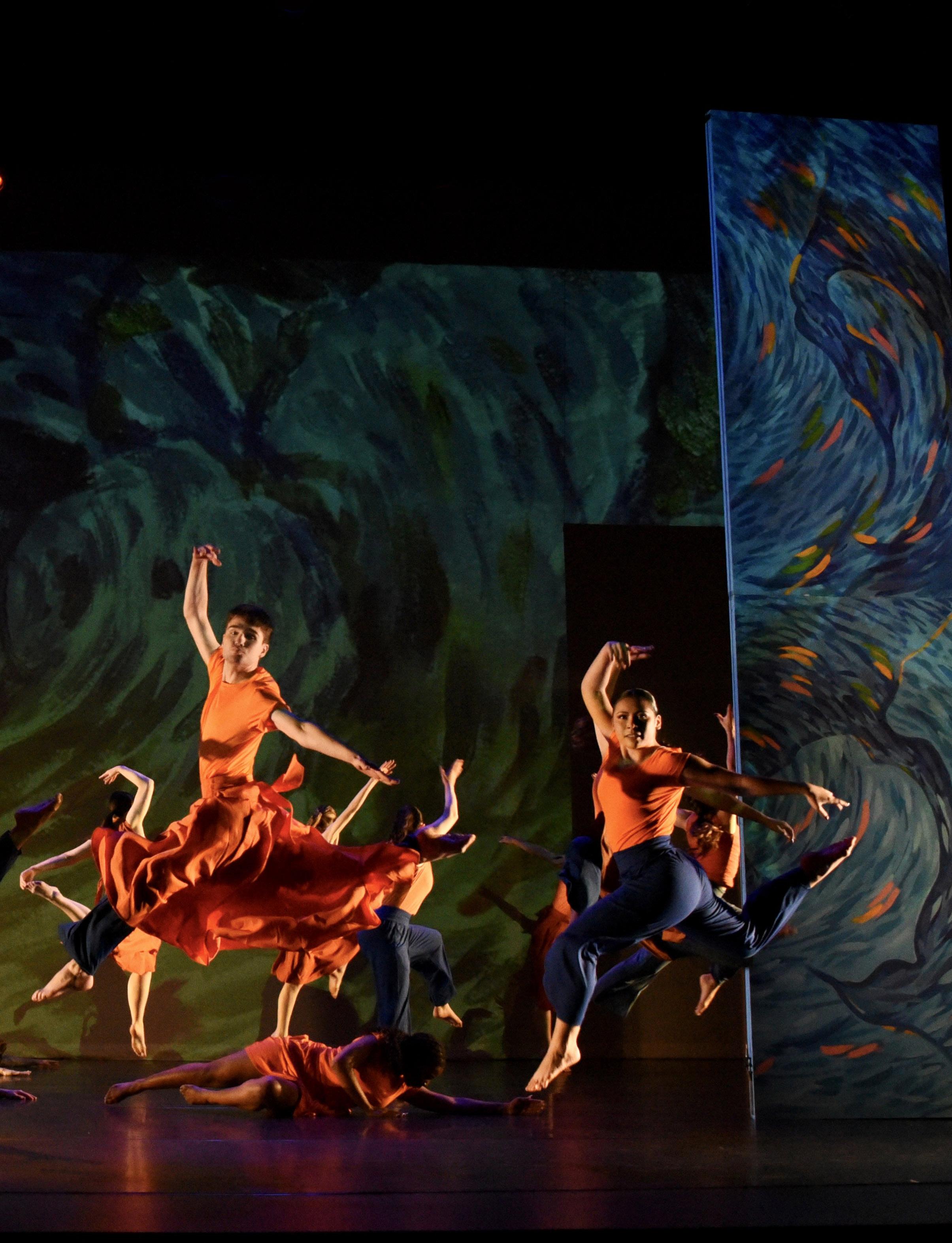
The New Jersey Jazz Society’s Jersey Jazz magazine named Jazz Studies saxophone student Kristin Field their Rising Star. “I always find it beautiful when players almost sing through the horn,” Field told Jersey Jazz
has made the Forbes 30 Under 30 United States List 2026, alongside tennis player Coco Gauff, musician Doechii, and actor Chase Infiniti, among others. Forbes says the class on its 15th-annual list “features up-and-coming visionaries shaping tomorrow.”
Ellen Bredehoft
Interim Dean
Stephanie Cronenberg
Interim Associate Dean for Academic Affairs
Director of Research
Annabelle Luu
Associate Dean for Finance and Administration
Marshall Jones III
Associate Dean for Access
Alana Integlia
Assistant Dean for Admissions and Enrollment Management
Lisa Sanon-Jules
Assistant Dean for Advising and Student Success
Denyse Reed
Director of Development
Jacqueline Thaw
Chair of the Art & Design Department
John Evans
Chair of the Dance Department
Amanda Eubanks Winkler Director of the Music Department
David P. Gordon
Chair of the Theater Department
Patrick Stettner
Director of the Rutgers Filmmaking Center
Kevin Bott
Director of Rutgers Arts Online
+ Share kudos, news, and career moves via our online form at go.rutgers.edu/submit-news
+ Join the Mason Gross LinkedIn community to network, share news and job opportunities, and interact.
+ Connect with the Rutgers University Alumni Association at alumni.rutgers.edu to update your info or to access alumni resources, benefits, events, and more.

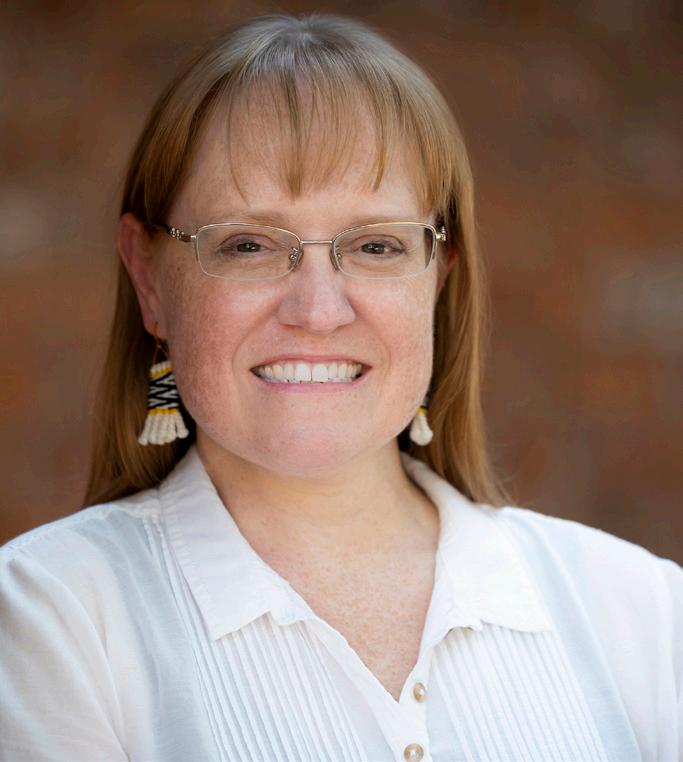
As we near the end of another incredible year at Mason Gross, there is a profound sense of joy and celebration within our community. On February 1, we launched our 50th-anniversary celebration with our Golden Kick-Off event, showcasing the dynamism of all five departments. And throughout the remainder of 2026, we look forward to continuing to celebrate our anniversary with various performances, exhibitions, screenings, and gatherings.
As we reflect on our past, it’s evident that our strength lies in our unity as a single school. Our collaborative spirit and commitment to interdisciplinary work are at the heart of what makes us an exceptional conservatory within an exceptional state institution.
Educating the next generations of artists is more important than ever: We need artists who are willing to bring creativity and beauty into this world to promote peace, joy, and healing.
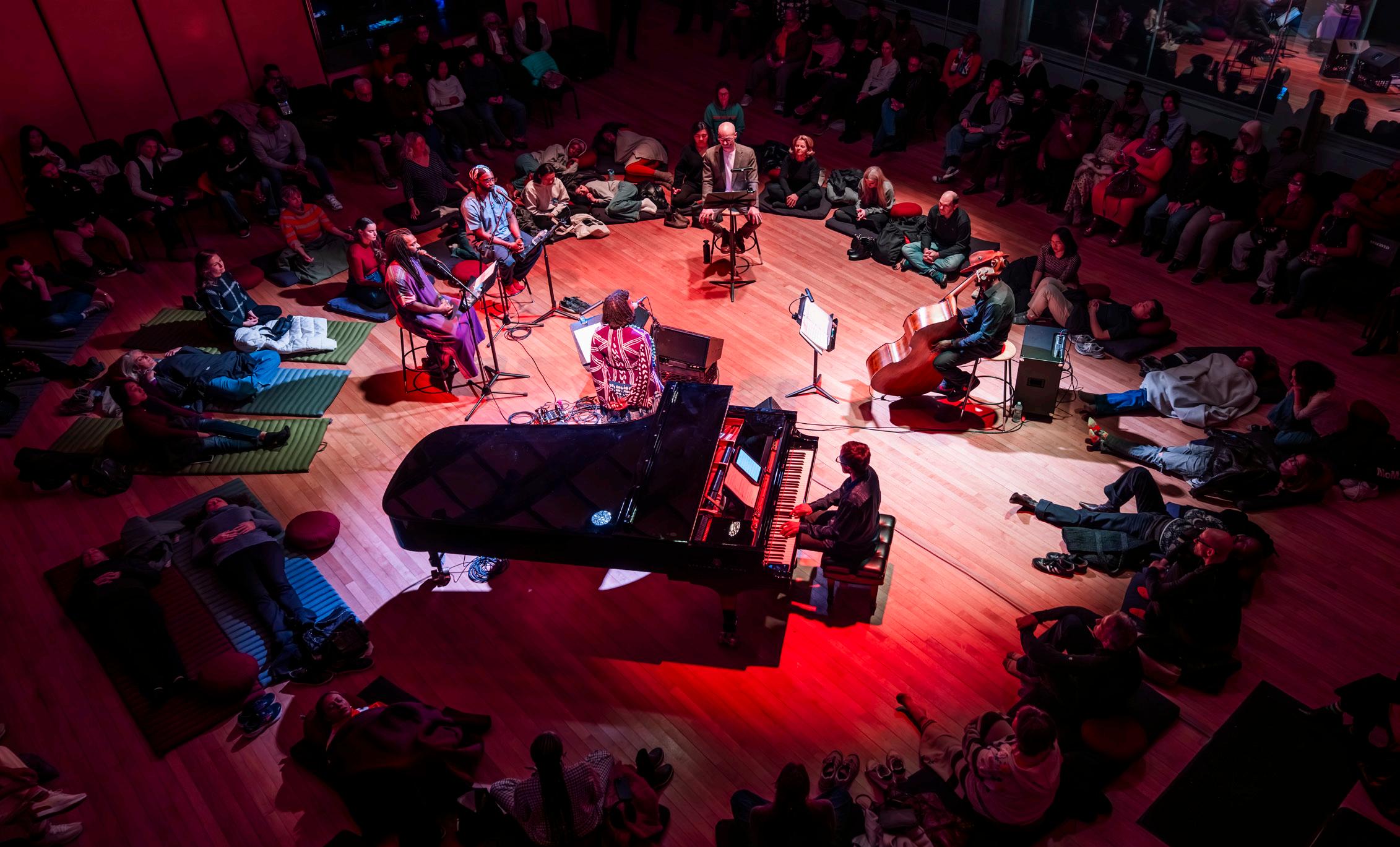
During the 2025–26 school year, we saw MGSA continue to evolve. We increased our course offerings at Rutgers Arts Online, expanding opportunities for the community and state educators. We are also thrilled to welcome Dr. Ian Koebner as our inaugural chair and endowed professor for Arts in Health. As part of this work, Koebner launched an initiative with Carnegie Hall earlier this year that resulted in a wellness concert hosted at the university’s Zimmerli Art Museum. Look for more offerings from the Well-Being Concert Series in the coming months.
Throughout the year, Mason Gross has been centering collaboration. During the spring semester, our Dance and Music departments collaborated on multiple events, including DancePlus at the New Brunswick Performing Arts Center and the Sound and Sculpture concert as part of the Tiny Dances Festival in Bettenbender Plaza. Additionally, we were captivated by an innovative drone-and-dancer performance, showcasing a new relationship between the Dance Department and the School of Engineering. This year also saw the appointment of Sue Huang, assistant professor in Art & Design, as the inaugural Rutgers–New Brunswick Laureate. During her tenure, Huang collaborated across multiple disciplines in a search to reintroduce New Jersey plant species long thought to be extinct.
As proud as we are of the past five decades at MGSA, we must also consider what the next five decades will look like. We will continue to gather and do the one thing that all the disciplines of our school share—telling stories. Documenting and interpreting the world around us through images, movement, or song isn’t just something we do for fun—this impulse is central to the human experience. There are stories of the past that have yet to be told, stories of the present that must still be told, and stories of the future that will need to be told.
In closing, it has been my greatest pleasure to have served the school as interim dean this year. We all look forward to the arrival of Dr. Michael Kim as our dean this summer as we consider our next chapter in student excellence and artistic success. Thank you, dear readers, for your ongoing support. I look forward to seeing you at our next event!


WE HAVE TO GET AWAY FROM THE IDEA THAT THE ARTS REPRESENT SPECIAL, ISOLATED ANTIQUARIAN ENDEAVORS NOT RELATED TO OUR TIMES. ART IS ORGANIC TO OUR TECHNOLOGY, TO OUR SOCIETY, AND TO OUR WHOLE CULTURE.”
–Theater professor Jack Bettenbender, advocating for the formation of the school in 1973. Bettenbender served as the first dean of Mason Gross School of the Arts.

6 THE SPIRIT OF ‘76
ON THE FRONT :
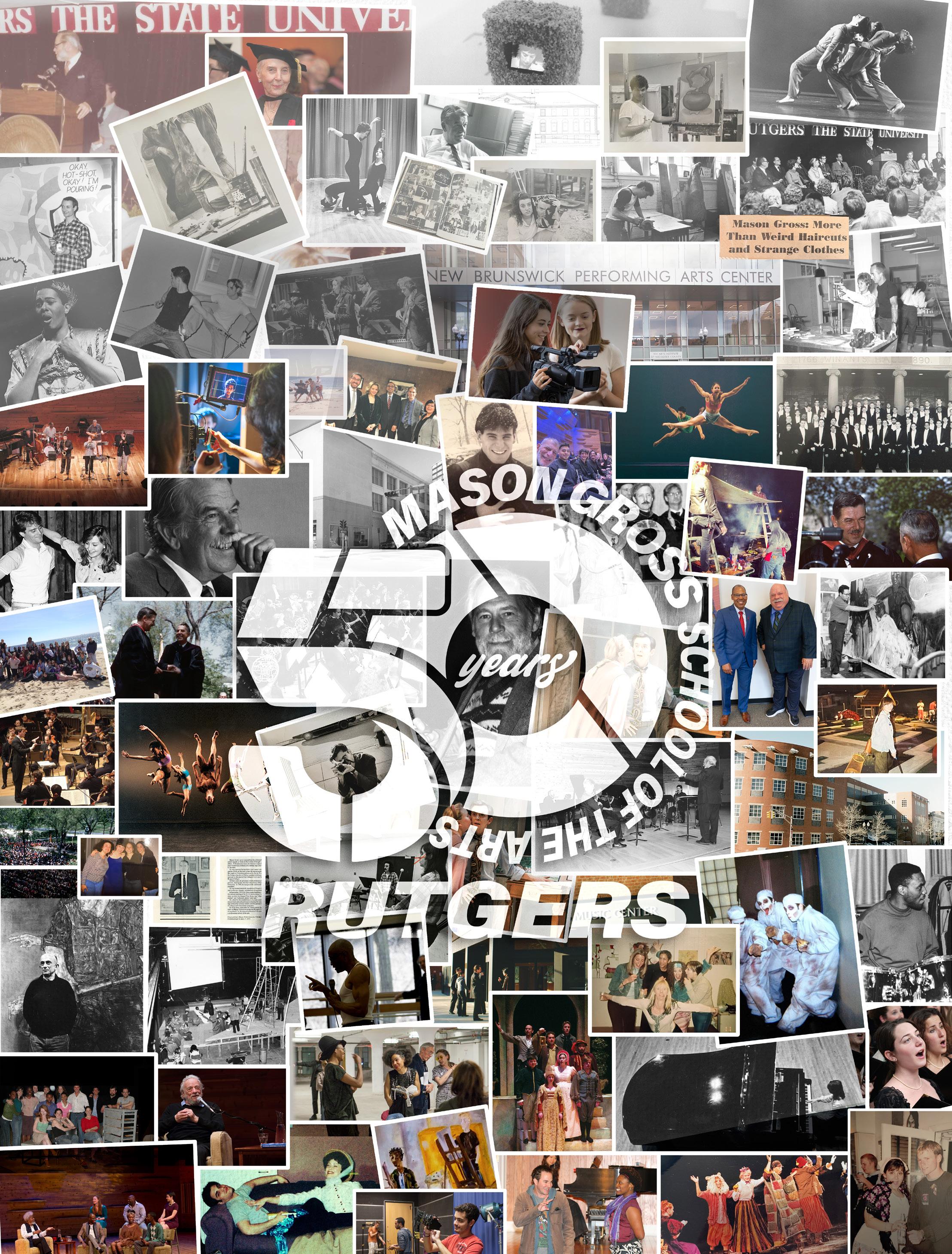
Fifty years of MGSA in photos, courtesy of alumni and Rutgers University Archives. Browse these and other images at go.rutgers.edu/mgsa50.
ON THE BACK :
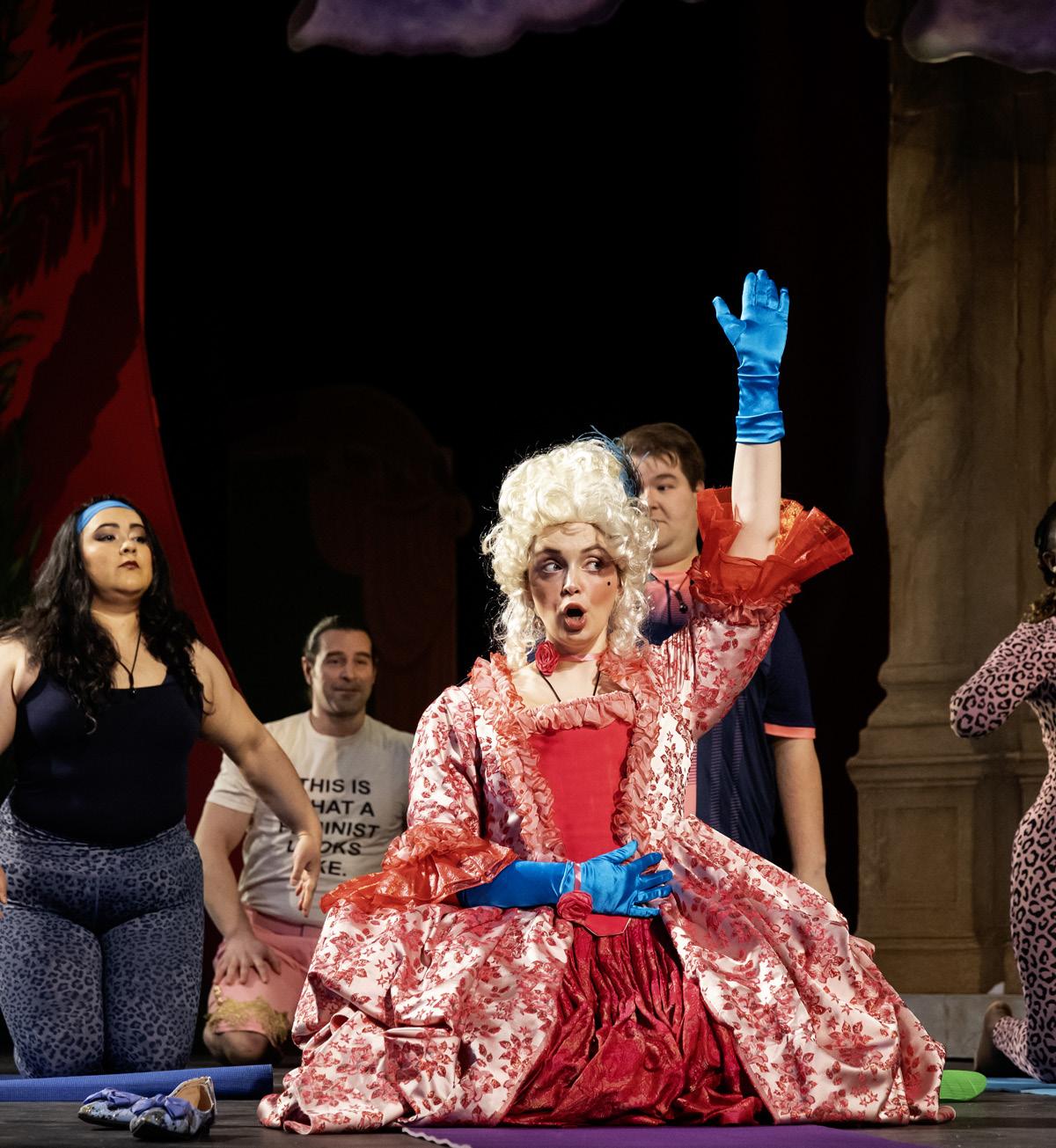
Micaëla Aldridge, foreground, with Susanna Leila, from left, Paul LaRossa, Dylan Rausch, and Blessing Ogbor in a February 9, 2026, dress rehearsal of Opera Theater Rutgers’ Don Giovanni . The production ran at the New Brunswick Performing Arts Center. Photo by Lynne DeLade
“I WAS STRUCK BY. . . THE STRONG SENSE OF COMMUNITY THAT DEFINES MASON GROSS—A COMMUNITY OF PASSIONATE ARTISTS AND FEARLESS RISK-TAKERS.”
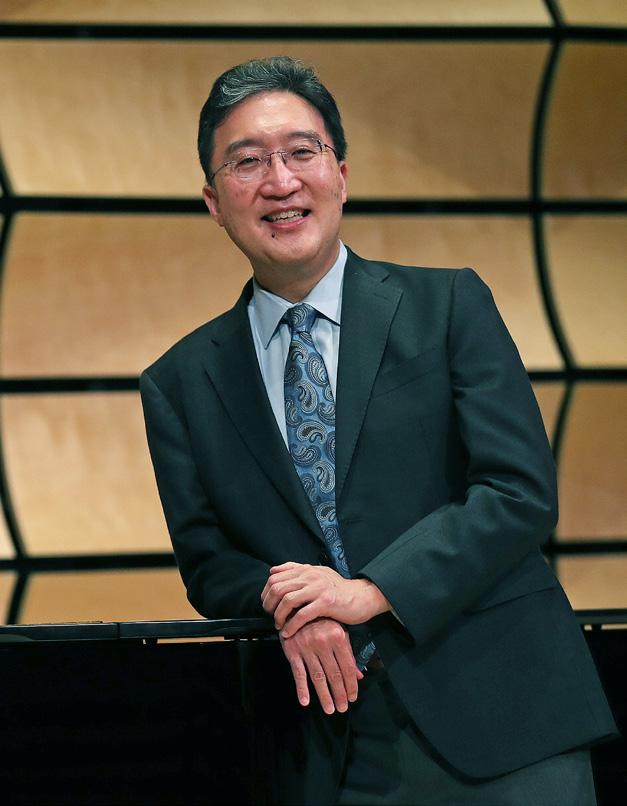
Incoming dean Michael Kim. The concert pianist and scholar is set to become the fifth dean in the school’s history.
14
19
Rutgers partners with Carnegie Hall for a Well-Being Concert Series
Initiative launches to welcome community to MGSA events
23
Dance alum recounts what it’s like to “fly, fall, and fight” as a Hollywood stunt performer
Five decades ago, The School for Creative and Performing Arts was established as Rutgers University’s arts conservatory. Shop MGSA merch! $1 from each item goes to the Academic Excellence Fund. go.rutgers.edu/shopmgsa
EDITORIAL STAFF
Editor: Laurie Granieri
Copy Editor: Risa Barisch
Contributing writers: Kelly-Jane Cotter, Paul Franklin, Lisa Intrabartola, Mike Lucas, Amanda MacLeod, Debbie Meyers, Emily Soper, Patty Zielinski
Designer: Mónica Toledo-Fraginals
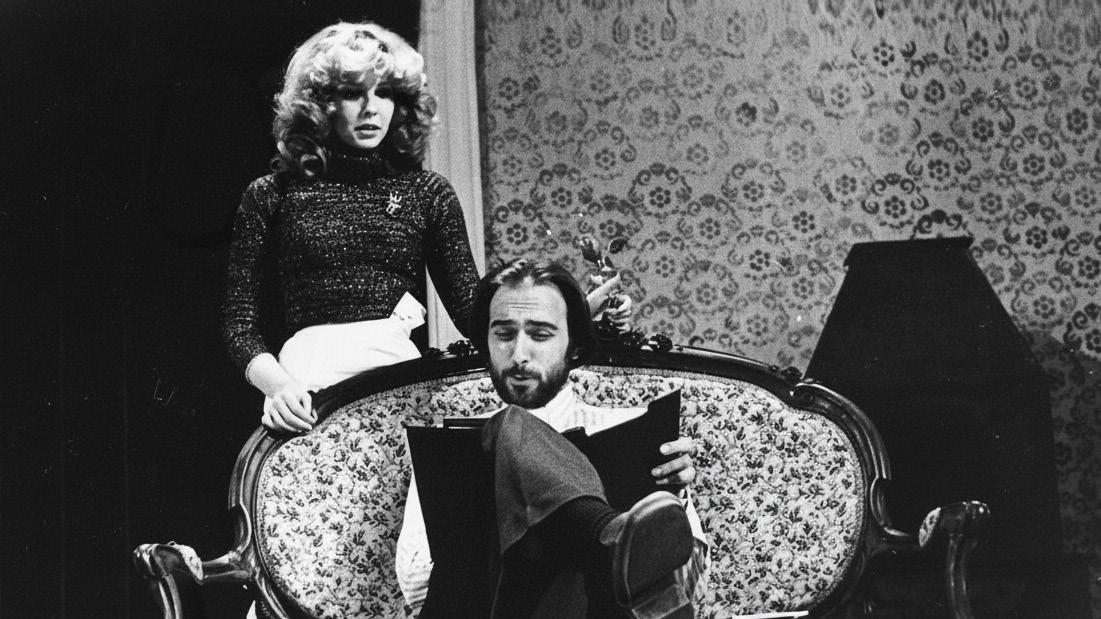
COURTESY OF THE THEATER DEPARTMENT
Deborah Jacobson and Gene Terruso in a publicity photo for our 1979 production of Henrik Ibsen's A Doll's
By Kelly-Jane Cotter
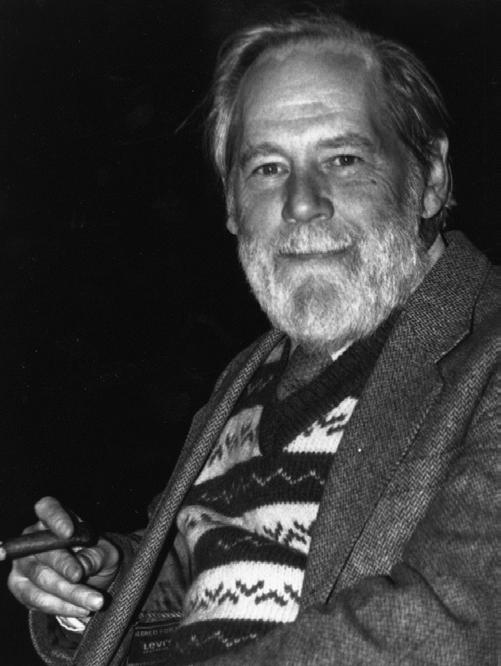
Ben Bettenbender recalls an air of possibility on campus as part of the first class of 80 students at Mason Gross School of the Arts.
“We were giddy,” the Theater alum says. “It was so much fun. So. Much. Fun. There were times when you’d get up at six in the morning and you wouldn’t get back until after midnight and you were basically in rehearsal or in class all day.”
“It was one of those periods,” he went on, “where it was just so exciting and so creative and you felt this energy and you barely slept and felt like you didn’t need it.”
Half a century ago, Mason Gross School of the Arts emerged as a laboratory and a playground for aspiring artists, an experimental place at an experimental time for Rutgers. Before the founding of Mason Gross in 1976, arts education at Rutgers operated under the auspices of the individual colleges.
“There was no really good professional arts training in the entire state of New Jersey,” says Patricia Mayer, who joined the Rutgers faculty in 1971 and later served as head of the Dance and Visual Arts departments, as well as interim dean. “The State Board of Higher Education, which no longer exists, decided to do something about it.” Rutgers was chosen as the site for this new school.
The consolidation, unification, and reimagining of the existing arts departments proved challenging. As Mayer recalls, “They were squashed together screaming and kicking.” William Berz, Professor Emeritus of
Music, who joined the faculty of Rutgers College in 1980, concurs. “Quite a bit of tension at first,” Berz says of faculty interaction. “They weren’t rivals, but they did feel those loyalties to their colleges.”
In addition to the jockeying and interdepartmental squabbling, there was the actual move to contend with, which was a lengthy process.
“The transition was much longer than many people remember,” Berz says. “There was a lot of equipment to move.” As a newbie on campus, Berz found himself assigned to piano duty, and he remembers a chaotic journey for two grand pianos that were moved from College Avenue to the Douglass campus. Workers for the moving company, he says, “took the lids off the pianos and moved the lids separately, and each piano had been designated for a certain faculty member in their private studio, and they put the lids in the right place, but not the pianos.” What followed, he says, was a significant amount of lugging, in a building without an elevator.
Ben Bettenbender has a unique perspective on the messy, exhilarating process, because his father, Jack Bettenbender, was the first dean of Mason Gross, serving until his death in 1988, and one of the key forces behind its creation. The other was Edward J. Bloustein, president of Rutgers from 1971 until his death in 1989, who also oversaw Rutgers’ emergence as a renowned research university and as a contender in big-time collegiate sports.
Ben Bettenbender remembers discussions around the family dinner table in Ohio, as his dad contemplated leaving Oberlin College to head the Theatre Arts Department at Rutgers in 1970.
“I must give Ed Bloustein the credit for reaching out to my father,” Bettenbender says. “I know within a year of his arrival there, they were talking about something university-wide: We want to be a national center of excellence in arts education. They were two brilliant people who strongly believed that the arts were a critical complement to education. They weren’t a nice add-on, they rounded out a curriculum, they rounded out a university and what it was teaching and what it was bringing to the world. Probably around ‘73, that idea began to take shape.”
The resulting School for the Creative and Performing Arts was re-named in 1977 for Mason Welch Gross, who served as president of Rutgers from 1959 to 1971. “He used to walk the campus and talk to students, so I chatted with him on a couple occasions,” says former associate dean Dennis Benson, who came to Rutgers as an undergraduate in 1966 and retired from his post at Mason Gross in 2012. “He was very laid back. He was a very decent guy.” Gross was known for his diplomatic handling of student protests of the Vietnam War as well as for the development of the Livingston campus and other large-scale projects. In 1959, he spoke bluntly about the need for community cultural centers in New Jersey, telling the state’s Constitutional Convention Association that New Jersey was “educationally impoverished” and “culturally almost bankrupt.”
The existence of Mason Gross School of the Arts helped to address those concerns. “By pooling all the students together,” Ben Bettenbender says, “you can now develop and design programs that support a much larger population of students, and in doing so, you are now able to go into the professional world and start to attract some of the very best teachers possible.”
The Theater Department, for example, could attract Bill Esper, the New Yorkbased, preeminent first-generation teacher of the Meisner Technique, in which actors focus on the behavior of another cast member, rather than simply anticipating their next lines, in order to generate a natural response. “It’s a virtuous cycle,” says Bettenbender, who has described the school’s founding as a “noble experiment.” “The better the students, the better teachers you can get; the better teachers you get, the better students you can get.”
This was crucial for smaller programs, such as Design, says Vickie Esposito, who retired from the Theater Department in 2016, after 43 years. Esposito says it would not have been possible to partner with the Globe Theatre in London for a study abroad program in 2003 without the clout of the Mason Gross School. “The London Design program was my baby,” she says. “We couldn’t have been as popular with the Globe if we didn’t have the school of the arts established.” More than two decades later, acting students continue to study at Rutgers Conservatory at Shakespeare’s Globe, while students in the design and production programs train at the Lyric Hammersmith.
Sometimes, the benefits of consolidation were even more basic. “Rutgers College never had a flute professor,” Berz says, “but Douglass did, so when we joined, we had a flute professor, and he was awesome. It was so unified and you could think about common purposes.”
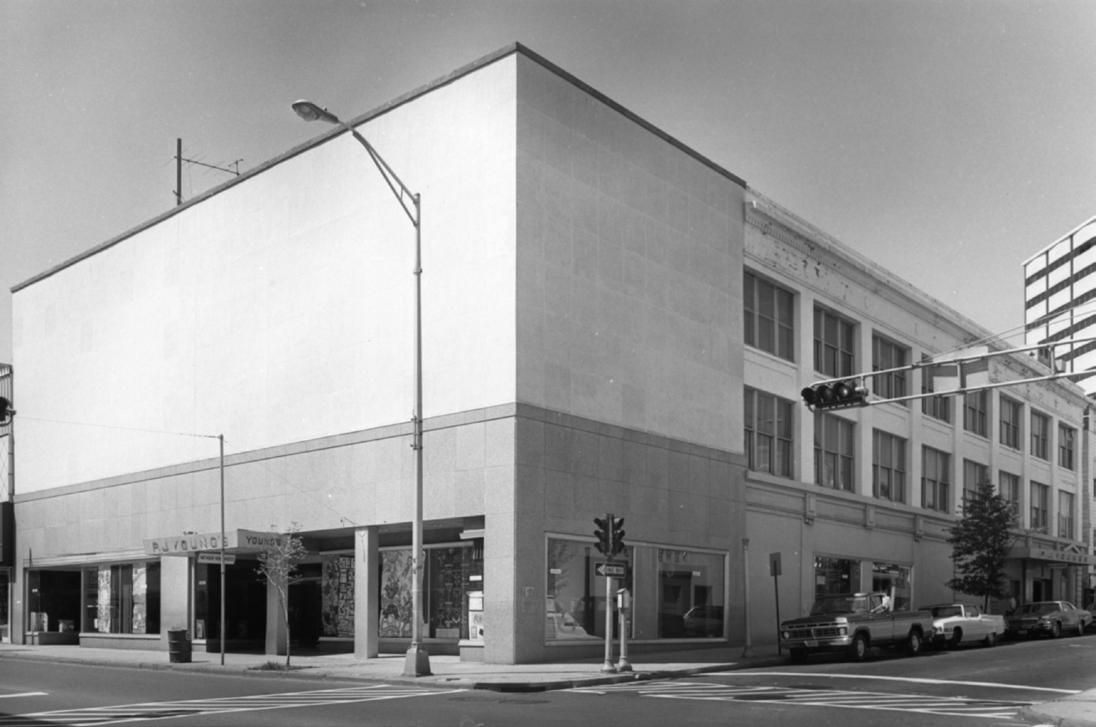
revitalization efforts, which began in the early 1980s, culminating with the establishment in 2019 of the New Brunswick Performing Arts Center, of which Rutgers is a partner company. But long before then, Paladino noticed an increased liveliness downtown as Mason Gross students attended classes there. “It set a new standard for the tempo of the streets,” Paladino says. “You started to see Mason Gross students coming and going at all hours of the day. I would come in at 7:30 in the morning and you would see someone leaving the school who’d obviously been working there all night with their portfolio. Just looking at who was walking on the streets and who might go into a pizza restaurant, you knew they were art students, which was important to the changing culture.”
Carol Thompson, who retired from the Theater Department in 2016 after 36 years on staff, says: “The thing that energized me all the way throughout was the student body, and later on, the alumni.” Mason Gross, she says, prepared students for careers in the arts and beyond. Theater, for example, is “an art form that’s based on a literary form, and each play offers a slice of the world, and, in order to do that play, you have to dive deep into the history, sociology, religious practice, etc., of that world…and you’re communicating physically and vocally, in ways that other people can’t do.” Future employers, she adds, benefit because “they have a really intelligent, collaborative, lively, mature, well-spoken, smart person. So, I believe that theater is a really fine major. It’s the definition of the liberal arts.”
E“D BLOUSTEIN AND JACK BETTENBENDER WERE TWO BRILLIANT PEOPLE WHO STRONGLY BELIEVED THAT THE ARTS WERE A CRITICAL COMPLEMENT TO EDUCATION.”
–Alum Ben Bettenbender, a son of MGSA’s first dean
In the 1960s and ‘70s, Rutgers was a hub of the Fluxus scene, a multimedia, performance-fueled art movement that emphasized the democratization of art and the creative process over the finished piece. “A key thing is that it’s interdisciplinary, challenging the divisions between music, poetry, and art,” says Gerry Beegan, professor and director of the MFA in Design, who joined Mason Gross faculty in 2000. “Disciplines can work together and enrich each other.”
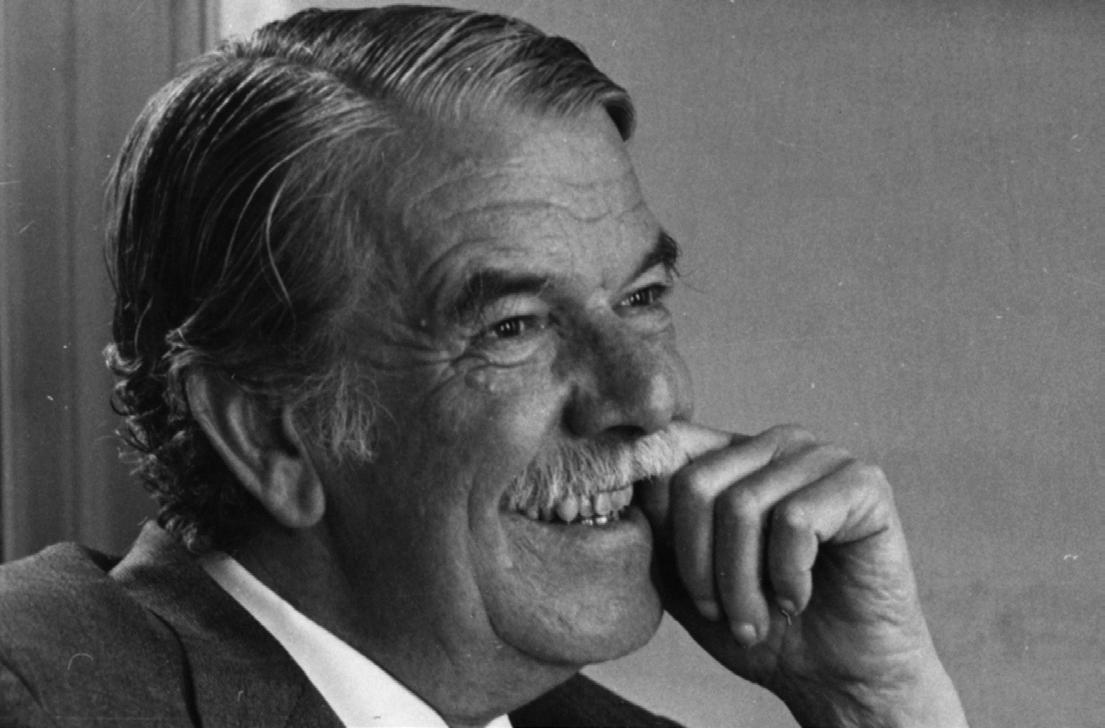
When he thinks back to the Music Department as it was in 1980, compared to now, Berz says, “the growth is absolutely beyond imagination, in terms of the capability of students, the enrollment, the scope, its influence in the state.
“Now, the professional music education organizations look to Rutgers for leadership,” Berz says. “The ensembles play in major venues in New York City, and the Rutgers Glee Club has performed all over the world.”
New Brunswick itself has benefited from the presence of Mason Gross, and vice versa, says Chris Paladino, president of the New Brunswick Development Corporation (DEVCO). The arts were a key factor in the city’s
Beegan sees a direct line between Fluxus and the outreach and interdisciplinary programs launched in the past five years under former dean Jason Geary, such as a minor in Creative Expression and the Environment, the Arts in Health Research Lab, and the wellness initiative Scarlet Arts Rx.
“We connect more with programs in high schools, and we’re engaged more with the local community, and we take that seriously,” Beegan says. “We’re back to Fluxus, because the point of Fluxus was that anyone can experience the art experience. It’s just about engaging with the world in a different way. There’s poetry in everyday life.”
Browse a timeline of the school’s history, and check out upcoming events celebrating MGSA’s golden anniversary at go.rutgers.edu/mgsa50

Longtime Art & Design
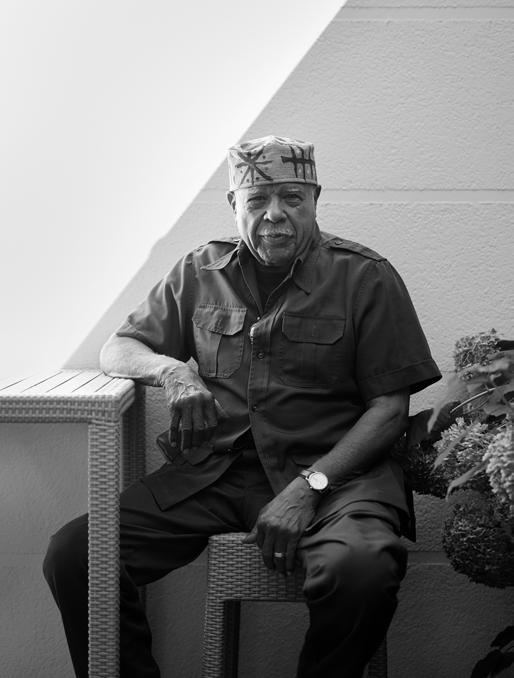
faculty Melvin Edwards died at his home in Baltimore, MD, on March 30, 2026.
“One of my discussions within the Black art community,” he told BOMB in 2014, “was with people who said, ‘Abstraction can’t be Black.’ Well, I don’t know why not. It always was.” Edwards, a sculptor, was on faculty at Rutgers from 1972 until his retirement in 2002.
Arts Online director Kevin Bott received the Cam Busch NOAH Award for Arts Advancing Social Justice at NOAHCON in New York City for creating and operating Ritual4Return (R4R), a program that supports formerly incarcerated individuals through the creation and performance of homecoming rites of passage.
Pam Tanowitz choreographed the Opéra National de Paris’ Gala Lyrique Anthony Roth Costanzo, a multimedia theater experience that combines opera, art, dance, film, and fashion. The event took place November 14 and featured music by Philip Glass and George Frideric Handel, costumes by Raf Simons
(co-creative director of Prada), and videos by Tilda Swinton and others.
In January, Tanowitz returned to Lincoln Center with Pastoral, set to an evening-length reworking of Beethoven’s Sixth Symphony by composer Caroline Shaw, with set design by Sarah Crowner.
Dance’s Gerald Casel has joined the leadership team of Jacob's Pillow. He is now the Carole and Dan Burack Director of The School at Jacob’s Pillow, a dance center, educational, and performance space in Massachusetts.
Filmmaking chair Patrick Stettner is quoted in Variety commenting on the ways in which the Rutgers Filmmaking Center is navigating AI and other emerging technologies. "Students have a clear awareness about what feels authored and what feels machine-made and are trying to find a way to use it that still feels personal and appropriate," Stettner said.
Composition faculty Scott Ordway’s concerto for violin and string orchestra, The Memory of Snow, premiered November 22 at Carnegie Hall. The piece was commissioned by Ruda Lee and the Hong Kong-
based Anima Ensemble.
Music faculty Conrad Herwig appears in Spike Lee’s latest film, the crime thriller Highest 2 Lowest, performing with Eddie Palmieri. The film, starring Denzel Washington, is streaming on Apple TV.
Brandon Williams made his Alice Tully Hall conducting debut in March during National Concerts' This Is Love: This Is Me Festival. He was also commissioned to compose a new work, Life Is Not a Dream, which received its premiere performance at the festival.
Bob Aldridge and Kraig Alan Williams are on faculty this summer at Brevard Music Center in North Carolina. Boston Pops conductor Keith Lockhart serves as artistic director of BMC, which is celebrating its 90th season.
Cameron Knight starred as Ebenezer Scrooge in McCarter Theatre's production of A Christmas Carol in Princeton, December 9–28. “Scrooge is a character of Shakespearean magnitude,” says Artistic Director Sarah Rasmussen. “Cameron’s deep sense of humanity and love of language will bring something truly
special to this production.” He also starred in McCarter's production of Heidi Armbruster's Mrs. Christie, which ran May 6–31.
Marshall Jones III, Theater alum and associate dean for access, directed Eboni Booth’s Primary Trust at the Guthrie Theater in Minneapolis, a production that the Minnesota Star Tribune named among the “10 Best Theater Performances in the Twin Cities in 2025.”

M USIC
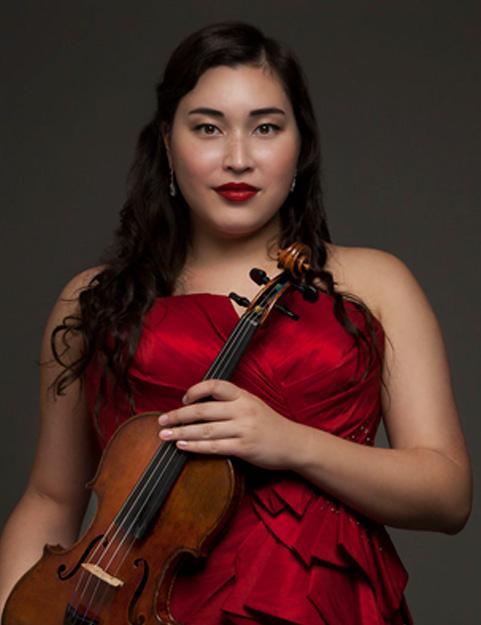
“I look forward to having meaningful discussions and musical sessions with students that will enable them to think outside the box and prepare them for a life outside of school.” Bouey is assistant professor of violin.
M USIC
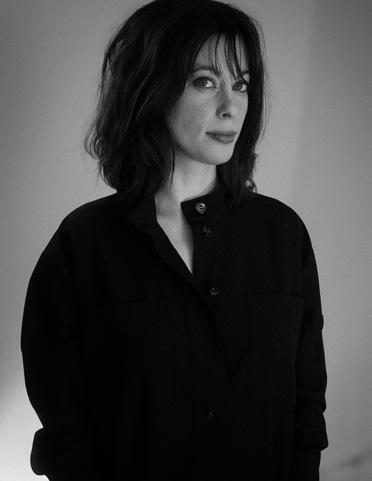
“I work with students to imagine what music education can be when every voice is heard, literally and figuratively. Together, we explore the traditions we inherit, question the practices we take for granted, and create space for new ways of teaching and learning.” Menon is an assistant professor of choral music education.
T HEATER
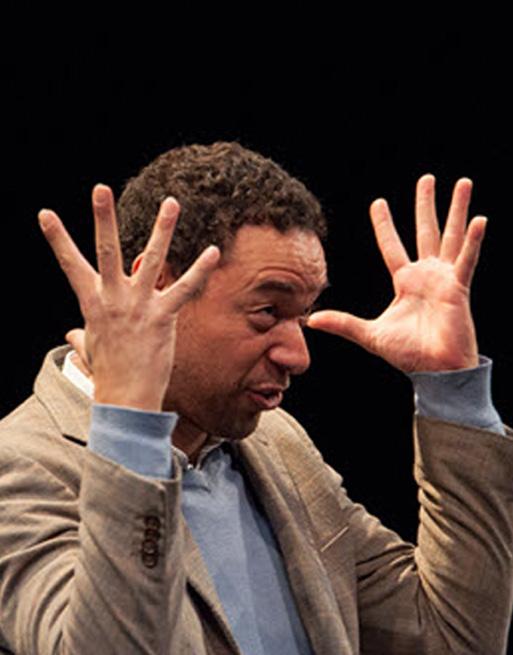
“I’m interested in and excited by theater where something is happening in the room, energetically, not just inside of the actor. In a world of Zoom boxes, this is what the communal arena of the theater has to offer us if we dare to step outside of our own bubbles.” Pauley is an assistant professor of acting.

A RT & DESIGN
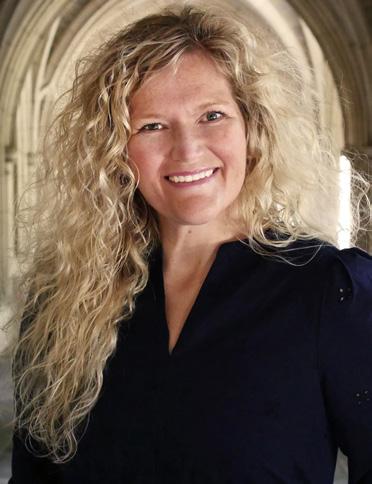
“I believe now more than ever the role of an artist in society is a necessary and crucial element in forming our future. My role is to help students develop their ability to paint thoughts, feelings, hopes, dreams, fears in a way that can transcend other forms of communication.”
Gibson is an assistant professor of painting.
M USIC
“With compassion, empathy, and curiosity, we as composers have the opportunity to tell our own stories as well as amplify the stories of those around us.”
Farrell is an assistant professor of composition in commercial music.
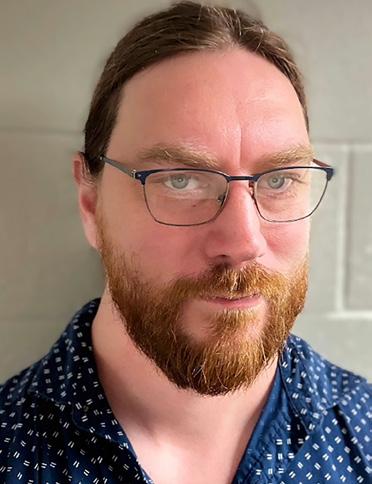
M USIC
“I strive to nurture reflective, resilient, and musically engaged students who feel seen, valued, and empowered.” Ryals is a director of clinical experience and practice and an assistant professor in music education.
T HEATER
“The most incredible thing about learning to make things with your hands is how everything is interconnected and how skills compound. Each new tool and material inspire new creative thoughts. I am excited to see how students discover what they are capable of creating.” Watson is an assistant professor, head of technical direction, and production manager.
Art & Design alum Serafina Kennedy received a grant from the Fulbright U.S. Student Program allowing her to spend nearly a year in Boda Glasbruk, a village in Sweden. While there, Kennedy worked with The Glass Factory to learn graal, a decorative etching process.
The Brooklyn Rail featured Art & Design alum Sedrick Chisom on its May 2026 cover. “The main things I depend on for my studio practice, outside of my research and being obsessive about developing an archive,” Chisom told curator and writer Ginevra De Blasio, “is just the act of showing up to the studio every day. The canvases really sort of endure me showing up repeatedly. They accumulate a sensibility over time from those encounters.” Chisom's show, The Revenants of Our Founding Furies, was on view at New York City's Matthew Brown Gallery from May 15 through June 20.
Since graduating from the Department of Art & Design in 2011, Juliana Frankovich has worked with a who’s who of lifestyle brands, including Moda Operandi, West Elm, and Equinox. Most recently, she’s been dreaming up the launch campaign for Clinique’s “Vitamin Makeup” line. As Clinique’s design

director of 360 Global Creative, Frankovich led the art direction for the campaign, which went live in spring 2025. Working together with her creative partner, Frankovich was responsible for pitching ideas, reviewing CGI and vector animations, and art directing photo and video shoots spotlighting the product. “All of this work is now live across the globe,” she says, reflecting on the nearly 200 photos and 50 video edits created for the launch. “It was one of the most rewarding projects of my career.”
Music alum Amanda Batista performed in The Met Opera's production of The Amazing Adventures of Kavalier & Clay earlier this year, while Art & Design alum Jamian JulianoVillani had a painting on view at The Metropolitan Opera House for the run of the opera in a companion exhibit about modernday superheroes. Juliano-Villani’s painting, enlarged, also hung as a banner outside the opera house. The New Yorker interviewed Juliano-Villani for a feature in February. She also has paintings in the collections of the Whitney and the Guggenheim museums.
Dance alum Shakira Barrera returned to the Marvel Universe last summer. Barrera starred as street fighter Roz Blood in the Disney+ series Ironheart, which premiered in June 2025. Barrera’s first foray into the Marvel Cinematic Universe was in 2020, when she played Agent King in the seventh season of Agents of S.H.I.E.L.D.
In March, Dance alum Damiani Van Rensalier joined the ensemble of Broadway’s The Great Gatsby.
Dance alum Carlo Antonio Villanueva was selected to be a 2025 Dance Research Fellow at the New York Public Library for the Performing Arts. Drawing from his own experiences as a dancer with the Bill T. Jones/Arnie Zane Company, his fellowship project explores the role of improvisation within the company’s oeuvre. On January 30, Villanueva presented a paper titled Live Action and the Archive: Locating Improvisation in Bill T. Jones’ Choreographies at the library’s Jerome Robbins Dance Division, the world’s largest dance archive and library.
Filmmaking alum Rachel Mihatov has directed and edited indie rock band Low Cut Connie’s video for
Little Freakers, the second single off their upcoming album. Though the band is based in Philadelphia, the video has a decidedly New Brunswick vibe: Part of the video was shot at Hamilton Street’s Ale ’N ‘Wich Pub. Livin’ in the USA will be released on July 3.
Fillmmaking student Nicholas Diodato had a short film, My Plastic Lung, screen on June 6 at the New Jersey International Film Festival.
In March, jazz radio station WBGO 88.3/Newark Public Radio invited several students to Yamaha Artist Services in New York City to record selections that aired in April, as part of the station’s Jazz Appreciation Month celebration. Participating students were Michael Price, Matt Estabrook, Micah Silverstein, James Pakhomou, Alex Ayala, and Ivanna Cuesta Gonzalez
Music student Kristin Field served as the writer, composer, and lyricist for Five Nights at Freddy’s: The Unofficial Musical, based on a video game. The musical won the New Jersey Association of Community Theaters Perry Award for Outstanding Production of an Original Musical.
Music alum Andrew Moore is set to appear in the role of Angelotti in a November 2026 concert performance of Puccini’s Tosca at Carnegie Hall with the New York Philharmonic under the baton of Gustavo Dudamel. In November 2025, Moore served as a cover for the bassbaritone role of Lamoral in The Metropolitan Opera’s production of Richard Strauss’ Arabella at Lincoln Center.
Grammy-winning Music alum
Peter Martin’s ensemble Third Coast Percussion was nominated for two Grammy Awards this year for their album Standard Stoppages: Best Chamber Music/ Small Ensemble Performance, and Best Engineered Album, Classical. The group took home a Grammy in 2017. Music alumni Isrea Butler and Shawn Edmonds are part of The Count Basie Orchestra, nominated for a Grammy Award for Best Large Jazz Ensemble for Basie Rocks with Deborah Silver.
On November 22, ANIMA ensemble performed Fool’s Spring, a composition by student Brandon DiNatale, at Carnegie Hall’s Zankel Hall.
Theater alum Joyce Meimei Zheng joined the national tour of Suffs in September.
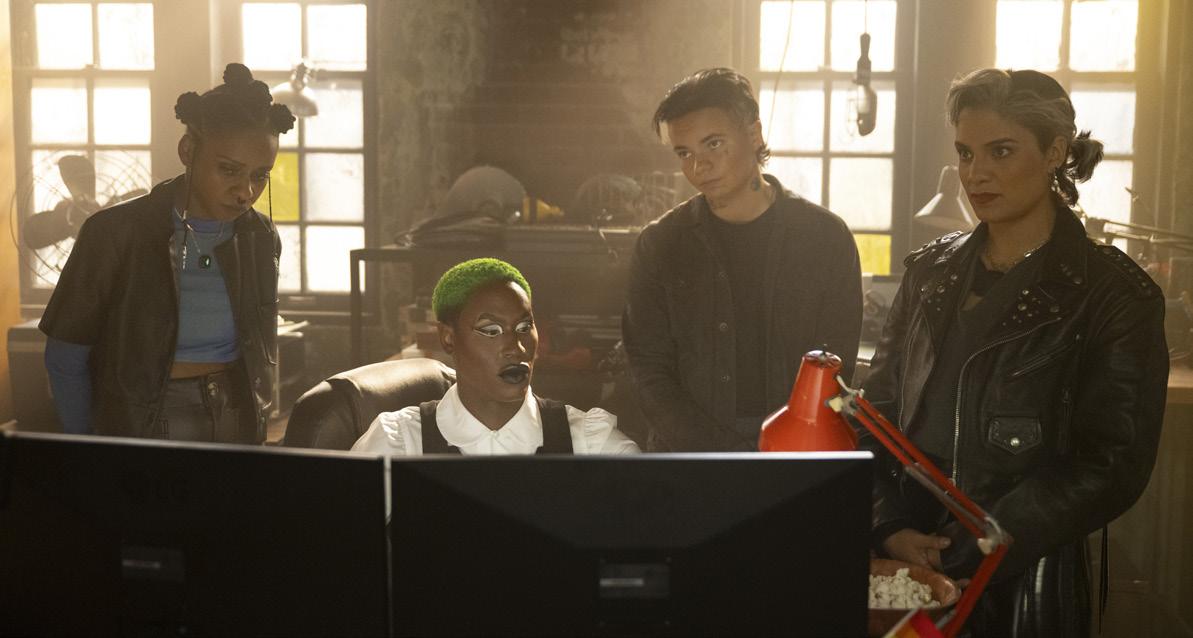
Emmy-winning Theater alum James Pearse Connelly designed the set for The Real Housewives of Beverly Hills Season 13 reunion. His other set design credits include Wheel of Fortune, The Voice, RuPaul’s Secret Celebrity Drag Race, and Top Chef
Theater alum Kayla Votapek has been named executive director of the Consortium of Asian American Theaters & Artists.
CNN included Theater alum Myla Flores in its 2025 “Champions for Change” cohort. Flores, who also majored in psychology while at Rutgers, is the founder of The Birthing Place in The Bronx, NY, an organization of BIPOC doulas,
As soon as Dylan Bates heard about the World Stinging Nettle Eating Championships while on a family vacation in England, he just had to compete.
It didn’t matter that he knew nothing about the competition or whether the plant was edible. It didn’t matter that the event was taking place the next day and he had not prepared. Bates, a first-year film student, wanted to compete because it was an opportunity to make a video.
“I thought it would be funny, and truthfully, just making other people laugh and to be entertaining is all I need,” he said. He didn’t win, but a photo of him—in his red mushroom hat, biting down on a nettle leaf and somehow simultaneously wincing and smiling—was captured by Getty Images—a widely used source of stock and editorial content—forever
midwives, and maternal health professionals working to improve maternal care in marginalized communities. The “Champions for Change” programming, which was featured on air and across CNN’s digital platforms in September, highlighted people across the nation who have worked to make meaningful change in their communities. CNN Chief Medical Correspondent Dr. Sanjay Gupta celebrated the cohort, including Flores, in an hour-long special that aired in September.
The Theatre Communications Group named alum and journalist Miranda Purcell one of their three “2025 Rising Leaders of Color.”
Theater student Meghana Kumar, named among “Six Rising Stars” by Backstage, told the magazine why she chose the Rutgers Acting program, crediting her study of the Meisner Technique and the opportunity to train at Shakespeare’s Globe in London. “I trusted my career with the right people; I feel like I have not wasted a single moment of time here,” she said.
If you watched Season 4 of the Emmy Award-winning Peacock competition game show The Traitors earlier this year, you saw host Alan Cumming’s splashy outfits—some of which were designed by MGSA Theater alumnae. As part of designer Chris Habana’s team, alums Emily Knapp, Keeley Seboria, and Colleen Burns helped construct a colordrenched custom yellow outfit with pants and a skirt that Cumming wore in episode 3. The outfit, a combination of mesh and lace, was dipped in silicone and meant to mimic muscles and tendons.
In January, Theater alum Bill Bowers received a 2025 BroadwayWorld Boston Award for his autobiographical show It Goes Without Saying. Bowers won Best Cabaret/Concert/Solo Performance (Professional) for the show, which ran at Provincetown Theater.
FILMMAKING STUDENT PARTICIPATED IN THE WORLD STINGING NETTLE EATING CHAMPIONSHIPS—THEN MADE A VIDEO ABOUT IT
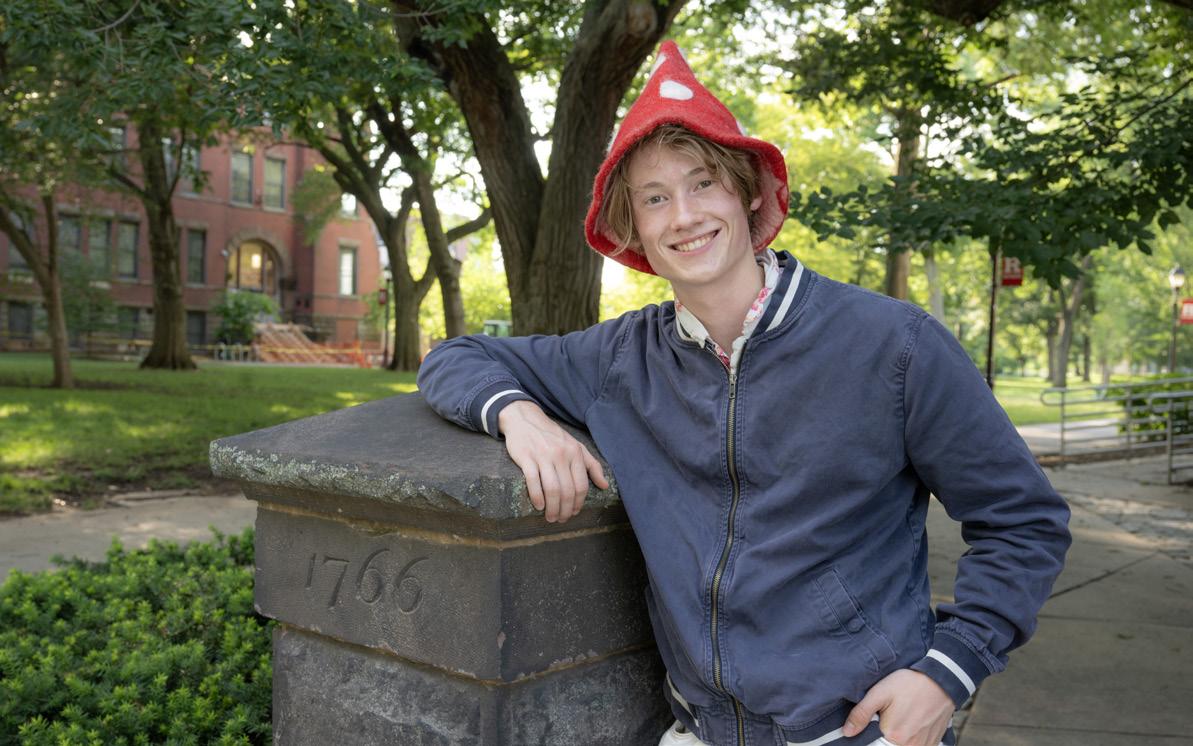
associating his face with the competition. And, yes: He made that video for his YouTube channel.
Bates loves movies and television and grew up with YouTube, watching videos and, later, making videos for the platform, but his ambitions aren’t limited to becoming a “YouTuber.”
“I just got fascinated by the idea of YouTube as an art form,” he said. “And I'm not saying I make anything sophisticated, deep, or with complex moral questions, but I do like to think that, to some extent in the 21st century, online video creation is going to be the art form.” He wants to work in the creative
side of the film industry. Even if he doesn’t become a filmmaker, he said he’d be happy to be what he called “film adjacent.”
“I'd love to be a writer for a sitcom, for example, or an editor for movies,” he said. “Anything that involves any sort of creativity within entertainment, I would absolutely adore.”
Bates grew up in Massachusetts. He chose Rutgers because he wanted to explore somewhere new.
“I love New England with my whole heart; I love Massachusetts, but I’ve spent 17 years here. I’d like to find another place to live now,” says Bates. “I really like just how diverse and multicultural New Jersey is. That was such a big appeal to me. I genuinely like how many different cultures you get in one space and how connected it is to the rest of the world.”
Watch Bates's video at go.rutgers.edu/mgsamag
DOCUMENTARY SPOTLIGHTS ESCALATING SEA LEVELS
Excerpted from a story by Mike Lucas
More than two dozen students and recent grads of the Filmmaking program collaborated with Oscarwinning documentarian and professor Thomas F. Lennon over three years to create Marine Field Station: The Retreat, a documentary detailing the real-world effects of rising sea levels.
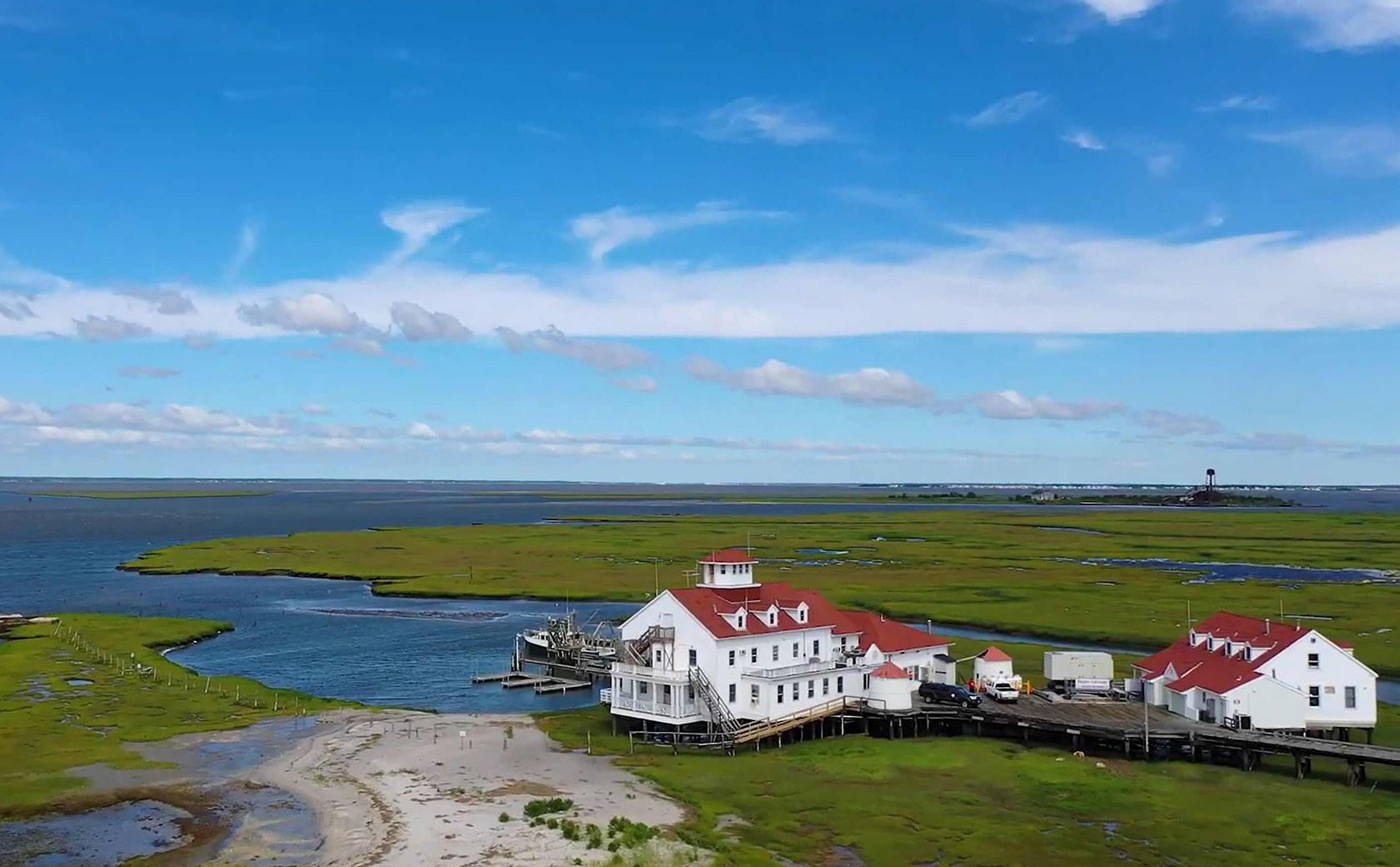
The 10-minute documentary, which Lennon, also head of the school’s Documentary Film Lab, directed and produced, focuses on the Rutgers University Marine Field Station, a facility of the Department of Marine and Coastal Sciences within the School of Environmental and Biological Sciences. The station, which serves as a working lab where graduate- and postdoctoral-level research is conducted year-round, sits across from the Little Egg Inlet in the Mullica River-Great Bay estuary.
The central dilemma: Do the Marine Field Station scientists move inland given that the station is vulnerable to rising flood waters?
When it came to interviewing the scientists, Lennon says that he and his film crew had to figure out “how
to draw out the best from them, and how to help mediate and translate the language of science into the language of film.”
He says, “Science, which is all about precision, and film, which is all about emotion and impression, and making all that work—that was the challenge, and I wanted the students to really feel that and be tested by that challenge.”
The film was accepted to several festivals, including the Climate
THE MASON GROSS SCHOOL OF THE ARTS COMMUNITY REPORTS WITH GREAT SADNESS THE LOSS OF ALUMNI AND FRIENDS OF THE SCHOOL. WE EXTEND OUR CONDOLENCES TO EACH OF THEIR FAMILIES AND CLASSMATES
Kevin M. Rank, BM’07, Music
Dianne C. Witherbee, BA’81, MFA'85, Art & Design
Action NOW Monthly Film Festival, the Colorado Environmental Film Festival, and the Newark International Film Festival.
Giving students projects that grapple with real-world issues is crucial, Lennon says.
“You can think of the Documentary Film Lab as something of a bridge between school and the world of work,” he says. “Giving students opportunity—that’s our job.”
Participating crew members include:
Editor: alum Margot Maxwell; associate producers: alums Cody Lawrence, Alla Rico, Kimberly Hansen, and Margot Maxwell; cinematography and sound: students Nolan Maraziti and Andrew Alexander, along with Evan DesRosiers; assistant editors: Kimberly Hansen, Cody Lawrence, Alex Lane, and Margot Maxwell; color correction: alum Jackson Clark
All death notifications included in this issue of our magazine were submitted to the university after our last issue in spring 2025 and before going to press on this issue. We apologize for any omissions and ask that loved ones of deceased alumni, friends, donors to the school, faculty, and staff notify us by emailing records@rutgersfoundation.org. Please be sure to include the full name of the deceased (and name as a student), death date, class year, and major. Thank you.
By Kelly-Jane Cotter
Courtesy of Rutgers
Today
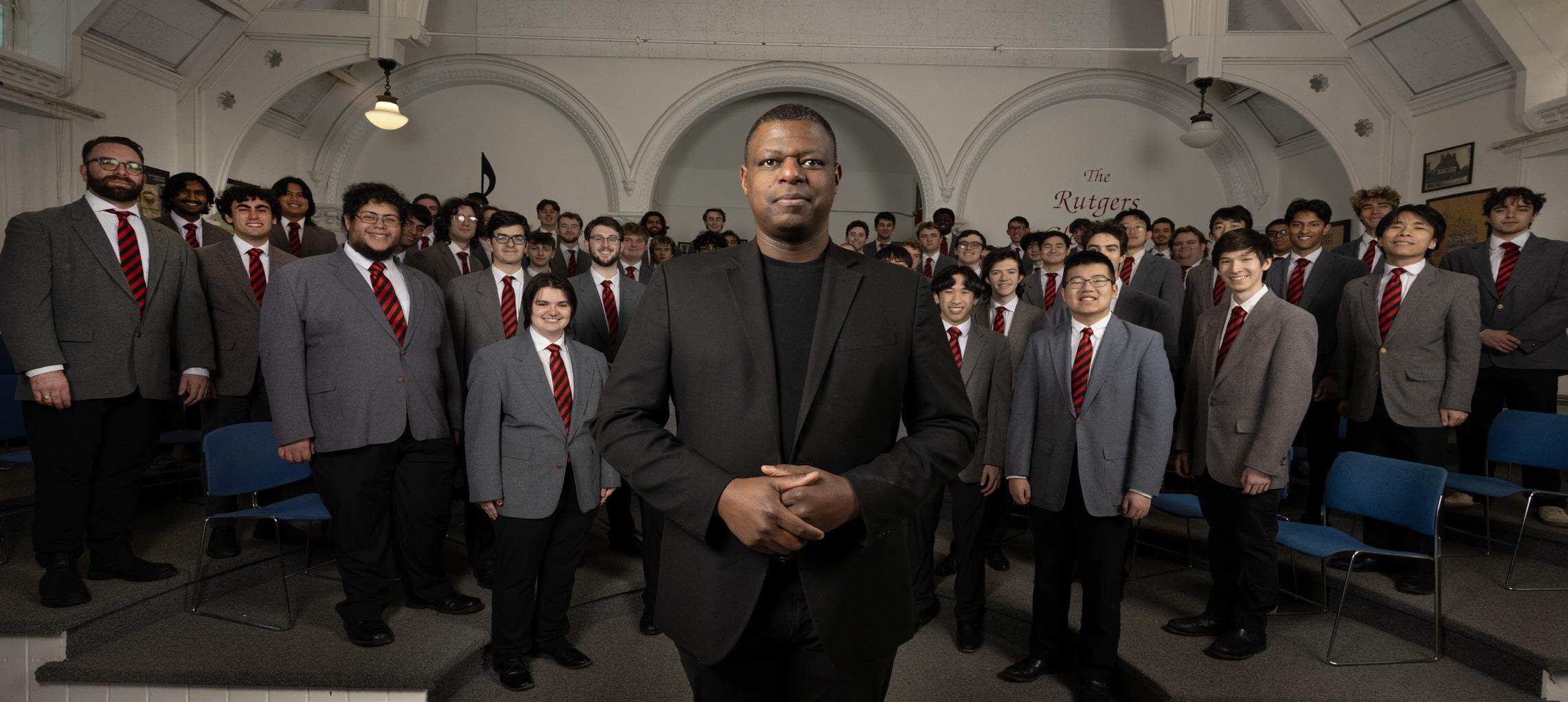
The members of Rutgers Glee Club, dressed in their signature gray blazers and red-and-black striped ties, are standing at attention in McKinney Hall on the College Avenue campus for a photo shoot before class. Brandon Williams, their professor and conductor, is arranging them as carefully as he would arrange music.
“Victor, would you switch with Nate?” Williams scrutinizes the ensemble. He points to one student. “Your button is lopsided.” And to another. “Help him with his collar here.” And to the group as a whole: “No smiles now, more stoic.” The students, a jovial bunch, take it down a notch and face the camera, looking like the dignified, respectful artists that they are. Perfect. The camera clicks. Done.
Before the students are even back in their seats, Williams begins vocal exercises. As he leads them through a warm-up of sustained vowels, the singers develop a rich, resonant sound, their voices blending so seamlessly that Williams interjects, “Great job!”
Since the founding of Rutgers Glee Club in 1872, generations have gone through similar rehearsals in a quest for musical excellence reflected in the ensemble’s motto, “Ever-changing, yet eternally the same.” Williams, associate professor and director of choral activities at Mason Gross School of the Arts, became director of Rutgers Glee Club in 2023, after the retirement of Patrick Gardner, who led the group for 30 years.
This year he is helping the Glee Club prepare for one of its most
cherished traditions: a concert tour abroad, which takes place every four years. This time, the singers will tour Portugal and Spain for 12 days in May. “They’re not going there just to eat and sit on the beach,” Williams says. “They are there to perform in some really prestigious and historic venues.” The trip is subsidized by Glee Club alumni, reducing the cost for current members. “Some of the most devoted and loyal alumni that we have at Rutgers are Glee Club alumni,” Williams said. “They care deeply about the choir.”
Williams, who reveres both tradition and innovation, takes his responsibility leading the Glee Club seriously, and his students know that. “Dr. Williams holds us to a high standard,” says John Rutsky, a senior who joined the Glee Club’s baritone section as a freshman. “He’s easy to talk to, but he runs a tight ship.”
Amanda Eubanks-Winkler, director of the Music Department, agrees.
“Brandon is a sensitive, musically perceptive conductor,” EubanksWinkler says. “He gets the very best out of the ensembles he leads, including Glee Club.”
Membership in Rutgers Glee Club and Kirkpatrick Choir, which Williams also leads, requires an audition as well as enrollment in class. “Check your body position,” Williams advises, as the Glee Club embarks on a first reading of Mozart’s “Little Masonic Cantata” from 1791. The students sit up straighter.
Williams has been laser-focused on music since his childhood in Illinois, growing up in a family that listened to R&B and gospel. “The first music education I received was sitting in the pews of my church,” he says. “There was a strong tradition of using your ears to learn music, the aural tradition, and creating harmonies and fitting your voice in
with others.” He became serious about the discipline of music in high school, where he further realized that “music takes work.”
He delved into music theory and voice and piano lessons. “I don’t see it as a gift,” he explaines. “Music is a skill that can be taught and learned.” Williams went on to earn degrees from Western Illinois University, the University of Illinois Urbana-Champaign, and Michigan State University.
Williams taught music at middle and high school levels for 10 years in St. Louis, where he also taught at Maryville University and was a conductor for the St. Louis Symphony IN UNISON Chorus and the St. Louis Children’s Choirs. He likes to say he teaches “ages eight to 80.”
“ I DON’T SEE IT AS A GIFT. MUSIC IS A SKILL THAT CAN BE TAUGHT AND LEARNED.”
“At its core, there’s not a difference,” he says. “People want to be engaged, and they want to know that you care about them. It doesn’t matter if you’re in kindergarten or if you’re a college senior. People appreciate that you’re competent, and that you have the skills to lead. You start by meeting them where they are, and then grow from there, especially in classes where there are music majors and non-majors.”
Rutgers Glee Club, a tenor-baritonebass choir, is predominately comprised of non-music majors, as is Voorhees Choir, the sopranoalto ensemble based at Douglass Residential College, which Williams led for seven years, strengthening the group to the extent that it was selected “not once, but twice”
to perform at the Eastern division of the American Choral Directors’ Association conference. “It’s a really big opportunity and recognition in the choral world,” Williams says. “I was quite proud of the work we did together to get there.”
William Berz, Professor Emeritus of Music at Mason Gross, described Williams as “a phenomenal musician, a great leader and a terrific choral conductor.”
“His energy is just infectious,” Berz continues. “When I was still director of the department, he was conducting Voorhees, and that group just shined. He did everything right, and the students loved and respected him. So, I know the same thing is going to happen with the Glee Club and Kirkpatrick.”
Most members of Kirkpatrick Choir are music majors, so Williams has led them as if they were the choral equivalent of a varsity team. “I intentionally made it smaller, from 70 people to about 47,” he said. “It’s a smaller group of singers who have stronger musicianship skills, and more control over their vocal mechanisms.”
Glee Club members highly anticipate the spring tour. Rutsky, a communications and human resources major, says he joined Glee Club because “I wanted to expand my musical excellence. I wanted to be more engrossed in this world. And now I’m getting the chance to sing in European cathedrals.”
Rutgers Glee Club, he says, has given him some of his closest friends and a sense of home on campus. “When I get tired from school or work, I can come here and feel at ease,” Rutsky says. “It’s a brotherhood.”
IAN KOEBNER, NAMED INAUGURAL CHAIR AND ENDOWED PROFESSOR IN ARTS IN HEALTH, LAUNCHES A WELL-BEING CONCERT SERIES WITH CARNEGIE HALL
In October 2025, Ian Koebner, a recognized expert in the public health benefits of weaving the arts into institutional settings, was named the inaugural chair and endowed professor in Arts in Health at Mason Gross. Koebner’s appointment came as a result of the largest gift in MGSA’s history, $8.8 million, an anonymous gift announced in February 2025.
In this position, Koebner is guiding the development of public programming, education, and research collaborations that explore how creative engagement supports physical, emotional, and social health. His work is meant to further connect Rutgers artists and scholars with health care institutions and community organizations across New Jersey and beyond.
In February 2026, Koebner, who also serves as strategic advisor for health and wellness programs at Carnegie Hall, announced a partnership between Rutgers and Carnegie Hall’s Weill Music Institute designating Rutgers as
an official partner for Carnegie Hall’s Well-Being Concerts. This initiative, established by Carnegie Hall in 2023, integrates musical performance with evidenceinformed approaches intended to support health, reflection, and social connection.
“This partnership will provide a platform for the university and the communities we serve
to experience and explore the profound impact of live music on individual and collective wellbeing,” Koebner says. “It will create meaningful training opportunities for students and faculty interested in using their musicianship to support health, while bringing inspiring artists and scholars to Rutgers. At the same time, it will serve as a bridge connecting the arts with departments and schools across the Rutgers ecosystem.”
Koebner notes that while each concert is unique, the series intentionally departs from a traditional performance format. Programs are structured as immersive experiences that integrate guided reflection, focused listening practices, and opportunities for connection between audiences and performers. The goal is to foster an environment where music is not only heard but experienced as a form of care.
The inaugural Rutgers WellBeing Concert, featuring Mason Gross Music Department faculty and violinist Christina Bouey, took place at the university’s
Zimmerli Art Museum on April 9 as the culminating event of the Art Heals symposium. Koebner is also planning a concert in collaboration with the School of Nursing for fall 2026.
Koebner holds a doctoral degree in health care leadership and a master’s degree in pain research, education, and policy. During Koebner’s tenure at the helm of the integrative pain management program at the University of California, Davis, from 2012 to 2022, he says, he established the nation’s first partnership between a contemporary art museum and an academic medical center devoted to researching the potential for museum and virtual venue engagement to mitigate loneliness and pain.
“I was drawn to Mason Gross because of its deep artistic excellence, its commitment to community, and its unique position within a major research university,” Koebner says. “I believe MGSA is poised to become a national leader in shaping how the arts contribute to human flourishing—through artistic practice, research, education, and public engagement.”
JOHN MUNSON/RUTGERS UNIVERSITY
Maya Ramdayal has made sustainability part of the planning process for theater production at Rutgers, influencing both Mason Gross faculty and her classmates.
By Kelly-Jane Cotter Courtesy of Rutgers Today
Maya Ramdayal is drawn to what she calls the “world-building” aspect of theater—creating the sets that serve as the habitat for the characters in a play.
As a student concentrating in set design, she also has been able to prioritize the environmental impact of her designs, thereby “worldbuilding” in an additional way.
“We throw away a lot,” she says. “It’s kind of impossible to save everything. Building our own shows, you learn how much waste can happen, but also how much you can recycle.”
The senior gets credit for making sustainability part of the planning process for theater at the university, influencing both Mason Gross faculty and her fellow classmates.
“Maya is the first person who really made it a priority and wanted to take action,” says David P. Gordon, chair of the Theater Department and associate professor of scenic design. He says Ramdayal brought the issue to his attention, and he has become more eco-conscious because of her influence.
Sustainability, Ramdayal says, can involve “simple things like using stock platforms when we can.” Those platforms have interchangeable legs and can be used and re-used at various heights.
Sustainable sourcing for materials, she says, is also key: “We have fabric scraps from a previous show; can we use it? Or can we buy second-hand fabric?” Wood, another material in high demand by set designers, is easily damaged, but Ramdayal says the careful use of screws can prevent pieces from breaking. Mindful care of floorboards from the set Ramdayal designed in her junior year for God of Vengeance, by Sholem Asch, a mainstage show at the Philip J. Levin Theater, resulted in their later use as material in class.
“Being wasteful,” she says, “is outdated.”
For Rutgers Day, April 25, Ramdayal designed the set for a performance of Ntozake Shange’s For Colored Girls Who Have Considered Suicide/When the Rainbow Is Enuf at Little Theater. For the set, Ramdayal repurposed textured paper from an earlier production. The cast also used recycled scripts.
Her classmates agree Ramdayal is leaving her mark at Rutgers, having reshaped the department’s approach to theater.
Ben Levie, a student lighting designer, recalls the painstaking process of selecting appropriate LED lights that would fit their budget as well as their sustainability goals.
“I never would have thought to do this if not for Maya, but it turned out the research I needed was so accessible, I just needed to want to look,” he says.
“I think that was the biggest thing she gave us, just a reason to try this way of doing things. There were always the tools and the capability, and the team was so on board as soon as she brought it up, but nobody would have put those ideas into action without Maya,’’ he says.
Ramdayal learned about sustainable theater production during her semester abroad in London in fall 2024, when she and other Mason Gross students studied at Shakespeare’s Globe Theatre and the Lyric Hammersmith.
“It lit a spark in me,” she says, recalling a presentation from a sustainability advocate in London. When she returned to Rutgers and began designing for a production of Hurricane Diane by Madeleine George, a comedy about Dionysus’s attempt to save the world from climate change, Ramdayal took the theme of the play as a sign and kept sustainability in mind.
She found resources and guidance through the Broadway Green Alliance, a New York-based organization that aims to reduce the environmental impact of theater on Broadway, college campuses, and elsewhere. Ramdayal decided Rutgers needed to participate in the initiative, so she became trained as a collegiate Broadway Green Captain.
“B UILDING OUR SHOWS, YOU LEARN HOW MUCH WASTE CAN HAPPEN, BUT ALSO HOW MUCH YOU CAN RECYCLE.”
A guest speaker from the alliance at Ramdayal’s “Theatre Colloquium” class helped spread the message to her peers.
“After that talk, interest grew,” Ramdayal says. “Sometimes it felt like I was the only one who cared, and then so many people reached out. It was validating.”
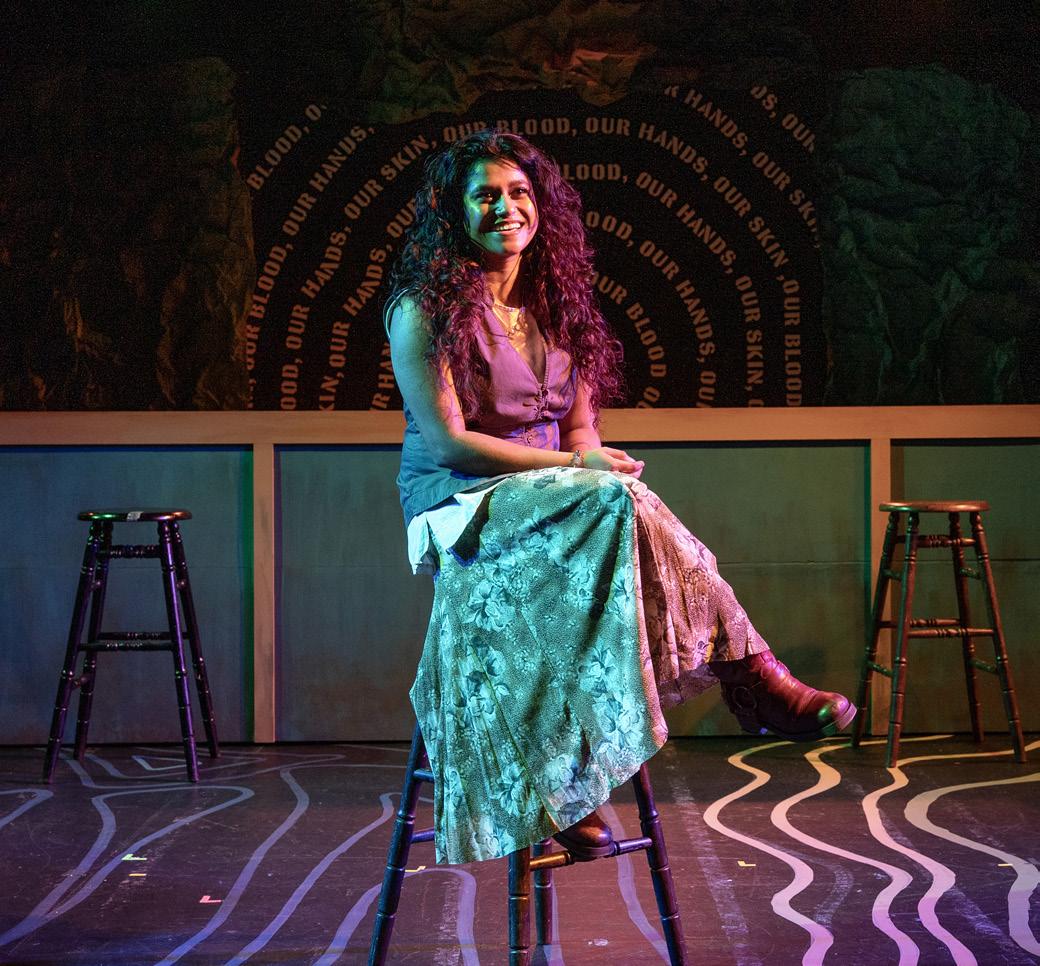
For her final production, Ruined, by Lynn Nottage, at Jameson Studio Theater on the Douglass campus in April, she mostly used recycled wood to construct the bar run by the main character. Paints for the set were donated by another scenic shop. Gordon praised Ramdayal’s stylized approach to the set for Ruined and noted the versatility of the bar, the main physical piece on stage.
“The bar breaks apart and can be re-figured into multiple configurations that can then turn it into other spaces and suggest other things,” Gordon says, “and that makes the setting much more fluid.”
Ramdayal hopes that future students can continue sustainable set design after she graduates. Gordon says there is already interest in following her example.
“I’m feeling optimistic that we’ll be able to keep this going and sustain Maya’s original vision,” he says.
She has several recommendations for students who’d like to learn more and do more to help the environment and encourages students to take some of the classes that shaped her vision including “Upcycling: An Artistic Response to the Environmental Effects of Fast Fashion,” taught by Denise Wagner, and an online course, “Introduction to Environmental Arts.”
She said students also can pursue a minor in Creative Expression and the Environment, which Mason Gross runs in collaboration with the School of Arts and Sciences and the School of Environmental and Biological Sciences.
Ramdayal intends to continue this mindful approach in her professional life, beginning this summer with a New York City run of Julius Caesar, by Dead Horse Productions, which will be set in a garden.
She says she initially felt awkward being known as the eco-conscious set designer on campus. But now she owns it. “At first it was weird, like, ‘Maya is the sustainable person,’” she says. “And now I’m like, ‘Yeah, I am. And now you’re thinking about it. It’s on your radar.’”
See Ramdayal at work at go.rutgers.edu/mgsamag
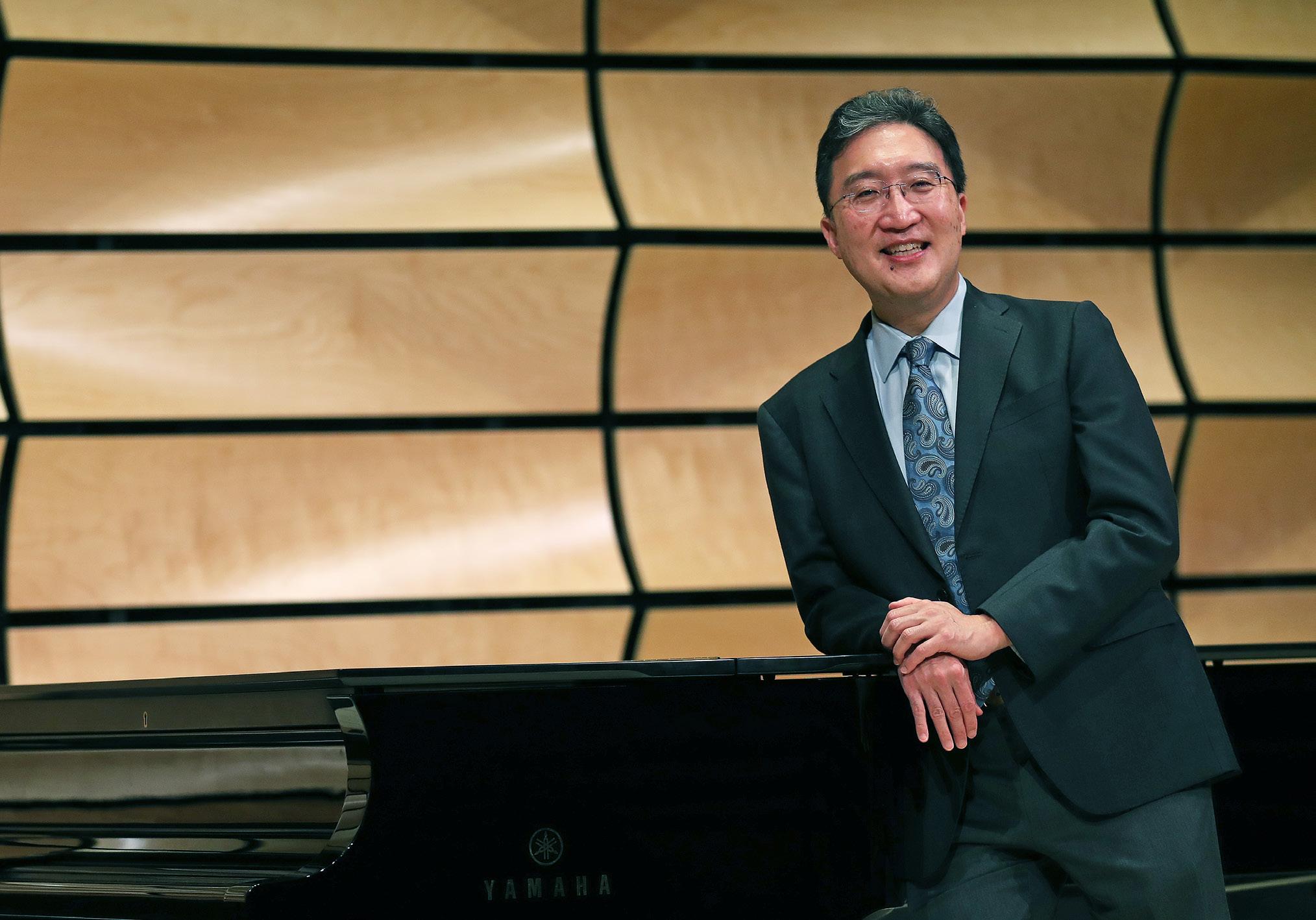
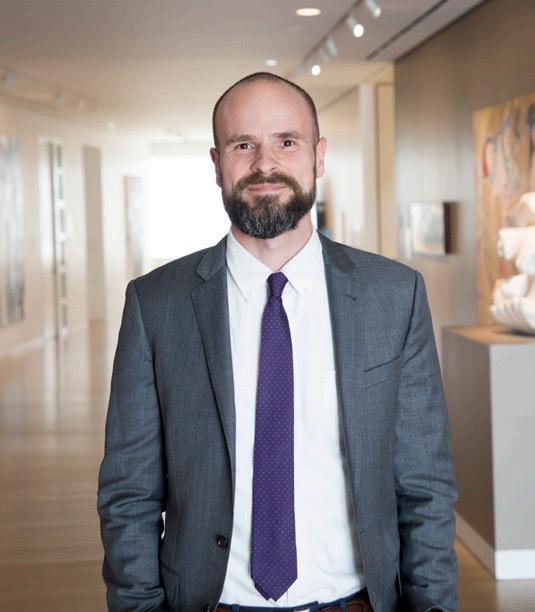
Dr. Michael Kim, a distinguished concert pianist, scholar, and dean of Western University’s Don Wright Faculty of Music, has been named the next dean of the Mason Gross School of the Arts at Rutgers University. When Kim begins his tenure on July 1, he will become the fifth dean in the school’s 50-year history.
“I am deeply honored and humbled to join Rutgers University and to serve as the next dean of the Mason Gross School of the Arts,” says Kim, a two-time graduate of The Juilliard School (MM, DMA) who brings more than two decades of senior leadership experience in higher education. “I was struck by the excellence of its faculty and students, the strength of its traditions, and the strong sense of community that defines Mason Gross—a community of passionate artists and fearless risk-takers.”
Kim previously served as director of the School of Music at the University of Minnesota Twin Cities, dean of music and acting vicepresident (external) at Brandon University, and faculty associate to
the president at Lawrence University. Across these roles, he has led strategic initiatives advancing research excellence, interdisciplinary collaboration, community engagement, student career readiness, and philanthropic growth.
“Mason Gross has been long recognized nationally for its excellence,” Kim says. “I see tremendous opportunity to elevate its national and international stature even further. Together, we will build on this strong foundation to position Mason Gross as an international magnet for artistic excellence, innovation, and community impact—and as a leader shaping the future of artistic practice and education.”
In addition to his administrative leadership, Kim is an internationally recognized pianist who has appeared as a soloist with major orchestras across North and South America, Europe, and Asia, collaborating with distinguished conductors including Yannick NézetSéguin and Hans Graf.
Watch The Marvelous Laboratory, an interview between Ben Bettenbender, a member of the first entering class in 1976, and JoAna Marie Henigan, a member of the class of 2026, at go.rutgers.edu/mgsamag.

On February 1, the Mason Gross community gathered for The Golden Kick-Off at Nicholas Music Center, an event honoring the school’s 50th anniversary. Alums Audrey Arias-Justo and Karen Alvarado served as co-hosts.
Dancers performed on platforms set up in the lobby before the show and later performed Tiny Dances onstage in a variety of assemblages. Jazz faculty Kenny Davis led some of our jazz students in a performance of Herbie Hancock’s “I Have a Dream” and John Coltrane’s “Alabama,” and faculty
Brandon Williams conducted the Kirkpatrick Choir as they sang the alma mater and Lloyd Pfautsch’s “Consecrate the Place and Day.”
The event also featured a documentary film detailing the school’s history directed by alum Parthe Marathe, media works by current Department of Art & Design students, and several performances directed by alum and Associate Dean for Access Marshall Jones III
Theater alum Ben Bettenbender, a son of the school’s first dean, Jack Bettenbender, shared a brief reflection on the school’s founding, which he likened to an “incredible, noble experiment” dreamed up by his father and then-Rutgers president Edward J. Bloustein
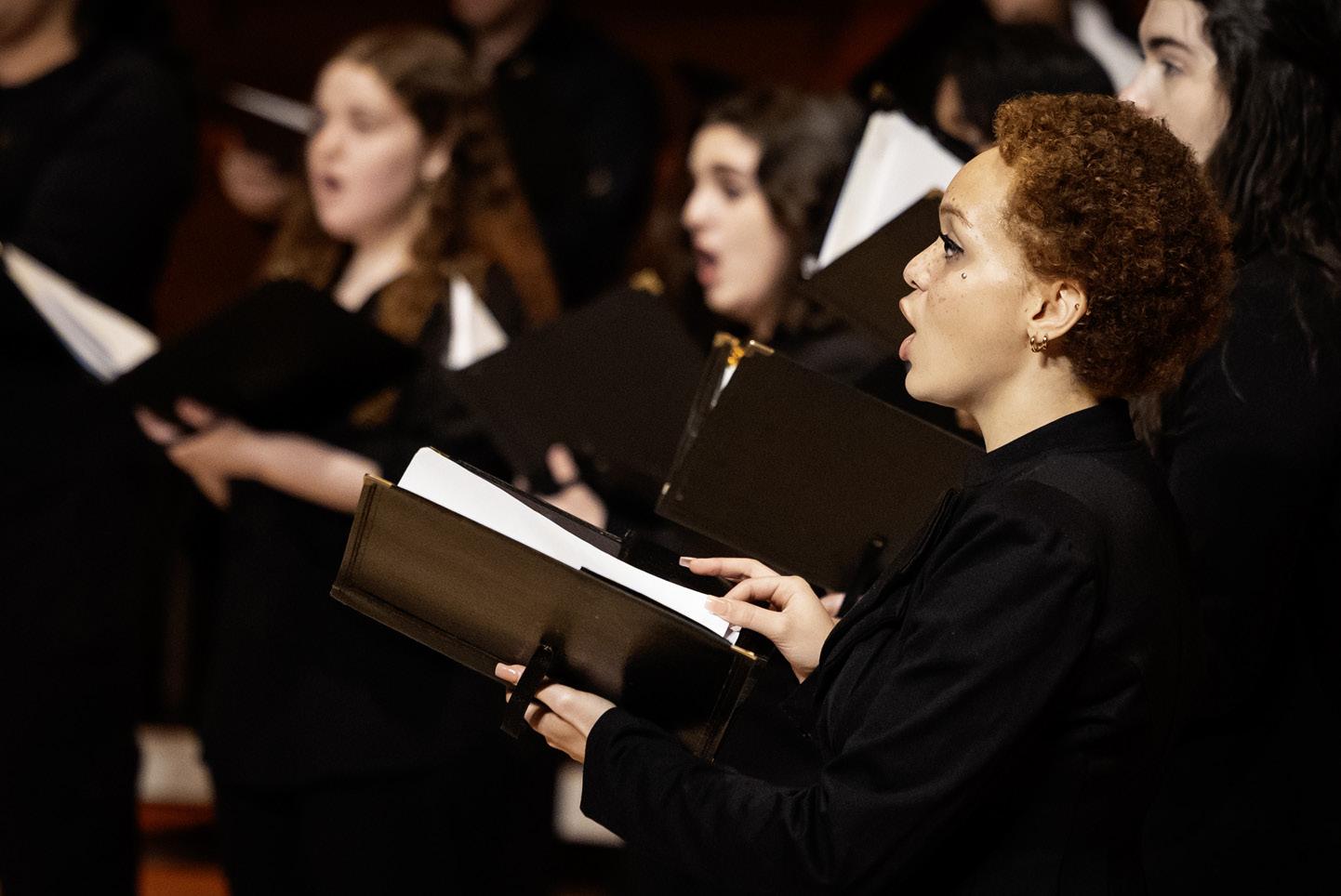
Music student Croix Ellison, foreground, and other members of the Rutgers University Kirkpatrick Choir perform at February's Golden Kick-Off event celebrating MGSA's 50th anniversary.
“My father believed that being an artist wasn’t a choice but a calling, and that it carried with it a sacred duty to give form to that thing burning inside you that you were driven to express,” he said, “because by doing that you might be creating something important, something that would connect you to the lives of others . . . expressions of love and loss and fear and hope and pain and joy
that together form the fabric of what makes us human.”
“So, to be true to that, to foster that, he and Ed [Bloustein] knew that what they were creating needed to be flexible enough to support the sensibilities of all the students it would attract,”
Bettenbender continued.
“Experiences drawn from all walks of life, from all backgrounds, from
As evidenced in these pages, Mason Gross students are thoughtful, devoted, and determined. Over the last five decades, MGSA has emerged as a premier artistic and academic training ground, due in no small part to the passion and purpose of our young artists. While we do all that we can to support their success, we notice that more students are struggling with food insecurity, housing, and other basic needs. Meeting these needs fuels their artistry and prepares them for success beyond Rutgers.
We established the Mason Gross Student Emergency Fund to support our artists. But requests for these funds far outpace the amount we have to give.
all countries and cultures. They would come here and they would be given the opportunity to grow, to sharpen their skills, to give to each other, take from each other, and possibly create something the world had not yet seen.”

We’re celebrating all year long! Visit go.rutgers.edu/mgsa50 to learn about additional 50th-anniversary events.

YOU CAN HELP. GIVE NOW

QUESTIONS?
Please consider making a gift to the Mason Gross Student Emergency Fund
Contact Denyse Reed, director of Development, at (848) 932-5197 or denyse.reed@mgsa.rutgers.edu
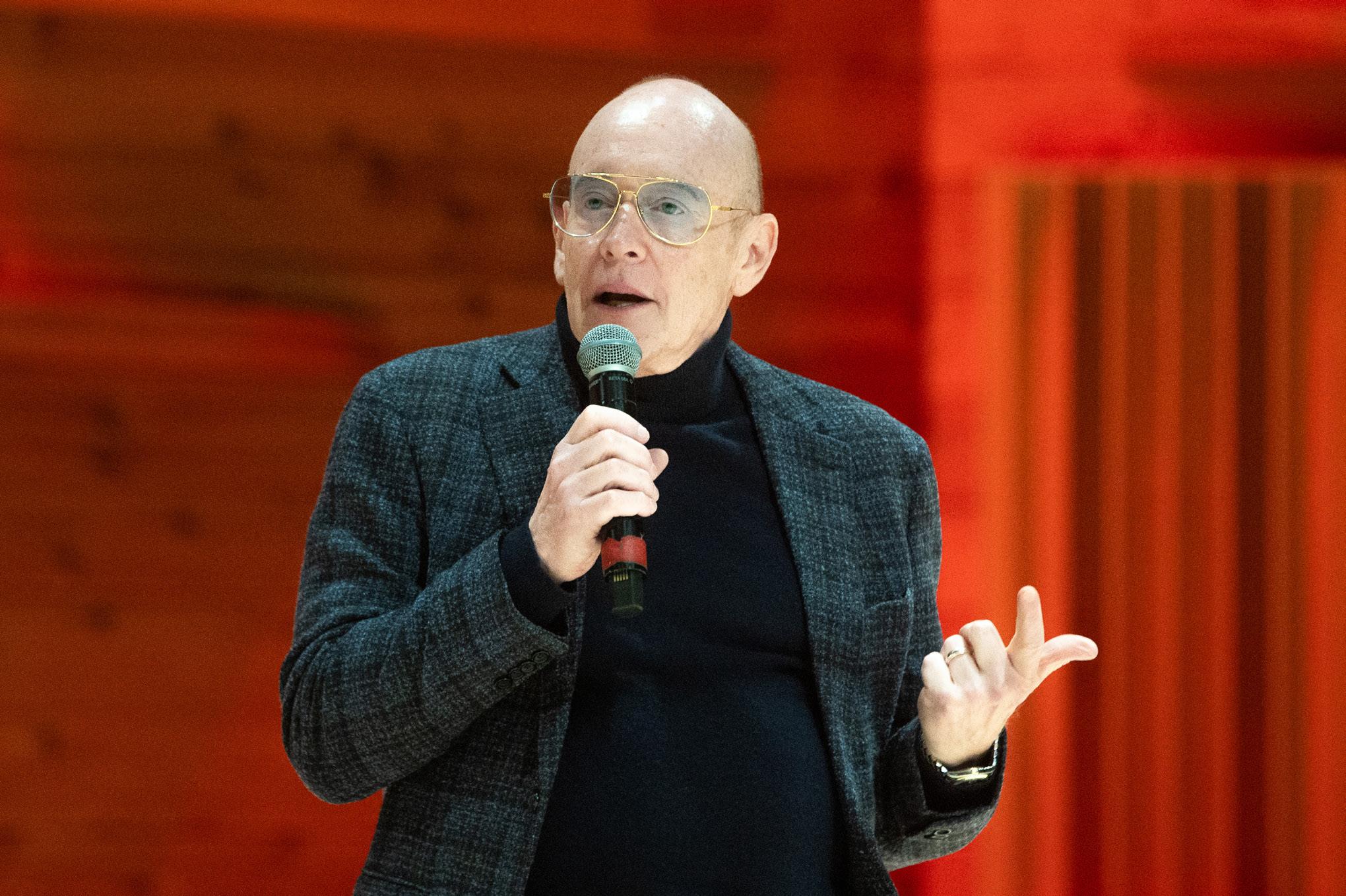
ALUM KEVIN GOETZ HAS TESTED MORE THAN 5,000 FILMS, INCLUDING TITANIC AND SINNERS
Excerpted from a story by Debbie Meyers
Courtesy of the Rutgers University Alumni Association
As a researcher, marketing strategist, audience advocate, and creative force, Theater alum Kevin Goetz has analyzed audience reactions to movies ranging from Fatal Attraction, Titanic, Forrest Gump, and Mission Impossible to Despicable Me, Barbie, Wicked, and Sinners. The results: recommendations for changes to everything from addressing pacing issues to alleviating confusion and even shooting new endings.
Over several decades, Goetz has become a renowned film industry expert in using focus groups to best position movies for broad appeal and ultimately for financial success. As founder and CEO of Screen Engine, a global research and strategy firm, he oversees a worldwide team that partners with all the major film studios, television networks, streaming platforms, gaming publishers, and other lifestyle brands.
Best-selling author of Audience-ology, a 2021 book that explains the test-screening and audience reaction process in Hollywood, he recently published How to Score in Hollywood, a guide to making commercially successful movies before even a frame of film is shot.
“My thesis in the book is that every movie, if made and marketed for the right price, should make money,” says Goetz, who also hosts a popular filmmaking podcast, Don’t Kill the Messenger. “We try to mitigate that risk early on, sometimes even beginning at the twinkle in the eye of the idea.”
Throughout his career, he has tested more than 5,000 film titles, significantly impacting how movies are made, marketed, and released. At the 37th American Cinematheque Awards in 2024, Goetz received the Power of Cinema Award for his contributions to the entertainment industry, along with Dame Helen Mirren, who also received an award for her lifetime achievements.
Goetz credits Rutgers with truly legitimizing him as an artist who eventually also became an entrepreneur. “This was serious training,” Goetz says. “I can’t tell you just how much it transformed me, transformed my life.”
In December, Mason Gross was among 39 cultural organizations that received grants from the New Jersey Economic Development Authority (NJEDA) to support efforts to expand arts access and audience attendance.
MGSA received a $500,000 grant under Phase II of NJEDA’s Activation, Revitalization, and Transformation (A.R.T.) program, which, according to the NJEDA, “aims to catalyze community placemaking efforts by leveraging New Jersey’s arts and cultural sector as a creative force for change, and by supporting non-profit organizations focused on public art installations and arts-based initiatives.”
The school’s initiative, MGSA Access New Brunswick Project, was launched with the goal of improving audience attendance at public performances and exhibitions at the Mason Gross Performing Arts Center on Douglass campus, at the New Brunswick Performing Arts
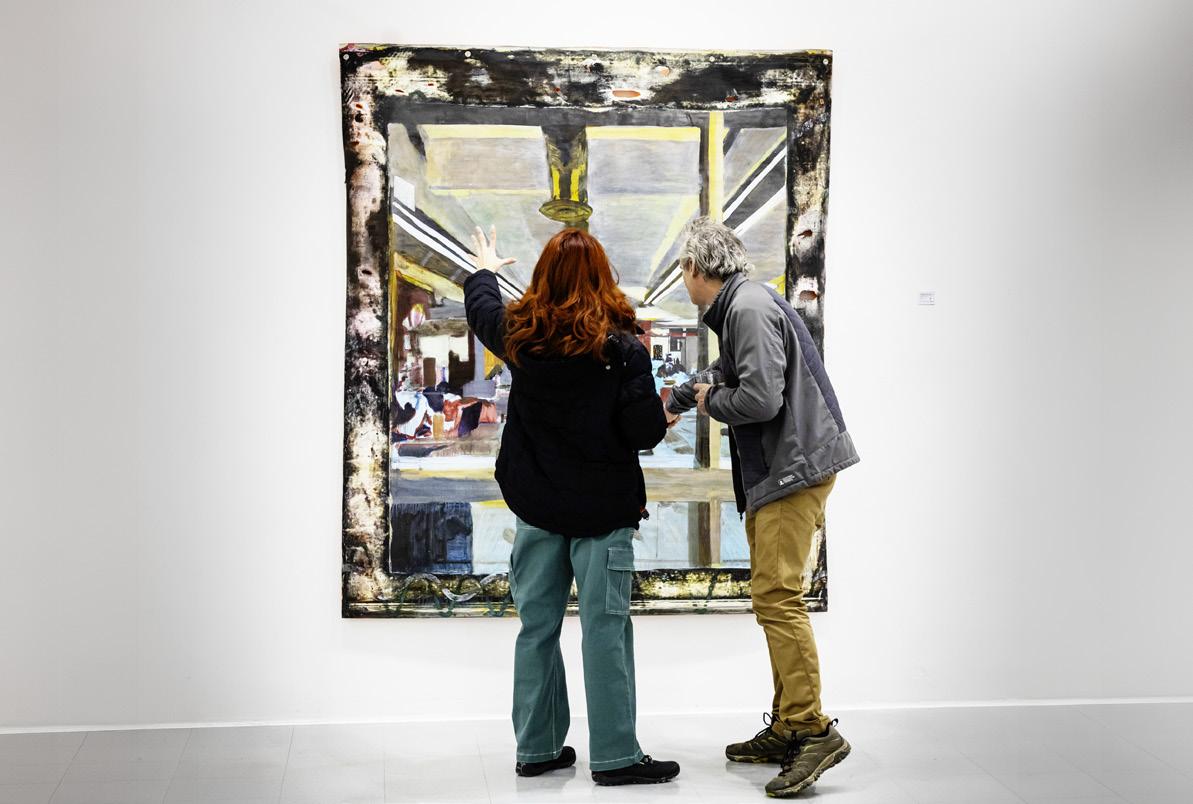
Center, and at the Civic Square Building, both in downtown New Brunswick on Livingston Avenue.
The grant allows MGSA to provide up to 12,000 complimentary performance tickets to New
Brunswick Public School students and parents for events taking place throughout 2026, educational and Spanish-language materials related to select performances, and auxiliary fieldtrip events. MGSA is coordinating approximately 15 engagement opportunities throughout 2026 and is developing resources to make MGSA spaces feel more accessible and less intimidating to first-time visitors.
Stephanie Cronenberg, MGSA’s interim associate dean for academic affairs and director of research, says the NJEDA grant “makes it possible for MGSA to embody its mission of ‘cultivating partnerships with schools and communities throughout New Jersey.’”
“We want to help our entire community feel comfortable and welcome at our arts events, many of which are free and unticketed,” Cronenberg adds. “We are pleased that this grant allows us to deepen our ongoing relationship with New Brunswick Public School students, wherever they are on their artistic journey.”
By Emily Soper
This spring, the Rutgers Filmmaking Center’s Visiting Filmmaker Series gave students the opportunity to learn from a pair of Oscar-nominated directors: On April 10, Mohammadreza Eyni and Sara Khaki visited Rutgers Cinema for a screening of their 2025 documentary Cutting Through Rocks, followed by a Q&A with our students, led by Documentary Film Lab director and Oscarwinning filmmaker Thomas F. Lennon. Lennon served as contributing producer and editing consultant on Cutting Through Rocks
“When you start a documentary film, you don’t know how long you’re going to film—for one month, 10 months, for 10 years,” Eyni told students. “So, it’s important to choose a subject that you think is really important—not just what the industry’s asking for or what audiences are looking for.” Cutting Through Rocks is Eyni and Khaki’s feature film debut.
Shot over the course of eight years, Cutting Through Rocks follows Iranian Sara Shahverdi, the first woman elected to her village council. A motorbikeriding, pants-wearing former midwife, Shahverdi is bold, charismatic, and unconventional
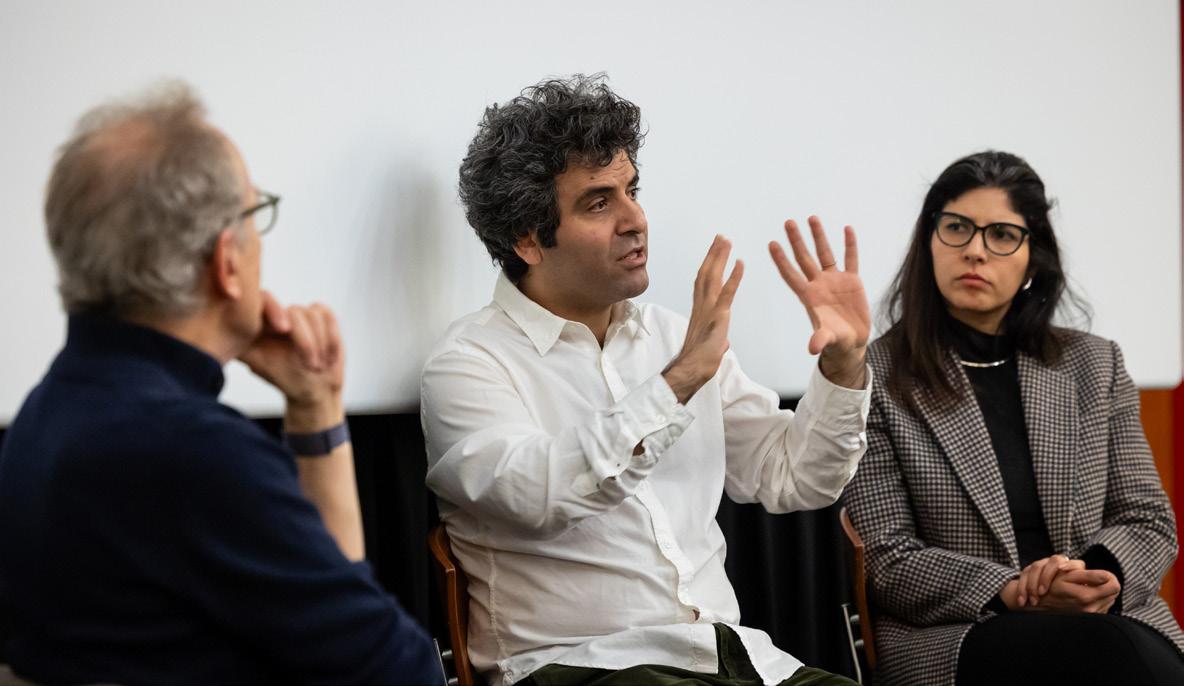
in the eyes of her rural community.
“We knew that this was really an important story for us on a personal level,” Eyni said. “The story was mirroring our own experiences, of having a lot of obstacles and seeing a woman who’s fighting [to overcome them.]”
Shahverdi’s story of resilience and resistance was familiar to Khaki. Born and raised in Iran’s capital city of Tehran, Khaki recalls growing up with women like Shahverdi, including her sisters, and credits their perseverance with motivating her to make the film.
“I was always intrigued . . . by [women] who paved the way for the next generation,” she told the students. “When I came to the U.S., I found that inequality was a work-in-progress here, as well, and I started to wonder, for those who never left Iran, how are they pushing towards creating space for women and girls now?”
The film follows Shahverdi as she questions the boundaries of what women and girls can do. Over the course of the film, she teaches a group of teenage girls to ride motorbikes, intervenes in a proposed child marriage, argues
with male family members in property disputes, and even comes face-to-face with law enforcement. The film grapples with resistance to change and the ways in which Shahverdi is able to chip away at the village’s patriarchal systems— the start of a new path for women and girls in her community.
“There’s something about this type of film—we’re not just talking about problems; we’re seeing a change, a solution,” student Owen Lam said after the screening. “There’s something empowering about a film that isn’t just victimizing these women, or showing them as, you know, completely helpless . . .. It’s really great to watch a movie like this, and to know that there’s a real fight, that they’re really putting the pressure on.”
Filmmaking student Sofia Ayyad says that the opportunity to see Cutting Through Rocks and to meet Khaki and Eyni provided her and her classmates with an important perspective for future filmmakers.
“Sometimes film programs can be a little America-centric,” said Ayyad. “It's great to have filmmakers from around the world come visit. There’s a narrative that women in the Middle East need to be saved, or that they need regime change. It’s refreshing to see a narrative where the women save themselves.”
D“ON’T BE AFRAID TO ASK FOR MORE. FOR TOO MANY YEARS, I THOUGHT I WAS ONLY WORTHY OF A SMALL SLIVER OF THE PIE. ASK FOR A BIG SLICE. WITH ICE CREAM. ASK FOR MORE.”
GUEST SPEAKER BIANCA LEIGH (MGSA’84).
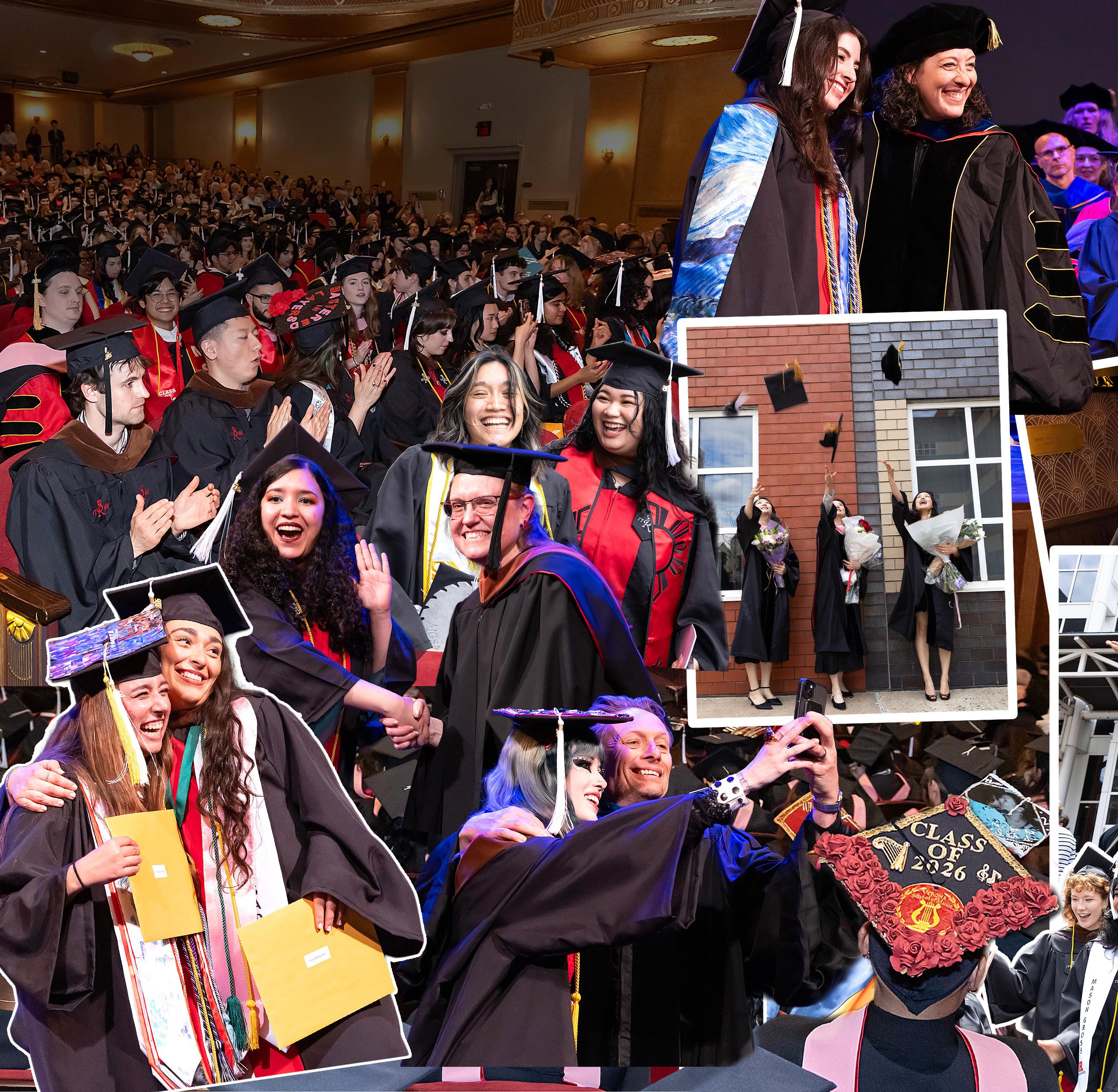
The class of 2026 said their goodbyes on May 14 with a rollicking convocation ceremony at the State Theatre New Jersey in downtown New Brunswick.
“Your friendships with your classmates will last a lifetime,” Theater alum and actor, singer, writer, and educator Bianca Leigh (Broadway’s Oh, Mary!; Transamerica) told the
crowd. “And, if you are a cool breeze to work with, you will build a network of colleagues that will inspire you, collaborate with you, and every once in a while, get you work. Yes, there is rivalry and pettiness in the arts but far less of it than you’d think.”
Student speaker Madeline Hettrick asked her fellow students to ponder how far they’ve come.
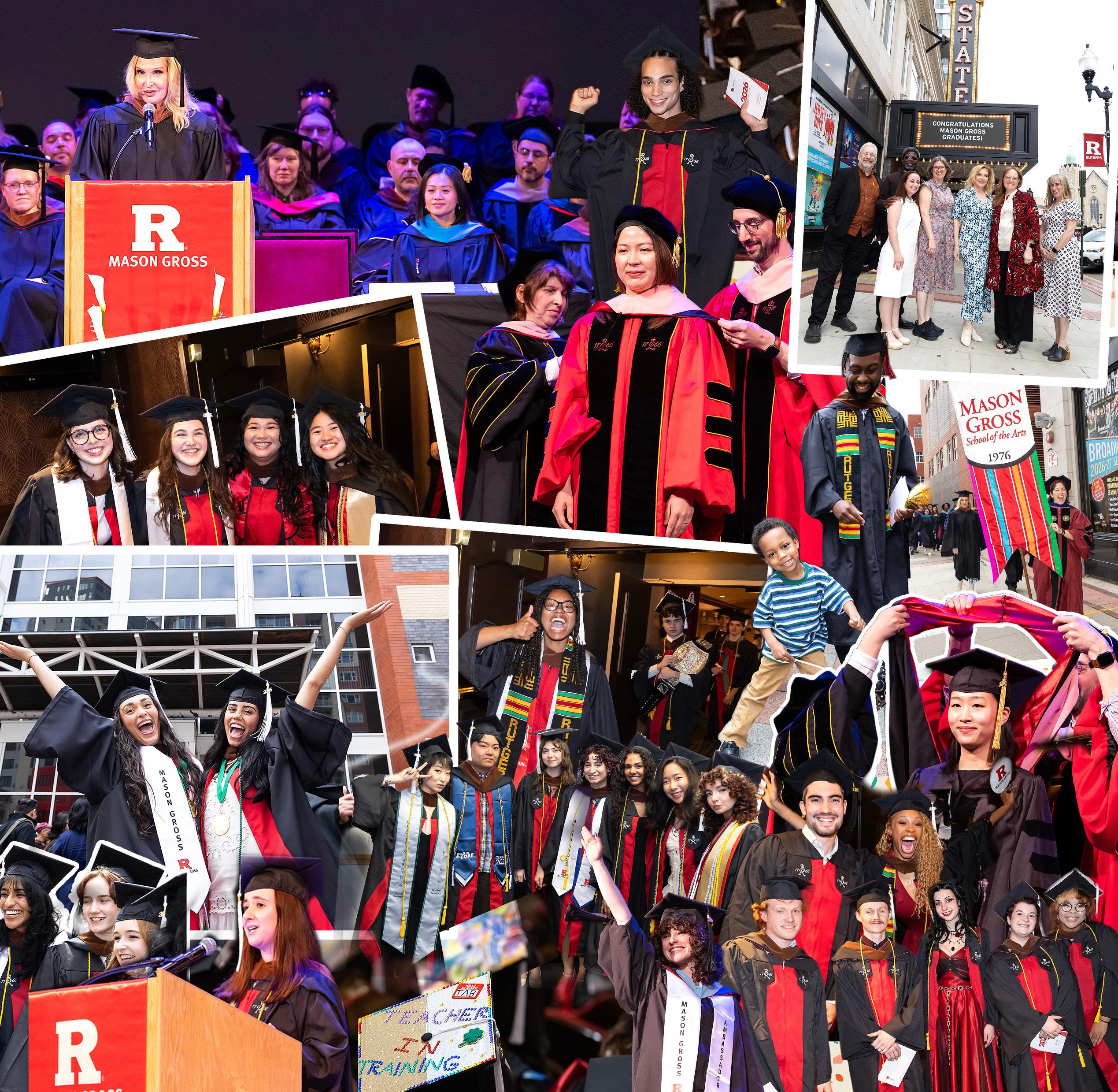
“I encourage you to think about who you were when you first came to Rutgers,” the Filmmaking student told the class. “Think about that version of you: nervous, excited, maybe a little confused . . .. Think about everything you didn’t know yet, the challenges you’d face, the people who would shape you, the growth you’d undergo.”
“And now look at you,” Hettrick continued. “Look at us. Sitting
here today. Wearing those gowns we once imagined ourselves in. We’re here. We did it.”
Family and friends continued the celebration next door in the Civic Square Building at a tearful, giddy reception that included cake, wine, and a student jazz quartet.
Take a bow, class of 2026! You deserve it.
View additional convocation photos at go.rutgers.edu/mgsamag.
Music alum Brent Chancellor is one of five composers behind The Secret Symphony of Plants, an album whose music is, well, rooted in data collected from plants growing in a park in New York State. As Chancellor explains it to NPR, as part of the project, they attached electrodes to plants, recorded the plants’ bioelectric information, and then had the information converted into MIDI (Musical Instrument Digital Interface) data. The MIDI technology,
a type of digital sheet music, communicated sonic information to the composers. Chancellor’s plant, and the name of his 14-minute composition performed by Lux Ensemble, is “Speedwell.”
Listen to Chancellor discuss the concept behind the recordings—and listen to excerpts of the music—in an interview with NPR at go.rutgers.edu/mgsamag
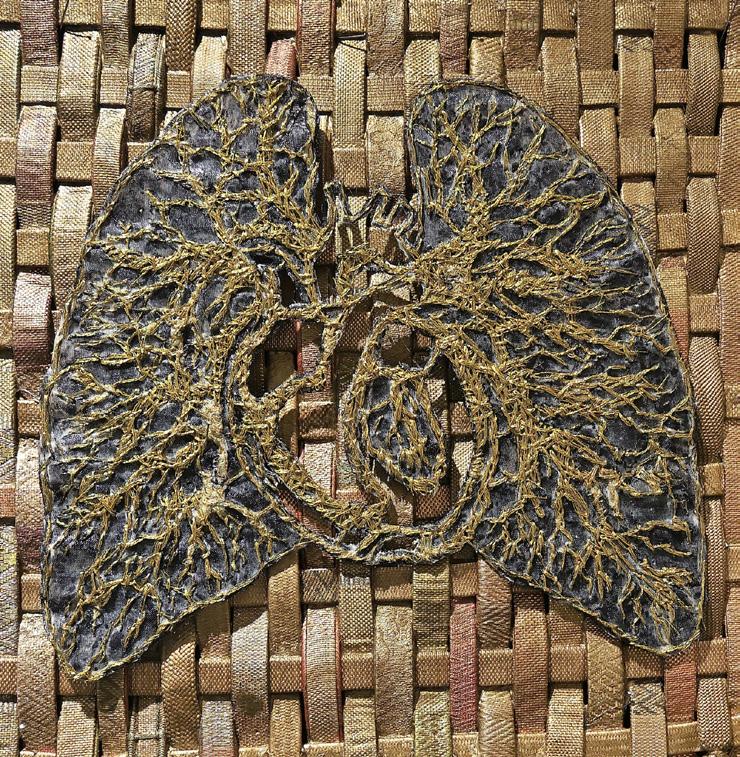
Art & Design alum Malcolm Peacock is one of 56 artists represented in the Whitney Biennial 2026. His fiber sculpture, in the shape of a massive redwood tree trunk, is called Five of them were hers and she carved shelters with windows into the backs of their skulls. Approximately 3,500 hair braids that Peacock made over 10 months comprise the piece. “Peacock typifies what’s best in this Biennial, which is working with materials, forms, colors, spaces, not abstract theory,” says New York Magazine senior critic Jerry Saltz. “. . .He’s really somebody to watch for.” The Biennial, the longest-running survey of contemporary art in the United States, opened on March 8 and runs through August 23 in New York City.
Watch Peacock discussing his installation at go.rutgers.edu/mgsamag.
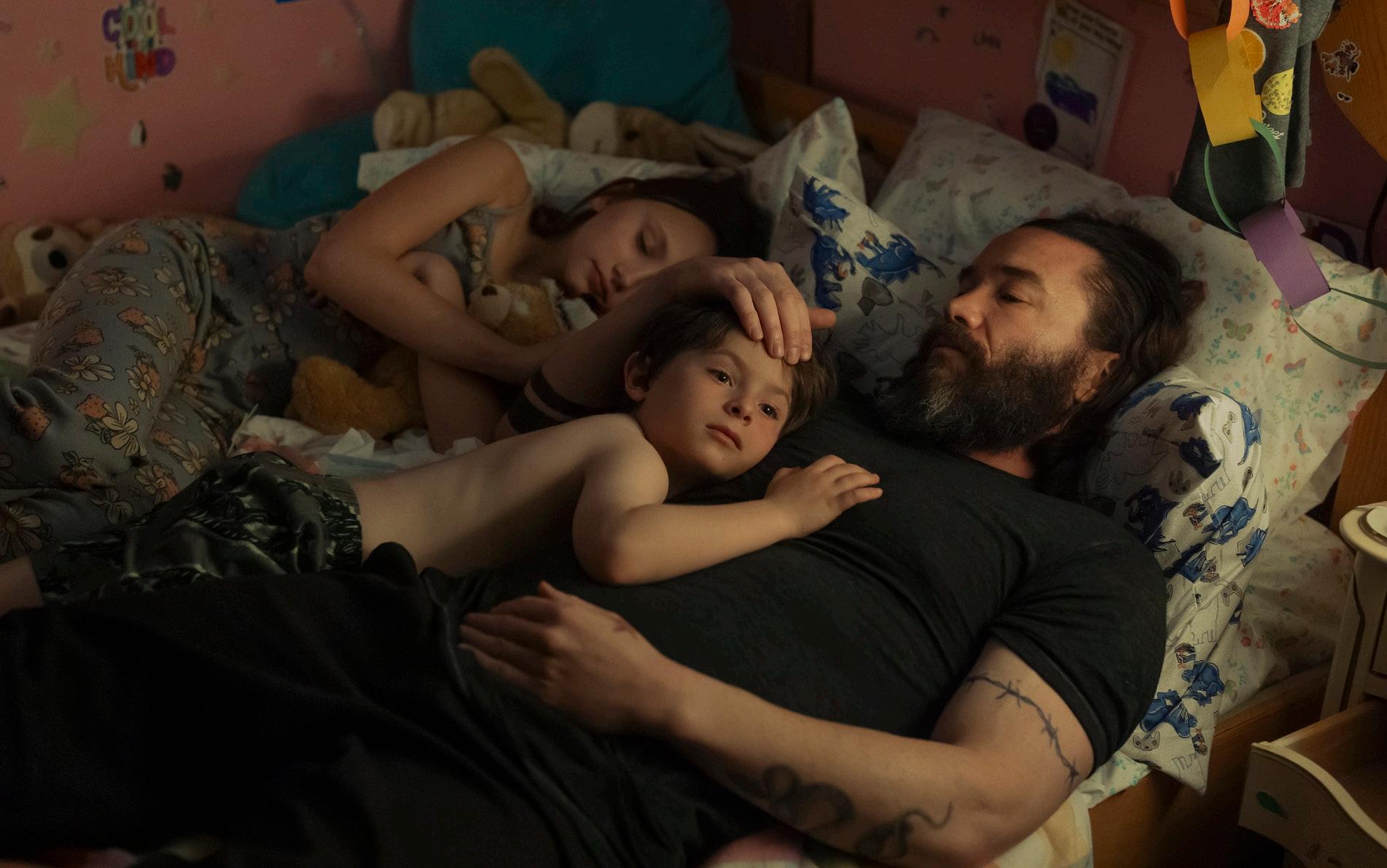
Don’t miss Emmy-winning Theater alum Tom Pelphrey, nominated for a Critics Choice award for Best Supporting Actor in a Drama Series for his work opposite Mark Ruffalo in HBO’s Task, helmed by the creator of Mare of Easttown. According to British GQ, “Task’s Tom Pelphrey is quietly giving the TV performance of the year.”
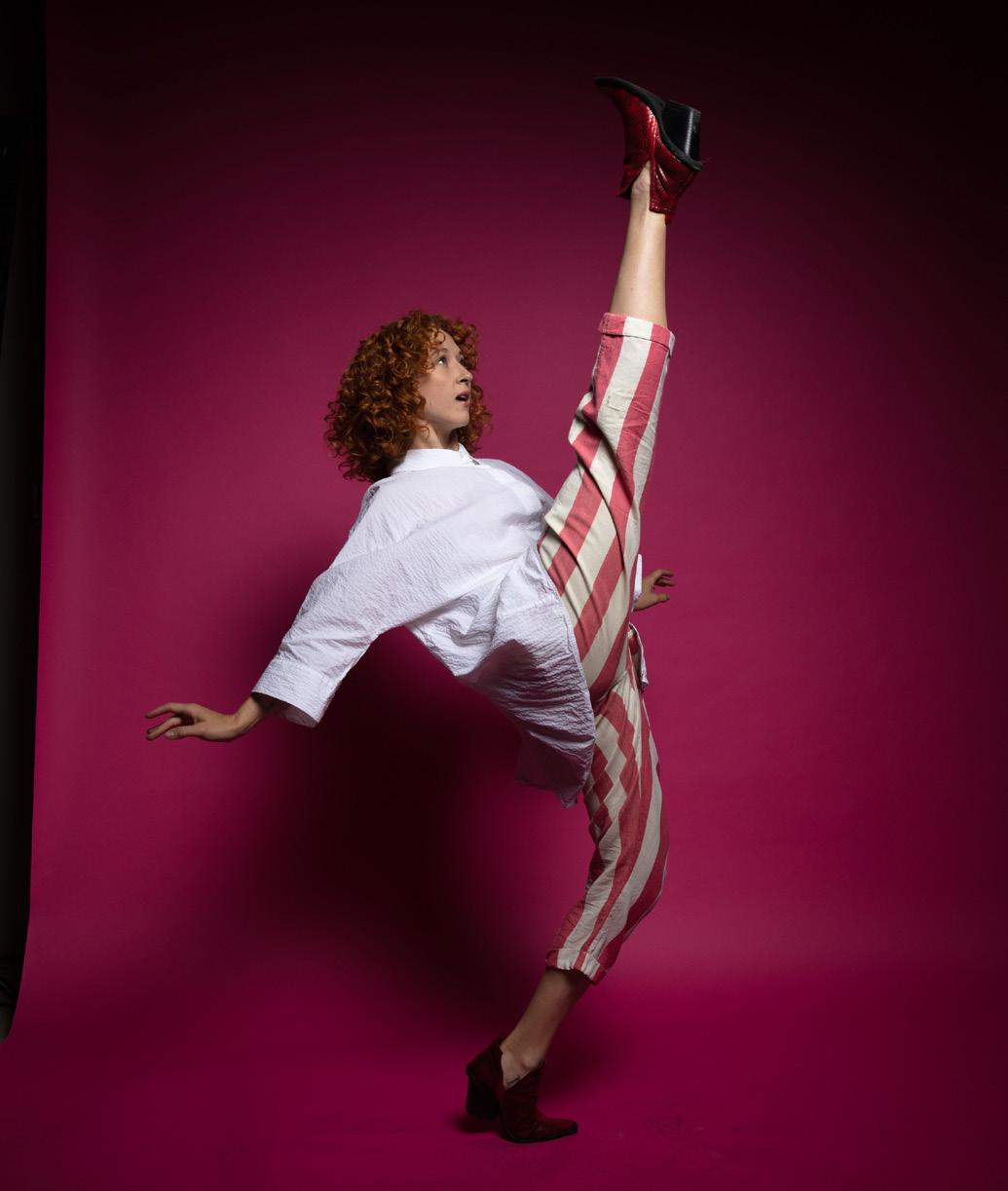
says decades of dance training gave her the physical and mental strength to cultivate and sustain a career as a stunt performer.
By Amanda MacLeod, BFA’12
You'd be forgiven for not recognizing Dance alum Amanda MacLeod in her Super Bowl LX Liquid Death TV spot earlier this year: The longtime stunt actress went headless for her turn as a woman colliding with a pane of glass in the decidedly zany spring water commercial.
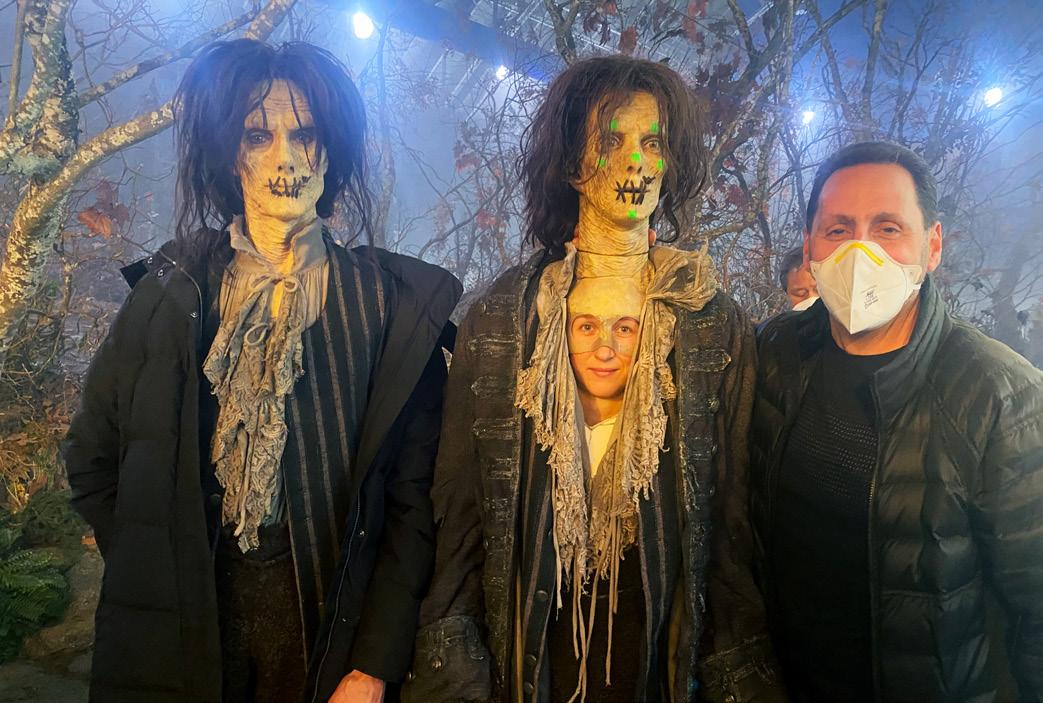
But for MacLeod, losing her head is all in a day’s work: She’s taken tumbles in high-profile films and TV shows such as Avatar: The Way of Water, Hocus Pocus 2 (where she performed stunt work as, yes, headless Billy Butcherson), Westworld, The Righteous Gemstones, and others.
Here, MacLeod discusses how her dance training, and a preternatural sense of daring, paved the way for landing her dream job as a stunt woman.
Growing up, I had a secret: I wanted to fly.
After seeing the 2000 action film Crouching Tiger, Hidden Dragon, I longed to dance on buildings like Zhang Ziyi and fight like Michelle Yeoh, but I never told a soul. My youth in Jackson, Wyoming, had a dual focus— cultivating an adrenaline-seeking attitude on the ski slopes while training 30 hours a week as a pre-professional dancer. This path eventually led me to Mason Gross, recruited by Professor Randy James.
Eventually, after graduating and spending a few years as a performance artist in Brooklyn, I migrated to Los Angeles on a whim. With two suitcases and zero contacts, I began working
in the film industry as a choreographer and dancer, where I encountered a new breed of performer: the stunt professional. I quickly realized that my dance background had equipped me with the mental fortitude and choreographic memory that organically cross-pollinated with martial arts and informed stunt training.
My first booking in 2017 was a trial-by-fire. Four callbacks after an open call for a film I knew nothing about, I found myself snarling into a camera held by Oscar-winning filmmaker James Cameron, who was tracking and recording my positioning and movement. Avatar: The Way of Water became my first stunt job and entryway into the industry.
My training allows me to mimic the actors I double and to bring a unique affectation to characters—like my role as zombie Billy Butcherson in 2022’s Hocus Pocus 2. I threw in some of my own little character choices to enhance the comic relief of this headless animated body, and as a result, my hero, Doug Jones, who originated the role in 1993, paid me a very sweet compliment: He told me how impressed he was with my ability to mimic his movement almost exactly, and that he loved how I added my own little essence to the character. He’s a master of nuance and physical acting, so to hear this from him was everything.
I even had the chance to meet Michelle Yeoh on the set of Everything Everywhere All at Once; secret childhood dream: realized.
I love this work. I love the thrill of performance, because it’s a combination of your own preparedness, getting an opportunity— which is thrilling in its own right—and trusting all your training. I love it because I’ve worked very hard to get here, I love it because performing is what I believe I was put here to do.
The work I do is thrilling, adrenaline inducing, and requires a great amount of trust and skill, so there’s nothing like getting the shot on the first take, and hearing the A.D. [assistant director] say: “Moving on.” Free-falling 30 feet through the air, tumbling down stairs, and somehow magically still hitting your mark, or being a part of a fight scene where every player is nailing the choreo and/ or adjusting seamlessly with the camera operator in a one-shot take (what we call a “Oner”). . . . I love it all.
To be honest, it’s a lot like being in a dance company and performing on stage with all your company members: Everyone is dancing around each other and living entirely in the moment, enabling all of us to react at a moment’s notice. It’s magical when it works.
ALUM HOSTS FIGUREDRAWING COURSE OPEN TO THE PUBLIC
Excerpted from a story by Lisa Intrabartola
Courtesy of Rutgers Today
Before Art & Design alum Layqa Nuna Yawar became renowned for his vibrant communitybased murals and intricate portrait paintings, he enrolled in a “life-changing” figure drawing class at Rutgers-Newark.
There he discovered his path as an artist, he says, and transferred to Mason Gross School of the Arts, where he took figure drawing every semester the course was offered before graduating in 2007.
Four years ago, Yawar returned to RutgersNewark to pass on the art of figure drawing to a new generation. Only in the spring 2026 semester, his course was also open to the public. “Figure drawing is a practice that is so necessary for any artist,” he says. “I don’t like to say I have talent. My brain works in ways that allow me to capture things with drawing more naturally than others, but it’s a skill we can all have.”
The expanded course, called “Drawing Circle,” featured live models and music and was integrated directly into Express Newark’s exhibit “Drawing Room.” Express Newark is an art and design center established in 2017 to link the university and the community through the arts.
“Drawing Room” and “Drawing Circle” were designed in tandem to uphold that mission. While the class was open only to enrolled Rutgers-Newark students on Tuesday evenings, on Thursday evenings through May
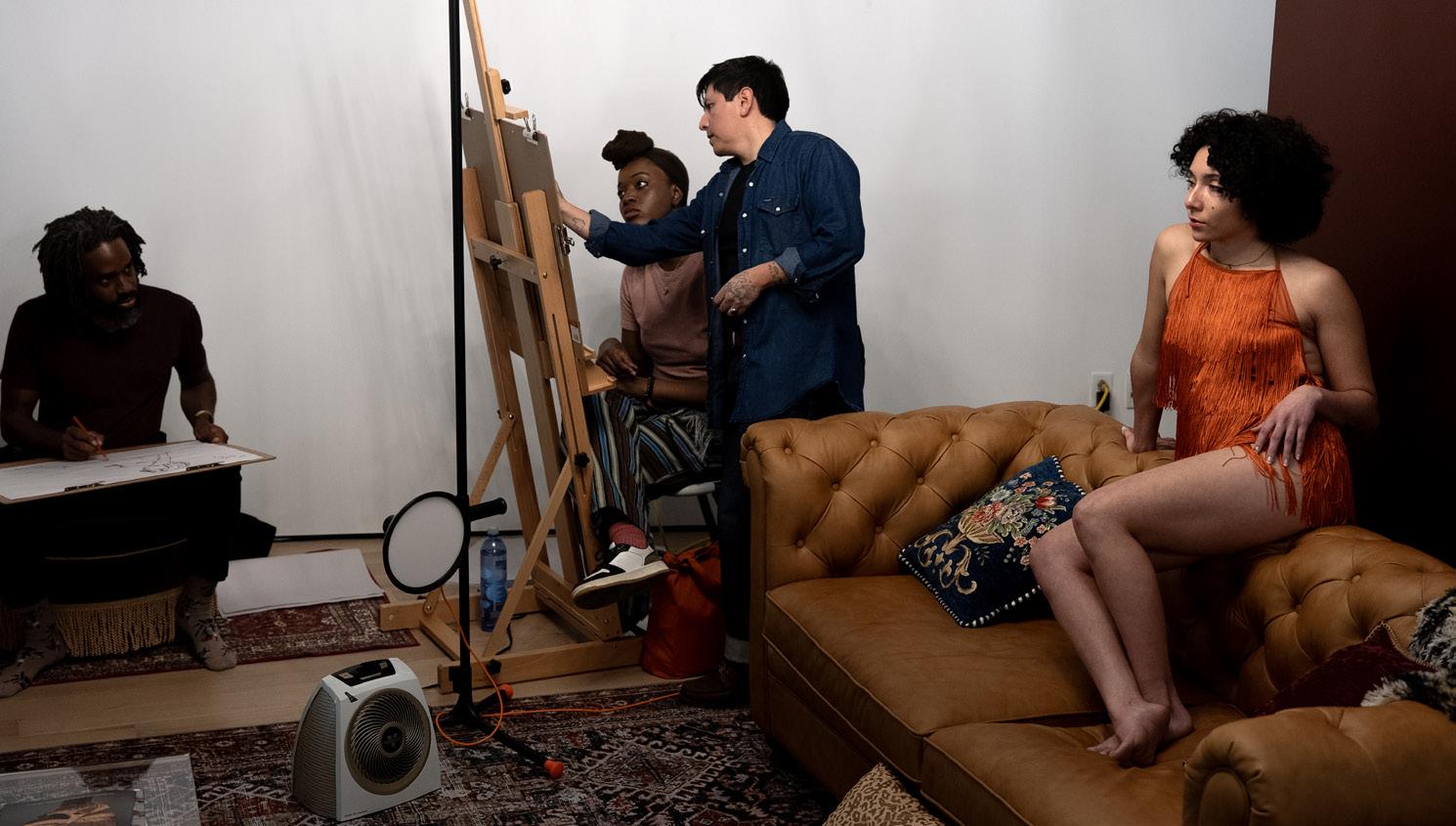
it was free and open to the public.
As a muralist, Yawar strives to create art that can be accessed by the public while reflecting the community where it is based. He has adorned large swaths of Newark with 15 murals, including two of Rutgers alumnus Paul Robeson that flank the entrance of the Paul Robeson Main Art Gallery and a massive piece in Terminal A of the Newark Liberty International Airport that celebrates New Jersey’s diversity.
As an instructor, being able to open access to art education aligns with that ethos.
“When I told my family I wanted to do art at 18, they were supportive, but I know the realities are very different for a lot of people. A lot of my students aren’t allowed to explore anything creative because it’s not valued as much in a hypercapitalistic society,” says Yawar, who was raised in Ecuador before emigrating to the United States.
“We need to exercise being human, and making art is part of being human,” he says. “I want us to have a space for that and to see this career is viable and possible.”
EXHIBITIONS EXPLORE TEXTILES AS CULTURAL DEPOSITS
From March 23 through April 9, Valerie Ramshur, head of costume design and director of design and production in the Theater Department, mounted a dual exhibition at Douglass Library’s Mary H. Dana Women Artists Series Galleries. Together, Tabards of Place and Threaded Paths examined how textiles can tell stories and express identity.
Threaded Paths, part of the school’s 50thanniversary celebration, displayed 100 10-by10-inch stitched squares by makers from the Mason Gross theater community and across the globe. Each square was highly idiosyncratic and deeply personal, the walls of the gallery broadcasting both a collective and varied vision of color and texture.
Meanwhile, Ramshur’s Tabards of Place reflected her sabbatical research informed by travel to Turkey, Croatia, and Italy. Tabards, generally sleeveless tunics worn in the Middle Ages and early modern Europe, often displayed one’s coat of arms. To that end, Ramshur reinterpreted the tabard, exploring garmentas-identity-marker, creating gleaming digital photographic textiles reflecting landscape and architecture.
“Garments can serve as repositories of place, devotion, and cultural memory, inviting the body to carry story, history, and identity across time,” Ramshur says in her introduction to the dual exhibition, “to hold what we have witnessed, and to shape it into cloth.”
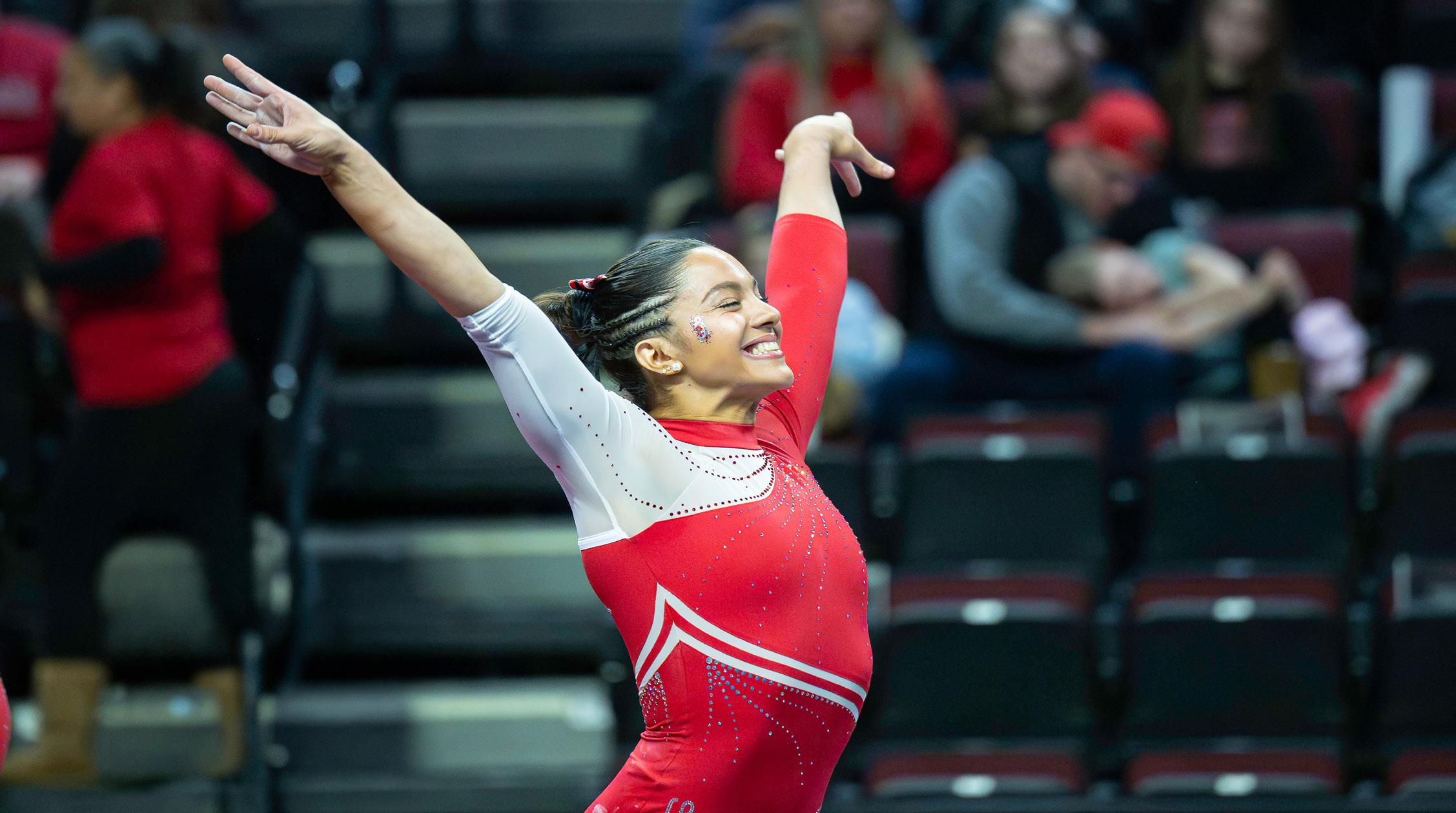
ARGENTINE DANCER-GYMNAST HAS MADE HER MARK—ON STAGE AND ON THE MAT
Excerpted from a story by Paul Franklin Courtesy of Rutgers Today
Valentina LorenteGarcia came to the United States with a dream. Turns out, the reality was even better.
Since the age of 3, Lorente-Garcia wanted to become a world-class gymnast. As she worked toward that goal she found a second love in dance.
By age 12, Lorente-Garcia had made the Argentinian National Team, competing in Pan American tournaments and South American club championships.
But when she found her way to Rutgers to compete for a Big Ten women’s gymnastics team, she found her dreams could come true more than once, because Rutgers offered a major in dance.
“I didn’t know majoring in dance was even a thing! When I got in,” she says, “it was like, insane.” She’s now a
fourth-year BA Dance student.
Lorente-Garcia’s success at Rutgers extends off the mat: As a first-year student, she was a Women’s College Gymnastics Scholastic All-American, and during her sophomore year she was an Academic All-Big Ten selection, which recognizes athletes with a cumulative grade-point average of 3.0 or higher.
This is especially notable given that Lorente-Garcia and her parents came to the United States from Argentina only eight years ago to pursue opportunities in her sport.
Settling in Virginia with the help of a friend of her father, Lorente-Garcia continued to excel on the mat, although learning a new language was difficult. Struggling with the transition, she repeated eighth grade.
“It was a very slow process. Very difficult,” she said. “Basically, I learned by listening to others. I couldn’t really speak English for like three years. I couldn’t say a word. I was so embarrassed. But little by little it started happening. It was like I was pushed into a pool and forced to
learn how to swim.”
Throughout all this, the grind, the pressure, began to take its toll in the form of panic attacks.
“Emotionally it was a hard period. At one point I almost quit gymnastics,” she says. “Eventually I began to feel better and better and returned to showcases and Nationals and Regionals.’’ And eventually, she was offered a full scholarship and discovered the opportunity to simultaneously major in dance at Mason Gross.
Lorente-Garcia’s skill impressed Barbara Angeline, an assistant professor in the Dance Department.
“Her talent was unquestionable,” says Angeline, who taught LorenteGarcia jazz dance. “No matter what type of dancing we did, she met each challenge with excitement, energy, and expertise. I would say her facility for dance was surpassed only by the absolute sunshine of her personality and generosity. She is a beautiful human.’’
Head coach Anastasia Candia calls
Lorente-Garcia “a firecracker. She has a lot of energy; always smiling. She is someone genuinely kind and wants the best for everyone around her. She’s super involved with dancing, and the youth. She can showcase her personality, which elevates her scoring potential. She’s choreographed about 80 percent of our floor routines.”
“ I COULDN’T REALLY SPEAK ENGLISH FOR LIKE THREE YEARS. I COULDN’T SAY A WORD. I WAS SO EMBARRASSED. BUT LITTLE BY LITTLE IT STARTED HAPPENING. IT WAS LIKE I WAS PUSHED INTO A POOL AND FORCED TO LEARN HOW TO SWIM.”
And Lorente-Garcia knows the credit goes, at least in part, to her parents’ willingness to believe in her and her goals all those years ago.
“My parents moved here with the goal of me finding schools and doing college gymnastics,” she says. “So, my family basically moved to support my dreams.”
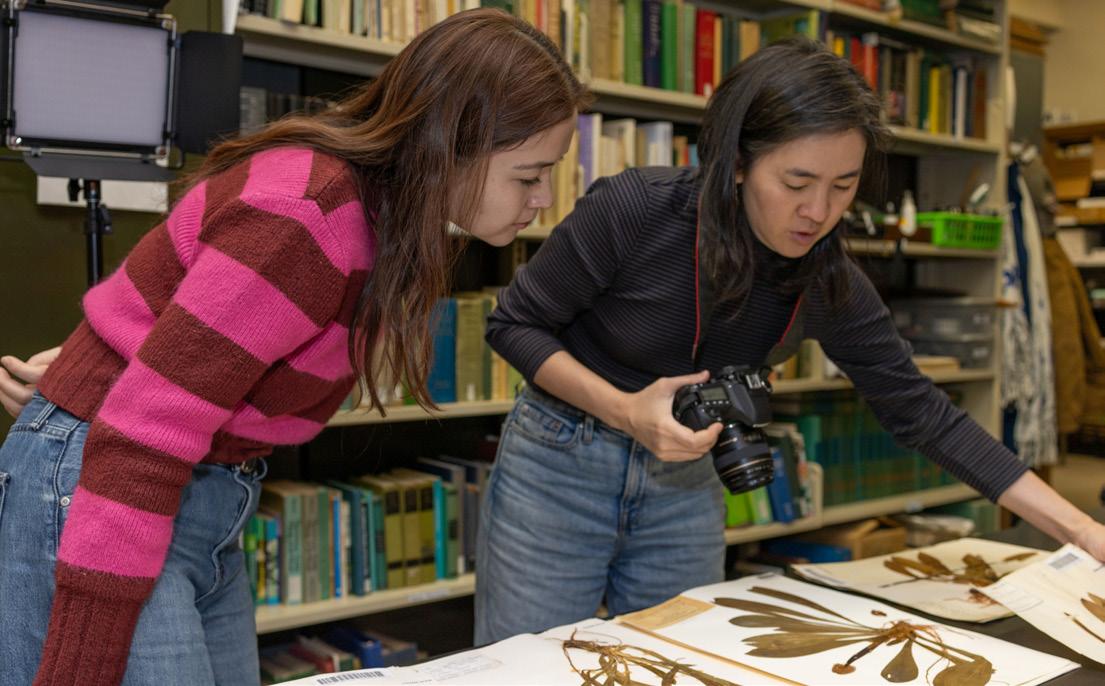
JEFF ARBAN/RUTGERS UNIVERSITY
Art & Design MFA student and research assistant Asem Kiyalova, from left, and faculty Sue Huang examine plant specimens housed at the university’s
In her role as inaugural Rutgers University–New Brunswick Laureate, Art & Design faculty Sue Huang has spent the school year marshaling the resources of art, language, history, and science to reintroduce several long-dead New Jersey plant species to the public.
“The mission is to examine ecological loss not only as a measurable scientific reality, but also as a cultural rupture,” Huang says of her laureate
project, Bodies of Flora. “I was interested in the idea that ecological loss operates on two levels: There is the physical realm, where we lose the actual body of a species and its material presence in the world, but there is also the loss of a species in our social memory, which feels like an especially profound kind of disappearance because we lose our emotional relationship to those beings. They vanish from our cultural imagination.”
“This second loss—the disappearance from collective memory—is harder to track by the numbers, but it is profound,” she adds.
This kind of collaboration is central to the Rutgers–New Brunswick Laureate Program’s dual mission: cultivating meaningful crossdisciplinary connections among faculty; and nurturing engagement with the arts and humanities across the wider community. Each year, the program will designate a new laureate to further this mission.
Bodies of Flora culminated on May 1 in what Huang describes as a “lecture-performance” exploring botanical loss and visualizing the resurrection of vanished plants.
Huang presented Bodies of Flora that day at the Jersey Art Book Fair at Mana Contemporary in Jersey City.
To make Bodies of Flora a reality, Huang enlisted help from the university’s 100-year-old Chrysler Herbarium and Mycological Collection, which houses a collection of preserved plant specimens, as well as from the Department of Plant Biology and the Department of Ecology,
Evolution, and Natural Resources at the School of Environmental and Biological Sciences.
She also collaborated with graduate software engineering student Kundan Kumar Reddy Digavinti to develop a software tool that reconstructs plant forms from historical descriptions and generates three-dimensional models using artificial intelligence. Art & Design graduate students Asem Kiyalova and Anukriti Kaushik assisted Huang in developing and researching the project, which translated text descriptions into imagery.
“We are looking at these [plant] descriptions, and I was thinking about ways of using this language, which describes the plant body, to bring these plants back into the cultural consciousness through . . . the generation of visual and audio materials” Huang says.
“I use language to give these botanical ghosts a body.”
Excerpted from stories by Mike Lucas and Patti Zielinski

Our Alumni Relations team has been busy this year, meeting with MGSA grads both on campus and in nearby cities. Gatherings included:
+ A reception with MGSA alumni and friends at New York City’s Penrose Bar following a visit to view alum Jennie C. Jones’s sound sculpture installation on the rooftop of The Metropolitan Museum of Art.
+ A visit from the Stockholm Studentsångare. The Glee Club hosted a post-performance event for the Swedish choir and Glee Club members, supporters, and friends.
+ The first annual MGSA Homecoming event welcoming back alumni to New Brunswick with a night of art and connections at the university’s Zimmerli Art Museum. Our second annual MGSA Homecoming is set for October 1.
+ The MGSA “Interplay” class visit featuring Theater alum Kevin Goetz. MGSA Development hosted a discussion with Goetz, followed by a pizza party with students.
+ Rutgers in New Hope. In partnership with the Rutgers Foundation regional team, the MGSA Development team coordinated a reception at Gallery Piquel, featuring a

conversation with Arts In Health Endowed Chair Ian Koebner
+ MGSA in Philly. Rutgers alumni were invited to a reception at Center City’s Attico Rooftop Bar & Restaurant prior to a performance by Ballet X, with original music and a live performance by faculty Scott Ordway
+ MGSA in NYC. MGSA alumni hosted our annual spring New York City event at The Empire Rooftop prior to a performance of La Traviata at The Metropolitan Opera.

go.rutgers.edu/mgsamag
To highlight the desperation of Diane’s mission to save the world, we wanted her to look ready to go to literal war for her cause. The moment and costume are intense: We’re at the brink of the world ending, and Diane is at her wit’s end trying to stop it. She’s dressed for the final 'battle,' wrapped in rich gold and purple,” a nod to the visuals of royalty and ancient Greek myth. “We wanted an air of authority and even intimidation. The kid gloves are fully off, so to speak.”
– Student costume designer Izzy DeFlice