T H E M A RY M O U N T M A G A Z I N E
WINTER/SPRING 2026
Shaped Here, Needed Everywhere p.20
Becoming
The Missing Link p.46 Celebrating the Class of 2025 p.54 M - THE MARYMOUNT MAGAZINE | A
12
Marking one year since the fires across Los Angeles, the Marymount community gather in prayer—united in reflection, resilience, and hope.
T H E M A RY M O U N T M AG A Z I N E
40
The Marymount Players reimagine Shakespeare’s A Midsummer Night’s Dream, bringing fresh creativity and theatrical magic to the classic comedy.
46
| WINTER/SPRING 2026
Through the SAILL Internship Program, Marymount students partner with UCLA researchers, transforming campus into a site for real-world research.
INSIDE THE GATEWAY
FEATURE ARTICLES
1 | Letter from the Head of School
12 | One Community
50 | The Door They Opened
The Marymount community gather for a special prayer service on the oneyear anniversary of the fires across Los Angeles—coming together as one community in remembrance and hope.
At Loyola Law School’s Project for the Innocent, two Marymount students experience the quiet, meticulous work of justice through the SAILL Internship Program.
ON CAMPUS
20 | Shaped Here, Needed Everywhere
54 | Celebrating the Class of 2025
10 | Her Voice, Carried Forward
In a personal reflection, Head of School Fadia Hefni Desmond ’90 reflects on the formation she received at Marymount and the ways in which the School continues to educate young women for the world beyond campus.
3 | Where's Marymount? 6 | Gateway to Marymount
18 | The Installation of Dr. Fadia Hefni Desmond ’90 26 | Awaken a Consciousness of Social Justice 28 | Athletic Recap
40 | A Midsummer Reimagined
34 | Visual Arts Recap
Marymount Players bring fresh imagination and bold creativity to Shakespeare’s A Midsummer Night’s Dream, reintroducing the classic comedy for a new generation of audiences.
37 | Designing a Creative Life
46 | The Missing Link
38 | Beyond the Final Note
Through The Margo Leonetti O'Connell ’60 Students Advancing in Internship Leadership and Learning (SAILL) Program, Marymount students partner with UCLA researchers— turning campus into a living laboratory for studying local lizard populations.
32 | 700+ Wins and a Legacy Still Unfolding
39 | Movement Without Boundaries 44 | When the Stage Becomes the Classroom
With pride, gratitude, and anticipation, Marymount celebrates the Class of 2025 as they prepare to carry their formation into their next chapter.
ALUMNAE CORNER 64 | Behind Children's Eyes From Marymount classrooms to a career at PBS, Rosemary Miller ’08 reflects on the mentors and moments that shaped her path in early childhood learning. 69 | Alumnae Events 72 | Class Notes 74 | In Memoriam
T H E M A RY M O U N T M AG A Z I N E WINTER/SPRING 2026
EDITOR Stephanie David Director of Strategic Marketing & Communications ILLUSTRATIONS Genna Whittell '17 Marketing & Communications Associate PHOTOGRAPHY Stephanie David Kambria Fisher Lindsay Mays Sr. Margaret McKenna, RSHM Philip 'PJ' Petrone Micaela Plummer Dawn Regan Genna Whittell '17 DESIGN Stephanie David Director of Strategic Marketing & Communications M - The Marymount Magazine is published by the Marketing and Communications Office at: Marymount High School 10643 Sunset Boulevard Los Angeles, CA 90077 Send address corrections to: alumnae@mhs-la.org Every effort has been made to ensure the accuracy of this publication. If we have made an error or you would like additional copies of this magazine, please contact the Marketing & Communications Office at communications@mhs-la.org
The Class of 2029 receive their caps during Marymount's Capping and Pinning Ceremony, a tradition that dates back more than 70 years.
LETTER FROM THE
Head of School
Dear Marymount Community, Welcome to this issue of M Magazine—the first I share with you in my role as Head of School. These pages hold our past, present, and future: who we were, who we are, and who we are becoming. “Becoming” is not a single moment at Marymount. It is a movement shaped over time through discovery, creativity, and sisterhood. It lives in classrooms and conversations, in quiet moments of reflection, and in experiences that expand our understanding of the world and our place within it. You will see that movement throughout this issue. In the work of students stepping into research and real-world learning through our SAILL Internship Program. In classrooms where curiosity leads to discovery and ideas take form. In spaces where students are asked not only what they think, but what they will do in response—engaging questions of justice, belonging, and responsibility. And in the story of one alumna, whose work centers on the earliest years of life—when minds are still taking shape and the experiences, stories, and ideas children encounter can leave a lasting imprint on who they are becoming. A Marymount education isn’t static. It is formative in the fullest sense—engaging the heart, mind, and spirit in the tradition of the Religious of the Sacred Heart of Mary. It does not prescribe who you will become. Rather, it gives you the confidence, the grounding, and the sense of purpose to believe you can become anything God calls you to be. For me, that understanding has come full circle. In the years following my graduation from Marymount, I was always eager to receive this magazine. I loved learning about my fellow Sailors—those I knew and those I didn’t—seeing who they were becoming in the years following our time here. There was never one profile of who they would be after graduation. Instead, it made clear that a Marymount education isn’t a moment—it is a lifetime, and sometimes even a lifeline. With the Class of 2025 now among our newest alumnae, the movement of becoming continues beyond Marymount in the lives they are just beginning to shape. What this place makes possible is not a particular outcome, but a way of being: thoughtful, reflective, compassionate, confident, and purpose-filled. These are the qualities that endure. These are the markers of a Marymount education. It is my hope that you will see all of this reflected in the pages that follow—not only in what our community is doing, but in who they are becoming. With gratitude,
Dr. Fadia Hefni Desmond '90 Head of School
M - THE MARYMOUNT MAGAZINE | 1
Shaped Here. Needed Everywhere.
At Marymount, girls discover their voices. They learn to match intellect with integrity, to rise as leaders, to innovate with courage, and to serve with compassion. THEY ARE SHAPED HERE. AND THEY ARE NEEDED EVERYWHERE— in classrooms and communities, in boardrooms and laboratories, in service of the common good, and in moments that matter most. Annual Giving makes this possible. It fuels every classroom, every teacher, and every opportunity that defines the Marymount experience—from academics and athletics to the arts, service learning, global programs, financial assistance, and more.
When you give, you invest in Marymount girls. You empower Marymount women. And together, we change the world. Give today to be part of that change. Visit https://www.mhs-la.org/25-26annualfund
2 | M - THE MARYMOUNT MAGAZINE
WHERE'S MARYMOUNT? Everywhere. Discover the many ways the Sailor community stays
FOLLOW ALONG From classroom moments to performances, traditions, and celebrations, see daily life at Marymount through the stories our students and alumnae are creating at instagram.com/ marymountla.
connected—on campus and around the world.
SAILORS IN THE WORLD Stay connected with the Marymount network on LinkedIn— where alumnae share opportunities, celebrate milestones, and support one another long after graduation.
SAILOR ATHLETICS Game highlights, athlete spotlights, and championship moments— follow along as Sailor teams compete with heart, discipline, and pride. Keep up with the latest from Marymount Athletics at instagram.com/ mhslaathletics.
ONCE A SAILOR, ALWAYS A SAILOR From regional gatherings to campus celebrations, our alumnae community continues to connect long after graduation. Find upcoming events at mhs-la.org/ alumnaeevents.
instagram.com/marymountla
linkedin.com/school/marymount-high-school/
mhs-la.org/alumnaeevents
instagram.com/mhslaathletics M - THE MARYMOUNT MAGAZINE | 3
1967
Then Now
&
4 | M - THE MARYMOUNT MAGAZINE
Moments of stillness, reflection, and connection have long defined the Marymount retreat experience.
2025
R
etreat has been part of Marymount since 1928—a pause in the rhythm of the year set aside for reflection, faith, and togetherness. For the students who experienced it first, it felt like something entirely new. As Blanche Coyne Corkill ’30 † recalled, it was “the first time we enjoyed such a privilege”—one that gave way to “days…of spiritual happiness and truth.” In 1968, that same spirit unfolded
on a hillside, students gathered close, music rising easily among them, grounded in togetherness. Decades later, the image feels strikingly familiar. In 2025, seniors gather in a chapel in Brightwood, CA, voices filling the room in much the same way. The setting has changed, but the sentiment has not. Nearly a century later, retreat remains not just a tradition, but a return to what matters most: faith, connection, and one another.
M - THE MARYMOUNT MAGAZINE | 5
GATE WAY TO
Marymount 1
Big and Little Sisters spent their first week together sharing advice, building connection, and ending with an ice cream picnic to begin the year side by side.
2
A full week of festive traditions brought the community together during Winter Week, culminating in a joyful karaoke finale—where Mariah Carey's “All I Want for Christmas Is You” became a shared anthem.
3
The first-ever Art Week brought five days of handson creativity to campus, from blind contour portraits to clay work, inviting every student into the artistic process.
4
Rooted in the theme “Awaken the Change,” students gathered for a day of workshops focused on justice, belonging, and the shared responsibility to care for one another.
5
More than 200 members of the Marymount community came together for the Mentors Appreciation Dinner to celebrate the mentors who guided 90 students through meaningful summer internships.
6
Judge Kimberley Baker Guillemet, author of Black Prep: Life Lessons of a Perpetual Outsider, led a powerful conversation with our BIPOC families about her experiences as a student of color in a private school setting and how those years shaped her path.
7
Dancers, singers, and musicians took the stage for the Annual Holiday Concert, showcasing months of dedication through a dynamic evening of performance.
8
At the Stanley Mosk Courthouse, Marymount’s Mock Trial team opened their season with a strong first-round win, with Maya Wierzba ’26 earning MVP honors.
9
1
2
With more than 40 clubs on campus, students found spaces to explore their interests, build community, and lead in ways that matter to them. Alumna Sophie Kim ’15 returned to campus for a
10 Thought Talk hosted by the Mental Health Alliance
to share reflections on pressure, mental health, and embracing imperfection in her talk, What I’d Say to My Younger Self.
6 | M - THE MARYMOUNT MAGAZINE
3
4
5
6
7
9
8
M - THE MARYMOUNT MAGAZINE | 7
10
8 | M - THE MARYMOUNT MAGAZINE
Retreat is where becoming takes shape—not in big moments, but in the quiet, shared ones that deepen connection and remind us who we are together. A tradition carried by generations of Marymount students and alumnae, each class steps into it in their own way—from freshmen finding their place, to sophomores embracing challenge, to juniors deepening connection, to seniors reflecting on the legacy they will carry forward.
M - THE MARYMOUNT MAGAZINE | 9
Her Voice, Carried Forward A student-led prayer service honoring St. Phoebe created space for Marymount students to reflect on those who have shaped them—and the gifts they are called to carry forward.
A
t Marymount, prayer services are never simply rituals. They are moments of collective pause—intentional invitations to reflect on who we are, who we are becoming, and how we are called to show up in the world.
might easily have been dismissed. The early Church endured, in no small part, because of leaders like her. To honor Phoebe is not simply to recall her story, but to recognize that her witness continues—in the ways women and girls today lead, serve, and shape the communities around them.
This year’s first all-school prayer service, held on the Feast of St. Phoebe, offered one of those moments. But more than marking a date in the liturgical calendar, it opened a broader reflection—one that reached across centuries—on the enduring presence of women’s voices in the Church and the responsibility our students carry to continue that legacy.
That connection feels especially resonant in this moment. Pope Francis’ Synod on Synodality, a global process of listening and discernment, has called for deeper attention to women’s voices and participation in the life of the Church. In lifting up St. Phoebe, Marymount situates its students within that wider movement—one that affirms that leadership is not confined to position, but expressed through presence, action, and voice.
St. Phoebe, remembered as a deacon and benefactor in the early Christian community, embodied both service and leadership. She welcomed, taught, and advocated with courage at a time when her voice
10 | M - T H E M A R Y M O U N T M A G A Z I N E
“As a girls’ school, it’s our responsibility to affirm the strengths and ministry of women in the Church and
amplify their voices,” shared Director of Campus Ministry and Service Learning Micaela Plummer. At Marymount, that affirmation is not abstract. It is lived. The service itself was designed and led by students, who shaped every element—from the readings and music to the reflection that would become its center. What unfolded was not simply something to observe, but something to enter. At the heart of the service was a moment of reflection—simple in structure, but expansive in what it asked of each person. Students were handed notecards and Postits and invited into two questions: What gifts do you bring to Marymount? and Who is someone who has shaped you into the person you are becoming? The Pavilion—so often filled with movement and conversation—grew noticeably still. Students were given time to think, to look inward, and to look around. Pens moved slowly across paper as names began to surface—teachers, friends, family members, mentors— those whose presence had, in ways both quiet and profound, shaped who they are. From there, the reflection turned inward. Students were asked not to list accomplishments, but to name the gifts they themselves bring—what they carry, what they offer, what may still be unfolding. It is not always easy to articulate that kind of self-understanding. It requires a willingness to see oneself not only as someone being shaped, but as someone actively shaping others in return. Held together, the two questions revealed something essential about becoming: that it is never a solitary process. We are formed by others, and at the same time, we are continually forming the community around us—often in ways we may not yet fully recognize.
Madi also turned to her own story, sharing the influence of her mother, whose resilience shaped her understanding of strength and perseverance. In doing so, she grounded the reflection in something both personal and universal, echoing Marymount’s call to Awaken the Change—not as an abstract idea, but as something lived and carried forward.
“
A student trio’s performance of “What Was I Made For” invited the community into a shared reflection on purpose—an expression of the same question at the heart of the service: not only who we are, but who we are becoming.
As a girls’ school, it’s our responsibility to affirm the strengths and ministry of women in the Church and amplify their voices.”
- MICAELA PLUMMER Director of Campus Ministry and Service Learning
That idea was given voice in a student reflection by Madeleine (Madi) Silva ’26, who spoke about the quiet but powerful ways individuals influence one another. Drawing on the example of St. Phoebe, she reminded the community that each person carries something uniquely their own to offer—something that may, often unknowingly, shape the lives of others.
As the service drew to a close, students carried their cards forward and placed them onto frames, transforming individual reflections into a shared, visible expression of community. Names layered over names, gifts held alongside gratitude, creating something both deeply personal and collectively meaningful.
In naming the “modern Phoebes” within the Marymount community, her reflection brought the theme into focus. Faculty and staff were recognized for their authenticity and presence, while students named one another for qualities like courage, compassion, and quiet leadership. Inspiration, it became clear, is rarely distant; it is found in the people who surround us each day.
In celebrating St. Phoebe, Marymount affirmed a truth that extends far beyond a single day: leadership is not defined by title or recognition, but by the willingness to use one’s gifts in service of others. And those handwritten notes—later tucked into frames—became a portrait of becoming: shaped by others, claimed within ourselves, and carried forward in the ways we choose to show up for one another. M - T H E M A R Y M O U N T M A G A Z I N E | 11
One Community OVER A YEAR SINCE THE PALISADES AND EATON FIRES, WHAT ENDURES IS NOT ONLY WHAT WAS LOST, BUT HOW THE MARYMOUNT COMMUNITY CHOSE TO RESPOND—AND WHAT IT CONTINUES TO CARRY FORWARD.
M
ore than a year has passed since the fires moved through Los Angeles, disrupting lives, routines, and any sense of predictability. For some within the Marymount community, the impact was immediate and deeply personal. For others, it unfolded more gradually—through uncertainty, waiting, and the quiet question of what it meant to respond in a moment that had no clear script.
Time has not simplified that experience. If anything, it has clarified how moments like these do not resolve cleanly or all at once. They settle unevenly, returning in different ways over time. They live not only in memory, but in the body—in moments of pause, in heightened awareness, in the recognition that recovery is not a single milestone, but an ongoing process.
“Milestones like this don’t arrive neatly,” reflected Assistant Head of School Dawn Regan. “They can bring memories back in full color… or arrive more quietly—as fatigue, as grief that surprises you, as a nervous system that remembers before your mind does.” That understanding has shaped how the community now reflects on that time—not simply by revisiting what happened, but by considering what was revealed through it. In the immediate aftermath of the fires, Marymount’s campus became a place of response. Families—current and former—alumnae, faculty, staff, and friends began arriving one after another, carrying what they could: supplies, clothing, and essentials gathered with intention. Over the course of those first days, 165 families came through to contribute. Support
12 | M - T H E M A R Y M O U N T M A G A Z I N E
extended beyond campus as well, with Loyola High School and American Martyrs School joining in alongside six organizations and companies that delivered bulk donations. Together, the community collected more than $10,500 in gift cards, along with essential supplies that were carefully sorted and redistributed to over 20 community organizations and schools as needs evolved. What emerged in those days was not simply generosity, but attentiveness. People responded to what was needed, not just what was easy to give. They stepped in without waiting to be asked, and they did so in ways that were practical, sustained, and often unseen. Reflecting on that time, Ms. Regan shared, “I was held by this community… in a hundred practical ways… in the way people didn’t bring noise—they brought solutions.” Her words capture something essential about those early days: care was
not abstract. It was organized, responsive, and deeply rooted in a shared sense of responsibility. For students, these moments became a form of learning that extended far beyond the classroom. In times of uncertainty, what young minds observe often shapes them as much as anything they are explicitly taught. They watched how adults communicated when information was incomplete, how steadiness could exist alongside concern, and how action could be taken without losing sight of care. As Ms. Regan noted, “Emotions are contagious… when one person is steady, that can spread too.” What students witnessed was not perfection, but presence—a model of how to move through complexity with both honesty and restraint. Over a year later, that experience continues to take shape in quieter, more intentional ways. For students directly impacted by the fires, that reflection has become a form of leadership. On the anniversary of the fires, the Pali Club—a club created for and by students who were directly impacted by the fires—created space not only to remember, but to reconnect, choosing to center joy as part of the
healing process. During a lunch gathering, they invited students, faculty, and staff to come together for cookie decorating, filling the dining room with color, conversation, and laughter. The activity itself was simple, but its meaning was not. “After a year of grief, it’s very important to bring joy to our community and to have something that brings us together,” shared co-leader Liza Lowe ’27. Coleader Milla Blanchard ’27 echoed that intention, explaining, “We chose cookie decorating because it was something sweet and fun. It is a great way to bring light to things, and a way for everyone to come together, no matter where you are from.” For students whose lives have shifted in the time since the fires, the gathering reflected something ongoing rather than complete. “We’ve all moved across different locations since the fires,” Milla shared. “Even though we may be far, Marymount is a place where we can come together as a community.” That sense of continuity—of choosing connection even after disruption—echoes a larger question the community continues to hold: not only what was lost, but what has been carried forward. In her reflection M - T H E M A R Y M O U N T M A G A Z I N E | 13
“
After a year of grief, it ’s very important to bring joy to our community and to have something that brings us together.”
to students, Ms. Regan framed it this way: What are we bartering? What seeds were planted? What are we nurturing? In moments of crisis, something shifts beneath the surface. Assumptions fall away, and what remains becomes clearer. There is a movement from independence toward interdependence, from intention toward action, from abstraction toward what is tangible and necessary. Seeds are planted in that process—some chosen, others not. There are seeds of attentiveness, of practical compassion, of courage, and of responsibility for one another. There are also seeds of fear, anxiety, and uncertainty—real and human responses to instability. What matters, over time, is what is nurtured. Whether those experiences lead toward isolation or toward deeper connection is shaped not by the moment itself, but by what follows—by the habits, choices, and relationships that continue to grow in its wake. In reflecting on the year since the fires during our student-led prayer service, Ms. Regan offered a question that continues to guide the community forward: How do you want to continue learning from this past year? Her response was not a single answer, but a vision of the kind of community we are still becoming:
“
I hope we keep learning how to be a community that doesn’t look away. I hope we keep learning how to talk about hard things with honesty—without panic. How to tell the truth without creating fear. How to ask for help earlier. How to notice the people who are carrying something quietly.
14 | M - T H E M A R Y M O U N T M A G A Z I N E
- LIZA LOWE ’27
How to be gentle with one another’s timelines. How to be prepared—not just with plans, but with habits of care. And I want to say this directly to students, because you asked me to reflect, and you are the heart of this place: I hope we keep learning how to be that kind of community for one another—students for students, adults for students, and students for adults. Because one of the most powerful things you can do in a moment of fear or uncertainty is to remind someone: ‘You’re not alone.’ ‘I’m with you.’ ‘We’re going to get through this—together.’
”
If there is a throughline from that moment to now, it is this: the fires did not create the community—they revealed it. That truth carries with it both comfort and responsibility. As Ms. Regan reminded the community, “We don’t have to wait for a crisis to become the kind of community we were in a crisis.” The invitation is not simply to remember what happened, but to continue living in alignment with what was learned—to remain attentive, to respond with care, and to recognize that resilience is not a single act, but an ongoing practice. A year later, the work is quieter, but no less important. It lives in small, consistent choices—in noticing, in checking in, in showing up. It lives in the decision to carry forward what was revealed at the most uncertain of times: that community is not defined by proximity or circumstance alone, but by the ways people choose to be present for one another.
ONE community
M - T H E M A R Y M O U N T M A G A Z I N E | 15
16 | M - T H E M A R Y M O U N T M A G A Z I N E
Following our student-led prayer service on the anniversary of the Palisades and Eaton Fires, all community members received seed paper—a small but intentional symbol—as a reminder that even after loss, something new can still take root and grow. M - T H E M A R Y M O U N T M A G A Z I N E | 17
The Installation of Dr. Fadia Hefni Desmond '90 When Dr. Fadia Hefni Desmond ’90 was installed as Marymount’s sixth Head of School— and its sixth lay leader— the moment carried significance far beyond ceremony. As an alumna, her return to lead reflects the enduring strength of a community that forms its students not just for a moment, but for a lifetime.
18 | M - T H E M A R Y M O U N T M A G A Z I N E
A
t Marymount, leadership has never been understood as a role alone. It is something carried—formed over time, shaped by community, and entrusted from one generation to the next.
The installation of Dr. Fadia Hefni Desmond ’90 as the school’s sixth Head of School on Friday, October 10, 2025, marked one of those rare moments when that continuity becomes visible. Not because something new begins, but because something enduring is recognized, renewed, and set forward again. Gathered in the Pavilion for the Installation Mass, the Marymount community reflected the full scope of that continuity. Students sat alongside alumnae who once walked the same paths. Parents, faculty, staff, Trustees, and Les Anges filled the space. The Sisters of the Religious of the Sacred Heart of Mary— whose mission has guided the school since its founding—were present as both witnesses and stewards of a charism that continues to shape Marymount today. Presided over by Fr. Marc Reeves, SJ and Fr. Tom O’Neill, SJ, the liturgy centered on themes that have long defined the school’s purpose: humility, unity, and leadership rooted in service. The familiar rhythm of prayer and song did not simply mark tradition—it revealed it as something lived, something still actively forming the community.
In her remarks on behalf of the Board of Trustees, Colleen McCarthy Pennell ’89 named what this moment represents in the broader life of the school. “As an alumna herself, Dr. Desmond steps into this role with a profound sense of purpose and an authentic commitment to the values that have shaped Marymount for over a century,” she said. “She is a builder of bridges—between tradition and innovation, faith and inquiry, mission and modernity.” That idea of bridging was not abstract. It was embodied throughout the morning. Alumnae from Dr. Desmond’s own years at Marymount, including her sister Nadia Hefni Foster '88, led the Prayers of the Faithful. Her three children, Lilly, Richard, and Alex, carried forward the gifts of bread and wine. Students welcomed her not only as a leader, but as one of their own— someone whose story is inseparable from the place itself. This is what gave the moment its weight. Dr. Desmond stands at the front of the school, but she also stands within its history. When she addressed the community, that perspective was clear. “Standing here today, surrounded by this extraordinary community, I feel both humbled and deeply grateful,” she shared. “As the sixth lay leader of Marymount’s history, I feel the responsibility—and the wonder—of honoring our past while leading us boldly into the future.” Her remarks reaffirmed the core of Marymount’s mission: the integration of faith and intellect, leadership expressed through service, and an education that forms both the mind and the heart. What evolves over time is not the mission itself, but how it is lived—how each generation carries it forward in its own way. What distinguished the moment was not only the installation itself, but what it represented. Dr. Desmond is both a graduate of Marymount and now its Head of School—a reflection of the formation the school seeks to provide and the lasting connection it builds with its students. As the liturgy came to a close and the final notes of "Fire and Flame" filled the Pavilion, the meaning of the morning came into focus. This was not simply a transition in leadership, but a continuation of a mission entrusted to someone who knows it from the inside.
M - T H E M A R Y M O U N T M A G A Z I N E | 19
20 | M - T H E M A R Y M O U N T M A G A Z I N E
shaped here needed
everywhere here here BY FADIA HEFNI DESMOND '90
I
’ve been back at Marymount since July, and though some things look different, the feeling of this place hasn’t changed. Most mornings, as I walk across campus, I catch flashes of my younger self: a girl full of questions and ambition, lingering after school for meetings with her dean or college counselor, drawn to a place where conversation and curiosity were taken seriously.
By late afternoon, the campus would grow quiet, the sun would turn everything gold. Even when I was the only student left, I never felt alone. I felt held by relationships, expectations, and a community that cared not only about who I was, but who I was becoming. I couldn’t have named that then. Now, I can.
I left Marymount thirty-five years ago, but the formation I received here never left me. During one of the most challenging seasons of my adult life, I found myself returning again and again to the lessons first learned on this campus: that strength and grace can coexist; that leadership requires both conviction and deep listening; and that there is rarely only one path forward. I came to understand those lessons not because they were taught explicitly, but because of how I was taught: Marymount taught me how to think, not what to think. Just as importantly, it taught me that my questions mattered. That same spirit is still very much alive. Marymount has always been, at its core, a relational academic community,
M - T H E M A R Y M O U N T M A G A Z I N E | 21
where learning is shaped by mutual respect, collegiality, and trust—not only between students and teachers, but among faculty and staff as well. Students arrive ready to engage in learning, eager to understand, and confident that their efforts will be met with guidance and care. Since the school year began, I have made a point of spending time in classrooms—what I like to think of as our teachers’ “living rooms.” I’ve always been oddly fascinated by living rooms. Even as a child, I felt they revealed something intrinsic about a person—their hospitality, their priorities, the way they welcomed others into their space. Classrooms feel the same to me. Perhaps it’s the English teacher in me, but there is something so energizing about sitting quietly in the back of the room, listening to students work through an idea, watching a teacher push just a little further, asking for clarity, asking for precision. And when the class period is over, I am truly amazed, struck by the seriousness and the joy that shape the way learning unfolds. My own children notice it when they visit campus. They comment on how the teachers genuinely like being here, and that matters more than it might seem. The tone of a classroom is shaped by the people who lead it, and at Marymount, teaching is understood not only as an intellectual craft, but as a deeply relational act. As a student, I didn’t always excel. English, in particular, was especially hard for me. What stayed with me was not a perfect transcript, but the experience of being believed in anyway— teachers who took the time, who guided me patiently, and who helped me find my voice even when it didn’t come easily. That belief changed how I saw myself as a learner—and ultimately turned the girl whose least favorite subject was English into an English major and eventual English teacher. Those supports have always been part of Marymount. Today, they have names. They are both intuitive and intentionally strengthened by structures like advisory, writing labs, and math labs—creating the conditions in which students support one another with generosity and grace, celebrating each other’s successes as if it were their own.
22 | M - T H E M A R Y M O U N T M A G A Z I N E
“
There is something deeply grounding about returning to a place you once loved and discovering that it has not only stayed true to itself, but grown stronger.”
Even as the world our students are growing into looks very different from the one I knew when I was here, the core of Marymount remains the same. Curiosity is encouraged. Confidence is built without ego. Community is not conditional. At Marymount, joy is not the absence of challenge; it is what makes challenge possible.
What is shaped here reaches far beyond our gateway—in the courage our students show, in the relationships they build, and in the choices they make long after graduation. Families see it in small, steady growth. Alumnae carry it into their work and their communities. Faculty and staff nurture it daily through care and high expectations.
There is something deeply grounding about returning to a place you once loved and discovering that it has not only stayed true to itself, but grown stronger. That kind of homecoming reminds you why it mattered in the first place.
Returning has reminded me that becoming is not a milestone we cross; it is ongoing work. Here, young women develop not only strong minds, but sound judgement—the capacity to ask not just “Can I?” but “Should I?” They leave with more than knowledge; they leave with direction.
In many ways, I’ve come full circle. I still carry the words of Sister Colette, our Head of School when I was a student here. I recently learned that she once told my mother, “I could leave the school in Fadia’s hands and know everything would be okay.” If I’d known that at seventeen, I’m not sure I would have truly understood what she saw in me. Now I do. She saw the spark of someone who had been believed in—and who, because of that belief, would one day believe in others.
I was shaped here. And I am still becoming. To return now, entrusted with the care of this community, is both a responsibility and a gift. My commitment is that every student who walks these halls leaves grounded in who she is—prepared enough to lead, generous enough to listen, and bold enough to shape the world she enters, not simply with ambition, but with conscience. What is shaped here matters. And it is needed everywhere.
Marymount does not simply prepare young women for what comes next; it forms them in ways that endures.
M - T H E M A R Y M O U N T M A G A Z I N E | 23
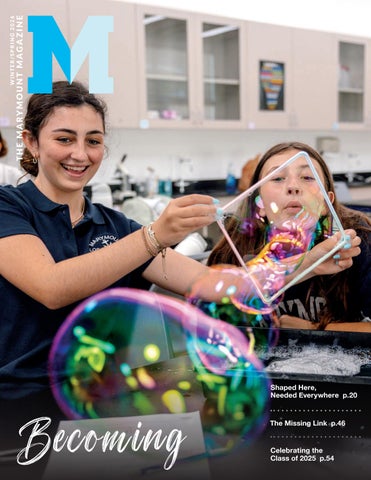
In Ms. Gorder’s biology class, students brought the cell membrane to life through a hands-on bubble lab— discovering the joy of learning by seeing science in action.
24 | M - T H E M A R Y M O U N T M A G A Z I N E
M - T H E M A R Y M O U N T M A G A Z I N E | 25
Awaken a Consciousness of Social Justice
In Religious Studies I, students create original art inspired by Sister Corita Kent, connecting personal expression to broader questions of justice, responsibility, and response.
I
n Ms. Borges’ ninth grade Religious Studies class, students were asked to consider a question that feels increasingly relevant: What does it mean to respond to the world around you?
The question emerged through their study of Sister Corita Kent, the Los Angeles–based artist, educator, and activist whose work in the 1960s helped redefine how art could engage with social and political issues. Known for her bold serigraph prints, Sr. Corita combined text, color, and cultural references to create work that was both visually striking and deeply rooted in questions of justice, community, and faith. For students, her work offered more than a historical example. It provided a framework—one that positioned art not simply as expression, but as a form of engagement.
The process required more than creativity. It asked students to clarify what they believed, to make decisions about how to communicate it, and to consider how their work might be received by others. The resulting work was varied in both style and focus, but consistent in its sense of purpose. For Tessa Delfin ’29, that purpose centered on the idea that social change does not always begin at a distance—it often begins in the smallest, most immediate interactions.
They studied how she used repetition, language, and composition to communicate meaning, often drawing attention to issues that were urgent in her time. Just as importantly, they considered how Sr. Corita’s work invited a response. It asked something of the viewer. That shift—from observing to responding—became central to the project.
“The repeating aspect of the words shows how there is so much love in the world, and it is very easy to show—it only takes a wave and a smile.”
Students were asked to select a social justice issue that mattered to them and create an original art piece inspired by Sr. Corita's approach. The topics they chose reflected both global concerns and local realities, including access to clean water, immigration, environmental challenges, feminism, and the impact of the Palisades fires.
Her piece, built around the word "love" placed inside a heart and surrounded by handwritten affirmations, reflects that belief. By repeating positive phrases across the background, she emphasizes not only the presence of
26 | M - T H E M A R Y M O U N T M A G A Z I N E
“
Don’t let someone leave an interaction with you feeling worse than they came… Be the light in the darkness.”
love, but its accessibility—suggesting that awareness of others is something that can be practiced daily. Katherine Eddy ’29 approached the project from a broader perspective, shaped by her awareness of the world beyond the classroom. “What inspired me… was how much darkness is going on in the world right now, and how much we need to love others,” Katherine shared. Her response does not ignore that complexity, but addresses it directly. She continued, “Don’t let someone leave an interaction with you feeling worse than they came… Be the light in the darkness.” Katherine's work points to a consistent, outwardfacing approach to others—one grounded in the idea that kindness is not situational, but constant. “Let no one leave you without feeling happier… spread love to everyone no matter where they come from.” Together, these reflections highlight a shared understanding: that while the issues students chose
- K ATH ERIN E ED DY ’ 29
may be large and complex, their responses often return to something foundational—the way people encounter and care for one another in everyday life. This work connects directly to Marymount’s focus this year on Goal 5: to awaken a consciousness of social justice, part of the broader mission of the Religious of the Sacred Heart of Mary. Rather than approaching social justice as an abstract concept, students are invited to engage with it through experience—by noticing, reflecting, and responding. In Religious Studies I, art became the medium for that engagement. The project also serves as an early introduction to ethical thinking, a foundation students will continue to develop in the years ahead. At this stage, the emphasis is not on having complete answers, but on beginning to ask the right questions—about justice, responsibility, and the role each person plays in shaping the world around them. What emerges is not a single definition of activism, but a clearer understanding of where it can begin.
M - T H E M A R Y M O U N T M A G A Z I N E | 27
Athletic Recap Across every field, court, and course, Marymount student-athletes continue to compete with purpose, resilience, and pride. This Fall Season, their collective achievements reflect not only a commitment to excellence, but a program defined by depth, growth, and the strength of the Sailor spirit.
28 | M - T H E M A R Y M O U N T M A G A Z I N E
CROSS COUNTRY Varsity and JV Cross Country saw strong finishes across both levels, with JV placing 1st and Varsity placing 3rd in the final League Cluster Meet and two runners earning top-10 league finishes. Varsity made a CIF Division 4 playoff appearance at Mt. SAC closing the season with momentum and promise. GOLF Varsity Golf This season was one defined by growth and resilience as our young Varsity Golf team competed in one of the league’s most competitive fields, grounding the team for future momentum. Highlighted by Isabel Beran '27 advancing to regionals, she placed 52 out of 110 players.
JV Golf JV Golf focused on development and steady improvement, competing in three matches and building confidence with each outing. With the addition of Spring Golf next year, the program is poised for continued growth and expanded opportunity. TENNIS Varsity Tennis Varsity Tennis finished 10–7, highlighted by an undefeated run to win the First Serve Tournament. Continuing to the CIF Division 4 playoffs, Varsity Tennis completed their season and a quarterfinal appearance in the CIF Division 4 playoffs. Competing with consistency and composure, the team proved itself against a strong field and delivered a season marked by high-level play.
JV Tennis JV Tennis finished 6–2 in league play and made program history with its first-ever tournament appearance at the First Serve Tournament. With strong teamwork and a growing competitive edge, the group continues to build momentum and strengthen the foundation of the program. VOLLEYBALL Varsity Volleyball Marymount Volleyball delivered a dominant 38–7 season, going 8–2 in league play and capturing tournament titles in Hawaii and Las Vegas while finishing as runners-up at the Tournament of Champions. The team’s strength was reflected in its accolades, with Samantha Destler '26 named Mission League Co-MVP and Katelyn Oerlemans '27, Elle Vandeweghe '26, Makenna Barnes '27, and Olivia Penske '26 earning All-League honors.
JV & Frosh Volleyball JV (8–2) and Frosh (7–3) both turned in strong league performances, continuing to build depth across the program. Through competitive tournament play, both teams gained valuable experience and continued to elevate the level of play at every stage.
M - T H E M A R Y M O U N T M A G A Z I N E | 29
Collegiate-Bound Student-Athletes Eight of Marymount’s Class of 2026 student-athletes have once again demonstrated what is possible when passion, perseverance, and academic ambition come together. On November 12, they officially committed to competing at the collegiate level, signing their National Letters of Intent (NLI) in the Terry Leavy Lemons Pavilion, surrounded by family, friends, and the Marymount community.
JOCELYN DEMOREST '26
Rowing University of California, Los Angeles
SAMANTHA DESTLER '26
Volleyball University of Washington
DECLAN EASTMAN '26
Volleyball Rice University
GRACE JAMISON '26
Volleyball Lafayette College
30 - | T M TH RU YN MTO M UN MZAI G 30 | M H E- M A ER YMMAO AT GA NA E ZINE
FRANKIE JONES '26
Volleyball Brown University
PRESLEY JONES '26
Volleyball Amherst College
OLIVIA PENSKE '26
Volleyball Georgetown University
ELLE VANDEWEGHE '26
Volleyball Southern Methodist University
OLIVIA PENSKE '26
FRANKIE JONES '26 JOCELYN DEMOREST '26
DECLAN EASTMAN '26 SAMMY DESTLER '26
PRESLEY JONES '26
ELLE VANDEWEGHE '26
GRACE JAMISON '26
M - T H E M A R Y M O U N T M A G A Z I N E | 31
700+ Wins & a Legacy Still Unfolding Across 28 seasons, Coach Cari Klein has built a volleyball program defined as much by its standards as by its success.
T
his fall, Head Volleyball Coach Cari Klein reached a milestone few coaches ever attain: over 700 career wins. Spanning 28 seasons, the achievement reflects consistency, preparation, and a long-standing commitment to the game. It is also a testament to the generations of student-athletes who trained, competed, and grew within the program she has guided for nearly three decades.
From the outset, Coach Klein brought a clear sense of purpose to Marymount’s volleyball program. Practices were structured, expectations were understood, and players were taught to approach the sport with focus and intention. Over time, that approach shaped a culture: one built on preparation, teamwork, and accountability, and sustained by students willing to invest fully in the work required to compete at a high level. Teams under her leadership are known for their composure and consistency. They play with confidence, communicate effectively, and understand their roles within the larger whole. There is an emphasis on doing the fundamentals well, staying disciplined under pressure, and respecting both the game and one another—qualities that have defined the program year after year. For many alumnae, the experience of playing in the program remains formative, with many crediting Coach Klein for preparing them for collegiate play. They often reflect on learning 32 | M - T H E M A R Y M O U N T M A G A Z I N E
BY THE NUMBERS
772 Wins
28
8
8
Seasons
Regional Championships
State Championships
2
203
120
National Titles
how to manage expectations, collaborate with teammates, and respond thoughtfully to challenges. The lessons extend beyond volleyball, shaping how they approach academics, leadership, and competitive environments long after their time at Marymount. Devon Newberry ’19, who was recruited to play at UCLA while at Marymount and went on to become a three-time NCAA runner-up and two-time Pac-12 champion, now competes professionally on the AVP tour. Reflecting on the role Coach Klein played in her development, Devon says the lessons she learned extended far beyond the court. “Cari didn’t just train me as a volleyball player, she changed the way I saw myself,” Devon shared. “Her belief in me, especially when I didn’t believe in myself, pushed me toward opportunities I could have never imagined. She taught me how to put my head down and grind, and how to trust that I was capable of more. Even now, I still go to her for advice and guidance because her lessons extend far beyond the court. I am who I am today in so many ways because she believed in me.” Current players describe a coach who values preparation and growth, who encourages athletes to take ownership of their development. They learn that progress is incremental, that mistakes are part of learning, and that confidence is built through repetition and trust in the process. Olivia Penske ’26, who has committed to play Division I volleyball at Georgetown University this fall, says Coach
Student-Athletes Coached
Student-Athletes who have continued at NCAA Level
Klein’s approach has helped prepare her for the next level. “Cari is truly the best coach there is. She pushes me every day to be the best version of myself on and off the court, making me feel very prepared to play volleyball in college,” Olivia says. “She also cares about every girl on the team and makes sure that we are always playing to our best potential.” Over seven hundred wins represent thousands of hours in the gym, countless matches, evolving strategies, and seasons marked by change. They also reflect Coach Klein’s ability to remain grounded as the sport has evolved—adapting strategies while maintaining a steady philosophy centered on effort, commitment, and team cohesion. For Coach Klein, the milestone is meaningful, but it is not the defining measure of her work. “I really coach because it’s amazing to watch these girls grow into incredible women.” Coach Klein says. “I love seeing where life takes them and following their careers, staying connected, seeing them have their own families, and watching what they go on to do.” Her impact can be seen in the program’s sustained success and in the many students who have gone on to compete at the collegiate level, pursue leadership roles, and carry with them a deep understanding of what it means to be part of a team. As Marymount volleyball continues to evolve, the foundation built over 28 seasons remains firmly in place: a legacy shaped by consistency, care for the game, and the shared effort of coach and players alike. M - T H E M A R Y M O U N T M A G A Z I N E | 33
Visual Arts
Leighton Devereux '27
Emma Devine '26 34 | M - T H E M A R Y M O U N T M A G A Z I N E
Christine Lu '29
Audrey Devine '29
Maica Monti '27
M - T H E M A R Y M O U N T M A G A Z I N E | 35
Sophia Winnick '27
Sophia Poon '26
Frances Lawton '26
Caroline Crane '28
Shelby Scott '26 36 | M - T H E M A R Y M O U N T M A G A Z I N E
Designing a Creative Life Through a visit from SAILL mentor and CO Architects associate Joe Chase, Marymount students explored the intersection of art and architecture, gaining insight into how creativity can evolve across disciplines.
F
or students in Marymount’s AP Visual Arts class, a visit from architect and artist Joe Chase offered something more than a look into a single career—it opened up a broader understanding of what it means to sustain creativity over time.
exchange felt less like critique and more like conversation—an extension of the kind of mentorship that continues beyond a single program or season.
A mentor through Marymount’s Margo Leonetti O’Connell ’60 Students Advancing in Internship, Leadership, and Learning (SAILL) Program, Mr. Chase has worked with students over the years, helping to cultivate their interest in architecture and design beyond the summer months. His visit to AP Visual Arts grew out of that ongoing relationship, following the success of the School's first-ever Art Week and a shared sense that students would benefit from seeing how his work has evolved.
“I think it's so important to have this continued relationship with a mentor that can expand past the summer,” said Mr. Philip 'PJ' Petrone, Co-Director of College Counseling and Director of SAILL. “These relationships are ongoing and dynamic, offering our students more opportunities throughout the school year.”
An associate at CO Architects, Mr. Chase moves between architecture and multimedia art. What began as small figures drawn into architectural sketches to demonstrate scale has developed into a larger body of paintings, prints, and collage—work that explores human identity through form and repetition. In sharing that evolution, he offered students a perspective on creativity as something not fixed, but continuously developing. As he walked students through his process, Mr. Chase spoke about navigating a creative career—balancing professional work with personal practice, and making space for both. His experience reflected a path shaped not by a single discipline, but by curiosity and a willingness to continue creating outside of formal expectations.
Experiences like this give students something tangible to carry forward: a clearer sense that creative work does not have to follow a single path. Whether it becomes a profession or remains a personal practice, it is something that can continue to grow alongside them.
Following the presentation, Mr. Chase spent time reviewing student portfolios, asking questions about their ideas and offering thoughtful feedback. The M - T H E M A R Y M O U N T M A G A Z I N E | 37
Beyond the Final Note The Chapman University Singers showed Marymount students that music is not just an activity, but something that can continue alongside whatever path they choose.
O
n a January morning, Marymount was filled with the voices of the Chapman University Singers, who joined our students for a choral exchange that felt as much about possibility as it did about performance.
Led by Dr. Ryan Brown, the ensemble represents the highest level of choral performance at Chapman University—28 students selected not only for their technical skill, but for their ability to perform with nuance, connection, and expression. What stood out most, however, was not simply the precision of their sound, but the accessibility of their path. Many of the singers are not music majors, offering a clear reminder that the arts can remain part of a student’s life alongside a wide range of academic interests. Dr. Brown’s visit is part of his ongoing work with high school programs across Los Angeles, helping students see the many ways music can continue beyond high school—whether as a major, a minor, or something they choose to pursue simply because it matters to them.
After performing, the Chapman singers spoke candidly with Marymount students, answering questions that went beyond auditions and repertoire. They shared what it looks like to balance rehearsals with coursework, how they’ve found community through music, and why they’ve chosen to keep singing—even when it is no longer required. Then, the roles reversed. Marymount’s choirs took their turn, sharing their own work and growth while receiving thoughtful feedback in return. The exchange
38 | M - T H E M A R Y M O U N T M A G A Z I N E
became less about performance and more about connection—students engaging with one another through a shared language of discipline, listening, and creativity. “I really hope my students discovered what is possible for them after high school,” Director of Choirs Kendall Renaud reflected. “Whether they plan to study arts and performance in college or participate in the arts outside of school, I hope they know music and choir are always an option for them. They don’t ever have to stop singing.” At Marymount, the arts are not confined to a stage or a schedule. They are part of a larger formation: one that invites students to explore, to express, and ultimately, to carry forward what matters to them. Experiences like this one do more than refine technique; they expand imagination. They offer students a vision of continuity—of passions that don’t end with graduation, but evolve.
and Jhené Aiko—bringing a breadth of professional experience into the studio. Throughout the class, students learned a sequence of Amapiano movement, focusing on control, rhythm, and expression while adapting to a style that, for many, was entirely new. The experience was both technical and immersive—an opportunity to step outside familiar forms and engage with dance as a global language.
Movement Without Boundaries A masterclass with choreographer Lindiwe Rose introduced Marymount dancers to Amapiano, expanding their understanding of dance as both a cultural practice and a global form of expression.
M
arymount’s Advanced and Conservatory Arts Program Dance classes welcomed Lindiwe Rose for a masterclass centered on Amapiano dance—part of the program’s ongoing exploration of cultural styles from around the world.
In conversation, Ms. Rose also shared insights into her professional journey, offering students a glimpse into the possibilities of pursuing dance beyond high school. She spoke about building a career, finding artistic community, and staying connected to the craft in a field that continues to evolve. “We had an amazing turnout for this class,” Director of Dance Education Ms. Shanta’ Robinson said. “Our students are really excited to learn from new people and new styles, and I want to keep giving them that opportunity.” More than anything, the workshop expanded students’ sense of what dance can be. It offered a reminder that there is no single way to move, no single tradition to follow—only a wide and varied world of expression waiting to be explored.
Originating in South Africa, Amapiano is a dynamic and expressive form of hip hop dance, known for its rhythmic precision and fluid, intricate footwork. Under Ms. Rose’s guidance, students were introduced not only to the movement itself, but to the musicality and cultural context that shape it—approaching the style with both curiosity and care. Ms. Rose’s own background spans a wide range of disciplines, from ballet and jazz to street styles such as hip hop, house, waacking, voguing, and popping and locking. Now based in Los Angeles, her work includes collaborations with artists like The Chainsmokers, will.i.am,
M - T H E M A R Y M O U N T M A G A Z I N E | 39
a Midsummer Reimagined Certain stories survive because they bend—across time, across voices, across generations willing to reinvent them. Shakespeare's A Midsummer Night’s Dream has always been one of those stories. Elastic, mischievous, and strangely timeless, it shifts depending on who holds it. This fall, the play found new resonance in the hands of Performing Arts Chair and Director Corey Wexler, whose bold artistic vision invited the audience not to see Shakespeare differently, but to understand why he endures. Ms. Wexler did not approach the play as a puzzle to be preserved, but as a living text—one that could meet students exactly where they are, without losing the integrity of where it began.
40 | M - T H E M A R Y M O U N T M A G A Z I N E
M - T H E M A R Y M O U N T M A G A Z I N E | 41
“When you strip away the intimidation of the language, you realize Shakespeare wrote about things teenagers know intuitively,” Ms. Wexler said. “Longing, confusion, ego, heartbreak, identity. My hope is to build a world and create an environment where students and audiences are not apprehensive of his works. Then watch the students bring that world to life with confidence and passion.” To do that, she began with rigor, not reinvention. For weeks, the cast sat on the rehearsal room floor translating the play line by line. With over 45 student actors in the room, they read aloud, debated meaning, wrote contemporary paraphrases, and unraveled the intricacies that make Midsummer both brilliant and bewildering. “I translated my lines into modern English so I could fully understand what I was saying,” Mihira Sista ’28, who played Robin Goodfellow (Puck), said. “I would watch videos and listen to recordings of other performances…hearing the text over and over helped to build my confidence with the language.” Only once they understood the content did she invite them to explore. “Shakespeare is not fragile,” Ms. Wexler said. “He can withstand curiosity and handle being questioned. Once the girls realized that, it took the pressure and fear out of the text, and everything opened up.” 42 | M - T H E M A R Y M O U N T M A G A Z I N E
“
Like Shakespeare, Marymount’s history and impact never leave us. The Marymount Players performed this same show in the 1920s, 1970s, and 2000s, showing us how Shakespeare and Marymount withstand the test of time.” - MARIAN DELFIN '26
Scan to view a highlight of the 1929 Marymount production of A Midsummer Night’s Dream beginning at the 8:44 mark—a glimpse into the earliest chapter of a century-long tradition. Scan to watch Marymount’s 2025 Fall production of A Midsummer Night’s Dream—a new chapter in that same tradition.
From there, the cast began experimenting with characterization: How might a fairy’s spell feel physically? What modern gestures could clarify a lover’s confusion? How could contemporary music heighten a moment without overshadowing the text? Titania’s entrance to Mariah Carey’s “Fantasy” became one of the production’s brightest moments, not because it was unexpected, but because it made emotional sense within the world they created, drawing audiences more fully into Shakespeare’s imagination. The interplay between classic text and contemporary expression produced a show that felt both true to the original and unmistakably modern. Laughter ripped through Cantwell Hall as comedic moments landed sharply, the storytelling felt clear, and the emotional logic— often lost in traditional staging—came through with striking ease. Assistant Head of School Dawn Regan noted this clarity after she attended the preview of the show. “It wasn’t just that the production was modern,” she reflected. “It was that the girls performed Shakespeare with such certainty! They weren’t tentative, but instead, understood the play deeply enough to be bold.” That boldness is part of a much longer lineage. Marymount has performed A Midsummer Night’s Dream since the 1920s. Archival footage— accessible through the QR code alongside this piece—reveals a tradition that evolves rather than repeats: a bare-bones 1920s staging, a whimsical 1970s interpretation, a playful early2000s revival. Each reflects the cultural moment and artistic values of its era. This year’s production is simply the latest chapter in that living archive. Student Director Marian Delfin ’26 captured this continuity in her program note: “Like Shakespeare, Marymount’s history and impact never leave us. The Marymount Players performed this same show in the 1920s, 1970s, and 2000s, showing us how Shakespeare and Marymount withstand the test of time.” That spirit was visible throughout the production. This year’s fall play was rigorous enough to honor the text, imaginative enough to make it resonate, and confident enough to feel entirely its own. It was the continuation of a century-long tradition proving that the stories we inherit are only as static as we allow them to be. M - T H E M A R Y M O U N T M A G A Z I N E | 43
When the Stage Becomes the Classroom
A visit to A Noise Within Theatre invites Marymount acting students to encounter August Wilson's work in a way no classroom lesson could replicate.
T
he lights dimmed inside A Noise Within Theatre, and the room fell quiet. On stage, the world of August Wilson’s Joe Turner’s Come and Gone unfolded—voices rising, tensions simmering, stories of identity and freedom reverberating through the space.
For Marymount students in Ms. Corey Wexler’s acting classes, the performance offered something different from the rehearsals and scene work they knew well. It was not a lesson delivered at a desk or diagrammed on a whiteboard. It was something felt—an encounter with language, history, and humanity that demanded attention.
The October 2025 field trip came at the invitation of Marymount alumna Lea Madda ’08, now Director of Education at A Noise Within Theatre in Pasadena. For many students, it was their first time seeing an August Wilson play performed live. The experience was both challenging and illuminating. “August Wilson is difficult, both in his language and content,” Ms. Wexler explained. “Most students don’t encounter his work until college. Being able to see it performed—and then ask questions of professional actors and dramaturgs about the choices they make and the historical context behind the play—helps students understand the material on a much deeper level. That kind of experience is incredibly valuable.” After the performance, the students remained in the theatre for a conversation with the cast. Questions ranged from the technical—how actors prepare for emotionally demanding roles—to the historical research that informed the production’s setting in the years following the Civil War. For Lea, hosting the students felt like a full-circle moment. “It’s such an honor to share these pieces of literature at such a high caliber with students,” she said. “Most high schoolers are exposed to a lot of mainstream shows like Mean Girls or & Juliet, which are wonderful and fun for good reason. But it’s really special to round out their experience with works they may not have encountered before.” 44 | M - T H E M A R Y M O U N T M A G A Z I N E
“
It’s such an honor to share these pieces of literature at such a high caliber with students.” - LEA MADDA ’08
“
Most students don’t encounter his [Wilson's] work until college. Being able to see it performed...helps students understand the material on a much deeper level. That kind of experience is incredibly valuable.” - COREY WEXLER Theatre Director and Performing Arts Department Chair
The visit also revealed something about the students themselves. Advanced Acting students modeled what it means to be thoughtful audience members—attentive, curious, and respectful—setting an example for their peers in Acting I and II. Not every student in Ms. Wexler’s classes will pursue theatre professionally. That, she notes, is precisely why experiences like this matter. “My hope isn’t that all of them become actors,” she said. “It’s that they leave with a deeper appreciation and respect for theatre as an art form.” The connection to Marymount runs deeper than professional collaboration for Lea. As a student herself, she once sat in the same theatre seats. “When I was at Marymount, our acting teacher Mr. Schulte took us to A Noise Within to see As You Like It,” she recalled. “I still think it’s Shakespeare’s best comedy. That
day is crystal clear to me—I’ve never forgotten it because it was such a formative experience.” The memory stayed with her, shaping the path she would follow: studying music and theatre in college, teaching performance, and eventually returning to A Noise Within in a leadership role. Today, she works to create the same spark of inspiration for the next generation of students. “We can’t wait to keep Marymount involved,” she said. “From our student monologue festival to future educational performances, we’re excited to be a resource for the students.” For the Marymount students who filled the theatre that afternoon, the experience offered a different kind of learning—one that cannot be easily measured or graded. It revealed the discipline behind performance, the depth behind Wilson’s words, and the enduring power of stories that ask us to see ourselves and one another more clearly. M - T H E M A R Y M O U N T M A G A Z I N E | 45
The Missing Link How Marymount Became Part of Southern California Native Herpetology Research What does a high school campus have to do with university research, native wildlife, and climate science? As it turns out, quite a lot. 46 | M - T H E M A R Y M O U N T M A G A Z I N E
FOR NEARLY TWO DECADES, MARYMOUNT’S SIGNATURE MARGO LEONETTI O'CONNELL '60 STUDENTS ADVANCING IN INTERNSHIP LEADERSHIP AND LEARNING (SAILL) PROGRAM HAS DONE MORE THAN PLACE STUDENTS IN INTERNSHIPS. BY MATCHING STUDENTS WITH MENTORS ACROSS DISCIPLINES AND IMMERSING THEM IN REALWORLD WORK, SAILL HELPS YOUNG WOMEN MOVE BEYOND THEORY: TESTING IDEAS, REFINING AMBITIONS, AND DISCOVERING WHAT GENUINELY HOLDS THEIR ATTENTION. IT’S AN APPROACH THAT ASKS MORE OF STUDENTS, AND TRUSTS THEM WITH MORE IN RETURN. THAT TRUST, IN THIS CASE, EXTENDED BEYOND THE CLASSROOM AND INTO THE FIELD, POSITIONING MARYMOUNT NOT ONLY AS A PLACE OF LEARNING, BUT AS AN UNEXPECTED CONTRIBUTOR TO UNIVERSITY-LEVEL SCIENTIFIC RESEARCH.
A CHANCE CONVERSATION That collaboration began, fittingly, with curiosity. A chance conversation on an airplane between Marymount’s former Head of School Jacqueline L. Landry and Dr. Dave Daversa, a researcher at the UCLA Institute of Environment and Sustainability, led to an introduction that would connect Marymount students to a university-level ecological study. Dr. Daversa— known to students simply as “Dr. Dave”—studies the non-lethal effects of climate change and urbanization on native reptiles and amphibians. A central theme of his recent research is the "landscape of fear:" the subtle but powerful stress responses animals experience as urbanization encroaches on wild habitats. When he agreed to mentor students through SAILL, the expectation was exposure. What unfolded was partnership—particularly for Colette Palaganas ’27 and Maya Wierzba ’26, two Marymount students drawn to environmental and conservation-based research.
FINDING THE GAP Dr. Dave had been tracking Western Fence Lizards—Sceloporus occidentalis— across the Santa Monica Mountains and UCLA’s campus, including the Chancellor’s Residence and Sage Hill. Yet between those locations lay a critical gap: a transitional zone that had not been surveyed, limiting a full understanding of how the species move between natural and urban environments. As Maya and Colette learned more about the scope of the research, the realization came quickly. Marymount’s campus sat squarely within that unstudied corridor. Paths they walked every day, hillsides they barely noticed, suddenly mattered in a new way. The campus functioned as a bridge between chaparral and city—exactly the interface where human activity and wildlife intersect, and precisely where the research needed to go next. As Philip ‘PJ’ Petrone, Co-Director of College Counseling and Director of SAILL, explained, “What makes experiences like this possible is that students aren’t just observing—they’re actively contributing. They’re helping solve real problems and make a tangible impact. When learning moves beyond theory and into authentic work, it sticks differently. It becomes clearer, more grounded, and more connected to everything around them.”
STUDENTS AS SCIENTISTS From the outset, Colette and Maya were immersed in the full research process. They conducted field surveys, observed lizard behavior, recorded and organized data, and contributed to written documentation. They learned that ecological research requires patience and sustained focus and that progress is often measured in careful observation rather than immediate results. They also discovered that serious science can be unexpectedly joyful. To humanely capture lizards for brief study, Dr. Dave taught them a technique using a fishing pole and a tiny slip knot made of dental floss. “I was expecting
M - T H E M A R Y M O U N T M A G A Z I N E | 47
“
I gave them total ownership of this project, and they completely blew me away. Their organization, writing, and confidence were remarkable. Presenting research like this is difficult even for undergraduate and graduate students, but Maya and Colette got up and nailed it.” − Dr. Dave Daversa, Researcher | UCLA Institute of Environment and Sustainability
to set traps or methodically track the lizards down,” Colette recalled. “Instead, we were lassoing them with floss. It was surprising, but so much fun.” “It’s the most humane and effective way of catching the lizards,” Maya explained. “But honestly it felt like a game. Once you successfully get one you’re ready for the next!” What stood out most, though, was not the method, but the mindset. “Every question was welcome,” Maya reflected. “Dr. Dave treated us like we were a part of his research team. He told us all about his path to earning a PhD and showed us what we would be doing if that was the path we wanted to follow in and after college.”
FROM FIELDWORK TO THE LAB After several weeks of fieldwork and analysis, Maya and Colette were invited to present their findings to Dr. Dave’s colleagues at the UCLA Shaffer Lab. Dr. Dave challenged our students to synthesize their data into a comprehensive research report—something he expected would take weeks. Instead, they completed it in a single afternoon. Walking into a room of graduate students and faculty was intimidating at first, but the tone quickly shifted. “We were both really nervous going in,” Colette shared, “but everyone was so kind and welcoming. They met us at our level of scientific research and didn’t talk down to us or make us feel bad when we didn’t necessarily understand something.” Their presentation was met with tremendous enthusiasm from the department, with faculty and graduate researchers noting the thoroughness and clarity with which Colette and Maya explained their process and conclusions. “I gave them total ownership of this project, and they completely blew me away.” Dr. Dave reflected. “Their organization, writing, and confidence were remarkable. Presenting research like this is difficult even for undergraduate and graduate students, but Maya and Colette got up and nailed it.” For Maya, the experience underscored how prepared she felt stepping into a university research environment. “Going into it, we were definitely nervous,” Maya explained. “But the research team treated us like students—not like we were at a lower level. Because of the science and research background we get at Marymount, we felt prepared to contribute and work alongside college students.”
48 | M - T H E M A R Y M O U N T M A G A Z I N E
A Closer Look at the Western Fence Lizard WHY IT MATTERS This past summer, 90 Marymount students completed 45 internships across Los Angeles through SAILL. While each experience looks different, they share a common expectation: students are trusted with meaningful work and supported as they learn how to carry it out. This experience clarified something that classrooms alone cannot for Maya and Colette. “There’s only so much you can learn about what it means to be a research scientist from textbooks,” Colette reflected. “Our teachers point us in a direction, but experiences like this help you understand what you actually love when you’re outside the classroom.” For Maya, the internship was a deliberate next step. The summer before, she had worked with The Bay Foundation through Marymount’s SAILL Program. There, she discovered how much she loved environmental science. This time, she applied to just one internship. “This was the only one I wanted,” she said. “I knew I wanted more field experience, just to see if I loved it or hated it, and I absolutely loved it! Being immersed in whatever field you think you want to pursue in the future is so important. It really shows you what being out in ‘the real world’ is like.” Dr. Dave emphasized the value of experiences like this for high school students, noting that time spent outdoors and engaged in real research not only sparks excitement about science, but also builds a strong foundation for future collegiate work. “We don’t always realize the synergies that exist,” he said. “These professional relationships between university researchers and high school students benefit everyone. Working with Colette and Maya supported my research in a pragmatic way, but just as importantly, their enthusiasm and joy were infectious. It made going to work all the more fun.”
CONTINUING THE WORK As the 2025-26 school year continues, Colette and Maya will remain involved in Dr. Dave’s research—tracking seasonal changes in the western fence lizard distribution on Marymount’s campus and joining his UCLA ecology class in the Palos Verdes tide pools. Their initial surveys have helped establish a baseline and opened the door to a more systematic, long-term approach to documenting wildlife observations—work that future researchers will be able to build upon. What began as a chance conversation became something far more enduring: a collaboration shaped by trust, curiosity, and real work. For Colette and Maya, the experience offered clarity—about the kind of work they enjoy, the environments they want to be in, and the questions they hope to keep asking. For Dr. Dave, it filled a critical gap in understanding how wildlife moves through an increasingly urban landscape. And for Marymount, it reaffirmed a simple idea: when students are prepared, trusted, and invited fully into the work of the world, learning doesn’t stay contained within a classroom. Sometimes, it becomes part of the research itself.
Western fence lizards are insectivorous, which means their menu includes spiders, beetles, mosquitoes, and grasshoppers— nature’s pest control at work. They’re diurnal (active during the day), so if you spot one sunning itself, it’s not being lazy—it’s right on schedule. Male western fence lizards sport a bright blue belly, earning them the nickname “blue-bellies.” The name Sceloporus occidentalis loosely translates to “western porous legs,” in nod to small pores along the underside of their legs. Their range stretches across much of the western United States, from California to Washington, and from Utah to New Mexico. Like many lizards, they have a parietal “third eye” on top of their head that helps detect shadows from predators overhead. Perhaps more impressively: western fence lizards help reduce Lyme disease on the West Coast! When infected ticks feed on them, enzymes in the lizard's blood neutralizes the bacteria—meaning those ticks can no longer spread the disease!
M - T H E M A R Y M O U N T M A G A Z I N E | 49
1 2 3 4 5 6 7 8 9 10
THE DOOR THEY OPENED It’s easy to talk about social justice in the abstract—until you’re holding a court transcript in your hands and realizing the dates at the top aren’t history.
11 12 13 14 15 16 17 18 19 20 21 22 23 24 25
At Loyola Law School’s
Project for the Innocent
(LPI), justice looks less
like headlines and more like
footnotes: a detail buried in testimony, an interview that doesn’t quite align, a phone
call to an attorney who
handled a case years ago, a
record that should have been part of a trial. It is slow, methodical work, centered
on a single question with
profound consequences: What
if the system got it wrong?
50 | M - T H E M A R Y M O U N T M A G A Z I N E
They’re someone’s life.
For Luzind Gartlan ’26 and Maude Stalbow ’26, that question became real this summer—not because they were watching from a distance, but because they were contributing. Reading transcripts. Writing summaries. Speaking with families. Learning how to hold responsibility without simplifying the work. What makes their story distinctly Marymount isn’t only where they interned. It’s how the opportunity came to Marymount in the first place. This internship didn’t arrive through a formal placement or a predetermined list. It arrived through student initiative and Marymount connection—and then grew because the community knew how to respond. Maude’s involvement with LPI began before she transferred to Marymount. As a sophomore, interested in law but unsure where to start, she sent cold emails to legal organizations, including Loyola’s Project for the Innocent. One message reached Professor Laurie Levinson, who told her about a summer opportunity to assist with casework while law students were away. “I went in not knowing anything,” Maude says. “I remember studying law terms on Quizlet before I went.” Because she arrived late in the summer, after many volunteers had already left, Maude was quickly immersed in real work. She screened case files, read transcripts, and summarized evidence using a structured framework. At the end of each report was a question that still stays with her: Do you think this case is innocent?
She was fifteen or sixteen—and being asked to help determine whether a person’s story warranted deeper investigation. “I was so grateful that I was given that responsibility as young as I was,” she says. When Maude transferred to Marymount after the fires, she shared the experience with Mr.
Petrone and introduced him to Joe Trigilio, LPI’s Executive Director. What began as a single student’s outreach grew into something larger. At Marymount, experiential learning through SAILL isn’t static. Some opportunities come from established partnerships; others surface through student initiative; still others are actively built in response to where students are headed. Reflecting on how Maude’s individual outreach grew into something larger, Philip 'PJ' Petrone, Co-Director of College Counseling and Director of SAILL, points to that flexibility as essential to the program’s purpose. “We’re always looking for ways to meet students where they are and help create pathways into their interests,” Mr. Petrone says. “Sometimes that means strengthening existing relationships, sometimes it means supporting an opportunity a student brings forward, and other times it means building something new altogether.” For Luzind, that structure helped deepen an interest she was already pursuing. Interested in criminal justice since middle school, Luzind had long been drawn to writing, history, and the broader question of how systems shape people’s lives. At Marymount, those interests deepened. Religious Studies classes framed social justice as a lens rather than a topic. Humanities courses pushed discussions beyond what happened into why it happened. She started a pre-law club and pursued other legal experiences, increasingly certain that law could be a way to advocate with purpose. Then, just as school ended, a separate internship opportunity she had been pursuing fell through—on the last day. Through a Marymount family connection, and with Mr. Petrone helping communicate her interests, Luzind was introduced to the Project for the Innocent.
M - T H E M A R Y M O U N T M A G A Z I N E | 51
1 2 3 4 5
“POST-CONVICTION LITIGATION IS ABOUT IDENTIFYING AND TELLING THE TRUE STORY OF AN INCARCERATED PERSON’S LIFE AS WELL AS DECONSTRUCTING A FALSE STORY OF GUILT WHILE BUILDING A NEW STORY ABOUT WHAT WENT WRONG IN THE SYSTEM. LUZIND AND MAUDE ASKED THOUGHTFUL QUESTIONS AND NOTICED DETAILS THAT EVEN TRAINED LAWYERS CAN OVERLOOK—BECAUSE THEY WEREN’T CONSTRAINED BY ASSUMPTIONS ABOUT HOW CASES ARE ‘SUPPOSED’ TO WORK. THAT PERSPECTIVE COMES FROM AN INSTINCTIVE SENSE OF JUSTICE.” Joe Trigilo, Executive Director Loyola Project for the Innocent
6 7 8 9 10 11 12 13 14 15 16 17 18 19 20 21 22 23 24 25
“I’ve seen how SAILL helps connect Marymount families and students,” she says. “It was through that connection that I was able to find this opportunity.”
lawyers can overlook—because they weren’t constrained by assumptions about how cases are ‘supposed’ to work. That perspective comes from an instinctive sense of justice.”
She arrived expecting one of two extremes common in legal internships: being sidelined or being thrown in without guidance. Instead, she found something more demanding—and more formative.
For both students, the work eventually shifted from demanding to deeply human.
“It felt like the big leagues,” she says. Surrounded by law students, paralegals, and attorneys, Luzind wasn’t pushed to the margins. She worked with multiple attorneys, collaborated with interns, contacted former counsel to track down missing evidence, spoke with incarcerated clients and their families, and helped screen prospective cases. That presence mattered to the work itself. “Luzind and Maude brought clarity and humanity to our work.” Mr. Trigilo says. “Post-conviction litigation is about identifying and telling the true story of an incarcerated person’s life as well as deconstructing a false story of guilt while building a new story about what went wrong in the system. Luzind and Maude asked thoughtful questions and noticed details that even trained
52 | M - T H E M A R Y M O U N T M A G A Z I N E
For Luzind, it was a witness interview conducted not in a courtroom, but at a restaurant— burgers on the table, conversation unfolding naturally. The witness, a lifelong friend of the client, spoke about her life, her children, and her relationship with the man wrongfully convicted of murder. Records existed placing him with her the night of the crime—records that had never been accessed. “To speak with someone who can paint such an authentic picture of the client,” Luzind says, “it really humanizes them.” For Maude, the moment came on her first day, when she was taken to the actual crime scene of a case she had only known on paper. Thirty years later, standing at the intersection collapsed the distance between transcript and reality.
already looking ahead, hoping to continue this work through the innocence clinic at the University of Michigan, where she will enroll this fall. For Mr. Trigilio, that early exposure is exactly the point. “When students encounter this work early, they learn that the law is not abstract—it affects real people in irreversible ways,” he says. “Exposing young people to the power they have to change even one life builds a sense of responsibility that I hope stays with them, whether they become lawyers or not. At LPI, training future lawyers is part of our mission, but so is cultivating citizens who understand justice as a moral obligation that is obtainable and necessary.”
“It’s easy to read it as a story,” she says. “Then you realize this person is still behind bars.” The experience challenged both students’ understanding of justice. Maude describes losing an “idealistic innocence” about how the system works, seeing how corruption can be pushed aside—and feeling more determined to be part of the solution. Luzind came to understand wrongful conviction not as the failure of one individual, but as the result of systems with “players on every level.” That clarity reshaped how school felt for her afterward. Luzind returned to campus with a new sense of purpose. AP Literature, Government, Gender Studies—courses she was already invested in—now felt directly connected to the future she was imagining. Writing became a tool. History became context. Research became responsibility.
What stands out in both experiences is not only the seriousness of the work, but how prepared the students were to meet it. Luzind points to Marymount’s writing program, which pushes students while supporting them; to history classes that examine culture as well as events; and to Religious Studies, where social justice is treated as a way of seeing the world. And she points to something less tangible, but just as essential: a culture that holds students to high standards while teaching them how to be humane. That formation travels. It shows up in how students listen, how they write, how they carry responsibility. And in this story, it shows up in something quietly powerful. These students didn’t just participate in an opportunity. They expanded it—bringing an internship to Marymount, and making space for others to follow.
“This internship gave me the opportunity to apply the skills and passions I developed through Marymount in a real-world context,” she says, “and gave me a very clear understanding of my mission.” Maude, too, sees her path more clearly. She plans to pursue criminal law and is
M - T H E M A R Y M O U N T M A G A Z I N E | 53
C
elebrating the
lass of 2025
54 | M - T H E M A R Y M O U N T M A G A Z I N E
M - T H E M A R Y M O U N T M A G A Z I N E | 55
“
Y
ou are part of something larger than yourselves — the legacy of Marymount, and the bold, justicedriven, radically faithful women of the RSHM who built it. Women who believed deeply in the mission ‘that all may have life, and have it to the full.’ Women who broke barriers, made noise, and demanded that education be both excellent and equitable.
You carry that same spirit forward. The world needs your leadership — your voice, your empathy, your fire. It doesn’t need you to be perfect. It needs you to be present. So when life feels uncertain, I hope you remember Spirit Week. I hope you remember that a small class can fill an entire campus with purpose and power. I hope you remember what it felt like to be fully seen, fully celebrated, fully you.
“
And when you question whether you're ready for what comes next — remember this moment. Look around at your classmates, your teachers, your family. Remember who walked this road with you.
You didn’t just finish something. You became something.
- DAWN REGAN 2024 -2025 Interim Head of School
56 | M - T H E M A R Y M O U N T M A G A Z I N E
M - T H E M A R Y M O U N T M A G A Z I N E | 57
Class of 2025
Matriculation Schools denoted in bold indicate multiple enrollees.
CALIFORNIA
MASSACHUSETTS
Loyola Marymount University Pepperdine University Santa Clara University University of California, Berkeley University of California, Davis University of California, Santa Barbara University of San Francisco University of Southern California
Boston College Wellesley College
MICHIGAN
FLORIDA University of Miami
Davidson College Elon University Wake Forest University
HAWAI‘I
NEW JERSEY
University of Hawai‘i at Mānoa
Princeton University
INDIANA
NEW YORK
University of Notre Dame
Columbia University Fordham University Marist University New York University Parsons School of Design at The New School
LOUISIANA Tulane University 58 | M - T H E M A R Y M O U N T M A G A Z I N E
PENNSYLVANIA Carnegie Mellon University
RHODE ISLAND Brown University
University of Michigan
TENNESSEE NORTH CAROLINA
The University of Tennessee, Knoxville
TEXAS Southern Methodist University Texas Christian University
WASHINGTON, D.C. Howard University
WISCONSIN University of Wisconsin–Madison
2025
Talia Angles THE MOTHER BUTLER AWARD Marymount’s highest honor is given in memory of the Foundress of the Marymount Schools in the United States and Europe. It is awarded to a Senior who has best integrated the ideals of a Marymount education through her academic excellence, leadership, loyalty, and supportive presence to the school community.
Awards
THE OUTSTANDING SCHOLAR AWARD This award represents Marymount’s highest academic honor, and is presented to an exceptional Senior who has achieved excellence in multiple disciplines.
Lucia Sun THE LES ANGES AWARD
Abigail Anderson THE MARIAN AWARD
Ryan Gilhooly THE KRISTIN KLEIN KEEFE ’88 AWARD
This award is given to a Senior who has consistently demonstrated the high ideals of a Marymount education, who has taken full advantage of Marymount’s unique opportunities, and who has consistently contributed to her school community.
This award is presented to a Senior whose devotion to the pursuit of excellence is complemented by sincere dedication to the highest standards of character and integrity.
This award is presented to a Marymount Senior who displays excellence in academics, and who participates in interscholastic sports with the highest standards of sportsmanship and integrity, as exemplified by Kristin Klein Keefe ’88 during her years at Marymount.
Kay Irimajiri THE KATHERINE ALFS CALDWELL ’35 AWARD
Elizabeth Griffis THE FATHER GAILHAC AWARD
Bella Neumann THE ALUMNAE ASSOCIATION’S YOUNG WOMAN AWARD
This award is presented to a Senior class leader for her initiative, devotion, commitment, and spirited contribution to her class.
This award, named after the Founder of the Religious of the Sacred Heart of Mary, is presented to a Senior who has consistently demonstrated the energy, enthusiasm, warmth, leadership, and joy that promotes the special family spirit unique to Marymount.
This award is given to a Senior for her dedication and service to Marymount High School, and for her devotion to the principles of Christian womanhood.
M - T H E M A R Y M O U N T M A G A Z I N E | 59
Siblings and Legacies
1
2
3
4
5
6
7
8
9
10
1. Miriam Lee Ha '85, Yasmeen Akounou ’13, Yva Akounou '25, Mercedes Lee Akounou '86, 2. Madeline Anderson '21, Abigail Anderson '25 3. Ally Bibawi '23, Sienna Beccaria '25, Darlene Bibawi Beccaria '89, April Levy Bibawi '90 4. Karina Kassai Catalano '88, Vanessa Catalano '25, Sybelle Kassai Sprague '85 5. Reilly Davis '25, Austyn Davis '21
60 | M - T H E M A R Y M O U N T M A G A Z I N E
6. Leighton Devereux '27, Logan Devereux '25, Olivia Devereux '19 7. Bella DiGenova '21, Gigi DiGenova '25, Cesca DiGenova '21 8. Pippa Ehrich '27, Sophie Ehrich '25 9. Valentina Knapp-Schwarzenegger '24, Franziska Knapp-Schwarzenegger '25 10. Zoe Swisher '19, Mia Swisher '25, Anna Swisher '21
M - T H E M A R Y M O U N T M A G A Z I N E | 61
Alumnae News
Alumnae: Send Us Your Notes! Do you have any professional accomplishments, passion projects, or newsworthy updates you'd like to share with your fellow alumnae? Let us know so we can include it in our class notes! Email your updates to alumnae@mhs-la.org. If you are submitting pictures (we love seeing them!), please send them in a .jpg, .jpeg, or .png format and make sure that the resolution is high enough for print publication—preferably 300 DPI.
62 | M - T H E M A R Y M O U N T M A G A Z I N E
M - T H E M A R Y M O U N T M A G A Z I N E | 63
64 | M - T H E M A R Y M O U N T M A G A Z I N E
BEHIND CHILDREN'S EYES Rosemary Miller ’08 has built her career around a simple but important question: how do young children learn, and what shapes who they become. Through her work at PBS SoCal and in early childhood education, she is committed to protecting the curiosity, openness, and possibility that define the earliest years— and set the foundation for everything that follows.
R
osemary Miller’s ’08 work returns, again and again, to the same question: how do children learn, and what shapes who they become. Today, as Senior Director at PBS SoCal, she leads work that reaches millions of children and families—developing educational media, building curriculum, guiding digital innovation, and forging partnerships that bring high-quality early learning into communities that might otherwise go without it. The scale is expansive, but the focus is precise: the earliest years of life, when development is rapid, foundational, and deeply influenced by experience.
M - T H E M A R Y M O U N T M A G A Z I N E | 65
“
Those years from zero to eight—there’s nothing else like them... What children’s brains are capable of, and how much their experiences matter in that time—it’s fundamental to who they become.”
“Those years from zero to eight,” Rosemary says, “there’s nothing else like them in terms of brain development. What children’s brains are capable of, and how much their experiences matter in that time— it’s fundamental to who they become.” Learning during those years is not just faster, it is different. Children move through the world with openness. They try without first calculating the outcome. They build, imagine, and begin without needing permission. “You watch them on a playground,” she says, “and they create these elaborate, multi-dimensional games with no instructions. They just start. It's incredible!” That instinct, to begin without hesitation, is something adults often lose. “We overthink. We hesitate. We worry about getting it right before we even try,” Rosemary says. Her work is designed to protect what children already know how to do, creating environments where curiosity continues instead of narrowing over time.
school, stepping into an unfamiliar environment with no built-in circle. What she found instead was a place that held two things at once. “It was this combination of warmth and high expectations,” Rosemary recalls. “You felt supported, but you also knew you were going to be pushed.” That combination gave her permission to take risks— and the expectation that she would. She entered as someone who describes herself as observant, more comfortable listening than speaking, aware that she wanted to lead but not yet certain how. Marymount gave her the space to grow into that version of herself without forcing it. Rosemary jumped in, trying everything— student council, retreat leadership, athletics—not to define herself, but to discover what felt true. “I never felt like I was just one thing,” she says. “I could try different things and figure it out.”
That perspective has sharpened in her own life. As a mother of two young children, Rosemary experiences those early years not as theory, but as something unfolding in real time. The questions that guide her work—about development, environment, and access—are the same ones she navigates daily. Her family is not separate from her work; it is where the stakes of that work are most immediate.
Over time, that willingness to try became confidence. Moments that once felt intimidating became markers of growth. Rosemary still remembers standing in front of Ms. Dickey's English Class, reciting lines from the Canterbury Tales in Old English—an experience that felt overwhelming at the time. Now, it serves as a measure of what she can do. “Now if I can do that,” Rosemary says, laughing, “I can do anything.”
That focus on children and growth began long before her career. When Rosemary arrived at Marymount, she did so as the only student from her previous
Marymount asked students to stretch in that way— not by removing difficulty, but by surrounding it with support. That experience extended beyond the
66 | M - T H E M A R Y M O U N T M A G A Z I N E
classroom. Through Theology courses and service work, Rosemary explains, students were given time and space to think about what they believed and why. “It’s incredibly important, especially for young women, to have the space and time to explore their values—what matters to them, what their moral compass is,” she says. That kind of reflection, she believes, is not optional. It shapes how you move through the world. Her career reflects that same clarity of purpose. Although she always knew she wanted to work with children, following in the footsteps of her parents and grandparents, Rosemary’s path did not follow a straight line. In college, she pursued neuroscience, drawn to understanding how the brain develops. But over time, the work felt incomplete. “I wanted to see that development in real time,” she says. “I wanted to be with kids.” That pull led her into the classroom, where she began teaching and grounding her understanding of development in daily practice. From there, her work expanded into research, curriculum design, and eventually into leadership at PBS SoCal, where she now operates at a scale that allows her to shape how children learn far beyond a single classroom. Alongside developing educational content, her team works directly in communities—partnering with schools, libraries, and organizations in places like Compton, South Central Los Angeles, and Santa Ana, CA to provide resources, workshops, and support to families. The goal is not only reach, but access—ensuring that children, especially those in under-resourced communities, have the opportunity to experience high-quality early learning. Across all of it, Rosemary’s focus remains consistent: children need different things, and education has the power to meet those needs in ways that extend beyond academics. Some need stability. Some need challenge. Some need care. “School is often the constant,” she says. “It’s where kids know what to expect, where they feel safe. And when they feel safe, that’s when they can learn and grow.” Looking back, Rosemary does not describe her path as something she had fully mapped from the beginning. If anything, she remembers feeling the opposite—the pressure to decide too early, to define everything before it had time to unfold. What she
“
It’s incredibly important, especially for young women, to have the space and time to explore their values—what matters to them, what their moral compass is.”
understands now is much simpler. “Everything works out,” Rosemary says. “If I could tell my high school self one thing, it would be that you don’t need to have it all figured out. Every experience leads you somewhere—it opens another door, and then another. You’ll end up somewhere you probably didn’t even know existed; but you have to have the openness and flexibility in your mindset to just embrace that.” She understands now that growth is not linear. That becoming does not follow a single path. That the environments you move through, the risks you take, and the people who shape you all accumulate into something you could not have predicted at the start. Rosemary’s work continues to return to what children already know how to do: to try without hesitation, to imagine without limits, to begin without certainty. Creating the conditions where that way of thinking can grow—especially in the earliest years of life—has become both her work and her responsibility. In those years, when everything is still forming, that responsibility carries extraordinary weight. And in answering it, she is shaping not only how children learn today, but what they will carry forward into the world.
M - T H E M A R Y M O U N T M A G A Z I N E | 67
We want to say thank you!
Please tell us if you have included Marymount in your will or living trust, or as a beneficiary of a retirement account or life insurance policy. We would love to welcome you to Marymount's Mother Butler Heritage Society— alumnae, parents, grandparents, and friends who have committed to keep the Mission of our School and the Religious of the Sacred Heart of Mary alive for generations to come.
For more information on leaving a bequest to Marymount or for other Planned Giving opportunities, or if you have included Marymount in your will but have not yet informed the School, please contact Rachel Grella-Harding at the Development Office at rgrella-harding@mhs-la.org or call 310.472.1205 x 213.
68 | M - T H E M A R Y M O U N T M A G A Z I N E
Alumnae Events Making Spirits Bright
Marymount’s first all-community Making Spirits Bright gathering brought together more than 160 students, alumnae, parents, RSHM Sisters, faculty, staff, and friends for a day that blended service with reconnection across generations. The open-house celebration unfolded through shared moments of care: assembling more than 200 kits for the Ronald McDonald House, creating cards and ornaments for assisted living residents, and collecting nearly 200 toys for A Place Called Home.
M - T H E M A R Y M O U N T M A G A Z I N E | 69
Regional Alumnae Gatherings Head of School Dr. Fadia Hefni Desmond ’90 and Assistant Head of School Dawn Regan have been traveling to cities across the country to gather with Marymount alumnae. What has emerged in each city feels instantly familiar—stories shared across decades, friendships rekindled, and a renewed sense that the Marymount community extends well beyond the years spent on campus.
New York City, NY
70 | M - T H E M A R Y M O U N T M A G A Z I N E
San Francisco, CA
Les Anges Luncheon On February 4, Parents of Alumnae (Les Anges) and alumnae returned to campus for a luncheon that brought reflection and reconnection into conversation. Guided by Director of Campus Ministry and Service Learning Micaela Plummer and rooted in the charism of the RSHM, the event invited guests to revisit a shared legacy while considering how it continues to shape their lives today—revealing a community bound not only by memory, but by an enduring call to grow, lead, and remain connected.
M - T H E M A R Y M O U N T M A G A Z I N E | 71
Class Notes JENNIFER DUDLEY ARBAUGH '69 shares, "Good evening from the lake shores of Charlevoix, Michigan. Ed and I continue to embrace the beauty of our home on the harbor. Still traveling on our Searay to ports beyond with Alvin, our English Black Lab. Twelve years old and sturdy as he goes. Same as we. Not getting any younger but fortunate to be healthy. Our family has welcomed three granddaughters, Adeline Eleanor (3), Susanna Mae (2), and Molly Rose (1), along with our older grands: Isabel (23) and Jude (18). I continue to write for Substack: Jennifer Ward Dudley for those brave enough to venture. Some of my classmates and I connect on Instagram and Facebook. Best to all."
TRICIA YUHL HUNTER '75 shares, "The Class of 1975, which was a small graduating class, had a 50th reunion in the desert last summer. Photos are below."
Back Row: Lisa Zipser Derr, Mary Joan Johnson, Mary Moody Lewis, Mary Ann Maher Armet, Ann Fusco Jones, Suzanne Sinclair Daly, Julie Gaydou Alexander, Laura Simpson Monahan, Tricia Yuhl Hunter Front Row: Maria Barrie, Ann Spearman, Marilee Mahoney
72 | M - T H E M A R Y M O U N T M A G A Z I N E
Monica Adler-Herrera Thomas '94 on her annual girls' trip with her Marymount friends. Back Row (L to R): Amy McGaughey Sendil, Shawna Skinner Knyal, Clare Gibbs, Katie O'Keefe Everly, Katie Walsh Bruzzo, Susie McNamara Hastings, Monica Adler-Herrera Thomas Front Row (L to R): Jenny Von Der Ahe Van Tuyle, Michele Lotta LeSieur, Elise Houterman Crader
MONICA ADLER-HERRERA THOMAS '94 writes, "My Marymount group of friends (pictured above) recently gathered in Newport Beach for our annual girls' trip." LAUREN WAHLQUIST TIGANI '09 writes, "I am not sure when my last update was, so for big life events, I'll share: I got married to my husband Thomas Tigani in Washington, D.C. on July 7, 2018! Our daughter Charlotte Jane Tigani was born in New York City on February 28, 2022, and our son John Patrick Tigani was born in New York City on February 18, 2025."
Lauren Wahlquist Tigani '09 with her husband Thomas Tigani and their two children, Charlotte Jane and John Patrick
NATALIE WILSON BARRETT '10 shares, "ERIN CORNYN '82 is one of the owners at Brentwood Sunshine Preschool and my daughter just graduated from there!"
Natalie, her mom Stefanie Schwedes Wilson '83, and Erin Cornyn '82 at Natalie's daughter's preschool graduation
Aleksandra Martinovic '11 married Dave Ferguson on October 18, 2025 in Palm Springs, California
M - T H E M A R Y M O U N T M A G A Z I N E | 73
In Memoriam CLAUDIA STONE AVITABILE '66 (1/4/2025)
CATHERINE SMITH MCCAMMON '61 (3/19/2025)
Vera Ryan Barnes, grandparent of MOLLY HUNT HATZENBUEHLER '13 (2/25/2026)
Julian McMahon, father of MADISON MCMAHON '18 (7/2/2025)
ADELE DOLAN BEAUREGARD '47 (6/1/2025)
Joan Nicholson, mother of JILL NICHOLSON-SAMUEL '79, LAUREN NICHOLSON '80, JENNIFER NICHOLSON-SALKE '82, and AMY NICHOLSON ZIMMERMAN '84
JUDY CALVERT FLOWERS '60 (4/20/2025) Daniel Chandler, Jr., father of LINDY CHANDLER FISHER '89 and CISSY CHANDLER TETREAULT '82; and grandfather of FIONA FISHER '22 and KENDALL FISHER '20 (2/26/2026) KATIE DEVCICH '98 (5/4/2025) EDWINA DRAKE SKAFF '61 (12/17/2024) Mina Elliot, mother of NATALIE ELLIOT '17 (10/22/2024) William French, father of NATASCHA FRENCH '98 MONAISE JONES MACDONALD '41 (8/4/2024) Christopher Kochoff, father of KRISTINA KOCHOFF KELL '83 and grandfather of DASHA ROMANO '26 (12/08/2025) Braun Levi, brother of ADELLE LEVI '23 (5/4/2025) JACQUELINE LOVETT GRIFFIN '51 (7/16/2025) Donna Maffei, mother of TRACI MAFFEI '87 and grandmother of CATHERINE MAFFEI '23 (11/19/2025) OLGA ORELLANA MCADAM '61, daughter of † OLGA SIBBEL ORELLANA '35 and sister of ELENA ORELLANA HEIL '64 (6/23/2024)
74 | M - T H E M A R Y M O U N T M A G A Z I N E
ANNETTE RANFTL MCGUIRE '66 (5/24/2025) Christine Rohleder, grandparent of RILEY DUFFY '29 (3/14/2026) Brian Shea, father of KELLY SHEA '90, STACY SHEA '93, and KATHERINE SHEA '99 (7/23/2025) KATHERINE SHORT '02 (2/23/2026) MARGARET SKINNER '23 (12/18/2025) TILDEN (KENDRA) THORNBURGH-MUELLER '20 (7/17/2025) Mary Tokuza, mother of LAURA TOKUZA ARENSTEIN '01 (9/17/2025) KIMBERLY TRAUTH '87 (2/20/2025) Elaine Vogel, mother of KATIE VOGEL '01 (7/1/2025) STEFANIA PIGNATELLI WERNER '48 (6/9/2025) Mary Lee Barab, mother of AVA BARAB WILSON '93 (6/2/2025)
M - T H E M A R Y M O U N T M A G A Z I N E | 75
Marymount LOS ANGELES
10643 Sunset Boulevard Los Angeles, CA 90077
For information about important dates and upcoming events, please visit our website: www.mhs-la.org
Address service requested
Non-Profit Org. US Postage Paid Los Angeles CA Permit# 2112