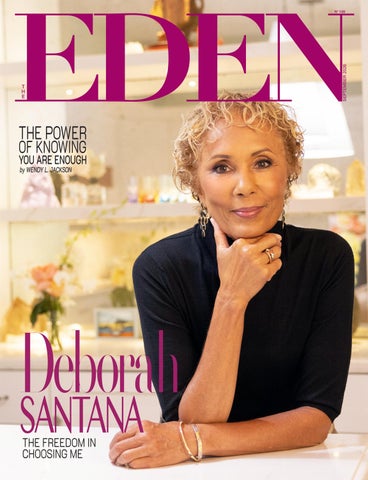
EDEN T H E
THE POWER OF KNOWING
YOU ARE ENOUGH by WENDY L. JACKSON
Deborah SANTANA THE FREEDOM IN CHOOSING ME
SEPTEMBER 2026
N° 189
@TheEdenMagazine
TheEdenMagazine
@TheEdenMagazine
Maryam Morrison
Dina Morrone
Paulette Dozier
Emilie Macas
Nikki Pattillo
Edward Hakopian
Dr. Rob Moir
Joe Santos, Jr.
Wendy L. Jackson
Philip Smith
JSquared Photography @j2pix
Brad wallace
Sheri Determan
Ben Rollins
Lisa Joy Walton
Greg Doherty
Polly Wirum
Artin Mardirosian
Benjamin D.Buren
MEET OUR TEAM
EDEN T H E
Since 2010
The Eden Magazine is a nonprofit online publication is your guide to healthy living, spiritual awareness, compassion and love for all living beings, holistic lifestyle, mindfulness, organic living, positive thinking, sustainability, and personal development Founder & Editor-in-Chief Maryam Morrison Executive Editor/Contributing Writer Dina Morrone East Coast Liaison & Partnership Director Paulette Dozier Contributing Writers Sadhguru, Isha Foundation Joe Santos, Jr. Dr. Rob Moir Emilie Macas Nikki Pattillo Polly Wirum Wendy L. Jackson Guest Writer Philip Smith Contributing Stylists + Makeup Artist Edward Hakopian Lisa Joy Walton Graphics & Photography JSquared Photography @j2pix (Los Angeles) Artin Mardirosian (Nexision) (Los Angeles) Benjamin D. Buren – AliveStudios.Com (Denver, SanFrancisco, Boston) Sheri Determan (Los Angeles) Greg Doherty (Los Vegas) Ben Rollins (Atlanta) Web developer Brad wallace https://bradwallacedesign.com/ 325 N. Maple Dr. Po Box 5132 Beverly Hills, CA 90209
To purchase a copy, visit us at www.theedenmagazine.com Eden Magazine is a non-profit monthly online magazine that aims to promote a better environment in which humans live in peace and harmony with other living beings. The Eden Magazine supports artists whose work matches our criteria. If you would like to submit your artwork, article, or/ and your photography for our future issues, please contact Maryam Morrison at maryammorrison@theedenmagazine.com The Eden Magazine reviews article content for accuracy before publication. The views expressed in the articles reflect the author(s) opinions and do not necessarily reflect the views of the publisher and editor. The published material, adverts, editorials, and all other content are published in good faith. 5 THEEDENMAGAZINE.COM e SEPTEMBER 2026
24 10
CONTENTS
10
Table of
HOW DOGS HELP US FEEL SAFE IN A WORLD THAT DOESN'T by Dr. Chris Blazina
18
WHEN THE RESCUER BECOMES THE ONE WHO NEEDS SAVING by Captain James Owen
24
THE RIPPLES WE CANNOT SEE by Brad Newbury & Kier Newbury
30
AN INTERVIEW WITH DEBORAH SANTANA
42
ANN LESLEY SMITH AND THE UNIQUE NATURE OF ARABIAN HORSES
44
WHAT PARROT CAN TEACH US IN THE WILD & IN CAPTIVITY - PART2 by Leslie Crane Rugg
18
46 44
42
Cover photo by Michael Collopy
48
48
THE LIFE THAT WAS TAKEN FROM YOU, & HOW YOU CAN TAKE IT BACK by Dr. Carl R. Nassar
74
56
HOW GOOD CAN IT GET? IDEAS TO HELP YOU GET THERE by Helen Lavresky
62
THE BATTLE OF CONSCIOUSNESS by Nikki Pattillo
74
56
STAYING IN THE FLOW THROUGH LIFE & DEATH by Polly Wirum
78
AUTHENTICITY IN A WORLD OF MASKS by Emilie Macas
84
THE POWER OF KNOWING YOU ARE ENOUGH by Wendy L. Jackson
88
62
HONORING THE HOLINESS OF EVERYDAY LIFE by Colette Lafia
78 88
GET YOUR OWN COPY TODAY Order the latest edition by visiting our website www.theedenmagazine.com
8 THEEDENMAGAZINE.COM e MAY 2024
9 THEEDENMAGAZINE.COM e MAY 2024
Adapted the above excerpt from Good Dogs & Difficult People: What Dogs Teach Us About Love
How
DOGS HELP US
FEEL SAFE
in a World That Doesn't By Dr. Chris Blazina
Left Gaze Bias Research psychologist Paul Ekman has spent decades focusing on emotions. He even consults for animated and CGI films to help get emotional nuance correct. But he made his first breakthrough studying the micro-expressions of couples coming to therapy. Micro-expressions are subtle, fleeting facial reactions. A slight rise of the eyebrow, perhaps a downturned smile, or even a narrowing of one's eyes. The context of what couples said turned out not to be as important as the subtle facial cues that signal, among other things, contempt or dislike for one another. While these micro-expressions may last only a fleeting moment, their impact is, by contrast, long-lasting. In the context of a relationship, they may signal the beginning of the end of love. Part of Ekman's research on emotions also focuses on the micro-expressions that occur as we attempt to mask our emotions. Part of us knows the context is not right to make what we feel obvious. Maybe we even feel bad for feeling what we feel. A counter maneuver involves trying to hide or mask what we really feel. But our reactions are not entirely under our conscious control. Sometimes what we try to disguise leaks out in unexpected ways. Findings suggest that a less filtered, more honest version of emotional expression shows up on our right (from an observer's perspective, left) side of the face, even when we try to conceal it. If you are the observer trying to figure out what is going on, we have, over our evolution, unwittingly learned to orient toward the left side of our friends, family members, and partners' faces. In tense moments, we bias our gaze toward that side of the face, looking for clues. This is called the "left gaze bias." 10 THEEDENMAGAZINE.COM e SEPTEMBER 2026
Photo by Isabel Moreno
It may come as little surprise that dogs also utilize the left gaze bias when staring at humans, but not when gazing at other animals or inanimate objects. It could have been very evolutionarily adaptive to corner the market on reading human emotions over the past millennia. Dogs even outshine humans' closest genetic cousins on this essential step in reading emotions. The left side of a human's face (from the observer's perspective) gives much more unfiltered information about how people feel. When a dog looks at a human face, this includes scanning the same place for tell-tale signs of emotional cues. In the same vein, dogs have shown evidence of taking note of their person's facial expressions when encountering novel situations, using the gaze as a means to process information and subsequently direct behavior. Like “Is this new person who just showed up at the dog park friend or foe?” In other instances, “Is my human upset or angry with me?” A dog’s ability to discriminate the emotional expressions of human faces adds to their ability to attune to human mood states. This ability sets the stage for a sense of emotional attunement that can help in many situations, especially when the human is out of sorts. Emotion Regulation An additional aspect of attachment bond maintenance and growth involves emotional regulation. It concerns how we deal with intense, overwhelming internal experiences (emotions)
and difficult external events, such as interacting with others. We benefit from having others with us who help us decompress from the day. We sit and chat about a difficult moment. We share with an interested listener. It helps. Our bodies may have been in fight/flight mode from the stress of dealing with a grumpy boss, family member, or a significant work setback. But being in the presence of someone's calm, we slowly come back to our normal baseline. In one version, emotional regulation is about someone lending their calm to us. Another version involves lending ourselves some calm. A type of self-care involves taking the accumulation of the good experiences of others being there for us and applying it to ourselves. It could be an affirmation, a mantra, or just a wide berth of personal grace as we are gentle with ourselves in a difficult moment. The nature of having someone present for us in a moment of distress is rooted in how we start our first relationships in the world. In the best situations, a caregiver helps manage what we feel. For young infants and children, so many occurrences carry the possibility of being too much, beyond our ability to really grapple with things on our own. Hunger, thirst, and being on our own, even for short periods of time, are just a shortlist of potentially triggering events. A sensitive parent sees how the events are overwhelming to a child. They absorb the intensity by being present and attuned. They offer soothing and lend their calm to the child. Slowly, the child’s cloud of feeling overwhelmed begins to pass, and everything resets back to normal. 11 THEEDENMAGAZINE.COM e SEPTEMBER 2026
In secure attachments and safe, predictable family environments, it becomes second nature over time to reach out to trusted others in moments of feeling out of sorts. With the help of another, we can also gain more of a sense of mastery that we can perform some of the regulating of our emotions by ourselves. We learn to calm our own emotions from the experiences of someone helping us. That in turn sets the stage for offering the same care to others. While dogs can be a social catalyst helping us be more at ease interacting with others, they also act as a prompt and an emotional anchor in the process of emotional regulation. They lend us their calm. Allowing us to dialogue with our inner world. Learning to self-correct when we are tempted to follow the old ways of wanting to burn the barn down with others or ourselves.
Photo by A.C.
Given that the art of loving is also about being of service to others, we also lend our calm to our animal companions. One example of this occurs when dogs are taken out of familiar surroundings. Research suggests that more than half of dogs are in fight/flight mode when they go to the vet. There is an overabundance of external happenings like unfamiliar dogs, new scents, even sensing other's anxiety. Companion dogs are easily susceptible in these moments, especially if they have a history of their own developmental trauma. When neglect or abuse is part of their early experience. They can be triggered into anxiety, provoking moments that can turn into aggression. Lending our calm in these moments offers support to our dogs. I have seen how humans and animal companions co-regulate difficult emotions together. Each leans on the other in this special bond. The dialogue goes back and forth. Situations include 12 THEEDENMAGAZINE.COM e SEPTEMBER 2026
when a client brings their dog to session, when they interact with my own animal companions. The presence of a dog helps absorb difficult moments. We reach out to stroke the dog’s fur to find grounding. We hold them close. We do the work of facing a difficult past or triggering current circumstances and know we are not alone. Attachment Through the SensesDogs Bonding with Us It is important to consider that, like humans, dogs also utilize their senses to navigate the world. This also includes forming and maintaining emotional bonds. Dogs predominantly experience the world through their noses. This is their most powerful sense, being 10,000 to 100,000 times more powerful than that of human olfaction. The olfactory bulb or the olfactory cortex is very well developed in dogs. The Olfactory bulb accounts for one-eighth of the dog's brain. The average dog has more than 100 million sensory receptor sites in the nasal cavity compared to a mere 6 million in people. Research has shown that under ideal circumstances, certain dogs can sniff their human up to twelve miles away.
The presence of a dog helps absorb difficult moments. We reach out to stroke the dog’s fur to find grounding. We hold them close. We do the work of facing a difficult past or triggering current circumstances and know we are not alone.
Part of the underlying abilities of a dog's superpower is that they have two olfactory systems. One similar to our own. When we inhale various scents, they are transported via airstream to smell receptors. Then dogs also have something known as a Jacobson organ situated in the back of their palates. It's believed that the Jacobson organ may be involved in picking up pheromones. This becomes a way to track what is going on with fellow canines (like whether they have an available mating partner). We will see if future research regarding the Jacobson organ is also involved with tracking human scents. Dogs utilize their nose in a number of powerful ways with humans. This includes how they are trained to do specific tasks. They are the first choice for a search and rescue teammate because of their ability to pick up on a scent. Dogs are utilized in drug/ bomb detection at airports. They can smell the body
changes that occur when a person is about to have a seizure, migraine, or panic attack. There is even support for dogs picking up on the smallest micro levels, detecting cancer cells in humans. So, it would make sense that dogs also utilize their nose in interacting with humans on a normal day-to-day basis as well. First,, there was anecdotal evidence suggesting canines use their noses to detect human emotion. Later research suggests they can differentiate human happiness, stress, anxiety, and fear through scent alone. Underarm samples of humans are collected, one while they are happy, stressed, etc. When tested, dogs can differentiate between mood states based entirely on scent. This works by picking up on very subtle smells (chemical changes or chemosignals) humans produce.
13 THEEDENMAGAZINE.COM e SEPTEMBER 2026
DR. CHRIS BLAZINA Dr. Chris Blazina draws on extensive professional experience, including 30 years as a practicing psychologist, as well as being an award-winning author, professor, and researcher. Good Dogs & Difficult People: What Dogs Teach Us About Love (Merlinuspublishers.co.uk ) is his 9th book. He has been widely interviewed across the US, the UK, Canada, and Australia on radio, in magazines, and in newspapers.
When under stress, the body produces neurochemicals cortisol and epinephrine, which are released into the bloodstream. We have changes in our heart rate, breathing, and even the electrical conductivity of skin. The changes prompt the body to create Volatile Organic Compounds (VOC) that show up in chemical ways released through our skin and breath. You might have experienced your dog leaning in for a good sniff after you come home from a difficult day. They are tracking your well-being. Sometimes I wonder if dogs are overwhelmed by the scent of our human Potpourri. Or when they meet us at the door, they experience a wave of our stressed collective humanity. Dogs also utilize their sight with humans. Remember the left gaze bias that naturally orients dogs to the left side of our faces, displaying our unfiltered emotional microexpressions. It provides another means of reading and reacting to their humans. Sound is also a part of the dogs' bonding repertoire. A dog's sense of hearing is much more powerful in the high range than that of humans. Humans hear sounds in the range of 20-20,000 Hz, but dogs can hear sounds up to 65,000 Hz. This involves tones. This includes tones. But decibels are also important- that is, the intensity, or what we would experience as how loud a sound is. Dogs can hear negative decibels, sounds so faint they are beyond human notice. The structure of a dog's ear also plays a part. They are bigger than ours and can move their ears, allowing for an accurate triangulation of sound. Dogs also hear sounds from much farther away than humans. These skills are utilized in interacting with humans in daily exchanges. In one study, dogs recognize their human's voice solely from a recording 82% of the time without any other cues. Or, how your dog picks up on the sound
14 THEEDENMAGAZINE.COM e SEPTEMBER 2026
of your vehicle heading home. I am reminded of these unique hearing skills when Tex bursts with excitement through the dog door into our yard. He is noting the arrival of some potential visitors. This is not always a human passerby. We live in the mountains where bears, mountain lions, and other critters that go bump in the night are only a few steps away. Or when the temperature turns cold, we sometimes have a mouse use the crawl space under the house as a winter Airbnb. Tex will pivot his ears, tracking the faint sounds I cannot hear. And of course, animal companions utilize touch. Dogs have more sensory receptors in their skin than humans. That, along with whiskers on their face, allows for sensing the slightest changes in the environment and navigating their surroundings. It is no wonder I can not quietly sneak past my animal friends when they are at rest. Touch is also sometimes paired with taste. Dogs have fewer taste buds than humans, and their sense of taste is not their strongest sensory ability. For instance, dogs have a weaker sense of sweetness. However, they have a stronger sense of saltiness and bitterness. Somehow that seems most applicable being in the company of salty and perhaps bitter humans. When your dog licks you, one might consider the taste of our skin as part of a dog’s grooming ritual. Their taste buds are on the tip of their tongues as well as in the back of their throat. These skills evolved to help them assess the quality and safety of water or meat in the wild. But dogs may not be doing a taste test when they lick our skin; rather, it prompts bonding and soothing when we are under distress. This licking action can include the face, hands, or feet. Dogs instinctively use the combination of taste and touch to groom and soothe their young, as well as their human friends.
Photo by Mary Y.
GIVE A SHELTER DOG A HOME
Adopt Today
15 THEEDENMAGAZINE.COM e JULY 2026
16 THEEDENMAGAZINE.COM e JULY 2026
17 THEEDENMAGAZINE.COM e JULY 2026
WHEN THE RESCUER
Becomes the One Who Needs Saving By Captain James Owen, Retired Long Beach Fire Captain
F
For most of my adult life, I was trained to move toward other people's emergencies. Fire. Injury. Loss. Fear. Violence. Grief. Families standing in the worst moment of their lives, looking at us to bring order to chaos. That was the job. That was the calling. You put on the uniform, answer the tones, and move toward what everyone else is trying to escape. For thirty years in the fire service, including twenty-three years with the Long Beach Fire Department, I learned how to stay calm when the world was coming apart. I learned how to read smoke, read danger, read a room, and make decisions under pressure. I became a firefighter, a paramedic, and eventually a captain. I was proud of that. I still am. But there was another emergency building quietly inside me. That is the one I did not know how to answer. My memoir, The Last Patient, grew out of that realization. It is not a book about glory. It is not a polished hero story. It is a story about what happens when the person trained to save everyone else finally has to face the truth that he is the one who needs saving. That is a difficult truth for many first responders, veterans, caregivers, clinicians, and high-stress professionals to admit. We are often rewarded for staying strong, staying useful, and staying quiet. We learn how to function while carrying what we have seen. We learn how to walk out of someone else's tragedy and drive home as if nothing followed us. But something does follow us. Sometimes it follows us into our sleep. Sometimes into our marriages. Sometimes into our parenting. Sometimes into our health. Sometimes into ad-
20 THEEDENMAGAZINE.COM e SEPTEMBER 2026
diction, isolation, anger, anxiety, or silence. Sometimes it shows up as the favorite chair in the house where a person disappears, physically present but emotionally gone. The public sees the uniform. They see the red lights, the rescue, the ceremony, the handshake, the bravery. What they do not always see is the cost paid by the person inside the uniform and by the family waiting at home. That hidden cost is one of the reasons I wrote this book. I wrote it for the first responder who keeps showing up while privately falling apart. I wrote it for the spouse who has learned to read the mood before speaking. I wrote it for the child who senses that something is wrong but does not yet have the words. I wrote it for the veteran, nurse, dispatcher, police officer, medic, clinician, and exhausted leader who has carried more than they were ever taught how to release. I also wrote it for anyone who has been crushed by life and wondered if there is still a way back. I believe there is. But the way back requires honesty. One of the hard truths I had to accept is this: trauma may not be your fault, but recovery is still your responsibility. That sentence can sound harsh if it is heard through shame. I do not mean it as blame. I mean it as a doorway. For years, I wanted the world around me to understand what had happened to me. I wanted the system, the job, and certain people to acknowledge the damage. Some of that was legitimate. Some of that also kept me waiting. At some point, I had to stop waiting for perfect understanding before I began the work of healing.
The rescuer had to become responsible for saving himself. That is what I mean by “the last patient.” In emergency work, we are trained to assess everyone else first. We check breathing. We control bleeding. We protect the scene. We start treatment. We solve the problem in front of us. But many of us never turn that same assessment inward. How is my breathing? How is my sleep? How is my family? How is my anger? How is my drinking? How is my relationship with faith? How is my relationship with myself? Those questions are not soft. They are essential. A person can appear strong while slowly losing contact with peace, purpose, and love. Strength without self-honesty becomes performance. Performance without recovery eventually becomes collapse. My own collapse did not come all at once. It came through years of accumulated stress, injury, grief, addiction, career pressure, and unprocessed pain. I had childhood wounds that followed me into the job. Then the job added its own layers. For a long time, I believed I could outwork the damage. I thought discipline alone would save me. Discipline matters. It helped me survive. It helped me become a firefighter. It helped me keep moving through difficulty. But discipline alone cannot heal a life. It can build the structure, but truth, humility, love, community, faith, and willingness must enter the room in equal parts. That is where recovery began for me.
I went to a first responder-specific rehab, twice. I needed a new group of men focused on recovery in my life. I got sober through Alcoholics Anonymous. I asked for help. I learned to sit with pain instead of constantly outrunning it. I began telling the truth about what I had seen, what I had done, what I had lost, and what I still wanted to become. I learned that asking for help is not weakness. For a first responder, it may be one of the most courageous acts available. Recovery is not one clean moment. It is daily work. It is the meeting when you do not feel like going. It is the phone call when shame tells you to isolate. It is making amends when pride wants to defend. It is the walk, the prayer, the breath, the glass of water, the honest conversation, the meal, the sleep, and the decision not to burn your life down because your nervous system is loud, constantly and always. One of the core phrases in The Last Patient is: Situation Screwed / Still Survivable. That phrase became a lifeline for me. It means the facts may be painful, but the mission is not over. It means the marriage may be strained, the career may be damaged, the money may be tight, the body may hurt, or the shame may be heavy, but there is still a next right action. There is still breath. There is still help. There is still a way through. When a person is overwhelmed, they do not always need a lecture. They need a simple command they can carry out themselves. 21 THEEDENMAGAZINE.COM e SEPTEMBER 2026
CAPTAIN JAMES OWEN Captain James Owen is a retired Long Beach Fire Captain, speaker, recovery advocate, and author of The Last Patient: A Memoir of Resilience and Recovery. Learn more at CaptainJamesOwen.com
Breathe. Drink water. Eat something. Move your body. Call someone safe. Tell the truth. Do not make a permanent decision inside a temporary storm. Life is always better when you stay here. This is not medical advice. It is lived experience. If someone is in crisis, believes they may harm themselves or someone else, or is facing a medical or psychiatric emergency, they should call 911, go to the nearest emergency room, or call or text 988 in the United States and Canada. There is no shame in needing immediate help. Staying alive is the first mission. Healing also requires us to look beyond the individual. Families and communities carry the impact of unprocessed pain. When a first responder, veteran, caregiver, or leader suffers in silence, the people closest to them often suffer too. The answer cannot be shame. Shame drives people deeper into hiding. The answer must include compassion, accountability, treatment, peer support, spiritual grounding, and practical daily tools. We need cultures where asking for help is not seen as failure. We need homes where honest conversations can happen before the damage becomes permanent. We need leaders who understand that human beings are not machines to be disposed of. The fire service gave me purpose. It gave me identity, discipline, brotherhood, and some of the best people I have ever known. It also taught me that even the strongest people have limits. That lesson did not make me weaker. It made me more human.
22 THEEDENMAGAZINE.COM e SEPTEMBER 2026
Today, my mission is simple. I want to help the people who help everyone else. I want the wounded helper to know they are not beyond help. I want the family standing nearby to know their pain matters too. I want the person who has carried too much for too long to understand that recovery is not the end of strength. It is strength redirected toward life. I am not perfect. Recovery has not turned me into someone untouched by stress, fear, grief, or uncertainty. It has given me a way to return to centered self. It has taught me how to pause, breathe, tell the truth, and take the next right action, no matter the fear. That is how my life was rebuilt and yours too. Not all at once. One honest step at a time. If you are still here, that matters. You are not finished because you are tired. You are not broken because you need help. You are not weak because life changed you. You are responsible now, and that responsibility can become a form of freedom. The life on the other side of survival is not perfect, but it is real and worth the effort. Family can be repaired. Purpose can be rebuilt. Faith can return. The body can grow stronger. The mind can quiet down. The heart can open again. Faithful trust steps are needed. That is why I wrote The Last Patient. Not to tell people how bad it got. To show them there is a way back. Situation Screwed / Still Survivable. Take the next breath. Then take the next right action.
23 THEEDENMAGAZINE.COM e SEPTEMBER 2026
You have been created in order that you might make a difference. You have within you the power to change the world. ~Andy Andrews, The Butterfly Effect Small moments shape the course of our lives more than we realize. A late alarm. A car that struggles to start. Traffic that feels heavier than usual. At first these interruptions seem like simple frustrations in an already crowded day, but when we look more closely, we begin to see that the timing of events is not random. It places us in moments we could never predict but sometimes were meant to be a part of. In the field of emergency medicine, these moments appear often. You leave the house a few minutes later than planned, and somehow you are the one who arrives when someone collapses. You take a different route on instinct and discover a person in need. You are asked to help at the exact second your presence matters most. Had any one of those small delays or detours been different, you might not have been there at all. You might have even been the patient. But instead, you find yourself in the position to save a life. This idea is captured in what many refer to as the "butterfly effect." Decades ago, mathematician Edward Lorenz described how tiny shifts in initial conditions could dramatically change an outcome. His metaphor of a butterfly flapping its wings, stirring the air in Brazil and influencing weather patterns far away, was not meant to be literal; instead, it was meant to remind us of the sensitivity of complex systems. Slight changes can alter everything that follows. The same is true in the lives of individuals we encounter every day. A small action or a simple moment of readiness can lead to consequences far more meaningful than we may ever know. In medicine, we like to ask constant questions about time. When did the symptoms start? How long was the patient unconscious? When was the last time they were well? Time frames matter in treatment, but 24 THEEDENMAGAZINE.COM e SEPTEMBER 2026
they also shape the stories behind the scenes. Rarely do we consider the chain of events that allowed a trained professional, a bystander, or a loved one to be there in the first place. These moments are easy to overlook, yet they are often the reason someone's life continues. What happens after a life is saved is almost never documented. Medical professionals often speak about why they serve. They talk about helping people, providing care, and doing what needs to be done. But they almost never discuss the long arc of their actions. Most times, they don't get to see the father walk his daughter down the aisle years later, or the friend who survives cancer treatment because someone acted during those critical first minutes, or the family who remains whole because a stranger stepped forward. The impact travels far beyond the emergency itself. This is why we set out to explore something deeper, which we'll refer to in this book as the Saved Effect. It is the continuation of a life that almost ended, the chapters that continue to unfold because someone acted, the stories that rarely make it into a medical chart but need to be told. It reminds us that the power to save a life does not belong only to professionals. A dispatcher guiding CPR over the phone, a teenager who learned compressions in school, a passerby who was willing to stop and try every one of us has the ability to change an outcome. We cross paths with people every day who might save us if the moment came, and we ourselves may one day be called to do the same. Readiness matters. Education matters. Courage matters. Because someone's life, someone's family, and someone's future may depend on a single choice you make without ever knowing what led you there.
THE RIPPLES WE CANNOT SEE By Brad & Kiera Newbury
There was a morning years ago when my son, Colin, and I stood beside Carver's Pond near our house in Bridgewater, Massachusetts. He was about five then, full of the restless energy that comes when the fish are not biting, and the world feels too still for a young boy. The water was quiet and glasslike, the sun drifting through the trees, and the air carried the easy calm that only summer mornings seem to hold. Then a small splash broke the stillness. Colin had picked up a pebble and tossed it into the pond.
For a moment I found myself worrying he would scare the fish, but they had no interest in us that day. So, I watched the water instead. The rock slipped beneath the surface without a trace, and a single tight ring appeared. It widened in slow, steady circles, each one opening into the next, the series of them reaching farther across the pond than I ever would have expected from something so small. Colin was already searching for another stone, but I stayed focused on those spreading rings. 25 THEEDENMAGAZINE.COM e SEPTEMBER 2026
Photo by Andriyks Podilnyk & Jon Tyson
Later that night I was back at the firehouse working an overtime shift. I was lying in my bunk after coming back from a call. The rain drummed against the rubber roof in a steady rhythm that almost felt like breathing, and my mind drifted back to the pond. I kept thinking about those ripples, how one small motion could change the shape of still water long after the stone had disappeared. What I realized in that quiet moment is something I had witnessed throughout my career but had never given words to. A life has the same shape as those ripples. The closest circle is family, the people whose world changes first when something happens. The next circle includes friends, coworkers, and neighbors—the people who fill the ordinary spaces of a day. Beyond those are the circles that stretch even wider, reaching individuals whose lives you touch without ever knowing it. And when a life is saved, those circles do not just keep moving. They expand, pressing forward into places no one could predict. They touch people far beyond 26 THEEDENMAGAZINE.COM e SEPTEMBER E 2026
the one moment when everything could have been lost. Over time, I came to understand that the moments we remember most are rarely the ones that end something, but the ones that allow something to continue. Most people think of saving a life as a moment. A collapse. A call for help. Hands pressing down on a chest. Sirens in the distance. Then, if things go well, a breath returns, a heartbeat follows, and the moment ends. But saving a life is never just a moment. What happens next is rarely seen by the people who stepped in. The birthday parties that still take place. The relationships that deepen instead of ending. The ordinary mornings that continue because someone did not die on an ordinary day. These are the ripples that follow survival. They move quietly outward, touching lives far beyond the moment itself. This is what we call the Saved Effect, and the stories in this book are about those ripples.
BRAD & KIERA NEWBURY Brad Newbury, MPA, NRP, is the President and CEO of the National Medical Education and Training Center (NMETC) and the author of The Saved Effect: True Stories of Lives Reclaimed by People Who Were Willing to Act and the First Responder Advantage. With over forty years of experience in firefighting and prehospital medicine, Brad has dedicated his life to one mission: helping others be ready and willing to act when it matters most. A fire captain, paramedic, and educator, Brad has built NMETC into one of the nation's premier institutions for EMS education. Founded in 2010, Brad serves with the Beth Israel Deaconess Medical Center Fellowship in Disaster Medicine as Associate Director of Prehospital Disaster Operations. Brad holds a master’s degree in public administration (fire and emergency management) and a bachelor's degree in fire science, along with executive education credentials from Harvard University’s T.H. Kiera Newbury, BA, NREMT, is an emergency medical professional and emerging author of The Saved Effect: True Stories of Lives Reclaimed by People Who Were Willing to Act. With a background in psychology and a passion for storytelling, Kiera combines her clinical training with a deep empathy for the human side of emergency medicine, sharing real stories that reveal how readiness saves lives. A nationally registered emergency medical technician, Kiera has worked alongside the Beth Israel Deaconess Medical Center Disaster Medicine Fellowship, contributing to projects that bridge science, service, and public awareness. Her research has been featured in Prehospital Emergency Care, where she co-authored a study examining the diagnostic accuracy of large language models in prehospital settings. Kiera holds a bachelor's degree in psychology with a minor in writing and brings over three years of field experience in emergency services. She speaks on healthcare, CPR readiness, and mental health, using her platform to inspire individuals, organizations, and communities to become trained, prepared, and willing to act when it matters most.
They are stories of cardiac arrest that happened without warning, in living rooms, at sporting events, on dance floors, and in public places where no one expected to be needed. They are stories of ordinary people who were faced with an unplanned decision and chose to act. Some had formal training. Some were guided step-by-step by a calm voice over the phone. Others simply refused to do nothing. None of them set out to be heroes. They simply chose to be present when presence mattered. As a firefighter and paramedic, I have spent four decades responding to emergencies. I have seen outcomes shaped by preparation, hesitation, fear, and courage. But it was only through listening to these stories, sitting across from survivors and their families, that I fully understood how survival is measured. Again and again, people spoke less about the medical event itself and more about what came after. They spoke about time. About memories that were still being made because someone had intervened. About futures that were not erased. This book is built around those conversations. Each chapter centers on a real person whose life was saved and the people who were part of that moment. Some stories unfold from the perspective of the rescuer. Others are told by the person who survived or the survivor's family. Together, they reveal a simple truth: When a life is saved, the impact does not stop when the heart starts beating again. It carries forward, often for decades. Cardiopulmonary resuscitation, known as CPR, runs through
many of the stories in this book, but it is not the whole story. What connects these moments is not a single skill but a willingness to recognize that something is wrong and to act before hesitation takes over. Sometimes that action is administering CPR. Sometimes it’s clearing an airway. Sometimes it’s paying attention to warning signs that are easy to dismiss until they are no longer ignorable. In every case, the moment demands engagement, not perfection. These stories challenge the belief that lifesaving actions are simple, intuitive, or something anyone could figure out under pressure. They reveal the physical effort involved, the uncertainty people feel when they step into a critical situation, and the reality that action taken imperfectly is often what changes the outcome. Readiness is not about being fearless or highly trained. It is about being prepared enough to begin when the moment arrives. The Saved Effect is also not about medical professionals alone. It does not belong to a select group of people who wear certain uniforms or carry specific equipment. It belongs to all of us, because emergencies do not wait for ideal conditions, and help does not always arrive in time unless someone nearby is willing to act. What follows are not lessons in heroism. They are reminders of responsibility. They show that preparation matters, that awareness changes outcomes, and that ordinary people are capable of making life-altering decisions when the moment demands it. The hidden value of saving a life isn't just survival; it's everything that happens after. Here are the survivors' stories. 27 THEEDENMAGAZINE.COM e SEPTEMBER 2026
28 THEEDENMAGAZINE.COM e JULY 2026
GO VEGAN
“Animals Have Souls Don’t Put Them in Your Bowl” 29 THEEDENMAGAZINE.COM e JUNE 2026
Deborah
Santana A Journey of Grace, Courage & Giving
30 THEEDENMAGAZINE.COM e SEPTEMBER 2026
T
There are women whose lives are defined by the rooms they enter, and there are women who quietly transform the rooms they enter. Deborah Santana belongs to the latter. An author, activist, philanthropist, filmmaker, and advocate for women and girls, Deborah has built a life around a deeply held belief: that a meaningful life is not measured solely by what we accomplish, but by what we give, what we awaken in others, and what we leave behind. The daughter of celebrated blues and R&B guitarist Saunders King, Deborah was raised in San Francisco surrounded by music, culture, and the currents of a changing America. Her father’s artistic legacy, together with the social and cultural landscape of her upbringing, gave her an early understanding of the power of both expression and identity. It was an upbringing that would eventually lead her toward a life of activism and service. Her activism began in her youth, when she stood alongside others protesting the Vietnam War at UC Berkeley. Over the decades, that early instinct to speak out evolved into a broader commitment to social justice, equality, women’s rights, and human dignity. Yet Deborah’s activism has never existed apart from her philanthropy. Through Do A Little, the organization she founded, she has created a platform for meaningful support of women and girls,
32 THEEDENMAGAZINE.COM e SEPTEMBER 2026
with an emphasis on education, health, empowerment, and opportunity. Her philanthropy is an extension of her personal philosophy that transformation often begins with one intentional act of generosity, one open door, one person willing to make a difference. She has also lent her support to institutions preserving the history, culture, and voices of African Americans, reflecting her belief that philanthropy is not simply about giving, but about preserving stories, expanding possibilities, and ensuring that future generations inherit a more inclusive world. There is an unmistakable elegance to Deborah’s approach to life, one that comes not from the trappings of achievement, but from self-knowledge. Her journey has been one of continually finding her own voice, embracing change, and choosing authenticity over expectation. In her memoir, Loving the Fire: Choosing Me, Finding Freedom, she opens the door to that deeply personal journey, a story of love, identity, resilience, awakening, and ultimately, the courage to choose oneself. In this interview Deborah Santana invites us into a conversation about the making of a woman beyond the headlines: her father’s influence, the origins of her activism, the meaning of philanthropy, and the quiet power of living a life in service of something greater than oneself.
Jo Frances King & blues musician Saunders King
Jo Frances King & Deborah Santana
Your new memoir, Loving the Fire: Choosing Me, Finding Freedom, is such a powerful title. What does “choosing me” mean to you today, and was there a defining moment when you realized you had to reclaim your own voice and identity? “Choosing me” means being brave enough to live as fiercely as myself as I can. It is such an obvious concept and a natural one, but there were years of my life when I conformed to others’ expectations. I must consistently know who I am and what I believe to live in my authentic expression. In my twenties, I followed a guru from India, and it wasn’t expected that my needs, goals, or desires were at the forefront. The guru told us what was best for our spiritual progress and asked me to open a vegetarian restaurant in San Francisco, and I did. I had dropped out of college to travel with Carlos, and managing the restaurant was a valuable learning experience. I created the menu, hired the staff, and with the assistance of my sister, Kitsaun, built the business for ten years. I took a restaurant management course at UC Berkeley Extension and taught meditation around the world. Leaving the meditation path and the guru’s teachings was the first defining moment when I reclaimed my voice and identity. I realized that no one is more able to connect me with God than my own spirit. I have continued meditating every day since that time, discovering the path to peace begins within. You are the daughter of the legendary blues guitarist and singer Saunders King. Growing up in such a creative and groundbreaking family, what lessons from your father shaped the woman you became? My father was stoic and unflinching in standing up to injustices. In many ways, I have my father’s
personality. The greatest lesson he taught me was to stand strong in adversity. He encouraged me to climb to the highest pinnacle I wanted to reach, and he fiercely watched over me. He loved my mother beyond any love I have seen, and they stood together as equals. Each one shaped me in different ways. My father in his elegant posture and eloquent speech; his firm handshake and looking people directly in their eyes when speaking; his hawk-like attention to everything in the vicinity of our family, and his dedication to his daughters. He played all the great jazz musicians on our turntable: Ella Fitzgerald, Miles Davis, Thelonious Monk, Billie Holiday, Wes Montgomery, Art Tatum, which was a sterling education. My mother influenced me with her faith in God and her friendliness to all. I find myself chatting with the person ahead of me in line at the post office or reaching out to help someone struggling with groceries because this was how Mom lived. Your parents’ interracial marriage was pioneering for its time. How did witnessing their love and resilience influence your understanding of relationships, courage, and belonging? I didn’t realize my parents’ marriage had been illegal in California (and in 16 other states) when they married. That information only became available to me when I was a teenager. They never complained of the hardships and racism they experienced, but I sensed Dad’s tension and wariness. Mom and Dad looked out at the world from a position of unity and power. Their relationship was an obvious bond that showed me what partnership meant. Dad stood with his chest out; Mom lived with her heart out and was always courageous in her interactions for us She would fly out our front door. 33 THEEDENMAGAZINE.COM e SEPTEMBER 2026
With Nelson Mandela, and our family
Giving a speech at Smithsonia
and stride to the neighbor’s when a parent spoke out of turn to us. When our family walked into a restaurant, heads would turn, and people’s eyes followed us to our table. When Kitsaun and I were teenagers, we loved to turn around and catch people staring at us with their mouths open. We laughed at their narrow-mindedness. But Mom and Dad never reacted to subtle or outright racism. Mom lived her faith in God and loved church, the church that was created by my paternal grandparents, Judge and Sarah King. My parents taught us that we belonged even though society tried to separate people into caste systems by skin color; just the act of my parents’ love defied that system. The memoir explores your life alongside Carlos Santana during one of the most iconic eras in music history. What were some of the most beautiful and unexpected moments from that chapter of your life? Actually, Loving the Fire doesn’t focus on our three decades of marriage; my first memoir, Space Between the Stars, delved more deeply into our years together. There were many beautiful moments from those years, especially traveling the world and seeing how people live so differently than Americans: riding the bullet train through countrysides in Japan and taking part in a tea ceremony in a temple in Kyoto, taking the elevator to the top of the Eiffel Tower in Paris, seeing the lovely way families stop mid-day and eat a meal together in Italy, the magic of listening as Weather Report sent their ornate music from the stage as stars brightened the night sky in Antibes, France. The children traveled with us every summer, and we often took my parents or Carlos’s parents on the road for a week or more to help. Those were beloved times when we shared the joy of being together on the band bus and in hotels where we went from room to room to visit.
They were glorious times of unity, laughter, and love. Living in the spotlight can be both glamorous and deeply challenging. How did you protect your sense of self while being connected to such a legendary public figure? We lived in the San Francisco Bay Area, which did not have paparazzi on every corner. This gave me freedom to live my life without the scrutiny of the press. My parents taught my sister and me not to think more highly of people who are famous. Their philosophy was that humans are all created equal and there are those with great intellect, creative talents, and special gifts, but we are all still human. I had dated a famous musician before marrying Carlos, so I was inured to being noticed in public. When we married, Carlos was shy and very humble, not wanting attention except when he played his guitar, and we didn’t live a glamorous life. We had similar spiritual aspirations, enhanced by our daily meditation. My sense of self came from being in harmony with my inner spirit through the guru’s teachings, and later with Bible studies and daily meditation. I felt grounded. The disciple life created a level playing field with other seekers, and I was in a singing group that learned Bengali songs to sing in devotion to God. I wore saris to the group meditations while working in our vegetarian restaurant. It was not difficult to remain humble and connected to one’s inner life while doing these things. My friends were from the meditation center and from my life before Carlos. If I needed to protect our private lives, I didn’t share personal information. My friends all knew me “before,” and valued my heart and my family. My father had been relatively famous as a musician, well-respected and loved by B.B. King and Miles Davis. We heard some stories about Dad’s life growing up and were familiar with famous names.
With Samuel L. Jackson and LaTanya Richard Jackson 35 THEEDENMAGAZINE.COM e SEPTEMBER 2026
I also pursued my own interests and studies, taking college courses to learn Spanish (I am still not fluent!), writing courses, and completing my BA in Humanities. I had strong female friendships and connected through a group called Spirit Sisters that gathered monthly to learn from each other. In your book, you write with honesty about heartbreak, transformation, and liberation. Was there a chapter or memory that was especially emotional or difficult for you to revisit? It was difficult to revisit the days and months leading up to and after my divorce. It is so far in my past now 17 years - and I have done so much work to heal, forgive, and reckon with releasing the past. Returning to those memories to write about that time felt dark emotionally. Yet, I couldn’t revel in the joy of my present without revealing how I made the choice to leave, and how I grew each day after that. I have found that, in writing my truth, I have been freed from trauma. Releasing my position as COO and Vice President of Santana, as well as leaving the Milagro Foundation that we both founded, was transformative. Who was I without those titles? I learned to be tremendously kind to myself during that time of growth and transformation. Spirituality has always played a significant role in your journey. How has your understanding of spirituality evolved through love, motherhood, loss, and healing? I have had a very inspiring spiritual journey. I was raised in two churches. One was my family’s Pentecostal church in Oakland, and the other was Our Savior’s Lutheran Church in San Francisco. They are both very different in their expressions of worship. My childhood friend Karmen was Catholic, and many times we walked to St. Emydius Church in our neighborhood to sit in prayer. I loved the silence, the holy water to tap onto my forehead, and the 36 THEEDENMAGAZINE.COM e SEPTEMBER 2026
fragrance of candles in the sanctuary. My understanding of spiritual truth has changed from listening to church sermons or gurus tell me how I should be and has evolved to connecting with my highest self in the peace and silence of meditation. Patriarchal systems of worship have long excluded women as leaders and have left out the sacredness of cyclical life, of nature and our natural environment, of the possibility to transform ourselves, and the belief that energy and consciousness are infinite. I didn’t grow up understanding the indigenous wisdom of First Nations people and have studied and tried to respectfully bring into my own life a love for Mother Earth and Father Creator. This oneness with spirit carries me each day, and I continue to learn from great seekers. Through my challenges, I have learned to sit with discomfort, with not having my way, with people’s choices that sometimes caused me pain. At the end of Loving the Fire, I write: “Life brings suffering; the root of survival is courage. Bend with the pain. See the light behind another person’s cloud.” Motherhood is often transformative. What did being a mother teach you about strength, forgiveness, and unconditional love? Motherhood taught me flexibility. I am a natural planner and desirous of order. That’s why I loved managing the restaurant, my part of the band’s business, and my own life. However, with motherhood, all of that changed. The first bits were with my hormones when I was pregnant being controlled by my body rather than me controlling my body was a shock! I loved being pregnant - feeling the baby grow and beginning to feel unconditional love in the process. I birthed three beautiful souls, each a unique individual. Each one taught me something new. Strength is the quality I needed from the very beginning. When I was in a very long labor with Salvador, I remembered when, at one point, I had run the New York City Marathon in my twenties.
I told myself that if I could run 26.2 miles, I could birth this baby. Unconditional love for each little one is a bit of a miracle. It is a gift to parent children from a heart of love, and my parents had been stellar models of love, so I learned that from them. I can’t remember a time I needed to forgive one of my children. I wanted them to be obedient, to do their best in school, and to excel with their creative talents. There were many times I needed to forgive myself for yelling at them to get them in the car to go to school or rushing them to complete a task. It’s just not valuable to make children conform to a rigid Western system of success. My children have taught me that learning continues to occur at each stage of life. Your story is filled with reinvention and empowerment. What advice would you give to women who are afraid to leave situations or identities that no longer serve them? In the Dhammapada, Buddha writes, “If the traveler can find a virtuous and wise companion, let him go with him joyfully and overcome the dangers of the way. But if you cannot find a friend or master to go with you, travel on alone, like a king who has given away his kingdom, like an elephant in the forest.” Living true to our own nature and purpose takes tremendous courage. For anyone afraid to leave their current situation for whatever reason, I ask that they sit in silence, breathe deeply, and listen for their true essence. Some people can accept where they are in life and make the most of their situations, but I believe that change is a significant part of growth and that we are here to become
our best selves for our highest good. At the end of Loving the Fire, I include two pages of How to Walk Through Fire, listing steps I took to move on from what no longer served me. The first step was to acknowledge my life was out of balance with my soul’s purpose. Next, I sat in silence and prayed for guidance. I journaled, letting my thoughts spill onto a blank page. I created a vision board with what I wanted to bring into my life. I acknowledged who was toxic to my growth and moved away from them. I acknowledged who brought light to my life and brought them closer. Who would support me in the changes I wanted to make and believed I could move forward? This is key to reinvention and empowerment. One must envision there is pure light at the end of the tunnel.
I created a vision board with what I wanted to bring into my life. I acknowledged who was toxic to my growth and moved away from them. I acknowledged who brought light to my life and brought them closer.
You have lived through extraordinary cultural and musical moments. Looking back, what was one unforgettable experience from the music world that still makes you smile today? In October 2006, our family was invited to South Africa to celebrate Archbishop Desmond Tutu's 75th birthday with the activist organization Artists for a New South Africa, where I served on the Board. Nelson Mandela attended the gala dinner in Johannesburg and publicly urged the Arch to “continue to be our voice of conscience.” Johnny Clegg and his band performed his wellknown anti-apartheid anthem, "Asimbonanga," and Mr. Mandela stood to dance. To be in the presence of the greatest South African leaders/freedom fighters and listen to this beautiful song is an unforgettable blessing. 37 THEEDENMAGAZINE.COM e SEPTEMBER 2026
Your life has been surrounded by incredible music, culture, and creativity. What song instantly lifts your spirit no matter where you are in the world? There are so many. Music touches my nerve endings and my heart and radiates memories. What lifts my spirit one day can change the next. I love my daughter Stella Santana’s single Golden with Avi Snow. It always makes me smile. India Aire’s Video is eternally uplifting because it resists society’s attempts to homogenize women in a beautiful, poetic, rhythmic voice. Salvador’s composition Rise Up inspires everyone to make it through every challenge. Aretha Franklin’s I Say a Little Prayer for You makes me dance.
Special Thanks to: Deborah Santana Photography by: Michael Collopy, Power Quevedo (MoAD), Chloe Jackman (Courage Museum) Interview and edited by;; Dina Morrone
You traveled to so many beautiful places throughout your life. Is there one destination that feels most like “home” to your soul? I have a chapter in Loving the Fire about my journeys to Kenya. There is a sweet familiarity I feel with the red soil, the musky dry air, the acacia trees standing stark on the land. The smiles of people walking on roads, picking tea leaves on verdant hills, of the children laughing as they run to school, sometimes in their older siblings’ passed-down uniforms, of the camels slowly turning their heads to watch as our car zooms by. Africa feels like home to my soul in a vibrating acceptance of who I am. It is the home of all humanity, the birthplace of the earliest humans 300,000 years ago. It is a continent I have only visited thrice, but whose essence is a breathing aliveness that thrums like the footfalls of a herd of elephants. Please share one backstage memory that always makes you laugh. My joys have always involved experiences, insights, and times with my children. They bring laughter to my heart and lightness to my life. When Salvador was in high school, he was playing the bass
38 THEEDENMAGAZINE.COM e SEPTEMBER 2026
drum in a band concert. He stood behind it with a mallet to strike at just the right beat, and when he did, the drum bounced off its stand and rolled on the stage for a bit. The look of surprise on Salvador’s face was priceless, and I began to laugh uncontrollably. The drum bounced once, Salvador caught it and returned it to its stand, continuing to be a part of the song. I’m not sure the conductor even noticed. There is a chapter in Robin Wall Kimmerer’s book Braiding Sweetgrass titled A Mother’s Work. She writes, “I wanted to be a good mother, that’s all, like Skywoman, maybe.” Skywoman Falling is the mythic story of a woman with a duty to safeguard life. This has been the joy of my parenting, of being the best mother I could be as a safeguard and believer in my children. After readers finish Loving the Fire: Choosing Me, Finding Freedom, what is the one feeling or message you hope stays in their hearts long after they turn over the final page? I hope readers take away the message that they have a purpose in this life. I mentioned earlier the challenge of writing about the times before my divorce from Carlos, but now that I’m speaking about what I’ve gained, I only have gratitude for how much I’ve grown. There is a beautiful song by Bebe Winans called Stand. I remember belting that song out as I hiked alone on Mt. Tamalpais, believing I just needed to stand and allow the Holy Spirit to do the work. I named my youngest child Angelica Faith, and faith has been a deep root of my life. In writing Loving the Fire, I explain how the strength of my ancestors and the power of my spiritual faith empowered me to transcend negative experiences with love. When readers finish the Epilogue and look at the final collage of my ancestors, I hope they feel ready to stand in their lives with courage.
40 THEEDENMAGAZINE.COM e SEPTEMBER 2026
41 THEEDENMAGAZINE.COM eSEPTEMBER 2026
Ann Lesley
Smith
AND THE UNIQUE NATURE OF ARABIAN HORSES
In an Era of Polarization, Why Heritage Might Be the Bridge We Forgot? 42 THEEDENMAGAZINE.COM e SEPTEMBER 2026
The story of Ann Lesley Smith and her prized Arabian horse, Amir Fadjur Salaam, is more than just a story of a woman and her horse. It is a deeper narrative about connection and the role of heritage in an era of polarization and lost authenticity. The grounded presence that Amir provides is a rarity in this age of division, prompting Smith to set out on a mission to inspire others, through Amir, to form more meaningful connections with one another. Heritage as a bridge Arabian horses have long been admired not only for their beauty and grace but also for their incredible intelligence and ability to empathize with human beings. Amir is a descendant of one of the most wellknown Arabian horses in recent history, The Fabulous Fadjur, and has inherited many of his empathetic, human-like traits. It is that intelligence and ability to connect on a different level that Smith believes could be transformative in our highly divided age. “Arabian horses were used as a symbol of goodwill for thousands of years," explains Smith. "They can understand you. They have empathy. I believe those unique attributes could act as a bridge in today's divided world.”
Amir represents a living tradition. Arabian horses were bred thousands of years ago by Bedouin tribes to be far more than just simple beasts of burden. They were brought into the family tents and learned ways of interacting with humans that made them more connected companions than workhorses.
The center of renewed purpose Like many people, Smith's own life has been a series of ups and downs. Amir entered her life after the death of her husband, musician and mogul Chester Smith, and showed her a path to a greater purpose. "I associate his presence with peace and empathy," Smith says. "When I invite people to my estate or when I talk to others about Amir, I can see how that peace and empathy impact others." Smith opened her sprawling California estate to others seeking respite and renewal. People who visit have a chance to be among the free-roaming Arabian horses and soak in the transformative nature of their presence. "I can see people relax when they are confronted with the true freedom of the Arabian horses," says Smith. Witnessing this impact, Smith has also begun positioning Amir as an ambassador of peace on a wider scale, a project that harkens back to the days when Arabian horses were given to countries as gifts symbolizing goodwill. Smith feels that the unique personality of the Arabian horse has something to teach us all about empathy, understanding, and how we can all speak the same language of life without saying a word. Authenticity in a synthetic age For Smith, it is clear that we are living at a time when the synthetic often makes a more sur-
face-level splash than the truly authentic. Social media influencers, viral TikToks, and the pursuit of wealth can make everything seem plastic. "Arabian horses are authentic," says Smith. “There is nothing fake about how they communicate and connect.” It is another way she believes humans could learn from the horses. The very design of the Arabian horse's personality, crafted over thousands of years, has been guided by integrity. While the ancient Bedouin tribes had no way of knowing we would live in an age dominated by technology and synthetic communication, the traits they carefully bred into the Arabian horse can still have a significant impact on society today. "These horses teach us to be present, be responsive, and to strive to connect authentically, even when it seems difficult," says Smith. A bridge to remember Smith is a fan of the unexpected, and she knows that Amir being a blueprint for forming deeper human connections is unexpected. "That's what makes it so exciting," she explains. It is a bridge to others that we may have forgotten over thousands of years of human existence, yet one that remains applicable in today's world. When we remember our shared heritage and shared history, it can be easier to come together and build a bridge to a better tomorrow. Amir Fadjur Salaam is a symbol of what is possible. Through Smith's work and Amir's example, we may soon be able to live in a world that is more patient, caring, and empathetic than we ever dreamed possible.
ANN LESLEY SMITH
Smith believes that the identity of today's Arabian horses, which makes the breed so singular, could have the same impact on human connection and history that it had thousands of years ago.
Ann Lesley Smith is a philanthropist, estate owner, and equestrian expert dedicated to using her California estate and vineyard as a space for healing, empowerment, and equine-assisted therapy. She is the owner of Amir Fadjur Salaam, a rare Arabian stallion whose lineage symbolizes peace and cross-cultural connection. Through her work with rescued and rehabilitated individuals, Ann combines her love of horses with a mission to transform lives, creating opportunities for personal growth and emotional restoration while championing philanthropy, wellness, and the equestrian legacy. Ann has been featured in Haute Living, Medium, California Business Journal, Authority Magazine, Dubai Weekly, and The Plaid Horse. 43 THEEDENMAGAZINE.COM e SEPTEMBER 2026
Part 2 - The Plumery - A Haven for Parrots
What PARROTS Can Teach Us: In the Wild and In Captivity By Leslie Crane Rugg
First and foremost, observation and communication are the tools humans have depended on to ask the big questions and find answers about life in all its forms. It's no different when we attempt to understand each other as well as other species. It's especially rewarding when dealing with creatures who can intelligently speak our language as well as imitate it. How have we managed to successfully observe and communicate with parrots? Have most parrot owners taken the time to understand or interpret what their birds try to tell them? Indeed, every squawk has meaning. On the negative side, look at how many social media videos go viral when parrots act like humans – mimic our languages, either swearing or singing operatic arias, wear miniaturized costumes we sew to emulate heroes or poke fun as haters, ingest food or substances that will make a bird sick, push them to display behavior so like our own emotions of anger or delight? How does that benefit a parrot and what does that say about the inherent egotism and impulsive cruelty of human nature? On the plus side, read about the serious studies researchers have conducted to discover how African grey parrots, for example, sophisticatedly manipulate human language. Dr. Irene Pepperberg's seminal 30-year project with Alex, named from the acronym Avian Learning Experiment, began at Purdue University in the 1970s and opened the door for continued university research at Northwestern, Arizona, MIT, Brandeis, Harvard, Georgia, Cornell, and now abroad at the Austrian Academy of Sciences. Let's stay positive and make the assumption that you take responsibility, do your homework, and prepare everything necessary to enrich the life of a parrot in your home and yard. If you're thinking of getting a parrot, what should you first learn about the species and your specific bird? Start with the mental framework of schooling yourself.
44 THEEDENMAGAZINE.COM e SEPTEMBER 2026
Get educated in the basics:
does it also bite you?
Avian/Parrot Physiology: Learn about your parrot's body and all its systems. Remember a bird is not a human covered in feathers. Birds are different and fragile. We take for granted many items in our homes that are toxic to parrots. Be ready to study bird droppings as one way of diagnosing health or disease. Learn when and why female parrots lay eggs or become eggbound.
Avian/Parrot Construction Learn the right size housing for your parrot's species, based on wingspan and age. Can you provide diversity? A place to sleep, to perch, to forage, to fly, to exercise? Birds like to climb, be high up, have a bath or shower. Parrots like toys appropriate to their jaws/beaks; destroying their toys is more than half the fun. Learn to make toys from natural materials.
Avian/Parrot Gastronomy: Learn what foods suit your parrot and what to avoid at all costs. Different species require different foods, and don't be fooled by commercial pet stores intent on selling you bags of seed as an appropriate lifetime diet.
Avian/Parrot Civics Learn when to make rules and when it's okay for your parrot to break rules. Pay attention because your parrot may also make rules that you shouldn't break or suffer the consequences. Will you let your parrot on furniture? Will you let your parrot on your arm? Your shoulder? Will you be fair and patient with your feathered alien who must learn everything about humans to survive in our world?
Avian/Parrot Psychology: Learn how birds learn. Observe your parrot in a variety of situations both day and night. Practice classic conditioning and response techniques. What is your parrot trying to get you to do and understand? Get inside that bird brain to figure out how a bird thinks. What behavior does your parrot display for hunger, for comfort, when frustrated, when scared, when happy? What do you do that triggers your bird to react positively or negatively? What differences do you see when your parrot is caged or given free time – outside the cage, in the home, in an outdoor aviary? You know your parrot loves you, so why
45 THEEDENMAGAZINE.COM eSEPTEMBER 2026
What does it come down to in our desire to share life with an exotic wild creature? Truthfully, birds live the life they're supposed to live in nature. At the same time, even in the wild, some birds need human intervention – if their habitats have been destroyed, if disease can be controlled or conquered by avian veterinary medicine, if their species is endangered. The best thing you can do is to appreciate birds in the wild and support conservation efforts.
- Reputable means a legal nonprofit, an organization or entity well connected with other sanctuaries/rescues or shelters and local avian specialist veterinarians.
But with the human impulse to possess things, own things, AND bond with animals, it may prove impossible to eliminate illegal smuggling and commodified breeding. We want what we want when we want it, and the marketplace supplies what we demand. So if you decide that a parrot is the right creature to share life with, be responsible from the get-go.
- Reputable means being trained how to approach, handle, feed, care for, and understand your parrot.
To get a stark view of reality, go on the internet to understand the depth of the parrot problem. You'll see dozens – hundreds – of photos of all species and hybrids of parrots. You'll see prices that make you gulp. And if you're naive enough to proceed and buy from the internet, the bird you actually get is likely not to be the same parrot in the photo. You'll also see parrots for sale who have already been in one, two, or more homes. The cycle of rehoming and abandonment, resale and relinquishment, is very real and brutal to creatures who thrive on routine and the familiar and live a very long time. Don't get caught in this loop. Don't reinforce the commercialization of animals who have not evolved to live with humans. What you can do – if you've schooled yourself and done all your homework – is to adopt a parrot from a reputable sanctuary or rescue.
46 THEEDENMAGAZINE.COM e SEPTEMBER 2026
- Reputable means having you go through a process of meeting potential parrots that match your lifestyle and capabilities. - Reputable means requiring you to interact with parrots until it is clear one chooses you.
- Reputable means providing resources for you so you won't end up so frustrated with your parrot – and your parrot with you – that relinquishment back to the sanctuary/rescue becomes the only viable solution. - Reputable means promising to provide – once again – a haven and quality of life for a parrot when you can no longer care for your feathered friend.
IF YOU'RE THINKING OF GETTING
A PARROT,
WHAT SHOULD YOU FIRST LEARN ABOUT THE SPECIES AND
YOUR
SPECIFIC BIRD? START WITH THE MENTAL FRAMEWORK OF SCHOOLING
YOURSELF
About The Plumery The Plumery is a 501(c)(3) nonprofit parrot rescue and educational center located in Ventura, California. Founded by Leslie Rugg, Erica Brege, and Megan Bay, it offers permanent residency, rehabilitation, shortand long-term boarding, and adoption services for surrendered and displaced parrots.
Photos of The Plumery parrots in this article represent birds experiencing different forms of trauma, ending in relinquishment to The Plumery. Two young birds, Indian Ringneck Harley and Blue & Gold Macaw Maggie, came to The Plumery when their older owners, leaving no instructions for their parrots' care. Budgies Yuki, Jello, and Bluey were relinquished when their families' priorities changed. Two cockatoos, Umbrella Zachary (age 27) and Moluccan Cece (age 47), each lived with one family until their aging owners realized their parrots needed more attention. Often, parrots fly away by mistake or through neglect and are never claimed, such as our 1-year-old Whitefaced Cockatiel Roxi and Black-capped Conure Chaplin. Nanday Conure Malibu was a young wild parrot found with an injured wing, nursed back to health after surgery at The Plumery. Green-cheeked Conure Mozu, born with deformed feet and extra toes, was loved by his owner but needed more specialized care. Blue & Gold Macaw Duck was attacked when very young, resulting in a missing upper mandible, two toes lost, and a keel injury. Even in that condition, he lived in three homes over seven years. Now he has a safe and stable home at The Plumery...as do all The Plumery flock.
That is exactly why havens for parrots like The Plumery exist and exactly what happens at The Plumery. We give parrots in situations of neglect, misunderstanding, abuse, hoarding, or abandonment a second, sometimes third or fourth, chance to regain health and quality of life. We work with avian specialist veterinarians; we provide social rehabilitation; we care for parrots with chronic ailments and injuries; we offer a variety of enriching exercise – physical and mental. Above all, we seek to show our flock they can trust humans again or even for the first time, because they receive nonstop attention and affection, regular grooming and bathing, a clean environment and fresh or cooked food daily, safety and security within and outside at our facility. If any can be adopted, they will have the opportunity to choose their new human caretakers. If they need lifelong care, The Plumery will be their forever home.
immediate need to relinquish a parrot. The problem is real. The number of pet birds is in the millions. Imagine how many are parrots and cockatoos whose adult behaviors have so exhausted human owners that the only answer is to rehome or relinquish them.
Our mission and primary responsibility is to care for abandoned, neglected, and abused parrots placed in our care. The cute baby chick, who seems to only want to cuddle, turns into a full-time, full-blown, hormone-driven maniac. In the wild, that call of nature is readily and seasonally handled; in your home, your feathered prisoner may lead a constant rebellion against his or her jailers. Think of it this way: Polly Parrot or Cosmo Cockatoo, perched in your living room, is the direct descendant and has the DNA of flying dinosaurs, who survived the great asteroid impact on Earth some 66,000,000 years ago. Jurassic Park isn't so far-fetched and is indeed still here in your lifetime.
The Plumery isn't the only parrot sanctuary, although it may be among the newest. Just about every bird rescue reaches capacity in short order and then can take no more, regardless of the phone calls and emails describing undeniable, 47 THEEDENMAGAZINE.COM e SEPTEMBER 2026
Photo by GeyyImage
THE LIFE THAT WAS
TAKEN FROM YOU and How You Can Take It Back By Dr. Carl R Nassar
A creek runs through the plains of eastern Colorado, lined on both sides by buffalo grass, short and silver-green. When the wind blows from the east, the grass shimmers and bends westward, pointing toward the Rocky Mountains, their jagged peaks sawing the horizon. Imagine arriving at the creek, Sand Creek, not today, but on October 8, 1864. We follow it as it winds through the short grass, meandering downstream in no particular hurry. It guides us to two rows of cottonwoods, one on each bank, their golden leaves glittering in the sunlight. We peek through the branches, and there it is, what we've come here to see: a Cheyenne village of more than a hundred tipis, arranged in a large crescent, facing east. Each tipi’s wooden poles reach skyward, buffalo hide stretched thin between them, painted symbols telling the story of the family inside.
48 THEEDENMAGAZINE.COM e SEPTEMBER 2026
We see the villagers, smiles on their faces, in their hearts, and we hear them, songs lifting into the air, drums beating in unison, because today Aiyana is born, arriving into a world eagerly awaiting her. She is passed between welcoming hands until two hundred pairs of loving eyes have greeted her and two hundred pairs of gentle arms have held her close. Aiyana will be cradled against warm chests for more than nine hours each day, and when she cries from her small bed, a villager will arrive in under twenty-five seconds, scooping her up. In this village, Chief Black Kettle's village, Aiyana doesn't belong to just two parents; she belongs to everyone: every villager here is grandmother, grandfather, aunt, uncle, sister, brother. And Aiyana feels it: I am wanted here.
war built empires; and empires erased villages. It was the Romans in Europe two thousand years ago and the Spanish and British in Africa and the Americas three hundred years ago, extinguishing villages one by one. Now, in 1864, only a handful remain, in the cold of the Arctic, in the heat of the Amazon, in the dry of central Australia, and here, scattered and shrinking, along the western plains of the United States.
These villagers don’t know what we know. They have no way of knowing what is coming in 52 days.
On the edge of these plains, two men meet: John Evans, governor of Colorado, and John Chivington, commander of its military. They share a cigar, and its smoke curls skyward as they agree to a plan. They enlist a militia of seven hundred men for one hundred days under the guise of defending Colorado against the Cheyenne and Arapaho… but their real intent is killing them, people they believe aren't really people at all, so they can take their lands for settlers pouring in during the gold rush.
It was set in motion twenty thousand years ago, when the Age of Great Hospitality, a time when there was no stranger, only an interwoven web of humanity, came to its close. In Central Europe, once-open villages began building walls; one village’s walls led to another, and closed communities spread. This closure bred fear; fear led to conflict; conflict led to war;
On November 28, 1864, John Chivington marches his seven-hundred-man militia from Denver in secret, trudging through deep snow in bitter cold. He arrives at Fort Lyon, just forty miles northeast of Chief Black Kettle's village, and immediately seals the fort, making sure no one can leak word of their arrival. 49 THEEDENMAGAZINE.COM e SEPTEMBER 2026
“
Compassion keeps our hearts open to what arrives, allowing us to hold the joy, the suffering, and even life's deepest agonies.
That night, Captain Silas Soule finds John Chivington and, sensing his intent, tells him: God damn it, John! What you're planning isn't war. It's murder. Chief Black Kettle and his people are peaceful. They've signed the treaties. They're camped at the exact spot the government told them to camp. Attacking them isn't just a crime. It's a disgrace. Silas argues through the night until Chivington tells him to shut up or be hanged. At 4 a.m. the next morning, Chivington and his soldiers ride toward Sand Creek, toward Black Kettle's village, toward Aiyana's birthplace, arriving as first light touches the plains. Aiyana is two months old now, asleep in her mother's arms. Chief Black Kettle wakes first, sees the soldiers coming, and raises the American flag presented to him with a promise: fly this flag, and no one will harm you. You will be under the government's protection. He raises a white flag beside it. We are peaceful, he tells them.
Photo by Boston Public Libary
The soldiers open fire anyway. What follows lasts several hours. Some children run toward the soldiers with their arms raised. They are shot and killed. Some women wave white flags. They, too, are shot and killed. Others, mostly women, children, and elders (the men are away hunting buffalo), run toward the creek, digging into the sandy banks, seeking cover. Two hundred people are killed that day, including little Aiyana and her mother. The village at Sand Creek is gone. When I tell this story, I am deeply saddened, shaken by the scale of the loss. But this story of loss doesn't end 50 THEEDENMAGAZINE.COM e SEPTEMBER 2026
here. It ripples forward, traveling into each of our lives, beginning the day we arrive. We are born into the world expecting what humans have always found: a village, because our brains have been shaped by two million years of shared life. They are wired for connection, built for belonging, ready for the promise that defines every village: you will not journey through this life alone; we will walk beside you, through its joys and sorrows. We raise our tiny hands upward, expecting a hundred pairs of loving eyes to look down on us, anticipating a hundred pairs of arms eager to lift us up, just as they once did for Aiyana. To our amazement, only two pairs of eyes meet ours. They are the eyes of two parents who love us fiercely, with everything they have, but eyes exhausted by the demands of modern life. For these two, it's early mornings and long days at the office, stops at the grocery store on the way home, then cooking, cleaning, bill-paying, and laundry-folding before a little television and a collapse into bed. And that's before we arrive. There is simply no way these two can meet us the way a village once did. We cry from our cribs, and sometimes our parents come, worn thin; other times they can't come at all; and either way, we receive far less than what we were born for. We sense it: a silence, an absence, settling in the place our village once stood. Something strange and unexpected breaks the silence, something our young minds have no defense against. It's Consumer Culture,
DR. CARL NASSAR
loud and demanding, stepping in with a promise: follow me, and I’ll take you to your people.
Dr. Carl Nassar is a professional counselor, a former tenured professor, and a regular contributor to Psychology Today. He is also the author of the upcoming book, The Village Solution, on loneliness, belonging, and the possibility of our return to the village. He has spent his career sitting with people in their pain, and he's come to believe that most of what we call personal struggle is actually a collective wound, one that began long before any of us were born.
Consumer Culture doesn't come alone. It's backed by a chattering army of two million advertisers, displaying ad after ad on small screens until we're convinced: if I just get the right stuff, and collect enough of it, a Tonka truck, a Mattel racing set, a Wham-O Frisbee, my people will come and play with me, staying with me. It doesn't work, but before we realize it, we're hooked on acquiring. When we're a little older, Consumer Culture takes us into classrooms where we're taught we can earn our way to our people: if I just accomplish enough, a shiny red A+, a glittering gold star, a glowing report card, my people will see me, celebrate me, and stay. Again, it doesn't work, and this time we're hooked on accomplishing. We start running on the hamster wheel of acquiring and accomplishing, two forces that fuel Consumer Culture's tireless growth, getting no closer to our people, exhausted and alone. It’s time we follow the forces that can bring us back to the world we were meant for: not back into the wild to forage, gather, and hunt in small groups, but back to a shared way of life that cures the exhaustion and isolation that haunt us, returning us to the belonging we were born for. We turn to the research, and it points the way: there are two gentle forces that lead us toward wholeness, inside ourselves and with one another. They are stillness and compassion, forces far kinder than acquiring and achieving. Stillness lets us arrive in this moment free from expectation and judgment, curious to see what it brings.
Compassion keeps our hearts open to what arrives, allowing us to hold the joy, the suffering, and even life's deepest agonies. These forces guided village life for two million years, when people worked together in large groups, finished the day’s work in four hours, and then enjoyed the unhurried presence of each other as they set down their tools and gathered, side by side. The forces of stillness and compassion are still here, alive and well, hidden in plain sight.. hidden because Consumer Culture points us to the rich, the beautiful, and the powerful, declaring, Look at them. See what they're wearing. See what they're doing. It seldom points to the quiet, remarkable people who sit with others, hold them, and stay. But here they are, in therapists' lamp-lit offices, in basements where AA meetings are held, in grief circles where people gather around loss, in classrooms with teachers who truly see us, in churches with pastors who sit with us long after the sermon is over because they remember this is the anniversary of our brother's death. Our work is finding these people, sitting beside them, staying with them, experiencing the power of stillness and compassion firsthand; then learning how to summon these two forces from within, something mythic traditions have offered to teach us for thousands of years; and finally carrying these gentle forces into our time with others, becoming an instrument of renewed wholeness. As more and more of us embrace this work, these two powers weave us back to each other, returning us to a sense of shared life where the words once spoken to Aiyana and to every village child ring true again: You are wanted here. 51 THEEDENMAGAZINE.COM e SEPTEMBER 2026
Author of The Prodigy
An interview with
Dee A. Replogle Jr. Few authors bring together history, science, and suspense as seamlessly as Dee A. Replogle Jr. In his novel, The Prodigy, he takes readers into the final days of East Germany, where political turmoil, genetic experimentation, and a family's fight for survival collide in a gripping thriller. Drawing from his extensive travels in Germany, decades of involvement with medical research, and a distinguished legal career, Replogle crafts a story that explores both the promise and the ethical questions of human potential. In this conversation with The Eden Magazine, Replogle shares the inspiration behind The Prodigy, his fascination with neuroscience, and the deeper themes of family, courage, and the extraordinary possibilities that lie within us.
Photo by Vitaly Gariev
What first inspired you to set The Prodigy during the dramatic final days of East Germany, and what drew you personally to that period of history? My wife and I have visited Berlin 5 or 6 times, and I have always had a very strong interest in German history. About 4 years ago, she asked if I'd ever thought about writing a book about Berlin, probably assuming it would be a history of at least a portion of that city's fascinating past. I thought a novel would be more fun and, since I had visited East Berlin in 1971 and found the DDR incredibly oppressive, I decided to center the book in the atmosphere of that sad era of Berlin's history. Peter is an extraordinary child whose intelligence becomes both a gift and a danger. What does Peter represent to you on a deeper human level? Peter represents the almost limitless possibilities of neuroscience. Humans now know that all biological processes are subject to manipulation, if not outright control. The mind is an incredible organ. The manner in which thoughts are stored, retrieved, assembled, and expressed is, for want of a better term, miraculous. Many explain the construction of the brain as the product of intelligent design, and the more I studied neuroscience and its fascinating complexity, the more I agreed. It is simply not realistic, or mathematically possible, to ascribe that complexity to "chance.” We can tinker with
those processes, quite possibly improve their speed and just maybe their efficiency, but we do so at our own peril. Man makes mistakes. God doesn't. Having traveled extensively throughout Germany, how did your experiences there influence the authenticity of the novel's setting and characters? I hope they informed that authenticity. I never wrote about any location I hadn't visited, and the historical figures mentioned, i.e., Erick Mielke and Markus Wolf, were described as accurately as I could after reading a good deal about them, including an autobiography by Wolf.
53 THEEDENMAGAZINE.COM e SEPTEMBER 2026
Is there a personal experience that found its way into The Prodigy? Nothing in the book mirrored anything I'd done personally. But when I visit someplace with historical significance, I almost always try to imagine what it would have been like to live in past times. Walking through the former headquarters of the Staatssicherheitsdienst (the "Stasi) and imagining what life would be like without the freedom of privacy made it easy to see why Friedrich Stossel never felt any loyalty to the State.
Photo by Martin Isaksson
You have spent more than four decades serving on the board of a major medical research foundation. How did your interest in neuroscience and genetics shape the scientific foundation of The Prodigy? All my life, I have had a profound interest in the mysteries of science. My service on the board of the Oklahoma Medical Research Foundation has given that interest a more defined form and exposed me to numerous scientists who work every day to discover processes that can make our lives better. But when I became interested in neuroscience, an interest generated by reading about the structure of the brain, I found it the most interesting and absorbing subject I had ever encountered. As I said earlier, all biological processes are subject to manipulation and probable control. If that thought doesn't stimulate your imagination and desire to learn more, I don't know what would.
54 THEEDENMAGAZINE.COM e SEPTEMBER 2026
The novel explores the possibility of engineering exceptional intelligence. As scientific discoveries continue to accelerate, what ethical questions do you believe society should be asking today? As I said, Man makes mistakes.
Humans are fallible, and our mistakes can have lasting consequences. The ability to control thoughts and how they are formed raises the possibility of concentrating control of thought processes in a small body of persons. That means mistakes could become irremediable. Moreover, one of the greatest gifts we have today is the freedom of thought. It’s the source of our imagination and ingenuity. It fuels discovery, and discovery, particularly in science, can equate to progress. Limiting that freedom, whether through indoctrination or genetic engineering, is perhaps the greatest threat today to our way of life. The Revolutionary War adage “Don’t tread on me” is equally applicable to genetic engineering to the extent it seeks to adjust the way we think. I’m a huge advocate of making advances in the neuroscience of the mind, but those advances should be the result of a very careful analysis of the implications of any changes. A simple example is the very real possibility of increasing the speed or amount of information carried by neurotransmissions involved in the formulation of a thought. If information from one portion of the brain is accentuated, signals from other, probably more distant portions, may well be occluded. Those distant portions may be contributing important refinements or emotions, the absence of which could produce very undesirable consequences.
Humans now know that all biological processes are subject to manipulation, if not outright control. The mind is an incredible organ.
Dee A. Replogle, Jr. practices tax and business law with a large firm, particularly estate planning and large corporate transactions. He is a graduate of Stanford University, the University of Oklahoma College of Law, and the New York University Graduate Tax Program and has served for a number of years on the board of a major medical research foundation where he developed his longtime interest in microbiology and neuroscience. Mr. Replogle has traveled extensively in Europe, particularly Germany. He enjoys skiing, golf, horseback riding, church, family, and reading.
At its heart, The Prodigy is also a story about parents willing to risk everything for their child. What did you hope readers would take away from the family's journey and sacrifices? I think all of us are moved by the sacrifices parents make on behalf of a child, and the greater the sacrifice, the greater the impact. When a father and mother work together to protect a child, their actions reflect the depth of their love for each other and for their child. I have been blessed with an almost idyllic marriage that has lasted almost 50 years. I know what it's like to love and feel loved, and if a reader senses that mutual commitment in Friedrich and Ana Stossel, I hope it inspires them to strengthen their own matrimonial bonds. As for Peter, I hope readers understand that a child is not given to us, but entrusted to our care. Our actions should always be directed to helping our children become selfreliant, mature adults, with a strong sense of right and wrong.
law. What inspired you to step into fiction writing, and how has your legal background influenced your approach to storytelling? Because the type of law I practice is completely fact-dominated, the ability to "make things up” was irresistibly appealing. Fiction beckoned. But my legal background also made it essential that I devote a good deal of thought to “thinking things out.” By that I mean: were the descriptions of events as realistic as a fiction writer could make them? The embryonic experiments were not true science, but the concepts were not unrealistic. Could an embryo be induced to change the manner in which thoughts are generated and transmitted? I don’t know. It’s certainly theoretically possible with genetics, but otherwise unlikely. Also, when describing places and historical events, it was very important for me to do so as accurately as possible (but maybe with just a tinge of poetic license when necessary).
The book combines historical events, suspense, science, and family relationships. Which of these elements was the most challenging and the most rewarding to write? They were all challenging in their own way, but I would say describing family relationships and how those played out in different and increasingly threatening situations was the most rewarding.
The Eden Magazine celebrates stories that inspire reflection and personal growth. What message or insight do you hope remains with readers long after they finish the final page of The Prodigy? I hope they have a deep appreciation for what we have in America today: the freedom to think, express,, and live our beliefs. But most of all, I hope they have a strong urge to learn more about Peter Stossel and will let me know that.
Your professional career has been in tax and business
www.dreploglejr.com
55 THEEDENMAGAZINE.COM e SEPTEMBER 2026
HOW GOOD CAN IT GET? Ideas to Help You Get There by Helen Lavresky
The most common drama and upheaval of our lives is being born into our biological families. I rarely see people who are completely happy with their parents and the circumstances of their upbringing. Due to my profession, I do not see happy people. Most of us are born into families that provide valuable lessons, but as we grow older, we often become disenchanted with our closest blood relatives, who, even without direct traumatic experiences, project their desires, beliefs, and wishes onto us that are not our true nature. It is important to let go of repeating patterns of behavior or experiences, ancestral trauma, and the lessons we came into this life to learn. The best way to do this is through forgiveness rituals and by separating ourselves from the families and influences that are barriers to our spiritual evolution, rituals like the ancient Hawaiian transformational healing tradition of reconciliation, compassion, and forgiveness, Ho'oponopono (translates as "to make right, to correct"). The Ho'oponopono prayer states, "I am sorry, please forgive me, thank you, I love you." It comes with a story about a jail psychologist who cured inmates with mental illness by reciting this prayer. It is indeed very powerful but may need to be repeated many times for complete resolution of conflicts because the familial transmissions of trauma and grief are so deep-seated in our bones and genes; it takes persistence and being neutral to past events and trauma to completely release it once and for all. Any emotional charge, like blame or guilt, keeps it going as an attachment to the story. 56 THEEDENMAGAZINE.COM e SEPTEMBER 2026
They keep tormenting us and keep us from achieving our highest potential. It is imperative that we let go of all past that no longer serves us through forgiveness. Release all that no longer serves your journey. Feel your freedom to create your own path. Other techniques that I have worked with are cutting the cords of dependencies and toxic relationships and establishing boundaries. If you do it from the position of the Soul, you will thank all participants for the valuable lessons and thank the lesson for showing up in your life stream, and then you state that you are complete with the lesson and you are willing to let it go completely, deeply, and permanently— So be it! And so it is! That is how you can master your own reactivity and past grudges by forgiving and releasing them from your mind and your body and replacing them with positive, enjoyable emotions of gratitude, love, and peace. It will make you feel lighter and happier, because it was a big stone in your life backpack that you just released. Enjoy your lighter True Self being freed from the baggage of the past!
“
Daily Exercises 1. Cultivation of gratitude. Upon awakening, set your day by expressing your gratitude for having your body and being healthy, whole, and complete. Find three things to be grateful for. Thank the universal wisdom for guiding you through life and affording you life lessons that increase your vibration and elevate your life experience. You do not have to list desired items, as that will most likely be dictated by your ego. Just leave it up to the universe to show you how good it can get.
to focus on what brings you joy (hopefully something that does not require a lot of money or travel). Do things like watch nature, birds, and animals, and spend time outdoors. Sun gazing could be good at sunrise or right before sunset to help with mood and sleep. I send people to the beach to walk barefoot on the wet sand, or to watch flowers and birds in the park, or to watch sunsets, listen to your favorite music, and dance or sing along. Get together with your spiritual community for a Satsang (meeting), anything that elevates your spirits. Do more of that before going to sleep. Surround yourself with favorite smells or calming sounds, or silence, which can work too. Maybe go on a brief retreat away from it all to separate yourself from worries. Again, it does not need to be expensive or long. That is how we can rejuvenate and find strength to go on. This is a “must” activity for caregivers of all shapes and colors, who constantly give of themselves to others and eventually deplete themselves, burn out, and get sick; people in this situation must find an hour a day to devote to themselves and their bodies to prevent detrimental decline of their mental and physical health. 3. Intention setting in the morning: a. Setting a morning intention when you start your day. This could be a mindset, goal, or a behavior you want to embody— "Today is a great and positive day. Tonight is a great and peaceful night." b. Practice meditation, breathing, yoga, or a mind-body exercise of your choice. c. Journal about the positive during the day and intentions for the next day.
Cultivation of joy. It is very easy Remember, your imagination 2.to succumb to the negative daily news d. Intend to align your work and life is what creates your reality. (have you heard any good news lately? with your passions to enjoy it. you seen any uplifting movies or You are in total command. Have shows recently? the answer is probably e. Integrate self-care; do at least one resounding "No"). It would be highly thing that is good for your body (e.g., Just allow yourself to be in adesirable to have negative-news or peo- a warm bath with aromatherapy mascommand. ple-detox days, and especially nights, sage).
57 THEEDENMAGAZINE.COM e SEPTEMBER 2026
HELEN LAVRETSKY Helen Lavretsky, MD, MS, is an integrative and geriatric psychiatrist, neuroscientist, and a professor of psychiatry at UCLA. She directs clinical and research programs in integrative mental health. She serves as a Director of Research for the UCLA Integrative Medicine Collaborative and lives in Los Angeles. drhelenlavretsky.com Living from the Soul by Helen Lavresky is published by Inner Traditions International and Bear & Company, © 2026. All rights reserved. http://www.Innertraditions.com.
4. Self-Compassion practice: Work with the tools that bring you joy, mantras, breathing, dancing, music, massage and body treatments, being in nature, your pets, being with people that uplift you. Thank your body for carrying your spirit and soul. Compliment yourself on the day well-lived. You did good! 5. Setting up heart coherence: Intend, visualize, and practice a heart-centered life. Inhale Love and exhale Light through your heart center; try it for at least 3 to 10 minutes. 6. Use sound healing to increase your heart and body frequency of joy: Solfeggio tones, positive music, toning, singing bowls, tuning forks, bird song (proven!), and healing frequency tools. 7. Boundary setting and protection: Protection of your boundaries from negative influences and toxic emotions and relationships. These are important tools to learn and have in your toolbox of life. You can select a few. Here are the ones I found useful in teaching others. a. An energetic visualization meditation on a Rose (as a flower in any size and color of your choice) that I learned from Jim Self and the course, Mastering Alchemy. It is your friend and protector. Imagine it surrounding your auric field at arm’s length all around your body, a field of roses that will identify your boundaries that are impermeable to others, and you command it as such. You can practice it everywhere, in the office, in the supermarket, in crowded places, and notice that people will walk around you and not run into you. Also, put it around your car when driving to avoid accidents. Practice when it does not count, to make this automatic. You can also imagine placing anybody or anything that is toxic to your life inside the rose and exploding it; do it several times to feel lighter. This tool takes unwanted energy out of your field. I ask patients to watch those roses exploding many times and watch petals fall around. You can go back in time
to your childhood and do this with all traumatic events or individuals. b. Water and salt combined can be very purifying while bathing with Epsom salts; having a dish in your workplace would serve as a detractor of negative energy—you can intend for all negative energy to go into that dish (“holy water” in Catholic churches uses the same principle). c. Your best allies are plants and animals that may serve as shields to protect you. Cactuses can be asked to protect you from negative energies. You can visualize snakes, tigers, or other ferocious protectors to create shields around you. Your pets are your real-life protectors and teachers of energy management. d. The use of earth elements. Have you seen shamans wearing large stones as protection? Select your crystal allies—amethysts, turquoise, and black tourmaline are good protectors of boundaries. Others to increase your vibration include clear white stones. My lifelong crystal ally is amber, I used to gather pieces of amber at the Baltic Sea as a child and have fond memories and relationships with it. A part of the deal is your belief that they are helping. It can be a placebo, but it is a very beautiful one. e. Visualization of protective light or anything else around you, including shielding yourself with “imagined mirrors” or placing yourself in a “mirror-ball” to reflect all negative energy. This game of fantasy and visualization can be infinitely entertaining for your imagination. Remember, your imagination is what creates your reality. You are in total command. Just allow yourself to be in command. There are infinite tools to learn, such as protective meditations and mantras. But you ultimately need to trust that you are always being taken care of and protected if you ask for it. Yes, you must intend and ask for extra protection, and trust that it is given.
59 THEEDENMAGAZINE.COM e SEPTEMBER 2026
Photo by Mika Baumeister
Welcome to Our Contributor Writers’ Neighborhood
60 THEEDENMAGAZINE.COM e SEPTEMBER 2026
61 THEEDENMAGAZINE.COM e SEPTEMBER 2026
The Angel Connection by Nikki Pattillo
The Battle of Consciousness Throughout human history, people have sought to understand the invisible struggle that shapes both individual lives and the destiny of civilizations. Every culture, religion, and spiritual tradition has described this conflict in different ways. Some speak of light and darkness, others of wisdom and ignorance, spirit and flesh, awakening and illusion, or love and fear. While the language varies, the central truth remains remarkably consistent: the greatest battle humanity faces is not merely external but internal. It is the battle of consciousness, a continual choice between the forces that elevate the human spirit and those that diminish it. Consciousness is more than the ability to think or to per-
62 THEEDENMAGAZINE.COM e SEPTEMBER 2026
ceive. Spiritually, consciousness is the lens through which we experience reality. It is the condition of the heart, the orientation of the soul, and the awareness through which we interpret ourselves, others, and the world around us. Every decision, every relationship, and every action in our lives begins within consciousness. The battle for good begins with recognizing that every human being carries within them the capacity for both light and darkness. None of us is immune from selfishness, pride, fear, resentment, or despair. Likewise, every person possesses the potential for compassion, humility, courage, forgiveness, and unconditional love.
Photo by Curated lifestyle
63 THEEDENMAGAZINE.COM e SEPTEMBER 2026
Spiritual maturity does not come from pretending that darkness does not exist; rather, it comes from acknowledging its presence while choosing not to be ruled by it. The journey that humanity has now, with the advancement of AI, wars, terrorism, organized crime, geopolitical tensions, and trafficking, will become a lifelong practice of allowing our light to shine on everything we do and for the betterment of people as a whole and not as individuals. Many spiritual traditions teach us that the greatest obstacle to a conscious awakening is not the world itself, but the illusion of separation. The ego convinces us that we are isolated individuals whose worth depends upon achievement, comparison, control, or approval. It constantly whispers that there is never enough. That there is not enough success, love, security, recognition, or power. Fear becomes the language of the ego because fear maintains the illusion that survival depends upon competition instead of connection. When consciousness is dominated by fear, life becomes reactive rather than creative. We judge before we understand. We defend before we listen. We seek victory rather than wisdom. Relationships become transactions instead of sacred encounters. It seems to be a constant state in which the powers that be use to gaslight and control us.
Photo by GettyImage
Higher consciousness offers another way. It reminds us that our deepest identity is not rooted in status or possessions but in the sacred value of every soul. Instead of asking, “How can I get more?” higher consciousness asks, “How can I contribute more?” Instead of asking, “Who
64 THEEDENMAGAZINE.COM e SEPTEMBER 2026
is my enemy?” it asks, “What fear prevents me from seeing another person’s humanity?” These questions transform the heart because they shift attention from self-preservation to a shared purpose. Love should stand at the center of our consciousness. On a spiritual level, love is not merely emotion or affection. It is a way of being. Love is the willingness to seek another person’s highest good while remaining rooted in truth. It is patient without becoming passive. It is compassionate without abandoning wisdom. It is forgiving without ignoring accountability. Love requires courage because it asks us to remain open in a world that often rewards hardness, greed, and competition. Fear and love cannot occupy the center of consciousness equally. Whenever fear governs our choices, our compassion begins to shrink. And whenever love expands, fear gradually loses its authority within our spirit. This does not mean fear disappears entirely. Rather, it means fear no longer controls the direction of our lives. Courage is not the absence of fear but the decision to move toward goodness despite it. The battle of consciousness is often fought in ordinary moments rather than dramatic events in our lives. We imagine that spiritual transformation occurs only during extraordinary experiences, yet it is shaped in everyday decisions. It is present when someone chooses honesty over convenience, forgiveness over resentment, generosity over selfishness, or humility over pride. These choices may seem small, but they can reshape the architecture of the soul.
Photo by GettyImage
Every thought in our lives contributes to the direction of consciousness. Thoughts become beliefs. Beliefs influence emotions. Emotions shape behaviors. Behaviors become habits, and habits eventually form character. Because of this progression, spiritual traditions consistently emphasize the importance of inner awareness. The mind cannot simply be left unattended. Like a garden, it produces either nourishing fruit or invasive weeds depending upon what is cultivated. Modern life often makes this inner cultivation difficult. Endless distractions compete for attention. Constant information leaves little room for reflection. We become busy without becoming wise, informed without becoming compassionate, and connected digitally while remaining spiritually isolated. Silence in our lives needs to become a sacred practice. In silence, the constant noise of the world begins to settle, allowing deeper truths to emerge. Whether experienced through prayer, meditation, contemplation, or quiet walks in nature, stillness creates the conditions in which higher consciousness can flourish. Silence is not empty. Rather, it is
full of awareness. It reminds us that wisdom often speaks softly while fear usually shouts. Nature itself provides profound lessons about consciousness. Trees do not compete with flowers to prove their worth. Rivers do not force their way through mountains with violence but patiently carve valleys through persistence. The changing seasons reveal that apparent endings often prepare the way for new beginnings. These rhythms remind us that growth unfolds gradually and spiritual maturity rarely arrives suddenly. Like seeds beneath the soil, transformation often occurs invisibly before becoming visible. Compassion naturally flows from someone living in awakened consciousness. Compassion is the ability to recognize ourselves in the experiences of others. It acknowledges that beneath differences in culture, belief, appearance, or circumstance lies a shared human longing for love, dignity, meaning, and peace. Compassion does not require agreement. One can disagree deeply while still honoring another person’s humanity. This distinction is increasingly important in a world often divided by polarization and hostility.
65 THEEDENMAGAZINE.COM e SEPTEMBER 2026
NIKKI PATTILLO Nikki Pattillo graduated from Stephen F. Austin State University in Texas and began her career as a clinical and molecular biologist. As a child, Nikki was psychic, conversing regularly with her angels and guides, but it wasn’t until she was in her 30s that she accepted her gift. She is now an international author with Ozark Mountain Publishing. She authored Children of Stars: Advice for Parents and Star Children, A Spiritual Evolution, A Day in Spirit: A Spiritual Calendar for Teens, and A Golden Compass. She has been featured on BRAVO and The History Channel and writes numerous magazine and newspaper articles to help raise awareness and consciousness of environmental and spiritual issues.
The greatest battle is within us Every person faces a choice between good and destructive orces. Consciousness shapes the world we create Contribute to the world based on compassion, truth, peace, and understanding. What kind of humanity will we chose to become? This is the battle for our consciousness.
66 THEEDENMAGAZINE.COM e SEPTEMBER 2026
Hope also plays a central role in the battle for consciousness. Hope is often mistaken for wishful thinking, but spiritually it is much deeper. Hope is the discipline of believing that goodness remains possible even when circumstances suggest otherwise. It is not blind optimism but faithful perseverance. Hope allows people to continue planting seeds whose harvest they may never personally witness. Every movement toward justice, reconciliation, healing, or peace began because someone believed transformation was possible. The battle of consciousness is also collective. Individual choices ripple outward into families, communities, institutions, and nations. One person’s kindness influences another. One act of courage inspires many. One example of integrity encourages trust where cynicism once prevailed. A single candle does not eliminate all darkness, but it changes the character of the space it enters. Likewise, every act of goodness contributes to a larger movement toward the consciousness of good. The world’s greatest spiritual teachers have consistently emphasized inner transformation before outer transformation. They understood that lasting peace cannot be legislated into existence if hearts remain governed by hatred. Lasting justice cannot flourish where greed dominates consciousness. Lasting reconciliation cannot occur where pride refuses humility. Social renewal begins with personal awakening because institutions ultimately reflect the character of the people who create them. This truth offers us both responsibility and hope. Each person possesses far more influence than they often realize. We may not change the entire world, but we can transform the atmosphere around us.
We can become sources of encouragement where discouragement prevails, honesty where deception exists, patience where frustration grows, and compassion where judgment has taken root. These choices create ripples, and the full impact of this may never be measured. The battle of consciousness for good is therefore not a single event but a lifelong pilgrimage. Every sunrise presents another opportunity to choose love over fear, gratitude over entitlement, service over selfishness, and wisdom over ignorance. We will not make these choices perfectly, nor should perfection be the measure of our spiritual growth. Rather, growth is revealed through continual willingness to return to the path whenever we wander. Ultimately, the victory of higher consciousness is not measured by wealth, status, popularity, or worldly success. It is measured by the quiet transformation of the human heart. A person who becomes more forgiving, more compassionate, more courageous, more truthful, and more loving has already participated in one of the greatest victories possible. These individuals become living reminders that living with goodness in one’s heart should be a daily practice. In the end, the battle of consciousness is not about defeating other people. It is about overcoming the fear, pride, hatred, and illusion that prevent us from becoming fully alive. As consciousness awakens, love ceases to be merely a belief and becomes a way of living. Light quietly overcomes darkness not through force, but through faithful presence. And every soul that chooses goodness adds another light to a world continually waiting for dawn.
67 THEEDENMAGAZINE.COM e SEPTEMBER 2026
by Sadhguru, Isha Foundation
68 THEEDENMAGAZINE.COM e SEPTEMBER 2026
69 THEEDENMAGAZINE.COM e SEPTEMBER 2026
Photos 1 & 2 by GettyImage
Allowing Children to Blossom Sadhguru: In what way can you nurture your children to become ideal human beings? First, you must understand that your children are not your children. They do not come from you; they only come through you. It is a privilege that they have come through you; do not think it is a right. They are not your property; they do not belong to you. When children come, most parents think that they have to teach them something. But please compare yourself with your child and see who is capable of more joy, you or your child? If they know more joy than you, who is better qualified to be a consultant about life, you or them?
70 THEEDENMAGAZINE.COM e SEPTEMBER 2026
When a child comes, it is time to learn, not to teach. You have forgotten how to laugh; you have forgotten how to play. When a child comes, you can relearn all the things that you have lost and become childlike and wonderful once again. Instead of that, people are trying to make children into adults. Do not try to mould them according to your understanding of life. Let them become whatever they have to become. So it is time to learn about life. What do you know about life? What can you teach the child? A few survival tricks; that is the only thing you can teach the child. Because you have been exposed to the world, you learned a few survival tricks; that does not make you any closer to life. A child is much closer to life than you are. If you learn instead of teaching, if you create a very strong relationship of love and support, if you create a bond of friendship, that is the best thing you can do. Even when you were growing up, if you had some problem within yourself, did you go to your parents or your friends? Generally, most of you went to your friends because your parents did not understand anything. They also went through the same nonsense just 15-20 years earlier, but they seemed to have forgotten it completely and acted as if they had come from another planet. When parents act like this, naturally children will
try to find help on the street. When they go and ask their friends, you do not know what their friend is going to say because they are as confused as your child is. They will guide the way they know. So the best thing you can do is place yourself below the child so that it is easy for them to talk to you; it is easy for them to maintain a friendly relationship with you. Do not seek respect; love is what you seek with your children. But most parents say, "You must respect me." Why? You came a few years early, you are bigger in the body, and you know a few survival tricks; beyond that, in what way are you a better life than them? If you stop imposing yourself on the child, if you just maintain a very friendly relationship, then the chances of the child going off the mark are very rare; but at the same time, there is no 100% fix. Once you have borne a child, you are taking a risk because it is not just you who is influencing them. The street is influencing them, the TV is influencing them, the neighbors are influencing them, the school is influencing them...there are a million influences on them. They will go to whoever they find most attractive. You have to make yourself truly attractive so that they find the most attractive thing is to be with the parents. If you show yourself as a joyous, intelligent, and wonderful person, they will not seek company anywhere else. If there is any issue, they will come and ask you; it will be very simple to do things.
71 THEEDENMAGAZINE.COM e SEPTEMBER 2026
“ Photo by srinivas bandari
The moment you are identified with something, you split the world into a million pieces. That is not for the ultimate well-being of the human at all. If you really rear your children in a joyful and loving atmosphere, things cannot go wrong. The reason why it is going wrong is that children are growing up in miserable atmospheres either at home or at school or in their social situations. If every day they are witnessing anger, fear, anxiety, and insecurity, in the house and outside the house, how can you expect them to live in joy? Set an example of love and joy for them, and it will happen. Some parents, in their aspirations to make their children super strong, unnecessarily put their children through too much hardship. Because parents have ambitions; what they themselves could not become, they want their children to become. So it is natural for a parent wanting the child to be a little better because their parents provided them a certain base; now they themselves are providing a base which may be a little better. So they are expecting their children to do a little better. But in trying to fulfill their ambitions through their children, some very ambitious parents have been extremely cruel to their children. Others, believing that they are very loving to their children, have over-pampered them and made them powerless and useless in the world. It is a matter of discretion; there is no one perfect line to draw as to how much to do, how much not to do. Different children may need different levels of attention, different levels of expression of love and toughness and whatever else. There is no one standard rule for all children as each child is different. Standards imposed have been extremely cruel upon the children. These standards at home and especially these standards at school are killing the children in many ways. School life generally takes away
72 THEEDENMAGAZINE.COM eSEPTEMBER 2026
childhood. If you take away childhood, you will have adults who behave like children. You are seeing it all over the place. Most adults today behave like teenagers; lots of them because they have missed their childhood. You can see this very strongly manifesting in the Western world: adults behaving like children because they have missed their childhood so badly. It is very important that a child remains a child; there is no hurry to make him into an adult because you cannot reverse it later. When they are a child and behave like a child, it is wonderful. When they become an adult and behave like a child, that is bad; that is retarded life. So there is no hurry for a child to become an adult. If we really want to bring up our children well, first of all, we must see if we can do something with ourselves. Are you capable? Everyone who wishes to be a parent, just do one simple experiment. Sit down and see what it is that is not okay with your life and what would be good to happen in your life. See if you can manifest that in the next three months' time. Not about the world outside, but about yourself. Because the world outside needs cooperation from other people. Something about yourself, your own behavior, your own speech, your own mode of actions, your own habits - see if you can alter these in three months' time. If you are capable, then you have a right to tell the child. If you know what it takes for you to change from one pattern to another, then you would handle your child also with wisdom. Otherwise, you will go by silly consultancy from somebody else. Consultancy will not work; it takes observation of a particular child as to what should be done and what should not be done with that particular child. You cannot do the same things with every child because each child is a unique happening.
SADHGURU Infrastructures to Raise Human Consciousness
Experience Yoga in its classical form at Isha Yoga Center Los Angeles and Isha Institute of Inner-sciences. Established by Sadhguru, the centers serve as powerful spaces for inner transformation and raising human consciousness. Located in northern Los Angeles County and Tennessee, the centers offer an array of yoga and meditation programs in a vibrant and conducive ambience. You are invited to Free Yoga Day, a monthly open-door event a t the center. On this day, we offer a variety of free sessions dedicated to educating and empowering individuals to take charge of their well-being through simple but powerful practices sourced from the Yogic tradition. Learn more at ishausa.org/la
And please do not introduce any spirituality to young children. In a way, it is really a shame that we have to go about reminding people about their spirituality. For children, there is no need to talk about spirituality. If you help them to grow up with an uncluttered intelligence, they are bound to become spiritual. Uncluttered intelligence means you need to help the child to grow up without identifying with anything, not even with you. If a child grows up without any identification in their mind, they will naturally turn spiritual. No one has to teach them any spirituality. It is like teaching a plant to flower. It is the nature of the plant to flower. So you do not have to teach any spirituality to children.
If people's intelligence were not twisted out, spirituality would be a natural thing. It would not be something that someone has to teach you, not something someone has to remind you of. Very easily, you could see that there seems to be something beyond the physicality of life, but just a handful of people in the world actually see it because, right from childhood, everybody around you has a vested interest; everybody is encouraging you to identify with them. Your parents want you to get identified with them. Your teachers want you to get identified with them and their kind of education. Your leaders and others want you to get identified with their nation, caste, creed, and whatever else; everybody has their own agenda.
If you un-teach all the nonsense, all the tricks that you have taught the children, if you get them off it, they will naturally turn spiritual. It is natural for human intelligence to seek what is life and beyond. It is very natural for a human being to look at life, to long to know; and how can you avoid spirituality? You have managed to avoid it for a long time because you are deeply attached to and identified with things that you are not. Once you get identified with something that you are not, your whole intelligence gets distorted. When I say being identified with things that you are not, it includes your body and mind. Once you are identified with something that you are not, your intelligence is twisted out; it cannot see anything straight because, from then on, it works only from that identity.
I am not saying all the activity that is being done is of no worth; but just because you are doing something, even if it is extremely useful, there is no need to be identified with it, because the moment you get identified, you get twisted out. Twisted-out human beings cannot truly bring well-being to people. They may have good intentions, but the moment you are identified with something, you split the world into a million pieces. That is not for the ultimate well-being of the human at all. So with children, do not teach them any spirituality. If you want to teach them some simple Yoga to develop their mind and body, that can be done. We are conducting programs for ages 7 to 14, a simple kind of Yoga. After 14 to 15 years of age, they can do the programs for adults.
73 THEEDENMAGAZINE.COM e SEPTEMBER 2026
A Guide to High-Vibrational Living by Polly Wirum
STAYING IN THE FLOW THROUGH LIFE AND DEATH Bryn’s Story
74 THEEDENMAGAZINE.COM e SEPTEMBER 2026
Photo by Neil Cooper
H
Have you ever had one of those days where time stands still, and you can clearly see the connection between an event from long ago and what you are experiencing now? It is as though the Universe is reminding you there is a flow that ties everything together. There is nothing random in our cosmic-derived human experience. Keep reading, and maybe you will determine where the forces at work created surprising connections and events in your life. Years Ago
Many years ago, I attended a spiritual retreat in Santa Barbara. The event was held at a hotel that offered an amazing view of the ocean. It was easy to slip away to the beach and meditate or enjoy time alone. One morning I walked down by myself, planning to meditate in the early morning sun and enjoy the cool wind off the water. The small pebbles were wet, cool, and sometimes sharp on my calloused bare feet. The different-sized rocks and driftwood allowed my mind to consider the way we are all shaped over our lifetime. As I explored the nearby landscape, I noticed a small seal between two rocks. The gravel below the seal was being pulled out by the rising tide. The seal stayed in place on the beach, simply because of its weight. It didn't have the strength to resist the water, or even to let go and swim into the water. A few other people also noticed the seal. Someone had even called a sea life rescue unit. It was suspected the seal had been attacked by a shark and was not strong enough to survive in the open sea. Later in the day I returned to the beach at high tide.
76 THEEDENMAGAZINE.COM e SEPTEMBER 2026
The seal was no longer on the beach; it had been swept out to sea. The unfolding of the injured seal's physical death touched me in unexpected ways. I wrote an article that stemmed from my grief for the seal's physical suffering and probable death. I envisioned the spirit letting go of the tired and injured physical body as it melded into the ripples of the Universe, making room for something vast and unknown. The pull to discover a new way of being was impossible to ignore. A Couple Months Ago I found myself planning to attend my second spiritual retreat in Santa Barbara. A good friend wanted me to join her at an event with one of her favorite spiritual teachers, Lee Harris. I had just canceled a more adventurous trip, so I said, “yes” to her suggestion. This Morning I Received a Call Today, just as I was putting my trail shoes on, I received a call from my friend. She shared with me that her youngest child had just lost her life in a swimming accident. This is the same friend that I will be joining in Santa Barbara for the spiritual retreat. She will be bringing her daughter's ashes. We will take time to honor Bryn on the same beach that, years ago, held the seal before it slipped off into the sea. After the call, I went out on some fire roads near my home; they are tangled up, and it is easy to get disoriented and even lost when running, especially when my mind is miles away, sifting through thoughts of grief.
POLLY WIRUM Polly Wirum is a psychic, life coach, and writer. Years ago, she experienced a health crisis that led to a complete spiritual and life transformation. When she thought her life was crumbling, the universe was easing her grip on everything, distracting her from the truth. The healing helped her discover the beauty of a joyful and uncomplicated life.It is here that she connects with wisdom and magic. She shares this with her clients through life’s coaching psychic readings and spiritual retreats. visit Pollywirum.com
Maybe this is how Bryn felt when swimming away from shore, possibly off course, but trusting the strength and rhythm of her muscles. It was easy for me to imagine what being lost at sea or even in life would feel like, as I went deeper into the trees. As I moved on the dirt roads, it was almost like I was experiencing the world the way Bryn did. There was a different visual depth, almost like seeing everything with a fisheye lens. Even the curvature of the Earth was very apparent. I saw a woman a shortish distance from me; the distortion made it appear that she was miles or even worlds away. The deeper I went into the forest, the more mud and puddles I found from our recent rain. I felt my grief; I even stopped to cry. I was grieving for the person that I knew was no longer in the physical world. Maybe this was a gift from Bryn, not just experiencing the grief or sadness for her death, and what my friend and her family are going through, but also everything sad I’ve been holding onto. It was all being released. Bryn was always pulled into experiences more colorful and radiant than what most of us experience.
Life is easier. Even when challenges arise, there is less resistance as you move through life. Manifestation skills and intuitive abilities are heightened when you are living in the flow. There is a shift in your awareness That allows you to explore many possibilities and realities offered by our Universe.
It is not uncommon for me to go 10-20 miles by myself on dirt roads or trails. On my way home, there was a junction of 3 fire roads. I was unsure of which one was my way home, even after looking for my tracks in the mud. There were clouds building up, and I didn’t want to get caught in the monsoons. I called a friend who helped steady my mind as we talked about landmarks on Google Maps. When I was almost home, I saw people at the trailhead; part of me wanted to warn them of the crazy experiences that are waiting in the woods, and then I would remember it was only my experience, and how I was mov-
ing through the day, that made the deep woods and the maze of fire roads unpredictable. Staying Connected Sometimes I'll stop and take pictures of things that catch my eye. On that day, there was a long raven feather in the middle of the trail. It wasn't particularly remarkable, but I connected with it and stopped to take a picture. A couple of days later, I contacted my friend to see how she was doing and inquired if she was sleeping better. She mentioned how her daughter showed up in a dream, radiant and at peace. Before her death, Bryn had told her mother she would return as a raven. I immediately thought of the raven feather that landed on my path just when I was thinking of Bryn. I know the Universal energy shifts and dances in magical ways that can't even be imagined, let alone explained by a logical mind; sometimes it's difficult to settle down and be in the flow of Universal energy. This is what I'm trying to be more aware of and trusting of now. It requires me to let go of some of the familiar and trust that what I’m releasing is no longer needed. Allowing me to move in a lighter way. Maybe our paths with all the contrast, highs, lows, fears, and love were chosen just for us, or by us, long before we took our first breath. Maybe gravity is here to help us slow down and honor times of transformation. Thank you for reading this article. May we all thrive in the flow of universal energy as we move through both life and death.
77 THEEDENMAGAZINE.COM e SEPTEMBER 2026
Heartfelt Conversations by Emilie Macas
Photo by Didssph
Authenticity in a World
OF MASKS
78 THEEDENMAGAZINE.COM e SEPTEMBER 2026
T
This is a deep reflection as I sit quietly watching the ocean in the Algarve, Portugal. These past three weeks, I have sat in a deep quietness I don't often experience, the kind that happens only with certain people. Sitting with my dear friends, my soul sisters, who live far away from me, there is this strange relief that I don't need to explain myself to them; they know my heart, and they see me for who I am. I sat with them, laughed with them, and felt something I don't often feel enough: unguarded. To help with this feeling that urged me to share this article with you all, on August 12, the sky itself will go dark for a few minutes. A solar eclipse, the first major one since the nodes shifted into Leo and Aquarius, and astrologers are calling it an invitation to release, to ask honestly whether the roles we've been playing are still true to who we are, or whether we kept playing them out of habit, out of fear, out of needing to be needed. I believe that. It's part of why I'm writing this now, and part of why I felt the pull to share it at all. Being with my friends was the catalyst for a deep self-reflection. I allowed myself to surrender and reflect on this whole year, on my work, on the changes I know I still need to make, some of them small, some of them long overdue. And what struck me most was that my friends didn't need to ask me a single question to bring up any of this. Sometimes a mirror doesn't hold you by questioning. It holds you simply by looking at you, and actually seeing you, no performance to get through first. Being seen has a way of surfacing exactly what you've been avoiding, gently, without anyone having to say a word. Society is filled with masks, and the hardest, least applauded thing anyone can do is actually look at themselves, sit in their own darkness, and stay there long enough to understand it. We only ever see the fast solution online, the before and after, never the messy middle. But healing doesn't have a destination. There's no arrival point where you're finally, fully healed and done. It's a journey, the whole time, for all of us, mine included. After over twenty years on this quest, I know
this, and it resonates with every fibre of my being. Even in spirituality, masks exist; it does not mean it is real because it is spiritual. It does not mean it is authentic. This year, once again, one of the biggest scandals involving the Epstein files has rocked the spiritual community. You can meditate every morning, know every mantra, and still be completely unwilling to look at yourself and not practice what you preach. Truth, for example, is interpreted differently depending on where each person actually is in their own consciousness, which is part of why two people can hear the same teaching and walk away with completely different, sometimes opposite, understandings of it. Now there's a new layer to all of this, one I've watched unfold mostly in just the last ten months, with my own experience. More and more people, when something hurts, open a chat window before they open up to a person. Before they call a therapist, before they even sit with the feeling itself, they ask an AI what it means and how to fix it. It answers instantly, endlessly patient, and it never asks the harder follow-up question a real therapist or a real friend would. It gives the illusion of being understood without any of the discomfort of actually being seen. This is why I believe we are facing the deepest loneliness crisis and mental health crisis. People are connecting more with bots or hiding behind social media instead of looking into someone else's eyes, touching a hand, or sitting across from someone and asking, "How are you?" In my personal experience, I've encountered a few individuals who, following a psychedelic journey, claimed to have undergone a profound rush of enlightenment. Individuals who wanted to become practitioners and receive a certification without a deeper commitment and without going through any of the necessary practice and study.
79 THEEDENMAGAZINE.COM e SEPTEMBER 2026
On social media, you can literally find people offering programs that encourage individuals to abandon traditional teachers and practice independently, claiming that they don't need guidance. This fast-paced society does not promote true healing or self-mastery of the mind, body, and soul; instead, it fosters a business model that lacks a solid foundation and ultimately caters to the ego. For example, in North America, you can become a Reiki practitioner by completing an online course and receiving a certificate in just a few hours, and this certificate of completion doesn't truly reflect one's understanding or ability in Reiki. It was never meant to be passed on at the speed of light. The real learning comes from personal practice and experience. This is why, in Europe, including Portugal, the process of learning Reiki typically takes much longer and emphasizes hands-on practice. It is essential to cultivate a steady, calm, and clear inner state to support others effectively. This process starts with ourselves; daily practice is key and has a direct impact on how we hold space for others and the quality of our service. Unfortunately, the approach taken is often the opposite; many believe that a few hours of training is enough to begin helping others. I understand this desire; society encourages it. However, wisdom gained from AI, flattery, or a temporarily altered state is still borrowed knowledge, not a genuine understanding or insight.
Photo by Frank Flores
Living what we actually talk about is hard. It isn't glamorous, and it does not sell! The model that sells is the copy-paste formula, the seven steps of manifestation, the downloadable template for transformation. Inner work doesn't sell the same way, because it's slow and it doesn't promise anything by a certain date. But look around at what's actually happening in the world right now. The formula was never go80 THEEDENMAGAZINE.COM e SEPTEMBER 2026
ing to be pretending, and it was never going to be a mask worn to please people. The real formula, if there is one, is to be open, willing and humble enough to park our ego and sit in our own darkness, actually understand our own why, and only then implement real change. Not in a race. Each of us, at our own pace. If we want to change anything collectively, it starts with each of us alone first. It is our only hope to shift the consciousness of our world, I believe. Let me share a piece of my messy middle this year: I experienced deep disillusionment with some outside circumstances, people around me, and others I worked with. This realization shook me to my core, and I even questioned whether it was worth continuing on this path of service. Working diligently in this field can be incredibly hard and, at times, very lonely. I had to confront my own role in this situation. Yes, I carry responsibility. One aspect is my tendency to believe that others share the same intentions as I do and that they have similar values in their hearts. Fourteen years ago, when I committed to working with people, I promised myself to uphold this responsibility. I often feel a profound sense of duty towards the individuals who reach out to me. I realized that my level of investment in the people I work with is unbalanced. I tend to care more deeply than some of those seeking my help. This is one of the challenges of being an empath: I feel intensely for others and give my heart and soul completely, every single time. However, I have learned that sometimes my commitment is too high, without recognizing that the person across from me may only be halfway committed. When someone reaches out wanting to heal, it doesn't necessarily mean they are ready to look within or embark on that journey. Many only seek temporary relief; They often call me their lifeline, and I can only feel immense gratitude for that.
EMILIE MACAS
I've come to understand that I cannot hold someone's healing higher than they do themselves. Learning to let go of that weight and to stop giving more than someone is ready to receive has been a healing journey for me in itself.
Émilie Macas is a Trauma-Informed Transformational Educator focused on Emotional Awareness, a Reiki Teacher, a Mindfulness-Meditation Educator, a Certified Life Coach, an Author, and a Motivational Speaker. Émilie has owned a private practice for over a decade. She continues to empower others to adopt a spirit of raw truthfulness, guiding them to their inner wisdom and empowering them to connect with their inner pharmacy.
I've had conversations with wonderful professionals and other spiritual leaders who told me they felt the same heaviness; we shared the same reflections. I am not alone in it, and that alone meant something to me. What I've come to believe, talking with them, is that the ones doing the most diligent, honest work are rarely the loudest, rarely the ones applauded on social media. Being in service with integrity, I think, isn't about being seen, sometimes. It's about enduring and continuing to walk through the fire of challenges, quietly, unnoticed most days, while still holding your purpose steady in your own heart. Love and light are so easily repeated these days, but without the shadow work underneath it, it becomes just another bypass; a beautiful way to avoid the very thing it claims to heal. Real light was never meant to replace the dark.
Spirituality and authenticity aren’t the same. What someone practices matters more than what they say or post. Quick fixes, a session, an app, a certificate. can’t replace the slow work of actually understanding yourself. You can’t want someone’s growth more than they want it themselves. In a client relationship, a friendship, or a family.
That's what my friends give to me: they see me for who I truly am, the love, the light, and my shadows. This is the essence of friendship and authenticity: a person who keeps asking the next question until you drop the facade and embrace honesty, both with them and yourself. I wanted to share this insight with you all: on our spiritual journeys, we often believe that clarity and those "ah-ha!" moments only come during yoga or meditation. But in truth, when we are selfaware and present in life, with people who witness us, those who truly see us, we can discover im-
mense wisdom. It's through our willingness to reflect and step into discomfort that we grow. On your own spiritual path, no one else can hand you your answers. Not a teacher, not a certificate, not an app, not even the most gifted practitioner you'll ever sit with. They can walk beside you. They cannot walk it for you. And it was never a race to begin with. There's no finish line where you arrive fully healed and get to stop. It's a journey, the whole time, at your own pace, for as long as you're alive to keep walking it. So here's what I'd ask you to sit with: who in your life actually holds a mirror for you, on this path, the one who doesn't just tell you what you want to hear? If you have anyone in your life who does, hold them close to your heart. Spirituality was never only about love and light. It's about being willing to sit in your own darkness long enough to actually understand what love and light are supposed to mean, not as a phrase, but as something lived. And one more question, maybe the most honest one: are you doing the inner work? Or are you bypassing it without full consciousness, simply accepting the affirmations around you that say you are doing great? I promise you the shortcuts only delay what is waiting for you. Yes, the real work is slower and harder, but on the other side there is the freedom of the soul, free of masks, free of limitations, free of pretending. This freedom is available to each one of us the moment we stop avoiding and decide to look at ourselves truly and honestly; it brings us the path to coming home. From my heart to yours, 81 THEEDENMAGAZINE.COM e SEPTEMBER 2026
The Wat I See it by Joey Santo
How many times, and in how many ways, have we uttered that word? Goodbye.
Finding the
GOOD
Goodbye can be casual. We say it when leaving a party, ending a telephone call, or slipping away from someone we hope not to encounter again before reaching the door. Sometimes goodbye means, "Until tomorrow." Sometimes it means, "I'll miss you." And sometimes, although we may not realize it at the time, it means, "This is the last time I will ever see you." That is the trouble with goodbyes: we are rarely told which kind we are being given.
Photo by Amine mouzaoui
in GOODBYE!
Have we ever taken the time to consider it? Or has it become as simple and meaningless as "Hello,” "How are you?" or that other great conversational lie: "Let's have lunch soon."
There are the goodbyes we prepare for: vacations, retirements, relocations, graduations, our YOUTH. We know they are coming. We rehearse what we will say, buy an appropriate card, and promise to stay in touch. Then there are the goodbyes that arrive without warning. No preparation. No final embrace. No opportunity to say what we should have said when we had the chance. 82 THEEDENMAGAZINE.COM e JULY 2026
Those are the ones that remain unfinished.
JOEY SANTOS
But hidden inside the word goodbye is something we often overlook: Good.
Joey Santos is a Celebrity Chef, Life Stylist and Co-Host of The Two Guys From Hollywood Podcast on Spotify. A Columnist for The Eden Magazine since 2016. Joey was raised in NYC, Malibu, and West Hollywood. He is the son of Film and Television Actor Joe Santos, and his Grandfather is World- Renowned Latin Singer Daniel Santos. To follow Joey on IG: @jojoboy13 To contact Joey visit whynotjoe@gmail.com
Perhaps it is there to remind us that an ending does not erase everything that came before it. The good remains. The laughter remains. The lessons remain. The dinners, the arguments, the forgiveness, the private jokes, and the moments that seemed completely ordinary, until they became memories.
Grief is grief. An ending hurts because something mattered.
Not every goodbye is a tragedy. Some are necessary. Some are merciful. Some are long overdue.
And goodbye is not always the end of a relationship. Sometimes it is merely the end of its physical presence.
We must eventually release people, places, habits, and even former versions of ourselves. Not because they were all bad, but because we have taken from them what we were meant to learn.
The people we have loved continue to appear in unexpected ways, in our gestures, our humor, the advice we repeat, and the traditions we carry forward. They are present at our tables, tucked into our stories and woven into the people we have become.
It can mean, "This chapter mattered, but it is finished."
Some goodbyes are acts of courage. Letting go can honor what was while making room for what is still to come.
Finding the good in goodbye does not mean denying the sadness. It does not ask us to smile when our hearts are breaking or pretend that loss is some beautifully wrapped spiritual gift.
We spend so much time mourning the ending that we sometimes forget to celebrate the privilege of the beginning.
It can mean, "I loved you, but I must let you go."
An ending does not erase the good that came before it. The love, laughter, lessons, and memories remain long after the moment has passed.
Yet each leaves something behind, a mark, a memory, a bruise, a blessing, a curse, or, if we are very lucky, a good recipe.
But perhaps the "good" is found in knowing that we loved deeply enough to feel the absence. Perhaps it is found in gratitude for the time we were given, however long or painfully brief.
Goodbye can be an act of courage.
Never take a goodbye for granted. Pause, look a little longer, and say what matters while you still can.
While others barely unpack.
It can even mean, "Thank you for what you taught me, including what I will never tolerate again.” Now, there's personal growth! In my 60th (here, I said it, I have learned that life is a continuing series of hellos and goodbyes. We welcome people, experiences, and dreams into our lives, never knowing how long they intend to stay. Some remain for decades.
They are gone, but not entirely. So the next time we say goodbye, we should pause. Look a little longer. Hold the embrace a little tighter. Say the thing we keep assuming we'll have time to say later. Because later is a promise life has never actually made. And if a goodbye must come, let us search for the good within it: the gratitude, the lesson, the laughter, and the love that refuses to leave simply because someone else had to. After all, every goodbye proves that, once upon a time, there was a hello worth remembering. 83 THEEDENMAGAZINE.COM e SEPTEMBER 2026
THE POWER OF KNOWING YOU ARE ENOUGH
Around the world, someone is being told they are not enough. Those words may come from a classmate, a supervisor, a family member, a stranger, or even the quiet voice of selfdoubt. Yet no one has the right to define another person's worth. Think of the child hoping to make the bas84 THEEDENMAGAZINE.COM e SEPTEMBER 2026
ketball team, the employee who didn't receive the promotion they worked so hard for, or the person simply trying to live their best life while feeling overlooked, rejected, or unappreciated. These moments can leave us questioning our value. But our worth has never been determined by acceptance, applause, or another person's opinion.
It's going to be okay.
WENDY L. JACKSON
Often, those who make others feel small are wrestling with their own battles. Their words reflect their pain, not your value. As the saying goes, misery loves company. Feeling like you're not enough is a heavy, universal experience, but when life pushes you to your limits, one of the greatest gifts you can give yourself is radical self-compassion.
Wendy L. Jackson is an international, award-winning artist, motivational speaker, and writer whose work explores the intersection of creativity, healing, mindfulness, and spiritual growth. Through both her art and her words, she inspires others to live with intention, embrace purpose, and cultivate inner peace.
Never allow anyone to convince you that you are not enough. Growing up, I experienced bullying almost every day from first grade through sixth grade. I still remember the day six girls jumped me at the same time. As a young child, I couldn't understand why I was constantly being targeted. I thought I was kind, respectful, and friendly. I would ask my mother, "Why do they pick on me so much?" She would gently reply, "Because you're a good girl and well-mannered." At the time, I didn't fully understand what she meant. Now, as an adult, I see those experiences differently. Looking back, I realize they were never trying to take away my possessions; they were trying to take away my confidence, my pride, and my self-esteem. They wanted me to believe that I wasn't enough. They were wrong.
Know Your Worth You are worthy simply because you exist, regardless of approval. Give Yourself Grace You don’t have to be perfect to be enough. Just be kind to yourself Believe in Who You Are Embrace your unique journey; you are always enough
Those painful experiences taught me one of life's greatest lessons: your self-worth is something no one can take unless you surrender it. Challenge your inner critic whenever it whispers that you don't measure up. Your value isn't something you have to earn through achievements, titles, appearance, popularity, or the approval of others. Your worth is already within you.
Each of us was given unique gifts, a unique purpose, and life experiences that no one else can duplicate. There has never been another you, and there never will be. The world is richer because you are in it. Sadly, many children and many adults still carry the wounds of bullying, rejection, and comparison. In today's world, people often compete against one another instead of celebrating each other's success. Sometimes they want what someone else already has without realizing that true success is built through patience, perseverance, and hard work. We've all heard the saying, "Everybody wants success, but not everybody wants to work for it." Instead of tearing someone else down, we should be inspired by their journey. Another person's success never diminishes our own potential. If you have ever made someone feel less than worthy, take a moment to reflect. None of us would want those words spoken over our own lives. Kindness costs nothing, but it can change everything. The next time someone tries to convince you that you're not enough, remember this: your worth was never determined by another person's opinion. You are not defined by rejection, comparison, failure, or criticism. You are defined by the life you choose to live, the kindness you extend to others, the strength you've developed through adversity, and the light you continue to bring into the world. Walk confidently in who you are. Hold your head high, protect your peace, and never allow anyone to write a story about your life that doesn't belong to them. You have always been ENOUGH. And you always will be.
85 THEEDENMAGAZINE.COM e SEPTEMBER 2026
Photo Stella Toth
BE KIND TO COWS, HONOR EVERY MOTHER
86 THEEDENMAGAZINE.COM e SEPTEMBER 2026
87 THEEDENMAGAZINE.COM e SEPTEMBER 2026
HONORING THE HOLINESS OF EVERYDAY LIFE By Colette Lafia
88 THEEDENMAGAZINE.COM e SEPTEMBER 2026
COLETTE LAFIA Colette Lafia is an award-winning writer, retreat leader, and spiritual director. She has spent decades guiding individuals into deeper contemplative practice through workshops, retreats, and one-on-one spiritual direction. Her latest book is Leaving the Shore: Experiencing Poetry as Prayer (Monkfish Book Publishing, 2025).
We miss so much when we fail to slow down and relish the simple rituals of our everyday lives. In slowing down, we begin to experience ordinary moments not as interruptions to spiritual life, but as the very place where spiritual life happens. It’s been my habit for years to find some quiet time in the morning, savoring my warm cup of tea, writing in my journal, and enjoying a few moments of silence. Even during years of a very busy work schedule, this morning ritual always grounded me. When I was a young woman, I imagined I would need to travel to India to find spiritual enlightenment. I almost made it there when I was in my mid-twenties, but on the way, my traveling companion became ill, and we had to cut our trip short. Years later, I was introduced to the teachings of the Vietnamese monk, Thich Nhat Hanh, and that introduction to Buddhism and mindfulness had a lifelong impact on me. I began to realize that my everyday life is my spiritual life, if I pay attention to the holiness woven through everyday moments—taking a walk outdoors, calling a friend, preparing dinner, or being present to my students in the school library where I worked for many years. Ultimately, I found my spiritual path in my own tradition, following the path of the Christian mystics. Throughout my spiritual journey, I’ve discovered that what sustains me is not theological insight or pedagogy, but a firm grounding in gratitude: gratitude for laughing with a friend; gratitude for the warmth of holding hands with my husband; gratitude for the fresh seasonal fruits and vegetables at the local farmer’s market. Without reverence and gratitude for these everyday moments, we miss the everyday spirituality of our lives. Gratitude slows us down enough to inhabit our lives more fully. It teaches us to receive rather than rush past what is quietly sustaining us every day. When we become attentive in this way, we begin to recognize that the sacred is not
separate from ordinary life, but woven quietly through it. The very first book I published, Comfort & Joy: Simple Ways to Care for Ourselves and Others, was my personal tribute to the rituals of my everyday life and how they helped me during a difficult period of my life when I was dealing with my sister's death from cancer, my husband and I facing infertility, and periods of insomnia. During that season, ordinary rituals became more than comforts; they became ways of staying connected to life, love, and hope in the midst of grief and uncertainty. It is a theme that has threaded its way through all my other writings as well. I love the notion of everyday holiness, because it brings the idea that there’s some spiritual destination we’re striving to reach, back home to where we actually live. The holiness of everyday life is always present, quietly waiting for our attention and willingness to receive it. These days, with so much information and stimulation flowing through our phones and laptops, it’s even more crucial that we slow down and create space to breathe, pay attention, and return to the depth of the present moment and the simple comforts that sustain us. Through my work as a spiritual Director and author, I’ve found that people often relax when they begin to understand that their daily lives are not separate from their spiritual lives. I bring this perspective when I listen with people in the practice of spiritual companionship, taking time together to notice the sacredness woven through moments like reading a child a goodnight story, smelling a deep pink rose, or supporting a friend in grief. We don’t have to wait for some extraordinary moment to awaken us to the sacredness of life. The invitation is already here—in the breath we take, the people we love, the rituals that sustain us, and the moments we so easily overlook. When we slow down enough to receive our lives with gratitude and attention, we begin to discover that holiness has been quietly accompanying us all along. 89 THEEDENMAGAZINE.COM e SEPTEMBER 2026