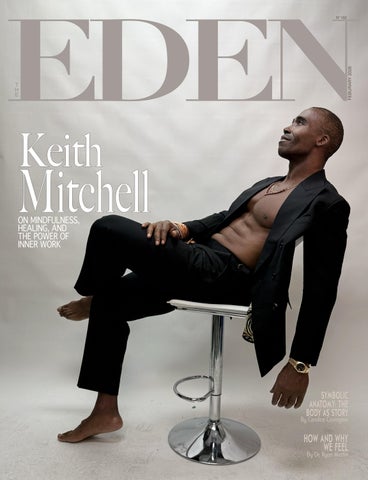
Keith Mitchell
ON MINDFULNESS, HEALING, AND THE POWER OF INNER WORK

SYMBOLIC ANATOMY: THE BODY AS STORY
By Candice Covington
HOW AND WHY WE FEEL
By Dr. Ryan Martin


MEET OUR TEAM

EDEN
Since 2010
The Eden Magazine is a free online publication is your guide to healthy living, spiritual awareness, compassion and love for all living beings, holistic lifestyle, mindfulness, organic living, positive thinking, sustainability, and personal development
Founder & Editor-in-Chief
Maryam Morrison
Executive Editor/Contributing Writer
Dina Morrone
EastCoast Liason & Partnership Director
Paulette Dozier
Contributing Writers
Sadhguru, Isha Foundation
Dr. Rob Moir
Emilie Macas
Nikki Pattillo
Polly Wirum
Joe Santos, Jr.
Guest Writer
Philip Smith
Contributing Stylists + Makeup Artist
Edward Hakopian
Lisa Joy Walton
Graphics & Photography
JSquared Photography @j2pix (Los Angeles)
Artin Mardirosian (Nexision) (Los Angeles) Benjamin D. Buren – AliveStudios.Com (Denver, SanFrancisco, Boston)
Sheri Determan (Los Angeles)
Greg Doherty (Los Vegas)
Ben Rollins (Atlanta)
Web developer
Brad wallace https://bradwallacedesign.com/
325 N. Maple Dr. Po Box 5132 Beverly Hills, CA 90209


66 70 76 82 88 90
56
AN INTERVIEW WITH Maestro Constantine Orbelian
66 WHEN FAITH HOLDS THE FUTURE by Wendy L. Jackson
70
FUELING FAMILIES RECIPES & STRATEGIES FOR HEALTHY MEAL PLANNING by Michele Pettinger
76
TELEPATHIC TALES PRECOGNITION & CLAIRVOYANCE IN LEGEND, LYRIC, & LORE by Daniel Bourke Forward by George Shushan, Ph.D.
82

GUARDING THE SACRED AN INTERVIEW WITH Bill McKibben on climate Action & Moral Responsibility
88
GRIEF AS A CALL TO THE SOUL by Nancy MacMillan
90
AN INTERVIEW WITH THE FRUITGUYS CEO Erin Mittelstead


The Body as Story
Symbolic Anatomy:
By Candice Covington

The body is called the Field, because a man sows seeds of action in it, and reaps their fruits. Wise men say that the Knower of the Field is he who watches what takes place within this body. ~Bhagavad Gita.
OOur skin tells the story of our lives. Born smooth and unmarked, it soon becomes a living diary etched with time. Childhood tumbles leave their trace, as do motherhood, illness, trauma, and joy. Fine lines form with smiles and sorrow. Stretch marks, scars, tattoos, and wrinkles all speak to the lives we've led, the bodies we've lived in, and the experiences we've weathered. Skin is memory made visible.
Culturally, skin is loaded with meaning. We speak of developing "a thick skin" to protect ourselves from criticism, or how something "gets under our skin" when it affects us deeply. To "have skin in the game" is to risk something personal. Skin is a symbol of vulnerability and strength, boundary, and belonging. It is our frontline with the world—an energetic and physical barrier that communicates who we are.
Beneath the metaphor, the skin is also our larg-
est organ. It weighs about 8 pounds and spans roughly 21 square feet. It hosts immune cells, processes sensation, regulates temperature, and allows for the absorption of nutrients and oils. It is made of three layers: the epidermis, dermis, and hypodermis. And though we often think of it as merely surface, it is an active participant in our physical and emotional health.
Skin is also marked ritually. In many cultures, tattooing is more than body art; it is spiritual, ancestral, and transformative. From the Māori to modern expressions of identity, skin becomes a canvas for story and symbol. It is where we declare our affiliations, our grief, our love, our rebellion.
In the symbolic view, skin becomes more than flesh. It is the medium through which we interact with the world and express our inner selves. It is a site of transformation—where wounds heal, marks are made, and healing can occur.

Candice Covington is a certified aromatherapist, massage therapist, healing arts master, and energy worker. A former aromatherapist for the Chopra Center, she is the founder of Divine Archetypes, an essential oil and flower essence company, and the author of Essential Oils in Spiritual Practice. She lives in Oregon City, Oregon. https://divinearchetypes.org/
For more, please visit: https://www.innertraditions.com/ floral-absolutes

Plant Wisdom and the Language of Skin
Essential oils, absolutes, and fixed oils offer more than physical benefit; they carry an energetic intelligence that interacts with our emotional and spiritual anatomy. When applied to the skin, they permeate the body's outer boundary and move inward, affecting mood, memory, and the subtle body.
Because their molecules are so small and lipophilic, essential oils and absolutes pass easily through the stratum corneum, the outermost layer of the epidermis. From there, they move into the bloodstream, traveling to various organs and energetic centers. In this way, the skin becomes a portal for healing on every level.
Different oils work on different layers of the self. Fixed onion oil soothes shingles. Fixed tomato seed oil calms irritated skin and acne. Fixed quinoa seed oil encourages collagen production and renewal. White birch essential oil acts as a counterirritant, disrupting pain signals. Petitgrain essential oil helps balance excessive perspiration. Neroli essential oil softens stretch marks and supports emotional balance.
But oils also work symbolically. Spinach absolute or lime essential oil, blended with fixed guava oil and applied to the breastbone, can nurture the heart chakra. Vetiver essential oil applied to the soles of the feet grounds scattered energy. White lily absolute evokes the archetype of Hera, fixed olive oil that of Athena, and pink damask rose absolute channels the essence of Venus. Myrrh absolute offers solace during grief, juhi absolute supports meditation and connection to origin, and fixed cherry oil cultivates unbridled joy.
These are not just chemical interactions—they are subtle con-
versations between plant and person.
Blends to Support the Skin and the Self
Not Under My Skin Blend
1 part fixed raspberry seed oil
1 part fixed cucumber seed oil
This blend creates a subtle barrier, protecting you from absorbing external emotional turbulence. Fixed raspberry seed oil helps maintain strong energetic boundaries for the empath, while fixed cucumber seed oil refreshes the spirit, especially when you feel overwhelmed, exhausted, or energetically raw. Together, they offer a sense of safety, restoration, and clear emotional space.
More Than Skin-Deep Blend
1 tablespoon fixed sweet almond oil
1 tablespoon fixed papaya seed oil
6 drops narcissus absolute
This trio supports graceful aging and the reclamation of inner beauty. Fixed sweet almond oil helps release fear around aging. Fixed papaya seed oil transforms sexual energy into poise and inner radiance. Narcissus absolute aids in letting go of attachment to surface identity, encouraging a deeper connection with soul and essence. This blend honors beauty as something lived, not worn.
The Skin as Threshold
The skin is not just a boundary; it is a living record of your life and a channel through which nature speaks. When you engage with plant distillations through the skin, you invite a layered dialogue—between body and plant, past and present, self and story. In this way, the skin becomes a place not only of protection, but of remembrance and renewal.


HOW AND WHY We Feel
By Dr Ryan Martin
TThis crowd wants me to succeed

In 2018, I did a TEDx talk in Fond du Lac, Wisconsin. I knew it would be one of the most important moments of my career, and I was terrified. I had spent months preparing, finalized my script a month in advance, and practised about five times a day. On the day, I tried to stay calm and probably looked calm on the outside, but inside, I was a wreck.
There were five talks before mine, so I spent the morning watching the other speakers while my thoughts spiralled. “What if I blow it? Go blank? Pass out? Trip? Throw up on stage?” I wasn’t nervous about public speaking itself — I’d done that countless times — but because I knew if this went well, it could be career-changing. I wanted
it to be perfect and put extraordinary pressure on myself to make it so.
When I was on deck, I stood silently backstage watching the red clock tick toward 18 minutes, the maximum length. The next speaker tried to lighten the mood. “Don’t shit your pants out there,” she joked — already on my mental list of things that could go wrong.
I took the stage and started to an eerily silent audience. I walked to the red circle, planted myself, breathed, and began. At 30 seconds in, I made a small joke — barely a joke —, and to my surprise, they laughed. Some even laughed hard. In that moment, all my nervousness faded. “This crowd wants me to succeed,” I thought, and instantly relaxed.
Emotions, Thoughts and Behavioural Impulses
Emotion
Fear
Anger
Sadness
Joy
Curiosity
Disgust
Jealousy
Pride
Thought/Appraisal Behavioural Impulse
“That’s dangerous.”
“That’s not fair.”
Avoidance / flight
Lashing out
“I’ve lost something important.” Withdrawal / crying
“This is pleasant.”
Smiling / laughing
“This unknown may matter.” Exploration
“That’s gross.”
Avoidance / cleaning
“I want what they have.” Possessiveness
“I’ve done something impressive.” Standing taller / boasting

“
Each choice nudges your emotional experience. The point isn’t to eliminate feelings but to recognize how your decisions shape them.
What is an emotion?
I’m sharing this story because it captures how emotions work. It’s rare for something to simply happen and cause a feeling. Emotions result from situations, physiology, thoughts, and choices coming together — and we control some of those more than we realize. A healthy emotional life means recognizing what parts of that pattern we can control and using that control.
So, what is an emotion? Psychologists don’t fully agree. Some behaviourists argue emotions aren’t worth studying because they aren’t observable; others think they’re just labels for collections of feeling states. My definition is that emotions are psychological states that include (1) physiological arousal, (2) predictable thoughts, and (3) expected behaviours — what we call action tendencies.
When we encounter a stimulus — say, a spider — our heart rate increases (arousal), we think “It’s going to bite me” (thought), and we flee (behaviour). Or when some-
one we like says they like us too: heart skips (arousal), “Oh thank God” (thought), we move closer (behaviour).
Sometimes we notice one or two elements but not all. With phobias, people often say, “I just get scared and want to run.” That’s because our brain can skip conscious thought: the startle response originates in the brainstem, triggering muscle movement before the thinking parts engage. Still, some quick appraisal — “We’re going to crash!” or “This is dangerous!” — usually occurs.
Our sympathetic nervous system then activates: heart racing, fast breathing, sweating, and dry mouth. This fight-or-flight response evolved to prepare us for threat or loss. The third element, our behavioural impulse, is what we want to do: run when afraid, lash out when angry. We don’t always act on it, but it motivates us toward a need. Curiosity says, “There’s something you don’t know,” so you explore. Shame says, “You’ve done wrong,” so you look away to signal remorse.


Dr Ryan Martin is the author of Emotion Hacks: 50 Ways to Feel Better Fast, published on January 6th 2026 and the Dean of the College of Arts, Humanities and Social Sciences and a Professor of Psychology at the University of Wisconsin-Green Bay. He is the author of the international bestsellers, Why We Get Mad and How to Deal with Angry People. In his work on emotion, he draws on over 20 years of research, teaching and clinical experience. His TED Talk, “Why We Get Mad,” has been viewed 3.5 million times. Find out more about Ryan at: www.alltheragescience.com
Why We Feel
When we emote, three things — the stimulus, our mood, and our interpretation — combine to produce a feeling that leads to expression. We’ll call this the Why We Feel Model:
1. Stimulus: the spark that prompts the emotion.
2. Mood at the time: tired, stressed, hungry, anxious? These shape your reaction.
3. Interpretation: what the event means — is it good, bad, fair, dangerous?
4. Emotional feeling: the state itself (e.g., joy, fear, anger).
5. Expression: how it shows — crying, laughing, smiling, swearing, etc.
Example: you’re late for work, already anxious, and the car ahead stops at a yellow light. Stimulus: the car. Interpretation: “They shouldn’t have stopped.” Mood: stressed. The combination sparks anger. The amygdala fires, sending signals for the fight-or-flight response: heart rate spikes, muscles tense, breath quickens, face scowls. Then your prefrontal cortex steps in: you might honk, swear, or decide it’s not worth it.
Hack Your Emotions
In 2003, Stanford psychologist Dr James J. Gross wrote an influential article describing how we can regulate our emotions — or “hack” them. He defined emotion regulation as influencing which emotions we have, when we have them, and how we experience and express them. He distinguished between strategies used before and after an emotional response.
Before-the-feeling strategies:
1. Situation selection – choosing whether to enter a situation.
2. Situation modification – adjusting circumstances to alter impact.
3. Attentional deployment – deciding what to focus on.
4. Cognitive change (reappraisal) – rethinking what the situation means.
After-the-feeling strategy:
5. Response modulation – controlling your reaction once it arrives.
Returning to my TED talk, I used several without realizing it. Applying for the talk (situation selection), practising (situation modification), and ignoring backstage jokes (attentional deployment). When anxiety rose, I breathed and grounded myself (response modulation). When I realized the crowd wanted me to succeed, that was a cognitive reappraisal.
Different choices would have changed everything: skipping the talk, practising less, fixating on what might go wrong. Even so, each decision I made before, during, and after the talk shaped my emotional state. That link — between choice and feeling — is the core of emotion hacking. By being aware of how situations, attention, interpretation, and reaction interconnect, we can intentionally influence how we feel.
Putting It Into Practice
Imagine a co-worker invites you to a party. You don’t know many guests, and you’re socially anxious. All five strategies apply:
• Decide if you even want to go (selection).
• Bring a friend or ask for introductions (modification).
• Focus on music or decor instead of people (attentional deployment).
• Reinterpret a laughing group as friendly, not mocking (cognitive change).
• When anxiety rises, breathe, ground yourself, step away (response modulation).
Each choice nudges your emotional experience. The point isn’t to eliminate feelings but to recognize how your decisions shape them. That awareness and intentionality are how you hack your emotions — the very reason I wrote this book.


A Conversation with
K KEITH MITCHELL
Former All-Pro NFL linebacker for the New Orleans Saints, Houston Texans, and Jacksonville Jaguars. Today, a renowned mindfulness teacher, wellness coach, motivational speaker, and humanitarian.


FFor some, the journey to awakening begins with a gentle shift and an unexpected bend in the road that quietly redirects the soul. For others, it arrives as a sudden dead end, demanding the courage to forge an entirely new path where none existed before.
For Keith Michell, it was the latter.
At the height of his NFL (National Football League) career, Keith Mitchell was living the American dream. An elite linebacker for the New Orleans Saints, Houston Texans, and Jacksonville Jaguars, he played before more than 80,000 roaring fans, embodying strength, discipline, and triumph at the highest level of professional football. Fame, success, and legacy were well within his grasp until one play changed everything.
A devastating spinal injury on the field brought his career to an abrupt halt. In an instant, Keith found himself
flat on his back, staring into the blinding stadium lights, unable to move. The roar of the crowd faded, replaced by silence, and a profound reckoning.
What followed was not an ending but a rebirth for Ketih.
Through adversity, stillness, and deep inner inquiry, Keith Mitchell transformed pain into purpose. Today, he is a powerful voice in mindfulness, healing, and conscious living. His journey beyond the helmet and into the heart is beautifully captured in his new coffee table book, The Mindfulness Mission, a visual and spiritual invitation to reconnect with presence, purpose, and inner strength.
In this intimate and inspiring conversation, Keith shares how a life-altering moment became the gateway to awakening, and how true power is not found in force, but in awareness, compassion, and the courage to begin again.

Your new coffee table book, The Mindfulness Mission, is visually stunning. What inspired you to create it, and what message do you hope readers take away from it?
So much is telling us, from an esoteric perspective, what to do, but not from the current state. Meaning it’s 2026, and I feel we need to consider an evolution in our thoughts and thinking. By doing so, we question whether we are holding beliefs for tradition's sake or because they work for us. Meaning we are seeing progress, whether it is being kind, forgiving, or showing up with confidence to execute our talents. I don't usually see this from believers. I see fear, insecurities, dysfunction, and unhealthy individuals who are obsessed with the belief but missing the upgraded potential for living.
After a career-ending injury in the NFL, your journey into mindfulness and yoga began. How did that transition shape who you are today?
It sparked my curiosity about living and about how I need to care for myself. The first place it started was with nutrition. I want you to follow this idea with me. If you can see the scarring on your leg from when you were 10 years old, imagine what the impact of the harm we have done to ourselves on the inside. Kind of scary, right? Well, because I found this out around the time of my injury, I prioritized the healing internally. The misconception that the detox is physical is a huge myth that is inaccurate. We are giving an identity to what we call Bad Bacteria. Meaning these attitudes and emotions live inside us, and we feed them what they need to exist. The anger and rage at this state of our lives we are harvesting are disrupting our ability to maintain a harmonious state in our bodies and in our endeavors.
Many athletes struggle to find a sense of purpose after retirement. What advice would you give to others going through that same identity shift?
Sports are not a purpose; you must find one. This can be missing from a sports career, from academia, and from any other career, so this isn’t necessarily just about sports. Buddha asked what the meaning
of life was, then concluded that life has no meaning. I agree with that. Life has no purpose. We give meaning to life. People get sick, people die, we have trauma, we have problems. We are not here just to make money, accumulate things, or outdo one another. We are here to manifest loving situations, co-create with the planet, and solve the problems, traumas, and difficulties that inevitably arise. And we get distracted from that, because the pressure is to be a character, to be a consumer. So, when we think about purpose and how it fits into the course of one’s life, the only purpose is found in servitude, helping humanity, and solving problems. We connect to purpose by realizing our experience and overcoming what has happened to us. Because someone else will come after me and experience a similar situation, and I will then have the opportunity to use my knowledge and experience to help them. At the same time, by doing this, I help myself. And this gives me purpose.
Well, naturally, the human in an unnatural environment will adapt and create another, even if it's dysfunctional; the human has a renowned ability to do so. However, the ability to remember what is and the meaning of existence is where the core principles of what I feel religion, or what I think religion was meant to be. The reason why I say this is that when I found my practice, I realized that service to humanity is all that makes sense.
I had to break my life down to its most unapologetic perspective, and be willing to share both my highs and my lows to find my truth. And it starts with our words. I suggest you make them a tool, not a liability.


The wear and tear, physically, mentally, and emotionally, on professional athletes is being overlooked in today's fast-paced, big-dollar sports business. How do you envision mindfulness becoming a more integrated part of professional sports and youth athletics in the next decade?
I don’t think players realize how much vitality is lost while playing. Maybe it’s changed a bit, but many guys aren't really taking care of themselves before or after the intense competition and depletion. I used to spend around $300,000.00 dollars on trainers, suppliers, nutrition, and therapists to heal my body in the offseason. I had someone literally stretch me for 90 minutes per day. On top of that, the lifestyle you lead is unreal, and I’m not sure how you could possibly prepare for it.
I believe the new athlete comes with a mindfulness coach. It will be imperative to keep your mind together. Because you grow up in an unrealistic world, to most of the population, and how do you learn to relax in it to stay the course! Women, social distractions, money, family, how can you process? Just wait, every team will have a mindfulness coach.
Your book blends art, mindfulness, and personal reflection. How did you choose the images and stories that best capture your transformation?
We’ve been given philosophy that served a purpose during that day; to some extent, it still serves. However, I’m suggesting an updated approach to know what to do. Thought, process, and action to navigate to maximize the human potential. How did I get to these images? I had to break my life down to its most unapologetic perspective, and be willing to share both my highs and my lows to find my truth. And it starts with our words. I suggest you make them a tool,
not a liability. If 70 percent of our thoughts are repetitive, then let’s be mindful of the words we use with complete conviction about how we know these words. By doing so, words equate to conversation, which is also your integration. So, for example, I define the term love to understand how it truly applies to me, so when I use it or suggest an idea about it, it's not some drawn-out, vague concept; it’s specific to what I mean. Why is this important? When I decide to share love with someone else, I don’t assume their definition is my definition. I’m clear from the standpoint of what do you mean by love?
I captured the stories that were so pivotal in my journey, whether I succeeded or failed. In those moments, what I had to do was pull myself out of the holes that I had put myself in. With an understanding that no one can help me but me. Not even the one I call God put me in those predicaments. I did, and it will be the God in me that will need to be my deliverance.

As someone who experienced both extreme physical performance and deep inner healing, how do you define "strength" today?
Strength looks good physically, I can’t lie. I love to strive to look my personal best; however, we in this human body are frail and weak in comparison. So, the strength you want to retain is inner strength. The resilience for that can’t be scaled. My formula. The mind is God, for what you believe will be your truth; the body is the son of God, and the heart is the Holy Spirit, for it is the will that cannot be measured. The inner strength is how we move mountains one brick at a time for a lifetime if we must. That’s where our true power lies, in our resilience.
You've often spoken about the importance of breath and stillness. How do those practices help you stay grounded in today's fast-paced world? Breath is spirituality. Breath is an orgasmic life force energy that enhances and maintains our vitality. Meditation is everything, to drop in to listen to the things that matter, to reflect to realize my strengths and my so-called weaknesses, to realize what is and determine where I want to be. Breathe is a curiosity about life, with a desire to experience it all. It’s the longing to be loved and share it. It’s my reason why. The world is moving at such a fast pace because people still think that you must do something out there to find mindfulness, the realization that everything that you want is already here!


How has yoga changed the way you relate to your body? Not as an athlete, but as a human being?
Yoga teaches you how to acknowledge what feels good. It also helps you feel comfortable being okay with feeling good. It’s a physical dialogue with you and your body. Like a formal conversation with your hips, your back, your pains, and your grief. To sit with yourself and work it out, unwind your own complexity. I didn’t realize when I first started that the relationship started with the one I had with myself. Much of my life, I thought relationships started with another person. Yoga revealed the relationship that I had with myself, which was nonexistent, with dysfunctional patterns that insinuated that I didn’t even care about myself. How do I know this? I didn’t get the sleep I needed. I didn’t nurture myself properly; I let people into my space who didn’t deserve my time. I constantly put myself last. And my body resented me for doing so, and it checked out!
Your message bridges wellness, spirituality, and social awareness. How do you see yoga and mindfulness influencing collective healing, especially in marginalized communities? Because they all go together! You can’t compartmentalize life. You either have all of it, or you get none! Mindfulness is active prayer; an unconditional gratitude lived over the verbiage. It’s the way that we live, not a presentation. If we as humanity, as a collective, are to get ourselves out of the holes we put ourselves in, we must consider this. I think the youth have had it for what we have said about our faith and how we live, but the math does not match. At some point, what you believe must pay a dividend to how you show up in the world. Are you kind, are you lovable? Whom do you suggest you worship, resulting in a benefit, and the youth don’t see this?
Was there a particular moment or realization that inspired you to share your story in this book format rather than through a traditional memoir?
I had been nudged to do it several years before, but I thought that this was out of my field. How would I even start? I met an amazing woman who initiat ed my journey with this book. She and her husband were very good people, and she was going to publish my book. She set me up with someone to help me flesh out my thoughts, and we began to put the pen to paper, or in this case, type.
You have spent a lot of time at some incredible destinations during your transformative retreats, including Honduras, Bali, and Egypt. Where have you chosen as your next destina tion for a retreat, and why?
Tulum for the next retreat. I fell in love with the Quintana Roo, Tulum, Mex ico, and the place is just enough of a destination to get people out of their comfort zone. I’ve learned in the years of doing this work that people want to travel but don’t know how. The fear of the unknown keeps many from venturing out too much. So, we build a collarbone, the experience, so that you feel you're not alone and you feel safe to journey with us. I’ve done at least 50 or so retreats, and they have all been so different and life-changing for so many. My next destination is Brazil. A retreat space and a hotel-healing center in the Northeast of Brazil, in Ceará, will be my home. We have been acquiring land to do so. This will be a legacy project, a project that will live beyond my time on earth. I feel this is my purpose.

What do you hope each retreat will offer those who choose to attend?
The retreat is a lifeline, just as retreats changed my life. To connect with people that you may not typically meet. To connect so deeply through lived experiences is required when you do the work. To peel layers and layers to be seen, heard, and felt by your peers in ways many will never get to experience. The retreat space is an immersion of allowance to go into those dark places and redecorate a bit. To renew, grow, and heal aspects of ourselves that we never knew possible.


What has been the most rewarding aspect of the retreats for you?
To walk with so many on their journey and to see them arrive on the other side. To see the faces of people living an experience that they will never forget. To see many overcome and celebrate the testimony of how they have overcome.
I would like to ask you about your holistic approach to health. Are you finding that more people are becoming aware of and open to alternative approaches to health? And what do you say to those who aren't as open to alternative approaches, to convince them that there is another way to approach health, healing, and medicine?
The Holistic approach is to realize the whole life, meaning that lifestyle choices are the goal. To take it on because you desire to love yourself. Loving yourself gives a tremendous capacity to genuinely share your gifts with the world. It adds depth to realize that micro and macro cosmos exist. There’s an African proverb that suggests I am because we are, therefore, I am. The human potential to serve oneself gives freedom to serve the world, whether directly or indirectly. Huge responsibility, but it feels right. This is why I get so excited about this life opportunity!
What's next for you? Are there new projects, collaborations, or retreats that continue this mission of conscious living and empowerment?
New age medicines. Peptides, stem cells, it’s the medicine of our future that can help us right now. I’ve learned so much in my immediate learning. However, this is by far the most profound discovery. At the retreat center in Brazil, I’m starting my podcast, The Keith Mitchell and Jenelle Gordon Experience. We talk about sex, politics, health, travel, and all the current-day topics.
Special thanks to:
Keith Mitchell
Editing by Dina Morrone
Photography by Jonnashnagi


Welcome
to
Our Contributor Writers’ Neighborhood


by Sadhguru, Isha Foundation


The Other Side of the
Mirror
SSadhguru: Time as an experience is relevant to all of us because we are mortal. Everything that you think you are, in terms of body, mind, and emotions, is a product of memory. Every level of memory – evolutionary, genetic, conscious, subconscious, unconscious – is calibrated in terms of time. In some sense, the solar system has its own memory, which in turn reflects in every life, every animate and inanimate form in this system –everything is shaped by the system as a whole.
If you are totally absorbed in your physiological or psychological processes, you are a product of time. Being a product of time means being repetitive – your original nature will never find expression. This is why, since the time of Adiyogi, we have been talking about consciousness: consciousness means the transcendence of the cycles of time. You may be aware of the world outside, but you are not conscious that you as a life are here. You experience the world and its people, but you have no experience of the self.
Your mind and your body are a product of the world and its people. Your original nature is not in your experience because it is on the other side of the mind. In a way, your mind is like a mirror. It may be a distorted one, but still a mirror. You see the world because it is reflected in your mind. But the mind never reflects the self. I am not talking about your physical or psychological self. You can contemplate your thoughts and emotions, but you cannot contemplate the self. Your existence cannot be contemplated – it can only be experienced. The mind is reflecting the
world around you, but there is no experience of you as a life. But the most important thing in this existence right now for you is that you are here.
When there is no experience of the self, when you have not touched life on a deeper level, there is no question of experiencing the source of the self. Most human beings experience only the kaleidoscope in the mirror of the mind. They keep digging into their memory either to make themselves happy or to make themselves unhappy. Whether it is joy or misery, the source is what is happening in one's mind.
What is happening in the mirror of the mind keeps you engaged for a lifetime and more – the same thoughts, the same emotions go on endlessly. It is important to understand that you have an expiry date. Another moment, another day, another year should not pass without you knowing what life is. You will know life not with food, drink, love, or pleasure. The only way to know life is if you get to the other side of the mirror. On this side of the mirror, you can only see drama –you cannot see life in its essence.
There are many ways to approach this. One simple thing is meditation. We have created the Miracle of Mind app for this. When you say, "I am not the body. I am not the mind," it means "I am not a product of memory. I am not an accumulation. I must be something more than that." Your aliveness comes from the fundamental source that is on the other side of your mental mirror.

I want you to make a sustained effort. Wherever you are right now, close your eyes and check – are you here? Thoughts and emotions are there, the body is there, but are you really here? To experience that, you can employ a few simple methods. The reason why, for ages, anyone who wants to be spiritual foregoes food for periods of time is not to torment oneself. When you are really hungry and simply sit, you will see a clear distinction between you and your body. Then, when you eat the first morsel of food, there is a feeling of pleasantness spreading through the body. Or when you are really thirsty, and you drink a glass of water, the entire being feels pleasant.
Just stay with that pleasantness. It is not about the stomach being full or the thirst being gone. It is about the pleasantness of experience that is caused from within. The mind chooses the experience, but it
cannot cause the experience. Something within, what you call the self or the life within you, causes the experience.
There are two aspects in this context –sensation and experience. Sensual pleasantness is not the real thing because the senses do not create the experience. Let us say you drink a glass of water. The thirst is being quenched, coolness is spreading in your body, but it is not about that. Enjoy the sensation, but the important thing is the pleasantness that occurs on a deeper level.
Choose something that causes pleasantness within you – whether it is the breeze, the breath, water, food, or anything for that matter. Try to stay with this pleasant experience, if only for a few seconds to begin with, without thoughts or emotions. Slowly, you will shift to the other side of the mirror.
When time is rolling, you are a complete product of memory and time. During sandhyas or transition periods, there is a certain break, a certain space, a little room to go beyond that. The sandhya kalas, four times a day, are such opportunities. In your own system, the most important transition periods are when you fall asleep and when you wake up. In this transition, there is a little gap. We want to make use of this gap.
As you come awake, a certain pleasantness spreads through the body. If you remain with this pleasantness at that moment, the entire day, your mind will dip into pleasantness. If your mind does pleasant things to you, you will do pleasant things to the world around you. Similarly, when you are about to fall asleep, pleasantness spreads through the body. It takes a little effort, but if you notice this pleasantness, your sleep will be of a completely different quality, dreamless, because you will be on the other side of the mirror.
Most people only know sensual pleasantness. They are not conscious of the pleasantness of something much deeper happening within themselves. The fundamental idea behind closed-eye processes, any kind of meditation, is to reduce the input to the mirror. If there is no input for long periods of time, the mind will not reflect anything. Then it will be easier to get to the other side.
What you experience now is just a reflection of the mind. Reality is on the other side. The other side is not a product of time and space. Everything is here and now. The entire cosmos is right here. It is a simple process, but because you are so busy with your own psychological drama, you completely missed it. Because it is missed, life is punishing people with repetitive cycles.
Once you are here, the most important thing is to have a powerful experience of life. Right now, you know everything except life because you are only
looking at the mirror of the mind as it reflects the world, not at the basis of all experience within you. With every inhalation, every exhalation, with every step you take, when you sit down or stand up, when you eat or drink – with everything, there is an opportunity to watch a certain pleasantness spread in the system. Not on the sensory level –a much deeper experience.
Most people are unconscious of this experience because their psychological drama – their emotions and thoughts – override it completely. The powerful processes we teach are essentially devices to get to the other side of the mental mirror and have a taste of life – life that is not a product of memory, not a product of time, not an accumulation – life that is the basis of life. There is no difference between life and the source of life. Life is the source of life. There is no place in the universe where creation and the Creator exist separately. A separation between life and God only happens in the human mind.
Every misery that you go through is your own making. The life within knows no such thing as unpleasantness. Unpleasantness can be of the sensory body, or, most often, it is of the mind. Once you fall on the other side of the mirror, whatever happens is just surface waves. Once you know this experientially, you will become a devotee of life. That is what is needed in the world today. Instead of becoming devotees of God who are willing to take the lives of others, people should become devoted to life, which, anyway, embodies the source of creation.
If you pay attention, somewhere behind this huge, colorful statement that the mind is making, life is constantly making its own statement. You need to get in touch with that. To know this aliveness is the most important dimension. If you experientially know that you are here right now, if you capture one moment, you capture eternity. If you capture one moment, you capture the entire cosmos.

Infrastructures to Raise Human Consciousness
Experience Yoga in its classical form at Isha Yoga Center Los Angeles and Isha Institute of Inner-sciences. Established by Sadhguru, the centers serve as powerful spaces for inner transformation and raising human consciousness. Located in northern Los Angeles County and Tennessee, the centers offer an array of yoga and meditation programs in a vibrant and conducive ambience.
You are invited to Free Yoga Day, a monthly open-door event a t the center. On this day, we offer a variety of free sessions dedicated to educating and empowering individuals to take charge of their well-being through simple but powerful practices sourced from the Yogic tradition.
Learn more at ishausa.org/la


A Guide to High-Vibrational Living by Polly
Wirum
A MONTHLY GUIDE TO THE ENERGETIC FREQUENCIES OF 2026

AAre you curious about what 2026 holds in store for you? Ultimately, our beliefs and intentions shape much of what we will experience, but I also like the added magic of the universal energy we co-create.
Some people use astrology to look at themes and predictions for the upcoming years. I have my own methods that involve meditation and tarot cards. I write my notes in a calendar and a blog to reference them each month. The predictions of the future are written far enough in advance to offer an interesting perspective on what is going on in our collective and personal worlds. Keep reading and discover what each month is offering our collective and how it might influence your personal world.
THEME OF THE YEAR
This year, there is a prevalence of energy that has us seeking a sense of safety and grounding, so we don’t lose our footing. There is an emphasis on finances and health. This isn’t a surprise, as our 2025 year ended with health care and the economy being at the forefront of the news. I see these tangled up and unresolved, almost until the fall of 2026. It might take that long for people to begin to feel confident in our health care system. It is also a call to be intentional about your financial and wellness decisions. There is energy to make changes in both of these. Your positive thoughts and intentions can have a great impact in these areas.
We are also building new foundations, refurbishing crumbling ones, and discovering new ways to move through old barriers and foundations. If we look at the foundations of government structures, in the US, it is still a free-for-all in each party taking advantage of a system that is feeling the weight of continuous
conflict. I do see the political parties coming to a truce on a pile of rubble. Hopefully, partnerships and alliances will be formed that are for the greater good.
We do have the collective energy to see progress in partnerships, both personally and collectively. We are supported when we work together and when we move through difficulties. I love that each of us can tap into confidence and contentment this year.
There is a lot of energy around communication, and logic is emphasized more than emotional communication. I encourage you to be very intentional with your communication and practice your big conversations before they take place. This can shift the energy into what you are seeking. Avoid stressful situations by double-checking emails and other forms of communication.
We are also encouraged to honor our instinctive self, the part of us that has been with us since childhood. It is a great time to trust your first instinct. We also have the ability to allow our curiosity and inspiration to expand. This is great for manifestation and living your highest potential.
One skill to master this year is learning to trust your instincts and communicate from the awareness of your truest self. This requires us to be truthful with what we need and how we feel. It doesn't mean we are necessarily blurting it out or sharing it with the world, but it does mean allowing our instincts to guide our choices and being selective about who we share our intentions with.
Mantra: The Universe supports me as I move through life, including any challenges that arise.
JANUARY
There is emphasis on our past choices and reflection on our life experiences. We also have support in keeping our commitments and meeting our goals this month. It is a great time to pause and look at the trajectory of your life. Are you making choices that support the highest expression of yourself?
January’s skill of mastery will be gaining insight from our past, letting go of the frustration, and acknowledging the gains. Do you like the impact from your past and how it influences the direction of your life?
Mantra: I trust the process of my personal spiritual evolution
FEBRUARY
This month, there is a call to have faith and trust in the highest good. This may require trusting someone or something again. It might simply be asking you to trust yourself again. Legal documents and agreements are highlighted this month.
We have the energy of success and the call to seek peace and calm. I love that we can easily experience success and then take a breather and recover in the calm.
February will help us master the skill of connecting with the energy of peace and calm. We will have opportunities to find balance and calm in unexpected ways.
Mantra: I attract Peace and calm into my life
MARCH
This month holds some powerful energy that can help us break patterns that bring in new circumstances and awareness of different possibilities and opportunities. We will courageously face challenges and let go of things we have been holding onto.
I love the opportunity to explore and create new experiences that are uplifting and bring in all sorts of exciting energy.
March offers us opportunities to tap into courage as we make choices that break
long-established life patterns.
Mantra: I welcome new, loving, and adventurous opportunities into my life.
APRIL
This month offers hope in resolving complicated issues. I love this month for sharing and receiving both kindness and comfort. It is also perfect for trusting your intuitive skills.
There will be a call to compromise on a situation and a promise of new opportunities to explore.
April offers us lessons of compromise and settling into the feelings that arise with allowing things to settle before taking action.
Mantra: I welcome comfort and kindness into my life

MAY
This month has a really fun mix of bravery, joy, success, and blessings. All of this fun, fastpaced energy will put us in line with some challenges that call for observations and brainstorming. I think this month is fun, because even though we face challenges, we have the energy to overcome them.
On a side note, pay attention to words in all forms of communication.
May offers us the opportunity to be very intentional with our communication. We will gain clarity in the power of our words, written and otherwise.
Mantra: I communicate well and welcome joy and success into my world.
JUNE
This month, you are asked to trust your Intuition. Don’t be put off by delays; the outcome can still be favorable. We will also have some opportunities to discover what we want, because we are experiencing some of what we don't want. This is a powerful opportunity for change.
Get ready for some lucky days, a sense of stability, and comfort in established rules.
June offers us the ability to gain insight into what we resonate with. You will have plenty of choices to decide what matches you and what doesn't.
Mantra: I trust my intuition and have clarity on what resonates with me.
JULY
This month offers some really fun days with a couple of dips into the unknown. Most of us will experience some type of breakthrough, positive news, and good luck. We live in a very fast-paced environment that makes us feel we need to make quick choices. It's ok to take a deep breath and let things settle before you say yes.
This is a great month to appreciate your physical self (maybe this is where the breakthroughs are happening). Take time to nurture yourself and notice how things are tipping in your direction.
July is a wonderful opportunity to celebrate what brings you joy and gratitude. Notice all the things working for you.
Mantra: I love my physical body and am grateful for the good luck in my life.
AUGUST
This month, there is a focus on commitment, maybe even a fear of committing to a certain life path. There is a call to ensure you treat others well. You will experience feelings of victory (even in partnerships) and balance overall.
August is a great month to discover how to navigate life through fearful thoughts. How can you focus on what's lovely in your life and the direction you're taking? What is bringing up your fearful thoughts, and how can you begin to let that go?
Mantra: I love discovering what feels good to me and welcome it in my life.

Polly Wirum is a psychic, life coach, and writer. Years ago, she experienced a health crisis that led to a complete spiritual and life transformation.
When she thought her life was crumbling, the universe was easing her grip on everything, distracting her from the truth. The healing helped her discover the beauty of a joyful and uncomplicated life.It is here that she connects with wisdom and magic.
She shares this with her clients through life’s coaching psychic readings and spiritual retreats. visit Pollywirum.com
SEPTEMBER
This month offers opportunities to make clear choices. It feels like this isn't the first time we have had to make this choice. Maybe this time we will choose what is aligned with our highest self.
We will also need to balance the feeling of uncertainty as we muster up our trust and courage and let go, maybe choosing the unknown. We will experience deep passionate feelings, victory, and satisfaction this month (good feelings for sure).
It is another month to watch our communication in all forms. Sharing words of gratitude is always a blessing for the world.
September offers us the opportunity to feel satisfied and easily let go of needing to control outcomes.
Mantra: It is safe for me to let go and trust that I have beautiful choices in my world.
OCTOBER
This is another fast-paced month, but it also includes stretches of days that seem to move very slowly. We are encouraged to take thoughtful action and pursue the changes we want to see in our lives. Teamwork is highlighted, allow others into your circle, and have fun creating change together. It is possible to have great triumph when there is less control and more balance in relationships, work, and otherwise.
Education and skill development are supported, as are creative projects. Prioritize comfort, gratitude, and self-love in your life; these might be found in your home.
October offers us the opportunity to learn about ourselves and even love ourselves, as we navigate group efforts. There will be some wins for sure when we step back and trust others.
Mantra: I easily let go of what isn’t for my highest good and am grateful for all
the love and ease in my life.
NOVEMBER
This month is calling for us to focus on calm and peace. We have a great opportunity to gain clarity on what we want to experience in our lives. There will be an emphasis on the choices to be made regarding money and locations. This could be in our professional and personal lives.
We will see people and opportunities return to our lives, offering a second chance and forgiveness. Allow the promise of peace and calm to guide your decisions.
November offers us the opportunity to thrive when we make choices that require self-discipline.
Mantra: I attract peace and calm into my world.
DECEMBER
This month has a sharp edge to it. The way to avoid disappointment is to recognize that we might need to change to get the results we want. There is great potential for healing as we lessen our expectations of the world and ourselves.
Some might find inspiration is slow to find its way to you. Take a break and just focus on fun for a bit. This is when the world opens up, and it becomes easier to see our accomplishments and even find that we are harmonizing with the world and others. Taking a break from your day-to-day life will pay off huge:)
December offers us the opportunity to recognize that patience and waiting for things to settle before we take action can bring peace to our world.
Mantra: I am choosing peace and balance over madness and chaos
In closing, I wish us all peace, love, and adventures that open up our hearts to an amazing world of love and light.
The Way I See It
By Joey Santos
HOME IS WHERE THE HEART IS


Joey Santos is a Celebrity Chef, Life Stylist and Co-Host of The Two Guys From Hollywood Podcast on Spotify. A Columnist for The Eden Magazine since 2016. Joey was raised in NYC, Malibu, and West Hollywood. He is the son of Film and Television Actor Joe Santos, and his Grandfather is World-Renowned Latin Singer
Daniel Santos
To follow Joey on IG: @jojoboy13
To contact Joey visit whynotjoe@gmail.com
I moved into my townhouse in 2011, thinking I was simply changing addresses. What I didn’t realize was that I was stepping into a future—a living, breathing chapter that would quietly become the safest place I’ve ever known.
At first, it was just walls and rooms. Then it became something else entirely. A refuge. A gathering place. A sanctuary for living, loving, grieving, celebrating, and everything in between. Over the years, that space learned us—our laughter, our heartbreaks, our music, our silences.
I’ve always believed one simple thing: guests are invited only once. From then on, they’re always welcome. That philosophy shaped the soul of our home. Doors stayed open. Extra chairs appeared. Meals stretched longer than planned. Strangers arrived unsure and left somehow lighter.
Those walls witnessed countless dinners and parties— some spontaneous, some carefully planned, all fueled by connection. They hosted three weddings and two memorials, moments of both ecstatic joy and profound loss. They held salons filled with music, poetry, conversation, and laughter that spilled late into the night, the kind of laughter that only happens when people feel safe enough to be fully themselves.
Our home welcomed everyone. Movie and television stars sat alongside writers and directors. Starving artists shared wine with comedians. Porn actors broke bread with
clergy. Teachers, musicians, white-collar and blue-collar folks—hunks, chunks, supermodels, and beautifully interesting people who defied labels altogether. Ages ranged from eighteen to ninety. People arrived from all over the world, from every culture, religion, and political aisle.
What united them wasn’t status or belief—it was openness. Time and again, the same quiet miracle occurred: people who arrived as strangers left as friends, sometimes even as family.
That is what I will miss most.
I mourn the loss of the walls that protected us, that warmed us, that absorbed our stories and held our secrets. I appreciate the silence they now keep, the way they seem to pause, as if listening for one last echo of music or laughter.
And yet, I know this: a home is never just a place. It’s a practice. It’s an intention. It’s the courage to say, come in, sit down, stay awhile. What we created there doesn’t disappear because the address changes. It travels with us, carried in memory, in habit, in the way we continue to open our hearts.
If those walls could talk, I imagine they’d gently remind us of what matters most. Not the square footage. Not the decor. But the love that filled the rooms. The generosity of spirit. The simple truth we should always remember—
That, “Home is where the heart is!”


O Maestro Constantine Orbelian


Music has the power to transcend time, borders, and history, carrying within it the memory of those who came before us.
This February, The Eden Magazine is honored to feature Maestro Constantine Orbelian, an acclaimed conductor and pianist born in San Francisco to Russian and Armenian emigré parents, and deeply rooted in his Armenian heritage. Maestro Orbelian carries with him a profound sense of history, resilience, and cultural pride that subtly shapes both his artistry and leadership.
Maestro Constantine Orbelian first gained attention as an 11-year-old piano prodigy with the San Francisco Symphony before graduating from The Juilliard School and embarking on an international solo career.
As Executive Director of the New York City Opera, and Principal Conductor of the Kaunas City Symphony Orchestra in Lithuania. Previously, he led the Moscow Chamber Orchestra and the Yerevan State Opera and Ballet Theater. Maestro Orbelian stands at the helm of one of America's most storied cultural institutions, guiding it into a new era while honoring its rich legacy. His artistry is rooted not only in technical mastery but in a deep reverence for music as a living, breathing language, one that united generations, cultures, and emotions.
Over the past decades, Orbelian has appeared on
primary stages across the United States, the United Kingdom, Europe, and Russia, collaborating with leading singers such as Renée Fleming, Dmitri Hvorostovsky, Elīna Garanča, Anna Netrebko, Jonas Kaufmann, and many others, building a discography of more than 80 recordings on the Delos label.
The four-time GRAMMY-nominated conductor was recently named the new Music Director for Israel Sinfonietta Beer-Sheva, marking a vibrant new chapter for the orchestra, located in the heart of the Negev.
The Israel Sinfonietta Beer-Sheva has launched a bold 2025/26 music season under the maestro's leadership, reflecting Orbelian's hallmark blend of worldclass guest artists, beloved masterpieces, and fresh repertoire, designed to connect Israeli audiences with outstanding international performers and to spotlight Israeli talent in new productions.
In this interview, Maestro Orbelian reflects on his journey as a musician, the responsibility of leadership in the arts, and the influence of his heritage on creative expression. He speaks to the discipline, passion, and vision required to sustain opera's relevance in today's evolving world, as well as to the role of music in reminding us of our shared humanity.
This interview is an invitation to listen more closely to the music, to the stories behind ir, and to the enduring power of art to elevate the human spirit.


Maestro Orbelian, congratulations on your appointment as the new Music Director of the Israel Sinfonietta Beer-Sheva. What drew you to this orchestra at this moment in your artistic journey, and what vision do you hope to bring to its next chapter?
I have always had a strong relationship with Israel and Israeli musicians. I have been conducting in Israel for over 25 years—first with the Raanana Sinfonietta and the Israel Chamber Orchestra and now, of course, with the Israel Sinfonietta Beer-Sheva. I want to bring engaging repertoire and offer the public a new musical experience.
Your lifelong connection to Israel—artistically and personally—has been widely noted. How does this new role deepen that relationship, and what does it mean to you to return in such a significant leadership capacity?
If I was coming for one or two concerts a year previously, now I am coming for around 15 concerts each year. This changes the dynamic for the orchestra and for me. They will all get to know me as a musician and conductor, and through my repertoire choices. Hopefully, the public will appreciate this, too.
You began your career as an 11-year-old prodigy with the San Francisco Symphony and went on to collaborate with some of the greatest voices and soloists of our time. How have these early experiences and collaborations shaped the conductor and artistic leader you are today?
I was fortunate to have professors who shaped my musical upbringing. Of course, being given various opportunities, such as competitions I attended and usually won, gave me, as a young performer, the confidence to progress further. My parents were, of course, instrumental in finding the right teachers and took the time and energy to bring me to those lessons two to three times every week.
With your simultaneous leadership at New York City Opera and the Kaunas City Symphony Orchestra, how do you balance the demands of these major institutions while cultivating unique artistic identities for each ensemble?
Each of those entities is entirely different. NYC Opera mainly focuses on opera programs, with some symphonic offerings, while Kaunas is mostly symphonic and engages in many recordings with top opera stars. Kaunas is a well-known hub for my recording productions; we have almost 30 recordings with the greatest opera singers made there. We also have a great chorus—the Kaunas State Chorus, which is our in-house partner at the Kaunas Philharmonic, making it a very versatile and convenient venue for recording vocal works. Just this past summer, I recorded with American superstars Stephen Costello, Charles Castronovo, and soprano Corinne Winters, and most recently with Kristina Mkhitaryan, who was singing the role of Micaëla in the Metropolitan Opera's production of Carmen
You have recorded more than 80 acclaimed albums and built a historic legacy on the DELOS label. How does your extensive recording experience inform your approach to programming and audience engagement in today's evolving global classical landscape?
To be honest, I love working with singers. I have been blessed with major collaborations with the unsurpassed baritone Dmitri Hvorostovsky, sopranos Renée Fleming and Sondra Radvanovsky, the young star Nadine Sierra, the incredible Jonathan Tetelman, mezzo Elīna Garanča, Latvian soprano Kristine Opolais, and upcoming stars Liparit Avetisyan and Arsen Soghomonian—who most recently stepped in and saved the day at the Metropolitan Opera's Production of Tchaikovsky's The Queen of Spades. I love singers, and they seem to like working with me.
From Carnegie Hall to opera houses around the world, your career continues to bridge cultures and generations. As you step into this new chapter in Beer-Sheva, what role do you believe music, and the music director—can play in fostering cul-
tural dialogue and unity across borders?
I love connecting music and cultures and seeing how fate brought one composer to one place and another to a different one for their livelihoods and lives. We recently did a concert at Carnegie Hall focusing on the music of Mieczysław Weinberg and Erich Korngold, highlighting their cello concertos. It was a fantastic event performed by the fabulous cellist Kristina Reiko Cooper
Bringing them to Carnegie Hall was a great experience, not only for me but also for the audience.
As someone who began as a young prodigy and rose to become one of the world's most respected conductors, what message or advice would you offer to young people today who aspire to pursue music as their life's calling?
It's hard to give career advice at this time in history, but if you do your very best and keep your personality and musical message truly your own, you will inevitably find your audience. Once you do, and your message resonates with people, everything will align, and your career will soar.


LA Art Show 2026
Photography by Sheri Determan

LA Art Show, Los Angeles’s largest and longest-running art fair, returned to the Los Angeles Convention Center from January 7-11, 2026, celebrated its 31 years as a cornerstone of the city’s cultural landscape, The Eden Magazine was honored to cover the event as an official media partner, captured the psirit of a fair renowend for it’s globalrach and authentic connection to LA’s vibrant, multicutlural art scene.
Under the direction of producer and director Kassandra Voyagis, this year’s edition successfully brought together leading galleries, artists, and collectors from around the world, honoring artistic resilience and the city's rich cultural legacy. Highlights included the return of DIVERSEartLA, curated by Marisa Caichiolo, and an invitation-only Latin American Pavilion showcasing dynamic voices from across the American Continent.
With over 90 exhibitors, LA Art Show 2026 featured a strong mix of international and local galleries, including returning participants such as LICHT FELD Gallery (Switzerland), Rebecca Hossack Art Gallery (U.K, Arcadia Contemporary (New York), Fabril Projects (Los Angels), and Rehs Galleries, a New York- based Galleries, that has been part of the fair since its inception in 1994.


The show also welcomed notable first-time exhibitors, including Ireland’s Oliver Sears Gallery, new U.K galleries, and a continued robust presence from South Korean galleries, underscoring the fair’s expanding global reach. The fair also demonstrated its commitment to giving back, with the American Heart Association serving as the official charity beneficiary and reciving 15% of proceeds from every ticket sold in support of their Life is Why campaign.


Following its Los Angeles edition, the LA Art Show was followed by its East Coast Counterpart, Art Palm Beach, which returned for its fourth edition from January 28 to February 1, 2026, at the Palm Beach County Convention Center. To purchase your ticket, visit https://www.artpalmbeachshow.com/
Holds the Future When FAITH
By Wendy L. Jackson

IIn a world that rarely pauses, faith often becomes the quiet anchor that steadies us when life feels uncertain. Not faith defined by structure or labels, but a deeper, more personal faith, an inner trust that something meaningful is unfolding, even when the path ahead feels unclear. This kind of faith lives in the space between patience and possibility. It reminds us that although we may not have control over timing, we can still move forward with intention, resilience, and hope.
From an early age, I learned that faith doesn’t need to be loud to be powerful. Even the smallest belief, the kind that gently nudges us forward, can sustain us through difficult seasons. Faith shows up in subtle ways: choosing hope when circumstances feel heavy, continuing to believe when motivation fades, and trusting that today’s uncertainty may be shaping tomorrow’s clarity. Often, faith is less about certainty and more about courage.
There comes a moment in many of our lives when we feel paused—waiting for clarity, direction, or a long-anticipated breakthrough. These seasons of waiting can feel uncomfortable and discouraging, especially in a world that values instant results. Yet waiting often holds transformative potential. What feels like a delay may
actually be an invitation to grow, reflect, and realign with who we are becoming.
What feels like a pause may be a moment of preparation.
Looking back, many of us realize that timing played a crucial role in our readiness—not just for opportunities, but for responsibility, balance, and emotional maturity. Faith encourages us to trust the process, particularly when it unfolds slowly. Growth rarely happens in moments of ease; it happens when we are stretched beyond what feels familiar and invited to sit with uncertainty.
Faith does not require us to see the entire journey—it only asks that we take the next step with intention. Progress does not need to be dramatic to be meaningful. Even the smallest steps forward are signs of movement, reminders that we are still becoming.
Equally important, faith is not passive. It asks us to participate fully in our own lives. It calls us to nurture our goals, remain open to learning, and show up consistently for ourselves. Some days, moving forward looks like bold action and decisive choices. Other days, it looks like rest, reflection, or simply refusing to give up.

Wendy L. Jackson is an international, award-winning artist, motivational speaker, and writer whose work explores the intersection of creativity, healing, mindfulness, and spiritual growth. Through both her art and her words, she inspires others to live with intention, embrace purpose, and cultivate inner peace.
Faith is not about rushing the process, but learning to live fully within it.
Throughout history and across cultures, people have relied on faith to navigate seasons of loss, transition, and uncertainty. Lived experience reminds us that faith has carried individuals through moments that felt impossible—helping them emerge with greater wisdom, compassion, and resilience. Faith does not promise a life free from challenges, but it does offer a way to meet those challenges with steadiness and grace.
When we live with faith, our relationship with uncertainty begins to shift. Setbacks feel less like failures and more like redirections. Pauses become opportunities for reflection rather than signs of defeat. We learn to respond instead of react, to breathe through discomfort, and to remain grounded when outcomes remain unclear.
continuing to move forward with intention.
A Moment to Reflect — An Invitation Forward
Faith, in its quietest form, often asks us to slow down and listen—to ourselves, to the rhythm of our lives, and to what is unfolding beneath the surface. When we allow ourselves to pause without pressure, we begin to understand that waiting is not wasted time, but meaningful space.
This reflection reminds us that growth is rarely linear. It unfolds in layers, shaped by patience, persistence, and self-trust. Even when outcomes remain unseen, the act of continuing forward with intention becomes a powerful form of progress.
“ Even the smallest belief, the kind that gently nudges us forward, can sustain us through difficult seasons.
As faith deepens, so does our capacity for compassion—toward ourselves and toward others. We become more patient, more forgiving, and more open. Faith gently reminds us that healing and growth are ongoing practices, not final destinations.
In embracing faith, we begin to understand that timing is not a measure of worth or readiness. Life unfolds in layers, and each season carries its own lesson. What matters most is remaining open, staying present, and
Faith does not demand certainty; it simply asks for willingness. Willingness to trust the process, to remain open, and to keep showing up even when the path ahead is unclear. In moments of waiting, faith reminds us that we are not standing still, we are becoming.
Each pause carries purpose. Each delay holds meaning. And each step forward, no matter how small, matters. With faith as our guide, we move forward grounded in the present and open to the future, knowing that timing is not an obstacle, but part of the journey itself.
SO KEEP THE FAITH
BECAUSE NOT NOW DOESN’T MEAN NEVER
FUELING FAMILIES
Recipes and Strategies for Healthy Meal Planning
By Michele Pettinger

Balancing Modern Family Life
Modern-day life involves juggling work at home and at the office, along with various school, sports, and extracurricular schedules for the entire family. It can feel like there’s constant pressure to get dinner on the table and make the right choices. Or maybe you’re in a season where takeout and drive-through meals are more common. Even in the best circumstances, those will still have their place, so let’s take the pressure off now and focus on doing our best most of the time.
Healthy eating doesn’t have to be all-or-nothing. Think of each meal and snack as a building block; each contributes to the foundation of your family’s health. When you see nutrition in this way, it becomes less about perfection and more about creating steady, realistic habits that fit the rhythm of your family’s schedule.
The science shows that adolescence is a pivotal time for teens to develop autonomy in their nutrition choices. Parents can help their kids find what works best for them and build tools they’ll carry into adulthood. Your teen is still growing and developing, so their nutrition should first support that growth while also fueling their school, sports, and extracurricular activities. Their energy needs are high, and their energy intake has to keep up. When it doesn’t, it can affect hormone balance, bone health, muscle development, and even brain function.
So where do you start? Begin with the building blocks that make up the day, meals, and snacks that work together to support growth, focus, and recovery. Each one plays a role in creating a solid foundation for both health and performance.
Building Blocks for the Day
Breakfast fuels focus for the morning. Lunch rebuilds and replenishes. Snacks help maintain steady energy levels and prevent crashes. Dinner helps restore and prepare the body for a good night's sleep and optimal recovery.
When you look at nutrition this way, it’s less about getting every meal perfect and more about creating balance over time. Some days come together easily; others feel a little off, and that’s okay. What matters most is consistency and awareness—finding a rhythm that supports your family’s schedule.
By keeping that rhythm in mind, you can plan for what each family member needs. Maybe your child’s after-school building block is yogurt and fruit before practice, or yours is a balanced lunch that fuels your own workout or time spent running errands. Over time, these small, consistent choices help build habits and help your teen recognize how good nutrition supports their energy, mood, and overall performance throughout the day.

Breakfast: Starting Strong
Breakfast sets the tone for the day for both you and your teen. A mix of complex carbohydrates, protein, and healthy fats provides steady energy and focus for school, work, and everything in between. Here’s a recipe to try for a quick, protein-packed breakfast that can also double as a mid-morning snack.
Recipe: Egg Muffin Cups with Bacon
Yields: 12 muffins
1 tablespoon olive oil
1 red bell pepper, chopped
1 onion, chopped
6 eggs, whisked
1 1/3 cups almond flour
1 teaspoon salt
1 teaspoon pepper
2 teaspoons baking powder
8 ounces cooked bacon, diced 2/3 cup cottage cheese
1 cup shredded cheese, divided
1. Preheat oven to 375°F. Line a 12cup muffin pan with baking cups and set aside. If you use paper baking cups, spray them with nonstick cooking spray before filling.
2. Heat olive oil in a medium sauté pan and add the bell peppers. Sauté for 1–2 minutes, add the onion, and cook until tender. Remove from heat.
3. In a large bowl, whisk together almond flour, salt, pepper, and baking powder. Add in the eggs, onions, and
peppers, and stir to combine. Fold in the bacon, cottage cheese, and 2/3 cup of the cheese.
4. Drop 1/3-cup portions into the muffin pan. Sprinkle the remaining cheese on top of each muffin.
5. Bake for 20–25 minutes or until a toothpick inserted in the center comes out clean. Let cool in the pan for 5 minutes before removing.
Storage
Store in an airtight container in the refrigerator for up to 3 days, or freeze for up to 3 months.
To Reheat
Reheat in the microwave for 30 seconds, or from frozen for 90 seconds.
Nutrition Information (per muffin): Calories: 265
Carbohydrate: 6g
Protein: 16g
Fat: 20g
Simplifying Meal Planning
Meal planning helps reduce food costs, makes it easier to eat well, and takes away the nightly stress of deciding what to make for dinner. Think of it as an extension of those daily building blocks, stacking them in a way that fits your family’s schedule so there’s always something ready when you need it. Plan together as a household by creating a shared grocery list and choosing a few recipes everyone enjoys.
Start small and choose one prep day each week. Get kids involved in the kitchen, even if it’s just washing produce or packing snacks. Prepping a few grab-and-go items, such as cut vegetables with hummus or string cheese, can make the week run more smoothly.
On especially busy evenings, “build your own” dinners can make mealtime easier for everyone. Choose a base of complex carbohydrates, such as quinoa, rice, or tortillas. Add a protein source, like chicken, tofu, beans, or eggs, and finish with roasted, raw, or sautéed vegetables.

A perfect example of a build-your-own meal, this taco bowl brings everyone to the table with something they love. It’s a simple way to carry the building-block idea into dinner, with each person layering their own bowl and choosing what fits their needs that day.
Recipe: Taco Bowl with Plant-Based Meat and Cilantro-Lime Quinoa
Yield: 6 servings
This bowl is meant to be eaten cold, making it perfect for midweek lunches. Using quinoa instead of rice boosts the protein content and adds texture. For a non-vegetarian option, ground turkey can easily replace the plantbased protein. Each serving is packed with protein, fiber, vitamins A and C, and healthy fats, making it a balanced and satisfying meal.
For the cilantro-lime quinoa:
1 cup uncooked tri-color quinoa, rinsed
2 cups low-sodium vegetable broth

1/2 teaspoon fine sea salt (omit if using fullsodium broth)
Juice from one large lime, about 2 tablespoons
1/4 cup chopped cilantro
For the Plant-Based meat:
1 pound ground plant-based protein (like Impossible or Beyond Beef)
2 teaspoons extra virgin olive oil
2 teaspoons chipotle chili powder
1/2 teaspoon ground cumin
1/2 teaspoon garlic powder
1/4 teaspoon fine sea salt
For the beans:
1 (15-ounce) can black beans, rinsed and drained
2 cloves garlic, minced
1 teaspoon fresh lime juice
1/4 teaspoon fine sea salt
1/8 teaspoon freshly ground black pepper


Michele Pettinger is a certified running coach, nutritionist, and award-winning author of The Young Runner’s Guide to Nutrition. As both a mom and a coach, she understands how busy family life can be and believes fueling well doesn’t have to be complicated. Through her coaching and writing, she helps families find simple, practical ways to build healthy routines and support performance through sound nutrition.
To garnish:
1/4 cup sour cream
1/4 cup Frank’s Red Hot Sauce
2 cups quartered grape tomatoes
2 cups thinly sliced romaine
lettuce
1/4 cup diced carrot
2 avocados, cut into bite-sized pieces when ready to serve
1. Add quinoa to a medium saucepan and heat over medium heat. Stir constantly for about 2 minutes to lightly toast the quinoa. Add vegetable broth and salt, increase the heat to high, and bring to a boil. Reduce heat to low, cover, and simmer until tender and liquid is absorbed, about 15–20 minutes. Remove from heat, let rest 5 minutes, then fluff with a fork. Stir in lime juice and cilantro; set aside.
2. Heat a large sauté pan on medium heat. Add olive oil and plant-based meat. After one minute, break up the meat with a spatula and add chili powder, cumin, garlic powder, and salt. Cook thoroughly, stirring often, until lightly browned, about 4–6 minutes. Remove from heat.
3. Combine black beans, garlic, lime juice, salt, and pepper in a medium bowl. Toss to combine and set aside.
4. In a small bowl, whisk sour cream and hot sauce until smooth and creamy.
To assemble:
In individual serving bowls, layer quinoa, meat, and beans. Top with tomatoes, lettuce, carrots, and diced avocado. Drizzle with sour cream sauce and serve.
Storage
Assemble quinoa, meat, and beans in meal prep containers and top with tomatoes and
lettuce. Store sauce separately. Avocados can be prepped ahead with lemon or lime juice to prevent browning. Refrigerate for up to 5 days.
Nutrition Information
(per serving, using plant-based meat):
Calories: 542
Carbohydrate: 53g
Protein: 29g
Fat: 28g
Fueling On the Go
Some days, your family’s building blocks won’t come from the kitchen table. They’ll come from the car, the sidelines, or between activities. Instead of fighting that reality, plan for it. A small cooler or lunch bag stocked with simple, balanced snacks can help keep everyone fueled throughout the day.
Pantry Grab and Go Snacks
Dried fruit
Graham crackers
Multi-seed crackers
Pretzels
Trail mix
Jerky
Refrigerator Grab and
Go Snacks
String cheese
Hard-boiled eggs
Hummus with vegetables
Yogurt
Cottage cheese
Fresh fruit
The Big Picture
When you think in building blocks instead of rules, meal planning becomes less about doing it all and more about having what you need, when you need it. Over time, those small, steady choices add up to a rhythm that works, keeping your family fueled, balanced, and confident in how they eat, whether they’re at home or on the go.
Give a Shelter Cat a Home

Adopt Today

Telepathic Tales

Precognition and Clairvoyance in Legend, Lyric, and Lore
By Daniel Bourke
Foreword by Gregory Shushan, Ph.D.
IIn the 1970s, a rural Finnish woman offered the following memoir to Leea Virtanen, former professor of Finnish and comparative folk poetry studies:
My mother had the gift of knowing in advance when visitors were coming and who they would be. She had this gift all her life.
Occasionally, she has been mistaken, but then it has turned out that the person intended to come but was prevented.
Some decades earlier, in his autobiography, English writer Osbert Sitwell stated, rather unceremoniously, regarding his time at boardingschool, that: I knew beforehand when my mother, my brother, or my sister was coming to see me. Infallibly, invariably, and without being informed of it, I became aware the previous day, and even when it appeared most unlikely that such a visit was impending. Equally, I could tell if it had to be postponed.
While a couple of anecdotes may not impress, such experiences are surprisingly common and involve the seeming reception of knowledge about someone's approach to one's own location at a time when this couldn’t have been conventionally
known. This, as we'll see, might be a visitor known to the informant, a loved one, a stranger, an animal, or even entire armies, and may become known by way of a dream, a vision, a footstep, a voice, a scent, or a sound. While there is no agreed-upon terminology to describe what seems to present as "clairvoyant" or "telepathic” experiences, they are nevertheless widely found. Renowned novelist Charles Dickens wrote in his journal of just such a thing, a dream regarding which he made it clear that "all the circumstances" were "exactly told."
Dickens saw a lady in a red shawl who identified herself as "Miss Napier." Dickens wondered in the morning why on earth he would dream such a thing, noting he had never heard of a Miss Napier. That same night, however, the identical lady in the red shawl turned up in his retiring room, and her name was Miss Napier. She had been traveling to see him with two others he knew.
Vardoger (vard-deh-ay’-grr), or roughly "spiritual predecessor," is the Norwegian term most closely related to these experiences, and unlike the numerous strange and seemingly "extrasensory" phenomena that have been so well described over the past half century, these mysterious vardogers, and especially their relatives, have gone mostly untouched.

They have certainly been acknowledged to some degree; how much they have been historically and cross-culturally represented, however, remains significantly and conspicuously unexplored. These phenomena themselves, as it happens, are found not just among a variety of folkloric sources, but literary, allegorical, anecdotal, anthropological, and legendary sources on every continent. Here, we hope, for the first time, to give a much firmer indication in this regard. Furthermore, the extent to which these mysterious accounts have been neglected warrants the relatively bulky presentation that will be our first and longest chapter here, the first port of call in our explorations of these "telepathic tales."
WORLD OF VISIONS AND VARDOGERS
While these phenomena are most commonly associated with Norse and some Scottish sources, such visions, dreams, and intimations are to be found in impressive abundance much further afield, for example, among Africans, Polynesians, Siberians, and the First Peoples spanning the Americas. Even those spread liberally throughout the present chapter are only indicative of a much
greater trove of accounts that have rarely, if ever, been related to their more recognized northern European counterparts.
Award-winning American folklorist Barre Toelken was himself greatly impressed with such incidents—which fell under the category of "moccasin telegraph," as it is often referred to among the Navajo Indians—and gave numerous examples. One of the particularly striking characters from 1956 had the author driving over three hundred miles from Salt Lake City to a reserve in Blanding, Utah. When he arrived, Toelken found an old Navajo woman preparing food. Upon speaking to her regarding his arrival, she said, "Of course, that's why I cooked up all this food!" Toelken expressed great disbelief, noting this woman had no way to know they were coming—no electricity, phone, or even windows. The rather measured folklorist had "no doubt" these things happened, although he made clear the difficulty in explaining them. While again, singular stories may not impress, Toelken observed that these anecdotes are common and that, while surprise was often the reaction of outsiders, for the Navajo themselves, it was rather taken for granted.

Daniel Bourke is an author, poet, and songwriter. He has a background in the natural sciences, the arts, and the video game industry.
He has previously been published in the Journal of the Society for Psychical Research, New Dawn Magazine, and The Journal Darklore. He lives in Dublin, Ireland. https://x.com/Near_Death_FE
Telepathic Tales by Daniel Bourke published by Inner Traditions International and Bear & Company, © 2025. All rights reserved.

According to Danish polar explorer, author, and anthropologist Peter Freuchen, when he visited an old friend called Manasse in Ikamiut, a settlement in western Greenland, he was, upon his arrival, greeted with a smile before Manasse noted that "he had known we were coming because his last few dreams had told him of our arrival."
English ethnologist and folklorist Charles Hill-Tout, who worked primarily in British Columbia, heard of an elk man and his wife who lived among the Canadian Salish and Dene Indians "long ago." Their daughter left home to seek an old aunt who lived somewhere far to the south. She had not, however, traveled long before her aunt, who was a very wise woman, learned in a dream that her niece was on her way to seek her out.
Strange Connections
Something of interest here is the extent to which these events are often incidentally referenced, presented dispassionately by those recording them, and divorced from any vardoger-specific or otherwise strange or spiritual/psychical context. The social scientists, in fact, have independently recorded innumerable examples and often express great surprise at their occurrence. Like Toelken, Elmer Miller, anthropologist and former chair of the Anthropology Department at Temple University, Pennsylvania, gave multiple anecdotes of this kind. While in the Gran Chaco region of South America on August 11, 1960, Miller briefly noted in his chapter that a practicing Toba pastor, Acosta, had a vision of their coming the night before he and another colleague set out to visit him. In relation to this vision, Elmer wrote that, Despite more than a year in this cultural milieu, I was perplexed.
Considering how little has been written on these prophetic intuitions, it is unsurprising that ethnologists, folklorists, and, as we'll see, hagiographers (the biographers of the saints) rarely make the connection between their own records and those of the relatively more established visions and vardogers of the north. Nevertheless, they persist. In another diary entry, Miller writes of a man, Jose, who dreamed that Miller's daughters were coming to visit, and the author later confirmed the dream to Jose by presenting photographs upon their actual arrival. He also wrote, seven years earlier, in his diary, that while visiting a man named Jose Braunstein, another named Valentin Moreno arrived because he dreamed Braunstein would have a visitor, and says nothing more.
These are by no means unprecedented reports among academically oriented travelers to those particular regions. Psychotherapist Bradford Keeney, after arriving in Curuguaty, a village in Paraguay, heard from a great shaman there that he had dreamed he was on the way and that he had informed the community they might be prepared for his arrival.
Mystery Across the Americas
Among the Sibundoy of southwestern Colombia, it is particularly strongly believed that people can dream of a visitor's coming before they arrive. One Sibundoy gave an example, which echoed Sitwell’s and, like Toelken, later referred to their ubiquity. I dreamed of so and so, the informant's father used to say, "and then truly the next day in the evening that person would arrive. And so it was true." The Sibundoy, indeed, have a saying, genti-mi muscu-chi-mi, caya-ndi chi genti chaya-ngapa ca, which McDowell gives as meaning You are made to dream a person, the next day that person will arrive.
GO VEGAN

“Animals Have Souls Don’t Put Them in Your Bowl”


Bill McKibben GUARDING THE SACRED Climate Action and on Moral Responsibility
Amid ongoing environmental challenges, a quiet yet powerful shift is underway: solar energy is now cheaper than fossil fuels and expanding at a record pace worldwide. In Here Comes the Sun, climate activist and journalist Bill McKibben highlights this historic turning point, revealing how renewable energy offers a rare and urgent chance to slow climatechange and reimagine our future. McKibben is the founder of Third Act and has written more than a dozen influential books, including The End of Nature, and is a longtime contributor to The New Yorker, The New York Review of Books, and Rolling Stone


We hope people will organize things within their own communities to help bring the message home!
You’ve been at the forefront of climate activism for decades. What initially sparked your deep commitment to environmental justice?
At first, I just thought climate change was the biggest story on earth that nobody was telling, and I was a young journalist--but I was halfway through the book when I realized that I was no longer a completely objective reporter: I cared how it was going to come out. Partly because I lived in wild places--the remote Adirondack mountains. And partly because I could see, even in the 1980s, the human toll it was going to take.
In your groundbreaking book The End of Nature, you sounded the alarm on climate change early on. Looking back, how do you feel society has responded since its publication?
Badly, for the most part. We clearly knew we had a problem, and we set up international organizations to address it to some extent: the IPCC and the COP process. But we let the fossil fuel industry sabotage most of those efforts (especially in the United States). Some of us built movements to try and shift the narrative, and to some extent we succeeded, but the cash of the oil industry was always in the way.
You’ve often spoken about the role of grassroots movements. How has 350.org empowered communities globally, and what gives you hope from the younger generation of climate activists?
Young activists have been providing such amazing leadership; the last burst of real organizing came from Greta Thunberg's efforts nationwide and the Sunrise Movement in America. But I fear too many people my age have looked at that and thought,
'it's up to the next generation.' That's immoral and impractical, since, by themselves, young people lack the structural power to effect change on the scale required. That's why we've started Third Act, to bring people over the age of 60 into the fight. We've got about 100,000 of us now around the country.
How do you maintain resilience in the face of ongoing climate challenges and the slow pace of policy change?
By figuring out where the opportunities for new progress are, right now, that means in the possibility for rapidly growing solar and wind energy.
Faith and spirituality are themes you’ve touched on in your writing. How do they inform your environmental philosophy and activism?
Well, I'm a Christian. In the Old Testament, we're told to take care of the earth; that's really God's first request in Genesis. And in the New Testament, we're told, above all, to love our neighbors. Global warming makes both of those impossible, so that's one reason I've stayed in this fight.
Your upcoming book, Here Comes the Sun: A Last Chance for the Climate and a Fresh Chance for Civilization, carries a powerful call to action. What message do you most hope readers will walk away with—and act on—after reading it?
That these clean sources are not 'alternative energy' anymore, but instead the obvious, common sense, mainstream way to power the world--and also the beautiful way, since you can't hoard sunshine, and even human beings will be hard-pressed to figure out how to fight a war over it.
In Here Comes the Sun, you offer a fresh perspective on solar energy not just as a technology but as a cultural and civilizational shift. How can this moment redefine the way we live, connect, and coexist with the planet?
Humans have been around for 700,000 years by setting stuff on fire. But that's now too dangerous--climate change, not to mention the nine million deaths a year from breathing particulates, means it’s time to find a new way. Happily, engineers have provided it. We live on a planet where the cheapest way to make power is to point a sheet of glass at the sun. That gives us an incredible opportunity.
With the rise of clean energy, how can individuals and communities make the most impactful shift toward a more sustainable future?
By spreading the word and demanding political leadership. That's why we’re organizing this massive SunDay celebration across the country for Sept. 21, the fall equinox. We hope people will organize things within their own communities to help bring the message home!
You’ve written extensively about the intersection of economics and the environment. What changes do you believe are most critical for a just and sustainable economic system?
I think the rapid buildout of solar, wind, and batteries is the most subversive thing we can do right now, by disrupting one of the main pillars of oligarchy. We no longer have to enrich (and bow down to) the people who

happen to control the deposits of fossil fuel; every community can power itself.
Nature is central to your work. Can you share a personal memory in nature that profoundly shaped your worldview? I've been lucky enough to live in the wilderness most of my life, so it's very much a daily immersion. But for me, winter is the most magical, the season when friction gives up its remit, and we can glide across the surface of the earth. I'm out on my XC skis every day I can be, and I hate to see it all shifting into mud and rain.
Climate change is not just an environmental issue—it’s deeply connected to social justice. How can we better bridge these conversations in public discourse? By reminding people constantly that those who've done the least to cause the crisis are most likely to suffer from it, and to try to amplify their voices. This includes, by the way, old people, which is one of our commitments at Third Act.
How can media, especially conscious publications like The Eden Magazine, play a stronger role in amplifying truth, compassion, and environmental awareness?By organizing! It's good to write about this stuff, but my experience indicates you have to get in the fight too. So join us in actions like SunDay.
If you could leave one message for future generations facing the consequences of today’s decisions, what would it be? Sorry. Don't hate us too much.

Grief AS A CALL
TO THE SOUL
"I have loved the stars too fondly to be fearful of the night." ~Nancy MacMillan


The stars are brilliant these cool nights. When I go out for my goodnight gaze, they shine down insistently. The immensity is often too much. Forcing me to be within the limits of my understanding. Such is the mood that can come when grappling with the death of someone we know. Where are you? So here, and now… where?
I’m in this mood, of course, with the recent death of my friend “Alex.” Not being a close family member, I’m spared the all-encompassing shock and grief. Yet grief has its way, its own imperative. Must be tended
to as a holy friend. Given space for, in order to feel the absence that is now a presence. As the author of Die Wise, Stephen Jenkinson, says, “Grief is a way of loving what has slipped from view.”
I don’t think anything else conjures up what soul means quite so well. To grieve means a call to be Soul Fully. As hard as this may be, when embraced, there’s something so compelling about it that it can actually make us feel more alive.
That’s what being in touch with death does: it attunes us to what is precious in our lives.

Nancy MacMillan is a registered psychotherapist and retired certified spiritual care practitioner with master’s degrees in education and theology and experience working in palliative care, intensive care, geriatrics, and bereavement. She lives outside of Kingston, Ontario. https://www.innertraditions.com/the-call-tothe-far-shore
Mourning seems to be about our own deep loss. The word itself, when sounded out, is like a long, aching, low moan, conveying a resonance to the emotion. Mourning is a rightful companion to grief, but not grief itself.
Grief, as I experience it, is more of a sharp pain, like being pierced by something. Personal, yet going beyond the personal. With its distinct animal intelligence, grief has a life of its own, liking best to roam down the slow, deep, meandering pathways that are the way of our soul, with the occasional pounce upon the unsuspecting.
The complex reality is that we often have a lot of emotions, including regret, guilt, and shame, that mix in with and color our mourning and grief. And this can complicate and confound things, especially if we just want to quickly get back to “normal,” to return unchanged to our usual daily routine.

As I note in my book, The Call to the Far Shore: Carrying Our Loved Ones through Dying, Death and Beyond, I was surprised by my own nagging feelings of guilt and listlessness weeks after my Mum’s death. Surprised because I believed I had done as much as possible to tend to my mother’s death, and yet … a hole appeared. I wrote about this in verse: Where are you, mother? After the festival of bringing you to the doorway of death, and blessing your way with flowers and prayers and tender holding, I am surprised by a hole that seeks to be filled, Then I watch as the hole starts to fill with remorse, inadequacy, guilt...
Better still to cry, filling hollow spaces with tears that light the dark warmly. Tears of praise and grief, that softly sculpt an inner chamber,
—A cup, for my mother’s essence to fill, now a distilled stubborn spark of love that carries on.
We do seem hard-wired to find a hole where what we did or did not do was not good enough. Sometimes, this kind of suffering leads us to needed insights. But it can also drive us down old pathways of just feeling inadequate. Healing takes place when we don’t push feelings of any kind away but let them live with us, as raw and uncomfortable as this may be. And then come back to our center.
Being undone by grief once came more naturally—when community instinctively came together in the immediacy of a death. Now, often alone in our private little rooms, it’s much harder. Harder, but still possible. Still necessary for our own health and perhaps also for the well-being of the newly dead. For it can be a long journey to get to the far shore, and the river of tears, it is said, is a means by which they travel.
When we do make space for grieving, another dimension can come to reveal itself—the very real dimension our beloved now inhabits. We may even get hints of their presence and the deep consolation they wish to bring.
Grief, then, is a call to the soul, and, in the stillness that comes after tears, an uprising may also be experienced: the agony and brilliance of a new star being born.
Alex sent us the following verse, which he loved so much. It will be sung at his service.
Though my soul may set in darkness, it will rise in perfect light; I have loved the stars too fondly to be fearful of the night.
~from “The Old Astronomer” by Sarah William, 1868
TheFruitGuys

Founded by Chris Mittelstaedt and led today by CEO Erin Mittelstaedt, The FruitGuys has long stood at the intersection of wellness, sustainability, and social impact. Best known for delivering fresh, seasonal fruit and healthy gourmet snack boxes to more than 3, 500 offices nationwide.including Fidelity Investments and alo, the company’s missionreaches far beyond the workplace. For over a decade, The FruitGuys has championed small farmers through its through The FruitGuys Community Fund, fostering a more resilient and equitable food system. As the company announces its 2025 grant recipients, 21 farms are being awarded vital funding, with an inspiring 18 of them women-owned, reflecting a deep commitment to empowering farms and supporting sustainable agriculture.

We’re focused on growing our business to make a greater positive impact on the world. “

Please tell us how you started The FruitGuys?
My brother Chris started The FruitGuys in 1998. He had friends in San Francisco who worked for big tech firms, and he found out they were eating chocolate-covered espresso beans and drinking energy drinks all day. He saw an opportunity to bring something healthy into the office and thought of fruit! Chris convinced his first client to prepay for their fruit and packed The FruitGuys’ very first boxes in his apartment. Fast-forward 28 years, and we’ve expanded to deliver from eleven locations across the country.
The FruitGuys has been awarding grants to small farms for over a decade. What first inspired the creation of this program, and how has it shaped the company's mission over the years?
We’ve always felt that it’s important to support small, local farms whenever possible. In 2009, we started the Farm Steward program to fund sustainability-focused projects on farms around the country. For our first project, we donated bees to Gabriel Farm in Sebastopol, California. Then
we extended the donations to other farms. We installed owl boxes (owls are natural pest control) and planted hedgerows to increase pollination. Eventually, we transformed the Farm Steward program into The FruitGuys Community Fund (TFGCF), which is a nonprofit, fiscally sponsored project of Community Initiatives.
Small farms are still at the heart of what we do at The FruitGuys. We support them through TFGCF and source produce from them for our deliveries as often as we can.
This year, 21 farms received grants, with an incredible 18 being women-owned. What does this milestone mean for you, and how do you see women farmers influencing the future of sustainable agriculture?
The diversity of ownership and leadership among our grantees is truly remarkable! Empowering small, independent farms and agricultural nonprofits that are often overlooked by traditional funding sources is at the core of TFGCF’s mission. I believe that diversity strengthens every system, and farming is no exception.


The FruitGuys delivers farm-fresh fruit and clean-ingredient snacks to employees nationwide, helping companies build happier, healthier teams while making a positive social impact. The B Corp Certified company has sourced produce from small farms and delivered it in eco-friendly packaging since 1998. Every order feeds people in need and helps fund sustainability grants for farmers. With its nationwide facilities, The FruitGuys makes it simple for businesses to provide fresh, nutritious options to their employees.


How do you choose the farms that receive these grants, and what qualities or values do you look for in potential recipients?
Every grant recipient must use their funds for a project that increases the sustainability of their small farm or agricultural nonprofit. The project might increase their environmental sustainability by saving water or improving the soil, for example, or it could boost their economic sustainability by extending their growing season. We have an application process that outlines all the details, like what size of farm counts as “small,” and a committee of volunteers who review every application.
Many small farms face challenges that go beyond funding. In what ways does The FruitGuys continue to support these farmers after the grant is awarded?
Beyond The FruitGuys Community Fund, we support farmers in other ways.
• Some of our grantees have gone on to become farm partners of The FruitGuys and supply us with produce for our office fruit boxes and school deliveries.
• Our Farm-Fit program connects local farmers from underrepresented communities with food service and institutional buyers they may not have had access to otherwise. Some of those farmers have never sold wholesale before, so we connect them with resources, help them complete their food safety requirements, walk them through developing their price sheets, and support them by marketing their produce and telling their stories.
How big is your business today?
We deliver fresh produce and snacks nationwide from 11 locations and connect with thousands of offices, schools, and institutions every week.

Could you share a success story or memorable moment from a past grant recipient that truly captures the spirit of The FruitGuys' mission?
In the spring of 2025, we awarded $90,000 in grants to 21 farm grantees. One of our 2025 grantees was Gardopia Gardens in San Antonio, Texas, and I think their project stands out as a great example of how small grants can make a big local impact. The farm received a $5,000 grant to expand its "Community Resilience Tool Library.” That library makes essential farming and gardening equipment, such as compost tumblers, soil testers, and drip irrigation kits, freely available to local schools, community gardens, and aspiring urban farmers. It was an honor to help it grow!
So far, more than 500 community members have benefited from the expanded tool library. That illustrates how targeted investments in small farms and agricultural nonprofits can strengthen local food systems, support environmental stewardship, and expand food access.
What I really love is that the Gardopia Gardens Grant didn’t just fund tools; it also brought people together in community collaboration and education. Using its grant funds, Gardopia designed and built its very first on-site composter with students from The University of Texas at San Antonio and Trinity University. What be-

gan as a basic infrastructure need quickly became a hands-on learning opportunity and a practical asset.
Gardopia’s story truly reflects our mission to support sustainable agriculture, expand equitable access to resources, and strengthen community connections through the shared stewardship of food systems.
Can you tell us about the FruitGuys community fund?
The FruitGuys Community Fund is a nonprofit, fiscally sponsored by Community Initiatives, and grew out of our Farm Stewardship program. Every year, we give out microgrants of less than $5,000 to small farms and agricultural nonprofits nationwide.
Looking ahead, how do you see
The FruitGuys expanding its impact — both in supporting farmers and in promoting sustainability within the food industry?
We’re focused on growing our business to make a greater positive impact on the world. We donate at least 20% of our annual profits to feed people in need and support small farms. That means that as we serve more clients, we’ll be able to purchase from more small farms, award more grants to support sustainable agriculture, and donate more produce and snacks to feed people in our communities. I’m excited to grow our impact and use our business to do more good in the world.
Earth Day is Everyday for The FruitGuys
Certified B Corp company is dedicated to making the earth a better place every day by:
Eliminating food waste in our supply chain
All excess produce and snacks are donated, reducing waste while increasing access to healthy food for those in need (fed 906,972 people in 2024)
Sourcing produce from small/regional farms whenever possible — dedicated to building long-term relationships with growers who are strong stewards of the land; more local sourcing means lower transportation emissions (50+ farm-direct suppliers)
Funding small farm sustainability projects through The FruitGuys Community Fund — award grants to small farms every year specifically for sustainability projects like solar-powered equipment, expanding pollinator habitat, revitalizing soil, etc. (supported 20 farms with a total of $85,328 in grants in 2024)
Sourcing snacks from brands that prioritize sustainability — many of our snack brands use eco-friendly practices and/or support environmental nonprofits
Reducing carbon emissions — By donating food to those in need and preventing waste, we help divert greenhouse gas emissions (422 tons diverted in 2024)
Packaging designed with sustainability in mind — In 2021, we updated our box design to reduce the volume of material needed for our packaging and minimize environmental impact


