MARTLET.CA
AUGUST 27, 2026 • VOLUME 79 • ISSUE 4
@HUMANSOFTHEMARTLET
@THEMARTLET
@THEMARTLET
THE
MARTLET UVic's independent newspaper
NEWS
FEATURES
OPINION
UVSS pushes for expanded hormone replacement therapy options
Vancouver challenges AI data centers, and a glipse intoUVic Student Life in 1967
Substack is a welcome port in the storm of brainrot
PG. 4
PG. 6-7
PG. 9
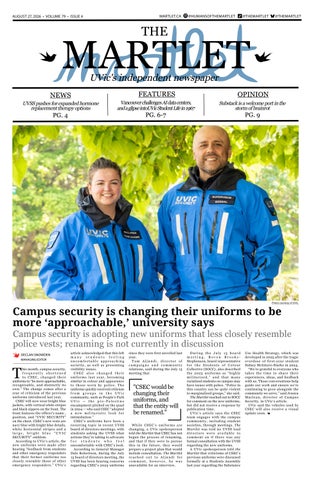
Photo courtesy of UVic.
Campus security is changing their uniforms to be more ‘approachable,’ university says
Campus security is adopting new uniforms that less closely resemble police vests; renaming is not currently in discussion DECLAN SNOWDEN MANAGING EDITOR
T
his month, campus security, frequently shortened to CSEC, changed their uniforms to “be more approachable, recognizable, and distinctly its own.” The change comes after a year of criticism of the previous uniforms introduced last year. CSEC will now wear bright blue jackets, with vertical white stripes and black zippers on the front. The front features the officer's name , position, and “UVIC SECURITY” on the chest. CSEC’s new vests are navy blue with bright blue details, white horizontal stripes and a large, bright blue “UVIC SECURITY” emblem. According to UVic’s article, the new uniforms were made after hearing “feedback from students and other emergency responders that their former uniforms too closely resemble those of other emergency responders.” UVic’s
article acknowledged that this left many students feeling uncomfortable approaching security, as well as presenting visibility issues. CSEC also changed their uniforms last year, becoming similar in colour and appearance to those worn by police. The uniforms quickly received criticism from groups in the UVic community, such as People’s Park UVic — the pro-Palestine encampment pitched on the quad in 2024 — who said CSEC “adopted a new militaristic look for intimidation.” CSEC’s uniforms have been a recurring topic in recent UVSS board of directors meetings, with students asking the UVSS what actions they’re taking to advocate for students who feel uncomfortable with CSEC’s look. According to General Manager Dale Robertson, during the July 13 board of directors meeting, the UVSS has been hearing concerns regarding CSEC’s 2025 uniforms
since they were first unveiled last year. Tam Aljundi, director of campaigns and community relations, said during the July 13 meeting that
"CSEC would be changing their uniforms, and that the entity will be renamed." While CSEC’s uniforms are changing, a UVic spokesperson told the Martlet that CSEC has not begun the process of renaming, and that if they were to pursue this in the future, they would prepare a project plan that would include consultation. The Martlet reached out to Aljundi for comment, however, he was unavailable for an interview.
During the July 13 board meeting, Roven BrooksStephenson, board representative for the Students of Colour Collective (SOCC), also described t h e 2025 u n i f o rm s a s “ h i g h l y militarized,” and that many racialized students on campus may have issues with police. “Police in this country can be quite violent to marginalized groups,” she said. The Martlet reached out to SOCC for comment on the new uniforms, but did not receive a response by publication time. UVic’s article says the CSEC team engages with the campus community, including student societies, through meetings. The Martlet was told no UVSS lead directors were available to comment on if there was any formal consultation with the UVSS regarding the new uniforms. A UVic spokesperson told the Martlet that criticisms of CSEC’s previous uniforms were discussed formally at a Students Assembly last year regarding the Substance
Use Health Strategy, which was developed in 2025 after the tragic overdose of first-year student Sidney McIntyre-Starko in 2024. “We’re grateful to everyone who takes the time to share their experiences, ideas, and feedback with us. Those conversations help guide our work and ensure we’re continuing to grow alongside the community we serve,” said Jessica Maclean, director of Campus Security, in UVic’s article. UVic said the vehicles used by CSEC will also receive a visual update soon.
UVIC LIFE
An Insider’s Guide to UVic’s Campus Kickoff 2026
From live music, free swag, to a movie in the quad, Campus Kickoff has an event for everyone! JAYDA BAXTER CONTRIBUTING WRITER The UVSS’ annual CKO is back, taking place from Tuesday, Sept. 8 to Friday, Sept. 11 with events you don’t want to miss. Not sure what to expect? Here is an insider’s guide to all the free events happening this year!
SUB FAIR
OPEN
HOUSE
GOODBYE RENT.
SATURDAYS 1-4 PM
Hello Equity. Heritage Inspired Boutique Suites & Townhomes
FROM
$339,900
60% SOLD | MOVE-IN READY!
LIVE IN THE PUB @ 7PM
TRIVIA TUESDAYS
DO YOU HAVE A KNACK FOR TRIVIA? Come to Felicita’s to have fun with friends & win prizes! HOSTED BY
KARAOKE THURSDAYS
(plus GST if applicable)
LIVE IN THE PUB @ 7:30PM FREE TO SING. FREE TO WATCH. GOOD VIBES GUARANTEED! Thursday food & beverage specials available all night!
Weekly Pub Entertainment Starting September 8 TH // FELICITAS.CA/UPCOMINGEVENTS // 19+
MUSIC BINGO
WEDNESDAYS
LIVE IN THE PUB @ 7:30PM LISTEN. MARK. WIN! Bring your friends, bring your music knowledge, and get ready to shout BINGO! No pre registration required.
LIVE MUSIC FRIDAYS
SEPT 11: NO DANCING @7:30PM + TWO RATS LOVING @9:30PM (Battle of the Band finalists & winner!) SEPT 18: HOT PANTS @7:30PM, SEPT 25: TRANSITIONAL ALIEN @7:30PM
What could be a better kickoff than free food? On Sept. 9, from 8 to 10:30 a.m., enjoy free freshly-made pancakes, courtesy of the UVSS Board of Directors. Come on down and fuel your brain in the Michèle Pujol Room in the SUB — it’s the best way to start your first day of classes.
BEATS BY THE SUB Tune into three days of live performances by local Victoria musicians. From noon to 5 p.m. on Sept. 9 to 11, these artists
MOVIE IN THE QUAD Come wind down with a movie night under the stars. On Sept. 4 at 8 p.m., the UVSS will be screening Shrek 2 in the quad in front of McPherson Library. Bring your blankets and cozy up in front of a giant inflatable screen. There will be popcorn available in exchange for a donation to the UVSS
Food Bank. Any non-perishable food items are accepted, or you’re welcome to bring a monetary donation.
BEVERAGE GARDENS UVic’s iconic campus pub is here for another delicious year! Felicitas will be open all week from afternoon to “late” with an extended patio to welcome you back, and refreshing drinks to cool off in between events.
thousands of students, staff, and faculty to ThunderFest! Taking place from 11:30 to 3:30 p.m. on Sept. 11, join Vikes Nation on the quad lawn for an afternoon of festivities. Make some friends, listen to live music, and check out tons of booths for free swag and giveaways.
THUNDERFEST Everyone’s favourite festival of the school year has returned for another year of fun! Vikes Nation is proud to welcome
Student-led research finds Campus Community Garden native plant plots more biodiverse than Finnerty Garden, university quad BRIANNA BOCK SENIOR STAFF WRITER Over a six week period this summer, the Campus Community Garden (CCG) began a student-led research project with the encouragement of the Sustainability Scholars Program. The project enlisted one paid graduate intern to conduct research aligned with their expertise, in collaboration with the CCG. Juls Macdonell, the assistant coordinator at the CCG, said that this initiative marked the first research project in the CCG’s history. This year, Ethan Fortin, a second-year graduate student in Sociology, conducted a biodiversity survey of insects in designated plots in the CCG, Finnerty Garden, and the quad. He earned his undergraduate degree in Biology at the
University of Alberta, with a focus on entomology, the study of insects. “I was looking specifically at ants, bees, and wasps,” Fortin said about the research project. “[Wasps are] a really good group for seeing wider ecosystem effects. There’s lots of pollinators, there’s lots of predators, lots of parasites all within that group, and if there’s a lot of them, it’s a really good indication that there’s a lot of biodiversity.” According to Macdonell, CCG originally imagined a survey on both bugs and birds, but because Fortin’s resume was so tailored to wasps, it ended up being a survey of local insects. Other than a check-in every two weeks, Fortin was mostly left on his own until the end of the internship, when Macdonell helped Fortin frame the report for UVic’s Administration. Macdonell said that the goals of the research project were not to force specific demands onto the university, but to support their goals and give them the
opportunity to extend their research. Fortin’s research focus was on pollinators and parasitoids, “which is a lot of the wasps,” he said. “Many of them are, less than a millimetre long — they’re tiny. Parasitic wasps are my favourite group of bugs; they’re very cool.” Fortin explained that a lot of parasitoids are specialists, meaning one species will parasitize, or live on, another species of insects. For example, certain families of parasitoids parasitize only scarab beetles (Scoliidae wasps) or only monarch butterflies (Pteromalus cassotis). “The group acts as a really good stand-in for the wider ecosystem, because if there’s something parasitizing scarab beetles, then you know there are scarab beetles, and so you don’t need to sample for every kind of bug if you can sample for this group of parasites,” he said. “The more diverse that group is, the more diverse the wider ecosystem must be.”
According to Fortin’s research, the native plant garden plots had statistically higher biodiversity of insects than Finnerty Garden or the quad did. What surprised both Fortin and Macdonell was that the biodiversity of Finnerty Garden and the quad plots were relatively the same. “It really does go to show that non-native plants are not useful in terms of biodiversity. They’re not nearly as effective as native plants,” said Fortin. “You might see some pollinators, you might see some charismatic big bugs like honeybees [and] bumblebees show up for the big huge ornamental flowers, but you’re just not getting all these little species.” “When they’re so highly managed too, it doesn’t create the same kind of habitat in the undergrowth, or the leaf litter in the messiness of what native plant gardens can sometimes be. That messiness is good; that’s part of what allows for so many different habitats.”
If you have visited Finnerty Garden, you may have noticed that several plants are surrounded by wood shavings. “It’s all kept very clean,” said Fortin. “There’s a certain aesthetic preference for cleanly cut lines and clean ground that has no leaf litter, grasses. It really really limits what bugs, what animals are able to use it. There’s not nearly as many resources or habitats.” Macdonell plans to present the final report to UVic, and post it on the CCG website as a public-facing resource in their resource tab. “If we get the chance to do another Sustainability Scholars grant next year…. Now that I’ve seen what research students, what grads students have, which [are] very specialized skillsets, I would want to do something similar … so someone could come in with a skillset like that and do what they do best.”
New saltwater display tank in Petch showcases marine life at UVic The tank is the result of a decades-long vision from biology lab instructor Dr. Rossi Marx to bring marine life closer to students and the public ISOBEL BARLOW-BUSCH CONTRIBUTING WRITER A new saltwater display tank has been built outside the biology department’s marine biology teaching labs in the Petch Building. Located outside room 107, the tank is currently home to roughly a dozen sea anemones. While the tank is not directly used for teaching, it is intended to draw attention to the department’s marine sciences program and the work happening inside its labs. It was built alongside renovations to the marine biology teaching labs. Dr. Rossi Marx, a senior lab instructor with the biology department, has dreamed of having a display tank in the department for more than 25 years. Her hope is to inspire students on campus, as well as the general public, to engage with marine ecosystems. “There are not many universities around the world where you have access to the ocean,” Marx said in an interview with the Martlet. “And I thought, ‘we have to display it.’” For students, the opportunity to see
2 // AUGUST 27, 2026
FREE PANCAKE BREAKFAST
will be sure to bring the good vibes and energy to campus. The music will be taking place by Fel’s BEvERage Garden’s, where you can grab a drink and dance to some tunes! At the time of publication, the band lineup has not been made public.
This summer, CCG hosted sociology grad student Ethan Fortin to conduct survey of insect populations in campus areas
MarloweResidential.ca
4201 TYNDALL AVENUE JUST MINUTES FROM UVIC!
From Sept. 8 to 11, the SUB is ready to welcome you to campus with style! Check out SUB businesses and local vendors and claim free swag, along with special deals for students. Located outside the SUB building
from 10 to 4 p.m., the SUB will be starting CKO the right way and debuting new swag for the year.
marine life up close is part of what makes the tank appealing. Martin Liu, a master’s student in botany who took marine biology courses during his undergraduate degree, sees it as a way to draw attention to the department and its programming. “When you have a display tank, it’s almost like a little teaser,” Liu said. He sees the tank as both a way of attracting prospective students and providing inspiration for students already enrolled in marine biology courses. The tank also offers a quiet, personal connection to marine life. Taraneh Abarin, who is finishing her undergraduate degree this summer in biology with a specialization in marine sciences, finds the anemones in the display tank soothing to watch. “Watching them calms me down, because I know that a lot of things [are] happening in that quiet, tiny environment.” The tank was built as part of a broader renovation to update the marine biology teaching labs. The Dean of Science, Dr. Peter Loock, played a role in prioritizing the construction of the display tank alongside the renovations to labs, and says he is pleased with how the updated facilities turned out.
“I think it’s an awesome environment for students. The tank has no teaching functions, per se, but it attracts attention and signals the awesome stuff that’s inside.” While the tank currently houses sea anemones, its inhabitants are expected to change over time. Marx hopes to eventually build a more diverse ecosystem in the tank, with animals including the shrimp, crabs, tube worms, molluscs, and sea cucumbers that are all permanently housed in the university’s aquatic care facilities. The department also plans to construct information plaques next to the tank in the 2026 fall term to help visitors identify its inhabitants. Creating an ecosystem that represents the marine environments around Victoria will take time, however, as each species needs to be safely acclimated to the tank. “It’s a work in progress,” Marx said. “Nature takes a while.” Additionally, the number of species that can be maintained in the tank will depend in part on the funding and staffing available to the university’s aquatic care team, which has shrunk over the years from three fulltime staff to one.
Photo by Isobel Barlow-Busch
While staffing limitations may prevent Marx from realizing her full vision for the tank, she remains enthusiastic about what already exists.
“This is already amazing, even though it's just barely the beginning.”
AUGUST 27, 2026 // 3
NEWS
"Bird news."
NEWS
UVSS to push for wider range of hormone replacement therapy options through health plan The UVSS, supported by the Pride Collective, will lobby for expanded options such as injectable estradiol and testosterone pills, gels, and patches to be covered under the health plan RUBY HARRIS SENIOR STAFF EDITOR At the July 20 UVSS board meeting, one motion, introduced by Director-atLarge Ame Sillars, proposed that the UVSS endorse injectable estradiol and testosterone pills, gels, and patches — used in hormone replacement therapy (HRT) — to better support gender-affirming care for students. The motion, which passed with seven in favour, no objections, and three abstentions, will have the UVSS lobby for expanded HRT options under the UVSS Health and Dental Plan and include the issue in future advocacy efforts. UVSS advocacy groups, including the Gender Empowerment Centre, the Pride Collective, the Native Students Union, the Society for Students with a Disability, and the Students of Colour Collective, all endorsed the motion and expressed their belief in its importance. The Pride Collective began working alongside Sillars to lead the initiative for expanded and easier access to HRT options after the issue was brought to their attention by friends and students. In a working draft of a brochure created by Ame Sillars and Liya Tensae, Pride Collective coordinator, they stated that “Two-Spirit, Transgender, Non-Binary, and Queer folk deserve to have access to necessary medications that support them and allow them to thrive. As such, advocating for full hormonal access is important.” During the UVSS meeting, Sillars said an increasing number of transfeminine people are taking estrogen by injection as their preferred method of administration. Injectable estrogen can eliminate the need for both oral estrogen and anti-androgens (testosterone blockers), reducing strain
on the liver. However, Sillars said compounded hormone medications are not covered by Canadian pharmaceutical companies or the provincial Pharmacare program, with the exception of last-case-scenario authority, meaning a patient has tried all other HRT options before requesting approval of injectable estrogen. Because UVic is on a Pharmacareshared healthcare plan, Sillars said, Pacific Blue Cross generally does not cover these medications. According to Trans Care BC, injectable estrogen may have a lower cardiovascular risk for people over 40 compared to options like oral estrogen, which is the least expensive choice relative to estrogen patches. Injectable estrogen is more costly and less available, with no public options available to cover the costs. For transmasculine people, Sillars said only injectable testosterone is currently covered, though some struggle with needles, making alternative options preferable. Trans Care B.C. says that injectable testosterone may lead to highs and lows in energy and mood swings in-between doses, unlike testosterone gel/ cream. Like injectable estrogen, both testosterone gel/cream and oral testosterone are significantly more expensive than injectable testosterone. In a written statement to the Martlet, Tensae said that all forms of testosterone require Special Authority Approval, which requires patients to prove they have the medical need for a drug and must be filed by a prescriber or pharmacist. If one’s doctor is not knowledgeable about this application process, barriers might arise, Tensae said. She highlighted how difficult it is to
navigate the healthcare system and insurance matters, especially for marginalized people. According to Sillars, the healthcare plan offered by the Graduate Student Society (GSS) provides more coverage for HRT, but it comes at a higher cost for students. The GSS held a referendum in 2024, introducing gender affirming care alongside other health amendments. Following the referendum, gender affirming care is covered for a lifetime amount up to $15 000 per student. This amendment led to an $8 per year increase to graduate students’ health and dental insurance costs. Sillars said that, while a referendum could be a route for the UVSS to take in the future, she believes it is a significant undertaking. Furthermore, she believes that advocacy for expanded HRT coverage must go beyond the university, such as through political advocacy. “I think the biggest injustice isn’t just the fact that this isn’t covered,” Sillars said. “It’s the fact that it’s a systemic issue.… If this were cis people, then it wouldn’t be a problem.” Sillars said that efforts have been made to expand access to HRT, including advocacy work by UBC in 2022. However, the lack of standardization in the noncovered medication — like the lack of a Drug Identification Number necessary for compliance with Canadian law — has made these efforts challenging. Following the passing of the motion, Sillars said the UVSS is beginning its advocacy work. Tensae said that the initiative to expand HRT access is in its early days, and will be a large undertaking, but that the Pride Collective is starting to gather information, build awareness of the issue, and come
Illustration by Sabina Mendoza.
up with an action plan and approach to advocacy. The UVSS motion proposed that advocacy would include, but not be limited to, advocacy to the Pacific Blue Cross, GreenShield, pharmaceutical companies, and the B.C. government in support of expanded HRT coverage and production, as well as to other student unions and student healthcare plans to build coalition support. One of the next steps planned for advocacy is these coalition-building efforts. “We have a large contingent of trans people on campus, and I think supporting that minority is extremely important, especially to give the best care that is possible.… It adheres to our mandate to
support minorities in the UVSS too,” Sillars said. Tensae said that the UVSS can be a key source of change and action for the issue. “If not us then who?” she wrote. “Ultimately, we will need the support of multiple peoples, professionals, and organizations, but I believe the student union is a great place to get the ball rolling.” Sillars said that students who want to support efforts to expand HRT coverage can take action by contacting politicians or reaching out to queer organizations to see where their help is needed, noting that HRT access is only one aspect of supporting queer people.
Recent study estimates up to 1 342 birds die from window collisions on campus between September and February each year An average of 1 095 birds die from window collisions in fall and winter on campus, making fall deaths significantly higher on average than at many other institutions DECLAN SNOWDEN MANAGING EDITOR Since 1970, North America’s bird populations have declined by approximately 30 per cent (roughly three billion), and window collisions are often cited as a significant risk to avians. A 2025 study examining window strike fatalities among birds at UVic estimated that an average of 2 651 collisions occur between Sept. 15 and Feb. 10 each year, with an estimated 855–1 342 (1 095 average) fatalities. The study, which featured UVic’s Dr. Louise Blight, an adjunct associate professor in the School of Environmental Studies, as an author, surveyed six buildings across campus for six 21-day periods in fall, early winter, and late winter from 2019–2022, looking for evidence of window collisions. The researchers surveyed the buildings for a total of 149 days. The study notes that building glass has been estimated to kill between 16–42 million birds per year in Canada. However, these estimates are based on
4 // AUGUST 27, 2026
the number of buildings that existed over a decade ago, according to the study. By 2060, building floor area is expected to double, potentially posing an even greater risk to bird conservation. Golden-crowned kinglet, hermit thrush, American robin, and varied thrush were species found to be more vulnerable to collisions in fall. Dr. Krista De Groot, one of the authors of the study and a research coordinator with Environment and Climate Change Canada, told the Martlet that one possible explanation for their higher vulnerability was that many of these birds are seasonally frugivorous (switching to eating fruit depending on the season), and that, during the colder months, fruit can start to ferment. As a result, the fruit will contain higher ethanol content, potentially causing the birds to be “flying around drunk.” The study found that collisions were highest during the fall migration period. The study only looked at the fall and winter period. “We know mortality is happening in [between March and August],” Blight said. “[But] we decided not to extrapolate to the rest of the year
because we didn’t have data for the other half of the year.” “Bird-window collisions are a significant and growing threat to birds, but the issue is still understudied in many geographical areas and stages of the avian annual life cycle," the study says. “There is increasing urgency to address this growing conservation threat.” Other universities in the province, such as UBC, have their own struggles with window collisions. At UBC, roughly 10 000 birds die per year colliding with clear and reflective glass. UBC has developed bird-friendly design guidelines as a result. UVic’s new Indigenous Law building has bird-safe windows, which have “bird dots” to deter birds from colliding with them. The Martlet asked the university if this was a required design element or an optional add-on. In a statement, Mike Wilson, director of campus planning, said, “the University of Victoria considers bird-safety as part of all new capital projects on campus. The recently completed Indigenous Law Wing as well as the Engineering and Computer Science Expansion, which is planned to open this fall, both feature bird-friendly glass.”
The statement confirmed that, unlike other campuses such as UBC, UVic does not have any formal guidelines for birdfriendly glass. Despite this, Wilson said bird-safety is “considered in the planning of new buildings, and our Facilities Management teams regularly monitor for troublesome spots on campus for birds, particularly those located near forests with large windows.” According to his statement, UVic maintains a yearly budget for retrofitting problem areas with a “special film to help prevent bird strikes.” The District Energy Plant has received post-construction retrofitting, and the Fraser Building has been identified as a priority this year, Wilson said. Though UBC’s bird deaths from window collisions per year are much higher than UVic’s from September to February, the study suggests that mortalities at UVic in the fall are much higher on average. “Standardized to 21 days [looking] at collisions per building, UVic is actually [two] times higher than UBC in the fall,” De Groot said. “We used the same methodology as a large study that took place across North America …
[where] they looked at [40] campuses,…” “The average for fall per building at UVic was eight times greater.” Blight said that, while working on the study, many people in the UVic community said they were glad the research was being done, and that they hoped it would contribute to fewer bird deaths on campus. On campus, the UVic Sustainability Project (UVSP) has started a “bird-safe campus” campaign, hoping to raise awareness of window strikes on campus. “Window collisions are a serious source of mortality for birds, for some species much more than others … and we have a bit of a crisis of conservation for birds in North America,” Blight said, referencing a 2019 study that found that, since 1970, bird populations have decreased by approximately 30 per cent (roughly 3 billion) in North America. “To me, it's kind of incredible that we have a system where we essentially build death traps for these wild animals that are around us all the time.”
UVic participation in post-secondary emergency manager network ‘scant,’ university says
The network came under recent scrutiny in an article published by online investigative outlet 'the Breach,' alleging several universities obstructed and delayed access to requested records ETHAN BARKLEY EDITOR IN CHIEF In late July, independent Canadian news outlet the Breach published a major investigation — the result of more than a year’s work by two reporters — revealing that over the summer of 2024, more than 30 Canadian universities operated communication channels with one another, sharing actions taken in response to the many pro-Palestine encampments that had been pitched on university campuses. According to the Breach’s reporting, two networks with overlapping membership — one national network, hosted by the University of Toronto, and one in Alberta, hosted by Edmonton’s MacEwen University — were established, coordinating and sharing resources related to the proPalestine encampments that were pitched at universities across the country in the summer of 2024, among other subjects. According to files obtained by the Breach via a freedom-of-information (FOI) request, the national “post-secondary emergency manager network” included a Microsoft SharePoint site containing, among other things, a discussion board, resource library, compiled list of contact information, and spreadsheet listing “actions taken,” created by the Business Continuity and Emergency Management manager at Toronto’s Humber College, Kathy Branton.
Ten post-secondary institutions of the 30 universities which were invited to the U of T-hosted national network contributed to the “actions taken” spreadsheet, detailing their response to encampments on university grounds. The Breach reported UVic was the 18th university to be onboarded by U of T into the network, which records reveal was created in November 2023 — after the October 7 attacks, but long before encampments were pitched. In a statement to the Martlet, UVic confirmed that two of the university’s emergency management personnel were invited to the network, but the university said that their participation was “scant,” and that UVic did not actively post materials or contribute to the site. UVic does not appear in the screenshot of the spreadsheet detailing “actions taken.” “Some member institutions shared emergency plans via the SharePoint site, which acts as a repository for materials that could be of assistance to other institutions. E.g. emergency management plans and messaging for specific incident scenarios (i.e. active threat, earthquake),” UVic told the Martlet in a written statement. UVic’s “People’s Park” encampment was pitched on May 1, 2024; the timeline assembled by the Breach indicates UVic also joined the network before the encampment was pitched, and before the
University of Calgary’s emergency manager was invited to the network on April 18, 2024. “The network hosted guest speakers on a variety of topics of interest to emergency managers who could call in to listen, then ask questions related to their work,” UVic’s statement continued. In the course of their reporting, the Breach’s article says, the two reporters covering the story were met with delays, obstruction, and destruction of records as they filed more than a dozen (FOI) requests with many different institutions. The Breach’s article alleges several universities followed a pattern of delaying the release of requested records, and “withholding documents that are known to exist.” UVic is not listed among them. At the time of publication, the Martlet has submitted FOI requests to the university for records associated with the network. Many of the allegations surrounding the denial of records’ existence are against Albertan universities such as the University of Calgary, University of Alberta, and MacEwan University, which are reported to have worked much more closely through their provincial network with city police in Edmonton and Calgary, as well as Alberta Ministry of Advanced Education personnel, and included information from these groups in their network. This claim is not made about the national network.
Three-term councillor and masters of education alum Karen Harper to run for Saanich mayor
Karen Harper will be running for mayor of Saanich, against fellow councillor Zac de Vries and Save our Saanich candidate Rishi Sharma DECLAN SNOWDEN MANAGING EDITOR On April 14, three-term District of Saanich Councillor and UVic masters of education alum Karen Harper announced her intention to run for mayor. The announcement came a month after Dean Murdock, current mayor of Saanich, announced he would not be seeking re-election. Harper was the first candidate to announce she is running. Her running mates in the upcoming B.C. local general election will be fellow Saanich councillor Zac de Vries as well as Save our Saanich candidate Rishi Sharma. While on council, Harper has pushed for improving efficiencies in bureaucracy, including pushing the district to electronic document management, which she said Saanich had not done prior to 2017. More recently, Harper pushed for greater access to doctors and nurse practitioners in Saanich alongside fellow councillor Teale Phelps Bondaroff, she told the Martlet in an interview. As one of Harper’s main priorities, she hopes to continue fixing inefficiencies, such as she did with digital electronic management, to ensure fiscal accountability. Outside of council, Harper has advocated for the inclusion of LGBTQ+ people in the workforce. “When I look back on my history … I was the chair of the Status of Movement Committee for the BCTF, [and] I moved a motion that the BCTF change its code
of conduct … not to discriminate on the basis of sexual orientation,” Harper said. “Back in the day this was not an easy thing to do.… [But] it was the right thing to do.” Another priority for Harper is housing. When Harper first announced she was running for mayor, she told Times Colonist she wants to carry on the work of the current council on housing and asset management, while improving service delivery and building various housing types to attract and keep young people in the district. Harper also wants to protect the environment in Saanich via its natural park system. Over the past few years in Saanich, there has been a growing divide over development projects and municipal spending, with reports of inappropriate conduct at city halls over controversial projects such as the Quadra-McKenzie Plan (QMP). The Martlet asked Harper how she would work with a divided Saanich. Harper said that she wants to improve how the district communicates with the public and that, in her experience, most people agree on the end goal, but disagree on the path forward. “I think we need to have a lot of clearer discussions about why what [changes] coming before us achieves the goals that most of us would agree with,” she said. “I do remember what it’s like to be young, and so one of my goals is … that young people have the same opportunities that my generation had,” she said. “It’s really important that we provide an environment where people know that if
they’re here, they will be able to thrive.” Harper told the Martlet that she thinks younger and older generations can work together and learn from each other, and that it is important to have young people in Saanich because, “without young people around, we are all losers.” She also said that many of the challenges facing young people today, such as LGBTQ+ exclusion, are challenges that have been faced before. Harper has extensive background in education and with students, working as a teacher for 17 years, as well as working with the BC Teachers Federation (BCTF). “I was a union activist. I worked at the Teachers Federation and then I was at the Pension Corporation…. I had to develop skill sets where I helped people to work together,” she said. Harper also hopes her running for mayor inspires more women to do so in the future. “There [has] never been a woman mayor in Saanich,” she said. “People shouldn’t vote for me because I’m a woman. They should vote for me because I’m the right person. But having said that, it’s kind of mind-boggling that after 120 years, Saanich has not had a woman mayor.” Voting for the 2026 local general elections will be held on Oct. 17. The elections will include voting for new mayors and councillors, regional district directors, school board trustees, parks boards, and the Islands Trust. More information on this year's local general elections can be found at elections.bc.ca.
Photo by Sydney Lobe.
In Alberta, student demonstrators at the University of Calgary and University of Alberta were forcibly removed by police shortly after the encampment began. In Calgary, nine of those demonstrators are now suing the city, university, and Calgary Police for $331 000 in damages, alleging violations of Charter rights and excessive use of force. The Alberta network is also reported to have included instructions to keep an update provided to MacEwan’s emergency manager “absolutely secret.” But other institutions, including U of T and the University of New Brunswick, are alleged to have had difficulty finding records
requested via FOI. In response to a question about whether UVic met or communicated with B.C. government officials about the encampment, a spokesperson for the university said: “As a publicly funded institution, we work with government, as appropriate, on critical issues and initiatives impacting our community. During incidents of note, UVic’s decisions and actions take into account the unique context of our campus community.” The Martlet reached out to the UVic People’s Park for comment but did not hear back by publication time.
UPCOM UPCO MING FILM FILMS
STAND BY ME SEPT 6: 5:00 & 7:00
TEENAGE SEX AND DEATH CAMP MIASMA SEPT 8, 9 & 10: 5:00 & 7:00
Photo courtesy of Pierre ____.
FANTASTIC MR. FOX
THE WRONG GIRLS
SEPT 21 & 22: 5:00 & 7:00
OCT 1: 7:00 OCT 2: 5:00 & 7:00
AUGUST 27, 2026 // 5
Sock Hops, Sit-Ins, and Folk Singers: UVic Student Life in 1967 Using interviews and dusty newspapers, we uncover what UVic was like six decades ago
Photos via UVic Archives.
AI data centers are coming to Vancouver, but the community is successfully pushing back The Canadian government announced two AI data centers planned for Vancouver and the community mobilized to successfully resist the new builds ABIGAIL FISHMAN SENIOR STAFF WRITER
UVic students are interviewed about food on campus (1967), the Martlet
HAILEY CHUTTER CONTRIBUTING WRITER Almost 60 years ago, UVic officially put an end to its nomadic lifestyle. From Craigdarroch Castle to Victoria High to current-day Camosun College’s Lansdowne campus, 1967 was the year that UVic completed its final move to a sunny spot up the hill from sŋéqəʔ (Cadboro Bay).
At its time of purchase, the new grounds consisted mainly of an old army camp and 141 acres of secondgrowth forest (previously logged by the Hudson’s Bay Company). In five years, UVic fashioned the essential buildings and swung open its doors to its (then) biggest ever enrollment in fall of 1967 — although, campus wasn’t without its oddities. The staff lounge, the UVic theatre, and certain classes could still be found inside the World War ll-era army huts scattered across the grounds. An old army drill hall acted as the school gym and main exam hall. In the fall of 1967, 3 800 undergraduate students graced its halls — over double the student population three years previous. Although today’s undergraduate population is roughly 19 000, at the time it marked a new chapter for student culture with a student population growing faster than ever on a brand-new campus. What was it like to be a student at UVic during this exciting year? The Martlet tracked down two alumni who experienced it first hand as undergraduates in 1967. Renowned ethnobotanist Nancy Turner was majoring in biology and taking anthropology classes at UVic in 1967. She worked closely with honours thesis supervisor the late Mark Bell, and met weekly with the late Christopher Paul from Tsartlip, whom she had been introduced to through his son, Chief Philip Paul, after attending a guest lecture from him about First Nations life and culture. Turner attended UVic with her now-husband of 57 years, Robert. They married the week after they graduated UVic. Turner was heavily involved in the biology club, which lobbied UVic regarding a range of environmental issues at the time. Derek Reimer served as Men’s Athletic Rep on the 1967 Students Council (now known as the UVSS). Reimer played for the Vikings volleyball team, and in 1967 played
6 // AUGUST 27, 2026
UVic students dance in front of the SUB to the band playing on the roof, 1967
alongside two other Vikings as starters on the B.C. team, who won gold at the first Canada Winter Games. He also played on the UVic rugby team later on in his degree. Reimer was completing a Bachelor of Science at the time, and later became a lab instructor for the geography department.
THE BRAND NEW CAMPUS Reimer noted that when he first arrived at UVic, there was only half of a ring road. During his first year, they completed the ring and dismantled the “extension of Henderson road [that] went right straight across the campus.”
“When I go to UVic now and I go to the main quadrangle, I think back of the quadrangle that I remember — it is so completely different. First of all, no Native art, none … the trees were saplings … they were 15 feet high. And it was a barren plain. “I go there now and I think this is a lovely space. In those days, it was just a thing to get across because the thing you wanted to get to was over there, and across the quadrangle you had to go. Now it's lovely … well aged,” he said. Turner had her eye on UVic’s approach to landscaping. “Of course, the campus was just being set up, and … being a botanist, I really really wanted them to use native plants in the landscaping … [as] a wonderful educational experience for everyone.” “I talked to the … head of landscaping at the time … and they essentially said no, we need ‘proper’ landscaping. And so, they ended up planting eastern tulip trees around the library and eastern oak trees and Scots pine … they rejected the idea of using native plants in the landscaping.” “It wasn’t until many many years later that, when they built the First Peoples House, that they landscaped it with native species, I’m very happy to say.” “There have been some really nice initiatives relating to the School of Environmental Studies … [and] work that's been done in the restoration of natural systems program…and now there are native plants in many different areas of the campus, so I’m really happy about that.” “It was frustrating back in the day when the conventional landscaping was just, you know, the only thing.”
THE STUDENT UNION BUILDING (SUB) The Martlet came across many 1967 newspaper articles focused on the quality of food at UVic. An “objective investigation of campus food services” was undertaken by 1967 Student Council President Dave McLean. The SUB was one of the two main school cafeterias on campus at the time, and was run by the Student Council. “I don’t remember the investigation, but I do remember the food and it was dreadful. It was really, really bad,” said Reimer. “They had hamburgers that they’d microwave … and they would stick the hamburger in the microwave and so it would come out thin and dense and horrid. But I ate my share of them.” Reimer recounted that aside from a cafeteria, the SUB was used as a gambling den. “Oh, there was a lot of money that changed hands everyday in the Student Union Buildin g. They played
particularly hearts, and sometimes for relatively high stakes. And they also played bridge and crib for money, but hearts was the thing … I wasted a good few hours watching hearts in the student union building.”
STUDENT COUNCIL: FROSH WEEK Frosh Week in 1967 had a major focus on live music events, commonly referred to back then as ‘sock-hops.’ Student Council organized a ‘frosh bash’ in Esquimalt, featuring “San Francisco's acid rock band, the Peanut Butter Conspiracy,” followed by a dance at The Purple Onion, with tunes from local Victoria rock band The Pharaohs. To finish off the week, Frosh were serenaded by folksingers at an outdoor barbecue at the SUB, followed by a final dance in the UVic library parking lot, with Victoria’s leading blues band, the Blues X Five. In addition, ‘costume sockhops’ (themed dances) were held throughout the week at the SUB. Monday was mod, Tuesday was hard times, Wednesday was beach wear, and Thursday was protest night. Reimer recalled attending the Peanut Butter Conspiracy show during frosh week that year. “I’m pretty sure it was at the Esquimalt Arena … and they came up from California. They also did a [psychedelic] light show as part of this … and of course this was just well, mind blowing, that's what it was, it was mind blowing. But yes I went to that dance and saw the light
The Martlet reports on student ‘Log and Saw,’ 1976
show…I remember my date — Gail Bigsby. Stephen Bigsby’s [1966 Student Council President’s] sister.” Reimer also mentioned that “there was also a very good musical series that was put on in those days,” where artists such as Gordon Lightfoot, Sonny Terry, and Brownie McGhee played at the school gym. The other main event during frosh week was an annual “Log and Saw”, which consisted of students sawing up driftwood and selling it to Victoria residents to raise money for the “Victoria Community Chest,” a charity that aimed to alleviate poverty in the city. Reimer recalls the high volume of fresh driftwood at Clover Point, and that students would sell a truckload for “a buckdollar or two.” In 1967, students in the Arts, Science, and Education faculties competed at different beaches to see who could make the most money.
PUBLICATIONS In 1967, the Student Council’s director of publications was in charge of the Martlet (we wouldn’t become independent until the 1990s), as well as an avant-garde student annual called Tower (named after the Lansdowne campus clock tower).
“My impression is that quite a substantial portion of the student body read [the Martlet]. You know, they might not have respected it very much but they read it. There were some very good journalists that worked for the Martlet. [The late] Ian Halkett … he worked for the Martlet and he was excellent. Susan Mayse — a really outstanding writer, she worked for the Martlet. Stephen Hume … he wrote for the Sun … he was a columnist for them.”
ADVOCACY In 1967, a growing topic of concern among students was public transit. That year the Students Council studied a plan to implement two new bus routes that would provide “a substantial saving in transportation costs” for students in Foul Bay, Hampshire, Central Beach Drive, Lower Richmond, and Fort. This is one topic that has spanned the decades — just last year, the UVSS led a transit campaign to reduce walk-on ferry prices for students.
Other student concerns were more topical. “It was the era of the Vietnam War, and there was a lot of agitation at the university about [it],” said Reimer. He recalled that at their first Student Council meeting of the year, one director put forward a motion
condemning the Vietnam War, which Reimer seconded. That resolution failed; however, later in the year the Student Council publicly opposed a chemical company recruiting student employees at UVic that produced napalm for use in bombing Vietnam. According to a Martlet newspaper from January 1967, Student Council “unanimously passed a motion giving $1 500 to the Viet Nam Teach-In Committee,” which ran a speaker series featuring singer-songwriter, musician, and activist Joan Baez and other prominent speakers on “both sides of the problem.” Additionally, that year, the Martlet left the pages of their Christmas edition blank as a “formal protest against the affluence of our Christmas season which demonstrates our lack of social responsibility to the millions of people now victims of disease, hunger, violence and war.” Instead, they donated their publishing funds for that edition to UNICEF, which was providing aid in Vietnam at the time. A major successful campaign that Student Council spearheaded in 1967 regarded student involvement in university governance. “The Senate and the Board of Governors (BOG) in those days had no student representation. And that didn’t seem fair, since we were the ones ultimately who were going to be most … directly affected by these policies,” Reimer said. This culminated in a campaign to get student representation on both governing bodies. ” The Student Council submitted a formal report to UVic outlining what they felt “should be the relationship between the student and the university.” This report, along with pressure from future student council members, resulted in students being elected for the first time to the UVic Senate in January 1968, and the first student on the BDG in the early 1970s. One of the most famous stints from the Student Council in 1967 was hosting UVic’s first student sit-in, when three professors were fired without public reason. Students occupied the third-floor hallway of the MacLaurin building for 25 hours, where the University President held their office at the time.
Data centers are rapidly rolling out and communities are mobilizing just as quickly. In May, the Canadian government announced a partnership with Telus, under which two Artificial Intelligence (AI) data centers will come to Vancouver, and the existing Telus AI data centre facility in Kamloops will be expanded. The two data centers in Vancouver are planned to be located in Mount Pleasant — at the former Hootsuite headquarters, — and at 150 West Georgia Street, respectively. According to the CBC, Telus says the Mount Pleasant data center will come online later this year, while the second facility is planned to come online in 2029. Data centres are being proposed across B.C. and Canada, including one facility so far on Vancouver Island, which will be located in Nanaimo. While the Nanaimo data centre is not intended for AI, the city still estimates it could use up to 69 000 litres of water per day. Thompson Rivers University (TRU) in Kamloops is also reportedly launching an open-loop AI data centre, and a Microsoft data center in Etobicoke, Ontario has been approved to use up to 39.75 litres of water per second for cooling purposes. Over recent months, the Vancouver community has pushed back against the data centers — and Torin LaRocque, an eighteen-year-old Vancouver resident, has been at the heart of it all. He said that he had been following the data centers popping up around the U.S. before learning about the plans for Vancouver. “So that is when I knew that, if no one else was going to do it, someone had to, and that person would have to be me.” LaRocque, with help of his friend Mary Easton, organized the first protest Vancouver saw against the data centers. “It was super amazing to see how only two people turned into hundreds of people helping out,” he said. Over the following weeks,
LaRocque’s opposition grew into the grassroots organization No AI Vancouver. According to LaRocque the team currently sits between 300 and 400 people. On July 14, the Vancouver City Council voted to send the rezoning application for the Mount Pleasant data center to a public hearing on July 23. However, on July 21, the council unanimously voted to reverse its decision from the week prior, effectively delaying the public hearing and sending the proposal back to the application review stage. “I think that really speaks to the hunger for community consultation,” said Emily Lowan, leader of the BC Green Party, in an interview. Vancouver City Councillor Sean Orr, said in a statement to the Martlet that while the public was successful in delaying the hearing, “it really came down to fortunate timing.” He explained that the council did not sit during the FIFA World Cup, and therefore saw an unusually high number of applications referred to public hearing. Some of the applications — including the Mount Pleasant data centre — had a large number of public speakers, and the council decided to refer the item back to staff so that it could finish all of its business by August. With a municipal election approaching in October, LaRoque said that the delay has turned data centers into an election issue. Solomon Yi-Kieran, a Coalition of Progressive Electors (COPE) backed candidate for city council, said “it shows that turning out works, and shows that making your voice as a regular person heard works.” They said that at the very least, the deferral gives the community more time to fight the data centers before they are built. “Best-case scenario, it’s an election issue. We can mobilize on it.” In the leadup to the election, LaRocque shared that No AI Vancouver is reaching out to each candidate to learn their stance on AI. Yi-Kieran said that COPE has been present and active on this
issue over the last few months. The party has attended marches and run town halls on the topic of data centers, they said, intending to teach individuals how to mobilize. Additionally COPE began a No AI Data Centers petition with a goal of 10 000 signatures, which it has nearly reached at the time of publication. “We were the first party that started calling for a moratorium,” Yi-Kieran said. Regular citizens and politicians alike are calling for a moratorium on AI data center builds — a pause in development until the consequences of AI data centers are better understood, and there are plans in place to manage said consequences. In a media release in May, Lowan joined the call for a moratorium. In the release, she also calls for an end to what she describes as the B.C. government’s “build-first, regulate-later” approach to data center development. “I tend to agree with B.C. Green leader Emily Lowan in calling for stronger regulations,” Orr said in a statement, “I would like to see strong assurance that we aren’t sacrificing our water and environment to corporate interests.” Like others, Lowan shares a wide array of concerns about the rapid roll out of AI data centers nation- and province-wide. “Right now, we have British Columbians being told to stop watering their plants, to take shorter showers, because of the climate crisis causing droughts across our province, but suddenly we’re supposed to cheer for tech billionaires squeezing profit out of us with AI data centers at the expense of our clean water.” On May 1, Metro Vancouver began stage two water restrictions, under which all lawn watering is prohibited, aesthetic water features cannot be filled or topped up, washing surfaces like driveways is prohibited except in limited circumstances, and tighter restrictions were placed on watering plants and sprinkler use. “Adding massive AI factories to
the grid only means one thing: it means higher energy bills for working families and even more strain on our grid,” Lowan said. Yi-Kieran shares this concern, pointing to examples in the U.S. in which data centers’ burden on the energy grid has resulted in higher energy bills. According to Consumer Reports, residential electricity bills jumped 7.1 per cent in 2025 — and up to 20 per cent in some states — with AI data centers as a significant factor. Yi-Kieran said that a moratorium is necessary until there is a reliable way to ensure that AI data centers are not hiking utility bills for average Vancouvorites. “Because it’s a gamble that is going to have likely very negative effects on a lot of people’s lives and a lot of people’s cost of living.” Orr said that his biggest concern is the lack of regulatory framework to properly assess the impacts of this digital infrastructure. In the July 15 Committee on City Finance and Services meeting, Councillor Lucy Maloney brought forward a motion that called for addressing the “risks of digital infrastructure,” which ultimately failed. Orr seconded the motion, and said that he supported it. The motion points to the U.S., which “has shown that, in the absence of thoughtful regulation, data centre construction and operation can create legitimate concerns and serious impacts on b ot h ne arb y re s id e nt s and municipal infrastructure.” Additionally, the motion outlines a number of concerns raised from various sources. It acknowledges a growing number of municipalities questioning whether residential areas are suitable locations for data centers, and requiring further studies to manage potential impacts; the potential of data centers occupying “scarce” commercial and industrial-zoned land while creating few postconstruction jobs; and concerns that AI infrastructure generates substantial value for private investors while only contributing marginally to the local economy. The motion would have had
council direct staff to urgently report back on how to develop a Data Center Public Impact requirement, concerning how staff could assess consistency of data center development applications with Vancouver’s climate targets, and assess other impacts such as noise pollution. Yi-Kieran said that the fight against data centers in Vancouver is not yet done, and stressed the importance of continued community organizing. “When the first AI march happened, I did not think it was going to change anything. When the second AI march happened, I did not think it was going to change anything. But after the second AI march … [it became] such a big conversation locally and nationally.” They said that their advice to people in other parts of Canada and the U.S. is “do not back down, do not let them force these data centers through.” Yi-Kieran is not alone in sharing this sentiment. The first protest Lowan spoke at had around 500–700 attendees, she said, but the numbers have consistently grown since then. “Don’t wait for someone else to take the reins,” Lowan said. “Don’t just organize one rally and call it a day.” Lowan said that it was inspiring to see eighteen-year-old LaRocque take action within days of learning about the project. “I think that everyone should know that one person can indeed make a difference,” LaRocque said. He pointed to No AI Vancouver, which began with just himself and has now grown into a large organization with many more looking to join in the fight. “The fact is that it all starts with one person, it is important to be that one person and make that change that you want to see in the world.”
Read the full article at martlet.ca
Photos courtesy of No AI Vancouver.
AUGUST 27, 2026 // 7
NEWS OPINIONS
NEWS OPINIONS
Alberta’s new three-in-one IDs are a sign of continued trend towards the far-right
Substack is a welcome port in the storm of brainrot
Alberta rolls out new ID’s that include a citizenship marker amidst growing anti-immigration sentiment in the province DECLAN SNOWDEN MANAGING EDITOR On June 3, Danielle Smith, premier of Alberta, announced the province would be rolling out new three-in-one identification cards in July, combining a driver’s license, personal health card, as well as the addition of a citizenship or legal status marker. Framed as a way to streamline services and prevent election fraud, Alberta’s new ID cards open up the door for increased discrimination against Canada’s most vulnerable. Identification cards with citizenship markers are, quite frankly, short-sighted, fascistic, and dangerous. Featured famously in states that have carried out genocide, such as Nazi Germany and Rwanda, during the 1994 genocide against the Tutsi people — though they were introduced earlier during Belgian colonial rule — they have long been used as a tool to discriminate against and marginalize others. As much as I’ll criticize my home province, Alberta, it is not nearly as extreme as either of those countries during those timeframes. Still, the province is moving to the far-right at an increasingly alarming rate, with a growing separatist movement fueled by disinformation, foreign interference, and an inflammatory premier who has worked toward U.S. style healthcare, continues to rely on
climate-destroying energy sources, and fans the flames of anti-immigrant sentiments. The change is especially unfortunate when looking toward the U.S., whose Immigration and Customs Enforcement (ICE) agency rounded up over 43 000 people in June alone, and sent many of them to what can rightfully be considered modern-day concentration camps. The situations where you realistically need proof of citizenship, like getting a SIN number or passport, are already strictly regulated and inconvenient; having a citizenship marker on your driver’s license will not make the process significantly easier. Instead, a license is mostly used for daily life, such as at a traffic stop, or having your age checked at a bar. In both cases, the person checking your ID does not need to know your citizenship status, and making this information accessible only invites bias. Licences will now immediately alert police, who are already shown to disproportionately target marginalized groups, such as Black men and Indigenous women, to those who have more or less legal protections. Since Smith announced the new threein-one IDs, immigration lawyers, human rights activists, and advocates have warned of the potential dangers of citizenship markers on Alberta’s ID, with some going so far as to suggest that some governmental agencies may try to target
non-Canadian citizens through the cards. Beyond police profiling, these new IDs introduce a slew of other profiling-related harms, with the Alberta Civil Liberties Association pointing out that banking, housing, employment, and schooling opportunities could be affected by one's citizenship status. Despite such concerns, Minister of Service Alberta Dale Nally has claimed that, in Alberta — where police profiling is already a prominent issue — these IDs will not lead to discrimination. At the same time, Alberta’s fall referendum questions include adding an “Alberta-approved immigration status” to the province with the intention of limiting immigrants’ access to services, despite immigration being a primary responsibility of the federal government. Smith blamed the province's $9.4 billion deficit (which may now become a surplus, due to skyrocketing oil prices following the U.S. and Israel’s war in Iran) largely on immigration, despite asking former Prime Minister Justin Trudeau to increase immigration just two years earlier, in 2024. North America’s political climate is already alarmingly anti-immigrant, both in the U.S. and Canada, and Smith's actions in Alberta risk further normalizing hate and discrimination at home as she mimics U.S. style politics in Alberta for her own gain.
With literacy rates declining, interest in news media dwindling, and attention spans plummeting, Substack is exactly what we need to help ourselves out of this pit Graphic courtesy of the Native Students Union.
NEWS UNSETTLED |'Beacon Hill Park' Makes Me Uncomfortable AVERY FEDERSPIEL NSU COLUMNIST Placenames and the history of areas are important to know and respect on Indigenous land. You never know what you may pick up without the proper knowledge or respect for the earth beneath your feet (remember: what goes around, comes around).
Photo handout by the Government of Alberta.
Illustration by Sabina Mendoza.
SKYLAR TIMMERMANS CONTRIBUTING WRITER Substack, first launched as a publishing and newsletter platform, was created in 2017 by founders Chris Best, Jairaj Sethi, and Hamish McKenzie. The idea was simple yet brilliant: create a way for writers to independently publish their work while connecting directly with their audience. Since then, the platform has since expanded to become a multi-medium network where users can share poetry, social commentary, journalism, essays, podcasts, or even one-sentence blurbs. This expansion, alongside notable figures such as Charli XCX, Dolly Parton, and Pamela Anderson joining Substack, has drawn in over 35 million users. Unfortunately, as social media becomes tightly wound into everyday life, our minds are somewhat wired to accept the aestheticization, overproductivity, and political provocation which fuel mainstream platforms. The synthetic society created by platforms such as Instagram and TikTok shapes how we see reality, but we aren’t always aware that it’s happening. Additionally, social media addiction is unique because its widespread nature makes it socially acceptable. Yet, after spending hours on end watching videos that have already escaped our memory, we are often left feeling guilty. Why? My theory is that, on some level, we know that what we are consuming is meaningless. Creativity needs boredom to survive, and the constant access to dopamine that social media affords leaves no room for boredom. These platforms aim to fill the void of boredom for many users, putting a chaotic lullaby in the place of silence
8 // AUGUST 27, 2026
and intention. Seeing strangers on the internet display their vibrant, visionary lives makes us forget that raw creativity comes at the great cost of both vulnerability and imperfection. However, there is a solution: the same models that these platforms depend on can be used to undo the damage. These models, if we disregard the sneaky algorithms, centre around sharing pieces of your life with others, either with a select few people or millions. This in itself is a wonderful way to build connections, learn new things, or derive inspiration. As we can see, the concept of social media itself is not the problem. Rather, it is the way the platforms were, and are, designed. This is exactly the route that Substack has taken. It has given me hope for our future, and given creativity a chance to thrive once more. Substack differs from the norm in that it is propelled by subscriptions, instead of algorithms. This means that, when you want to hear more from an author, their work — once you are subscribed — is sent directly to your email. There is also an optional paywall function used by many independent journalists, career-writers, and influencers; however, many writers who are on the platform simply to share keep their work accessible and free. This way, you can use the platform to read the work you want without being pulled in by content you never signed up for. The difference is not the time you spend on each platform, but the way you spend your time. For many Substack users, that time is spent with intent and attention, as opposed to passively riding a merry-go-round of fruitless information. The fact that Substack has gained so much popularity in recent years may show us something promising:
long-form writing might not become a thing of the past. While perusing Substack in preparation for writing this piece, I found countless accounts with very small followings that were scattered with a plethora of writing. I found pieces that were raw, diverse, sometimes sloppy, but nevertheless real. They ranged from childhood mementos to opinions on current affairs, yet carried the same thread of originality throughout. These accounts were not for anyone in particular to see; they were simply people with ideas to share, and with enough creative stamina to turn those thoughts into something genuine. One user wrote a 42-line poem about poetry which made me cry. This post had 12 likes. But we shouldn’t jump to conclusions. Although Substack may be a step in a good direction for our “brainrotted” minds, there is no denying that these magnetic, easyreward platforms aren’t going away. The rate at which many of us consume short-form videos (SFVs) has been proven to be harmful to our cognitive abilities, sleep quality, mental health, and attention span, leading to deeprooted effects. As many of us know, the algorithms integrated into these platforms are designed to suck us in, and bribe us to stay. However, Substack is an accessible way for people who have struggled with these effects to be reintroduced to slow-release dopamine activities such as reading and writing. The act of simply picking up a book to read seems to have become intimidating for many, because it requires one to hold their attention span longer than they are used to. If books are like mountain biking, Substack is like riding a tricycle. You can’t jump on a mountain bike after your first day on training wheels, but it’s a step in the right direction.
The history of míqәn (Beacon Hill Park), pronounced MEE-qan, starts with the Indigenous people of the ‘Salish sea basin’ which stretches from the coasts of Kwak̓wala territory to Chemakum, Tawaduq, and Lushootseed lands. This corner of Salish islands and coasts were some of the most densely populated areas precontact. Tucked inside this exuberant sea basin, the lək’wəŋən stewarded the land of míqәn, which roughly translates to “a place to warm your belly ” and acted as a place of defensive refuge, food, and burial sites (yes, there are graves at Beacon Hill). Defensive refuges were located at Finlayson Point, Holland Point, and Clover Point. It’s presumed these refuges were used to defend against outsiders who could’ve been settlers or other Indigenous groups. Foods were (and still are) regularly harvested in the area, including the native plant kwetlal or ‘Camas’ which are a popular food source once used for trade throughout the sea basin, along with razor clams and oolichan oil. The burial sites in míqәn have a more controversial history. There’s a story set in Finlayson Point and it may have occurred during the 1700s after the height of a smallpox epidemic. It speaks of a split in the lək’wəŋən community where some fled to the hills to escape the disease while others packed up winter supplies and moved to a fort nearby. When those who fled returned to the Finlayson area after winter, they discovered every body of those who stayed behind. There were no survivors. They took their postmortem community members and buried them in stone cairns in míqәn, some still visible today. Burial cairns are made of loose stone placed circularly in two rings with the friend who passed resting in the middle encased in smaller rock and gravel. Many of these cairns are over 2000 years old and historically not subtle in their visibility unlike today. The thousands of burial cairns spoke to the density of Salish population and was evidential of the lands’ true millennia-long caretakers. In 1850, (60 years after George
Vancouver entered the region in 1792) Chief Factor of the Hudson's Bay Company and the first Governor of the Colony of British Columbia James Douglas set his sights on the prosperity the island generously offered its respectful inhabitants. Shortly after his arrival, so-called Victoria’s development shifted gears. Land was quickly sold and developed, involving rigorous construction and land surveying which led to settlers quickly discovering the burial cairns, unafraid to open them up like treasure chests. Discovering bones at rest, they made haste to create discussion on what to do with the findings with Douglas and landowners who decided the least they could do is consult the people who put them there. I just lied to you… did you believe me for a second though? Instead and in full truth, any burial cairns deemed in the way of exercising colonial property rights were dug up. Consequently, coastal ancestors were put on display in museums, early Victorians' humble abodes, and business walls as decorations or sold as display items overseas to other Western admirers of the ‘ancient indian.’ The cairns left today have loose protection by the City of Victoria and it’s no longer trendy to showoff an “indian skull” inside settler establishments, however the history remains. Areas such as Uplands and Oak Bay were also built atop of cairns; homeowners still find and dig up bones. Reckoning with míqәn’s story while strolling through the park leaves a twisting feeling in my chest. Don’t get me wrong, míqәn is beautiful but what I know (and now you too) taints my admiration for its colonially-distorted attractiveness. It’s symbolic of the continued disruption of lək’wəŋən caretaking and life. Beacon Hill Park makes me uncomfortable and if you still don’t understand: Imagine somebody dancing on the graves in Ross Bay Cemetery, ripping up the tombstones while muttering insults on the names they belong to, building shelter out of the stolen stone and inviting the entire extended family to come and do the same. Don’t forget to imagine the bones they’ll discover when collecting said tombstones of which they’ll hang next to their door for the admiration of their guests, who will marvel at the scene.
AUGUST 27, 2026 // 9
ARTS & ENTERTAINMENT
FUN STUFF
Six books by UVic alumni to add to your reading list
Divided
From memoirs to historical fiction, these UVic grads are crafting award-winning stories KIERA CLARK VOLUNTEER STAFF WRITER Looking for some Canadian authors to add to your TBR pile? Whether you’re a poetry lover, a fan of fiction, or only read nonfiction, try these six books by UVic grads.
MONKEY BEACH BY EDEN ROBINSON (UVIC BFA ‘92) When seventeen year old Jimmy Hill goes missing at sea, his family and community are left to piece together what happened. Monkey Beach follows Lisamarie Hill as she ventures on her own search and rescue mission for Jimmy through the Douglas Channel to Monkey Beach, famous for its sasquatch sightings. Robinson’s debut novel is a gothic-style coming of age story that carefully blends Haisla mythology and the teenage experience with an underlying exploration of the impact of colonial violence in Canada.
THAT TINY LIFE BY ERIN FRANCES FISHER (UVIC MFA ‘14) In this debut collection of short stories (and one novella), Erin Frances Fisher takes readers from a desert amputation in the American West to the edges of the galaxy once humans have run out of resources to extract on earth, then back to a raptor-
breeding farm in B.C. The collection’s unifying core is captured in the blurb on the back cover, positioning That Tiny Life as an exploration of “humanity’s neverending cycle of creation and destruction.”
HALF BLOOD BLUES BY ESI EDUGYAN (UVIC BFA ‘99) Half Blood Blues follows a group of Black Jazz musicians in Europe during two significant times in their lives, fifty years apart: from Berlin and Paris in 1939–40 to 1992 as the surviving members of the Hot Time Swingers return to Berlin for a documentary screening about the life of Hieronymous Falk, their twenty year old German trumpet player who was arrested in 1940 and never seen again. The screening sends narrator Sid Griffiths and bandmate Chip Jones on an unexpected journey, and Sid must confront the ghosts he tried to leave behind in Europe fifty years before.
DEAD RECKONING BY CARYS CRAGG (UVIC MA ‘08, BA ‘05) “Grief isn’t only about the death of a loved one; rather, it is the process of building a new life, including a new relationship with the person who was no longer there,” Carys Cragg writes in her memoir, Dead Reckoning: How I Came to Meet the Man Who Murdered My Father. In 1992, when Cragg was eleven, her
SEE THIS ISSUE'S CROSSWORD ANSWERS MARTLET.CA/CROSSWORD
ATUM BECKETT CROSSWORD WIZARD
father was murdered in their family home during a home invasion gone wrong. Dead Reckoning follows Cragg through the restorative justice process as she corresponds with — and ultimately goes to meet — the man who killed her father. Though raw and at times unsettling, Cragg’s book is a poignant exploration of how reconciliation may be achieved outside of the courtroom.
LAMPEDUSA BY STEVEN PRICE (UVIC BFA ‘00) Set in Sicily in the 1950s, this moving and contemplative historical fiction novel tells the story of Guiseppe Tomasi, the final prince of Italy’s southernmost island, Lampedusa, in his final years as he completes his own novel, The Leopard — unpublished in his lifetime but now considered a masterpiece in Italy. Rooted in historical fact, this fictionalized biography is an elegant exploration of one of Italy’s great writers, through the mind of the artist himself. Steven Price carefully weaves memories from Tomasi’s youth with the realities of aging when diagnosed with emphysema.
MIDWAY BY KAYLA CZAGA (UVIC BFA ‘11) As the back of the book explains, Kayla Czaga’s third poetry collection explores
Illustration by Sabina Mendoza.
Photos via Goodreads; collage by Sabina Mendoza.
“grief in all its manifestations,” taking readers from local Vietnamese restaurants and the beach to the Tate Modern in London and casinos in Las Vegas. While the collection is rooted in Czaga’s grief after her parents’ deaths, it is also funny and hopeful at the most unexpected of times
— you may even find yourself laughing, like when she writes, “Inside a Pizza Pop, a god may be building a new world / with no people in it, only talking animals.”
Pop-up bookstore Alphabet City Books is creating a community hub for Victoria’s book lovers
Across
Down
1. Older brother, in Korea 5. Like someone who can 9. Metric weight unit 13. Like the circled answers in this puzzle 15. Seventh incarnation of Vishnu 16. Protein building blocks 17. Stink 18. Haley Joel or Emily 19. Window quality 20. Spooky 24. Early home console 25. Zeus' wife 29. Temporary bed 30. Insomnia director 31. Plastic tubs in school lunches 35. Stat in action games 36. Winnie's saddest friend 41. They divide roads 45. Elaborate outfit 49. X, in Roman times 50. Ostentatious display 51. Make like a volcano 52. '70s music genre 55. Marty actor in Madagascar 56. Major Ukrainian port city 61. Zero emission vehicle 62. Luke, Liam, and their brother 66. Slushy brand 67. Begins to make tea 68. Play dress up, seriously; abbr. 69. "Right turn ____" (traffic sign) 70. Nintendo handhelds with cameras
1. Units of electrical resistance 2. Proper 3. Captain Kirk actor in Star Trek 4. In harmony 5. Rainbow shape 6. "Here comes dat ___" 7. hallucinogenic letters 8. Suffix with host or priest 9. Small cave 10. Spreading out from a central point 11. Sun God in ancient 32-down 12. "Viva la Vida" singer 13. Calcium Oxide, in short 14. Blanchett of Tar 21. American TV company 22. Letters of debt 23. Latin extender 24. Elgort of Baby Driver 25. Once held 26. Feds in The Simpsons Movie; abbr. 27. Vinyl speed; abbr. 28. In the style of 32. Home of Alexandria 33. "I told you so!" 34. "That's so gross!" 37. High pitched dog cry 38. One of John Lennon's names 39. Stage in a sleep cycle; abbr. 40. Sixth sense, in short 42. Restricted, in a restricted way? 43. Luau attire 44. Slip-___ (laceless shoes) 45. Popular rodent pet 46. Beethoven's 3rd symphony 47. Ruby Rhod in The Fifth Element 48. Part of a turn in Magic: the Gathering 53. Some bovines 54. Roy actor in The IT Crowd 57. Taylor Swift's "The ____ Tour" 58. Nurse union with a greek name; abbr. 59. "____ all that" (high school romcom) 60. One of the five daily Islamic prayers 62. The White Lotus airer 63. One billion years 64. Wife's mom, in short 65. Quality of a fox
Visit https://pondscumgames.blogspot.com for more puzzles like this one!
The pop-up bookshop in Habit Coffee is 'connecting people through books' KIERA CLARK VOLUNTEER STAFF WRITER Tucked in the back of Habit Coffee’s Chinatown location sits Alphabet City Books, a pop-up bookstore stocked with a carefully curated selection of used books. Alphabet City was co-founded by Talia Freimanis and Michael Pollard, who have over three decades of combined experience in bookstores and libraries. Freimanis and Pollard told the Martlet that, while opening a bookstore had been in the back of their minds for some time, it became a more serious idea in spring 2023. Pollard estimates that since 2023, they have collected around 15 000 volumes, though said they stopped counting after 12 000 and have acquired many more books since. “The easiest bit about imagining starting a bookstore,” Freimanis said, “is just collecting the books.” From the beginning, Freimanis and Pollard, a two-time UVic grad, knew they wanted to open their bookstore in Victoria rather than Vancouver, where they were living in 2023. They said they landed on the concept of a pop-up primarily out of necessity, because finding commercial space in Victoria is challenging. Before moving back last fall, Pollard
reached out to Habit owner Shane Devereaux about a temporary pop-up for the holidays in December; with Devereaux’s support, the month-long pop-up became a permanent fixture, as the search for retail space continued. Freimanis and Pollard told the Martlet that Devereaux has given them “free rein” with the pop-up, creating the opportunity to test their ideas in a low-risk environment. “He took a chance on us, and that’s just a gift,” Freimanis said. Pollard and his brother custom built the shelves, one of which is designed to display books with their covers facing outwards. After years of searching, Freimanis and Pollard revealed that they have secured a retail space downtown for Sept. 1. Their new location, like the pop-up, will be primarily second-hand books, though they plan to also keep a small selection of new books. “Used books [are] kind of more our bread and butter, and more what we’re interested in,” Freimanis said, adding that with the cost of books continuing to rise, they want to maintain their commitment to making them accessible by selling used books. They will also be purchasing used books from people in exchange for cash or store credit. They plan to create a small space with
an intentional, curated book selection, a goal their new 950-square-foot storefront will help accomplish. The pair don’t have plans to expand to multiple locations in the future, either. Instead, Freimanis told the Martlet that they “just want to do a little thing really well.” Pollard added that they hope to be a “community hub … [that is] connecting people through books.” Thanks to their shared bookselling experience, the pair recall many of the titles people ask for most often. Freimanis said they want to primarily offer books that “last the test of time,” rather than what is popular at the moment. Freimanis said that one of her favourite parts of the pop-up has been the people who make zines and other creative projects asking if they can display work there. “Because we are the bosses, we can just say yes,” she said. “It’s fun to just see what people are making and what they bring us.” “People have left their own publications,” Pollard shared. “They just kind of interfiled them with the books.” One of their most unexpected moments so far was meeting author and historian Dr. Quinn Slobodian. “I have read a couple of his books and loved them,” Pollard said. “He was just sitting around the corner, so I grabbed his book and … got him to sign it, and that
Down
Photo courtesy of Alphabet City Books.
was pretty exciting for me.” “We have a few hundred books, and what are the odds that the author of one of the books we’re carrying is just having a coffee?” Freimanis added. “So of course, we bothered him.” They hope to open their new storefront in early November, but in the meantime, the pop-up location will continue. Pollard
also hopes to keep the used bookshelf in Habit even after opening their own location. You can browse their carefully curated used books at Habit seven days a week. On Sundays, Freimanis and Pollard come in from 10 a.m. to 4 p.m. with a selection of brand new books. Select books are also available to purchase on their website.
Graphic by Amy Vurdela.
VOLUME 79 VOLUME 76 The Martlet Publishing Society is an incorporated B.C. society and operates based on our Statement of Principles. We strive to act as an agent of constructive social change and will not publish racist, sexist, homophobic or otherwise oppressive copy.
EDITOR-IN-CHIEF Ethan Barkley edit@martlet.ca EDITOR!IN!CHIEF Ashlee Levy OPERATIONS MANAGER edit@martlet.ca Rae Dawson business@martlet.ca OPERATIONS MANAGER Anna Alva DESIGN DIRECTOR business@martlet.ca Sage Blackwell design@martlet.ca DESIGN DIRECTOR Sie Douglas-Fish design@martlet.ca
ISSUE 1 ISSUE 2
MANAGING EDITOR Declan Snowden info@martlet.ca SENIOR STAFF WRITERS DESIGN Kristen deASSISTANT Jager, Sydney Lobe Sabina Mendoza design@martlet.ca VOLUNTEER STAFF WRITER Brianna Bock SENIOR STAFF WRITERS Brianna Bock EDITOR SENIOR STAFF Abigail Fishman Yo'ad Eilon-Heiber Al Tantalidou
SENIOR STAFF EDITORS Ruby Harris VOLUNTEER STAFF WRITERS VOLUNTEER STAFF EDITORS Ella Baird, Kiera JulienClark Johnston-Brew, Hannah Seaton VOLUNTEER STAFF EDITORS CONTRIBUTORS Eden Conti, Gillain Fung, Rory Haase, Cooper Anderson, Sage Blackwell, Kiera Clark, Keira HolmanMary MacLeod, Aidan Nelson-Sandmark, Sarah Roberts, Paul Voll CONTRIBUTORS Isobel Barlow-Busch, Jayda Baxter, Atum Beckett, Hailey Chutter, Avery Federspiel Skylar Timmermans, Amy Vurdela
The Martlet Publishing Society is an incorporated B.C. society and operates based on our Statement of Principles. We strive to act as an agent of constructive social change and will not publish racist, sexist, homophobic or otherwise oppressive copy.
Our paper is written and published on the unceded lands of the Lekwungen peoples, and the Songhees, Esquimalt and WSÁNEĆ peoples whose historical relationships with the land continue to this day. Our paper is written and published on the unceded lands of the Lekwungen peoples, and the Songhees, Esquimalt and WSÁNEĆ peoples whose historical relationships with the land continue to this day.
Newsroom 250.721.8361 Business 250.721.8359 martlet.ca Newsroom |250.721.8361 | Business |250.721.8359
10 // AUGUST 27, 2026
||
@TheMartlet | | @TheMartlet Facebook.com/themartlet martlet.ca
Members get $0 Delivery Fee How's that for math?
Save on Uber and Uber Eats Benefits apply on eligible rides & orders only. 3 months free subject to eligibility and member terms, see app for details
3 MONTHS FREE
JOIN TODAY
Eligibility & member terms apply.