MARTLET.CA
FEB 26, 2026 • VOLUME 78 • ISSUE 16
@HUMANSOFTHEMARTLET
@THEMARTLET
@THEMARTLET
THE
MARTLET UVic's independent newspaper
NEWS
OPINIONS
ARTS
UVic senator pushes for more inclusive language in academic awards
Attacks on DEI are the harbinger of more hostility for our post-secondary sector
In conversation with Leigh Jarrett, author of queer romance series' The Salish Sea Society'
PG. 4
PG. 9
PG. 10
SEX & GENDER ISSUE SEX & GENDER ISSUE SEX & GENDER ISSUE
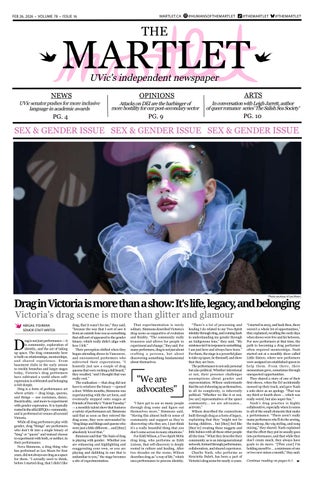
Photo courtesy of Leo Moon.
Drag in Victoria is more than a show: It's life, legacy, and belonging Victoria's drag scene is more than glitter and glamour ABIGAIL FISHMAN SENIOR STAFF WRITER
D
rag is not just performance — it is community, exploration of identity, and the act of taking up space. The drag community here is built on relationships, mentorships, and shared experience. From basement clubs in the early 2000s to weekly brunches and larger stages today, Victoria’s drag performers have cultivated a world where selfexpression is celebrated and belonging is felt deeply. Drag is a form of performance art where artists — drag kings, queens, and things — use costumes, dance, theatricality, and more to experiment with gender expression. It is typically rooted in the 2SLGBTQIA+ community, and is performed at venues all around Victoria. While all drag performers play with gender, drag “things” are performers who don’t fit into a single binary of “king” or “queen” and instead choose to experiment with both, or neither, in their performance. Nova Simmons, a drag thing who has performed as Leo Moon for four years, did not always see drag as a space for them. “I actually used to think, before I started drag, that I didn’t like
drag, that it wasn’t for me,” they said, “because the way that I sort of saw it from an outside lens was as something that still sort of appeared to the gender binary, which really didn’t align with how I felt.” Their perception shifted when they began attending shows in Vancouver, and encountered performers who subverted their expectations. “I honestly just saw a couple of drag queens that were rocking a full beard,” they recalled, “and I thought that was really cool.” The realization — that drag did not have to reinforce the binary — opened a door. Within months, Simmons was experimenting with the art form, and eventually stepped onto stages at Friends of Dorothy’s “Talent Tuesday” — a monthly talent show that features a variety of performance art. Simmons said that as soon as they entered the drag scene, they were surrounded by “drag kings and things and queens who were just a little different … and [they] absolutely loved that.” Simmons said that “the basis of drag is playing with gender. Whether you are enhancing and highlighting and exaggerating your own, or you are playing and dabbling in one that is unfamiliar to you,” the stage becomes a site of experimentation.
That experimentation is rarely solitary. Simmons described Victoria’s drag scene as supportive of evolution and fluidity. “The community really treasures and allows for people to experiment and change,” they said. For many performers, drag is not just about crafting a persona, but about discovering something fundamental about themselves.
"We are advocates" “I have got to see so many people through drag come and figure out themselves more,” Simmons said. “Having this almost built-in sense of community and support as they’re discovering who they are, I just think it’s a really beautiful thing that you don’t come across in many situations.” For Eddi Wilson, a Two-Spirit Métis drag king, who performs as Eddi Licious, that self-discovery is deeply rooted in culture and healing. After two decades on the scene, Wilson describes drag as “a way of life,” which uses performance to process identity.
“There’s a lot of processing and healing I do related to my Two-Spirit identity through drag, and coming back to understanding my gender through an Indigenous lens,” they said. “My existence isn’t in response to something; I am just here and always have been.” For them, the stage is a powerful place to take up space, be themself, and show that they are here. The performance is not only personal but also political. Whether intentional or not, their presence challenges assumptions about gender and representation. Wilson understands that the act of showing up as themselves, in all its complexity, is inherently political. “Whether we like it or not, [we are] representatives of the queer community… we are advocates… activists.” Wilson described the connections built through drag as a form of legacy, explaining that they “might not be having children… but [they] feel like [they’re] creating these nuggets and little babies with all these other people all the time.” What they describe their community as is an intergenerational network, formed through performance, collaboration, and shared experience. Charlie Nash, who performs as Henrietta Dubét, has been a part of Victoria’s drag scene for nearly 11 years.
“I started in 2015, and back then, there weren't a whole lot of opportunities,” they explained, recalling the early days when shows were few and far between. For new performers at that time, the path to becoming a drag performer often required mentorships. Nash started out at a monthly show called Little Sisters, where new performers were assigned an established queen to help them. From there, their momentum grew, sometimes through unexpected opportunities. They shared a story of one of their first shows, when the DJ accidentally messed up their track, and gave Nash a solo show as an apology. “That was my third or fourth show … which was really weird, but also super fun.” Nash’s drag practice is highly collaborative, especially when it comes to all of the small elements that make a performance. “There aren’t really many performers who’ll do the sewing, the makeup, the wig styling, and song mixing,” they shared. Nash explained that the effort they put in usually goes into performance, and that while they don’t create much, they always have goals to do more. “[This year] I’m holding myself to … a minimum of one or two new mixes a month,” they said. Continue reading on pages 6-7.