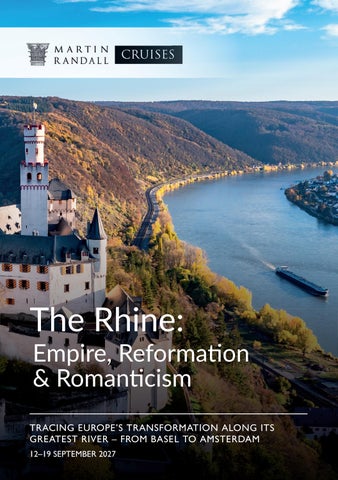
The Rhine:
Empire, Reformation & Romanticism
TRACING EUROPE’S TRANSFORMATION ALONG ITS GREATEST RIVER – FROM BASEL TO AMSTERDAM 12–19 SEPTEMBER 2027
Holiday protection We provide full financial protection for our package holidays which include international flights, by way of our Air Travel Organiser’s Licence (ATOL). We do not levy any surcharges.
Christ Blessing the Children, Lucas Cranach the Younger, ca. 1545–50 ©The Met Front cover: Marksburg Castle along the Rhine.
A word from our Cruise Director A journey along the Rhine is often described as one of Europe’s great travel experiences. Its vineyard-clad slopes, medieval towns and castle-crowned hillsides have inspired travellers for centuries. Yet the Rhine is much more than a beautiful river. For generations it has been one of the great arteries of European civilisation: a frontier of empire, a highway of commerce, a cradle of religious reform and a source of artistic inspiration. What makes this voyage distinctive is the opportunity to explore that story in depth. Accompanied by five expert speakers, we trace the evolution of Europe through the cities, cathedrals, castles and landscapes that line the Rhine. From the great Romanesque cathedrals of the Holy Roman Empire to Gutenberg’s Mainz, Luther’s Worms and the landscapes that inspired the Romantic imagination, each day reveals another chapter in a remarkable historical narrative. Travelling aboard the elegant MS Amadeus Queen, and with no more than 100 guests, we enjoy both the pleasures of river travel and the intellectual richness for which Martin Randall Travel is known. I very much hope you will join us. Sophie Watts, Cruise Director
Heidelberg Castle.
The Rhine: Empire, Reformation & Romanticism Tracing Europe’s transformation along its greatest river – from Basel to Amsterdam 12–19 September 2027 8 days • Speakers: Tom Abbott, Dr Hugh Doherty, Dr Jarl Kremeier, Dr Jean-Michel Johnston, Dr Ulrike Ziegler Follow the Rhine through eight centuries of European history, from empire and religious reform to Romanticism. Five distinguished speakers accompany the voyage throughout, offering expert interpretation on board and on site. Exclusive private evening events at Heidelberg Castle and Marksburg, the Middle Rhine’s only hilltop castle never to have been destroyed. Explore the cities where Europe changed, from Speyer, Worms and Mainz – centres of empire, printing and religious reform – to magnificent Cologne. Experience the Romantic Rhine from the elegant MS Amadeus Queen, with castles, vineyards, dramatic river scenery and a private tasting of traditional-method German Sekt. Travel in true Martin Randall style, aboard an exclusively chartered ship for no more than 100 guests, with all dinners, wine, excursions, admissions and gratuities included.
Few waterways have played a greater role in the making of Europe than the Rhine. For centuries it served as a political frontier, a commercial highway and a conduit through which ideas, beliefs and artistic movements travelled across the continent. Along its banks empires rose and fell, cities 4
flourished, religious certainties were challenged and new visions of Europe emerged. This voyage follows the course of that story. Travelling from Basel to Amsterdam, we explore the religious, political, artistic and intellectual forces that shaped Europe through the cities, landscapes and monuments of the Rhine corridor. From the great Romanesque cathedrals of the Holy Roman Empire to the upheavals of the Reformation, from the flourishing Jewish communities of the medieval Rhineland to the castles, myths and landscapes that inspired the Romantic imagination, each stage of the journey reveals another chapter in Europe’s transformation. Accompanied by five expert speakers, specialists in medieval history, art, architecture and German cultural history, we approach the Rhine from multiple perspectives. Through lectures on board and visits ashore, the voyage becomes not simply a journey along one of Europe’s most beautiful rivers, but an exploration of how the continent itself was shaped. Along the way we encounter some of the most significant places in European history: Speyer, Mainz and Worms, heartlands of the Holy Roman Empire and centres of the Reformation; Heidelberg and the Middle Rhine, where history, legend and landscape converged to inspire Romanticism; Cologne, one of medieval Europe’s greatest cities; and Xanten, where Roman frontiers, medieval myth and modern ideas of nationhood intersect. The result is a journey through more than eight centuries of European civilisation, viewed through the lens of one of its defining rivers.
The Rhine, engraving c. 1840
5
Itinerary Days 1–3: Basel, Colmar, Speyer, Heidelberg Upper Rhine. Stroll among its colourful halftimbered houses and canals before visiting the Musée d’Unterlinden, home to Grünewald’s extraordinary Isenheim Altarpiece and one of the finest collections of northern European art. Lunch with Alsatian wines is included. Sail overnight to Speyer.
PIC OF MONEMVASIA
Day 3. Empire & Reformation: Speyer, Heidelberg. Morning lectures explore the rise of the Holy Roman Empire and the religious upheavals that transformed the Rhineland in the 16th century. Arrive in Speyer, dominated by Germany’s largest Romanesque cathedral and the burial place of the Salian emperors. Continue to Heidelberg, where the great castle overlooking the Neckar encapsulates centuries of German history: medieval stronghold, Renaissance palace, casualty of war and ultimately one of the great symbols of Romanticism. The day concludes with a drinks reception overlooking the town and a private dinner in the castle’s historic surroundings.
The Isenheim Altarpiece, Grünewald
Day 1. Basel and the Reformation in Central Europe. Book one of our flight options from London to Zürich, or make your own way. Basel is a city that has long stood at the crossroads of northern and southern Europe. Visit the Kunstmuseum, home to outstanding works by Holbein, whose career unfolded against the backdrop of the Reformation and the profound religious and cultural changes it brought to Europe. Transfer to the ship in time for an introductory talk by Jean-Michel Johnston, followed by drinks and dinner, as we begin our journey along the Rhine. Sail overnight to Breisach. Day 2. The Rhine as border of the Roman Empire. A morning talk introduces the shifting frontier between France and the Holy Roman Empire before a full-day excursion to Colmar, one of the most attractive towns of the 6
Speyer Cathedral
Itinerary Days 4–5 Worms, Mainz Day 4. Faith, Power & Jewish Culture: Worms. A morning lecture prepares us for Worms, one of the most historically significant cities on the Rhine. It was here that Luther defended his beliefs before the Emperor at the Diet of Worms, and here too that some of Europe’s most important medieval Jewish communities flourished. Visit the Romanesque cathedral, the Rashi Synagogue and the ancient Jewish cemetery, among the oldest and most significant in Europe. Time is also devoted to a tasting with one of Germany’s leading sparkling wine producers. Sail overnight to Mainz.
Braubach on the Rhine with the Marksburg castle rising above the town ©Interpixels
8
Day 5. Printing, Reform & the Romantic Rhine: Mainz. Spend the morning in Mainz, a city central to the story of Europe’s transformation. Visit the cathedral and the Gutenberg Museum, where the invention of movable type reveals how ideas could spread across the continent with unprecedented speed, helping to make the Reformation possible. In the afternoon, sail through the most dramatic stretch of the Rhine, where castles crown vine-clad hills above the river. Commentary on board explores how these landscapes became central to the Romantic imagination. This evening, stroll through the pretty town of Braubach and enjoy a drinks reception at Marksburg Castle, dramatically positioned above the Rhine.
Days 6–8: Cologne, Xanten, Kleve, Amsterdam
PIC OF MONEMVASIA
Day 7. Myth, Memory and Nationhood: Xanten & Kleve. Today’s visits explore how history, legend and identity became intertwined along the Lower Rhine. At Xanten Archaeological Park, discover one of the most important Roman sites in Germany, where reconstructed buildings bring the ancient frontier vividly to life. Continue to Kleve, whose imposing Schwanenburg is linked to the medieval legend of Lohengrin, later immortalised by Wagner and woven into the cultural imagination of 19th-century Germany. Sail overnight to Amsterdam. Day 8: Amsterdam. Arrive in Amsterdam. Depending on departure arrangements, enjoy free time or join a guided visit of the Rijksmuseum before returning to the UK.
Below: detail of the 42-line Gutenberg Bible (Shuckburgh copy). Gutenberg Museum ©Carsten Costard
Cologne Cathedral
Day 6. Cologne and the Age of Cathedrals. A morning lecture introduces Cologne and the artistic culture of the Lower Rhine. Visit the Rococo palaces of Augustusburg and Falkenlust, masterpieces created for the Prince-Archbishops of Cologne. Returning to the city, explore the magnificent Gothic cathedral, one of the greatest architectural achievements of medieval Europe, or choose to visit one of Cologne’s outstanding museums. Sail overnight towards the Dutch border.
Personal service From your first conversation with us to the moment you return home, we take care of everything, so that you need think of nothing but the journey ahead. 9
Pre-cruise extension: Basel
Basel along the Rhine. Right: portrait of Amerbach by Holbein
Saturday 11th September: Basel. There is the option to arrive a day before the cruise begins. Book our flight to Zurich or train to Basel, or alternatively make your own way. Arrive in time for dinner and an introductory talk by Ulrike Ziegler or Hugh Doherty. Overnight in Basel. Day 1. Basel and the Reformation in Central Europe. Morning visit of Basel Minster. The architecture of this cathedral built in the 12th and 13th centuries bears witness to the Upper Rhine valley as an architectural melting pot absorbing both German and French influences. Continue in the afternoon to the Kunstmuseum, focusing on the works of Holbein, an artist at the centre of artistic innovation around the time of the Reformation. Transfer to the ship in time for an introductory talk by Jean-Michel Johnston, drinks and dinner. Sail overnight to Breisach.
10
Pre-cruise accommodation Hotel Teufelhof, Basel (teufelhof.com): located in Basel’s historic centre, this characterful 3-star hotel is housed in two integrated, historic townhouses from the 18th century. The hotel does not have air-conditioning. Fans can be provided in particularly warm weather.
Pre-cruise tour: Art in Switzerland Great collections, lovely towns, sublime landscapes 8–12 September 2027 5 days • Speaker: Mary Lynn Riley Fine and varied art collections, some in the collectors’ homes or in brilliant recent buildings. Impressionism, Post-Impressionism and classic modernism figure prominently, also European Old Masters, decorative arts and Oriental art. Excursions to collections outside the city centres pass through picturesque countryside.
Post-cruise tour: Art in the Netherlands A spectrum, of the finest 19–25 September 2027 7 days • Speaker: Desmond Shawe-Taylor A celebration of Dutch art in some of the finest museums in the Netherlands. Masterpieces by Rembrandt, Vermeer and Van Gogh alongside other leading figures of the Dutch tradition. Architecture and design from medieval to modern, all set in highly picturesque historic town centres.
‘The Milkmaid’ c. 1660, Johannes Vermeer © Rijksmuseum
11
The MS Amadeus Queen MS Amadeus Queen is one of the most comfortable river cruisers in Europe. With a floor area of 16m2 (Haydn deck) or 17.5m2 (Strauss and Mozart decks) the cabins are reasonably spacious by the standards of river cruisers. All have windows to the outside and are equipped with the facilities one would expect of a first-class hotel. Bathrooms have showers only. Special attention has been paid to noise insulation. The significant differences are the size of windows and height above water level (higher cabins enjoy better views and fewer stairs). Cabins on the top decks (Mozart and Strauss) are the most desirable, with floor-to-ceiling windows which drop down to open, and minibars. There are 12 suites (Mozart) measuring 26.4m2 with a corner sofa and small balcony. Cabins on the lowest deck (Haydn) have smaller windows which do not open. The public areas include the lounge and bar and a restaurant which can seat everyone at a single sitting. The sun deck has a tented area for shade. There is an indoor swimming pool.
12
Haydn deck cabin
Mozart deck suite
Value for money The price includes nearly everything, not only the major ingredients, such as accommodation, transport and the costs of tour leaders, but also tips, drinks with meals, and taxes. The price published is the price you pay.
Strauss/Mozart deck cabin
“
The experience could not have been bettered. We had the most wonderful time! 13
Deck and cabin plans
Haydn deck cabin
14
Strauss/Mozart deck cabin
Mozart deck suite
Map of the Rhine c. 1850.
Included: – Seven nights’ accommodation aboard the first-class river cruiser MS Amadeus Queen. – Almost all meals, from dinner on the first evening to breakfast on the final morning, with wine, beer and soft drinks included. (Just two lunches are independent.) – Coach travel for excursions where destinations are not reached on foot. If making your own travel arrangements, you may join our scheduled transfers where these coincide with your arrival and departure. – Five distinguished speakers accompany the voyage throughout, with lectures on board, expert-led visits ashore and the services of local guides where appropriate.
– All excursions, visits and admission charges. – All gratuities for waiters, crew, guides and drivers, together with all taxes. – The assistance of an experienced team of Martin Randall Travel staff throughout. – A printed booklet containing practical information, maps and background reading. How strenuous? Quite a lot of walking is involved, some of it uphill. A good level of fitness is necessary. The cruise should not be attempted by anyone who has difficulty with everyday walking and stair-climbing. We ask that you read our fitness guidelines before booking.
“
The itinerary was brilliant! Every destination was so interesting and within the subject of the tour. 15
The lounge
“
Excellent cruise: perfect organisation, excellent itinerary, very nice ship with perfect cabins, fascinating lectures and explanations, very good food - what could I add? Congenial company Our travellers are kindred spirits: brought together by shared interests and a warm curiosity for the world and its cultures.
16
Restaurant
Travel options :
We offer flights or trains from and to London with this cruise Pre-cruise: arriving a day early ((see p. 10):
Cruise only:
Option 1 (by train)
Option 3
Saturday 11th September: by Eurostar from London St Pancras (No.9008 departing 8.00am), continuing by TGV to Basel (No.9213 arriving 17.30).
Sunday 12th September: London Heathrow to Zurich (Swiss LX 317 departing 8.45 and arriving 11.45). A box lunch is provided en route from Zurich to Basel.
Sunday 19th September: by Eurostar from Amsterdam to London St Pancras (No.9143 departing 12.40 and arriving c.15.57).
Sunday 19th September: Amsterdam to London Heathrow (BA431 departing 11.35 and arriving 11.55)
Option 2 (by plane)
Option 4
Saturday 11th September: London Heathrow to Zurich (BA745 departing 11.50 and arriving 14.45)
Sunday 12th September: London Heathrow to Zurich (BA732 departing 9.20, arriving 12.15). A box lunch is provided en route from Zurich to Basel.
Sunday 19th September: Amsterdam to London Heathrow (BA431 departing 11.30 and arriving 11.55)
“
This was our first river cruise and the cabin was very well provided and extremely comfortable.
Sunday 19th September: Amsterdam to London Heathrow (BA435 departing 16.15 and arriving 16.40).
Privileged access Through partnerships and relationships cultivated over many years, we aim to offer our travellers access to people, places and experiences that lie quietly beyond the reach of ordinary tourism.
17
The speakers Our experts are chosen not just for what they know, but for the way they share it – with wit, warmth and enthusiasm that transforms a journey into something utterly memorable. Tom Abbott Art historian Tom Abbott specialises in medieval architecture and the visual culture of northern Europe. An experienced lecturer and tour leader, he has a particular gift for revealing how works of art and historic buildings reflect the societies that created them. His knowledge of the Rhineland’s churches, sculpture and artistic traditions adds another rich dimension to the story of Europe’s transformation along the Rhine.
Dr Hugh Doherty Medieval historian Hugh Doherty lectures at the University of East Anglia and has studied at the Universities of London, Cambridge and Oxford. His research focuses on kingship, political culture and the societies of early medieval Europe, but he is equally passionate about understanding the surviving buildings and landscapes through which that history can still be experienced today. His expertise illuminates the world of emperors, bishops and cathedral builders that shaped the medieval Rhine.
Dr Jean-Michel Johnston Historian of Germany and modern Europe, Jean-Michel Johnston is Associate Professor of Modern European History at Fitzwilliam College, Cambridge. His research explores the political, cultural and intellectual history of Germany and the ways in which ideas have shaped European society. An engaging and insightful lecturer, he has a gift for revealing the connections between places, people and events, bringing fresh perspective to the Rhine’s role in the making of Europe. His lectures illuminate the themes at the heart of this journey.
18
“
Jarl’s breadth of knowledge and ability to put it over in such an interesting way was exceptional.
Dr Jarl Kremeier Art historian Jarl Kremeier specialises in 17th- to 19th-century architecture and the decorative arts. He teaches at Berlin’s Freie Universität and Berlin College of Acting, and is the author of numerous publications on Baroque architecture and architectural theory. His enthusiasm for the buildings, interiors and artistic culture of the German-speaking world brings the Rhine’s palaces, churches and historic towns vividly into focus.
“
Ulrike is outstanding: clear, comprehensive, concise, friendly and an absolute pleasure to travel with.
Dr Ulrike Ziegler Art historian specialising in medieval art and architecture, Ulrike Ziegler has spent many years exploring the churches, castles and historic landscapes of Germany and Austria. She studied Art History and Archaeology at Regensburg and Aberdeen universities before completing a PhD on the cultural politics of post-war Germany. A highly experienced lecturer and tour leader, she is admired for bringing medieval buildings and works of art vividly to life through their cultural context. Her expertise provides the perfect introduction to the Romanesque and Gothic monuments of the Rhine.
19
How to book On our website Click ‘Book now’ on any tour page. Fill in your details, consent to the booking conditions, and pay the deposit (15% of the total booking price) or full balance if booking within 12 weeks of departure.
Confirming your booking Once you have completed the above, we will send a formal confirmation.Your deposit is then non-refundable except under the special circumstances mentioned in our booking conditions.
Booking conditions It is important that you read these before committing to a booking. We will direct you to these when you book, but you can also find them online: www.martinrandall.com/terms
Fitness Please ensure that you have read the ‘Practicalities’ section of the tour description.
Martin Randall Travel Ltd 10 Barley Mow Passage, London W4 4PH Tel +44 (0)20 8742 3355 info@martinrandall.co.uk From North America: Tel 1 800 988 6168 (toll-free) northamerica@martinrandall.com From Australasia: Tel 1300 55 95 95 anz@martinrandall.com.au
www.martinrandall.com ATOL 3622 | ABTOT 5468 | AITO 5085